EP1093316A2 - Associated method for cell selection in a packet radio communication system - Google Patents
Associated method for cell selection in a packet radio communication system Download PDFInfo
- Publication number
- EP1093316A2 EP1093316A2 EP00308241A EP00308241A EP1093316A2 EP 1093316 A2 EP1093316 A2 EP 1093316A2 EP 00308241 A EP00308241 A EP 00308241A EP 00308241 A EP00308241 A EP 00308241A EP 1093316 A2 EP1093316 A2 EP 1093316A2
- Authority
- EP
- European Patent Office
- Prior art keywords
- communication path
- communication
- packet
- network
- quality
- Prior art date
- Legal status (The legal status is an assumption and is not a legal conclusion. Google has not performed a legal analysis and makes no representation as to the accuracy of the status listed.)
- Withdrawn
Links
- 238000004891 communication Methods 0.000 title claims abstract description 212
- 238000000034 method Methods 0.000 title claims abstract description 19
- 238000010295 mobile communication Methods 0.000 claims description 7
- 230000005540 biological transmission Effects 0.000 claims description 2
- 238000001228 spectrum Methods 0.000 description 7
- 238000010586 diagram Methods 0.000 description 3
- 238000010187 selection method Methods 0.000 description 3
- 238000005516 engineering process Methods 0.000 description 2
- 230000001747 exhibiting effect Effects 0.000 description 2
- 230000010267 cellular communication Effects 0.000 description 1
- 230000001413 cellular effect Effects 0.000 description 1
- 230000003247 decreasing effect Effects 0.000 description 1
- 238000001514 detection method Methods 0.000 description 1
- 230000007246 mechanism Effects 0.000 description 1
- 230000008569 process Effects 0.000 description 1
- 238000003908 quality control method Methods 0.000 description 1
Images
Classifications
-
- H—ELECTRICITY
- H04—ELECTRIC COMMUNICATION TECHNIQUE
- H04W—WIRELESS COMMUNICATION NETWORKS
- H04W48/00—Access restriction; Network selection; Access point selection
- H04W48/18—Selecting a network or a communication service
-
- H—ELECTRICITY
- H04—ELECTRIC COMMUNICATION TECHNIQUE
- H04W—WIRELESS COMMUNICATION NETWORKS
- H04W48/00—Access restriction; Network selection; Access point selection
- H04W48/08—Access restriction or access information delivery, e.g. discovery data delivery
- H04W48/12—Access restriction or access information delivery, e.g. discovery data delivery using downlink control channel
Definitions
- the present invention relates generally to cell selection in a packet communication system having a radio part, such as a WIO (wireless intranet office). More particularly, the present invention relates to a manner by which to utilize packet network quality as an indicia of the cell selection. Improved communication quality is possible in such a system as cell selection takes into account quality indicia of a packet network in addition to, or alternate to, quality indicia of the radio part of the communication system.
- New types of communication systems have been made possible as a result of advancements in communication technologies. Such new types of communication systems have generally permitted increased rates of data transmission and corresponding amounts of data to be communicated in such new communication systems.
- Radio communication systems are advantageously utilized as communication paths formed during operation thereof include radio links.
- radio links By utilization of radio links to form at least portions of the communication paths upon which information is communicated, the use of such portions of the communication paths do not require conventional wirelines. Increased communication mobility, relative to conventional wireline communication systems, is thereby generally possible in a radio communication system.
- the communication capacity of a radio communication system is sometimes limited by bandwidth limitations. That is to say, generally, only a limited spectrum allocation is provided to a radio communication system. Communication channels are defined within the allocated spectrum. And, communication signals are communicated upon the communication channels during operation of the radio communication system. However, because the spectrum allocation to the system is limited, the communication capacity of the communication system is sometimes limited by the amount of spectrum allocated to the system. Without additional spectrum allocation to the system, communication capacity of the system is possible only by utilizing more efficiently the allocated spectrum.
- Digital communication techniques provide a manner by which to increase the bandwidth efficiency of communication in a communication system.
- the use of digital techniques is particularly advantageously utilized in a radio communication because of the limited spectrum typically allocated to such a system.
- Information which is to be communicated in a communication system which utilizes digital communication techniques typically, digitizes the information to form digital bits.
- the digital bits are typically formatted according to a formatting scheme. Groups of the digital bits, for instance, are positioned to form a packet, and, one or more packets of data together form a frame of data. Because packets, or frames, of data can be communicated at discrete intervals, rather than continuously, a frequency band need not be dedicated solely for the communication of data between one communication pair. Instead, the frequency band can be shared amongst a plurality of different communication pairs. The ability to share the frequency band amongst more than one communication pair permits a multiple increase in the communication capacity of the system.
- Packet data communications are effectuated, for instance, in conventional LANs (local area networks).
- Wireless networks operable in manners analogous to wired LANs, referred to as WLANs (wireless local area networks) have also been developed and are utilized to communicate data over a radio-link.
- Packet communication systems such as a LAN or WLAN, were generally initially installed to provide non-realtime data communications. But, with continued advancements in digital communication techniques, packet communication systems are increasingly installed to permit realtime communications.
- Telephony over IP Internet protocol
- voice communication by way of the Internet, or other packet data network backbone is provided for in such systems.
- a WIO wireless intranet office
- a WIO wireless intranet office
- Voice communications by way of a WIO provides the advantages of use of a wireless communication system in a cost-effective manner.
- Voice, as well as other data, can be communicated between mobile terminals operable in such a system.
- Various aspects of conventional cellular, or microcellular, communication systems are conventionally utilized in a WIO system.
- cell selection is made responsive to determination of radio link quality of the radio link extending between the mobile terminal and network infrastructure. Because other portions of a communication path conventionally extend to a fixed network, conventional systems do not generally consider the communication quality of the fixed network.
- different radio base stations might utilize different packet data networks, or portions thereof, through which to form a communication path.
- the different packet data networks might have differing levels of communication quality therethrough.
- Existing systems do not take into account the packet network quality when determinations are made for purposes of cell selection.
- Cell selection might be made to have a mobile terminal, in either an idle or active mode, to be tuned-to, or "camp in" a cell which, while exhibiting good radio link qualities, exhibit poor packet network qualities. Communication quality levels would suffer as a result.
- the present invention accordingly, advantageously provides apparatus, and an associated method, by which to utilize an indicia of packet network quality during cell selection procedures in a packet radio communication system.
- improved communication quality is possible through operation of an embodiment of the present invention.
- Communication quality levels in a packet data network to which a radio base station is coupled is taken into account during cell selection procedures.
- cell selection is made responsive to determination of the radio link quality and also responsive to the packet network quality to which a radio base station is coupled and through which a communication path would be formed pursuant to a communication session. If the radio link quality is of a level at least as great as a selected threshold, cell selection is made responsive to packet network quality levels of the cells available for selection. If, however, the radio link quality is less than the threshold level, the cell associated with the radio link exhibiting the poor radio link quality is not further considered in the cell selection process. Thereby, cell selection is made on the basis of the packet network quality as long as the radio link quality is at least as good at the threshold level.
- an embodiment of the present invention is operable in a WIO (wireless intranet office) system.
- WIO wireless intranet office
- a plurality of radio base stations are positioned throughout an area to permit wireless communications in the area encompassed by the plurality of radio base stations.
- Each radio base station defines a cell, and various of the cells, such as adjacent cells, include overlapping areas.
- the mobile terminal is able to tune to, i.e., camp-on, a radio base station which defines either of the cells.
- Cell selection is performed to determine which of the radio base stations to which the mobile terminal camps.
- An embodiment of the present invention provides a manner by which to select the cell to which the mobile terminal camps.
- the determination is made, for instance, to ensure better the best quality of communications with the mobile terminal.
- Indicia of the quality of the radio link extending between the mobile terminal and the radio base stations as well as indicia of the communication qualities in the portions of packet data networks to which the radio base stations are coupled are utilized in making the determination.
- the radio link must exhibit a quality level at least as good as a minimum threshold level and the packet network communication quality level exhibits the best of the available selections.
- apparatus for an IMC (intranet mobile cluster) which forms a portion of a WIO system.
- An IMC is associated with each radio base station of the WIO system.
- Apparatus of an embodiment of the present invention is coupled to receive values representative of radio link quality levels of a radio link formable between the radio base station associated therewith and a mobile terminal.
- the apparatus is coupled to receive values representative of packet network communication quality of a packet network to which the IMC is also coupled. Signals representative of such values are provided to a mobile terminal.
- apparatus for a mobile terminal operable in a WIO system.
- the mobile terminal is operable to receive signals generated by various radio base stations indicating radio link quality and packet network quality values. Responsive to detection of such signals, determination is made at the mobile terminal to which of the radio base stations that the mobile terminal should "camp-on.” The mobile terminal is further operable to generate signals indicative of such determination so that appropriate actions can be performed by the network infrastructure of the system.
- apparatus, and an associated method for a mobile communication system having a mobile terminal positionable to be operable to communicate alternately by way of a first radio base station upon a first communication path with a correspondent entity and by way of at least a second radio base station upon at least a second communication path with the correspondent entity.
- the first communication path extends through a first packet data network
- the second communication path extends through a second packet data network. Determinations are made of a preferred communication path of the first and at least second communication paths upon which to communicate information.
- a detector is at least coupled to receive indications of a first packet-network indicia of communication quality through the first packet data network.
- the detector is at least further coupled to receive indications of a second packet-network indicia of communication quality through the second packet data network.
- the detector forms a first communication path quality value responsive, at least in part, to the first packet-network indicia of communication quality and a second communication path quality value responsive, at least in part, to the second indicia of communication quality.
- a determiner is coupled to receive the first communication path quality value and the second communication path quality value. The determiner determines the preferred communication path responsive thereto.
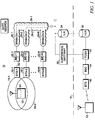
- a packet radio communication system shown generally at 10, is operable to provide radio communications with a mobile terminal 12 when the mobile terminal is positioned within an area encompassed by the system.
- the system 10 is formed of a WIO (wireless intranet office) portion, formed of the elements positioned above the line 14, shown in dash, connected together with a GSM (global system for mobile communications) portion which is formed of the elements shown beneath the line 14 in the Figure.
- WIO wireless intranet office
- GSM global system for mobile communications
- the illustrated system is exemplary.
- embodiments of the present invention are operable in other types of packet radio communication systems. And, operation of such embodiments of the present invention can analogously be described with respect to such systems.
- the WIO portion of the system 10 includes a plurality of base transceiver stations (BTSs) 16.
- BTSs base transceiver stations
- N base transceiver stations are shown.
- Each of the base transceiver stations includes both radio receiver and radio transmitter circuitry capable of transceiving communication signals with a mobile terminal 12.
- each of the base transceiver stations defines a cell 18.
- the cells define coverage areas of the base transceiver stations with which the cells are associated. That is to say, when a mobile terminal is positioned within a cell associated with a particular base transceiver station, generally, communications are able to be effectuated between the mobile terminal and the base transceiver station.
- the cells 18 include partially-overlapping areas.
- the overlapping nature of the cells reduces the possibility of communication termination as the mobile terminal is moved during a communication session.
- the mobile terminal When the mobile terminal is positioned at a location at which two or more of the cells overlap, a possibility exists that the mobile terminal can communicate with a selected one of more than one base transceiver station.
- the mobile terminal when the mobile terminal is in an idle mode, i.e., when the mobile terminal is turned-on but is not being utilized in a communication session, the mobile terminal periodically registers its location and is set to "camp-on" a particular one of the base transceiver stations. When in the idle state, therefore, also, if the mobile terminal is positioned at a location having overlapping coverage areas, the mobile terminal is able to camp-on a selected one of more than one base transceiver station.
- Each of the base transceiver stations 16 is coupled to an intranet mobile cluster (IMC) 22.
- the intranet mobile clusters perform various control functions, such as handling of radio resources and channel configurations, as well as detecting need for hand overs of communications between base transceiver stations and power control operations.
- Each of the intranet mobile clusters 22 is coupled to a packet data network, here a local area network (LAN) 24.
- the local area network includes branches 26 which are representative of different portions of the local area network which are connected to respective ones of the intranet mobile clusters 22 and through which separate communication paths are formable during a communication session.
- the different communication paths exhibit different communication quality characteristics.
- the WIO portion of the system 10 is further shown to include a gatekeeper (GK) 28.
- GK gatekeeper
- a first communication path 28-1 extends through the first branch 26 and a second communication path 28-2 extends through a second branch 26. Because the paths follow different routes, the communication quality characteristics of such different paths exhibit different communication quality levels.
- the WIO portion of the system 10 is further shown to include a gatekeeper 32, also coupled to the local area network 24.
- the gatekeeper provides quality control services to a WIO end point. Functions such as call forwarding, call re-routing, and other advanced control features, such as mobility management are performed by the gatekeeper.
- the WIO portion is further shown to include an intranet location register (ILR) 34 which is operable to form a database which stores permanent subscriber data. That is to say, the data stored at the intranet location register provides a storage base for retrieving mobile-terminal-specific information configured for the WIO portion of the communication system.
- the intranet location register 34 is coupled to corresponding structure, here shown to be a home location register (HLR) 36 of the GSM network portion of the communication system.
- An A-interface gateway (AGW) 38 also forms a portion of the communication system 10.
- the gateway 38 forms the gateway between the two portions of the communication system. And, here, the gateway is operable as a traffic router and data converter between the two
- the GSM network portion of the communication system 10 includes a transcoder sub-multiplexer (TCSM) 42 coupled to the gateway 38. Such device is operable to perform transcoding operations.
- the GSM network is further shown to include a base station controller 42 and a base transceiver station 46, operable in conventional manner, to transceive communication signals with a mobile terminal 12 operable in the GSM network.
- Communication sessions are formable between mobile terminals or a mobile terminal and another type of correspondent entity.
- communications are effectuated between two mobile terminals 12 positioned within the area encompassed by the WIO portion of the communication system, as well as communications between mobile terminals positioned at areas encompassed by the separate portions of the communication system. That is to say, communications are also effectuable between a mobile terminal 12 operable in the WIO portion and a mobile terminal operable in the GSM portion of the communication system.
- the intranet mobile controllers 22 are here shown to further include a detector 52, and the mobile terminal 12 is further shown to include a determiner 54.
- the detector and determiner 52 and 54 are operable pursuant to an embodiment of the present invention to facilitate cell selection. Cell selection is performed, for instance, when the mobile terminal is in the idle mode and more than one base transceiver station is available to communicate with the mobile terminal.
- the detector 52 is operable to detect, or otherwise to form, values representative of both the radio-link extending between a particular base transceiver station and the mobile terminal and a communication path portion extending through the local area network or other packet data network, to which the detector, and associated intranet mobile cluster, is connected.
- Signals representative of such values are provided to the base transceiver station and communicated to the mobile terminal.
- the mobile terminal receives such signals from more than one base transceiver station when the mobile terminal is positioned in an area encompassed by such base transceiver stations.
- the mobile terminal receives signals from both the first base transceiver station (BTS-1) and from the second base transceiver station (BTS-2).
- the signals generated by the respective base stations include indications both of the radio-link qualities and also the packet data network quality levels of the communication paths formable therethrough.
- the determiner 54 of the mobile terminal is operable to determine, responsive to the signals received thereat, to which of the base transceiver stations, i.e., BTS-1 or BTS-2, to which the mobile terminal should camp-on.
- a reverse link signal representative of the determination made by the determiner is returned to the infrastructure of the WIO portion of the communication system, and the mobile terminal is directed to camp-on the latest transceiver station responsive to the determination of the determiner.
- the determiner determines the best base transceiver station through which a communication path is formable.
- the best base transceiver station is that which exhibits the best packet network quality as long as the radio-link quality is at least a minimum threshold level. If the radio-link quality is not at least a minimum threshold level, the determiner determines the best base transceiver station to camp-on to be the base transceiver station through which a communication path is formable which exhibits an adequate radio-link quality.
- other manners by which to make determinations, at least partly responsive to packet network quality levels are utilized.
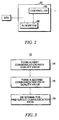
- Figure 2 also illustrates a base transceiver station 16, an intranet mobile cluster 22, and a mobile terminal 12 operable pursuant to an embodiment of the present invention.
- the packet network is operable pursuant to an H.323 RTCP (real-time transport control protocol) protocol.
- the RTCP protocol is utilized in other environments.
- the determiner 52 of the intranet mobile cluster maintains a quality reference number of values responsive to other RTCP reports of other ongoing communication sessions.
- the determiner 52 includes a mechanism for detecting packet loss, jitter, or packet network load.
- the detector is formed of a controller 56 which executes an algorithm 58 for calculating the quality reference number.
- the packet network quality values may further be determined in other manners, such as by generating RTP test stream between the base transceiver station controller and another end in order to generate the RTCP reports for the particular communication path.
- Figure 3 illustrates a method, shown generally at 72, of an embodiment of the present invention.
- the method 72 is operable to determine the preferred communication path of a first and at least second communication paths of a packet radio communication system upon which to communicate information.
- a first communication path quality value is formed, responsive, at least in part, to a first packet-network indicia of communication quality through the first packet data network.
- a second communication path quality value is formed responsive, at least in part, to a second packet-network indicia of communication quality through the second packet data network.
- the preferred communication path upon which to communicate information is determined.
Landscapes
- Engineering & Computer Science (AREA)
- Computer Security & Cryptography (AREA)
- Computer Networks & Wireless Communication (AREA)
- Signal Processing (AREA)
- Mobile Radio Communication Systems (AREA)
Abstract
Description
Packet data communications are effectuated, for instance, in conventional LANs (local area networks). Wireless networks, operable in manners analogous to wired LANs, referred to as WLANs (wireless local area networks) have also been developed and are utilized to communicate data over a radio-link. Packet communication systems, such as a LAN or WLAN, were generally initially installed to provide non-realtime data communications. But, with continued advancements in digital communication techniques, packet communication systems are increasingly installed to permit realtime communications. Telephony over IP (Internet protocol), e.g., voice communication by way of the Internet, or other packet data network backbone, is provided for in such systems.
Then, and as indicated by the
Claims (20)
- In a mobile communication system having a mobile terminal positionable to be operable to communicate alternately by way of a first radio base station upon a first communication path with a correspondent entity and by way of at least a second radio base station upon at least a second communication path with the correspondent entity, the first communication path extending through a first packet data network and the second communication path extending through a second packet data network, an improvement of apparatus for determining a preferred communication path of the first and at least second communication paths, respectively, upon which to communicate information, said apparatus comprising:a detector at least coupled to receive indications of a first packet-network indicia of communication quality through the first packet data network and a second packet-network indicia of communication quality through the second packet data network, said detector for forming a first communication path quality value responsive at least in part, to the first packet-network indicia of communication quality and a second communication path quality value responsive, at least in part, to the second indicia of communication quality;a determiner coupled to receive the first communication path quality value and the second communication path quality value, said determiner for determining the preferred communication path responsive thereto.
- The apparatus of claim 1 wherein said detector is further coupled to receive indications of a first radio-link indicia of communication quality upon a first radio link formable between the mobile terminal and the first radio base station and to receive indications of a second radio-link indicia of communication quality upon a second radio link formable between the mobile terminal and the second radio base station, the first communication path quality value further responsive to the first radio-link indicia and the second communication path quality value further responsive to the second radio-link indicia.
- The apparatus of claim 2 wherein the first communication path quality level value is at least beyond a first threshold level when the first radio-link indicia indicates the communication quality upon the first radio link to be of at least a minimum acceptable level and wherein the second communication path quality level value is at least beyond the first threshold level when the second radio-link indicia indicates the communication quality upon the second radio link to be at least the minimum threshold level.
- The apparatus of claim 3 wherein the preferred communication path of the first and at least second communication paths determined by said determiner exhibits a communication path quality level beyond the first threshold level.
- The apparatus of claim 1 wherein the first radio base station and the second radio base station form portions of network infrastructure of the mobile communication system and wherein said detector is located at the network infrastructure.
- The apparatus of claim 5 wherein said determiner is located at the network infrastructure.
- The apparatus of claim 1 wherein said determiner is located at the mobile terminal.
- The apparatus of claim 7 wherein said determiner further generates a preferred communication path indication indicative of the preferred communication path determined thereat, and wherein the mobile terminal generates a preferred communication path signal indicating the preferred communication path determined by said determiner.
- The apparatus of claim 1 wherein the mobile terminal is at least selectably operable in an idle mode when powered-on and wherein determinations made by said determiner are made at selected intervals while the mobile terminal is maintained in the idle mode.
- The apparatus of claim 1 wherein the mobile communication system comprises a WIO (wireless intranet office) system having a first IMC (intranet mobile cluster) coupled to the first radio base station and at least a second IMC (intranet mobile cluster) coupled to the at least the second radio base station and wherein said detector comprises a first detector portion located at the first IMC and a second detector portion located at the second IMC, the first detector portion coupled to receive the indications of the first packet-network indicia and for forming the first communication path quality value and the second detector portion coupled to receive the indications of the second packet-network indicia and for forming the second communication path quality value.
- The apparatus of claim 10 wherein said determiner is located at the mobile terminal, wherein indications of the first communication path quality value are provided by the first detector portion to the mobile terminal by way of the first radio base station, and wherein indications of the second communication path quality value are provided by the second detector portion to the mobile terminal by way of the second radio base station.
- The apparatus of claim 11 wherein a broadcast control channel upon which to broadcast control information from the network infrastructure is defined and wherein the indications of the first and second communication path quality values, respectively, are broadcast upon the broadcast control channel.
- The apparatus of claim 1 wherein the mobile communication system is operable pursuant to a H.323 RTCP (real-time transport control protocol) protocol and is a multi-user communication system, wherein the first packet-network indicia is representative of communication quality of ongoing communications through the first packet data network, and wherein the second packet-network indicia is representative of communication quality of ongoing communications through the second packet data network.
- The apparatus of claim 13 wherein the communication quality of the ongoing communications of which the first packet-network indicia is representative is measured in terms of packet loss and wherein the communication quality of the ongoing communications of which the second packet-network indicia is representative is measured in terms of packet loss.
- The apparatus of claim 13 wherein the communication quality of the ongoing communications of which the first packet-network indicia is representative is measured in terms of first packet-network load and wherein the communication quality of the ongoing communications of which the second packet-network indicia is representative is measured in terms of second packet-network load.
- In a method for communicating in a mobile communication system having a mobile terminal positionable to be operable to communicate alternately by way of a first radio base station upon a first communication path with a correspondent entity and by way of at least a second radio base station upon at least a second communication path with the correspondent entity, the first communication path extending through a first packet data network and the second communication path extending through a second packet data network, an improvement of a method for determining a preferred communication path of the first and at least second communication paths, respectively, upon which to communicate information, said method comprising:forming a first communication path quality value responsive, at least in part, to a first packet-network indicia of communication quality through the first packet data network;forming a second communication path quality value responsive, at lest in part, to a second packet-network indicia of communication quality through the second packet data network; anddetermining, responsive to the first communication path quality value and the second communication path quality value, the preferred communication path upon which to communicate information.
- The method of claim 16 wherein the first communication path quality value formed during said operation of forming the first communication path quality value is further responsive to indications of a first radio-link indicia of communication quality upon a first radio link formable between the mobile terminal and the first radio base station and wherein the second communication path quality value formed during said operation of forming the second communication path quality value is further responsive to indications of a second radio-link indicia of communication quality upon a first radio link formable between the mobile terminal and the second radio base station.
- The method of claim 16 wherein the first radio base station and the second radio base station form portions of network infrastructure and wherein said operations of forming are performed at the network infrastructure.
- The method of claim 16 wherein said operation of determining is performed at the mobile terminal.
- Apparatus for an intranet mobile cluster of a WIO (wireless intranet office), the intranet mobile cluster connected between a packet network and a radio base station, the radio base station capable of forming a radio link with a mobile terminal, said apparatus comprising:a detector at least coupled to receive indications of a first packet-network indicia of communication quality through the packet network, said detector for forming a first communication path quality value responsive, at least in part, to the first packet-network indicia of communication path quality;a quality value signal generator coupled to receive indications of the first communication path quality value formed by said detector, said quality value signal generator for generating a quality value signal of a value representative of the first communication path quality value for transmission to the mobile terminal.
Applications Claiming Priority (2)
| Application Number | Priority Date | Filing Date | Title |
|---|---|---|---|
| US405670 | 1995-03-17 | ||
| US09/405,670 US6408184B1 (en) | 1999-09-24 | 1999-09-24 | Apparatus, and associated method, for cell selection in a packet radio communication system |
Publications (2)
| Publication Number | Publication Date |
|---|---|
| EP1093316A2 true EP1093316A2 (en) | 2001-04-18 |
| EP1093316A3 EP1093316A3 (en) | 2001-05-02 |
Family
ID=23604698
Family Applications (1)
| Application Number | Title | Priority Date | Filing Date |
|---|---|---|---|
| EP00308241A Withdrawn EP1093316A3 (en) | 1999-09-24 | 2000-09-20 | Associated method for cell selection in a packet radio communication system |
Country Status (2)
| Country | Link |
|---|---|
| US (1) | US6408184B1 (en) |
| EP (1) | EP1093316A3 (en) |
Cited By (1)
| Publication number | Priority date | Publication date | Assignee | Title |
|---|---|---|---|---|
| EP1408647A1 (en) * | 2002-10-09 | 2004-04-14 | Melco Inc. | Wireless LAN system and method for providing network services to an area determined by intersection of cells |
Families Citing this family (10)
| Publication number | Priority date | Publication date | Assignee | Title |
|---|---|---|---|---|
| GB2361837B (en) * | 1999-11-25 | 2003-11-05 | Nokia Corp | Logical channel control procedures for handover |
| JP3629025B2 (en) * | 2000-08-24 | 2005-03-16 | 松下電器産業株式会社 | Transmission / reception method and apparatus |
| US8019335B2 (en) * | 2001-01-29 | 2011-09-13 | Nokia Corporation | Identifying neighboring cells in telecommunication network |
| US7805161B1 (en) | 2002-06-03 | 2010-09-28 | Sprint Spectrum L.P. | Virtual visitor location register for a wireless local area network |
| JP4475377B2 (en) * | 2002-12-27 | 2010-06-09 | 日本電気株式会社 | Wireless communication system, common key management server, and wireless terminal device |
| US7103024B2 (en) * | 2003-10-17 | 2006-09-05 | Motorola, Inc. | Wireless local area network future service quality determination method |
| US20070032254A1 (en) * | 2005-08-02 | 2007-02-08 | Hitachi, Ltd. | System and method for providing efficient spectrum usage of wireless devices in unlicensed bands |
| US8238899B2 (en) | 2007-03-16 | 2012-08-07 | Research In Motion Limited | Soliciting first party in communication session to maintain call when degradation of connection to second party is anticipated |
| US9215591B2 (en) | 2012-12-06 | 2015-12-15 | At&T Intellectual Property I, L.P. | Security for network load broadcasts over cellular networks |
| CN105900390B (en) | 2014-07-21 | 2019-04-26 | 华为技术有限公司 | Link control node, link control method and communication system |
Family Cites Families (5)
| Publication number | Priority date | Publication date | Assignee | Title |
|---|---|---|---|---|
| JP2626449B2 (en) * | 1993-03-08 | 1997-07-02 | 日本電気株式会社 | Mobile switching center |
| SE516723C2 (en) * | 1994-12-08 | 2002-02-19 | Ericsson Telefon Ab L M | Method and device for uplink macro diversity in a digital mobile radio communication system |
| FI106671B (en) | 1995-03-13 | 2001-03-15 | Nokia Mobile Phones Ltd | Mobile telephony, mobile terminal and a method of establishing a connection from a mobile terminal |
| US5898668A (en) | 1996-12-13 | 1999-04-27 | Siemens Information And Communication Networks, Inc. | Method and system for increasing quality of service at or below a threshold cost |
| WO1999048311A2 (en) | 1998-03-18 | 1999-09-23 | Nokia Networks Oy | A method and system for routing a call between cellular subsystems |
-
1999
- 1999-09-24 US US09/405,670 patent/US6408184B1/en not_active Expired - Lifetime
-
2000
- 2000-09-20 EP EP00308241A patent/EP1093316A3/en not_active Withdrawn
Cited By (2)
| Publication number | Priority date | Publication date | Assignee | Title |
|---|---|---|---|---|
| EP1408647A1 (en) * | 2002-10-09 | 2004-04-14 | Melco Inc. | Wireless LAN system and method for providing network services to an area determined by intersection of cells |
| US7555296B2 (en) | 2002-10-09 | 2009-06-30 | Buffalo Inc. | Wireless LAN system, method for providing network services, and medium storing program to provide network services |
Also Published As
| Publication number | Publication date |
|---|---|
| EP1093316A3 (en) | 2001-05-02 |
| US6408184B1 (en) | 2002-06-18 |
Similar Documents
| Publication | Publication Date | Title |
|---|---|---|
| US8526956B2 (en) | Method, medium, and apparatus controlling handover between different networks | |
| US9532399B2 (en) | Apparatus, system and method for managing wireless local area network service to a multi-mode portable communication device | |
| US7978667B2 (en) | Management of WLAN and WWAN communication services to a multi-mode wireless communication device | |
| US5327576A (en) | Handoff of a mobile station between half rate and full rate channels | |
| RU2392773C2 (en) | System and method for detuning and cross paging | |
| US7969930B2 (en) | Apparatus, system and method for managing wireless local area network service based on a location of a multi-mode portable communication device | |
| FI108974B (en) | Soft channel switching in a cellular CDMA telephone network | |
| US7616604B2 (en) | Identifying one or more access points in one or more channels to facilitate communication | |
| EP0856214B1 (en) | A method for compensating for time dispersion in a communication system | |
| US20090290555A1 (en) | Autonomous anonymous association between a mobile station and multiple network elements in a wireless communication system | |
| US20090291686A1 (en) | Autonomous connectivity between a mobile station and multiple network elements for minimizing service discontinuities during handovers in a wireless communication system | |
| JP4874601B2 (en) | Detecting wireless network air interface | |
| US20040219918A1 (en) | System for and its method of controlling handover, mobile terminal, and apparatus for controlling handover | |
| US20080254797A1 (en) | Seamless and vertical call handoff solution architecture | |
| US9078187B2 (en) | System and method for handoff between different types of networks | |
| US20060159038A1 (en) | System and method for using per-packet receive signal strength indication and transmit power levels to compute path loss for a link for use in layer II routing in a wireless communication network | |
| WO2006055273A2 (en) | A system and method to scout for routes in a wireless network | |
| WO1997015168A2 (en) | A method for system registration and cell reselection | |
| US6408184B1 (en) | Apparatus, and associated method, for cell selection in a packet radio communication system | |
| US6928267B2 (en) | Estimating an indicator for a communication path | |
| US7065363B1 (en) | Routing in a network | |
| Hou et al. | Coverage and capacity measurements for 5g voice services | |
| US9363716B1 (en) | Coverage area adjustment for circuit switched fallback | |
| JP4864664B2 (en) | Wireless communication terminal and control method thereof | |
| MXPA98003045A (en) | Control of register of mobile stations in a communication system inalambr |
Legal Events
| Date | Code | Title | Description |
|---|---|---|---|
| PUAI | Public reference made under article 153(3) epc to a published international application that has entered the european phase |
Free format text: ORIGINAL CODE: 0009012 |
|
| PUAL | Search report despatched |
Free format text: ORIGINAL CODE: 0009013 |
|
| AK | Designated contracting states |
Kind code of ref document: A2 Designated state(s): DE FR GB NL |
|
| AX | Request for extension of the european patent |
Free format text: AL;LT;LV;MK;RO;SI |
|
| AK | Designated contracting states |
Kind code of ref document: A3 Designated state(s): AT BE CH CY DE DK ES FI FR GB GR IE IT LI LU MC NL PT SE |
|
| AX | Request for extension of the european patent |
Free format text: AL;LT;LV;MK;RO;SI |
|
| 17P | Request for examination filed |
Effective date: 20011010 |
|
| AKX | Designation fees paid |
Free format text: DE FR GB NL |
|
| RAP1 | Party data changed (applicant data changed or rights of an application transferred) |
Owner name: NOKIA CORPORATION |
|
| STAA | Information on the status of an ep patent application or granted ep patent |
Free format text: STATUS: THE APPLICATION HAS BEEN WITHDRAWN |
|
| 18W | Application withdrawn |
Effective date: 20040712 |