EP1092734A1 - Regulator for digging mud - Google Patents
Regulator for digging mud Download PDFInfo
- Publication number
- EP1092734A1 EP1092734A1 EP00913028A EP00913028A EP1092734A1 EP 1092734 A1 EP1092734 A1 EP 1092734A1 EP 00913028 A EP00913028 A EP 00913028A EP 00913028 A EP00913028 A EP 00913028A EP 1092734 A1 EP1092734 A1 EP 1092734A1
- Authority
- EP
- European Patent Office
- Prior art keywords
- mud
- drilling
- meth
- conditioning agent
- vinyl monomer
- Prior art date
- Legal status (The legal status is an assumption and is not a legal conclusion. Google has not performed a legal analysis and makes no representation as to the accuracy of the status listed.)
- Withdrawn
Links
- 239000003795 chemical substances by application Substances 0.000 claims abstract description 54
- 229920001577 copolymer Polymers 0.000 claims abstract description 44
- 239000000178 monomer Substances 0.000 claims abstract description 37
- 125000000391 vinyl group Chemical group [H]C([*])=C([H])[H] 0.000 claims abstract description 27
- 229920002554 vinyl polymer Polymers 0.000 claims abstract description 27
- 150000003839 salts Chemical class 0.000 claims abstract description 19
- 238000007334 copolymerization reaction Methods 0.000 claims abstract description 5
- -1 carboxylic acid compound Chemical class 0.000 claims description 25
- NIXOWILDQLNWCW-UHFFFAOYSA-M Acrylate Chemical compound [O-]C(=O)C=C NIXOWILDQLNWCW-UHFFFAOYSA-M 0.000 claims description 21
- 125000002496 methyl group Chemical group [H]C([H])([H])* 0.000 claims description 13
- 125000004435 hydrogen atom Chemical group [H]* 0.000 claims description 12
- NLHHRLWOUZZQLW-UHFFFAOYSA-N Acrylonitrile Chemical compound C=CC#N NLHHRLWOUZZQLW-UHFFFAOYSA-N 0.000 claims description 10
- 150000001875 compounds Chemical class 0.000 claims description 8
- CERQOIWHTDAKMF-UHFFFAOYSA-N Methacrylic acid Chemical compound CC(=C)C(O)=O CERQOIWHTDAKMF-UHFFFAOYSA-N 0.000 claims description 6
- 125000000217 alkyl group Chemical group 0.000 claims description 6
- 125000002768 hydroxyalkyl group Chemical group 0.000 claims description 6
- XTXRWKRVRITETP-UHFFFAOYSA-N Vinyl acetate Chemical compound CC(=O)OC=C XTXRWKRVRITETP-UHFFFAOYSA-N 0.000 claims description 5
- VZCYOOQTPOCHFL-UHFFFAOYSA-N trans-butenedioic acid Natural products OC(=O)C=CC(O)=O VZCYOOQTPOCHFL-UHFFFAOYSA-N 0.000 claims description 5
- JAHNSTQSQJOJLO-UHFFFAOYSA-N 2-(3-fluorophenyl)-1h-imidazole Chemical compound FC1=CC=CC(C=2NC=CN=2)=C1 JAHNSTQSQJOJLO-UHFFFAOYSA-N 0.000 claims description 4
- OFOBLEOULBTSOW-UHFFFAOYSA-N Propanedioic acid Natural products OC(=O)CC(O)=O OFOBLEOULBTSOW-UHFFFAOYSA-N 0.000 claims description 4
- 150000001252 acrylic acid derivatives Chemical class 0.000 claims description 4
- 125000001495 ethyl group Chemical group [H]C([H])([H])C([H])([H])* 0.000 claims description 4
- VZCYOOQTPOCHFL-UPHRSURJSA-N maleic acid Chemical compound OC(=O)\C=C/C(O)=O VZCYOOQTPOCHFL-UPHRSURJSA-N 0.000 claims description 4
- 239000011976 maleic acid Substances 0.000 claims description 4
- LVHBHZANLOWSRM-UHFFFAOYSA-N methylenebutanedioic acid Natural products OC(=O)CC(=C)C(O)=O LVHBHZANLOWSRM-UHFFFAOYSA-N 0.000 claims description 4
- 229910052757 nitrogen Inorganic materials 0.000 claims description 4
- 125000006702 (C1-C18) alkyl group Chemical group 0.000 claims description 3
- 125000000954 2-hydroxyethyl group Chemical group [H]C([*])([H])C([H])([H])O[H] 0.000 claims description 3
- 229910052784 alkaline earth metal Inorganic materials 0.000 claims description 3
- 150000001342 alkaline earth metals Chemical class 0.000 claims description 3
- 125000003277 amino group Chemical group 0.000 claims description 3
- QGZKDVFQNNGYKY-UHFFFAOYSA-O ammonium group Chemical group [NH4+] QGZKDVFQNNGYKY-UHFFFAOYSA-O 0.000 claims description 3
- 229910052751 metal Inorganic materials 0.000 claims description 3
- 239000002184 metal Substances 0.000 claims description 3
- 238000005553 drilling Methods 0.000 abstract description 50
- XLYOFNOQVPJJNP-UHFFFAOYSA-N water Substances O XLYOFNOQVPJJNP-UHFFFAOYSA-N 0.000 abstract description 15
- RQAKESSLMFZVMC-UHFFFAOYSA-N n-ethenylacetamide Chemical compound CC(=O)NC=C RQAKESSLMFZVMC-UHFFFAOYSA-N 0.000 abstract description 8
- XHZPRMZZQOIPDS-UHFFFAOYSA-N 2-Methyl-2-[(1-oxo-2-propenyl)amino]-1-propanesulfonic acid Chemical compound OS(=O)(=O)CC(C)(C)NC(=O)C=C XHZPRMZZQOIPDS-UHFFFAOYSA-N 0.000 abstract description 6
- 235000002639 sodium chloride Nutrition 0.000 description 22
- 238000004519 manufacturing process Methods 0.000 description 20
- 239000000203 mixture Substances 0.000 description 11
- 230000000052 comparative effect Effects 0.000 description 7
- 239000007864 aqueous solution Substances 0.000 description 6
- HRPVXLWXLXDGHG-UHFFFAOYSA-N Acrylamide Chemical compound NC(=O)C=C HRPVXLWXLXDGHG-UHFFFAOYSA-N 0.000 description 5
- FAPWRFPIFSIZLT-UHFFFAOYSA-M Sodium chloride Chemical compound [Na+].[Cl-] FAPWRFPIFSIZLT-UHFFFAOYSA-M 0.000 description 5
- 238000011156 evaluation Methods 0.000 description 5
- 238000000034 method Methods 0.000 description 5
- 229920000642 polymer Polymers 0.000 description 5
- IJGRMHOSHXDMSA-UHFFFAOYSA-N Atomic nitrogen Chemical compound N#N IJGRMHOSHXDMSA-UHFFFAOYSA-N 0.000 description 4
- 206010016807 Fluid retention Diseases 0.000 description 4
- 238000006116 polymerization reaction Methods 0.000 description 4
- 239000000126 substance Substances 0.000 description 4
- ZMANZCXQSJIPKH-UHFFFAOYSA-N Triethylamine Chemical compound CCN(CC)CC ZMANZCXQSJIPKH-UHFFFAOYSA-N 0.000 description 3
- 229940088644 n,n-dimethylacrylamide Drugs 0.000 description 3
- YLGYACDQVQQZSW-UHFFFAOYSA-N n,n-dimethylprop-2-enamide Chemical compound CN(C)C(=O)C=C YLGYACDQVQQZSW-UHFFFAOYSA-N 0.000 description 3
- 239000011734 sodium Substances 0.000 description 3
- 239000011780 sodium chloride Substances 0.000 description 3
- 239000007787 solid Substances 0.000 description 3
- 239000000243 solution Substances 0.000 description 3
- OZAIFHULBGXAKX-UHFFFAOYSA-N 2-(2-cyanopropan-2-yldiazenyl)-2-methylpropanenitrile Chemical compound N#CC(C)(C)N=NC(C)(C)C#N OZAIFHULBGXAKX-UHFFFAOYSA-N 0.000 description 2
- VZCYOOQTPOCHFL-OWOJBTEDSA-N Fumaric acid Chemical compound OC(=O)\C=C\C(O)=O VZCYOOQTPOCHFL-OWOJBTEDSA-N 0.000 description 2
- MHAJPDPJQMAIIY-UHFFFAOYSA-N Hydrogen peroxide Chemical compound OO MHAJPDPJQMAIIY-UHFFFAOYSA-N 0.000 description 2
- TWRXJAOTZQYOKJ-UHFFFAOYSA-L Magnesium chloride Chemical compound [Mg+2].[Cl-].[Cl-] TWRXJAOTZQYOKJ-UHFFFAOYSA-L 0.000 description 2
- BAPJBEWLBFYGME-UHFFFAOYSA-N Methyl acrylate Chemical compound COC(=O)C=C BAPJBEWLBFYGME-UHFFFAOYSA-N 0.000 description 2
- ATUOYWHBWRKTHZ-UHFFFAOYSA-N Propane Chemical compound CCC ATUOYWHBWRKTHZ-UHFFFAOYSA-N 0.000 description 2
- 239000004373 Pullulan Substances 0.000 description 2
- 229920001218 Pullulan Polymers 0.000 description 2
- LXEKPEMOWBOYRF-UHFFFAOYSA-N [2-[(1-azaniumyl-1-imino-2-methylpropan-2-yl)diazenyl]-2-methylpropanimidoyl]azanium;dichloride Chemical compound Cl.Cl.NC(=N)C(C)(C)N=NC(C)(C)C(N)=N LXEKPEMOWBOYRF-UHFFFAOYSA-N 0.000 description 2
- 150000003863 ammonium salts Chemical class 0.000 description 2
- 239000000440 bentonite Substances 0.000 description 2
- 229910000278 bentonite Inorganic materials 0.000 description 2
- SVPXDRXYRYOSEX-UHFFFAOYSA-N bentoquatam Chemical compound O.O=[Si]=O.O=[Al]O[Al]=O SVPXDRXYRYOSEX-UHFFFAOYSA-N 0.000 description 2
- WQAQPCDUOCURKW-UHFFFAOYSA-N butanethiol Chemical compound CCCCS WQAQPCDUOCURKW-UHFFFAOYSA-N 0.000 description 2
- 230000003750 conditioning effect Effects 0.000 description 2
- 239000002270 dispersing agent Substances 0.000 description 2
- 239000000428 dust Substances 0.000 description 2
- 238000005227 gel permeation chromatography Methods 0.000 description 2
- 239000003999 initiator Substances 0.000 description 2
- ZQXSMRAEXCEDJD-UHFFFAOYSA-N n-ethenylformamide Chemical compound C=CNC=O ZQXSMRAEXCEDJD-UHFFFAOYSA-N 0.000 description 2
- 239000003129 oil well Substances 0.000 description 2
- 150000002978 peroxides Chemical class 0.000 description 2
- JRKICGRDRMAZLK-UHFFFAOYSA-L peroxydisulfate Chemical class [O-]S(=O)(=O)OOS([O-])(=O)=O JRKICGRDRMAZLK-UHFFFAOYSA-L 0.000 description 2
- 229920003023 plastic Polymers 0.000 description 2
- 239000004033 plastic Substances 0.000 description 2
- 238000010248 power generation Methods 0.000 description 2
- 238000002360 preparation method Methods 0.000 description 2
- 235000019423 pullulan Nutrition 0.000 description 2
- 238000005204 segregation Methods 0.000 description 2
- GEHJYWRUCIMESM-UHFFFAOYSA-L sodium sulfite Chemical compound [Na+].[Na+].[O-]S([O-])=O GEHJYWRUCIMESM-UHFFFAOYSA-L 0.000 description 2
- FWFUWXVFYKCSQA-UHFFFAOYSA-M sodium;2-methyl-2-(prop-2-enoylamino)propane-1-sulfonate Chemical compound [Na+].[O-]S(=O)(=O)CC(C)(C)NC(=O)C=C FWFUWXVFYKCSQA-UHFFFAOYSA-M 0.000 description 2
- SONHXMAHPHADTF-UHFFFAOYSA-M sodium;2-methylprop-2-enoate Chemical compound [Na+].CC(=C)C([O-])=O SONHXMAHPHADTF-UHFFFAOYSA-M 0.000 description 2
- 239000000725 suspension Substances 0.000 description 2
- LDHQCZJRKDOVOX-UHFFFAOYSA-N trans-crotonic acid Natural products CC=CC(O)=O LDHQCZJRKDOVOX-UHFFFAOYSA-N 0.000 description 2
- DNIAPMSPPWPWGF-GSVOUGTGSA-N (R)-(-)-Propylene glycol Chemical compound C[C@@H](O)CO DNIAPMSPPWPWGF-GSVOUGTGSA-N 0.000 description 1
- 229920003067 (meth)acrylic acid ester copolymer Polymers 0.000 description 1
- QRGNGVOBMOHGED-UHFFFAOYSA-N 2-[2-[2-(5-hydroxy-1,4,5,6-tetrahydropyrimidin-2-yl)propan-2-yldiazenyl]propan-2-yl]-1,4,5,6-tetrahydropyrimidin-5-ol;dihydrochloride Chemical compound Cl.Cl.N=1CC(O)CNC=1C(C)(C)N=NC(C)(C)C1=NCC(O)CN1 QRGNGVOBMOHGED-UHFFFAOYSA-N 0.000 description 1
- OMIGHNLMNHATMP-UHFFFAOYSA-N 2-hydroxyethyl prop-2-enoate Chemical compound OCCOC(=O)C=C OMIGHNLMNHATMP-UHFFFAOYSA-N 0.000 description 1
- MKTOIPPVFPJEQO-UHFFFAOYSA-N 4-(3-carboxypropanoylperoxy)-4-oxobutanoic acid Chemical compound OC(=O)CCC(=O)OOC(=O)CCC(O)=O MKTOIPPVFPJEQO-UHFFFAOYSA-N 0.000 description 1
- KWSLGOVYXMQPPX-UHFFFAOYSA-N 5-[3-(trifluoromethyl)phenyl]-2h-tetrazole Chemical compound FC(F)(F)C1=CC=CC(C2=NNN=N2)=C1 KWSLGOVYXMQPPX-UHFFFAOYSA-N 0.000 description 1
- 229920002126 Acrylic acid copolymer Polymers 0.000 description 1
- 239000004342 Benzoyl peroxide Substances 0.000 description 1
- OMPJBNCRMGITSC-UHFFFAOYSA-N Benzoylperoxide Chemical compound C=1C=CC=CC=1C(=O)OOC(=O)C1=CC=CC=C1 OMPJBNCRMGITSC-UHFFFAOYSA-N 0.000 description 1
- OYPRJOBELJOOCE-UHFFFAOYSA-N Calcium Chemical compound [Ca] OYPRJOBELJOOCE-UHFFFAOYSA-N 0.000 description 1
- UXVMQQNJUSDDNG-UHFFFAOYSA-L Calcium chloride Chemical compound [Cl-].[Cl-].[Ca+2] UXVMQQNJUSDDNG-UHFFFAOYSA-L 0.000 description 1
- LFQSCWFLJHTTHZ-UHFFFAOYSA-N Ethanol Chemical compound CCO LFQSCWFLJHTTHZ-UHFFFAOYSA-N 0.000 description 1
- FYYHWMGAXLPEAU-UHFFFAOYSA-N Magnesium Chemical compound [Mg] FYYHWMGAXLPEAU-UHFFFAOYSA-N 0.000 description 1
- CERQOIWHTDAKMF-UHFFFAOYSA-M Methacrylate Chemical compound CC(=C)C([O-])=O CERQOIWHTDAKMF-UHFFFAOYSA-M 0.000 description 1
- GYCMBHHDWRMZGG-UHFFFAOYSA-N Methylacrylonitrile Chemical compound CC(=C)C#N GYCMBHHDWRMZGG-UHFFFAOYSA-N 0.000 description 1
- 239000007832 Na2SO4 Substances 0.000 description 1
- PMZURENOXWZQFD-UHFFFAOYSA-L Sodium Sulfate Chemical compound [Na+].[Na+].[O-]S([O-])(=O)=O PMZURENOXWZQFD-UHFFFAOYSA-L 0.000 description 1
- GSEJCLTVZPLZKY-UHFFFAOYSA-N Triethanolamine Chemical compound OCCN(CCO)CCO GSEJCLTVZPLZKY-UHFFFAOYSA-N 0.000 description 1
- 229920006322 acrylamide copolymer Polymers 0.000 description 1
- 239000000654 additive Substances 0.000 description 1
- 238000013019 agitation Methods 0.000 description 1
- 229910052783 alkali metal Inorganic materials 0.000 description 1
- ROOXNKNUYICQNP-UHFFFAOYSA-N ammonium peroxydisulfate Substances [NH4+].[NH4+].[O-]S(=O)(=O)OOS([O-])(=O)=O ROOXNKNUYICQNP-UHFFFAOYSA-N 0.000 description 1
- VAZSKTXWXKYQJF-UHFFFAOYSA-N ammonium persulfate Chemical compound [NH4+].[NH4+].[O-]S(=O)OOS([O-])=O VAZSKTXWXKYQJF-UHFFFAOYSA-N 0.000 description 1
- 229910001870 ammonium persulfate Inorganic materials 0.000 description 1
- ZZTCCAPMZLDHFM-UHFFFAOYSA-N ammonium thioglycolate Chemical compound [NH4+].[O-]C(=O)CS ZZTCCAPMZLDHFM-UHFFFAOYSA-N 0.000 description 1
- 229940075861 ammonium thioglycolate Drugs 0.000 description 1
- QVGXLLKOCUKJST-UHFFFAOYSA-N atomic oxygen Chemical compound [O] QVGXLLKOCUKJST-UHFFFAOYSA-N 0.000 description 1
- 235000019400 benzoyl peroxide Nutrition 0.000 description 1
- LBSPZZSGTIBOFG-UHFFFAOYSA-N bis[2-(4,5-dihydro-1h-imidazol-2-yl)propan-2-yl]diazene;dihydrochloride Chemical compound Cl.Cl.N=1CCNC=1C(C)(C)N=NC(C)(C)C1=NCCN1 LBSPZZSGTIBOFG-UHFFFAOYSA-N 0.000 description 1
- 239000012267 brine Substances 0.000 description 1
- 229960005069 calcium Drugs 0.000 description 1
- 229910052791 calcium Inorganic materials 0.000 description 1
- 239000011575 calcium Substances 0.000 description 1
- 239000001110 calcium chloride Substances 0.000 description 1
- 229910001628 calcium chloride Inorganic materials 0.000 description 1
- LLSDKQJKOVVTOJ-UHFFFAOYSA-L calcium chloride dihydrate Chemical compound O.O.[Cl-].[Cl-].[Ca+2] LLSDKQJKOVVTOJ-UHFFFAOYSA-L 0.000 description 1
- 229940052299 calcium chloride dihydrate Drugs 0.000 description 1
- 239000012986 chain transfer agent Substances 0.000 description 1
- 239000003638 chemical reducing agent Substances 0.000 description 1
- LDHQCZJRKDOVOX-NSCUHMNNSA-N crotonic acid Chemical compound C\C=C\C(O)=O LDHQCZJRKDOVOX-NSCUHMNNSA-N 0.000 description 1
- 125000003438 dodecyl group Chemical group [H]C([H])([H])C([H])([H])C([H])([H])C([H])([H])C([H])([H])C([H])([H])C([H])([H])C([H])([H])C([H])([H])C([H])([H])C([H])([H])C([H])([H])* 0.000 description 1
- 230000000694 effects Effects 0.000 description 1
- UYMKPFRHYYNDTL-UHFFFAOYSA-N ethenamine Chemical group NC=C UYMKPFRHYYNDTL-UHFFFAOYSA-N 0.000 description 1
- 239000001530 fumaric acid Substances 0.000 description 1
- 150000002500 ions Chemical class 0.000 description 1
- 125000000959 isobutyl group Chemical group [H]C([H])([H])C([H])(C([H])([H])[H])C([H])([H])* 0.000 description 1
- LDHQCZJRKDOVOX-IHWYPQMZSA-N isocrotonic acid Chemical compound C\C=C/C(O)=O LDHQCZJRKDOVOX-IHWYPQMZSA-N 0.000 description 1
- 125000001449 isopropyl group Chemical group [H]C([H])([H])C([H])(*)C([H])([H])[H] 0.000 description 1
- 229910052749 magnesium Inorganic materials 0.000 description 1
- 239000011777 magnesium Substances 0.000 description 1
- 229910001629 magnesium chloride Inorganic materials 0.000 description 1
- 229940050906 magnesium chloride hexahydrate Drugs 0.000 description 1
- DHRRIBDTHFBPNG-UHFFFAOYSA-L magnesium dichloride hexahydrate Chemical compound O.O.O.O.O.O.[Mg+2].[Cl-].[Cl-] DHRRIBDTHFBPNG-UHFFFAOYSA-L 0.000 description 1
- 229940091250 magnesium supplement Drugs 0.000 description 1
- 239000000463 material Substances 0.000 description 1
- 229910021645 metal ion Inorganic materials 0.000 description 1
- OVHHHVAVHBHXAK-UHFFFAOYSA-N n,n-diethylprop-2-enamide Chemical compound CCN(CC)C(=O)C=C OVHHHVAVHBHXAK-UHFFFAOYSA-N 0.000 description 1
- QYZFTMMPKCOTAN-UHFFFAOYSA-N n-[2-(2-hydroxyethylamino)ethyl]-2-[[1-[2-(2-hydroxyethylamino)ethylamino]-2-methyl-1-oxopropan-2-yl]diazenyl]-2-methylpropanamide Chemical compound OCCNCCNC(=O)C(C)(C)N=NC(C)(C)C(=O)NCCNCCO QYZFTMMPKCOTAN-UHFFFAOYSA-N 0.000 description 1
- PNLUGRYDUHRLOF-UHFFFAOYSA-N n-ethenyl-n-methylacetamide Chemical compound C=CN(C)C(C)=O PNLUGRYDUHRLOF-UHFFFAOYSA-N 0.000 description 1
- YPHQUSNPXDGUHL-UHFFFAOYSA-N n-methylprop-2-enamide Chemical compound CNC(=O)C=C YPHQUSNPXDGUHL-UHFFFAOYSA-N 0.000 description 1
- QNILTEGFHQSKFF-UHFFFAOYSA-N n-propan-2-ylprop-2-enamide Chemical compound CC(C)NC(=O)C=C QNILTEGFHQSKFF-UHFFFAOYSA-N 0.000 description 1
- 239000001301 oxygen Substances 0.000 description 1
- 229910052760 oxygen Inorganic materials 0.000 description 1
- 239000012466 permeate Substances 0.000 description 1
- 239000003208 petroleum Substances 0.000 description 1
- 239000003505 polymerization initiator Substances 0.000 description 1
- USHAGKDGDHPEEY-UHFFFAOYSA-L potassium persulfate Chemical compound [K+].[K+].[O-]S(=O)(=O)OOS([O-])(=O)=O USHAGKDGDHPEEY-UHFFFAOYSA-L 0.000 description 1
- 238000012673 precipitation polymerization Methods 0.000 description 1
- 239000001294 propane Substances 0.000 description 1
- 125000001436 propyl group Chemical group [H]C([*])([H])C([H])([H])C([H])([H])[H] 0.000 description 1
- 239000007870 radical polymerization initiator Substances 0.000 description 1
- 239000012966 redox initiator Substances 0.000 description 1
- 229910001379 sodium hypophosphite Inorganic materials 0.000 description 1
- 229910052938 sodium sulfate Inorganic materials 0.000 description 1
- 235000010265 sodium sulphite Nutrition 0.000 description 1
- AKHNMLFCWUSKQB-UHFFFAOYSA-L sodium thiosulfate Chemical compound [Na+].[Na+].[O-]S([O-])(=O)=S AKHNMLFCWUSKQB-UHFFFAOYSA-L 0.000 description 1
- 235000019345 sodium thiosulphate Nutrition 0.000 description 1
- HPALAKNZSZLMCH-UHFFFAOYSA-M sodium;chloride;hydrate Chemical compound O.[Na+].[Cl-] HPALAKNZSZLMCH-UHFFFAOYSA-M 0.000 description 1
- 125000004079 stearyl group Chemical group [H]C([*])([H])C([H])([H])C([H])([H])C([H])([H])C([H])([H])C([H])([H])C([H])([H])C([H])([H])C([H])([H])C([H])([H])C([H])([H])C([H])([H])C([H])([H])C([H])([H])C([H])([H])C([H])([H])C([H])([H])C([H])([H])[H] 0.000 description 1
- 238000010557 suspension polymerization reaction Methods 0.000 description 1
- CIHOLLKRGTVIJN-UHFFFAOYSA-N tert‐butyl hydroperoxide Chemical compound CC(C)(C)OO CIHOLLKRGTVIJN-UHFFFAOYSA-N 0.000 description 1
- 238000005979 thermal decomposition reaction Methods 0.000 description 1
- 239000002562 thickening agent Substances 0.000 description 1
Classifications
-
- C—CHEMISTRY; METALLURGY
- C09—DYES; PAINTS; POLISHES; NATURAL RESINS; ADHESIVES; COMPOSITIONS NOT OTHERWISE PROVIDED FOR; APPLICATIONS OF MATERIALS NOT OTHERWISE PROVIDED FOR
- C09K—MATERIALS FOR MISCELLANEOUS APPLICATIONS, NOT PROVIDED FOR ELSEWHERE
- C09K8/00—Compositions for drilling of boreholes or wells; Compositions for treating boreholes or wells, e.g. for completion or for remedial operations
- C09K8/02—Well-drilling compositions
- C09K8/04—Aqueous well-drilling compositions
- C09K8/14—Clay-containing compositions
- C09K8/18—Clay-containing compositions characterised by the organic compounds
- C09K8/22—Synthetic organic compounds
- C09K8/24—Polymers
-
- C—CHEMISTRY; METALLURGY
- C08—ORGANIC MACROMOLECULAR COMPOUNDS; THEIR PREPARATION OR CHEMICAL WORKING-UP; COMPOSITIONS BASED THEREON
- C08F—MACROMOLECULAR COMPOUNDS OBTAINED BY REACTIONS ONLY INVOLVING CARBON-TO-CARBON UNSATURATED BONDS
- C08F226/00—Copolymers of compounds having one or more unsaturated aliphatic radicals, each having only one carbon-to-carbon double bond, and at least one being terminated by a single or double bond to nitrogen or by a heterocyclic ring containing nitrogen
- C08F226/02—Copolymers of compounds having one or more unsaturated aliphatic radicals, each having only one carbon-to-carbon double bond, and at least one being terminated by a single or double bond to nitrogen or by a heterocyclic ring containing nitrogen by a single or double bond to nitrogen
-
- C—CHEMISTRY; METALLURGY
- C09—DYES; PAINTS; POLISHES; NATURAL RESINS; ADHESIVES; COMPOSITIONS NOT OTHERWISE PROVIDED FOR; APPLICATIONS OF MATERIALS NOT OTHERWISE PROVIDED FOR
- C09K—MATERIALS FOR MISCELLANEOUS APPLICATIONS, NOT PROVIDED FOR ELSEWHERE
- C09K8/00—Compositions for drilling of boreholes or wells; Compositions for treating boreholes or wells, e.g. for completion or for remedial operations
- C09K8/02—Well-drilling compositions
- C09K8/03—Specific additives for general use in well-drilling compositions
- C09K8/035—Organic additives
Definitions
- the present invention relates to a drilling-mud-conditioning agent used during ground drilling such as drilling of an oil well, drilling of a well for geothermal power generation, or civil engineering foundation work. More particularly, the invention relates to a drilling-mud-conditioning agent having excellent chemical stability at high temperature and salt resistance and novel copolymer used as a drilling-mud-conditioning agent.
- a drilling-mud-conditioning agent such as a polymeric dispersant or a thickener is added to drilling mud which is used during deep ground drilling, by means of a drilling edge in order to convey drill-dust and maintain conditions of a tunnel wall.
- a drilling-mud-conditioning agent is required to provide appropriate lubricity to drilling mud in order to reduce the load imposed on a drilling machine at a portion where a drill edge contacts the ground and to provide high fluidity to drilling mud in order to facilitate conveyance of drill-dust by means of a pump.
- a drilling-mud-conditioning agent is also required to have performance for providing resistance to segregation of a suspension so as to maintain drilling mud in a homogeneous suspension state and for providing an appropriate water-retention property.
- drilling-mud-conditioning agents have been used as drilling-mud-conditioning agents in order to satisfy the above demands; i.e., to control the viscosity, fluidity, and water-retention of drilling mud.
- these drilling-mud-conditioning agents are required to have heat resistance; i.e., resistance to thermal decomposition at a temperature as high as 150°C or higher during deep level drilling, and salt resistance; i.e., resistance to salt components such as brine contained in drilling mud.
- Japanese Patent Application Laid-Open ( kokai ) 2-163189 discloses a 2-acrylamido-2-methyl-propanesulfonic acid salt/N,N-dimethylacrylamide/(meth)acrylic acid ester copolymer
- Japanese Patent Application Laid-Open ( kokai ) 2-173085(U.S.Patent 4,921,621) discloses a partial hydrolyzate in N-vinylamide unit of an acrylamide/N-vinylamide copolymer
- Japanese Patent Publication ( kokoku ) 6-25341 discloses a (meth)acrylamide/(meth)acrylic acid copolymer and a 2-acrylamido-2-methyl-propanesulfonic acid salt/amphoteric acrylamide-type vinyl monomer copolymer
- an object of the present invention is to provide a drilling-mud-conditioning agent which enables reduction of the load imposed on a drilling machine and conveyance of drilling mud effectively by imparting to the drilling mud high fluidity, lubricity, and resistance to loss of water, even when deep level drilling is carried out under high-temperature and high-pressure conditions and the drilling mud contains a large amount of salts.
- the present inventors have conducted earnest studies, and have found that, among copolymers comprising monomers including N-vinylacylamide (including N-vinylformamide), a copolymer comprising monomers including N-vinylacetamide has remarkably excellent performance as a drilling-mud-conditioning agent which solves the aforementioned problems.
- the present invention has been accomplished on the basis of this finding.
- the present invention provides the following drilling-mud-conditioning agents and novel copolymers:
- the copolymer used in the present invention contains N-vinylacetamide as a (A) component in a compositional proportion of 20-90 mass%, preferably 30-70 mass%, based on all monomers.
- A N-vinylacetamide
- the proportion is in excess of 90 mass%, the fluidity of the drilling mud may be reduced, whereas when the proportion is less than 20 mass%, heat resistance and salt resistance of the polymer tend to be reduced.
- the copolymer used in the present invention contains 2-acrylamido-2-methyl-propanesulfonic acid and/or a salt thereof as a (B) component in a compositional proportion of 7-70 mass%, preferably 20-60 mass%, based on all monomers.
- a proportion is in excess of 70 mass%, water retention of the drilling mud tends to decrease, whereas when the proportion is less than 7 mass%, the fluidity of the drilling mud tends to decrease.
- Examples of 2-acrylamido-2-methyl-propanesulfonic acid and/or a salt thereof used in the present invention include 2-acrylamido-2-methyl-propanesulfonic acid, alkali metal salts, ammonium salts and organic ammonium salts thereof.
- Examples of (i) unsaturated carboxylic acid compound used as a vinyl monomer (said (C) component) used in the copolymerization of the present invention include (meth)acrylic acid, crotonic acid, isocrotonic acid, maleic acid, fumaric acid, itaconic acid, etc. and salts thereof. Among these, (meth)acrylic acid, maleic acid, itaconic acid and salts thereof can be preferably used.
- Examples of (ii)alkyl (meth)acrylates used as a vinyl monomer (said (C) component) include methyl (meth)acrylate, ethyl (meth)acrylate, propyl (meth)acrylate, isobutyl (meth)acrylate, 2-ethylhexyl (meth)acrylate, lauryl (meth)acrylate, and stearyl (meth)acrylate.
- methyl (meth)acrylate and ethyl (meth)acrylate are preferably used.
- Examples of (iii) hydroxyalkyl (meth)acrylates used as a vinyl monomer (said (C) component) include (meth)acrylic acid ester of linear or branched aliphatic alcohol having 1 to 18 carbons such as 2-hydroxyethyl (meth)acrylate, 2-hydroxypropyl (meth)acrylate.
- Examples of (iv)N-alkylacrylamides used as a vinyl monomer (said (C) component) include N-methylacrylamide, N-isopropylacrylamide.
- Examples of (v)N,N-dialkylacrylamides used as a vinyl monomer (said (C) component) include N,N-dimethylacrylamide, N,N-diethylacrylamide.
- (meth)acrylate refers to “methacrylate” or “acrylate” or mixture of these compounds
- (meth)acrylonitrile refers to "methacrylonitrile” or “acrylonitrile” or mixture of these compounds.
- the copolymer used in the present invention contains the vinyl monomers as a (C) component at a compositional proportion of 3-40 mass%, preferably 3-30 mass%, based on all monomers. When the proportion is in excess of 40 mass% or less than 3 mass%, the drilling-mud-conditioning agent of the present invention exhibits poor performance.
- polymerization processes such as polymerization in aqueous solution, reverse phase suspension polymerization, and precipitation polymerization may be employed.
- the polymer is produced by use of a polymerization initiator.
- initiators typically employed radical polymerization initiators may be used.
- initiators include azo compound initiators such as 2,2'-azobisisobutyronitrile, 2,2'-azobis(2-amidinopropane) dihydrochloride, 2,2'-azobis [2-(2-imidazolin-2-yl)propane] dihydrochloride, 2,2'-azobis [2-(3,4,5,6-tetrahydropyrimidin-2-yl)propane]dihydrochloride, and 2,2'-azobis[2-(5-hydroxy-3,4,5,6-tetrahydropyrimidin-2-yl)propane] dihydrochloride; peroxides such as hydrogen peroxide, benzoyl peroxide, t-butyl hydroperoxide, and succinic peroxide; and persulfate salts such as ammonium persulfate and potassium persulfate.
- peroxides such as hydrogen peroxide, benzoyl peroxid
- a redox initiator i.e., a system comprising a peroxide or persulfate salt and a reducing agent such as triethanolamine, sodium sulfite, or sodium thiosulfate, may also be used.
- a chain-transfer agent may be used as a molecular-weight-controlling agent.
- chain-transfer agents include n-butylmercaptan, triethylamine, isopropyl, alcohol, ammonium thioglycolate, and sodium hypophosphite.
- the copolymer used in the present invention may have a mass average molecular weight (as measured by gel permeation chromatography by use of pullulan as a standard substance) which may vary depending on the composition of suspended matter, the kind of ground, the kind and concentration of containing ion, species and amounts of other components such as dispersant of the drilling-mud-conditioning agent and on conditions such as pressure, temperature, drilling conditions, and the distance over which drilling mud is to be conveyed.
- the molecular weight is preferably 100,000 to 5,000,000.
- the drilling-mud-conditioning agent When the mass average molecular weight is less than 100,000, the drilling-mud-conditioning agent has an insufficient effect in imparting viscosity to the drilling mud and water retention in the drilling mud tends to decrease, whereas when it is in excess of 5,000,000, cohesive force of suspended matter increases excessively to thereby induce segregation of material in the drilling mud.
- the amount of the drilling-mud-conditioning agent of the present invention which is added to drilling mud varies depending on the aforementioned conditions, the drilling-mud-conditioning agent is added typically in an amount of 0.005-3.0 mass% on a solid basis, preferably 0.5-2.0 mass%.
- the present invention will next be described in detail by way of production examples of the copolymers, production examples of the comparative copolymers, and test example for evaluation of performance for the drilling mud conditioning agent using these copolymers, however, the present invention should not be construed as being limited the following examples.
- the % in the example below means mass% except for described otherwise.
- Test example 1 Evaluation of performance-1 as a drilling-mud-conditioning agent
- Test example 2 Evaluation of performance-2 as a drilling-mud-conditioning agent
- the drilling-mud-conditioning agents obtained in Production Examples 1 to 11 exhibit low water liberation; i.e., low loss of water, even in drilling mud containing a large amount of salts, as compared with the drilling-mud-conditioning agents obtained in Comparative Production Examples 1 to 5.
- the difference was observed to be remarkable in the case in which a mud sample had been subjected to high-temperature conditions(Test example 2, Table 6).
- the results indicate that the drilling-mud-conditioning agent of the present invention exhibits excellent chemical stability at high temperature and salt resistance.
- the drilling-mud-conditioning agent of the present invention enables a reduction in the load imposed on a drilling machine and effective conveyance of drilling mud, by imparting high fluidity, lubricity, and resistance to loss of water to the drilling mud, even when deep level drilling is carried out under high-temperature and high-pressure conditions and the drilling mud contains a large amount of salts.
Landscapes
- Chemical & Material Sciences (AREA)
- Organic Chemistry (AREA)
- Life Sciences & Earth Sciences (AREA)
- General Life Sciences & Earth Sciences (AREA)
- Engineering & Computer Science (AREA)
- Materials Engineering (AREA)
- Health & Medical Sciences (AREA)
- Chemical Kinetics & Catalysis (AREA)
- Medicinal Chemistry (AREA)
- Polymers & Plastics (AREA)
- Dispersion Chemistry (AREA)
- Addition Polymer Or Copolymer, Post-Treatments, Or Chemical Modifications (AREA)
Abstract
A novel copolymer which is obtained through
copolymerization of
A drilling-mud-conditioning agent of the present
invention can impart to drilling mud high fluidity, lubricity,
and resistance to loss of water, even under high-temperature
and high-pressure conditions and when the drilling mud contains
a large amount of salts.
Description
This application is an application filed under 35 U.S.C.
§111(a) claiming benefit pursuant to 35 U.S.C. §119(e)(i) of
the filing date of Provisional Application 60/156,873 filed
September 30, 1999 pursuant to 35 U.S.C. §111(b).
The present invention relates to a
drilling-mud-conditioning agent used during ground drilling
such as drilling of an oil well, drilling of a well for geothermal
power generation, or civil engineering foundation work. More
particularly, the invention relates to a
drilling-mud-conditioning agent having excellent chemical
stability at high temperature and salt resistance and novel
copolymer used as a drilling-mud-conditioning agent.
Conventionally, during ground drilling such as drilling
of an oil well, drilling of a well for geothermal power
generation, or civil engineering foundation work, a
drilling-mud-conditioning agent such as a polymeric dispersant
or a thickener is added to drilling mud which is used during
deep ground drilling, by means of a drilling edge in order to
convey drill-dust and maintain conditions of a tunnel wall.
Such a drilling-mud-conditioning agent is required to provide
appropriate lubricity to drilling mud in order to reduce the
load imposed on a drilling machine at a portion where a drill
edge contacts the ground and to provide high fluidity to
drilling mud in order to facilitate conveyance of drill-dust
by means of a pump. Particularly, when drilling is carried out
at a level of 1000 m underground or deeper, water contained in
drilling mud permeates a stratum due to high-pressure and
high-temperature conditions, to thereby reduce water content
of the drilling mud. As a result, the fluidity of the drilling
mud is drastically lowered, and the mud may not be conveyed by
means of a pump. In order to prevent loss of water, a
drilling-mud-conditioning agent is also required to have
performance for providing resistance to segregation of a
suspension so as to maintain drilling mud in a homogeneous
suspension state and for providing an appropriate
water-retention property. Accordingly, a variety of polymeric
additives have been used as drilling-mud-conditioning agents
in order to satisfy the above demands; i.e., to control the
viscosity, fluidity, and water-retention of drilling mud.
Furthermore, these drilling-mud-conditioning agents are
required to have heat resistance; i.e., resistance to thermal
decomposition at a temperature as high as 150°C or higher during
deep level drilling, and salt resistance; i.e., resistance to
salt components such as brine contained in drilling mud.
Accordingly, in order to satisfy the aforementioned
demands, a variety of polymeric drilling-mud-conditioning
agents have been proposed. For example, Japanese Patent
Application Laid-Open (kokai) 2-163189 discloses a
2-acrylamido-2-methyl-propanesulfonic acid
salt/N,N-dimethylacrylamide/(meth)acrylic acid ester copolymer;
Japanese Patent Application Laid-Open (kokai)
2-173085(U.S.Patent 4,921,621) discloses a partial
hydrolyzate in N-vinylamide unit of an acrylamide/N-vinylamide
copolymer; Japanese Patent Publication (kokoku) 6-25341
discloses a (meth)acrylamide/(meth)acrylic acid copolymer and
a 2-acrylamido-2-methyl-propanesulfonic acid salt/amphoteric
acrylamide-type vinyl monomer copolymer; and Japanese Patent
Publication (kokoku) 2-023566(U.S.Patent 4,309,523) discloses
a 2-acrylamido-2-methyl-propanesulfonic acid
salt/vinylacylamide/acrylamide copolymer.
However, conventional drilling-mud-conditioning agents
have drawbacks. One conventional drilling-mud conditioning
agent has sufficient resistance to loss of water but fluidity
is lowered due to excessively increased viscosity; another has
sufficient heat resistance but has considerably poor resistance
to loss of water due to divalent metal ions such as calcium and
magnesium contained in drilling mud. It is very difficult to
satisfy the aforementioned demands with well balance. Thus,
a polymeric drilling-mud-conditioning agent satisfying all the
demands is needed.
In view of the forgoing, an object of the present invention
is to provide a drilling-mud-conditioning agent which enables
reduction of the load imposed on a drilling machine and
conveyance of drilling mud effectively by imparting to the
drilling mud high fluidity, lubricity, and resistance to loss
of water, even when deep level drilling is carried out under
high-temperature and high-pressure conditions and the drilling
mud contains a large amount of salts.
The present inventors have conducted earnest studies, and
have found that, among copolymers comprising monomers including
N-vinylacylamide (including N-vinylformamide), a copolymer
comprising monomers including N-vinylacetamide has remarkably
excellent performance as a drilling-mud-conditioning agent
which solves the aforementioned problems. The present
invention has been accomplished on the basis of this finding.
Accordingly, the present invention provides the
following drilling-mud-conditioning agents and novel
copolymers:
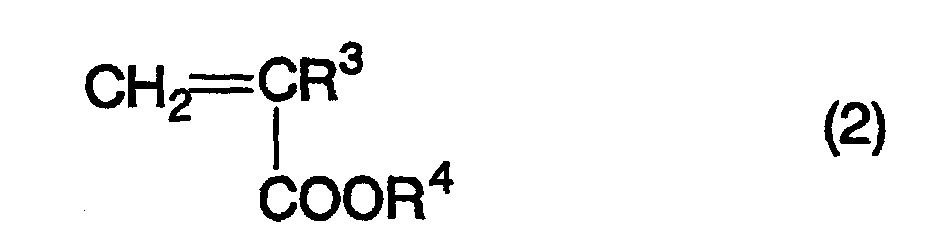
a copolymer which is obtained through copolymerization of (A)N-vinylacetamide in an amount of 20-90 mass%; (B)2-acrylamido-2-methyl-propanesulfonic acid and/or a salt thereof in an amount of 7-70 mass%; and at least one (C)vinyl monomer selected from the group consisting of (i)unsaturated carboxylic acid compound represented by the following formula (1):



The copolymer used in the present invention contains
N-vinylacetamide as a (A) component in a compositional
proportion of 20-90 mass%, preferably 30-70 mass%, based on all
monomers. When the proportion is in excess of 90 mass%, the
fluidity of the drilling mud may be reduced, whereas when the
proportion is less than 20 mass%, heat resistance and salt
resistance of the polymer tend to be reduced.
The copolymer used in the present invention contains
2-acrylamido-2-methyl-propanesulfonic acid and/or a salt
thereof as a (B) component in a compositional proportion of 7-70
mass%, preferably 20-60 mass%, based on all monomers. When the
proportion is in excess of 70 mass%, water retention of the
drilling mud tends to decrease, whereas when the proportion is
less than 7 mass%, the fluidity of the drilling mud tends to
decrease.
Examples of 2-acrylamido-2-methyl-propanesulfonic acid
and/or a salt thereof used in the present invention include
2-acrylamido-2-methyl-propanesulfonic acid, alkali metal
salts, ammonium salts and organic ammonium salts thereof.
Examples of (i) unsaturated carboxylic acid compound used
as a vinyl monomer (said (C) component) used in the
copolymerization of the present invention include
(meth)acrylic acid, crotonic acid, isocrotonic acid, maleic
acid, fumaric acid, itaconic acid, etc. and salts thereof.
Among these, (meth)acrylic acid, maleic acid, itaconic acid and
salts thereof can be preferably used.
Examples of (ii)alkyl (meth)acrylates used as a vinyl
monomer (said (C) component) include methyl (meth)acrylate,
ethyl (meth)acrylate, propyl (meth)acrylate, isobutyl
(meth)acrylate, 2-ethylhexyl (meth)acrylate, lauryl
(meth)acrylate, and stearyl (meth)acrylate. Among these,
methyl (meth)acrylate and ethyl (meth)acrylate are preferably
used.
Examples of (iii) hydroxyalkyl (meth)acrylates used as
a vinyl monomer (said (C) component) include (meth)acrylic acid
ester of linear or branched aliphatic alcohol having 1 to 18
carbons such as 2-hydroxyethyl (meth)acrylate,
2-hydroxypropyl (meth)acrylate.
Examples of (iv)N-alkylacrylamides used as a vinyl
monomer (said (C) component) include N-methylacrylamide,
N-isopropylacrylamide.
Examples of (v)N,N-dialkylacrylamides used as a vinyl
monomer (said (C) component) include N,N-dimethylacrylamide,
N,N-diethylacrylamide.
In this specification and claims, the term
"(meth)acrylate" refers to "methacrylate" or "acrylate" or
mixture of these compounds, and the term "(meth)acrylonitrile"
refers to "methacrylonitrile" or "acrylonitrile" or mixture of
these compounds.
The copolymer used in the present invention contains the
vinyl monomers as a (C) component at a compositional proportion
of 3-40 mass%, preferably 3-30 mass%, based on all monomers.
When the proportion is in excess of 40 mass% or less than 3 mass%,
the drilling-mud-conditioning agent of the present invention
exhibits poor performance.
No particular limitation is imposed on the process for
producing the copolymer used in the present invention, and
polymerization processes such as polymerization in aqueous
solution, reverse phase suspension polymerization, and
precipitation polymerization may be employed. Typically, the
polymer is produced by use of a polymerization initiator.
Typically employed radical polymerization initiators may
be used. Examples of initiators include azo compound
initiators such as 2,2'-azobisisobutyronitrile,
2,2'-azobis(2-amidinopropane) dihydrochloride, 2,2'-azobis
[2-(2-imidazolin-2-yl)propane] dihydrochloride, 2,2'-azobis
[2-(3,4,5,6-tetrahydropyrimidin-2-yl)propane]dihydrochloride,
and 2,2'-azobis[2-(5-hydroxy-3,4,5,6-tetrahydropyrimidin-2-yl)propane]
dihydrochloride; peroxides such as hydrogen
peroxide, benzoyl peroxide, t-butyl hydroperoxide, and
succinic peroxide; and persulfate salts such as ammonium
persulfate and potassium persulfate. In addition, a redox
initiator; i.e., a system comprising a peroxide or persulfate
salt and a reducing agent such as triethanolamine, sodium
sulfite, or sodium thiosulfate, may also be used.
During polymerization, a chain-transfer agent may be used
as a molecular-weight-controlling agent. Examples of
chain-transfer agents include n-butylmercaptan,
triethylamine, isopropyl, alcohol, ammonium thioglycolate, and
sodium hypophosphite.
The copolymer used in the present invention may have a
mass average molecular weight (as measured by gel permeation
chromatography by use of pullulan as a standard substance) which
may vary depending on the composition of suspended matter, the
kind of ground, the kind and concentration of containing ion,
species and amounts of other components such as dispersant of
the drilling-mud-conditioning agent and on conditions such as
pressure, temperature, drilling conditions, and the distance
over which drilling mud is to be conveyed. Typically, the
molecular weight is preferably 100,000 to 5,000,000. When the
mass average molecular weight is less than 100,000, the
drilling-mud-conditioning agent has an insufficient effect in
imparting viscosity to the drilling mud and water retention in
the drilling mud tends to decrease, whereas when it is in excess
of 5,000,000, cohesive force of suspended matter increases
excessively to thereby induce segregation of material in the
drilling mud.
Although the amount of the drilling-mud-conditioning
agent of the present invention which is added to drilling mud
varies depending on the aforementioned conditions, the
drilling-mud-conditioning agent is added typically in an amount
of 0.005-3.0 mass% on a solid basis, preferably 0.5-2.0 mass%.
The present invention will next be described in detail
by way of production examples of the copolymers, production
examples of the comparative copolymers, and test example for
evaluation of performance for the drilling mud conditioning
agent using these copolymers, however, the present invention
should not be construed as being limited the following
examples. The % in the example below means mass% except for
described otherwise.
In a glass-made reactor equipped with a stirrer were
placed a 10% aqueous solution of sodium
2-acrylamido-2-methyl-propanesulfonate (210g) and a 20%
aqueous solution of sodium methacrylate (70g).
N-vinylacetamide (35g) was added to the mixture with additional
water (685g), to thereby dissolve N-vinylacetamide. The
mixture was held at 50°C under agitation in a thermostat water
bath, and dissolved oxygen was removed by passage of nitrogen.
Subsequently, 2,2'-azobis(2-amidinopropane) dihydrochloride
(0.5g) was added to cause polymerization with passage of
nitrogen, to thereby obtain copolymer S1 (polymer content: 7%).
The mass average molecular weight of (S1) was 3,080,000 as
measured by gel permeation chromatography by use of pullulan
as a standard substance.
The procedure of Production Example 1 was repeated,
except that the species and amounts of monomers were altered
as shown in Table 1, to thereby obtain copolymers (S2 to S11).
The mass average molecular weight was measured in the same
manner in production example 1, the results are shown in Table
1.
The meanings of abbreviations in Table 1 are described
below.
| Copolymer | Compositional proportions of monomers (mass%) | Mass. av. mol. wt. (x104) | ||||||
| NVA | AMPS-Na | Monomer A | ||||||
| MA-Na | MAA | HEA | DMAAM | AN | ||||
| S1 | 50 | 30 | 20 | 308 | ||||
| S2 | 50 | 40 | 10 | 301 | ||||
| S3 | 40 | 50 | 10 | 287 | ||||
| S4 | 40 | 45 | 15 | 240 | ||||
| S5 | 50 | 45 | 5 | 256 | ||||
| S6 | 40 | 50 | 10 | 268 | ||||
| S7 | 40 | 50 | 10 | 283 | ||||
| S8 | 50 | 40 | 10 | 262 | ||||
| S9 | 40 | 30 | 20 | 10 | 273 | |||
| S10 | 40 | 40 | 10 | 10 | 264 | |||
| S11 | 40 | 50 | 5 | 5 | 266 |
Each of the procedures of Production Examples 1 to 11 was
repeated, except that the species and amounts of monomers were
altered as shown in Table 2, to thereby obtain the Comparative
copolymers (R1 to R5). The mass average molecular weight was
measured in the same manner as in production example 1. The
results are shown in Table 2.
The meanings of abbreviations in Table 2 are described
below.
| Comp. Copolymer | Compositional proportions of monomers (mass %) | Mass. av. mol. wt. (×104) | |||||
| NVF | NVNMA | AAM | AMPS-Na | MA-Na | MAA | ||
| R1 | 50 | 50 | 231 | ||||
| R2 | 50 | 50 | 235 | ||||
| R3 | 50 | 30 | 20 | 269 | |||
| R4 | 40 | 45 | 15 | 228 | |||
| R5 | 50 | 50 | 281 |
Each of copolymers produced in Production Examples 1 to
11 and Comparative Production Examples 1 to 5 was added to
artificially prepared drilling mud so as to evaluate
performance as a drilling-mud-conditioning agent.
Two types of mud, Mud-1 and Mud-2 having the following
compositions, were prepared.
An aqueous solution (170g) containing one of the
copolymers obtained in Production Examples and Comparative
Production Examples was added to each of the above-prepared
Mud-1 and Mud-2 (1000g), and the mixture (polymer solid content
1% based on the total amount) was stirred to thereby dissolve
the added copolymer and was subsequently allowed to stand for
15 hours at room temperature.
The apparent viscosity, plastic viscosity, yield value,
gel strength (after 10 seconds), and amount of water liberation
were measured on the basis of the applicable API (American
Petroleum Institute) standards.
The test results using Mud-1 are shown in Table 3 and the
test results using Mud-2 are shown in Table 4.
The meanings of abbreviations in Tables 3 and 4 are described
below.
- AV;
- apparent viscosity (mPa·s)
- PV;
- plastic viscosity (mPa·s)
- YV;
- yield value (lb/100ft2)
- GS;
- gel strength (after 10 seconds) (lb/100ft2)
- WL:
- amount of water liberation (ml)
| Sample | AV (mPa·s)(mPa·s) | PV | YV (lb/100ft2) | GS (lb/100ft2) | WL (ml) | |
| Copolymer | S1 | 21 | 17 | 8 | 2-4 | 7.7 |
| S2 | 21 | 17 | 9 | 2-4 | 7.4 | |
| S3 | 22 | 17 | 8 | 2-4 | 6.9 | |
| S4 | 23 | 19 | 10 | 2-4 | 7.3 | |
| S5 | 22 | 19 | 9 | 2-4 | 7.3 | |
| S6 | 22 | 18 | 10 | 1-4 | 8.1 | |
| S7 | 20 | 17 | 9 | 2-4 | 7.8 | |
| S8 | 23 | 20 | 10 | 2-4 | 6.6 | |
| S9 | 24 | 20 | 11 | 2-4 | 6.4 | |
| S10 | 23 | 19 | 10 | 1-4 | 6.6 | |
| S11 | 22 | 16 | 10 | 1-4 | 7.5 | |
| Comp. Copolymer | R1 | 18 | 16 | 8 | 2-6 | 12.8 |
| R2 | 17 | 14 | 7 | 1-4 | 10.6 | |
| R3 | 17 | 14 | 6 | 1-4 | 11.4 | |
| R4 | 16 | 13 | 6 | 1-4 | 10.3 | |
| R5 | 19 | 16 | 10 | 3-7 | 15.9 |
| Sample | AV (mPa·s) | PV (mPa·s) | YV (lb/100ft2) | GS (lb/100ft2) | WL (ml) | |
| Copolymer | S1 | 18 | 14 | 7 | 1-3 | 9.1 |
| S2 | 18 | 15 | 7 | 2-4 | 9.0 | |
| S3 | 18 | 14 | 7 | 2-4 | 8.6 | |
| S4 | 19 | 15 | 9 | 2-4 | 9.2 | |
| S5 | 18 | 16 | 8 | 2-3 | 9.0 | |
| S6 | 18 | 16 | 9 | 1-3 | 8.6 | |
| S7 | 19 | 14 | 8 | 2-4 | 8.7 | |
| S8 | 19 | 16 | 10 | 2-4 | 8.9 | |
| S9 | 20 | 17 | 10 | 2-4 | 8.3 | |
| S10 | 20 | 16 | 9 | 1-4 | 8.4 | |
| S11 | 18 | 16 | 9 | 2-4 | 9.2 | |
| Comp. Coplymer | R1 | 17 | 14 | 9 | 2-5 | 13.1 |
| R2 | 15 | 12 | 8 | 1-4 | 14.0 | |
| R3 | 15 | 12 | 7 | 1-4 | 13.8 | |
| R4 | 16 | 13 | 8 | 1-3 | 13.5 | |
| R5 | 17 | 14 | 9 | 2-6 | 14.4 |
The procedure of "Evaluation of performance-1 as a
drilling-mud-conditioning agent" was repeated, to thereby
prepare Mud-1 and Mud-2.
An aqueous solution of one of the copolymers (170g)
obtained in Production Examples and Comparative Production
Examples was added to each of the above-prepared types of
drilling mud (1000g), and the mixture (polymer solid content
1% based on the total amount) was stirred to thereby dissolve
the added copolymer and was subsequently treated at 200°C for
10 hours in an autoclave.
The same procedure as in above described "Evaluation of
performance-1 as a drilling-mud-conditioning agent" was
repeated.
The test results using Mud-1 are shown in Table 5 and the
test results using Mud-2 are shown in Table 6.
The meaning of abbreviations(AV, PV, YV, GS, and WL) in
Tables 5 and 6 are the same as described in Table 3.
| Sample | AV (mPa·s) | PV (mPa·s) | YV (lb/100ft2) | GS (lb/100ft2) | WL (ml) | |
| Copolymer | S1 | 29 | 25 | 16 | 3-7 | 13.2 |
| S2 | 28 | 25 | 17 | 3-8 | 13.1 | |
| S3 | 28 | 25 | 16 | 3-7 | 12.8 | |
| S4 | 30 | 27 | 18 | 2-8 | 12.9 | |
| S5 | 33 | 29 | 17 | 4-8 | 12.2 | |
| S6 | 31 | 29 | 16 | 3-8 | 13.6 | |
| S7 | 34 | 30 | 18 | 3-8 | 12.9 | |
| S8 | 32 | 27 | 17 | 3-8 | 13.3 | |
| S9 | 32 | 25 | 18 | 3-7 | 13.3 | |
| S10 | 31 | 26 | 17 | 3-8 | 12.5 | |
| S11 | 32 | 28 | 16 | 4-7 | 13.0 | |
| Comp. Copolymer | R1 | 57 | 49 | 28 | 4-17 | 31.3 |
| R2 | 49 | 44 | 23 | 3-19 | 25.6 | |
| R3 | 53 | 48 | 25 | 4-21 | 28.8 | |
| R4 | 52 | 47 | 23 | 3-19 | 26.4 | |
| R5 | 68 | 53 | 31 | 3-20 | 40.5 |
| Sample | AV (mPa·s) | PV (mPa·s) | YV (lb/100ft2) | GS (lb/100ft2) | WL (ml) | |
| Copolymer | S1 | 25 | 20 | 14 | 4-10 | 15.3 |
| S2 | 26 | 21 | 14 | 4-10 | 14.9 | |
| S3 | 26 | 22 | 13 | 4-10 | 14.8 | |
| S4 | 29 | 23 | 15 | 3-9 | 14.8 | |
| S5 | 24 | 23 | 15 | 5-11 | 15.5 | |
| S6 | 28 | 27 | 14 | 4-11 | 16.0 | |
| S7 | 27 | 23 | 16 | 4-10 | 14.7 | |
| S8 | 28 | 26 | 15 | 4-10 | 14.2 | |
| S9 | 28 | 25 | 16 | 4-9 | 13.9 | |
| S10 | 28 | 25 | 15 | 5-12 | 14.0 | |
| S11 | 25 | 26 | 15 | 4-10 | 14.3 | |
| Comp. Copolymer | R1 | 60 | 52 | 33 | 6-25 | 40.1 |
| R2 | 52 | 47 | 22 | 4-21 | 33.3 | |
| R3 | 50 | 52 | 27 | 5-23 | 38.6 | |
| R4 | 54 | 51 | 25 | 5-22 | 34.4 | |
| R5 | 79 | 61 | 38 | 7-29 | 49.9 |
As is clear from the results in Tables 3 to 6, the
drilling-mud-conditioning agents obtained in Production
Examples 1 to 11 exhibit low water liberation; i.e., low loss
of water, even in drilling mud containing a large amount of
salts, as compared with the drilling-mud-conditioning agents
obtained in Comparative Production Examples 1 to 5.
Particularly, the difference was observed to be remarkable in
the case in which a mud sample had been subjected to
high-temperature conditions(Test example 2, Table 6). Thus,
the results indicate that the drilling-mud-conditioning agent
of the present invention exhibits excellent chemical stability
at high temperature and salt resistance.
The drilling-mud-conditioning agent of the present
invention enables a reduction in the load imposed on a drilling
machine and effective conveyance of drilling mud, by imparting
high fluidity, lubricity, and resistance to loss of water to
the drilling mud, even when deep level drilling is carried out
under high-temperature and high-pressure conditions and the
drilling mud contains a large amount of salts.
Claims (11)
- A drilling-mud-conditioning agent comprising :
a copolymer which is obtained through copolymerization of (A)N-vlnylacetamide in an amount of 20-90 mass%; (B)2-acrylamldo-2-methyl-propanesulfonic acid and/or a salt thereof in an amount of 7-70 mass%; and at least one (C)vinyl monomer selected from the group consisting of (i)unsaturated carboxylic acid compound represented by the following formula (1):(wherein R1 represents a hydrogen atom, a methyl group, or COOX2, R2 represents a hydrogen atom, a methyl group, or COOX3; each of X1, X2, and X3 represents a hydrogen atom, an alkaline metal, an alkaline earth metal, an ammonium group, or an organic amino group; and n is 0 or 1), (ii) alkyl (meth)acrylate compound represented by the following formula (2):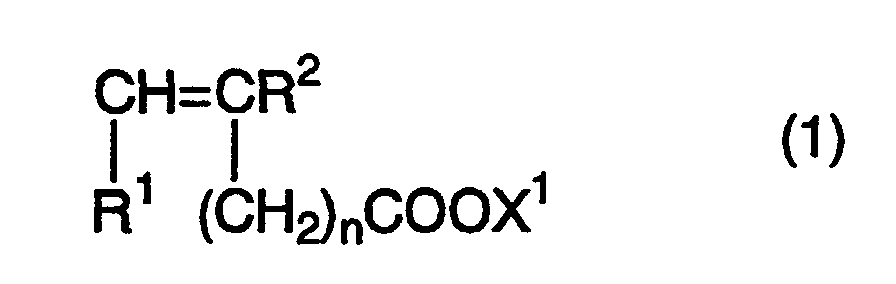 (wherein R3 represents a hydrogen atom or a methyl group; and R4 represents a linear or branched C1-C18 alkyl group), (iii) hydroxyalkyl (meth)acrylates, (iv) (meth)acrylonitrile, (v) N-alkylacrylamides, (vi) N, N-dialkylacrylamides, and (vii) vinyl acetate in an amount of 3-40 mass% (wherein the total amount of said (A), (B) and (C) component is 100%).
- A drilling-mud-conditioning agent according to claim 1, wherein the mass average molecular weight of the copolymer is 100,000 to 5,000,000.
- A drilling-mud-conditioning agent according to claim 1 or 2, wherein (C)the vinyl monomer is at least one unsaturated carboxylic acid compound selected from (i) (meth)acrylic acid, maleic acid, itaconic acid, and/or salts thereof.
- A drilling-mud-conditioning agent according to claim 1 or 2, wherein (C)the vinyl monomer is at least one alkyl (meth)acrylate compound selected from (ii) methyl (meth)acrylate and ethyl (meth) acrylate.
- A drilling-mud-conditioning agent according to claim 1 or 2, wherein (C) the vinyl monomer is at least one hydroxyalkyl (meth)acrylate compound selected from (iii) 2-hydroxyethyl (meth)acrylate and 2-hydroxypropyl (meth)acrylate.
- A drilling-mud-conditioning agent according to claim 1 or 2, wherein (C)the vinyl monomer is (iv) (meth)acrylonitrile.
- A drilling-mud-conditioning agent according to claim 1 or 2, wherein (C)the vinyl monomer is (v) N-alkylacrylamide compound.
- A drilling-mud-conditioning agent according to claim 1 or 2, wherein (C) the vinyl monomer is (vi) N,N-dialkylacrylamide compound.
- A drilling-mud-conditioning agent according to claim 1 or 2, wherein (C) the vinyl monomer is (vii) vinyl acetate.
- A drilling-mud-conditioning agent according to claim 1 or 2, wherein the (C) vinyl monomer is (i) unsaturated carboxylic acid compound and (iv) (meth)acrylonitrile.
- (Canceled)
Applications Claiming Priority (5)
| Application Number | Priority Date | Filing Date | Title |
|---|---|---|---|
| JP9471399 | 1999-04-01 | ||
| JP9471399 | 1999-04-01 | ||
| US15687399P | 1999-09-30 | 1999-09-30 | |
| US156873P | 1999-09-30 | ||
| PCT/JP2000/002084 WO2000059964A1 (en) | 1999-04-01 | 2000-03-31 | Regulator for digging mud |
Publications (2)
| Publication Number | Publication Date |
|---|---|
| EP1092734A1 true EP1092734A1 (en) | 2001-04-18 |
| EP1092734A4 EP1092734A4 (en) | 2004-07-14 |
Family
ID=26435973
Family Applications (1)
| Application Number | Title | Priority Date | Filing Date |
|---|---|---|---|
| EP00913028A Withdrawn EP1092734A4 (en) | 1999-04-01 | 2000-03-31 | Regulator for digging mud |
Country Status (4)
| Country | Link |
|---|---|
| EP (1) | EP1092734A4 (en) |
| AU (1) | AU3457700A (en) |
| CA (1) | CA2332322A1 (en) |
| WO (1) | WO2000059964A1 (en) |
Families Citing this family (3)
| Publication number | Priority date | Publication date | Assignee | Title |
|---|---|---|---|---|
| JP5566645B2 (en) * | 2009-09-08 | 2014-08-06 | 株式会社クラレ | Mud dispersant |
| CN102585783B (en) * | 2011-12-29 | 2013-11-27 | 西南石油大学 | High temperature and salt resistant polymer fluid loss reducer for drilling fluid and preparation method thereof |
| CA2921219C (en) | 2013-08-30 | 2021-09-07 | Dai-Ichi Kogyo Seiyaku Co., Ltd. | Additive for drilling mud comprising i-type crystal structure cellulose fibers with specified number average fiber diameters and aspect ratios |
Family Cites Families (3)
| Publication number | Priority date | Publication date | Assignee | Title |
|---|---|---|---|---|
| DE2931897A1 (en) * | 1979-08-06 | 1981-02-26 | Cassella Ag | WATER-SOLUBLE COPOLYMER AND ITS PRODUCTION |
| JP3069982B2 (en) * | 1991-12-18 | 2000-07-24 | 昭和電工株式会社 | Polymer gel and method for producing the same |
| JPH1053627A (en) * | 1996-05-27 | 1998-02-24 | Showa Denko Kk | High fluidity concrete composition, separation reducing agent and copolymer for the composition |
-
2000
- 2000-03-31 WO PCT/JP2000/002084 patent/WO2000059964A1/en not_active Ceased
- 2000-03-31 AU AU34577/00A patent/AU3457700A/en not_active Abandoned
- 2000-03-31 EP EP00913028A patent/EP1092734A4/en not_active Withdrawn
- 2000-03-31 CA CA002332322A patent/CA2332322A1/en not_active Abandoned
Non-Patent Citations (2)
| Title |
|---|
| No further relevant documents disclosed * |
| See also references of WO0059964A1 * |
Also Published As
| Publication number | Publication date |
|---|---|
| WO2000059964A1 (en) | 2000-10-12 |
| EP1092734A4 (en) | 2004-07-14 |
| AU3457700A (en) | 2000-10-23 |
| CA2332322A1 (en) | 2000-10-12 |
Similar Documents
| Publication | Publication Date | Title |
|---|---|---|
| US6380137B1 (en) | Copolymers and their use as drilling aids | |
| US6346588B1 (en) | Terpolymers based on sulfobetaines, processes for their preparation and their use as thickeners for aqueous salt solutions | |
| CN104448127B (en) | Polymer mobility control agent suitable for special high salinity reservoirs and preparation method thereof | |
| US4340525A (en) | Additive for deep-well cement slurries | |
| CN104448125B (en) | Amphoteric hydrophobically-associating polymer and preparation method thereof | |
| US5270382A (en) | Compositions and applications thereof of water-soluble copolymers comprising an ampholytic imidazolium inner salt | |
| CN102464781B (en) | Thermothickening terpolymer, its preparation method and application | |
| US4563290A (en) | Water-soluble copolymers useful for enhanced oil recovery | |
| US4357245A (en) | Water-soluble copolymer and its preparation | |
| CA1223721A (en) | Intramolecular polymer complexes - viscosifiers for high ionic strength drilling fluids | |
| CN106866878B (en) | Polymer-type profile control agent and preparation method thereof suitable for high temperature and high salt harshness oil reservoir | |
| CN104449636B (en) | Oil displacement agent of recovery ratio and preparation method thereof is improved suitable for high temperature and high salt harshness oil reservoir | |
| CN104448128A (en) | Polymer mobility control agent suitable for high-temperature and high-salinity harsh reservoir and preparation method of polymer mobility control agent | |
| JP2019501988A (en) | Crosslinked polymers derived from monomers having acryloyl and lactam and sulfonic acid / sulfonate comonomers, compositions thereof and applications thereof | |
| EP0877147A1 (en) | Method of plugging low temperature subterranean formation | |
| US6436878B1 (en) | Rheology stabilizer for high-temperature high-pressure high-mineralized degree drilling fluids | |
| CN108676129A (en) | A kind of comb-type structure amphoteric ion polymer fluid loss additive and preparation method thereof | |
| CN110452326B (en) | Coating agent for water-based drilling fluid and preparation method thereof | |
| US20250002626A1 (en) | Polymerizable phosphonic acid (salt) and preparation method therefor, copolymer and drilling fluid | |
| WO2015042028A1 (en) | High temperature stable cross-linked polymers | |
| JPS63258911A (en) | Heat stable polymer, its production and holding agent and flowability lowering additive | |
| US11845858B2 (en) | Friction reducing copolymers and method of preparation thereof | |
| EP0123420A1 (en) | Intramolecular polymeric complexes - viscosifiers for acid, base and salt (aqueous) solutions | |
| CA2332322A1 (en) | Drilling mud conditionning agent | |
| US7223827B1 (en) | Water control in a subsurface formation |
Legal Events
| Date | Code | Title | Description |
|---|---|---|---|
| PUAI | Public reference made under article 153(3) epc to a published international application that has entered the european phase |
Free format text: ORIGINAL CODE: 0009012 |
|
| 17P | Request for examination filed |
Effective date: 20001220 |
|
| AK | Designated contracting states |
Kind code of ref document: A1 Designated state(s): AT BE CH CY DE DK ES FI FR GB GR IE IT LI LU MC NL PT SE |
|
| AX | Request for extension of the european patent |
Free format text: AL;LT;LV;MK;RO;SI |
|
| A4 | Supplementary search report drawn up and despatched |
Effective date: 20040601 |
|
| STAA | Information on the status of an ep patent application or granted ep patent |
Free format text: STATUS: THE APPLICATION IS DEEMED TO BE WITHDRAWN |
|
| 18D | Application deemed to be withdrawn |
Effective date: 20040909 |