EP1092709A1 - Process for producing beta-carotene - Google Patents
Process for producing beta-carotene Download PDFInfo
- Publication number
- EP1092709A1 EP1092709A1 EP00121975A EP00121975A EP1092709A1 EP 1092709 A1 EP1092709 A1 EP 1092709A1 EP 00121975 A EP00121975 A EP 00121975A EP 00121975 A EP00121975 A EP 00121975A EP 1092709 A1 EP1092709 A1 EP 1092709A1
- Authority
- EP
- European Patent Office
- Prior art keywords
- formula
- group
- derivative
- wavy line
- alkyl group
- Prior art date
- Legal status (The legal status is an assumption and is not a legal conclusion. Google has not performed a legal analysis and makes no representation as to the accuracy of the status listed.)
- Withdrawn
Links
- 0 CC1(C)C(C(CC(C)=CC(CC(C)=CCO)O*)S(*)(=O)=O)=C(C)CCC1 Chemical compound CC1(C)C(C(CC(C)=CC(CC(C)=CCO)O*)S(*)(=O)=O)=C(C)CCC1 0.000 description 1
Classifications
-
- C—CHEMISTRY; METALLURGY
- C07—ORGANIC CHEMISTRY
- C07C—ACYCLIC OR CARBOCYCLIC COMPOUNDS
- C07C403/00—Derivatives of cyclohexane or of a cyclohexene or of cyclohexadiene, having a side-chain containing an acyclic unsaturated part of at least four carbon atoms, this part being directly attached to the cyclohexane or cyclohexene or cyclohexadiene rings, e.g. vitamin A, beta-carotene, beta-ionone
- C07C403/22—Derivatives of cyclohexane or of a cyclohexene or of cyclohexadiene, having a side-chain containing an acyclic unsaturated part of at least four carbon atoms, this part being directly attached to the cyclohexane or cyclohexene or cyclohexadiene rings, e.g. vitamin A, beta-carotene, beta-ionone having side-chains substituted by sulfur atoms
-
- C—CHEMISTRY; METALLURGY
- C07—ORGANIC CHEMISTRY
- C07C—ACYCLIC OR CARBOCYCLIC COMPOUNDS
- C07C403/00—Derivatives of cyclohexane or of a cyclohexene or of cyclohexadiene, having a side-chain containing an acyclic unsaturated part of at least four carbon atoms, this part being directly attached to the cyclohexane or cyclohexene or cyclohexadiene rings, e.g. vitamin A, beta-carotene, beta-ionone
- C07C403/24—Derivatives of cyclohexane or of a cyclohexene or of cyclohexadiene, having a side-chain containing an acyclic unsaturated part of at least four carbon atoms, this part being directly attached to the cyclohexane or cyclohexene or cyclohexadiene rings, e.g. vitamin A, beta-carotene, beta-ionone having side-chains substituted by six-membered non-aromatic rings, e.g. beta-carotene
-
- C—CHEMISTRY; METALLURGY
- C07—ORGANIC CHEMISTRY
- C07F—ACYCLIC, CARBOCYCLIC OR HETEROCYCLIC COMPOUNDS CONTAINING ELEMENTS OTHER THAN CARBON, HYDROGEN, HALOGEN, OXYGEN, NITROGEN, SULFUR, SELENIUM OR TELLURIUM
- C07F9/00—Compounds containing elements of Groups 5 or 15 of the Periodic Table
- C07F9/02—Phosphorus compounds
- C07F9/28—Phosphorus compounds with one or more P—C bonds
- C07F9/54—Quaternary phosphonium compounds
- C07F9/5435—Cycloaliphatic phosphonium compounds
-
- Y—GENERAL TAGGING OF NEW TECHNOLOGICAL DEVELOPMENTS; GENERAL TAGGING OF CROSS-SECTIONAL TECHNOLOGIES SPANNING OVER SEVERAL SECTIONS OF THE IPC; TECHNICAL SUBJECTS COVERED BY FORMER USPC CROSS-REFERENCE ART COLLECTIONS [XRACs] AND DIGESTS
- Y02—TECHNOLOGIES OR APPLICATIONS FOR MITIGATION OR ADAPTATION AGAINST CLIMATE CHANGE
- Y02P—CLIMATE CHANGE MITIGATION TECHNOLOGIES IN THE PRODUCTION OR PROCESSING OF GOODS
- Y02P20/00—Technologies relating to chemical industry
- Y02P20/50—Improvements relating to the production of bulk chemicals
- Y02P20/55—Design of synthesis routes, e.g. reducing the use of auxiliary or protecting groups
Definitions
- the present invention relates to a process for the production of ⁇ -carotene, a carotenoid that is important in the fields of medicines, feed additives and food additives and also to an intermediate of ⁇ -carotene
- An object of the invention is to provide a method for producing ⁇ -carotene using a novel intermediate compound.
- Further objects of the invention are to provide industrially advantageous two C20 compounds for producing the intermediate compound and methods for producing the two C20 compounds from an inexpensive C10 compound, linalool or geraniol in an industrially advantageous manner.
- the present invention provides:
- Examples of the lower alkyl group represented by R in the sulfone derivative (1), aldehyde derivative (2), phosphonium salt (3) and alcohol derivative (7) in the present invention include
- the optionally substituted aryl group include a phenyl, naphthyl, o-tolyl, m-tolyl, p-tolyl, o-methoxyphenyl, m-methoxyphenyl, p -methoxyphenyl, o-chlorophenyl, m-chlorophenyl, p-chlorophenyl, o-bromophenyl, m-bromophenyl, p-bromophenyl, o-iodophenyl, m-iodophenyl, p-iodophenyl, o-fluorophenyl, m-fluorophenyl, p-fluorophenyl, o-nitrophenyl, m-nitrophenyl and p-nitrophenyl group.
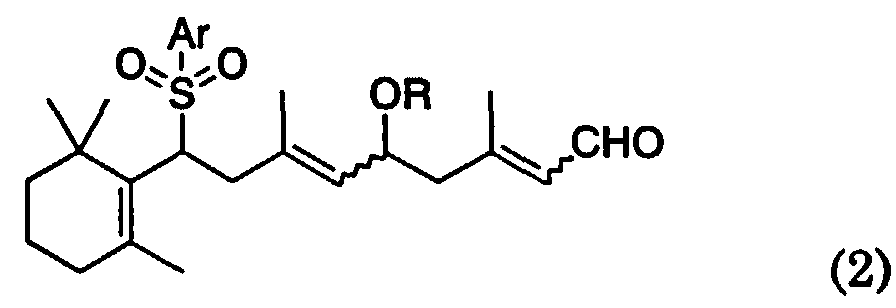
- aldehyde derivative of formula (2) include an aldehyde derivative of formula (2), wherein
- the aldehyde derivative (2) can be obtained by a process as shown in the attached Scheme 1.
- a halogen atom represented by X include a chlorine atom, bromine atom and iodine atom.
- Examples of the lower alkyl group represented by Y include a C1-C6 alkyl group such as a methl, ethyl, n-propyl, i-propyl, sec-butyl, n-butyl, i-butyl, n-pentyl, or the like.
- Examples of the optionally substituted phenyl group represented by Y include
- PY 3 in the phosphonium salt of formula (3) include triethylphosphine, tripropylphosphine, tributylphosphine, tripentylphosphine, trihexylphosphine, triphenylphosphine, tri-(o-tolyl)phosphine and the like.
- phosphonium salt (3) examples include a phosphonium salt (3), wherein "Ar" and R have the same meaning as defined for specific examples of the aldehyde derivative of formula (2) and Y is a phenyl group and X is chlorine, and
- the amount of the phosphonium salt (3) to be used is usually 0.5 to 2.0 moles, preferably, 0.8 to 1.2 per mole of the aldehyde derivative (2).
- the base examples include an alkali metal alkoxide such as potassium methoxide, potassium ethoxide, potassium n-butoxide, potassium t-butoxide, sodium methoxide, sodium ethoxide, sodium n-butoxide, or sodium t-butoxide and an alkali metal hydroxide such as potassium hydroxide or sodium hydroxide.
- an epoxide such as an ethylene oxide or 1,2-butene oxide may be used instead of the base.
- the amount of the base or epoxide to be used is usually 1 to 5 moles per mol the phosphonium salt of formula (3).
- Reacting of an aldehyde derivative of formula (2) with a phosphonium salt of formula (3) in the presence of a base or an epoxide is usually conducted in an organic solvent.
- Examples of the solvent include
- the reaction may also be conducted in a two phase system of an organic solvent immiscible with water such as the hydrocarbon solvent, the halogenated hydrocarbon solvent or the like as referred to above and water.
- the reaction temperature is usually in a range of about -10°C to 150°C, preferably 0°C to 100°C.
- reaction mixture is usually subjected to post-treatments which include optionally filtration, washing, phase separation and/or evaporation to give the sulfone derivative (1), which may be further purified by column chromatography or recrystallization, if necessary.
- post-treatments include optionally filtration, washing, phase separation and/or evaporation to give the sulfone derivative (1), which may be further purified by column chromatography or recrystallization, if necessary.
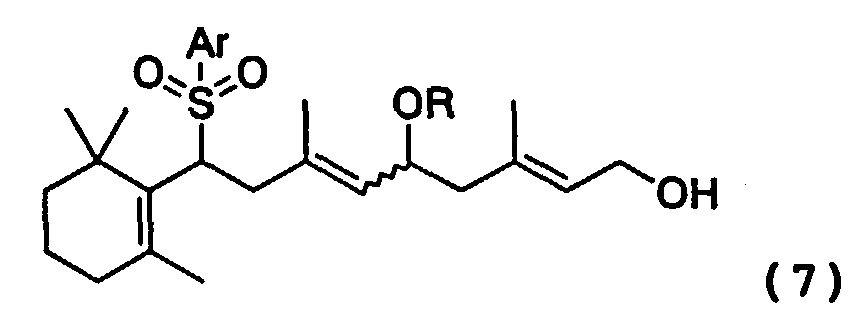
- the phosphonium salt (3) can be obtained by a process which comprises reacting an alcohol derivative of formula (7): wherein Ar, R and the wavy line respectively have the same meanings as defined above, with a salt of a tertiary phosphine compound of formula: PY 3 and a protonic acid, or with a tertiary phosphine compound of formula: PY 3 , in the presence of a protonic acid, wherein Y represents the same as defined above.
- tertiary phosphine compound examples include a triphenylphosphine compound of which phenyl group may be substituted with a C1-C3 alkyl or a C1-C3 alkoxy group, and a tri(C1-C6)alkylphosphine.
- triphenylphosphine compound examples include triphenylphosphine, tri-(o-tolyl)phosphine and the like.
- trialkylphosphine examples include triethylphosphine, tripropylphosphine, tributylphosphine, tripentylphosphine, trihexylphosphine and the like.
- Examples of the protonic acid include hydrogen chloride, hydrogen bromide, hydrogen iodide and sulfuric acid
- Examples of the salt of the tertiary phosphine compound and a protonic acid used in the above reaction include triphenylphosphine hydrochloride, triphenylphosphine hydrobromide or triphenylphosphine hydroiodide.
- Examples of the protonic acid allowed to coexist with the tertiary phosphine compound include hydrogen chloride, hydrogen bromide, hydrogen iodide and sulfuric acid.
- the amount of the tertiary phosphine compound or its salt with a protonic acid is usually about 0.7 to 2 moles per mol of the alcohol derivative (7).
- the amount of the protonic acid allowed to coexist with the tertiary phosphine compound is usually about 0.7 to 2.0 moles per mol of the alcohol derivative (7).
- the reaction is usually conducted in an organic solvent, examples of which include those specified for the reaction of aldehyde derivative of formula (2) and a phosphonium derivative (3) above, and an alcohol solvent such as methanol or ethanol.
- the reaction temperature is usually in a range of 10°C to 50°C.
- the resulting phosphonium salt (3) may be isolated after the reaction, alternatively it may be used as it is in the subsequent reaction without being isolated.
- ⁇ -carotene of formula (4) can be produced by a process which comprises reacting the sulfone derivative (1) with a base.
- Example of the base to be used in the this reaction include an alkali metal hydroxide, an alkali metal hydride and an alkali metal alkoxide. Specific examples thereof include sodium hydroxide, potassium hydroxide, sodium hydride, potassium hydride, sodium methoxide, potassium methoxide, sodium ethoxide, potassium ethoxide, sodium t-butoxide, potassium t-butoxide and the like.
- the amount of the base is usually about 2 to 30 moles, preferably 4 to 25 moles per mol of the sulfone derivative (1).
- the reaction is usually conducted in an organic solvent, examples of which include those described above for the production process of the phosphonium derivative (3) above.
- the reaction temperature is usually in a range of -78°C to the boiling point of the solvent to be used.
- reaction mixture is usually subjected to post-treatments which include optionally filtration, washing, phase separation and/or evaporation as described above to give ⁇ -carotene, which may be further purified by column chromatography or recrystallization, if necessary.
- post-treatments include optionally filtration, washing, phase separation and/or evaporation as described above to give ⁇ -carotene, which may be further purified by column chromatography or recrystallization, if necessary.
- said post-treatments are preferably carried out in an inert atmosphere, for example, in a atmosphere of nitrogen or argon, and an antioxidant such as BHT(di-t-butylhydroxytoluene) may be added to the reaction mixture or a solution thereof.
- an antioxidant such as BHT(di-t-butylhydroxytoluene)
- the alcohol derivative (7) which may be a mixture of geometrical isomers of E and Z, a racemate or an optically active isomer can be used in the present process.
- the alcohol derivative (7) above can be readily synthesized from linalool or geraniol, which is available at relatively low cost, according to the route as shown by the Scheme 1 described below.
- a method for the synthesis of the cyclic sulfone (5) is described in JP11-222479(Laid-Open, unexamined).
- the sulfone (6) can be derivatized by deacylation followed by selective alkylation of a secondery alcohol group to the alcohol derivative (7), which can be oxidized to aldehyde derivative (3) as shown in the following scheme and reference examples.
- ⁇ -carotene which is an important carotenoid in the fields of medicines, feed additives and food additives can be produced from readily available linalool or geraniol in an industrially advantageous manner.
Landscapes
- Chemical & Material Sciences (AREA)
- Organic Chemistry (AREA)
- Health & Medical Sciences (AREA)
- Life Sciences & Earth Sciences (AREA)
- Biochemistry (AREA)
- General Health & Medical Sciences (AREA)
- Molecular Biology (AREA)
- Organic Low-Molecular-Weight Compounds And Preparation Thereof (AREA)
- Low-Molecular Organic Synthesis Reactions Using Catalysts (AREA)
Abstract
Description

R represents a lower alkyl group and the wavy line depicted by "

which comprises reacting an aldehyde derivative of formula (2):

Y means an lower alkyl group or an optionally substituted phenyl group, in the presence of a base or an epoxide;

which comprises reacting a sulfone derivative of formula (1) as defined above, with a base.


Claims (8)
- A process for producing a sulfone derivative of formula (1):wherein Ar represents an aryl group which may be substituted, R represents a lower alkyl group and the wavy line depicted by "
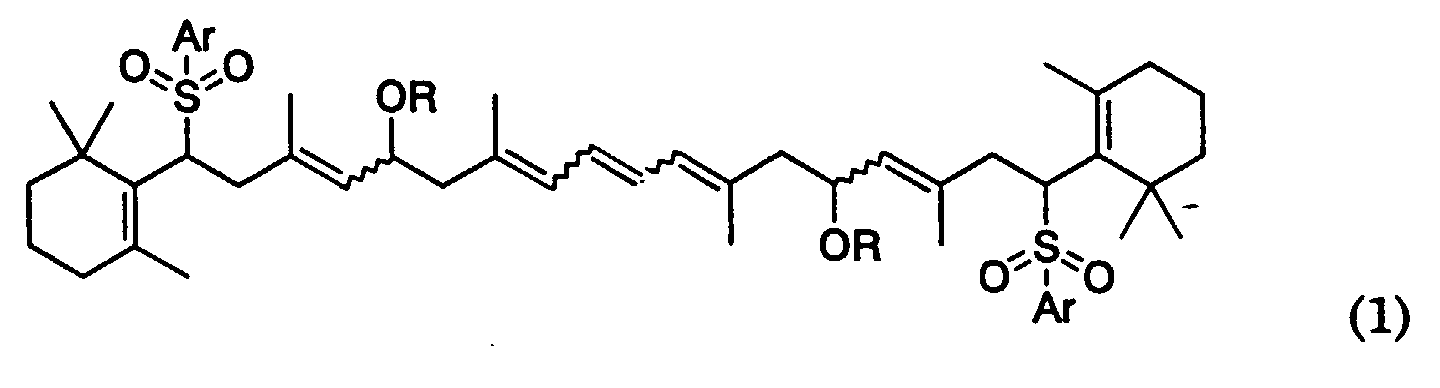 " indicates a single bond and stereochemistry relating to a double bond bound therewith is E or Z or a mixture thereof,
which comprises reacting an aldehyde derivative of formula (2):wherein Ar, R and the wavy line respectively have the same meanings as defined above, with a phosphonium salt of formula (3):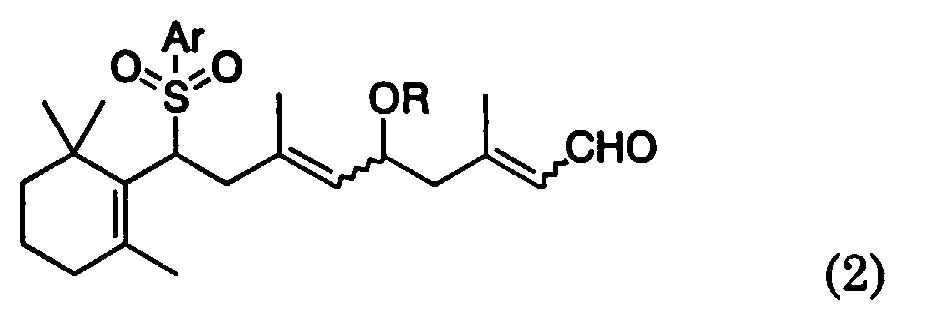 wherein Ar, R and the wavy line respectively have the same meanings as defined above, X represents a halogen atom or HSO4, and
Y means an lower alkyl group or an optionally substituted phenyl group, in the presence of a base or an epoxide; - A sulfone derivative of formula (1) as defined in claim 1.
- A process for producing β-carotene of formula (4):wherein the wavy line depicted by "

which comprises reacting a sulfone derivative of formula (1):wherein Ar represents an aryl group which may be substituted,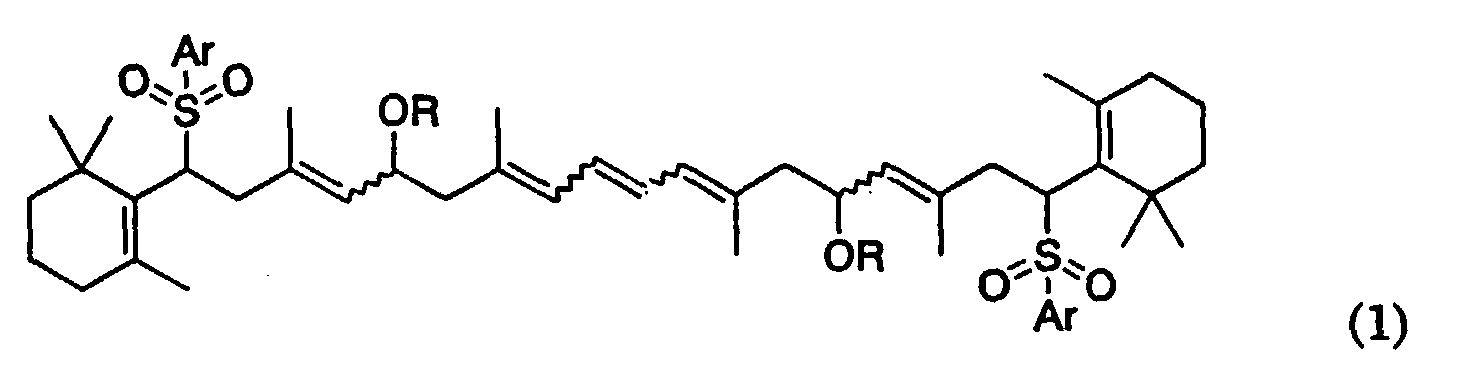
R represents a lower alkyl group and the wavy line depicted by " - A process according to claim 1, wherein R representsa (C1-C5) alkyl group, andAr represents a phenyl group or a naphthyl group, both of which may be substituted with at least one group selected froma (C1-C6) alkyl group, a (C1- C6) alkoxy group, a halogen atom or a nitro group.
- A process according to claim 1, which further comprises the step of reacting the sulfone derivative of formula (1) with a base to produce a β-carotene of formula (4):wherein the wavy line depicted by "

- A process according to claim 1 or 5, wherein said phosphonium salt of formula (3) is a compound obtained by a process comprising reacting an alcohol derivative of formula (7):wherein Ar, R and the wavy line respectively have the same meanings as defined in connection with formula (3), with a salt of a tertiary phosphine compound of formula: PY3 and a protonic acid, or with a tertiary phosphine compound of formula: PY3, in the presence of a protonic acid, wherein Y represents the same as defined in connection with formula (3) and said protonic acid is a protonic acid selected from hydrogen chloride, hydrogen bromide, hydrogen iodide or sulfuric acid.

- A process according to clam 6, wherein Y is a phenyl group.
- A process according to claim 3 or 5, wherein said base is an alkali metal hydroxide or alkali metal alkoxide.
Applications Claiming Priority (2)
| Application Number | Priority Date | Filing Date | Title |
|---|---|---|---|
| JP28931299 | 1999-10-12 | ||
| JP28931299A JP2001114756A (en) | 1999-10-12 | 1999-10-12 | Method for producing β-carotene |
Publications (1)
| Publication Number | Publication Date |
|---|---|
| EP1092709A1 true EP1092709A1 (en) | 2001-04-18 |
Family
ID=17741564
Family Applications (1)
| Application Number | Title | Priority Date | Filing Date |
|---|---|---|---|
| EP00121975A Withdrawn EP1092709A1 (en) | 1999-10-12 | 2000-10-09 | Process for producing beta-carotene |
Country Status (5)
| Country | Link |
|---|---|
| US (1) | US6355841B1 (en) |
| EP (1) | EP1092709A1 (en) |
| JP (1) | JP2001114756A (en) |
| KR (1) | KR20010067307A (en) |
| CN (1) | CN1291608A (en) |
Cited By (3)
| Publication number | Priority date | Publication date | Assignee | Title |
|---|---|---|---|---|
| US6355841B1 (en) * | 1999-10-12 | 2002-03-12 | Sumitomo Chemical Company, Limited | Process for producing β-carotene |
| WO2003070698A1 (en) * | 2002-02-19 | 2003-08-28 | Sumitomo Chemical Company, Limited | Process for preparation of carotenoids |
| EP2130833A1 (en) | 2008-06-05 | 2009-12-09 | DSM IP Assets B.V. | Process for the preparation of zeacarotenes |
Families Citing this family (2)
| Publication number | Priority date | Publication date | Assignee | Title |
|---|---|---|---|---|
| CN1208316C (en) * | 2000-10-18 | 2005-06-29 | 住友化学工业株式会社 | Method for producing retinol and intermediate compounds for producing retinol |
| CN114213303B (en) * | 2022-02-09 | 2023-01-13 | 万华化学集团股份有限公司 | A kind of preparation method of β-carotene |
Citations (1)
| Publication number | Priority date | Publication date | Assignee | Title |
|---|---|---|---|---|
| EP0461653A1 (en) * | 1990-06-14 | 1991-12-18 | Kuraray Co., Ltd. | Process for producing beta-carotene, and intermediate compounds useful for the process |
Family Cites Families (10)
| Publication number | Priority date | Publication date | Assignee | Title |
|---|---|---|---|---|
| US3367985A (en) * | 1966-04-18 | 1968-02-06 | Hoffmann La Roche | Process for the manufacture of polyene compounds |
| US3932546A (en) * | 1974-02-08 | 1976-01-13 | Massachusetts Institute Of Technology | Preparation of polyenes |
| DE2505869C3 (en) * | 1975-02-12 | 1978-05-18 | Basf Ag, 6700 Ludwigshafen | Process for the preparation of symmetrical carotenoids |
| EP0187259B2 (en) * | 1985-01-10 | 1996-05-15 | Kuraray Co., Ltd. | Process for producing vitamin A or its carboxylic acid esters, and intermediate compounds useful for the process |
| US5237102A (en) | 1990-06-14 | 1993-08-17 | Kuraray Company Ltd. | Sulfone aldehydes useful for producing β-carotene |
| JP2506495B2 (en) | 1990-09-25 | 1996-06-12 | 株式会社クラレ | Method for producing β-carotene |
| JPH08311020A (en) | 1995-05-15 | 1996-11-26 | Takeda Chem Ind Ltd | Production of beta-carotene |
| RU2188193C2 (en) | 1997-08-25 | 2002-08-27 | Сумитомо Кемикал Компани, Лимитед | Compound related to vitamin a and methods of its synthesis |
| DE19926090A1 (en) * | 1998-06-12 | 1999-12-16 | Sumitomo Chemical Co | Production of retinal, useful as carotinoid intermediate, via new sulfonated aldehyde intermediates |
| JP2001114756A (en) * | 1999-10-12 | 2001-04-24 | Sumitomo Chem Co Ltd | Method for producing β-carotene |
-
1999
- 1999-10-12 JP JP28931299A patent/JP2001114756A/en active Pending
-
2000
- 2000-10-09 EP EP00121975A patent/EP1092709A1/en not_active Withdrawn
- 2000-10-10 CN CN00130453A patent/CN1291608A/en active Pending
- 2000-10-10 KR KR1020000059438A patent/KR20010067307A/en not_active Withdrawn
- 2000-10-10 US US09/685,030 patent/US6355841B1/en not_active Expired - Fee Related
Patent Citations (1)
| Publication number | Priority date | Publication date | Assignee | Title |
|---|---|---|---|---|
| EP0461653A1 (en) * | 1990-06-14 | 1991-12-18 | Kuraray Co., Ltd. | Process for producing beta-carotene, and intermediate compounds useful for the process |
Non-Patent Citations (2)
| Title |
|---|
| CHEMLA, F. ET AL: "A stereoselective C10 + C10 route to retinal", BULL. SOC. CHIM. FR. (1993), 130(2), 200-5, XP002157625 * |
| CHOI, HOJIN ET AL: "Diallylic Sulfides as Key Structures for Carotenoid Syntheses", J. ORG. CHEM. (1999), 64(21), 8051-8053, XP000852477 * |
Cited By (3)
| Publication number | Priority date | Publication date | Assignee | Title |
|---|---|---|---|---|
| US6355841B1 (en) * | 1999-10-12 | 2002-03-12 | Sumitomo Chemical Company, Limited | Process for producing β-carotene |
| WO2003070698A1 (en) * | 2002-02-19 | 2003-08-28 | Sumitomo Chemical Company, Limited | Process for preparation of carotenoids |
| EP2130833A1 (en) | 2008-06-05 | 2009-12-09 | DSM IP Assets B.V. | Process for the preparation of zeacarotenes |
Also Published As
| Publication number | Publication date |
|---|---|
| US6355841B1 (en) | 2002-03-12 |
| CN1291608A (en) | 2001-04-18 |
| KR20010067307A (en) | 2001-07-12 |
| JP2001114756A (en) | 2001-04-24 |
Similar Documents
| Publication | Publication Date | Title |
|---|---|---|
| US20030236419A1 (en) | Production methods of epoxytriazole derivative and intermediate therefor | |
| US6355841B1 (en) | Process for producing β-carotene | |
| US6331652B1 (en) | Process for producing lycopene and intermediate thereof | |
| HU215528B (en) | Process for the preparation of difluoromethoxy- and difluoromethylthio-benzene derivatives | |
| EP1477477B1 (en) | Process for preparation of carotenoids | |
| US6211411B1 (en) | Process for producing retinal and intermediate for producing the same | |
| US6444857B1 (en) | Process for producing vitamin A aldehyde and intermediate for producing the same | |
| US20040034257A1 (en) | Novel sulfone derivatives and process for producing these | |
| US20020107422A1 (en) | Process for producing allyl halide compound | |
| US6388124B2 (en) | Dihalo-compound and process for producing vitamin A derivative | |
| US6660888B2 (en) | Process for producing retinol and intermediate compounds for producing the same | |
| EP0983998B1 (en) | Tetraene derivative and process for producing the same | |
| US5162566A (en) | Stereospecific synthesis of tetrasubstituted acrylic esters | |
| EP1125921A1 (en) | Process for the preparation of retinol and intermediates therefor | |
| EP0494771B1 (en) | Process for producing optically active dihydropyran derivatives | |
| US6806387B2 (en) | Process for preparation of allyl sulfone derivatives and intermediates for the preparation | |
| JP2000143615A (en) | Tetraene derivative and method for producing the same | |
| JP2003212838A (en) | Method for producing sulfone derivative | |
| JPH0557247B2 (en) | ||
| JPH0653698B2 (en) | Process for producing 1- (3-phenoxyphenyl) -4- (4-alkoxyphenyl) -4-methylpentane derivative | |
| JP2000344737A (en) | Process for producing retinal and intermediates | |
| JP2002308846A (en) | Method for producing retinoid intermediate | |
| JP2003212825A (en) | Method for producing ester compound | |
| JP2004182603A (en) | Method for producing carotenoids | |
| JP2002241360A (en) | Method for producing halosulfone derivative |
Legal Events
| Date | Code | Title | Description |
|---|---|---|---|
| PUAI | Public reference made under article 153(3) epc to a published international application that has entered the european phase |
Free format text: ORIGINAL CODE: 0009012 |
|
| AK | Designated contracting states |
Kind code of ref document: A1 Designated state(s): CH DE DK FR LI |
|
| AX | Request for extension of the european patent |
Free format text: AL;LT;LV;MK;RO;SI |
|
| 17P | Request for examination filed |
Effective date: 20011018 |
|
| AKX | Designation fees paid |
Free format text: CH DE DK FR LI |
|
| 17Q | First examination report despatched |
Effective date: 20020503 |
|
| GRAH | Despatch of communication of intention to grant a patent |
Free format text: ORIGINAL CODE: EPIDOS IGRA |
|
| STAA | Information on the status of an ep patent application or granted ep patent |
Free format text: STATUS: THE APPLICATION IS DEEMED TO BE WITHDRAWN |
|
| 18D | Application deemed to be withdrawn |
Effective date: 20030709 |