EP1092491A1 - Method for separating green sand mold and as-cast product and apparatus therefor - Google Patents
Method for separating green sand mold and as-cast product and apparatus therefor Download PDFInfo
- Publication number
- EP1092491A1 EP1092491A1 EP00913044A EP00913044A EP1092491A1 EP 1092491 A1 EP1092491 A1 EP 1092491A1 EP 00913044 A EP00913044 A EP 00913044A EP 00913044 A EP00913044 A EP 00913044A EP 1092491 A1 EP1092491 A1 EP 1092491A1
- Authority
- EP
- European Patent Office
- Prior art keywords
- green
- sand mold
- pressure
- cast product
- filled
- Prior art date
- Legal status (The legal status is an assumption and is not a legal conclusion. Google has not performed a legal analysis and makes no representation as to the accuracy of the status listed.)
- Withdrawn
Links
- 239000004576 sand Substances 0.000 title claims abstract description 162
- 238000000034 method Methods 0.000 title claims description 27
- 239000000463 material Substances 0.000 claims abstract description 41
- 238000009835 boiling Methods 0.000 claims abstract description 16
- XLYOFNOQVPJJNP-UHFFFAOYSA-N water Substances O XLYOFNOQVPJJNP-UHFFFAOYSA-N 0.000 claims abstract description 16
- 238000000465 moulding Methods 0.000 claims description 7
- 230000000694 effects Effects 0.000 description 6
- 230000007423 decrease Effects 0.000 description 3
- 230000007547 defect Effects 0.000 description 3
- 238000001514 detection method Methods 0.000 description 3
- 238000007789 sealing Methods 0.000 description 2
- 230000003245 working effect Effects 0.000 description 2
- 238000005266 casting Methods 0.000 description 1
- 238000007796 conventional method Methods 0.000 description 1
- 238000001816 cooling Methods 0.000 description 1
- 230000006837 decompression Effects 0.000 description 1
- 230000002950 deficient Effects 0.000 description 1
- 230000005484 gravity Effects 0.000 description 1
- 238000004064 recycling Methods 0.000 description 1
- 230000000630 rising effect Effects 0.000 description 1
Images




Classifications
-
- B—PERFORMING OPERATIONS; TRANSPORTING
- B22—CASTING; POWDER METALLURGY
- B22C—FOUNDRY MOULDING
- B22C5/00—Machines or devices specially designed for dressing or handling the mould material so far as specially adapted for that purpose
-
- B—PERFORMING OPERATIONS; TRANSPORTING
- B22—CASTING; POWDER METALLURGY
- B22D—CASTING OF METALS; CASTING OF OTHER SUBSTANCES BY THE SAME PROCESSES OR DEVICES
- B22D29/00—Removing castings from moulds, not restricted to casting processes covered by a single main group; Removing cores; Handling ingots
Definitions
- This invention relates to a proper method and apparatus for separating an as-cast product from a green-sand mold that has been supplied with a melted material
- the object of this invention is to provide a method and apparatus for perfectly separating a green-sand mold and an as-cast product, and definitely breaking the green-sand mold.
- this invention provides a method and apparatus for separating an as-cast product from a green-sand mold that has been filled with a melted material.
- the method is characterized by the steps of gas-tightly surrounding a green-sand mold that has been filled with a melted material and that has no flask, rapidly aspirating the inner pressure in a structure gas-tightly surrounding the green-sand mold within a period of 0.5 second to reduce the pressure to a pressure of ⁇ 200 mmHg or less and finally to a pressure of ⁇ 360 mmHg or less, thereby reducing the boiling temperature of the water present within the entire green-sand mold that includes a condensed moisture layer formed around the as-cast product in the green-sand mold to bring this water to a boil, so that the green-sand mold is broken and separated from the as-cast product, and restoring the structure to the original pressure to take out the as-cast product.
- a condensed moisture layer is formed, at which layer much moisture has a temperature higher than the other parts of the upper and lower green-sand mold due to the heat of the as-cast product.
- a green-sand mold that has been filled with a melted material and that does not have a flask is gas-tightly surrounded, and then the pressure in the structure gas-tightly surrounding the green-sand mold is rapidly reduced to a pressure of ⁇ 200 mmHg or less within a period of 0.5 second as expressed in gauge pressure and finally to a pressure of ⁇ 360 mmHg or less as expressed in gauge pressure.
- a green-sand mold that has been filled with a melted material and that does not have a flask means a mold that is separated from the flask of a green-sand mold that contains the flask just after a molding is made, or a mold that does not contain a flask just after a molding is made.
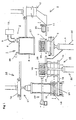
- an apparatus for separating an as-cast product from a green-sand mold that has been filled with a melted material is comprised of an airtight-surrounding member 1 to air-tightly surround a green-sand mold that has been filled with a melted material and that does not have a flask, a suction member 2, which exhausts and decompresses the space that is defined by the airtight-surrounding member 1 to a negative pressure condition, and which member maintains the negative-pressure condition over a certain time, and a taking-out member 3, which takes the as-cast product out of the green-sand mold that has been broken after the negative-pressure condition is restored.
- the airtight-surrounding member 1 is comprised of a box-like tray 5, which can be lifted up or down by a cylinder 4, and a reversely-positioned box-like cover 6, which is fixed above the tray 5.
- a base member 7 is positioned on the tray 5.
- the base member is comprised of a plurality of belt-like plates that are arranged in the right and left directions in Fig. 1.
- the tray 5 and the base member 7 can be rotated counterclockwise and inclined at an angle so that a green-sand mold may slide on the member 7.
- a pressure-detection mechanism 26 is located on the cover 6 to sense the inner pressure of it.
- a sealing member 27 is embedded at the lower end of the cover 6.
- the suction member 2 is connected to the cover 6.
- the suction member 2 includes a valve 8, a conduit 9, and a vacuum source 10.
- the taking-out member 3 is comprised of a fork member 11, which can be moved up, down, right, and left; and rotated horizontally, and a driving mechanism 12, which moves the fork member 11 right, left, up, and down, and rotates it horizontally.
- the number 13 denotes a transmitting apparatus to horizontally carry a set of upper and lower green-sand molds 15, having a set of upper and lower flask 14.
- the transmitting apparatus 13 is comprised of a moving carriage 16, which can be reciprocated in the right and left directions in Fig. 1, and a lifting mechanism 17, which is located on the moving carriage 16 to lift the upper and lower flasks 14.
- the number 18 denotes a taking-out apparatus to take the upper and lower green-sand molds 15 out of the upper and lower flasks 14.
- the taking-out apparatus is comprised of a cast base 19, on which the upper and lower flasks 14 are put, a taking-out mechanism 20, which takes the upper green-sand molds 15 out of the upper and lower flasks 14, and a stopper 21, to prevent the upper and lower flasks 14 from rising.
- the number 23 denotes a surface-table carrier.
- the number 24 denotes a chute for recycling material.
- the upper and lower green-sand molds 15 having the upper and lower flasks 14 that have been filled with a melted material are put on the surface-table carrier 23 and are conveyed through a cooling line of this casting line.
- the upper and lower green-sand molds 15 are lifted by the lifting mechanism 17 of the transmitting apparatus 13, and transmitted to the base 19 of the taking-out apparatus 18.
- the upper and lower green-sand molds 15, including the as-cast product 25 are taken out of the upper and lower flasks 14 by the taking-out mechanism 20 of the taking-out apparatus 18.
- the upper and lower green-sand molds 15, which have been taken out of the upper and lower flasks 14, are pushed and put on the base member 7 of the airtight-surrounding member 1 by an extruding apparatus 22.
- the base member 7, on which the upper and lower green-sand molds 15 are located is lifted by extending the cylinder 4 of the airtight-surrounding member 1 to contact the sealing member 27 with the tray 7, so that, as in Fig. 2, the upper and lower green-sand molds 15 are gas-tightly surrounded by the tray 5 and the cover 6.
- a layer (a moisture-condensed layer) 28 is formed around the as-cast product 25 in the upper and lower green-sand molds 15. Much moisture is condensed at the layer. The moisture is higher in temperature than the other parts of the upper and lower green-sand molds 15 due to the heat of the as-cast product 25. Thus, the moisture-condensed layer 28 is weak. While the pressure in the cover 6 is sensed by the pressure-detection mechanism 26, the valve 8 of the suction member 2 is opened to abruptly exhaust the airtight space defined by both the tray 5 and the cover 6 and reduce its pressure such that the space is changed to a negative pressurized condition. That is, as in Fig.
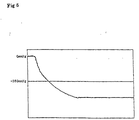
- the inner pressure in the structure forming the space is rapidly aspirated to reduce the pressure to a pressure of ⁇ 200 mmHg or less as expressed in gauge pressure within a period of 0.5 second and finally to a pressure of ⁇ 360 mmHg or less as expressed in gauge pressure (below, all the pressure is referred to in gauge pressure).
- the reason the pressure is rapidly reduced to a pressure of ⁇ 200 mmHg or less within a period of 0.5 second is that if the pressure were slowly reduced, gas generated by the boiling would be slowly diffused from the green-sand mold, so that the forces that would be generated would not be enough to rapidly break the green-sand mold.
- an atmospheric-pressure restoring valve (not shown) that is located on the cover 6 is opened to restore the pressure in the cover 6 to the atmospheric pressure.
- the cylinder 4 is retracted to move down the tray 5, the upper and lower green-sand molds 15, the as-cast product 25, etc.
- the driving mechanism 12 of the taking-out member 3 for as-cast products is driven to move the fork member 11 leftward in relation to Fig. 1 and below the as-cast product 25.
- the driving mechanism 12 is driven to raise the fork member 11 to lift the as-cast member 25 from the base member 7.
- the driving mechanism 12 is driven to move the fork member 11 and the as-cast product 25 rightward in relation to Fig. 1.
- the as-cast product 25 is conveyed to a following processing step. Then, the tray 5 and the cast-base member 7 are inclined so that any pieces of the green-sand mold that are deposited on the tray 5 may be expelled to the restoring chute 24 to a sand treatment line.
- the green-sand mold contained flasks just after the molding had finished.
- the green-sand mold that has been filled with a melted material and that does not contain a flask is made by taking the upper and lower green-sand molds having the upper and lower flasks out of the upper and lower flasks after the melted material is supplied.
- the green-sand mold is not limited to one made by that method.
- green-sand molds that do not have a flask just after they are molded by a so-called snap flask-type molding apparatus can generate the same effects.
- generally a jacket covers the upper and lower green-sand molds while melted material is supplied.
- the green-sand mold that has been filled with a melted material and that has no flask can be divided along the horizontal plane.
- the embodiment is not limited to that carried out by that method. For example, even if the upper and lower green-sand molds stand vertically to supply a melted material, the same effect can be generated.
- the invention of claim 1 relates to a method for separating an as-cast product from a green-sand mold that has been filled with a melted material.
- the method includes the steps for gas-tightly surrounding a green-sand mold that has been filled with a melted material and that has no flask, rapidly aspirating the inner pressure in a structure gas-tightly surrounding the green-sand mold within a period of 0.5 second to reduce the pressure to a pressure of ⁇ 200 mmHg or less and finally to a pressure of ⁇ 360 mmHg or less, thereby reducing the boiling temperature of the water present within the entire green-sand mold that includes a condensed moisture layer formed around the as-cast product in the green-sand mold to bring this water to a boil, so that the green-sand mold is broken and separated from the as-cast product, and restoring the structure to the original pressure to take out the as-cast product.
- this method can generate several effects. For example, it does not
- the apparatus for separating an as-cast product from a green-sand mold that has been filled with a melted material has a supporting apparatus 40 to support a green-sand mold on the smallest area on it that can be contacted.
- the other members and apparatuses are the same as those denoted by the same reference numbers in Fig. 1.
- the supporting apparatus 40 has a plurality of bar members 45, which stand on the upper surface of the box-like tray 5, as explained below.
- the tray 5 and the bar members 45 are rotated counterclockwise and inclined to an angle such that the green-sand mold can slide down on them.
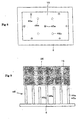
- bar members 45a of the plurality of the bar members 45 are the longest (as in Fig. 9). At least three bar members 45a are needed to support the green-sand mold. Bar members 45b of the remainder of the plurality of the bar members 45 are slightly shorter than the bar members 45a. They can support the as-cast product by their upper ends when the green-sand mold is broken (Fig. 9).
- the supporting apparatus 40 has a supporting-assistance mechanism 30 to temporarily support a green-sand mold when it is transmitted to the supporting apparatus 40.
- the supporting-assistance mechanism 30 is comprised of a supporting member 31, which horizontally extends through spaces between the bar members 45, and cylinders 32, which lift upward the supporting member 31.
- the supporting member 31 can be extended or extracted above or below the horizontal level defined by the upper ends of the plurality of the bar members 45.
- the cylinders 32 of the supporting-assistance mechanism 30 are extended to elevate the supporting member 31 above the horizontal level that is defined by the upper ends of the bar members 45. Under this condition the upper and lower green-sand molds 15, which include the as-cast product 25, are pulled out of the upper and lower flasks 14 by the taking-out mechanism 20.
- the upper and lower green-sand molds 15, which have been pulled out of the upper and lower flasks 14, are pushed by the extruding apparatus 22 to the supporting member 31.
- the cylinders 32 are extracted to make the upper and lower green-sand molds 15, the supporting member 31, etc. descend and to put the upper and lower green-sand molds 15 on the upper ends of the bar members 45.
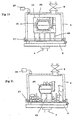
- the cylinder 4 of the airtight-surrounding member 1 is extended to make the bar members 45 etc. ascend and contact the seal member 27 with the tray 5, so that, as in Fig. 7, the upper and lower green-sand molds 15 are surrounded by the tray 5 and the cover 6.
- a condensed moisture layer 28 is formed, at which layer much moisture has a temperature higher than the other parts of the upper and lower green-sand molds 15 due to the heat of the as-cast product 25.
- the moisture condensed layer 28 is weak.
- the valve 8 of the suction member 2 is opened to abruptly exhaust the airtight space defined by both the tray 5 and the cover 6 and to reduce its pressure, such that the space is changed to a negative pressurized condition.
- the inner pressure in the structure forming the space is rapidly aspirated to reduce the pressure to a pressure of ⁇ 200 mmHg or less within a period of 0.5 second and finally to a pressure of ⁇ 360 mmHg or less.
- the boiling point of the moisture included in the entire green-sand molds 15, which include the moisture condensed layer 28, decreases, so that the moisture is boiled away.
- the upper and lower green-sand molds 15 are supported on the tip ends of the bar members 45, so that the area of the molds 15 contacted with the tip ends is very small.
- the lower part of the mold is supported such that it can be easily broken.
- the upper and lower green-sand molds 15 are made to be surely and easily broken and separated from the as-cast product 25 (as in Fig. 11).
- the pieces of the green-sand molds are deposited on the tray 5. No core sand is broken by the boiling.
- the core sand is kept in the as-cast product 25, so that it is never mixed with the pieces of the green-sand mold.
- an atmospheric-pressure restoring valve (not shown) that is located on the cover 6 is opened to restore the pressure in the cover 6 to the atmospheric pressure.
- the cylinder 4 is retracted to move down the tray 5, the upper and lower green-sand molds 15, the as-cast product 25, etc.
- the driving mechanism 12 of the taking-out member 3 for as-cast products is driven to move the fork member 11 leftward in relation to Fig. 6 and below the as-cast product 25.
- the driving mechanism 12 is driven to raise the fork member 11 to lift the as-cast member 25 from the bar members 45.
- the driving mechanism 12 is driven to move rightward (as in Fig. 6) the fork member 11 and the as-cast product 25.
- the as-cast product 25 is conveyed to a following processing step. Then, the tray 5 and the bar members 45 are inclined so that any pieces of the green-sand molds that are deposited on the tray 5 may be expelled to convey them to a sand treatment line.
- the upper and lower green-sand molds 15 do not have any flask after they are taken out of the upper and lower flask 14 after melted material has been supplied
- Green-sand molds that have flasks can generate the same effects.
- the upper and lower green-sand molds that have been filled with a melted material and that do not have any flask are a cast that includes an upper flask and a lower flask.
- those molds are not limited to that The upper flask that is separated from the lower flask can generate the same effects.
- the method in claim 8 for separating an as-cast product from a green-sand mold that has been filled with a melted material which includes the steps for gas-tightly surrounding a green-sand mold that has been filled with a melted. material by the smallest area that can be contacted, rapidly aspirating the inner pressure in a structure gas-tightly surrounding the green-sand mold to a negative pressure, thereby reducing the boiling temperature of the water being present within the entire green-sand mold that includes a condensed-moisture layer formed around the as-cast product in the green-sand mold to bring this water to a boil, so that the green-said mold is broken and separated from the as-cast product, and restoring the structure to the original pressure to take out the as-cast product.
- this method can generate several effects. For example, it does not make dents in the as-cast products. Also, it makes sure that the as-cast product and the green-sand mold are easily separated and the green-sand mold is also easily broken.
Landscapes
- Engineering & Computer Science (AREA)
- Mechanical Engineering (AREA)
- Casting Devices For Molds (AREA)
Abstract
An as-cast mold and a green-sand mold can be surely separated. Also, a green-sand mold can be surely broken. The green-sand mold that has been filled with a melted material and that does not have a flask is gas-tightly surrounded. The pressure in a structure gas-tightly surrounding the green-sand mold is reduced within a period of 0.5 second to a pressure of -200 mmHg or less and finally to a pressure of -360 mmHg or less, thereby reducing the boiling temperature of the water being present within the entire green-sand mold, including a condensed moisture layer formed around the as-cast product in the green-sand mold, to bring this water to a boil, so that the green-sand mold is broken and separated from the as-cast product, and to restore the original pressure of the structure to take out the as-cast product. <IMAGE>
Description
This invention relates to a proper method and apparatus for separating an as-cast
product from a green-sand mold that has been supplied with a melted material
As conventional methods for separating a green-sand mold that has been
supplied with a melted material and that has a flask from an as-cast product after
the green-sand mold is broken, these methods have been generally known: for
example, 1) a method for taking a green-sand mold out of a flask, and then using the
falling impact on the green-sand mold caused by the gravity or a vibrator, so that the
green sand mold is broken and separated from an as-cast product by the weight of
the green-sand mold and the vibrations of the vibrator; 2) a method for using impacts
given by mechanical forces caused by, for example, inserting a wedge-like projection
into a green-sand mold when a green-sand mold is taken out of a flask, so that the
green-sand mold is broken and separated from an as-cast product, and 3) a method
for taking a green-sand mold out of a flask to supply the green-sand mold into a
rotating drum or a vibrating drum, so that the green-sand mold is broken and
separated from an as-cast product by the weight or fall of the green-sand mold and
its heat.
However, those methods use strong impacts on a green-sand mold and an as-cast
product to separate them, so that they may cause the as-cast product to have
defects such as breakages, chips, and deformations, essentially when the as-cast
product contacts other products. Recently, since complications of shapes and high
accuracy of dimensions of as-cast products are needed so that green-sand molds
having high hardness and strength may be formed and cast, stronger forces are
needed to separate the green-sand mold and the as-cast product.
Also, it is difficult to break the green-sand molds having high strength as
stated above, so that the green-sand molds cannot be fully separated from the as-cast
products. Then the as-cast products are conveyed to a following step with parts
of the green-sand molds attached to the as-cast products. Thus, the efficiency of the
retrieval of the green-sand molds has been low in a green-sand molding plant where
the green sands are repeatedly used. Also, costs of the green sands increase. Core
sands are mixed with the recycled sands so that the treatment of the sands becomes
difficult Since a plurality of as-cast products are transmitted to a following
processing step at the same time, the background of each product cannot be
identified. Thus, when defective products are found, it is difficult to make a definite
determination of the reasons for the defects. Thus, it is difficult to fully overcome
their defects.
This invention was conceived to overcome those disadvantages. The object of
this invention is to provide a method and apparatus for perfectly separating a green-sand
mold and an as-cast product, and definitely breaking the green-sand mold.
To achieve that object; this invention provides a method and apparatus for
separating an as-cast product from a green-sand mold that has been filled with a
melted material. The method is characterized by the steps of gas-tightly
surrounding a green-sand mold that has been filled with a melted material and that
has no flask, rapidly aspirating the inner pressure in a structure gas-tightly
surrounding the green-sand mold within a period of 0.5 second to reduce the
pressure to a pressure of ―200 mmHg or less and finally to a pressure of ―360 mmHg
or less, thereby reducing the boiling temperature of the water present within the
entire green-sand mold that includes a condensed moisture layer formed around the
as-cast product in the green-sand mold to bring this water to a boil, so that the
green-sand mold is broken and separated from the as-cast product, and restoring the
structure to the original pressure to take out the as-cast product.
Generally, around an as-cast product in an upper and lower green-sand mold
a condensed moisture layer is formed, at which layer much moisture has a
temperature higher than the other parts of the upper and lower green-sand mold
due to the heat of the as-cast product. Thus, in this invention a green-sand mold
that has been filled with a melted material and that does not have a flask is gas-tightly
surrounded, and then the pressure in the structure gas-tightly surrounding
the green-sand mold is rapidly reduced to a pressure of ―200 mmHg or less within a
period of 0.5 second as expressed in gauge pressure and finally to a pressure of ―360
mmHg or less as expressed in gauge pressure. As a result, the boiling point of the
water decreases, and the water heated by the as-cast product is boiled. Thus, the
green-sand mold is broken and separated from the as-cast product. Then, this
negative pressure condition is released and the as-cast product is taken out. The
reason the pressure is rapidly reduced to a pressure of ―200 mmHg or less within a
period of 0.5 second is that if the pressure were slowly reduced, the gas generated in
boiling would slowly be diffused from the green-sand mold, so that the enough forces
to rapidly break the green-sand mold would not be generated. Also, another reason
is that if the reduced pressure were higher than ―360 mmHg, the boiling that could
break the green-sand mold would not be generated.
In the method for separating a green-sand mold and an as-cast product of the
invention of claim 1, a green-sand mold that has been filled with a melted material
and that does not have a flask means a mold that is separated from the flask of a
green-sand mold that contains the flask just after a molding is made, or a mold that
does not contain a flask just after a molding is made.
Now, based on Figs. 1 and 2 an embodiment of this invention is detailed. As
in Fig. 1, an apparatus for separating an as-cast product from a green-sand mold
that has been filled with a melted material is comprised of an airtight-surrounding
member 1 to air-tightly surround a green-sand mold that has been filled with a
melted material and that does not have a flask, a suction member 2, which exhausts
and decompresses the space that is defined by the airtight-surrounding member 1 to
a negative pressure condition, and which member maintains the negative-pressure
condition over a certain time, and a taking-out member 3, which takes the as-cast
product out of the green-sand mold that has been broken after the negative-pressure
condition is restored.
As in Fig. 1, the airtight-surrounding member 1 is comprised of a box-like tray
5, which can be lifted up or down by a cylinder 4, and a reversely-positioned box-like
cover 6, which is fixed above the tray 5. A base member 7 is positioned on the tray 5.
On the base member a green-sand mold is put. The base member is comprised of a
plurality of belt-like plates that are arranged in the right and left directions in Fig. 1.
The tray 5 and the base member 7 can be rotated counterclockwise and inclined at
an angle so that a green-sand mold may slide on the member 7. A pressure-detection
mechanism 26 is located on the cover 6 to sense the inner pressure of it. A
sealing member 27 is embedded at the lower end of the cover 6. Also, the suction
member 2 is connected to the cover 6. The suction member 2 includes a valve 8, a
conduit 9, and a vacuum source 10.
The taking-out member 3 is comprised of a fork member 11, which can be
moved up, down, right, and left; and rotated horizontally, and a driving mechanism
12, which moves the fork member 11 right, left, up, and down, and rotates it
horizontally.
The number 13 denotes a transmitting apparatus to horizontally carry a set of
upper and lower green-sand molds 15, having a set of upper and lower flask 14.
The transmitting apparatus 13 is comprised of a moving carriage 16, which can be
reciprocated in the right and left directions in Fig. 1, and a lifting mechanism 17,
which is located on the moving carriage 16 to lift the upper and lower flasks 14.
The number 18 denotes a taking-out apparatus to take the upper and lower green-sand
molds 15 out of the upper and lower flasks 14. The taking-out apparatus is
comprised of a cast base 19, on which the upper and lower flasks 14 are put, a
taking-out mechanism 20, which takes the upper green-sand molds 15 out of the
upper and lower flasks 14, and a stopper 21, to prevent the upper and lower flasks
14 from rising. The number 23 denotes a surface-table carrier. The number 24
denotes a chute for recycling material.
Next, the function of the system constructed above is explained. The upper
and lower green-sand molds 15 having the upper and lower flasks 14 that have been
filled with a melted material are put on the surface-table carrier 23 and are conveyed
through a cooling line of this casting line. The upper and lower green-sand molds
15 are lifted by the lifting mechanism 17 of the transmitting apparatus 13, and
transmitted to the base 19 of the taking-out apparatus 18. Then, the upper and
lower green-sand molds 15, including the as-cast product 25, are taken out of the
upper and lower flasks 14 by the taking-out mechanism 20 of the taking-out
apparatus 18. Then, the upper and lower green-sand molds 15, which have been
taken out of the upper and lower flasks 14, are pushed and put on the base member
7 of the airtight-surrounding member 1 by an extruding apparatus 22. Then, the
base member 7, on which the upper and lower green-sand molds 15 are located, is
lifted by extending the cylinder 4 of the airtight-surrounding member 1 to contact
the sealing member 27 with the tray 7, so that, as in Fig. 2, the upper and lower
green-sand molds 15 are gas-tightly surrounded by the tray 5 and the cover 6.
Generally, as in Fig. 3, a layer (a moisture-condensed layer) 28 is formed
around the as-cast product 25 in the upper and lower green-sand molds 15. Much
moisture is condensed at the layer. The moisture is higher in temperature than the
other parts of the upper and lower green-sand molds 15 due to the heat of the as-cast
product 25. Thus, the moisture-condensed layer 28 is weak. While the pressure in
the cover 6 is sensed by the pressure-detection mechanism 26, the valve 8 of the
suction member 2 is opened to abruptly exhaust the airtight space defined by both
the tray 5 and the cover 6 and reduce its pressure such that the space is changed to a
negative pressurized condition. That is, as in Fig. 5, the inner pressure in the
structure forming the space is rapidly aspirated to reduce the pressure to a pressure
of ―200 mmHg or less as expressed in gauge pressure within a period of 0.5 second
and finally to a pressure of ―360 mmHg or less as expressed in gauge pressure
(below, all the pressure is referred to in gauge pressure). The reason the pressure is
rapidly reduced to a pressure of ―200 mmHg or less within a period of 0.5 second is
that if the pressure were slowly reduced, gas generated by the boiling would be
slowly diffused from the green-sand mold, so that the forces that would be generated
would not be enough to rapidly break the green-sand mold. Also, another reason is
that if the reduced pressure were higher than ―360 mmHg, the boiling that could
break the green-sand mold would not be generated. When the pressure in the
space is reduced, the boiling point of the moisture included in the entire green-sand
mold 15 that includes the condensed moisture layer 28 decreases, so that the
moisture is boiled away. Thus, the green-sand molds 15 are broken and separated
from the as-cast product 25 (as in Fig. 4). The pieces of the broken green-sand
molds are deposited on the tray 5. A core sand is not broken by the boiling. Thus,
the core sand is kept in the as-cast product 25, so that it is never mixed with the
pieces of the green-sand mold.
Then, after the valve 8 is closed, an atmospheric-pressure restoring valve (not
shown) that is located on the cover 6 is opened to restore the pressure in the cover 6
to the atmospheric pressure. Then, the cylinder 4 is retracted to move down the
tray 5, the upper and lower green-sand molds 15, the as-cast product 25, etc. Then,
the driving mechanism 12 of the taking-out member 3 for as-cast products is driven
to move the fork member 11 leftward in relation to Fig. 1 and below the as-cast
product 25. Then, the driving mechanism 12 is driven to raise the fork member 11
to lift the as-cast member 25 from the base member 7. Then, the driving
mechanism 12 is driven to move the fork member 11 and the as-cast product 25
rightward in relation to Fig. 1. Then, the as-cast product 25 is conveyed to a
following processing step. Then, the tray 5 and the cast-base member 7 are inclined
so that any pieces of the green-sand mold that are deposited on the tray 5 may be
expelled to the restoring chute 24 to a sand treatment line.
In the embodiment as explained above, the green-sand mold contained flasks
just after the molding had finished. The green-sand mold that has been filled with
a melted material and that does not contain a flask is made by taking the upper and
lower green-sand molds having the upper and lower flasks out of the upper and
lower flasks after the melted material is supplied. The green-sand mold is not
limited to one made by that method. For example, green-sand molds that do not
have a flask just after they are molded by a so-called snap flask-type molding
apparatus can generate the same effects. In this case, generally a jacket covers the
upper and lower green-sand molds while melted material is supplied. Also, in the
embodiment stated above, the green-sand mold that has been filled with a melted
material and that has no flask can be divided along the horizontal plane. But, the
embodiment is not limited to that carried out by that method. For example, even if
the upper and lower green-sand molds stand vertically to supply a melted material,
the same effect can be generated.
From the explanations stated above, it is seen that the invention of claim 1
relates to a method for separating an as-cast product from a green-sand mold that
has been filled with a melted material. The method includes the steps for gas-tightly
surrounding a green-sand mold that has been filled with a melted material
and that has no flask, rapidly aspirating the inner pressure in a structure gas-tightly
surrounding the green-sand mold within a period of 0.5 second to reduce the
pressure to a pressure of ―200 mmHg or less and finally to a pressure of ―360 mmHg
or less, thereby reducing the boiling temperature of the water present within the
entire green-sand mold that includes a condensed moisture layer formed around the
as-cast product in the green-sand mold to bring this water to a boil, so that the
green-sand mold is broken and separated from the as-cast product, and restoring the
structure to the original pressure to take out the as-cast product. Thus, this method
can generate several effects. For example, it does not make dents in the as-cast
products. Also, it makes sure that the as-cast product and the green-sand mold are
easily separated, and that the green-sand mold is also easily broken.
Next, based on Figs. 6-11, a second embodiment of this invention is now
explained. As in Fig. 6, the apparatus for separating an as-cast product from a
green-sand mold that has been filled with a melted material has a supporting
apparatus 40 to support a green-sand mold on the smallest area on it that can be
contacted. The other members and apparatuses are the same as those denoted by
the same reference numbers in Fig. 1. The supporting apparatus 40 has a plurality
of bar members 45, which stand on the upper surface of the box-like tray 5, as
explained below. The tray 5 and the bar members 45 are rotated counterclockwise
and inclined to an angle such that the green-sand mold can slide down on them.
As in Figs. 8 and 9, bar members 45a of the plurality of the bar members 45,
which members 45a are positioned both at the center and near the periphery of the
tray 5, are the longest (as in Fig. 9). At least three bar members 45a are needed to
support the green-sand mold. Bar members 45b of the remainder of the plurality of
the bar members 45 are slightly shorter than the bar members 45a. They can
support the as-cast product by their upper ends when the green-sand mold is broken
(Fig. 9).
Also, the supporting apparatus 40 has a supporting-assistance mechanism 30
to temporarily support a green-sand mold when it is transmitted to the supporting
apparatus 40. The supporting-assistance mechanism 30 is comprised of a
supporting member 31, which horizontally extends through spaces between the bar
members 45, and cylinders 32, which lift upward the supporting member 31. The
supporting member 31 can be extended or extracted above or below the horizontal
level defined by the upper ends of the plurality of the bar members 45.
Next, this embodiment is now explained As in Fig. 6, the cylinders 32 of the
supporting-assistance mechanism 30 are extended to elevate the supporting
member 31 above the horizontal level that is defined by the upper ends of the bar
members 45. Under this condition the upper and lower green-sand molds 15,
which include the as-cast product 25, are pulled out of the upper and lower flasks 14
by the taking-out mechanism 20.
Then, the upper and lower green-sand molds 15, which have been pulled out
of the upper and lower flasks 14, are pushed by the extruding apparatus 22 to the
supporting member 31. Then, the cylinders 32 are extracted to make the upper
and lower green-sand molds 15, the supporting member 31, etc. descend and to put
the upper and lower green-sand molds 15 on the upper ends of the bar members 45.
Then, the cylinder 4 of the airtight-surrounding member 1 is extended to make the
bar members 45 etc. ascend and contact the seal member 27 with the tray 5, so that,
as in Fig. 7, the upper and lower green-sand molds 15 are surrounded by the tray 5
and the cover 6.
Similar to the first embodiment, as in Fig. 10, generally around the as-cast
product 25 in the upper and lower green-sand molds 15 a condensed moisture layer
28 is formed, at which layer much moisture has a temperature higher than the other
parts of the upper and lower green-sand molds 15 due to the heat of the as-cast
product 25. The moisture condensed layer 28 is weak. Thus, as the pressure in
the cover 6 is sensed by the pressure-detection mechanism 26, the valve 8 of the
suction member 2 is opened to abruptly exhaust the airtight space defined by both
the tray 5 and the cover 6 and to reduce its pressure, such that the space is changed
to a negative pressurized condition. For example, as in Fig. 5, like the first
embodiment, the inner pressure in the structure forming the space is rapidly
aspirated to reduce the pressure to a pressure of ―200 mmHg or less within a period
of 0.5 second and finally to a pressure of ―360 mmHg or less. As a result, the boiling
point of the moisture included in the entire green-sand molds 15, which include the
moisture condensed layer 28, decreases, so that the moisture is boiled away. At that
time, the upper and lower green-sand molds 15 are supported on the tip ends of the
bar members 45, so that the area of the molds 15 contacted with the tip ends is very
small. Thus, the lower part of the mold is supported such that it can be easily
broken. As a result, the upper and lower green-sand molds 15 are made to be
surely and easily broken and separated from the as-cast product 25 (as in Fig. 11).
The pieces of the green-sand molds are deposited on the tray 5. No core sand is
broken by the boiling. Thus, the core sand is kept in the as-cast product 25, so that
it is never mixed with the pieces of the green-sand mold.
Then, after the valve 8 is closed, an atmospheric-pressure restoring valve (not
shown) that is located on the cover 6 is opened to restore the pressure in the cover 6
to the atmospheric pressure. Then, the cylinder 4 is retracted to move down the
tray 5, the upper and lower green-sand molds 15, the as-cast product 25, etc. Then,
the driving mechanism 12 of the taking-out member 3 for as-cast products is driven
to move the fork member 11 leftward in relation to Fig. 6 and below the as-cast
product 25. Then, the driving mechanism 12 is driven to raise the fork member 11
to lift the as-cast member 25 from the bar members 45. Then, the driving
mechanism 12 is driven to move rightward (as in Fig. 6) the fork member 11 and the
as-cast product 25. Then, the as-cast product 25 is conveyed to a following
processing step. Then, the tray 5 and the bar members 45 are inclined so that any
pieces of the green-sand molds that are deposited on the tray 5 may be expelled to
convey them to a sand treatment line.
In the second embodiment, the upper and lower green-sand molds 15 do not
have any flask after they are taken out of the upper and lower flask 14 after melted
material has been supplied However, that embodiment is not limited to being
carried out by that method. Green-sand molds that have flasks can generate the
same effects. Also, in the second embodiment the upper and lower green-sand
molds that have been filled with a melted material and that do not have any flask
are a cast that includes an upper flask and a lower flask. However, those molds are
not limited to that The upper flask that is separated from the lower flask can
generate the same effects.
Thus, the method in claim 8 for separating an as-cast product from a green-sand
mold that has been filled with a melted material, which includes the steps for
gas-tightly surrounding a green-sand mold that has been filled with a melted.
material by the smallest area that can be contacted, rapidly aspirating the inner
pressure in a structure gas-tightly surrounding the green-sand mold to a negative
pressure, thereby reducing the boiling temperature of the water being present
within the entire green-sand mold that includes a condensed-moisture layer formed
around the as-cast product in the green-sand mold to bring this water to a boil, so
that the green-said mold is broken and separated from the as-cast product, and
restoring the structure to the original pressure to take out the as-cast product.
Thus, this method can generate several effects. For example, it does not make
dents in the as-cast products. Also, it makes sure that the as-cast product and the
green-sand mold are easily separated and the green-sand mold is also easily broken.
Claims (13)
- A method for separating an as-cast product from a green-sand mold that has been filled with a melted material including the steps ofgas-tightly surrounding a green-sand mold that has been filled with a melted material.rapidly lowering the inner pressure in a surrounding gas-tight structure within a period of 0.5 second to reduce the pressure to a pressure of ―200 mmHg or less and finally to a pressure of ―360 mmHg or less, thereby reducing the boiling temperature of the water present within the entire green-sand mold, including a condensed moisture layer formed around the as-cast product in the green-sand mold, to bring this water to a boil, so that the green-sand mold is broken and separated from the as-cast product, andrestoring the original pressure of the structure to take out the as-cast product
- A method for separating an as-cast product from a green-sand mold that has been filled with a melted material including the steps forgas-tightly surrounding a green-sand mold that has been filled with a melted material and that does not have a flask,rapidly lowering the inner pressure in a structure gas-tightly surrounding the green-sand mold within a period of 0.5 second to reduce the pressure to a pressure of ―200 mmHg or less and finally to a pressure of ―360 mmHg or less, thereby reducing the boiling temperature of the water being present within the entire green-sand mold, including a condensed moisture layer formed around the as-cast product in the green-sand mold to bring this water to a boil, so that the green-sand mold is broken and separated from the as-cast product, andrestoring the original pressure of the structure to take out the as-cast product.
- The method of claim 2 wherein the green-sand mold that has been filled with a melted material and that does not contain a flask is separated from a flask of a green-sand mold that contains a flask just after a molding step, is finished.
- The method of claim 2 wherein the green-sand mold that has been filled with a melted, material and that does not contain a flask is a green mold that does not contain a flask just after a molding step is finished.
- The method of any one of claims 2 - 4 wherein the green-sand mold that has been filled with a melted material and that does not contain a flask is divided into two parts.
- An apparatus for separating an as-cast product from a green-sand mold that has been filled with a melted, material comprising:an airtight-surrounding means for gas-tightly surrounding a green-sand mold that has been filled with a melted material and that does not contain a flask,a suction means rapidly reducing a space defined by the airtight-surrounding means within a period of 0.5 second to a pressure of ―200 mmHg or less and finally to a pressure of ―360 mmHg or less, anda taking-out means restoring the original pressure of the structure to take the as-cast product out of the broken green-sand mold.
- An apparatus for separating an as-cast product from a green-sand mold that has been filled with a melted material comprising:an airtight-surrounding means for gas-tightly surrounding a green-sand mold that has been filled with a melted material,a suction means rapidly reducing the pressure in a space defined by the airtight-surrounding means within, a period of 0.5 second to a pressure of ―200 mmHg or less and finally to a pressure of ―360 mmHg or less, anda taking-out means restoring the original pressure of the structure to take the as-cast product out of the broken green-sand mold.
- A method for separating an as-cast product from a green-sand mold that has been filled with a melted material including the steps ofgas-tightly surrounding a green-sand mold that has been filled with a melted material and supporting the green-sand mold by the smallest area that can be contacted,rapidly reducing the inner pressure in a structure gas-tightly surrounding the green-sand mold to a negative pressure, thereby reducing the boiling temperature of the water present within the entire green-sand mold, including a condensed moisture layer formed around the as-cast product in the green-sand mold, to bring this water to a boil, so that the green-sand mold is broken and separated from the as-cast product, andrestoring the original pressure of the structure to take out the as-cast product
- The method of claim 8 wherein the green-sand mold that has been filled with a melted material is supported by a plurality of bar members on their tip ends, the bar members extending upward.
- The method of claim 8 wherein the step for reducing the inner pressure in the structure includes a step for reducing the inner pressure in a structure gas-tightly surrounding the green-sand mold within a period of 0.5 second to reduce the pressure to a pressure of ―200 mmHg or less and finally to a pressure of ―360 mmHg or less.
- An apparatus for separating an as-cast product from a green-sand mold that has been filled with a melted material comprising:a supporting means for supporting the green-sand mold that has been filled with a melted material under a condition where an area of the green-sand mold that is made to contact the supporting means is the smallest possible,an airtight-surrounding means for gas-tightly surrounding a green-sand mold that has been filled with a melted material and that is supported by the supporting means,a suction means rapidly reducing the pressure in a space defined by the airtight-surrounding means to a negative pressure, anda taking-out means taking the as-cast product out of the broken green-sand mold after the negative pressure is brought back to the original pressure.
- The apparatus of claim 11 wherein the supporting means includes a plurality of bar members that stand to support on their tip ends the green-sand mold that has been filled with a melted material.
- The apparatus of claim 11 wherein the suction means reduces the pressure in a space defined by the airtight-surrounding means within a period of 0.5 second to a pressure of ―200 mmHg or less and finally to a pressure of ―360 mmHg or less.
Applications Claiming Priority (9)
| Application Number | Priority Date | Filing Date | Title |
|---|---|---|---|
| JP11094601A JP2000288717A (en) | 1999-04-01 | 1999-04-01 | Method and apparatus for separating green sand mold and casting material |
| JP9460199 | 1999-04-01 | ||
| JP23053099A JP3341998B2 (en) | 1999-08-17 | 1999-08-17 | Method and apparatus for separating green sand mold and casting material |
| JP23053099 | 1999-08-17 | ||
| JP11232766A JP2001058256A (en) | 1999-08-19 | 1999-08-19 | Method and apparatus for separating green sand mold and casting material |
| JP23276699 | 1999-08-19 | ||
| JP25396899A JP3314765B2 (en) | 1999-09-08 | 1999-09-08 | Method and apparatus for separating green sand mold and casting material |
| JP25396899 | 1999-09-08 | ||
| PCT/JP2000/002101 WO2000059659A1 (en) | 1999-04-01 | 2000-03-31 | Method for separating green sand mold and as-cast product and apparatus therefor |
Publications (2)
| Publication Number | Publication Date |
|---|---|
| EP1092491A1 true EP1092491A1 (en) | 2001-04-18 |
| EP1092491A4 EP1092491A4 (en) | 2004-08-11 |
Family
ID=27468236
Family Applications (1)
| Application Number | Title | Priority Date | Filing Date |
|---|---|---|---|
| EP00913044A Withdrawn EP1092491A4 (en) | 1999-04-01 | 2000-03-31 | Method for separating green sand mold and as-cast product and apparatus therefor |
Country Status (2)
| Country | Link |
|---|---|
| EP (1) | EP1092491A4 (en) |
| WO (1) | WO2000059659A1 (en) |
Cited By (2)
| Publication number | Priority date | Publication date | Assignee | Title |
|---|---|---|---|---|
| CN109967725A (en) * | 2019-04-18 | 2019-07-05 | 淮北德林机械设备有限公司 | Sand shake-out device is used in a kind of casting |
| WO2021255140A1 (en) * | 2020-06-18 | 2021-12-23 | Universität Kassel | Vacuum mask, device and method for demolding a cast part |
Family Cites Families (5)
| Publication number | Priority date | Publication date | Assignee | Title |
|---|---|---|---|---|
| US3563711A (en) * | 1968-07-18 | 1971-02-16 | Trw Inc | Process for removal of siliceous cores from castings |
| US4620586A (en) * | 1977-03-23 | 1986-11-04 | General Kinematics | Method and apparatus for reclaiming foundry sand |
| JPS53125935A (en) * | 1977-04-11 | 1978-11-02 | Asahi Malleable Iron Co Ltd | Removement of casting sand |
| GB2266677B (en) * | 1992-05-08 | 1995-02-01 | Rolls Royce Plc | Improvements in or relating to the leaching of ceramic materials |
| JP2940338B2 (en) * | 1993-03-15 | 1999-08-25 | 日産自動車株式会社 | How to remove core sand |
-
2000
- 2000-03-31 WO PCT/JP2000/002101 patent/WO2000059659A1/en not_active Ceased
- 2000-03-31 EP EP00913044A patent/EP1092491A4/en not_active Withdrawn
Cited By (3)
| Publication number | Priority date | Publication date | Assignee | Title |
|---|---|---|---|---|
| CN109967725A (en) * | 2019-04-18 | 2019-07-05 | 淮北德林机械设备有限公司 | Sand shake-out device is used in a kind of casting |
| CN109967725B (en) * | 2019-04-18 | 2020-12-01 | 淮北禾获人科技有限公司 | Shakeout device for casting |
| WO2021255140A1 (en) * | 2020-06-18 | 2021-12-23 | Universität Kassel | Vacuum mask, device and method for demolding a cast part |
Also Published As
| Publication number | Publication date |
|---|---|
| WO2000059659A1 (en) | 2000-10-12 |
| EP1092491A4 (en) | 2004-08-11 |
Similar Documents
| Publication | Publication Date | Title |
|---|---|---|
| US4620586A (en) | Method and apparatus for reclaiming foundry sand | |
| EP1228826A1 (en) | Method and device for separating casting material from poured green sand mold | |
| JPH08164445A (en) | Mold making equipment | |
| JP4437765B2 (en) | Demolding device for sand mold with poured frame | |
| CN102380609A (en) | Foundry production line and shakeout method | |
| EP1205270A1 (en) | Method and device for collapsing and separating mold material and mold green sand from green sand mold | |
| WO2000059659A1 (en) | Method for separating green sand mold and as-cast product and apparatus therefor | |
| JP2001105128A (en) | Method and apparatus for removing casting material from poured hot sand mold | |
| JP2001071123A (en) | Casting material removal system from green sand mold with frame | |
| JP2022150554A (en) | Mold disassembling device | |
| JP3102994B2 (en) | Vanishing model casting equipment | |
| JP2001038462A (en) | Casting material removal system from poured hot sand mold | |
| JPH06182520A (en) | Suction casting method | |
| JP2001025859A (en) | Method and apparatus for separating casting mold and casting material | |
| JP3314765B2 (en) | Method and apparatus for separating green sand mold and casting material | |
| SU1423276A1 (en) | Method and apparatus for shaking out casting moulds | |
| JP3341998B2 (en) | Method and apparatus for separating green sand mold and casting material | |
| JP2001071121A (en) | Removal method of casting material from poured raw sand mold | |
| JP2001087851A (en) | Method and apparatus for removing casting material from poured hot sand mold | |
| JP3116463B2 (en) | Vacuum casting equipment | |
| JP2000288717A (en) | Method and apparatus for separating green sand mold and casting material | |
| JP2001287020A (en) | Method and apparatus for removing casting material from poured hot sand mold | |
| JP2001129656A (en) | Casting material removal device from poured hot sand mold | |
| JPH0259139A (en) | Apparatus for producing deformed pipe kind in expendable pattern casting | |
| JP2003170268A (en) | Casting removal method and casting removal device |
Legal Events
| Date | Code | Title | Description |
|---|---|---|---|
| PUAI | Public reference made under article 153(3) epc to a published international application that has entered the european phase |
Free format text: ORIGINAL CODE: 0009012 |
|
| 17P | Request for examination filed |
Effective date: 20001130 |
|
| AK | Designated contracting states |
Kind code of ref document: A1 Designated state(s): AT BE CH CY DE DK ES FI FR GB GR IE IT LI LU MC NL PT SE |
|
| A4 | Supplementary search report drawn up and despatched |
Effective date: 20040630 |
|
| STAA | Information on the status of an ep patent application or granted ep patent |
Free format text: STATUS: THE APPLICATION IS DEEMED TO BE WITHDRAWN |
|
| 18D | Application deemed to be withdrawn |
Effective date: 20040916 |