EP1092021B1 - Npy-y7 receptor gene - Google Patents
Npy-y7 receptor gene Download PDFInfo
- Publication number
- EP1092021B1 EP1092021B1 EP99928896A EP99928896A EP1092021B1 EP 1092021 B1 EP1092021 B1 EP 1092021B1 EP 99928896 A EP99928896 A EP 99928896A EP 99928896 A EP99928896 A EP 99928896A EP 1092021 B1 EP1092021 B1 EP 1092021B1
- Authority
- EP
- European Patent Office
- Prior art keywords
- npy
- receptor
- receptor polypeptide
- seq
- polynucleotide molecule
- Prior art date
- Legal status (The legal status is an assumption and is not a legal conclusion. Google has not performed a legal analysis and makes no representation as to the accuracy of the status listed.)
- Expired - Lifetime
Links
Images


Classifications
-
- C—CHEMISTRY; METALLURGY
- C07—ORGANIC CHEMISTRY
- C07K—PEPTIDES
- C07K14/00—Peptides having more than 20 amino acids; Gastrins; Somatostatins; Melanotropins; Derivatives thereof
- C07K14/435—Peptides having more than 20 amino acids; Gastrins; Somatostatins; Melanotropins; Derivatives thereof from animals; from humans
- C07K14/705—Receptors; Cell surface antigens; Cell surface determinants
- C07K14/70571—Receptors; Cell surface antigens; Cell surface determinants for neuromediators, e.g. serotonin receptor, dopamine receptor
-
- A—HUMAN NECESSITIES
- A01—AGRICULTURE; FORESTRY; ANIMAL HUSBANDRY; HUNTING; TRAPPING; FISHING
- A01K—ANIMAL HUSBANDRY; AVICULTURE; APICULTURE; PISCICULTURE; FISHING; REARING OR BREEDING ANIMALS, NOT OTHERWISE PROVIDED FOR; NEW BREEDS OF ANIMALS
- A01K2217/00—Genetically modified animals
- A01K2217/05—Animals comprising random inserted nucleic acids (transgenic)
Definitions
- the present invention relates to isolated polynucleotide molecules which encode a novel neuropeptide Y (NPY) receptor designated NPY-Y7.
- NPY neuropeptide Y
- the present invention relates to the use of these molecules in the production of NPY-Y7 receptors using recombinant DNA technology and to methods of screening and testing compounds for agonist or antagonist activity.
- Neuropeptide Y forms a family (called the pancreatic polypeptide family) together with pancreatic polypeptide (PP) and peptide YY (PYY), which all consist of 36 amino acids and possess a common tertiary structure.
- NPY receptors members of the G protein- coupled receptor superfamily, when activated influence a diverse range of important physiological parameters, including effects on psychomotor activity, central endocrine secretion, anxiety, reproduction, vasoactive effects on the cardiovascular system and strongly stimulates food consumption.
- Specific agonists and antagonists of NPY are therefore likely to be of substantial benefit for therapy of a wide range of clinical disorders.
- NPY possess a compact tertiary structure and different parts of the molecule are required for interaction with different subtypes of the receptor, the logical developments of both agonists and antagonists is critically dependent upon the availability and knowledge of specific receptor structure.
- NPY binds specifically to at least six receptors; Y1, Y2, Y3, Y4, Y5 (or "atypical Y1") and Y6. While it has been demonstrated that NPY receptors couple to the adenylate cyclase second messenger system, it remains probable that additional NPY receptor subtypes exist since there is evidence that phosphatidylinositol turnover, cations, and arachidonic acid may also function as second messengers for NPY.
- NPY agonists and antagonists may have commercial value as, for example, potential anti-hypertensive agents, cardiovascular drugs. neuronal growth factors, anti-psychotics, anti-obesity and anti-diabetic agents, the ability to produce NPY receptors by recombinant DNA technology would be advantageous. To this end, DNA molecules encoding Y1, Y2, Y4, Y5 and Y6 have previously been isolated. However, no further receptor molecules have so far been identified.
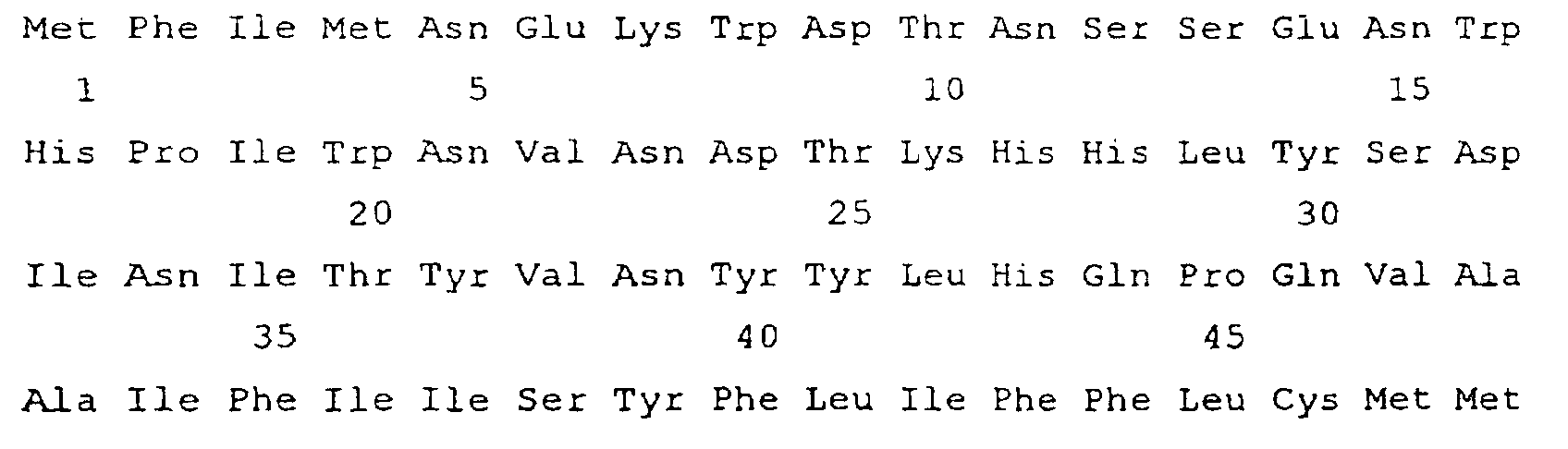
- the present invention provides an isolated polynucleotide molecule encoding a human NPY-Y7 receptor comprising the amino acid sequence set out in SEQ ID No. 2.
- an isolated polynucleotide molecule encoding an NPY-Y7 receptor polypeptide, wherein the polynucleotide molecule comprises a nucleotide sequence selected from the group consisting of: (i) the sequence set forth in SEQ ID No. 4; (ii) a sequence comprising nucleotides 369 to 1592 of SEQ ID No. 4; and (iii) a sequence that encodes the amino acid sequence set forth in SEQ ID No. 2.
- the polynucleotide molecule may comprise the nucleotide sequence set forth in SEQ ID No. 4 or a fragment thereof comprising nucleotides 369 to 1592 of SEQ ID No. 4.
- the encoded NPY-Y7 receptor may be characterised by the N-terminal amino acid sequence: wherein X 1 , X 2 , X 3 and X 4 are selected from codable amino acids but, preferably, X 1 is selected from Phe and Ser, X 2 is selected from Ile and Thr, X 3 is selected from Asn and Ser, and X 4 is selected from Thr and Ser.
- polynucleotide molecule comprising a nucleotide sequence substantially corresponding or, at least, showing at least 90% (more preferably, at least 95%) homology to that shown at nucleotides 1 to 1903 or nucleotides 369 to 1592 of SEQ ID No. 4 or any portion thereof encoding a functionally equivalent NPY-Y7 receptor fragment.
- the polynucleotide molecule may be incorporated into plasmids or expression vectors (including viral vectors), which may then be introduced into suitable bacterial, yeast, insect and mammalian host cells. Such host cells may be used to express the NPY-Y7 receptor.
- the present invention provides a plasmid or expression vector comprising the isolated polynucleotide molecule according to the first, second, or third aspect of the invention.
- a host cell transformed with the isolated polynucleotide molecule according to the first, second or third aspect of the invention, or a plasmid or expression vector according to the fourth aspect of the invention.
- the host cell may be a mammalian, insect, yeast or bacterial host cell.
- it is a mammalian or insect cell. More preferably, it is a Chinese hamster ovary (CHO) cell, human embryonic kidney (HEK) 293 cell or an insect Sf9 cell.
- the cell expresses the NPY-Y7 receptor polypeptide on its surface.
- NPY-Y7 receptors or functionally equivalent fragments thereof, comprising culturing a host cell as set out under conditions enabling the expression of NPY-Y7 receptors.
- the host cell is mammalian, it is presently preferred that it be a Chinese hamster ovary (CHO) cell, monkey kidney (COS) cell or human embryonic kidney 293 cell. Where the host cell is of insect origin, it is preferred that it be an insect Sf9 cell.
- CHO Chinese hamster ovary
- COS monkey kidney
- insect Sf9 insect Sf9
- the NPY-Y7 receptors or functionally equivalent fragments thereof are expressed onto the surface of the host cell.
- the polynucleotide molecule of the present invention encodes an NPY receptor which may be of interest both clinically and commercially as it is expressed in many regions of the body and neuropeptides of the NPY family affect a wide number of systems.
- polynucleotide molecule of the present invention By using the polynucleotide molecule of the present invention it is possible to obtain NPY-Y7 receptor protein or fragments thereof in a substantially pure form.
- the present invention provides an isolated NPY-Y7 receptor in a substantially pure form, wherein said polypeptide is encoded by the isolated polynucleotide according to the first, second or third aspect of the invention.
- the NPY-Y7 receptor polypeptide is a human receptor polypeptide consisting of about 408 amino acids in length. More preferably, it has the amino acid sequence set forth in SEQ ID No. 2.
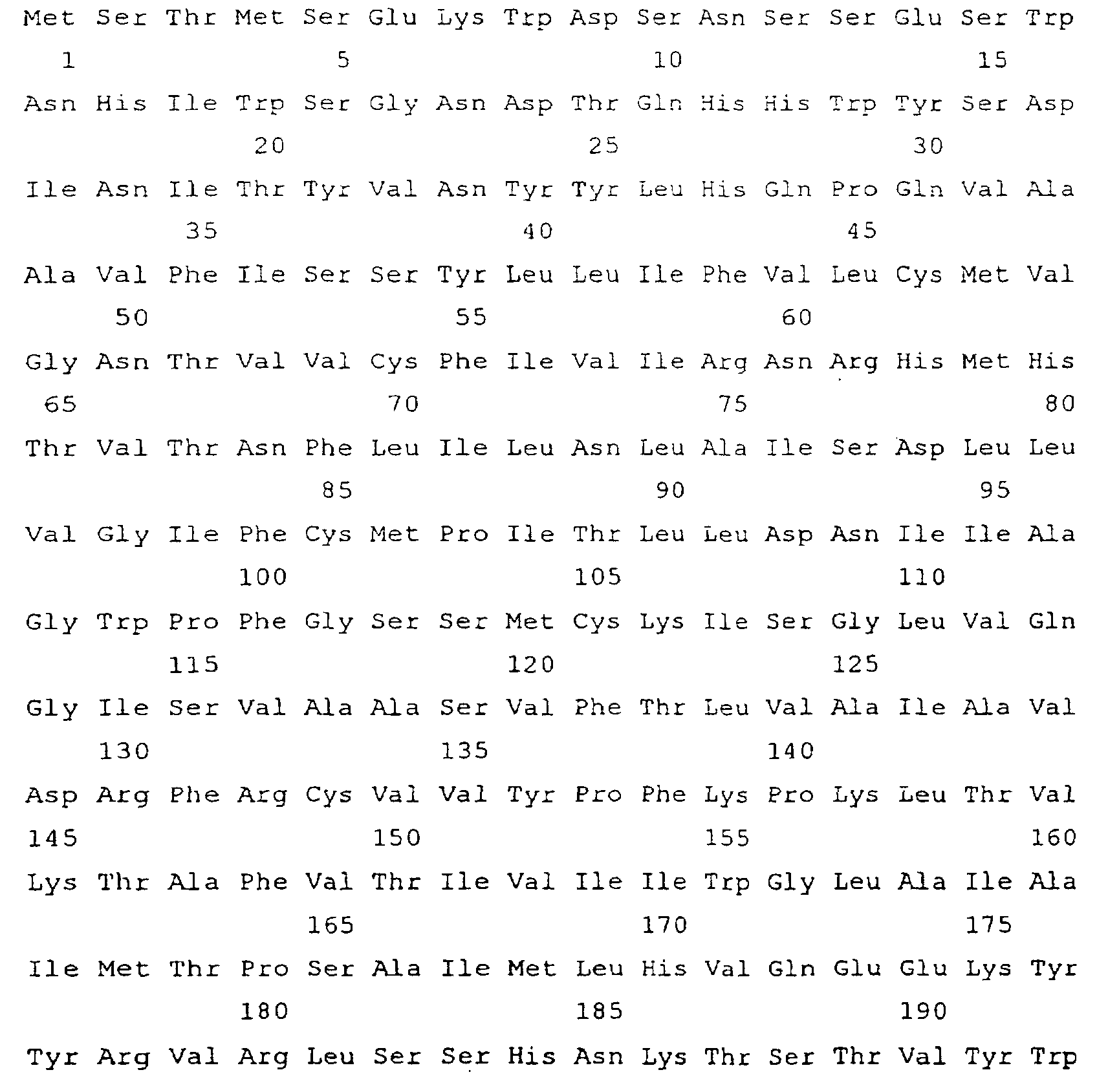
- the NPY-Y7 receptor may be a murine receptor polypeptide consisting of about 405 amino acids in length. Preferably, it has the amino acid sequence set forth in SEQ ID No. 3.
- the present invention provides a non-human animal transformed with the polynucleotide molecule or plasmid or expression vector as described.
- the present invention provides a method for detecting agonist or antagonist agents of an NPY-Y7 receptor, comprising contacting an isolated NPY-Y7 receptor or a host cell transfected with and expressing the polynucleotide molecule as described, with a test agent under conditions enabling the activation of an NPY-Y7 receptor, and detecting an increase or decrease in activity of the NPY-Y7 receptor.
- An increase or decrease in activity of the receptor or functionally equivalent fragment thereof may be detected by measuring changes in cAMP production, Ca 2+ levels or IP3 turnover after activating the receptor or fragment with specific agonist or antagonist agents.
- a method of producing an NPY-Y7 receptor polypeptide comprising culturing a host cell as set out above under conditions enabling the expression of an NPY-Y7 receptor polypeptide, and optionally recovering the expressed receptor polypeptide.
- oligonucleotide or polynucleotide probe comprising a nucleotide sequence of 10 or more nucleotides, the probe comprising a nucleotide sequence such that the probe specifically hybridises to the polynucleotide molecule of the first, second or third aspect under high stringency conditions (Sambrook et al , Molecular Cloning: a laboratory manual , Second Edition, Cold Spring Harbor Laboratory Press).
- an antisense oligonucleotide or polynucleotide molecule comprising a nucleotide sequence capable of specifically hybridising to an mRNA molecule which encodes an NPY-Y7 receptor so as to prevent translation of the mRNA molecule.
- Such antisense oligonucleotide or polynucleotide molecules may include a ribozyme region to catalystically inactivate mRNA to which it is hybridised.
- an antisense oligonucleotide or polynucleotide molecule comprising a nucleotide sequence capable of hybridizing to an mRNA molecule which encodes an NPY-Y7 receptor as set forth in SEQ ID No. 2 or SEQ ID No. 3 for the preparation of a pharmaceutical composition for regulating Circadian rhythm.
- the polynucleotide molecule of the first, second or third aspect of the invention may be a dominant negative mutant which encodes a gene product causing an altered phenotype by, for example, reducing or eliminating the activity of endogenous NPY-Y7 receptors.
- substantially corresponding as used herein in relation to amino acid sequences is intended to encompass minor variations in the amino acid sequences which do not result in a decrease in biological activity of the NPY-Y7 receptor. These variations may include conservative amino acid substitutions.
- the substitutions envisaged are:- G, A, V, I, L, M; D, E; N, Q; S, T; K, R, H; F, Y, W, H; and P, N ⁇ -alkalamino acids.
- nucleotide sequences are intended to encompass minor variations in the nucleotide sequences which due to degeneracy in the DNA code do not result in a change in the encoded protein. Further, this term is intended to encompass other minor variations in the sequence which may be required to enhance expression in a particular system but in which the variations do not result in a decrease in biological activity of the encoded protein.
- fragment/s as used herein is intended to refer to fragments of the NPY-Y7 receptor that exhibit binding specificity and activity that is substantially equivalent to the NPY-Y7 receptor from which it/they is/are derived.
- Human amygdala and testis cDNA libraries (Stratagene) were screened under low stringency conditions with a 401 bp 32 P-labelled fragment (corresponding to nucleotides 507 to 908 of SEQ ID No. 4) originated from a human fetal brain EST clone (GenBank AA449919). Two overlapping cDNA clones were obtained from the screen. The combined nucleotide sequence (hy7) of the clones is shown as SEQ ID No. 4 and encodes a protein of 408 amino acids (SEQ ID No. 2).
- Radio-ligand binding experiments has shown that the protein encoded by the hy7 cDNA shows highest affinity for human PYY ( Figure 2). These experiments were conducted using COS-6 or HEK (293) cells transiently expressing recombinant Y7 receptor protein.
- the radio-ligand binding suggests that the NPY-Y7 receptor has a pharmacology similar to the Y2 receptor (Rose, P., J. Biol. Chem. 270:22661-22664. 1995).
- the rank of potency for the Y7 receptor is: PYY>NPY>[2-36]PYY>[3-36]NPY>[13-36]NPY>>(Leu31, Pro34)NPY>PP.
- pcDNA3.1-hy7 cDNA was transiently transfected into the COSm6 cell line using FUGENE and 5mg of DNA/106 cells.
- the COSm6 cells were grown in Dulbecco's modified Eagles medium supplemented with 2mM glutamine and 10% fetal calf serum, in 5% CO 2 at 37°C.
- Membranes were harvested with COSm6 cells 72hr post-transfection.
- Adherent cells were washed twice in ice-cold phosphate buffered saline and lysed using a glass homogeniser in ice-cold hypotonic buffer (50mM Tris-HCI, pH 7.4, 0.1% bacitracin).
- Membranes were pelleted by high speed centrifugation (30,000 x g, 15min, 4°C), homogenised again in ice-cold hypotonic buffer and collected again by high speed centrifugation (30,000 x g, 15min, 4°C). The final membrane pellet was resuspended into 1ml of ice-cold binding buffer (50mM Tris-HCI, pH7.4, 10mM NaCl, 5mM MgCl2, 2.5mM CaCl2, 0.1% bacitracin, 0.1% bovine serum albumin. Membrane suspensions were diluted in binding buffer to yield membrane protein concentrations of 0.05mg/ml. Under these conditions non-specific binding of [ 125 I]PYY to membranes was less than 10%.
- [ 125 I]PYY and unlabelled peptide competitors were also diluted to the required concentrations in binding buffer.
- Samples were prepared by mixing 50ml binding buffer, unlabelled peptide or binding buffer (50ml), [ 125 I]PYY (50mM, 50ml) and membrane suspension (100ml). Samples were incubated at room temperature for 2hr. Incubations were terminated by centrifugation (4min) and pellets collected. Radioactivity was measured for 1min in a g counter.
Landscapes
- Health & Medical Sciences (AREA)
- Life Sciences & Earth Sciences (AREA)
- Chemical & Material Sciences (AREA)
- Organic Chemistry (AREA)
- Cell Biology (AREA)
- General Health & Medical Sciences (AREA)
- Immunology (AREA)
- Toxicology (AREA)
- Zoology (AREA)
- Gastroenterology & Hepatology (AREA)
- Biomedical Technology (AREA)
- Biochemistry (AREA)
- Biophysics (AREA)
- Neurology (AREA)
- Genetics & Genomics (AREA)
- Medicinal Chemistry (AREA)
- Molecular Biology (AREA)
- Proteomics, Peptides & Aminoacids (AREA)
- Engineering & Computer Science (AREA)
- Peptides Or Proteins (AREA)
- Micro-Organisms Or Cultivation Processes Thereof (AREA)
- Preparation Of Compounds By Using Micro-Organisms (AREA)
- Measuring Or Testing Involving Enzymes Or Micro-Organisms (AREA)
Description

G, A, V, I, L, M; D, E; N, Q; S, T; K, R, H; F, Y, W, H; and P, Nα-alkalamino acids.
PYY>NPY>[2-36]PYY>[3-36]NPY>[13-36]NPY>>(Leu31, Pro34)NPY>PP.
Title of Invention: NPY-Y7 Receptor Gene
Prior Application Filing Date: 1998-06-29
Length: 14
Type: PRT
Organism: Artificial Sequence
Other Information: Description of Artificial Sequence: N-terminal consensus sequence

Length: 408
Type: PRT
Organism: Homo sapiens


Length: 405
Type: PRT
Organism: Mus musculus

Length: 1903
Type: DNA
Organism: Homo sapiens


Length: 1228
Type: DNA
Organism: Mus musculus

Claims (17)
- An isolated polynucleotide molecule that encodes an NPY-Y7 receptor polypeptide of human origin comprising the amino acid sequence set forth in SEQ ID No. 2.
- An isolated polynucleotide molecule that encodes an NPY-Y7 receptor polypeptide of murine origin comprising the amino acid sequence set forth in SEQ ID No. 3.
- An isolated polynucleotide molecule encoding an NPY-Y7 receptor polypeptide, wherein the polynucleotide molecule comprises a nucleotide sequence selected from the group consisting of:(i) the sequence set forth in SEQ ID No. 4;(ii) a sequence comprising nucleotides 369 to 1592 of SEQ ID No. 4; and(iii) a sequence that encodes the amino acid sequence set forth in SEQ ID No. 2.
- The isolated polynucleotide molecule according to Claim 3, wherein the polynucleotide molecule comprises the nucleotide sequence set forth in SEQ ID No. 4 or a fragment thereof comprising nucleotides 369 to 1592 of SEQ ID No. 4.
- A plasmid or expression vector comprising the isolated polynucleotide molecule according to any one of Claims I to 4.
- A host cell transformed with the isolated polynucleotide molecule according to any one of Claims 1 to 4 or the plasmid or expression vector according to Claim 5.
- The host cell according to Claim 6, wherein the cell is a mammalian cell or an insect cell.
- The host cell according to Claim 7, wherein the cell is a Chinese hamster ovary (CHO) cell, human embryonic kidney (HEK) 293 cell or an insect Sf9 cell.
- The host cell according to any one of Claims 6 to 8, wherein the cell expresses the NPY-Y7 receptor polypeptide on its surface.
- An isolated NPY-Y7 receptor in a substantially pure form, wherein said polypeptide is encoded by the isolated polynucleotide according to any one of Claims 1 to 4.
- The isolated NPY-Y7 receptor polypeptide according to Claim 10, wherein said NPY-Y7 receptor polypeptide is a human receptor polypeptide consisting of about 408 amino acids in length.
- The isolated NPY-Y7 receptor polypeptide according to Claim 10 or 11, wherein said NPY-Y7 receptor polypeptide has the amino acid sequence set forth in SEQ ID No. 2.
- The isolated NPY-Y7 receptor polypeptide according to Claim 10, wherein said NPY-Y7 receptor polypeptide is a murine receptor polypeptide consisting of about 405 amino acids in length.
- The isolated NPY-Y7 receptor polypeptide according to Claim 10 or 13, wherein said NPY-Y7 receptor polypeptide has the amino acid sequence set forth in SEQ ID No. 3.
- A non-human animal transformed with the isolated polynucleotide molecule according to any one of Claims 1 to 4 or the plasmid or expression vector according to Claim 5.
- A method for detecting an agonist or antagonist of an NPY-Y7 receptor, comprising contacting the isolated NPY-Y7 receptor according to any one of Claims 10 to 14 or the host cell according to any one of Claims 6 to 9 with a test agent under conditions enabling the activation of said receptor, and detecting an increase or decrease in the receptor activity.
- A method of producing an NPY-Y7 receptor polypeptide comprising culturing the host cell according to any one of Claims 6 to 9 under conditions enabling the expression of an NPY-Y7 receptor polypeptide encoded by the polynucleotide molecule according to any one of Claims I to 4 or the plasmid or expression vector according to Claim 5, and optionally recovering the expressed receptor polypeptide.
Applications Claiming Priority (3)
| Application Number | Priority Date | Filing Date | Title |
|---|---|---|---|
| AUPP438598 | 1998-06-29 | ||
| AUPP4385A AUPP438598A0 (en) | 1998-06-29 | 1998-06-29 | NPY-Y7 receptor gene |
| PCT/AU1999/000523 WO2000000606A1 (en) | 1998-06-29 | 1999-06-29 | Npy-y7 receptor gene |
Publications (3)
| Publication Number | Publication Date |
|---|---|
| EP1092021A1 EP1092021A1 (en) | 2001-04-18 |
| EP1092021A4 EP1092021A4 (en) | 2002-05-08 |
| EP1092021B1 true EP1092021B1 (en) | 2005-01-26 |
Family
ID=3808628
Family Applications (1)
| Application Number | Title | Priority Date | Filing Date |
|---|---|---|---|
| EP99928896A Expired - Lifetime EP1092021B1 (en) | 1998-06-29 | 1999-06-29 | Npy-y7 receptor gene |
Country Status (7)
| Country | Link |
|---|---|
| US (1) | US6803232B1 (en) |
| EP (1) | EP1092021B1 (en) |
| JP (1) | JP2002519026A (en) |
| AU (1) | AUPP438598A0 (en) |
| CA (1) | CA2331328A1 (en) |
| DE (1) | DE69923452T2 (en) |
| WO (1) | WO2000000606A1 (en) |
Families Citing this family (3)
| Publication number | Priority date | Publication date | Assignee | Title |
|---|---|---|---|---|
| US6262246B1 (en) | 1998-09-25 | 2001-07-17 | Synaptic Pharmaceutical Corporation | DNA encoding mammalian neuropeptides FF (NPFF) receptors and uses thereof |
| US6849727B1 (en) | 1998-09-25 | 2005-02-01 | H.Lundbeck A/S | DNA encoding mammalian neuropeptide FF (NPFF) receptors and uses thereof |
| AU2003260187A1 (en) * | 2003-09-18 | 2005-04-06 | Garvan Institute Of Medical Research | Methods of modulating bone growth, bone remodeling and adiposity |
Family Cites Families (37)
| Publication number | Priority date | Publication date | Assignee | Title |
|---|---|---|---|---|
| US4256832A (en) | 1978-12-12 | 1981-03-17 | Bioresearch Inc. | Carcinogen and mutagen screening method and apparatus |
| JPS59161470A (en) | 1983-03-05 | 1984-09-12 | Canon Inc | Recording liquid |
| NZ223044A (en) | 1986-12-30 | 1990-11-27 | Du Pont | Method of determining the potential mutagenicity of a substance |
| NZ223569A (en) | 1987-02-24 | 1990-06-26 | Mobil Oil Corp | Assaying polynuclear compounds for mutagenic activity |
| US5273880A (en) | 1987-12-23 | 1993-12-28 | Genebiomed, Inc. | Process for detecting potential carcinogens |
| AU4386393A (en) | 1992-05-21 | 1993-12-13 | Genebiomed, Inc. | Process for gene targeting and genome manipulations |
| JPH07191037A (en) | 1993-12-27 | 1995-07-28 | Kikkoman Corp | Method for detecting carcinogenesis of material to be inspected |
| WO1995021191A1 (en) | 1994-02-04 | 1995-08-10 | William Ward | Bioluminescent indicator based upon the expression of a gene for a modified green-fluorescent protein |
| JPH08205708A (en) | 1995-01-31 | 1996-08-13 | Rikagaku Kenkyusho | Methods for detecting mutagens using transgenic fish |
| CA2220036A1 (en) | 1995-05-05 | 1996-11-07 | Human Genome Sciences, Inc. | Human neuropeptide receptor |
| US5683903A (en) | 1995-05-30 | 1997-11-04 | Smithkline Beecham Corporation | Attachment enhanced 293 cells |
| DE19549417C2 (en) | 1995-11-29 | 1998-08-13 | Deutsch Zentr Luft & Raumfahrt | Process for the luminometric determination of the mutagenic and / or carcinogenic potency of a sample to be investigated or a factor (agent) to be investigated |
| US5821049A (en) | 1996-04-05 | 1998-10-13 | Viratest Carcinogen Monitoring, Ltd | In vitro assay for identification of carcinogens |
| US5916766A (en) | 1996-05-23 | 1999-06-29 | Smithkline Beecham Corporation | Human marco scavenger receptor |
| JPH11513896A (en) | 1996-07-22 | 1999-11-30 | スミスクライン・ビーチャム・コーポレイション | G-protein coupled receptor HNFDS78 |
| AU6596096A (en) | 1996-07-23 | 1998-02-10 | Smithkline Beecham Corporation | Calcitonin gene-related peptide receptor component factor (houdc44) |
| US5710024A (en) | 1996-07-23 | 1998-01-20 | Smithkline Beecham Corporation | Polynucleotides that encode the calcitonin gene-related peptide receptor coponent factor (HOUNDC44) |
| US5763180A (en) | 1996-08-14 | 1998-06-09 | Viratest Carcinogen Monitoring Ltd. | In vitro assay for carcinogens using phenotypic transformation of human cells |
| US5824504A (en) | 1996-09-26 | 1998-10-20 | Elshourbagy; Nabil A. | Human 7-transmembrane receptor and DNA |
| US6008017A (en) | 1997-01-02 | 1999-12-28 | Smithkline Beecham Corporation | Human cardiac/brain tolloid-like protein |
| GB9706414D0 (en) | 1997-03-27 | 1997-05-14 | Univ Manchester | Detection of DNA damage |
| CA2232861A1 (en) | 1997-04-15 | 1998-10-15 | Smithkline Beecham Corporation | Cdna clone hacch94 that encodes a novel human 7-transmembrane receptor |
| US5858716A (en) | 1997-05-30 | 1999-01-12 | Smithkline Beecham Corporation | H2CAA71 polynucleotides |
| CA2233584A1 (en) | 1997-06-11 | 1998-12-11 | Smithkline Beecham Corporation | 7tm receptor hlwar77 |
| JP2002508660A (en) | 1997-06-12 | 2002-03-19 | スミスクライン ビーチャム コーポレーション | HM74A receptor |
| JP2002504331A (en) | 1998-02-19 | 2002-02-12 | スミスクライン ビーチャム コーポレーション | G protein-coupled receptor AmMaid |
| FR2775694B1 (en) | 1998-03-06 | 2000-06-09 | Gradient Ass | TOXICITY TEST |
| EP0950717A1 (en) | 1998-04-14 | 1999-10-20 | "VLAAMSE INSTELLING VOOR TECHNOLOGISCH ONDERZOEK", afgekort "V.I.T.O." | Diagnostic system and method for determining the presence of a genotoxic compound in a sample |
| WO1999058568A1 (en) | 1998-05-08 | 1999-11-18 | Smithkline Beecham Corporation | Gprw receptor |
| WO1999058567A1 (en) | 1998-05-08 | 1999-11-18 | Smithkline Beecham Corporation | GABAB1b RECEPTOR |
| WO1999064452A1 (en) | 1998-06-11 | 1999-12-16 | Smithkline Beecham Corporation | Gpr35a receptor |
| EP1083909A4 (en) | 1998-06-11 | 2002-01-02 | Smithkline Beecham Corp | hCEPR RECEPTOR |
| US6361967B1 (en) | 1998-07-14 | 2002-03-26 | Smithkline Beecham Corporation | Axor10, a g-protein coupled receptor |
| WO2000012105A1 (en) | 1998-08-28 | 2000-03-09 | Smithkline Beecham Corporation | RAMP2a: RECEPTOR ACTIVITY MODIFYING PROTEIN-2a |
| AU775606B2 (en) | 1998-08-31 | 2004-08-05 | Government Of The United States Of America, As Represented By The Secretary Of The Department Of Health And Human Services, The | Methimazole derivatives and tautomeric cyclic thiones to treat autoimmune diseases |
| EP1109565A4 (en) | 1998-09-01 | 2004-05-19 | Smithkline Beecham Corp | Gabab1aa receptor |
| EP1131335A4 (en) | 1998-11-19 | 2002-07-31 | Smithkline Beecham Corp | 7tm receptor hlwar77 |
-
1998
- 1998-06-29 AU AUPP4385A patent/AUPP438598A0/en not_active Abandoned
-
1999
- 1999-06-29 EP EP99928896A patent/EP1092021B1/en not_active Expired - Lifetime
- 1999-06-29 JP JP2000557359A patent/JP2002519026A/en active Pending
- 1999-06-29 US US09/719,088 patent/US6803232B1/en not_active Expired - Fee Related
- 1999-06-29 WO PCT/AU1999/000523 patent/WO2000000606A1/en not_active Ceased
- 1999-06-29 CA CA002331328A patent/CA2331328A1/en not_active Abandoned
- 1999-06-29 DE DE69923452T patent/DE69923452T2/en not_active Expired - Fee Related
Also Published As
| Publication number | Publication date |
|---|---|
| JP2002519026A (en) | 2002-07-02 |
| EP1092021A1 (en) | 2001-04-18 |
| CA2331328A1 (en) | 2000-01-06 |
| DE69923452D1 (en) | 2005-03-03 |
| EP1092021A4 (en) | 2002-05-08 |
| DE69923452T2 (en) | 2005-12-29 |
| US6803232B1 (en) | 2004-10-12 |
| WO2000000606A1 (en) | 2000-01-06 |
| AUPP438598A0 (en) | 1998-07-23 |
Similar Documents
| Publication | Publication Date | Title |
|---|---|---|
| US6103475A (en) | Excitatory amino acid receptor protein expression testing methods | |
| US6355478B1 (en) | Rhesus monkey neuropeptide Y Y2 receptor | |
| CA2497356A1 (en) | Nucleic acid sequences encoding novel point mutations on mglur2 and mglur3 | |
| US7238780B2 (en) | G-protein coupled receptor | |
| EP0606734A1 (en) | Human CNS receptors of the NMDA-R1 family | |
| WO1992016547A1 (en) | Controlling nk-1 receptor-mediated responses and related diagnostics | |
| US5882926A (en) | Excitatory amino acid transporter gene and uses | |
| US6803232B1 (en) | NPY-Y7 receptor gene | |
| AU782848B2 (en) | DNA encoding SNORF62 and SNORF72 receptors | |
| AU764565B2 (en) | NPY-Y7 receptor gene | |
| US6221609B1 (en) | Isolate nucleic acid encoding human MGLUR8 | |
| US6358693B1 (en) | AMPA-binding human gluR4 receptor methods | |
| US6689585B1 (en) | GABA-B2 receptor | |
| US6384205B1 (en) | Metabotropic glutamate receptor 4 nucleic acid | |
| US6242251B1 (en) | Rhesus neuropeptide Y5 receptor | |
| US6087154A (en) | Rhesus neuropeptide Y1 receptor | |
| WO2000075168A1 (en) | Mouse urotensin-ii receptor (utb-r) | |
| AU764155B2 (en) | Novel GABA-B receptor | |
| US6387655B1 (en) | Excitatory amino acid receptor protein and related nucleic acid compounds | |
| WO2001090189A2 (en) | G-protein coupled receptor org3. | |
| EP1255832A1 (en) | 18057 protein, a seven transmembrane protein | |
| EP1212347A1 (en) | 7tm receptor (axor23) | |
| WO2001040252A1 (en) | Monkey calcium sensing receptor | |
| WO2000002918A1 (en) | Mouse growth hormone secretagogue receptor | |
| US20060035339A1 (en) | IL-8 like protein |
Legal Events
| Date | Code | Title | Description |
|---|---|---|---|
| PUAI | Public reference made under article 153(3) epc to a published international application that has entered the european phase |
Free format text: ORIGINAL CODE: 0009012 |
|
| 17P | Request for examination filed |
Effective date: 20010116 |
|
| AK | Designated contracting states |
Kind code of ref document: A1 Designated state(s): CH DE FR GB IT LI |
|
| A4 | Supplementary search report drawn up and despatched |
Effective date: 20020327 |
|
| AK | Designated contracting states |
Kind code of ref document: A4 Designated state(s): CH DE FR GB IT LI |
|
| RIC1 | Information provided on ipc code assigned before grant |
Free format text: 7C 12N 15/12 A, 7C 07K 14/72 B, 7C 07K 16/28 B, 7C 12P 19/34 B, 7G 01N 33/58 B, 7C 07K 14/705 B |
|
| 17Q | First examination report despatched |
Effective date: 20030113 |
|
| GRAP | Despatch of communication of intention to grant a patent |
Free format text: ORIGINAL CODE: EPIDOSNIGR1 |
|
| GRAS | Grant fee paid |
Free format text: ORIGINAL CODE: EPIDOSNIGR3 |
|
| GRAA | (expected) grant |
Free format text: ORIGINAL CODE: 0009210 |
|
| AK | Designated contracting states |
Kind code of ref document: B1 Designated state(s): CH DE FR GB IT LI |
|
| PG25 | Lapsed in a contracting state [announced via postgrant information from national office to epo] |
Ref country code: FR Free format text: LAPSE BECAUSE OF FAILURE TO SUBMIT A TRANSLATION OF THE DESCRIPTION OR TO PAY THE FEE WITHIN THE PRESCRIBED TIME-LIMIT Effective date: 20050126 |
|
| REG | Reference to a national code |
Ref country code: GB Ref legal event code: FG4D |
|
| REG | Reference to a national code |
Ref country code: CH Ref legal event code: EP |
|
| REF | Corresponds to: |
Ref document number: 69923452 Country of ref document: DE Date of ref document: 20050303 Kind code of ref document: P |
|
| PLBE | No opposition filed within time limit |
Free format text: ORIGINAL CODE: 0009261 |
|
| STAA | Information on the status of an ep patent application or granted ep patent |
Free format text: STATUS: NO OPPOSITION FILED WITHIN TIME LIMIT |
|
| 26N | No opposition filed |
Effective date: 20051027 |
|
| REG | Reference to a national code |
Ref country code: CH Ref legal event code: NV Representative=s name: RITSCHER & PARTNER AG |
|
| EN | Fr: translation not filed | ||
| REG | Reference to a national code |
Ref country code: CH Ref legal event code: PCAR Free format text: RITSCHER & PARTNER AG;RESIRAIN 1;8125 ZOLLIKERBERG (CH) |
|
| PGFP | Annual fee paid to national office [announced via postgrant information from national office to epo] |
Ref country code: CH Payment date: 20090626 Year of fee payment: 11 |
|
| PGFP | Annual fee paid to national office [announced via postgrant information from national office to epo] |
Ref country code: GB Payment date: 20090624 Year of fee payment: 11 Ref country code: DE Payment date: 20090702 Year of fee payment: 11 |
|
| REG | Reference to a national code |
Ref country code: CH Ref legal event code: PL |
|
| GBPC | Gb: european patent ceased through non-payment of renewal fee |
Effective date: 20100629 |
|
| PG25 | Lapsed in a contracting state [announced via postgrant information from national office to epo] |
Ref country code: IT Free format text: LAPSE BECAUSE OF NON-PAYMENT OF DUE FEES Effective date: 20090629 |
|
| PG25 | Lapsed in a contracting state [announced via postgrant information from national office to epo] |
Ref country code: DE Free format text: LAPSE BECAUSE OF NON-PAYMENT OF DUE FEES Effective date: 20110101 Ref country code: LI Free format text: LAPSE BECAUSE OF NON-PAYMENT OF DUE FEES Effective date: 20100630 Ref country code: CH Free format text: LAPSE BECAUSE OF NON-PAYMENT OF DUE FEES Effective date: 20100630 |
|
| PG25 | Lapsed in a contracting state [announced via postgrant information from national office to epo] |
Ref country code: GB Free format text: LAPSE BECAUSE OF NON-PAYMENT OF DUE FEES Effective date: 20100629 |
|
| PGFP | Annual fee paid to national office [announced via postgrant information from national office to epo] |
Ref country code: IT Payment date: 20090625 Year of fee payment: 11 |
|
| PGRI | Patent reinstated in contracting state [announced from national office to epo] |
Ref country code: IT Effective date: 20110616 |
|
| PGRI | Patent reinstated in contracting state [announced from national office to epo] |
Ref country code: IT Effective date: 20110616 |