EP1091933B1 - Substituted beta-diketones and their use - Google Patents
Substituted beta-diketones and their use Download PDFInfo
- Publication number
- EP1091933B1 EP1091933B1 EP99934722A EP99934722A EP1091933B1 EP 1091933 B1 EP1091933 B1 EP 1091933B1 EP 99934722 A EP99934722 A EP 99934722A EP 99934722 A EP99934722 A EP 99934722A EP 1091933 B1 EP1091933 B1 EP 1091933B1
- Authority
- EP
- European Patent Office
- Prior art keywords
- compound
- pentanedione
- halogen
- methylene
- methylsulfonyl
- Prior art date
- Legal status (The legal status is an assumption and is not a legal conclusion. Google has not performed a legal analysis and makes no representation as to the accuracy of the status listed.)
- Expired - Lifetime
Links
- 150000001875 compounds Chemical class 0.000 claims abstract description 47
- 229910052739 hydrogen Inorganic materials 0.000 claims abstract description 23
- 208000006673 asthma Diseases 0.000 claims abstract description 21
- 229910052736 halogen Inorganic materials 0.000 claims abstract description 17
- 238000011282 treatment Methods 0.000 claims abstract description 15
- 239000001257 hydrogen Substances 0.000 claims abstract description 13
- 125000004435 hydrogen atom Chemical group [H]* 0.000 claims abstract description 13
- 150000002367 halogens Chemical class 0.000 claims abstract description 12
- 201000010099 disease Diseases 0.000 claims abstract description 9
- 208000037265 diseases, disorders, signs and symptoms Diseases 0.000 claims abstract description 9
- 230000002265 prevention Effects 0.000 claims abstract description 7
- 206010001052 Acute respiratory distress syndrome Diseases 0.000 claims abstract description 5
- 208000006545 Chronic Obstructive Pulmonary Disease Diseases 0.000 claims abstract description 5
- 208000013616 Respiratory Distress Syndrome Diseases 0.000 claims abstract description 5
- 201000000028 adult respiratory distress syndrome Diseases 0.000 claims abstract description 5
- 208000023504 respiratory system disease Diseases 0.000 claims abstract description 5
- 239000008194 pharmaceutical composition Substances 0.000 claims abstract description 4
- 239000000203 mixture Substances 0.000 claims description 26
- GUBGYTABKSRVRQ-QKKXKWKRSA-N lactose group Chemical group OC1[C@H](O)[C@@H](O)[C@H](O[C@H]2[C@H](O)[C@@H](O)[C@@H](O)[C@H](O2)CO)[C@H](O1)CO GUBGYTABKSRVRQ-QKKXKWKRSA-N 0.000 claims description 11
- 239000008101 lactose Substances 0.000 claims description 10
- 239000003814 drug Substances 0.000 claims description 7
- 238000009472 formulation Methods 0.000 claims description 7
- 239000002245 particle Substances 0.000 claims description 6
- 125000005843 halogen group Chemical group 0.000 claims description 5
- ZUIYTTCOLRKEHO-UHFFFAOYSA-N 3-[(3-chloro-4-methylsulfonylphenyl)methylidene]pentane-2,4-dione Chemical compound CC(=O)C(C(C)=O)=CC1=CC=C(S(C)(=O)=O)C(Cl)=C1 ZUIYTTCOLRKEHO-UHFFFAOYSA-N 0.000 claims description 4
- CAWYWWPWSAMGBV-UHFFFAOYSA-N 3-[(4-methylsulfonylphenyl)methylidene]pentane-2,4-dione Chemical compound CC(=O)C(C(C)=O)=CC1=CC=C(S(C)(=O)=O)C=C1 CAWYWWPWSAMGBV-UHFFFAOYSA-N 0.000 claims description 4
- LITPXWODWSLZIB-UHFFFAOYSA-N 3-[(3,5-dichloro-4-methylsulfonylphenyl)methylidene]pentane-2,4-dione Chemical compound CC(=O)C(C(C)=O)=CC1=CC(Cl)=C(S(C)(=O)=O)C(Cl)=C1 LITPXWODWSLZIB-UHFFFAOYSA-N 0.000 claims description 3
- XHZGTAJSUWDJOE-UHFFFAOYSA-N 3-[(3-fluoro-4-methylsulfonylphenyl)methylidene]pentane-2,4-dione Chemical compound CC(=O)C(C(C)=O)=CC1=CC=C(S(C)(=O)=O)C(F)=C1 XHZGTAJSUWDJOE-UHFFFAOYSA-N 0.000 claims description 3
- ATFKDQOGYYWXIY-UHFFFAOYSA-N 3-fluoro-4-methylsulfonylbenzaldehyde Chemical compound CS(=O)(=O)C1=CC=C(C=O)C=C1F ATFKDQOGYYWXIY-UHFFFAOYSA-N 0.000 claims description 3
- 125000001246 bromo group Chemical group Br* 0.000 claims description 3
- 125000001153 fluoro group Chemical group F* 0.000 claims description 3
- 238000004519 manufacturing process Methods 0.000 claims description 3
- IZYIHHPXTJGBPF-UHFFFAOYSA-N 3-[(3-bromo-4-methylsulfonylphenyl)methylidene]pentane-2,4-dione Chemical compound CC(=O)C(C(C)=O)=CC1=CC=C(S(C)(=O)=O)C(Br)=C1 IZYIHHPXTJGBPF-UHFFFAOYSA-N 0.000 claims description 2
- VQVXLUIYQIQWLH-UHFFFAOYSA-N 3-bromo-4-methylsulfonylbenzaldehyde Chemical compound CS(=O)(=O)C1=CC=C(C=O)C=C1Br VQVXLUIYQIQWLH-UHFFFAOYSA-N 0.000 claims description 2
- 239000003085 diluting agent Substances 0.000 claims description 2
- 125000000325 methylidene group Chemical group [H]C([H])=* 0.000 claims 1
- 125000002345 steroid group Chemical group 0.000 claims 1
- 150000003431 steroids Chemical class 0.000 abstract description 6
- 206010039085 Rhinitis allergic Diseases 0.000 abstract description 2
- 201000010105 allergic rhinitis Diseases 0.000 abstract description 2
- 230000004968 inflammatory condition Effects 0.000 abstract description 2
- IAZDPXIOMUYVGZ-WFGJKAKNSA-N Dimethyl sulfoxide Chemical compound [2H]C([2H])([2H])S(=O)C([2H])([2H])[2H] IAZDPXIOMUYVGZ-WFGJKAKNSA-N 0.000 description 34
- XEKOWRVHYACXOJ-UHFFFAOYSA-N Ethyl acetate Chemical compound CCOC(C)=O XEKOWRVHYACXOJ-UHFFFAOYSA-N 0.000 description 33
- KFZMGEQAYNKOFK-UHFFFAOYSA-N Isopropanol Chemical compound CC(C)O KFZMGEQAYNKOFK-UHFFFAOYSA-N 0.000 description 21
- XLYOFNOQVPJJNP-UHFFFAOYSA-N water Substances O XLYOFNOQVPJJNP-UHFFFAOYSA-N 0.000 description 20
- YXFVVABEGXRONW-UHFFFAOYSA-N Toluene Chemical compound CC1=CC=CC=C1 YXFVVABEGXRONW-UHFFFAOYSA-N 0.000 description 18
- 238000005160 1H NMR spectroscopy Methods 0.000 description 17
- VEXZGXHMUGYJMC-UHFFFAOYSA-N Hydrochloric acid Chemical compound Cl VEXZGXHMUGYJMC-UHFFFAOYSA-N 0.000 description 14
- WYURNTSHIVDZCO-UHFFFAOYSA-N Tetrahydrofuran Chemical compound C1CCOC1 WYURNTSHIVDZCO-UHFFFAOYSA-N 0.000 description 13
- YMWUJEATGCHHMB-UHFFFAOYSA-N Dichloromethane Chemical compound ClCCl YMWUJEATGCHHMB-UHFFFAOYSA-N 0.000 description 12
- PMZURENOXWZQFD-UHFFFAOYSA-L Sodium Sulfate Chemical compound [Na+].[Na+].[O-]S([O-])(=O)=O PMZURENOXWZQFD-UHFFFAOYSA-L 0.000 description 12
- 239000000047 product Substances 0.000 description 12
- YRKCREAYFQTBPV-UHFFFAOYSA-N acetylacetone Chemical compound CC(=O)CC(C)=O YRKCREAYFQTBPV-UHFFFAOYSA-N 0.000 description 11
- NQRYJNQNLNOLGT-UHFFFAOYSA-N Piperidine Chemical compound C1CCNCC1 NQRYJNQNLNOLGT-UHFFFAOYSA-N 0.000 description 10
- BDAGIHXWWSANSR-UHFFFAOYSA-N methanoic acid Natural products OC=O BDAGIHXWWSANSR-UHFFFAOYSA-N 0.000 description 10
- 239000000843 powder Substances 0.000 description 10
- 238000003756 stirring Methods 0.000 description 10
- QTBSBXVTEAMEQO-UHFFFAOYSA-N Acetic acid Chemical compound CC(O)=O QTBSBXVTEAMEQO-UHFFFAOYSA-N 0.000 description 9
- IAZDPXIOMUYVGZ-UHFFFAOYSA-N Dimethylsulphoxide Chemical compound CS(C)=O IAZDPXIOMUYVGZ-UHFFFAOYSA-N 0.000 description 9
- 239000004480 active ingredient Substances 0.000 description 7
- 210000003979 eosinophil Anatomy 0.000 description 7
- -1 3,5-Dichloro-4-(methylsulfonyl)benzyl Chemical group 0.000 description 6
- 206010014950 Eosinophilia Diseases 0.000 description 6
- OKKJLVBELUTLKV-UHFFFAOYSA-N Methanol Chemical compound OC OKKJLVBELUTLKV-UHFFFAOYSA-N 0.000 description 6
- UIIMBOGNXHQVGW-UHFFFAOYSA-M Sodium bicarbonate Chemical compound [Na+].OC([O-])=O UIIMBOGNXHQVGW-UHFFFAOYSA-M 0.000 description 6
- 230000000694 effects Effects 0.000 description 6
- 230000000622 irritating effect Effects 0.000 description 6
- 229910000028 potassium bicarbonate Inorganic materials 0.000 description 6
- 235000015497 potassium bicarbonate Nutrition 0.000 description 6
- 239000011736 potassium bicarbonate Substances 0.000 description 6
- TYJJADVDDVDEDZ-UHFFFAOYSA-M potassium hydrogencarbonate Chemical compound [K+].OC([O-])=O TYJJADVDDVDEDZ-UHFFFAOYSA-M 0.000 description 6
- 229910052938 sodium sulfate Inorganic materials 0.000 description 6
- 235000011152 sodium sulphate Nutrition 0.000 description 6
- YLQBMQCUIZJEEH-UHFFFAOYSA-N tetrahydrofuran Natural products C=1C=COC=1 YLQBMQCUIZJEEH-UHFFFAOYSA-N 0.000 description 6
- OSWFIVFLDKOXQC-UHFFFAOYSA-N 4-(3-methoxyphenyl)aniline Chemical compound COC1=CC=CC(C=2C=CC(N)=CC=2)=C1 OSWFIVFLDKOXQC-UHFFFAOYSA-N 0.000 description 5
- 238000009825 accumulation Methods 0.000 description 5
- 239000000443 aerosol Substances 0.000 description 5
- 239000000284 extract Substances 0.000 description 5
- 235000019253 formic acid Nutrition 0.000 description 5
- 230000007794 irritation Effects 0.000 description 5
- 239000007787 solid Substances 0.000 description 5
- IJGRMHOSHXDMSA-UHFFFAOYSA-N Atomic nitrogen Chemical compound N#N IJGRMHOSHXDMSA-UHFFFAOYSA-N 0.000 description 4
- MHAJPDPJQMAIIY-UHFFFAOYSA-N Hydrogen peroxide Chemical compound OO MHAJPDPJQMAIIY-UHFFFAOYSA-N 0.000 description 4
- 208000022559 Inflammatory bowel disease Diseases 0.000 description 4
- JUJWROOIHBZHMG-UHFFFAOYSA-N Pyridine Chemical compound C1=CC=NC=C1 JUJWROOIHBZHMG-UHFFFAOYSA-N 0.000 description 4
- 239000003246 corticosteroid Substances 0.000 description 4
- 239000000706 filtrate Substances 0.000 description 4
- WVDDGKGOMKODPV-UHFFFAOYSA-N hydroxymethyl benzene Natural products OCC1=CC=CC=C1 WVDDGKGOMKODPV-UHFFFAOYSA-N 0.000 description 4
- 210000004072 lung Anatomy 0.000 description 4
- NUJOXMJBOLGQSY-UHFFFAOYSA-N manganese dioxide Chemical compound O=[Mn]=O NUJOXMJBOLGQSY-UHFFFAOYSA-N 0.000 description 4
- 239000012074 organic phase Substances 0.000 description 4
- CWERGRDVMFNCDR-UHFFFAOYSA-N thioglycolic acid Chemical compound OC(=O)CS CWERGRDVMFNCDR-UHFFFAOYSA-N 0.000 description 4
- VOVIALXJUBGFJZ-KWVAZRHASA-N Budesonide Chemical compound C1CC2=CC(=O)C=C[C@]2(C)[C@@H]2[C@@H]1[C@@H]1C[C@H]3OC(CCC)O[C@@]3(C(=O)CO)[C@@]1(C)C[C@@H]2O VOVIALXJUBGFJZ-KWVAZRHASA-N 0.000 description 3
- 241000700198 Cavia Species 0.000 description 3
- LFQSCWFLJHTTHZ-UHFFFAOYSA-N Ethanol Chemical compound CCO LFQSCWFLJHTTHZ-UHFFFAOYSA-N 0.000 description 3
- 229960004436 budesonide Drugs 0.000 description 3
- 239000000969 carrier Substances 0.000 description 3
- 229940079593 drug Drugs 0.000 description 3
- 125000001570 methylene group Chemical group [H]C([H])([*:1])[*:2] 0.000 description 3
- 229910000030 sodium bicarbonate Inorganic materials 0.000 description 3
- 235000017557 sodium bicarbonate Nutrition 0.000 description 3
- HRZFUMHJMZEROT-UHFFFAOYSA-L sodium disulfite Chemical class [Na+].[Na+].[O-]S(=O)S([O-])(=O)=O HRZFUMHJMZEROT-UHFFFAOYSA-L 0.000 description 3
- LYPGDCWPTHTUDO-UHFFFAOYSA-M sodium;methanesulfinate Chemical compound [Na+].CS([O-])=O LYPGDCWPTHTUDO-UHFFFAOYSA-M 0.000 description 3
- 238000012360 testing method Methods 0.000 description 3
- DFMBOVYGRYKHBQ-UHFFFAOYSA-N (4-chloro-3-methylsulfonylphenyl)methanol Chemical compound CS(=O)(=O)C1=CC(CO)=CC=C1Cl DFMBOVYGRYKHBQ-UHFFFAOYSA-N 0.000 description 2
- KQLDVCCNXGIVNC-UHFFFAOYSA-N 2-(2,6-dichloro-4-ethoxycarbonylphenyl)sulfanylacetic acid Chemical compound CCOC(=O)C1=CC(Cl)=C(SCC(O)=O)C(Cl)=C1 KQLDVCCNXGIVNC-UHFFFAOYSA-N 0.000 description 2
- QPCTVMOFLWABON-UHFFFAOYSA-N 2-(2,6-dichloro-4-ethoxycarbonylphenyl)sulfonylacetic acid Chemical compound CCOC(=O)C1=CC(Cl)=C(S(=O)(=O)CC(O)=O)C(Cl)=C1 QPCTVMOFLWABON-UHFFFAOYSA-N 0.000 description 2
- HVAUUPRFYPCOCA-AREMUKBSSA-N 2-O-acetyl-1-O-hexadecyl-sn-glycero-3-phosphocholine Chemical compound CCCCCCCCCCCCCCCCOC[C@@H](OC(C)=O)COP([O-])(=O)OCC[N+](C)(C)C HVAUUPRFYPCOCA-AREMUKBSSA-N 0.000 description 2
- QUBFQDMBXUUUNO-UHFFFAOYSA-N 3,5-dichloro-4-methylsulfonylbenzaldehyde Chemical compound CS(=O)(=O)C1=C(Cl)C=C(C=O)C=C1Cl QUBFQDMBXUUUNO-UHFFFAOYSA-N 0.000 description 2
- BKKXQNYUVCDQRJ-UHFFFAOYSA-N 3-chloro-4-methylsulfonylbenzaldehyde Chemical compound CS(=O)(=O)C1=CC=C(C=O)C=C1Cl BKKXQNYUVCDQRJ-UHFFFAOYSA-N 0.000 description 2
- PRXIEGNPKOEMKI-UHFFFAOYSA-N 4-chloro-3-methylsulfonylbenzaldehyde Chemical compound CS(=O)(=O)C1=CC(C=O)=CC=C1Cl PRXIEGNPKOEMKI-UHFFFAOYSA-N 0.000 description 2
- 241000700199 Cavia porcellus Species 0.000 description 2
- 206010061218 Inflammation Diseases 0.000 description 2
- AFVFQIVMOAPDHO-UHFFFAOYSA-N Methanesulfonic acid Chemical compound CS(O)(=O)=O AFVFQIVMOAPDHO-UHFFFAOYSA-N 0.000 description 2
- 241000283973 Oryctolagus cuniculus Species 0.000 description 2
- 108010003541 Platelet Activating Factor Proteins 0.000 description 2
- XSQUKJJJFZCRTK-UHFFFAOYSA-N Urea Chemical compound NC(N)=O XSQUKJJJFZCRTK-UHFFFAOYSA-N 0.000 description 2
- 230000002411 adverse Effects 0.000 description 2
- 235000019445 benzyl alcohol Nutrition 0.000 description 2
- 229960001334 corticosteroids Drugs 0.000 description 2
- 230000007423 decrease Effects 0.000 description 2
- XESZBRCJZPZRIE-UHFFFAOYSA-N ethyl 3,5-dichloro-4-methylsulfonylbenzoate Chemical compound CCOC(=O)C1=CC(Cl)=C(S(C)(=O)=O)C(Cl)=C1 XESZBRCJZPZRIE-UHFFFAOYSA-N 0.000 description 2
- 208000024711 extrinsic asthma Diseases 0.000 description 2
- 238000001914 filtration Methods 0.000 description 2
- JYGXADMDTFJGBT-VWUMJDOOSA-N hydrocortisone Chemical compound O=C1CC[C@]2(C)[C@H]3[C@@H](O)C[C@](C)([C@@](CC4)(O)C(=O)CO)[C@@H]4[C@@H]3CCC2=C1 JYGXADMDTFJGBT-VWUMJDOOSA-N 0.000 description 2
- 150000005828 hydrofluoroalkanes Chemical class 0.000 description 2
- 230000004054 inflammatory process Effects 0.000 description 2
- 230000005764 inhibitory process Effects 0.000 description 2
- 239000000543 intermediate Substances 0.000 description 2
- 238000002844 melting Methods 0.000 description 2
- 230000008018 melting Effects 0.000 description 2
- NLPRXDKTULOVCK-UHFFFAOYSA-N methyl 4-chloro-3-methylsulfonylbenzoate Chemical compound COC(=O)C1=CC=C(Cl)C(S(C)(=O)=O)=C1 NLPRXDKTULOVCK-UHFFFAOYSA-N 0.000 description 2
- 229910052757 nitrogen Inorganic materials 0.000 description 2
- 239000012286 potassium permanganate Substances 0.000 description 2
- UMJSCPRVCHMLSP-UHFFFAOYSA-N pyridine Natural products COC1=CC=CN=C1 UMJSCPRVCHMLSP-UHFFFAOYSA-N 0.000 description 2
- LPXPTNMVRIOKMN-UHFFFAOYSA-M sodium nitrite Chemical compound [Na+].[O-]N=O LPXPTNMVRIOKMN-UHFFFAOYSA-M 0.000 description 2
- 239000002904 solvent Substances 0.000 description 2
- 239000000725 suspension Substances 0.000 description 2
- 210000003462 vein Anatomy 0.000 description 2
- XXWCWUGFKSQGDM-UHFFFAOYSA-N 2-(2-chloro-5-methoxycarbonylphenyl)sulfanylacetic acid Chemical compound COC(=O)C1=CC=C(Cl)C(SCC(O)=O)=C1 XXWCWUGFKSQGDM-UHFFFAOYSA-N 0.000 description 1
- MTLLWRVBRPGQBC-UHFFFAOYSA-N 2-(2-chloro-5-methoxycarbonylphenyl)sulfonylacetic acid Chemical compound COC(=O)C1=CC=C(Cl)C(S(=O)(=O)CC(O)=O)=C1 MTLLWRVBRPGQBC-UHFFFAOYSA-N 0.000 description 1
- JPHKMYXKNKLNDF-UHFFFAOYSA-N 3,4-difluorobenzaldehyde Chemical compound FC1=CC=C(C=O)C=C1F JPHKMYXKNKLNDF-UHFFFAOYSA-N 0.000 description 1
- WXGVASWIUBFCHW-UHFFFAOYSA-N 3-(2-acetyl-3-oxobut-1-enyl)benzonitrile Chemical compound CC(=O)C(C(C)=O)=CC1=CC=CC(C#N)=C1 WXGVASWIUBFCHW-UHFFFAOYSA-N 0.000 description 1
- QNVKHNRVDKUYQR-UHFFFAOYSA-N 3-[(4-chloro-3-methylsulfonylphenyl)methylidene]pentane-2,4-dione Chemical compound CC(=O)C(C(C)=O)=CC1=CC=C(Cl)C(S(C)(=O)=O)=C1 QNVKHNRVDKUYQR-UHFFFAOYSA-N 0.000 description 1
- FAHZIKXYYRGSHF-UHFFFAOYSA-N 3-bromo-4-fluorobenzaldehyde Chemical compound FC1=CC=C(C=O)C=C1Br FAHZIKXYYRGSHF-UHFFFAOYSA-N 0.000 description 1
- VABGXUAWEVOXSV-UHFFFAOYSA-N 3-bromo-4-methylsulfonylbenzaldehyde 3-[(3-bromo-4-methylsulfonylphenyl)methylidene]pentane-2,4-dione Chemical compound BrC=1C=C(C=O)C=CC1S(=O)(=O)C.BrC=1C=C(C=CC1S(=O)(=O)C)C=C(C(C)=O)C(C)=O VABGXUAWEVOXSV-UHFFFAOYSA-N 0.000 description 1
- GVORVQPNNSASDM-UHFFFAOYSA-N 3-chloro-4-fluorobenzaldehyde Chemical compound FC1=CC=C(C=O)C=C1Cl GVORVQPNNSASDM-UHFFFAOYSA-N 0.000 description 1
- DPSHWAMRRBDJLM-UHFFFAOYSA-N 5-phenylhex-5-ene-2,4-dione Chemical class CC(=O)CC(=O)C(=C)C1=CC=CC=C1 DPSHWAMRRBDJLM-UHFFFAOYSA-N 0.000 description 1
- 206010003645 Atopy Diseases 0.000 description 1
- PMATZTZNYRCHOR-CGLBZJNRSA-N Cyclosporin A Chemical compound CC[C@@H]1NC(=O)[C@H]([C@H](O)[C@H](C)C\C=C\C)N(C)C(=O)[C@H](C(C)C)N(C)C(=O)[C@H](CC(C)C)N(C)C(=O)[C@H](CC(C)C)N(C)C(=O)[C@@H](C)NC(=O)[C@H](C)NC(=O)[C@H](CC(C)C)N(C)C(=O)[C@H](C(C)C)NC(=O)[C@H](CC(C)C)N(C)C(=O)CN(C)C1=O PMATZTZNYRCHOR-CGLBZJNRSA-N 0.000 description 1
- 229930105110 Cyclosporin A Natural products 0.000 description 1
- 108010036949 Cyclosporine Proteins 0.000 description 1
- 239000001828 Gelatine Substances 0.000 description 1
- 241000282412 Homo Species 0.000 description 1
- 108060003951 Immunoglobulin Proteins 0.000 description 1
- 108010002616 Interleukin-5 Proteins 0.000 description 1
- FBOZXECLQNJBKD-ZDUSSCGKSA-N L-methotrexate Chemical compound C=1N=C2N=C(N)N=C(N)C2=NC=1CN(C)C1=CC=C(C(=O)N[C@@H](CCC(O)=O)C(O)=O)C=C1 FBOZXECLQNJBKD-ZDUSSCGKSA-N 0.000 description 1
- 241000700159 Rattus Species 0.000 description 1
- VMHLLURERBWHNL-UHFFFAOYSA-M Sodium acetate Chemical compound [Na+].CC([O-])=O VMHLLURERBWHNL-UHFFFAOYSA-M 0.000 description 1
- FAPWRFPIFSIZLT-UHFFFAOYSA-M Sodium chloride Chemical compound [Na+].[Cl-] FAPWRFPIFSIZLT-UHFFFAOYSA-M 0.000 description 1
- 230000002378 acidificating effect Effects 0.000 description 1
- 239000012190 activator Substances 0.000 description 1
- 239000013543 active substance Substances 0.000 description 1
- 239000000654 additive Substances 0.000 description 1
- 208000026935 allergic disease Diseases 0.000 description 1
- 238000010171 animal model Methods 0.000 description 1
- 230000001088 anti-asthma Effects 0.000 description 1
- 230000003110 anti-inflammatory effect Effects 0.000 description 1
- 239000000924 antiasthmatic agent Substances 0.000 description 1
- 239000008365 aqueous carrier Substances 0.000 description 1
- 239000007900 aqueous suspension Substances 0.000 description 1
- 230000017531 blood circulation Effects 0.000 description 1
- 230000003139 buffering effect Effects 0.000 description 1
- 239000002775 capsule Substances 0.000 description 1
- 239000004202 carbamide Substances 0.000 description 1
- 150000001720 carbohydrates Chemical class 0.000 description 1
- 239000003054 catalyst Substances 0.000 description 1
- 125000001309 chloro group Chemical group Cl* 0.000 description 1
- KYKAJFCTULSVSH-UHFFFAOYSA-N chloro(fluoro)methane Chemical compound F[C]Cl KYKAJFCTULSVSH-UHFFFAOYSA-N 0.000 description 1
- 230000001684 chronic effect Effects 0.000 description 1
- 208000037976 chronic inflammation Diseases 0.000 description 1
- 208000037893 chronic inflammatory disorder Diseases 0.000 description 1
- 229960001265 ciclosporin Drugs 0.000 description 1
- 206010009887 colitis Diseases 0.000 description 1
- 238000002425 crystallisation Methods 0.000 description 1
- 230000008025 crystallization Effects 0.000 description 1
- 229930182912 cyclosporin Natural products 0.000 description 1
- 230000034994 death Effects 0.000 description 1
- 231100000517 death Toxicity 0.000 description 1
- 238000004821 distillation Methods 0.000 description 1
- 231100000673 dose–response relationship Toxicity 0.000 description 1
- MIDALAPASRDTOZ-UHFFFAOYSA-N ethyl 4-amino-3,5-dichlorobenzoate Chemical compound CCOC(=O)C1=CC(Cl)=C(N)C(Cl)=C1 MIDALAPASRDTOZ-UHFFFAOYSA-N 0.000 description 1
- 239000002024 ethyl acetate extract Substances 0.000 description 1
- 238000002474 experimental method Methods 0.000 description 1
- 239000012530 fluid Substances 0.000 description 1
- 229920000159 gelatin Polymers 0.000 description 1
- 235000019322 gelatine Nutrition 0.000 description 1
- 239000003102 growth factor Substances 0.000 description 1
- 229960000890 hydrocortisone Drugs 0.000 description 1
- 230000035874 hyperreactivity Effects 0.000 description 1
- 102000018358 immunoglobulin Human genes 0.000 description 1
- 210000004969 inflammatory cell Anatomy 0.000 description 1
- 238000001802 infusion Methods 0.000 description 1
- 239000004615 ingredient Substances 0.000 description 1
- 229940125369 inhaled corticosteroids Drugs 0.000 description 1
- 208000030603 inherited susceptibility to asthma Diseases 0.000 description 1
- 230000002401 inhibitory effect Effects 0.000 description 1
- 230000022023 interleukin-5 production Effects 0.000 description 1
- 201000010659 intrinsic asthma Diseases 0.000 description 1
- OWFXIOWLTKNBAP-UHFFFAOYSA-N isoamyl nitrite Chemical compound CC(C)CCON=O OWFXIOWLTKNBAP-UHFFFAOYSA-N 0.000 description 1
- 238000011866 long-term treatment Methods 0.000 description 1
- 210000004698 lymphocyte Anatomy 0.000 description 1
- 229940098779 methanesulfonic acid Drugs 0.000 description 1
- 238000000034 method Methods 0.000 description 1
- 229960000485 methotrexate Drugs 0.000 description 1
- LOCJPOYKBUUVKU-UHFFFAOYSA-N methyl 3-amino-4-chlorobenzoate Chemical compound COC(=O)C1=CC=C(Cl)C(N)=C1 LOCJPOYKBUUVKU-UHFFFAOYSA-N 0.000 description 1
- 239000002547 new drug Substances 0.000 description 1
- 231100000252 nontoxic Toxicity 0.000 description 1
- 230000003000 nontoxic effect Effects 0.000 description 1
- 239000000546 pharmaceutical excipient Substances 0.000 description 1
- 230000010118 platelet activation Effects 0.000 description 1
- 239000002244 precipitate Substances 0.000 description 1
- 238000002360 preparation method Methods 0.000 description 1
- 239000003755 preservative agent Substances 0.000 description 1
- 230000002685 pulmonary effect Effects 0.000 description 1
- 230000036387 respiratory rate Effects 0.000 description 1
- 238000012216 screening Methods 0.000 description 1
- 230000035909 sensory irritation Effects 0.000 description 1
- 239000001632 sodium acetate Substances 0.000 description 1
- 235000017281 sodium acetate Nutrition 0.000 description 1
- 239000011780 sodium chloride Substances 0.000 description 1
- 235000010288 sodium nitrite Nutrition 0.000 description 1
- 238000001228 spectrum Methods 0.000 description 1
- 230000003019 stabilising effect Effects 0.000 description 1
- 230000001629 suppression Effects 0.000 description 1
- 208000024891 symptom Diseases 0.000 description 1
- 230000009885 systemic effect Effects 0.000 description 1
- LMBFAGIMSUYTBN-MPZNNTNKSA-N teixobactin Chemical compound C([C@H](C(=O)N[C@@H]([C@@H](C)CC)C(=O)N[C@@H](CO)C(=O)N[C@H](CCC(N)=O)C(=O)N[C@H]([C@@H](C)CC)C(=O)N[C@@H]([C@@H](C)CC)C(=O)N[C@@H](CO)C(=O)N[C@H]1C(N[C@@H](C)C(=O)N[C@@H](C[C@@H]2NC(=N)NC2)C(=O)N[C@H](C(=O)O[C@H]1C)[C@@H](C)CC)=O)NC)C1=CC=CC=C1 LMBFAGIMSUYTBN-MPZNNTNKSA-N 0.000 description 1
- 238000002560 therapeutic procedure Methods 0.000 description 1
Classifications
-
- C—CHEMISTRY; METALLURGY
- C07—ORGANIC CHEMISTRY
- C07C—ACYCLIC OR CARBOCYCLIC COMPOUNDS
- C07C317/00—Sulfones; Sulfoxides
- C07C317/24—Sulfones; Sulfoxides having sulfone or sulfoxide groups and doubly-bound oxygen atoms bound to the same carbon skeleton
-
- A—HUMAN NECESSITIES
- A61—MEDICAL OR VETERINARY SCIENCE; HYGIENE
- A61P—SPECIFIC THERAPEUTIC ACTIVITY OF CHEMICAL COMPOUNDS OR MEDICINAL PREPARATIONS
- A61P11/00—Drugs for disorders of the respiratory system
-
- A—HUMAN NECESSITIES
- A61—MEDICAL OR VETERINARY SCIENCE; HYGIENE
- A61P—SPECIFIC THERAPEUTIC ACTIVITY OF CHEMICAL COMPOUNDS OR MEDICINAL PREPARATIONS
- A61P11/00—Drugs for disorders of the respiratory system
- A61P11/02—Nasal agents, e.g. decongestants
-
- A—HUMAN NECESSITIES
- A61—MEDICAL OR VETERINARY SCIENCE; HYGIENE
- A61P—SPECIFIC THERAPEUTIC ACTIVITY OF CHEMICAL COMPOUNDS OR MEDICINAL PREPARATIONS
- A61P11/00—Drugs for disorders of the respiratory system
- A61P11/06—Antiasthmatics
Definitions
- the invention relates to new and known substituted ⁇ -diketones, more precisely, phenyl-methylene-2,4-pentanedione derivatives, to their preparation and use in the prevention and the treatment of respiratory diseases, especially asthma, ARDS (Acute Respiratory Distress Syndrome), COPD (chronic obstructive pulmonary diseases), allergic rhinitis and related inflammatory conditions. More specifically, the invention relates to the use of said compounds in the prevention and the treatment of asthma in steroid-resistant patients. The invention also relates to pharmaceutical formulations used in the treatment of said diseases.
- the compounds of invention which are new have the following general formula I wherein one of X 1 and X 2 is MeSO 2 and the other one is halogen and X 3 is hydrogen or halogen.
- halogen means here a chioro, bromo or fluoro substituent.
- EP-A-0 440 324 discloses substituted ⁇ -diketones which are suggested to be useful in the treatment of inflammatory bowel disease (IBD).
- IBD inflammatory bowel disease
- the compounds of EP-A-0 440 324 were tested using the so called TNB-induced chronic colitis model in rats.
- the most promising compound OR 1364 (3-[(3-cyanophenyl)methylene]-2,4-pentanedione) has been extensively studied in the treatment of IBD and taken to clinical trials. Unfortunately, the trials had to be discontinued because the compound was found to be irritating.
- compounds of the invention work in the same way as budesonide, a conventional anti-asthma Corticosteroid. Because the compounds of the invention act locally and decompose in the blood circulation, they are excellent candidates for the treatment of asthma, especially in those patients which cannot use traditional steroid therapy. Furthermore, the compounds of the invention do not have the harmful irritative properties of OR 1364.
- Asthma is a chronic inflammatory disease of the airways characterized by eosinophil accumulation into the lung and hyperreactivity of the airways.
- the disease has a wide spectrum from mild symptoms to deaths.
- Atopic asthma is an allergic disease where the airways-hyperreactivity is most typical feature and occurs most often in children. When the disease occurs in older people it is very often so called intrinsic asthma. Characteristic for this subtype of asthma is a more prominent inflammation of the airways than in atopic asthma.
- the compounds of the invention have potential independently of whether the condition to be treated has its origin in intrinsic or atopic type of asthma.
- the most effective drugs for asthma today are inhaled corticosteroids. All currently available inhaled steroids are absorbed systemically from the lungs. The most important adverse effect of long term treatment with corticosteroids is the suppression of endogenous cortisol production by adrenals. An ideal drug for asthma would have powerful anti-inflammatory effect locally at the airways but no systemic effects. A subset of patients with asthma are steroid-resistant. For these patients there is a need for a new drug, which does not affect via the same mechanism as corticosteroids but has the same Inhibitory effect on the inflammatory cells. Today methotrexate, cyclosporin and immunoglobulin are used for treatment of steroid resistant asthma. These drugs are systemically acting and thus cause serious adverse effects.
- the compounds of the invention are new, except of 3-[(4-methylsulfonylphenyl)methylene]-2,4-pentanedione), the use of which in the treatment of inflammatory bowel disease has been disclosed earlier in EP-A-0 440 324.
- X 1 and X 2 is MeSO 2 and the other one is hydrogen or halogen and X 3 is hydrogen or halogen in the manufacture of a medicament for use in the prevention or treatment of respiratory diseases.
- Most preferable in this indication are the compounds of formula I (l') wherein X 1 is halogen, X 2 is MeSO 2 and X 3 is hydrogen. Especially preferably X 1 is chloro.
- the compounds of the invention may be prepared by the same principles as described in EP-A-0 440 324. Accordingly, the compound of formula II wherein X 1 to X 3 are the same as defined above for formula I is allowed to react in the presence of an acidic or basic catalyst with a compound of formula III having an active methylene group CH 3 -CO-CH 2 -CO-CH 3 to produce the compound of formula I.
- an inhalable pharmaceutical formulation containing a compound according to formula I, having preferably about 100 % of its particle size below 10 ⁇ m, more preferably about 95 % being below 5.0 ⁇ m, optionally in a suitable carrier or diluent.
- the amount of the active ingredient is preferably 0.1 to 100 % (w / w), more preferably 1-50 % based on the total weight of the formulation.
- the effective dose of the compound varies depending on the individual, severity and stage of the disease.
- the effective dose for adult male humans is likely to be from 500 ⁇ g to 5 mg per day, preferably 1 - 2 mg per day
- the compounds according to this invention may be given to a patient as such or in combination with one or more other active ingredients and /or suitable pharmaceutically advantageous additives and / or excipients.
- These groups comprise primarily a carrier suitable for compositions which are intended for pulmonary delivery, optionally with the addition of solubilizers, buffering, stabilising, flavouring, colorising and / or preserving agents.
- suitable solid carriers are saccharide particles, e.g. lactose having larger particle size than the active substance, preferably 5 - 100 ⁇ m.
- Aerosol carriers especially non-chlorofluorocarbon-based carriers, may also be used, e.g. HFA (hydrofluoroalkane) based aerosols.
- HFA hydrofluoroalkane
- aqueous carriers is also possible.
- dry inhalation formulations are preferred.
- the formulations may be administered using conventional delivery techniques. Dry inhalation powders may be packed, e.g. in hard gelatine capsule s or a blister package to be given in single units or directly in dry powder inhalers, e.g. multi-dose devices. Aerosols may be given from pressurised metered dose inhalers (PMDI) and aqueous suspensions from nebulisers.
- PMDI pressurised metered dose inhalers
- This intermediate was mixed with potassium bicarbonate solution (1M, 160 mL) and then potassium permanganate solution (0.33 M in 0.42 M acetic acid, 750 mL) was slowly added at 20-30°C (until the colour of the permanganate was permanent). After 2h stirring at 20-30°C the residual permanganate was decolorized with saturated sodium pyrosulfite solution. The mixture was filtrated and the filtrate was acidified with hydrochloric acid (6 M) and the product was extracted with ethyl acetate.
- PAF Platelet activation factor
- PAF platelet activating factor
- PAF induced eosinophil accumulation into the guinea-pig lung is a widely used animal model for human asthma. Inflammation of the airways is a characteristic feature of bronchial asthma and is associated with eosinophil and lymphocyte accumulation in the airway wall and lumen. In guinea-pigs, eosinophilia can be induced by local administration of platelet activating factor into the airways. IL-5, an eosinophil growth factor and activator, is one important mediator of the PAF-induced eosinophilia (Whelan C.J. Inflamm, Res. 45:166-170, 1996). Glucocorticolds Inhibit PAF eosinophilia in guinea-pigs and the effect is thought to come through inhibition of IL-5 production.
- the test was carried out by infusing the compound to be tested into the airways at the rate of 100 ⁇ l/min for 5 minutes. One hour later the guinea-pigs were exposed to 2.5 ⁇ g PAF intratracheally within 5 minutes by an infusion at a rate of 100 ⁇ l/min. 24 h after PAF the lungs were lavaged with saline and the number of eosinophils in the bronchdalveolar lavage fluid (BALE) was counted.
- BALE bronchdalveolar lavage fluid
- Micronised active ingredient is mixed with an inert carrier, lactose in three steps. Lactose (450 mesh) and a part of lactose (325 mesh) and the active ingredient are added into the blender and mixed until the powder mixture is homogenous. The mixture of lactose grades and the active ingredient is sieved. The screening of the powder mixture reduces the number of particle clusters present. Thereafter, part of lactose (325 mesh) is added into the blender and mixed further. Thirdly, the rest of lactose (325 mesh) is added and mixed until the powder is again homogenous. The manufactured inhalation powder mixture is packed into a multiple dose powder inhaler device.
Landscapes
- Health & Medical Sciences (AREA)
- Organic Chemistry (AREA)
- Chemical & Material Sciences (AREA)
- Pulmonology (AREA)
- Public Health (AREA)
- Veterinary Medicine (AREA)
- Chemical Kinetics & Catalysis (AREA)
- General Chemical & Material Sciences (AREA)
- Medicinal Chemistry (AREA)
- Nuclear Medicine, Radiotherapy & Molecular Imaging (AREA)
- Pharmacology & Pharmacy (AREA)
- Life Sciences & Earth Sciences (AREA)
- Animal Behavior & Ethology (AREA)
- General Health & Medical Sciences (AREA)
- Engineering & Computer Science (AREA)
- Bioinformatics & Cheminformatics (AREA)
- Otolaryngology (AREA)
- Pharmaceuticals Containing Other Organic And Inorganic Compounds (AREA)
- Acyclic And Carbocyclic Compounds In Medicinal Compositions (AREA)
- Organic Low-Molecular-Weight Compounds And Preparation Thereof (AREA)
- Low-Molecular Organic Synthesis Reactions Using Catalysts (AREA)
- Steroid Compounds (AREA)
- Paper (AREA)
- Electrophonic Musical Instruments (AREA)
- Stringed Musical Instruments (AREA)
- Detergent Compositions (AREA)
- Materials For Medical Uses (AREA)
- Tents Or Canopies (AREA)
Abstract
Description
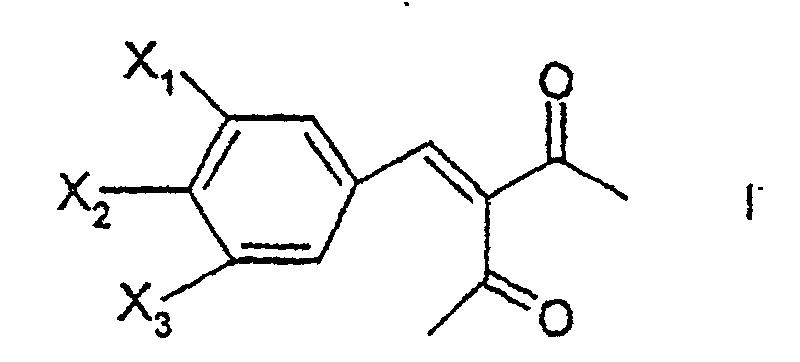
- The invention relates to new and known substituted β-diketones, more precisely, phenyl-methylene-2,4-pentanedione derivatives, to their preparation and use in the prevention and the treatment of respiratory diseases, especially asthma, ARDS (Acute Respiratory Distress Syndrome), COPD (chronic obstructive pulmonary diseases), allergic rhinitis and related inflammatory conditions. More specifically, the invention relates to the use of said compounds in the prevention and the treatment of asthma in steroid-resistant patients. The invention also relates to pharmaceutical formulations used in the treatment of said diseases.
- The compounds of invention which are new have the following general formula Iwherein one of X1 and X2 is MeSO2 and the other one is halogen and X3 is hydrogen or halogen.
- The term halogen means here a chioro, bromo or fluoro substituent.
- EP-A-0 440 324 discloses substituted β-diketones which are suggested to be useful in the treatment of inflammatory bowel disease (IBD). The compounds of EP-A-0 440 324 were tested using the so called TNB-induced chronic colitis model in rats. The most promising compound OR 1364 (3-[(3-cyanophenyl)methylene]-2,4-pentanedione) has been extensively studied in the treatment of IBD and taken to clinical trials. Unfortunately, the trials had to be discontinued because the compound was found to be irritating.
- It has now been found out that compounds of the invention work in the same way as budesonide, a conventional anti-asthma Corticosteroid. Because the compounds of the invention act locally and decompose in the blood circulation, they are excellent candidates for the treatment of asthma, especially in those patients which cannot use traditional steroid therapy. Furthermore, the compounds of the invention do not have the harmful irritative properties of OR 1364.
- Asthma is a chronic inflammatory disease of the airways characterized by eosinophil accumulation into the lung and hyperreactivity of the airways. The disease has a wide spectrum from mild symptoms to deaths. Atopic asthma is an allergic disease where the airways-hyperreactivity is most typical feature and occurs most often in children. When the disease occurs in older people it is very often so called intrinsic asthma. Characteristic for this subtype of asthma is a more prominent inflammation of the airways than in atopic asthma. The compounds of the invention have potential independently of whether the condition to be treated has its origin in intrinsic or atopic type of asthma.
- The most effective drugs for asthma today are inhaled corticosteroids. All currently available inhaled steroids are absorbed systemically from the lungs. The most important adverse effect of long term treatment with corticosteroids is the suppression of endogenous cortisol production by adrenals. An ideal drug for asthma would have powerful anti-inflammatory effect locally at the airways but no systemic effects. A subset of patients with asthma are steroid-resistant. For these patients there is a need for a new drug, which does not affect via the same mechanism as corticosteroids but has the same Inhibitory effect on the inflammatory cells. Today methotrexate, cyclosporin and immunoglobulin are used for treatment of steroid resistant asthma. These drugs are systemically acting and thus cause serious adverse effects.
- It is the object of the invention to provide a new type of locally acting, nontoxic, medicament for the prevention and treatment of respiratory diseases, especially asthma. The compounds of the invention are new, except of 3-[(4-methylsulfonylphenyl)methylene]-2,4-pentanedione), the use of which in the treatment of inflammatory bowel disease has been disclosed earlier in EP-A-0 440 324.
- It is another object of the invention to provide the use of a compound of general formula I'wherein one of X1 and X2 is MeSO2 and the other one is hydrogen or halogen and X3 is hydrogen or halogen in the manufacture of a medicament for use in the prevention or treatment of respiratory diseases. Most preferable in this indication are the compounds of formula I (l') wherein X1 is halogen, X2 is MeSO2 and X3 is hydrogen. Especially preferably X1 is chloro.

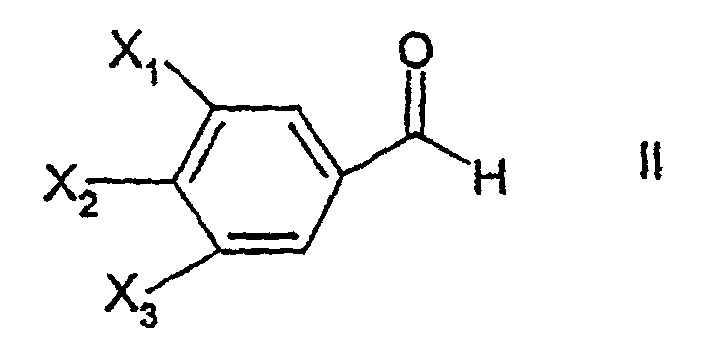
- The compounds of the invention may be prepared by the same principles as described in EP-A-0 440 324. Accordingly, the compound of formula IIwherein X1 to X3 are the same as defined above for formula I is allowed to react in the presence of an acidic or basic catalyst with a compound of formula III having an active methylene group
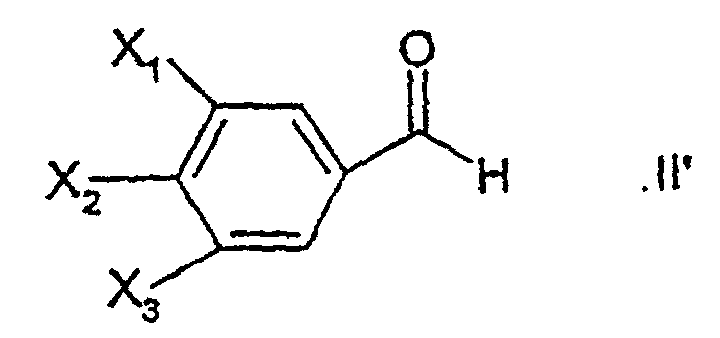
- It is still another object of the invention to provide new valuable intermediates of formula II'wherein one of X1 and X2 is MeSO2 and the other one bromo or fluoro and X3 is hydrogen or halogen.
- To ascertain that the medicament reaches its location of action in the airways, it is preferable to reduce the particle size of the active ingredient powder, e.g. by micronization. It is therefore a further object of the invention to provide an inhalable pharmaceutical formulation containing a compound according to formula I, having preferably about 100 % of its particle size below 10 µm, more preferably about 95 % being below 5.0 µm, optionally in a suitable carrier or diluent. The amount of the active ingredient is preferably 0.1 to 100 % (w / w), more preferably 1-50 % based on the total weight of the formulation.
- The effective dose of the compound varies depending on the individual, severity and stage of the disease. The effective dose for adult male humans is likely to be from 500 µg to 5 mg per day, preferably 1 - 2 mg per day
- The compounds according to this invention may be given to a patient as such or in combination with one or more other active ingredients and /or suitable pharmaceutically advantageous additives and / or excipients. These groups comprise primarily a carrier suitable for compositions which are intended for pulmonary delivery, optionally with the addition of solubilizers, buffering, stabilising, flavouring, colorising and / or preserving agents.
- Examples of suitable solid carriers are saccharide particles, e.g. lactose having larger particle size than the active substance, preferably 5 - 100 µm. Aerosol carriers, especially non-chlorofluorocarbon-based carriers, may also be used, e.g. HFA (hydrofluoroalkane) based aerosols. The use of aqueous carriers is also possible. However, dry inhalation formulations are preferred.
- The formulations may be administered using conventional delivery techniques. Dry inhalation powders may be packed, e.g. in hard gelatine capsule s or a blister package to be given in single units or directly in dry powder inhalers, e.g. multi-dose devices. Aerosols may be given from pressurised metered dose inhalers (PMDI) and aqueous suspensions from nebulisers.
- To a solution containing 0.5 g of 3,4-difluorobenzaldehyde in 20 ml of DMSO was added 0.71 g of methanesulfinicacid sodiumsalt with stirring at 90° C. The solution was stirred for 6 hours at 90° C and then poured into water. Sodiumhydrogencarbonate was added and the product was extracted with ethyl acetate. The extract was evaporated to dryness in vacuo. The residue was triturated with 2-propanol, yield 0.93 g. 1H NMR (DMSO-d6, 400 MHz): 3.52 (s, 3 H, CH3), 7.98-8.13 (m, 3 H, Ar), 10.22 (d, 1 H, CHO)
- To a solution containing 0.93 g of 3-fluoro-4-methylsulfonylbenzaldehyde, 0.05 ml of piperidine and 0.02 ml of formic acid in 20 ml of DMF was added 1.04 ml of 2,4-pentanedione with stirring at 20° C. The solution was stirred over night at 20° C and poured into water. The product was extracted with ethyl acetate and washed with water and evaporated to dryness in vacuo. The residue was crystallized from methanol, yield 0.48 g (30%), mp. 140-143° C. 1H NMR (DMSO-d6, 400 MHz): 2.28 (s, 3 H, CH3), 2.50 (s, 3 H, CH3), 3.36 (s, 3 H, CH3), 7.47 (m, 1 H, Ar), 7.93 (m, 2 H, Ar), 7.76 (s, 1 H, CH)
- To a solution containing 1.0 g of 4-fluoro-3-chlorobenzaldehyde in 45 ml of DMSO was added 1.93 g of methanesulfinicacid sodiumsalt with stirring at 90° C. The solution was stirred for 6 hours at 90° C and poured into water. Sodiumhydrogencarbonate was added and the product was extracted with ethyl acetate. The extract was evaporated to dryness in vacuo. The residue was triturated with 2-propanol, yield 1.06 g. 1H NMR (DMSO-d6, 400 MHz): 3.45 (s, 3 H, CH3), 8.09-8.27 (m, 3 H, Ar), 10.01 (d, 1 H, CHO)
- To a solution containing 1.42 g of 3-chloro-4-methylsulfonylbenzaldehyde, 0.05 ml of piperidine and 0.02 ml of formic acid in 20 ml DMF was added 1.50 ml of 2,4-pentanedione with stirring at 20° C. The solution was stirred over night at 20° C and poured into water. The oily residue was separated and crystallized from ethanol, yield 0.24 g (10 %), mp. 140-142° C. 1H NMR (DMSO-d6, 400 MHz): 2.28 (s, 3 H, CH3), 2.50 (s, 3 H, CH3), 3.40 (s, 3 H, CH3), 7.60 (m, 1 H, Ar), 7.80 (m, 1 H, Ar), 7.77 (s, 1 H, CH), 8.1 (m, 1 H, Ar)
- To a solution containing 0.5 g of 3-bromo-4-fluorobenzaldehyde in 20 ml of DMSO was added 0.49 g of methanesulfinicacid sodiumsalt with stirring at 90° C. The solution was stirred for 6 hours at 90° C and then poured into water. Sodiumhydrogencarbonate was and the product was extracted with ethyl acetate. The extract was evaporated to dryness in vacuo. The residue was triturated with 2-propanol, yield 0.69 g. 1H NMR (DMSO-d6, 400 MHz): 3.52 (s, 3 H, CH3), 8.10-8.47 (m, 3 H, Ar), 10.01 (d, 1 H, CHO)
- To a solution containing 0.68 g of 3-bromo-4-methylsulfonylbenzaldehyde, 0.03 ml of piperidine and 0.02 ml of formic acid in 20 ml DMF was added 0.59 ml of 2,4-pentanedione with stirring at 20° C. The solution was stirred over night at 20° C and then poured into water. The product was extracted with ethyl acetate, washed with water and evaporated to dryness in vacuo. The residue was crystallized from methanol, yield 0.18 g (20%), mp 135-139° C. 1H NMR (DMSO-d6, 400 MHz): 2.28 (s, 3 H, CH3), 2.50 (s, 3 H, CH3), 3.36 (s, 3 H, CH3), 7.60 (d, 1 H, Ar), 7.99 ( d, 1 H, Ar),8.12 ( d, 1 H, Ar) 7.71 (s, 1 H, CH)
- 4-Amino-3,5-dichlorobenzoic acid ethyl ester (17.7 g) was dissolved in a mixture of acetic acid (75 mL) and dichloromethane (75 mL) and then methanesulfonic acid (22 mL) was added. 3-Methylbutyl nitrite (10 mL) was added to the solution while the temperature was kept at 0-5°C. After 30 min mercaptoacetic acid (38 mL) was added at 0-5°C. Then a part of the dichloromethane was removed by distillation which was stopped when the internal temperature of the mixture was 80°C and this temperature was kept for additional 45 min. The mixture was cooled and the rest of the solvents were evaporated under vacuum. Toluene (300 mL), water (200 mL) and hydrochloric acid (6 M, 80 mL) were added. The organic phase was separated and then extracted with potassium bicarbonate solution (1M, 200 mL) which was acidified with hydrochloric acid (6M, 50 ml). The product was extracted to toluene (100 mL) which was dried (sodium sulphate) and evaporated to dryness (yield 5.1 g). 1H-NMR (400 MHz, DMSO-d6) d=1.33 (t, J= 7.0 Hz, 3H), 3.74 (s, 2H), 4.34 (q, J=7.0 Hz, 2H), 7.97 (s, 2H), 12.5 (b, 1H).
- 3,5-Dichloro-4-((carboxymethyl)thio)benzoic acid ethyl ester (5.1 g) was dissolved in potassium bicarbonate solution (1M, 50 mL). Then potassium permanganate solution (0.33 M in 0.42 M acetic acid, 150 mL) was slowly added at 20-30°C (until the colour of the permanganate was permanent). After 1h stirring at 20-30°C the residual permanganate was decolorized with saturated sodium pyrosulfite solution. The mixture was filtrated and the filtrate was acidified with hydrochloric acid (6 M) and the product was extracted with ethyl acetate. The extract was dried with sodium sulphate and evaporated to dryness (yield 3.1 g). 1H-NMR (400 MHz, DMSO-d6) d=1.35 (t, J= 7.0 Hz, 3H), 4.37 (q, J=7.0 Hz, 2H), 4.75 (s, 2H), 8.06 (s, 2H), 12.8 (b, 1H).
- 3,5-Dichloro-4-((carboxymethyl)sulfonyl)benzoic acid ethyl ester (3.1 g) was mixed with toluene (100 mL) and pyridine (1.0 mL) and the mixture was refluxed for 30 min and then evaporated to dryness (yield 2.6 g). 1H-NMR (400 MHz, DMSO-d6) d=1.34 (t, J= 7.0 Hz, 3H), 3.51 (s, 3H), 4.37 (q, J=7.0 Hz, 2H), 8.05 (s, 2H).
- To a solution of 3,5-dichloro-4-(methylsulfonyl)benzoic acid ethyl ester (2.6 g) in tetrahydrofuran (50 mL) was added lithium triethylborohydride (1 M in tetrahydrofuran, 24 mL) at 0-5°C under nitrogen. The mixture was stirred for 30 min and then water (2 mL) was added and the tetrahydrofuran was evaporated under vacuum. Toluene (100 mL) and water (30 mL) were added and then hydrogen peroxide (30 % in water, 20 mL) was added at 10-20°C. After 30 min the separated solid was dissolved by adding ethyl acetate (100 mL). The organic phase was separated and washed with saturated sodium pyrosulfite solution (25 mL) and then with potassium bicarbonate solution (1M, 25 ml) and then dried with sodium sulphate and evaporated to dryness (yield 1.8 g). 1H-NMR (400 MHz, DMSO-d6) d=3.43 (s, 3H), 4.57 (s, 2H), 5.6 (b, 1H), 7.59 (s, 2H).
- 3,5-Dichloro-4-(methylsulfonyl)benzyl alcohol (1,7 g) was dissolved in dichloromethane (35 mL) and then active manganese(IV) oxide (7.0 g) was added and the mixture was stirred for 25 min at 22-28°C. The solid was removed by filtration and the filtrate was evaporated to dryness (yield 1.5 g). 1H-NMR (400 MHz, DMSO-d6) d=3.53 (s, 3H), 8.12 (s, 2H), 10.02 (s, 1H).
- 3,5-Dichloro-4-(methylsulfonyl)benzaldehyde (1,5 g), 2-propanol (20 ml), 2,4-pentanedione (1,6 ml), formic acid (44 mL) and piperidine (114 mL) were mixed and stirred at 22-25°C for 63 h. The product was filtered, washed with 2-propanol and dried (yield 1,0 g, melting point 134-6°C). 1H-NMR (400 MHz, DMSO-d6) d=2.29 (s, 3H), 2.46 (s, 3H), 3.48 (s, 3H), 7.67 (s, 2H), 7.71 (s, 1H).
- 4-Chloro-3-aminobenzoic acid methyl ester (7.0 g) was suspended in a mixture of hydrochloric acid (1 M,85 mL) and water (170 mL). A solution of sodium nitrite (2.59 g) in water (40 mL) was slowly added to the suspension at 0-5°C temperature. After 40 min stirring at 0-5°C solid urea (3.8 g) was added and dissolved by stirring. After 5 min a cold solution containing sodium acetate (12.7 g) and mercaptoacetic acid (13.0 mL) in water (85 mL) was added. Ethyl acetate (300 ml) was added and the solution was then refluxed for 60 min. The mixture was cooled and ethyl acetate (100 ml) and hydrochloric acid (6 M, 50 mL) were added. The organic phase was separated and the product extracted from it to potassium bicarbonate solution (1 M, 200 mL). The solution was acidified with 6 M hydrochloric acid and then extracted with ethyl acetate (200 mL). The ethyl acetate extract was dried with sodium sulphate and evaporated to dryness to give impure 4-chloro-3-((carboxymethyl)thio)benzoic acid methyl ester (15.5 g). This intermediate was mixed with potassium bicarbonate solution (1M, 160 mL) and then potassium permanganate solution (0.33 M in 0.42 M acetic acid, 750 mL) was slowly added at 20-30°C (until the colour of the permanganate was permanent). After 2h stirring at 20-30°C the residual permanganate was decolorized with saturated sodium pyrosulfite solution. The mixture was filtrated and the filtrate was acidified with hydrochloric acid (6 M) and the product was extracted with ethyl acetate. The extract was dried with sodium sulphate and evaporated to dryness (yield 3.5 g)1H-NMR (400 MHz, DMSO-d6) d=3.93 (s, 3H), 4.70 (s, 2H), 7.93 (d, J=11,1 Hz, 1 H), 8.26 (dd, J=11.1 Hz, 2.8 Hz, 1H), 8.51 (d, J=2.8 Hz, 1 H), 12.5 (b, 1 H)
- 4-Chloro-3-((carboxymethyl)sulfonyl)benzoic acid methyl ester (5.6 g) was mixed with pyridine (10 mL) and the mixture was refluxed for 30 min and then cooled to room temperature. The product was precipitated by adding water (30 mL). The precipitate was filtered, washed with water and dried (yield 2.5 g). 1H-NMR (400 MHz, DMSO-d6) d=3.43 (s, 3H), 3.92 (s, 3H), 7.92 (d, J=8.2 Hz, 1H), 8.24 (dd, J=8.2 Hz, 2.2 Hz, 1H), 8.53 (d, J=2.2 Hz, 1 H).
- To a suspension of 4-chloro-3-(methylsulfonyl)benzoic acid methyl ester (2.4 g) in tetrahydofuran (50 mL) was added lithium triethylborohydride (1M in tetrahydrofuran, 24 mL) at 0-5°C under nitrogen. The mixture was stirred for 30 min and then more of lithium triethylborohydride (1 M in tetrahydrofuran, 5 mL) was added and the mixture was further stirred for 60 min. Water (2 mL) was added and the tetrahydrofuran was evaporated under vacuum. Toluene (100 mL) and water (30 mL) were added and then hydrogen peroxide (30 % in water, 20 mL) was added at 10-20°C. After 30 min the organic phase was separated and washed with potassium bicarbonate solution (1M) and then dried with sodium sulphate and evaporated to dryness (yield 1.2 g). 1H-NMR (400 MHz, DMSO-d6) d=3.36 (s, 3H), 4.59 (d, J=5.7 Hz, 2H), 5.52 (t, J=5.7 Hz, 1 H), 7.66 (dd, J=8.2 Hz, 2.1 Hz, 1 H), 7.70 (d, J=8.2 Hz, 1H), 8.03 (d, J=2.1 Hz, 1H).
- 4-Chloro-3-(methylsulfonyl)benzyl alcohol (1,0 g) was dissolved in dichloromethane (20 mL) and then active manganese(IV) oxide (4.2 g) was added and the mixture was stirred for 15 min at 22-28°C. The solid was removed by filtration and the filtrate was evaporated to dryness (yield 0.76 g). 1H-NMR (400 MHz, DMSO-d6) d=3.44 (s, 3H), 8.00 (d, J=8.2 Hz, 1 H), 8.23 (dd, J=8.2 Hz, 2.2 Hz, 1H), 8.53 (d, J=2.2 Hz, 1H), 10.12 (s, 1H).
- 4-Chloro-3-(methylsulfonyl)benzaldehyde (760 mg), 2-propanol (10 ml), 2,4-pentanedione (0,8 ml), formic acid (22 mL) and piperidine (57 mL) were mixed and stirred at 22-25°C for 20 h. The product was filtered, washed with 2-propanol and dried. The compound was purified by crystallization from toluene (15 mL, yield 790 mg, melting point 170-2°C). 1H-NMR (400 MHz, DMSO-d6) d=2.27 (s, 3H), 2.47 (s, 3H), 3.40 (s, 3H), 7.72 (dd, J=8.3 Hz, 2.2 Hz, 1H), 7.84 (d, J=8.3 Hz, 1H), 7.84 (s, 1H), 8.19 (d, J=2.2 Hz, 1H).
- The effect of the compounds of the invention was evaluated using platelet activating factor (PAF) induced airway eosinophilia model. Budesonide, a widely used inhaled corticosteroid in the treatment of human asthma, was tested as a reference compound.
- PAF induced eosinophil accumulation into the guinea-pig lung is a widely used animal model for human asthma. Inflammation of the airways is a characteristic feature of bronchial asthma and is associated with eosinophil and lymphocyte accumulation in the airway wall and lumen. In guinea-pigs, eosinophilia can be induced by local administration of platelet activating factor into the airways. IL-5, an eosinophil growth factor and activator, is one important mediator of the PAF-induced eosinophilia (Whelan C.J. Inflamm, Res. 45:166-170, 1996). Glucocorticolds Inhibit PAF eosinophilia in guinea-pigs and the effect is thought to come through inhibition of IL-5 production.
- - The test was carried out by infusing the compound to be tested into the airways at the rate of 100 µl/min for 5 minutes. One hour later the guinea-pigs were exposed to 2.5 µg PAF intratracheally within 5 minutes by an infusion at a rate of 100 µl/min. 24 h after PAF the lungs were lavaged with saline and the number of eosinophils in the bronchdalveolar lavage fluid (BALE) was counted.
- The effect of 3-[(4-methylsulfonylphenyl)methylene]-2,4-pentanedione (test compound OR 1384) and the reference compound, budesonide on PAF-induced eosinophil accumulation was measured. Corresponding results with 3-[(3-chloro-4-methylsulfonylphenyl)methylene]-2,4-pentanedione (test compound OR 1958) were also measured. According to these results the compounds of the invention decreases the eosinophil accumulation to the level of the vehicle in a dose dependent manner indicating the total inhibition of the airway eosinophilia.
- Several studies were performed to compare the local irritative effect of the compounds of the invention (3-[(3-chloro-4-methylsulfonylphenyl)-methylene]-2,4-pentanedione and 3-[(4-methylsulfonylphenyl)methylene]-2,4-pentanedione) and OR-1364. The compounds of the invention could be given as an aerosol or intratracheally as a powder to a guinea pig at the doses up to 3 mg/kg without any signs of irritation. On the contrary, when OR 1364 was given as an aerosol (1mg/ml/15min), there was a significant decrease in respiratory rate indicating sensory irritation by this compound. Furthermore, in rabbits, the vein irritation was studied by giving 8 mg of the compounds intravenously to the marginal ear vein. The compounds of the invention had no irritative effect while OR 1364 induced clear irritation. In accordance, OR 1364 in the form of a 20% creme (w/w) induced both macroscopic and histological irritation of the rabbit skin, while the compound of the invention had no effect. Therefore it can be concluded, that the compounds of the invention do not induce local irritation, while the irritative effect is an obstacle for the local use of OR 1364 in the airways.
-
Ingredient Amount pro 1 kg Active ingredient * 26.25 g Lactose (450 mesh) 194.75 g Lactose (325 mesh) 779.00 g 3-[(3-chloro-4-methylsulfonylphenyl)methylene]-2,4-pentanedione - Micronised active ingredient is mixed with an inert carrier, lactose in three steps. Lactose (450 mesh) and a part of lactose (325 mesh) and the active ingredient are added into the blender and mixed until the powder mixture is homogenous. The mixture of lactose grades and the active ingredient is sieved. The screening of the powder mixture reduces the number of particle clusters present. Thereafter, part of lactose (325 mesh) is added into the blender and mixed further. Thirdly, the rest of lactose (325 mesh) is added and mixed until the powder is again homogenous. The manufactured inhalation powder mixture is packed into a multiple dose powder inhaler device.
Claims (20)
- A compound of general formula Iwherein one of X1 and X2 is MeSO2 and the other one is halogen and X3 is hydrogen or halogen.

- The compound of claim 1 wherein X1 is halogen, X2 is MeSO2 and X3 is hydrogen.
- A compound of claim 1 which is 3-{[3-Fluoro-4-(methylsulfonyl)-phenyl]methylene}-2,4-pentanedione.
- A compound of claim 1 which is 3-{[3-Cloro-4-(methylsulfonyl)-phenyl]methylene}-2,4-pentanedione
- A compound of claim 1 which is 3-{[3-Bromo-4-(methylsulfonyl)-phenyl]methylene}-2,4-pentanedione
- A compound of claim 1 which is 3-{[3,5-Dichloro-4-(methylsulfonyl)phenyl)methylene)-2,4-pentanedione.
- A compound of claim 1 which is 3-{[4-Chloro-3-(methylsulfonyl)penyl)methylene)-2,4-pentanedione
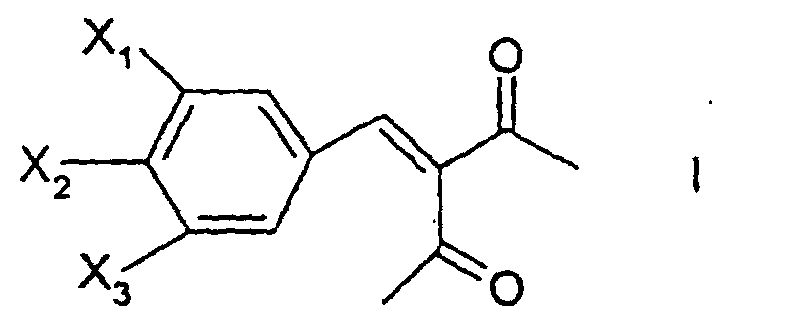
- An inhalable pharmaceutical formulation comprising a compound of formula Iwherein one of X1 and X2 is MeSO2 and the other one is halogen and X3 is hydrogen or halogen, having about 100 % of its particle size below 10 µm, optionally in a suitable carrier or diluent.
- The formulation according to claim 8, wherein the carrier is lactose.
- The formulation according to claim 8, wherein it is a dry inhalation formulation.
- Use of a compound of general formula I'wherein one of X1 and X2 is MeSO2 and the other one is hydrogen or halogen and X3 is hydrogen or halogen in the manufacture of a medicament for use in the prevention or treatment of respiratory diseases.

- The use of claim 11, wherein the disease is asthma.
- The use of claim 11, wherein the disease is steroid-resistant asthma.
- The use of claim 11, wherein the disease is Acute Respiratory Distress Syndrome.
- The use of claim 11, wherein the disease is chronic obstructive pulmonary disease.
- The use of claim 11, wherein the compound is 3-[(4-methylsulfonylphenyl)methylene]-2,4-pentanedione.
- The use of claim 11, wherein the compound is 3-[(3-chloro-4-methylsulfonylphenyl)methylene]-2,4-pentanedione.
- An intermediate of formula II'wherein one of X1 and X2 is MeSO2 and the other one bromo or fluoro and X3 is hydrogen or halogen.

- The intermediate of claim 18 which is 3-Fluoro-4-methylsulfonylbenzaldehyde.
- The intermediate of claim 18 which is 3-Bromo-4-methylsulfonylbenzaldehyde.
Priority Applications (1)
| Application Number | Priority Date | Filing Date | Title |
|---|---|---|---|
| SI9930503T SI1091933T1 (en) | 1998-07-01 | 1999-06-30 | Substituted beta-diketones and their use |
Applications Claiming Priority (4)
| Application Number | Priority Date | Filing Date | Title |
|---|---|---|---|
| FI981521 | 1998-07-01 | ||
| FI981521A FI981521A0 (en) | 1998-07-01 | 1998-07-01 | Substituted beta diketones and their use |
| PCT/FI1999/000575 WO2000001667A1 (en) | 1998-07-01 | 1999-06-30 | SUBSTITUTED β-DIKETONES AND THEIR USE |
| US09/346,397 US6201027B1 (en) | 1998-07-01 | 1999-07-01 | Substituted β diketones and their use |
Publications (2)
| Publication Number | Publication Date |
|---|---|
| EP1091933A1 EP1091933A1 (en) | 2001-04-18 |
| EP1091933B1 true EP1091933B1 (en) | 2003-11-26 |
Family
ID=26160612
Family Applications (1)
| Application Number | Title | Priority Date | Filing Date |
|---|---|---|---|
| EP99934722A Expired - Lifetime EP1091933B1 (en) | 1998-07-01 | 1999-06-30 | Substituted beta-diketones and their use |
Country Status (28)
| Country | Link |
|---|---|
| US (1) | US6201027B1 (en) |
| EP (1) | EP1091933B1 (en) |
| JP (1) | JP2002519407A (en) |
| CN (1) | CN1258526C (en) |
| AT (1) | ATE255088T1 (en) |
| AU (1) | AU745338B2 (en) |
| BG (1) | BG64529B1 (en) |
| BR (1) | BR9911626A (en) |
| CA (1) | CA2336300A1 (en) |
| CZ (1) | CZ296378B6 (en) |
| DE (1) | DE69913145T2 (en) |
| DK (1) | DK1091933T3 (en) |
| EA (1) | EA002693B1 (en) |
| EE (1) | EE200000789A (en) |
| ES (1) | ES2212590T3 (en) |
| FI (1) | FI981521A0 (en) |
| HR (1) | HRP20000911B1 (en) |
| HU (1) | HUP0103006A3 (en) |
| IL (1) | IL139963A0 (en) |
| IS (1) | IS2037B (en) |
| NO (1) | NO20006665L (en) |
| PL (1) | PL195216B1 (en) |
| PT (1) | PT1091933E (en) |
| SI (1) | SI1091933T1 (en) |
| SK (1) | SK284934B6 (en) |
| TR (1) | TR200003773T2 (en) |
| WO (1) | WO2000001667A1 (en) |
| ZA (1) | ZA200006961B (en) |
Families Citing this family (4)
| Publication number | Priority date | Publication date | Assignee | Title |
|---|---|---|---|---|
| AU2519601A (en) * | 1999-12-30 | 2001-07-16 | Orion Corporation | A process for preparing 3-((3-chloro-4-(methylsulfonyl)-phenyl)methylene)-2,4- pentanedione |
| FI20011386A0 (en) * | 2001-06-28 | 2001-06-28 | Orion Corp | Inhalation particles |
| FI20020126A0 (en) * | 2002-01-23 | 2002-01-23 | Orion Corp | Compositions for pulmonary administration |
| WO2013008002A1 (en) * | 2011-07-12 | 2013-01-17 | Astrazeneca Ab | N- (6- ( (2r,3s) -3,4-dihydroxybutan-2-yloxy) -2- (4 - fluorobenzylthio) pyrimidin- 4 - yl) -3- methylazetidine- 1 - sulfonamide as chemokine receptor modulator |
Family Cites Families (8)
| Publication number | Priority date | Publication date | Assignee | Title |
|---|---|---|---|---|
| JPS6230767A (en) | 1985-08-01 | 1987-02-09 | Taisho Pharmaceut Co Ltd | Imidazole derivative |
| US4741769A (en) | 1986-06-09 | 1988-05-03 | Stauffer Chemical Company | Certain 1-phenyl-3-alkyl-1,3-propanediones |
| YU213587A (en) | 1986-11-28 | 1989-06-30 | Orion Yhtymae Oy | Process for obtaining new pharmacologic active cateholic derivatives |
| MTP1031B (en) | 1987-12-24 | 1990-10-04 | Orion Yhtymae Oy | New use of cathecol-o-methyl transferase (comt) inhibitors and their physiologically acceptable salts and esters |
| GB9002337D0 (en) * | 1990-02-02 | 1990-04-04 | Orion Yhtymae Oy | Compounds useful in treating inflammatory bowel disease |
| US5185370A (en) * | 1988-09-01 | 1993-02-09 | Orion-Yhtyma Oy | Substituted β-diketones and their use |
| IL91382A (en) | 1988-09-01 | 1995-06-29 | Orion Yhtymae Oy | Alkenyl or arylmethylene-substituted beta-diketones their preparation and pharmaceutical compositions containing them |
| US5804532A (en) * | 1991-01-25 | 1998-09-08 | Rhone-Poulenc Agriculture Limited | Herbicidal 2-cyano-1,3-diones |
-
1998
- 1998-07-01 FI FI981521A patent/FI981521A0/en unknown
-
1999
- 1999-06-30 DK DK99934722T patent/DK1091933T3/en active
- 1999-06-30 PL PL99344856A patent/PL195216B1/en not_active IP Right Cessation
- 1999-06-30 EA EA200100094A patent/EA002693B1/en unknown
- 1999-06-30 CN CNB998080535A patent/CN1258526C/en not_active Expired - Fee Related
- 1999-06-30 HU HU0103006A patent/HUP0103006A3/en unknown
- 1999-06-30 HR HR20000911A patent/HRP20000911B1/en not_active IP Right Cessation
- 1999-06-30 SI SI9930503T patent/SI1091933T1/en unknown
- 1999-06-30 TR TR2000/03773T patent/TR200003773T2/en unknown
- 1999-06-30 CZ CZ20004774A patent/CZ296378B6/en not_active IP Right Cessation
- 1999-06-30 EP EP99934722A patent/EP1091933B1/en not_active Expired - Lifetime
- 1999-06-30 WO PCT/FI1999/000575 patent/WO2000001667A1/en not_active Ceased
- 1999-06-30 EE EEP200000789A patent/EE200000789A/en unknown
- 1999-06-30 AT AT99934722T patent/ATE255088T1/en not_active IP Right Cessation
- 1999-06-30 BR BR9911626-0A patent/BR9911626A/en not_active Application Discontinuation
- 1999-06-30 ES ES99934722T patent/ES2212590T3/en not_active Expired - Lifetime
- 1999-06-30 AU AU50392/99A patent/AU745338B2/en not_active Ceased
- 1999-06-30 JP JP2000558072A patent/JP2002519407A/en active Pending
- 1999-06-30 CA CA002336300A patent/CA2336300A1/en not_active Abandoned
- 1999-06-30 IL IL13996399A patent/IL139963A0/en not_active IP Right Cessation
- 1999-06-30 PT PT99934722T patent/PT1091933E/en unknown
- 1999-06-30 DE DE69913145T patent/DE69913145T2/en not_active Expired - Fee Related
- 1999-06-30 SK SK1985-2000A patent/SK284934B6/en unknown
- 1999-07-01 US US09/346,397 patent/US6201027B1/en not_active Expired - Fee Related
-
2000
- 2000-11-27 ZA ZA200006961A patent/ZA200006961B/en unknown
- 2000-12-21 BG BG105080A patent/BG64529B1/en unknown
- 2000-12-27 NO NO20006665A patent/NO20006665L/en not_active Application Discontinuation
- 2000-12-27 IS IS5793A patent/IS2037B/en unknown
Also Published As
Similar Documents
| Publication | Publication Date | Title |
|---|---|---|
| AU2001276497B2 (en) | 17.beta.-carbothioate 17.alpha.-arylcarbonyloxyloxy androstane derivative as anti-inflammatory agents | |
| JP2006502172A (en) | Anti-inflammatory or anti-allergic androstane complex | |
| WO2005063777A1 (en) | Benzylphosphate and substituted benzylphosphate prodrugs for the treatment of pulmonary inflammation | |
| SI9210065A (en) | Novel antiinflamatory and antialergic active compounds, glucocorticosteroids and processes for their preparation | |
| CZ175496A3 (en) | 6-(2-imidazolinylamino)quinoxaline compounds usable as alpha-2 adrenoceptor agonists | |
| EP1472272B1 (en) | Crystalline complexes of fluticasone 2-furoate | |
| JPH09507219A (en) | 7- (2-Imidazolinylamino) quinoline compounds useful as α-2-adrenoceptor agonists | |
| JP3691487B2 (en) | Prophylactic / therapeutic agent for inflammatory airway diseases | |
| HU225962B1 (en) | Substituted (1,3-bis(cyclohexylmethyl)-1,2,3,6-tetrahydro-2,6-dioxo-9h-purin-8-yl)phenyl derivatives and their preparation | |
| AU745338B2 (en) | Substituted beta-diketones and their use | |
| PT87487B (en) | PROCESS FOR THE PREPARATION OF NAFTALENE, BENZOXEPIN, BENZAZEPINE AND BENZOCYCLOHEPTEN DERIVATIVES | |
| HK1036054B (en) | Substituted beta-diketones and their use | |
| CN115974832B (en) | A kind of N-acetyl-L-cysteine derivative containing disulfide bond and its preparation method and application | |
| UA64805C2 (en) | SUBSTITUTED b-DIKETONES AND USE THEREOF FOR THE TREATMENT OF RESPIRATORY DISEASES | |
| CN109694376B (en) | Beta-beta2Receptor agonist compounds and their use in the treatment of asthma | |
| JP2003321368A (en) | Medicine containing n,n'-disubstituted urea or thiourea compound | |
| US4296092A (en) | Mucolytic benzene and thiophene-carbothioic acid 2-aminoalkyl ester acid salts | |
| KR101293350B1 (en) | Neutrophilia inhibitor | |
| JPH0262530B2 (en) | ||
| CN117562915A (en) | Application of an adenosine derivative in the preparation of drugs for preventing, alleviating or treating fibrotic diseases | |
| JPH11502519A (en) | Novel 1-ethyl-1,2-dihydro-2-oxo-3-methylaminoquinoxaline derivatives, their use as medicaments, and pharmaceutical compositions containing them | |
| HU181739B (en) | Process for preparing new digoxin derivatives |
Legal Events
| Date | Code | Title | Description |
|---|---|---|---|
| PUAI | Public reference made under article 153(3) epc to a published international application that has entered the european phase |
Free format text: ORIGINAL CODE: 0009012 |
|
| 17P | Request for examination filed |
Effective date: 20001205 |
|
| AK | Designated contracting states |
Kind code of ref document: A1 Designated state(s): AT BE CH CY DE DK ES FI FR GB GR IE IT LI LU MC NL PT SE |
|
| AX | Request for extension of the european patent |
Free format text: LT PAYMENT 20001205;LV PAYMENT 20001205;RO PAYMENT 20001205;SI PAYMENT 20001205 |
|
| GRAH | Despatch of communication of intention to grant a patent |
Free format text: ORIGINAL CODE: EPIDOS IGRA |
|
| RIN1 | Information on inventor provided before grant (corrected) |
Inventor name: POHTO, PENTTI Inventor name: PIPPURI, AINO Inventor name: LOENNBERG, KARI Inventor name: LOTTA, TIMO Inventor name: LINDEN, INGE-BRITT Inventor name: KOPONEN, ANITA Inventor name: BAECKSTROEM, REIJO Inventor name: AHO, PAEIVI |
|
| RTI1 | Title (correction) |
Free format text: SUBSTITUTED BETA-DIKETONES AND THEIR USE |
|
| GRAS | Grant fee paid |
Free format text: ORIGINAL CODE: EPIDOSNIGR3 |
|
| GRAA | (expected) grant |
Free format text: ORIGINAL CODE: 0009210 |
|
| AK | Designated contracting states |
Kind code of ref document: B1 Designated state(s): AT BE CH CY DE DK ES FI FR GB GR IE IT LI LU MC NL PT SE |
|
| AX | Request for extension of the european patent |
Extension state: LT LV RO SI |
|
| REG | Reference to a national code |
Ref country code: GB Ref legal event code: FG4D |
|
| REG | Reference to a national code |
Ref country code: CH Ref legal event code: EP |
|
| REF | Corresponds to: |
Ref document number: 69913145 Country of ref document: DE Date of ref document: 20040108 Kind code of ref document: P |
|
| REG | Reference to a national code |
Ref country code: IE Ref legal event code: FG4D |
|
| REG | Reference to a national code |
Ref country code: GR Ref legal event code: EP Ref document number: 20040400216 Country of ref document: GR |
|
| REG | Reference to a national code |
Ref country code: CH Ref legal event code: NV Representative=s name: A. BRAUN, BRAUN, HERITIER, ESCHMANN AG PATENTANWAE |
|
| REG | Reference to a national code |
Ref country code: SE Ref legal event code: TRGR |
|
| REG | Reference to a national code |
Ref country code: DK Ref legal event code: T3 |
|
| REG | Reference to a national code |
Ref country code: PT Ref legal event code: SC4A Free format text: AVAILABILITY OF NATIONAL TRANSLATION Effective date: 20040218 |
|
| REG | Reference to a national code |
Ref country code: HK Ref legal event code: GR Ref document number: 1036054 Country of ref document: HK |
|
| REG | Reference to a national code |
Ref country code: ES Ref legal event code: FG2A Ref document number: 2212590 Country of ref document: ES Kind code of ref document: T3 |
|
| ET | Fr: translation filed | ||
| PLBE | No opposition filed within time limit |
Free format text: ORIGINAL CODE: 0009261 |
|
| STAA | Information on the status of an ep patent application or granted ep patent |
Free format text: STATUS: NO OPPOSITION FILED WITHIN TIME LIMIT |
|
| 26N | No opposition filed |
Effective date: 20040827 |
|
| REG | Reference to a national code |
Ref country code: SI Ref legal event code: IF |
|
| PGFP | Annual fee paid to national office [announced via postgrant information from national office to epo] |
Ref country code: AT Payment date: 20060509 Year of fee payment: 8 |
|
| PGFP | Annual fee paid to national office [announced via postgrant information from national office to epo] |
Ref country code: FR Payment date: 20060511 Year of fee payment: 8 |
|
| PGFP | Annual fee paid to national office [announced via postgrant information from national office to epo] |
Ref country code: MC Payment date: 20060512 Year of fee payment: 8 |
|
| PGFP | Annual fee paid to national office [announced via postgrant information from national office to epo] |
Ref country code: NL Payment date: 20060515 Year of fee payment: 8 |
|
| PGFP | Annual fee paid to national office [announced via postgrant information from national office to epo] |
Ref country code: IE Payment date: 20060516 Year of fee payment: 8 Ref country code: GB Payment date: 20060516 Year of fee payment: 8 Ref country code: FI Payment date: 20060516 Year of fee payment: 8 Ref country code: DK Payment date: 20060516 Year of fee payment: 8 |
|
| PGFP | Annual fee paid to national office [announced via postgrant information from national office to epo] |
Ref country code: PT Payment date: 20060517 Year of fee payment: 8 |
|
| PGFP | Annual fee paid to national office [announced via postgrant information from national office to epo] |
Ref country code: SE Payment date: 20060518 Year of fee payment: 8 |
|
| PGFP | Annual fee paid to national office [announced via postgrant information from national office to epo] |
Ref country code: CY Payment date: 20060519 Year of fee payment: 8 Ref country code: CH Payment date: 20060519 Year of fee payment: 8 |
|
| PGFP | Annual fee paid to national office [announced via postgrant information from national office to epo] |
Ref country code: DE Payment date: 20060523 Year of fee payment: 8 |
|
| PGFP | Annual fee paid to national office [announced via postgrant information from national office to epo] |
Ref country code: GR Payment date: 20060530 Year of fee payment: 8 |
|
| PGFP | Annual fee paid to national office [announced via postgrant information from national office to epo] |
Ref country code: BE Payment date: 20060531 Year of fee payment: 8 |
|
| PGFP | Annual fee paid to national office [announced via postgrant information from national office to epo] |
Ref country code: ES Payment date: 20060606 Year of fee payment: 8 |
|
| PGFP | Annual fee paid to national office [announced via postgrant information from national office to epo] |
Ref country code: LU Payment date: 20060622 Year of fee payment: 8 |
|
| PGFP | Annual fee paid to national office [announced via postgrant information from national office to epo] |
Ref country code: IT Payment date: 20060630 Year of fee payment: 8 |
|
| REG | Reference to a national code |
Ref country code: FR Ref legal event code: TP Ref country code: FR Ref legal event code: CD |
|
| BERE | Be: lapsed |
Owner name: *ORION CORP. Effective date: 20070630 |
|
| REG | Reference to a national code |
Ref country code: PT Ref legal event code: MM4A Free format text: LAPSE DUE TO NON-PAYMENT OF FEES Effective date: 20080102 |
|
| PG25 | Lapsed in a contracting state [announced via postgrant information from national office to epo] |
Ref country code: MC Free format text: LAPSE BECAUSE OF NON-PAYMENT OF DUE FEES Effective date: 20070630 Ref country code: FI Free format text: LAPSE BECAUSE OF NON-PAYMENT OF DUE FEES Effective date: 20070630 |
|
| REG | Reference to a national code |
Ref country code: CH Ref legal event code: PL |
|
| REG | Reference to a national code |
Ref country code: DK Ref legal event code: EBP |
|
| LTLA | Lt: lapse of european patent or patent extension |
Effective date: 20070630 |
|
| GBPC | Gb: european patent ceased through non-payment of renewal fee |
Effective date: 20070630 |
|
| PG25 | Lapsed in a contracting state [announced via postgrant information from national office to epo] |
Ref country code: AT Free format text: LAPSE BECAUSE OF NON-PAYMENT OF DUE FEES Effective date: 20070630 |
|
| NLV4 | Nl: lapsed or anulled due to non-payment of the annual fee |
Effective date: 20080101 |
|
| EUG | Se: european patent has lapsed | ||
| PG25 | Lapsed in a contracting state [announced via postgrant information from national office to epo] |
Ref country code: BE Free format text: LAPSE BECAUSE OF NON-PAYMENT OF DUE FEES Effective date: 20070630 |
|
| REG | Reference to a national code |
Ref country code: FR Ref legal event code: ST Effective date: 20080229 |
|
| PG25 | Lapsed in a contracting state [announced via postgrant information from national office to epo] |
Ref country code: SE Free format text: LAPSE BECAUSE OF NON-PAYMENT OF DUE FEES Effective date: 20070701 Ref country code: NL Free format text: LAPSE BECAUSE OF NON-PAYMENT OF DUE FEES Effective date: 20080101 Ref country code: LI Free format text: LAPSE BECAUSE OF NON-PAYMENT OF DUE FEES Effective date: 20070630 Ref country code: DE Free format text: LAPSE BECAUSE OF NON-PAYMENT OF DUE FEES Effective date: 20080101 Ref country code: CH Free format text: LAPSE BECAUSE OF NON-PAYMENT OF DUE FEES Effective date: 20070630 |
|
| REG | Reference to a national code |
Ref country code: IE Ref legal event code: MM4A Ref country code: SI Ref legal event code: KO00 Effective date: 20080228 |
|
| PG25 | Lapsed in a contracting state [announced via postgrant information from national office to epo] |
Ref country code: PT Free format text: LAPSE BECAUSE OF NON-PAYMENT OF DUE FEES Effective date: 20080102 Ref country code: GB Free format text: LAPSE BECAUSE OF NON-PAYMENT OF DUE FEES Effective date: 20070630 Ref country code: CY Free format text: LAPSE BECAUSE OF NON-PAYMENT OF DUE FEES Effective date: 20070630 |
|
| PG25 | Lapsed in a contracting state [announced via postgrant information from national office to epo] |
Ref country code: DK Free format text: LAPSE BECAUSE OF NON-PAYMENT OF DUE FEES Effective date: 20070702 |
|
| REG | Reference to a national code |
Ref country code: ES Ref legal event code: FD2A Effective date: 20070702 |
|
| PG25 | Lapsed in a contracting state [announced via postgrant information from national office to epo] |
Ref country code: FR Free format text: LAPSE BECAUSE OF NON-PAYMENT OF DUE FEES Effective date: 20070702 |
|
| PG25 | Lapsed in a contracting state [announced via postgrant information from national office to epo] |
Ref country code: IE Free format text: LAPSE BECAUSE OF NON-PAYMENT OF DUE FEES Effective date: 20070702 Ref country code: ES Free format text: LAPSE BECAUSE OF NON-PAYMENT OF DUE FEES Effective date: 20070702 |
|
| PG25 | Lapsed in a contracting state [announced via postgrant information from national office to epo] |
Ref country code: GR Free format text: LAPSE BECAUSE OF NON-PAYMENT OF DUE FEES Effective date: 20080104 |
|
| PG25 | Lapsed in a contracting state [announced via postgrant information from national office to epo] |
Ref country code: LU Free format text: LAPSE BECAUSE OF NON-PAYMENT OF DUE FEES Effective date: 20070630 |
|
| PG25 | Lapsed in a contracting state [announced via postgrant information from national office to epo] |
Ref country code: IT Free format text: LAPSE BECAUSE OF NON-PAYMENT OF DUE FEES Effective date: 20070630 |