EP1091530A2 - Traffic allocation on virtual trunks - Google Patents
Traffic allocation on virtual trunks Download PDFInfo
- Publication number
- EP1091530A2 EP1091530A2 EP00440242A EP00440242A EP1091530A2 EP 1091530 A2 EP1091530 A2 EP 1091530A2 EP 00440242 A EP00440242 A EP 00440242A EP 00440242 A EP00440242 A EP 00440242A EP 1091530 A2 EP1091530 A2 EP 1091530A2
- Authority
- EP
- European Patent Office
- Prior art keywords
- nodes
- group
- links
- network
- traffic
- Prior art date
- Legal status (The legal status is an assumption and is not a legal conclusion. Google has not performed a legal analysis and makes no representation as to the accuracy of the status listed.)
- Ceased
Links
Images

Classifications
-
- H—ELECTRICITY
- H04—ELECTRIC COMMUNICATION TECHNIQUE
- H04L—TRANSMISSION OF DIGITAL INFORMATION, e.g. TELEGRAPHIC COMMUNICATION
- H04L45/00—Routing or path finding of packets in data switching networks
-
- H—ELECTRICITY
- H04—ELECTRIC COMMUNICATION TECHNIQUE
- H04L—TRANSMISSION OF DIGITAL INFORMATION, e.g. TELEGRAPHIC COMMUNICATION
- H04L45/00—Routing or path finding of packets in data switching networks
- H04L45/24—Multipath
Definitions
- This invention provides an improved traffic routing tool.
- a known method of determining the route of traffic across a network is the shortest path method which requires that each terminal have a map of the network so that the path with the least number of links between the sending and receiving terminals can be determined.
- Our invention described in Australian Patent application No. 44470/99 (Docket No. 127045), entitled “Maximal Flow Data Routing” describes an improved path selection algorithm which distributes the traffic over all practical available links between the sender and receiver.
- This invention facilitates the determination of the network load status by treating parallel paths as a single link.
- one of the nodes in each group of parallel paths is designated as a master node and collates the load status for the nodes and links in the designated group, and broadcasts an overall load status report for the group.
- Each group of nodes and links is connected to an adjacent group via at least one inter-group link.
- the receiving node of each group i.e. the node connected to the inter-group link, has available to the details of the load status of all the other nodes and links in its group and uses the load sharing algorithm to distribute the traffic across the paths within the group.
- This process reduces the amount of load status report traffic on the network, and simplifies the routing of a message across the network. It is not necessary for the sending node to have detailed load status data for each node and link in the network. Routing and distribution across a group is carried out by the inter group link node which receives the traffic.
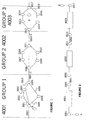
- Figure 1 represents a network of nodes 2001 ... 2017, interconnected by node links 3001 to 3019.
- the nodes are arranged in groups 4001, 4002, 4003.
- the groups are interconnected by group links 5001, 5002.
- each group of nodes will provide at least one, and usually multiple paths across the group from one group link to another group link.
- a group 4004 is illustrated, and the nodes have been labelled as follows:
- Traffic directed to E4 has 3 possible paths: A4.B4.E4, A4.C4.B4.E4, A4.D4.B4.E4.
- Traffic directed to F4 has 3 possible paths: A4.D4.F4, A4.B4.D4.F4, A4.C4.B4.D4.F4.
- each message header should include priority information in addition to destination and origin information.
- time information is associated with each message.
- the time information may be an absolute time stamp (the time when the message was initially transmitted), or sequence information (the sequence of the block of data in an overall message). Additionally, time information may include the time when the data was received at the node. ( relative time information).
- A4 has three choices A4D4, A4B4D4, A4C4B4D4, but the second and third choices include the same link B4D4, assuming that all the links have the same available capacity, the load should be distributed 50% to A4D4, 25% A4B4D4, and 25% A4C4B4D4, rather than 1/3 to each because of the common link.
- the actual load status of each link would then be taken into consideration to determine the actual load distribution. For example if link A4D4 were fully loaded and link A4B4 had half the available capacity of links A4C4 & C4B4, 2/3 of the traffic should be assigned to A4C4B4D4 and 1/3 to A4B4D4.
- the above example illustrates the factors which a group master node would take into account is determining the available capacity across the group from one group link to another.
- the network between two terminals A, connected to node 2001 in Group 1 (4001) and B connected to node 2017 in Group 3 (4003) the network between A & B can be condensed to a series of nodes and links as shown in Figure 2.
- each group, 4001, 4002, 4003, is reduced to a pair of nodes, 2001/2005, 2006/2011, 2012/2017, interconnected by corresponding hypothetical equivalent single links 6001, 6002, 6003.
- the hypothetical links represent the available useable capacity between the corresponding nodes.
- link 6001 represents the available useable capacity on the paths between node 2001 and node 2005 of Group 1.
- Figure 4 illustrates header information which may be included in the message packets to facilitate reconstitution of the message after transmission across a network using the "all paths" technique.
- the information may include:
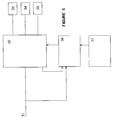
- Figure 5 illustrates schematically a mechanism within a node for distributing incoming messages to outgoing links.
- Incoming messages on link 51 are stored in buffer 52 for transmission to other links or nodes 53, 54, 55.
- Control means receives the header information and uses the destination, time stamp, priority, temporary buffer address of a message etc to determine the output to which a message is to be connected.
- the control means also has access to network map and load status information 57, and decides how much traffic can be allocated to each link.
- link 3001 has a capacity C1
- link 3002 has a capacity C2
- link 3003 has capacity C3
- link 3004 has capacity C4
- link 3005 has capacity C5
- link 3006 has capacity C6, and that all nodes are non-blocking.
- This maximum capacity varies with the loads on the links, and this load information is exchanged between the nodes of a group. Because there may be both intra-group and transgroup traffic, the smallest link in a path may not be the limiting factor in a path if the traffic on one of the other links in the path reduces its available capacity.
- the available capacity of the equivalent link can be calculated. For example, in the equivalent link limited by C2, C4 and C5, assume that C2 has 60% available capacity, C4 has 75% available capacity and C5 has 100% available capacity.
- CE x 1 .C 1 + x 2 .C 2 + ... + x n .C n
- x n C n is the available capacity of the link having the least available capacity in Path n, x n being the available fraction of the link having capacity C n .
Landscapes
- Engineering & Computer Science (AREA)
- Computer Networks & Wireless Communication (AREA)
- Signal Processing (AREA)
- Data Exchanges In Wide-Area Networks (AREA)
Abstract
Description
- Figure 1
- represents a network of nodes and links.
- Figure 2
- represents a network including notional links produced by notionally combining parallel paths in accordance with an embodiment of this invention.
- Figure 3
- represents a group of nodes.
- Figure 4
- represents header information utilized in implementing an embodiment of the invention.
- Figure 5
- represents a schematic arrangement for routing traffic according to an embodiment of the invention.
A4.B4.E4, A4.C4.B4.E4, A4.D4.B4.E4.
A4.D4.F4, A4.B4.D4.F4, A4.C4.B4.D4.F4.
Claims (7)
- A traffic routing tool for use in a network of nodes interconnected by node links in which groups of nodes are interconnected by group links,wherein the tool dynamically determines the available traffic capacity between a source and a destination using all practical paths,wherein, within each group of nodes is notionally reduced to a corresponding equivalent link between an associated pair of nodes in the source/destination path, the equivalent single path representing the available capacity between the associated pair of nodes.
- A method for routing traffic in a network of nodes interconnected by node links in which groups of nodes are interconnected by group links,wherein the tool dynamically determines the available traffic capacity between a source and a destination using all practical paths,wherein, within each group of nodes is notionally reduced to a corresponding equivalent link between an associated pair of nodes in the source/destination path, the equivalent single path representing the available capacity between the associated pair of nodes.
- A traffic routing arrangement for routing each message on an incoming link to one or more outgoing links, the arrangement including:buffer means to store incoming message;control means to determine the destination of each incoming message from destination information in the message header;the control means having access to network layout information and network load status information;whereby the traffic routing arrangement routes each message to one or more output links on the basis of all practical paths to the destination determined from the, destination information, the network layout information, and the network load status information.
- An arrangement as claimed in wherein the network information includes notional equivalent links representing the available capacity of groups of parallel paths.
- A traffic routing arrangement substantially as herein described with reference to the accompanying drawings.
- A traffic routing tool substantially as herein described with reference to the accompanying drawings.
- A method of routing traffic substantially as herein described with reference to the accompanying drawings.
Applications Claiming Priority (4)
| Application Number | Priority Date | Filing Date | Title |
|---|---|---|---|
| AUPQ990199 | 1999-10-05 | ||
| AU5270099 | 1999-10-05 | ||
| AU5270099 | 1999-10-05 | ||
| AU53694/00A AU5369400A (en) | 1999-10-05 | 2000-08-23 | Traffic allocation on virtual trunks |
Publications (2)
| Publication Number | Publication Date |
|---|---|
| EP1091530A2 true EP1091530A2 (en) | 2001-04-11 |
| EP1091530A3 EP1091530A3 (en) | 2002-09-11 |
Family
ID=54065619
Family Applications (1)
| Application Number | Title | Priority Date | Filing Date |
|---|---|---|---|
| EP00440242A Ceased EP1091530A3 (en) | 1999-10-05 | 2000-09-08 | Traffic allocation on virtual trunks |
Country Status (3)
| Country | Link |
|---|---|
| EP (1) | EP1091530A3 (en) |
| CN (1) | CN1291030A (en) |
| AU (1) | AU5369400A (en) |
Cited By (4)
| Publication number | Priority date | Publication date | Assignee | Title |
|---|---|---|---|---|
| WO2003009544A1 (en) * | 2001-07-17 | 2003-01-30 | Intel Corporation | Bus protocol |
| US6687263B2 (en) | 2001-04-18 | 2004-02-03 | Nonend Inventions N.V. | Method for inverse multiplexing |
| EP1458148A1 (en) * | 2003-03-10 | 2004-09-15 | Sony International (Europe) GmbH | Quality of Service (QoS) -aware handover procedure for Ad-Hoc networks |
| US7529190B2 (en) | 2001-07-04 | 2009-05-05 | Nonend Inventions N.V. | Method, device and software for digital inverse multiplexing |
Families Citing this family (2)
| Publication number | Priority date | Publication date | Assignee | Title |
|---|---|---|---|---|
| CN103093281B (en) * | 2012-12-27 | 2016-09-14 | 吴立新 | A kind of Parallel implementation method of Network Maximal-flow |
| CN106411555B (en) * | 2015-08-03 | 2020-02-14 | 阿里巴巴集团控股有限公司 | Communication link configuration method, device and related system |
Family Cites Families (3)
| Publication number | Priority date | Publication date | Assignee | Title |
|---|---|---|---|---|
| US4967345A (en) * | 1988-06-23 | 1990-10-30 | International Business Machines Corporation | Method of selecting least weight routes in a communications network |
| US5949788A (en) * | 1997-05-06 | 1999-09-07 | 3Com Corporation | Method and apparatus for multipoint trunking |
| DE19746904B4 (en) * | 1997-10-23 | 2004-09-30 | Telefonaktiebolaget L M Ericsson (Publ) | Traffic data evaluation device and associated method for a network with dynamic switching |
-
2000
- 2000-08-23 AU AU53694/00A patent/AU5369400A/en not_active Abandoned
- 2000-09-08 EP EP00440242A patent/EP1091530A3/en not_active Ceased
- 2000-09-25 CN CN00128795A patent/CN1291030A/en active Pending
Cited By (7)
| Publication number | Priority date | Publication date | Assignee | Title |
|---|---|---|---|---|
| US6687263B2 (en) | 2001-04-18 | 2004-02-03 | Nonend Inventions N.V. | Method for inverse multiplexing |
| US7738513B2 (en) | 2001-04-18 | 2010-06-15 | Nonend Inventions N.V. | Method for inverse multiplexing |
| US7995624B2 (en) | 2001-04-18 | 2011-08-09 | Nonend Inventions N.V. | Systems and methods for multiplexing digital data |
| US7529190B2 (en) | 2001-07-04 | 2009-05-05 | Nonend Inventions N.V. | Method, device and software for digital inverse multiplexing |
| WO2003009544A1 (en) * | 2001-07-17 | 2003-01-30 | Intel Corporation | Bus protocol |
| EP1458148A1 (en) * | 2003-03-10 | 2004-09-15 | Sony International (Europe) GmbH | Quality of Service (QoS) -aware handover procedure for Ad-Hoc networks |
| US7693093B2 (en) | 2003-03-10 | 2010-04-06 | Sony Deutschland Gmbh | QoS-aware handover procedure for IP-based mobile ad-hoc network environments |
Also Published As
| Publication number | Publication date |
|---|---|
| AU5369400A (en) | 2001-04-12 |
| CN1291030A (en) | 2001-04-11 |
| EP1091530A3 (en) | 2002-09-11 |
Similar Documents
| Publication | Publication Date | Title |
|---|---|---|
| US5687167A (en) | Method for preempting connections in high speed packet switching networks | |
| US8717875B2 (en) | Condensed core-energy-efficient architecture for WAN IP backbones | |
| US5491690A (en) | Method and apparatus to speed up the path selection in a packet switching network | |
| AU607571B2 (en) | Distributed load sharing | |
| US6574669B1 (en) | Method and apparatus for routing traffic within a network utilizing linear optimization | |
| EP0843942B1 (en) | Route finding in communications networks | |
| Chlamtac et al. | Scalable WDM access network architecture based on photonic slot routing | |
| EP0753979A1 (en) | Routing method and system for a high speed packet switching network | |
| EP0781068A1 (en) | Method and system for adaptive bandwidth allocation in a high speed data network | |
| JPS62502303A (en) | Interconnection method of packet communication networks | |
| US7092359B2 (en) | Method for distributing the data-traffic load on a communication network and a communication network for implementing this method | |
| JP2000502856A (en) | Method and apparatus for managing network resources | |
| US6567382B1 (en) | Maximal flow data routing | |
| JP4966206B2 (en) | Ethernet-based system and method for improving network routing | |
| EP1091530A2 (en) | Traffic allocation on virtual trunks | |
| US7283467B2 (en) | Procedures for improving call routing in PNNI networks | |
| She et al. | Multi-resource manycast over optical burst switched networks | |
| Aalto et al. | Basic packet routing problem | |
| Chu et al. | A hierarchical routing and flow control policy (HRFC) for packet switched networks | |
| Zantuti | The capacity and non-simultaneously multicommodity flow problem in wide area network and data flow management | |
| Baldi et al. | Ring versus tree embedding for real-time group multicast | |
| Reed et al. | Analysis of adaptive algorithms for an integrated communication network | |
| Bahk | Routing for interconnected networks and high-speed wide area networks | |
| Awdeh et al. | A contention resolution algorithm for input‐buffered batcher‐banyan networks | |
| Reed et al. | Packet routing algorithms for integrated switching networks |
Legal Events
| Date | Code | Title | Description |
|---|---|---|---|
| PUAI | Public reference made under article 153(3) epc to a published international application that has entered the european phase |
Free format text: ORIGINAL CODE: 0009012 |
|
| AK | Designated contracting states |
Kind code of ref document: A2 Designated state(s): AT BE CH CY DE DK ES FI FR GB GR IE IT LI LU MC NL PT SE |
|
| AX | Request for extension of the european patent |
Free format text: AL;LT;LV;MK;RO;SI |
|
| PUAL | Search report despatched |
Free format text: ORIGINAL CODE: 0009013 |
|
| AK | Designated contracting states |
Kind code of ref document: A3 Designated state(s): AT BE CH CY DE DK ES FI FR GB GR IE IT LI LU MC NL PT SE |
|
| AX | Request for extension of the european patent |
Free format text: AL;LT;LV;MK;RO;SI |
|
| 17P | Request for examination filed |
Effective date: 20021030 |
|
| 17Q | First examination report despatched |
Effective date: 20030114 |
|
| AKX | Designation fees paid |
Designated state(s): AT BE CH CY DE DK ES FI FR GB GR IE IT LI LU MC NL PT SE |
|
| STAA | Information on the status of an ep patent application or granted ep patent |
Free format text: STATUS: THE APPLICATION HAS BEEN REFUSED |
|
| 18R | Application refused |
Effective date: 20050310 |