EP1090625A2 - Topical composition for the skin and use thereof - Google Patents
Topical composition for the skin and use thereof Download PDFInfo
- Publication number
- EP1090625A2 EP1090625A2 EP00121247A EP00121247A EP1090625A2 EP 1090625 A2 EP1090625 A2 EP 1090625A2 EP 00121247 A EP00121247 A EP 00121247A EP 00121247 A EP00121247 A EP 00121247A EP 1090625 A2 EP1090625 A2 EP 1090625A2
- Authority
- EP
- European Patent Office
- Prior art keywords
- alkyl group
- group
- compound
- hydrogen atom
- skin
- Prior art date
- Legal status (The legal status is an assumption and is not a legal conclusion. Google has not performed a legal analysis and makes no representation as to the accuracy of the status listed.)
- Granted
Links
- HWQCSPKTQYYFIC-NSHDSACASA-N OC(CN[C@@H](Cc1ccccc1)C(NCCS(O)(=O)=O)=O)=O Chemical compound OC(CN[C@@H](Cc1ccccc1)C(NCCS(O)(=O)=O)=O)=O HWQCSPKTQYYFIC-NSHDSACASA-N 0.000 description 1
Classifications
-
- C—CHEMISTRY; METALLURGY
- C07—ORGANIC CHEMISTRY
- C07C—ACYCLIC OR CARBOCYCLIC COMPOUNDS
- C07C237/00—Carboxylic acid amides, the carbon skeleton of the acid part being further substituted by amino groups
- C07C237/02—Carboxylic acid amides, the carbon skeleton of the acid part being further substituted by amino groups having the carbon atoms of the carboxamide groups bound to acyclic carbon atoms of the carbon skeleton
- C07C237/20—Carboxylic acid amides, the carbon skeleton of the acid part being further substituted by amino groups having the carbon atoms of the carboxamide groups bound to acyclic carbon atoms of the carbon skeleton the carbon skeleton containing six-membered aromatic rings
-
- A—HUMAN NECESSITIES
- A61—MEDICAL OR VETERINARY SCIENCE; HYGIENE
- A61K—PREPARATIONS FOR MEDICAL, DENTAL OR TOILETRY PURPOSES
- A61K38/00—Medicinal preparations containing peptides
- A61K38/04—Peptides having up to 20 amino acids in a fully defined sequence; Derivatives thereof
- A61K38/05—Dipeptides
-
- A—HUMAN NECESSITIES
- A61—MEDICAL OR VETERINARY SCIENCE; HYGIENE
- A61P—SPECIFIC THERAPEUTIC ACTIVITY OF CHEMICAL COMPOUNDS OR MEDICINAL PREPARATIONS
- A61P17/00—Drugs for dermatological disorders
Definitions
- the present invention relates to a topical composition for the skin (hereinafter may be simply referred to as a topical skin composition) exhibiting effects of retarding aging of the skin or rejuvenating the skin and of suppressing hair growth.
- aging of the skin is mainly caused by advancing age, drying, oxidation, or sunlight (i.e., UV rays). Aging of the skin is recognized by a decrease in collagen or elastin in the dermis of the skin; a decrease in mucopolysaccharides, including hyaluronic acid; or the presence of cells which are damaged by UV rays.
- an object of the present invention is to provide a topical composition for the skin exhibiting effects with respect to retarding aging of the skin, such as wrinkle formation, or rejuvenating the skin, and of suppressing hair growth.
- the present inventors have found that a dipeptide compound having a specific structure or a salt thereof exhibits excellent effects with respect to suppressing wrinkle formation, preventing a reduction in skin elasticity, and suppressing hair growth, and that the compound or the salt is effectively employed in a topical skin composition for retarding aging of the skin or suppressing hair growth.
- the present invention provides a topical skin composition
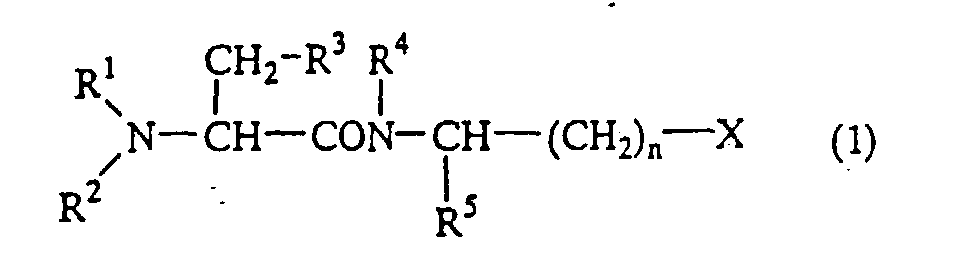
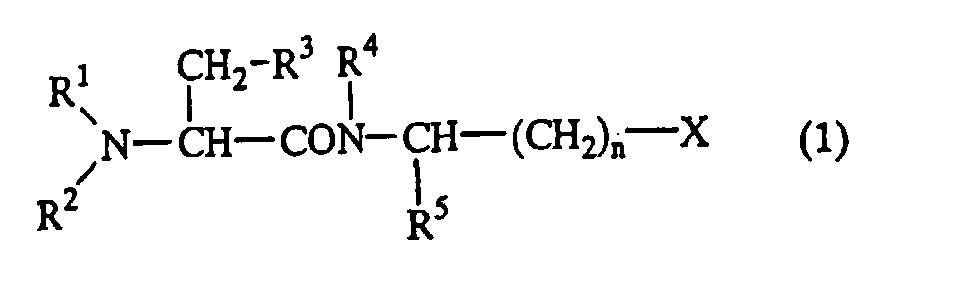
- the present invention also provides, as a novel compound which has not yet been described in any literature, N-(carboxymethyl)phenylalanyl- ⁇ -alanine, among dipeptide compounds represented by formula (1), or a salt thereof.
- an alkyl group represented by R 1 is preferably a C1-C6 alkyl group, may be a linear or branched alkyl group, and is more preferably a methyl group, an ethyl group, an n-propyl group, an isopropyl group, an n-butyl group, an isobutyl group, or a t-butyl group.
- An alkanoyl group represented by R 1 is preferably a C1-C6 alkanoyl group, may be a linear or branched alkanoyl group, and is more preferably an acetyl group, a propionyl group, or a butyryl group.
- a lower alkyl group represented by R 3 , R 4 , R 6 , R 7 , or R 8 is preferably a C1-C6 alkyl group, may be a linear or branched alkyl group, and is more preferably a methyl group, an ethyl group, an n-propyl group, an isopropyl group, an n-butyl group, an isobutyl group, or a t-butyl group.
- a lower alkenyl group represented by R 7 or R 8 is preferably a C2-C6 alkenyl group, more preferably a vinyl group or a propenyl group.
- An aralkyl group represented by R 7 or R 8 is a C7-C18 aralkyl group.
- Specific examples include a phenyl C1-C6 alkyl group, a biphenyl C1-C6 alkyl group, and a naphthyl C1-C6 alkyl group. Of these, a phenyl C1-C6 alkyl group is preferable, and a benzyl group is more preferable.
- An alkyl group which may have a substituent, represented by R 2 may be a C1-C6 alkyl group, a carboxy C1-C6 alkyl group, or a C1-C6 alkoxycarbonyl C1-C6 alkyl group. Of these, a C1-C6 alkyl group is preferable.
- R 2 is more preferably a methyl group, an ethyl group, an n-propyl group, an isopropyl group, an isobutyl group, or a t-butyl group.
- An alkyl group which may have a substituent, represented by R 5 may be a C1-C6 alkyl group, a carboxy C1-C6 alkyl group, or a C1-C6 alkoxycarbonyl C1-C6 alkyl group. Of these, a C1-C6 alkyl group and a carboxy C1-C6 alkyl group are preferable.
- R 5 is more preferably a methyl group, an isopropyl group, an isobutyl group, a t-butyl group, a carboxymethyl group, or a carboxyethyl group.
- a heterocyclic ring which is formed by R 4 and R 5 may be pyrrolidine or piperidine.
- n is preferably 0, 1, or 2.
- R 1 is more preferably a hydrogen atom, a C1-C6 alkyl group, a C1-C6 alkanoyl group, or -CH(R 6 )COOR 7 (wherein R 6 represents a hydrogen atom or a C1-C6 alkyl group, and R 7 represents a hydrogen atom, a C1-C6 alkyl group, a C2-C6 alkenyl group, or a phenyl C1-C6 alkyl group).
- R 2 is more preferably a hydrogen atom or a C1-C6 alkyl group.
- R 3 is more preferably a C1-C6 alkyl group or a phenyl group.
- R 4 is more preferably a hydrogen atom or a C1-C6 alkyl group.
- R 5 is more preferably a hydrogen atom, a C1-C6 alkyl group, a phenyl C1-C6 alkyl group, or a carboxy C1-C6 alkyl group.
- X is more preferably -COOR 8 (wherein R 8 represents a hydrogen atom, a C1-C6 alkyl group, a C2-C6 alkenyl group, or a phenyl C1-C6 alkyl group) or -SO 3 H.
- An integer n is more preferably 0, 1, or 2.
- Examples of salts of a dipeptide compound (1) include alkali metal salts, alkaline earth metal salts, amine salts, amino acid salts, and acid addition salts. Of these, alkali metal salts and amino acid salts are preferable.
- a dipeptide compound (1) may have optical activity, and its steric configuration may be any of R, S, and a racemic mixture. The compound may also be in the form of a hydrate.
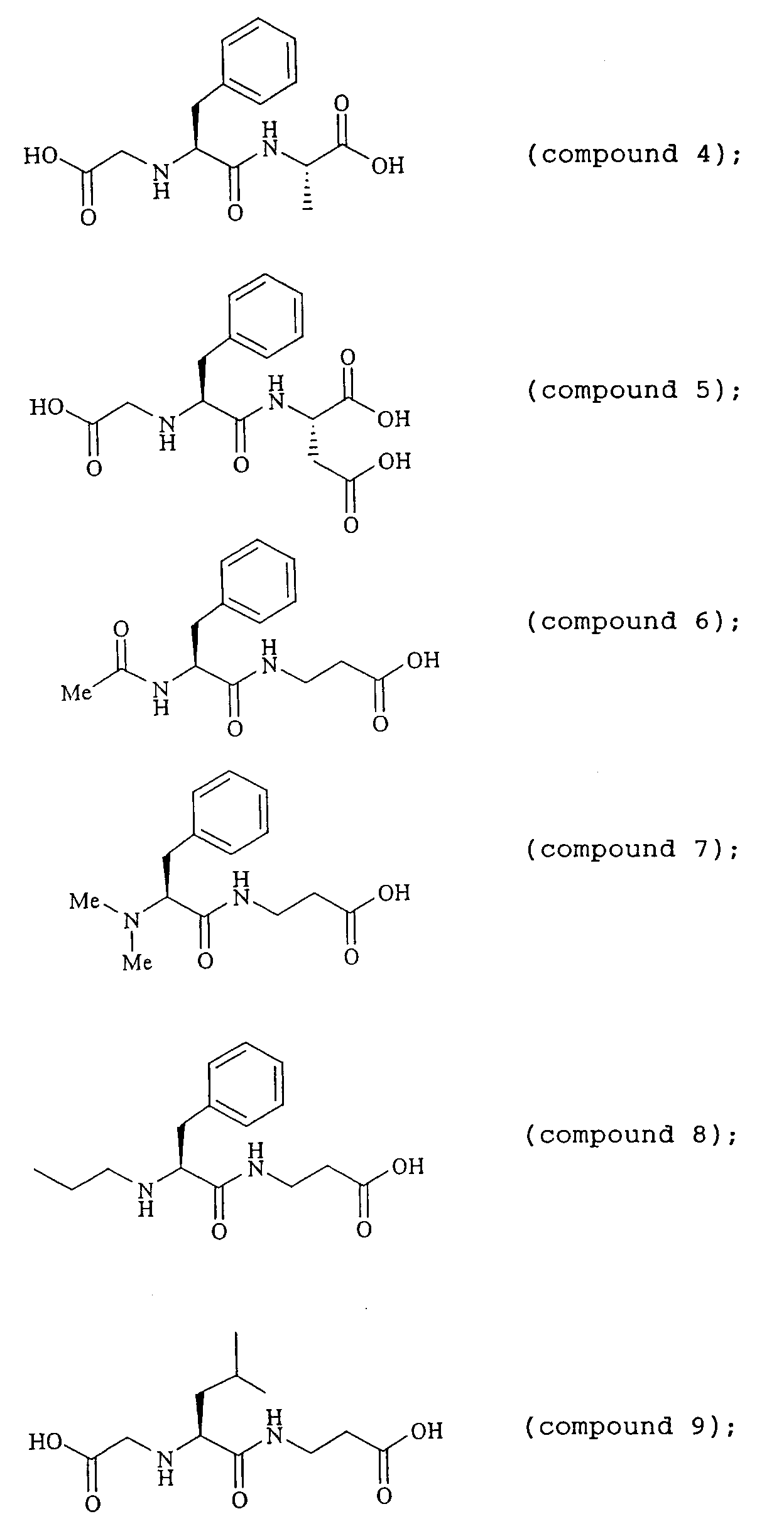
- dipeptide compounds of formula (1) the more preferred compounds are as follows: Phe-Gly (compound 11); Phe- ⁇ -Ala (compound 12); Phe-Phe (compound 13); Phe-Leu (compound 14); Phe-Ala (compound 15); and Phe-Asp (compound 16): Phe-Tau (compound 17).
- compound 1 and compound 12 are more preferable.
- a compound of formula (1) in which R 1 is a hydrogen atom may be synthesized through a process described in "K. Ienalga, K. Higashihara, and H. Kimura, Chem. Pharm. Bull., 35, 1249-1254 (1987)."
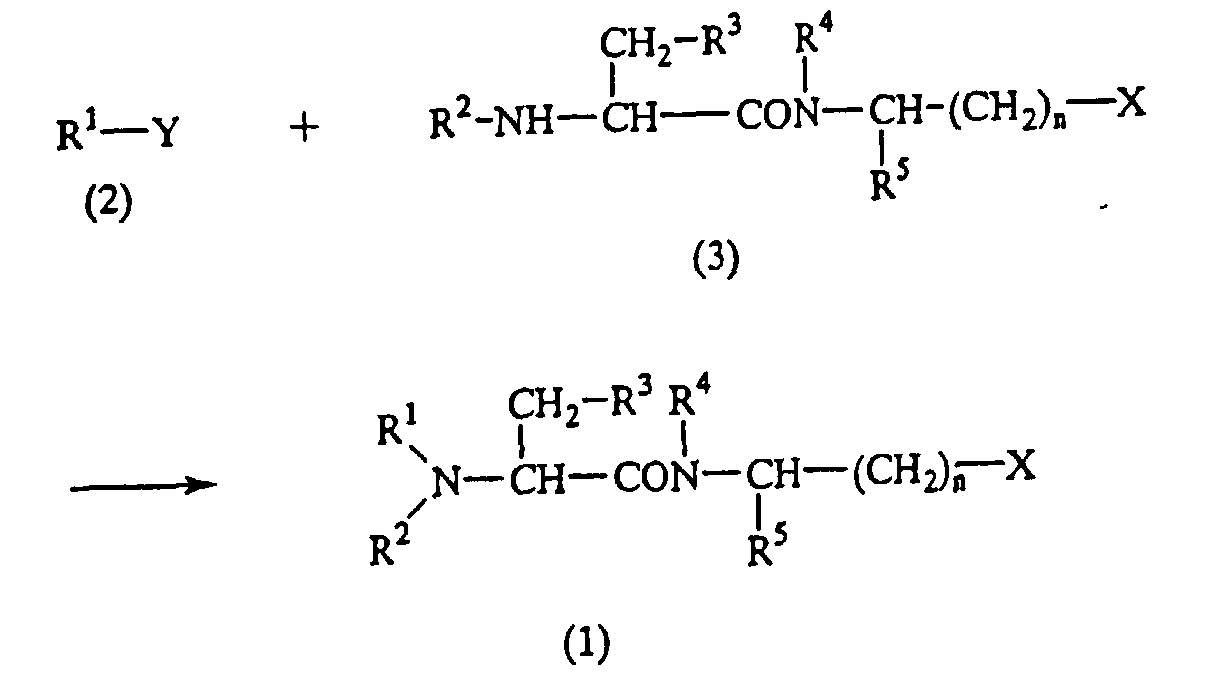
- a compound of formula (1) in which R 1 is not a hydrogen atom but is any of the aforementioned groups may be synthesized through, for example, the following process: (wherein Y represents a halogen atom, a p-toluenesulfonyl group, or a methanesulfonyloxy group; R 1 represents any of the aforementioned groups other than a hydrogen atom; and R 2 through R 5 , n, and X are the same as described above).
- a compound (2) is reacted with a compound (3) in the presence or absence of a base, and if necessary, hydrolysis by use of a base such as sodium hydroxide, or catalytic hydrogenation by use of a catalyst such as palladium carbon may be carried out, to thereby yield a compound (1) of the present invention.
- a base such as sodium hydroxide
- a catalyst such as palladium carbon
- bases which may be employed in the reaction include sodium hydroxide, potassium hydroxide, potassium carbonate, sodium carbonate, sodium hydrogencarbonate, and triethylamine. Of these, potassium carbonate and triethylamine are preferable, and triethylamine is more preferable.
- solvents which may be employed in the reaction include water, dimethylformamide, tetrahydrofuran, benzene, toluene, xylene, and hexane. Of these, toluene and benzene are preferable, and toluene is more preferable.
- the reaction temperature is -30 to 200°C, preferably 10 to 90°C, more preferably 40 to 70°C.
- a dipeptide compound (1) or a salt thereof is incorporated into the topical skin composition of the present invention in an amount of 0.0001-40 wt.% (hereinafter “wt.%” will be simply referred to as “%”), preferably 0.01-20%.
- the topical skin composition of the present invention is more preferably used for preventing and ameliorating unfavorable skin conditions caused by aging of the skin, such as wrinkles, flabbiness, and reduction of elasticity; or for suppressing hair growth.
- the topical skin composition of the present invention may further contain a keratinization-ameliorating agent, to thereby enhance the effect of retarding aging of the skin, such as wrinkle formation, or the effect of suppressing hair growth.
- keratinization-ameliorating agents include sphingosine derivatives.
- the topical skin composition of the present invention may appropriately contain, in addition to the aforementioned ingredients, a variety of ingredients or carriers which are usually employed in cosmetics, quasidrugs, and drugs.
- ingredients or carriers include humectants, powders, gelation agents, thickeners, surfactants, emulsifiers, anti-inflammatory agents, antioxidants, pH regulating agents, chelating agents, preservatives, dyes, perfumes, UV absorbing agents, UV protecting agents, existing skin-aging preventive or retarding agents such as collagen, and existing hair-growth suppressing agents.
- the composition may be produced through a conventional method in accordance with the application form.
- the topical skin composition of the present invention may be used as a skin composition for pharmaceutical use or a cosmetic composition.
- pharmaceutical compositions include a variety of ointments containing a pharmaceutically active ingredient.
- Such an ointment may comprise an oily base, or an oil-in-water or water-in-oil emulsion base.
- oily base or an oil-in-water or water-in-oil emulsion base.
- No particular limitation is imposed on the species of oily base, and, for example, vegetable oil, animal oil, synthetic oil, fatty acid, or natural or synthetic glyceride may be employed.
- No particular limitation is imposed on the species of pharmaceutically active ingredient, and, for example, analgesic and anti-inflammatory agents, antipruritic drugs, astringent agents, or hormones may be appropriately employed in accordance with needs.
- cosmetic compositions include lotions, emulsions, creams, ointments, sticks, solutions in organic solvents or purified water, packs, gels and aerosols.
- the cosmetic composition may be employed as a lotion, an oil essence, an O/W-type or W/O-type cream, a pack, a foundation, a skin-cleansing agent, a tonic, a bathing agent, or an aerosol.
- Phenylalanyl- ⁇ -alanine benzyl ester hydrochloride (10.0 g, 0.028 mol) and benzyl bromoacetate (14.6 g, 0.062 mol) were dissolved in tetrahydrofuran (200 mL).
- tetrahydrofuran 200 mL
- triethylamine suspended in tetrahydrofuran was added, and the resultant mixture was stirred for 42 hours.
- the resultant mixture was subjected to extraction with ethyl acetate (100 mL), and the organic layer was washed with a saturated aqueous solution of sodium hydrogencarbonate and saturated brine and then dried over anhydrous sodium sulfate.
- Phenylalanyl- ⁇ -aminobutyric acid methyl ester hydrochloride (1.4 g, 0.0047 mol) and ethyl bromoacetate (0.8 g, 0.0056 mol) were dissolved in tetrahydrofuran (80 mL).
- tetrahydrofuran 80 mL
- triethylamine suspended in tetrahydrofuran was added, and the resultant mixture was stirred for 24 hours.
- the resultant mixture was subjected to extraction with ethyl acetate (20 mL), and the organic layer was washed with a saturated aqueous solution of sodium hydrogencarbonate and saturated brine, and then dried over anhydrous sodium sulfate.
- Phenylalanyl- ⁇ -alanine ethyl ester (10 g, 0.038 mol) and triethylamine (10.3 g, 0.1 mol) were suspended in toluene (45 g), and the suspension was heated to 60°C.
- ethyl bromoacetate (9.3 g, 0.057 mol) suspended in toluene (5 g) was added dropwise over 0.5 hours, and then the resultant mixture was stirred for three hours. After completion of reaction, the resultant reaction mixture was subjected to extraction with ethyl acetate (20 g). The organic layer was washed with a 2.5% aqueous solution of citric acid.
- N-(carboethoxymethyl)phenylalanyl- ⁇ -alanine ethyl ester (10.7 g, yield: 80.3%).
- the compound was dissolved in methanol, and a 48% aqueous solution of sodium hydroxide (6.6 g, 0.08 mol) was added to the methanol solution, and the resultant mixture was stirred for three hours.
- the solvent was removed, and the resultant residue was dissolved in water (20 mL), and then washed with ethyl acetate (10 g). Subsequently, hydrochloric acid was added to the aqueous layer, so as to attain a pH of 3.5.
- Phenylalanyl- ⁇ -alanine (17.4 g, 0.074 mol) was suspended in pyridine (120 g), and the suspension was cooled to 15°C. Acetic anhydride (30 g) was added dropwise to the resultant suspension over one hour. After completion of addition, the temperature of the resultant mixture was returned to room temperature, and the mixture was stirred for 13 hours, and then the reaction was terminated. The resultant reaction mixture was cooled to 5°C, and ethanol (50 mL) was added to the reaction mixture, and the mixture was stirred for 30 minutes, and then the solvent was removed.
- the resultant residue was subjected to extraction with ethyl acetate (500 mL), and washed with 5% hydrochloric acid, distilled water, and saturated brine, successively, and then dried over anhydrous sodium sulfate. Subsequently, the solvent was removed, and the resultant residue was subjected to column chromatography with a solvent mixture of chloroform and methanol serving as an eluent. Thereafter, the solvent was removed, to thereby obtain compound 6 (11.5 g, yield: 56%).
- Phenylalanyl- ⁇ -alanine (1 g, 0.0042 mol) was suspended in water (2 g). To the resultant suspension, palladium carbon (10%) (1 g) and a 36% aqueous solution of formaldehyde (7.1 g, 0.042 mol) were added, and the resultant mixture was stirred in an H 2 atmosphere at 10 atm. for 24 hours. After completion of reaction, the solvent was removed. The resultant residue was purified through column chromatography, to thereby obtain compound 7 (12.8 mg, yield: 8.1%).
- Phenylalanyl- ⁇ -alanine (0.5 g, 0.0021 mol) was suspended in water (5 g). To the resultant suspension, palladium carbon (10%) (0.5 g) and propionaldehyde (0.15 g, 0.027 mol) in methanol (5 g) were added, and the resultant mixture was stirred in a H 2 atmosphere for 24 hours. After completion of reaction, the solvent was removed. The resultant residue was recrystallized from methanol, to thereby obtain compound 8 (0.13 g, yield: 22.2%).
- Phenylalanyl taurine (2.5 g, 9.18 mmol) and sodium hydroxide (0.58 g, 0.0144 mol) were dissolved in distilled water (25 g), and the solution was heated to 50°C.
- bromoacetic acid (1.5 g, 0.011 mol) in distilled water (3 g) and an aqueous solution of sodium hydroxide were added dropwise simultaneously over 0.5 hours, so as to attain a pH of 10.5-11.5, and the resultant mixture was stirred for three hours.
- concentrated hydrochloric acid was added to the resultant reaction mixture, so as to attain a pH of 3.
- Test Example 1 Suppression of wrinkle formation in hairless mouse
- Three-week-old SD male rats were classified into three groups (five rats per group): a group of rats to which an 80% ethanol solution containing a test compound was applied to pads of hind limbs; a group of rats to which a solvent (80% ethanol) was applied to the pads; and a group of non-treated rats.
- Each pad was exposed to UV-B rays (less than 1 MED), and then the test compound-containing solution or the solvent was applied to the pad in an amount of 10 ⁇ L.
- the above procedure was carried out three times a week (every other day of the week days) for six weeks.
- Skin elasticity was determined using a cutometer (model: SES575, product of Courage Kazaka) as follows. The skin of the pad was subjected to suction at 500 hPa for three seconds, and then released for three seconds. The displacement over six seconds was measured, to thereby obtain Ue and Uf values. The measurement was repeated five times for each pad.
- the linearity of elastic fibers was analyzed according to the method of Imokawa et al. (J. Invest. Dermatol., 105, 254-258(1995)) through image analysis of an SEM micrograph. Specifically, samples for scanning electron microscopy (SEM) were prepared by fixing the pad of a rat with Mercox (product of Dainippon Ink and Chemicals, Inc.) under reflux, followed by digestion with formic acid. From SEM micrographs ( ⁇ 1000) of each of the samples, ten typical micrographs were selected and enlarged copies were made. Each of the enlarged micrographs was divided into 16 uniform regions.
- SEM scanning electron microscopy
- any one of the elastic fibers was selected and traced on a transparent film with a line having a fixed width (width: 8 pixels).
- A the area surrounded by the line tracing the elastic fiber
- B and C the longitudinal length and lateral length of the minimum rectangle surrounding the trace
- B and C the linearity of the elastic fiber
- the linearity becomes 1.
- Table 2 The results are shown in Table 2.
- a sample was applied in an amount of 100 ⁇ L twice a day for four weeks.
- Test compounds were dissolved in a solvent (80% ethanol) to attain the concentrations shown in Table 3, to thereby prepare samples. In the control group, only the solvent was applied to the shaved portion.
- the shaved portion was photographed at a certain magnification, and the ratio of the area of hair regrowth (i.e., the ratio of the area of hair regrowth to that of the shaved area) was compared with that of the control group using an image analyzer.
- the hair growth suppression ratio (%) was represented by a relative value when the ratio of the area of the hair regrowth in the control group was taken as 100. The results are shown in Table 3.
- a cream for retarding aging of the skin was produced through a conventional method.
- the cream exhibited an excellent effect with respect to retarding aging of the skin.
- (%) Compound 1 or 12 0.2 Stearic acid 2.0 Cetanol 4.0 Squalene 8.0 Vaseline 5.0 Hydrogenated palm oil 4.0 Polyoxyethylene sorbitan monostearate (20 E.O.) 1.4 Oleophilic glycerin monostearate 2.4 Butyl paraben 0.1 Glycerin 3.0 10.0% Potassium hydroxide 0.2 Perfume 0.1 Purified water Balance Total 100.0
- a hair growth suppression lotion was produced. Specifically, a solution containing ingredients of A and a solution containing ingredients of B were prepared separately. The solution B was added to the solution A, and the resultant mixture was stirred for homogeneity, to thereby produce a hair growth suppression lotion. The lotion exhibited an excellent effect with respect to suppressing hair growth. (%) A. Polyoxyethylene hydrogenated castor oil 0.8 Ethanol 30.0 B. Compound 1 or 12 1.0 Sodium dodecyl sulfate 0.12 Dodecylmethylamine oxide 0.18 Isopropyl alcohol 15.0 Benzyl alcohol 12.0 Glycerin 2.0 Purified water Balance Total 100.0
- a hair growth suppression aerosol was produced. Specifically, ingredients of A were uniformly mixed and charged in a container. The container was then filled with solution B through a conventional method, to thereby produce a hair growth suppression aerosol. The aerosol exhibited an excellent effect with respect to suppressing hair growth. (%) A. Compound 1 1.0 Cetanol 1.2 Propylene glycol 4.0 Ethanol 8.0 Purified water Balance B. Liquefied petroleum gas (propellant) 4.0 Total 100.0
- the topical skin composition of the present invention exhibits excellent effects with respect to retarding aging of the skin or rejuvenating the skin and suppressing hair growth.
Landscapes
- Health & Medical Sciences (AREA)
- Chemical & Material Sciences (AREA)
- Organic Chemistry (AREA)
- Life Sciences & Earth Sciences (AREA)
- Animal Behavior & Ethology (AREA)
- Engineering & Computer Science (AREA)
- Bioinformatics & Cheminformatics (AREA)
- Veterinary Medicine (AREA)
- Public Health (AREA)
- Medicinal Chemistry (AREA)
- General Health & Medical Sciences (AREA)
- Pharmacology & Pharmacy (AREA)
- Proteomics, Peptides & Aminoacids (AREA)
- Gastroenterology & Hepatology (AREA)
- Immunology (AREA)
- Epidemiology (AREA)
- Nuclear Medicine, Radiotherapy & Molecular Imaging (AREA)
- General Chemical & Material Sciences (AREA)
- Chemical Kinetics & Catalysis (AREA)
- Dermatology (AREA)
- Medicines That Contain Protein Lipid Enzymes And Other Medicines (AREA)
- Peptides Or Proteins (AREA)
- Cosmetics (AREA)
- Acyclic And Carbocyclic Compounds In Medicinal Compositions (AREA)
Abstract
Description


- 0:
- No wrinkle formation.
- 1:
- A few shallow wrinkles were formed.
- 2:
- A slight amount of wrinkles was formed.
- 3:
- Some wrinkles were formed.
- 4:
- Deep wrinkles were formed.
| Test Compound | Concentration | Wrinkle Index |
| Control | - | 3.06 ± 0.13 |
| Compound 1 | 0.1% | 1.25 ± 0.11 |
| Compound 2 | 0.1% | 2.01 ± 0.14 |
| Compound 3 | 0.1% | 1.82 ± 0.09 |
| Compound 4 | 0.1% | 1.75 ± 0.12 |
| Compound 5 | 0.1% | 2.21 ± 0.14 |
| Compound 6 | 0.1% | 2.57 ± 0.20 |
| Compound 7 | 0.1% | 2.34 ± 0.10 |
| Compound 8 | 0.1% | 2.03 ± 0.09 |
| Compound 9 | 0.1% | 2.11 ± 0.11 |
| Compound 10 | 0.1% | 1.95 ± 0.12 |
| Compound 11 | 1% | 2.82 ± 0.18 |
| Compound 12 | 1% | 1.98 ± 0.20 |
| Compound 13 | 1% | 2.64 ± 0.16 |
| Compound 14 | 1% | 2.82 ± 0.22 |
| Compound 15 | 1% | 2.72 ± 0.16 |
| Compound 16 | 1% | 2.50 ± 0.15 |
| Compound 17 | 1% | 1.99 ± 0.12 |
| Test Compound | Concentration | Ue value | Uf value | Linearity |
| No treatment | - | 0.03294 ± 0.00251 | 0.04833 ± 0.01700 | 0.7345 ± 0.0333 |
| Solvent only | - | 0.02125 ± 0.00875 | 0.03333 ± 0.01111 | 0.5133 ± 0.0600 |
| Compound 1 | 0.1% | 0.03153 ± 0.00523 | 0.04711 ± 0.00213 | 0.7221 ± 0.0299 |
| Compound 3 | 0.1% | 0.02985 ± 0.01021 | 0.04323 ± 0.01722 | 0.7013 ± 0.06551 |
| Compound 4 | 0.1% | 0.03009 ± 0.00274 | 0.04533 ± 0.00971 | 0.7153 ± 0.0329 |
| Compound 5 | 0.1% | 0.02694 ± 0.00157 | 0.04285 ± 0.00271 | 0.6652 ± 0.0239 |
| Compound 6 | 0.1% | 0.02433 ± 0.00921 | 0.03913 ± 0.00924 | 0.6078 ± 0.0195 |
| Compound 7 | 0.1% | 0.02623 ± 0.00874 | 0.0412 ± 0.00258 | 0.6423 ± 0.0433 |
| Compound 8 | 0.1% | 0.02708 ± 0.00119 | 0.0427 ± 0.00657 | 0.6976 ± 0.0422 |
| Compound 9 | 0.1% | 0.02793 ± 0.00697 | 0.04295 ± 0.00836 | 0.6892 ± 0.0157 |
| Compound 10 | 0.1% | 0.02972 ± 0.01034 | 0.04498 ± 0.00637 | 0.7021 ± 0.0454 |
| Compound 12 | 1% | 0.03326 ± 0.01267 | 0.04572 ± 0.01862 | 0.7197 ± 0.0321 |
| Compound 17 | 1% | 0.02894 ± 0.0114 | 0.04369 ± 0.00872 | 0.6913 ± 0.0341 |
| Test compound | Concentration | Hair-growth suppression ratio |
| Compound 1 | 0.1% | 82.4% |
| Compound 2 | 0.1% | 73.3% |
| Compound 3 | 0.1% | 72.3% |
| Compound 4 | 0.1% | 80.5% |
| Compound 5 | 0.1% | 71.0% |
| Compound 6 | 0.1% | 58.3% |
| Compound 7 | 0.1% | 69.6% |
| Compound 8 | 0.1% | 77.8% |
| Compound 9 | 0.1% | 77.1% |
| Compound 10 | 0.1% | 79.2% |
| Compound 11 | 1% | 32.9% |
| Compound 12 | 1% | 90.4% |
| Compound 13 | 1% | 78.5% |
| Compound 14 | 1% | 70.9% |
| Compound 15 | 1% | 68.4% |
| Compound 16 | 1% | 75.2% |
| Compound 17 | 1% | 79.5% |
| (%) | |
| Compound 1 or 12 | 0.2 |
| Stearic acid | 2.0 |
| Cetanol | 4.0 |
| Squalene | 8.0 |
| Vaseline | 5.0 |
| Hydrogenated palm oil | 4.0 |
| Polyoxyethylene sorbitan monostearate (20 E.O.) | 1.4 |
| Oleophilic glycerin monostearate | 2.4 |
| Butyl paraben | 0.1 |
| Glycerin | 3.0 |
| 10.0% Potassium hydroxide | 0.2 |
| Perfume | 0.1 |
| Purified water | Balance |
| Total | 100.0 |
| (%) | |
| Compound 3 | 3.0 |
| Polyvinyl alcohol | 20.0 |
| Glycerin | 5.0 |
| Ethanol | 16.0 |
| Perfume | 0.1 |
| Dye | 0.1 |
| Purified water | Balance |
| Total | 100.0 |
| (%) | ||
| A. | Polyoxyethylene hydrogenated castor oil | 0.8 |
| Ethanol | 30.0 | |
| B. | Compound 1 or 12 | 1.0 |
| Sodium dodecyl sulfate | 0.12 | |
| Dodecylmethylamine oxide | 0.18 | |
| Isopropyl alcohol | 15.0 | |
| Benzyl alcohol | 12.0 | |
| Glycerin | 2.0 | |
| Purified water | Balance | |
| Total | 100.0 |
| (%) | ||
| A. | Compound 1 | 1.0 |
| Cetanol | 1.2 | |
| Propylene glycol | 4.0 | |
| Ethanol | 8.0 | |
| Purified water | Balance | |
| B. | Liquefied petroleum gas (propellant) | 4.0 |
| Total | 100.0 |
Claims (8)
- A topical skin composition comprising a dipeptide compound represented by formula (1) or a salt of the dipeptide:
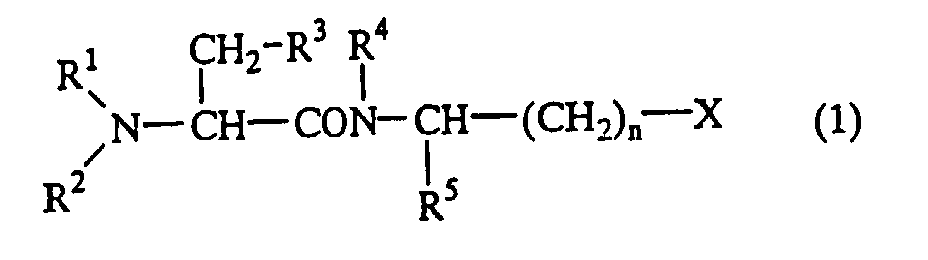 wherein R1 represents a hydrogen atom, an alkyl group, an alkanoyl group, or -CH(R6)COOR7 (wherein R6 represents a hydrogen atom or a lower alkyl group, and R7 represents a hydrogen atom, a lower alkyl group, a lower alkenyl group, or an aralkyl group);R2 represents a hydrogen atom or an alkyl group which may have a substituent;R3 represents a lower alkyl group or a phenyl group;R4 represents a hydrogen atom or a lower alkyl group, and may form a heterocyclic ring together with R5 and an adjacent nitrogen atom;R5 represents a hydrogen atom, an alkyl group which may have a substituent, or an aralkyl group which may have a substituent, and may form the heterocyclic ring together with R4;X represents -COOR8 (wherein R8 represents a hydrogen atom, a lower alkyl group, a lower alkenyl group, or an aralkyl group) or -SO3H; andn is an integer of 0-4; and a pharmaceutically acceptable carrier therefor.
 - A topical skin composition according to claim 1, wherein, in formula (1), R1 is a hydrogen atom, a C1-C6 alkyl group, a C1-C6 alkanoyl group, or -CH(R6)COOR7 (wherein R6 represents a hydrogen atom or a C1-C6 alkyl group, and R7 represents a hydrogen atom, a C1-C6 alkyl group, a C2-C6 alkenyl group, or a phenyl C1-C6 alkyl group);R2 is a hydrogen atom or a C1-C6 alkyl group;R3 is a C1-C6 alkyl group or a phenyl group;R4 is a hydrogen atom or a C1-C6 alkyl group;R5 is a hydrogen atom, a C1-C6 alkyl group, a phenyl C1-C6 alkyl group, or a carboxy C1-C6 alkyl group;X is -COOR8 (wherein R8 represents a hydrogen atom, a C1-C6 alkyl group, a C2-C6 alkenyl group, or a phenyl C1-C6 alkyl group) or -SO3H; andn is 0, 1, or 2.
- A topical skin composition according to claim 1, wherein the dipetide compound represented by formula (1) is N-(carboxymethyl)phenylalanyl-β-alanine or phenylalanyl-β-alanine.
- The dipeptide compound as defined in any one of claims 1 through 3 for preparing a pharmaceutical composition for retarding aging of the skin or rejuvenating the skin.
- Use of the dipeptide compound as defined in any one of claims 1 through 3 for preparing a pharmaceutical composition for suppressing growth of the hair.
- N-(Carboxymethyl)phenylalanyl-β-alanine or a salt thereof.
- A method for retarding aging of the skin or rejuvenating the skin by use of a topical skin composition as recited in any one of claims 1 through 3.
- A method for suppressing hair growth by use of a topical skin composition as recited in any one of claims 1 through 3.
Applications Claiming Priority (2)
| Application Number | Priority Date | Filing Date | Title |
|---|---|---|---|
| JP28379499 | 1999-10-05 | ||
| JP28379499 | 1999-10-05 |
Publications (3)
| Publication Number | Publication Date |
|---|---|
| EP1090625A2 true EP1090625A2 (en) | 2001-04-11 |
| EP1090625A3 EP1090625A3 (en) | 2001-05-23 |
| EP1090625B1 EP1090625B1 (en) | 2004-12-22 |
Family
ID=17670234
Family Applications (1)
| Application Number | Title | Priority Date | Filing Date |
|---|---|---|---|
| EP00121247A Expired - Lifetime EP1090625B1 (en) | 1999-10-05 | 2000-10-04 | Topical composition for the skin and use thereof |
Country Status (4)
| Country | Link |
|---|---|
| US (2) | US6489291B1 (en) |
| EP (1) | EP1090625B1 (en) |
| JP (1) | JP5023135B2 (en) |
| DE (1) | DE60016867T2 (en) |
Cited By (4)
| Publication number | Priority date | Publication date | Assignee | Title |
|---|---|---|---|---|
| WO2001054654A3 (en) * | 2000-01-25 | 2002-02-21 | Gillette Co | Reduction of hair growth |
| US8642801B2 (en) | 2003-06-23 | 2014-02-04 | Bhi Limited Partnership | Methods and compositions for treating amyloid-related diseases |
| US9499480B2 (en) | 2006-10-12 | 2016-11-22 | Bhi Limited Partnership | Methods, compounds, compositions and vehicles for delivering 3-amino-1-propanesulfonic acid |
| US10035970B2 (en) | 2016-05-09 | 2018-07-31 | Basf Se | Friction-reducing compound, method of producing same, and lubricant composition |
Families Citing this family (5)
| Publication number | Priority date | Publication date | Assignee | Title |
|---|---|---|---|---|
| AU2011250847B2 (en) * | 2003-06-23 | 2013-06-20 | Bhi Limited Partnership | Methods and compositions for treating amyloid-related diseases |
| WO2006085149A2 (en) | 2004-12-22 | 2006-08-17 | Neurochem (International) Limited | Methods and compositions for treating amyloid-related diseases |
| KR20080047358A (en) * | 2005-09-22 | 2008-05-28 | 가부시키가이샤 시세이도 | Wrinkle improver |
| ES2379703T3 (en) | 2010-03-26 | 2012-04-30 | The Procter And Gamble Company | Hair removal method and hair removal kit |
| WO2025136798A1 (en) * | 2023-12-18 | 2025-06-26 | Merck Sharp & Dohme Llc | Process for preparing (s)-1-((s)-2-amino-3-(4-methoxyphenyl)propanoyl)-n-(4-(hydroxymethyl)phenethyl)-2-methylpyrrolidine-2-carboxamide and its intermediates |
Family Cites Families (9)
| Publication number | Priority date | Publication date | Assignee | Title |
|---|---|---|---|---|
| FR2480747A1 (en) * | 1980-04-17 | 1981-10-23 | Roques Bernard | AMINO ACID DERIVATIVES AND THEIR THERAPEUTIC APPLICATION |
| EP0054862B1 (en) | 1980-12-18 | 1985-11-27 | Schering Corporation | Substituted dipeptides, processes for their preparation and pharmaceutical compositions containing them and their use in the inhibition of enkephalinase |
| ES2061442T3 (en) * | 1985-10-14 | 1994-12-16 | Nippon Zoki Pharmaceutical Co | PEPTIDOS. |
| US5091171B2 (en) * | 1986-12-23 | 1997-07-15 | Tristrata Inc | Amphoteric compositions and polymeric forms of alpha hydroxyacids and their therapeutic use |
| JPH05170637A (en) * | 1991-12-25 | 1993-07-09 | Narisu Keshohin:Kk | Beautifying and whitening cosmetic |
| JPH08333230A (en) * | 1995-06-07 | 1996-12-17 | Kao Corp | Whitening agent |
| JP3490816B2 (en) * | 1995-10-31 | 2004-01-26 | 株式会社コーセー | External preparation for skin |
| JPH11279040A (en) | 1998-03-27 | 1999-10-12 | Kao Corp | External preparation for skin |
| JP3887109B2 (en) * | 1998-10-13 | 2007-02-28 | 花王株式会社 | Topical skin preparation |
-
2000
- 2000-10-04 EP EP00121247A patent/EP1090625B1/en not_active Expired - Lifetime
- 2000-10-04 US US09/678,615 patent/US6489291B1/en not_active Expired - Lifetime
- 2000-10-04 DE DE60016867T patent/DE60016867T2/en not_active Expired - Lifetime
-
2002
- 2002-09-23 US US10/252,057 patent/US7189708B2/en not_active Expired - Lifetime
-
2009
- 2009-11-06 JP JP2009254913A patent/JP5023135B2/en not_active Expired - Fee Related
Cited By (7)
| Publication number | Priority date | Publication date | Assignee | Title |
|---|---|---|---|---|
| WO2001054654A3 (en) * | 2000-01-25 | 2002-02-21 | Gillette Co | Reduction of hair growth |
| US8642801B2 (en) | 2003-06-23 | 2014-02-04 | Bhi Limited Partnership | Methods and compositions for treating amyloid-related diseases |
| US9499480B2 (en) | 2006-10-12 | 2016-11-22 | Bhi Limited Partnership | Methods, compounds, compositions and vehicles for delivering 3-amino-1-propanesulfonic acid |
| US10238611B2 (en) | 2006-10-12 | 2019-03-26 | Bellus Health Inc. | Methods, compounds, compositions and vehicles for delivering 3-amino-1-propanesulfonic acid |
| US10857109B2 (en) | 2006-10-12 | 2020-12-08 | Bellus Health, Inc. | Methods, compounds, compositions and vehicles for delivering 3-amino-1-propanesulfonic acid |
| US11020360B2 (en) | 2006-10-12 | 2021-06-01 | Bellus Health Inc. | Methods, compounds, compositions and vehicles for delivering 3-amino-1-propanesulfonic acid |
| US10035970B2 (en) | 2016-05-09 | 2018-07-31 | Basf Se | Friction-reducing compound, method of producing same, and lubricant composition |
Also Published As
| Publication number | Publication date |
|---|---|
| JP5023135B2 (en) | 2012-09-12 |
| JP2010031039A (en) | 2010-02-12 |
| US7189708B2 (en) | 2007-03-13 |
| DE60016867D1 (en) | 2005-01-27 |
| US6489291B1 (en) | 2002-12-03 |
| EP1090625B1 (en) | 2004-12-22 |
| EP1090625A3 (en) | 2001-05-23 |
| US20030087833A1 (en) | 2003-05-08 |
| DE60016867T2 (en) | 2005-12-22 |
Similar Documents
| Publication | Publication Date | Title |
|---|---|---|
| JP5023135B2 (en) | Topical skin preparation | |
| EP0759292B1 (en) | Use of alpha type melanocytes stimulating hormone derivatives to stimulate the hairgrowth | |
| EP0765152B1 (en) | Stimulation of hair growth by peptide-copper complexes | |
| JP3174323B2 (en) | Metal-peptide compositions and methods for stimulating hair growth | |
| US7105570B2 (en) | Cysteine derivatives | |
| US20030152600A1 (en) | Novel compounds of the n-acylamino-amide-family, cpmpositions comprising same, and uses | |
| US6075052A (en) | Skin external preparation | |
| JPH10130128A (en) | Cosmetics | |
| US5252559A (en) | His-Gly-Gly peptide and derivatives thereof for hair growth | |
| JP4440446B2 (en) | Topical skin preparation | |
| JP2003055133A (en) | Cosmetic or dermatological composition comprising a combination of an elastase inhibitor of the N-acylaminoamide family and at least one muscle relaxant | |
| KR20200058350A (en) | Peptide derivatives that enhance skin moisturization and method for manufacturing the same | |
| US7375085B1 (en) | Melanocyte-stimulating hormone inhibitors | |
| JP2018501239A (en) | N-acylamino-amide family of compounds, compositions containing them, and uses | |
| JPWO2000064926A1 (en) | Melanocyte-stimulating hormone inhibitors | |
| KR20040040792A (en) | Retinol derivatives grafted with peptide and antiaging cosmetic composition containing the same | |
| JP3477266B2 (en) | Anti-aging skin cosmetics | |
| JPH06271446A (en) | Wrinkle improver | |
| JP2000169324A (en) | External preparation for skin | |
| KR100497151B1 (en) | Novel peptide compound and uses thereof | |
| KR100505469B1 (en) | Novel peptide compound and uses thereof | |
| KR20200032962A (en) | Peptide derivatives that enhance skin moisturization and method for manufacturing the same | |
| MXPA96006553A (en) | Composition for the stimulation of hair growth through complexes of peptide-co | |
| JP2000119144A (en) | External preparation for skin | |
| JPH07330578A (en) | External skin preparation |
Legal Events
| Date | Code | Title | Description |
|---|---|---|---|
| PUAI | Public reference made under article 153(3) epc to a published international application that has entered the european phase |
Free format text: ORIGINAL CODE: 0009012 |
|
| PUAL | Search report despatched |
Free format text: ORIGINAL CODE: 0009013 |
|
| AK | Designated contracting states |
Kind code of ref document: A2 Designated state(s): DE FR GB |
|
| AX | Request for extension of the european patent |
Free format text: AL;LT;LV;MK;RO;SI |
|
| AK | Designated contracting states |
Kind code of ref document: A3 Designated state(s): AT BE CH CY DE DK ES FI FR GB GR IE IT LI LU MC NL PT SE |
|
| AX | Request for extension of the european patent |
Free format text: AL;LT;LV;MK;RO;SI |
|
| 17P | Request for examination filed |
Effective date: 20010716 |
|
| AKX | Designation fees paid |
Free format text: DE FR GB |
|
| 17Q | First examination report despatched |
Effective date: 20040102 |
|
| GRAP | Despatch of communication of intention to grant a patent |
Free format text: ORIGINAL CODE: EPIDOSNIGR1 |
|
| GRAS | Grant fee paid |
Free format text: ORIGINAL CODE: EPIDOSNIGR3 |
|
| GRAA | (expected) grant |
Free format text: ORIGINAL CODE: 0009210 |
|
| AK | Designated contracting states |
Kind code of ref document: B1 Designated state(s): DE FR GB |
|
| REG | Reference to a national code |
Ref country code: GB Ref legal event code: FG4D |
|
| REF | Corresponds to: |
Ref document number: 60016867 Country of ref document: DE Date of ref document: 20050127 Kind code of ref document: P |
|
| PLBE | No opposition filed within time limit |
Free format text: ORIGINAL CODE: 0009261 |
|
| STAA | Information on the status of an ep patent application or granted ep patent |
Free format text: STATUS: NO OPPOSITION FILED WITHIN TIME LIMIT |
|
| ET | Fr: translation filed | ||
| 26N | No opposition filed |
Effective date: 20050923 |
|
| REG | Reference to a national code |
Ref country code: FR Ref legal event code: PLFP Year of fee payment: 16 |
|
| REG | Reference to a national code |
Ref country code: FR Ref legal event code: PLFP Year of fee payment: 17 |
|
| PGFP | Annual fee paid to national office [announced via postgrant information from national office to epo] |
Ref country code: GB Payment date: 20160928 Year of fee payment: 17 |
|
| PGFP | Annual fee paid to national office [announced via postgrant information from national office to epo] |
Ref country code: FR Payment date: 20160919 Year of fee payment: 17 |
|
| PGFP | Annual fee paid to national office [announced via postgrant information from national office to epo] |
Ref country code: DE Payment date: 20160927 Year of fee payment: 17 |
|
| REG | Reference to a national code |
Ref country code: DE Ref legal event code: R119 Ref document number: 60016867 Country of ref document: DE |
|
| GBPC | Gb: european patent ceased through non-payment of renewal fee |
Effective date: 20171004 |
|
| REG | Reference to a national code |
Ref country code: FR Ref legal event code: ST Effective date: 20180629 |
|
| PG25 | Lapsed in a contracting state [announced via postgrant information from national office to epo] |
Ref country code: DE Free format text: LAPSE BECAUSE OF NON-PAYMENT OF DUE FEES Effective date: 20180501 Ref country code: GB Free format text: LAPSE BECAUSE OF NON-PAYMENT OF DUE FEES Effective date: 20171004 |
|
| PG25 | Lapsed in a contracting state [announced via postgrant information from national office to epo] |
Ref country code: FR Free format text: LAPSE BECAUSE OF NON-PAYMENT OF DUE FEES Effective date: 20171031 |