EP1090004B1 - A substituted triazolo-pyridazine derivative, pharmaceutical compositions made therefrom - Google Patents
A substituted triazolo-pyridazine derivative, pharmaceutical compositions made therefrom Download PDFInfo
- Publication number
- EP1090004B1 EP1090004B1 EP99929508A EP99929508A EP1090004B1 EP 1090004 B1 EP1090004 B1 EP 1090004B1 EP 99929508 A EP99929508 A EP 99929508A EP 99929508 A EP99929508 A EP 99929508A EP 1090004 B1 EP1090004 B1 EP 1090004B1
- Authority
- EP
- European Patent Office
- Prior art keywords
- compound
- formula
- triazolo
- pyridazine
- dimethylethyl
- Prior art date
- Legal status (The legal status is an assumption and is not a legal conclusion. Google has not performed a legal analysis and makes no representation as to the accuracy of the status listed.)
- Expired - Lifetime
Links
- 239000008194 pharmaceutical composition Chemical class 0.000 title claims description 3
- CBHTTYDJRXOHHL-UHFFFAOYSA-N 2h-triazolo[4,5-c]pyridazine Chemical class N1=NC=CC2=C1N=NN2 CBHTTYDJRXOHHL-UHFFFAOYSA-N 0.000 title description 3
- QKIWQBLNTSQOLY-UHFFFAOYSA-N tpa-023 Chemical compound CCN1N=CN=C1COC(C(=C1)C(C)(C)C)=NN2C1=NN=C2C1=CC=CC=C1F QKIWQBLNTSQOLY-UHFFFAOYSA-N 0.000 claims abstract description 14
- 208000019901 Anxiety disease Diseases 0.000 claims abstract description 8
- 230000036506 anxiety Effects 0.000 claims abstract description 6
- 230000002265 prevention Effects 0.000 claims abstract description 6
- 150000001875 compounds Chemical class 0.000 claims description 101
- 238000000034 method Methods 0.000 claims description 24
- 238000006243 chemical reaction Methods 0.000 claims description 21
- SECXISVLQFMRJM-UHFFFAOYSA-N N-Methylpyrrolidone Chemical compound CN1CCCC1=O SECXISVLQFMRJM-UHFFFAOYSA-N 0.000 claims description 14
- HEMHJVSKTPXQMS-UHFFFAOYSA-M Sodium hydroxide Chemical compound [OH-].[Na+] HEMHJVSKTPXQMS-UHFFFAOYSA-M 0.000 claims description 12
- SQGYOTSLMSWVJD-UHFFFAOYSA-N silver(1+) nitrate Chemical compound [Ag+].[O-]N(=O)=O SQGYOTSLMSWVJD-UHFFFAOYSA-N 0.000 claims description 11
- ROOXNKNUYICQNP-UHFFFAOYSA-N ammonium persulfate Chemical compound [NH4+].[NH4+].[O-]S(=O)(=O)OOS([O-])(=O)=O ROOXNKNUYICQNP-UHFFFAOYSA-N 0.000 claims description 6
- IUGYQRQAERSCNH-UHFFFAOYSA-N pivalic acid Chemical compound CC(C)(C)C(O)=O IUGYQRQAERSCNH-UHFFFAOYSA-N 0.000 claims description 6
- 230000008569 process Effects 0.000 claims description 6
- 239000004160 Ammonium persulphate Substances 0.000 claims description 4
- 235000019395 ammonium persulphate Nutrition 0.000 claims description 4
- 239000003814 drug Substances 0.000 claims description 4
- 239000003937 drug carrier Substances 0.000 claims description 4
- 229910001961 silver nitrate Inorganic materials 0.000 claims description 4
- 239000003054 catalyst Substances 0.000 claims description 3
- 238000002360 preparation method Methods 0.000 claims description 3
- 229910052723 transition metal Inorganic materials 0.000 claims description 3
- 150000003624 transition metals Chemical class 0.000 claims description 3
- 125000004169 (C1-C6) alkyl group Chemical group 0.000 claims description 2
- LDGXFPTUGULLJC-UHFFFAOYSA-N 5h-[1,2,4]triazolo[4,3-b]pyridazin-6-one Chemical compound N1C(=O)C=CC2=NN=CN21 LDGXFPTUGULLJC-UHFFFAOYSA-N 0.000 claims description 2
- 238000004519 manufacturing process Methods 0.000 claims 1
- 150000003839 salts Chemical class 0.000 abstract description 13
- 239000003446 ligand Substances 0.000 abstract description 8
- 208000037265 diseases, disorders, signs and symptoms Diseases 0.000 abstract description 6
- 206010010904 Convulsion Diseases 0.000 abstract description 5
- 230000036461 convulsion Effects 0.000 abstract description 4
- 230000008901 benefit Effects 0.000 abstract description 3
- 210000003169 central nervous system Anatomy 0.000 abstract description 2
- 102000027484 GABAA receptors Human genes 0.000 abstract 1
- 108091008681 GABAA receptors Proteins 0.000 abstract 1
- 108020003175 receptors Proteins 0.000 description 38
- 102000005962 receptors Human genes 0.000 description 36
- OKKJLVBELUTLKV-UHFFFAOYSA-N Methanol Chemical compound OC OKKJLVBELUTLKV-UHFFFAOYSA-N 0.000 description 30
- XLYOFNOQVPJJNP-UHFFFAOYSA-N water Substances O XLYOFNOQVPJJNP-UHFFFAOYSA-N 0.000 description 26
- 239000011541 reaction mixture Substances 0.000 description 25
- LFQSCWFLJHTTHZ-UHFFFAOYSA-N Ethanol Chemical compound CCO LFQSCWFLJHTTHZ-UHFFFAOYSA-N 0.000 description 24
- ZMXDDKWLCZADIW-UHFFFAOYSA-N N,N-Dimethylformamide Chemical group CN(C)C=O ZMXDDKWLCZADIW-UHFFFAOYSA-N 0.000 description 22
- 239000000243 solution Substances 0.000 description 20
- 238000000634 powder X-ray diffraction Methods 0.000 description 18
- 210000004027 cell Anatomy 0.000 description 17
- 239000000203 mixture Substances 0.000 description 17
- 239000012453 solvate Substances 0.000 description 17
- ZXEKIIBDNHEJCQ-UHFFFAOYSA-N isobutanol Chemical compound CC(C)CO ZXEKIIBDNHEJCQ-UHFFFAOYSA-N 0.000 description 16
- 230000027455 binding Effects 0.000 description 15
- 239000002904 solvent Substances 0.000 description 15
- YMWUJEATGCHHMB-UHFFFAOYSA-N Dichloromethane Chemical compound ClCCl YMWUJEATGCHHMB-UHFFFAOYSA-N 0.000 description 13
- 239000000543 intermediate Substances 0.000 description 13
- 239000007787 solid Substances 0.000 description 13
- XEKOWRVHYACXOJ-UHFFFAOYSA-N Ethyl acetate Chemical compound CCOC(C)=O XEKOWRVHYACXOJ-UHFFFAOYSA-N 0.000 description 12
- VLKZOEOYAKHREP-UHFFFAOYSA-N n-Hexane Chemical compound CCCCCC VLKZOEOYAKHREP-UHFFFAOYSA-N 0.000 description 11
- 239000000047 product Substances 0.000 description 11
- BTCSSZJGUNDROE-UHFFFAOYSA-N gamma-aminobutyric acid Chemical compound NCCCC(O)=O BTCSSZJGUNDROE-UHFFFAOYSA-N 0.000 description 10
- 239000002585 base Substances 0.000 description 9
- IAZDPXIOMUYVGZ-UHFFFAOYSA-N dimethyl sulfoxide Natural products CS(C)=O IAZDPXIOMUYVGZ-UHFFFAOYSA-N 0.000 description 9
- 238000002844 melting Methods 0.000 description 9
- 230000008018 melting Effects 0.000 description 9
- SVUOLADPCWQTTE-UHFFFAOYSA-N 1h-1,2-benzodiazepine Chemical compound N1N=CC=CC2=CC=CC=C12 SVUOLADPCWQTTE-UHFFFAOYSA-N 0.000 description 8
- 239000002253 acid Substances 0.000 description 8
- 229940049706 benzodiazepine Drugs 0.000 description 8
- 238000002411 thermogravimetry Methods 0.000 description 8
- 229940035429 isobutyl alcohol Drugs 0.000 description 7
- 238000003756 stirring Methods 0.000 description 7
- GQHTUMJGOHRCHB-UHFFFAOYSA-N 2,3,4,6,7,8,9,10-octahydropyrimido[1,2-a]azepine Chemical compound C1CCCCN2CCCN=C21 GQHTUMJGOHRCHB-UHFFFAOYSA-N 0.000 description 6
- WEVYAHXRMPXWCK-UHFFFAOYSA-N Acetonitrile Chemical compound CC#N WEVYAHXRMPXWCK-UHFFFAOYSA-N 0.000 description 6
- CSNNHWWHGAXBCP-UHFFFAOYSA-L Magnesium sulfate Chemical compound [Mg+2].[O-][S+2]([O-])([O-])[O-] CSNNHWWHGAXBCP-UHFFFAOYSA-L 0.000 description 6
- WYURNTSHIVDZCO-UHFFFAOYSA-N Tetrahydrofuran Chemical compound C1CCOC1 WYURNTSHIVDZCO-UHFFFAOYSA-N 0.000 description 6
- HEDRZPFGACZZDS-MICDWDOJSA-N Trichloro(2H)methane Chemical compound [2H]C(Cl)(Cl)Cl HEDRZPFGACZZDS-MICDWDOJSA-N 0.000 description 6
- ZMANZCXQSJIPKH-UHFFFAOYSA-N Triethylamine Chemical compound CCN(CC)CC ZMANZCXQSJIPKH-UHFFFAOYSA-N 0.000 description 6
- DTQVDTLACAAQTR-UHFFFAOYSA-N Trifluoroacetic acid Chemical compound OC(=O)C(F)(F)F DTQVDTLACAAQTR-UHFFFAOYSA-N 0.000 description 6
- 239000012131 assay buffer Substances 0.000 description 6
- 150000004683 dihydrates Chemical class 0.000 description 6
- 238000001914 filtration Methods 0.000 description 6
- 230000001788 irregular Effects 0.000 description 6
- OGNSCSPNOLGXSM-UHFFFAOYSA-N (+/-)-DABA Natural products NCCC(N)C(O)=O OGNSCSPNOLGXSM-UHFFFAOYSA-N 0.000 description 5
- ZQYXCGFXZPLEKX-UHFFFAOYSA-N (2-ethyl-1,2,4-triazol-3-yl)methanol Chemical compound CCN1N=CN=C1CO ZQYXCGFXZPLEKX-UHFFFAOYSA-N 0.000 description 5
- KXRSWXZVHQRQTP-UHFFFAOYSA-N 7-tert-butyl-6-chloro-3-(2-fluorophenyl)-[1,2,4]triazolo[4,3-b]pyridazine Chemical compound N12N=C(Cl)C(C(C)(C)C)=CC2=NN=C1C1=CC=CC=C1F KXRSWXZVHQRQTP-UHFFFAOYSA-N 0.000 description 5
- 239000000556 agonist Substances 0.000 description 5
- 238000003556 assay Methods 0.000 description 5
- 230000000712 assembly Effects 0.000 description 5
- 238000000429 assembly Methods 0.000 description 5
- 125000001309 chloro group Chemical group Cl* 0.000 description 5
- 238000001816 cooling Methods 0.000 description 5
- 238000000113 differential scanning calorimetry Methods 0.000 description 5
- 208000035475 disorder Diseases 0.000 description 5
- 239000002552 dosage form Substances 0.000 description 5
- 229960003692 gamma aminobutyric acid Drugs 0.000 description 5
- 239000012442 inert solvent Substances 0.000 description 5
- 230000002829 reductive effect Effects 0.000 description 5
- 230000004044 response Effects 0.000 description 5
- 238000007363 ring formation reaction Methods 0.000 description 5
- 239000002002 slurry Substances 0.000 description 5
- 239000000725 suspension Substances 0.000 description 5
- 239000003826 tablet Substances 0.000 description 5
- RYHBNJHYFVUHQT-UHFFFAOYSA-N 1,4-Dioxane Chemical compound C1COCCO1 RYHBNJHYFVUHQT-UHFFFAOYSA-N 0.000 description 4
- 238000005160 1H NMR spectroscopy Methods 0.000 description 4
- VEXZGXHMUGYJMC-UHFFFAOYSA-N Hydrochloric acid Chemical compound Cl VEXZGXHMUGYJMC-UHFFFAOYSA-N 0.000 description 4
- IMNFDUFMRHMDMM-UHFFFAOYSA-N N-Heptane Chemical compound CCCCCCC IMNFDUFMRHMDMM-UHFFFAOYSA-N 0.000 description 4
- 241000700159 Rattus Species 0.000 description 4
- KEAYESYHFKHZAL-UHFFFAOYSA-N Sodium Chemical compound [Na] KEAYESYHFKHZAL-UHFFFAOYSA-N 0.000 description 4
- QAOWNCQODCNURD-UHFFFAOYSA-N Sulfuric acid Chemical compound OS(O)(=O)=O QAOWNCQODCNURD-UHFFFAOYSA-N 0.000 description 4
- 239000004480 active ingredient Substances 0.000 description 4
- 230000000949 anxiolytic effect Effects 0.000 description 4
- 230000015572 biosynthetic process Effects 0.000 description 4
- 239000013078 crystal Substances 0.000 description 4
- LOKCTEFSRHRXRJ-UHFFFAOYSA-I dipotassium trisodium dihydrogen phosphate hydrogen phosphate dichloride Chemical compound P(=O)(O)(O)[O-].[K+].P(=O)(O)([O-])[O-].[Na+].[Na+].[Cl-].[K+].[Cl-].[Na+] LOKCTEFSRHRXRJ-UHFFFAOYSA-I 0.000 description 4
- 229960004381 flumazenil Drugs 0.000 description 4
- 125000005843 halogen group Chemical group 0.000 description 4
- 239000002953 phosphate buffered saline Substances 0.000 description 4
- 239000006187 pill Substances 0.000 description 4
- 125000006239 protecting group Chemical group 0.000 description 4
- 239000000376 reactant Substances 0.000 description 4
- 238000010992 reflux Methods 0.000 description 4
- 239000012312 sodium hydride Substances 0.000 description 4
- 229910000104 sodium hydride Inorganic materials 0.000 description 4
- 238000012360 testing method Methods 0.000 description 4
- NWZSZGALRFJKBT-KNIFDHDWSA-N (2s)-2,6-diaminohexanoic acid;(2s)-2-hydroxybutanedioic acid Chemical compound OC(=O)[C@@H](O)CC(O)=O.NCCCC[C@H](N)C(O)=O NWZSZGALRFJKBT-KNIFDHDWSA-N 0.000 description 3
- DTUZXHRABOWYAE-UHFFFAOYSA-N 4-tert-butyl-3,6-dichloropyridazine Chemical compound CC(C)(C)C1=CC(Cl)=NN=C1Cl DTUZXHRABOWYAE-UHFFFAOYSA-N 0.000 description 3
- NSPMIYGKQJPBQR-UHFFFAOYSA-N 4H-1,2,4-triazole Chemical compound C=1N=CNN=1 NSPMIYGKQJPBQR-UHFFFAOYSA-N 0.000 description 3
- QTBSBXVTEAMEQO-UHFFFAOYSA-N Acetic acid Chemical compound CC(O)=O QTBSBXVTEAMEQO-UHFFFAOYSA-N 0.000 description 3
- CSCPPACGZOOCGX-UHFFFAOYSA-N Acetone Chemical compound CC(C)=O CSCPPACGZOOCGX-UHFFFAOYSA-N 0.000 description 3
- RTZKZFJDLAIYFH-UHFFFAOYSA-N Diethyl ether Chemical compound CCOCC RTZKZFJDLAIYFH-UHFFFAOYSA-N 0.000 description 3
- 108090000543 Ligand-Gated Ion Channels Proteins 0.000 description 3
- 102000004086 Ligand-Gated Ion Channels Human genes 0.000 description 3
- MUBZPKHOEPUJKR-UHFFFAOYSA-N Oxalic acid Chemical compound OC(=O)C(O)=O MUBZPKHOEPUJKR-UHFFFAOYSA-N 0.000 description 3
- 206010039897 Sedation Diseases 0.000 description 3
- 206010047700 Vomiting Diseases 0.000 description 3
- 150000007513 acids Chemical class 0.000 description 3
- KRKNYBCHXYNGOX-UHFFFAOYSA-N citric acid Chemical compound OC(=O)CC(O)(C(O)=O)CC(O)=O KRKNYBCHXYNGOX-UHFFFAOYSA-N 0.000 description 3
- 238000001938 differential scanning calorimetry curve Methods 0.000 description 3
- 230000000694 effects Effects 0.000 description 3
- IKDUDTNKRLTJSI-UHFFFAOYSA-N hydrazine monohydrate Substances O.NN IKDUDTNKRLTJSI-UHFFFAOYSA-N 0.000 description 3
- 150000002429 hydrazines Chemical class 0.000 description 3
- 229910052943 magnesium sulfate Inorganic materials 0.000 description 3
- 239000000463 material Substances 0.000 description 3
- SYSQUGFVNFXIIT-UHFFFAOYSA-N n-[4-(1,3-benzoxazol-2-yl)phenyl]-4-nitrobenzenesulfonamide Chemical class C1=CC([N+](=O)[O-])=CC=C1S(=O)(=O)NC1=CC=C(C=2OC3=CC=CC=C3N=2)C=C1 SYSQUGFVNFXIIT-UHFFFAOYSA-N 0.000 description 3
- 230000009871 nonspecific binding Effects 0.000 description 3
- 239000003921 oil Substances 0.000 description 3
- 235000019198 oils Nutrition 0.000 description 3
- 239000012044 organic layer Substances 0.000 description 3
- 238000000524 positive electrospray ionisation mass spectrometry Methods 0.000 description 3
- 239000000018 receptor agonist Substances 0.000 description 3
- 229940044601 receptor agonist Drugs 0.000 description 3
- 230000036280 sedation Effects 0.000 description 3
- 239000001117 sulphuric acid Substances 0.000 description 3
- 235000011149 sulphuric acid Nutrition 0.000 description 3
- FEOIYPLRWRCSMS-UHFFFAOYSA-N 1-ethyl-1,2,4-triazole Chemical compound CCN1C=NC=N1 FEOIYPLRWRCSMS-UHFFFAOYSA-N 0.000 description 2
- GUSWJGOYDXFJSI-UHFFFAOYSA-N 3,6-dichloropyridazine Chemical compound ClC1=CC=C(Cl)N=N1 GUSWJGOYDXFJSI-UHFFFAOYSA-N 0.000 description 2
- 208000008811 Agoraphobia Diseases 0.000 description 2
- IJGRMHOSHXDMSA-UHFFFAOYSA-N Atomic nitrogen Chemical compound N#N IJGRMHOSHXDMSA-UHFFFAOYSA-N 0.000 description 2
- 208000020925 Bipolar disease Diseases 0.000 description 2
- 108020004635 Complementary DNA Proteins 0.000 description 2
- IAZDPXIOMUYVGZ-WFGJKAKNSA-N Dimethyl sulfoxide Chemical group [2H]C([2H])([2H])S(=O)C([2H])([2H])[2H] IAZDPXIOMUYVGZ-WFGJKAKNSA-N 0.000 description 2
- VZCYOOQTPOCHFL-OWOJBTEDSA-N Fumaric acid Chemical compound OC(=O)\C=C\C(O)=O VZCYOOQTPOCHFL-OWOJBTEDSA-N 0.000 description 2
- KFZMGEQAYNKOFK-UHFFFAOYSA-N Isopropanol Chemical compound CC(C)O KFZMGEQAYNKOFK-UHFFFAOYSA-N 0.000 description 2
- MZRVEZGGRBJDDB-UHFFFAOYSA-N N-Butyllithium Chemical compound [Li]CCCC MZRVEZGGRBJDDB-UHFFFAOYSA-N 0.000 description 2
- NBIIXXVUZAFLBC-UHFFFAOYSA-N Phosphoric acid Chemical compound OP(O)(O)=O NBIIXXVUZAFLBC-UHFFFAOYSA-N 0.000 description 2
- PPTYJKAXVCCBDU-UHFFFAOYSA-N Rohypnol Chemical compound N=1CC(=O)N(C)C2=CC=C([N+]([O-])=O)C=C2C=1C1=CC=CC=C1F PPTYJKAXVCCBDU-UHFFFAOYSA-N 0.000 description 2
- YRACHDVMKITFAZ-UHFFFAOYSA-N [1,2,4]triazolo[4,3-b]pyridazine Chemical class C1=CC=NN2C=NN=C21 YRACHDVMKITFAZ-UHFFFAOYSA-N 0.000 description 2
- 230000002378 acidificating effect Effects 0.000 description 2
- 239000005557 antagonist Substances 0.000 description 2
- 239000002249 anxiolytic agent Substances 0.000 description 2
- 239000007900 aqueous suspension Substances 0.000 description 2
- 230000009286 beneficial effect Effects 0.000 description 2
- WPYMKLBDIGXBTP-UHFFFAOYSA-N benzoic acid Chemical compound OC(=O)C1=CC=CC=C1 WPYMKLBDIGXBTP-UHFFFAOYSA-N 0.000 description 2
- YNHIGQDRGKUECZ-UHFFFAOYSA-L bis(triphenylphosphine)palladium(ii) dichloride Chemical compound [Cl-].[Cl-].[Pd+2].C1=CC=CC=C1P(C=1C=CC=CC=1)C1=CC=CC=C1.C1=CC=CC=C1P(C=1C=CC=CC=1)C1=CC=CC=C1 YNHIGQDRGKUECZ-UHFFFAOYSA-L 0.000 description 2
- 210000004556 brain Anatomy 0.000 description 2
- 125000001246 bromo group Chemical group Br* 0.000 description 2
- 239000000872 buffer Substances 0.000 description 2
- FJDQFPXHSGXQBY-UHFFFAOYSA-L caesium carbonate Chemical group [Cs+].[Cs+].[O-]C([O-])=O FJDQFPXHSGXQBY-UHFFFAOYSA-L 0.000 description 2
- 229910000024 caesium carbonate Inorganic materials 0.000 description 2
- 239000002775 capsule Substances 0.000 description 2
- 150000007942 carboxylates Chemical group 0.000 description 2
- 238000012512 characterization method Methods 0.000 description 2
- 239000003795 chemical substances by application Substances 0.000 description 2
- 238000004587 chromatography analysis Methods 0.000 description 2
- 239000012043 crude product Substances 0.000 description 2
- 230000003111 delayed effect Effects 0.000 description 2
- 238000004090 dissolution Methods 0.000 description 2
- 238000004821 distillation Methods 0.000 description 2
- 229940079593 drug Drugs 0.000 description 2
- 238000001035 drying Methods 0.000 description 2
- 239000003480 eluent Substances 0.000 description 2
- 238000001839 endoscopy Methods 0.000 description 2
- 239000012055 enteric layer Substances 0.000 description 2
- 229960002200 flunitrazepam Drugs 0.000 description 2
- 238000010438 heat treatment Methods 0.000 description 2
- BXWNKGSJHAJOGX-UHFFFAOYSA-N hexadecan-1-ol Chemical compound CCCCCCCCCCCCCCCCO BXWNKGSJHAJOGX-UHFFFAOYSA-N 0.000 description 2
- HVTICUPFWKNHNG-UHFFFAOYSA-N iodoethane Chemical compound CCI HVTICUPFWKNHNG-UHFFFAOYSA-N 0.000 description 2
- RBTARNINKXHZNM-UHFFFAOYSA-K iron trichloride Chemical compound Cl[Fe](Cl)Cl RBTARNINKXHZNM-UHFFFAOYSA-K 0.000 description 2
- 239000010410 layer Substances 0.000 description 2
- 239000007788 liquid Substances 0.000 description 2
- 238000005567 liquid scintillation counting Methods 0.000 description 2
- HQKMJHAJHXVSDF-UHFFFAOYSA-L magnesium stearate Chemical compound [Mg+2].CCCCCCCCCCCCCCCCCC([O-])=O.CCCCCCCCCCCCCCCCCC([O-])=O HQKMJHAJHXVSDF-UHFFFAOYSA-L 0.000 description 2
- 238000002156 mixing Methods 0.000 description 2
- 208000019906 panic disease Diseases 0.000 description 2
- 239000002287 radioligand Substances 0.000 description 2
- 238000000926 separation method Methods 0.000 description 2
- 238000010898 silica gel chromatography Methods 0.000 description 2
- 239000012279 sodium borohydride Substances 0.000 description 2
- 229910000033 sodium borohydride Inorganic materials 0.000 description 2
- HPALAKNZSZLMCH-UHFFFAOYSA-M sodium;chloride;hydrate Chemical class O.[Na+].[Cl-] HPALAKNZSZLMCH-UHFFFAOYSA-M 0.000 description 2
- 238000001179 sorption measurement Methods 0.000 description 2
- 238000002560 therapeutic procedure Methods 0.000 description 2
- VZCYOOQTPOCHFL-UHFFFAOYSA-N trans-butenedioic acid Natural products OC(=O)C=CC(O)=O VZCYOOQTPOCHFL-UHFFFAOYSA-N 0.000 description 2
- ILWRPSCZWQJDMK-UHFFFAOYSA-N triethylazanium;chloride Chemical compound Cl.CCN(CC)CC ILWRPSCZWQJDMK-UHFFFAOYSA-N 0.000 description 2
- RIOQSEWOXXDEQQ-UHFFFAOYSA-N triphenylphosphine Chemical compound C1=CC=CC=C1P(C=1C=CC=CC=1)C1=CC=CC=C1 RIOQSEWOXXDEQQ-UHFFFAOYSA-N 0.000 description 2
- FMCAFXHLMUOIGG-JTJHWIPRSA-N (2s)-2-[[(2r)-2-[[(2s)-2-[[(2r)-2-formamido-3-sulfanylpropanoyl]amino]-3-methylbutanoyl]amino]-3-(4-hydroxy-2,5-dimethylphenyl)propanoyl]amino]-4-methylsulfanylbutanoic acid Chemical compound O=CN[C@@H](CS)C(=O)N[C@@H](C(C)C)C(=O)N[C@@H](C(=O)N[C@@H](CCSC)C(O)=O)CC1=CC(C)=C(O)C=C1C FMCAFXHLMUOIGG-JTJHWIPRSA-N 0.000 description 1
- HLIKYPJWBHIEFE-UHFFFAOYSA-N (5-tert-butyl-6-chloropyridazin-3-yl)hydrazine Chemical compound CC(C)(C)C1=CC(NN)=NN=C1Cl HLIKYPJWBHIEFE-UHFFFAOYSA-N 0.000 description 1
- 125000004178 (C1-C4) alkyl group Chemical group 0.000 description 1
- WJUKOGPNGRUXMG-UHFFFAOYSA-N 1,2-dibromo-1,1,2,2-tetrachloroethane Chemical compound ClC(Cl)(Br)C(Cl)(Cl)Br WJUKOGPNGRUXMG-UHFFFAOYSA-N 0.000 description 1
- NGNBDVOYPDDBFK-UHFFFAOYSA-N 2-[2,4-di(pentan-2-yl)phenoxy]acetyl chloride Chemical group CCCC(C)C1=CC=C(OCC(Cl)=O)C(C(C)CCC)=C1 NGNBDVOYPDDBFK-UHFFFAOYSA-N 0.000 description 1
- YJCCKQQVXNNAAR-UHFFFAOYSA-N 2-fluorobenzohydrazide Chemical compound NNC(=O)C1=CC=CC=C1F YJCCKQQVXNNAAR-UHFFFAOYSA-N 0.000 description 1
- RAAGZOYMEQDCTD-UHFFFAOYSA-N 2-fluorobenzoyl chloride Chemical compound FC1=CC=CC=C1C(Cl)=O RAAGZOYMEQDCTD-UHFFFAOYSA-N 0.000 description 1
- JADVVTZXHQUFLS-UHFFFAOYSA-N 3,4-dichloropyridazine Chemical compound ClC1=CC=NN=C1Cl JADVVTZXHQUFLS-UHFFFAOYSA-N 0.000 description 1
- FHVDTGUDJYJELY-UHFFFAOYSA-N 6-{[2-carboxy-4,5-dihydroxy-6-(phosphanyloxy)oxan-3-yl]oxy}-4,5-dihydroxy-3-phosphanyloxane-2-carboxylic acid Chemical compound O1C(C(O)=O)C(P)C(O)C(O)C1OC1C(C(O)=O)OC(OP)C(O)C1O FHVDTGUDJYJELY-UHFFFAOYSA-N 0.000 description 1
- GUBGYTABKSRVRQ-XLOQQCSPSA-N Alpha-Lactose Chemical compound O[C@@H]1[C@@H](O)[C@@H](O)[C@@H](CO)O[C@H]1O[C@@H]1[C@@H](CO)O[C@H](O)[C@H](O)[C@H]1O GUBGYTABKSRVRQ-XLOQQCSPSA-N 0.000 description 1
- VHUUQVKOLVNVRT-UHFFFAOYSA-N Ammonium hydroxide Chemical compound [NH4+].[OH-] VHUUQVKOLVNVRT-UHFFFAOYSA-N 0.000 description 1
- 206010002091 Anaesthesia Diseases 0.000 description 1
- 206010002650 Anorexia nervosa and bulimia Diseases 0.000 description 1
- 241000416162 Astragalus gummifer Species 0.000 description 1
- 208000006096 Attention Deficit Disorder with Hyperactivity Diseases 0.000 description 1
- 208000036864 Attention deficit/hyperactivity disease Diseases 0.000 description 1
- 239000005711 Benzoic acid Substances 0.000 description 1
- 201000006474 Brain Ischemia Diseases 0.000 description 1
- ORYWONNFPWJLEW-UHFFFAOYSA-N CCc1ncn[n]1C Chemical compound CCc1ncn[n]1C ORYWONNFPWJLEW-UHFFFAOYSA-N 0.000 description 1
- CURLTUGMZLYLDI-UHFFFAOYSA-N Carbon dioxide Chemical compound O=C=O CURLTUGMZLYLDI-UHFFFAOYSA-N 0.000 description 1
- 206010008120 Cerebral ischaemia Diseases 0.000 description 1
- 208000019888 Circadian rhythm sleep disease Diseases 0.000 description 1
- 229920002261 Corn starch Polymers 0.000 description 1
- FBPFZTCFMRRESA-FSIIMWSLSA-N D-Glucitol Natural products OC[C@H](O)[C@H](O)[C@@H](O)[C@H](O)CO FBPFZTCFMRRESA-FSIIMWSLSA-N 0.000 description 1
- FBPFZTCFMRRESA-JGWLITMVSA-N D-glucitol Chemical compound OC[C@H](O)[C@@H](O)[C@H](O)[C@H](O)CO FBPFZTCFMRRESA-JGWLITMVSA-N 0.000 description 1
- 206010011878 Deafness Diseases 0.000 description 1
- 208000020401 Depressive disease Diseases 0.000 description 1
- 229920002307 Dextran Polymers 0.000 description 1
- FEWJPZIEWOKRBE-JCYAYHJZSA-N Dextrotartaric acid Chemical compound OC(=O)[C@H](O)[C@@H](O)C(O)=O FEWJPZIEWOKRBE-JCYAYHJZSA-N 0.000 description 1
- 235000019739 Dicalciumphosphate Nutrition 0.000 description 1
- 208000030814 Eating disease Diseases 0.000 description 1
- -1 Ethyl acetate Acetonitrile Acetone Acetic acid Chemical compound 0.000 description 1
- 208000019454 Feeding and Eating disease Diseases 0.000 description 1
- 108091006027 G proteins Proteins 0.000 description 1
- 102000030782 GTP binding Human genes 0.000 description 1
- 108091000058 GTP-Binding Proteins 0.000 description 1
- 108010010803 Gelatin Proteins 0.000 description 1
- 238000010268 HPLC based assay Methods 0.000 description 1
- 108090000862 Ion Channels Proteins 0.000 description 1
- 102000004310 Ion Channels Human genes 0.000 description 1
- 229910021578 Iron(III) chloride Inorganic materials 0.000 description 1
- 208000001456 Jet Lag Syndrome Diseases 0.000 description 1
- 239000007836 KH2PO4 Substances 0.000 description 1
- GUBGYTABKSRVRQ-QKKXKWKRSA-N Lactose Natural products OC[C@H]1O[C@@H](O[C@H]2[C@H](O)[C@@H](O)C(O)O[C@@H]2CO)[C@H](O)[C@@H](O)[C@H]1O GUBGYTABKSRVRQ-QKKXKWKRSA-N 0.000 description 1
- 235000010643 Leucaena leucocephala Nutrition 0.000 description 1
- 240000007472 Leucaena leucocephala Species 0.000 description 1
- 241001465754 Metazoa Species 0.000 description 1
- AFVFQIVMOAPDHO-UHFFFAOYSA-N Methanesulfonic acid Chemical compound CS(O)(=O)=O AFVFQIVMOAPDHO-UHFFFAOYSA-N 0.000 description 1
- 208000019695 Migraine disease Diseases 0.000 description 1
- 241000699666 Mus <mouse, genus> Species 0.000 description 1
- 241000699670 Mus sp. Species 0.000 description 1
- 208000007101 Muscle Cramp Diseases 0.000 description 1
- 208000008238 Muscle Spasticity Diseases 0.000 description 1
- 208000012902 Nervous system disease Diseases 0.000 description 1
- 208000025966 Neurological disease Diseases 0.000 description 1
- CTQNGGLPUBDAKN-UHFFFAOYSA-N O-Xylene Chemical compound CC1=CC=CC=C1C CTQNGGLPUBDAKN-UHFFFAOYSA-N 0.000 description 1
- 208000021384 Obsessive-Compulsive disease Diseases 0.000 description 1
- 208000002193 Pain Diseases 0.000 description 1
- 206010033892 Paraplegia Diseases 0.000 description 1
- 235000019483 Peanut oil Nutrition 0.000 description 1
- CWRVKFFCRWGWCS-UHFFFAOYSA-N Pentrazole Chemical compound C1CCCCC2=NN=NN21 CWRVKFFCRWGWCS-UHFFFAOYSA-N 0.000 description 1
- 208000031649 Postoperative Nausea and Vomiting Diseases 0.000 description 1
- 206010036618 Premenstrual syndrome Diseases 0.000 description 1
- OFOBLEOULBTSOW-UHFFFAOYSA-N Propanedioic acid Natural products OC(=O)CC(O)=O OFOBLEOULBTSOW-UHFFFAOYSA-N 0.000 description 1
- 208000028017 Psychotic disease Diseases 0.000 description 1
- 229920001800 Shellac Polymers 0.000 description 1
- VYPSYNLAJGMNEJ-UHFFFAOYSA-N Silicium dioxide Chemical compound O=[Si]=O VYPSYNLAJGMNEJ-UHFFFAOYSA-N 0.000 description 1
- 206010041250 Social phobia Diseases 0.000 description 1
- PMZURENOXWZQFD-UHFFFAOYSA-L Sodium Sulfate Chemical compound [Na+].[Na+].[O-]S([O-])(=O)=O PMZURENOXWZQFD-UHFFFAOYSA-L 0.000 description 1
- 208000005392 Spasm Diseases 0.000 description 1
- 235000021355 Stearic acid Nutrition 0.000 description 1
- 208000013200 Stress disease Diseases 0.000 description 1
- KDYFGRWQOYBRFD-UHFFFAOYSA-N Succinic acid Natural products OC(=O)CCC(O)=O KDYFGRWQOYBRFD-UHFFFAOYSA-N 0.000 description 1
- 229930006000 Sucrose Natural products 0.000 description 1
- CZMRCDWAGMRECN-UGDNZRGBSA-N Sucrose Chemical compound O[C@H]1[C@H](O)[C@@H](CO)O[C@@]1(CO)O[C@@H]1[C@H](O)[C@@H](O)[C@H](O)[C@@H](CO)O1 CZMRCDWAGMRECN-UGDNZRGBSA-N 0.000 description 1
- FEWJPZIEWOKRBE-UHFFFAOYSA-N Tartaric acid Natural products [H+].[H+].[O-]C(=O)C(O)C(O)C([O-])=O FEWJPZIEWOKRBE-UHFFFAOYSA-N 0.000 description 1
- SEQDDYPDSLOBDC-UHFFFAOYSA-N Temazepam Chemical compound N=1C(O)C(=O)N(C)C2=CC=C(Cl)C=C2C=1C1=CC=CC=C1 SEQDDYPDSLOBDC-UHFFFAOYSA-N 0.000 description 1
- 229920001615 Tragacanth Polymers 0.000 description 1
- 208000031674 Traumatic Acute Stress disease Diseases 0.000 description 1
- LONQTZORWVBHMK-UHFFFAOYSA-N [N].NN Chemical group [N].NN LONQTZORWVBHMK-UHFFFAOYSA-N 0.000 description 1
- 235000011054 acetic acid Nutrition 0.000 description 1
- DPXJVFZANSGRMM-UHFFFAOYSA-N acetic acid;2,3,4,5,6-pentahydroxyhexanal;sodium Chemical compound [Na].CC(O)=O.OCC(O)C(O)C(O)C(O)C=O DPXJVFZANSGRMM-UHFFFAOYSA-N 0.000 description 1
- 229940081735 acetylcellulose Drugs 0.000 description 1
- 150000008065 acid anhydrides Chemical class 0.000 description 1
- 230000009471 action Effects 0.000 description 1
- 230000001154 acute effect Effects 0.000 description 1
- 208000026345 acute stress disease Diseases 0.000 description 1
- 239000000443 aerosol Substances 0.000 description 1
- 230000001476 alcoholic effect Effects 0.000 description 1
- 150000001299 aldehydes Chemical class 0.000 description 1
- 229940072056 alginate Drugs 0.000 description 1
- 235000010443 alginic acid Nutrition 0.000 description 1
- 229920000615 alginic acid Polymers 0.000 description 1
- 150000008044 alkali metal hydroxides Chemical class 0.000 description 1
- JRTIDHTUMYMPRU-UHFFFAOYSA-N alpidem Chemical compound N1=C2C=CC(Cl)=CN2C(CC(=O)N(CCC)CCC)=C1C1=CC=C(Cl)C=C1 JRTIDHTUMYMPRU-UHFFFAOYSA-N 0.000 description 1
- 229950008673 alpidem Drugs 0.000 description 1
- 229910000147 aluminium phosphate Inorganic materials 0.000 description 1
- QGZKDVFQNNGYKY-UHFFFAOYSA-N ammonia Natural products N QGZKDVFQNNGYKY-UHFFFAOYSA-N 0.000 description 1
- 229910001870 ammonium persulfate Inorganic materials 0.000 description 1
- 230000037005 anaesthesia Effects 0.000 description 1
- 238000001949 anaesthesia Methods 0.000 description 1
- 150000008064 anhydrides Chemical class 0.000 description 1
- 230000000454 anti-cipatory effect Effects 0.000 description 1
- 230000001773 anti-convulsant effect Effects 0.000 description 1
- 239000001961 anticonvulsive agent Substances 0.000 description 1
- 229960003965 antiepileptics Drugs 0.000 description 1
- 238000013459 approach Methods 0.000 description 1
- 239000007864 aqueous solution Substances 0.000 description 1
- 208000015802 attention deficit-hyperactivity disease Diseases 0.000 description 1
- 229940090047 auto-injector Drugs 0.000 description 1
- 230000003542 behavioural effect Effects 0.000 description 1
- 235000010233 benzoic acid Nutrition 0.000 description 1
- 230000008499 blood brain barrier function Effects 0.000 description 1
- 210000001218 blood-brain barrier Anatomy 0.000 description 1
- 239000012267 brine Substances 0.000 description 1
- KDYFGRWQOYBRFD-NUQCWPJISA-N butanedioic acid Chemical compound O[14C](=O)CC[14C](O)=O KDYFGRWQOYBRFD-NUQCWPJISA-N 0.000 description 1
- 239000001506 calcium phosphate Substances 0.000 description 1
- 238000004364 calculation method Methods 0.000 description 1
- BVKZGUZCCUSVTD-UHFFFAOYSA-N carbonic acid Chemical compound OC(O)=O BVKZGUZCCUSVTD-UHFFFAOYSA-N 0.000 description 1
- 239000001768 carboxy methyl cellulose Substances 0.000 description 1
- 229920002301 cellulose acetate Polymers 0.000 description 1
- 206010008118 cerebral infarction Diseases 0.000 description 1
- 229960000541 cetyl alcohol Drugs 0.000 description 1
- 239000003153 chemical reaction reagent Substances 0.000 description 1
- 238000002512 chemotherapy Methods 0.000 description 1
- 150000001805 chlorine compounds Chemical class 0.000 description 1
- 230000027288 circadian rhythm Effects 0.000 description 1
- 235000015165 citric acid Nutrition 0.000 description 1
- 238000010367 cloning Methods 0.000 description 1
- 238000000576 coating method Methods 0.000 description 1
- 239000003240 coconut oil Substances 0.000 description 1
- 235000019864 coconut oil Nutrition 0.000 description 1
- 230000001143 conditioned effect Effects 0.000 description 1
- 238000007796 conventional method Methods 0.000 description 1
- 239000008120 corn starch Substances 0.000 description 1
- 235000012343 cottonseed oil Nutrition 0.000 description 1
- 239000002385 cottonseed oil Substances 0.000 description 1
- 238000002425 crystallisation Methods 0.000 description 1
- 208000026725 cyclothymic disease Diseases 0.000 description 1
- 230000002939 deleterious effect Effects 0.000 description 1
- 230000003001 depressive effect Effects 0.000 description 1
- 238000003795 desorption Methods 0.000 description 1
- 229960003529 diazepam Drugs 0.000 description 1
- AAOVKJBEBIDNHE-UHFFFAOYSA-N diazepam Chemical compound N=1CC(=O)N(C)C2=CC=C(Cl)C=C2C=1C1=CC=CC=C1 AAOVKJBEBIDNHE-UHFFFAOYSA-N 0.000 description 1
- NEFBYIFKOOEVPA-UHFFFAOYSA-K dicalcium phosphate Chemical compound [Ca+2].[Ca+2].[O-]P([O-])([O-])=O NEFBYIFKOOEVPA-UHFFFAOYSA-K 0.000 description 1
- 229940038472 dicalcium phosphate Drugs 0.000 description 1
- 229910000390 dicalcium phosphate Inorganic materials 0.000 description 1
- 235000014632 disordered eating Nutrition 0.000 description 1
- 239000002270 dispersing agent Substances 0.000 description 1
- 239000006185 dispersion Substances 0.000 description 1
- 238000006073 displacement reaction Methods 0.000 description 1
- 230000035622 drinking Effects 0.000 description 1
- 210000001198 duodenum Anatomy 0.000 description 1
- 208000024732 dysthymic disease Diseases 0.000 description 1
- 239000008157 edible vegetable oil Substances 0.000 description 1
- 238000001493 electron microscopy Methods 0.000 description 1
- 239000000839 emulsion Substances 0.000 description 1
- 239000002702 enteric coating Substances 0.000 description 1
- 206010015037 epilepsy Diseases 0.000 description 1
- 150000002148 esters Chemical class 0.000 description 1
- 210000003527 eukaryotic cell Anatomy 0.000 description 1
- 239000000284 extract Substances 0.000 description 1
- 239000000706 filtrate Substances 0.000 description 1
- 235000020375 flavoured syrup Nutrition 0.000 description 1
- 239000001530 fumaric acid Substances 0.000 description 1
- 230000002496 gastric effect Effects 0.000 description 1
- 239000008273 gelatin Substances 0.000 description 1
- 229920000159 gelatin Polymers 0.000 description 1
- 235000019322 gelatine Nutrition 0.000 description 1
- 235000011852 gelatine desserts Nutrition 0.000 description 1
- 239000008187 granular material Substances 0.000 description 1
- 150000004820 halides Chemical class 0.000 description 1
- 238000003306 harvesting Methods 0.000 description 1
- 230000010370 hearing loss Effects 0.000 description 1
- 231100000888 hearing loss Toxicity 0.000 description 1
- 208000016354 hearing loss disease Diseases 0.000 description 1
- 210000001320 hippocampus Anatomy 0.000 description 1
- 239000008240 homogeneous mixture Substances 0.000 description 1
- XMBWDFGMSWQBCA-UHFFFAOYSA-N hydrogen iodide Chemical compound I XMBWDFGMSWQBCA-UHFFFAOYSA-N 0.000 description 1
- 239000003326 hypnotic agent Substances 0.000 description 1
- 230000000147 hypnotic effect Effects 0.000 description 1
- 238000011065 in-situ storage Methods 0.000 description 1
- 239000004615 ingredient Substances 0.000 description 1
- 230000002401 inhibitory effect Effects 0.000 description 1
- 230000005764 inhibitory process Effects 0.000 description 1
- 238000002347 injection Methods 0.000 description 1
- 239000007924 injection Substances 0.000 description 1
- 229910052500 inorganic mineral Inorganic materials 0.000 description 1
- 208000033915 jet lag type circadian rhythm sleep disease Diseases 0.000 description 1
- 239000008101 lactose Substances 0.000 description 1
- CETVQRFGPOGIQJ-UHFFFAOYSA-N lithium;hexane Chemical compound [Li+].CCCCC[CH2-] CETVQRFGPOGIQJ-UHFFFAOYSA-N 0.000 description 1
- 235000019359 magnesium stearate Nutrition 0.000 description 1
- 208000024714 major depressive disease Diseases 0.000 description 1
- VZCYOOQTPOCHFL-UPHRSURJSA-N maleic acid Chemical compound OC(=O)\C=C/C(O)=O VZCYOOQTPOCHFL-UPHRSURJSA-N 0.000 description 1
- 239000011976 maleic acid Substances 0.000 description 1
- 230000001404 mediated effect Effects 0.000 description 1
- 239000000155 melt Substances 0.000 description 1
- 230000006996 mental state Effects 0.000 description 1
- YNGJZCUAHVBRJA-UHFFFAOYSA-N methanol;2-methylpropan-1-ol Chemical compound OC.CC(C)CO YNGJZCUAHVBRJA-UHFFFAOYSA-N 0.000 description 1
- 229920000609 methyl cellulose Polymers 0.000 description 1
- 239000001923 methylcellulose Substances 0.000 description 1
- 235000010981 methylcellulose Nutrition 0.000 description 1
- 206010027599 migraine Diseases 0.000 description 1
- 239000011707 mineral Substances 0.000 description 1
- 229910000402 monopotassium phosphate Inorganic materials 0.000 description 1
- 125000004108 n-butyl group Chemical group [H]C([H])([H])C([H])([H])C([H])([H])C([H])([H])* 0.000 description 1
- 229920001206 natural gum Polymers 0.000 description 1
- 230000004770 neurodegeneration Effects 0.000 description 1
- 239000002858 neurotransmitter agent Substances 0.000 description 1
- 229910052757 nitrogen Inorganic materials 0.000 description 1
- QIQXTHQIDYTFRH-UHFFFAOYSA-N octadecanoic acid Chemical compound CCCCCCCCCCCCCCCCCC(O)=O QIQXTHQIDYTFRH-UHFFFAOYSA-N 0.000 description 1
- OQCDKBAXFALNLD-UHFFFAOYSA-N octadecanoic acid Natural products CCCCCCCC(C)CCCCCCCCC(O)=O OQCDKBAXFALNLD-UHFFFAOYSA-N 0.000 description 1
- 239000012053 oil suspension Substances 0.000 description 1
- 238000000399 optical microscopy Methods 0.000 description 1
- 239000003960 organic solvent Substances 0.000 description 1
- 235000006408 oxalic acid Nutrition 0.000 description 1
- 230000036407 pain Effects 0.000 description 1
- NFHFRUOZVGFOOS-UHFFFAOYSA-N palladium;triphenylphosphane Chemical compound [Pd].C1=CC=CC=C1P(C=1C=CC=CC=1)C1=CC=CC=C1.C1=CC=CC=C1P(C=1C=CC=CC=1)C1=CC=CC=C1.C1=CC=CC=C1P(C=1C=CC=CC=1)C1=CC=CC=C1.C1=CC=CC=C1P(C=1C=CC=CC=1)C1=CC=CC=C1 NFHFRUOZVGFOOS-UHFFFAOYSA-N 0.000 description 1
- 239000003182 parenteral nutrition solution Substances 0.000 description 1
- 239000000312 peanut oil Substances 0.000 description 1
- 239000008188 pellet Substances 0.000 description 1
- 229960005152 pentetrazol Drugs 0.000 description 1
- JRKICGRDRMAZLK-UHFFFAOYSA-L peroxydisulfate Chemical compound [O-]S(=O)(=O)OOS([O-])(=O)=O JRKICGRDRMAZLK-UHFFFAOYSA-L 0.000 description 1
- 239000008024 pharmaceutical diluent Substances 0.000 description 1
- 208000019899 phobic disease Diseases 0.000 description 1
- 239000001267 polyvinylpyrrolidone Substances 0.000 description 1
- 235000013855 polyvinylpyrrolidone Nutrition 0.000 description 1
- 208000028173 post-traumatic stress disease Diseases 0.000 description 1
- GNSKLFRGEWLPPA-UHFFFAOYSA-M potassium dihydrogen phosphate Chemical compound [K+].OP(O)([O-])=O GNSKLFRGEWLPPA-UHFFFAOYSA-M 0.000 description 1
- 239000000843 powder Substances 0.000 description 1
- 239000002244 precipitate Substances 0.000 description 1
- 238000009101 premedication Methods 0.000 description 1
- 230000002035 prolonged effect Effects 0.000 description 1
- 230000005855 radiation Effects 0.000 description 1
- 238000001953 recrystallisation Methods 0.000 description 1
- 230000000306 recurrent effect Effects 0.000 description 1
- 238000000611 regression analysis Methods 0.000 description 1
- 230000002441 reversible effect Effects 0.000 description 1
- 201000000980 schizophrenia Diseases 0.000 description 1
- 230000001624 sedative effect Effects 0.000 description 1
- 230000035945 sensitivity Effects 0.000 description 1
- 230000020341 sensory perception of pain Effects 0.000 description 1
- 239000008159 sesame oil Substances 0.000 description 1
- 235000011803 sesame oil Nutrition 0.000 description 1
- 239000004208 shellac Substances 0.000 description 1
- 229940113147 shellac Drugs 0.000 description 1
- ZLGIYFNHBLSMPS-ATJNOEHPSA-N shellac Chemical compound OCCCCCC(O)C(O)CCCCCCCC(O)=O.C1C23[C@H](C(O)=O)CCC2[C@](C)(CO)[C@@H]1C(C(O)=O)=C[C@@H]3O ZLGIYFNHBLSMPS-ATJNOEHPSA-N 0.000 description 1
- 235000013874 shellac Nutrition 0.000 description 1
- 239000000741 silica gel Substances 0.000 description 1
- 229910002027 silica gel Inorganic materials 0.000 description 1
- 235000019812 sodium carboxymethyl cellulose Nutrition 0.000 description 1
- 229920001027 sodium carboxymethylcellulose Polymers 0.000 description 1
- 229910052938 sodium sulfate Inorganic materials 0.000 description 1
- 235000011152 sodium sulphate Nutrition 0.000 description 1
- 239000008247 solid mixture Substances 0.000 description 1
- 239000000600 sorbitol Substances 0.000 description 1
- 235000010356 sorbitol Nutrition 0.000 description 1
- 238000002336 sorption--desorption measurement Methods 0.000 description 1
- 235000015096 spirit Nutrition 0.000 description 1
- 239000007921 spray Substances 0.000 description 1
- 238000010561 standard procedure Methods 0.000 description 1
- 239000007858 starting material Substances 0.000 description 1
- 239000008117 stearic acid Substances 0.000 description 1
- 210000002784 stomach Anatomy 0.000 description 1
- 239000000126 substance Substances 0.000 description 1
- 239000005720 sucrose Substances 0.000 description 1
- 239000006228 supernatant Substances 0.000 description 1
- 239000000829 suppository Substances 0.000 description 1
- 230000001629 suppression Effects 0.000 description 1
- 239000000375 suspending agent Substances 0.000 description 1
- 238000003786 synthesis reaction Methods 0.000 description 1
- 239000000454 talc Substances 0.000 description 1
- 229910052623 talc Inorganic materials 0.000 description 1
- 235000012222 talc Nutrition 0.000 description 1
- 239000011975 tartaric acid Substances 0.000 description 1
- 235000002906 tartaric acid Nutrition 0.000 description 1
- 229960003188 temazepam Drugs 0.000 description 1
- 125000000999 tert-butyl group Chemical group [H]C([H])([H])C(*)(C([H])([H])[H])C([H])([H])[H] 0.000 description 1
- YLQBMQCUIZJEEH-UHFFFAOYSA-N tetrahydrofuran Natural products C=1C=COC=1 YLQBMQCUIZJEEH-UHFFFAOYSA-N 0.000 description 1
- 230000001225 therapeutic effect Effects 0.000 description 1
- 239000000196 tragacanth Substances 0.000 description 1
- 235000010487 tragacanth Nutrition 0.000 description 1
- 229940116362 tragacanth Drugs 0.000 description 1
- 238000012800 visualization Methods 0.000 description 1
- 239000003039 volatile agent Substances 0.000 description 1
- 230000004580 weight loss Effects 0.000 description 1
- 239000008096 xylene Substances 0.000 description 1
- 229960001475 zolpidem Drugs 0.000 description 1
- ZAFYATHCZYHLPB-UHFFFAOYSA-N zolpidem Chemical compound N1=C2C=CC(C)=CN2C(CC(=O)N(C)C)=C1C1=CC=C(C)C=C1 ZAFYATHCZYHLPB-UHFFFAOYSA-N 0.000 description 1
Images


Classifications
-
- C—CHEMISTRY; METALLURGY
- C07—ORGANIC CHEMISTRY
- C07D—HETEROCYCLIC COMPOUNDS
- C07D487/00—Heterocyclic compounds containing nitrogen atoms as the only ring hetero atoms in the condensed system, not provided for by groups C07D451/00 - C07D477/00
- C07D487/02—Heterocyclic compounds containing nitrogen atoms as the only ring hetero atoms in the condensed system, not provided for by groups C07D451/00 - C07D477/00 in which the condensed system contains two hetero rings
- C07D487/04—Ortho-condensed systems
-
- A—HUMAN NECESSITIES
- A61—MEDICAL OR VETERINARY SCIENCE; HYGIENE
- A61P—SPECIFIC THERAPEUTIC ACTIVITY OF CHEMICAL COMPOUNDS OR MEDICINAL PREPARATIONS
- A61P25/00—Drugs for disorders of the nervous system
-
- A—HUMAN NECESSITIES
- A61—MEDICAL OR VETERINARY SCIENCE; HYGIENE
- A61P—SPECIFIC THERAPEUTIC ACTIVITY OF CHEMICAL COMPOUNDS OR MEDICINAL PREPARATIONS
- A61P25/00—Drugs for disorders of the nervous system
- A61P25/18—Antipsychotics, i.e. neuroleptics; Drugs for mania or schizophrenia
-
- A—HUMAN NECESSITIES
- A61—MEDICAL OR VETERINARY SCIENCE; HYGIENE
- A61P—SPECIFIC THERAPEUTIC ACTIVITY OF CHEMICAL COMPOUNDS OR MEDICINAL PREPARATIONS
- A61P25/00—Drugs for disorders of the nervous system
- A61P25/22—Anxiolytics
-
- A—HUMAN NECESSITIES
- A61—MEDICAL OR VETERINARY SCIENCE; HYGIENE
- A61P—SPECIFIC THERAPEUTIC ACTIVITY OF CHEMICAL COMPOUNDS OR MEDICINAL PREPARATIONS
- A61P25/00—Drugs for disorders of the nervous system
- A61P25/24—Antidepressants
Definitions
- the present invention relates to a substituted triazolo-pyridazine derivative and to its use in therapy. More particularly, this invention is concerned with a particular substituted 1,2,4-triazolo[4,3- b ]pyridazine derivative which is a GABA A receptor ligand and is therefore useful in the therapy of deleterious mental states.
- GABA gamma-aminobutyric acid
- GABA A receptors which are members of the ligand-gated ion channel superfamily
- GABA B receptors which may be members of the G-protein linked receptor superfamily. Since the first cDNAs encoding individual GABA A receptor subunits were cloned the number of known members of the mammalian family has grown to include at least six ⁇ subunits, four ⁇ subunits, three ⁇ subunits, one ⁇ subunit, one ⁇ subunit and two ⁇ subunits.
- Receptor subtype assemblies which do exist include, amongst many others, ⁇ 1 ⁇ 2 ⁇ 2, ⁇ 2 ⁇ 2/3 ⁇ 2, ⁇ 3 ⁇ 2/3, ⁇ 2 ⁇ 1, ⁇ 5 ⁇ 3 ⁇ 2/3, ⁇ 6 ⁇ 2, ⁇ 6 ⁇ and ⁇ 4 ⁇ .
- Subtype assemblies containing an ⁇ 1 subunit are present in most areas of the brain and are thought to account for over 40% of GABA A receptors in the rat.
- Subtype assemblies containing ⁇ 2 and ⁇ 3 subunits respectively are thought to account for about 25% and 17% of GABA A receptors in the rat.
- Subtype assemblies containing an ⁇ 5 subunit are expressed predominantly in the hippocampus and cortex and are thought to represent about 4% of GABA A receptors in the rat.
- a characteristic property of all known GABA A receptors is the presence of a number of modulatory sites, one of which is the benzodiazepine (BZ) binding site.
- the BZ binding site is the most explored of the GABA A receptor modulatory sites, and is the site through which anxiolytic drugs such as diazepam and temazepam exert their effect.
- the benzodiazepine binding site was historically subdivided into two subtypes, BZ1 and BZ2, on the basis of radioligand binding studies.
- the BZ1 subtype has been shown to be pharmacologically equivalent to a GABA A receptor comprising the ⁇ 1 subunit in combination with a ⁇ subunit and ⁇ 2. This is the most abundant GABA A receptor subtype, and is believed to represent almost half of all GABA A receptors in the brain.
- GABA A receptor agonists Compounds which are modulators of the benzodiazepine binding site of the GABA A receptor by acting as BZ agonists are referred to hereinafter as "GABA A receptor agonists".
- GABA A receptor agonists Compounds which are modulators of the benzodiazepine binding site of the GABA A receptor by acting as BZ agonists are referred to hereinafter as "GABA A receptor agonists".
- the ⁇ 1-selective GABA A receptor agonists alpidem and zolpidem are clinically prescribed as hypnotic agents, suggesting that at least some of the sedation associated with known anxiolytic drugs which act at the BZ1 binding site is mediated through GABA A receptors containing the ⁇ 1 subunit.
- GABA A receptor agonists which interact more favourably with the ⁇ 2 and/or ⁇ 3 subunit than with ⁇ 1 will be effective in the treatment of anxiety with a reduced propensity to cause sedation.
- agents which are antagonists or inverse agonists at ⁇ 1 might be employed to reverse sedation or hypnosis caused by ⁇ 1 agonists.
- the compounds of the present invention being selective ligands for GABA A receptors, are therefore of use in the treatment and/or prevention of a variety of disorders of the central nervous system.
- disorders include anxiety disorders, such as panic disorder with or without agoraphobia, agoraphobia without history of panic disorder, animal and other phobias including social phobias, obsessive-compulsive disorder, stress disorders including post-traumatic and acute stress disorder, and generalized or substance-induced anxiety disorder; neuroses; convulsions; migraine; depressive or bipolar disorders, for example single-episode or recurrent major depressive disorder, dysthymic disorder, bipolar I and bipolar II manic disorders, and cyclothymic disorder; psychotic disorders including schizophrenia; neurodegeneration arising from cerebral ischemia; attention deficit hyperactivity disorder; and disorders of circadian rhythm, e.g. in subjects suffering from the effects of jet lag or shift work.
- emesis including acute, delayed and anticipatory emesis, in particular emesis induced by chemotherapy or radiation, as well as post-operative nausea and vomiting
- eating disorders including anorexia nervosa and bulimia nervosa
- premenstrual syndrome muscle spasm or spasticity, e.g. in paraplegic patients
- hearing loss e.g. in paraplegic patients
- Selective ligands for GABA A receptors may also be effective as pre-medication prior to anaesthesia or minor procedures such as endoscopy, including gastric endoscopy.
- WO 98/04559 describes a class of substituted and 7,8-ring fused 1,2,4-triazolo[4,3- b ]pyridazine derivatives which are stated to be selective ligands for GABA A receptors beneficial in the treatment and/or prevention of neurological disorders including anxiety and convulsions.
- the present invention provides a particular triazolo-pyridazine derivative, and pharmaceutically acceptable salts thereof, which possess desirable binding properties at various GABA A receptor subtypes.
- the compounds in accordance with the present invention have good affinity as ligands for the ⁇ 2 and/or ⁇ 3 subunit of the human GABA A receptor.
- the compounds of this invention interact more favourably with the ⁇ 2 and/or ⁇ 3 subunit than with the ⁇ 1 subunit.
- the compounds of the invention exhibit functional selectivity in terms of a selective efficacy for the ⁇ 2 and/or ⁇ 3 subunit relative to the ⁇ 1 subunit.
- the compounds of the present invention are GABA A receptor subtype ligands having a binding affinity (K i ) for the ⁇ 2 and/or ⁇ 3 subunit, as measured in the assay described hereinbelow, of less than 1 nM. Furthermore, the compounds in accordance with this invention exhibit functional selectivity in terms of a selective efficacy for the ⁇ 2 and/or ⁇ 3 subunit relative to the ⁇ 1 subunit. Moreover, the compounds according to the present invention possess interesting pharmacokinetic properties, notably in terms of improved oral bioavailability.
- the present invention provides 7-(1,1-dimethylethyl)-6-(2-ethyl-2 H -1,2,4-triazol-3-ylmethoxy)-3-(2-fluorophenyl)-1,2,4-triazolo[4,3- b ]pyridazine of formula I: or a pharmaceutically acceptable salt thereof.
- the salts of the compound of formula I above will be pharmaceutically acceptable salts.
- Other salts may, however, be useful in the preparation of the compound of formula I or of its pharmaceutically acceptable salts.
- Suitable pharmaceutically acceptable salts of the compound of formula I include acid addition salts which may, for example, be formed by mixing a solution of the compound of formula I with a solution of a pharmaceutically acceptable acid such as hydrochloric acid, sulphuric acid, methanesulphonic acid, fumaric acid, maleic acid, succinic acid, acetic acid, benzoic acid, oxalic acid, citric acid, tartaric acid, carbonic acid or phosphoric acid.
- a pharmaceutically acceptable acid such as hydrochloric acid, sulphuric acid, methanesulphonic acid, fumaric acid, maleic acid, succinic acid, acetic acid, benzoic acid, oxalic acid, citric acid, tartaric acid, carbonic acid or phosphoric acid.
- Also provided by the present invention is a method for the treatment and/or prevention of anxiety which comprises administering to a patient in need of such treatment an effective amount'of the compound of formula I as depicted above or a pharmaceutically acceptable salt thereof.
- a method for the treatment and/or prevention of convulsions e.g. in a patient suffering from epilepsy or a related disorder which comprises administering to a patient in need of such treatment an effective amount of the compound of formula I as depicted above or a pharmaceutically acceptable salt thereof.
- the binding affinity (K i ) of the compounds according to the present invention for the ⁇ 3 subunit of the human GABA A receptor is conveniently as measured in the assay described hereinbelow.
- the ⁇ 3 subunit binding affinity (K i ) of the compounds of the invention is less than 1 nM.
- the compounds according to the present invention elicit a selective potentiation of the GABA EC 20 response in stably transfected recombinant cell lines expressing the ⁇ 3 subunit of the human GABA A receptor relative to the potentiation of the GABA EC 20 response elicited in stably transfected recombinant cell lines expressing the ⁇ 1 subunit of the human GABA A receptor.
- the potentiation of the GABA EC 20 response in stably transfected cell lines expressing the ⁇ 3 and ⁇ 1 subunits of the human GABA A receptor can conveniently be measured by procedures analogous to the protocol described in Wafford et al., Mol. Pharmacol ., 1996, 50, 670-678.
- the procedure will suitably be carried out utilising cultures of stably transfected eukaryotic cells, typically of stably transfected mouse Ltk-fibroblast cells.
- the compounds according to the present invention exhibit anxiolytic activity, as demonstrated by a positive response in the elevated plus maze and conditioned suppression of drinking tests (cf. Dawson et al., Psychopharmacology , 1995, 121, 109-117). Moreover, the compounds of the invention are substantially non-sedating, as confirmed by an appropriate result obtained from the response sensitivity (chain-pulling) test (cf. Bayley et al ., J. Psychopharmacol., 1996, 10, 206-213).
- the compounds according to the present invention may also exhibit anticonvulsant activity. This can be demonstrated by the ability to block pentylenetetrazole-induced seizures in rats and mice, following a protocol analogous to that described by Bristow et al . in J. Pharmacol. Exp. Ther ., 1996, 279 , 492-501.
- the compounds of the invention plainly are brain-penetrant; in other words, these compounds are capable of crossing the so-called "blood-brain barrier".
- the compounds of the invention are capable of exerting their beneficial therapeutic action following administration by the oral route.
- compositions comprising one or more compounds of this invention in association with a pharmaceutically acceptable carrier.
- these compositions are in unit dosage forms such as tablets, pills, capsules, powders, granules, sterile parenteral solutions or suspensions, metered aerosol or liquid sprays, drops, ampoules, auto-injector devices or suppositories; for oral, parenteral, intranasal, sublingual or rectal administration, or for administration by inhalation or insufflation.
- a pharmaceutical carrier e.g.
- a solid preformulation composition containing a homogeneous mixture of a compound of the present invention, or a pharmaceutically acceptable salt thereof.
- preformulation compositions as homogeneous, it is meant that the active ingredient is dispersed evenly throughout the composition so that the composition may be readily subdivided into equally effective unit dosage forms such as tablets, pills and capsules.
- This solid preformulation composition is then subdivided into unit dosage forms of the type described above containing from 0.1 to about 500 mg of the active ingredient of the present invention.
- Typical unit dosage forms contain from 1 to 100 mg, for example 1, 2, 5, 10, 25, 50 or 100 mg, of the active ingredient.
- the tablets or pills of the novel composition can be coated or otherwise compounded to provide a dosage form affording the advantage of prolonged action.
- the tablet or pill can comprise an inner dosage and an outer dosage component, the latter being in the form of an envelope over the former.
- the two components can be separated by an enteric layer which serves to resist disintegration in the stomach and permits the inner component to pass intact into the duodenum or to be delayed in release.
- enteric layers or coatings such materials including a number of polymeric acids and mixtures of polymeric acids with such materials as shellac, cetyl alcohol and cellulose acetate.
- liquid forms in which the novel compositions of the present invention may be incorporated for administration orally or by injection include aqueous solutions, suitably flavoured syrups, aqueous or oil suspensions, and flavoured emulsions with edible oils such as cottonseed oil, sesame oil, coconut oil or peanut oil, as well as elixirs and similar pharmaceutical vehicles.
- Suitable dispersing or suspending agents for aqueous suspensions include synthetic and natural gums such as tragacanth, acacia, alginate. dextran, sodium carboxymethylcellulose, methylcellulose, polyvinyl-pyrrolidone or gelatin.
- a suitable dosage level is about 0.01 to 250 mg/kg per day, preferably about 0.05 to 100 mg/kg per day, and especially about 0.05 to 5 mg/kg per day.
- the compounds may be administered on a regimen of 1 to 4 times per day.
- the compound of formula I as depicted above may be prepared by a process which comprises reacting a compound of formula III with the compound of formula IV: wherein L 1 represents a suitable leaving group.
- the leaving group L 1 is typically a halogen atom, especially chloro.
- the reaction between compounds III and IV is conveniently effected by stirring the reactants in a suitable solvent, in the presence of a base.
- the solvent is N,N -dimethylformamide
- the base is a strong base such a sodium hydride.
- the solvent is dimethyl sulfoxide, and the base is cesium carbonate.
- the solvent is 1-methyl-2-pyrrolidinone
- the base is sodium hydroxide, in which case the reaction is advantageously performed at a temperature in the region of 0°C.
- the intermediates of formula III above may be prepared by reacting a compound of formula V with a substantially equimolar amount of the hydrazine derivative of formula VI: wherein L 1 is as defined above, and L 2 represents a suitable leaving group; followed, if necessary, by separation of the resulting mixture of isomers by conventional means.
- the leaving group L 2 is typically a halogen atom, especially chloro.
- the leaving groups L 1 and L 2 may be the same or different, but are suitably the same, preferably both chloro.
- the reaction between compounds V and VI is conveniently effected by heating the reactants in the presence of a proton source such as triethylamine hydrochloride, typically at reflux in an inert solvent such as xylene or 1,4-dioxane.
- a proton source such as triethylamine hydrochloride
- the intermediates of formula III above may be prepared by reacting a hydrazine derivative of formula VII with the aldehyde derivative of formula VIII: wherein L 1 is as defined above; followed by cyclization of the intermediate Schiffs base thereby obtained.
- the reaction between compounds VII and VIII is conveniently effected under acidic conditions, for example in the presence of a mineral acid such as hydrochloric acid.
- Cyclization of the resulting Schiffs base intermediate may then conveniently be carried out by treatment with iron(III) chloride in a suitable solvent, e.g. an alcoholic solvent such as ethanol, at an elevated temperature, typically at a temperature in the region of 60-70°C.
- the intermediates of formula VII above may be prepared by reacting the appropriate compound of formula V as defined above with hydrazine hydrate, typically in isobutyl alcohol at an elevated temperature, e.g. a temperature in the region of 90°C, or in 1,4-dioxane at the reflux temperature of the solvent; followed, if necessary, by separation of the resulting mixture of isomers by conventional means.
- the intermediates of formula III above may be prepared by reacting the hydrazine derivative of formula VII as defined above with a compound of formula IX: wherein Q represents a reactive carboxylate moiety; followed by cyclization of the hydrazide derivative of formula X thereby obtained: wherein L 1 is as defined above.
- Suitable values for the reactive carboxylate moiety Q include esters, for example C 1-4 alkyl esters; acid anhydrides, for example mixed anhydrides with C 1-4 alkanoic acids; acid halides, for example acid chlorides; and acylimidazoles.
- Q represents an acid chloride moiety.
- reaction between compounds VII and IX is conveniently effected under basic conditions, e.g. in the presence of triethylamine, suitably in an inert solvent such as diethyl ether, and typically at a temperature in the region of 0°C.
- Cyclization of the resulting compound of formula X may then conveniently be carried out by treatment with 1,2-dibromo-1,1,2,2-tetrachloroethane and triphenylphosphine, in the presence of a base such as triethylamine, suitably in an inert solvent such as acetonitrile, and typically at a temperature in the region of 0°C.
- the reaction between compounds VII and IX may be effected by mixing the reactants in a solvent such as 1-methyl-2-pyrrolidinone at a temperature in the region of 0°C; cyclization of the compound of formula X thereby obtained may then be accomplished in situ by heating the reaction mixture at a temperature in the region of 130°C.
- a solvent such as 1-methyl-2-pyrrolidinone
- the compound of formula I as depicted above may be prepared by a process which comprises reacting the compound of formula XI (or its 1,2,4-triazolo[4,3- b ]pyridazin-6-one tautomer) with a compound of formula XII: wherein L 3 represents a suitable leaving group.
- the leaving group L 3 is suitably a halogen atom, typically chloro or bromo.
- reaction between compounds XI and XII is conveniently effected by stirring the reactants in a suitable solvent, typically N,N -dimethylformamide, in the presence of a strong base such as sodium hydride.
- a suitable solvent typically N,N -dimethylformamide
- the intermediate of formula XI above may conveniently be prepared by reacting a compound of formula III as defined above with an alkali metal hydroxide, e.g. sodium hydroxide.
- the reaction is conveniently effected in an inert solvent such as aqueous 1,4-dioxane, ideally at the reflux temperature of the solvent.
- the compound of formula I as depicted above may be prepared by a process which comprises reacting trimethylacetic acid with the compound of formula XIII: in the presence of silver nitrate and ammonium persulphate.
- reaction is conveniently carried out in a suitable solvent, for example in water or aqueous acetonitrile, optionally under acidic conditions, e.g. using trifluoroacetic acid or sulphuric acid, typically at an elevated temperature.
- a suitable solvent for example in water or aqueous acetonitrile, optionally under acidic conditions, e.g. using trifluoroacetic acid or sulphuric acid, typically at an elevated temperature.
- the intermediate of formula XIII corresponds to the compound of formula I as depicted above wherein the tert -butyl substituent at the 7-position is absent, and the intermediate XIII may therefore be prepared by methods analogous to those described above for preparing the compound of formula I.
- the compound of formula I as depicted above may be prepared by a process which comprises reacting a compound of formula XIV with a compound of formula XV: wherein M represents -B(OH) 2 or -Sn(Alk) 3 in which Alk represents a C 1-6 alkyl group, typically n -butyl, and L 4 represents a suitable leaving group; in the presence of a transition metal catalyst.
- the leaving group L 4 is suitably a halogen atom, e.g. bromo.
- a suitable transition metal catalyst of use in the reaction between compounds XIV and XV comprises dichlorobis(triphenylphosphine)palladium(II) or tetrakis(triphenylphosphine)palladium(O).
- reaction between compounds XIV and XV is conveniently effected in an inert solvent such as N,N -dimethylformamide, typically at an elevated temperature.
- the intermediates of formula XIV may be prepared by reacting the compound of formula IV as defined above with a compound of formula XVI: wherein L 1 and L 4 are as defined above; under conditions analogous to those described above for the reaction between compounds III and IV.
- the intermediate of formula IV above may be prepared by the procedures described in EP-A-0421210, or by methods analogous thereto. Suitable methods are described in the accompanying Examples.
- the intermediates of formula V above may be prepared by reacting trimethylacetic acid with a compound of formula XVII: wherein L 1 and L 2 are as defined above; in the presence of silver nitrate and ammonium persulphate; under conditions analogous to those described above for the reaction between trimethylacetic acid and compound XIII. Where L 1 and L 2 are both chloro in compound XVII, the reaction is advantageously effected in the presence of trifluoroacetic acid.
- the starting materials of formula VI, VIII, IX, XII, XV, XVI and XVII may be prepared by methods analogous to those described in the accompanying Examples, or by standard methods well known from the art.
- any of the above synthetic sequences it may be necessary and/or desirable to protect sensitive or reactive groups on any of the molecules concerned. This may be achieved by means of conventional protecting groups, such as those described in Protective Groups in Organic Chemistry, ed. J.F.W. McOmie, Plenum Press, 1973; and T.W. Greene & P.G.M. Wuts, Protective Groups in Organic Synthesis, John Wiley & Sons, 1991.
- the protecting groups may be removed at a convenient subsequent stage using methods known from the art.
- the compounds in accordance with this invention potently inhibit the binding of [ 3 H]-flumazenil to the benzodiazepine binding site of human GABA A receptors containing the ⁇ 2 or ⁇ 3 subunit stably expressed in Ltk-cells.
- Supernatant is removed from cells.
- PBS approximately 20 ml
- the cells are scraped and placed in a 50 ml centrifuge tube. The procedure is repeated with a further 10 ml of PBS to ensure that most of the cells are removed.
- the cells are pelleted by centrifuging for 20 min at 3000 rpm in a benchtop centrifuge, and then frozen if desired. The pellets are resuspended in 10 ml of buffer per tray (25 cm x 25 cm) of cells.
- Each tube contains:
- Assays are incubated for 1 hour at 40°C, then filtered using either a Tomtec or Brandel cell harvester onto GF/B filters followed by 3 x 3 ml washes with ice cold assay buffer. Filters are dried and counted by liquid scintillation counting. Expected values for total binding are 3000-4000 dpm for total counts and less than 200 dpm for non-specific binding if using liquid scintillation counting, or 1500-2000 dpm for total counts and less than 200 dpm for non-specific binding if counting with meltilex solid scintillant. Binding parameters are determined by non-linear least squares regression analysis, from which the inhibition constant K i can be calculated for each test compound.
- reaction mixture was diluted with water (80 ml) and the solid that precipitated was collected by filtration and washed several times with water in the sinter funnel.
- the solid was recrystallised from ethyl acetate/hexane to give pure title compound (0.085 g, 44%).
- Ammonium persulfate (245 g, 1.07 mol) was dissolved in water (500 ml) and added dropwise to the suspension over 45-60 min resulting in an exotherm (typically temperature increases to between 75-80°C and can be controlled by rate of persulfate addition). The temperature was maintained at 75°C for a further 1 h and then cooled to room temperature. The reaction mixture was extracted with isobutyl alcohol (11) and the aqueous layer discarded. The organic layer was washed with water (250 ml) and the aqueous cut discarded. HPLC assay yield is 134 g (97%). The isobutyl alcohol solution was used as is in the next step.
- 1,2,4-Triazole (100.0 g, 1.45 mol) in anhydrous THF (950 ml) was cooled to 0°C and 1,8-diazabicyclo[5.4.0]undec-7-ene (DBU) (220 g, 1.45 mol) was added in one portion. The reaction mixture was stirred for 30 min until complete dissolution was observed. Whilst maintaining the ice/water cooling bath, iodoethane (317 g, 2.03 mol) was added dropwise over a 15 min period resulting in an internal temperature rise to 30°C. The reaction was stirred at room temperature for 16 h, after which the DBU hydroiodide was removed by filtration. The filtrate solution was used as is in the next step.
- DBU 1,8-diazabicyclo[5.4.0]undec-7-ene
- the stirred solution from the preceding step was cooled to -75°C internal temperature in a solid CO 2 /acetone slurry bath.
- Hexyllithium (458 ml of 33% solution in hexanes) was added dropwise over 25 min keeping the internal temperature below -55°C.
- the reaction mixture was aged for 30 min (back to -75°C) and then neat DMF (108 ml, 1.39 mol) was added dropwise over 10 min maintaining internal temperature below -60°C.
- the reaction mixture was aged at -70°C for 90 min before the cooling bath was removed and the reaction mixture allowed to warm to 0°C over 30 min.
- Industrial methylated spirits (340 ml) was added over 10 min.
- Compound I 7-(1,1-Dimethylethyl)-6-(2-ethyl-2 H -1,2,4-triazol-3-ylmethoxy)-3-(2-fluorophenyl)-1,2,4-triazolo[4,3- b ]pyridazine (hereinafter referred to as Compound I) was recrystallised from a selection of organic solvents and the resultant solids were dried in vacuo overnight at 60°C unless otherwise stated. Each batch was then characterised by optical microscopy, differential scanning calorimetry (DSC), thermogravimetric analysis (TGA), and X-ray powder diffraction (XRPD).
- DSC differential scanning calorimetry
- TGA thermogravimetric analysis
- XRPD X-ray powder diffraction
- Polymorph A consists of irregular or elongated rectangular birefringent crystals. It shows one major endotherm by DSC at ca . 186°C due to melting. In the case of some of the samples prepared this melt displays several events happening within it, typified by shoulders on the melting endotherm. Polymorph A is anhydrous and displays no losses by TGA. It has a unique XRPD diffractogram, typified by two peaks at 2 ⁇ ⁇ 7.3°.
- Polymorph B consists of irregular or elongated rectangular birefringent crystals. Polymorph B displays one major endotherm by DSC at ca. 181°C due to melting. It is anhydrous and displays no weight loss by TGA. It has a unique XRPD diffractogram.
- Polymorph C consists of acicular, birefringent crystals.
- the DSC thermograms of polymorph C show an endotherm at ca . 170°C, an exotherm at ca . 173°C, a small endotherm at ca . 181°C, and an endotherm due to melting at ca . 186°C. No losses are observed by thermogravimetric analysis.
- Polymorph D consists of acicular birefringent crystals.
- the DSC trace of polymorph D displays a very broad exotherm at ca . 108°C, followed by an endotherm and exotherm at 170°C and 173°C, as for polymorph C.
- the major melting is observed at ca . 181°C, and several events are seen to occur within the melting endotherm, with minor melting at 186°C. No losses are observed by TGA.
- the DSC thermogram of the methanol solvate shows one endotherm at ca . 157°C due to loss of methanol, and one endotherm at 186°C due to melting. A gradual loss is observed by TGA up to ca . 150°C, at which point a step loss is observed, coincident with the endotherm observed by DSC. This step loss is in some instances composed of more than one event, and the amount varies among recrystallised samples and does not appear to correspond to a stoichiometric solvate.
- methanol vapour sorption studies on polymorph A show the presence of a distinct hemisolvate.
- the XRPD diffractogram of the solvate is unique.
- the ethanol solvate is typified by its DSC thermogram which shows one endotherm at ca . 111°C due to loss of ethanol, and an endotherm at ca . 186°C due to melting. TGA shows the loss to be variable in different recrystallised samples, between ca. 4 and 6.5%, and does not correspond to a stoichiometric solvate.
- the XRPD diffractogram is unique.
- Figure 1 shows the adsorption/desorption isotherm of Compound I polymorph A at 25°C.
- Figure 2 shows side-by-side XRPD diffractograms of anhydrous Compound I polymorph A and of the dihydrate of polymorph A.
- Figure 3 shows side-by-side XRPD diffractograms of anhydrous Compound I polymorphs A, B, C and D, of the methanol and ethanol solvates, and of the dihydrate of polymorph A. Numerical data associated therewith are presented below.
- Compound I Polymorph A X-Ray Powder Diffraction Data Angle 2 ⁇ d value ⁇ Intensity Count Intensity % Angle 2 ⁇ d value ⁇ Intensity Count Intensity % 7.243 12.19523 2214 88.5 22.885 3.88289 195 7.8 7.559 11.68660 613 24.5 23.621 3.76351 307 12.3 8.601 10.27227 50 2 23.67 3.75587 256 10.2 9.694 9.11647 211 8.4 23.767 3.74068 253 10.1 10.703 8.25928 270 10.8 24.12 3.68684 102 4.1 11.027 8.01719 213 8.5 24.518 3.62778 281 11.2 11.239 7.86640 1464 58.5 25.223 3.52803 162 6.5 12.943 6.83420 2501 100 25.275 3.52082 185 7.4 13.441 6.58218 41 1.6 25.478 3.49324 808 32.3 14.497 6.10492 740 29.6 2
Landscapes
- Health & Medical Sciences (AREA)
- Chemical & Material Sciences (AREA)
- Organic Chemistry (AREA)
- Engineering & Computer Science (AREA)
- Bioinformatics & Cheminformatics (AREA)
- General Chemical & Material Sciences (AREA)
- Public Health (AREA)
- Neurosurgery (AREA)
- Biomedical Technology (AREA)
- Chemical Kinetics & Catalysis (AREA)
- Veterinary Medicine (AREA)
- Medicinal Chemistry (AREA)
- Nuclear Medicine, Radiotherapy & Molecular Imaging (AREA)
- Neurology (AREA)
- Pharmacology & Pharmacy (AREA)
- Life Sciences & Earth Sciences (AREA)
- Animal Behavior & Ethology (AREA)
- General Health & Medical Sciences (AREA)
- Psychiatry (AREA)
- Pain & Pain Management (AREA)
- Nitrogen Condensed Heterocyclic Rings (AREA)
- Pharmaceuticals Containing Other Organic And Inorganic Compounds (AREA)
Abstract
Description
- The present invention relates to a substituted triazolo-pyridazine derivative and to its use in therapy. More particularly, this invention is concerned with a particular substituted 1,2,4-triazolo[4,3-b]pyridazine derivative which is a GABAA receptor ligand and is therefore useful in the therapy of deleterious mental states.
- Receptors for the major inhibitory neurotransmitter, gamma-aminobutyric acid (GABA), are divided into two main classes: (1) GABAA receptors, which are members of the ligand-gated ion channel superfamily; and (2) GABAB receptors, which may be members of the G-protein linked receptor superfamily. Since the first cDNAs encoding individual GABAA receptor subunits were cloned the number of known members of the mammalian family has grown to include at least six α subunits, four β subunits, three γ subunits, one δ subunit, one ε subunit and two ρ subunits.
- Although knowledge of the diversity of the GABAA receptor gene family represents a huge step forward in our understanding of this ligand-gated ion channel, insight into the extent of subtype diversity is still at an early stage. It has been indicated that an α subunit, a β subunit and a γ subunit constitute the minimum requirement for forming a fully functional GABAA receptor expressed by transiently transfecting cDNAs into cells. As indicated above, δ, ε and ρ subunits also exist, but are present only to a minor extent in GABAA receptor populations.
- Studies of receptor size and visualisation by electron microscopy conclude that, like other members of the ligand-gated ion channel family, the native GABAA receptor exists in pentameric form. The selection of at least one α, one β and one γ subunit from a repertoire of seventeen allows for the possible existence of more than 10,000 pentameric subunit combinations. Moreover, this calculation overlooks the additional permutations that would be possible if the arrangement of subunits around the ion channel had no constraints (i.e. there could be 120 possible variants for a receptor composed of five different subunits).
- Receptor subtype assemblies which do exist include, amongst many others, α1β2γ2, α2β2/3γ2, α3βγ2/3, α2βγ1, α5β3γ2/3, α6βγ2, α6βδ and α4βδ. Subtype assemblies containing an α1 subunit are present in most areas of the brain and are thought to account for over 40% of GABAA receptors in the rat. Subtype assemblies containing α2 and α3 subunits respectively are thought to account for about 25% and 17% of GABAA receptors in the rat. Subtype assemblies containing an α5 subunit are expressed predominantly in the hippocampus and cortex and are thought to represent about 4% of GABAA receptors in the rat.
- A characteristic property of all known GABAA receptors is the presence of a number of modulatory sites, one of which is the benzodiazepine (BZ) binding site. The BZ binding site is the most explored of the GABAA receptor modulatory sites, and is the site through which anxiolytic drugs such as diazepam and temazepam exert their effect. Before the cloning of the GABAA receptor gene family, the benzodiazepine binding site was historically subdivided into two subtypes, BZ1 and BZ2, on the basis of radioligand binding studies. The BZ1 subtype has been shown to be pharmacologically equivalent to a GABAA receptor comprising the α1 subunit in combination with a β subunit and γ2. This is the most abundant GABAA receptor subtype, and is believed to represent almost half of all GABAA receptors in the brain.
- Two other major populations are the α2βγ2 and α3βγ2/3 subtypes. Together these constitute approximately a further 35% of the total GABAA receptor repertoire. Pharmacologically this combination appears to be equivalent to the BZ2 subtype as defined previously by radioligand binding, although the BZ2 subtype may also include certain α5-containing subtype assemblies. The physiological role of these subtypes has hitherto been unclear because no sufficiently selective agonists or antagonists were known.
- It is now believed that agents acting as BZ agonists at α1βγ2, α2βγ2 or α3βγ2 subunits will possess desirable anxiolytic properties. Compounds which are modulators of the benzodiazepine binding site of the GABAA receptor by acting as BZ agonists are referred to hereinafter as "GABAA receptor agonists". The α1-selective GABAA receptor agonists alpidem and zolpidem are clinically prescribed as hypnotic agents, suggesting that at least some of the sedation associated with known anxiolytic drugs which act at the BZ1 binding site is mediated through GABAA receptors containing the α1 subunit. Accordingly, it is considered that GABAA receptor agonists which interact more favourably with the α2 and/or α3 subunit than with α1 will be effective in the treatment of anxiety with a reduced propensity to cause sedation. Also, agents which are antagonists or inverse agonists at α1 might be employed to reverse sedation or hypnosis caused by α1 agonists.
- The compounds of the present invention, being selective ligands for GABAA receptors, are therefore of use in the treatment and/or prevention of a variety of disorders of the central nervous system. Such disorders include anxiety disorders, such as panic disorder with or without agoraphobia, agoraphobia without history of panic disorder, animal and other phobias including social phobias, obsessive-compulsive disorder, stress disorders including post-traumatic and acute stress disorder, and generalized or substance-induced anxiety disorder; neuroses; convulsions; migraine; depressive or bipolar disorders, for example single-episode or recurrent major depressive disorder, dysthymic disorder, bipolar I and bipolar II manic disorders, and cyclothymic disorder; psychotic disorders including schizophrenia; neurodegeneration arising from cerebral ischemia; attention deficit hyperactivity disorder; and disorders of circadian rhythm, e.g. in subjects suffering from the effects of jet lag or shift work.
- Further disorders for which selective ligands for GABAA receptors may be of benefit include pain and nociception; emesis, including acute, delayed and anticipatory emesis, in particular emesis induced by chemotherapy or radiation, as well as post-operative nausea and vomiting; eating disorders including anorexia nervosa and bulimia nervosa; premenstrual syndrome; muscle spasm or spasticity, e.g. in paraplegic patients; and hearing loss. Selective ligands for GABAA receptors may also be effective as pre-medication prior to anaesthesia or minor procedures such as endoscopy, including gastric endoscopy.
- WO 98/04559 describes a class of substituted and 7,8-ring fused 1,2,4-triazolo[4,3-b]pyridazine derivatives which are stated to be selective ligands for GABAA receptors beneficial in the treatment and/or prevention of neurological disorders including anxiety and convulsions.
- The present invention provides a particular triazolo-pyridazine derivative, and pharmaceutically acceptable salts thereof, which possess desirable binding properties at various GABAA receptor subtypes. The compounds in accordance with the present invention have good affinity as ligands for the α2 and/or α3 subunit of the human GABAA receptor. The compounds of this invention interact more favourably with the α2 and/or α3 subunit than with the α1 subunit. Indeed, the compounds of the invention exhibit functional selectivity in terms of a selective efficacy for the α2 and/or α3 subunit relative to the α1 subunit.
- The compounds of the present invention are GABAA receptor subtype ligands having a binding affinity (Ki) for the α2 and/or α3 subunit, as measured in the assay described hereinbelow, of less than 1 nM. Furthermore, the compounds in accordance with this invention exhibit functional selectivity in terms of a selective efficacy for the α2 and/or α3 subunit relative to the α1 subunit. Moreover, the compounds according to the present invention possess interesting pharmacokinetic properties, notably in terms of improved oral bioavailability.
- The present invention provides 7-(1,1-dimethylethyl)-6-(2-ethyl-2H-1,2,4-triazol-3-ylmethoxy)-3-(2-fluorophenyl)-1,2,4-triazolo[4,3-b]pyridazine of formula I:or a pharmaceutically acceptable salt thereof.

- The compounds in accordance with the present invention are encompassed within the generic scope of WO 98/04559. There is, however, no specific disclosure therein of the compound of formula I as depicted above, or pharmaceutically acceptable salts thereof.
- For use in medicine, the salts of the compound of formula I above will be pharmaceutically acceptable salts. Other salts may, however, be useful in the preparation of the compound of formula I or of its pharmaceutically acceptable salts. Suitable pharmaceutically acceptable salts of the compound of formula I include acid addition salts which may, for example, be formed by mixing a solution of the compound of formula I with a solution of a pharmaceutically acceptable acid such as hydrochloric acid, sulphuric acid, methanesulphonic acid, fumaric acid, maleic acid, succinic acid, acetic acid, benzoic acid, oxalic acid, citric acid, tartaric acid, carbonic acid or phosphoric acid.
- Also provided by the present invention is a method for the treatment and/or prevention of anxiety which comprises administering to a patient in need of such treatment an effective amount'of the compound of formula I as depicted above or a pharmaceutically acceptable salt thereof.
- Further provided by the present invention is a method for the treatment and/or prevention of convulsions (e.g. in a patient suffering from epilepsy or a related disorder) which comprises administering to a patient in need of such treatment an effective amount of the compound of formula I as depicted above or a pharmaceutically acceptable salt thereof.
- The binding affinity (Ki) of the compounds according to the present invention for the α3 subunit of the human GABAA receptor is conveniently as measured in the assay described hereinbelow. The α3 subunit binding affinity (Ki) of the compounds of the invention is less than 1 nM.
- The compounds according to the present invention elicit a selective potentiation of the GABA EC20 response in stably transfected recombinant cell lines expressing the α3 subunit of the human GABAA receptor relative to the potentiation of the GABA EC20 response elicited in stably transfected recombinant cell lines expressing the α1 subunit of the human GABAA receptor.
- The potentiation of the GABA EC20 response in stably transfected cell lines expressing the α3 and α1 subunits of the human GABAA receptor can conveniently be measured by procedures analogous to the protocol described in Wafford et al., Mol. Pharmacol., 1996, 50, 670-678. The procedure will suitably be carried out utilising cultures of stably transfected eukaryotic cells, typically of stably transfected mouse Ltk-fibroblast cells.
- The compounds according to the present invention exhibit anxiolytic activity, as demonstrated by a positive response in the elevated plus maze and conditioned suppression of drinking tests (cf. Dawson et al., Psychopharmacology, 1995, 121, 109-117). Moreover, the compounds of the invention are substantially non-sedating, as confirmed by an appropriate result obtained from the response sensitivity (chain-pulling) test (cf. Bayley et al., J. Psychopharmacol., 1996, 10, 206-213).
- The compounds according to the present invention may also exhibit anticonvulsant activity. This can be demonstrated by the ability to block pentylenetetrazole-induced seizures in rats and mice, following a protocol analogous to that described by Bristow et al. in J. Pharmacol. Exp. Ther., 1996, 279, 492-501.
- Since they elicit behavioural effects, the compounds of the invention plainly are brain-penetrant; in other words, these compounds are capable of crossing the so-called "blood-brain barrier". Advantageously, the compounds of the invention are capable of exerting their beneficial therapeutic action following administration by the oral route.
- The invention also provides pharmaceutical compositions comprising one or more compounds of this invention in association with a pharmaceutically acceptable carrier. Preferably these compositions are in unit dosage forms such as tablets, pills, capsules, powders, granules, sterile parenteral solutions or suspensions, metered aerosol or liquid sprays, drops, ampoules, auto-injector devices or suppositories; for oral, parenteral, intranasal, sublingual or rectal administration, or for administration by inhalation or insufflation. For preparing solid compositions such as tablets, the principal active ingredient is mixed with a pharmaceutical carrier, e.g. conventional tableting ingredients such as corn starch, lactose, sucrose, sorbitol, talc, stearic acid, magnesium stearate, dicalcium phosphate or gums, and other pharmaceutical diluents, e.g. water, to form a solid preformulation composition containing a homogeneous mixture of a compound of the present invention, or a pharmaceutically acceptable salt thereof. When referring to these preformulation compositions as homogeneous, it is meant that the active ingredient is dispersed evenly throughout the composition so that the composition may be readily subdivided into equally effective unit dosage forms such as tablets, pills and capsules. This solid preformulation composition is then subdivided into unit dosage forms of the type described above containing from 0.1 to about 500 mg of the active ingredient of the present invention. Typical unit dosage forms contain from 1 to 100 mg, for example 1, 2, 5, 10, 25, 50 or 100 mg, of the active ingredient. The tablets or pills of the novel composition can be coated or otherwise compounded to provide a dosage form affording the advantage of prolonged action. For example, the tablet or pill can comprise an inner dosage and an outer dosage component, the latter being in the form of an envelope over the former. The two components can be separated by an enteric layer which serves to resist disintegration in the stomach and permits the inner component to pass intact into the duodenum or to be delayed in release. A variety of materials can be used for such enteric layers or coatings, such materials including a number of polymeric acids and mixtures of polymeric acids with such materials as shellac, cetyl alcohol and cellulose acetate.
- The liquid forms in which the novel compositions of the present invention may be incorporated for administration orally or by injection include aqueous solutions, suitably flavoured syrups, aqueous or oil suspensions, and flavoured emulsions with edible oils such as cottonseed oil, sesame oil, coconut oil or peanut oil, as well as elixirs and similar pharmaceutical vehicles. Suitable dispersing or suspending agents for aqueous suspensions include synthetic and natural gums such as tragacanth, acacia, alginate. dextran, sodium carboxymethylcellulose, methylcellulose, polyvinyl-pyrrolidone or gelatin.
- In the treatment of anxiety, a suitable dosage level is about 0.01 to 250 mg/kg per day, preferably about 0.05 to 100 mg/kg per day, and especially about 0.05 to 5 mg/kg per day. The compounds may be administered on a regimen of 1 to 4 times per day.
- The compound of formula I as depicted above may be prepared by a process which comprises reacting a compound of formula III with the compound of formula IV:wherein L1 represents a suitable leaving group.

- The leaving group L1 is typically a halogen atom, especially chloro.
- The reaction between compounds III and IV is conveniently effected by stirring the reactants in a suitable solvent, in the presence of a base. Typically, the solvent is N,N-dimethylformamide, and the base is a strong base such a sodium hydride. Preferably, the solvent is dimethyl sulfoxide, and the base is cesium carbonate. More preferably, the solvent is 1-methyl-2-pyrrolidinone, and the base is sodium hydroxide, in which case the reaction is advantageously performed at a temperature in the region of 0°C.
- The intermediates of formula III above may be prepared by reacting a compound of formula V with a substantially equimolar amount of the hydrazine derivative of formula VI:wherein L1 is as defined above, and L2 represents a suitable leaving group; followed, if necessary, by separation of the resulting mixture of isomers by conventional means.

- The leaving group L2 is typically a halogen atom, especially chloro. In the intermediates of formula V, the leaving groups L1 and L2 may be the same or different, but are suitably the same, preferably both chloro.
- The reaction between compounds V and VI is conveniently effected by heating the reactants in the presence of a proton source such as triethylamine hydrochloride, typically at reflux in an inert solvent such as xylene or 1,4-dioxane.
- Alternatively, the intermediates of formula III above may be prepared by reacting a hydrazine derivative of formula VII with the aldehyde derivative of formula VIII:wherein L1 is as defined above; followed by cyclization of the intermediate Schiffs base thereby obtained.

- The reaction between compounds VII and VIII is conveniently effected under acidic conditions, for example in the presence of a mineral acid such as hydrochloric acid. Cyclization of the resulting Schiffs base intermediate may then conveniently be carried out by treatment with iron(III) chloride in a suitable solvent, e.g. an alcoholic solvent such as ethanol, at an elevated temperature, typically at a temperature in the region of 60-70°C.
- The intermediates of formula VII above may be prepared by reacting the appropriate compound of formula V as defined above with hydrazine hydrate, typically in isobutyl alcohol at an elevated temperature, e.g. a temperature in the region of 90°C, or in 1,4-dioxane at the reflux temperature of the solvent; followed, if necessary, by separation of the resulting mixture of isomers by conventional means.
- In an alternative approach, the intermediates of formula III above may be prepared by reacting the hydrazine derivative of formula VII as defined above with a compound of formula IX:wherein Q represents a reactive carboxylate moiety; followed by cyclization of the hydrazide derivative of formula X thereby obtained:
 wherein L1 is as defined above.
- Suitable values for the reactive carboxylate moiety Q include esters, for example C1-4 alkyl esters; acid anhydrides, for example mixed anhydrides with C1-4 alkanoic acids; acid halides, for example acid chlorides; and acylimidazoles. Suitably, Q represents an acid chloride moiety.
- The reaction between compounds VII and IX is conveniently effected under basic conditions, e.g. in the presence of triethylamine, suitably in an inert solvent such as diethyl ether, and typically at a temperature in the region of 0°C. Cyclization of the resulting compound of formula X may then conveniently be carried out by treatment with 1,2-dibromo-1,1,2,2-tetrachloroethane and triphenylphosphine, in the presence of a base such as triethylamine, suitably in an inert solvent such as acetonitrile, and typically at a temperature in the region of 0°C.
- In a preferred method, the reaction between compounds VII and IX may be effected by mixing the reactants in a solvent such as 1-methyl-2-pyrrolidinone at a temperature in the region of 0°C; cyclization of the compound of formula X thereby obtained may then be accomplished in situ by heating the reaction mixture at a temperature in the region of 130°C.
- The reaction between compound V and hydrazine hydrate or compound VI will, as indicated above, possibly give rise to a mixture of isomeric products depending upon whether the hydrazine nitrogen atom displaces the leaving group L1 or L2. Thus, in addition to the required product of formula III or VII, the alternative isomer will possibly be obtained to some extent. For this reason it might be necessary to separate the resulting mixture of isomers by conventional methods such as chromatography.
- In another procedure, the compound of formula I as depicted above may be prepared by a process which comprises reacting the compound of formula XI (or its 1,2,4-triazolo[4,3-b]pyridazin-6-one tautomer) with a compound of formula XII:wherein L3 represents a suitable leaving group.
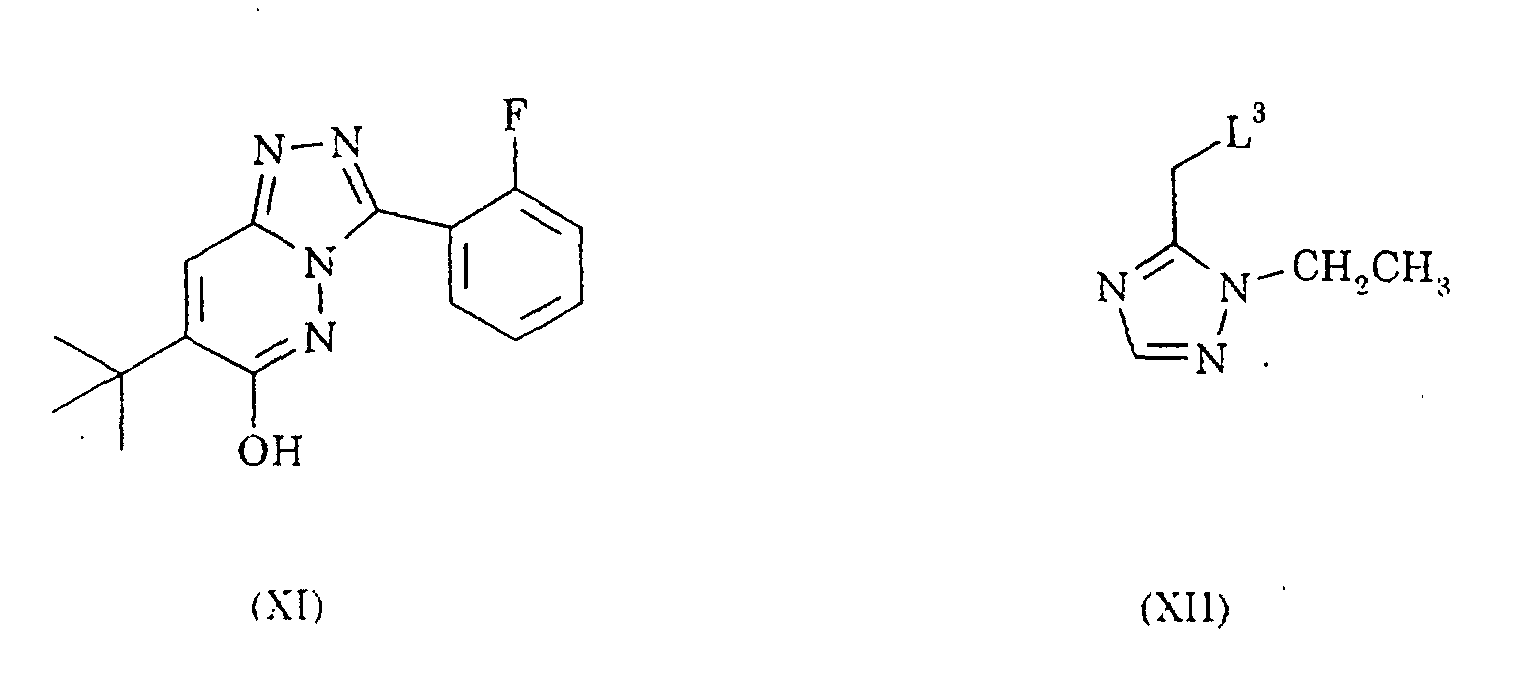
- The leaving group L3 is suitably a halogen atom, typically chloro or bromo.
- The reaction between compounds XI and XII is conveniently effected by stirring the reactants in a suitable solvent, typically N,N-dimethylformamide, in the presence of a strong base such as sodium hydride.
- The intermediate of formula XI above may conveniently be prepared by reacting a compound of formula III as defined above with an alkali metal hydroxide, e.g. sodium hydroxide. The reaction is conveniently effected in an inert solvent such as aqueous 1,4-dioxane, ideally at the reflux temperature of the solvent.
- In a further procedure, the compound of formula I as depicted above may be prepared by a process which comprises reacting trimethylacetic acid with the compound of formula XIII:in the presence of silver nitrate and ammonium persulphate.
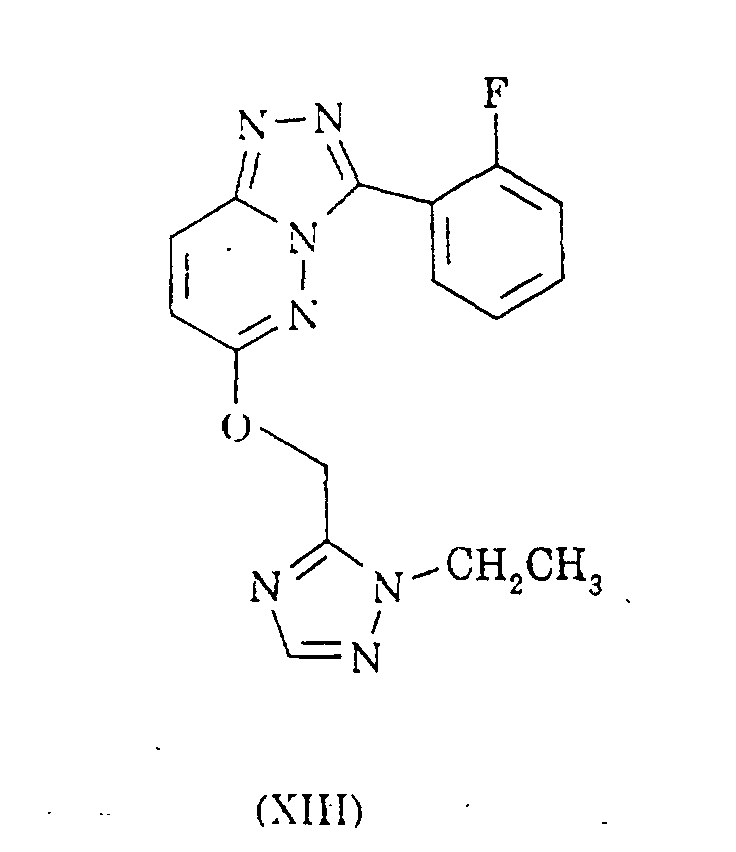
- The reaction is conveniently carried out in a suitable solvent, for example in water or aqueous acetonitrile, optionally under acidic conditions, e.g. using trifluoroacetic acid or sulphuric acid, typically at an elevated temperature.
- The intermediate of formula XIII corresponds to the compound of formula I as depicted above wherein the tert-butyl substituent at the 7-position is absent, and the intermediate XIII may therefore be prepared by methods analogous to those described above for preparing the compound of formula I.
- In a still further procedure, the compound of formula I as depicted above may be prepared by a process which comprises reacting a compound of formula XIV with a compound of formula XV:wherein M represents -B(OH)2 or -Sn(Alk)3 in which Alk represents a C1-6 alkyl group, typically n-butyl, and L4 represents a suitable leaving group; in the presence of a transition metal catalyst.
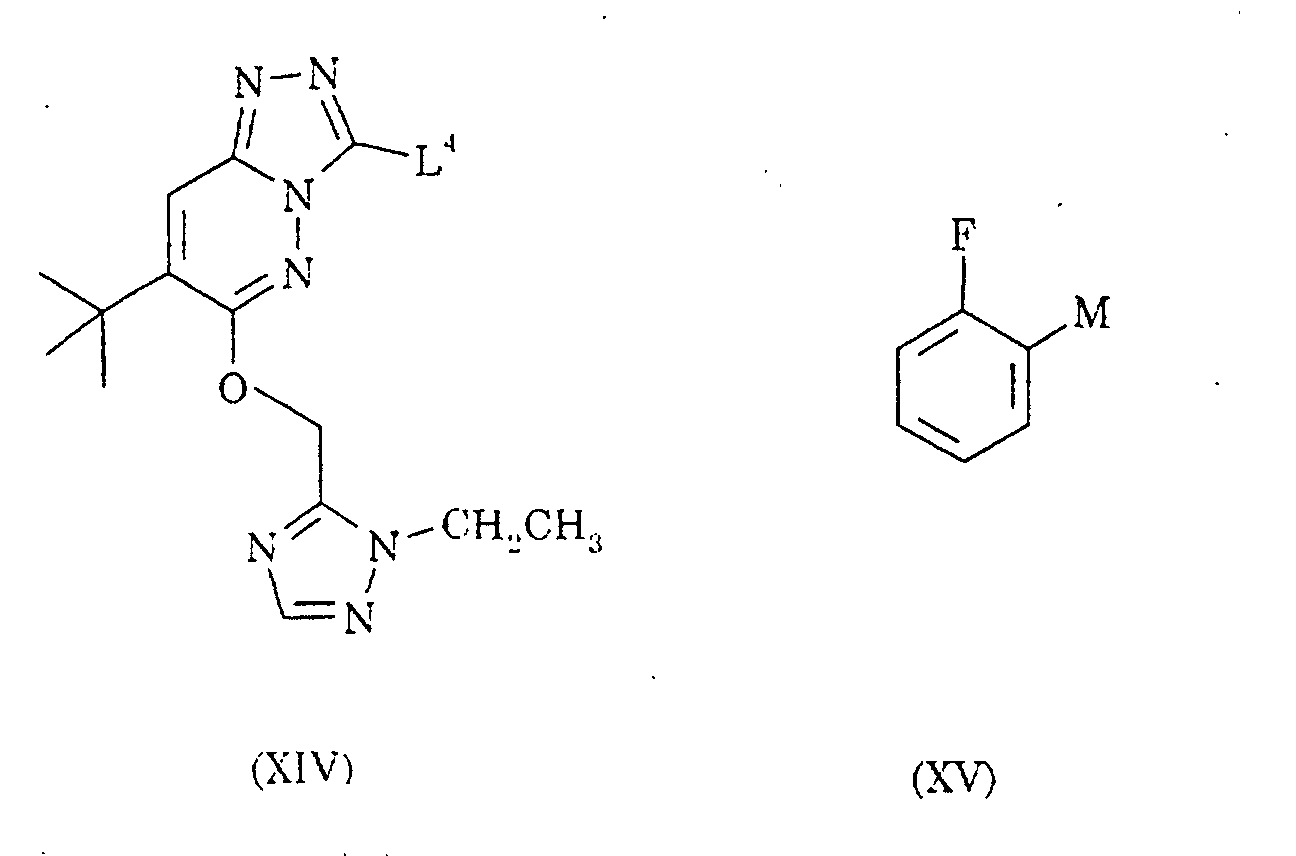
- The leaving group L4 is suitably a halogen atom, e.g. bromo.
- A suitable transition metal catalyst of use in the reaction between compounds XIV and XV comprises dichlorobis(triphenylphosphine)palladium(II) or tetrakis(triphenylphosphine)palladium(O).
- The reaction between compounds XIV and XV is conveniently effected in an inert solvent such as N,N-dimethylformamide, typically at an elevated temperature.
- The intermediates of formula XIV may be prepared by reacting the compound of formula IV as defined above with a compound of formula XVI:wherein L1 and L4 are as defined above; under conditions analogous to those described above for the reaction between compounds III and IV.

- The intermediate of formula IV above may be prepared by the procedures described in EP-A-0421210, or by methods analogous thereto. Suitable methods are described in the accompanying Examples.
- The intermediates of formula V above may be prepared by reacting trimethylacetic acid with a compound of formula XVII:wherein L1 and L2 are as defined above; in the presence of silver nitrate and ammonium persulphate; under conditions analogous to those described above for the reaction between trimethylacetic acid and compound XIII. Where L1 and L2 are both chloro in compound XVII, the reaction is advantageously effected in the presence of trifluoroacetic acid.
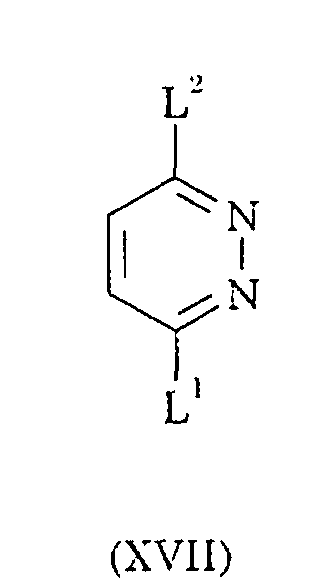
- Where they are not commercially available, the starting materials of formula VI, VIII, IX, XII, XV, XVI and XVII may be prepared by methods analogous to those described in the accompanying Examples, or by standard methods well known from the art.
- During any of the above synthetic sequences it may be necessary and/or desirable to protect sensitive or reactive groups on any of the molecules concerned. This may be achieved by means of conventional protecting groups, such as those described in Protective Groups in Organic Chemistry, ed. J.F.W. McOmie, Plenum Press, 1973; and T.W. Greene & P.G.M. Wuts, Protective Groups in Organic Synthesis, John Wiley & Sons, 1991. The protecting groups may be removed at a convenient subsequent stage using methods known from the art.
- Four anhydrous polymorphs, two solvates and a dihydrate of 7-(1,1-dimethylethyl)-6-(2-ethyl-2H-1,2,4-triazol-3-ylmethoxy)-3-(2-fluorophenyl)-1,2,4-triazolo[4,3-b]pyridazine have been synthesised and characterised. All the polymorphs and solvates revert to the most thermodynamically stable form, polymorph A (for formation and characterisation see Example 3), after stirring as a suspension in water. A dihydrate of polymorph A is stable, but only at elevated humidities.
- The following Examples illustrate the preparation of compounds according to the invention.
- The compounds in accordance with this invention potently inhibit the binding of [3H]-flumazenil to the benzodiazepine binding site of human GABAA receptors containing the α2 or α3 subunit stably expressed in Ltk-cells.
-
- Phosphate buffered saline (PBS).
- Assay buffer: 10 mM KH2PO4, 100 mM KCl, pH 7.4 at room temperature.
- [3H]-Flumazenil (18 nM for α1β3γ2 cells; 18 nM for α2β3γ2 cells; 10 nM for α3β3γ2 cells) in assay buffer.
-
Flunitrazepam 100 µM in assay buffer. - Cells resuspended in assay buffer (1 tray to 10 ml).
- Supernatant is removed from cells. PBS (approximately 20 ml) is added. The cells are scraped and placed in a 50 ml centrifuge tube. The procedure is repeated with a further 10 ml of PBS to ensure that most of the cells are removed. The cells are pelleted by centrifuging for 20 min at 3000 rpm in a benchtop centrifuge, and then frozen if desired. The pellets are resuspended in 10 ml of buffer per tray (25 cm x 25 cm) of cells.
- Can be carried out in deep 96-well plates or in tubes. Each tube contains:
- 300 µl of assay buffer.
- 50 µl of [3H]-flumazenil (final concentration for α1β3γ2: 1.8 nM; for α2β3γ2: 1.8 nM; for α3β3γ2: 1.0 nM).
- 50 µl of buffer or solvent carrier (e.g. 10% DMSO) if compounds are dissolved in 10% DMSO (total); test compound or flunitrazepam (to determine non-specific binding), 10 µM final concentration.
- 100 µl of cells.
- Assays are incubated for 1 hour at 40°C, then filtered using either a Tomtec or Brandel cell harvester onto GF/B filters followed by 3 x 3 ml washes with ice cold assay buffer. Filters are dried and counted by liquid scintillation counting. Expected values for total binding are 3000-4000 dpm for total counts and less than 200 dpm for non-specific binding if using liquid scintillation counting, or 1500-2000 dpm for total counts and less than 200 dpm for non-specific binding if counting with meltilex solid scintillant. Binding parameters are determined by non-linear least squares regression analysis, from which the inhibition constant Ki can be calculated for each test compound.
- The compound of the accompanying Examples was tested in the above assay, and was found to possess a Ki value for displacement of [3H]-flumazenil from the α2 and/or α3 subunit of the human GABAA receptor of less than 1 nM.
- Concentrated sulphuric acid (53.6 ml, 1.0 mol) was added carefully to a stirred suspension of 3,6-dichloropyridazine (50.0 g, 0.34 mol) in water (1.25 l). This mixture was then heated to 70°C (internal temperature) before the addition of trimethylacetic acid (47.5 ml, 0.41 mol). A solution of silver nitrate (11.4 g, 0.07 mol) in water (20 ml) was then added over approximately one minute. This caused the reaction mixture to become milky in appearance. A solution of ammonium persulphate (230 g, 1.0 mol) in water (0.63 l) was then added over 20-30 minutes. The internal temperature rose to approximately 85°C. During the addition the product formed as a sticky precipitate. Upon complete addition the reaction was stirred for an additional 10 minutes, then allowed to cool to room temperature. The mixture was then poured onto ice and basified with concentrated aqueous ammonia, with the addition of more ice as required to keep the temperature below 10°C. The aqueous was extracted with dichloromethane (3 x 300 ml). The combined extracts were dried (MgSO4), filtered and evaporated to give 55.8 g of crude product as an oil. This was purified by silica gel chromatography using 0-15% ethyl acetate in hexane as eluent to give 37.31 g (53%) of the desired compound. Data for the title compound: 1H NMR (360 MHz, d6-DMSO) δ 1.50 (9H, s), 7.48 (1H, s); MS (ES+) m/e 205 [MH]+, 207 [MH]+.
- A mixture of 3,6-dichloro-4-(1,1-dimethylethyl)pyridazine (20 g, 0.097 mol), 2-fluorobenzhydrazide (22.6 g, 0.145 mol) and triethylamine hydrochloride (20 g, 0.0145 mol) in dioxan (1.2 l) was stirred and heated at reflux under a stream of nitrogen for 4 days. Upon cooling the volatiles were removed in vacuo and the residue was triturated with dichloromethane (200 ml), filtered and concentrated under vacuum. The residue was purified by chromatography on silica gel eluting with 0%→25% ethyl acetate/dichloromethane to give the title compound (12.95 g, 44%) as a white solid. Data for the title compound: 1H NMR (360 MHz, CDCl3) δ 1.57 (9H, s), 7.26-7.35 (2H, m), 7.53-7.60 (1H, m), 7.89-7.93 (1H, m), 8.17 (1H, s); MS (ES+) m/e 305 [MH]+, 307 [MH]+.
- To a solution of 1,2,4-triazole (10 g, 0.145 mol) in DMF (150 ml) at room temperature was added sodium hydride (6.4 g of a 60% disp. in oil, 0.16 mol) in portions over 15 min. When the addition was complete, the reaction mixture was allowed to cool to room temperature, then cooled in an ice-bath and iodoethane (14 ml, 0.174 mol) added dropwise over 10 min. The reaction mixture was allowed to warm to room temperaure and after stirring for 3 h the solvents were removed under high vacuum to leave a residue which was partitioned between water (300 ml) and ethyl acetate (3 x 300 ml). The combined organic layers were washed with saturated brine and dried (MgSO4), filtered and concentrated under vacuum to leave an oily residue which was purified by distillation (120°C @ ∼20 mmHg) to give 1-ethyl-1,2,4-triazole contaminated with ∼15% DMF (2.4 g). The crude product (2.4 g, 0.025 mol) was dissolved in dry THF (35 ml), cooled to -40°C and n-butyllithium (16.2 ml of a 1.6 M solution in hexane, 0.026 mol) was added slowly over 20 min keeping the temperature constant. DMF (2.03 ml, 0.026 mol) was then added and after 15 min the reaction mixture was allowed to warm slowly to room temperature over 2 h. To the reaction mixture was added methanol (20 ml) followed by sodium borohydride (1 g, 0.026 mol) and the solution was allowed to stir for 14 h. The solvents were removed under vacuum and the residue was partitioned between brine (50 ml) and dichloromethane (6 x 50 ml). The combined organic layers were dried (MgSO4), filtered and concentrated under vacuum to leave a residue which was purified by silica gel chromatography using 0-5% methanol in dichlorometane as eluent to give the title compound as an off-white solid (0.5 g, 3%). Data for the title compound: 1H NMR (250 MHz, CDCl3) δ 1.48 (3H, t, J = 7.3 Hz), 4.25 (2H, q, J = 7.3 Hz), 4.75 (2H, s), 5.14 (1H, br s), 7.78 (1H, s).
- To a solution of (2-ethyl-2H-1,2,4-triazol-3-yl)methanol (0.094 g, 0.74 mmol) and 6-chloro-7-(1,1-dimethylethyl)-3-(2-fluorophenyl)-1,2,4-triazolo[4,3-b]pyridazine (0.15 g, 0.49 mmol) in DMF (10 ml) was added sodium hydride (0.024 g of a 60% dispersion in oil, 1.1 mol eq.) and the reaction mixture was stirred at room temperature for 30 minutes. After this time, the reaction mixture was diluted with water (80 ml) and the solid that precipitated was collected by filtration and washed several times with water in the sinter funnel. The solid was recrystallised from ethyl acetate/hexane to give pure title compound (0.085 g, 44%). Data for the title compound: 1H NMR (250 MHz, CDCl3) δ 1.40-1.47 (12H, m), 4.14 (2H, t, J = 7.3 Hz), 5.26 (2H, s), 7.26-7.38 (2H, m), 7.53-7.58 (1H, m), 7.86-7.90 (1H, m), 7.93 (1H, s), 7.99 (1H, s); MS (ES+) m/e 396 [MH]+. Anal. Found C, 61.02; H, 5.45; N, 24.75%. C20H22FN7O requires C, 60.75; H, 5.61; N, 24.79%.
- A mixture of dichloropyridazine (100 g, 0.67 mol), trimethylacetic acid (96 g, 0.94 mol) and water (800 ml) in a 10 l flask with overhead stirring was warmed to 55°C resulting in a two-phase solution. A solution of AgNO3 (11.4 g, 0.134 mol) in water (125 ml) was added in one portion resulting in an opaque solution. Trifluoroacetic acid (10.3 ml, 0.134 mol) was added in one portion. Ammonium persulfate (245 g, 1.07 mol) was dissolved in water (500 ml) and added dropwise to the suspension over 45-60 min resulting in an exotherm (typically temperature increases to between 75-80°C and can be controlled by rate of persulfate addition). The temperature was maintained at 75°C for a further 1 h and then cooled to room temperature. The reaction mixture was extracted with isobutyl alcohol (11) and the aqueous layer discarded. The organic layer was washed with water (250 ml) and the aqueous cut discarded. HPLC assay yield is 134 g (97%). The isobutyl alcohol solution was used as is in the next step.
- Hydrazine hydrate (95 ml, 1.95 mol) was added to the isobutyl alcohol solution from step a in a 3 l flask and heated at 90°C for 20 h. The reaction mixture was cooled to room temperature and the lower aqueous layer discarded. The reaction mixture was washed with water (450 ml) and the aqueous cut discarded. The reaction mixture was distilled under reduced pressure until the product started to crystallise and then 1-methyl-2-pyrrolidinone (NMP) (550 ml) was added. Distillation was continued to remove the last of the isobutyl alcohol. The solution was used as is in the next step.
- 2-Fluorobenzoyl chloride (103 g, 0.65 mol) was added dropwise to the cooled (0°C) NMP solution from step b maintaining the internal temperature <5°C. After the addition the reaction mixture was heated at 130°C for 2 h. The reaction mixture was cooled to room temperature which resulted in the crystallisation of the product. Water (1.3 l) was added dropwise over 30 min. The slurry was cooled to 10°C and the solid isolated by filtration, then dried under reduced pressure to afford product (145 g, 71% yield from 3,6-dichloropyridazine).
- 1,2,4-Triazole (100.0 g, 1.45 mol) in anhydrous THF (950 ml) was cooled to 0°C and 1,8-diazabicyclo[5.4.0]undec-7-ene (DBU) (220 g, 1.45 mol) was added in one portion. The reaction mixture was stirred for 30 min until complete dissolution was observed. Whilst maintaining the ice/water cooling bath, iodoethane (317 g, 2.03 mol) was added dropwise over a 15 min period resulting in an internal temperature rise to 30°C. The reaction was stirred at room temperature for 16 h, after which the DBU hydroiodide was removed by filtration. The filtrate solution was used as is in the next step.
- The stirred solution from the preceding step was cooled to -75°C internal temperature in a solid CO2/acetone slurry bath. Hexyllithium (458 ml of 33% solution in hexanes) was added dropwise over 25 min keeping the internal temperature below -55°C. The reaction mixture was aged for 30 min (back to -75°C) and then neat DMF (108 ml, 1.39 mol) was added dropwise over 10 min maintaining internal temperature below -60°C. The reaction mixture was aged at -70°C for 90 min before the cooling bath was removed and the reaction mixture allowed to warm to 0°C over 30 min. Industrial methylated spirits (340 ml) was added over 10 min. Sodium borohydride (26.3 g, 0.695 mol) was then added portionwise maintaining internal temperature below 6°C. After the addition the reaction mixture was allowed to warm to room temperature and stirred for 1 h at that temperature. The reaction was quenched by the careful addition of 2M H2SO4 (200 ml) and then stirred at room temperature for 20 h. The reaction mixture was concentrated to 675 ml and sodium sulfate (135 g) was added in one portion. The reaction mixture was warmed to 35°C and stirred for 15 min. The solution was extracted with warm (45°C) isobutyl alcohol (2 x 675 ml). The combined organic fractions were concentrated under reduced pressure 450 ml at which point the product crystallised. Heptane (1.125 l) was added and the slurry concentrated under reduced pressure to remove most of the isobutyl alcohol. Heptane was added to give a final slurry volume of 680 ml. After cooling to 0°C, filtration gave the title compound (137 g, 74% from 1,2,4-triazole).
- 6-Chloro-7-(1,1-dimethylethyl)- 3-(2-fluorophenyl)-1,2,4-triazolo[4,3-b]pyridazine (255 g, 0.819 mol), (2-ethyl-2H-1,2,4-triazol-3-yl)methanol (125 g, 0.983 mol) and cesium carbonate (640 g, 1.966 mol) were charged to a 10 l flask equipped with an overhead stirrer. Dimethyl sulfoxide (2.5 l) was added in one portion and the reaction mixture stirred at room temperature for 20 h. The product had crystallised. The reaction mixture was maintained at <25°C whilst water (5 l) was added dropwise over 45 min to the stirred suspension. After cooling to 10°C, the product was isolated by filtration and the cake washed with water (1.75 l). Drying at 50°C in vacuo gave the title compound (317 g, 98%) as a white solid.
- 6-Chloro-7-(1,1-dimethylethyl)-3-(2-fluorophenyl)-1,2,4-triazolo[4,3-b]pyridazine (10 g, 32.12 mmol) and (2-ethyl-2H-1,2,4-triazol-3-yl)methanol (5.01 g, 38.55 mmol) were charged to a 500 ml flask equipped with an overhead stirrer. NMP (100 ml) was added in one portion and the reaction mixture stirred until complete dissolution was achieved. The reaction mixture was cooled to 0°C and 48% w/w sodium hydroxide solution (4.02 g, 46 mmol) was added in one portion. After stirring for 1 h at 0°C, the product had crystallised. Water (100 ml) was added dropwise over 15 min and the slurry aged for 30 min. The product was isolated by filtration and the cake washed with water (100 ml). Drying at 50°C in vacuo gave the title compound (12.50 g, 98%) as a white solid.
- 7-(1,1-Dimethylethyl)-6-(2-ethyl-2H-1,2,4-triazol-3-ylmethoxy)-3-(2-fluorophenyl)-1,2,4-triazolo[4,3-b]pyridazine (hereinafter referred to as Compound I) was recrystallised from a selection of organic solvents and the resultant solids were dried in vacuo overnight at 60°C unless otherwise stated. Each batch was then characterised by optical microscopy, differential scanning calorimetry (DSC), thermogravimetric analysis (TGA), and X-ray powder diffraction (XRPD). Four distinct anhydrous polymorphs, a hydrate and two solvates have been characterised, as summarised in Table 1.
Polymorphs of Compound I Polymorph Recrystallisation Solvent Crystal Habit M.P. °C A Methanol Elongated rectangular or irregular ca. 186 Ethyl acetate Acetonitrile Acetone Acetic acid/H2O B Isobutanol Elongated rectangular or irregular ca. 181 C Dimethylformamide Acicular ca. 170 Tetrahydrofuran D Isopropanol Acicular ca. 170 Isobutanol Methanol Solvate Methanol (air-dried) Irregular ca. 186 Ethanol Solvate Ethanol Irregular ca. 186 - Polymorph A consists of irregular or elongated rectangular birefringent crystals. It shows one major endotherm by DSC at ca. 186°C due to melting. In the case of some of the samples prepared this melt displays several events happening within it, typified by shoulders on the melting endotherm. Polymorph A is anhydrous and displays no losses by TGA. It has a unique XRPD diffractogram, typified by two peaks at 2 ≈ 7.3°.
- Polymorph B consists of irregular or elongated rectangular birefringent crystals. Polymorph B displays one major endotherm by DSC at ca. 181°C due to melting. It is anhydrous and displays no weight loss by TGA. It has a unique XRPD diffractogram.
- Polymorph C consists of acicular, birefringent crystals. The DSC thermograms of polymorph C show an endotherm at ca. 170°C, an exotherm at ca. 173°C, a small endotherm at ca. 181°C, and an endotherm due to melting at ca. 186°C. No losses are observed by thermogravimetric analysis.
- Polymorph D consists of acicular birefringent crystals. The XRPD diffractogram of polymorph D is similar in pattern to that of polymorph C. However, significant differences are observed, notably additional peaks at 2 = 9.861, 15.113, 18.015 and 22.224. The DSC trace of polymorph D displays a very broad exotherm at ca. 108°C, followed by an endotherm and exotherm at 170°C and 173°C, as for polymorph C. The major melting is observed at ca. 181°C, and several events are seen to occur within the melting endotherm, with minor melting at 186°C. No losses are observed by TGA.
- The DSC thermogram of the methanol solvate shows one endotherm at ca. 157°C due to loss of methanol, and one endotherm at 186°C due to melting. A gradual loss is observed by TGA up to ca. 150°C, at which point a step loss is observed, coincident with the endotherm observed by DSC. This step loss is in some instances composed of more than one event, and the amount varies among recrystallised samples and does not appear to correspond to a stoichiometric solvate. However, methanol vapour sorption studies on polymorph A show the presence of a distinct hemisolvate. The XRPD diffractogram of the solvate is unique.
- The ethanol solvate is typified by its DSC thermogram which shows one endotherm at ca. 111°C due to loss of ethanol, and an endotherm at ca. 186°C due to melting. TGA shows the loss to be variable in different recrystallised samples, between ca. 4 and 6.5%, and does not correspond to a stoichiometric solvate. The XRPD diffractogram is unique.
- Figure 1 shows the adsorption/desorption isotherm of Compound I polymorph A at 25°C. These moisture vapour sorption studies show formation of a dihydrate above 80% relative humidity (RH) at 25°C. Hysteresis indicative of hydrate formation is seen to occur, with desorption occurring below ca. 60% RH.
- Figure 2 shows side-by-side XRPD diffractograms of anhydrous Compound I polymorph A and of the dihydrate of polymorph A. The XRPD diffractogram of the dihydrate, obtained on a wetted sample of polymorph A, demonstrates the distinct differences observed between the two forms. The major changes in diffraction can be seen to be loss of the peak at 2 = 11.2°, and the appearance of two major peaks at 2 = 11.9° and 12.3°.
- On slurrying in water all of the polymorphs and solvates decribed above convert to polymorph A over a period of 1-4 days, indicating that this is the most stable form at room temperature. This conversion is slow due to the low aqueous solubility of Compound I in relation to the large excess of solid compound slurried.
- Figure 3 shows side-by-side XRPD diffractograms of anhydrous Compound I polymorphs A, B, C and D, of the methanol and ethanol solvates, and of the dihydrate of polymorph A. Numerical data associated therewith are presented below.
Compound I Polymorph A: X-Ray Powder Diffraction Data Angle 2 d value Å Intensity Count Intensity % Angle 2 d value Å Intensity Count Intensity % 7.243 12.19523 2214 88.5 22.885 3.88289 195 7.8 7.559 11.68660 613 24.5 23.621 3.76351 307 12.3 8.601 10.27227 50 2 23.67 3.75587 256 10.2 9.694 9.11647 211 8.4 23.767 3.74068 253 10.1 10.703 8.25928 270 10.8 24.12 3.68684 102 4.1 11.027 8.01719 213 8.5 24.518 3.62778 281 11.2 11.239 7.86640 1464 58.5 25.223 3.52803 162 6.5 12.943 6.83420 2501 100 25.275 3.52082 185 7.4 13.441 6.58218 41 1.6 25.478 3.49324 808 32.3 14.497 6.10492 740 29.6 26.088 3.41292 2178 87.1 15.178 5.83251 1211 48.4 26.686 3.33787 86 3.4 15.376 5.75802 187 7.5 27.093 3.28857 138 5.5 15.42 5.74169 144 5.8 27.74 3.21330 186 7.4 15.854 5.58536 391 15.6 28.056 3.17789 87 3.5 16.081 5.50706 236 9.4 28.607 3.11788 248 9.9 16.134 5.48931 250 10 28.703 3.10770 155 6.2 16.419 5.39437 135 5.4 29.135 3.06255 131 5.2 16.76 5.28552 36 1.4 29.267 3.04911 284 11.4 17.165 5.16167 304 12.1 29.353 3.04034 193 7.7 17.199 5.15149 235 9.4 29.787 2.99703 71 2.8 17.24 5.13933 329 13.2 30.357 2.94205 106 4.2 17.355 5.10550 281 11.2 30.954 2.88666 38 1.5 18.556 4.77774 213 8.5 31.436 2.84343 52 2.1 18.829 4.70917 85 3.4 32.618 2.74309 163 6.5 19.27 4.60224 372 14.9 32.773 2.73047 161 6.5 19.499 4.54892 233 9.3 33.254 2.69202 64 2.6 20.203 4.39192 118 4.7 33.897 2.64245 66.4 2.7 20.635 4.30098 238 9 5 34.14 2.62417 162 6.5 21.584 4.11385 250 10 36.522 2.45827 53 2.1 21.689 4.09416 704 28.2 38.532 2.33459 40 1.6 21.867 4.06119 1621 64.8 38.859 2.31564 78 3.1 22.28 3.98692 154 6.2 39.594 2.27434 47 1.9 Compound I Polymorph B: X-Ray Powder Diffraction Data Angle 2 d value Å Intensity Count Intensity % Angle 2 d value Å Intensity Count Intensity % 7.379 11.97023 651 49.2 20.179 4.39705 119 9 10.096 8.75424 481 36.4 20.9 4.24699 54 4.1 10.821 8.16974 1323 100 21.718 4.08884 1300 98.3 12.482 7.08575 61 4.6 22.285 3.98602 446 33.7 12.739 6.94328 149 11.3 22.96 3.87033 87 6.6 13.036 6.78588 194 14.7 23.304 3.81394 111 8.4 13.475 6.56586 123 9.3 24.018 3.70224 73 5.5 13.828 6.39890 69 5 2 24.459 3.63648 75 5.7 14.815 5.97480 322 24.3 25.081 3.54765 141 10.7 15.078 5.87109 307 23.2 25.837 3.44555 47 3.6 15.584 5.68147 86 6.5 26.204 3.39810 193 14.6 16.082 5.50675 391 29.6 27.078 3.29031 176 13.3 16.979 5.21789 147 11.1 28.449 3.13490 91 6.9 17.02 5.20548 163 12.3 28.889 3.08812 51 3.9 17.287 5.12570 257 19.4 29.84 2.99177 166 12.6 17.616 5.03052 72 5.4 29.922 2.98380 121 9.1 18.125 1.89033 83.1 6.3 30.227 2.95440 58 4.4 18.161 4.88081 129 9.7 31.94 2.79975 70.5 5.3 18.192 4.87269 143 10.8 32.837 2.72528 117 8.8 19.022 4.66174 69 5.2 33.295 2.68885 40 3 19.542 4.53891 119 9 34.407 2.60440 52 3.9 19.68 4.50748 70.5 5.3 38.876 2.31472 27 2 Compound I Polymorph C: X-Ray Powder Diffraction Data Angle 2 d value Å Intensity Count Intensity % Angle 2 d value Å Intensity Count Intensity % 7.254 12.17653 25 0.6 24.647 3.60908 75 1.8 8.023 11.01169 798 19.3 24.961 3.56448 398 9.6 9.686 9.12421 4130 100 25.341 3.51181 182 4.4 10.489 8.42726 64 1.5 25.549 3.48378 617 14.9 10.813 8.17559 107 2.6 25.981 3.42671 832 20.1 11.277 7.83989 31 0.8 26.794 3.32466 328 7.9 12.193 7.25327 48 1.2 27.782 3.20863 166 4 12.961 6.82506 40 1 27.985 3.18576 158 3.8 14.357 6.16430 146 3.5 28.257 3.15573 241 5.8 14.497 6.10512 213 5.2 28.788 3.09868 257 6.2 15.225 5.81495 35 0.8 29.242 3.05164 322 7.8 16.007 5.53248 917 22.2 29.301 3.04560 322 7.8 16.545 5.35385 681 16.5 29.56 3.01950 111 2.7 16.951 5.22646 61 1.5 30.544 2.92444 158 3.8 17.672 5.01479 402 9.7 30.942 2.88768 70 1.7 18.337 4.83428 536 13 31.839 2.80834 156 3.8 18.578 4.77228 533 12.9 32.457 2.75628 157 3.8 19.396 4.57272 3486 84.4 32.745 2.73271 369 8.9 20.034 4.42851 57 1.4 34.246 2.61626 150 3.6 20.913 4.24430 193 4.7 34.979 2.56310 76 1.8 21.189 4.18959 1917 46.4 35.42 2.53225 74 1.8 21.523 4.12543 476 11.5 35.753 2.50941 92 2.2 21.876 4.05969 329 8 36.71 2.44615 91 2.2 22.654 3.92185 151 3.7 37.036 2.42537 145 3.5 23.207 3.82968 463 11.2 37.549 2.39339 137 3.3 23.238 3.82472 462 11.2 38.915 2.31247 74 1.8 24.316 3.65757 87 2.1 39.41 2.28456 166 4 Compound I Polymorph D: X-Ray Powder Diffraction Data Angle 2 d value Å Intensity Count Intensity % Angle 2 d value Å Intensity Count Intensity % 8.024 11.00971 501 33.4 22.224 3.99690 414 27.6 9.664 9.14458 1501 100 22.654 3.92192 112 7.5 9.861 8.96259 502 33.5 23.22 3.82757 322 21.5 10.497 8.42115 38 2.5 24.052 3.69702 89 5.9 10.8 8.18489 229 15.3 24.313 3.65791 295 19.7 11.462 7.71362 40 2.7 24.948 3.56619 272 18.1 12.105 7.30563 216 14.4 25.3 3.51744 120 8 12.951 6.83035 573 38.2 25.543 3.48455 304 20.3 13.312 6.64558 107 7.1 25.977 3.42728 362 24.1 13.817 6.40392 39 2.6 26.036 3.41965 416 27.7 14.478 6.11305 282 18.8 26.789 3.32518 539 35.9 14.823 5.97145 76 5.1 27.479 3.24329 173 11.5 15.113 5.85746 162 10.8 27.754 3.21176 198 13.2 16 5.53485 396 26.4 28.019 3.18199 170 11.3. 16.533 5.35742 774 51 6 28.261 3.15525 314 20.9 16.952 5.22613 72 4.8 28.478 3.13170 144 9.6 17.661 5.01784 509 33.9 28.809 3.09646 205 13.7 18.015 4.92003 479 31.9 29.257 3.05012 176 11.7 18.316 4.83994 545 36.3 29.83 2.99276 178 11.9 18.46 4.80255 512 34.1 30.533 2.92545 157 10.5 18.543 4.78110 498 33.2 30.904 2.89114 96 6.4 19.239 4.60966 196 13.1 31.818 2.81015 131 8.7 19.41 4.56957 775 51.6 32.454 2.75655 119 7.9 20.005 4.43493 158 10.5 32.744 2.73282 182 12.1 20.525 4.32367 82 5.5 33.654 2.66094 94 6.3 20.798 4.26748 386 25.7 34.22 2.61823 95 6.3 20.882 4.25060 416 27.7 34.526 2.59568 80 5.3 21.188 4.18982 1344 89.5 34.934 2.56632 99 6.6 21.509 4.12810 1313 87.5 36.998 2.42775 122 8.1 21.853 4.06378 296 19.7 37.545 2.39366 97 6.5 Compound I Methanol Solvate: X-Ray Powder Diffraction Data Angle 2 d value Å Intensity Count Intensity % Angle 2 d value Å Intensity Count Intensity % 7.357 12.00677 9531 90.4 21.153 4.19677 224 2.1 7.608 11.61023 260 2.5 22.081 4.02236 10545 100 9.616 9.19052 260 2.5 22.588 3.93327 526 5 9.755 9.05958 433 4.1 22.825 3.89290 1150 10.9 10.943 8.07881 1145 10.9 23.14 3.84065 362 3.4 11.274 7.84189 406 3.9 23.742 3.74460 291 2.8 12.36 7.15546 3517 33.4 24.295 3.66064 440 4.2 12.942 6.83511 472 4.5 24.818 3.58463 3357 31.8 12.981 6.81447 530 5 25.434 3.49921 933 8.8 14.42 6.13754 440 4.2 25.967 3.42863 2020 19.2 14.69 6.02552 3179 30.1 26 3.42428 2000 19 15.196 5.82583 371 3.5 26.761 3.32860 402 3.8 15.651 5.65758 767 7.3 27.151 3.28169 230 2.2 15.913 5.56476 954 9 28.642 3.11415 273 2.6 16.507 5.36597 379 3.6 28.951 3.08162 298 2.8 16.539 5.35556 426 4 29.56 3.01950 1793 17 16.871 5.25102 1070 10.1 30.365 2.94130 455 4.3 17.226 5.14355 237 2.2 31.319 2.85382 313 3 18.226 4.86354 372 3.5 32.074 2.78834 173 1.6 18.613 4.76331 112 1.1 32.739 2.73323 134 1.3 19.283 4.59933 291 2.8 33.77 2.65210 344 3.3 19.545 4.53827 195 1.8 35.185 2.54858 129 1.2 19.961 4.44452 1703 16.2 37.166 2.41715 145 1.4 20.675 4.29264 161 1.5 37.694 2.38454 218 2.1 Compound I Ethanol Solvate: X-Ray Powder Diffraction Data Angle 2 d value Å Intensity Count Intensity % Angle 2 d value Å Intensity Count Intensity % 7.357 12.00679 943 52.5 25.061 3.55045 462 25.7 9.541 9.26191 201 11.2 25.341 3.51184 1795 100 9.809 9.00980 208 11.6 25.712 3.46196 290 16.2 10.951 8.07238 1365 76.1 26.055 3.41713 463 25.8 12.031 7.35019 1500 83.6 26.235 3.39415 401 22.4 12.499 7.07637 115 6.4 26.599 3.34857 178 9.9 14.158 6.25067 245 13.7 27.054 3.29329 159 8.9 14.707 6.01841 236 13.2 28.355 3.14498 311 17.3 15.719 5.63302 428 23.8 28.491 3.13034 190 10.6 15.899 5.56980 657 36.6 28 667 3.1154 150 8.1 16.304 5.43218 869 48.4 29.029 3.07353 142 7.9 16.895 5.24359 1076 60 29.658 3.00975 207 11.5 18.227 4.86334 500 27.9 29.819 2.99388 604 33.7 19.109 4.64073 148 8.2 30.421 2.93596 132 7.4 19.49 4.55085 1045 58.2 30.609 2.91837 133 7.4 20.998 4.22731 211 11.8 31.383 2.84817 131 7.3 21.177 4.19195 168 9.3 32.048 2.79050 154 8.6 21.982 4.04035 1230 68.6 32.116 2.78480 146 8.1 22.124 4.01471 1146 63.9 33.78 2.65134 233 13 22.82 3.89385 904 50.4 35.079 2.55608 119 6.6 23.017 3.86082 475 26.5 35.267 2.54289 123 6.9 23.321 3.81127 295 16.5 36.866 2.43614 89 5 23.459 3.78909 282 15.7 37.84 2.37564 88 4.9 23.961 3.71094 701 39.1 39.182 2.29730 102 5.7 24.159 3.68094 1504 83.8 39.406 2.28477 104 5.8 Compound I Hydrate of Polymorph A: X-Ray Powder Diffraction Data Angle 2 d value Å Intensity Count Intensity % Angle 2 d value Å Intensity ' Count Intensity % 7.261 12.16414 447 100 18.657 4.75222 48.4 10.8 9.1 9.70988 25.6 5.7 18.779 4.72155 35.7 8 9.626 9.18058 31 6.9 18.859 4.70171 43.7 9.8 10.796 8.18860 283 63.2 19.276 4.60089 82 18.3 11.858 7.45707 170 38 19.504 4.54766 46 10.3 12.218 7.23806 51.8 11.6 20.22 4.38821 28 6.3 12.261 7.21317 79.4 17.7 20.655 4.29677 133 29.7 12.302 7.18922 78 17.4 21.68 4.09588 163 36.4 12.97 6.82039 173 38.7 21.86 4.06263 223 49.8 14.462 6.11993 132 29.5 22.316 3.98062 88.8 19.8 14.518 6.09637 138 30.8 22.537 3.94207 254 56.7 15.19 5.82798 229 51.2 22.579 3.93478 281 62.7 15.402 5.74824 114 25.6 22.901 3.88013 78 17.4 15.866 5.58141 222 49.6 23.673 3.75541 84 18.8 15.906 5.56750 196 43.9 24.507 3.62946 46 10.3 16.08 5.50763 102 22.7 25.469 3.49445 203 45.4 16.127 5.49137 117 26.1 26.087 3.41311 128 28.6 16.178 5.47423 112 25.1 27.754 3.21175 56 12.5 16.221 5.46004 78 17.4 28.613 3.11725 65 14.5 16.357 5.41482 65.9 14.7 29.291 3.04663 57 12.7 16.418 5.39480 71.3 15.9 29.935 2.98248 43 9.6 17.189 5.15467 146 32.6 32.747 2.73253 63 14.1 17.345 5.10866 105 23.5 34.176 2.62146 32 7.2 18.57 4.77428 71 15.9 38.848 2.31630 31 6.9
Claims (6)
- 7-(1,1-Dimethylethyl)-6-(2-ethyl-2H-1,2,4-triazol-3-ylmethoxy)-3-(2-fluorophenyl)-1,2,4-triazolo[4,3-b]pyridazine.
- Polymorph A of 7-(1,1-dimethylethyl)-6-(2-ethyl-2H-1,2,4-triazol-3-ylmethoxy)-3-(2-fluorophenyl)-1,2,4-triazolo[4,3-b]pyridazine as characterised herein.
- A pharmaceutical composition comprising 7-(1,1-dimethylethyl)-6-(2-ethyl-2H-1,2,4-triazol-3-ylmethoxy)-3-(2-fluorophenyl)-1,2,4-triazolo[4,3-b]pyridazine in association with a pharmaceutically acceptable carrier.
- The use of 7-(1,1-dimethylethyl)-6-(2-ethyl-2H-1,2,4-triazol-3-ylmethoxy)-3-(2-fluorophenyl)-1,2,4-triazolo[4,3-b]pyridazine for the manufacture of a medicament for the treatment and/or prevention of anxiety.
- A process for the preparation of 7-(1,1-dimethylethyl)-6-(2-ethyl-2H-1,2,4-triazol-3-ylmethoxy)-3-(2-fluorophenyl)-1,2,4-triazolo[4,3-b]pyridazine, which comprises:wherein M represents -B(OH)2 or -Sn(Alk)3 in which Alk represents a C1-6 alkyl group, and L4 represents a suitable leaving group; in the presence of a transition metal catalyst.(A) reacting a compound of formula III with the compound of formula IV:wherein L1 represents a suitable leaving group; or
 (B) reacting the compound of formula XI (or its 1,2,4-triazolo[4,3-b]pyridazin-6-one tautomer) with a compound of formula XII:wherein L3 represents a suitable leaving group; or
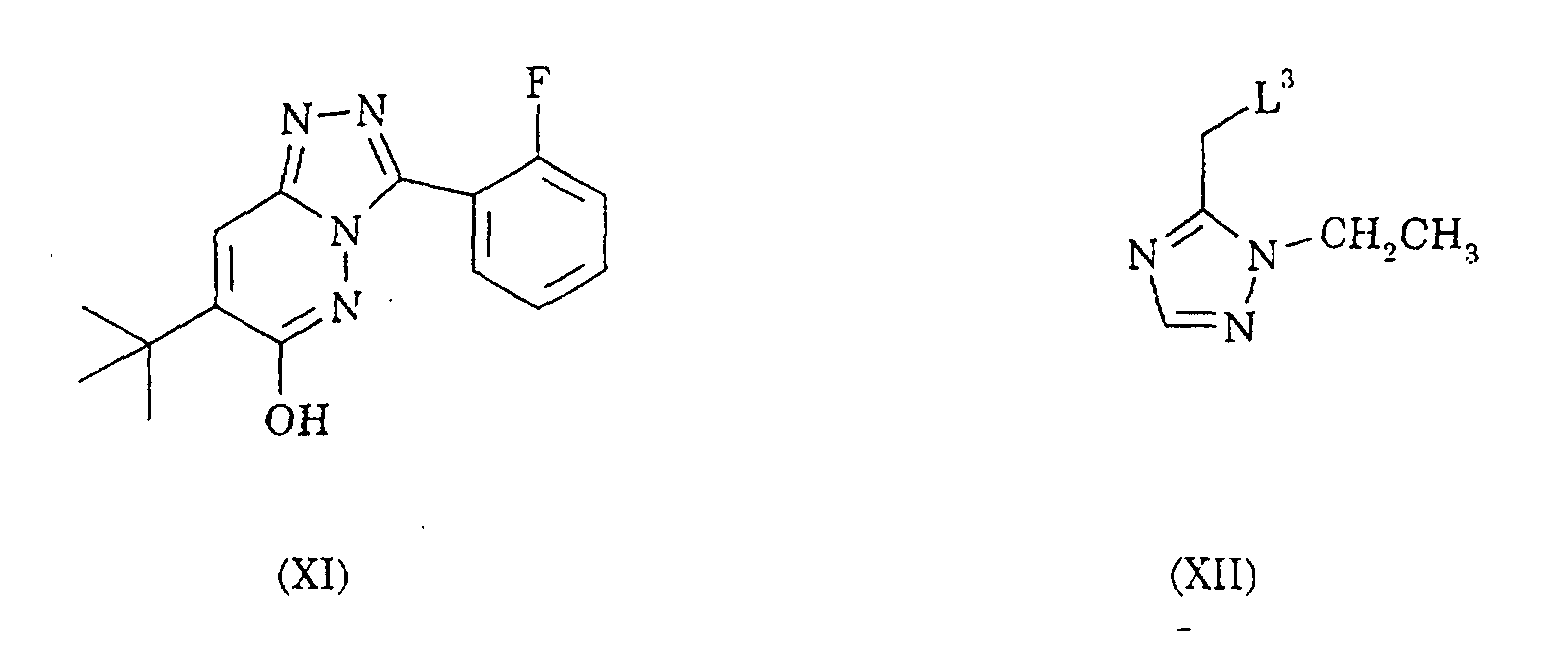 (C) reacting trimethylacetic acid with the compound of formula XIII:in the presence of silver nitrate and ammonium persulphate; or
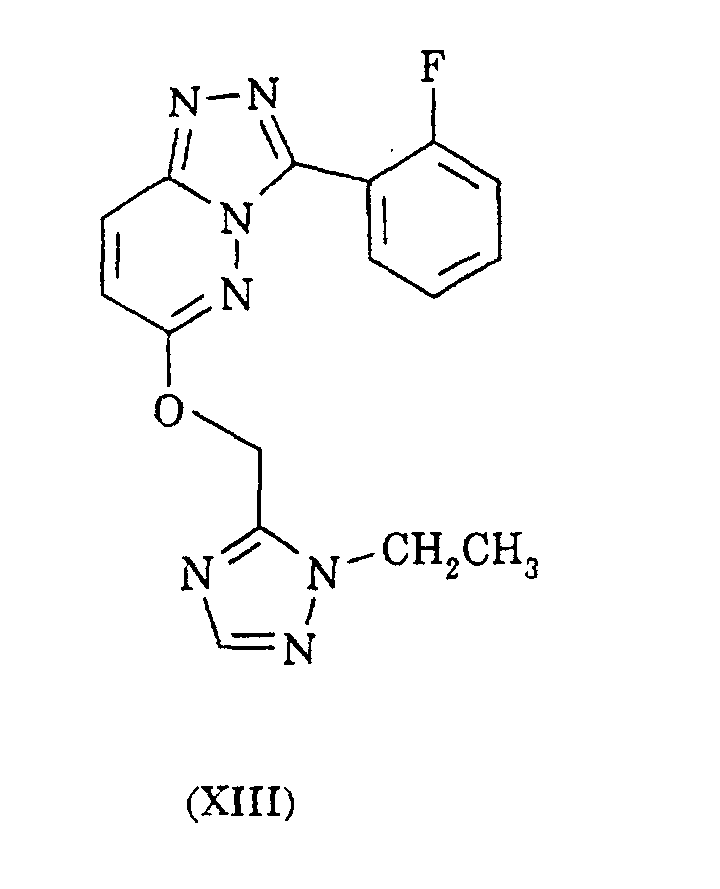 (D) reacting a compound of formula XIV with a compound of formula XV:
- A process as claimed in claim 5 wherein reaction (A) is carried out in 1-methyl-2-pyrrolidinone, in the presence of sodium hydroxide, at a temperature in the region of 0°C.
Applications Claiming Priority (3)
| Application Number | Priority Date | Filing Date | Title |
|---|---|---|---|
| GBGB9813576.7A GB9813576D0 (en) | 1998-06-24 | 1998-06-24 | Therapeutic agents |
| GB9813576 | 1998-06-24 | ||
| PCT/GB1999/001897 WO1999067245A1 (en) | 1998-06-24 | 1999-06-15 | A substituted triazolo-pyridazine derivative, pharmaceutical compositions made therefrom |
Publications (2)
| Publication Number | Publication Date |
|---|---|
| EP1090004A1 EP1090004A1 (en) | 2001-04-11 |
| EP1090004B1 true EP1090004B1 (en) | 2003-05-07 |
Family
ID=10834265
Family Applications (1)
| Application Number | Title | Priority Date | Filing Date |
|---|---|---|---|
| EP99929508A Expired - Lifetime EP1090004B1 (en) | 1998-06-24 | 1999-06-15 | A substituted triazolo-pyridazine derivative, pharmaceutical compositions made therefrom |
Country Status (35)
| Country | Link |
|---|---|
| US (1) | US6630471B1 (en) |
| EP (1) | EP1090004B1 (en) |
| JP (1) | JP4749545B2 (en) |
| KR (1) | KR100604108B1 (en) |
| CN (1) | CN1138779C (en) |
| AR (1) | AR018925A1 (en) |
| AT (1) | ATE239730T1 (en) |
| AU (1) | AU757315B2 (en) |
| BG (1) | BG64989B1 (en) |
| BR (1) | BR9911563A (en) |
| CA (1) | CA2335328C (en) |
| CO (1) | CO5031239A1 (en) |
| CZ (1) | CZ291409B6 (en) |
| DE (1) | DE69907675T2 (en) |
| EA (1) | EA003332B1 (en) |
| EE (1) | EE200000767A (en) |
| ES (1) | ES2196824T3 (en) |
| GB (1) | GB9813576D0 (en) |
| GE (1) | GEP20033143B (en) |
| HR (1) | HRP20000879A2 (en) |
| HU (1) | HUP0102894A3 (en) |
| ID (1) | ID27771A (en) |
| IL (2) | IL139775A0 (en) |
| IS (1) | IS2258B (en) |
| MY (1) | MY124341A (en) |
| NO (1) | NO317992B1 (en) |
| NZ (1) | NZ508290A (en) |
| PE (1) | PE20000710A1 (en) |
| PL (1) | PL204650B1 (en) |
| RS (1) | RS49746B (en) |
| SK (1) | SK285307B6 (en) |
| TR (1) | TR200003789T2 (en) |
| TW (1) | TWI222449B (en) |
| WO (1) | WO1999067245A1 (en) |
| ZA (1) | ZA200007485B (en) |
Families Citing this family (18)
| Publication number | Priority date | Publication date | Assignee | Title |
|---|---|---|---|---|
| GB2345443A (en) * | 1999-01-08 | 2000-07-12 | Merck Sharp & Dohme | Use of triazolo-pyridazines for treating premenstrual syndrome |
| US20050042194A1 (en) | 2000-05-11 | 2005-02-24 | A.P. Pharma, Inc. | Semi-solid delivery vehicle and pharmaceutical compositions |
| GB0111191D0 (en) * | 2001-05-08 | 2001-06-27 | Merck Sharp & Dohme | Therapeutic agents |
| ATE473980T1 (en) * | 2002-12-18 | 2010-07-15 | Vertex Pharma | TRIAZOLOPYRIDAZINE AS PROTEIN KINASE INHIBITORS |
| WO2006061428A2 (en) * | 2004-12-10 | 2006-06-15 | Universität Zürich | Gaba-a alpha 2 and alpha 3 receptor agonists for treating neuropathic, inflammatory and migraine associated pain |
| US8501738B2 (en) * | 2009-06-23 | 2013-08-06 | Concert Pharmaceuticals, Inc. | Substituted triazolo-pyridazine derivatives |
| US20110082147A1 (en) * | 2009-07-24 | 2011-04-07 | Concert Pharmaceuticals, Inc. | Substituted imidazotriazines |
| WO2011047315A1 (en) | 2009-10-15 | 2011-04-21 | Concert Pharmaceuticals, Inc. | Subsitituted benzimidazoles |
| PH12012501361A1 (en) | 2009-12-31 | 2012-10-22 | Centro Nac De Investigaciones Oncologicas Cnio | Tricyclic compounds for use as kinase inhibitors |
| WO2012098387A1 (en) * | 2011-01-18 | 2012-07-26 | Centro Nacional De Investigaciones Oncológicas (Cnio) | 6, 7-ring-fused triazolo [4, 3 - b] pyridazine derivatives as pim inhibitors |
| AU2012314501B2 (en) | 2011-09-27 | 2017-02-16 | Genfit | Derivatives of 6-substituted triazolopyridazines as Rev-Erb agonists |
| BR112018015386A2 (en) | 2016-01-27 | 2019-03-19 | Universität Zürich | use of gabaa receptor modulators for pruritus treatment |
| BR112020021104A2 (en) * | 2018-04-18 | 2021-02-23 | Neurocycle Therapeutics, Inc | positive allosteric modulator compounds gabaa, production methods and uses thereof |
| KR102712565B1 (en) | 2018-09-13 | 2024-10-02 | 사니오나 에이/에스 | GABAA receptor ligand |
| HU231223B1 (en) | 2018-09-28 | 2022-01-28 | Richter Gedeon Nyrt. | GABAA A5 receptor modulator bicyclic compounds |
| EP4126858B1 (en) | 2020-03-26 | 2026-03-18 | Richter Gedeon Nyrt. | Dihydro-2-pyrrolo[3,4-c]pyridine derivatives as gabaa a5 receptor modulators |
| WO2025141131A1 (en) | 2023-12-27 | 2025-07-03 | Saniona A/S | A gabaa receptor ligand and the use thereof in medicine, in particular in the treatment of epilepsy |
| WO2026082004A1 (en) * | 2024-10-14 | 2026-04-23 | 上海京新生物医药有限公司 | Fused heteroaryl derivative, preparation method therefor, and application thereof |
Family Cites Families (1)
| Publication number | Priority date | Publication date | Assignee | Title |
|---|---|---|---|---|
| AU723098B2 (en) * | 1996-07-25 | 2000-08-17 | Merck Sharp & Dohme Limited | Substituted triazolo-pyridazine derivatives as ligands for GABA receptors |
-
1998
- 1998-06-24 GB GBGB9813576.7A patent/GB9813576D0/en not_active Ceased
-
1999
- 1999-06-15 DE DE69907675T patent/DE69907675T2/en not_active Expired - Lifetime
- 1999-06-15 JP JP2000555898A patent/JP4749545B2/en not_active Expired - Fee Related
- 1999-06-15 CN CNB998078352A patent/CN1138779C/en not_active Expired - Fee Related
- 1999-06-15 PL PL345332A patent/PL204650B1/en not_active IP Right Cessation
- 1999-06-15 CZ CZ20004872A patent/CZ291409B6/en not_active IP Right Cessation
- 1999-06-15 EP EP99929508A patent/EP1090004B1/en not_active Expired - Lifetime
- 1999-06-15 RS YUP-778/00A patent/RS49746B/en unknown
- 1999-06-15 EE EEP200000767A patent/EE200000767A/en unknown
- 1999-06-15 TR TR2000/03789T patent/TR200003789T2/en unknown
- 1999-06-15 IL IL13977599A patent/IL139775A0/en active IP Right Grant
- 1999-06-15 EA EA200100071A patent/EA003332B1/en not_active IP Right Cessation
- 1999-06-15 HU HU0102894A patent/HUP0102894A3/en unknown
- 1999-06-15 US US09/719,184 patent/US6630471B1/en not_active Expired - Lifetime
- 1999-06-15 AT AT99929508T patent/ATE239730T1/en not_active IP Right Cessation
- 1999-06-15 AU AU46301/99A patent/AU757315B2/en not_active Ceased
- 1999-06-15 HR HR20000879A patent/HRP20000879A2/en not_active Application Discontinuation
- 1999-06-15 ID IDW20002717A patent/ID27771A/en unknown
- 1999-06-15 SK SK1955-2000A patent/SK285307B6/en not_active IP Right Cessation
- 1999-06-15 WO PCT/GB1999/001897 patent/WO1999067245A1/en not_active Ceased
- 1999-06-15 BR BR9911563-8A patent/BR9911563A/en not_active Application Discontinuation
- 1999-06-15 GE GEAP19995726A patent/GEP20033143B/en unknown
- 1999-06-15 NZ NZ508290A patent/NZ508290A/en unknown
- 1999-06-15 KR KR1020007014680A patent/KR100604108B1/en not_active Expired - Fee Related
- 1999-06-15 ES ES99929508T patent/ES2196824T3/en not_active Expired - Lifetime
- 1999-06-15 CA CA002335328A patent/CA2335328C/en not_active Expired - Fee Related
- 1999-06-16 MY MYPI99002465A patent/MY124341A/en unknown
- 1999-06-18 CO CO99038282A patent/CO5031239A1/en unknown
- 1999-06-22 PE PE1999000557A patent/PE20000710A1/en not_active Application Discontinuation
- 1999-06-23 AR ARP990103008A patent/AR018925A1/en active IP Right Grant
- 1999-06-28 TW TW088110866A patent/TWI222449B/en active
-
2000
- 2000-11-20 IL IL139775A patent/IL139775A/en not_active IP Right Cessation
- 2000-11-24 IS IS5730A patent/IS2258B/en unknown
- 2000-12-14 ZA ZA200007485A patent/ZA200007485B/en unknown
- 2000-12-21 NO NO20006576A patent/NO317992B1/en not_active IP Right Cessation
-
2001
- 2001-01-15 BG BG105152A patent/BG64989B1/en unknown
Also Published As
Similar Documents
| Publication | Publication Date | Title |
|---|---|---|
| EP1149102B1 (en) | Triazolo-pyridazine derivatives as ligands for gaba receptors | |
| US6630471B1 (en) | Substituted triazolo-pyridazine derivative, pharmaceutical compositions made therefrom | |
| US6303605B1 (en) | Triazolo-pyridazine derivatives as ligands for GABA receptors | |
| US6291460B1 (en) | Triazolo-pyridazine derivatives as ligands for GABA receptors | |
| WO2000047582A1 (en) | Triazolo-pyridazine derivatives as ligands for gaba receptors | |
| EP1430055B1 (en) | 7-tert-butyl-3-(2-fluorophenyl)-6-(2h-¬1,2,4|triazol-3-ylmethoxy)-¬1,2,4|triazolo¬4,3-b|pyridazine for the treatment of anxiety and convulsions | |
| AU2002331942A1 (en) | 7-tert-butyl-3-(2-fluorophenyl)-6-(2H-(1,2,4)triazol-3-ylmethoxy)-(1,2,4)triazolo (4,3-b) pyridazine for the treatment of anxiety and convulsions | |
| MXPA01000075A (en) | A substituted triazolo-pyridazine derivative, pharmaceutical compositions made therefrom |
Legal Events
| Date | Code | Title | Description |
|---|---|---|---|
| PUAI | Public reference made under article 153(3) epc to a published international application that has entered the european phase |
Free format text: ORIGINAL CODE: 0009012 |
|
| 17P | Request for examination filed |
Effective date: 20010124 |
|
| AK | Designated contracting states |
Kind code of ref document: A1 Designated state(s): AT BE CH CY DE DK ES FI FR GB GR IE IT LI LU NL PT SE |
|
| AX | Request for extension of the european patent |
Free format text: AL PAYMENT 20010124;LT PAYMENT 20010124;LV PAYMENT 20010124;MK PAYMENT 20010124;RO PAYMENT 20010124;SI PAYMENT 20010124 |
|
| GRAH | Despatch of communication of intention to grant a patent |
Free format text: ORIGINAL CODE: EPIDOS IGRA |
|
| GRAH | Despatch of communication of intention to grant a patent |
Free format text: ORIGINAL CODE: EPIDOS IGRA |
|
| GRAA | (expected) grant |
Free format text: ORIGINAL CODE: 0009210 |
|
| AK | Designated contracting states |
Designated state(s): AT BE CH CY DE DK ES FI FR GB GR IE IT LI LU NL PT SE |
|
| AX | Request for extension of the european patent |
Extension state: AL LT LV MK RO SI |
|
| PG25 | Lapsed in a contracting state [announced via postgrant information from national office to epo] |
Ref country code: FI Free format text: LAPSE BECAUSE OF FAILURE TO SUBMIT A TRANSLATION OF THE DESCRIPTION OR TO PAY THE FEE WITHIN THE PRESCRIBED TIME-LIMIT Effective date: 20030507 Ref country code: AT Free format text: LAPSE BECAUSE OF FAILURE TO SUBMIT A TRANSLATION OF THE DESCRIPTION OR TO PAY THE FEE WITHIN THE PRESCRIBED TIME-LIMIT Effective date: 20030507 |
|
| REG | Reference to a national code |
Ref country code: GB Ref legal event code: FG4D |
|
| REG | Reference to a national code |
Ref country code: CH Ref legal event code: EP |
|
| REG | Reference to a national code |
Ref country code: IE Ref legal event code: FG4D |
|
| REF | Corresponds to: |
Ref document number: 69907675 Country of ref document: DE Date of ref document: 20030612 Kind code of ref document: P |
|
| PG25 | Lapsed in a contracting state [announced via postgrant information from national office to epo] |
Ref country code: LU Free format text: LAPSE BECAUSE OF NON-PAYMENT OF DUE FEES Effective date: 20030615 Ref country code: CY Free format text: LAPSE BECAUSE OF FAILURE TO SUBMIT A TRANSLATION OF THE DESCRIPTION OR TO PAY THE FEE WITHIN THE PRESCRIBED TIME-LIMIT Effective date: 20030615 |
|
| REG | Reference to a national code |
Ref country code: CH Ref legal event code: NV Representative=s name: DR. LUSUARDI AG |
|
| PG25 | Lapsed in a contracting state [announced via postgrant information from national office to epo] |
Ref country code: SE Free format text: LAPSE BECAUSE OF FAILURE TO SUBMIT A TRANSLATION OF THE DESCRIPTION OR TO PAY THE FEE WITHIN THE PRESCRIBED TIME-LIMIT Effective date: 20030807 Ref country code: PT Free format text: LAPSE BECAUSE OF FAILURE TO SUBMIT A TRANSLATION OF THE DESCRIPTION OR TO PAY THE FEE WITHIN THE PRESCRIBED TIME-LIMIT Effective date: 20030807 Ref country code: GR Free format text: LAPSE BECAUSE OF FAILURE TO SUBMIT A TRANSLATION OF THE DESCRIPTION OR TO PAY THE FEE WITHIN THE PRESCRIBED TIME-LIMIT Effective date: 20030807 Ref country code: DK Free format text: LAPSE BECAUSE OF FAILURE TO SUBMIT A TRANSLATION OF THE DESCRIPTION OR TO PAY THE FEE WITHIN THE PRESCRIBED TIME-LIMIT Effective date: 20030807 |
|
| LTIE | Lt: invalidation of european patent or patent extension |
Effective date: 20030507 |
|
| REG | Reference to a national code |
Ref country code: ES Ref legal event code: FG2A Ref document number: 2196824 Country of ref document: ES Kind code of ref document: T3 |
|
| ET | Fr: translation filed | ||
| PLBE | No opposition filed within time limit |
Free format text: ORIGINAL CODE: 0009261 |
|
| STAA | Information on the status of an ep patent application or granted ep patent |
Free format text: STATUS: NO OPPOSITION FILED WITHIN TIME LIMIT |
|
| 26N | No opposition filed |
Effective date: 20040210 |
|
| REG | Reference to a national code |
Ref country code: CH Ref legal event code: PFA Owner name: MERCK SHARP & DOHME LIMITED Free format text: MERCK SHARP & DOHME LIMITED#HERTFORD ROAD#HODDESDON HERTFORDSHIRE EN11 9BU (GB) -TRANSFER TO- MERCK SHARP & DOHME LIMITED#HERTFORD ROAD#HODDESDON HERTFORDSHIRE EN11 9BU (GB) |
|
| REG | Reference to a national code |
Ref country code: HK Ref legal event code: WD Ref document number: 1034069 Country of ref document: HK |
|
| PGFP | Annual fee paid to national office [announced via postgrant information from national office to epo] |
Ref country code: ES Payment date: 20120618 Year of fee payment: 14 |
|
| PGFP | Annual fee paid to national office [announced via postgrant information from national office to epo] |
Ref country code: CH Payment date: 20130426 Year of fee payment: 15 Ref country code: IE Payment date: 20130531 Year of fee payment: 15 |
|
| PGFP | Annual fee paid to national office [announced via postgrant information from national office to epo] |
Ref country code: IT Payment date: 20130618 Year of fee payment: 15 Ref country code: NL Payment date: 20130620 Year of fee payment: 15 |
|
| PGFP | Annual fee paid to national office [announced via postgrant information from national office to epo] |
Ref country code: BE Payment date: 20130625 Year of fee payment: 15 |
|
| REG | Reference to a national code |
Ref country code: NL Ref legal event code: V1 Effective date: 20150101 |
|
| REG | Reference to a national code |
Ref country code: CH Ref legal event code: PL |
|
| REG | Reference to a national code |
Ref country code: IE Ref legal event code: MM4A |
|
| PG25 | Lapsed in a contracting state [announced via postgrant information from national office to epo] |
Ref country code: NL Free format text: LAPSE BECAUSE OF NON-PAYMENT OF DUE FEES Effective date: 20150101 |
|
| PG25 | Lapsed in a contracting state [announced via postgrant information from national office to epo] |
Ref country code: CH Free format text: LAPSE BECAUSE OF NON-PAYMENT OF DUE FEES Effective date: 20140630 Ref country code: IT Free format text: LAPSE BECAUSE OF NON-PAYMENT OF DUE FEES Effective date: 20140615 Ref country code: LI Free format text: LAPSE BECAUSE OF NON-PAYMENT OF DUE FEES Effective date: 20140630 Ref country code: IE Free format text: LAPSE BECAUSE OF NON-PAYMENT OF DUE FEES Effective date: 20140615 |
|
| REG | Reference to a national code |
Ref country code: ES Ref legal event code: FD2A Effective date: 20160204 |
|
| PG25 | Lapsed in a contracting state [announced via postgrant information from national office to epo] |
Ref country code: ES Free format text: LAPSE BECAUSE OF NON-PAYMENT OF DUE FEES Effective date: 20140616 |
|
| REG | Reference to a national code |
Ref country code: FR Ref legal event code: PLFP Year of fee payment: 18 |
|
| REG | Reference to a national code |
Ref country code: FR Ref legal event code: PLFP Year of fee payment: 19 |
|
| PG25 | Lapsed in a contracting state [announced via postgrant information from national office to epo] |
Ref country code: BE Free format text: LAPSE BECAUSE OF NON-PAYMENT OF DUE FEES Effective date: 20140630 |
|
| REG | Reference to a national code |
Ref country code: FR Ref legal event code: PLFP Year of fee payment: 20 |
|
| PGFP | Annual fee paid to national office [announced via postgrant information from national office to epo] |
Ref country code: DE Payment date: 20180608 Year of fee payment: 20 |
|
| PGFP | Annual fee paid to national office [announced via postgrant information from national office to epo] |
Ref country code: FR Payment date: 20180516 Year of fee payment: 20 |
|
| PGFP | Annual fee paid to national office [announced via postgrant information from national office to epo] |
Ref country code: GB Payment date: 20180403 Year of fee payment: 20 |
|
| REG | Reference to a national code |
Ref country code: DE Ref legal event code: R071 Ref document number: 69907675 Country of ref document: DE |
|
| REG | Reference to a national code |
Ref country code: GB Ref legal event code: PE20 Expiry date: 20190614 |
|
| PG25 | Lapsed in a contracting state [announced via postgrant information from national office to epo] |
Ref country code: GB Free format text: LAPSE BECAUSE OF EXPIRATION OF PROTECTION Effective date: 20190614 |