EP1089998B1 - Epothilone derivatives and their synthesis and use - Google Patents
Epothilone derivatives and their synthesis and use Download PDFInfo
- Publication number
- EP1089998B1 EP1089998B1 EP99931120A EP99931120A EP1089998B1 EP 1089998 B1 EP1089998 B1 EP 1089998B1 EP 99931120 A EP99931120 A EP 99931120A EP 99931120 A EP99931120 A EP 99931120A EP 1089998 B1 EP1089998 B1 EP 1089998B1
- Authority
- EP
- European Patent Office
- Prior art keywords
- formula
- compound
- absent
- equiv
- salt
- Prior art date
- Legal status (The legal status is an assumption and is not a legal conclusion. Google has not performed a legal analysis and makes no representation as to the accuracy of the status listed.)
- Expired - Lifetime
Links
- 230000015572 biosynthetic process Effects 0.000 title claims abstract description 22
- 238000003786 synthesis reaction Methods 0.000 title claims abstract description 18
- 150000003883 epothilone derivatives Chemical class 0.000 title abstract description 13
- 229910052739 hydrogen Inorganic materials 0.000 claims abstract description 131
- 150000001875 compounds Chemical class 0.000 claims abstract description 117
- 125000002496 methyl group Chemical group [H]C([H])([H])* 0.000 claims abstract description 45
- 150000003839 salts Chemical class 0.000 claims abstract description 38
- 201000010099 disease Diseases 0.000 claims abstract description 21
- 208000037265 diseases, disorders, signs and symptoms Diseases 0.000 claims abstract description 21
- 125000006239 protecting group Chemical group 0.000 claims abstract description 19
- 239000001257 hydrogen Substances 0.000 claims abstract description 17
- 230000002062 proliferating effect Effects 0.000 claims abstract description 16
- 229910052760 oxygen Inorganic materials 0.000 claims abstract description 11
- QVGXLLKOCUKJST-UHFFFAOYSA-N atomic oxygen Chemical compound [O] QVGXLLKOCUKJST-UHFFFAOYSA-N 0.000 claims abstract description 10
- 239000001301 oxygen Substances 0.000 claims abstract description 10
- 150000002431 hydrogen Chemical class 0.000 claims abstract description 9
- UFHFLCQGNIYNRP-UHFFFAOYSA-N Hydrogen Chemical compound [H][H] UFHFLCQGNIYNRP-UHFFFAOYSA-N 0.000 claims abstract description 8
- 239000000203 mixture Substances 0.000 claims description 61
- 238000000034 method Methods 0.000 claims description 37
- 238000011282 treatment Methods 0.000 claims description 34
- 239000004480 active ingredient Substances 0.000 claims description 19
- XMBWDFGMSWQBCA-UHFFFAOYSA-N hydrogen iodide Chemical compound I XMBWDFGMSWQBCA-UHFFFAOYSA-N 0.000 claims description 15
- 239000008194 pharmaceutical composition Substances 0.000 claims description 12
- 241001465754 Metazoa Species 0.000 claims description 10
- 150000003254 radicals Chemical class 0.000 claims description 9
- 125000004108 n-butyl group Chemical group [H]C([H])([H])C([H])([H])C([H])([H])C([H])([H])* 0.000 claims description 8
- 125000000391 vinyl group Chemical group [H]C([*])=C([H])[H] 0.000 claims description 8
- 125000001495 ethyl group Chemical group [H]C([H])([H])C([H])([H])* 0.000 claims description 7
- 239000003937 drug carrier Substances 0.000 claims description 6
- 125000002887 hydroxy group Chemical group [H]O* 0.000 claims description 6
- 150000003606 tin compounds Chemical class 0.000 claims description 6
- 239000003814 drug Substances 0.000 claims description 5
- 125000000959 isobutyl group Chemical group [H]C([H])([H])C([H])(C([H])([H])[H])C([H])([H])* 0.000 claims description 5
- 125000001449 isopropyl group Chemical group [H]C([H])([H])C([H])(*)C([H])([H])[H] 0.000 claims description 5
- 125000001280 n-hexyl group Chemical group C(CCCCC)* 0.000 claims description 5
- 125000000740 n-pentyl group Chemical group [H]C([H])([H])C([H])([H])C([H])([H])C([H])([H])C([H])([H])* 0.000 claims description 5
- 125000004123 n-propyl group Chemical group [H]C([H])([H])C([H])([H])C([H])([H])* 0.000 claims description 5
- 125000000999 tert-butyl group Chemical group [H]C([H])([H])C(*)(C([H])([H])[H])C([H])([H])[H] 0.000 claims description 5
- 125000001153 fluoro group Chemical group F* 0.000 claims description 4
- 238000004519 manufacturing process Methods 0.000 claims description 4
- 230000008878 coupling Effects 0.000 claims description 3
- 238000010168 coupling process Methods 0.000 claims description 3
- 238000005859 coupling reaction Methods 0.000 claims description 3
- ZVQOOHYFBIDMTQ-UHFFFAOYSA-N [methyl(oxido){1-[6-(trifluoromethyl)pyridin-3-yl]ethyl}-lambda(6)-sulfanylidene]cyanamide Chemical compound N#CN=S(C)(=O)C(C)C1=CC=C(C(F)(F)F)N=C1 ZVQOOHYFBIDMTQ-UHFFFAOYSA-N 0.000 claims description 2
- 125000006701 (C1-C7) alkyl group Chemical group 0.000 claims 3
- 125000002816 methylsulfanyl group Chemical group [H]C([H])([H])S[*] 0.000 claims 2
- 229930013356 epothilone Natural products 0.000 abstract description 17
- FCCNKYGSMOSYPV-OKOHHBBGSA-N epothilone e Chemical compound C/C([C@@H]1C[C@@H]2O[C@@H]2CCC[C@@H]([C@@H]([C@@H](C)C(=O)C(C)(C)[C@@H](O)CC(=O)O1)O)C)=C\C1=CSC(CO)=N1 FCCNKYGSMOSYPV-OKOHHBBGSA-N 0.000 abstract description 14
- FCCNKYGSMOSYPV-DEDISHTHSA-N (-)-Epothilone E Natural products O=C1[C@H](C)[C@H](O)[C@@H](C)CCC[C@H]2O[C@H]2C[C@@H](/C(=C\c2nc(CO)sc2)/C)OC(=O)C[C@H](O)C1(C)C FCCNKYGSMOSYPV-DEDISHTHSA-N 0.000 abstract description 8
- FCCNKYGSMOSYPV-UHFFFAOYSA-N epothilone E Natural products O1C(=O)CC(O)C(C)(C)C(=O)C(C)C(O)C(C)CCCC2OC2CC1C(C)=CC1=CSC(CO)=N1 FCCNKYGSMOSYPV-UHFFFAOYSA-N 0.000 abstract description 8
- 125000000217 alkyl group Chemical group 0.000 abstract description 7
- 230000002401 inhibitory effect Effects 0.000 abstract description 2
- RTZKZFJDLAIYFH-UHFFFAOYSA-N Diethyl ether Chemical compound CCOCC RTZKZFJDLAIYFH-UHFFFAOYSA-N 0.000 description 110
- VLKZOEOYAKHREP-UHFFFAOYSA-N n-Hexane Chemical class CCCCCC VLKZOEOYAKHREP-UHFFFAOYSA-N 0.000 description 106
- WYURNTSHIVDZCO-UHFFFAOYSA-N Tetrahydrofuran Chemical compound C1CCOC1 WYURNTSHIVDZCO-UHFFFAOYSA-N 0.000 description 96
- 229910052799 carbon Inorganic materials 0.000 description 96
- VYPSYNLAJGMNEJ-UHFFFAOYSA-N Silicium dioxide Chemical compound O=[Si]=O VYPSYNLAJGMNEJ-UHFFFAOYSA-N 0.000 description 56
- 239000000741 silica gel Substances 0.000 description 56
- 229910002027 silica gel Inorganic materials 0.000 description 56
- 210000004027 cell Anatomy 0.000 description 55
- 229910052710 silicon Inorganic materials 0.000 description 55
- HEDRZPFGACZZDS-MICDWDOJSA-N Trichloro(2H)methane Chemical compound [2H]C(Cl)(Cl)Cl HEDRZPFGACZZDS-MICDWDOJSA-N 0.000 description 54
- 239000000243 solution Substances 0.000 description 54
- OKKJLVBELUTLKV-UHFFFAOYSA-N Methanol Chemical compound OC OKKJLVBELUTLKV-UHFFFAOYSA-N 0.000 description 51
- YXFVVABEGXRONW-UHFFFAOYSA-N Toluene Chemical compound CC1=CC=CC=C1 YXFVVABEGXRONW-UHFFFAOYSA-N 0.000 description 51
- XEKOWRVHYACXOJ-UHFFFAOYSA-N Ethyl acetate Chemical compound CCOC(C)=O XEKOWRVHYACXOJ-UHFFFAOYSA-N 0.000 description 50
- HEDRZPFGACZZDS-UHFFFAOYSA-N Chloroform Chemical compound ClC(Cl)Cl HEDRZPFGACZZDS-UHFFFAOYSA-N 0.000 description 48
- YLQBMQCUIZJEEH-UHFFFAOYSA-N tetrahydrofuran Natural products C=1C=COC=1 YLQBMQCUIZJEEH-UHFFFAOYSA-N 0.000 description 48
- LFQSCWFLJHTTHZ-UHFFFAOYSA-N Ethanol Chemical compound CCO LFQSCWFLJHTTHZ-UHFFFAOYSA-N 0.000 description 40
- 206010028980 Neoplasm Diseases 0.000 description 39
- CSNNHWWHGAXBCP-UHFFFAOYSA-L Magnesium sulfate Chemical compound [Mg+2].[O-][S+2]([O-])([O-])[O-] CSNNHWWHGAXBCP-UHFFFAOYSA-L 0.000 description 36
- ZMXDDKWLCZADIW-UHFFFAOYSA-N N,N-Dimethylformamide Chemical compound CN(C)C=O ZMXDDKWLCZADIW-UHFFFAOYSA-N 0.000 description 36
- YMWUJEATGCHHMB-UHFFFAOYSA-N Dichloromethane Chemical compound ClCCl YMWUJEATGCHHMB-UHFFFAOYSA-N 0.000 description 33
- 150000001299 aldehydes Chemical class 0.000 description 32
- 238000005160 1H NMR spectroscopy Methods 0.000 description 31
- 238000006243 chemical reaction Methods 0.000 description 31
- XLYOFNOQVPJJNP-UHFFFAOYSA-N water Substances O XLYOFNOQVPJJNP-UHFFFAOYSA-N 0.000 description 30
- IPZJQDSFZGZEOY-UHFFFAOYSA-N dimethylmethylene Chemical compound C[C]C IPZJQDSFZGZEOY-UHFFFAOYSA-N 0.000 description 28
- 238000010265 fast atom bombardment Methods 0.000 description 26
- 235000019439 ethyl acetate Nutrition 0.000 description 25
- 238000003818 flash chromatography Methods 0.000 description 25
- 125000006519 CCH3 Chemical group 0.000 description 23
- UUFQTNFCRMXOAE-UHFFFAOYSA-N 1-methylmethylene Chemical compound C[CH] UUFQTNFCRMXOAE-UHFFFAOYSA-N 0.000 description 22
- 239000010409 thin film Substances 0.000 description 22
- GVNVAWHJIKLAGL-UHFFFAOYSA-N 2-(cyclohexen-1-yl)cyclohexan-1-one Chemical compound O=C1CCCCC1C1=CCCCC1 GVNVAWHJIKLAGL-UHFFFAOYSA-N 0.000 description 21
- 101150065749 Churc1 gene Proteins 0.000 description 21
- 102100038239 Protein Churchill Human genes 0.000 description 21
- HEMHJVSKTPXQMS-UHFFFAOYSA-M Sodium hydroxide Chemical compound [OH-].[Na+] HEMHJVSKTPXQMS-UHFFFAOYSA-M 0.000 description 21
- 230000002829 reductive effect Effects 0.000 description 21
- 239000002904 solvent Substances 0.000 description 19
- RAXXELZNTBOGNW-UHFFFAOYSA-N imidazole Natural products C1=CNC=N1 RAXXELZNTBOGNW-UHFFFAOYSA-N 0.000 description 18
- GHXZPUGJZVBLGC-UHFFFAOYSA-N iodoethene Chemical compound IC=C GHXZPUGJZVBLGC-UHFFFAOYSA-N 0.000 description 18
- 229910052943 magnesium sulfate Inorganic materials 0.000 description 18
- QTBSBXVTEAMEQO-UHFFFAOYSA-N Acetic acid Chemical compound CC(O)=O QTBSBXVTEAMEQO-UHFFFAOYSA-N 0.000 description 17
- 239000000284 extract Substances 0.000 description 17
- ZCSHNCUQKCANBX-UHFFFAOYSA-N lithium diisopropylamide Chemical compound [Li+].CC(C)[N-]C(C)C ZCSHNCUQKCANBX-UHFFFAOYSA-N 0.000 description 16
- 201000011510 cancer Diseases 0.000 description 15
- -1 carboxy, hydroxy, amino Chemical group 0.000 description 15
- 239000011541 reaction mixture Substances 0.000 description 15
- 229920006395 saturated elastomer Polymers 0.000 description 15
- DKGAVHZHDRPRBM-UHFFFAOYSA-N Tert-Butanol Chemical compound CC(C)(C)O DKGAVHZHDRPRBM-UHFFFAOYSA-N 0.000 description 14
- ZMANZCXQSJIPKH-UHFFFAOYSA-N Triethylamine Chemical compound CCN(CC)CC ZMANZCXQSJIPKH-UHFFFAOYSA-N 0.000 description 14
- 238000009472 formulation Methods 0.000 description 14
- 238000012360 testing method Methods 0.000 description 14
- 238000007792 addition Methods 0.000 description 13
- WEVYAHXRMPXWCK-UHFFFAOYSA-N Acetonitrile Chemical compound CC#N WEVYAHXRMPXWCK-UHFFFAOYSA-N 0.000 description 12
- UHOVQNZJYSORNB-UHFFFAOYSA-N Benzene Chemical compound C1=CC=CC=C1 UHOVQNZJYSORNB-UHFFFAOYSA-N 0.000 description 12
- IAZDPXIOMUYVGZ-UHFFFAOYSA-N Dimethylsulphoxide Chemical compound CS(C)=O IAZDPXIOMUYVGZ-UHFFFAOYSA-N 0.000 description 12
- JUJWROOIHBZHMG-UHFFFAOYSA-N Pyridine Chemical compound C1=CC=NC=C1 JUJWROOIHBZHMG-UHFFFAOYSA-N 0.000 description 12
- UIIMBOGNXHQVGW-UHFFFAOYSA-M Sodium bicarbonate Chemical compound [Na+].OC([O-])=O UIIMBOGNXHQVGW-UHFFFAOYSA-M 0.000 description 12
- 102000004243 Tubulin Human genes 0.000 description 12
- 108090000704 Tubulin Proteins 0.000 description 12
- 239000002253 acid Substances 0.000 description 12
- 239000003921 oil Substances 0.000 description 12
- 235000018102 proteins Nutrition 0.000 description 12
- 102000004169 proteins and genes Human genes 0.000 description 12
- 108090000623 proteins and genes Proteins 0.000 description 12
- 238000006619 Stille reaction Methods 0.000 description 11
- HESCAJZNRMSMJG-KKQRBIROSA-N epothilone A Chemical class C/C([C@@H]1C[C@@H]2O[C@@H]2CCC[C@@H]([C@@H]([C@@H](C)C(=O)C(C)(C)[C@@H](O)CC(=O)O1)O)C)=C\C1=CSC(C)=N1 HESCAJZNRMSMJG-KKQRBIROSA-N 0.000 description 11
- 239000003978 infusion fluid Substances 0.000 description 11
- 150000007931 macrolactones Chemical class 0.000 description 11
- MHAJPDPJQMAIIY-UHFFFAOYSA-N Hydrogen peroxide Chemical compound OO MHAJPDPJQMAIIY-UHFFFAOYSA-N 0.000 description 10
- NFHFRUOZVGFOOS-UHFFFAOYSA-N Pd(PPh3)4 Substances [Pd].C1=CC=CC=C1P(C=1C=CC=CC=1)C1=CC=CC=C1.C1=CC=CC=C1P(C=1C=CC=CC=1)C1=CC=CC=C1.C1=CC=CC=C1P(C=1C=CC=CC=1)C1=CC=CC=C1.C1=CC=CC=C1P(C=1C=CC=CC=1)C1=CC=CC=C1 NFHFRUOZVGFOOS-UHFFFAOYSA-N 0.000 description 10
- 239000012267 brine Substances 0.000 description 10
- 238000001802 infusion Methods 0.000 description 10
- HPALAKNZSZLMCH-UHFFFAOYSA-M sodium;chloride;hydrate Chemical compound O.[Na+].[Cl-] HPALAKNZSZLMCH-UHFFFAOYSA-M 0.000 description 10
- OISVCGZHLKNMSJ-UHFFFAOYSA-N 2,6-dimethylpyridine Chemical compound CC1=CC=CC(C)=N1 OISVCGZHLKNMSJ-UHFFFAOYSA-N 0.000 description 9
- VHYFNPMBLIVWCW-UHFFFAOYSA-N 4-Dimethylaminopyridine Chemical compound CN(C)C1=CC=NC=C1 VHYFNPMBLIVWCW-UHFFFAOYSA-N 0.000 description 9
- SIPUZPBQZHNSDW-UHFFFAOYSA-N bis(2-methylpropyl)aluminum Chemical compound CC(C)C[Al]CC(C)C SIPUZPBQZHNSDW-UHFFFAOYSA-N 0.000 description 9
- 150000002009 diols Chemical class 0.000 description 9
- 150000001261 hydroxy acids Chemical class 0.000 description 9
- 239000007951 isotonicity adjuster Substances 0.000 description 9
- 239000007858 starting material Substances 0.000 description 9
- 102000029749 Microtubule Human genes 0.000 description 8
- 108091022875 Microtubule Proteins 0.000 description 8
- FAPWRFPIFSIZLT-UHFFFAOYSA-M Sodium chloride Chemical compound [Na+].[Cl-] FAPWRFPIFSIZLT-UHFFFAOYSA-M 0.000 description 8
- 239000012736 aqueous medium Substances 0.000 description 8
- 239000008346 aqueous phase Substances 0.000 description 8
- 239000000543 intermediate Substances 0.000 description 8
- 239000000047 product Substances 0.000 description 8
- UKHQRARQNZOXRL-UHFFFAOYSA-N trimethyltin Chemical compound C[SnH](C)C UKHQRARQNZOXRL-UHFFFAOYSA-N 0.000 description 8
- IAKHMKGGTNLKSZ-INIZCTEOSA-N (S)-colchicine Chemical compound C1([C@@H](NC(C)=O)CC2)=CC(=O)C(OC)=CC=C1C1=C2C=C(OC)C(OC)=C1OC IAKHMKGGTNLKSZ-INIZCTEOSA-N 0.000 description 7
- YGCKEBOZMZSIDW-UHFFFAOYSA-N 4-bromo-2-methylsulfanyl-1,3-thiazole Chemical compound CSC1=NC(Br)=CS1 YGCKEBOZMZSIDW-UHFFFAOYSA-N 0.000 description 7
- 241000699670 Mus sp. Species 0.000 description 7
- 239000003153 chemical reaction reagent Substances 0.000 description 7
- KPUWHANPEXNPJT-UHFFFAOYSA-N disiloxane Chemical compound [SiH3]O[SiH3] KPUWHANPEXNPJT-UHFFFAOYSA-N 0.000 description 7
- HESCAJZNRMSMJG-HGYUPSKWSA-N epothilone A Natural products O=C1[C@H](C)[C@H](O)[C@H](C)CCC[C@H]2O[C@H]2C[C@@H](/C(=C\c2nc(C)sc2)/C)OC(=O)C[C@H](O)C1(C)C HESCAJZNRMSMJG-HGYUPSKWSA-N 0.000 description 7
- QXRSDHAAWVKZLJ-PVYNADRNSA-N epothilone B Chemical compound C/C([C@@H]1C[C@@H]2O[C@]2(C)CCC[C@@H]([C@@H]([C@@H](C)C(=O)C(C)(C)[C@@H](O)CC(=O)O1)O)C)=C\C1=CSC(C)=N1 QXRSDHAAWVKZLJ-PVYNADRNSA-N 0.000 description 7
- 150000002825 nitriles Chemical class 0.000 description 7
- 238000003756 stirring Methods 0.000 description 7
- MKEJZKKVVUZXIS-UHFFFAOYSA-N 2,4-dibromo-1,3-thiazole Chemical compound BrC1=CSC(Br)=N1 MKEJZKKVVUZXIS-UHFFFAOYSA-N 0.000 description 6
- BKOOMYPCSUNDGP-UHFFFAOYSA-N 2-methylbut-2-ene Chemical compound CC=C(C)C BKOOMYPCSUNDGP-UHFFFAOYSA-N 0.000 description 6
- HSJKGGMUJITCBW-UHFFFAOYSA-N 3-hydroxybutanal Chemical compound CC(O)CC=O HSJKGGMUJITCBW-UHFFFAOYSA-N 0.000 description 6
- FEJUGLKDZJDVFY-UHFFFAOYSA-N 9-borabicyclo[3.3.1]nonane Substances C1CCC2CCCC1B2 FEJUGLKDZJDVFY-UHFFFAOYSA-N 0.000 description 6
- 102100033350 ATP-dependent translocase ABCB1 Human genes 0.000 description 6
- QXRSDHAAWVKZLJ-OXZHEXMSSA-N Epothilone B Natural products O=C1[C@H](C)[C@H](O)[C@@H](C)CCC[C@@]2(C)O[C@H]2C[C@@H](/C(=C\c2nc(C)sc2)/C)OC(=O)C[C@H](O)C1(C)C QXRSDHAAWVKZLJ-OXZHEXMSSA-N 0.000 description 6
- LFTLOKWAGJYHHR-UHFFFAOYSA-N N-methylmorpholine N-oxide Chemical compound CN1(=O)CCOCC1 LFTLOKWAGJYHHR-UHFFFAOYSA-N 0.000 description 6
- 229930012538 Paclitaxel Natural products 0.000 description 6
- NBBJYMSMWIIQGU-UHFFFAOYSA-N Propionic aldehyde Chemical compound CCC=O NBBJYMSMWIIQGU-UHFFFAOYSA-N 0.000 description 6
- 150000001732 carboxylic acid derivatives Chemical class 0.000 description 6
- CSJLBAMHHLJAAS-UHFFFAOYSA-N diethylaminosulfur trifluoride Chemical compound CCN(CC)S(F)(F)F CSJLBAMHHLJAAS-UHFFFAOYSA-N 0.000 description 6
- UAOMVDZJSHZZME-UHFFFAOYSA-N diisopropylamine Chemical compound CC(C)NC(C)C UAOMVDZJSHZZME-UHFFFAOYSA-N 0.000 description 6
- 229960004756 ethanol Drugs 0.000 description 6
- 150000007857 hydrazones Chemical class 0.000 description 6
- 239000010410 layer Substances 0.000 description 6
- 150000004702 methyl esters Chemical class 0.000 description 6
- 210000004688 microtubule Anatomy 0.000 description 6
- 229910052757 nitrogen Inorganic materials 0.000 description 6
- 229960001592 paclitaxel Drugs 0.000 description 6
- UMJSCPRVCHMLSP-UHFFFAOYSA-N pyridine Natural products COC1=CC=CN=C1 UMJSCPRVCHMLSP-UHFFFAOYSA-N 0.000 description 6
- 229910000030 sodium bicarbonate Inorganic materials 0.000 description 6
- KXCAEQNNTZANTK-UHFFFAOYSA-N stannane Chemical compound [SnH4] KXCAEQNNTZANTK-UHFFFAOYSA-N 0.000 description 6
- 229910000080 stannane Inorganic materials 0.000 description 6
- 239000011550 stock solution Substances 0.000 description 6
- UCSJYZPVAKXKNQ-HZYVHMACSA-N streptomycin Chemical compound CN[C@H]1[C@H](O)[C@@H](O)[C@H](CO)O[C@H]1O[C@@H]1[C@](C=O)(O)[C@H](C)O[C@H]1O[C@@H]1[C@@H](NC(N)=N)[C@H](O)[C@@H](NC(N)=N)[C@H](O)[C@H]1O UCSJYZPVAKXKNQ-HZYVHMACSA-N 0.000 description 6
- RCINICONZNJXQF-MZXODVADSA-N taxol Chemical compound O([C@@H]1[C@@]2(C[C@@H](C(C)=C(C2(C)C)[C@H](C([C@]2(C)[C@@H](O)C[C@H]3OC[C@]3([C@H]21)OC(C)=O)=O)OC(=O)C)OC(=O)[C@H](O)[C@@H](NC(=O)C=1C=CC=CC=1)C=1C=CC=CC=1)O)C(=O)C1=CC=CC=C1 RCINICONZNJXQF-MZXODVADSA-N 0.000 description 6
- FPGGTKZVZWFYPV-UHFFFAOYSA-M tetrabutylammonium fluoride Chemical compound [F-].CCCC[N+](CCCC)(CCCC)CCCC FPGGTKZVZWFYPV-UHFFFAOYSA-M 0.000 description 6
- LYCAIKOWRPUZTN-UHFFFAOYSA-N Ethylene glycol Chemical compound OCCO LYCAIKOWRPUZTN-UHFFFAOYSA-N 0.000 description 5
- WQZGKKKJIJFFOK-GASJEMHNSA-N Glucose Natural products OC[C@H]1OC(O)[C@H](O)[C@@H](O)[C@@H]1O WQZGKKKJIJFFOK-GASJEMHNSA-N 0.000 description 5
- 229910007161 Si(CH3)3 Inorganic materials 0.000 description 5
- 238000003556 assay Methods 0.000 description 5
- 239000002585 base Substances 0.000 description 5
- 239000000872 buffer Substances 0.000 description 5
- 125000004432 carbon atom Chemical group C* 0.000 description 5
- 230000003197 catalytic effect Effects 0.000 description 5
- 210000000349 chromosome Anatomy 0.000 description 5
- 239000012230 colorless oil Substances 0.000 description 5
- 230000000694 effects Effects 0.000 description 5
- 239000010408 film Substances 0.000 description 5
- 125000002485 formyl group Chemical group [H]C(*)=O 0.000 description 5
- USSBDBZGEDUBHE-UHFFFAOYSA-L magnesium;2-oxidooxycarbonylbenzoate Chemical compound [Mg+2].[O-]OC(=O)C1=CC=CC=C1C([O-])=O USSBDBZGEDUBHE-UHFFFAOYSA-L 0.000 description 5
- 230000003287 optical effect Effects 0.000 description 5
- 238000002360 preparation method Methods 0.000 description 5
- 230000008569 process Effects 0.000 description 5
- 238000000746 purification Methods 0.000 description 5
- 230000009467 reduction Effects 0.000 description 5
- AMKGKYQBASDDJB-UHFFFAOYSA-N 9$l^{2}-borabicyclo[3.3.1]nonane Chemical compound C1CCC2CCCC1[B]2 AMKGKYQBASDDJB-UHFFFAOYSA-N 0.000 description 4
- NLXLAEXVIDQMFP-UHFFFAOYSA-N Ammonia chloride Chemical compound [NH4+].[Cl-] NLXLAEXVIDQMFP-UHFFFAOYSA-N 0.000 description 4
- 0 C[C@@]1SC*C1 Chemical compound C[C@@]1SC*C1 0.000 description 4
- VEXZGXHMUGYJMC-UHFFFAOYSA-N Hydrochloric acid Chemical compound Cl VEXZGXHMUGYJMC-UHFFFAOYSA-N 0.000 description 4
- TWRXJAOTZQYOKJ-UHFFFAOYSA-L Magnesium chloride Chemical compound [Mg+2].[Cl-].[Cl-] TWRXJAOTZQYOKJ-UHFFFAOYSA-L 0.000 description 4
- 229930182555 Penicillin Chemical class 0.000 description 4
- RBYGDVHOECIAFC-UHFFFAOYSA-L acetonitrile;palladium(2+);dichloride Chemical compound [Cl-].[Cl-].[Pd+2].CC#N.CC#N RBYGDVHOECIAFC-UHFFFAOYSA-L 0.000 description 4
- WQZGKKKJIJFFOK-VFUOTHLCSA-N beta-D-glucose Chemical compound OC[C@H]1O[C@@H](O)[C@H](O)[C@@H](O)[C@@H]1O WQZGKKKJIJFFOK-VFUOTHLCSA-N 0.000 description 4
- 210000004556 brain Anatomy 0.000 description 4
- 239000003795 chemical substances by application Substances 0.000 description 4
- 239000012141 concentrate Substances 0.000 description 4
- 230000001472 cytotoxic effect Effects 0.000 description 4
- 231100000135 cytotoxicity Toxicity 0.000 description 4
- 230000003013 cytotoxicity Effects 0.000 description 4
- 235000014113 dietary fatty acids Nutrition 0.000 description 4
- POULHZVOKOAJMA-UHFFFAOYSA-N dodecanoic acid Chemical compound CCCCCCCCCCCC(O)=O POULHZVOKOAJMA-UHFFFAOYSA-N 0.000 description 4
- 229940079593 drug Drugs 0.000 description 4
- 239000000194 fatty acid Substances 0.000 description 4
- 229930195729 fatty acid Natural products 0.000 description 4
- 125000000524 functional group Chemical group 0.000 description 4
- 239000008103 glucose Substances 0.000 description 4
- 238000011534 incubation Methods 0.000 description 4
- 150000002576 ketones Chemical class 0.000 description 4
- 230000003204 osmotic effect Effects 0.000 description 4
- 238000007254 oxidation reaction Methods 0.000 description 4
- 239000000546 pharmaceutical excipient Substances 0.000 description 4
- 239000000825 pharmaceutical preparation Substances 0.000 description 4
- 239000011736 potassium bicarbonate Substances 0.000 description 4
- 229910000028 potassium bicarbonate Inorganic materials 0.000 description 4
- TYJJADVDDVDEDZ-UHFFFAOYSA-M potassium hydrogencarbonate Chemical compound [K+].OC([O-])=O TYJJADVDDVDEDZ-UHFFFAOYSA-M 0.000 description 4
- 238000012746 preparative thin layer chromatography Methods 0.000 description 4
- 150000003138 primary alcohols Chemical class 0.000 description 4
- 108090000765 processed proteins & peptides Proteins 0.000 description 4
- 238000000926 separation method Methods 0.000 description 4
- 239000011780 sodium chloride Substances 0.000 description 4
- 229960005322 streptomycin Drugs 0.000 description 4
- 239000000725 suspension Substances 0.000 description 4
- 238000006257 total synthesis reaction Methods 0.000 description 4
- RIOQSEWOXXDEQQ-UHFFFAOYSA-N triphenylphosphine Chemical compound C1=CC=CC=C1P(C=1C=CC=CC=1)C1=CC=CC=C1 RIOQSEWOXXDEQQ-UHFFFAOYSA-N 0.000 description 4
- 210000004881 tumor cell Anatomy 0.000 description 4
- BWSIKGOGLDNQBZ-LURJTMIESA-N (2s)-2-(methoxymethyl)pyrrolidin-1-amine Chemical compound COC[C@@H]1CCCN1N BWSIKGOGLDNQBZ-LURJTMIESA-N 0.000 description 3
- DYLIWHYUXAJDOJ-OWOJBTEDSA-N (e)-4-(6-aminopurin-9-yl)but-2-en-1-ol Chemical compound NC1=NC=NC2=C1N=CN2C\C=C\CO DYLIWHYUXAJDOJ-OWOJBTEDSA-N 0.000 description 3
- MQLACMBJVPINKE-UHFFFAOYSA-N 10-[(3-hydroxy-4-methoxyphenyl)methylidene]anthracen-9-one Chemical compound C1=C(O)C(OC)=CC=C1C=C1C2=CC=CC=C2C(=O)C2=CC=CC=C21 MQLACMBJVPINKE-UHFFFAOYSA-N 0.000 description 3
- OZGSEIVTQLXWRO-UHFFFAOYSA-N 2,4,6-trichlorobenzoyl chloride Chemical compound ClC(=O)C1=C(Cl)C=C(Cl)C=C1Cl OZGSEIVTQLXWRO-UHFFFAOYSA-N 0.000 description 3
- IOOMXAQUNPWDLL-UHFFFAOYSA-N 2-[6-(diethylamino)-3-(diethyliminiumyl)-3h-xanthen-9-yl]-5-sulfobenzene-1-sulfonate Chemical compound C=12C=CC(=[N+](CC)CC)C=C2OC2=CC(N(CC)CC)=CC=C2C=1C1=CC=C(S(O)(=O)=O)C=C1S([O-])(=O)=O IOOMXAQUNPWDLL-UHFFFAOYSA-N 0.000 description 3
- XWKFPIODWVPXLX-UHFFFAOYSA-N 2-methyl-5-methylpyridine Natural products CC1=CC=C(C)N=C1 XWKFPIODWVPXLX-UHFFFAOYSA-N 0.000 description 3
- 108091003079 Bovine Serum Albumin Proteins 0.000 description 3
- 206010006187 Breast cancer Diseases 0.000 description 3
- 208000026310 Breast neoplasm Diseases 0.000 description 3
- 201000009030 Carcinoma Diseases 0.000 description 3
- PEDCQBHIVMGVHV-UHFFFAOYSA-N Glycerine Chemical compound OCC(O)CO PEDCQBHIVMGVHV-UHFFFAOYSA-N 0.000 description 3
- ZDXPYRJPNDTMRX-VKHMYHEASA-N L-glutamine Chemical compound OC(=O)[C@@H](N)CCC(N)=O ZDXPYRJPNDTMRX-VKHMYHEASA-N 0.000 description 3
- 229930182816 L-glutamine Natural products 0.000 description 3
- JGSARLDLIJGVTE-MBNYWOFBSA-N Penicillin G Chemical compound N([C@H]1[C@H]2SC([C@@H](N2C1=O)C(O)=O)(C)C)C(=O)CC1=CC=CC=C1 JGSARLDLIJGVTE-MBNYWOFBSA-N 0.000 description 3
- WLLIXJBWWFGEHT-UHFFFAOYSA-N [tert-butyl(dimethyl)silyl] trifluoromethanesulfonate Chemical compound CC(C)(C)[Si](C)(C)OS(=O)(=O)C(F)(F)F WLLIXJBWWFGEHT-UHFFFAOYSA-N 0.000 description 3
- 150000001336 alkenes Chemical group 0.000 description 3
- 210000001124 body fluid Anatomy 0.000 description 3
- 239000010839 body fluid Substances 0.000 description 3
- ZTQSAGDEMFDKMZ-UHFFFAOYSA-N butyric aldehyde Natural products CCCC=O ZTQSAGDEMFDKMZ-UHFFFAOYSA-N 0.000 description 3
- 230000001413 cellular effect Effects 0.000 description 3
- KRKNYBCHXYNGOX-UHFFFAOYSA-N citric acid Chemical compound OC(=O)CC(O)(C(O)=O)CC(O)=O KRKNYBCHXYNGOX-UHFFFAOYSA-N 0.000 description 3
- 229960001338 colchicine Drugs 0.000 description 3
- 210000001072 colon Anatomy 0.000 description 3
- 238000002784 cytotoxicity assay Methods 0.000 description 3
- 231100000263 cytotoxicity test Toxicity 0.000 description 3
- AOMZHDJXSYHPKS-UHFFFAOYSA-L disodium 4-amino-5-hydroxy-3-[(4-nitrophenyl)diazenyl]-6-phenyldiazenylnaphthalene-2,7-disulfonate Chemical compound [Na+].[Na+].[O-]S(=O)(=O)C1=CC2=CC(S([O-])(=O)=O)=C(N=NC=3C=CC=CC=3)C(O)=C2C(N)=C1N=NC1=CC=C([N+]([O-])=O)C=C1 AOMZHDJXSYHPKS-UHFFFAOYSA-L 0.000 description 3
- BEFZAMRWPCMWFJ-QJKGZULSSA-N epothilone C Chemical compound O1C(=O)C[C@H](O)C(C)(C)C(=O)[C@H](C)[C@@H](O)[C@@H](C)CCC\C=C/C[C@H]1C(\C)=C\C1=CSC(C)=N1 BEFZAMRWPCMWFJ-QJKGZULSSA-N 0.000 description 3
- 238000001914 filtration Methods 0.000 description 3
- 125000004216 fluoromethyl group Chemical group [H]C([H])(F)* 0.000 description 3
- 239000011521 glass Substances 0.000 description 3
- CBOIHMRHGLHBPB-UHFFFAOYSA-N hydroxymethyl Chemical compound O[CH2] CBOIHMRHGLHBPB-UHFFFAOYSA-N 0.000 description 3
- 238000000338 in vitro Methods 0.000 description 3
- 239000003112 inhibitor Substances 0.000 description 3
- 239000007924 injection Substances 0.000 description 3
- 238000002347 injection Methods 0.000 description 3
- 150000002596 lactones Chemical class 0.000 description 3
- DLEDOFVPSDKWEF-UHFFFAOYSA-N lithium butane Chemical compound [Li+].CCC[CH2-] DLEDOFVPSDKWEF-UHFFFAOYSA-N 0.000 description 3
- 210000004072 lung Anatomy 0.000 description 3
- 238000002156 mixing Methods 0.000 description 3
- MZRVEZGGRBJDDB-UHFFFAOYSA-N n-Butyllithium Substances [Li]CCCC MZRVEZGGRBJDDB-UHFFFAOYSA-N 0.000 description 3
- JRZJOMJEPLMPRA-UHFFFAOYSA-N olefin Natural products CCCCCCCC=C JRZJOMJEPLMPRA-UHFFFAOYSA-N 0.000 description 3
- 239000012044 organic layer Substances 0.000 description 3
- 239000003960 organic solvent Substances 0.000 description 3
- 229910000489 osmium tetroxide Inorganic materials 0.000 description 3
- CTSLXHKWHWQRSH-UHFFFAOYSA-N oxalyl chloride Chemical compound ClC(=O)C(Cl)=O CTSLXHKWHWQRSH-UHFFFAOYSA-N 0.000 description 3
- 230000003647 oxidation Effects 0.000 description 3
- 229940049954 penicillin Drugs 0.000 description 3
- WQEPLUUGTLDZJY-UHFFFAOYSA-N pentadecanoic acid Chemical compound CCCCCCCCCCCCCCC(O)=O WQEPLUUGTLDZJY-UHFFFAOYSA-N 0.000 description 3
- 239000008363 phosphate buffer Substances 0.000 description 3
- 229920003023 plastic Polymers 0.000 description 3
- 239000004033 plastic Substances 0.000 description 3
- 238000006116 polymerization reaction Methods 0.000 description 3
- 210000002307 prostate Anatomy 0.000 description 3
- 238000010992 reflux Methods 0.000 description 3
- 238000010916 retrosynthetic analysis Methods 0.000 description 3
- UKLNMMHNWFDKNT-UHFFFAOYSA-M sodium chlorite Chemical compound [Na+].[O-]Cl=O UKLNMMHNWFDKNT-UHFFFAOYSA-M 0.000 description 3
- AJPJDKMHJJGVTQ-UHFFFAOYSA-M sodium dihydrogen phosphate Chemical compound [Na+].OP(O)([O-])=O AJPJDKMHJJGVTQ-UHFFFAOYSA-M 0.000 description 3
- 229910000162 sodium phosphate Inorganic materials 0.000 description 3
- CCRMAATUKBYMPA-UHFFFAOYSA-N trimethyltin Chemical compound C[Sn](C)C.C[Sn](C)C CCRMAATUKBYMPA-UHFFFAOYSA-N 0.000 description 3
- JBWKIWSBJXDJDT-UHFFFAOYSA-N triphenylmethyl chloride Chemical compound C=1C=CC=CC=1C(C=1C=CC=CC=1)(Cl)C1=CC=CC=C1 JBWKIWSBJXDJDT-UHFFFAOYSA-N 0.000 description 3
- GVJHHUAWPYXKBD-UHFFFAOYSA-N (±)-α-Tocopherol Chemical compound OC1=C(C)C(C)=C2OC(CCCC(C)CCCC(C)CCCC(C)C)(C)CCC2=C1C GVJHHUAWPYXKBD-UHFFFAOYSA-N 0.000 description 2
- SXGZJKUKBWWHRA-UHFFFAOYSA-N 2-(N-morpholiniumyl)ethanesulfonate Chemical compound [O-]S(=O)(=O)CC[NH+]1CCOCC1 SXGZJKUKBWWHRA-UHFFFAOYSA-N 0.000 description 2
- CIWBSHSKHKDKBQ-JLAZNSOCSA-N Ascorbic acid Chemical compound OC[C@H](O)[C@H]1OC(=O)C(O)=C1O CIWBSHSKHKDKBQ-JLAZNSOCSA-N 0.000 description 2
- IJGRMHOSHXDMSA-UHFFFAOYSA-N Atomic nitrogen Chemical compound N#N IJGRMHOSHXDMSA-UHFFFAOYSA-N 0.000 description 2
- 206010009944 Colon cancer Diseases 0.000 description 2
- 208000001333 Colorectal Neoplasms Diseases 0.000 description 2
- FBPFZTCFMRRESA-KVTDHHQDSA-N D-Mannitol Chemical compound OC[C@@H](O)[C@@H](O)[C@H](O)[C@H](O)CO FBPFZTCFMRRESA-KVTDHHQDSA-N 0.000 description 2
- AOJJSUZBOXZQNB-TZSSRYMLSA-N Doxorubicin Chemical compound O([C@H]1C[C@@](O)(CC=2C(O)=C3C(=O)C=4C=CC=C(C=4C(=O)C3=C(O)C=21)OC)C(=O)CO)[C@H]1C[C@H](N)[C@H](O)[C@H](C)O1 AOJJSUZBOXZQNB-TZSSRYMLSA-N 0.000 description 2
- 239000006144 Dulbecco’s modified Eagle's medium Substances 0.000 description 2
- VZCYOOQTPOCHFL-OWOJBTEDSA-N Fumaric acid Chemical compound OC(=O)\C=C\C(O)=O VZCYOOQTPOCHFL-OWOJBTEDSA-N 0.000 description 2
- AEMRFAOFKBGASW-UHFFFAOYSA-N Glycolic acid Chemical compound OCC(O)=O AEMRFAOFKBGASW-UHFFFAOYSA-N 0.000 description 2
- 206010058467 Lung neoplasm malignant Diseases 0.000 description 2
- 229930195725 Mannitol Natural products 0.000 description 2
- 108010047230 Member 1 Subfamily B ATP Binding Cassette Transporter Proteins 0.000 description 2
- 206010027476 Metastases Diseases 0.000 description 2
- LRHPLDYGYMQRHN-UHFFFAOYSA-N N-Butanol Chemical compound CCCCO LRHPLDYGYMQRHN-UHFFFAOYSA-N 0.000 description 2
- AMQJEAYHLZJPGS-UHFFFAOYSA-N N-Pentanol Chemical compound CCCCCO AMQJEAYHLZJPGS-UHFFFAOYSA-N 0.000 description 2
- ZQPPMHVWECSIRJ-UHFFFAOYSA-N Oleic acid Natural products CCCCCCCCC=CCCCCCCCC(O)=O ZQPPMHVWECSIRJ-UHFFFAOYSA-N 0.000 description 2
- KDLHZDBZIXYQEI-UHFFFAOYSA-N Palladium Chemical compound [Pd] KDLHZDBZIXYQEI-UHFFFAOYSA-N 0.000 description 2
- NBIIXXVUZAFLBC-UHFFFAOYSA-N Phosphoric acid Chemical compound OP(O)(O)=O NBIIXXVUZAFLBC-UHFFFAOYSA-N 0.000 description 2
- 206010060862 Prostate cancer Diseases 0.000 description 2
- 208000000236 Prostatic Neoplasms Diseases 0.000 description 2
- QAOWNCQODCNURD-UHFFFAOYSA-N Sulfuric acid Chemical compound OS(O)(=O)=O QAOWNCQODCNURD-UHFFFAOYSA-N 0.000 description 2
- XSTXAVWGXDQKEL-UHFFFAOYSA-N Trichloroethylene Chemical compound ClC=C(Cl)Cl XSTXAVWGXDQKEL-UHFFFAOYSA-N 0.000 description 2
- 238000002835 absorbance Methods 0.000 description 2
- 150000007513 acids Chemical class 0.000 description 2
- 239000013543 active substance Substances 0.000 description 2
- WNLRTRBMVRJNCN-UHFFFAOYSA-N adipic acid Chemical compound OC(=O)CCCCC(O)=O WNLRTRBMVRJNCN-UHFFFAOYSA-N 0.000 description 2
- XXROGKLTLUQVRX-UHFFFAOYSA-N allyl alcohol Chemical compound OCC=C XXROGKLTLUQVRX-UHFFFAOYSA-N 0.000 description 2
- 235000001014 amino acid Nutrition 0.000 description 2
- 150000001413 amino acids Chemical class 0.000 description 2
- 239000003708 ampul Substances 0.000 description 2
- 239000003098 androgen Substances 0.000 description 2
- 239000002246 antineoplastic agent Substances 0.000 description 2
- 229940041181 antineoplastic drug Drugs 0.000 description 2
- 239000003963 antioxidant agent Substances 0.000 description 2
- 235000006708 antioxidants Nutrition 0.000 description 2
- 238000013459 approach Methods 0.000 description 2
- 239000007864 aqueous solution Substances 0.000 description 2
- WPYMKLBDIGXBTP-UHFFFAOYSA-N benzoic acid Chemical compound OC(=O)C1=CC=CC=C1 WPYMKLBDIGXBTP-UHFFFAOYSA-N 0.000 description 2
- 238000012925 biological evaluation Methods 0.000 description 2
- 230000037396 body weight Effects 0.000 description 2
- 210000000481 breast Anatomy 0.000 description 2
- 239000002775 capsule Substances 0.000 description 2
- 239000001768 carboxy methyl cellulose Substances 0.000 description 2
- 239000000969 carrier Substances 0.000 description 2
- 230000000973 chemotherapeutic effect Effects 0.000 description 2
- 238000004587 chromatography analysis Methods 0.000 description 2
- 238000003776 cleavage reaction Methods 0.000 description 2
- 239000007819 coupling partner Substances 0.000 description 2
- 231100000433 cytotoxic Toxicity 0.000 description 2
- 230000001419 dependent effect Effects 0.000 description 2
- 229940043279 diisopropylamine Drugs 0.000 description 2
- XBDQKXXYIPTUBI-UHFFFAOYSA-N dimethylselenoniopropionate Natural products CCC(O)=O XBDQKXXYIPTUBI-UHFFFAOYSA-N 0.000 description 2
- UKMSUNONTOPOIO-UHFFFAOYSA-N docosanoic acid Chemical compound CCCCCCCCCCCCCCCCCCCCCC(O)=O UKMSUNONTOPOIO-UHFFFAOYSA-N 0.000 description 2
- 239000008298 dragée Substances 0.000 description 2
- ZQPPMHVWECSIRJ-MDZDMXLPSA-N elaidic acid Chemical compound CCCCCCCC\C=C\CCCCCCCC(O)=O ZQPPMHVWECSIRJ-MDZDMXLPSA-N 0.000 description 2
- 238000010828 elution Methods 0.000 description 2
- 238000006735 epoxidation reaction Methods 0.000 description 2
- 150000002148 esters Chemical class 0.000 description 2
- DEFVIWRASFVYLL-UHFFFAOYSA-N ethylene glycol bis(2-aminoethyl)tetraacetic acid Chemical compound OC(=O)CN(CC(O)=O)CCOCCOCCN(CC(O)=O)CC(O)=O DEFVIWRASFVYLL-UHFFFAOYSA-N 0.000 description 2
- 150000004665 fatty acids Chemical class 0.000 description 2
- 239000012091 fetal bovine serum Substances 0.000 description 2
- 239000012894 fetal calf serum Substances 0.000 description 2
- 239000006260 foam Substances 0.000 description 2
- RWSXRVCMGQZWBV-WDSKDSINSA-N glutathione Chemical compound OC(=O)[C@@H](N)CCC(=O)N[C@@H](CS)C(=O)NCC(O)=O RWSXRVCMGQZWBV-WDSKDSINSA-N 0.000 description 2
- 230000012010 growth Effects 0.000 description 2
- KEMQGTRYUADPNZ-UHFFFAOYSA-N heptadecanoic acid Chemical compound CCCCCCCCCCCCCCCCC(O)=O KEMQGTRYUADPNZ-UHFFFAOYSA-N 0.000 description 2
- IPCSVZSSVZVIGE-UHFFFAOYSA-N hexadecanoic acid Chemical compound CCCCCCCCCCCCCCCC(O)=O IPCSVZSSVZVIGE-UHFFFAOYSA-N 0.000 description 2
- GNOIPBMMFNIUFM-UHFFFAOYSA-N hexamethylphosphoric triamide Chemical compound CN(C)P(=O)(N(C)C)N(C)C GNOIPBMMFNIUFM-UHFFFAOYSA-N 0.000 description 2
- VKOBVWXKNCXXDE-UHFFFAOYSA-N icosanoic acid Chemical compound CCCCCCCCCCCCCCCCCCCC(O)=O VKOBVWXKNCXXDE-UHFFFAOYSA-N 0.000 description 2
- 238000001727 in vivo Methods 0.000 description 2
- 230000005764 inhibitory process Effects 0.000 description 2
- 238000001990 intravenous administration Methods 0.000 description 2
- 150000004694 iodide salts Chemical class 0.000 description 2
- SUMDYPCJJOFFON-UHFFFAOYSA-N isethionic acid Chemical compound OCCS(O)(=O)=O SUMDYPCJJOFFON-UHFFFAOYSA-N 0.000 description 2
- 238000002955 isolation Methods 0.000 description 2
- QXJSBBXBKPUZAA-UHFFFAOYSA-N isooleic acid Natural products CCCCCCCC=CCCCCCCCCC(O)=O QXJSBBXBKPUZAA-UHFFFAOYSA-N 0.000 description 2
- JVTAAEKCZFNVCJ-UHFFFAOYSA-N lactic acid Chemical compound CC(O)C(O)=O JVTAAEKCZFNVCJ-UHFFFAOYSA-N 0.000 description 2
- 201000005296 lung carcinoma Diseases 0.000 description 2
- 238000006841 macrolactonization reaction Methods 0.000 description 2
- 229910001629 magnesium chloride Inorganic materials 0.000 description 2
- 239000000594 mannitol Substances 0.000 description 2
- 235000010355 mannitol Nutrition 0.000 description 2
- 239000002609 medium Substances 0.000 description 2
- 201000001441 melanoma Diseases 0.000 description 2
- 230000009401 metastasis Effects 0.000 description 2
- 125000001570 methylene group Chemical group [H]C([H])([*:1])[*:2] 0.000 description 2
- 230000000986 microtubule polymerisation Effects 0.000 description 2
- 150000007522 mineralic acids Chemical class 0.000 description 2
- 230000004048 modification Effects 0.000 description 2
- 238000012986 modification Methods 0.000 description 2
- 239000002808 molecular sieve Substances 0.000 description 2
- 150000002772 monosaccharides Chemical class 0.000 description 2
- XTEGVFVZDVNBPF-UHFFFAOYSA-N naphthalene-1,5-disulfonic acid Chemical compound C1=CC=C2C(S(=O)(=O)O)=CC=CC2=C1S(O)(=O)=O XTEGVFVZDVNBPF-UHFFFAOYSA-N 0.000 description 2
- BDJRBEYXGGNYIS-UHFFFAOYSA-N nonanedioic acid Chemical compound OC(=O)CCCCCCCC(O)=O BDJRBEYXGGNYIS-UHFFFAOYSA-N 0.000 description 2
- WWZKQHOCKIZLMA-UHFFFAOYSA-N octanoic acid Chemical compound CCCCCCCC(O)=O WWZKQHOCKIZLMA-UHFFFAOYSA-N 0.000 description 2
- 150000007524 organic acids Chemical class 0.000 description 2
- 239000012074 organic phase Substances 0.000 description 2
- 229940026778 other chemotherapeutics in atc Drugs 0.000 description 2
- ZRSNZINYAWTAHE-UHFFFAOYSA-N p-methoxybenzaldehyde Chemical compound COC1=CC=C(C=O)C=C1 ZRSNZINYAWTAHE-UHFFFAOYSA-N 0.000 description 2
- 230000000144 pharmacologic effect Effects 0.000 description 2
- XNGIFLGASWRNHJ-UHFFFAOYSA-N phthalic acid Chemical compound OC(=O)C1=CC=CC=C1C(O)=O XNGIFLGASWRNHJ-UHFFFAOYSA-N 0.000 description 2
- WLJVNTCWHIRURA-UHFFFAOYSA-N pimelic acid Chemical compound OC(=O)CCCCCC(O)=O WLJVNTCWHIRURA-UHFFFAOYSA-N 0.000 description 2
- 238000007747 plating Methods 0.000 description 2
- 229940068886 polyethylene glycol 300 Drugs 0.000 description 2
- 229920001451 polypropylene glycol Polymers 0.000 description 2
- 239000011148 porous material Substances 0.000 description 2
- 239000013641 positive control Substances 0.000 description 2
- BWHMMNNQKKPAPP-UHFFFAOYSA-L potassium carbonate Chemical compound [K+].[K+].[O-]C([O-])=O BWHMMNNQKKPAPP-UHFFFAOYSA-L 0.000 description 2
- 102000004196 processed proteins & peptides Human genes 0.000 description 2
- YGSDEFSMJLZEOE-UHFFFAOYSA-N salicylic acid Chemical compound OC(=O)C1=CC=CC=C1O YGSDEFSMJLZEOE-UHFFFAOYSA-N 0.000 description 2
- URGAHOPLAPQHLN-UHFFFAOYSA-N sodium aluminosilicate Chemical compound [Na+].[Al+3].[O-][Si]([O-])=O.[O-][Si]([O-])=O URGAHOPLAPQHLN-UHFFFAOYSA-N 0.000 description 2
- RMBAVIFYHOYIFM-UHFFFAOYSA-M sodium methanethiolate Chemical compound [Na+].[S-]C RMBAVIFYHOYIFM-UHFFFAOYSA-M 0.000 description 2
- DAEPDZWVDSPTHF-UHFFFAOYSA-M sodium pyruvate Chemical compound [Na+].CC(=O)C([O-])=O DAEPDZWVDSPTHF-UHFFFAOYSA-M 0.000 description 2
- 239000007787 solid Substances 0.000 description 2
- 238000003797 solvolysis reaction Methods 0.000 description 2
- 206010041823 squamous cell carcinoma Diseases 0.000 description 2
- 230000006641 stabilisation Effects 0.000 description 2
- 238000011105 stabilization Methods 0.000 description 2
- 230000000087 stabilizing effect Effects 0.000 description 2
- 230000000707 stereoselective effect Effects 0.000 description 2
- 238000007920 subcutaneous administration Methods 0.000 description 2
- TYFQFVWCELRYAO-UHFFFAOYSA-N suberic acid Chemical compound OC(=O)CCCCCCC(O)=O TYFQFVWCELRYAO-UHFFFAOYSA-N 0.000 description 2
- 239000000126 substance Substances 0.000 description 2
- 231100000338 sulforhodamine B assay Toxicity 0.000 description 2
- 238000003210 sulforhodamine B staining Methods 0.000 description 2
- 239000003826 tablet Substances 0.000 description 2
- CIHOLLKRGTVIJN-UHFFFAOYSA-N tert‐butyl hydroperoxide Chemical compound CC(C)(C)OO CIHOLLKRGTVIJN-UHFFFAOYSA-N 0.000 description 2
- 238000004809 thin layer chromatography Methods 0.000 description 2
- VZCYOOQTPOCHFL-UHFFFAOYSA-N trans-butenedioic acid Natural products OC(=O)C=CC(O)=O VZCYOOQTPOCHFL-UHFFFAOYSA-N 0.000 description 2
- YNJBWRMUSHSURL-UHFFFAOYSA-N trichloroacetic acid Chemical compound OC(=O)C(Cl)(Cl)Cl YNJBWRMUSHSURL-UHFFFAOYSA-N 0.000 description 2
- SZHOJFHSIKHZHA-UHFFFAOYSA-N tridecanoic acid Chemical compound CCCCCCCCCCCCC(O)=O SZHOJFHSIKHZHA-UHFFFAOYSA-N 0.000 description 2
- LENZDBCJOHFCAS-UHFFFAOYSA-N tris Chemical compound OCC(N)(CO)CO LENZDBCJOHFCAS-UHFFFAOYSA-N 0.000 description 2
- 230000004614 tumor growth Effects 0.000 description 2
- 238000010518 undesired secondary reaction Methods 0.000 description 2
- 108010064245 urinary gonadotropin fragment Proteins 0.000 description 2
- 238000010792 warming Methods 0.000 description 2
- 230000003442 weekly effect Effects 0.000 description 2
- QBYIENPQHBMVBV-HFEGYEGKSA-N (2R)-2-hydroxy-2-phenylacetic acid Chemical compound O[C@@H](C(O)=O)c1ccccc1.O[C@@H](C(O)=O)c1ccccc1 QBYIENPQHBMVBV-HFEGYEGKSA-N 0.000 description 1
- DYTUAOUIQFNOIH-HTQZYQBOSA-N (2s,3s)-2,3-diethyl-2,3-dihydroxybutanedioic acid Chemical compound CC[C@@](O)(C(O)=O)[C@@](O)(CC)C(O)=O DYTUAOUIQFNOIH-HTQZYQBOSA-N 0.000 description 1
- OYHQOLUKZRVURQ-NTGFUMLPSA-N (9Z,12Z)-9,10,12,13-tetratritiooctadeca-9,12-dienoic acid Chemical compound C(CCCCCCC\C(=C(/C\C(=C(/CCCCC)\[3H])\[3H])\[3H])\[3H])(=O)O OYHQOLUKZRVURQ-NTGFUMLPSA-N 0.000 description 1
- WRIDQFICGBMAFQ-UHFFFAOYSA-N (E)-8-Octadecenoic acid Natural products CCCCCCCCCC=CCCCCCCC(O)=O WRIDQFICGBMAFQ-UHFFFAOYSA-N 0.000 description 1
- BJEPYKJPYRNKOW-REOHCLBHSA-N (S)-malic acid Chemical compound OC(=O)[C@@H](O)CC(O)=O BJEPYKJPYRNKOW-REOHCLBHSA-N 0.000 description 1
- UWYVPFMHMJIBHE-OWOJBTEDSA-N (e)-2-hydroxybut-2-enedioic acid Chemical compound OC(=O)\C=C(\O)C(O)=O UWYVPFMHMJIBHE-OWOJBTEDSA-N 0.000 description 1
- WBYWAXJHAXSJNI-VOTSOKGWSA-M .beta-Phenylacrylic acid Natural products [O-]C(=O)\C=C\C1=CC=CC=C1 WBYWAXJHAXSJNI-VOTSOKGWSA-M 0.000 description 1
- YCGQPIRMLGEWMW-UHFFFAOYSA-N 1-[1-butyl-4-(3-methoxyphenyl)-2-oxo-1,8-naphthyridin-3-yl]-3-[4-[(dimethylamino)methyl]-2,6-di(propan-2-yl)phenyl]urea;hydrochloride Chemical compound Cl.CC(C)C=1C=C(CN(C)C)C=C(C(C)C)C=1NC(=O)NC=1C(=O)N(CCCC)C2=NC=CC=C2C=1C1=CC=CC(OC)=C1 YCGQPIRMLGEWMW-UHFFFAOYSA-N 0.000 description 1
- GYSCBCSGKXNZRH-UHFFFAOYSA-N 1-benzothiophene-2-carboxamide Chemical compound C1=CC=C2SC(C(=O)N)=CC2=C1 GYSCBCSGKXNZRH-UHFFFAOYSA-N 0.000 description 1
- IIZPXYDJLKNOIY-JXPKJXOSSA-N 1-palmitoyl-2-arachidonoyl-sn-glycero-3-phosphocholine Chemical compound CCCCCCCCCCCCCCCC(=O)OC[C@H](COP([O-])(=O)OCC[N+](C)(C)C)OC(=O)CCC\C=C/C\C=C/C\C=C/C\C=C/CCCCC IIZPXYDJLKNOIY-JXPKJXOSSA-N 0.000 description 1
- GZCWLCBFPRFLKL-UHFFFAOYSA-N 1-prop-2-ynoxypropan-2-ol Chemical compound CC(O)COCC#C GZCWLCBFPRFLKL-UHFFFAOYSA-N 0.000 description 1
- NHBKXEKEPDILRR-UHFFFAOYSA-N 2,3-bis(butanoylsulfanyl)propyl butanoate Chemical compound CCCC(=O)OCC(SC(=O)CCC)CSC(=O)CCC NHBKXEKEPDILRR-UHFFFAOYSA-N 0.000 description 1
- GXVUZYLYWKWJIM-UHFFFAOYSA-N 2-(2-aminoethoxy)ethanamine Chemical compound NCCOCCN GXVUZYLYWKWJIM-UHFFFAOYSA-N 0.000 description 1
- LBLYYCQCTBFVLH-UHFFFAOYSA-N 2-Methylbenzenesulfonic acid Chemical compound CC1=CC=CC=C1S(O)(=O)=O LBLYYCQCTBFVLH-UHFFFAOYSA-N 0.000 description 1
- 125000000022 2-aminoethyl group Chemical group [H]C([*])([H])C([H])([H])N([H])[H] 0.000 description 1
- RXNZFHIEDZEUQM-UHFFFAOYSA-N 2-bromo-1,3-thiazole Chemical compound BrC1=NC=CS1 RXNZFHIEDZEUQM-UHFFFAOYSA-N 0.000 description 1
- GLVYLTSKTCWWJR-UHFFFAOYSA-N 2-carbonoperoxoylbenzoic acid Chemical compound OOC(=O)C1=CC=CC=C1C(O)=O GLVYLTSKTCWWJR-UHFFFAOYSA-N 0.000 description 1
- DZFWKQYMUZMLSR-UHFFFAOYSA-N 2-iodo-4-methylpyridine Chemical compound CC1=CC=NC(I)=C1 DZFWKQYMUZMLSR-UHFFFAOYSA-N 0.000 description 1
- XOODLNRDHSTOQJ-UHFFFAOYSA-N 2-iodo-5-methylpyridine Chemical compound CC1=CC=C(I)N=C1 XOODLNRDHSTOQJ-UHFFFAOYSA-N 0.000 description 1
- NRQIFSBIYCSMQV-UHFFFAOYSA-N 2-iodo-6-methylpyridine Chemical compound CC1=CC=CC(I)=N1 NRQIFSBIYCSMQV-UHFFFAOYSA-N 0.000 description 1
- WLJVXDMOQOGPHL-PPJXEINESA-N 2-phenylacetic acid Chemical compound O[14C](=O)CC1=CC=CC=C1 WLJVXDMOQOGPHL-PPJXEINESA-N 0.000 description 1
- LQJBNNIYVWPHFW-UHFFFAOYSA-N 20:1omega9c fatty acid Natural products CCCCCCCCCCC=CCCCCCCCC(O)=O LQJBNNIYVWPHFW-UHFFFAOYSA-N 0.000 description 1
- JDQDSEVNMTYMOC-UHFFFAOYSA-N 3-methylbenzenesulfonic acid Chemical compound CC1=CC=CC(S(O)(=O)=O)=C1 JDQDSEVNMTYMOC-UHFFFAOYSA-N 0.000 description 1
- CSDQQAQKBAQLLE-UHFFFAOYSA-N 4-(4-chlorophenyl)-4,5,6,7-tetrahydrothieno[3,2-c]pyridine Chemical compound C1=CC(Cl)=CC=C1C1C(C=CS2)=C2CCN1 CSDQQAQKBAQLLE-UHFFFAOYSA-N 0.000 description 1
- WUBBRNOQWQTFEX-UHFFFAOYSA-N 4-aminosalicylic acid Chemical compound NC1=CC=C(C(O)=O)C(O)=C1 WUBBRNOQWQTFEX-UHFFFAOYSA-N 0.000 description 1
- DMAYBPBPEUFIHJ-UHFFFAOYSA-N 4-bromobut-1-ene Chemical compound BrCCC=C DMAYBPBPEUFIHJ-UHFFFAOYSA-N 0.000 description 1
- ZCYVEMRRCGMTRW-UHFFFAOYSA-N 7553-56-2 Chemical compound [I] ZCYVEMRRCGMTRW-UHFFFAOYSA-N 0.000 description 1
- HBAQYPYDRFILMT-UHFFFAOYSA-N 8-[3-(1-cyclopropylpyrazol-4-yl)-1H-pyrazolo[4,3-d]pyrimidin-5-yl]-3-methyl-3,8-diazabicyclo[3.2.1]octan-2-one Chemical class C1(CC1)N1N=CC(=C1)C1=NNC2=C1N=C(N=C2)N1C2C(N(CC1CC2)C)=O HBAQYPYDRFILMT-UHFFFAOYSA-N 0.000 description 1
- QSBYPNXLFMSGKH-UHFFFAOYSA-N 9-Heptadecensaeure Natural products CCCCCCCC=CCCCCCCCC(O)=O QSBYPNXLFMSGKH-UHFFFAOYSA-N 0.000 description 1
- 102000013563 Acid Phosphatase Human genes 0.000 description 1
- 108010051457 Acid Phosphatase Proteins 0.000 description 1
- 208000010507 Adenocarcinoma of Lung Diseases 0.000 description 1
- AOMZHDJXSYHPKS-DROYEMJCSA-L Amido Black 10B Chemical compound [Na+].[Na+].[O-]S(=O)(=O)C1=CC2=CC(S([O-])(=O)=O)=C(\N=N\C=3C=CC=CC=3)C(O)=C2C(N)=C1\N=N\C1=CC=C(N(=O)=O)C=C1 AOMZHDJXSYHPKS-DROYEMJCSA-L 0.000 description 1
- 206010002091 Anaesthesia Diseases 0.000 description 1
- 235000021357 Behenic acid Nutrition 0.000 description 1
- 239000005711 Benzoic acid Substances 0.000 description 1
- 206010005003 Bladder cancer Diseases 0.000 description 1
- 238000009010 Bradford assay Methods 0.000 description 1
- 208000003174 Brain Neoplasms Diseases 0.000 description 1
- DPUOLQHDNGRHBS-UHFFFAOYSA-N Brassidinsaeure Natural products CCCCCCCCC=CCCCCCCCCCCCC(O)=O DPUOLQHDNGRHBS-UHFFFAOYSA-N 0.000 description 1
- CPELXLSAUQHCOX-UHFFFAOYSA-M Bromide Chemical compound [Br-] CPELXLSAUQHCOX-UHFFFAOYSA-M 0.000 description 1
- NLZUEZXRPGMBCV-UHFFFAOYSA-N Butylhydroxytoluene Chemical compound CC1=CC(C(C)(C)C)=C(O)C(C(C)(C)C)=C1 NLZUEZXRPGMBCV-UHFFFAOYSA-N 0.000 description 1
- JAPMJSVZDUYFKL-UHFFFAOYSA-N C1C2C1CCC2 Chemical compound C1C2C1CCC2 JAPMJSVZDUYFKL-UHFFFAOYSA-N 0.000 description 1
- RZZPDXZPRHQOCG-OJAKKHQRSA-O CDP-choline(1+) Chemical compound O[C@@H]1[C@H](O)[C@@H](COP(O)(=O)OP(O)(=O)OCC[N+](C)(C)C)O[C@H]1N1C(=O)N=C(N)C=C1 RZZPDXZPRHQOCG-OJAKKHQRSA-O 0.000 description 1
- HBXPHMXLRHRUIJ-KCLUNSFPSA-N C[C@@H](CCC/C(/C)=C/C[C@@H](/C(/C)=C/c1c[s]c(SC)n1)OC(C[C@@H](C(C)(C)C([C@@H]1C)=O)O)=O)[C@@H]1O Chemical compound C[C@@H](CCC/C(/C)=C/C[C@@H](/C(/C)=C/c1c[s]c(SC)n1)OC(C[C@@H](C(C)(C)C([C@@H]1C)=O)O)=O)[C@@H]1O HBXPHMXLRHRUIJ-KCLUNSFPSA-N 0.000 description 1
- 229920002134 Carboxymethyl cellulose Polymers 0.000 description 1
- 229930186147 Cephalosporin Natural products 0.000 description 1
- WBYWAXJHAXSJNI-SREVYHEPSA-N Cinnamic acid Chemical compound OC(=O)\C=C/C1=CC=CC=C1 WBYWAXJHAXSJNI-SREVYHEPSA-N 0.000 description 1
- 206010052360 Colorectal adenocarcinoma Diseases 0.000 description 1
- 238000009014 DC Assay Kit Methods 0.000 description 1
- GHVNFZFCNZKVNT-UHFFFAOYSA-N Decanoic acid Natural products CCCCCCCCCC(O)=O GHVNFZFCNZKVNT-UHFFFAOYSA-N 0.000 description 1
- 229920002307 Dextran Polymers 0.000 description 1
- FEWJPZIEWOKRBE-JCYAYHJZSA-N Dextrotartaric acid Chemical compound OC(=O)[C@H](O)[C@@H](O)C(O)=O FEWJPZIEWOKRBE-JCYAYHJZSA-N 0.000 description 1
- 238000005773 Enders reaction Methods 0.000 description 1
- 102000004190 Enzymes Human genes 0.000 description 1
- 108090000790 Enzymes Proteins 0.000 description 1
- BEFZAMRWPCMWFJ-JRBBLYSQSA-N Epothilone C Natural products O=C1[C@H](C)[C@@H](O)[C@@H](C)CCC/C=C\C[C@@H](/C(=C\c2nc(C)sc2)/C)OC(=O)C[C@H](O)C1(C)C BEFZAMRWPCMWFJ-JRBBLYSQSA-N 0.000 description 1
- URXZXNYJPAJJOQ-UHFFFAOYSA-N Erucic acid Natural products CCCCCCC=CCCCCCCCCCCCC(O)=O URXZXNYJPAJJOQ-UHFFFAOYSA-N 0.000 description 1
- KIWBPDUYBMNFTB-UHFFFAOYSA-N Ethyl hydrogen sulfate Chemical compound CCOS(O)(=O)=O KIWBPDUYBMNFTB-UHFFFAOYSA-N 0.000 description 1
- 241000282326 Felis catus Species 0.000 description 1
- 238000005033 Fourier transform infrared spectroscopy Methods 0.000 description 1
- 108010010803 Gelatin Proteins 0.000 description 1
- WHUUTDBJXJRKMK-UHFFFAOYSA-N Glutamic acid Natural products OC(=O)C(N)CCC(O)=O WHUUTDBJXJRKMK-UHFFFAOYSA-N 0.000 description 1
- SXRSQZLOMIGNAQ-UHFFFAOYSA-N Glutaraldehyde Chemical compound O=CCCCC=O SXRSQZLOMIGNAQ-UHFFFAOYSA-N 0.000 description 1
- 108010024636 Glutathione Proteins 0.000 description 1
- PIWKPBJCKXDKJR-UHFFFAOYSA-N Isoflurane Chemical compound FC(F)OC(Cl)C(F)(F)F PIWKPBJCKXDKJR-UHFFFAOYSA-N 0.000 description 1
- CKLJMWTZIZZHCS-REOHCLBHSA-N L-aspartic acid Chemical compound OC(=O)[C@@H](N)CC(O)=O CKLJMWTZIZZHCS-REOHCLBHSA-N 0.000 description 1
- WHUUTDBJXJRKMK-VKHMYHEASA-N L-glutamic acid Chemical compound OC(=O)[C@@H](N)CCC(O)=O WHUUTDBJXJRKMK-VKHMYHEASA-N 0.000 description 1
- 239000005639 Lauric acid Substances 0.000 description 1
- 238000003231 Lowry assay Methods 0.000 description 1
- 238000009013 Lowry's assay Methods 0.000 description 1
- AFVFQIVMOAPDHO-UHFFFAOYSA-N Methanesulfonic acid Chemical compound CS(O)(=O)=O AFVFQIVMOAPDHO-UHFFFAOYSA-N 0.000 description 1
- 241000699660 Mus musculus Species 0.000 description 1
- SECXISVLQFMRJM-UHFFFAOYSA-N N-Methylpyrrolidone Chemical compound CN1CCCC1=O SECXISVLQFMRJM-UHFFFAOYSA-N 0.000 description 1
- 206010029260 Neuroblastoma Diseases 0.000 description 1
- 239000005642 Oleic acid Substances 0.000 description 1
- 235000021314 Palmitic acid Nutrition 0.000 description 1
- 206010061902 Pancreatic neoplasm Diseases 0.000 description 1
- OFOBLEOULBTSOW-UHFFFAOYSA-N Propanedioic acid Natural products OC(=O)CC(O)=O OFOBLEOULBTSOW-UHFFFAOYSA-N 0.000 description 1
- 201000004681 Psoriasis Diseases 0.000 description 1
- IWYDHOAUDWTVEP-UHFFFAOYSA-N R-2-phenyl-2-hydroxyacetic acid Natural products OC(=O)C(O)C1=CC=CC=C1 IWYDHOAUDWTVEP-UHFFFAOYSA-N 0.000 description 1
- 125000000066 S-methyl group Chemical group [H]C([H])([H])S* 0.000 description 1
- 229910018162 SeO2 Inorganic materials 0.000 description 1
- XUIMIQQOPSSXEZ-UHFFFAOYSA-N Silicon Chemical group [Si] XUIMIQQOPSSXEZ-UHFFFAOYSA-N 0.000 description 1
- 235000021355 Stearic acid Nutrition 0.000 description 1
- KDYFGRWQOYBRFD-UHFFFAOYSA-N Succinic acid Natural products OC(=O)CCC(O)=O KDYFGRWQOYBRFD-UHFFFAOYSA-N 0.000 description 1
- UCKMPCXJQFINFW-UHFFFAOYSA-N Sulphide Chemical compound [S-2] UCKMPCXJQFINFW-UHFFFAOYSA-N 0.000 description 1
- FEWJPZIEWOKRBE-UHFFFAOYSA-N Tartaric acid Natural products [H+].[H+].[O-]C(=O)C(O)C(O)C([O-])=O FEWJPZIEWOKRBE-UHFFFAOYSA-N 0.000 description 1
- FZWLAAWBMGSTSO-UHFFFAOYSA-N Thiazole Chemical group C1=CSC=N1 FZWLAAWBMGSTSO-UHFFFAOYSA-N 0.000 description 1
- GCTFWCDSFPMHHS-UHFFFAOYSA-M Tributyltin chloride Chemical compound CCCC[Sn](Cl)(CCCC)CCCC GCTFWCDSFPMHHS-UHFFFAOYSA-M 0.000 description 1
- 208000026487 Triploidy Diseases 0.000 description 1
- 239000007983 Tris buffer Substances 0.000 description 1
- 208000007097 Urinary Bladder Neoplasms Diseases 0.000 description 1
- 229940122803 Vinca alkaloid Drugs 0.000 description 1
- 229930003427 Vitamin E Natural products 0.000 description 1
- 238000007239 Wittig reaction Methods 0.000 description 1
- 210000002593 Y chromosome Anatomy 0.000 description 1
- XXFXTBNFFMQVKJ-UHFFFAOYSA-N [diphenyl(trityloxy)methyl]benzene Chemical compound C=1C=CC=CC=1C(C=1C=CC=CC=1)(C=1C=CC=CC=1)OC(C=1C=CC=CC=1)(C=1C=CC=CC=1)C1=CC=CC=C1 XXFXTBNFFMQVKJ-UHFFFAOYSA-N 0.000 description 1
- DPXJVFZANSGRMM-UHFFFAOYSA-N acetic acid;2,3,4,5,6-pentahydroxyhexanal;sodium Chemical compound [Na].CC(O)=O.OCC(O)C(O)C(O)C(O)C=O DPXJVFZANSGRMM-UHFFFAOYSA-N 0.000 description 1
- 230000009471 action Effects 0.000 description 1
- 230000010933 acylation Effects 0.000 description 1
- 238000005917 acylation reaction Methods 0.000 description 1
- JIMXXGFJRDUSRO-UHFFFAOYSA-N adamantane-1-carboxylic acid Chemical compound C1C(C2)CC3CC2CC1(C(=O)O)C3 JIMXXGFJRDUSRO-UHFFFAOYSA-N 0.000 description 1
- 238000004115 adherent culture Methods 0.000 description 1
- 230000001464 adherent effect Effects 0.000 description 1
- 239000001361 adipic acid Substances 0.000 description 1
- 235000011037 adipic acid Nutrition 0.000 description 1
- 125000003158 alcohol group Chemical group 0.000 description 1
- 150000001298 alcohols Chemical class 0.000 description 1
- 238000005575 aldol reaction Methods 0.000 description 1
- 150000001335 aliphatic alkanes Chemical class 0.000 description 1
- 229910052783 alkali metal Inorganic materials 0.000 description 1
- 229910000288 alkali metal carbonate Inorganic materials 0.000 description 1
- 150000008041 alkali metal carbonates Chemical class 0.000 description 1
- 150000008044 alkali metal hydroxides Chemical class 0.000 description 1
- 238000005865 alkene metathesis reaction Methods 0.000 description 1
- 230000029936 alkylation Effects 0.000 description 1
- 238000005804 alkylation reaction Methods 0.000 description 1
- OENHQHLEOONYIE-UKMVMLAPSA-N all-trans beta-carotene Natural products CC=1CCCC(C)(C)C=1/C=C/C(/C)=C/C=C/C(/C)=C/C=C/C=C(C)C=CC=C(C)C=CC1=C(C)CCCC1(C)C OENHQHLEOONYIE-UKMVMLAPSA-N 0.000 description 1
- 125000000746 allylic group Chemical group 0.000 description 1
- OBETXYAYXDNJHR-UHFFFAOYSA-N alpha-ethylcaproic acid Natural products CCCCC(CC)C(O)=O OBETXYAYXDNJHR-UHFFFAOYSA-N 0.000 description 1
- BJEPYKJPYRNKOW-UHFFFAOYSA-N alpha-hydroxysuccinic acid Natural products OC(=O)C(O)CC(O)=O BJEPYKJPYRNKOW-UHFFFAOYSA-N 0.000 description 1
- PNEYBMLMFCGWSK-UHFFFAOYSA-N aluminium oxide Inorganic materials [O-2].[O-2].[O-2].[Al+3].[Al+3] PNEYBMLMFCGWSK-UHFFFAOYSA-N 0.000 description 1
- 229910000147 aluminium phosphate Inorganic materials 0.000 description 1
- 229960004909 aminosalicylic acid Drugs 0.000 description 1
- 230000037005 anaesthesia Effects 0.000 description 1
- 238000004458 analytical method Methods 0.000 description 1
- 102000001307 androgen receptors Human genes 0.000 description 1
- 108010080146 androgen receptors Proteins 0.000 description 1
- 229940030486 androgens Drugs 0.000 description 1
- 238000010171 animal model Methods 0.000 description 1
- 238000005349 anion exchange Methods 0.000 description 1
- 150000001450 anions Chemical class 0.000 description 1
- 230000001093 anti-cancer Effects 0.000 description 1
- 230000000259 anti-tumor effect Effects 0.000 description 1
- 239000007900 aqueous suspension Substances 0.000 description 1
- 239000012300 argon atmosphere Substances 0.000 description 1
- 210000003567 ascitic fluid Anatomy 0.000 description 1
- 235000010323 ascorbic acid Nutrition 0.000 description 1
- 229960005070 ascorbic acid Drugs 0.000 description 1
- 239000011668 ascorbic acid Substances 0.000 description 1
- 235000003704 aspartic acid Nutrition 0.000 description 1
- 230000000712 assembly Effects 0.000 description 1
- 238000000429 assembly Methods 0.000 description 1
- 238000011914 asymmetric synthesis Methods 0.000 description 1
- 239000012298 atmosphere Substances 0.000 description 1
- 229940116226 behenic acid Drugs 0.000 description 1
- 230000008901 benefit Effects 0.000 description 1
- SRSXLGNVWSONIS-UHFFFAOYSA-N benzenesulfonic acid Chemical compound OS(=O)(=O)C1=CC=CC=C1 SRSXLGNVWSONIS-UHFFFAOYSA-N 0.000 description 1
- 229940092714 benzenesulfonic acid Drugs 0.000 description 1
- 235000010233 benzoic acid Nutrition 0.000 description 1
- 229960004365 benzoic acid Drugs 0.000 description 1
- 208000036815 beta tubulin Diseases 0.000 description 1
- OQFSQFPPLPISGP-UHFFFAOYSA-N beta-carboxyaspartic acid Natural products OC(=O)C(N)C(C(O)=O)C(O)=O OQFSQFPPLPISGP-UHFFFAOYSA-N 0.000 description 1
- 235000013734 beta-carotene Nutrition 0.000 description 1
- TUPZEYHYWIEDIH-WAIFQNFQSA-N beta-carotene Natural products CC(=C/C=C/C=C(C)/C=C/C=C(C)/C=C/C1=C(C)CCCC1(C)C)C=CC=C(/C)C=CC2=CCCCC2(C)C TUPZEYHYWIEDIH-WAIFQNFQSA-N 0.000 description 1
- 239000011648 beta-carotene Substances 0.000 description 1
- 229960002747 betacarotene Drugs 0.000 description 1
- AZWXAPCAJCYGIA-UHFFFAOYSA-N bis(2-methylpropyl)alumane Chemical compound CC(C)C[AlH]CC(C)C AZWXAPCAJCYGIA-UHFFFAOYSA-N 0.000 description 1
- 210000004369 blood Anatomy 0.000 description 1
- 239000008280 blood Substances 0.000 description 1
- 210000000601 blood cell Anatomy 0.000 description 1
- 239000005388 borosilicate glass Substances 0.000 description 1
- 201000008275 breast carcinoma Diseases 0.000 description 1
- 244000309464 bull Species 0.000 description 1
- KDYFGRWQOYBRFD-NUQCWPJISA-N butanedioic acid Chemical compound O[14C](=O)CC[14C](O)=O KDYFGRWQOYBRFD-NUQCWPJISA-N 0.000 description 1
- 235000010354 butylated hydroxytoluene Nutrition 0.000 description 1
- 244000309466 calf Species 0.000 description 1
- 150000001720 carbohydrates Chemical class 0.000 description 1
- 235000014633 carbohydrates Nutrition 0.000 description 1
- 235000010948 carboxy methyl cellulose Nutrition 0.000 description 1
- 125000002843 carboxylic acid group Chemical group 0.000 description 1
- 239000008112 carboxymethyl-cellulose Substances 0.000 description 1
- 238000000423 cell based assay Methods 0.000 description 1
- 230000010261 cell growth Effects 0.000 description 1
- 229940124587 cephalosporin Drugs 0.000 description 1
- 150000001780 cephalosporins Chemical class 0.000 description 1
- 239000007795 chemical reaction product Substances 0.000 description 1
- 235000013985 cinnamic acid Nutrition 0.000 description 1
- 229930016911 cinnamic acid Natural products 0.000 description 1
- 229960001284 citicoline Drugs 0.000 description 1
- HNEGQIOMVPPMNR-IHWYPQMZSA-N citraconic acid Chemical compound OC(=O)C(/C)=C\C(O)=O HNEGQIOMVPPMNR-IHWYPQMZSA-N 0.000 description 1
- 235000015165 citric acid Nutrition 0.000 description 1
- 238000004737 colorimetric analysis Methods 0.000 description 1
- 238000007398 colorimetric assay Methods 0.000 description 1
- 238000001816 cooling Methods 0.000 description 1
- SFJMFSWCBVEHBA-UHFFFAOYSA-M copper(i)-thiophene-2-carboxylate Chemical compound [Cu+].[O-]C(=O)C1=CC=CS1 SFJMFSWCBVEHBA-UHFFFAOYSA-M 0.000 description 1
- 238000002425 crystallisation Methods 0.000 description 1
- 230000008025 crystallization Effects 0.000 description 1
- HCAJEUSONLESMK-UHFFFAOYSA-N cyclohexylsulfamic acid Chemical compound OS(=O)(=O)NC1CCCCC1 HCAJEUSONLESMK-UHFFFAOYSA-N 0.000 description 1
- 238000004163 cytometry Methods 0.000 description 1
- 239000000824 cytostatic agent Substances 0.000 description 1
- 230000001085 cytostatic effect Effects 0.000 description 1
- DIOQZVSQGTUSAI-NJFSPNSNSA-N decane Chemical compound CCCCCCCCC[14CH3] DIOQZVSQGTUSAI-NJFSPNSNSA-N 0.000 description 1
- 238000010511 deprotection reaction Methods 0.000 description 1
- BEFZAMRWPCMWFJ-UHFFFAOYSA-N desoxyepothilone A Natural products O1C(=O)CC(O)C(C)(C)C(=O)C(C)C(O)C(C)CCCC=CCC1C(C)=CC1=CSC(C)=N1 BEFZAMRWPCMWFJ-UHFFFAOYSA-N 0.000 description 1
- 239000008121 dextrose Substances 0.000 description 1
- YSAVZVORKRDODB-OLQVQODUSA-N diethyl (2r,3s)-2,3-dihydroxybutanedioate Chemical compound CCOC(=O)[C@@H](O)[C@@H](O)C(=O)OCC YSAVZVORKRDODB-OLQVQODUSA-N 0.000 description 1
- 239000003085 diluting agent Substances 0.000 description 1
- 238000010790 dilution Methods 0.000 description 1
- 239000012895 dilution Substances 0.000 description 1
- AASUFOVSZUIILF-UHFFFAOYSA-N diphenylmethanone;sodium Chemical compound [Na].C=1C=CC=CC=1C(=O)C1=CC=CC=C1 AASUFOVSZUIILF-UHFFFAOYSA-N 0.000 description 1
- 238000009826 distribution Methods 0.000 description 1
- MOTZDAYCYVMXPC-UHFFFAOYSA-N dodecyl hydrogen sulfate Chemical compound CCCCCCCCCCCCOS(O)(=O)=O MOTZDAYCYVMXPC-UHFFFAOYSA-N 0.000 description 1
- 239000002552 dosage form Substances 0.000 description 1
- 229960004679 doxorubicin Drugs 0.000 description 1
- 238000007876 drug discovery Methods 0.000 description 1
- 238000007877 drug screening Methods 0.000 description 1
- 230000009977 dual effect Effects 0.000 description 1
- 239000003995 emulsifying agent Substances 0.000 description 1
- 150000002118 epoxides Chemical class 0.000 description 1
- DPUOLQHDNGRHBS-KTKRTIGZSA-N erucic acid Chemical compound CCCCCCCC\C=C/CCCCCCCCCCCC(O)=O DPUOLQHDNGRHBS-KTKRTIGZSA-N 0.000 description 1
- 239000003797 essential amino acid Substances 0.000 description 1
- 235000020776 essential amino acid Nutrition 0.000 description 1
- 230000032050 esterification Effects 0.000 description 1
- 238000005886 esterification reaction Methods 0.000 description 1
- 229940011871 estrogen Drugs 0.000 description 1
- 239000000262 estrogen Substances 0.000 description 1
- AFAXGSQYZLGZPG-UHFFFAOYSA-N ethanedisulfonic acid Chemical compound OS(=O)(=O)CCS(O)(=O)=O AFAXGSQYZLGZPG-UHFFFAOYSA-N 0.000 description 1
- CCIVGXIOQKPBKL-UHFFFAOYSA-M ethanesulfonate Chemical compound CCS([O-])(=O)=O CCIVGXIOQKPBKL-UHFFFAOYSA-M 0.000 description 1
- 238000006266 etherification reaction Methods 0.000 description 1
- FPIQZBQZKBKLEI-UHFFFAOYSA-N ethyl 1-[[2-chloroethyl(nitroso)carbamoyl]amino]cyclohexane-1-carboxylate Chemical compound ClCCN(N=O)C(=O)NC1(C(=O)OCC)CCCCC1 FPIQZBQZKBKLEI-UHFFFAOYSA-N 0.000 description 1
- SIVVHUQWDOGLJN-UHFFFAOYSA-N ethylsulfamic acid Chemical group CCNS(O)(=O)=O SIVVHUQWDOGLJN-UHFFFAOYSA-N 0.000 description 1
- 230000005284 excitation Effects 0.000 description 1
- 238000002474 experimental method Methods 0.000 description 1
- 239000000706 filtrate Substances 0.000 description 1
- 235000013305 food Nutrition 0.000 description 1
- 125000004005 formimidoyl group Chemical group [H]\N=C(/[H])* 0.000 description 1
- 239000012634 fragment Substances 0.000 description 1
- 239000001530 fumaric acid Substances 0.000 description 1
- 235000011087 fumaric acid Nutrition 0.000 description 1
- WIGCFUFOHFEKBI-UHFFFAOYSA-N gamma-tocopherol Natural products CC(C)CCCC(C)CCCC(C)CCCC1CCC2C(C)C(O)C(C)C(C)C2O1 WIGCFUFOHFEKBI-UHFFFAOYSA-N 0.000 description 1
- 238000002290 gas chromatography-mass spectrometry Methods 0.000 description 1
- 229920000159 gelatin Polymers 0.000 description 1
- 239000008273 gelatin Substances 0.000 description 1
- 235000019322 gelatine Nutrition 0.000 description 1
- 235000011852 gelatine desserts Nutrition 0.000 description 1
- 230000014509 gene expression Effects 0.000 description 1
- 125000002791 glucosyl group Chemical group C1([C@H](O)[C@@H](O)[C@H](O)[C@H](O1)CO)* 0.000 description 1
- 235000013922 glutamic acid Nutrition 0.000 description 1
- 239000004220 glutamic acid Substances 0.000 description 1
- 229960003180 glutathione Drugs 0.000 description 1
- 230000009036 growth inhibition Effects 0.000 description 1
- 239000001963 growth medium Substances 0.000 description 1
- 229940093915 gynecological organic acid Drugs 0.000 description 1
- 229910052736 halogen Inorganic materials 0.000 description 1
- 208000014829 head and neck neoplasm Diseases 0.000 description 1
- 230000036541 health Effects 0.000 description 1
- 238000010438 heat treatment Methods 0.000 description 1
- 125000000623 heterocyclic group Chemical group 0.000 description 1
- 238000004128 high performance liquid chromatography Methods 0.000 description 1
- WGCNASOHLSPBMP-UHFFFAOYSA-N hydroxyacetaldehyde Natural products OCC=O WGCNASOHLSPBMP-UHFFFAOYSA-N 0.000 description 1
- 125000004029 hydroxymethyl group Chemical group [H]OC([H])([H])* 0.000 description 1
- 239000007943 implant Substances 0.000 description 1
- 238000002513 implantation Methods 0.000 description 1
- 238000011065 in-situ storage Methods 0.000 description 1
- 230000006698 induction Effects 0.000 description 1
- 238000002329 infrared spectrum Methods 0.000 description 1
- 210000000936 intestine Anatomy 0.000 description 1
- 238000007918 intramuscular administration Methods 0.000 description 1
- 206010073095 invasive ductal breast carcinoma Diseases 0.000 description 1
- 229910052740 iodine Inorganic materials 0.000 description 1
- 239000011630 iodine Substances 0.000 description 1
- 229960002725 isoflurane Drugs 0.000 description 1
- 239000004310 lactic acid Substances 0.000 description 1
- 235000014655 lactic acid Nutrition 0.000 description 1
- 239000000787 lecithin Substances 0.000 description 1
- 235000010445 lecithin Nutrition 0.000 description 1
- 229940067606 lecithin Drugs 0.000 description 1
- 208000032839 leukemia Diseases 0.000 description 1
- 239000003446 ligand Substances 0.000 description 1
- 239000007788 liquid Substances 0.000 description 1
- 210000004185 liver Anatomy 0.000 description 1
- 201000005249 lung adenocarcinoma Diseases 0.000 description 1
- 210000005265 lung cell Anatomy 0.000 description 1
- 208000020816 lung neoplasm Diseases 0.000 description 1
- 208000037841 lung tumor Diseases 0.000 description 1
- 159000000003 magnesium salts Chemical class 0.000 description 1
- VZCYOOQTPOCHFL-UPHRSURJSA-N maleic acid Chemical compound OC(=O)\C=C/C(O)=O VZCYOOQTPOCHFL-UPHRSURJSA-N 0.000 description 1
- 239000011976 maleic acid Substances 0.000 description 1
- 239000001630 malic acid Substances 0.000 description 1
- 235000011090 malic acid Nutrition 0.000 description 1
- 230000003211 malignant effect Effects 0.000 description 1
- 229960002510 mandelic acid Drugs 0.000 description 1
- 239000003550 marker Substances 0.000 description 1
- 238000001819 mass spectrum Methods 0.000 description 1
- 239000000463 material Substances 0.000 description 1
- 230000031864 metaphase Effects 0.000 description 1
- 208000010658 metastatic prostate carcinoma Diseases 0.000 description 1
- 125000001160 methoxycarbonyl group Chemical group [H]C([H])([H])OC(*)=O 0.000 description 1
- XMJHPCRAQCTCFT-UHFFFAOYSA-N methyl chloroformate Chemical compound COC(Cl)=O XMJHPCRAQCTCFT-UHFFFAOYSA-N 0.000 description 1
- WBYWAXJHAXSJNI-UHFFFAOYSA-N methyl p-hydroxycinnamate Natural products OC(=O)C=CC1=CC=CC=C1 WBYWAXJHAXSJNI-UHFFFAOYSA-N 0.000 description 1
- JZMJDSHXVKJFKW-UHFFFAOYSA-N methyl sulfate Chemical compound COS(O)(=O)=O JZMJDSHXVKJFKW-UHFFFAOYSA-N 0.000 description 1
- DIOQZVSQGTUSAI-UHFFFAOYSA-N n-butylhexane Natural products CCCCCCCCCC DIOQZVSQGTUSAI-UHFFFAOYSA-N 0.000 description 1
- KVBGVZZKJNLNJU-UHFFFAOYSA-N naphthalene-2-sulfonic acid Chemical compound C1=CC=CC2=CC(S(=O)(=O)O)=CC=C21 KVBGVZZKJNLNJU-UHFFFAOYSA-N 0.000 description 1
- 239000005445 natural material Substances 0.000 description 1
- 230000017095 negative regulation of cell growth Effects 0.000 description 1
- 208000025440 neoplasm of neck Diseases 0.000 description 1
- 125000004433 nitrogen atom Chemical group N* 0.000 description 1
- 238000000655 nuclear magnetic resonance spectrum Methods 0.000 description 1
- 108020004707 nucleic acids Chemical class 0.000 description 1
- 150000007523 nucleic acids Chemical class 0.000 description 1
- 102000039446 nucleic acids Human genes 0.000 description 1
- 238000011580 nude mouse model Methods 0.000 description 1
- QIQXTHQIDYTFRH-UHFFFAOYSA-N octadecanoic acid Chemical compound CCCCCCCCCCCCCCCCCC(O)=O QIQXTHQIDYTFRH-UHFFFAOYSA-N 0.000 description 1
- OQCDKBAXFALNLD-UHFFFAOYSA-N octadecanoic acid Natural products CCCCCCCC(C)CCCCCCCCC(O)=O OQCDKBAXFALNLD-UHFFFAOYSA-N 0.000 description 1
- 238000011369 optimal treatment Methods 0.000 description 1
- 235000005985 organic acids Nutrition 0.000 description 1
- 230000002018 overexpression Effects 0.000 description 1
- 229910052763 palladium Inorganic materials 0.000 description 1
- 210000000496 pancreas Anatomy 0.000 description 1
- FJKROLUGYXJWQN-UHFFFAOYSA-N papa-hydroxy-benzoic acid Natural products OC(=O)C1=CC=C(O)C=C1 FJKROLUGYXJWQN-UHFFFAOYSA-N 0.000 description 1
- 239000002245 particle Substances 0.000 description 1
- 230000037361 pathway Effects 0.000 description 1
- 150000002960 penicillins Chemical class 0.000 description 1
- VLTRZXGMWDSKGL-UHFFFAOYSA-N perchloric acid Chemical class OCl(=O)(=O)=O VLTRZXGMWDSKGL-UHFFFAOYSA-N 0.000 description 1
- 230000003285 pharmacodynamic effect Effects 0.000 description 1
- 239000002831 pharmacologic agent Substances 0.000 description 1
- 208000023974 pharynx neoplasm Diseases 0.000 description 1
- 239000012071 phase Substances 0.000 description 1
- ABLZXFCXXLZCGV-UHFFFAOYSA-N phosphonic acid group Chemical group P(O)(O)=O ABLZXFCXXLZCGV-UHFFFAOYSA-N 0.000 description 1
- 150000004714 phosphonium salts Chemical class 0.000 description 1
- DHRLEVQXOMLTIM-UHFFFAOYSA-N phosphoric acid;trioxomolybdenum Chemical compound O=[Mo](=O)=O.O=[Mo](=O)=O.O=[Mo](=O)=O.O=[Mo](=O)=O.O=[Mo](=O)=O.O=[Mo](=O)=O.O=[Mo](=O)=O.O=[Mo](=O)=O.O=[Mo](=O)=O.O=[Mo](=O)=O.O=[Mo](=O)=O.O=[Mo](=O)=O.OP(O)(O)=O DHRLEVQXOMLTIM-UHFFFAOYSA-N 0.000 description 1
- 238000006303 photolysis reaction Methods 0.000 description 1
- 230000015843 photosynthesis, light reaction Effects 0.000 description 1
- 230000004962 physiological condition Effects 0.000 description 1
- OXNIZHLAWKMVMX-UHFFFAOYSA-N picric acid Chemical class OC1=C([N+]([O-])=O)C=C([N+]([O-])=O)C=C1[N+]([O-])=O OXNIZHLAWKMVMX-UHFFFAOYSA-N 0.000 description 1
- 239000002798 polar solvent Substances 0.000 description 1
- 229940068918 polyethylene glycol 400 Drugs 0.000 description 1
- 230000037048 polymerization activity Effects 0.000 description 1
- 239000001267 polyvinylpyrrolidone Substances 0.000 description 1
- 229920000036 polyvinylpyrrolidone Polymers 0.000 description 1
- 235000013855 polyvinylpyrrolidone Nutrition 0.000 description 1
- IUBQJLUDMLPAGT-UHFFFAOYSA-N potassium bis(trimethylsilyl)amide Chemical compound C[Si](C)(C)N([K])[Si](C)(C)C IUBQJLUDMLPAGT-UHFFFAOYSA-N 0.000 description 1
- 229910000027 potassium carbonate Inorganic materials 0.000 description 1
- 239000012286 potassium permanganate Substances 0.000 description 1
- LJCNRYVRMXRIQR-OLXYHTOASA-L potassium sodium L-tartrate Chemical compound [Na+].[K+].[O-]C(=O)[C@H](O)[C@@H](O)C([O-])=O LJCNRYVRMXRIQR-OLXYHTOASA-L 0.000 description 1
- 230000003389 potentiating effect Effects 0.000 description 1
- 239000002243 precursor Substances 0.000 description 1
- 239000003755 preservative agent Substances 0.000 description 1
- 238000012545 processing Methods 0.000 description 1
- 230000035755 proliferation Effects 0.000 description 1
- 230000001737 promoting effect Effects 0.000 description 1
- BDERNNFJNOPAEC-UHFFFAOYSA-N propan-1-ol Chemical compound CCCO BDERNNFJNOPAEC-UHFFFAOYSA-N 0.000 description 1
- 238000011321 prophylaxis Methods 0.000 description 1
- 235000019260 propionic acid Nutrition 0.000 description 1
- HLIBNTOXKQCYMV-UHFFFAOYSA-N propylsulfamic acid Chemical compound CCCNS(O)(=O)=O HLIBNTOXKQCYMV-UHFFFAOYSA-N 0.000 description 1
- 201000005825 prostate adenocarcinoma Diseases 0.000 description 1
- 238000010791 quenching Methods 0.000 description 1
- 230000000171 quenching effect Effects 0.000 description 1
- IUVKMZGDUIUOCP-BTNSXGMBSA-N quinbolone Chemical compound O([C@H]1CC[C@H]2[C@H]3[C@@H]([C@]4(C=CC(=O)C=C4CC3)C)CC[C@@]21C)C1=CCCC1 IUVKMZGDUIUOCP-BTNSXGMBSA-N 0.000 description 1
- 102000005962 receptors Human genes 0.000 description 1
- 108020003175 receptors Proteins 0.000 description 1
- 238000006722 reduction reaction Methods 0.000 description 1
- 230000001105 regulatory effect Effects 0.000 description 1
- 238000009877 rendering Methods 0.000 description 1
- 230000008261 resistance mechanism Effects 0.000 description 1
- 208000037803 restenosis Diseases 0.000 description 1
- 239000002342 ribonucleoside Substances 0.000 description 1
- 229960004889 salicylic acid Drugs 0.000 description 1
- 230000007017 scission Effects 0.000 description 1
- 238000007789 sealing Methods 0.000 description 1
- JPJALAQPGMAKDF-UHFFFAOYSA-N selenium dioxide Chemical compound O=[Se]=O JPJALAQPGMAKDF-UHFFFAOYSA-N 0.000 description 1
- 238000013207 serial dilution Methods 0.000 description 1
- 210000002966 serum Anatomy 0.000 description 1
- 238000006884 silylation reaction Methods 0.000 description 1
- 239000002356 single layer Substances 0.000 description 1
- 239000002002 slurry Substances 0.000 description 1
- 239000005361 soda-lime glass Substances 0.000 description 1
- 239000012279 sodium borohydride Substances 0.000 description 1
- 229910000033 sodium borohydride Inorganic materials 0.000 description 1
- 235000019812 sodium carboxymethyl cellulose Nutrition 0.000 description 1
- 229920001027 sodium carboxymethylcellulose Polymers 0.000 description 1
- JQWHASGSAFIOCM-UHFFFAOYSA-M sodium periodate Chemical compound [Na+].[O-]I(=O)(=O)=O JQWHASGSAFIOCM-UHFFFAOYSA-M 0.000 description 1
- 239000001476 sodium potassium tartrate Substances 0.000 description 1
- 235000011006 sodium potassium tartrate Nutrition 0.000 description 1
- 229940054269 sodium pyruvate Drugs 0.000 description 1
- GEHJYWRUCIMESM-UHFFFAOYSA-L sodium sulfite Chemical compound [Na+].[Na+].[O-]S([O-])=O GEHJYWRUCIMESM-UHFFFAOYSA-L 0.000 description 1
- AKHNMLFCWUSKQB-UHFFFAOYSA-L sodium thiosulfate Chemical compound [Na+].[Na+].[O-]S([O-])(=O)=S AKHNMLFCWUSKQB-UHFFFAOYSA-L 0.000 description 1
- 241000894007 species Species 0.000 description 1
- 239000003381 stabilizer Substances 0.000 description 1
- 230000003068 static effect Effects 0.000 description 1
- 239000008117 stearic acid Substances 0.000 description 1
- 239000003270 steroid hormone Substances 0.000 description 1
- 238000003860 storage Methods 0.000 description 1
- 238000010254 subcutaneous injection Methods 0.000 description 1
- 239000007929 subcutaneous injection Substances 0.000 description 1
- 125000001424 substituent group Chemical group 0.000 description 1
- 239000000758 substrate Substances 0.000 description 1
- 235000000346 sugar Nutrition 0.000 description 1
- 150000008163 sugars Chemical class 0.000 description 1
- IIACRCGMVDHOTQ-UHFFFAOYSA-N sulfamic acid group Chemical class S(N)(O)(=O)=O IIACRCGMVDHOTQ-UHFFFAOYSA-N 0.000 description 1
- PXQLVRUNWNTZOS-UHFFFAOYSA-N sulfanyl Chemical class [SH] PXQLVRUNWNTZOS-UHFFFAOYSA-N 0.000 description 1
- 125000000542 sulfonic acid group Chemical group 0.000 description 1
- 239000006228 supernatant Substances 0.000 description 1
- 239000000829 suppository Substances 0.000 description 1
- 238000004114 suspension culture Methods 0.000 description 1
- 230000002195 synergetic effect Effects 0.000 description 1
- 239000011975 tartaric acid Substances 0.000 description 1
- 235000002906 tartaric acid Nutrition 0.000 description 1
- BCNZYOJHNLTNEZ-UHFFFAOYSA-N tert-butyldimethylsilyl chloride Chemical compound CC(C)(C)[Si](C)(C)Cl BCNZYOJHNLTNEZ-UHFFFAOYSA-N 0.000 description 1
- 125000001981 tert-butyldimethylsilyl group Chemical group [H]C([H])([H])[Si]([H])(C([H])([H])[H])[*]C(C([H])([H])[H])(C([H])([H])[H])C([H])([H])[H] 0.000 description 1
- TUNFSRHWOTWDNC-HKGQFRNVSA-N tetradecanoic acid Chemical compound CCCCCCCCCCCCC[14C](O)=O TUNFSRHWOTWDNC-HKGQFRNVSA-N 0.000 description 1
- RWRDLPDLKQPQOW-UHFFFAOYSA-N tetrahydropyrrole Substances C1CCNC1 RWRDLPDLKQPQOW-UHFFFAOYSA-N 0.000 description 1
- 230000001225 therapeutic effect Effects 0.000 description 1
- 231100001274 therapeutic index Toxicity 0.000 description 1
- 238000002560 therapeutic procedure Methods 0.000 description 1
- 229910052718 tin Inorganic materials 0.000 description 1
- 210000001519 tissue Anatomy 0.000 description 1
- JOXIMZWYDAKGHI-UHFFFAOYSA-N toluene-4-sulfonic acid Chemical compound CC1=CC=C(S(O)(=O)=O)C=C1 JOXIMZWYDAKGHI-UHFFFAOYSA-N 0.000 description 1
- 230000001988 toxicity Effects 0.000 description 1
- 231100000419 toxicity Toxicity 0.000 description 1
- 230000009466 transformation Effects 0.000 description 1
- 238000002054 transplantation Methods 0.000 description 1
- BPLUKJNHPBNVQL-UHFFFAOYSA-N triphenylarsine Chemical compound C1=CC=CC=C1[As](C=1C=CC=CC=1)C1=CC=CC=C1 BPLUKJNHPBNVQL-UHFFFAOYSA-N 0.000 description 1
- 125000002221 trityl group Chemical group [H]C1=C([H])C([H])=C([H])C([H])=C1C([*])(C1=C(C(=C(C(=C1[H])[H])[H])[H])[H])C1=C([H])C([H])=C([H])C([H])=C1[H] 0.000 description 1
- 210000003932 urinary bladder Anatomy 0.000 description 1
- 201000005112 urinary bladder cancer Diseases 0.000 description 1
- 235000013311 vegetables Nutrition 0.000 description 1
- 239000003981 vehicle Substances 0.000 description 1
- 239000011782 vitamin Substances 0.000 description 1
- 229930003231 vitamin Natural products 0.000 description 1
- 235000013343 vitamin Nutrition 0.000 description 1
- 229940088594 vitamin Drugs 0.000 description 1
- 235000019165 vitamin E Nutrition 0.000 description 1
- 229940046009 vitamin E Drugs 0.000 description 1
- 239000011709 vitamin E Substances 0.000 description 1
- 150000003722 vitamin derivatives Chemical class 0.000 description 1
- 239000003039 volatile agent Substances 0.000 description 1
- 238000005406 washing Methods 0.000 description 1
- 238000009736 wetting Methods 0.000 description 1
- 239000000080 wetting agent Substances 0.000 description 1
- 238000010626 work up procedure Methods 0.000 description 1
- OENHQHLEOONYIE-JLTXGRSLSA-N β-Carotene Chemical compound CC=1CCCC(C)(C)C=1\C=C\C(\C)=C\C=C\C(\C)=C\C=C\C=C(/C)\C=C\C=C(/C)\C=C\C1=C(C)CCCC1(C)C OENHQHLEOONYIE-JLTXGRSLSA-N 0.000 description 1
Classifications
-
- C—CHEMISTRY; METALLURGY
- C07—ORGANIC CHEMISTRY
- C07D—HETEROCYCLIC COMPOUNDS
- C07D313/00—Heterocyclic compounds containing rings of more than six members having one oxygen atom as the only ring hetero atom
-
- A—HUMAN NECESSITIES
- A61—MEDICAL OR VETERINARY SCIENCE; HYGIENE
- A61K—PREPARATIONS FOR MEDICAL, DENTAL OR TOILETRY PURPOSES
- A61K31/00—Medicinal preparations containing organic active ingredients
- A61K31/33—Heterocyclic compounds
- A61K31/335—Heterocyclic compounds having oxygen as the only ring hetero atom, e.g. fungichromin
-
- A—HUMAN NECESSITIES
- A61—MEDICAL OR VETERINARY SCIENCE; HYGIENE
- A61P—SPECIFIC THERAPEUTIC ACTIVITY OF CHEMICAL COMPOUNDS OR MEDICINAL PREPARATIONS
- A61P35/00—Antineoplastic agents
-
- A—HUMAN NECESSITIES
- A61—MEDICAL OR VETERINARY SCIENCE; HYGIENE
- A61P—SPECIFIC THERAPEUTIC ACTIVITY OF CHEMICAL COMPOUNDS OR MEDICINAL PREPARATIONS
- A61P35/00—Antineoplastic agents
- A61P35/02—Antineoplastic agents specific for leukemia
-
- A—HUMAN NECESSITIES
- A61—MEDICAL OR VETERINARY SCIENCE; HYGIENE
- A61P—SPECIFIC THERAPEUTIC ACTIVITY OF CHEMICAL COMPOUNDS OR MEDICINAL PREPARATIONS
- A61P35/00—Antineoplastic agents
- A61P35/04—Antineoplastic agents specific for metastasis
-
- A—HUMAN NECESSITIES
- A61—MEDICAL OR VETERINARY SCIENCE; HYGIENE
- A61P—SPECIFIC THERAPEUTIC ACTIVITY OF CHEMICAL COMPOUNDS OR MEDICINAL PREPARATIONS
- A61P43/00—Drugs for specific purposes, not provided for in groups A61P1/00-A61P41/00
-
- C—CHEMISTRY; METALLURGY
- C07—ORGANIC CHEMISTRY
- C07D—HETEROCYCLIC COMPOUNDS
- C07D417/00—Heterocyclic compounds containing two or more hetero rings, at least one ring having nitrogen and sulfur atoms as the only ring hetero atoms, not provided for by group C07D415/00
- C07D417/02—Heterocyclic compounds containing two or more hetero rings, at least one ring having nitrogen and sulfur atoms as the only ring hetero atoms, not provided for by group C07D415/00 containing two hetero rings
- C07D417/06—Heterocyclic compounds containing two or more hetero rings, at least one ring having nitrogen and sulfur atoms as the only ring hetero atoms, not provided for by group C07D415/00 containing two hetero rings linked by a carbon chain containing only aliphatic carbon atoms
-
- C—CHEMISTRY; METALLURGY
- C07—ORGANIC CHEMISTRY
- C07D—HETEROCYCLIC COMPOUNDS
- C07D493/00—Heterocyclic compounds containing oxygen atoms as the only ring hetero atoms in the condensed system
- C07D493/02—Heterocyclic compounds containing oxygen atoms as the only ring hetero atoms in the condensed system in which the condensed system contains two hetero rings
- C07D493/04—Ortho-condensed systems
-
- Y—GENERAL TAGGING OF NEW TECHNOLOGICAL DEVELOPMENTS; GENERAL TAGGING OF CROSS-SECTIONAL TECHNOLOGIES SPANNING OVER SEVERAL SECTIONS OF THE IPC; TECHNICAL SUBJECTS COVERED BY FORMER USPC CROSS-REFERENCE ART COLLECTIONS [XRACs] AND DIGESTS
- Y02—TECHNOLOGIES OR APPLICATIONS FOR MITIGATION OR ADAPTATION AGAINST CLIMATE CHANGE
- Y02P—CLIMATE CHANGE MITIGATION TECHNOLOGIES IN THE PRODUCTION OR PROCESSING OF GOODS
- Y02P20/00—Technologies relating to chemical industry
- Y02P20/50—Improvements relating to the production of bulk chemicals
- Y02P20/55—Design of synthesis routes, e.g. reducing the use of auxiliary or protecting groups
Definitions
- the present invention relates to epothilone analogs having side chain modifications and to methods for producing such compounds, their use in the therapy of diseases or for the manufacture of pharmaceutical preparations for the treatment of diseases, as well as to novel intermediates used in the synthesis of such analogs and new methods of synthesis.
- Epothilones are natural substances which exhibit cytotoxicity even against paclitaxel-resistant tumor cells by promoting the polymerization of ⁇ - and ⁇ -tubulin subunits and stabilizing the resulting microtubule assemblies.
- Epothilones displace paclitaxel (the active principle of TAXOL TM ) from its microtubuli binding site and are reported to be more potent than paclitaxel with respect to the stabilization of microtubules.
- an enhanced therapeutic index e.g. a larger range of cytotoxic doses against e.g. proliferative diseases without toxicity to normal cells
- better pharmakokinetic properties e.g. better pharmacodynamic properties
- better solubility in water e.g. better efficiency against tumor types that are or become resistant to facture of formulations
- polar solvents especially those comprising water, enhanced stability, convenient manufacture of the compounds as such, improved inhibition of proliferation at the cellular level, high levels of microtubule stabilizing effects, and/or specific pharmacologic profiles.
- WO 98/25929A Discloses analogs of epothilone and libraries of epothilone analogs and the synthesis thereof. Several of the analogs are demonstrated to have a superior cytotoxic activity to induce the polymerization and stabilization of microtubules.
- the present invention relates to new compounds that surprisingly have one or more of the above-mentioned advantages.
- One major aspect of the invention relates to an epothilone analog compound represented by the formula I wherein the waved bond indicates that bond " a " is present either in the cis or in the trans form; (i) R 2 is absent or oxygen; " a " can be either a single or double bond; " b “ can be either absent or a single bond; and “ c " can be either absent or a single bond, with the proviso that if R 2 is oxygen then “ b “ and “ c " are both a single bond and " a " is a single bond; if R 2 is absent then " b “ and “ c " are absent and " a " is a double bond; and if " a " is a double bond, then R 2 , " b “ and “ c “ are absent; R 3 is a radical selected from the group consisting of hydrogen; lower alkyl, especially methyl, e
- lower means that the respective radical preferably has up to and including 7, more preferably up to and including 4 carbon atoms.
- Lower alkyl can be linear or branched one or more times and has preferably up to and including 7, more preferably up to and including 4 carbon atoms.
- lower alkyl is methyl, ethyl, n-propyl, iso-propyl, n-butyl, iso-butyl, tert-butyl or further n-pentyl or n-hexyl.
- a protecting group is preferably a standard protecting group. If one or more other functional groups, for example carboxy, hydroxy, amino, or mercapto, are or need to be protected in a compound of formulae I, because they should not take part in the reaction, these are such groups as are usually used in the synthesis of peptide compounds, and also of cephalosporins and penicillins, as well as nucleic acid derivatives and sugars.
- the protecting groups may already be present in precursors and should protect the functional groups concerned against unwanted secondary reactions, such as acylations, etherifications, esterifications, oxidations, solvolysis, and similar reactions. It is a characteristic of protecting groups that they lend themselves readily, i.e. without undesired secondary reactions, to removal, typically by solvolysis, reduction, photolysis or also by enzyme activity, for example under conditions analogous to physiological conditions, and that they are not present in the end-products.
- the specialist knows, or can easily establish, which protecting groups are suitable with the reactions mentioned hereinabove and hereinafter.
- R 4 and R 5 are preferably hydrogen.
- the waved bond starting from the carbon atom bearing R 3 means that bond " a " is present in the trans- or preferably the cis-form.
- Salts are especially the pharmaceutically acceptable salts of compounds of formula I.
- Such salts are formed, for example, as acid addition salts, preferably with organic or inorganic acids, from compounds of formula I with a basic nitrogen atom, especially the pharmaceutically acceptable salts.
- Suitable inorganic acids are, for example, halogen acids, such as hydrochloric acid, sulfuric acid, or phosphoric acid.
- Suitable organic acids are, for example, carboxylic, phosphonic, sulfonic or sulfamic acids, for example acetic acid, propionic acid, octanoic acid, decanoic acid, dodecanoic acid, glycolic acid, lactic acid, fumaric acid, succinic acid, adipic acid, pimelic acid, suberic acid, azelaic acid, malic acid, tartaric acid, citric acid, amino acids, such as glutamic acid or aspartic acid, maleic acid, hydroxy-maleic acid, methylmaleic acid, cyclohexanecarboxylic acid, adamantanecarboxylic acid, benzoic acid, salicylic acid, 4-aminosalicylic acid, phthalic acid, phenylacetic acid, mandelic acid, cinnamic acid, methane- or ethane-sulfonic acid, 2-hydroxyethanesulfonic acid, ethane-1,2-d
- salts for isolation or purification purposes it is also possible to use pharmaceutically unacceptable salts, for example picrates or perchlorates.
- pharmaceutically acceptable salts or free compounds are employed (where applicable in the form of pharmaceutical preparations), and these are therefore preferred.
- any reference to the free compounds hereinbefore and hereinafter is to be understood as referring also to the corresponding salts, as appropriate and expedient.
- a free compound of the formula I or a salt thereof.
- a proliferative disease especially a cancer, like cancers of the lung, especially non-small lung cell lung carcinoma, of the prostate, of the intestine, e.g. colorectal cancers, epidermoid tumors, such as head and/or neck tumors, or breast cancer, or other cancers
- the compounds of formula I are tested for their action on tubulin assembly using purified tubulin with an assay developed to amplify differences between compounds more active than Taxol.
- Compounds of the formula I are found to have a high level of cytotoxic and tubulin polymerization activity, as compared to Epothilones A and B. (Lin et al. Cancer Chemother. Pharmacol. 38, 136-140 (1996); Rogan et al. Science 244, 994-996 (1984)).
- Microtubule protein (0.25 ml of 1 mg/ml) is placed into an assay tube and 2.5 ⁇ l of the test compound are added. The sample is mixed and incubated at 37 °C for 30 min. Sample (150 ⁇ l) is transferred to a well in a 96-well Millipore Multiscreen Durapore hydrophilic 0.22 ⁇ m pore size filtration plate which has previously been washed with 200 ⁇ l of MEM buffer under vacuum. The well is then washed with 200 ⁇ l of MEM buffer.
- amido black solution [0.1% naphthol blue black (Sigma)/45% methanol/ 10% acetic acid] are added to the filter for 2 min; then the vacuum is reapplied.
- the signal is quantitated by the method of Schaffner and Weissmann et al. Anal. Biochem., 56: 502-514, 1973 as follows: 200 ⁇ l of elution solution (25 mM NaOH-0.05 mm EDTA-50% ethanol) are added to the well and the solution is mixed with a pipette after 5 min. Following a 10-min incubation at room temperature, 150 ⁇ l of the elution solution are transferred to the well of a 96-well plate and the absorbance is measured on a Molecular Devices Microplate Reader.
- Cytotoxicity experiments with 1A9, 1A9PTX10 ( ⁇ -tubulin mutant), and 1A9PTX22 ( ⁇ -tubulin mutant) cell lines can reveal the cytotoxic activity of the compounds of formula I.
- compounds of the formula I show significant activity against the altered ⁇ -tubulin-expressing cell lines 1A9PTX10 and 1A9PTX22.
- the preferred IC50 values concentration where half-maximal growth inhibition of tumor cells is found in comparison with a control without added inhibitor of the formula I
- the colorimetric cytotoxicity assay used is adapted from Skehan et al ( Journal of National Cancer Inst 82:1107-1112, 19901).
- the procedure provides a rapid, sensitive, and inexpensive method for measuring the cellular protein content of adherent and suspension cultures in 96-well microtiter plates.
- the method is suitable for the National Cancer Institute's disease-oriented in vitro anticancer-drug discovery screen.
- SRB sulforhodamine B
- Unbound dye is removed by four washes with 1% acetic acid, and protein-bound dye is extracted with 10 mM unbuffered Tris base [tris (hydroxymethyl) aminomethane] for determination of optical density in a computer-interfaced, 96-well microtiter plate reader.
- the SRB assay results are linear with the number of cells and with values for cellular protein measured by both the Lowry and Bradford assays at densities ranging from sparse subconfluence to multilayered supraconfluence.
- the signal-to-noise ratio at 564 nm is approximately 1.5 with 1,000 cells per well.
- the SRB assay provides a calorimetric end point that is nondestructive, indefinitely stable, and visible to the naked eye. It provides a sensitive measure of drug-induced cytotoxicity. SRB fluoresces strongly with laser excitation at 488 nm and can be measured quantitatively at the single-cell level by static fluorescence cytometry (Skehan et al ( Journal of National Cancer Inst 82:1107-1112, 19901)).
- the efficiency against tumor cells can also be shown in the following way:
- the IC50 is defined as the concentration of a test compound at the end of the incubation period that leads to 50 % of the number of cells in comparison to controls without test compound (concentration at halfmaximal inhibition of cell growth).
- Compounds of the formula I preferably show here and IC50 in the range from 0.1 x 10 -9 to 500 x 10 -9 M, preferably between 0.1 and 60 nM.
- the compounds of the formula I are appropriate for the treatment of proliferative diseases, such as especially tumor diseases, including also metastasis where present, for example of solid tumors, such as lung tumor, breast tumor, colorectal cancer, prostate cancer, melanoma, brain tumor, pancreas tumor, head-and-neck tumor, bladder cancer, neuroblastoma, pharyngeal tumor, or also of proliferative diseases of blood cells, such as leukaemia; or further for the treatment of other diseases that respond to treatment with microtubuli depolymerisation inhibitors, such as psoriasis.
- the compounds of formula I, or salts thereof are also appropriate for covering medical implants (useful in prophylaxis of restenosis) (see WO 99/16416, priority Sept. 29, 1997).
- Tumor growth and body weights are monitored once or twice weekly. All treatments are administered intravenously (i.v.) and are initiated when a mean tumor volume of approximately 100 to 250 mm 3 is attained, depending upon the tumor type. Tumor volumes are determined using the formula (L x D x ⁇ )/6 (see Cancer Chemother. Pharmacol. 24:148-154, [1989]). Treatments with epothilones of the formula I vary the dose and the frequency of administration. Comparator agents are administered according to previously determined optimal treatment regimens. In addition to presenting changes in tu-mor volumes over the course of treatment, antitumor activity is expressed as T/C% (mean increase of tumor volumes of treated animals divided by the mean increase of tumor volu-mes of control animals multiplied by 100).
- Solubility The water solubility is determined as follows, for example: the compounds of formula I, or the salts thereof, are stirred with water at room temperature until no further compound dissolves (about 1 hour). The solubilities found are preferably between 0.01 and 1 % by weight.
- the invention most specifically relates to the compounds of the formula I given in the examples, or the pharmaceutically acceptable salts thereof where one or more salt-forming groups are present.
- the invention relates to a compound selected from the group consisting of compound 18b (see Example 2), compound 19b (see Example 2), or a pharmaceutically acceptable salt thereof if one or more salt-forming groups are present.
- the compounds of the invention can be synthesized using methods in analogy to methods that are known in the art, preferably by a method characterized by
- protecting groups especially standard protecting groups.
- the protecting groups, their introduction and their cleavage are known in the art, for example, they are described in the standard references mentioned above.
- Reaction a The reaction (a (preferably improved) Stille coupling) preferably takes place under standard conditions; more preferably, the reaction takes place
- Reaction b) The reaction (an improved Stille coupling) preferably takes place under standard conditions; more preferably, the reaction takes place in an appropriate solvent, especially DMF, at temperatures of from 50 to 100, preferably from 80 to 85° C, preferably with an excess of the iodide of the formula V, in the presence of a catalytic amount of AsPh 3 , preferably about 0.4 equivalents, Cul, preferably about 0.1 equivalents, and PdCl 2 (MeCN) 2 , preferably about 0.2 equivalents.
- an appropriate solvent especially DMF
- a compound of the formula I wherein R 2 is absent, b and c are absent and a is a double bond, and the other moieties are as described for compounds of the formula I, can be converted into the corresponding epoxide wherein R 2 is O and b and c are present while a is a single bond.
- the epoxidation takes place in the presence of (+)-diethyl-D-tartrate ((+)-DET) (preferably about 0.5 equivalents), Ti(i-PrO) 4 (preferably about 0.5 equivalents), tert-butylhydroperoxide (preferably about 2.2 equivalents) and molecular sieve, especially 4 A molecular sieves, in an appropriate solvent, e.g.
- an appropriate solvent e.g. an alcohol, preferably methanol
- a compound of the formula I wherein R 3 is hydroxymethyl can be converted into a compound of formula I wherein R 3 is fluoromethyl, e.g. by treatment with DAST (preferably 1.05 to 1.4 equivalents) in an appropriate solvent, e.g. methylene chloride, at low temperatures, preferably at -95 to 0° C, especially at about -78 °C.
- DAST is diethylamino-sulfur trifluoride.
- a compound of the formula I wherein R 3 is iodomethyl can be converted into a compound of formula I wherein R 3 is methyl, e.g. by treatment with cyanoborohydride (preferably about 10 equivalents) in HMPA (hexamethylphosphoric triamide) at elevated temperatures, e.g. at 40 to 45 °C.
- cyanoborohydride preferably about 10 equivalents
- HMPA hexamethylphosphoric triamide
- Salts of a compound of formula I with a salt-forming group may be prepared in a manner known per se . Acid addition salts of compounds of formula I may thus be obtained by treatment with an acid or with a suitable anion exchange reagent.
- Salts can usually be converted to free compounds, e.g. by treating with suitable basic agents, for example with alkali metal carbonates, alkali metal hydrogencarbonates, or alkali metal hydroxides, typically potassium carbonate or sodium hydroxide.
- suitable basic agents for example with alkali metal carbonates, alkali metal hydrogencarbonates, or alkali metal hydroxides, typically potassium carbonate or sodium hydroxide.
- the resulting free compounds can then, if desired, be converted into different salts as described for the formation of salts from the free compounds.
- Stereoisomeric mixtures e.g. mixtures of diastereomers
- Diastereomeric mixtures for example may be separated into their individual diastereomers by means of fractionated crystallization, chromatography, solvent distribution, and similar procedures. This separation may take place either at the level of a starting compound or in a compound of formula I itself.
- Enantiomers may be separated through the formation of diastereomeric salts, for example by salt formation with an enantiomer-pure chiral acid, or by means of chromatography, for example by HPLC, using chromatographic substrates with chiral ligands.
- Compounds of the formula IV are accessible by reaction of the respective compounds of the formula II, for example by reaction of a compound of the formula II with (R) 6 Sn 2 , wherein R is lower alkyl, especially methyl or n-butyl, in the presence of an appropriate nitrogen base, e.g. Hünig's base, and in the presence of catalytic amount (preferably about 0.1 equivalents) of Pd(PPh 3 ) 4 in an appropriate solvent, e.g. toluene, at elevated temperatures, e.g. 30 to 90 °C, especially 80 to 85 °C.
- Iodides of the formula V are known and can be obtained according to literature procedures, or they are commercially available.
- 2-iodo-6-methyl pyridine can be obtained according to Klei, E. ; Teuben, J.H. J. Organomet. Chem. 1981, 214, 53-64; 2-iodo-5-methyl pyridine according to Talik, T.; Talik, Z. Rocz. Chem. 1968, 42, 2061-76; and 2-iodo-4-methyl pyridine according to Talik, T.; Talik, Z. Rocz. Chem. 1968, 42, 2061-76, Yamamoto, Y.; Yanagi, A. Heterocycles 1981, 16, 1161-4 or Katritzky, A.R.; Eweiss, N.F.; Nie, P.-L.
- hydroxymethyl-substituted compounds of formula V are available for example by oxidation of the methyl groups of the iodides mentioned above with SeO 2 and subsequent reduction, e.g. with NaBH 4 or DIBALH) of the aldehyde or by oxidation of the methyl group to form the acid (for example with KMnO 4 ) and subsequent reduction of the ester e.g. with DIBAL.
- new or also known starting materials and intermediates can be prepared in accordance with or in analogy to the methods described in the examples, where the amounts, temperatures and the like of the respective reactions can be modified, e.g. by varying in the range of ⁇ 99 %, preferably ⁇ 25%, and other appropriate solvents and reagents can be used.
- the invention relates also to all new intermediates, especially those mentioned in the
- the present invention also relates to the use of a compound of the formula I for the manufacture of a pharmaceutical formulation for use against a proliferative disease as defined above; or to a pharmaceutical formulation for the treatment of said proliferative disease comprising a compound of the invention and a pharmaceutically acceptable carrier.
- the compounds of the formula I are called active ingredient hereinafter.
- the invention relates also to pharmaceutical compositions comprising an active ingredient as defined above, for the treatment of a proliferative disease, especially as defined above, and to the preparation of pharmaceutical preparations for said treatment.
- the invention relates also to a pharmaceutical composition that is suitable for administration to a warm-blooded animal, especially a human, for the treatment of a proliferative disease as defined hereinbefore, comprising an amount of an active ingredient, which is effective for the treatment of said proliferative disease, together with at least one pharmaceutically acceptable carrier.
- the pharmaceutical compositions according to the invention are those for enteral, such as nasal, rectal or oral, or preferably parenteral, such as intramuscular or intravenous, administration to a warm-blooded animal (human or animal), that comprise an effective dose of the pharmacologically active ingredient, alone or together with a significant amount of a pharmaceutically acceptable carrier.
- the dose of the active ingredient depends on the species of warm-blooded animal, the body weight, the age and the individual condition, individual pharmacokinetic data, the disease to be treated and the mode of administration; preferably, the dose is one of the preferred doses as defined below, being accommodated appropriately where pediatric treatment is intended.
- compositions comprise from about 0.00002 to about 95%, especially (e.g. in the case of infusion dilutions that are ready for use) of 0.0001 to 0.02%, or (for example in case of infusion concentrates) from about 0.1 % to about 95%, preferably from about 20% to about 90%, active ingredient (weight by weight, in each case).
- Pharmaceutical compositions according to the invention may be, for example, in unit dose form, such as in the form of ampoules, vials, suppositories, dragées, tablets or capsules.
- compositions of the present invention are prepared in a manner known per se, for example by means of conventional dissolving, lyophilizing, mixing, granulating or confectioning processes.
- Solutions of the active ingredient, and also suspensions, and especially isotonic aqueous solutions or suspensions are preferably used, it being possible, for example in the case of lyophilized compositions that comprise the active ingredient alone or together with a pharmaceutically acceptable carrier, for example mannitol, for such solutions or suspensions to be produced prior to use.
- the pharmaceutical compositions may be sterilized and/or may comprise excipients, for example preservatives, stabilizers, wetting and/or emulsifying agents, solubilizers, salts for regulating the osmotic pressure and/or buffers, and are prepared in a manner known per se, for example by means of conventional dissolving or lyophilizing processes.
- the said solutions or suspensions may comprise viscosity-increasing substances, such as sodium carboxymethylcellulose, carboxymethylcellulose, dextran, polyvinylpyrrolidone or gelatin.
- Suspensions in oil comprise as the oil component the vegetable, synthetic or semi-synthetic oils customary for injection purposes.
- liquid fatty acid esters that contain as the acid component a long-chained fatty acid having from 8 to 22, especially from 12 to 22, carbon atoms, for example lauric acid, tridecylic acid, myristic acid, pentadecylic acid, palmitic acid, margaric acid, stearic acid, arachidic acid, behenic acid or corresponding unsaturated acids, for example oleic acid, elaidic acid, erucic acid, brasidic acid or linoleic acid, if desired with the addition of anti-oxidants, for example vitamin E, betacarotene or 3,5-di-tert-butyl-4-hydroxytoluene.
- the alcohol component of those fatty acid esters has a maximum of 6 carbon atoms and is a mono- or polyhydroxy, for example a mono-, di- or tri-hydroxy, alcohol, for example methanol, ethanol, propanol, butanol or pentanol or the isomers thereof, but especially glycol and glycerol.
- injection or infusion compositions are prepared in customary manner under sterile conditions; the same applies also to introducing the compositions into ampoules or vials and sealing the containers.
- Preferred is an infusion formulation comprising an active ingredient and a pharmaceutically acceptable organic solvent.
- the pharmaceutically acceptable organic solvent used in a formulation according to the invention may be chosen from any such organic solvent known in the art.
- the solvent is selected from alcohol, e.g. absolute ethanol or ethanol/water mixtures, more preferably 70% ethanol, polyethylene glycol 300, polyethylene glycol 400, polypropylene glycol or N-methylpyrrolidone, most preferably polypropylene glycol or 70% ethanol or polyethylene glycol 300.
- the active ingredient may preferably be present in the formulation in a concentration of about 0.01 to about 100 mg/ml, more preferably about 0.1 to about 100 mg/ml, still more preferably about 1 to about 10 mg/ml (especially in infusion concentrates).
- the active ingredient may be used as pure substances or as a mixture with another active ingredient.
- a concentration of active ingredient of 0.01 to 100, more preferably 0.05 to 50, still more preferably 1 to 10 mg/ml (this number makes reference especially to an infusion concentrate that, before treatment, is diluted accordingly, see below).
- Such formulations are conveniently stored in vials or ampoules.
- the vials or ampoules are made from glass, e.g. borosilicate or soda-lime glass.
- the vials or ampoules may be of any volume conventional in the art, preferably they are of a size sufficient to accommodate 0.5 to 5 ml of formulation.
- the formulation is stable for periods of storage of up to 12 to 24 months at temperatures of at least 2 to 8°C.
- Formulations must be diluted in an aqueous medium suitable for intravenous administration before the formulation of the active ingredient can be administered to a patient.
- the infusion solution preferably must have the same or essentially the same osmotic pressure as body fluid.
- the aqueous medium preferably contains an isotonic agent which has the effect of rendering the osmotic pressure of the infusion solution the same or essentially the same as body fluid.
- the isotonic agent may be selected from any of those known in the art, e.g. mannitol, dextrose, glucose and sodium chloride.
- the isotonic agent is glucose or sodium chloride.
- the isotonic agents may be used in amounts which impart to the infusion solution the same or essentially the same osmotic pressure as body fluid. The precise quantities needed can be determined by routine experimentation and will depend upon the composition of the infusion solution and the nature of the isotonic agent. Selection of a particular isotonic agent is made having regard to the properties of the active agent.
- the concentration of isotonic agent in the aqueous medium will depend upon the nature of the particular isotonic agent used. When glucose is used it is preferably used in a concentration of from 1 to 5% w/v, more particularly 5% w/v. When the isotonic agent is sodium chloride it is preferably employed in amounts of up to 1% w/v, in particular 0.9% w/v.
- the infusion formulation may be diluted with the aqueous medium.
- the amount of aqueous medium employed as a diluent is chosen according to the desired concentration of active ingredient in the infusion solution.
- the infusion solution is made by mixing a vial or ampoule of infusion concentrate afore-mentioned with an aqueous medium, making the volume up to between 20 ml and 200 ml, preferably between about 50 and about 100 ml, with the aqueous medium.
- Infusion solutions may contain other excipients commonly employed in formulations to be administered intravenously. Excipients include antioxidants.
- Infusion solutions may be prepared by mixing an ampoule or vial of the formulation with the aqueous medium, e.g. a 5% w/v glucose solution in WFI or especially 0.9% sodium chloride solution in a suitable container, e.g. an infusion bag or bottle.
- the infusion solution once formed, is preferably used immediately or within a short time of being formed, e.g. within 6 hours.
- Containers for holding the infusion solutions may be chosen from any conventional container which is nonreactive with the infusion solution. Glass containers made from those glass types afore-mentioned are suitable although it may be preferred to use plastics containers, e.g. plastics infusion bags.
- the invention also relates to a method of treatment of a warm-blooded animal, especially a human, that is in need of such treatment, especially of treatment of a proliferative disease, comprising administering a compound of the formula I, or a pharmaceutically acceptable salt thereof, to said warm-blooded animal, especially a human, in an amount that is sufficient for said treatment, especially effective against said proliferative disease.
- Dosage forms may be conveniently administered intravenously in a dosage of from 0.01 mg up to 100 mg/m 2 of active ingredient, preferably from 0.1 to 20 mg/m 2 of active ingredient.
- the exact dosage required and the duration of administration will depend upon the seriousness of the condition, the condition of the patient and the rate of administration.
- the dose may be administered daily or preferably with intervals of some days or weeks, for example weekly or every 3 weeks.
- the dose received and the blood concentration can be determined accurately on the basis of known in vivo and in vitro techniques.
- compositions for oral administration can be obtained by combining the active ingredient with solid carriers, if desired granulating a resulting mixture, and processing the mixture, if desired or necessary, after the addition of appropriate excipients, into tablets, dragée cores or capsules. It is also possible for them to be incorporated into plastics carriers that allow the active ingredients to diffuse or be released in measured amounts.
- the compounds of the invention can be used alone or in combination with other pharmaceutically active substances, e.g. with other chemotherapeutics, such as classical cytostatics.
- other chemotherapeutics such as classical cytostatics.
- a fixed combination of two or more components or two or more independent formulations e.g. in a kit of part
- the other chemotherapeutics are used in standard formulations that are marketed and known to the person of skill in the art, and the compound of the present invention and any other chemotherapeutic are administered at an interval that allows for a common, additional or preferably synergistic effect for tumor treatment.
- the first total synthesis of epothilone E ( 3 ) is accomplished by a strategy in which the key step is a Stille coupling (Stille et al. Angew. Chem. Int. Ed. Engl. 1986, 25, 508-524; Farina et al. J. Org. React. 1997, 50, 1-65) between vinyl iodide 7 and the thiazole moiety ( 8h, Scheme 2a).
- the macrolactone core fragment 7, which is prepared via ring-closing olefin metathesis (RCM), is subsequently used to provide convenient and flexible access to a variety of side-chain modified epothilone analogs ( 9 ) for biological evaluation ( Schem e 2b).
- the RCM reaction used to access 7 also provides trans-macrolactone ( 11, Scheme 2b) which serves as an alternative template for the Stille coupling process and provides an additional array of analogs 10 .
- Sulfide 21b is obtained in 92% yield by replacing the 2-bromo substituent of 20 with the thiomethyl moiety using sodium thiomethoxide (EtOH, 25 °C). Bromide ( 21b ) is then transformed to the desired trimethylstannane ( 8b ) with hexamethylditin under palladium catalyzed conditions [Pd(PPh 3 ) 4 , toluene, 80 - 100 °C].
- Procedure A involves heating a toluene solution of the desired vinyl iodide ( 7 or 11 ) with the appropriate stannane 8 in the presence of catalytic amounts of Pd(PPh 3 ) 4 at 80-100 °C for between 15 and 40 min. This protocol is used to couple stannane 8b
- 9-BBN 9-borabicyclo[3.3.1]nonane
- DIBAL diisobutylaluminium hydride
- 4-DMAP 4-dimethylaminopyridine
- LDA lithium diisopropylamide
- NMO 4-methylmorpholine N -oxide
- SAMP ( S )-(-)-1-amino-2-(methoxymethyl)pyrrolidine
- MMPP monoperoxyphthalic acid, magnesium salt.
- the chemistry described in this example relies on a Stille coupling approach to construct a series of epothilone analogs with diversity at the side-chain or at both the side-chain and C26 site from a common macrocyclic intermediate.
- Example 2 Formulae of compounds according to the invention:
- IR spectra are recorded on a Perkin-Elmer 1600 series FT-IR spectrometer. Optical rotations are recorded on a Perkin-Elmer 241 polarimeter. High resolution mass spectra (HRMS) are recorded on a VG ZAB-ZSE mass spectrometer under fast atom bombardment (FAB) conditions.
- trans -Macrolactone diol 11 as illustrated in Scheme 3.
- a solution of iodide 17 (194 mg, 0.313 mmol) in THF (5.2 mL, 0.06 M) is treated with HF•pyr. (1.7 mL) according to the procedure described for the preparation of diol 7 to afford, after flash column chromatography (silica gel, 20 to 50% EtOAc in hexanes), diol 11 (134 mg, 85%).
- Epothilone E (3) as illustrated in Schemes 2 and 3.
- acetonitrile 32 ⁇ L, 0.606 mmol, 30 equiv.
- KHCO 3 10 mg, 0.102 mmol, 5 equiv.
- hydrogen peroxide 27 ⁇ L, 35% w/w in water, 0.303 mmol, 15 equiv.
- trans -Macrolactone 19b as illustrated in Scheme 3.
- a solution of vinyl iodide 11 (6.9 mg, 0.014 mmol, 1.0 equiv.), stannane 8b (8.2 mg, 0.028 mmol, 2.0 equiv.) and Pd(PPh 3 ) 4 (1.6 mg, 0.0014 mmol, 0.1 equiv.) in degassed toluene (140 ⁇ L, 0.1 M) is heated at 100 °C for 40 min, according to the procedure described for the synthesis of lactone 18h , to yield, after preparative thin layer chromatography (250 mm silica gel plate, 75% ether in hexanes), macrolactone 19b (5.0 mg, 72%).
- the diols (obtained as described above) (23.3 g, 60.2 mmol, 1.0 equiv.) are dissolved in a mixture of MeOH (400 mL) and water (200 mL) and the solution is cooled to 0 °C.
- NalO 4 (77.2 g, 361.1 mmol, 6.0 equiv.) is then added portionwise over 5 min, and the resulting slurry is stirred vigorously for 30 min at 25°C. After completion of the reaction, the mixture is partitioned between CH 2 Cl 2 (500 mL) and water (500 mL) and the organic phase is separated.
- Methyl ester 28 as illustrated in Scheme 7.
- aldehyde 26 (19.6 g, 55.2 mmol, 1.0 equiv.) and stabilized ylide 27 (50.2 g, 134.0 mmol, 2.4 equiv.) [prepared from 4-bromo-1-butene by: (i) phosphonium salt formation; (ii) anion formation with KHMDS; and (iii) quenching with MeOC(O)Cl)] (see Marshall, J.A., et al., J. Org. Chem. 51, 1735-1741 (1986) and Bestmann, H. J., Angew. Chem. Int. Ed. Engl.
- Triphenylmethyl ether 30 as illustrated in Scheme 7.
- Alcohol 29 (23.5 g, 55.7 mmol, 1.0 equiv.) is dissolved in DMF (300 mL, 0.15 M) and 4-DMAP (11.3 g, 92.5 mmol, 1.7 equiv.) and trityl chloride (22.1 g, 79.3 mmol, 1.4 equiv.) are added.
- the reaction mixture is stirred at 80°C for 21 h, cooled to room temperature and the solvent is removed under reduced pressure.
- the resulting residue is purified by flash column chromatography to afford the required ether 30 as an oil (35.3 g, 95%).
- Aqueous NaOH (106 mL of a 3 N solution, 319.0 mmol, 6.0 equiv.) is added, followed by aqueous H 2 O 2 (32 mL, 30% w/w in water, 319.0 mmol, 6.0 equiv.). Stirring is continued for 1 h at 0 °C, after which time the reaction mixture is diluted with ether (500 mL) and water (500 mL). The organic layer is separated and the aqueous phase is extracted with ether (2 x 500 mL). The combined organic extracts are washed with brine (1 L), dried (MgSO 4 ) and concentrated under reduced pressure.
- Iodide 32 as illustrated in Scheme 7.
- a solution of alcohol 31 (34.6 g, 50.73 mmol, 1.0 equiv.) in a mixture of ether (380 mL) and MeCN (127 mL) is cooled to 0 °C.
- Imidazole (17.3 g, 253.7 mmol, 5.0 equiv.) and PPh 3 (33.3 g, 126.8 mmol, 2.5 equiv.) are then added and the mixture is stirred until all the solids have dissolved.
- Iodine (33.5 g, 131.9 mmol, 2.6 equiv.) is added and the mixture is stirred for 45 min at 0 °C.
- reaction is quenched by the addition of saturated aqueous Na 2 S 2 O 3 (150 mL) and the layers are separated. The aqueous phase is then extracted with ether (2 x 250 mL) and the combined organic extracts are washed with brine (750 mL), dried (MgSO 4 ) and concentrated under reduced pressure. Flash column chromatography (silica gel, 5 to 9% ether in hexanes) furnishes iodide 32 (39.2 g, 97%).
- Nitrile 34 (7.01 g, 9.74 mmol, 1.0 equiv.) is dissolved in toluene (195 mL, 0.05 M) and cooled to -78 °C.
- DIBAL 29.2 mL, 1.0 M in toluene, 29.2 mmol, 3.0 equiv.
- Methanol 10 mL
- HCl 10 mL, 1.0 N in water
- Carboxylic acid 42 as illustrated in Scheme 8.
- aldehyde 41 (943 mg, 0.839 mmol, 1.0 equiv.) in t -BuOH (38.5 mL) and H 2 O (8.4 mL) is added 2-methyl-2-butene (31.5 mL, 2 M in THF, 63.0 mmol, 75 equiv.) and NaH 2 PO 4 (250 mg, 2.08 mmol, 2.5 equiv.) followed by NaClO 2 (380 mg, 4.20 mmol, 5.0 equiv.) and the resulting mixture is stirred at 25 °C for 40 min.
- Macrolactone 44 as illustrated in Scheme 8: To a solution of hydroxy acid 43 (1.06 g, 1.04 mmol, 1.0 equiv.) in THF (15 mL, 0.07 M) is added Et 3 N (870 ⁇ L 0.24 mmol, 6.0 equiv.) and 2,4,6-trichlorobenzoyl chloride (390 ⁇ L, 2.50 mmol, 2.4 equiv.).
- reaction mixture is stirred at 0 °C for 1.5 h, and then added slowly over a period of 2 h via syringe pump to a solution of 4-DMAP (280 mg, 2.29 mmol, 2.2 equiv.) in toluene (208 mL, 0.005 M based on 43 ) at 75°C.
- 4-DMAP 280 mg, 2.29 mmol, 2.2 equiv.
- toluene 208 mL, 0.005 M based on 43
- the mixture is stirred at that temperature for an additional 0.5 h and is then concentrated under reduced pressure.
- the resulting residue is filtered through a plug of silica gel eluting with 50% ether in hexanes. Flash column chromatography (silica gel, 17% ether in hexanes) furnishes macrolactone 44 as a colorless foam (877 mg, 84%).
- Tubulin polymerization is determined by the filtration-colorimetric method, developed by Bollag et Cancer Res. 1995, 55, 2325-2333.
- Purified tubulin (1 mg/mL) is incubated at 37 °C for 30 minutes in the presence of each compound (20 mM) in MEM buffer [(100 mM 2-(N-morpholino)ethanesulfonic acid, pH 6.75, 1 mM ethylene glycol bis( ⁇ -aminoethyl ether), N, N,N',N' -tetraacetic acid, and 1 mM MgCl 2 ]; the mixture is then filtered to remove unpolymerized tubulin by using a 96-well Millipore Multiscreen Durapore hydrophilic 0.22 ⁇ m pore size filtration plate; the collected polymerized tubulin is stained with amido black solution and quantified by measuring absorbance of the dyed solution on a Molecular Devices Microplate Reader.
- the growth of all cell lines is evaluated by quantitation of the protein in 96-well plates as described previously. Briefly, 500 cells are seeded in each well of the plates and incubated with the various concentrations of the epothilones at 37 °C in a humidified 5% CO 2 atmosphere for four days. After cell fixation with 50% trichloroacetic acid, the optical density corresponding to the quantity of proteins is measured in 25 mM NaOH solution (50% methanol: 50% water) at a wavelength of 564 nm. The IC50 is defined as the dose of drug required to inhibit cell growth by 50%.
Landscapes
- Chemical & Material Sciences (AREA)
- Organic Chemistry (AREA)
- Health & Medical Sciences (AREA)
- General Health & Medical Sciences (AREA)
- Veterinary Medicine (AREA)
- Public Health (AREA)
- Medicinal Chemistry (AREA)
- Animal Behavior & Ethology (AREA)
- Life Sciences & Earth Sciences (AREA)
- Pharmacology & Pharmacy (AREA)
- Chemical Kinetics & Catalysis (AREA)
- Nuclear Medicine, Radiotherapy & Molecular Imaging (AREA)
- General Chemical & Material Sciences (AREA)
- Oncology (AREA)
- Bioinformatics & Cheminformatics (AREA)
- Engineering & Computer Science (AREA)
- Hematology (AREA)
- Epidemiology (AREA)
- Pharmaceuticals Containing Other Organic And Inorganic Compounds (AREA)
- Heterocyclic Carbon Compounds Containing A Hetero Ring Having Oxygen Or Sulfur (AREA)
- Silicon Polymers (AREA)
- Plural Heterocyclic Compounds (AREA)
- Acyclic And Carbocyclic Compounds In Medicinal Compositions (AREA)
- Lubricants (AREA)
- Organic Low-Molecular-Weight Compounds And Preparation Thereof (AREA)
Abstract
Description
- The present invention relates to epothilone analogs having side chain modifications and to methods for producing such compounds, their use in the therapy of diseases or for the manufacture of pharmaceutical preparations for the treatment of diseases, as well as to novel intermediates used in the synthesis of such analogs and new methods of synthesis.
- This invention was made with government support under Grant CA 46446 awarded by the National Institutes of Health. The U.S. government has certain rights in the invention.
- The epothilones (1-5) are natural substances which exhibit cytotoxicity even against paclitaxel-resistant tumor cells by promoting the polymerization of α- and β-tubulin subunits and stabilizing the resulting microtubule assemblies. Epothilones displace paclitaxel (the active principle of TAXOL™) from its microtubuli binding site and are reported to be more potent than paclitaxel with respect to the stabilization of microtubules.

- What is needed are analogs of epothilone A and B that exhibit superior pharmacological properties, especially one or more of the following properties: an enhanced therapeutic index (e.g. a larger range of cytotoxic doses against e.g. proliferative diseases without toxicity to normal cells), better pharmakokinetic properties, better pharmacodynamic properties, better solubility in water, better efficiency against tumor types that are or become resistant to facture of formulations, e.g. better solubility in polar solvents, especially those comprising water, enhanced stability, convenient manufacture of the compounds as such, improved inhibition of proliferation at the cellular level, high levels of microtubule stabilizing effects, and/or specific pharmacologic profiles.
WO 98/25929A Discloses analogs of epothilone and libraries of epothilone analogs and the synthesis thereof. Several of the analogs are demonstrated to have a superior cytotoxic activity to induce the polymerization and stabilization of microtubules. - The present invention relates to new compounds that surprisingly have one or more of the above-mentioned advantages.
One major aspect of the invention relates to an epothilone analog compound represented by the formula I
the waved bond indicates that bond "a" is present either in the cis or in the trans form; (i) R 2 is absent or oxygen; "a" can be either a single or double bond; "b" can be either absent or a single bond; and "c" can be either absent or a single bond, with the proviso that if R 2 is oxygen then "b" and "c" are both a single bond and "a" is a single bond; if R 2 is absent then "b" and "c" are absent and "a" is a double bond; and if "a" is a double bond, then R 2 , "b" and "c" are absent;
R 3 is a radical selected from the group consisting of hydrogen; lower alkyl, especially methyl, ethyl, n-propyl, iso-propyl, n-butyl, iso-butyl, tert-butyl, n-pentyl, n-hexyl; -CH=CH2; -C≡CH; -CH2F; -CH2Cl; -CH2-OH; -CH2-O-(C1-C6-alkyl), especially -CH2-O-CH3; and -CH2-S-(C1-C6-alkyl), especially -CH2-S-CH3;
R 4 and R 5 are independently selected from hydrogen, methyl or a protecting group, preferably hydrogen; and
R 1 is a radical selected from the following structures:
- The general terms used hereinbefore and hereinafter preferably have within the context of this disclosure the following meanings, unless otherwise indicated:
- The term "lower" means that the respective radical preferably has up to and including 7, more preferably up to and including 4 carbon atoms.
- Lower alkyl can be linear or branched one or more times and has preferably up to and including 7, more preferably up to and including 4 carbon atoms. Preferably, lower alkyl is methyl, ethyl, n-propyl, iso-propyl, n-butyl, iso-butyl, tert-butyl or further n-pentyl or n-hexyl.
- A protecting group is preferably a standard protecting group. If one or more other functional groups, for example carboxy, hydroxy, amino, or mercapto, are or need to be protected in a compound of formulae I, because they should not take part in the reaction, these are such groups as are usually used in the synthesis of peptide compounds, and also of cephalosporins and penicillins, as well as nucleic acid derivatives and sugars.
- The protecting groups may already be present in precursors and should protect the functional groups concerned against unwanted secondary reactions, such as acylations, etherifications, esterifications, oxidations, solvolysis, and similar reactions. It is a characteristic of protecting groups that they lend themselves readily, i.e. without undesired secondary reactions, to removal, typically by solvolysis, reduction, photolysis or also by enzyme activity, for example under conditions analogous to physiological conditions, and that they are not present in the end-products. The specialist knows, or can easily establish, which protecting groups are suitable with the reactions mentioned hereinabove and hereinafter.
- The protection of such functional groups by such protecting groups, the protecting groups themselves, and their removal reactions are described for example in standard reference works, such as J. F. W. McOmie, "Protective Groups in Organic Chemistry", Plenum Press, London and New York 1973, in T. W. Greene, "Protective Groups in Organic Synthesis", Wiley, New York 1981, in "The Peptides"; Volume 3 (editors: E. Gross and J. Meienhofer), Academic Press, London and New York 1981, in "Methoden der organischen Chemie" (Methods of organic chemistry), Houben Weyl, 4th edition, Volume 15/I, Georg Thieme Verlag, Stuttgart 1974, in H.-D. Jakubke and H. Jescheit, "Aminosäuren, Peptide, Proteine" (Amino acids, peptides, proteins), Verlag Chemie, Weinheim, Deerfield Beach, and Basel 1982, and in Jochen Lehmann, "Chemie der Kohlenhydrate: Monosaccharide und Derivate" (Chemistry of carbohydrates: monosaccharides and derivatives), Georg Thieme Verlag, Stuttgart 1974. Especially preferred protecting groups are hydroxy protecting groups, such as tert-butyldimethylsilyl or trityl.
- R 4 and R 5 are preferably hydrogen.
- The waved bond starting from the carbon atom bearing R 3 means that bond "a" is present in the trans- or preferably the cis-form.
- Salts are especially the pharmaceutically acceptable salts of compounds of formula I.
- Such salts are formed, for example, as acid addition salts, preferably with organic or inorganic acids, from compounds of formula I with a basic nitrogen atom, especially the pharmaceutically acceptable salts. Suitable inorganic acids are, for example, halogen acids, such as hydrochloric acid, sulfuric acid, or phosphoric acid. Suitable organic acids are, for example, carboxylic, phosphonic, sulfonic or sulfamic acids, for example acetic acid, propionic acid, octanoic acid, decanoic acid, dodecanoic acid, glycolic acid, lactic acid, fumaric acid, succinic acid, adipic acid, pimelic acid, suberic acid, azelaic acid, malic acid, tartaric acid, citric acid, amino acids, such as glutamic acid or aspartic acid, maleic acid, hydroxy-maleic acid, methylmaleic acid, cyclohexanecarboxylic acid, adamantanecarboxylic acid, benzoic acid, salicylic acid, 4-aminosalicylic acid, phthalic acid, phenylacetic acid, mandelic acid, cinnamic acid, methane- or ethane-sulfonic acid, 2-hydroxyethanesulfonic acid, ethane-1,2-disulfonic acid, benzenesulfonic acid, 2-naphthalenesulfonic acid, 1,5-naphthalene-disulfonic acid, 2-, 3- or 4-methylbenzenesulfonic acid, methylsulfuric acid, ethylsulfuric acid, dodecylsulfuric acid, N-cyclohexylsulfamic acid, N-methyl-, N-ethyl- or N-propyl-sulfamic acid, or other organic protonic acids, such as ascorbic acid.
- For isolation or purification purposes it is also possible to use pharmaceutically unacceptable salts, for example picrates or perchlorates. For therapeutic use, only pharmaceutically acceptable salts or free compounds are employed (where applicable in the form of pharmaceutical preparations), and these are therefore preferred.
- In view of the close relationship between the novel compounds in free form and those in the form of their salts, including those salts that can be used as intermediates, for example in the purification or identification of the novel compounds, any reference to the free compounds hereinbefore and hereinafter is to be understood as referring also to the corresponding salts, as appropriate and expedient.
- The term "about" in connection with numerical values, e.g. "about 2-fold molar excess" or the like, is preferably intended to mean that the given numerical value may deviate from the given number by up to ± 10%, more preferably by up to ± 3 %; most preferably, the numerical value is exactly as given.
- Especially preferred is either a free compound of the formula I, or a salt thereof.
- Bioactivity: The compound(s) of the invention can be used for the treatment of a proliferative disease, especially a cancer, like cancers of the lung, especially non-small lung cell lung carcinoma, of the prostate, of the intestine, e.g. colorectal cancers, epidermoid tumors, such as head and/or neck tumors, or breast cancer, or other cancers like cancers of the bladder, pancreas or brain or melanoma, including especially the treatment of cancers that are multidrug-resistant (e.g. due to the expression of p-glycoprotein = P-gp) and/or refractory to treatment with paclitaxel (e.g. in the form of TAXOL).
- The ability of the compounds of the present invention to block the depolymerization of microtubuli can be shown by the following assay:
- Microtubule assays are carried out following literature procedures and evaluate synthesized compounds for their ability to form and stabilize microtubules. Cytotoxicity studies are carried out as well.
- The compounds of formula I are tested for their action on tubulin assembly using purified tubulin with an assay developed to amplify differences between compounds more active than Taxol. Compounds of the formula I are found to have a high level of cytotoxic and tubulin polymerization activity, as compared to Epothilones A and B. (Lin et al. Cancer Chemother. Pharmacol. 38, 136-140 (1996); Rogan et al. Science 244, 994-996 (1984)).
- Microtubule protein (0.25 ml of 1 mg/ml) is placed into an assay tube and 2.5 µl of the test compound are added. The sample is mixed and incubated at 37 °C for 30 min. Sample (150 µl) is transferred to a well in a 96-well Millipore Multiscreen Durapore hydrophilic 0.22 µm pore size filtration plate which has previously been washed with 200 µl of MEM buffer under vacuum. The well is then washed with 200 µl of MEM buffer. To stain the trapped protein on the plate, 50 µl amido black solution [0.1% naphthol blue black (Sigma)/45% methanol/ 10% acetic acid] are added to the filter for 2 min; then the vacuum is reapplied. Two additions of 200 µl amido black destain solution (90% methanol/2% acetic acid) are added to remove unbound dye. The signal is quantitated by the method of Schaffner and Weissmann et al. Anal. Biochem., 56: 502-514, 1973 as follows: 200 µl of elution solution (25 mM NaOH-0.05 mm EDTA-50% ethanol) are added to the well and the solution is mixed with a pipette after 5 min. Following a 10-min incubation at room temperature, 150 µl of the elution solution are transferred to the well of a 96-well plate and the absorbance is measured on a Molecular Devices Microplate Reader.
- Cytotoxicity experiments with 1A9, 1A9PTX10 (α-tubulin mutant), and 1A9PTX22 (α-tubulin mutant) cell lines can reveal the cytotoxic activity of the compounds of formula I. Like the naturally occurring epothilones 1 and 2, compounds of the formula I show significant activity against the altered α-tubulin-expressing cell lines 1A9PTX10 and 1A9PTX22. For compounds of the formula I, the preferred IC50 values (concentration where half-maximal growth inhibition of tumor cells is found in comparison with a control without added inhibitor of the formula I) can lie in the range of 1 to 1000 nM, preferably from 1 to 200 nM.
- The ability of the compounds of the present invention to inhibit tumor growth can be shown by the following assays with the following cell lines:
- The colorimetric cytotoxicity assay used is adapted from Skehan et al (Journal of National Cancer Inst 82:1107-1112, 19901). The procedure provides a rapid, sensitive, and inexpensive method for measuring the cellular protein content of adherent and suspension cultures in 96-well microtiter plates. The method is suitable for the National Cancer Institute's disease-oriented in vitro anticancer-drug discovery screen.
- In particular, cultures fixed with trichloroacetic acid are stained for 30 minutes with 0.4% (wt/vol) sulforhodamine B (SRB) dissolved in 1% acetic acid. Unbound dye is removed by four washes with 1% acetic acid, and protein-bound dye is extracted with 10 mM unbuffered Tris base [tris (hydroxymethyl) aminomethane] for determination of optical density in a computer-interfaced, 96-well microtiter plate reader. The SRB assay results are linear with the number of cells and with values for cellular protein measured by both the Lowry and Bradford assays at densities ranging from sparse subconfluence to multilayered supraconfluence. The signal-to-noise ratio at 564 nm is approximately 1.5 with 1,000 cells per well.
- The SRB assay provides a calorimetric end point that is nondestructive, indefinitely stable, and visible to the naked eye. It provides a sensitive measure of drug-induced cytotoxicity. SRB fluoresces strongly with laser excitation at 488 nm and can be measured quantitatively at the single-cell level by static fluorescence cytometry (Skehan et al (Journal of National Cancer Inst 82:1107-1112, 19901)).
- Alternatively, the efficiency of the compounds of the formula I as inhibitors of microtubuli depolymerisation can be demonstrated as follows:
- Stock solutions of the test compounds are made in DMSO and stored at -20 °C. Microtubuliprotein is obtained from pig brain by two cycles of temperature dependent depolymerisation/polymerisation, as described (see Weingarten et al., Biochemistry 1974; 13: 5529-37). Working stock solutions of microtubule protein (meaning tubulin plus microtubuli-associated proteins) are stored at -70 °C. The degree of the microtubuli protein polymerisation induced by a test compound is measured essentially as known from the literature (see Lin et al., Cancer Chem. Pharm. 1996; 38:136-140). In short, 5 µl stock solution of the test compound are pre-mixed in the twenty-fold of the desired final concentration with 45 µl of water at room temperature, and the mixture is then placed on ice. An aliquot of the working stock solution of pig brain microtubuli protein is thawed quickly and then diluted to 2 mg/ml with ice-cold 2 x MEM buffer (200 ml MES, 2 mM EGTA, 2 mM MgCl2, pH 6.7) (MES = 2-morpholinoethanesulfonic acid, EGTA = ethylenglycol-bis-(2(2-aminoethyl)-tetraacetic acid). The polymerisation reaction is then started by the addition of each time 50 µl diluted microtubuli-protein to the test compound, followed by incubation of the sample in a water bath with room temperature. Then the reaction mixtures are placed in an Eppendorf microcentrifuge and incubated for additional 15 min at room temperature. The samples are then centrifuged for 20 min at 14 000 rpm at room temperature for separating polymerized from non-polymerized microtubuli protein. As indirect measure for the tubulin-polymerisation the protein concentration of the supernatant (which contains the rest of the un-polymerised, soluble microtubuli protein) is determined according to the Lowry method (DC Assay Kit, Bio-Rad Laboratories, Hercules, CA), and the optical density (OD) of the color reaction is determined at 750 nm with a spectrometer (SpectraMax 340, Molecular Devices, Sunnyvale, CA). The differences in the OD's between samples treated with a test compound and vehicle-treated controls are compared with those of test incubations which contain 25 µM Epothilon B (positive controls). The degree of polymerisation that is induced by a test compound is expressed relatively to the positive controls (100 %). By comparison of several concentrations the EC50 (concentration where 50 % of the maximal polymerisation is found) can be determined. For compounds of the formula I the EC50 lies preferably in the range of 1 to 200, preferably 1 to 50 µM. The induction of tubulin polymerisation of test compound of the formula I in 5 µM concentration as perentage in comparison to 25 µM epothilone B preferably lies in the range of 50 to 100%, especially 80 to 100%.
- The efficiency against tumor cells can also be shown in the following way:
- Stock solutions of the test compound of formula I 10 mM) in DMSO are prepared and stored at -20 °C. Human KB-31 and (multidrug-resistant, P-gp 170 overexpressing) KB-8511 epidermoid carcinoma cells are from Dr. M. Baker, Roswell Park Memorial Institute (Buffalo, NY, USA) (for description see also Akiyama et al., Somat. Cell. Mol. Genetics 11, 117-126 (1985) und Fojo A., et al., Cancer Res. 45, 3002-3007 (1985) - KB-31 und KB-8511 both are derivatives of the KB-cell line (American Type Culture Collection) and are human epidermoid carcinoma cells. KB-31 cells can be cultivated in mono-layers using calf serum (M.A. Bioproducts), L-glutamine (Flow), penicillin (50 Units/ml) und streptomycin (50 µg/ml (Flow); they then grow with a doubling rate of about 22 hours, and the relative efficiency of plating them out lies at about 60 %. KB-8511 is a variant derived from the KB-31 cell line which has been obtained by treatment cycles with colchicine, and it shows an about 40-fold relative resistance against colchicin in comparison to KB-31 cells). The cells are incubated at 37 °C in an incubator with 5% v/v CO2 and at 80 % relative atmospheric humidity in MEM Alpha-medium which contains ribonucleosides und desoxyribonucleosides (Gibco BRL), complemented with 10 IU Penicillin, 10 µg/ml Streptomycin and 5 % fetal calf serum. The cells are spread in an amount of 1.5 x 10³ cells/well in 96-well-microtiter plates and incubated overnight. Serial dilutions of the test compounds in culture medium are added at day 1. The plates are then incubated for an additional period of four days, after which the cells are fixed using 3.3% v/v glutaraldehyde washed with water and finally stained with 0,05 % w/v methylen blue. After washing again, the stain is eluted with 3 % HCl and the optical density at 665 nm is measured with a SpectraMax 340 (Molecular Devices, Sunnyvale, CA). IC50-values are determined by mathematically fitting the data to curves using the SoftPro2.0 program (Molecular Devices, Sunnyvale, CA) and the formula

- The IC50 is defined as the concentration of a test compound at the end of the incubation period that leads to 50 % of the number of cells in comparison to controls without test compound (concentration at halfmaximal inhibition of cell growth). Compounds of the formula I preferably show here and IC50 in the range from 0.1 x 10⁻⁹ to 500 x 10-9 M, preferably between 0.1 and 60 nM.
- Comparable testing can also be made with other tumor cell lines, such as A459 (lung; ATCC CCL 185), NCIH460 (lung), Colo 205 (colon; ATCC No. CCL 222) (HCT-15 (colon; ATCC CCL 225 - ATCC = American Type Culture Collection (Rockville, MD, USA)), HCT-116 (colon), Du145 (prostate; ATCC No. HTB 81; see also Cancer Res. 37, 4049-58 [1978]), PC-3M (prostate - hormone-insensitive derivative obtained from Dr. I.J. Fidler (MD Anderson Cancer Center, Houston, TX, USA) and derived from PC-3 that is a cell line available from ATCC (ATCC CRL 1435)), MCF-7 (breast; ATCC HTB 22) or MCF-7/ADR (breast, multidrug resistant; for description see Blobe G.C.et al., J. Biol. Chem. (1983), 658-664; the cell line is highly resistant (360- to 2400-fold) to doxorubicin and Vinca alkaloids compared over MDR-7 "wild type" cells)), where similar results are obtained as with KB-31 and KB-8511 cells. Compounds of the formula I preferably show here and IC50 in the range from 0.1 x 10⁻⁹ to 500 x 10-9 M, preferably between 0.1 and 60 nM.
- Based on these properties, the compounds of the formula I (meaining also salts thereof) are appropriate for the treatment of proliferative diseases, such as especially tumor diseases, including also metastasis where present, for example of solid tumors, such as lung tumor, breast tumor, colorectal cancer, prostate cancer, melanoma, brain tumor, pancreas tumor, head-and-neck tumor, bladder cancer, neuroblastoma, pharyngeal tumor, or also of proliferative diseases of blood cells, such as leukaemia; or further for the treatment of other diseases that respond to treatment with microtubuli depolymerisation inhibitors, such as psoriasis. The compounds of formula I, or salts thereof, are also appropriate for covering medical implants (useful in prophylaxis of restenosis) (see WO 99/16416, priority Sept. 29, 1997).
- The in vivo activity of a compound of the invention can be demonstrated with the following animal model:
- Female or male BALB/c nu/nu (nude) mice are kept under sterile conditions (10 to 12 mice per Type III cage) with free access to food and water. Mice weigh between 20 and 25 grams at the time of tumor implantation. Tumors are established by subcutaneous injection of cells (minimum 2 x 10⁶ cells in 100 µl PBS or medium) in carrier mice (4-8 mice per cell line). The resulting tumors are serially passaged for a minimum of three consecutive transplantations prior to start of treatment. Tumor fragments (approx. 25 mg) are implanted s.c. into the left flank of animals with a 13-gauge trocar needle while the mice are exposed to Forene (Abbott, Switzerland) anesthesia.
- Tumor growth and body weights are monitored once or twice weekly. All treatments are administered intravenously (i.v.) and are initiated when a mean tumor volume of approximately 100 to 250 mm3 is attained, depending upon the tumor type. Tumor volumes are determined using the formula (L x D x π)/6 (see Cancer Chemother. Pharmacol. 24:148-154, [1989]). Treatments with epothilones of the formula I vary the dose and the frequency of administration. Comparator agents are administered according to previously determined optimal treatment regimens. In addition to presenting changes in tu-mor volumes over the course of treatment, antitumor activity is expressed as T/C% (mean increase of tumor volumes of treated animals divided by the mean increase of tumor volu-mes of control animals multiplied by 100). Tumor regression (%) represents the smallest mean tumor volume compared to the mean tumor volume at the start of treatment, accor-ding to the formula Regression (%) = (1 -VendNstart) x 100 (Vend = final mean tumor volume, Vstart = mean tumor volume at the start of treatment.
- With this model, the inhibitory effect of a compound of the invention on growth e.g. of tumors derived from the following cell lines can be tested:
- Human colorectal adenocarcinoma cell line HCT-15 (ATCC CCL 225) is from the American Type Culture Collection (Rockville, MD, USA), and the cells are cultivated in vitro as recommended by the supplier. HCT-15 is an epithelial-like cell line (Cancer Res. 39: 1020-25 [1979]) that is multi-drug resistant by virtue of over-expression of P-glycoprotein (P-gp, gp170, MDR-1 ;Anticancer Res. 11: 1309-12 [1991]; J. Biol. Chem. 264: 18031-40 [1989]; Int. J. Cancer 1991; 49: 696-703 [1991]) and glutathione-dependent resistance mechanisms (Int. J. Cancer 1991; 49: 688-95.[1991]). The Colo 205 cell line is also a human colon carcinoma cell line (ATCC No. CCL 222; see also Cancer Res. 38, 1345-55 [1978] which was isolated from ascitic fluid of a patient, dis-plays epithelial-like morphology and is generally considered to be drug-sensitive. A human androgen-independent prostate cancer cell line is used to establish subcutaneous and orthotopic models in mice. The human metastatic prostate carcinoma PC-3M is obtained from Dr. I.J. Fidler (MD Anderson Cancer Center, Houston, TX, USA) and is cultured in Ham's F12K media supplemented with 7% v/v FBS. The PC-3M cell line is the result of isolation from liver metastasis produced in nude mice subsequent to intrasplenic injection of PC-3 cells [ATCC CRL 1435; American Type Culture Collection (Rockville, MD, USA)], and they can grow in Eagle's MEM supplemented with 10% fetal bovine serum, sodium pyruvate, non-essential amino acids, L-glutamine, a two-fold vitamin solution (Gibco Laboratories, Long Island, N.Y.) and penicillin-streptomycin (Flow Laboratories, Rockville, Md.). The PC-3M cell line is hormone-insensitive (that is, it grows in the absence of androgens). The PC-3 cell line is androgen receptor negative, as is presumably the derived PC-3M cell line. PC-3 is a cell line available from ATCC (ATCC CRL 1435) and corresponds to a grade IV prostatic adenocarcinoma isolated from a 62-year-old Caucasian male; the cells exhibit low acid phosphatase and testosterone-5-a-reductase activity. The cells are near-triploid with a modal number of 62 chromosomes. No normal Y chromosomes can be detected by Q-band analysis. Human lung adenocarcinoma A549 (ATCC CCL 185; isolated as explant culture from lung carcinoma tissue from a 58-year-old Caucasian male); shows epithelial morphology and can synthesize lecithin with a high percentage of desaturated fatty acids utilizing the cytidine diphosphocholine pathway; a subtelocentric marker chromosome involving chromosome 6 and the long arm of chromosome 1 is found in all metaphases. The human breast carcinoma ZR-75-1 (ATCC CRL 1500; isolated from a malignant ascitic effusion of a 63-year-old Caucasian female with infiltrating ductal carcinoma); is of mammary epithelial origin; the cells possess receptors for estrogen and other steroid hormones and have a hypertriploid chromosome number. The human epidermal (mouth) carcinoma cell line KB-8511 (a P-gp over-expressing cell line derived from the epidermoid (mouth) KB-31 carcinoma cell line) is obtained from Dr. R.M. Baker, Roswell Park Memorial Institute (Buffalo, N.Y., USA) (for description see Akiyama et al., Somat. Cell. Mol. Genetics 11, 117-126 (1985) and Fojo A., et al., Cancer Res. 45, 3002-3007 (1985)) and is cultured as previously described (Meyer, T., et al., Int. J. Cancer 43, 851-856 (1989)). KB-8511 cells, like KB-31, are derived from the KB cell line (ATCC) and they are human epidermal carcinoma cells; KB-31 cells can be grown in mono-layer using Dulbecco's modified Eagle's medium (D-MEM) with 10% fetal calf serum (M.A. Bioproducts), L-glutamine (Flow), penicillin (50 units/ml) and streptomycin (50 mg/ml (Flow); they then grow with a doubling time of 22 h, and their relative plating efficiency is approximately 60%. KB-8511 is a cell line derived from the KB-31 cell line by use of colchicine treatment cycles; it shows about a 40-fold relative resistance against colchicine when compared with the KB-31 cells; it can be grown under the same conditions as KB-31."
- Solubility: The water solubility is determined as follows, for example: the compounds of formula I, or the salts thereof, are stirred with water at room temperature until no further compound dissolves (about 1 hour). The solubilities found are preferably between 0.01 and 1 % by weight.
- Within the groups of preferred compounds of formula I mentioned hereinafter, definitions of substituents from the general definitions mentioned hereinbefore may reasonably be used, for example, to replace more general definitions with more specific definitions or especially with definitions characterised as being preferred.
- The invention preferably also relates to a compound of the formula I wherein
R 2 is absent or oxygen; "a" can be either a single or double bond; "b" can be either absent or a single bond; and "c" can be either absent or a single bond, with the proviso that if R 2 is oxygen then "b" and "c" are both a single bond and "a" is a single bond; if R 2 is absent then "b" and "c" are absent and "a" is a double bond; and if "a" is a double bond, then R 2 , "b" and "c" are absent;
R 3 is a radical selected from the group consisting of lower alkyl, especially methyl, ethyl, n-propyl, iso-propyl, n-butyl, iso-butyl, tert-butyl, n-pentyl, n-hexyl; -CH=CH2; -C≡CH; -CH2F; -CH2Cl; -CH2-OH; -CH2-O-(C1-C6-alkyl), especially -CH2-O-CH3; and -CH2-S-(C1-C6-alkyl), especially -CH2-S-CH3,
R 4 and R 5 are independently selected from hydrogen, methyl or a protecting group, preferably hydrogen; and
R 1 is a radical selected from the following structures:
- The invention most specifically also relates to a compound of the formula Id

- The invention most specifically also relates to a compound of the formula Ie
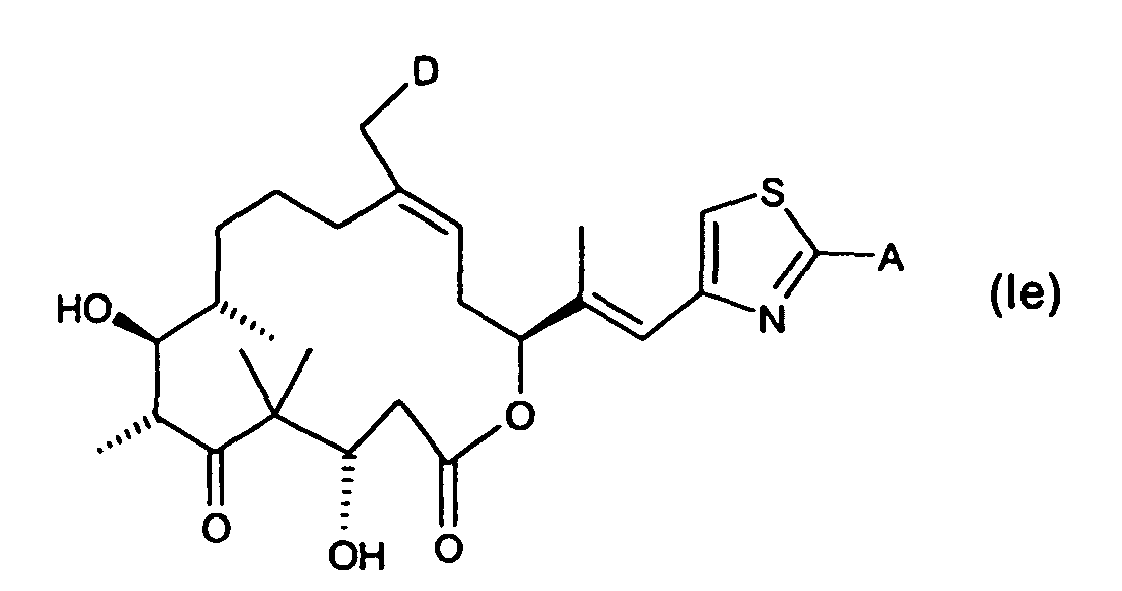
- The invention most specifically relates to the compounds of the formula I given in the examples, or the pharmaceutically acceptable salts thereof where one or more salt-forming groups are present.
- Most preferably, the invention relates to a compound selected from the group consisting of compound 18b (see Example 2), compound 19b (see Example 2), or a pharmaceutically acceptable salt thereof if one or more salt-forming groups are present.
- The compounds of the invention can be synthesized using methods in analogy to methods that are known in the art, preferably by a method characterized by
- a) reacting a iodide of the formula II,

R1-Sn(R)3 (III)
wherein R1 has the meanings given under formula I and R is lower alkyl, especially methyl or n-butyl, or - b) reacting a tin compound of the formula IV,

R1-I (V)
wherein R1 has the meanings given under formula I; - In all starting materials, where required, functional groups that shall not participate in the reaction are protected by protecting groups, especially standard protecting groups. The protecting groups, their introduction and their cleavage are known in the art, for example, they are described in the standard references mentioned above.
- Reaction a): The reaction (a (preferably improved) Stille coupling) preferably takes place under standard conditions; more preferably, the reaction takes place
- (i) in an appropriate solvent, e.g. toluene, at elevated temperature, especially about 90 to about 100 °C, preferably with an excess of the tin compound of the formula III, preferably in the 1.1- to 3-, e.g. the 1.5- to 2-fold molar excess; and a catalytic amount, preferably of about 1 to 30%, preferably 5 to 10 %, of Pd(PPh3)4; or
- (ii) in an appropriate solvent, e.g. dimethylformamide (DMF), at temperatures of from 10 to 40 °C, especially at 25°C, preferably with an excess of the tin compound of the formula III, preferably in the 1.1- to 3-, e.g. the 1.5- to 2.3-fold molar excess; in the presence of a catalytic amount, preferably of 10 to 50%, especially 20 to 30%, of Pd(MeCN)2Cl2.
Alternative conditions for this coupling also comprise the use of the following reagents and/or conditions: - (iii). cuprous 2-thiophene carboxylate, N-methyl-2-pyrrolidine.
- (iv). PdCl2(MeCN)2 (cat.), DMF, 50 - 150° (with or without additon of tertiary base).
- (v). Pd(PPh3)4/Cul (cat), DMF, 50 - 150° (with or without addition of tertiary base)
- Reaction b): The reaction (an improved Stille coupling) preferably takes place under standard conditions; more preferably, the reaction takes place in an appropriate solvent, especially DMF, at temperatures of from 50 to 100, preferably from 80 to 85° C, preferably with an excess of the iodide of the formula V, in the presence of a catalytic amount of AsPh3, preferably about 0.4 equivalents, Cul, preferably about 0.1 equivalents, and PdCl2(MeCN)2, preferably about 0.2 equivalents.
- Especially preferred are the reaction conditions mentioned in the examples.
- Compounds of the formula I can be converted into different compounds of formula I by standard or novel methods.
- For example, a compound of the formula I wherein R2 is absent, b and c are absent and a is a double bond, and the other moieties are as described for compounds of the formula I, can be converted into the corresponding epoxide wherein R2 is O and b and c are present while a is a single bond. Preferably, the epoxidation takes place in the presence of (+)-diethyl-D-tartrate ((+)-DET) (preferably about 0.5 equivalents), Ti(i-PrO)4 (preferably about 0.5 equivalents), tert-butylhydroperoxide (preferably about 2.2 equivalents) and molecular sieve, especially 4 A molecular sieves, in an appropriate solvent, e.g. methylene chloride and optionally an alkane, such as decane, at low temperatures, preferably -78 to 0 °C, especially about -40 °C;
or in presence of hydrogen peroxide (preferably about 30 equivalents), acetonitrile (preferably about 60 equivalents), a base, especially KHCO3 (preferably about 10 equivalents) in an appropriate solvent, e.g. an alcohol, preferably methanol, at preferred temperatures between 10 and 40 °C, e.g. at about 25 °C. - A compound of the formula I wherein R3 is hydroxymethyl can be converted into a compound of formula I wherein R3 is fluoromethyl, e.g. by treatment with DAST (preferably 1.05 to 1.4 equivalents) in an appropriate solvent, e.g. methylene chloride, at low temperatures, preferably at -95 to 0° C, especially at about -78 °C. DAST is diethylamino-sulfur trifluoride.
- A compound of the formula I wherein R3 is iodomethyl can be converted into a compound of formula I wherein R3 is methyl, e.g. by treatment with cyanoborohydride (preferably about 10 equivalents) in HMPA (hexamethylphosphoric triamide) at elevated temperatures, e.g. at 40 to 45 °C.
- Other conversions can be made in accordance with known procedures, e.g. those given in PCT application WO 98/25929, which is herewith incorporated by reference.
- Salts of a compound of formula I with a salt-forming group may be prepared in a manner known per se. Acid addition salts of compounds of formula I may thus be obtained by treatment with an acid or with a suitable anion exchange reagent.
- Salts can usually be converted to free compounds, e.g. by treating with suitable basic agents, for example with alkali metal carbonates, alkali metal hydrogencarbonates, or alkali metal hydroxides, typically potassium carbonate or sodium hydroxide.
- The resulting free compounds can then, if desired, be converted into different salts as described for the formation of salts from the free compounds.
- Stereoisomeric mixtures, e.g. mixtures of diastereomers, can be separated into their corresponding isomers in a manner known per se by means of suitable separation methods. Diastereomeric mixtures for example may be separated into their individual diastereomers by means of fractionated crystallization, chromatography, solvent distribution, and similar procedures. This separation may take place either at the level of a starting compound or in a compound of formula I itself. Enantiomers may be separated through the formation of diastereomeric salts, for example by salt formation with an enantiomer-pure chiral acid, or by means of chromatography, for example by HPLC, using chromatographic substrates with chiral ligands.
- Starting materials and intermediates are known in the art, commercially available, and/or prepared in accordance with methods known in the art or in analogy thereto.
- Compounds of the formula II and of the formula III can, for example, be synthesized as described in PCT application WO 98/25929, which is herewith incorporated by reference, or as described or in analogy to the methods in the examples.
- Compounds of the formula IV are accessible by reaction of the respective compounds of the formula II, for example by reaction of a compound of the formula II with (R)6Sn2, wherein R is lower alkyl, especially methyl or n-butyl, in the presence of an appropriate nitrogen base, e.g. Hünig's base, and in the presence of catalytic amount (preferably about 0.1 equivalents) of Pd(PPh3)4 in an appropriate solvent, e.g. toluene, at elevated temperatures, e.g. 30 to 90 °C, especially 80 to 85 °C.
Iodides of the formula V are known and can be obtained according to literature procedures, or they are commercially available. For example, 2-iodo-6-methyl pyridine can be obtained according to Klei, E. ; Teuben, J.H. J. Organomet. Chem. 1981, 214, 53-64;
2-iodo-5-methyl pyridine according to Talik, T.; Talik, Z. Rocz. Chem. 1968, 42, 2061-76; and 2-iodo-4-methyl pyridine according to Talik, T.; Talik, Z. Rocz. Chem. 1968, 42, 2061-76, Yamamoto, Y.; Yanagi, A. Heterocycles 1981, 16, 1161-4 or Katritzky, A.R.; Eweiss, N.F.; Nie, P.-L. JCS, Perkin Trans I 1979, 433-5. The corresponding hydroxymethyl-substituted compounds of formula V are available for example by oxidation of the methyl groups of the iodides mentioned above with SeO2 and subsequent reduction, e.g. with NaBH4 or DIBALH) of the aldehyde or by oxidation of the methyl group to form the acid (for example with KMnO4) and subsequent reduction of the ester e.g. with DIBAL. - Preferably, new or also known starting materials and intermediates can be prepared in accordance with or in analogy to the methods described in the examples, where the amounts, temperatures and the like of the respective reactions can be modified, e.g. by varying in the range of ± 99 %, preferably ± 25%, and other appropriate solvents and reagents can be used.
- The invention relates also to all new intermediates, especially those mentioned in the
- The present invention also relates to the use of a compound of the formula I for the manufacture of a pharmaceutical formulation for use against a proliferative disease as defined above; or to a pharmaceutical formulation for the treatment of said proliferative disease comprising a compound of the invention and a pharmaceutically acceptable carrier.
- The compounds of the formula I are called active ingredient hereinafter.
- The invention relates also to pharmaceutical compositions comprising an active ingredient as defined above, for the treatment of a proliferative disease, especially as defined above, and to the preparation of pharmaceutical preparations for said treatment.
- The invention relates also to a pharmaceutical composition that is suitable for administration to a warm-blooded animal, especially a human, for the treatment of a proliferative disease as defined hereinbefore, comprising an amount of an active ingredient, which is effective for the treatment of said proliferative disease, together with at least one pharmaceutically acceptable carrier. The pharmaceutical compositions according to the invention are those for enteral, such as nasal, rectal or oral, or preferably parenteral, such as intramuscular or intravenous, administration to a warm-blooded animal (human or animal), that comprise an effective dose of the pharmacologically active ingredient, alone or together with a significant amount of a pharmaceutically acceptable carrier. The dose of the active ingredient depends on the species of warm-blooded animal, the body weight, the age and the individual condition, individual pharmacokinetic data, the disease to be treated and the mode of administration; preferably, the dose is one of the preferred doses as defined below, being accommodated appropriately where pediatric treatment is intended.
- The pharmaceutical compositions comprise from about 0.00002 to about 95%, especially (e.g. in the case of infusion dilutions that are ready for use) of 0.0001 to 0.02%, or (for example in case of infusion concentrates) from about 0.1 % to about 95%, preferably from about 20% to about 90%, active ingredient (weight by weight, in each case). Pharmaceutical compositions according to the invention may be, for example, in unit dose form, such as in the form of ampoules, vials, suppositories, dragées, tablets or capsules.
- The pharmaceutical compositions of the present invention are prepared in a manner known per se, for example by means of conventional dissolving, lyophilizing, mixing, granulating or confectioning processes.
- Solutions of the active ingredient, and also suspensions, and especially isotonic aqueous solutions or suspensions, are preferably used, it being possible, for example in the case of lyophilized compositions that comprise the active ingredient alone or together with a pharmaceutically acceptable carrier, for example mannitol, for such solutions or suspensions to be produced prior to use. The pharmaceutical compositions may be sterilized and/or may comprise excipients, for example preservatives, stabilizers, wetting and/or emulsifying agents, solubilizers, salts for regulating the osmotic pressure and/or buffers, and are prepared in a manner known per se, for example by means of conventional dissolving or lyophilizing processes. The said solutions or suspensions may comprise viscosity-increasing substances, such as sodium carboxymethylcellulose, carboxymethylcellulose, dextran, polyvinylpyrrolidone or gelatin.
- Suspensions in oil comprise as the oil component the vegetable, synthetic or semi-synthetic oils customary for injection purposes. There may be mentioned as such especially liquid fatty acid esters that contain as the acid component a long-chained fatty acid having from 8 to 22, especially from 12 to 22, carbon atoms, for example lauric acid, tridecylic acid, myristic acid, pentadecylic acid, palmitic acid, margaric acid, stearic acid, arachidic acid, behenic acid or corresponding unsaturated acids, for example oleic acid, elaidic acid, erucic acid, brasidic acid or linoleic acid, if desired with the addition of anti-oxidants, for example vitamin E, betacarotene or 3,5-di-tert-butyl-4-hydroxytoluene. The alcohol component of those fatty acid esters has a maximum of 6 carbon atoms and is a mono- or polyhydroxy, for example a mono-, di- or tri-hydroxy, alcohol, for example methanol, ethanol, propanol, butanol or pentanol or the isomers thereof, but especially glycol and glycerol.
- The injection or infusion compositions are prepared in customary manner under sterile conditions; the same applies also to introducing the compositions into ampoules or vials and sealing the containers.
- Preferred is an infusion formulation comprising an active ingredient and a pharmaceutically acceptable organic solvent.
- The pharmaceutically acceptable organic solvent used in a formulation according to the invention may be chosen from any such organic solvent known in the art. Preferably the solvent is selected from alcohol, e.g. absolute ethanol or ethanol/water mixtures, more preferably 70% ethanol, polyethylene glycol 300, polyethylene glycol 400, polypropylene glycol or N-methylpyrrolidone, most preferably polypropylene glycol or 70% ethanol or polyethylene glycol 300.
- The active ingredient may preferably be present in the formulation in a concentration of about 0.01 to about 100 mg/ml, more preferably about 0.1 to about 100 mg/ml, still more preferably about 1 to about 10 mg/ml (especially in infusion concentrates).
- The active ingredient may be used as pure substances or as a mixture with another active ingredient. When used in its pure form it is preferable to employ a concentration of active ingredient of 0.01 to 100, more preferably 0.05 to 50, still more preferably 1 to 10 mg/ml (this number makes reference especially to an infusion concentrate that, before treatment, is diluted accordingly, see below).
- Such formulations are conveniently stored in vials or ampoules. Typically the vials or ampoules are made from glass, e.g. borosilicate or soda-lime glass. The vials or ampoules may be of any volume conventional in the art, preferably they are of a size sufficient to accommodate 0.5 to 5 ml of formulation. The formulation is stable for periods of storage of up to 12 to 24 months at temperatures of at least 2 to 8°C.
- Formulations must be diluted in an aqueous medium suitable for intravenous administration before the formulation of the active ingredient can be administered to a patient.
- The infusion solution preferably must have the same or essentially the same osmotic pressure as body fluid. Accordingly, the aqueous medium preferably contains an isotonic agent which has the effect of rendering the osmotic pressure of the infusion solution the same or essentially the same as body fluid.
- The isotonic agent may be selected from any of those known in the art, e.g. mannitol, dextrose, glucose and sodium chloride. Preferably the isotonic agent is glucose or sodium chloride. The isotonic agents may be used in amounts which impart to the infusion solution the same or essentially the same osmotic pressure as body fluid. The precise quantities needed can be determined by routine experimentation and will depend upon the composition of the infusion solution and the nature of the isotonic agent. Selection of a particular isotonic agent is made having regard to the properties of the active agent.
- The concentration of isotonic agent in the aqueous medium will depend upon the nature of the particular isotonic agent used. When glucose is used it is preferably used in a concentration of from 1 to 5% w/v, more particularly 5% w/v. When the isotonic agent is sodium chloride it is preferably employed in amounts of up to 1% w/v, in particular 0.9% w/v.
- The infusion formulation may be diluted with the aqueous medium. The amount of aqueous medium employed as a diluent is chosen according to the desired concentration of active ingredient in the infusion solution. Preferably the infusion solution is made by mixing a vial or ampoule of infusion concentrate afore-mentioned with an aqueous medium, making the volume up to between 20 ml and 200 ml, preferably between about 50 and about 100 ml, with the aqueous medium.
- Infusion solutions may contain other excipients commonly employed in formulations to be administered intravenously. Excipients include antioxidants. Infusion solutions may be prepared by mixing an ampoule or vial of the formulation with the aqueous medium, e.g. a 5% w/v glucose solution in WFI or especially 0.9% sodium chloride solution in a suitable container, e.g. an infusion bag or bottle. The infusion solution, once formed, is preferably used immediately or within a short time of being formed, e.g. within 6 hours. Containers for holding the infusion solutions may be chosen from any conventional container which is nonreactive with the infusion solution. Glass containers made from those glass types afore-mentioned are suitable although it may be preferred to use plastics containers, e.g. plastics infusion bags.
- The invention also relates to a method of treatment of a warm-blooded animal, especially a human, that is in need of such treatment, especially of treatment of a proliferative disease, comprising administering a compound of the formula I, or a pharmaceutically acceptable salt thereof, to said warm-blooded animal, especially a human, in an amount that is sufficient for said treatment, especially effective against said proliferative disease.
- Dosage forms may be conveniently administered intravenously in a dosage of from 0.01 mg up to 100 mg/m2 of active ingredient, preferably from 0.1 to 20 mg/m2 of active ingredient. The exact dosage required and the duration of administration will depend upon the seriousness of the condition, the condition of the patient and the rate of administration. The dose may be administered daily or preferably with intervals of some days or weeks, for example weekly or every 3 weeks. As the dose may be delivered intravenously, the dose received and the blood concentration can be determined accurately on the basis of known in vivo and in vitro techniques.
- Pharmaceutical compositions for oral administration can be obtained by combining the active ingredient with solid carriers, if desired granulating a resulting mixture, and processing the mixture, if desired or necessary, after the addition of appropriate excipients, into tablets, dragée cores or capsules. It is also possible for them to be incorporated into plastics carriers that allow the active ingredients to diffuse or be released in measured amounts.
- The compounds of the invention can be used alone or in combination with other pharmaceutically active substances, e.g. with other chemotherapeutics, such as classical cytostatics.
In the case of combinations with an other chemotherapeutic, a fixed combination of two or more components or two or more independent formulations (e.g. in a kit of part) are prepared as described above, or the other chemotherapeutics are used in standard formulations that are marketed and known to the person of skill in the art, and the compound of the present invention and any other chemotherapeutic are administered at an interval that allows for a common, additional or preferably synergistic effect for tumor treatment. - The following examples are intended to illustrate the present invention without being intended to limit the scope of the invention.
- Starting materials:
- The first total synthesis of epothilone E (3) is accomplished by a strategy in which the key step is a Stille coupling (Stille et al. Angew. Chem. Int. Ed. Engl. 1986, 25, 508-524; Farina et al. J. Org. React. 1997, 50, 1-65) between vinyl iodide 7 and the thiazole moiety (8h, Scheme 2a). The macrolactone core fragment 7, which is prepared via ring-closing olefin metathesis (RCM), is subsequently used to provide convenient and flexible access to a variety of side-chain modified epothilone analogs (9) for biological evaluation (Scheme 2b). The RCM reaction used to access 7 also provides trans-macrolactone (11, Scheme 2b) which serves as an alternative template for the Stille coupling process and provides an additional array of analogs 10.
- ---Scheme 2:
- a) Retrosynthetic analysis and strategy for the total synthesis of epothilone E

- b) Side chain analogs of epothilone C (9) and its Δ12,13 trans-isomer (10)

- The chemical synthesis of the requisite vinyl iodides 7 and 11 is delineated in PCT application WO 98/25929.
- The stannane coupling partners used in the Stille reaction are shown in Scheme 3.

- Stille coupling: Procedure A: 2.0 equiv. of 8, 5 - 10 mol% Pd(PPh3)4, toluene, 90 - 100 °C, 15 - 40 min, 39 - 88%; procedure B: 2.0 - 2.2 equiv. of 8, 20 - 30 mol% Pd(MeCN)2Cl2, DMF, 25 °C, 12 - 33 h, 49 - 94%.---
- The coupling partners 8b accessible 2,4-dibromothiazole (20) via monobromides 21 as outlined in Schemes 4 and 5.

- Preparation of A) stannanes 8b. Reagents and conditions: (b) 3.0 equiv. of NaSMe, EtOH, 25 °C, 2 h, 92%; (d) 13 equiv. NaOH, EtOH, 25 °C, 30 h, 91 %; (e) 13 equiv. NaOH, MeOH, 25 °C, 16h, 82%; (f) 5 - 10 equiv. of Me3SnSnMe3, 5 - 10 mol% of Pd(PPh3)4, toluene, 80 - 100 °C, 0.5 - 3 h, 81 - 100 %; (g) 1.1 equiv. of n-BuLi, 1.2 equiv. of n-Bu3SnCl, -78 to 25 °C, 30 min, 98%; ---
- Sulfide 21b is obtained in 92% yield by replacing the 2-bromo substituent of 20 with the thiomethyl moiety using sodium thiomethoxide (EtOH, 25 °C). Bromide (21b) is then transformed to the desired trimethylstannane (8b) with hexamethylditin under palladium catalyzed conditions [Pd(PPh3)4, toluene, 80 - 100 °C].
- With the necessary components in hand, the critical Stille couplings are investigated. Two alternative sets of reaction conditions prove adequate (Scheme 3). Procedure A involves heating a toluene solution of the desired vinyl iodide (7 or 11) with the appropriate stannane 8 in the presence of catalytic amounts of Pd(PPh3)4 at 80-100 °C for between 15 and 40 min. This protocol is used to couple stannane 8b
- The total synthesis is completed by epoxidation with in situ generated methylperoxycarboximidic acid (H2O2, KHCO3, MeCN, MeOH, 25 °C; Chaudhuri et al. J. J. Org. Chem. 1982, 47, 5196-5198) furnishing epothilone E (3) (66% based on 50% conversion), which exhibits identical physical characteristics (1H NMR, [α]D) to those published in the art.
- The Stille coupling approach is then extended to provide easy access to a variety of side-chain modified analogs of epothilone B (2), both at C-26 and the side chain. The retrosynthetic analysis of epothilone analogs possessing these dual modifications is shown in Scheme 6b and requires the preparation of the crucial vinyl iodide core fragment 24. A macrolactonization strategy similar to that used in our synthesis of epothilone B and a variety of epothilone analogs is thought to be most suitable for this task.

- The synthesis begins from the vinyl iodide 13 (Scheme 7) used in the preparation of epothilone E and related analogs (Scheme 3).

- Stereoselective synthesis of aldehyde 35. Reagents and conditions: (a) 1.7 equiv. TBSCI, 2.8 equiv. imidazole, DMF, 0 to 25 °C, 7 h, 84%; (b) i. 1.0 mol% OsO4, 1.1 equiv. NMO, THF:t-BuOH:H2O (5:5:1), 0 to 25 °C, 13 h, 89%; ii. 6.0 equiv. NalO4, MeOH:H2O (2:1), 0 °C, 30 min, 92%; (c) 2.4 equiv. 27, benzene, reflux, 1.2 h, 98%; (d) 3.0 equiv. DIBAL, THF, -78 °C, 2.5 h, 100%. (e) 1.4 equiv. of TrCl, 1.7 equiv. of 4-DMAP, DMF, 80 °C, 21 h, 95%; (f) 1.4 equiv. of 9-BBN, THF, 0 °C, 9 h; then 3 N aqueous NaOH and 30% H2O2 0 °C, 1 h, 95%; (g) 2.6 equiv. of I2, 5.0 equiv. of imidazole, 2.5 equiv. of Ph3P, Et2O:MeCN (3:1), 0 °C, 45 min, 97%; (h) 1.3 equiv. of the SAMP hydrazone of propionaldehyde, 1.4 equiv. of LDA, THF, 0 °C, 16 h; then -100 °C and add 1.0 equiv. of 32 in THF, -100 to -20 °C, 20 h, 71%; (i) 2.5 equiv. of MMPP, MeOH:phosphate buffer pH 7 (1:1), 0 °C, 3.5 h, 89%; (j) 3.0 equiv. of DIBAL, toluene, -78 °C, 1 h, 88%. 9-BBN = 9-borabicyclo[3.3.1]nonane; DIBAL = diisobutylaluminium hydride; 4-DMAP = 4-dimethylaminopyridine; LDA = lithium diisopropylamide; NMO = 4-methylmorpholine N-oxide; SAMP = (S)-(-)-1-amino-2-(methoxymethyl)pyrrolidine; MMPP = monoperoxyphthalic acid, magnesium salt.---
- Protection of the allylic hydroxyl group (TBSCI, imidazole, DMF, 0 to 25°C) affords silyl ether 25 (84%) which is transformed into aldehyde 26 by a two-step dihydroxylation-glycol-cleavage sequence (OsO4, NMO, THF/t-BuOH/H2O, 0 to 25 °C; then NaIO4, MeOH/H2O, 0 °C, 82% for two steps). A stereocontrolled Wittig reaction with the stabilized ylide 27 (benzene, reflux; Marshall et al. J. Org. Chem. 1986, 51, 1735-1741; Bestmann et al. Angew. Chem. Int. Ed. Engl. 1965, 4, 645-660.) affords ester 28 as a single geometrical isomer in 98% yield. Reduction of the latter compound (DIBAL, THF, -78 °C) affords alcohol 29, which is protected as the triphenylmethyl (trityl) derivative 30 (TrCl, 4-DMAP, DMF, 70 °C, 95%).
- Elaboration of the terminal olefin is then achieved by selective hydroboration-oxidation to give alcohol 31 (9-BBN, THF, 0 °C; then NaOH, H2O2, 0 °C) which is transformed further into diiodide 32 (I2, imidazole, Ph3P, 0 °C) in 92% overall yield. Introduction of the C8 stereocenter is then achieved using an Ender's alkylation protocol (SAMP hydrazone of propionaldehyde, LDA, THF, 0 °C; then -100 °C and add 32 in THF; Enders et al. Asymmetric Synthesis 1984; Morrison, J. D., Ed.; Academic Press, Orlando, Vol 3, p. 275-339; we thank Prof. Enders for a generous gift of SAMP) resulting in the formation of SAMP hydrazone 33 in 71% yield. Conversion to nitrile 34 (MMPP, MeOH/phosphate buffer pH 7, 0 °C, 89%) and ensuing reduction (DIBAL, toluene, -78 °C) afford the desired aldehyde 35 in 88% yield.
- The transformation of aldehyde 35 into the desired epothilone macrocyclic core 24 is summarized in Scheme 8.

- Stereoselective synthesis of vinyl iodide 24. Reagents and conditions: (a) 1.45 equiv. of LDA, THF, -78 °C, then 1.4 equiv. of 36 in THF, -78 °C, 1.5 h then; -40 °C, 0.5 h; then 1.0 equiv. of 35 in THF at -78 °C (66% combined yield, ca. 1.5:1 ratio of 37:38); (b) 3.2 equiv. of TBSOTf, 4.3 equiv. of 2,6-lutidine, CH2Cl2, -20 to 0 °C, 2.5 h, 90%; (c) HF•pyr. in pyridine, THF, 0 °C, 3 h, 84%; (d) 2.0 equiv. of (COCl)2, 4.0 equiv. of DMSO, 6.0 equiv. of Et3N, CH2Cl2, -78 to 0 °C, 1.5 h, 98%; (e) 5.0 equiv. of NaClO2, 75 equiv. of 2-methyl-2-butene, 2.5 equiv. of NaH2PO4, t-BuOH:H2O (4.5:1), 25 °C, 40 min, 100%; (f) 6.0 equiv. of TBAF, THF, 0 to 25°C, 19 h, 95%; (g) 6.0 equiv. of Et3N, 2.4 equiv. of 2,4,6-trichlorobenzoylchloride, THF, 0 °C, 1.5 h; then add to a solution of 2.2 equiv. of 4-DMAP in toluene (0.005 M based on 43), 75°C, 2.5 h, 84%; (h) 25% v/v HF•pyr. in THF 0 to 25°C, 15 h, 86%. TBAF = tetra n-butylammonium fluoride.---
- Aldol reaction of ketone 36, previously used in our synthesis of epothilone B and related analogs (LDA, THF, -78 to -40 °C) and aldehyde 35, affords alcohols 37 and 38 in 66% overall yield, with modest selectivity for the desired 6R,7S diastereoisomer (37). Separation and silylation (TBSOTf, 2,6-lutidine, CH2Cl2, -20 to 0 °C) of the correct aldol product 37 provides tris-silyl ether 39 in 90% yield. Selective removal of the primary silyl ether protecting group (HF•pyr. in pyridine/THF, 0 °C) affords alcohol 40 (84%), which is oxidized to acid 42 via aldehyde 41 by a two-step procedure [Swern; then NaClO2, 2-methyl-2-butene, NaH2PO4, t-BuOH/H2O, 25 °C, 98% for two steps). Removal of the C15 silicon protecting group (TBAF, THF, 0 to 25°C) provides hydroxy-acid 43 (95%) and lays the foundation for the macrolactonization process. This key step is achieved under Yamaguchi conditions (2,4,6-trichlorobenzoylchloride, Et3N, THF; then add to a solution of 4-DMAP in toluene, 0.005M, 75 °C; Inanaga et al. Bull. Chem. Soc. Jpn. 1979, 52, 1989; Mulzer et al. Synthesis 1992, 215-228; Nicolaou et al. Chem. Eur. J. 1996, 2, 847-868) to give the protected epothilone core 44 in 84% yield. Global deprotection (HF•pyr., THF, 0 to 25 °C, 86%) completes the synthesis of the key vinyl iodide intermediate 24.
- With intermediate 24 in hand, the Stille coupling protocol is then employed to attach the desired heterocyclic moiety.
- The chemistry described in this example relies on a Stille coupling approach to construct a series of epothilone analogs with diversity at the side-chain or at both the side-chain and C26 site from a common macrocyclic intermediate.
-
Table: Formulae of compounds according to the invention: En-try Compound 4 
8 
- In accordance with the methods described above (inhibition of tubulin depolymerization by a compound of the formula I is measured using pig brain microtubuli, comparison with 25 µM epothilone B; cellular assays are analogous to those described above for KB-31 cells.
- In analogy to the methods described above and below, the compounds falling under formula I are prepared that have the following formulae:


- General: All reactions are carried out under an argon atmosphere with dry, freshly distilled solvents under anhydrous conditions, unless otherwise noted. Tetrahydrofuran (THF) and diethyl ether (ether) are distilled from sodium-benzophenone, and dichloromethane (CH2Cl2), benzene (PhH), and toluene from calcium hydride. Anhydrous solvents are also obtained by passing them through commercially available activated alumina columns. Yields refer to chromatographically and spectroscopically (1H NMR) homogeneous materials, unless otherwise stated. All solutions used in workup procedures are saturated unless otherwise noted. All reagents are purchased at highest commercial quality and used without further purification unless otherwise stated. All reactions are monitored by thin-layer chromatography carried out on 0.25 mm E. Merck silica gel plates (60F-254) using UV light as visualizing agent and 7% ethanolic phosphomolybdic acid or p-anisaldehyde solution and heat as developing agents. E. Merck silica gel (60, particle size 0.040-0.063 mm) is used for flash column chromatography. Preparative thin-layer chromatography separations are carried out on 0.25, 0.50 or 1 mm E. Merck silica gel plates (60F-254). NMR spectra are recorded on Bruker DRX-600, AMX-500, AMX-400 or AC-250 instruments and calibrated using residual undeuterated solvent as an internal reference. The following abbreviations are used to explain the multiplicities: s, singlet; d, doublet; t, triplet; q, quartet; m, multiplet; band, several overlapping signals; b, broad. IR spectra are recorded on a Perkin-Elmer 1600 series FT-IR spectrometer. Optical rotations are recorded on a Perkin-Elmer 241 polarimeter. High resolution mass spectra (HRMS) are recorded on a VG ZAB-ZSE mass spectrometer under fast atom bombardment (FAB) conditions.
- cis-Macrolactone diol 7 as illustrated in Scheme 3. To a solution of iodide 16 (305 mg, 0.491 mmol) in THF (8.2 mL, 0.06 M) at 25 °C is added HF•pyr. (2.7 mL) and the resulting solution is stirred at the same temperature for 27 h. The reaction is then quenched by careful addition to a mixture of saturated aqueous NaHCO3 (100 mL) and EtOAc (100 mL), and the resulting two-phase mixture is stirred at 25 °C for 2 h. The extracts are then separated and the organic layer is washed with saturated aqueous NaHCO3 (100 mL) and brine (100 mL), and then dried (MgSO4). Purification by flash column chromatography (silica gel, 20 to 50% EtOAc in hexanes) furnishes diol 7 (208 mg, 84%). R f = 0.21 (silica gel, 25% EtOAc in hexanes); [α]22 D -53.1 (c 1.37, CHCl3); IR (thin film) v max 3499 (br), 2930, 1732, 1688, 1469, 1379, 1259, 1149, 1093, 1048, 1006, 732 cm-1; 1H NMR (500 MHz, CDCl3) δ 6.43 (s, 1 H, ICH=C(CH3)), 5.44 (ddd, J = 10.5, 10.5, 4.5 Hz, 1 H, CH=CHCH2), 5.34 (dd, J = 9.5, 2.0 Hz, 1 H, CHOCO), 5.32 (ddd, J = 10.5, 10.5, 5.5 Hz, 1 H, CH=CHCH2), 4.07 (ddd, J = 11.0, 6.0, 3.0 Hz, 1 H, (CH3)2CCH(OH)), 3.73 (ddd, J = 2.5, 2.5, 2.5 Hz, 1 H, CHOH(CHCH3)), 3.10 (qd, J = 7.0, 2.5 Hz, 1 H, CH3CH(C=O)), 2.84 (d, J = 2.5 Hz, 1 H, CH(CH3)CHOHCH(CH3)), 2.66 (ddd, J = 15.0, 9.5, 9.5 Hz, 1H, =CHCH 2CHO), 2.51 (dd, J = 15.5, 11.0 Hz, 1 H, CH2COO), 2.42 (dd, J = 15.5, 3.0 Hz, 1 H, CH2COO), 2.35 (d, J = 6.0 Hz, 1 H, (CH3)2CHOH), 2.21-2.12 (m, 2 H), 2.05-1.97 (m, 1 H), 1.88 (s, 3 H, ICH=CCH 3), 1.76-1.70 (m, 1 H), 1.70-1.62 (m, 1 H), 1.32 (s, 3 H, C(CH3)2), 1.18 (d, J = 7.0 Hz, 3 H, CH 3CH(C=O)), 1.10 (s, 3 H, C(CH3)2), 1.35-1.05 (m, 3 H), 0.99 (d, J = 7.0 Hz, 3 H, CH 3CHCH2); HRMS (FAB), calcd. for C22H35IO5 (M + Cs+) 639.0584, found 639.0557.
- trans-Macrolactone diol 11 as illustrated in Scheme 3. A solution of iodide 17 (194 mg, 0.313 mmol) in THF (5.2 mL, 0.06 M) is treated with HF•pyr. (1.7 mL) according to the procedure described for the preparation of diol 7 to afford, after flash column chromatography (silica gel, 20 to 50% EtOAc in hexanes), diol 11 (134 mg, 85%). R f = 0.16 (silica gel, 25% EtOAc in hexanes); [α]22 D -20.0 (c 1.15, CHCl3); IR (film) v max 3478, 2930, 1732, 1693 cm-1; 1H NMR (500 MHz, CDCl3) δ 6.37 (d, J = 1.5 Hz, 1 H, ICH=CCH3), 5.35 (ddd, J = 14.5, 7.0, 7.0 Hz, 1 H, CH=CHCH2), 5.24 (ddd, J = 14.5, 7.0, 7.0 Hz, 1 H, CH=CHCH2), 5.17 (dd, J = 6.5, 3.5 Hz, 1 H, CHOCO), 4.41 (dd, J = 8.0, 3.5 Hz, 1 H, (CH3)2CCH(OTBS)), 3.85 (bs, 1 H, CHOH(CHCH3)), 3.38 (bs, 1 H, CHOH(CHCH3)), 3.18 (qd, J = 7.0, 6.5 Hz, 1 H, CH3CH(C=O)), 2.68-2.34 (m, 4 H), 2.44 (s, 3 H, CH3Ar), 2.19-2.11 (m, 1 H), 1.96 (s, 3 H, CH 3C=CH), 1.99-1.93 (m, 1 H), 1.67-1.52 (m, 2 H), 1.48-1.42 (m, 1 H), 1.31-0.99 (m, 2 H), 1.22 (d, J = 7.0 Hz, 3 H, CH 3CH(C=O)), 1.14 (s, 3 H, C(CH3)2), 1.09 (s, 3 H, C(CH3)2), 1.02 (d, J = 7.0 Hz, 3 H, CH 3CHCH2), 0.84 (s, 9 H, SiC(CH 3)3(CH3)2), 0.08 (s, 3 H, SiC(CH3)3(CH 3)2), -0.01 (s, 3 H, SiC(CH3)3(CH 3)2); HRMS (FAB), calcd.. for C22H35IO5 (M + Cs+) 639.0584, found 639.0606.
- 2- Thiomethyl-4-bromothiazole 21b as illustrated in Scheme 4. 2,4-Dibromothiazole 20 (82 mg, 0.34 mmol, 1.0 equiv.) is dissolved in ethanol (2.3 mL, 0.15 M) and treated with sodium thiomethoxide (75 mg, 1.02 mmol, 3.0 equiv.). The reaction mixture is stirred at 25 °C for 2 h, upon which time completion of the reaction is established by 1H NMR. The mixture is poured into water (5 mL) and extracted with ether (2 x 5 mL). The combined organic fractions are dried (MgSO4), the solvents evaporated and the residue purified by flash column chromatography (silica gel, 5% EtOAc in hexanes) to furnish 2-thiomethyl-4-bromothiazole 21b (77 mg, 92%). R f = 0.58 (silica gel, 10% EtOAc in hexanes); IR (film) v max 3118, 2926, 1459, 1430, 1388, 1242, 1040, 966, 876, 818 cm-1; 1H NMR (500 MHz, CDCl3) δ 7.07 (s, 1 H, ArH), 2.69 (s, 3 H, SCH3); GC/MS (EI), calcd. for C4H4BrNS2 (M+) 209 / 211, found 209 / 211.
- 2-Thiomethyl-4-trimethylstannylthiazole 8b as illustrated in Scheme 3. To a solution of bromothiazole 21b (51 mg, 0.24 mmol, 1.0 equiv.) in degassed toluene (4.9 mL, 0.1 M) is added hexamethylditin (498 µL, 2.4 mmol, 10 equiv.) and Pd(PPh3)4 (14 mg, 0.012 mmol, 0.05 equiv.) and the reaction mixture is heated at 80°C for 3 h. Then the reaction mixture is cooled to 25°C and affords, after flash column chromatography (silica gel, 5% Et3N in hexanes), stannane 8b (71 mg, 100%). R f = 0.67 (silica gel; pre-treated with Et3N, 10% EtOAc); IR (film) v max 2981, 2924, 1382, 1030, 772 cm-1; 1H NMR (500 MHz, CDCl3) δ 7.25 (s, 1 H, ArH), 2.70 (s, 3 H, SCH3), 0.32 (s, 9 H, Sn(CH3)3); HRMS (FAB), calcd. for C7H13NS2Sn (M + H+) 295.9588, found 295.9576.
- Epothilone E (3) as illustrated in Schemes 2 and 3. To a solution of lactone 18h (10.0 mg, 0.020 mmol, 1.0 equiv.) in methanol (600 µL, 0.03 M) is added acetonitrile (32 µL, 0.606 mmol, 30 equiv.), KHCO3 (10 mg, 0.102 mmol, 5 equiv.) and hydrogen peroxide (27 µL, 35% w/w in water, 0.303 mmol, 15 equiv.) and the reaction mixture stirred at 25 °C for 3 h. Additional acetonitrile (32 µL, 0.606 mmol, 30 equiv.), KHCO3 (10 mg, 0.102 mmol, 5 equiv.) and hydrogen peroxide (27 µL, 35% w/w in water, 0.303 mmol, 15 equiv.) are then added and stirring is continued for a further 3 h. The reaction mixture is then passed directly through a short plug of silica gel, eluting with ether, and the filtrate is concentrated under reduced pressure. Preparative thin layer chromatography (250 mm silica gel plate, 50% EtOAc in hexanes) furnishes unreacted starting material 18h (5.0 mg, 50%) and epothilone E (3) (3.4 mg, 33%). R f = 0.56 (silica gel, 66% EtOAc in hexanes); [α]22 D = -27.5 (c 0.20, CHCl3); IR (film) v max 3413, 2928, 2867, 1731, 1689, 1462, 1375, 1257, 1152, 1061, 978, 756 cm-1; 1H NMR (600 MHz, CDCl3) δ 7.13 (s, 1 H, ArH), 6.61 (s, 1 H, CH=CCH3), 5.46 (dd, J = 8.1, 2.4 Hz, 1 H, CHOCO), 4.94 (d, J = 5.2 Hz, 2 H, CH 2OH), 4.16-4.12 (m, 1 H, (CH3)2CCH(OH)), 3.82-3.78 (m, 1H, CHOH(CHCH3)), 3.66 (bs, 1 H, OH), 3.23 (qd, J = 6.8, 5.2 Hz, 1 H, CH3CH(C=O)), 3.04 (ddd, J = 8.1, 4.5, 4.5 Hz, 1 H, CH2CH(O)CHCH2), 2.91 (ddd, J = 7.3, 4.5, 4.1 Hz, 1 H, CH2CH(O)CHCH2), 2.61 (t, J = 5.2 Hz, 1 H, CH2OH), 2.55 (dd, J = 14.7, 10.4 Hz, 1 H, CH2COO), 2.48 (bs, 1 H, OH), 2.45 (dd, J = 14.7, 3.2 Hz, 1 H, CH2COO), 2.14-2.07 (m, 1 H, CH 2CH(O)CHCH2), 2.11 (s, 3 H, CH=CCH 3), 1.91 (ddd, J = 15.1, 8.1, 8.1 Hz, 1 H, CH 2CH(O)CHCH2), 1.78-1.66 (m, 2 H, CH 2CH(O)CHCH2), 1.52-1.38 (m, 5 H), 1.36 (s, 3 H, C(CH3)2), 1.18 (d, 3 H, J = 6.8 Hz, CH 3CH(C=O)), 1.10 (s, 3 H, C(CH3)2), 1.01 (d, J = 7.0 Hz, 3 H, CH3CHCH2); HRMS (FAB), calcd. for C26H39NO7S (M + H+) 510.2525, found 510.2539.
- cis-Macrolactone 18b as illustrated in Scheme 3. A solution of vinyl iodide 7 (9.2 mg, 0.018 mmol, 1.0 equiv.), stannane 8b (10.7 mg, 0.036 mmol, 2.0 equiv.) and Pd(PPh3)4 (2.1 mg, 0.0018 mmol, 0.1 equiv.) in degassed toluene (180 µL, 0.1 M) is heated at 100 °C for 40 min, according to the procedure described for the synthesis of lactone 18h, to yield, after preparative thin layer chromatography (250 mm silica gel plate, 75% ether in hexanes), macrolactone 18b (4.1 mg, 44%). R f = 0.50 (silica gel, 50% EtOAc in hexanes); [α]22 D -38.6 (c 0.21, CHCl3); IR (thin film) v max 3444, 2925, 1732, 1682, 1259, 1037, 756 cm-1; 1H-NMR (500 MHz, CDCl3) δ 6.99 (s, 1 H, CH=C(CH3)), 6.52 (bs, 1 H, ArH), 5.45 (ddd, J = 10.5, 10.5, 4.0 Hz, 2 H, CH=CHCH2), 5.39 (ddd, J = 10.5, 10.5, 4.0 Hz, 1 H, CH=CHCH2), 5.29 (d,J = 8.0 Hz, 1 H, CHOCO), 4.20 (ddd, J = 11.0, 5.5, 2.5 Hz, 1 H, (CH3)2CCH(OH)), 3.75-3.73 (m, 1 H, CHOH(CHCH3)), 3.13 (qd, J = 6.5, 2.0 Hz, 1 H, CH3CH(C=O)), 2.98 (d, J = 2.0 Hz, 1 H, CHOH(CHCH3)), 2.93 (d, J = 5.5 Hz, 1 H, (CH3)2CCH(OH)), 2.71 (ddd, J = 15.0, 10.0, 10.0 Hz, 1 H, CH=CHCH 2), 2.70 (s, 3 H, SCH3), 2.51 (dd, J = 15.5, 11.5 Hz, 1 H, CH2COO), 2.30 (dd, J = 15.0, 2.5 Hz, 1 H, CH2COO), 2.28-2.16 (m, 2 H), 2.13 (d, J = 1.0 Hz, 3 H, CH=CCH 3), 2.06-1.98 (m, 1 H), 1.79-1.60 (m, 2 H), 1.40-1.06 (m, 3 H), 1.33 (s, 3 H, C(CH3)2), 1.19 (d, J = 7.0 Hz, 3 H, CH 3CH(C=O)), 1.09 (s, 3 H, C(CH3)2), 1.00 (d, J = 7.0 Hz, 3 H, CH 3CHCH2); HRMS (FAB), calcd. for C26H39NO5S2 (M + Cs+) 642.1324, found 642.1345.
- trans-Macrolactone 19b as illustrated in Scheme 3. A solution of vinyl iodide 11 (6.9 mg, 0.014 mmol, 1.0 equiv.), stannane 8b (8.2 mg, 0.028 mmol, 2.0 equiv.) and Pd(PPh3)4 (1.6 mg, 0.0014 mmol, 0.1 equiv.) in degassed toluene (140 µL, 0.1 M) is heated at 100 °C for 40 min, according to the procedure described for the synthesis of lactone 18h, to yield, after preparative thin layer chromatography (250 mm silica gel plate, 75% ether in hexanes), macrolactone 19b (5.0 mg, 72%). Rf = 0.47 (silica gel, 50% EtOAc in hexanes); [α]22 D -32.9 (c 0.35, CHCl3); IR (film) v max 3488, 2928, 1728, 1692, 1259, 1036, 800, 757 cm-1; 1H NMR (500 MHz, CDCl3) δ 7.00 (s, 1 H, ArH), 6.48 (s, 1 H, CH=CCH3), 5.53 (ddd, J = 15.0, 7.5, 7.5 Hz, 1 H, CH=CHCH2), 5.40 (d, J = 8.0 Hz, 1 H, CHOCO), 5.39 (ddd, J = 15.0, 7.5, 7.5 Hz, 1 H, CH=CHCH2), 4.12 (ddd, J = 11.0, 2.5, 2.5 Hz, 1 H, (CH3)2CCHOH), 3.77-3.74 (m, 1 H, CHOH(CHCH3)), 3.24 (m, 1 H, CH=CHCH 2), 3.07 (m, 1 H, CH3CH(C=O)), 2.70 (s, 3 H, SCH3), 2.61 (d, J = 3.5 Hz, 1 H, CHOH(CHCH3)), 2.59-2.44 (m, 5 H), 2.19-2.12 (m, 1 H), 2.13 (s, 3 H, CH=CCH 3), 2.02-1.94 (m, 1 H), 1.70-1.55 (m, 2 H), 1.48-1.41 (m, 1 H), 1.29 (s, 3 H, C(CH3)2), 1.18 (d, J = 7.0 Hz, 3 H, CH 3CH(C=O)), 1.08 (s, 3 H, C(CH3)2), 0.99 (d, J = 7.0 Hz, 3 H, CH 3CHCH2); HRMS (FAB), calcd. for C26H39NO5S2 (M + Cs+) 642.1324, found 642.1298.
- Silyl ether 25 as illustrated in Scheme 7. To a solution of alcohol 13 (12.96 g, 54.4 mmol, 1.0 equiv.), in DMF (180 mL, 0.3 M) at 0 °C, is added imidazole (10.2 g, 150.0 mmol, 2.8 equiv.) followed by tert-butyldimethylchlorosilane (13.5 g, 89.8 mmol, 1.7 equiv.). After warming to 25 °C over 7 h, the solvent is removed under reduced pressure and the resulting oil is partitioned between ether (200 mL) and saturated aqueous NH4Cl (200 mL). The aqueous layer is extracted with ether (200 mL) and the combined organic extracts are washed with brine (550 mL), dried (MgSO4) and concentrated under reduced pressure. Flash column chromatography (silica gel, 0 to 5% EtOAc in hexanes) furnishes silyl ether 25 as an oil (16.03 g, 84%). R f = 0.48 (hexanes); [α]22 D -17.5 (c 1.65, CHCl3); IR (thin film) v max 2954, 2928, 2857, 1472, 1361, 1278, 1252, 1082, 914, 836, 776, 677 cm-1; 1H NMR (500 MHz, CDCl3) δ 6.15 (s, 1 H, CH=CCH3), 5.74-5.66 (m, 1 H, CH=CH2), 5.03 (bm, 1 H, CH=CH 2), 5.01 (s, 1 H, CH=CH 2), 4.16 (dd, J = 6.5, 6.5 Hz, 1 H, CHOH), 2.25 (m, 1 H, CH2=CHCH 2), 1.77 (s, 3 H, CH=CCH 3), 0.88 (s, 9 H, SiC(CH3)3), 0.04 (s, 3 H, Si(CH3)2), -0.01 (s, 3 H, Si(CH3)2);
- Aldehyde 26 as illustrated in Scheme 7. To a solution of olefin 25 (16.0 g, 45.3 mmol, 1.0 equiv.) in a mixture of THF (206 mL), t-BuOH (206 mL) and H2O (41 mL) at 0 °C is added 4-methylmorpholine N-oxide (NMO) (5.84 g, 49.8 mmol, 1.1 equiv.) followed by OsO4 (5.2 mL, 2.5% w/v in t-BuOH, 0.453 mmol, 0.01 equiv.). The mixture is vigorously stirred 13 h at 25 °C and then quenched with saturated aqueous Na2SO3 (125 mL). The resulting solution is stirred for 2 h and then partitioned between EtOAc (150 mL) and water (150 mL). The organic phase is separated and the aqueous phase is extracted with EtOAc (2 x 200 mL). The combined organic extracts are dried (MgSO4), filtered, and the solvents are removed under reduced pressure. Flash column chromatography (silica gel, 50 to 90% ether in hexanes) provides unreacted starting material (1.0 g, 6%) and the desired diols as a ca. 1:1 mixture of diastereoisomers (15.5 g, 89%). R f = 0.44 (silica gel, 50% EtOAc in hexanes); IR (thin film) v max 3387,2952,2928, 1252, 1080, 837, 777 cm-1; 1H NMR (500 MHz, CDCl3) δ 6.28 and 6.26 (singlets, 1 H total, CH=CCH3), 4.47-4.42 (m, 1 H, CHOSi), 3.86-3.76 (m, 1H, CHOH), 3.61-3.55 and 3.49-3.39 (m, 2 H total, CH 2OH), 3.33 and 3.15 (2 doublets, J = 2.0 and 3.5 Hz, 1 H total, CHOH), 2.46 and 2.45 (triplets, J = 5.5 and 5.5 Hz, CH2OH), 1.78 and 1.76 (singlets, 3 H total), 1.63-1.60 and 1.58-1.53 (m, 2 H total, CH2), 0.88 and 0.87 (singlets, 9 H total, SiC(CH3)3), 0.08 and 0.07 (singlets, 3 H total, Si(CH3)2), 0.01 and 0.00 (singlets, 3 H total, Si(CH3)2); HRMS (FAB), calcd. for C13H27IO3Si (M + Na+) 409.0672 found 409.0662.
- The diols (obtained as described above) (23.3 g, 60.2 mmol, 1.0 equiv.) are dissolved in a mixture of MeOH (400 mL) and water (200 mL) and the solution is cooled to 0 °C. NalO4 (77.2 g, 361.1 mmol, 6.0 equiv.) is then added portionwise over 5 min, and the resulting slurry is stirred vigorously for 30 min at 25°C. After completion of the reaction, the mixture is partitioned between CH2Cl2 (500 mL) and water (500 mL) and the organic phase is separated. The aqueous layer is extracted with CH2Cl2 (500 mL) and the combined organic extracts are washed with brine (1 L), dried (MgSO4) and concentrated under reduced pressure. Flash column chromatography (silica gel, 17 to 50% ether in hexanes) provides aldehyde 26 as an oil (19.6 g, 92%). R f = 0.35 (silica gel, 20% ether in hexanes); [α]22 D -34.1 (c 2.8, CHCl3); IR (thin film) v max 2954, 2928, 2885, 2856, 1728, 1471, 1279, 1254, 1091, 838, 777, 677 cm-1; 1H NMR (500 MHz, CDCl3) δ 9.73 (dd, J = 2.5, 2.5 Hz, 1 H, CHO), 6.34 (s, 1 H, CH=CCH3), 4.70 (dd, J = 8.0, 4.0 Hz, 1 H, CHOSi), 2.68 (ddd, J = 16.0, 8.3, 2.5 Hz, 1 H, (CHO)CH 2), 2.44 (ddd, J = 16.0, 4.0, 2.5 Hz, 1 H, (CHO)CH 2), 1.80 (s, 3 H, CH=CCH 3), 0.85 (s, 9 H, SiC(CH3)3), 0.05 (s, 3 H, Si(CH3)2), 0.01 (s, 3 H, Si(CH3)2); HRMS (FAB), calcd. for C12H23IO2Si (M + Na+) 377.0410 found 377.0402.
- Methyl ester 28 as illustrated in Scheme 7. A mixture of aldehyde 26 (19.6 g, 55.2 mmol, 1.0 equiv.) and stabilized ylide 27 (50.2 g, 134.0 mmol, 2.4 equiv.) [prepared from 4-bromo-1-butene by: (i) phosphonium salt formation; (ii) anion formation with KHMDS; and (iii) quenching with MeOC(O)Cl)] (see Marshall, J.A., et al., J. Org. Chem. 51, 1735-1741 (1986) and Bestmann, H. J., Angew. Chem. Int. Ed. Engl. 1965, 645-60) in benzene (550 mL, 0.1 M) is heated at reflux for 1.5 h. After cooling to 25°C, the mixture is filtered and the solvent is removed under reduced pressure. Flash column chromatography (silica gel, 9 to 17% ether in hexanes) furnishes methyl ester 28 (24.5 g, 98%). R f = 0.37 (silica gel, 20% ether in hexanes); [α]22 D -7.25 (c 1.6, CHCl3); IR (thin film) v max 3078, 2952, 2920, 2856, 1720, 1462, 1434, 1276, 1253, 1208, 1084, 836, 776, 672 cm-1; 1H NMR (600 MHz, CDCl3) δ 6.81 (dd, J = 7.4, 7.4 Hz, 1 H, CH=CCOOCH3), 6.22 (s, 1 H, CH=CCH3), 5.83-5.75 (m, 1 H, CH=CH2), 4.99-4.98 (m, 1 H, CH=CH 2), 4.96 (m, 1 H, CH=CH 2), 4.22 (dd, J = 7.5, 5.1 Hz, 1 H, CHOSi), 3.72 (s, 3 H, COOCH3), 3.05 (d, J = 6.0 Hz, 2 H, CH 2C(CO2Me)), 2.40 (ddd, J = 15.0, 7.5, 7.5 Hz, 1 H, CH 2CHOSi), 2.33 (ddd, J = 15.0, 7.5, 5.1 Hz, 1 H, CH 2CHOSi), 1.77 (s, 3 H, CH=CCH 3), 0.85 (s, 9 H, SiC(CH3)3), 0.02 (s, 3 H, Si(CH3)2), -0.02 (s, 3 H, Si(CH3)2); HRMS (FAB), calcd. for C18H31IO3Si (M + Cs+), 583.0142 found 583.0159.
- Allylic alcohol 29 as illustrated in Scheme 7. Methyl ester 28 (24.5 g, 54.3 mmol, 1.0 equiv.) is dissolved in THF (280 mL) and the solution is cooled to -78°C. DIBAL (163.0 mL, 1 M in CH2Cl2, 163.0 mmol, 3.0 equiv.) is added dropwise at -78°C over 50 min, and the reaction mixture is stirred for a further 80 min. The reaction mixture is quenched with saturated aqueous sodium-potassium tartrate (150 mL) and the resulting mixture is allowed to warm up to 25 °C over 16 h. The organic layer is separated and the aqueous phase is extracted with ether (3 x 250 mL). The combined organic extracts are washed with brine (650 mL), dried (MgSO4) and concentrated under reduced pressure. Flash column chromatography (silica gel, 17 to 50% ether in hexanes) furnishes alcohol 29 (22.9 g, 100%). R f = 0.11 (silica gel, 20% ether in hexanes); [α]22 D -7.25 (c 1.6, CHCl3); IR (thin film) v max 3346, 3078, 2954, 2928, 2857, 1637, 1471, 1361, 1276, 1252, 1078, 1005, 836, 775, 674, 558 cm-1; 1H NMR (500 MHz, CDCl3) δ6.16 (s, 1 H, CH=CCH3), 5.81-5.73 (m, 1 H, CH=CH2), 5.45 (dd, J = 6.5, 6.5 Hz, 1 H, CH=CCH2OH), 5.03 (m, 2 H, CH=CH 2), 4.16 (dd, J = 6.5, 6.5 Hz, 1 H, CHOSi), 4.02 (d, J = 4.5 Hz, 2 H, CH 2OH), 2.85 (dd, J = 15.0, 5.1 Hz, 1H, CH 2CH=CH2), 2.84 (dd, J = 15.0, 5.0 Hz, 1 H, CH 2CH=CH2), 2.27 (ddd, J = 15.0, 6.5, 6.5 Hz, 1H, CH 2CHOSi), 2.25 (ddd, J = 15.0, 6.5, 6.5 Hz, 1 H, CH 2CHOSi), 1.78 (s, 3 H, CH=CCH 3), 0.88 (s, 9 H, SiC(CH3)3), 0.02 (s, 3 H, Si(CH3)2), -0.02 (s, 3 H, Si(CH3)2); HRMS (FAB), calcd. for C17H31IO2Si (M + Cs+), 555.0192 found 555.0177.
- Triphenylmethyl ether 30 as illustrated in Scheme 7. Alcohol 29 (23.5 g, 55.7 mmol, 1.0 equiv.) is dissolved in DMF (300 mL, 0.15 M) and 4-DMAP (11.3 g, 92.5 mmol, 1.7 equiv.) and trityl chloride (22.1 g, 79.3 mmol, 1.4 equiv.) are added. The reaction mixture is stirred at 80°C for 21 h, cooled to room temperature and the solvent is removed under reduced pressure. The resulting residue is purified by flash column chromatography to afford the required ether 30 as an oil (35.3 g, 95%). R f = 0.88 (silica gel, 20% ether in hexanes); [α]22 D -0.74 (c 0.3, CHCl3); IR (thin film) v max 3058, 2927, 2854, 1488, 1470, 1448, 1250, 1082, 836, 702, 632 cm-1; 1H NMR (600 MHz, CDCl3) δ 7.45-7.43 (m, 5 H, Ph), 7.32-7.21 (m, 10 H, Ph), 6.19 (s, 1 H, CH=CCH3), 5.61 (m, 2 H, CH=CH2, CH=CH 2), 4.87 (m, 2 H, CH=CH 2, CH(C)CH2OTr), 4.19 (dd, J = 6.8, 6.8 Hz, 1 H, CHOSi), 3.46 (s, 2 H, CH2OTr), 2.78 (dd, J = 15.4, 6.7 Hz, 1 H, CH 2CH=CH2), 2.73 (dd, J = 15.4, 6.3 Hz, 1 H, CH 2CH=CH2), 2.33 (ddd, J = 14.5, 6.8, 6.8 Hz, 1 H, CH 2CHOSi), 2.31 (ddd, J = 14.5, 6.8, 6.8 Hz, 1 H, CH 2CHOSi), 1.80 (s, 3 H, CH=CCH 3), 0.87 (s, 9 H, SiC(CH3)3), 0.04 (s, 3 H, Si(CH3)2), 0.00 (s, 3 H, Si(CH3)2); HRMS (FAB), calcd. for C36H45IO2Si (M + Cs+), 797.1288 found 797.1309.
- Alcohol 31 as illustrated in Scheme 7. Olefin 30 (35.3 g, 53.1 mmol, 1.0 equiv.) is dissolved in THF (53 mL, 1.0 M) and the solution is cooled to 0 °C. 9-BBN (149 mL, 0.5 M in THF, 74.5 mmol, 1.4 equiv.) is added dropwise over 1.5 h, and the resulting mixture is stirred for 9 h at 0 °C. Aqueous NaOH (106 mL of a 3 N solution, 319.0 mmol, 6.0 equiv.) is added, followed by aqueous H2O2 (32 mL, 30% w/w in water, 319.0 mmol, 6.0 equiv.). Stirring is continued for 1 h at 0 °C, after which time the reaction mixture is diluted with ether (500 mL) and water (500 mL). The organic layer is separated and the aqueous phase is extracted with ether (2 x 500 mL). The combined organic extracts are washed with brine (1 L), dried (MgSO4) and concentrated under reduced pressure. Flash column chromatography (silica gel, 9 to 50% ether in hexanes) furnishes primary alcohol 31 (34.6 g, 95%). R f = 0.54 (silica gel, 60% ether in hexanes); [α]22 D -3.5 (c 0.2, CHCl3); IR (thin film) v max 3380, 3058, 3032, 2926, 2855, 1489, 1449, 1278, 1251, 1078, 835, 706, 632 cm-1; 1H NMR (500 MHz, CDCl3) δ 7.47-7.45 (m, 5 H, Ph), 7.32-7.22 (m, 10 H, Ph), 6.22 (s, 1 H, CH=CCH3), 5.58 (dd, J = 7.1, 7.1 Hz, 1 H, C=CHCH2), 4.22 (dd, J = 6.8, 6.0 Hz, 1 H, CHOSi), 3.52 (bm, 2 H, CH 2OH), 3.50 (s, 2 H, CH2OTr), 2.33 (dd, J = 14.5, 6.8, 6.8 Hz, 1 H, CH 2CHOSi), 2.28 (ddd, J = 14.5, 6.8, 6.8 Hz, 1 H, CH 2CHOSi), 2.14 (m, 2 H, CH 2CH2CH2OH), 1.82 (s, 3 H, CH=CCH 3), 1.46 (m, 2 H, CH 2CH2OH), 0.90 (s, 9 H, SiC(CH3)3), 0.06 (s, 3 H, Si(CH3)2), 0.02 (s, 3 H, Si(CH3)2); HRMS (FAB), calcd. for C36H47IO3Si (M + Cs+), 815.1394 found 815.1430.
- Iodide 32 as illustrated in Scheme 7. A solution of alcohol 31 (34.6 g, 50.73 mmol, 1.0 equiv.) in a mixture of ether (380 mL) and MeCN (127 mL) is cooled to 0 °C. Imidazole (17.3 g, 253.7 mmol, 5.0 equiv.) and PPh3 (33.3 g, 126.8 mmol, 2.5 equiv.) are then added and the mixture is stirred until all the solids have dissolved. Iodine (33.5 g, 131.9 mmol, 2.6 equiv.) is added and the mixture is stirred for 45 min at 0 °C. The reaction is quenched by the addition of saturated aqueous Na2S2O3 (150 mL) and the layers are separated. The aqueous phase is then extracted with ether (2 x 250 mL) and the combined organic extracts are washed with brine (750 mL), dried (MgSO4) and concentrated under reduced pressure. Flash column chromatography (silica gel, 5 to 9% ether in hexanes) furnishes iodide 32 (39.2 g, 97%). R f = 0.88 (silica gel, 60% ether in hexanes); [α]22 D -2.9 (c 2.6, CHCl3); IR (thin film) v max 3057, 2926, 2855, 1481, 1448, 1251, 1083, 939, 836, 774, 706, 632 cm-1; 1H NMR (500 MHz, CDCl3) δ 7.49-7.45 (m, 5 H, Ph), 7.33-7.23 (m, 10 H, Ph), 6.23 (s, 1 H, CH=CCH3), 5.67 (dd, J = 7.2, 7.1 Hz, 1 H, CH2C=CH), 4.22 (dd, J = 6.8, 6.8 Hz, 1 H, CHOSi), 3.51 (s, 2 H, CH2OTr), 3.07 (dd, J = 7.1, 7.0 Hz, 2 H, CH2I), 2.34 (ddd, J = 14.5, 6.8, 6.8 Hz, 1 H, CH 2CHOSi), 2.25 (ddd, J = 14.5, 6.8, 6.8 Hz, CH 2CHOSi), 2.13 (m, 2 H, CH 2CH2CH2), 1.84 (s, 3 H, CH=CCH 3 ), 1.75 (m, 2 H, CH2CH 2CH2I), 0.90 (s, 9 H, SiC(CH3)3), 0.07 (s, 3 H, Si(CH3)2), 0.02 (s, 3 H, Si(CH3)2); HRMS (FAB), calcd. for C36H46I2O2Si (M + Cs+), 925.0411 found 925.0450.
- Hydrazone 33 as illustrated in Scheme 7. Diisopropylamine (5.0 mL, 35.28 mmol, 1.4 equiv.) is added to a solution of n-BuLi (22.0 mL, 1.6 M in hexanes, 35.28 mmol, 1.4 equiv.) in 32 mL of THF at 0 °C and stirred for 1 h. The SAMP hydrazone of propionaldehyde (5.6 g, 32.76 mmol, 1.3 equiv.) in THF (16 mL), is added to this freshly prepared solution of LDA at 0°C. After stirring at that temperature for 16 h, the resulting yellow solution is cooled to -100 °C, and a solution of iodide 32 (20.0 g, 25.23 mmol, 1.0 equiv.) in THF (32 mL) is added dropwise over a period of 2 h. The mixture is allowed to warm to -20 °C over 20 h, and then poured into saturated aqueous NH4Cl (50 mL) and extracted with ether (3 x 100 mL). The combined organic extract is dried (MgSO4), filtered and evaporated. Purification by flash column chromatography on silica gel (5 to 50% ether in hexanes) provides hydrazone 33 (15.0 g, 71 %) as a yellow oil. R f = 0.63 (silica gel, 40% ether in hexanes); [α]22 D -22.7 (c 0.2, CHCl3); IR (thin film) v max 3057, 2927, 2854, 1489, 1448, 1251, 1078, 940, 836, 775, 706, 668, 632 cm-1; 1H NMR (500 MHz, CDCl3) δ 7.46-7.44 (m, 5 H, Ph), 7.31-7.21 (m, 10 H, Ph), 6.40 (d, J = 6.5 Hz, 1 H, N=CH), 6.21 (s, 1 H, CH=CCH3), 5.50 (dd, J = 7.0, 7.0 Hz, 1 H, CH2C=CH), 4.20 (dd, J = 6.0, 6.0 Hz, 1 H, CHOSi), 3.54 (dd, J = 9.2, 3.5 Hz, 1 H, CH 2OCH3), 3.45 (s, 2 H, CH2OTr) 3.41 (dd, J = 9.5, 7.0 Hz, 1 H, CH 2OCH3), 3.37 (s, 3 H, CH2OCH 3), 3.32-3.30 (m, 2 H, CH2N), 2.60-2.55 (m, 1 H), 2.34-2.20 (m, 3 H), 2.04-1.95 (m, 1 H), 1.98-1.73 (m, 5 H), 1.82 (s, 3 H, CH=CCH 3), 1.38-1.21 (m, 4 H), 0.96 (d, J = 6.9 Hz, 3 H, CHCH 3), 0.89 (s, 9 H, SiC(CH3)3), 0.06 (s, 3 H, Si(CH3)2), 0.01 (s, 3 H, Si(CH3)2); HRMS (FAB), calcd. for C45H63IN2O3Si (M + Cs+), 967.2707 found 967.2740.
- Nitrile 34 as illustrated in Scheme 7. Monoperoxyphthalic acid magnesium salt (MMPP•6H2O, 80%, 52.4 g, 84.8 mmol, 2.5 equiv.) is added portionwise over 10 min to a rapidly stirred solution of hydrazone 33 (28.3 g, 33.9 mmol, 1.0 equiv.) in a mixture of MeOH (283 mL), THF (100 mL) and pH 7 phosphate buffer (283 mL) at 0 °C. The mixture is stirred at 0 °C for 1.5 h and then more THF (120 mL) is added in two portions over 30 min to help dissolve the starting material. After stirring for a further 1.5 h the reaction mixture is poured into saturated aqueous solution of NaHCO3 (750 mL) and the product is extracted with ether (750 mL) and then EtOAc (2 x 750 mL). The combined organic extracts are washed with brine (1 L), dried (MgSO4) and concentrated under reduced pressure. Flash column chromatography (silica gel, 9 to 20% ether in hexanes) furnishes nitrile 34 as a colorless oil (21.8 g, 89%). R f = 0.44 (silica gel, 20% ether in hexanes); [α]22 D +2.9 (c 1.2, CHCl3); IR (thin film) v max 3057, 2928, 2855, 2238, 1490, 1448, 1252, 1081, 836, 775, 707, 632 cm-1; 1H NMR (500 MHz, CDCl3) δ 7.47-7.45 (m, 5 H, Ph), 7.33-7.23 (m, 10 H, Ph), 6.22 (s, 1 H, CH=CCH3), 5.56 (dd, J = 6.8, 6.8 Hz, 1 H, CH2C=CH), 4.21 (dd, J = 6.8, 6.8 Hz, 1 H, CHOSi), 3.49 (s, 2 H, CH2OTr), 2.48 (m, 1 H, CH(CH3)), 2.29 (ddd, J = 14.5, 6.8, 6.8 Hz, 1 H, CH 2CHOSi), 2.24 (ddd, J = 14.5, 6.8, 6.8 Hz, 1 H, CH 2CHOSi), 2.07 (m, 2 H, CH 2(C)CH2OTr)), 1.82 (s, 3 H, CH=CCH 3), 1.58-1.23 (m, 4 H), 1.24 (d, J = 7.0 Hz, 3 H, CHCH 3), 0.90 (s, 9 H, SiC(CH3)3), 0.07 (s, 3 H, Si(CH3)2), 0.0 (s, 3 H, Si(CH3)2); HRMS (FAB), calcd. for C39H50INO2Si (M + Cs+), 852.1710 found 852.1738.
- Aldehyde 35 as illustrated in Scheme 7. Nitrile 34 (7.01 g, 9.74 mmol, 1.0 equiv.) is dissolved in toluene (195 mL, 0.05 M) and cooled to -78 °C. DIBAL (29.2 mL, 1.0 M in toluene, 29.2 mmol, 3.0 equiv.) is added dropwise at -78 °C over 10 min. The reaction mixture is stirred at -78 °C until completion is verified by TLC (1 h). Methanol (10 mL) and HCl (10 mL, 1.0 N in water) are sequentially added and the resulting mixture is brought up to 0 °C over 1 h. Ether (250 mL) and water (250 mL) are added and the layers are separated. The aqueous phase is extracted with ether (2 x 250 mL) and the combined organic extracts are washed with brine (500 mL), dried (MgSO4) and concentrated under reduced pressure. Flash column chromatography (silica gel, 17 to 33% ether in hexanes) affords aldehyde 35 as an oil (6.18 g, 88%). R f = 0.51 (silica gel, 20% ether in hexanes); [α]22 D +2.0 (c 0.3, CHCl3); IR (thin film) v max 3057, 2927, 2855, 1726, 1490, 1448, 1251, 1081, 836, 775, 707, 632 cm-1; 1H NMR (500 MHz, CDCl3) δ 9.51 (d, J = 1.9 Hz, 1 H, CHO), 7.46-7.45 (m, 5 H, Ph), 7.32-7.22 (m, 10 H, Ph), 6.20 (s, 1 H, CH=CCH3), 5.54 (dd, J = 7.0, 7.0 Hz, 1 H, CH2C=CH), 4.20 (dd, J = 6.5, 6.0 Hz, 1 H, CHOSi), 3.47 (s, 2 H, CH2OTr), 2.34-2.20 (m, 3 H, CH 2CHOSi and CH(CH3)), 2.04 (m, 2 H, CH 2(C)CH2OTr), 1.82 (s, 3 H, CH=CCH 3), 1.66 (m, 1 H), 1.30-1.19 (m, 3 H), 1.02 (d, J = 7.0 Hz, 3 H, CHCH 3), 0.89 (s, 9 H, SiC(CH3)3), 0.06 (s, 3 H, Si(CH3)2), 0.00 (s, 3 H, Si(CH3)2); HRMS (FAB), calcd. for C39H51IO3Si (M + Cs+), 855.1707 found 855.1672.
- tris-(Silylethers) 37 and 38 as illustrated in Scheme 8. A solution of ketone 36 (see Nicolaou, K.C., et al., J. Am. Chem. Soc. 119, 7974-91 (1997) (1.20 g, 2.99 mmol, 1.4 equiv.) in THF (4.3 mL) is added dropwise over 5 min to a freshly prepared solution of LDA [diisopropylamine (424 µL, 3.03 mmol, 1.45 equiv.) is added to n-BuLi (2.00 mL, 1.52 M in hexanes, 3.04 mmol, 1.45 equiv.) at 0 °C, and after 5 min THF (4.3 mL) is added] at -78 °C. After stirring for 1.5 h at -78 °C, the solution is allowed to warm up to -40 °C over a period of 30 min. The reaction mixture is then cooled to -78 °C, and a solution of aldehyde 35 (1.51 g, 2.09 mmol, 1.0 equiv.) in THF (12.5 mL) is added dropwise over 15 min. The resulting mixture is stirred for 1 h at -78 °C, and then quenched by dropwise addition of saturated aqueous AcOH (3.1 mL of a 1 M solution in THF, 3.10 mmol, 1.5 equiv.). The mixture is then warmed to 25 °C and partitioned between ether (25 mL) and saturated aqueous NH4Cl (25 mL). The aqueous phase is extracted with ether (3 x 25 mL) and the combined organic extracts are dried (MgSO4) and concentrated under reduced pressure. Flash column chromatography (silica gel, 4 to 20% ether in hexanes) provides unreacted ketone (502 mg, 42%), undesired aldol product 38 (705 mg, 27%) and a mixture of desired aldol product 37 and unreacted aldehyde 35 [1.136 g, (ca. 9:1 ratio of 37:35 by 1H NMR)] (i.e. 39% yield of 37). This mixture is used directly in the next step. 37: (major) (obtained as a colorless oil from a mixture containing 35, by flash column chromatography silica gel, (10 to 17% EtOAc in hexanes). R f = 0.22 (silica gel, 10% ether in hexanes); [α]22 D -20.0 (c 0.3, CHCl3); IR (thin film) v max 3486, 2954, 2928, 2856, 1682, 1472, 1448, 1253, 1090, 994, 836, 775, 706, 668, 632 cm-1; 1H NMR (600 MHz, CDCl3) δ 7.45-7.43 (m, 5 H, Ph), 7.30-7.19 (m, 10 H, Ph), 6.19 (s, 1 H, CH=CCH3), 5.51 (dd, J = 7.0, 6.9 Hz, 1 H, C=CHCH2), 4.18 (dd, J = 6.3, 6.2 Hz, 1 H, CHOSi), 3.88 (dd, J = 7.5, 2.6 Hz, 1 H, CHOSi), 3.65 (m, 1 H, CH2OSi), 3.59 (m, 1 H, CH2OSi), 3.46 (d, J = 11.2 Hz, 1 H, CH2OTr), 3.43 (d, J = 11.2 Hz, 1 H, CH2OTr), 3.27 (m, 1 H, CH3CH(C=O)), 3.22 (d, J = 9.3 Hz, 1 H, CHOH), 2.32-2.18 (m, 2 H, C=CHCH 2CHOSi) 2.00 (m, 2 H, CH 2(C)CH2OTr), 1.80 (s, 3 H, CH=C(CH 3)), 1.66 (m, 2 H), 1.46 (m, 2 H), 1.27 (m, 1 H, CH(CH3), 1.19 (s, 3 H, C(CH3)2), 1.07 (s, 3 H, C(CH3)2), 0.99 (d, J = 6.8 Hz, 3 H, CH(CH 3)), 0.89 (s, 9 H, SiC(CH3)3), 0.87 (s, 9 H, SiC(CH3)3), 0.86 (s, 9 H, SiC(CH3)3), 0.71 (d, J = 6.7 Hz, 3 H, CH(CH 3)), 0.10 (s, 3 H, Si(CH3)2), 0.07 (s, 3 H, Si(CH3)2), 0.04 (s, 3 H, Si(CH3)2), 0.03 (s, 6 H, Si(CH3)2), -0.01 (s, 3 H, Si(CH3)2); HRMS (FAB), calcd. for C60H97IO6Si3 (M + Cs+), 1257.4692 found 1257.4639. 38: (minor) Colorless oil; R f = 0.38 (silica gel, 20% ether in hexanes); [α]22 D -11.9 (c 2.9, CHCl3); IR (thin film) v max 3501, 2954, 2930, 2856, 1682, 1469, 1254, 1088, 836, 776, 705, 670 cm-1; 1H NMR (500 MHz, CDCl3) δ 7.46-7.44 (m, 5 H, Ph), 7.31-7.21 (m, 10 H, Ph), 6.21 (s, 1 H, CH=CCH3), 5.52 (dd, J = 7.0, 6.9Hz , 1 H, C=CHCH2), 4.20 (dd, J = 6.5, 6.5 Hz, 1 H, CHOSi), 3.88 (dd, J = 7.5, 2.5 Hz, 1 H, CHOSi), 3.67 (m, 1 H, CH2OSi), 3.60 (m, 1 H, CH2OSi), 3.46 (s, 2 H, CH2OTr), 3.30-3.21 (m, 2 H, CHOH, CH3CH(C=O)), 2.30-2.25 (m, 2 H, C=CHCH 2CHOSi), 2.05-1.93 (m, 2 H, CH 2C(CH2OTr)=CH), 1.81 (s, 3 H, CH=C(CH 3)), 1.63 (m, 1 H, CH(CH3), 1.45 (m, 2 H), 1.24 (m, 2 H), (s, 3 H, C(CH3)2), 1.05 (s, 3 H, C(CH3)2), 1.01 (d, J = 6.9 Hz, 3 H, CH(CH 3)), 0.92 (s, 18 H, SiC(CH3)3), 0.89 (s, 9 H, SiC(CH3)3), 0.88 (obscured d, 3 H, CH(CH3)), 0.88 (s, 18 H, SiC(CH3)3), 0.11 (s, 3 H, Si(CH3)2), 0.07 (s, 3 H, Si(CH3)2), 0.06 (s, 3 H, Si(CH3)2), 0.04 (s, 6 H, Si(CH3)2), 0.01 (s, 3 H, Si(CH3)2); HRMS (FAB), calcd. for C60H97IO6Si3 (M + Cs+), 1257.4692 found 1257.4749.
- tetra-(Silylether) 39 as illustrated in Scheme 8. Alcohol 37 (1.136 g of a 9:1 mixture with aldehyde 35, 0.933 mmol, 1.0 equiv.) is dissolved in CH2Cl2 (5.0 mL), cooled to -20 °C and treated with 2,6-lutidine (470 µL, 4.04 mmol, 4.3 equiv.) and tert-butyldimethylsilyl trifluoromethanesulfonate (695 µL, 3.03 mmol, 3.2 equiv.). The mixture is then stirred for 2.5 h with slow warming to 0 °C. The reaction is then quenched with saturated aqueous NaHCO3 (25 mL) and the aqueous phase is extracted with ether (3 x 25 mL). The combined organic extracts are washed with brine (250 mL), dried (MgSO4) and concentrated under reduced pressure. Flash column chromatography (silica gel, 4 to 9% ether in hexanes) furnishes tetra-(silylether) 39 as a colorless oil (1.04 g, 90%). R f = 0.91 (silica gel, 20% ether in hexanes); [α]22 D -16.8 (c 0.7, CHCl3); IR (thin film) v max 3058, 2951, 2856, 1693, 1471, 1253, 1079, 1004, 836, 706 cm-1; 1H NMR (600 MHz, CDCl3) δ 7.46-7.43 (m, 5 H, Ph), 7.29-7.19 (m, 10 H, Ph), 6.19 (s, 1 H, CH=CCH3), 5.49 (dd, J = 7.0, 7.0 Hz , 1 H, C=CHCH2), 4.18 (dd, J = 6.3, 6.1 Hz, 1 H, CHOSi), 3.85 (dd, J = 7.6, 2.5 Hz, 1 H, CHOSi), 3.70 (dd, J = 6.7, 2.0 Hz, 1 H, CHOSi), 3.67 (ddd, J = 9.6, 4.8, 4.8 Hz, 1 H, CH2OSi) 3.59 (ddd, J = 9.7, 7.9. 7.9 Hz, 1 H, CH2OSi), 3.45 (d, J =11.2 Hz, 1 H, CH2OTr) 3.42 (d, J =11.2 Hz, 1 H, CH2OTr), 3.08 (qd, J = 6.8, 6.8 Hz, 1 H, CH3CH(C=O)), 2.27 (ddd, J = 14.4, 7.2, 7.2 Hz, 1 H, C=CHCH 2CHOSi), 2.23 (ddd, J = 14.5, 6.2, 6.2 Hz, 1 H, C=CHCH 2CHOSi), 1.97 (m, 2 H, CH 2C(CH2OTr)=CH), 1.79 (s, 3 H, CH=C(CH 3)), 1.57 (m, 1 H), 1.46 (m, 1 H), 1.25 (m, 3 H), 1.17 (s, 3 H, C(CH3)2), 1.01 (d, J = 6.8 Hz, 3 H, CH(CH 3)), 0.95 (s, 3 H, C(CH3)2), 0.87 (s, 18 H, SiC(CH3)3), 0.86 (s, 18 H, SiC(CH3)3), 0.09- -0.03 (m, 24 H, Si(CH3)2); HRMS (FAB), calcd. for C66H111IO6Si4 (M + Cs+), 1371.5557 found 1371.5523.
- Alcohol 40 as illustrated in Scheme 8. To a solution of tetra-silyl ether 39 (180 mg, 0.145 mmol) in THF (1.5 mL) at 0 °C is added HF•pyr. in pyridine/THF mixture (prepared from a stock solution containing 420 µL HF•pyridine, 1.14 mL pyridine and 2.00 mL THF) (1.5 mL) and the resulting solution is stirred for 2 h at 0 °C. More HF•pyr. in pyridine/THF mixture (0.5 mL) is then added and stirring is continued for additional 1 h at 0 °C. The reaction is quenched by careful addition of saturated aqueous NaHCO3 and the product is extracted with EtOAc (3 x 25 mL). The combined organic extracts are then dried (MgSO4) and concentrated under reduced pressure. Flash chromatography (silica gel 30% ether in hexanes) furnishes alcohol 40 as a pale yellow oil (137 mg, 84%). R f = 0.36 (silica gel, 40% ether in hexanes); [α]22 D -26.0 (c 0.3, CHCl3); IR (thin film) v max 3422, 2928, 2855, 1690, 1490. 1471, 1448, 1360, 1252, 1086, 1004, 986, 836, 774, 706 cm-1; 1H NMR (600 MHz, CDCl3) δ 7.44-7.42 (m, 5 H, Ph), 7.29-7.20 (m, 10 H, Ph), 6.19 (s, 1 H, CH=CCH3), 5.49 (dd, J = 7.1, 7.1 Hz, 1 H, C=CHCH2), 4.17 (dd, J = 6.2, 6.0 Hz, 1 H, CHOSi). 4.03 (dd, J = 6.6, 3.7 Hz, 1 H, CHOSi), 3.73 (dd, J = 7.2, 1.7 Hz, 1 H, CHOSi), 3.65 m, 2 H, CH 2OH), 3.45 (d, J =11.7 Hz, 1 H, CH2OTr), 3.42 (d, J =11.7 Hz, 1 H, CH2OTr), 3.06 (qd, J = 6.9, 6.9 Hz, 1 H, CH3CH(C=O)), 2.28 (ddd, J = 14.7, 7.3, 7.3 Hz, 1 H, C=CHCH 2CHOSi), 2.22 (ddd, J = 14.7, 6.3, 6.3 Hz, 1 H, C=CHCH 2CHOSi), 1.98 (m, 2 H, CH 2C(CHzOTr)=CH). 1.79 (s, 3 H, CH=C(CH 3)), 1.56 (m, 2 H), 1.24 (m, 3 H), 1.18 (s, 3 H, C(CH3)2), 1.03 (d, J = 6.9 Hz, 3 H, CH(CH 3)), 0.97 (s, 3 H, C(CH3)2), 0.87 (3 singlets, 27 H, SiC(CH3)3), 0.81 (d, J = 6.7 Hz, 3 H, CH(CH3)), 0.10 (s, 3 H, Si(CH3)2), 0.04 (s, 9 H, Si(CH3)2), 0.03 (s, 3 H, Si(CH3)2), 0.00 (s, 3 H, Si(CH3)2); HRMS (FAB), calcd. for C60H97IO6Si3 (M + Cs+), 1257.4692 found 1257.4780.
- Aldehyde 41 as illustrated in Scheme 8. To a solution of oxalyl chloride (150 µL, 1.72 mmol, 2.0 equiv.) in CH2Cl2 (10 mL) at -78 °C is added dropwise DMSO (247 µL, 3.48 mmol, 4.0 equiv.). After stirring for 10 min at -78 °C, a solution of alcohol 40 (960 mg, 0.853 mmol, 1.0 equiv.) in CH2Cl2 (10 mL) is added dropwise. The resulting solution is stirred at -78 °C for 1 h, and then Et3N (714 µL, 5.12 mmol, 6.0 equiv.) is added and the reaction mixture is allowed to warm up to 25°C over 30 min. Water (30 mL) is added, and the product is extracted with ether (3 x 40 mL). The combined organic extracts are dried (MgSO4) and then concentrated under reduced pressure. Flash column chromatography (silica gel, 17 to 50% ether in hexanes) furnishes aldehyde 41 as a colorless oil (943 mg, 98%). R f = 0.74 (silica gel, 40% ether in hexanes); [α]22 D -10.8 (c 0.1, CHCl3): IR (thin film) v max 2928, 2855, 1728, 1690, 1471, 1448, 1260, 1252, 1085, 987, 836, 774, 706 cm-1; 1H NMR (600 MHz, CDCl3) δ 9.74 (dd, J = 2.4, 1.5 Hz, 1 H, CHO), 7.44-7.42 (m, 5 H, Ph), 7.29-7.20 (m, 10 H, Ph), 6.19 (s, 1 H, CH=CCH3), 5.49 (dd, J = 7.0, 6.8 Hz, 1 H, C=CHCH2), 4.44 (dd, J = 6.3, 5.0 Hz, 1 H, CHOSi), 4.18 (dd, J = 6.9, 6.4 Hz, 1 H, CHOSi), 3.70 (dd, J = 7.2, 1.8 Hz, 1 H, CHOSi), 3.45 (d, J = 11.4 Hz, 1 H, CH2OTr), 3.42 (d, J = 11.4 Hz, 1 H, CH2OTr), 3.05 (qd, J = 7.0, 7.0 Hz, 1 H, CH3CH(C=O)), 2.49 (ddd, J = 17.0, 4.5, 1.4 Hz, CH 2CHO), 2.38 (ddd, J = 17.0, 5.4, 2.8 Hz, 1 H, CH 2CHO), 2.27 (ddd, J = 14.0, 7.1, 7.1 Hz, 1 H, C=CHCH 2CHOSi), 2.23 (ddd, J = 14.5, 6.5, 6.5 Hz, 1 H, C=CHCH 2CHOSi), 1.98 (m, 2 H, CH 2C(CH2OTr)=CH), 1.79 (s, 3 H, CH=C(CH 3)), 1.27 (m, 4 H), 1.19 (s, 3 H, C(CH3)2), 1.12 (m, 1 H), 1.00 (d, J = 6.8 Hz, 3 H, CH(CH 3)), 0.98 (s, 3 H, C(CH3)2), 0.87 (s, 27 H, Si(CH3)3), 0.80 (d, J = 6.7 Hz, 3 H, CH(CH 3)), 0.07 (s, 3 H, Si(CH3)2), 0.04 (s, 3 H, Si(CH3)2), 0.03 (s, 3 H, Si(CH3)2), 0.03 (s, 3 H, Si(CH3)2), 0.02 (s, 3 H, Si(CH3)2), 0.00 (s, 3 H, Si(CH3)2); HRMS (FAB), calcd. for C60H95IO6Si3 (M + Cs+), 1255.4536 found 1255.4561.
- Carboxylic acid 42 as illustrated in Scheme 8. To a solution of aldehyde 41 (943 mg, 0.839 mmol, 1.0 equiv.) in t-BuOH (38.5 mL) and H2O (8.4 mL) is added 2-methyl-2-butene (31.5 mL, 2 M in THF, 63.0 mmol, 75 equiv.) and NaH2PO4 (250 mg, 2.08 mmol, 2.5 equiv.) followed by NaClO2 (380 mg, 4.20 mmol, 5.0 equiv.) and the resulting mixture is stirred at 25 °C for 40 min. The volatiles are then removed under reduced pressure and the residue is partitioned between EtOAc (40 mL) and brine (40 mL) and the layers are separated. The aqueous phase is then extracted with EtOAc (3 x 40 mL), and the combined organic extracts are dried (MgSO4) and then concentrated under reduced pressure. Flash column chromatography (silica gel, 60% ether in hexanes) furnishes carboxylic acid 42 as an oil (956 mg, 100%). R f = 0.47 (silica gel, 40% ether in hexanes); [α]22 D -19.6 (c 0.2, CHCl3); IR (thin film) v max 3389, 2930, 2856, 1711, 1469, 1254, 1085, 988, 835, 775, 705 cm-1; 1H NMR (600 MHz, CDCl3) δ 7.44-7.43 (m, 5 H, Ph), 7.29-7.20 (m, 10 H, Ph), 6.19 (s, 1 H, CH=CCH3), 5.49 (dd, J = 7.3, 7.1 Hz , 1 H, C=CHCH2), 4.34 (dd, J = 6.4, 3.3 Hz, 1 H, CHOSi), 4.18 (dd, J = 6.2, 6.2 Hz, 1 H, CHOSi), 3.72 (dd, J = 7.2, 1.7 Hz, 1 H, CHOSi), 3.45 (d, J = 11.4 Hz, 1 H, CH2OTr), 3.41 (d, J = 11.4 Hz, 1 H, CH2OTr) 3.07 (qd, J = 7.0, 7.0 Hz, 1 H, CH3CH(C=O)), 2.46 (dd, J = 16.3, 3.1 Hz, 1 H, CH 2CO2H), 2.32-2.18 (m, 3 H, CH 2CO2H and C=CHCH 2CHOSi), 1.97 (m, 2 H, CH 2C(CH2OTr)=CH), 1.80 (s, 3 H, CH=C(CH 3)), 1.31-1.19 (m, 5 H), 1.19 (s, 3 H, C(CH3)2), 1.02 (d, J = 6.9 Hz, 3 H, CH(CH 3)), 0.99 (s, 3 H, C(CH3)2), 0.87 (s, 27 H, Si(CH3)3), 0.80 (d, J = 6.8 Hz, 3 H, CH(CH 3)), 0.07, (s, 3 H, Si(CH3)2), 0.04 (s, 3 H, Si(CH3)2), 0.04 (s, 3 H, Si(CH3)2), 0.03 (s, 3 H, Si(CH3)2), 0.02 (s, 3 H, Si(CH3)2), 0.00 (s, 3 H, Si(CH3)2); HRMS (FAB), calcd. for C60H95IO7Si3 (M + Cs+), 1271.4485 found 1271.4550.
- Hydroxy acid 43 as illustrated in Scheme 8. A solution of carboxylic acid 42 (956 mg, 0.839 mmol, 1.0 equiv.) in THF (17 mL) at 0 °C is treated with TBAF (5.0 mL, 1.0 M in THF, 5.00 mmol, 6.0 equiv.) and the mixture is allowed to warm to 25 °C over 19 h. The reaction is then quenched by the addition of saturated aqueous NH4Cl (40 mL) and the product is extracted with EtOAc (3 x 40 mL). The combined organic extracts are dried (MgSO4) and concentrated under reduced pressure. Flash column chromatography (silica gel, 5% MeOH in CH2Cl2) furnishes hydroxy acid 43 as a yellow oil (817 mg, 95%). R f = 0.27 (silica gel, 5% MeOH in CH2Cl2); [α]22 D -11.4 (c 0.2, CHCl3); IR (thin film) v max 3364, 3057, 2938, 2856, 1712, 1694, 1469, 1254, 1086, 1053, 988, 836, 776, 734, 705 cm-1; 1H NMR (600 MHz, CDCl3) δ 7.43-7.42 (m, 5 H, Ph), 7.30-7.21 (m, 10 H, Ph), 6.32 (s, 1 H, CH=CCH3), 5.46 (dd, J = 7.2, 7.2 Hz , 1 H, C=CHCH2), 4.35 (dd, J = 6.3, 3.2 Hz, 1 H, CHOH), 4.21 (dd, J = 6.4, 6.3 Hz, 1 H, CHOSi), 3.73 (dd, J = 7.3, 1.2 Hz, 1 H, CHOSi), 3.52 (d, J = 12.1 Hz, 1 H, CH2OTr) 3.48 (d, J = 12.1 Hz, 1 H, CH2OTr), 3.06 (m, 2 H, CH3CH(C=O) and OH), 2.45 (dd, J = 16.4, 3.0 Hz, 1 H, CH 2CO2H), 2.35 (m, 2 H, C=CHCH 2CHOH), 2.29 (dd, J = 16.4, 6.5 Hz, 1 H, CH 2CO2H), 2.07-1.94 (m, 2 H, CH 2C(CH2OTr)=CH), 1.85 (s, 3 H, CH=C(CH 3)), 1.71 (m, 1 H), 1.39 (m, 1 H, CH(CH3)), 1.27 (m, 3 H), 1.18 (s, 3 H, C(CH3)2), 1.02 (obscured d, 3 H, CH(CH 3)), 1.02 (s, 3 H, C(CH3)2), 0.87 (s, 18 H, Si(CH3)3), 0.81 (d, J = 6.8 Hz, 3 H, CH(CH 3)), 0.09 (s, 3 H, Si(CH3)2), 0.07 (s, 3 H, Si(CH3)2), 0.04 (s, 3 H, Si(CH3)2), 0.02 (s, 3 H, Si(CH3)2); HRMS (FAB), calcd. for C54H81IO7Si2 (M + Cs+), 1157.3620 found 1157.3669.
- Macrolactone 44 as illustrated in Scheme 8: To a solution of hydroxy acid 43 (1.06 g, 1.04 mmol, 1.0 equiv.) in THF (15 mL, 0.07 M) is added Et3N (870 µL 0.24 mmol, 6.0 equiv.) and 2,4,6-trichlorobenzoyl chloride (390 µL, 2.50 mmol, 2.4 equiv.). The reaction mixture is stirred at 0 °C for 1.5 h, and then added slowly over a period of 2 h via syringe pump to a solution of 4-DMAP (280 mg, 2.29 mmol, 2.2 equiv.) in toluene (208 mL, 0.005 M based on 43) at 75°C. The mixture is stirred at that temperature for an additional 0.5 h and is then concentrated under reduced pressure. The resulting residue is filtered through a plug of silica gel eluting with 50% ether in hexanes. Flash column chromatography (silica gel, 17% ether in hexanes) furnishes macrolactone 44 as a colorless foam (877 mg, 84%). R f = 0.19 (10% ether in hexanes); [α]22 D -7.4 (c 0.2, CHCl3); IR (thin film) v max 2929, 2855, 1742, 1695, 1468, 1381, 1253, 1156, 1065, 985, 834, 774, 733, 706 cm-1; 1H NMR (600 MHz, CDCl3) δ 7.44-7.42 (m, 5 H, Ph), 7.29-7.20 (m, 10 H, Ph), 6.39 (s, 1 H, CH=CCH3), 5.51 (dd, J = 9.5, 6.8 Hz , 1 H, C=CHCH2), 5.07 (d, J = 9.3 Hz, 1 H, CHOCO), 4.02 (d, J = 9.2 Hz, 1 H, CHOSi), 3.82 (d, J = 8.9 Hz, 1 H, CHOSi), 3.46 (d, J =11.5 Hz, 1 H, CH2OTr), 3.42 (d, J = 11.5 Hz, 1 H, CH2OTr), 2.95 (dq, J = 8.7, 7.0 Hz, 1 H, CH3CH(C=O)), 2.72 (m, 2 H, C=CHCH 2CHO and CH2COO), 2.54 (dd, J = 16.2, 9.7 Hz, 1 H, CH2COO), 2.29 (m, 1 H, C=CHCH 2CHO), 2.12 (dd, J = 14.3, 5.1 Hz, 1 H, CH 2C(CH2OTr)=CH), 1.98 (m, CH 2C(CH2OTr)=CH), 1.88 (s, 3 H, CH=C(CH 3)), 1.44-1.23 (m, 5 H), 1.18 (s, 3 H, C(CH3)2), 1.10 (s, 3 H, C(CH3)2), 1.07 (d, J = 6.8 Hz, 3 H, CH(CH 3)), 0.92 ((s, 9 H, Si(CH3)3), 0.82 (d, J = 6.9 Hz, 3 H, CH(CH 3)), 0.72 (s, 9 H, Si(CH3)3), 0.08 (s, 3 H, Si(CH3)2), 0.05 (s, 3 H, Si(CH3)2), 0.05 (s, 3 H, Si(CH3)2), -0.32 (s, 3 H, Si(CH3)2); HRMS (FAB), calcd. for C54H79IO6Si2 (M + Cs+), 1139.3514 found 1139.3459.
- Triol 24 as illustrated in Scheme 8. To a solution of macrolactone 44 (608 mg, 0.604 mmol, 1.0 equiv.) in THF (45 mL) at 0 °C is added HF•pyr. (15 mL). The resulting mixture is allowed to warm up to 25°C over 15 h and is then cooled to 0 °C and quenched by careful addition of saturated aqueous NaHCO3 (50 mL). The product is then extracted with EtOAc (3 x 50 mL), and the combined organic extracts are dried (MgSO4) and then concentrated under reduced pressure. Flash column chromatography (silica gel, 60% EtOAc in hexanes) furnishes triol 24 as a colorless foam (280 mg, 86%). R f = 0.32 (silica gel, 60% EtOAc in hexanes); [α]22D -32.1 (c 0.2, CHCl3); IR (thin film) v max 3413, 2923, 2857, 1731, 1686, 1461, 1379, 1259, 1148, 1046, 737 cm-1; 1H NMR (600 MHz, CDCl3) δ 6.43 (s, 1 H, CH=CCH3), 5.38 (dd, J = 9.7, 5.4 Hz, 1 H, C=CHCH2), 5.29 (dd, J = 8.8, 1.9 Hz, 1 H, CHOCO), 4.08 (m, 1 H, CHOH), 4.06 (d, J = 13.0 Hz, 1 H, CH 2OH), 4.00 (d, J = 13.0 Hz, 1 H, CH 2OH), 3.69 (dd, J = 3.5. 3.4 Hz, 1 H, CHOH), 3.12 (qd, J = 6.9, 3.1 Hz, 1 H, CH3CH(C=O)), 2.76 (bs, 1 H, OH), 2.67 (ddd, J = 15.0, 9.7, 9.7 Hz, 1 H, C=CHCH 2CHO), 2.45 (dd, J = 15.4, 10.6 Hz, 1 H, CH2COO), 2.38 (bs, 1 H, OH), 2.33 (dd, J = 15.4, 3.0 Hz, 1 H, CH2COO), 2.21 (m, 2 H, CH 2C(CH2OH)=CH), 2.06 (m, 1 H, C=CHCH 2CHO), 1.87 (s, 3 H, CH=C(CH 3)), 1.71 (m, 1 H), 1.66 (m, 1 H), 1.32 (s, 3 H, C(CH3)2), 1.29-1.24 (m, 3 H), 1.17 (d, J = 6.9 Hz, 3 H, CH(CH 3)), 1.08 (s, 3 H, C(CH3)2), 0.99 (d, J = 7.0 Hz, 3 H, CH(CH 3)); HRMS (FAB), calcd. for C23H37IO6 (M + Cs+), 669.0689 found 669.0711.
- Tubulin polymerization is determined by the filtration-colorimetric method, developed by Bollag et Cancer Res. 1995, 55, 2325-2333. Purified tubulin (1 mg/mL) is incubated at 37 °C for 30 minutes in the presence of each compound (20 mM) in MEM buffer [(100 mM 2-(N-morpholino)ethanesulfonic acid, pH 6.75, 1 mM ethylene glycol bis(β-aminoethyl ether), N, N,N',N'-tetraacetic acid, and 1 mM MgCl2]; the mixture is then filtered to remove unpolymerized tubulin by using a 96-well Millipore Multiscreen Durapore hydrophilic 0.22 µm pore size filtration plate; the collected polymerized tubulin is stained with amido black solution and quantified by measuring absorbance of the dyed solution on a Molecular Devices Microplate Reader. The growth of all cell lines is evaluated by quantitation of the protein in 96-well plates as described previously. Briefly, 500 cells are seeded in each well of the plates and incubated with the various concentrations of the epothilones at 37 °C in a humidified 5% CO2 atmosphere for four days. After cell fixation with 50% trichloroacetic acid, the optical density corresponding to the quantity of proteins is measured in 25 mM NaOH solution (50% methanol: 50% water) at a wavelength of 564 nm. The IC50 is defined as the dose of drug required to inhibit cell growth by 50%.
Claims (10)
- A compound represented by the formula I

the waved bond indicates that bond "a" is present either in the cis or in the trans form;
(i) R 2 is absent or oxygen; "a" can be either a single or double bond; "b" can be either absent or a single bond; and "c" can be either absent or a single bond, with the proviso that if R 2 is oxygen then "b" and "c" are both a single bond and "a" is a single bond; if R 2 is absent then "b" and "c" are absent and "a" is a double bond; and if "a" is a double bond, then R 2 , "b" and "c" are absent;
R 3 is a radical selected from the group consisting of C1-C7 alkyl, especially methyl, ethyl, n-propyl, iso-propyl, n-butyl, iso-butyl, tert-butyl, n-pentyl, n-hexyl; -CH=CH2; -C≡CH; -CH2F; -CH2Cl; -CH2-OH; -CH2-O-(C1-C6-alkyl), especially -CH2-O-CH3; and -CH2-S-(C1-C6-alkyl), especially -CH2-S-CH3;
R 4 and R 5 are independently selected from hydrogen, methyl or a protecting group, preferably hydrogen; and
R 1 is a radical selected from
- A compound of the formula I according to claim 1 wherein
R 2 is absent or oxygen; "a" can be either a single or double bond; "b" can be either absent or a single bond; and "c" can be either absent or a single bond, with the proviso that if R 2 is oxygen then "b" and "c" are both a single bond and "a" is a single bond; if R 2 is absent then "b" and "c" are absent and "a" is a double bond; and if "a" is a double bond, then R 2 , "b" and "c" are absent;
R 3 is a radical selected from the group consisting of C1-C7 alkyl, especially methyl, ethyl, n-propyl, iso-propyl, n-butyl, iso-butyl, tert-butyl, n-pentyl, n-hexyl; -CH=CH2; -C≡CH; -CH2F; -CH2Cl; -CH2-OH; -CH2-O-(C1-C6-alkyl), especially -CH2-O-CH3; and -CH2-S-(C1-C6-alkyl), especially -CH2-S-CH3,
R 4 and R 5 are independently selected from hydrogen, methyl or a protecting group, preferably hydrogen; and
R 1 is a radical
- A compound according to claim 1 of the formula Id

D is hydrogen, fluoro, hydroxy or methyl. - A compound according to claim 1 of the formula Ie

D is hydrogen, fluoro, hydroxy or methyl. - A compound according to claim 1, selected from the group consisting of the compounds of the following formulae:


- A pharmaceutical formulation comprising a compound according to any one of claims 1 to 5 and a pharmaceutically acceptable carrier.
- A compound according to any one of claims 1 to 5 for use in the treatment of a proliferative disease.
- The use of a compound of the formula I according to any one of claims 1 to 5 for manufacture of a medicament for the treatment of a proliferative disease.
- A pharmaceutical composition that is suitable for administration to a warm-blooded animal for the treatment of a proliferative disease, comprising an amount of an active ingredient of the formula I according to claim 1, which is effective for the treatment of said proliferative disease, together with at least one pharmaceutically acceptable carrier.
- A method for the synthesis of a compound of the formula I according to claim 1, comprisinga) coupling a iodide of the formula II,

R1-Sn(R)3 (III)
wherein R1 has the meanings given under formula I and R is C1-C7 alkyl, especially methyl or n-butyl, orb) coupling a tin compound of the formula IV,and, if desired, a resulting compound of the formula I is converted into a different compound of the formula I, a resulting free compound of the formula I is converted into a salt of a compound of the formula I, and/or a resulting salt of a compound of the formula I is converted into a free compound of the formula I or into a different salt of a compound of the formula I, and/or a stereoisomeric mixture of compounds of formula I is separated into the corresponding isomers.
R1-I (V)
wherein R1 has the meanings given under formula I in claim 1;
Priority Applications (2)
| Application Number | Priority Date | Filing Date | Title |
|---|---|---|---|
| EP06118853A EP1741715A1 (en) | 1998-06-22 | 1999-06-21 | Epothilone derivatives and their synthesis and use |
| SI9930943T SI1089998T1 (en) | 1998-06-22 | 1999-06-21 | Epothilone derivatives and their synthesis and use |
Applications Claiming Priority (3)
| Application Number | Priority Date | Filing Date | Title |
|---|---|---|---|
| US102602 | 1998-06-22 | ||
| US09/102,602 US6380394B1 (en) | 1996-12-13 | 1998-06-22 | Epothilone analogs |
| PCT/EP1999/004287 WO1999067252A2 (en) | 1998-06-22 | 1999-06-21 | Epothilone derivatives and their synthesis and use |
Related Child Applications (1)
| Application Number | Title | Priority Date | Filing Date |
|---|---|---|---|
| EP06118853A Division EP1741715A1 (en) | 1998-06-22 | 1999-06-21 | Epothilone derivatives and their synthesis and use |
Publications (2)
| Publication Number | Publication Date |
|---|---|
| EP1089998A2 EP1089998A2 (en) | 2001-04-11 |
| EP1089998B1 true EP1089998B1 (en) | 2006-10-25 |
Family
ID=22290705
Family Applications (2)
| Application Number | Title | Priority Date | Filing Date |
|---|---|---|---|
| EP06118853A Ceased EP1741715A1 (en) | 1998-06-22 | 1999-06-21 | Epothilone derivatives and their synthesis and use |
| EP99931120A Expired - Lifetime EP1089998B1 (en) | 1998-06-22 | 1999-06-21 | Epothilone derivatives and their synthesis and use |
Family Applications Before (1)
| Application Number | Title | Priority Date | Filing Date |
|---|---|---|---|
| EP06118853A Ceased EP1741715A1 (en) | 1998-06-22 | 1999-06-21 | Epothilone derivatives and their synthesis and use |
Country Status (27)
| Country | Link |
|---|---|
| US (3) | US6380394B1 (en) |
| EP (2) | EP1741715A1 (en) |
| JP (1) | JP4681732B2 (en) |
| KR (3) | KR20090066332A (en) |
| CN (1) | CN1192031C (en) |
| AT (1) | ATE343573T1 (en) |
| AU (1) | AU757854B2 (en) |
| BR (1) | BR9911420A (en) |
| CA (1) | CA2334342C (en) |
| CY (1) | CY1105863T1 (en) |
| CZ (1) | CZ301783B6 (en) |
| DE (1) | DE69933767T2 (en) |
| DK (1) | DK1089998T3 (en) |
| ES (1) | ES2273502T3 (en) |
| HU (1) | HUP0102711A3 (en) |
| ID (1) | ID28210A (en) |
| IL (3) | IL139784A0 (en) |
| MX (1) | MXPA00012443A (en) |
| NO (1) | NO328417B1 (en) |
| NZ (1) | NZ508622A (en) |
| PL (1) | PL197648B1 (en) |
| PT (1) | PT1089998E (en) |
| RU (1) | RU2227142C2 (en) |
| SK (2) | SK287864B6 (en) |
| TR (1) | TR200003844T2 (en) |
| WO (1) | WO1999067252A2 (en) |
| ZA (1) | ZA200007059B (en) |
Families Citing this family (95)
| Publication number | Priority date | Publication date | Assignee | Title |
|---|---|---|---|---|
| ATE218556T1 (en) | 1995-11-17 | 2002-06-15 | Biotechnolog Forschung Gmbh | EPOTHILONE DERIVATIVES AND THEIR PRODUCTION |
| JP4274583B2 (en) | 1996-11-18 | 2009-06-10 | ゲゼルシャフト・フュア・ビオテクノロギッシェ・フォルシュンク・ミット・ベシュレンクテル・ハフツング(ゲー・ベー・エフ) | Epothilone C, D, E and F, manufacturing and drugs |
| US6204388B1 (en) | 1996-12-03 | 2001-03-20 | Sloan-Kettering Institute For Cancer Research | Synthesis of epothilones, intermediates thereto and analogues thereof |
| US6867305B2 (en) * | 1996-12-03 | 2005-03-15 | Sloan-Kettering Institute For Cancer Research | Synthesis of epothilones, intermediates thereto and analogues thereof |
| US6242469B1 (en) | 1996-12-03 | 2001-06-05 | Sloan-Kettering Institute For Cancer Research | Synthesis of epothilones, intermediates thereto, analogues and uses thereof |
| US20050043376A1 (en) * | 1996-12-03 | 2005-02-24 | Danishefsky Samuel J. | Synthesis of epothilones, intermediates thereto, analogues and uses thereof |
| US6660758B1 (en) * | 1996-12-13 | 2003-12-09 | The Scripps Research Institute | Epothilone analogs |
| US6605599B1 (en) * | 1997-07-08 | 2003-08-12 | Bristol-Myers Squibb Company | Epothilone derivatives |
| US6365749B1 (en) | 1997-12-04 | 2002-04-02 | Bristol-Myers Squibb Company | Process for the preparation of ring-opened epothilone intermediates which are useful for the preparation of epothilone analogs |
| FR2775187B1 (en) * | 1998-02-25 | 2003-02-21 | Novartis Ag | USE OF EPOTHILONE B FOR THE MANUFACTURE OF AN ANTIPROLIFERATIVE PHARMACEUTICAL PREPARATION AND A COMPOSITION COMPRISING EPOTHILONE B AS AN IN VIVO ANTIPROLIFERATIVE AGENT |
| US6498257B1 (en) | 1998-04-21 | 2002-12-24 | Bristol-Myers Squibb Company | 2,3-olefinic epothilone derivatives |
| US6380395B1 (en) | 1998-04-21 | 2002-04-30 | Bristol-Myers Squibb Company | 12, 13-cyclopropane epothilone derivatives |
| DE19820599A1 (en) * | 1998-05-08 | 1999-11-11 | Biotechnolog Forschung Gmbh | New epothilone derivatives useful as pharmaceuticals and in plant protection |
| DE19826988A1 (en) * | 1998-06-18 | 1999-12-23 | Biotechnolog Forschung Gmbh | Epothilone minor components |
| US6410301B1 (en) | 1998-11-20 | 2002-06-25 | Kosan Biosciences, Inc. | Myxococcus host cells for the production of epothilones |
| KR100851418B1 (en) | 1998-11-20 | 2008-08-08 | 코산 바이오사이언시즈, 인코포레이티드 | Recombinant methods and materials for producing epothilone and epothilone derivatives |
| WO2000050423A1 (en) * | 1999-02-22 | 2000-08-31 | Gesellschaft Fuer Biotechnologische Forschung Mbh (Gbf) | C-21 modified epothilones |
| US20020058286A1 (en) * | 1999-02-24 | 2002-05-16 | Danishefsky Samuel J. | Synthesis of epothilones, intermediates thereto and analogues thereof |
| NZ513639A (en) | 1999-04-15 | 2004-02-27 | Bristol Myers Squibb Co | Cyclic protein tyrosine kinase inhibitors |
| US7125875B2 (en) | 1999-04-15 | 2006-10-24 | Bristol-Myers Squibb Company | Cyclic protein tyrosine kinase inhibitors |
| AU2508201A (en) * | 1999-11-24 | 2001-06-04 | Basf Aktiengesellschaft | Fungicidal melithiazole derivatives |
| US6518421B1 (en) * | 2000-03-20 | 2003-02-11 | Bristol-Myers Squibb Company | Process for the preparation of epothilone analogs |
| WO2001092255A2 (en) * | 2000-05-26 | 2001-12-06 | Kosan Biosciences, Inc. | Epothilone derivatives and methods for making and using the same |
| AU2001291876C1 (en) * | 2000-09-22 | 2006-11-23 | Gesellschaft Fuer Biotechnologische Forschung Mbh (Gbf) | Triazolo-epothilones |
| AU2002213248A1 (en) * | 2000-10-13 | 2002-04-22 | The University Of Mississipi | Synthesis of epothilones and relates analogs |
| NZ526871A (en) * | 2001-01-25 | 2006-01-27 | Bristol Myers Squibb Co | Pharmaceutical dosage forms of epothilones for oral administration |
| EP1353667A1 (en) | 2001-01-25 | 2003-10-22 | Bristol-Myers Squibb Company | Parenteral formulations containing epothilone analogs |
| CZ20032021A3 (en) | 2001-01-25 | 2004-05-12 | Bristol@Myersásquibbácompany | Methods of administering epothilone analogs in the treatment of cancer |
| WO2002066038A1 (en) | 2001-02-20 | 2002-08-29 | Bristol-Myers Squibb Company | Treatment of refractory tumors using epothilone derivatives |
| MXPA03007423A (en) | 2001-02-20 | 2003-11-18 | Bristol Myers Squibb Co | Epothilone derivatives for the treatment of refractory tumors. |
| KR20030084952A (en) * | 2001-02-27 | 2003-11-01 | 게젤샤프트 퓌어 비오테크놀로기쉐 포르슝 엠베하(게베에프) | Degradation of epothilones and ethynyl substituted epotilones |
| CA2440555A1 (en) | 2001-03-14 | 2002-09-19 | Bristol-Myers Squibb Company | Combination of epothilone analogs and chemotherapeutic agents for the treatment of proliferative diseases |
| WO2002098868A1 (en) * | 2001-06-01 | 2002-12-12 | Bristol-Myers Squibb Company | Epothilone derivatives |
| CA2456280A1 (en) * | 2001-08-23 | 2003-03-06 | Novartis Ag | Cyclopropyl and cyclobutyl epothilone analogs |
| WO2003026744A1 (en) * | 2001-09-25 | 2003-04-03 | Alcon, Inc. | The use of epothilones and analogs in conjunction with ophthalmic surgery |
| DE60224299T2 (en) * | 2001-10-25 | 2008-12-11 | Novartis Ag | COMBINATION MEDICATIONS WITH A SELECTIVE CYCLOOXYGENASE 2 INHIBITOR |
| JP2005511062A (en) * | 2001-12-07 | 2005-04-28 | ノバルティス アクチエンゲゼルシャフト | Use of alpha-tubulin acetylation levels as biomarkers for protein deacetylase inhibitors |
| RU2346686C2 (en) | 2002-01-14 | 2009-02-20 | Новартис Аг | Combinations containing epothilones and antimetabolites |
| TW200303202A (en) * | 2002-02-15 | 2003-09-01 | Bristol Myers Squibb Co | Method of preparation of 21-amino epothilone derivatives |
| EP1340498A1 (en) * | 2002-03-01 | 2003-09-03 | Schering Aktiengesellschaft | Use of epothilones in the treatment of brain diseases associated with proliferative processes |
| WO2003077903A1 (en) | 2002-03-12 | 2003-09-25 | Bristol-Myers Squibb Company | C12-cyano epothilone derivatives |
| DK1483251T3 (en) * | 2002-03-12 | 2010-04-12 | Bristol Myers Squibb Co | C3-cyano-epothilone derivatives |
| TW200403994A (en) * | 2002-04-04 | 2004-03-16 | Bristol Myers Squibb Co | Oral administration of EPOTHILONES |
| TW200400191A (en) * | 2002-05-15 | 2004-01-01 | Bristol Myers Squibb Co | Pharmaceutical compositions and methods of using C-21 modified epothilone derivatives |
| US7405234B2 (en) | 2002-05-17 | 2008-07-29 | Bristol-Myers Squibb Company | Bicyclic modulators of androgen receptor function |
| US7008936B2 (en) | 2002-06-14 | 2006-03-07 | Bristol-Myers Squibb Company | Combination of epothilone analogs and chemotherapeutic agents for the treatment of proliferative diseases |
| BR0313198A (en) * | 2002-08-02 | 2005-07-12 | Novartis Ag | Epothilone Derivatives |
| WO2004018478A2 (en) * | 2002-08-23 | 2004-03-04 | Sloan-Kettering Institute For Cancer Research | Synthesis of epothilones, intermediates thereto, analogues and uses thereof |
| US6921769B2 (en) | 2002-08-23 | 2005-07-26 | Sloan-Kettering Institute For Cancer Research | Synthesis of epothilones, intermediates thereto and analogues thereof |
| US7384964B2 (en) * | 2002-08-23 | 2008-06-10 | Sloan-Kettering Institute For Cancer Research | Synthesis of epothilones, intermediates thereto, analogues and uses thereof |
| US7649006B2 (en) | 2002-08-23 | 2010-01-19 | Sloan-Kettering Institute For Cancer Research | Synthesis of epothilones, intermediates thereto and analogues thereof |
| GB0221312D0 (en) * | 2002-09-13 | 2002-10-23 | Novartis Ag | Organic compounds |
| KR20050053681A (en) | 2002-09-23 | 2005-06-08 | 브리스톨-마이어스 스큅 컴퍼니 | Methods for the preparation, isolation and purification of epothilone b, and x-ray crystal structures of epothilone b |
| DK1553938T3 (en) * | 2002-10-15 | 2007-03-26 | Univ Louisiana State | Use of epothilone derivatives to treat hyperparathyroidism |
| EP1567487A4 (en) | 2002-11-15 | 2005-11-16 | Bristol Myers Squibb Co | Open chain prolyl urea-related modulators of androgen receptor function |
| US20050171167A1 (en) * | 2003-11-04 | 2005-08-04 | Haby Thomas A. | Process and formulation containing epothilones and analogs thereof |
| EP1559447A1 (en) | 2004-01-30 | 2005-08-03 | Institut National De La Sante Et De La Recherche Medicale (Inserm) | Use of epothilones in the treatment of neuronal connectivity defects such as schizophrenia and autism |
| US7820702B2 (en) | 2004-02-04 | 2010-10-26 | Bristol-Myers Squibb Company | Sulfonylpyrrolidine modulators of androgen receptor function and method |
| US7378426B2 (en) | 2004-03-01 | 2008-05-27 | Bristol-Myers Squibb Company | Fused heterotricyclic compounds as inhibitors of 17β-hydroxysteroid dehydrogenase 3 |
| US7696241B2 (en) | 2004-03-04 | 2010-04-13 | Bristol-Myers Squibb Company | Bicyclic compounds as modulators of androgen receptor function and method |
| US7625923B2 (en) | 2004-03-04 | 2009-12-01 | Bristol-Myers Squibb Company | Bicyclic modulators of androgen receptor function |
| GB0405898D0 (en) * | 2004-03-16 | 2004-04-21 | Novartis Ag | Organic compounds |
| US10675326B2 (en) | 2004-10-07 | 2020-06-09 | The Board Of Trustees Of The University Of Illinois | Compositions comprising cupredoxins for treating cancer |
| EP1674098A1 (en) | 2004-12-23 | 2006-06-28 | Schering Aktiengesellschaft | Stable and tolerable parental formulations of highly reactive organic drug substances with low or no solubility in water |
| JP2008536479A (en) | 2005-02-11 | 2008-09-11 | ユニバーシティ オブ サザン カリフォルニア | Expression method of protein having disulfide bridge |
| JP4954983B2 (en) | 2005-05-18 | 2012-06-20 | ファーマサイエンス・インコーポレイテッド | BIR domain binding compound |
| WO2007015929A2 (en) * | 2005-07-27 | 2007-02-08 | University Of Toledo | Epothilone analogues |
| US8003801B2 (en) * | 2005-11-22 | 2011-08-23 | The Scripps Research Institute | Chemical synthesis of a highly potent epothilone |
| US7653731B2 (en) * | 2006-02-24 | 2010-01-26 | Microsoft Corporation | Management of connections to external data |
| US8008256B2 (en) * | 2006-05-01 | 2011-08-30 | University Of Southern California | Combination therapy for treatment of cancer |
| SG10201407457UA (en) | 2006-05-16 | 2014-12-30 | Pharmascience Inc | Iap bir domain binding compounds |
| KR20090095626A (en) | 2006-12-04 | 2009-09-09 | 더 보드 오브 트러스티즈 오브 더 유니버시티 오브 일리노이 | COMPOSITIONS AND METHODS TO TREAT CANCER WITH CpG RICH DNA AND CUPREDOXINS |
| AU2008212788A1 (en) | 2007-02-08 | 2008-08-14 | The Board Of Trustees Of The University Of Illinois | Compositions and methods to prevent cancer with cupredoxins |
| WO2008118327A1 (en) * | 2007-03-23 | 2008-10-02 | University Of Toledo | Conformationally restrained epothilone analogues as anti-leukemic agents |
| EP2065054A1 (en) | 2007-11-29 | 2009-06-03 | Bayer Schering Pharma Aktiengesellschaft | Combinations comprising a prostaglandin and uses thereof |
| DE102007059752A1 (en) | 2007-12-10 | 2009-06-18 | Bayer Schering Pharma Aktiengesellschaft | Functionalized solid polymer nanoparticles containing epothilones |
| EP2070521A1 (en) | 2007-12-10 | 2009-06-17 | Bayer Schering Pharma Aktiengesellschaft | Surface-modified nanoparticles |
| US20110118343A1 (en) * | 2008-07-03 | 2011-05-19 | Pharma Mar, S. A. | Antitumoral Macrolides |
| US8802394B2 (en) | 2008-11-13 | 2014-08-12 | Radu O. Minea | Method of expressing proteins with disulfide bridges with enhanced yields and activity |
| EP2210584A1 (en) | 2009-01-27 | 2010-07-28 | Bayer Schering Pharma Aktiengesellschaft | Stable polymeric composition comprising an epothilone and an amphiphilic block copolymer |
| MX340870B (en) | 2010-02-12 | 2016-07-27 | Pharmascience Inc | Iap bir domain binding compounds. |
| CN103037903A (en) | 2010-05-18 | 2013-04-10 | 天蓝制药公司 | Compositions and methods for treating autoimmune or other diseases |
| BR112013018534B1 (en) | 2011-01-20 | 2021-04-06 | Board Of Regents, The University Of Texas System | CONTRAST AGENT, ITS PREPARATION METHODS, AND COMBINATION PRODUCT |
| CN102863474A (en) | 2011-07-09 | 2013-01-09 | 陈小平 | Platinum compounds for treating cell proliferative diseases and preparation method and application thereof |
| CN102993239A (en) | 2011-09-19 | 2013-03-27 | 陈小平 | Platinum compound of succinic acid derivative with leaving group containing amino or alkylamino |
| AU2012356894B2 (en) | 2011-12-23 | 2018-01-18 | Araris Biotech Ltd. | Enzymatic conjugation of polypeptides |
| WO2014009426A2 (en) | 2012-07-13 | 2014-01-16 | Innate Pharma | Screening of conjugated antibodies |
| EP2916872B1 (en) | 2012-11-09 | 2019-02-27 | Innate Pharma | Recognition tags for tgase-mediated conjugation |
| WO2014075391A1 (en) | 2012-11-17 | 2014-05-22 | 北京市丰硕维康技术开发有限责任公司 | Platinum compound of malonic acid derivative having leaving group containing amino or alkylamino |
| WO2014116594A1 (en) * | 2013-01-23 | 2014-07-31 | The University Of Toledo | Highly selective anti-cancer agents targeting non-small cell lung cancer and other forms of cancer |
| WO2014140300A1 (en) | 2013-03-15 | 2014-09-18 | Innate Pharma | Solid phase tgase-mediated conjugation of antibodies |
| WO2014202773A1 (en) | 2013-06-20 | 2014-12-24 | Innate Pharma | Enzymatic conjugation of polypeptides |
| JP6744212B2 (en) | 2013-06-21 | 2020-08-19 | イナート・ファルマ・ソシエテ・アノニムInnate Pharma Pharma S.A. | Enzymatic binding of polypeptides |
| WO2017066606A1 (en) * | 2015-10-16 | 2017-04-20 | William Marsh Rice University | Epothilone analogs, methods of synthesis, methods of treatment, and drug conjugates thereof |
| WO2019092148A1 (en) | 2017-11-10 | 2019-05-16 | Innate Pharma | Antibodies with functionalized glutamine residues |
Family Cites Families (12)
| Publication number | Priority date | Publication date | Assignee | Title |
|---|---|---|---|---|
| TW221441B (en) * | 1991-01-25 | 1994-03-01 | Taiho Pharmaceutical Co Ltd | |
| DE4138042C2 (en) | 1991-11-19 | 1993-10-14 | Biotechnolog Forschung Gmbh | Epothilones, their production processes and agents containing these compounds |
| ATE218556T1 (en) | 1995-11-17 | 2002-06-15 | Biotechnolog Forschung Gmbh | EPOTHILONE DERIVATIVES AND THEIR PRODUCTION |
| AU716610B2 (en) | 1996-08-30 | 2000-03-02 | Novartis Ag | Method for producing epothilones, and intermediate products obtained during the production process |
| JP4274583B2 (en) | 1996-11-18 | 2009-06-10 | ゲゼルシャフト・フュア・ビオテクノロギッシェ・フォルシュンク・ミット・ベシュレンクテル・ハフツング(ゲー・ベー・エフ) | Epothilone C, D, E and F, manufacturing and drugs |
| US6242469B1 (en) | 1996-12-03 | 2001-06-05 | Sloan-Kettering Institute For Cancer Research | Synthesis of epothilones, intermediates thereto, analogues and uses thereof |
| US6441186B1 (en) | 1996-12-13 | 2002-08-27 | The Scripps Research Institute | Epothilone analogs |
| US6660758B1 (en) * | 1996-12-13 | 2003-12-09 | The Scripps Research Institute | Epothilone analogs |
| EP1201666A3 (en) | 1997-02-25 | 2003-03-05 | Gesellschaft für biotechnologische Forschung mbH (GBF) | Epothilones with a modified side chain |
| US6605599B1 (en) | 1997-07-08 | 2003-08-12 | Bristol-Myers Squibb Company | Epothilone derivatives |
| CA2299608A1 (en) | 1997-08-09 | 1999-02-18 | Schering Aktiengesellschaft | New epothilone derivatives, method for producing same and their pharmaceutical use |
| DE19744135C1 (en) | 1997-09-29 | 1999-03-25 | Schering Ag | Medical implants coated with epothilone |
-
1998
- 1998-06-22 US US09/102,602 patent/US6380394B1/en not_active Expired - Fee Related
-
1999
- 1999-06-21 AU AU47748/99A patent/AU757854B2/en not_active Ceased
- 1999-06-21 TR TR2000/03844T patent/TR200003844T2/en unknown
- 1999-06-21 SK SK5009-2007A patent/SK287864B6/en not_active IP Right Cessation
- 1999-06-21 EP EP06118853A patent/EP1741715A1/en not_active Ceased
- 1999-06-21 PL PL345327A patent/PL197648B1/en not_active IP Right Cessation
- 1999-06-21 AT AT99931120T patent/ATE343573T1/en active
- 1999-06-21 PT PT99931120T patent/PT1089998E/en unknown
- 1999-06-21 MX MXPA00012443A patent/MXPA00012443A/en not_active IP Right Cessation
- 1999-06-21 RU RU2000132188/04A patent/RU2227142C2/en not_active IP Right Cessation
- 1999-06-21 IL IL13978499A patent/IL139784A0/en unknown
- 1999-06-21 DK DK99931120T patent/DK1089998T3/en active
- 1999-06-21 KR KR1020097010651A patent/KR20090066332A/en not_active Ceased
- 1999-06-21 US US09/720,070 patent/US6531497B1/en not_active Expired - Fee Related
- 1999-06-21 CA CA2334342A patent/CA2334342C/en not_active Expired - Fee Related
- 1999-06-21 KR KR1020007014546A patent/KR100864742B1/en not_active Expired - Fee Related
- 1999-06-21 DE DE69933767T patent/DE69933767T2/en not_active Expired - Lifetime
- 1999-06-21 CN CNB998077690A patent/CN1192031C/en not_active Expired - Fee Related
- 1999-06-21 JP JP2000555904A patent/JP4681732B2/en not_active Expired - Fee Related
- 1999-06-21 NZ NZ508622A patent/NZ508622A/en not_active IP Right Cessation
- 1999-06-21 ID IDW20002739A patent/ID28210A/en unknown
- 1999-06-21 ES ES99931120T patent/ES2273502T3/en not_active Expired - Lifetime
- 1999-06-21 KR KR1020087011102A patent/KR20080045298A/en not_active Ceased
- 1999-06-21 CZ CZ20004769A patent/CZ301783B6/en not_active IP Right Cessation
- 1999-06-21 SK SK1971-2000A patent/SK285647B6/en not_active IP Right Cessation
- 1999-06-21 WO PCT/EP1999/004287 patent/WO1999067252A2/en not_active Ceased
- 1999-06-21 HU HU0102711A patent/HUP0102711A3/en unknown
- 1999-06-21 BR BR9911420-8A patent/BR9911420A/en not_active Application Discontinuation
- 1999-06-21 EP EP99931120A patent/EP1089998B1/en not_active Expired - Lifetime
-
2000
- 2000-11-20 IL IL139784A patent/IL139784A/en not_active IP Right Cessation
- 2000-11-30 ZA ZA200007059A patent/ZA200007059B/en unknown
- 2000-12-14 NO NO20006378A patent/NO328417B1/en not_active IP Right Cessation
-
2003
- 2003-03-11 US US10/386,999 patent/US7579366B2/en not_active Expired - Fee Related
-
2006
- 2006-12-20 CY CY20061101818T patent/CY1105863T1/en unknown
-
2007
- 2007-04-23 IL IL182744A patent/IL182744A/en not_active IP Right Cessation
Also Published As
Similar Documents
| Publication | Publication Date | Title |
|---|---|---|
| US6531497B1 (en) | Epothilone derivatives and their synthesis and use | |
| US6958401B2 (en) | Method for synthesizing epothilones and epothilone analogs | |
| WO1999067253A2 (en) | Desmethyl epothilones | |
| MXPA01008374A (en) | C-21 modified epothilones. | |
| JP2009007367A (en) | Cyclopropyl and cyclobutyl epothilone analogs | |
| EP1546152B1 (en) | Epothilone derivatives | |
| JP2002518504A5 (en) | ||
| US20110112149A1 (en) | Epothilone analogues, their pharmaceutical compositions, their use and their prepa rations | |
| US6350878B1 (en) | Intermediates for the synthesis of epothilones and methods for their preparation | |
| US7317100B2 (en) | Epothilone derivatives | |
| HK1102439A (en) | Epothilone derivatives and their synthesis and use | |
| US20070203346A1 (en) | Method for synthesizing epothilones and epothilone analogs |
Legal Events
| Date | Code | Title | Description |
|---|---|---|---|
| PUAI | Public reference made under article 153(3) epc to a published international application that has entered the european phase |
Free format text: ORIGINAL CODE: 0009012 |
|
| 17P | Request for examination filed |
Effective date: 20001218 |
|
| AK | Designated contracting states |
Kind code of ref document: A2 Designated state(s): AT BE CH CY DE DK ES FI FR GB GR IE IT LI LU NL PT SE |
|
| AX | Request for extension of the european patent |
Free format text: RO PAYMENT 20001218;SI PAYMENT 20001218 |
|
| RAP1 | Party data changed (applicant data changed or rights of an application transferred) |
Owner name: THE SCRIPPS RESEARCH INSTITUTE Owner name: NOVARTIS-ERFINDUNGEN VERWALTUNGSGESELLSCHAFT M.B. Owner name: NOVARTIS AG |
|
| RAP1 | Party data changed (applicant data changed or rights of an application transferred) |
Owner name: THE SCRIPPS RESEARCH INSTITUTE Owner name: NOVARTIS PHARMA GMBH Owner name: NOVARTIS AG |
|
| RAP1 | Party data changed (applicant data changed or rights of an application transferred) |
Owner name: THE SCRIPPS RESEARCH INSTITUTE Owner name: NOVARTIS PHARMA GMBH Owner name: NOVARTIS AG |
|
| 17Q | First examination report despatched |
Effective date: 20031006 |
|
| GRAP | Despatch of communication of intention to grant a patent |
Free format text: ORIGINAL CODE: EPIDOSNIGR1 |
|
| GRAS | Grant fee paid |
Free format text: ORIGINAL CODE: EPIDOSNIGR3 |
|
| GRAA | (expected) grant |
Free format text: ORIGINAL CODE: 0009210 |
|
| AK | Designated contracting states |
Kind code of ref document: B1 Designated state(s): AT BE CH CY DE DK ES FI FR GB GR IE IT LI LU NL PT SE |
|
| AX | Request for extension of the european patent |
Extension state: RO SI |
|
| PG25 | Lapsed in a contracting state [announced via postgrant information from national office to epo] |
Ref country code: IT Free format text: LAPSE BECAUSE OF FAILURE TO SUBMIT A TRANSLATION OF THE DESCRIPTION OR TO PAY THE FEE WITHIN THE PRE;WARNING: LAPSES OF ITALIAN PATENTS WITH EFFECTIVE DATE BEFORE 2007 MAY HAVE OCCURRED AT ANY TIME BEFORE 2007. THE CORRECT EFFECTIVE DATE MAY BE DIFFERENT FROM THE ONE RECORDED.SCRIBED TIME-LIMIT Effective date: 20061025 |
|
| REG | Reference to a national code |
Ref country code: GB Ref legal event code: FG4D |
|
| REG | Reference to a national code |
Ref country code: CH Ref legal event code: NV Representative=s name: NOVARTIS AG Ref country code: CH Ref legal event code: EP |
|
| REG | Reference to a national code |
Ref country code: IE Ref legal event code: FG4D |
|
| REF | Corresponds to: |
Ref document number: 69933767 Country of ref document: DE Date of ref document: 20061207 Kind code of ref document: P |
|
| REG | Reference to a national code |
Ref country code: SE Ref legal event code: TRGR |
|
| REG | Reference to a national code |
Ref country code: DK Ref legal event code: T3 |
|
| REG | Reference to a national code |
Ref country code: PT Ref legal event code: SC4A Free format text: AVAILABILITY OF NATIONAL TRANSLATION Effective date: 20070104 |
|
| REG | Reference to a national code |
Ref country code: GR Ref legal event code: EP Ref document number: 20070400061 Country of ref document: GR |
|
| REG | Reference to a national code |
Ref country code: ES Ref legal event code: FG2A Ref document number: 2273502 Country of ref document: ES Kind code of ref document: T3 |
|
| ET | Fr: translation filed | ||
| PLBE | No opposition filed within time limit |
Free format text: ORIGINAL CODE: 0009261 |
|
| STAA | Information on the status of an ep patent application or granted ep patent |
Free format text: STATUS: NO OPPOSITION FILED WITHIN TIME LIMIT |
|
| 26N | No opposition filed |
Effective date: 20070726 |
|
| PG25 | Lapsed in a contracting state [announced via postgrant information from national office to epo] |
Ref country code: CY Free format text: LAPSE BECAUSE OF NON-PAYMENT OF DUE FEES Effective date: 20080621 |
|
| PGFP | Annual fee paid to national office [announced via postgrant information from national office to epo] |
Ref country code: LU Payment date: 20110621 Year of fee payment: 13 |
|
| PGFP | Annual fee paid to national office [announced via postgrant information from national office to epo] |
Ref country code: DE Payment date: 20120613 Year of fee payment: 14 Ref country code: NL Payment date: 20120614 Year of fee payment: 14 Ref country code: IE Payment date: 20120612 Year of fee payment: 14 Ref country code: DK Payment date: 20120612 Year of fee payment: 14 Ref country code: CH Payment date: 20120612 Year of fee payment: 14 |
|
| PGFP | Annual fee paid to national office [announced via postgrant information from national office to epo] |
Ref country code: GB Payment date: 20120620 Year of fee payment: 14 Ref country code: FR Payment date: 20120619 Year of fee payment: 14 Ref country code: FI Payment date: 20120612 Year of fee payment: 14 Ref country code: SE Payment date: 20120612 Year of fee payment: 14 |
|
| PGFP | Annual fee paid to national office [announced via postgrant information from national office to epo] |
Ref country code: IT Payment date: 20120620 Year of fee payment: 14 |
|
| PGFP | Annual fee paid to national office [announced via postgrant information from national office to epo] |
Ref country code: BE Payment date: 20120620 Year of fee payment: 14 |
|
| PGFP | Annual fee paid to national office [announced via postgrant information from national office to epo] |
Ref country code: ES Payment date: 20120726 Year of fee payment: 14 |
|
| PGFP | Annual fee paid to national office [announced via postgrant information from national office to epo] |
Ref country code: AT Payment date: 20120529 Year of fee payment: 14 |
|
| PGFP | Annual fee paid to national office [announced via postgrant information from national office to epo] |
Ref country code: GR Payment date: 20130514 Year of fee payment: 15 Ref country code: PT Payment date: 20130621 Year of fee payment: 15 |
|
| PGFP | Annual fee paid to national office [announced via postgrant information from national office to epo] |
Ref country code: CY Payment date: 20130530 Year of fee payment: 15 |
|
| BERE | Be: lapsed |
Owner name: *THE SCRIPPS RESEARCH INSTITUTE Effective date: 20130630 Owner name: *NOVARTIS A.G. Effective date: 20130630 |
|
| REG | Reference to a national code |
Ref country code: NL Ref legal event code: V1 Effective date: 20140101 |
|
| PG25 | Lapsed in a contracting state [announced via postgrant information from national office to epo] |
Ref country code: SE Free format text: LAPSE BECAUSE OF NON-PAYMENT OF DUE FEES Effective date: 20130622 |
|
| REG | Reference to a national code |
Ref country code: CH Ref legal event code: PL |
|
| REG | Reference to a national code |
Ref country code: SE Ref legal event code: EUG |
|
| REG | Reference to a national code |
Ref country code: DK Ref legal event code: EBP Effective date: 20130630 |
|
| REG | Reference to a national code |
Ref country code: AT Ref legal event code: MM01 Ref document number: 343573 Country of ref document: AT Kind code of ref document: T Effective date: 20130621 |
|
| GBPC | Gb: european patent ceased through non-payment of renewal fee |
Effective date: 20130621 |
|
| PG25 | Lapsed in a contracting state [announced via postgrant information from national office to epo] |
Ref country code: FI Free format text: LAPSE BECAUSE OF NON-PAYMENT OF DUE FEES Effective date: 20130621 |
|
| REG | Reference to a national code |
Ref country code: IE Ref legal event code: MM4A |
|
| REG | Reference to a national code |
Ref country code: DE Ref legal event code: R119 Ref document number: 69933767 Country of ref document: DE Effective date: 20140101 |
|
| REG | Reference to a national code |
Ref country code: FR Ref legal event code: ST Effective date: 20140228 |
|
| PG25 | Lapsed in a contracting state [announced via postgrant information from national office to epo] |
Ref country code: BE Free format text: LAPSE BECAUSE OF NON-PAYMENT OF DUE FEES Effective date: 20130630 |
|
| PG25 | Lapsed in a contracting state [announced via postgrant information from national office to epo] |
Ref country code: IE Free format text: LAPSE BECAUSE OF NON-PAYMENT OF DUE FEES Effective date: 20130621 Ref country code: LI Free format text: LAPSE BECAUSE OF NON-PAYMENT OF DUE FEES Effective date: 20130630 Ref country code: CH Free format text: LAPSE BECAUSE OF NON-PAYMENT OF DUE FEES Effective date: 20130630 Ref country code: NL Free format text: LAPSE BECAUSE OF NON-PAYMENT OF DUE FEES Effective date: 20140101 Ref country code: GB Free format text: LAPSE BECAUSE OF NON-PAYMENT OF DUE FEES Effective date: 20130621 Ref country code: DE Free format text: LAPSE BECAUSE OF NON-PAYMENT OF DUE FEES Effective date: 20140101 |
|
| PG25 | Lapsed in a contracting state [announced via postgrant information from national office to epo] |
Ref country code: IT Free format text: LAPSE BECAUSE OF NON-PAYMENT OF DUE FEES Effective date: 20130621 Ref country code: AT Free format text: LAPSE BECAUSE OF NON-PAYMENT OF DUE FEES Effective date: 20130621 Ref country code: FR Free format text: LAPSE BECAUSE OF NON-PAYMENT OF DUE FEES Effective date: 20130701 |
|
| PG25 | Lapsed in a contracting state [announced via postgrant information from national office to epo] |
Ref country code: DK Free format text: LAPSE BECAUSE OF NON-PAYMENT OF DUE FEES Effective date: 20130630 |
|
| REG | Reference to a national code |
Ref country code: PT Ref legal event code: MM4A Free format text: LAPSE DUE TO NON-PAYMENT OF FEES Effective date: 20141222 |
|
| PG25 | Lapsed in a contracting state [announced via postgrant information from national office to epo] |
Ref country code: PT Free format text: LAPSE BECAUSE OF NON-PAYMENT OF DUE FEES Effective date: 20141222 |
|
| PG25 | Lapsed in a contracting state [announced via postgrant information from national office to epo] |
Ref country code: CY Free format text: LAPSE BECAUSE OF NON-PAYMENT OF DUE FEES Effective date: 20140621 |
|
| REG | Reference to a national code |
Ref country code: GR Ref legal event code: ML Ref document number: 20070400061 Country of ref document: GR Effective date: 20150105 |
|
| REG | Reference to a national code |
Ref country code: SI Ref legal event code: KO00 Effective date: 20150216 |
|
| PG25 | Lapsed in a contracting state [announced via postgrant information from national office to epo] |
Ref country code: GR Free format text: LAPSE BECAUSE OF NON-PAYMENT OF DUE FEES Effective date: 20150105 |
|
| REG | Reference to a national code |
Ref country code: ES Ref legal event code: FD2A Effective date: 20150710 |
|
| PG25 | Lapsed in a contracting state [announced via postgrant information from national office to epo] |
Ref country code: ES Free format text: LAPSE BECAUSE OF NON-PAYMENT OF DUE FEES Effective date: 20130622 Ref country code: LU Free format text: LAPSE BECAUSE OF NON-PAYMENT OF DUE FEES Effective date: 20130621 |