EP1089722B1 - Matrix-type transdermal patch for steroid hormones - Google Patents
Matrix-type transdermal patch for steroid hormones Download PDFInfo
- Publication number
- EP1089722B1 EP1089722B1 EP99931130A EP99931130A EP1089722B1 EP 1089722 B1 EP1089722 B1 EP 1089722B1 EP 99931130 A EP99931130 A EP 99931130A EP 99931130 A EP99931130 A EP 99931130A EP 1089722 B1 EP1089722 B1 EP 1089722B1
- Authority
- EP
- European Patent Office
- Prior art keywords
- matrix
- transdermal patch
- patch according
- estradiol
- foil
- Prior art date
- Legal status (The legal status is an assumption and is not a legal conclusion. Google has not performed a legal analysis and makes no representation as to the accuracy of the status listed.)
- Expired - Lifetime
Links
- 239000003270 steroid hormone Substances 0.000 title description 11
- 239000011159 matrix material Substances 0.000 claims abstract description 88
- VYPSYNLAJGMNEJ-UHFFFAOYSA-N Silicium dioxide Chemical class O=[Si]=O VYPSYNLAJGMNEJ-UHFFFAOYSA-N 0.000 claims abstract description 51
- VOXZDWNPVJITMN-ZBRFXRBCSA-N 17β-estradiol Chemical compound OC1=CC=C2[C@H]3CC[C@](C)([C@H](CC4)O)[C@@H]4[C@@H]3CCC2=C1 VOXZDWNPVJITMN-ZBRFXRBCSA-N 0.000 claims abstract description 29
- 229960005309 estradiol Drugs 0.000 claims abstract description 29
- 229930182833 estradiol Natural products 0.000 claims abstract description 29
- 239000000583 progesterone congener Substances 0.000 claims abstract description 29
- 239000011888 foil Substances 0.000 claims abstract description 24
- 239000003795 chemical substances by application Substances 0.000 claims abstract description 21
- 230000001681 protective effect Effects 0.000 claims abstract description 7
- 238000009256 replacement therapy Methods 0.000 claims abstract description 5
- 230000003054 hormonal effect Effects 0.000 claims abstract description 4
- 239000000377 silicon dioxide Substances 0.000 claims description 17
- 239000000203 mixture Substances 0.000 claims description 16
- 229960001652 norethindrone acetate Drugs 0.000 claims description 15
- IMONTRJLAWHYGT-ZCPXKWAGSA-N Norethindrone Acetate Chemical group C1CC2=CC(=O)CC[C@@H]2[C@@H]2[C@@H]1[C@@H]1CC[C@](C#C)(OC(=O)C)[C@@]1(C)CC2 IMONTRJLAWHYGT-ZCPXKWAGSA-N 0.000 claims description 14
- 239000003623 enhancer Substances 0.000 claims description 12
- -1 polyethylene Polymers 0.000 claims description 12
- 239000000463 material Substances 0.000 claims description 11
- 239000003814 drug Substances 0.000 claims description 10
- 229910052681 coesite Inorganic materials 0.000 claims description 9
- 229920001577 copolymer Polymers 0.000 claims description 9
- 229910052906 cristobalite Inorganic materials 0.000 claims description 9
- 229940079593 drug Drugs 0.000 claims description 9
- 238000004519 manufacturing process Methods 0.000 claims description 9
- 238000000034 method Methods 0.000 claims description 9
- 229910052682 stishovite Inorganic materials 0.000 claims description 9
- 229910052905 tridymite Inorganic materials 0.000 claims description 9
- 230000035515 penetration Effects 0.000 claims description 8
- 235000012239 silicon dioxide Nutrition 0.000 claims description 8
- 239000004698 Polyethylene Substances 0.000 claims description 7
- 229920000573 polyethylene Polymers 0.000 claims description 7
- XTXRWKRVRITETP-UHFFFAOYSA-N Vinyl acetate Chemical compound CC(=O)OC=C XTXRWKRVRITETP-UHFFFAOYSA-N 0.000 claims description 6
- 229920000728 polyester Polymers 0.000 claims description 6
- 229920000139 polyethylene terephthalate Polymers 0.000 claims description 6
- 229920000915 polyvinyl chloride Polymers 0.000 claims description 6
- 239000004800 polyvinyl chloride Substances 0.000 claims description 6
- 229940117958 vinyl acetate Drugs 0.000 claims description 6
- GOXQRTZXKQZDDN-UHFFFAOYSA-N 2-Ethylhexyl acrylate Chemical compound CCCCC(CC)COC(=O)C=C GOXQRTZXKQZDDN-UHFFFAOYSA-N 0.000 claims description 5
- 239000004820 Pressure-sensitive adhesive Substances 0.000 claims description 5
- 150000001875 compounds Chemical class 0.000 claims description 5
- 239000000123 paper Substances 0.000 claims description 5
- OMIGHNLMNHATMP-UHFFFAOYSA-N 2-hydroxyethyl prop-2-enoate Chemical compound OCCOC(=O)C=C OMIGHNLMNHATMP-UHFFFAOYSA-N 0.000 claims description 4
- 239000004743 Polypropylene Substances 0.000 claims description 4
- 239000000853 adhesive Substances 0.000 claims description 4
- 230000001070 adhesive effect Effects 0.000 claims description 4
- OSGAYBCDTDRGGQ-UHFFFAOYSA-L calcium sulfate Chemical compound [Ca+2].[O-]S([O-])(=O)=O OSGAYBCDTDRGGQ-UHFFFAOYSA-L 0.000 claims description 4
- 229920001155 polypropylene Polymers 0.000 claims description 4
- 230000008569 process Effects 0.000 claims description 4
- RVPHBKHKFNGAOI-UHFFFAOYSA-L calcium;carbonate;dihydrate Chemical compound O.O.[Ca+2].[O-]C([O-])=O RVPHBKHKFNGAOI-UHFFFAOYSA-L 0.000 claims description 3
- 239000002274 desiccant Substances 0.000 claims description 3
- 239000003822 epoxy resin Substances 0.000 claims description 3
- 229920000647 polyepoxide Polymers 0.000 claims description 3
- 239000000126 substance Substances 0.000 claims description 3
- PMZURENOXWZQFD-UHFFFAOYSA-L Sodium Sulfate Chemical compound [Na+].[Na+].[O-]S([O-])(=O)=O PMZURENOXWZQFD-UHFFFAOYSA-L 0.000 claims description 2
- 239000004411 aluminium Substances 0.000 claims description 2
- XAGFODPZIPBFFR-UHFFFAOYSA-N aluminium Chemical compound [Al] XAGFODPZIPBFFR-UHFFFAOYSA-N 0.000 claims description 2
- 229910052782 aluminium Inorganic materials 0.000 claims description 2
- 229920002313 fluoropolymer Polymers 0.000 claims description 2
- 239000004811 fluoropolymer Substances 0.000 claims description 2
- LNEPOXFFQSENCJ-UHFFFAOYSA-N haloperidol Chemical compound C1CC(O)(C=2C=CC(Cl)=CC=2)CCN1CCCC(=O)C1=CC=C(F)C=C1 LNEPOXFFQSENCJ-UHFFFAOYSA-N 0.000 claims description 2
- 229920000554 ionomer Polymers 0.000 claims description 2
- 239000004922 lacquer Substances 0.000 claims description 2
- 239000000178 monomer Substances 0.000 claims description 2
- 229920002635 polyurethane Polymers 0.000 claims description 2
- 239000004814 polyurethane Substances 0.000 claims description 2
- 229920005989 resin Polymers 0.000 claims description 2
- 239000011347 resin Substances 0.000 claims description 2
- 239000000741 silica gel Substances 0.000 claims description 2
- 229910002027 silica gel Inorganic materials 0.000 claims description 2
- 229910052938 sodium sulfate Inorganic materials 0.000 claims description 2
- 235000011152 sodium sulphate Nutrition 0.000 claims description 2
- VOZRXNHHFUQHIL-UHFFFAOYSA-N glycidyl methacrylate Chemical compound CC(=C)C(=O)OCC1CO1 VOZRXNHHFUQHIL-UHFFFAOYSA-N 0.000 claims 2
- 238000007334 copolymerization reaction Methods 0.000 claims 1
- 229920001296 polysiloxane Polymers 0.000 claims 1
- 210000003491 skin Anatomy 0.000 description 25
- XLYOFNOQVPJJNP-UHFFFAOYSA-N water Substances O XLYOFNOQVPJJNP-UHFFFAOYSA-N 0.000 description 23
- 229940088597 hormone Drugs 0.000 description 16
- 239000005556 hormone Substances 0.000 description 16
- 230000004907 flux Effects 0.000 description 13
- 229940011871 estrogen Drugs 0.000 description 12
- 239000000262 estrogen Substances 0.000 description 12
- 230000000694 effects Effects 0.000 description 10
- 238000001035 drying Methods 0.000 description 9
- RJKFOVLPORLFTN-LEKSSAKUSA-N Progesterone Chemical compound C1CC2=CC(=O)CC[C@]2(C)[C@@H]2[C@@H]1[C@@H]1CC[C@H](C(=O)C)[C@@]1(C)CC2 RJKFOVLPORLFTN-LEKSSAKUSA-N 0.000 description 8
- 238000002360 preparation method Methods 0.000 description 7
- 238000010521 absorption reaction Methods 0.000 description 6
- LFQSCWFLJHTTHZ-UHFFFAOYSA-N Ethanol Chemical compound CCO LFQSCWFLJHTTHZ-UHFFFAOYSA-N 0.000 description 5
- NAUDKYVGHCCLOT-LAQCMFAESA-N [(8r,9s,10r,13s,14s,17r)-17-ethynyl-13-methyl-3-oxo-1,2,6,7,8,9,10,11,12,14,15,16-dodecahydrocyclopenta[a]phenanthren-17-yl] acetate;(8r,9s,13s,14s,17s)-13-methyl-6,7,8,9,11,12,14,15,16,17-decahydrocyclopenta[a]phenanthrene-3,17-diol Chemical compound OC1=CC=C2[C@H]3CC[C@](C)([C@H](CC4)O)[C@@H]4[C@@H]3CCC2=C1.C1CC2=CC(=O)CC[C@@H]2[C@@H]2[C@@H]1[C@@H]1CC[C@](C#C)(OC(=O)C)[C@@]1(C)CC2 NAUDKYVGHCCLOT-LAQCMFAESA-N 0.000 description 5
- 238000009472 formulation Methods 0.000 description 5
- 239000000047 product Substances 0.000 description 5
- 238000001953 recrystallisation Methods 0.000 description 5
- 206010040914 Skin reaction Diseases 0.000 description 4
- 239000004480 active ingredient Substances 0.000 description 4
- 239000007857 degradation product Substances 0.000 description 4
- 229960003387 progesterone Drugs 0.000 description 4
- 239000000186 progesterone Substances 0.000 description 4
- 230000035483 skin reaction Effects 0.000 description 4
- 231100000430 skin reaction Toxicity 0.000 description 4
- 239000000243 solution Substances 0.000 description 4
- XEKOWRVHYACXOJ-UHFFFAOYSA-N Ethyl acetate Chemical compound CCOC(C)=O XEKOWRVHYACXOJ-UHFFFAOYSA-N 0.000 description 3
- 230000015556 catabolic process Effects 0.000 description 3
- 239000003153 chemical reaction reagent Substances 0.000 description 3
- 238000006731 degradation reaction Methods 0.000 description 3
- 238000001704 evaporation Methods 0.000 description 3
- 230000008020 evaporation Effects 0.000 description 3
- 230000001965 increasing effect Effects 0.000 description 3
- 230000001678 irradiating effect Effects 0.000 description 3
- 230000009245 menopause Effects 0.000 description 3
- 229940095055 progestogen systemic hormonal contraceptives Drugs 0.000 description 3
- 239000002904 solvent Substances 0.000 description 3
- 230000009885 systemic effect Effects 0.000 description 3
- 238000002560 therapeutic procedure Methods 0.000 description 3
- 238000004448 titration Methods 0.000 description 3
- ZVVGLAMWAQMPDR-WVEWYJOQSA-N (8r,9s,13s,14s,17s)-13-methyl-6,7,8,9,11,12,14,15,16,17-decahydrocyclopenta[a]phenanthrene-3,17-diol;hydrate Chemical compound O.OC1=CC=C2[C@H]3CC[C@](C)([C@H](CC4)O)[C@@H]4[C@@H]3CCC2=C1.OC1=CC=C2[C@H]3CC[C@](C)([C@H](CC4)O)[C@@H]4[C@@H]3CCC2=C1 ZVVGLAMWAQMPDR-WVEWYJOQSA-N 0.000 description 2
- GVJHHUAWPYXKBD-UHFFFAOYSA-N (±)-α-Tocopherol Chemical compound OC1=C(C)C(C)=C2OC(CCCC(C)CCCC(C)CCCC(C)C)(C)CCC2=C1C GVJHHUAWPYXKBD-UHFFFAOYSA-N 0.000 description 2
- 229910002012 Aerosil® Inorganic materials 0.000 description 2
- 229910002019 Aerosil® 380 Inorganic materials 0.000 description 2
- 208000024172 Cardiovascular disease Diseases 0.000 description 2
- 102000015779 HDL Lipoproteins Human genes 0.000 description 2
- 108010010234 HDL Lipoproteins Proteins 0.000 description 2
- 102000007330 LDL Lipoproteins Human genes 0.000 description 2
- 108010007622 LDL Lipoproteins Proteins 0.000 description 2
- 206010027304 Menopausal symptoms Diseases 0.000 description 2
- ZMXDDKWLCZADIW-UHFFFAOYSA-N N,N-Dimethylformamide Chemical compound CN(C)C=O ZMXDDKWLCZADIW-UHFFFAOYSA-N 0.000 description 2
- 229920003182 Surlyn® Polymers 0.000 description 2
- 230000002411 adverse Effects 0.000 description 2
- 239000003963 antioxidant agent Substances 0.000 description 2
- 235000006708 antioxidants Nutrition 0.000 description 2
- 230000000052 comparative effect Effects 0.000 description 2
- 230000002708 enhancing effect Effects 0.000 description 2
- 229960003851 estradiol hemihydrate Drugs 0.000 description 2
- 238000010579 first pass effect Methods 0.000 description 2
- 239000000499 gel Substances 0.000 description 2
- 230000002440 hepatic effect Effects 0.000 description 2
- 239000004615 ingredient Substances 0.000 description 2
- 238000012423 maintenance Methods 0.000 description 2
- 230000007246 mechanism Effects 0.000 description 2
- PSGAAPLEWMOORI-PEINSRQWSA-N medroxyprogesterone acetate Chemical compound C([C@@]12C)CC(=O)C=C1[C@@H](C)C[C@@H]1[C@@H]2CC[C@]2(C)[C@@](OC(C)=O)(C(C)=O)CC[C@H]21 PSGAAPLEWMOORI-PEINSRQWSA-N 0.000 description 2
- 229940053934 norethindrone Drugs 0.000 description 2
- VIKNJXKGJWUCNN-XGXHKTLJSA-N norethisterone Chemical compound O=C1CC[C@@H]2[C@H]3CC[C@](C)([C@](CC4)(O)C#C)[C@@H]4[C@@H]3CCC2=C1 VIKNJXKGJWUCNN-XGXHKTLJSA-N 0.000 description 2
- BASFCYQUMIYNBI-UHFFFAOYSA-N platinum Chemical compound [Pt] BASFCYQUMIYNBI-UHFFFAOYSA-N 0.000 description 2
- 239000012047 saturated solution Substances 0.000 description 2
- 239000007787 solid Substances 0.000 description 2
- 238000003756 stirring Methods 0.000 description 2
- 238000013271 transdermal drug delivery Methods 0.000 description 2
- 210000004291 uterus Anatomy 0.000 description 2
- ARIWANIATODDMH-AWEZNQCLSA-N 1-lauroyl-sn-glycerol Chemical compound CCCCCCCCCCCC(=O)OC[C@@H](O)CO ARIWANIATODDMH-AWEZNQCLSA-N 0.000 description 1
- LEACJMVNYZDSKR-UHFFFAOYSA-N 2-octyldodecan-1-ol Chemical compound CCCCCCCCCCC(CO)CCCCCCCC LEACJMVNYZDSKR-UHFFFAOYSA-N 0.000 description 1
- 208000006386 Bone Resorption Diseases 0.000 description 1
- 206010014733 Endometrial cancer Diseases 0.000 description 1
- 206010014759 Endometrial neoplasm Diseases 0.000 description 1
- 206010060800 Hot flush Diseases 0.000 description 1
- 206010020880 Hypertrophy Diseases 0.000 description 1
- 238000003109 Karl Fischer titration Methods 0.000 description 1
- ARIWANIATODDMH-UHFFFAOYSA-N Lauric acid monoglyceride Natural products CCCCCCCCCCCC(=O)OCC(O)CO ARIWANIATODDMH-UHFFFAOYSA-N 0.000 description 1
- 206010028980 Neoplasm Diseases 0.000 description 1
- 208000001132 Osteoporosis Diseases 0.000 description 1
- XUIMIQQOPSSXEZ-UHFFFAOYSA-N Silicon Chemical compound [Si] XUIMIQQOPSSXEZ-UHFFFAOYSA-N 0.000 description 1
- 229930003427 Vitamin E Natural products 0.000 description 1
- NIXOWILDQLNWCW-UHFFFAOYSA-N acrylic acid group Chemical group C(C=C)(=O)O NIXOWILDQLNWCW-UHFFFAOYSA-N 0.000 description 1
- 239000013543 active substance Substances 0.000 description 1
- 230000002730 additional effect Effects 0.000 description 1
- 230000001476 alcoholic effect Effects 0.000 description 1
- 239000005030 aluminium foil Substances 0.000 description 1
- 230000003078 antioxidant effect Effects 0.000 description 1
- BTFJIXJJCSYFAL-UHFFFAOYSA-N arachidyl alcohol Natural products CCCCCCCCCCCCCCCCCCCCO BTFJIXJJCSYFAL-UHFFFAOYSA-N 0.000 description 1
- 238000003556 assay Methods 0.000 description 1
- 230000015572 biosynthetic process Effects 0.000 description 1
- 239000008280 blood Substances 0.000 description 1
- 210000004369 blood Anatomy 0.000 description 1
- 210000000988 bone and bone Anatomy 0.000 description 1
- 230000024279 bone resorption Effects 0.000 description 1
- 201000011510 cancer Diseases 0.000 description 1
- 230000001413 cellular effect Effects 0.000 description 1
- 230000008859 change Effects 0.000 description 1
- 239000002131 composite material Substances 0.000 description 1
- 238000003869 coulometry Methods 0.000 description 1
- 238000002425 crystallisation Methods 0.000 description 1
- 230000008025 crystallization Effects 0.000 description 1
- 238000001514 detection method Methods 0.000 description 1
- 230000001627 detrimental effect Effects 0.000 description 1
- 238000011161 development Methods 0.000 description 1
- 230000018109 developmental process Effects 0.000 description 1
- 235000014113 dietary fatty acids Nutrition 0.000 description 1
- 238000009792 diffusion process Methods 0.000 description 1
- 239000003684 drug solvent Substances 0.000 description 1
- 201000003914 endometrial carcinoma Diseases 0.000 description 1
- 201000006828 endometrial hyperplasia Diseases 0.000 description 1
- 210000004696 endometrium Anatomy 0.000 description 1
- 210000003038 endothelium Anatomy 0.000 description 1
- 230000001076 estrogenic effect Effects 0.000 description 1
- 239000000194 fatty acid Substances 0.000 description 1
- 229930195729 fatty acid Natural products 0.000 description 1
- 150000004665 fatty acids Chemical class 0.000 description 1
- 239000004446 fluoropolymer coating Substances 0.000 description 1
- WIGCFUFOHFEKBI-UHFFFAOYSA-N gamma-tocopherol Natural products CC(C)CCCC(C)CCCC(C)CCCC1CCC2C(C)C(O)C(C)C(C)C2O1 WIGCFUFOHFEKBI-UHFFFAOYSA-N 0.000 description 1
- 125000003055 glycidyl group Chemical group C(C1CO1)* 0.000 description 1
- 238000002657 hormone replacement therapy Methods 0.000 description 1
- 239000007943 implant Substances 0.000 description 1
- 239000011261 inert gas Substances 0.000 description 1
- 239000003112 inhibitor Substances 0.000 description 1
- 239000007927 intramuscular injection Substances 0.000 description 1
- 238000010255 intramuscular injection Methods 0.000 description 1
- 230000003902 lesion Effects 0.000 description 1
- 230000037356 lipid metabolism Effects 0.000 description 1
- 239000007788 liquid Substances 0.000 description 1
- 210000004185 liver Anatomy 0.000 description 1
- 229960004616 medroxyprogesterone Drugs 0.000 description 1
- 229960002985 medroxyprogesterone acetate Drugs 0.000 description 1
- 239000012528 membrane Substances 0.000 description 1
- 230000005906 menstruation Effects 0.000 description 1
- 239000002207 metabolite Substances 0.000 description 1
- 230000004048 modification Effects 0.000 description 1
- 238000012986 modification Methods 0.000 description 1
- 238000012544 monitoring process Methods 0.000 description 1
- 230000036651 mood Effects 0.000 description 1
- 230000002611 ovarian Effects 0.000 description 1
- 230000027758 ovulation cycle Effects 0.000 description 1
- 239000003961 penetration enhancing agent Substances 0.000 description 1
- 230000035699 permeability Effects 0.000 description 1
- 229910052697 platinum Inorganic materials 0.000 description 1
- 229920006267 polyester film Polymers 0.000 description 1
- 239000005020 polyethylene terephthalate Substances 0.000 description 1
- 229920000642 polymer Polymers 0.000 description 1
- 229920002959 polymer blend Polymers 0.000 description 1
- 239000003755 preservative agent Substances 0.000 description 1
- 230000000750 progressive effect Effects 0.000 description 1
- 230000002035 prolonged effect Effects 0.000 description 1
- 238000004080 punching Methods 0.000 description 1
- 238000012207 quantitative assay Methods 0.000 description 1
- 230000009467 reduction Effects 0.000 description 1
- 230000001105 regulatory effect Effects 0.000 description 1
- 230000001850 reproductive effect Effects 0.000 description 1
- 210000005000 reproductive tract Anatomy 0.000 description 1
- 229920006395 saturated elastomer Polymers 0.000 description 1
- 238000007789 sealing Methods 0.000 description 1
- 230000003248 secreting effect Effects 0.000 description 1
- 230000036301 sexual development Effects 0.000 description 1
- 230000001568 sexual effect Effects 0.000 description 1
- 229910052710 silicon Inorganic materials 0.000 description 1
- 239000010703 silicon Substances 0.000 description 1
- 208000019116 sleep disease Diseases 0.000 description 1
- 208000022925 sleep disturbance Diseases 0.000 description 1
- 239000006104 solid solution Substances 0.000 description 1
- 230000003381 solubilizing effect Effects 0.000 description 1
- 238000003860 storage Methods 0.000 description 1
- 210000000434 stratum corneum Anatomy 0.000 description 1
- 238000007920 subcutaneous administration Methods 0.000 description 1
- 239000000725 suspension Substances 0.000 description 1
- 230000035900 sweating Effects 0.000 description 1
- 208000024891 symptom Diseases 0.000 description 1
- 230000001839 systemic circulation Effects 0.000 description 1
- 230000001225 therapeutic effect Effects 0.000 description 1
- 239000012780 transparent material Substances 0.000 description 1
- 239000000522 vaginal cream Substances 0.000 description 1
- 230000001457 vasomotor Effects 0.000 description 1
- 235000019165 vitamin E Nutrition 0.000 description 1
- 229940046009 vitamin E Drugs 0.000 description 1
- 239000011709 vitamin E Substances 0.000 description 1
- 229920003169 water-soluble polymer Polymers 0.000 description 1
Images



Classifications
-
- A—HUMAN NECESSITIES
- A61—MEDICAL OR VETERINARY SCIENCE; HYGIENE
- A61K—PREPARATIONS FOR MEDICAL, DENTAL OR TOILETRY PURPOSES
- A61K9/00—Medicinal preparations characterised by special physical form
- A61K9/70—Web, sheet or filament bases ; Films; Fibres of the matrix type containing drug
-
- A—HUMAN NECESSITIES
- A61—MEDICAL OR VETERINARY SCIENCE; HYGIENE
- A61K—PREPARATIONS FOR MEDICAL, DENTAL OR TOILETRY PURPOSES
- A61K9/00—Medicinal preparations characterised by special physical form
- A61K9/70—Web, sheet or filament bases ; Films; Fibres of the matrix type containing drug
- A61K9/7023—Transdermal patches and similar drug-containing composite devices, e.g. cataplasms
- A61K9/703—Transdermal patches and similar drug-containing composite devices, e.g. cataplasms characterised by shape or structure; Details concerning release liner or backing; Refillable patches; User-activated patches
- A61K9/7038—Transdermal patches of the drug-in-adhesive type, i.e. comprising drug in the skin-adhesive layer
- A61K9/7046—Transdermal patches of the drug-in-adhesive type, i.e. comprising drug in the skin-adhesive layer the adhesive comprising macromolecular compounds
- A61K9/7053—Transdermal patches of the drug-in-adhesive type, i.e. comprising drug in the skin-adhesive layer the adhesive comprising macromolecular compounds obtained by reactions only involving carbon to carbon unsaturated bonds, e.g. polyvinyl, polyisobutylene, polystyrene
-
- A—HUMAN NECESSITIES
- A61—MEDICAL OR VETERINARY SCIENCE; HYGIENE
- A61K—PREPARATIONS FOR MEDICAL, DENTAL OR TOILETRY PURPOSES
- A61K31/00—Medicinal preparations containing organic active ingredients
- A61K31/56—Compounds containing cyclopenta[a]hydrophenanthrene ring systems; Derivatives thereof, e.g. steroids
- A61K31/565—Compounds containing cyclopenta[a]hydrophenanthrene ring systems; Derivatives thereof, e.g. steroids not substituted in position 17 beta by a carbon atom, e.g. estrane, estradiol
-
- A—HUMAN NECESSITIES
- A61—MEDICAL OR VETERINARY SCIENCE; HYGIENE
- A61K—PREPARATIONS FOR MEDICAL, DENTAL OR TOILETRY PURPOSES
- A61K9/00—Medicinal preparations characterised by special physical form
- A61K9/70—Web, sheet or filament bases ; Films; Fibres of the matrix type containing drug
- A61K9/7023—Transdermal patches and similar drug-containing composite devices, e.g. cataplasms
- A61K9/703—Transdermal patches and similar drug-containing composite devices, e.g. cataplasms characterised by shape or structure; Details concerning release liner or backing; Refillable patches; User-activated patches
- A61K9/7038—Transdermal patches of the drug-in-adhesive type, i.e. comprising drug in the skin-adhesive layer
- A61K9/7046—Transdermal patches of the drug-in-adhesive type, i.e. comprising drug in the skin-adhesive layer the adhesive comprising macromolecular compounds
- A61K9/7053—Transdermal patches of the drug-in-adhesive type, i.e. comprising drug in the skin-adhesive layer the adhesive comprising macromolecular compounds obtained by reactions only involving carbon to carbon unsaturated bonds, e.g. polyvinyl, polyisobutylene, polystyrene
- A61K9/7061—Polyacrylates
-
- A—HUMAN NECESSITIES
- A61—MEDICAL OR VETERINARY SCIENCE; HYGIENE
- A61P—SPECIFIC THERAPEUTIC ACTIVITY OF CHEMICAL COMPOUNDS OR MEDICINAL PREPARATIONS
- A61P15/00—Drugs for genital or sexual disorders; Contraceptives
- A61P15/12—Drugs for genital or sexual disorders; Contraceptives for climacteric disorders
-
- A—HUMAN NECESSITIES
- A61—MEDICAL OR VETERINARY SCIENCE; HYGIENE
- A61P—SPECIFIC THERAPEUTIC ACTIVITY OF CHEMICAL COMPOUNDS OR MEDICINAL PREPARATIONS
- A61P43/00—Drugs for specific purposes, not provided for in groups A61P1/00-A61P41/00
-
- A—HUMAN NECESSITIES
- A61—MEDICAL OR VETERINARY SCIENCE; HYGIENE
- A61K—PREPARATIONS FOR MEDICAL, DENTAL OR TOILETRY PURPOSES
- A61K47/00—Medicinal preparations characterised by the non-active ingredients used, e.g. carriers or inert additives; Targeting or modifying agents chemically bound to the active ingredient
- A61K47/02—Inorganic compounds
Definitions
- the present invention relates to a Transdermal Drug Delivery System (TDDS) (a transdermal patch), to a method for manufacturing such system, and to the use of such system for hormone replacement therapy.
- TDDS Transdermal Drug Delivery System
- Estrogens are hormones which are necessary for the sexual development of females at puberty and for the maintenance of the oestrous cycle and secondary sexual characteristics. Estrogens and progesterone induce changes in the reproductive tract and elsewhere in the body of females during the menstrual cycle. Blood estrogen concentrations must be above a certain level for the maintenance of both proliferate and (together with progesterone) secretory phases of the uterine endothelium.
- the menopause occurs when menstruation ceases and indicates the end of a woman's reproductive life; during this phase of a woman's life there is a progressive loss of ovarian functions and there is a decrease in the production of Estradiol and other hormones.
- oral estrogens are effective as HRT, related adverse effects are a problem; a high amount (60 - 90%) of the oral estrogens are converted within the gut wall and liver to inactive metabolites having hepatic adverse effects, therefore relatively high doses of oral estrogens are required to compensate first-pass metabolism.
- transdermal preparations delivering Estradiol at a constant rate have become available.
- estrogens produce hypertrophy of the endometrium which could provoke cancer.
- the treatment In order to minimize the risk of endometrial hyperplasia and carcinoma of the estrogen therapy in women with an intact uterus the treatment must be opposed intermittently by a progestogen to be associated to the estrogen.
- the opposition therapy normally is carried out by oral administration of a progestogen like medroxyprogesterone acetate, norethindrone, norethindrone acetate, progesterone, etc. for 10 - 14 days per month.
- a patch delivering both Estradiol and a progestogen is an useful alternative to a method which combines the transdermal administration of Estradiol with the daily oral administration of progestogen. Compliance is likely to be further improved and side effects minimized thanks to a lower progestogen dosage requirement compared with oral therapy.
- Some inventions refer to the discovery of special matrix formulations containing substances able to reduce the re-crystallization of Estradiol and Norethindrone. Indeed, it is well known for scientists skilled in TDDS that, in order to obtain an adequate release of steroid hormones from transdermal patches, it is necessary to reach in the matrix high concentrations of the hormones (high drug load) or to significantly increase the release area of the patch.
- the first solution leads quite often to re-crystallization of the hormones during the shelf-life of the product with consequent reduction of the drug release; the second solution often is not acceptable since it reduces patient compliance because of the size of the patch and even could have a negative effect on the adhesivity of the patch during the intended period of use of the product.
- a third possibility to reach an adequate flux from matrix transdermal patches is the inclusion of absorption enhancers (penetration enhancers) in the matrix formulation to generate a high flux of the active compounds when the system is applied to the skin.
- absorption enhancers are ethanol, glycerolmonolaurate, DMF, polyethylenglycole monolaurate, etc.
- Absorption enhancers provoke skin reactions and systemic side effects and this aspect reduces the ratio efficacy/tolerability of the resulting transdermal systems. They increase the permeability of the stratum corneum of the skin through a modification of the cellular layer, provoking lesions of the skin; they can moreover be absorbed by the skin provoking systemic side effects.
- WO 96/03119 (PCT/EP 95/02938) relates to a device for the administration of Estradiol alone or in combination with progestogen(s), encompassing a specific penetration enhancer that achieves elevated transdermal fluxes and optionally an anti-oxidant that achieves good product stability; however, as mentioned above, penetration enhancers can provoke skin reactions.
- PCT EP 94/23707 describes an active substance containing laminated plasters with a carrier and a matrix made of one or two polymers, as well as Vitamin E (tocoferol); tocoferol, however, is not free of potential skin reactions in an occlusive patch that has to remain attached to patient skin for 3-4 days.
- US Patent 4,379,454 refers to a transdermal liquid reservoir patch which contains Estradiol in an alcoholic gel solution; the alcohol contained in the reservoir, however, acts also as an absorption enhancer and can provoke skin reactions.
- WO 9740792 A discloses a matrix type patch for transdermally administering a steroid hormone which comprises a skin permeation enhancing amount of a diethanolamide of a 12 - 18 C fatty acid.
- WO 95/09618 (PCT/EP 94/03269) describes the use of octyldodecanol as crystallization inhibitor in matrix patches containing Estradiol and Norethindrone Acetate.
- DE 44 29 664 refers to a transdermal therapeutic system containing Estradiol and a water absorbing additiv, which is part of the matrix.
- the system according to this document does not contain a progestogen agent and is said to be applicable to Estradiol only.
- the object of the invention is the development of a TDDS for HRT releasing Estradiol and at least one progestogen with improved skin permeation of the hormones compared to prior art.
- the present invention provides a transdermal patch for the release of Estradiol and at least one progestogen agent through the skin, comprising or consisting of an outer backing foil, a matrix and a protective liner wherein the Estradiol and the progestogen agent(s) are present in the matrix in an over saturated solution, the matrix contains 1 to 5, preferably 1 to 4 wt-% activated SiO 2 and the matrix has a moisture content of less than 0.7 wt.-%.
- the matrix has a moisture content of less than 0.5 wt-% and especially preferred is a moisture content of less than 0.4 wt-%.
- the moisture content refers to the content of free water, that is, the water not adsorbed on or absorbed in the SiO 2 .
- moisture-free semi-solid matrix-type TDDS which contain ativated silicon dioxide and steroid hormones in over-saturated solutions have an optimal performance with reference to the release rates of such steroid hormones when applied to human skin.
- Such unexpected behaviour although not known with certainty and without intention to be bound to any specific mechanism, is believed to be due to absorption of water from the skin, especially by activated silicon dioxide, when such moisture-free activated silicon dioxide containing systems are applied to human skin and to the consequent decrease of the solubility of the hormones in the matrix. This provokes an increase of the driving force in the system and therefore results in a better flux of the drugs (such surprising characteristics of a matrix containing non water-soluble polymers were not known). It is therefore possible to have a high release of the hormones with TDDS of small release areas (and/or reduced concentration of hormones).
- Moisture-free matrix systems can be obtained by standard manufacturing TDDS processes and concomitant or subsequent treatment of the systems with infrared rays.
- the energy of water molecules is activated provoking the evaporation of residual water from the matrix at relatively low temperatures that do not provoke degradation of the steroid hormones.
- Moisture-free matrix TDDS which contain activated silicon dioxide in the matrix show an enhanced drug release into the skin.
- Such surprising indirect enhancing properties in TDDS of moisture-free matrix TDDS containing activated silicon dioxide for steroid hormones were not previously known.
- the high rate of delivery is due to a different mechanism compared to that of penetration enhancers utilized in TDDS:
- activated SiO 2 enhances the flux of water from the skin into the matrix thereby increasing the force which drives the hormones out of the matrix so that the flux of Estradiol and the progestogen agent(s) into the skin is/are increased.
- a preferred amount of SiO 2 in the matrix lies in the range from 2.5 to 3.5 wt-%; and an amount of about 3 wt-% SiO 2 is especially preferred.
- An amount above 5 wt-% is detrimental to the flux of the active ingredients in the matrix in that the concentration of the ingredients in the matrix must be lowered when the content of SiO 2 is increased.
- An amount of less than 1 wt-% SiO 2 will not attract a sufficient amount of water to increase the flux of the active ingredients.
- SiO 2 can be activated according to the present invention by irradiating the patch - with or preferably without the release liner being applied - with an IR-source. At the same time irradiation of the matrix reduces its water content to the required level.
- the matrix systems according to the present invention can thus be obtained by standard manufacturing TDDS processes and concomitant or subsequent treatment of the systems with infrared rays.
- Activated silicon dioxide can be prepared by irradiating silicon dioxide (like an Aerosil, especially Aerosil 380) with an IR source.
- the results are particularly adequate when irradiating the matrix of the patch including the silicon dioxide with infrared rays having a wavelength of 1 to 100 ⁇ m, preferably of 1 and 10 ⁇ m, for 1 to 10 minutes, preferably for 1 to 5 minutes with an incandescent filament lamp of an adequate power (Watt) at a distance of 20 to 40 cm generating a temperature of 40 to 120 °C, preferably of 60 to 90 °C.
- the lamp(s) have an active power of 100 to 3000 Watt.
- the most important feature of this invention is the use of a moisture-free matrix containing activated silicon dioxide which allows for a high flux of drugs into the skin from small patches without skin penetration (rate) enhancers.
- the at least one pressure sensitive adhesive used for the matrix of this invention is selected from a group of vinylacetate containing acrylate copolymers; specifically the matrix consists of one, two or more pressure sensitive adhesive copolymers, obtainable by the radical copolymerisation of:
- Norethindrone Acetate is preferred because it is effective at low doses and therefore can be formulated in TDDS and because it has some additional effects, e.g. on libido, that are absent in other progestogens like progesterone and medroxyprogesterone.
- Estradiol (as hemihydrate) and the progestogen agent(s) like Norethindrone Acetate can be maintained in high concentration.
- the matrix can have an Estradiol content of 1.0 to 3%, preferably of 1.5 to 2.5 % and especially of 1,8 to 2.4% and a content of at least one progestogen agent like Norethindrone Acetate of 2 to 12%, preferably of 4 to 11% and especially of 5 to 9%.
- the matrix can preferably contain 1 to 5 wt-% of silicon dioxide to contribute to the maintanance of an anhydrous state in the matrix and to provoke absorption of water from the skin when the patch is applied.
- the matrix In order to eventually improve the matrix characteristics, it is possible to include in the matrix small amounts of up to 4%, preferably of up to 3 % of other compounds having e.g. a solubilizing effect on the active ingredients, or avoiding re-crystallization thereof or having drying activities or acting as preservatives or antioxidants, etc.
- the thickness of the matrix should be kept low enough so that it can be dried during the drying step of the manufacturing process and that the solvent content, including the moisture content can be reduced to a minimum.
- the matrix preferably has a thickness of 20 to 100 ⁇ m, more preferred of 30 (or 40) to 80 ⁇ m and especially of 50 to 70 ⁇ m.
- the patch according to the present invention can be a laminated composite with a backing foil that is substantially impermeable to the drugs and the adhesive copolymer(s) of the matrix and supports the matrix.
- the backing foil can be made from one or more materials selected from the group consisting of polyester, polyurethane, polyethylene, polyethylene terephtalate, polypropylene and polyvinyl chloride materials; and the side of the backing foil not facing the matrix can be lacquered, preferably by a lacquer comprising epoxy resins or polyaminoamido resins containing opacifying agents and it can have a thickness of 10 to 45 (or 50) ⁇ m and preferably 12 (or 15) to 30 ⁇ m.
- the backing foil or layer according to the present invention can be an occlusive or a transparent material, preferably a transparent polyester material such as polyethylene terephthalate.
- a protective (release) liner In order to protect the matrix during storage a protective (release) liner is used; such release liner can be impermeable to the active ingredients and the pressure sensitive adhesive(s) and should be easily removable by the patient before the application of the patch.
- the release liner can be made of at least one foil of paper, polyester, polyethylene, polypropylene, polyethylene terephtalate (PET) or polyvinylchloride. It is preferably coated, to reach the requested release strength, on one or both sides with a silicon system or fluoropolymer coating blend.
- the optimum thickness for an appropriate rigidity of the release liner is 50 to 150 (or 200) ⁇ m and preferably between 60 (or 80) to 120 (or 150) ⁇ m.
- a pull-off tag can be cut in the release liner and, where requested, an appropriate profile ring is stamped on the liner in order to maintain a distance from the backing foil to the internal wall of a pouch (sachet) material into which the patch can be sealed, so that the profile ring prevents the sticking of the patch on the internal wall of the sachets.
- the sachet can comprise a humidity impermeable foil, preferably a multi-layered foil, which is preferably made of sheets of aluminium, paper, polyethylene or polyvinylchloride, especially Surlyn R .
- the sachets can contain as a precaution a desiccant such as silica gel, sodium sulfate, calcium sulfate, calcium carbonate dihydrate or a mixture thereof.
- a desiccant such as silica gel, sodium sulfate, calcium sulfate, calcium carbonate dihydrate or a mixture thereof.
- the transdermal patch according to the invention has a circular or oval shape or a square shape with round edges, and/or a release area of 5 to 60 cm 2 and preferably 8 to 40 cm 2 .
- transdermal patch according to the invention for hormonal replacement therapy.
- the ratio of the monomers used to prepare the vinylacetate-acrylate copolymer of the (final) matrix obtained are as follows:
- the drug solvent polymer mixture was then cast to a thickness of about 60 micrometers on a polyester film (backing foil) to obtain after drying a matrix having a weight of 60 g/m 2 .
- Drying of the medicated laminate is carried out at a temperature between 35 and 95°C and this leads to a composition of 0.135 mg of Estradiol and 0.520 mg of Norethindrone Acetate per cm 2 of the dried matrix.
- the medicated laminate after drying, is treated for about 2 minutes with an IR lamp able to eliminate the water and to activate the silicon dioxide at a temperature of less than 100 °C. In this way it is possible to avoid degradation of the hormones and especially of Norethindrone Acetate that can occur if the matrix is treated at high temperatures.
- the release liner i.e. a polyester foil of 80 ⁇ m thickness, coated with a fluoropolymer, is stuck on the matrix to form the final medicated laminate.
- Circular or oval shapes or square shapes with round edges having a release area of 8 to 40 cm 2 are punched from the medicated foil to form the final transdermal patches; the size is decided according to the requested release rate of Estradiol and Norethindrone Acetate.
- FIG. 1 A not-to-scale cross-sectional view and a front view of a transdermal patch obtained according to this invention is given in Figure 1.
- Each transdermal patch is sealed into a pouch not permeable to moisture and composed of a 4-layered material made by paper, polyethylene foil, aluminium foil and surlyn ionomer foil.
- a desiccant like calcium carbonate dihydrate may be included in the pouch.
- Example 1 All the remaining steps are as in Example 1; in this example, however, the medicated laminate is not irradiated with the infrared lamp(s).
- transdermal patches resulting from each of the preparations described have been tested with the Karl-Fischer method in order to quantify the (free) water content in the matrix of the systems:
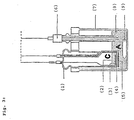
- the (free) water content in the transdermal patches can be driven off in a tube furnace at a certain temperature. It can then be transferred to a Karl-Fischer titration cell by an inert gas where it is titrated by a Coulometric method with specific reagents. A suitable arrangement for such a technique is depicted in Figure 2.
- a constant flow of air is achieved by regulating valve R and monitoring the air flow using the flowmeter D.
- the air is then dried in the drying towers T before being passed over the heated sample (P) (a patch or portion of patch) into the titration cell Z depicted in Figure 3.
- the system can detect from 100 to 3000 ⁇ g of (free) water equivalent to a percentage of water in the matrix of the present invention ranging approximately from 0.1 to 2.5 %.
Landscapes
- Health & Medical Sciences (AREA)
- Engineering & Computer Science (AREA)
- Bioinformatics & Cheminformatics (AREA)
- Medicinal Chemistry (AREA)
- Chemical & Material Sciences (AREA)
- Public Health (AREA)
- Veterinary Medicine (AREA)
- Pharmacology & Pharmacy (AREA)
- Life Sciences & Earth Sciences (AREA)
- Animal Behavior & Ethology (AREA)
- General Health & Medical Sciences (AREA)
- Dermatology (AREA)
- Epidemiology (AREA)
- General Chemical & Material Sciences (AREA)
- Organic Chemistry (AREA)
- Nuclear Medicine, Radiotherapy & Molecular Imaging (AREA)
- Chemical Kinetics & Catalysis (AREA)
- Endocrinology (AREA)
- Reproductive Health (AREA)
- Medicinal Preparation (AREA)
- Pharmaceuticals Containing Other Organic And Inorganic Compounds (AREA)
- Steroid Compounds (AREA)
Abstract
Description
- The present invention relates to a Transdermal Drug Delivery System (TDDS) (a transdermal patch), to a method for manufacturing such system, and to the use of such system for hormone replacement therapy.
- Estrogens are hormones which are necessary for the sexual development of females at puberty and for the maintenance of the oestrous cycle and secondary sexual characteristics. Estrogens and progesterone induce changes in the reproductive tract and elsewhere in the body of females during the menstrual cycle. Blood estrogen concentrations must be above a certain level for the maintenance of both proliferate and (together with progesterone) secretory phases of the uterine endothelium.
- The menopause occurs when menstruation ceases and indicates the end of a woman's reproductive life; during this phase of a woman's life there is a progressive loss of ovarian functions and there is a decrease in the production of Estradiol and other hormones.
- About 40% of women develop menopausal symptoms serious enough to require medical treatment; the symptoms include mainly vasomotor instability (hot flushes and sweating) and mood and sleep disturbances; during menopause, there is a gradual decrease of bone mass due to a loss of the modulating effect of Estradiol on bone resorption and this process normally leads to osteoporosis. The loss of estrogenic activity changes also the lipid metabolism with a decrease of the ratio of high density lipoprotein (HDL) to low-density lipoprotein (LDL), and this change increases the risk of cardiovascular diseases.
- All these negative effects that can occur in a woman in menopause can be eliminated or at least reduced by an appropriate replacement therapy with estrogen agents, i.e. by the "Hormonal Replacement Therapy" (HRT).
- Oral administration of estrogens as HRT has been extensively used for about 30 years and it was confirmed that, besides the climacteric symptoms, HRT was effective in reducing the death by cardiovascular diseases.
- However, although oral estrogens are effective as HRT, related adverse effects are a problem; a high amount (60 - 90%) of the oral estrogens are converted within the gut wall and liver to inactive metabolites having hepatic adverse effects, therefore relatively high doses of oral estrogens are required to compensate first-pass metabolism.
- Several non-oral formulations of estrogens, which avoid hepatic first-pass effects, have been developed and used as HRT; they include subcutaneous implants, intramuscular injections, vaginal creams and percutaneous gels. However, with such preparations, control of dosage is difficult and patients compliance is poor.
- More recently, transdermal preparations delivering Estradiol at a constant rate have become available. In women with an intact uterus estrogens produce hypertrophy of the endometrium which could provoke cancer. In order to minimize the risk of endometrial hyperplasia and carcinoma of the estrogen therapy in women with an intact uterus the treatment must be opposed intermittently by a progestogen to be associated to the estrogen. The opposition therapy normally is carried out by oral administration of a progestogen like medroxyprogesterone acetate, norethindrone, norethindrone acetate, progesterone, etc. for 10 - 14 days per month.
- A patch delivering both Estradiol and a progestogen is an useful alternative to a method which combines the transdermal administration of Estradiol with the daily oral administration of progestogen. Compliance is likely to be further improved and side effects minimized thanks to a lower progestogen dosage requirement compared with oral therapy.
- Several problems, however, are encountered when including a progestogen in a transdermal patch. Among these one important obstacle is the low, therapeutically uneffective drug release obtained with a transdermal patch of relatively small size; this is due to the poor skin permeation properties of steroid hormones. Another obstacle is the low stability of some progestogens that leads to degradation products.
- In the light of the aforementioned art, there is a need for an optimal transdermal drug delivery system releasing Estradiol and a progestogen through an intact skin resulting in a constant systemic absorption rate.
- Numerous patents refer to the delivery of steroid hormones to the systemic circulation via a transdermal route, and some of them refer to transdermal systems containing Estradiol and Norethindrone Acetate.
- Some inventions refer to the discovery of special matrix formulations containing substances able to reduce the re-crystallization of Estradiol and Norethindrone. Indeed, it is well known for scientists skilled in TDDS that, in order to obtain an adequate release of steroid hormones from transdermal patches, it is necessary to reach in the matrix high concentrations of the hormones (high drug load) or to significantly increase the release area of the patch. The first solution, however, leads quite often to re-crystallization of the hormones during the shelf-life of the product with consequent reduction of the drug release; the second solution often is not acceptable since it reduces patient compliance because of the size of the patch and even could have a negative effect on the adhesivity of the patch during the intended period of use of the product.
- A third possibility to reach an adequate flux from matrix transdermal patches is the inclusion of absorption enhancers (penetration enhancers) in the matrix formulation to generate a high flux of the active compounds when the system is applied to the skin. Typical known enhancers are ethanol, glycerolmonolaurate, DMF, polyethylenglycole monolaurate, etc. Absorption enhancers, however, provoke skin reactions and systemic side effects and this aspect reduces the ratio efficacy/tolerability of the resulting transdermal systems. They increase the permeability of the stratum corneum of the skin through a modification of the cellular layer, provoking lesions of the skin; they can moreover be absorbed by the skin provoking systemic side effects.
- Another problem known by skilled researchers in TDDS formulations is the low stability of Norethindrone Acetate in acrylic based formulations that leads to degradation products.
- WO 96/03119 (PCT/EP 95/02938) relates to a device for the administration of Estradiol alone or in combination with progestogen(s), encompassing a specific penetration enhancer that achieves elevated transdermal fluxes and optionally an anti-oxidant that achieves good product stability; however, as mentioned above, penetration enhancers can provoke skin reactions.
- WO 94/23707 (PCT EP 94/01231) describes an active substance containing laminated plasters with a carrier and a matrix made of one or two polymers, as well as Vitamin E (tocoferol); tocoferol, however, is not free of potential skin reactions in an occlusive patch that has to remain attached to patient skin for 3-4 days.
- US Patent 4,379,454 refers to a transdermal liquid reservoir patch which contains Estradiol in an alcoholic gel solution; the alcohol contained in the reservoir, however, acts also as an absorption enhancer and can provoke skin reactions.
- WO 9740792 A discloses a matrix type patch for transdermally administering a steroid hormone which comprises a skin permeation enhancing amount of a diethanolamide of a 12 - 18 C fatty acid.
- WO 95/09618 (PCT/EP 94/03269) describes the use of octyldodecanol as crystallization inhibitor in matrix patches containing Estradiol and Norethindrone Acetate.
- DE 44 29 664 refers to a transdermal therapeutic system containing Estradiol and a water absorbing additiv, which is part of the matrix. The system according to this document does not contain a progestogen agent and is said to be applicable to Estradiol only.
- A system for the application of norethisterone acetate is disclosed in DE 195 48 332. It is, however, stated in this document that the addition of an Aerosil to a matrix does not result in a reduced formation of degradation products of norethisterone acetate.
- The object of the invention is the development of a TDDS for HRT releasing Estradiol and at least one progestogen with improved skin permeation of the hormones compared to prior art.
- At the same time the TDDS is to have the following characteristics:
- very simple composition and structure;
- absence of skin penetration enhancers or other compounds which can irritate the skin;
- prolonged and controlled rate of release of the hormones up to 7-days;
- small size;
- good adhesivity onto the skin during the intended period of use;
- easy removal from the skin at the end of the treatment;
- "skin-safe" pressure sensitive adhesive;
- absence of re-crystallization of Estradiol and of the progestogen;
- stability of Estradiol and Norethindrone Acetate without degradation products;
- transparent, cosmetically attractive system;
- good physical stability, i.e. small tendency of creeping of the matrix so that the system can easily be removed from the package.
- It has now been found that it is possible to obtain a TDDS containing steroid hormones that can release high amounts of hormones from relatively small matrix areas without the use of penetration enhancers and avoiding the re-crystallization and the degradation of the hormones in the matrix and satisfying all the above characteristics.
- Thus the present invention provides a transdermal patch for the release of Estradiol and at least one progestogen agent through the skin, comprising or consisting of an outer backing foil, a matrix and a protective liner wherein the Estradiol and the progestogen agent(s) are present in the matrix in an over saturated solution, the matrix contains 1 to 5, preferably 1 to 4 wt-% activated SiO2 and the matrix has a moisture content of less than 0.7 wt.-%. Preferably the matrix has a moisture content of less than 0.5 wt-% and especially preferred is a moisture content of less than 0.4 wt-%. The moisture content refers to the content of free water, that is, the water not adsorbed on or absorbed in the SiO2.
- In the description and in the claims all percentages refer to weight-% if not indicated otherwise and all contents of the matrix, given in percentages, refer to the weight of the final matrix in the patch, that is, the matrix which comprises the copolymer(s), estradiol, the progestogen agent(s) and optionally further compounds.
- Surprisingly it was found that the hormone release rate from such "moisture-free" matrix-type TDDS containing activated SiO2 increases significantly with reference to the same non moisture free matrix without using penetration enhancers:
- It was found that moisture-free semi-solid matrix-type TDDS which contain ativated silicon dioxide and steroid hormones in over-saturated solutions have an optimal performance with reference to the release rates of such steroid hormones when applied to human skin. Such unexpected behaviour, although not known with certainty and without intention to be bound to any specific mechanism, is believed to be due to absorption of water from the skin, especially by activated silicon dioxide, when such moisture-free activated silicon dioxide containing systems are applied to human skin and to the consequent decrease of the solubility of the hormones in the matrix. This provokes an increase of the driving force in the system and therefore results in a better flux of the drugs (such surprising characteristics of a matrix containing non water-soluble polymers were not known). It is therefore possible to have a high release of the hormones with TDDS of small release areas (and/or reduced concentration of hormones).
- Moisture-free matrix systems can be obtained by standard manufacturing TDDS processes and concomitant or subsequent treatment of the systems with infrared rays. Thus the energy of water molecules is activated provoking the evaporation of residual water from the matrix at relatively low temperatures that do not provoke degradation of the steroid hormones.
- Moisture-free matrix TDDS which contain activated silicon dioxide in the matrix show an enhanced drug release into the skin. Such surprising indirect enhancing properties in TDDS of moisture-free matrix TDDS containing activated silicon dioxide for steroid hormones were not previously known. In this invention the high rate of delivery is due to a different mechanism compared to that of penetration enhancers utilized in TDDS:
- It is assumed that activated SiO2 enhances the flux of water from the skin into the matrix thereby increasing the force which drives the hormones out of the matrix so that the flux of Estradiol and the progestogen agent(s) into the skin is/are increased.
- It has been found that a preferred amount of SiO2 in the matrix lies in the range from 2.5 to 3.5 wt-%; and an amount of about 3 wt-% SiO2 is especially preferred. An amount above 5 wt-% is detrimental to the flux of the active ingredients in the matrix in that the concentration of the ingredients in the matrix must be lowered when the content of SiO2 is increased. An amount of less than 1 wt-% SiO2 will not attract a sufficient amount of water to increase the flux of the active ingredients.
- SiO2 can be activated according to the present invention by irradiating the patch - with or preferably without the release liner being applied - with an IR-source. At the same time irradiation of the matrix reduces its water content to the required level.
- The matrix systems according to the present invention can thus be obtained by standard manufacturing TDDS processes and concomitant or subsequent treatment of the systems with infrared rays.
- By irradiation the energy of water molecules is probably activated provoking the evaporation of residual water from the matrix and inter alia the evaporation of absorbed water of SiO2 at relatively low temperatures.
- Activated silicon dioxide can be prepared by irradiating silicon dioxide (like an Aerosil, especially Aerosil 380) with an IR source.
- It has been shown that the results are particularly adequate when irradiating the matrix of the patch including the silicon dioxide with infrared rays having a wavelength of 1 to 100 µm, preferably of 1 and 10 µm, for 1 to 10 minutes, preferably for 1 to 5 minutes with an incandescent filament lamp of an adequate power (Watt) at a distance of 20 to 40 cm generating a temperature of 40 to 120 °C, preferably of 60 to 90 °C. Preferably the lamp(s) have an active power of 100 to 3000 Watt.
- The inclusion in the matrix of activated, preferably colloidal, silicon dioxide moreover contributes to maintain the system anhydrous. This condition of the matrix system probably reduces the solubility of the hormones in the patch and increases the flux.
- The most important feature of this invention is the use of a moisture-free matrix containing activated silicon dioxide which allows for a high flux of drugs into the skin from small patches without skin penetration (rate) enhancers.
- The at least one pressure sensitive adhesive used for the matrix of this invention is selected from a group of vinylacetate containing acrylate copolymers; specifically the matrix consists of one, two or more pressure sensitive adhesive copolymers, obtainable by the radical copolymerisation of:
- a) 2-ethylhexylacrylate (2-EHA) preferably in an amount of 44% to 80%, preferably 48% to 75% and especially 50% to 68%.
- b) Hydroxyethyl-acrylate (HEA) preferably in an amount of 2.5% and 9.7%, preferably 4.0% to 5.0%;
- c) vinylacetate (VA) preferably in an amount of 8% to 48.2%, preferably 20% to 26%;
- d) glycidylmethacylate (GMA), preferably in an amount of 0.01 to 0.3%, preferably of 0.1% to 0.2%;
- e) and in the presence of other substances in quantities of up to 5%, all percentages being based on the weight of the matrix of the final patch.
-
- Among several progestogens, Norethindrone Acetate is preferred because it is effective at low doses and therefore can be formulated in TDDS and because it has some additional effects, e.g. on libido, that are absent in other progestogens like progesterone and medroxyprogesterone.
- In the described matrix Estradiol (as hemihydrate) and the progestogen agent(s) like Norethindrone Acetate can be maintained in high concentration. Thus the matrix can have an Estradiol content of 1.0 to 3%, preferably of 1.5 to 2.5 % and especially of 1,8 to 2.4% and a content of at least one progestogen agent like Norethindrone Acetate of 2 to 12%, preferably of 4 to 11% and especially of 5 to 9%. In these concentrations, Estradiol and the progestogen agent like Norethindrone Acetate, although being in a supersaturated (= over saturated) solid solution in this matrix, do not re-crystallize and are maintained in a condition that confers to the steroid hormones a high thermodynamic activity.
- The matrix can preferably contain 1 to 5 wt-% of silicon dioxide to contribute to the maintanance of an anhydrous state in the matrix and to provoke absorption of water from the skin when the patch is applied.
- In order to eventually improve the matrix characteristics, it is possible to include in the matrix small amounts of up to 4%, preferably of up to 3 % of other compounds having e.g. a solubilizing effect on the active ingredients, or avoiding re-crystallization thereof or having drying activities or acting as preservatives or antioxidants, etc.
- Preferably the thickness of the matrix should be kept low enough so that it can be dried during the drying step of the manufacturing process and that the solvent content, including the moisture content can be reduced to a minimum.
- Thus the matrix preferably has a thickness of 20 to 100 µm, more preferred of 30 (or 40) to 80 µm and especially of 50 to 70 µm.
- The patch according to the present invention can be a laminated composite with a backing foil that is substantially impermeable to the drugs and the adhesive copolymer(s) of the matrix and supports the matrix.
- The backing foil can be made from one or more materials selected from the group consisting of polyester, polyurethane, polyethylene, polyethylene terephtalate, polypropylene and polyvinyl chloride materials; and the side of the backing foil not facing the matrix can be lacquered, preferably by a lacquer comprising epoxy resins or polyaminoamido resins containing opacifying agents and it can have a thickness of 10 to 45 (or 50) µm and preferably 12 (or 15) to 30 µm.
- Thus the backing foil or layer according to the present invention can be an occlusive or a transparent material, preferably a transparent polyester material such as polyethylene terephthalate.
- For better handling during its production such material can be lacquered on the side not in contact with the matrix with an epoxy resin containing opacifying agents.
- In order to protect the matrix during storage a protective (release) liner is used; such release liner can be impermeable to the active ingredients and the pressure sensitive adhesive(s) and should be easily removable by the patient before the application of the patch.
- The release liner can be made of at least one foil of paper, polyester, polyethylene, polypropylene, polyethylene terephtalate (PET) or polyvinylchloride. It is preferably coated, to reach the requested release strength, on one or both sides with a silicon system or fluoropolymer coating blend. The optimum thickness for an appropriate rigidity of the release liner is 50 to 150 (or 200) µm and preferably between 60 (or 80) to 120 (or 150) µm.
- In order to facilitate its detachment from the patch, a pull-off tag can be cut in the release liner and, where requested, an appropriate profile ring is stamped on the liner in order to maintain a distance from the backing foil to the internal wall of a pouch (sachet) material into which the patch can be sealed, so that the profile ring prevents the sticking of the patch on the internal wall of the sachets. The sachet can comprise a humidity impermeable foil, preferably a multi-layered foil, which is preferably made of sheets of aluminium, paper, polyethylene or polyvinylchloride, especially SurlynR.
- To maintain the matrix "moisture-free" (to allow a high flux of the hormones) the sachets can contain as a precaution a desiccant such as silica gel, sodium sulfate, calcium sulfate, calcium carbonate dihydrate or a mixture thereof.
- Preferably the transdermal patch according to the invention has a circular or oval shape or a square shape with round edges, and/or a release area of 5 to 60 cm2 and preferably 8 to 40 cm2.
- According to the present invention there is also disclosed the use of a transdermal patch according to the invention for hormonal replacement therapy.
- The description of the present invention and the manufacture of the relevant TDDS delivering Estradiol and a progestogen agent like Norethindrone Acetate are illustrated by the following examples:
- 12.05 kg of a vinylacetate-acrylate copolymer solution having a solid content of about 51% are homogenized under stirring together with 0.1621 kg of Estradiol Hemihydrate and 0.6055 kg of Norethindrone Acetate; the suspension is transferred into 6.96 kg of a 50 : 50 mixture of Ethyl Acetate and Ethanol (these solvent materials were later removed during drying) and 0.2098 kg of Aerosil 380 are added; the mixture is then maintained under stirring for 24 hours at room temperature until a homogenous mass is obtained.
- The ratio of the monomers used to prepare the vinylacetate-acrylate copolymer of the (final) matrix obtained are as follows:
- 2-ethylhexyl acrylate: 58.67 %
- vinylacetate: 22.43 %
- 2-hydroxyethylacrilate: 4.31 %
- glycidyl metacrylate: 0.13 %
- The drug solvent polymer mixture was then cast to a thickness of about 60 micrometers on a polyester film (backing foil) to obtain after drying a matrix having a weight of 60 g/m2.
- Drying of the medicated laminate is carried out at a temperature between 35 and 95°C and this leads to a composition of 0.135 mg of Estradiol and 0.520 mg of Norethindrone Acetate per cm2 of the dried matrix.
- At this temperature the matrix cannot be dried completely and the water content deriving from the materials and solvents used, from the environment and also from the Estradiol Hemihydrate used cannot be eliminated. The medicated laminate, after drying, is treated for about 2 minutes with an IR lamp able to eliminate the water and to activate the silicon dioxide at a temperature of less than 100 °C. In this way it is possible to avoid degradation of the hormones and especially of Norethindrone Acetate that can occur if the matrix is treated at high temperatures.
- After drying and IR lamp treatment, the release liner , i.e. a polyester foil of 80 µm thickness, coated with a fluoropolymer, is stuck on the matrix to form the final medicated laminate.
- Circular or oval shapes or square shapes with round edges having a release area of 8 to 40 cm2 are punched from the medicated foil to form the final transdermal patches; the size is decided according to the requested release rate of Estradiol and Norethindrone Acetate.
- A not-to-scale cross-sectional view and a front view of a transdermal patch obtained according to this invention is given in Figure 1.
- In
Figur 1 - (1) is a lacquered backing foil
- (2) is a drug containing adhesive matrix
- (3) is a protective liner, and
- (4) is a profile ring.
-
- Each transdermal patch is sealed into a pouch not permeable to moisture and composed of a 4-layered material made by paper, polyethylene foil, aluminium foil and surlyn ionomer foil. To maintain the matrix of the TDDS moisture-free, a desiccant like calcium carbonate dihydrate may be included in the pouch.
- Proceed as in Example 1.
- All the remaining steps are as in Example 1; in this example, however, the medicated laminate is not irradiated with the infrared lamp(s).
- The transdermal patches resulting from each of the preparations described have been tested with the Karl-Fischer method in order to quantify the (free) water content in the matrix of the systems:
- The (free) water content in the transdermal patches can be driven off in a tube furnace at a certain temperature. It can then be transferred to a Karl-Fischer titration cell by an inert gas where it is titrated by a Coulometric method with specific reagents. A suitable arrangement for such a technique is depicted in Figure 2.
- A constant flow of air is achieved by regulating valve R and monitoring the air flow using the flowmeter D. The air is then dried in the drying towers T before being passed over the heated sample (P) (a patch or portion of patch) into the titration cell Z depicted in Figure 3.
- In Figure 3
- (1) is an inner burette,
- (2) is a catholyte,
- (3) is a cathode,
- (4) is a membrane,
- (5) is an anode,
- (6) is a detection electrode (double platinum pin electrode),
- (7) is a titration vessel,
- (8) is an anolyte, and
- (9) is a rotor.
-
- In this assay the following devices, reagents and experimental conditions can be used:
- 1. Apparatus The specific apparatus used is the METTLER DO 337 Drying Oven coupled with the METTLER DL 37 KF Coulometer.
- 2. Reagents used in the titration cell
- Hydranal® - Coulomat AG, art. 34836 (in compartment A)
- Hydranal® - Coulomat CG, art. 34840 (in compartment C) (supplier Riedel-de-Haën, D- 30918 Seelze, Germany)
- 3. Experimental conditions
The experimental conditions used for determining the (free)
water content in the matrix of the transdermal patches were:
- Flow of air: 300 ml/min
- Temperature of the furnace: 80 °C
- Size of the patch sample: 20 cm2
- Time of exposure of sample to 80 °C: 15 minutes
-
- The system can detect from 100 to 3000 µg of (free) water equivalent to a percentage of water in the matrix of the present invention ranging approximately from 0.1 to 2.5 %.
- With this system the content of (free) water in the matrix is determined, the amount of water adsorbed on or absorbed by the silicon dioxide cannot be determined thereby.
- For each of the products according to the two examples five units have been tested and the results are shown below:
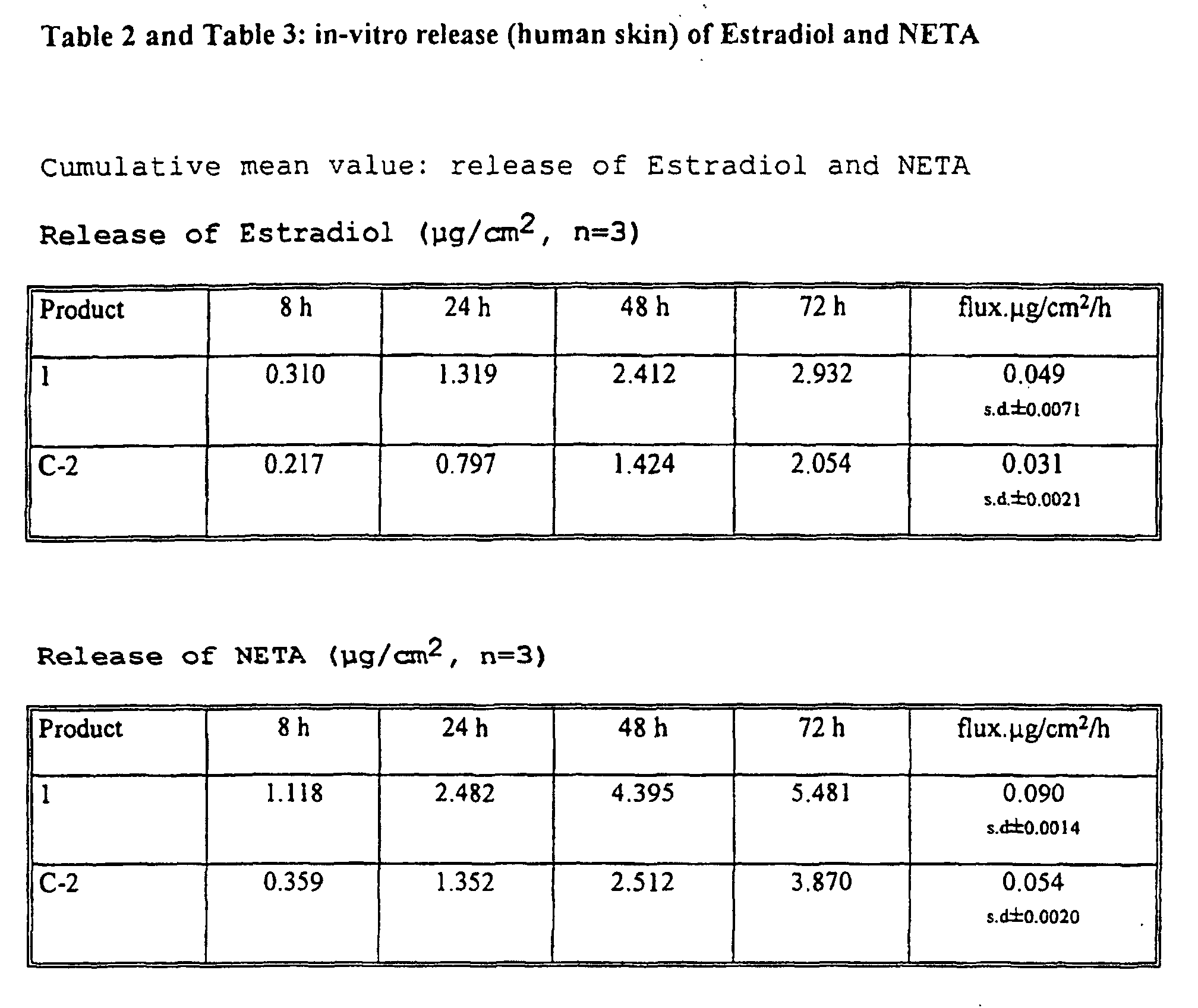
Moisture content in Estradiol - NETA patches Product 1 C-2 Moisture wt.-% 0.15 0.85 0.13 0.81 0.18 0.72 0.15 0.78 0.16 0.75 Average 0.15 0.78 SD 0.0013 0.0507 - A comparative study of the flux trough human cadaver skin, carried out with the modified Franz diffusion cell, is presented in the following tables and graphs. It can be seen that the systems of the present invention exhibit elevated skin fluxes of Estradiol and Norethindrone Acetate (NETA) compared to the reference system.
Claims (19)
- A transdermal patch for the release of Estradiol and at least one progestogen agent through the skin, comprising or consisting of an outer backing foil, a matrix and a protective liner whereina) the Estradiol and the progestogen agent(s) are present in the matrix in an oversaturated solution,b) the matrix contains 1 to 4 wt% activated SiO2 , andc) the matrix has a moisture content of less than 0.7 wt.-%.
- A transdermal patch according to claim 1 characterized in that the matrix has a moisture content of less than 0.5 wt.-%.
- A transdermal patch according to claim 1 or 2, characterized in that the matrix contains 2,5 to 3,5 wt% SiO2.
- A transdermal patch according to any of the preceding claims characterized in that the SiO2 is activated by irradiation with an infrared source.
- A transdermal patch according to any of the preceding claims characterized in that it is free of penetration enhancers.
- A transdermal patch according to any of the preceding claims characterized in that the matrix consists of one, two or more pressure sensitive adhesive copolymers obtainable by radical copolymerization of:optionally in the presence of other substances in quantities of up to 0.5 wt.-%, based on the weight of the matrix.2-ethylhexyl acrylate,hydroxyethyl acrylate,vinylacetate andglycidyl methacrylate,
- A transdermal patch according to claim 6 characterized in that the monomers are used in the following amounts:2-ethylhexyl acrylate is used in an amount of 44 to 80 wt.-%, preferably 48 to 75 wt.-% and especially 50 to 68 wt.-%,hydroxyethyl acrylate is used in an amount of 2.5 to 9.7 wt.-%, preferably 4.0 to 5.0 wt.-%,vinylacetate is used in an amount of 8 to 48.2 wt.-%, preferably 20 to 26 wt.-%, andglycidyl methacrylate is used in an amount of 0.01 to 0.3 wt.-%, preferably 0.1 to 0.2 wt.-%, all percentages being based on the weight of the matrix.
- A transdermal patch according to any of the preceding claims characterized in that the matrix has a thickness of 20 to 100 µm, preferably of 40 to 80 µm.
- A transdermal patch according to any of the preceding claims, characterized in that the matrix has an Estradiol content of 1 to 3 wt.-%, preferably 1.5 to 2.5 wt.-% and especially 1.8 to 2.4 wt.-%.
- A transdermal patch according to any of the preceding claims, characterized in that the matrix has a progestogen agent content of 2 to 12 wt.-%, preferably 4 to 11 wt.-% and especially 5 to 9 wt.-%.
- A transdermal patch according to any of the preceding claims, characterized in that the matrix has a content of other compounds of up to 4 wt.-%.
- A transdermal patch according to any of the preceding claims characterized in that the progestogen agent is norethindrone acetate.
- A transdermal patch according to any of the preceding claims, characterized in thatthe backing foil consists of a material impermeable to the drugs and to the adhesive copolymer(s), preferably made from one or more materials selected from the group consisting of polyester, polyurethane, polyethylene, polyethylene terephtalate, polypropylene and polyvinyl chloride materials; and/orthe side of the backing foil not facing the matrix is lacquered, preferably by a lacquer comprising epoxy resins and/or polyaminoamido resins containing opacifying agents and/orthe backing foil has a thickness of 10 to 50 µm and preferably 12 to 30 µm.
- A transdermal patch according to any of the preceding claims, characterized in that the patch comprises a removable protective linermade of at least one foil of paper, polyester, polyethylene, polyethylene terephtalate, polypropylene or polyvinylchloride or mixtures thereof, preferably coated with silicone or a fluoropolymer on one or both sides, and/orhaving a thickness of 50 to 200 µm and preferably 80 to 150 µm; and/orbeing provided with a cut-off tag and a stamped profile ring.
- A transdermal patch according to any of the preceding claims, characterized by a circular or oval shape or a square shape with round edges, and/or a release area of 5 to 60 cm2 and preferably 8 to 40 cm2.
- A transdermal patch according to any of the preceding claims, characterized in that it is sealed in a sachet comprising a humidity impermeable foil, preferably a multi-layered foil, which is preferably made of sheets of aluminium, paper, polyethylene or polyvinylchloride, especially ionomer foil.
- A transdermal patch according to claim 16, characterized in that the sachet contains a desiccant like silica gel, sodium sulfate, calcium sulfate, calcium carbonate dihydrate or a mixture thereof.
- A process for the production of a transdermal patch according to any of the preceding claims characterized in thata) Estradiol and at least one progestogen agent are mixed with a copolymer solution,b) a silicon dioxide is added to the mixture,c) the mixture is applied to a backing layer to form a laminate,d) the laminate is dried at a temperature from 35 to 95 °C,e) the laminate is irradiated with IR-rays, andf) the laminate is covered with a protective liner.
- Use of a transdermal patch according to any of claims 1 to 17 for the manufacture of a medicament for hormonal replacement therapy.
Applications Claiming Priority (3)
| Application Number | Priority Date | Filing Date | Title |
|---|---|---|---|
| DE19827732A DE19827732A1 (en) | 1998-06-22 | 1998-06-22 | Transdermal patch useful for hormone replacement therapy used for treatment of menopausal symptoms |
| DE19827732 | 1998-06-22 | ||
| PCT/EP1999/004305 WO1999066908A1 (en) | 1998-06-22 | 1999-06-22 | Matrix-type transdermal patch for steroid hormones |
Publications (2)
| Publication Number | Publication Date |
|---|---|
| EP1089722A1 EP1089722A1 (en) | 2001-04-11 |
| EP1089722B1 true EP1089722B1 (en) | 2002-05-22 |
Family
ID=7871628
Family Applications (1)
| Application Number | Title | Priority Date | Filing Date |
|---|---|---|---|
| EP99931130A Expired - Lifetime EP1089722B1 (en) | 1998-06-22 | 1999-06-22 | Matrix-type transdermal patch for steroid hormones |
Country Status (17)
| Country | Link |
|---|---|
| US (1) | US6440454B1 (en) |
| EP (1) | EP1089722B1 (en) |
| JP (1) | JP2002518434A (en) |
| KR (1) | KR20010053072A (en) |
| CN (1) | CN1306421A (en) |
| AT (1) | ATE217793T1 (en) |
| AU (1) | AU4775499A (en) |
| BR (1) | BR9911411A (en) |
| CA (1) | CA2333586A1 (en) |
| DE (2) | DE19827732A1 (en) |
| DK (1) | DK1089722T3 (en) |
| ES (1) | ES2177295T3 (en) |
| HU (1) | HUP0102785A2 (en) |
| IL (1) | IL140335A0 (en) |
| PL (1) | PL345061A1 (en) |
| PT (1) | PT1089722E (en) |
| WO (1) | WO1999066908A1 (en) |
Cited By (7)
| Publication number | Priority date | Publication date | Assignee | Title |
|---|---|---|---|---|
| US7198801B2 (en) | 2000-08-03 | 2007-04-03 | Antares Pharma Ipl Ag | Formulations for transdermal or transmucosal application |
| US7404965B2 (en) | 2000-08-03 | 2008-07-29 | Antares Pharma Ipl Ag | Composition for transdermal and/or transmucosal administration of active compounds that ensures adequate therapeutic levels |
| US7425340B2 (en) | 2004-05-07 | 2008-09-16 | Antares Pharma Ipl Ag | Permeation enhancing compositions for anticholinergic agents |
| US8067399B2 (en) | 2005-05-27 | 2011-11-29 | Antares Pharma Ipl Ag | Method and apparatus for transdermal or transmucosal application of testosterone |
| US8268346B2 (en) | 2006-04-21 | 2012-09-18 | Antares Pharma Ipl Ag | Methods of treating hot flashes with formulations for transdermal or transmucosal application |
| US8652491B2 (en) | 2000-08-03 | 2014-02-18 | Antares Pharma Ipl Ag | Transdermal compositions for anticholinergic agents |
| US8980309B2 (en) | 2003-10-10 | 2015-03-17 | Antares Pharma Ipl Ag | Transdermal testosterone formulation for minimizing skin residues |
Families Citing this family (53)
| Publication number | Priority date | Publication date | Assignee | Title |
|---|---|---|---|---|
| EP1280485A4 (en) * | 2000-02-29 | 2006-11-29 | Zars Inc | Improved transdermal drug patch |
| DE10033853A1 (en) * | 2000-07-12 | 2002-01-31 | Hexal Ag | Transdermal therapeutic system with highly disperse silicon dioxide |
| US20040198706A1 (en) * | 2003-03-11 | 2004-10-07 | Carrara Dario Norberto R. | Methods and formulations for transdermal or transmucosal application of active agents |
| US20040062794A1 (en) * | 2002-09-30 | 2004-04-01 | Lee Shulman | 17Beta- estradiol/levonorgestrel transdermal patch for hormone replacement therapy |
| US20040086551A1 (en) * | 2002-10-30 | 2004-05-06 | Miller Kenneth J. | Fentanyl suspension-based silicone adhesive formulations and devices for transdermal delivery of fentanyl |
| MEP14008A (en) | 2003-02-21 | 2010-06-10 | Bayer Schering Pharma Ag | Uv stable transdermal therapeutic plaster |
| US8668925B2 (en) | 2003-12-12 | 2014-03-11 | Bayer Intellectual Property Gmbh | Transdermal delivery of hormones without the need of penetration enhancers |
| GB0409498D0 (en) * | 2004-04-28 | 2004-06-02 | Hunter Fleming Ltd | Transdermal steroid formulation |
| US8962013B2 (en) | 2005-05-02 | 2015-02-24 | Bayer Intellectual Property Gmbh | Multi-layered transdermal system with triazine UV absorber |
| WO2007035942A2 (en) * | 2005-09-23 | 2007-03-29 | Alza Corporation | Transdermal risperidone delivery system |
| EP1928924B1 (en) * | 2005-09-23 | 2011-05-18 | National Starch and Chemical Investment Holding Corporation | Acrylic polymer-based adhesives |
| WO2008067991A2 (en) * | 2006-12-08 | 2008-06-12 | Antares Pharma Ipl Ag | Skin-friendly drug complexes for transdermal administration |
| US20080152592A1 (en) * | 2006-12-21 | 2008-06-26 | Bayer Healthcare Llc | Method of therapeutic drug monitoring |
| US20080226698A1 (en) * | 2007-03-16 | 2008-09-18 | Mylan Technologies, Inc. | Amorphous drug transdermal systems, manufacturing methods, and stabilization |
| WO2008115224A2 (en) * | 2007-03-20 | 2008-09-25 | Bayer Healthcare Llc | Method of analyzing an analyte |
| JP2012504609A (en) * | 2008-10-06 | 2012-02-23 | マイラン・テクノロジーズ,インコーポレイテッド | Amorphous rotigotine transdermal system |
| PT2613772T (en) | 2010-09-06 | 2017-03-06 | Bayer Ip Gmbh | Low-dose transdermal patches with high drug release |
| AU2015203180B2 (en) * | 2010-09-06 | 2016-06-30 | Bayer Intellectual Property Gmbh | Transdermal therapeutic systems with crystallization-inhibiting protective film (release liner) |
| DE102010040299A1 (en) * | 2010-09-06 | 2012-03-08 | Bayer Schering Pharma Aktiengesellschaft | Transdermal therapeutic systems with crystallization-inhibiting protective film (release liner) |
| US9301920B2 (en) | 2012-06-18 | 2016-04-05 | Therapeuticsmd, Inc. | Natural combination hormone replacement formulations and therapies |
| RS62297B1 (en) | 2011-11-23 | 2021-09-30 | Therapeuticsmd Inc | Natural combination hormone replacement formulations and therapies |
| JP2015518854A (en) | 2012-05-23 | 2015-07-06 | セリックスビオ プライヴェート リミテッド | Compositions and methods for the treatment of multiple sclerosis |
| NZ701832A (en) | 2012-05-23 | 2016-08-26 | Cellix Bio Private Ltd | Compositions and methods for treatment of inflammatory bowel disease |
| US20150196640A1 (en) | 2012-06-18 | 2015-07-16 | Therapeuticsmd, Inc. | Progesterone formulations having a desirable pk profile |
| US20130338122A1 (en) | 2012-06-18 | 2013-12-19 | Therapeuticsmd, Inc. | Transdermal hormone replacement therapies |
| US10806697B2 (en) | 2012-12-21 | 2020-10-20 | Therapeuticsmd, Inc. | Vaginal inserted estradiol pharmaceutical compositions and methods |
| US10806740B2 (en) | 2012-06-18 | 2020-10-20 | Therapeuticsmd, Inc. | Natural combination hormone replacement formulations and therapies |
| US10568891B2 (en) | 2012-12-21 | 2020-02-25 | Therapeuticsmd, Inc. | Vaginal inserted estradiol pharmaceutical compositions and methods |
| US9180091B2 (en) | 2012-12-21 | 2015-11-10 | Therapeuticsmd, Inc. | Soluble estradiol capsule for vaginal insertion |
| US10537581B2 (en) | 2012-12-21 | 2020-01-21 | Therapeuticsmd, Inc. | Vaginal inserted estradiol pharmaceutical compositions and methods |
| US10471072B2 (en) | 2012-12-21 | 2019-11-12 | Therapeuticsmd, Inc. | Vaginal inserted estradiol pharmaceutical compositions and methods |
| US11266661B2 (en) | 2012-12-21 | 2022-03-08 | Therapeuticsmd, Inc. | Vaginal inserted estradiol pharmaceutical compositions and methods |
| US11246875B2 (en) | 2012-12-21 | 2022-02-15 | Therapeuticsmd, Inc. | Vaginal inserted estradiol pharmaceutical compositions and methods |
| WO2016128991A1 (en) | 2015-02-09 | 2016-08-18 | Cellix Bio Private Limited | Compositions and methods for the treatment of mucositis |
| RU2016143081A (en) | 2014-05-22 | 2018-06-26 | Терапьютиксмд, Инк. | NATURAL COMBINED HORMONE SUBSTITUTION COMPOSITIONS AND THERAPIES |
| EP3174542A4 (en) | 2014-07-29 | 2018-01-03 | TherapeuticsMD, Inc. | Transdermal cream |
| SG11201706952VA (en) | 2014-09-26 | 2017-10-30 | Cellix Bio Private Ltd | Compositions and methods for the treatment of epilepsy and neurological disorders |
| EP3201168B1 (en) | 2014-09-29 | 2020-03-18 | Cellix Bio Private Limited | Compounds and compositions for the treatment of multiple sclerosis |
| WO2016067297A1 (en) | 2014-10-27 | 2016-05-06 | Cellix Bio Private Limited | Salts of valproic acid with piperazine, ethylenediamine, lysine and/or eicosapentaenoic ecid (epa) amine derivatives for the treatment of epilepsy |
| AU2014414316B2 (en) | 2014-10-27 | 2020-04-09 | Cellix Bio Private Limited | Three component salts of fumaric acid monomethyl ester with piperazine or ethylene diamine for the treatment of multiple sclerosis |
| WO2016088132A1 (en) | 2014-12-01 | 2016-06-09 | Cellix Bio Private Limited | Compositions and methods for the treatment of multiple sclerosis |
| WO2016112342A1 (en) * | 2015-01-09 | 2016-07-14 | Hemcon Medical Technologies, Inc. | Percutaneous vascular injury treatment systems and methods |
| US10328087B2 (en) | 2015-07-23 | 2019-06-25 | Therapeuticsmd, Inc. | Formulations for solubilizing hormones |
| US9931349B2 (en) | 2016-04-01 | 2018-04-03 | Therapeuticsmd, Inc. | Steroid hormone pharmaceutical composition |
| US10286077B2 (en) | 2016-04-01 | 2019-05-14 | Therapeuticsmd, Inc. | Steroid hormone compositions in medium chain oils |
| MX387330B (en) | 2016-08-11 | 2025-03-18 | Cellix Bio Private Ltd | Compositions and methods for the treatment of irritable bowel syndrome |
| WO2018065831A1 (en) | 2016-10-04 | 2018-04-12 | Cellix Bio Private Limited | Compositions and methods for the treatment of xerostomia |
| EP3554494A4 (en) | 2016-12-19 | 2021-02-17 | Cellixbio Private Limited | COMPOSITIONS AND METHODS FOR THE TREATMENT OF INFLAMMATION |
| WO2019023605A1 (en) | 2017-07-27 | 2019-01-31 | Allergan, Inc. | Prostacyclin receptor agonists for reduction of body fat |
| KR102405239B1 (en) | 2017-11-17 | 2022-06-08 | 셀릭스 바이오 프라이빗 리미티드 | Compounds, compositions and methods for the treatment of eye and skin disorders |
| AU2018367909B2 (en) | 2017-11-17 | 2022-03-10 | Cellix Bio Private Limited | Compositions and methods for the treatment of eye disorders |
| EP4007581A4 (en) | 2019-08-02 | 2023-10-25 | Enterin, Inc. | DOSAGE PROTOCOLS AND REGIMES FOR AMINOSTEROL TREATMENT |
| US11633405B2 (en) | 2020-02-07 | 2023-04-25 | Therapeuticsmd, Inc. | Steroid hormone pharmaceutical formulations |
Family Cites Families (15)
| Publication number | Priority date | Publication date | Assignee | Title |
|---|---|---|---|---|
| US4559222A (en) * | 1983-05-04 | 1985-12-17 | Alza Corporation | Matrix composition for transdermal therapeutic system |
| CA2065311C (en) * | 1989-09-08 | 2000-01-11 | Chia-Ming Chiang | Solid matrix system for transdermal drug delivery |
| US5252334A (en) * | 1989-09-08 | 1993-10-12 | Cygnus Therapeutic Systems | Solid matrix system for transdermal drug delivery |
| US5676968A (en) * | 1991-10-31 | 1997-10-14 | Schering Aktiengesellschaft | Transdermal therapeutic systems with crystallization inhibitors |
| DE4210711A1 (en) * | 1991-10-31 | 1993-05-06 | Schering Ag Berlin Und Bergkamen, 1000 Berlin, De | TRANSDERMAL THERAPEUTIC SYSTEMS WITH CRYSTALIZATION INHIBITORS |
| DE4223360C1 (en) * | 1992-07-16 | 1993-04-08 | Lts Lohmann Therapie-Systeme Gmbh & Co Kg, 5450 Neuwied, De | |
| US5989586A (en) * | 1992-10-05 | 1999-11-23 | Cygnus, Inc. | Two-phase matrix for sustained release drug delivery device |
| DE4237453C1 (en) * | 1992-11-06 | 1993-08-19 | Lts Lohmann Therapie-Systeme Gmbh & Co Kg, 5450 Neuwied, De | |
| DE4333595A1 (en) * | 1993-10-01 | 1995-04-06 | Labtec Gmbh | Transdermal therapeutic system for applying drugs to the skin |
| DE4405898A1 (en) * | 1994-02-18 | 1995-08-24 | Schering Ag | Transdermal therapeutic systems containing sex steroids |
| JPH0827003A (en) * | 1994-07-22 | 1996-01-30 | Sekisui Chem Co Ltd | Transdermal formulation |
| DE4429664C2 (en) * | 1994-08-20 | 1997-09-11 | Lohmann Therapie Syst Lts | Estradiol TTS with water-binding additives and process for its preparation |
| DE4429667C2 (en) * | 1994-08-20 | 1996-07-11 | Lohmann Therapie Syst Lts | Estradiol TTS with water-binding additives and process for its preparation |
| DE19548332A1 (en) * | 1995-12-22 | 1997-07-10 | Rotta Res Bv | hormone patches |
| DE19600347A1 (en) * | 1996-01-08 | 1997-07-10 | Lohmann Therapie Syst Lts | Skin-adhering pharmaceutical preparation, in particular TTS for the delivery of 17-beta-estradiol to the human organism |
-
1998
- 1998-06-22 DE DE19827732A patent/DE19827732A1/en not_active Ceased
-
1999
- 1999-06-22 ES ES99931130T patent/ES2177295T3/en not_active Expired - Lifetime
- 1999-06-22 KR KR1020007014543A patent/KR20010053072A/en not_active Withdrawn
- 1999-06-22 PL PL99345061A patent/PL345061A1/en unknown
- 1999-06-22 BR BR9911411-9A patent/BR9911411A/en not_active Application Discontinuation
- 1999-06-22 CN CN99807718A patent/CN1306421A/en active Pending
- 1999-06-22 DK DK99931130T patent/DK1089722T3/en active
- 1999-06-22 AT AT99931130T patent/ATE217793T1/en not_active IP Right Cessation
- 1999-06-22 EP EP99931130A patent/EP1089722B1/en not_active Expired - Lifetime
- 1999-06-22 JP JP2000555594A patent/JP2002518434A/en active Pending
- 1999-06-22 US US09/720,324 patent/US6440454B1/en not_active Expired - Fee Related
- 1999-06-22 AU AU47754/99A patent/AU4775499A/en not_active Abandoned
- 1999-06-22 IL IL14033599A patent/IL140335A0/en unknown
- 1999-06-22 DE DE69901561T patent/DE69901561T2/en not_active Expired - Fee Related
- 1999-06-22 HU HU0102785A patent/HUP0102785A2/en unknown
- 1999-06-22 WO PCT/EP1999/004305 patent/WO1999066908A1/en not_active Ceased
- 1999-06-22 PT PT99931130T patent/PT1089722E/en unknown
- 1999-06-22 CA CA002333586A patent/CA2333586A1/en not_active Abandoned
Cited By (11)
| Publication number | Priority date | Publication date | Assignee | Title |
|---|---|---|---|---|
| US7198801B2 (en) | 2000-08-03 | 2007-04-03 | Antares Pharma Ipl Ag | Formulations for transdermal or transmucosal application |
| US7404965B2 (en) | 2000-08-03 | 2008-07-29 | Antares Pharma Ipl Ag | Composition for transdermal and/or transmucosal administration of active compounds that ensures adequate therapeutic levels |
| US7470433B2 (en) | 2000-08-03 | 2008-12-30 | Antares Pharma Ipl Ag | Formulations for transdermal or transmucosal application |
| US8652491B2 (en) | 2000-08-03 | 2014-02-18 | Antares Pharma Ipl Ag | Transdermal compositions for anticholinergic agents |
| US8980290B2 (en) | 2000-08-03 | 2015-03-17 | Antares Pharma Ipl Ag | Transdermal compositions for anticholinergic agents |
| US8980309B2 (en) | 2003-10-10 | 2015-03-17 | Antares Pharma Ipl Ag | Transdermal testosterone formulation for minimizing skin residues |
| US7425340B2 (en) | 2004-05-07 | 2008-09-16 | Antares Pharma Ipl Ag | Permeation enhancing compositions for anticholinergic agents |
| US8067399B2 (en) | 2005-05-27 | 2011-11-29 | Antares Pharma Ipl Ag | Method and apparatus for transdermal or transmucosal application of testosterone |
| US8338400B2 (en) | 2005-05-27 | 2012-12-25 | Antares Pharma Ipl Ag | Methods and apparatus for transdermal or transmucosal application of testosterone |
| US8268346B2 (en) | 2006-04-21 | 2012-09-18 | Antares Pharma Ipl Ag | Methods of treating hot flashes with formulations for transdermal or transmucosal application |
| US8647665B2 (en) | 2006-04-21 | 2014-02-11 | Antares Pharma Ipl Ag | Methods of treating hot flashes with formulations for transdermal or transmucosal application |
Also Published As
| Publication number | Publication date |
|---|---|
| CN1306421A (en) | 2001-08-01 |
| HUP0102785A2 (en) | 2002-01-28 |
| EP1089722A1 (en) | 2001-04-11 |
| BR9911411A (en) | 2001-10-23 |
| DE69901561D1 (en) | 2002-06-27 |
| IL140335A0 (en) | 2002-02-10 |
| JP2002518434A (en) | 2002-06-25 |
| US6440454B1 (en) | 2002-08-27 |
| AU4775499A (en) | 2000-01-10 |
| ATE217793T1 (en) | 2002-06-15 |
| CA2333586A1 (en) | 1999-12-29 |
| WO1999066908A1 (en) | 1999-12-29 |
| DK1089722T3 (en) | 2002-07-01 |
| PT1089722E (en) | 2002-09-30 |
| KR20010053072A (en) | 2001-06-25 |
| DE69901561T2 (en) | 2002-10-10 |
| ES2177295T3 (en) | 2002-12-01 |
| PL345061A1 (en) | 2001-11-19 |
| DE19827732A1 (en) | 1999-12-23 |
Similar Documents
| Publication | Publication Date | Title |
|---|---|---|
| US6440454B1 (en) | Matrix-type transdermal patch for steroid hormones | |
| EP0868187B1 (en) | Transdermal estradiol/progestogen agent patch and its production | |
| EP2305195B1 (en) | Drug Delivery Compositions for Improved Stability of Steroids | |
| AU652336B2 (en) | Transdermal estrogen/progestin dosage unit, system and process | |
| US9005653B2 (en) | Transdermal delivery of hormones with low concentration of penetration enhancers | |
| EP0737477A1 (en) | Percutaneously absorbable preparation | |
| WO1994006383A1 (en) | Transdermal controlled delivery of pharmaceuticals at variable dosage rates and processes | |
| NO180567B (en) | Fertilizer and / or cycle regulator for transdermal application | |
| CN101843603B (en) | Transdermal delivery of hormones without the need of penetration enhancers | |
| JP3043071B2 (en) | Transdermal administration device containing estrogen | |
| WO2005058287A2 (en) | Transdermal delivery system of hormones without penetration enhancers | |
| CN1187042C (en) | Plaster which contains steroids, and method for the production and use thereof | |
| WO1997040792A1 (en) | Transdermal administration of steroid hormones using diethanolamides of c12-c18 fatty acids as permeation enhancers | |
| CA2483834A1 (en) | Norethindrone sustained release formulations and methods associated therewith | |
| HK1132682B (en) | Transdermal delivery system of hormones without penetration enhancers | |
| HK1066724B (en) | Drug delivery compositions for improved stability of steroids | |
| JPWO1995017896A1 (en) | Transdermal absorption preparations |
Legal Events
| Date | Code | Title | Description |
|---|---|---|---|
| PUAI | Public reference made under article 153(3) epc to a published international application that has entered the european phase |
Free format text: ORIGINAL CODE: 0009012 |
|
| 17P | Request for examination filed |
Effective date: 20001103 |
|
| AK | Designated contracting states |
Kind code of ref document: A1 Designated state(s): AT BE CH CY DE DK ES FI FR GB GR IE IT LI LU MC NL PT SE |
|
| AX | Request for extension of the european patent |
Free format text: RO PAYMENT 20001103 |
|
| GRAG | Despatch of communication of intention to grant |
Free format text: ORIGINAL CODE: EPIDOS AGRA |
|
| 17Q | First examination report despatched |
Effective date: 20010905 |
|
| GRAG | Despatch of communication of intention to grant |
Free format text: ORIGINAL CODE: EPIDOS AGRA |
|
| GRAH | Despatch of communication of intention to grant a patent |
Free format text: ORIGINAL CODE: EPIDOS IGRA |
|
| GRAH | Despatch of communication of intention to grant a patent |
Free format text: ORIGINAL CODE: EPIDOS IGRA |
|
| GRAA | (expected) grant |
Free format text: ORIGINAL CODE: 0009210 |
|
| AX | Request for extension of the european patent |
Free format text: RO PAYMENT 20001103 |
|
| REF | Corresponds to: |
Ref document number: 217793 Country of ref document: AT Date of ref document: 20020615 Kind code of ref document: T |
|
| REG | Reference to a national code |
Ref country code: GB Ref legal event code: FG4D |
|
| REG | Reference to a national code |
Ref country code: CH Ref legal event code: EP |
|
| PG25 | Lapsed in a contracting state [announced via postgrant information from national office to epo] |
Ref country code: MC Free format text: LAPSE BECAUSE OF NON-PAYMENT OF DUE FEES Effective date: 20020622 Ref country code: LU Free format text: LAPSE BECAUSE OF NON-PAYMENT OF DUE FEES Effective date: 20020622 |
|
| REG | Reference to a national code |
Ref country code: IE Ref legal event code: FG4D |
|
| REF | Corresponds to: |
Ref document number: 69901561 Country of ref document: DE Date of ref document: 20020627 |
|
| PG25 | Lapsed in a contracting state [announced via postgrant information from national office to epo] |
Ref country code: CY Free format text: LAPSE BECAUSE OF FAILURE TO SUBMIT A TRANSLATION OF THE DESCRIPTION OR TO PAY THE FEE WITHIN THE PRESCRIBED TIME-LIMIT Effective date: 20020630 |
|
| REG | Reference to a national code |
Ref country code: DK Ref legal event code: T3 |
|
| RAP2 | Party data changed (patent owner data changed or rights of a patent transferred) |
Owner name: ROTTAPHARM LTD. |
|
| REG | Reference to a national code |
Ref country code: CH Ref legal event code: NV Representative=s name: E. BLUM & CO. PATENTANWAELTE |
|
| NLT2 | Nl: modifications (of names), taken from the european patent patent bulletin |
Owner name: ROTTAPHARM LTD. |
|
| REG | Reference to a national code |
Ref country code: PT Ref legal event code: SC4A Free format text: AVAILABILITY OF NATIONAL TRANSLATION Effective date: 20020710 |
|
| REG | Reference to a national code |
Ref country code: GR Ref legal event code: EP Ref document number: 20020402744 Country of ref document: GR |
|
| ET | Fr: translation filed | ||
| REG | Reference to a national code |
Ref country code: ES Ref legal event code: FG2A Ref document number: 2177295 Country of ref document: ES Kind code of ref document: T3 |
|
| PLBE | No opposition filed within time limit |
Free format text: ORIGINAL CODE: 0009261 |
|
| STAA | Information on the status of an ep patent application or granted ep patent |
Free format text: STATUS: NO OPPOSITION FILED WITHIN TIME LIMIT |
|
| 26N | No opposition filed |
Effective date: 20030225 |
|
| PGFP | Annual fee paid to national office [announced via postgrant information from national office to epo] |
Ref country code: SE Payment date: 20070427 Year of fee payment: 9 |
|
| PGFP | Annual fee paid to national office [announced via postgrant information from national office to epo] |
Ref country code: FI Payment date: 20070504 Year of fee payment: 9 |
|
| PGFP | Annual fee paid to national office [announced via postgrant information from national office to epo] |
Ref country code: AT Payment date: 20070510 Year of fee payment: 9 |
|
| PGFP | Annual fee paid to national office [announced via postgrant information from national office to epo] |
Ref country code: DK Payment date: 20070514 Year of fee payment: 9 |
|
| PGFP | Annual fee paid to national office [announced via postgrant information from national office to epo] |
Ref country code: NL Payment date: 20070522 Year of fee payment: 9 |
|
| PGFP | Annual fee paid to national office [announced via postgrant information from national office to epo] |
Ref country code: BE Payment date: 20070614 Year of fee payment: 9 |
|
| PGFP | Annual fee paid to national office [announced via postgrant information from national office to epo] |
Ref country code: CH Payment date: 20070627 Year of fee payment: 9 |
|
| REG | Reference to a national code |
Ref country code: CH Ref legal event code: PFA Owner name: ROTTAPHARM LTD. Free format text: ROTTAPHARM LTD.#DAMASTOWN INDUSTRIAL PARK#MULHUDDART, DUBLIN 15 (IE) -TRANSFER TO- ROTTAPHARM LTD.#DAMASTOWN INDUSTRIAL PARK#MULHUDDART, DUBLIN 15 (IE) |
|
| PGFP | Annual fee paid to national office [announced via postgrant information from national office to epo] |
Ref country code: IT Payment date: 20070609 Year of fee payment: 9 |
|
| PGFP | Annual fee paid to national office [announced via postgrant information from national office to epo] |
Ref country code: FR Payment date: 20070629 Year of fee payment: 9 |
|
| PGFP | Annual fee paid to national office [announced via postgrant information from national office to epo] |
Ref country code: GR Payment date: 20070531 Year of fee payment: 9 |
|
| BERE | Be: lapsed |
Owner name: *ROTTAPHARM LTD Effective date: 20080630 |
|
| REG | Reference to a national code |
Ref country code: CH Ref legal event code: PL |
|
| REG | Reference to a national code |
Ref country code: DK Ref legal event code: EBP |
|
| EUG | Se: european patent has lapsed | ||
| PG25 | Lapsed in a contracting state [announced via postgrant information from national office to epo] |
Ref country code: FI Free format text: LAPSE BECAUSE OF NON-PAYMENT OF DUE FEES Effective date: 20080622 |
|
| NLV4 | Nl: lapsed or anulled due to non-payment of the annual fee |
Effective date: 20090101 |
|
| PG25 | Lapsed in a contracting state [announced via postgrant information from national office to epo] |
Ref country code: BE Free format text: LAPSE BECAUSE OF NON-PAYMENT OF DUE FEES Effective date: 20080630 |
|
| REG | Reference to a national code |
Ref country code: FR Ref legal event code: ST Effective date: 20090228 |
|
| PG25 | Lapsed in a contracting state [announced via postgrant information from national office to epo] |
Ref country code: AT Free format text: LAPSE BECAUSE OF NON-PAYMENT OF DUE FEES Effective date: 20080622 |
|
| PG25 | Lapsed in a contracting state [announced via postgrant information from national office to epo] |
Ref country code: NL Free format text: LAPSE BECAUSE OF NON-PAYMENT OF DUE FEES Effective date: 20090101 |
|
| PG25 | Lapsed in a contracting state [announced via postgrant information from national office to epo] |
Ref country code: LI Free format text: LAPSE BECAUSE OF NON-PAYMENT OF DUE FEES Effective date: 20080630 Ref country code: GR Free format text: LAPSE BECAUSE OF NON-PAYMENT OF DUE FEES Effective date: 20090107 Ref country code: CH Free format text: LAPSE BECAUSE OF NON-PAYMENT OF DUE FEES Effective date: 20080630 |
|
| PG25 | Lapsed in a contracting state [announced via postgrant information from national office to epo] |
Ref country code: IT Free format text: LAPSE BECAUSE OF NON-PAYMENT OF DUE FEES Effective date: 20080622 Ref country code: FR Free format text: LAPSE BECAUSE OF NON-PAYMENT OF DUE FEES Effective date: 20080630 |
|
| PG25 | Lapsed in a contracting state [announced via postgrant information from national office to epo] |
Ref country code: DK Free format text: LAPSE BECAUSE OF NON-PAYMENT OF DUE FEES Effective date: 20090106 |
|
| PGFP | Annual fee paid to national office [announced via postgrant information from national office to epo] |
Ref country code: IE Payment date: 20091124 Year of fee payment: 11 Ref country code: ES Payment date: 20091118 Year of fee payment: 11 Ref country code: DE Payment date: 20091127 Year of fee payment: 11 |
|
| PGFP | Annual fee paid to national office [announced via postgrant information from national office to epo] |
Ref country code: PT Payment date: 20091119 Year of fee payment: 11 |
|
| PGFP | Annual fee paid to national office [announced via postgrant information from national office to epo] |
Ref country code: GB Payment date: 20091119 Year of fee payment: 11 |
|
| PG25 | Lapsed in a contracting state [announced via postgrant information from national office to epo] |
Ref country code: DK Free format text: LAPSE BECAUSE OF NON-PAYMENT OF DUE FEES Effective date: 20080630 |
|
| PG25 | Lapsed in a contracting state [announced via postgrant information from national office to epo] |
Ref country code: SE Free format text: LAPSE BECAUSE OF NON-PAYMENT OF DUE FEES Effective date: 20080623 |
|
| REG | Reference to a national code |
Ref country code: PT Ref legal event code: MM4A Free format text: LAPSE DUE TO NON-PAYMENT OF FEES Effective date: 20101222 |
|
| GBPC | Gb: european patent ceased through non-payment of renewal fee |
Effective date: 20100622 |
|
| PG25 | Lapsed in a contracting state [announced via postgrant information from national office to epo] |
Ref country code: PT Free format text: LAPSE BECAUSE OF NON-PAYMENT OF DUE FEES Effective date: 20101222 |
|
| REG | Reference to a national code |
Ref country code: IE Ref legal event code: MM4A |
|
| PG25 | Lapsed in a contracting state [announced via postgrant information from national office to epo] |
Ref country code: DE Free format text: LAPSE BECAUSE OF NON-PAYMENT OF DUE FEES Effective date: 20110101 Ref country code: IE Free format text: LAPSE BECAUSE OF NON-PAYMENT OF DUE FEES Effective date: 20100622 |
|
| REG | Reference to a national code |
Ref country code: ES Ref legal event code: FD2A Effective date: 20110718 |
|
| PG25 | Lapsed in a contracting state [announced via postgrant information from national office to epo] |
Ref country code: GB Free format text: LAPSE BECAUSE OF NON-PAYMENT OF DUE FEES Effective date: 20100622 Ref country code: ES Free format text: LAPSE BECAUSE OF NON-PAYMENT OF DUE FEES Effective date: 20110706 |
|
| PG25 | Lapsed in a contracting state [announced via postgrant information from national office to epo] |
Ref country code: ES Free format text: LAPSE BECAUSE OF NON-PAYMENT OF DUE FEES Effective date: 20100623 |