EP1089670B1 - Surgical drape with a liquid barrier - Google Patents
Surgical drape with a liquid barrier Download PDFInfo
- Publication number
- EP1089670B1 EP1089670B1 EP99933366A EP99933366A EP1089670B1 EP 1089670 B1 EP1089670 B1 EP 1089670B1 EP 99933366 A EP99933366 A EP 99933366A EP 99933366 A EP99933366 A EP 99933366A EP 1089670 B1 EP1089670 B1 EP 1089670B1
- Authority
- EP
- European Patent Office
- Prior art keywords
- drape
- liquid
- strings
- surgical
- string
- Prior art date
- Legal status (The legal status is an assumption and is not a legal conclusion. Google has not performed a legal analysis and makes no representation as to the accuracy of the status listed.)
- Expired - Lifetime
Links
- 239000007788 liquid Substances 0.000 title description 16
- 230000004888 barrier function Effects 0.000 title description 5
- 239000003292 glue Substances 0.000 claims description 13
- 239000012943 hotmelt Substances 0.000 claims description 12
- 239000002250 absorbent Substances 0.000 claims description 9
- 239000012530 fluid Substances 0.000 description 6
- 230000002745 absorbent Effects 0.000 description 5
- 239000008280 blood Substances 0.000 description 4
- 210000004369 blood Anatomy 0.000 description 4
- 230000005484 gravity Effects 0.000 description 3
- 238000004519 manufacturing process Methods 0.000 description 3
- 229920002678 cellulose Polymers 0.000 description 2
- 239000001913 cellulose Substances 0.000 description 2
- 230000000694 effects Effects 0.000 description 2
- 230000002349 favourable effect Effects 0.000 description 2
- 239000002985 plastic film Substances 0.000 description 2
- 238000001356 surgical procedure Methods 0.000 description 2
- 241000894006 Bacteria Species 0.000 description 1
- 239000004698 Polyethylene Substances 0.000 description 1
- 208000002847 Surgical Wound Diseases 0.000 description 1
- 230000003187 abdominal effect Effects 0.000 description 1
- 239000011324 bead Substances 0.000 description 1
- 230000008901 benefit Effects 0.000 description 1
- 230000008859 change Effects 0.000 description 1
- 238000011109 contamination Methods 0.000 description 1
- 230000002262 irrigation Effects 0.000 description 1
- 238000003973 irrigation Methods 0.000 description 1
- 239000000463 material Substances 0.000 description 1
- 238000000034 method Methods 0.000 description 1
- 229920006255 plastic film Polymers 0.000 description 1
- -1 polyethylene Polymers 0.000 description 1
- 229920000573 polyethylene Polymers 0.000 description 1
- 238000003825 pressing Methods 0.000 description 1
- 230000008569 process Effects 0.000 description 1
- 230000007480 spreading Effects 0.000 description 1
- 238000003892 spreading Methods 0.000 description 1
- 238000009736 wetting Methods 0.000 description 1
Images
Classifications
-
- A—HUMAN NECESSITIES
- A61—MEDICAL OR VETERINARY SCIENCE; HYGIENE
- A61B—DIAGNOSIS; SURGERY; IDENTIFICATION
- A61B46/00—Surgical drapes
- A61B46/40—Drape material, e.g. laminates; Manufacture thereof
Definitions
- the present invention relates to a surgical drape that includes a liquid-absorbent top sheet and a liquid-impervious sheet placed immediately beneath the top sheet, said liquid-impervious sheet being turned to face towards a patient when the surgical drape is used.
- Applicant retails a surgical drape designated Klinidrape® which is comprised of a three-sheet laminate, i.e. a liquid-impervious nonwoven top sheet, a liquid-impervious intermediate sheet comprised of polyethylene, and a bottom absorbent sheet comprised of cellulose wadding.
- the top sheet is intended to absorb blood and other fluids discharged or flowing from the surgical area, in order to prevent contamination of theatre personnel and the operating theatre itself.
- the plastic film forms a barrier against the transportation of fluid-carried bacteria between the patient and the surgical area and the undersurface of the sheet of cellulose wadding is intended to enhance patient comfort, by absorbing perspiration and preventing direct contact of the patient's skin with the plastic sheet.
- An object of the present invention is to satisfy this need.
- a surgical drape of the kind described in the introduction that is characterised by at least one string or bead of hotmelt glue disposed on one surface of the surgical drape, and in that the hotmelt glue extends from the upper side of the top sheet and through said top sheet and is fastened to the liquid-impervious sheet.
- strings can be produced very simply, by placing the string in a molten phase on the surface of the drape and thereafter pressing the string through the top sheet into abutment with the liquid-impervious sheet with the aid of a roller or like pressure means.
- each string of hotmelt glue extends in a direction generally parallel with one edge of the drape and has a generally rectilinear extension.
- at least one string of hotmelt glue is disposed on each side of two mutually opposing edges of an opening formed in the drape, between respective edges of the opening and corresponding edges of the drape.
- the string or strings of hotmelt glue is/are curved.
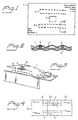
- the surgical drape in the Figures is built-up in the same way as the drape retailed by Applicant under the trademark Klinidrape®, and includes an liquid-absorbent top sheet 1, a liquid-impervious intermediate sheet 2, and an absorbent bottom sheet 3.
- the sheet includes an opening 4 which is intended to be placed over the surgical area.
- strings 5 of hotmelt glue are disposed on the drape generally parallel with two mutually opposing edges of the drape.
- the strings 5 extend in the longitudinal direction of the drape, on respective sides of the opening 4.
- the strings 5 are applied in a molten state in a desired pattern on the upper side of said drape during its manufacture.
- the strings 5 are then pressed down into and through the top sheet 1 and into abutment with the intermediate sheet 2, with the aid of a roller or some like pressure means. Because the strings are pressed into abutment with the sheet 2, it is ensured that no gaps or the like will be found between the strings 5 and the sheet 2. This effectively prevents liquid on the surface of the sheet 2 from passing beyond the strings 5.
- the strings 5 function as flow barriers and force at least some of the liquid that flows in a direction towards the element/?/ to change direction and flow in a direction that is essentially parallel with the longitudinal direction of the glue string.
- Figure 3 shows the drape of Figures 1 and 2 placed over a patient, with the opening 4 positioned in the region where surgery is to take place, which in the illustrated case is in the abdominal region of the patient.
- Those parts of the surgical drape that lie outwardly of the patient's sides will slope comparativly steeply in relation to the horizontal, meaning that gravity will greatly influence the way in which liquid spreads on these parts of the drape.
- Liquid present on a horizontal absorbent surface of a surgical drape of the Klinidrape® kind will spread radially from the wetting point so as to form a generally circular spread pattern, while liquid present on a surface that slopes relative to the horizontal will spread downwards to a extent that increases in keeping with an increasing angle of slope, so as to form a droplet-like spread pattern with the narrow end of the droplet pointing downwards.
- the strings 5 will produce the spread pattern referenced A when liquid or fluid flowing from the surgical area reaches one of the strings 5, which stops downward movement of the liquid and causes the liquid to flow in the longitudinal direction of the string, as shown in Figure 3.
- large quantities of liquid e.g.
- the strings 5 are disposed solely on those parts of the drape that lie along the sides of the patient when the drape is placed in position, since remaining parts of the drape either do not slope to an extent at which the spread pattern will be affected unduly by gravity, or are followed by generally horizontal drape parts that provide a favourable spread pattern.
- the effect of gravity may, on the other hand, be to advantage since this will promote spreading of the liquid in the longitudinal direction of the drape in these parts thereof.
- the strings 5 are only shown to extend over a part of the length of the drape, it will be understood that these strings may extend along the full length of the drape if so desired.
- strings will, of course, depend on the kind of surgical operation to be performed, and that in the case of other surgical drape configurations intended for other kinds of surgery it may be appropriate to place the strings transversely across the drape or even around the perimeter of the drape in a manner to obtain suitable spread patterns.
- the number of strings used may also vary within the scope of the invention. For instance, the strings may be arranged in a chequered pattern over the whole of the drape, although only those strings that extend transversely of the drape flow direction when the drape is in use will have the aforesaid effect.
- Figure 4 shows a surgical drape that is comprised of four separate parts, exemplified in the Figure by the top sheet parts 1'a, 1'b, 1'c and 1'd which have been arranged to form an opening 4' in the surgical area.
- strings 5' are disposed in the side parts 1'c, 1'd.
- the strings may be curved instead of essentially rectilinear as in the drawing, and neither need the strings extend parallel with the longitudinal or transversal edges of the drape.
- the main criterion is that those parts of the drape which slope in relation to the horizontal when the drape is used extend at an angle to the gravitational force projection in the plane in which the string-carrying parts of the drape lie. It may be sufficient in many cases to apply a longitudinal string on each side of the longitudinal symmetry line of the drape.
- the invention can also be applied to surgical drapes that lack a bottom absorbent comfort layer. It will therefore be understood that the invention is restricted solely by the contents of the following Claims.
Landscapes
- Health & Medical Sciences (AREA)
- Surgery (AREA)
- Life Sciences & Earth Sciences (AREA)
- Medical Informatics (AREA)
- Biomedical Technology (AREA)
- Heart & Thoracic Surgery (AREA)
- Engineering & Computer Science (AREA)
- Molecular Biology (AREA)
- Animal Behavior & Ethology (AREA)
- General Health & Medical Sciences (AREA)
- Public Health (AREA)
- Veterinary Medicine (AREA)
- Materials For Medical Uses (AREA)
- Absorbent Articles And Supports Therefor (AREA)
- Nonwoven Fabrics (AREA)
Description
Claims (5)
- A surgical drape that includes a liquid-absorbent top sheet (1) and a liquid-impervious sheet (2) immediately beneath said top sheet, said liquid-impervious sheet facing towards a patient when the drape is in use, characterised in that at least one string of hotmelt glue (5) is disposed on the surface of the drape; and in that the hotmelt glue extends from the upper side of the top sheet, through said top sheet and bonds with the liquid-impervious sheet.
- A surgical drape according to Claim 1, characterised in that each string of hotmelt glue (5) extends in a direction that is generally parallel to one edge of the drape.
- A surgical drape according to Claim 1 or 2, characterised in that the hotmelt glue string or strings (5) has/have a generally rectilinear extension.
- A surgical drape according to Claim 1 or 2, characterised in that the hotmelt glue string or strings (5) has/have a curved extension.
- A surgical drape according to any one of Claims 1-4, characterised in that at least one hotmelt glue string (5) is disposed on each side of two mutually opposing edges of an opening (4) provided in the drape, between respective edges of the opening and corresponding edges of the drape.
Applications Claiming Priority (3)
| Application Number | Priority Date | Filing Date | Title |
|---|---|---|---|
| SE9802343 | 1998-06-30 | ||
| SE9802343A SE514369C2 (en) | 1998-06-30 | 1998-06-30 | The operating sheet with liquid barriers |
| PCT/SE1999/001126 WO2000000101A1 (en) | 1998-06-30 | 1999-06-22 | Surgical drape with a liquid barrier |
Publications (2)
| Publication Number | Publication Date |
|---|---|
| EP1089670A1 EP1089670A1 (en) | 2001-04-11 |
| EP1089670B1 true EP1089670B1 (en) | 2003-11-26 |
Family
ID=20411909
Family Applications (1)
| Application Number | Title | Priority Date | Filing Date |
|---|---|---|---|
| EP99933366A Expired - Lifetime EP1089670B1 (en) | 1998-06-30 | 1999-06-22 | Surgical drape with a liquid barrier |
Country Status (6)
| Country | Link |
|---|---|
| US (1) | US6394095B1 (en) |
| EP (1) | EP1089670B1 (en) |
| DE (1) | DE69913140T2 (en) |
| ES (1) | ES2212587T3 (en) |
| SE (1) | SE514369C2 (en) |
| WO (1) | WO2000000101A1 (en) |
Families Citing this family (3)
| Publication number | Priority date | Publication date | Assignee | Title |
|---|---|---|---|---|
| US20030188753A1 (en) * | 2002-04-03 | 2003-10-09 | Kimberly-Clark Worldwide, Inc. | Radial angiography drape |
| EP1572450B1 (en) * | 2002-12-12 | 2019-07-24 | Ahlstrom-Munksjo Nonwovens LLC | Ethylene oxide sterilizable, low cost nonwoven laminates with high wet peel strength and improved barrier properties |
| US10729507B2 (en) | 2017-01-12 | 2020-08-04 | Warsaw Orthopedic, Inc. | Surgical draping system and method for using same |
Family Cites Families (5)
| Publication number | Priority date | Publication date | Assignee | Title |
|---|---|---|---|---|
| US3538912A (en) * | 1968-08-26 | 1970-11-10 | American Hospital Supply Corp | Fenestrated surgical drape and method of forming the same |
| US3763857A (en) * | 1972-04-24 | 1973-10-09 | Kimberly Clark Co | Surgical drape |
| US3921627A (en) * | 1974-05-14 | 1975-11-25 | Spartan Mills Inc | Surgical drape with drainage troughs |
| US4873997A (en) * | 1988-04-25 | 1989-10-17 | Scherer Healthcare Ltd. | Surgical drape |
| SE9303324L (en) * | 1993-10-11 | 1995-04-12 | Moelnlycke Ab | A surgical drape |
-
1998
- 1998-06-30 SE SE9802343A patent/SE514369C2/en not_active IP Right Cessation
-
1999
- 1999-06-22 ES ES99933366T patent/ES2212587T3/en not_active Expired - Lifetime
- 1999-06-22 WO PCT/SE1999/001126 patent/WO2000000101A1/en not_active Ceased
- 1999-06-22 DE DE69913140T patent/DE69913140T2/en not_active Expired - Lifetime
- 1999-06-22 EP EP99933366A patent/EP1089670B1/en not_active Expired - Lifetime
- 1999-06-22 US US09/720,875 patent/US6394095B1/en not_active Expired - Fee Related
Also Published As
| Publication number | Publication date |
|---|---|
| ES2212587T3 (en) | 2004-07-16 |
| EP1089670A1 (en) | 2001-04-11 |
| SE9802343L (en) | 1999-12-31 |
| DE69913140T2 (en) | 2004-06-03 |
| US6394095B1 (en) | 2002-05-28 |
| DE69913140D1 (en) | 2004-01-08 |
| WO2000000101A1 (en) | 2000-01-06 |
| SE514369C2 (en) | 2001-02-19 |
| SE9802343D0 (en) | 1998-06-30 |
Similar Documents
| Publication | Publication Date | Title |
|---|---|---|
| DE69126054T2 (en) | Surgical drape with 360 degree fluid control | |
| EP2291158B1 (en) | Surgical drape with integrated liquid barrier | |
| US4873997A (en) | Surgical drape | |
| DE69819175T2 (en) | Tearable surgical drape | |
| DE60216164T2 (en) | Disposable surgical gowns | |
| EP0812159B1 (en) | A surgical drape having adhesive margins | |
| EP2552338B1 (en) | Surgical drape having tearable sheet | |
| CN108472101B (en) | Surgical drape having attachable fluid control pouch and geometric alignment feature | |
| EP1942822B1 (en) | Fenestrated surgical drape | |
| RU2019141106A (en) | ABSORBING PRODUCT WITH CHANNELS AND METHOD OF ITS MANUFACTURE | |
| SE508398C2 (en) | Absorbent articles | |
| US5832927A (en) | Surgical drape | |
| US6394095B1 (en) | Surgical drape with a liquid barrier | |
| US7588034B2 (en) | Three piece drape with fluid diversion capabilities | |
| EP0770360A2 (en) | Method for making a surgical drape | |
| MXPA05005890A (en) | Surgical drape with diverting fluid channels. | |
| US20070135784A1 (en) | Surgical drape with superabsorbent fluid management members | |
| US8142410B2 (en) | Fluid absorption mat | |
| US20130174858A1 (en) | Angiography surgical drape | |
| DE60116558T2 (en) | Sanitary napkin with stiff side flaps | |
| EP0531714B1 (en) | Absorbant article for human body discharge |
Legal Events
| Date | Code | Title | Description |
|---|---|---|---|
| PUAI | Public reference made under article 153(3) epc to a published international application that has entered the european phase |
Free format text: ORIGINAL CODE: 0009012 |
|
| 17P | Request for examination filed |
Effective date: 20001215 |
|
| AK | Designated contracting states |
Kind code of ref document: A1 Designated state(s): BE DE ES FR GB IT SE |
|
| GRAH | Despatch of communication of intention to grant a patent |
Free format text: ORIGINAL CODE: EPIDOS IGRA |
|
| GRAS | Grant fee paid |
Free format text: ORIGINAL CODE: EPIDOSNIGR3 |
|
| GRAA | (expected) grant |
Free format text: ORIGINAL CODE: 0009210 |
|
| AK | Designated contracting states |
Kind code of ref document: B1 Designated state(s): BE DE ES FR GB IT SE |
|
| REG | Reference to a national code |
Ref country code: GB Ref legal event code: FG4D |
|
| REF | Corresponds to: |
Ref document number: 69913140 Country of ref document: DE Date of ref document: 20040108 Kind code of ref document: P |
|
| REG | Reference to a national code |
Ref country code: SE Ref legal event code: TRGR |
|
| REG | Reference to a national code |
Ref country code: ES Ref legal event code: FG2A Ref document number: 2212587 Country of ref document: ES Kind code of ref document: T3 |
|
| ET | Fr: translation filed | ||
| PLBE | No opposition filed within time limit |
Free format text: ORIGINAL CODE: 0009261 |
|
| STAA | Information on the status of an ep patent application or granted ep patent |
Free format text: STATUS: NO OPPOSITION FILED WITHIN TIME LIMIT |
|
| 26N | No opposition filed |
Effective date: 20040827 |
|
| REG | Reference to a national code |
Ref country code: FR Ref legal event code: PLFP Year of fee payment: 18 |
|
| REG | Reference to a national code |
Ref country code: FR Ref legal event code: PLFP Year of fee payment: 19 |
|
| PGFP | Annual fee paid to national office [announced via postgrant information from national office to epo] |
Ref country code: GB Payment date: 20170621 Year of fee payment: 19 Ref country code: DE Payment date: 20170613 Year of fee payment: 19 Ref country code: FR Payment date: 20170511 Year of fee payment: 19 |
|
| PGFP | Annual fee paid to national office [announced via postgrant information from national office to epo] |
Ref country code: BE Payment date: 20170515 Year of fee payment: 19 Ref country code: SE Payment date: 20170613 Year of fee payment: 19 Ref country code: IT Payment date: 20170619 Year of fee payment: 19 |
|
| PGFP | Annual fee paid to national office [announced via postgrant information from national office to epo] |
Ref country code: ES Payment date: 20170704 Year of fee payment: 19 |
|
| REG | Reference to a national code |
Ref country code: DE Ref legal event code: R119 Ref document number: 69913140 Country of ref document: DE |
|
| REG | Reference to a national code |
Ref country code: SE Ref legal event code: EUG |
|
| PG25 | Lapsed in a contracting state [announced via postgrant information from national office to epo] |
Ref country code: SE Free format text: LAPSE BECAUSE OF NON-PAYMENT OF DUE FEES Effective date: 20180623 |
|
| GBPC | Gb: european patent ceased through non-payment of renewal fee |
Effective date: 20180622 |
|
| REG | Reference to a national code |
Ref country code: BE Ref legal event code: MM Effective date: 20180630 |
|
| PG25 | Lapsed in a contracting state [announced via postgrant information from national office to epo] |
Ref country code: GB Free format text: LAPSE BECAUSE OF NON-PAYMENT OF DUE FEES Effective date: 20180622 Ref country code: IT Free format text: LAPSE BECAUSE OF NON-PAYMENT OF DUE FEES Effective date: 20180622 Ref country code: FR Free format text: LAPSE BECAUSE OF NON-PAYMENT OF DUE FEES Effective date: 20180630 Ref country code: DE Free format text: LAPSE BECAUSE OF NON-PAYMENT OF DUE FEES Effective date: 20190101 |
|
| PG25 | Lapsed in a contracting state [announced via postgrant information from national office to epo] |
Ref country code: BE Free format text: LAPSE BECAUSE OF NON-PAYMENT OF DUE FEES Effective date: 20180630 |
|
| REG | Reference to a national code |
Ref country code: ES Ref legal event code: FD2A Effective date: 20190916 |
|
| PG25 | Lapsed in a contracting state [announced via postgrant information from national office to epo] |
Ref country code: ES Free format text: LAPSE BECAUSE OF NON-PAYMENT OF DUE FEES Effective date: 20180623 |