EP1089224A2 - Image partitioning to avoid overlap transmission - Google Patents
Image partitioning to avoid overlap transmission Download PDFInfo
- Publication number
- EP1089224A2 EP1089224A2 EP00120299A EP00120299A EP1089224A2 EP 1089224 A2 EP1089224 A2 EP 1089224A2 EP 00120299 A EP00120299 A EP 00120299A EP 00120299 A EP00120299 A EP 00120299A EP 1089224 A2 EP1089224 A2 EP 1089224A2
- Authority
- EP
- European Patent Office
- Prior art keywords
- image
- partitioning
- rectangles
- images
- partially
- Prior art date
- Legal status (The legal status is an assumption and is not a legal conclusion. Google has not performed a legal analysis and makes no representation as to the accuracy of the status listed.)
- Granted
Links
Images




Classifications
-
- G—PHYSICS
- G06—COMPUTING OR CALCULATING; COUNTING
- G06T—IMAGE DATA PROCESSING OR GENERATION, IN GENERAL
- G06T15/00—Three-dimensional [3D] image rendering
- G06T15/10—Geometric effects
- G06T15/40—Hidden part removal
-
- H—ELECTRICITY
- H04—ELECTRIC COMMUNICATION TECHNIQUE
- H04N—PICTORIAL COMMUNICATION, e.g. TELEVISION
- H04N1/00—Scanning, transmission or reproduction of documents or the like, e.g. facsimile transmission; Details thereof
- H04N1/387—Composing, repositioning or otherwise geometrically modifying originals
- H04N1/3872—Repositioning or masking
- H04N1/3873—Repositioning or masking defined only by a limited number of coordinate points or parameters, e.g. corners, centre; for trimming
Definitions
- This invention relates to image partitioning methods and devices, such as computers, on which such methods may be implemented. More particularly, the invention relates to the partitioning of a set of overlapping images to improve downloading and processing efficiency. Overlapping images are partitioned so that when the image data is transmitted (i.e., downloaded) only the visible portions of the images are downloaded. Invisible image portions are not transmitted to conserve bandwidth.
- the user is typically dealing only with thumbnail sized images. This minimizes the demands on the client machine. It also minimizes the download time. Downloading of the full size image can be delayed until the user is ready to print. This way, if the user changes his mind about which image he wants to use, no time is wasted downloading a full size image.
- the user may wish to incorporate in the graphics document multiple images, some of which partially overlap. In any region of overlap only the corresponding portion of the topmost image is visible; the corresponding portions of the images further down in the stack are occluded.
- all of the image data is downloaded, even data of image portions that will not be visible. This is time consuming and unnecessary.
- Another object of this invention is to provide a system for partitioning a set of overlapping images to improve transmitting and processing efficiency.
- a further object of this invention is to provide a system for partitioning a set of overlapping images such that only the visible portions of the images are transmitted.
- Still another object of this invention is to provide a system for partitioning a set of overlapping images that are in compressed domain and transmitting only the compressed data from the partitioned area.
- a method for partitioning a group of images including at least a first, bottom-most image and a second image in front of, and partially overlapping, the first image.
- the method comprises partitioning a non-overlapped portion of the first image into at least two sections based on the position of the second image to form a first set of image elements; and transmitting only the first set of image elements.
- a non-overlapped portion of each partially overlapped image element in the first set of image elements is preferably further partitioned in a second partitioning stage into at least two sections based on the position a third image in the group of images that partially overlaps the first set of image elements.
- This second stage of partitioning results in the formation of a second set of image elements. In this case, only the first and second sets of image elements are transmitted.
- a method for partitioning a group of images, at least some of which partially overlap, the group of images including a first, bottom-most image and a last, top-most image.
- the method comprises partitioning a non-overlapped portion of the first image into a plurality of rectangles based on the position of a second image in front of, and partially overlapping, the first image to form a first set of rectangles; iteratively forming new sets of rectangles by partitioning a current set of rectangles based on a next image in the group of images until a final set of rectangles is formed based on the position of the top-most image; and transmitting only the final set of rectangles.
- the first set of rectangles includes the second image and each additional set of rectangles includes the image on which the partitioning for that additional set is based.
- the first set of image elements includes the second image
- the second set of image elements includes the third image
- each section and image element is in the shape of a rectangle.
- the partitioning is done in compressed or partially compressed domain.
- an apparatus for partitioning a group of images in accordance with the above-described method(s).
- the apparatus may be a digital computer, other processor-controlled device, or equivalent.
- the above-described method(s) may be embodied in a program of instructions which is stored on a medium readable by a digital computer or other processor-controlled device.
- the method(s) may be implemented using hardware or a combination of software and hardware.
- the image partitioning techniques of the present invention may be used with graphics or image processing applications where a user is working with multiple images, some or all of which partially overlap, and the image data is to be transmitted.
- Such applications may include, for example, programs that allow a user to create business or greeting cards.
- the techniques of the present invention improve transmitting and processing efficiency by partitioning the multiple overlapping images so that only the visible portions of the images are transmitted.
- the present invention has particular utility in connection with online graphics or image processing applications where the user is working on a client computer that is interacting with a server through a network.
- FIG. 1 is a schematic representation of a network.
- Network client 11 uses network 13 to access resources provided by network server 12.
- network server 12 is a hypermedia server, perhaps operating in conformity with the Hypertext Transfer Protocol (HTTP), this is not necessary to practice the present invention.
- HTTP Hypertext Transfer Protocol
- the nature of the communication paths connecting network client 11 and network server 12 are not critical to the practice of the present invention. Such paths may be implemented as switched and/or non-switched paths using private and/or public facilities.
- the topology of network 13 is not critical and may be implemented in a variety of ways including hierarchical and peer-to-peer networks.
- Network client 11 and network server 12 for example, may be locally located with respect to one another and may be implemented on the same hardware.
- FIG. 2 is a functional block diagram of a typical computer system 20 that may be used to implement network client 11 and/or network server 12.
- this computer system includes bus 21 that interconnects central processing unit (CPU) 22, system memory 23 and several device interfaces.
- Bus 21 can be implemented by more than one physical bus such as a system bus and a processor local bus.
- CPU 22 represents processing circuitry such as a microprocessor.
- System memory 23 represents various memory components such as random access memory (RAM) and read only memory (ROM).
- Input control 25 represents interface circuitry that connects to one or more input devices 35 such as a keyboard, mouse, track ball or stylus.
- Display control 26 represents interface circuitry that connects to one or more display devices 36 such as a video display terminal.
- I/O control 27 represents interface circuitry that connects to one or more I/O devices 37 such as a modem or a network connection.
- Storage control 28 represents interface circuitry that connects to one or more storage devices 38 such as a magnetic disk drive, magnetic tape drive, optical disk drive or solid-state storage device.
- Printer control 29 represents interface circuitry that connects to one or more printer devices 39 such as a laser printer, ink-jet printer or plotter.
- No particular type of computer system is critical to practice the present invention. For example, a computer with a bus architecture different from that illustrated in FIG. 2 may be used.
- computer system 20 carries out the image partitioning techniques of the present invention by using CPU 22 to execute a program of instructions residing in RAM that may be fetched from ROM, storage device 38 or obtained from a network server or other source through I/O device 37.
- the program of instructions i.e., software
- the program of instructions may be conveyed by a medium that is readable by a computer or other processor-controlled device, including various magnetic media such as disk or tape, various optical media such as compact discs, and optical, infrared, and baseband or modulated communication paths throughout the electromagnetic spectrum from supersonic to ultraviolet frequencies.
- the term "device readable medium” as used in the claims is intended to cover all such media including a carrier wave encoded to transmit the program of instructions.
- the image partitioning techniques of the present invention may be implemented with hardware using discrete components, application specific integrated circuits (ASICs), digital signal processors, or the like.
- ASICs application specific integrated circuits
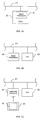
- Such hardware may be embodied, for example, in an image processor 40 which may be physically integrated with the CPU 22 (FIG. 3A) or may be a separate element. Where the image processor 40 is a separate element, it may be embodied in the computer 20 itself (FIG. 3B) or on an option card 41 that can be inserted into an available computer card slot 42 (FIG. 3C).
- the image partitioning techniques may also be implemented using a combination of software and hardware. Various aspects of the underlying partitioning algorithm may be implemented with hardware while others are implemented using software.
- a set of overlapping images are partitioned into smaller pieces so only the visible portions of the images are transmitted (i.e., downloaded).
- the partitioning is preferably done using rectangles since digital devices such as computers typically work with images in the form of rectangles.
- the partitioning is preferably done while the images are in the partially compressed (i.e., frequency) domain and thereafter the compressed (i.e., bitstream) data in only the partitioned areas is transmitted.
- the invention is not limited to any particular partitioning procedure. Rather, any known spatial domain or frequency domain cropping procedure may be used to do the actual partitioning of the image data. However, in the preferred embodiments, the partitioning is done using a frequency domain cropping procedure, after which the compressed data in only the partitioned areas is transmitted. With JPEG images, the image data is preferably processed in the frequency or partially compressed domain using a JPEG cropping procedure.
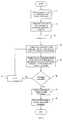
- FIG. 4 shows a flow diagram which illustrates the process of the iterative imaging partitioning algorithm of the present invention.
- the algorithm begins at step 41, where, in a stack of overlapping, rectangular images, each image is labeled with a distinct z-order number representing its order in the stack.
- the z-order numbers may be consecutively assigned so that the lowest number (i.e., 0) represents the bottom-most image in the stack and the highest number (i.e., n - 1) represents the top-most image in the stack, where the number of images in the stack is equal to n.
- a higher z-order number usually indicates a more frontal image.
- This current set of visible rectangles is iteratively partitioned by the image with the next z-order, at the heart of the algorithm.
- This next z-order is denoted by the incremented variable i , which is initialized to 1 in step 43.
- the current set of visible rectangles is compared with the image having a z-order number of i to determine the area of overlap.
- the non-overlapped portions of all the rectangles in the currently visible set are partitioned to form the next set of rectangles.
- the image with z-order number of i is also added to this set, and this set becomes the current set of visible rectangles for the next iteration, for which i is incremented to i+1 .
- This process continues, comparing the next image in the z-order with the previously generated (i.e., "current") set of visible rectangles to generate a "new" set of visible rectangles, until all images have been considered.
- the last (i.e., top-most) image is considered and the final partitioning completed, a final set of rectangles is generated which represents only the visible portions of the stack of images.
- step 44 may be generally described as comparing the current set of visible rectangles with a rectangle having a z-order of i (i.e., the next-most-frontal image in the stack) to determine the area of overlap.
- the current set of visible rectangles consists of only the bottom-most image.
- Step 45 described more generally, involves partitioning the non-overlapped portion of each partially overlapped rectangle in the current set of visible rectangles to form the next set of visible rectangles which also includes the image with z-order of i .
- the algorithm determines whether or not all of the images in the stack have been considered in the partitioning process (step 46). If not, i is incremented by one in step 47, and the algorithm returns to step 44 to compare the next-most-frontal image in the stack with the "current" set of visible rectangles. The process continues until all images/rectangles have been considered and the partitioning is completed, at which time further processing of the final set of visible rectangles may be done in step 48. Such further processing may include, for example, merging neighboring rectangles that belong to the same image into larger rectangles if it is efficient to do so.
- step 49 only the data in the final set of rectangles, which represents only the visible portions of the stack of images, is transmitted to conserve bandwidth and improve processing efficiency.
- the partitioning is preferably done while the images are in the partially compressed (i.e., frequency) domain.
- the algorithm extracts the compressed data from the cropped (i.e., partitioned) area represented by the final set of rectangles. The algorithm then sends that data in compressed form. Performing the partitioning in partially compressed domain and transmitting in compressed domain results in an additional reduction in bandwidth and further improvement in processing efficiency.
- each level of partitioning considers only the "current" set of visible rectangles with respect to the rectangle/image having the next highest z-order in the stack.
- Each partially overlapped rectangle in the "current" set of visible rectangles is partitioned into smaller rectangles based on the rectangle/image having z-order i to generate a "new" set of visible rectangles including the rectangle defined by the z-order i .
- This "new" set of rectangles, which now becomes the "current” set of rectangles, is then compared against the next rectangle/image in the stack. Further partitioning of the non-overlapped portions of each partially overlapped rectangle in the "current” set yields a "new" set of rectangles.
- a "previous” rectangle in the "current” set gets split up only if a "new” rectangle is in front of it and if the "new” rectangle partially overlaps the "previous” rectangle.
- the "previous” rectangle may have been the result of an earlier partitioning.
- the algorithm preferably does not reverse its decision about splitting up a "previous” rectangle. When a "previous” rectangle is to be split, it is advantageous from a computing perspective to split up the "previous” rectangle such that the resulting smaller rectangles are of roughly equal area.
- rectangle is the preferred partitioning shape since computers typically deal with images in rectangles.
- rectangles are not partitioned into irregular polygonal pieces where the edges of the pieces are random line segments. Rather, the edges of the split pieces are either horizontal or vertical. Given rectangles A and B, where A is in front of B, the pieces into which rectangle B is partitioned will have edges that are aligned with some of the edges of A and/or B. The algorithm also assumes that the rectangles are not rotated.
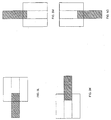
- FIGs. 5A through 5Q there are seventeen ways in which two rectangles A and B can be positioned with respect to each other.
- the top rectangle is hatched.
- the algorithm handles each of these cases separately when making partitioning decisions. Some of the cases are similar (the only difference is that they are rotated by a multiple of 90°).
- cases 1 and 2 (FIGs. 5A and 5B respectively)
- the bottom-most rectangle B is not partitioned because there is no non-overlapped portion to partition.
- case 1 there is no intersection and in case 2 the bottom rectangle is completely covered by the top rectangle.
- the bottom rectangle is partitioned as shown in FIGs. 5C through 5Q respectively.
- dashed lines have been added to show the partitioning.
- this scheme can take up to O(N 2 ) operations to finish. Furthermore, the number of rectangles may grow with a theoretical upper bound of O(N 2 ), where N is the number of images and O is a standard notation used in complexity theory.
- the algorithm is preferably designed to stop partitioning once a maximum number of rectangles, say 100, has been exceeded. Once the preset maximum is reached, the algorithm stops partitioning, performs any final processing, and then sends the data as is. That is, images with higher z-order are sent in full along with the current (and in this case last) set of visible rectangles.
- the image partitioning techniques of the present invention are particularly well suited for use in connection with online graphics applications where a user is working with multiple overlapping images.
- the partitioning algorithm can be implemented using software, hardware, or combination thereof.
- the block and flow diagrams used to illustrate the techniques of the present invention show the performance of certain specified functions and relationships thereof.
- the boundaries of these functional blocks have been arbitrarily defined herein for convenience of description. Alternate boundaries may be defined so long as the specified functions are performed and the relationships between the functions are appropriately maintained.
- the diagrams and accompanying description provide the functional information one skilled in the art would require to implement a system to perform the processing required.
- Each of the functions depicted in the block and flow diagrams may be implemented, for example, by software, functionally equivalent hardware, or a combination thereof.
Landscapes
- Engineering & Computer Science (AREA)
- Physics & Mathematics (AREA)
- Multimedia (AREA)
- Computer Graphics (AREA)
- General Physics & Mathematics (AREA)
- Theoretical Computer Science (AREA)
- Geometry (AREA)
- Signal Processing (AREA)
- Editing Of Facsimile Originals (AREA)
- Image Processing (AREA)
- Processing Or Creating Images (AREA)
- Facsimile Transmission Control (AREA)
- Woven Fabrics (AREA)
- Non-Silver Salt Photosensitive Materials And Non-Silver Salt Photography (AREA)
Abstract
Description
Claims (28)
- A method for partitioning a group of images including at least a first, bottom-most image and a second image in front of, and partially overlapping, the first image, said method comprising:partitioning a non-overlapped portion of the first image into at least two sections based on the position of the second image to form a first set of image elements; andtransmitting only the first set of image elements.
- The method of claim 1, further comprising:partitioning a non-overlapped portion of each partially overlapped image element in the first set of image elements into at least two sections based on the position of a third image in the group of images that partially overlaps the first set of image elements to form a second set of image elements; andtransmitting only the first and second sets of image elements.
- The method of claim 1 or 2, wherein the first set of image elements includes the second image.
- The method of claim 2, wherein the first set of image elements includes the second image and the second set of image elements includes the third image.
- The method according to one of claims 1-4, wherein the partitioning step is done in partially compressed domain.
- The method according to one of claims 1-5, wherein each section and image element is in the shape of a rectangle.
- A method for partitioning a group of images, at least some of which partially overlap, the group of images including a first, bottom-most image and a last, top-most image, said method comprising:partitioning a non-overlapped portion of the first image into a plurality of rectangles based on the position of a second image in front of, and partially overlapping, the first image to form a first set of rectangles;iteratively forming new sets of rectangles by partitioning a current set of rectangles based on a next image in the group of images until a final set of rectangles is formed based on the position of the top-most image; andtransmitting only the final set of rectangles.
- The method of claim 7, wherein the first set of rectangles includes the second image and each additional set of rectangles includes the image on which the partitioning for that additional set is based.
- The method of claim 7 or 8, wherein the partitioning step is done in partially compressed domain.
- A apparatus for partitioning a group of images including at least a first, bottom-most image and a second image in front of, and partially overlapping, the first image, said apparatus comprising:means for partitioning a non-overlapped portion of the first image into at least two sections based on the position of the second image to form a first set of image elements; andmeans for transmitting only the first set of image elements.
- The apparatus of claim 10, further comprising:means for partitioning a non-overlapped portion of each partially overlapped image element in the first set of image elements into at least two sections based on the position of a third image in the group of images that partially overlaps the first set of image elements to form a second set of image elements; andmeans for transmitting only the first and second sets of image elements.
- The apparatus of claim 10 or 11, wherein the first set of image elements includes the second image.
- The apparatus of claim 11, wherein the first set of image elements includes the second image and the second set of image elements includes the third image.
- The apparatus according to one of claims 10-13, wherein the partitioning function is done in partially compressed domain.
- The apparatus according to one of claims 10-14, wherein each section and image element is in the shape of a rectangle.
- An apparatus for partitioning a group of images, at least some of which partially overlap, the group of images including a first, bottom-most image and a last, top-most image, said apparatus comprising:means for partitioning a non-overlapped portion of the first image into a plurality of rectangles based on the position of a second image in front of, and partially overlapping, the first image to form a first set of rectangles;means for iteratively forming new sets of rectangles by partitioning a current set of rectangles based on a next image in the group of images until a final set of rectangles is formed based on the position of the top-most image; andmeans for transmitting only the final set of rectangles.
- The apparatus of claim 16, wherein the first set of rectangles includes the second image and each additional set of rectangles includes the image on which the partitioning for that additional set is based.
- The apparatus of claim 16 or 17, wherein the partitioning function is done in partially compressed domain.
- A computer-program of instructions for execution by a computer to perform a method for partitioning a group of images including at least a first, bottom-most image and a second image in front of, and partially overlapping, the first image, said program of instructions comprising:instructions for partitioning a non-overlapped portion of the first image into at least two sections based on the position of the second image to form a first set of image elements; andinstructions for transmitting only the first set of image elements.
- The computer-program of claim 19, further comprising:instructions for partitioning a non-overlapped portion of each partially overlapped image element in the first set of image elements into at least two sections based on the position of a third image in the group of images that partially overlaps the first set of image elements to form a second set of image elements; andinstructions for transmitting only the first and second sets of image elements.
- The computer-program of claim 19 or 20, wherein the first set of image elements includes the second image.
- The computer-program of claim 20, wherein the first set of image elements includes the second image and the second set of image elements includes the third image.
- The computer-program according to one of claims 19-22, wherein the instructions for partitioning include instructions for partitioning in partially compressed domain.
- The computer-program according to one of claims 19-23, wherein each section and image element is in the shape of a rectangle.
- A computer-program of instructions for execution by a computer to perform a method for partitioning a group of images including at least a first, bottom-most image and a second image in front of, and partially overlapping, the first image, said program of instructions comprising:instructions for partitioning a non-overlapped portion of the first image into a plurality of rectangles based on the position of a second image in front of, and partially overlapping, the first image to form a first set of rectangles;instructions for iteratively forming new sets of rectangles by partitioning a current set of rectangles based on a next image in the group of images until a final set of rectangles is formed based on the position of the top-most image; andinstructions for transmitting only the final set of rectangles.
- The computer-program of claim 25, wherein the first set of rectangles includes the second image and each additional set of rectangles includes the image on which the partitioning for that additional set is based.
- The computer-program of claim 25, wherein the instructions for partitioning include instructions for partitioning in partially compressed domain.
- A computer-readable medium comprising the computer-program as defined in one of claims 19-27.
Applications Claiming Priority (2)
| Application Number | Priority Date | Filing Date | Title |
|---|---|---|---|
| US09/408,108 US6625309B1 (en) | 1999-09-29 | 1999-09-29 | Image partitioning to avoid overlap transmission |
| US408108 | 1999-09-29 |
Publications (3)
| Publication Number | Publication Date |
|---|---|
| EP1089224A2 true EP1089224A2 (en) | 2001-04-04 |
| EP1089224A3 EP1089224A3 (en) | 2001-04-11 |
| EP1089224B1 EP1089224B1 (en) | 2006-11-02 |
Family
ID=23614895
Family Applications (1)
| Application Number | Title | Priority Date | Filing Date |
|---|---|---|---|
| EP00120299A Expired - Lifetime EP1089224B1 (en) | 1999-09-29 | 2000-09-28 | Image partitioning to avoid overlap transmission |
Country Status (5)
| Country | Link |
|---|---|
| US (1) | US6625309B1 (en) |
| EP (1) | EP1089224B1 (en) |
| JP (2) | JP2001136369A (en) |
| AT (1) | ATE344508T1 (en) |
| DE (1) | DE60031624T2 (en) |
Cited By (1)
| Publication number | Priority date | Publication date | Assignee | Title |
|---|---|---|---|---|
| EP1695548A4 (en) * | 2004-07-30 | 2010-05-26 | Microsoft Corp | SYSTEM AND METHOD FOR EDITING PHOTOGRAPHS |
Families Citing this family (15)
| Publication number | Priority date | Publication date | Assignee | Title |
|---|---|---|---|---|
| JP2002092303A (en) * | 2000-07-13 | 2002-03-29 | Fumio Ri | Managing system and using program for personal information |
| US8924506B2 (en) * | 2000-12-27 | 2014-12-30 | Bradium Technologies Llc | Optimized image delivery over limited bandwidth communication channels |
| GB2378340A (en) * | 2001-07-31 | 2003-02-05 | Hewlett Packard Co | Generation of an image bounded by a frame or of overlapping images |
| US6882755B2 (en) * | 2001-10-19 | 2005-04-19 | Hewlett-Packard Development Company, L.P. | Image transmission for low bandwidth with region of interest |
| CN100423021C (en) * | 2002-10-17 | 2008-10-01 | 精工爱普生株式会社 | Method and device for image segmentation with low depth of field |
| JP4976975B2 (en) * | 2007-10-03 | 2012-07-18 | 株式会社東芝 | Server apparatus, server apparatus control method, and server apparatus control program |
| JP4518181B2 (en) * | 2008-04-17 | 2010-08-04 | セイコーエプソン株式会社 | Image transmission apparatus, display system, image transmission program, and recording medium |
| US8339671B2 (en) * | 2009-03-30 | 2012-12-25 | Sharp Laboratories Of America, Inc. | Methods and systems for rendering data by partitioning a graphics list |
| US20100245889A1 (en) * | 2009-03-30 | 2010-09-30 | Nguyen Uoc H | Methods and Systems for Rendering Data |
| US8339670B2 (en) * | 2009-03-30 | 2012-12-25 | Sharp Laboratories Of America, Inc. | Methods and systems for rendering data based on graphic-list partitioning |
| US8339672B2 (en) * | 2009-03-30 | 2012-12-25 | Sharp Laboratories Of America, Inc. | Methods and systems for rendering data using graphic-list partitions and associated rendering processors |
| US20100245918A1 (en) * | 2009-03-30 | 2010-09-30 | Nguyen Uoc H | Methods and Systems for Rendering Data |
| US8339653B2 (en) * | 2009-03-30 | 2012-12-25 | Sharp Laboratories Of America, Inc. | Methods and systems for rendering data based on overlap characteristics |
| US8411319B2 (en) * | 2009-03-30 | 2013-04-02 | Sharp Laboratories Of America, Inc. | Methods and systems for concurrent rendering of graphic-list elements |
| JP2012118832A (en) * | 2010-12-02 | 2012-06-21 | Sony Corp | Information processor, information processing method and program |
Family Cites Families (11)
| Publication number | Priority date | Publication date | Assignee | Title |
|---|---|---|---|---|
| JPH0646408B2 (en) | 1987-11-20 | 1994-06-15 | 日立ソフトウェアエンジニアリング株式会社 | Split image processing method |
| US5212742A (en) | 1991-05-24 | 1993-05-18 | Apple Computer, Inc. | Method and apparatus for encoding/decoding image data |
| US5640607A (en) | 1992-04-21 | 1997-06-17 | Microsoft Corporation | Method for sending bit mapped image by appending special code to text string and transmitting the text string separately from compressed residual image |
| US5436981A (en) | 1992-06-24 | 1995-07-25 | Canon Kabushiki Kaisha | Image processing method, and apparatus therefor |
| US5812704A (en) | 1994-11-29 | 1998-09-22 | Focus Automation Systems Inc. | Method and apparatus for image overlap processing |
| US5917962A (en) | 1995-06-06 | 1999-06-29 | Apple Computer, Inc. | Method and apparatus for partitioning an image |
| US6307559B1 (en) * | 1995-07-13 | 2001-10-23 | International Business Machines Corporation | Method and apparatus for color space conversion, clipping, and scaling of an image during blitting |
| US5841420A (en) * | 1995-08-18 | 1998-11-24 | International Business Machines Corporation | Method and system in a data processing system windowing environment for displaying previously obscured information |
| US6141007A (en) * | 1997-04-04 | 2000-10-31 | Avid Technology, Inc. | Newsroom user interface including multiple panel workspaces |
| JPH10283298A (en) | 1997-04-04 | 1998-10-23 | Casio Comput Co Ltd | Information providing system, terminal device and server device |
| US6215490B1 (en) * | 1998-02-02 | 2001-04-10 | International Business Machines Corporation | Task window navigation method and system |
-
1999
- 1999-09-29 US US09/408,108 patent/US6625309B1/en not_active Expired - Fee Related
-
2000
- 2000-09-28 EP EP00120299A patent/EP1089224B1/en not_active Expired - Lifetime
- 2000-09-28 DE DE60031624T patent/DE60031624T2/en not_active Expired - Lifetime
- 2000-09-28 AT AT00120299T patent/ATE344508T1/en not_active IP Right Cessation
- 2000-09-28 JP JP2000295640A patent/JP2001136369A/en active Pending
-
2004
- 2004-01-16 JP JP2004009854A patent/JP2004159365A/en not_active Withdrawn
Cited By (1)
| Publication number | Priority date | Publication date | Assignee | Title |
|---|---|---|---|---|
| EP1695548A4 (en) * | 2004-07-30 | 2010-05-26 | Microsoft Corp | SYSTEM AND METHOD FOR EDITING PHOTOGRAPHS |
Also Published As
| Publication number | Publication date |
|---|---|
| DE60031624D1 (en) | 2006-12-14 |
| JP2004159365A (en) | 2004-06-03 |
| JP2001136369A (en) | 2001-05-18 |
| EP1089224A3 (en) | 2001-04-11 |
| US6625309B1 (en) | 2003-09-23 |
| EP1089224B1 (en) | 2006-11-02 |
| ATE344508T1 (en) | 2006-11-15 |
| DE60031624T2 (en) | 2007-08-23 |
Similar Documents
| Publication | Publication Date | Title |
|---|---|---|
| EP1089224B1 (en) | Image partitioning to avoid overlap transmission | |
| US7212678B2 (en) | Image transfer optimisation | |
| JP4299034B2 (en) | Raster mixed file | |
| US6281874B1 (en) | Method and system for downloading graphic images on the internet | |
| US7065249B2 (en) | System and method for image editing | |
| US8760463B2 (en) | Automatic color adjustment of a template design | |
| US6449639B1 (en) | Method and system for client-less viewing of scalable documents displayed using internet imaging protocol commands | |
| US6708309B1 (en) | Method and system for viewing scalable documents | |
| JP4753627B2 (en) | A method for dynamically controlling the file size of digital images. | |
| JP2000092424A (en) | Image server | |
| US20040027593A1 (en) | Techniques for resolution independent rendering of images | |
| US7136528B2 (en) | System and method for editing digital images | |
| US20050162680A1 (en) | Communication apparatus for forming and outputting image data on the basis of received data | |
| US8670631B2 (en) | Image processing apparatus, control method and computer-readable medium storing a program | |
| JP3541714B2 (en) | Image display device | |
| JP3960210B2 (en) | Image processing device | |
| JP3755674B2 (en) | Image processing apparatus and method | |
| JP2004511863A (en) | A method for resolution independent rendering of images | |
| EP1295480A2 (en) | Compression system and method for use in a set top box environment | |
| JP2001197230A (en) | Method and system for editing image | |
| Waclawik | Creating Better Thumbnails CS 638 Project Paper | |
| JPH05211607A (en) | Image processing apparatus and method | |
| JPH05211614A (en) | Image processing apparatus and method | |
| HK1058849B (en) | Process for rendering mixed raster content files | |
| JPH05211615A (en) | Image processing apparatus and method |
Legal Events
| Date | Code | Title | Description |
|---|---|---|---|
| PUAI | Public reference made under article 153(3) epc to a published international application that has entered the european phase |
Free format text: ORIGINAL CODE: 0009012 |
|
| PUAL | Search report despatched |
Free format text: ORIGINAL CODE: 0009013 |
|
| AK | Designated contracting states |
Kind code of ref document: A2 Designated state(s): AT BE CH CY DE DK ES FI FR GB GR IE IT LI LU MC NL PT SE |
|
| AX | Request for extension of the european patent |
Free format text: AL;LT;LV;MK;RO;SI |
|
| AK | Designated contracting states |
Kind code of ref document: A3 Designated state(s): AT BE CH CY DE DK ES FI FR GB GR IE IT LI LU MC NL PT SE |
|
| AX | Request for extension of the european patent |
Free format text: AL;LT;LV;MK;RO;SI |
|
| 17P | Request for examination filed |
Effective date: 20010417 |
|
| AKX | Designation fees paid |
Free format text: AT BE CH CY DE DK ES FI FR GB GR IE IT LI LU MC NL PT SE |
|
| 17Q | First examination report despatched |
Effective date: 20040203 |
|
| GRAP | Despatch of communication of intention to grant a patent |
Free format text: ORIGINAL CODE: EPIDOSNIGR1 |
|
| GRAS | Grant fee paid |
Free format text: ORIGINAL CODE: EPIDOSNIGR3 |
|
| GRAA | (expected) grant |
Free format text: ORIGINAL CODE: 0009210 |
|
| AK | Designated contracting states |
Kind code of ref document: B1 Designated state(s): AT BE CH CY DE DK ES FI FR GB GR IE IT LI LU MC NL PT SE |
|
| PG25 | Lapsed in a contracting state [announced via postgrant information from national office to epo] |
Ref country code: IT Free format text: LAPSE BECAUSE OF FAILURE TO SUBMIT A TRANSLATION OF THE DESCRIPTION OR TO PAY THE FEE WITHIN THE PRESCRIBED TIME-LIMIT;WARNING: LAPSES OF ITALIAN PATENTS WITH EFFECTIVE DATE BEFORE 2007 MAY HAVE OCCURRED AT ANY TIME BEFORE 2007. THE CORRECT EFFECTIVE DATE MAY BE DIFFERENT FROM THE ONE RECORDED. Effective date: 20061102 Ref country code: NL Free format text: LAPSE BECAUSE OF FAILURE TO SUBMIT A TRANSLATION OF THE DESCRIPTION OR TO PAY THE FEE WITHIN THE PRESCRIBED TIME-LIMIT Effective date: 20061102 Ref country code: LI Free format text: LAPSE BECAUSE OF FAILURE TO SUBMIT A TRANSLATION OF THE DESCRIPTION OR TO PAY THE FEE WITHIN THE PRESCRIBED TIME-LIMIT Effective date: 20061102 Ref country code: FI Free format text: LAPSE BECAUSE OF FAILURE TO SUBMIT A TRANSLATION OF THE DESCRIPTION OR TO PAY THE FEE WITHIN THE PRESCRIBED TIME-LIMIT Effective date: 20061102 Ref country code: BE Free format text: LAPSE BECAUSE OF FAILURE TO SUBMIT A TRANSLATION OF THE DESCRIPTION OR TO PAY THE FEE WITHIN THE PRESCRIBED TIME-LIMIT Effective date: 20061102 Ref country code: CH Free format text: LAPSE BECAUSE OF FAILURE TO SUBMIT A TRANSLATION OF THE DESCRIPTION OR TO PAY THE FEE WITHIN THE PRESCRIBED TIME-LIMIT Effective date: 20061102 Ref country code: AT Free format text: LAPSE BECAUSE OF FAILURE TO SUBMIT A TRANSLATION OF THE DESCRIPTION OR TO PAY THE FEE WITHIN THE PRESCRIBED TIME-LIMIT Effective date: 20061102 |
|
| REG | Reference to a national code |
Ref country code: GB Ref legal event code: FG4D |
|
| REG | Reference to a national code |
Ref country code: IE Ref legal event code: FG4D |
|
| REG | Reference to a national code |
Ref country code: CH Ref legal event code: EP |
|
| REF | Corresponds to: |
Ref document number: 60031624 Country of ref document: DE Date of ref document: 20061214 Kind code of ref document: P |
|
| PG25 | Lapsed in a contracting state [announced via postgrant information from national office to epo] |
Ref country code: DK Free format text: LAPSE BECAUSE OF FAILURE TO SUBMIT A TRANSLATION OF THE DESCRIPTION OR TO PAY THE FEE WITHIN THE PRESCRIBED TIME-LIMIT Effective date: 20070202 Ref country code: SE Free format text: LAPSE BECAUSE OF FAILURE TO SUBMIT A TRANSLATION OF THE DESCRIPTION OR TO PAY THE FEE WITHIN THE PRESCRIBED TIME-LIMIT Effective date: 20070202 |
|
| PG25 | Lapsed in a contracting state [announced via postgrant information from national office to epo] |
Ref country code: ES Free format text: LAPSE BECAUSE OF FAILURE TO SUBMIT A TRANSLATION OF THE DESCRIPTION OR TO PAY THE FEE WITHIN THE PRESCRIBED TIME-LIMIT Effective date: 20070213 |
|
| PG25 | Lapsed in a contracting state [announced via postgrant information from national office to epo] |
Ref country code: PT Free format text: LAPSE BECAUSE OF FAILURE TO SUBMIT A TRANSLATION OF THE DESCRIPTION OR TO PAY THE FEE WITHIN THE PRESCRIBED TIME-LIMIT Effective date: 20070402 |
|
| NLV1 | Nl: lapsed or annulled due to failure to fulfill the requirements of art. 29p and 29m of the patents act | ||
| REG | Reference to a national code |
Ref country code: CH Ref legal event code: PL |
|
| ET | Fr: translation filed | ||
| PLBE | No opposition filed within time limit |
Free format text: ORIGINAL CODE: 0009261 |
|
| STAA | Information on the status of an ep patent application or granted ep patent |
Free format text: STATUS: NO OPPOSITION FILED WITHIN TIME LIMIT |
|
| 26N | No opposition filed |
Effective date: 20070803 |
|
| PG25 | Lapsed in a contracting state [announced via postgrant information from national office to epo] |
Ref country code: GR Free format text: LAPSE BECAUSE OF FAILURE TO SUBMIT A TRANSLATION OF THE DESCRIPTION OR TO PAY THE FEE WITHIN THE PRESCRIBED TIME-LIMIT Effective date: 20070203 Ref country code: MC Free format text: LAPSE BECAUSE OF NON-PAYMENT OF DUE FEES Effective date: 20070930 |
|
| PG25 | Lapsed in a contracting state [announced via postgrant information from national office to epo] |
Ref country code: IE Free format text: LAPSE BECAUSE OF NON-PAYMENT OF DUE FEES Effective date: 20070928 |
|
| PG25 | Lapsed in a contracting state [announced via postgrant information from national office to epo] |
Ref country code: CY Free format text: LAPSE BECAUSE OF FAILURE TO SUBMIT A TRANSLATION OF THE DESCRIPTION OR TO PAY THE FEE WITHIN THE PRESCRIBED TIME-LIMIT Effective date: 20061102 Ref country code: LU Free format text: LAPSE BECAUSE OF NON-PAYMENT OF DUE FEES Effective date: 20070928 |
|
| PGFP | Annual fee paid to national office [announced via postgrant information from national office to epo] |
Ref country code: DE Payment date: 20130925 Year of fee payment: 14 |
|
| PGFP | Annual fee paid to national office [announced via postgrant information from national office to epo] |
Ref country code: FR Payment date: 20130910 Year of fee payment: 14 Ref country code: GB Payment date: 20130925 Year of fee payment: 14 |
|
| REG | Reference to a national code |
Ref country code: DE Ref legal event code: R119 Ref document number: 60031624 Country of ref document: DE |
|
| GBPC | Gb: european patent ceased through non-payment of renewal fee |
Effective date: 20140928 |
|
| REG | Reference to a national code |
Ref country code: DE Ref legal event code: R119 Ref document number: 60031624 Country of ref document: DE Effective date: 20150401 |
|
| REG | Reference to a national code |
Ref country code: FR Ref legal event code: ST Effective date: 20150529 |
|
| PG25 | Lapsed in a contracting state [announced via postgrant information from national office to epo] |
Ref country code: GB Free format text: LAPSE BECAUSE OF NON-PAYMENT OF DUE FEES Effective date: 20140928 Ref country code: DE Free format text: LAPSE BECAUSE OF NON-PAYMENT OF DUE FEES Effective date: 20150401 |
|
| PG25 | Lapsed in a contracting state [announced via postgrant information from national office to epo] |
Ref country code: FR Free format text: LAPSE BECAUSE OF NON-PAYMENT OF DUE FEES Effective date: 20140930 |