EP1089198A2 - Content-based image searching - Google Patents
Content-based image searching Download PDFInfo
- Publication number
- EP1089198A2 EP1089198A2 EP00307874A EP00307874A EP1089198A2 EP 1089198 A2 EP1089198 A2 EP 1089198A2 EP 00307874 A EP00307874 A EP 00307874A EP 00307874 A EP00307874 A EP 00307874A EP 1089198 A2 EP1089198 A2 EP 1089198A2
- Authority
- EP
- European Patent Office
- Prior art keywords
- image
- subset
- images
- feature
- metric
- Prior art date
- Legal status (The legal status is an assumption and is not a legal conclusion. Google has not performed a legal analysis and makes no representation as to the accuracy of the status listed.)
- Withdrawn
Links
Images




Classifications
-
- G—PHYSICS
- G06—COMPUTING OR CALCULATING; COUNTING
- G06F—ELECTRIC DIGITAL DATA PROCESSING
- G06F16/00—Information retrieval; Database structures therefor; File system structures therefor
- G06F16/50—Information retrieval; Database structures therefor; File system structures therefor of still image data
- G06F16/56—Information retrieval; Database structures therefor; File system structures therefor of still image data having vectorial format
-
- G—PHYSICS
- G06—COMPUTING OR CALCULATING; COUNTING
- G06F—ELECTRIC DIGITAL DATA PROCESSING
- G06F16/00—Information retrieval; Database structures therefor; File system structures therefor
- G06F16/50—Information retrieval; Database structures therefor; File system structures therefor of still image data
- G06F16/53—Querying
- G06F16/532—Query formulation, e.g. graphical querying
-
- G—PHYSICS
- G06—COMPUTING OR CALCULATING; COUNTING
- G06F—ELECTRIC DIGITAL DATA PROCESSING
- G06F16/00—Information retrieval; Database structures therefor; File system structures therefor
- G06F16/50—Information retrieval; Database structures therefor; File system structures therefor of still image data
- G06F16/58—Retrieval characterised by using metadata, e.g. metadata not derived from the content or metadata generated manually
- G06F16/583—Retrieval characterised by using metadata, e.g. metadata not derived from the content or metadata generated manually using metadata automatically derived from the content
Definitions
- This invention relates to hierarchical methods for content-based image searching, for example a method for arranging a hierarchical image search tree that substantially improves the speed of a search, and hence makes practical the searching of databases that include millions of images.
- a prior art of method for solving the image search problem has been to compare each image in the database to the search image, using an image feature-based metric; select the top k matches; rank order them; and return the result to the user. This is called a "full search” (or “exhaustive search”) approach.
- the complexity of a full search is the complexity of comparing the search image to the images in the database and rank ordering the top k matches.
- the complexity of rank ordering the top k images from a set of n images is also linearly proportional to n.
- the overall complexity of full search is linearly proportional to n---the number of images in the collection.
- U. S. Patent 5,734,893 to Li et al. discloses a method for minimizing the time required to obtain results from a content based query search.
- the database is partitioned into a plurality of groups.
- a schedule or sequence of groups is assigned to each of the operations of the query, where the schedule represents the order in which an operation of the query will be assigned to the groups in the schedule.
- Each schedule is arranged so that each application of the operation operates on the group that will yield intermediate results that are closest to final results.
- U. S. Patent 5,751,286 to Barber et al. describes a system where images in a database are searched in response to queries that include visual characteristics of the images, such as colors, textures, shapes and sizes, as well as by textual tags appended to the images. Queries are constructed in an image query area in response to values representing the visual image characteristics and to locations of the representations in the image query area.
- the present invention seeks to provide improved image searching.
- a preferred method can partition a database of images to enable more efficient searches thereof and/or can provide an improved search method for searching a partitioned image database.
- a preferred hierarchical method derives a content-based image tree from a database set of multiple images, each image having an associated feature metric.
- the method partitions the set of multiple images into a first subset and a second subset by allocating images to each subset whose feature metrics are closer to a feature metric of a seed image in each respective subset; selects for each subset a comparison image whose feature metric is representative of feature metrics of images partitioned into the respective subsets; and recursively repeats the above steps for each subset, subsets of each subset, etc. to create a tree of partitioned subsets of images.
- the method then enables a search based on the comparison images.
- the method preferably compares a feature metric associated with a base search image, with feature metrics associated with comparison images in the first and second subsets, and selects either the first subset or the second subset, depending on which feature metric associated with a comparison image in a respective subset is closer to the feature metric associated with the search image; and repeats the comparing action with respect to subsets that extend from the selected subset down the tree of subsets until a lowest subset of the tree is reached.
- the embodiment of method described below partitions a collection of n images of a database into two equal sized subsets, each comprising n/2 images.
- a condition that is enforced during the partitioning is that all of the images in a same subset are close to each other (as determined by image feature metrics associated with the images).
- a base search image When a base search image is provided that is to be matched to an image in the database, it is first determined from which subset the search is to commence. If there is only one subset, as indicated in Fig. 1, the search is made over the subset and the results are returned.
- the complexity of this search is linearly proportional to 2+n/2; the first 2 represents the effort to decide on which subset to search, and n/2 represents the effort to search the subset of n/2 images. Although the complexity is still linearly proportional to n, it represents a reduction approximately by a factor of 2 compared to a full search. The cost is that the images need to be partitioned before the searching can start.
- the partitioning method can be extended to include p clusters as shown in Fig. 1.
- the images are partitioned into p subsets of n/p images each.
- the condition is enforced that images within each subset are close to each other as measured by an image feature based metric.
- the complexity of this clustering scheme is proportional to p+(n/p) .
- Fig. 2 shows a hierarchical tree with two levels of partitioning. In general, there can be m levels of recursive partitioning. The maximum number of levels m for a collection of n images is log 2 n.
- a base search image is provided and the object is to find the closest matches.
- the search image is compared with a representative image in each of sets 1 and 2. If the image in set 1 is a closer match than the one in set 2, set 2 is discarded.
- the search then moves to the next level and compares the search image with a representative image in each of set 11 and set 12 to decide which set is to be followed. This procedure is recursively applied until the bottom of the tree is reached. At such point a small subset of images has been found that are all reasonably close matches to the search image. This small subset can then be individually examined and a ranking thereof returned.
- the images in the database are analyzed so as to rate each image in accordance with one or more image feature metric(s).
- One or more common image feature(s) is/are used for all images, and each image is analyzed to derive metric(s) for its respective feature(s). While many features may be considered, the following is a list of preferred features from which one or more can be chosen as the common feature(s):
- a color histogram is derived for each image as the image feature metric.
- Exemplary image histograms are shown in Figs. 5-7.
- a feature metric for an image can be derived from a histogram by associating with the respective image, the wavelength values of the histogram peaks whose magnitudes exceed a threshold and the respective histogram peak magnitude values. Such value(s) provide a color distribution (and intensity) feature metric for the image.
- a partitioning step is applied to split the collection of images into two subsets so that the images within each subset are close to each other.
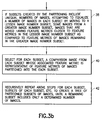
- a non-iterative recursive method that can produce a good partition is shown in Figs 3a and 3b.
- a reference image is randomly selected from the set of images in the database (step 30). Then a first seed image is found in the set of multiple images whose associated feature metric is farthest distant from the feature metric associated with the reference image (step 32). Next, a second seed image is found in the set of multiple images whose associated feature metric is farthest distant from the feature metric associated with the first image (step 34).
- the set of multiple images is partitioned into first and second subsets by: (i) allocating images to the first subset whose associated feature metrics are closer in distance to the associated feature metric of the first seed image than the feature metric associated with the second seed image; and (ii) allocating images to the second subset whose associated feature metrics are closer in distance to the associated feature metric of the second seed image than the feature metric associated with the first seed image (step 36).
- the subsets created by the partitioning include unequal numbers of images, an attempt is made to equalize the number of images in each subset by moving to a lesser image number subset, some images from a greater image number subset. Images that are moved have feature metrics closer to feature metrics in the lesser image number subset, as compared to feature metrics of images remaining in the greater image number subset (step 38).
- a comparison image is selected from each subset whose feature metric is representative of feature metrics of images partitioned into each subset (step 40).
- steps 30-40 are recursively repeated for each subset, subsets of each subset, etc. to create a tree of partitioned subsets of images, until a remaining subset includes only a determined number of images (step 42).
- a search may proceed to identify a subset of images that most closely match a base search image.
- the search proceeds as shown in Fig. 3c as follows.
- a feature metric, associated with a base search image is compared with feature metrics associated with comparison images in the first and second subsets, and either the first subset or the second subset is selected, depending on which feature metric associated with a comparison image is closer to the feature metric associated with the base search image (step 44).
- the compare action is then repeated with respect to subsets that extend from the subset selected above, down the tree of subsets until an end subset including only determined number of images is reached (step 46). Thereafter, the images in the end subset are rank ordered in accordance with how close their feature metrics are to the feature metric of the base search image (step 48). The images are then presented to the user
- FIG. 4 A block diagram of the hierarchical image search system is shown in Fig. 4.
- the overall system comprises three main subsystems:
- the objective of the image database partitioning application is to produce a hierarchical tree based on the characteristics of the images in the database.
- the system interfaces with database 52 to obtain a list of images. It also accesses all the pre-computed image feature metrics.
- Partitioning subsystem 54 partitions the images and builds a hierarchical tree. The hierarchical tree is written to disk 58 that will later be accessed by hierarchical image search subsystem 56.
- the image database partitioning subsystem 54 is started periodically to update the hierarchical tree so that the new additions to the image database are accounted for.
- Hierarchical image search subsystem 56 is invoked by the user whenever an image search is to be performed. Specifically, it reads the hierarchical tree from disk 58 and then uses this information, as well as the image feature metrics, to traverse down the tree until it arrives at a leaf of the tree. The leaf represents a subset of images that are all close to each other and are relatively close to the base search image. The subset of images is then searched and ranked to return the list of top matches to the user.
- the number of feature comparisons using (i) an exhaustive search, (ii) optimum partitioning and (iii) a 16-level hierarchical tree are 16x10 6 , 8x10 3 and 288, respectively.
Landscapes
- Engineering & Computer Science (AREA)
- Theoretical Computer Science (AREA)
- Physics & Mathematics (AREA)
- Data Mining & Analysis (AREA)
- Databases & Information Systems (AREA)
- General Engineering & Computer Science (AREA)
- General Physics & Mathematics (AREA)
- Library & Information Science (AREA)
- Mathematical Physics (AREA)
- Processing Or Creating Images (AREA)
- Information Retrieval, Db Structures And Fs Structures Therefor (AREA)
- Image Analysis (AREA)
Abstract
Description
Claims (10)
- A hierarchical method of deriving a content-based image tree from a database (52) set of multiple images, each image having an associated feature metric, the method including the steps of:a) partitioning the set of multiple images into a first subset and a second subset by allocating images to each subset whose feature metrics are closer to a feature metric of a speed image in each respective subset (step 36);b) selecting for each subset a comparison image from each subset whose feature metric is representative of feature metrics of images partitioned into the each subset (step 40); andc) recursively repeating steps a) and b) for each subset, subsets of each subset and so on, to create a tree of partitioned subsets of images, until a remaining subset includes a determined number of images (step 42).
- A method as in claim 1, wherein partitioning step a) comprises the substeps of:a1) randomly selecting a reference image from the set of images (step 30);a2) finding a first seed image in the set of multiple images whose associated feature metric is most distant from a feature metric associated with the reference image and assigning it to a first subset (step 32); anda3) finding a second seed image in the set of multiple images whose associated feature metric is most distant from the feature metric associated with the first image and assigning it to a second subset (step 34).
- A method as in claim 1 or 2, including the steps of:d) comparing a feature metric of a search image with feature metrics of comparison images in the first and second subsets and selecting either the first subset or the second subset depending on which feature metric of a comparison image in a respective subset is closer to the feature metric of the search image (step 44); ande) recursively repeating comparing step d) with respect to subsets that extend from the subset selected in step d) down the tree of subsets until a subset with a determined number of images is reached (step 46).
- A method as in claim 1, 2 or 3, wherein step a) includes the subset of:a1) if subsets created by the partitioning include unequal numbers of images, attempting to equalise a number of images in each subset by moving to a lesser image number subset, some images from a greater image number subset, images that are moved having feature metrics closer to feature metrics in the lesser image number subset as compared to feature metrics of images remaining in the greater image number subset (step 38).
- A method as in any preceding claim, wherein the feature metric is dependent on one or more values derived from: at least one of a metric of color distribution in each image; a mean and a standard deviation of each primary color component in each image; a spatial distribution of one or more colors in each image; a metric of spatial rapidity of color changes in each image; a metric of color grain sizes in each image; and a metric of directional components of each image.
- A memory medium (60) including instructions for controlling a processor to perform a hierarchical method to deriving a content-based image tree from a database set of multiple images, each image having a feature metric, the memory medium including:a) means for controlling the processor to partition the set of multiple images into a first subset and a second subset by allocating images to each subset whose feature metrics are closer to a feature metric of a seed image in each respective subset;b) means for controlling the processor to select for each subset a comparison image from the each subset whose feature metric is representative of feature metrics of images partitioned into each subset; andc) means for controlling the processor to operate recursively means a) and b) for each subset, subsets of each subset and so on, to crate a tree of partitioned subsets of images, until a remaining subset includes a determined number of images.
- A memory medium as in claim 6, wherein means a) includes:a1) means for controlling the processor to select randomly a reference image from the set of multiple images;a2) means for controlling the processor to find a first seed image in the set of multiple images whose feature metric is most distant from the feature metric of the reference image and assigning it to a first subset; anda3) means for controlling the processor to find a second seed image in the set of multiple images whose feature metric is most distant from the feature metric of the first image and assigning it to a second subset.
- A memory medium as in claim 6 or 7, comprising:d) means for controlling the processor to compare a feature metric of a base search image with feature metrics of comparison images in the first and second subsets and to select either the first subset or the second subset depending on which feature metric of a comparison image in a respective subset is closer to the feature metric of the base search image; ande) means for controlling the processor to repeat the compare action with respect to subsets that extend from the subset selected in step d) down the tree of subsets until a subset including only a determined number of images is reached.
- A memory medium as in claim 6, 7 or 8, wherein means a) is operable to control the processor to attempt to equalize the number of images in each subset if subsets created by the partitioning include unequal numbers of images, by moving to a lesser image number subset, some images from a greater image number subset, images that are moved having feature metrics closer to feature metrics in the lesser image number subset as compared to feature metrics of images remaining in the greater image number subset.
- A memory medium as in claim 6, 7, 8 or 9, wherein the feature metric is dependent on one or more values derived from: at least one of a metric of color distribution in each image; a mean and a standard deviation of each primary color component in each image; a spatial distribution of one or more colors in each image; a metric of spatial rapidity of color changes in each image; a metric of color grain sizes in each image; and a metric of directional components of each image.
Applications Claiming Priority (2)
| Application Number | Priority Date | Filing Date | Title |
|---|---|---|---|
| US40947099A | 1999-09-30 | 1999-09-30 | |
| US409470 | 1999-09-30 |
Publications (2)
| Publication Number | Publication Date |
|---|---|
| EP1089198A2 true EP1089198A2 (en) | 2001-04-04 |
| EP1089198A3 EP1089198A3 (en) | 2003-03-12 |
Family
ID=23620632
Family Applications (1)
| Application Number | Title | Priority Date | Filing Date |
|---|---|---|---|
| EP00307874A Withdrawn EP1089198A3 (en) | 1999-09-30 | 2000-09-12 | Content-based image searching |
Country Status (2)
| Country | Link |
|---|---|
| EP (1) | EP1089198A3 (en) |
| JP (1) | JP2001160070A (en) |
Cited By (7)
| Publication number | Priority date | Publication date | Assignee | Title |
|---|---|---|---|---|
| US7433895B2 (en) | 2005-06-24 | 2008-10-07 | Microsoft Corporation | Adding dominant media elements to search results |
| US8036497B2 (en) * | 2005-03-01 | 2011-10-11 | Osaka Prefecture University Public Corporation | Method, program and apparatus for storing document and/or image using invariant values calculated from feature points and method, program and apparatus for retrieving document based on stored document and/or image |
| CN103119627A (en) * | 2010-09-20 | 2013-05-22 | 高通股份有限公司 | An adaptable framework for cloud assisted augmented reality |
| US9588991B2 (en) | 2011-09-16 | 2017-03-07 | Rakuten, Inc. | Image search device, image search method, program, and computer-readable storage medium |
| US9619469B2 (en) | 2009-12-22 | 2017-04-11 | Apple Inc. | Adaptive image browsing |
| CN107480282A (en) * | 2017-08-23 | 2017-12-15 | 深圳天珑无线科技有限公司 | A kind of method and device of picture searching |
| WO2020051704A1 (en) * | 2018-09-12 | 2020-03-19 | Avigilon Corporation | System and method for improving speed of similarity based searches |
Families Citing this family (4)
| Publication number | Priority date | Publication date | Assignee | Title |
|---|---|---|---|---|
| US7425963B2 (en) * | 2001-07-16 | 2008-09-16 | Hewlett-Packard Development Company, L.P. | Hierarchical image feature-based visualization |
| CN101576932B (en) | 2009-06-16 | 2012-07-04 | 阿里巴巴集团控股有限公司 | Close-repetitive picture computer searching method and device |
| JP5577371B2 (en) | 2012-03-29 | 2014-08-20 | 楽天株式会社 | Image search apparatus, image search method, and program |
| JP5577372B2 (en) | 2012-03-29 | 2014-08-20 | 楽天株式会社 | Image search apparatus, image search method, program, and computer-readable storage medium |
Family Cites Families (3)
| Publication number | Priority date | Publication date | Assignee | Title |
|---|---|---|---|---|
| FR2717285B1 (en) * | 1994-03-08 | 1996-06-07 | Vacher Jean Noel | Object classification method, use of this method and systems for implementing the method and its use. |
| US5893095A (en) * | 1996-03-29 | 1999-04-06 | Virage, Inc. | Similarity engine for content-based retrieval of images |
| US6163622A (en) * | 1997-12-18 | 2000-12-19 | U.S. Philips Corporation | Image retrieval system |
-
2000
- 2000-09-12 EP EP00307874A patent/EP1089198A3/en not_active Withdrawn
- 2000-09-29 JP JP2000297992A patent/JP2001160070A/en active Pending
Cited By (13)
| Publication number | Priority date | Publication date | Assignee | Title |
|---|---|---|---|---|
| US8036497B2 (en) * | 2005-03-01 | 2011-10-11 | Osaka Prefecture University Public Corporation | Method, program and apparatus for storing document and/or image using invariant values calculated from feature points and method, program and apparatus for retrieving document based on stored document and/or image |
| US7996395B2 (en) | 2005-06-24 | 2011-08-09 | Microsoft Corporation | Adding dominant media elements to search results |
| US8250067B2 (en) | 2005-06-24 | 2012-08-21 | Microsoft Corporation | Adding dominant media elements to search results |
| US7433895B2 (en) | 2005-06-24 | 2008-10-07 | Microsoft Corporation | Adding dominant media elements to search results |
| US9619469B2 (en) | 2009-12-22 | 2017-04-11 | Apple Inc. | Adaptive image browsing |
| US9633447B2 (en) | 2010-09-20 | 2017-04-25 | Qualcomm Incorporated | Adaptable framework for cloud assisted augmented reality |
| CN103119627B (en) * | 2010-09-20 | 2017-03-08 | 高通股份有限公司 | Adaptability framework for cloud assist type Augmented Reality |
| US9495760B2 (en) | 2010-09-20 | 2016-11-15 | Qualcomm Incorporated | Adaptable framework for cloud assisted augmented reality |
| CN103119627A (en) * | 2010-09-20 | 2013-05-22 | 高通股份有限公司 | An adaptable framework for cloud assisted augmented reality |
| US9588991B2 (en) | 2011-09-16 | 2017-03-07 | Rakuten, Inc. | Image search device, image search method, program, and computer-readable storage medium |
| CN107480282A (en) * | 2017-08-23 | 2017-12-15 | 深圳天珑无线科技有限公司 | A kind of method and device of picture searching |
| WO2020051704A1 (en) * | 2018-09-12 | 2020-03-19 | Avigilon Corporation | System and method for improving speed of similarity based searches |
| US11386284B2 (en) | 2018-09-12 | 2022-07-12 | Avigilon Corporation | System and method for improving speed of similarity based searches |
Also Published As
| Publication number | Publication date |
|---|---|
| JP2001160070A (en) | 2001-06-12 |
| EP1089198A3 (en) | 2003-03-12 |
Similar Documents
| Publication | Publication Date | Title |
|---|---|---|
| US6347313B1 (en) | Information embedding based on user relevance feedback for object retrieval | |
| KR100860902B1 (en) | Method and apparatus for representing and searching for colour images | |
| US6163622A (en) | Image retrieval system | |
| Aksoy et al. | Textural features for image database retrieval | |
| Zhang et al. | Scheme for visual feature-based image indexing | |
| US6285995B1 (en) | Image retrieval system using a query image | |
| US5542089A (en) | Method and apparatus for estimating the number of occurrences of frequent values in a data set | |
| EP1036354B1 (en) | A scalable solution for image retrieval | |
| JP2001202523A (en) | Image processing method and apparatus | |
| CN109614510B (en) | Image retrieval method, image retrieval device, image processor and storage medium | |
| US5367677A (en) | System for iterated generation from an array of records of a posting file with row segments based on column entry value ranges | |
| US20060093221A1 (en) | Image retrieval device, image retrieval method and storage medium storing similar-image retrieval program | |
| EP1089198A2 (en) | Content-based image searching | |
| EP1494136A1 (en) | Method and device for measuring visual similarity of images | |
| KR20030066582A (en) | Palette-based histogram matching with recursive histogram vector generation | |
| WO2005002243A2 (en) | Multidimensional data object searching using bit vector indices | |
| US20060190425A1 (en) | Method for merging multiple ranked lists with bounded memory | |
| US20020059206A1 (en) | Method for searching multimedia using progressive histogram | |
| JP4215386B2 (en) | Similar object search method and similar object search device | |
| Berman et al. | Selecting good keys for triangle-inequality-based pruning algorithms | |
| Egas et al. | Adapting kd trees to visual retrieval | |
| JPH11288418A (en) | Image retrieval apparatus and method | |
| Paredes et al. | A probabilistic model for user relevance feedback on image retrieval | |
| Brunelli et al. | Compass: an image retrieval system for distributed databases | |
| KR19990025292A (en) | An Effective Search Method of Image Database by Filtering Process |
Legal Events
| Date | Code | Title | Description |
|---|---|---|---|
| PUAI | Public reference made under article 153(3) epc to a published international application that has entered the european phase |
Free format text: ORIGINAL CODE: 0009012 |
|
| AK | Designated contracting states |
Kind code of ref document: A2 Designated state(s): AT BE CH CY DE DK ES FI FR GB GR IE IT LI LU MC NL PT SE |
|
| AX | Request for extension of the european patent |
Free format text: AL;LT;LV;MK;RO;SI |
|
| RAP1 | Party data changed (applicant data changed or rights of an application transferred) |
Owner name: HEWLETT-PACKARD COMPANY, A DELAWARE CORPORATION |
|
| PUAL | Search report despatched |
Free format text: ORIGINAL CODE: 0009013 |
|
| AK | Designated contracting states |
Kind code of ref document: A3 Designated state(s): AT BE CH CY DE DK ES FI FR GB GR IE IT LI LU MC NL PT SE |
|
| AX | Request for extension of the european patent |
Extension state: AL LT LV MK RO SI |
|
| 17P | Request for examination filed |
Effective date: 20030519 |
|
| AKX | Designation fees paid |
Designated state(s): DE FR GB SE |
|
| STAA | Information on the status of an ep patent application or granted ep patent |
Free format text: STATUS: THE APPLICATION IS DEEMED TO BE WITHDRAWN |
|
| 18D | Application deemed to be withdrawn |
Effective date: 20060531 |