EP1088811A1 - A novel cross-aldol condensation for hydroxypivaldehyde - Google Patents
A novel cross-aldol condensation for hydroxypivaldehyde Download PDFInfo
- Publication number
- EP1088811A1 EP1088811A1 EP99118634A EP99118634A EP1088811A1 EP 1088811 A1 EP1088811 A1 EP 1088811A1 EP 99118634 A EP99118634 A EP 99118634A EP 99118634 A EP99118634 A EP 99118634A EP 1088811 A1 EP1088811 A1 EP 1088811A1
- Authority
- EP
- European Patent Office
- Prior art keywords
- aldehyde
- aldol
- cho
- formula
- carbon atoms
- Prior art date
- Legal status (The legal status is an assumption and is not a legal conclusion. Google has not performed a legal analysis and makes no representation as to the accuracy of the status listed.)
- Granted
Links
- JJMOMMLADQPZNY-UHFFFAOYSA-N 3-hydroxy-2,2-dimethylpropanal Chemical compound OCC(C)(C)C=O JJMOMMLADQPZNY-UHFFFAOYSA-N 0.000 title claims abstract description 23
- 238000005882 aldol condensation reaction Methods 0.000 title abstract description 10
- 150000001299 aldehydes Chemical class 0.000 claims abstract description 73
- HSJKGGMUJITCBW-UHFFFAOYSA-N 3-hydroxybutanal Chemical compound CC(O)CC=O HSJKGGMUJITCBW-UHFFFAOYSA-N 0.000 claims abstract description 50
- 238000006243 chemical reaction Methods 0.000 claims abstract description 48
- AMIMRNSIRUDHCM-UHFFFAOYSA-N Isopropylaldehyde Chemical compound CC(C)C=O AMIMRNSIRUDHCM-UHFFFAOYSA-N 0.000 claims abstract description 46
- WSFSSNUMVMOOMR-UHFFFAOYSA-N Formaldehyde Chemical compound O=C WSFSSNUMVMOOMR-UHFFFAOYSA-N 0.000 claims abstract description 38
- 238000000034 method Methods 0.000 claims abstract description 26
- 239000000203 mixture Substances 0.000 claims abstract description 26
- 239000003444 phase transfer catalyst Substances 0.000 claims abstract description 25
- 125000004432 carbon atom Chemical group C* 0.000 claims abstract description 20
- 239000000047 product Substances 0.000 claims abstract description 15
- 125000000217 alkyl group Chemical group 0.000 claims abstract description 14
- 125000003710 aryl alkyl group Chemical group 0.000 claims abstract description 14
- 239000007795 chemical reaction product Substances 0.000 claims abstract description 13
- 230000018044 dehydration Effects 0.000 claims abstract description 10
- 238000006297 dehydration reaction Methods 0.000 claims abstract description 10
- 238000009833 condensation Methods 0.000 claims abstract description 9
- 230000005494 condensation Effects 0.000 claims abstract description 9
- 125000004429 atom Chemical group 0.000 claims abstract description 8
- 230000015572 biosynthetic process Effects 0.000 claims abstract description 8
- 150000001450 anions Chemical class 0.000 claims abstract description 7
- 238000003786 synthesis reaction Methods 0.000 claims abstract description 6
- 229910052757 nitrogen Inorganic materials 0.000 claims abstract description 4
- IJGRMHOSHXDMSA-UHFFFAOYSA-N nitrogen Substances N#N IJGRMHOSHXDMSA-UHFFFAOYSA-N 0.000 claims abstract description 4
- QJGQUHMNIGDVPM-UHFFFAOYSA-N nitrogen group Chemical group [N] QJGQUHMNIGDVPM-UHFFFAOYSA-N 0.000 claims abstract description 4
- 125000004437 phosphorous atom Chemical group 0.000 claims abstract description 4
- 229910052698 phosphorus Chemical group 0.000 claims abstract description 4
- 230000008569 process Effects 0.000 claims description 14
- SLCVBVWXLSEKPL-UHFFFAOYSA-N neopentyl glycol Chemical compound OCC(C)(C)CO SLCVBVWXLSEKPL-UHFFFAOYSA-N 0.000 claims description 8
- 239000011541 reaction mixture Substances 0.000 claims description 7
- 230000003197 catalytic effect Effects 0.000 claims description 6
- 230000035484 reaction time Effects 0.000 claims description 6
- 239000002904 solvent Substances 0.000 claims description 5
- LFQSCWFLJHTTHZ-UHFFFAOYSA-N Ethanol Chemical compound CCO LFQSCWFLJHTTHZ-UHFFFAOYSA-N 0.000 claims description 4
- 229930040373 Paraformaldehyde Natural products 0.000 claims description 4
- NDKBVBUGCNGSJJ-UHFFFAOYSA-M benzyltrimethylammonium hydroxide Chemical compound [OH-].C[N+](C)(C)CC1=CC=CC=C1 NDKBVBUGCNGSJJ-UHFFFAOYSA-M 0.000 claims description 4
- 238000000605 extraction Methods 0.000 claims description 4
- -1 hydroxypivaldehyde Chemical compound 0.000 claims description 4
- 229920002866 paraformaldehyde Polymers 0.000 claims description 4
- 239000007787 solid Substances 0.000 claims description 4
- BGJSXRVXTHVRSN-UHFFFAOYSA-N 1,3,5-trioxane Chemical compound C1OCOCO1 BGJSXRVXTHVRSN-UHFFFAOYSA-N 0.000 claims description 3
- FKPSBYZGRQJIMO-UHFFFAOYSA-M benzyl(triethyl)azanium;hydroxide Chemical compound [OH-].CC[N+](CC)(CC)CC1=CC=CC=C1 FKPSBYZGRQJIMO-UHFFFAOYSA-M 0.000 claims description 3
- DJFBJKSMACBYBD-UHFFFAOYSA-N phosphane;hydrate Chemical compound O.P DJFBJKSMACBYBD-UHFFFAOYSA-N 0.000 claims description 2
- QGZKDVFQNNGYKY-UHFFFAOYSA-O Ammonium Chemical compound [NH4+] QGZKDVFQNNGYKY-UHFFFAOYSA-O 0.000 claims 1
- 230000001476 alcoholic effect Effects 0.000 claims 1
- 238000009903 catalytic hydrogenation reaction Methods 0.000 claims 1
- 239000003054 catalyst Substances 0.000 abstract description 23
- 125000002485 formyl group Chemical group [H]C(*)=O 0.000 abstract 1
- 238000005984 hydrogenation reaction Methods 0.000 abstract 1
- ZMANZCXQSJIPKH-UHFFFAOYSA-N Triethylamine Chemical compound CCN(CC)CC ZMANZCXQSJIPKH-UHFFFAOYSA-N 0.000 description 24
- 239000002585 base Substances 0.000 description 17
- XLYOFNOQVPJJNP-UHFFFAOYSA-N water Substances O XLYOFNOQVPJJNP-UHFFFAOYSA-N 0.000 description 10
- OKKJLVBELUTLKV-UHFFFAOYSA-N Methanol Chemical compound OC OKKJLVBELUTLKV-UHFFFAOYSA-N 0.000 description 9
- 239000000243 solution Substances 0.000 description 9
- 229940086542 triethylamine Drugs 0.000 description 8
- 239000000376 reactant Substances 0.000 description 7
- 229920003002 synthetic resin Polymers 0.000 description 7
- 238000004817 gas chromatography Methods 0.000 description 6
- 239000002952 polymeric resin Substances 0.000 description 6
- QTBSBXVTEAMEQO-UHFFFAOYSA-N Acetic acid Chemical compound CC(O)=O QTBSBXVTEAMEQO-UHFFFAOYSA-N 0.000 description 5
- ZTQSAGDEMFDKMZ-UHFFFAOYSA-N Butyraldehyde Chemical compound CCCC=O ZTQSAGDEMFDKMZ-UHFFFAOYSA-N 0.000 description 5
- 230000008901 benefit Effects 0.000 description 5
- 239000006227 byproduct Substances 0.000 description 5
- 239000012071 phase Substances 0.000 description 5
- 238000003756 stirring Methods 0.000 description 5
- XKRFYHLGVUSROY-UHFFFAOYSA-N Argon Chemical compound [Ar] XKRFYHLGVUSROY-UHFFFAOYSA-N 0.000 description 4
- 239000003795 chemical substances by application Substances 0.000 description 4
- 230000000052 comparative effect Effects 0.000 description 4
- 238000002474 experimental method Methods 0.000 description 4
- BWHMMNNQKKPAPP-UHFFFAOYSA-L potassium carbonate Chemical compound [K+].[K+].[O-]C([O-])=O BWHMMNNQKKPAPP-UHFFFAOYSA-L 0.000 description 4
- VHUUQVKOLVNVRT-UHFFFAOYSA-N Ammonium hydroxide Chemical compound [NH4+].[OH-] VHUUQVKOLVNVRT-UHFFFAOYSA-N 0.000 description 3
- XEKOWRVHYACXOJ-UHFFFAOYSA-N Ethyl acetate Chemical compound CCOC(C)=O XEKOWRVHYACXOJ-UHFFFAOYSA-N 0.000 description 3
- HEMHJVSKTPXQMS-UHFFFAOYSA-M Sodium hydroxide Chemical compound [OH-].[Na+] HEMHJVSKTPXQMS-UHFFFAOYSA-M 0.000 description 3
- 239000008346 aqueous phase Substances 0.000 description 3
- 239000007864 aqueous solution Substances 0.000 description 3
- 239000012300 argon atmosphere Substances 0.000 description 3
- XLYOFNOQVPJJNP-UHFFFAOYSA-M hydroxide Chemical compound [OH-] XLYOFNOQVPJJNP-UHFFFAOYSA-M 0.000 description 3
- 238000004519 manufacturing process Methods 0.000 description 3
- 230000007246 mechanism Effects 0.000 description 3
- WSFSSNUMVMOOMR-NJFSPNSNSA-N methanone Chemical compound O=[14CH2] WSFSSNUMVMOOMR-NJFSPNSNSA-N 0.000 description 3
- 239000012074 organic phase Substances 0.000 description 3
- 238000004064 recycling Methods 0.000 description 3
- BYGQBDHUGHBGMD-UHFFFAOYSA-N 2-methylbutanal Chemical compound CCC(C)C=O BYGQBDHUGHBGMD-UHFFFAOYSA-N 0.000 description 2
- IKHGUXGNUITLKF-UHFFFAOYSA-N Acetaldehyde Chemical compound CC=O IKHGUXGNUITLKF-UHFFFAOYSA-N 0.000 description 2
- NBBJYMSMWIIQGU-UHFFFAOYSA-N Propionic aldehyde Chemical compound CCC=O NBBJYMSMWIIQGU-UHFFFAOYSA-N 0.000 description 2
- CDBYLPFSWZWCQE-UHFFFAOYSA-L Sodium Carbonate Chemical compound [Na+].[Na+].[O-]C([O-])=O CDBYLPFSWZWCQE-UHFFFAOYSA-L 0.000 description 2
- 229960000583 acetic acid Drugs 0.000 description 2
- 230000009471 action Effects 0.000 description 2
- 150000008044 alkali metal hydroxides Chemical class 0.000 description 2
- 150000001412 amines Chemical class 0.000 description 2
- 239000000908 ammonium hydroxide Substances 0.000 description 2
- 238000005349 anion exchange Methods 0.000 description 2
- 229910052786 argon Inorganic materials 0.000 description 2
- 150000003934 aromatic aldehydes Chemical class 0.000 description 2
- 125000003118 aryl group Chemical group 0.000 description 2
- 239000003153 chemical reaction reagent Substances 0.000 description 2
- 150000001875 compounds Chemical class 0.000 description 2
- 238000006482 condensation reaction Methods 0.000 description 2
- 125000000753 cycloalkyl group Chemical group 0.000 description 2
- 238000000354 decomposition reaction Methods 0.000 description 2
- 239000008098 formaldehyde solution Substances 0.000 description 2
- 239000007789 gas Substances 0.000 description 2
- 238000002347 injection Methods 0.000 description 2
- 239000007924 injection Substances 0.000 description 2
- HGBOYTHUEUWSSQ-UHFFFAOYSA-N pentanal Chemical compound CCCCC=O HGBOYTHUEUWSSQ-UHFFFAOYSA-N 0.000 description 2
- 238000003408 phase transfer catalysis Methods 0.000 description 2
- 229910000027 potassium carbonate Inorganic materials 0.000 description 2
- 125000001453 quaternary ammonium group Chemical group 0.000 description 2
- 239000012429 reaction media Substances 0.000 description 2
- 239000000126 substance Substances 0.000 description 2
- 239000001893 (2R)-2-methylbutanal Substances 0.000 description 1
- ZHDDGKNACKSKEF-UHFFFAOYSA-N 2,3-diphenylpropanal Chemical compound C=1C=CC=CC=1C(C=O)CC1=CC=CC=C1 ZHDDGKNACKSKEF-UHFFFAOYSA-N 0.000 description 1
- PUAQLLVFLMYYJJ-UHFFFAOYSA-N 2-aminopropiophenone Chemical compound CC(N)C(=O)C1=CC=CC=C1 PUAQLLVFLMYYJJ-UHFFFAOYSA-N 0.000 description 1
- UQURIQWAEZGLAC-UHFFFAOYSA-N 2-cyclohexylpropanal Chemical compound O=CC(C)C1CCCCC1 UQURIQWAEZGLAC-UHFFFAOYSA-N 0.000 description 1
- SHGPBDQRELYPLO-UHFFFAOYSA-N 2-ethyl-3-methylbutanal Chemical compound CCC(C=O)C(C)C SHGPBDQRELYPLO-UHFFFAOYSA-N 0.000 description 1
- LGYNIFWIKSEESD-UHFFFAOYSA-N 2-ethylhexanal Chemical compound CCCCC(CC)C=O LGYNIFWIKSEESD-UHFFFAOYSA-N 0.000 description 1
- OZGRFPZYTKHWMZ-UHFFFAOYSA-N 2-ethylpentanal Chemical compound CCCC(CC)C=O OZGRFPZYTKHWMZ-UHFFFAOYSA-N 0.000 description 1
- DIBSCKQIZZVKMG-UHFFFAOYSA-N 2-phenylbutanal Chemical compound CCC(C=O)C1=CC=CC=C1 DIBSCKQIZZVKMG-UHFFFAOYSA-N 0.000 description 1
- IQVAERDLDAZARL-UHFFFAOYSA-N 2-phenylpropanal Chemical compound O=CC(C)C1=CC=CC=C1 IQVAERDLDAZARL-UHFFFAOYSA-N 0.000 description 1
- 150000001298 alcohols Chemical class 0.000 description 1
- 125000001931 aliphatic group Chemical group 0.000 description 1
- 239000003513 alkali Substances 0.000 description 1
- 229910000288 alkali metal carbonate Inorganic materials 0.000 description 1
- 150000008041 alkali metal carbonates Chemical class 0.000 description 1
- 229910001860 alkaline earth metal hydroxide Inorganic materials 0.000 description 1
- 150000003973 alkyl amines Chemical group 0.000 description 1
- 150000004649 carbonic acid derivatives Chemical class 0.000 description 1
- 238000005341 cation exchange Methods 0.000 description 1
- 239000007810 chemical reaction solvent Substances 0.000 description 1
- 230000003247 decreasing effect Effects 0.000 description 1
- VILAVOFMIJHSJA-UHFFFAOYSA-N dicarbon monoxide Chemical group [C]=C=O VILAVOFMIJHSJA-UHFFFAOYSA-N 0.000 description 1
- 230000000694 effects Effects 0.000 description 1
- 229920001971 elastomer Polymers 0.000 description 1
- 239000012362 glacial acetic acid Substances 0.000 description 1
- 239000011521 glass Substances 0.000 description 1
- 239000001257 hydrogen Substances 0.000 description 1
- 229910052739 hydrogen Inorganic materials 0.000 description 1
- 230000001771 impaired effect Effects 0.000 description 1
- 239000012535 impurity Substances 0.000 description 1
- 230000003993 interaction Effects 0.000 description 1
- 150000002500 ions Chemical class 0.000 description 1
- GJRQTCIYDGXPES-UHFFFAOYSA-N iso-butyl acetate Natural products CC(C)COC(C)=O GJRQTCIYDGXPES-UHFFFAOYSA-N 0.000 description 1
- FGKJLKRYENPLQH-UHFFFAOYSA-M isocaproate Chemical compound CC(C)CCC([O-])=O FGKJLKRYENPLQH-UHFFFAOYSA-M 0.000 description 1
- OQAGVSWESNCJJT-UHFFFAOYSA-N isovaleric acid methyl ester Natural products COC(=O)CC(C)C OQAGVSWESNCJJT-UHFFFAOYSA-N 0.000 description 1
- 239000007788 liquid Substances 0.000 description 1
- 239000011344 liquid material Substances 0.000 description 1
- 239000000314 lubricant Substances 0.000 description 1
- 239000000395 magnesium oxide Substances 0.000 description 1
- CPLXHLVBOLITMK-UHFFFAOYSA-N magnesium oxide Inorganic materials [Mg]=O CPLXHLVBOLITMK-UHFFFAOYSA-N 0.000 description 1
- AXZKOIWUVFPNLO-UHFFFAOYSA-N magnesium;oxygen(2-) Chemical compound [O-2].[Mg+2] AXZKOIWUVFPNLO-UHFFFAOYSA-N 0.000 description 1
- 230000014759 maintenance of location Effects 0.000 description 1
- 239000000463 material Substances 0.000 description 1
- 238000010907 mechanical stirring Methods 0.000 description 1
- 125000002496 methyl group Chemical group [H]C([H])([H])* 0.000 description 1
- 239000002480 mineral oil Substances 0.000 description 1
- 235000010446 mineral oil Nutrition 0.000 description 1
- 230000004048 modification Effects 0.000 description 1
- 238000012986 modification Methods 0.000 description 1
- 238000006386 neutralization reaction Methods 0.000 description 1
- 230000000269 nucleophilic effect Effects 0.000 description 1
- 239000003960 organic solvent Substances 0.000 description 1
- 239000004014 plasticizer Substances 0.000 description 1
- 229920000642 polymer Polymers 0.000 description 1
- 229920002635 polyurethane Polymers 0.000 description 1
- 239000004814 polyurethane Substances 0.000 description 1
- 239000002243 precursor Substances 0.000 description 1
- 238000002360 preparation method Methods 0.000 description 1
- 229920005989 resin Polymers 0.000 description 1
- 239000011347 resin Substances 0.000 description 1
- 229920006395 saturated elastomer Polymers 0.000 description 1
- 238000000926 separation method Methods 0.000 description 1
- 238000007086 side reaction Methods 0.000 description 1
- 229910000029 sodium carbonate Inorganic materials 0.000 description 1
- 230000008961 swelling Effects 0.000 description 1
- 239000000057 synthetic resin Substances 0.000 description 1
- 125000005207 tetraalkylammonium group Chemical group 0.000 description 1
- 229920006305 unsaturated polyester Polymers 0.000 description 1
Classifications
-
- C—CHEMISTRY; METALLURGY
- C07—ORGANIC CHEMISTRY
- C07C—ACYCLIC OR CARBOCYCLIC COMPOUNDS
- C07C45/00—Preparation of compounds having >C = O groups bound only to carbon or hydrogen atoms; Preparation of chelates of such compounds
- C07C45/78—Separation; Purification; Stabilisation; Use of additives
- C07C45/80—Separation; Purification; Stabilisation; Use of additives by liquid-liquid treatment
-
- C—CHEMISTRY; METALLURGY
- C07—ORGANIC CHEMISTRY
- C07C—ACYCLIC OR CARBOCYCLIC COMPOUNDS
- C07C29/00—Preparation of compounds having hydroxy or O-metal groups bound to a carbon atom not belonging to a six-membered aromatic ring
- C07C29/132—Preparation of compounds having hydroxy or O-metal groups bound to a carbon atom not belonging to a six-membered aromatic ring by reduction of an oxygen containing functional group
- C07C29/136—Preparation of compounds having hydroxy or O-metal groups bound to a carbon atom not belonging to a six-membered aromatic ring by reduction of an oxygen containing functional group of >C=O containing groups, e.g. —COOH
- C07C29/14—Preparation of compounds having hydroxy or O-metal groups bound to a carbon atom not belonging to a six-membered aromatic ring by reduction of an oxygen containing functional group of >C=O containing groups, e.g. —COOH of a —CHO group
- C07C29/141—Preparation of compounds having hydroxy or O-metal groups bound to a carbon atom not belonging to a six-membered aromatic ring by reduction of an oxygen containing functional group of >C=O containing groups, e.g. —COOH of a —CHO group with hydrogen or hydrogen-containing gases
-
- C—CHEMISTRY; METALLURGY
- C07—ORGANIC CHEMISTRY
- C07C—ACYCLIC OR CARBOCYCLIC COMPOUNDS
- C07C45/00—Preparation of compounds having >C = O groups bound only to carbon or hydrogen atoms; Preparation of chelates of such compounds
- C07C45/61—Preparation of compounds having >C = O groups bound only to carbon or hydrogen atoms; Preparation of chelates of such compounds by reactions not involving the formation of >C = O groups
- C07C45/67—Preparation of compounds having >C = O groups bound only to carbon or hydrogen atoms; Preparation of chelates of such compounds by reactions not involving the formation of >C = O groups by isomerisation; by change of size of the carbon skeleton
- C07C45/68—Preparation of compounds having >C = O groups bound only to carbon or hydrogen atoms; Preparation of chelates of such compounds by reactions not involving the formation of >C = O groups by isomerisation; by change of size of the carbon skeleton by increase in the number of carbon atoms
- C07C45/72—Preparation of compounds having >C = O groups bound only to carbon or hydrogen atoms; Preparation of chelates of such compounds by reactions not involving the formation of >C = O groups by isomerisation; by change of size of the carbon skeleton by increase in the number of carbon atoms by reaction of compounds containing >C = O groups with the same or other compounds containing >C = O groups
-
- C—CHEMISTRY; METALLURGY
- C07—ORGANIC CHEMISTRY
- C07C—ACYCLIC OR CARBOCYCLIC COMPOUNDS
- C07C45/00—Preparation of compounds having >C = O groups bound only to carbon or hydrogen atoms; Preparation of chelates of such compounds
- C07C45/61—Preparation of compounds having >C = O groups bound only to carbon or hydrogen atoms; Preparation of chelates of such compounds by reactions not involving the formation of >C = O groups
- C07C45/67—Preparation of compounds having >C = O groups bound only to carbon or hydrogen atoms; Preparation of chelates of such compounds by reactions not involving the formation of >C = O groups by isomerisation; by change of size of the carbon skeleton
- C07C45/68—Preparation of compounds having >C = O groups bound only to carbon or hydrogen atoms; Preparation of chelates of such compounds by reactions not involving the formation of >C = O groups by isomerisation; by change of size of the carbon skeleton by increase in the number of carbon atoms
- C07C45/72—Preparation of compounds having >C = O groups bound only to carbon or hydrogen atoms; Preparation of chelates of such compounds by reactions not involving the formation of >C = O groups by isomerisation; by change of size of the carbon skeleton by increase in the number of carbon atoms by reaction of compounds containing >C = O groups with the same or other compounds containing >C = O groups
- C07C45/74—Preparation of compounds having >C = O groups bound only to carbon or hydrogen atoms; Preparation of chelates of such compounds by reactions not involving the formation of >C = O groups by isomerisation; by change of size of the carbon skeleton by increase in the number of carbon atoms by reaction of compounds containing >C = O groups with the same or other compounds containing >C = O groups combined with dehydration
-
- C—CHEMISTRY; METALLURGY
- C07—ORGANIC CHEMISTRY
- C07C—ACYCLIC OR CARBOCYCLIC COMPOUNDS
- C07C45/00—Preparation of compounds having >C = O groups bound only to carbon or hydrogen atoms; Preparation of chelates of such compounds
- C07C45/61—Preparation of compounds having >C = O groups bound only to carbon or hydrogen atoms; Preparation of chelates of such compounds by reactions not involving the formation of >C = O groups
- C07C45/67—Preparation of compounds having >C = O groups bound only to carbon or hydrogen atoms; Preparation of chelates of such compounds by reactions not involving the formation of >C = O groups by isomerisation; by change of size of the carbon skeleton
- C07C45/68—Preparation of compounds having >C = O groups bound only to carbon or hydrogen atoms; Preparation of chelates of such compounds by reactions not involving the formation of >C = O groups by isomerisation; by change of size of the carbon skeleton by increase in the number of carbon atoms
- C07C45/72—Preparation of compounds having >C = O groups bound only to carbon or hydrogen atoms; Preparation of chelates of such compounds by reactions not involving the formation of >C = O groups by isomerisation; by change of size of the carbon skeleton by increase in the number of carbon atoms by reaction of compounds containing >C = O groups with the same or other compounds containing >C = O groups
- C07C45/75—Reactions with formaldehyde
Definitions
- This invention relates generally to a novel process for aldol condensation of aldehydes, and particularly to a process for forming desired aldols by the reaction of specified aldehydes in the presence of basic phase-transfer catalyst. More particularly, this invention relates to using tetra alkyl ammonium or phosphonium hydroxides as phase-transfer catalyst in simple or cross-aldol condensation.
- aldehydes in the so-called “aldol condensation” reaction
- aldol condensation a nucleophilic carbanion, produced, for example, by the action of a strong base or alkali ion on aldehyde having an ⁇ -hydrogen atom, attacks the carbonyl carbon atom of another aldehyde molecule. If the second aldehyde is different from the first one, the process is called "cross-aldol” condensation.
- the aldehyde-alcohol (aldol) produced by the reaction may be recovered, or it may be treated directly in the reaction system or reaction product admixture to form a desired product.
- the aldol de-hydrates spontaneously or promptly in the process admixture or environment, or is easily dehydrated, forming an unsaturated aldehyde, which can be recovered or treated further.
- HPA Hydroxypivaldehyde
- Neopentyl glycol in turn, has been widely used as an intermediate for the synthesis of saturated and unsaturated polyesters and in manufacture of synthetic resin, polyurethanes, synthetic lubricants, polymers and plasticizers.
- US patent 2,818,443 has disclosed a reaction of formaldehyde and an aliphatic aldehyde in the presence of anion exchange polymeric resin catalyst to form hydroxyaldehyde.
- DE patent 26 53 096 proposes the use of cation exchange polymeric resins as a catalyst for the aldolization reaction.
- WO 98/29374 (PCT/F197/00835) describes the use of a weak base anion exchange polymeric resins as an aldolization catalyst.
- Solid base catalysts also have been employed in the cross-aldolization reaction.
- WO 97/35825 discloses the use of hydrated magnesium oxide.
- isobutyraldehyde is taken in large excess, at least 3 mole equivalent, it needs longer time, and at least two side products are formed.
- U.S. Pat. No. 2,811,562 has disclosed the use of alkali metal carbonate such as potassium carbonate as a base catalyst.
- the disadvantage in this process is that it requires an elevated temperature such as 60-75°C, and long reaction time usually 2 - 4 hours.
- U.S. Pat. No. 3,920,760 has disclosed the use of sodium carbonate base but do not demonstrate any better advantage over potassium carbonate.
- U.S. Pat. No. 5,841,002 discloses the use of sodium hydroxide base catalyst for cross-aldolization of isobutyraldehyde with formaldehyde.
- recycling of base involves quite elaborate electrolytic process.
- alkali metal hydroxide base leads to crossed Canizzaro and Tischenko reaction side products even if the reaction temperature rises slightly.
- one of the objectives of the present invention is to overcome the difficulties and disadvantages encountered in the prior art by providing a phase-transfer catalyzed novel process for the synthesis of hydroxypivaldehyde.
- the invention relates to a process for the condensation of an aldehyde comprising contacting or combining aldehyde containing an ⁇ -hydrogen atom and having the formula R 1 CHO, wherein R 1 is selected from alkyl having one to twelve carbon atoms, and aralkyl having seven to fourteen carbon atoms, with a catalytic amount of a phase-transfer catalyst of Formula (I), where Y particularly being hydroxide anion in this invention.
- reaction product mixture comprising or containing an aldol of said aldehyde, the unsaturated aldehyde derived by dehydration of said aldol, or mixtures thereof.
- the expression "the unsaturated aldehyde derived by dehydration of said aldol” refers to the ⁇ , ⁇ -olefinic aldehyde resulting from the decomposition of the aldol produced by the condensation, which decomposition also results in or is characterized by the formation of water as a product.
- This invention also relates particularly to an aldehyde condensation process comprising contacting or combining a first aldehyde selected from aldehydes containing an ⁇ -hydrogen atom having the formula R 1 CHO, wherein R 1 is selected from alkyl having one to twelve carbon atoms, and aralkyl having one to fourteen carbon atoms, with a second different aldehyde selected from aldehydes having the formula R 2 CHO, wherein R 2 is selected from H, alkyl having one to twelve carbon atoms, and aralkyl having one to fourteen carbon atoms, and with a catalytic amount of Formula (I), under reaction conditions to form reaction product mixture comprising or containing an aldol of said aldehydes, the unsaturated aldehyde derived by dehydration of said aldol, or mixtures thereof.
- R 1 is selected from alkyl having one to twelve carbon atoms, and aralkyl having one to fourteen carbon atoms
- R 2 is
- reaction product mixtures of the invention will comprise or contain one of (A) the aldol of the aldehyde condensed, or of the aldehydes cross condensed; (B) the unsaturated aldehyde derived by dehydration of said aldol; or (C) a mixture of (A) and (B).
- any stable aldol formed may be separated from the reaction mixture produced, and treated as desired, e.g., hydrogenated to form a hydrogenated mixture containing a di-alcohol therein.
- the invention is particularly useful for the condensation of n-butyraldehyde and the cross condensations of n-butyraldehyde, or isobutyraldehyde, with formaldehyde.
- phase-transfer catalyst no more than 4 mole % equivalent of phase-transfer catalyst is needed in this reaction. No other (or additional) base is required by virtue of this phase-transfer catalyst containing hydroxide counter anion (a basic entity necessary to initiate the first step in the reaction by de-protonation of the ⁇ -hydrogen atom of isobutyraldehyde).
- hydroxide counter anion a basic entity necessary to initiate the first step in the reaction by de-protonation of the ⁇ -hydrogen atom of isobutyraldehyde.
- the catalyst can be easily recovered by extraction with a suitable solvent.
- This reagent provides 100% selectivity of the product hydroxypivaldehyde (including 2-5% of NPG formed). It should be noted that hydroxypivaldehyde being the precursor intermediate for neopentyl glycol, to our advantage, neopentyl glycol is already being formed from it in small amount.
- This reaction represents cross-aldol condensation between two different aldehydes, namely isobutyraldehyde having an ⁇ -hydrogen atom and formaldehyde having no ⁇ -hydrogen atom, for the synthesis of aldehyde-alcohol, namely hydroxypivaldehyde (HPA).
- HPA hydroxypivaldehyde
- the expression "formaldehyde” comprises both conventional formaldehyde obtained as an aqueous solution and anhydrous forms of formaldehyde, such as paraformaldehyde and trioxane.
- Commercially available aqueous formaldehyde usually also contain relatively small amounts of methanol.
- the problem at hand in this invention is the following. Reaction between two substances located in different phases of a mixture is often inhibited because of the inability of reagents to come together.
- Isobutyraldehyde is a liquid material that makes the water insoluble organic phase.
- formaldehyde solution makes the aqueous phase because it comes as 37 - 40% aqueous solution.
- these two reacting components create a non-homogeneous two phase reaction medium. Therefore, interaction of the two reacting components is not sufficient enough for smooth cross-aldolization leading to the product hydroxypivaldehyde.
- the equilibrium in the first step of the reaction mechanism tries to be more to the backward (i.e., to the starting isobutyraldehyde).
- reaction mixture homogeneous by using a solvent such as methanol or ethanol.
- a solvent such as methanol or ethanol.
- phase-transfer catalyst PTC
- Reaction is brought about by the use of small quantities of an agent, which transfers one reactant across the interface into the other phase, so that reaction can proceed.
- phase-transfer catalysts are defined as compounds whose addition to a two-phase organic-water system helps transfer a water soluble reactant across the interface to the organic phase where a homogeneous reaction can occur. This can also help transfer a water insoluble reactant across the interface to the aqueous phase where a homogeneous reaction can occur.
- phase-transfer agent is not consumed but performs the transport function repeatedly.
- Organic-soluble quaternary ammonium or phosphonium cations have been found to be excellent agents for the transport of anions from aqueous phase to an organic phase.
- phase-transfer catalyst namely benzyltrimethyl or benzyltriethyl ammonium hydroxide which is also known as Triton B (methyl version) (Fluka Catalog # 13991). This comes as a 40% solution in water. Its chemical formula is given below:
- the hydroxide counter anion acts as a base entity to de-protonate ⁇ -hydrogen of the isobutyraldehyde molecule, whereas the quaternary ammonium cation part assists in the phase-transfer mechanism.
- anhydrous formaldehyde such as paraformaldehyde or trioxane
- some amount of water could be added to generate a binary phase reaction medium.
- our invention seems to be by far the first example of phase-transfer catalyzed aldol condensation involving two different kind of aliphatic aldehydes. thereby making an excellent representation of cross-aldol condensation.
- the concept of basic phase-transfer catalysis is easily extended to aldehydes in which at least one of the aldehydes should contain an ⁇ -hydrogen atom.
- the said aldehyde may have a general formula of R 1 CHO, where R 1 is selected from alkyl having 1-12 carbon atoms, cycloalkyl, aryl, and aralkyl having 1-14 carbon atoms.
- the aldolization reaction forms a reaction product mixture comprising or containing an aldol of said aldehyde, an unsaturated aldehyde derived by dehydration of said aldol, or mixtures thereof. Meaning of unsaturated aldehyde has been defined previously.
- the present invention preferably relates to an aldolization reaction of aldehydes containing a mixture of an aldehyde containing ⁇ -hydrogen atom defined above and a second different aldehyde having a general formula of R 2 CHO, where R 2 is selected from H, alkyl having 1-12 carbon atoms, cycloalkyl, aryl and aralkyl having 1-14 carbon atoms, in the presence of catalytic amount of benzyltriethyl ammonium hydroxide.
- Suitable starting aldehydes are, for example, formaldehyde, ethanal, propanal, butanal, pentanal, 2-methylpropanal(isobutyraldehyde), 2-methyl butanal, 2-ethylpentanal, 2-ethylhexanal, 2-isopropylbutanal, 2-phenylpropanal, 2-cyclohexylpropanal, 2-phenylbutanal, 2,3-diphenylpropanal, cyclopentylaldehye and cyclohexylaldehye.
- the aldehyde or aldehydes chosen be pure or substantially pure, selectivity to the aldol may be impaired in the reaction in proportion to the amount of impurity or undesired reactant present. Accordingly, some concentration of other compositions may be present in the aldehyde or aldehydes employed so long as the compositions do not interfere significantly with the condensation reaction or with the desired end use of the products of the invention.
- Patent No. WO 9829374 (9 July 1998) assigned to NESTE OY in Finland. Its title is "Process for the Preparation of Polyvalent Alcohols".
- the main feature disclosed in the prior art is using polymeric resin-based catalyst for aldolization and claiming several advantages for using such catalysts. These advantages include good yield without notable side reactions, no separation and recycling of catalyst and easy re-generation of catalyst.
- the prior art does not disclose the mode of action of the catalyst. Weak basic nature of the catalyst would initiate de-protonation of ⁇ -hydrogen atom of the isobutyraldehyde molecule in order to proceed to cross-aldolization.
- the prior art does not envision the process as phase-transfer catalyzed. Therefore, our invention is clearly distinct from the closest prior art.
- the reaction solvent system may comprise of a combination of miscible and immiscible solvents, preferably of water and an organic solvent, or most preferably of an aqueous solution of first aldehyde and of second aldehyde as neat liquid (if it is not a solid).
- the reaction temperature may be varied from zero to 30°C, but the most preferred range is 18 - 25 °C.
- the reaction time may be varied from 10 - 120 minutes. However, the most preferred reaction time is 30 - 90 minutes.
- Example 4 provides far superior result, e. g. 82.09% peak area and 100% selectivity, of hydroxypivaldehyde.
- the apparatus was set up on a water bath (water chiller) using a 4-necked 250 mL round-bottomed flask (all joints S24/40). Mechanical stirring rod was attached in the central neck, a digital thermocouple inlet in the hind side neck, stopper in the front side neck, a dropping funnel in the right side neck. Argon gas inlet/ outlet were attached through a rubber septum, the outlet tube was attached to a mineral oil bubbler. The system was purged with argon gas for 5-10 minutes. A small short stem glass funnel was put in the neck in place of the stopper. Isobutyraldehyde was added followed by formaldehyde solution.
- phase-transfer catalyst solution is very critical because of significant exotherm.
- the addition of phase-transfer catalyst may take as long as 30-35 minutes. In order to control the temperature, it may become necessary to stop the addition temporarily for a few minutes. [ Caution : Exotherm may be as high as 30-40°C if PTC added all at once].
- GC analysis surprisingly about 80% conversion takes place within 5 minutes. Generally reaction gets completed within 60 minutes with over 90% conversion of isobutyraldehyde.
- the sample aliquots for GC analysis were taken after 30, 60, and 90 minutes. Added 1-2 drops of glacial acetic acid for neutralization of the base before GC injection. (Addition of acetic acid may not be necessary). Generally, the product starts solidifying after 30-40 minutes. At 60 minutes, it may be completely solid and stirring of the reaction mixture becomes inefficient. In this situation, 10 mL of methanol is added through the dropping funnel while raising the temperature to 35°C and stir for another 30 minutes.
Landscapes
- Chemical & Material Sciences (AREA)
- Organic Chemistry (AREA)
- Chemical Kinetics & Catalysis (AREA)
- Low-Molecular Organic Synthesis Reactions Using Catalysts (AREA)
- Organic Low-Molecular-Weight Compounds And Preparation Thereof (AREA)
Abstract

under reaction conditions to form a reaction product mixture comprising an aldol of said aldehyde, the unsaturated aldehyde derived by dehydration of said aldol, or mixtures thereof. Alternatively according to the invention, an aldehyde of formula R,CHO is combined under reaction conditions with a second aldehyde of formula R2CHO, wherein R2 is selected from H, alkyl having one to twelve carbon atoms, and aralkyl having one to fourteen carbon atoms, and with catalyst of Formula (I), to form a reaction product mixture comprising an aldol of said aldehyde, the unsaturated aldehyde derived by dehydration of said aldol, or a mixtures thereof. Further according to the invention, the aldol or aldehyde formed may be separated from the reaction product mixture, and recovered or treated as desired, or the reaction product mixture may be further directly treated, such as by hydrogenation, to produce a desired product mixture.
Description
- This invention relates generally to a novel process for aldol condensation of aldehydes, and particularly to a process for forming desired aldols by the reaction of specified aldehydes in the presence of basic phase-transfer catalyst. More particularly, this invention relates to using tetra alkyl ammonium or phosphonium hydroxides as phase-transfer catalyst in simple or cross-aldol condensation.
- The reaction of aldehydes in the so-called "aldol condensation" reaction is well known. In this reaction, a nucleophilic carbanion, produced, for example, by the action of a strong base or alkali ion on aldehyde having an α-hydrogen atom, attacks the carbonyl carbon atom of another aldehyde molecule. If the second aldehyde is different from the first one, the process is called "cross-aldol" condensation. The aldehyde-alcohol (aldol) produced by the reaction may be recovered, or it may be treated directly in the reaction system or reaction product admixture to form a desired product. In many instances, if the starting aldehyde had more than one α-hydrogen atom, the aldol de-hydrates spontaneously or promptly in the process admixture or environment, or is easily dehydrated, forming an unsaturated aldehyde, which can be recovered or treated further.
- Hydroxypivaldehyde (HPA), a cross-aldolization product, serves as an important intermediate in the manufacture of neopentyl glycol. Neopentyl glycol, in turn, has been widely used as an intermediate for the synthesis of saturated and unsaturated polyesters and in manufacture of synthetic resin, polyurethanes, synthetic lubricants, polymers and plasticizers.
- Traditionally hydroxypivaldehyde has been obtained by cross-aldolization of isobutyraldehyde with formaldehyde using triethyl amine or alkali metal hydroxides or carbonates or alkaline earth metal hydroxides (hydrated) as a base catalyst. Such publications are referenced in this application. These references describe the state of the art to which this invention pertains, and incorporated herein by reference.
- US patent 2,818,443 has disclosed a reaction of formaldehyde and an aliphatic aldehyde in the presence of anion exchange polymeric resin catalyst to form hydroxyaldehyde. DE patent 26 53 096 proposes the use of cation exchange polymeric resins as a catalyst for the aldolization reaction. WO 98/29374 (PCT/F197/00835) describes the use of a weak base anion exchange polymeric resins as an aldolization catalyst. However, these polymeric resin catalysts in these patents have not been disclosed to involve a phase-transfer mechanism in the aldolization chemistry, handling of these polymeric resins to the precise molar ratio is difficult, require long residence times usually 3 to 10 hours, and more importantly, with these catalysts the maximum conversion of isobutyraldehyde has been up to 86% only whereas nearly 100% conversion is desirable in the high volume manufacturing process.
- U.S. Patent Nos. 3,808,280; 4,855,515; 5,185,478; 5,146,012; 5,144,088; and 5,072,058; and WO 98/17614 (PCT/KR97/00199); and EP 484800 teach the use of tertiary alkylamine, such as triethyl amine, as the base catalyst for the cross-aldolization of isobutyraldehyde with formaldehyde or paraformaldehyde. However, elevated temperature, and longer reaction time are usually required. Also, occasionally the selectivity remains moderate.
- Solid base catalysts also have been employed in the cross-aldolization reaction. For example, WO 97/35825 (PCT/US97/04926), discloses the use of hydrated magnesium oxide. However, this process suffers from the disadvantage that isobutyraldehyde is taken in large excess, at least 3 mole equivalent, it needs longer time, and at least two side products are formed. U.S. Pat. No. 2,811,562 has disclosed the use of alkali metal carbonate such as potassium carbonate as a base catalyst. The disadvantage in this process is that it requires an elevated temperature such as 60-75°C, and long reaction time usually 2 - 4 hours. U.S. Pat. No. 3,920,760 has disclosed the use of sodium carbonate base but do not demonstrate any better advantage over potassium carbonate.
- U.S. Pat. No. 5,841,002 discloses the use of sodium hydroxide base catalyst for cross-aldolization of isobutyraldehyde with formaldehyde. However, recycling of base involves quite elaborate electrolytic process. Moreover, the use of alkali metal hydroxide base leads to crossed Canizzaro and Tischenko reaction side products even if the reaction temperature rises slightly.
- Therefore, one of the objectives of the present invention is to overcome the difficulties and disadvantages encountered in the prior art by providing a phase-transfer catalyzed novel process for the synthesis of hydroxypivaldehyde.
- The invention relates to a process for the condensation of an aldehyde comprising contacting or combining aldehyde containing an α-hydrogen atom and having the formula R1CHO, wherein R1 is selected from alkyl having one to twelve carbon atoms, and aralkyl having seven to fourteen carbon atoms, with a catalytic amount of a phase-transfer catalyst of Formula (I), where Y particularly being hydroxide anion in this invention.[Where, R = same or different alkyl or aralkyl group, X = nitrogen or phosphorus atom, Y = any atom or group of atoms, such as OH, making a counter anion.]

under reaction conditions to form reaction product mixture comprising or containing an aldol of said aldehyde, the unsaturated aldehyde derived by dehydration of said aldol, or mixtures thereof. As used herein, the expression "the unsaturated aldehyde derived by dehydration of said aldol" refers to the α, β-olefinic aldehyde resulting from the decomposition of the aldol produced by the condensation, which decomposition also results in or is characterized by the formation of water as a product. - This invention also relates particularly to an aldehyde condensation process comprising contacting or combining a first aldehyde selected from aldehydes containing an α-hydrogen atom having the formula R1CHO, wherein R1 is selected from alkyl having one to twelve carbon atoms, and aralkyl having one to fourteen carbon atoms, with a second different aldehyde selected from aldehydes having the formula R2CHO, wherein R2 is selected from H, alkyl having one to twelve carbon atoms, and aralkyl having one to fourteen carbon atoms, and with a catalytic amount of Formula (I), under reaction conditions to form reaction product mixture comprising or containing an aldol of said aldehydes, the unsaturated aldehyde derived by dehydration of said aldol, or mixtures thereof. Accordingly, the reaction product mixtures of the invention will comprise or contain one of (A) the aldol of the aldehyde condensed, or of the aldehydes cross condensed; (B) the unsaturated aldehyde derived by dehydration of said aldol; or (C) a mixture of (A) and (B).
- Further, according to the present invention, any stable aldol formed may be separated from the reaction mixture produced, and treated as desired, e.g., hydrogenated to form a hydrogenated mixture containing a di-alcohol therein.
- The invention is particularly useful for the condensation of n-butyraldehyde and the cross condensations of n-butyraldehyde, or isobutyraldehyde, with formaldehyde.
- According to this invention, no more than 4 mole % equivalent of phase-transfer catalyst is needed in this reaction. No other (or additional) base is required by virtue of this phase-transfer catalyst containing hydroxide counter anion (a basic entity necessary to initiate the first step in the reaction by de-protonation of the α-hydrogen atom of isobutyraldehyde). The catalyst can be easily recovered by extraction with a suitable solvent. This reagent provides 100% selectivity of the product hydroxypivaldehyde (including 2-5% of NPG formed). It should be noted that hydroxypivaldehyde being the precursor intermediate for neopentyl glycol, to our advantage, neopentyl glycol is already being formed from it in small amount.
- The following is the basic reaction of the present invention:

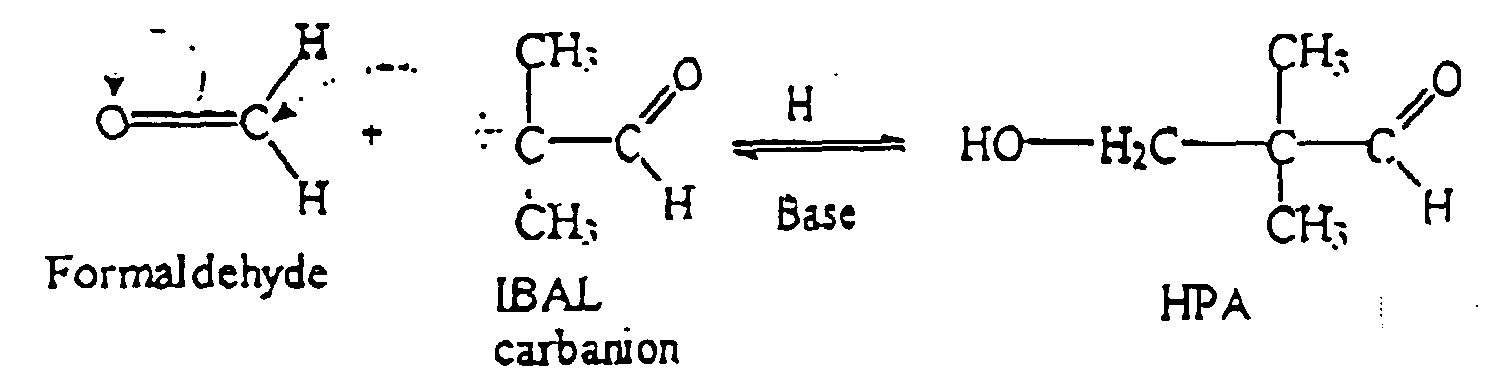
- This reaction represents cross-aldol condensation between two different aldehydes, namely isobutyraldehyde having an α-hydrogen atom and formaldehyde having no α-hydrogen atom, for the synthesis of aldehyde-alcohol, namely hydroxypivaldehyde (HPA). The expression "formaldehyde" comprises both conventional formaldehyde obtained as an aqueous solution and anhydrous forms of formaldehyde, such as paraformaldehyde and trioxane. Commercially available aqueous formaldehyde usually also contain relatively small amounts of methanol.
- The problem at hand in this invention is the following. Reaction between two substances located in different phases of a mixture is often inhibited because of the inability of reagents to come together. Isobutyraldehyde is a liquid material that makes the water insoluble organic phase. On the other hand, formaldehyde solution makes the aqueous phase because it comes as 37 - 40% aqueous solution. In the aldolization process, these two reacting components create a non-homogeneous two phase reaction medium. Therefore, interaction of the two reacting components is not sufficient enough for smooth cross-aldolization leading to the product hydroxypivaldehyde. Thus, the equilibrium in the first step of the reaction mechanism tries to be more to the backward (i.e., to the starting isobutyraldehyde).
- One way to solve this problem is to make the reaction mixture homogeneous by using a solvent such as methanol or ethanol. However, by doing this we will decrease the concentration of the reacting components, thereby decreasing the reaction rate.
- The another but better way to solve this problem, according to the present invention, is to make use of an appropriate basic phase-transfer catalyst (PTC). Reaction is brought about by the use of small quantities of an agent, which transfers one reactant across the interface into the other phase, so that reaction can proceed. Thus, phase-transfer catalysts are defined as compounds whose addition to a two-phase organic-water system helps transfer a water soluble reactant across the interface to the organic phase where a homogeneous reaction can occur. This can also help transfer a water insoluble reactant across the interface to the aqueous phase where a homogeneous reaction can occur.
- The phase-transfer agent is not consumed but performs the transport function repeatedly. Organic-soluble quaternary ammonium or phosphonium cations have been found to be excellent agents for the transport of anions from aqueous phase to an organic phase.
- We have chosen a specific phase-transfer catalyst, namely benzyltrimethyl or benzyltriethyl ammonium hydroxide which is also known as Triton B (methyl version) (Fluka Catalog # 13991). This comes as a 40% solution in water. Its chemical formula is given below:

- The hydroxide counter anion acts as a base entity to de-protonate α-hydrogen of the isobutyraldehyde molecule, whereas the quaternary ammonium cation part assists in the phase-transfer mechanism.
- To achieve similar results from anhydrous formaldehyde, such as paraformaldehyde or trioxane, preferably some amount of water could be added to generate a binary phase reaction medium.
- There are a few relevant references in the literature on phase-transfer catalyzed aldol condensation with aromatic aldehydes but none found with aliphatic aldehydes Products are frequently olefinic compounds as a result of dehydration favored by their thermodynamic stability. The following examples of aromatic aldehydes may be cited to substantiate the present invention.
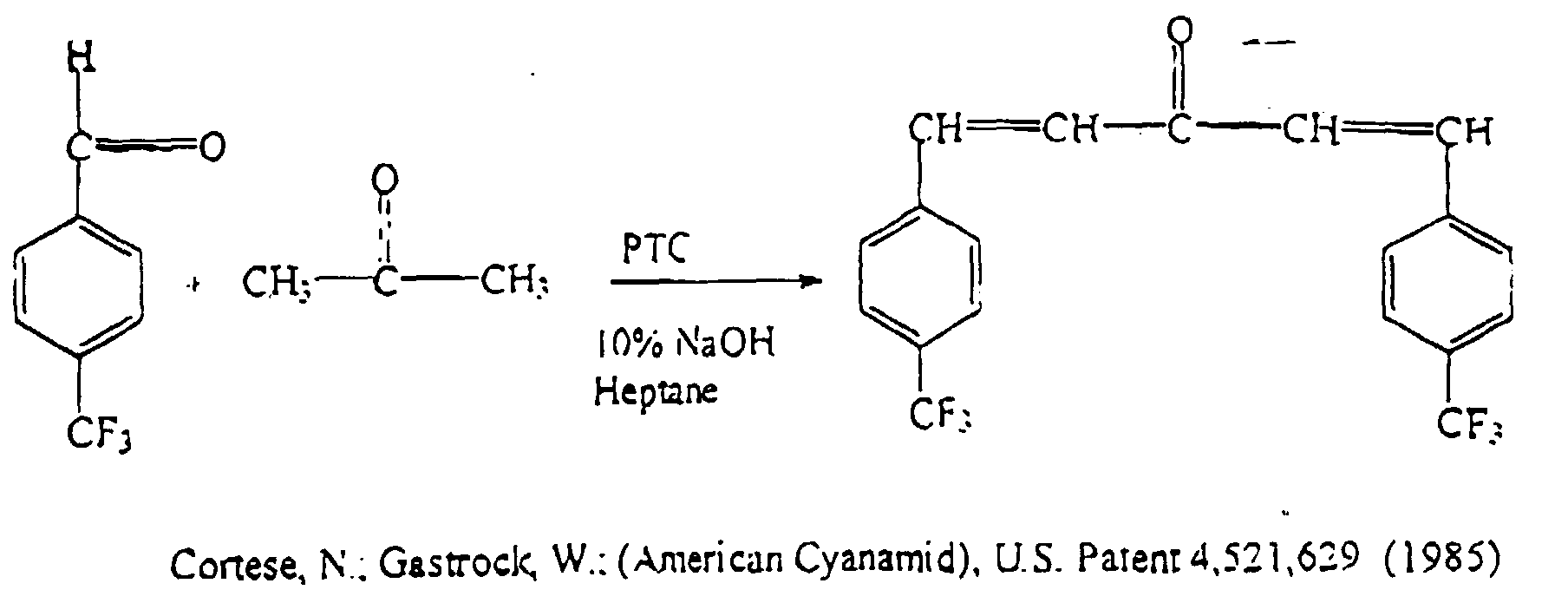
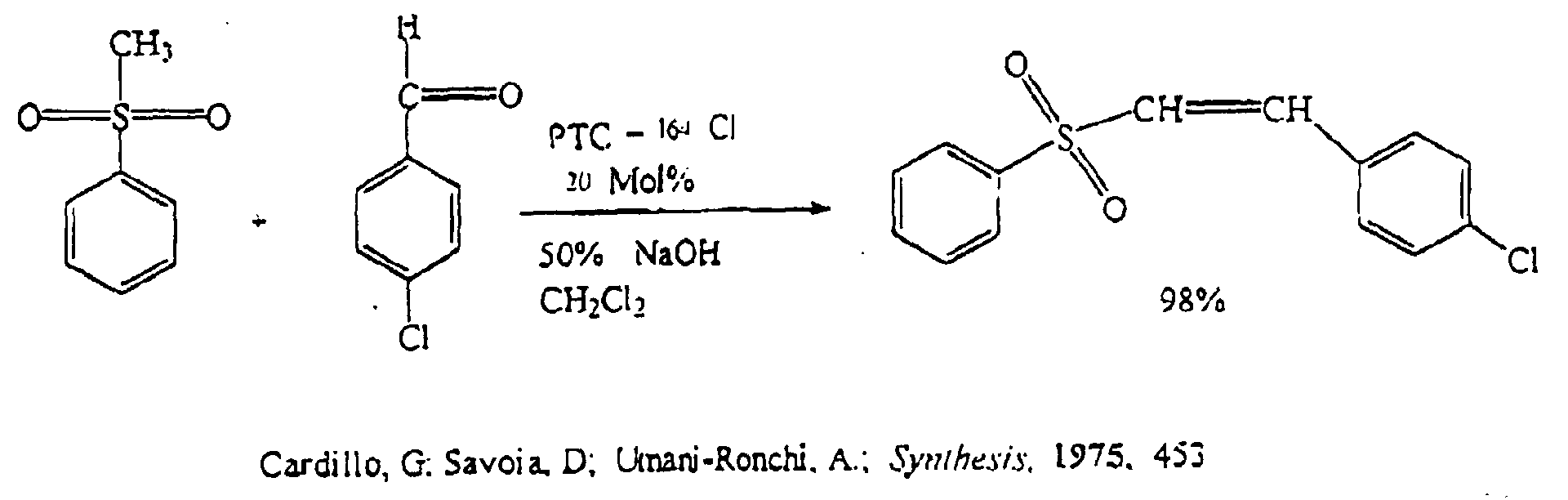
- These references, however, are far from the present invention because they are not representing condensation reactions between two same kind of aldehydes or two different kind of aldehydes.
- Thus, our invention seems to be by far the first example of phase-transfer catalyzed aldol condensation involving two different kind of aliphatic aldehydes. thereby making an excellent representation of cross-aldol condensation.
- The concept of basic phase-transfer catalysis is easily extended to aldehydes in which at least one of the aldehydes should contain an α-hydrogen atom. The said aldehyde may have a general formula of R1CHO, where R1 is selected from alkyl having 1-12 carbon atoms, cycloalkyl, aryl, and aralkyl having 1-14 carbon atoms. The aldolization reaction forms a reaction product mixture comprising or containing an aldol of said aldehyde, an unsaturated aldehyde derived by dehydration of said aldol, or mixtures thereof. Meaning of unsaturated aldehyde has been defined previously.
- The present invention preferably relates to an aldolization reaction of aldehydes containing a mixture of an aldehyde containing α-hydrogen atom defined above and a second different aldehyde having a general formula of R2CHO, where R2 is selected from H, alkyl having 1-12 carbon atoms, cycloalkyl, aryl and aralkyl having 1-14 carbon atoms, in the presence of catalytic amount of benzyltriethyl ammonium hydroxide.
- Suitable starting aldehydes are, for example, formaldehyde, ethanal, propanal, butanal, pentanal, 2-methylpropanal(isobutyraldehyde), 2-methyl butanal, 2-ethylpentanal, 2-ethylhexanal, 2-isopropylbutanal, 2-phenylpropanal, 2-cyclohexylpropanal, 2-phenylbutanal, 2,3-diphenylpropanal, cyclopentylaldehye and cyclohexylaldehye.
- While it is not a requirement of the invention that the aldehyde or aldehydes chosen be pure or substantially pure, selectivity to the aldol may be impaired in the reaction in proportion to the amount of impurity or undesired reactant present. Accordingly, some concentration of other compositions may be present in the aldehyde or aldehydes employed so long as the compositions do not interfere significantly with the condensation reaction or with the desired end use of the products of the invention.
- The prior art closest to the present invention is Patent No. WO 9829374 (9 July 1998) assigned to NESTE OY in Finland. Its title is "Process for the Preparation of Polyvalent Alcohols". The main feature disclosed in the prior art is using polymeric resin-based catalyst for aldolization and claiming several advantages for using such catalysts. These advantages include good yield without notable side reactions, no separation and recycling of catalyst and easy re-generation of catalyst. The prior art does not disclose the mode of action of the catalyst. Weak basic nature of the catalyst would initiate de-protonation of α-hydrogen atom of the isobutyraldehyde molecule in order to proceed to cross-aldolization. However, the prior art does not envision the process as phase-transfer catalyzed. Therefore, our invention is clearly distinct from the closest prior art.
- The distinction and advantages of the present invention over the closest prior is further illustrated from Table 1.
Results/Comments Patent WO 98/29374 (Neste) (Closest prior art) Present Invention (Phase-transfer catalysis) Catalyst type Polystyrene-DVB based amine or quat. amine bases (Resin) Simple PTC agent such as benzyltrimethyl ammonium hydroxide Conversion 95.8% ∼ 100% Selectivity 98.1% 100% Catalyst amount Typically 25-60% by wt. (based on isobutyraldehyde) ∼ 4% (wt) Reaction time > 7 hours 0.5 - 1.0 hour By-products formation By-product (HPHP)/HPA = 3.5% By-product (HPHP)/HPA = 0% Characteristics concerns Not easy to handle in recycling due to swelling Can be recycled after extraction - In the present invention, the reaction solvent system may comprise of a combination of miscible and immiscible solvents, preferably of water and an organic solvent, or most preferably of an aqueous solution of first aldehyde and of second aldehyde as neat liquid (if it is not a solid). The reaction temperature may be varied from zero to 30°C, but the most preferred range is 18 - 25 °C. The reaction time may be varied from 10 - 120 minutes. However, the most preferred reaction time is 30 - 90 minutes.
- The present invention is illustrated in greater detail by the following examples, Examples 1 and 2 being comparative examples. It will be understood, however, that these examples are not intended to limit the invention in any way and obvious modifications will appear to those skilled in the art.
- The following quantities of reactants were taken in this experiment as described in the Table 2.
Isobutyraldehyde 37% HCHO aq.solution 25% Aqueous NH4OH 3.6g (0.05 Mole), MW 72, 4.22 g of 37% aq. solution (0.052 Mole, d=1.081; 0.175 g (0.005 Mole) d=0.7938, 3.9 mL 0.39 mL
MW 30 - The two aldehydes were taken together in a reaction flask under argon atmosphere. It was cooled to 25 °C. Aqueous ammonium hydroxide was added dropwise to the stirring reaction mixture. No exotherm was observed. The reaction was run at the same temperature for 2 hours. The GC analysis did not show any significant amount of desired product hydroxypivaldehyde.
- The following quantities of reactants were taken in this experiment as described in the Table 3.
Isobutyraldehyde 37% HCHO aq.solution Triethylamine 7.2 g (0.10 Mole), MW 10.14 g of 37% aq. solution 0.5 g (0.005 Mole), 72, d=0.7938, 9.1 mL (0.125 Mole, d=1.081;
0.9.4 mL
MW 300.7 mL, d = 0.726 - The two aldehydes were taken together in a reaction flask under argon atmosphere. It was cooled to 25 °C. Triethylamine was added dropwise to the stirring reaction mixture. No exotherm was observed. The reaction was run at the same temperature for 1.5 hours. The GC analysis did not show any significant amount of desired product, hydroxypivaldehyde.
- The following quantities of reactants were taken in this experiment as described in the Table 4.
Isobutyraldehyde 37% HCHO aq.solution Triethylamine 7.2 g (0.10 Mole), MW 10.14 g of 37% aq. solution 0.5 g (0.005 Mole), 72, d=0.7938, 9.1 mL (0.125 Mole, d=1.081;
0.9.4 mL
MW 300.7 mL, d = 0.726 - The two aldehydes were taken together in a reaction flask under argon atmosphere. It was cooled to 25 °C. Triethylamine was added dropwise to the stirring reaction mixture. No exotherm was observed. The reaction temperature was raised to 65 °C. The reaction was run at the same temperature for 1.5 hours. The GC analysis showed 53.81% peak area of desired product, hydroxypivaldehyde with about 90% selectivity.
- The following example of the present invention (Example 4) provides far superior result, e. g. 82.09% peak area and 100% selectivity, of hydroxypivaldehyde.
- The experiment of the present invention is fully illustrated by the following detailed steps and analytical data for the result.
- The apparatus was set up on a water bath (water chiller) using a 4-necked 250 mL round-bottomed flask (all joints S24/40). Mechanical stirring rod was attached in the central neck, a digital thermocouple inlet in the hind side neck, stopper in the front side neck, a dropping funnel in the right side neck. Argon gas inlet/ outlet were attached through a rubber septum, the outlet tube was attached to a mineral oil bubbler. The system was purged with argon gas for 5-10 minutes. A small short stem glass funnel was put in the neck in place of the stopper. Isobutyraldehyde was added followed by formaldehyde solution. It was stirred at 20 ° C at such a rate that the contents of the flask did not splash out. The funnel was removed. The solution of the phase-transfer catalyst was added dropwise through this neck at such a rate that temperature did not rise beyond 21-22°C. Slow addition of phase-transfer catalyst solution is very critical because of significant exotherm. The addition of phase-transfer catalyst may take as long as 30-35 minutes. In order to control the temperature, it may become necessary to stop the addition temporarily for a few minutes. [Caution: Exotherm may be as high as 30-40°C if PTC added all at once]. As indicated by GC analysis, surprisingly about 80% conversion takes place within 5 minutes. Generally reaction gets completed within 60 minutes with over 90% conversion of isobutyraldehyde. The sample aliquots for GC analysis were taken after 30, 60, and 90 minutes. Added 1-2 drops of glacial acetic acid for neutralization of the base before GC injection. (Addition of acetic acid may not be necessary). Generally, the product starts solidifying after 30-40 minutes. At 60 minutes, it may be completely solid and stirring of the reaction mixture becomes inefficient. In this situation, 10 mL of methanol is added through the dropping funnel while raising the temperature to 35°C and stir for another 30 minutes.
- The Table 5 summarizes the GC analysis result for the 90 minute injection.
GC Analytical Data Component Retention Time (Minute) % Peak Area %Conversion of IBAL Selectivity of HPA (including NPG) Isobutyraldehyde 2.33 4.83 95.17 --- Unknown 2.87 2.25 ---- ---- HPA (Product) 6.08 82.09 ---- 100% NPG (Final) 8.13 4.11 --- (included with HPA) Unknown (PTC) 10.17 2.46 --- --- Unknown (PTC) 10.79 1.14 --- --- Unknown(PTC) 12.30 3.13 ---- ---- - This reaction, including the scale-ups, is well reproducible. The product (hydroxypivaldehyde) was isolated by extracting with a suitable solvent such as ethyl acetate or isobutyl acetate. Phase-transfer catalyst stays in the aqueous layer during extraction.
- The features disclosed in the foregoing description or in the claims may, both separately and in any combination thereof, be material for realising the invention in diverse forms thereof.
Claims (12)
- An aldehyde condensation process comprising contacting or combining a first aldehyde selected from aldehydes containing at least one α-hydrogen atom having the formula R1CHO, wherein R1 is selected from alkyl having one to twelve carbon atoms, and aralkyl having one to fourteen carbon atoms, with a second different aldehyde selected from aldehydes having the formula R2CHO, wherein R2 is selected from H, alkyl having one to twelve carbon atoms, and aralkyl having one to fourteen carbon atoms, and with a catalytic amount of Formula (1),where, R = same or different alkyl or aralkyl group, X = nitrogen or phosphorus atom, Y = any atom or group of atoms, particularly OH, making a basic counter anion,

under reaction conditions to form reaction product mixture comprising or containing an aldol, such as hydroxypivaldehyde, of said aldehydes. - A method according to Claim 1, wherein aldehydes R1CHO or R2CHO may be taken in 5 - 10% excess with respect to each other.
- A method according to Claim 1, wherein the reaction product mixtures of the invention will comprise or contain one of (A) the aldol of the aldehyde condensed, or of the aldehydes cross condensed: (B) the unsaturated aldehyde derived by dehydration of said aldol; or (C) a mixture of (A) and (B).
- A method according to Claim 1, for the synthesis of hydroxypivaldehyde comprising reacting isobutyraldehyde and formaldehyde/or paraformaldehyde, or trioxane and catalytic amount of the phase-transfer catalyst of Formula (I), such as benzyltrimethylammonium hydroxide or benzyltriethylammonium hydroxide.
- A method according to Claim 1, wherein the molar ratio of phase-transfer catalyst to aldehyde R1CHO is 0.5.0% to 10% equivalent, most preferably 4 mole % equivalent.
- A method according to Claim 1, wherein the reaction temperature is 18 - 23 °C. most preferably 20 °C.
- A method according to Claim 1, wherein the reaction time is 10 - 90 minutes. most preferably 30 - 90 minutes.
- A method according to Claim 1, wherein the aldol product can be isolated by extraction with a suitable solvent while allowing the phase-transfer catalyst in the aqueous layer.
- A method according to Claim 1, wherein the reaction product mixture can be directly subjected to catalytic hydrogenation for making polyvalent alcohol such as neopentyl glycol.
- A method for the condensation of an aldehyde comprising contacting or combining aldehyde containing at least one α-hydrogen atom and having the formula R1CHO, wherein R1 is selected from alkyl having one to twelve carbon atoms, and aralkyl having seven to fourteen carbon atoms, with a catalytic amount of a phase-transfer catalyst of Formula (I),where, R = same or different alkyl or aralkyl group, X = nitrogen or phosphorus atom, Y = any atom or group of atoms, particularly OH, making a basic counter anion.

under reaction conditions to form reaction product mixture comprising or containing an aldol of said aldehydes, the unsaturated aldehyde derived by dehydration of said aldol, or mixtures thereof. - A method according to any of the Claims 3 - 8, characterized in that the phase-transfer catalyst is a quarternary ammonium or phosphonium hydroxide.
- A method according to Claims 1 and 10, wherein the phase-transfer catalyst may be added to the reaction mixture in the solid form (when available) or in the form of an aqueous or an alcoholic solution.
Priority Applications (2)
| Application Number | Priority Date | Filing Date | Title |
|---|---|---|---|
| DE1999604048 DE69904048T2 (en) | 1999-09-21 | 1999-09-21 | Cross-aldol condensation for hydroxypivaldehyde |
| EP19990118634 EP1088811B1 (en) | 1999-09-21 | 1999-09-21 | A cross-aldol condensation for hydroxypivaldehyde |
Applications Claiming Priority (1)
| Application Number | Priority Date | Filing Date | Title |
|---|---|---|---|
| EP19990118634 EP1088811B1 (en) | 1999-09-21 | 1999-09-21 | A cross-aldol condensation for hydroxypivaldehyde |
Publications (2)
| Publication Number | Publication Date |
|---|---|
| EP1088811A1 true EP1088811A1 (en) | 2001-04-04 |
| EP1088811B1 EP1088811B1 (en) | 2002-11-20 |
Family
ID=8239033
Family Applications (1)
| Application Number | Title | Priority Date | Filing Date |
|---|---|---|---|
| EP19990118634 Expired - Lifetime EP1088811B1 (en) | 1999-09-21 | 1999-09-21 | A cross-aldol condensation for hydroxypivaldehyde |
Country Status (2)
| Country | Link |
|---|---|
| EP (1) | EP1088811B1 (en) |
| DE (1) | DE69904048T2 (en) |
Cited By (8)
| Publication number | Priority date | Publication date | Assignee | Title |
|---|---|---|---|---|
| WO2004065342A1 (en) * | 2003-01-13 | 2004-08-05 | Basf Corporation | A process for the co-production of alcohols |
| WO2009045156A1 (en) * | 2007-10-01 | 2009-04-09 | Noziere Barbara | Novel catalyst for aldol condensation reactions |
| US7705038B2 (en) | 2004-11-19 | 2010-04-27 | Intervet, Inc. | Control of parasites in animals by the use of parasiticidal 2-phenyl-3-(1H-pyrrol-2-yl)acrylonitrile derivatives |
| CN105712842A (en) * | 2014-12-05 | 2016-06-29 | 中国石油化工股份有限公司 | Method for separating and extracting 1,3-propylene glycol from fermentation broth |
| CN105712841A (en) * | 2014-12-05 | 2016-06-29 | 中国石油化工股份有限公司 | Method for separating and extracting 1,3-propylene glycol from fermentation broth |
| CN116462580A (en) * | 2023-04-24 | 2023-07-21 | 圣奥化学科技有限公司 | Apparatus and method for preparing methyl isoamyl ketone |
| WO2025034469A1 (en) * | 2023-08-04 | 2025-02-13 | Dow Global Technologies Llc | Cross-aldol condensation of alkyl aldehydes using solid-supported bronsted acid catalysts |
| WO2025034470A1 (en) * | 2023-08-04 | 2025-02-13 | Dow Global Technologies Llc | Continuous cross-aldol condensation of linear aldehydes using solid-supported basic catalyst and polar cosolvents |
Families Citing this family (2)
| Publication number | Priority date | Publication date | Assignee | Title |
|---|---|---|---|---|
| KR101293818B1 (en) | 2010-03-09 | 2013-08-07 | 주식회사 엘지화학 | METHOD FOR PREPARING α, β-UNSATURATED ALDEHYDE |
| IN2013MU02838A (en) * | 2013-08-30 | 2015-07-03 | Godavari Biorefineries Ltd |
Citations (3)
| Publication number | Priority date | Publication date | Assignee | Title |
|---|---|---|---|---|
| US3432557A (en) * | 1966-03-23 | 1969-03-11 | Celanese Corp | Aldoling process |
| US4215076A (en) * | 1976-04-23 | 1980-07-29 | Union Carbide Corporation | Surfactant-promoted aldol reactions |
| WO1998029374A1 (en) * | 1996-12-30 | 1998-07-09 | Neste Chemicals Oy | Process for the preparation of polyvalent alcohols |
-
1999
- 1999-09-21 DE DE1999604048 patent/DE69904048T2/en not_active Expired - Lifetime
- 1999-09-21 EP EP19990118634 patent/EP1088811B1/en not_active Expired - Lifetime
Patent Citations (3)
| Publication number | Priority date | Publication date | Assignee | Title |
|---|---|---|---|---|
| US3432557A (en) * | 1966-03-23 | 1969-03-11 | Celanese Corp | Aldoling process |
| US4215076A (en) * | 1976-04-23 | 1980-07-29 | Union Carbide Corporation | Surfactant-promoted aldol reactions |
| WO1998029374A1 (en) * | 1996-12-30 | 1998-07-09 | Neste Chemicals Oy | Process for the preparation of polyvalent alcohols |
Non-Patent Citations (2)
| Title |
|---|
| CHEMICAL ABSTRACTS, vol. 106, no. 1, 5 January 1987, Columbus, Ohio, US; abstract no. 004499, JIA Y ET AL: "Aldol condensation of aldehydes and butanone with the phase-transfer catalyst benzyltriethylammonium chloride" XP002129892 * |
| FUDAN XUEBAO, ZIRAN KEXUEBAN (FHPTAY,04277104);1986; VOL.25 (1); PP.57-64, Fudan Univ.;Shanghai; Peop. Rep. China (CN) * |
Cited By (10)
| Publication number | Priority date | Publication date | Assignee | Title |
|---|---|---|---|---|
| WO2004065342A1 (en) * | 2003-01-13 | 2004-08-05 | Basf Corporation | A process for the co-production of alcohols |
| US7705038B2 (en) | 2004-11-19 | 2010-04-27 | Intervet, Inc. | Control of parasites in animals by the use of parasiticidal 2-phenyl-3-(1H-pyrrol-2-yl)acrylonitrile derivatives |
| WO2009045156A1 (en) * | 2007-10-01 | 2009-04-09 | Noziere Barbara | Novel catalyst for aldol condensation reactions |
| CN105712842A (en) * | 2014-12-05 | 2016-06-29 | 中国石油化工股份有限公司 | Method for separating and extracting 1,3-propylene glycol from fermentation broth |
| CN105712841A (en) * | 2014-12-05 | 2016-06-29 | 中国石油化工股份有限公司 | Method for separating and extracting 1,3-propylene glycol from fermentation broth |
| CN105712841B (en) * | 2014-12-05 | 2017-10-27 | 中国石油化工股份有限公司 | A kind of method of the propane diols of the separation and Extraction from zymotic fluid 1,3 |
| CN105712842B (en) * | 2014-12-05 | 2018-06-19 | 中国石油化工股份有限公司 | The separating and extracting process of 1,3- propylene glycol in a kind of zymotic fluid |
| CN116462580A (en) * | 2023-04-24 | 2023-07-21 | 圣奥化学科技有限公司 | Apparatus and method for preparing methyl isoamyl ketone |
| WO2025034469A1 (en) * | 2023-08-04 | 2025-02-13 | Dow Global Technologies Llc | Cross-aldol condensation of alkyl aldehydes using solid-supported bronsted acid catalysts |
| WO2025034470A1 (en) * | 2023-08-04 | 2025-02-13 | Dow Global Technologies Llc | Continuous cross-aldol condensation of linear aldehydes using solid-supported basic catalyst and polar cosolvents |
Also Published As
| Publication number | Publication date |
|---|---|
| DE69904048D1 (en) | 2003-01-02 |
| DE69904048T2 (en) | 2003-04-03 |
| EP1088811B1 (en) | 2002-11-20 |
Similar Documents
| Publication | Publication Date | Title |
|---|---|---|
| FI102474B (en) | Process for the preparation of polyhydric alcohols | |
| KR101584375B1 (en) | Process for preparing polyalcohols from formaldehyde with a low formic acid content | |
| EP1088811B1 (en) | A cross-aldol condensation for hydroxypivaldehyde | |
| US4943663A (en) | Process for the preparation of α-alkylacroleins | |
| EP1957437B1 (en) | Process for producing alpha,beta-unsaturated aldehyde compounds | |
| JPH0455181B2 (en) | ||
| US7439406B2 (en) | Method for hydrogenating methylol alkanals | |
| US6960694B2 (en) | Processes for preparing β-hydroxy-ketones and α,β-unsaturated ketones | |
| JP2002500208A (en) | Preparation process of neopentyl glycol | |
| KR100519184B1 (en) | How to prepare saturated alcohol | |
| AU689963B2 (en) | Process for preparing 1,3-alkanediols and 3-hydroxyldehydes | |
| EP0771779B1 (en) | Process for producing acetals | |
| US4097540A (en) | Process for the preparation of 2-alkyl-2-methylpropane-1,3-diol | |
| JP3342973B2 (en) | Method for producing hydroxyalkanal | |
| HU205060B (en) | Process for producing 2,2-dimethyl propanediole-(1,3) | |
| JP4253366B2 (en) | Process for producing polyhydroxy ether and novel asymmetric polyhydroxy ether | |
| SA00210022B1 (en) | A new method for mixed aldol condensation of hydroxypivaldehyde. | |
| JPH1059892A (en) | Method for producing α, β-unsaturated aldehyde | |
| JPH09202745A (en) | Method for producing acetals | |
| HUT54964A (en) | Continuous process for producing ketales | |
| JPH09188643A (en) | Method for producing acetals | |
| JPS6311333B2 (en) | ||
| JPH1129517A (en) | Method for producing acetal |
Legal Events
| Date | Code | Title | Description |
|---|---|---|---|
| PUAI | Public reference made under article 153(3) epc to a published international application that has entered the european phase |
Free format text: ORIGINAL CODE: 0009012 |
|
| 17P | Request for examination filed |
Effective date: 20000705 |
|
| AK | Designated contracting states |
Kind code of ref document: A1 Designated state(s): DE FI FR GB IT NL |
|
| AX | Request for extension of the european patent |
Free format text: AL;LT;LV;MK;RO;SI |
|
| 17Q | First examination report despatched |
Effective date: 20010706 |
|
| RTI1 | Title (correction) |
Free format text: A CROSS-ALDOL CONDENSATION FOR HYDROXYPIVALDEHYDE |
|
| GRAG | Despatch of communication of intention to grant |
Free format text: ORIGINAL CODE: EPIDOS AGRA |
|
| AKX | Designation fees paid |
Free format text: DE FI FR GB IT NL |
|
| GRAG | Despatch of communication of intention to grant |
Free format text: ORIGINAL CODE: EPIDOS AGRA |
|
| GRAG | Despatch of communication of intention to grant |
Free format text: ORIGINAL CODE: EPIDOS AGRA |
|
| GRAH | Despatch of communication of intention to grant a patent |
Free format text: ORIGINAL CODE: EPIDOS IGRA |
|
| GRAH | Despatch of communication of intention to grant a patent |
Free format text: ORIGINAL CODE: EPIDOS IGRA |
|
| GRAA | (expected) grant |
Free format text: ORIGINAL CODE: 0009210 |
|
| AK | Designated contracting states |
Kind code of ref document: B1 Designated state(s): DE FI FR GB IT NL |
|
| REG | Reference to a national code |
Ref country code: GB Ref legal event code: FG4D |
|
| REF | Corresponds to: |
Ref document number: 69904048 Country of ref document: DE Date of ref document: 20030102 |
|
| ET | Fr: translation filed | ||
| PLBE | No opposition filed within time limit |
Free format text: ORIGINAL CODE: 0009261 |
|
| STAA | Information on the status of an ep patent application or granted ep patent |
Free format text: STATUS: NO OPPOSITION FILED WITHIN TIME LIMIT |
|
| 26N | No opposition filed |
Effective date: 20030821 |
|
| REG | Reference to a national code |
Ref country code: FR Ref legal event code: PLFP Year of fee payment: 18 |
|
| REG | Reference to a national code |
Ref country code: FR Ref legal event code: PLFP Year of fee payment: 19 |
|
| REG | Reference to a national code |
Ref country code: FR Ref legal event code: PLFP Year of fee payment: 20 |
|
| PGFP | Annual fee paid to national office [announced via postgrant information from national office to epo] |
Ref country code: FR Payment date: 20180813 Year of fee payment: 20 Ref country code: IT Payment date: 20180919 Year of fee payment: 20 Ref country code: DE Payment date: 20180911 Year of fee payment: 20 |
|
| PGFP | Annual fee paid to national office [announced via postgrant information from national office to epo] |
Ref country code: GB Payment date: 20180919 Year of fee payment: 20 Ref country code: FI Payment date: 20180910 Year of fee payment: 20 Ref country code: NL Payment date: 20180912 Year of fee payment: 20 |
|
| REG | Reference to a national code |
Ref country code: DE Ref legal event code: R071 Ref document number: 69904048 Country of ref document: DE |
|
| REG | Reference to a national code |
Ref country code: NL Ref legal event code: MK Effective date: 20190920 |
|
| REG | Reference to a national code |
Ref country code: GB Ref legal event code: PE20 Expiry date: 20190920 |
|
| PG25 | Lapsed in a contracting state [announced via postgrant information from national office to epo] |
Ref country code: GB Free format text: LAPSE BECAUSE OF EXPIRATION OF PROTECTION Effective date: 20190920 |