EP1088591A2 - Low temperature waste crushing system - Google Patents
Low temperature waste crushing system Download PDFInfo
- Publication number
- EP1088591A2 EP1088591A2 EP00112080A EP00112080A EP1088591A2 EP 1088591 A2 EP1088591 A2 EP 1088591A2 EP 00112080 A EP00112080 A EP 00112080A EP 00112080 A EP00112080 A EP 00112080A EP 1088591 A2 EP1088591 A2 EP 1088591A2
- Authority
- EP
- European Patent Office
- Prior art keywords
- temperature
- cold heat
- cold
- refrigerating cycle
- cooling
- Prior art date
- Legal status (The legal status is an assumption and is not a legal conclusion. Google has not performed a legal analysis and makes no representation as to the accuracy of the status listed.)
- Withdrawn
Links
Images


Classifications
-
- B—PERFORMING OPERATIONS; TRANSPORTING
- B29—WORKING OF PLASTICS; WORKING OF SUBSTANCES IN A PLASTIC STATE IN GENERAL
- B29B—PREPARATION OR PRETREATMENT OF THE MATERIAL TO BE SHAPED; MAKING GRANULES OR PREFORMS; RECOVERY OF PLASTICS OR OTHER CONSTITUENTS OF WASTE MATERIAL CONTAINING PLASTICS
- B29B17/00—Recovery of plastics or other constituents of waste material containing plastics
- B29B17/04—Disintegrating plastics, e.g. by milling
- B29B17/0404—Disintegrating plastics, e.g. by milling to powder
- B29B17/0408—Disintegrating plastics, e.g. by milling to powder using cryogenic systems
-
- B—PERFORMING OPERATIONS; TRANSPORTING
- B02—CRUSHING, PULVERISING, OR DISINTEGRATING; PREPARATORY TREATMENT OF GRAIN FOR MILLING
- B02C—CRUSHING, PULVERISING, OR DISINTEGRATING IN GENERAL; MILLING GRAIN
- B02C19/00—Other disintegrating devices or methods
- B02C19/18—Use of auxiliary physical effects, e.g. ultrasonic waves or irradiation, for disintegrating
- B02C19/186—Use of cold or heat for disintegrating
-
- F—MECHANICAL ENGINEERING; LIGHTING; HEATING; WEAPONS; BLASTING
- F25—REFRIGERATION OR COOLING; COMBINED HEATING AND REFRIGERATION SYSTEMS; HEAT PUMP SYSTEMS; MANUFACTURE OR STORAGE OF ICE; LIQUEFACTION SOLIDIFICATION OF GASES
- F25B—REFRIGERATION MACHINES, PLANTS OR SYSTEMS; COMBINED HEATING AND REFRIGERATION SYSTEMS; HEAT PUMP SYSTEMS
- F25B7/00—Compression machines, plants or systems, with cascade operation, i.e. with two or more circuits, the heat from the condenser of one circuit being absorbed by the evaporator of the next circuit
-
- F—MECHANICAL ENGINEERING; LIGHTING; HEATING; WEAPONS; BLASTING
- F25—REFRIGERATION OR COOLING; COMBINED HEATING AND REFRIGERATION SYSTEMS; HEAT PUMP SYSTEMS; MANUFACTURE OR STORAGE OF ICE; LIQUEFACTION SOLIDIFICATION OF GASES
- F25D—REFRIGERATORS; COLD ROOMS; ICE-BOXES; COOLING OR FREEZING APPARATUS NOT OTHERWISE PROVIDED FOR
- F25D13/00—Stationary devices, e.g. cold-rooms
- F25D13/06—Stationary devices, e.g. cold-rooms with conveyors carrying articles to be cooled through the cooling space
-
- B—PERFORMING OPERATIONS; TRANSPORTING
- B02—CRUSHING, PULVERISING, OR DISINTEGRATING; PREPARATORY TREATMENT OF GRAIN FOR MILLING
- B02C—CRUSHING, PULVERISING, OR DISINTEGRATING IN GENERAL; MILLING GRAIN
- B02C2201/00—Codes relating to disintegrating devices adapted for specific materials
- B02C2201/02—Codes relating to disintegrating devices adapted for specific materials for reinforced concrete
-
- B—PERFORMING OPERATIONS; TRANSPORTING
- B29—WORKING OF PLASTICS; WORKING OF SUBSTANCES IN A PLASTIC STATE IN GENERAL
- B29B—PREPARATION OR PRETREATMENT OF THE MATERIAL TO BE SHAPED; MAKING GRANULES OR PREFORMS; RECOVERY OF PLASTICS OR OTHER CONSTITUENTS OF WASTE MATERIAL CONTAINING PLASTICS
- B29B17/00—Recovery of plastics or other constituents of waste material containing plastics
- B29B17/04—Disintegrating plastics, e.g. by milling
- B29B2017/0416—Cooling the plastics before disintegration, e.g. freezing
-
- B—PERFORMING OPERATIONS; TRANSPORTING
- B29—WORKING OF PLASTICS; WORKING OF SUBSTANCES IN A PLASTIC STATE IN GENERAL
- B29L—INDEXING SCHEME ASSOCIATED WITH SUBCLASS B29C, RELATING TO PARTICULAR ARTICLES
- B29L2030/00—Pneumatic or solid tyres or parts thereof
-
- Y—GENERAL TAGGING OF NEW TECHNOLOGICAL DEVELOPMENTS; GENERAL TAGGING OF CROSS-SECTIONAL TECHNOLOGIES SPANNING OVER SEVERAL SECTIONS OF THE IPC; TECHNICAL SUBJECTS COVERED BY FORMER USPC CROSS-REFERENCE ART COLLECTIONS [XRACs] AND DIGESTS
- Y02—TECHNOLOGIES OR APPLICATIONS FOR MITIGATION OR ADAPTATION AGAINST CLIMATE CHANGE
- Y02W—CLIMATE CHANGE MITIGATION TECHNOLOGIES RELATED TO WASTEWATER TREATMENT OR WASTE MANAGEMENT
- Y02W30/00—Technologies for solid waste management
- Y02W30/50—Reuse, recycling or recovery technologies
- Y02W30/62—Plastics recycling; Rubber recycling
Definitions
- the present invention relates to a low temperature waste crushing system for crushing waste tire, plastics, etc., by taking advantage of cold shortness, specifically a system effectively utilizing a cascaded refrigerating system.
- a crushing method taking advantage of cold shortness in which iron and steel materials, etc., are cooled by, for example, very low temperature cooling medium such as liquid nitrogen below their cold shortness transition temperature to reduce them to a brittle state like glass, and crushed, is disclosed in Japanese Unexamined Patent publication No. Sho 51-39452.
- the conventional crushing system at low temperature using the low temperature liquid nitrogen is shown in FIG.3. It is composed of a material supplying section 50, a cold heat source 51 for supplying liquid nitrogen, a liquid nitrogen freezer 52 in which the material 50a of about 20°C supplied from the material supplying section 50 is cooled to be reduced to the frozen material 52a of about -130°C by spraying with liquid nitrogen 51a of about -196°C supplied from the cold heat source 51, and a crushing section 53 in which crushed product 53a of about -75°C is obtained by crushing the frozen material 52a.
- liquid nitrogen freezer 52 liquid nitrogen is sprayed on the material 50a and the nitrogen gas gasified through spraying is exhausted to the atmosphere by an exhaust blower or the like not shown in the drawing.
- the crushing section 53 the frozen material 52a of about -130°C is raised in temperature by the heat generated at crushing to be reduced to the crushed product 53a of about -75°C.
- the conventional method using liquid nitrogen has the advantage that liquid nitrogen is comparatively cheap and easy to handle. However, it has a problem which makes it not the best system for environmental hygiene because the nitrogen gas used for freezing the waste material for low temperature crushing is exhausted to the atmosphere. Further, in the case liquid nitrogen is used, there is a problem that a stepwise cooling of high efficiency is not possible and that a cold heat source of -196°C is used for obtaining a frozen material of about -75°C or lower which is the glass transition temperature of the material.
- a cooling mechanism for absorbing the heat generated in crushing is not provided at the crushing section.
- the frozen material is heated at crushing, and necessitates a setting and securing of the frozen temperature which takes the change of quality of the material due to temperature rise at the crushing into consideration.
- the present invention was made in light of the problems mentioned above, and an object is to provide a low temperature crushing system without using liquid nitrogen, which reduces burden to the environment in comparison with the prior art of cooling with liquid nitrogen.
- Another object of the present invention is to provide a crushing system at freezing low temperature, which enables bringing efficiency to cooling by adopting stepwise cooling along with effective removal of the heat generated at crushing.
- the present invention is a low temperature crushing system having a low temperature freezing section for cooling material below its cold shortness transition temperature (glass transition temperature at which low-temperature embrittlement occurs) by receiving the supply of cold heat from a cold heat source and a crushing section for crushing the material cooled in the low temperature freezing section by taking advantage of cold shortness, and characterized in that
- the binary refrigerating cycle is preferably configured as a cascaded binary refrigerating cycle combining two different cycles, the first refrigerating cycle for obtaining the higher temperature cold heat and the second refrigerating cycle for obtaining the lower temperature cold heat by introducing the higher temperature cold heat to its condenser.
- the cascaded binary refrigerating cycle comprises a higher temperature condensing unit configured as the first refrigerating cycle which uses ammonia as a refrigerant and a lower temperature condensing brine unit configured as the second refrigerating cycle which uses a refrigerant of hydrocarbon group such as ethane and methane,
- the two step cooling section suitably comprises:
- the dual step cooling section comprises:
- the crushing section is suitably provided with a crushing machine in which the frozen waste material is crushed while removing the heat generated at crushing through blowing the air of low temperature below the cold shortness transition temperature produced by the lower temperature cold heat into the crushing machine.
- refrigerant such as ammonia and the like generally used in a conventional refrigerating cycle
- refrigerant such as ammonia and the like
- the specific volume of evaporated vapor is very large when the evaporation temperature is about -70°C and below
- refrigerant such as methane, ethane, and the like whose specific volume of saturated vapor is small becomes necessary.
- sufficient refrigerating effect and capacity can not be obtained with the refrigerating cycle using only these refrigerants.
- the present invention is configured as a binary refrigerating cycle, in which the higher temperature side refrigerating cycle uses a generally used refrigerant with a high refrigerating capacity, more specifically, ammonia refrigerant to condense the compressed refrigerant gas (ethane) in the lower temperature side refrigerating machine and heat exchange is performed between the evaporator of the higher temperature side refrigerating machine and the condenser of the lower temperature side refrigerating machine in the cascade condenser to condense the lower temperature side refrigerant.
- the higher temperature side refrigerating cycle uses a generally used refrigerant with a high refrigerating capacity, more specifically, ammonia refrigerant to condense the compressed refrigerant gas (ethane) in the lower temperature side refrigerating machine and heat exchange is performed between the evaporator of the higher temperature side refrigerating machine and the condenser of the lower temperature side refrigerating machine in the cascade condenser to condense
- the higher temperature cold heat source is efficiently obtained by the first refrigerating cycle using generally used refrigerant such as ammonia and the like
- the lower temperature cold heat is obtained by the second refrigerating cycle using refrigerant such as methane, ethane, and the like whose specific volume of saturated vapor is small.
- the present invention uses the binary refrigerating cycle instead of conventional cooling and freezing by releasing liquid nitrogen, and cools the waste material stepwise to the cold shortness transition temperature by the air cooled by heat exchange.
- the coolant can be exhausted in an as-is status without any harm to the environment. Cooling to the cold shortness transition temperature of below -70°C is possible, although air which holds substantially small cold energy compared with liquid nitrogen is used, for the configuration of dual step cooling is adopted, which is made possible by the use of the binary refrigerating cycle.
- the cold heat source of the present invention is configured so that ammonia refrigerant whose evaporation temperature is high, is used in the first refrigerating cycle to obtain the higher temperature cold heat; and hydrocarbon group refrigerants such as ethane, methane, and the like are used for the second refrigerating cycle to obtain the lower temperature cold heat.
- HFE hydrofluoroether
- ammonia refrigerant is used, as the pre-cooling of the waste material is performed by the air produced through heat exchange with the ammonia refrigerant, the configuration of the hermetically sealed refrigerating cycle is possible without the danger of ammonia leak, which is very desirable for the environment.
- the present invention is configured as the following: a part of the latent heat of evaporation of the first refrigerating cycle unit for obtaining the higher temperature cold heat Is introduced to the preceding cooling step for pre-cooling the waste material in the tunnel type freezer; the rest of the latent heat of evaporation is introduced to the condenser part of the lower temperature side condensing brine unit which is the second refrigerating cycle for obtaining the lower temperature cold heat.
- the cascade condenser is formed and the high pressure, high temperature ethane refrigerant is condensed.
- Low temperature brine of HFE, an inactive liquid, is obtained by the medium of the condensed ethane. This low temperature brine is used as a lower temperature cold heat source at the succeeding cooling step of the dual step cooling section, as well as for cooling the air to be used for removing the heat generated at the crushing.
- the tunnel type freezer as set forth in claim 1 is composed of the pre-cooling room formed in the preceding step and the lower temperature cooling room formed in the succeeding step, and so the cooling load of the lower temperature cooling in the succeeding step is lightened by the pre-cooling.
- the crushing section is so configured that the crushing is performed while removing the heat generated at crushing by blowing on the waste material the cold air which is lower in temperature than the cold shortness transition temperature and produced through the medium of the lower temperature cold heat source.
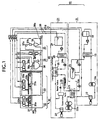
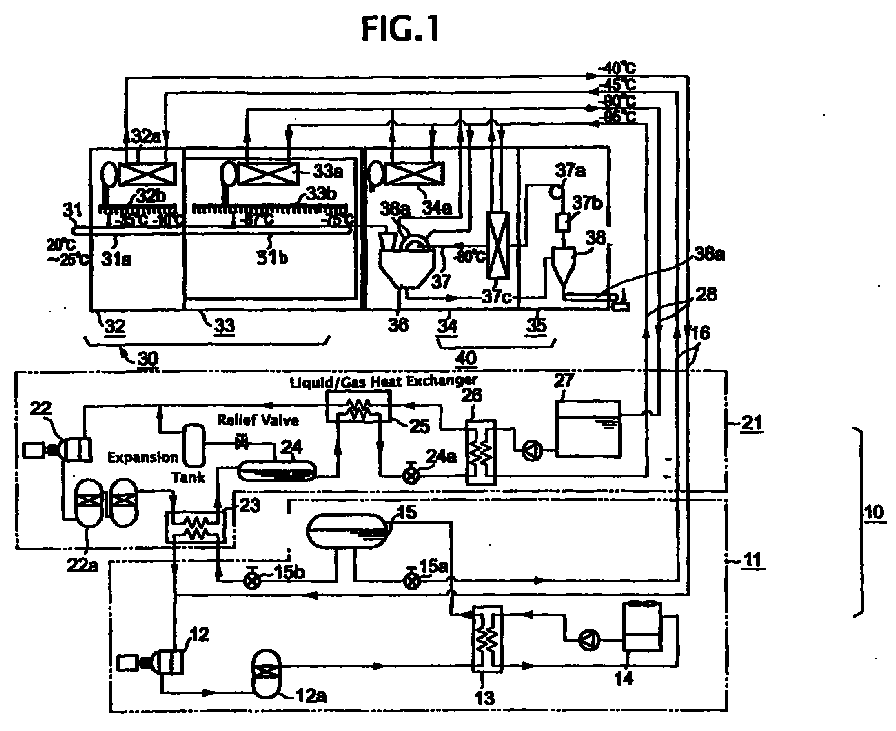
- reference numeral 10 denotes cold heat source, 11 higher temperature condensing unit, 12 higher temperature side compressor, 13 condenser, 15 higher temperature side receiver, 16 higher temperature cold heat source, 21 lower temperature condensing unit, 22 lower temperature side compressor, 23 cascade condenser, 24 lower temperature side receiver, 26 brine cooler, 28 lower temperature cold heat source, 30 freezer, 31 material supply section, 32 pre-cooling room, 33 lower temperature cooling room, 34 crushing room, 35 separating room, 36 crushing machine, 37 cold air, 40 crushing section.
- FIG.1 is a diagrammatic sketch showing the overall configuration of the binary freezing low temperature crushing system taking advantage of cold shortness according to the present invention
- FIG.2 is a diagram showing the change in temperature of the material to be crushed in the crushing system of FIG.1.
- the binary freezing low temperature crushing system is a low temperature crushing system composed of a freezer 30 for cooling waste material below its cold shortness transition temperature (glass transition temperature at which low-temperature embrittlement occurs) by receiving the supply of cold heat from a cold heat source 10, and a crushing section 40 for crushing the material cooled by the freezer 30 by taking advantage of cold shortness.
- the cold heat source 10 for the freezer 30 is configured as a binary refrigerating cycle combining two different refrigerating cycles, the first refrigerating cycle for obtaining the first cold heat (hereinafter referred to as higher temperature cold heat) higher in temperature than the cold shortness transition temperature and the second refrigerating cycle for obtaining the second cold heat (hereinafter referred to as lower temperature cold heat) lower in temperature than the cold shortness transition temperature.
- the first refrigerating cycle is configured as a higher temperature condensing unit 11 which uses ammonia refrigerant
- the second refrigerating cycle is configured as a lower temperature condensing brine unit 21.
- the main components of the higher temperature condensing unit 11 are: a compressor of the first refrigerating cycle of higher temperature side for compressing ammonia refrigerant; an oil separator 12a for separating the oil from the compressed, high pressure, high temperature ammonia gas; a condenser 13 for condensing the compressed, high pressure, high temperature ammonia gas after separation of the oil through the heat exchange with the cooling medium cooled in a cooling tower 14; and a higher temperature side receiver 15 for storing the condensed liquid.
- a part of the condensed ammonia liquid stored in the higher temperature side receiver 15 is sent by way of an expansion valve 15a to an air cooler 32a, forming a higher temperature cold heat source 16 of -40°C ⁇ -50°C which is higher than the cold shortness transition temperature. Then, ammonia gas of about -45°C is supplied to the air cooler 32a in a pre-cooling room 32 of the freezer 30. At the air cooler 32a, air is cooled to -40°C ⁇ -35°C to be jetted from nozzles 32b arranged along the direction of transfer of the conveyor toward the surface of the conveyor 31a in forms of impinging air jets of -35°C.
- a part of the condensed ammonia liquid stored in the higher temperature side receiver 15 is sent by way of an expansion valve 15b to a cascade condenser 23, where mixed liquid-gas ammonia evaporates to be released of its latent heat of evaporation. Then, the compressed ethane gas of high temperature and high pressure sent from a lower temperature side compressor 22 by way of an oil separator 22a is condensed, and the condensed liquid ethane is stored in a lower temperature side receiver 24.
- the stored condensed liquid ethane is sent to a brine cooler 26 by way of an expansion valve 24a to produce low temperature brine of about -95°C.
- This low temperature brine is supplied by way of a brine tank 27 to an air cooler 33a of a lower temperature cooling room 33 of the freezer 30 and to an air cooler 34a, 37c of the crushing section 40 as lower temperature cold heat source 28.
- Low temperature brine of -95°C may be used with HFE (hydrofluoroether) whose safety is high, in addition to ethyl ether, R11, and the like. Any of these is circulated between the brine tank 27 and the air cooler 33a of the lower temperature cooling room 33, the air cooler 34a, 37c of the crushing section 40.
- HFE hydrofluoroether
- air is cooled to -85°C ⁇ -90°C by the low temperature brine of about -95°C to be jetted from nozzles 33b arranged along the direction of transfer of the conveyor toward the surface of the conveyor 31b in forms of impinging air jets of about -87°C.
- the freezer 30 is a tunnel-shaped freezer covering the circumference of the freezing section, in which the material to be crushed, for example, waste rubber tire, supplied from a material supply section 31 is transferred to the crushing section 40 on the conveyor belt 31a, 31b, while being cooled firstly by the impinging air jet of -35°C to the neighborhood of -10°C ⁇ -30°C, then by the impinging air jet of about -87°C finally to below about -75°C.
- the freezer 30 is provided with a pre-cooling room 32 and a lower temperature cooling room 33.
- Each cooling room is provided with an air cooler 32a which connects with the higher temperature cold heat source 16 and an air cooler 33a which connects with the lower temperature cold heat source 28 respectively; and a number of groups of multi-air-nozzles 32b and 33b, each group of 32b and 33b being arranged in parallel with the transfer direction and side by side in the direction perpendicularly to the transfer direction, respectively.
- the air cooled in the air coolers are supplied the nozzles 32b and 33b to form the impinging air jet of about -35°C and -87°C, respectively, which air jets cool the waste material with high efficiency by turbulent effect at impinging against the surface of the waste material of 20°C ⁇ 25°C.
- the material for example, pieces of rubber, is supplied at the supply section 31, pre-cooled by using the cold air (impinging air jet) of about -35°C in the pre-cooling room 32, and then cooled by using the cold air (impinging air jet) of about -87°C. Thereby, a frozen material of about -75°C, lower than the cold shortness transition temperature, is obtained at the exit of the freezer 30.
- the freezer panel of the tunnel-shaped freezer is of double shell construction to reduce heat transfer through the panel and the cold heat loss in the freezer is reduced to the minimum.
- the crushing section 40 is composed of a crushing room 34 in which the frozen material cooled to about -75°C, a temperature below the cold shortness transition temperature, is charged into a crushing machine 36 to be crushed; and a separation room 35 for separating fine-grained material from the crushed material.
- the air cooler 34a which keeps the room temperature below about 0°C and the air cooler 37c which produces the cold air 37 of about -80°C, a temperature below the cold shortness transition temperature, by cooling the air supplied from a blower 37a provided in the separation room 35.
- a cooling jacket 36a for introducing the low temperature brine of the lower temperature cold heat source 28, and the low temperature brine absorbs the heat generated at crushing together with the blown-in cold air.
- a cyclone 38 for obtaining fine-crushed material pieces through gas/solid separation of the crushed material exhausted together with the cold air 37 of -80°C from the crushing machine 36, a filter 37b, the blower 37a, and a screw feeder 38a for taking out the fine-crushed material pieces.
- FIG.2 shows the change in temperature of the material to be crushed in the case the binary freezing low temperature crushing system taking advantage of cold shortness.
- the load in the pre-cooling room 32 is set to half the total load, the temperature of the material decreases virtually linearly to -75°C.
- the crushed material is able to be supplied without change in temperature to the succeeding process.
- HFE hydrofluoroether
- the burden to the environment is reduced by the use of the binary refrigerating cycle of ammonia and ethane.
- the ammonia and ethane refrigerants are used in the hermetically sealed refrigerating cycle, and the lower temperature cold heat produced in the refrigerating cycle using ethane refrigerant is supplied to the air cooler 33a of the lower temperature cooling room 33 of the freezer 30 by the medium of the low temperature brine.
- the cold heat supplied to the pre-cooling room 32, the lower temperature cooling room 33, the crushing section 40, and to the inside of the crushing machine 36 is that of cold air.
- the exhaustion of the coolant is of no problem to the environment.
- the material is enabled to be efficiently cooled below the glass transition temperature at which cold shortness occurs. Furthermore, according to the embodiment of the present invention, effective removal of the heat generated at crushing is enabled by blowing the cold air lower in temperature than the glass transition temperature, providing high effectiveness in a wide range of low temperature crushing not limited to crushing waste tire and the like.
Landscapes
- Engineering & Computer Science (AREA)
- Mechanical Engineering (AREA)
- General Engineering & Computer Science (AREA)
- Physics & Mathematics (AREA)
- Thermal Sciences (AREA)
- Combustion & Propulsion (AREA)
- Chemical & Material Sciences (AREA)
- Health & Medical Sciences (AREA)
- Toxicology (AREA)
- Food Science & Technology (AREA)
- Environmental & Geological Engineering (AREA)
- Disintegrating Or Milling (AREA)
- Processing Of Solid Wastes (AREA)
- Processing And Handling Of Plastics And Other Materials For Molding In General (AREA)
- Separation, Recovery Or Treatment Of Waste Materials Containing Plastics (AREA)
Abstract
Description
Claims (6)
- A low temperature waste crushing system having a low temperature freezing section for cooling material below its cold shortness transition temperature (glass transition temperature at which low-temperature embrittlement occurs) by receiving the supply of cold heat from a cold heat source and a crushing section for crushing the material cooled in the low temperature freezing section by taking advantage of cold shortness, whereinthe cold heat source is configured as a binary refrigerating cycle combining two different refrigerating cycles, the first refrigerating cycle for obtaining the first cold heat(hereinafter referred to as higher temperature cold heat) higher in temperature than the cold shortness transition temperature and the second refrigerating cycle for obtaining the second cold heat (hereinafter referred to as lower temperature cold heat) lower in temperature than the cold shortness transition temperature,the low temperature freezing section is configured as a dual steps cooling section, the preceding and succeeding step, each of which receives cold heat of different temperatures, andthe preceding step of the dual steps cooling section is supplied with the higher temperature cold heat of the first refrigerating cycle and the succeeding step is supplied with the lower temperature cold heat of the second refrigerating cycle.
- A low temperature waste crushing system according to claim 1, wherein the binary refrigerating cycle is configured as a cascaded binary refrigerating cycle combining two different refrigerating cycles, the first refrigerating cycle for obtaining the higher temperature cold heat and the second refrigerating cycle for obtaining the lower temperature cold heat by introducing the higher temperature cold heat to its condenser.
- A low temperature waste crushing system according to claim 2, whereinthe cascaded binary refrigerating cycle set forth in claim 2 comprises a higher temperature condensing unit configured as the first refrigerating cycle which uses ammonia as refrigerant and a lower temperature condensing unit configured as the second refrigerating cycle which uses refrigerant of hydrocarbon group such as ethane and methane,the higher temperature condensing unit supplies a part of the latent heat of vaporization of ammonia refrigerant to the load of the preceding step of the dual steps cooling section and at the same time introduces the remainder to the condensing part of the lower temperature condensing unit to make the condensing part a cascade condenser, andthe lower temperature condensing brine unit supplies to the load of the succeeding step of the dual steps cooling section the low temperature brine cooled in a brine cooler to which the ethane refrigerant condensed in the cascade condenser is supplied.
- A low temperature waste crushing system according to claim 1, wherein the two steps cooling section comprises:a pre-cooling room in which the waste material is pre-cooled by the first cooling air which is produced by supplying the higher temperature cold heat of the first refrigerating cycle to the air cooler of the preceding step and is higher in temperature than the cold shortness transition temperature; anda lower temperature cooling room in which the pre-cooled waste material is cooled to a temperature lower than the cold shortness transition temperature by the second cooling air which is produced by supplying the lower temperature cold heat to the air cooler of the succeeding step and is lower in temperature than the cold shortness transition temperature.
- A low temperature waste crushing system according to claim 4, wherein the dual steps cooling section comprises:a transfer belt for transferring waste material, and nozzles for forming air jet provided above the belt along the direction of transfer and divided in preceding and succeeding group along the direction of transfer; a plurality of air coolers for cooling the air to be supplied to each group of nozzles; and a tunnel covering these; andthe dual steps cooling freezer is so configured that the higher temperature cold heat is supplied to the air cooler which supplies the air to the preceding group of the nozzles and the lower temperature cold heat to the air cooler which supplies the air to the succeeding group of the nozzles.
- A low temperature waste crushing system according to claim 1, wherein the crushing section is provided with a crushing machine in which the frozen waste material is crushed while removing the heat generated at crushing through blowing the air of low temperature below the cold shortness transition temperature produced by the lower temperature cold heat into the crushing machine.
Applications Claiming Priority (2)
| Application Number | Priority Date | Filing Date | Title |
|---|---|---|---|
| JP27966199 | 1999-09-30 | ||
| JP27966199A JP4201936B2 (en) | 1999-09-30 | 1999-09-30 | Dual freezing cryogenic crushing system using low temperature brittleness |
Publications (2)
| Publication Number | Publication Date |
|---|---|
| EP1088591A2 true EP1088591A2 (en) | 2001-04-04 |
| EP1088591A3 EP1088591A3 (en) | 2001-12-12 |
Family
ID=17614106
Family Applications (1)
| Application Number | Title | Priority Date | Filing Date |
|---|---|---|---|
| EP00112080A Withdrawn EP1088591A3 (en) | 1999-09-30 | 2000-06-05 | Low temperature waste crushing system |
Country Status (4)
| Country | Link |
|---|---|
| US (1) | US6334332B1 (en) |
| EP (1) | EP1088591A3 (en) |
| JP (1) | JP4201936B2 (en) |
| CA (1) | CA2310823A1 (en) |
Cited By (3)
| Publication number | Priority date | Publication date | Assignee | Title |
|---|---|---|---|---|
| WO2003041931A1 (en) * | 2001-11-15 | 2003-05-22 | Kolon Construction Co., Ltd. | Freeze-grinding method of the waste materials using the cooled air. |
| KR20040023869A (en) * | 2002-09-12 | 2004-03-20 | 김정석 | Cold crushing method for waste materials using gas phase or liquid-gas phase-changing refrigerants |
| CN114632607A (en) * | 2022-03-17 | 2022-06-17 | 祝长翠 | Modified asphalt mixture and preparation method thereof |
Families Citing this family (9)
| Publication number | Priority date | Publication date | Assignee | Title |
|---|---|---|---|---|
| JP4737741B2 (en) * | 2004-06-29 | 2011-08-03 | 株式会社前川製作所 | Waste plastic cryogenic crushing equipment, processing system equipped with the equipment, and processing method |
| GB0610124D0 (en) * | 2006-05-20 | 2006-06-28 | Earthcare Products Ltd | Natural alternatives to r410a refrigerant |
| JP5312075B2 (en) * | 2009-02-05 | 2013-10-09 | 株式会社東洋製作所 | Defrost equipment in carbon dioxide circulation and cooling system |
| EP3135380B1 (en) * | 2015-08-27 | 2017-10-11 | Josef Fischer | Cryogenic grinding device and method |
| US11600419B2 (en) * | 2018-10-08 | 2023-03-07 | Taiwan Oasis Technology Co., Ltd. | Magnetic assembly structure |
| CN111545552B (en) * | 2020-05-14 | 2023-03-03 | 姜心刚 | Energy-recycling production method for municipal domestic waste |
| CN112718157B (en) * | 2020-12-15 | 2022-07-01 | 杨建才 | An environmentally friendly packaging bucket for polar waste |
| CN112934663B (en) * | 2020-12-29 | 2023-03-28 | 重庆浓趣农业科技有限公司 | Fine pea shelling equipment and pea powder processing method |
| CN113524316B (en) * | 2021-08-04 | 2023-03-10 | 广东华南特种气体研究所有限公司 | Low-temperature cutting method and system for cold brittle material |
Family Cites Families (13)
| Publication number | Priority date | Publication date | Assignee | Title |
|---|---|---|---|---|
| US2609150A (en) * | 1949-11-05 | 1952-09-02 | Union Carbide & Carbon Corp | Mechanical pulverization of refrigerated plastics |
| GB1530785A (en) * | 1975-08-07 | 1978-11-01 | British Steel Corp | Scrap treatment |
| DE2555578C2 (en) * | 1975-12-10 | 1986-08-21 | Linde Ag, 6200 Wiesbaden | Method and device for cooling objects or substances |
| US4028079A (en) * | 1976-02-23 | 1977-06-07 | Suntech, Inc. | Cascade refrigeration system |
| FR2431102A1 (en) * | 1978-07-12 | 1980-02-08 | York Froid Indl | Embrittling products by cooling, for subsequent crushing - by transporting products through cooling zone on circular conveyor housed entirely within enclosure maximising thermal efficiency |
| US4850199A (en) * | 1988-03-21 | 1989-07-25 | Guild Associates, Inc. | Cryo-refrigeration system |
| DE4033599C3 (en) * | 1990-10-23 | 1998-09-17 | Ubd Patent Lizenzverwaltung | Plant for shredding soft material, especially waste rubber |
| DE4329476A1 (en) * | 1993-09-02 | 1995-03-09 | Willich F Gmbh & Co | Process and installation for recycling plastics and electronics waste |
| US5447038A (en) * | 1993-11-16 | 1995-09-05 | Reefco Manufacturing Corporation | Apparatus for simultaneously providing multiple temperatures using an automatically configurable cooling system having both cascade and single compressor modes |
| DE19600647A1 (en) * | 1996-01-10 | 1997-07-17 | Ktb Kommunale Technologie Bera | Recovery of clean, valuable materials from electrical cable terminations and electronic scrap |
| FR2758181B1 (en) * | 1997-01-09 | 1999-04-02 | Freeze Agro Ingenierie | FREEZER FOR BULK FOOD PRODUCTS WITH FLUIDIZATION AND TRANSFER SYSTEM |
| EP0919284A1 (en) * | 1997-12-02 | 1999-06-02 | Fraunhofer-Gesellschaft Zur Förderung Der Angewandten Forschung E.V. | Installation and method for the cryogenic milling of material |
| US6018961A (en) * | 1998-07-09 | 2000-02-01 | Venture; Darrell M. | Coolant apparatus, and associated method, for cooling an article |
-
1999
- 1999-09-30 JP JP27966199A patent/JP4201936B2/en not_active Expired - Fee Related
-
2000
- 2000-06-05 EP EP00112080A patent/EP1088591A3/en not_active Withdrawn
- 2000-06-07 CA CA 2310823 patent/CA2310823A1/en not_active Abandoned
- 2000-06-08 US US09/589,363 patent/US6334332B1/en not_active Expired - Fee Related
Cited By (4)
| Publication number | Priority date | Publication date | Assignee | Title |
|---|---|---|---|---|
| WO2003041931A1 (en) * | 2001-11-15 | 2003-05-22 | Kolon Construction Co., Ltd. | Freeze-grinding method of the waste materials using the cooled air. |
| KR20040023869A (en) * | 2002-09-12 | 2004-03-20 | 김정석 | Cold crushing method for waste materials using gas phase or liquid-gas phase-changing refrigerants |
| CN114632607A (en) * | 2022-03-17 | 2022-06-17 | 祝长翠 | Modified asphalt mixture and preparation method thereof |
| CN114632607B (en) * | 2022-03-17 | 2024-02-13 | 祝长翠 | A rubbing crusher for preparing modified asphalt mixture |
Also Published As
| Publication number | Publication date |
|---|---|
| CA2310823A1 (en) | 2001-03-30 |
| JP4201936B2 (en) | 2008-12-24 |
| EP1088591A3 (en) | 2001-12-12 |
| US6334332B1 (en) | 2002-01-01 |
| JP2001096184A (en) | 2001-04-10 |
Similar Documents
| Publication | Publication Date | Title |
|---|---|---|
| US6334332B1 (en) | Low temperature waste crushing system taking advantage of cold shortness | |
| US5694776A (en) | Refrigeration method and apparatus | |
| US5245833A (en) | Liquid over-feeding air conditioning system and method | |
| KR101891993B1 (en) | Triple cooling system for rapid freezing chamber, freezing chamber and refrigerating chamber | |
| KR0176303B1 (en) | Refrigerator and Condenser | |
| US6327866B1 (en) | Food freezing method using a multicomponent refrigerant | |
| US20010023594A1 (en) | Refrigeration system | |
| KR101357130B1 (en) | Seperator And Refrigerating Apparatus Using The Same | |
| US2791891A (en) | Refrigeration heat exchange circuit | |
| CN109764591A (en) | A kind of indirect type refrigeration system and refrigerating box | |
| KR100596157B1 (en) | Refrigeration apparatus using carbon dioxide mixed refrigerant | |
| US5566555A (en) | Vapor recovery system with refrigeration and regeneration cycles | |
| JP2003240360A (en) | Carbon dioxide gas cooling system using natural cold source | |
| JPH0658640A (en) | Freezer circuit using expansion ejector and gas collector using the same | |
| KR102382796B1 (en) | Brine indirect cooling system for freezing chamber and refrigerating chamber | |
| ES2841066T3 (en) | Procedure and device for product cooling | |
| JP4209244B2 (en) | Cryogenic cooling crushing method and apparatus | |
| EP0138041B1 (en) | Chemically assisted mechanical refrigeration process | |
| JP2000146372A (en) | Refrigerant recovering apparatus | |
| KR102042353B1 (en) | Refrigerator | |
| KR100594423B1 (en) | Deep temperature freezing system using binary cycle | |
| KR20240147907A (en) | Manufacturing apparatus of solid CO2 using refrigerator | |
| KR102437859B1 (en) | Freezing method of wasted plastics by lng cold energy | |
| KR0118457B1 (en) | Refrigeration cycle apparatus | |
| KR0114925Y1 (en) | Refrigerating apparatus combined with refrigerant compression cycle and refrigerant absorptive cycle |
Legal Events
| Date | Code | Title | Description |
|---|---|---|---|
| PUAI | Public reference made under article 153(3) epc to a published international application that has entered the european phase |
Free format text: ORIGINAL CODE: 0009012 |
|
| AK | Designated contracting states |
Kind code of ref document: A2 Designated state(s): AT BE CH CY DE DK ES FI FR GB GR IE IT LI LU MC NL PT SE Kind code of ref document: A2 Designated state(s): DE FR GB IT |
|
| AX | Request for extension of the european patent |
Free format text: AL;LT;LV;MK;RO;SI |
|
| PUAL | Search report despatched |
Free format text: ORIGINAL CODE: 0009013 |
|
| AK | Designated contracting states |
Kind code of ref document: A3 Designated state(s): AT BE CH CY DE DK ES FI FR GB GR IE IT LI LU MC NL PT SE |
|
| AX | Request for extension of the european patent |
Free format text: AL;LT;LV;MK;RO;SI |
|
| RIC1 | Information provided on ipc code assigned before grant |
Free format text: 7B 02C 19/18 A, 7F 25B 7/00 B, 7F 25D 13/06 B, 7B 03B 9/06 B |
|
| 17P | Request for examination filed |
Effective date: 20020524 |
|
| AKX | Designation fees paid |
Free format text: DE FR GB IT |
|
| 17Q | First examination report despatched |
Effective date: 20080111 |
|
| STAA | Information on the status of an ep patent application or granted ep patent |
Free format text: STATUS: THE APPLICATION IS DEEMED TO BE WITHDRAWN |
|
| 18D | Application deemed to be withdrawn |
Effective date: 20080722 |