EP1088430B1 - A communications network or an ip-network which incorporates a packet classifier - Google Patents
A communications network or an ip-network which incorporates a packet classifier Download PDFInfo
- Publication number
- EP1088430B1 EP1088430B1 EP99927046A EP99927046A EP1088430B1 EP 1088430 B1 EP1088430 B1 EP 1088430B1 EP 99927046 A EP99927046 A EP 99927046A EP 99927046 A EP99927046 A EP 99927046A EP 1088430 B1 EP1088430 B1 EP 1088430B1
- Authority
- EP
- European Patent Office
- Prior art keywords
- packet
- network
- node
- filters
- classifier
- Prior art date
- Legal status (The legal status is an assumption and is not a legal conclusion. Google has not performed a legal analysis and makes no representation as to the accuracy of the status listed.)
- Expired - Lifetime
Links
Images


Classifications
-
- H—ELECTRICITY
- H04—ELECTRIC COMMUNICATION TECHNIQUE
- H04L—TRANSMISSION OF DIGITAL INFORMATION, e.g. TELEGRAPHIC COMMUNICATION
- H04L47/00—Traffic control in data switching networks
- H04L47/10—Flow control; Congestion control
- H04L47/24—Traffic characterised by specific attributes, e.g. priority or QoS
- H04L47/2441—Traffic characterised by specific attributes, e.g. priority or QoS relying on flow classification, e.g. using integrated services [IntServ]
-
- H—ELECTRICITY
- H04—ELECTRIC COMMUNICATION TECHNIQUE
- H04L—TRANSMISSION OF DIGITAL INFORMATION, e.g. TELEGRAPHIC COMMUNICATION
- H04L47/00—Traffic control in data switching networks
- H04L47/50—Queue scheduling
-
- H—ELECTRICITY
- H04—ELECTRIC COMMUNICATION TECHNIQUE
- H04L—TRANSMISSION OF DIGITAL INFORMATION, e.g. TELEGRAPHIC COMMUNICATION
- H04L47/00—Traffic control in data switching networks
- H04L47/50—Queue scheduling
- H04L47/62—Queue scheduling characterised by scheduling criteria
- H04L47/6215—Individual queue per QOS, rate or priority
-
- H—ELECTRICITY
- H04—ELECTRIC COMMUNICATION TECHNIQUE
- H04L—TRANSMISSION OF DIGITAL INFORMATION, e.g. TELEGRAPHIC COMMUNICATION
- H04L49/00—Packet switching elements
- H04L49/90—Buffering arrangements
- H04L49/901—Buffering arrangements using storage descriptor, e.g. read or write pointers
-
- H—ELECTRICITY
- H04—ELECTRIC COMMUNICATION TECHNIQUE
- H04L—TRANSMISSION OF DIGITAL INFORMATION, e.g. TELEGRAPHIC COMMUNICATION
- H04L61/00—Network arrangements, protocols or services for addressing or naming
-
- H—ELECTRICITY
- H04—ELECTRIC COMMUNICATION TECHNIQUE
- H04L—TRANSMISSION OF DIGITAL INFORMATION, e.g. TELEGRAPHIC COMMUNICATION
- H04L63/00—Network architectures or network communication protocols for network security
- H04L63/02—Network architectures or network communication protocols for network security for separating internal from external traffic, e.g. firewalls
- H04L63/0227—Filtering policies
-
- H—ELECTRICITY
- H04—ELECTRIC COMMUNICATION TECHNIQUE
- H04L—TRANSMISSION OF DIGITAL INFORMATION, e.g. TELEGRAPHIC COMMUNICATION
- H04L65/00—Network arrangements, protocols or services for supporting real-time applications in data packet communication
- H04L65/80—Responding to QoS
-
- H—ELECTRICITY
- H04—ELECTRIC COMMUNICATION TECHNIQUE
- H04L—TRANSMISSION OF DIGITAL INFORMATION, e.g. TELEGRAPHIC COMMUNICATION
- H04L69/00—Network arrangements, protocols or services independent of the application payload and not provided for in the other groups of this subclass
- H04L69/16—Implementation or adaptation of Internet protocol [IP], of transmission control protocol [TCP] or of user datagram protocol [UDP]
- H04L69/161—Implementation details of TCP/IP or UDP/IP stack architecture; Specification of modified or new header fields
-
- H—ELECTRICITY
- H04—ELECTRIC COMMUNICATION TECHNIQUE
- H04L—TRANSMISSION OF DIGITAL INFORMATION, e.g. TELEGRAPHIC COMMUNICATION
- H04L69/00—Network arrangements, protocols or services independent of the application payload and not provided for in the other groups of this subclass
- H04L69/16—Implementation or adaptation of Internet protocol [IP], of transmission control protocol [TCP] or of user datagram protocol [UDP]
-
- H—ELECTRICITY
- H04—ELECTRIC COMMUNICATION TECHNIQUE
- H04L—TRANSMISSION OF DIGITAL INFORMATION, e.g. TELEGRAPHIC COMMUNICATION
- H04L69/00—Network arrangements, protocols or services independent of the application payload and not provided for in the other groups of this subclass
- H04L69/22—Parsing or analysis of headers
Definitions
- a communications network or a IP-network which incorporates a packet classifier in a end system or a router which inspects each incoming packet based on information in the packet headers and determines how each packet should be treated.
- a packet classifier is a program in an end system or a router that inspects each incoming packet and based on the information in the packet headers determines how each packet should be treated. Thus, a packet classifier divides packets into different classes.
- An operating system can take advantage of a packet classifier in many different ways.
- a packet classifier in an end system can decide which process to wake up to take care of the packets (e.g., start a user level protocol stack: D. R. Engler and M. F. Kaashoek: DPF: Fast, Flexible Message Demultiplexing using Dynamic Code Generation. Proc. of ACM SIGCOMM'96, August 1996.).
- a router can use a packet classifier to make the management of packet flows more efficient by marking packets. This makes them easier to process when sent to the next hop router, so-called tag or IP switching (Y. Rekhter, B. Davie, D. Katz, E. Rosen, G. Swallow and D. Farinacci: Tag Switching Architecture - Overview. Internet Draft, July 1997. Work in progress.and ( IP Switching: The Intelligence of Routing, the Performance of Switching . Ipsilon Networks white paper, February 1996. http://www.ipsilon.com/productinfo/wp-ipswitch.html.).
- a packet classifier can be used in firewalls. For example, a company is not interested in any traffic to its local network with the exception of www-traffic to a specific computer, ftp traffic to another and PPP-connections to a third computer. These rules are inserted as filters in a packet classifier and the packets that match one of those criteria are the only ones that are allowed to pass the firewall.
- a packet classifier can be used in Quality of Service, QoS, solutions.
- the Internet has only supported best effort service, no guarantees on delay or delay variation (jitter) has been given by the network.
- packets must be classified so the scheduler can give each packet the requested service.
- Packet classification is done by examining a number of fields in the packet headers. Fields of interest are for example: source address, destination address, source port and destination port. These fields are compared with the filters stored in the packet classifier. With each filter is also an action stored. The action describes what to do if the incoming packet matches the filter. The appropriate action depends on the context in which the packet classifier is used.
- US-A-5 574 910 discloses a method and apparatus for treatment of packets depending on information in the packet headers.
- a binary search tree including a large number of filters is utilized to determine how the packets should be treated.
- the invention seeks to provide a efficient packet classifier which can be implemented in applications of the above-mentioned kind.
- the classifier is not intended to solve one single problem but is instead designed to solve a group of problems and specially packet classification when a large amount of filters are stored.
- a Packet Classifier formed in accordance with the invention has a number of advantages.
- the packet classifiers data structure can scale well when additional filters are inserted, the filter specification is general enough to support classification on subnets etc. and the data structure is memory efficient.
- the advantages of the implemented packet classifier can be summarised as the following:
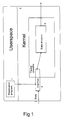
- the implemented packet classifier is shown in figure 1 and consists of three more or less detached parts. These are: the reservation program 1 which is a standalone program, the interface between the packet flows 2 and the data structure 3 and the data structure itself. The main part, the data structure 3 and the interface 4 between it and the packets, is implemented as a part of the kernel 5 in the operating system NetBSD. This is done to speed up the packet classification and to achieve access to the incoming packets in a natural way.
- the reservation program does not have the same demands for swiftness, and interaction with the incoming packets is not needed either. Therefore it is placed in user space.
- the implementation of the packet classifier is relatively general.
- the classifier is not optimized to solve one single problem but is instead designed to solve a group of problems, namely packet classification when a large amount of filters are stored.
- a filter consists of a reservation and a number of fields in the packet headers.
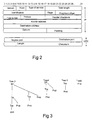
- a filter can consist of any combination of the six fields shown in figure 2.
- Some prior art uses the SA,DA,DP and Prot fields to specify flows and filters.
- Differential Services uses the TOS field in some proposals in the prior art.
- the packet classifier can be configured to give the source address field higher priority than the protocol field.
- a priority order between the different fields is necessary since an incoming packet can match more then one filter. For example, a packet can match one filter which is based on the source and destination ports and at the same time match another filter which is based on the source and destination address. The priority order then decides which filter that will be chosen.
- An important quality for a fast packet classifier is that filters can match not only individual flows but also groups of flows.
- the property that indicates on which detail level a flow is specified is called granularity. With a coarser granularity each single flow does not have to be specified when making the same filter for many flows, thus a complete subnet can be specified with just one filter.
- the advantage of using a coarser granularity is that many flows can share a single filter, meaning that the filters are fewer. This results in faster packet classification.
- the disadvantage is a lower level of detail. One flow cannot be separated from the other.
- Our packet classifier supports filter specifications on subnets. Source and destination addresses can have subnet filters made on bit level. The notation 131.115.22.11/29 means that a filter is made on the high order 29 bits in the address.
- the reservation program is the part of the packet classifier where new filters are made and old ones are deleted. Filters consist of header fields and a corresponding reservation. Filters are inserted as the user enters the filters in a configuration file. After that the user compiles the configuration file with the reservation program. The reservation program gives, if the configuration file is syntactically correct, a compiled file back. This file is then copied by the user, via a device, down to kernel. Addition and removal of filters can be done at any time. No rebooting is necessary and the new filters are accessible for the classifier as soon as they are copied down to the kernel.
- the interface forwards incoming packets to the data structure. It also takes care of the interrupts that are generated when new filters are copied down to the kernel. When these filters arrive it is the interface that takes care of them and inserts them into, or removes them from, the data structure.
- the filters and their reservations are stored in the data structure. This is the most important part of a fast packet classifier, at least when many filters are stored. The reason for this is that the cost for filter lookups in a linear structure (an array or a linked list) is proportional to the numbers of filters. This is not a problem if the packet classifier only needs to store a small number of filters at the same time. Since the number of filters is small, the lookup time will also be small. For a packet classifier intended to be used in a router handling QoS matters, the working conditions are totally different. The number of simultaneously stored filters can often be counted in 1000:s and then it is not appropriate to use a linear data structure. In this case it is important to find matching filters without having to traverse all of them.
- the first tree contains all filters associated with the highest priority field (i.e., if a filter includes the highest priority field, all fields of the filter will be inserted in the first tree). If the filter does not include this field but the second highest, all fields of the filter are inserted in the second tree etc. If DP had been given a higher priority than SP at the configuration, DP would be found in SP's position in figure 3 and vice versa.
- These binomial trees are a bit more complex than ordinary binomial trees. In figure 3 the nodes represent smaller trees. These smaller trees are trie trees and will be described further down.
- All nodes in a trie tree has pointers to its following binomial trees.
- the rest of the fields are inserted recursively in the following binomial trees pointed at by this newly inserted node. Accordingly, each node in a binomial tree points to multiple, smaller binomial trees.
- the resource reservation is stored in the node containing the last inserted field.
- the node in the trie tree contains pointers to the following binomial trees.
- SA priority order
- DA priority order
- SP DA
- SP DP
- TOS TOS
- PROT priority order
- the router must classify every incoming packet to find out if there are any specific resources allocated for it. This is done by searching the filters to find one that matches the incoming packet. The search starts in the first binomial tree. If a matching filter is found in this tree, the associated action is performed, otherwise the search continues in the second tree etc. If no filter is found in any of the six trees, then a default action is performed.
- the small trees appearing as nodes in figure 3 are trie trees.
- the nodes in these small trees are grouped in such a way that when a lookup is performed and a node that does not match the incoming packet is found, the lookup does not have to continue further down in this tree.
- Every node in the tree contains the number of bits of the field in the incoming packet that has to be compared and also what these bits should be to get a match.
- the field of the incoming packet is shifted this given number of bits and the next bit of the incoming packet decides which one of the two children nodes to visit next. This bit is shifted, and a new comparison is made in the corresponding child node.
- Each filter that is kept in our data structure is stored as a number of cells. Because of the structure of our algorithm these cells are rather many, approximately ten, per filter. They are also rather small. These cells are smaller then the smallest size of memory the kernel of NetBSD can allocate, which means that we are wasting memory every time we make a filter. To cope with this and to save time when inserting new filters a new memory allocation structure has been implemented. This new structure merges a number of small cells into larger cells which are allocated when needed. It also removes larger cells when no smaller cell in it is being used.
- a classifier is a natural and indispensable part of a firewall. Greater demands are raised on the firewalls as they become more advanced and protect larger areas. The performance must stay the same despite that more filters are stored. Newly performed tests have show that performance is one of the weakest points of today's firewalls. In the test, virtual clients instead of real clients were used. When the number of virtual clients grows beyond 48, the performance rapidly drops for many of the tested firewalls. A large share of this increase in lookup time is likely to depend on increased costs of packet classification. To meet these new demands, our packet classifier tries to improve the scaling properties regarding the lookup time of the packet classifiers data structure. Our packet classifier already works as a packet filter. If our packet classifier should work as a circuit level gateway, extensions like session memory also needs to be implemented.
- a number of filters and their according actions must also be implemented to make the firewall know what to do with the packets after the classification. The most common actions are 'accept', 'deny' and 'deny and report'.
- An accept-filter lets all matching packets through.
- a deny-filter denies all matching packets and a deny-and-report filter denies matching packets and reports them too.
- a module to take care of the reaction on these filters must also be implemented, but this is a question of minor adjustments to the present code.
- packet classifiers will be needed. These packet classifiers will often work with large amounts of flows and large amounts of reservations. To deal with this in a swift way, new packet classifiers with better performance must be developed. It is in this perspective our packet classifier is interesting.
- packets In a QoS enabled network, packets must be compared to stored reservations to find out which class of service a packet shall be given. If this is done in every involved node as in RSVP, or if it is done at the border routers of the networks like in many DiffServ proposals, does not matter for the packet classifier. The same fields in the packet header will be of interest and the number of filters will in both cases be large.
- a policing unit discriminates flows that send to much data. This can be realized with a packet classifier and new modules that remembers how much data each flow has sent.
- the policing unit compares all incoming packets against the stored filters. If a packet matches a filter and the according reservation the flow is examined to see if it keeps to what is agreed or if it sends more. If more packets than agreed on are sent, packets are either degraded to best effort or simply dropped. In this case as well, it is demanded of the packet classifier to be able to compare incoming packets fast to a large amount of filters.
Landscapes
- Engineering & Computer Science (AREA)
- Computer Networks & Wireless Communication (AREA)
- Signal Processing (AREA)
- Computer Security & Cryptography (AREA)
- Multimedia (AREA)
- Computer Hardware Design (AREA)
- Computing Systems (AREA)
- General Engineering & Computer Science (AREA)
- Data Exchanges In Wide-Area Networks (AREA)
Abstract
Description
- A communications network or a IP-network which incorporates a packet classifier in a end system or a router which inspects each incoming packet based on information in the packet headers and determines how each packet should be treated.
- A packet classifier is a program in an end system or a router that inspects each incoming packet and based on the information in the packet headers determines how each packet should be treated. Thus, a packet classifier divides packets into different classes.
- An operating system can take advantage of a packet classifier in many different ways. First, a packet classifier in an end system can decide which process to wake up to take care of the packets (e.g., start a user level protocol stack: D. R. Engler and M. F. Kaashoek: DPF: Fast, Flexible Message Demultiplexing using Dynamic Code Generation. Proc. of ACM SIGCOMM'96, August 1996.).
- Second, a router can use a packet classifier to make the management of packet flows more efficient by marking packets. This makes them easier to process when sent to the next hop router, so-called tag or IP switching (Y. Rekhter, B. Davie, D. Katz, E. Rosen, G. Swallow and D. Farinacci: Tag Switching Architecture - Overview. Internet Draft, July 1997. Work in progress.and (IP Switching: The Intelligence of Routing, the Performance of Switching. Ipsilon Networks white paper, February 1996. http://www.ipsilon.com/productinfo/wp-ipswitch.html.).
- Third, a packet classifier can be used in firewalls. For example, a company is not interested in any traffic to its local network with the exception of www-traffic to a specific computer, ftp traffic to another and PPP-connections to a third computer. These rules are inserted as filters in a packet classifier and the packets that match one of those criteria are the only ones that are allowed to pass the firewall.
- Fourth, a packet classifier can be used in Quality of Service, QoS, solutions. Traditionally the Internet has only supported best effort service, no guarantees on delay or delay variation (jitter) has been given by the network. To offer different levels of service, packets must be classified so the scheduler can give each packet the requested service. Packet classification is done by examining a number of fields in the packet headers. Fields of interest are for example: source address, destination address, source port and destination port. These fields are compared with the filters stored in the packet classifier. With each filter is also an action stored. The action describes what to do if the incoming packet matches the filter. The appropriate action depends on the context in which the packet classifier is used.
- US-A-5 574 910 discloses a method and apparatus for treatment of packets depending on information in the packet headers. A binary search tree including a large number of filters is utilized to determine how the packets should be treated.
- The invention seeks to provide a efficient packet classifier which can be implemented in applications of the above-mentioned kind.
- The classifier is not intended to solve one single problem but is instead designed to solve a group of problems and specially packet classification when a large amount of filters are stored.
- According to an aspect of the present invention, there is provided a Packet Classifier as specified in
claim 1. - A Packet Classifier formed in accordance with the invention has a number of advantages.
The packet classifiers data structure can scale well when additional filters are inserted, the filter specification is general enough to support classification on subnets etc. and the data structure is memory efficient. The advantages of the implemented packet classifier can be summarised as the following: - 1.Scaleable data structure
- 2.General filter specifications
- 3.Low memory consumption
-
- Embodiments of the invention will now be described, by way of example, with reference to the accompanying drawings, in which:
- Fig. 1. illustrates, in schematic form, an packet classifier according to our invention and different parts of the classifier.
- Fig. 2. illustrates, an IP and UDP header.
- Fig. 3. illustrates, the binomial trees of the data structure.
- Fig. 4. illustrates, the filter (SP=16, TOS=0) is the first filter inserted.
- Fig. 5. illustrates,
filters - Fig. 6. illustrates, the trie tree is extended with filters 01xx, 1000 and 1001.
-
- The implemented packet classifier is shown in figure 1 and consists of three more or less detached parts. These are: the
reservation program 1 which is a standalone program, the interface between the packet flows 2 and thedata structure 3 and the data structure itself. The main part, thedata structure 3 and theinterface 4 between it and the packets, is implemented as a part of thekernel 5 in the operating system NetBSD. This is done to speed up the packet classification and to achieve access to the incoming packets in a natural way. The reservation program does not have the same demands for swiftness, and interaction with the incoming packets is not needed either. Therefore it is placed in user space. - The implementation of the packet classifier is relatively general. The classifier is not optimized to solve one single problem but is instead designed to solve a group of problems, namely packet classification when a large amount of filters are stored.
- A filter consists of a reservation and a number of fields in the packet headers. A filter can consist of any combination of the six fields shown in figure 2.
- The following abbreviations are introduced for these fields:
• SA
bits- Source Address 32 • DA
bits- Destination Address 32 • SP
bits- Source Port 16 • DP
bits- Destination Port 16 • Prot - - Protocol 8 bits • TOS - - Type of Service 8 bits - The reason for choosing these field are that they can specify a flow. Some prior art uses the SA,DA,DP and Prot fields to specify flows and filters. Differential Services uses the TOS field in some proposals in the prior art.
At start up time it is possible to give different priority orders to the fields that shall be classified on (e.g., the packet classifier can be configured to give the source address field higher priority than the protocol field). A priority order between the different fields is necessary since an incoming packet can match more then one filter. For example, a packet can match one filter which is based on the source and destination ports and at the same time match another filter which is based on the source and destination address. The priority order then decides which filter that will be chosen. - An important quality for a fast packet classifier is that filters can match not only individual flows but also groups of flows. The property that indicates on which detail level a flow is specified is called granularity. With a coarser granularity each single flow does not have to be specified when making the same filter for many flows, thus a complete subnet can be specified with just one filter. The advantage of using a coarser granularity is that many flows can share a single filter, meaning that the filters are fewer. This results in faster packet classification. The disadvantage is a lower level of detail. One flow cannot be separated from the other. Our packet classifier supports filter specifications on subnets. Source and destination addresses can have subnet filters made on bit level. The notation 131.115.22.11/29 means that a filter is made on the high order 29 bits in the address.
- The reservation program is the part of the packet classifier where new filters are made and old ones are deleted. Filters consist of header fields and a corresponding reservation. Filters are inserted as the user enters the filters in a configuration file. After that the user compiles the configuration file with the reservation program. The reservation program gives, if the configuration file is syntactically correct, a compiled file back. This file is then copied by the user, via a device, down to kernel. Addition and removal of filters can be done at any time. No rebooting is necessary and the new filters are accessible for the classifier as soon as they are copied down to the kernel.
- The interface forwards incoming packets to the data structure. It also takes care of the interrupts that are generated when new filters are copied down to the kernel. When these filters arrive it is the interface that takes care of them and inserts them into, or removes them from, the data structure.
- The filters and their reservations are stored in the data structure. This is the most important part of a fast packet classifier, at least when many filters are stored. The reason for this is that the cost for filter lookups in a linear structure (an array or a linked list) is proportional to the numbers of filters. This is not a problem if the packet classifier only needs to store a small number of filters at the same time. Since the number of filters is small, the lookup time will also be small. For a packet classifier intended to be used in a router handling QoS matters, the working conditions are totally different. The number of simultaneously stored filters can often be counted in 1000:s and then it is not appropriate to use a linear data structure. In this case it is important to find matching filters without having to traverse all of them. The faster we can find a match between the incoming packet and a filter the better. We have chosen to build our structure as a combination between binomial trees and tries. We have created a data structure with six binomial trees where each node in the binomial tree is a trie.
- How a filter is inserted in the data structure depends on the priority order between the different fields. If we assume that SA has the highest priority followed by DA, SP, DP, TOS and PROT, our data structure consists of six binomial trees structured as in figure 3. There are six trees where the first and the second tree follow the same binomial structure as the ones below. Please observe that only the four smallest trees are pictured in figure 3.
- The first tree contains all filters associated with the highest priority field (i.e., if a filter includes the highest priority field, all fields of the filter will be inserted in the first tree). If the filter does not include this field but the second highest, all fields of the filter are inserted in the second tree etc. If DP had been given a higher priority than SP at the configuration, DP would be found in SP's position in figure 3 and vice versa.
These binomial trees are a bit more complex than ordinary binomial trees. In figure 3 the nodes represent smaller trees. These smaller trees are trie trees and will be described further down. When inserting a filter in this structure, we first insert the highest priority field in the trie tree at the top of the corresponding binomial tree. All nodes in a trie tree has pointers to its following binomial trees. When the high priority field has been inserted, the rest of the fields are inserted recursively in the following binomial trees pointed at by this newly inserted node. Accordingly, each node in a binomial tree points to multiple, smaller binomial trees. The resource reservation is stored in the node containing the last inserted field. - Figure 4 illustrates the third tree after inserting the filter (SP=16, TOS=0). The node in the trie tree contains pointers to the following binomial trees. In this example the same priority order as mentioned above (SA, DA, SP, DP, TOS, PROT) is assumed.
- If the packet classifier is used in a router, the router must classify every incoming packet to find out if there are any specific resources allocated for it. This is done by searching the filters to find one that matches the incoming packet. The search starts in the first binomial tree. If a matching filter is found in this tree, the associated action is performed, otherwise the search continues in the second tree etc. If no filter is found in any of the six trees, then a default action is performed.
- The small trees appearing as nodes in figure 3 are trie trees. The nodes in these small trees are grouped in such a way that when a lookup is performed and a node that does not match the incoming packet is found, the lookup does not have to continue further down in this tree.
Every node in the tree contains the number of bits of the field in the incoming packet that has to be compared and also what these bits should be to get a match. When there is a match, the field of the incoming packet is shifted this given number of bits and the next bit of the incoming packet decides which one of the two children nodes to visit next. This bit is shifted, and a new comparison is made in the corresponding child node.
Since the best matching filter is the longest match, the search must continue with the ambition to find a longer match even if a reservation already has been found. A match is better than a previous match if it contains a longer address prefix or if it comprises more fields. However, not only the number of fields in the filter decides if it is a better match, but also the priority order. If we have the same priority order as mentioned before (SA, DA, SP, DP, TOS, PROT), the filter (SP, DP) would give a better match than (SP, TOS, PROT) although it comprises fewer fields, on account of the fact that DP has higher priority than both TOS and PROT. This assumes of course that both these filters match the incoming packet. Accordingly, when we find a matching filter in a node, the search continues either further down the trie tree or, if that is not possible, in the following binomial trees starting at that particular node.
In figure 5 and figure 6 we illustrate how insertion of filters in these trie trees works. We exemplify using fields of maximum four bits where insertion of prefixes is possible.
Figure 5 illustrates the insertion of thefields
Figure 6 illustrates the insertion of 0100 and 010x as in the previous example, but also 01xx, 1000 and 10++01. - Each filter that is kept in our data structure is stored as a number of cells. Because of the structure of our algorithm these cells are rather many, approximately ten, per filter. They are also rather small. These cells are smaller then the smallest size of memory the kernel of NetBSD can allocate, which means that we are wasting memory every time we make a filter. To cope with this and to save time when inserting new filters a new memory allocation structure has been implemented. This new structure merges a number of small cells into larger cells which are allocated when needed. It also removes larger cells when no smaller cell in it is being used.
- In the prior art section some fields of application for packet classifiers were enumerated. Our invention have the greatest advantages for mainly two of these; packet classifiers used in firewalls and packet classifiers used in a QoS context. What these two fields of application have in common is foremost that the number of stored filters are often large and classification needs to be done fast. This means that the packet classifier used in these areas need to scale well regarding time when many filters are inserted. This is what our invention is intended for.
- A classifier is a natural and indispensable part of a firewall. Greater demands are raised on the firewalls as they become more advanced and protect larger areas. The performance must stay the same despite that more filters are stored. Newly performed tests have show that performance is one of the weakest points of today's firewalls. In the test, virtual clients instead of real clients were used. When the number of virtual clients grows beyond 48, the performance rapidly drops for many of the tested firewalls. A large share of this increase in lookup time is likely to depend on increased costs of packet classification. To meet these new demands, our packet classifier tries to improve the scaling properties regarding the lookup time of the packet classifiers data structure.
Our packet classifier already works as a packet filter. If our packet classifier should work as a circuit level gateway, extensions like session memory also needs to be implemented. A number of filters and their according actions must also be implemented to make the firewall know what to do with the packets after the classification. The most common actions are 'accept', 'deny' and 'deny and report'. An accept-filter lets all matching packets through. A deny-filter denies all matching packets and a deny-and-report filter denies matching packets and reports them too. A module to take care of the reaction on these filters must also be implemented, but this is a question of minor adjustments to the present code. - No matter which model of QoS that is introduced in the network, packet classifiers will be needed. These packet classifiers will often work with large amounts of flows and large amounts of reservations. To deal with this in a swift way, new packet classifiers with better performance must be developed. It is in this perspective our packet classifier is interesting.
In a QoS enabled network, packets must be compared to stored reservations to find out which class of service a packet shall be given. If this is done in every involved node as in RSVP, or if it is done at the border routers of the networks like in many DiffServ proposals, does not matter for the packet classifier. The same fields in the packet header will be of interest and the number of filters will in both cases be large.
Another application for our packet classifier in a QoS context is as a policing unit. A policing unit, as has been mentioned before, discriminates flows that send to much data. This can be realized with a packet classifier and new modules that remembers how much data each flow has sent.
The policing unit compares all incoming packets against the stored filters. If a packet matches a filter and the according reservation the flow is examined to see if it keeps to what is agreed or if it sends more. If more packets than agreed on are sent, packets are either degraded to best effort or simply dropped. In this case as well, it is demanded of the packet classifier to be able to compare incoming packets fast to a large amount of filters. - The invention is to be limited only by the scope of the claim so the description is not to be taken as limiting the invention.
Claims (8)
- A communications network or an IP-network which incorporates a packet classifier in an end system or a router, which is arranged to inspect each incoming packet in a search tree with a number of nodes based on information in fields in the packet headers and to determines how each packet should be treated, said packet classifier being arranged to divides packets into classes, when a large number of filters are stored, by matching each incoming packet to one of said large number of filters, characterised in that the packet classifier comprises a data structure (3) built as a combination between binomial trees and trie trees, where each node in a binomial tree is a trie tree, in which the filters are stored, for improving the performance of the data structure (3), in that a field prefix is stored in every node in the trie trees, and in that the packet classifier is arranged to compare the field prefix with a corresponding bit field of the incoming packet.
- A communications network or an IP-network as claimed in claim 1, characterized in that every node in the trie tree further includes stored data about the number of shift steps to be done in a bit field of the packet, the result of the shift, and if a reservation exists for the node.
- A communications network or an IP-network as claimed in claim 2, characterized in that the packet classifier is implemented in the kernel (5) of an operating system.
- A communications network or an IP-network as claimed in claim 1, characterized in that the packet classifier is a part of a firewall of the network.
- A communications network or an IP-network as claimed in claim 1, characterized in that the network is a QoS enabled network.
- A communications network or an IP-network as claimed in any of the previous claims, characterized in that the packet classifier consists of three detached parts which are: the reservation program (1) which is a standalone program, an interface (4) between the packet flows (2) and the data structure (3), and the data structure (3) itself, and where the main part, the data structure (3) and the interface (4), is implemented as a part of the kernel (5) in the operating system NetBSD.
- A communications network or an IP-network as claimed in any of the previous claims, characterized in that nodes which have underlying child nodes may have stored reservations for subnets.
- A method in a communications network to manage packets in a packet classifier, situated in an end system or a router, that examines every incoming packet in a search tree with a plurality of nodes and that, based on information in fields in the packet headers, decides how every packet shall be treated, characterized by the steps:Providing said packet classifier with a data structure (3) built as a combination between binomial trees and trie trees, where each node in a binomial tree is a trie tree;Storing filters in said data structure (3);Comparing a bit field of an incoming packet with a field prefix stored in a node in a trie tree;If the field prefix does not match the bit field of the incoming packet, finish the search in that trie tree;If the field prefix does match the bit field of the incoming packet, shift the bit field of the incoming packet the number of steps given in the node that is visited;With the next bit in the bit field decide which child node to be visited in the next place.
Priority Applications (1)
| Application Number | Priority Date | Filing Date | Title |
|---|---|---|---|
| DK99927046T DK1088430T3 (en) | 1998-05-14 | 1999-05-11 | A communication network or IP network that includes a packet classifier |
Applications Claiming Priority (3)
| Application Number | Priority Date | Filing Date | Title |
|---|---|---|---|
| SE9801744 | 1998-05-14 | ||
| SE9801744A SE521814C2 (en) | 1998-05-14 | 1998-05-14 | A communication network or an IP network which includes a packet classifier |
| PCT/SE1999/000788 WO1999059303A2 (en) | 1998-05-14 | 1999-05-11 | A communications network or an ip-network which incorporates a packet classifier |
Publications (2)
| Publication Number | Publication Date |
|---|---|
| EP1088430A2 EP1088430A2 (en) | 2001-04-04 |
| EP1088430B1 true EP1088430B1 (en) | 2005-06-01 |
Family
ID=20411357
Family Applications (1)
| Application Number | Title | Priority Date | Filing Date |
|---|---|---|---|
| EP99927046A Expired - Lifetime EP1088430B1 (en) | 1998-05-14 | 1999-05-11 | A communications network or an ip-network which incorporates a packet classifier |
Country Status (6)
| Country | Link |
|---|---|
| EP (1) | EP1088430B1 (en) |
| DE (1) | DE69925599T2 (en) |
| EE (1) | EE04732B1 (en) |
| NO (1) | NO332171B1 (en) |
| SE (1) | SE521814C2 (en) |
| WO (1) | WO1999059303A2 (en) |
Families Citing this family (5)
| Publication number | Priority date | Publication date | Assignee | Title |
|---|---|---|---|---|
| US6807183B1 (en) * | 2000-05-09 | 2004-10-19 | Advanced Micro Devices, Inc. | Arrangement for reading a prescribed location of a FIFO buffer in a network switch port |
| US7149216B1 (en) * | 2000-09-05 | 2006-12-12 | Cisco Technology, Inc. | M-trie based packet processing |
| US7246173B2 (en) * | 2001-04-16 | 2007-07-17 | Nokia Corporation | Method and apparatus for classifying IP data |
| US7684400B2 (en) * | 2002-08-08 | 2010-03-23 | Intel Corporation | Logarithmic time range-based multifield-correlation packet classification |
| GB2422507A (en) | 2005-01-21 | 2006-07-26 | 3Com Corp | An intrusion detection system using a plurality of finite state machines |
Family Cites Families (5)
| Publication number | Priority date | Publication date | Assignee | Title |
|---|---|---|---|---|
| AU4661793A (en) * | 1992-07-02 | 1994-01-31 | Wellfleet Communications | Data packet processing method and apparatus |
| US5473607A (en) * | 1993-08-09 | 1995-12-05 | Grand Junction Networks, Inc. | Packet filtering for data networks |
| US5509006A (en) * | 1994-04-18 | 1996-04-16 | Cisco Systems Incorporated | Apparatus and method for switching packets using tree memory |
| US5802320A (en) * | 1995-05-18 | 1998-09-01 | Sun Microsystems, Inc. | System for packet filtering of data packets at a computer network interface |
| WO1997041674A2 (en) * | 1996-04-30 | 1997-11-06 | 3Com Corporation | Packet filtering based on socket or application identification |
-
1998
- 1998-05-14 SE SE9801744A patent/SE521814C2/en unknown
-
1999
- 1999-05-11 WO PCT/SE1999/000788 patent/WO1999059303A2/en not_active Ceased
- 1999-05-11 DE DE69925599T patent/DE69925599T2/en not_active Expired - Lifetime
- 1999-05-11 EP EP99927046A patent/EP1088430B1/en not_active Expired - Lifetime
- 1999-05-11 EE EEP200000649A patent/EE04732B1/en not_active IP Right Cessation
-
2000
- 2000-11-08 NO NO20005629A patent/NO332171B1/en not_active IP Right Cessation
Also Published As
| Publication number | Publication date |
|---|---|
| WO1999059303A2 (en) | 1999-11-18 |
| DE69925599T2 (en) | 2006-04-27 |
| SE9801744D0 (en) | 1998-05-14 |
| EP1088430A2 (en) | 2001-04-04 |
| WO1999059303A3 (en) | 2000-03-09 |
| NO20005629L (en) | 2001-01-10 |
| NO20005629D0 (en) | 2000-11-08 |
| SE9801744L (en) | 1999-11-15 |
| DE69925599D1 (en) | 2005-07-07 |
| SE521814C2 (en) | 2003-12-09 |
| EE04732B1 (en) | 2006-10-16 |
| EE200000649A (en) | 2002-04-15 |
| NO332171B1 (en) | 2012-07-16 |
Similar Documents
| Publication | Publication Date | Title |
|---|---|---|
| Waldvogel | Fast longest prefix matching: algorithms, analysis, and applications | |
| Feldman et al. | Tradeoffs for packet classification | |
| Chao | Next generation routers | |
| US7028098B2 (en) | Selective routing of data flows using a TCAM | |
| US6980555B2 (en) | Policy change characterization method and apparatus | |
| US6341130B1 (en) | Packet classification method and apparatus employing two fields | |
| US8619793B2 (en) | Dynamic assignment of traffic classes to a priority queue in a packet forwarding device | |
| Chao et al. | High performance switches and routers | |
| US6567408B1 (en) | Methods and apparatus for packet classification with multi-level data structure | |
| KR100333250B1 (en) | Packet forwarding apparatus with a flow detection table | |
| US8645568B2 (en) | Various methods and apparatuses for a route server | |
| US7327727B2 (en) | Atomic lookup rule set transition | |
| JP2012507930A (en) | Method and system for classifying data packets | |
| US20040170170A1 (en) | Packet classification apparatus and method using field level tries | |
| AU763215B2 (en) | Method and system for controlling data flow through a multiport switch | |
| EP1088430A2 (en) | A communications network or an ip-network which incorporates a packet classifier | |
| US7864776B2 (en) | Method and equipment for making a routing decision dependent on a quality-of-service class | |
| Wu | Packet forwarding technologies | |
| US7023852B1 (en) | Policy verification methods and apparatus | |
| Singhal et al. | Terabit switching: a survey of techniques and current products | |
| Adiseshu et al. | Packet filter management for layer 4 switching | |
| Kim et al. | An efficient ip lookup architecture with fast update using single-match tcams | |
| CN115051951B (en) | Service flow scheduling method, centralized controller and storage medium | |
| US6700883B1 (en) | Algorithm to bypass L4 processing in an internet protocol forwarding processor | |
| Kim | Data structures for static and dynamic router tables |
Legal Events
| Date | Code | Title | Description |
|---|---|---|---|
| PUAI | Public reference made under article 153(3) epc to a published international application that has entered the european phase |
Free format text: ORIGINAL CODE: 0009012 |
|
| 17P | Request for examination filed |
Effective date: 20001214 |
|
| AK | Designated contracting states |
Kind code of ref document: A2 Designated state(s): DE DK ES FI FR GB IT SE |
|
| AX | Request for extension of the european patent |
Free format text: LT PAYMENT 20001214;LV PAYMENT 20001214 |
|
| 17Q | First examination report despatched |
Effective date: 20040406 |
|
| GRAP | Despatch of communication of intention to grant a patent |
Free format text: ORIGINAL CODE: EPIDOSNIGR1 |
|
| GRAS | Grant fee paid |
Free format text: ORIGINAL CODE: EPIDOSNIGR3 |
|
| GRAA | (expected) grant |
Free format text: ORIGINAL CODE: 0009210 |
|
| AK | Designated contracting states |
Kind code of ref document: B1 Designated state(s): DE DK ES FI FR GB IT SE |
|
| AX | Request for extension of the european patent |
Extension state: LT LV |
|
| PG25 | Lapsed in a contracting state [announced via postgrant information from national office to epo] |
Ref country code: IT Free format text: LAPSE BECAUSE OF FAILURE TO SUBMIT A TRANSLATION OF THE DESCRIPTION OR TO PAY THE FEE WITHIN THE PRESCRIBED TIME-LIMIT;WARNING: LAPSES OF ITALIAN PATENTS WITH EFFECTIVE DATE BEFORE 2007 MAY HAVE OCCURRED AT ANY TIME BEFORE 2007. THE CORRECT EFFECTIVE DATE MAY BE DIFFERENT FROM THE ONE RECORDED. Effective date: 20050601 |
|
| REG | Reference to a national code |
Ref country code: GB Ref legal event code: FG4D |
|
| REF | Corresponds to: |
Ref document number: 69925599 Country of ref document: DE Date of ref document: 20050707 Kind code of ref document: P |
|
| PG25 | Lapsed in a contracting state [announced via postgrant information from national office to epo] |
Ref country code: SE Free format text: LAPSE BECAUSE OF FAILURE TO SUBMIT A TRANSLATION OF THE DESCRIPTION OR TO PAY THE FEE WITHIN THE PRESCRIBED TIME-LIMIT Effective date: 20050901 |
|
| PG25 | Lapsed in a contracting state [announced via postgrant information from national office to epo] |
Ref country code: ES Free format text: LAPSE BECAUSE OF FAILURE TO SUBMIT A TRANSLATION OF THE DESCRIPTION OR TO PAY THE FEE WITHIN THE PRESCRIBED TIME-LIMIT Effective date: 20050912 |
|
| REG | Reference to a national code |
Ref country code: DK Ref legal event code: T3 |
|
| LTIE | Lt: invalidation of european patent or patent extension |
Effective date: 20050601 |
|
| PLBE | No opposition filed within time limit |
Free format text: ORIGINAL CODE: 0009261 |
|
| STAA | Information on the status of an ep patent application or granted ep patent |
Free format text: STATUS: NO OPPOSITION FILED WITHIN TIME LIMIT |
|
| 26N | No opposition filed |
Effective date: 20060302 |
|
| EN | Fr: translation not filed | ||
| PG25 | Lapsed in a contracting state [announced via postgrant information from national office to epo] |
Ref country code: FR Free format text: LAPSE BECAUSE OF FAILURE TO SUBMIT A TRANSLATION OF THE DESCRIPTION OR TO PAY THE FEE WITHIN THE PRESCRIBED TIME-LIMIT Effective date: 20050601 |
|
| PGFP | Annual fee paid to national office [announced via postgrant information from national office to epo] |
Ref country code: DK Payment date: 20150520 Year of fee payment: 17 Ref country code: GB Payment date: 20150521 Year of fee payment: 17 Ref country code: FI Payment date: 20150513 Year of fee payment: 17 Ref country code: DE Payment date: 20150521 Year of fee payment: 17 |
|
| REG | Reference to a national code |
Ref country code: DE Ref legal event code: R119 Ref document number: 69925599 Country of ref document: DE |
|
| REG | Reference to a national code |
Ref country code: DK Ref legal event code: EBP Effective date: 20160531 |
|
| GBPC | Gb: european patent ceased through non-payment of renewal fee |
Effective date: 20160511 |
|
| PG25 | Lapsed in a contracting state [announced via postgrant information from national office to epo] |
Ref country code: FI Free format text: LAPSE BECAUSE OF NON-PAYMENT OF DUE FEES Effective date: 20160511 |
|
| PG25 | Lapsed in a contracting state [announced via postgrant information from national office to epo] |
Ref country code: DE Free format text: LAPSE BECAUSE OF NON-PAYMENT OF DUE FEES Effective date: 20161201 |
|
| PG25 | Lapsed in a contracting state [announced via postgrant information from national office to epo] |
Ref country code: DK Free format text: LAPSE BECAUSE OF NON-PAYMENT OF DUE FEES Effective date: 20160531 Ref country code: GB Free format text: LAPSE BECAUSE OF NON-PAYMENT OF DUE FEES Effective date: 20160511 |