EP1087591A2 - Data conversion apparatuses and method - Google Patents
Data conversion apparatuses and method Download PDFInfo
- Publication number
- EP1087591A2 EP1087591A2 EP00308253A EP00308253A EP1087591A2 EP 1087591 A2 EP1087591 A2 EP 1087591A2 EP 00308253 A EP00308253 A EP 00308253A EP 00308253 A EP00308253 A EP 00308253A EP 1087591 A2 EP1087591 A2 EP 1087591A2
- Authority
- EP
- European Patent Office
- Prior art keywords
- data
- communication apparatus
- octet
- node
- bit
- Prior art date
- Legal status (The legal status is an assumption and is not a legal conclusion. Google has not performed a legal analysis and makes no representation as to the accuracy of the status listed.)
- Granted
Links
Images










Classifications
-
- H—ELECTRICITY
- H04—ELECTRIC COMMUNICATION TECHNIQUE
- H04L—TRANSMISSION OF DIGITAL INFORMATION, e.g. TELEGRAPHIC COMMUNICATION
- H04L12/00—Data switching networks
- H04L12/66—Arrangements for connecting between networks having differing types of switching systems, e.g. gateways
-
- H—ELECTRICITY
- H04—ELECTRIC COMMUNICATION TECHNIQUE
- H04L—TRANSMISSION OF DIGITAL INFORMATION, e.g. TELEGRAPHIC COMMUNICATION
- H04L67/00—Network arrangements or protocols for supporting network services or applications
- H04L67/14—Session management
-
- H—ELECTRICITY
- H04—ELECTRIC COMMUNICATION TECHNIQUE
- H04L—TRANSMISSION OF DIGITAL INFORMATION, e.g. TELEGRAPHIC COMMUNICATION
- H04L69/00—Network arrangements, protocols or services independent of the application payload and not provided for in the other groups of this subclass
- H04L69/03—Protocol definition or specification
-
- H—ELECTRICITY
- H04—ELECTRIC COMMUNICATION TECHNIQUE
- H04L—TRANSMISSION OF DIGITAL INFORMATION, e.g. TELEGRAPHIC COMMUNICATION
- H04L69/00—Network arrangements, protocols or services independent of the application payload and not provided for in the other groups of this subclass
- H04L69/08—Protocols for interworking; Protocol conversion
-
- H—ELECTRICITY
- H04—ELECTRIC COMMUNICATION TECHNIQUE
- H04L—TRANSMISSION OF DIGITAL INFORMATION, e.g. TELEGRAPHIC COMMUNICATION
- H04L69/00—Network arrangements, protocols or services independent of the application payload and not provided for in the other groups of this subclass
- H04L69/18—Multiprotocol handlers, e.g. single devices capable of handling multiple protocols
-
- H—ELECTRICITY
- H04—ELECTRIC COMMUNICATION TECHNIQUE
- H04L—TRANSMISSION OF DIGITAL INFORMATION, e.g. TELEGRAPHIC COMMUNICATION
- H04L69/00—Network arrangements, protocols or services independent of the application payload and not provided for in the other groups of this subclass
- H04L69/30—Definitions, standards or architectural aspects of layered protocol stacks
- H04L69/32—Architecture of open systems interconnection [OSI] 7-layer type protocol stacks, e.g. the interfaces between the data link level and the physical level
- H04L69/322—Intralayer communication protocols among peer entities or protocol data unit [PDU] definitions
- H04L69/324—Intralayer communication protocols among peer entities or protocol data unit [PDU] definitions in the data link layer [OSI layer 2], e.g. HDLC
-
- H—ELECTRICITY
- H04—ELECTRIC COMMUNICATION TECHNIQUE
- H04L—TRANSMISSION OF DIGITAL INFORMATION, e.g. TELEGRAPHIC COMMUNICATION
- H04L69/00—Network arrangements, protocols or services independent of the application payload and not provided for in the other groups of this subclass
- H04L69/30—Definitions, standards or architectural aspects of layered protocol stacks
- H04L69/32—Architecture of open systems interconnection [OSI] 7-layer type protocol stacks, e.g. the interfaces between the data link level and the physical level
- H04L69/322—Intralayer communication protocols among peer entities or protocol data unit [PDU] definitions
- H04L69/329—Intralayer communication protocols among peer entities or protocol data unit [PDU] definitions in the application layer [OSI layer 7]
Definitions
- the present invention relates to a data conversion apparatus, a signal, a data conversion method, a DCE (Data Circuit-terminating Equipment), a gateway and a communication apparatus. More specifically, the present invention relates to a data conversion apparatus etc. for inhibiting octet/bit insertion in a section which does not require octet insertion or bit insertion (hereinafter referred to "octet/bit insertion") during communication on the basis of PPP (Point-to-Point Protocol). The present invention further relates to a communication apparatus which reduces control packet on the communication line.
- PPP is present as a data link layer protocol of OSI reference model.
- PPP is a bit/byte synchronous and an asynchronous link control protocol by a serial circuit.
- PPP is specified in RFC (Request For Comments) 1661 and RFC 1662 of IETF (Internet Engineering Task Force).
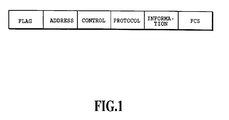
- Fig. 1 is a diagram showing a PPP frame configuration (frame format).
- the PPP frame has a flag field, address field, control field, protocol field, information field and FCS field.
- the number of bytes of respective fields are 1 byte for the flag field, 1 byte for the address field, 1 byte for the control field, 1 or 2 bytes for the protocol field, and 2 or 4 bytes for the FCS field.
- the address field and the control field may sometimes be compressed by negotiation of LCP (Link Control Protocol) ACFC (Address and Control Field Compression).
- the protocol field may sometimes be compressed by LCPPFC (Protocol Field Compression) negotiation.
- the FCS (Frame Check Sequence) field may sometimes be compressed by LCPFCS negotiation.
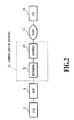
- Fig. 2 is a diagram showing an example of communication between DTE (Data Terminal Equipment) through a communication network and PSTN (Public Switched Telephone Network).
- DTE Data Terminal Equipment
- PSTN Public Switched Telephone Network
- an exchange 8 and a gateway 10 forms a communication network 5.
- DTE 2 and DTE 14 perform communication through DCE 4, exchange 8, gateway 10 and PSTN12.
- the communication network 5 can be, for example, a mobile communication network, and DCE 4 be, for example, a mobile station.
- DTE 2 data communication between DTE 2 and DTE 14 is performed on the basis of PPP.
- a data signal is transmitted from DTE 2 to DTE 14
- the data signal has been transmitted after making octet/bit insertion in DTE 2.
- octet/bit deletion octet/bit deletion
- octet/bit deletion octet/bit deletion
- DTE 2 data communication between DTE 2 and a given point (point for terminating PPP) in the network is performed on the basis of PPP.
- the gateway 10 or the like is considered.
- description is made for a case where the gateway 10 is the terminating point.
- a data signal is transmitted from DTE 2 to DTE 14
- octet/bit insertion has been made in DTE 2
- octet/bit deletion made on the received data signal in gateway 10
- the data signal has been transmitted to DTE 14.
- octet/bit insertion has been made in gateway 10
- octet/bit deletion has been made in DTE 2.
- Octet insertion means for example, a specific 1-byte data is escape processed with a 1-byte escape character (1 byte) to form a 2-byte data (will be described later in detail with reference to Fig. 9). Further, bit insertion is described using an example, when a flag ("01111110" in binary notation) is to be distinguished from other data portion, bit insertion is made, to data other than the flag, when five "Is" continue, "0" is inserted after the data.
- PPP Point-to-Point Protocol
- PPP enables transfer of various network protocols such as IP (Internet Protocol), Appletalk, and the like.
- IP Internet Protocol
- Appletalk and the like.
- the PPP specifications are specified as RFC (Request For Comment) of IETF (Internet Engineering Task Force).
- Fig. 17 is a diagram showing a communication example.
- a DTE (Data Terminal Equipment) 52 and a DTE 60 perform communication through a DCE (Data Circuit-terminating Equipment) 54, a network 56 and a DCE 58.
- the DCE 54 and the DCE 58 can be, for example, mobile stations (portable telephones).
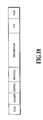
- Fig. 18 shows a PPP frame format.
- Flag represents start or end of PPP, and is used for identifying a frame partition.
- Address field is information representing address of this PPP frame, for which a fixed value is generally used.
- Control field is information used for identifying frame type, for which a fixed value is generally used.
- Protocol field is used for identifying the protocol of packet included in the information field, and protocol packet shown in the protocol field is included in the information field.
- FCS Fre Check Sequence
- Fig. 19 shows a PPP procedure.
- PPP transfers to a link establish phase when a physical layer starts in a link stop phase.
- link setting procedure of LCP Link Control Protocol
- LCP link establishment transfers to a verification phase, where a verification procedure is carried out as necessary.
- PPP transfers to a network layer protocol phase, where NCP link setting procedure corresponding to each network protocol is performed.
- NCP link setting procedure corresponding to each network protocol is performed.
- packet of network protocol corresponding to each NCP becomes transferable.
- PPP transfers to a link end phase by a communication end request or the like.
- LCP instructs to transmit an end request packet, when its identification packet is received, so that PPP link is closed and the physical layer is cut off. Further, close of the PPP link is notified to the network layer.
- PPP returns to the link stop phase.
- link establish condition is that node A and node B transmit and receive respective setting identification packets.
- ID is used for correspondence of setting request packet with response packet (setting identification packet, setting negation packet, or setting rejection packet), and ID value received in the request packet is included in the ID value of the response packet.
- an option Opt_A ⁇ G can be designated.
- Reception side of the setting request packet when all options included in the setting request packet can be recognized, and those values are all tolerable, accepts all options included in the setting request packet in the setting identification packet and performs a response.
- the setting request packet reception side when an unrecognizable option is present in options included in the setting request packet, in the setting rejection packet makes a response including the unrecognizable option.
- the setting request packet reception side when all options included in the setting request packet are recognizable, however, intolerable option values exist, in the setting negation packet includes only intolerable value option, however, changes these options to tolerable values and performs a response. Further, when options other than those included in the setting request packet are to be requested to the setting request packet transmission side, those options can also be added to the packet.
- the setting request packet transmission side when receiving a setting rejection packet, such rejected options are removed, and then transmits the setting request packet again.
- the setting request packet transmission side when receiving a setting negation packet, a setting request packet with option values changed to those included in the setting negation packet. However, when a plurality of values exist in the options of the setting negation packet, one of them is selected.
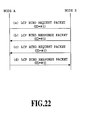
- Fig. 22 shows a keep alive sequence example using LCP echo request/response packet.
- the LCP echo request/response packet is used during LCP link establishment and can be used for determining whether or not the link is held.
- Another object of the present invention is to reduce the control packet on the communication line. With this configuration, reduction of communication tariff/communication cost and an increase in subscriber capacity associated with communication traffic amount reduction can be achieved.
- a data conversion apparatus performing octet deletion or bit deletion to data having a PPP configuration and being octet-inserted or bit-inserted.
- a data conversion apparatus comprising:
- a data conversion apparatus comprising:
- a data conversion apparatus comprising:
- a data conversion apparatus performing octet deletion or bit deletion to data having a PPP frame configuration and being not octet-inserted or not bit-inserted.
- a data conversion apparatus comprising:
- a data conversion apparatus comprising:
- a data conversion apparatus comprising:
- a data conversion apparatus converting data having a PPP frame configuration and being not octet-inserted or not bit-inserted into data having a frame configuration of data link layer protocol other than PPP.
- a data conversion apparatus converting data having a frame configuration in which additional information including information for identifying a frame partition is added to a PPP frame configuration and being not octet-inserted or not bit-inserted into data having a frame configuration of data link layer protocol other than PPP.
- a data conversion apparatus converting data having a frame configuration flag-deleted from a PPP frame configuration and being not octet-inserted or not bit-inserted into data having a frame configuration of data link layer protocol other than PPP.
- a data conversion apparatus converting data having a frame configuration in which additional information including information for identifying frame partition is added to a frame configuration flag-deleted from a PPP frame configuration and being not octet-inserted or not bit-inserted into data having a frame configuration of data link layer protocol other than PPP.
- a data conversion apparatus converting data having a frame configuration of data link layer protocol other than a PPP into data having a PPP frame configuration and being not octet-inserted or not bit-inserted.
- a data conversion apparatus converting data having a frame configuration of data link layer protocol other than a PPP into data having a frame configuration in which additional information including information for identifying frame partition is added to a PPP frame configuration and being not octet-inserted or not bit-inserted.
- a data conversion apparatus converting data having a frame configuration of data link layer protocol other than a PPP into data having a frame configuration flag-deleted from a PPP frame configuration and being not octet-inserted or not bit-inserted.
- a data conversion apparatus converting data having a frame configuration of data link layer protocol other than a PPP into data having a frame configuration flag-deleted from a PPP frame configuration to which additional information including information for identifying frame partition is added and being not octet-inserted or not bit-inserted.
- a signal having a PPP frame configuration and including data not octet-inserted or not bit-inserted.
- a signal having a PPP frame configuration to which additional information including information for identifying frame partition is added and including data not octet-inserted or not bit-inserted.
- a signal having a frame configuration of flag-deleted from a PPP frame configuration and including data not octet-inserted or not bit-inserted.
- a signal having a frame configuration of flag-deleted from a PPP frame configuration to which additional information including information for identifying frame partition is added and including data not octet-inserted or not bit-inserted.
- a data conversion method performing octet deletion or bit deletion to data having a PPP frame configuration and being octet-inserted or bit-inserted.
- a data conversion method comprising:
- a data conversion method comprising:
- a data conversion method comprising:
- a data conversion method performing octet insertion or bit insertion to data having a PPP frame configuration and being not octet-inserted or not bit-inserted.
- a data conversion method comprising:
- a data conversion method comprising:
- a data conversion method comprising:
- a data conversion method converting data having a PPP frame configuration and being not octet-inserted or not bit-inserted into data having a frame configuration of data link layer protocol other than PPP.
- a data conversion method converting data having a frame configuration in which additional information including information for identifying frame partition is added to a PPP frame configuration and being not octet-inserted or not bit-inserted into data having a frame configuration of data link layer protocol other than PPP.
- a data conversion method for converting data having a frame configuration flag-deleted from a PPP frame configuration and being not octet-inserted or not bit-inserted into data having a frame configuration of data link layer protocol other than PPP.
- a data conversion method converting data having a frame configuration in which additional information including information for identifying frame partition is added to a frame configuration flag-deleted from a PPP frame configuration and being not octet-inserted or not bit-inserted into data having a frame configuration of data link layer protocol other than PPP.
- a data conversion method converting data having a frame configuration of data link layer protocol other than PPP into data having a PPP frame configuration and being not octet-inserted or not bit-inserted.
- a data conversion method converting data having a frame configuration of data link layer protocol other than PPP into data having a frame configuration in which additional information including information for identifying frame partition is added to a PPP frame configuration and being not octet-inserted or not bit-inserted.
- a data conversion method converting data having a frame configuration of data link layer protocol other than PPP into data having a frame configuration flag-deleted from a PPP frame configuration and being not octet-inserted or not bit-inserted.
- a data conversion method converting data having a frame configuration of data link layer protocol other than PPP into data having a frame configuration flag-deleted from a PPP frame configuration to which additional information including information for identifying frame partition is added and being not octet-inserted or not bit-inserted.
- a DCE transmitting a LCP echo reply to one of two apparatus performing data communication based on PPP, when the DCE receives a LCP echo request transmitted by the one apparatus to the other apparatus.
- a DCE discarding a LCP discard request when the DCE receives the LCP discard request transmitted by one of two apparatus performing data communication based on PPP to the other.
- a gateway transmitting a LCP echo reply to one of two apparatus performing data communication based on PPP, when the gateway receives a LCP echo request transmitted by the one apparatus to the other apparatus.
- a gateway discarding a LCP discard request, when the gateway receives the LCP discard request transmitted by one of two apparatus performing data communication based on PPP to the other.
- a communication apparatus located between another communication apparatus of self-node and a communication apparatus of other node, producing a setting request packet according to a setting rejection packet or a setting negation packet and transmitting the setting request packet to the another communication apparatus of self-node, when the communication apparatus receives the setting rejection packet or the setting negation packet from the another communication apparatus of self-node, after intermediating a setting request packet from the communication apparatus of other node to the another communication apparatus of self-node.
- the communication apparatus may notify setting rejection or setting negation to the communication apparatus of other node by transmitting only information included in a setting rejection packet or a setting negation packet to the communication apparatus of other node, when the communication apparatus receives the setting rejection packet or the setting negation packet from the another communication apparatus of self-node, after intermediating a setting request packet from the communication apparatus of other node to the another communication apparatus of self-node.
- the communication apparatus may terminate a setting identification packet when the communication apparatus receives the setting identification packet after intermediating a setting request packet from the communication apparatus of other node to the another communication apparatus of self-node and receiving a setting rejection packet or a setting negation packet from the another communication apparatus of self-node, and the communication apparatus is able to not terminate a setting identification packet when the communication apparatus receives the setting identification packet without receiving a setting rejection packet or a setting negation packet from the another communication apparatus of self-node after intermediating a setting request packet from the communication apparatus of other node to the another communication apparatus of self-node.
- a communication apparatus located between another communication apparatus of self-node and a communication apparatus of other node, terminating a setting request packet, when the communication apparatus receives the setting request packet after intermediating a setting request packet from the another communication apparatus of self-node to the other node communication apparatus and a notification of setting rejection or setting negation from the other node communication apparatus to the another communication of self-node.
- the communication apparatus may produce a setting rejection packet or a setting negation packet and transmit it to the another communication apparatus of self-node, when the communication apparatus receives a notification of setting rejection or setting negation from the communication apparatus of other node after intermediating a setting request packet from the another communication apparatus of self-node to the other node communication apparatus.
- the communication apparatus may produce a setting identification packet and transmit it to the another communication apparatus of self-node, when the communication apparatus receives from the another communication apparatus of self-node, all of setting request packets according to notifications of setting rejection or setting negation from the communication apparatus of other node to the another communication of self-node after intermediating setting request packets from the another communication apparatus of self-node to the other node communication apparatus and the notifications.
- a communication apparatus located between another communication apparatus of self-node and a communication apparatus of other node, producing an end identification packet and transmitting it to the another communication apparatus of self-node after intermediating a notification of end request from the another communication apparatus of self-node to the other node communication.
- the communication apparatus may produce an end request signal and transmit it to the communication apparatus of other node, when the communication apparatus receives an end request packet from the another communication apparatus of self-node.
- the communication apparatus may produce an end request packet and transmit it to the another communication apparatus of self-node, when the communication apparatus receives a notification of end identification from the communication apparatus of other node after intermediating a notification of end request from the another communication apparatus of self-node to the communication apparatus of other node.
- the communication apparatus may terminate an end identification packet, when the communication apparatus receives the end identification packet from the another communication apparatus of self-node after transmitting the produced end request packet.
- a communication apparatus located between another communication apparatus of self-node and a communication apparatus of other node, terminating an end identification packet, when the communication apparatus receives the end identification packet from the another communication apparatus of self-node after intermediating a notification of end request from the other node communication apparatus to the another communication apparatus of self-node.
- the communication apparatus may produce an end request packet and transmit it to the another communication apparatus of self-node, when the communication apparatus receives a notification of end request from the other node communication apparatus.
- the communication apparatus may produce an end identification signal and transmit it to the communication apparatus of other node, when the communication apparatus receives an end request packet from the another communication apparatus of self-node after intermediating a notification of end request from the other node communication apparatus to the another communication apparatus of self-node.
- the communication apparatus may produce an end identification packet and transmit it to the another communication apparatus of self-node after transmitting the produced end identification signal.
- a communication apparatus located between another communication apparatus of self-node and a communication apparatus of other node, terminating an echo request, producing an echo response packet and transmits it to the another communication apparatus of self-node, when the communication apparatus receives the echo request packet from the another communication apparatus of self-node to the other node communication apparatus.
- the communication apparatus may be a mobile station.
- control packet on the communication line can be reduced.
- data communication between DTE 2 and DTE 14 is performed on the basis of PPP.
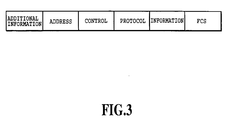
- Fig. 3 is a diagram showing an example of improved PPP frame construction according to the present embodiment.
- the improved PPP frame has an additional information field, an address field, a control field, a protocol field, an information field and a FCS field. That is, the frame has a frame construction in which additional information is added to a frame construction with the flag deleted from the PPP frame construction.
- the additional information includes identification information for identifying frame partition. In the present embodiment, frame length (number of bytes of the frame) is used as the identification information.
- a frame construction with a flag added to the frame construction of Fig. 3 can also be used. That is, it is also possible that, without deleting the flag from the PPP frame construction, but the additional information is simply added.
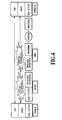
- Fig. 4 is a diagram for explaining data communication between DTE 2 and DTE 14.
- octet insertion is performed in DTE 2 to the data as in the prior art, and then the result is transmitted.
- DCE 4 a special processing (this processing will be described below) is performed, in which the data having the PPP frame construction and octet inserted is converted to data which has an improved frame construction (Fig. 3) and is not octet inserted.
- the gateway 10 (indicated by NW in Fig.
- a special processing is performed, whereby the data having the improved PPP frame construction and not octet inserted is converted to data which has the PPP frame construction and is octet inserted.
- the gateway 10 transmits the signal including the converted data to DTE 14. Then, in DTE 14, octet deletion is performed as in the prior art.
- octet insertion is performed in DTE 14 to the data as in the prior art, and the data transmitted.
- the gateway 10 a special processing is performed, in which the data having the PPP frame construction and octet inserted is converted to data which has an improved frame construction and is not octet inserted.
- DCE 4 a special processing is performed, whereby the data having the improved PPP frame construction and not octet inserted is converted to data which has the PPP frame construction and is octet inserted. Then, in DTE 2, octet deletion is performed as in the prior art.
- a first data conversion apparatus 20 and a second data conversion apparatus 30 In DCE 4 and gateway 10, to perform the above special processing, a first data conversion apparatus 20 and a second data conversion apparatus 30.
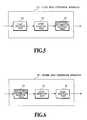
- Fig. 5 is a diagram showing construction example of the first data conversion apparatus.
- the first data conversion apparatus 20 comprises a flag deletion part 22, an octet deletion part 24 and an additional information addition part 26.
- a flag is added (remained) to the frame construction of Fig. 3, the flag deletion part 22 is unnecessary.
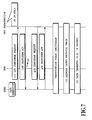
- Fig. 6 is a diagram showing a construction example of the second data conversion apparatus.
- the second data conversion apparatus 30 comprises an additional information deletion part 32, an octet insertion part 34 and a flag addition part 36.
- the flag addition part 36 is unnecessary.
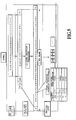
- Fig. 7 is a diagram showing a negotiation processing example when data is generated in DTE 2.
- DTE 2 when data is generated, to establish PPP link, transmits LCP link setting request to PPP termination (DTE 14) ((1) of Fig. 7).
- PPP termination is DTE 14, however, it can be gateway 10 or the like. A case where the PPP termination is gateway 10 will be described in a second embodiment of the present invention.
- DCE 4 monitors response of LCP and, when ACCM (Async Control Character Map) is included in the response from the DTE 14 side, stores it, receives PPP frame from the DTE 14 side, and utilizes it for octet insertion processing when transmitting to the DTE 2 side (Fig. 7(2)).
- ACCM Auto Control Character Map
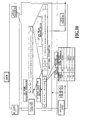
- Fig. 8 is a diagram showing a processing example of DTE 2 and DCE 4 when transferring data from DTE 2 to DTE 14.
- DTE 2 data received from the network layer (NW layer) is provided with an address (A), control (C), protocol (P) and FCS fields, octet insertion processing is performed according to LCP negotiation (Fig. 8(1)), and, after adding flag (F) field, data transfer is performed.
- octet insertion a processing of increasing 1 byte to 2 bytes is performed, the data after octet insertion is greater than the original data. Further, before completion of negotiation, default octet insertion is performed.
- DCE 4 data portion surrounded by flag of data received from DTE 2 is taken out (flag is deleted) by the flag deletion part 22.
- octet deletion part 24 octet deletion processing which is quite the reverse to the octet insertion processing performed by DTE 2 is performed to the taken-out data portion (Fig. 8(2)).
- additional information addition part 26 additional information including identification information for identifying the partition of that 1 frame (information for recognizing that 1 frame) is added (Fig. 8 (3)). In the present embodiment, only identification information is added as the additional information. Further, frame length is used as the identification information.
- the data provided with the additional information is transferred towards DTE 14.
- flag deletion by the flag deletion part 22 is not performed.
- Fig. 9 is a diagram showing a practical example of octet insertion processing performed in DTE 2.
- octet insertion processing is shown using an example of a case where all of 00h to 1Fh (h indicates hexadecimal notation) are escape processed with escape character (7Dh) by LCP negotiation.
- escape processing is also performed for escape character (7Dh) and flag value (7Eh).
- escape processing is performed by adding escape character (7Dh) before subject data and exclusive ORing subject data with 20h. For example, when octet insertion processing is performed on data 00h, data 7D20h is formed. When performing such octet processing, the original data of 1 byte becomes a 2-byte data.
- Fig. 10 is a diagram showing a practical example of octet deletion processing performed in DCE 4.
- the quite reverse processing to the octet insertion processing performed in DTE 2 is performed.
- Fig. 11 is a diagram showing a processing example of DTE 2 and DCE 4 when transferring data from DTE 14 to DTE 2.
- DCE 4 data portion other than additional information of the received signal is taken out (additional information is deleted) in the additional information deletion part 32 (Fig. 11(1)).
- octet insertion is performed according to ACCM negotiation result performed in LCP (Fig. 11(2)), and, after adding a flag in flag addition part 36, data transfer is performed.
- octet insertion performs a processing for changing 1 byte to 2 bytes, the data after octet insertion is greater than the original data. Further, before completion of negotiation, default octet insertion is performed.
- Fig. 12 is a diagram showing a practical example of octet insertion processing performed in DCE 4.
- the octet insertion processing performed in DCE 4 is the same as the octet insertion processing (Fig. 9) performed in DTE 2.
- Fig. 13 is a diagram showing a practical example of octet deletion processing performed in DTE 2.
- the octet deletion processing the quite reverse processing to the octet insertion processing performed in DCE 4 is performed.
- the processing (octet insertion processing or the like) performed in gateway 10 when transferring data from DTE 2 to DTE 14 is the same as the processing performed in DCE 4 (Figs. 11 and 12) when transferring data from DTE 14 to DTE 2.
- processing octet deletion processing or the like
- gateway 10 when transferring data from DTE 14 to DTE 2 is the same as the processing performed in DCE 4 (Figs. 8 and 10) when transferring data from DTE 2 to DTE 14.
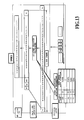
- Fig. 16 is a diagram for explaining processing performed in DCE.
- LCP Echo-Request code: 09h
- LCP Discard-Request code: 0Bh
- DCE 4 when one (for example, DTE 2) of two apparatus performing data communication according to PPP receives a LCP echo-request transmitted to the other (for example, DTE 14), a LCP Echo-Reply) (code: 0Ah) is transmitted to the one apparatus. This inhibits transmission of LCP echo-request to the other apparatus (transmitted in the past), thereby reducing the data transmission amount.
- DTE 2 when one (for example, DTE 2) of two apparatus performing data communication according to PPP receives a LCP echo-request transmitted to the other (for example, DTE 14), a LCP Echo-Reply) (code: 0Ah) is transmitted to the one apparatus. This inhibits transmission of LCP echo-request to the other apparatus (transmitted in the past), thereby reducing the data transmission amount.
- DCE 4 when one of two apparatus performing data transmission according to PPP receives a LCP Discard-Request transmitted to the other, the LCP Discard-Request is discarded (deleted). This inhibits transmission of LCP discard-request to the other apparatus (transmitted in the past), thereby reducing the data transmission amount.
- gateway 10 when one (for example, DTE 14) of two apparatus performing data communication according to PPP receives a LCP echo-request transmitted to the other (for example, DTE 2), a LCP echo-reply is transmitted to the one apparatus. This inhibits transmission of LCP echo-request to the other apparatus (transmitted in the past), thereby reducing the data transmission amount.
- gateway 10 when one of two apparatus performing data transmission according to PPP receives a LCP Discard-Request transmitted to the other, the LCP Discard-Request is discarded (deleted). This inhibits transmission of LCP discard-request to the other apparatus (transmitted in the past), thereby reducing the data transmission amount.
- DCE 4 and gateway 10 comprise the first data conversion apparatus 20 and the second data conversion apparatus 30, however, it is also possible that, for example, only the first data conversion apparatus 20 is provided in DCE 4 and gateway 10 is provided with only the second data conversion apparatus 30, so as to use a PPP frame construction improved for use only in one-way data communication.
- a special processing (octet insertion, deletion or the like) is performed in gateway 10, however, alternatively, this processing can be performed, for example, in the exchange 8.
- data communication between DTE 2 and gateway 10 is performed according to PPP.
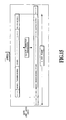
- Fig. 14 is a diagram for explaining data communication between DTE 2 and gateway 10.
- the gateway 10 and DTE 14 are connected with a dedicated line.
- negotiation processing (Fig. 7) is performed between DTE 2 and gateway 10.
- DTE 2 When transmitting data signal from DTE 2 to DTE 14, octet insertion is performed in DTE 2 to the data as in the past, and the result transmitted.
- DCE 4 the same processing as in the first embodiment is performed, so that data having PPP frame construction and octet inserted is converted into data which has improved PPP frame construction (Fig. 3) and is not octet inserted.
- Gateway 10 (indicated as NW in Fig. 14) converts data having improved PPP frame construction and not octet inserted into data which has a data link layer protocol frame construction other than PPP.
- the data conversion can be performed same as in the case of converting data having PPP frame construction into data having frame construction of data link layer protocol other than PPP.
- an identification information for identifying a frame partition instead of the flag, an identification information for identifying a frame partition.
- gateway 10 transmits a signal including the converted data to DTE 14.
- gateway 10 when transmitting a data signal from DTE 14 to DTE 2, in gateway 10, the data having data link layer protocol frame construction other than PPP is converted into data having improved frame construction and not octet inserted.
- the data conversion can be performed same as in the case of converting data having data link layer protocol frame construction other than PPP into data having PPP frame construction.
- gateway 10 transmits the signal including the converted data to DCE 4.
- DCE 4 the same processing as in the first embodiment is performed, so that data having improved PPP frame construction and not octet inserted is converted into data having PPP frame construction and octet inserted. After that, octet deletion is performed in DTE 2 same as in the past.
- a signal including data having improved PPP frame construction and not octet inserted as shown in Fig. 3 is communicated. With this operation, data transmission amount is reduced and the throughput is improved.
- PPP frame construction improved for use in only one-way data communication can be used.
- gateway 10 a special processing (conversion to data having different frame construction) is performed in gateway 10, however, alternatively, this processing can also be performed, for example, in the exchange 8 as well.
- DCE 4 and gateway 10 perform the processing shown in Fig. 16.
- the first and second embodiments use additional information, however, if a construction is available which is capable of identifying 1 PPP in a lower layer than PPP, such additional information is unnecessary. In such a case, the additional information addition part 26 and the additional information deletion part 32 are unnecessary.
- the present invention is described in conjunction with octet insertion and deletion, however, the present invention can also be applied to the case of bit insertion and deletion.
- Fig. 15 is a diagram for explaining bit insertion.
- Example of performing octet insertion in DTE 2 is described in Fig. 9, when bit insertion is performed in DTE 2, operation is as shown, for example, in Fig. 15.
- bit insertion is performed, when five "1"s continue to data other than flag, by inserting "0" after that.
- bit deletion is the reverse processing of bit insertion, in bit deletion, when five "1"s continue to data other than flag, "0" after that is deleted.
- the octet/bit insertion is inhibited, so that the data transmission amount can be reduced, and the throughput be improved.
- the users can be provided with various services at low cost.
- Fig. 23 shows a sequence diagram when the present invention is applied to LCP or NCP link establish sequence example of Fig. 20.
- a (communication) apparatus 71 and a (communication) apparatus 72 belong to node A, and a (communication) apparatus 73 and a (communication) apparatus 74 to node B, which may be physically different apparatus or same apparatus.
- Between the apparatus and the apparatus 73 is connected with a communication line.
- DTE 2 of Fig. 17 can be corresponded to the apparatus 71, DCE 4 to the apparatus 72, DEC 8 to the apparatus 73, and DTE 10 to the apparatus 74, whereby a redundant packet between DCE 4 and DCE 8 can be deleted.
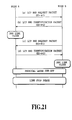
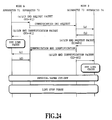
- Fig. 24 shows a sequence diagram when the present invention is applied to the LCP link cut-off sequence example of Fig. 21. The procedures will be described below.
- Fig. 25 shows a sequence diagram when the present invention is applied to the LCP keep alive sequence example of Fig. 22. The procedures will be described below.
- the present invention can also be applied to communication based on similar protocol.
- control packet on the communication line can be reduced.
- redundant packets for example, in end-to-end PPP link establish procedure, cut-off procedure, and PPP link continuity identification procedure are terminated in the same node, whereby control packet amount transferred on the communication line can be reduced, communication fees and communication cost be reduced, and subscriber capacity be increased in association with reduction of communication traffic amount.
Landscapes
- Engineering & Computer Science (AREA)
- Computer Networks & Wireless Communication (AREA)
- Signal Processing (AREA)
- Computer Security & Cryptography (AREA)
- Data Exchanges In Wide-Area Networks (AREA)
- Communication Control (AREA)
Abstract
Description
producing a setting request packet according to a setting rejection packet or a setting negation packet and transmitting the setting request packet to the another communication apparatus of self-node, when the communication apparatus receives the setting rejection packet or the setting negation packet from the another communication apparatus of self-node, after intermediating a setting request packet from the communication apparatus of other node to the another communication apparatus of self-node.
terminating a setting request packet, when the communication apparatus receives the setting request packet after intermediating a setting request packet from the another communication apparatus of self-node to the other node communication apparatus and a notification of setting rejection or setting negation from the other node communication apparatus to the another communication of self-node.
producing an end identification packet and transmitting it to the another communication apparatus of self-node after intermediating a notification of end request from the another communication apparatus of self-node to the other node communication.
terminating an end identification packet, when the communication apparatus receives the end identification packet from the another communication apparatus of self-node after intermediating a notification of end request from the other node communication apparatus to the another communication apparatus of self-node.
terminating an echo request, producing an echo response packet and transmits it to the another communication apparatus of self-node, when the communication apparatus receives the echo request packet from the another communication apparatus of self-node to the other node communication apparatus.
Claims (56)
- A data conversion apparatus performing octet deletion or bit deletion to data having a PPP configuration and being octet-inserted or bit-inserted.
- A data conversion apparatus characteried by comprising:deletion means for performing octet deletion or bit deletion to data having a PPP frame configuration and being octet-inserted or bit-inserted; andadditional information addition means for adding additional information including information for identifying a frame partition to the data octet-deleted or bit-deleted by said deletion means.
- A data conversion apparatus characteried by comprising:flag deletion means for deleting a flag from data having a PPP frame configuration and being octet-inserted or bit-inserted; anddeletion means for performing octet deletion or bit deletion to the data flag-deleted by said flag deletion means.
- A data conversion apparatus characteried by comprising:flag deletion means for deleting a flag from data having a PPP frame configuration and being octet-inserted or bit-inserted;deletion means for performing octet deletion or bit deletion to the data flag-deleted by said flag deletion means; andadditional information addition means for adding additional information including information for identifying a frame partition to the data octet-deleted or bit-deleted by said deletion means.
- A data conversion apparatus performing octet deletion or bit deletion to data having a PPP frame configuration and being not octet-inserted or not bit-inserted.
- A data conversion apparatus characteried by comprising:additional information deletion means for deleting additional information from data having a frame configuration in which said additional information including information for identifying a frame partition is added to a PPP frame configuration and being not octet-inserted or not bit-inserted; andinsertion means for performing octet insertion or bit insertion to the data deleted of additional information by said additional information deletion means.
- A data conversion apparatus characteried by comprising:insertion means for performing octet insertion or bit insertion to data having a frame configuration flag-deleted from a PPP frame configuration and being not octet-inserted or not bit-inserted; andflag addition means for adding a flag to the data octet-inserted or bit-inserted by said insertion means.
- A data conversion apparatus characteried by comprising:additional information deletion means for deleting additional information from data having a frame configuration in which said additional information including information for identifying frame partition is added to a frame configuration flag-deleted from a PPP frame configuration and being not octet-inserted or not bit-inserted;insertion means for performing octet insertion or bit insertion to the data additional information-deleted by said additional information deletion means; andflag addition means for adding a flag to the data octet-inserted or bit-inserted by said insertion means.
- A data conversion apparatus converting data having a PPP frame configuration and being not octet-inserted or not bit-inserted into data having a frame configuration of data link layer protocol other than PPP.
- A data conversion apparatus converting data having a frame configuration in which additional information including information for identifying a frame partition is added to a PPP frame configuration and being not octet-inserted or not bit-inserted into data having a frame configuration of data link layer protocol other than PPP.
- A data conversion apparatus converting data having a frame configuration flag-deleted from a PPP frame configuration and being not octet-inserted or not bit-inserted into data having a frame configuration of data link layer protocol other than PPP.
- A data conversion apparatus converting data having a frame configuration in which additional information including information for identifying frame partition is added to a frame configuration flag-deleted from a PPP frame configuration and being not octet-inserted or not bit-inserted into data having a frame configuration of data link layer protocol other than PPP.
- A data conversion apparatus converting data having a frame configuration of data link layer protocol other than a PPP into data having a PPP frame configuration and being not octet-inserted or not bit-inserted.
- A data conversion apparatus converting data having a frame configuration of data link layer protocol other than a PPP into data having a frame configuration in which additional information including information for identifying frame partition is added to a PPP frame configuration and being not octet-inserted or not bit-inserted.
- A data conversion apparatus converting data having a frame configuration of data link layer protocol other than a PPP into data having a frame configuration flag-deleted from a PPP frame configuration and being not octet-inserted or not bit-inserted.
- A data conversion apparatus converting data having a frame configuration of data link layer protocol other than a PPP into data having a frame configuration flag-deleted from a PPP frame configuration to which additional information including information for identifying frame partition is added and being not octet-inserted or not bit-inserted.
- A signal having a PPP frame configuration and including data not octet-inserted or not bit-inserted.
- A signal having a PPP frame configuration to which additional information including information for identifying frame partition is added and including data not octet-inserted or not bit-inserted.
- A signal having a frame configuration of flag-deleted from a PPP frame configuration and including data not octet-inserted or not bit-inserted.
- A signal having a frame configuration of flag-deleted from a PPP frame configuration to which additional information including information for identifying frame partition is added and including data not octet-inserted or not bit-inserted.
- A data conversion method performing octet deletion or bit deletion to data having a PPP frame configuration and being octet-inserted or bit-inserted.
- A data conversion method characteried by comprising:a deletion step for performing octet deletion or bit deletion to data having a PPP frame configuration and being octet-inserted or bit-inserted; andan additional information addition step for adding additional information including information for identifying a frame partition to the data octet-deleted or bit-deleted by said deletion step.
- A data conversion method characteried by comprising:a flag deletion step for deleting a flag from data having a PPP frame configuration and being octet-inserted or bit-inserted; anda deletion step for performing octet deletion or bit deletion to the data flag-deleted by said flag deletion step.
- A data conversion method characteried by comprising:a flag deletion step for deleting a flag from data having a PPP frame configuration and being octet-inserted or bit-inserted;a deletion step for performing octet deletion or bit deletion to the data flag-deleted by said flag deletion step; andan additional information addition step for adding additional information including information for identifying a frame partition to the data octet-deleted or bit-deleted by said deletion step.
- A data conversion method performing octet insertion or bit insertion to data having a PPP frame configuration and being not octet-inserted or not bit-inserted.
- A data conversion method characteried by comprising:an additional information deletion step for deleting additional information from data having a PPP frame configuration to which said additional information including information for identifying a frame partition and being octet-inserted or bit-inserted is added; andan insertion step for performing octet insertion or bit insertion to the data additional information-deleted by said additional information deletion step.
- A data conversion method characteried by comprising:an insertion step for performing octet insertion or bit insertion to data having a frame configuration flag-deleted from a PPP frame configuration and being not octet-inserted or not bit-inserted; anda flag addition step for adding a flag to the data octet-inserted or bit-inserted by said insertion step.
- A data conversion method characteried by comprising:an additional information deletion step for deleting additional information from data having a frame configuration flag deleted from a PPP frame configuration to which said additional information including information for identifying a frame partition is added and being not octet-inserted or not bit-inserted;an insertion step for performing octet insertion or bit insertion to the data additional information-deleted by said additional information deletion step; anda flag addition step for adding a flag to the data octet-inserted or bit-inserted by said insertion step.
- A data conversion method converting data having a PPP frame configuration and being not octet-inserted or not bit-inserted into data having a frame configuration of data link layer protocol other than PPP.
- A data conversion method converting data having a frame configuration in which additional information including information for identifying frame partition is added to a PPP frame configuration and being not octet-inserted or not bit-inserted into data having a frame configuration of data link layer protocol other than PPP.
- A data conversion method for converting data having a frame configuration flag-deleted from a PPP frame configuration and being not octet-inserted or not bit-inserted into data having a frame configuration of data link layer protocol other than PPP.
- A data conversion method converting data having a frame configuration in which additional information including information for identifying frame partition is added to a frame configuration flag-deleted from a PPP frame configuration and being not octet-inserted or not bit-inserted into data having a frame configuration of data link layer protocol other than PPP.
- A data conversion method converting data having a frame configuration of data link layer protocol other than PPP into data having a PPP frame configuration and being not octet-inserted or not bit-inserted.
- A data conversion method converting data having a frame configuration of data link layer protocol other than PPP into data having a frame configuration in which additional information including information for identifying frame partition is added to a PPP frame configuration and being not octet-inserted or not bit-inserted.
- A data conversion method converting data having a frame configuration of data link layer protocol other than PPP into data having a frame configuration flag-deleted from a PPP frame configuration and being not octet-inserted or not bit-inserted.
- A data conversion method converting data having a frame configuration of data link layer protocol other than PPP into data having a frame configuration flag-deleted from a PPP frame configuration to which additional information including information for identifying frame partition is added and being not octet-inserted or not bit-inserted.
- A DCE transmitting a LCP echo reply to one of two apparatus performing data communication based on PPP, when said DCE receives a LCP echo request transmitted by said one apparatus to the other apparatus.
- A DCE discarding a LCP discard request, when said DCE receives said LCP discard request transmitted by one of two apparatus performing data communication based on PPP to the other.
- A gateway transmitting a LCP echo reply to one of two apparatus performing data communication based on PPP, when said gateway receives a LCP echo request transmitted by said one apparatus to the other apparatus.
- A gateway discarding a LCP discard request, when said gateway receives said LCP discard request transmitted by one of two apparatus performing data communication based on PPP to the other.
- A communication apparatus located between another communication apparatus of self-node and a communication apparatus of other node,
producing a setting request packet according to a setting rejection packet or a setting negation packet and transmitting said setting request packet to said another communication apparatus of self-node, when said communication apparatus receives said setting rejection packet or said setting negation packet from said another communication apparatus of self-node, after intermediating a setting request packet from said communication apparatus of other node to said another communication apparatus of self-node. - The communication apparatus as claimed in Claim 41, characteried in that said communication apparatus notifies setting rejection or setting negation to said communication apparatus of other node by transmitting only information included in a setting rejection packet or a setting negation packet to said communication apparatus of other node, when said communication apparatus receives said setting rejection packet or said setting negation packet from said another communication apparatus of self-node, after intermediating a setting request packet from said communication apparatus of other node to said another communication apparatus of self-node.
- The communication apparatus as claimed in Claim 41, characteried in that said communication apparatus terminates a setting identification packet when said communication apparatus receives said setting identification packet after intermediating a setting request packet from said communication apparatus of other node to said another communication apparatus of self-node and receiving a setting rejection packet or a setting negation packet from said another communication apparatus of self-node, and said communication apparatus does not terminate a setting identification packet when said communication apparatus receives said setting identification packet without receiving a setting rejection packet or a setting negation packet from said another communication apparatus of self-node after intermediating a setting request packet from said communication apparatus of other node to said another communication apparatus of self-node.
- A communication apparatus located between another communication apparatus of self-node and a communication apparatus of other node,
terminating a setting request packet, when said communication apparatus receives said setting request packet after intermediating a setting request packet from said another communication apparatus of self-node to said other node communication apparatus and a notification of setting rejection or setting negation from said other node communication apparatus to said another communication of self-node. - The communication apparatus as claimed in Claim 44, characteried in that said communication apparatus produces a setting rejection packet or a setting negation packet and transmits it to said another communication apparatus of self-node, when said communication apparatus receives a notification of setting rejection or setting negation from said communication apparatus of other node after intermediating a setting request packet from said another communication apparatus of self-node to said other node communication apparatus.
- The communication apparatus as claimed in Claim 44, characteried in that said communication apparatus produces a setting identification packet and transmits it to said another communication apparatus of self-node, when said communication apparatus receives from said another communication apparatus of self-node, all of setting request packets according to notifications of setting rejection or setting negation from said communication apparatus of other node to said another communication of self-node after intermediating setting request packets from said another communication apparatus of self-node to said other node communication apparatus and said notifications.
- A communication apparatus located between another communication apparatus of self-node and a communication apparatus of other node,
producing an end identification packet and transmitting it to said another communication apparatus of self-node after intermediating a notification of end request from said another communication apparatus of self-node to said other node communication. - The communication apparatus as claimed in Claim 47, characteried in that said communication apparatus produces an end request signal and transmits it to said communication apparatus of other node, when said communication apparatus receives an end request packet from said another communication apparatus of self-node.
- The communication apparatus as claimed in Claim 47, characteried in that said communication apparatus produces an end request packet and transmits it to said another communication apparatus of self-node, when said communication apparatus receives a notification of end identification from said communication apparatus of other node after intermediating a notification of end request from said another communication apparatus of self-node to said communication apparatus of other node.
- The communication apparatus as claimed in Claim 49, characteried in that said communication apparatus terminates an end identification packet, when said communication apparatus receives said end identification packet from said another communication apparatus of self-node after transmitting said produced end request packet.
- A communication apparatus located between another communication apparatus of self-node and a communication apparatus of other node,
terminating an end identification packet, when said communication apparatus receives said end identification packet from said another communication apparatus of self-node after intermediating a notification of end request from said other node communication apparatus to said another communication apparatus of self-node. - The communication apparatus as claimed in Claim 51, characteried in that said communication apparatus produces an end request packet and transmits it to said another communication apparatus of self-node, when said communication apparatus receives a notification of end request from said other node communication apparatus.
- The communication apparatus as claimed in Claim 51, characteried in that said communication apparatus produces an end identification signal and transmits it to said communication apparatus of other node, when said communication apparatus receives an end request packet from said another communication apparatus of self-node after intermediating a notification of end request from said other node communication apparatus to said another communication apparatus of self-node.
- The communication apparatus as claimed in Claim 53, characteried in that said communication apparatus produces an end identification packet and transmits it to said another communication apparatus of self-node after transmitting said produced end identification signal.
- A communication apparatus located between another communication apparatus of self-node and a communication apparatus of other node,
terminating an echo request, producing an echo response packet and transmits it to said another communication apparatus of self-node, when said communication apparatus receives said echo request packet from said another communication apparatus of self-node to said other node communication apparatus. - The communication apparatus as claimed in Claim 41, 44, 47, 51, or 55, characteried in that said communication apparatus is a mobile station.
Priority Applications (1)
| Application Number | Priority Date | Filing Date | Title |
|---|---|---|---|
| EP05075339A EP1549023B1 (en) | 1999-09-21 | 2000-09-21 | Data conversion and communication method |
Applications Claiming Priority (4)
| Application Number | Priority Date | Filing Date | Title |
|---|---|---|---|
| JP26686299A JP3689279B2 (en) | 1999-09-21 | 1999-09-21 | Data conversion apparatus, signal, data conversion method, DCE, and gateway |
| JP26686299 | 1999-09-21 | ||
| JP2000118620A JP3793393B2 (en) | 2000-04-19 | 2000-04-19 | Communication device |
| JP2000118620 | 2000-04-19 |
Related Child Applications (1)
| Application Number | Title | Priority Date | Filing Date |
|---|---|---|---|
| EP05075339A Division EP1549023B1 (en) | 1999-09-21 | 2000-09-21 | Data conversion and communication method |
Publications (3)
| Publication Number | Publication Date |
|---|---|
| EP1087591A2 true EP1087591A2 (en) | 2001-03-28 |
| EP1087591A3 EP1087591A3 (en) | 2004-04-07 |
| EP1087591B1 EP1087591B1 (en) | 2007-04-04 |
Family
ID=26547621
Family Applications (2)
| Application Number | Title | Priority Date | Filing Date |
|---|---|---|---|
| EP00308253A Expired - Lifetime EP1087591B1 (en) | 1999-09-21 | 2000-09-21 | Data conversion apparatuses and method |
| EP05075339A Expired - Lifetime EP1549023B1 (en) | 1999-09-21 | 2000-09-21 | Data conversion and communication method |
Family Applications After (1)
| Application Number | Title | Priority Date | Filing Date |
|---|---|---|---|
| EP05075339A Expired - Lifetime EP1549023B1 (en) | 1999-09-21 | 2000-09-21 | Data conversion and communication method |
Country Status (6)
| Country | Link |
|---|---|
| US (2) | US7260107B1 (en) |
| EP (2) | EP1087591B1 (en) |
| KR (1) | KR100367657B1 (en) |
| CN (2) | CN1287574C (en) |
| DE (2) | DE60034193T2 (en) |
| SG (3) | SG119208A1 (en) |
Families Citing this family (6)
| Publication number | Priority date | Publication date | Assignee | Title |
|---|---|---|---|---|
| JP3959402B2 (en) * | 2004-03-19 | 2007-08-15 | 株式会社日立コミュニケーションテクノロジー | COMMUNICATION CONNECTION DEVICE, COMMUNICATION TERMINAL, AND COMMUNICATION METHOD USING THE SAME |
| KR100575989B1 (en) * | 2004-04-08 | 2006-05-02 | 삼성전자주식회사 | Split transmission method of asynchronous data in synchronous ethernet and data structure used in the method |
| US7657744B2 (en) * | 2004-08-10 | 2010-02-02 | Cisco Technology, Inc. | System and method for dynamically determining the role of a network device in a link authentication protocol exchange |
| CN101729391B (en) * | 2008-10-23 | 2012-09-19 | 华为技术有限公司 | Method, node and system for acquiring link aggregation group information |
| US9692784B1 (en) * | 2016-10-25 | 2017-06-27 | Fortress Cyber Security, LLC | Security appliance |
| CN115118497B (en) * | 2022-06-28 | 2024-01-30 | 中国南方电网有限责任公司 | Edge gateway point-to-point method, device, computer equipment and storage medium |
Family Cites Families (50)
| Publication number | Priority date | Publication date | Assignee | Title |
|---|---|---|---|---|
| JPS58199238A (en) | 1982-05-17 | 1983-11-19 | Nissan Motor Co Ltd | Hinge pin for car glove box |
| US4607364A (en) * | 1983-11-08 | 1986-08-19 | Jeffrey Neumann | Multimode data communication system |
| JPH0773240B2 (en) | 1985-12-13 | 1995-08-02 | 日本電気株式会社 | Automatic retraining method |
| US5054019A (en) | 1989-01-13 | 1991-10-01 | International Business Machines Corporation | Transfer direction turnaround in network data communications |
| US5416772A (en) * | 1993-08-20 | 1995-05-16 | At&T Corp. | Apparatus for insertion of overhead protocol data into a switched data stream |
| US5446736A (en) | 1993-10-07 | 1995-08-29 | Ast Research, Inc. | Method and apparatus for connecting a node to a wireless network using a standard protocol |
| US6181703B1 (en) * | 1995-09-08 | 2001-01-30 | Sprint Communications Company L. P. | System for managing telecommunications |
| AU706160B2 (en) | 1994-06-08 | 1999-06-10 | Hughes Electronics Corporation | Apparatus and method for hybrid network access |
| JPH08102761A (en) | 1994-09-30 | 1996-04-16 | Toshiba Corp | Protocol conversion device and protocol conversion method |
| FI98027C (en) * | 1995-01-10 | 1997-03-25 | Nokia Telecommunications Oy | Packet radio system and terminal device for a packet radio system |
| DE69620389T2 (en) | 1995-01-11 | 2002-12-12 | Wci Outdoor Products, Inc. | CUTTING HEAD FOR TRIMMER WITH FLEXIBLE CUTTING THREAD |
| JP2687919B2 (en) | 1995-03-29 | 1997-12-08 | 日本電気株式会社 | A router that performs keep-alive proxy response and keep-alive proxy delivery. |
| US6304574B1 (en) | 1995-06-07 | 2001-10-16 | 3Com Corporation | Distributed processing of high level protocols, in a network access server |
| US5666362A (en) | 1995-07-25 | 1997-09-09 | 3Com Corporation | Method and apparatus for asynchronous PPP and synchronous PPP conversion |
| US5657452A (en) * | 1995-09-08 | 1997-08-12 | U.S. Robotics Corp. | Transparent support of protocol and data compression features for data communication |
| US5870540A (en) | 1995-11-20 | 1999-02-09 | Ncr Corporation | Low overhead method for detecting communication failures on a network |
| US5781726A (en) * | 1996-01-31 | 1998-07-14 | 3Com Corporation | Management of polling traffic in connection oriented protocol sessions |
| JPH09307580A (en) | 1996-05-10 | 1997-11-28 | Nippon Telegr & Teleph Corp <Ntt> | Illegal packet prevention method and bridge device |
| JPH09326819A (en) * | 1996-06-03 | 1997-12-16 | Nec Corp | Gateway device |
| JPH1023003A (en) | 1996-06-27 | 1998-01-23 | Matsushita Electric Ind Co Ltd | Terminal adapter |
| US6754181B1 (en) * | 1996-11-18 | 2004-06-22 | Mci Communications Corporation | System and method for a directory service supporting a hybrid communication system architecture |
| CA2245808C (en) * | 1996-12-10 | 2003-01-28 | Ntt Mobile Communications Network Inc. | Mobile communication device, method for mobile data communication, and program storage medium |
| JP3735168B2 (en) | 1996-12-11 | 2006-01-18 | 富士通株式会社 | Simple routing method |
| US6144671A (en) | 1997-03-04 | 2000-11-07 | Nortel Networks Corporation | Call redirection methods in a packet based communications network |
| JPH10322361A (en) | 1997-03-14 | 1998-12-04 | Fujitsu Ltd | Signaling method, switching device, storage medium, and network |
| JP2970579B2 (en) | 1997-03-19 | 1999-11-02 | 日本電気株式会社 | ATM communication system |
| JP3156760B2 (en) | 1997-05-19 | 2001-04-16 | 日本電気株式会社 | Packet communication method |
| JPH1174992A (en) | 1997-06-23 | 1999-03-16 | Canon Inc | Wireless communication device |
| JP3713281B2 (en) | 1997-06-24 | 2005-11-09 | 株式会社エヌ・ティ・ティ・ドコモ | COMMUNICATION SYSTEM, COMMUNICATION CONTROL METHOD, AND COMMUNICATION CONTROL DEVICE |
| JPH1127740A (en) | 1997-06-30 | 1999-01-29 | Matsushita Electric Ind Co Ltd | Data communication terminal |
| GB9715966D0 (en) * | 1997-07-30 | 1997-10-01 | Ibm | Data communications management for use with networking applications and for mobile communications environments |
| GB2329550A (en) * | 1997-09-22 | 1999-03-24 | Northern Telecom Ltd | Transporting multi-protocol datagrams over an asynchronous virtual channel |
| JP3922482B2 (en) * | 1997-10-14 | 2007-05-30 | ソニー株式会社 | Information processing apparatus and method |
| US6577643B1 (en) * | 1997-10-14 | 2003-06-10 | Lucent Technologies Inc. | Message and communication system in a network |
| US6233248B1 (en) * | 1997-10-14 | 2001-05-15 | Itt Manufacturing Enterprises, Inc. | User data protocol for internet data communications |
| US6856618B2 (en) * | 1997-10-21 | 2005-02-15 | Intel Corporation | Apparatus and method for computer telephone integration in packet switched telephone networks |
| JPH11136240A (en) * | 1997-10-27 | 1999-05-21 | Oki Electric Ind Co Ltd | node |
| US6438137B1 (en) * | 1997-12-22 | 2002-08-20 | Nms Communications Corporation | Packet-based trunking |
| DE19800772C2 (en) * | 1998-01-12 | 2000-04-06 | Ericsson Telefon Ab L M | Method and device for connection to a packet exchange network |
| CA2262774A1 (en) | 1998-03-06 | 1999-09-06 | Lucent Technologies Inc. | Simple data link (sdl) protocol |
| US6118785A (en) * | 1998-04-07 | 2000-09-12 | 3Com Corporation | Point-to-point protocol with a signaling channel |
| US6847614B2 (en) * | 1998-04-20 | 2005-01-25 | Broadcom Corporation | Apparatus and method for unilateral topology discovery in network management |
| US6496491B2 (en) * | 1998-05-08 | 2002-12-17 | Lucent Technologies Inc. | Mobile point-to-point protocol |
| US6449272B1 (en) * | 1998-05-08 | 2002-09-10 | Lucent Technologies Inc. | Multi-hop point-to-point protocol |
| US6320874B1 (en) * | 1998-10-07 | 2001-11-20 | Nortel Networks Limited | Establishing and terminating connections in a mixed protocol network |
| JP2000209920A (en) | 1999-01-19 | 2000-08-02 | Iseki & Co Ltd | Excavation depth control device for root crops |
| US6370118B1 (en) * | 1999-02-24 | 2002-04-09 | Qualcomm Incorporated | Simultaneous set up of PPP on AUM and a RM interface |
| WO2000057284A1 (en) * | 1999-03-25 | 2000-09-28 | Motorola Inc. | Point to point protocol multiplexing/demultiplexing method and apparatus |
| US6636505B1 (en) * | 1999-05-28 | 2003-10-21 | 3Com Corporation | Method for service provisioning a broadband modem |
| US6483822B1 (en) * | 1999-06-07 | 2002-11-19 | Marcello Lioy | Establishing a packet network call between a mobile terminal device and an interworking function |
-
2000
- 2000-09-20 SG SG200307649A patent/SG119208A1/en unknown
- 2000-09-20 SG SG200005369A patent/SG114472A1/en unknown
- 2000-09-20 KR KR10-2000-0055301A patent/KR100367657B1/en not_active Expired - Fee Related
- 2000-09-20 SG SG200307644A patent/SG119207A1/en unknown
- 2000-09-21 EP EP00308253A patent/EP1087591B1/en not_active Expired - Lifetime
- 2000-09-21 EP EP05075339A patent/EP1549023B1/en not_active Expired - Lifetime
- 2000-09-21 DE DE60034193T patent/DE60034193T2/en not_active Expired - Lifetime
- 2000-09-21 CN CNB2003101244274A patent/CN1287574C/en not_active Expired - Fee Related
- 2000-09-21 CN CNB001318861A patent/CN1164059C/en not_active Expired - Fee Related
- 2000-09-21 DE DE60037210T patent/DE60037210T2/en not_active Expired - Lifetime
- 2000-09-21 US US09/667,084 patent/US7260107B1/en not_active Expired - Fee Related
-
2006
- 2006-05-12 US US11/383,186 patent/US7680122B2/en not_active Expired - Fee Related
Also Published As
| Publication number | Publication date |
|---|---|
| KR20010050542A (en) | 2001-06-15 |
| SG114472A1 (en) | 2005-09-28 |
| EP1549023B1 (en) | 2007-11-21 |
| SG119207A1 (en) | 2006-02-28 |
| EP1549023A1 (en) | 2005-06-29 |
| US7260107B1 (en) | 2007-08-21 |
| SG119208A1 (en) | 2006-02-28 |
| DE60037210T2 (en) | 2008-09-25 |
| CN1296351A (en) | 2001-05-23 |
| CN1164059C (en) | 2004-08-25 |
| DE60037210D1 (en) | 2008-01-03 |
| CN1287574C (en) | 2006-11-29 |
| US20060193341A1 (en) | 2006-08-31 |
| US7680122B2 (en) | 2010-03-16 |
| DE60034193T2 (en) | 2007-12-20 |
| EP1087591A3 (en) | 2004-04-07 |
| DE60034193D1 (en) | 2007-05-16 |
| KR100367657B1 (en) | 2003-01-10 |
| EP1087591B1 (en) | 2007-04-04 |
| CN1529483A (en) | 2004-09-15 |
Similar Documents
| Publication | Publication Date | Title |
|---|---|---|
| US6563821B1 (en) | Channel bonding in a remote communications server system | |
| JP3694241B2 (en) | Method and apparatus for telecommunications using Internet protocols | |
| US7286536B2 (en) | Method and system for early header compression | |
| EP1122925B1 (en) | Header compression for general packet radio service tunneling protocol (GTP) | |
| JP3967548B2 (en) | Link configuration method and apparatus | |
| US6112245A (en) | Session establishment for static links in Point-to-Point Protocol sessions | |
| JP2003124969A (en) | Method and apparatus for transmitting data in a communication system | |
| US20120079071A1 (en) | Method and System for Out-of-Band Signaling for TCP Connection Setup | |
| WO2009056061A1 (en) | Method, system and device for transmitting general packet radio service tunneling protocol datagram | |
| WO2001019027A2 (en) | Methods for efficient early protocol detection | |
| US7260107B1 (en) | PPP data conversion apparatus and method | |
| JPH10117215A (en) | Method and apparatus for connecting between networks | |
| KR100689473B1 (en) | Protocol header compression device and method in communication system | |
| US7433368B2 (en) | Signaling transport converter | |
| CN100481811C (en) | Method and transmitter for transmitting data packets | |
| JPH08223222A (en) | Remote repeater | |
| Schneider et al. | PPP for Data Compression in Data Circuit-Terminating Equipment (DCE) | |
| JP3689279B2 (en) | Data conversion apparatus, signal, data conversion method, DCE, and gateway | |
| JP3993869B2 (en) | Data conversion device, signal, data conversion method, DCE, and gateway | |
| JP3959402B2 (en) | COMMUNICATION CONNECTION DEVICE, COMMUNICATION TERMINAL, AND COMMUNICATION METHOD USING THE SAME | |
| JP2003500934A (en) | Communication system and method in IP network | |
| US20080259932A1 (en) | Method and System for Facilitating a First and Second Protocol Between a Data Processing System and an ISP | |
| WO2002071725A1 (en) | Data communication device | |
| EP1210829B1 (en) | Methods for efficient early protocol detection | |
| JP2003519935A (en) | Communication network and method for framing point-to-point frame structure |
Legal Events
| Date | Code | Title | Description |
|---|---|---|---|
| PUAI | Public reference made under article 153(3) epc to a published international application that has entered the european phase |
Free format text: ORIGINAL CODE: 0009012 |
|
| AK | Designated contracting states |
Kind code of ref document: A2 Designated state(s): AT BE CH CY DE DK ES FI FR GB GR IE IT LI LU MC NL PT SE |
|
| AX | Request for extension of the european patent |
Free format text: AL;LT;LV;MK;RO;SI |
|
| PUAL | Search report despatched |
Free format text: ORIGINAL CODE: 0009013 |
|
| AK | Designated contracting states |
Kind code of ref document: A3 Designated state(s): AT BE CH CY DE DK ES FI FR GB GR IE IT LI LU MC NL PT SE |
|
| AX | Request for extension of the european patent |
Extension state: AL LT LV MK RO SI |
|
| 17P | Request for examination filed |
Effective date: 20040812 |
|
| 17Q | First examination report despatched |
Effective date: 20041007 |
|
| AKX | Designation fees paid |
Designated state(s): DE GB IT |
|
| GRAP | Despatch of communication of intention to grant a patent |
Free format text: ORIGINAL CODE: EPIDOSNIGR1 |
|
| GRAS | Grant fee paid |
Free format text: ORIGINAL CODE: EPIDOSNIGR3 |
|
| GRAA | (expected) grant |
Free format text: ORIGINAL CODE: 0009210 |
|
| AK | Designated contracting states |
Kind code of ref document: B1 Designated state(s): DE GB IT |
|
| REG | Reference to a national code |
Ref country code: GB Ref legal event code: FG4D |
|
| REF | Corresponds to: |
Ref document number: 60034193 Country of ref document: DE Date of ref document: 20070516 Kind code of ref document: P |
|
| PLBE | No opposition filed within time limit |
Free format text: ORIGINAL CODE: 0009261 |
|
| STAA | Information on the status of an ep patent application or granted ep patent |
Free format text: STATUS: NO OPPOSITION FILED WITHIN TIME LIMIT |
|
| 26N | No opposition filed |
Effective date: 20080107 |
|
| PGFP | Annual fee paid to national office [announced via postgrant information from national office to epo] |
Ref country code: DE Payment date: 20100915 Year of fee payment: 11 |
|
| PGFP | Annual fee paid to national office [announced via postgrant information from national office to epo] |
Ref country code: GB Payment date: 20110921 Year of fee payment: 12 |
|
| PGFP | Annual fee paid to national office [announced via postgrant information from national office to epo] |
Ref country code: IT Payment date: 20110919 Year of fee payment: 12 |
|
| GBPC | Gb: european patent ceased through non-payment of renewal fee |
Effective date: 20120921 |
|
| PG25 | Lapsed in a contracting state [announced via postgrant information from national office to epo] |
Ref country code: GB Free format text: LAPSE BECAUSE OF NON-PAYMENT OF DUE FEES Effective date: 20120921 Ref country code: DE Free format text: LAPSE BECAUSE OF NON-PAYMENT OF DUE FEES Effective date: 20130403 |
|
| PG25 | Lapsed in a contracting state [announced via postgrant information from national office to epo] |
Ref country code: IT Free format text: LAPSE BECAUSE OF NON-PAYMENT OF DUE FEES Effective date: 20120921 |
|
| REG | Reference to a national code |
Ref country code: DE Ref legal event code: R119 Ref document number: 60034193 Country of ref document: DE Effective date: 20130403 |