EP1087301A2 - Vorrichtung und Verfahren zur Speicherung und Anfrage von Informationen - Google Patents
Vorrichtung und Verfahren zur Speicherung und Anfrage von Informationen Download PDFInfo
- Publication number
- EP1087301A2 EP1087301A2 EP00119772A EP00119772A EP1087301A2 EP 1087301 A2 EP1087301 A2 EP 1087301A2 EP 00119772 A EP00119772 A EP 00119772A EP 00119772 A EP00119772 A EP 00119772A EP 1087301 A2 EP1087301 A2 EP 1087301A2
- Authority
- EP
- European Patent Office
- Prior art keywords
- question
- information
- questions
- sentence
- references
- Prior art date
- Legal status (The legal status is an assumption and is not a legal conclusion. Google has not performed a legal analysis and makes no representation as to the accuracy of the status listed.)
- Withdrawn
Links
Images






Classifications
-
- G—PHYSICS
- G06—COMPUTING OR CALCULATING; COUNTING
- G06F—ELECTRIC DIGITAL DATA PROCESSING
- G06F16/00—Information retrieval; Database structures therefor; File system structures therefor
- G06F16/20—Information retrieval; Database structures therefor; File system structures therefor of structured data, e.g. relational data
- G06F16/24—Querying
- G06F16/242—Query formulation
- G06F16/243—Natural language query formulation
Definitions
- the invention relates to a device for request and / or Storage of information.
- the object of the present invention is a database system to provide that without knowledge of the structure of a interactive communication with the user of any form Information linked together and this without knowledge of Syntax of the request language or storage language to the user in an interactive request.
- the question system asks the user starts with very general questions that have an answer on the information object to be entered or searched for allow. Here, the user does not have to answer every question Give an answer. He is only in the selection of questions Scope of the given questions and their logical dependency limited.
- the answers to the questions are analyzed and stored as new information objects, if not already the proposed information objects correspond to the answer and be selected as such.
- the object is achieved by the method according to claim 15 solved, in particular in that when entering a Sentence object with the help of a hierarchical question system the 1-n Questions linked to the 1-n classes, the Set object closer by references to other information objects is determined, the entry into the hierarchical Question system is done through questions that have no prior knowledge for need a meaningful answer.
- the request if available, broken down into question words, verbs and sentence objects and based on this information a question of the 1-n classes determined, via whose reference the answer can be given.
- a question can be selected, its answer is given to what you are looking for via this answer Find information object.
- a predefined level determines whether it is a verb, an adjective / adverb or a sentence object (Noun that can be both an object and a subject) acts.
- a verb in the question level is determined by the user in which context the Verb can then be used as an information object to be saved.
- Adjective / adverb acts by the user at the question level set the context of use, then as Information object to be saved.
- a major advantage is that not the procedure specifies concrete categorizations (in contrast to the thesaurus Word® for Windows®), but that it is the users who Generate categorizations when they ask about meanings answer with the intention of actually only the sentence object want to describe. Every property of a sentence object too a possible generic term of an information object and thus a category to which the information object belongs and according to that a user can find an information object is called Information object saved.
- Figure 1 shows a device for requesting and storing Information 10, which consists of a storage and loading module 11 consists of a request and input module 12 communicates. Communication can either be local on the Workstation computers are done, as well as via a - not shown - network.
- the storage and loading module 11 is used for storage and loading of information objects 18, which are stored in a database 16 are.
- the storage and loading module 11 can be a known one relational, a network-oriented or a object-oriented database system.
- Figure 4 shows the possible structure of a relational database system to which will be discussed later.
- the database 16 is either arranged locally on the server, or accessed via a network 17, preferably using known techniques, such as over IP, IPX or Apple Talk.
- the request and input module 12 serves to receive a hierarchical question system 13.
- the question system consists of a variety of 1-n questions 14 arising from different dependencies on different Question levels 15 are linked.
- the questions 14, the least prior knowledge are in one of the highest Question level 15 arranged.
- the user has the Possibility of a specific entry point in the question system 13 to choose interactively. This is especially from Interest if the user knows exactly which particular Properties of the sentence / to be filed as information object 18 Has information object and how he wants to define it.
- an information object 18 The properties of an information object 18 are determined by Figure 2 described in more detail. So there is a structure Information object 18 from a unique object ID 19 Information 20, which as unstructured information e.g. can be saved as a blob (binary large object), and from 1-n classes 21 to include references 22. The references characterize the information object 18 again further information objects 18. Each of the 1-n classes is 21 assigned a question 14. However, since a variety of answers are possible, a reference 22 is usually not sufficient.
- the question What does the "object” that relates to a car have to be assigned to class x.
- the possible answers can include all parts that a car has.
- the possible answers: wheels, body, engine, steering wheel etc. lead to
- the user has the option of using existing suggestions provided by the storage and loading module 11, or of creating a new information object 18, whereby the user can determine the level of detail himself If the user makes the input, the request and input module 12 starts with the next component that the user has to describe. The user has the option at any time to cancel the input or to end it.
- a canceling means that the hierarchy of the Question system 13 is not followed up, depending on the form of migration through the hierarchy of questions (depth first, width first) on the top question level 15 of the questioning system, a survey is continued or that only a new question 15 is asked at the next higher or the same question level 15.
- the choice of questions can also be determined by profiles that analyze user behavior in order to ask the most frequently asked questions first. These profiles can be geared towards groups or individuals. The profiles are dynamically adjusted during use.
- the question system 13 can be dynamic in the form of a Links existing network-like structure are loaded. This dynamic loading allows the use of different question systems 13, which in particular different languages may be of interest.
- Figure 3 shows the possible structure of the database of the storage and Charging module.
- This consists of two tables 23 and 24.
- the object table 23 becomes the unique identifier in the form of a Object Id 19 filed and information 20 that the user may want to store the information object 18 directly.
- the Reference table 24, serves to link the information object 18 with each other.
- the ID of the question system 13 parent information object 18 and the ID of the Response object.
- the column labeled Class number 1-n of the question is deposited.
- the reference 22 via the ID serves as a unique key for the Information objects in the reference table 24.
- the here proposed realization is just one possible of many, which vary depending on the database system used can fail. Especially with proprietary systems the mapping in the form of the database structure of the most varied Be kind.
- the category is in the predefinition phase of the information object to be entered is now determined as follows.
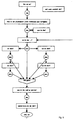
- the question system determines in a first step whether the information to be entered is a verb, a sentence object or a Adjective / adverb is. According to this categorization, the can be done either automatically or interactively depending on the categorization of the input Information in a second step the more specific further questions 13.
- Figure 4 shows the structure of a possible Question system 13 in the predefinition phase for determining the Categories.
- a basic principle of the invention is the generation of Object classes that are not categorized by a specific word only through questions 14. Questions 14 asked at Beginning consist only of vague words, but after each request a concrete answer. These are the ones for comparisons relevant meaning classes of the information objects 12, the by entering the user different or the same Get content, and thus information objects 12 comparable make and link them together.
- the basic questions 14 for the characterization of a sentence object in the second step are thus generated primarily from the component of the following table. What, where, how, when, why, where, from where, on what, ... Must, can, should, should, ... Not To be, to do, to have (plus verbs designed to do a question)
- Question system 13 contains questions 14 at one of the highest levels, which are determined from the components of what, his / her / do / have. However, the user is free to ask his own questions 14 from these provided components to answer his question 14 himself with which he can construct the information objects he enters, wants to link. The construction can e.g. by Pulldown menus. Every possible question 14 corresponds a reference table 24 via which the information object 18 is determined more precisely.
- This consistency check can either be done manually be initiated, or already when answering the question be checked.
- FIGS. 7, 9a and 9b show a possible determination of the Context for verbs. Here it is determined in which Sentence order and with which pronouns the verb is used can. References to synonyms can also be determined. This usage information has already clarified how a Sentence object regarding the verbs can be questioned. Here it is preferably assumed that verbs only in Can be understood in connection with sentence objects. Diving verbs the sequence is only in the context of a record object as follows:
- a verb is used when describing a sentence object (Meaning: what does the sentence object do) entered by the user and, if unknown, the different spellings of the verb and question options saved. So determined the verb entered by the user, what questions, regarding the sentence object from which the verb is generated should. These are questions in which the verb Is part of and this type of doing that particular Sentence object, is examined more deeply.
- Figures 6, 9a and 9b show a possible question level Determining the context in which an adjective or an adverb can be used. Here, a determination can be made about the On the contrary, the units of measurement are degrees, etc. Also the Adjectives only make sense in connection with the described record object.
- the inquiry is analyzed and broken down into question words, verbs and sentence objects where available.
- the information object 18 is determined in the database and the corresponding question, which gives the answer to the query by means of a reference.
- the question is chosen, the answer of which the user knows.
- the system can determine the information object sought.
- synonyms for the individual question words are listed if the questions in the question system are not met. If a verb could not be determined, the system can make suggestions from the What does the sentence object "give class, or automatically select one of the verbs. If the sentence object cannot be determined, the information object that comes closest to the properties of the sentence object sought can be selected.
- the properties of the information object are indicated by the references in the It is also possible to enter generic terms, for example, what is a dog: answer an animal.
Landscapes
- Engineering & Computer Science (AREA)
- Physics & Mathematics (AREA)
- Mathematical Physics (AREA)
- Theoretical Computer Science (AREA)
- Artificial Intelligence (AREA)
- Computational Linguistics (AREA)
- Data Mining & Analysis (AREA)
- Databases & Information Systems (AREA)
- General Engineering & Computer Science (AREA)
- General Physics & Mathematics (AREA)
- Information Retrieval, Db Structures And Fs Structures Therefor (AREA)
Abstract
Description
- Figur 1
- die erfindungsgemäße Vorrichtung bestehend aus einem Anfrage- und Lade-Modul, das ein hierarchisches Fragesystem aufgenommen hat, aus einem Speicher- und Lade-Modul, das mit einer Datenbank direkt und/oder über ein Netzwerk verbunden ist und das mit dem Anfrage- und Lade-Modul zusammenarbeitet ;
- Figur 2
- die Struktur eines Informationsobjektes, mit einer eindeutigen Objekt-Id, mit einem Feld für Informationen, mit Klassen, die den 1-n Fragen des hierarchischen Fragesystems zugeordnet sind, und mit Verweisen zu anderen Informationsobjekten;
- Figur 3
- die mögliche Umsetzung in einem relationalen Datenbankmodell;
- Figur 4
- zeigt ein Ablaufdiagramm für die Bestimmung der Wortart (Satzobjekt, Verb, Adjektiv), die Bestandteil des hierarchischen Fragesystems sein kann;
- Figur 5-5a
- zeigt ein Ablaufdiagramm für ein Satzobjekt, das durch die vorgegebenen Fragen des Fragesystems bestimmt wird;
- Figur 6-6a
- zeigt ein Ablaufdiagramm für ein Adjektiv/Adverb, das durch die vorgegeben Fragen des Fragesystems bestimmt werden kann;
- Figur 7
- zeigt ein Verbverwendungsmodul, das Graphisch bestimmt in welchen Zusammenhang Verben verwendet werden könne, wobei dieser Zusammenhang vom Fragesystem bei der Eingabe abgefragt werden kann;
- Figur 8
- zeigt eine Relation von Synonymen Fragewörtern, die bei einer Anfrage des Systems das Finden einer Antwort erleichtern;
- Figuren 9a-9h
- zeigen ein Ablaufdiagramm nach der Vordefinierungsphase wobei das hierarchische Fragesystem für die einzelnen Wortarten unterschiedlich aufgebaut ist.

| Was, wo, wie, wann, warum, wohin, woher, worauf, ... | Muß, ,kann will, soll, darf, ... | Nicht | Sein, tun, haben, (plus Verben, die auf eine Frage mit tun bestimmt wurden) |
- 10
- Vorrichtung zur Anfrage und Speicherung von Informationen (Device to store and query information)
- 11
- Speicher- und Lade-Modul (store and load module)
- 12
- Anfrage- und Eingabe-Modul (query and input module)
- 13
- Hierarchisches Fragesystem (hierarchical Query system)
- 14
- Fragen (Query)
- 15
- Frageebenen (Query Level)
- 16
- Datenbank (Database)
- 17
- Netzwerk (Network)
- 18
- Objekt (Object)
- 19
- Objekt-Id (Object Id)
- 20
- Information (Information)
- 21
- Klasse zur Aufnahme von Verweisen zu anderen Informationsobjekten (class having links to other information objects)
- 22
- Verweise zu anderen Informationsobjekten (links to other objects)
- 23
- Objekt-Tabelle (object table)
- 24
- Verweis-Tabelle (link table)
Claims (21)
- Vorrichtung zur Anfrage und/oder Speicherung von Informationen, mit einem Speicher- und/oder Lade-Modul (11), das in einer Datenbank (16) eine Vielzahl von Informationsobjekten (18) verwaltet, wobei die Informationsobjekte (18) 1-n Klassen (21) zur Aufnahme von 1-z Verweisen (22) zu anderen Informationsobjekten (18) speichern können, und die 1-n Fragen jede Beziehung zwischen jedem realen Satz-/ Objekt darstellt.
- Vorrichtung nach Anspruch 1, gekennzeichnet, durch ein Anfrage- und/oder Eingabe-Modul (12) für die vorzugsweise interaktive Ein- und/oder Ausgabe , das mit dem Speicher-und/oder Lade-Modul (11) kommuniziert und das ein hierarchisches Fragesystem (13) aufnimmt und abarbeitet, wobei in dem hierarchische Fragesystem (13) 1-n Fragen (14) hierarchisch miteinander verknüpft sind und bei dem jeder Frage (14) eine Klasse (21) des Informationsobjektes (18) zugeordnet ist, wobei
bei einer Eingabe eines neuen ersten Informationsobjekts (18) die Antworten, soweit sie beim Durchlaufen des Fragesystems (13) abgegeben werden, als weitere neue abzuspeichernde oder bereits bestehende Informationsobjekte (18) über die entsprechende Klasse (21) mit Hilfe der Verweise (22) mit dem ersten Informationsobjekt (18) verknüpft werden, und/oder
bei einer Anfrage die Fragen (14) bestimmt werden, deren Antwort mit der Anfrage übereinstimmt, was durch einen Parsevorgang und anschließender Analyse erfolgen kann oder durch interaktive Bestimmung der Fragen (14) unter Berücksichtigung der Struktur des hierarchischen Fragesystem (13), wobei die Informationsobjekt (18) ausgewählt werden, deren Verweise (22) die höchsten Übereinstimmungen mit den gegebenen Antworten haben. - Vorrichtung nach Anspruch 1, dadurch gekennzeichnet, daß das hierarchische Fragesystem (13) seine Fragen (14) in Abhängigkeit des benötigten Vorwissens auf unterschiedlichen Frageebenen (15) anordnet, so daß die Fragen mit dem geringsten Vorwissen auf der obersten Frageebene (15) angeordnet sind, und diejenigen Fragen (15) die das größte Vorwissen benötigen auf der untersten.
- Vorrichtung nach Anspruch 3, dadurch gekennzeichnet, daß bei der Speicherung von Informationen in einer Vordefinierungsebene die Wortklasse bestimmt wird um, dann in eine erste Frageebene (15) überzugehen, die speziell auf die Wortklasse abgestimmt ist, und die so gewonnen Informationen als Informationsobjekte (18) abzulegen.
- Vorrichtung nach Anspruch 4, dadurch gekennzeichnet, daß bei der Speicherung von Informationen in einer Vordefinierungsebene bestimmt wird, ob es sich um ein Verb ein Adjektiv/Adverb oder ein Satzobjekt handelt,für den Fall, daß es sich um ein Verb handelt, vom Benutzer bestimmt wird, in welchem Kontext das Verb verwendet werden kann,für den Fall, daß es sich um ein Adjektiv/Adverb handelt, vom Benutzer der Kontext der Verwendung des Adjektiv/Adverb festgelegt wird,für den Fall, daß es sich um ein Satzobjekt handelt, das Satzobjekt mit Hilfe der Fragen (14) der obersten Frageebene (15) so bestimmt wird, daß keinerlei Vorwissen für eine sinnvolle Beantwortung notwendig ist.
- Vorrichtung nach Anspruch 5, dadurch gekennzeichnet, daß die Fragen (14) zur Bestimmung des Satzobjektes in der ersten Frageebene (15) mit den Verbentun, sein, haben" und vorzugsweise dem Fragepronomen

- Vorrichtung nach Anspruch 6, dadurch gekennzeichnet, daß die Fragen hierarchisch angeordnet sind und aus den Fragewörtern
- Vorrichtung nach Anspruch 1, dadurch gekennzeichnet, daß eine interaktive Auswahl einer Frage (14) vom Benutzer vorgenommen werden kann.
- Vorrichtung nach Anspruch 1, dadurch gekennzeichnet, daß bei einer Anfrage die in einer natürlichen Sprache erfolgen kann, die Fragen zerlegt werden in Fragewörter, Verben und Satzobjekte und anhand dieser Informationen eine Frage (14) bestimmt wird, über deren Verweis (22) die Antwort gegeben werden kann.
- Vorrichtung nach Anspruch 1, dadurch gekennzeichnet, das insbesondere für den internationalen Gebrauch das Anfrage- und Eingabe-Modul (12) dynamisch hierarchische Fragesysteme (13) laden kann.
- Vorrichtung nach Anspruch 1, dadurch gekennzeichnet, daß das Anfrage und Eingabe-Modul (12) beim Durchlaufen des hierarchischen Fragesystems (13) während der Eingabe oder Anfrage von Informationsobjekten (18) Vorschläge aus den bereits vorhandenen Informationsobjekten (18) abgibt, wobei das Speicher- und Lade-Modul (11) anhand den bereits gewonnen Antworten, die Informationsobjekte (18) auswählt deren Verweise (22) die höchste Übereinstimmungen mit den Antworten aufweisen.
- Vorrichtung nach Anspruch 1, dadurch gekennzeichnet, daß das Speicher- und Lade-Modul (11) eine Standarddatenbank ist, die entweder lokal ist oder auf die über ein Netzwerk (17) zugegriffen werden kann.
- Vorrichtung nach Anspruch 1, dadurch gekennzeichnet, daß das Speicher- und Lade-Modul (11) ein relationale Datenbank ist, die mindestens zwei Tabellen (23, 24) umfaßt, wobei die erste Objekttabelle (23) die Informationsobjekte (18) aufnimmt und die zweite Verweistabelle (24) zur Aufnahme der Verweise (22) dient, die wiederum auf die Objekttabelle (23) zeigen.
- Vorrichtung nach Anspruch 12, dadurch gekennzeichnet, daß die Objekttabelle (23) eine Spalte für eine Objekt-Id (19) und eine Spalte für eine Information (20) aufweist, und daß die Verweistabelle zwei Spalten für Objekt-ID (19) eine Spalte für eine der 1-n Klassen (21) aufweist, und eine Spalte für eine Verweis-ID (25) aufweist.
- Vorrichtung nach Anspruch 1, gekennzeichnet durch ein Modul zur Konsistenzprüfung, das es ermöglicht Bedarfszyklen über zyklische Verweise(-ketten) (22) zwischen den Informationsobjekt (18) festzustellen, und das es ermöglicht auf fehlende Bedarfszyklen hinzuweisen.
- Verfahren zur Anfrage und/oder Speicherung von Informationen, dadurch gekennzeichnet, daßa) bei der Eingabe eines Satzobjektes ein Informationsobjekt angelegt wird, das durch Antworten auf ein hierarchischen Fragesystem, das 1-n Fragen verknüpft, denen 1-n Klassen mit Verweisen zugeordnet sind, näher bestimmt wird, wobei die Antworten durch Verweise zu anderen Informationsobjekten dargestellt werdenb) bei einer Anfrage, die Klassen bzw. Fragen bestimmt werden, über deren Verweis die Antwort gegeben werden kann.
- Verfahren nach Anspruch 16 dadurch gekennzeichnet, daß bei der Speicherung von Informationen in einer Vordefinierungsebene bestimmt wird, ob es sich um ein Verb ein Adjektiv/Adverb oder ein Satzobjekt handelt,a)für den Fall, daß es sich um ein Verb handelt, in der Frageebene vom Benutzer bestimmt wird, in welchem Kontext das Verb verwendet werden kann,für den Fall, daß es sich um ein Adjektiv/Adverb handelt, vom Benutzer in der Frageebene der Kontext der Verwendung festgelegt wird,für den Fall, daß es sich um ein Satzobjekt handelt, in der Frageebene mit Hilfe des hierarchischen Fragesystem das 1-n Fragen verknüpft, die den 1-n Klassen zugeordnet sind, das Satzobjekt durch Verweise zu anderen Informationsobjekten näher bestimmt wird, wobei der Einstieg in das hierarchische Fragesystem durch Fragen erfolgt, die keinerlei Vorwissen für eine sinnvolle Beantwortung benötigen und/oderb) bei einer Anfrage die in einer natürlichen Sprache erfolgen kann, die Anfrage zerlegt wird in Fragewörter, Verben und Satzobjekte und anhand dieser Informationen eine Frage der 1-n Klassen bestimmt wird, über deren Verweis die Antwort gegeben werden kann.
- Verfahren nach Anspruch 16, dadurch gekennzeichnet, daß die Fragen zur Bestimmung des Satzobjektes in der Frageebene mit den Verben
- Verfahren nach Anspruch 16, dadurch gekennzeichnet, daß die Fragen hierarchisch angeordnet sind und aus den Fragewörtern
- Verfahren nach Anspruch 16, dadurch gekennzeichnet, daß eine interaktive Auswahl einer Frage vorn Benutzer vorgenommen werden kann.
- Verfahren nach Anspruch 16, gekennzeichnet durch eine Konsistenzprüfung, die es ermöglicht Bedarfszyklen zwischen den Informationsobjekt festzustellen, und die es ermöglicht auf fehlende Bedarfszyklen hinzuweisen.
Applications Claiming Priority (2)
| Application Number | Priority Date | Filing Date | Title |
|---|---|---|---|
| DE19944392 | 1999-09-16 | ||
| DE19944392A DE19944392A1 (de) | 1999-09-16 | 1999-09-16 | Vorrichtung und Verfahren zur Speicherung und Abfrage von Informationen |
Publications (2)
| Publication Number | Publication Date |
|---|---|
| EP1087301A2 true EP1087301A2 (de) | 2001-03-28 |
| EP1087301A3 EP1087301A3 (de) | 2002-08-21 |
Family
ID=7922229
Family Applications (1)
| Application Number | Title | Priority Date | Filing Date |
|---|---|---|---|
| EP00119772A Withdrawn EP1087301A3 (de) | 1999-09-16 | 2000-09-11 | Vorrichtung und Verfahren zur Speicherung und Anfrage von Informationen |
Country Status (2)
| Country | Link |
|---|---|
| EP (1) | EP1087301A3 (de) |
| DE (1) | DE19944392A1 (de) |
Family Cites Families (2)
| Publication number | Priority date | Publication date | Assignee | Title |
|---|---|---|---|---|
| US5115504A (en) * | 1988-11-01 | 1992-05-19 | Lotus Development Corporation | Information management system |
| US5953718A (en) * | 1997-11-12 | 1999-09-14 | Oracle Corporation | Research mode for a knowledge base search and retrieval system |
-
1999
- 1999-09-16 DE DE19944392A patent/DE19944392A1/de not_active Withdrawn
-
2000
- 2000-09-11 EP EP00119772A patent/EP1087301A3/de not_active Withdrawn
Also Published As
| Publication number | Publication date |
|---|---|
| DE19944392A1 (de) | 2001-03-22 |
| EP1087301A3 (de) | 2002-08-21 |
Similar Documents
| Publication | Publication Date | Title |
|---|---|---|
| DE69126795T2 (de) | Dateienverwaltungssystem mit graphischer benutzerschnittstelle zum aufstellen von fragen | |
| DE69904588T2 (de) | Datenbankzugangswerkzeug | |
| DE69710458T2 (de) | Verfahren und system für die berechnung von semantischen logischen formen von syntaxbäumen | |
| DE69433165T2 (de) | Assoziatives textsuch- und wiederauffindungssystem | |
| DE68927743T2 (de) | Sortier-/Mischausgabe | |
| DE3855706T2 (de) | Automatisierte Rechnung von Materialien | |
| DE69022842T2 (de) | Verwendung von Befehlsähnlichkeiten in einem intelligenten Hilfssystem. | |
| DE3853894T2 (de) | Auf Paradigmen basierende morphologische Textanalyse für natürliche Sprachen. | |
| DE69333609T2 (de) | Indexierung von Multimediaobjekten | |
| DE69835792T2 (de) | Verfahren und Apparat zum Erzeugen semantisch konsistenter Eingaben für einen Dialog-Manager | |
| DE69230814T2 (de) | Datenbankauffindungssystem zur Beantwortung natursprachlicher Fragen mit dazugehörigen Tabellen | |
| DE69026885T2 (de) | Dynamische Selektion von Datenformaten für rekursiv geschachtelte logische Elemente | |
| DE69507647T2 (de) | Verfahren zur verarbeitung und zum zugreifen auf informationsobjekte, unter anderem dokumente, sowie system zu seiner durchführung | |
| DE60101668T2 (de) | Verfahren und gerät zum erzeugen eines auf einer formatvorlage basierten index für ein strukturiertes dokument | |
| EP0901658B1 (de) | Verfahren zur optimierung eines fuzzy-regelsatzes durch einen rechner | |
| DE69933123T2 (de) | Zugriff auf eine semi-strukturierte datenbank | |
| DE69517887T2 (de) | Verfahren und System zum Herstellen von Verbindungen in einem Datenbanksystem | |
| DE69229583T2 (de) | Verfahren zur Flektieren von Wörtern und Datenverarbeitungseinheit zur Durchführung des Verfahrens | |
| DE69909360T2 (de) | Verfahren und System um Dokumente über eine elektronische Datei wiederaufzufinden | |
| EP1324218A1 (de) | Kategorisierungsystem für Datenobjekte und Verfahren zum Prüfen der Konsistenz von Zuordnungen von Datenobjekten zu Kategorien | |
| EP1087301A2 (de) | Vorrichtung und Verfahren zur Speicherung und Anfrage von Informationen | |
| DE69908106T2 (de) | Erweiterung eines spracherkennungswortschatzes unter verwendung von abgeleiteten wörtern | |
| WO2005116867A1 (de) | Verfahren und system zur automatisierten erzeugung von computergestützten steuerungs- und analysevorrichtungen | |
| DE3511920A1 (de) | Elektronischer ratgeber | |
| DE102018008923A1 (de) | Verfahren zur Erstellung einer effizienten, logisch vollständigen, ontologischen Ebene im erweiterten relationalen Datenbankkonzept |
Legal Events
| Date | Code | Title | Description |
|---|---|---|---|
| PUAI | Public reference made under article 153(3) epc to a published international application that has entered the european phase |
Free format text: ORIGINAL CODE: 0009012 |
|
| AK | Designated contracting states |
Kind code of ref document: A2 Designated state(s): AT BE CH CY DE DK ES FI FR GB GR IE IT LI LU MC NL PT SE |
|
| AX | Request for extension of the european patent |
Free format text: AL;LT;LV;MK;RO;SI |
|
| PUAL | Search report despatched |
Free format text: ORIGINAL CODE: 0009013 |
|
| AK | Designated contracting states |
Kind code of ref document: A3 Designated state(s): AT BE CH CY DE DK ES FI FR GB GR IE IT LI LU MC NL PT SE |
|
| AX | Request for extension of the european patent |
Free format text: AL;LT;LV;MK;RO;SI |
|
| 17P | Request for examination filed |
Effective date: 20020717 |
|
| AKX | Designation fees paid |
Designated state(s): AT BE CH CY DE DK ES FI FR GB GR IE IT LI LU MC NL PT SE |
|
| 17Q | First examination report despatched |
Effective date: 20040407 |
|
| STAA | Information on the status of an ep patent application or granted ep patent |
Free format text: STATUS: THE APPLICATION IS DEEMED TO BE WITHDRAWN |
|
| 18D | Application deemed to be withdrawn |
Effective date: 20050401 |