EP1087058A2 - Completely combustible paper - Google Patents
Completely combustible paper Download PDFInfo
- Publication number
- EP1087058A2 EP1087058A2 EP00308258A EP00308258A EP1087058A2 EP 1087058 A2 EP1087058 A2 EP 1087058A2 EP 00308258 A EP00308258 A EP 00308258A EP 00308258 A EP00308258 A EP 00308258A EP 1087058 A2 EP1087058 A2 EP 1087058A2
- Authority
- EP
- European Patent Office
- Prior art keywords
- compound catalyst
- particles
- weight
- iron compound
- paper
- Prior art date
- Legal status (The legal status is an assumption and is not a legal conclusion. Google has not performed a legal analysis and makes no representation as to the accuracy of the status listed.)
- Withdrawn
Links
- 239000003054 catalyst Substances 0.000 claims abstract description 68
- 150000002506 iron compounds Chemical class 0.000 claims abstract description 60
- 239000002245 particle Substances 0.000 claims abstract description 55
- UQSXHKLRYXJYBZ-UHFFFAOYSA-N Iron oxide Chemical compound [Fe]=O UQSXHKLRYXJYBZ-UHFFFAOYSA-N 0.000 claims abstract description 24
- CURLTUGMZLYLDI-UHFFFAOYSA-N Carbon dioxide Chemical compound O=C=O CURLTUGMZLYLDI-UHFFFAOYSA-N 0.000 claims abstract description 20
- UGFAIRIUMAVXCW-UHFFFAOYSA-N Carbon monoxide Chemical compound [O+]#[C-] UGFAIRIUMAVXCW-UHFFFAOYSA-N 0.000 claims abstract description 16
- 229910002091 carbon monoxide Inorganic materials 0.000 claims abstract description 16
- 230000003197 catalytic effect Effects 0.000 claims abstract description 15
- 239000001569 carbon dioxide Substances 0.000 claims abstract description 10
- 229910002092 carbon dioxide Inorganic materials 0.000 claims abstract description 10
- IEECXTSVVFWGSE-UHFFFAOYSA-M iron(3+);oxygen(2-);hydroxide Chemical compound [OH-].[O-2].[Fe+3] IEECXTSVVFWGSE-UHFFFAOYSA-M 0.000 claims abstract description 6
- 229910052717 sulfur Inorganic materials 0.000 claims description 14
- 239000011593 sulfur Substances 0.000 claims description 14
- NINIDFKCEFEMDL-UHFFFAOYSA-N Sulfur Chemical compound [S] NINIDFKCEFEMDL-UHFFFAOYSA-N 0.000 claims description 13
- OAICVXFJPJFONN-UHFFFAOYSA-N Phosphorus Chemical compound [P] OAICVXFJPJFONN-UHFFFAOYSA-N 0.000 claims description 11
- AEIXRCIKZIZYPM-UHFFFAOYSA-M hydroxy(oxo)iron Chemical compound [O][Fe]O AEIXRCIKZIZYPM-UHFFFAOYSA-M 0.000 claims description 11
- 229910052698 phosphorus Inorganic materials 0.000 claims description 11
- 239000011574 phosphorus Substances 0.000 claims description 11
- DGAQECJNVWCQMB-PUAWFVPOSA-M Ilexoside XXIX Chemical compound C[C@@H]1CC[C@@]2(CC[C@@]3(C(=CC[C@H]4[C@]3(CC[C@@H]5[C@@]4(CC[C@@H](C5(C)C)OS(=O)(=O)[O-])C)C)[C@@H]2[C@]1(C)O)C)C(=O)O[C@H]6[C@@H]([C@H]([C@@H]([C@H](O6)CO)O)O)O.[Na+] DGAQECJNVWCQMB-PUAWFVPOSA-M 0.000 claims description 9
- 239000011734 sodium Substances 0.000 claims description 9
- 229910052708 sodium Inorganic materials 0.000 claims description 9
- 229910052598 goethite Inorganic materials 0.000 claims description 7
- 229910052595 hematite Inorganic materials 0.000 claims description 4
- 239000011019 hematite Substances 0.000 claims description 4
- LIKBJVNGSGBSGK-UHFFFAOYSA-N iron(3+);oxygen(2-) Chemical compound [O-2].[O-2].[O-2].[Fe+3].[Fe+3] LIKBJVNGSGBSGK-UHFFFAOYSA-N 0.000 claims description 4
- SZVJSHCCFOBDDC-UHFFFAOYSA-N iron(II,III) oxide Inorganic materials O=[Fe]O[Fe]O[Fe]=O SZVJSHCCFOBDDC-UHFFFAOYSA-N 0.000 claims description 4
- JEIPFZHSYJVQDO-UHFFFAOYSA-N iron(III) oxide Inorganic materials O=[Fe]O[Fe]=O JEIPFZHSYJVQDO-UHFFFAOYSA-N 0.000 claims description 3
- 239000000126 substance Substances 0.000 abstract description 14
- 239000012298 atmosphere Substances 0.000 abstract description 5
- 239000011261 inert gas Substances 0.000 abstract description 4
- 238000002485 combustion reaction Methods 0.000 description 31
- 239000000463 material Substances 0.000 description 21
- 238000000034 method Methods 0.000 description 16
- 238000011282 treatment Methods 0.000 description 12
- 230000000694 effects Effects 0.000 description 8
- 230000008569 process Effects 0.000 description 8
- CWYNVVGOOAEACU-UHFFFAOYSA-N Fe2+ Chemical compound [Fe+2] CWYNVVGOOAEACU-UHFFFAOYSA-N 0.000 description 6
- 239000002699 waste material Substances 0.000 description 6
- 239000002023 wood Substances 0.000 description 6
- 239000003818 cinder Substances 0.000 description 5
- 239000011248 coating agent Substances 0.000 description 5
- 238000000576 coating method Methods 0.000 description 5
- 239000001301 oxygen Substances 0.000 description 5
- 229910052760 oxygen Inorganic materials 0.000 description 5
- 239000002574 poison Substances 0.000 description 5
- 231100000614 poison Toxicity 0.000 description 5
- ZAMOUSCENKQFHK-UHFFFAOYSA-N Chlorine atom Chemical compound [Cl] ZAMOUSCENKQFHK-UHFFFAOYSA-N 0.000 description 4
- MHAJPDPJQMAIIY-UHFFFAOYSA-N Hydrogen peroxide Chemical compound OO MHAJPDPJQMAIIY-UHFFFAOYSA-N 0.000 description 4
- 230000010718 Oxidation Activity Effects 0.000 description 4
- 239000000460 chlorine Substances 0.000 description 4
- 229910052801 chlorine Inorganic materials 0.000 description 4
- 230000000052 comparative effect Effects 0.000 description 4
- OSVXSBDYLRYLIG-UHFFFAOYSA-N dioxidochlorine(.) Chemical compound O=Cl=O OSVXSBDYLRYLIG-UHFFFAOYSA-N 0.000 description 4
- WQYVRQLZKVEZGA-UHFFFAOYSA-N hypochlorite Chemical compound Cl[O-] WQYVRQLZKVEZGA-UHFFFAOYSA-N 0.000 description 4
- 239000002994 raw material Substances 0.000 description 4
- 230000009467 reduction Effects 0.000 description 4
- XLYOFNOQVPJJNP-UHFFFAOYSA-N water Substances O XLYOFNOQVPJJNP-UHFFFAOYSA-N 0.000 description 4
- XEEYBQQBJWHFJM-UHFFFAOYSA-N Iron Chemical compound [Fe] XEEYBQQBJWHFJM-UHFFFAOYSA-N 0.000 description 3
- KWYUFKZDYYNOTN-UHFFFAOYSA-M Potassium hydroxide Chemical compound [OH-].[K+] KWYUFKZDYYNOTN-UHFFFAOYSA-M 0.000 description 3
- 229920001131 Pulp (paper) Polymers 0.000 description 3
- HEMHJVSKTPXQMS-UHFFFAOYSA-M Sodium hydroxide Chemical compound [OH-].[Na+] HEMHJVSKTPXQMS-UHFFFAOYSA-M 0.000 description 3
- 239000003513 alkali Substances 0.000 description 3
- 229910001854 alkali hydroxide Inorganic materials 0.000 description 3
- 150000008044 alkali metal hydroxides Chemical class 0.000 description 3
- QVGXLLKOCUKJST-UHFFFAOYSA-N atomic oxygen Chemical compound [O] QVGXLLKOCUKJST-UHFFFAOYSA-N 0.000 description 3
- 150000004649 carbonic acid derivatives Chemical class 0.000 description 3
- 238000006243 chemical reaction Methods 0.000 description 3
- 239000003086 colorant Substances 0.000 description 3
- 150000001875 compounds Chemical class 0.000 description 3
- 239000000945 filler Substances 0.000 description 3
- BAUYGSIQEAFULO-UHFFFAOYSA-L iron(2+) sulfate (anhydrous) Chemical compound [Fe+2].[O-]S([O-])(=O)=O BAUYGSIQEAFULO-UHFFFAOYSA-L 0.000 description 3
- 238000004519 manufacturing process Methods 0.000 description 3
- MWUXSHHQAYIFBG-UHFFFAOYSA-N nitrogen oxide Inorganic materials O=[N] MWUXSHHQAYIFBG-UHFFFAOYSA-N 0.000 description 3
- -1 sulfur ions Chemical class 0.000 description 3
- 238000012360 testing method Methods 0.000 description 3
- KVGZZAHHUNAVKZ-UHFFFAOYSA-N 1,4-Dioxin Chemical compound O1C=COC=C1 KVGZZAHHUNAVKZ-UHFFFAOYSA-N 0.000 description 2
- 241000609240 Ambelania acida Species 0.000 description 2
- QGZKDVFQNNGYKY-UHFFFAOYSA-N Ammonia Chemical compound N QGZKDVFQNNGYKY-UHFFFAOYSA-N 0.000 description 2
- 235000017166 Bambusa arundinacea Nutrition 0.000 description 2
- 235000017491 Bambusa tulda Nutrition 0.000 description 2
- 241001330002 Bambuseae Species 0.000 description 2
- 239000004155 Chlorine dioxide Substances 0.000 description 2
- 241000196324 Embryophyta Species 0.000 description 2
- 235000002918 Fraxinus excelsior Nutrition 0.000 description 2
- 229910002651 NO3 Inorganic materials 0.000 description 2
- NHNBFGGVMKEFGY-UHFFFAOYSA-N Nitrate Chemical compound [O-][N+]([O-])=O NHNBFGGVMKEFGY-UHFFFAOYSA-N 0.000 description 2
- 235000014676 Phragmites communis Nutrition 0.000 description 2
- 235000015334 Phyllostachys viridis Nutrition 0.000 description 2
- CDBYLPFSWZWCQE-UHFFFAOYSA-L Sodium Carbonate Chemical compound [Na+].[Na+].[O-]C([O-])=O CDBYLPFSWZWCQE-UHFFFAOYSA-L 0.000 description 2
- LSNNMFCWUKXFEE-UHFFFAOYSA-N Sulfurous acid Chemical compound OS(O)=O LSNNMFCWUKXFEE-UHFFFAOYSA-N 0.000 description 2
- MCDLETWIOVSGJT-UHFFFAOYSA-N acetic acid;iron Chemical compound [Fe].CC(O)=O.CC(O)=O MCDLETWIOVSGJT-UHFFFAOYSA-N 0.000 description 2
- 239000000853 adhesive Substances 0.000 description 2
- 230000001070 adhesive effect Effects 0.000 description 2
- 239000002956 ash Substances 0.000 description 2
- 239000010905 bagasse Substances 0.000 description 2
- 239000011425 bamboo Substances 0.000 description 2
- 238000004061 bleaching Methods 0.000 description 2
- 239000003795 chemical substances by application Substances 0.000 description 2
- 235000019398 chlorine dioxide Nutrition 0.000 description 2
- 238000004040 coloring Methods 0.000 description 2
- 238000011156 evaluation Methods 0.000 description 2
- 238000002474 experimental method Methods 0.000 description 2
- 229940062993 ferrous oxalate Drugs 0.000 description 2
- 239000011790 ferrous sulphate Substances 0.000 description 2
- 235000003891 ferrous sulphate Nutrition 0.000 description 2
- 239000000835 fiber Substances 0.000 description 2
- 239000007789 gas Substances 0.000 description 2
- 238000004817 gas chromatography Methods 0.000 description 2
- 238000010438 heat treatment Methods 0.000 description 2
- 125000002887 hydroxy group Chemical group [H]O* 0.000 description 2
- OWZIYWAUNZMLRT-UHFFFAOYSA-L iron(2+);oxalate Chemical compound [Fe+2].[O-]C(=O)C([O-])=O OWZIYWAUNZMLRT-UHFFFAOYSA-L 0.000 description 2
- 229910000359 iron(II) sulfate Inorganic materials 0.000 description 2
- 239000003041 laboratory chemical Substances 0.000 description 2
- 229920005610 lignin Polymers 0.000 description 2
- 239000013502 plastic waste Substances 0.000 description 2
- BWHMMNNQKKPAPP-UHFFFAOYSA-L potassium carbonate Chemical compound [K+].[K+].[O-]C([O-])=O BWHMMNNQKKPAPP-UHFFFAOYSA-L 0.000 description 2
- 239000002243 precursor Substances 0.000 description 2
- 238000002203 pretreatment Methods 0.000 description 2
- 238000012216 screening Methods 0.000 description 2
- 238000004513 sizing Methods 0.000 description 2
- UKLNMMHNWFDKNT-UHFFFAOYSA-M sodium chlorite Chemical compound [Na+].[O-]Cl=O UKLNMMHNWFDKNT-UHFFFAOYSA-M 0.000 description 2
- 229960002218 sodium chlorite Drugs 0.000 description 2
- PFUVRDFDKPNGAV-UHFFFAOYSA-N sodium peroxide Chemical compound [Na+].[Na+].[O-][O-] PFUVRDFDKPNGAV-UHFFFAOYSA-N 0.000 description 2
- 239000010902 straw Substances 0.000 description 2
- 238000005406 washing Methods 0.000 description 2
- 238000004438 BET method Methods 0.000 description 1
- 229910021529 ammonia Inorganic materials 0.000 description 1
- 238000001354 calcination Methods 0.000 description 1
- AXCZMVOFGPJBDE-UHFFFAOYSA-L calcium dihydroxide Chemical compound [OH-].[OH-].[Ca+2] AXCZMVOFGPJBDE-UHFFFAOYSA-L 0.000 description 1
- 239000000920 calcium hydroxide Substances 0.000 description 1
- 229910001861 calcium hydroxide Inorganic materials 0.000 description 1
- 230000008859 change Effects 0.000 description 1
- 230000018044 dehydration Effects 0.000 description 1
- 238000006297 dehydration reaction Methods 0.000 description 1
- 238000006356 dehydrogenation reaction Methods 0.000 description 1
- 230000006866 deterioration Effects 0.000 description 1
- 150000002013 dioxins Chemical class 0.000 description 1
- 238000000635 electron micrograph Methods 0.000 description 1
- 238000003912 environmental pollution Methods 0.000 description 1
- 230000001747 exhibiting effect Effects 0.000 description 1
- RAQDACVRFCEPDA-UHFFFAOYSA-L ferrous carbonate Chemical class [Fe+2].[O-]C([O-])=O RAQDACVRFCEPDA-UHFFFAOYSA-L 0.000 description 1
- 150000004679 hydroxides Chemical class 0.000 description 1
- 238000009616 inductively coupled plasma Methods 0.000 description 1
- 239000012770 industrial material Substances 0.000 description 1
- 230000000977 initiatory effect Effects 0.000 description 1
- 229910052742 iron Inorganic materials 0.000 description 1
- VTHJTEIRLNZDEV-UHFFFAOYSA-L magnesium dihydroxide Chemical compound [OH-].[OH-].[Mg+2] VTHJTEIRLNZDEV-UHFFFAOYSA-L 0.000 description 1
- 239000000347 magnesium hydroxide Substances 0.000 description 1
- 229910001862 magnesium hydroxide Inorganic materials 0.000 description 1
- 230000007246 mechanism Effects 0.000 description 1
- YQCIWBXEVYWRCW-UHFFFAOYSA-N methane;sulfane Chemical compound C.S YQCIWBXEVYWRCW-UHFFFAOYSA-N 0.000 description 1
- 239000002985 plastic film Substances 0.000 description 1
- 229920006255 plastic film Polymers 0.000 description 1
- 229910000027 potassium carbonate Inorganic materials 0.000 description 1
- 239000002244 precipitate Substances 0.000 description 1
- 230000003449 preventive effect Effects 0.000 description 1
- 238000000746 purification Methods 0.000 description 1
- 239000012495 reaction gas Substances 0.000 description 1
- 238000005245 sintering Methods 0.000 description 1
- 229910000029 sodium carbonate Inorganic materials 0.000 description 1
- GCLGEJMYGQKIIW-UHFFFAOYSA-H sodium hexametaphosphate Chemical compound [Na]OP1(=O)OP(=O)(O[Na])OP(=O)(O[Na])OP(=O)(O[Na])OP(=O)(O[Na])OP(=O)(O[Na])O1 GCLGEJMYGQKIIW-UHFFFAOYSA-H 0.000 description 1
- 235000019982 sodium hexametaphosphate Nutrition 0.000 description 1
- 229910001415 sodium ion Inorganic materials 0.000 description 1
- 238000001179 sorption measurement Methods 0.000 description 1
- 239000000725 suspension Substances 0.000 description 1
- 239000001577 tetrasodium phosphonato phosphate Substances 0.000 description 1
- 229920005992 thermoplastic resin Polymers 0.000 description 1
- 238000004056 waste incineration Methods 0.000 description 1
- 229910003145 α-Fe2O3 Inorganic materials 0.000 description 1
Classifications
-
- D—TEXTILES; PAPER
- D21—PAPER-MAKING; PRODUCTION OF CELLULOSE
- D21H—PULP COMPOSITIONS; PREPARATION THEREOF NOT COVERED BY SUBCLASSES D21C OR D21D; IMPREGNATING OR COATING OF PAPER; TREATMENT OF FINISHED PAPER NOT COVERED BY CLASS B31 OR SUBCLASS D21G; PAPER NOT OTHERWISE PROVIDED FOR
- D21H17/00—Non-fibrous material added to the pulp, characterised by its constitution; Paper-impregnating material characterised by its constitution
- D21H17/63—Inorganic compounds
- D21H17/65—Acid compounds
-
- D—TEXTILES; PAPER
- D21—PAPER-MAKING; PRODUCTION OF CELLULOSE
- D21H—PULP COMPOSITIONS; PREPARATION THEREOF NOT COVERED BY SUBCLASSES D21C OR D21D; IMPREGNATING OR COATING OF PAPER; TREATMENT OF FINISHED PAPER NOT COVERED BY CLASS B31 OR SUBCLASS D21G; PAPER NOT OTHERWISE PROVIDED FOR
- D21H27/00—Special paper not otherwise provided for, e.g. made by multi-step processes
- D21H27/16—Pure paper, i.e. paper lacking or having low content of contaminants
-
- D—TEXTILES; PAPER
- D21—PAPER-MAKING; PRODUCTION OF CELLULOSE
- D21H—PULP COMPOSITIONS; PREPARATION THEREOF NOT COVERED BY SUBCLASSES D21C OR D21D; IMPREGNATING OR COATING OF PAPER; TREATMENT OF FINISHED PAPER NOT COVERED BY CLASS B31 OR SUBCLASS D21G; PAPER NOT OTHERWISE PROVIDED FOR
- D21H17/00—Non-fibrous material added to the pulp, characterised by its constitution; Paper-impregnating material characterised by its constitution
- D21H17/63—Inorganic compounds
- D21H17/67—Water-insoluble compounds, e.g. fillers, pigments
- D21H17/675—Oxides, hydroxides or carbonates
Definitions
- the present invention relates to a paper capable of being completely combusted with a less amount of combustion residues or cinders, and being inhibited from generating harmful substances, upon incineration thereof.
- a paper having an iron compound catalyst in an amount of 0.1 to 20% by weight, said iron compound catalyst comprising iron oxide hydroxide particles or iron oxide particles having an average particle size of 0.01 to 2.0 ⁇ m; and having a catalytic activity capable of converting not less than 15% by weight of carbon monoxide into carbon dioxide, when 2.8 X 10 -4 mole of iron oxide particles obtained by heat-treating said iron compound catalyst at a temperature of 800°C for 15 minutes in air, are instantaneously contacted with 6.1 X 10 -7 mole of carbon monoxide at a temperature of 250°C at a space velocity (SV) of 42,400 h -1 in an inert gas atmosphere using a pulse catalytic reactor.
- SV space velocity
- the iron compound catalyst used in the present invention has an average particle size of usually 0.01 to 2.0 ⁇ m, preferably 0.05 to 1.0 ⁇ m, more preferably 0.05 to 0.5 ⁇ m.
- the average particle size of the iron compound catalyst When the average particle size of the iron compound catalyst is less than 0.01 ⁇ m, the iron compound catalyst be difficult to handle, and further the yield of paper-making process may be deteriorated. When the average particle size of the iron compound catalyst is more than 2.0 ⁇ m, the obtained paper may be deteriorated in surface smoothness. In addition, since a specific surface area of such an iron compound catalyst becomes small, the oxidation activity thereof for converting carbon monoxide into carbon dioxide may be also deteriorated, thereby failing to attain the aimed effect of causing the obtained paper to be completely combusted.
- the iron compound catalyst used in the present invention has a BET specific surface area value of usually 0.2 to 200 m 2 /g, preferably 0.5 to 200 m 2 /g, more preferably 0.5 to 100 m 2 /g.
- the iron compound catalyst used in the present invention comprises at least one material selected from the group consisting of iron oxide hydroxide particles such as goethite particles, akaganeite particles and lepidocrocite particles, and iron oxide particles such as hematite particles, maghemite particles and magnetite particles. Among these materials, goethite particles is preferred.
- the shape of the iron oxide hydroxide particles or iron oxide particles constituting the iron compound catalyst used in the present invention is a granular shape, a spherical shape, a spindle shape, an acicular shape or the like. Among these particles, the use of spindle-shaped particles is preferred.
- the iron compound catalyst used in the present invention has a phosphorus content of usually 0.0001 to 0.02% by weight, preferably 0.0001 to 0.01% by weight, more preferably 0.0001 to 0.005% by weight.
- the catalyst poison ability of the phosphorus may become large, so that the oxidation activity for converting carbon monoxide into carbon dioxide may be deteriorated, thereby failing to obtain the aimed effect of causing the obtained paper to be completely combusted.
- the phosphorus content is preferably as low as possible, it is difficult to industrially produce such an iron compound catalyst having a phosphorus content of less than 0.0001% by weight.
- the iron compound catalyst used in the present invention has a sulfur content of usually 0.001 to 0.3% by weight, preferably 0.001 to 0.1% by weight, more preferably 0.001 to 0.07% by weight.
- the sulfur content is more than 0.3% by weight, the catalyst poison ability of the sulfur may become large, so that the oxidation activity for converting carbon monoxide into carbon dioxide may be deteriorated, thereby failing to obtain the aimed effect of causing the obtained paper to be completely combusted.
- the sulfur content is preferably as low as possible, it is difficult to industrially produce such an iron compound catalyst having a sulfur content of less than 0.001% by weight.
- the iron compound catalyst used in the present invention has a sodium content of usually 0.001 to 0.3% by weight, preferably 0.001 to 0.2% by weight, more preferably 0.001 to 0.15% by weight.
- the sulfur content is more than 0.3% by weight, the catalyst poison ability of the sodium may become large, so that the oxidation activity for converting carbon monoxide into carbon dioxide may be deteriorated, thereby failing to obtain the aimed effect of causing the obtained paper to be completely combusted.
- the sodium content is preferably as low as possible, it is difficult to industrially produce such an iron compound catalyst having a sodium content of less than 0.001% by weight.
- the iron compound catalyst used in the present invention exhibits a catalytic activity capable of converting usually not less than 15% by weight, preferably not less than 18% by weight, more preferably not less than 20% by weight of carbon monoxide into carbon dioxide, when 2.8 ⁇ 10 -4 mole of iron oxide particles obtained by heat-treating said iron compound catalyst at a temperature of 800°C for 15 minutes in air, are instantaneously contacted with 6.1 ⁇ 10 -7 mole of carbon monoxide at a temperature of 250°C at a space velocity (SV) of 42,400 h -1 in an inert gas atmosphere using a pulse catalytic reactor.
- the upper limit of the catalytic activity for converting the carbon monoxide into carbon dioxide is 50% by weight.
- Ground pulps, alkaline pulps, sulfite pulps, chemical ground pulps and semi-chemical ground pulps are obtained from plant-based raw materials such as wood chips, straws, reed, bagasse or bamboo, waste papers or rags, which wood chips may be optionally subjected to pre-treatments such as bleaching treatment with chlorine, hypochlorite, sodium chlorite, chlorine dioxide, hydrogen peroxide, sodium peroxide or the like, and screening treatment.
- At least one material selected from the above-described pulps is appropriately hammer-crushed (after being mixed together, if two or more pulp materials are used) in order to vary or modify a fiber shape and colloidal property thereof.
- the hammer-crushed materials are further mixed with colorants, sizing agents or fillers to prepare a paper material.
- the paper material is then subjected to a paper-making process and then to finishing treatment, thereby producing the paper.
- the paper of the present invention has the above iron compound catalyst in an amount of usually 0.1 to 20.0% by weight, preferably 0.5 to 10.0% by weight, more preferably 0.5 to 5.0% by weight based on the weight of the paper of the present invention.
- amount of the iron compound catalyst is less than 0.1% by weight, it may be difficult to obtain the aimed effect of the present invention.
- the amount of the iron compound catalyst is more than 20.0% by weight, the obtained paper may be considerably deteriorated in coloring property, strength and surface smoothness.
- the paper of the present invention has a combustion velocity of preferably not more than 3.0 minutes, more preferably not more than 2.5 minutes; an amount of the residual combustible components of preferably not more than 10.0 % by weight, more preferably not more than 9.0 % by weight based on the weight of the initially charged combustible components; and a low-temperature combustion property of preferably not more than 530°C, more preferably not more than 520°C, which are measured by the combustion test described in the Example 1.
- the goethite particles may be produced, for example, by passing an oxygen-containing gas such as air through a suspension containing a ferrous iron-containing precipitate such as hydroxides of iron or iron carbonates which are produced by reacting a ferrous salt with at least one compound selected from the group consisting of alkali hydroxides, alkali carbonates and ammonia.
- a ferrous iron-containing precipitate such as hydroxides of iron or iron carbonates which are produced by reacting a ferrous salt with at least one compound selected from the group consisting of alkali hydroxides, alkali carbonates and ammonia.
- the obtained goethite particles are desired to be subject to purifying treatment, i.e. sufficient washing treatment with water in order to lessen the sulfur content.
- ferrous salts may include ferrous nitrate, ferrous acetate, ferrous oxalate, ferrous sulfate or the like.
- ferrous salts the use of ferrous nitrate, ferrous acetate, ferrous oxalate, etc. which are free from elements acting as catalyst poisons such as phosphorus, sulfur or the like, is preferred.
- alkali hydroxides may include sodium hydroxide, potassium hydroxide, calcium hydroxide, magnesium hydroxide or the like.
- alkali carbonates may include sodium carbonate, potassium carbonate or the like.
- the hematite particles may be produced, for example, by heat-dehydrating or heat-treating the above obtained goethite particles at a temperature of usually 200 to 800°C in air; the magnetite particles may be produced, for example, by heat-reducing the above obtained hematite particles at a temperature of usually 300 to 800°C in a reducing atmosphere; and the maghemite particles may be produced, for example, by heat-oxidizing the above obtained magnetite particles at a temperature of usually 200 to 600°C in air.
- the iron compound catalyst used in the present invention it is necessary to lessen the contents of phosphorus, sulfur and sodium as catalyst poisons to not more than predetermined amounts. More specifically, the contents of phosphorus, sulfur and sodium should be reduced by avoiding the use of sodium hexametaphosphate usually added as a sintering preventive upon heat-calcination step, and by removing sulfur ions derived from the raw ferrous materials or sodium ions derived from alkali hydroxides or the alkali carbonates by means of purification treatments such as washing with water or the like.
- the paper of the present invention has the above iron compound catalyst in an amount of usually 0.1 to 20.0% by weight, preferably 0.5 to 10.0% by weight, more preferably 0.5 to 5.0% by weight based on the weight of the paper of the present invention.
- amount of the iron compound catalyst is less than 0.1% by weight, it may be difficult to obtain the aimed effect of the present invention.
- the amount of the iron compound catalyst is more than 20.0% by weight, the obtained paper may be considerably deteriorated in coloring property, strength and surface smoothness.
- the paper of the present invention can be produced by the following method.
- the raw material of the paper there may be usually used, for example, at least one material selected from the group consisting of ground pulps, alkaline pulps, sulfite pulps, chemical ground pulps, semi-chemical ground pulps and the like.
- These pulps are obtained from plant-based raw materials such as wood chips, straws, reed, bagasse or bamboo, waste papers or rags, which wood chips may be optionally subjected to pre-treatments such as bleaching treatment with chlorine, hypochlorite, sodium chlorite, chlorine dioxide, hydrogen peroxide, sodium peroxide or the like, and screening treatment.
- At least one material selected from the above-described pulps is appropriately hammer-crushed (after being mixed together, if two or more pulp materials are used) in order to vary or modify a fiber shape and colloidal property thereof.
- the hammer-crushed materials are further mixed with colorants, sizing agents or fillers to prepare a complete paper material.
- the paper material is then subjected to a paper-making process and then to finishing treatment, thereby producing the paper.
- the iron compound catalyst may be introduced into the paper material by replacing a part or whole of the colorants and/or fillers used.
- the iron compound catalyst may be added to a coating solution or an adhesive, and then the obtained coating solution or adhesive is coated on the paper to produce a coated paper.
- the iron compound catalyst may be incorporated into plastic films to be laminated on the paper.
- the present invention is not limited to those papers produced by the above-specified processes, and may be extensively applied to various kinds of papers and various application fields.
- the combustion mechanism of the present invention is considered as follows. That is, iron atoms present on the surface of each iron compound catalyst particle are initially kept stable by surface hydroxyl groups capable of dissociating and adsorbing water. When these hydroxyl groups undergo dehydration by the heating in the combustion process, coordination-unsaturated iron ions and oxygen ions are produced. Then, the thus produced coordination-unsaturated active sites can activate oxygen due to the oxygen adsorption thereto caused during the combustion process, and show a good catalytic activity in a series of reaction steps such as dehydrogenation reaction from organic substances or the like, thereby exhibiting a good combustion-promoting effect.
- the paper having the iron compound catalyst according to the present invention has the following advantages. That is, when the paper is incinerated after its inherent use as paper, the iron compound catalyst can exhibit a good combustion-promoting effect such that the paper can be completely combusted with less amounts of combustion residues (cinders) and residual ashes without significant deterioration of combustion efficiency even in the case where an incinerator is operated under low-temperature and low-oxygen concentration conditions which are considered to be effective for reducing the amount of NOx and preventing damage to the incinerator.
- the average particle size of the iron compound catalyst was expressed by the average of values measured from an electron micrograph.
- the specific surface area of the iron compound catalyst was expressed by the value measured by a BET method.
- the space velocity (SV) represents the value obtained by dividing a flow rate of the reaction gas by a volume of the catalyst, and is expressed by a unit of an inverse number of time (h -1 ).
- the pulse catalytic reactor used comprises a reactor portion and a gas chromatography portion which is constituted by Gas Chromatography GC-16A (manufactured by Shimadzu Seisakusho Co., Ltd.).
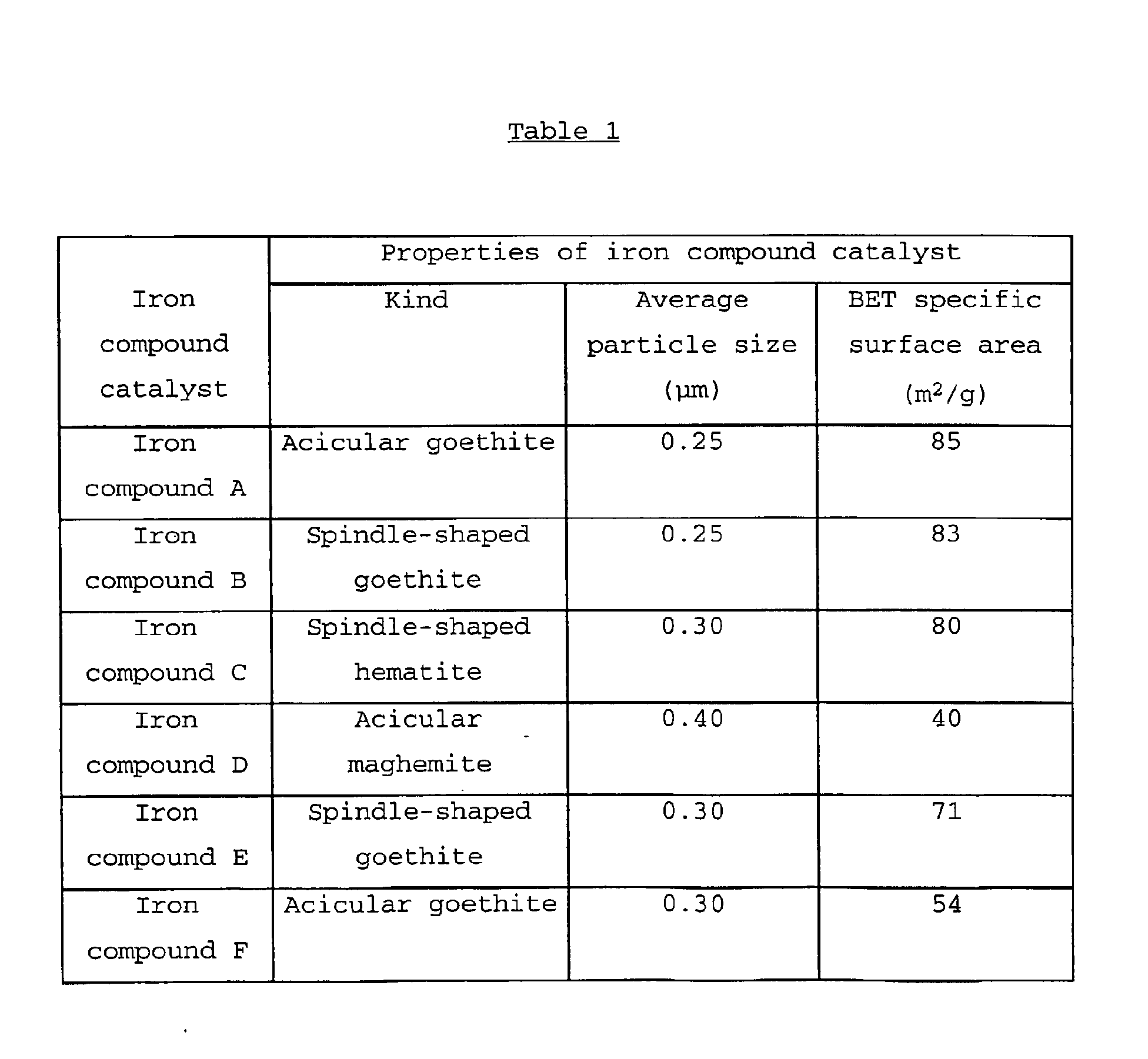
- a filter paper (weight: 0.50 g; No.2, manufactured by Advantec Toyo Co., Ltd.) for laboratory chemical experiments was coated with a coating solution prepared by dispersing 1.0 g of goethite particles as iron compound catalyst A (average particle size: 0.25 ⁇ m; phosphorus content: 0.002 % by weight; sulfur content: 0.05 % by weight; sodium content: 0.08 % by weight; BET specific surface area: 85 m 2 /g; catalytic activity by the above evaluation method: 20 %) in 100 ml of water, and then dried in air at a temperature of 60°C for 1 hour, thereby obtaining a paper having 5.0 mg of the iron compound catalyst (1.0 % by weight).
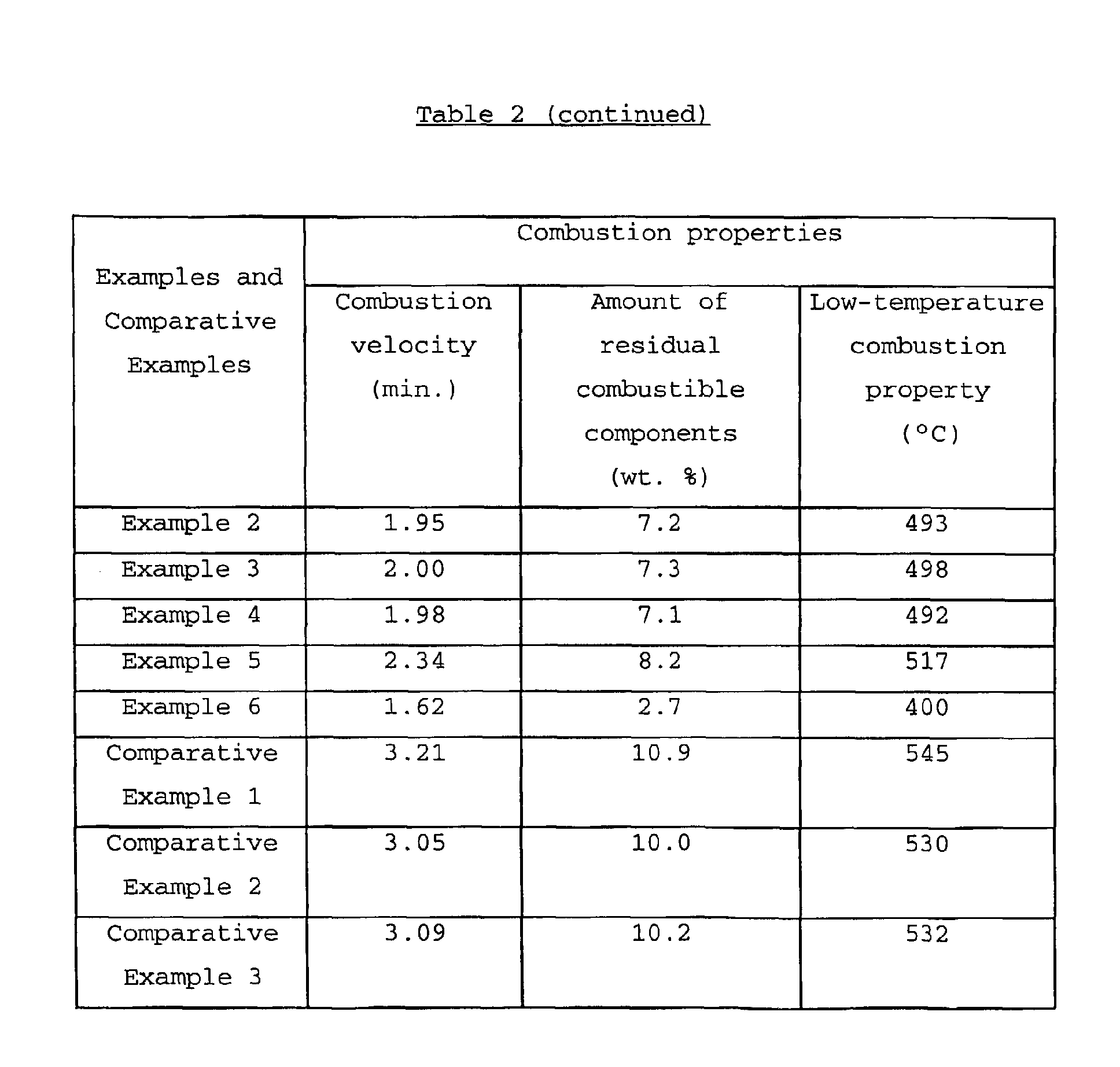
- the combustion velocity represents the time required from the initiation of abrupt reduction in weight up to the termination thereof (the combustion of the paper is considered to take place during such a time).
- the amount of residual combustible components is expressed by the residual weight percentage (wt%) calculated as the percentage of combustible components which still remain unburned upon the termination of abrupt reduction in weight, based on the weight of initially charged combustible components.
- the low-temperature combustion property (which is considered to be a temperature at which organic substances are completely burned out) is expressed by the temperature at which the reduction in weight is no longer caused.
- the combustion velocity was 2.1 minutes; the amount of residual combustible components was 7.5 % by weight; and the low-temperature combustion property was 495 °C.
- Example 2 The same procedure as defined in Example 1 was conducted except that the filter paper for laboratory chemical experiments was surface-coated with coating solutions respectively containing the iron compound catalysts shown in Table 1, thereby obtaining papers each containing the predetermined amount of the iron compound catalyst in the filter paper.
- the iron compound catalyst-containing papers of the present invention obtained in Examples 2 to 6 were excellent in all of combustion velocity, amount of residual combustible components and low-temperature combustion property as compared to those of the paper obtained in Comparative Example 1 containing no iron compound catalyst. This indicates that the papers of the present invention can be completely combusted with a less amount of combustion residues or cinders upon incineration. Further, both of the papers obtained in Comparative Examples 2 and 3 containing the iron compound catalyst out of the range specified by the present invention, failed to exhibit improved combustion properties.
Landscapes
- Chemical & Material Sciences (AREA)
- Inorganic Chemistry (AREA)
- Catalysts (AREA)
- Paper (AREA)
Abstract
said iron compound catalyst comprising iron oxide hydroxide particles or iron oxide particles having an average particle size of 0.01 to 2.0 µm; and having a catalytic activity capable of converting not less than 15% by weight of carbon monoxide into carbon dioxide, when 2.8 X 10⁻⁴ mole of iron oxide particles obtained by heat-treating said iron compound catalyst at a temperature of 800°C for 15 minutes in air, are instantaneously contacted with 6.1 X 10⁻⁷ mole of carbon monoxide at a temperature of 250°C at a space velocity of 42,400 h-1 in an inert gas atmosphere using a pulse catalytic reactor.
Description
said iron compound catalyst comprising iron oxide hydroxide particles or iron oxide particles having an average particle size of 0.01 to 2.0 µm; and having a catalytic activity capable of converting not less than 15% by weight of carbon monoxide into carbon dioxide, when 2.8 X 10⁻⁴ mole of iron oxide particles obtained by heat-treating said iron compound catalyst at a temperature of 800°C for 15 minutes in air, are instantaneously contacted with 6.1 X 10⁻⁷ mole of carbon monoxide at a temperature of 250°C at a space velocity (SV) of 42,400 h-1 in an inert gas atmosphere using a pulse catalytic reactor.


Claims (4)
- Paper having an iron compound catalyst in an amount of 0.1 to 20% by weight,
said iron compound catalyst comprising particles which severally may be of the same or different composition, each particle comprising iron oxide hydroxide and/or iron oxide; the particles having an average particle size of 0.01 to 2.0 µm, and having a catalytic activity such that not less than 15% by weight of carbon monoxide is converted into carbon dioxide when 2.8 X 10⁻⁴ mole of iron oxide-based particles, obtained by heat-treating said catalyst at a temperature of 800°C for 15 minutes in air, are contacted with 6.1 X 10⁻⁷ mole of carbon monoxide at a temperature of 250°C at a space velocity of 42,400 h-1 using a pulse catalytic reactor. - Paper according to claim 1, wherein said iron compound catalyst further has a BET specific surface area of 0.2 to 200 m2/g.
- Paper according to claim 1 or 2, wherein said iron compound catalyst comprises at least one of goethite particles, akaganeite particles, lepidocrocite particles, hematite particles, maghemite particles and magnetite particles.
- Paper according to claim 1, 2 or 3 wherein said iron compound catalyst has a phosphorus content of 0.0001 to 0.02%, a sulfur content of 0.001 to 0.3% and a sodium content of 0.001 to 0.3%, each by weight based on the weight of the catalyst.
Applications Claiming Priority (2)
| Application Number | Priority Date | Filing Date | Title |
|---|---|---|---|
| JP26946899 | 1999-09-22 | ||
| JP26946899A JP2001089995A (en) | 1999-09-22 | 1999-09-22 | paper |
Publications (2)
| Publication Number | Publication Date |
|---|---|
| EP1087058A2 true EP1087058A2 (en) | 2001-03-28 |
| EP1087058A3 EP1087058A3 (en) | 2002-03-06 |
Family
ID=17472867
Family Applications (1)
| Application Number | Title | Priority Date | Filing Date |
|---|---|---|---|
| EP00308258A Withdrawn EP1087058A3 (en) | 1999-09-22 | 2000-09-21 | Completely combustible paper |
Country Status (4)
| Country | Link |
|---|---|
| EP (1) | EP1087058A3 (en) |
| JP (1) | JP2001089995A (en) |
| KR (1) | KR20010050519A (en) |
| CN (1) | CN1289877A (en) |
Families Citing this family (2)
| Publication number | Priority date | Publication date | Assignee | Title |
|---|---|---|---|---|
| JP2007511204A (en) * | 2003-06-13 | 2007-05-10 | フィリップ・モーリス・プロダクツ・ソシエテ・アノニム | Cigarette wrapping paper with printed catalyst |
| JP7181497B2 (en) * | 2018-02-28 | 2022-12-01 | 戸田工業株式会社 | Combustion method of biomass fuel |
Family Cites Families (2)
| Publication number | Priority date | Publication date | Assignee | Title |
|---|---|---|---|---|
| US5386838A (en) * | 1993-07-09 | 1995-02-07 | Kimberly-Clark Corporation | High surface area iron-magnesium smoke suppressive compositions |
| JP2824203B2 (en) * | 1994-03-18 | 1998-11-11 | 大倉工業株式会社 | Plastic trash bags |
-
1999
- 1999-09-22 JP JP26946899A patent/JP2001089995A/en active Pending
-
2000
- 2000-09-19 KR KR1020000054895A patent/KR20010050519A/en not_active Withdrawn
- 2000-09-21 EP EP00308258A patent/EP1087058A3/en not_active Withdrawn
- 2000-09-21 CN CN00133853A patent/CN1289877A/en active Pending
Also Published As
| Publication number | Publication date |
|---|---|
| KR20010050519A (en) | 2001-06-15 |
| CN1289877A (en) | 2001-04-04 |
| JP2001089995A (en) | 2001-04-03 |
| EP1087058A3 (en) | 2002-03-06 |
Similar Documents
| Publication | Publication Date | Title |
|---|---|---|
| Selomulya et al. | Mechanisms of Cr (VI) removal from water by various types of activated carbons | |
| Cao et al. | Catalytic wet air oxidation of wastewater containing ammonia and phenol over activated carbon supported Pt catalysts | |
| US6436868B1 (en) | Composite catalyst composition for inhibiting generation of dioxin | |
| JP2001232204A (en) | Cadmium zinc sulfide-based photocatalyst for hydrogen generation to which a cation is added, method for producing the same, and method for producing hydrogen using the same | |
| Ichiura et al. | Preparation of composite TiO2-zeolite sheets using a papermaking technique and their application to environmental improvement Part I Removal of acetaldehyde with and without UV irradiation | |
| Fu et al. | Applications in photocatalytic purification of air | |
| EP1050333B1 (en) | Iron compound catalyst for inhibiting generation of dioxin and incineration process of municipal solid waste using the same | |
| Liu et al. | Seaweed bio-chars modified with metal chloride for elemental mercury capture from simulated flue gas | |
| US6503471B1 (en) | Process for malodorous gas treatment | |
| Zhai et al. | Enhanced catalytic degradation of polyvinyl alcohol from aqueous solutions by novel synthesis of MnCoO3@ γ-Al2O3 nanocomposites: Performance, degradation intermediates and mechanism | |
| US6271168B1 (en) | Catalyst for decomposing organohalogen compound | |
| US5744690A (en) | Method of incinerating combustible wastes and chlorine scavenger | |
| KR20010050519A (en) | Paper | |
| d'Hennezel et al. | Surface prechlorination of anatase TiO2 for enhanced photocatalytic oxidation of toluene and hexane | |
| CN117619438A (en) | A kind of chitosan anchored cobalt zinc oxide composite material and its preparation method and application | |
| US5603928A (en) | Air purification agent and process for production of same | |
| EP0342310B1 (en) | Composition containing divalent manganese ion and method for preparing the same | |
| JP2824203B2 (en) | Plastic trash bags | |
| CN111054422A (en) | A kind of composite photocatalyst and its preparation method and application | |
| JPH11267507A (en) | Iron compound catalyst for dioxin control and method for incinerating refuse using the iron compound catalyst | |
| RU2067496C1 (en) | Catalyst for sulfurous compound oxidation | |
| CA3287307A1 (en) | Method for producing oxygen carrier, method for producing hydrogen, and apparatus for producing hydrogen | |
| KR100407241B1 (en) | Iron compound catalyst for inhibiting generation of dioxin and incineration process of municipal solid waste using the same | |
| JPH08183617A (en) | Production of fine lepidocrocite particles or powder | |
| JP2004210861A (en) | sticker |
Legal Events
| Date | Code | Title | Description |
|---|---|---|---|
| PUAI | Public reference made under article 153(3) epc to a published international application that has entered the european phase |
Free format text: ORIGINAL CODE: 0009012 |
|
| AK | Designated contracting states |
Kind code of ref document: A2 Designated state(s): AT BE CH CY DE DK ES FI FR GB GR IE IT LI LU MC NL PT SE Kind code of ref document: A2 Designated state(s): DE DK FR GB IT NL |
|
| AX | Request for extension of the european patent |
Free format text: AL;LT;LV;MK;RO;SI |
|
| PUAL | Search report despatched |
Free format text: ORIGINAL CODE: 0009013 |
|
| AK | Designated contracting states |
Kind code of ref document: A3 Designated state(s): AT BE CH CY DE DK ES FI FR GB GR IE IT LI LU MC NL PT SE |
|
| AX | Request for extension of the european patent |
Free format text: AL;LT;LV;MK;RO;SI |
|
| 17P | Request for examination filed |
Effective date: 20020802 |
|
| AKX | Designation fees paid |
Free format text: DE DK FR GB IT NL |
|
| STAA | Information on the status of an ep patent application or granted ep patent |
Free format text: STATUS: THE APPLICATION IS DEEMED TO BE WITHDRAWN |
|
| 18D | Application deemed to be withdrawn |
Effective date: 20040331 |