EP1087018A1 - Aminoacylases for acylation of alcohols and amines - Google Patents
Aminoacylases for acylation of alcohols and amines Download PDFInfo
- Publication number
- EP1087018A1 EP1087018A1 EP00117771A EP00117771A EP1087018A1 EP 1087018 A1 EP1087018 A1 EP 1087018A1 EP 00117771 A EP00117771 A EP 00117771A EP 00117771 A EP00117771 A EP 00117771A EP 1087018 A1 EP1087018 A1 EP 1087018A1
- Authority
- EP
- European Patent Office
- Prior art keywords
- aminoacylases
- alcohols
- process according
- acylation
- amines
- Prior art date
- Legal status (The legal status is an assumption and is not a legal conclusion. Google has not performed a legal analysis and makes no representation as to the accuracy of the status listed.)
- Withdrawn
Links
- 108010003977 aminoacylase I Proteins 0.000 title claims abstract description 23
- 150000001412 amines Chemical class 0.000 title claims abstract description 19
- 150000001298 alcohols Chemical class 0.000 title claims abstract description 16
- 230000010933 acylation Effects 0.000 title claims abstract description 13
- 238000005917 acylation reaction Methods 0.000 title claims abstract description 13
- 238000000034 method Methods 0.000 claims abstract description 25
- 238000006243 chemical reaction Methods 0.000 claims abstract description 14
- 150000002148 esters Chemical class 0.000 claims abstract description 10
- 238000003776 cleavage reaction Methods 0.000 claims abstract description 5
- 230000007017 scission Effects 0.000 claims abstract description 5
- 239000004094 surface-active agent Substances 0.000 claims description 8
- 241000981399 Aspergillus melleus Species 0.000 claims description 7
- 150000001408 amides Chemical class 0.000 claims description 7
- 239000003054 catalyst Substances 0.000 claims description 7
- 238000004108 freeze drying Methods 0.000 claims description 5
- APSBXTVYXVQYAB-UHFFFAOYSA-M sodium docusate Chemical compound [Na+].CCCCC(CC)COC(=O)CC(S([O-])(=O)=O)C(=O)OCC(CC)CCCC APSBXTVYXVQYAB-UHFFFAOYSA-M 0.000 claims description 5
- 239000002904 solvent Substances 0.000 claims description 5
- 240000006439 Aspergillus oryzae Species 0.000 claims description 4
- 238000007127 saponification reaction Methods 0.000 claims description 4
- 235000013855 polyvinylpyrrolidone Nutrition 0.000 claims description 3
- 235000002247 Aspergillus oryzae Nutrition 0.000 claims description 2
- WVDDGKGOMKODPV-UHFFFAOYSA-N Benzyl alcohol Chemical compound OCC1=CC=CC=C1 WVDDGKGOMKODPV-UHFFFAOYSA-N 0.000 claims description 2
- 150000001338 aliphatic hydrocarbons Chemical class 0.000 claims description 2
- 150000004945 aromatic hydrocarbons Chemical class 0.000 claims description 2
- 239000012528 membrane Substances 0.000 claims description 2
- 239000003495 polar organic solvent Substances 0.000 claims description 2
- 229920000036 polyvinylpyrrolidone Polymers 0.000 claims description 2
- 239000001267 polyvinylpyrrolidone Substances 0.000 claims description 2
- 150000003333 secondary alcohols Chemical class 0.000 claims description 2
- 239000000758 substrate Substances 0.000 abstract description 5
- 150000001413 amino acids Chemical class 0.000 abstract description 2
- 230000007306 turnover Effects 0.000 abstract 1
- 108090000790 Enzymes Proteins 0.000 description 11
- 102000004190 Enzymes Human genes 0.000 description 11
- VLKZOEOYAKHREP-UHFFFAOYSA-N n-Hexane Chemical compound CCCCCC VLKZOEOYAKHREP-UHFFFAOYSA-N 0.000 description 9
- MEGHWIAOTJPCHQ-UHFFFAOYSA-N ethenyl butanoate Chemical compound CCCC(=O)OC=C MEGHWIAOTJPCHQ-UHFFFAOYSA-N 0.000 description 5
- 230000009466 transformation Effects 0.000 description 5
- WAPNOHKVXSQRPX-UHFFFAOYSA-N 1-phenylethanol Chemical compound CC(O)C1=CC=CC=C1 WAPNOHKVXSQRPX-UHFFFAOYSA-N 0.000 description 4
- YXFVVABEGXRONW-UHFFFAOYSA-N Toluene Chemical compound CC1=CC=CC=C1 YXFVVABEGXRONW-UHFFFAOYSA-N 0.000 description 3
- 238000004458 analytical method Methods 0.000 description 3
- 238000005809 transesterification reaction Methods 0.000 description 3
- NMSBTWLFBGNKON-UHFFFAOYSA-N 2-(2-hexadecoxyethoxy)ethanol Chemical compound CCCCCCCCCCCCCCCCOCCOCCO NMSBTWLFBGNKON-UHFFFAOYSA-N 0.000 description 2
- ULGJWNIHLSLQPZ-UHFFFAOYSA-N 7-[(6,8-dichloro-1,2,3,4-tetrahydroacridin-9-yl)amino]-n-[2-(1h-indol-3-yl)ethyl]heptanamide Chemical compound C1CCCC2=NC3=CC(Cl)=CC(Cl)=C3C(NCCCCCCC(=O)NCCC=3C4=CC=CC=C4NC=3)=C21 ULGJWNIHLSLQPZ-UHFFFAOYSA-N 0.000 description 2
- 239000007836 KH2PO4 Substances 0.000 description 2
- XPNGNIFUDRPBFJ-UHFFFAOYSA-N alpha-methylbenzylalcohol Natural products CC1=CC=CC=C1CO XPNGNIFUDRPBFJ-UHFFFAOYSA-N 0.000 description 2
- 230000015572 biosynthetic process Effects 0.000 description 2
- 230000003197 catalytic effect Effects 0.000 description 2
- GLVVKKSPKXTQRB-UHFFFAOYSA-N ethenyl dodecanoate Chemical compound CCCCCCCCCCCC(=O)OC=C GLVVKKSPKXTQRB-UHFFFAOYSA-N 0.000 description 2
- 239000007788 liquid Substances 0.000 description 2
- 229910000402 monopotassium phosphate Inorganic materials 0.000 description 2
- 229920006316 polyvinylpyrrolidine Polymers 0.000 description 2
- GNSKLFRGEWLPPA-UHFFFAOYSA-M potassium dihydrogen phosphate Chemical compound [K+].OP(O)([O-])=O GNSKLFRGEWLPPA-UHFFFAOYSA-M 0.000 description 2
- 108090000623 proteins and genes Proteins 0.000 description 2
- 102000004169 proteins and genes Human genes 0.000 description 2
- 239000000126 substance Substances 0.000 description 2
- 238000003786 synthesis reaction Methods 0.000 description 2
- 238000000844 transformation Methods 0.000 description 2
- XLYOFNOQVPJJNP-UHFFFAOYSA-N water Substances O XLYOFNOQVPJJNP-UHFFFAOYSA-N 0.000 description 2
- YWBQYPKXAMIUQE-UHFFFAOYSA-N 5-methylhexa-3,5-dienoic acid Chemical compound CC(=C)C=CCC(O)=O YWBQYPKXAMIUQE-UHFFFAOYSA-N 0.000 description 1
- 241000228212 Aspergillus Species 0.000 description 1
- JGFBQFKZKSSODQ-UHFFFAOYSA-N Isothiocyanatocyclopropane Chemical compound S=C=NC1CC1 JGFBQFKZKSSODQ-UHFFFAOYSA-N 0.000 description 1
- 102000004882 Lipase Human genes 0.000 description 1
- 108090001060 Lipase Proteins 0.000 description 1
- 239000004367 Lipase Substances 0.000 description 1
- WHNWPMSKXPGLAX-UHFFFAOYSA-N N-Vinyl-2-pyrrolidone Chemical compound C=CN1CCCC1=O WHNWPMSKXPGLAX-UHFFFAOYSA-N 0.000 description 1
- XUYPXLNMDZIRQH-LURJTMIESA-N N-acetyl-L-methionine Chemical compound CSCC[C@@H](C(O)=O)NC(C)=O XUYPXLNMDZIRQH-LURJTMIESA-N 0.000 description 1
- 239000000020 Nitrocellulose Substances 0.000 description 1
- 229920003081 Povidone K 30 Polymers 0.000 description 1
- XTXRWKRVRITETP-UHFFFAOYSA-N Vinyl acetate Chemical compound CC(=O)OC=C XTXRWKRVRITETP-UHFFFAOYSA-N 0.000 description 1
- 239000000443 aerosol Substances 0.000 description 1
- -1 aromatic alcohols Chemical class 0.000 description 1
- 125000003118 aryl group Chemical group 0.000 description 1
- 238000003556 assay Methods 0.000 description 1
- PWLNAUNEAKQYLH-UHFFFAOYSA-N butyric acid octyl ester Natural products CCCCCCCCOC(=O)CCC PWLNAUNEAKQYLH-UHFFFAOYSA-N 0.000 description 1
- 238000004296 chiral HPLC Methods 0.000 description 1
- 239000011248 coating agent Substances 0.000 description 1
- 238000000576 coating method Methods 0.000 description 1
- 150000001875 compounds Chemical class 0.000 description 1
- 238000004132 cross linking Methods 0.000 description 1
- 230000000694 effects Effects 0.000 description 1
- 239000000839 emulsion Substances 0.000 description 1
- IYNRVIKPUTZSOR-HWKANZROSA-N ethenyl (e)-but-2-enoate Chemical compound C\C=C\C(=O)OC=C IYNRVIKPUTZSOR-HWKANZROSA-N 0.000 description 1
- LZWYWAIOTBEZFN-UHFFFAOYSA-N ethenyl hexanoate Chemical compound CCCCCC(=O)OC=C LZWYWAIOTBEZFN-UHFFFAOYSA-N 0.000 description 1
- QBDADGJLZNIRFQ-UHFFFAOYSA-N ethenyl octanoate Chemical compound CCCCCCCC(=O)OC=C QBDADGJLZNIRFQ-UHFFFAOYSA-N 0.000 description 1
- BLCTWBJQROOONQ-UHFFFAOYSA-N ethenyl prop-2-enoate Chemical compound C=COC(=O)C=C BLCTWBJQROOONQ-UHFFFAOYSA-N 0.000 description 1
- UIWXSTHGICQLQT-UHFFFAOYSA-N ethenyl propanoate Chemical compound CCC(=O)OC=C UIWXSTHGICQLQT-UHFFFAOYSA-N 0.000 description 1
- 238000007172 homogeneous catalysis Methods 0.000 description 1
- 230000007062 hydrolysis Effects 0.000 description 1
- 238000006460 hydrolysis reaction Methods 0.000 description 1
- 230000003301 hydrolyzing effect Effects 0.000 description 1
- 235000019421 lipase Nutrition 0.000 description 1
- 238000004519 manufacturing process Methods 0.000 description 1
- 239000000203 mixture Substances 0.000 description 1
- UUIQMZJEGPQKFD-UHFFFAOYSA-N n-butyric acid methyl ester Natural products CCCC(=O)OC UUIQMZJEGPQKFD-UHFFFAOYSA-N 0.000 description 1
- 229920001220 nitrocellulos Polymers 0.000 description 1
- 150000002894 organic compounds Chemical class 0.000 description 1
- 239000003960 organic solvent Substances 0.000 description 1
- 150000002902 organometallic compounds Chemical class 0.000 description 1
- 238000002360 preparation method Methods 0.000 description 1
- 150000003141 primary amines Chemical class 0.000 description 1
- 239000011541 reaction mixture Substances 0.000 description 1
- 238000009877 rendering Methods 0.000 description 1
- 238000004007 reversed phase HPLC Methods 0.000 description 1
- 238000010898 silica gel chromatography Methods 0.000 description 1
- 238000001179 sorption measurement Methods 0.000 description 1
- 230000001131 transforming effect Effects 0.000 description 1
- KOZCZZVUFDCZGG-UHFFFAOYSA-N vinyl benzoate Chemical compound C=COC(=O)C1=CC=CC=C1 KOZCZZVUFDCZGG-UHFFFAOYSA-N 0.000 description 1
Classifications
-
- C—CHEMISTRY; METALLURGY
- C12—BIOCHEMISTRY; BEER; SPIRITS; WINE; VINEGAR; MICROBIOLOGY; ENZYMOLOGY; MUTATION OR GENETIC ENGINEERING
- C12P—FERMENTATION OR ENZYME-USING PROCESSES TO SYNTHESISE A DESIRED CHEMICAL COMPOUND OR COMPOSITION OR TO SEPARATE OPTICAL ISOMERS FROM A RACEMIC MIXTURE
- C12P7/00—Preparation of oxygen-containing organic compounds
- C12P7/02—Preparation of oxygen-containing organic compounds containing a hydroxy group
-
- C—CHEMISTRY; METALLURGY
- C12—BIOCHEMISTRY; BEER; SPIRITS; WINE; VINEGAR; MICROBIOLOGY; ENZYMOLOGY; MUTATION OR GENETIC ENGINEERING
- C12P—FERMENTATION OR ENZYME-USING PROCESSES TO SYNTHESISE A DESIRED CHEMICAL COMPOUND OR COMPOSITION OR TO SEPARATE OPTICAL ISOMERS FROM A RACEMIC MIXTURE
- C12P41/00—Processes using enzymes or microorganisms to separate optical isomers from a racemic mixture
- C12P41/003—Processes using enzymes or microorganisms to separate optical isomers from a racemic mixture by ester formation, lactone formation or the inverse reactions
- C12P41/004—Processes using enzymes or microorganisms to separate optical isomers from a racemic mixture by ester formation, lactone formation or the inverse reactions by esterification of alcohol- or thiol groups in the enantiomers or the inverse reaction
-
- C—CHEMISTRY; METALLURGY
- C12—BIOCHEMISTRY; BEER; SPIRITS; WINE; VINEGAR; MICROBIOLOGY; ENZYMOLOGY; MUTATION OR GENETIC ENGINEERING
- C12P—FERMENTATION OR ENZYME-USING PROCESSES TO SYNTHESISE A DESIRED CHEMICAL COMPOUND OR COMPOSITION OR TO SEPARATE OPTICAL ISOMERS FROM A RACEMIC MIXTURE
- C12P41/00—Processes using enzymes or microorganisms to separate optical isomers from a racemic mixture
- C12P41/006—Processes using enzymes or microorganisms to separate optical isomers from a racemic mixture by reactions involving C-N bonds, e.g. nitriles, amides, hydantoins, carbamates, lactames, transamination reactions, or keto group formation from racemic mixtures
- C12P41/007—Processes using enzymes or microorganisms to separate optical isomers from a racemic mixture by reactions involving C-N bonds, e.g. nitriles, amides, hydantoins, carbamates, lactames, transamination reactions, or keto group formation from racemic mixtures by reactions involving acyl derivatives of racemic amines
-
- C—CHEMISTRY; METALLURGY
- C12—BIOCHEMISTRY; BEER; SPIRITS; WINE; VINEGAR; MICROBIOLOGY; ENZYMOLOGY; MUTATION OR GENETIC ENGINEERING
- C12P—FERMENTATION OR ENZYME-USING PROCESSES TO SYNTHESISE A DESIRED CHEMICAL COMPOUND OR COMPOSITION OR TO SEPARATE OPTICAL ISOMERS FROM A RACEMIC MIXTURE
- C12P7/00—Preparation of oxygen-containing organic compounds
- C12P7/62—Carboxylic acid esters
Definitions
- the present invention is directed to a process for the acylation of racemic alcohols or amines or their cleavage by the aid of aminoacylases.
- Enantioselective synthesis is a versatile tool to produce chiral non-racemic organic compounds in organic chemistry. Its applicability in the production of substances on technical scale becomes more and more important due to the ever growing need to provide purer and cheaper products. Thus, there is still a demand for new and superior processes in chemical industries.
- aminoacylases are well known in the art to be suitable catalysts and are incorporated in many industrial applications (e.g. DE 19546532; Bommarius et al. Ann. N. Y. Acad. Sci. 1992, 672, 126). On the other hand aminoacylases are deemed to be ineffective in transforming amines to amides enantioselectively and vice versa, respectively.
- Enzymes to be used advantageously with respect to alcohols are lipases in this regard (Lalonde et al. Methods in Enzymology 1997, 286, 443-464). Herradon et al. published the possibility to transesterify enantioselectively ⁇ 1-phenylethanol with vinylbutyrate by an acylase of Aspergillus melleus (Synlett 1997, 367-370).
- the catalytic enantioselective acylation of racemic alcohols or enantioselective saponification of racemic esters can be done advantageously by reaction with immobilised aminoacylases.
- free or immobilised aminoacylases can be taken for enantioselective acylation of racemic amines or enantioselective cleavage of racemic amides, too. So far the theory revealed that only amino acids are deemed to be proper substrates for aminoacylase transformation (A. S. Bommarius et al., Tetrahedron; Asymmetry, 1997, Vol. 8, 3197-3200).
- aminoacylases it is a unique feature of aminoacylases to be able to transform alcohols and amines according to the invention.
- aminoacylases from Aspergillus are used. More advantageously, the process can be performed with aminoacylases taken from Aspergillus melleus or Aspergillus oryzae.
- the mode of immobilisation of instant enzymes can be chosen according to the knowledge of the skilled worker (Bhavender P. Sharma, Lorraine F. Bailey and Ralph A. Messing, "Immobilinstrumente Biomaterialiern -techniken und füren", Angew. Chem. 1982, 94, 836-852).
- the enzymes are immobilised by lyophilisation (Dordick et al. J. Am. Chem. Soc. 194, 116, 5009-5010; Okahata et al. Tetrahedron Lett. 1997, 38, 1971-1974; Adlercreutz et al. Biocatalysis 1992, 6, 291-305) .
- a lyophilisation using surfactants like aerosol OT or polyvinylpyrrolidone or polyethylenglycol (PEG) or Brij 52 (Diethylenglycol-monocetylether) (Goto et al. Biotechnol. Techniques 1997, 11, 375-378.
- surfactants like aerosol OT or polyvinylpyrrolidone or polyethylenglycol (PEG) or Brij 52 (Diethylenglycol-monocetylether) (Goto et al. Biotechnol. Techniques 1997, 11, 375-378.
- acylation the process can advantageously be conducted in a non-polar organic solvent. More preferably an aliphatic or aromatic hydrocarbon, like hexane, toluene can be used as solvent. Most preferably and totally surprisingly the acylation can be conducted without additional solvents.
- amines or amides or alcohols or esters can be used as long as they possess at least one centre of chirality.
- the enantioselectivity will be larger the narrower this centre is connected to the centre of reaction.
- the centre of chirality is related to the centre of reaction. Therefore, a secondary alcohol or amine with adjacent secondary centre can be acylated preferably.
- the instant invention can be performed in an enzyme-membrane reactor like mentioned in Wandrey et al. in Gonzbuch 1998, Maschinenstechnik und Chemieingenieuroire, VDI S. 151ff.; Wandrey et al. in Applied Homogeneous Catalysis with Organometallic Compounds, Vol. 2, VCH 1996, S.832 ff.; Kragl et al., Angew. Chem. 1996, 6, 684f or DE 197 27 715.
- aminoacylases are deemed to be excellent catalysts for the enantioselective transesterification of racemic alcohols to their corresponding esters in their immobilised form. Due to reversibility of instant reactions the saponification is also possible purely by rendering the thermodynamic reaction conditions. Amines are transformed accordingly into their enantiomerically enriched amides and vice versa.
- Immobilisation means according to this invention the crosslinking of enzymes (clecs); the adsorption of enzymes on special devices (e.g. nitrocellulose) or other techniques known to the artisan to harbour enzymes on polymerically enlarged substrates, like e.g. surfactant coating techniques (Goto et al. Biotechnol. Prog. 1994, 10, 263-268; Kamiya et al. Biotechnol. Prog. 1995, 11, 270-275; Okahata et al. Tibtech February 1997, 15, 50-54; Fishman et al. Biotechnol. Lett. 1998, 20, 535-538).
- Aminoacylases from A. melleus and A. oryzae are commercially available.
- Amines according to the invention mean primary amines, which do not possess an ⁇ -carboxylic group.
- surfactant coated protein 5 g of dry weight PVP K30 was dissolved in 50 ml buffer (100mM KH 2 PO 4 , pH 8.0) and mixed with 1 g catalyst. After achieving homogeneous enzyme solution, the liquid was frozen at -40 °C and the resulting frozen aqueous layer was removed under vacuum during 16 h. The activity of aminoacylases preparations was measured using the standard hydrolysis of N-acetyl-L-methionine as the assay. In the case of AOT, 28 g of emulsion (10% Aerosol) was mixed with 50 ml buffer (100 mM KH 2 PO 4 ), pH 8.0) and when 1 g of enzyme was dissolved the liquid was frozen and dried under vacuum.
- 50 ml buffer 100mM KH 2 PO 4 , pH 8.0
Landscapes
- Chemical & Material Sciences (AREA)
- Organic Chemistry (AREA)
- Engineering & Computer Science (AREA)
- Zoology (AREA)
- Life Sciences & Earth Sciences (AREA)
- Wood Science & Technology (AREA)
- Chemical Kinetics & Catalysis (AREA)
- Microbiology (AREA)
- General Chemical & Material Sciences (AREA)
- Biotechnology (AREA)
- Health & Medical Sciences (AREA)
- Biochemistry (AREA)
- Bioinformatics & Cheminformatics (AREA)
- General Engineering & Computer Science (AREA)
- General Health & Medical Sciences (AREA)
- Genetics & Genomics (AREA)
- Analytical Chemistry (AREA)
- Preparation Of Compounds By Using Micro-Organisms (AREA)
- Enzymes And Modification Thereof (AREA)
Abstract
Description
- The present invention is directed to a process for the acylation of racemic alcohols or amines or their cleavage by the aid of aminoacylases.
- Enantioselective synthesis is a versatile tool to produce chiral non-racemic organic compounds in organic chemistry. Its applicability in the production of substances on technical scale becomes more and more important due to the ever growing need to provide purer and cheaper products. Thus, there is still a demand for new and superior processes in chemical industries.
- One straightforward method of industrial enantioselective synthesis is the transformation of compounds by enzymes. Aminoacylases are well known in the art to be suitable catalysts and are incorporated in many industrial applications (e.g. DE 19546532; Bommarius et al. Ann. N. Y. Acad. Sci. 1992, 672, 126). On the other hand aminoacylases are deemed to be ineffective in transforming amines to amides enantioselectively and vice versa, respectively.
- Enzymes to be used advantageously with respect to alcohols are lipases in this regard (Lalonde et al. Methods in Enzymology 1997, 286, 443-464). Herradon et al. published the possibility to transesterify enantioselectively ±1-phenylethanol with vinylbutyrate by an acylase of Aspergillus melleus (Synlett 1997, 367-370).
- Above mentioned processes with respect to aminoacylases have the disadvantage to provide undesirably low productivity for the transformation of alcohols to be implemented on industrial scale or are not known in the art with regard to transformations of amines so far.
- Therefore, it was an object of this invention to provide a catalytic process for the enantioselective acylation of racemic alcohols or the saponification of racemic esters and the enantioselective acylation of racemic amines or the cleavage of racemic amides in a manner to adopt this process on industrial scale, which requires a high efficiency regarding yields, purities and costs of products.
- This task is realised by a process characterised by claim 1. Preferred embodiments of this invention are subject to claims depending from claim 1.
- The catalytic enantioselective acylation of racemic alcohols or enantioselective saponification of racemic esters can be done advantageously by reaction with immobilised aminoacylases. Surprisingly, free or imobilised aminoacylases can be taken for enantioselective acylation of racemic amines or enantioselective cleavage of racemic amides, too. So far the theory revealed that only amino acids are deemed to be proper substrates for aminoacylase transformation (A. S. Bommarius et al., Tetrahedron; Asymmetry, 1997, Vol. 8, 3197-3200).
- It is a unique feature of aminoacylases to be able to transform alcohols and amines according to the invention. Preferably, aminoacylases from Aspergillus are used. More advantageously, the process can be performed with aminoacylases taken from Aspergillus melleus or Aspergillus oryzae.
- The mode of immobilisation of instant enzymes can be chosen according to the knowledge of the skilled worker (Bhavender P. Sharma, Lorraine F. Bailey and Ralph A. Messing, "Immobilisierte Biomaterialiern - Techniken und Anwendungen", Angew. Chem. 1982, 94, 836-852). Preferably, the enzymes are immobilised by lyophilisation (Dordick et al. J. Am. Chem. Soc. 194, 116, 5009-5010; Okahata et al. Tetrahedron Lett. 1997, 38, 1971-1974; Adlercreutz et al. Biocatalysis 1992, 6, 291-305) . Most preferred is a lyophilisation using surfactants like aerosol OT or polyvinylpyrrolidone or polyethylenglycol (PEG) or Brij 52 (Diethylenglycol-monocetylether) (Goto et al. Biotechnol. Techniques 1997, 11, 375-378.
- To cleave amides or to saponify esters water has to be present in the reaction mixture or the reaction can be totally run in water and the pH-value has to be kept constant in a range from 5 to 9, preferably around 7(±1). For the reversed reactions an organic solvent is preferably used. In case of acylation the process can advantageously be conducted in a non-polar organic solvent. More preferably an aliphatic or aromatic hydrocarbon, like hexane, toluene can be used as solvent. Most preferably and totally surprisingly the acylation can be conducted without additional solvents.
- For substrates all amines or amides or alcohols or esters can be used as long as they possess at least one centre of chirality. The enantioselectivity will be larger the narrower this centre is connected to the centre of reaction. Advantageously, the centre of chirality is related to the centre of reaction. Therefore, a secondary alcohol or amine with adjacent secondary centre can be acylated preferably.
- Within the preferred amines and alcohols those are most preferred, which are connected to aromatic residues. Thus an aromatic alcohol or amine with adjacent secondary centres can be used most advantageously.
- The instant invention can be performed in an enzyme-membrane reactor like mentioned in Wandrey et al. in Jahrbuch 1998, Verfahrenstechnik und Chemieingenieurwesen, VDI S. 151ff.; Wandrey et al. in Applied Homogeneous Catalysis with Organometallic Compounds, Vol. 2, VCH 1996, S.832 ff.; Kragl et al., Angew. Chem. 1996, 6, 684f or DE 197 27 715.
- In the following table 1 results are shown of reactions of rac-1-phenylethanol with activated esters in the presence of aminoacylase of Aspergillus melleus.
Activated ester Rate Conversion (%) Time (d) ee (%) vinylacetat 52,6 50 3 >99 vinylpropionate 67,0 50 2 >99 vinylbutyrate 109,7 50 1,25 >99 vinylacrylate 26,6 37 7 >99 vinylcrotonate 40,2 45 7 >99 vinylhexanoate 15,3 50 4 >99 vinyloctanoate 14,6 50 4 >99 vinyldodecanoate 13,7 50 4 >99 vinylbenzoate 1,9 13,5 7 72 vinyllaurate 35 50 6 >99 isoprenylacetat 1,2 8 7 48 methylbutyrate 4,3 11,6 7 >99 - The following table 2 shows the results of transformations of different aromatic alcohols with vinylbutyrate and aminoaclase from Aspergillus melleus in hexane

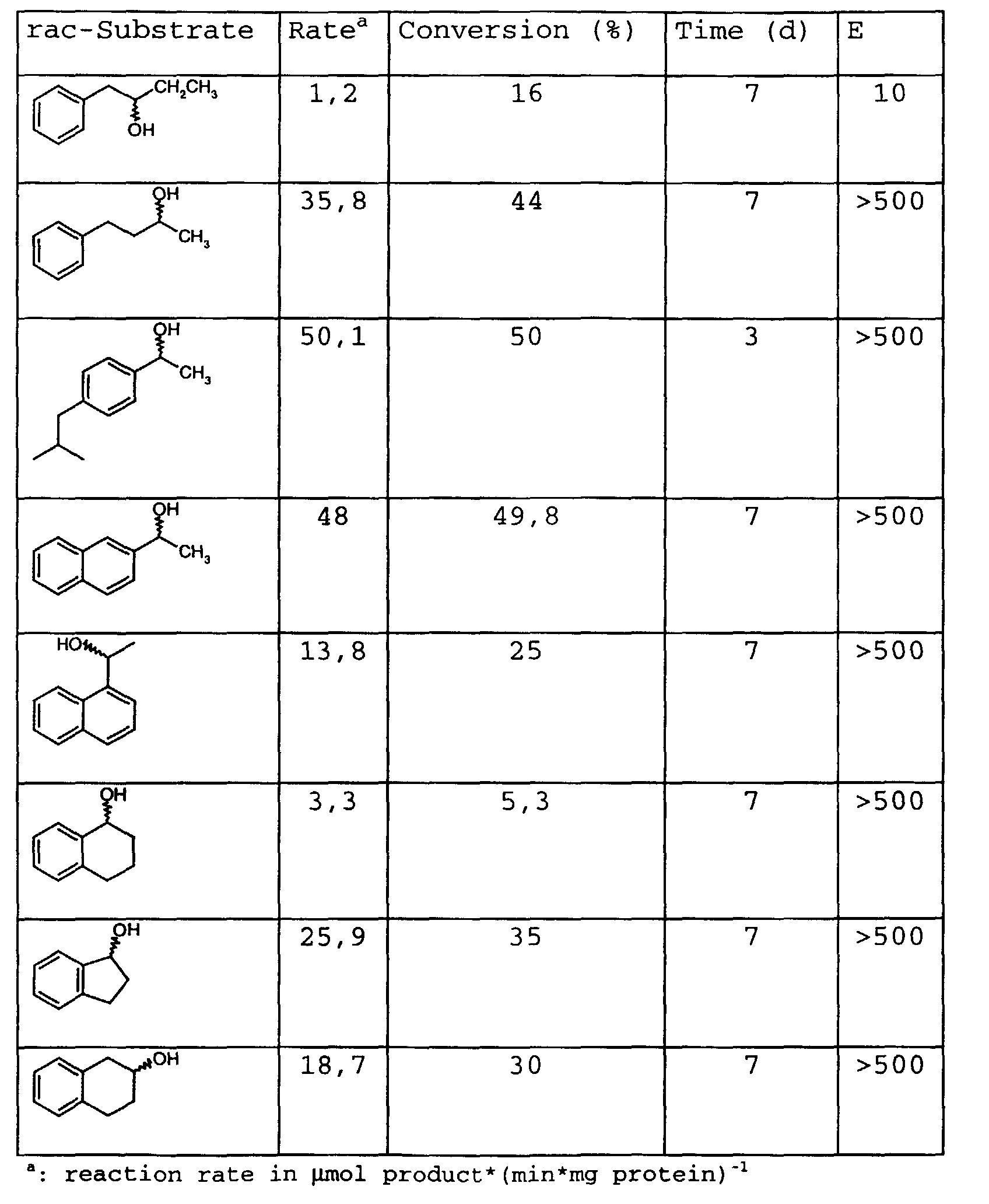
- The following table 3 reveals the increase in productivity of surfactant coated enzymes and native enzymes
Aminoacylase Hydrolytic activity (Umg-1) Transesterification (µmolmin-1mg-1) STY (gl-1d-1) Productivity (gg-1h-1) A. oryzae Native 11,2 0,2 45 0,6 PVP-complex 3,89 2,4 70 6,4 AOT-complex 4,38 74 2104 127,2 A. melleus Native 100 0,4 47 1,2 PVP-complex 6,22 3,6 50 8,8 AOT-complex 5,33 20,0 376 41,1 - It can be deduced from above mentioned results that aminoacylases are deemed to be excellent catalysts for the enantioselective transesterification of racemic alcohols to their corresponding esters in their immobilised form. Due to reversibility of instant reactions the saponification is also possible purely by rendering the thermodynamic reaction conditions. Amines are transformed accordingly into their enantiomerically enriched amides and vice versa.
- Enantioselective means within the framework of this invention that one antipode is the major component in the mixture of both antipodes.
- Immobilisation means according to this invention the crosslinking of enzymes (clecs); the adsorption of enzymes on special devices (e.g. nitrocellulose) or other techniques known to the artisan to harbour enzymes on polymerically enlarged substrates, like e.g. surfactant coating techniques (Goto et al. Biotechnol. Prog. 1994, 10, 263-268; Kamiya et al. Biotechnol. Prog. 1995, 11, 270-275; Okahata et al. Tibtech February 1997, 15, 50-54; Fishman et al. Biotechnol. Lett. 1998, 20, 535-538).
- Aminoacylases from A. melleus and A. oryzae are commercially available.
- Amines according to the invention mean primary amines, which do not possess an α-carboxylic group.
- The lyophilisation of enzyme-surfactant solutions was performed in rubber sealed freeze-dry flasks (Salm en Kipp bv, 300 ml). The reactions were monitored by reversed phase HPLC analysis. Polyvinylpyrrolidone K30 (PVP), Aerosol OT (10% v/v) (AOT) were obtained from Aldrich.
- To prepare surfactant coated protein 5 g of dry weight PVP K30 was dissolved in 50 ml buffer (100mM KH2PO4, pH 8.0) and mixed with 1 g catalyst. After achieving homogeneous enzyme solution, the liquid was frozen at -40 °C and the resulting frozen aqueous layer was removed under vacuum during 16 h. The activity of aminoacylases preparations was measured using the standard hydrolysis of N-acetyl-L-methionine as the assay.
In the case of AOT, 28 g of emulsion (10% Aerosol) was mixed with 50 ml buffer (100 mM KH2PO4), pH 8.0) and when 1 g of enzyme was dissolved the liquid was frozen and dried under vacuum. - 100 mg of rac-1-phenylethanol (0.8 mmol) were combined with 1.5 eq. activated ester, 100 mg catalyst and 5 ml hexane at room temperature (see table 1/2). During the first 5 h the initial rate was measured by following the course of the reaction with chiral HPLC. For the surfactant-coated catalyst (see table 3) the reactions were performed without additional solvents, solubilising 200 mg of surfactant-prepared catalyst in 3 g of rac 1-phenylethanol (24.6 mmol) and 1.1 eq. vinylbutyrate. The samples for analysis were centrifuged to remove the surfactant/protein layer from substrate/product. The excess of vinylbutyrate was evaporated and the residue was purified by silica gel column chromatography to afford (S)-alcohol and (R)-ester.
Claims (9)
- Process for the enantioselective acylation of racemic alcohols or enantioselective saponification of racemic esters with immobilised aminoacylases or enantioselective acylation of racemic amines or enantioselective cleavage of racemic amides with free or immobilised aminoacylases.
- Process according to claim 1,
characterised in that
aminoacylases of Aspergillus melleus or Aspergillus oryzae are used. - Process according to claim 1 and/or 2,
characterised in that
the catalysts are immobilised by lyophilisation with surfactants like aerosol OT or polyvinylpyrrolidone. - Process according to one or more of claims 1 to 3,
characterised in that
in case of acylation the process is conducted in a non-polar organic solvent. - Process according to claim 4,
characterised in that
an aliphatic or aromatic hydrocarbon is used as solvent. - Process according to one or more of claims 1 to 3,
characterised in that
in case of the acylation the process is conducted without additional solvents. - Process according to one or more of claims 1 to 6,
characterised in that
a secondary alcohol or amine with an adjacent secondary centre is acylated. - Process according to claim 7,
characterised in that
an aromatic alcohol or amine is used. - Process according to one or more of the preceding claims, characterised in that
the reaction is performed in an enzyme-membrane reactor.
Priority Applications (1)
| Application Number | Priority Date | Filing Date | Title |
|---|---|---|---|
| EP00117771A EP1087018A1 (en) | 1999-09-24 | 2000-08-18 | Aminoacylases for acylation of alcohols and amines |
Applications Claiming Priority (3)
| Application Number | Priority Date | Filing Date | Title |
|---|---|---|---|
| EP99118844 | 1999-09-24 | ||
| EP99118844 | 1999-09-24 | ||
| EP00117771A EP1087018A1 (en) | 1999-09-24 | 2000-08-18 | Aminoacylases for acylation of alcohols and amines |
Publications (1)
| Publication Number | Publication Date |
|---|---|
| EP1087018A1 true EP1087018A1 (en) | 2001-03-28 |
Family
ID=26071296
Family Applications (1)
| Application Number | Title | Priority Date | Filing Date |
|---|---|---|---|
| EP00117771A Withdrawn EP1087018A1 (en) | 1999-09-24 | 2000-08-18 | Aminoacylases for acylation of alcohols and amines |
Country Status (1)
| Country | Link |
|---|---|
| EP (1) | EP1087018A1 (en) |
Cited By (1)
| Publication number | Priority date | Publication date | Assignee | Title |
|---|---|---|---|---|
| US7067291B2 (en) | 2002-12-20 | 2006-06-27 | Pfizer Inc. | Biocatalytic preparation of enantiomerically enriched aminopentanenitrile |
Citations (2)
| Publication number | Priority date | Publication date | Assignee | Title |
|---|---|---|---|---|
| EP0198397A2 (en) * | 1985-04-09 | 1986-10-22 | Kuraray Co., Ltd. | Method of producing L-phenylalanine |
| JPH10273466A (en) * | 1997-03-28 | 1998-10-13 | Nippon Steel Corp | Method for producing 2-hydroxy-1-indanone |
-
2000
- 2000-08-18 EP EP00117771A patent/EP1087018A1/en not_active Withdrawn
Patent Citations (2)
| Publication number | Priority date | Publication date | Assignee | Title |
|---|---|---|---|---|
| EP0198397A2 (en) * | 1985-04-09 | 1986-10-22 | Kuraray Co., Ltd. | Method of producing L-phenylalanine |
| JPH10273466A (en) * | 1997-03-28 | 1998-10-13 | Nippon Steel Corp | Method for producing 2-hydroxy-1-indanone |
Non-Patent Citations (4)
| Title |
|---|
| B HERRADON AND S VALVERDE: "Biocatalysis in Organic Synthesis", SYNLETT,DE,THIEME VERLAG, STUTTGART, 1 June 1995 (1995-06-01), pages 599 - 602, XP002078550, ISSN: 0936-5214 * |
| BAKKER M ET AL: "Highly enantioselective aminoacylase-catalyzed transesterification of secondary alcohols", TETRAHEDRON: ASYMMETRY,NL,ELSEVIER SCIENCE PUBLISHERS, AMSTERDAM, vol. 11, no. 8, May 2000 (2000-05-01), pages 1801 - 1808, XP004204585, ISSN: 0957-4166 * |
| DATABASE CHEMABS [online] CHEMICAL ABSTRACTS SERVICE, COLUMBUS, OHIO, US; JODAI, HIROSHI ET AL: "Preparation of 2-hydroxy-1-indanone", XP002157821, retrieved from STN Database accession no. 129:330555 * |
| KOKURYO Y ET AL: "Practical Synthesis of l-erythro- and l-threo-4-Fluoroglutamic Acids Using Aminoacylase", TETRAHEDRON: ASYMMETRY,NL,ELSEVIER SCIENCE PUBLISHERS, AMSTERDAM, vol. 7, no. 12, 1 December 1996 (1996-12-01), pages 3545 - 3551, XP004070829, ISSN: 0957-4166 * |
Cited By (1)
| Publication number | Priority date | Publication date | Assignee | Title |
|---|---|---|---|---|
| US7067291B2 (en) | 2002-12-20 | 2006-06-27 | Pfizer Inc. | Biocatalytic preparation of enantiomerically enriched aminopentanenitrile |
Similar Documents
| Publication | Publication Date | Title |
|---|---|---|
| Lalonde et al. | Cross-linked crystals of Candida rugosa lipase: highly efficient catalysts for the resolution of chiral esters | |
| Zhao et al. | Enzymatic resolution of amino acid esters using ionic liquid N-ethyl pyridinium trifluoroacetate | |
| Kamiya et al. | Surfactant‐coated lipase suitable for the enzymatic resolution of menthol as a biocatalyst in organic media | |
| Lou et al. | Efficient kinetic resolution of (R, S)‐1‐trimethylsilylethanol via lipase‐mediated enantioselective acylation in ionic liquids | |
| JPH0530992A (en) | Process for producing optically active carboxylic acid | |
| US5032523A (en) | Preparation of optically active esters | |
| Jin et al. | Enzymatic production of enantiopure ketoprofen in a solvent-free two-phase system | |
| Lokotsch et al. | Resolution of d, l-menthol by interesterification with triacetin using the free and immobilized lipase of Candida cylindracea | |
| EP0904400B1 (en) | Enzymatic process for stereoselective preparation of therapeutic amides | |
| EP1851311A2 (en) | Enzymatic enantioselective ester or amide hydrolysis or synthesis | |
| EP2154253B1 (en) | Process for producing optically active 2-alkyl-1,1,3-trialkoxycarbonylpropane | |
| CN1327002C (en) | Enzyme preparing method for Beta-amino acid of enriched antipode | |
| KR0164050B1 (en) | Method for preparing ester compound using enzyme in non-solvent | |
| WO1995007359A1 (en) | A process for carrying out enzymatically catalyzed conversions of organic compounds | |
| WO1991019002A1 (en) | A process for chiral enrichment of asymmetric primary amines | |
| JP4493851B2 (en) | Resolution of primary amine racemates by enzyme catalysis. | |
| JP4042454B2 (en) | Process for producing optically active 3-methylglutaric acid monoester | |
| JPH01235599A (en) | Method for optically resolving racemic alcohol | |
| US5756321A (en) | Process for enzymatic acylation of alcohols with alkoxyvinyl acetates by transesterification | |
| US7067291B2 (en) | Biocatalytic preparation of enantiomerically enriched aminopentanenitrile | |
| JP2001120298A (en) | Aminoacylase for acylating alcohol and amine | |
| Shih et al. | Enzymes catalyzed esterification of N-protected amino acids with secondary alcohols | |
| Zarevúcka et al. | Initial water content and lipase-mediated ester formation in hexane | |
| KR100618724B1 (en) | Method of producing monomer | |
| JPH05207881A (en) | Method for enhancing enantio-selectivity of candida lipase in esterification of chiral alcohol, and immobilized candida lipase |
Legal Events
| Date | Code | Title | Description |
|---|---|---|---|
| PUAI | Public reference made under article 153(3) epc to a published international application that has entered the european phase |
Free format text: ORIGINAL CODE: 0009012 |
|
| 17P | Request for examination filed |
Effective date: 20000818 |
|
| AK | Designated contracting states |
Kind code of ref document: A1 Designated state(s): AT BE CH CY DE DK ES FI FR GB GR IE IT LI LU MC NL PT SE |
|
| AX | Request for extension of the european patent |
Free format text: AL;LT;LV;MK;RO;SI |
|
| RAP1 | Party data changed (applicant data changed or rights of an application transferred) |
Owner name: DEGUSSA AG |
|
| AKX | Designation fees paid |
Free format text: AT BE CH CY DE DK ES FI FR GB GR IE IT LI LU MC NL PT SE |
|
| STAA | Information on the status of an ep patent application or granted ep patent |
Free format text: STATUS: THE APPLICATION IS DEEMED TO BE WITHDRAWN |
|
| 18D | Application deemed to be withdrawn |
Effective date: 20040229 |