EP1086739A2 - Catalyst for decomposing organohalogen compound - Google Patents
Catalyst for decomposing organohalogen compound Download PDFInfo
- Publication number
- EP1086739A2 EP1086739A2 EP00308340A EP00308340A EP1086739A2 EP 1086739 A2 EP1086739 A2 EP 1086739A2 EP 00308340 A EP00308340 A EP 00308340A EP 00308340 A EP00308340 A EP 00308340A EP 1086739 A2 EP1086739 A2 EP 1086739A2
- Authority
- EP
- European Patent Office
- Prior art keywords
- particles
- compound
- weight
- organohalogen
- iron
- Prior art date
- Legal status (The legal status is an assumption and is not a legal conclusion. Google has not performed a legal analysis and makes no representation as to the accuracy of the status listed.)
- Withdrawn
Links
- 239000003054 catalyst Substances 0.000 title claims abstract description 103
- 150000002896 organic halogen compounds Chemical class 0.000 title claims abstract description 71
- 239000002245 particle Substances 0.000 claims abstract description 134
- 150000002506 iron compounds Chemical class 0.000 claims abstract description 62
- -1 amine compound Chemical class 0.000 claims abstract description 48
- UQSXHKLRYXJYBZ-UHFFFAOYSA-N Iron oxide Chemical compound [Fe]=O UQSXHKLRYXJYBZ-UHFFFAOYSA-N 0.000 claims abstract description 42
- 239000002131 composite material Substances 0.000 claims abstract description 41
- MVPPADPHJFYWMZ-UHFFFAOYSA-N chlorobenzene Chemical compound ClC1=CC=CC=C1 MVPPADPHJFYWMZ-UHFFFAOYSA-N 0.000 claims abstract description 26
- 230000003197 catalytic effect Effects 0.000 claims abstract description 23
- 239000011593 sulfur Substances 0.000 claims abstract description 21
- 229910052717 sulfur Inorganic materials 0.000 claims abstract description 21
- NINIDFKCEFEMDL-UHFFFAOYSA-N Sulfur Chemical compound [S] NINIDFKCEFEMDL-UHFFFAOYSA-N 0.000 claims abstract description 20
- DGAQECJNVWCQMB-PUAWFVPOSA-M Ilexoside XXIX Chemical compound C[C@@H]1CC[C@@]2(CC[C@@]3(C(=CC[C@H]4[C@]3(CC[C@@H]5[C@@]4(CC[C@@H](C5(C)C)OS(=O)(=O)[O-])C)C)[C@@H]2[C@]1(C)O)C)C(=O)O[C@H]6[C@@H]([C@H]([C@@H]([C@H](O6)CO)O)O)O.[Na+] DGAQECJNVWCQMB-PUAWFVPOSA-M 0.000 claims abstract description 17
- OAICVXFJPJFONN-UHFFFAOYSA-N Phosphorus Chemical compound [P] OAICVXFJPJFONN-UHFFFAOYSA-N 0.000 claims abstract description 17
- 239000011574 phosphorus Substances 0.000 claims abstract description 17
- 229910052698 phosphorus Inorganic materials 0.000 claims abstract description 17
- 239000011734 sodium Substances 0.000 claims abstract description 17
- 229910052708 sodium Inorganic materials 0.000 claims abstract description 17
- 239000000203 mixture Substances 0.000 claims abstract description 8
- 238000000034 method Methods 0.000 claims description 53
- IEECXTSVVFWGSE-UHFFFAOYSA-M iron(3+);oxygen(2-);hydroxide Chemical compound [OH-].[O-2].[Fe+3] IEECXTSVVFWGSE-UHFFFAOYSA-M 0.000 claims description 4
- 238000009835 boiling Methods 0.000 claims description 3
- 150000003973 alkyl amines Chemical class 0.000 claims description 2
- 239000008188 pellet Substances 0.000 claims description 2
- 239000002002 slurry Substances 0.000 claims description 2
- 150000001412 amines Chemical class 0.000 claims 1
- 239000011246 composite particle Substances 0.000 abstract description 18
- 239000011261 inert gas Substances 0.000 abstract description 9
- 238000000354 decomposition reaction Methods 0.000 description 68
- 239000007789 gas Substances 0.000 description 37
- 230000000694 effects Effects 0.000 description 18
- OKTJSMMVPCPJKN-UHFFFAOYSA-N Carbon Chemical compound [C] OKTJSMMVPCPJKN-UHFFFAOYSA-N 0.000 description 14
- 238000002485 combustion reaction Methods 0.000 description 14
- 150000002013 dioxins Chemical class 0.000 description 14
- 238000006243 chemical reaction Methods 0.000 description 12
- 230000000052 comparative effect Effects 0.000 description 12
- AEIXRCIKZIZYPM-UHFFFAOYSA-M hydroxy(oxo)iron Chemical compound [O][Fe]O AEIXRCIKZIZYPM-UHFFFAOYSA-M 0.000 description 12
- HGUFODBRKLSHSI-UHFFFAOYSA-N 2,3,7,8-tetrachloro-dibenzo-p-dioxin Chemical compound O1C2=CC(Cl)=C(Cl)C=C2OC2=C1C=C(Cl)C(Cl)=C2 HGUFODBRKLSHSI-UHFFFAOYSA-N 0.000 description 10
- 229910052598 goethite Inorganic materials 0.000 description 10
- 238000012360 testing method Methods 0.000 description 9
- 239000002699 waste material Substances 0.000 description 9
- 238000002156 mixing Methods 0.000 description 8
- XSTXAVWGXDQKEL-UHFFFAOYSA-N Trichloroethylene Chemical group ClC=C(Cl)Cl XSTXAVWGXDQKEL-UHFFFAOYSA-N 0.000 description 7
- 229960002415 trichloroethylene Drugs 0.000 description 7
- UBOXGVDOUJQMTN-UHFFFAOYSA-N trichloroethylene Natural products ClCC(Cl)Cl UBOXGVDOUJQMTN-UHFFFAOYSA-N 0.000 description 7
- 150000001875 compounds Chemical class 0.000 description 6
- 239000000428 dust Substances 0.000 description 6
- 239000010813 municipal solid waste Substances 0.000 description 6
- WXNZTHHGJRFXKQ-UHFFFAOYSA-N 4-chlorophenol Chemical compound OC1=CC=C(Cl)C=C1 WXNZTHHGJRFXKQ-UHFFFAOYSA-N 0.000 description 5
- 150000001491 aromatic compounds Chemical class 0.000 description 5
- 239000002574 poison Substances 0.000 description 5
- 231100000614 poison Toxicity 0.000 description 5
- QGZKDVFQNNGYKY-UHFFFAOYSA-N Ammonia Chemical compound N QGZKDVFQNNGYKY-UHFFFAOYSA-N 0.000 description 4
- VTYYLEPIZMXCLO-UHFFFAOYSA-L Calcium carbonate Chemical compound [Ca+2].[O-]C([O-])=O VTYYLEPIZMXCLO-UHFFFAOYSA-L 0.000 description 4
- CDBYLPFSWZWCQE-UHFFFAOYSA-L Sodium Carbonate Chemical compound [Na+].[Na+].[O-]C([O-])=O CDBYLPFSWZWCQE-UHFFFAOYSA-L 0.000 description 4
- GWEVSGVZZGPLCZ-UHFFFAOYSA-N Titan oxide Chemical compound O=[Ti]=O GWEVSGVZZGPLCZ-UHFFFAOYSA-N 0.000 description 4
- 239000002253 acid Substances 0.000 description 4
- 239000003795 chemical substances by application Substances 0.000 description 4
- 239000011019 hematite Substances 0.000 description 4
- 229910052595 hematite Inorganic materials 0.000 description 4
- 230000002401 inhibitory effect Effects 0.000 description 4
- LIKBJVNGSGBSGK-UHFFFAOYSA-N iron(3+);oxygen(2-) Chemical compound [O-2].[O-2].[O-2].[Fe+3].[Fe+3] LIKBJVNGSGBSGK-UHFFFAOYSA-N 0.000 description 4
- 230000003472 neutralizing effect Effects 0.000 description 4
- 239000002243 precursor Substances 0.000 description 4
- LFQSCWFLJHTTHZ-UHFFFAOYSA-N Ethanol Chemical compound CCO LFQSCWFLJHTTHZ-UHFFFAOYSA-N 0.000 description 3
- KFZMGEQAYNKOFK-UHFFFAOYSA-N Isopropanol Chemical compound CC(C)O KFZMGEQAYNKOFK-UHFFFAOYSA-N 0.000 description 3
- VYPSYNLAJGMNEJ-UHFFFAOYSA-N Silicium dioxide Chemical compound O=[Si]=O VYPSYNLAJGMNEJ-UHFFFAOYSA-N 0.000 description 3
- GSEJCLTVZPLZKY-UHFFFAOYSA-N Triethanolamine Chemical compound OCCN(CCO)CCO GSEJCLTVZPLZKY-UHFFFAOYSA-N 0.000 description 3
- QVGXLLKOCUKJST-UHFFFAOYSA-N atomic oxygen Chemical compound [O] QVGXLLKOCUKJST-UHFFFAOYSA-N 0.000 description 3
- 238000011156 evaluation Methods 0.000 description 3
- 239000010881 fly ash Substances 0.000 description 3
- SZVJSHCCFOBDDC-UHFFFAOYSA-N iron(II,III) oxide Inorganic materials O=[Fe]O[Fe]O[Fe]=O SZVJSHCCFOBDDC-UHFFFAOYSA-N 0.000 description 3
- JEIPFZHSYJVQDO-UHFFFAOYSA-N iron(III) oxide Inorganic materials O=[Fe]O[Fe]=O JEIPFZHSYJVQDO-UHFFFAOYSA-N 0.000 description 3
- 229910052760 oxygen Inorganic materials 0.000 description 3
- 239000001301 oxygen Substances 0.000 description 3
- 239000002904 solvent Substances 0.000 description 3
- 229960004418 trolamine Drugs 0.000 description 3
- XLYOFNOQVPJJNP-UHFFFAOYSA-N water Substances O XLYOFNOQVPJJNP-UHFFFAOYSA-N 0.000 description 3
- PAYRUJLWNCNPSJ-UHFFFAOYSA-N Aniline Chemical compound NC1=CC=CC=C1 PAYRUJLWNCNPSJ-UHFFFAOYSA-N 0.000 description 2
- 241000196324 Embryophyta Species 0.000 description 2
- CWYNVVGOOAEACU-UHFFFAOYSA-N Fe2+ Chemical compound [Fe+2] CWYNVVGOOAEACU-UHFFFAOYSA-N 0.000 description 2
- XEEYBQQBJWHFJM-UHFFFAOYSA-N Iron Chemical compound [Fe] XEEYBQQBJWHFJM-UHFFFAOYSA-N 0.000 description 2
- UIIMBOGNXHQVGW-UHFFFAOYSA-M Sodium bicarbonate Chemical compound [Na+].OC([O-])=O UIIMBOGNXHQVGW-UHFFFAOYSA-M 0.000 description 2
- 239000003513 alkali Substances 0.000 description 2
- 229910001854 alkali hydroxide Inorganic materials 0.000 description 2
- 150000008044 alkali metal hydroxides Chemical class 0.000 description 2
- 229910021529 ammonia Inorganic materials 0.000 description 2
- 229910000019 calcium carbonate Inorganic materials 0.000 description 2
- AXCZMVOFGPJBDE-UHFFFAOYSA-L calcium dihydroxide Chemical compound [OH-].[OH-].[Ca+2] AXCZMVOFGPJBDE-UHFFFAOYSA-L 0.000 description 2
- 239000000920 calcium hydroxide Substances 0.000 description 2
- 229910001861 calcium hydroxide Inorganic materials 0.000 description 2
- 150000004649 carbonic acid derivatives Chemical class 0.000 description 2
- 238000010276 construction Methods 0.000 description 2
- TXCDCPKCNAJMEE-UHFFFAOYSA-N dibenzofuran Chemical compound C1=CC=C2C3=CC=CC=C3OC2=C1 TXCDCPKCNAJMEE-UHFFFAOYSA-N 0.000 description 2
- 238000009826 distribution Methods 0.000 description 2
- 238000000635 electron micrograph Methods 0.000 description 2
- 238000010438 heat treatment Methods 0.000 description 2
- VKYKSIONXSXAKP-UHFFFAOYSA-N hexamethylenetetramine Chemical compound C1N(C2)CN3CN1CN2C3 VKYKSIONXSXAKP-UHFFFAOYSA-N 0.000 description 2
- 206010022000 influenza Diseases 0.000 description 2
- BAUYGSIQEAFULO-UHFFFAOYSA-L iron(2+) sulfate (anhydrous) Chemical compound [Fe+2].[O-]S([O-])(=O)=O BAUYGSIQEAFULO-UHFFFAOYSA-L 0.000 description 2
- 238000004519 manufacturing process Methods 0.000 description 2
- 239000004576 sand Substances 0.000 description 2
- 238000005245 sintering Methods 0.000 description 2
- 229910000029 sodium carbonate Inorganic materials 0.000 description 2
- 239000011949 solid catalyst Substances 0.000 description 2
- 239000002910 solid waste Substances 0.000 description 2
- 238000001179 sorption measurement Methods 0.000 description 2
- 238000003756 stirring Methods 0.000 description 2
- 239000000126 substance Substances 0.000 description 2
- 239000004408 titanium dioxide Substances 0.000 description 2
- 238000011282 treatment Methods 0.000 description 2
- 238000004056 waste incineration Methods 0.000 description 2
- VILCJCGEZXAXTO-UHFFFAOYSA-N 2,2,2-tetramine Chemical compound NCCNCCNCCN VILCJCGEZXAXTO-UHFFFAOYSA-N 0.000 description 1
- ZUNFPBNHELLPPP-UHFFFAOYSA-N 3-[4-(aminomethyl)-6-(trifluoromethyl)pyridin-2-yl]oxy-N-[2-(dimethylamino)ethyl]benzamide Chemical compound NCC1=CC(=NC(=C1)C(F)(F)F)OC=1C=C(C(=O)NCCN(C)C)C=CC=1 ZUNFPBNHELLPPP-UHFFFAOYSA-N 0.000 description 1
- QEIVWSRXBYOTAZ-UHFFFAOYSA-N 4-[4-(aminomethyl)-6-(trifluoromethyl)pyridin-2-yl]oxy-N-phenylpiperidine-1-carboxamide Chemical compound NCC1=CC(=NC(=C1)C(F)(F)F)OC1CCN(CC1)C(=O)NC1=CC=CC=C1 QEIVWSRXBYOTAZ-UHFFFAOYSA-N 0.000 description 1
- 238000004438 BET method Methods 0.000 description 1
- RPNUMPOLZDHAAY-UHFFFAOYSA-N Diethylenetriamine Chemical compound NCCNCCN RPNUMPOLZDHAAY-UHFFFAOYSA-N 0.000 description 1
- 240000007594 Oryza sativa Species 0.000 description 1
- 235000007164 Oryza sativa Nutrition 0.000 description 1
- CYTYCFOTNPOANT-UHFFFAOYSA-N Perchloroethylene Chemical group ClC(Cl)=C(Cl)Cl CYTYCFOTNPOANT-UHFFFAOYSA-N 0.000 description 1
- QIRRBNWABREFJF-UHFFFAOYSA-N [Fe].ClC1=CC=C(C=C1)O Chemical compound [Fe].ClC1=CC=C(C=C1)O QIRRBNWABREFJF-UHFFFAOYSA-N 0.000 description 1
- 238000005054 agglomeration Methods 0.000 description 1
- 230000002776 aggregation Effects 0.000 description 1
- 150000001339 alkali metal compounds Chemical class 0.000 description 1
- 229910052784 alkaline earth metal Inorganic materials 0.000 description 1
- 238000001354 calcination Methods 0.000 description 1
- 229940043430 calcium compound Drugs 0.000 description 1
- 150000001674 calcium compounds Chemical class 0.000 description 1
- BRPQOXSCLDDYGP-UHFFFAOYSA-N calcium oxide Chemical compound [O-2].[Ca+2] BRPQOXSCLDDYGP-UHFFFAOYSA-N 0.000 description 1
- 239000000292 calcium oxide Substances 0.000 description 1
- ODINCKMPIJJUCX-UHFFFAOYSA-N calcium oxide Inorganic materials [Ca]=O ODINCKMPIJJUCX-UHFFFAOYSA-N 0.000 description 1
- 230000000711 cancerogenic effect Effects 0.000 description 1
- 125000004432 carbon atom Chemical group C* 0.000 description 1
- 230000015556 catabolic process Effects 0.000 description 1
- 125000001309 chloro group Chemical group Cl* 0.000 description 1
- 239000010849 combustible waste Substances 0.000 description 1
- 238000007796 conventional method Methods 0.000 description 1
- 238000001816 cooling Methods 0.000 description 1
- 125000000753 cycloalkyl group Polymers 0.000 description 1
- 238000006298 dechlorination reaction Methods 0.000 description 1
- 238000006731 degradation reaction Methods 0.000 description 1
- 238000005238 degreasing Methods 0.000 description 1
- 230000006866 deterioration Effects 0.000 description 1
- ZBCBWPMODOFKDW-UHFFFAOYSA-N diethanolamine Chemical compound OCCNCCO ZBCBWPMODOFKDW-UHFFFAOYSA-N 0.000 description 1
- 238000009792 diffusion process Methods 0.000 description 1
- 229940042397 direct acting antivirals cyclic amines Drugs 0.000 description 1
- 239000010459 dolomite Substances 0.000 description 1
- 229910000514 dolomite Inorganic materials 0.000 description 1
- 238000005108 dry cleaning Methods 0.000 description 1
- 238000001035 drying Methods 0.000 description 1
- 238000003912 environmental pollution Methods 0.000 description 1
- RAQDACVRFCEPDA-UHFFFAOYSA-L ferrous carbonate Chemical class [Fe+2].[O-]C([O-])=O RAQDACVRFCEPDA-UHFFFAOYSA-L 0.000 description 1
- 238000004817 gas chromatography Methods 0.000 description 1
- 238000002290 gas chromatography-mass spectrometry Methods 0.000 description 1
- 239000008187 granular material Substances 0.000 description 1
- 239000003673 groundwater Substances 0.000 description 1
- 235000010299 hexamethylene tetramine Nutrition 0.000 description 1
- 239000004312 hexamethylene tetramine Substances 0.000 description 1
- 125000004435 hydrogen atom Chemical group [H]* 0.000 description 1
- 150000004679 hydroxides Chemical class 0.000 description 1
- 238000009616 inductively coupled plasma Methods 0.000 description 1
- 239000002440 industrial waste Substances 0.000 description 1
- 239000003112 inhibitor Substances 0.000 description 1
- 229910052742 iron Inorganic materials 0.000 description 1
- LLHITCBVCUPTBV-UHFFFAOYSA-N iron;1,1,2-trichloroethene Chemical compound [Fe].ClC=C(Cl)Cl LLHITCBVCUPTBV-UHFFFAOYSA-N 0.000 description 1
- XGZVUEUWXADBQD-UHFFFAOYSA-L lithium carbonate Chemical compound [Li+].[Li+].[O-]C([O-])=O XGZVUEUWXADBQD-UHFFFAOYSA-L 0.000 description 1
- 229910052808 lithium carbonate Inorganic materials 0.000 description 1
- ZLNQQNXFFQJAID-UHFFFAOYSA-L magnesium carbonate Chemical compound [Mg+2].[O-]C([O-])=O ZLNQQNXFFQJAID-UHFFFAOYSA-L 0.000 description 1
- 239000001095 magnesium carbonate Substances 0.000 description 1
- 229910000021 magnesium carbonate Inorganic materials 0.000 description 1
- 239000000395 magnesium oxide Substances 0.000 description 1
- CPLXHLVBOLITMK-UHFFFAOYSA-N magnesium oxide Inorganic materials [Mg]=O CPLXHLVBOLITMK-UHFFFAOYSA-N 0.000 description 1
- AXZKOIWUVFPNLO-UHFFFAOYSA-N magnesium;oxygen(2-) Chemical compound [O-2].[Mg+2] AXZKOIWUVFPNLO-UHFFFAOYSA-N 0.000 description 1
- 239000000463 material Substances 0.000 description 1
- 238000005259 measurement Methods 0.000 description 1
- 229910052751 metal Inorganic materials 0.000 description 1
- 239000002184 metal Substances 0.000 description 1
- 150000002736 metal compounds Chemical class 0.000 description 1
- YQCIWBXEVYWRCW-UHFFFAOYSA-N methane;sulfane Chemical compound C.S YQCIWBXEVYWRCW-UHFFFAOYSA-N 0.000 description 1
- 238000003801 milling Methods 0.000 description 1
- NFBOHOGPQUYFRF-UHFFFAOYSA-N oxanthrene Chemical compound C1=CC=C2OC3=CC=CC=C3OC2=C1 NFBOHOGPQUYFRF-UHFFFAOYSA-N 0.000 description 1
- 239000011736 potassium bicarbonate Substances 0.000 description 1
- 229910000028 potassium bicarbonate Inorganic materials 0.000 description 1
- 235000015497 potassium bicarbonate Nutrition 0.000 description 1
- TYJJADVDDVDEDZ-UHFFFAOYSA-M potassium hydrogencarbonate Chemical compound [K+].OC([O-])=O TYJJADVDDVDEDZ-UHFFFAOYSA-M 0.000 description 1
- 229940086066 potassium hydrogencarbonate Drugs 0.000 description 1
- 239000002244 precipitate Substances 0.000 description 1
- 230000003449 preventive effect Effects 0.000 description 1
- 238000000746 purification Methods 0.000 description 1
- 238000011160 research Methods 0.000 description 1
- 235000009566 rice Nutrition 0.000 description 1
- 239000012266 salt solution Substances 0.000 description 1
- 239000000741 silica gel Substances 0.000 description 1
- 229910002027 silica gel Inorganic materials 0.000 description 1
- 229910000030 sodium bicarbonate Inorganic materials 0.000 description 1
- 235000017557 sodium bicarbonate Nutrition 0.000 description 1
- 235000017550 sodium carbonate Nutrition 0.000 description 1
- GCLGEJMYGQKIIW-UHFFFAOYSA-H sodium hexametaphosphate Chemical compound [Na]OP1(=O)OP(=O)(O[Na])OP(=O)(O[Na])OP(=O)(O[Na])OP(=O)(O[Na])OP(=O)(O[Na])O1 GCLGEJMYGQKIIW-UHFFFAOYSA-H 0.000 description 1
- 235000019982 sodium hexametaphosphate Nutrition 0.000 description 1
- 229910001415 sodium ion Inorganic materials 0.000 description 1
- 239000002689 soil Substances 0.000 description 1
- 239000000725 suspension Substances 0.000 description 1
- 229950011008 tetrachloroethylene Drugs 0.000 description 1
- 239000001577 tetrasodium phosphonato phosphate Substances 0.000 description 1
- 231100000419 toxicity Toxicity 0.000 description 1
- 230000001988 toxicity Effects 0.000 description 1
- 238000005406 washing Methods 0.000 description 1
Images

Classifications
-
- B—PERFORMING OPERATIONS; TRANSPORTING
- B01—PHYSICAL OR CHEMICAL PROCESSES OR APPARATUS IN GENERAL
- B01J—CHEMICAL OR PHYSICAL PROCESSES, e.g. CATALYSIS OR COLLOID CHEMISTRY; THEIR RELEVANT APPARATUS
- B01J37/00—Processes, in general, for preparing catalysts; Processes, in general, for activation of catalysts
- B01J37/04—Mixing
-
- B—PERFORMING OPERATIONS; TRANSPORTING
- B01—PHYSICAL OR CHEMICAL PROCESSES OR APPARATUS IN GENERAL
- B01D—SEPARATION
- B01D53/00—Separation of gases or vapours; Recovering vapours of volatile solvents from gases; Chemical or biological purification of waste gases, e.g. engine exhaust gases, smoke, fumes, flue gases, aerosols
- B01D53/34—Chemical or biological purification of waste gases
- B01D53/74—General processes for purification of waste gases; Apparatus or devices specially adapted therefor
- B01D53/86—Catalytic processes
- B01D53/8659—Removing halogens or halogen compounds
- B01D53/8662—Organic halogen compounds
-
- B—PERFORMING OPERATIONS; TRANSPORTING
- B01—PHYSICAL OR CHEMICAL PROCESSES OR APPARATUS IN GENERAL
- B01J—CHEMICAL OR PHYSICAL PROCESSES, e.g. CATALYSIS OR COLLOID CHEMISTRY; THEIR RELEVANT APPARATUS
- B01J23/00—Catalysts comprising metals or metal oxides or hydroxides, not provided for in group B01J21/00
- B01J23/70—Catalysts comprising metals or metal oxides or hydroxides, not provided for in group B01J21/00 of the iron group metals or copper
- B01J23/74—Iron group metals
- B01J23/745—Iron
-
- B—PERFORMING OPERATIONS; TRANSPORTING
- B01—PHYSICAL OR CHEMICAL PROCESSES OR APPARATUS IN GENERAL
- B01J—CHEMICAL OR PHYSICAL PROCESSES, e.g. CATALYSIS OR COLLOID CHEMISTRY; THEIR RELEVANT APPARATUS
- B01J27/00—Catalysts comprising the elements or compounds of halogens, sulfur, selenium, tellurium, phosphorus or nitrogen; Catalysts comprising carbon compounds
-
- B—PERFORMING OPERATIONS; TRANSPORTING
- B01—PHYSICAL OR CHEMICAL PROCESSES OR APPARATUS IN GENERAL
- B01J—CHEMICAL OR PHYSICAL PROCESSES, e.g. CATALYSIS OR COLLOID CHEMISTRY; THEIR RELEVANT APPARATUS
- B01J27/00—Catalysts comprising the elements or compounds of halogens, sulfur, selenium, tellurium, phosphorus or nitrogen; Catalysts comprising carbon compounds
- B01J27/02—Sulfur, selenium or tellurium; Compounds thereof
- B01J27/04—Sulfides
- B01J27/047—Sulfides with chromium, molybdenum, tungsten or polonium
- B01J27/049—Sulfides with chromium, molybdenum, tungsten or polonium with iron group metals or platinum group metals
-
- B—PERFORMING OPERATIONS; TRANSPORTING
- B01—PHYSICAL OR CHEMICAL PROCESSES OR APPARATUS IN GENERAL
- B01J—CHEMICAL OR PHYSICAL PROCESSES, e.g. CATALYSIS OR COLLOID CHEMISTRY; THEIR RELEVANT APPARATUS
- B01J27/00—Catalysts comprising the elements or compounds of halogens, sulfur, selenium, tellurium, phosphorus or nitrogen; Catalysts comprising carbon compounds
- B01J27/14—Phosphorus; Compounds thereof
- B01J27/185—Phosphorus; Compounds thereof with iron group metals or platinum group metals
- B01J27/1853—Phosphorus; Compounds thereof with iron group metals or platinum group metals with iron, cobalt or nickel
-
- B—PERFORMING OPERATIONS; TRANSPORTING
- B01—PHYSICAL OR CHEMICAL PROCESSES OR APPARATUS IN GENERAL
- B01J—CHEMICAL OR PHYSICAL PROCESSES, e.g. CATALYSIS OR COLLOID CHEMISTRY; THEIR RELEVANT APPARATUS
- B01J31/00—Catalysts comprising hydrides, coordination complexes or organic compounds
- B01J31/02—Catalysts comprising hydrides, coordination complexes or organic compounds containing organic compounds or metal hydrides
- B01J31/0234—Nitrogen-, phosphorus-, arsenic- or antimony-containing compounds
- B01J31/0235—Nitrogen containing compounds
- B01J31/0254—Nitrogen containing compounds on mineral substrates
-
- B—PERFORMING OPERATIONS; TRANSPORTING
- B01—PHYSICAL OR CHEMICAL PROCESSES OR APPARATUS IN GENERAL
- B01J—CHEMICAL OR PHYSICAL PROCESSES, e.g. CATALYSIS OR COLLOID CHEMISTRY; THEIR RELEVANT APPARATUS
- B01J35/00—Catalysts, in general, characterised by their form or physical properties
- B01J35/60—Catalysts, in general, characterised by their form or physical properties characterised by their surface properties or porosity
- B01J35/61—Surface area
- B01J35/612—Surface area less than 10 m2/g
-
- B—PERFORMING OPERATIONS; TRANSPORTING
- B01—PHYSICAL OR CHEMICAL PROCESSES OR APPARATUS IN GENERAL
- B01J—CHEMICAL OR PHYSICAL PROCESSES, e.g. CATALYSIS OR COLLOID CHEMISTRY; THEIR RELEVANT APPARATUS
- B01J35/00—Catalysts, in general, characterised by their form or physical properties
- B01J35/60—Catalysts, in general, characterised by their form or physical properties characterised by their surface properties or porosity
- B01J35/61—Surface area
- B01J35/613—10-100 m2/g
-
- B—PERFORMING OPERATIONS; TRANSPORTING
- B01—PHYSICAL OR CHEMICAL PROCESSES OR APPARATUS IN GENERAL
- B01J—CHEMICAL OR PHYSICAL PROCESSES, e.g. CATALYSIS OR COLLOID CHEMISTRY; THEIR RELEVANT APPARATUS
- B01J35/00—Catalysts, in general, characterised by their form or physical properties
- B01J35/60—Catalysts, in general, characterised by their form or physical properties characterised by their surface properties or porosity
- B01J35/61—Surface area
- B01J35/615—100-500 m2/g
-
- B—PERFORMING OPERATIONS; TRANSPORTING
- B01—PHYSICAL OR CHEMICAL PROCESSES OR APPARATUS IN GENERAL
- B01J—CHEMICAL OR PHYSICAL PROCESSES, e.g. CATALYSIS OR COLLOID CHEMISTRY; THEIR RELEVANT APPARATUS
- B01J37/00—Processes, in general, for preparing catalysts; Processes, in general, for activation of catalysts
- B01J37/06—Washing
-
- B—PERFORMING OPERATIONS; TRANSPORTING
- B01—PHYSICAL OR CHEMICAL PROCESSES OR APPARATUS IN GENERAL
- B01D—SEPARATION
- B01D2255/00—Catalysts
- B01D2255/20—Metals or compounds thereof
- B01D2255/207—Transition metals
- B01D2255/20738—Iron
Definitions
- the present invention relates to a catalyst for the decomposition of an organohalogen compound, and more particularly, to a catalyst for the decomposition of an organohalogen compound for efficiently decomposing aromatic organohalogen compounds such as dioxins and precursors thereof, which are contained in a very small amount in an exhaust gas discharged from waste incinerators, or aliphatic organohalogen compounds such as trichloroethylene and dichlorometahne.
- dioxins Exhaust gases discharged from incinerators for incinerating municipal solid wastes or industrial wastes contain a small amount of aromatic chlorine compounds called "dioxins" which have an extremely strong toxicity to human bodies.
- the dioxins are a generic name of compounds formed by substituting hydrogen atoms of dibenzo-p-dioxine, dibenzofuran or the like with chlorine atoms.
- aliphatic organohalogen compounds such as trichloroethylene or tetrachloroethylene have been widely used in various applications such as degreasing of metal or dry-cleaning.
- organohalogen compounds are not only difficult to decompose, but also have a carcinogenic property. Therefore, there arises such a problem that the disposal of these compounds causes environmental pollution by diffusion in air and dissolving-out into ground water or soils.
- various methods for removing these organohalogen compounds have failed to establish economical and efficient techniques for decomposing the organohalogen compounds and converting the compounds into unharmful ones.
- the amine-carrying activated carbon is introduced into an exhaust gas containing dioxins, so that the dioxins are adsorbed into the activated carbon by the adsorptivity thereof, and then decomposed by reacting with the amine compound.
- the amine-carrying activated carbon has a high adsorptivity, but is incapable of sufficiently decomposing the dioxins and inhibiting the generation of dioxins. Further, the activated carbon has a risk of ignition at an elevated temperature, thereby causing problems concerning safety.
- the organohalogen compounds contained in the exhaust gas are decomposed at a temperature of from 60°C to less than 150°C in the presence of oxygen using the iron oxide-based and/or titanium dioxide-based solid catalysts.
- the decomposition percentage conversion rate
- organohalogen compounds can be decomposed at a high efficiency.
- organohalogen compounds can be decomposed at a high efficiency.
- the present invention has been attained on the basis of this finding.
- a composite catalyst for decomposing an organohalogen compound comprising composite particles comprising:
- a method for treating an organohalogen compound comprising:
- a composite catalyst for decomposing an organohalogen compound which composite catalyst comprises composite particles comprising:
- Fig. 1 is a schematic view showing an example of an intermittent operation-type solid waste incineration facility usable in the present invention.
- organohalogen compound-decomposition catalyst composite particles constituting a composite catalyst for the decomposition of an organohalogen compound (hereinafter referred to as "organohalogen compound-decomposition catalyst") according to the present invention.
- the iron compound particles contained in the composite particles constituting the organohalogen compound-decomposition catalyst of the present invention have an average particle size of usually 0.01 to 2.0 ⁇ m, preferably 0.02 to 2.0 ⁇ m, more preferably 0.02 to 1.0 ⁇ m.
- the average particle size of the iron compound particles is more than 2.0 ⁇ m, a sufficient activity for decomposing the organohalogen compound may not be exhibited due to deterioration in efficiency of contact with the organohalogen compound.
- the average particle size of the iron compound particles is less than 0.01 ⁇ m, the particles may rather suffer from undesired agglomeration due to sintering therebetween or the like, resulting in deteriorated activity for decomposing the organohalogen compound.
- the iron compound particles used in the present invention have a BET specific surface area value of usually 0.2 to 200 m 2 /g, preferably 0.5 to 200 m 2 /g, more preferably 0.5 to 100 m 2 /g.
- the iron compound particles used in the present invention comprises at least one selected from the group consisting of iron oxide hydroxide particles such as goethite particles, akaganeite particles and lepidocrocite particles, and iron oxide particles such as hematite particles, maghemite particles and magnetite particles. Among these particles, goethite particles and hematite particles are preferred.
- the shape of the iron compound particles used in the present invention may be either a granular shape such as a spherical shape, a granular shape, an octahedral shape, a hexahedral shape or a polyhedral shape, or an acicular shape such as an acicular shape, a spindle shape or a rice grain-like shape.
- a granular shape such as a spherical shape, a granular shape, an octahedral shape, a hexahedral shape or a polyhedral shape
- an acicular shape such as an acicular shape, a spindle shape or a rice grain-like shape.
- spindle-shaped particles or acicular particles are preferred.
- the iron compound particles used in the present invention have a phosphorus content of usually not more than 0.02% by weight, preferably not more than 0.01% by weight, more preferably not more than 0.005% by weight.
- the catalyst poison ability of the phosphorus may become large, so that the activity for decomposing the organohalogen compound is deteriorated.
- the iron compound particles used in the present invention have a sulfur content of usually not more than 0.3% by weight, preferably not more than 0.1% by weight, more preferably not more than 0.07% by weight.
- sulfur content is more than 0.3% by weight, the catalyst poison ability of the sulfur may become large, so that the activity for decomposing the organohalogen compound may be deteriorated.
- the iron compound particles used in the present invention have a sodium content of usually not more than 0.3% by weight, preferably not more than 0.2% by weight, more preferably not more than 0.15% by weight.
- the sulfur content is more than 0.3% by weight, the catalyst poison ability of the sodium may become large, so that the activity for decomposing the organohalogen compound may be deteriorated.
- the sum of the phosphorus, sulfur and sodium contents is preferably not more than 0.5% by weight, more preferably not more than 0.3% by weight, still more preferably not more than 0.2% by weight.
- the sum of the phosphorus, sulfur and sodium contents is more than 0.5% by weight, the activity for decomposing the organohalogen compound may be deteriorated.
- the iron compound particles used in the present invention exhibit a catalytic activity capable of decomposing usually not less than 20% by weight of monochlorobenzene when 50 mg of iron oxide particles obtained by heat-treating the iron compound particles at a temperature of 300°C for 60 minutes in air, are instantaneously contacted with 5.0 ⁇ 10 -7 mol of monochlorobenzene at a temperature of 300°C at a hourly space velocity of 150,000 h -1 in an inert gas atmosphere using a pulse catalytic reactor.
- the monochlorobenzene decomposition activity of the iron compound particles used in the present invention is preferably not less than 25%, more preferably not less than 30%.
- the amine compound used in the composite particles constituting the organohalogen compound-decomposition catalyst of the present invention comprises at least one compound selected from the group consisting of alkylamines such as diethylenetriamine and triethylenetetramine; alkanolamines such as triethanolamine and diethanolamine; cyclicamines such as aniline; hexamethylenetetramine and the like.
- the amine compound used in the present invention preferably has a boiling point of not less than 150°C.
- the amine compound may tend to be volatilized upon treating the organohalogen compound, thereby failing to exhibit the effect obtained by the combination with the iron compound particles.
- the particle shape and particle size of the composite particles constituting the organohalogen compound-decomposition catalyst of the present invention are the substantially same as those of the iron compound particles.
- the BET specific surface area of the composite particles constituting the organohalogen compound-decomposition catalyst of the present invention is preferably 0.2 to 200 m 2 /g, more preferably 0.5 to 200 m 2 /g still more preferably 0.5 to 100 m 2 /g.
- the weight ratio between the iron compound particles and the amine compound in the composite particles constituting the organohalogen compound-decomposition catalyst of the present invention is controlled such that the amount of the amine compound is preferably 0.1 to 10% by weight, more preferably 0.5 to 8.0% by weight, still more preferably 0.5 to 5.0% by weight based on the weight of the iron compound particles.
- the content of the amine compound is less than 0.1% by weight, the amine compound may not sufficiently show the effect for accelerating decomposition of the organohalogen compound.
- the content of the amine compound is more than 10% b y weight, the amine compound may tend to deteriorate the activity of the iron compound catalyst for decomposing the organohalogen compound.
- the composite particles constituting the organohalogen compound-decomposition catalyst of the present invention has a catalytic activity capable of decomposing usually not less than 50% by weight, preferably not less than 55% by weight of monochlorobenzene when 50 mg of a mixture obtained by mixing iron oxide particles obtained by heat-treating the iron compound particles at a temperature of 300°C for 60 minutes in air, with the amine compound at a predetermined ratio, is instantaneously contacted with 5.0 ⁇ 10 -7 mol of monochlorobenzene at a temperature of 300°C at a hourly space velocity of 150,000 h -1 in an inert gas atmosphere using a pulse catalytic reactor.
- the decomposition activity of the composite particles constituting the organohalogen compound-decomposition catalyst of the present invention by the above method is less than 50% by weight, it means that the organohalogen compounds cannot be effectively decomposed.
- monochlorobenzene is a typical one of the organohalogen compounds and is known as a precursor of dioxins. Therefore, the catalytic activity for the decomposition of monochlorobenzene is regarded as an index of the activity for decomposition of the organohalogen compounds including dioxins, or the activity for inhibiting the generation thereof.
- Conversion (%) [1-(amount of monochlorobenzene detected after reaction/amount of monochlorobenzene initially charged before reaction)] ⁇ 100
- goethite particles may be produced, for example, by passing an oxygen-containing gas such as air through a suspension containing a ferrous iron-containing precipitate such as hydroxides of iron or iron carbonates which are obtained by reacting a ferrous salt with at least one compound selected from the group consisting of alkali hydroxides, alkali carbonates and ammonia.
- an oxygen-containing gas such as air
- a ferrous iron-containing precipitate such as hydroxides of iron or iron carbonates which are obtained by reacting a ferrous salt with at least one compound selected from the group consisting of alkali hydroxides, alkali carbonates and ammonia.
- the hematite particles can be produced, for example, by heat-dehydrating or heat-treating the above obtained goethite particles at a temperature of 200 to 800°C in air; the magnetite particles can be produced, for example, by heat-reducing the above obtained hematite particles at a temperature of 300 to 600°C in a reducing atmosphere; and the maghemite particles can be produced, for example, by heat-oxidizing the above obtained magnetite particles in a temperature of 200 to 600°C in air.
- the ferrous salt solution there are preferably used those containing less contents of phosphorus, sulfur or the like as catalyst poisons.
- the contents of phosphorus, sulfur and sodium should be reduced by avoiding the use of sodium hexametaphosphate usually added as a sintering preventive upon heat-calcination step, and by removing sulfur ions derived from the raw ferrous materials and sodium ions derived from alkali hydroxides and/or the alkali carbonates by means of purification treatments such as washing with water or the like.
- the composite particles comprising the iron compound particles and the amine compound according to the present invention can be produced by driedly mixing the iron compound particles and the amine compound together in predetermined amounts, for example, in such amounts that the amine compound is present in an amount of preferably 0.1 to 10% by weight, more preferably 0.5 to 8.0% by weight, still more preferably 0.5 to 5.0% by weight based on the weight of the iron compound particles, using a mixer such as sand mill, Henschel mixer and Nauter mixer, or a grinder such as fine mill and pin mill.
- a solvent such as water or alcohol e.g. ethanol, isopropyl alcohol
- water or alcohol e.g. ethanol, isopropyl alcohol
- the solvent be evaporated by heating or under reduced pressure.
- the above mixing process using the mixer or grinder is preferably conducted under the following conditions:
- composite particles constituting the organohalogen compound-decomposition catalyst according to the present invention have such a configuration that the amine compound is carried on a part of the surface of each iron compound particle, when observed by an electron micrograph thereof.
- the incinerators to which the present invention can be applied include intermittent operation-type incinerators such as mechanical batch incinerators or semi-continuous incinerators, and continuous operation-type incinerators.
- FIG. 1 One of the intermittent operation-type incinerators usable in the present invention is schematically illustrated in Fig. 1.
- Fig. 1 respective reference numerals denote the following members and portions: 1: waste (municipal solid waste) hopper; 2: incinerator; 3: combustion chamber; 4: supplementary combustion burner port; 5: gas cooling chamber; 6: air preheater; 7: blower for feeding organohalogen compound-decomposition catalyst; 8: feed tank of organohalogen compound-decomposition catalyst; 9: dust collector; 10: induced draft fan; 11: chimney; 12: forced draft fan; 13 and 18: flues; 14 to 17 and 25: feed port for organohalogen compound-decomposition catalyst; 19: water sprayer; 20: drying stage of incinerator; 21: combustion stage of incinerator; 22: rear combustion stage of incinerator; 23: fly ash from dust collector; and 24: combustion air.
- 1 waste (municipal solid waste) hopper
- 2 incinerator
- 3 combustion
- a combustion air is introduced into the combustion chamber 3 from the bottom thereof in such an amount 1.5 to 3.5 times a theoretical combustion air amount required for complete combustion of wastes (municipal solid wastes).
- the combustion air there is used intake air received through the forced graft fan 12 and heated by the preheater 6.
- the combustion chamber is provided with the supplementary combustion burner port 4.
- the organohalogen compound-decomposition catalyst for inhibiting the generation of dioxin is fed through the respective feed ports 14 to 17, preferably through the feed ports 15 to 17 (namely, supplied into exhaust gases in flue 13, preheater 6 and flue 18) by a gas carrying method.
- the organohalogen compound-decomposition catalyst be contacted with a gas containing the organohalogen compound.
- the treating temperature is usually 150 to 600°C, preferably 200 to 600°C. When the treating temperature is less than 150°C, the decomposition activity of the organohalogen compound-decomposition catalyst may be deteriorated. When the treating temperature is more than 600°C, the amine compound in the organohalogen compound-decomposition catalyst may readily undergo thermal degradation, resulting in deteriorated decomposition activity of the catalyst.
- the method of contacting the organohalogen compounds with the organohalogen compound-decomposition catalyst there may be used the method of adding particles, granules or a slurry of the organohalogen compound-decomposition catalyst to the organohalogen compound-containing gas by an gas carrying method; or the method of passing the organohalogen compound-containing gas through a catalytic reactor of a fixed-bed type reactor, a fluidized-bed type reactor or the like which is filled with pellets of the organohalogen compound-decomposition catalyst.
- the amount of the organohalogen compound-decomposition catalyst used is preferably 0.01 to 0.5 g, more preferably 0.05 to 0.5 g, still more preferably 0.05 to 0.3 g based on 1 Nm 3 of the organohalogen compound-containing gas.
- a SV (space velocity) of the organohalogen compound-decomposition catalyst in the organohalogen compound-containing gas is preferably 500 to 10,000 h -1 , more preferably 500 to 8,000 h -1 , still more preferably 800 to 8,000 h -1 .
- the concentration of dioxin in the exhaust gas discharged, for example, through an outlet of an electric dust collector of waste incineration facilities can be reduced to usually not more than 2.0 ngTEQ/Nm 3 , preferably not more than 1.8 ngTEQ/Nm 3 , more preferably not more than 1.5 ngTEQ/Nm 3 .
- organohalogen compound-decomposition catalyst of the present invention by conducting the treatment of the organohalogen compounds using the organohalogen compound-decomposition catalyst of the present invention, for example, when 50 mg of a composite (mixture) is instantaneously contacted with 5.0 ⁇ 10 -7 mol of the organohalogen compound at a temperature of 300°C at a hourly space velocity of 150,000 h -1 in an inert gas atmosphere using a pulse catalytic reactor, usually not less than 50% by weight, preferably not less than 55% by weight of the organohalogen compound are decomposed.
- an acid gas neutralizing agent and/or activated carbon particles may be used jointly with the organohalogen compound-decomposition catalyst of the present invention.
- the acid gas neutralizing agents may include alkali earth metal compounds such as calcium hydroxide, calcium oxide, calcium carbonate, magnesium oxide, magnesium carbonate and dolomite; and alkali metal compounds such as lithium carbonate, sodium carbonate, sodium hydrogen carbonate and potassium hydrogen carbonate.
- alkali earth metal compounds such as calcium hydroxide, calcium oxide, calcium carbonate, magnesium oxide, magnesium carbonate and dolomite
- alkali metal compounds such as lithium carbonate, sodium carbonate, sodium hydrogen carbonate and potassium hydrogen carbonate.
- the calcium compounds are preferred, and calcium hydroxide is more preferred.
- the acid gas neutralizing agent has an average particle size (D 50 ) (particle size of 50% of a total volume thereof when measured by a dry particle size distribution meter) of preferably not more than 20 ⁇ m, and a BET specific surface area of preferably not less than 0.5 m 2 /g.
- the activated carbon particles has an average particle size (D 50 ) (particle size of 50% of a total volume thereof when measured by a dry particle size distribution meter) of preferably not more than 50 ⁇ m, and a BET specific surface area of preferably not less than 600 m 2 /g.
- D 50 average particle size of 50% of a total volume thereof when measured by a dry particle size distribution meter
- the important point of the present invention is that by using the organohalogen compound-decomposition catalyst constituted by the composite particles comprising the iron compound particles and the amine compound which is carried on a part of the surface of each iron compound particles, the organohalogen compound can be effectively decomposed.
- the reason why the organohalogen compound can be effectively decomposed is considered as follows. That is, it is considered that due to the fact that the iron compound particles itself exhibits an excellent decomposition activity; the amine compound carried on a part of the surface of each iron compound particle accelerates the adsorption reaction of the organohalogen compound thereonto; and both the iron compound and the amine compound are exposed to the surface of the composite catalyst, so that the decomposition reaction of the organohalogen compound adsorbed can be accelerated. Further, it is considered that the amine compound accelerates not only the adsorption of the organohalogen compound but also the dechlorination reaction thereof.
- the organohalogen compound-decomposition catalyst of the present invention can effectively decompose dioxins or precursors thereof and, therefore, is suitable as the catalyst for the decomposition of the organohalogen compounds.
- a composite material comprising iron oxide particles (Fe 2 O 3 ) obtained by heat-treating the iron compound particles at a temperature of 300°C for 60 minutes in air, and the amine compound, was instantaneously contacted with 5.0 ⁇ 10 -7 mol of monochlorobenzene at a temperature of 300°C at a hourly space velocity of 150,000 h -1 in an inert gas atmosphere using a pulse catalytic reactor.
- the catalyst property of the composite catalyst was expressed by the concentration of monochlorobenzene decomposed in the above process.
- the pulse catalytic reactor used comprises a reactor portion and a gas chromatography portion which is constituted by Gas Chromatography-Mass Spectroscopy GC/MSQP-5050 (manufactured by Shimadzu Seisakusho Co., Ltd.).
- iron compound particles there were used spindle-shaped goethite particles having an average particle size of 0.24 ⁇ m, a phosphorus content of 0.001% by weight, a sulfur content of 0.05% by weight, a sodium content of 0.09% by weight, and a BET specific surface area of 90 m 2 /g.
- the goethite particles When measured by the above evaluation method, the goethite particles exhibited a monochlorobenzene decomposition percentage at a temperature of 300°C of 32%.
- triethanol amine-carrying goethite particles exhibited a monochlorobenzene decomposition percentage at a temperature of 300°C of 86% when measured by the above evaluation method.
- the concentration of dioxin was expressed by the average of values obtained when the exhaust gas sampled at an outlet of the electric dust collector 9 was measured for 4 hours subsequent to the elapse of 2 hours from the start-up of the incinerator.
- the measurement of the concentration of dioxin in the exhaust gas was conducted according to the method approved by Waste Matter Research Foundation (15, Kagurazaka 1-chome, Shinjuku-ku, Tokyo).
- the concentration of dioxin in the exhaust gas sampled at the outlet of the electric dust collector was 1.5 ngTEQ/Nm 3 .
- the incinerator was similarly operated without the addition of the organohalogen compound-decomposition catalyst, and the exhaust gas discharged therefrom were measured similarly.
- the concentration of dioxin in the exhaust gas sampled at the outlet of the electric dust collector was 16 ngTEQ/Nm 3 .
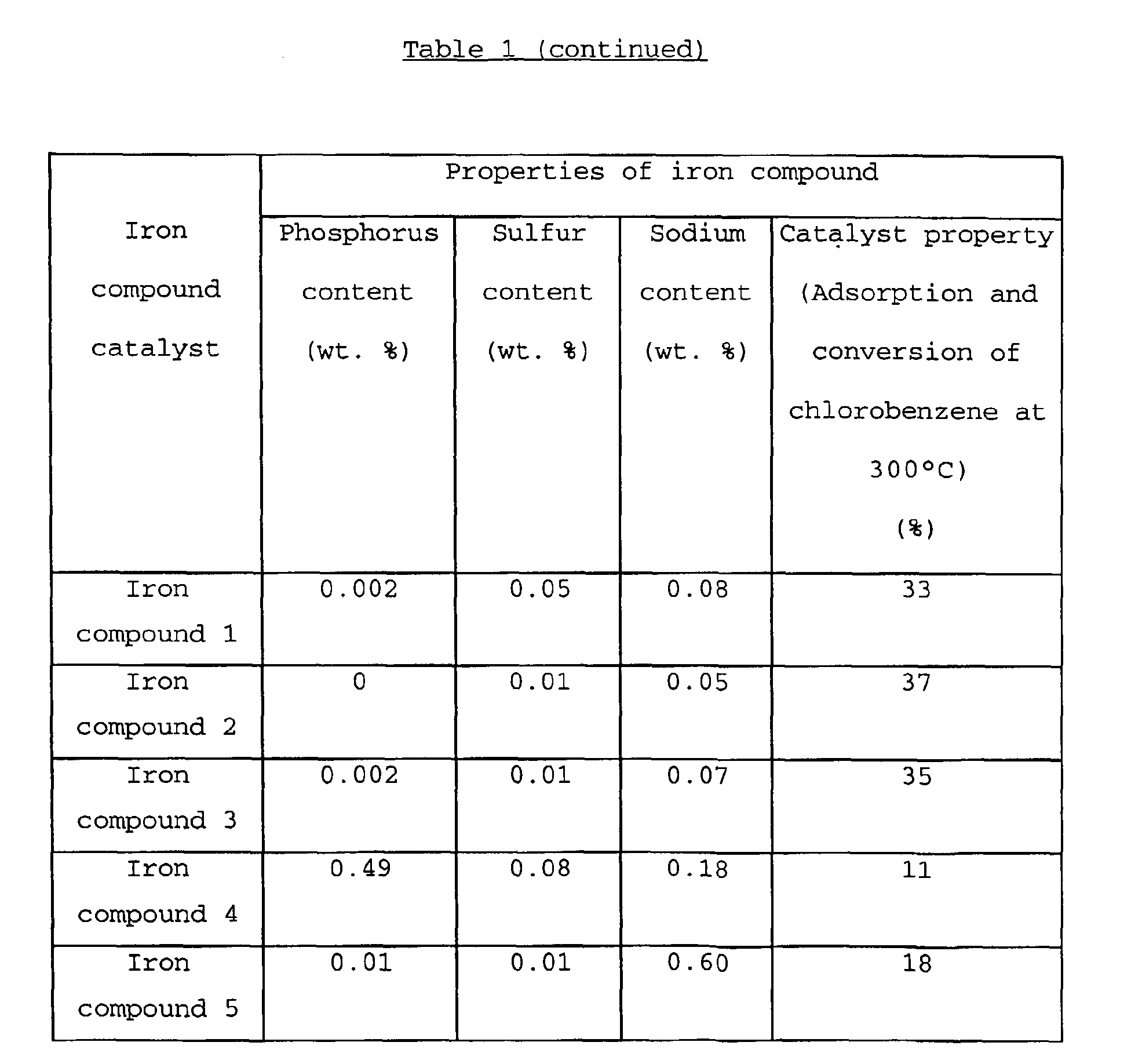
- iron compounds 1 to 5 were prepared as the iron compound for the organohalogen compound-decomposition catalyst. Various properties of the iron compounds are shown in Table 1.
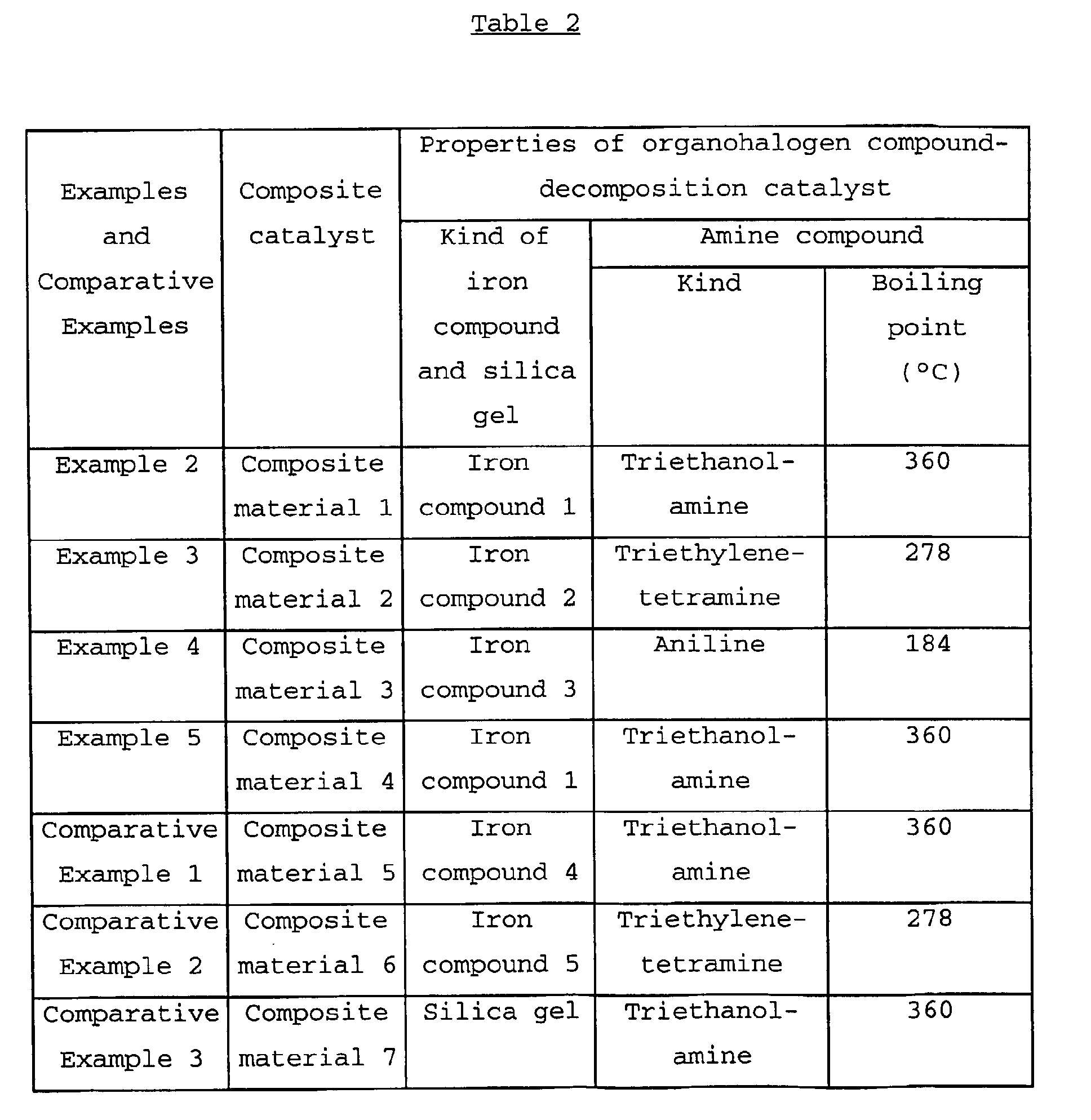
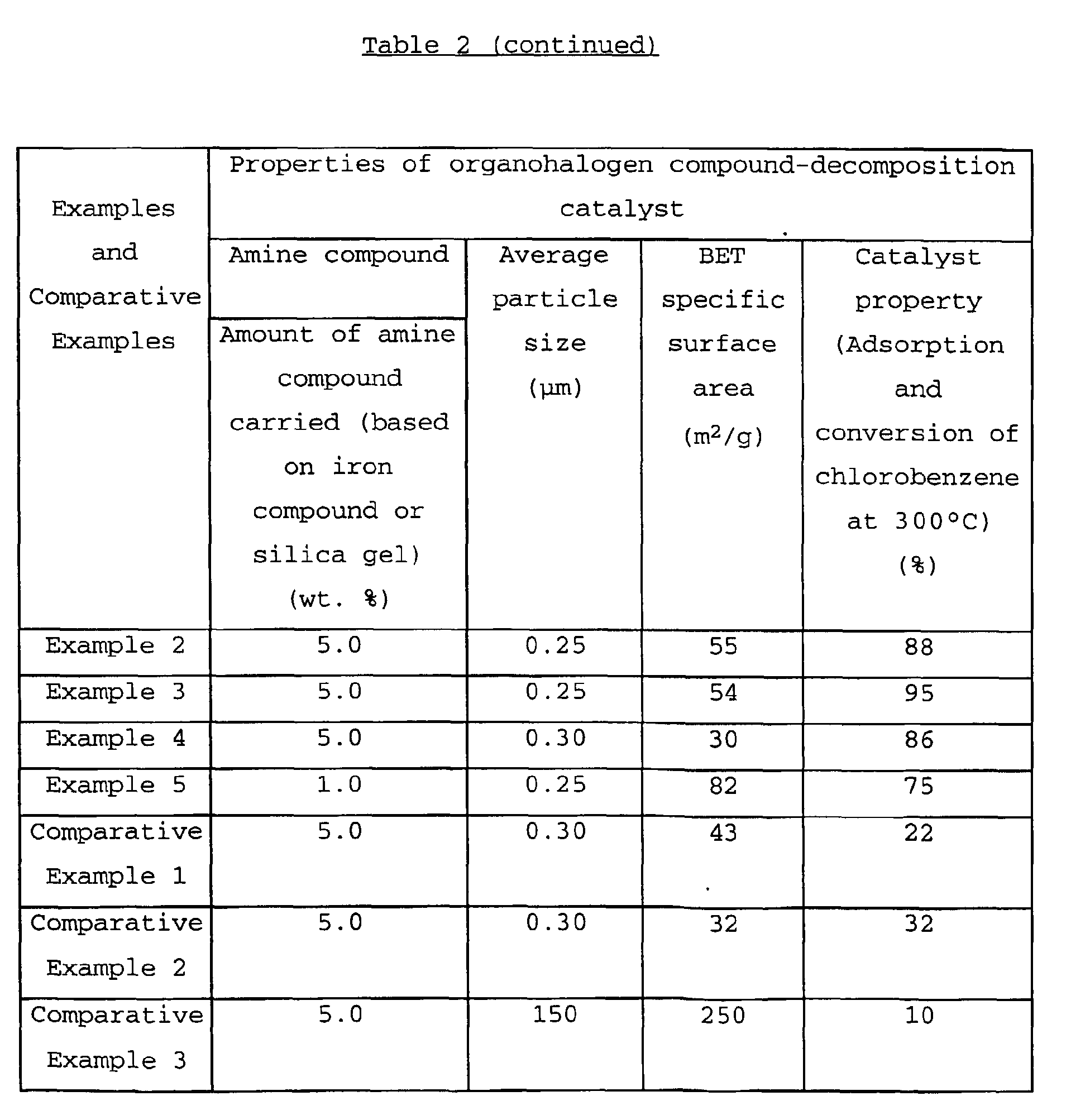
- Example 2 The same procedure as defined in Example 1 was conducted except that kind of iron compound and kind and amount of amine compound were varied, thereby obtaining composite catalysts.
- Comparative Example 3 composite catalyst 7
- silica gel having no catalytic activity in itself was used instead of the iron compound.
- Table 2 Various properties of the obtained composite catalysts are shown in Table 2.
- Example 3 The same procedure as defined in Example 1 was conducted except that kind of organohalogen compound-decomposition catalyst was varied, thereby performing decomposition tests for dioxin. Various conditions of the dioxin decomposition tests and the results thereof are shown in Table 3.
- the composite catalyst 50 mg was instantaneously contacted with 5.0 ⁇ 10 -7 mol of the organohalogen compound at 300°C at an hourly space velocity of 150,000 h -1 in an inert gas atmosphere using a pulse catalytic reactor.
- the catalyst property of the composite catalyst was expressed by the concentration of the organohalogen compound decomposed upon the above contact.
- Conversion (%) [1-(amount of organohalogen compound detected after reaction/amount of organohalogen compound initially charged before reaction)] ⁇ 100
Landscapes
- Chemical & Material Sciences (AREA)
- Engineering & Computer Science (AREA)
- Chemical Kinetics & Catalysis (AREA)
- Materials Engineering (AREA)
- Organic Chemistry (AREA)
- Environmental & Geological Engineering (AREA)
- Health & Medical Sciences (AREA)
- Biomedical Technology (AREA)
- Analytical Chemistry (AREA)
- General Chemical & Material Sciences (AREA)
- Oil, Petroleum & Natural Gas (AREA)
- Catalysts (AREA)
- Fire-Extinguishing Compositions (AREA)
- Exhaust Gas Treatment By Means Of Catalyst (AREA)
Abstract
Description



| Examples and Comparative Examples | Kind of organohalogen compound | Kind of organohalogen compound-decomposition catalyst | Conversion of organohalogen compound (%) | |
| Example 9 | Monochloro-phenol | Composite catalyst 1 | 93 | |
| Example 10 | Monochloro- | Composite catalyst | 2 | 97 |
| Example 11 | Monochloro- | Composite catalyst | 3 | 90 |
| Example 12 | Trichloro-ethylene | Composite catalyst 1 | 97 | |
| Example 13 | Trichloro-ethylene | Composite catalyst 4 | 86 | |
| Comparative Example 6 | Monochloro- | Composite catalyst | 5 | 24 |
| Comparative Example 7 | Monochloro-phenol | Iron compound 1 | 35 | |
| Comparative Example 8 | Monochloro-phenol | Composite catalyst 7 | 12 | |
| Comparative Example 9 | Trichloro- | Composite catalyst | 6 | 45 |
| Comparative Example 10 | Trichloro-ethylene | Iron compound 1 | 41 | |
| Comparative Example 11 | Trichloro-ethylene | Composite catalyst 7 | 16 |
Claims (14)
- A composite catalyst capable of decomposing an organohalogen compound, comprising:iron compound particles having an average particle size of 0.01 to 2.0 µm, and having a phosphorus content of not more than 0.02%, a sulfur content of not more than 0.3% and a sodium content of not more than 0.3% each by weight based on the weight of the particles; andan amine compound;said composite catalyst having a catalytic activity such that not less than 50% by weight of monochlorobenzene is decomposed when 50 mg of a mixture comprising iron oxide-based particles, obtained by heat-treating said particles at a temperature of 300°C for 60 minutes in air, and the amine compound, is contacted with 5.0 X 10⁻⁷ mol of monochlorobenzene at a temperature of 300°C at a space velocity of 150,000 h-1 using a pulse catalytic reactor.
- A composite catalyst according to claim 1, wherein said iron compound particles have a BET specific surface area of 0.2 to 200 m2/g.
- A composite catalyst according to claim 1 or 2, wherein said iron compound particles severally may be of the same or different composition, each particle comprising iron oxide hydroxide particles and/or iron oxide.
- A composite catalyst according to claim 1, 2 or 3, wherein the sum of the phosphorus, sulfur and sodium percentages is not more than 0.5%.
- A composite catalyst according to any preceding claim, wherein said amine compound comprises an alkyl amine and/or an alkanol amine.
- A composite catalyst according to any preceding claim, wherein said amine compound has a boiling point of not less than 150°C.
- A composite catalyst according to any preceding claim, wherein said amine compound is present in an amount of 0.1 to 10% by weight based on the weight of the iron compound particles.
- A composite catalyst according to claim 1, further having a BET specific surface area of 0.2 to 200 m2/g.
- A method of treating an organohalogen compound, comprising:
contacting a gas containing the organohalogen with a catalyst according to any preceding claim. - A method according to claim 9, wherein said gas is contacted with said catalyst (a) by adding said catalyst, in the form of particles or slurry, into said gas by a gas carrying method, or (b) by passing said gas through a fix bed-type or fluidized bed-type catalytic reactor containing pellets of said composite catalyst.
- A method according to claim 10, wherein the amount of the catalyst used in the gas carrying method is 0.01 to 0.5 g based on 1 Nm3 of the gas.
- A method according to claim 9, 10 or 11, wherein the space velocity of the catalyst is 500 to 10,000 h-1 in the gas.
- A method according to any one of claims 9 - 12, wherein the amount of said amine compound used is 0.1 to 10% by weight based on the weight of the iron compound particles.
- The use of a composite catalyst according to any of claims 1 - 8 for decomposing an organohalogen compound.
Applications Claiming Priority (2)
| Application Number | Priority Date | Filing Date | Title |
|---|---|---|---|
| JP27091699 | 1999-09-24 | ||
| JP27091699 | 1999-09-24 |
Publications (2)
| Publication Number | Publication Date |
|---|---|
| EP1086739A2 true EP1086739A2 (en) | 2001-03-28 |
| EP1086739A3 EP1086739A3 (en) | 2001-04-11 |
Family
ID=17492786
Family Applications (1)
| Application Number | Title | Priority Date | Filing Date |
|---|---|---|---|
| EP00308340A Withdrawn EP1086739A3 (en) | 1999-09-24 | 2000-09-22 | Catalyst for decomposing organohalogen compound |
Country Status (4)
| Country | Link |
|---|---|
| US (1) | US6271168B1 (en) |
| EP (1) | EP1086739A3 (en) |
| KR (1) | KR20010067212A (en) |
| CN (1) | CN1187112C (en) |
Cited By (6)
| Publication number | Priority date | Publication date | Assignee | Title |
|---|---|---|---|---|
| EP1318103A2 (en) | 2001-12-04 | 2003-06-11 | Toda Kogyo Corporation | Iron particles for purifying contaminated soil or ground water |
| EP1190738A3 (en) * | 2000-09-22 | 2003-10-29 | Toda Kogyo Corporation | Method for treating organohalogen compound-containing soil or ash |
| EP1388523A3 (en) * | 2002-08-05 | 2004-05-26 | Elementis Pigments, Inc. | Low sulfur red iron oxide useful as a catalyst or catalyst component and a process for making low sulfur red iron oxice |
| WO2007092029A3 (en) * | 2005-05-10 | 2008-12-11 | Massachusetts Inst Technology | Catalytic nanoparticles for nerve-agent destruction |
| US8758460B2 (en) | 1999-02-08 | 2014-06-24 | Johnson Matthey Public Limited Company | Catalyst composition |
| US10792647B2 (en) | 2009-04-21 | 2020-10-06 | Johnson Matthey Public Limited Company | Base metal catalysts for the oxidation of carbon monoxide and volatile organic compounds |
Families Citing this family (5)
| Publication number | Priority date | Publication date | Assignee | Title |
|---|---|---|---|---|
| EP1486463B1 (en) * | 2003-06-10 | 2016-08-10 | Toda Kogyo Corporation | Iron composite particles, methods of producing the same and of purifying soil or ground water using the same |
| JP4479899B2 (en) * | 2004-10-06 | 2010-06-09 | 戸田工業株式会社 | Purification agent for soil and groundwater purification, its production method, and soil and groundwater purification method |
| US20060081811A1 (en) * | 2004-10-19 | 2006-04-20 | Toda Kogyo Corporation | Iron composite particles for purifying soil or ground water, purifying agent containing the iron composite particles, and method for purifying soil or ground water |
| US7351355B2 (en) * | 2004-11-29 | 2008-04-01 | Toda Kogyo Corporation | Purifying agent for purifying soil or ground water, process for producing the same, and method for purifying soil or ground water using the same |
| CN101146617B (en) * | 2005-03-25 | 2012-05-30 | 同和环保再生事业有限公司 | Process for producing decomposing agent for organic halogen compound |
Family Cites Families (6)
| Publication number | Priority date | Publication date | Assignee | Title |
|---|---|---|---|---|
| DE3908740A1 (en) * | 1989-03-17 | 1990-11-29 | Didier Werke Ag | METHOD FOR REMOVING OR REDUCING HALOGENATED AROMATES FROM EXHAUST GASES FROM COMBUSTION PLANTS FOR MULES OR SPECIAL WASTE |
| DE4106515C2 (en) * | 1991-03-01 | 1993-12-16 | Boelsing Friedrich | Process for the production of a powdery, finely disperse dispersion homogeneously loaded with active ingredients and the use of products obtained thereafter |
| DE4404329C2 (en) * | 1994-02-11 | 1996-07-11 | Cs Halbleiter Solartech | Disposal of chlorofluorocarbons and halons |
| DE69524326T2 (en) * | 1994-09-14 | 2002-08-08 | Toda Kogyo Corp., Hiroshima | Process for the incineration of combustible waste and chlorine scavengers |
| ATE199027T1 (en) * | 1997-04-30 | 2001-02-15 | Corus Uk Ltd | IRON ORE SINTERING PROCESS WITH REDUCED EMISSIONS OF HARMFUL GASES |
| DE19903986A1 (en) * | 1999-02-02 | 2000-08-10 | Friedrich Boelsing | Reductive dehalogenation of halohydrocarbons under mild conditions, e.g. for removing toxic chloroaromatic compounds from waste oil or soil, using reducing metal in presence of amine |
-
2000
- 2000-09-21 KR KR1020000055455A patent/KR20010067212A/en not_active Ceased
- 2000-09-22 EP EP00308340A patent/EP1086739A3/en not_active Withdrawn
- 2000-09-24 CN CNB001318594A patent/CN1187112C/en not_active Expired - Fee Related
- 2000-09-25 US US09/667,304 patent/US6271168B1/en not_active Expired - Fee Related
Cited By (8)
| Publication number | Priority date | Publication date | Assignee | Title |
|---|---|---|---|---|
| US8758460B2 (en) | 1999-02-08 | 2014-06-24 | Johnson Matthey Public Limited Company | Catalyst composition |
| EP1190738A3 (en) * | 2000-09-22 | 2003-10-29 | Toda Kogyo Corporation | Method for treating organohalogen compound-containing soil or ash |
| EP1318103A2 (en) | 2001-12-04 | 2003-06-11 | Toda Kogyo Corporation | Iron particles for purifying contaminated soil or ground water |
| EP1318103A3 (en) * | 2001-12-04 | 2007-10-24 | Toda Kogyo Corporation | Iron particles for purifying contaminated soil or ground water |
| EP1388523A3 (en) * | 2002-08-05 | 2004-05-26 | Elementis Pigments, Inc. | Low sulfur red iron oxide useful as a catalyst or catalyst component and a process for making low sulfur red iron oxice |
| WO2007092029A3 (en) * | 2005-05-10 | 2008-12-11 | Massachusetts Inst Technology | Catalytic nanoparticles for nerve-agent destruction |
| US7598199B2 (en) | 2005-05-10 | 2009-10-06 | Massachusetts Institute Of Technology | Catalytic nanoparticles for nerve-agent destruction |
| US10792647B2 (en) | 2009-04-21 | 2020-10-06 | Johnson Matthey Public Limited Company | Base metal catalysts for the oxidation of carbon monoxide and volatile organic compounds |
Also Published As
| Publication number | Publication date |
|---|---|
| US6271168B1 (en) | 2001-08-07 |
| EP1086739A3 (en) | 2001-04-11 |
| CN1315223A (en) | 2001-10-03 |
| CN1187112C (en) | 2005-02-02 |
| KR20010067212A (en) | 2001-07-12 |
Similar Documents
| Publication | Publication Date | Title |
|---|---|---|
| US6436868B1 (en) | Composite catalyst composition for inhibiting generation of dioxin | |
| EP1050333B1 (en) | Iron compound catalyst for inhibiting generation of dioxin and incineration process of municipal solid waste using the same | |
| Kulkarni et al. | Dioxins sources and current remediation technologies—a review | |
| US6271168B1 (en) | Catalyst for decomposing organohalogen compound | |
| US6459012B1 (en) | Method for treating organohalogen compound-containing soil or ash | |
| EP0529243A1 (en) | Method of treating process gases or flue gases containing halogenous compounds | |
| US5777192A (en) | Method of decomposing polychlorodibenzo-p-dioxins and/or polychlorodibenzofurans | |
| JP3591587B2 (en) | Processing method of fly ash containing dioxin | |
| JP3676768B2 (en) | Method and apparatus for treating incineration ash | |
| JP3770309B2 (en) | Organohalogen compound decomposition catalyst | |
| JP2001259607A (en) | Method and apparatus for treating heavy metals or organochlorine compounds | |
| KR100407241B1 (en) | Iron compound catalyst for inhibiting generation of dioxin and incineration process of municipal solid waste using the same | |
| JP2002370015A (en) | Composite catalyst for decomposing organohalogen compound | |
| Hitchman et al. | A feasibility study of the destruction of chemical weapons by photocatalytic oxidation | |
| JP3927393B2 (en) | Method for treating soil or ash containing organic halogen compounds | |
| JP2000297911A (en) | Method for incinerating refuse | |
| JP2003200022A (en) | Method and apparatus for treating harmful substances in exhaust gas | |
| JPH0989228A (en) | Incineration method | |
| JPH119960A (en) | Dioxin release prevention material | |
| CN121972491A (en) | A method for low-temperature detoxification of dioxins in fly ash by adding trace amounts of α-MnO2 | |
| JPH11226355A (en) | Prevention method of dioxin release | |
| Rossabi et al. | Technology status report: Off-gas treatment technologies for chlorinated volatile organic compound air emissions | |
| JPH06285453A (en) | Disposal of waste containing dioxin | |
| JP2002364815A (en) | Hazardous substance generation control method for waste treatment system | |
| JP2001047006A (en) | System and method for removing dioxin in ash |
Legal Events
| Date | Code | Title | Description |
|---|---|---|---|
| PUAI | Public reference made under article 153(3) epc to a published international application that has entered the european phase |
Free format text: ORIGINAL CODE: 0009012 |
|
| PUAL | Search report despatched |
Free format text: ORIGINAL CODE: 0009013 |
|
| AK | Designated contracting states |
Kind code of ref document: A2 Designated state(s): DE DK FR GB IT NL |
|
| AX | Request for extension of the european patent |
Free format text: AL;LT;LV;MK;RO;SI |
|
| AK | Designated contracting states |
Kind code of ref document: A3 Designated state(s): AT BE CH CY DE DK ES FI FR GB GR IE IT LI LU MC NL PT SE |
|
| AX | Request for extension of the european patent |
Free format text: AL;LT;LV;MK;RO;SI |
|
| RIC1 | Information provided on ipc code assigned before grant |
Free format text: 7B 01D 53/86 A, 7B 01J 23/745 B, 7B 01J 31/02 B, 7A 62D 3/00 B |
|
| 17P | Request for examination filed |
Effective date: 20010402 |
|
| AKX | Designation fees paid |
Free format text: DE DK FR GB IT NL |
|
| 17Q | First examination report despatched |
Effective date: 20050223 |
|
| STAA | Information on the status of an ep patent application or granted ep patent |
Free format text: STATUS: THE APPLICATION IS DEEMED TO BE WITHDRAWN |
|
| 18D | Application deemed to be withdrawn |
Effective date: 20080909 |