EP1086182B1 - Coating composition - Google Patents
Coating composition Download PDFInfo
- Publication number
- EP1086182B1 EP1086182B1 EP99923202A EP99923202A EP1086182B1 EP 1086182 B1 EP1086182 B1 EP 1086182B1 EP 99923202 A EP99923202 A EP 99923202A EP 99923202 A EP99923202 A EP 99923202A EP 1086182 B1 EP1086182 B1 EP 1086182B1
- Authority
- EP
- European Patent Office
- Prior art keywords
- coating composition
- conductive polymer
- resin base
- metal particles
- alloys
- Prior art date
- Legal status (The legal status is an assumption and is not a legal conclusion. Google has not performed a legal analysis and makes no representation as to the accuracy of the status listed.)
- Expired - Lifetime
Links
- 239000008199 coating composition Substances 0.000 title claims description 47
- 238000000576 coating method Methods 0.000 claims description 86
- 239000011248 coating agent Substances 0.000 claims description 69
- 238000000034 method Methods 0.000 claims description 45
- 239000000758 substrate Substances 0.000 claims description 45
- 229920005989 resin Polymers 0.000 claims description 41
- 239000011347 resin Substances 0.000 claims description 41
- 229920001940 conductive polymer Polymers 0.000 claims description 40
- 239000000843 powder Substances 0.000 claims description 36
- 239000002923 metal particle Substances 0.000 claims description 32
- 229910052751 metal Inorganic materials 0.000 claims description 26
- 239000002184 metal Substances 0.000 claims description 26
- XAGFODPZIPBFFR-UHFFFAOYSA-N aluminium Chemical compound [Al] XAGFODPZIPBFFR-UHFFFAOYSA-N 0.000 claims description 25
- 229920000767 polyaniline Polymers 0.000 claims description 20
- 230000008569 process Effects 0.000 claims description 19
- 229910052782 aluminium Inorganic materials 0.000 claims description 18
- 230000007797 corrosion Effects 0.000 claims description 17
- 238000005260 corrosion Methods 0.000 claims description 17
- -1 polythiopene Polymers 0.000 claims description 16
- 238000002156 mixing Methods 0.000 claims description 15
- 239000000203 mixture Substances 0.000 claims description 15
- 239000007787 solid Substances 0.000 claims description 13
- 239000003795 chemical substances by application Substances 0.000 claims description 11
- 230000005855 radiation Effects 0.000 claims description 11
- 238000000227 grinding Methods 0.000 claims description 9
- 239000011701 zinc Substances 0.000 claims description 9
- HCHKCACWOHOZIP-UHFFFAOYSA-N Zinc Chemical compound [Zn] HCHKCACWOHOZIP-UHFFFAOYSA-N 0.000 claims description 8
- 229910052793 cadmium Inorganic materials 0.000 claims description 8
- BDOSMKKIYDKNTQ-UHFFFAOYSA-N cadmium atom Chemical compound [Cd] BDOSMKKIYDKNTQ-UHFFFAOYSA-N 0.000 claims description 8
- 229910052725 zinc Inorganic materials 0.000 claims description 8
- FYYHWMGAXLPEAU-UHFFFAOYSA-N Magnesium Chemical compound [Mg] FYYHWMGAXLPEAU-UHFFFAOYSA-N 0.000 claims description 7
- 229910052749 magnesium Inorganic materials 0.000 claims description 7
- 239000011777 magnesium Substances 0.000 claims description 7
- 238000001816 cooling Methods 0.000 claims description 6
- 238000009472 formulation Methods 0.000 claims description 6
- 229940124530 sulfonamide Drugs 0.000 claims description 6
- 150000003456 sulfonamides Chemical class 0.000 claims description 6
- 239000004593 Epoxy Substances 0.000 claims description 5
- 229920000728 polyester Polymers 0.000 claims description 5
- 229920002635 polyurethane Polymers 0.000 claims description 5
- 239000004814 polyurethane Substances 0.000 claims description 5
- 229920000265 Polyparaphenylene Polymers 0.000 claims description 4
- HSFWRNGVRCDJHI-UHFFFAOYSA-N alpha-acetylene Natural products C#C HSFWRNGVRCDJHI-UHFFFAOYSA-N 0.000 claims description 4
- 238000013329 compounding Methods 0.000 claims description 4
- 238000002844 melting Methods 0.000 claims description 4
- 230000008018 melting Effects 0.000 claims description 4
- 239000002245 particle Substances 0.000 claims description 4
- 229920001197 polyacetylene Polymers 0.000 claims description 4
- 229920000128 polypyrrole Polymers 0.000 claims description 4
- 125000003545 alkoxy group Chemical group 0.000 claims description 3
- 125000000217 alkyl group Chemical group 0.000 claims description 3
- 125000003118 aryl group Chemical group 0.000 claims description 3
- 125000001246 bromo group Chemical group Br* 0.000 claims description 3
- 125000001309 chloro group Chemical group Cl* 0.000 claims description 3
- 125000004356 hydroxy functional group Chemical group O* 0.000 claims description 3
- 125000000449 nitro group Chemical group [O-][N+](*)=O 0.000 claims description 3
- 229920000553 poly(phenylenevinylene) Polymers 0.000 claims description 3
- 229920000069 polyphenylene sulfide Polymers 0.000 claims description 3
- 230000002378 acidificating effect Effects 0.000 claims description 2
- 150000001252 acrylic acid derivatives Chemical class 0.000 claims description 2
- 150000008064 anhydrides Chemical class 0.000 claims description 2
- 230000007935 neutral effect Effects 0.000 claims description 2
- RPQRDASANLAFCM-UHFFFAOYSA-N oxiran-2-ylmethyl prop-2-enoate Chemical class C=CC(=O)OCC1CO1 RPQRDASANLAFCM-UHFFFAOYSA-N 0.000 claims description 2
- 229920000647 polyepoxide Polymers 0.000 claims description 2
- 229910000838 Al alloy Inorganic materials 0.000 claims 5
- 229910000925 Cd alloy Inorganic materials 0.000 claims 5
- 229910000861 Mg alloy Inorganic materials 0.000 claims 5
- 229910001297 Zn alloy Inorganic materials 0.000 claims 5
- 239000004411 aluminium Substances 0.000 claims 3
- 239000012952 cationic photoinitiator Substances 0.000 claims 1
- 125000003700 epoxy group Chemical group 0.000 claims 1
- 239000012949 free radical photoinitiator Substances 0.000 claims 1
- 230000004888 barrier function Effects 0.000 description 11
- 238000001723 curing Methods 0.000 description 11
- 238000004806 packaging method and process Methods 0.000 description 8
- 238000002360 preparation method Methods 0.000 description 8
- 208000001840 Dandruff Diseases 0.000 description 7
- 230000008901 benefit Effects 0.000 description 7
- 239000000463 material Substances 0.000 description 7
- XEEYBQQBJWHFJM-UHFFFAOYSA-N Iron Chemical compound [Fe] XEEYBQQBJWHFJM-UHFFFAOYSA-N 0.000 description 6
- 239000006185 dispersion Substances 0.000 description 6
- 150000002739 metals Chemical class 0.000 description 6
- 239000000654 additive Substances 0.000 description 5
- 150000003839 salts Chemical class 0.000 description 5
- 239000007921 spray Substances 0.000 description 5
- 238000012360 testing method Methods 0.000 description 5
- PXHVJJICTQNCMI-UHFFFAOYSA-N Nickel Chemical compound [Ni] PXHVJJICTQNCMI-UHFFFAOYSA-N 0.000 description 4
- OHPZPBNDOVQJMH-UHFFFAOYSA-N n-ethyl-4-methylbenzenesulfonamide Chemical compound CCNS(=O)(=O)C1=CC=C(C)C=C1 OHPZPBNDOVQJMH-UHFFFAOYSA-N 0.000 description 4
- 239000004014 plasticizer Substances 0.000 description 4
- LRHPLDYGYMQRHN-UHFFFAOYSA-N N-Butanol Chemical compound CCCCO LRHPLDYGYMQRHN-UHFFFAOYSA-N 0.000 description 3
- CTQNGGLPUBDAKN-UHFFFAOYSA-N O-Xylene Chemical compound CC1=CC=CC=C1C CTQNGGLPUBDAKN-UHFFFAOYSA-N 0.000 description 3
- 239000004743 Polypropylene Substances 0.000 description 3
- 239000011230 binding agent Substances 0.000 description 3
- 230000001680 brushing effect Effects 0.000 description 3
- 239000003054 catalyst Substances 0.000 description 3
- 239000004020 conductor Substances 0.000 description 3
- 238000007598 dipping method Methods 0.000 description 3
- 229910052742 iron Inorganic materials 0.000 description 3
- 230000003647 oxidation Effects 0.000 description 3
- 238000007254 oxidation reaction Methods 0.000 description 3
- 229920003023 plastic Polymers 0.000 description 3
- 239000004033 plastic Substances 0.000 description 3
- 238000007747 plating Methods 0.000 description 3
- 229920001155 polypropylene Polymers 0.000 description 3
- 238000005096 rolling process Methods 0.000 description 3
- 239000002904 solvent Substances 0.000 description 3
- 238000005507 spraying Methods 0.000 description 3
- 229920001187 thermosetting polymer Polymers 0.000 description 3
- XLYOFNOQVPJJNP-UHFFFAOYSA-N water Substances O XLYOFNOQVPJJNP-UHFFFAOYSA-N 0.000 description 3
- 239000008096 xylene Substances 0.000 description 3
- GWHJZXXIDMPWGX-UHFFFAOYSA-N 1,2,4-trimethylbenzene Chemical compound CC1=CC=C(C)C(C)=C1 GWHJZXXIDMPWGX-UHFFFAOYSA-N 0.000 description 2
- VYZAMTAEIAYCRO-UHFFFAOYSA-N Chromium Chemical compound [Cr] VYZAMTAEIAYCRO-UHFFFAOYSA-N 0.000 description 2
- YNQLUTRBYVCPMQ-UHFFFAOYSA-N Ethylbenzene Chemical compound CCC1=CC=CC=C1 YNQLUTRBYVCPMQ-UHFFFAOYSA-N 0.000 description 2
- 235000021355 Stearic acid Nutrition 0.000 description 2
- 239000010953 base metal Substances 0.000 description 2
- 150000001875 compounds Chemical class 0.000 description 2
- 238000007580 dry-mixing Methods 0.000 description 2
- 239000003792 electrolyte Substances 0.000 description 2
- 230000008030 elimination Effects 0.000 description 2
- 238000003379 elimination reaction Methods 0.000 description 2
- 239000010410 layer Substances 0.000 description 2
- 239000011159 matrix material Substances 0.000 description 2
- 238000005259 measurement Methods 0.000 description 2
- 239000000155 melt Substances 0.000 description 2
- 238000012986 modification Methods 0.000 description 2
- 230000004048 modification Effects 0.000 description 2
- 239000000178 monomer Substances 0.000 description 2
- 229910052759 nickel Inorganic materials 0.000 description 2
- QIQXTHQIDYTFRH-UHFFFAOYSA-N octadecanoic acid Chemical compound CCCCCCCCCCCCCCCCCC(O)=O QIQXTHQIDYTFRH-UHFFFAOYSA-N 0.000 description 2
- OQCDKBAXFALNLD-UHFFFAOYSA-N octadecanoic acid Natural products CCCCCCCC(C)CCCCCCCCC(O)=O OQCDKBAXFALNLD-UHFFFAOYSA-N 0.000 description 2
- 229920000642 polymer Polymers 0.000 description 2
- 150000003254 radicals Chemical class 0.000 description 2
- 230000009467 reduction Effects 0.000 description 2
- 239000012266 salt solution Substances 0.000 description 2
- 239000008117 stearic acid Substances 0.000 description 2
- 238000003756 stirring Methods 0.000 description 2
- 239000012855 volatile organic compound Substances 0.000 description 2
- QNODIIQQMGDSEF-UHFFFAOYSA-N (1-hydroxycyclohexyl)-phenylmethanone Chemical compound C=1C=CC=CC=1C(=O)C1(O)CCCCC1 QNODIIQQMGDSEF-UHFFFAOYSA-N 0.000 description 1
- PSGCQDPCAWOCSH-UHFFFAOYSA-N (4,7,7-trimethyl-3-bicyclo[2.2.1]heptanyl) prop-2-enoate Chemical compound C1CC2(C)C(OC(=O)C=C)CC1C2(C)C PSGCQDPCAWOCSH-UHFFFAOYSA-N 0.000 description 1
- XMLYCEVDHLAQEL-UHFFFAOYSA-N 2-hydroxy-2-methyl-1-phenylpropan-1-one Chemical compound CC(C)(O)C(=O)C1=CC=CC=C1 XMLYCEVDHLAQEL-UHFFFAOYSA-N 0.000 description 1
- KXGFMDJXCMQABM-UHFFFAOYSA-N 2-methoxy-6-methylphenol Chemical compound [CH]OC1=CC=CC([CH])=C1O KXGFMDJXCMQABM-UHFFFAOYSA-N 0.000 description 1
- RIWRBSMFKVOJMN-UHFFFAOYSA-N 2-methyl-1-phenylpropan-2-ol Chemical compound CC(C)(O)CC1=CC=CC=C1 RIWRBSMFKVOJMN-UHFFFAOYSA-N 0.000 description 1
- NIXOWILDQLNWCW-UHFFFAOYSA-M Acrylate Chemical compound [O-]C(=O)C=C NIXOWILDQLNWCW-UHFFFAOYSA-M 0.000 description 1
- 241000767593 Eulemur hybrids Species 0.000 description 1
- CWYNVVGOOAEACU-UHFFFAOYSA-N Fe2+ Chemical compound [Fe+2] CWYNVVGOOAEACU-UHFFFAOYSA-N 0.000 description 1
- 229910019142 PO4 Inorganic materials 0.000 description 1
- 229910000831 Steel Inorganic materials 0.000 description 1
- 238000003848 UV Light-Curing Methods 0.000 description 1
- PSGCQDPCAWOCSH-BREBYQMCSA-N [(1r,3r,4r)-4,7,7-trimethyl-3-bicyclo[2.2.1]heptanyl] prop-2-enoate Chemical compound C1C[C@@]2(C)[C@H](OC(=O)C=C)C[C@@H]1C2(C)C PSGCQDPCAWOCSH-BREBYQMCSA-N 0.000 description 1
- VEMHQNXVHVAHDN-UHFFFAOYSA-J [Cu+2].[Cu+2].[O-]S([O-])(=O)=O.[O-]S([O-])(=O)=O Chemical compound [Cu+2].[Cu+2].[O-]S([O-])(=O)=O.[O-]S([O-])(=O)=O VEMHQNXVHVAHDN-UHFFFAOYSA-J 0.000 description 1
- 230000009471 action Effects 0.000 description 1
- 230000001464 adherent effect Effects 0.000 description 1
- 239000002318 adhesion promoter Substances 0.000 description 1
- 125000001931 aliphatic group Chemical group 0.000 description 1
- 239000000956 alloy Substances 0.000 description 1
- 229910045601 alloy Inorganic materials 0.000 description 1
- 230000004075 alteration Effects 0.000 description 1
- 239000012298 atmosphere Substances 0.000 description 1
- ZNAAXKXXDQLJIX-UHFFFAOYSA-N bis(2-cyclohexyl-3-hydroxyphenyl)methanone Chemical compound C1CCCCC1C=1C(O)=CC=CC=1C(=O)C1=CC=CC(O)=C1C1CCCCC1 ZNAAXKXXDQLJIX-UHFFFAOYSA-N 0.000 description 1
- 238000005422 blasting Methods 0.000 description 1
- 238000004210 cathodic protection Methods 0.000 description 1
- 125000002091 cationic group Chemical group 0.000 description 1
- 238000010538 cationic polymerization reaction Methods 0.000 description 1
- ZCDOYSPFYFSLEW-UHFFFAOYSA-N chromate(2-) Chemical compound [O-][Cr]([O-])(=O)=O ZCDOYSPFYFSLEW-UHFFFAOYSA-N 0.000 description 1
- 230000001143 conditioned effect Effects 0.000 description 1
- 238000007796 conventional method Methods 0.000 description 1
- 238000005536 corrosion prevention Methods 0.000 description 1
- 229920006037 cross link polymer Polymers 0.000 description 1
- 238000004132 cross linking Methods 0.000 description 1
- 238000013036 cure process Methods 0.000 description 1
- 230000006866 deterioration Effects 0.000 description 1
- 230000002542 deteriorative effect Effects 0.000 description 1
- 125000004386 diacrylate group Chemical group 0.000 description 1
- 238000001227 electron beam curing Methods 0.000 description 1
- 238000010894 electron beam technology Methods 0.000 description 1
- 230000007613 environmental effect Effects 0.000 description 1
- 239000003822 epoxy resin Substances 0.000 description 1
- JZMPIUODFXBXSC-UHFFFAOYSA-N ethyl carbamate;prop-2-enoic acid Chemical compound OC(=O)C=C.OC(=O)C=C.CCOC(N)=O JZMPIUODFXBXSC-UHFFFAOYSA-N 0.000 description 1
- 238000011156 evaluation Methods 0.000 description 1
- 238000005246 galvanizing Methods 0.000 description 1
- 230000008570 general process Effects 0.000 description 1
- 229910001385 heavy metal Inorganic materials 0.000 description 1
- 229910052500 inorganic mineral Inorganic materials 0.000 description 1
- JEIPFZHSYJVQDO-UHFFFAOYSA-N iron(III) oxide Inorganic materials O=[Fe]O[Fe]=O JEIPFZHSYJVQDO-UHFFFAOYSA-N 0.000 description 1
- 239000007788 liquid Substances 0.000 description 1
- 229920001684 low density polyethylene Polymers 0.000 description 1
- 239000004702 low-density polyethylene Substances 0.000 description 1
- 238000012423 maintenance Methods 0.000 description 1
- 238000004519 manufacturing process Methods 0.000 description 1
- 239000011707 mineral Substances 0.000 description 1
- TWNQGVIAIRXVLR-UHFFFAOYSA-N oxo(oxoalumanyloxy)alumane Chemical compound O=[Al]O[Al]=O TWNQGVIAIRXVLR-UHFFFAOYSA-N 0.000 description 1
- 239000003973 paint Substances 0.000 description 1
- 229920001568 phenolic resin Polymers 0.000 description 1
- 239000005011 phenolic resin Substances 0.000 description 1
- 239000010452 phosphate Substances 0.000 description 1
- 229920006122 polyamide resin Polymers 0.000 description 1
- 229920000323 polyazulene Polymers 0.000 description 1
- 239000013047 polymeric layer Substances 0.000 description 1
- 238000006116 polymerization reaction Methods 0.000 description 1
- 229920005749 polyurethane resin Polymers 0.000 description 1
- 238000012545 processing Methods 0.000 description 1
- 239000011253 protective coating Substances 0.000 description 1
- 230000001681 protective effect Effects 0.000 description 1
- 238000010526 radical polymerization reaction Methods 0.000 description 1
- 239000002689 soil Substances 0.000 description 1
- 235000015096 spirit Nutrition 0.000 description 1
- 239000010959 steel Substances 0.000 description 1
- 239000000126 substance Substances 0.000 description 1
- 239000004094 surface-active agent Substances 0.000 description 1
- 238000010301 surface-oxidation reaction Methods 0.000 description 1
- JBQYATWDVHIOAR-UHFFFAOYSA-N tellanylidenegermanium Chemical compound [Te]=[Ge] JBQYATWDVHIOAR-UHFFFAOYSA-N 0.000 description 1
- 238000007751 thermal spraying Methods 0.000 description 1
- 229920001169 thermoplastic Polymers 0.000 description 1
- 229920002803 thermoplastic polyurethane Polymers 0.000 description 1
- 239000004416 thermosoftening plastic Substances 0.000 description 1
- 239000003039 volatile agent Substances 0.000 description 1
- 239000002351 wastewater Substances 0.000 description 1
- 238000004065 wastewater treatment Methods 0.000 description 1
Images
Classifications
-
- C—CHEMISTRY; METALLURGY
- C09—DYES; PAINTS; POLISHES; NATURAL RESINS; ADHESIVES; COMPOSITIONS NOT OTHERWISE PROVIDED FOR; APPLICATIONS OF MATERIALS NOT OTHERWISE PROVIDED FOR
- C09D—COATING COMPOSITIONS, e.g. PAINTS, VARNISHES OR LACQUERS; FILLING PASTES; CHEMICAL PAINT OR INK REMOVERS; INKS; CORRECTING FLUIDS; WOODSTAINS; PASTES OR SOLIDS FOR COLOURING OR PRINTING; USE OF MATERIALS THEREFOR
- C09D5/00—Coating compositions, e.g. paints, varnishes or lacquers, characterised by their physical nature or the effects produced; Filling pastes
- C09D5/24—Electrically-conducting paints
-
- C—CHEMISTRY; METALLURGY
- C09—DYES; PAINTS; POLISHES; NATURAL RESINS; ADHESIVES; COMPOSITIONS NOT OTHERWISE PROVIDED FOR; APPLICATIONS OF MATERIALS NOT OTHERWISE PROVIDED FOR
- C09D—COATING COMPOSITIONS, e.g. PAINTS, VARNISHES OR LACQUERS; FILLING PASTES; CHEMICAL PAINT OR INK REMOVERS; INKS; CORRECTING FLUIDS; WOODSTAINS; PASTES OR SOLIDS FOR COLOURING OR PRINTING; USE OF MATERIALS THEREFOR
- C09D5/00—Coating compositions, e.g. paints, varnishes or lacquers, characterised by their physical nature or the effects produced; Filling pastes
- C09D5/08—Anti-corrosive paints
- C09D5/10—Anti-corrosive paints containing metal dust
Definitions
- This invention pertains to a corrosion prevention system and method of producing the same, and more specifically to a system for protecting a metal substrate from corrosion utilizing a catholic coating comprising at least one inherently conductive polymer and sacrificial metal particles.
- barrier coatings function to separate the metal from the surrounding environment.
- Some examples of barrier coatings include paints and nickel and chrome plating.
- An effective barrier coating includes a layer of the conductive polymer polyaniline.
- holidays in the barrier coatings leave the metal substrate susceptible to corrosion.
- Electrochemically active barrier coatings, such as nickel, chrome, and conductive polyaniline layers, can actually accelerate corrosion of underlying metals at holidays in the coating.
- sacrificial coatings Another type of coating used to protect metal substrates are call sacrificial coatings.
- the metal substrate is coated with a material that reacts with the environment and is consumed in preference to the substrate it protects.
- These coatings may be further subdivided into chemically reactive, e.g., chromate coatings, and electrochemically active, or galvanically active, e.g., aluminum, cadmium, magnesium, and zinc.
- the galvanically active coatings must be conductive and are commonly called cathodic protection.
- the JP-A- 08277370 discloses undercoating material for general marine structure. To obtain an undercoating material composed of an organic resin, metal powder baser than an iron and an electro conductive polymer compound and capable of preventing dripping of iron rust from damaged part of coating film.
- This coating material is composed of (A) an organic resin, (B) at least one metal powder among metals baser than iron (e.g. aluminum (Al), zinc (Zn), etc., most preferably Zn powder) and (C) an electro conductive polymer compound (e.g. polyacetylene, polyparaphenylene, polyalinine, polypyrrole or polyazulene).
- A an organic resin
- B at least one metal powder among metals baser than iron (e.g. aluminum (Al), zinc (Zn), etc., most preferably Zn powder
- an electro conductive polymer compound e.g. polyacetylene, polyparaphenylene, polyalinine, polypyrrole or polyazulene.
- the JP 59075943 dicloses the production of a electrically conductive polymercomposition.
- This compositions is composed of a polymer having a conjugated double bond chain in its main chain and an electrically conductive material, by carrying out the polymerisation in the presence of an electrically conductive material.
- the present invention contemplates an improved coating system as defined in claim 1 and method of producing the same which overcomes the foregoing difficulties and others while providing better and more advantageous overall results.
- an improved cathodic corrosion resistant coating system is provided which may be easily applied in an environmentally friendly, efficient, safe and cost effective way to a metal substrate.
- the coating system utilizes at least one inherently conductive polymer in combination with galvanically anodic metals dispersed in a resin matrix and applied to a metal substrate to create a cathodic coating which is corrosion resistant.
- a coating composition for use in protecting metallic substrates from corrosion comprising at least one inherently conductive polymer and metal particles anodic to the substrate dispersed in a resin base.
- a method of protecting a metallic substrate from corrosion including the steps of preparing a surface of the substrate; coating the prepared surface with a coating composition comprising an inherently conductive polymer and metal particles anodic to the substrate dispersed in a resin base; and, curing the coating composition to form a corrosion resistant coating.
- a method of preparing a coating composition including the steps of dispersing at least one inherently conductive polymer and metal particles anodic to the intended substrate in a resin base material.
- the coating composition may be a high solids formulation.
- the coating composition may be a UV curable formulation.
- the coating composition may be a powder coating formulation.
- One advantage of the present invention is that the claimed coating can utilize most conventional methods for application, including dipping, brushing, rolling, spraying, fluidized bed, electrostatic powder, and thermally sprayed powder.
- Another advantage of the present invention is the reduction or elimination of the emission of volatile organic compounds into the atmosphere.
- Another advantage is the elimination of the rinsing processes associated with galvanizing and plating operations, surface preparation for top-coating, and subsequent waste water treatment.
- Another advantage is the reduction of the levels of zinc, lead, cadmium, and other heavy metals in water systems and soil due to weathering of galvanized and plated structures.
- Another advantage of the present invention is the cost effectiveness of the process.
- the coating may be produced at a reasonable cost and applied with existing application systems.
- Use of the inventive coating system will extend service life and reduce the costs associated with corrosion maintenance.
- the present invention concerns a cathodic coating for ferrous or nonferrous metal substrates.
- the coating system utilizes inherently conductive polymers and metal particles anodic to the metallic substrate dispersed in a coating matrix. It has been found that the coating system disclosed herein provides unexpected and significantly improved corrosion protection by forming an adherent, electrochemically active, and truly cathodic protective coating.
- the inventive coating system effectively creates an electron path by the thorough dispersion of one or more conductive polymers and metal particles which eliminates dielectric barriers associated with other organic systems, thus creating a protective galvanic corrosion cell.
- the present invention is directed to coating systems utilizing at least one inherently conductive polymer and metal particles anodic to the substrate dispersed in a resin base.
- the coating systems of the present invention may be formulated as high solids systems, radiation curable systems, and powder coat systems.
- High Solids means an ambient temperature curable coating that complies with the Los Angeles County Rule 66 definition, i.e. 80% non-volatiles by volume or greater.
- Rapid Curable involves the polymerization and crosslinking of functional monomers and oligomers (usually liquid, can be a powder) into a crosslinked polymer network (usually a solid film) induced by photons (UV curing) or electrons (EB curing). The curing can occur by either free radical or cationic polymerization. Infrared and beta radiation can also be utilized as energy sources for some radiation cure processes.
- Powder Coating involves coating objects with electrostatically sprayed, thermally sprayed, or fluidized polymer powder under influence of thermal energy causing the fine powder to melt or crosslink around the object and upon cooling to produce a compact polymeric layer.
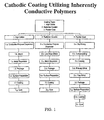
- the process steps and equipment to produce the coatings of the present invention are described below.
- the preferred conductive polymer for use in each of the systems is polyaniline.
- Aluminum is the preferred anodic metal particulate, however, any anodic metal that creates sufficient potential difference from the metal substrate may be used according to the invention.
- at least a 0.02 volt potential difference is established.
- the coating should produce a polarize cathode surface of -0.85 volts or more electronegative potential when measured using a copper-copper sulfate electrode place close to the electrolyte/structure interface. This measurement is actually a measurement of voltage drop at the interface of the metallic substrate surface and the electrolyte with the reference cell being one contact terminal and the metal surface being the other terminal.
- the process for making the coating is outlined in steps 1.a. through 1.c. Any suitable multi-agitator mixer may be utilized for the blending, dispersion, and grinding operations.
- the conductive polymer (polyaniline powder) is dispersed in a quantity sufficient to achieve the desired potential along with a plasticizer (sulfonamide) into a (polyurethane) resin base.
- the dispersion is high shear mixed for approximately 30 to 45 minutes at a process temperature of from approximately 70° (21,1 °C) to 150° F (65,5 °C).
- any remaining additives and solvent are added to the dispersion and blended for additional time, while maintaining the process temperature. If a two-part coating system is desired, the catalyst should not be added to this mixture until just prior to application of the coating.
- the metal in the form of finely divided particles (aluminum powder or flake), is added to the mixture in a quantity sufficient to achieve the desired potential.
- aluminum powder or flake Preferably, pure low oxidation aluminum flake or aluminum powder atomized and quenched in an inert environment is used.
- the aluminum can also be coated with stearic acid to preserve the deoxidized surface. Disperse and grind this mixture further utilizing the same equipment as the previous steps. Grind and disperse for additional 45 minutes or until desired fineness of grind is achieved while maintaining the process temperature below 150° F (65,5 °C).
- Step 1.d. is a packaging step. Any suitable polypropylene or plastic container can be utilized as packaging.
- the high solid coating mixture can be discharged directly from the mixing vessel into the packaging container. If a two part system is used, Parts A and B would be packaged separately using methods known in the art.
- step 1e Surface preparation of the substrate is outlined in step 1.e.
- a blast cabinet or similar means may be utilized for mechanical surface preparation. Alternately, other methods of surface preparation, including chemical means such as deoxidizing baths, may be utilized.
- the preferred method comprises lightly blasting the substrate with aluminum oxide grit. The prepared surface should be coated as soon as possible.
- Step 1.f. outlines the application of the coating to the substrate.
- the high solids system is suitable for various methods of applications that are well known and practiced in the art.
- the coating should be thoroughly mixed prior to application by stirring or shaking. Also, the catalyst should be added at this time if a two part coating is used.
- the coating can be applied by dipping, brushing, rolling, or spraying. Coating should be applied uniformly to all surfaces to be coated to a wet coat thickness sufficient to achieve a wet film thickness of 2 to 10 mils (50,8 to 254 ⁇ m).
- Step 1.g. is a curing step. Curing can be accomplished by allowing the coated item to stand 24 to 72 hours at room temperature to achieve cure. This process may be accelerated by curing in a thermal oven at 150° F (65,5 °C) for 1 to 4 hours.
- the process for making the coating is outlined in steps 1.a. through 1.c.
- the conductive polymer (polyaniline) is dispersed in a quantity sufficient to achieve desired potential along with a plasticizer (sulfonamide) into the resin base (polyurethane).
- the dispersion is accomplished by adding components to mixer, blender, attritor, or multi-agitator mixer and high shear mixing for roughly 15 to 30 minutes, maintaining a process temperature of 100° (37,8 °C) to 140° F (60 °C).
- Any remaining monomers, oligomers, additives, and photoinitiators are added to the polyaniline dispersion and low shear blended for an additional 15 to 30 minutes while maintaining a process temperature below 140° F (60 °C).
- the metal particles are then added to the mixture in a quantity sufficient to achieve desired potential.
- metal particles aluminum flake or powder
- pure low oxidation aluminum flake or aluminum powder atomized and quenched in an inert environment is used.
- the aluminum can also be coated with stearic acid to preserve the deoxidized surface. Disperse and grind this mixture further utilizing the same equipment as in the previous steps. Grind and disperse an additional 30 to 45 minutes or until desired fineness of grind is achieved.
- Step 2.d. is a packaging step. Because this coating system is UV curable, the packaging container must be opaque. Any plastic or polypropylene container that blocks ultraviolet light is suitable for packaging this material.
- Step 2.e. is the surface preparation step. Again, as with the high solids system, any suitable means of preparing the substrate surface for coating may be utilized.
- Step 2.f. is the application of the coating to the prepared substrate.
- the coating should be thoroughly mixed prior to coating by stirring or shaking.
- the coating may be applied by means such as dipping, brushing, rolling, spraying, or others already known in the art.
- the coating is applied uniformly to all surfaces to a wet film thickness of 2-8 mils (25,4 ⁇ m to 203,2 ⁇ m), which will correspond to an equivalent dry film thickness.
- Step 2.g. is a curing step.
- the coating may be cured by exposure to ultraviolet light, beta radiation, electron beam, or in some instances infrared light.
- One source of UV radiation suitable for curing these coatings produces UV light in the 250 to 500 nanometer wavelength ranges, at a power of 300 watts/inch.
- steps 3.a. through 3.i. the process steps required to produce a cathodic powder coating according to the invention are outlined.
- Equal volume amounts of Parts A and B are mixed immediately prior to application to the substrate.
- the cured resin or binder holds the aluminum or other anodic metal tightly in position to form the coating which adheres in electrical contact to the surface of the substrate.
- the polyaniline, or other inherently conductive polymer, that is dispersed into the resin base creates a conductive binder that promotes the galvanic action between the sacrificial metal anodes in the coating and the cathode surface.
- the conductive binder acts as a conductor rather than a dielectric as is the case with other sacrificial organic coatings, thus allowing electrons to flow freely between anodic particles and cathode substrate.
- the claimed improvements in corrosion resistance by use of the coating systems according to the invention are validated through markedly improved protection of the substrate when subjected to the salt spray test.
- Coated panels were intentionally scribed and tested in accordance with the procedure outlined in ASTM B117-95. The panels exhibited only slight surface oxidation at the damaged areas after 800+ hours in a salt spray chamber.
- the ASTM B117 salt spray test utilized to test the corrosion resistance of this cathodic coating system comprises a salt fog chamber.
- the chamber is comprised of a fog chamber, salt solution reservoir, conditioned compressed air line, fog nozzle, specimen support racks, heater, and controller.
- the specimens are supported in racks at an attitude between 15 and 30 degrees from vertical parallel to the principal direction of horizontal flow of fog through the chamber.
- the salt solution is mixed at 5% +/- 1% salt by weight with water meeting the requirements of ASTM 1193-91, Type III.
- the pH of the condensed fog is maintained between 6.5 and 7.2.
- Temperature in the chamber is maintained at 95° F, +2° or -3° (35 °C, + (-16,7 ° C) or -(-19,4 °C)).
- Relative humidity in the chamber is maintained at 95 % to 98%.
- test specimens consist of standard 3 X 5 inch (7,62 X 12,7 cm)) Q-panels, manufactured from cold rolled 1010 steel.
- the panels are coated utilizing the method described.
- the substrate is then intentionally scribed to base metal in an "X" pattern.
- the partially exposed base metal allows evaluation of the cathodic properties of the coating versus its performance as strictly an electrolytic barrier.
Landscapes
- Chemical & Material Sciences (AREA)
- Life Sciences & Earth Sciences (AREA)
- Engineering & Computer Science (AREA)
- Materials Engineering (AREA)
- Wood Science & Technology (AREA)
- Organic Chemistry (AREA)
- Paints Or Removers (AREA)
Description
| COMPONENT | TRADE NAME | VOLUME % |
| PART A | ||
| Polyamide Resin | 39.00 | |
| Xylene | 15.00 | |
| Polyaniline Powder | Versicon | 7.00 |
| Ethyl Benzene | 5.00 | |
| Stoddard Solvent | 5.00 | |
| 1,2,4-Trimethylbenzene | 2.00 | |
| n-butyl alcohol | 10.00 | |
| Aluminum powder | AL-120 | 12.00 |
| Ethyl toluenesulfonamide | Uniplex 108 | 5.00 |
| 100% Part A | ||
| PART B | ||
| Epon resin | 65.00 | |
| Epoxy resin | 13.00 | |
| Xylene | 22.00 | |
| 100% Part B |
| COMPONENT | TRADE NAME | VOLUME % |
| Urethane Resin | 51.00 | |
| Phenolic Resin | 5.00 | |
| Polyaniline Powder | Versicon | 7.00 |
| Aluminum Powder | Al-120 | 12.00 |
| Ethyl toluenesulfonamide | Uniplex 108 | 5.00 |
| VM&P naptha | 3.00 | |
| Xylene | 3.00 | |
| Mineral Spirits | 14.00 |
| COMPONENT | TRADE NAME | VOLUME % |
| Aliphatic urethane diacrylate | Ebercryl 4883 | 18.00 |
| Isobornyl acrylate | SR 506 | 33.00 |
| Polyaniline powder | Versicon | 10.00 |
| Acrylate polyester oligomer | Ebecryl 450 | 15.00 |
| 2-hydroxy-2-methyl-1-phenyl-1-propanone | Darocur 1173 | 5.00 |
| Hydroxycyclohexyl phenylketone | Irgacure 184 | 0.50 |
| Metallic diacrylate | SR 9016 | 5.00 |
| Aluminum Powder | AL-120 | 8.50 |
| Ethyl toluenesulfonamide | Uniplex 108 | 5.00 |
| COMPONENT | TRADE NAME | VOLUME % |
| Low density polyethylene | NA204 | 71.5 |
| Polyaniline powder | Versicon | 16.00 |
| Ethyl toluenesulfonamide | Uniplex 108 | 2.5 |
| Aluminum Powder | AL-120 | 10.00 |
Claims (20)
- A coating composition adapted for use on an associated metallic substrate, said coating composition comprising:wherein said metal particles are at least one member of the group consisting of aluminium, cadmium, magnesium, zinc, aluminium alloys, cadmium alloys, magnesium alloys and zinc alloys; anda resin base;an inherently conductive polymer;finely divided metal particles anodic to said associated metallic substrate,
a curing agent;
wherein said at least one inherently conductive polymer comprises between 1 % and 20 % by volume of said coating composition and said metal particles comprise between 5% and 20% by volume of said coating composition. - The coating composition of claim 1 wherein said inherently conductive polymer is at least one member of the group consisting of polyaniline, polypyrrole, polythiopene, polyacetylene, poly (p-phenylene), poly (p-phenylene vinylene), poly (p-phenylene sulfide) and polyaniline substituted with alkyl, aryl, hydroxy, alkoxy, chloro, bromo, or nitro groups.
- The coating composition of claim 1 wherein said metal is at least one member of the group consisting of aluminum, cadmium, magnesium, zinc, aluminum alloys, cadmium alloys, magnesium alloys and zinc alloys.
- The coating composition of claim 1 wherein said resin base is at least one member of the group consisting of polyurethanes, epoxies, neutral resins, acidic resins, acrylates, polyesters, and glycidyl acrylates.
- The coating composition of claim 1 wherein said curing agent is at least one member of the group consisting of sulfonamide, anhydride types, free radical photoinitiators, and cationic photoinitiators.
- The coating composition of claim 2 wherein said at least one inherently conductive polymer comprises between 1 % and 20 % by volume of said coating composition.
- The coating composition of claim 3 wherein said metal comprises between 5% and 20% by volume of said coating composition.
- The coating composition of claim 1 wherein said metal exhibits a sufficient volt potential difference from said metallic substrate to form a cathodic coating.
- The coating composition of claim 1 wherein said coating composition comprises a high solids formulation.
- The coating composition of claim 5 wherein said curing agent is a photoinitiator and wherein said coating composition comprises a UV radiation curable formulation.
- The coating composition of claim 1 wherein said coating composition comprises a powder coating formulation.
- A method of protecting a metallic substrate from corrosion including the steps of:preparing a coating composition comprising a resin base, an inherently conductive polymer, wherein said inherently conductive polymer is at least one member of the group consisting of polyaniline, polypyrrole, polythiopene, polyacetylene, poly (p-phenylene), poly (p-phenylene vinylene), poly (p-phenylene sulfide) and polyaniline substituted with alkyl, aryl, hydroxy, alkoxy, chloro, bromo, or nitro groups; finely divided metal particles anodic to said metallic substrate, wherein said metal particles consist of at least one member of the group consisting of aluminum, cadmium, magnesium, zinc, aluminum alloys, cadmium alloys, magnesium alloys and zinc alloys, and a curing agent, wherein said at least one inherently conductive polymer comprises between 1 % and 20% by volume of said coating composition and said metal particles comprise between 5 % and 20 % by volume of said coating composition;preparing a surface of said metallic substrate for adhesion to said coating composition;coating said prepared surface with said coating composition; and,curing said coating composition to form a corrosion resistant coating on said prepared surface.
- The method of claim 12 wherein said step of preparing said coating composition includes the steps of:adding said inherently conductive polymer to said resin base;mixing said conductive polymer and said resin base at a process temperature of from approximately 70° F (21,1 °C) to 150° F (65,6 °C) for sufficient time to thoroughly disperse said inherently conductive polymer;adding said metal particles to said resin base; after said step of mixing said conductive polymer and said resin base,mixing said metal particles and said resin base for sufficient time to thoroughly disperse said metal particles; andadding said curing agent to said resin base immediately prior to coating said prepared surface.
- The method of claim 12 wherein said step of curing said coating composition comprises:allowing said coated substrate to stand at room temperature for between 24 and 72 hours.
- The method of claim 12 wherein said step of curing said coating composition comprises:placing said coated substrate in a thermal oven at 150° F (65,6 °C) for between 1 and 4 hours.
- The method of claim 12 wherein said curing agent is a photoinitiator and
wherein said step of curing said coating composition comprises:exposing said coated substrate to a radiation source. - The method of claim 12 wherein said step of curing said coating composition comprises:placing said coated substrate in a thermal oven at a temperature below 400 ° F (204,4 °C) for between 10 minutes and 30 minutes.
- The method of claim 12 wherein said resin base and said inherently conductive polymer are in a form of powders and wherein said step of preparing said coating composition includes the steps of:preparing a premix by dry blending said powdered resin base, said conductive polymer, said curing agent, and said metal particles until thoroughly mixed;melt compounding said premix at a process temperature above a melting point of said resin base and below 400° F (204,4 °C) for sufficient time to thoroughly disperse said conductive polymer and said metal particles in said molten resin base;cooling and flattening said melt to form a compounded sheet;primary grinding said compounded sheet to form chips; and,fine grinding said chips in a cryogenic mixing vessel to a desired particle size.
- A method of preparing a coating composition for protection of a metallic substrate from corrosion, the method including the steps of:adding an inherently conductive polymer to a resin base wherein said inherently conductive polymer comprises between 1 % and 20% by volume of said coating composition;mixing said inherently conductive polymer and said resin base at a process temperature of from approximately 70° F (21,1 °C) to 150° F (65,6 °C) for sufficient time to thoroughly disperse said inherently conductive polymer;adding finely divided metal particles which are anodic to said metallic substrate, to said resin base wherein said metal particles are at least one member selected from the group consisting of aluminium, cadmium, magnesium, zinc, aluminium alloys, cadmium alloys, magnesium alloys and zinc alloys and wherein said metal particles comprise between 5% and 20 % by volume of said coating composition;mixing said metal particles and said resin base for sufficient time to thoroughly disperse said metal particles; and, adding a curing agent to said resin base.
- A method of preparing a coating composition for protection of a metallic substrate comprising the steps of:preparing a premix by dry blending a powdered resin base, an inherently conductive polymer, a curing agent, and finely divided metal particles which are anodic to said metallic substrate until thoroughly mixed wherein said metal particles are at least one member of the group consisting of aluminium, cadmium, magnesium, zinc, aluminium alloys, cadmium alloys, magnesium alloys and zinc alloys, wherein said inherently conductive polymer comprises between 1% and 20% by volume of said coating composition and said metal particles comprise between 5 % and 20% of said coating composition;melt compounding said premix at a process temperature above a melting point of said resin base and below 400° F (204,4 °C) for sufficient time to thoroughly disperse said conductive polymer and said metal particles in said molten resin base;cooling and flattening said melt to form a compounded sheet;primary grinding said compounded sheet to form chips; and,fine grinding said chips in a cryogenic mixing vessel to a desired particle size.
Applications Claiming Priority (3)
| Application Number | Priority Date | Filing Date | Title |
|---|---|---|---|
| US09/094,092 US5976419A (en) | 1998-06-09 | 1998-06-09 | Method for applying a coating that acts as an electrolytic barrier and a cathodic corrosion prevention system |
| US94092 | 1998-06-09 | ||
| PCT/US1999/010991 WO1999064524A1 (en) | 1998-06-09 | 1999-05-19 | Method for applying a coating that acts as an electrolytic barrier and a cathodic corrosion prevention system |
Publications (2)
| Publication Number | Publication Date |
|---|---|
| EP1086182A1 EP1086182A1 (en) | 2001-03-28 |
| EP1086182B1 true EP1086182B1 (en) | 2005-07-20 |
Family
ID=22242870
Family Applications (1)
| Application Number | Title | Priority Date | Filing Date |
|---|---|---|---|
| EP99923202A Expired - Lifetime EP1086182B1 (en) | 1998-06-09 | 1999-05-19 | Coating composition |
Country Status (6)
| Country | Link |
|---|---|
| US (2) | US5976419A (en) |
| EP (1) | EP1086182B1 (en) |
| CN (1) | CN1202177C (en) |
| AU (1) | AU4002799A (en) |
| DE (1) | DE69926237T2 (en) |
| WO (1) | WO1999064524A1 (en) |
Families Citing this family (49)
| Publication number | Priority date | Publication date | Assignee | Title |
|---|---|---|---|---|
| NO304956B1 (en) * | 1997-07-22 | 1999-03-08 | Opticom As | Electrode device without and with a functional element, as well as an electrode device formed by electrode devices with functional element and applications thereof |
| US6211262B1 (en) * | 1998-04-20 | 2001-04-03 | Spectra Group Limited, Inc. | Corrosion resistant, radiation curable coating |
| US6627117B2 (en) * | 1998-06-09 | 2003-09-30 | Geotech Chemical Company, Llc | Method for applying a coating that acts as an electrolytic barrier and a cathodic corrosion prevention system |
| US6440332B1 (en) * | 1998-06-09 | 2002-08-27 | Geotech Chemical Company | Method for applying a coating that acts as an electrolytic barrier and a cathodic corrosion prevention system |
| DE19925631A1 (en) * | 1999-06-04 | 2000-12-07 | Georg Gros | Coating process and coating mixture |
| DE19958485A1 (en) * | 1999-12-04 | 2001-06-21 | Dupont Performance Coatings | Antistatic powder coating compositions and their use |
| US6972098B1 (en) * | 2000-07-11 | 2005-12-06 | The United States Of America As Represented By The Administrator Of The National Aeronautics And Space Administration | Corrosion prevention of cold rolled steel using water dispersible lignosulfonic acid doped polyaniline |
| JP4333011B2 (en) * | 2000-08-30 | 2009-09-16 | 株式会社デンソー | Method for preventing contamination of heat exchanger and heat exchanger used in this method |
| WO2002018513A1 (en) * | 2000-08-30 | 2002-03-07 | Cambridge Display Technology Limited | A formulation for depositing a conjugated polymer layer |
| US6764617B1 (en) * | 2000-11-17 | 2004-07-20 | The United States Of America As Represented By The Administrator Of The National Aeronautics & Space Administration | Ferromagnetic conducting lignosulfonic acid-doped polyaniline nanocomposites |
| US7078076B2 (en) * | 2001-02-14 | 2006-07-18 | Metal Coatings International Inc. | Particulate metal alloy coating for providing corrosion protection |
| US8232116B2 (en) * | 2001-02-28 | 2012-07-31 | Cambridge Display Technology Limited | Method for fabricating a polymer L.E.D. |
| DE50205110D1 (en) * | 2001-03-05 | 2006-01-05 | Georg Gros | WATER-BASED COATING MIXTURE, METHOD FOR APPLYING A CORROSION PROTECTION LAYER TO THIS MIXTURE, A COATED COATED SUBSTRATE AND THE USE THEREOF |
| JP4134607B2 (en) * | 2001-11-05 | 2008-08-20 | 株式会社デンソー | Substrate having a film containing polyaniline on the surface, and method for forming the film formed on the surface of the substrate |
| US20030157266A1 (en) * | 2002-02-15 | 2003-08-21 | Peter Spellane | Metal protection with an electroactive polymer first coat and a second coat applied by an electrostatic coating method |
| US7273562B2 (en) * | 2002-04-17 | 2007-09-25 | Nutech 03, Inc. | Ozone injection method and system |
| AU2003224094B2 (en) * | 2002-04-20 | 2007-05-31 | Chemetall Gmbh | Mixture for applying a non-corrosive, thin polymer coating which can be shaped in a low-abrasive manner, and method for producing the same |
| US6916900B1 (en) | 2003-04-03 | 2005-07-12 | Geotech Chemical Company, Llc | Catalytic effects of transition metal ions in the synthesis of polyaniline grafted lignosulfonic acid |
| US6977050B1 (en) | 2003-04-07 | 2005-12-20 | Polyone Corporation | Synthesis of lignosulfonic acid-doped polyaniline using transition metal ion catalysts |
| US7063808B1 (en) | 2003-04-07 | 2006-06-20 | Poly One Corporation | Lignosulfonic acid-doped polyaniline composites with carbon allotropes |
| US7195721B2 (en) * | 2003-08-18 | 2007-03-27 | Gurin Michael H | Quantum lilypads and amplifiers and methods of use |
| BRPI0415934A (en) * | 2003-10-27 | 2007-01-02 | Polyone Corp | catholic protective coatings containing conductive carbonaceous media |
| FR2862985B1 (en) * | 2003-11-27 | 2006-02-24 | Airbus France | ASSEMBLY COMPRISING TWO METAL PIECES PROTECTED AGAINST THE FORMATION OF A GALVANIC COUPLE |
| US7794626B2 (en) * | 2004-02-04 | 2010-09-14 | Polyone Corporation | Cathodic protection compounds |
| US20050176592A1 (en) * | 2004-02-11 | 2005-08-11 | Tenaris Ag | Method of using intrinsically conductive polymers with inherent lubricating properties, and a composition having an intrinsically conductive polymer, for protecting metal surfaces from galling and corrosion |
| JP4456440B2 (en) * | 2004-08-31 | 2010-04-28 | 本田技研工業株式会社 | Rust prevention composition |
| CN101203628A (en) * | 2004-10-01 | 2008-06-18 | 普立万公司 | Application of Cathodic Protection Compounds to Treated Metal Articles |
| CN1321747C (en) * | 2005-09-06 | 2007-06-20 | 贵州科盛彩色喷涂有限公司 | Outdoor metal surface double coating antiseptic chromatic spray painting method |
| SE529327C2 (en) * | 2005-11-09 | 2007-07-03 | Totalfoersvarets Forskningsins | Ways of creating a low-missive surface and using a color to create a low-missive |
| JP5443009B2 (en) | 2009-01-29 | 2014-03-19 | トヨタ自動車株式会社 | Polyaniline-added prepolymer and production thereof, polyaniline graft polymer and production thereof, cross-linked product, and paint |
| CN101864239B (en) * | 2010-06-04 | 2012-07-04 | 北京化工大学 | Hyperbranched epoxy resin/polypyrrole composite anticorrosive paint and preparation method thereof |
| CN101967362B (en) * | 2010-09-30 | 2013-02-06 | 北京科技大学 | Special sealant with electrochemical activity for resisting crevice corrosion and preparation method thereof |
| CN102229778B (en) * | 2011-06-17 | 2012-10-10 | 山东大学 | A kind of anticorrosion conductive coating for metal grounding grid and using method thereof |
| CN102304317B (en) * | 2011-07-08 | 2013-09-04 | 中国石油天然气集团公司 | Solid electrolyte paint for protection of gas-phase cathode of pipeline in ocean platform atmospheric zone and preparing method thereof |
| US8802190B2 (en) | 2011-07-11 | 2014-08-12 | Honda Motor Co., Ltd. | Weldable corrosion resistant coating for steel and method of manufacture |
| DE102011115429A1 (en) * | 2011-10-08 | 2013-04-11 | Bizerba Gmbh & Co. Kg | Method of manufacturing a food slicer |
| CN103232789B (en) * | 2013-05-20 | 2015-04-22 | 山东龙泉管道工程股份有限公司 | Marine heavy anticorrosive epoxy aluminum-magnesium-manganese-enriched nano paint and preparation method thereof |
| WO2015021559A1 (en) | 2013-08-16 | 2015-02-19 | Shore Acres Enterprises Inc. (D/B/A Sae Inc.) | Corrosion protection of buried metallic conductors |
| CN103695979B (en) * | 2013-12-02 | 2016-08-17 | 常州大学 | A kind of method that Mg alloy surface processes |
| CN106995621A (en) * | 2017-04-26 | 2017-08-01 | 天津大学 | Ring substituting modification anticorrosive polyaniline, antifouling difunctional composite coating and preparation method |
| US10333234B2 (en) | 2017-08-14 | 2019-06-25 | Shore Acres Enterprises Inc. | Corrosion-protective jacket for electrode |
| US11121482B2 (en) | 2017-10-04 | 2021-09-14 | Shore Acres Enterprises Inc. | Electrically-conductive corrosion-protective covering |
| CN109370371A (en) * | 2018-09-13 | 2019-02-22 | 福建万安实业集团有限公司 | A kind of high brightness imitates the powdery paints of electroplating effect |
| CN109535938A (en) * | 2018-12-21 | 2019-03-29 | 六安捷通达新材料有限公司 | A kind of antistatic powdery paints |
| CN110317478B (en) * | 2019-06-19 | 2021-07-23 | 中国科学院金属研究所 | A kind of polythiophene modified cold coating zinc coating and preparation method thereof |
| CA3092850A1 (en) | 2019-12-18 | 2021-06-18 | Shore Acres Enterprises Inc. | Metallic structure with water impermeable and electrically conductive cementitious surround |
| CN110951382B (en) * | 2019-12-20 | 2021-06-04 | 刘艳蕊 | Environment-friendly three-proofing paint and preparation method thereof |
| CN111808525B (en) * | 2020-09-07 | 2021-01-19 | 佛山宜可居新材料有限公司 | Multiphase structure UV (ultraviolet) photocuring powder coating resin and preparation method thereof |
| CN114960194B (en) * | 2022-06-30 | 2024-01-09 | 马鞍山欧凯新材料科技有限公司 | Preparation method of carbon fiber composite anode material for electroplating |
Family Cites Families (21)
| Publication number | Priority date | Publication date | Assignee | Title |
|---|---|---|---|---|
| US3546155A (en) * | 1967-05-12 | 1970-12-08 | Hempel S Marine Paints Inc | Cathodic protective coatings of metal powder and titanate ester-orthosilicate polymer based vehicle |
| US3748172A (en) * | 1971-05-17 | 1973-07-24 | Chromalloy American Corp | Magnesium based coating for the sacrificial protection of metals |
| US3862851A (en) * | 1971-05-17 | 1975-01-28 | Chromalloy American Corp | Method of producing Magnesium-Based coating for the sacrificial protection of metals |
| US4130469A (en) * | 1975-07-14 | 1978-12-19 | Scm Corporation | Aqueous coating composition from a mercaptan containing polymer and a bis-maleimide |
| US4086153A (en) * | 1975-10-09 | 1978-04-25 | Toyo Kohan Co., Ltd. | Method of producing a composite coated steel sheet |
| US4140816A (en) * | 1977-03-28 | 1979-02-20 | Scm Corporation | Aqueous coating composition and process |
| JPS5975943A (en) * | 1982-10-25 | 1984-04-28 | Showa Denko Kk | Production of electrically conductive polymer composition |
| US5069820A (en) | 1987-08-07 | 1991-12-03 | Allied-Signal Inc. | Thermally stable forms of electrically conductive polyaniline |
| US5160457A (en) | 1987-08-07 | 1992-11-03 | Allied-Signal Inc. | Thermally stable forms of electrically conductive polyaniline |
| DE3729566A1 (en) | 1987-09-04 | 1989-03-16 | Zipperling Kessler & Co | INTRINSICALLY CONDUCTIVE POLYMER IN THE FORM OF A DISPERSIBLE SOLID, THE PRODUCTION THEREOF AND THE USE THEREOF |
| US5217649A (en) | 1991-01-31 | 1993-06-08 | Americhem, Inc. | Electrically conductive blends of intrinsically conductive polymers and thermoplastic polymers containing sulfonamide plasticizer and acidic surfactant |
| US5281363A (en) | 1991-04-22 | 1994-01-25 | Allied-Signal Inc. | Polyaniline compositions having a surface/core dopant arrangement |
| DE69229253T2 (en) | 1991-10-08 | 1999-11-04 | Americhem, Inc. | Process for producing an intrinsically conductive polymer and articles containing it from a thermoplastic polymer mixture |
| US5648416A (en) | 1992-01-21 | 1997-07-15 | Monsanto Company | Corrosion resistant paint |
| US5658649A (en) | 1992-03-13 | 1997-08-19 | The Regents Of The University Of California Office Of Technology Transfer | Corrosion resistant coating |
| US5532025A (en) | 1993-07-23 | 1996-07-02 | Kinlen; Patrick J. | Corrosion inhibiting compositions |
| JPH07103185A (en) | 1993-09-30 | 1995-04-18 | Oki Electric Ind Co Ltd | Fan controller |
| US5645890A (en) | 1995-02-14 | 1997-07-08 | The Trustess Of The University Of Pennsylvania | Prevention of corrosion with polyaniline |
| JPH08277370A (en) * | 1995-04-05 | 1996-10-22 | Nippon Steel Corp | Undercoating material for general marine structure |
| US5853621A (en) * | 1995-05-26 | 1998-12-29 | Monsanto Company | Corrosion resistant paint |
| US5871671A (en) * | 1997-10-14 | 1999-02-16 | Monsanto Company | Intrinsically conductive polymer/plasticizer blends with enhanced conductivity |
-
1998
- 1998-06-09 US US09/094,092 patent/US5976419A/en not_active Expired - Fee Related
-
1999
- 1999-05-19 AU AU40027/99A patent/AU4002799A/en not_active Abandoned
- 1999-05-19 EP EP99923202A patent/EP1086182B1/en not_active Expired - Lifetime
- 1999-05-19 CN CNB998084638A patent/CN1202177C/en not_active Expired - Fee Related
- 1999-05-19 DE DE69926237T patent/DE69926237T2/en not_active Expired - Fee Related
- 1999-05-19 WO PCT/US1999/010991 patent/WO1999064524A1/en not_active Ceased
- 1999-07-23 US US09/361,505 patent/US6231789B1/en not_active Expired - Lifetime
Also Published As
| Publication number | Publication date |
|---|---|
| US5976419A (en) | 1999-11-02 |
| DE69926237D1 (en) | 2005-08-25 |
| CN1308660A (en) | 2001-08-15 |
| WO1999064524A1 (en) | 1999-12-16 |
| US6231789B1 (en) | 2001-05-15 |
| AU4002799A (en) | 1999-12-30 |
| EP1086182A1 (en) | 2001-03-28 |
| CN1202177C (en) | 2005-05-18 |
| DE69926237T2 (en) | 2006-05-24 |
Similar Documents
| Publication | Publication Date | Title |
|---|---|---|
| US5976419A (en) | Method for applying a coating that acts as an electrolytic barrier and a cathodic corrosion prevention system | |
| US7074348B2 (en) | Method for applying a coating that acts as an electrolytic barrier and a cathodic corrosion prevention system | |
| US6440332B1 (en) | Method for applying a coating that acts as an electrolytic barrier and a cathodic corrosion prevention system | |
| CA2245428C (en) | Mar resistant, corrosion inhibiting, weldable coating containing iron powder for metal substrates | |
| CA2522907C (en) | Cathodic corrosion protection powder coating composition and method | |
| KR101722793B1 (en) | Conductive metallic coating material, method of corrosion prevention with conductive metallic coating material, and method of corrosion-preventive repair therewith | |
| US3887449A (en) | Coating method and composition for the sacrificial protection of metal substrates | |
| US6491973B1 (en) | Powder coating composition, process for the production and use thereof | |
| CA2335076A1 (en) | Corrosion resistant coating for aluminum and aluminum alloys | |
| JP3233700B2 (en) | Anticorrosion paint composition | |
| US7332069B2 (en) | Cathodic corrosion protection powder coating composition and method | |
| JP5194316B2 (en) | Water-based rough surface forming agent | |
| JPH06304519A (en) | Formation of coating film | |
| JP2002212508A (en) | Method for producing powdered coating, powdered coating and anticorrosion-treated steel material | |
| KR20000043669A (en) | Organic insulating paint having high weather resistance | |
| JP2002180266A (en) | Steel subjected to rust prevention treatment, powdery coating material for rust prevention and its production method | |
| JPH0341232B2 (en) | ||
| Saqib | Application and performance evaluation of environmentally friendly solvent-free industrial equipment coatings in industrial equipment protection | |
| PL241828B1 (en) | Method of producing corrosion protection for steel components of agricultural machinery | |
| KR970009357B1 (en) | High Weatherability Zinc Antirust Coating | |
| JP2002212494A (en) | Method of manufacturing powder coating, powder coating and rust-prevented steel | |
| PL241768B1 (en) | Corrosion protection of steel components of agricultural machinery | |
| JP2001315257A (en) | Coating laminated steel | |
| JP2003221549A (en) | Thermosetting powder coating composition |
Legal Events
| Date | Code | Title | Description |
|---|---|---|---|
| PUAI | Public reference made under article 153(3) epc to a published international application that has entered the european phase |
Free format text: ORIGINAL CODE: 0009012 |
|
| 17P | Request for examination filed |
Effective date: 20001214 |
|
| AK | Designated contracting states |
Kind code of ref document: A1 Designated state(s): DE FI GB NL |
|
| RIN1 | Information on inventor provided before grant (corrected) |
Inventor name: GEER, STEVEN K. Inventor name: HAWKINS, TODD R. |
|
| 17Q | First examination report despatched |
Effective date: 20040213 |
|
| GRAP | Despatch of communication of intention to grant a patent |
Free format text: ORIGINAL CODE: EPIDOSNIGR1 |
|
| RTI1 | Title (correction) |
Free format text: COATING COMPOSITION |
|
| GRAS | Grant fee paid |
Free format text: ORIGINAL CODE: EPIDOSNIGR3 |
|
| GRAA | (expected) grant |
Free format text: ORIGINAL CODE: 0009210 |
|
| AK | Designated contracting states |
Kind code of ref document: B1 Designated state(s): DE FI GB NL |
|
| PG25 | Lapsed in a contracting state [announced via postgrant information from national office to epo] |
Ref country code: NL Free format text: LAPSE BECAUSE OF FAILURE TO SUBMIT A TRANSLATION OF THE DESCRIPTION OR TO PAY THE FEE WITHIN THE PRESCRIBED TIME-LIMIT Effective date: 20050720 Ref country code: FI Free format text: LAPSE BECAUSE OF FAILURE TO SUBMIT A TRANSLATION OF THE DESCRIPTION OR TO PAY THE FEE WITHIN THE PRESCRIBED TIME-LIMIT Effective date: 20050720 |
|
| REG | Reference to a national code |
Ref country code: GB Ref legal event code: FG4D |
|
| REF | Corresponds to: |
Ref document number: 69926237 Country of ref document: DE Date of ref document: 20050825 Kind code of ref document: P |
|
| RAP2 | Party data changed (patent owner data changed or rights of a patent transferred) |
Owner name: POLYONE CORPORATION |
|
| NLT2 | Nl: modifications (of names), taken from the european patent patent bulletin |
Owner name: POLYONE CORPORATION Effective date: 20051123 |
|
| NLV1 | Nl: lapsed or annulled due to failure to fulfill the requirements of art. 29p and 29m of the patents act | ||
| REG | Reference to a national code |
Ref country code: GB Ref legal event code: 732E |
|
| PLBE | No opposition filed within time limit |
Free format text: ORIGINAL CODE: 0009261 |
|
| STAA | Information on the status of an ep patent application or granted ep patent |
Free format text: STATUS: NO OPPOSITION FILED WITHIN TIME LIMIT |
|
| 26N | No opposition filed |
Effective date: 20060421 |
|
| PGFP | Annual fee paid to national office [announced via postgrant information from national office to epo] |
Ref country code: GB Payment date: 20070525 Year of fee payment: 9 |
|
| GBPC | Gb: european patent ceased through non-payment of renewal fee |
Effective date: 20080519 |
|
| PG25 | Lapsed in a contracting state [announced via postgrant information from national office to epo] |
Ref country code: GB Free format text: LAPSE BECAUSE OF NON-PAYMENT OF DUE FEES Effective date: 20080519 |
|
| PGFP | Annual fee paid to national office [announced via postgrant information from national office to epo] |
Ref country code: DE Payment date: 20090528 Year of fee payment: 11 |
|
| PG25 | Lapsed in a contracting state [announced via postgrant information from national office to epo] |
Ref country code: DE Free format text: LAPSE BECAUSE OF NON-PAYMENT OF DUE FEES Effective date: 20101201 |