EP1085394A2 - Digital data access control - Google Patents
Digital data access control Download PDFInfo
- Publication number
- EP1085394A2 EP1085394A2 EP00306737A EP00306737A EP1085394A2 EP 1085394 A2 EP1085394 A2 EP 1085394A2 EP 00306737 A EP00306737 A EP 00306737A EP 00306737 A EP00306737 A EP 00306737A EP 1085394 A2 EP1085394 A2 EP 1085394A2
- Authority
- EP
- European Patent Office
- Prior art keywords
- content
- license information
- information
- medium
- contents
- Prior art date
- Legal status (The legal status is an assumption and is not a legal conclusion. Google has not performed a legal analysis and makes no representation as to the accuracy of the status listed.)
- Ceased
Links
Images














Classifications
-
- G—PHYSICS
- G11—INFORMATION STORAGE
- G11B—INFORMATION STORAGE BASED ON RELATIVE MOVEMENT BETWEEN RECORD CARRIER AND TRANSDUCER
- G11B20/00—Signal processing not specific to the method of recording or reproducing; Circuits therefor
- G11B20/00086—Circuits for prevention of unauthorised reproduction or copying, e.g. piracy
-
- G—PHYSICS
- G06—COMPUTING OR CALCULATING; COUNTING
- G06F—ELECTRIC DIGITAL DATA PROCESSING
- G06F21/00—Security arrangements for protecting computers, components thereof, programs or data against unauthorised activity
- G06F21/10—Protecting distributed programs or content, e.g. vending or licensing of copyrighted material ; Digital rights management [DRM]
-
- G—PHYSICS
- G11—INFORMATION STORAGE
- G11B—INFORMATION STORAGE BASED ON RELATIVE MOVEMENT BETWEEN RECORD CARRIER AND TRANSDUCER
- G11B20/00—Signal processing not specific to the method of recording or reproducing; Circuits therefor
- G11B20/00086—Circuits for prevention of unauthorised reproduction or copying, e.g. piracy
- G11B20/00137—Circuits for prevention of unauthorised reproduction or copying, e.g. piracy involving measures which result in a restriction to contents recorded on or reproduced from a record carrier to authorised users
-
- G—PHYSICS
- G11—INFORMATION STORAGE
- G11B—INFORMATION STORAGE BASED ON RELATIVE MOVEMENT BETWEEN RECORD CARRIER AND TRANSDUCER
- G11B20/00—Signal processing not specific to the method of recording or reproducing; Circuits therefor
- G11B20/00086—Circuits for prevention of unauthorised reproduction or copying, e.g. piracy
- G11B20/0021—Circuits for prevention of unauthorised reproduction or copying, e.g. piracy involving encryption or decryption of contents recorded on or reproduced from a record carrier
-
- G—PHYSICS
- G11—INFORMATION STORAGE
- G11B—INFORMATION STORAGE BASED ON RELATIVE MOVEMENT BETWEEN RECORD CARRIER AND TRANSDUCER
- G11B20/00—Signal processing not specific to the method of recording or reproducing; Circuits therefor
- G11B20/00086—Circuits for prevention of unauthorised reproduction or copying, e.g. piracy
- G11B20/0021—Circuits for prevention of unauthorised reproduction or copying, e.g. piracy involving encryption or decryption of contents recorded on or reproduced from a record carrier
- G11B20/00217—Circuits for prevention of unauthorised reproduction or copying, e.g. piracy involving encryption or decryption of contents recorded on or reproduced from a record carrier the cryptographic key used for encryption and/or decryption of contents recorded on or reproduced from the record carrier being read from a specific source
- G11B20/00246—Circuits for prevention of unauthorised reproduction or copying, e.g. piracy involving encryption or decryption of contents recorded on or reproduced from a record carrier the cryptographic key used for encryption and/or decryption of contents recorded on or reproduced from the record carrier being read from a specific source wherein the key is obtained from a local device, e.g. device key initially stored by the player or by the recorder
Definitions
- the present invention relates to a content access control apparatus which controls access to content provided by an authenticated information provider such as a copyright holder.
- This invention also relates to a content access control system, method and a computer-readable recording medium where a content access control program is recorded.
- Content here refers to copyrighted works in digital form, such as a collection of bit arrays recordable on a single piece of recording media, such as documents, still images, video, and software programs.
- This type of content can be distributed to users by recording it on one or more recording media.
- controls for access to the content are provided using license information for the purpose of protection of the copyrights.
- This contents access control is provided in order that only an authorized user can get access to the content.
- license information consisting of identifying information that identifies each of physical elements (that is, system elements such as recording media, device) required for accessing the content.
- This license information includes license conditions for access to the content.
- Such a system has identifying information allocated specifically to that system. A user gets the license information from a channel different from a channel from where he gets the content. The user then inputs the license information into the system, and sets the recording media, that contains the content, into this system.
- the system determines whether the identifying information allocated to the system satisfies the license conditions included in the license information entered by the user. When the information satisfies the license conditions, access to the content is allowed. On the other hand, when the information does not satisfies the license conditions, the access to the content is not allowed.
- Embodiments of this invention can provide a content access control apparatus which allows a user to easily access the content and which prevents unauthorized access to the content , and also provide a content access control system, method and a computer-readable recording medium that contains a content access control program.
- the content access control apparatus comprises a utilization unit which utilizes the content and to which identifying information for identifying physical elements that comprise the utilization unit is allocated, the utilization unit includes a medium on which the content is recorded; and an access control unit which controls access to the content based on the identifying information allocated to the utilization unit and license information regarding the access to the content , wherein the license information related to the content is recorded on the medium.
- the license information information indicating whether access to the content is to be allowed or not
- the access to the content is controlled based on the license information and identifying information. Therefore, by acquiring the medium, both the license information and the content can concurrently be obtained. Resultantly, the content can more easily be utilized as compared to the conventional case where the license information and the content are acquired from different channels.
- the access control unit decrypts the blocked license information acquired from the medium, and controls access to the content based on these results of decryption and the identifying information. Only a user who has the right can decrypt all the blocked license information. Therefore, the case where the blocked license information can not be decrypted indicates the fact that the corresponding device belongs to an unauthorized user. As a consequence, unauthorized access to the content can be prevented.
- the access control unit decrypts the blocked license information acquired from the medium, and controls access to the content based on these results of decryption and the identifying information. Only the user who has the right can decrypt all the blocked license information and the content decryption key. Further, when the access is licensed by the access control unit, the utilization unit utilizes the content based on the result of decrypting the content using the content decryption key. As a consequence, unauthorized access to the content can be prevented.
- the access control unit controls access to the content based on the result of decrypting the license information recorded on the secured region and the identifying information. Only a user who has the right can decrypt the license information. Therefore, the case where the license information can not be decrypted indicates the fact that the corresponding device belongs to an unauthorized user. As a consequence, unauthorized access to the content can be prevented.
- the utilization unit comprises at least two physical elements and these two physical elements perform mutual authentication when a mutual authentication command is issued.
- the access control unit acquires license information from the specific region, and controls access to content based on the license information and the identifying information.
- the access is not licensed.
- the license can be disapproved at the instant at which it is determined that mutual authentication is not obtained. As a consequence, unauthorized access to the content can be prevented.
- the secured region is mapped to the specific region, both of which are effective in security. Therefore, extremely high security can be ensured.
- the invention according to another aspect comprises a read unit which reads out content and license information from a medium where the content to be provided from an authenticated information provider to a user and the license information regarding access to the content are recorded in correlation with each other; a transfer unit which transfers the read-out content and license information as a file; a reception unit which receives the file; and a write unit which generates the content and the license information from the file received by the reception unit, and writes the generated content and license information onto another medium.
- the content and license information are read cut from the medium by the read unit, the content and the license information are transferred as a file by the transfer unit.
- the content and the license information are generated from the file by the reception unit.
- the write unit writes the content and the license information in another medium.
- the content and the license information are transferred (copied) from one medium to the other. Therefore, the license regarding the access to the content can be transferred to a third party.
- content such as copyrighted information, software and the like is referred to as "contents”.
- Fig. 1 is a block diagram showing a configuration of a first embodiment of this invention.
- a user U operates a computer 110.
- the computer 110 comprises OS (Operating System) 111.
- the OS 111 controls execution of various programs in this computer 110.
- File system 112 manages files handled by the computer 110, and controls read/write of data.
- ACM (Access Control Manager) 113 manages controls for access between the ACM and each of the file system 112, MPEG2 (Moving Picture Experts Group 2) playback control section 114, MO (Magneto Optic) device 120 (i.e. MO disk drive), and MPEG2 decoder 130.
- ACM Access Control Manager
- MPEG2 Motion Picture Experts Group 2
- MO Magnetic Optic
- the MPEG2 playback control section 114 provides controls for supplying data for moving pictures (contents) to the MPEG2 decoder 130. In reality, the functions of the MPEG2 playback control section 114 are realized by executing an MPEG2 playback control application program.
- the MO device 120 is provided externally (or internally), and reads out data from a medium (an MO disc 140 in Fig. 1).
- Contents 141 and AC (Access Condition: Information representing access approval condition) 142 are stored on the medium140 in a correlated form.
- the contents 141 are data for MPEG2-format moving pictures, for example, and are provided by the information provider such as the copyright holder.
- the data format of the contents 141 is immaterial so long as the data is subject to copyright or a license.
- the AC 142 is license information regarding the playback of the contents 141.
- the playback of the contents 141 is allowed when the provided data satisfies the condition of the AC 142. Whereas, the playback of the contents 141 is not allowed when the data does not satisfy the conditions of the AC 142.
- the condition of the AC 142 consists of a combination of respective identifying information allocated to a plurality of target physical elements.
- This target physical element includes any device and media, such as MO media, MO device, and MPEG2 device, that are required to playback the contents 141.
- the contents 141 and the AC 142 are stored on the MO media 140 in a correlated form as shown in Fig. 2.
- the contents 141 of the MO media 140 are divided into three blocks: contents (1/3) 141 1 , contents (2/3) 141 2 , and contents (3/3) 141 3 .
- LBN Logical Block Number
- AC 142 of the MO media 140 is divided into two blocks: AC (1/2) 142 1 , and AC (2/2) 142 2 .
- the contents 141 and the AC 142 are correlated with each other via file management data D A1 and auxiliary file management data D A2 .
- the file management data D A1 is used for managing the contents 141 as the main body of the file and the AC 142 as an auxiliary file.
- This file management data D A1 consists of information such as "file name”, "date and time of creation”, ⁇ , "link to the auxiliary file management data”, “link to main body of the file (1/3)", “link to main body of the file (2/3)", and "linkage to main body of the file (3/3)".
- the auxiliary file management data D A2 is used for directly managing the AC 142, and consists of information such as "auxiliary file name”, "date and time of creation”, ⁇ , "link to AC (1/2)", and “link to AC (2/2)".
- Fig. 3 shows an example of the format of the AC 142.
- the number of conditions for the logical product in this case is 2.
- a drive 121 drives the medium 140 so as to rotate the medium at the time of reading out the data.
- the MPEG2 decoder 130 decodes the contents 141 (for example, video data) based on the MPEG2 format and plays back the contents 241.
- MO device 150 is provided separately from (may be provided together with) the MO device 120 and reads out data from a MO disk (medium 160 in Fig. 1).
- Drive 151 in this MO device 150 drives the medium 160 so as to rotate.
- the ACM 113 acquires the AC 142 from the medium 140 via the file system 112.
- the ACM 113 transfers the acquired AC 142 to the AC check section 122 of the MO device 120.
- step SA7 the AC check section 122 returns the AC 142 together with the check result of OK (match) obtained at step SA6 to the ACM 113. Accordingly, at step SA8, the ACM 113 transfers the AC 142 to the AC check section 122.
- step SA17 the AC check section 122 sends the check result of NG back (no match) to the ACM 113. Accordingly, at step SA18, the ACM 113 sends the check result of NG back to the MPEG2 playback control section 114, and ends the series of processing.
- step SA11 the AC check section 122 returns the AC 142 together with the check result of OK (match) obtained at step SA10 to the ACM 113. Accordingly, at step SA12, the ACM 113 transfers the AC 142 to the AC check section 131 of the MPEG2 decoder 130.
- step SA17 the AC check section 131 sends the check result of NG (no match) back to the ACM 113.
- step SA18 the ACM 113 sends the check result of NG back to the MPEG2 playback control section 114, and ends the series of processing.
- step SA15 the AC check section 131 returns the AC 142 together with the check result of OK (match) obtained at step SA14 to the ACM 113. Accordingly, at step SA16, the ACM 113 sends all the check results of OK obtained at step SA6. step SA10, and step SA14 back to the MPEG2 playback control section 114, and ends the series of processing.
- this case indicates that all the conditions of the AC 142 recorded on the medium 140 are satisfied, and hence retrieval of contents 141 is allowed.
- the MPEG2 playback control section 114 reads out the contents 141 from the MO media 140 via the drive 121 and the file system 112, and then transfers the contents to the MPEG2 decoder 130. Accordingly, the contents 141 are decoded and played as video by the MPEG2 decoder 130.
- Fig. 5 is a block diagram showing a configuration of the second embodiment of this invention.
- the user U operates the computer 210.
- the computer 210 comprises OS 211.
- the OS 211 controls execution of various programs in this computer 210.
- File system 212 manages files handled by the computer 210, and controls read/write of data.
- ACM (Access Control Manager) 213 manages controls for access between the ACM and each of the file system 212.
- the MPEG2 playback control section 214 has the same function as that of the MPEG2 playback control section 114 (see Fig. 1).
- the MO device 220 is provided externally (or internally), and reads out data from MO disks (medium 240 in Fig. 5).
- Contents 241 and license information 242 are stored on the medium 240 in a correlated form.
- the contents 141 are data for MPEG2-format moving pictures.
- the license information 242 is information regarding whether the playback of the contents 241 is allowed or not. That is, when provided data satisfies the conditions of the license information 242 then the playback of the contents 241 is allowed. Whereas, when the data does not satisfy the conditions of the license information 242, the playback of the contents 241 is not allowed.
- the condition of the license information 242 consists of a combination of respective identifying information allocated to a plurality of target physical elements.
- This target physical element includes any device and media, such as MO disks, MO device, and MPEG2 device, that are required to play back the contents 241.
- Identifying information includes MSN (Media Serial Number) and DSN (Device Serial Number).
- the license information 242 has the MSN of the MO media set to "123", the DSN of the MO device set to "456", and the DSN of the MPEG2 decoder set to "789".
- the license information 242 plays a role as a license to give approval of the playback of the contents 241 only to an authorized party who can simultaneously satisfy the three conditions.
- the contents 241 and the license information 242 are stored on the MO media 240 in a correlated form as shown in Fig. 6 in the same manner as that of Fig. 2.
- the contents 241 of the MO media 240 are divided into three blocks: contents (1/3) 241 1 , contents (2/3) 241 2 , and contents (3/3) 241 3 .
- license information 242 of the MO media 240 is divided into two blocks: license information (1/2) 242 1 , and license information (2/2) 242 2 .
- the contents 241 and the license information 242 are correlated with each other via file management data D B1 and auxiliary file management data D B2 .
- the file management data D B1 is used for managing the contents 241 as the main body of the file and the license information 242 as an auxiliary file.
- This file management data D B1 consists of information such as "file name”, ⁇ , "link to the main body of file (3/3)”.
- the auxiliary file management data D B2 is used for directly managing the license information 242, and consists of information such as "auxiliary file name", ⁇ , "link to the license information (1/2)", and "link to the license information (2/2)".
- a drive 221 drives an MO disk 240 so as to rotate the disk at the time of reading out data.
- the MPEG2 decoder 230 decodes the contents 241 (data for moving pictures) in accordance with the MPEG2 format to reproduce the contents 241.
- Fig. 7 shows an example of a license (license information 242) in the second embodiment.
- the ACM 213 acquires the encrypted license information 242 shown in Fig. 8A from the MO disk 240 via the file system 212.
- the decryption section 223 transfers the decrypted license information 242 to the AC check section 222.
- step SB26 the AC check section 222 sends the check result of NG (no match) back to the ACM 213. Accordingly, at step SB27, the ACM 213 sends the check result of NG back to the MPEG2 playback control section 214, and ends the series of processing.
- step SB10 the AC check section 222 returns the license information 242 shown in Fig. 8C together with the check result of OK obtained at step SB9 to the ACM 213. Accordingly, at step SB11, the ACM 213 transfers the received license information 242 to the decryption section 223 of the MO device 220.
- the decryption section 223 transfers the decrypted license information 242 to the AC check section 222.
- step SB26 the AC check section 222 sends the check result of NG back (no match) to the ACM 213. Accordingly, at step SB27, the ACM 213 sends the check result of NG back to the MPEG2 playback control section 214, and ends the series of processing.
- step SB17 the AC check section 222 returns the license information 242 shown in Fig. 8E together with the check result of OK (match) obtained at step SB16 to the ACM 213.
- step SB18 the ACM 213 transfers the license information 242 to the decryption section 232 of the MPEG2 decoder 230.
- the decryption section 232 transfers the decrypted license information 242 to the AC check section 231.
- step SB26 the AC check section 231 sends the check result of NG back (no match) to the ACM 213.
- the ACM 213 sends the check result of NG back to the MPEG2 playback control section 214, and ends the series of processing.
- step SB24 the AC check section 231 returns the check result of OK obtained at step SB23 to the ACM 213.
- the ACM 213 sends all the check results of OK (match) obtained at step SB9, step SB16, and step SB23 back to the MPEG2 playback control section 214, and ends the series of processing.
- this case indicates that all the conditions of the license information 242 recorded on the medium 240 are satisfied, and hence the playback of the recorded contents 241 is authorised.
- the MPEG2 playback control section 214 reads out the contents 241 from the MO disk 240 via the drive 221 and the file system 212, and transfers the contents 241 to the MPEG2 decoder 230.
- the MPEG2 decoder 230 decodes the contents 241 and plays the video.
- Fig. 10 is a block diagram showing a configuration of the third embodiment of this invention. Same legends are assigned in this figure to the sections that are similar to those in Fig. 5.
- MPEG2 decoder 310 is provided here instead of the MPEG2 decoder 230 shown in Fig. 5.
- license information 300 is stored on the medium 240 instead of the license information 242 shown in Fig. 5.
- the contents 241 shown in Fig. 10 is encrypted. These encrypted contents 241 and license information 300 are stored on the medium 240 in a correlated form.
- the MPEG2 decoder 310 decrypts the encrypted contents 241 (for example, video data) using a contents decryption key K c set by an AC check section 311, and decodes the result of this decryption to play back the contents 241.
- Fig. 11 shows an example of a license (license information 300) in the third embodiment.
- the ACM 213 acquires the encrypted license information 300 shown in Fig. 12A from the MO disk 240 via the file system 212.
- the ACM 213 transfers the acquired license information 300 to the decryption section 223 of the MO device 220.
- the decryption section 223 transfers the decrypted license information 300 to the AC check section 222.
- step SC27 the AC check section 222 sends the check result of NG (no match) back to the ACM 213. Accordingly, at step SC28, the ACM 213 sends the check result of NG back to the MPEG2 playback control section 214, and ends the series of processing.
- step SC10 the AC check section 222 returns the license information 300 shown in Fig. 12C together with the check result of OK obtained at step SC9 to the ACM 213.
- step SC11 the ACM 213 transfers the received license information 300 to the decryption section 223 of the MO device 220.
- the decryption section 223 transfers the decrypted license information 300 to the AC check section 222.
- step SC27 the AC check section 222 sends the check result of NG (no match) back to the ACM 213.
- the ACM 213 sends the check result of NG back to the MPEG2 playback control section 214, and ends the series of processing.
- step SC17 the AC check section 222 returns the license information 300 shown in Fig. 12E together with the check result of OK obtained at step SC16 to the ACM 213.
- step SC18 the ACM 213 transfers the received license information 300 to the decryption section 312 of the MPEG2 decoder 310.
- the decryption section 312 transfers the decrypted license information 300 to the AC check section 311.
- step SC27 the process at step SC27 is performed.
- the AC check section 311 sends the check result of NG (no match) back to the ACM 213.
- step SC28 the ACM 213 sends the check result of NG back to the MPEG2 playback control section 214, and ends the series of processing.
- step SC24 the AC check section 311 sets a contents decryption key K c in the MPEG2 decoder 310.
- step SC25 the AC check section 311 sends the check result of OK (match) obtained at step SC23 back to the ACM 213.
- step SC26 the ACM 213 sends all the check results of OK obtained at step SC9, step SC16, and step SC23 back to the MPEG2 playback control section 214, and ends the series of processing.
- this case indicates that all the conditions of the license information 300 recorded on the medium 240 are satisfied, and hence the playback of the disk 240 is allowed.
- the MPEG2 playback control section 214 reads out the encrypted contents 241 from the MO media 240 via the drive 221 and the file system 212, and transfers the contents 241 to the MPEG2 decoder 310.
- the MPEG2 decoder 310 decrypts the contents 241 using the contents decryption key K c set at step SC24 decodes and plays the moving pictures.
- the contents decryption key K c to decrypt the contents 241 is subjected to multiple encryption as shown in Fig. 11 to be recorded on the medium 240.
- unauthorized access to the contents 241 can more effectively be prevented.
- the invention may be configured so that encrypted license information is stored on a secured region (encrypted region) of the medium 240 and only the file system, that can decrypt this encrypted license information, can read out the license information.
- This case is explained below as a fourth embodiment.
- Fig. 14 is a block diagram showing a configuration of the fourth embodiment of this invention. Same legends are assigned in this figure to the sections that are similar to those in Fig. 10. As shown in Fig. 14, medium 440 and computer 400 are provided instead of the medium 240 and the computer 210 shown in Fig 10.
- the medium 440 shown in Fig. 14 has a non-secured region A 1 where encrypted contents 441 is stored and a secured region A 2 where encrypted license information 442 is stored as shown in detail in Fig. 15.
- the non-secured region A 1 is a user region to which access can be made using any ordinary file system.
- the secured region A 2 is a region to which access can not be made by the ordinary file system, namely, to which only a file system 410 having a decryption unit 411 shown in Fig. 14 can get access.
- file management data D C1 in the non-secured region A 1 is data for managing the contents 441 and also for managing indirectly the license information 442 via auxiliary file management data D C2 .
- the contents 441 and the license information 442 are correlated with each other via the file management data D C1 and the auxiliary file management data D C2 on the medium 440.
- the decryption unit 411 decrypts the encrypted license information 442.
- the file system 410 accesses the secured region A 2 of the medium 440 to acquire the encrypted license information 442, and then transfers the information to the decryption unit 411.
- the decryption unit 411 decrypts the encrypted license information 442 using a specified key.
- the decryption unit 411 transfers the decrypted license information 442 to the ACM 213.
- the ACM 213 transfers the decrypted license information 442 to the decryption section 223 of the MO device 220.
- the decryption section 223 transfers the decrypted license information 442 to the AC check section 222.
- step SD29 the AC check section 222 sends the check result of NG (no match) back to the ACM 213. Accordingly, at step SD30, the ACM 213 sends the check result of NG back to the MPEG2 playback control section 214, and ends the series of processing.
- step SD12 the AC check section 222 returns the license information 442 (see Fig. 12C) together with the check result of OK obtained at step SD11 to the ACM 213. Accordingly, at step SD13. the ACM 213 transfers the received license information 442 to the decryption section 223 of the MO device 220.
- the decryption section 223 transfers the decrypted license information 442 to the AC check section 222.
- step SD29 the AC check section 222 sends the check result of NG (no match) back to the ACM 213. Accordingly, at step SD30, the ACM 213 sends the check result of NG back to the MPEG2 playback control section 214, and ends the series of processing.
- step SD19 the AC check section 222 returns the license information 442 shown in Fig. 12E together with the check result of OK obtained at step SD18 to the ACM 213.
- step SD20 the ACM 213 transfers the received license information 442 to the decryption section 312 of the MPEG2 decoder 310.
- the decryption section 312 transfers the decrypted license information 442 to the AC check section 311.
- step SD29 the AC check section 311 sends the check result of NG (no match) back to the ACM 213. Accordingly, at step SD30, the ACM 213 sends the check result of NG back to the MPEG2 playback control section 214, and ends the series of processing.
- step SD26 the AC check section 311 sets a contents decryption key K c in the MPEG2 decoder 310.
- step SD27 the AC check section 311 sends the check result of OK (match) obtained at step SD25 back to the ACM 213.
- step SD28 the ACM 213 sends all the check results of OK obtained at step SD11, step SD18, and step SD25 back to the MPEG2 playback control section 214, and ends the series of processing.
- this case indicates that all the conditions of the license information 442 recorded on the medium 440 are satisfied, and hence the output of data from the medium is permitted.
- the MPEG2 playback control section 214 reads out the encrypted contents 441 from the medium 440 via the drive 221 and the file system 410, and transfers the read-out contents 441 to the MPEG2 decoder 310.
- the contents 441 decrypted by the contents decryption key K c set at step SD26 are decoded to the moving pictures in the MPEG2 decoder 310.
- the license information 442 is not stored on the medium 440.
- a computer 460 in Fig. 18 is a device which is installed in a station (for example, railway station or bus station) or in a convenience store, or some similar places, and through which license information is purchased.
- a license-information purchase application program 461 for purchasing license information is started up in this computer 460.
- OS 462 controls the license-information purchase application program 461.
- a file system 463 manages files handled in the computer 460 and controls read/write of data.
- An encryption unit 464 encrypts data to be written onto an MO disk 440.
- a license server 450 is placed in the side of contents provider, and it is connected to the computer 460 via a network N. This license server 450 sells the license information.
- MO device 470 is provided to the computer 460 externally (or internally), and writes data onto MO media (MO disks 440 in Fig. 18). This MO device 470 has a drive 471 to drive the MO media.
- step SE1 shown in Fig. 19 the user U instructs to purchase license information 442 by entering parameters such as a file name (e.g., title of the song) and a server name using a not shown input device. Accordingly, at step SE2, the license-information purchase application program 461 purchases (acquires) the license information 442 from the license server 450 via the network N.
- a file name e.g., title of the song
- a server name e.g., the license-information purchase application program 461 purchases (acquires) the license information 442 from the license server 450 via the network N.
- the license-information purchase application program 461 transfers the license information 442 to the file system 463.
- the encryption unit 464 of the file system 463 encrypts the license information 442 using a predetermined key.
- the file system 463 stores the encrypted license information 442 on the secured region A 2 (see Fig. 15) of the MO disk 440 through the MO device 470.
- the encrypted license information 442 is recorded on the secured region A 2 of the medium 440 as shown in Fig. 15. Therefore, unauthorized access to the contents 441 can be prevented.
- Fig. 20 is a block diagram showing a configuration of a fifth embodiment of this invention. Same legends are assigned in this figure to the sections that are similar to those in Fig. 10.
- a disk 540, computer 500, and MO device 520 are provided instead of the MO disk 240, the computer 210, and the MO device 220 shown in Fig. 10.
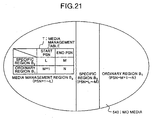
- the medium 540 shown in Fig. 20 has an ordinary region B 1 , a specific region B 2 , and a media management region B 3 as shown in detail in Fig 21.
- the specific region B 2 is where access can be made only when a mutual authentication command (specific command) explained later is issued and the license information 542 shown in Fig. 20 is stored.
- This license information 542 has the same data structure as that of license information 300.
- a file system 510 in the computer 500 manages files handled by the computer 500 and controls read/write of data.
- a mutual authentication module 511 holds secret information (henceforth, computer-side secret information) common to secret information (henceforth, MO device-side secret information) held by a mutual authentication module 521 of the MO device 520.
- the mutual authentication module 511 performs mutual authentication with the mutual authentication module 521 when the mutual authentication command is issued. That is, the mutual authentication module 511 transmits computer-side secret information to the mutual authentication module 521, and performs mutual authentication depending on whether the MO device-side secret information from the mutual authentication module 521 matches the computer-side secret information held by the module 511.
- the file system 510 can read out the license information 542 from the specific region B 2 of the medium 540 only when these two modules are mutually authenticated.
- the mutual authentication module 521 holds, as explained above, the MO device-side secret information common to the computer-side secret information held by the mutual authentication module 511 of the file system 510.
- the mutual authentication module 521 transmits the MO device-side secret information held by the module 521 to the mutual authentication module 511. Further, the mutual authentication module 521 performs mutual authentication depending on whether the computer-side secret information from the mutual authentication module 511 matches the MO device-side secret information held by the module 521.
- a mutual authentication command is issued from the ACM 213 to the file system 510, and mutual authentication is performed between the mutual authentication module 511 and the mutual authentication module 521.
- the mutual authentication module 511 of the file system 510 transmits the computer-side secret information to the mutual authentication module 521 of the MO device 520.
- the mutual authentication module 521 transmits the MO device-side secret information to the mutual authentication module 511.
- the mutual authentication module 521 determines whether the received computer-side secret information matches the MO device-side secret information held by the module 521, and transfers the result of the determination to the mutual authentication module 511. On the other hand, when receiving the MO device-side secret information from the mutual authentication module 521, the mutual authentication module 511 then determines whether the received MO device-side secret information matches the computer-side secret information held by the module 511.
- the file system 510 determines whether mutual authentication has been obtained based on both of the result of determination on the mutual authentication in the mutual authentication module 511 and the result of determination on the mutual authentication in the mutual authentication module 521. When respective results of the determination indicate "match", the file system 510 transfers the result of mutual authentication of OK to the ACM 213, and determines that the result of determination at step SF4 is "Yes".
- step SC3 shown in Fig. 13 the ACM 213 acquires the license information 542 from the specific region B 2 of the medium 540 via the file system 510. From then on, the processing from step SC4 to step SC28 is executed in the same manner as that of the third embodiment. It is assumed in the fifth embodiment that the MO disk 540, the license information 542, the contents 541, the file system 510, and the MO device 520 are substituted for the MO disk 240, the license information 300, the contents 241, the file system 212, and the MO device 220, respectively.
- step SF4 shown in Fig. 22 when both of the result of the determination on mutual authentication in the mutual authentication module 511 and the result of the determination on mutual authentication in the mutual authentication module 521 indicate "no match", the file system 510 determines that the result of determination is "No", and proceeds to step SC27 shown in Fig. 13.
- step SC27 the file system 510 transfers the mutual authentication result of NG (no match) to the ACM 213. In this case, mutual authentication is not obtained, therefore, there is no possibility that the license information 542 is read out from the specific region B 2 of the medium 540 shown in Fig. 20.
- a formatting device that sets an ordinary region B 1 and a specific region B 2 of the medium 540 shown in Fig. 20 is explained below with reference to Fig. 23.
- Computer 560 shown in this figure physically formats the medium 540.
- a formatter 561 provides controls for a physical format of the medium 540.
- OS 562 controls various types of application programs.
- a device driver 563 drives an MO device 570.
- the MO device 570 is provided to the computer 560 externally (or internally). This MO device 570 has a drive 571 that drives MO disks and performs physical formatting.
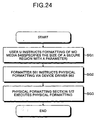
- the formatting device shown in Fig. 23 will be explained below with reference to Fig. 24.
- the user U instructs formatting of the medium 540 by specifying the size of the secured region (specific region B 2 ) using a not shown input device.
- the formatter 561 instructs physical formatting to a physical formatting section 572 via the device driver 563.
- the physical formatting section 572 then executes physical formatting of the MO disk 540.
- an ordinary region B 1 and a specific region B 2 are formed.
- the license information 542 is recorded on the specific region B 2 of the MO disk 540 shown in Fig. 21.
- the license information 542 is then acquired from the specific region B 2 only when respective mutual authentication is obtained in both of the mutual authentication module 511 and the mutual authentication module 521. Therefore, the license can be disapproved at the instant at which it is determined that mutual authentication is not obtained. Thus, unauthorized access to the contents 541 can be prevented.
- a disk 600 shown in Fig. 25 is used in the sixth embodiment. It has the ordinary region B 1 (see Fig. 21) and the non-secured region A 1 (see Fig. 15) mapped with each other, and also has the specific region B 2 (see Fig. 21) and the secured region A 2 (see Fig. 15) mapped with each other. Further, the ordinary region B 1 (corresponding to the non-secured region A 1 ) stores the contents 441 and the file management data D C1 that manages the contents. Whereas, the specific region B 2 (corresponding to the secured region A 2 ) stores the license information 442 and the file management data D C2 that manages the license information.
- the secured region A 2 is mapped to the specific region B 2 , both of which are effective in security. Thus, extremely high security can be ensured.
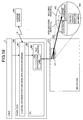
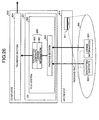
- Fig. 26 is a block diagram showing a configuration of a packed data generating device according to the seventh embodiment of this invention.
- Fig. 27 is a block diagram showing a configuration of an unpacking device according to the seventh embodiment of this invention.
- packed data generating device see Fig. 26
- unpacking device see Fig. 27
- the packed data generating device shown in Fig. 26 transfers license information 801 and encrypted contents 802, that are stored on a disk 800, as a grouping of data (packed data 830) to the unpacking device (see Fig. 27).
- the license information 801 stored on the disk 800 is the license information (AC) according any of the first to sixth embodiments.
- This license information 801 includes MSN and keys.
- the encrypted content 802 is content that is encrypted.
- a computer 820 is installed in the transmission side.
- OS 821 controls execution of various types of application programs.
- a file system 822 manages files handled by the computer 820 and controls read/write of data.
- a packing section 823 generates a file (packed data 830) from the license information 801 and the encrypted contents 802.
- a transfer section 824 transfers the packed data 830 to the unpacking device (see Fig. 27).
- MO device 810 is provided to the computer 820 externally (or internally), and reads out the license information 801 and the encrypted contents 802 from the disk (medium 800 in Fig. 26). This MO device 810 has a drive 811.
- computer 920 is installed in the reception side.
- OS 921 controls execution of various types of application programs.
- a file system 922 manages files handled by the computer 920 and controls read/write of data.
- a reception section 924 receives the packed data 830 transferred from the packed data generating device (see Fig. 26).
- An unpacking section 923 generates two files (license information 801 and encrypted contents 802) from the packed data 830.
- MO device 910 is installed to the computer 920 externally (or internally), and writes the license information 801 and the encrypted contents 802 onto a disk (medium 900 in Fig. 27) via a drive 911.
- the packing section 823 when the license information 801 and the encrypted contents 802 are read out from the medium 800 shown in Fig. 26, the packing section 823 generates a file (packed data 830) from these license information 801 and encrypted contents 802 and transfers the file to the transfer section 824. Accordingly, the transfer section 824 transfers the packed data 830 to the unpacking device shown in Fig. 27 via the cable or the network.
- the unpacking section 923 When the packed data 830 is received by the reception section 924 shown in Fig. 27, the unpacking section 923 generates the license information 801 and the encrypted contents 802 from the packed data 830. Thus, the license information 801 and the encrypted contents 802 are written onto the MO disk 900. In this seventh embodiment, the license information 801 and the encrypted contents 802 can be transferred (copied) from one disk 800 to another 900 in the manner as explained above. Thus, the license regarding the playback of contents can easily be transferred.
- the encrypted contents 802 and the license information 801 are transferred (copied) between media.
- the license allowing replay of the contents 801 can be transferred to a third party.
- access to contents may be controlled by recording a contents access control program, that realizes functions of the contents access control apparatus and the access control system, on a computer-readable recording medium, and making the computer read and execute the contents access control program recorded on the recording medium.
- the recording medium includes not only any transportable type of recording medium such as an optical disk, a floppy disk, or a hard disk, but also any transport media such as a network that temporarily records and holds data.
- license information and contents are correlated with each other and recorded on one medium, and access to the contents is controlled based on the license information and the identifying information. Therefore, by acquiring the medium, both of the license information and the contents can concurrently be obtained. Resultantly, the invention has such an advantageous effect that the contents can more easily be utilized as compared to the conventional case where the license information and the contents are separately acquired.
- a plurality of blocks of license information may be subjected to multiple encryption and recorded on the medium. Resultantly, the invention has such an advantageous effect that unauthorized access to contents can be prevented.
- the contents decryption key to decrypt the contents may be multiply-encrypted and recorded on a medium.
- the invention has such an advantageous effect that unauthorized access to contents can more effectively be prevented.
- encrypted license information can be recorded on the secured region of a medium.
- the invention has such an advantageous effect that unauthorized access to contents can be prevented.
- license information can be recorded on the secured region such that only when two physical elements are mutually authenticated, the license information is acquired from the specific region. Therefore, the license can be disapproved at the instant at which it is determined that mutual authentication is not obtained. Resultantly, the invention has such an advantageous effect that unauthorized access to contents can be prevented.
- the secured region may be mapped to the specific region, both of which are effective in security. Resultantly, the invention has such an advantageous effect that extremely high security can be ensured.
- the contents and the license information can be transferred (copied) from one medium to another. Resultantly, the invention has such an advantageous effect that the license regarding access to contents can be transferred to a third patty.
Landscapes
- Engineering & Computer Science (AREA)
- Computer Security & Cryptography (AREA)
- Signal Processing (AREA)
- Theoretical Computer Science (AREA)
- Software Systems (AREA)
- General Engineering & Computer Science (AREA)
- Computer Hardware Design (AREA)
- Physics & Mathematics (AREA)
- Technology Law (AREA)
- General Physics & Mathematics (AREA)
- Multimedia (AREA)
- Storage Device Security (AREA)
- Information Transfer Between Computers (AREA)
- Computer And Data Communications (AREA)
- Management, Administration, Business Operations System, And Electronic Commerce (AREA)
- Signal Processing For Digital Recording And Reproducing (AREA)
- Management Or Editing Of Information On Record Carriers (AREA)
- Two-Way Televisions, Distribution Of Moving Picture Or The Like (AREA)
Abstract
Description
- The present invention relates to a content access control apparatus which controls access to content provided by an authenticated information provider such as a copyright holder. This invention also relates to a content access control system, method and a computer-readable recording medium where a content access control program is recorded.
- Under present circumstances where distribution of content such as digitized movies and music has started in earnest, it is urgently required to realize a mechanism to manage copyrights and licenses concerning this type of content.
- One can not sell or transfer content such as movies or music (that is, material that has a copyright) in order to make profit, unless licensed to do so by the copyright holder under the provisions of copyright law. "Content" here refers to copyrighted works in digital form, such as a collection of bit arrays recordable on a single piece of recording media, such as documents, still images, video, and software programs.
- This type of content can be distributed to users by recording it on one or more recording media. In this case, controls for access to the content (henceforth, content access control) are provided using license information for the purpose of protection of the copyrights. This contents access control is provided in order that only an authorized user can get access to the content.
- As an example of content access control, there is one realized by using license information consisting of identifying information that identifies each of physical elements (that is, system elements such as recording media, device) required for accessing the content. This license information includes license conditions for access to the content. Such a system has identifying information allocated specifically to that system. A user gets the license information from a channel different from a channel from where he gets the content. The user then inputs the license information into the system, and sets the recording media, that contains the content, into this system.
- The system determines whether the identifying information allocated to the system satisfies the license conditions included in the license information entered by the user. When the information satisfies the license conditions, access to the content is allowed. On the other hand, when the information does not satisfies the license conditions, the access to the content is not allowed.
- As explained above, when accessing content in a conventional manner, it is required to acquire both the recording media that contain the content and the license information from different channels, which is extremely inconvenient. Further, the recording media and the license information exist separately, which may cause either of the two to be lost in the conventional system.
- Further, conventionally, only the license information exists as a single unit. Therefore, unauthorized duplication of the license information is possible, and as a result, there has been a problem that unauthorized access to the content may occur. This is not good from the viewpoint of protection of copyright holders.
- Embodiments of this invention can provide a content access control apparatus which allows a user to easily access the content and which prevents unauthorized access to the content , and also provide a content access control system, method and a computer-readable recording medium that contains a content access control program.
- According to one aspect of this invention, the content access control apparatus comprises a utilization unit which utilizes the content and to which identifying information for identifying physical elements that comprise the utilization unit is allocated, the utilization unit includes a medium on which the content is recorded; and an access control unit which controls access to the content based on the identifying information allocated to the utilization unit and license information regarding the access to the content , wherein the license information related to the content is recorded on the medium. Thus, the license information (information indicating whether access to the content is to be allowed or not) and the content are stored in one medium in a correlated form. The access to the content is controlled based on the license information and identifying information. Therefore, by acquiring the medium, both the license information and the content can concurrently be obtained. Resultantly, the content can more easily be utilized as compared to the conventional case where the license information and the content are acquired from different channels.
- Further, the access control unit decrypts the blocked license information acquired from the medium, and controls access to the content based on these results of decryption and the identifying information. Only a user who has the right can decrypt all the blocked license information. Therefore, the case where the blocked license information can not be decrypted indicates the fact that the corresponding device belongs to an unauthorized user. As a consequence, unauthorized access to the content can be prevented.
- Further, the access control unit decrypts the blocked license information acquired from the medium, and controls access to the content based on these results of decryption and the identifying information. Only the user who has the right can decrypt all the blocked license information and the content decryption key. Further, when the access is licensed by the access control unit, the utilization unit utilizes the content based on the result of decrypting the content using the content decryption key. As a consequence, unauthorized access to the content can be prevented.
- Further, the access control unit controls access to the content based on the result of decrypting the license information recorded on the secured region and the identifying information. Only a user who has the right can decrypt the license information. Therefore, the case where the license information can not be decrypted indicates the fact that the corresponding device belongs to an unauthorized user. As a consequence, unauthorized access to the content can be prevented.
- Further, the utilization unit comprises at least two physical elements and these two physical elements perform mutual authentication when a mutual authentication command is issued. When the two elements are mutually authenticated, the access control unit acquires license information from the specific region, and controls access to content based on the license information and the identifying information. When these two are not mutually authenticated, on the other hand, the access is not licensed. Thus, the license can be disapproved at the instant at which it is determined that mutual authentication is not obtained. As a consequence, unauthorized access to the content can be prevented.
- Further, the secured region is mapped to the specific region, both of which are effective in security. Therefore, extremely high security can be ensured.
- The invention according to another aspect comprises a read unit which reads out content and license information from a medium where the content to be provided from an authenticated information provider to a user and the license information regarding access to the content are recorded in correlation with each other; a transfer unit which transfers the read-out content and license information as a file; a reception unit which receives the file; and a write unit which generates the content and the license information from the file received by the reception unit, and writes the generated content and license information onto another medium. When content and license information are read cut from the medium by the read unit, the content and the license information are transferred as a file by the transfer unit. The content and the license information are generated from the file by the reception unit. The write unit writes the content and the license information in another medium. Thus, the content and the license information are transferred (copied) from one medium to the other. Therefore, the license regarding the access to the content can be transferred to a third party.
- Although a medium is referred to above, it is possible for the content and the license information to be distributed over a plurality of media.
- Reference is made, by way of example, to the accompanying drawings in which:
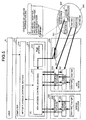
- Fig. 1 is a block diagram showing the configuration of the first embodiment of this invention.
- Fig. 2 is a diagram showing a relationship between the
contents 141 and theAC 142 shown in Fig. 1. - Fig. 3 is an example of the format of the
AC 142 shown in Fig. 1. - Fig. 4 is a flow chart showing the operation of the first embodiment.
- Fig. 5 is a block diagram showing the configuration of the second embodiment of this invention.
- Fig. 6 is a diagram showing a shows a relationship between
the
contents 241 and thelicense information 242 shown in Fig. 5. - Fig. 7 shows an example of the format of the
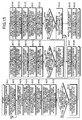
AC 242 shown in Fig. 5. - Fig. 8A to Fig. 8F show examples of the
license information 242 shown in Fig. 5. - Fig. 9 is a flow chart showing the operation of the second embodiment.
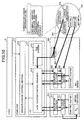
- Fig. 10 is a block diagram showing the configuration of the third embodiment of this invention.
- Fig. 11 shows an example of the license according to the third embodiment.
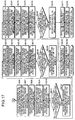
- Fig. 12A to Fig. 12F show examples of the
license information 300 shown in Fig. 10. - Fig. 13 is a flow chart showing the operation of the third embodiment.
- Fig. 14 is a block diagram showing the configuration of the fourth embodiment of this invention.
- Fig. 15 is a diagram showing the data structure of the
MO media 440 shown in Fig. 14. - Fig. 16 is a flow chart showing the operation of the fourth embodiment.
- Fig. 17 is a flow chart showing the operation of the fourth embodiment.
- Fig. 18 is a block diagram showing the configuration of the data write device in the fourth embodiment.
- Fig. 19 is a flow chart showing the operation of the data write device shown in Fig 18.
- Fig. 20 is a block diagram showing the configuration of the fifth embodiment of this invention.
- Fig. 21 is a diagram showing the data structure of the
MO media 540 shown in Fig. 20. - Fig. 22 is a flow chart showing the operation of the fifth embodiment.
- Fig. 23 is a block diagram showing the configuration of the formatting device in the fifth embodiment.
- Fig. 24 is a flow chart showing the operation of the formatting device shown in Fig 23.
- Fig. 25 is a diagram showing the data structure of the
MO media 600 in the sixth embodiment of this invention. - Fig. 26 is a block diagram showing the configuration of the packed data generating device in the seventh embodiment of this invention.
- Fig. 27 is a block diagram showing the configuration of the unpacking device in the seventh embodiment.
-
- In the following detailed description, content such as copyrighted information, software and the like is referred to as "contents".
- Seven preferred embodiments of the contents access control apparatus, the contents access control system, the contents access control method and the computer-readable recording medium containing a contents access control program according to this invention are explained in detail below with reference to the drawings.
- Fig. 1 is a block diagram showing a configuration of a first embodiment of this invention. A user U operates a
computer 110. Thecomputer 110 comprises OS (Operating System) 111. TheOS 111 controls execution of various programs in thiscomputer 110.File system 112 manages files handled by thecomputer 110, and controls read/write of data. ACM (Access Control Manager) 113 manages controls for access between the ACM and each of thefile system 112, MPEG2 (Moving Picture Experts Group 2)playback control section 114, MO (Magneto Optic) device 120 (i.e. MO disk drive), andMPEG2 decoder 130. - The MPEG2
playback control section 114 provides controls for supplying data for moving pictures (contents) to theMPEG2 decoder 130. In reality, the functions of the MPEG2playback control section 114 are realized by executing an MPEG2 playback control application program. TheMO device 120 is provided externally (or internally), and reads out data from a medium (anMO disc 140 in Fig. 1). -
Contents 141 and AC (Access Condition: Information representing access approval condition) 142 are stored on the medium140 in a correlated form. Thecontents 141 are data for MPEG2-format moving pictures, for example, and are provided by the information provider such as the copyright holder. The data format of thecontents 141 is immaterial so long as the data is subject to copyright or a license. TheAC 142 is license information regarding the playback of thecontents 141. The playback of thecontents 141 is allowed when the provided data satisfies the condition of theAC 142. Whereas, the playback of thecontents 141 is not allowed when the data does not satisfy the conditions of theAC 142. - The condition of the
AC 142 consists of a combination of respective identifying information allocated to a plurality of target physical elements. This target physical element includes any device and media, such as MO media, MO device, and MPEG2 device, that are required to playback thecontents 141. Identifying information includes MSN (Media Serial Number) and a DSN (Device Serial Number). It will be assumed here that theAC 142 has the MSN of the MO media set to "123", the DSN of the MO device set to "456", and the DSN of the MPEG2 decoder set to "789". Further, the condition for a logical product (AND): MSN (=123) & DSN (=456) & DSN (=789) is set in theAC 142. - That is, according to the
AC 142, the playback of thecontents 141 can be licensed only when all of three conditions are satisfied: the MO media are ones to which the MSN (=123) is allocated, the MO device is one to which the DSN (=456) is allocated, and the MPEG2 decoder is one to which the DSN (=789) is allocated. Conversely, playback of thecontents 141 is not allowed when one or two conditions out of the three conditions are not satisfied. Thus, theAC 142 plays a role as a license to give approval of playback of thecontents 141 only to an authorized party who can simultaneously satisfy the three conditions. - The
contents 141 and theAC 142 are stored on theMO media 140 in a correlated form as shown in Fig. 2. Thecontents 141 of theMO media 140 are divided into three blocks: contents (1/3) 1411, contents (2/3) 1412, and contents (3/3) 1413. These contents(1/3) 1411, contents (2/3) 1412, contents (3/3) 1413 are stored in regions specified by LBN (Logical Block Number)=L, LBN=M, and LBN=N, respectively. - Similarly, the
AC 142 of theMO media 140 is divided into two blocks: AC (1/2) 1421, and AC (2/2) 1422. These AC (1/2) 1421 and AC (2/2) 1422 are stored in regions specified by LBN=X and LBN=Y, respectively. - The
contents 141 and theAC 142 are correlated with each other via file management data DA1 and auxiliary file management data DA2. The file management data DA1 is used for managing thecontents 141 as the main body of the file and theAC 142 as an auxiliary file. This file management data DA1 consists of information such as "file name", "date and time of creation", ···, "link to the auxiliary file management data", "link to main body of the file (1/3)", "link to main body of the file (2/3)", and "linkage to main body of the file (3/3)". - On the other hand, the auxiliary file management data DA2 is used for directly managing the
AC 142, and consists of information such as "auxiliary file name", "date and time of creation", ···, "link to AC (1/2)", and "link to AC (2/2)". - Fig. 3 shows an example of the format of the
AC 142. In this figure, flag F4 represents the fact that a medium AC: MSN=123 does not satisfy the condition for logical sum (OR)/logical product (AND). Flag F5 represents the fact that the MO device AC: DSN=456 (see Fig. 1) does not satisfy the condition for logical sum/logical product (the slash / represents 'or'). Flag F3 represents the fact that the medium AC: MSN=123 and the MO device AC: DSN=456 satisfy the conditions of a logical sum. In this case, the number of conditions for a logical sum is 2. - Flag F6 represents the fact that MPEG2 decoder AC: DSN=789 does not satisfy the condition for logical sum/logical product. Flag F2 represents the fact that the elements with regard to flag F3 (MSN=123, DSN=456) and the element with regard to flag F6 (DSN=789) satisfy the conditions for the logical sum. In this case, the number of conditions for the logical sum is 2. Formats from the flag F2 to the flag F6 are used here for the
AC 142 shown in Fig. 1. Thus, flag F1 and flag F7 to flag F9 shown in Fig. 3 are used for extension. - Flag F8 represents the fact that medium AC: MSN=abc does not satisfy the condition for logical sum/logical product. Flag F9 represents the fact that MO device AC: DSN=def does not satisfy the condition for logical sum/logical product. Flag F7 represents the fact that the element (MSN=abc) with regard to flag F8 and the element (DSN=def) with regard to flag F9 satisfy the conditions for logical product. The number of conditions for the logical product in this case is 2. Flag F1 represents the fact that the elements (MSN=123, DSN=456, DSN=789) with regard to flag F2 and the elements (MSN=abc, DSN=def) with regard to flag F7 satisfy the conditions for a logical sum. In this case, the number of conditions for the logical sum is 2.
- Referring to Fig. 1, MSN=123 is allocated to the medium 140 as media identifying information. DSN=456 is allocated to the
MO device 120 as device identifying information. Adrive 121 drives the medium 140 so as to rotate the medium at the time of reading out the data.AC check section 122 checks whether the MSN=123 read-out from the medium 140 satisfies the condition (in this case, MSN=123) of theAC 142. Similarly, theAC check section 122 checks whether the DSN=456 allocated to theMO device 120 satisfies the condition (in this case, DSN=456) of theAC 142. - The
MPEG2 decoder 130 decodes the contents 141 (for example, video data) based on the MPEG2 format and plays back thecontents 241. DSN=789 is allocated to thisMPEG2 decoder 130 as device identifying information. TheAC check section 131 checks whether the DSN=789 satisfies the condition (in this case, DSN=789) of theAC 142. -
MO device 150 is provided separately from (may be provided together with) theMO device 120 and reads out data from a MO disk (medium 160 in Fig. 1). Drive 151 in thisMO device 150 drives the medium 160 so as to rotate. Further, DSN=def (see Fig. 3) is allocated to theMO device 150 as device identifying information. This DSN=def is different from the DSN=456 allocated to theMO device 120. MSN=abc is allocated to the medium 160 as media identifying information. This MSN=abc is different from the MSN=123 allocated to the medium 140. - Operation of the first embodiment will be explained below with reference to a flow chart shown in Fig. 4. It is assumed here that the medium 140 is set in the
drive 121 of theMO device 120. When the user U instructs playback of MPEG2 contents to the MPEG2playback control section 114 at step SA1, at the next step SA2 the MPEG2playback control section 114 instructs the playback of the MPEG2 contents to theACM 113. - Accordingly, at step SA3, the
ACM 113 acquires theAC 142 from the medium 140 via thefile system 112. At step SA4, theACM 113 transfers the acquiredAC 142 to theAC check section 122 of theMO device 120. At step SA5, theAC check section 122 then acquires the MSN (=123) from the medium 140. At step SA6, theAC check section 122 determines whether the condition of theAC 142 matches the MSN (=123). - Precisely, the
AC check section 122 determines whether the contents of the AC 142 (in this case, medium : MSN=123) shown in Fig. 1 match the MSN (=123) acquired from the medium 140. Assume that the two match. Therefore, the result of determination at step SA6 shall be "Yes". - On the other hand, when the result of determination at step SA6 is "No", namely when the two do not match, the processes in step SA17 is performed. At step SA17, the
AC check section 122 sends the check result of NG (no match) back to theACM 113. Accordingly, at step SA18. theACM 113 sends the check result of NG back to the MPEG2playback control section 114, and ends the series of processing. This case indicates that the condition of the AC 142 (MSN=123) is not satisfied, and hence the playback of thecontents 141 recorded on the medium 140 is not allowed. - When the result of determination at step SA6 is "Yes", at step SA7, the
AC check section 122 returns theAC 142 together with the check result of OK (match) obtained at step SA6 to theACM 113. Accordingly, at step SA8, theACM 113 transfers theAC 142 to theAC check section 122. When receiving theAC 142, at step SA9, theAC check section 122 acquires DSN (=456) from theMO device 120. At step SA10, theAC check section 122 determines whether the condition of theAC 142 matches the DSN (=456). - Precisely, the
AC check section 122 determines whether the contents of the AC 142 (in this case, MO device: DSN=456) shown in Fig. 1 match the DSN (=456) acquired from theMO device 120. Assume that the two match. Therefore, the result of determination at step SA10 will be "Yes". - On the other hand, when the result of determination at step SA10 is "No", the process at step SA17 is performed. At step SA17, the
AC check section 122 sends the check result of NG back (no match) to theACM 113. Accordingly, at step SA18, theACM 113 sends the check result of NG back to the MPEG2playback control section 114, and ends the series of processing. Thus, this case indicates that the conditions of the AC 142 (MSN=123 & DSN=456) are not satisfied, and hence the playback of thecontents 141 recorded on the medium 140 is not allowed. - When the result of determination at step SA10 is "Yes", at step SA11, the
AC check section 122 returns theAC 142 together with the check result of OK (match) obtained at step SA10 to theACM 113. Accordingly, at step SA12, theACM 113 transfers theAC 142 to theAC check section 131 of theMPEG2 decoder 130. When receiving theAC 142, at step SA13, theAC check section 131 acquires DSN (=789) from theMPEG2 decoder 130. At step SA14, theAC check section 131 determines whether the condition of theAC 142 matches the DSN (=789). - Precisely, the
AC check section 131 determines whether the contents of the AC 142 (in this case, MPEG2 decoder: DSN=789) shown in Fig. 1 match the DSN (=789) acquired from theMPEG2 decoder 130. Assume that the two match. Therefore, the result of determination at step SA14 will be "Yes". - On the other hand, when the result of determination at step SA14 is "No", the process at step SA17 is performed. At step SA17, the
AC check section 131 sends the check result of NG (no match) back to theACM 113. Accordingly, at step SA18, theACM 113 sends the check result of NG back to the MPEG2playback control section 114, and ends the series of processing. Thus, this case indicates that the conditions of the AC 142 (MSN=123 & DSN=456 & DSN=789) are not satisfied, and hence the playback of thecontents 141 recorded on the medium 140 is not allowed. - When the determination result at step SA14 is "Yes", at step SA15, the
AC check section 131 returns theAC 142 together with the check result of OK (match) obtained at step SA14 to theACM 113. Accordingly, at step SA16, theACM 113 sends all the check results of OK obtained at step SA6. step SA10, and step SA14 back to the MPEG2playback control section 114, and ends the series of processing. Thus, this case indicates that all the conditions of theAC 142 recorded on the medium 140 are satisfied, and hence retrieval ofcontents 141 is allowed. - Therefore, the MPEG2
playback control section 114 reads out thecontents 141 from theMO media 140 via thedrive 121 and thefile system 112, and then transfers the contents to theMPEG2 decoder 130. Accordingly, thecontents 141 are decoded and played as video by theMPEG2 decoder 130. - As explained above, according to the first embodiment, the
AC 142 and thecontents 141 are recorded in a correlated form on onemedium 140, and access to thecontents 141 is controlled based on theAC 142 and the identifying information (MSN=123, and so on). Therefore, theAC 142 and thecontents 141 can simultaneously be obtained when the medium 140 is acquired. Thus, contents can more easily be utilized as compared to the conventional case where these two are acquired through different channels. - A case is explained in the first embodiment where the
AC 142 is not encrypted. However, higher security may be achieved when theAC 142 is encrypted. This case is explained below as a second embodiment. - Fig. 5 is a block diagram showing a configuration of the second embodiment of this invention. The user U operates the
computer 210. Thecomputer 210 comprisesOS 211. TheOS 211 controls execution of various programs in thiscomputer 210.File system 212 manages files handled by thecomputer 210, and controls read/write of data. ACM (Access Control Manager) 213 manages controls for access between the ACM and each of thefile system 212. MPEG2playback control section 214,MO device 220, andMPEG2 decoder 230. - The MPEG2
playback control section 214 has the same function as that of the MPEG2 playback control section 114 (see Fig. 1). TheMO device 220 is provided externally (or internally), and reads out data from MO disks (medium 240 in Fig. 5). -
Contents 241 andlicense information 242 are stored on the medium 240 in a correlated form. Thecontents 141 are data for MPEG2-format moving pictures. Thelicense information 242 is information regarding whether the playback of thecontents 241 is allowed or not. That is, when provided data satisfies the conditions of thelicense information 242 then the playback of thecontents 241 is allowed. Whereas, when the data does not satisfy the conditions of thelicense information 242, the playback of thecontents 241 is not allowed. Thislicense information 242 is obtained by performing multiple encryption on items of information (MSN=123, DSN=456, and DSN=789) by a plurality of encryption keys. The detailed data structure of thislicense information 242 is explained later with reference to Fig. 7. - The condition of the
license information 242 consists of a combination of respective identifying information allocated to a plurality of target physical elements. This target physical element includes any device and media, such as MO disks, MO device, and MPEG2 device, that are required to play back thecontents 241. Identifying information includes MSN (Media Serial Number) and DSN (Device Serial Number). Precisely, thelicense information 242 has the MSN of the MO media set to "123", the DSN of the MO device set to "456", and the DSN of the MPEG2 decoder set to "789". Further, the condition for a logical product (AND): MSN (=123) & DSN (=456) & DSN (=789) is set in thelicense information 242. - That is, according to the
license information 242, the playback of thecontents 241 can be allowed only when all of three conditions is satisfied: the MO media are ones to which the MSN (=123) is allocated, the MO device is one to which the DSN (=456) is allocated, and the MPEG2 decoder is one to which the DSN (=789) is allocated. Conversely, when one or two conditions out of the three conditions are not satisfied,access to the data (contents) 241 is not allowed. Thus, thelicense information 242 plays a role as a license to give approval of the playback of thecontents 241 only to an authorized party who can simultaneously satisfy the three conditions. - The
contents 241 and thelicense information 242 are stored on theMO media 240 in a correlated form as shown in Fig. 6 in the same manner as that of Fig. 2. Thecontents 241 of theMO media 240 are divided into three blocks: contents (1/3) 2411, contents (2/3) 2412, and contents (3/3) 2413. These contents (1/3) 2411, contents (2/3) 2412, contents (3/3) 2413 are stored on regions specified by LBN=L, LBN=M, and LBN=N, respectively. - Similarly, the
license information 242 of theMO media 240 is divided into two blocks: license information (1/2) 2421, and license information (2/2) 2422. These license information (1/2) 2421 and license information (2/2) 2422 are stored on regions specified by LBN=X and LBN=Y, respectively. - The
contents 241 and thelicense information 242 are correlated with each other via file management data DB1 and auxiliary file management data DB2. The file management data DB1 is used for managing thecontents 241 as the main body of the file and thelicense information 242 as an auxiliary file. This file management data DB1 consists of information such as "file name", ···, "link to the main body of file (3/3)". On the other hand, the auxiliary file management data DB2 is used for directly managing thelicense information 242, and consists of information such as "auxiliary file name", ···, "link to the license information (1/2)", and "link to the license information (2/2)". - Referring to Fig. 5, MSN=123 is allocated to the
MO media 240 as media identifying information. Key=abc is also stored on theMO media 240. This Key=abc is used for decrypting the MSN=123 from thelicense information 242. DSN=456 is allocated to theMO device 220 as device identifying information. Key=def is also stored in theMO device 220. This Key=def is used for decrypting the DSN=456 from thelicense information 242. - A
drive 221 drives anMO disk 240 so as to rotate the disk at the time of reading out data. Adecryption section 223 decrypts the MSN=123 from thelicense information 242 using the Key=abc stored on theMO disk 240. Further, thedecryption section 223 decrypts the DSN=456 from thelicense information 242 using the Key=def stored in theMO device 220. -
AC check section 222 checks whether the MSN=123 read-out front theMO disk 240 satisfies the condition (in this case, MSN=123) of thelicense information 242. TheAC check section 222 also checks whether the DSN=456 allocated to theMO device 220 satisfies the condition (in this case, DSN=456) of thelicense information 242. - The
MPEG2 decoder 230 decodes the contents 241 (data for moving pictures) in accordance with the MPEG2 format to reproduce thecontents 241. DSN=789 is allocated to thisMPEG2 decoder 230 as device identifying information. Adecryption section 232 decrypts the DSN=789 from thelicense information 242 using Key=ghi stored in theMPEG2 decoder 230.AC check section 231 checks whether the DSN=789 satisfies the condition (in this case, DSN=789) of thelicense information 242. - Fig. 7 shows an example of a license (license information 242) in the second embodiment. MPEG2 decoder AC: DSN=789 that corresponds to the MPEG2 decoder as the target physical element, is encrypted by the Key=ghi. Further, the DSN=789 is the license information for the
MPEG2 decoder 230. - MO device AC: DSN=456 corresponds to the MO device as a target physical element. This DSN=456 and the encrypted DSN=789 are subjected to multiple encryption using the Key=def. These DSN=456 and DSN=789 subjected to multiple encryption are the license information for the
MO device 220. Further, MO media AC: MSN=123 corresponds to the medium as a target physical element. This MSN=123 and both of the DSN=456 and the DSN=789 subjected to multiple encryption are further subjected to multiple encryption using the Key=abc. These MSN=123, DSN=456, and DSN=789 subjected to multiple encryption are the license information for the medium 240. - Operation of the second embodiment will be explained below with reference to a flow chart shown in Fig. 9. It is assumed here that an
MO disk 240 is set in thedrive 221 of theMO device 220. When the user U instructs playback of MPEG2 contents to the MPEG2playback control section 214 at step SB1 as shown in Fig. 9, at step SB2, the MPEG2playback control section 214 instructs the playback of the MPEG2 contents to theACM 213. - At step SB3, the
ACM 213 acquires theencrypted license information 242 shown in Fig. 8A from theMO disk 240 via thefile system 212. At step SB4, theACM 213 transfers the acquiredlicense information 242 to thedecryption section 223 of theMO device 220. Accordingly, at step SB5, thedecryption section 223 acquires a key (=abc=K1) from the medium 240. - At step SB6, the
decryption section 223 decrypts thelicense information 242 to that as shown in Fig. 8B using the key (=abc=K1). The MSN (=123) is decrypted here as shown in Fig. 8B. At step SB7, thedecryption section 223 transfers the decryptedlicense information 242 to theAC check section 222. - At step SB8, the
AC check section 222 acquires an MSN (=123) from the medium 240. At step SB9, theAC check section 222 determines whether the condition (MSN=123) of the decryptedlicense information 242 shown in Fig. 8B matches the MSN (=123). Assume that the two match. Therefore, the result of determination at step SB9 will be "Yes". - On the other hand, when the result of determination at step SB9 is "No", the process at step SB26 is performed. At step SB26, the
AC check section 222 sends the check result of NG (no match) back to theACM 213. Accordingly, at step SB27, theACM 213 sends the check result of NG back to the MPEG2playback control section 214, and ends the series of processing. Thus, this case indicates that the condition for the license (MSN=123) based on thelicense information 242 is not satisfied, and hence disk replay is prevented. - When the result of determination at step SB9 is "Yes", at step SB10, the
AC check section 222 returns thelicense information 242 shown in Fig. 8C together with the check result of OK obtained at step SB9 to theACM 213. Accordingly, at step SB11, theACM 213 transfers the receivedlicense information 242 to thedecryption section 223 of theMO device 220. When receiving thelicense information 242, at step SB12, thedecryption section 223 acquires a key (=def=K2) from theMO device 220. - At step SB13, the
decryption section 223 decrypts thelicense information 242 to that as shown in Fig. 8D using the key (=def=K2). The DSN (=456) is decrypted here as shown in Fig. 8D. At step SB14, thedecryption section 223 transfers the decryptedlicense information 242 to theAC check section 222. - At step SB15, the
AC check section 222 acquires a DSN (=456) from theMO device 220. At step SB16, theAC check section 222 determines whether the condition (DSN=456) of the decryptedlicense information 242 matches the DSN (=456). Assume that the two match. Therefore, the result of determination at step SB16 will be "Yes". - On the other hand, when the result of determination at step SB16 is "No", the process at step SB26 is performed. At step SB26, the
AC check section 222 sends the check result of NG back (no match) to theACM 213. Accordingly, at step SB27, theACM 213 sends the check result of NG back to the MPEG2playback control section 214, and ends the series of processing. Thus, this case indicates that the conditions for the license (MSN=123 & DSN=456) based on thelicense information 242 are not satisfied, and hence the playback of thecontents 241 recorded on the medium 240 is not allowed. - When the result of determination at step SB16 is "Yes", at step SB17, the
AC check section 222 returns thelicense information 242 shown in Fig. 8E together with the check result of OK (match) obtained at step SB16 to theACM 213. At step SB18, theACM 213 transfers thelicense information 242 to thedecryption section 232 of theMPEG2 decoder 230. When receiving thelicense information 242, at step SB19, thedecryption section 232 acquires a key (=ghi=K3) from theMPEG2 decoder 230. - At step SB20, the
decryption section 232 decrypts thelicense Information 242 to that as shown in Fig. 8F using the key (=ghi=K3). The DSN (=789) is decrypted here as shown in Fig. 8F. At step SB21, thedecryption section 232 transfers the decryptedlicense information 242 to theAC check section 231. - At step SB22, the
AC check section 231 acquires a DSN (=789) from theMPEG2 decoder 230. At step SB23, theAC check section 231 determines whether the condition (DSN=789) of the decryptedlicense information 242 matches the DSN (=789). Assume that the two match. Therefore, the result of determination at step SB23 will be "Yes". - On the other hand, when the result of determination at step SB23 is "No", the process at step SB26 is performed. At step SB26, the
AC check section 231 sends the check result of NG back (no match) to theACM 213. At step SB27, theACM 213 sends the check result of NG back to the MPEG2playback control section 214, and ends the series of processing. Thus, this case indicates that the conditions for the license (MSN=123 & DSN=456 & DSN=789) based on thelicense information 242 are not satisfied, and hence the playback of thecontents 241 recorded on the medium 240 is not allowed. - When the result of determination at step SB23 is "Yes", at step SB24, the
AC check section 231 returns the check result of OK obtained at step SB23 to theACM 213. At step SB25, theACM 213 sends all the check results of OK (match) obtained at step SB9, step SB16, and step SB23 back to the MPEG2playback control section 214, and ends the series of processing. Thus, this case indicates that all the conditions of thelicense information 242 recorded on the medium 240 are satisfied, and hence the playback of the recordedcontents 241 is authorised. - The MPEG2
playback control section 214 reads out thecontents 241 from theMO disk 240 via thedrive 221 and thefile system 212, and transfers thecontents 241 to theMPEG2 decoder 230. TheMPEG2 decoder 230 decodes thecontents 241 and plays the video. - As explained above, according to the second embodiment, a plurality of blocked license information (MSN=123, DSN=456, and so on) are subjected to multiple encryption as shown in Fig. 7 to be recorded on the medium 240. Thus, unauthorized access to the
contents 241 can be prevented. - A case is explained in the second embodiment where the
contents 241 is not encrypted. However, thecontents 241 may also be encrypted. In this case, a contents decryption key to decrypt theencrypted contents 241 and thelicense information 242 may be subjected to multiple encryption. This case is explained below as a third embodiment. - Fig. 10 is a block diagram showing a configuration of the third embodiment of this invention. Same legends are assigned in this figure to the sections that are similar to those in Fig. 5.
MPEG2 decoder 310 is provided here instead of theMPEG2 decoder 230 shown in Fig. 5. Further,license information 300 is stored on the medium 240 instead of thelicense information 242 shown in Fig. 5. Thecontents 241 shown in Fig. 10 is encrypted. Theseencrypted contents 241 andlicense information 300 are stored on the medium 240 in a correlated form. - The
MPEG2 decoder 310 decrypts the encrypted contents 241 (for example, video data) using a contents decryption key Kc set by anAC check section 311, and decodes the result of this decryption to play back thecontents 241. DSN=789 as device identifying information is allocated to thisMPEG2 decoder 310. Adecryption section 312 decrypts DSN=789 from thelicense information 300 using the Key=ghi stored in theMPEG2 decoder 310. TheAC check section 311 checks whether the decrypted information satisfies the condition of the license information 300 (in this case, DSN=789). - Fig. 11 shows an example of a license (license information 300) in the third embodiment. MPEG2 decoder AC: DSN=789 and contents decryption key Kc correspond to the MPEG2 decoder as the target physical element, respectively, and are encrypted by the Key=ghi. This contents decryption key Kc is used for decrypting the encrypted contents in the
MPEG2 decoder 310. Further, the DSN=789 and the contents decryption key Kc are license information for theMPEG2 decoder 310. - MO device AC: DSN=456 corresponds to the MO device as a target physical element. This DSN=456 and these encrypted DSN=789 and contents decryption key Kc are further subjected to multiple encryption using the Key=def. These DSN=456, DSN=789, and contents decryption key Kc subjected to multiple encryption are the license information for the
MO device 220. - MO media AC: MSN=123 corresponds to the MO disk as a target physical element. This MSN=123, and three of the DSN=456, the DSN=789, and the contents decryption key Kc subjected to multiple encryption are further subjected to multiple encryption using the Key=abc. These MSN=123, DSN=456, DSN=789, and contents decryption key Kc subjected to multiple encryption are the license information for the
MO media 240. - Operation of the third embodiment will be explained below with reference to a flow chart shown in Fig. 13. In this case, it is assumed that the
MO disk 240 is set in thedrive 221 of theMO device 220. When the user U instructs playback of MPEG2 contents to the MPEG2playback control section 214 at step SC1 as shown in Fig. 13, at step SC2, the MPEG2playback control section 214 instructs the playback of the MPEG2 contents to theACM 213. - At step SC3, the
ACM 213 acquires theencrypted license information 300 shown in Fig. 12A from theMO disk 240 via thefile system 212. At step SC4, theACM 213 transfers the acquiredlicense information 300 to thedecryption section 223 of theMO device 220. At step SC5, thedecryption section 223 acquires a key (=abc=K1) from theMO disk 240. - At step SC6, the
decryption section 223 decrypts thelicense information 300 to that as shown in Fig. 12B using the key (=abc=K1). The MSN (=123) is decrypted here as shown in Fig. 12B. At step SC7, thedecryption section 223 transfers the decryptedlicense information 300 to theAC check section 222. - At step SC8, the
AC check section 222 acquires an MSN (=123) from theMO disk 240. At step SC9, theAC check section 222 determines whether the condition (MSN=123) of the decryptedlicense information 300 shown in Fig. 12B matches the MSN (=123). Assume that the two match. Therefore, the result of determination at step SC9 will be "Yes". - On the other hand, when the result of determination at step SC9 is "No", the process at step SC27 is performed. At step SC27, the
AC check section 222 sends the check result of NG (no match) back to theACM 213. Accordingly, at step SC28, theACM 213 sends the check result of NG back to the MPEG2playback control section 214, and ends the series of processing. Thus, this case indicates that the condition for the license (MSN=123) based on thelicense information 300 is not satisfied, and access to thecontents 241 is denied. - When the result of determination at step SC9 is "Yes", at step SC10 the
AC check section 222 returns thelicense information 300 shown in Fig. 12C together with the check result of OK obtained at step SC9 to theACM 213. At step SC11, theACM 213 transfers the receivedlicense information 300 to thedecryption section 223 of theMO device 220. When receiving thelicense information 300, at step SC12, thedecryption section 223 acquires a key (=def=K2) from theMO device 220. - At step SC13, the
decryption section 223 decrypts thelicense information 300 to that as shown in Fig. 12D using the key (=def=K2). The DSN (=456) is decrypted here as shown in Fig. 12D. At step SC14, thedecryption section 223 transfers the decryptedlicense information 300 to theAC check section 222. - At step SC15, the
AC check section 222 acquires a DSN (=456) from theMO device 220. At step SC16, theAC check section 222 determines whether the condition (DSN=456) of the decryptedlicense information 300 matches the DSN (=456). Assume that the two match. Therefore, the result of determination at step SC16 will be "Yes". - On the other hand, when the result of determination at step SC16 is "No", the process at step SC27 is performed. At step SC27, the
AC check section 222 sends the check result of NG (no match) back to theACM 213. Accordingly, at step SC28, theACM 213 sends the check result of NG back to the MPEG2playback control section 214, and ends the series of processing. Thus, this case indicates that the conditions for the license (MSN=123 & DSN=456) based on thelicense information 300 are not satisfied, thus the playback of thecontents 241 recorded on the medium 240 is not allowed. - When the result of determination at step SC16 is "Yes", at step SC17 the
AC check section 222 returns thelicense information 300 shown in Fig. 12E together with the check result of OK obtained at step SC16 to theACM 213. At step SC18, theACM 213 transfers the receivedlicense information 300 to thedecryption section 312 of theMPEG2 decoder 310. When receiving thelicense information 300, at step SC19, thedecryption section 312 acquires a key (=ghi=K3) from theMPEG2 decoder 310. - At step SC20, the
decryption section 312 decrypts thelicense information 300 to that as shown in Fig. 12F using the key (=ghi=K3). The DSN (=789) is decrypted here as shown in Fig. 12F. At step SC21, thedecryption section 312 transfers the decryptedlicense information 300 to theAC check section 311. - Accordingly, at step SC22, the
AC check section 311 acquires a DSN (=789) from theMPEG2 decoder 310. At step SC23, theAC check section 311 determines whether the condition (DSN=789) of the decryptedlicense information 300 matches the DSN(=789). Assume that the two match. Therefore, the result of determination at step SC23 will be "Yes". - On the other hand, when the result of determination at step SC23 is "No", the process at step SC27 is performed. At step SC27, the
AC check section 311 sends the check result of NG (no match) back to theACM 213. At step SC28, theACM 213 sends the check result of NG back to the MPEG2playback control section 214, and ends the series of processing. Thus, this case indicates that the conditions for the license (MSN=123 & DSN=456 & DSN=789) based on thelicense information 300 are not satisfied, and access to the information recorded on thedisk 240 is not allowed. - When the result of determination at step SC23 is "Yes", at step SC24, the
AC check section 311 sets a contents decryption key Kc in theMPEG2 decoder 310. At step SC25, theAC check section 311 sends the check result of OK (match) obtained at step SC23 back to theACM 213. At step SC26, theACM 213 sends all the check results of OK obtained at step SC9, step SC16, and step SC23 back to the MPEG2playback control section 214, and ends the series of processing. Thus, this case indicates that all the conditions of thelicense information 300 recorded on the medium 240 are satisfied, and hence the playback of thedisk 240 is allowed. - The MPEG2
playback control section 214 reads out theencrypted contents 241 from theMO media 240 via thedrive 221 and thefile system 212, and transfers thecontents 241 to theMPEG2 decoder 310. Thus, theMPEG2 decoder 310 decrypts thecontents 241 using the contents decryption key Kc set at step SC24 decodes and plays the moving pictures. - As explained above, according to the third embodiment, in addition to the plurality of blocked license information (MSN=123, DSN=456, and so on), the contents decryption key Kc to decrypt the
contents 241 is subjected to multiple encryption as shown in Fig. 11 to be recorded on the medium 240. Thus, unauthorized access to thecontents 241 can more effectively be prevented. - A case is explained the third embodiment where the
file system 212 shown in Fig. 10 unconditionally reads out license information from theMO media 240. However, for the purpose of achieving higher security, the invention may be configured so that encrypted license information is stored on a secured region (encrypted region) of the medium 240 and only the file system, that can decrypt this encrypted license information, can read out the license information. This case is explained below as a fourth embodiment. - Fig. 14 is a block diagram showing a configuration of the fourth embodiment of this invention. Same legends are assigned in this figure to the sections that are similar to those in Fig. 10. As shown in Fig. 14,
medium 440 andcomputer 400 are provided instead of the medium 240 and thecomputer 210 shown in Fig 10. - The medium 440 shown in Fig. 14 has a non-secured region A1 where
encrypted contents 441 is stored and a secured region A2 whereencrypted license information 442 is stored as shown in detail in Fig. 15. The non-secured region A1 is a user region to which access can be made using any ordinary file system. Whereas, the secured region A2 is a region to which access can not be made by the ordinary file system, namely, to which only afile system 410 having adecryption unit 411 shown in Fig. 14 can get access. - The
license information 442 shown in Fig. 15 is obtained by encrypting the license information 300 (see Fig. 10 and Fig. 11). Therefore, the MSN=123, the DSN=456, the DSN=789, and the contents decryption key Kc shown in Fig. 11 are included in thelicense information 442. Further, thelicense information 442 is managed by auxiliary file management data DC2 as shown in Fig. 15. - On the other hand, file management data DC1 in the non-secured region A1 is data for managing the
contents 441 and also for managing indirectly thelicense information 442 via auxiliary file management data DC2. Thus, thecontents 441 and thelicense information 442 are correlated with each other via the file management data DC1 and the auxiliary file management data DC2 on the medium 440. Referring to Fig. 14, thefile system 410 of thecomputer 400 reads out thelicense information 442, thecontents 441, the Key=abc, and MSN=123 from theMO disk 440, respectively. Thedecryption unit 411 decrypts theencrypted license information 442. - Operation of the fourth embodiment will be explained below with reference to flow charts shown in Fig. 16 and Fig. 17. It is assumed here that an
MD disk 440 is set in thedrive 221 of theMO device 220. When the user U instructs playback of MPEG2 contents to the MPEG2playback control section 214 at step SD1 as shown in Fig. 16, at step SD2, the MPEG2playback control section 214 instructs retrieval of the MPEG2 data to theACM 213. - At step SD3, the
file system 410 accesses the secured region A2 of the medium 440 to acquire theencrypted license information 442, and then transfers the information to thedecryption unit 411. At step SD4, thedecryption unit 411 decrypts theencrypted license information 442 using a specified key. At step SD5, thedecryption unit 411 transfers the decryptedlicense information 442 to theACM 213. - At step SD6 shown in Fig. 17, the
ACM 213 transfers the decryptedlicense information 442 to thedecryption section 223 of theMO device 220. At step SD7, thedecryption section 223 acquires a key (=abc=K1 (see Fig. 12A) from theMO media 440, and proceeds to step SD8. At step SD8, thedecryption section 223 decrypts thelicense information 442 to that as shown in Fig. 12B using the key (=abc). The MSN (=123) is decrypted here as shown in Fig. 12B. At step SD9, thedecryption section 223 transfers the decryptedlicense information 442 to theAC check section 222. - At step SD10, the
AC check section 222 acquires an MSN (=123) from theMO disk 440. At step SD11, theAC check section 222 determines whether the condition (MSN=123) of the decryptedlicense information 442 shown in Fig. 12B matches the MSN (=123). Assume that the two match. Therefore, the result of determination at step SD11 will be "Yes. - On the other hand, when the result of determination at step SD11 is "No", the process at step SD29 is performed. At step SD29, the
AC check section 222 sends the check result of NG (no match) back to theACM 213. Accordingly, at step SD30, theACM 213 sends the check result of NG back to the MPEG2playback control section 214, and ends the series of processing. Thus, this case indicates that the condition for the license (MSN=123) based on thelicense information 442 is not satisfied, and hence access to thedata 441 on the disk is prohibited. - When the result of determination at step SD11 is "Yes", at step SD12, the
AC check section 222 returns the license information 442 (see Fig. 12C) together with the check result of OK obtained at step SD11 to theACM 213. Accordingly, at step SD13. theACM 213 transfers the receivedlicense information 442 to thedecryption section 223 of theMO device 220. When receiving thelicense information 442, at step SD14, thedecryption section 223 acquires a key (=def=K2) from theMO device 220. - At step SD15, the
decryption section 223 decrypts thelicense information 442 to that as shown in Fig. 12D using the key (=def=K2). The DSN (=456) is decrypted here as shown in Fig. 12D. At step SD16, thedecryption section 223 transfers the decryptedlicense information 442 to theAC check section 222. - At step SD17, the
AC check section 222 acquires a DSN (=456) from theMO device 220. At step SD18, theAC check section 222 determines whether the condition (DSN=456) of the decryptedlicense information 442 matches the DSN (=456). Assume that the two match. Therefore, the result of determination at step SD18 will be "Yes". - On the other hand, when the result of determination at step SD18 is "No", the process at step SD29 is performed. At step SD29, the
AC check section 222 sends the check result of NG (no match) back to theACM 213. Accordingly, at step SD30, theACM 213 sends the check result of NG back to the MPEG2playback control section 214, and ends the series of processing. Thus, this case indicates that the conditions for the license (MSN=123 & DSN=456) based on thelicense information 442 are not satisfied, and hence play back is prohibited. - When the result of determination at step SD18 is "Yes", at step SD19, the
AC check section 222 returns thelicense information 442 shown in Fig. 12E together with the check result of OK obtained at step SD18 to theACM 213. At step SD20, theACM 213 transfers the receivedlicense information 442 to thedecryption section 312 of theMPEG2 decoder 310. When receiving thelicense information 442, at step SD21, thedecryption section 312 acquires a key (=ghi=K3) from theMPEG2 decoder 310. - At step SD22, the
decryption section 312 decrypts thelicense information 442 to that as shown in Fig. 12F using the key (=ghi=K3). The DSN (=789) is decrypted here as shown in Fig. 12F. At step SD23, thedecryption section 312 transfers the decryptedlicense information 442 to theAC check section 311. - At step SD24, the
AC check section 311 acquires a DSN (=789) from theMPEG2 decoder 310. At step SD25, theAC check section 311 determines whether the condition (DSN=789) of the decryptedlicense information 442 matches the DSN (=789). Assume that the two match. Therefore, the result of determination at step SD25 will be "Yes". - On the other hand, when the result of determination at step SD25 is "No" the process at step SD29 is performed. At step SD29, the
AC check section 311 sends the check result of NG (no match) back to theACM 213. Accordingly, at step SD30, theACM 213 sends the check result of NG back to the MPEG2playback control section 214, and ends the series of processing. Thus, this case indicates that the conditions for the license (MSN=123 & DSN=456 & DSN=789) based on thelicense information 442 are not satisfied, and reading is prohibited. - When the result of determination at step SD25 is "Yes", at step SD26 the
AC check section 311 sets a contents decryption key Kc in theMPEG2 decoder 310. At step SD27, theAC check section 311 sends the check result of OK (match) obtained at step SD25 back to theACM 213. Accordingly, at step SD28, theACM 213 sends all the check results of OK obtained at step SD11, step SD18, and step SD25 back to the MPEG2playback control section 214, and ends the series of processing. Thus, this case indicates that all the conditions of thelicense information 442 recorded on the medium 440 are satisfied, and hence the output of data from the medium is permitted. - The MPEG2
playback control section 214 reads out theencrypted contents 441 from the medium 440 via thedrive 221 and thefile system 410, and transfers the read-outcontents 441 to theMPEG2 decoder 310. Thus, thecontents 441 decrypted by the contents decryption key Kc set at step SD26 are decoded to the moving pictures in theMPEG2 decoder 310. - A data write device that writes the
license information 442 shown in Fig. 14 on the medium 440 where thecontents 441, the Key=abc, and the MSN=123 have already been stored is explained below with reference to Fig. 18. Thelicense information 442 is not stored on the medium 440. Acomputer 460 in Fig. 18 is a device which is installed in a station (for example, railway station or bus station) or in a convenience store, or some similar places, and through which license information is purchased. A license-informationpurchase application program 461 for purchasing license information is started up in thiscomputer 460.OS 462 controls the license-informationpurchase application program 461. - A
file system 463 manages files handled in thecomputer 460 and controls read/write of data. Anencryption unit 464 encrypts data to be written onto anMO disk 440. Alicense server 450 is placed in the side of contents provider, and it is connected to thecomputer 460 via a network N. Thislicense server 450 sells the license information.MO device 470 is provided to thecomputer 460 externally (or internally), and writes data onto MO media (MO disks 440 in Fig. 18). ThisMO device 470 has adrive 471 to drive the MO media. - Operation of the data write unit shown in Fig. 18 will be explained below with reference to Fig. 19. At step SE1 shown in Fig. 19, the user U instructs to purchase
license information 442 by entering parameters such as a file name (e.g., title of the song) and a server name using a not shown input device. Accordingly, at step SE2, the license-informationpurchase application program 461 purchases (acquires) thelicense information 442 from thelicense server 450 via the network N. - At step SE3, the license-information
purchase application program 461 transfers thelicense information 442 to thefile system 463. At step SE4, theencryption unit 464 of thefile system 463 encrypts thelicense information 442 using a predetermined key. At step SE5, thefile system 463 stores theencrypted license information 442 on the secured region A2 (see Fig. 15) of theMO disk 440 through theMO device 470. - As explained above, according to the fourth embodiment, the
encrypted license information 442 is recorded on the secured region A2 of the medium 440 as shown in Fig. 15. Therefore, unauthorized access to thecontents 441 can be prevented. - Fig. 20 is a block diagram showing a configuration of a fifth embodiment of this invention. Same legends are assigned in this figure to the sections that are similar to those in Fig. 10. A
disk 540,computer 500, andMO device 520 are provided instead of theMO disk 240, thecomputer 210, and theMO device 220 shown in Fig. 10. - The medium 540 shown in Fig. 20 has an ordinary region B1, a specific region B2, and a media management region B3 as shown in detail in Fig 21. The ordinary region B1 stores data (contents) 541 and this ordinary region B1 extends from PSN (Physical Sector Number)=M+1 to PSN=N. The specific region B2 is where access can be made only when a mutual authentication command (specific command) explained later is issued and the
license information 542 shown in Fig. 20 is stored. Thislicense information 542 has the same data structure as that oflicense information 300. This specific region B2 extends from PSN=L to PSN=M. - The media management region B3 is where a media management table T, that defines ranges of the ordinary region B1 and the specific region B2 on the medium 540, is stored. Start PSNs (header number of each of the physical sector numbers) of the ordinary region B1 and the specific region B2 are defined in this media management table T. Further, end PSNs (end number of each of the physical sector numbers) of the ordinary region B1 and the specific region B2 are also defined in the table T. This media management region B3 extends from PSN=1 to PSN=L.
- Referring to Fig. 20, Key=abc and MSN=123, in addition to the
contents 541 and thelicense information 542, are stored on the medium 540 in the same manner as that of the medium 240 (see Fig. 10). Afile system 510 in thecomputer 500 manages files handled by thecomputer 500 and controls read/write of data. Amutual authentication module 511 holds secret information (henceforth, computer-side secret information) common to secret information (henceforth, MO device-side secret information) held by amutual authentication module 521 of theMO device 520. - The
mutual authentication module 511 performs mutual authentication with themutual authentication module 521 when the mutual authentication command is issued. That is, themutual authentication module 511 transmits computer-side secret information to themutual authentication module 521, and performs mutual authentication depending on whether the MO device-side secret information from themutual authentication module 521 matches the computer-side secret information held by themodule 511. Thefile system 510 can read out thelicense information 542 from the specific region B2 of the medium 540 only when these two modules are mutually authenticated. - Referring to the
MO device 520, themutual authentication module 521 holds, as explained above, the MO device-side secret information common to the computer-side secret information held by themutual authentication module 511 of thefile system 510. When receiving the computer-side secret information from themutual authentication module 511, themutual authentication module 521 transmits the MO device-side secret information held by themodule 521 to themutual authentication module 511. Further, themutual authentication module 521 performs mutual authentication depending on whether the computer-side secret information from themutual authentication module 511 matches the MO device-side secret information held by themodule 521. - Operation of the fifth embodiment will be explained below with reference to flow charts shown in Fig. 22 and Fig. 13. It is assumed here that the medium 540 is set in the
drive 221 of theMO device 520 shown in Fig. 20. When the user U instructs playback of MPEG2 contents to the MPEG2playback control section 214 at step SF1 shown in Fig. 22, at the next step SF2 the MPEG2playback control section 214 instructs the playback of the MPEG2 contents to theACM 213. - At step SF3, a mutual authentication command is issued from the
ACM 213 to thefile system 510, and mutual authentication is performed between themutual authentication module 511 and themutual authentication module 521. In other words, themutual authentication module 511 of thefile system 510 transmits the computer-side secret information to themutual authentication module 521 of theMO device 520. When this computer-side secret information is received, themutual authentication module 521 transmits the MO device-side secret information to themutual authentication module 511. - The
mutual authentication module 521 then determines whether the received computer-side secret information matches the MO device-side secret information held by themodule 521, and transfers the result of the determination to themutual authentication module 511. On the other hand, when receiving the MO device-side secret information from themutual authentication module 521, themutual authentication module 511 then determines whether the received MO device-side secret information matches the computer-side secret information held by themodule 511. - At step SF4, the
file system 510 determines whether mutual authentication has been obtained based on both of the result of determination on the mutual authentication in themutual authentication module 511 and the result of determination on the mutual authentication in themutual authentication module 521. When respective results of the determination indicate "match", thefile system 510 transfers the result of mutual authentication of OK to theACM 213, and determines that the result of determination at step SF4 is "Yes". - Accordingly, at step SC3 shown in Fig. 13, the
ACM 213 acquires thelicense information 542 from the specific region B2 of the medium 540 via thefile system 510. From then on, the processing from step SC4 to step SC28 is executed in the same manner as that of the third embodiment. It is assumed in the fifth embodiment that theMO disk 540, thelicense information 542, thecontents 541, thefile system 510, and theMO device 520 are substituted for theMO disk 240, thelicense information 300, thecontents 241, thefile system 212, and theMO device 220, respectively. - On the other hand, at step SF4 shown in Fig. 22, when both of the result of the determination on mutual authentication in the
mutual authentication module 511 and the result of the determination on mutual authentication in themutual authentication module 521 indicate "no match", thefile system 510 determines that the result of determination is "No", and proceeds to step SC27 shown in Fig. 13. At step SC27, thefile system 510 transfers the mutual authentication result of NG (no match) to theACM 213. In this case, mutual authentication is not obtained, therefore, there is no possibility that thelicense information 542 is read out from the specific region B2 of the medium 540 shown in Fig. 20. - A formatting device that sets an ordinary region B1 and a specific region B2 of the medium 540 shown in Fig. 20 is explained below with reference to Fig. 23.
Computer 560 shown in this figure physically formats the medium 540. Aformatter 561 provides controls for a physical format of the medium 540.OS 562 controls various types of application programs. Adevice driver 563 drives anMO device 570. TheMO device 570 is provided to thecomputer 560 externally (or internally). ThisMO device 570 has adrive 571 that drives MO disks and performs physical formatting. - Operation of the formatting device shown in Fig. 23 will be explained below with reference to Fig. 24. At step SG1, the user U instructs formatting of the medium 540 by specifying the size of the secured region (specific region B2) using a not shown input device. Accordingly, at step SG2, the
formatter 561 instructs physical formatting to aphysical formatting section 572 via thedevice driver 563. At step SG3, thephysical formatting section 572 then executes physical formatting of theMO disk 540. Thus, an ordinary region B1 and a specific region B2 are formed. - As explained above, according to the fifth embodiment, the
license information 542 is recorded on the specific region B2 of theMO disk 540 shown in Fig. 21. Thelicense information 542 is then acquired from the specific region B2 only when respective mutual authentication is obtained in both of themutual authentication module 511 and themutual authentication module 521. Therefore, the license can be disapproved at the instant at which it is determined that mutual authentication is not obtained. Thus, unauthorized access to thecontents 541 can be prevented. - A case is explained in the fourth embodiment where the medium 440 has the non-secured region A1 and the secured region A2 as shown in Fig. 15. Further, a case is explained in the fifth embodiment where the medium 540 has the ordinary region B1 and the specific region B2 as shown in Fig. 21. A combination of the fourth embodiment (non-secured region A1 and secured region A2) with the fifth embodiment (ordinary region B1 and specific region B2) is explained below as a sixth embodiment.
- A
disk 600 shown in Fig. 25 is used in the sixth embodiment. It has the ordinary region B1 (see Fig. 21) and the non-secured region A1 (see Fig. 15) mapped with each other, and also has the specific region B2 (see Fig. 21) and the secured region A2 (see Fig. 15) mapped with each other. Further, the ordinary region B1 (corresponding to the non-secured region A1) stores thecontents 441 and the file management data DC1 that manages the contents. Whereas, the specific region B2 (corresponding to the secured region A2) stores thelicense information 442 and the file management data DC2 that manages the license information. - As explained above, according to the sixth embodiment, the secured region A2 is mapped to the specific region B2, both of which are effective in security. Thus, extremely high security can be ensured.
- The contents and the license information (AC) stored on a medium in the first to sixth embodiments may be transferred to another medium. This case is explained below as a seventh embodiment. Fig. 26 is a block diagram showing a configuration of a packed data generating device according to the seventh embodiment of this invention. Fig. 27 is a block diagram showing a configuration of an unpacking device according to the seventh embodiment of this invention.
- These packed data generating device (see Fig. 26) and unpacking device (see Fig. 27) are connected to each other via a not shown cable or a network. The packed data generating device shown in Fig. 26 transfers license
information 801 andencrypted contents 802, that are stored on adisk 800, as a grouping of data (packed data 830) to the unpacking device (see Fig. 27). - The
license information 801 stored on thedisk 800 is the license information (AC) according any of the first to sixth embodiments. Thislicense information 801 includes MSN and keys. Theencrypted content 802 is content that is encrypted. Acomputer 820 is installed in the transmission side.OS 821 controls execution of various types of application programs. Afile system 822 manages files handled by thecomputer 820 and controls read/write of data. - A
packing section 823 generates a file (packed data 830) from thelicense information 801 and theencrypted contents 802. Atransfer section 824 transfers the packeddata 830 to the unpacking device (see Fig. 27).MO device 810 is provided to thecomputer 820 externally (or internally), and reads out thelicense information 801 and theencrypted contents 802 from the disk (medium 800 in Fig. 26). ThisMO device 810 has adrive 811. - On the other hand, in Fig. 27,
computer 920 is installed in the reception side.OS 921 controls execution of various types of application programs. Afile system 922 manages files handled by thecomputer 920 and controls read/write of data. Areception section 924 receives the packeddata 830 transferred from the packed data generating device (see Fig. 26). Anunpacking section 923 generates two files (license information 801 and encrypted contents 802) from the packeddata 830.MO device 910 is installed to thecomputer 920 externally (or internally), and writes thelicense information 801 and theencrypted contents 802 onto a disk (medium 900 in Fig. 27) via adrive 911. - Based on this configuration, when the
license information 801 and theencrypted contents 802 are read out from the medium 800 shown in Fig. 26, thepacking section 823 generates a file (packed data 830) from theselicense information 801 andencrypted contents 802 and transfers the file to thetransfer section 824. Accordingly, thetransfer section 824 transfers the packeddata 830 to the unpacking device shown in Fig. 27 via the cable or the network. - When the packed
data 830 is received by thereception section 924 shown in Fig. 27, theunpacking section 923 generates thelicense information 801 and theencrypted contents 802 from the packeddata 830. Thus, thelicense information 801 and theencrypted contents 802 are written onto theMO disk 900. In this seventh embodiment, thelicense information 801 and theencrypted contents 802 can be transferred (copied) from onedisk 800 to another 900 in the manner as explained above. Thus, the license regarding the playback of contents can easily be transferred. - As explained above, according to the seventh embodiment, the
encrypted contents 802 and thelicense information 801 are transferred (copied) between media.
Thus, the license allowing replay of thecontents 801 can be transferred to a third party. - For example, in the first to the seventh embodiments, access to contents may be controlled by recording a contents access control program, that realizes functions of the contents access control apparatus and the access control system, on a computer-readable recording medium, and making the computer read and execute the contents access control program recorded on the recording medium. The recording medium includes not only any transportable type of recording medium such as an optical disk, a floppy disk, or a hard disk, but also any transport media such as a network that temporarily records and holds data.
- As explained above, according to the present invention, license information and contents are correlated with each other and recorded on one medium, and access to the contents is controlled based on the license information and the identifying information. Therefore, by acquiring the medium, both of the license information and the contents can concurrently be obtained. Resultantly, the invention has such an advantageous effect that the contents can more easily be utilized as compared to the conventional case where the license information and the contents are separately acquired.
- Further, a plurality of blocks of license information may be subjected to multiple encryption and recorded on the medium. Resultantly, the invention has such an advantageous effect that unauthorized access to contents can be prevented.
- Further, in addition to the plural blocks of license information, the contents decryption key to decrypt the contents may be multiply-encrypted and recorded on a medium.
- Resultantly, the invention has such an advantageous effect that unauthorized access to contents can more effectively be prevented.
- Further, encrypted license information can be recorded on the secured region of a medium. Thus, the invention has such an advantageous effect that unauthorized access to contents can be prevented.
- Further, license information can be recorded on the secured region such that only when two physical elements are mutually authenticated, the license information is acquired from the specific region. Therefore, the license can be disapproved at the instant at which it is determined that mutual authentication is not obtained. Resultantly, the invention has such an advantageous effect that unauthorized access to contents can be prevented.
- Further, the secured region may be mapped to the specific region, both of which are effective in security. Resultantly, the invention has such an advantageous effect that extremely high security can be ensured.
- Further, the contents and the license information can be transferred (copied) from one medium to another. Resultantly, the invention has such an advantageous effect that the license regarding access to contents can be transferred to a third patty.
- Although the invention has been described with respect to a specific embodiment for a complete and clear disclosure, the appended claims are not to be thus limited but are to be construed as embodying all modifications and alternative constructions that may occur to one skilled in the art which fairly fall within the basic teaching herein set forth.
Claims (10)
- A content access control apparatus which provides a control of access to content to be provided by an authenticated information provider to a user, said apparatus comprising:a utilization unit which utilizes the content and to which identifying information for identifying physical elements that comprise said utilization unit is allocated, said utilization unit including a medium on which the content is recorded; andan access control unit which controls access to the content based on the identifying information allocated to said utilization unit and license information regarding the access to the content, wherein the license information related to the content is recorded on said medium.
- The content access control apparatus according to claim 1, wherein the license information is formed with a plurality of blocks of license information corresponding to said physical elements, the blocks of license information that are subjected to multiple encryption by respective identifying information corresponding to said physical elements are recorded on said medium, and said access control unit controls access to the content based on the respective identifying information corresponding to said plurality of physical elements and the results of decrypting the blocks of license information using the respective identifying information corresponding to said plurality of physical elements.
- The content access control apparatus according to claim 2, wherein encrypted content is recorded on said medium, and data obtained by performing multiple encryption on the plurality of blocks of license information and a content decryption key to decrypt the content is also recorded on said medium, and when the access is allowed by said access control unit, said utilization unit utilizes the content based on the result of decrypting the content using the content decryption key.
- The content access control apparatus according to claim 1, 2 or 3, wherein said medium has a secured region where encrypted information is recorded, and the encrypted license information is recorded on this secured region, and said access control unit controls access to the content based on the result of decrypting the license information recorded on the secured region and the identifying information.
- The content access control apparatus according to claim 1, wherein said utilization unit comprises at least two physical elements, said two physical elements perform mutual authentication when a mutual authentication command is issued, said medium has a specific region to which access can be made only when the mutual authentication command is issued and the physical elements are mutually authenticated, and the license information is stored on the specific region, whereas said access control unit acquires the license information from the specific region only when the mutual authentication command is issued and the physical elements are mutually authenticated, and controls access to the content based on the license information and the identifying information.
- The content access control apparatus according to claim 4 and 5, wherein the specific region is mapped with the secured region where encrypted information is recorded.
- A content access control system comprising:a read unit which reads out content and license information from a medium where the content to be provided from an authenticated information provider to a user and the license information regarding access to the content are recorded in correlation with each other;a transfer unit which transfers the read-out content and license information as a file;a reception unit which receives the file; anda write unit which generates the content and the license information from the file received by the reception unit, and writes the generated content and license information onto another medium.
- A content access control method comprising the steps of:reading out content and license information from a medium where the content to be provided from an authenticated information provider to a user and the license information regarding access to the content are recorded in correlation with each other;transferring the read-out content and license information as a file;receiving the file; andgenerating the content and the license information from the file received by the receiving step, and writing the generated content and license information onto another medium.
- A computer-readable recording medium where a content access control program, that is applied in the content access control apparatus comprising a utilization unit having one or more media where content to be provided from an authenticated information provider to a user are recorded and utilizes the content and to which identifying information for identifying physical elements comprising said utilization unit is allocated, is recorded, whereinthe license information related to the content is recorded on said media, andthe content access control program makes a computer execute access control steps of controlling access to the content based on the identifying information allocated to said utilization unit and the license information regarding the access to the content.
- A computer program comprising computer program code means which when run on a general-purpose computer, carries out the method of claim 8.
Priority Applications (1)
| Application Number | Priority Date | Filing Date | Title |
|---|---|---|---|
| EP04017665A EP1480101A3 (en) | 1999-09-17 | 2000-08-08 | Content access control |
Applications Claiming Priority (3)
| Application Number | Priority Date | Filing Date | Title |
|---|---|---|---|
| JP26464699 | 1999-09-17 | ||
| JP26461699A JP2001092721A (en) | 1999-09-17 | 1999-09-17 | Content usage control device, content usage control system, and computer-readable recording medium storing content usage control program |
| JP26461699 | 1999-09-17 |
Related Child Applications (1)
| Application Number | Title | Priority Date | Filing Date |
|---|---|---|---|
| EP04017665A Division EP1480101A3 (en) | 1999-09-17 | 2000-08-08 | Content access control |
Publications (2)
| Publication Number | Publication Date |
|---|---|
| EP1085394A2 true EP1085394A2 (en) | 2001-03-21 |
| EP1085394A3 EP1085394A3 (en) | 2002-12-18 |
Family
ID=17405815
Family Applications (2)
| Application Number | Title | Priority Date | Filing Date |
|---|---|---|---|
| EP04017665A Ceased EP1480101A3 (en) | 1999-09-17 | 2000-08-08 | Content access control |
| EP00306737A Ceased EP1085394A3 (en) | 1999-09-17 | 2000-08-08 | Digital data access control |
Family Applications Before (1)
| Application Number | Title | Priority Date | Filing Date |
|---|---|---|---|
| EP04017665A Ceased EP1480101A3 (en) | 1999-09-17 | 2000-08-08 | Content access control |
Country Status (3)
| Country | Link |
|---|---|
| US (1) | US7028340B1 (en) |
| EP (2) | EP1480101A3 (en) |
| JP (1) | JP2001092721A (en) |
Cited By (1)
| Publication number | Priority date | Publication date | Assignee | Title |
|---|---|---|---|---|
| WO2007128162A1 (en) | 2006-05-08 | 2007-11-15 | Hui Lin | A method for protecting digital content by encrypting and decrypting a memory card |
Families Citing this family (17)
| Publication number | Priority date | Publication date | Assignee | Title |
|---|---|---|---|---|
| US20020019814A1 (en) * | 2001-03-01 | 2002-02-14 | Krishnamurthy Ganesan | Specifying rights in a digital rights license according to events |
| US7155415B2 (en) * | 2000-04-07 | 2006-12-26 | Movielink Llc | Secure digital content licensing system and method |
| JP2003069551A (en) * | 2001-08-24 | 2003-03-07 | Sony Corp | Encryption device and method, decryption device and method, recording medium, and program |
| KR20050006019A (en) * | 2002-05-15 | 2005-01-15 | 마쯔시다덴기산교 가부시키가이샤 | Management system for using content |
| EP1365339A3 (en) | 2002-05-20 | 2004-04-28 | NTT DoCoMo, Inc. | Electronic book distribution method and program |
| JP2003345641A (en) * | 2002-05-29 | 2003-12-05 | Ricoh Co Ltd | Storage medium and program |
| JP3823925B2 (en) * | 2003-02-05 | 2006-09-20 | ソニー株式会社 | Information processing apparatus, license information recording medium, information processing method, and computer program |
| US20050049886A1 (en) * | 2003-08-28 | 2005-03-03 | Sbc Knowledge Ventures, L.P. | System and method for managing digital rights and content assets |
| WO2005038681A1 (en) | 2003-10-16 | 2005-04-28 | Sharp Kabushiki Kaisha | Content use control device, recording device, reproduction device, recording medium, and content use control method |
| KR20050096036A (en) * | 2004-03-29 | 2005-10-05 | 삼성전자주식회사 | Portable storage and management method of files in the portable storage |
| EP1783581A4 (en) * | 2004-06-30 | 2010-08-25 | Panasonic Corp | PROVISION OF EXECUTION OF A PROGRAM AND METHOD OF EXECUTION |
| CN101076861A (en) * | 2004-12-13 | 2007-11-21 | 皇家飞利浦电子股份有限公司 | Controlling distribution and use of digital works |
| BRPI0611366A2 (en) * | 2005-05-23 | 2011-08-16 | Panasonic Corp | playback device, recording device, recording medium, data processing method, data processing program, data recording method, data recording program and integrated circuit |
| US20070265980A1 (en) * | 2006-05-15 | 2007-11-15 | Mukesh Sehgal | Systems and methods for managing, maximizing and clearing contractually based media assets |
| US20090199279A1 (en) * | 2008-01-31 | 2009-08-06 | Microsoft Corporation | Method for content license migration without content or license reacquisition |
| US20090199299A1 (en) * | 2008-01-31 | 2009-08-06 | Microsoft Corporation | Integrated user experience while allocating licenses within volume licensing systems |
| JP5173563B2 (en) * | 2008-05-02 | 2013-04-03 | キヤノン株式会社 | License management apparatus and method |
Citations (1)
| Publication number | Priority date | Publication date | Assignee | Title |
|---|---|---|---|---|
| WO1998042098A1 (en) * | 1997-03-14 | 1998-09-24 | Cryptoworks, Inc. | Digital product rights management technique |
Family Cites Families (17)
| Publication number | Priority date | Publication date | Assignee | Title |
|---|---|---|---|---|
| US5052040A (en) * | 1990-05-25 | 1991-09-24 | Micronyx, Inc. | Multiple user stored data cryptographic labeling system and method |
| US5668878A (en) * | 1994-02-28 | 1997-09-16 | Brands; Stefanus Alfonsus | Secure cryptographic methods for electronic transfer of information |
| EP1691315A1 (en) * | 1994-10-27 | 2006-08-16 | Intarsia Software LLC | Data copyright management system |
| CA2160942A1 (en) * | 1994-12-16 | 1996-06-17 | Alexander Gibson Fraser | Method of protecting proprietary rights in works of authorship |
| EP1313021B1 (en) * | 1995-06-30 | 2007-01-03 | Sony Corporation | Data recording method and apparatus, data record medium and data reproducing method and apparatus |
| JPH09115241A (en) | 1995-06-30 | 1997-05-02 | Sony Corp | Data recording apparatus and method, data reproducing apparatus and method, and recording medium |
| US5926624A (en) * | 1996-09-12 | 1999-07-20 | Audible, Inc. | Digital information library and delivery system with logic for generating files targeted to the playback device |
| US5949877A (en) * | 1997-01-30 | 1999-09-07 | Intel Corporation | Content protection for transmission systems |
| JPH10255394A (en) * | 1997-03-13 | 1998-09-25 | Sony Corp | Recording medium and its recording / reproducing apparatus |
| EP1653463A1 (en) * | 1997-05-13 | 2006-05-03 | Kabushiki Kaisha Toshiba | License information copying method and apparatus, license information moving method |
| JP2881151B1 (en) | 1997-06-24 | 1999-04-12 | 有限会社東北エスパル | Tool for clamping and crimping |
| JPH1131130A (en) * | 1997-07-10 | 1999-02-02 | Fuji Xerox Co Ltd | Service providing device |
| US6188995B1 (en) * | 1997-07-28 | 2001-02-13 | Apple Computer, Inc. | Method and apparatus for enforcing software licenses |
| JP3748155B2 (en) * | 1997-11-14 | 2006-02-22 | 富士通株式会社 | File management system with falsification prevention / detection function |
| US6327652B1 (en) * | 1998-10-26 | 2001-12-04 | Microsoft Corporation | Loading and identifying a digital rights management operating system |
| US6330670B1 (en) * | 1998-10-26 | 2001-12-11 | Microsoft Corporation | Digital rights management operating system |
| JP3977549B2 (en) * | 1999-04-30 | 2007-09-19 | 株式会社東芝 | Content management method, content usage management system, content usage management device, and playback device |
-
1999
- 1999-09-17 JP JP26461699A patent/JP2001092721A/en active Pending
-
2000
- 2000-07-28 US US09/628,562 patent/US7028340B1/en not_active Expired - Fee Related
- 2000-08-08 EP EP04017665A patent/EP1480101A3/en not_active Ceased
- 2000-08-08 EP EP00306737A patent/EP1085394A3/en not_active Ceased
Patent Citations (1)
| Publication number | Priority date | Publication date | Assignee | Title |
|---|---|---|---|---|
| WO1998042098A1 (en) * | 1997-03-14 | 1998-09-24 | Cryptoworks, Inc. | Digital product rights management technique |
Non-Patent Citations (2)
| Title |
|---|
| SCHNEIER B.: "Applied Cryptography, COMBINING BLOCK CIPHERS", APPLIED CRYPTOGRAPHY. PROTOCOLS, ALGORITHMS, AND SOURCE CODE IN C., 1996, NEW-YORK, US, pages 357 - 368, XP002928034 * |
| SCHNEIER B.: "PSEUDO-RANDOM-SEQUENCE GENERATORS AND STREAM CIPHERS", APPLIED CRYPTOGRAPHY, 1996, NEW YORK, JOHN WILEY & SONS, US, pages 369 - 428, XP000619296 * |
Cited By (2)
| Publication number | Priority date | Publication date | Assignee | Title |
|---|---|---|---|---|
| WO2007128162A1 (en) | 2006-05-08 | 2007-11-15 | Hui Lin | A method for protecting digital content by encrypting and decrypting a memory card |
| EP2023529A4 (en) * | 2006-05-08 | 2012-01-25 | Hui Lin | METHOD FOR PROTECTING DIGITAL CONTENT BY ENCRYPTION AND DECREASING A MEMORY CARD |
Also Published As
| Publication number | Publication date |
|---|---|
| US7028340B1 (en) | 2006-04-11 |
| EP1480101A3 (en) | 2006-05-10 |
| EP1085394A3 (en) | 2002-12-18 |
| EP1480101A2 (en) | 2004-11-24 |
| JP2001092721A (en) | 2001-04-06 |
Similar Documents
| Publication | Publication Date | Title |
|---|---|---|
| EP1480101A2 (en) | Content access control | |
| US8393005B2 (en) | Recording medium, and device and method for recording information on recording medium | |
| CA2316877C (en) | Data conversion apparatus and method in copyright protecting system | |
| US7020636B2 (en) | Storage-medium rental system | |
| JP3073590B2 (en) | Electronic data protection system, licensor's device and user's device | |
| US7181008B1 (en) | Contents management method, content management apparatus, and recording medium | |
| CN1331125C (en) | Method for controlling use and copying of digital content distributed on removable media | |
| USRE40547E1 (en) | Software reproduction apparatus | |
| JP2013138435A (en) | Reproducing method, reproducing apparatus, and record medium | |
| JP4592804B2 (en) | Key management device and key management system | |
| EP1451821A2 (en) | Digital rights management | |
| JPH0869419A (en) | Digital data recording device and recording medium | |
| JP2003509881A (en) | How to recover a master key from recorded electronic publications | |
| CN1574013B (en) | Prevent data from illegal use of the system | |
| JP2005258927A (en) | DYNAMIC VALUE CONTROL DRM SYSTEM, LICENSE ISSUING SERVER, CONTENT REPRODUCTION DEVICE, DYNAMIC VALUE CONTROL AND DRM LINKING METHOD, AND PROGRAM | |
| JPH09307543A (en) | Method and apparatus for reproducing copyrighted material data | |
| US8995661B2 (en) | Information provision system, provision information copying device, user terminal device and user management device | |
| US20120290834A1 (en) | Key distribution device, terminal device, and content distribution system | |
| JP2007220134A (en) | License delegation apparatus, recording medium, and license delegation method | |
| EP1764718A2 (en) | Information provision system, content information copying device, user terminal device and user management device | |
| JP2007179588A (en) | Content reading apparatus, computer-readable recording medium storing content reading program, and content reading method | |
| JPWO2006022349A1 (en) | Data recording / reproducing apparatus and method | |
| JP4559713B2 (en) | License control apparatus, program, and method | |
| US20040098601A1 (en) | Secure local copy protection | |
| JP2005011105A (en) | REPRODUCTION DEVICE, ENCRYPTION RECORDING DEVICE, AND PROGRAM |
Legal Events
| Date | Code | Title | Description |
|---|---|---|---|
| PUAI | Public reference made under article 153(3) epc to a published international application that has entered the european phase |
Free format text: ORIGINAL CODE: 0009012 |
|
| AK | Designated contracting states |
Kind code of ref document: A2 Designated state(s): AT BE CH CY DE DK ES FI FR GB GR IE IT LI LU MC NL PT SE |
|
| AX | Request for extension of the european patent |
Free format text: AL;LT;LV;MK;RO;SI |
|
| PUAL | Search report despatched |
Free format text: ORIGINAL CODE: 0009013 |
|
| AK | Designated contracting states |
Kind code of ref document: A3 Designated state(s): AT BE CH CY DE DK ES FI FR GB GR IE IT LI LU MC NL PT SE |
|
| AX | Request for extension of the european patent |
Free format text: AL;LT;LV;MK;RO;SI |
|
| 17P | Request for examination filed |
Effective date: 20030205 |
|
| 17Q | First examination report despatched |
Effective date: 20030320 |
|
| AKX | Designation fees paid |
Designated state(s): DE FR GB |
|
| APBN | Date of receipt of notice of appeal recorded |
Free format text: ORIGINAL CODE: EPIDOSNNOA2E |
|
| APBR | Date of receipt of statement of grounds of appeal recorded |
Free format text: ORIGINAL CODE: EPIDOSNNOA3E |
|
| APAF | Appeal reference modified |
Free format text: ORIGINAL CODE: EPIDOSCREFNE |
|
| APAF | Appeal reference modified |
Free format text: ORIGINAL CODE: EPIDOSCREFNE |
|
| APBT | Appeal procedure closed |
Free format text: ORIGINAL CODE: EPIDOSNNOA9E |
|
| STAA | Information on the status of an ep patent application or granted ep patent |
Free format text: STATUS: THE APPLICATION HAS BEEN REFUSED |
|
| 18R | Application refused |
Effective date: 20090212 |