EP1084710B1 - Adenosine a1 antagonists for male sterility - Google Patents
Adenosine a1 antagonists for male sterility Download PDFInfo
- Publication number
- EP1084710B1 EP1084710B1 EP99922530A EP99922530A EP1084710B1 EP 1084710 B1 EP1084710 B1 EP 1084710B1 EP 99922530 A EP99922530 A EP 99922530A EP 99922530 A EP99922530 A EP 99922530A EP 1084710 B1 EP1084710 B1 EP 1084710B1
- Authority
- EP
- European Patent Office
- Prior art keywords
- alkyl
- adenosine
- antagonist
- preferred
- oxo
- Prior art date
- Legal status (The legal status is an assumption and is not a legal conclusion. Google has not performed a legal analysis and makes no representation as to the accuracy of the status listed.)
- Expired - Lifetime
Links
- 239000002598 adenosine A1 receptor antagonist Substances 0.000 title claims abstract description 49
- 206010021929 Infertility male Diseases 0.000 title claims abstract description 12
- 208000007466 Male Infertility Diseases 0.000 title claims abstract description 12
- -1 pyrazolopyridine compound Chemical class 0.000 claims description 620
- 125000000217 alkyl group Chemical group 0.000 claims description 132
- 125000000623 heterocyclic group Chemical group 0.000 claims description 71
- 125000001424 substituent group Chemical group 0.000 claims description 51
- 125000003178 carboxy group Chemical group [H]OC(*)=O 0.000 claims description 49
- 125000002252 acyl group Chemical group 0.000 claims description 25
- OIRDTQYFTABQOQ-KQYNXXCUSA-N adenosine Chemical compound C1=NC=2C(N)=NC=NC=2N1[C@@H]1O[C@H](CO)[C@@H](O)[C@H]1O OIRDTQYFTABQOQ-KQYNXXCUSA-N 0.000 claims description 24
- 125000004430 oxygen atom Chemical group O* 0.000 claims description 23
- 125000002924 primary amino group Chemical group [H]N([H])* 0.000 claims description 18
- 150000003839 salts Chemical class 0.000 claims description 18
- 125000003342 alkenyl group Chemical group 0.000 claims description 16
- 150000001875 compounds Chemical class 0.000 claims description 16
- 229910052736 halogen Inorganic materials 0.000 claims description 15
- 150000002367 halogens Chemical class 0.000 claims description 15
- 230000006698 induction Effects 0.000 claims description 15
- 125000001997 phenyl group Chemical group [H]C1=C([H])C([H])=C(*)C([H])=C1[H] 0.000 claims description 15
- 125000003545 alkoxy group Chemical group 0.000 claims description 14
- 125000004093 cyano group Chemical group *C#N 0.000 claims description 14
- 239000002126 C01EB10 - Adenosine Substances 0.000 claims description 12
- 229960005305 adenosine Drugs 0.000 claims description 12
- 125000001118 alkylidene group Chemical group 0.000 claims description 11
- 125000003118 aryl group Chemical group 0.000 claims description 9
- 239000003814 drug Substances 0.000 claims description 7
- 230000000694 effects Effects 0.000 claims description 6
- 229910052739 hydrogen Inorganic materials 0.000 claims description 6
- 239000001257 hydrogen Substances 0.000 claims description 6
- 125000004435 hydrogen atom Chemical group [H]* 0.000 claims description 6
- 239000000126 substance Substances 0.000 claims description 6
- 238000004519 manufacturing process Methods 0.000 claims description 5
- LRFVTYWOQMYALW-UHFFFAOYSA-N Xanthine Natural products O=C1NC(=O)NC2=C1NC=N2 LRFVTYWOQMYALW-UHFFFAOYSA-N 0.000 claims description 4
- 125000001931 aliphatic group Chemical group 0.000 claims description 4
- AHLONZJYCGNSFG-UHFFFAOYSA-N 2-[2-[6-oxo-3-(2-phenylpyrazolo[1,5-a]pyridin-3-yl)pyridazin-1-yl]cyclohexen-1-yl]acetic acid Chemical group C1CCCC(CC(=O)O)=C1N1C(=O)C=CC(C2=C3C=CC=CN3N=C2C=2C=CC=CC=2)=N1 AHLONZJYCGNSFG-UHFFFAOYSA-N 0.000 claims description 3
- FKJPZJACCBMNKZ-UHFFFAOYSA-N 4-[6-oxo-3-(2-phenylpyrazolo[1,5-a]pyridin-3-yl)pyridazin-1-yl]butanoic acid Chemical group C1=CC(=O)N(CCCC(=O)O)N=C1C1=C2C=CC=CN2N=C1C1=CC=CC=C1 FKJPZJACCBMNKZ-UHFFFAOYSA-N 0.000 claims description 3
- 230000001737 promoting effect Effects 0.000 claims description 3
- 229940075420 xanthine Drugs 0.000 claims description 3
- 239000005557 antagonist Substances 0.000 claims description 2
- 125000002887 hydroxy group Chemical group [H]O* 0.000 claims 2
- UWTYIJJJSYDUQM-UHFFFAOYSA-N 2-[1-[3-(2-phenylpyrazolo[1,5-a]pyridin-3-yl)prop-2-enoyl]piperidin-2-yl]acetic acid Chemical group OC(=O)CC1CCCCN1C(=O)C=CC1=C2C=CC=CN2N=C1C1=CC=CC=C1 UWTYIJJJSYDUQM-UHFFFAOYSA-N 0.000 claims 1
- 238000002360 preparation method Methods 0.000 abstract description 5
- 239000004480 active ingredient Substances 0.000 abstract description 4
- 229910052757 nitrogen Inorganic materials 0.000 description 39
- 125000004433 nitrogen atom Chemical group N* 0.000 description 38
- 125000003282 alkyl amino group Chemical group 0.000 description 31
- 125000002911 monocyclic heterocycle group Chemical group 0.000 description 31
- 125000004178 (C1-C4) alkyl group Chemical group 0.000 description 24
- 125000004356 hydroxy functional group Chemical group O* 0.000 description 23
- 229910052717 sulfur Inorganic materials 0.000 description 19
- 125000005236 alkanoylamino group Chemical group 0.000 description 17
- 125000004453 alkoxycarbonyl group Chemical group 0.000 description 17
- 125000004434 sulfur atom Chemical group 0.000 description 17
- 125000005115 alkyl carbamoyl group Chemical group 0.000 description 11
- 125000004043 oxo group Chemical group O=* 0.000 description 11
- 238000000034 method Methods 0.000 description 10
- QJGQUHMNIGDVPM-UHFFFAOYSA-N nitrogen group Chemical group [N] QJGQUHMNIGDVPM-UHFFFAOYSA-N 0.000 description 10
- 229920006395 saturated elastomer Polymers 0.000 description 9
- 238000012360 testing method Methods 0.000 description 8
- 125000003831 tetrazolyl group Chemical group 0.000 description 8
- 125000004466 alkoxycarbonylamino group Chemical group 0.000 description 7
- 125000002496 methyl group Chemical group [H]C([H])([H])* 0.000 description 7
- 125000001436 propyl group Chemical group [H]C([*])([H])C([H])([H])C([H])([H])[H] 0.000 description 7
- 125000004076 pyridyl group Chemical group 0.000 description 7
- 101710169336 5'-deoxyadenosine deaminase Proteins 0.000 description 6
- 102000055025 Adenosine deaminases Human genes 0.000 description 6
- 125000001495 ethyl group Chemical group [H]C([H])([H])C([H])([H])* 0.000 description 6
- 125000000229 (C1-C4)alkoxy group Chemical group 0.000 description 5
- 125000000954 2-hydroxyethyl group Chemical group [H]C([*])([H])C([H])([H])O[H] 0.000 description 5
- 125000004442 acylamino group Chemical group 0.000 description 5
- 125000005907 alkyl ester group Chemical group 0.000 description 5
- 210000004556 brain Anatomy 0.000 description 5
- 125000003917 carbamoyl group Chemical group [H]N([H])C(*)=O 0.000 description 5
- 125000000587 piperidin-1-yl group Chemical group [H]C1([H])N(*)C([H])([H])C([H])([H])C([H])([H])C1([H])[H] 0.000 description 5
- 125000003226 pyrazolyl group Chemical group 0.000 description 5
- 125000002098 pyridazinyl group Chemical group 0.000 description 5
- 125000000714 pyrimidinyl group Chemical group 0.000 description 5
- 125000000143 2-carboxyethyl group Chemical group [H]OC(=O)C([H])([H])C([H])([H])* 0.000 description 4
- IJGRMHOSHXDMSA-UHFFFAOYSA-N Atomic nitrogen Chemical compound N#N IJGRMHOSHXDMSA-UHFFFAOYSA-N 0.000 description 4
- 125000004423 acyloxy group Chemical group 0.000 description 4
- 125000003277 amino group Chemical group 0.000 description 4
- 125000004104 aryloxy group Chemical group 0.000 description 4
- 125000000484 butyl group Chemical group [H]C([*])([H])C([H])([H])C([H])([H])C([H])([H])[H] 0.000 description 4
- 125000002057 carboxymethyl group Chemical group [H]OC(=O)C([H])([H])[*] 0.000 description 4
- 125000001511 cyclopentyl group Chemical group [H]C1([H])C([H])([H])C([H])([H])C([H])(*)C1([H])[H] 0.000 description 4
- 125000001153 fluoro group Chemical group F* 0.000 description 4
- 125000005842 heteroatom Chemical group 0.000 description 4
- 125000004051 hexyl group Chemical group [H]C([H])([H])C([H])([H])C([H])([H])C([H])([H])C([H])([H])C([H])([H])* 0.000 description 4
- 238000011534 incubation Methods 0.000 description 4
- 208000021267 infertility disease Diseases 0.000 description 4
- 125000001449 isopropyl group Chemical group [H]C([H])([H])C([H])(*)C([H])([H])[H] 0.000 description 4
- 210000004681 ovum Anatomy 0.000 description 4
- 125000001147 pentyl group Chemical group C(CCCC)* 0.000 description 4
- 239000000825 pharmaceutical preparation Substances 0.000 description 4
- 102000005962 receptors Human genes 0.000 description 4
- 108020003175 receptors Proteins 0.000 description 4
- 125000000999 tert-butyl group Chemical group [H]C([H])([H])C(*)(C([H])([H])[H])C([H])([H])[H] 0.000 description 4
- 125000000391 vinyl group Chemical group [H]C([*])=C([H])[H] 0.000 description 4
- 229920002554 vinyl polymer Polymers 0.000 description 4
- 125000006529 (C3-C6) alkyl group Chemical group 0.000 description 3
- DYLIWHYUXAJDOJ-OWOJBTEDSA-N (e)-4-(6-aminopurin-9-yl)but-2-en-1-ol Chemical compound NC1=NC=NC2=C1N=CN2C\C=C\CO DYLIWHYUXAJDOJ-OWOJBTEDSA-N 0.000 description 3
- 125000004511 1,2,3-thiadiazolyl group Chemical group 0.000 description 3
- 125000004504 1,2,4-oxadiazolyl group Chemical group 0.000 description 3
- 125000004514 1,2,4-thiadiazolyl group Chemical group 0.000 description 3
- 125000004506 1,2,5-oxadiazolyl group Chemical group 0.000 description 3
- 125000004517 1,2,5-thiadiazolyl group Chemical group 0.000 description 3
- 125000001781 1,3,4-oxadiazolyl group Chemical group 0.000 description 3
- 125000004520 1,3,4-thiadiazolyl group Chemical group 0.000 description 3
- 125000004214 1-pyrrolidinyl group Chemical group [H]C1([H])N(*)C([H])([H])C([H])([H])C1([H])[H] 0.000 description 3
- QOXOZONBQWIKDA-UHFFFAOYSA-N 3-hydroxypropyl Chemical group [CH2]CCO QOXOZONBQWIKDA-UHFFFAOYSA-N 0.000 description 3
- 239000012981 Hank's balanced salt solution Substances 0.000 description 3
- 241000700159 Rattus Species 0.000 description 3
- 125000002777 acetyl group Chemical group [H]C([H])([H])C(*)=O 0.000 description 3
- 125000004656 alkyl sulfonylamino group Chemical group 0.000 description 3
- HSFWRNGVRCDJHI-UHFFFAOYSA-N alpha-acetylene Natural products C#C HSFWRNGVRCDJHI-UHFFFAOYSA-N 0.000 description 3
- 125000003785 benzimidazolyl group Chemical group N1=C(NC2=C1C=CC=C2)* 0.000 description 3
- 125000005874 benzothiadiazolyl group Chemical group 0.000 description 3
- 125000001164 benzothiazolyl group Chemical group S1C(=NC2=C1C=CC=C2)* 0.000 description 3
- 125000003354 benzotriazolyl group Chemical group N1N=NC2=C1C=CC=C2* 0.000 description 3
- 125000004541 benzoxazolyl group Chemical group O1C(=NC2=C1C=CC=C2)* 0.000 description 3
- 230000027455 binding Effects 0.000 description 3
- 125000001246 bromo group Chemical group Br* 0.000 description 3
- 125000001309 chloro group Chemical group Cl* 0.000 description 3
- 125000001162 cycloheptenyl group Chemical group C1(=CCCCCC1)* 0.000 description 3
- 125000000582 cycloheptyl group Chemical group [H]C1([H])C([H])([H])C([H])([H])C([H])([H])C([H])(*)C([H])([H])C1([H])[H] 0.000 description 3
- 125000000596 cyclohexenyl group Chemical group C1(=CCCCC1)* 0.000 description 3
- 125000000113 cyclohexyl group Chemical group [H]C1([H])C([H])([H])C([H])([H])C([H])(*)C([H])([H])C1([H])[H] 0.000 description 3
- 125000001559 cyclopropyl group Chemical group [H]C1([H])C([H])([H])C1([H])* 0.000 description 3
- 125000004925 dihydropyridyl group Chemical group N1(CC=CC=C1)* 0.000 description 3
- 229940079593 drug Drugs 0.000 description 3
- 238000011156 evaluation Methods 0.000 description 3
- 125000002541 furyl group Chemical group 0.000 description 3
- 125000004029 hydroxymethyl group Chemical group [H]OC([H])([H])* 0.000 description 3
- 125000002883 imidazolyl group Chemical group 0.000 description 3
- 238000000338 in vitro Methods 0.000 description 3
- 125000003453 indazolyl group Chemical group N1N=C(C2=C1C=CC=C2)* 0.000 description 3
- 125000003406 indolizinyl group Chemical group C=1(C=CN2C=CC=CC12)* 0.000 description 3
- 125000001041 indolyl group Chemical group 0.000 description 3
- 230000002401 inhibitory effect Effects 0.000 description 3
- 125000002346 iodo group Chemical group I* 0.000 description 3
- 125000000904 isoindolyl group Chemical group C=1(NC=C2C=CC=CC12)* 0.000 description 3
- 125000005956 isoquinolyl group Chemical group 0.000 description 3
- 125000000842 isoxazolyl group Chemical group 0.000 description 3
- 125000001160 methoxycarbonyl group Chemical group [H]C([H])([H])OC(*)=O 0.000 description 3
- 125000002950 monocyclic group Chemical group 0.000 description 3
- 125000002757 morpholinyl group Chemical group 0.000 description 3
- 125000001715 oxadiazolyl group Chemical group 0.000 description 3
- 125000002971 oxazolyl group Chemical group 0.000 description 3
- 239000008188 pellet Substances 0.000 description 3
- 125000004193 piperazinyl group Chemical group 0.000 description 3
- 125000003367 polycyclic group Chemical group 0.000 description 3
- 125000003373 pyrazinyl group Chemical group 0.000 description 3
- 125000001422 pyrrolinyl group Chemical group 0.000 description 3
- 125000000168 pyrrolyl group Chemical group 0.000 description 3
- 125000005493 quinolyl group Chemical group 0.000 description 3
- 230000001850 reproductive effect Effects 0.000 description 3
- 210000000582 semen Anatomy 0.000 description 3
- 239000000725 suspension Substances 0.000 description 3
- 238000002560 therapeutic procedure Methods 0.000 description 3
- 125000001113 thiadiazolyl group Chemical group 0.000 description 3
- 125000001425 triazolyl group Chemical group 0.000 description 3
- 125000004169 (C1-C6) alkyl group Chemical group 0.000 description 2
- YQTCQNIPQMJNTI-UHFFFAOYSA-N 2,2-dimethylpropan-1-one Chemical group CC(C)(C)[C]=O YQTCQNIPQMJNTI-UHFFFAOYSA-N 0.000 description 2
- UWTYIJJJSYDUQM-GOSISDBHSA-N 2-[(2r)-1-[3-(2-phenylpyrazolo[1,5-a]pyridin-3-yl)prop-2-enoyl]piperidin-2-yl]acetic acid Chemical compound OC(=O)C[C@H]1CCCCN1C(=O)C=CC1=C2C=CC=CN2N=C1C1=CC=CC=C1 UWTYIJJJSYDUQM-GOSISDBHSA-N 0.000 description 2
- 125000000022 2-aminoethyl group Chemical group [H]C([*])([H])C([H])([H])N([H])[H] 0.000 description 2
- 125000001731 2-cyanoethyl group Chemical group [H]C([H])(*)C([H])([H])C#N 0.000 description 2
- 125000003006 2-dimethylaminoethyl group Chemical group [H]C([H])([H])N(C([H])([H])[H])C([H])([H])C([H])([H])* 0.000 description 2
- 125000004204 2-methoxyphenyl group Chemical group [H]C1=C([H])C(*)=C(OC([H])([H])[H])C([H])=C1[H] 0.000 description 2
- 125000003903 2-propenyl group Chemical group [H]C([*])([H])C([H])=C([H])[H] 0.000 description 2
- 125000004195 4-methylpiperazin-1-yl group Chemical group [H]C([H])([H])N1C([H])([H])C([H])([H])N(*)C([H])([H])C1([H])[H] 0.000 description 2
- 125000000339 4-pyridyl group Chemical group N1=C([H])C([H])=C([*])C([H])=C1[H] 0.000 description 2
- 125000004399 C1-C4 alkenyl group Chemical group 0.000 description 2
- 0 CC(C)=*C(*(C(*1N)=I)N)=C(**)C1=* Chemical compound CC(C)=*C(*(C(*1N)=I)N)=C(**)C1=* 0.000 description 2
- 229940126062 Compound A Drugs 0.000 description 2
- SNRUBQQJIBEYMU-UHFFFAOYSA-N Dodecane Natural products CCCCCCCCCCCC SNRUBQQJIBEYMU-UHFFFAOYSA-N 0.000 description 2
- NLDMNSXOCDLTTB-UHFFFAOYSA-N Heterophylliin A Natural products O1C2COC(=O)C3=CC(O)=C(O)C(O)=C3C3=C(O)C(O)=C(O)C=C3C(=O)OC2C(OC(=O)C=2C=C(O)C(O)=C(O)C=2)C(O)C1OC(=O)C1=CC(O)=C(O)C(O)=C1 NLDMNSXOCDLTTB-UHFFFAOYSA-N 0.000 description 2
- 150000001204 N-oxides Chemical class 0.000 description 2
- NINIDFKCEFEMDL-UHFFFAOYSA-N Sulfur Chemical compound [S] NINIDFKCEFEMDL-UHFFFAOYSA-N 0.000 description 2
- 125000000304 alkynyl group Chemical group 0.000 description 2
- 238000003556 assay Methods 0.000 description 2
- QVGXLLKOCUKJST-UHFFFAOYSA-N atomic oxygen Chemical compound [O] QVGXLLKOCUKJST-UHFFFAOYSA-N 0.000 description 2
- 125000002785 azepinyl group Chemical group 0.000 description 2
- 125000004196 benzothienyl group Chemical group S1C(=CC2=C1C=CC=C2)* 0.000 description 2
- 125000001797 benzyl group Chemical group [H]C1=C([H])C([H])=C(C([H])=C1[H])C([H])([H])* 0.000 description 2
- 239000007853 buffer solution Substances 0.000 description 2
- 125000004063 butyryl group Chemical group O=C([*])C([H])([H])C([H])([H])C([H])([H])[H] 0.000 description 2
- RYYVLZVUVIJVGH-UHFFFAOYSA-N caffeine Chemical compound CN1C(=O)N(C)C(=O)C2=C1N=CN2C RYYVLZVUVIJVGH-UHFFFAOYSA-N 0.000 description 2
- 125000001951 carbamoylamino group Chemical group C(N)(=O)N* 0.000 description 2
- 125000004432 carbon atom Chemical group C* 0.000 description 2
- 125000004122 cyclic group Chemical group 0.000 description 2
- 125000001995 cyclobutyl group Chemical group [H]C1([H])C([H])([H])C([H])(*)C1([H])[H] 0.000 description 2
- 125000000640 cyclooctyl group Chemical group [H]C1([H])C([H])([H])C([H])([H])C([H])([H])C([H])(*)C([H])([H])C([H])([H])C1([H])[H] 0.000 description 2
- 125000002433 cyclopentenyl group Chemical group C1(=CCCC1)* 0.000 description 2
- 125000002704 decyl group Chemical group [H]C([H])([H])C([H])([H])C([H])([H])C([H])([H])C([H])([H])C([H])([H])C([H])([H])C([H])([H])C([H])([H])C([H])([H])* 0.000 description 2
- 125000004915 dibutylamino group Chemical group C(CCC)N(CCCC)* 0.000 description 2
- 125000005972 dihydrochromenyl group Chemical group 0.000 description 2
- 125000005053 dihydropyrimidinyl group Chemical group N1(CN=CC=C1)* 0.000 description 2
- 125000002147 dimethylamino group Chemical group [H]C([H])([H])N(*)C([H])([H])[H] 0.000 description 2
- 201000010099 disease Diseases 0.000 description 2
- 208000037265 diseases, disorders, signs and symptoms Diseases 0.000 description 2
- 125000003438 dodecyl group Chemical group [H]C([H])([H])C([H])([H])C([H])([H])C([H])([H])C([H])([H])C([H])([H])C([H])([H])C([H])([H])C([H])([H])C([H])([H])C([H])([H])C([H])([H])* 0.000 description 2
- 150000002148 esters Chemical group 0.000 description 2
- 125000003754 ethoxycarbonyl group Chemical group C(=O)(OCC)* 0.000 description 2
- 125000002534 ethynyl group Chemical group [H]C#C* 0.000 description 2
- 230000004720 fertilization Effects 0.000 description 2
- 125000002485 formyl group Chemical group [H]C(*)=O 0.000 description 2
- FATAVLOOLIRUNA-UHFFFAOYSA-N formylmethyl Chemical group [CH2]C=O FATAVLOOLIRUNA-UHFFFAOYSA-N 0.000 description 2
- 239000011521 glass Substances 0.000 description 2
- 125000001475 halogen functional group Chemical group 0.000 description 2
- 125000003187 heptyl group Chemical group [H]C([*])([H])C([H])([H])C([H])([H])C([H])([H])C([H])([H])C([H])([H])C([H])([H])[H] 0.000 description 2
- 125000003104 hexanoyl group Chemical group O=C([*])C([H])([H])C([H])([H])C([H])([H])C([H])([H])C([H])([H])[H] 0.000 description 2
- 125000005935 hexyloxycarbonyl group Chemical group 0.000 description 2
- 125000002632 imidazolidinyl group Chemical group 0.000 description 2
- 230000009027 insemination Effects 0.000 description 2
- 238000007918 intramuscular administration Methods 0.000 description 2
- 238000007915 intraurethral administration Methods 0.000 description 2
- 238000001990 intravenous administration Methods 0.000 description 2
- 125000001786 isothiazolyl group Chemical group 0.000 description 2
- 239000007788 liquid Substances 0.000 description 2
- 125000004184 methoxymethyl group Chemical group [H]C([H])([H])OC([H])([H])* 0.000 description 2
- 125000001624 naphthyl group Chemical group 0.000 description 2
- 125000000449 nitro group Chemical group [O-][N+](*)=O 0.000 description 2
- 125000001400 nonyl group Chemical group [H]C([*])([H])C([H])([H])C([H])([H])C([H])([H])C([H])([H])C([H])([H])C([H])([H])C([H])([H])C([H])([H])[H] 0.000 description 2
- 125000002347 octyl group Chemical group [H]C([*])([H])C([H])([H])C([H])([H])C([H])([H])C([H])([H])C([H])([H])C([H])([H])C([H])([H])[H] 0.000 description 2
- 210000000056 organ Anatomy 0.000 description 2
- 125000000160 oxazolidinyl group Chemical group 0.000 description 2
- 229910052760 oxygen Inorganic materials 0.000 description 2
- 239000001301 oxygen Substances 0.000 description 2
- 125000001148 pentyloxycarbonyl group Chemical group 0.000 description 2
- 239000008194 pharmaceutical composition Substances 0.000 description 2
- 125000004194 piperazin-1-yl group Chemical group [H]N1C([H])([H])C([H])([H])N(*)C([H])([H])C1([H])[H] 0.000 description 2
- 125000005936 piperidyl group Chemical group 0.000 description 2
- 125000001501 propionyl group Chemical group O=C([*])C([H])([H])C([H])([H])[H] 0.000 description 2
- 125000004742 propyloxycarbonyl group Chemical group 0.000 description 2
- 125000000719 pyrrolidinyl group Chemical group 0.000 description 2
- 238000001525 receptor binding assay Methods 0.000 description 2
- 239000011593 sulfur Substances 0.000 description 2
- 125000005931 tert-butyloxycarbonyl group Chemical group [H]C([H])([H])C(OC(*)=O)(C([H])([H])[H])C([H])([H])[H] 0.000 description 2
- 125000001412 tetrahydropyranyl group Chemical group 0.000 description 2
- 125000005942 tetrahydropyridyl group Chemical group 0.000 description 2
- 125000001984 thiazolidinyl group Chemical group 0.000 description 2
- 125000000335 thiazolyl group Chemical group 0.000 description 2
- 125000001544 thienyl group Chemical group 0.000 description 2
- VZCYOOQTPOCHFL-UHFFFAOYSA-N trans-butenedioic acid Natural products OC(=O)C=CC(O)=O VZCYOOQTPOCHFL-UHFFFAOYSA-N 0.000 description 2
- 125000002861 (C1-C4) alkanoyl group Chemical group 0.000 description 1
- 125000006650 (C2-C4) alkynyl group Chemical group 0.000 description 1
- 125000005943 1,2,3,6-tetrahydropyridyl group Chemical group 0.000 description 1
- YJTKZCDBKVTVBY-UHFFFAOYSA-N 1,3-Diphenylbenzene Chemical group C1=CC=CC=C1C1=CC=CC(C=2C=CC=CC=2)=C1 YJTKZCDBKVTVBY-UHFFFAOYSA-N 0.000 description 1
- ILROLYQPRYHHFG-UHFFFAOYSA-N 1-$l^{1}-oxidanylprop-2-en-1-one Chemical group [O]C(=O)C=C ILROLYQPRYHHFG-UHFFFAOYSA-N 0.000 description 1
- OPLOPFHUHFGKMJ-LJQANCHMSA-N 1-[(2r)-2-(2-hydroxyethyl)piperidin-1-yl]-3-(2-phenylpyrazolo[1,5-a]pyridin-3-yl)prop-2-en-1-one Chemical compound OCC[C@H]1CCCCN1C(=O)C=CC1=C2C=CC=CN2N=C1C1=CC=CC=C1 OPLOPFHUHFGKMJ-LJQANCHMSA-N 0.000 description 1
- LLAPDLPYIYKTGQ-UHFFFAOYSA-N 1-aminoethyl Chemical group C[CH]N LLAPDLPYIYKTGQ-UHFFFAOYSA-N 0.000 description 1
- 125000004973 1-butenyl group Chemical group C(=CCC)* 0.000 description 1
- ORLCYMQZIPSODD-UHFFFAOYSA-N 1-chloro-2-[chloro(2,2,2-trichloroethoxy)phosphoryl]oxybenzene Chemical compound ClC1=CC=CC=C1OP(Cl)(=O)OCC(Cl)(Cl)Cl ORLCYMQZIPSODD-UHFFFAOYSA-N 0.000 description 1
- 125000006039 1-hexenyl group Chemical group 0.000 description 1
- 125000004066 1-hydroxyethyl group Chemical group [H]OC([H])([*])C([H])([H])[H] 0.000 description 1
- 125000006023 1-pentenyl group Chemical group 0.000 description 1
- 125000006017 1-propenyl group Chemical group 0.000 description 1
- 125000000530 1-propynyl group Chemical group [H]C([H])([H])C#C* 0.000 description 1
- YBYIRNPNPLQARY-UHFFFAOYSA-N 1H-indene Natural products C1=CC=C2CC=CC2=C1 YBYIRNPNPLQARY-UHFFFAOYSA-N 0.000 description 1
- AMOYMEBHYUTMKJ-UHFFFAOYSA-N 2-(2-phenylethoxy)ethylbenzene Chemical compound C=1C=CC=CC=1CCOCCC1=CC=CC=C1 AMOYMEBHYUTMKJ-UHFFFAOYSA-N 0.000 description 1
- JKMHFZQWWAIEOD-UHFFFAOYSA-N 2-[4-(2-hydroxyethyl)piperazin-1-yl]ethanesulfonic acid Chemical compound OCC[NH+]1CCN(CCS([O-])(=O)=O)CC1 JKMHFZQWWAIEOD-UHFFFAOYSA-N 0.000 description 1
- QKNYBSVHEMOAJP-UHFFFAOYSA-N 2-amino-2-(hydroxymethyl)propane-1,3-diol;hydron;chloride Chemical compound Cl.OCC(N)(CO)CO QKNYBSVHEMOAJP-UHFFFAOYSA-N 0.000 description 1
- 125000004974 2-butenyl group Chemical group C(C=CC)* 0.000 description 1
- 125000000069 2-butynyl group Chemical group [H]C([H])([H])C#CC([H])([H])* 0.000 description 1
- 125000004200 2-methoxyethyl group Chemical group [H]C([H])([H])OC([H])([H])C([H])([H])* 0.000 description 1
- 125000006020 2-methyl-1-propenyl group Chemical group 0.000 description 1
- 125000006022 2-methyl-2-propenyl group Chemical group 0.000 description 1
- LBLYYCQCTBFVLH-UHFFFAOYSA-M 2-methylbenzenesulfonate Chemical compound CC1=CC=CC=C1S([O-])(=O)=O LBLYYCQCTBFVLH-UHFFFAOYSA-M 0.000 description 1
- BSKHPKMHTQYZBB-UHFFFAOYSA-N 2-methylpyridine Chemical class CC1=CC=CC=N1 BSKHPKMHTQYZBB-UHFFFAOYSA-N 0.000 description 1
- 125000000094 2-phenylethyl group Chemical group [H]C1=C([H])C([H])=C(C([H])=C1[H])C([H])([H])C([H])([H])* 0.000 description 1
- 125000004105 2-pyridyl group Chemical group N1=C([*])C([H])=C([H])C([H])=C1[H] 0.000 description 1
- 125000006041 3-hexenyl group Chemical group 0.000 description 1
- 125000003349 3-pyridyl group Chemical group N1=C([H])C([*])=C([H])C([H])=C1[H] 0.000 description 1
- SXIFAEWFOJETOA-UHFFFAOYSA-N 4-hydroxy-butyl Chemical group [CH2]CCCO SXIFAEWFOJETOA-UHFFFAOYSA-N 0.000 description 1
- 125000006043 5-hexenyl group Chemical group 0.000 description 1
- QTBSBXVTEAMEQO-UHFFFAOYSA-M Acetate Chemical compound CC([O-])=O QTBSBXVTEAMEQO-UHFFFAOYSA-M 0.000 description 1
- 239000004475 Arginine Substances 0.000 description 1
- WQZGKKKJIJFFOK-QTVWNMPRSA-N D-mannopyranose Chemical compound OC[C@H]1OC(O)[C@@H](O)[C@@H](O)[C@@H]1O WQZGKKKJIJFFOK-QTVWNMPRSA-N 0.000 description 1
- FFBDFADSZUINTG-UHFFFAOYSA-N DPCPX Chemical compound N1C=2C(=O)N(CCC)C(=O)N(CCC)C=2N=C1C1CCCC1 FFBDFADSZUINTG-UHFFFAOYSA-N 0.000 description 1
- FEWJPZIEWOKRBE-JCYAYHJZSA-N Dextrotartaric acid Chemical compound OC(=O)[C@H](O)[C@@H](O)C(O)=O FEWJPZIEWOKRBE-JCYAYHJZSA-N 0.000 description 1
- XBPCUCUWBYBCDP-UHFFFAOYSA-N Dicyclohexylamine Chemical class C1CCCCC1NC1CCCCC1 XBPCUCUWBYBCDP-UHFFFAOYSA-N 0.000 description 1
- 102000002322 Egg Proteins Human genes 0.000 description 1
- 108010000912 Egg Proteins Proteins 0.000 description 1
- 208000007984 Female Infertility Diseases 0.000 description 1
- BDAGIHXWWSANSR-UHFFFAOYSA-M Formate Chemical compound [O-]C=O BDAGIHXWWSANSR-UHFFFAOYSA-M 0.000 description 1
- VZCYOOQTPOCHFL-OWOJBTEDSA-N Fumaric acid Chemical compound OC(=O)\C=C\C(O)=O VZCYOOQTPOCHFL-OWOJBTEDSA-N 0.000 description 1
- WHUUTDBJXJRKMK-UHFFFAOYSA-N Glutamic acid Natural products OC(=O)C(N)CCC(O)=O WHUUTDBJXJRKMK-UHFFFAOYSA-N 0.000 description 1
- VEXZGXHMUGYJMC-UHFFFAOYSA-N Hydrochloric acid Chemical compound Cl VEXZGXHMUGYJMC-UHFFFAOYSA-N 0.000 description 1
- CPELXLSAUQHCOX-UHFFFAOYSA-N Hydrogen bromide Chemical compound Br CPELXLSAUQHCOX-UHFFFAOYSA-N 0.000 description 1
- 206010021928 Infertility female Diseases 0.000 description 1
- LPHGQDQBBGAPDZ-UHFFFAOYSA-N Isocaffeine Natural products CN1C(=O)N(C)C(=O)C2=C1N(C)C=N2 LPHGQDQBBGAPDZ-UHFFFAOYSA-N 0.000 description 1
- KFZMGEQAYNKOFK-UHFFFAOYSA-N Isopropanol Chemical group CC(C)O KFZMGEQAYNKOFK-UHFFFAOYSA-N 0.000 description 1
- ODKSFYDXXFIFQN-BYPYZUCNSA-P L-argininium(2+) Chemical compound NC(=[NH2+])NCCC[C@H]([NH3+])C(O)=O ODKSFYDXXFIFQN-BYPYZUCNSA-P 0.000 description 1
- CKLJMWTZIZZHCS-REOHCLBHSA-N L-aspartic acid Chemical compound OC(=O)[C@@H](N)CC(O)=O CKLJMWTZIZZHCS-REOHCLBHSA-N 0.000 description 1
- WHUUTDBJXJRKMK-VKHMYHEASA-N L-glutamic acid Chemical compound OC(=O)[C@@H](N)CCC(O)=O WHUUTDBJXJRKMK-VKHMYHEASA-N 0.000 description 1
- 108010052285 Membrane Proteins Proteins 0.000 description 1
- 102000018697 Membrane Proteins Human genes 0.000 description 1
- AFVFQIVMOAPDHO-UHFFFAOYSA-N Methanesulfonic acid Chemical compound CS(O)(=O)=O AFVFQIVMOAPDHO-UHFFFAOYSA-N 0.000 description 1
- 229910019142 PO4 Inorganic materials 0.000 description 1
- BYPFEZZEUUWMEJ-UHFFFAOYSA-N Pentoxifylline Chemical compound O=C1N(CCCCC(=O)C)C(=O)N(C)C2=C1N(C)C=N2 BYPFEZZEUUWMEJ-UHFFFAOYSA-N 0.000 description 1
- 102000004861 Phosphoric Diester Hydrolases Human genes 0.000 description 1
- 108090001050 Phosphoric Diester Hydrolases Proteins 0.000 description 1
- QOSMNYMQXIVWKY-UHFFFAOYSA-N Propyl levulinate Chemical compound CCCOC(=O)CCC(C)=O QOSMNYMQXIVWKY-UHFFFAOYSA-N 0.000 description 1
- QAOWNCQODCNURD-UHFFFAOYSA-L Sulfate Chemical compound [O-]S([O-])(=O)=O QAOWNCQODCNURD-UHFFFAOYSA-L 0.000 description 1
- ZMANZCXQSJIPKH-UHFFFAOYSA-N Triethylamine Chemical class CCN(CC)CC ZMANZCXQSJIPKH-UHFFFAOYSA-N 0.000 description 1
- DTQVDTLACAAQTR-UHFFFAOYSA-M Trifluoroacetate Chemical compound [O-]C(=O)C(F)(F)F DTQVDTLACAAQTR-UHFFFAOYSA-M 0.000 description 1
- 239000002671 adjuvant Substances 0.000 description 1
- 239000000443 aerosol Substances 0.000 description 1
- 229910052783 alkali metal Inorganic materials 0.000 description 1
- 229910052784 alkaline earth metal Inorganic materials 0.000 description 1
- 125000005194 alkoxycarbonyloxy group Chemical group 0.000 description 1
- 125000004390 alkyl sulfonyl group Chemical group 0.000 description 1
- 125000004414 alkyl thio group Chemical group 0.000 description 1
- 235000001014 amino acid Nutrition 0.000 description 1
- 150000001413 amino acids Chemical class 0.000 description 1
- 125000004202 aminomethyl group Chemical group [H]N([H])C([H])([H])* 0.000 description 1
- 150000003863 ammonium salts Chemical class 0.000 description 1
- 125000005428 anthryl group Chemical group [H]C1=C([H])C([H])=C2C([H])=C3C(*)=C([H])C([H])=C([H])C3=C([H])C2=C1[H] 0.000 description 1
- 125000001204 arachidyl group Chemical group [H]C([*])([H])C([H])([H])C([H])([H])C([H])([H])C([H])([H])C([H])([H])C([H])([H])C([H])([H])C([H])([H])C([H])([H])C([H])([H])C([H])([H])C([H])([H])C([H])([H])C([H])([H])C([H])([H])C([H])([H])C([H])([H])C([H])([H])C([H])([H])[H] 0.000 description 1
- ODKSFYDXXFIFQN-UHFFFAOYSA-N arginine Natural products OC(=O)C(N)CCCNC(N)=N ODKSFYDXXFIFQN-UHFFFAOYSA-N 0.000 description 1
- 235000009697 arginine Nutrition 0.000 description 1
- 125000005239 aroylamino group Chemical group 0.000 description 1
- 150000007860 aryl ester derivatives Chemical class 0.000 description 1
- 125000005162 aryl oxy carbonyl amino group Chemical group 0.000 description 1
- 125000004657 aryl sulfonyl amino group Chemical group 0.000 description 1
- 235000003704 aspartic acid Nutrition 0.000 description 1
- 239000012752 auxiliary agent Substances 0.000 description 1
- JUHORIMYRDESRB-UHFFFAOYSA-N benzathine Chemical class C=1C=CC=CC=1CNCCNCC1=CC=CC=C1 JUHORIMYRDESRB-UHFFFAOYSA-N 0.000 description 1
- SRSXLGNVWSONIS-UHFFFAOYSA-M benzenesulfonate Chemical compound [O-]S(=O)(=O)C1=CC=CC=C1 SRSXLGNVWSONIS-UHFFFAOYSA-M 0.000 description 1
- 229940077388 benzenesulfonate Drugs 0.000 description 1
- OQFSQFPPLPISGP-UHFFFAOYSA-N beta-carboxyaspartic acid Natural products OC(=O)C(N)C(C(O)=O)C(O)=O OQFSQFPPLPISGP-UHFFFAOYSA-N 0.000 description 1
- 230000037396 body weight Effects 0.000 description 1
- 239000000872 buffer Substances 0.000 description 1
- 125000004744 butyloxycarbonyl group Chemical group 0.000 description 1
- 229960001948 caffeine Drugs 0.000 description 1
- VJEONQKOZGKCAK-UHFFFAOYSA-N caffeine Natural products CN1C(=O)N(C)C(=O)C2=C1C=CN2C VJEONQKOZGKCAK-UHFFFAOYSA-N 0.000 description 1
- 159000000007 calcium salts Chemical class 0.000 description 1
- 239000002775 capsule Substances 0.000 description 1
- 229910052799 carbon Inorganic materials 0.000 description 1
- 239000003153 chemical reaction reagent Substances 0.000 description 1
- 125000004230 chromenyl group Chemical group O1C(C=CC2=CC=CC=C12)* 0.000 description 1
- 239000003086 colorant Substances 0.000 description 1
- 125000001047 cyclobutenyl group Chemical group C1(=CCC1)* 0.000 description 1
- 125000000522 cyclooctenyl group Chemical group C1(=CCCCCCC1)* 0.000 description 1
- 125000000298 cyclopropenyl group Chemical group [H]C1=C([H])C1([H])* 0.000 description 1
- 230000002950 deficient Effects 0.000 description 1
- 125000005048 dihydroisoxazolyl group Chemical group O1N(CC=C1)* 0.000 description 1
- 125000005056 dihydrothiazolyl group Chemical group S1C(NC=C1)* 0.000 description 1
- 125000006222 dimethylaminomethyl group Chemical group [H]C([H])([H])N(C([H])([H])[H])C([H])([H])* 0.000 description 1
- 150000002013 dioxins Chemical class 0.000 description 1
- 125000005879 dioxolanyl group Chemical group 0.000 description 1
- ZZVUWRFHKOJYTH-UHFFFAOYSA-N diphenhydramine Chemical group C=1C=CC=CC=1C(OCCN(C)C)C1=CC=CC=C1 ZZVUWRFHKOJYTH-UHFFFAOYSA-N 0.000 description 1
- 239000003937 drug carrier Substances 0.000 description 1
- 239000000839 emulsion Substances 0.000 description 1
- 239000000598 endocrine disruptor Substances 0.000 description 1
- 231100000049 endocrine disruptor Toxicity 0.000 description 1
- 230000002708 enhancing effect Effects 0.000 description 1
- 125000005745 ethoxymethyl group Chemical group [H]C([H])([H])C([H])([H])OC([H])([H])* 0.000 description 1
- 125000004494 ethyl ester group Chemical group 0.000 description 1
- 238000001914 filtration Methods 0.000 description 1
- 238000012757 fluorescence staining Methods 0.000 description 1
- 230000002068 genetic effect Effects 0.000 description 1
- 239000003365 glass fiber Substances 0.000 description 1
- 235000013922 glutamic acid Nutrition 0.000 description 1
- 239000004220 glutamic acid Substances 0.000 description 1
- 125000005843 halogen group Chemical group 0.000 description 1
- XMBWDFGMSWQBCA-UHFFFAOYSA-N hydrogen iodide Chemical compound I XMBWDFGMSWQBCA-UHFFFAOYSA-N 0.000 description 1
- 125000003454 indenyl group Chemical group C1(C=CC2=CC=CC=C12)* 0.000 description 1
- 238000001802 infusion Methods 0.000 description 1
- 230000005764 inhibitory process Effects 0.000 description 1
- 238000002347 injection Methods 0.000 description 1
- 239000007924 injection Substances 0.000 description 1
- 125000001977 isobenzofuranyl group Chemical group C=1(OC=C2C=CC=CC12)* 0.000 description 1
- 159000000003 magnesium salts Chemical class 0.000 description 1
- VZCYOOQTPOCHFL-UPHRSURJSA-N maleic acid Chemical compound OC(=O)\C=C/C(O)=O VZCYOOQTPOCHFL-UPHRSURJSA-N 0.000 description 1
- 125000002960 margaryl group Chemical group [H]C([*])([H])C([H])([H])C([H])([H])C([H])([H])C([H])([H])C([H])([H])C([H])([H])C([H])([H])C([H])([H])C([H])([H])C([H])([H])C([H])([H])C([H])([H])C([H])([H])C([H])([H])C([H])([H])C([H])([H])[H] 0.000 description 1
- 229910052751 metal Inorganic materials 0.000 description 1
- 239000002184 metal Substances 0.000 description 1
- 125000006533 methyl amino methyl group Chemical group [H]N(C([H])([H])[H])C([H])([H])* 0.000 description 1
- 150000004702 methyl esters Chemical class 0.000 description 1
- 125000000250 methylamino group Chemical group [H]N(*)C([H])([H])[H] 0.000 description 1
- 239000000203 mixture Substances 0.000 description 1
- 125000004573 morpholin-4-yl group Chemical group N1(CCOCC1)* 0.000 description 1
- 125000001421 myristyl group Chemical group [H]C([*])([H])C([H])([H])C([H])([H])C([H])([H])C([H])([H])C([H])([H])C([H])([H])C([H])([H])C([H])([H])C([H])([H])C([H])([H])C([H])([H])C([H])([H])C([H])([H])[H] 0.000 description 1
- 125000005186 naphthyloxy group Chemical group C1(=CC=CC2=CC=CC=C12)O* 0.000 description 1
- 125000001196 nonadecyl group Chemical group [H]C([*])([H])C([H])([H])C([H])([H])C([H])([H])C([H])([H])C([H])([H])C([H])([H])C([H])([H])C([H])([H])C([H])([H])C([H])([H])C([H])([H])C([H])([H])C([H])([H])C([H])([H])C([H])([H])C([H])([H])C([H])([H])C([H])([H])[H] 0.000 description 1
- 230000009871 nonspecific binding Effects 0.000 description 1
- 231100000252 nontoxic Toxicity 0.000 description 1
- 230000003000 nontoxic effect Effects 0.000 description 1
- 125000005475 oxolanyl group Chemical group 0.000 description 1
- 125000000913 palmityl group Chemical group [H]C([*])([H])C([H])([H])C([H])([H])C([H])([H])C([H])([H])C([H])([H])C([H])([H])C([H])([H])C([H])([H])C([H])([H])C([H])([H])C([H])([H])C([H])([H])C([H])([H])C([H])([H])C([H])([H])[H] 0.000 description 1
- 230000035515 penetration Effects 0.000 description 1
- 125000002958 pentadecyl group Chemical group [H]C([*])([H])C([H])([H])C([H])([H])C([H])([H])C([H])([H])C([H])([H])C([H])([H])C([H])([H])C([H])([H])C([H])([H])C([H])([H])C([H])([H])C([H])([H])C([H])([H])C([H])([H])[H] 0.000 description 1
- 239000002304 perfume Substances 0.000 description 1
- 239000000546 pharmaceutical excipient Substances 0.000 description 1
- 230000000144 pharmacologic effect Effects 0.000 description 1
- 125000000951 phenoxy group Chemical group [H]C1=C([H])C([H])=C(O*)C([H])=C1[H] 0.000 description 1
- NBIIXXVUZAFLBC-UHFFFAOYSA-K phosphate Chemical compound [O-]P([O-])([O-])=O NBIIXXVUZAFLBC-UHFFFAOYSA-K 0.000 description 1
- 239000010452 phosphate Substances 0.000 description 1
- XAEFZNCEHLXOMS-UHFFFAOYSA-M potassium benzoate Chemical compound [K+].[O-]C(=O)C1=CC=CC=C1 XAEFZNCEHLXOMS-UHFFFAOYSA-M 0.000 description 1
- 239000000843 powder Substances 0.000 description 1
- 238000011321 prophylaxis Methods 0.000 description 1
- 238000000159 protein binding assay Methods 0.000 description 1
- 235000018102 proteins Nutrition 0.000 description 1
- 102000004169 proteins and genes Human genes 0.000 description 1
- 108090000623 proteins and genes Proteins 0.000 description 1
- LVTJOONKWUXEFR-FZRMHRINSA-N protoneodioscin Natural products O(C[C@@H](CC[C@]1(O)[C@H](C)[C@@H]2[C@]3(C)[C@H]([C@H]4[C@@H]([C@]5(C)C(=CC4)C[C@@H](O[C@@H]4[C@H](O[C@H]6[C@@H](O)[C@@H](O)[C@@H](O)[C@H](C)O6)[C@@H](O)[C@H](O[C@H]6[C@@H](O)[C@@H](O)[C@@H](O)[C@H](C)O6)[C@H](CO)O4)CC5)CC3)C[C@@H]2O1)C)[C@H]1[C@H](O)[C@H](O)[C@H](O)[C@@H](CO)O1 LVTJOONKWUXEFR-FZRMHRINSA-N 0.000 description 1
- 125000004309 pyranyl group Chemical group O1C(C=CC=C1)* 0.000 description 1
- 150000005229 pyrazolopyridines Chemical class 0.000 description 1
- 150000003222 pyridines Chemical class 0.000 description 1
- 239000002287 radioligand Substances 0.000 description 1
- 239000011541 reaction mixture Substances 0.000 description 1
- 238000011160 research Methods 0.000 description 1
- DCKVNWZUADLDEH-UHFFFAOYSA-N sec-butyl acetate Chemical compound CCC(C)OC(C)=O DCKVNWZUADLDEH-UHFFFAOYSA-N 0.000 description 1
- 159000000000 sodium salts Chemical class 0.000 description 1
- 239000007787 solid Substances 0.000 description 1
- 239000000243 solution Substances 0.000 description 1
- 238000004611 spectroscopical analysis Methods 0.000 description 1
- 239000003381 stabilizer Substances 0.000 description 1
- 125000004079 stearyl group Chemical group [H]C([*])([H])C([H])([H])C([H])([H])C([H])([H])C([H])([H])C([H])([H])C([H])([H])C([H])([H])C([H])([H])C([H])([H])C([H])([H])C([H])([H])C([H])([H])C([H])([H])C([H])([H])C([H])([H])C([H])([H])C([H])([H])[H] 0.000 description 1
- 238000007920 subcutaneous administration Methods 0.000 description 1
- 239000000829 suppository Substances 0.000 description 1
- 229940095064 tartrate Drugs 0.000 description 1
- 230000001225 therapeutic effect Effects 0.000 description 1
- 125000002769 thiazolinyl group Chemical group 0.000 description 1
- 239000002562 thickening agent Substances 0.000 description 1
- 210000003813 thumb Anatomy 0.000 description 1
- 238000011282 treatment Methods 0.000 description 1
- 125000002889 tridecyl group Chemical group [H]C([*])([H])C([H])([H])C([H])([H])C([H])([H])C([H])([H])C([H])([H])C([H])([H])C([H])([H])C([H])([H])C([H])([H])C([H])([H])C([H])([H])C([H])([H])[H] 0.000 description 1
- GETQZCLCWQTVFV-UHFFFAOYSA-N trimethylamine Chemical class CN(C)C GETQZCLCWQTVFV-UHFFFAOYSA-N 0.000 description 1
- XREXPQGDOPQPAH-QKUPJAQQSA-K trisodium;[(z)-18-[1,3-bis[[(z)-12-sulfonatooxyoctadec-9-enoyl]oxy]propan-2-yloxy]-18-oxooctadec-9-en-7-yl] sulfate Chemical compound [Na+].[Na+].[Na+].CCCCCCC(OS([O-])(=O)=O)C\C=C/CCCCCCCC(=O)OCC(OC(=O)CCCCCCC\C=C/CC(CCCCCC)OS([O-])(=O)=O)COC(=O)CCCCCCC\C=C/CC(CCCCCC)OS([O-])(=O)=O XREXPQGDOPQPAH-QKUPJAQQSA-K 0.000 description 1
- 125000002221 trityl group Chemical group [H]C1=C([H])C([H])=C([H])C([H])=C1C([*])(C1=C(C(=C(C(=C1[H])[H])[H])[H])[H])C1=C([H])C([H])=C([H])C([H])=C1[H] 0.000 description 1
- 210000004026 tunica intima Anatomy 0.000 description 1
- 125000002948 undecyl group Chemical group [H]C([*])([H])C([H])([H])C([H])([H])C([H])([H])C([H])([H])C([H])([H])C([H])([H])C([H])([H])C([H])([H])C([H])([H])C([H])([H])[H] 0.000 description 1
- 229920001567 vinyl ester resin Polymers 0.000 description 1
- 238000005406 washing Methods 0.000 description 1
- 238000005303 weighing Methods 0.000 description 1
Classifications
-
- A—HUMAN NECESSITIES
- A61—MEDICAL OR VETERINARY SCIENCE; HYGIENE
- A61K—PREPARATIONS FOR MEDICAL, DENTAL OR TOILETRY PURPOSES
- A61K31/00—Medicinal preparations containing organic active ingredients
- A61K31/33—Heterocyclic compounds
- A61K31/395—Heterocyclic compounds having nitrogen as a ring hetero atom, e.g. guanethidine or rifamycins
- A61K31/495—Heterocyclic compounds having nitrogen as a ring hetero atom, e.g. guanethidine or rifamycins having six-membered rings with two or more nitrogen atoms as the only ring heteroatoms, e.g. piperazine or tetrazines
- A61K31/50—Pyridazines; Hydrogenated pyridazines
- A61K31/501—Pyridazines; Hydrogenated pyridazines not condensed and containing further heterocyclic rings
-
- A—HUMAN NECESSITIES
- A61—MEDICAL OR VETERINARY SCIENCE; HYGIENE
- A61K—PREPARATIONS FOR MEDICAL, DENTAL OR TOILETRY PURPOSES
- A61K31/00—Medicinal preparations containing organic active ingredients
-
- A—HUMAN NECESSITIES
- A61—MEDICAL OR VETERINARY SCIENCE; HYGIENE
- A61K—PREPARATIONS FOR MEDICAL, DENTAL OR TOILETRY PURPOSES
- A61K31/00—Medicinal preparations containing organic active ingredients
- A61K31/33—Heterocyclic compounds
- A61K31/395—Heterocyclic compounds having nitrogen as a ring hetero atom, e.g. guanethidine or rifamycins
- A61K31/435—Heterocyclic compounds having nitrogen as a ring hetero atom, e.g. guanethidine or rifamycins having six-membered rings with one nitrogen as the only ring hetero atom
- A61K31/4353—Heterocyclic compounds having nitrogen as a ring hetero atom, e.g. guanethidine or rifamycins having six-membered rings with one nitrogen as the only ring hetero atom ortho- or peri-condensed with heterocyclic ring systems
- A61K31/437—Heterocyclic compounds having nitrogen as a ring hetero atom, e.g. guanethidine or rifamycins having six-membered rings with one nitrogen as the only ring hetero atom ortho- or peri-condensed with heterocyclic ring systems the heterocyclic ring system containing a five-membered ring having nitrogen as a ring hetero atom, e.g. indolizine, beta-carboline
-
- A—HUMAN NECESSITIES
- A61—MEDICAL OR VETERINARY SCIENCE; HYGIENE
- A61K—PREPARATIONS FOR MEDICAL, DENTAL OR TOILETRY PURPOSES
- A61K31/00—Medicinal preparations containing organic active ingredients
- A61K31/33—Heterocyclic compounds
- A61K31/395—Heterocyclic compounds having nitrogen as a ring hetero atom, e.g. guanethidine or rifamycins
- A61K31/435—Heterocyclic compounds having nitrogen as a ring hetero atom, e.g. guanethidine or rifamycins having six-membered rings with one nitrogen as the only ring hetero atom
- A61K31/44—Non condensed pyridines; Hydrogenated derivatives thereof
- A61K31/445—Non condensed piperidines, e.g. piperocaine
- A61K31/4523—Non condensed piperidines, e.g. piperocaine containing further heterocyclic ring systems
- A61K31/4545—Non condensed piperidines, e.g. piperocaine containing further heterocyclic ring systems containing a six-membered ring with nitrogen as a ring hetero atom, e.g. pipamperone, anabasine
-
- A—HUMAN NECESSITIES
- A61—MEDICAL OR VETERINARY SCIENCE; HYGIENE
- A61K—PREPARATIONS FOR MEDICAL, DENTAL OR TOILETRY PURPOSES
- A61K31/00—Medicinal preparations containing organic active ingredients
- A61K31/33—Heterocyclic compounds
- A61K31/395—Heterocyclic compounds having nitrogen as a ring hetero atom, e.g. guanethidine or rifamycins
- A61K31/495—Heterocyclic compounds having nitrogen as a ring hetero atom, e.g. guanethidine or rifamycins having six-membered rings with two or more nitrogen atoms as the only ring heteroatoms, e.g. piperazine or tetrazines
- A61K31/505—Pyrimidines; Hydrogenated pyrimidines, e.g. trimethoprim
- A61K31/519—Pyrimidines; Hydrogenated pyrimidines, e.g. trimethoprim ortho- or peri-condensed with heterocyclic rings
- A61K31/52—Purines, e.g. adenine
-
- A—HUMAN NECESSITIES
- A61—MEDICAL OR VETERINARY SCIENCE; HYGIENE
- A61K—PREPARATIONS FOR MEDICAL, DENTAL OR TOILETRY PURPOSES
- A61K31/00—Medicinal preparations containing organic active ingredients
- A61K31/33—Heterocyclic compounds
- A61K31/395—Heterocyclic compounds having nitrogen as a ring hetero atom, e.g. guanethidine or rifamycins
- A61K31/495—Heterocyclic compounds having nitrogen as a ring hetero atom, e.g. guanethidine or rifamycins having six-membered rings with two or more nitrogen atoms as the only ring heteroatoms, e.g. piperazine or tetrazines
- A61K31/505—Pyrimidines; Hydrogenated pyrimidines, e.g. trimethoprim
- A61K31/519—Pyrimidines; Hydrogenated pyrimidines, e.g. trimethoprim ortho- or peri-condensed with heterocyclic rings
- A61K31/52—Purines, e.g. adenine
- A61K31/522—Purines, e.g. adenine having oxo groups directly attached to the heterocyclic ring, e.g. hypoxanthine, guanine, acyclovir
-
- A—HUMAN NECESSITIES
- A61—MEDICAL OR VETERINARY SCIENCE; HYGIENE
- A61P—SPECIFIC THERAPEUTIC ACTIVITY OF CHEMICAL COMPOUNDS OR MEDICINAL PREPARATIONS
- A61P15/00—Drugs for genital or sexual disorders; Contraceptives
- A61P15/08—Drugs for genital or sexual disorders; Contraceptives for gonadal disorders or for enhancing fertility, e.g. inducers of ovulation or of spermatogenesis
-
- C—CHEMISTRY; METALLURGY
- C07—ORGANIC CHEMISTRY
- C07D—HETEROCYCLIC COMPOUNDS
- C07D471/00—Heterocyclic compounds containing nitrogen atoms as the only ring hetero atoms in the condensed system, at least one ring being a six-membered ring with one nitrogen atom, not provided for by groups C07D451/00 - C07D463/00
- C07D471/02—Heterocyclic compounds containing nitrogen atoms as the only ring hetero atoms in the condensed system, at least one ring being a six-membered ring with one nitrogen atom, not provided for by groups C07D451/00 - C07D463/00 in which the condensed system contains two hetero rings
- C07D471/04—Ortho-condensed systems
Definitions
- the present invention relates to the use of an adenosine A 1 antagonist or a salt thereof for the manufacture of a medicament for treating male sterility, and thus is useful in the pharmaceutical field.
- the infertile male population has recently been on the steady increase and, alongside endocrine disruptors in environment inclusive of dioxins, the so-called male sterility is a matter of serious concern to the society at large.
- ICSI intracytoplasmic (intraoosomal) sperm injection
- the acrosomal reaction is indispensable to the penetration of sperm through the pellucid zone of the ovum and it is considered to be very efficacious to promote the induction of sperm acrosomal reaction of sperm for the therapy of male sterility.
- the present inventor obtained a novel finding quite dissimilar to the earlier notion, namely "the induction of acrosomal reaction can be promoted by inhibiting the binding of adenosine to the adenosine A 1 receptor of the sperm", has accomplished the present invention.
- the present invention therefore, provides the use of an adenosine A 1 receptor antagonist or a salt thereof for the manufacture of a medicament for treating male sterility to thereby solve the above-mentioned problem.
- Percoll for sperm washing was isotonized and adjusted to 90% with 20 mM Hepes buffered Hanks solution (pH 7.4; supplemented with 1.0 mg/ml BSA).
- the ejaculated human seminal fluid was allowed to liquefy at room temperature, diluted 2-fold with Hanks solution, and layered on 6.0 ml Percoll.
- a glass capillary had been inserted in advance. The system was centrifuged at 1000 ⁇ g for 30 minutes to precipitate motile sperm. The precipitated sperm was aspirated through the capillary and recovered.
- the sperm was resuspended in Hanks solution at a final concentration of about 50 ⁇ 10 6 /ml and cultured at 37°C.
- the human sperm acrosomal reaction was monitored by a fluorescence staining technique using FITC-concanavalin A.
- the membrane protein rich in the high-mannose sugar chain on the acrosomal tunica intima becomes exposed. Therefore, the sperm showing a yellow fluorescence in the anterior half of the head was regarded as acrosomal reaction-induced sperm.
- Compound A was added to the sperm suspension at a final concentration of 10 -6 or 10 -7 M. Observation was made in the group supplemented with 1 I.U./ml of adenosine deaminase and the non-enzyme-addition group.
- test results are shown in the following tables. Each figure denotes the acrosomal reaction induction rate (%) (the mean ⁇ S.E. of 3 observations in Table 1; the mean ⁇ S.E. of 5 observations in Tables 2 and 3).
- the figure in the top row represents the result obtained in the absence of adenosine deaminase and the figures in the bottom row represent the results in the presence of adenosine deaminase.
- the present invention is carried into practice by submitting an adenosine A 1 antagonist or a salt thereof, either as it is or in the form of a pharmaceutical composition containing an adenosine A 1 antagonist or a salt thereof as an active ingredient, to a patient with male sterility.
- adenosine A 1 antagonist means a substance that opposes the action of adenosine on adenosine A 1 receptors and includes all substances falling within the category of "adenosine A 1 antagonist" as established in the art.
- a large number of compounds are already known as adenosine A 1 antagonists and even novel compounds that is regarded as adenosine A 1 antagonists should also be included in the category of adenosine A 1 antagonists in the context of the present invention.
- adenosine A 1 antagonist The existence as well as the intensity of action of "adenosine A 1 antagonist" can be evaluated typically by the following method.
- the intensity of adenosine A 1 antagonist action as referred to in the claims also means a quantity found by the following evaluation method. "Test for adenosine A 1 antagonist action"
- the rat brain homogenate is used in the adenosine A 1 receptor binding assay.
- the brains isolated from male SD rats weighing about 200 ⁇ 300 g are homogenized in 20 parts (w/v) of 50 mM Tris-HCl buffer (pH 7.4, 25°C) using Polytron homogenizer (Kinematica GmbH).
- the homogenate is centrifuged (4°C) at 41000 ⁇ g for 30 minutes.
- the resulting pellet is resuspended in 20 parts of buffer solution (50 mM, pH 7.4).
- adenosine deaminase (2 I.U./ml) To this is added adenosine deaminase (2 I.U./ml), and the mixture is incubated at 37°C for 30 minutes to remove the endogenous adenosine.
- This brain homogenate is recentrifuged and the resulting pellet is stored frozen at -70°C until used in the binding assay.
- the assay is performed in a system containing 1 nM 3 H-CHA with a specific activity of 25 Ci/mmol and giving a final volume of 1 ml. Non-specific binding is determined in the presence of CHA (10 ⁇ M).
- the reaction is started by adding the brain homogenate mentioned above at a final protein concentration of 200 ⁇ 300 ⁇ g/ml and the reaction mixture is incubated at 23°C for 3 hours. After this incubation, the bound radioactivity is isolated by filtration under vacuum through a Whatman GF/B glass fiber filter and the unbound radioactivity is washed off with 5 ml of ice-cooled buffer solution twice. The filter for each sample is placed in a glass vial, to which Aquasol II (manufactured by NEN Research Products) (10 ml) is added. After at least 12 hours of standing, the radioactivity is measured by the standard liquid scintillation spectroscopy.
- a specific adenosine A 1 antagonist having sufficiently high adenosine A 1 antagonist activity For example, a compound giving an IC 50 value of not more than 100 ⁇ M, preferably not more than 50 ⁇ M, more preferably not more than 10 ⁇ M, particularly not more than 1 ⁇ M, in the above assay can be used with advantage. (Any one skilled in the art should interpret the above values with experimental errors and other variables taken into consideration).
- a compound additionally possessed of a pharmacologic action other than adenosine A 1 antagonist action can likewise be used.
- pyrazolopyridine compounds of the following general formula (I) and their salts can be mentioned as typical examples of the adenosine A 1 antagonist.
- R 1 is a lower alkyl, aryl which may have one or more suitable substituent(s), or a heterocyclic group
- R 2 is a group of the formula: (wherein R 4 is protected amino or hydroxy and R 5 is hydrogen or lower alkyl); cyano; a group of the formula: -A-R 6 (wherein R 6 is an acyl group and A is a lower aliphatic hydrocarbon group which may have one or more suitable substituent(s)); amidated carboxy; unsaturated heterocyclic group which may have one or more suitable substituent(s); amino; or protected amino, and R 3 is hydrogen, lower alkyl, lower alkoxy, or halogen]
- Suitable salts of the pyrazolopyridine compound (I) are pharamceutically acceptable salts of the conventional kinds, for example metal salts such as alkali metal salts, (e.g. sodium salt, potassium salt, etc., and alkaline earth metal salts, e.g.
- metal salts such as alkali metal salts, (e.g. sodium salt, potassium salt, etc., and alkaline earth metal salts, e.g.
- organic base salts such as trimethylamine salt, triethylamine salt, pyridine salt, picoline salt, dicyclohexylamine salt, N,N'-dibenzylethylenediamine salt, etc.
- organic acid salts such as acetate, trifluoroacetate, maleate, tartrate, fumarate, methanesulfonate, benzenesulfonate, formate, toluenesulfonate, etc.
- inorganic acid salts such as hydrochloride, hydrobromide, hydroiodide, sulfate, phosphate, etc., and salts with amino acids such as arginine, aspartic acid, glutamic acid and so on.
- Suitable "lower aliphatic hydrocarbon group” may include the following lower alkyl, lower alkenyl and lower alkynyl groups.
- Suitable "lower alkyl” may include straight or branched ones such as methyl, ethyl, propyl, isopropyl, butyl, tert-butyl, pentyl, hexyl or the like, and among these, the preferred one may be (C 1 -C 4 )alkyl and the more preferred one may be methyl, ethyl, propyl and isopropyl.
- Suitable “lower alkenyl” may include straight or branched ones such as vinyl, 1-methylvinyl, 2-methylvinyl, 1-propenyl, 2-propenyl, 1-butenyl, 2-methyl-1-propenyl, 1,3-butadienyl, 1-pentenyl, 4-pentenyl, 1-hexenyl, 1,4-hexadienyl, 5-hexenyl or the like, and among these, the preferred one may be (C 2- C 4 )alkenyl and the more preferred one may be vinyl, 1-methylvinyl, 2-methylvinyl and 1,3-butadienyl.
- Suitable “lower alkynyl” may include straight or branched ones such as ethynyl, 1-propynyl, 1-methylethynyl, 2-butynyl, 2-methyl-3-butynyl, 2-pentynyl, 1-hexynyl or the like, and among these, the preferred one may be (C 2 -C 4 ) alkynyl and the more preferred one may be ethynyl.
- the "lower aliphatic hydrocarbon group” mentioned above may have one or more, preferably 1 to 3, suitable substituent(s) such as halogen, (e.g. chloro, bromo, fluoro and iodo).
- suitable substituent(s) such as halogen, (e.g. chloro, bromo, fluoro and iodo).
- Suitable “protected amino group” may include amino substituted with the conventional amino-protective groups, such as lower alkylamino, (e.g. methylamino, ethylamino, propylamino, butylamino, tert-butylamino, pentylamino, hexylamino, etc.), di(lower)alkylamino, (e.g. dimethylamino, diethylamino, N-ethylpropylamino, dibutylamino, N-(tert-butyl)pentylamino, dihexylamino, etc.), and the acylamino groups mentioned below.
- lower alkylamino e.g. methylamino, ethylamino, propylamino, butylamino, tert-butylamino, pentylamino, hexylamino, etc.
- acylamino may include ureido; lower alkanoylamino, (e.g. formylamino, acetylamino, propionylamino, butyrylamino, isobutyrylamino, pivaloylamino, hexanoylamino, etc.); lower alkoxycarbonylamino, (e.g. methoxycarbonylamino, ethoxycarbonylamino, propoxycarbonylamino, tert-butoxycarbonylamino, pentyloxycarbonylamino, hexyloxycarbonylamino, etc.); lower alkoxycarbonyl (lower)alkanoylamino, (e.g.
- methoxycarbonylacetylamino methoxycarbonylacetylamino, ethoxycarbonylacetylamino, 2-(propoxycarbonyl)-propionylamino, 4-(tert-butoxycarbonyl)butyrylamino, 2-(butoxycarbonylmethyl)propionylamino, 2-methyl-2-(pentyloxycarbonylmethyl)-propionylamino, 6-hexyloxycarbonylhexanoylamino, etc.); and lower alkanesulfonylamino, (e.g.
- methanesulfonylamino methanesulfonylamino, ethanesulfonylamino, propanesulfonylamino, butanesulfonylamino, tert-butanesulfonylamino, pentanesulfonylamino, hexanesulfonylamino, etc).
- the "lower alkanoylamino" mentioned above may have suitable substituent(s) such as di(lower)alkylamino groups, (e.g. dimethylamino, N-methyl-N-ethylamino, dipropylamino, di-tert-butylamino, N-pentyl-N-hexylamino, etc.); and cyclic amino groups which may have suitable substituents, (e.g. piperidino, etc.).
- suitable substituent(s) such as di(lower)alkylamino groups, (e.g. dimethylamino, N-methyl-N-ethylamino, dipropylamino, di-tert-butylamino, N-pentyl-N-hexylamino, etc.); and cyclic amino groups which may have suitable substituents, (e.g. piperidino, etc.).
- Suitable examples of the said "lower alkanoylamino groups having suitable substituent(s)" may include lower alkanoylamino having di(lower)alkylamino, such as dimethylaminocarbonylamino, 2-dimethylaminoacetylamino, 2-(N-methyl-N-ethylamino)-acetylamino, 2-dimethylaminopropionylamino, 3-dipropylaminobutyrylamino, 2-(di-tert-butylamino)-2-methylpropionylamino, 2-dimethylaminomethyl-2-methylpropionylamino, 6-(N-pentyl-N-hexylamino)-hexanoylamino or the like; and lower alkanoylamino having cyclic amino groups optionally having lower alkyl, such as piperidinocarbonylamino, 2-piperidinoacetylamino, 2-(2-methylpiperidino
- acylamino the preferred one may be ureido, (C 1 -C 4 )alkanoylamino, (C 1 -C 4 ) alkoxycarbonyl (C 1 -C 4 )alkanoylamino, di(C 1 -C 4 )alkylamino(C 1- C 4 )alkanoylamino, (C 1 -C 4 )alkylpiperidino(C 1- C 4 ) alkanoylamino, (C 1 -C 4 ) alkoxycarbonylamino, (C 1- C 4 ) alkanesulfonylamino, (C 1 -C 4 )alkylamino and di(C 1- C 4 ) alkylamino, in which the more preferred one may be ureido, acetylamino, 2-(ethoxycarbonyl)acetylamino, 2-dimethylaminoacetylamino, 2-(2-aminoacetyla
- Suitable “acyl” may include lower alkanoyl such as formyl, acetyl, propionyl, butyryl, isobutyryl, pivaloyl, hexanoyl or the like; carboxy; and protected carboxy, and so on.
- Suitable example of aforesaid "protected carboxy” may include esterified carboxy, the suitable example of which is lower alkoxycarbonyl, (e.g. methoxycarbonyl, ethoxycarbonyl, propoxycarbonyl, butoxycarbonyl, tert-butoxycarbonyl, pentyloxycarbonyl, hexyloxycarbonyl, etc.), which may have nitrogen-containing heterocyclic group; and amidated carboxy, the suitable examples of which are N-(lower)alkylcarbamoyl such as N-methylcarbamoyl, N-ethylcarbamoyl, N-isopropylcarbamoyl, N-butylcarbamoyl, N-pentylcarbamoyl, N-hexylcarbamoyl or the like; N-(higher)alkylcarbamoyl such as N-heptylcarbamoyl, N-(
- Suitable “nitrogen-containing heterocyclic group” may include saturated or unsaturated, monocyclic or polycyclic heterocyclic group such as unsaturated 3 to 8-membered (more preferably, 5 to 7-membered) heteromonocyclic group containing 1 to 4 nitrogen atom(s), for examole, azepinyl (e.g. 1H-azepinyl, etc.), pyrrolyl, pyrrolinyl, imidazolyl, pyrazolyl, pyridyl and its N-oxide, dihydropyridyl, pyrimidinyl, pyrazinyl, pyridazinyl, triazolyl (e.g.
- the preferred one may include saturated 3 to 8-membered heteromonocyclic group containing 1 to 4 nitrogen atom(s), saturated condensed heterocyclic group containing 1 to 4 nitrogen atom(s), and saturated 3 to 8-membered heteromonocyclic group containing 1 or 2 oxygen atom(s) and 1 to 3 nitrogen atom(s).
- nitrogen-containing heterocyclic groups may each have one or more suitable substituent(s) such as lower alkyl as mentioned above; hydroxy(lower)alkyl (e.g. hydroxymethyl, 1-hydroxyethyl, 2-hydroxyethyl, 3-hydroxypropyl, 2-hydroxybutyl, 1-methyl-1-hydroxymethylethyl, 4-hydroxypentyl, 3-hydroxyhexyl, etc.); lower alkoxy(lower)alkyl (e.g.
- acyloxy(lower)alkyl such as lower alkanoyloxy(lower)alkyl (e.g.
- acetoxymethyl 1-acetoxyethyl, 2-acetoxyethyl, 2-propionyloxyethyl, 3-propionyloxypropyl, 2-butyryloxybutyl, 4-pivaloyloxypentyl, 6-hexanoyloxyhexyl, etc.); protected carboxy such as said lower alkoxycarbonyloxy; carboxy; acyl(lower)alkyl such as lower alkanoyl(lower)alkyl (e.g.
- N-ethylcarbamoylmethyl, etc. and N,N-di(lower)alkylcarbamoyl(lower)alkyl e.g. N,N-diethylcarbamoylmethyl, etc.
- the preferred one may include piperidino optionally having 1 to 4 suitable substituent(s) selected from a group consisting of (C 1 -C 4 ) alkyl, hydroxy (C 1 -C 4 ) alkyl, (C 1 -C 4 )alkoxy(C 1- C 4 ) alkyl, (C 1 -C 4 )alkanoyloxy(C 1 -C 4 )alkyl, (C 1- C 4 )alkoxycarbonyl, carboxy, (C 1 -C 4 ) alkanoyl (C 1- C 4 )alkyl, carboxy (C 1 -C 4 ) alkyl, (C 1- C 4 )alkoxycarbonyl(C 1 -C 4 ) alkyl, carbamoyl(C 1 -C 4 )alkyl, N-(C 1 -C 4 )alkylcarbamoyl(C 1 -C 4 )alkyl, N-(C 1 -C 4 )al
- Suitable “aryl” may include phenyl, naphthyl, indenyl, anthryl or the like, and these "aryl” may have one or more suitable substituent(s), such as halogen (e.g. fluoro, chloro, bromo and iodo); lower alkoxy (e.g. methoxy, ethoxy, propoxy, tert-butoxy, pentyloxy, hexyloxy, etc.); nitro; amino; and said protected amino.
- halogen e.g. fluoro, chloro, bromo and iodo
- lower alkoxy e.g. methoxy, ethoxy, propoxy, tert-butoxy, pentyloxy, hexyloxy, etc.
- nitro amino
- amino and said protected amino.
- aryl optionally having one or more suitable substituent(s) may include phenyl which may have 1 to 3 suitable substituent(s) selected from a group consisting of halogen, (C 1 -C 4 ) alkoxy, nitro, amino, (C 1 -C 4 )alkanoylamino, (C 1- C 4 )alkoxycarbonylamino, (C 1 -C 4 ) alkanesulfonylamino, (C 1 -C 4 ) alkylamino and di (C 1 -C 4 ) alkylamino, in which the more preferred one may be phenyl, phenyl having chloro, phenyl having methoxy, phenyl having nitro, phenyl having amino, phenyl having acetylamino, phenyl having methoxycarbonylamino, phenyl having methanesulfonylamino, phenyl having methylamino, and
- Suitable "heterocyclic group” may include the ones as exemplified for "nitrogen-containing heterocyclic group” as mentioned above; unsaturated 3 to 8-membered (preferably 5 or 6-membered) heteromonocyclic group containing one oxygen atom, such as furyl or the like; unsaturated 3 to 8-membered (preferably 5 or 6-membered) heteromonocyclic group containing one oxygen atom and 1 or 2 sulfur atom(s), such as dihydrooxathiinyl or the like; unsaturated condensed heterocyclic group containing 1 or 2 sulfur atom(s), such as benzothienyl, benzodithiinyl or the like; unsaturated condensed heterocyclic group containing one oxygen atom and 1 or 2 sulfur atom (s), such as benzoxathiinyl or the like, in which the preferred one may be unsaturated 3 to 8-membered heteromonocyclic group containing 1 to 4 nitrogen atom(s), and the more preferred one may
- Suitable "lower alkenyl having halogen” may include 1-fluorovinyl, 1-bromovinyl, 1-chloro-2-methylvinyl, 1-bromo-1-propenyl, 2-chloro-2-propenyl, 1-iodo-1-butenyl, 1-bromo-2-methyl-1-propenyl, 3-bromo-1,3-butadienyl, 1-chloro-1-pentenyl, 4-chloro-4-pentenyl, 1-bromo-1-hexenyl or the like.
- Suitable "lower alkoxy” may include methoxy, ethoxy, propoxy, isopropoxy, butoxy, tert-butoxy, pentyloxy, hexyloxy or the like.
- Suitable "halogen” may include fluoro, chloro, bromo and iodo.
- Suitable “leaving group” may include di(lower)alkylamino, such as dimethylamino, diethylamino, N-ethylpropylamino, dibutylamino, N-pentylhexylamino or the like; lower alkoxy such as mentioned above; halogens mentioned above; and lower alkylthio, such as methylthio, ethylthio, propylthio, butylthio, pentylthio, hexylthio or the like.
- Suitable "unsaturated heterocyclic group" of said "unsaturated heterocyclic group optionally having one or more suitable substituent(s)" may include unsaturated monocyclic or polycyclic heterocyclic group containing at least one hetero atom, such as nitrogen, oxygen, sulfur or the like.
- Suitable examples of said "unsaturated heterocyclic group” may include unsaturated 3 to 8-membered (preferably 5 to 7-membered) heteromonocyclic group containing 1 to 4 nitrogen atom(s), such as azepinyl (e.g. 1H-azepinyl, etc.), pyrrolyl, pyrrolinyl, imidazolyl, pyrazolyl, pyridyl, dihydropyridyl (e.g. 1,2-dihydropyridyl, 1,4-dihydropyridyl, etc.), tetrahydropyridyl (e.g.
- 1,2,3,6-tetrahydropyridyl, etc. pyrimidinyl, dihydropyrimidinyl (e.g. 1,2-dihydropyrimidinyl, etc.), pyrazinyl, pyridazinyl, dihydropyridazinyl (e.g. 2,3-dihydropyridazinyl, 1,4-dihydropyridazinyl, etc.), tetrahydropyridazinyl (e.g. 2,3,4,5-tetrahydropyridazinyl, etc.), triazolyl (e.g.
- 2,3-dihydroquinolyl, etc. isoquinolyl, indazolyl, benzotriazolyl or the like; unsaturated 3 to 8-membered (preferably 5 or 6-membered) heteromonocyclic group containing 1 or 2 oxygen atom(s) and 1 to 3 nitrogen atom(s), such as oxazolyl, isoxazolyl, dihydroisoxazolyl (e.g. 2,5-dihydroisoxazolyl, etc.), oxadiazolyl (e.g.
- the preferred one may be unsaturated heterocyclic group containing at least one nitrogen atom as a hetero atom
- the more preferred one may be unsaturated 3 to 8-membered heteromonocyclic group containing 1 to 4 nitrogen atom(s) and unsaturated condensed heterocyclic group containing 1 or 2 sulfur atom(s) and 1 to 3 nitrogen atom(s)
- the much more preferred one may be pyridazinyl, dihydropyridazinyl, tetrahydropyridazinyl, pyrimidinyl, dihydropyrimidinyl, pyridyl, dihydropyridyl, tetrahydropyridyl, pyrazolyl and imidazothiadiazolyl
- the most preferred one may be pyridazinyl, 2,3-dihydropyridazinyl, 1,4-dihydropyridazinyl, 2,3,4,5-tetrahydropyri
- the "unsaturated heterocyclic group" mentioned above may have one or more (preferably 1 to 4) suitable substituent(s), such as lower alkyl (e.g. methyl, ethyl, propyl, isopropyl, butyl, tert-butyl, pentyl and hexyl, etc.) which may have one or more (preferably 1 to 4) suitable substituent(s) as mentioned hereinafter; carboxy(lower)alkenyl (e.g.
- Suitable "acyl group” may include lower alkanoyl group (e.g. formyl, acetyl, propionyl, butyryl, isobutyryl, pivaloyl, hexanoyl, etc.), carboxy, protected carboxy or the like.
- lower alkanoyl group e.g. formyl, acetyl, propionyl, butyryl, isobutyryl, pivaloyl, hexanoyl, etc.
- Suitable example of said "protected carboxy” may be esterified carboxy, the preferred one of which may include lower alkoxycarbonyl (e.g. methoxycarbonyl, ethoxycarbonyl, propoxycarbonyl, tert-butoxycarbonyl, pentyloxycarbonyl, hexyloxycarbonyl, etc.) or the like; and amidated carboxy, the preferred one of which may include carbamoyl and N,N-di(lower)alkylcarbamoyl groups, the two lower alkyl groups of which may bond to each other to form a 3 to 6-membered ring (e.g.
- N,N-dimethylcarbamoyl N-methyl-N-ethylcarbamoyl, N,N-diethylcarbamoyl, N,N-dipropylcarbamoyl, N-butyl-N-tert-butylcarbamoyl, N,N-dipentylcarbamoyl, N-pentyl-N-hexylcarbamoyl, 1-aziridinylcarbamoyl, 1-azetidinylcarbonyl, 1-pyrrolidinylcarbonyl, piperidinocarbonyl, etc.) or the like.
- Suitable example of the "suitable substituent(s)" of said "lower alkyl which may have one or more suitable substituent(s)” may include hydroxy, said halogen, said lower alkoxy, said acyl or the like.
- Suitable example of said "lower alkyl group having one or more suitable substituent(s)" may include lower alkyl having both hydroxy and halogen, such as 1-hydroxy-1-chloromethyl, 1-hydroxy-2-chloroethyl, 2-hydroxy-3-fluoropropyl, 2-hydroxy-3,3,3-trichloropropyl, 3-bromo-4-hydroxy-4-iodobutyl, 1-chloro-2-hydroxy-4-fluoropentyl, 3,4-dihydroxy-6-chlorohexyl or the like; hydroxy(lower)alkyl such as hydroxymethyl, 2-hydroxyethyl, 2-hydroxypropyl, 3-hydroxypropyl, 1-hydroxy-1-methylethyl, 1-hydroxybutyl, 1-hydroxymethyl-1-methylethyl, 3-hydroxypentyl, 2-hydroxyhexyl or the like; lower alkoxy(lower)alkyl such as methoxymethyl, ethoxymethyl, 2-ethoxyethyl, 1-propoxye
- N,N-dimethylcarbamoylmethyl 2-(N,N-dimethylcarbamoyl)ethyl, 2-(N-methyl-N-ethylcarbamoyl) ethyl, 3-(N-methyl-N-ethylcarbamoyl)propyl, 2-(N,N-dipropylcarbamoyl)-1-methylethyl, 4-(N,N-dipropylcarbamoyl)butyl, 1-(N,N-dimethylcarbamoyl)-methyl-1-methylethyl, 5-(N-pentyl-N-hexylcarbamoyl)pentyl,3-(N-pentyl-N-hexylcarbamoyl)hexyl, (1-aziridinylcarbonyl)methyl, 2-(1-azetidinylcarbonyl)ethyl, 2-(piperidinocarbony
- the preferred substituent on said "unsaturated heterocyclic group” may be lower alkyl, lower alkyl having hydroxy and halogen, hydroxy(lower)alkyl, lower alkoxy(lower)alkyl, carboxy(lower)alkyl, lower alkoxycarbonyl(lower)alkyl, carbamoyl(lower)alkyl, N,N-di(lower)alkylcarbamoyl(lower)alkyl wherein two lower alkyl groups on nitrogen atom may bond to each other to form a 3 to 6-membered ring, carboxy(lower)alkenyl, di(lower)alkylamino, halogen, lower alkoxy, oxo, carboxy, lower alkoxycarbonyl, lower alkanoyl, amino, cyano and hydroxy.
- the more preferred one may be (C 1 -C 4 )alkyl, (C 1 -C 4 )alkyl having hydroxy and halogen, hydroxy(C 1 -C 4 )alkyl, (C 1 -C 4 ) alkoxy (C 1 -C 4 ) alkyl, carboxy (C 1 -C 4 ) alkyl, (C 1- C 4 ) alkoxycarbonyl (C 1 -C 4 ) alkyl, carbamoyl (C 1 -C 4 ) alkyl, N,N-di (C 1 -C 4 ) alkylcarbamoyl (C 1 -C 4 ) alkyl, piperidinocarbonyl (C 1 -C 4 ) alkyl, carboxy (C 2 -C 4 ) alkenyl, di (C 1 -C 4 ) alkylamino, halogen, (C 1 -C 4 ) alkoxy, oxo, carboxy
- the most preferred one may be methyl, propyl, 2-hydroxy-3,3,3-trichloropropyl, 2-hydroxyethyl, 3-hydroxypropyl, 2-ethoxyethyl, 2-carboxyethyl, 3-carboxypropyl, 4-carboxybutyl, methoxycarbonylmethyl, 2-methoxycarbonylethyl, 3-ethoxycarbonylpropyl, 4-ethoxycarbonylbutyl, 2-carbamoylethyl, 2-(N,N-dimethylcarbamoyl)ethyl, 2-(piperidinocarbonyl)ethyl, 2-carboxyvinyl, dimethylamino, chloro, methoxy, oxo, carboxy, ethoxycarbonyl, methoxycarbonyl, acetyl, amino, cyano and hydroxy.
- the "unsaturated heterocyclic group" of said "unsaturated heterocyclic group which may have one or more suitable substituent(s)” may have one or more (preferably 1 to 4) substituent(s) mentioned below in addition to the ones mentioned hereinbefore.
- the substituent referred to above may include amino(lower)alkyl; lower alkylamino(lower)alkyl; carboxy(lower)alkylamino(lower)alkyl; protected carboxy(lower)alkylamino(lower)alkyl; lower alkylamino(lower)alkyl having hydroxy and aryloxy; protected amino(lower)alkyl; cyano(lower)alkyl; cyano(higher)alkyl; lower alkyl having heterocyclic group in which heterocyclic group may have one or more suitable substituent(s); higher alkyl having heterocyclic group in which heterocyclic group may have one or more suitable substituent(s); ar(lower)alkyl; lower alkenyl; heterocyclic group which may have one or more suitable substituent(s); cyclo(lower)alkyl which may have one or more suitable substituent(s); and cyclo (lower) alkenyl which may have one or more suitable substituent(s).
- Suitable “amino(lower)alkyl” may include aminomethyl, 1-aminoethyl, 2-aminoethyl, 2-aminopropyl, 3-aminobutyl, 2-amino-1,1-dimethylethyl, 5-aminopentyl, 1-aminohexyl, etc.
- the preferred one may be amino(C 1 -C 4 )alkyl, and the more preferred one may be 2-aminoethyl.
- Suitable “lower alkylamino(lower)alkyl” may include mono- or di(lower)alkylamino(lower)alkyl such as methylaminomethyl, 2-(ethylamino)ethyl, 3-(propylamino)propyl, 2-(propylamino)butyl, 2-(t-butylamino)-1,1-dimethylethyl, 4-pentylaminopentyl, 6-hexylaminohexyl, dimethylaminomethyl, 2-dimethylaminoethyl, 1-(N-methylethylamino)ethyl, 1-dimethylaminopropyl, 2-diethylaminopropyl, 3-dimethylaminopropyl, 3-(N-propylbutylamino)butyl, 4-dimethylaminobutyl, 2-dibutylamino-1,1-dimethylethyl, 4-dipentyla
- preferred one may be di (lower)alkylamino(lower)alkyl, and the more preferred one may be di(C 1- C 4 )alkylamino(C 1 -C 4 )alkyl, and the most preferred one may be 2-dimethylaminoethyl, 3-dimethylaminopropyl or 4-dimethylaminobutyl.
- Suitable “carboxy(lower)alkylamino(lower)alkyl” may include carboxymethylaminomethyl, 2-(carboxymethylamino)ethyl, 2-(1-carboxyethylamino)ethyl, 3-(2-carboxypropylamino)propyl, 2-(3-carboxypropylamino)butyl, 2-(2-carboxy-1,1-dimethylethylamino)-1,1-dimethylethyl, 4-(5-carboxypentylamino)pentyl, 6-(3-carboxyhexylamino)hexyl or the like, in which the preferred one may be carboxy(C 1 -C 4 )alkylamino(C 1 -C 4 )alkyl, and the most preferred one may be 2-(carboxymethylamino)ethyl.
- Suitable "protected carboxy" of said "protected carboxy(lower)alkylamino(lower)alkyl” may be esterified carboxy or the like, and concrete example of the ester moiety in said esterified carboxy may include lower alkyl esters (e.g. methyl ester, ethyl ester, propyl ester, isopropyl ester, butyl ester, isobutyl ester, tert-butyl ester, pentyl ester, hexyl ester, 1-cyclopropylethyl ester, etc.) which may have suitable substituent(s), for example, lower alkanoyloxy(lower)alkyl ester (e.g.
- acetoxymethyl ester propionyloxymethyl ester, butyryloxymethyl ester, valeryloxymethyl ester, pivaloyloxymethylester, 1-acetoxyethyl ester, 1-propionyloxyethyl ester, 2-propionyloxyethyl ester, hexanoyloxymethyl ester, etc.), lower alkanesulfonyl(lower)alkyl ester (e.g. 2-mesylethyl ester etc.) or mono(or di or tri)-halo(lower)alkyl ester (e.g.
- 2-iodoethyl ester, 2,2,2-trichloroethyl ester, etc. lower alkenyl ester (e.g. vinyl ester, allyl ester, etc.); lower alkynyl ester (e.g. ethynyl ester, propynyl ester, etc.); ar(lower)alkyl ester (e.g.
- benzyl ester 4-methoxybenzyl ester, 4-nitrobenzyl ester, phenethyl ester, trityl ester, benzhydryl ester, bis(methoxyphenyl)methyl ester, 3,4-dimethoxybenzyl ester, 4-hydroxy-3,5-di-tert-butylbenzyl ester, etc.) which may have suitable substituent(s); and aryl ester (e.g.
- phenyl ester 4-chlorophenyl ester, tolyl ester, 4-tert-butylphenyl ester, xylyl ester, mesityl ester, cumenyl ester, etc.
- suitable substituent(s) or the like.
- Suitable "protected carboxy(lower)alkylamino(lower)alkyl” may include esterified carboxy(lower)alkylamino(lower)alkyl in which the preferred one may be lower alkoxycarbonyl (lower)alkylamino(lower)alkyl, such as methoxycarbonylmethylaminomethyl, 2-(ethoxycarbonylmethylamino)ethyl, 2-(1-ethoxycarbonylethylamino)ethyl, 3-(2-propoxycarbonylpropylamino)propyl, 2-(3-butoxycarbonylpropylamino)butyl, 2-(2-t-butoxycarbonyl-1,1-dimethylethylamino)-1,1-dimethylethyl, 4-(5-pentyloxycarbonylpentylamino)-pentyl, 6-(3-hexyloxycarbonylhexylamino)hexyl or
- the more preferred one may be (C 1 -C 4 )alkoxycarbonyl(C 1 -C 4 )alkylamino(C 1 -C 4 )alkyl, and the most preferred one may be 2-(ethoxycarbonylmethylamino) ethyl.
- Suitable "lower alkylamino(lower)alkyl having hydroxy and aryloxy” may include said "lower alkylamino(lower)alkyl” having "hydroxy" and "aryloxy” (e.g. phenoxy, tolyloxy, naphthyloxy, etc.), the suitable example of which may include 1-(1-naphthyloxy)-1-hydroxymethylaminomethyl, 2-(1-hydroxy-2-phenoxyethylamino)ethyl, 2-[2-hydroxy-3-(1-naphthyloxy)propylamino]ethyl, 2-[4-hydroxy-3-(p-tolyloxy)butylamino]propyl, 2-[4-hydroxy-1-(2-naphthyloxy)butylamino]-1,1-dimethylethyl, 4-[1-hydroxy-5-(1-naphthyloxy)pentylamino]pentyl and 6-[2-hydroxy
- Suitable "protected amino(lower)alkyl” may include acylamino(lower)alkyl.
- acylamino may be lower alkanoylamino (e.g. formylamino, acetylamino, propionylamino, hexanoylamino, pivaloylamino, etc.), mono(or di or tri)halo(lower)alkanoylamino (e.g. chloroacetylamino, trifluoroacetylamino, etc.), lower alkoxycarbonylamino (e.g.
- lower alkanoylamino e.g. formylamino, acetylamino, propionylamino, hexanoylamino, pivaloylamino, etc.
- mono(or di or tri)halo(lower)alkanoylamino e.g. chloroacetylamino, trifluoroacetylamino, etc.
- lower alkoxycarbonylamino e.g.
- phenoxyacetylamino, phenoxypropionylamino, etc. arylglyoxyloylamino (e.g. phenylglyoxyloylamino, naphthylglyoxyloylamino, etc.), ar(lower)alkoxycarbonylamino which may have suitable substituent(s), such as phenyl(lower)alkoxycarbonylamino which may have nitro or lower alkoxy (e.g.
- benzyloxycarbonylamino phenethyloxycarbonylamino, p-nitrobenzyloxycarbonylamino, p-methoxybenzyloxycarbonylamino, etc.
- thienylacetylamino imidazolylacetylamino, furylacetylamino, tetrazolylacetylamino, thiazolylacetylamino, thiadiazolylacetylamino, thienylpropionylamino, thiadiazolylpropionylamino, lower alkylsulfonylamino (e.g.
- arylsulfonylamino e.g.
- phenylsulfonylamino tolylsulfonylamino, xylylsulfonylamino, naphthylsulfonylamino, etc.
- ar(lower)alkylsulfonylamino such as phenyl(lower) alkylsulfonylamino (e.g. benzylsulfonylamino, phenethylsulfonylamino, benzhydrylsulfonylamino, etc.), and imido (e.g. 1,2-cyclohexanedicarboximido, succinimido, phthalimido, etc.) or the like.
- Preferred example of said "protected amino(lower)alkyl” may be imido(lower)alkyl, such as phthalimidomethyl, 2-phthalimidoethyl, 1-(1,2-cyclohexanedicarboximido)ethyl, 2-succinimidopropyl, 3-phthalimidobutyl, 2-(1,2-cyclohexanedicarboximido)-1,1-dimethylethyl, 5-phthalimidopentyl, 1-phthalimidohexyl or the like.
- the more preferred one may be imido (C 1 -C 4 )alkyl, and the most preferred one may be 2-phthalimidoethyl.
- Suitable “cyano(lower)alkyl” may include cyanomethyl, 1-cyanoethyl, 2-cyanoethyl, 3-cyanopropyl, 2-cyanobutyl, 4-cyanobutyl, 2-cyano-1,1-dimethylethyl, 4-cyanopentyl, 5-cyanopentyl, 6-cyanohexyl or the like, in which the preferred one may be cyano (C 1 -C 6 )alkyl, and the most preferred one may be cyanomethyl, 2-cyanoethyl, 3-cyanopropyl, 4-cyanobutyl, 5-cyanopentyl and 6-cyanohexyl.
- Suitable "cyano(higher)alkyl” may include 7-cyanoheptyl, 8-cyanooctyl, 4-cyanooctyl, 8-cyano-3-methylheptyl, 9-cyanononyl, 1-cyanononyl, 10-cyanodecyl, 8-cyanoundecyl, 12-cyanododecyl, 11-cyano-4-methylundecyl, 13-cyanotridecyl, 6-cyanotetradecyl, 15-cyanopentadecyl, 12-cyanohexadecyl, 17-cyanoheptadecyl, 4-cyanooctadecyl, 19-cyanononadecyl, 1-cyano-12-ethylheptadecyl, 20-cyanoeicosyl or the like, in which the preferred one may be cyano (C 7 -C 16 )alkyl and the more preferred one may be 7-cyanoheptyl
- Suitable "lower alkyl” may include straight-chain or branched-chain alkyl such as methyl, ethyl, propyl, isopropyl, butyl, t-butyl, pentyl, hexyl or the like.
- Suitable "lower alkenyl” may include straight-chain or branched-chain alkenyl such as vinyl, allyl, 2-butenyl, 2-methyl-2-propenyl, 4-pentenyl, 3-hexenyl or the like, in which the preferred one may be (C 2- C 4 )alkenyl, and the more preferred one may be vinyl.
- Suitable "lower alkyl” of said "lower alkyl having heterocyclic group, in which heterocyclic group may have one or more suitable substituent(s)” may include the same lower alkyl as mentioned above, and the preferred one may be (C 1 -C 6 )alkyl, and the most preferred one may be methyl, ethyl, propyl, butyl, pentyl and hexyl.
- Suitable "higher alkyl” of said "higher alkyl having a heterocyclic group, in which heterocyclic group may have one or more suitable substituent(s)” may include heptyl, octyl, 3-methylheptyl, nonyl, 2,6-dimethylheptyl, decyl, undecyl, dodecyl, 4-methyldodecyl, tridecyl, tetradecyl, pentadecyl, hexadecyl, heptadecyl, octadecyl, nonadecyl, 12-ethylheptadecyl, eicosyl or the like, in which the preferred one may be (C 7 -C 16 ) alkyl, and the more preferred one may be heptyl, octyl, nonyl, decyl and dodecyl.
- Suitable "heterocyclic group" of said "lower alkyl having a heterocyclic group, in which heterocyclic group may have one or more suitable substituent(s) " and of said "higher alkyl having heterocyclic group, in which heterocyclic group may have one or more suitable substituent (s)” may include saturated or unsaturated monocyclic or polycyclic heterocyclic group containing at least one hetero atom such as oxygen, sulfur, nitrogen or the like.
- the particularly preferred heterocyclic group may be 3 to 8-membered unsaturated heteromonocyclic group containing 1 to 4 nitrogen atom(s), such as pyrrolyl, pyrrolinyl, imidazolyl, pyrazolyl, pyridyl and its N-oxide, pyrimidyl, pyrazinyl, pyridazinyl, triazolyl (e.g. 4H-1,2,4-triazolyl, 1H-1,2,3-triazolyl, 2H-1,2,3-triazolyl, etc.), tetrazolyl (e.g.
- piperidino, etc. piperazinyl or the like; unsaturated condensed heterocyclic group containing 1 to 5 nitrogen atom(s), such as indolyl, isoindolyl, indolizinyl, benzimidazolyl, quinolyl, isoquinolyl, indazolyl, benzotriazolyl, tetrazolopyridyl, tetrazolopyridazinyl (e.g.
- tetrazolo[1,5-b]pyridazinyl etc. dihydrotriazolopyridazinyl or the like; 3 to 8-membered unsaturated heteromonocyclic group containing 1 or 2 oxygen atom(s) and 1 to 3 nitrogen atom(s), such as oxazolyl, isoxazolyl, oxadiazolyl (e.g.
- 1,3-oxazolidinyl etc. or the like; unsaturated condensed heterocyclic group containing 1 or 2 oxygen atom(s) and 1 to 3 nitrogen atom(s), such as benzoxazolyl, benzoxadiazolyl or the like; 3 to 8-membered unsaturated heteromonocyclic group containing 1 or 2 sulfur atom(s) and 1 to 3 nitrogen atom(s), such as 1,3-thiazolyl, 1,2-thiazolyl, thiazolinyl, thiadiazolyl (e.g.
- heterocyclic group may be 3 to 8-membered unsaturated heteromonocyclic group containing 1 to 4 nitrogen atom(s); 3 to 8-membered saturated heteromonocyclic group containing 1 to 4 nitrogen atom(s), 3 to 8-membered saturated heteromonocyclic group containing 1 or 2 oxygen atom(s) and 1 to 3 nitrogen atom(s); and 3 to 8-membered saturated heteromonocyclic group containing 1 or 2 oxygen atom(s), in which the preferred one may be pyridyl, tetrazolyl, piperidyl, piperazinyl, morpholinyl, oxazolidinyl and tetrahydropyranyl, and the more preferred one may be 4-pyridyl, 1H-tetrazol-5-yl, piperidino, 1-piperazinyl, morpholino, 1,3-oxazolidin-5-yl and tetrahydro-2H-pyran-2-
- heterocyclic group may have one or more (preferably 1 to 3) suitable substituent(s) such as hydroxy(lower)alkyl (e.g. hydroxymethyl, 2-hydroxyethyl, 1-hydroxypropyl, 4-hydroxybutyl, 2-hydroxy-1,1-dimethylethyl, 3-hydroxypentyl, 6-hydroxyhexyl, etc.), aryl optionally having lower alkoxy (e.g.
- the preferred one, among such "suitable substituent(s)" may be hydroxy(C 1 -C 4 )alkyl, phenyl having (C 1 -C 4 ) alkoxy, and oxo, and the more preferred one may be 2-hydroxyethyl, 2-methoxyphenyl and oxo.
- Suitable "heterocyclic group” of said "heterocyclic group which may have one or more suitable substituent(s)” may include the same groups as mentioned for the "heterocyclic group” of said "lower alkyl having heterocyclic group, in which heterocyclic group may have one or more suitable substituent(s) " and of said "higher alkyl having a heterocyclic group, in which heterocyclic group may have one or more suitable substituent(s)", and the preferred one may be unsaturated condensed heterocyclic group containing 1 or 2 oxygen atom(s) and the more preferred one may be dihydrochromenyl, and the most preferred one may be 3,4-dihydro-2H-chromen-4-yl.
- This "heterocyclic group” may have one or more (preferably 1 to 4) suitable substituent (s) such as said lower alkyl, hydroxy, cyano or the like, in which the preferred one may be (C 1 -C 4 ) alkyl, hydroxy and cyano, and the most preferred one may be methyl, hydroxy and cyano.
- Suitable "ar(lower)alkyl” may include mono- or di- or tri-phenyl(lower)alkyl (e.g. benzyl, phenethyl, 2-phenylpropyl, 4-phenylbutyl, 2-phenyl-1,1-dimethylethyl, 1-phenylpentyl, 6-phenylhexyl, benzhydryl, trityl, etc.) or the like, in which the preferred one may be phenyl(C 1 -C 4 )alkyl, and the most preferred one may be benzyl.
- benzyl e.g. benzyl, phenethyl, 2-phenylpropyl, 4-phenylbutyl, 2-phenyl-1,1-dimethylethyl, 1-phenylpentyl, 6-phenylhexyl, benzhydryl, trityl, etc.
- Suitable "nitrogen-containing heterocyclic group" of said "nitrogen-containing heterocyclic group which may have one or more suitable substituent (s) " may include heterocyclic group containing at least one nitrogen atom as its ring member among said "heterocyclic group", and this "nitrogen-containing heterocyclic group” may have one or more (preferably 1 to 3) suitable substituent(s) (e.g. said hydroxy(lower)alkyl, said aryl which may have lower alkoxy, oxo, etc.).
- Suitable "tetrazolyl(lower)alkyl” may include 1H-tetrazol-5-ylmethyl, 2-(1H-tetrazol-5-yl)ethyl, 3-(1H-tetrazol-5-yl)propyl, 4-(1H-tetrazol-5-yl)butyl, 2-(2H-tetrazol-2-yl)-1,1-dimethylethyl, 4-(1H-tetrazol-1-yl)pentyl, 5-(1H-tetrazol-5-yl)pentyl, 6-(1H-tetrazol-5-yl)hexyl or the like, in which the preferred one may be tetrazolyl(C 1 -C 6 )alkyl, and the more preferred one may be (1H-tetrazol-5-yl)methyl, 2-(1H-tetrazol-5-yl)ethyl, 3-(1H-tetrazol-5-yl)
- Suitable "tetrazolyl(higher)alkyl” may include 7-(1H-tetrazol-5-yl)heptyl, 8-(1H-tetrazol-5-yl)octyl, 4-(1H-tetrazol-1-yl)octyl, 8-(1H-tetrazol-5-yl)-3-methylheptyl, 9-(1H-tetrazol-5-yl)nonyl, 1-(1H-tetrazol-1-yl)nonyl, 10-(1H-tetrazol-5-yl)decyl, 8-(1H-tetrazol-5-yl)undecyl, 12-(1H-tetrazol-5-yl)dodecyl, 11-(1H-tetrazol-5-yl)-4-methylundecyl, 13-(1H-tetrazol-5-yl)tridecyl, 6-(1H-t
- Suitable "cyclo(lower)alkyl” may include cyclo(C 3 -C 8 )alkyl such as cyclopropyl, cyclobutyl, cyclopentyl, cyclohexyl, cycloheptyl, cyclooctyl or the like, in which the preferred one may be cyclo(C 5 -C 7 )alkyl such as cyclopentyl, cyclohexyl, cycloheptyl or the like.
- cyclo(lower)alkyl may have one or more (preferably 1 to 3) suitable substituent(s) selected from among acyl(lower)alkyl, acyl(lower)alkylidene or the like.
- Suitable "cyclo(lower)alkenyl” may include cyclo (C 3 -C 8 ) alkenyl such as cyclopropenyl, cyclobutenyl, cyclopentenyl, cyclohexenyl, cycloheptenyl, cyclooctenyl or the like, in which the preferred one may be cyclo (C 5 -C 7 ) alkenyl such as cyclopentenyl, cyclohexenyl, cycloheptenyl or the like, and the more preferred one may be cyclohexenyl or cycloheptenyl.
- cyclo(lower)alkenyl mentioned above may also have one or more (preferably 1 to 3) suitable substituents such as those mentioned above for “cyclo(lower)alkyl".
- acyl(lower)alkyl may include carboxy(lower)alkyl (e.g. carboxymethyl, 2-carboxyethyl, 3-carboxypropyl, 1-carboxymethylethyl, 4-carboxybutyl, 2-carboxymethyl-2-methylethyl, 5-carboxypentyl, 3-carboxyhexyl, etc.) and lower alkanoyl(lower)alkyl (e.g.
- acetylmethyl formylmethyl, 2-acetylethyl, 2-propionylpropyl, 4-butyrylbutyl, 3-pentanoylpentyl, 6-hexanoylhexyl, etc.
- the preferred one may be carboxy(C 1 -C 4 )alkyl or (C 1- C 4 )alkanoyl (C 1 -C 4 )alkyl, and the more preferred one may be carboxymethyl, 2-carboxyethyl, 3-carboxypropyl or acetylmethyl.
- acyl(lower)alkyl may include protected carboxy (lower) alkyl, in which the preferred one may be esterified carboxy(lower)alkyl, and the more preferred one may be lower alkoxycarbonyl(lower)alkyl (e.g.
- benzyloxycarbonylmethyl 2-benzyloxycarbonylethyl, 1-phenethyloxycarbonylethyl, 3-benzyloxycarbonylpropyl, 2-benzyloxycarbonylbutyl, 2-phenethyloxycarbonylmethyl-2-methylethyl, 3-benzyloxycarbonylpentyl, 6-benzyloxycarbonylhexyl, etc.
- the more preferred one may be (C 1- C 4 ) alkoxycarbonyl (C 1 -C 4 ) alkyl or phenyl(C 1- C 4 ) alkoxycarbonyl (C 1 -C 4 )alkyl, and the particularly preferred one may be methoxycarbonylmethyl, ethoxycarbonylmethyl, t-butoxycarbonylmethyl, 2-benzyloxycarbonylethyl and 3-benzyloxycarbonylpropyl.
- acyl(lower)alkylidene may include carboxy(lower)alkylidene (e.g. carboxymethylene, 2-carboxyethylidene, 2-carboxypropylidene, 4-carboxybutylidene, 5-carboxypentylidene, 3-carboxyhexylidene, etc.), in which the preferred one may be carboxy (C 1 -C 4 ) alkylidene, and the more preferred one may carboxymethylene.
- carboxy(lower)alkylidene e.g. carboxymethylene, 2-carboxyethylidene, 2-carboxypropylidene, 4-carboxybutylidene, 5-carboxypentylidene, 3-carboxyhexylidene, etc.
- acyl(lower)alkylidene may include protected carboxy(lower)alkylidene, in which the preferred one may be esterified carboxy(lower)alkylidene, and the more preferred one may be lower alkoxycarbonyl(lower)alkylidene such as methoxycarbonylmethylene, ethoxycarbonylmethylene, 2-ethoxycarbonylethylidene, 1-propoxycarbonylpropylidene, 2-isopropoxycarbonylpropylidene, butoxycarbonylmethylene, t-butoxycarbonylmethylene, 4-isobutoxycarbonylbutylidene, 3-pentyloxycarbonylpentylidene, 6-hexyloxycarbonylhexylidene, (1-cyclopropylethoxycarbonyl)methyleneor the like.
- protected carboxy(lower)alkylidene in which the preferred one may be esterified carboxy(lower)alkylidene, and the
- the further more preferred one may be (C 1 -C 4 ) alkoxycarbonyl (C 1- C 4 ) alkylidene, and the particularly preferred one may be methoxycarbonylmethylene, ethoxycarbonylmethylene and t-butoxycarbonylmethylene.
- the particularly preferred compound for practicing the present invention may include the following ones.
- xanthine compounds of the following general formula (II) and salts thereof can be mentioned. and [wherein R 7 and R 8 each is lower alkyl R 9 is cyclo (C 3 -C 8 ) alkyl which may have oxo; (C 7 -C 12 )tricycloalkyl; or a group of the formula: (wherein R 11 and R 12 each is cyclo (C 3 -C 8 ) alkyl, R 10 is hydrogen, and X 1 and X 2 each is an oxygen atom.
- Suitable saltsof the above xanthine compound may include salts of the kinds mentioned hereinbefore with reference to pyrazolopyridine compound (I).
- lower alkyl group may be (C 1 -C 4 )alkyl, and the most preferred one may be propyl.
- Suitable cyclo (C 3 -C 8 ) alkyl groups include cyclopropyl, cyclobutyl, cyclopentyl, cyclohexyl, cycloheptyl and cyclooctyl [particularly preferred one may be cyclo (C 3 -C 6 ) alkyl].
- Particularly preferred (C 7 -C 12 ) tricycloalkyl groups may be groups of the formula: (wherein m is 0 or 1).
- R 9 includes cyclo(C 3 -C 8 ) alkyl which may have oxo; (C 7 -C 12 )tricycloalkyl; and groups of the formula: (wherein R 11 and R 12 each is cyclo(C 3 -C 8 )alkyl).
- the more preferred one may be cyclo(C 3 -C 6 )alkyl which may have oxo; groups of the formula: (wherein m is as defined above); and groups of the formula: (wherein R 11 and R 12 each is cyclo(C 3 -C 6 )alkyl); and the most preferred one may be cyclopentyl having oxo; groups of the formula: and groups of the formula: (wherein R 11 and R 12 each is cyclopropyl).
- the particularly preferred compound for the practice of the present invention may include the following ones.
- the pharmaceutical composition suited for the practice of the present invention may be the bulk of adenosine A 1 antagonist or a salt thereof, or in the form of a solid, semisolid or liquid pharmaceutical preparation containing said antagonist or salt thereof as an active ingredient together with an organic or inorganic carrier or excipient suitable for rectal administration, oral or parenteral (inclusive of subcutaneous, intravenous and intramuscular) administration, intratesticular administration, intraurethral administration, intradeferential administration, intrascrotal.administration, administration into the female reproductive organ (e.g. intravaginal administration, intrauterine administration, etc.), administration to the ejaculated seminal fluid in various artificial insemination procedures, administration to sperm in the presence of ova in vitro fertilization, or inhalation.
- an organic or inorganic carrier or excipient suitable for rectal administration, oral or parenteral (inclusive of subcutaneous, intravenous and intramuscular) administration, intratesticular administration, intraurethral administration, intradeferential administration, intrascrotal.
- the active ingredient can be compounded with the conventional nontoxic, pharmaceutically acceptable carriers for use in the preparation of tablets, pellets, troches, capsules, suppositories, aerosols, powders for inhalation, solutions, emulsions, suspensions and any other form suitable for use.
- adjuvants auxiliary agents
- stabilizers thickeners
- coloring agents perfumes
- the adenosine A 1 antagonist or its salt can be contained in the pharmaceutical preparation at a sufficient level to produce an expected therapeutic effect according to the course or status of disease.
- the pharmaceutical preparations for use in the practice of the present invention can be manufactured by the procedures established in the art. Where necessary, the techniques used in the art for enhancing the bioavailability of drugs can also be applied to the manufacture of the pharmaceutical preparations of the invention.
- a preparation of the invention When a preparation of the invention is applied in an infertile man, it is preferably administered by the intravenous (inclusive of addition to an infusion), intramuscular, oral, intratesticular, intraurethral, intradeferential or intrascrotal route, or into the female reproductive organ, or to ejaculated seminal fluids in various artificial insemination procedures or to sperm in the presence of ova in vitro fertilization.
- the therapeutically effective dose of the adenosine A 1 antagonist varies with the patient's age and other factors, but for the tretament of male sterility, 0.01 ⁇ 200 mg, as the adenosine A 1 antagonist, per kilogram body weight can be administered daily.
- the preparation may also be administered for the prophylaxis of male sterility. Furthermore, it is also expected to find application in female infertility as well as in male sterility. In addition, its utilization as an in vitro diagnostic reagent for sperm function testing is also expected.
Landscapes
- Health & Medical Sciences (AREA)
- Chemical & Material Sciences (AREA)
- Medicinal Chemistry (AREA)
- Pharmacology & Pharmacy (AREA)
- Life Sciences & Earth Sciences (AREA)
- Animal Behavior & Ethology (AREA)
- General Health & Medical Sciences (AREA)
- Public Health (AREA)
- Veterinary Medicine (AREA)
- Epidemiology (AREA)
- Organic Chemistry (AREA)
- Reproductive Health (AREA)
- Gynecology & Obstetrics (AREA)
- Pregnancy & Childbirth (AREA)
- Engineering & Computer Science (AREA)
- Bioinformatics & Cheminformatics (AREA)
- Endocrinology (AREA)
- Chemical Kinetics & Catalysis (AREA)
- General Chemical & Material Sciences (AREA)
- Nuclear Medicine, Radiotherapy & Molecular Imaging (AREA)
- Pharmaceuticals Containing Other Organic And Inorganic Compounds (AREA)
- Saccharide Compounds (AREA)
Abstract
Description
- The present invention relates to the use of an adenosine A1 antagonist or a salt thereof for the manufacture of a medicament for treating male sterility, and thus is useful in the pharmaceutical field.
- The infertile male population has recently been on the steady increase and, alongside endocrine disruptors in environment inclusive of dioxins, the so-called male sterility is a matter of serious concern to the society at large.
- However, no satisfactory remedy has been established for the therapy of this disease as yet and the assisted reproductive technology such as intracytoplasmic (intraoosomal) sperm injection (ICSI) is an exclusive choice available today. ICSI is a laudably effective fertilizing method but is defective in terms of safety in that the genetic check of the sperm cannot be made. Furthermore, because the selection of fertile sperm is entrusted to the human hand, the method has ethically a negative aspect and, in addition, since the cost of the procedure is exorbitant and not covered by an insurance, many patients have to abandon the idea to receive the treatment.
- Therefore, there is a keen demand from the medical scene for a fertilizing technology which would be less costly than ICSI and more natural in that the sperm would be encouraged to enter the ova by its own efforts.
- The acrosomal reaction is indispensable to the penetration of sperm through the pellucid zone of the ovum and it is considered to be very efficacious to promote the induction of sperm acrosomal reaction of sperm for the therapy of male sterility.
- It is generally considered that the induction of sperm acrosomal reaction in infertile men can be promoted by inhibiting the sperm phosphodiesterase and, aiming at this inhibition, such drugs as caffeine and pentoxiphylline have been used on an empirical basis.
- However, the promotion of induction of sperm acrosomal reaction with such drugs has not been fruitful enough.
- In the field of therapy for male sterility today, there exists a demand for an effective acrosomal reaction induction promoter and the present invention has for its object to solve the above problem.
- The present inventor obtained a novel finding quite dissimilar to the earlier notion, namely "the induction of acrosomal reaction can be promoted by inhibiting the binding of adenosine to the adenosine A1 receptor of the sperm", has accomplished the present invention. The present invention, therefore, provides the use of an adenosine A1 receptor antagonist or a salt thereof for the manufacture of a medicament for treating male sterility to thereby solve the above-mentioned problem.
- To demonstrate that the induction of acrosomal reaction in infertile men can be promoted by inhibiting the binding of adenosine to the adenosine A1 receptor of the sperm, the influence of adenosine A1 antagonists on the human sperm acrosomal reaction was investigated using the following test compounds which are well-known specific adenosine A1 antagonists.
-
- (A) 3-[2-(3-Carboxypropyl)-3-oxo-2,3-dihydropyridazin-6-yl]-2-phenylpyrazolo[1,5-a]pyridine
- (B) (2R)-1-[3-(2-Phenylpyrazolo[1,5-a]pyridin-3-yl)acryloyl]-2-(carboxymethyl)piperidine (transisomer)
- (C) 3-[2-(2-Carboxymethyl-1-cyclohexenyl)-3-oxo-2,3-dihydropyridazin-6-yl]-2-phenylpyrazolo[1,5-a]pyridine
- Percoll for sperm washing was isotonized and adjusted to 90% with 20 mM Hepes buffered Hanks solution (pH 7.4; supplemented with 1.0 mg/ml BSA). The ejaculated human seminal fluid was allowed to liquefy at room temperature, diluted 2-fold with Hanks solution, and layered on 6.0 ml Percoll. In the Percoll layer, a glass capillary had been inserted in advance. The system was centrifuged at 1000 × g for 30 minutes to precipitate motile sperm. The precipitated sperm was aspirated through the capillary and recovered. The sperm was resuspended in Hanks solution at a final concentration of about 50 × 106/ml and cultured at 37°C.
- The human sperm acrosomal reaction was monitored by a fluorescence staining technique using FITC-concanavalin A.
- As the acrosomal cap splits off on acrosomal reaction, the membrane protein rich in the high-mannose sugar chain on the acrosomal tunica intima becomes exposed. Therefore, the sperm showing a yellow fluorescence in the anterior half of the head was regarded as acrosomal reaction-induced sperm.
- Compound A was added to the sperm suspension at a final concentration of 10-6 or 10-7 M. Observation was made in the group supplemented with 1 I.U./ml of adenosine deaminase and the non-enzyme-addition group.
- Compounds B and C were respectively added to the sperm suspension at a final concentration of 10-7 M. Observation was made in the groups supplemented with 1 I.U./ml of adenosine deaminase.
- The test results are shown in the following tables. Each figure denotes the acrosomal reaction induction rate (%) (the mean ± S.E. of 3 observations in Table 1; the mean ± S.E. of 5 observations in Tables 2 and 3). In Table 1, the figure in the top row represents the result obtained in the absence of adenosine deaminase and the figures in the bottom row represent the results in the presence of adenosine deaminase.
Table 1 Incubation time Compound A, concentration (M) 0 10-6 10-7 0 6.54±1.87 - - 3 27.1±2.35 43.7±2.77 47.1±2.37 32.7±2.45 63.6±1.84 64.1±1.73 Table 2 Incubation time Compound B, concentration (M) 0 10-7 3 30.98±1.17 41.26±2.18 Table 3 Incubation time Compound C, concentration (M) 0 10-7 3 34.20±2.93 48.86±2.57 - The finding that the induction of acrosomal reaction was promoted in the presence of adenosine deaminase suggests that the induction of acrosomal reaction is inhibited in the presence of adenosine. Furthermore, the finding that the induction of acrosomal reaction was promoted by Compounds A, B and C, which are specific adenosine A1 antagonists, suggests that the induction of acrosomal reaction is inhibited by the binding of adenosine to the adenosine A1 receptor.
- It has, thus, been proven that adenosine A1 antagonists promote the induction of acrosomal reaction.
- The present invention is carried into practice by submitting an adenosine A1 antagonist or a salt thereof, either as it is or in the form of a pharmaceutical composition containing an adenosine A1 antagonist or a salt thereof as an active ingredient, to a patient with male sterility.
- The term "adenosine A1 antagonist" as used in this specification means a substance that opposes the action of adenosine on adenosine A1 receptors and includes all substances falling within the category of "adenosine A1 antagonist" as established in the art. A large number of compounds are already known as adenosine A1 antagonists and even novel compounds that is regarded as adenosine A1 antagonists should also be included in the category of adenosine A1 antagonists in the context of the present invention.
- The existence as well as the intensity of action of "adenosine A1 antagonist" can be evaluated typically by the following method. The intensity of adenosine A1 antagonist action as referred to in the claims also means a quantity found by the following evaluation method. "Test for adenosine A1 antagonist action"
- The rat brain homogenate is used in the adenosine A1 receptor binding assay. The brains isolated from male SD rats weighing about 200∼300 g are homogenized in 20 parts (w/v) of 50 mM Tris-HCl buffer (pH 7.4, 25°C) using Polytron homogenizer (Kinematica GmbH). The homogenate is centrifuged (4°C) at 41000 × g for 30 minutes. The resulting pellet is resuspended in 20 parts of buffer solution (50 mM, pH 7.4). To this is added adenosine deaminase (2 I.U./ml), and the mixture is incubated at 37°C for 30 minutes to remove the endogenous adenosine. This brain homogenate is recentrifuged and the resulting pellet is stored frozen at -70°C until used in the binding assay.
- The assay is performed in a system containing 1 nM 3H-CHA with a specific activity of 25 Ci/mmol and giving a final volume of 1 ml. Non-specific binding is determined in the presence of CHA (10 µM).
- The reaction is started by adding the brain homogenate mentioned above at a final protein concentration of 200∼300 µg/ml and the reaction mixture is incubated at 23°C for 3 hours. After this incubation, the bound radioactivity is isolated by filtration under vacuum through a Whatman GF/B glass fiber filter and the unbound radioactivity is washed off with 5 ml of ice-cooled buffer solution twice. The filter for each sample is placed in a glass vial, to which Aquasol II (manufactured by NEN Research Products) (10 ml) is added. After at least 12 hours of standing, the radioactivity is measured by the standard liquid scintillation spectroscopy.
- In carrying the present invention into practice, it is advisable to use a specific adenosine A1 antagonist having sufficiently high adenosine A1 antagonist activity. For example, a compound giving an IC50 value of not more than 100 µM, preferably not more than 50 µM, more preferably not more than 10 µM, particularly not more than 1 µM, in the above assay can be used with advantage. (Any one skilled in the art should interpret the above values with experimental errors and other variables taken into consideration). Thus, these values should be considered to be rules of thumb and rather one skilled in the art can judiciously select an adenosine A1 antagonist suitable for the present invention by carrying out the above "Test for evaluation of the promoting effect on the induction of acrosomal reaction" and "Test for adenosine A1 antagonist action".
- In the above sense, a compound additionally possessed of a pharmacologic action other than adenosine A1 antagonist action can likewise be used.
- Structurally, pyrazolopyridine compounds of the following general formula (I) and their salts can be mentioned as typical examples of the adenosine A1 antagonist.

R2 is a group of the formula:
cyano;
a group of the formula:
-A-R6
(wherein R6 is an acyl group and A is a lower aliphatic hydrocarbon group which may have one or more suitable substituent(s));
amidated carboxy;
unsaturated heterocyclic group which may have one or more suitable substituent(s);
amino; or
protected amino, and
R3 is hydrogen, lower alkyl, lower alkoxy, or halogen] - As the above pyrazolopyridine compound (I), there can be mentioned the known compounds described in, inter alia, Japanese laid-open (Kokai Tokkyo Koho)No. S64-45385, H2-243689, H4-253978, and H5-112566, and WO95/18128.
- Suitable salts of the pyrazolopyridine compound (I) are pharamceutically acceptable salts of the conventional kinds, for example metal salts such as alkali metal salts, (e.g. sodium salt, potassium salt, etc., and alkaline earth metal salts, e.g. calcium salt, magnesium salt, etc.), ammonium salts, organic base salts, such as trimethylamine salt, triethylamine salt, pyridine salt, picoline salt, dicyclohexylamine salt, N,N'-dibenzylethylenediamine salt, etc., organic acid salts, such as acetate, trifluoroacetate, maleate, tartrate, fumarate, methanesulfonate, benzenesulfonate, formate, toluenesulfonate, etc., inorganic acid salts, such as hydrochloride, hydrobromide, hydroiodide, sulfate, phosphate, etc., and salts with amino acids such as arginine, aspartic acid, glutamic acid and so on.
- Suitable examples and particulars of various terms defining the above pyrazolopyridine compound (I) are explained hereinbelow in detail.
- The term "lower" is intended to mean 1 to 6 carbon atom(s), unless otherwise indicated.
- The term "higher" is intended to mean 7 to 20 carbon atoms, unless otherwise indicated.
- Suitable "lower aliphatic hydrocarbon group" may include the following lower alkyl, lower alkenyl and lower alkynyl groups.
- Suitable "lower alkyl" may include straight or branched ones such as methyl, ethyl, propyl, isopropyl, butyl, tert-butyl, pentyl, hexyl or the like, and among these, the preferred one may be (C1-C4)alkyl and the more preferred one may be methyl, ethyl, propyl and isopropyl.
- Suitable "lower alkenyl" may include straight or branched ones such as vinyl, 1-methylvinyl, 2-methylvinyl, 1-propenyl, 2-propenyl, 1-butenyl, 2-methyl-1-propenyl, 1,3-butadienyl, 1-pentenyl, 4-pentenyl, 1-hexenyl, 1,4-hexadienyl, 5-hexenyl or the like, and among these, the preferred one may be (C2-C4)alkenyl and the more preferred one may be vinyl, 1-methylvinyl, 2-methylvinyl and 1,3-butadienyl.
- Suitable "lower alkynyl" may include straight or branched ones such as ethynyl, 1-propynyl, 1-methylethynyl, 2-butynyl, 2-methyl-3-butynyl, 2-pentynyl, 1-hexynyl or the like, and among these, the preferred one may be (C2-C4) alkynyl and the more preferred one may be ethynyl.
- The "lower aliphatic hydrocarbon group" mentioned above may have one or more, preferably 1 to 3, suitable substituent(s) such as halogen, (e.g. chloro, bromo, fluoro and iodo).
- Suitable "protected amino group" may include amino substituted with the conventional amino-protective groups, such as lower alkylamino, (e.g. methylamino, ethylamino, propylamino, butylamino, tert-butylamino, pentylamino, hexylamino, etc.), di(lower)alkylamino, (e.g. dimethylamino, diethylamino, N-ethylpropylamino, dibutylamino, N-(tert-butyl)pentylamino, dihexylamino, etc.), and the acylamino groups mentioned below.
- Suitable "acylamino" may include ureido; lower alkanoylamino, (e.g. formylamino, acetylamino, propionylamino, butyrylamino, isobutyrylamino, pivaloylamino, hexanoylamino, etc.); lower alkoxycarbonylamino, (e.g. methoxycarbonylamino, ethoxycarbonylamino, propoxycarbonylamino, tert-butoxycarbonylamino, pentyloxycarbonylamino, hexyloxycarbonylamino, etc.); lower alkoxycarbonyl (lower)alkanoylamino, (e.g. methoxycarbonylacetylamino, ethoxycarbonylacetylamino, 2-(propoxycarbonyl)-propionylamino, 4-(tert-butoxycarbonyl)butyrylamino, 2-(butoxycarbonylmethyl)propionylamino, 2-methyl-2-(pentyloxycarbonylmethyl)-propionylamino, 6-hexyloxycarbonylhexanoylamino, etc.); and lower alkanesulfonylamino, (e.g. methanesulfonylamino, ethanesulfonylamino, propanesulfonylamino, butanesulfonylamino, tert-butanesulfonylamino, pentanesulfonylamino, hexanesulfonylamino, etc).
- The "lower alkanoylamino" mentioned above may have suitable substituent(s) such as di(lower)alkylamino groups, (e.g. dimethylamino, N-methyl-N-ethylamino, dipropylamino, di-tert-butylamino, N-pentyl-N-hexylamino, etc.); and cyclic amino groups which may have suitable substituents, (e.g. piperidino, etc.). Suitable examples of the said "lower alkanoylamino groups having suitable substituent(s)" may include lower alkanoylamino having di(lower)alkylamino, such as dimethylaminocarbonylamino, 2-dimethylaminoacetylamino, 2-(N-methyl-N-ethylamino)-acetylamino, 2-dimethylaminopropionylamino, 3-dipropylaminobutyrylamino, 2-(di-tert-butylamino)-2-methylpropionylamino, 2-dimethylaminomethyl-2-methylpropionylamino, 6-(N-pentyl-N-hexylamino)-hexanoylamino or the like; and lower alkanoylamino having cyclic amino groups optionally having lower alkyl, such as piperidinocarbonylamino, 2-piperidinoacetylamino, 2-(2-methylpiperidino)-acetylamino, 2-(2-ethylpiperidino)acetylamino, 2-piperidinopropionylamino, 3-(2-ethylpiperidino)-butyrylamino, 2-(4-ethylpiperidino)-2-methylpropionylamino, 2-piperidinomethyl-2-methylpropionylamino, 6-(3-propylpiperidino)-hexanoylamino or the like.
- In aforesaid "acylamino", the preferred one may be ureido, (C1-C4)alkanoylamino, (C1-C4) alkoxycarbonyl (C1-C4)alkanoylamino, di(C1-C4)alkylamino(C1-C4)alkanoylamino, (C1-C4)alkylpiperidino(C1-C4) alkanoylamino, (C1-C4) alkoxycarbonylamino, (C1-C4) alkanesulfonylamino, (C1-C4)alkylamino and di(C1-C4) alkylamino, in which the more preferred one may be ureido, acetylamino, 2-(ethoxycarbonyl)acetylamino, 2-dimethylaminoacetylamino, 2-(2-ethylpiperidino)acetylamino, methoxycarbonylamino, methanesulfonylamino, methylamino and dimethylamino.
- Suitable "acyl" may include lower alkanoyl such as formyl, acetyl, propionyl, butyryl, isobutyryl, pivaloyl, hexanoyl or the like; carboxy; and protected carboxy, and so on.
- Suitable example of aforesaid "protected carboxy" may include esterified carboxy, the suitable example of which is lower alkoxycarbonyl, (e.g. methoxycarbonyl, ethoxycarbonyl, propoxycarbonyl, butoxycarbonyl, tert-butoxycarbonyl, pentyloxycarbonyl, hexyloxycarbonyl, etc.), which may have nitrogen-containing heterocyclic group; and
amidated carboxy, the suitable examples of which are
N-(lower)alkylcarbamoyl such as N-methylcarbamoyl, N-ethylcarbamoyl, N-isopropylcarbamoyl, N-butylcarbamoyl, N-pentylcarbamoyl, N-hexylcarbamoyl or the like;
N-(higher)alkylcarbamoyl such as N-heptylcarbamoyl, N-(2-methylheptyl)carbamoyl, N-nonylcarbamoyl, N-decanylcarbamoyl, N-tricyclo-[3.3.1.13,7]decanylcarbamoyl, N-undecanylcarbamoyl, N-(bicyclo[4.3.2]undecanyl)carbamoyl, N-dodecanylcarbamoyl, N-tridecanylcarbamoyl, N-tetradecanylcarbamoyl, N-pentadecanylcarbamoyl, N-hexadecanylcarbamoyl, N-heptadecanylcarbamoyl, N-octadecanylcarbamoyl, N-nonadecanylcarbamoyl, N-icosanylcarbamoyl or the like;
N,N-di(lower)alkylcarbamoyl such as N,N-dimethylcarbamoyl, N,N-diethylcarbamoyl, N-methyl-N-ethylcarbamoyl, N,N-dipropylcarbamoyl, N,N-di(tert-butyl)carbamoyl, N-pentyl-N-hexylcarbamoyl or the like;
N-(lower)alkyl-N-ar(lower)alkylcarbamoyl such as N-methyl-N-benzylcarbamoylor the like;
a group of the formula: -CO-RN
(wherein RN is nitrogen-containing heterocyclic group optionally having one or more suitable substituent(s); this nitrogen-containing heterocyclic group RN may contain another hetero atom(s) such as N, O and/or S in its ring). - Suitable "nitrogen-containing heterocyclic group" may include saturated or unsaturated, monocyclic or polycyclic heterocyclic group such as unsaturated 3 to 8-membered (more preferably, 5 to 7-membered) heteromonocyclic group containing 1 to 4 nitrogen atom(s), for examole, azepinyl (e.g. 1H-azepinyl, etc.), pyrrolyl, pyrrolinyl, imidazolyl, pyrazolyl, pyridyl and its N-oxide, dihydropyridyl, pyrimidinyl, pyrazinyl, pyridazinyl, triazolyl (e.g. 4H-1,2,4-triazolyl, 1H-1,2,3-triazolyl, 2H-1,2,3-triazolyl, etc.), and tetrazolyl (e.g. 1H-tetrazolyl, 2H-tetrazolyl, etc.);
saturated 3 to 8-membered (more preferably 5 to 7-membered) heteromonocyclic group containing 1 to 4 nitrogen atom(s), for example, perhydroazepinyl (e.g. perhydro-1H-azepinyl, etc.), pyrrolidinyl, imidazolidinyl, piperidino and piperazinyl;
unsaturated condensed heterocyclic group containing 1 to 4 nitrogen atom(s), for example, indolyl, isoindolyl, indolizinyl, benzimidazolyl, quinolyl, isoquinolyl, indazolyl, benzotriazolyl or the like;
saturated condensed heterocyclic group containing 1 to 4 nitrogen atom(s), for example, 7-azabicyclo[2.2.1]heptyl, 3-azabicyclo[3.2.2]nonanyl or the like;
unsaturated 3 to 8-membered (more preferably 5 or 6-membered) heteromonocyclic group containing 1 or 2 oxygen atom(s) and 1 to 3 nitrogen atom(s), for example, oxazolyl, isoxazolyl, and oxadiazolyl (e.g. 1,2,4-oxadiazolyl, 1,3,4-oxadiazolyl, 1,2,5-oxadiazolyl, etc.) or the like;
saturated 3 to 8-membered (more preferably, 5 or 6-membered) heteromonocyclic group containing 1 or 2 oxygen atom(s) and 1 to 3 nitrogen atom(s), for example, morpholinyl, sydnonyl, or the like;
unsaturated fused heterocyclic groups containing 1∼2 oxygen atoms and 1∼3 nitrogen atoms, such as benzoxazolyl, benzoxadiazolyl, etc.;
unsaturated 3 to 8-membered (more preferably, 5 or 6-membered) heteromonocyclic group containing 1 or 2 sulfur atom(s) and 1 to 3 nitrogen atom(s), for example, thiazolyl, isothiazolyl (e.g. 1,2,3-thiadiazolyl, 1,2,4-thiadiazolyl, 1,3,4-thiadiazolyl, 1,2,5-thiadiazolyl, etc.), dihydrothiazinyl or the like;
saturated 3 to 8-membered (more preferably, 5 or 6-membered) heteromonocyclic group containing 1 or 2 sulfur atom(s) and 1 to 3 nitrogen atom(s), for example, thiazolidinyl or the like;
unsaturated condensed heterocyclic group containing 1 or 2 sulfur atom(s) and 1 to 3 nitrogen atom(s), for example, benzothiazolyl, benzothiadiazolyl or the like. - Among these groups, the preferred one may include saturated 3 to 8-membered heteromonocyclic group containing 1 to 4 nitrogen atom(s), saturated condensed heterocyclic group containing 1 to 4 nitrogen atom(s), and saturated 3 to 8-membered heteromonocyclic group containing 1 or 2 oxygen atom(s) and 1 to 3 nitrogen atom(s).
- These nitrogen-containing heterocyclic groups may each have one or more suitable substituent(s) such as lower alkyl as mentioned above; hydroxy(lower)alkyl (e.g. hydroxymethyl, 1-hydroxyethyl, 2-hydroxyethyl, 3-hydroxypropyl, 2-hydroxybutyl, 1-methyl-1-hydroxymethylethyl, 4-hydroxypentyl, 3-hydroxyhexyl, etc.); lower alkoxy(lower)alkyl (e.g. methoxymethyl, 2-methoxyethyl, 1-ethoxyethyl, 3-propoxypropyl, 2-(tert-butoxy)butyl, 5-pentyloxypentyl, 3-hexyloxyhexyl, etc.); acyloxy(lower)alkyl such as lower alkanoyloxy(lower)alkyl (e.g. acetoxymethyl, 1-acetoxyethyl, 2-acetoxyethyl, 2-propionyloxyethyl, 3-propionyloxypropyl, 2-butyryloxybutyl, 4-pivaloyloxypentyl, 6-hexanoyloxyhexyl, etc.); protected carboxy such as said lower alkoxycarbonyloxy; carboxy; acyl(lower)alkyl such as lower alkanoyl(lower)alkyl (e.g. formylmethyl, 1-formylethyl, 2-acetylethyl, 2-formylpropyl, 3-propionylpropyl, 4-formylbutyl, 2-butyrylbutyl, 1-formylmethylethyl, 3-formylpentyl, 1-isobutyrylpentyl, 4-pivaloylpentyl, 2-formylhexyl, 6-hexanoylhexyl, etc.), carboxy(lower)alkyl (e.g. carboxymethyl, 1-carboxyethyl, 2-carboxypropyl, 1-carboxymethylethyl, 4-carboxybutyl, 3-carboxypentyl, 2-carboxyhexyl, etc.), protected carboxy(lower)alkyl [preferably, esterified carboxy(lower)alkyl, more preferably lower alkoxycarbonyl(lower)alkyl such as methoxycarbonylmethyl, 2-methoxycarbonylethyl, 1-ethoxycarbonylethyl, 2-propoxycarbonylpropyl, 1-methoxycarbonylmethylethyl, 4-t-butoxycarbonylbutyl, 3-pentyloxycarbonylpentyl, 2-hexyloxycarbonylhexyl or the like; and amidated carboxy(lower)alkyl, more preferably carbamoyl(lower)alkyl, N-(lower)alkylcarbamoyl(lower)alkyl (e.g. N-ethylcarbamoylmethyl, etc.) and N,N-di(lower)alkylcarbamoyl(lower)alkyl (e.g. N,N-diethylcarbamoylmethyl, etc.)]or the like.
- Among said "nitrogen-containing heterocyclic groups which may have one or more suitable substituent(s)", the preferred one may include piperidino optionally having 1 to 4 suitable substituent(s) selected from a group consisting of (C1-C4) alkyl, hydroxy (C1-C4) alkyl, (C1-C4)alkoxy(C1-C4) alkyl, (C1-C4)alkanoyloxy(C1-C4)alkyl, (C1-C4)alkoxycarbonyl, carboxy, (C1-C4) alkanoyl (C1-C4)alkyl, carboxy (C1-C4) alkyl, (C1-C4)alkoxycarbonyl(C1-C4) alkyl, carbamoyl(C1-C4)alkyl, N-(C1-C4)alkylcarbamoyl(C1-C4)alkyl and N,N-di(C1-C4)alkylcarbamoyl(C1-C4)alkyl, such as piperidino, 2-methylpiperidino, 2-ethylpiperidino, 3-ethylpiperidino, 4-ethylpiperidino, 2-propylpiperidino, 4-isopropylpiperidino, 2-butylpiperidino, 3-(tert-butyl)piperidino, 2,2,6,6-tetramethylpiperidino, 2,2-dimethyl-6,6-diethylpipridino, 2-hydroxymethylpiperidino, 3-hydroxymethylpiperidino, 2-(1-hydroxyethyl)piperidino, 2-(2-hydroxyethyl)-piperidino, 3-(2-hydroxyethyl)piperidino, 4-(2-hydroxyethyl)piperidino, 2-(3-hydroxypropyl)-piperidino, 3-(2-hydroxybutyl)piperidino, 2-(1-methyl-1-hydroxymethylethyl)piperidino, 2-methoxymethylpiperidino, 2-(2-methoxyethyl)-piperidino, 2-(1-ethoxyethyl)piperidino, 3-(3-propoxypropyl)piperidino, 4-{2-(tert-butoxy)butyl} piperidino, 2-acetoxymethylpiperidino, 3-(1-acetoxyethyl)piperidino, 2-(2-acetoxyethyl) piperidino, 3-(2-propionyloxyethyl)piperidino, 4-(3-propionyloxypropyl)piperidino, 2-(2-butyryloxybutyl)piperidino, 2-methoxycarbonylpiperidino, 2-ethoxycarbonylpiperidino, 2-propoxycarbonylpiperidino, 3-butoxycarbonylpiperidino, 4-(tert-butoxycarbonyl)piperidino, 2-carboxypiperidino, 3-carboxypiperidino, 4-carboxypiperidino, 2-(2-hydroxyethyl)-3-methylpiperidino, 2-(2-hydroxyethyl)-4-carboxypiperidino,2-formylmethylpiperidino, 2-(1-formylethyl)piperidino, 3-(2-acetylethyl)-piperidino, 4-(2-formylpropyl)piperidino, 2-(3-propionylpropyl)piperidino, 2-(4-formylbutyl)-piperidino, 3-(2-butyrylbutyl)-piperidino, 2-[1-(formylmethyl)ethyl]piperidino, 2-carboxymethylpiperidino, 2-(1-carboxyethyl)piperidino, 3-(2-carboxypropyl)piperidino, 4-[1-(carboxymethyl) ethyl]piperidino, 2-(4-carboxybutyl)piperidino, 2-methoxycarbonylmethylpiperidino, 2-(2-methoxycarbonylethyl)piperidino, 3-(1-ethoxycarbonylethyl)piperidino, 4-(2-propoxycarbonylpropyl)-piperidino, 2-[1-(methoxycarbonylmethyl)ethyl]-piperidino, 2-(4-t-butoxycarbonylbutyl)piperidino or the like;
pyrrolidin-1-yl optionally having (C1-C4)alkoxy(C1-C4)alkyl, such as pyrrolidin-1-yl, 2-methoxymethylpyrrolidin-1-yl, 2-(2-methoxyethyl)-pyrrolidin-1-yl, 2-(1-ethoxyethyl)pyrrolidin-1-yl, 3-(3-propoxypropyl)pyrrolidin-1-yl, 3-{2-(tert-butoxy)butyl}pyrrolidin-1-yl or the like;
perhydroazepin-1-yl, such as perhydro-1H-azepin-1-yl or the like;
piperazin-1-yl optionally having (C1-C4)alkyl, such as piperazin-1-yl, 2-methylpiperazin-1-yl, 3-methylpiperazin-1-yl, 4-methylpiperazin-1-yl, 2-ethylpiperazin-1-yl, 3-propylpiperazin-1-yl, 4-isopropylpiperazin-1-yl, 2-butylpiperazin-1-yl, 3-(tert-butyl)piperazin-1-yl or the like;
morpholino;
7-azabicyclo[2.2.1]heptan-7-yl; and
3-azabicyclo[3.2.2]nonan-3-yl or the like, and the most preferred one may include piperidino, 2-methylpiperidino, 2-ethylpiperidino, 3-ethylpiperidino, 4-ethylpiperidino, 2-propylpiperidino, 2,2,6,6-tetramethylpiperidino, 2-hydroxymethylpiperidino, 2-(2-hydroxyethyl)-piperidino, 4-(2-hydroxyethyl)piperidino, 2-methoxymethylpiperidino, 2-(2-methoxyethyl)-piperidino, 2-acetoxymethylpiperidino, 2-(2-acetoxyethyl)piperidino, 2-ethoxycarbonylpiperidino, 2-carboxypiperidino, 2-(methoxycarbonylmethyl)-piperidino, 2-carboxymethylpiperidino, 2-carbamoylmethylpiperidino, 2-(N-ethylcarbamoylmethyl)piperidino, 2-N,N-diethylcarbamoylmethyl)-piperidino, pyrrolidin-1-yl, 2-methoxymethylpyrrolidin-1-yl, perhydro-1H-azepin-1-yl, 4-methylpiperazin-1-yl, morpholino, 7-azabicyclo-[2.2.1]heptan-7-yl, 3-azabicyclo[3.2.2]nonan-3-yl or the like. - Suitable "aryl" may include phenyl, naphthyl, indenyl, anthryl or the like, and these "aryl" may have one or more suitable substituent(s), such as halogen (e.g. fluoro, chloro, bromo and iodo); lower alkoxy (e.g. methoxy, ethoxy, propoxy, tert-butoxy, pentyloxy, hexyloxy, etc.); nitro; amino; and said protected amino.
- The preferred example of "aryl optionally having one or more suitable substituent(s)" may include phenyl which may have 1 to 3 suitable substituent(s) selected from a group consisting of halogen, (C1-C4) alkoxy, nitro, amino, (C1-C4)alkanoylamino, (C1-C4)alkoxycarbonylamino, (C1-C4) alkanesulfonylamino, (C1-C4) alkylamino and di (C1-C4) alkylamino, in which the more preferred one may be phenyl, phenyl having chloro, phenyl having methoxy, phenyl having nitro, phenyl having amino, phenyl having acetylamino, phenyl having methoxycarbonylamino, phenyl having methanesulfonylamino, phenyl having methylamino, and phenyl having dimethylamino.
- Suitable "heterocyclic group" may include the ones as exemplified for "nitrogen-containing heterocyclic group" as mentioned above;
unsaturated 3 to 8-membered (preferably 5 or 6-membered) heteromonocyclic group containing one oxygen atom, such as furyl or the like;
unsaturated 3 to 8-membered (preferably 5 or 6-membered) heteromonocyclic group containing one oxygen atom and 1 or 2 sulfur atom(s), such as dihydrooxathiinyl or the like;
unsaturated condensed heterocyclic group containing 1 or 2 sulfur atom(s), such as benzothienyl, benzodithiinyl or the like;
unsaturated condensed heterocyclic group containing one oxygen atom and 1 or 2 sulfur atom (s), such as benzoxathiinyl or the like, in which the preferred one may be unsaturated 3 to 8-membered heteromonocyclic group containing 1 to 4 nitrogen atom(s), and the more preferred one may be pyridyl, and the most preferred one may be 2-pyridyl, 3-pyridyl and 4-pyridyl. - Suitable "lower alkenyl having halogen" may include 1-fluorovinyl, 1-bromovinyl, 1-chloro-2-methylvinyl, 1-bromo-1-propenyl, 2-chloro-2-propenyl, 1-iodo-1-butenyl, 1-bromo-2-methyl-1-propenyl, 3-bromo-1,3-butadienyl, 1-chloro-1-pentenyl, 4-chloro-4-pentenyl, 1-bromo-1-hexenyl or the like.
- Suitable "lower alkoxy" may include methoxy, ethoxy, propoxy, isopropoxy, butoxy, tert-butoxy, pentyloxy, hexyloxy or the like.
- Suitable "halogen" may include fluoro, chloro, bromo and iodo.
- Suitable "leaving group" may include di(lower)alkylamino, such as dimethylamino, diethylamino, N-ethylpropylamino, dibutylamino, N-pentylhexylamino or the like; lower alkoxy such as mentioned above; halogens mentioned above; and lower alkylthio, such as methylthio, ethylthio, propylthio, butylthio, pentylthio, hexylthio or the like.
- Suitable "unsaturated heterocyclic group" of said "unsaturated heterocyclic group optionally having one or more suitable substituent(s)" may include unsaturated monocyclic or polycyclic heterocyclic group containing at least one hetero atom, such as nitrogen, oxygen, sulfur or the like.
- Suitable examples of said "unsaturated heterocyclic group" may include unsaturated 3 to 8-membered (preferably 5 to 7-membered) heteromonocyclic group containing 1 to 4 nitrogen atom(s), such as azepinyl (e.g. 1H-azepinyl, etc.), pyrrolyl, pyrrolinyl, imidazolyl, pyrazolyl, pyridyl, dihydropyridyl (e.g. 1,2-dihydropyridyl, 1,4-dihydropyridyl, etc.), tetrahydropyridyl (e.g. 1,2,3,6-tetrahydropyridyl, etc.), pyrimidinyl, dihydropyrimidinyl (e.g. 1,2-dihydropyrimidinyl, etc.), pyrazinyl, pyridazinyl, dihydropyridazinyl (e.g. 2,3-dihydropyridazinyl, 1,4-dihydropyridazinyl, etc.), tetrahydropyridazinyl (e.g. 2,3,4,5-tetrahydropyridazinyl, etc.), triazolyl (e.g. 4H-1,2,4-triazolyl, 1H-1,2,3-triazolyl, 2H-1,2,3-triazolyl, etc.), tetrazolyl (e.g. 1H-tetrazolyl, 2H-tetrazolyl, etc.) or the like;
unsaturated condensed heterocyclic group containing 1 to 4 nitrogen atom(s), such as indolyl, isoindolyl, indolizinyl, benzimidazolyl, quinolyl, dihydroquinolyl (e.g. 2,3-dihydroquinolyl, etc.), isoquinolyl, indazolyl, benzotriazolyl or the like;
unsaturated 3 to 8-membered (preferably 5 or 6-membered) heteromonocyclic group containing 1 or 2 oxygen atom(s) and 1 to 3 nitrogen atom(s), such as oxazolyl, isoxazolyl, dihydroisoxazolyl (e.g. 2,5-dihydroisoxazolyl, etc.), oxadiazolyl (e.g. 1,2,4-oxadiazolyl, 1,3,4-oxadiazolyl, 1,2,5-oxadiazolyl, etc.) or the like;
unsaturated condensed heterocyclic group containing 1 or 2 oxygen atom(s) and 1 to 3 nitrogen atom(s), such as benzoxazolyl, benzoxadiazolyl or the like;
unsaturated 3 to 8-membered (preferably 5 or 6-membered) heteromonocyclic group containing 1 or 2 sulfur atom(s) and 1 to 3 nitrogen atom(s), such as thiazolyl, dihydrothiazolyl (e.g. 2,3-dihydrothiazolyl, etc.), isothiazolyl, thiadiazolyl (e.g. 1,2,3-thiadiazolyl, 1,2,4-thiadiazolyl, 1,3,4-thiadiazolyl, 1,2,5-thiadiazolyl, etc.), dihydrothiadinyl or the like;
unsaturated condensed heterocyclic group containing 1 or 2 sulfur atom(s) and 1 to 3 nitrogen atom(s), such as benzothiazolyl, benzothiadiazolyl (e.g. benzo[d][1,2,3]thiadiazolyl, etc.), imidazothiadiazolyl (e.g. 5H-imidazo[2,1-b][1,3,4]thiadiazolyl, etc.) or the like;
unsaturated 3 to 8-membered (preferably 5 or 6-membered) heteromonocyclic group containing 1 or 2 sulfur atom(s), such as thienyl, dihydrothiynyl or the like;
unsaturated 3 to 8-membered (preferably 5 or 6-membered) heteromonocyclic group containing one oxygen atom, such as furyl or the like;
unsaturated 3 to 8-membered (preferably 5 or 6-membered) heteromonocyclic group containing one oxygen atom and 1 or 2 sulfur atom(s), such as dihydroxathiinyl or the like;
unsaturated condensed heterocyclic group containing 1 or 2 sulfur atom(s), such as benzothienyl and benzodithiinyl or the like; and
unsaturated condensed heterocyclic group containing one oxygen atom and 1 or 2 sulfur atom(s), such as benzoxathiinyl or the like; and so on. - Among these, the preferred one may be unsaturated heterocyclic group containing at least one nitrogen atom as a hetero atom, and the more preferred one may be unsaturated 3 to 8-membered heteromonocyclic group containing 1 to 4 nitrogen atom(s) and unsaturated condensed heterocyclic group containing 1 or 2 sulfur atom(s) and 1 to 3 nitrogen atom(s), and the much more preferred one may be pyridazinyl, dihydropyridazinyl, tetrahydropyridazinyl, pyrimidinyl, dihydropyrimidinyl, pyridyl, dihydropyridyl, tetrahydropyridyl, pyrazolyl and imidazothiadiazolyl, and the most preferred one may be pyridazinyl, 2,3-dihydropyridazinyl, 1,4-dihydropyridazinyl, 2,3,4,5-tetrahydropyridazinyl, pyrimidinyl, 1,2-dihydropyrimidinyl, pyridyl, 1,2-dihydropyridyl, 1,4-dihydropyridyl, 1,2,3,6-tetrahdyropyridyl, pyrazolyl and imidazo[2,1-b][1,3,4]thiadiazolyl.
- The "unsaturated heterocyclic group" mentioned above may have one or more (preferably 1 to 4) suitable substituent(s), such as lower alkyl (e.g. methyl, ethyl, propyl, isopropyl, butyl, tert-butyl, pentyl and hexyl, etc.) which may have one or more (preferably 1 to 4) suitable substituent(s) as mentioned hereinafter; carboxy(lower)alkenyl (e.g. 1-carboxyvinyl, 2-carboxyvinyl, 1-carboxy-2-propenyl, 3-carboxy-2-propenyl, 3-carboxy-2-butenyl, 4-carboxy-2-methyl-2-butenyl, 3-carboxy-1-hexenyl, etc.); amino; di(lower)alkylamino (e.g. dimethylamino, N-methylethylamino, dipropylamino, N-butyl-(2-methylbutyl)amino, N-pentylhexylamino, etc.); halogens (e.g. fluoro, chloro, bromo, iodo, etc.); lower alkoxy (e.g. methoxy, ethoxy, propoxy, isopropoxy, butoxy, tert-butoxy, pentyloxy, hexyloxy, etc.); oxo; hydroxy; cyano; acyl group as mentioned below or the like.
- Suitable "acyl group" may include lower alkanoyl group (e.g. formyl, acetyl, propionyl, butyryl, isobutyryl, pivaloyl, hexanoyl, etc.), carboxy, protected carboxy or the like.
- Suitable example of said "protected carboxy" may be esterified carboxy, the preferred one of which may include lower alkoxycarbonyl (e.g. methoxycarbonyl, ethoxycarbonyl, propoxycarbonyl, tert-butoxycarbonyl, pentyloxycarbonyl, hexyloxycarbonyl, etc.) or the like; and amidated carboxy, the preferred one of which may include carbamoyl and N,N-di(lower)alkylcarbamoyl groups, the two lower alkyl groups of which may bond to each other to form a 3 to 6-membered ring (e.g. N,N-dimethylcarbamoyl, N-methyl-N-ethylcarbamoyl, N,N-diethylcarbamoyl, N,N-dipropylcarbamoyl, N-butyl-N-tert-butylcarbamoyl, N,N-dipentylcarbamoyl, N-pentyl-N-hexylcarbamoyl, 1-aziridinylcarbamoyl, 1-azetidinylcarbonyl, 1-pyrrolidinylcarbonyl, piperidinocarbonyl, etc.) or the like.
- Suitable example of the "suitable substituent(s)" of said "lower alkyl which may have one or more suitable substituent(s)" may include hydroxy, said halogen, said lower alkoxy, said acyl or the like.
- Suitable example of said "lower alkyl group having one or more suitable substituent(s)" may include lower alkyl having both hydroxy and halogen, such as 1-hydroxy-1-chloromethyl, 1-hydroxy-2-chloroethyl, 2-hydroxy-3-fluoropropyl, 2-hydroxy-3,3,3-trichloropropyl, 3-bromo-4-hydroxy-4-iodobutyl, 1-chloro-2-hydroxy-4-fluoropentyl, 3,4-dihydroxy-6-chlorohexyl or the like;
hydroxy(lower)alkyl such as hydroxymethyl, 2-hydroxyethyl, 2-hydroxypropyl, 3-hydroxypropyl, 1-hydroxy-1-methylethyl, 1-hydroxybutyl, 1-hydroxymethyl-1-methylethyl, 3-hydroxypentyl, 2-hydroxyhexyl or the like;
lower alkoxy(lower)alkyl such as methoxymethyl, ethoxymethyl, 2-ethoxyethyl, 1-propoxyethyl, 3-isopropoxypropyl, 2-butoxybutyl, 1-tert-butoxymethyl-1-methylethyl, 5-pentyloxypentyl, hexyloxymethyl, 3-hexyloxyhexyl or the like; and
acyl(lower)alkyl, the preferred one of which may be carboxy(lower)alkyl (e.g. carboxymethyl, 2-carboxyethyl, 2-carboxypropyl, 3-carboxypropyl, 2-carboxy-1-methylethyl, 4-carboxybutyl, 1-carboxymethyl-1-methylethyl, 3-carboxypentyl, 2-carboxyhexyl, etc.), preferably protected carboxy(lower)alkyl, such as esterified carboxy(lower)alkyl and amidated carboxy(lower)alkyl, still more preferably lower alkoxycarbonyl(lower)alkyl (e.g. methoxycarbonylmethyl, ethoxycarbonylmethyl, 2-methoxycarbonylethyl, 2-ethoxycarbonylethyl, 1-propoxycarbonylethyl, 3-ethoxycarbonylpropyl, 2-butoxycarbonylbutyl, 4-ethoxycarbonylbutyl, 1-tert-butoxycarbonylmethyl-1-methylethyl, 5-pentyloxycarbonylpentyl, hexyloxycarbonylmethyl, 3-hexyloxycarbonylhexyl, etc.), carbamoyl(lower)alkyl (e.g. carbamoylmethyl, 2-carbamoylethyl, 3-carbamoylpropyl, 2-carbamoyl-1-methylethyl, 4-carbamoylbutyl, 1-carbamoylmethyl-1-methylethyl, 5-carbamoylpentyl, 3-carbamoylhexyl, etc.), and N,N-di (lower) alkylcarbamoyl (lower) alkyl in which two lower alkyl groups on nitrogen atom may bond to each other to form 3 to 6-membered ring [e.g. N,N-dimethylcarbamoylmethyl, 2-(N,N-dimethylcarbamoyl)ethyl, 2-(N-methyl-N-ethylcarbamoyl) ethyl, 3-(N-methyl-N-ethylcarbamoyl)propyl, 2-(N,N-dipropylcarbamoyl)-1-methylethyl, 4-(N,N-dipropylcarbamoyl)butyl, 1-(N,N-dimethylcarbamoyl)-methyl-1-methylethyl, 5-(N-pentyl-N-hexylcarbamoyl)pentyl,3-(N-pentyl-N-hexylcarbamoyl)hexyl, (1-aziridinylcarbonyl)methyl, 2-(1-azetidinylcarbonyl)ethyl, 2-(piperidinocarbonyl)ethyl, 3-(1-pyrrolidinylcarbonyl)propyl, 2-(piperidinocarbonyl)-1-methylethyl, 4-(1-azetidinylcarbonyl)butyl, 1-(1-aziridinylcarbonyl)methyl-1-methylethyl, 3-(1-pyrrolidinylcarbonyl)pentyl, 6-(piperidinocarbonyl)hexyl, etc.] or the like. - The preferred substituent on said "unsaturated heterocyclic group" may be lower alkyl, lower alkyl having hydroxy and halogen, hydroxy(lower)alkyl, lower alkoxy(lower)alkyl, carboxy(lower)alkyl, lower alkoxycarbonyl(lower)alkyl, carbamoyl(lower)alkyl, N,N-di(lower)alkylcarbamoyl(lower)alkyl wherein two lower alkyl groups on nitrogen atom may bond to each other to form a 3 to 6-membered ring, carboxy(lower)alkenyl, di(lower)alkylamino, halogen, lower alkoxy, oxo, carboxy, lower alkoxycarbonyl, lower alkanoyl, amino, cyano and hydroxy. Among these, the more preferred one may be (C1-C4)alkyl, (C1-C4)alkyl having hydroxy and halogen, hydroxy(C1-C4)alkyl, (C1-C4) alkoxy (C1-C4) alkyl, carboxy (C1-C4) alkyl, (C1-C4) alkoxycarbonyl (C1-C4) alkyl, carbamoyl (C1-C4) alkyl, N,N-di (C1-C4) alkylcarbamoyl (C1-C4) alkyl, piperidinocarbonyl (C1-C4) alkyl, carboxy (C2-C4) alkenyl, di (C1-C4) alkylamino, halogen, (C1-C4) alkoxy, oxo, carboxy, (C1-C4) alkoxycarbonyl, (C1-C4) alkanoyl, amino, cyano and hydroxy. The most preferred one may be methyl, propyl, 2-hydroxy-3,3,3-trichloropropyl, 2-hydroxyethyl, 3-hydroxypropyl, 2-ethoxyethyl, 2-carboxyethyl, 3-carboxypropyl, 4-carboxybutyl, methoxycarbonylmethyl, 2-methoxycarbonylethyl, 3-ethoxycarbonylpropyl, 4-ethoxycarbonylbutyl, 2-carbamoylethyl, 2-(N,N-dimethylcarbamoyl)ethyl, 2-(piperidinocarbonyl)ethyl, 2-carboxyvinyl, dimethylamino, chloro, methoxy, oxo, carboxy, ethoxycarbonyl, methoxycarbonyl, acetyl, amino, cyano and hydroxy.
- The "unsaturated heterocyclic group" of said "unsaturated heterocyclic group which may have one or more suitable substituent(s)" may have one or more (preferably 1 to 4) substituent(s) mentioned below in addition to the ones mentioned hereinbefore.
- The substituent referred to above may include amino(lower)alkyl; lower alkylamino(lower)alkyl; carboxy(lower)alkylamino(lower)alkyl; protected carboxy(lower)alkylamino(lower)alkyl; lower alkylamino(lower)alkyl having hydroxy and aryloxy; protected amino(lower)alkyl; cyano(lower)alkyl; cyano(higher)alkyl; lower alkyl having heterocyclic group in which heterocyclic group may have one or more suitable substituent(s); higher alkyl having heterocyclic group in which heterocyclic group may have one or more suitable substituent(s); ar(lower)alkyl; lower alkenyl; heterocyclic group which may have one or more suitable substituent(s); cyclo(lower)alkyl which may have one or more suitable substituent(s); and cyclo (lower) alkenyl which may have one or more suitable substituent(s).
- These substituents are now explained in the following.
- Suitable "amino(lower)alkyl" may include aminomethyl, 1-aminoethyl, 2-aminoethyl, 2-aminopropyl, 3-aminobutyl, 2-amino-1,1-dimethylethyl, 5-aminopentyl, 1-aminohexyl, etc. Among these, the preferred one may be amino(C1-C4)alkyl, and the more preferred one may be 2-aminoethyl.
- Suitable "lower alkylamino(lower)alkyl" may include mono- or di(lower)alkylamino(lower)alkyl such as methylaminomethyl, 2-(ethylamino)ethyl, 3-(propylamino)propyl, 2-(propylamino)butyl, 2-(t-butylamino)-1,1-dimethylethyl, 4-pentylaminopentyl, 6-hexylaminohexyl, dimethylaminomethyl, 2-dimethylaminoethyl, 1-(N-methylethylamino)ethyl, 1-dimethylaminopropyl, 2-diethylaminopropyl, 3-dimethylaminopropyl, 3-(N-propylbutylamino)butyl, 4-dimethylaminobutyl, 2-dibutylamino-1,1-dimethylethyl, 4-dipentylaminopentyl, 6-(N-pentylhexylamino)hexyl or the like. Among these, preferred one may be di (lower)alkylamino(lower)alkyl, and the more preferred one may be di(C1-C4)alkylamino(C1-C4)alkyl, and the most preferred one may be 2-dimethylaminoethyl, 3-dimethylaminopropyl or 4-dimethylaminobutyl.
- Suitable "carboxy(lower)alkylamino(lower)alkyl" may include carboxymethylaminomethyl, 2-(carboxymethylamino)ethyl, 2-(1-carboxyethylamino)ethyl, 3-(2-carboxypropylamino)propyl, 2-(3-carboxypropylamino)butyl, 2-(2-carboxy-1,1-dimethylethylamino)-1,1-dimethylethyl, 4-(5-carboxypentylamino)pentyl, 6-(3-carboxyhexylamino)hexyl or the like, in which the preferred one may be carboxy(C1-C4)alkylamino(C1-C4)alkyl, and the most preferred one may be 2-(carboxymethylamino)ethyl.
- Suitable "protected carboxy" of said "protected carboxy(lower)alkylamino(lower)alkyl" may be esterified carboxy or the like, and concrete example of the ester moiety in said esterified carboxy may include lower alkyl esters (e.g. methyl ester, ethyl ester, propyl ester, isopropyl ester, butyl ester, isobutyl ester, tert-butyl ester, pentyl ester, hexyl ester, 1-cyclopropylethyl ester, etc.) which may have suitable substituent(s), for example, lower alkanoyloxy(lower)alkyl ester (e.g. acetoxymethyl ester, propionyloxymethyl ester, butyryloxymethyl ester, valeryloxymethyl ester, pivaloyloxymethylester, 1-acetoxyethyl ester, 1-propionyloxyethyl ester, 2-propionyloxyethyl ester, hexanoyloxymethyl ester, etc.), lower alkanesulfonyl(lower)alkyl ester (e.g. 2-mesylethyl ester etc.) or mono(or di or tri)-halo(lower)alkyl ester (e.g. 2-iodoethyl ester, 2,2,2-trichloroethyl ester, etc.); lower alkenyl ester (e.g. vinyl ester, allyl ester, etc.); lower alkynyl ester (e.g. ethynyl ester, propynyl ester, etc.); ar(lower)alkyl ester (e.g. benzyl ester, 4-methoxybenzyl ester, 4-nitrobenzyl ester, phenethyl ester, trityl ester, benzhydryl ester, bis(methoxyphenyl)methyl ester, 3,4-dimethoxybenzyl ester, 4-hydroxy-3,5-di-tert-butylbenzyl ester, etc.) which may have suitable substituent(s); and aryl ester (e.g. phenyl ester, 4-chlorophenyl ester, tolyl ester, 4-tert-butylphenyl ester, xylyl ester, mesityl ester, cumenyl ester, etc.) which may have suitable substituent(s), or the like.
- Suitable "protected carboxy(lower)alkylamino(lower)alkyl" may include esterified carboxy(lower)alkylamino(lower)alkyl in which the preferred one may be lower alkoxycarbonyl (lower)alkylamino(lower)alkyl, such as methoxycarbonylmethylaminomethyl, 2-(ethoxycarbonylmethylamino)ethyl, 2-(1-ethoxycarbonylethylamino)ethyl, 3-(2-propoxycarbonylpropylamino)propyl, 2-(3-butoxycarbonylpropylamino)butyl, 2-(2-t-butoxycarbonyl-1,1-dimethylethylamino)-1,1-dimethylethyl, 4-(5-pentyloxycarbonylpentylamino)-pentyl, 6-(3-hexyloxycarbonylhexylamino)hexyl or the like. The more preferred one may be (C1-C4)alkoxycarbonyl(C1-C4)alkylamino(C1-C4)alkyl, and the most preferred one may be 2-(ethoxycarbonylmethylamino) ethyl.
- Suitable "lower alkylamino(lower)alkyl having hydroxy and aryloxy" may include said "lower alkylamino(lower)alkyl" having "hydroxy" and "aryloxy" (e.g. phenoxy, tolyloxy, naphthyloxy, etc.), the suitable example of which may include 1-(1-naphthyloxy)-1-hydroxymethylaminomethyl, 2-(1-hydroxy-2-phenoxyethylamino)ethyl, 2-[2-hydroxy-3-(1-naphthyloxy)propylamino]ethyl, 2-[4-hydroxy-3-(p-tolyloxy)butylamino]propyl, 2-[4-hydroxy-1-(2-naphthyloxy)butylamino]-1,1-dimethylethyl, 4-[1-hydroxy-5-(1-naphthyloxy)pentylamino]pentyl and 6-[2-hydroxy-4-(2-naphthyloxy)hexylamino]hexyl, in which the preferred one may be (C1-C4)alkylamino(C1-C4)alkyl having hydroxy and naphthyloxy, and the more preferred one may be 2-[2-hydroxy-3-(1-naphthyloxy)propylamino]ethyl.
- Suitable "protected amino(lower)alkyl" may include acylamino(lower)alkyl.
- Suitable example of said acylamino may be lower alkanoylamino (e.g. formylamino, acetylamino, propionylamino, hexanoylamino, pivaloylamino, etc.), mono(or di or tri)halo(lower)alkanoylamino (e.g. chloroacetylamino, trifluoroacetylamino, etc.), lower alkoxycarbonylamino (e.g. methoxycarbonylamino, ethoxycarbonylamino, tert-butoxycarbonylamino, tert-pentyloxycarbonylamino, hexyloxycarbonylamino, etc.), mono(or di or tri)-halo(lower)alkoxycarbonylamino (e.g. chloromethoxycarbonylamino, dichloroethoxycarbonylamino, trichloroethoxycarbonylamino, etc.), aroylamino (e.g. benzoylamino, toluoylamino, xyloylamino, naphthoylamino, etc.), ar(lower)alkanoylamino such as phenyl(lower)alkanoylamino (e.g. phenylacetylamino, phenylpropionylamino, etc.), aryloxycarbonylamino (e.g. phenoxycarbonylamino, naphthyloxycarbonylamino, etc.), aryloxy(lower)alkanoylamino such as phenoxy(lower)alkanoylamino (e.g. phenoxyacetylamino, phenoxypropionylamino, etc.), arylglyoxyloylamino (e.g. phenylglyoxyloylamino, naphthylglyoxyloylamino, etc.), ar(lower)alkoxycarbonylamino which may have suitable substituent(s), such as phenyl(lower)alkoxycarbonylamino which may have nitro or lower alkoxy (e.g. benzyloxycarbonylamino, phenethyloxycarbonylamino, p-nitrobenzyloxycarbonylamino, p-methoxybenzyloxycarbonylamino, etc.), thienylacetylamino, imidazolylacetylamino, furylacetylamino, tetrazolylacetylamino, thiazolylacetylamino, thiadiazolylacetylamino, thienylpropionylamino, thiadiazolylpropionylamino, lower alkylsulfonylamino (e.g. methylsulfonylamino, ethylsulfonylamino, propylsulfonylamino, isopropylsulfonylamino, pentylsulfonylamino, butylsulfonylamino, etc.), arylsulfonylamino (e.g. phenylsulfonylamino, tolylsulfonylamino, xylylsulfonylamino, naphthylsulfonylamino, etc.), ar(lower)alkylsulfonylamino such as phenyl(lower) alkylsulfonylamino (e.g. benzylsulfonylamino, phenethylsulfonylamino, benzhydrylsulfonylamino, etc.), and imido (e.g. 1,2-cyclohexanedicarboximido, succinimido, phthalimido, etc.) or the like.
- Preferred example of said "protected amino(lower)alkyl" may be imido(lower)alkyl, such as phthalimidomethyl, 2-phthalimidoethyl, 1-(1,2-cyclohexanedicarboximido)ethyl, 2-succinimidopropyl, 3-phthalimidobutyl, 2-(1,2-cyclohexanedicarboximido)-1,1-dimethylethyl, 5-phthalimidopentyl, 1-phthalimidohexyl or the like. The more preferred one may be imido (C1-C4)alkyl, and the most preferred one may be 2-phthalimidoethyl.
- Suitable "cyano(lower)alkyl" may include cyanomethyl, 1-cyanoethyl, 2-cyanoethyl, 3-cyanopropyl, 2-cyanobutyl, 4-cyanobutyl, 2-cyano-1,1-dimethylethyl, 4-cyanopentyl, 5-cyanopentyl, 6-cyanohexyl or the like, in which the preferred one may be cyano (C1-C6)alkyl, and the most preferred one may be cyanomethyl, 2-cyanoethyl, 3-cyanopropyl, 4-cyanobutyl, 5-cyanopentyl and 6-cyanohexyl.
- Suitable "cyano(higher)alkyl" may include 7-cyanoheptyl, 8-cyanooctyl, 4-cyanooctyl, 8-cyano-3-methylheptyl, 9-cyanononyl, 1-cyanononyl, 10-cyanodecyl, 8-cyanoundecyl, 12-cyanododecyl, 11-cyano-4-methylundecyl, 13-cyanotridecyl, 6-cyanotetradecyl, 15-cyanopentadecyl, 12-cyanohexadecyl, 17-cyanoheptadecyl, 4-cyanooctadecyl, 19-cyanononadecyl, 1-cyano-12-ethylheptadecyl, 20-cyanoeicosyl or the like, in which the preferred one may be cyano (C7-C16)alkyl and the more preferred one may be 7-cyanoheptyl, 8-cyanooctyl, 9-cyanononyl, 10-cyanodecyl and 12-cyanodecyl.
- Suitable "lower alkyl" may include straight-chain or branched-chain alkyl such as methyl, ethyl, propyl, isopropyl, butyl, t-butyl, pentyl, hexyl or the like.
- Suitable "lower alkenyl" may include straight-chain or branched-chain alkenyl such as vinyl, allyl, 2-butenyl, 2-methyl-2-propenyl, 4-pentenyl, 3-hexenyl or the like, in which the preferred one may be (C2-C4)alkenyl, and the more preferred one may be vinyl.
- Suitable "lower alkyl" of said "lower alkyl having heterocyclic group, in which heterocyclic group may have one or more suitable substituent(s)" may include the same lower alkyl as mentioned above, and the preferred one may be (C1-C6)alkyl, and the most preferred one may be methyl, ethyl, propyl, butyl, pentyl and hexyl.
- Suitable "higher alkyl" of said "higher alkyl having a heterocyclic group, in which heterocyclic group may have one or more suitable substituent(s)" may include heptyl, octyl, 3-methylheptyl, nonyl, 2,6-dimethylheptyl, decyl, undecyl, dodecyl, 4-methyldodecyl, tridecyl, tetradecyl, pentadecyl, hexadecyl, heptadecyl, octadecyl, nonadecyl, 12-ethylheptadecyl, eicosyl or the like, in which the preferred one may be (C7-C16) alkyl, and the more preferred one may be heptyl, octyl, nonyl, decyl and dodecyl.
- Suitable "heterocyclic group" of said "lower alkyl having a heterocyclic group, in which heterocyclic group may have one or more suitable substituent(s) " and of said "higher alkyl having heterocyclic group, in which heterocyclic group may have one or more suitable substituent (s)" may include saturated or unsaturated monocyclic or polycyclic heterocyclic group containing at least one hetero atom such as oxygen, sulfur, nitrogen or the like. The particularly preferred heterocyclic group may be 3 to 8-membered unsaturated heteromonocyclic group containing 1 to 4 nitrogen atom(s), such as pyrrolyl, pyrrolinyl, imidazolyl, pyrazolyl, pyridyl and its N-oxide, pyrimidyl, pyrazinyl, pyridazinyl, triazolyl (e.g. 4H-1,2,4-triazolyl, 1H-1,2,3-triazolyl, 2H-1,2,3-triazolyl, etc.), tetrazolyl (e.g. 1H-tetrazolyl, 2H-tetrazolyl, etc.), dihydrotriazinyl (e.g. 4,5-dihydro-1,2,4-triazinyl, 2,5-dihydro-1,2,4-triazinyl, etc.) or the like;
3 to 8-membered saturated heteromonocyclic group containing 1 to 4 nitrogen atom(s) , such as pyrrolidinyl, imidazolidinyl, piperidyl (e.g. piperidino, etc.), piperazinyl or the like;
unsaturated condensed heterocyclic group containing 1 to 5 nitrogen atom(s), such as indolyl, isoindolyl, indolizinyl, benzimidazolyl, quinolyl, isoquinolyl, indazolyl, benzotriazolyl, tetrazolopyridyl, tetrazolopyridazinyl (e.g. tetrazolo[1,5-b]pyridazinyl etc.), dihydrotriazolopyridazinyl or the like;
3 to 8-membered unsaturated heteromonocyclic group containing 1 or 2 oxygen atom(s) and 1 to 3 nitrogen atom(s), such as oxazolyl, isoxazolyl, oxadiazolyl (e.g. 1,2,4-oxadiazolyl, 1,3,4-oxadiazolyl, 1,2,5-oxadiazolyl, etc.) or the like;
3 to 8-membered saturated heteromonocyclic group containing 1 or 2 oxygen atom(s) and 1 to 3 nitrogen atom(s), such as morpholinyl, oxazolidinyl (e.g. 1,3-oxazolidinyl etc.) or the like;
unsaturated condensed heterocyclic group containing 1 or 2 oxygen atom(s) and 1 to 3 nitrogen atom(s), such as benzoxazolyl, benzoxadiazolyl or the like;
3 to 8-membered unsaturated heteromonocyclic group containing 1 or 2 sulfur atom(s) and 1 to 3 nitrogen atom(s), such as 1,3-thiazolyl, 1,2-thiazolyl, thiazolinyl, thiadiazolyl (e.g. 1,2,4-thiadiazolyl, 1,3,4-thiadiazolyl, 1,2,5-thiadiazolyl, 1,2,3-thiadiazolyl) or the like;
3 to 8-membered saturated heteromonocyclic group containing 1 or 2 sulfur atom(s) and 1 to 3 nitrogen atom(s), such as thiazolidinyl or the like;
3 to 8-membered unsaturated heteromonocyclic group containing one sulfur atom, such as thienyl or the like;
unsaturated condensed heterocyclic group containing 1 or 2 sulfur atom(s) and 1 to 3 nitrogen atom(s), such as benzothiazolyl, benzothiadiazolyl or the like;
3 to 8-membered unsaturated heteromonocyclic group containing 1 or 2 oxygen atom(s), such as furyl, pyranyl, dioxolyl or the like;
3 to 8-membered saturated heteromonocyclic group containing 1 or 2 oxygen atom(s), such as oxolanyl, tetrahydropyranyl (e.g. tetrahydro-2H-pyran-2-yl etc.), dioxolanyl or the like;
unsaturated condensed heterocyclic group containing 1 or 2 oxygen atom(s), such as isobenzofuranyl, chromenyl (e.g. 2H-chlomen-3-yl etc.), dihydrochromenyl (e.g. 3,4-dihydro-2H-chlomen-4-yl etc.)or the like; and so on. - Preferred example of said "heterocyclic group" may be 3 to 8-membered unsaturated heteromonocyclic group containing 1 to 4 nitrogen atom(s); 3 to 8-membered saturated heteromonocyclic group containing 1 to 4 nitrogen atom(s), 3 to 8-membered saturated heteromonocyclic group containing 1 or 2 oxygen atom(s) and 1 to 3 nitrogen atom(s); and 3 to 8-membered saturated heteromonocyclic group containing 1 or 2 oxygen atom(s), in which the preferred one may be pyridyl, tetrazolyl, piperidyl, piperazinyl, morpholinyl, oxazolidinyl and tetrahydropyranyl, and the more preferred one may be 4-pyridyl, 1H-tetrazol-5-yl, piperidino, 1-piperazinyl, morpholino, 1,3-oxazolidin-5-yl and tetrahydro-2H-pyran-2-yl.
- The "heterocyclic group" mentioned above may have one or more (preferably 1 to 3) suitable substituent(s) such as hydroxy(lower)alkyl (e.g. hydroxymethyl, 2-hydroxyethyl, 1-hydroxypropyl, 4-hydroxybutyl, 2-hydroxy-1,1-dimethylethyl, 3-hydroxypentyl, 6-hydroxyhexyl, etc.), aryl optionally having lower alkoxy (e.g. phenyl, naphthyl, 2-methoxyphenyl, 2-methoxynaphthyl, 3-ethoxyphenyl, 4-propoxyphenyl, 2-butoxyphenyl, 5-propoxynaphthyl, 3-t-butoxyphenyl, 4-pentyloxyphenyl, 2-hexyloxyphenyl, etc.), oxo or the like. The preferred one, among such "suitable substituent(s)", may be hydroxy(C1-C4)alkyl, phenyl having (C1-C4) alkoxy, and oxo, and the more preferred one may be 2-hydroxyethyl, 2-methoxyphenyl and oxo.
- Suitable "heterocyclic group" of said "heterocyclic group which may have one or more suitable substituent(s)" may include the same groups as mentioned for the "heterocyclic group" of said "lower alkyl having heterocyclic group, in which heterocyclic group may have one or more suitable substituent(s) " and of said "higher alkyl having a heterocyclic group, in which heterocyclic group may have one or more suitable substituent(s)", and the preferred one may be unsaturated condensed heterocyclic group containing 1 or 2 oxygen atom(s) and the more preferred one may be dihydrochromenyl, and the most preferred one may be 3,4-dihydro-2H-chromen-4-yl.
- This "heterocyclic group" may have one or more (preferably 1 to 4) suitable substituent (s) such as said lower alkyl, hydroxy, cyano or the like, in which the preferred one may be (C1-C4) alkyl, hydroxy and cyano, and the most preferred one may be methyl, hydroxy and cyano.
- Suitable "ar(lower)alkyl" may include mono- or di- or tri-phenyl(lower)alkyl (e.g. benzyl, phenethyl, 2-phenylpropyl, 4-phenylbutyl, 2-phenyl-1,1-dimethylethyl, 1-phenylpentyl, 6-phenylhexyl, benzhydryl, trityl, etc.) or the like, in which the preferred one may be phenyl(C1-C4)alkyl, and the most preferred one may be benzyl.
- Suitable "nitrogen-containing heterocyclic group" of said "nitrogen-containing heterocyclic group which may have one or more suitable substituent (s) " may include heterocyclic group containing at least one nitrogen atom as its ring member among said "heterocyclic group", and this "nitrogen-containing heterocyclic group" may have one or more (preferably 1 to 3) suitable substituent(s) (e.g. said hydroxy(lower)alkyl, said aryl which may have lower alkoxy, oxo, etc.).
- Suitable "tetrazolyl(lower)alkyl" may include 1H-tetrazol-5-ylmethyl, 2-(1H-tetrazol-5-yl)ethyl, 3-(1H-tetrazol-5-yl)propyl, 4-(1H-tetrazol-5-yl)butyl, 2-(2H-tetrazol-2-yl)-1,1-dimethylethyl, 4-(1H-tetrazol-1-yl)pentyl, 5-(1H-tetrazol-5-yl)pentyl, 6-(1H-tetrazol-5-yl)hexyl or the like, in which the preferred one may be tetrazolyl(C1-C6)alkyl, and the more preferred one may be (1H-tetrazol-5-yl)methyl, 2-(1H-tetrazol-5-yl)ethyl, 3-(1H-tetrazol-5-yl)propyl, 4-(1H-tetrazol-5-yl)butyl, 5-(1H-tetrazol-5-yl)pentyl, and 6-(1H-tetrazol-5-yl)hexyl.
- Suitable "tetrazolyl(higher)alkyl" may include 7-(1H-tetrazol-5-yl)heptyl, 8-(1H-tetrazol-5-yl)octyl, 4-(1H-tetrazol-1-yl)octyl, 8-(1H-tetrazol-5-yl)-3-methylheptyl, 9-(1H-tetrazol-5-yl)nonyl, 1-(1H-tetrazol-1-yl)nonyl, 10-(1H-tetrazol-5-yl)decyl, 8-(1H-tetrazol-5-yl)undecyl, 12-(1H-tetrazol-5-yl)dodecyl, 11-(1H-tetrazol-5-yl)-4-methylundecyl, 13-(1H-tetrazol-5-yl)tridecyl, 6-(1H-tetrazol-5-yl)-tetradecyl, 15-(1H-tetrazol-5-yl)-pentadecyl, 12-(1H-tetrazol-5-yl)-hexadecyl, 17-(1H-tetrazol-1-yl)-heptadecyl, 4-(1H-tetrazol-5-yl)-octadecyl, 19-(1H-tetrazol-5-yl)-nonadecyl, 1-(1H-tetrazol-1-yl)-12-ethylheptadecyl, 20-(1H-tetrazol-5-yl)eicosyl or the like, in which the preferred one may be tetrazolyl (C7-C16) alkyl, and the more preferred one may be 7-(1H-tetrazol-5-yl)heptyl, 8-(1H-tetrazol-5-yl)-octyl, 9-(1H-tetrazol-5-yl)nonyl, 10-(1H-tetrazol-5-yl)decyl and 12-(1H-tetrazol-5-yl) dodecyl.
- Suitable "cyclo(lower)alkyl" may include cyclo(C3-C8)alkyl such as cyclopropyl, cyclobutyl, cyclopentyl, cyclohexyl, cycloheptyl, cyclooctyl or the like, in which the preferred one may be cyclo(C5-C7)alkyl such as cyclopentyl, cyclohexyl, cycloheptyl or the like.
- The "cyclo(lower)alkyl" mentioned above may have one or more (preferably 1 to 3) suitable substituent(s) selected from among acyl(lower)alkyl, acyl(lower)alkylidene or the like.
- Suitable "cyclo(lower)alkenyl" may include cyclo (C3-C8) alkenyl such as cyclopropenyl, cyclobutenyl, cyclopentenyl, cyclohexenyl, cycloheptenyl, cyclooctenyl or the like, in which the preferred one may be cyclo (C5-C7) alkenyl such as cyclopentenyl, cyclohexenyl, cycloheptenyl or the like, and the more preferred one may be cyclohexenyl or cycloheptenyl.
- The "cyclo(lower)alkenyl" mentioned above may also have one or more (preferably 1 to 3) suitable substituents such as those mentioned above for "cyclo(lower)alkyl".
- Suitable example of the above "acyl(lower)alkyl" may include carboxy(lower)alkyl (e.g. carboxymethyl, 2-carboxyethyl, 3-carboxypropyl, 1-carboxymethylethyl, 4-carboxybutyl, 2-carboxymethyl-2-methylethyl, 5-carboxypentyl, 3-carboxyhexyl, etc.) and lower alkanoyl(lower)alkyl (e.g. acetylmethyl, formylmethyl, 2-acetylethyl, 2-propionylpropyl, 4-butyrylbutyl, 3-pentanoylpentyl, 6-hexanoylhexyl, etc.), in which the preferred one may be carboxy(C1-C4)alkyl or (C1-C4)alkanoyl (C1-C4)alkyl, and the more preferred one may be carboxymethyl, 2-carboxyethyl, 3-carboxypropyl or acetylmethyl.
- Other preferred example of "acyl(lower)alkyl", may include protected carboxy (lower) alkyl, in which the preferred one may be esterified carboxy(lower)alkyl, and the more preferred one may be lower alkoxycarbonyl(lower)alkyl (e.g. methoxycarbonylmethyl, ethoxycarbonylmethyl, 2-ethoxycarbonylethyl, 1-propoxycarbonylpropyl, 2-isopropoxycarbonylpropyl, butoxycarbonylmethyl, t-butoxycarbonylmethyl, 4-isobutoxycarbonylbutyl, 3-pentyloxycarbonylpentyl, 6-hexyloxycarbonylhexyl, (1-cyclopropylethoxycarbonyl)methyl, etc.) and phenyl(lower)alkoxycarbonyl(lower)alkyl (e.g. benzyloxycarbonylmethyl, 2-benzyloxycarbonylethyl, 1-phenethyloxycarbonylethyl, 3-benzyloxycarbonylpropyl, 2-benzyloxycarbonylbutyl, 2-phenethyloxycarbonylmethyl-2-methylethyl, 3-benzyloxycarbonylpentyl, 6-benzyloxycarbonylhexyl, etc.), and the more preferred one may be (C1-C4) alkoxycarbonyl (C1-C4) alkyl or phenyl(C1-C4) alkoxycarbonyl (C1-C4)alkyl, and the particularly preferred one may be methoxycarbonylmethyl, ethoxycarbonylmethyl, t-butoxycarbonylmethyl, 2-benzyloxycarbonylethyl and 3-benzyloxycarbonylpropyl.
- Suitable example of "acyl(lower)alkylidene" may include carboxy(lower)alkylidene (e.g. carboxymethylene, 2-carboxyethylidene, 2-carboxypropylidene, 4-carboxybutylidene, 5-carboxypentylidene, 3-carboxyhexylidene, etc.), in which the preferred one may be carboxy (C1-C4) alkylidene, and the more preferred one may carboxymethylene.
- Other suitableexample of "acyl(lower)alkylidene" may include protected carboxy(lower)alkylidene, in which the preferred one may be esterified carboxy(lower)alkylidene, and the more preferred one may be lower alkoxycarbonyl(lower)alkylidene such as methoxycarbonylmethylene, ethoxycarbonylmethylene, 2-ethoxycarbonylethylidene, 1-propoxycarbonylpropylidene, 2-isopropoxycarbonylpropylidene, butoxycarbonylmethylene, t-butoxycarbonylmethylene, 4-isobutoxycarbonylbutylidene, 3-pentyloxycarbonylpentylidene, 6-hexyloxycarbonylhexylidene, (1-cyclopropylethoxycarbonyl)methyleneor the like. The further more preferred one may be (C1-C4) alkoxycarbonyl (C1-C4) alkylidene, and the particularly preferred one may be methoxycarbonylmethylene, ethoxycarbonylmethylene and t-butoxycarbonylmethylene.
- Among the pyrazolopyridine compound (I) described above, the particularly preferred compound for practicing the present invention may include the following ones.
- (1) (2R)-1-[3-(2-Phenylpyrazolo[1,5-a]pyridin-3-yl)acryloyl]-2-(2-hydroxyethyl)piperidine (transisomer)
- (2) 3-[2-(3-Carboxypropyl)-3-oxo-2,3-dihydropyridazin-6-yl]-2-phenylpyrazolo[1,5-a]pyridine
- (3) (2R)-1-[3-(2-Phenylpyrazolo[1,5-a]pyridin-3-yl)acryloyl]-2-(carboxymethyl)piperidine (transisomer)
- (4) 3-[2-(2-Carboxymethyl-1-cyclohexenyl)-3-oxo-2,3-dihydropyridazin-6-yl]-2-phenylpyrazolo[1,5-a]pyridine
- As other specific examples of the adenosine A1 antagonist, xanthine compounds of the following general formula (II) and salts thereof can be mentioned.
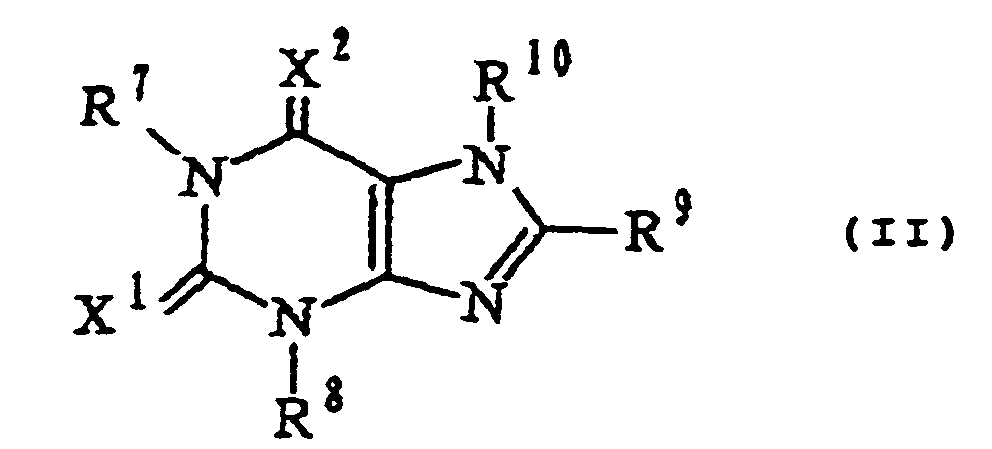

R10 is hydrogen, and
X1 and X2 each is an oxygen atom. - Suitable saltsof the above xanthine compound may include salts of the kinds mentioned hereinbefore with reference to pyrazolopyridine compound (I).
- The following definitions pertain to particularly preferred examples of the compound (II).
- The preferred example of the above "lower alkyl group" may be (C1-C4)alkyl, and the most preferred one may be propyl.
- Suitable cyclo (C3-C8) alkyl groups include cyclopropyl, cyclobutyl, cyclopentyl, cyclohexyl, cycloheptyl and cyclooctyl [particularly preferred one may be cyclo (C3-C6) alkyl].
- Particularly preferred (C7-C12) tricycloalkyl groups may be groups of the formula:

- R9 includes cyclo(C3-C8) alkyl which may have oxo; (C7-C12)tricycloalkyl; and groups of the formula:

- The more preferred one may be cyclo(C3-C6)alkyl which may have oxo; groups of the formula:


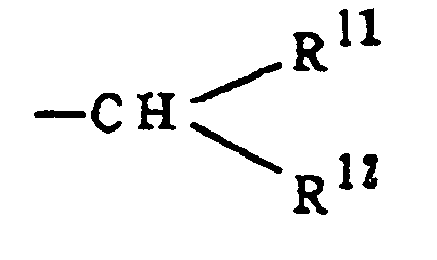
- Among the xanthine compound (II) described above, the particularly preferred compound for the practice of the present invention may include the following ones.
- (1) 8-(Noradamantan-3-yl)-1,3-dipropylxanthine
- (2) 8-Cyclopentyl-1,3-dipropylxanthine
- The pharmaceutical composition suited for the practice of the present invention may be the bulk of adenosine A1 antagonist or a salt thereof, or in the form of a solid, semisolid or liquid pharmaceutical preparation containing said antagonist or salt thereof as an active ingredient together with an organic or inorganic carrier or excipient suitable for rectal administration, oral or parenteral (inclusive of subcutaneous, intravenous and intramuscular) administration, intratesticular administration, intraurethral administration, intradeferential administration, intrascrotal.administration, administration into the female reproductive organ (e.g. intravaginal administration, intrauterine administration, etc.), administration to the ejaculated seminal fluid in various artificial insemination procedures, administration to sperm in the presence of ova in vitro fertilization, or inhalation. The active ingredient can be compounded with the conventional nontoxic, pharmaceutically acceptable carriers for use in the preparation of tablets, pellets, troches, capsules, suppositories, aerosols, powders for inhalation, solutions, emulsions, suspensions and any other form suitable for use. Where necessary, adjuvants (auxiliary agents), stabilizers, thickeners, coloring agents and perfumes can be used. The adenosine A1 antagonist or its salt can be contained in the pharmaceutical preparation at a sufficient level to produce an expected therapeutic effect according to the course or status of disease.
- The pharmaceutical preparations for use in the practice of the present invention can be manufactured by the procedures established in the art. Where necessary, the techniques used in the art for enhancing the bioavailability of drugs can also be applied to the manufacture of the pharmaceutical preparations of the invention.
- When a preparation of the invention is applied in an infertile man, it is preferably administered by the intravenous (inclusive of addition to an infusion), intramuscular, oral, intratesticular, intraurethral, intradeferential or intrascrotal route, or into the female reproductive organ, or to ejaculated seminal fluids in various artificial insemination procedures or to sperm in the presence of ova in vitro fertilization.
- The therapeutically effective dose of the adenosine A1 antagonist varies with the patient's age and other factors, but for the tretament of male sterility, 0.01~200 mg, as the adenosine A1 antagonist, per kilogram body weight can be administered daily.
- The preparation may also be administered for the prophylaxis of male sterility. Furthermore, it is also expected to find application in female infertility as well as in male sterility. In addition, its utilization as an in vitro diagnostic reagent for sperm function testing is also expected.
Claims (16)
- Use of an adenosine A1 antagonist or a salt thereof for the manufacture of a medicament for treating male sterility..
- Use of claim 1, wherein the adenosine A1 antagonist is a pyrozolopyridine compound of the following general formula or a salt thereof:

R2 is a group of the formula:
cyano;
group of the formula: -A-R6
(wherein R6 is acyl group, and A is lower aliphatic hydrocarbon group which may have one or more suitable substituent(s));
amidated carboxyl;
unsaturated heterocyclic group which may have one or more suitable substituent(s);
amino; or
protected amino; and
R3 is hydrogen, lower alkyl, lower alkoxy, or halogen]. - Use of claim 2, wherein the adenosine A1 antagonist is a pyrazolopyridine compound of the formula:

R is acyl(lower)alkyl or hydroxy(lower)alkyl, and
A is lower alkenyl). - Use of claim 3, wherein the adenosine A1 antagonist is a compound as defined in claim 3 in which R1 is phenyl, and R is carboxy(lower)alkyl.
- Use of claim 4, wherein the adenosine A1 antagonist is 1-[3-(2-phenylpyrazolo[1,5-a]pyridin-3-yl)acryloyl]-2-(carboxymethyl)piperidine.
- Use of claim 2, wherein the adenosine A1, antagonist is a pyrazolopyridine compound of the formula:

R2 is dihydropyridazinyl having acyl(lower)alkyl and oxo;
dihydropyridazinyl having cyclo(lower)alkyl substituted by acyl(lower)alkyl or acyl(lower)alkylidene and oxo; or
dihydropyridazinyl having cyclo(lower)alkenyl substituted by acyl(lower)alkyl or acyl(lower)alkylidene and oxo]. - Use of claim 6, wherein the adenosine A1 antagonist is a compound as defined in claim 6 in which
R1 is phenyl and
R2 is a 3-oxo-2,3-dihydropyridazinyl having carboxy(lower)alkyl or 3-oxo-2,3-dihydropyridazinyl having cyclo(lower)alkenyl substituted by carboxy(lower)alkyl. - Use of claim 7, wherein the adenosine A1 antagonist is 3-[2-(3-carboxypropyl)-3-oxo-2,3-dihydropyridazin-6-yl]-2-phenylpyrazolo[1,5-a]pyridine.
- Use of claim 7, wherein the adenosine A1 antagonist is 3-[2-(2-carboxymethyl-1-cyclohexenyl)-3-oxo-2,3-dihydropyridazin-6-yl]-2-phenylpyrazolo[1,5-a]pyridine.
- Use of claim 1, wherein the adenosine A1 antagonist is a xanthine compound of the following formula

R7 and R8 each is lower alkyl,
R9 is cyclo(C3-C8)alkyl which may have oxo;
(C7-C12)tricycloalkyl; or a group of the formula:
R10 is hydrogen, and
X1 and X2 each is an oxygen atom. - Use of claim 1, wherein the adenosine A1 antagonist Is a specific adenosine A1 antagonist.
- Use of claim 1, wherein the adenosine A1 antagonist is a substance having adenosine A1 antagonist activity with an IC50 value of not more than 100 µM.
- Use of claim 1, wherein the adenosine A1 antagonist is a substance having adenosine A1 antagonist activity with an IC50 value of not more than 50 µM.
- Use of claim 1, wherein the adenosine A1 antagonist is a substance having adenosine A1 antagonist activity with an IC50 value of not more than 10 µM.
- Use of claim 1, wherein the adenosine A1 antagonist is a substance having adenosine A1 antagonist activity with an IC50 value of not more than 1 µM.
- Use of an adenosine A1 antagonist or a salt thereof for the manufacture of a medicament for promoting an induction of sperm acrosomal reaction.
Applications Claiming Priority (5)
| Application Number | Priority Date | Filing Date | Title |
|---|---|---|---|
| JP15122498 | 1998-06-01 | ||
| JP15122498 | 1998-06-01 | ||
| JP31779598 | 1998-11-09 | ||
| JP31779598 | 1998-11-09 | ||
| PCT/JP1999/002811 WO1999062553A1 (en) | 1998-06-01 | 1999-05-28 | Remedies for male sterility |
Publications (3)
| Publication Number | Publication Date |
|---|---|
| EP1084710A1 EP1084710A1 (en) | 2001-03-21 |
| EP1084710A4 EP1084710A4 (en) | 2004-10-06 |
| EP1084710B1 true EP1084710B1 (en) | 2006-10-18 |
Family
ID=26480537
Family Applications (1)
| Application Number | Title | Priority Date | Filing Date |
|---|---|---|---|
| EP99922530A Expired - Lifetime EP1084710B1 (en) | 1998-06-01 | 1999-05-28 | Adenosine a1 antagonists for male sterility |
Country Status (8)
| Country | Link |
|---|---|
| US (1) | US6521656B1 (en) |
| EP (1) | EP1084710B1 (en) |
| AT (1) | ATE342734T1 (en) |
| AU (1) | AU754094B2 (en) |
| CA (1) | CA2333947C (en) |
| DE (1) | DE69933671T2 (en) |
| ES (1) | ES2273487T3 (en) |
| WO (1) | WO1999062553A1 (en) |
Families Citing this family (10)
| Publication number | Priority date | Publication date | Assignee | Title |
|---|---|---|---|---|
| US7732484B2 (en) | 2000-08-01 | 2010-06-08 | University Of Virginia Patent Foundation | Use of selective adenosine A1 receptor allosteric enhancers to manipulate angiogenesis |
| US6977300B2 (en) | 2001-11-09 | 2005-12-20 | Cv Therapeutics, Inc. | A2B adenosine receptor antagonists |
| US7317017B2 (en) | 2002-11-08 | 2008-01-08 | Cv Therapeutics, Inc. | A2B adenosine receptor antagonists |
| KR100937620B1 (en) * | 2001-11-09 | 2010-01-20 | 씨브이 쎄러퓨틱스, 인코포레이티드 | A2B adenosine receptor antagonist |
| US7125993B2 (en) | 2001-11-09 | 2006-10-24 | Cv Therapeutics, Inc. | A2B adenosine receptor antagonists |
| MX2007014114A (en) | 2005-05-10 | 2008-03-14 | Intermune Inc | DERIVATIVES OF PIRIDONA TO MODULATE THE SYSTEM OF PROTEIN KINASE ACTIVATED BY STRESS. |
| JP5627574B2 (en) * | 2008-06-03 | 2014-11-19 | インターミューン, インコーポレイテッド | Compounds and methods for treating inflammatory and fibrotic diseases |
| CN106986862A (en) | 2010-12-22 | 2017-07-28 | Abbvie 公司 | Hepatitis c inhibitor and application thereof |
| AR092742A1 (en) | 2012-10-02 | 2015-04-29 | Intermune Inc | ANTIFIBROTIC PYRIDINONES |
| US10233195B2 (en) | 2014-04-02 | 2019-03-19 | Intermune, Inc. | Anti-fibrotic pyridinones |
Family Cites Families (7)
| Publication number | Priority date | Publication date | Assignee | Title |
|---|---|---|---|---|
| DE8817122U1 (en) * | 1988-12-22 | 1993-02-04 | Boehringer Ingelheim Kg, 55218 Ingelheim | New xanthine derivatives with adenosine antogenic activity |
| GB8901423D0 (en) * | 1989-01-23 | 1989-03-15 | Fujisawa Pharmaceutical Co | Pyrazolopyridine compound and processes for preparation thereof |
| JPH06102662B2 (en) * | 1989-09-01 | 1994-12-14 | 協和醗酵工業株式会社 | Xanthine derivative |
| GB9015764D0 (en) * | 1990-07-18 | 1990-09-05 | Fujisawa Pharmaceutical Co | Pyrazolopyridine compound and processes for preparation thereof |
| GB9107513D0 (en) * | 1991-04-10 | 1991-05-29 | Fujisawa Pharmaceutical Co | Pyrazolopyridine compound and processes for preparation thereof |
| WO1995011681A1 (en) * | 1993-10-29 | 1995-05-04 | Merck & Co., Inc. | Human adenosine receptor antagonists |
| CA2180253A1 (en) * | 1993-12-29 | 1995-07-06 | Atsushi Akahane | Pyrazolopyridine adenosine antagonists |
-
1999
- 1999-05-28 CA CA2333947A patent/CA2333947C/en not_active Expired - Fee Related
- 1999-05-28 DE DE69933671T patent/DE69933671T2/en not_active Expired - Lifetime
- 1999-05-28 WO PCT/JP1999/002811 patent/WO1999062553A1/en not_active Ceased
- 1999-05-28 US US09/701,385 patent/US6521656B1/en not_active Expired - Lifetime
- 1999-05-28 AU AU39549/99A patent/AU754094B2/en not_active Ceased
- 1999-05-28 AT AT99922530T patent/ATE342734T1/en not_active IP Right Cessation
- 1999-05-28 ES ES99922530T patent/ES2273487T3/en not_active Expired - Lifetime
- 1999-05-28 EP EP99922530A patent/EP1084710B1/en not_active Expired - Lifetime
Also Published As
| Publication number | Publication date |
|---|---|
| DE69933671T2 (en) | 2007-02-01 |
| EP1084710A4 (en) | 2004-10-06 |
| AU3954999A (en) | 1999-12-20 |
| WO1999062553A1 (en) | 1999-12-09 |
| US6521656B1 (en) | 2003-02-18 |
| CA2333947A1 (en) | 1999-12-09 |
| EP1084710A1 (en) | 2001-03-21 |
| DE69933671D1 (en) | 2006-11-30 |
| ATE342734T1 (en) | 2006-11-15 |
| AU754094B2 (en) | 2002-11-07 |
| ES2273487T3 (en) | 2007-05-01 |
| CA2333947C (en) | 2010-09-21 |
Similar Documents
| Publication | Publication Date | Title |
|---|---|---|
| EP0497258B1 (en) | Use of adenosine antagonists in the prevention and treatment of pancreatitis and ulcer | |
| EP1177797A1 (en) | Novel use | |
| JP7746278B2 (en) | Compounds for targeted degradation of BRD9 | |
| US20040152659A1 (en) | Method for the treatment of parkinson's disease comprising administering an A1A2a receptor dual antagonist | |
| ES2299888T3 (en) | PIRID (2,3-D) PYRIMIDIN-2,4-DIAMINS AS PDE INHIBITORS 2. | |
| US20010041673A1 (en) | Combinations of corticotropin releasing factor antagonists and growth hormone secretagogues | |
| US5338743A (en) | New use of the adenosine antagonist | |
| KR20060110006A (en) | Therapeutic Combinations of Atypical Antipsychotics and Corticotropin Release Factor Antagonists | |
| US6521656B1 (en) | Remedies for male sterility | |
| AU2011267385A1 (en) | Heteroaryl imidazolone derivatives as JAK inhibitors | |
| EP0644762B1 (en) | Pyrazolopyridine compounds for the treatment of anemia | |
| Sugerman et al. | Molindone: An indole derivative with antipsychotic activity | |
| US6214843B1 (en) | Preventives and remedies for ischemic intestinal lesion and ileus | |
| US6303624B1 (en) | Preventives and remedies for hyperphosphatemia | |
| US6232324B1 (en) | Use of pyrazolopyridine compound | |
| JPWO1999062553A1 (en) | Male infertility treatment | |
| JPWO1998041237A1 (en) | Preventive and therapeutic agent for hyperphosphatemia | |
| JPWO1997040047A1 (en) | Preventive and therapeutic agent for ischemic intestinal lesions and ileus | |
| JPWO1996033715A1 (en) | New uses of pyrazolopyridine compounds | |
| JPH06192092A (en) | New use of pyrazolopyridine | |
| KR100237505B1 (en) | New use of the adenosine antagonist | |
| JPH0959157A (en) | New use of pyrazolopyridine compound | |
| JPWO2000069464A1 (en) | New uses | |
| US5026699A (en) | Use of 5,11-dihydro-6H-pyrido[2,3-b][1,4]-benzodiazepin-6-ones substituted in the 11-position for treating bradycardia and bradyarrhythmia in human and veterinary medicine | |
| JPH06239743A (en) | New use of pyrazolopyridine compound |
Legal Events
| Date | Code | Title | Description |
|---|---|---|---|
| PUAI | Public reference made under article 153(3) epc to a published international application that has entered the european phase |
Free format text: ORIGINAL CODE: 0009012 |
|
| 17P | Request for examination filed |
Effective date: 20001204 |
|
| AK | Designated contracting states |
Kind code of ref document: A1 Designated state(s): AT BE CH DE DK ES FI FR GB GR IE IT LI LU NL PT SE |
|
| A4 | Supplementary search report drawn up and despatched |
Effective date: 20040820 |
|
| 17Q | First examination report despatched |
Effective date: 20050429 |
|
| GRAP | Despatch of communication of intention to grant a patent |
Free format text: ORIGINAL CODE: EPIDOSNIGR1 |
|
| RAP1 | Party data changed (applicant data changed or rights of an application transferred) |
Owner name: ASTELLAS PHARMA INC. |
|
| RIC1 | Information provided on ipc code assigned before grant |
Ipc: A61P 15/08 00000000ALI20051117BHEP Ipc: C07D 473/04 19850101ALI20051117BHEP Ipc: C07D 471/04 19850101ALI20051117BHEP Ipc: A61K 31/52 19850101ALI20051117BHEP Ipc: A61K 31/435 19850101ALI20051117BHEP Ipc: A61K 45/00 19850101AFI20051117BHEP |
|
| RTI1 | Title (correction) |
Free format text: ADENOSINE A1 ANTAGONISTS FOR MALE STERILITY |
|
| GRAS | Grant fee paid |
Free format text: ORIGINAL CODE: EPIDOSNIGR3 |
|
| GRAA | (expected) grant |
Free format text: ORIGINAL CODE: 0009210 |
|
| AK | Designated contracting states |
Kind code of ref document: B1 Designated state(s): AT BE CH DE DK ES FI FR GB GR IE IT LI LU NL PT SE |
|
| PG25 | Lapsed in a contracting state [announced via postgrant information from national office to epo] |
Ref country code: LI Free format text: LAPSE BECAUSE OF FAILURE TO SUBMIT A TRANSLATION OF THE DESCRIPTION OR TO PAY THE FEE WITHIN THE PRESCRIBED TIME-LIMIT Effective date: 20061018 Ref country code: FI Free format text: LAPSE BECAUSE OF FAILURE TO SUBMIT A TRANSLATION OF THE DESCRIPTION OR TO PAY THE FEE WITHIN THE PRESCRIBED TIME-LIMIT Effective date: 20061018 Ref country code: CH Free format text: LAPSE BECAUSE OF FAILURE TO SUBMIT A TRANSLATION OF THE DESCRIPTION OR TO PAY THE FEE WITHIN THE PRESCRIBED TIME-LIMIT Effective date: 20061018 Ref country code: BE Free format text: LAPSE BECAUSE OF FAILURE TO SUBMIT A TRANSLATION OF THE DESCRIPTION OR TO PAY THE FEE WITHIN THE PRESCRIBED TIME-LIMIT Effective date: 20061018 Ref country code: AT Free format text: LAPSE BECAUSE OF FAILURE TO SUBMIT A TRANSLATION OF THE DESCRIPTION OR TO PAY THE FEE WITHIN THE PRESCRIBED TIME-LIMIT Effective date: 20061018 |
|
| REG | Reference to a national code |
Ref country code: GB Ref legal event code: FG4D |
|
| REG | Reference to a national code |
Ref country code: IE Ref legal event code: FG4D Ref country code: CH Ref legal event code: EP |
|
| REF | Corresponds to: |
Ref document number: 69933671 Country of ref document: DE Date of ref document: 20061130 Kind code of ref document: P |
|
| PG25 | Lapsed in a contracting state [announced via postgrant information from national office to epo] |
Ref country code: SE Free format text: LAPSE BECAUSE OF FAILURE TO SUBMIT A TRANSLATION OF THE DESCRIPTION OR TO PAY THE FEE WITHIN THE PRESCRIBED TIME-LIMIT Effective date: 20070118 Ref country code: DK Free format text: LAPSE BECAUSE OF FAILURE TO SUBMIT A TRANSLATION OF THE DESCRIPTION OR TO PAY THE FEE WITHIN THE PRESCRIBED TIME-LIMIT Effective date: 20070118 |
|
| PG25 | Lapsed in a contracting state [announced via postgrant information from national office to epo] |
Ref country code: PT Free format text: LAPSE BECAUSE OF FAILURE TO SUBMIT A TRANSLATION OF THE DESCRIPTION OR TO PAY THE FEE WITHIN THE PRESCRIBED TIME-LIMIT Effective date: 20070319 |
|
| ET | Fr: translation filed | ||
| REG | Reference to a national code |
Ref country code: CH Ref legal event code: PL |
|
| REG | Reference to a national code |
Ref country code: ES Ref legal event code: FG2A Ref document number: 2273487 Country of ref document: ES Kind code of ref document: T3 |
|
| PLBE | No opposition filed within time limit |
Free format text: ORIGINAL CODE: 0009261 |
|
| STAA | Information on the status of an ep patent application or granted ep patent |
Free format text: STATUS: NO OPPOSITION FILED WITHIN TIME LIMIT |
|
| 26N | No opposition filed |
Effective date: 20070719 |
|
| PG25 | Lapsed in a contracting state [announced via postgrant information from national office to epo] |
Ref country code: GR Free format text: LAPSE BECAUSE OF FAILURE TO SUBMIT A TRANSLATION OF THE DESCRIPTION OR TO PAY THE FEE WITHIN THE PRESCRIBED TIME-LIMIT Effective date: 20070119 |
|
| PG25 | Lapsed in a contracting state [announced via postgrant information from national office to epo] |
Ref country code: IE Free format text: LAPSE BECAUSE OF NON-PAYMENT OF DUE FEES Effective date: 20070528 |
|
| PG25 | Lapsed in a contracting state [announced via postgrant information from national office to epo] |
Ref country code: LU Free format text: LAPSE BECAUSE OF NON-PAYMENT OF DUE FEES Effective date: 20070528 |
|
| REG | Reference to a national code |
Ref country code: FR Ref legal event code: PLFP Year of fee payment: 17 |
|
| PGFP | Annual fee paid to national office [announced via postgrant information from national office to epo] |
Ref country code: GB Payment date: 20150527 Year of fee payment: 17 Ref country code: DE Payment date: 20150519 Year of fee payment: 17 Ref country code: ES Payment date: 20150413 Year of fee payment: 17 |
|
| PGFP | Annual fee paid to national office [announced via postgrant information from national office to epo] |
Ref country code: IT Payment date: 20150515 Year of fee payment: 17 Ref country code: NL Payment date: 20150409 Year of fee payment: 17 Ref country code: FR Payment date: 20150508 Year of fee payment: 17 |
|
| REG | Reference to a national code |
Ref country code: DE Ref legal event code: R119 Ref document number: 69933671 Country of ref document: DE |
|
| REG | Reference to a national code |
Ref country code: NL Ref legal event code: MM Effective date: 20160601 |
|
| GBPC | Gb: european patent ceased through non-payment of renewal fee |
Effective date: 20160528 |
|
| PG25 | Lapsed in a contracting state [announced via postgrant information from national office to epo] |
Ref country code: NL Free format text: LAPSE BECAUSE OF NON-PAYMENT OF DUE FEES Effective date: 20160601 Ref country code: IT Free format text: LAPSE BECAUSE OF NON-PAYMENT OF DUE FEES Effective date: 20160528 |
|
| REG | Reference to a national code |
Ref country code: FR Ref legal event code: ST Effective date: 20170131 |
|
| PG25 | Lapsed in a contracting state [announced via postgrant information from national office to epo] |
Ref country code: FR Free format text: LAPSE BECAUSE OF NON-PAYMENT OF DUE FEES Effective date: 20160531 Ref country code: DE Free format text: LAPSE BECAUSE OF NON-PAYMENT OF DUE FEES Effective date: 20161201 |
|
| PG25 | Lapsed in a contracting state [announced via postgrant information from national office to epo] |
Ref country code: GB Free format text: LAPSE BECAUSE OF NON-PAYMENT OF DUE FEES Effective date: 20160528 |
|
| PG25 | Lapsed in a contracting state [announced via postgrant information from national office to epo] |
Ref country code: ES Free format text: LAPSE BECAUSE OF NON-PAYMENT OF DUE FEES Effective date: 20160529 |
|
| REG | Reference to a national code |
Ref country code: ES Ref legal event code: FD2A Effective date: 20181126 |