EP1084693A1 - $g(a)-HYDROXY FATTY ACID DERIVATIVES AND COMPOSITION FOR EXTERNAL USE CONTAINING THE SAME - Google Patents
$g(a)-HYDROXY FATTY ACID DERIVATIVES AND COMPOSITION FOR EXTERNAL USE CONTAINING THE SAME Download PDFInfo
- Publication number
- EP1084693A1 EP1084693A1 EP99922548A EP99922548A EP1084693A1 EP 1084693 A1 EP1084693 A1 EP 1084693A1 EP 99922548 A EP99922548 A EP 99922548A EP 99922548 A EP99922548 A EP 99922548A EP 1084693 A1 EP1084693 A1 EP 1084693A1
- Authority
- EP
- European Patent Office
- Prior art keywords
- fatty acid
- chain
- alpha
- ester
- hydroxy fatty
- Prior art date
- Legal status (The legal status is an assumption and is not a legal conclusion. Google has not performed a legal analysis and makes no representation as to the accuracy of the status listed.)
- Granted
Links
- 0 CC*(*N)(*(C)C)O*C Chemical compound CC*(*N)(*(C)C)O*C 0.000 description 1
Images


Classifications
-
- A—HUMAN NECESSITIES
- A61—MEDICAL OR VETERINARY SCIENCE; HYGIENE
- A61K—PREPARATIONS FOR MEDICAL, DENTAL OR TOILETRY PURPOSES
- A61K8/00—Cosmetics or similar toiletry preparations
- A61K8/18—Cosmetics or similar toiletry preparations characterised by the composition
- A61K8/30—Cosmetics or similar toiletry preparations characterised by the composition containing organic compounds
- A61K8/33—Cosmetics or similar toiletry preparations characterised by the composition containing organic compounds containing oxygen
- A61K8/36—Carboxylic acids; Salts or anhydrides thereof
- A61K8/365—Hydroxycarboxylic acids; Ketocarboxylic acids
-
- A—HUMAN NECESSITIES
- A61—MEDICAL OR VETERINARY SCIENCE; HYGIENE
- A61K—PREPARATIONS FOR MEDICAL, DENTAL OR TOILETRY PURPOSES
- A61K8/00—Cosmetics or similar toiletry preparations
- A61K8/18—Cosmetics or similar toiletry preparations characterised by the composition
- A61K8/30—Cosmetics or similar toiletry preparations characterised by the composition containing organic compounds
- A61K8/33—Cosmetics or similar toiletry preparations characterised by the composition containing organic compounds containing oxygen
- A61K8/37—Esters of carboxylic acids
-
- A—HUMAN NECESSITIES
- A61—MEDICAL OR VETERINARY SCIENCE; HYGIENE
- A61K—PREPARATIONS FOR MEDICAL, DENTAL OR TOILETRY PURPOSES
- A61K47/00—Medicinal preparations characterised by the non-active ingredients used, e.g. carriers or inert additives; Targeting or modifying agents chemically bound to the active ingredient
- A61K47/06—Organic compounds, e.g. natural or synthetic hydrocarbons, polyolefins, mineral oil, petrolatum or ozokerite
- A61K47/08—Organic compounds, e.g. natural or synthetic hydrocarbons, polyolefins, mineral oil, petrolatum or ozokerite containing oxygen, e.g. ethers, acetals, ketones, quinones, aldehydes, peroxides
- A61K47/14—Esters of carboxylic acids, e.g. fatty acid monoglycerides, medium-chain triglycerides, parabens or PEG fatty acid esters
-
- A—HUMAN NECESSITIES
- A61—MEDICAL OR VETERINARY SCIENCE; HYGIENE
- A61K—PREPARATIONS FOR MEDICAL, DENTAL OR TOILETRY PURPOSES
- A61K9/00—Medicinal preparations characterised by special physical form
- A61K9/0012—Galenical forms characterised by the site of application
- A61K9/0014—Skin, i.e. galenical aspects of topical compositions
-
- A—HUMAN NECESSITIES
- A61—MEDICAL OR VETERINARY SCIENCE; HYGIENE
- A61P—SPECIFIC THERAPEUTIC ACTIVITY OF CHEMICAL COMPOUNDS OR MEDICINAL PREPARATIONS
- A61P17/00—Drugs for dermatological disorders
-
- A—HUMAN NECESSITIES
- A61—MEDICAL OR VETERINARY SCIENCE; HYGIENE
- A61Q—SPECIFIC USE OF COSMETICS OR SIMILAR TOILETRY PREPARATIONS
- A61Q19/00—Preparations for care of the skin
-
- C—CHEMISTRY; METALLURGY
- C07—ORGANIC CHEMISTRY
- C07C—ACYCLIC OR CARBOCYCLIC COMPOUNDS
- C07C69/00—Esters of carboxylic acids; Esters of carbonic or haloformic acids
- C07C69/66—Esters of carboxylic acids having esterified carboxylic groups bound to acyclic carbon atoms and having any of the groups OH, O—metal, —CHO, keto, ether, acyloxy, groups, groups, or in the acid moiety
- C07C69/67—Esters of carboxylic acids having esterified carboxylic groups bound to acyclic carbon atoms and having any of the groups OH, O—metal, —CHO, keto, ether, acyloxy, groups, groups, or in the acid moiety of saturated acids
- C07C69/675—Esters of carboxylic acids having esterified carboxylic groups bound to acyclic carbon atoms and having any of the groups OH, O—metal, —CHO, keto, ether, acyloxy, groups, groups, or in the acid moiety of saturated acids of saturated hydroxy-carboxylic acids
-
- A—HUMAN NECESSITIES
- A61—MEDICAL OR VETERINARY SCIENCE; HYGIENE
- A61K—PREPARATIONS FOR MEDICAL, DENTAL OR TOILETRY PURPOSES
- A61K2800/00—Properties of cosmetic compositions or active ingredients thereof or formulation aids used therein and process related aspects
- A61K2800/74—Biological properties of particular ingredients
- A61K2800/75—Anti-irritant
-
- A—HUMAN NECESSITIES
- A61—MEDICAL OR VETERINARY SCIENCE; HYGIENE
- A61Q—SPECIFIC USE OF COSMETICS OR SIMILAR TOILETRY PREPARATIONS
- A61Q1/00—Make-up preparations; Body powders; Preparations for removing make-up
- A61Q1/02—Preparations containing skin colorants, e.g. pigments
- A61Q1/04—Preparations containing skin colorants, e.g. pigments for lips
- A61Q1/06—Lipsticks
-
- A—HUMAN NECESSITIES
- A61—MEDICAL OR VETERINARY SCIENCE; HYGIENE
- A61Q—SPECIFIC USE OF COSMETICS OR SIMILAR TOILETRY PREPARATIONS
- A61Q5/00—Preparations for care of the hair
- A61Q5/02—Preparations for cleaning the hair
Definitions
- the present invention relates to novel alpha-hydroxy fatty acid derivatives, and external compositions containing the same.
- oily bases For the purpose of minimizing water loss from the skin and hair and providing them with the smoothness, gloss or the like, oily bases have widely been used. Since these oily bases are applied to portions such as the skin or hair of the human body, the oily substances and body constituting substances preferably resemble each other in components and properties. The oily substances importantly exhibit neither irritation nor toxicity to the skin in view of the safety.
- wax diesters contain, as principal components, alpha-hydroxy fatty acids having 14 to 22 carbon atoms, fatty acids having 14 to 28 carbon atoms and higher alcohols having 14 to 28 carbon atoms, but wax diesters composed of short-chain fatty acids having 2 to 6 carbon atoms have never been reported. It has never been reported to use wax diesters in external compositions.
- An object of the present invention is to provide a novel oily base, which has excellent stability , low melting point , dose not irritate the skin and is superior feel in use, and an external composition contains the oily base.
- the present inventors have studied intensively to attain the object described above and found that the alpha-hydroxy fatty acid derivative represented by the following general formula (1). Though the alpha-hydroxy fatty acid derivative is saturated compound, it has low melting point. And it dose not irritate the skin and is also superior in feel in use.
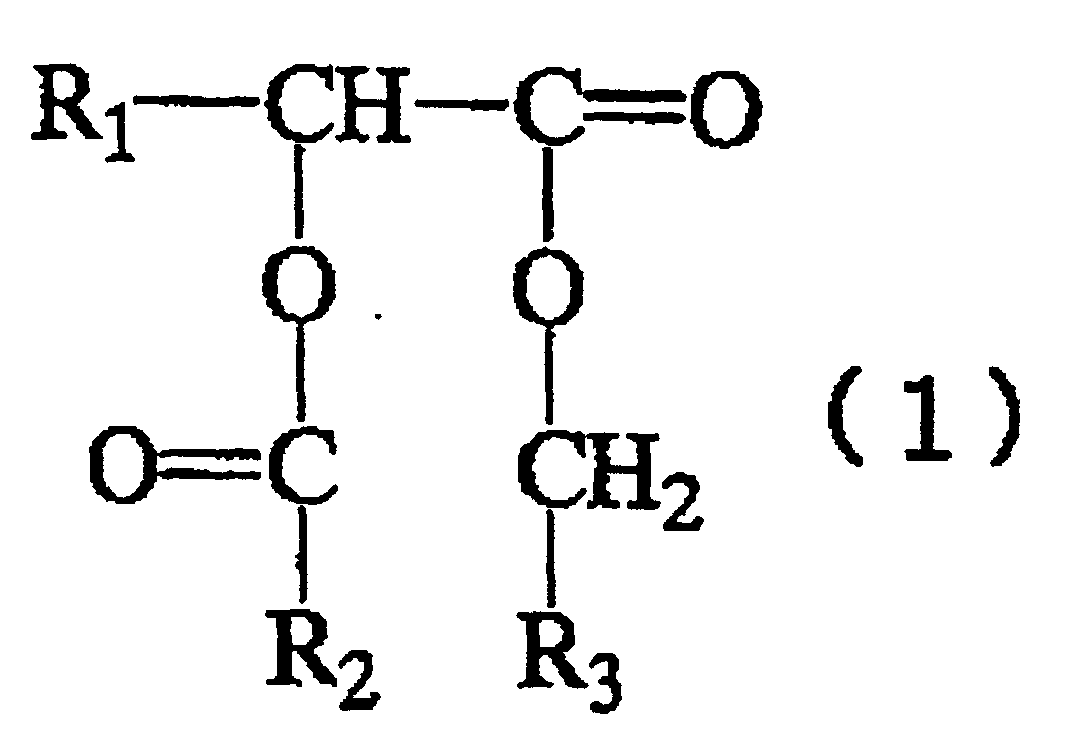
- the present invention is an external composition comprising one or more alpha-hydroxy fatty acid derivatives represented by the general formula (1): wherein R 1 represents a straight-chain or branched alkyl group having 10 to 24 carbon atoms, R 2 represents a straight-chain or branched alkyl group having 1 to 31 carbon atoms, and R 3 represents a straight-chain or branched alkyl group having 11 to 31 carbon atoms.
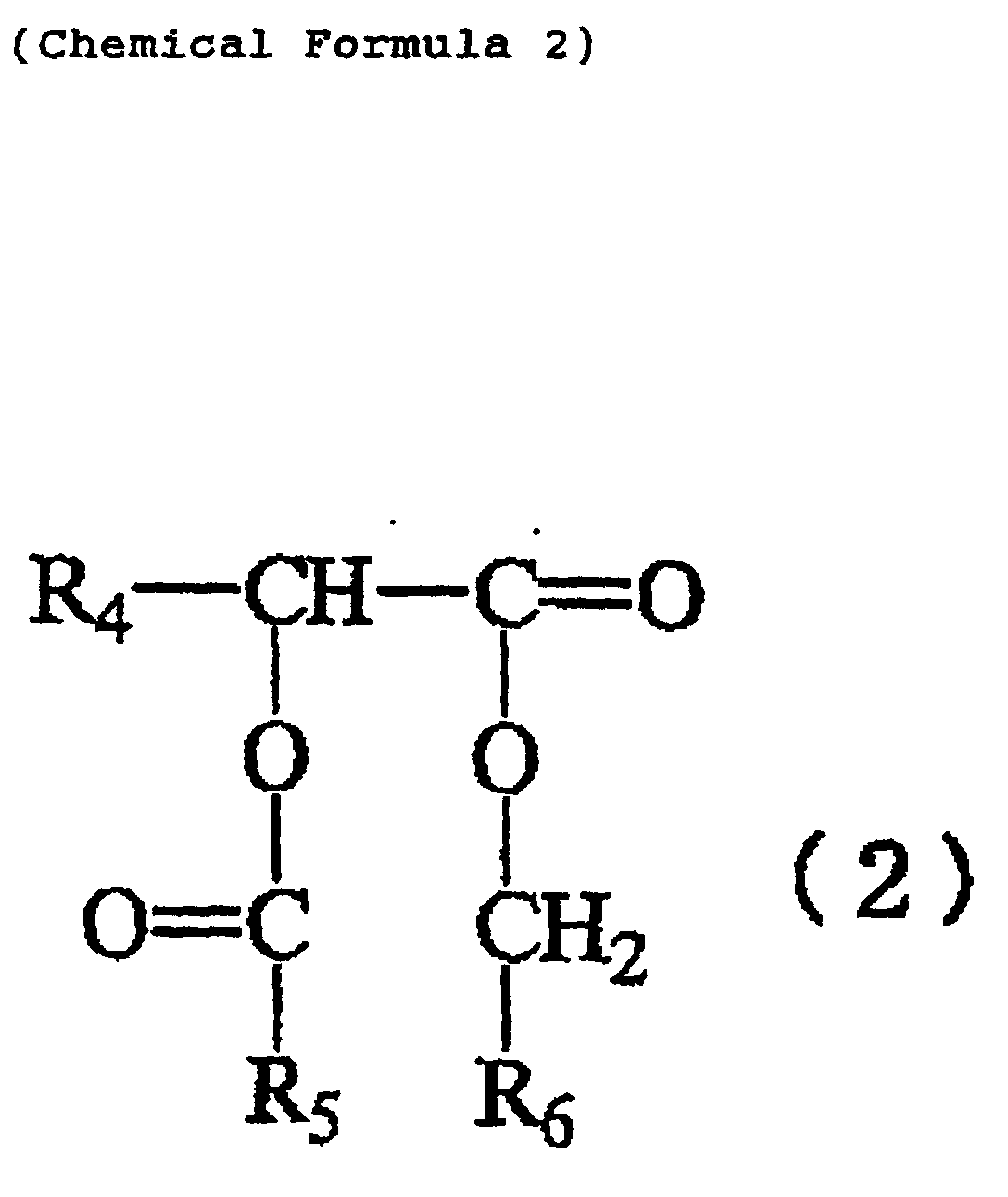
- the present invention is also an alpha-hydroxy fatty acid derivatives represented by the general formula (2): wherein R 4 represents a straight-chain or branched alkyl group having 10 to 20 carbon atoms, R 5 represents a straight-chain or iso- or anteiso-branched alkyl group having 1 to 5 carbon atoms, and R 6 represents a straight-chain or iso- or anteiso-branched alkyl group having 11 to 31 carbon atoms.
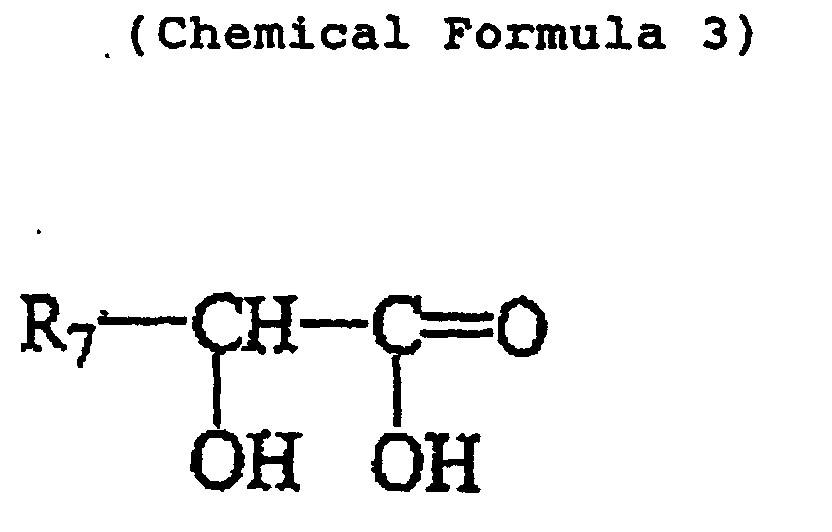
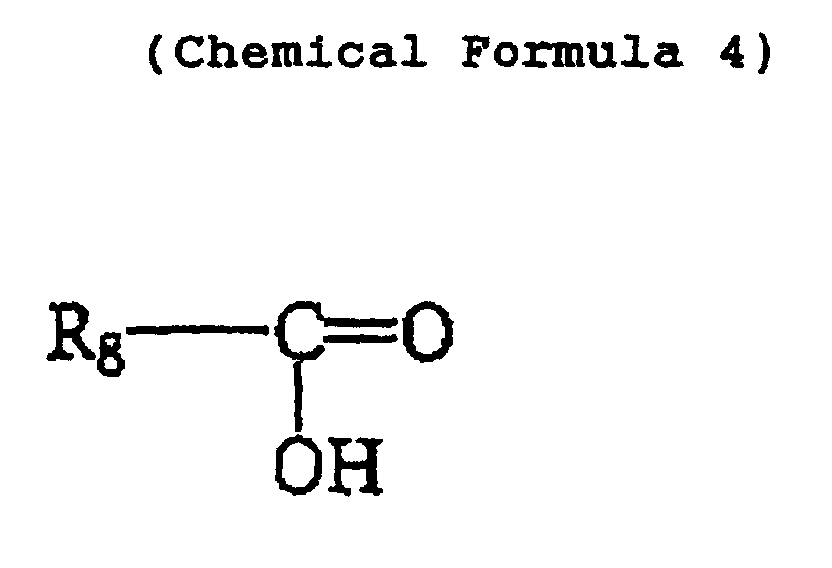
- the alpha-hydroxy fatty acid derivatives of the general formulas (1) and (2) of the present invention can be prepared by using an alpha-hydroxy fatty acid represented by the following chemical formula 3 or an alpha-hydroxy fatty acid derivative such as its methyl ester, a fatty acid represented by the following chemical formula 4 or fatty acid derivative such as an anhydrides and halides, and a higher alcohol represented by the following chemical formula 5 as raw materials according to a conventional procedure.
- R 7 represents a straight-chain or branched alkyl group having 10 to 24 carbon atoms
- R 8 represents a straight-chain or branched alkyl group having 1 to 31 carbon atoms
- R 9 -CH 2 -OH wherein R 9 represents a straight-chain or branched alkyl group having 11 to 31 carbon atoms
- the alpha-hydroxy fatty acid derivatives can easily be prepared by using an ordinary acidic catalyst and enzyme. If necessary, the alpha-hydroxy fatty acid derivatives can be used after purifying by deacidification, decoloring and deodorization according to a conventional method. In some cases, the alpha-hydroxy fatty acid derivatives may be contained unreacted alpha-hydroxy fatty acid, fatty acid, higher alcohol, and alpha-hydroxy fatty acid monoalkyl ester as an intermediate.
- the alpha-hydroxy fatty acid derivatives (1) and (2) according to the present invention can be extracted from Cashmere goat's fur by using an organic solvent. If necessary, the alpha-hydroxy fatty acid derivatives can also be used after purifying by a conventional method. Those, which are, present on the surface animal's fur such as cow, rabbit, cat and the like do not correspond to the alpha-hydroxy fatty acid derivative (2) and is contained in the derivative (1).
- the alpha-hydroxy fatty acid derivative according to the present invention obtained by the above procedure can be used in skin care compositions such as lotions, milky lotions, creams, packs, face washes, foundations, lipsticks, and bath preparation; and hair care compositions such as shampoos, rinses, hair treatments, and hair creams.
- skin care compositions such as lotions, milky lotions, creams, packs, face washes, foundations, lipsticks, and bath preparation
- hair care compositions such as shampoos, rinses, hair treatments, and hair creams.
- the alpha-hydroxy fatty acid derivative can be used in conventional cosmetics, quasi-drugs and drugs.
- the amount of the alpha-hydroxy fatty acid derivative is preferably used within a range from 0.1 to 60.0% by weight (hereinafter described as "wt%") based on the total weight in view of the effect and economical reason.
- the external composition there can be used components that are conventionally used in cosmetics, quasi-drugs and drugs.
- the component include fats and oils, dyes, perfumes, antiseptics, surfactants, pigments, antioxidants, cheleting agents, ultraviolet absorbers, ultraviolet scattering agents, polymeric viscosity modifiers, inorganic salts, polyhydric alcohols, vitamins, higher alcohols, vegetable extracts and the like.
- the term "external composition” includes a hair care composition and a skin care composition.
- any of cationic, anionic, nonionic, amphoteric and other surfactants can be used.
- the cationic surfactant include quaternary ammonium salts such as aliphatic amine salt, quaternary ammonium salt, alkyltrialkyleneglycol ammonium salt, alkyl ether ammonium salt, pyridinium salt, imidazolinium salt, benzalkonium salt and the like.
- anionic surfactant examples include carboxylates such as acylaminate, alkyl ether carboxylate, and fatty acid salt; sulfonates such as N-acylmethyltaurine salts and alpha-olefin sulfonic acid salts; sulfates such as alkyl sulfate and fatty alkanolamide sulfate; and phosphates such as polyxyethylene alkyl ether phosphate and fatty amide ether phosphate.
- carboxylates such as acylaminate, alkyl ether carboxylate, and fatty acid salt
- sulfonates such as N-acylmethyltaurine salts and alpha-olefin sulfonic acid salts
- sulfates such as alkyl sulfate and fatty alkanolamide sulfate
- phosphates such as polyxyethylene alkyl ether phosphate and fatty amide ether phosphate.
- nonionic surfactant examples include polyhydric alcohol fatty esters or polyhydric alcohol alkyl ethers, such as sorbitan fatty acid ester, sucrose fatty acid ester, and ethylene glycol monofatty acid ester; polyoxyethylene ethers such as polyoxyethylene alkyl ether, polyoxyethylene alkyl phenyl ether, polyoxyethylene cholesterol, and polyoxyethylene polyoxypropylene alkyl ether; ether esters such as polyoxyethylene monofatty acid ester, polyethylene glycol difatty acid ester, polyoxyethylene sorbitan fatty acid ester, polyoxyethylene sorbitol fatty acid ester, polyoxyethylene castor oil, polyoxyethylene alkyl ether fatty acid ester, and polyoxyethylene methyl glucoside fatty acid ester; and nitrogen-containing derivatives such as alkylamine oxide, polyoxyethylene alkylamine, and alkyldiethanol amide.
- polyhydric alcohol fatty esters or polyhydric alcohol alkyl ethers such as
- amphoteric surfactant examples include glycine type surfactants, aminopropionic acid type surfactants, carboxybetaine type surfactants, sulfuric acid type surfactants, phosphoric type surfactants, and carboxylic acid type surfactants such as sulfobetaine type surfactant.
- other surfactant examples include fluorine surfactants; silicone surfactants such as polyether-modified silicone and amino-modified silicone; and natural surfactants such as saponin and lecithin.
- polyhydric alcohol examples include ethylene glycol, diethylene glycol, triethylene glycol, polyethylene glycol, propylene glycol, dipropylene glycol, polypropylene glycol, glycerin diglycerin, polyglycerin, 3-methyl-1, 3-butanediol, 1,3-butylene glycol, saccharides and the like.
- the higher alcohols to be used may be natural or synthetic higher alcohol, and may be straight-chain, branched, saturated or unsaturated. Specific examples thereof include isostearyl alcohol, octyl dodecanol, hexyl decanol, lauryl alcohol, myristyl alcohol, stearyl alcohol, oleyl alcohol, behenyl alcohol, cetanol and the like.
- the formation of 2-hydroxypalmitic acid palmityl ester was confirmed by a signal at 175.5, 70.5 and 65.7 ppm observed in the measurement of 13 C-NMR.
- the wax diesters fraction was saponified and methylated by conventional methods and then analyzed by gas chromatography.
- the alpha-hydroxy fatty acids contain alpha-hydroxy palmitic acid as a principal component and have 12 to 20 carbon atoms.
- the alpha-hydroxy fatty acids were saturated, straight-chain compounds contained small amounts of iso- or anteiso- branched chain compounds.
- the fatty acids were straight-chain, or iso- or anteiso- branched saturated fatty acids having 2 to 6 carbon atoms, principally isobutyric acid.
- the higher alcohols were straight-chain, or iso- or anteiso- branched saturated higher alcohols having 12 to 25 carbon atoms, principally 18-methylicosanol and 18-methylnonadecanol. That is, the wax diesters of Cashmere were compounds corresponding to the general formula (2).
- the melting point of the alpha-hydroxy fatty acid derivatives of the present invention is shown in Table 1.
- 2-Palmitoyloxypalmitic acid palmityl ester, 2-isobutyloxy long-chain fatty acid (14-25) long-chain branched alcohol (12-31) ester, 2-isobutyryloxypalmitic acid palmityl ester and 2-acetyloxypalmitic acid palmityl ester were obtained in Example 1, Example 4, Example 5 and Example 6, respectively:
- glyceryl tripalmitate manufactured by Tokyo Chemicals Industry Co., Ltd.
- cetyl palmitate manufactured by Funakosbi Co., Ltd.
- ceramide 2 manufactured by Cederma
- ceramide 3 manufactured by Gist-brocades
- the alpha-hydroxy fatty acid derivatives according to the present invention had noticeably lower melting points. Furthermore, the melting points were than that of ceramide, and the ordinary oily base having the same molecular weight. And the melting points were closer to the body or the skin surface temperature. As is apparent from these results, the alpha-hydroxy fatty acid derivative according to the present invention is superior in physical properties for lipid to be used in external compositions such as skin or hair composition.
- alpha-hydroxy fatty acid derivatives according to the present invention, the melting points of 2-isobutyryloxypalmitic acid palmityl ester, 2-isobutyryloxy long-chain fatty acid (14-25) long-chain branched alcohol (12-31) ester or 2-acetyloxypalmitic acid palmityl ester wherein the chain length of the substituted fatty acid is short [R 2 in the general formula (1) or R 5 in the general formula (2)], were noticeably lower than that of 2-palmitoyloxypalmitic acid palmityl ester and are closer to the body temperature or skin temperature. That is, the alpha-hydroxy fatty acid derivative has particularly excellent physical properties for oily base used in the external composition.
- the skin creams were prepared with the formulation shown in Table 3 by a conventional method.
- Application Example 1 was a skin cream containing 2-palmitoyloxypalmitic acid palmityl ester obtained in Example 1.
- a skin care cream containing no alpha-hydroxy fatty acid derivatives as Comparative Example 1 was prepared.
- the comparative sensory test was carried out by applying the skin care creams of Application Example 1 and Comparative Example 1 to each lower leg portion of 20 women panelists twice a day for one week by a conventional method.
- the results of the comparative sensory test, the number of persons, who answered that "the skin became smooth", “the skin was moisturized” and "the skin was firmer” with respect to the respective items such as smoothness, moisture and elasticity, are also shown in Table 3.
- the skin care cream of Application Example 1 as the skin composition of the present invention was superior in all properties to Comparative Example 1 which contains no alpha-hydroxy fatty acid derivative.
- Application Example 1 had no problems in the stability and no skin trouble such as the irritation to skin..
- a skin care milky lotion was prepared with the formulation of Table 4 using 2-isobutyryloxymyristic acid-(18)-methylicosanyl ester obtained in Example 2 and 2-acetyloxystearic acid- (18)-methylnonadecanyl ester obtained in Example 3 by a conventional method.
- the skin care milky lotion of the present invention exhibited an extremely good stability of emulsified state, and was not greasy and exhibited good affinity with the skin when applied on the face, hands and feet. Also the skin care milky lotion had excellent sensory properties capable of providing the smoothness, moisture and elasticity.
- a lipstick was prepared with the formulation of Table 5 using 2-acetyloxypalmitic acid palmityl ester obtained in Example 6, 2-long-chain branched fatty acid (12-31) oxypalmitic acid palmityl ester obtained in Example 8 and the wax diesters of Cashmere obtained in Example 9 by a conventional method.
- the lipstick as the skin composition of the present invention was good stability such as good dispersion of pigments and exhibited excellent sensory properties such as no greasiness and good make-up retention.
- the lipstick was prepared by using a Cashmere lipids extract of Example 9 in place of the wax diesters of Cashmere had slight odor as compared with the lipstick of Application Example 3, but exhibited excellent sensory properties..
- a hair rinses were prepared with the formulation shown in Table 6 by a conventional method.
- Application Example 4 was a hair rinse containing 2-isobutyryloxy long-chain (14-25) long-chain branched alcohol (12-3) ester obtained in Example 4.
- Comparative Example 2 was lacked alpha-hydroxy fatty acid derivatives.
- the comparative sensory test was carried out by applying the hair rinses of Application Example 4 and Comparative Example 2 to 20 women panelists once a day for three days by a conventional method.
- the results of the comparative sensory test the number of persons, who answered that "the hair became smooth", “the hair was moisturized” and "the hair became glossy” with respect to the respective items such as smoothness, moisture and gloss are also shown in Table 6.
- the hair rinse of Application Example 4 as the hair composition of the present invention was superior in all properties to Comparative Example 2 which lacked the alpha-hydroxy fatty acid derivatives.
- Application Example 4 had no problem in the stability and no skin trouble such as the irritation to skin.
- a hair shampoo was prepared with the formulation shown in Table 7 using 2-isovaleryloxylauric acid lauryl obtained in Example 7.
- the hair shampoo of Application Example 5 of the present invention exhibited satisfactory foaming and detergency and was smooth on washing-out, and also exhibited excellent sensory properties such as smoothness, moisture and gloss after drying.
- the novel alpha-hydroxy fatty acid derivatives of the present invention have excellent properties for oily base with low melting points and dose not irritation to the skin. Furthermore, skin and hair compositions containing the alpha-hydroxy fatty acid derivative as an essential component had good stability and also had good sensory properties.
- the novel composition of present invention is useful for external use.
Landscapes
- Health & Medical Sciences (AREA)
- Chemical & Material Sciences (AREA)
- Life Sciences & Earth Sciences (AREA)
- Veterinary Medicine (AREA)
- Public Health (AREA)
- General Health & Medical Sciences (AREA)
- Animal Behavior & Ethology (AREA)
- Organic Chemistry (AREA)
- Epidemiology (AREA)
- Pharmacology & Pharmacy (AREA)
- Dermatology (AREA)
- Medicinal Chemistry (AREA)
- Emergency Medicine (AREA)
- Chemical Kinetics & Catalysis (AREA)
- General Chemical & Material Sciences (AREA)
- Birds (AREA)
- Engineering & Computer Science (AREA)
- Oil, Petroleum & Natural Gas (AREA)
- Bioinformatics & Cheminformatics (AREA)
- Nuclear Medicine, Radiotherapy & Molecular Imaging (AREA)
- Cosmetics (AREA)
- Organic Low-Molecular-Weight Compounds And Preparation Thereof (AREA)
- Acyclic And Carbocyclic Compounds In Medicinal Compositions (AREA)
Abstract
Description

| Name of compounds | Melting point (°C) |
| 2-palmitoyloxypalmitic acid palmityl ester | 52.5 |
| 2-isobutyloxy long-chain fatty acid (14-25) long-chain branched alcohol (12-31) ester | 2.0 |
| 2-isobutyryloxypalmitic acid palmityl ester | 28.3 |
| 2-acetyloxypalmitic acid palmityl ester | 35.1 |
| Wax diesters of Cashmere | -0.8 |
| Glyceryl tripalmitate | 64.1 |
| Cetyl palmitate | 52.8 |
| Ceramide 2 | 106.8 |
| Ceramide 3 | 125.3 |
| Name of samples | Positive percentage (%) |
| 2-palmitoyloxypalmitic | 0 |
| 2-isobutyloxymyristic acid- (18)- | 0 |
| 2-acetyloxymyristic acid- (18)- | 0 |
| 2-isobutyloxy long-chain fatty acid (14-25) long-chain branched alcohol (12-31) | 0 |
| 2-isobutyryloxypalmitic | 0 |
| 2-acetyloxypalmitic | 0 |
| 2-isovaleryloxypalmitic | 0 |
| 2-long-chain branched fatty acid (12-31) | 0 |
| Wax diesters of | 0 |
| Name of Components (wt%) | Application Example 1 | Comparative Example 1 |
| 2-palmitoyloxypalmitic acid palmityl ester | 15.0 | - |
| Squalane | 5.0 | 5.0 |
| Liquid petrolatum | 5.0 | 5.0 |
| Cholesterol | 0.5 | 0.5 |
| Hydrogenated soybean phopholipid | 1.0 | 1.0 |
| Glyceryl monostearate | 1.0 | 1.0 |
| Sorbitan monostearate | 2.0 | 2.0 |
| Dipropylene glycol | 5.0 | 5.0 |
| 1,3-butylene glycol | 5.0 | 5.0 |
| Methyl parahydroxybenzoate | 0.1 | 0.1 |
| Purified water | balance | Balance |
| Comparative sensory test results (number of persons) | ||
| Smoothness | 19 | 1 |
| Moisture | 18 | 2 |
| Elasticity | 18 | 2 |
| Name of components (wt%) | Application Example 2 |
| 2-isobutyloxymyristic acid- (18)-methylisaconyl ester | 3.0 |
| 2-acetyloxymyristic acid- (18)-methylnonadecanyl ester | 2.0 |
| Octyldodecy myristate | 2.0 |
| Poloxyethylene hydrogenated castor oil (60E.O.) | 1.0 |
| Myristic acid | 0.5 |
| Glycerin | 10.0 |
| Diglycerin | 5.0 |
| Maltitol | 2.0 |
| Carboxyvinyl polymer | 0.2 |
| Potassium hydroxide | 0.3 |
| Methyl parahydroxybenzoate | 0.1 |
| Potassium edetate | 0.1 |
| Purified water | balance |
| Name of components (wt%) | Application Example 3 |
| 2-palmitoyloxypalmitic acid palmityl ester | 30.0 |
| 2-long-chain branched fatty acid (12-31) palmityl oxypalmitate | 20.0 |
| Wax diesters of Cashmere | 10.0 |
| Beeswax | 10.0 |
| Carnauba wax | 10.0 |
| 2-Octyldodecanol | 5.0 |
| Behenyl alcohol | 5.0 |
| Pigment | 9.8 |
| Perfume | 0.2 |
| Name of Components (wt%) | Application Example 4 | Comparative Example 2 |
| 2-isobutyryloxy long-chain (14-25) long-chain branched alcohol (12-31) ester | 2.0 | - |
| Cetyl alcohol | 3.0 | 3.0 |
| Stearyl trimethyl ammonium chloride | 1.5 | 1.5 |
| Polyoxyethylene cetyl ether (10E.O.) | 1.0 | 1.0 |
| Glycerin | 5.0 | 5.0 |
| Methyl parahydroxybenzoate | 0.1 | 0.1 |
| Perfume (flesh floral compound perfume) | 0.3 | 0.3 |
| Purified water | balance | balance |
| Comparative sensory test results (number of persons) | ||
| | 20 | 0 |
| Moisture | 18 | 2 |
| Gloss | 19 | 1 |
| Name of components (% by weight) | Application Example 5 |
| 2-isovaleryloxylauric acid lauryl ester | 0.1 |
| Lauramidopropyl betaine | 15.0 |
| Coconut fatty acid diethanolamide | 5.0 |
| Sodium N-cocoyl N-methyl tauratecoconut | 3.0 |
| Stearyl trimethyl ammonium chloride | 0.3 |
| Polyoxyethylene-methylpolysiloxane copolymer | 0.5 |
| Methyl parahydroxybenzoate | 0.2 |
| Citric acid | 0.2 |
| Disodium edetate | 0.1 |
| Perfume (citrus perfume) | 0.6 |
| Purified water | balance |
Claims (6)
- An external composition comprising one or more alpha-hydroxy fatty acid derivatives represented by the general formula (1):wherein R1 represents a straight-chain or branched alkyl group having 10 to 24 carbon atoms, R2 represents a straight-chain or branched alkyl group having 1 to 31 carbon atoms, and R3 represents a straight-chain or branched alkyl group having 11 to 31 carbon atoms.
- An alpha-hydroxy fatty acid derivative represented by the general formula (2):wherein R4 represents a straight-chain or branched alkyl group having 10 to 20 carbon atoms, R5 represents a straight-chain or iso- or anteiso-branched alkyl group having 1 to 5 carbon atoms, and R6 represents a straight-chain or iso- or anteiso-branched alkyl group having 11 to 31 carbon atoms.
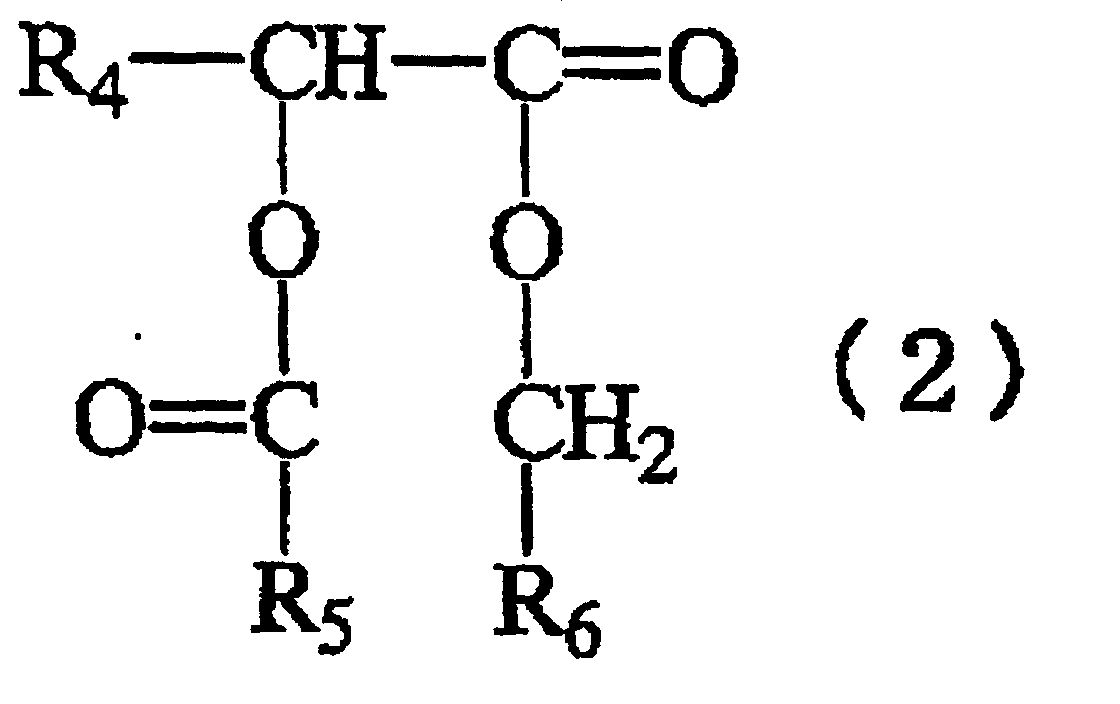
- An external composition comprising one or more alpha-hydroxy fatty acid derivatives of claim 2.
- The external composition according to claim 1 or 3, further comprising at least one selected from the group consisting of surfactant, polyhydric alcohol and higher alcohol.
- The external composition according to claim 1 or 3, further comprising at least one selected from the group consisting of perfume and pigment.
- The external composition according to any one of claims 1 and 3 to 5, which is a cosmetic.
Applications Claiming Priority (3)
| Application Number | Priority Date | Filing Date | Title |
|---|---|---|---|
| JP15570698 | 1998-06-04 | ||
| JP15570698 | 1998-06-04 | ||
| PCT/JP1999/002831 WO1999062463A1 (en) | 1998-06-04 | 1999-05-27 | α-HYDROXY FATTY ACID DERIVATIVES AND COMPOSITION FOR EXTERNAL USE CONTAINING THE SAME |
Publications (3)
| Publication Number | Publication Date |
|---|---|
| EP1084693A1 true EP1084693A1 (en) | 2001-03-21 |
| EP1084693A4 EP1084693A4 (en) | 2002-08-28 |
| EP1084693B1 EP1084693B1 (en) | 2005-10-05 |
Family
ID=15611744
Family Applications (1)
| Application Number | Title | Priority Date | Filing Date |
|---|---|---|---|
| EP99922548A Expired - Lifetime EP1084693B1 (en) | 1998-06-04 | 1999-05-27 | Alpha-hydroxy fatty acid derivatives and composition for external use containing the same |
Country Status (10)
| Country | Link |
|---|---|
| US (1) | US6531143B1 (en) |
| EP (1) | EP1084693B1 (en) |
| JP (1) | JP3515522B2 (en) |
| KR (1) | KR100421516B1 (en) |
| CN (1) | CN1133413C (en) |
| AU (1) | AU3955599A (en) |
| CA (1) | CA2333701C (en) |
| DE (1) | DE69927585T2 (en) |
| ES (1) | ES2249003T3 (en) |
| WO (1) | WO1999062463A1 (en) |
Cited By (4)
| Publication number | Priority date | Publication date | Assignee | Title |
|---|---|---|---|---|
| FR2830752A1 (en) * | 2001-10-11 | 2003-04-18 | Oreal | Cosmetic composition used to impart shine and softness to hair, comprises 3-32C optionally ethoxylated alcohol and 3-32C carboxylic acid and esterifying enzyme |
| EP1304100A1 (en) * | 2001-10-11 | 2003-04-23 | L'oreal | Hair treatment by application of exogenous enzymes, alcohols and acids or triglycerides |
| WO2004022029A3 (en) * | 2002-09-07 | 2004-07-22 | Procter & Gamble | Branched alcohol-based personal care compositions |
| WO2012009523A3 (en) * | 2010-07-15 | 2013-05-16 | The Procter & Gamble Company | A personal care composition comprising a near-terminal branched compound |
Families Citing this family (8)
| Publication number | Priority date | Publication date | Assignee | Title |
|---|---|---|---|---|
| US6150322A (en) * | 1998-08-12 | 2000-11-21 | Shell Oil Company | Highly branched primary alcohol compositions and biodegradable detergents made therefrom |
| JP3437494B2 (en) * | 1999-07-01 | 2003-08-18 | カネボウ株式会社 | Novel α-hydroxy fatty acid derivative and composition for external use |
| JP3403984B2 (en) | 1999-11-30 | 2003-05-06 | カネボウ株式会社 | Fiber treatment composition |
| US20040042988A1 (en) * | 2002-09-03 | 2004-03-04 | Raney Kirk Herbert | Personal care compositions containing highly branched primary alcohol component |
| BRPI0413970A (en) * | 2003-08-28 | 2006-10-31 | Shell Internationale Reseach M | branched ester composition, personal care composition, and use of branched ester composition |
| AU2005219405B2 (en) * | 2004-03-02 | 2007-10-11 | Shell Internationale Research Maatschappij B.V. | Personal care composition comprising highly branched primary alcohol component |
| US20060046135A1 (en) * | 2004-08-27 | 2006-03-02 | Weiwei Huang | Alkaline battery with MnO2/NiOOH active material |
| JP5465921B2 (en) | 2009-05-15 | 2014-04-09 | 出光興産株式会社 | Biodegradable lubricating oil composition |
Family Cites Families (13)
| Publication number | Priority date | Publication date | Assignee | Title |
|---|---|---|---|---|
| US2452029A (en) * | 1945-06-21 | 1948-10-26 | Rohm & Haas | Addition products from acrylic esters |
| US2652411A (en) * | 1952-07-18 | 1953-09-15 | Howard M Teeter | Alkyl acyloxy stearates |
| US3308140A (en) * | 1963-06-24 | 1967-03-07 | Edward T Roe | Chain substituted higher fatty acids |
| US4469635A (en) * | 1980-12-24 | 1984-09-04 | The Procter & Gamble Company | Polyol esters of alpha-hydroxy carboxylic acids |
| US4867965A (en) * | 1986-10-02 | 1989-09-19 | Revlon, Inc. | Fatty acid diesters |
| WO1991001713A1 (en) * | 1987-03-13 | 1991-02-21 | R.I.T.A. Corporation | Cosmetic base composition with therapeutic properties |
| US5659049A (en) * | 1988-02-18 | 1997-08-19 | Virginia Commonwealth University | Antioxidant, antiphospholipase derivatives of ricinoleic acid |
| US5451405A (en) * | 1994-04-25 | 1995-09-19 | Chesebrough-Pond's Usa Co. | Skin treatment composition |
| US5968543A (en) * | 1996-01-05 | 1999-10-19 | Advanced Polymer Systems, Inc. | Polymers with controlled physical state and bioerodibility |
| JP2001509137A (en) * | 1996-11-12 | 2001-07-10 | タマーキン ファーマシューティカル イノベイション リミテッド | How to treat skin diseases |
| US5989533A (en) * | 1997-07-21 | 1999-11-23 | Revlon Consumer Products Corporation | Hair conditioning compositions containing alpha or beta hydroxy acid esters |
| US5961992A (en) * | 1997-07-22 | 1999-10-05 | Lever Brothers Company Inc. | Benefit agent compositions comprising mixtures of alpha-hydroxy esters |
| US6180120B1 (en) * | 1998-12-08 | 2001-01-30 | Elizabeth Arden Co., Division Of Conopco, Inc. | Cosmetic skin care compositions containing alpha hydroxy acids linoleates |
-
1999
- 1999-05-27 JP JP2000551723A patent/JP3515522B2/en not_active Expired - Fee Related
- 1999-05-27 US US09/701,532 patent/US6531143B1/en not_active Expired - Lifetime
- 1999-05-27 AU AU39555/99A patent/AU3955599A/en not_active Abandoned
- 1999-05-27 KR KR10-2000-7013171A patent/KR100421516B1/en not_active Expired - Fee Related
- 1999-05-27 CN CNB998066419A patent/CN1133413C/en not_active Expired - Fee Related
- 1999-05-27 WO PCT/JP1999/002831 patent/WO1999062463A1/en not_active Ceased
- 1999-05-27 CA CA002333701A patent/CA2333701C/en not_active Expired - Fee Related
- 1999-05-27 ES ES99922548T patent/ES2249003T3/en not_active Expired - Lifetime
- 1999-05-27 DE DE69927585T patent/DE69927585T2/en not_active Expired - Lifetime
- 1999-05-27 EP EP99922548A patent/EP1084693B1/en not_active Expired - Lifetime
Non-Patent Citations (2)
| Title |
|---|
| No further relevant documents disclosed * |
| See also references of WO9962463A1 * |
Cited By (4)
| Publication number | Priority date | Publication date | Assignee | Title |
|---|---|---|---|---|
| FR2830752A1 (en) * | 2001-10-11 | 2003-04-18 | Oreal | Cosmetic composition used to impart shine and softness to hair, comprises 3-32C optionally ethoxylated alcohol and 3-32C carboxylic acid and esterifying enzyme |
| EP1304100A1 (en) * | 2001-10-11 | 2003-04-23 | L'oreal | Hair treatment by application of exogenous enzymes, alcohols and acids or triglycerides |
| WO2004022029A3 (en) * | 2002-09-07 | 2004-07-22 | Procter & Gamble | Branched alcohol-based personal care compositions |
| WO2012009523A3 (en) * | 2010-07-15 | 2013-05-16 | The Procter & Gamble Company | A personal care composition comprising a near-terminal branched compound |
Also Published As
| Publication number | Publication date |
|---|---|
| CN1133413C (en) | 2004-01-07 |
| JP3515522B2 (en) | 2004-04-05 |
| DE69927585T2 (en) | 2006-07-20 |
| AU3955599A (en) | 1999-12-20 |
| CA2333701A1 (en) | 1999-12-09 |
| ES2249003T3 (en) | 2006-03-16 |
| EP1084693B1 (en) | 2005-10-05 |
| US6531143B1 (en) | 2003-03-11 |
| CA2333701C (en) | 2003-04-08 |
| DE69927585D1 (en) | 2006-02-16 |
| KR20010043775A (en) | 2001-05-25 |
| CN1303260A (en) | 2001-07-11 |
| WO1999062463A1 (en) | 1999-12-09 |
| KR100421516B1 (en) | 2004-03-09 |
| EP1084693A4 (en) | 2002-08-28 |
Similar Documents
| Publication | Publication Date | Title |
|---|---|---|
| US7687066B2 (en) | Self emulsifying oily liquid cosmetic | |
| US6346256B1 (en) | Stable O/W/O emulsion and its use as a cosmetic and/or dermatological composition | |
| KR0185178B1 (en) | Hydroxylated milk glycerides | |
| CN101516449B (en) | Alkyl benzoate mixtures | |
| US5017368A (en) | Composition for application to hair or scalp | |
| US5885593A (en) | Skin care composition including cyclodextrin materials and method for treating skin therewith | |
| EP1084693B1 (en) | Alpha-hydroxy fatty acid derivatives and composition for external use containing the same | |
| CN116528830A (en) | Long chain esters for cosmetic treatment of skin | |
| JPWO1999062463A1 (en) | α-hydroxy fatty acid derivative and topical composition containing same | |
| CN116367816A (en) | Novel Uses of Sugar Isomers | |
| KR19990023818A (en) | Aqueous dispersions based on lipid vesicles used in anti-inflammatory compositions | |
| AU656830B2 (en) | A cosmetic or dermatological composition containing a diol ester | |
| JP3483984B2 (en) | Cosmetics | |
| KR20220156532A (en) | Estolide composition for topical application | |
| JP3437494B2 (en) | Novel α-hydroxy fatty acid derivative and composition for external use | |
| Urata et al. | Cholesteryl ester compounds containing alkyl branched acyl groups—their preparations, properties and applications | |
| JP2871764B2 (en) | Cosmetics | |
| EP4570322A1 (en) | Oil-in-water-type emulsion composition | |
| JP2003026530A (en) | Cosmetics and external preparations | |
| EP0769292A1 (en) | Products for dermatologic care and cosmetics | |
| JP3712676B2 (en) | External preparation composition | |
| EP2512411B1 (en) | Composition with enhanced hydration ability | |
| JP2001010921A (en) | Composition for external use | |
| JP4150738B2 (en) | External preparation composition | |
| JP2004277341A (en) | Emulsified composition |
Legal Events
| Date | Code | Title | Description |
|---|---|---|---|
| PUAI | Public reference made under article 153(3) epc to a published international application that has entered the european phase |
Free format text: ORIGINAL CODE: 0009012 |
|
| 17P | Request for examination filed |
Effective date: 20001106 |
|
| AK | Designated contracting states |
Kind code of ref document: A1 Designated state(s): CH DE ES FR GB IT LI NL |
|
| RTI1 | Title (correction) |
Free format text: ALPHA-HYDROXY FATTY ACID DERIVATIVES AND COMPOSITION FOR EXTERNAL USE CONTAINING THE SAME |
|
| A4 | Supplementary search report drawn up and despatched |
Effective date: 20020715 |
|
| AK | Designated contracting states |
Kind code of ref document: A4 Designated state(s): CH DE ES FR GB IT LI NL |
|
| 17Q | First examination report despatched |
Effective date: 20031219 |
|
| RAP1 | Party data changed (applicant data changed or rights of an application transferred) |
Owner name: KANEBO COSMETICS, INC. |
|
| GRAP | Despatch of communication of intention to grant a patent |
Free format text: ORIGINAL CODE: EPIDOSNIGR1 |
|
| GRAS | Grant fee paid |
Free format text: ORIGINAL CODE: EPIDOSNIGR3 |
|
| GRAA | (expected) grant |
Free format text: ORIGINAL CODE: 0009210 |
|
| AK | Designated contracting states |
Kind code of ref document: B1 Designated state(s): CH DE ES FR GB IT LI NL |
|
| REG | Reference to a national code |
Ref country code: GB Ref legal event code: FG4D |
|
| REG | Reference to a national code |
Ref country code: CH Ref legal event code: EP |
|
| REG | Reference to a national code |
Ref country code: CH Ref legal event code: NV Representative=s name: HEPP, WENGER & RYFFEL AG |
|
| REF | Corresponds to: |
Ref document number: 69927585 Country of ref document: DE Date of ref document: 20060216 Kind code of ref document: P |
|
| REG | Reference to a national code |
Ref country code: ES Ref legal event code: FG2A Ref document number: 2249003 Country of ref document: ES Kind code of ref document: T3 |
|
| ET | Fr: translation filed | ||
| PLBE | No opposition filed within time limit |
Free format text: ORIGINAL CODE: 0009261 |
|
| STAA | Information on the status of an ep patent application or granted ep patent |
Free format text: STATUS: NO OPPOSITION FILED WITHIN TIME LIMIT |
|
| 26N | No opposition filed |
Effective date: 20060706 |
|
| REG | Reference to a national code |
Ref country code: GB Ref legal event code: 732E |
|
| NLS | Nl: assignments of ep-patents |
Owner name: KAO CORPORATION Effective date: 20061218 |
|
| REG | Reference to a national code |
Ref country code: FR Ref legal event code: TP |
|
| REG | Reference to a national code |
Ref country code: CH Ref legal event code: PFA Owner name: KAO CORPORATION Free format text: KAO CORPORATION#14-10, NIHONBASHI KAYABACHO 1-CHOME#CHUO-KU, TOKYO (JP) -TRANSFER TO- KAO CORPORATION#14-10, NIHONBASHI KAYABACHO 1-CHOME#CHUO-KU, TOKYO (JP) |
|
| REG | Reference to a national code |
Ref country code: FR Ref legal event code: PLFP Year of fee payment: 17 |
|
| REG | Reference to a national code |
Ref country code: FR Ref legal event code: PLFP Year of fee payment: 18 |
|
| REG | Reference to a national code |
Ref country code: FR Ref legal event code: PLFP Year of fee payment: 19 |
|
| PGFP | Annual fee paid to national office [announced via postgrant information from national office to epo] |
Ref country code: NL Payment date: 20170519 Year of fee payment: 19 |
|
| PGFP | Annual fee paid to national office [announced via postgrant information from national office to epo] |
Ref country code: CH Payment date: 20170519 Year of fee payment: 19 Ref country code: DE Payment date: 20170523 Year of fee payment: 19 Ref country code: FR Payment date: 20170523 Year of fee payment: 19 Ref country code: GB Payment date: 20170519 Year of fee payment: 19 |
|
| PGFP | Annual fee paid to national office [announced via postgrant information from national office to epo] |
Ref country code: ES Payment date: 20170627 Year of fee payment: 19 Ref country code: IT Payment date: 20170526 Year of fee payment: 19 |
|
| REG | Reference to a national code |
Ref country code: DE Ref legal event code: R119 Ref document number: 69927585 Country of ref document: DE |
|
| REG | Reference to a national code |
Ref country code: CH Ref legal event code: PL |
|
| REG | Reference to a national code |
Ref country code: NL Ref legal event code: MM Effective date: 20180601 |
|
| GBPC | Gb: european patent ceased through non-payment of renewal fee |
Effective date: 20180527 |
|
| PG25 | Lapsed in a contracting state [announced via postgrant information from national office to epo] |
Ref country code: LI Free format text: LAPSE BECAUSE OF NON-PAYMENT OF DUE FEES Effective date: 20180531 Ref country code: CH Free format text: LAPSE BECAUSE OF NON-PAYMENT OF DUE FEES Effective date: 20180531 |
|
| PG25 | Lapsed in a contracting state [announced via postgrant information from national office to epo] |
Ref country code: GB Free format text: LAPSE BECAUSE OF NON-PAYMENT OF DUE FEES Effective date: 20180527 Ref country code: NL Free format text: LAPSE BECAUSE OF NON-PAYMENT OF DUE FEES Effective date: 20180601 Ref country code: DE Free format text: LAPSE BECAUSE OF NON-PAYMENT OF DUE FEES Effective date: 20181201 Ref country code: IT Free format text: LAPSE BECAUSE OF NON-PAYMENT OF DUE FEES Effective date: 20180527 Ref country code: FR Free format text: LAPSE BECAUSE OF NON-PAYMENT OF DUE FEES Effective date: 20180531 |
|
| REG | Reference to a national code |
Ref country code: ES Ref legal event code: FD2A Effective date: 20190913 |
|
| PG25 | Lapsed in a contracting state [announced via postgrant information from national office to epo] |
Ref country code: ES Free format text: LAPSE BECAUSE OF NON-PAYMENT OF DUE FEES Effective date: 20180528 |