EP1084170B1 - Polyethylene glycol-polyorthoester, polyethylene glycol-polyorthoester-polyethylene glycol, and polyorthoester-polyethylene glycol-polyorthoester block copolymers - Google Patents
Polyethylene glycol-polyorthoester, polyethylene glycol-polyorthoester-polyethylene glycol, and polyorthoester-polyethylene glycol-polyorthoester block copolymers Download PDFInfo
- Publication number
- EP1084170B1 EP1084170B1 EP99926034A EP99926034A EP1084170B1 EP 1084170 B1 EP1084170 B1 EP 1084170B1 EP 99926034 A EP99926034 A EP 99926034A EP 99926034 A EP99926034 A EP 99926034A EP 1084170 B1 EP1084170 B1 EP 1084170B1
- Authority
- EP
- European Patent Office
- Prior art keywords
- copolymer
- formula
- block
- active agent
- polyorthoester
- Prior art date
- Legal status (The legal status is an assumption and is not a legal conclusion. Google has not performed a legal analysis and makes no representation as to the accuracy of the status listed.)
- Expired - Lifetime
Links
- 229920001400 block copolymer Polymers 0.000 title claims abstract description 41
- -1 Polyethylene Polymers 0.000 title description 79
- 229920001223 polyethylene glycol Polymers 0.000 title description 47
- 229920001710 Polyorthoester Polymers 0.000 title description 18
- 239000002745 poly(ortho ester) Substances 0.000 title description 13
- 239000002202 Polyethylene glycol Substances 0.000 title description 4
- 239000004698 Polyethylene Substances 0.000 title 3
- 229920000573 polyethylene Polymers 0.000 title 3
- 239000013543 active substance Substances 0.000 claims abstract description 50
- 230000002209 hydrophobic effect Effects 0.000 claims abstract description 25
- 238000013268 sustained release Methods 0.000 claims abstract description 13
- 239000012730 sustained-release form Substances 0.000 claims abstract description 13
- 229920001577 copolymer Polymers 0.000 claims description 81
- 239000000203 mixture Substances 0.000 claims description 35
- 125000004178 (C1-C4) alkyl group Chemical group 0.000 claims description 15
- 239000011159 matrix material Substances 0.000 claims description 12
- 239000002246 antineoplastic agent Substances 0.000 claims description 11
- 150000001875 compounds Chemical class 0.000 claims description 7
- 125000002496 methyl group Chemical group [H]C([H])([H])* 0.000 claims description 6
- 125000001495 ethyl group Chemical group [H]C([H])([H])C([H])([H])* 0.000 claims description 4
- 239000008194 pharmaceutical composition Substances 0.000 claims description 4
- 125000004169 (C1-C6) alkyl group Chemical group 0.000 claims description 3
- 239000001257 hydrogen Substances 0.000 claims description 3
- 229910052739 hydrogen Inorganic materials 0.000 claims description 3
- 125000004435 hydrogen atom Chemical group [H]* 0.000 claims description 3
- ORLQHILJRHBSAY-UHFFFAOYSA-N [1-(hydroxymethyl)cyclohexyl]methanol Chemical compound OCC1(CO)CCCCC1 ORLQHILJRHBSAY-UHFFFAOYSA-N 0.000 claims description 2
- 239000003937 drug carrier Substances 0.000 claims description 2
- LMBFAGIMSUYTBN-MPZNNTNKSA-N teixobactin Chemical compound C([C@H](C(=O)N[C@@H]([C@@H](C)CC)C(=O)N[C@@H](CO)C(=O)N[C@H](CCC(N)=O)C(=O)N[C@H]([C@@H](C)CC)C(=O)N[C@@H]([C@@H](C)CC)C(=O)N[C@@H](CO)C(=O)N[C@H]1C(N[C@@H](C)C(=O)N[C@@H](C[C@@H]2NC(=N)NC2)C(=O)N[C@H](C(=O)O[C@H]1C)[C@@H](C)CC)=O)NC)C1=CC=CC=C1 LMBFAGIMSUYTBN-MPZNNTNKSA-N 0.000 claims 1
- 239000000693 micelle Substances 0.000 abstract description 14
- 229940061720 alpha hydroxy acid Drugs 0.000 abstract description 7
- 150000001280 alpha hydroxy acids Chemical class 0.000 abstract description 6
- 239000007864 aqueous solution Substances 0.000 abstract description 5
- 230000007928 solubilization Effects 0.000 abstract description 4
- 238000005063 solubilization Methods 0.000 abstract description 4
- 238000005538 encapsulation Methods 0.000 abstract description 3
- 239000002198 insoluble material Substances 0.000 abstract 1
- 150000002009 diols Chemical class 0.000 description 32
- 229920000642 polymer Polymers 0.000 description 23
- 239000000243 solution Substances 0.000 description 23
- DHKHKXVYLBGOIT-UHFFFAOYSA-N acetaldehyde Diethyl Acetal Natural products CCOC(C)OCC DHKHKXVYLBGOIT-UHFFFAOYSA-N 0.000 description 22
- 238000000034 method Methods 0.000 description 21
- 239000003814 drug Substances 0.000 description 20
- JOXIMZWYDAKGHI-UHFFFAOYSA-N toluene-4-sulfonic acid Chemical compound CC1=CC=C(S(O)(=O)=O)C=C1 JOXIMZWYDAKGHI-UHFFFAOYSA-N 0.000 description 20
- 238000002360 preparation method Methods 0.000 description 19
- 206010028980 Neoplasm Diseases 0.000 description 18
- VLKZOEOYAKHREP-UHFFFAOYSA-N n-Hexane Chemical compound CCCCCC VLKZOEOYAKHREP-UHFFFAOYSA-N 0.000 description 18
- WYURNTSHIVDZCO-UHFFFAOYSA-N Tetrahydrofuran Chemical compound C1CCOC1 WYURNTSHIVDZCO-UHFFFAOYSA-N 0.000 description 16
- 239000003795 chemical substances by application Substances 0.000 description 16
- 229940079593 drug Drugs 0.000 description 16
- 239000002245 particle Substances 0.000 description 13
- CSCPPACGZOOCGX-UHFFFAOYSA-N Acetone Chemical compound CC(C)=O CSCPPACGZOOCGX-UHFFFAOYSA-N 0.000 description 12
- 238000006243 chemical reaction Methods 0.000 description 11
- 239000002904 solvent Substances 0.000 description 11
- ZNCFMBOWBMPEAC-UHFFFAOYSA-N 3,9-di(ethylidene)-2,4,8,10-tetraoxaspiro[5.5]undecane Chemical compound C1OC(=CC)OCC21COC(=CC)OC2 ZNCFMBOWBMPEAC-UHFFFAOYSA-N 0.000 description 10
- 230000015572 biosynthetic process Effects 0.000 description 10
- 239000003981 vehicle Substances 0.000 description 10
- 238000013459 approach Methods 0.000 description 9
- 229920000359 diblock copolymer Polymers 0.000 description 9
- 239000000463 material Substances 0.000 description 9
- 238000002844 melting Methods 0.000 description 9
- 229920000428 triblock copolymer Polymers 0.000 description 9
- JYGXADMDTFJGBT-VWUMJDOOSA-N hydrocortisone Chemical compound O=C1CC[C@]2(C)[C@H]3[C@@H](O)C[C@](C)([C@@](CC4)(O)C(=O)CO)[C@@H]4[C@@H]3CCC2=C1 JYGXADMDTFJGBT-VWUMJDOOSA-N 0.000 description 8
- 230000008018 melting Effects 0.000 description 8
- 238000012377 drug delivery Methods 0.000 description 7
- 230000000694 effects Effects 0.000 description 7
- 239000000543 intermediate Substances 0.000 description 7
- 238000003786 synthesis reaction Methods 0.000 description 7
- 210000005166 vasculature Anatomy 0.000 description 7
- 201000011510 cancer Diseases 0.000 description 6
- 239000007943 implant Substances 0.000 description 6
- 238000002347 injection Methods 0.000 description 6
- 239000007924 injection Substances 0.000 description 6
- 239000007787 solid Substances 0.000 description 6
- 238000003756 stirring Methods 0.000 description 6
- 239000000126 substance Substances 0.000 description 6
- XLYOFNOQVPJJNP-UHFFFAOYSA-N water Substances O XLYOFNOQVPJJNP-UHFFFAOYSA-N 0.000 description 6
- 239000003054 catalyst Substances 0.000 description 5
- 239000003921 oil Substances 0.000 description 5
- 235000019198 oils Nutrition 0.000 description 5
- XKRFYHLGVUSROY-UHFFFAOYSA-N Argon Chemical compound [Ar] XKRFYHLGVUSROY-UHFFFAOYSA-N 0.000 description 4
- LCGLNKUTAGEVQW-UHFFFAOYSA-N Dimethyl ether Chemical compound COC LCGLNKUTAGEVQW-UHFFFAOYSA-N 0.000 description 4
- AOJJSUZBOXZQNB-TZSSRYMLSA-N Doxorubicin Chemical compound O([C@H]1C[C@@](O)(CC=2C(O)=C3C(=O)C=4C=CC=C(C=4C(=O)C3=C(O)C=21)OC)C(=O)CO)[C@H]1C[C@H](N)[C@H](O)[C@H](C)O1 AOJJSUZBOXZQNB-TZSSRYMLSA-N 0.000 description 4
- NWIBSHFKIJFRCO-WUDYKRTCSA-N Mytomycin Chemical compound C1N2C(C(C(C)=C(N)C3=O)=O)=C3[C@@H](COC(N)=O)[C@@]2(OC)[C@@H]2[C@H]1N2 NWIBSHFKIJFRCO-WUDYKRTCSA-N 0.000 description 4
- 230000009471 action Effects 0.000 description 4
- 239000000969 carrier Substances 0.000 description 4
- 210000004027 cell Anatomy 0.000 description 4
- 239000011248 coating agent Substances 0.000 description 4
- 238000000576 coating method Methods 0.000 description 4
- 239000002537 cosmetic Substances 0.000 description 4
- 229960000890 hydrocortisone Drugs 0.000 description 4
- 238000002513 implantation Methods 0.000 description 4
- 150000002905 orthoesters Chemical class 0.000 description 4
- 239000000047 product Substances 0.000 description 4
- 235000018102 proteins Nutrition 0.000 description 4
- 102000004169 proteins and genes Human genes 0.000 description 4
- 108090000623 proteins and genes Proteins 0.000 description 4
- 230000008685 targeting Effects 0.000 description 4
- 235000012431 wafers Nutrition 0.000 description 4
- RKDVKSZUMVYZHH-UHFFFAOYSA-N 1,4-dioxane-2,5-dione Chemical compound O=C1COC(=O)CO1 RKDVKSZUMVYZHH-UHFFFAOYSA-N 0.000 description 3
- WEVYAHXRMPXWCK-UHFFFAOYSA-N Acetonitrile Chemical compound CC#N WEVYAHXRMPXWCK-UHFFFAOYSA-N 0.000 description 3
- YMWUJEATGCHHMB-UHFFFAOYSA-N Dichloromethane Chemical compound ClCCl YMWUJEATGCHHMB-UHFFFAOYSA-N 0.000 description 3
- XEKOWRVHYACXOJ-UHFFFAOYSA-N Ethyl acetate Chemical compound CCOC(C)=O XEKOWRVHYACXOJ-UHFFFAOYSA-N 0.000 description 3
- ZMXDDKWLCZADIW-UHFFFAOYSA-N N,N-Dimethylformamide Chemical compound CN(C)C=O ZMXDDKWLCZADIW-UHFFFAOYSA-N 0.000 description 3
- MZRVEZGGRBJDDB-UHFFFAOYSA-N N-Butyllithium Chemical compound [Li]CCCC MZRVEZGGRBJDDB-UHFFFAOYSA-N 0.000 description 3
- ZMANZCXQSJIPKH-UHFFFAOYSA-N Triethylamine Chemical compound CCN(CC)CC ZMANZCXQSJIPKH-UHFFFAOYSA-N 0.000 description 3
- 229920002988 biodegradable polymer Polymers 0.000 description 3
- 239000004621 biodegradable polymer Substances 0.000 description 3
- 238000013270 controlled release Methods 0.000 description 3
- 239000000599 controlled substance Substances 0.000 description 3
- LOKCTEFSRHRXRJ-UHFFFAOYSA-I dipotassium trisodium dihydrogen phosphate hydrogen phosphate dichloride Chemical compound P(=O)(O)(O)[O-].[K+].P(=O)(O)([O-])[O-].[Na+].[Na+].[Cl-].[K+].[Cl-].[Na+] LOKCTEFSRHRXRJ-UHFFFAOYSA-I 0.000 description 3
- 239000002552 dosage form Substances 0.000 description 3
- 239000000417 fungicide Substances 0.000 description 3
- 230000007062 hydrolysis Effects 0.000 description 3
- 238000006460 hydrolysis reaction Methods 0.000 description 3
- 230000014759 maintenance of location Effects 0.000 description 3
- 230000000399 orthopedic effect Effects 0.000 description 3
- 239000002953 phosphate buffered saline Substances 0.000 description 3
- 238000006116 polymerization reaction Methods 0.000 description 3
- 239000011541 reaction mixture Substances 0.000 description 3
- 230000009919 sequestration Effects 0.000 description 3
- 238000001356 surgical procedure Methods 0.000 description 3
- 229940124597 therapeutic agent Drugs 0.000 description 3
- 210000001519 tissue Anatomy 0.000 description 3
- 102100025573 1-alkyl-2-acetylglycerophosphocholine esterase Human genes 0.000 description 2
- AOJJSUZBOXZQNB-VTZDEGQISA-N 4'-epidoxorubicin Chemical compound O([C@H]1C[C@@](O)(CC=2C(O)=C3C(=O)C=4C=CC=C(C=4C(=O)C3=C(O)C=21)OC)C(=O)CO)[C@H]1C[C@H](N)[C@@H](O)[C@H](C)O1 AOJJSUZBOXZQNB-VTZDEGQISA-N 0.000 description 2
- STQGQHZAVUOBTE-UHFFFAOYSA-N 7-Cyan-hept-2t-en-4,6-diinsaeure Natural products C1=2C(O)=C3C(=O)C=4C(OC)=CC=CC=4C(=O)C3=C(O)C=2CC(O)(C(C)=O)CC1OC1CC(N)C(O)C(C)O1 STQGQHZAVUOBTE-UHFFFAOYSA-N 0.000 description 2
- 108010024976 Asparaginase Proteins 0.000 description 2
- KZMGYPLQYOPHEL-UHFFFAOYSA-N Boron trifluoride etherate Chemical compound FB(F)F.CCOCC KZMGYPLQYOPHEL-UHFFFAOYSA-N 0.000 description 2
- HEDRZPFGACZZDS-UHFFFAOYSA-N Chloroform Chemical compound ClC(Cl)Cl HEDRZPFGACZZDS-UHFFFAOYSA-N 0.000 description 2
- IAZDPXIOMUYVGZ-UHFFFAOYSA-N Dimethylsulphoxide Chemical compound CS(C)=O IAZDPXIOMUYVGZ-UHFFFAOYSA-N 0.000 description 2
- HTIJFSOGRVMCQR-UHFFFAOYSA-N Epirubicin Natural products COc1cccc2C(=O)c3c(O)c4CC(O)(CC(OC5CC(N)C(=O)C(C)O5)c4c(O)c3C(=O)c12)C(=O)CO HTIJFSOGRVMCQR-UHFFFAOYSA-N 0.000 description 2
- LFQSCWFLJHTTHZ-UHFFFAOYSA-N Ethanol Chemical compound CCO LFQSCWFLJHTTHZ-UHFFFAOYSA-N 0.000 description 2
- PIICEJLVQHRZGT-UHFFFAOYSA-N Ethylenediamine Chemical compound NCCN PIICEJLVQHRZGT-UHFFFAOYSA-N 0.000 description 2
- ZDZOTLJHXYCWBA-VCVYQWHSSA-N N-debenzoyl-N-(tert-butoxycarbonyl)-10-deacetyltaxol Chemical compound O([C@H]1[C@H]2[C@@](C([C@H](O)C3=C(C)[C@@H](OC(=O)[C@H](O)[C@@H](NC(=O)OC(C)(C)C)C=4C=CC=CC=4)C[C@]1(O)C3(C)C)=O)(C)[C@@H](O)C[C@H]1OC[C@]12OC(=O)C)C(=O)C1=CC=CC=C1 ZDZOTLJHXYCWBA-VCVYQWHSSA-N 0.000 description 2
- 101710204212 Neocarzinostatin Proteins 0.000 description 2
- 229930012538 Paclitaxel Natural products 0.000 description 2
- JUJWROOIHBZHMG-UHFFFAOYSA-N Pyridine Chemical compound C1=CC=NC=C1 JUJWROOIHBZHMG-UHFFFAOYSA-N 0.000 description 2
- NKANXQFJJICGDU-QPLCGJKRSA-N Tamoxifen Chemical compound C=1C=CC=CC=1C(/CC)=C(C=1C=CC(OCCN(C)C)=CC=1)/C1=CC=CC=C1 NKANXQFJJICGDU-QPLCGJKRSA-N 0.000 description 2
- 239000002253 acid Substances 0.000 description 2
- 150000007513 acids Chemical class 0.000 description 2
- RJURFGZVJUQBHK-UHFFFAOYSA-N actinomycin D Natural products CC1OC(=O)C(C(C)C)N(C)C(=O)CN(C)C(=O)C2CCCN2C(=O)C(C(C)C)NC(=O)C1NC(=O)C1=C(N)C(=O)C(C)=C2OC(C(C)=CC=C3C(=O)NC4C(=O)NC(C(N5CCCC5C(=O)N(C)CC(=O)N(C)C(C(C)C)C(=O)OC4C)=O)C(C)C)=C3N=C21 RJURFGZVJUQBHK-UHFFFAOYSA-N 0.000 description 2
- 150000005215 alkyl ethers Chemical class 0.000 description 2
- 125000000217 alkyl group Chemical group 0.000 description 2
- 239000003817 anthracycline antibiotic agent Substances 0.000 description 2
- 239000003242 anti bacterial agent Substances 0.000 description 2
- 230000001093 anti-cancer Effects 0.000 description 2
- 229940088710 antibiotic agent Drugs 0.000 description 2
- 229940041181 antineoplastic drug Drugs 0.000 description 2
- 229910052786 argon Inorganic materials 0.000 description 2
- 239000012300 argon atmosphere Substances 0.000 description 2
- 230000008901 benefit Effects 0.000 description 2
- 239000003139 biocide Substances 0.000 description 2
- 238000009835 boiling Methods 0.000 description 2
- 229960004562 carboplatin Drugs 0.000 description 2
- 190000008236 carboplatin Chemical compound 0.000 description 2
- 210000000845 cartilage Anatomy 0.000 description 2
- 230000015556 catabolic process Effects 0.000 description 2
- INENPLBOLCGOAH-RFNBFDFKSA-N chembl454708 Chemical compound O1[C@H](C)[C@H](O)[C@H](O)[C@@H](NC)[C@H]1O[C@@H]1C/2=C/C#C[C@H]3O[C@@]3([C@@H]3OC(=O)OC3)C#CC\2=C[C@H]1OC(=O)C1=CC=CC2=C(C)C=C(OC)C=C12 INENPLBOLCGOAH-RFNBFDFKSA-N 0.000 description 2
- DQLATGHUWYMOKM-UHFFFAOYSA-L cisplatin Chemical compound N[Pt](N)(Cl)Cl DQLATGHUWYMOKM-UHFFFAOYSA-L 0.000 description 2
- 229960004316 cisplatin Drugs 0.000 description 2
- OROGSEYTTFOCAN-DNJOTXNNSA-N codeine Chemical compound C([C@H]1[C@H](N(CC[C@@]112)C)C3)=C[C@H](O)[C@@H]1OC1=C2C3=CC=C1OC OROGSEYTTFOCAN-DNJOTXNNSA-N 0.000 description 2
- 230000001276 controlling effect Effects 0.000 description 2
- 229960000975 daunorubicin Drugs 0.000 description 2
- STQGQHZAVUOBTE-VGBVRHCVSA-N daunorubicin Chemical compound O([C@H]1C[C@@](O)(CC=2C(O)=C3C(=O)C=4C=CC=C(C=4C(=O)C3=C(O)C=21)OC)C(C)=O)[C@H]1C[C@H](N)[C@H](O)[C@H](C)O1 STQGQHZAVUOBTE-VGBVRHCVSA-N 0.000 description 2
- 238000006731 degradation reaction Methods 0.000 description 2
- 238000003745 diagnosis Methods 0.000 description 2
- 229960003668 docetaxel Drugs 0.000 description 2
- 229960004679 doxorubicin Drugs 0.000 description 2
- 230000002708 enhancing effect Effects 0.000 description 2
- 229960001904 epirubicin Drugs 0.000 description 2
- 230000029142 excretion Effects 0.000 description 2
- 238000009472 formulation Methods 0.000 description 2
- 238000005194 fractionation Methods 0.000 description 2
- 125000004356 hydroxy functional group Chemical group O* 0.000 description 2
- 239000005457 ice water Substances 0.000 description 2
- 238000010348 incorporation Methods 0.000 description 2
- 239000004615 ingredient Substances 0.000 description 2
- NOESYZHRGYRDHS-UHFFFAOYSA-N insulin Chemical compound N1C(=O)C(NC(=O)C(CCC(N)=O)NC(=O)C(CCC(O)=O)NC(=O)C(C(C)C)NC(=O)C(NC(=O)CN)C(C)CC)CSSCC(C(NC(CO)C(=O)NC(CC(C)C)C(=O)NC(CC=2C=CC(O)=CC=2)C(=O)NC(CCC(N)=O)C(=O)NC(CC(C)C)C(=O)NC(CCC(O)=O)C(=O)NC(CC(N)=O)C(=O)NC(CC=2C=CC(O)=CC=2)C(=O)NC(CSSCC(NC(=O)C(C(C)C)NC(=O)C(CC(C)C)NC(=O)C(CC=2C=CC(O)=CC=2)NC(=O)C(CC(C)C)NC(=O)C(C)NC(=O)C(CCC(O)=O)NC(=O)C(C(C)C)NC(=O)C(CC(C)C)NC(=O)C(CC=2NC=NC=2)NC(=O)C(CO)NC(=O)CNC2=O)C(=O)NCC(=O)NC(CCC(O)=O)C(=O)NC(CCCNC(N)=N)C(=O)NCC(=O)NC(CC=3C=CC=CC=3)C(=O)NC(CC=3C=CC=CC=3)C(=O)NC(CC=3C=CC(O)=CC=3)C(=O)NC(C(C)O)C(=O)N3C(CCC3)C(=O)NC(CCCCN)C(=O)NC(C)C(O)=O)C(=O)NC(CC(N)=O)C(O)=O)=O)NC(=O)C(C(C)CC)NC(=O)C(CO)NC(=O)C(C(C)O)NC(=O)C1CSSCC2NC(=O)C(CC(C)C)NC(=O)C(NC(=O)C(CCC(N)=O)NC(=O)C(CC(N)=O)NC(=O)C(NC(=O)C(N)CC=1C=CC=CC=1)C(C)C)CC1=CN=CN1 NOESYZHRGYRDHS-UHFFFAOYSA-N 0.000 description 2
- 210000003041 ligament Anatomy 0.000 description 2
- 239000007788 liquid Substances 0.000 description 2
- 229960004857 mitomycin Drugs 0.000 description 2
- 239000000178 monomer Substances 0.000 description 2
- BQJCRHHNABKAKU-KBQPJGBKSA-N morphine Chemical compound O([C@H]1[C@H](C=C[C@H]23)O)C4=C5[C@@]12CCN(C)[C@@H]3CC5=CC=C4O BQJCRHHNABKAKU-KBQPJGBKSA-N 0.000 description 2
- 239000003960 organic solvent Substances 0.000 description 2
- 229960001592 paclitaxel Drugs 0.000 description 2
- 239000012466 permeate Substances 0.000 description 2
- 239000000575 pesticide Substances 0.000 description 2
- 238000005191 phase separation Methods 0.000 description 2
- XHXFXVLFKHQFAL-UHFFFAOYSA-N phosphoryl trichloride Chemical compound ClP(Cl)(Cl)=O XHXFXVLFKHQFAL-UHFFFAOYSA-N 0.000 description 2
- 238000002428 photodynamic therapy Methods 0.000 description 2
- 239000003504 photosensitizing agent Substances 0.000 description 2
- 150000003057 platinum Chemical class 0.000 description 2
- 239000003880 polar aprotic solvent Substances 0.000 description 2
- 238000001556 precipitation Methods 0.000 description 2
- 230000008569 process Effects 0.000 description 2
- AQHHHDLHHXJYJD-UHFFFAOYSA-N propranolol Chemical compound C1=CC=C2C(OCC(O)CNC(C)C)=CC=CC2=C1 AQHHHDLHHXJYJD-UHFFFAOYSA-N 0.000 description 2
- 210000003491 skin Anatomy 0.000 description 2
- 230000002459 sustained effect Effects 0.000 description 2
- RCINICONZNJXQF-MZXODVADSA-N taxol Chemical compound O([C@@H]1[C@@]2(C[C@@H](C(C)=C(C2(C)C)[C@H](C([C@]2(C)[C@@H](O)C[C@H]3OC[C@]3([C@H]21)OC(C)=O)=O)OC(=O)C)OC(=O)[C@H](O)[C@@H](NC(=O)C=1C=CC=CC=1)C=1C=CC=CC=1)O)C(=O)C1=CC=CC=C1 RCINICONZNJXQF-MZXODVADSA-N 0.000 description 2
- 210000002435 tendon Anatomy 0.000 description 2
- YLQBMQCUIZJEEH-UHFFFAOYSA-N tetrahydrofuran Natural products C=1C=COC=1 YLQBMQCUIZJEEH-UHFFFAOYSA-N 0.000 description 2
- 230000001225 therapeutic effect Effects 0.000 description 2
- 229920003169 water-soluble polymer Polymers 0.000 description 2
- 230000004580 weight loss Effects 0.000 description 2
- JIAARYAFYJHUJI-UHFFFAOYSA-L zinc dichloride Chemical compound [Cl-].[Cl-].[Zn+2] JIAARYAFYJHUJI-UHFFFAOYSA-L 0.000 description 2
- 229950009268 zinostatin Drugs 0.000 description 2
- WWYNJERNGUHSAO-XUDSTZEESA-N (+)-Norgestrel Chemical compound O=C1CC[C@@H]2[C@H]3CC[C@](CC)([C@](CC4)(O)C#C)[C@@H]4[C@@H]3CCC2=C1 WWYNJERNGUHSAO-XUDSTZEESA-N 0.000 description 1
- IGLYMJRIWWIQQE-QUOODJBBSA-N (1S,2R)-2-phenylcyclopropan-1-amine (1R,2S)-2-phenylcyclopropan-1-amine Chemical compound N[C@H]1C[C@@H]1C1=CC=CC=C1.N[C@@H]1C[C@H]1C1=CC=CC=C1 IGLYMJRIWWIQQE-QUOODJBBSA-N 0.000 description 1
- XFDJYSQDBULQSI-QFIPXVFZSA-N (R)-doxapram Chemical compound C([C@H]1CN(C(C1(C=1C=CC=CC=1)C=1C=CC=CC=1)=O)CC)CN1CCOCC1 XFDJYSQDBULQSI-QFIPXVFZSA-N 0.000 description 1
- WSPOMRSOLSGNFJ-AUWJEWJLSA-N (Z)-chlorprothixene Chemical compound C1=C(Cl)C=C2C(=C/CCN(C)C)\C3=CC=CC=C3SC2=C1 WSPOMRSOLSGNFJ-AUWJEWJLSA-N 0.000 description 1
- BTFMCMVEUCGQDX-UHFFFAOYSA-N 1-[10-[3-[4-(2-hydroxyethyl)-1-piperidinyl]propyl]-2-phenothiazinyl]ethanone Chemical compound C12=CC(C(=O)C)=CC=C2SC2=CC=CC=C2N1CCCN1CCC(CCO)CC1 BTFMCMVEUCGQDX-UHFFFAOYSA-N 0.000 description 1
- KIBXMJQKVVOEFO-UHFFFAOYSA-K 15551-60-7 Chemical compound [Na+].[Ca+2].[O-]P(=O)=O.[O-]P(=O)=O.[O-]P(=O)=O KIBXMJQKVVOEFO-UHFFFAOYSA-K 0.000 description 1
- NDMPLJNOPCLANR-UHFFFAOYSA-N 3,4-dihydroxy-15-(4-hydroxy-18-methoxycarbonyl-5,18-seco-ibogamin-18-yl)-16-methoxy-1-methyl-6,7-didehydro-aspidospermidine-3-carboxylic acid methyl ester Natural products C1C(CC)(O)CC(CC2(C(=O)OC)C=3C(=CC4=C(C56C(C(C(O)C7(CC)C=CCN(C67)CC5)(O)C(=O)OC)N4C)C=3)OC)CN1CCC1=C2NC2=CC=CC=C12 NDMPLJNOPCLANR-UHFFFAOYSA-N 0.000 description 1
- OOXMQACSWCZQLX-UHFFFAOYSA-N 3,9-bis(ethenyl)-2,4,8,10-tetraoxaspiro[5.5]undecane Chemical compound C1OC(C=C)OCC21COC(C=C)OC2 OOXMQACSWCZQLX-UHFFFAOYSA-N 0.000 description 1
- JJTUDXZGHPGLLC-IMJSIDKUSA-N 4511-42-6 Chemical compound C[C@@H]1OC(=O)[C@H](C)OC1=O JJTUDXZGHPGLLC-IMJSIDKUSA-N 0.000 description 1
- WYWHKKSPHMUBEB-UHFFFAOYSA-N 6-Mercaptoguanine Natural products N1C(N)=NC(=S)C2=C1N=CN2 WYWHKKSPHMUBEB-UHFFFAOYSA-N 0.000 description 1
- FHVDTGUDJYJELY-UHFFFAOYSA-N 6-{[2-carboxy-4,5-dihydroxy-6-(phosphanyloxy)oxan-3-yl]oxy}-4,5-dihydroxy-3-phosphanyloxane-2-carboxylic acid Chemical compound O1C(C(O)=O)C(P)C(O)C(O)C1OC1C(C(O)=O)OC(OP)C(O)C1O FHVDTGUDJYJELY-UHFFFAOYSA-N 0.000 description 1
- ZCYVEMRRCGMTRW-UHFFFAOYSA-N 7553-56-2 Chemical compound [I] ZCYVEMRRCGMTRW-UHFFFAOYSA-N 0.000 description 1
- 229910021630 Antimony pentafluoride Inorganic materials 0.000 description 1
- BSYNRYMUTXBXSQ-UHFFFAOYSA-N Aspirin Chemical compound CC(=O)OC1=CC=CC=C1C(O)=O BSYNRYMUTXBXSQ-UHFFFAOYSA-N 0.000 description 1
- 108010006654 Bleomycin Proteins 0.000 description 1
- DLGOEMSEDOSKAD-UHFFFAOYSA-N Carmustine Chemical compound ClCCNC(=O)N(N=O)CCCl DLGOEMSEDOSKAD-UHFFFAOYSA-N 0.000 description 1
- CMSMOCZEIVJLDB-UHFFFAOYSA-N Cyclophosphamide Chemical compound ClCCN(CCCl)P1(=O)NCCCO1 CMSMOCZEIVJLDB-UHFFFAOYSA-N 0.000 description 1
- 108010092160 Dactinomycin Proteins 0.000 description 1
- 108010061435 Enalapril Proteins 0.000 description 1
- 108090000790 Enzymes Proteins 0.000 description 1
- 102000004190 Enzymes Human genes 0.000 description 1
- 102000003951 Erythropoietin Human genes 0.000 description 1
- 108090000394 Erythropoietin Proteins 0.000 description 1
- GHASVSINZRGABV-UHFFFAOYSA-N Fluorouracil Chemical compound FC1=CNC(=O)NC1=O GHASVSINZRGABV-UHFFFAOYSA-N 0.000 description 1
- HEFNNWSXXWATRW-UHFFFAOYSA-N Ibuprofen Chemical compound CC(C)CC1=CC=C(C(C)C(O)=O)C=C1 HEFNNWSXXWATRW-UHFFFAOYSA-N 0.000 description 1
- 102000004877 Insulin Human genes 0.000 description 1
- 108090001061 Insulin Proteins 0.000 description 1
- FBOZXECLQNJBKD-ZDUSSCGKSA-N L-methotrexate Chemical compound C=1N=C2N=C(N)N=C(N)C2=NC=1CN(C)C1=CC=C(C(=O)N[C@@H](CCC(O)=O)C(O)=O)C=C1 FBOZXECLQNJBKD-ZDUSSCGKSA-N 0.000 description 1
- 239000002841 Lewis acid Substances 0.000 description 1
- NNJVILVZKWQKPM-UHFFFAOYSA-N Lidocaine Chemical compound CCN(CC)CC(=O)NC1=C(C)C=CC=C1C NNJVILVZKWQKPM-UHFFFAOYSA-N 0.000 description 1
- GQYIWUVLTXOXAJ-UHFFFAOYSA-N Lomustine Chemical compound ClCCN(N=O)C(=O)NC1CCCCC1 GQYIWUVLTXOXAJ-UHFFFAOYSA-N 0.000 description 1
- 208000019693 Lung disease Diseases 0.000 description 1
- CSNNHWWHGAXBCP-UHFFFAOYSA-L Magnesium sulfate Chemical compound [Mg+2].[O-][S+2]([O-])([O-])[O-] CSNNHWWHGAXBCP-UHFFFAOYSA-L 0.000 description 1
- 241000124008 Mammalia Species 0.000 description 1
- XADCESSVHJOZHK-UHFFFAOYSA-N Meperidine Chemical compound C=1C=CC=CC=1C1(C(=O)OCC)CCN(C)CC1 XADCESSVHJOZHK-UHFFFAOYSA-N 0.000 description 1
- 241001465754 Metazoa Species 0.000 description 1
- DUGOZIWVEXMGBE-UHFFFAOYSA-N Methylphenidate Chemical compound C=1C=CC=CC=1C(C(=O)OC)C1CCCCN1 DUGOZIWVEXMGBE-UHFFFAOYSA-N 0.000 description 1
- 229940123685 Monoamine oxidase inhibitor Drugs 0.000 description 1
- FXHOOIRPVKKKFG-UHFFFAOYSA-N N,N-Dimethylacetamide Chemical compound CN(C)C(C)=O FXHOOIRPVKKKFG-UHFFFAOYSA-N 0.000 description 1
- CMWTZPSULFXXJA-UHFFFAOYSA-N Naproxen Natural products C1=C(C(C)C(O)=O)C=CC2=CC(OC)=CC=C21 CMWTZPSULFXXJA-UHFFFAOYSA-N 0.000 description 1
- SNIOPGDIGTZGOP-UHFFFAOYSA-N Nitroglycerin Chemical compound [O-][N+](=O)OCC(O[N+]([O-])=O)CO[N+]([O-])=O SNIOPGDIGTZGOP-UHFFFAOYSA-N 0.000 description 1
- 239000000006 Nitroglycerin Substances 0.000 description 1
- PHVGLTMQBUFIQQ-UHFFFAOYSA-N Nortryptiline Chemical compound C1CC2=CC=CC=C2C(=CCCNC)C2=CC=CC=C21 PHVGLTMQBUFIQQ-UHFFFAOYSA-N 0.000 description 1
- 201000009859 Osteochondrosis Diseases 0.000 description 1
- 235000019483 Peanut oil Nutrition 0.000 description 1
- RMUCZJUITONUFY-UHFFFAOYSA-N Phenelzine Chemical compound NNCCC1=CC=CC=C1 RMUCZJUITONUFY-UHFFFAOYSA-N 0.000 description 1
- CXOFVDLJLONNDW-UHFFFAOYSA-N Phenytoin Chemical compound N1C(=O)NC(=O)C1(C=1C=CC=CC=1)C1=CC=CC=C1 CXOFVDLJLONNDW-UHFFFAOYSA-N 0.000 description 1
- 229920000805 Polyaspartic acid Polymers 0.000 description 1
- 108010039918 Polylysine Proteins 0.000 description 1
- 241001415846 Procellariidae Species 0.000 description 1
- 206010040943 Skin Ulcer Diseases 0.000 description 1
- FAPWRFPIFSIZLT-UHFFFAOYSA-M Sodium chloride Chemical compound [Na+].[Cl-] FAPWRFPIFSIZLT-UHFFFAOYSA-M 0.000 description 1
- KLBQZWRITKRQQV-UHFFFAOYSA-N Thioridazine Chemical compound C12=CC(SC)=CC=C2SC2=CC=CC=C2N1CCC1CCCCN1C KLBQZWRITKRQQV-UHFFFAOYSA-N 0.000 description 1
- 229910021627 Tin(IV) chloride Inorganic materials 0.000 description 1
- JXLYSJRDGCGARV-WWYNWVTFSA-N Vinblastine Natural products O=C(O[C@H]1[C@](O)(C(=O)OC)[C@@H]2N(C)c3c(cc(c(OC)c3)[C@]3(C(=O)OC)c4[nH]c5c(c4CCN4C[C@](O)(CC)C[C@H](C3)C4)cccc5)[C@@]32[C@H]2[C@@]1(CC)C=CCN2CC3)C JXLYSJRDGCGARV-WWYNWVTFSA-N 0.000 description 1
- 238000010521 absorption reaction Methods 0.000 description 1
- 229960001138 acetylsalicylic acid Drugs 0.000 description 1
- RJURFGZVJUQBHK-IIXSONLDSA-N actinomycin D Chemical compound C[C@H]1OC(=O)[C@H](C(C)C)N(C)C(=O)CN(C)C(=O)[C@@H]2CCCN2C(=O)[C@@H](C(C)C)NC(=O)[C@H]1NC(=O)C1=C(N)C(=O)C(C)=C2OC(C(C)=CC=C3C(=O)N[C@@H]4C(=O)N[C@@H](C(N5CCC[C@H]5C(=O)N(C)CC(=O)N(C)[C@@H](C(C)C)C(=O)O[C@@H]4C)=O)C(C)C)=C3N=C21 RJURFGZVJUQBHK-IIXSONLDSA-N 0.000 description 1
- 239000002671 adjuvant Substances 0.000 description 1
- 230000001780 adrenocortical effect Effects 0.000 description 1
- 239000003570 air Substances 0.000 description 1
- 229940072056 alginate Drugs 0.000 description 1
- 229920000615 alginic acid Polymers 0.000 description 1
- 235000010443 alginic acid Nutrition 0.000 description 1
- 229930013930 alkaloid Natural products 0.000 description 1
- 125000003545 alkoxy group Chemical group 0.000 description 1
- 229940100198 alkylating agent Drugs 0.000 description 1
- 239000002168 alkylating agent Substances 0.000 description 1
- 229960004538 alprazolam Drugs 0.000 description 1
- VREFGVBLTWBCJP-UHFFFAOYSA-N alprazolam Chemical compound C12=CC(Cl)=CC=C2N2C(C)=NN=C2CN=C1C1=CC=CC=C1 VREFGVBLTWBCJP-UHFFFAOYSA-N 0.000 description 1
- 229960000836 amitriptyline Drugs 0.000 description 1
- KRMDCWKBEZIMAB-UHFFFAOYSA-N amitriptyline Chemical compound C1CC2=CC=CC=C2C(=CCCN(C)C)C2=CC=CC=C21 KRMDCWKBEZIMAB-UHFFFAOYSA-N 0.000 description 1
- 229960002519 amoxapine Drugs 0.000 description 1
- QWGDMFLQWFTERH-UHFFFAOYSA-N amoxapine Chemical compound C12=CC(Cl)=CC=C2OC2=CC=CC=C2N=C1N1CCNCC1 QWGDMFLQWFTERH-UHFFFAOYSA-N 0.000 description 1
- 229960003116 amyl nitrite Drugs 0.000 description 1
- 239000003098 androgen Substances 0.000 description 1
- 229940030486 androgens Drugs 0.000 description 1
- 230000001430 anti-depressive effect Effects 0.000 description 1
- 230000002924 anti-infective effect Effects 0.000 description 1
- 229940121363 anti-inflammatory agent Drugs 0.000 description 1
- 239000002260 anti-inflammatory agent Substances 0.000 description 1
- 230000000340 anti-metabolite Effects 0.000 description 1
- 230000001139 anti-pruritic effect Effects 0.000 description 1
- 239000000935 antidepressant agent Substances 0.000 description 1
- 229940005513 antidepressants Drugs 0.000 description 1
- 239000000427 antigen Substances 0.000 description 1
- 102000036639 antigens Human genes 0.000 description 1
- 108091007433 antigens Proteins 0.000 description 1
- 229940039089 antihidrotics Drugs 0.000 description 1
- 229940030600 antihypertensive agent Drugs 0.000 description 1
- 239000002220 antihypertensive agent Substances 0.000 description 1
- 229960005475 antiinfective agent Drugs 0.000 description 1
- 229940100197 antimetabolite Drugs 0.000 description 1
- 239000002256 antimetabolite Substances 0.000 description 1
- VBVBHWZYQGJZLR-UHFFFAOYSA-I antimony pentafluoride Chemical compound F[Sb](F)(F)(F)F VBVBHWZYQGJZLR-UHFFFAOYSA-I 0.000 description 1
- 239000003908 antipruritic agent Substances 0.000 description 1
- 239000000164 antipsychotic agent Substances 0.000 description 1
- 239000002221 antipyretic Substances 0.000 description 1
- 229940125716 antipyretic agent Drugs 0.000 description 1
- 239000003443 antiviral agent Substances 0.000 description 1
- 229940121357 antivirals Drugs 0.000 description 1
- 239000002249 anxiolytic agent Substances 0.000 description 1
- 239000012736 aqueous medium Substances 0.000 description 1
- 125000003118 aryl group Chemical group 0.000 description 1
- 239000003212 astringent agent Substances 0.000 description 1
- 229940125717 barbiturate Drugs 0.000 description 1
- 230000009286 beneficial effect Effects 0.000 description 1
- 229940049706 benzodiazepine Drugs 0.000 description 1
- 150000001557 benzodiazepines Chemical class 0.000 description 1
- 239000011230 binding agent Substances 0.000 description 1
- 239000012867 bioactive agent Substances 0.000 description 1
- 230000004071 biological effect Effects 0.000 description 1
- 229960001561 bleomycin Drugs 0.000 description 1
- OYVAGSVQBOHSSS-UAPAGMARSA-O bleomycin A2 Chemical compound N([C@H](C(=O)N[C@H](C)[C@@H](O)[C@H](C)C(=O)N[C@@H]([C@H](O)C)C(=O)NCCC=1SC=C(N=1)C=1SC=C(N=1)C(=O)NCCC[S+](C)C)[C@@H](O[C@H]1[C@H]([C@@H](O)[C@H](O)[C@H](CO)O1)O[C@@H]1[C@H]([C@@H](OC(N)=O)[C@H](O)[C@@H](CO)O1)O)C=1N=CNC=1)C(=O)C1=NC([C@H](CC(N)=O)NC[C@H](N)C(N)=O)=NC(N)=C1C OYVAGSVQBOHSSS-UAPAGMARSA-O 0.000 description 1
- 239000008280 blood Substances 0.000 description 1
- 210000004369 blood Anatomy 0.000 description 1
- 230000036760 body temperature Effects 0.000 description 1
- 210000000988 bone and bone Anatomy 0.000 description 1
- 230000008468 bone growth Effects 0.000 description 1
- 239000000316 bone substitute Substances 0.000 description 1
- 239000002775 capsule Substances 0.000 description 1
- FAKRSMQSSFJEIM-RQJHMYQMSA-N captopril Chemical compound SC[C@@H](C)C(=O)N1CCC[C@H]1C(O)=O FAKRSMQSSFJEIM-RQJHMYQMSA-N 0.000 description 1
- 229960000830 captopril Drugs 0.000 description 1
- 239000002327 cardiovascular agent Substances 0.000 description 1
- 229940125692 cardiovascular agent Drugs 0.000 description 1
- 229960005243 carmustine Drugs 0.000 description 1
- 238000005266 casting Methods 0.000 description 1
- 238000005119 centrifugation Methods 0.000 description 1
- 238000012512 characterization method Methods 0.000 description 1
- 238000007385 chemical modification Methods 0.000 description 1
- 238000002512 chemotherapy Methods 0.000 description 1
- 229960004630 chlorambucil Drugs 0.000 description 1
- JCKYGMPEJWAADB-UHFFFAOYSA-N chlorambucil Chemical compound OC(=O)CCCC1=CC=C(N(CCCl)CCCl)C=C1 JCKYGMPEJWAADB-UHFFFAOYSA-N 0.000 description 1
- QIESBVQBFFBEJV-UHFFFAOYSA-N chloro hypochlorite;tin Chemical compound [Sn].ClOCl QIESBVQBFFBEJV-UHFFFAOYSA-N 0.000 description 1
- ZPEIMTDSQAKGNT-UHFFFAOYSA-N chlorpromazine Chemical compound C1=C(Cl)C=C2N(CCCN(C)C)C3=CC=CC=C3SC2=C1 ZPEIMTDSQAKGNT-UHFFFAOYSA-N 0.000 description 1
- 229960001076 chlorpromazine Drugs 0.000 description 1
- 229960001552 chlorprothixene Drugs 0.000 description 1
- 210000001612 chondrocyte Anatomy 0.000 description 1
- 238000003776 cleavage reaction Methods 0.000 description 1
- DGBIGWXXNGSACT-UHFFFAOYSA-N clonazepam Chemical compound C12=CC([N+](=O)[O-])=CC=C2NC(=O)CN=C1C1=CC=CC=C1Cl DGBIGWXXNGSACT-UHFFFAOYSA-N 0.000 description 1
- 229960003120 clonazepam Drugs 0.000 description 1
- 229960004126 codeine Drugs 0.000 description 1
- 239000000356 contaminant Substances 0.000 description 1
- 238000007796 conventional method Methods 0.000 description 1
- 238000001816 cooling Methods 0.000 description 1
- 239000002285 corn oil Substances 0.000 description 1
- 235000005687 corn oil Nutrition 0.000 description 1
- 239000008406 cosmetic ingredient Substances 0.000 description 1
- 235000012343 cottonseed oil Nutrition 0.000 description 1
- 239000002385 cottonseed oil Substances 0.000 description 1
- 239000013058 crude material Substances 0.000 description 1
- 239000013078 crystal Substances 0.000 description 1
- VEIOBOXBGYWJIT-UHFFFAOYSA-N cyclohexane;methanol Chemical compound OC.OC.C1CCCCC1 VEIOBOXBGYWJIT-UHFFFAOYSA-N 0.000 description 1
- 229960004397 cyclophosphamide Drugs 0.000 description 1
- 229960000640 dactinomycin Drugs 0.000 description 1
- 238000010908 decantation Methods 0.000 description 1
- 229940124447 delivery agent Drugs 0.000 description 1
- 239000000645 desinfectant Substances 0.000 description 1
- 238000011161 development Methods 0.000 description 1
- 230000018109 developmental process Effects 0.000 description 1
- 239000000032 diagnostic agent Substances 0.000 description 1
- 229940039227 diagnostic agent Drugs 0.000 description 1
- 229960003529 diazepam Drugs 0.000 description 1
- AAOVKJBEBIDNHE-UHFFFAOYSA-N diazepam Chemical compound N=1CC(=O)N(C)C2=CC=C(Cl)C=C2C=1C1=CC=CC=C1 AAOVKJBEBIDNHE-UHFFFAOYSA-N 0.000 description 1
- 230000029087 digestion Effects 0.000 description 1
- 239000003085 diluting agent Substances 0.000 description 1
- 201000010099 disease Diseases 0.000 description 1
- 208000037265 diseases, disorders, signs and symptoms Diseases 0.000 description 1
- 238000004821 distillation Methods 0.000 description 1
- 229960002955 doxapram Drugs 0.000 description 1
- 229960005426 doxepin Drugs 0.000 description 1
- ODQWQRRAPPTVAG-GZTJUZNOSA-N doxepin Chemical compound C1OC2=CC=CC=C2C(=C/CCN(C)C)/C2=CC=CC=C21 ODQWQRRAPPTVAG-GZTJUZNOSA-N 0.000 description 1
- 238000002296 dynamic light scattering Methods 0.000 description 1
- 230000002526 effect on cardiovascular system Effects 0.000 description 1
- 239000003974 emollient agent Substances 0.000 description 1
- GBXSMTUPTTWBMN-XIRDDKMYSA-N enalapril Chemical compound C([C@@H](C(=O)OCC)N[C@@H](C)C(=O)N1[C@@H](CCC1)C(O)=O)CC1=CC=CC=C1 GBXSMTUPTTWBMN-XIRDDKMYSA-N 0.000 description 1
- 229960000873 enalapril Drugs 0.000 description 1
- 230000012202 endocytosis Effects 0.000 description 1
- 230000001159 endocytotic effect Effects 0.000 description 1
- 238000005516 engineering process Methods 0.000 description 1
- 230000002255 enzymatic effect Effects 0.000 description 1
- 229940088598 enzyme Drugs 0.000 description 1
- 206010015037 epilepsy Diseases 0.000 description 1
- 210000000981 epithelium Anatomy 0.000 description 1
- 229940105423 erythropoietin Drugs 0.000 description 1
- 230000032050 esterification Effects 0.000 description 1
- 238000005886 esterification reaction Methods 0.000 description 1
- 229940011871 estrogen Drugs 0.000 description 1
- 239000000262 estrogen Substances 0.000 description 1
- RTZKZFJDLAIYFH-UHFFFAOYSA-N ether Substances CCOCC RTZKZFJDLAIYFH-UHFFFAOYSA-N 0.000 description 1
- 150000002170 ethers Chemical class 0.000 description 1
- 229960003533 ethotoin Drugs 0.000 description 1
- SZQIFWWUIBRPBZ-UHFFFAOYSA-N ethotoin Chemical compound O=C1N(CC)C(=O)NC1C1=CC=CC=C1 SZQIFWWUIBRPBZ-UHFFFAOYSA-N 0.000 description 1
- 238000001704 evaporation Methods 0.000 description 1
- 230000035558 fertility Effects 0.000 description 1
- 239000000835 fiber Substances 0.000 description 1
- 239000000706 filtrate Substances 0.000 description 1
- 238000001914 filtration Methods 0.000 description 1
- 229960002949 fluorouracil Drugs 0.000 description 1
- 230000037406 food intake Effects 0.000 description 1
- 238000005227 gel permeation chromatography Methods 0.000 description 1
- 230000009477 glass transition Effects 0.000 description 1
- 229960003711 glyceryl trinitrate Drugs 0.000 description 1
- 238000000227 grinding Methods 0.000 description 1
- 239000003102 growth factor Substances 0.000 description 1
- 239000003966 growth inhibitor Substances 0.000 description 1
- 239000007952 growth promoter Substances 0.000 description 1
- 238000010438 heat treatment Methods 0.000 description 1
- 239000004009 herbicide Substances 0.000 description 1
- 239000002035 hexane extract Substances 0.000 description 1
- 229940088597 hormone Drugs 0.000 description 1
- 239000005556 hormone Substances 0.000 description 1
- 230000036571 hydration Effects 0.000 description 1
- 238000006703 hydration reaction Methods 0.000 description 1
- OROGSEYTTFOCAN-UHFFFAOYSA-N hydrocodone Natural products C1C(N(CCC234)C)C2C=CC(O)C3OC2=C4C1=CC=C2OC OROGSEYTTFOCAN-UHFFFAOYSA-N 0.000 description 1
- 229960001680 ibuprofen Drugs 0.000 description 1
- 229960004801 imipramine Drugs 0.000 description 1
- BCGWQEUPMDMJNV-UHFFFAOYSA-N imipramine Chemical compound C1CC2=CC=CC=C2N(CCCN(C)C)C2=CC=CC=C21 BCGWQEUPMDMJNV-UHFFFAOYSA-N 0.000 description 1
- 238000000338 in vitro Methods 0.000 description 1
- 229910010272 inorganic material Inorganic materials 0.000 description 1
- 239000011147 inorganic material Substances 0.000 description 1
- 238000003780 insertion Methods 0.000 description 1
- 230000037431 insertion Effects 0.000 description 1
- 229940125396 insulin Drugs 0.000 description 1
- 210000000936 intestine Anatomy 0.000 description 1
- 229910052740 iodine Inorganic materials 0.000 description 1
- 239000011630 iodine Substances 0.000 description 1
- 239000003410 keratolytic agent Substances 0.000 description 1
- 210000003734 kidney Anatomy 0.000 description 1
- 150000002605 large molecules Chemical class 0.000 description 1
- 150000007517 lewis acids Chemical class 0.000 description 1
- 229960004194 lidocaine Drugs 0.000 description 1
- 239000002502 liposome Substances 0.000 description 1
- DLEDOFVPSDKWEF-UHFFFAOYSA-N lithium butane Chemical compound [Li+].CCC[CH2-] DLEDOFVPSDKWEF-UHFFFAOYSA-N 0.000 description 1
- 210000004185 liver Anatomy 0.000 description 1
- 239000003589 local anesthetic agent Substances 0.000 description 1
- 229960005015 local anesthetics Drugs 0.000 description 1
- 229960002247 lomustine Drugs 0.000 description 1
- 239000000314 lubricant Substances 0.000 description 1
- 230000001926 lymphatic effect Effects 0.000 description 1
- 230000002132 lysosomal effect Effects 0.000 description 1
- 229920002521 macromolecule Polymers 0.000 description 1
- 230000007246 mechanism Effects 0.000 description 1
- 229960004961 mechlorethamine Drugs 0.000 description 1
- HAWPXGHAZFHHAD-UHFFFAOYSA-N mechlorethamine Chemical compound ClCCN(C)CCCl HAWPXGHAZFHHAD-UHFFFAOYSA-N 0.000 description 1
- 239000002609 medium Substances 0.000 description 1
- 229960001924 melphalan Drugs 0.000 description 1
- SGDBTWWWUNNDEQ-LBPRGKRZSA-N melphalan Chemical compound OC(=O)[C@@H](N)CC1=CC=C(N(CCCl)CCCl)C=C1 SGDBTWWWUNNDEQ-LBPRGKRZSA-N 0.000 description 1
- 238000002074 melt spinning Methods 0.000 description 1
- SLVMESMUVMCQIY-UHFFFAOYSA-N mesoridazine Chemical compound CN1CCCCC1CCN1C2=CC(S(C)=O)=CC=C2SC2=CC=CC=C21 SLVMESMUVMCQIY-UHFFFAOYSA-N 0.000 description 1
- 229960000300 mesoridazine Drugs 0.000 description 1
- 229960000485 methotrexate Drugs 0.000 description 1
- 229960001344 methylphenidate Drugs 0.000 description 1
- IUBSYMUCCVWXPE-UHFFFAOYSA-N metoprolol Chemical compound COCCC1=CC=C(OCC(O)CNC(C)C)C=C1 IUBSYMUCCVWXPE-UHFFFAOYSA-N 0.000 description 1
- 229960002237 metoprolol Drugs 0.000 description 1
- 239000003094 microcapsule Substances 0.000 description 1
- 238000002156 mixing Methods 0.000 description 1
- 239000002899 monoamine oxidase inhibitor Substances 0.000 description 1
- 210000000865 mononuclear phagocyte system Anatomy 0.000 description 1
- 229960005181 morphine Drugs 0.000 description 1
- CSDTZUBPSYWZDX-UHFFFAOYSA-N n-pentyl nitrite Chemical compound CCCCCON=O CSDTZUBPSYWZDX-UHFFFAOYSA-N 0.000 description 1
- 239000002088 nanocapsule Substances 0.000 description 1
- 229960002009 naproxen Drugs 0.000 description 1
- CMWTZPSULFXXJA-VIFPVBQESA-N naproxen Chemical compound C1=C([C@H](C)C(O)=O)C=CC2=CC(OC)=CC=C21 CMWTZPSULFXXJA-VIFPVBQESA-N 0.000 description 1
- 239000004081 narcotic agent Substances 0.000 description 1
- 239000002547 new drug Substances 0.000 description 1
- NCYVXEGFNDZQCU-UHFFFAOYSA-N nikethamide Chemical compound CCN(CC)C(=O)C1=CC=CN=C1 NCYVXEGFNDZQCU-UHFFFAOYSA-N 0.000 description 1
- 229960003226 nikethamide Drugs 0.000 description 1
- 231100000252 nontoxic Toxicity 0.000 description 1
- 230000003000 nontoxic effect Effects 0.000 description 1
- 229960001158 nortriptyline Drugs 0.000 description 1
- 235000015097 nutrients Nutrition 0.000 description 1
- 229960004535 oxazepam Drugs 0.000 description 1
- ADIMAYPTOBDMTL-UHFFFAOYSA-N oxazepam Chemical compound C12=CC(Cl)=CC=C2NC(=O)C(O)N=C1C1=CC=CC=C1 ADIMAYPTOBDMTL-UHFFFAOYSA-N 0.000 description 1
- 230000036961 partial effect Effects 0.000 description 1
- 239000000312 peanut oil Substances 0.000 description 1
- 229960000482 pethidine Drugs 0.000 description 1
- 239000008177 pharmaceutical agent Substances 0.000 description 1
- 239000000546 pharmaceutical excipient Substances 0.000 description 1
- 230000000144 pharmacologic effect Effects 0.000 description 1
- 229960000964 phenelzine Drugs 0.000 description 1
- 150000002990 phenothiazines Chemical class 0.000 description 1
- MRBDMNSDAVCSSF-UHFFFAOYSA-N phentolamine Chemical compound C1=CC(C)=CC=C1N(C=1C=C(O)C=CC=1)CC1=NCCN1 MRBDMNSDAVCSSF-UHFFFAOYSA-N 0.000 description 1
- 229960001999 phentolamine Drugs 0.000 description 1
- 229960002036 phenytoin Drugs 0.000 description 1
- OBCUTHMOOONNBS-UHFFFAOYSA-N phosphorus pentafluoride Chemical compound FP(F)(F)(F)F OBCUTHMOOONNBS-UHFFFAOYSA-N 0.000 description 1
- 230000000704 physical effect Effects 0.000 description 1
- 230000019612 pigmentation Effects 0.000 description 1
- 229960004265 piperacetazine Drugs 0.000 description 1
- 230000008635 plant growth Effects 0.000 description 1
- 239000002798 polar solvent Substances 0.000 description 1
- 229920001432 poly(L-lactide) Polymers 0.000 description 1
- 229920000172 poly(styrenesulfonic acid) Polymers 0.000 description 1
- 229920001610 polycaprolactone Polymers 0.000 description 1
- 229920002643 polyglutamic acid Polymers 0.000 description 1
- 229920000656 polylysine Polymers 0.000 description 1
- 229920000137 polyphosphoric acid Polymers 0.000 description 1
- 229940005642 polystyrene sulfonic acid Drugs 0.000 description 1
- OXCMYAYHXIHQOA-UHFFFAOYSA-N potassium;[2-butyl-5-chloro-3-[[4-[2-(1,2,4-triaza-3-azanidacyclopenta-1,4-dien-5-yl)phenyl]phenyl]methyl]imidazol-4-yl]methanol Chemical compound [K+].CCCCC1=NC(Cl)=C(CO)N1CC1=CC=C(C=2C(=CC=CC=2)C2=N[N-]N=N2)C=C1 OXCMYAYHXIHQOA-UHFFFAOYSA-N 0.000 description 1
- 239000000843 powder Substances 0.000 description 1
- IENZQIKPVFGBNW-UHFFFAOYSA-N prazosin Chemical compound N=1C(N)=C2C=C(OC)C(OC)=CC2=NC=1N(CC1)CCN1C(=O)C1=CC=CO1 IENZQIKPVFGBNW-UHFFFAOYSA-N 0.000 description 1
- 229960001289 prazosin Drugs 0.000 description 1
- 239000003755 preservative agent Substances 0.000 description 1
- REQCZEXYDRLIBE-UHFFFAOYSA-N procainamide Chemical compound CCN(CC)CCNC(=O)C1=CC=C(N)C=C1 REQCZEXYDRLIBE-UHFFFAOYSA-N 0.000 description 1
- 229960000244 procainamide Drugs 0.000 description 1
- 229960004919 procaine Drugs 0.000 description 1
- MFDFERRIHVXMIY-UHFFFAOYSA-N procaine Chemical compound CCN(CC)CCOC(=O)C1=CC=C(N)C=C1 MFDFERRIHVXMIY-UHFFFAOYSA-N 0.000 description 1
- 239000000583 progesterone congener Substances 0.000 description 1
- 230000002035 prolonged effect Effects 0.000 description 1
- 230000000069 prophylactic effect Effects 0.000 description 1
- 229960003712 propranolol Drugs 0.000 description 1
- 230000001681 protective effect Effects 0.000 description 1
- 238000000746 purification Methods 0.000 description 1
- UMJSCPRVCHMLSP-UHFFFAOYSA-N pyridine Natural products COC1=CC=CN=C1 UMJSCPRVCHMLSP-UHFFFAOYSA-N 0.000 description 1
- 230000035484 reaction time Effects 0.000 description 1
- 230000002829 reductive effect Effects 0.000 description 1
- 230000001105 regulatory effect Effects 0.000 description 1
- 239000012763 reinforcing filler Substances 0.000 description 1
- 230000008439 repair process Effects 0.000 description 1
- 230000002441 reversible effect Effects 0.000 description 1
- 239000003542 rubefacient Substances 0.000 description 1
- 230000007017 scission Effects 0.000 description 1
- 239000003772 serotonin uptake inhibitor Substances 0.000 description 1
- 239000008159 sesame oil Substances 0.000 description 1
- 235000011803 sesame oil Nutrition 0.000 description 1
- 231100000019 skin ulcer Toxicity 0.000 description 1
- 238000001694 spray drying Methods 0.000 description 1
- 229910001220 stainless steel Inorganic materials 0.000 description 1
- 239000010935 stainless steel Substances 0.000 description 1
- 239000007858 starting material Substances 0.000 description 1
- 238000001370 static light scattering Methods 0.000 description 1
- 150000003431 steroids Chemical class 0.000 description 1
- 239000000021 stimulant Substances 0.000 description 1
- 229960001052 streptozocin Drugs 0.000 description 1
- ZSJLQEPLLKMAKR-GKHCUFPYSA-N streptozocin Chemical compound O=NN(C)C(=O)N[C@H]1[C@@H](O)O[C@H](CO)[C@@H](O)[C@@H]1O ZSJLQEPLLKMAKR-GKHCUFPYSA-N 0.000 description 1
- 230000000475 sunscreen effect Effects 0.000 description 1
- 239000000516 sunscreening agent Substances 0.000 description 1
- 239000000725 suspension Substances 0.000 description 1
- 229960001603 tamoxifen Drugs 0.000 description 1
- 229960002372 tetracaine Drugs 0.000 description 1
- GKCBAIGFKIBETG-UHFFFAOYSA-N tetracaine Chemical compound CCCCNC1=CC=C(C(=O)OCCN(C)C)C=C1 GKCBAIGFKIBETG-UHFFFAOYSA-N 0.000 description 1
- 238000002560 therapeutic procedure Methods 0.000 description 1
- 239000010409 thin film Substances 0.000 description 1
- 229960002784 thioridazine Drugs 0.000 description 1
- 150000005075 thioxanthenes Chemical class 0.000 description 1
- HPGGPRDJHPYFRM-UHFFFAOYSA-J tin(iv) chloride Chemical compound Cl[Sn](Cl)(Cl)Cl HPGGPRDJHPYFRM-UHFFFAOYSA-J 0.000 description 1
- 229960003087 tioguanine Drugs 0.000 description 1
- MNRILEROXIRVNJ-UHFFFAOYSA-N tioguanine Chemical compound N1C(N)=NC(=S)C2=NC=N[C]21 MNRILEROXIRVNJ-UHFFFAOYSA-N 0.000 description 1
- 230000017423 tissue regeneration Effects 0.000 description 1
- 231100000331 toxic Toxicity 0.000 description 1
- 230000002588 toxic effect Effects 0.000 description 1
- 231100000419 toxicity Toxicity 0.000 description 1
- 230000001988 toxicity Effects 0.000 description 1
- 229960003741 tranylcypromine Drugs 0.000 description 1
- FAQYAMRNWDIXMY-UHFFFAOYSA-N trichloroborane Chemical compound ClB(Cl)Cl FAQYAMRNWDIXMY-UHFFFAOYSA-N 0.000 description 1
- XSCGXQMFQXDFCW-UHFFFAOYSA-N triflupromazine Chemical compound C1=C(C(F)(F)F)C=C2N(CCCN(C)C)C3=CC=CC=C3SC2=C1 XSCGXQMFQXDFCW-UHFFFAOYSA-N 0.000 description 1
- 229960003904 triflupromazine Drugs 0.000 description 1
- CHQOEHPMXSHGCL-UHFFFAOYSA-N trimethaphan Chemical compound C12C[S+]3CCCC3C2N(CC=2C=CC=CC=2)C(=O)N1CC1=CC=CC=C1 CHQOEHPMXSHGCL-UHFFFAOYSA-N 0.000 description 1
- 229940035742 trimethaphan Drugs 0.000 description 1
- 238000002525 ultrasonication Methods 0.000 description 1
- 210000000626 ureter Anatomy 0.000 description 1
- 229960005486 vaccine Drugs 0.000 description 1
- 229960003048 vinblastine Drugs 0.000 description 1
- JXLYSJRDGCGARV-XQKSVPLYSA-N vincaleukoblastine Chemical compound C([C@@H](C[C@]1(C(=O)OC)C=2C(=CC3=C([C@]45[C@H]([C@@]([C@H](OC(C)=O)[C@]6(CC)C=CCN([C@H]56)CC4)(O)C(=O)OC)N3C)C=2)OC)C[C@@](C2)(O)CC)N2CCC2=C1NC1=CC=CC=C21 JXLYSJRDGCGARV-XQKSVPLYSA-N 0.000 description 1
- OGWKCGZFUXNPDA-XQKSVPLYSA-N vincristine Chemical compound C([N@]1C[C@@H](C[C@]2(C(=O)OC)C=3C(=CC4=C([C@]56[C@H]([C@@]([C@H](OC(C)=O)[C@]7(CC)C=CCN([C@H]67)CC5)(O)C(=O)OC)N4C=O)C=3)OC)C[C@@](C1)(O)CC)CC1=C2NC2=CC=CC=C12 OGWKCGZFUXNPDA-XQKSVPLYSA-N 0.000 description 1
- 229960004528 vincristine Drugs 0.000 description 1
- OGWKCGZFUXNPDA-UHFFFAOYSA-N vincristine Natural products C1C(CC)(O)CC(CC2(C(=O)OC)C=3C(=CC4=C(C56C(C(C(OC(C)=O)C7(CC)C=CCN(C67)CC5)(O)C(=O)OC)N4C=O)C=3)OC)CN1CCC1=C2NC2=CC=CC=C12 OGWKCGZFUXNPDA-UHFFFAOYSA-N 0.000 description 1
- UGGWPQSBPIFKDZ-KOTLKJBCSA-N vindesine Chemical compound C([C@@H](C[C@]1(C(=O)OC)C=2C(=CC3=C([C@]45[C@H]([C@@]([C@H](O)[C@]6(CC)C=CCN([C@H]56)CC4)(O)C(N)=O)N3C)C=2)OC)C[C@@](C2)(O)CC)N2CCC2=C1N=C1[C]2C=CC=C1 UGGWPQSBPIFKDZ-KOTLKJBCSA-N 0.000 description 1
- 229960004355 vindesine Drugs 0.000 description 1
- 229940088594 vitamin Drugs 0.000 description 1
- 239000011782 vitamin Substances 0.000 description 1
- 235000013343 vitamin Nutrition 0.000 description 1
- 229930003231 vitamin Natural products 0.000 description 1
- 239000011592 zinc chloride Substances 0.000 description 1
- 235000005074 zinc chloride Nutrition 0.000 description 1
Images

Classifications
-
- A—HUMAN NECESSITIES
- A61—MEDICAL OR VETERINARY SCIENCE; HYGIENE
- A61K—PREPARATIONS FOR MEDICAL, DENTAL OR TOILETRY PURPOSES
- A61K9/00—Medicinal preparations characterised by special physical form
- A61K9/10—Dispersions; Emulsions
- A61K9/107—Emulsions ; Emulsion preconcentrates; Micelles
- A61K9/1075—Microemulsions or submicron emulsions; Preconcentrates or solids thereof; Micelles, e.g. made of phospholipids or block copolymers
-
- A—HUMAN NECESSITIES
- A61—MEDICAL OR VETERINARY SCIENCE; HYGIENE
- A61K—PREPARATIONS FOR MEDICAL, DENTAL OR TOILETRY PURPOSES
- A61K9/00—Medicinal preparations characterised by special physical form
- A61K9/20—Pills, tablets, discs, rods
- A61K9/2004—Excipients; Inactive ingredients
- A61K9/2022—Organic macromolecular compounds
- A61K9/2031—Organic macromolecular compounds obtained otherwise than by reactions only involving carbon-to-carbon unsaturated bonds, e.g. polyethylene glycol, polyethylene oxide, poloxamers
- A61K9/204—Polyesters, e.g. poly(lactide-co-glycolide)
-
- C—CHEMISTRY; METALLURGY
- C08—ORGANIC MACROMOLECULAR COMPOUNDS; THEIR PREPARATION OR CHEMICAL WORKING-UP; COMPOSITIONS BASED THEREON
- C08G—MACROMOLECULAR COMPOUNDS OBTAINED OTHERWISE THAN BY REACTIONS ONLY INVOLVING UNSATURATED CARBON-TO-CARBON BONDS
- C08G63/00—Macromolecular compounds obtained by reactions forming a carboxylic ester link in the main chain of the macromolecule
- C08G63/66—Polyesters containing oxygen in the form of ether groups
- C08G63/664—Polyesters containing oxygen in the form of ether groups derived from hydroxy carboxylic acids
-
- C—CHEMISTRY; METALLURGY
- C08—ORGANIC MACROMOLECULAR COMPOUNDS; THEIR PREPARATION OR CHEMICAL WORKING-UP; COMPOSITIONS BASED THEREON
- C08G—MACROMOLECULAR COMPOUNDS OBTAINED OTHERWISE THAN BY REACTIONS ONLY INVOLVING UNSATURATED CARBON-TO-CARBON BONDS
- C08G65/00—Macromolecular compounds obtained by reactions forming an ether link in the main chain of the macromolecule
- C08G65/002—Macromolecular compounds obtained by reactions forming an ether link in the main chain of the macromolecule from unsaturated compounds
-
- C—CHEMISTRY; METALLURGY
- C08—ORGANIC MACROMOLECULAR COMPOUNDS; THEIR PREPARATION OR CHEMICAL WORKING-UP; COMPOSITIONS BASED THEREON
- C08G—MACROMOLECULAR COMPOUNDS OBTAINED OTHERWISE THAN BY REACTIONS ONLY INVOLVING UNSATURATED CARBON-TO-CARBON BONDS
- C08G65/00—Macromolecular compounds obtained by reactions forming an ether link in the main chain of the macromolecule
- C08G65/34—Macromolecular compounds obtained by reactions forming an ether link in the main chain of the macromolecule from hydroxy compounds or their metallic derivatives
-
- C—CHEMISTRY; METALLURGY
- C08—ORGANIC MACROMOLECULAR COMPOUNDS; THEIR PREPARATION OR CHEMICAL WORKING-UP; COMPOSITIONS BASED THEREON
- C08L—COMPOSITIONS OF MACROMOLECULAR COMPOUNDS
- C08L71/00—Compositions of polyethers obtained by reactions forming an ether link in the main chain; Compositions of derivatives of such polymers
- C08L71/02—Polyalkylene oxides
Definitions
- This invention relates to poly(ethylene glycol)-poly(orthoester), poly(ethylene glycol)-poly(orthoester)-poly(ethylene glycol), and poly(orthoester)-poly(ethylene glycol)-poly(orthoester) block copolymers.
- EPR enhanced permeation and retention
- the EPR effect can be used in cancer targeting by using delivery systems containing anticancer drugs that are too large to permeate normal vasculature, but which are small enough to permeate tumor vasculature, and two approaches have been developed.
- a water-soluble polymer is used that contains an anticancer drug chemically bound to the polymer via a hydrolytically labile linkage.
- Such drug-polymer constructs are injected intravenously and accumulate in the tumors, where they are internalized by the cells via endocytosis and released in the lysosomal compartment of the cell via enzymatic cleavage of the labile bond attaching the drug to the polymer.
- an AB or ABA block copolymer is prepared where the B-block is hydrophobic and the A-block is hydrophilic.
- the B-block is hydrophobic and the A-block is hydrophilic.
- Such a material When such a material is placed in water, it will self-assemble into micelles with a hydrophobic core and a hydrophilic shell surrounding the core.
- Such micelles have a diameter of about 100 nm, which is large enough that when they are injected intravenously, the micelles can not leave the normal vasculature, but they are small enough to leave the vasculature within tumors. Further, a 100 nm diameter is too small to be recognized by the reticuloendothelial system, thus enhancing micelle lifetime within the blood stream.
- hydrophilic block is poly(ethylene glycol)
- block copolymer micelles as long-circulating drug delivery vehicles
- AB, ABA, or BAB block copolymers comprising a hydrophilic A block and a hydrophobic B block
- the A and B blocks are incompatible and on a microscopic scale will phase-separate. This phase separation imparts unique and useful thermal properties to the material.
- block copolymers comprised of poly(ethylene glycol) and bioerodible hydrophobic segments such as poly(L-lactic acid), poly(L-lactic- co -glycolic acid) copolymers and poly( ⁇ -caprolactone), and discussion of their use as drug delivery agents.
- block copolymers comprised of poly(ethylene glycol) and bioerodible hydrophobic segments such as poly(L-lactic acid), poly(L-lactic- co -glycolic acid) copolymers and poly( ⁇ -caprolactone), and discussion of their use as drug delivery agents.
- block copolymers comprised of poly(ethylene glycol) and bioerodible hydrophobic segments such as poly(L-lactic acid), poly(L-lactic- co -glycolic acid) copolymers and poly( ⁇ -caprolactone)
- Poly(orthoesters) are known as potential vehicles for sustained release drug delivery. See, for example, J. Heller, "Poly (Ortho Esters)", Adv. Polymer Sci., 107, 41-92 (1993), and references cited therein, Heller et al., US Patents Nos. 4,304,767, 4,946,931, and 4,957,998, and PCT International Publication No. WO97/25366.
- this invention provides a block copolymer of formula I: formula II: or formula III: in which:
- this invention provides a process for the preparation of a block copolymer of formula I, formula II, or formula III, as described in the "DETAILED DESCRIPTION OF THE INVENTION".
- this invention provides a micellar pharmaceutical composition for the delivery of a hydrophobic or water-insoluble active agent, comprising the active agent physically entrapped within but not covalently bonded to a drug carrier comprising a block copolymer of formula I, formula II, or formula III, or a mixture thereof.
- this invention provides a composition for the sustained release of an active agent, comprising the active agent dispersed in a matrix comprising a block copolymer of formula I, formula II, or formula III, or a mixture thereof.
- the Figure shows the rate of weight loss of a block copolymer of this invention in aqueous solution.
- Active agent includes any compound or mixture of compounds which produces a beneficial or useful result. Active agents are distinguishable from such components as vehicles, carriers, diluents, lubricants, binders and other formulating aids, and encapsulating or otherwise protective components. Examples of active agents are pharmaceutical, agricultural or cosmetic agents.
- Suitable pharmaceutical agents include antigens, antibodies, vaccines, hormones (for example, estrogens, progestins, androgens, adrenocortical steroids, insulin, erythropoietin and the like), vitamins, enzymes, proteins, naturally occurring or bioengineered substances, anti-infectives (including antibiotics, antivirals, fungicides, scabicides or pediculicides), antipsychotic agents (for example, phenothiazines including chlorpromazine, triflupromazine, mesoridazine, piperacetazine and thioridazine; thioxanthenes including chlorprothixene; and the like), anti-anxiety agents (for example, benzodiazepines including diazepam, alprazolam, clonazepam, oxazepam; and barbiturates), anti-depressants (including tricyclics, monoamine oxidase inhibitors, serotonin reuptake
- Bioerodible “biodegradable”, and the like terms refer to the degradation, disassembly or digestion of the polymer by action of a biological environment, including the action of living organisms, and most notably at physiological pH and temperature.
- a principal mechanism for bioerosion of the copolymers of the present invention is hydrolysis of linkages between and within the POE blocks of the copolymer.
- CDM means cyclohexanedimethanol
- Controlled release means a mode of active agent delivery that occurs when the active agent is released from the vehicle or carrier at an ascertainable and controllable rate over a period of time, rather than dispersed immediately upon ingestion or application.
- Controlled or sustained release may extend for hours, days or months, and may vary as a function of numerous factors.
- an important determinant of the rate of delivery is the rate of hydrolysis of the linkages between and within the copolymer.
- the rate of hydrolysis in turn may be controlled by the composition of the copolymer and the number of hydrolyzable bonds in the copolymer. Other factors include particle size, particle composition, particle hydration, acidity of the medium (either internal or external to the matrix), solubility of the active agent in the matrix and molecular weight and charge density of the active agent.
- DETOSU means 3,9-di(ethylidene)-2,4,8,10-tetraoxaspiro[5.5]undecane.
- Microx means the physical structure of the copolymer. Solid matrices essentially retain the active agent in a manner preventing release of the agent until the copolymer erodes or decomposes.
- PEG means polyethylene glycol, H-[OCH 2 CH 2 ] m -OH, with a numerical suffix indicating the nominal number average molecular weight, M n . Unless the context requires otherwise, "PEG” also includes polyethylene glycol C 1 -C 4 alkyl ether, R 2 -[OCH 2 CH 2 ] m -OH, sometimes referred to as "RPEG”.
- POE means a poly(orthoester).
- PTSA means p -toluenesulfonic acid
- Sequestration means the confinement or retention of an active agent within the internal spaces of a copolymer matrix. Sequestration of an active agent within the matrix may limit the toxic effect of the agent, prolong the time of action of the agent in a controlled manner, permit the release of the agent in a precisely defined location in an organism, or protect an unstable agent against the action of the environment.
- THF tetrahydrofuran
- Vehicle and carrier mean an ingredient that is included in a composition such as a pharmaceutical or cosmetic preparation for reasons other than a therapeutic or other biological effect.
- Functions served by vehicles and carriers include transporting an active agent to a site of interest, controlling the rate of access to, or release of, the active agent by sequestration or other means, and facilitating the application of the agent to the region where its activity is needed.
- the copolymers of this invention may serve as vehicles for the sustained release of active agents.
- the block copolymers of this invention are of formula I: formula II: or formula III: in which:
- the copolymers are AB (formula I), ABA (formula II), and BAB (formula III) block copolymers in which the A blocks are hydrophilic poly(ethylene glycol) and the B blocks are hydrophobic poly(orthoester).
- the poly(orthoester) blocks are composed of alternating residues of a diketene acetal and a diol.
- the properties of the copolymers are determined by the type of the copolymer (whether AB diblock, ABA triblock, or BAB triblock), the length of the PEG and POE blocks, and the diol(s) used in the POE blocks (in particular, the proportion of diol of the general formula HO-R 5 -OH used in the POE blocks).
- Preferred polymers are those in which:
- block copolymer having any one of these preferences listed above is preferred over a block copolymer not having that preference, the block copolymers will be more preferred the greater the number of preferences met.
- the number of repeating units within the blocks, m, n, p, and q necessarily represent averages rather than exact numbers; and in particular, when m and n or p and q are described as being the same, this indicates that the average values of m and n, or of p and q, should be approximately the same.
- Polyethylene glycols, and polyethylene glycol lower alkyl ethers of various chain lengths (molecular weights) are available from a number of sources, including Aldrich Chemical Company, Inc., Milwaukee, Wisconsin, and Shearwater Polymers, Huntsville, Alabama.
- Diketene acetals of formula IV may be prepared, for example, by the methods described in J. Heller, "Poly (Ortho Esters)", Adv. Polymer Sci., 107, 41-92 (1993), and references cited therein, or Helwing, US Patent No. 4,532,335.
- the preparation of DETOSU is described in Preparation 1 below.
- Diols of the formula HO-R 4 -OH are generally commercially available from such suppliers as Aldrich Chemical Company, Inc., Milwaukee, Wisconsin, and other suppliers of organic chemicals. Trans -cyclohexanedimethanol is commercially available from Cros-Organics, New Jersey.
- the ⁇ -hydroxy acid containing diols of the formula HO-R 5 -OH may be prepared by the reaction of a diol of the formula HO-R 4 -OH with from 0.5 to 5 molar equivalents of a cyclic ester of an ⁇ -hydroxy acid, such as L-lactide or glycolide. Suitable reaction conditions are temperatures from 100°C to 200°C and times from 1 to 60 hours, especially from 12 to 48 hours.
- the reaction may be performed in the absence of solvent, or in the presence of aprotic polar solvents such as dimethylformamide, dimethylacetamide, dimethylsulfoxide, acetonitrile, and the like.
- aprotic polar solvents such as dimethylformamide, dimethylacetamide, dimethylsulfoxide, acetonitrile, and the like.
- aprotic polar solvents such as dimethylformamide, dimethylacetamide, dimethylsulfoxide, acetonitrile, and the like.
- aprotic polar solvents such as dimethylformamide, dimethylacetamide, dimethylsulfoxide, acetonitrile, and the like.
- Alternative preparative techniques for the diols of the formula HO-R 5 -OH such as partial esterification of a diol of the formula HO-R 4 -OH with an (optionally protected) ⁇ -hydroxy acid, will also be apparent to a person of ordinary skill in the art having regard to
- the diblock copolymers of formula I are prepared in a two-step synthesis.
- a PEG lower alkyl ether of the formula R 2 -[OCH 2 CH 2 ] m -OH, where R 2 is C 1 -C 4 alkyl (an RPEG) is reacted with an excess of a diketene acetal of formula IV, to form an intermediate of formula V
- a diol of the formula HO-R 4 -OH, or HO-R 5 -OH, or a mixture thereof is reacted with the solution of the first step (containing the intermediate of formula IV and the excess diketene acetal) to extend the POE block, thereby forming the diblock copolymer of formula I.
- the quantities of the RPEG, the diketene acetal, and the diol are chosen so that the molar amount of diketene acetal is equal to the sum of the molar amounts of the RPEG and the diol.
- the value of in in the PEG block i.e. the length of the PEG block, is determined by the RPEG chosen.
- n in the POE block i.e. the length of the POE block, is determined by the molar quantity of diol relative to the molar quantity of RPEG: the greater the molar quantity of diol (assuming that the diketene acetal is present in at least an equimolar quantity), the longer is the POE block.
- the triblock copolymers of formula II are also formed in a two-step synthesis.
- an excess of the diketene acetal of formula IV is reacted with a diol of the formula HO-R 4 -OH, or HO-R 5 -OH, or a mixture thereof, to form a POE block which is terminated at each end with a diketene acetal unit, giving an intermediate of formula VI where r is p-2.
- the intermediate of formula VI is reacted with two equivalents of PEG or an RPEG to form the triblock copolymer of formula II.
- the quantities of the diketene acetal and the diol are chosen so that the molar amount of diketene acetal is slightly greater than the molar amount of the diol.
- the molar ratio of PEG/RPEG to POE block should be approximately 2:1, but an excess of PEG/RPEG may be used, as it may be easily separated from the polymer after completion of the reaction.
- m and n for the PEG blocks are determined by the PEG/RPEG chosen. Typically m and n are the same, when a single PEG/RPEG is used; but if two or more PEGs/RPEGs of different lengths are used, then mixtures of copolymers containing varying PEG block lengths can be obtained, and these mixtures may be separated if desired, by such molecular weight fractionation techniques as gel permeation chromatography.
- the value of p for the POE block is determined primarily by the ratio of the diketene acetal to the diol used to form the POE.
- the triblock copolymers of formula III are also formed in a two-step synthesis.
- a PEG of the formula H-[OCH 2 CH 2 ] m -OH is reacted with an excess of a diketene acetal of formula IV to form an intermediate of formula VII
- a diol of the formula HO-R 4 -OH, or HO-R 5 -OH, or a mixture thereof is reacted with the solution of the first step (containing the intermediate of formula VII and the excess diketene acetal) to extend the POE blocks, thereby forming the triblock copolymer of formula III.
- the quantities of the PEG, the diketene acetal, and the diol are chosen so that the molar amount of diketene acetal is equal to the sum of the molar amounts of the PEG and the diol.
- the value of m for the PEG block is determined by the PEG chosen.
- the values of p and q for the POE blocks are determined by the molar quantity of diol relative to the molar quantity of PEG: the greater the molar quantity of diol (assuming that the diketene acetal is present in at least an equimolar quantity), the longer are the POE blocks.
- the POE blocks will be of equal lengths, on average.
- POE blocks terminated with diketene acetal units are prepared, and reacted with 0.5 molar equivalent of PEG to terminate each end of the PEG with the POE blocks.
- the copolymer may be reacted with a hydroxy-containing compound, such as a C 1 -C 4 alcohol, to terminate the copolymer with alkoxy units; and such alkoxy-terminated copolymers are included within the scope of the invention.
- a hydroxy-containing compound such as a C 1 -C 4 alcohol
- the hydroxy-containing compound, especially a C 1 -C 4 alcohol, may be employed in excess and the unreacted excess easily separated during purification of the polymer.
- Suitable reaction conditions for the formation of the copolymers are those conditions well known for the formation of orthoesters, such as are described in WO97/25366 and the other documents cited in the BACKGROUND OF THE INVENTION.
- the reaction takes place in a polar aprotic solvent, such as those solvents mentioned previously for the preparation of the ⁇ -hydroxy acid containing diols, and ethers, especially THF.
- a catalyst may be used if desired or necessary, and may be selected from those catalysts known to the art for the formation of orthoesters.
- Suitable such catalysts include iodine/pyridine, strong acids such as p -toluenesulfonic acid; Lewis acids, such as boron trichloride etherate, boron trifluoride etherate, tin oxychloride, phosphorus oxychloride, zinc chloride, phosphorus pentafluoride, antimony pentafluoride, stannic chloride, and the like; and Brönsted acids, such as polyphosphoric acid, polystyrenesulfonic acid, and the like.
- a particularly suitable catalyst is PTSA.
- a typical amount of catalyst used is about 0.2% by weight relative to the diketene acetal, though quantities between 0.005% and 2% may be used.
- Suitable reaction temperatures are from room temperature to the boiling point of the solvent used, for example, between 20 C and 70°C; and suitable reaction times are between a few minutes and 48 hours, typically between 30 minutes and 24 hours.
- the copolymer can be isolated by precipitation in a non-polar aprotic solvent such as hexane.
- a non-polar aprotic solvent such as hexane.
- the reaction mixture containing the copolymer (which may be cooled before the addition) is added slowly to about ten volumes of the rapidly stirred solvent at room temperature.
- the precipitated block copolymer may be collected by filtration, decantation, or other suitable method, washed to remove unreacted monomers or other contaminants, and dried, typically in a vacuum oven at a temperature below its melting point.
- the bioerodibility of a block copolymer of this invention is determined by two factors: first, the extent to which the copolymer will dissolve/become suspended intact in an aqueous medium, the solubility of the copolymer; and second, the extent to which the copolymer, or, to be more precise, the POE block(s), will degrade in the environment to which it is exposed.
- the speed of degradation of the POE block(s) of the copolymer in an aqueous environment is determined by the hydrophilicity of the copolymer and by the proportion of ⁇ -hydroxy acid ester groups, if present, in the block(s), with greater bioerodibility being achieved by inclusion of a greater proportion of diols of the formula HO-R 5 -OH in the diol mixture used to form the POE block(s).
- block copolymers of this invention will find utility in any of the uses for which biodegradable polymers are useful, including such uses as vehicles for the sustained release of active agents, orthopedic implants, degradable sutures, and the like, they will also find particular utility in applications where their nature as block copolymers having both hydrophobic and hydrophilic blocks confers a special benefit, and these uses will be addressed in greater detail, since a person of ordinary skill in the art will be well acquainted with the uses of biodegradable polymers and will have no difficulty, having regard to the skill of the art and this disclosure, in adapting the block copolymers of this invention to such uses.
- Polymers useful as micellar delivery systems can be prepared by forming diblock, AB, or triblock, ABA or BAB, copolymers comprising a hydrophilic poly(ethylene glycol) A block and a hydrophobic poly(orthoester) B block.
- the block copolymer chains When such block copolymers are placed in water, in which the poly(ethylene glycol) block is soluble and the poly(orthoester) block is insoluble, the block copolymer chains will spontaneously self-aggregate to form micellar structures.
- the hydrodynamic diameter of such micelles which may be determined by methods such as dynamic light scattering, will be in the order of 10-30 nm. As may be determined by methods such as static light scattering, such micelles will contain several hundred polymer chains. The micelles will undergo a secondary, reversible association, giving particles of an average diameter of about 100 nm. While such micelles are too large to be excreted by the kidneys, individual block copolymers are not. Further, since the poly(orthoester) segments can be made to be biodegradable, facile renal excretion will take place.
- micellar systems The major utility of such micellar systems resides in their ability to entrap and solubilize hydrophobic drugs in the hydrophobic core. Such entrapment is easily carried out in a number of ways.
- the drug can be added to the aqueous solution containing micelles and incorporated by simple stirring, by heating to moderate temperatures, or by ultrasonication.
- the micelles are efficient carriers for a variety of hydrophobic or insoluble active agents, and are particularly suitable as carriers for anticancer agents, which will accumulate in the tumor by an endocytotic process.
- hydrophobic drugs require a highly hydrophobic core.
- AB, ABA, or BAB block copolymers where the hydrophobic B block forms a biodegradable, highly hydrophobic poly(orthoester) core will allow preparation of systems with significantly enhanced entrapment efficiency relative to other biodegradable segments such as poly(L-lactic-co-glycolic acid) copolymers.
- anticancer agents that are particularly suitable for micellar tumor targeting are those with low water solubility or high aromatic content, such as the anthracycline antibiotics (e.g. doxorubicin, daunorubicin, and epirubicin), mitomycin C, paclitaxel and its analogs (e.g. docetaxol), platinum analogs (e.g. cisplatin and carboplatin), and the like.
- Other agents may include anticancer proteins, such as neocarzinostatin, L-asparaginase, and the like, and photosensitizers used in photodynamic therapy.
- phase separation will occur where domains of the B block form within the continuous A-phase or vice versa.
- phase-separated material will have unique and useful thermal properties.
- PEG/POE AB, ABA, or BAB block copolymers have relatively sharp melting points.
- poly(orthoesters) containing short segments of poly(ethylene glycol) that have low softening temperatures have very poor mechanical properties, the copolymers of this invention, even those having very low melting temperatures, will retain mechanical properties suitable for use as implants.
- the active agent must be incorporated into a matrix of the copolymer or encapsulated within a capsule (or a "microcapsule” or “nanocapsule”, as those terms are sometimes used) of the copolymer.
- a capsule or a "microcapsule” or “nanocapsule”, as those terms are sometimes used
- Methods for the preparation of sustained-release dosage forms using biodegradable polymers are well known in the art, as discussed in the references cited in the "BACKGROUND OF THE INVENTION" section of this application, and in other references familiar to those of ordinary skill in the art; so that a person of ordinary skill in the art would have no difficulty, having regard to that skill and this disclosure, in preparing sustained-release formulations using the copolymer of this invention.
- Suitable active agents include therapeutic agents such as pharmaceutical or pharmacological active agents, e.g. drugs and medicaments, as well as prophylactic agents, diagnostic agents, and other chemicals or materials useful in preventing or treating disease.
- the compositions of this invention are particularly useful for the therapeutic treatment of humans and other mammals, but may also be used for other animals.
- the sustained-release compositions of this invention may also be used for the release of cosmetic and agricultural agents, or for the release of biocides, such as fungicides or other pesticides, into an environment where prolonged release of the active agent is desired.
- the copolymer is first mixed with the active agent.
- High homogeneity may be achieved by mixing the polymer in its heat softened state with the active agent, followed by lowering the temperature to harden the composition.
- the copolymer can be dissolved in an appropriate casting solvent, such as tetrahydrofuran, methylene chloride, chloroform or ethyl acetate, and the active agent can then be dispersed or dissolved in the copolymer solution, followed by evaporating the solvent to achieve the finished composition.
- Another method is grinding a solid copolymer material into powder which is then mixed with a powdered active agent.
- the active agent may also be incorporated into the mixture of monomers before polymerization provided that it is stable under the polymerization conditions and does not interfere with the polymerization reaction.
- the active agent is one that is unstable at elevated temperatures (e.g. above 40°C), or in the presence of organic solvents or organic solvent/water mixtures, such as a protein
- special preparation techniques may be required to minimize the exposure of the active agent to damaging conditions.
- Such techniques are disclosed in, for example, US Patents Nos. 5,620,697 (Törmälä et al., assigned to Orion-Yhtyma Oy and Leiras Oy), which discloses ultrasonic melting to form matrix-type pharmaceutical compositions, and 5,518,730 (Fuisz, assigned to Fuisz Technologies, Inc.), which discloses melt-spinning, both of which techniques are designed to minimize the exposure of the polymer and active to elevated temperatures.
- Other methods are disclosed in the documents cited elsewhere in this application.
- bioerodible copolymers that have physical properties tailored for this incorporation.
- the copolymer may be chosen so that it is semi-solid and has an ointment-like consistency, rather than being fully solid.
- a copolymer may be chosen that has a very high viscosity at normal body temperature of 37°C so that little if any deformation takes place at that temperature.
- the viscosity of the copolymer may decrease substantially at temperatures no higher than 45°C, or preferably by 40°C, so that injection of the material may be possible at a temperature at which the active agent retains its activity.
- composition obtained from any of the above methods can be readily processed into a variety of shapes and forms for implantation, insertion or placement on the body or into body cavities or passageways.
- the copolymer composition may be injection molded, extruded or compressed into a thin film or made into devices of various geometric shapes or forms such as flat, square, round, cylindrical, tubular, disc, ring and the like.
- Rod- or pellet-shaped devices may be implanted through a trocar, such as is known for Norplant ® implants, and these or other shapes may be implanted by minor surgical procedures.
- a device may be implanted following a major surgical procedure such as tumor removal in the surgical treatment of cancer.
- the polymer composition may also be injected by syringe subcutaneously or intramuscularly as particles of 0.1 ⁇ m to 1000 ⁇ m, preferably 0.5 ⁇ m to 200 ⁇ m, and more preferably 1 ⁇ m to 150 ⁇ m suspended in a pharmaceutically acceptable injection base.
- Liquid vehicles useful for suspending the drug-copolymer composition for injection include isotonic saline solution or oils (such as corn oil, cottonseed oil, peanut oil and sesame oil) which, if desired, may contain other adjuvants.
- Another injectable dosage form may be prepared from an active agent mixed in with a copolymer of the present invention which has an ointment-like consistency. Such a dosage form may be administered by injection with or without a solvent.
- the copolymer composition administered by either injection or implantation undergoes bioerosion in the body into non-toxic and non-reactive materials.
- the active agent may be released at a desired rate.
- Implants prepared from the present copolymers in which the copolymer constitutes the matrix containing an active agent also have the advantage that they do not require removal because of the bioerodibility of the copolymer.
- particles with cores of the pure active agent coated with various thicknesses of the present copolymer may be preferred for sustained delivery of the active agent.
- Coating or encapsulation of discrete particles of the active agent may be accomplished by conventional methods which are all well-known to the person skilled in the art. For example, finely divided drug particles may be suspended in a solvent system (in which the drug is not soluble) containing the dissolved copolymer and other excipients, followed by spray drying. Alternatively, the drug particles may be placed in a rotating pan or a fluid-bed dryer and the copolymer dissolved in a carrier solvent is sprayed onto the drug particles until a suitable coating quantity is deposited on the particles to give a desired thickness. The coating may also be achieved by suspending the drug particles in a solvent system containing the dissolved copolymer followed by adding to the suspension a non-solvent causing the copolymer to precipitate and form a coating over the drug particles.
- the agent for the sustained release compositions, because the active agent will be released over a controlled period of time, the agent usually is present in an amount which is greater than the conventional single dose.
- the relative proportions of the active agent and the copolymer can vary over a wide range (e.g., 0.1 to 50 weight percent) depending on the therapeutic agent and the desired effect.
- Sustained compositions of cosmetic and agricultural agents may also be prepared by any one of the methods as described above, using the copolymers of the present invention.
- the solid copolymers are also useful for a variety of orthopedic applications. For example, they can be used as fracture fixation devices for repair of osteochondral defects, ligament and tendon reconstructions and bone substitutes.
- the fact that the present copolymers permit simultaneous selection of both a desired level of their mechano-physical state and a desired rate of bioerodibility, also renders them attractive as grafts or scaffolds on which cells can be cultured in vitro prior to implantation to regenerate tissues. Tissues which can be regenerated using this approach include but are not limited to bone, tendon, cartilage, ligaments, liver, intestine, ureter and skin tissues.
- the copolymers may be used to regenerate skin for patients with bums or skin ulcers. Cartilages may be repaired by first isolating chondrocytes from a patient (or a donor), allowing them to proliferate on the scaffolds prepared from the present copolymer and re-implanting the cells in the patient.
- copolymer scaffolds or implants may further contain other biologically active substances or synthetic inorganic materials such as reinforcing filler material for enhancing the mechanical properties of the scaffolds or implants (e.g. calcium sodium metaphosphate fibers), antibiotics, or bone growth factors to induce and/or promote orthopedic restoration and tissue regeneration.
- reinforcing filler material for enhancing the mechanical properties of the scaffolds or implants (e.g. calcium sodium metaphosphate fibers), antibiotics, or bone growth factors to induce and/or promote orthopedic restoration and tissue regeneration.
- the crude DETOSU product was dissolved in 2 L hexane containing 10 mL triethylamine and the solution was placed in a 4 L filter flask, sealed, and stored in a freezer at -20°C for two days.
- the crystals thus formed were collected by basket centrifugation at -5°C under an argon atmosphere. Distillation of the brownish product through a 12-inch Vigreaux column at reduced pressure gave 313 g (61% yield) DETOSU as a colorless liquid, boiling point 82°C (0.1 Torr), which crystallized at room temperature, with a melting point of 30°C and a characteristic infrared absorption band at 1700 cm -1 .
- the copolymer had a melting point of 34.1°C and a glass transition temperature, T g , of 27.5°C.
- the aqueous solution was found to have a hydrocortisone concentration of 1.1 mg/mL, approximately four times greater than the water solubility of hydrocortisone of 0.28 mg/mL, indicating micellar encapsulation and solubilization of the hydrocortisone by the copolymer.
- copolymers of formula I and formula 11 show similar solubilization of hydrophobic/water-insoluble active agents.
- the copolymer of E1(c) was pressed at 48°C and 1000 atm into a slab 0.6 mm thick, and the slab then cut into wafers approximately 6 mm x 6 mm. The wafers were weighed, and then placed into phosphate-buffered saline, pH 7.4, at 37°C; and the weight loss of the wafers measured as a function of time. The results are shown in FIG. 1.
Landscapes
- Health & Medical Sciences (AREA)
- Chemical & Material Sciences (AREA)
- Medicinal Chemistry (AREA)
- Chemical Kinetics & Catalysis (AREA)
- Polymers & Plastics (AREA)
- Organic Chemistry (AREA)
- Life Sciences & Earth Sciences (AREA)
- Pharmacology & Pharmacy (AREA)
- Public Health (AREA)
- Veterinary Medicine (AREA)
- General Health & Medical Sciences (AREA)
- Epidemiology (AREA)
- Animal Behavior & Ethology (AREA)
- Biophysics (AREA)
- Molecular Biology (AREA)
- Dispersion Chemistry (AREA)
- Medicinal Preparation (AREA)
- Other Resins Obtained By Reactions Not Involving Carbon-To-Carbon Unsaturated Bonds (AREA)
- Biological Depolymerization Polymers (AREA)
- Heterocyclic Carbon Compounds Containing A Hetero Ring Having Oxygen Or Sulfur (AREA)
- Polyethers (AREA)
Abstract
Description
- This invention relates to poly(ethylene glycol)-poly(orthoester), poly(ethylene glycol)-poly(orthoester)-poly(ethylene glycol), and poly(orthoester)-poly(ethylene glycol)-poly(orthoester) block copolymers.
- One of the major problems in treating cancer is the difficulty of achieving a sufficient concentration of an anticancer agent in the tumor. This is due to the toxicity, sometimes extreme, of such agents which severely limits the amounts that can be used. However, a major discovery in cancer chemotherapy has been the so-called EPR (enhanced permeation and retention) effect. The EPR effect is based on the observation that tumor vasculature, being newly formed vasculature, has an incompletely formed epithelium and is much more permeable than established older vasculature which is essentially impermeable to large molecules. Further, lymphatic drainage in tumors is very poor thus facilitating retention of anticancer agents delivered to the tumor.
- The EPR effect can be used in cancer targeting by using delivery systems containing anticancer drugs that are too large to permeate normal vasculature, but which are small enough to permeate tumor vasculature, and two approaches have been developed. In one approach, a water-soluble polymer is used that contains an anticancer drug chemically bound to the polymer via a hydrolytically labile linkage. Such drug-polymer constructs are injected intravenously and accumulate in the tumors, where they are internalized by the cells via endocytosis and released in the lysosomal compartment of the cell via enzymatic cleavage of the labile bond attaching the drug to the polymer. Two disadvantages of this approach are that, first, nondegradable, water-soluble polymers have been used, and this requires a tedious fractionation of the polymer to assure that the molecular weight of the polymer is below the renal excretion threshold, and, second, the drug must be chemically attached to the polymer, which in effect creates a new drug entity with consequent regulatory hurdles that must be overcome. The use of polymer conjugates in cancer diagnosis and treatment is discussed in R. Duncan et al., "The role of polymer conjugates in the diagnosis and treatment of cancer", S.T.P. Pharma Sciences, 6(4), 237-263 (1996), and an example of an alginate -bioactive agent conjugate is given in Al-Shamkhani et al., US Patent No. 5,622,718.
- An alternate approach has been described. In this approach, an AB or ABA block copolymer is prepared where the B-block is hydrophobic and the A-block is hydrophilic. When such a material is placed in water, it will self-assemble into micelles with a hydrophobic core and a hydrophilic shell surrounding the core. Such micelles have a diameter of about 100 nm, which is large enough that when they are injected intravenously, the micelles can not leave the normal vasculature, but they are small enough to leave the vasculature within tumors. Further, a 100 nm diameter is too small to be recognized by the reticuloendothelial system, thus enhancing micelle lifetime within the blood stream. Additionally, when the hydrophilic block is poly(ethylene glycol), further enhancement of circulation time is noted, as has been observed with "stealth" liposomes. The use of block copolymer micelles is reviewed in G.S. Kwon et al., "Block copolymer micelles as long-circulating drug delivery vehicles", Adv. Drug Delivery Rev., 16, 295-309 (1995).
- Sakurai et al., US Patents Nos. 5,412,072 and 5,693,751, and Yokoyama et al., US Patents Nos. 5,449,513 and 5,510,103, describe block copolymers useful as micellar delivery systems where the hydrophilic block is poly(ethylene glycol) and the hydrophobic blocks are various derivatives of poly(aspartic acid), poly(glutamic acid) and polylysine. US Patents Nos. 5,412,072 and 5,693,751 describe an approach where drugs have been chemically attached to the hydrophobic segment; while US Patents Nos. 5,449,513 and 5,510,103 describe an approach where hydrophobic drugs have been physically entrapped within the hydrophobic portion of the micelle. This latter approach is clearly preferable because no chemical modification of the drug is necessary.
- In AB, ABA, or BAB block copolymers comprising a hydrophilic A block and a hydrophobic B block, the A and B blocks are incompatible and on a microscopic scale will phase-separate. This phase separation imparts unique and useful thermal properties to the material.
- There is considerable prior art in the development of block copolymers comprised of poly(ethylene glycol) and bioerodible hydrophobic segments such as poly(L-lactic acid), poly(L-lactic-co-glycolic acid) copolymers and poly(ε-caprolactone), and discussion of their use as drug delivery agents. For example, see W.N.E. Wolthuis et al., "Synthesis and characterization of poly(ethylene glycol) poly-L-lactide block copolymers", Third European Symposium on Controlled Drug Delivery, 271-276 (1994), L. Youxin et al., "Synthesis and properties of biodegradable ABA triblock copolymers ...", J. Controlled Release, 27, 247-257 (1993), and Bezwada et al., US Patent No. 5,133,739.
- Poly(orthoesters) are known as potential vehicles for sustained release drug delivery. See, for example, J. Heller, "Poly (Ortho Esters)", Adv. Polymer Sci., 107, 41-92 (1993), and references cited therein, Heller et al., US Patents Nos. 4,304,767, 4,946,931, and 4,957,998, and PCT International Publication No. WO97/25366.
- The disclosures of these and other documents referred to in this application are incorporated herein by reference.
- However, no block copolymer systems have been described where the hydrophobic, bioerodible segment is a poly(orthoester).
- In a first aspect, this invention provides a block copolymer of formula I:


- m and n are independently an integer from 5 to 500;
- p and q are independently an integer from 5 to 100; R1 is C2-C4 alkyl; R2 is C1-C4 alkyl;
- R3 is H or C1-C4 alkyl; and
- A is -O-R4-, -O-R5-, or a mixture thereof; where:
- R4 is selected from


- R4 is selected from
- x is an integer from 1 to 10, and
- R8 is H or C1-C6 alkyl.
- In a second aspect, this invention provides a process for the preparation of a block copolymer of formula I, formula II, or formula III, as described in the "DETAILED DESCRIPTION OF THE INVENTION".
- In a third aspect, this invention provides a micellar pharmaceutical composition for the delivery of a hydrophobic or water-insoluble active agent, comprising the active agent physically entrapped within but not covalently bonded to a drug carrier comprising a block copolymer of formula I, formula II, or formula III, or a mixture thereof.
- In a fourth aspect, this invention provides a composition for the sustained release of an active agent, comprising the active agent dispersed in a matrix comprising a block copolymer of formula I, formula II, or formula III, or a mixture thereof.
- The Figure shows the rate of weight loss of a block copolymer of this invention in aqueous solution.
- Unless defined otherwise in this specification, all technical and scientific terms are used herein according to their conventional definitions as they are commonly used and understood by those of ordinary skill in the art of synthetic and pharmaceutical chemistry.
- "Active agent" includes any compound or mixture of compounds which produces a beneficial or useful result. Active agents are distinguishable from such components as vehicles, carriers, diluents, lubricants, binders and other formulating aids, and encapsulating or otherwise protective components. Examples of active agents are pharmaceutical, agricultural or cosmetic agents. Suitable pharmaceutical agents include antigens, antibodies, vaccines, hormones (for example, estrogens, progestins, androgens, adrenocortical steroids, insulin, erythropoietin and the like), vitamins, enzymes, proteins, naturally occurring or bioengineered substances, anti-infectives (including antibiotics, antivirals, fungicides, scabicides or pediculicides), antipsychotic agents (for example, phenothiazines including chlorpromazine, triflupromazine, mesoridazine, piperacetazine and thioridazine; thioxanthenes including chlorprothixene; and the like), anti-anxiety agents (for example, benzodiazepines including diazepam, alprazolam, clonazepam, oxazepam; and barbiturates), anti-depressants (including tricyclics, monoamine oxidase inhibitors, serotonin reuptake inhibitors, and others, including imipramine, amitriptyline, doxepin, nortriptyline, amoxapine, tranylcypromine, phenelzine, and the like), stimulants (for example, methylphenidate, doxapram, nikethamide, and the like), narcotics (for example, morphine, meperidine, codeine, and the like), analgesic-antipyretics and antiinflammatory agents (for example, aspirin, ibuprofen, naproxen, and the like), local anesthetics (for example, procaine, lidocaine, tetracaine, and the like), fertility control agents, anticancer agents (including the anthracycline antibiotics such as doxorubicin, daunorubicin, and epirubicin, mitomycin C, dactinomycin, tamoxifen, paclitaxel and its analogs such as docetaxol, platinum analogs such as cisplatin and carboplatin, anticancer proteins such as neocarzinostatin and L-asparaginase, photosensitizers for photodynamic therapy, alkylating agents such as cyclophosphamide, mechlorethamine, melphalan, chlorambucil, carmustine, and lomustine, antimetabolites such as methotrexate, alkaloids such as vinblastine, vincristine, and vindesine, 5-fluorouracil, thioguanine, streptozocin, bleomycin, and the like), cardiovascular and anti-hypertensive agents (for example, procainamide, amyl nitrite, nitroglycerin, propranolol, metoprolol, prazosin, phentolamine, trimethaphan, captopril, enalapril and the like), drugs for the therapy of pulmonary disorders, anti-epilepsy agents (for example, phenytoin, ethotoin and the like), antipruritics, astringents, anti-hidrotics, keratolytic agents, keratoplastic agents, rubefacients, sunscreens, pigmentation agents or emollients: The term "active agents" further includes biocides such as fungicides, pesticides, and herbicides, plant growth promoters or inhibitors, preservatives, disinfectants, air purifiers and nutrients.
- "Bioerodible", "biodegradable", and the like terms refer to the degradation, disassembly or digestion of the polymer by action of a biological environment, including the action of living organisms, and most notably at physiological pH and temperature. A principal mechanism for bioerosion of the copolymers of the present invention is hydrolysis of linkages between and within the POE blocks of the copolymer.
- "CDM" means cyclohexanedimethanol.
- "Controlled release", "sustained release", and similar terms mean a mode of active agent delivery that occurs when the active agent is released from the vehicle or carrier at an ascertainable and controllable rate over a period of time, rather than dispersed immediately upon ingestion or application. Controlled or sustained release may extend for hours, days or months, and may vary as a function of numerous factors. In the present invention, an important determinant of the rate of delivery is the rate of hydrolysis of the linkages between and within the copolymer. The rate of hydrolysis in turn may be controlled by the composition of the copolymer and the number of hydrolyzable bonds in the copolymer. Other factors include particle size, particle composition, particle hydration, acidity of the medium (either internal or external to the matrix), solubility of the active agent in the matrix and molecular weight and charge density of the active agent.
- "DETOSU" means 3,9-di(ethylidene)-2,4,8,10-tetraoxaspiro[5.5]undecane.
- "Matrix" means the physical structure of the copolymer. Solid matrices essentially retain the active agent in a manner preventing release of the agent until the copolymer erodes or decomposes.
- "PEG" means polyethylene glycol, H-[OCH2CH2]m-OH, with a numerical suffix indicating the nominal number average molecular weight, Mn. Unless the context requires otherwise, "PEG" also includes polyethylene glycol C1-C4 alkyl ether, R2-[OCH2CH2]m-OH, sometimes referred to as "RPEG".
- "POE" means a poly(orthoester).
- "PTSA" means p-toluenesulfonic acid.
- "Sequestration" means the confinement or retention of an active agent within the internal spaces of a copolymer matrix. Sequestration of an active agent within the matrix may limit the toxic effect of the agent, prolong the time of action of the agent in a controlled manner, permit the release of the agent in a precisely defined location in an organism, or protect an unstable agent against the action of the environment.
- "THF" means tetrahydrofuran.
- "Vehicle" and "carrier" mean an ingredient that is included in a composition such as a pharmaceutical or cosmetic preparation for reasons other than a therapeutic or other biological effect. Functions served by vehicles and carriers include transporting an active agent to a site of interest, controlling the rate of access to, or release of, the active agent by sequestration or other means, and facilitating the application of the agent to the region where its activity is needed. The copolymers of this invention may serve as vehicles for the sustained release of active agents.
- Ranges given, such as temperatures, times, sizes, and the like, should be considered approximate, unless specifically stated.
- Ingredient names are taken from the International Cosmetic Ingredient Handbook, 3rd edition, 1995.
- The block copolymers of this invention are of formula I:


- m and n are independently an integer from 5 to 500;
- p and q are independently an integer from 5 to 100; R1 is C2-C4 alkyl; R2 is C1-C4 alkyl;
- R3 is H or C1-C4 alkyl; and
- A is -O-R4-, -O-R5-, or a mixture thereof; where:
- R4 is selected from


- R4 is selected from
- x is an integer from 1 to 10, and
- R8 is H or C1-C6 alkyl.
- The copolymers are AB (formula I), ABA (formula II), and BAB (formula III) block copolymers in which the A blocks are hydrophilic poly(ethylene glycol) and the B blocks are hydrophobic poly(orthoester). Within these, the poly(orthoester) blocks are composed of alternating residues of a diketene acetal and a diol.
- The properties of the copolymers, including both the mechanophysical properties and the bioerodibility, are determined by the type of the copolymer (whether AB diblock, ABA triblock, or BAB triblock), the length of the PEG and POE blocks, and the diol(s) used in the POE blocks (in particular, the proportion of diol of the general formula HO-R5-OH used in the POE blocks).
- Preferred polymers are those in which:
- m and n are independently an integer from 50 to 250, especially when m and n are the same;
- p and q are independently an integer from 10 to 50, especially when p and q are the same;
- R1 is ethyl;
- R2 is methyl;
- R3 is hydrogen or methyl, especially methyl;
- R4 is CDM;
- the proportion of -O-R5- groups in the molecule is from 0 to 10%; and
- in each R5 group x is 1 or 2 and R8 is hydrogen or methyl.
- While a block copolymer having any one of these preferences listed above is preferred over a block copolymer not having that preference, the block copolymers will be more preferred the greater the number of preferences met.
- Because of the polymer character of these molecules, the number of repeating units within the blocks, m, n, p, and q, necessarily represent averages rather than exact numbers; and in particular, when m and n or p and q are described as being the same, this indicates that the average values of m and n, or of p and q, should be approximately the same.
- Polyethylene glycols, and polyethylene glycol lower alkyl ethers of various chain lengths (molecular weights) are available from a number of sources, including Aldrich Chemical Company, Inc., Milwaukee, Wisconsin, and Shearwater Polymers, Huntsville, Alabama.
- Diketene acetals of formula IV may be prepared, for example, by the methods described in J. Heller, "Poly (Ortho Esters)", Adv. Polymer Sci., 107, 41-92 (1993), and references cited therein, or Helwing, US Patent No. 4,532,335. The preparation of DETOSU is described in Preparation 1 below.
- Diols of the formula HO-R4-OH are generally commercially available from such suppliers as Aldrich Chemical Company, Inc., Milwaukee, Wisconsin, and other suppliers of organic chemicals. Trans-cyclohexanedimethanol is commercially available from Cros-Organics, New Jersey. The α-hydroxy acid containing diols of the formula HO-R5-OH may be prepared by the reaction of a diol of the formula HO-R4-OH with from 0.5 to 5 molar equivalents of a cyclic ester of an α-hydroxy acid, such as L-lactide or glycolide. Suitable reaction conditions are temperatures from 100°C to 200°C and times from 1 to 60 hours, especially from 12 to 48 hours. The reaction may be performed in the absence of solvent, or in the presence of aprotic polar solvents such as dimethylformamide, dimethylacetamide, dimethylsulfoxide, acetonitrile, and the like. The preparation of some representative α-hydroxy acid containing diols is described in Preparation 2 below. Alternative preparative techniques for the diols of the formula HO-R5-OH, such as partial esterification of a diol of the formula HO-R4-OH with an (optionally protected) α-hydroxy acid, will also be apparent to a person of ordinary skill in the art having regard to this disclosure.
- The diblock copolymers of formula I are prepared in a two-step synthesis. In the first step, a PEG lower alkyl ether of the formula R2-[OCH2CH2]m-OH, where R2 is C1-C4 alkyl (an RPEG), is reacted with an excess of a diketene acetal of formula IV,
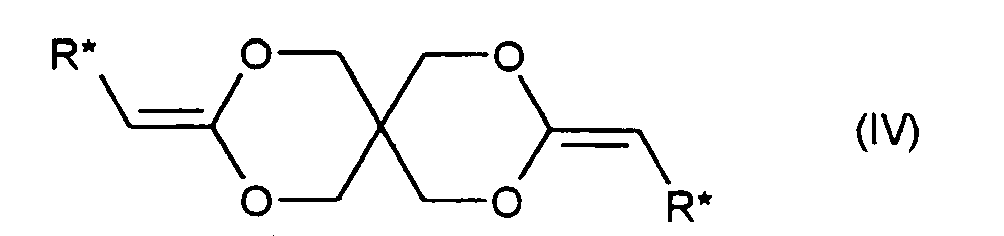

- Since the diketene acetal and the diol react in a 1:1 ratio to form the POE block of the diblock copolymer, the quantities of the RPEG, the diketene acetal, and the diol are chosen so that the molar amount of diketene acetal is equal to the sum of the molar amounts of the RPEG and the diol.
- The value of in in the PEG block, i.e. the length of the PEG block, is determined by the RPEG chosen.
- The value of n in the POE block, i.e. the length of the POE block, is determined by the molar quantity of diol relative to the molar quantity of RPEG: the greater the molar quantity of diol (assuming that the diketene acetal is present in at least an equimolar quantity), the longer is the POE block.
- The triblock copolymers of formula II are also formed in a two-step synthesis.
In the first step, an excess of the diketene acetal of formula IV is reacted with a diol of the formula HO-R4-OH, or HO-R5-OH, or a mixture thereof, to form a POE block which is terminated at each end with a diketene acetal unit, giving an intermediate of formula VI
In the second step, the intermediate of formula VI is reacted with two equivalents of PEG or an RPEG to form the triblock copolymer of formula II. - Since the diketene acetal and the diol react in essentially a 1:1 ratio to form the POE block of the triblock copolymer, but diketene acetal termination of the POE block is desired, the quantities of the diketene acetal and the diol are chosen so that the molar amount of diketene acetal is slightly greater than the molar amount of the diol. The molar ratio of PEG/RPEG to POE block should be approximately 2:1, but an excess of PEG/RPEG may be used, as it may be easily separated from the polymer after completion of the reaction.
- The values of m and n for the PEG blocks, are determined by the PEG/RPEG chosen. Typically m and n are the same, when a single PEG/RPEG is used; but if two or more PEGs/RPEGs of different lengths are used, then mixtures of copolymers containing varying PEG block lengths can be obtained, and these mixtures may be separated if desired, by such molecular weight fractionation techniques as gel permeation chromatography.
- The value of p for the POE block is determined primarily by the ratio of the diketene acetal to the diol used to form the POE.
- The triblock copolymers of formula III are also formed in a two-step synthesis.
In the first step, a PEG of the formula H-[OCH2CH2]m-OH is reacted with an excess of a diketene acetal of formula IV to form an intermediate of formula VII
- Since the diketene acetal and the diol react in a 1:1 ratio to form the POE blocks of the diblock copolymer, the quantities of the PEG, the diketene acetal, and the diol are chosen so that the molar amount of diketene acetal is equal to the sum of the molar amounts of the PEG and the diol.
- The value of m for the PEG block is determined by the PEG chosen.
- The values of p and q for the POE blocks are determined by the molar quantity of diol relative to the molar quantity of PEG: the greater the molar quantity of diol (assuming that the diketene acetal is present in at least an equimolar quantity), the longer are the POE blocks. Typically the POE blocks will be of equal lengths, on average.
- In an alternative synthesis of the triblock copolymer of formula III, POE blocks terminated with diketene acetal units (intermediates of formula VI) are prepared, and reacted with 0.5 molar equivalent of PEG to terminate each end of the PEG with the POE blocks.
- In any of the syntheses in which the copolymers may have an unreacted diketene acetal terminal group, the copolymer may be reacted with a hydroxy-containing compound, such as a C1-C4 alcohol, to terminate the copolymer with alkoxy units; and such alkoxy-terminated copolymers are included within the scope of the invention. The hydroxy-containing compound, especially a C1-C4 alcohol, may be employed in excess and the unreacted excess easily separated during purification of the polymer.
- Suitable reaction conditions for the formation of the copolymers are those conditions well known for the formation of orthoesters, such as are described in WO97/25366 and the other documents cited in the BACKGROUND OF THE INVENTION. Typically, the reaction takes place in a polar aprotic solvent, such as those solvents mentioned previously for the preparation of the α-hydroxy acid containing diols, and ethers, especially THF. A catalyst may be used if desired or necessary, and may be selected from those catalysts known to the art for the formation of orthoesters. Suitable such catalysts include iodine/pyridine, strong acids such as p-toluenesulfonic acid; Lewis acids, such as boron trichloride etherate, boron trifluoride etherate, tin oxychloride, phosphorus oxychloride, zinc chloride, phosphorus pentafluoride, antimony pentafluoride, stannic chloride, and the like; and Brönsted acids, such as polyphosphoric acid, polystyrenesulfonic acid, and the like. A particularly suitable catalyst is PTSA. A typical amount of catalyst used is about 0.2% by weight relative to the diketene acetal, though quantities between 0.005% and 2% may be used.
- Suitable reaction temperatures are from room temperature to the boiling point of the solvent used, for example, between 20 C and 70°C; and suitable reaction times are between a few minutes and 48 hours, typically between 30 minutes and 24 hours.
- Once the formation of the block copolymer is complete, the copolymer can be isolated by precipitation in a non-polar aprotic solvent such as hexane. Typically, the reaction mixture containing the copolymer (which may be cooled before the addition) is added slowly to about ten volumes of the rapidly stirred solvent at room temperature. The precipitated block copolymer may be collected by filtration, decantation, or other suitable method, washed to remove unreacted monomers or other contaminants, and dried, typically in a vacuum oven at a temperature below its melting point.
- The bioerodibility of a block copolymer of this invention is determined by two factors: first, the extent to which the copolymer will dissolve/become suspended intact in an aqueous medium, the solubility of the copolymer; and second, the extent to which the copolymer, or, to be more precise, the POE block(s), will degrade in the environment to which it is exposed. The speed of degradation of the POE block(s) of the copolymer in an aqueous environment is determined by the hydrophilicity of the copolymer and by the proportion of α-hydroxy acid ester groups, if present, in the block(s), with greater bioerodibility being achieved by inclusion of a greater proportion of diols of the formula HO-R5-OH in the diol mixture used to form the POE block(s).
- While the block copolymers of this invention will find utility in any of the uses for which biodegradable polymers are useful, including such uses as vehicles for the sustained release of active agents, orthopedic implants, degradable sutures, and the like, they will also find particular utility in applications where their nature as block copolymers having both hydrophobic and hydrophilic blocks confers a special benefit, and these uses will be addressed in greater detail, since a person of ordinary skill in the art will be well acquainted with the uses of biodegradable polymers and will have no difficulty, having regard to the skill of the art and this disclosure, in adapting the block copolymers of this invention to such uses.
- Polymers useful as micellar delivery systems can be prepared by forming diblock, AB, or triblock, ABA or BAB, copolymers comprising a hydrophilic poly(ethylene glycol) A block and a hydrophobic poly(orthoester) B block.
- When such block copolymers are placed in water, in which the poly(ethylene glycol) block is soluble and the poly(orthoester) block is insoluble, the block copolymer chains will spontaneously self-aggregate to form micellar structures. The hydrodynamic diameter of such micelles, which may be determined by methods such as dynamic light scattering, will be in the order of 10-30 nm. As may be determined by methods such as static light scattering, such micelles will contain several hundred polymer chains. The micelles will undergo a secondary, reversible association, giving particles of an average diameter of about 100 nm. While such micelles are too large to be excreted by the kidneys, individual block copolymers are not. Further, since the poly(orthoester) segments can be made to be biodegradable, facile renal excretion will take place.
- The major utility of such micellar systems resides in their ability to entrap and solubilize hydrophobic drugs in the hydrophobic core. Such entrapment is easily carried out in a number of ways. Thus, the drug can be added to the aqueous solution containing micelles and incorporated by simple stirring, by heating to moderate temperatures, or by ultrasonication. The micelles are efficient carriers for a variety of hydrophobic or insoluble active agents, and are particularly suitable as carriers for anticancer agents, which will accumulate in the tumor by an endocytotic process.
- Efficient entrapment of hydrophobic drugs requires a highly hydrophobic core. Using AB, ABA, or BAB block copolymers where the hydrophobic B block forms a biodegradable, highly hydrophobic poly(orthoester) core will allow preparation of systems with significantly enhanced entrapment efficiency relative to other biodegradable segments such as poly(L-lactic-co-glycolic acid) copolymers.
- While any of the anticancer agents that can form micellar complexes are suitable for this use, anticancer agents that are particularly suitable for micellar tumor targeting are those with low water solubility or high aromatic content, such as the anthracycline antibiotics (e.g. doxorubicin, daunorubicin, and epirubicin), mitomycin C, paclitaxel and its analogs (e.g. docetaxol), platinum analogs (e.g. cisplatin and carboplatin), and the like. Other agents may include anticancer proteins, such as neocarzinostatin, L-asparaginase, and the like, and photosensitizers used in photodynamic therapy.
- In the block copolymers of this invention, phase separation will occur where domains of the B block form within the continuous A-phase or vice versa. Such phase-separated material will have unique and useful thermal properties. Specifically, unlike poly(orthoesters) containing short segments of PEG within the poly(orthoester), which when heated will gradually soften, PEG/POE AB, ABA, or BAB block copolymers have relatively sharp melting points. Further, while poly(orthoesters) containing short segments of poly(ethylene glycol) that have low softening temperatures have very poor mechanical properties, the copolymers of this invention, even those having very low melting temperatures, will retain mechanical properties suitable for use as implants.
- To use the copolymer as a sustained-release vehicle, the active agent must be incorporated into a matrix of the copolymer or encapsulated within a capsule (or a "microcapsule" or "nanocapsule", as those terms are sometimes used) of the copolymer. Methods for the preparation of sustained-release dosage forms using biodegradable polymers are well known in the art, as discussed in the references cited in the "BACKGROUND OF THE INVENTION" section of this application, and in other references familiar to those of ordinary skill in the art; so that a person of ordinary skill in the art would have no difficulty, having regard to that skill and this disclosure, in preparing sustained-release formulations using the copolymer of this invention. Suitable active agents include therapeutic agents such as pharmaceutical or pharmacological active agents, e.g. drugs and medicaments, as well as prophylactic agents, diagnostic agents, and other chemicals or materials useful in preventing or treating disease. The compositions of this invention are particularly useful for the therapeutic treatment of humans and other mammals, but may also be used for other animals. In addition, the sustained-release compositions of this invention may also be used for the release of cosmetic and agricultural agents, or for the release of biocides, such as fungicides or other pesticides, into an environment where prolonged release of the active agent is desired.
- In the case of matrix formulations, the copolymer is first mixed with the active agent. High homogeneity may be achieved by mixing the polymer in its heat softened state with the active agent, followed by lowering the temperature to harden the composition. Alternatively, the copolymer can be dissolved in an appropriate casting solvent, such as tetrahydrofuran, methylene chloride, chloroform or ethyl acetate, and the active agent can then be dispersed or dissolved in the copolymer solution, followed by evaporating the solvent to achieve the finished composition. Another method is grinding a solid copolymer material into powder which is then mixed with a powdered active agent. The active agent may also be incorporated into the mixture of monomers before polymerization provided that it is stable under the polymerization conditions and does not interfere with the polymerization reaction.
- If the active agent is one that is unstable at elevated temperatures (e.g. above 40°C), or in the presence of organic solvents or organic solvent/water mixtures, such as a protein, then special preparation techniques may be required to minimize the exposure of the active agent to damaging conditions. Such techniques are disclosed in, for example, US Patents Nos. 5,620,697 (Törmälä et al., assigned to Orion-Yhtyma Oy and Leiras Oy), which discloses ultrasonic melting to form matrix-type pharmaceutical compositions, and 5,518,730 (Fuisz, assigned to Fuisz Technologies, Inc.), which discloses melt-spinning, both of which techniques are designed to minimize the exposure of the polymer and active to elevated temperatures. Other methods are disclosed in the documents cited elsewhere in this application.
- An alternate method for the incorporation and release of sensitive therapeutic agents is to use bioerodible copolymers that have physical properties tailored for this incorporation. For example, the copolymer may be chosen so that it is semi-solid and has an ointment-like consistency, rather than being fully solid. Thus, a copolymer may be chosen that has a very high viscosity at normal body temperature of 37°C so that little if any deformation takes place at that temperature. However, the viscosity of the copolymer may decrease substantially at temperatures no higher than 45°C, or preferably by 40°C, so that injection of the material may be possible at a temperature at which the active agent retains its activity.
- The composition obtained from any of the above methods can be readily processed into a variety of shapes and forms for implantation, insertion or placement on the body or into body cavities or passageways. For example, the copolymer composition may be injection molded, extruded or compressed into a thin film or made into devices of various geometric shapes or forms such as flat, square, round, cylindrical, tubular, disc, ring and the like. Rod- or pellet-shaped devices may be implanted through a trocar, such as is known for Norplant® implants, and these or other shapes may be implanted by minor surgical procedures. Alternatively, a device may be implanted following a major surgical procedure such as tumor removal in the surgical treatment of cancer. The implantation of polymer wafers containing anticancer agents is described, for example, in Brem et al., US Patents Nos. 5,626,862 and 5,651,986, and references cited therein; and the copolymers of this invention will find utility in such applications.
- The polymer composition may also be injected by syringe subcutaneously or intramuscularly as particles of 0.1µm to 1000µm, preferably 0.5µm to 200µm, and more preferably 1µm to 150µm suspended in a pharmaceutically acceptable injection base. Liquid vehicles useful for suspending the drug-copolymer composition for injection include isotonic saline solution or oils (such as corn oil, cottonseed oil, peanut oil and sesame oil) which, if desired, may contain other adjuvants.
- Another injectable dosage form may be prepared from an active agent mixed in with a copolymer of the present invention which has an ointment-like consistency. Such a dosage form may be administered by injection with or without a solvent.
- The copolymer composition administered by either injection or implantation undergoes bioerosion in the body into non-toxic and non-reactive materials. By controlling the number of hydrolyzable bonds in the polymer, the active agent may be released at a desired rate. Implants prepared from the present copolymers in which the copolymer constitutes the matrix containing an active agent also have the advantage that they do not require removal because of the bioerodibility of the copolymer.
- In some cases, particles with cores of the pure active agent coated with various thicknesses of the present copolymer may be preferred for sustained delivery of the active agent. Coating or encapsulation of discrete particles of the active agent may be accomplished by conventional methods which are all well-known to the person skilled in the art. For example, finely divided drug particles may be suspended in a solvent system (in which the drug is not soluble) containing the dissolved copolymer and other excipients, followed by spray drying. Alternatively, the drug particles may be placed in a rotating pan or a fluid-bed dryer and the copolymer dissolved in a carrier solvent is sprayed onto the drug particles until a suitable coating quantity is deposited on the particles to give a desired thickness. The coating may also be achieved by suspending the drug particles in a solvent system containing the dissolved copolymer followed by adding to the suspension a non-solvent causing the copolymer to precipitate and form a coating over the drug particles.
- For the sustained release compositions, because the active agent will be released over a controlled period of time, the agent usually is present in an amount which is greater than the conventional single dose. The relative proportions of the active agent and the copolymer can vary over a wide range (e.g., 0.1 to 50 weight percent) depending on the therapeutic agent and the desired effect.
- Sustained compositions of cosmetic and agricultural agents may also be prepared by any one of the methods as described above, using the copolymers of the present invention.
- The solid copolymers are also useful for a variety of orthopedic applications. For example, they can be used as fracture fixation devices for repair of osteochondral defects, ligament and tendon reconstructions and bone substitutes. In addition, the fact that the present copolymers permit simultaneous selection of both a desired level of their mechano-physical state and a desired rate of bioerodibility, also renders them attractive as grafts or scaffolds on which cells can be cultured in vitro prior to implantation to regenerate tissues. Tissues which can be regenerated using this approach include but are not limited to bone, tendon, cartilage, ligaments, liver, intestine, ureter and skin tissues. For example, the copolymers may be used to regenerate skin for patients with bums or skin ulcers. Cartilages may be repaired by first isolating chondrocytes from a patient (or a donor), allowing them to proliferate on the scaffolds prepared from the present copolymer and re-implanting the cells in the patient.
- The copolymer scaffolds or implants may further contain other biologically active substances or synthetic inorganic materials such as reinforcing filler material for enhancing the mechanical properties of the scaffolds or implants (e.g. calcium sodium metaphosphate fibers), antibiotics, or bone growth factors to induce and/or promote orthopedic restoration and tissue regeneration. Preparations and Examples
-

- A 3-liter, 3-necked flask fitted with a mechanical stirrer, argon inlet tube, thermometer and rubber septum was charged with 1.2 L ethylenediamine. The flask was cooled with ice water and the contents kept at about 8°C under an argon atmosphere. A hexane solution of n-butyllithium, 130 g (2 mol n-BuLi), was added over one hour through a stainless steel U-tube pushed through the rubber septum, using carefully controlled argon pressure. Next, a mixture of 3,9-divinyl-2,4,8,10-tetraoxaspiro[5.5]undecane, 530 g (2.5 mol), (available from Aldrich Chemical Company, Inc., Milwaukee, Wisconsin, DSA) and 0.5 L ethylenediamine was cooled to 8°C and added to the flask. After stirring at 8°C for 3 hours, the reaction mixture was poured into 3 L of ice water with vigorous stirring. The aqueous mixture was extracted twice with 1 L portions of hexane. The combined hexane extracts were washed three times with 1 L portions of water, dried over anhydrous magnesium sulfate and filtered under suction. The filtrate was evaporated to dryness on a rotary evaporator to give crude material (413 g, 78%) containing 90% DETOSU.
- The crude DETOSU product was dissolved in 2 L hexane containing 10 mL triethylamine and the solution was placed in a 4 L filter flask, sealed, and stored in a freezer at -20°C for two days. The crystals thus formed were collected by basket centrifugation at -5°C under an argon atmosphere. Distillation of the brownish product through a 12-inch Vigreaux column at reduced pressure gave 313 g (61% yield) DETOSU as a colorless liquid, boiling point 82°C (0.1 Torr), which crystallized at room temperature, with a melting point of 30°C and a characteristic infrared absorption band at 1700 cm-1.
-

- Under anhydrous conditions, 14.42 g (100 mmol) CDM and 11.6 g (100 mmol) glycolide were weighed into a 100-mL round bottom flask. The flask was stoppered with a rubber septum, then heated in an oil bath at 180°C for 24 hours. The product shown above was obtained as a viscous oil.
-

- CDM, 2.88 g (20 mmol) and 6.96 g (60 mmol) glycolide were reacted according to the procedure of Preparation P2(a), yielding the product shown above as a low-melting solid.
- The following additional diols were synthesized using analogous procedures:
- P2(c).

- P2(d).

- Other diols are similarly synthesized using analogous procedures.
- In a glove box, PEG 2000 methyl ether, 4 g (2 mmol), was weighed into a 100 mL flask and dissolved in 25 g THF, and 4.372 g (20.6 mmol) DETOSU was added. Three drops of a 25 mg/mL solution of PTSA in THF were added to the solution, and the flask was capped with a rubber septum and heated in an oil bath at 70°C for 30 minutes. A further three drops of PTSA solution were added, and the solution heated for a further 30 minutes. CDM, 2.596 g (18 mmol), was added, and the solution stirred until all CDM dissolved, when another three drops of PTSA solution were added. After stirring for 30 minutes, the solution was transferred to an addition funnel and dropped into approximately 1 L hexane with vigorous stirring to precipitate the diblock copolymer, which was filtered and dried in a vacuum oven. The isolated copolymer had a number average molecular weight, Mn, of 12240, indicating the presence of an average of 31 orthoester units in the molecule, n = 31, and contained approximately 36.5% PEG. The copolymer had a melting point of 34.1°C and a glass transition temperature, Tg, of 27.5°C.
- A similar reaction using 10 g (2 mmol) PEG 5000 methyl ether gave a diblock copolymer having an Mn of 14820, a PEG content of 58.9%, and a melting point of 51.2°C.
- A similar reaction using 7 g (1.4 mmol) PEG 5000 methyl ether and 2.682 g (18.6 mmol) CDM gave a diblock copolymer having an Mn of 19150, a PEG content of 49.8%, a melting point of 48.2°C, and a Tg of 32.7°C.
- A similar reaction using 20 g (4 mmol) PEG 5000 methyl ether and 2.307 g (16 mmol) CDM gave a diblock copolymer.
- In a glove box, 4.372 g (20.6 mmol) DETOSU and 2.307 g (16 mmol) CDM are weighed into a 100 mL flask and dissolved in 25 mL THF. One drop of a 25 mg/mL solution of PTSA in THF is added to initiate the reaction. When the reaction mixture has cooled to room temperature, 8 g (4 mmol) PEG 2000 is added. The solution is gently warmed until all the PEG has fully dissolved, and three drops of the PTSA solution are added. The flask is capped with a rubber septum and heated in an oil bath at 70°C for 30 minutes. A further three drops of the PTSA solution are added and the flask heated for an additional 30 minutes. After cooling to room temperature, the solution is added dropwise to 1 L hexane with stirring to precipitate the triblock copolymer. The copolymer is dried in a vacuum oven.
- The copolymer of E1(d), 100 mg, was dissolved in 2 mL acetone, and 20 mL phosphate-buffered saline, pH 7.4, was added. No precipitation of the copolymer was observed. The solution was placed under aspirator vacuum at room temperature to remove the acetone, and the copolymer remained in solution.
- Other copolymers of formula I and formula II show similar solubility.
- The copolymer of E1(d), 100 mg, was dissolved in 2 mL acetone, and the solution added to a solution of 7.7 mg hydrocortisone in 2 mL acetone. The combined acetone solutions were added to 5 mL phosphate-buffered saline, pH 7.4, the acetone removed under vacuum, and the aqueous solution filtered through a 0.45 µm filter. The aqueous solution was found to have a hydrocortisone concentration of 1.1 mg/mL, approximately four times greater than the water solubility of hydrocortisone of 0.28 mg/mL, indicating micellar encapsulation and solubilization of the hydrocortisone by the copolymer.
- Other copolymers of formula I and formula 11 show similar solubilization of hydrophobic/water-insoluble active agents.
- The copolymer of E1(c) was pressed at 48°C and 1000 atm into a slab 0.6 mm thick, and the slab then cut into wafers approximately 6 mm x 6 mm. The wafers were weighed, and then placed into phosphate-buffered saline, pH 7.4, at 37°C; and the weight loss of the wafers measured as a function of time. The results are shown in FIG. 1.
- Other copolymers of formula I, II, and III show similar bioerodibility.
- While this invention has been described in conjunction with specific embodiments and examples, it will be evident to one of ordinary skill in the art, having regard to this disclosure, that equivalents of the specifically disclosed materials and techniques will also be applicable to this invention; and such equivalents are intended to be included within the following claims.
R6 is C1-C4 alkyl, and
R7 is H or C1-C4 alkyl; and
R5 is

R6 is C1-C4alkyl, and
R7 is H or C1-C4 alkyl; and
R5 is

Claims (11)
- A block copolymer of formula I:


 m and n are independently an integer from 5 to 500;p and q are independently an integer from 5 to 100;R1 is C1-C4 alkyl; R2 is C1-C4 alkyl;R3 is H or C1-C4 alkyl; andA is -O-R4-, -O-R5-, or a mixture thereof; where:where t is an integer from 1 to 12,R4 is selected from

R6 is C1-C4 alkyl, and
R7 is H or C1-C4 alkyl; and
R5 is x is an integer from 1 to 10, andR8 is H or C1-C6 alkyl.
 - The copolymer of Claim 1 which is a compound of formula I, II or III.
- The copolymer of Claim 2 where m is an integer from 50 to 250, and p is an integer from 10 to 50.
- The copolymer of Claim 2 which is a compound of Formula I wherein R1 is ethyl and R2 is methyl.
- The copolymer of Claim 2 which is a compound of Formula II wherein R1 is ethyl and R3 is hydrogen or methyl.
- The copolymer of Claim 2 which is a compound of Formula III wherein R1 is ethyl.
- The copolymer of Claim 2 where A is -O-R4- and HO-R4-OH is cyclohexanedimethanol.
- A micellar pharmaceutical composition for the delivery of a hydrophobic or water-insoluble active agent, comprising the active agent physically entrapped within but not covalently bonded to a drug carrier comprising a block copolymer of Claim 1 or 2.
- A composition for the sustained release of an active agent, comprising the active agent dispersed in a matrix comprising the block copolymer of Claim 1 or 2.
- The micellar pharmaceutical composition according to claim 8 wherein the active agent is an anticancer agent.
- The composition of claim 9 wherein the active agent is an anticancer agent.
Applications Claiming Priority (3)
| Application Number | Priority Date | Filing Date | Title |
|---|---|---|---|
| US90648 | 1998-06-04 | ||
| US09/090,648 US5939453A (en) | 1998-06-04 | 1998-06-04 | PEG-POE, PEG-POE-PEG, and POE-PEG-POE block copolymers |
| PCT/US1999/011952 WO1999062983A1 (en) | 1998-06-04 | 1999-05-28 | Polyethylene glycol-polyorthoester, polyethylene glycol-polyorthoester-polythylene glycol, and polyorthoester-polyethylene glycol-polyorthoester block copolymers |
Publications (2)
| Publication Number | Publication Date |
|---|---|
| EP1084170A1 EP1084170A1 (en) | 2001-03-21 |
| EP1084170B1 true EP1084170B1 (en) | 2007-01-17 |
Family
ID=22223679
Family Applications (1)
| Application Number | Title | Priority Date | Filing Date |
|---|---|---|---|
| EP99926034A Expired - Lifetime EP1084170B1 (en) | 1998-06-04 | 1999-05-28 | Polyethylene glycol-polyorthoester, polyethylene glycol-polyorthoester-polyethylene glycol, and polyorthoester-polyethylene glycol-polyorthoester block copolymers |
Country Status (12)
| Country | Link |
|---|---|
| US (1) | US5939453A (en) |
| EP (1) | EP1084170B1 (en) |
| JP (1) | JP2002517535A (en) |
| KR (1) | KR100546983B1 (en) |
| CN (1) | CN1304423A (en) |
| AU (1) | AU749197B2 (en) |
| CA (1) | CA2332333A1 (en) |
| DE (1) | DE69934884T2 (en) |
| ES (1) | ES2281176T3 (en) |
| MX (1) | MXPA00011998A (en) |
| NZ (1) | NZ508301A (en) |
| WO (1) | WO1999062983A1 (en) |
Families Citing this family (81)
| Publication number | Priority date | Publication date | Assignee | Title |
|---|---|---|---|---|
| EP2138191A1 (en) | 1998-01-05 | 2009-12-30 | University Of Washington | Enhanced transport using membrane disruptive agents |
| US6958148B1 (en) * | 1998-01-20 | 2005-10-25 | Pericor Science, Inc. | Linkage of agents to body tissue using microparticles and transglutaminase |
| US7425581B2 (en) * | 1999-07-30 | 2008-09-16 | Universiteit Utrecht | Temperature sensitive polymers |
| US6582683B2 (en) | 2000-01-04 | 2003-06-24 | Skinvisible Pharmaceuticals, Inc. | Dermal barrier composition |
| WO2001051092A2 (en) * | 2000-01-07 | 2001-07-19 | University Of Washington | Enhanced transport of agents using membrane disruptive agents |
| CA2408332C (en) * | 2000-05-08 | 2011-02-15 | The University Of British Columbia | Supports for photosensitizer formulations |
| US20050042194A1 (en) | 2000-05-11 | 2005-02-24 | A.P. Pharma, Inc. | Semi-solid delivery vehicle and pharmaceutical compositions |
| EP1280558B1 (en) * | 2000-05-11 | 2005-12-07 | AP Pharma, Inc. | Semi-solid delivery vehicle and pharmaceutical compositions |
| US6613355B2 (en) * | 2000-05-11 | 2003-09-02 | A.P. Pharma, Inc. | Semi-solid delivery vehicle and pharmaceutical compositions |
| EP1286643A2 (en) * | 2000-05-17 | 2003-03-05 | Labopharm Inc. | Drug containing polymeric micelles |
| SG98393A1 (en) | 2000-05-19 | 2003-09-19 | Inst Materials Research & Eng | Injectable drug delivery systems with cyclodextrin-polymer based hydrogels |
| DE60131177T2 (en) | 2000-09-06 | 2008-08-07 | AP Pharma, Inc., Redwood | DEVELOPABLE POLYACETAL POLYMERS |
| JP2004512345A (en) * | 2000-11-02 | 2004-04-22 | スミスクライン・ビーチャム・コーポレイション | Receptor antagonist-lipid conjugates and delivery vehicles containing the same |
| US7378056B2 (en) | 2000-11-09 | 2008-05-27 | Sicel Technologies, Inc. | Circuits for in vivo detection of biomolecule concentrations using fluorescent tags |
| US6590059B2 (en) * | 2001-05-11 | 2003-07-08 | Ap Pharma, Inc. | Bioerodible polyorthoesters from dioxolane-based diketene acetals |
| US20030152630A1 (en) * | 2001-05-11 | 2003-08-14 | Ng Steven Y. | PEG-POE, PEG-POE-PEG, and POE-PEG-POE block copolymers |
| EP1395626A1 (en) * | 2001-05-11 | 2004-03-10 | AP Pharma, Inc. | Peg-poe, peg-poe-peg, and poe-peg-poe block copolymers |
| US7094810B2 (en) * | 2001-06-08 | 2006-08-22 | Labopharm, Inc. | pH-sensitive block copolymers for pharmaceutical compositions |
| US6939564B2 (en) * | 2001-06-08 | 2005-09-06 | Labopharm, Inc. | Water-soluble stabilized self-assembled polyelectrolytes |
| FR2826280B1 (en) * | 2001-06-20 | 2005-03-04 | Ceva Sante Animale | BIODEGRADABLE INJECTABLE SEMI-SOLID COMPOSITION PROVIDING A PARTICULAR RELEASE PROFILE |
| KR100566911B1 (en) | 2001-06-25 | 2006-04-03 | 주식회사 삼양사 | Anion group-containing amphiphilic block copolymers for drug carriers and complexes thereof with cationic drugs |
| ATE365183T1 (en) * | 2001-07-14 | 2007-07-15 | Samyang Corp | POSITIVELY CHARGED AMPHIPHILE BLOCK COPOLYMER AS A DRUG CARRIER AND COMPLEX THEREOF WITH A NEGATIVELY CHARGED DRUG |
| US6756059B2 (en) | 2001-08-20 | 2004-06-29 | Skinvisible Pharmaceuticals, Inc. | Topical composition, topical composition precursor, and methods for manufacturing and using |
| US6524606B1 (en) * | 2001-11-16 | 2003-02-25 | Ap Pharma, Inc. | Bioerodible polyorthoesters containing amine groups |
| US7557353B2 (en) | 2001-11-30 | 2009-07-07 | Sicel Technologies, Inc. | Single-use external dosimeters for use in radiation therapies |
| JP4502641B2 (en) * | 2002-01-24 | 2010-07-14 | ティルタン ファーマ リミテッド | Anti-cancer combinations and methods of use |
| US7649023B2 (en) * | 2002-06-11 | 2010-01-19 | Novartis Ag | Biodegradable block copolymeric compositions for drug delivery |
| US20040001889A1 (en) | 2002-06-25 | 2004-01-01 | Guohua Chen | Short duration depot formulations |
| CA2490007C (en) * | 2002-07-19 | 2011-05-24 | Omeros Corporation | Biodegradable triblock copolymers, synthesis methods therefor, and hydrogels and biomaterials made there from |
| US7219731B2 (en) * | 2002-08-26 | 2007-05-22 | Schlumberger Technology Corporation | Degradable additive for viscoelastic surfactant based fluid systems |
| AU2003270555B2 (en) | 2002-09-09 | 2009-01-29 | Nektar Therapeutics | Method for preparing water-soluble polymer derivatives bearing a terminal carboxylic acid |
| AU2003301672A1 (en) | 2002-10-21 | 2004-05-13 | Allegiance Corporation | Coating composition for skin-contacting surface of elastomeric articles and articles containing the same |
| US7045589B2 (en) * | 2002-11-15 | 2006-05-16 | A.P. Pharma, Inc. | Bioerodible poly(ortho esters) from dioxane-based di(ketene acetals), and block copolymers containing them |
| US20040126339A1 (en) * | 2002-12-31 | 2004-07-01 | Roszell James A. | Sunscreen composition and methods for manufacturing and using a sunscreen composition |
| AU2004214420A1 (en) | 2003-02-19 | 2004-09-02 | Sicel Technologies Inc. | In vivo fluorescence sensors, systems, and related methods operating in conjunction with fluorescent analytes |
| US7329413B1 (en) * | 2003-11-06 | 2008-02-12 | Advanced Cardiovascular Systems, Inc. | Coatings for drug delivery devices having gradient of hydration and methods for fabricating thereof |
| GB0329654D0 (en) * | 2003-12-23 | 2004-01-28 | Smith & Nephew | Tunable segmented polyacetal |
| US20050163843A1 (en) * | 2003-12-31 | 2005-07-28 | Garth Boehm | Alprazolam formulations |
| US7350479B2 (en) * | 2004-09-10 | 2008-04-01 | United States Of America As Represented By The Secretary Of The Army | System and method for controlling growth of aquatic plants utilizing bio-eroding means implanted in triploid grass carp |
| CN101137700B (en) * | 2005-03-09 | 2012-07-18 | 东丽株式会社 | Microparticle and pharmaceutical composition |
| CN101426529A (en) * | 2005-03-31 | 2009-05-06 | 阿帕医药有限公司 | PEG-poly(ortho ester) graft copolymers and pharmaceutical compositions |
| JP2008534747A (en) * | 2005-03-31 | 2008-08-28 | エーピー ファーマ, インコーポレイテッド | PEG-polyacetal graft copolymer and PEG-polyacetal-POE graft copolymer and pharmaceutical composition |
| US7337839B2 (en) * | 2005-06-10 | 2008-03-04 | Schlumberger Technology Corporation | Fluid loss additive for enhanced fracture clean-up |
| CA2619552A1 (en) * | 2005-08-18 | 2007-02-22 | Smith & Nephew, Plc | Multimodal high strength devices and composites |
| WO2007109584A1 (en) * | 2006-03-16 | 2007-09-27 | University Of Washington | Temperature-and ph-responsive polymer compositions |
| US20070264338A1 (en) * | 2006-05-12 | 2007-11-15 | Shah Devang T | Base-stabilized polyorthoester formulations |
| US20070264339A1 (en) * | 2006-05-12 | 2007-11-15 | Ap Pharma, Inc. | Base-stabilized polyorthoester formulations |
| US20070265329A1 (en) * | 2006-05-12 | 2007-11-15 | Devang Shah T | Methods for the prevention of acute and delayed chemotherapy-induced nausea and vomiting (CINV) |
| EP2044142A2 (en) * | 2006-06-29 | 2009-04-08 | Medtronic, Inc. | Poly(orthoester) polymers, and methods of making and using same |
| JP2010504318A (en) * | 2006-09-22 | 2010-02-12 | ラボファーム インコーポレイテッド | Compositions and methods for pH targeted drug delivery |
| US20080095847A1 (en) * | 2006-10-18 | 2008-04-24 | Thierry Glauser | Stimulus-release carrier, methods of manufacture and methods of treatment |
| US20100137333A1 (en) * | 2006-10-20 | 2010-06-03 | Roszell James A | Antifungal composition and methods for using |
| US20080114076A1 (en) * | 2006-11-09 | 2008-05-15 | Alcon Manufacturing Ltd. | Punctal plug comprising a water-insoluble polymeric matrix |
| TWI409081B (en) * | 2006-11-09 | 2013-09-21 | Alcon Res Ltd | Water insoluble polymer matrix for drug delivery |
| CN101594831B (en) | 2006-11-30 | 2011-09-14 | 史密夫和内修有限公司 | Fiber reinforced composite material |
| EP2097140B1 (en) | 2006-12-20 | 2012-09-26 | Arkema Inc. | Polymer encapsulation and/or binding |
| US7981688B2 (en) | 2007-03-08 | 2011-07-19 | University Of Washington | Stimuli-responsive magnetic nanoparticles and related methods |
| US8695708B2 (en) * | 2007-03-26 | 2014-04-15 | Schlumberger Technology Corporation | Method for treating subterranean formation with degradable material |
| WO2008129245A1 (en) * | 2007-04-18 | 2008-10-30 | Smith & Nephew Plc | Expansion moulding of shape memory polymers |
| DE602008006181D1 (en) * | 2007-04-19 | 2011-05-26 | Smith & Nephew Inc | GRAFT FIXATION |
| ATE547129T1 (en) | 2007-04-19 | 2012-03-15 | Smith & Nephew Inc | MULTIMODAL SHAPE MEMORY POLYMERS |
| US20090259280A1 (en) * | 2007-10-15 | 2009-10-15 | Kevin Wilkin | Electrical stimulation lead with bioerodible anchors and anchor straps |
| US20090099612A1 (en) * | 2007-10-15 | 2009-04-16 | Armstrong Julie S | Electrical conductor having a bioerodible coating |
| US8128913B1 (en) | 2007-12-06 | 2012-03-06 | Skinvisible Pharmaceuticals, Inc. | Sunscreen composition with enhanced UV-A absorber stability and methods |
| US8299122B2 (en) * | 2008-04-14 | 2012-10-30 | Skinvisible Pharmaceuticals, Inc. | Method for stabilizing retinoic acid, retinoic acid containing composition, and method of using a retinoic acid containing composition |
| US8475823B2 (en) * | 2008-04-18 | 2013-07-02 | Medtronic, Inc. | Baclofen formulation in a polyorthoester carrier |
| US8956642B2 (en) * | 2008-04-18 | 2015-02-17 | Medtronic, Inc. | Bupivacaine formulation in a polyorthoester carrier |
| JP2012512163A (en) * | 2008-12-11 | 2012-05-31 | エーピー ファーマ, インコーポレイテッド | Methods for enhancing the stability of polyorthoesters and their formulations |
| US8426214B2 (en) * | 2009-06-12 | 2013-04-23 | University Of Washington | System and method for magnetically concentrating and detecting biomarkers |
| US9080933B2 (en) | 2009-11-09 | 2015-07-14 | University Of Washington Through Its Center For Commercialization | Stimuli-responsive polymer diagnostic assay comprising magnetic nanoparticles and capture conjugates |
| US20110117668A1 (en) * | 2009-11-09 | 2011-05-19 | University Of Washington Through Its Center For Commercialization | Self-powered smart diagnostic devices |
| US11065461B2 (en) | 2019-07-08 | 2021-07-20 | Bioness Inc. | Implantable power adapter |
| CA3167217A1 (en) | 2020-01-13 | 2021-07-22 | Durect Corporation | Sustained release drug delivery systems with reduced impurities and related methods |
| CA3074150C (en) | 2020-02-18 | 2025-12-16 | Ovation Science, Inc. | Composition and method for transdermal delivery of cannabidiol (cbd) and delta9-tetrahydrocannabinol (thc) |
| US12472140B2 (en) | 2020-02-18 | 2025-11-18 | Ovation Science Inc. | Composition and method for transdermal delivery of cannabidiol (CBD) and tetrahydrocannabinol (THC) |
| CN113980254A (en) * | 2020-07-10 | 2022-01-28 | 南京泛太化工医药研究所 | A series of polymers with acid-sensitive degradation and temperature-sensitive properties and drug-loaded composition thereof |
| CN116940358A (en) | 2021-01-12 | 2023-10-24 | 度勒科特公司 | Sustained release drug delivery system and related methods |
| EP4538310A4 (en) * | 2022-01-20 | 2026-05-06 | Nanjing Fantai Chemical Pharmaceutical Res Institute | Series of polymers with acid-sensitive degradation and temperature sensitivity properties and composition for drug loading therefrom |
| JP2025509813A (en) * | 2022-03-17 | 2025-04-11 | イノコア テクノロジーズ ホールディング ビー.ブイ. | Biodegradable thermoplastic poly(ortho ester)-based multiblock copolymers |
| CN119770428B (en) * | 2025-03-12 | 2025-06-03 | 安徽大学 | Bionic nanoparticle suspension formulation based on orthoester compound and preparation method thereof |
| CN120168400B (en) * | 2025-05-21 | 2025-08-15 | 安徽大学 | Injectable organic composite hydrogel combined with photothermal chemotherapy and preparation method and application thereof |
Family Cites Families (13)
| Publication number | Priority date | Publication date | Assignee | Title |
|---|---|---|---|---|
| US4304767A (en) * | 1980-05-15 | 1981-12-08 | Sri International | Polymers of di- (and higher functionality) ketene acetals and polyols |
| US4532335A (en) * | 1983-03-07 | 1985-07-30 | Sri International | Preparation of ketene acetals by rearrangement of allyl and substituted allyl acetals |
| GB8416234D0 (en) * | 1984-06-26 | 1984-08-01 | Ici Plc | Biodegradable amphipathic copolymers |
| US4957998A (en) * | 1988-08-22 | 1990-09-18 | Pharmaceutical Delivery Systems, Inc. | Polymers containing acetal, carboxy-acetal, ortho ester and carboxyortho ester linkages |
| JP2517760B2 (en) * | 1989-05-11 | 1996-07-24 | 新技術事業団 | Water-soluble polymerized pharmaceutical preparation |
| US4946931A (en) * | 1989-06-14 | 1990-08-07 | Pharmaceutical Delivery Systems, Inc. | Polymers containing carboxy-ortho ester and ortho ester linkages |
| US5133739A (en) * | 1990-02-06 | 1992-07-28 | Ethicon, Inc. | Segmented copolymers of ε-caprolactone and glycolide |
| US5518730A (en) * | 1992-06-03 | 1996-05-21 | Fuisz Technologies Ltd. | Biodegradable controlled release flash flow melt-spun delivery system |
| KR940003548U (en) * | 1992-08-14 | 1994-02-21 | 김형술 | Laundry dryer |
| GB2270920B (en) * | 1992-09-25 | 1997-04-02 | Univ Keele | Alginate-bioactive agent conjugates |
| GB2273874A (en) * | 1992-12-31 | 1994-07-06 | Pertti Olavi Toermaelae | Preparation of pharmaceuticals in a polymer matrix |
| US5626862A (en) * | 1994-08-02 | 1997-05-06 | Massachusetts Institute Of Technology | Controlled local delivery of chemotherapeutic agents for treating solid tumors |
| AU1527097A (en) * | 1996-01-05 | 1997-08-01 | Advanced Polymer Systems Inc. | Polymers with controlled physical state and bioerodibility |
-
1998
- 1998-06-04 US US09/090,648 patent/US5939453A/en not_active Expired - Lifetime
-
1999
- 1999-05-28 MX MXPA00011998A patent/MXPA00011998A/en not_active IP Right Cessation
- 1999-05-28 ES ES99926034T patent/ES2281176T3/en not_active Expired - Lifetime
- 1999-05-28 EP EP99926034A patent/EP1084170B1/en not_active Expired - Lifetime
- 1999-05-28 CA CA002332333A patent/CA2332333A1/en not_active Abandoned
- 1999-05-28 WO PCT/US1999/011952 patent/WO1999062983A1/en not_active Ceased
- 1999-05-28 AU AU42204/99A patent/AU749197B2/en not_active Ceased
- 1999-05-28 JP JP2000552189A patent/JP2002517535A/en active Pending
- 1999-05-28 NZ NZ508301A patent/NZ508301A/en unknown
- 1999-05-28 KR KR1020007013306A patent/KR100546983B1/en not_active Expired - Fee Related
- 1999-05-28 DE DE69934884T patent/DE69934884T2/en not_active Expired - Fee Related
- 1999-05-28 CN CN99806965A patent/CN1304423A/en active Pending
Also Published As
| Publication number | Publication date |
|---|---|
| AU749197B2 (en) | 2002-06-20 |
| WO1999062983A1 (en) | 1999-12-09 |
| AU4220499A (en) | 1999-12-20 |
| CN1304423A (en) | 2001-07-18 |
| CA2332333A1 (en) | 1999-12-09 |
| DE69934884T2 (en) | 2007-10-18 |
| ES2281176T3 (en) | 2007-09-16 |
| KR100546983B1 (en) | 2006-01-26 |
| NZ508301A (en) | 2002-09-27 |
| MXPA00011998A (en) | 2003-03-12 |
| JP2002517535A (en) | 2002-06-18 |
| EP1084170A1 (en) | 2001-03-21 |
| US5939453A (en) | 1999-08-17 |
| DE69934884D1 (en) | 2007-03-08 |
| KR20010071330A (en) | 2001-07-28 |
Similar Documents
| Publication | Publication Date | Title |
|---|---|---|
| US5939453A (en) | PEG-POE, PEG-POE-PEG, and POE-PEG-POE block copolymers | |
| US5968543A (en) | Polymers with controlled physical state and bioerodibility | |
| EP1448666B1 (en) | Bioerodible poly(ortho esters) containing amine groups, and block copolymers containing them | |
| US7163694B2 (en) | Bioerodible poly(ortho esters) from dioxane-based di(ketene acetals), and block copolymers containing them | |
| WO2002092661A1 (en) | Peg-poe, peg-poe-peg, and poe-peg-poe block copolymers | |
| EP0869986B1 (en) | Polymers with controlled physical state and bioerodibility | |
| US20030152630A1 (en) | PEG-POE, PEG-POE-PEG, and POE-PEG-POE block copolymers | |
| KR20070122519A (en) | PI-polyacetal diblock and triblock copolymers and pharmaceutical compositions | |
| KR20070122522A (en) | PI-Poly (ortho ester) graft copolymers and pharmaceutical compositions |
Legal Events
| Date | Code | Title | Description |
|---|---|---|---|
| PUAI | Public reference made under article 153(3) epc to a published international application that has entered the european phase |
Free format text: ORIGINAL CODE: 0009012 |
|
| 17P | Request for examination filed |
Effective date: 20001227 |
|
| AK | Designated contracting states |
Kind code of ref document: A1 Designated state(s): AT BE CH CY DE DK ES FI FR GB GR IE IT LI LU MC NL PT SE |
|
| RAP1 | Party data changed (applicant data changed or rights of an application transferred) |
Owner name: AP PHARMA, INC. |
|
| 17Q | First examination report despatched |
Effective date: 20041013 |
|
| GRAP | Despatch of communication of intention to grant a patent |
Free format text: ORIGINAL CODE: EPIDOSNIGR1 |
|
| GRAS | Grant fee paid |
Free format text: ORIGINAL CODE: EPIDOSNIGR3 |
|
| GRAA | (expected) grant |
Free format text: ORIGINAL CODE: 0009210 |
|
| AK | Designated contracting states |
Kind code of ref document: B1 Designated state(s): AT BE CH CY DE DK ES FI FR GB GR IE IT LI LU MC NL PT SE |
|
| PG25 | Lapsed in a contracting state [announced via postgrant information from national office to epo] |
Ref country code: NL Free format text: LAPSE BECAUSE OF FAILURE TO SUBMIT A TRANSLATION OF THE DESCRIPTION OR TO PAY THE FEE WITHIN THE PRESCRIBED TIME-LIMIT Effective date: 20070117 Ref country code: LI Free format text: LAPSE BECAUSE OF FAILURE TO SUBMIT A TRANSLATION OF THE DESCRIPTION OR TO PAY THE FEE WITHIN THE PRESCRIBED TIME-LIMIT Effective date: 20070117 Ref country code: FI Free format text: LAPSE BECAUSE OF FAILURE TO SUBMIT A TRANSLATION OF THE DESCRIPTION OR TO PAY THE FEE WITHIN THE PRESCRIBED TIME-LIMIT Effective date: 20070117 Ref country code: DK Free format text: LAPSE BECAUSE OF FAILURE TO SUBMIT A TRANSLATION OF THE DESCRIPTION OR TO PAY THE FEE WITHIN THE PRESCRIBED TIME-LIMIT Effective date: 20070117 Ref country code: CH Free format text: LAPSE BECAUSE OF FAILURE TO SUBMIT A TRANSLATION OF THE DESCRIPTION OR TO PAY THE FEE WITHIN THE PRESCRIBED TIME-LIMIT Effective date: 20070117 Ref country code: AT Free format text: LAPSE BECAUSE OF FAILURE TO SUBMIT A TRANSLATION OF THE DESCRIPTION OR TO PAY THE FEE WITHIN THE PRESCRIBED TIME-LIMIT Effective date: 20070117 |
|
| REG | Reference to a national code |
Ref country code: GB Ref legal event code: FG4D |
|
| REG | Reference to a national code |
Ref country code: CH Ref legal event code: EP |
|
| REG | Reference to a national code |
Ref country code: IE Ref legal event code: FG4D |
|
| REF | Corresponds to: |
Ref document number: 69934884 Country of ref document: DE Date of ref document: 20070308 Kind code of ref document: P |
|
| PG25 | Lapsed in a contracting state [announced via postgrant information from national office to epo] |
Ref country code: SE Free format text: LAPSE BECAUSE OF FAILURE TO SUBMIT A TRANSLATION OF THE DESCRIPTION OR TO PAY THE FEE WITHIN THE PRESCRIBED TIME-LIMIT Effective date: 20070417 |
|
| PG25 | Lapsed in a contracting state [announced via postgrant information from national office to epo] |
Ref country code: PT Free format text: LAPSE BECAUSE OF FAILURE TO SUBMIT A TRANSLATION OF THE DESCRIPTION OR TO PAY THE FEE WITHIN THE PRESCRIBED TIME-LIMIT Effective date: 20070618 |
|
| NLV1 | Nl: lapsed or annulled due to failure to fulfill the requirements of art. 29p and 29m of the patents act | ||
| REG | Reference to a national code |
Ref country code: CH Ref legal event code: PL |
|
| ET | Fr: translation filed | ||
| REG | Reference to a national code |
Ref country code: ES Ref legal event code: FG2A Ref document number: 2281176 Country of ref document: ES Kind code of ref document: T3 |
|
| PLBE | No opposition filed within time limit |
Free format text: ORIGINAL CODE: 0009261 |
|
| STAA | Information on the status of an ep patent application or granted ep patent |
Free format text: STATUS: NO OPPOSITION FILED WITHIN TIME LIMIT |
|
| 26N | No opposition filed |
Effective date: 20071018 |
|
| PG25 | Lapsed in a contracting state [announced via postgrant information from national office to epo] |
Ref country code: BE Free format text: LAPSE BECAUSE OF FAILURE TO SUBMIT A TRANSLATION OF THE DESCRIPTION OR TO PAY THE FEE WITHIN THE PRESCRIBED TIME-LIMIT Effective date: 20070117 |
|
| PG25 | Lapsed in a contracting state [announced via postgrant information from national office to epo] |
Ref country code: GR Free format text: LAPSE BECAUSE OF FAILURE TO SUBMIT A TRANSLATION OF THE DESCRIPTION OR TO PAY THE FEE WITHIN THE PRESCRIBED TIME-LIMIT Effective date: 20070418 |
|
| PGFP | Annual fee paid to national office [announced via postgrant information from national office to epo] |
Ref country code: LU Payment date: 20080604 Year of fee payment: 10 Ref country code: ES Payment date: 20080619 Year of fee payment: 10 Ref country code: DE Payment date: 20080605 Year of fee payment: 10 |
|
| PGFP | Annual fee paid to national office [announced via postgrant information from national office to epo] |
Ref country code: MC Payment date: 20080429 Year of fee payment: 10 Ref country code: IT Payment date: 20080529 Year of fee payment: 10 |
|
| PGFP | Annual fee paid to national office [announced via postgrant information from national office to epo] |
Ref country code: IE Payment date: 20080515 Year of fee payment: 10 |
|
| PGFP | Annual fee paid to national office [announced via postgrant information from national office to epo] |
Ref country code: GB Payment date: 20080528 Year of fee payment: 10 |
|
| PG25 | Lapsed in a contracting state [announced via postgrant information from national office to epo] |
Ref country code: CY Free format text: LAPSE BECAUSE OF FAILURE TO SUBMIT A TRANSLATION OF THE DESCRIPTION OR TO PAY THE FEE WITHIN THE PRESCRIBED TIME-LIMIT Effective date: 20070117 |
|
| PG25 | Lapsed in a contracting state [announced via postgrant information from national office to epo] |
Ref country code: MC Free format text: LAPSE BECAUSE OF NON-PAYMENT OF DUE FEES Effective date: 20090531 |
|
| GBPC | Gb: european patent ceased through non-payment of renewal fee |
Effective date: 20090528 |
|
| REG | Reference to a national code |
Ref country code: FR Ref legal event code: ST Effective date: 20100129 |
|
| PG25 | Lapsed in a contracting state [announced via postgrant information from national office to epo] |
Ref country code: IE Free format text: LAPSE BECAUSE OF NON-PAYMENT OF DUE FEES Effective date: 20090528 Ref country code: FR Free format text: LAPSE BECAUSE OF NON-PAYMENT OF DUE FEES Effective date: 20090602 |
|
| PGFP | Annual fee paid to national office [announced via postgrant information from national office to epo] |
Ref country code: FR Payment date: 20080514 Year of fee payment: 10 |
|
| PG25 | Lapsed in a contracting state [announced via postgrant information from national office to epo] |
Ref country code: GB Free format text: LAPSE BECAUSE OF NON-PAYMENT OF DUE FEES Effective date: 20090528 |
|
| PG25 | Lapsed in a contracting state [announced via postgrant information from national office to epo] |
Ref country code: DE Free format text: LAPSE BECAUSE OF NON-PAYMENT OF DUE FEES Effective date: 20091201 |
|
| REG | Reference to a national code |
Ref country code: ES Ref legal event code: FD2A Effective date: 20090529 |
|
| PG25 | Lapsed in a contracting state [announced via postgrant information from national office to epo] |
Ref country code: ES Free format text: LAPSE BECAUSE OF NON-PAYMENT OF DUE FEES Effective date: 20090529 |
|
| PG25 | Lapsed in a contracting state [announced via postgrant information from national office to epo] |
Ref country code: IT Free format text: LAPSE BECAUSE OF NON-PAYMENT OF DUE FEES Effective date: 20090528 |
|
| PG25 | Lapsed in a contracting state [announced via postgrant information from national office to epo] |
Ref country code: LU Free format text: LAPSE BECAUSE OF NON-PAYMENT OF DUE FEES Effective date: 20090528 |