EP1083764A2 - Remotely controlling operation mode of portable wireless communication terminals - Google Patents
Remotely controlling operation mode of portable wireless communication terminals Download PDFInfo
- Publication number
- EP1083764A2 EP1083764A2 EP00203081A EP00203081A EP1083764A2 EP 1083764 A2 EP1083764 A2 EP 1083764A2 EP 00203081 A EP00203081 A EP 00203081A EP 00203081 A EP00203081 A EP 00203081A EP 1083764 A2 EP1083764 A2 EP 1083764A2
- Authority
- EP
- European Patent Office
- Prior art keywords
- wireless communication
- communication terminal
- operation mode
- switching
- mode
- Prior art date
- Legal status (The legal status is an assumption and is not a legal conclusion. Google has not performed a legal analysis and makes no representation as to the accuracy of the status listed.)
- Granted
Links
- 238000004891 communication Methods 0.000 title claims abstract description 83
- 238000000034 method Methods 0.000 claims abstract description 37
- 230000004044 response Effects 0.000 claims abstract description 16
- 230000005236 sound signal Effects 0.000 claims 1
- 230000001413 cellular effect Effects 0.000 abstract description 36
- 230000008569 process Effects 0.000 abstract description 25
- 230000008859 change Effects 0.000 abstract description 2
- 238000010586 diagram Methods 0.000 description 5
- 201000009032 substance abuse Diseases 0.000 description 3
- 230000005540 biological transmission Effects 0.000 description 1
- 238000012790 confirmation Methods 0.000 description 1
- 230000006870 function Effects 0.000 description 1
Images


Classifications
-
- H—ELECTRICITY
- H04—ELECTRIC COMMUNICATION TECHNIQUE
- H04W—WIRELESS COMMUNICATION NETWORKS
- H04W88/00—Devices specially adapted for wireless communication networks, e.g. terminals, base stations or access point devices
- H04W88/02—Terminal devices
Definitions
- the current invention is generally related to cellular phones, and more particularly related to features that are useful in controlling an operational mode of remote cellular phones as well as in retrieving them when they are lost or left behind.
- Japanese Laid Patent Publication No. Hei 9-312687 discloses a cellular phone with a crime-preventive feature.
- an owner of the cellular phone is able to remotely shut off the lost or stolen phone.
- the original owner calls the lost or stolen phone from any telephone. If the stolen phone has an off-hook response to the above call, the normal operation of the stolen phone resumes.
- the stolen phone fails to have an off-hook, the stolen phone initiates a mode switching process by incrementing a counter. When the counter value reaches a predetermined number of incomplete calls, the mode switching process establishes connection with an incoming call and generates a predetermined audible signal.
- the original owner Upon hearing the audible signal, the original owner enters a predetermined personal identification number to switch the operation of the lost cellular phone. When the entered personal identification number matches the predetermined personal identification number, the mode switching process generates another audible signal to indicate to the original owner that the lost cellular phone is now blocked. The blocked cellular phone can only receive incoming calls and prevents the abuse by the founder. Upon confirmation of the blocked mode, the original owner terminates the mode switching process. The mode switching process can be reinitiated by the above described acts and reverse the blocked cellular phone for normal operation.
- the above described prior art reference still fails to solve some issues.
- One issue is that the owner has to possess or remember a predetermined personal identification number in order to remotely block a remote cellular phone.
- the personal identification number is remotely inputted into the remote cellular phone only when the connection is established. For some reason or another, if the connection is not established, the remote phone cannot change its operational mode. The mode switching process cannot be independently completed without the connection and the correct personal identification number.
- the above described prior art reference fails to provide a solution for facilitating the return of a remote cellular phone to an original owner.
- a method of remotely switching an operation mode of portable wireless communication terminals via a wireless network including: inputting mode switch parameters including a time period and a number of terminations to a first portable wireless communication terminal in a normal operation mode; storing the mode switch parameters in the first portable wireless communication terminal; attempting to connect to the first portable wireless communication terminal from a single second wireless communication terminal when a predetermined event occurs; determining whether or not the single second portable wireless communication terminal has attempted to connect to the first wireless communication terminal without an off-hook at the first wireless communication terminal for the number of the terminations within the time period; and switching an operation mode of the first wireless communication terminal from the normal operation mode to a lost mode in response to the determining.
- an apparatus for remotely switching an operation mode of portable wireless communication terminals via a wireless network including: an input unit for inputting mode switch parameters including a time period and a number of terminations to be used for switching an operation mode from a normal operation mode to a lost mode; a storage unit connected to the input unit for storing the mode switch parameters; and a processing unit for generating a mode switch signal when an identical one of the portable wireless communication terminals has attempted to connect to the apparatus without an off-hook at the apparatus for the number of the terminations within the time period, the processing unit switching the operation mode of the apparatus from the normal operation mode to the lost mode in response to the mode switch signal.
- a system for remotely switching an operation mode of portable wireless communication terminals via a wireless network including: a first portable wireless communication terminal; a second portable wireless communication terminal further including: an input unit inputting mode switch parameters including a time period and a number of terminations to be used for switching an operation mode from a normal operation mode to a lost mode; a storage unit connected to the input unit for storing the mode switch parameters; and a processing unit for generating a mode switch signal when an identical one of the first portable wireless communication terminal has attempted to connect to the wireless communication terminal without an off-hook at the second wireless communication terminal for the number of the terminations within the time period, the processing unit switching the operation mode of the second wireless communication terminal from the normal operation mode to the lost mode in response to the mode switch signal.
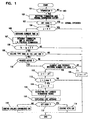
- a flow chart illustrates acts involved in a preferred method of remotely switching an operational mode of a portable wireless communication terminal according to the current invention.
- a mode switch process in the portable wireless communication terminal fails to proceed as shown in Act 101.
- the mode switch process in the portable wireless communication terminal proceeds to Act 102 where the termination is notified by a predetermined output such as an audible signal.
- the termination information includes time, date and a calling type such as a number notification and a non-number notification, a public phone and analog/digital distinction.
- the termination information for the last twenty calls is stored in a predetermined termination history storage unit.
- Act 103 determines whether or not an off-hook takes place. That is, if the incoming call is accepted for connection. If an off-hook takes place, the normal operation of the wireless communication terminal resumes.
- the mode switch process determines in Act 104 whether or not a counter j is set to contain a zero value.
- the counter j is initialized to zero upon each time power is turned on, and a subsequent termination increments the counter value by one. If it is zero, the mode switch process sets the counter value to one in Act 105 and terminates its process. On the other hand, the counter value j is not equal to zero, the mode switch process obtains the current time tb in Act 106 and retrieves a termination time ta of the jth previous termination in Act 107.
- the jth previous termination is in fact the last termination in this exemplary mode switch process, but it is not limited to the last time in other mode switch processes according to the current invention.
- An amount of time in difference between the current time tb and the last termination time ta is now compared to a predetermined time period T in Act 108. If the difference is not less than the predetermined time period T, the counter value j is initialized to one in Act 105. That is, the current termination took place after the predetermined amount of time T subsequent to the last termination. In contrast, if the current termination took place within the predetermined amount of time T subsequent to the last termination, the information is examined in the following acts.
- Figure 1 shows that the mode switch process examines whether or not the origin of a current termination is identical to that of the previous or last termination.
- Act 109 it is determined whether or not a calling type of the current termination is the same as that of the previous termination.
- Act 110 After determining in Act 110 that the current termination is a number notice, it is further determined in Act 111 whether or not a receiving number of the current termination is the same as that of the previous termination. If any of the above three determination results from Acts 109, 110 and 111 is negative, the mode switch process performs Act 105 and terminates. On the other hand, all of the three determination results from Acts 109, 110 and 111 are affirmative, the counter value j is incremented by one in Act 112.
- Acts 109, 110 and 111 attempt to distinguish calls that are received from various origins while the portable wireless communication terminal is left behind at a certain known place for example at home, and it is not misplaced or stolen. Thus, Acts 109, 110 and 111 substantially eliminate a possibility of an accidental or unintended mode switch in the portable wireless communication terminal by ascertaining that the termination attempts are intentionally made from the same origin for a predetermined number of times within a predetermined time period.
- the mode switch process completes the following acts.
- the incremented counter value j is compared to a predetermined maximal counter value j max in Act 113. If the comparison indicates that the current counter value j has not reached the predetermined j max value, the mode switch process terminates without performing Act 105. In case, the counter value j has reached the predetermined j max value, the mode switch process changes the operation mode. First, the counter value j is initialized to zero in Act 114.
- the mode switch process generates an audible signal for example at the highest level for twenty seconds in Act 115 and displays a message or contact information such as a phone number for returning the wireless communication terminal in Act 116. Finally, based upon a predetermined key lock preference in Act 117, the mode switch process either limits the calling capability in Act 118 or locks the keys in Act 199 and terminates.
- the above described mode switch process enables an owner of the cellular phone to remotely control the operational mode without connection as well as a password or a personal identification number.
- the above feature allows the owner to quickly eliminate potential abuse of the cellular phone without incurring any calling cost.
- An additional feature of displaying some contact information also facilitates the return of a lost cellular phone.
- the owner has to enter a predetermined password or a personal identification number into the cellular phone in one preferred process according to the current invention.
- the password substantially prevents undesired reversal of the locked or limited operational mode prior to return. The need for passwords outweighs the cumbersome memorization and does not contradict with initial urgency for placing the cellular phone into a locked or limited mode without a password.
- the portable wireless communication terminal or cellular phone includes a wireless receiving/transmission unit 1 for receiving and transmitting wireless communication signals, a control unit 2 for controlling and processing information, an operational unit 3 for inputting data in the cellular phone, a memory unit 4 for storing software and data such as messages or phone numbers, a display unit 5 for displaying a message, a microphone 6 for inputting voice data and a speaker 7 for outputting voice data.
- a wireless receiving/transmission unit 1 for receiving and transmitting wireless communication signals
- a control unit 2 for controlling and processing information
- an operational unit 3 for inputting data in the cellular phone
- a memory unit 4 for storing software and data such as messages or phone numbers
- a display unit 5 for displaying a message
- a microphone 6 for inputting voice data
- a speaker 7 for outputting voice data.
- the control unit 5 further includes a mode switching unit 21, a lost mode set unit 22 and a termination counter 23.
- a user invokes the lost mode set unit 22 to be in the parameter setting mode via the operation unit 3.
- the user inputs mode switch parameters as well as lost messages or contact information via the operation unit 3 such as key pad and other buttons on the cellular phone and/or the display unit 5.
- the mode switch parameters include a number of terminations to be made from an identical origin as well as a time period within which these terminations are to be made and provide a predetermined set of rules or conditions for switching an operational mode of a remote cellular phone.
- the mode switch parameters also include a rule for how the cellular phone is limited or locked when the mode is remotely switched according to the above rules.
- the lost messages or contact information include a phone number of an owner or a short message.
- a display message storage unit 41 of the memory unit 4 stores the above inputted information.
- the mode switching unit 21 with the termination counter 23 generally determines whether or not the operational mode of a cellular phone is to be switched. In other words, the mode switching unit 21 determines whether or not the predetermined conditions as set forth in the above mode switch parameters are met. To do so, the mode switching unit 21 processes information, stores and updates a number of termination attempts in the termination counter 23, retrieves the mode switch parameters from the memory unit and compares the retrieved information. The termination counter is initialized whenever power is turned on. When the mode switching unit 21 determines that the mode switching conditions are met, the mode switching unit 21 switches the operational mode to a predetermined limited mode and or a locked mode. The mode switching unit 21 further retrieves a display message from the display message storage 41 and sends the message to the display unit 5 for displaying the same.
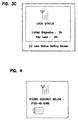
- FIGS 3A, 3B and 3C are diagrams respectively illustrating an exemplary message input screen, an exemplary termination parameter setting screen and an exemplary lock status setting screen for use with the portable wireless communication terminal according to the current invention.
- a message to be displayed when the mode switch takes place is inputted through the screen.
- the message "PLEASE CONTACT BELOW :” is fixed and previously stored.
- the user is allowed to input information or message in the bracketed area through the keyboard on a cellular phone.
- contact information is provided in up to three lines, and "Please contact below: 0123-45-6789" is inputted and stored.
- Figure 4 shows the stored message.
- a termination parameter setting screen as shown in Figure 3B appears according to this exemplary implementation.
- This screen allows the user to input conditions to be met for the cellular phone to remotely switch its operational mode.
- the operational mode is switched.
- the user inputs the desired number as well as the desired time
- the user selects a desired setting in the switched mode. For example, in the locked mode, the user turns either or both of limited origination and key lock selections. Under the limited origination condition, only a predetermined number of phone calls are made. On the other hand, under the key lock condition, no call is made. The selection is also stored.
Landscapes
- Engineering & Computer Science (AREA)
- Computer Networks & Wireless Communication (AREA)
- Signal Processing (AREA)
- Telephone Function (AREA)
- Mobile Radio Communication Systems (AREA)
Abstract
Description
Claims (25)
- A method of remotely switching an operation mode of portable wireless communication terminals via a wireless network, comprising:inputting mode switch parameters including a time period and a number of terminations to a first portable wireless communication terminal in a normal operation mode;storing the mode switch parameters in the first portable wireless communication terminal;attempting to connect to the first portable wireless communication terminal from a single second wireless communication terminal when a predetermined event occurs;determining whether or not the single second portable wireless communication terminal has attempted to connect to the first wireless communication terminal without an off-hook at the first wireless communication terminal for the number of the terminations within the time period; andswitching an operation mode of the first wireless communication terminal from the normal operation mode to a lost mode in response to said determining.
- The method of remotely switching an operation mode according to claim 1 wherein the predetermined event includes that the first portable wireless communication terminal is lost and no longer under possession of an original owner of the first portable wireless communication terminal.
- The method of remotely switching an operation mode according to claim 1 or 2 wherein a predetermined message is displayed at the first wireless communication terminal in the lost mode.
- The method of remotely switching an operation mode according to claim 3 wherein the predetermined message includes contact information for returning the first wireless communication terminal to the original owner.
- The method of remotely switching an operation mode according to any one of the preceding claims, wherein an audio signal is generated at the first wireless communication terminal in the lost mode.
- The method of remotely switching an operation mode according to any one of the preceding claims, wherein the first wireless communication terminal has a predetermined limited calling capability in the lost mode.
- The method of remotely switching an operation mode according to any one of the preceding claims, wherein the mode switch parameter additionally includes contact information for returning the first wireless communication terminal to the original owner.
- The method of remotely switching an operation mode according to any one of the preceding claims, wherein said determining further comprises:comparing an origin of the second wireless communication terminal in a current attempt and that in a previous attempt;incrementing a counter by one when the origin of the second wireless communication terminal is the same in the current attempt and the previous attempt within the time period;initializing the counter to one when the origin of the second wireless communication terminal is different in the current attempt and the previous attempt; andswitching the operation mode of the first wireless communication terminal from the normal operation mode to the lost mode when the counter indicates the number of the terminations.
- The method of remotely switching an operation mode according to claim 8 wherein the origin in said comparing includes a type, a calling type, and a receiving number.
- An apparatus for remotely switching an operation mode of portable wireless communication terminals via a wireless network, said apparatus communicating with the wireless communication terminals, comprising:an input unit for inputting mode switch parameters including a time period and a number of terminations to be used for switching an operation mode from a normal operation mode to a lost mode;a storage unit connected to the input unit for storing the mode switch parameters; anda processing unit for generating a mode switch signal when an identical one of the portable wireless communication terminals has attempted to connect to said apparatus without an off-hook at said apparatus for the number of the terminations within the time period, the processing unit switching the operation mode of said apparatus from the normal operation mode to the lost mode in response to the mode switch signal.
- The apparatus for remotely switching an operation mode according to claim 10 further comprising a display unit connected to the processing unit for displaying a predetermined message in response to the mode switch signal.
- The apparatus for remotely switching an operation mode according to claim 11 wherein the predetermined message includes contact information for returning said apparatus to an original owner.
- The apparatus for remotely switching an operation mode according to any one of claims 10-12, further comprising an audio generating unit connected to the processing unit for generating an audible signal in response to the mode switch signal.
- The apparatus for remotely switching an operation mode according to any one of claims 10-13, wherein the processing unit places said apparatus in a predetermined limited calling capability in response to the mode switch signal.
- The apparatus for remotely switching an operation mode according to any one of claims 10-14, wherein the mode switch parameter additionally includes contact information for returning the first wireless communication terminal to the original owner.
- The apparatus for remotely switching an operation mode according to any one of claims 10-15, wherein the processing unit further comprises:a comparison sub-unit for comparing an origin of the wireless communication terminal in a current attempt and that in a previous attempt;a counter sub-unit connected to the comparison sub-unit for incrementing a counter value by one when the origin of the wireless communication terminal is the same in the current attempt and the previous attempt within the time period, the counter sub-unit initializing the counter value to one when the origin of the wireless communication terminal is different in the current attempt and the previous attempt; anda switching sub-unit connected to the counter sub-unit for switching the operation mode of said apparatus from the normal operation mode to the lost mode when the counter value indicates the number of the terminations.
- The apparatus for remotely switching an operation mode according to claim 16 wherein the comparison sub-unit compares the origin including a type, a calling type, and a receiving number.
- A system for remotely switching an operation mode of portable wireless communication terminals via a wireless network, comprising:a first portable wireless communication terminal;a second portable wireless communication terminal further including:an input unit inputting mode switch parameters including a time period and a number of terminations to be used for switching an operation mode from a normal operation mode to a lost mode;a storage unit connected to the input unit for storing the mode switch parameters; anda processing unit for generating a mode switch signal when an identical one of said first portable wireless communication terminal has attempted to connect to said wireless communication terminal without an off-hook at said second wireless communication terminal for the number of the terminations within the time period, the processing unit switching the operation mode of said second wireless communication terminal from the normal operation mode to the lost mode in response to the mode switch signal.
- The system for remotely switching an operation mode according to claim 18 wherein said second wireless communication terminal further includes a display unit connected to the processing unit for displaying a predetermined message in response to the mode switch signal.
- The system for remotely switching an operation mode according to claim 19 wherein the predetermined message includes contact information for returning said second wireless communication terminal to an original owner.
- The system for remotely switching an operation mode according to any one of claims 18-20, wherein said second wireless communication terminal further includes an audio generating unit connected to the processing unit for generating an audible signal in response to the mode switch signal.
- The system for remotely switching an operation mode according to any one of claims 18-21, wherein the processing unit places said second wireless communication terminal in a predetermined limited calling capability in response to the mode switch signal.
- The system for remotely switching an operation mode according to any one of claims 18-22, wherein the mode switch parameter additionally includes contact information for returning the first wireless communication terminal to the original owner.
- The system for remotely switching an operation mode according to any one of claims 18-23, wherein the processing unit further comprises:a comparison sub-unit for comparing an origin of said first wireless communication terminal in a current attempt and that in a previous attempt;a counter sub-unit connected to the comparison sub-unit for incrementing a counter value by one when the origin of said first wireless communication terminal is the same in the current attempt and the previous attempt within the time period, the counter sub-unit initializing the counter value to one when the origin of said first wireless communication terminal is different in the current attempt and the previous attempt; anda switching sub-unit connected to the counter sub-unit for switching the operation mode of said second wireless communication terminal from the normal operation mode to the lost mode when the counter value indicates the number of the terminations.
- The system for remotely switching an operation mode according to claim 24 wherein the comparison sub-unit compares the origin including a type, a calling type, and a receiving number.
Applications Claiming Priority (2)
| Application Number | Priority Date | Filing Date | Title |
|---|---|---|---|
| JP25529199A JP3621612B2 (en) | 1999-09-09 | 1999-09-09 | Mobile phone |
| JP25529199 | 1999-09-09 |
Publications (3)
| Publication Number | Publication Date |
|---|---|
| EP1083764A2 true EP1083764A2 (en) | 2001-03-14 |
| EP1083764A3 EP1083764A3 (en) | 2001-05-02 |
| EP1083764B1 EP1083764B1 (en) | 2008-04-23 |
Family
ID=17276732
Family Applications (1)
| Application Number | Title | Priority Date | Filing Date |
|---|---|---|---|
| EP00203081A Expired - Lifetime EP1083764B1 (en) | 1999-09-09 | 2000-09-07 | Remotely controlling operation mode of portable wireless communication terminals |
Country Status (4)
| Country | Link |
|---|---|
| US (1) | US6771954B1 (en) |
| EP (1) | EP1083764B1 (en) |
| JP (1) | JP3621612B2 (en) |
| KR (1) | KR100645933B1 (en) |
Cited By (13)
| Publication number | Priority date | Publication date | Assignee | Title |
|---|---|---|---|---|
| GB2380356A (en) * | 2001-09-26 | 2003-04-02 | Sendo Int Ltd | Disabling of mobile communication apparatus |
| GB2381703A (en) * | 2001-11-02 | 2003-05-07 | Agere Syst Guardian Corp | Restricting the use of a lost wireless device |
| KR100820793B1 (en) * | 2001-07-04 | 2008-04-10 | 엘지전자 주식회사 | Operation Control Method of Remote Mobile Terminal |
| WO2009006082A1 (en) * | 2007-06-29 | 2009-01-08 | Microsoft Corporation | Activity illumination |
| WO2010127149A1 (en) * | 2009-05-01 | 2010-11-04 | Apple Inc. | Remotely locating and commanding a mobile device |
| US8355710B2 (en) | 2008-05-09 | 2013-01-15 | Research In Motion Limited | System and method of initiating user notification for a wireless device |
| US9702721B2 (en) | 2008-05-12 | 2017-07-11 | Apple Inc. | Map service with network-based query for search |
| US9702709B2 (en) | 2007-06-28 | 2017-07-11 | Apple Inc. | Disfavored route progressions or locations |
| US9891055B2 (en) | 2007-06-28 | 2018-02-13 | Apple Inc. | Location based tracking |
| US9979776B2 (en) | 2009-05-01 | 2018-05-22 | Apple Inc. | Remotely locating and commanding a mobile device |
| US10064158B2 (en) | 2007-06-28 | 2018-08-28 | Apple Inc. | Location aware mobile device |
| US10313826B2 (en) | 2005-04-04 | 2019-06-04 | X One, Inc. | Location sharing and map support in connection with services request |
| US10368199B2 (en) | 2008-06-30 | 2019-07-30 | Apple Inc. | Location sharing |
Families Citing this family (46)
| Publication number | Priority date | Publication date | Assignee | Title |
|---|---|---|---|---|
| US6456234B1 (en) | 2000-06-07 | 2002-09-24 | William J. Johnson | System and method for proactive content delivery by situation location |
| US8073565B2 (en) | 2000-06-07 | 2011-12-06 | Apple Inc. | System and method for alerting a first mobile data processing system nearby a second mobile data processing system |
| US8060389B2 (en) | 2000-06-07 | 2011-11-15 | Apple Inc. | System and method for anonymous location based services |
| JP2002218043A (en) * | 2001-01-18 | 2002-08-02 | Nec Corp | Radiotelephone and incoming call program |
| WO2002058414A1 (en) * | 2001-01-20 | 2002-07-25 | Samsung Electronics Co., Ltd | System and method for remotely controlling a mobile terminal |
| US7244853B2 (en) * | 2001-05-09 | 2007-07-17 | President And Fellows Of Harvard College | Dioxanes and uses thereof |
| JP2003032354A (en) * | 2001-07-16 | 2003-01-31 | Nec Corp | Portable communication equipment |
| US20030074577A1 (en) * | 2001-10-17 | 2003-04-17 | Bean Heather N. | Return-to-owner security lockout for a portable electronic device |
| CA2737849C (en) * | 2001-10-26 | 2017-01-24 | Research In Motion Limited | System and method for remotely controlling mobile communication devices |
| US7054624B2 (en) * | 2002-04-02 | 2006-05-30 | X-Cyte, Inc. | Safeguarding user data stored in mobile communications devices |
| JP4026397B2 (en) * | 2002-04-09 | 2007-12-26 | 日本電気株式会社 | Mobile communication terminal remote control system, mobile communication terminal, remote control method, and remote control program |
| US7103367B2 (en) * | 2003-03-12 | 2006-09-05 | Sbc Knowledge Ventures, L.P. | Network-based services for misplaced cellular mobile stations |
| US7493105B2 (en) * | 2003-03-18 | 2009-02-17 | Simplexity, Llc | Certification and activation of used phones on a wireless carrier network |
| US20050070276A1 (en) * | 2003-09-26 | 2005-03-31 | Mcgarry Rob | Systems and methods that provide modes of access for a phone |
| JP2005204039A (en) * | 2004-01-15 | 2005-07-28 | Matsushita Electric Ind Co Ltd | Mobile device |
| US7400891B2 (en) * | 2004-11-10 | 2008-07-15 | At&T Delaware Intellectual Property, Inc. | Methods, systems and computer program products for remotely controlling wireless terminals |
| US20070021109A1 (en) * | 2005-07-21 | 2007-01-25 | Zellner Samuel N | Remote disabling of an article of manufacture |
| US20070099601A1 (en) * | 2005-10-28 | 2007-05-03 | Tzung-Shian Yang | Method of varying the behavior of a mobile phone based on unhandled events on the mobile phone |
| US7689205B2 (en) * | 2005-12-23 | 2010-03-30 | Morgan Stanley | Systems and methods for configuration of mobile computing devices |
| CN101018375B (en) * | 2007-01-29 | 2011-11-30 | 中兴通讯股份有限公司 | Method for remotely controlling the terminal data |
| US9109904B2 (en) | 2007-06-28 | 2015-08-18 | Apple Inc. | Integration of map services and user applications in a mobile device |
| US8175802B2 (en) | 2007-06-28 | 2012-05-08 | Apple Inc. | Adaptive route guidance based on preferences |
| US8311526B2 (en) | 2007-06-28 | 2012-11-13 | Apple Inc. | Location-based categorical information services |
| US8275352B2 (en) | 2007-06-28 | 2012-09-25 | Apple Inc. | Location-based emergency information |
| US8762056B2 (en) | 2007-06-28 | 2014-06-24 | Apple Inc. | Route reference |
| US8774825B2 (en) | 2007-06-28 | 2014-07-08 | Apple Inc. | Integration of map services with user applications in a mobile device |
| US8204684B2 (en) | 2007-06-28 | 2012-06-19 | Apple Inc. | Adaptive mobile device navigation |
| US8332402B2 (en) | 2007-06-28 | 2012-12-11 | Apple Inc. | Location based media items |
| US8290513B2 (en) | 2007-06-28 | 2012-10-16 | Apple Inc. | Location-based services |
| US8977294B2 (en) | 2007-10-10 | 2015-03-10 | Apple Inc. | Securely locating a device |
| US8355862B2 (en) | 2008-01-06 | 2013-01-15 | Apple Inc. | Graphical user interface for presenting location information |
| US8932368B2 (en) * | 2008-04-01 | 2015-01-13 | Yougetitback Limited | Method for monitoring the unauthorized use of a device |
| US8644843B2 (en) | 2008-05-16 | 2014-02-04 | Apple Inc. | Location determination |
| CN101616212B (en) * | 2008-06-27 | 2012-11-21 | 深圳富泰宏精密工业有限公司 | Mobile phone and method for automatically searching same |
| US8359643B2 (en) | 2008-09-18 | 2013-01-22 | Apple Inc. | Group formation using anonymous broadcast information |
| US8260320B2 (en) | 2008-11-13 | 2012-09-04 | Apple Inc. | Location specific content |
| JP5527214B2 (en) * | 2008-11-25 | 2014-06-18 | 富士通株式会社 | Alternative processing determination method, alternative processing determination device, program, and mobile phone terminal |
| US8660530B2 (en) | 2009-05-01 | 2014-02-25 | Apple Inc. | Remotely receiving and communicating commands to a mobile device for execution by the mobile device |
| US10715380B2 (en) | 2011-05-23 | 2020-07-14 | Apple Inc. | Setting a reminder that is triggered by a target user device |
| US8971924B2 (en) | 2011-05-23 | 2015-03-03 | Apple Inc. | Identifying and locating users on a mobile network |
| US9104896B2 (en) | 2012-06-04 | 2015-08-11 | Apple Inc. | System and method for remotely initiating lost mode on a computing device |
| US9763098B2 (en) | 2013-01-11 | 2017-09-12 | Apple Inc. | Bypassing security authentication scheme on a lost device to return the device to the owner |
| US9179247B2 (en) | 2013-03-15 | 2015-11-03 | First Principles, Inc. | Systems and methods for locating a mobile communication device |
| US9830567B2 (en) | 2013-10-25 | 2017-11-28 | Location Labs, Inc. | Task management system and method |
| CN105657118A (en) * | 2015-11-27 | 2016-06-08 | 东莞酷派软件技术有限公司 | A call management method between communication terminals, a call management device and a communication terminal |
| CN110072073B (en) * | 2019-03-14 | 2021-01-01 | 视联动力信息技术股份有限公司 | Terminal calling service control method, device, electronic device and storage medium |
Family Cites Families (11)
| Publication number | Priority date | Publication date | Assignee | Title |
|---|---|---|---|---|
| JPH0490249A (en) | 1990-08-02 | 1992-03-24 | Matsushita Electric Ind Co Ltd | Remote controller |
| FR2718310B1 (en) * | 1994-03-29 | 1996-04-26 | Alcatel Mobile Comm France | Self-invalidation device of a portable terminal of the mobile radiotelephone type. |
| JPH08186869A (en) * | 1994-12-28 | 1996-07-16 | Nec Corp | Radio telephone set with illegal use preventing function |
| KR0143122B1 (en) * | 1995-07-29 | 1998-08-01 | 김광호 | Cellular phone |
| JPH09312687A (en) | 1996-05-23 | 1997-12-02 | Nec Eng Ltd | Portable telephone set with burglar-proof function |
| JPH09322239A (en) * | 1996-05-31 | 1997-12-12 | Nippon Shinpan Kk | Illegal use prevention method for mobile communication equipment such as portable telephone set and illegal use prevention system realizing the method |
| JPH10126495A (en) * | 1996-10-23 | 1998-05-15 | Nippon Denki Ido Tsushin Kk | Mobile radio communication device |
| US5924025A (en) * | 1996-10-25 | 1999-07-13 | Cellular Technical Services Company, Inc. | System and method for detection of redial fraud in a cellular telephone system |
| US5956634A (en) * | 1997-02-28 | 1999-09-21 | Cellular Technical Services Company, Inc. | System and method for detection of fraud in a wireless telephone system |
| JP2938062B1 (en) * | 1998-09-01 | 1999-08-23 | 埼玉日本電気株式会社 | Mobile radio |
| JP2000242565A (en) * | 1999-02-19 | 2000-09-08 | Nec Corp | Radio portable terminal |
-
1999
- 1999-09-09 JP JP25529199A patent/JP3621612B2/en not_active Expired - Lifetime
-
2000
- 2000-09-07 EP EP00203081A patent/EP1083764B1/en not_active Expired - Lifetime
- 2000-09-08 KR KR1020000053302A patent/KR100645933B1/en not_active Expired - Lifetime
- 2000-09-08 US US09/657,696 patent/US6771954B1/en not_active Expired - Lifetime
Cited By (34)
| Publication number | Priority date | Publication date | Assignee | Title |
|---|---|---|---|---|
| KR100820793B1 (en) * | 2001-07-04 | 2008-04-10 | 엘지전자 주식회사 | Operation Control Method of Remote Mobile Terminal |
| GB2380356B (en) * | 2001-09-26 | 2006-05-31 | Sendo Int Ltd | Disabling of mobile communication apparatus |
| GB2380356A (en) * | 2001-09-26 | 2003-04-02 | Sendo Int Ltd | Disabling of mobile communication apparatus |
| GB2381703A (en) * | 2001-11-02 | 2003-05-07 | Agere Syst Guardian Corp | Restricting the use of a lost wireless device |
| GB2381703B (en) * | 2001-11-02 | 2006-05-10 | Agere Syst Guardian Corp | Wireless device temporary recovery mode services and functionality |
| US10313826B2 (en) | 2005-04-04 | 2019-06-04 | X One, Inc. | Location sharing and map support in connection with services request |
| US10341808B2 (en) | 2005-04-04 | 2019-07-02 | X One, Inc. | Location sharing for commercial and proprietary content applications |
| US10341809B2 (en) | 2005-04-04 | 2019-07-02 | X One, Inc. | Location sharing with facilitated meeting point definition |
| US10458800B2 (en) | 2007-06-28 | 2019-10-29 | Apple Inc. | Disfavored route progressions or locations |
| US10952180B2 (en) | 2007-06-28 | 2021-03-16 | Apple Inc. | Location-aware mobile device |
| US12228411B2 (en) | 2007-06-28 | 2025-02-18 | Apple Inc. | Location based tracking |
| US12114284B2 (en) | 2007-06-28 | 2024-10-08 | Apple Inc. | Location-aware mobile device |
| US11665665B2 (en) | 2007-06-28 | 2023-05-30 | Apple Inc. | Location-aware mobile device |
| US11419092B2 (en) | 2007-06-28 | 2022-08-16 | Apple Inc. | Location-aware mobile device |
| US11221221B2 (en) | 2007-06-28 | 2022-01-11 | Apple Inc. | Location based tracking |
| US9702709B2 (en) | 2007-06-28 | 2017-07-11 | Apple Inc. | Disfavored route progressions or locations |
| US9891055B2 (en) | 2007-06-28 | 2018-02-13 | Apple Inc. | Location based tracking |
| US10508921B2 (en) | 2007-06-28 | 2019-12-17 | Apple Inc. | Location based tracking |
| US10064158B2 (en) | 2007-06-28 | 2018-08-28 | Apple Inc. | Location aware mobile device |
| US10412703B2 (en) | 2007-06-28 | 2019-09-10 | Apple Inc. | Location-aware mobile device |
| US8611962B2 (en) | 2007-06-29 | 2013-12-17 | Microsoft Corporation | Activity illumination |
| US9669298B2 (en) | 2007-06-29 | 2017-06-06 | Microsoft Technology Licensing, Llc | Activity illumination |
| WO2009006082A1 (en) * | 2007-06-29 | 2009-01-08 | Microsoft Corporation | Activity illumination |
| US8355710B2 (en) | 2008-05-09 | 2013-01-15 | Research In Motion Limited | System and method of initiating user notification for a wireless device |
| US8588757B2 (en) | 2008-05-09 | 2013-11-19 | Blackberry Limited | System and method of initiating user notification for a wireless device |
| US9702721B2 (en) | 2008-05-12 | 2017-07-11 | Apple Inc. | Map service with network-based query for search |
| US10841739B2 (en) | 2008-06-30 | 2020-11-17 | Apple Inc. | Location sharing |
| US10368199B2 (en) | 2008-06-30 | 2019-07-30 | Apple Inc. | Location sharing |
| JP2012525794A (en) * | 2009-05-01 | 2012-10-22 | アップル インコーポレイテッド | Remote positioning and command of mobile devices |
| US9979776B2 (en) | 2009-05-01 | 2018-05-22 | Apple Inc. | Remotely locating and commanding a mobile device |
| CN102804144A (en) * | 2009-05-01 | 2012-11-28 | 苹果公司 | Remotely locating and commanding a mobile device |
| CN102804144B (en) * | 2009-05-01 | 2015-12-02 | 苹果公司 | Remotely locate and command mobile devices |
| WO2010127149A1 (en) * | 2009-05-01 | 2010-11-04 | Apple Inc. | Remotely locating and commanding a mobile device |
| US12250262B2 (en) | 2009-05-01 | 2025-03-11 | Apple Inc. | Remotely locating and commanding a mobile device |
Also Published As
| Publication number | Publication date |
|---|---|
| JP3621612B2 (en) | 2005-02-16 |
| EP1083764A3 (en) | 2001-05-02 |
| EP1083764B1 (en) | 2008-04-23 |
| KR100645933B1 (en) | 2006-11-14 |
| US6771954B1 (en) | 2004-08-03 |
| JP2001086228A (en) | 2001-03-30 |
| KR20010050386A (en) | 2001-06-15 |
Similar Documents
| Publication | Publication Date | Title |
|---|---|---|
| EP1083764B1 (en) | Remotely controlling operation mode of portable wireless communication terminals | |
| US6937880B2 (en) | Telecommunication device with improved call-priority notification function and method of notification of call-priority | |
| US8494509B2 (en) | Method of remotely changing operating characteristics of a communications device | |
| USRE39231E1 (en) | Communication terminal equipment and call incoming control method | |
| USRE42459E1 (en) | Mobile telephone terminal with improved utility | |
| US20040259540A1 (en) | Method and apparatus for providing an indication of a reason for a power-off state of a mobile communication device | |
| US7603104B2 (en) | Apparatus and method of making a secure call | |
| JPH11298600A (en) | Mobile phone equipment | |
| JPH06125305A (en) | Mobile wireless communication device | |
| US7233789B2 (en) | Wireless security and access device | |
| JPH09312687A (en) | Portable telephone set with burglar-proof function | |
| US20090247143A1 (en) | Mobile phone, and method of limiting operations of mobile phone | |
| JP3004086B2 (en) | Communication terminal device | |
| KR100606017B1 (en) | Mobile terminal and method which can call in locked state | |
| KR20010001043A (en) | System for verifying caller number and, method thereof | |
| JPH0927853A (en) | Mobile phone | |
| JPH11239206A (en) | Wireless telephone device and telephone directory data transfer method for wireless telephone device | |
| KR100276812B1 (en) | How to block last call in communication terminal | |
| JP2001320472A (en) | Mobile phone with illegal use preventing device | |
| JP2001313980A (en) | Mobile phone | |
| KR100717498B1 (en) | Method and device for message sharing in mobile communication terminal | |
| JP2003289371A (en) | Portable wireless terminal device | |
| KR100560920B1 (en) | Speed Dialing Method of Mobile Communication Terminal | |
| KR20030070210A (en) | Method of a calling restriction in mobile phone | |
| JP2000092166A (en) | Telephone set |
Legal Events
| Date | Code | Title | Description |
|---|---|---|---|
| PUAI | Public reference made under article 153(3) epc to a published international application that has entered the european phase |
Free format text: ORIGINAL CODE: 0009012 |
|
| AK | Designated contracting states |
Kind code of ref document: A2 Designated state(s): FI GB SE |
|
| AX | Request for extension of the european patent |
Free format text: AL;LT;LV;MK;RO;SI |
|
| PUAL | Search report despatched |
Free format text: ORIGINAL CODE: 0009013 |
|
| AK | Designated contracting states |
Kind code of ref document: A3 Designated state(s): AT BE CH CY DE DK ES FI FR GB GR IE IT LI LU MC NL PT SE |
|
| AX | Request for extension of the european patent |
Free format text: AL;LT;LV;MK;RO;SI |
|
| 17P | Request for examination filed |
Effective date: 20010716 |
|
| AKX | Designation fees paid |
Free format text: FI GB SE |
|
| REG | Reference to a national code |
Ref country code: DE Ref legal event code: 8566 |
|
| 17Q | First examination report despatched |
Effective date: 20061129 |
|
| 17Q | First examination report despatched |
Effective date: 20061129 |
|
| GRAP | Despatch of communication of intention to grant a patent |
Free format text: ORIGINAL CODE: EPIDOSNIGR1 |
|
| GRAS | Grant fee paid |
Free format text: ORIGINAL CODE: EPIDOSNIGR3 |
|
| GRAA | (expected) grant |
Free format text: ORIGINAL CODE: 0009210 |
|
| AK | Designated contracting states |
Kind code of ref document: B1 Designated state(s): FI GB SE |
|
| REG | Reference to a national code |
Ref country code: GB Ref legal event code: FG4D |
|
| RIN2 | Information on inventor provided after grant (corrected) |
Inventor name: YONEYAMA, TOKUJI Inventor name: AOYAMA, KENJI |
|
| RIN2 | Information on inventor provided after grant (corrected) |
Inventor name: YONEYAMA, TOKUJI Inventor name: AOYAMA, KENJI |
|
| PG25 | Lapsed in a contracting state [announced via postgrant information from national office to epo] |
Ref country code: FI Free format text: LAPSE BECAUSE OF FAILURE TO SUBMIT A TRANSLATION OF THE DESCRIPTION OR TO PAY THE FEE WITHIN THE PRESCRIBED TIME-LIMIT Effective date: 20080423 |
|
| PG25 | Lapsed in a contracting state [announced via postgrant information from national office to epo] |
Ref country code: SE Free format text: LAPSE BECAUSE OF FAILURE TO SUBMIT A TRANSLATION OF THE DESCRIPTION OR TO PAY THE FEE WITHIN THE PRESCRIBED TIME-LIMIT Effective date: 20080723 |
|
| PLBE | No opposition filed within time limit |
Free format text: ORIGINAL CODE: 0009261 |
|
| STAA | Information on the status of an ep patent application or granted ep patent |
Free format text: STATUS: NO OPPOSITION FILED WITHIN TIME LIMIT |
|
| 26N | No opposition filed |
Effective date: 20090126 |
|
| PGFP | Annual fee paid to national office [announced via postgrant information from national office to epo] |
Ref country code: GB Payment date: 20190905 Year of fee payment: 20 |
|
| REG | Reference to a national code |
Ref country code: GB Ref legal event code: PE20 Expiry date: 20200906 |
|
| PG25 | Lapsed in a contracting state [announced via postgrant information from national office to epo] |
Ref country code: GB Free format text: LAPSE BECAUSE OF EXPIRATION OF PROTECTION Effective date: 20200906 |