EP1083218A1 - Quaternary polyvinylpyrridinium derivatives as anti-dye transfer agents - Google Patents
Quaternary polyvinylpyrridinium derivatives as anti-dye transfer agents Download PDFInfo
- Publication number
- EP1083218A1 EP1083218A1 EP00119306A EP00119306A EP1083218A1 EP 1083218 A1 EP1083218 A1 EP 1083218A1 EP 00119306 A EP00119306 A EP 00119306A EP 00119306 A EP00119306 A EP 00119306A EP 1083218 A1 EP1083218 A1 EP 1083218A1
- Authority
- EP
- European Patent Office
- Prior art keywords
- independently
- group
- acid
- benzene
- substituted
- Prior art date
- Legal status (The legal status is an assumption and is not a legal conclusion. Google has not performed a legal analysis and makes no representation as to the accuracy of the status listed.)
- Withdrawn
Links
- 238000012546 transfer Methods 0.000 title claims abstract description 23
- 239000003599 detergent Substances 0.000 claims abstract description 59
- UHOVQNZJYSORNB-UHFFFAOYSA-N Benzene Chemical compound C1=CC=CC=C1 UHOVQNZJYSORNB-UHFFFAOYSA-N 0.000 claims abstract description 57
- 239000000203 mixture Substances 0.000 claims abstract description 57
- -1 amino saccharides Chemical class 0.000 claims abstract description 28
- 239000000178 monomer Substances 0.000 claims abstract description 22
- 239000001257 hydrogen Substances 0.000 claims abstract description 20
- 229910052739 hydrogen Inorganic materials 0.000 claims abstract description 20
- 150000001555 benzenes Chemical class 0.000 claims abstract description 18
- 125000002887 hydroxy group Chemical group [H]O* 0.000 claims abstract description 14
- 125000000129 anionic group Chemical group 0.000 claims abstract description 13
- 125000003118 aryl group Chemical group 0.000 claims abstract description 12
- 150000004820 halides Chemical class 0.000 claims abstract description 12
- QJGQUHMNIGDVPM-UHFFFAOYSA-N nitrogen group Chemical group [N] QJGQUHMNIGDVPM-UHFFFAOYSA-N 0.000 claims abstract description 12
- QGZKDVFQNNGYKY-UHFFFAOYSA-N Ammonia Chemical compound N QGZKDVFQNNGYKY-UHFFFAOYSA-N 0.000 claims abstract description 11
- 229910052757 nitrogen Inorganic materials 0.000 claims abstract description 11
- IJGRMHOSHXDMSA-UHFFFAOYSA-N nitrogen Substances N#N IJGRMHOSHXDMSA-UHFFFAOYSA-N 0.000 claims abstract description 11
- 150000001412 amines Chemical class 0.000 claims abstract description 8
- 125000006702 (C1-C18) alkyl group Chemical group 0.000 claims abstract description 7
- 229910052783 alkali metal Inorganic materials 0.000 claims abstract description 7
- 229910052784 alkaline earth metal Inorganic materials 0.000 claims abstract description 7
- 150000001342 alkaline earth metals Chemical class 0.000 claims abstract description 7
- 125000003342 alkenyl group Chemical group 0.000 claims abstract description 7
- 125000001797 benzyl group Chemical group [H]C1=C([H])C([H])=C(C([H])=C1[H])C([H])([H])* 0.000 claims abstract description 7
- 150000001768 cations Chemical class 0.000 claims abstract description 7
- RYGMFSIKBFXOCR-UHFFFAOYSA-N Copper Chemical compound [Cu] RYGMFSIKBFXOCR-UHFFFAOYSA-N 0.000 claims abstract description 6
- HCHKCACWOHOZIP-UHFFFAOYSA-N Zinc Chemical compound [Zn] HCHKCACWOHOZIP-UHFFFAOYSA-N 0.000 claims abstract description 6
- 150000001340 alkali metals Chemical class 0.000 claims abstract description 6
- 125000003545 alkoxy group Chemical group 0.000 claims abstract description 6
- 125000002877 alkyl aryl group Chemical group 0.000 claims abstract description 6
- 125000000217 alkyl group Chemical group 0.000 claims abstract description 6
- 150000001413 amino acids Chemical class 0.000 claims abstract description 6
- 229910021529 ammonia Inorganic materials 0.000 claims abstract description 6
- 150000007942 carboxylates Chemical group 0.000 claims abstract description 6
- 229910052802 copper Inorganic materials 0.000 claims abstract description 6
- 239000010949 copper Substances 0.000 claims abstract description 6
- 229910052736 halogen Inorganic materials 0.000 claims abstract description 6
- 150000002367 halogens Chemical class 0.000 claims abstract description 6
- 125000000449 nitro group Chemical group [O-][N+](*)=O 0.000 claims abstract description 6
- 125000002924 primary amino group Chemical group [H]N([H])* 0.000 claims abstract description 6
- 229910052725 zinc Inorganic materials 0.000 claims abstract description 6
- 239000011701 zinc Substances 0.000 claims abstract description 6
- UFHFLCQGNIYNRP-UHFFFAOYSA-N Hydrogen Chemical compound [H][H] UFHFLCQGNIYNRP-UHFFFAOYSA-N 0.000 claims abstract description 5
- BDHFUVZGWQCTTF-UHFFFAOYSA-M sulfonate Chemical compound [O-]S(=O)=O BDHFUVZGWQCTTF-UHFFFAOYSA-M 0.000 claims abstract description 5
- 150000002431 hydrogen Chemical class 0.000 claims abstract 8
- 239000000975 dye Substances 0.000 claims description 41
- 239000004744 fabric Substances 0.000 claims description 21
- WHNWPMSKXPGLAX-UHFFFAOYSA-N N-Vinyl-2-pyrrolidone Chemical compound C=CN1CCCC1=O WHNWPMSKXPGLAX-UHFFFAOYSA-N 0.000 claims description 8
- 239000003795 chemical substances by application Substances 0.000 claims description 7
- 238000004900 laundering Methods 0.000 claims description 7
- VZCYOOQTPOCHFL-UHFFFAOYSA-N trans-butenedioic acid Natural products OC(=O)C=CC(O)=O VZCYOOQTPOCHFL-UHFFFAOYSA-N 0.000 claims description 6
- SMZOUWXMTYCWNB-UHFFFAOYSA-N 2-(2-methoxy-5-methylphenyl)ethanamine Chemical compound COC1=CC=C(C)C=C1CCN SMZOUWXMTYCWNB-UHFFFAOYSA-N 0.000 claims description 5
- NIXOWILDQLNWCW-UHFFFAOYSA-N 2-Propenoic acid Natural products OC(=O)C=C NIXOWILDQLNWCW-UHFFFAOYSA-N 0.000 claims description 5
- 102000004190 Enzymes Human genes 0.000 claims description 5
- 108090000790 Enzymes Proteins 0.000 claims description 5
- 239000007844 bleaching agent Substances 0.000 claims description 5
- SZTBMYHIYNGYIA-UHFFFAOYSA-N 2-chloroacrylic acid Chemical compound OC(=O)C(Cl)=C SZTBMYHIYNGYIA-UHFFFAOYSA-N 0.000 claims description 4
- IJVRPNIWWODHHA-UHFFFAOYSA-N 2-cyanoprop-2-enoic acid Chemical compound OC(=O)C(=C)C#N IJVRPNIWWODHHA-UHFFFAOYSA-N 0.000 claims description 4
- VZCYOOQTPOCHFL-OWOJBTEDSA-N Fumaric acid Chemical compound OC(=O)\C=C\C(O)=O VZCYOOQTPOCHFL-OWOJBTEDSA-N 0.000 claims description 4
- OFOBLEOULBTSOW-UHFFFAOYSA-N Propanedioic acid Natural products OC(=O)CC(O)=O OFOBLEOULBTSOW-UHFFFAOYSA-N 0.000 claims description 4
- VZCYOOQTPOCHFL-UPHRSURJSA-N maleic acid Chemical compound OC(=O)\C=C/C(O)=O VZCYOOQTPOCHFL-UPHRSURJSA-N 0.000 claims description 4
- 239000011976 maleic acid Substances 0.000 claims description 4
- 229910052708 sodium Inorganic materials 0.000 claims description 4
- 239000011734 sodium Substances 0.000 claims description 4
- 239000004334 sorbic acid Substances 0.000 claims description 4
- 235000010199 sorbic acid Nutrition 0.000 claims description 4
- 229940075582 sorbic acid Drugs 0.000 claims description 4
- JKNCOURZONDCGV-UHFFFAOYSA-N 2-(dimethylamino)ethyl 2-methylprop-2-enoate Chemical compound CN(C)CCOC(=O)C(C)=C JKNCOURZONDCGV-UHFFFAOYSA-N 0.000 claims description 3
- DPBJAVGHACCNRL-UHFFFAOYSA-N 2-(dimethylamino)ethyl prop-2-enoate Chemical compound CN(C)CCOC(=O)C=C DPBJAVGHACCNRL-UHFFFAOYSA-N 0.000 claims description 3
- XHZPRMZZQOIPDS-UHFFFAOYSA-N 2-Methyl-2-[(1-oxo-2-propenyl)amino]-1-propanesulfonic acid Chemical compound OS(=O)(=O)CC(C)(C)NC(=O)C=C XHZPRMZZQOIPDS-UHFFFAOYSA-N 0.000 claims description 3
- FLCAEMBIQVZWIF-UHFFFAOYSA-N 6-(dimethylamino)-2-methylhex-2-enamide Chemical compound CN(C)CCCC=C(C)C(N)=O FLCAEMBIQVZWIF-UHFFFAOYSA-N 0.000 claims description 3
- 238000000034 method Methods 0.000 claims description 3
- 230000003287 optical effect Effects 0.000 claims description 3
- FEIQOMCWGDNMHM-KBXRYBNXSA-N (2e,4e)-5-phenylpenta-2,4-dienoic acid Chemical compound OC(=O)\C=C\C=C\C1=CC=CC=C1 FEIQOMCWGDNMHM-KBXRYBNXSA-N 0.000 claims description 2
- XVOUMQNXTGKGMA-OWOJBTEDSA-N (E)-glutaconic acid Chemical compound OC(=O)C\C=C\C(O)=O XVOUMQNXTGKGMA-OWOJBTEDSA-N 0.000 claims description 2
- 239000001124 (E)-prop-1-ene-1,2,3-tricarboxylic acid Substances 0.000 claims description 2
- WBYWAXJHAXSJNI-VOTSOKGWSA-M .beta-Phenylacrylic acid Natural products [O-]C(=O)\C=C\C1=CC=CC=C1 WBYWAXJHAXSJNI-VOTSOKGWSA-M 0.000 claims description 2
- UNMSMHCTGCYBJM-UHFFFAOYSA-N 1-ethenylimidazolidin-2-one Chemical compound C=CN1CCNC1=O UNMSMHCTGCYBJM-UHFFFAOYSA-N 0.000 claims description 2
- JAHNSTQSQJOJLO-UHFFFAOYSA-N 2-(3-fluorophenyl)-1h-imidazole Chemical compound FC1=CC=CC(C=2NC=CN=2)=C1 JAHNSTQSQJOJLO-UHFFFAOYSA-N 0.000 claims description 2
- SJIXRGNQPBQWMK-UHFFFAOYSA-N 2-(diethylamino)ethyl 2-methylprop-2-enoate Chemical compound CCN(CC)CCOC(=O)C(C)=C SJIXRGNQPBQWMK-UHFFFAOYSA-N 0.000 claims description 2
- QHVBLSNVXDSMEB-UHFFFAOYSA-N 2-(diethylamino)ethyl prop-2-enoate Chemical compound CCN(CC)CCOC(=O)C=C QHVBLSNVXDSMEB-UHFFFAOYSA-N 0.000 claims description 2
- 229920000536 2-Acrylamido-2-methylpropane sulfonic acid Polymers 0.000 claims description 2
- WROUWQQRXUBECT-UHFFFAOYSA-N 2-ethylacrylic acid Chemical compound CCC(=C)C(O)=O WROUWQQRXUBECT-UHFFFAOYSA-N 0.000 claims description 2
- ONPJWQSDZCGSQM-UHFFFAOYSA-N 2-phenylprop-2-enoic acid Chemical compound OC(=O)C(=C)C1=CC=CC=C1 ONPJWQSDZCGSQM-UHFFFAOYSA-N 0.000 claims description 2
- PCUPXNDEQDWEMM-UHFFFAOYSA-N 3-(diethylamino)propyl 2-methylprop-2-enoate Chemical compound CCN(CC)CCCOC(=O)C(C)=C PCUPXNDEQDWEMM-UHFFFAOYSA-N 0.000 claims description 2
- XUYDVDHTTIQNMB-UHFFFAOYSA-N 3-(diethylamino)propyl prop-2-enoate Chemical compound CCN(CC)CCCOC(=O)C=C XUYDVDHTTIQNMB-UHFFFAOYSA-N 0.000 claims description 2
- WWJCRUKUIQRCGP-UHFFFAOYSA-N 3-(dimethylamino)propyl 2-methylprop-2-enoate Chemical compound CN(C)CCCOC(=O)C(C)=C WWJCRUKUIQRCGP-UHFFFAOYSA-N 0.000 claims description 2
- UFQHFMGRRVQFNA-UHFFFAOYSA-N 3-(dimethylamino)propyl prop-2-enoate Chemical compound CN(C)CCCOC(=O)C=C UFQHFMGRRVQFNA-UHFFFAOYSA-N 0.000 claims description 2
- CYUZOYPRAQASLN-UHFFFAOYSA-N 3-prop-2-enoyloxypropanoic acid Chemical compound OC(=O)CCOC(=O)C=C CYUZOYPRAQASLN-UHFFFAOYSA-N 0.000 claims description 2
- WZISPVCKWGNITO-UHFFFAOYSA-N 4-(diethylamino)-2-methylidenebutanamide Chemical compound CCN(CC)CCC(=C)C(N)=O WZISPVCKWGNITO-UHFFFAOYSA-N 0.000 claims description 2
- OAKUJYMZERNLLT-UHFFFAOYSA-N 4-(dimethylamino)butyl 2-methylprop-2-enoate Chemical compound CN(C)CCCCOC(=O)C(C)=C OAKUJYMZERNLLT-UHFFFAOYSA-N 0.000 claims description 2
- QGXMPHBQJFXJCI-UHFFFAOYSA-N 4-(dimethylamino)butyl prop-2-enoate Chemical compound CN(C)CCCCOC(=O)C=C QGXMPHBQJFXJCI-UHFFFAOYSA-N 0.000 claims description 2
- MWAOKSKBAQCZDC-UHFFFAOYSA-N 4-(dipropylamino)-2-methylidenebutanamide Chemical compound CCCN(CCC)CCC(=C)C(N)=O MWAOKSKBAQCZDC-UHFFFAOYSA-N 0.000 claims description 2
- GXLIFJYFGMHYDY-ZZXKWVIFSA-N 4-chlorocinnamic acid Chemical compound OC(=O)\C=C\C1=CC=C(Cl)C=C1 GXLIFJYFGMHYDY-ZZXKWVIFSA-N 0.000 claims description 2
- HDWNKEWYEDOKIZ-UHFFFAOYSA-N 5-(diethylamino)-2-methylidenepentanamide Chemical compound CCN(CC)CCCC(=C)C(N)=O HDWNKEWYEDOKIZ-UHFFFAOYSA-N 0.000 claims description 2
- ZWAPMFBHEQZLGK-UHFFFAOYSA-N 5-(dimethylamino)-2-methylidenepentanamide Chemical compound CN(C)CCCC(=C)C(N)=O ZWAPMFBHEQZLGK-UHFFFAOYSA-N 0.000 claims description 2
- LVGSUQNJVOIUIW-UHFFFAOYSA-N 5-(dimethylamino)-2-methylpent-2-enamide Chemical compound CN(C)CCC=C(C)C(N)=O LVGSUQNJVOIUIW-UHFFFAOYSA-N 0.000 claims description 2
- NFKIMJJASFDDJG-UHFFFAOYSA-N 5-amino-N,N-diethyl-2-methylpent-2-enamide Chemical compound NCCC=C(C(=O)N(CC)CC)C NFKIMJJASFDDJG-UHFFFAOYSA-N 0.000 claims description 2
- ALXUOLQRSSGTMU-UHFFFAOYSA-N 6-(diethylamino)-2-methylhex-2-enamide Chemical compound CCN(CC)CCCC=C(C)C(N)=O ALXUOLQRSSGTMU-UHFFFAOYSA-N 0.000 claims description 2
- HRPVXLWXLXDGHG-UHFFFAOYSA-N Acrylamide Chemical compound NC(=O)C=C HRPVXLWXLXDGHG-UHFFFAOYSA-N 0.000 claims description 2
- UIERETOOQGIECD-UHFFFAOYSA-N Angelic acid Natural products CC=C(C)C(O)=O UIERETOOQGIECD-UHFFFAOYSA-N 0.000 claims description 2
- LSNNMFCWUKXFEE-UHFFFAOYSA-M Bisulfite Chemical compound OS([O-])=O LSNNMFCWUKXFEE-UHFFFAOYSA-M 0.000 claims description 2
- GJEYVVTYGKKQNL-UHFFFAOYSA-N C(CC)N(CCC)CCC=C(C(=O)N)C Chemical compound C(CC)N(CCC)CCC=C(C(=O)N)C GJEYVVTYGKKQNL-UHFFFAOYSA-N 0.000 claims description 2
- XGWTZMBGXRSRDQ-UHFFFAOYSA-N CC(C)(C)CC(N(C)C)=C(C)C(N)=O Chemical compound CC(C)(C)CC(N(C)C)=C(C)C(N)=O XGWTZMBGXRSRDQ-UHFFFAOYSA-N 0.000 claims description 2
- PLNWWBDABZAGGY-UHFFFAOYSA-N CN(C)C=C(C(N)=O)CC(C)(C)C Chemical compound CN(C)C=C(C(N)=O)CC(C)(C)C PLNWWBDABZAGGY-UHFFFAOYSA-N 0.000 claims description 2
- WBYWAXJHAXSJNI-SREVYHEPSA-N Cinnamic acid Chemical compound OC(=O)\C=C/C1=CC=CC=C1 WBYWAXJHAXSJNI-SREVYHEPSA-N 0.000 claims description 2
- VGGSQFUCUMXWEO-UHFFFAOYSA-N Ethene Chemical compound C=C VGGSQFUCUMXWEO-UHFFFAOYSA-N 0.000 claims description 2
- 239000005977 Ethylene Substances 0.000 claims description 2
- CERQOIWHTDAKMF-UHFFFAOYSA-N Methacrylic acid Chemical compound CC(=C)C(O)=O CERQOIWHTDAKMF-UHFFFAOYSA-N 0.000 claims description 2
- CNCOEDDPFOAUMB-UHFFFAOYSA-N N-Methylolacrylamide Chemical compound OCNC(=O)C=C CNCOEDDPFOAUMB-UHFFFAOYSA-N 0.000 claims description 2
- 108091005804 Peptidases Proteins 0.000 claims description 2
- NEGKNLJVKTUFJV-UHFFFAOYSA-N [1-(dimethylamino)-2,2-dimethylpropyl] 2-methylprop-2-enoate Chemical compound CN(C)C(C(C)(C)C)OC(=O)C(C)=C NEGKNLJVKTUFJV-UHFFFAOYSA-N 0.000 claims description 2
- KNUSQTXJWATMLJ-UHFFFAOYSA-N [1-(dimethylamino)-2,2-dimethylpropyl] prop-2-enoate Chemical compound CN(C)C(C(C)(C)C)OC(=O)C=C KNUSQTXJWATMLJ-UHFFFAOYSA-N 0.000 claims description 2
- 229940091181 aconitic acid Drugs 0.000 claims description 2
- UIERETOOQGIECD-ARJAWSKDSA-N angelic acid Chemical compound C\C=C(\C)C(O)=O UIERETOOQGIECD-ARJAWSKDSA-N 0.000 claims description 2
- RLYNGYDVXRKEOO-SQQVDAMQSA-N but-2-enoic acid;(e)-but-2-enoic acid Chemical compound CC=CC(O)=O.C\C=C\C(O)=O RLYNGYDVXRKEOO-SQQVDAMQSA-N 0.000 claims description 2
- 229930016911 cinnamic acid Natural products 0.000 claims description 2
- 235000013985 cinnamic acid Nutrition 0.000 claims description 2
- GTZCVFVGUGFEME-IWQZZHSRSA-N cis-aconitic acid Chemical compound OC(=O)C\C(C(O)=O)=C\C(O)=O GTZCVFVGUGFEME-IWQZZHSRSA-N 0.000 claims description 2
- HNEGQIOMVPPMNR-IHWYPQMZSA-N citraconic acid Chemical compound OC(=O)C(/C)=C\C(O)=O HNEGQIOMVPPMNR-IHWYPQMZSA-N 0.000 claims description 2
- 229940018557 citraconic acid Drugs 0.000 claims description 2
- BEFDCLMNVWHSGT-UHFFFAOYSA-N ethenylcyclopentane Chemical compound C=CC1CCCC1 BEFDCLMNVWHSGT-UHFFFAOYSA-N 0.000 claims description 2
- 239000001530 fumaric acid Substances 0.000 claims description 2
- 239000003752 hydrotrope Substances 0.000 claims description 2
- 239000004615 ingredient Substances 0.000 claims description 2
- 230000002401 inhibitory effect Effects 0.000 claims description 2
- HNEGQIOMVPPMNR-NSCUHMNNSA-N mesaconic acid Chemical compound OC(=O)C(/C)=C/C(O)=O HNEGQIOMVPPMNR-NSCUHMNNSA-N 0.000 claims description 2
- WBYWAXJHAXSJNI-UHFFFAOYSA-N methyl p-hydroxycinnamate Natural products OC(=O)C=CC1=CC=CC=C1 WBYWAXJHAXSJNI-UHFFFAOYSA-N 0.000 claims description 2
- LVHBHZANLOWSRM-UHFFFAOYSA-N methylenebutanedioic acid Natural products OC(=O)CC(=C)C(O)=O LVHBHZANLOWSRM-UHFFFAOYSA-N 0.000 claims description 2
- HNEGQIOMVPPMNR-UHFFFAOYSA-N methylfumaric acid Natural products OC(=O)C(C)=CC(O)=O HNEGQIOMVPPMNR-UHFFFAOYSA-N 0.000 claims description 2
- 229940088644 n,n-dimethylacrylamide Drugs 0.000 claims description 2
- YLGYACDQVQQZSW-UHFFFAOYSA-N n,n-dimethylprop-2-enamide Chemical compound CN(C)C(=O)C=C YLGYACDQVQQZSW-UHFFFAOYSA-N 0.000 claims description 2
- RQAKESSLMFZVMC-UHFFFAOYSA-N n-ethenylacetamide Chemical compound CC(=O)NC=C RQAKESSLMFZVMC-UHFFFAOYSA-N 0.000 claims description 2
- ZQXSMRAEXCEDJD-UHFFFAOYSA-N n-ethenylformamide Chemical compound C=CNC=O ZQXSMRAEXCEDJD-UHFFFAOYSA-N 0.000 claims description 2
- RCLLINSDAJVOHP-UHFFFAOYSA-N n-ethyl-n',n'-dimethylprop-2-enehydrazide Chemical compound CCN(N(C)C)C(=O)C=C RCLLINSDAJVOHP-UHFFFAOYSA-N 0.000 claims description 2
- AWGZKFQMWZYCHF-UHFFFAOYSA-N n-octylprop-2-enamide Chemical compound CCCCCCCCNC(=O)C=C AWGZKFQMWZYCHF-UHFFFAOYSA-N 0.000 claims description 2
- 239000002304 perfume Substances 0.000 claims description 2
- POSICDHOUBKJKP-UHFFFAOYSA-N prop-2-enoxybenzene Chemical compound C=CCOC1=CC=CC=C1 POSICDHOUBKJKP-UHFFFAOYSA-N 0.000 claims description 2
- 150000003839 salts Chemical class 0.000 claims description 2
- BWYYYTVSBPRQCN-UHFFFAOYSA-M sodium;ethenesulfonate Chemical compound [Na+].[O-]S(=O)(=O)C=C BWYYYTVSBPRQCN-UHFFFAOYSA-M 0.000 claims description 2
- 239000003381 stabilizer Substances 0.000 claims description 2
- 150000003440 styrenes Chemical class 0.000 claims description 2
- GTZCVFVGUGFEME-UHFFFAOYSA-N trans-aconitic acid Natural products OC(=O)CC(C(O)=O)=CC(O)=O GTZCVFVGUGFEME-UHFFFAOYSA-N 0.000 claims description 2
- 102100037486 Reverse transcriptase/ribonuclease H Human genes 0.000 claims 1
- 239000012190 activator Substances 0.000 claims 1
- 239000003086 colorant Substances 0.000 claims 1
- 239000003248 enzyme activator Substances 0.000 claims 1
- 239000000945 filler Substances 0.000 claims 1
- 239000002689 soil Substances 0.000 abstract description 12
- 230000002411 adverse Effects 0.000 abstract description 9
- 238000012360 testing method Methods 0.000 description 41
- 229920000642 polymer Polymers 0.000 description 33
- XLYOFNOQVPJJNP-UHFFFAOYSA-N water Substances O XLYOFNOQVPJJNP-UHFFFAOYSA-N 0.000 description 22
- 229920001577 copolymer Polymers 0.000 description 21
- 239000007788 liquid Substances 0.000 description 16
- 238000005406 washing Methods 0.000 description 12
- KFZMGEQAYNKOFK-UHFFFAOYSA-N Isopropanol Chemical compound CC(C)O KFZMGEQAYNKOFK-UHFFFAOYSA-N 0.000 description 10
- 239000003945 anionic surfactant Substances 0.000 description 10
- 239000000463 material Substances 0.000 description 10
- SZAXDKXHDBPOJW-UHFFFAOYSA-M 2-ethenyl-1-ethylpyridin-1-ium;bromide Chemical compound [Br-].CC[N+]1=CC=CC=C1C=C SZAXDKXHDBPOJW-UHFFFAOYSA-M 0.000 description 9
- LYCAIKOWRPUZTN-UHFFFAOYSA-N Ethylene glycol Chemical compound OCCO LYCAIKOWRPUZTN-UHFFFAOYSA-N 0.000 description 9
- OSSNTDFYBPYIEC-UHFFFAOYSA-N 1-ethenylimidazole Chemical compound C=CN1C=CN=C1 OSSNTDFYBPYIEC-UHFFFAOYSA-N 0.000 description 8
- HNPSIPDUKPIQMN-UHFFFAOYSA-N dioxosilane;oxo(oxoalumanyloxy)alumane Chemical compound O=[Si]=O.O=[Al]O[Al]=O HNPSIPDUKPIQMN-UHFFFAOYSA-N 0.000 description 7
- AYMALQIRXBTCAW-UHFFFAOYSA-M 2-ethenyl-1-methylpyridin-1-ium;bromide Chemical compound [Br-].C[N+]1=CC=CC=C1C=C AYMALQIRXBTCAW-UHFFFAOYSA-M 0.000 description 6
- 229920000742 Cotton Polymers 0.000 description 6
- QXNVGIXVLWOKEQ-UHFFFAOYSA-N Disodium Chemical compound [Na][Na] QXNVGIXVLWOKEQ-UHFFFAOYSA-N 0.000 description 6
- 238000011156 evaluation Methods 0.000 description 6
- 239000003112 inhibitor Substances 0.000 description 6
- 239000002736 nonionic surfactant Substances 0.000 description 6
- 239000000047 product Substances 0.000 description 6
- 239000000243 solution Substances 0.000 description 6
- KGIGUEBEKRSTEW-UHFFFAOYSA-N 2-vinylpyridine Chemical compound C=CC1=CC=CC=N1 KGIGUEBEKRSTEW-UHFFFAOYSA-N 0.000 description 5
- 238000000151 deposition Methods 0.000 description 5
- 125000004435 hydrogen atom Chemical class [H]* 0.000 description 5
- 239000004094 surface-active agent Substances 0.000 description 5
- VEXZGXHMUGYJMC-UHFFFAOYSA-M Chloride anion Chemical compound [Cl-] VEXZGXHMUGYJMC-UHFFFAOYSA-M 0.000 description 4
- 229910021536 Zeolite Inorganic materials 0.000 description 4
- 238000006243 chemical reaction Methods 0.000 description 4
- 229920001296 polysiloxane Polymers 0.000 description 4
- 229920000036 polyvinylpyrrolidone Polymers 0.000 description 4
- 239000001267 polyvinylpyrrolidone Substances 0.000 description 4
- 235000013855 polyvinylpyrrolidone Nutrition 0.000 description 4
- 239000000843 powder Substances 0.000 description 4
- 239000011541 reaction mixture Substances 0.000 description 4
- 239000007787 solid Substances 0.000 description 4
- 239000010457 zeolite Substances 0.000 description 4
- XHULUQRDNLRXPF-UHFFFAOYSA-N 3-ethenyl-1,3-oxazolidin-2-id-4-one Chemical compound C(=C)N1[CH-]OCC1=O XHULUQRDNLRXPF-UHFFFAOYSA-N 0.000 description 3
- LFQSCWFLJHTTHZ-UHFFFAOYSA-N Ethanol Chemical compound CCO LFQSCWFLJHTTHZ-UHFFFAOYSA-N 0.000 description 3
- 150000001204 N-oxides Chemical class 0.000 description 3
- BPQQTUXANYXVAA-UHFFFAOYSA-N Orthosilicate Chemical compound [O-][Si]([O-])([O-])[O-] BPQQTUXANYXVAA-UHFFFAOYSA-N 0.000 description 3
- 229910000323 aluminium silicate Inorganic materials 0.000 description 3
- 239000002280 amphoteric surfactant Substances 0.000 description 3
- 239000003054 catalyst Substances 0.000 description 3
- BPHHNXJPFPEJOF-UHFFFAOYSA-J chembl296966 Chemical compound [Na+].[Na+].[Na+].[Na+].[O-]S(=O)(=O)C1=CC(S([O-])(=O)=O)=C(N)C2=C(O)C(N=NC3=CC=C(C=C3OC)C=3C=C(C(=CC=3)N=NC=3C(=C4C(N)=C(C=C(C4=CC=3)S([O-])(=O)=O)S([O-])(=O)=O)O)OC)=CC=C21 BPHHNXJPFPEJOF-UHFFFAOYSA-J 0.000 description 3
- KRKNYBCHXYNGOX-UHFFFAOYSA-N citric acid Chemical compound OC(=O)CC(O)(C(O)=O)CC(O)=O KRKNYBCHXYNGOX-UHFFFAOYSA-N 0.000 description 3
- 239000008367 deionised water Substances 0.000 description 3
- 229910021641 deionized water Inorganic materials 0.000 description 3
- 230000000694 effects Effects 0.000 description 3
- 229940088598 enzyme Drugs 0.000 description 3
- 230000003993 interaction Effects 0.000 description 3
- 229920002006 poly(N-vinylimidazole) polymer Polymers 0.000 description 3
- 229920000233 poly(alkylene oxides) Polymers 0.000 description 3
- 229920000768 polyamine Polymers 0.000 description 3
- 229920005646 polycarboxylate Polymers 0.000 description 3
- VKZRWSNIWNFCIQ-UHFFFAOYSA-N 2-[2-(1,2-dicarboxyethylamino)ethylamino]butanedioic acid Chemical compound OC(=O)CC(C(O)=O)NCCNC(C(O)=O)CC(O)=O VKZRWSNIWNFCIQ-UHFFFAOYSA-N 0.000 description 2
- CPELXLSAUQHCOX-UHFFFAOYSA-M Bromide Chemical compound [Br-] CPELXLSAUQHCOX-UHFFFAOYSA-M 0.000 description 2
- 244000025254 Cannabis sativa Species 0.000 description 2
- 229920002134 Carboxymethyl cellulose Polymers 0.000 description 2
- KRHYYFGTRYWZRS-UHFFFAOYSA-M Fluoride anion Chemical compound [F-] KRHYYFGTRYWZRS-UHFFFAOYSA-M 0.000 description 2
- DGAQECJNVWCQMB-PUAWFVPOSA-M Ilexoside XXIX Chemical group C[C@@H]1CC[C@@]2(CC[C@@]3(C(=CC[C@H]4[C@]3(CC[C@@H]5[C@@]4(CC[C@@H](C5(C)C)OS(=O)(=O)[O-])C)C)[C@@H]2[C@]1(C)O)C)C(=O)O[C@H]6[C@@H]([C@H]([C@@H]([C@H](O6)CO)O)O)O.[Na+] DGAQECJNVWCQMB-PUAWFVPOSA-M 0.000 description 2
- DNIAPMSPPWPWGF-UHFFFAOYSA-N Propylene glycol Chemical group CC(O)CO DNIAPMSPPWPWGF-UHFFFAOYSA-N 0.000 description 2
- VYPSYNLAJGMNEJ-UHFFFAOYSA-N Silicium dioxide Chemical compound O=[Si]=O VYPSYNLAJGMNEJ-UHFFFAOYSA-N 0.000 description 2
- 239000004115 Sodium Silicate Substances 0.000 description 2
- 229920002125 Sokalan® Polymers 0.000 description 2
- KKEYFWRCBNTPAC-UHFFFAOYSA-N Terephthalic acid Chemical compound OC(=O)C1=CC=C(C(O)=O)C=C1 KKEYFWRCBNTPAC-UHFFFAOYSA-N 0.000 description 2
- 125000001931 aliphatic group Chemical group 0.000 description 2
- ROOXNKNUYICQNP-UHFFFAOYSA-N ammonium persulfate Chemical compound [NH4+].[NH4+].[O-]S(=O)(=O)OOS([O-])(=O)=O ROOXNKNUYICQNP-UHFFFAOYSA-N 0.000 description 2
- 239000002585 base Substances 0.000 description 2
- 230000015572 biosynthetic process Effects 0.000 description 2
- 239000008280 blood Substances 0.000 description 2
- 210000004369 blood Anatomy 0.000 description 2
- RDHPKYGYEGBMSE-UHFFFAOYSA-N bromoethane Chemical compound CCBr RDHPKYGYEGBMSE-UHFFFAOYSA-N 0.000 description 2
- 239000006172 buffering agent Substances 0.000 description 2
- 239000001768 carboxy methyl cellulose Substances 0.000 description 2
- 235000010948 carboxy methyl cellulose Nutrition 0.000 description 2
- 239000008112 carboxymethyl-cellulose Substances 0.000 description 2
- 239000003093 cationic surfactant Substances 0.000 description 2
- 239000002738 chelating agent Substances 0.000 description 2
- 238000001816 cooling Methods 0.000 description 2
- 238000005260 corrosion Methods 0.000 description 2
- 230000007797 corrosion Effects 0.000 description 2
- 230000008021 deposition Effects 0.000 description 2
- 230000009881 electrostatic interaction Effects 0.000 description 2
- 125000000524 functional group Chemical group 0.000 description 2
- 229930182478 glucoside Natural products 0.000 description 2
- 229920001519 homopolymer Polymers 0.000 description 2
- XMBWDFGMSWQBCA-UHFFFAOYSA-N hydrogen iodide Chemical compound I XMBWDFGMSWQBCA-UHFFFAOYSA-N 0.000 description 2
- 239000003701 inert diluent Substances 0.000 description 2
- BDAGIHXWWSANSR-UHFFFAOYSA-N methanoic acid Natural products OC=O BDAGIHXWWSANSR-UHFFFAOYSA-N 0.000 description 2
- 229920000609 methyl cellulose Polymers 0.000 description 2
- 239000001923 methylcellulose Substances 0.000 description 2
- 235000010981 methylcellulose Nutrition 0.000 description 2
- 235000013336 milk Nutrition 0.000 description 2
- 239000008267 milk Substances 0.000 description 2
- 210000004080 milk Anatomy 0.000 description 2
- 238000012986 modification Methods 0.000 description 2
- 230000004048 modification Effects 0.000 description 2
- 230000000379 polymerizing effect Effects 0.000 description 2
- 229920002717 polyvinylpyridine Polymers 0.000 description 2
- 150000004760 silicates Chemical class 0.000 description 2
- NTHWMYGWWRZVTN-UHFFFAOYSA-N sodium silicate Chemical compound [Na+].[Na+].[O-][Si]([O-])=O NTHWMYGWWRZVTN-UHFFFAOYSA-N 0.000 description 2
- 229910052911 sodium silicate Inorganic materials 0.000 description 2
- FWFUWXVFYKCSQA-UHFFFAOYSA-M sodium;2-methyl-2-(prop-2-enoylamino)propane-1-sulfonate Chemical compound [Na+].[O-]S(=O)(=O)CC(C)(C)NC(=O)C=C FWFUWXVFYKCSQA-UHFFFAOYSA-M 0.000 description 2
- 239000002904 solvent Substances 0.000 description 2
- 238000003786 synthesis reaction Methods 0.000 description 2
- 229920003169 water-soluble polymer Polymers 0.000 description 2
- OPRIWFSSXKQMPB-UHFFFAOYSA-N 2-methyl-2-(prop-2-enoylamino)propane-1-sulfonic acid;sodium Chemical compound [Na].OS(=O)(=O)CC(C)(C)NC(=O)C=C OPRIWFSSXKQMPB-UHFFFAOYSA-N 0.000 description 1
- ZMPRRFPMMJQXPP-UHFFFAOYSA-N 2-sulfobenzoic acid Chemical compound OC(=O)C1=CC=CC=C1S(O)(=O)=O ZMPRRFPMMJQXPP-UHFFFAOYSA-N 0.000 description 1
- OSWFIVFLDKOXQC-UHFFFAOYSA-N 4-(3-methoxyphenyl)aniline Chemical compound COC1=CC=CC(C=2C=CC(N)=CC=2)=C1 OSWFIVFLDKOXQC-UHFFFAOYSA-N 0.000 description 1
- KFDVPJUYSDEJTH-UHFFFAOYSA-N 4-ethenylpyridine Chemical compound C=CC1=CC=NC=C1 KFDVPJUYSDEJTH-UHFFFAOYSA-N 0.000 description 1
- NIXOWILDQLNWCW-UHFFFAOYSA-M Acrylate Chemical compound [O-]C(=O)C=C NIXOWILDQLNWCW-UHFFFAOYSA-M 0.000 description 1
- QGZKDVFQNNGYKY-UHFFFAOYSA-O Ammonium Chemical compound [NH4+] QGZKDVFQNNGYKY-UHFFFAOYSA-O 0.000 description 1
- 102000013142 Amylases Human genes 0.000 description 1
- 108010065511 Amylases Proteins 0.000 description 1
- KWIUHFFTVRNATP-UHFFFAOYSA-N Betaine Natural products C[N+](C)(C)CC([O-])=O KWIUHFFTVRNATP-UHFFFAOYSA-N 0.000 description 1
- 238000006418 Brown reaction Methods 0.000 description 1
- 102000005575 Cellulases Human genes 0.000 description 1
- 108010084185 Cellulases Proteins 0.000 description 1
- KCXVZYZYPLLWCC-UHFFFAOYSA-N EDTA Chemical compound OC(=O)CN(CC(O)=O)CCN(CC(O)=O)CC(O)=O KCXVZYZYPLLWCC-UHFFFAOYSA-N 0.000 description 1
- 229940120146 EDTMP Drugs 0.000 description 1
- 229920005682 EO-PO block copolymer Polymers 0.000 description 1
- IAYPIBMASNFSPL-UHFFFAOYSA-N Ethylene oxide Chemical compound C1CO1 IAYPIBMASNFSPL-UHFFFAOYSA-N 0.000 description 1
- 229920000663 Hydroxyethyl cellulose Polymers 0.000 description 1
- 239000004354 Hydroxyethyl cellulose Substances 0.000 description 1
- 239000004367 Lipase Substances 0.000 description 1
- 102000004882 Lipase Human genes 0.000 description 1
- 108090001060 Lipase Proteins 0.000 description 1
- KWIUHFFTVRNATP-UHFFFAOYSA-O N,N,N-trimethylglycinium Chemical compound C[N+](C)(C)CC(O)=O KWIUHFFTVRNATP-UHFFFAOYSA-O 0.000 description 1
- 229910019142 PO4 Inorganic materials 0.000 description 1
- 102000035195 Peptidases Human genes 0.000 description 1
- 108700020962 Peroxidase Proteins 0.000 description 1
- 102000003992 Peroxidases Human genes 0.000 description 1
- ZLMJMSJWJFRBEC-UHFFFAOYSA-N Potassium Chemical group [K] ZLMJMSJWJFRBEC-UHFFFAOYSA-N 0.000 description 1
- 239000004365 Protease Substances 0.000 description 1
- JUJWROOIHBZHMG-UHFFFAOYSA-N Pyridine Chemical group C1=CC=NC=C1 JUJWROOIHBZHMG-UHFFFAOYSA-N 0.000 description 1
- 240000004808 Saccharomyces cerevisiae Species 0.000 description 1
- 239000004965 Silica aerogel Substances 0.000 description 1
- KEAYESYHFKHZAL-UHFFFAOYSA-N Sodium Chemical compound [Na] KEAYESYHFKHZAL-UHFFFAOYSA-N 0.000 description 1
- 239000004902 Softening Agent Substances 0.000 description 1
- 244000269722 Thea sinensis Species 0.000 description 1
- XTXRWKRVRITETP-UHFFFAOYSA-N Vinyl acetate Chemical compound CC(=O)OC=C XTXRWKRVRITETP-UHFFFAOYSA-N 0.000 description 1
- 230000002378 acidificating effect Effects 0.000 description 1
- 239000000654 additive Substances 0.000 description 1
- 230000000996 additive effect Effects 0.000 description 1
- 239000003513 alkali Substances 0.000 description 1
- 229940045714 alkyl sulfonate alkylating agent Drugs 0.000 description 1
- 150000008052 alkyl sulfonates Chemical class 0.000 description 1
- 229910001870 ammonium persulfate Inorganic materials 0.000 description 1
- 150000003863 ammonium salts Chemical class 0.000 description 1
- 235000019418 amylase Nutrition 0.000 description 1
- 229940025131 amylases Drugs 0.000 description 1
- 239000002216 antistatic agent Substances 0.000 description 1
- 239000007864 aqueous solution Substances 0.000 description 1
- QVGXLLKOCUKJST-UHFFFAOYSA-N atomic oxygen Chemical compound [O] QVGXLLKOCUKJST-UHFFFAOYSA-N 0.000 description 1
- 230000001580 bacterial effect Effects 0.000 description 1
- 239000011324 bead Substances 0.000 description 1
- 229960003237 betaine Drugs 0.000 description 1
- 125000004432 carbon atom Chemical group C* 0.000 description 1
- BVKZGUZCCUSVTD-UHFFFAOYSA-N carbonic acid Chemical class OC(O)=O BVKZGUZCCUSVTD-UHFFFAOYSA-N 0.000 description 1
- 125000003178 carboxy group Chemical group [H]OC(*)=O 0.000 description 1
- 150000001767 cationic compounds Chemical class 0.000 description 1
- 125000002091 cationic group Chemical group 0.000 description 1
- 229920002678 cellulose Polymers 0.000 description 1
- 239000001913 cellulose Substances 0.000 description 1
- 239000013522 chelant Substances 0.000 description 1
- 239000007795 chemical reaction product Substances 0.000 description 1
- 239000003153 chemical reaction reagent Substances 0.000 description 1
- 150000001860 citric acid derivatives Chemical class 0.000 description 1
- 239000004927 clay Substances 0.000 description 1
- 238000004140 cleaning Methods 0.000 description 1
- 238000010668 complexation reaction Methods 0.000 description 1
- 150000001875 compounds Chemical class 0.000 description 1
- 235000014113 dietary fatty acids Nutrition 0.000 description 1
- 229940090960 diethylenetriamine pentamethylene phosphonic acid Drugs 0.000 description 1
- 125000000118 dimethyl group Chemical group [H]C([H])([H])* 0.000 description 1
- WOZVHXUHUFLZGK-UHFFFAOYSA-N dimethyl terephthalate Chemical compound COC(=O)C1=CC=C(C(=O)OC)C=C1 WOZVHXUHUFLZGK-UHFFFAOYSA-N 0.000 description 1
- 238000002845 discoloration Methods 0.000 description 1
- OQEVSCYDUYRAAM-UHFFFAOYSA-N disodium;oxido-[oxido(oxo)silyl]oxy-oxosilane Chemical compound [Na+].[Na+].[O-][Si](=O)O[Si]([O-])=O OQEVSCYDUYRAAM-UHFFFAOYSA-N 0.000 description 1
- DUYCTCQXNHFCSJ-UHFFFAOYSA-N dtpmp Chemical compound OP(=O)(O)CN(CP(O)(O)=O)CCN(CP(O)(=O)O)CCN(CP(O)(O)=O)CP(O)(O)=O DUYCTCQXNHFCSJ-UHFFFAOYSA-N 0.000 description 1
- 239000000428 dust Substances 0.000 description 1
- NFDRPXJGHKJRLJ-UHFFFAOYSA-N edtmp Chemical compound OP(O)(=O)CN(CP(O)(O)=O)CCN(CP(O)(O)=O)CP(O)(O)=O NFDRPXJGHKJRLJ-UHFFFAOYSA-N 0.000 description 1
- 230000007613 environmental effect Effects 0.000 description 1
- 150000002148 esters Chemical class 0.000 description 1
- 229940071106 ethylenediaminetetraacetate Drugs 0.000 description 1
- 239000000194 fatty acid Substances 0.000 description 1
- 229930195729 fatty acid Natural products 0.000 description 1
- 150000004665 fatty acids Chemical class 0.000 description 1
- 235000019253 formic acid Nutrition 0.000 description 1
- 239000003205 fragrance Substances 0.000 description 1
- 230000002538 fungal effect Effects 0.000 description 1
- 229940083124 ganglion-blocking antiadrenergic secondary and tertiary amines Drugs 0.000 description 1
- 125000000623 heterocyclic group Chemical group 0.000 description 1
- PMYUVOOOQDGQNW-UHFFFAOYSA-N hexasodium;trioxido(trioxidosilyloxy)silane Chemical compound [Na+].[Na+].[Na+].[Na+].[Na+].[Na+].[O-][Si]([O-])([O-])O[Si]([O-])([O-])[O-] PMYUVOOOQDGQNW-UHFFFAOYSA-N 0.000 description 1
- 230000002209 hydrophobic effect Effects 0.000 description 1
- 235000019447 hydroxyethyl cellulose Nutrition 0.000 description 1
- 229920003088 hydroxypropyl methyl cellulose Polymers 0.000 description 1
- 239000001866 hydroxypropyl methyl cellulose Substances 0.000 description 1
- 235000010979 hydroxypropyl methyl cellulose Nutrition 0.000 description 1
- UFVKGYZPFZQRLF-UHFFFAOYSA-N hydroxypropyl methyl cellulose Chemical compound OC1C(O)C(OC)OC(CO)C1OC1C(O)C(O)C(OC2C(C(O)C(OC3C(C(O)C(O)C(CO)O3)O)C(CO)O2)O)C(CO)O1 UFVKGYZPFZQRLF-UHFFFAOYSA-N 0.000 description 1
- 239000012535 impurity Substances 0.000 description 1
- 239000003999 initiator Substances 0.000 description 1
- 229910001410 inorganic ion Inorganic materials 0.000 description 1
- 238000005342 ion exchange Methods 0.000 description 1
- 150000002500 ions Chemical class 0.000 description 1
- 239000012948 isocyanate Substances 0.000 description 1
- 150000002513 isocyanates Chemical class 0.000 description 1
- 235000019421 lipase Nutrition 0.000 description 1
- 238000012423 maintenance Methods 0.000 description 1
- 229910021645 metal ion Inorganic materials 0.000 description 1
- 125000002496 methyl group Chemical group [H]C([H])([H])* 0.000 description 1
- 235000012149 noodles Nutrition 0.000 description 1
- 239000003605 opacifier Substances 0.000 description 1
- 239000001301 oxygen Substances 0.000 description 1
- 229910052760 oxygen Inorganic materials 0.000 description 1
- 230000002085 persistent effect Effects 0.000 description 1
- NBIIXXVUZAFLBC-UHFFFAOYSA-K phosphate Chemical compound [O-]P([O-])([O-])=O NBIIXXVUZAFLBC-UHFFFAOYSA-K 0.000 description 1
- 239000010452 phosphate Substances 0.000 description 1
- 125000001476 phosphono group Chemical group [H]OP(*)(=O)O[H] 0.000 description 1
- 229920000075 poly(4-vinylpyridine) Polymers 0.000 description 1
- 239000004584 polyacrylic acid Substances 0.000 description 1
- 229920000728 polyester Polymers 0.000 description 1
- 229920001223 polyethylene glycol Polymers 0.000 description 1
- 238000006116 polymerization reaction Methods 0.000 description 1
- 229910052700 potassium Chemical group 0.000 description 1
- 239000011591 potassium Chemical group 0.000 description 1
- 239000002243 precursor Substances 0.000 description 1
- ULWHHBHJGPPBCO-UHFFFAOYSA-N propane-1,1-diol Chemical compound CCC(O)O ULWHHBHJGPPBCO-UHFFFAOYSA-N 0.000 description 1
- 239000011814 protection agent Substances 0.000 description 1
- 150000003856 quaternary ammonium compounds Chemical class 0.000 description 1
- 150000004023 quaternary phosphonium compounds Chemical class 0.000 description 1
- 229920005604 random copolymer Polymers 0.000 description 1
- 235000020095 red wine Nutrition 0.000 description 1
- 210000002374 sebum Anatomy 0.000 description 1
- 239000003352 sequestering agent Substances 0.000 description 1
- 239000000377 silicon dioxide Substances 0.000 description 1
- 239000002002 slurry Substances 0.000 description 1
- 235000019795 sodium metasilicate Nutrition 0.000 description 1
- 239000013042 solid detergent Substances 0.000 description 1
- 239000000126 substance Substances 0.000 description 1
- DIORMHZUUKOISG-UHFFFAOYSA-N sulfoformic acid Chemical compound OC(=O)S(O)(=O)=O DIORMHZUUKOISG-UHFFFAOYSA-N 0.000 description 1
- 239000000375 suspending agent Substances 0.000 description 1
- 229920001897 terpolymer Polymers 0.000 description 1
- 150000004026 tertiary sulfonium compounds Chemical class 0.000 description 1
- 239000004753 textile Substances 0.000 description 1
- 229910052723 transition metal Inorganic materials 0.000 description 1
- 150000003624 transition metals Chemical class 0.000 description 1
- 235000013311 vegetables Nutrition 0.000 description 1
- 229940117958 vinyl acetate Drugs 0.000 description 1
Classifications
-
- C—CHEMISTRY; METALLURGY
- C08—ORGANIC MACROMOLECULAR COMPOUNDS; THEIR PREPARATION OR CHEMICAL WORKING-UP; COMPOSITIONS BASED THEREON
- C08F—MACROMOLECULAR COMPOUNDS OBTAINED BY REACTIONS ONLY INVOLVING CARBON-TO-CARBON UNSATURATED BONDS
- C08F228/00—Copolymers of compounds having one or more unsaturated aliphatic radicals, each having only one carbon-to-carbon double bond, and at least one being terminated by a bond to sulfur or by a heterocyclic ring containing sulfur
- C08F228/02—Copolymers of compounds having one or more unsaturated aliphatic radicals, each having only one carbon-to-carbon double bond, and at least one being terminated by a bond to sulfur or by a heterocyclic ring containing sulfur by a bond to sulfur
-
- C—CHEMISTRY; METALLURGY
- C11—ANIMAL OR VEGETABLE OILS, FATS, FATTY SUBSTANCES OR WAXES; FATTY ACIDS THEREFROM; DETERGENTS; CANDLES
- C11D—DETERGENT COMPOSITIONS; USE OF SINGLE SUBSTANCES AS DETERGENTS; SOAP OR SOAP-MAKING; RESIN SOAPS; RECOVERY OF GLYCEROL
- C11D3/00—Other compounding ingredients of detergent compositions covered in group C11D1/00
- C11D3/0005—Other compounding ingredients characterised by their effect
- C11D3/0021—Dye-stain or dye-transfer inhibiting compositions
-
- C—CHEMISTRY; METALLURGY
- C08—ORGANIC MACROMOLECULAR COMPOUNDS; THEIR PREPARATION OR CHEMICAL WORKING-UP; COMPOSITIONS BASED THEREON
- C08F—MACROMOLECULAR COMPOUNDS OBTAINED BY REACTIONS ONLY INVOLVING CARBON-TO-CARBON UNSATURATED BONDS
- C08F26/00—Homopolymers and copolymers of compounds having one or more unsaturated aliphatic radicals, each having only one carbon-to-carbon double bond, and at least one being terminated by a single or double bond to nitrogen or by a heterocyclic ring containing nitrogen
- C08F26/06—Homopolymers and copolymers of compounds having one or more unsaturated aliphatic radicals, each having only one carbon-to-carbon double bond, and at least one being terminated by a single or double bond to nitrogen or by a heterocyclic ring containing nitrogen by a heterocyclic ring containing nitrogen
-
- C—CHEMISTRY; METALLURGY
- C11—ANIMAL OR VEGETABLE OILS, FATS, FATTY SUBSTANCES OR WAXES; FATTY ACIDS THEREFROM; DETERGENTS; CANDLES
- C11D—DETERGENT COMPOSITIONS; USE OF SINGLE SUBSTANCES AS DETERGENTS; SOAP OR SOAP-MAKING; RESIN SOAPS; RECOVERY OF GLYCEROL
- C11D3/00—Other compounding ingredients of detergent compositions covered in group C11D1/00
- C11D3/16—Organic compounds
- C11D3/37—Polymers
- C11D3/3746—Macromolecular compounds obtained by reactions only involving carbon-to-carbon unsaturated bonds
- C11D3/3769—(Co)polymerised monomers containing nitrogen, e.g. carbonamides, nitriles or amines
- C11D3/3776—Heterocyclic compounds, e.g. lactam
Definitions
- This invention relates to water-soluble quaternary polyvinylpyrridinium derivatives containing a quaternary nitrogen.
- the quaternary polyvinylpyrridinium derivatives are useful as anti-dye transfer and color protection agents in detergent compositions, especially detergent compositions containing a high level of anionic surfactants.
- polyvinylpyrrolidone by virtue of its dye complexation ability, has been used to inhibit dye deposition during washing of colored fabrics under laundry conditions.
- the performance of polyvinylpyrrolidone as a dye transfer inhibitor is adversely affected by the presence of high levels of anionic surfactants in the washing process.
- polymers which have been used in detergent compositions to inhibit dye transfer include polyvinylimidazole, polyvinylpyridine N-oxide, polyvinylimidazole and copolymers of polyvinylpyridine and polyvinylimidazole.
- DE 2 814 287-A describes detergent compositions containing N-vinyl imidazole homo- or copolymer in combination with anionic and/or nonionic surfactants and other detergent ingredients.
- WO 95/03390 describes dye inhibiting polymers of polyvinylpyrrolidone, polyamine N-oxide, and vinylimidazole.
- U.S. Patent No. 5,460,752 describes polyamine N-oxide polymers.
- U.S. Patent No. 5,627,151 describes copolymers of vinylpyrrolidone or vinylimidazole, vinylpyridine or dimethylaminoethyl methacrylate or dimethylaminopropylmethacrylamide, including up to 20% vinylacetate, for use in laundry detergents.
- U.S. Patent No. 5,466,802 describes poly(4-vinylpyridine-N-oxide) and copolymers of vinylpyrrolidone and vinylimidazole.
- EP 754748 describes vinylpyridine copolymers and formic acid.
- U.S. Patent No. 5,458,809 describes poly(4-vinylpyridine-N-oxide).
- WO 95/27038 describes poly(4-vinylpyridine-N-oxide), polyvinylpyrrolidone, polyvinylpyrrolidone-vinylimidazole and copolymers of vinylpyrrolidone and vinylimidazole.
- EP 372 291 describes a process for washing discoloration-sensitive textiles.
- the wash liquor contains anionic/nonionic surfactants and water-soluble polymers, for example, copolymers N-vinylimidazole, N-vinyloxazolidone or N-vinylpyrrolidone.
- EP 327 927 describes a granular detergent additive comprising water-soluble polymeric compounds based on N-vinylpyrrolidone and/or N-vinylimidazole and/or N-vinyloxazolidone and cationic compounds.
- DE 4027832 describes electrolyte-free liquid detergent compositions comprising zeolite A, nonionic surfactants and homo- and copolymers selected from N-vinylpyrrolidone and/or N-vinylimidazole and/or N-vinyloxazolidone.
- U.S. Patent No. 5,776,879 describes water-soluble poly(vinylpyridine betaines) containing a quaternary nitrogen and a carboxylate salt, which have effective dye transfer inhibitor properties.
- U.S. Patent Application Serial No. 09/300,913, filed April 28, 1999 describes polyvinylpyrridinium derivatives containing a quaternary nitrogen and an anionic moiety selected from a sulfonate or a carboxylate functionality, for use in detergent compositions.
- the polymer should also provide anti-dye transfer and color protection properties without adversely affecting stain or soil removal or soil redeposition.
- the polymer should be effective on a broad range of dyes present in the wash water.
- the invention provides a water-soluble quaternary polyvinylpyrridinium derivative comprising a quaternary nitrogen.
- the quaternary polyvinylpyrridinium derivative has the structure: wherein a, b, c, d, e, and f represent the mole percent of the respective repeating unit, a is 1 to 100, b is 0 to 99, c is 0 to 99, d is 0 to 99, e is 0 to 99; f is 0 to 99; R is selected from the group consisting of substituted or unsubstituted C 1 -C 18 alkyl, C 1 -C 18 alkenyl, C 1 -C 18 alkoxy, C 1 -C 18 aryl, and benzyl; R 1 , R 2 , and R 3 , are independently selected from the group consisting of hydrogen, hydroxyl, alkyl having C 1 to C 18 , aryl having C 6 to C 18 , and alkaryl having C 7 to C
- the quaternary polyvinylpyrridinium derivatives of the invention inhibit dye transfer in detergent compositions having a high level of anionic surfactants.
- the polymer also provides anti-dye transfer and color protection properties without adversely affecting stain or soil removal or soil redeposition.
- the polymer is effective on a broad range of dyes present in the wash water.
- the water-soluble quaternary polyvinylpyrridinium derivative comprises a quaternary nitrogen.
- the quaternary polyvinylpyrridinium derivative has the general structure: wherein a, b, c, d, e, and f represent the mole percent of the respective repeating unit, a is 1 to 100, b is 0 to 99, c is 0 to 99, d is 0 to 99, e is 0 to 99; f is 0 to 99; R is selected from the group consisting of substituted or unsubstituted C 1 -C 18 alkyl, C 1 -C 18 alkenyl, C 1 -C 18 alkoxy, C 1 -C 18 aryl, and benzyl; R 1 , R 2 , and R 3 , are independently selected from the group consisting of hydrogen, hydroxyl, alkyl having C 1 to C 18 , aryl having C 6 to C 18 , and alkaryl having C 7 to C
- a is 50 to 100
- b is 0 to 50
- c is 0 to 50
- d is 0 to 50
- e is 0 to 50
- f is 0 to 50
- R is selected from C 1 -C 18 alkyl, C 1 -C 18 alkenyl, or benzyl.
- R 1 , R 2 , and R 3 are independently selected from hydrogen, hydroxyl or methyl.
- Y is independently selected from (CR 4 R 5 ) m1 , or benzene.
- m 1 is 1 to 6.
- Z is the residue of an anionic ethylenically unsaturated monomer.
- M + is independently a cation wherein M is sodium or potassium
- X - is independently fluoride, chloride, iodide, or bromide, more preferably chloride.
- a - is independently fluoride, chloride, iodide, or bromide, more preferably chloride.
- M + and A - may not be present in the quaternary polyvinylpyrridinium derivative of the invention.
- a - is present when M + is present.
- M + is present when A - is present.
- the letter Z represents the residue of an ethylenically unsaturated monomer. Any ethylenically unsaturated monomer may be used. Such monomers are known to those skilled in the art. A combination of ethylenically unsaturated monomers may also be used.
- the ethylenically unsaturated monomers have an anionic charge or become anionic upon treatment with a base. While not wishing to be bound by any particular theory, the inventors believe that the anionic charge minimizes interaction of the polymers of the invention with anionic surfactants present in the detergent compositions.
- Examples of such monomers are acrylic acid, 2-acrylamido-2-methyl propane sulfonic acid, sodium methallyl sufonate, sodium vinyl sulfonate, sulfonated styrene, allyloxybenzene sulfonic acid, methacrylic acid, ethacrylic acid, alpha-chloro-acrylic acid, alpha-cyano acrylic acid, alpha-chloro-acrylic acid, alpha-cyano acrylic acid, beta methyl-acrylic acid (crotonic acid), alpha-phenyl acrylic acid, beta-acryloxy propionic acid, sorbic acid, alpha-chloro sorbic acid, angelic acid cinnamic acid, p-chloro cinnamic acid, beta styryl acrylic acid (1-carboxy-4-phenyl butadiene-1,3), itaconic acid, maleic acid, citraconic acid, mesaconic acid, glutaconic acid, aconitic acid
- the ethylenically unsaturated monomers are nonionic nitrogen containing monomers.
- examples of such monomers are acrylamide, N, N-dimethylacrylamide, N-octyl acrylamide, N-methylol acrylamide, dimethylaminoethylacrylate, vinyl pyrrolidone, vinyl imidazolidone, N-vinyl formamide, N-vinyl acetamide, dimethytaminoethyl acrylate, dimethylaminoethyl methacrylate, diethylaminoethyl acrylate, diethylaminoethyl methacrylate, dimethylaminopropyl acrylate, dimethylaminopropyl methacrylate, diethylaminopropyl acrylate, diethylaminopropyl methacrylate, dimethylaminobutyl acrylate, dimethylaminobutyl methacrylate, dimethylaminobutyl
- the water-soluble quaternary polyvinylpyrridinium derivatives of the invention are made by polymerizing a vinylpyridine under suitable polymerization conditions to form a poly(vinylpyridine) intermediate, and then reacting the poly(vinylpyridine) intermediate with a quaternizing agent.
- the reaction product is a quaternary polyvinylpyrridinium derivative containing a quaternary nitrogen.
- the water-soluble quaternary polyvinylpyrridinium derivatives of the invention are made by reacting a vinylpyridine monomer with a suitable quaternary reagent to form a quaternized vinylpyrridinium monomer, and then polymerizing the quaternized vinylpyrridinium monomer to form a quaternary polyvinylpyrridinium derivative containing a quaternary nitrogen.
- unfunctionalized pyridine groups in the quaternary polyvinylpyrridinium derivative are further reacted to the corresponding betaine (repeating unit b and c), or amine oxide (repeating unit d), or left as is (repeating unit e).
- another monomer (repeating unit f) may be incorporated into the quaternary polyvinylpyrridinium derivative.
- vinyl pyridine is polymerized in an alcohol water mixture and then reacted to form the corresponding quaternary polyvinylpyrridinium derivative.
- a small amount of base is added to the reaction mixture, alcohol is distilled off to produce a water soluble product.
- nonwater-soluble monomers may be used to prepare the quaternary polyvinylpyrridinium derivative.
- a catalyst may be employed to speed up the reaction. Suitable catalysts are known to those skilled in the art.
- the quaternary polyvinylpyrridinium derivative is used in a fabric softening composition.
- the level of the quaternary polyvinylpyrridinium derivative in the fabric softening compositions is from about 0.01 to about 90 weight percent, more preferably from about 0.05 to about 20 percent, most preferably from about 0.1 to about 10 weight percent, based on the total weight of the fabric softening composition.
- the quaternary polyvinylpyrridinium derivative is used in detergent compositions
- the level of the quaternary polyvinylpyrridinium derivative in the detergent compositions is from about 0.01 to about 90 weight percent, more preferably from about 0.05 to about 20 percent, most preferably from about 0.1 to about 10 weight percent, based on the total weight of the detergent composition.
- the present inventors believe that the quaternary polyvinylpyrridinium derivative of the invention inhibits dye transfer in laundering or washing processes containing the detergent composition by hydrogen bonding with dyes or through dipole-dipole interaction or electrostatic interaction with dyes which are present in wash water.
- the laundering or washing process is preferably carried out at about 5°C to about 75°C, more preferably, from about 20°C to about 60°C.
- the detergent composition may be a solid or liquid composition. If the detergent composition is solid, the detergent composition may be in any of the usual physical forms, such as for example, powders, beads, flakes, bars, tablets, noodles, pastes, and slurries. If the detergent composition is liquid, the detergent composition preferably disperses or solubilizes the quaternary polyvinylpyrridinium derivative.
- the detergent composition may be aqueous or nonaqueous.
- the quaternary polyvinylpyrridinium derivative may be dissolved or dispersed in water, in one or more solvents or inert diluents.
- the detergent composition is aqueous.
- the detergent compositions may contain any additional components which are used in detergent compositions.
- additional components are well known to those skilled in the art and include one or more surfactants, builders, ion exchangers, alkalies, anticorrosion materials, antiredeposition materials, optical brighteners, fragrances, dyes, chelating agents, enzymes, whiteners, brighteners, antistatic agents, sudsing control agents, solvents, hydrotropes, bleaching agents, perfumes, bleach precursors, water, buffering agents, soil removal agents, soil release agents, softening agents, opacifiers, inert diluents, buffering agents, corrosion inhibitors, graying inhibitors, and stabilizers. Combinations of such additional components may also be used.
- Suitable surfactants are nonionic, anionic, cationic, ampholytic, zwitterionic and semi-polar surfactants. A combination of surfactants may also be used.
- Anionic surfactants include, for example, from C 8 to C 20 alkylbenzenesulfonates, from C 8 to C 20 alkanesulfonates, from C 8 to C 20 alkylsulfates, from C 8 to C 20 alkylsulfosuccinates or from C 8 to C 20 sulfated ethoxylated alkanols.
- Nonionic surfactants include, for example, from C 6 to C 12 alkylphenol ethoxylates, from C 8 to C 20 alkanol alkoxylates, and block copolymers of ethylene oxide and propylene oxide.
- the end groups of polyalkylene oxides can be blocked, whereby the free OH groups of the polyalkylene oxides can be etherified, esterified, acetalized and/or aminated.
- Another modification consists of reacting the free OH groups of the polyalkylene oxides with isocyanates.
- the nonionic surfactants also include C 4 to C 18 alkyl glucosides as well as the alkoxylated products obtainable therefrom by alkoxylation, particularly those obtainable by reaction of alkyl glucosides with ethylene oxide.
- Cationic surfactants contain hydrophilic functional groups where the charge of the functional groups are positive when dissolved or dispersed in an aqueous solution.
- Typical cationic surfactants include, for example, amine compounds, oxygen containing amines, and quaternary amine salts.
- Amphoteric surfactants contain both acidic and basic hydrophilic groups
- Amphoteric surfactants are preferably derivatives of secondary and tertiary amines, derivatives of quaternary ammonium, quaternary phosphonium or tertiary sulfonium compounds.
- the cationic atom in the quaternary compound can be part of a heterocyclic ring.
- the amphoteric surfactant preferably contains at least one aliphatic group, containing about 3 to about 18 carbon atoms. At least one aliphatic group preferably contains an anionic water-solubilizing group such as a carboxy, sulfonate, or phosphono.
- anionic surfactants such as linear alkyl sulfonates (LAS) are preferred for use in solid detergent compositions containing the quaternary polyvinylpyrridinium derivative.
- Nonionic and anionic surfactant mixtures such as alcohol ethoxylates and LAS are preferred in liquid detergent compositions containing the quaternary polyvinylpyrridinium derivative.
- the surfactants are optionally present in an amount of from about 0 to about 50 weight percent, preferably from about 2 to about 45 weight percent, and more preferably from about 5 to about 40 weight percent, based on the total weight of the detergent composition.
- bleaching agents are perborates, percarbonates, or chlorine-generating substances such as chloroisocyanurates.
- silicates used as corrosion inhibitors are sodium silicate, sodium disilicate, and sodium metasilicate.
- graying inhibitors are carboxymethylcellulose, methylcellulose, hydroxypropylmethyl-cellulose, and polyacrylic acid and copolymers of acrylic and maleic acid.
- enzymes are proteases, amylases, lipases, cellulases, and peroxidases, as well as mixtures thereof. Other types of enzymes may also be included. They may be of any suitable origin, such as vegetable, animal, bacterial, fungal and yeast origin.
- Any conventional builder system is suitable for use in the detergent composition including aluminosilicate materials, silicates, polycarboxylates and fatty acids, materials such as ethylenediamine tetraacetate, metal ion sequestrants such as aminopolyphosphonates, particularly ethylenediamine tetramethylene phosphonic acid and diethylene triamine pentamethylenephosphonic acid.
- aluminosilicate materials silicates, polycarboxylates and fatty acids
- materials such as ethylenediamine tetraacetate
- metal ion sequestrants such as aminopolyphosphonates, particularly ethylenediamine tetramethylene phosphonic acid and diethylene triamine pentamethylenephosphonic acid.
- phosphate builders can also be used herein.
- Suitable builders can be an inorganic ion exchange material, commonly an inorganic hydrated aluminosilicate material, more particularly a hydrated synthetic zeolite such as hydrated zeolite A, X, B or HS.
- Another suitable inorganic builder material is layered silicate, e.g., SKS-6 (Hoechst).
- SKS-6 is a crystalline layered silicate consisting of sodium silicate (Na 2 Si 2 O 5 ).
- the preferred polycarboxylates are hydroxycarboxylates containing up to three carboxy groups per molecule, more particularly citrates.
- Preferred builder systems for use in the detergent compositions include a mixture of a water-insoluble aluminosilicate builder such as zeolite A or of a layered silicate (SKS/6), and a water-soluble carboxylate chelating agent such as citric acid.
- a water-insoluble aluminosilicate builder such as zeolite A or of a layered silicate (SKS/6)
- a water-soluble carboxylate chelating agent such as citric acid.
- a suitable chelant for inclusion in the detergent compositions is ethylenediamine-N,N'-disuccinic acid (EDDS) or the alkali metal, alkaline earth metal, ammonium, or substituted ammonium salts thereof, or mixtures thereof.
- EDDS ethylenediamine-N,N'-disuccinic acid
- suds suppressors are silicones and silica-silicone mixtures.
- Silicones can be generally represented by alkylated polysiloxane materials while silica is normally used in finely divided forms exemplified by silica aerogels and xerogels and hydrophobic silicas of various types.
- antiredeposition and soil suspension agents are cellulose derivatives such as methylcellulose, carboxymethylcellulose and hydroxyethylcellulose, and homopolymers of acrylic acid and copolymers of maleic acid and acrylic acid.
- optical brighteners examples include disodium 4,4 1 -bis-(2-diethanolamino-4-anilino-s-triazin-6-ylamino)stilbene-2:2 1 disulphonate, disodium 4,-4 1 -bis-(2-morpholino-4-anilino-s-triazin-6-ylaminostilbene-2:2 1 -disulphonate, disodium 4,4 1 - bis-(2,4-dianilino-s-triazin-6-ylamino)stilbene-2:2 1 -disulphonate, monosodium 4 1 ,4 11 -bis-(2,4-dianilino-s-triazin-6ylamino)stilbene-2-sulphonate, disodium 4,4 1 -bis-(2-anilino-4-(N-methyl-N-2-hydroxyethylamino)-s-triazin-6-ylamino)stilbene-2,2 1 - disulphonate, disodium 4,4
- polyethylene glycols particularly those of molecular weight 1000-10000, more particularly 2000 to 8000 and most preferably about 4000.
- These optional polymeric materials including the previously mentioned homo- or copolymeric polycarboxylate salts are valuable for improving whiteness maintenance, fabric ash deposition, and cleaning performance on clay, proteinaceous and oxidizable soils in the presence of transition metal impurities.
- soil release agents are conventional copolymers or terpolymers of terephthalic acid with ethylene glycol and/or propylene glycol units in various arrangements, as well as the ethoxylated/propoxylated polyamines.
- Modified polyesters may also be used as soil release agents, and include random copolymers of dimethyl terephtalate, dimethyl sulfoisophtalate ethylene glycol and 1-2 propane diol, the end groups consisting primarily of sulphobenzoate and secondarily of mono esters of ethylene glycol and/or propane-diol.
- a sample of poly(4 vinyl-1-methyl-pyridinium bromide) (20% solution in water) was obtained from PolySciences Inc, Warrington PA. This polymer was evaluated in the anti-dye transfer test described below.
- the test involved washing 1 white cotton swatch with 4 swatches dyed with Direct Blue 1, 4 swatches dyed with Direct Blue 90, and 1 white cotton 400. These swatches are commercially available from Test Fabrics in New Jersey. The test was conducted in a terg-o-tometer using 1.3 g/l of commercial Wisk liquid detergent and 1 weight percent polymer based on the weight of the detergent. The test was conducted at 93.4°F, 80 rpm and 110 PPM hardness water. The wash was 20 minutes and was followed by a 3 minute rinse. The swatches were then dried and the L values (whiteness) of the white swatches were measured using a Hunter colorimeter.
- a primary detergency test was conducted using a Blood/Milk/Ink (BMI) stain that was obtained from Test Fabrics. The test consisted on washing a BMI obtained swatch with 5 white swatches as ballast. These swatches are commercially available from Test Fabrics in New Jersey. The test was conducted in a terg-o-tometer using 1.9 g/l of commercially available Arm and Hammer powder or 1.3 g/l of commercially available liquid Wisk and 1.0 wt. Polymer based on weight of detergent. The test was conducted at 93°F, 80 rpm and 110 PPM hardness water. The wash was 20 minutes and was followed by a 3 minute rinse.
- BMI Blood/Milk/Ink
- test results in Table II show that the quaternary polyvinylpyrridinium derivative of Example 1 does not adversely affect stain removal since the L value of the BMI swatch in the presence of the polymer is approximately the same as that of the control. Furthermore, the L values of the white swatch indicate that the polymer and copolymer do not have an adverse effect on anti-redeposition properties since L value of the white swatch in the presence of the polymer is approximately the same as that of the control.
- a sample of poly(4 vinyl-1-ethyl-pyridinium bromide) synthesized in Example 3 was evaluated in the anti-dye transfer test described below.
- the test involved washing 1 white cotton swatch with 4 swatches dyed with Direct Blue 1, 4 swatches dyed with Direct Blue 90, and 1 white cotton 400. These swatches are commercially available from Test Fabrics in New Jersey.
- the test was conducted in a terg-o-tometer using 1.3 g/l of Wisk liquid detergent and 1weight percent polymer based on the weight of the detergent.
- the test was conducted at 93.4°F, 80 rpm and 110 PPM hardness water. The wash was 20 minutes and was followed by a 3 minute rinse.
- a primary detergency test was conducted using a series of stains that ware obtained from Test Fabrics.
- the test consisted on 3 swatches each stained with Grass, tea, red wine and dust sebum in a full scale washing machine using 48.3 L of water.
- the test was conducted using 1.3 g/l of commercially available liquid Wisk and 0.5 wt. Polymer based on weight of detergent.
- the test was conducted at 93°F, 80 rpm and 110 PPM hardness water. The wash was 20 minutes and was followed by a 3 minute rinse.
- the swatches were then dried and the L values of the swatches were measured using a Hunter colorimeter.
- a mixture of 100 grams of deionized water and 100 grams isopropyl alcohol were taken in a reactor and heated to 80°C.
- the comonomers comprising 50 grams of 4-vinyl pyridine and 218.2 grams of a 50% solution of sodium 2-ACRYLAMIDO-2-METHYL-1-PROPANE SULFONIC ACID were fed to the reactor in separate feeds over a period of 1 hour.
- An initiator feed comprising of 1.5 grams of ammonium persulfate in 30 grams of deionized water was simultaneously added over a period of 1.5 hours.
- the reaction mixture was then held for 2 hours at 80°C.
- the reaction mixture was then cooled to 21°C and 100 grams of the copolymer product were separated out for the quarternization reaction.
- Example 6 A sample of poly(sodium 2 acrylamido-2 methyl propane sulfonate co-4 vinyl-1-ethyl-pyridinium bromide) synthesized in Example 6 was evaluated in the anti-dye transfer test described below.
- the test involved washing 1 white cotton swatch with 4 swatches dyed with Direct Blue 1, 4 swatches dyed with Direct Blue 90, and 1 white cotton 400. These swatches are commercially available from Test Fabrics in New Jersey. The test was conducted in a terg-o-tometer using 1.3 g/l of Wisk liquid detergent and 1weight percent polymer based on the weight of the detergent. The test was conducted at 93.4°F, 80 rpm and 110 PPM hardness water. The wash was 20 minutes and was followed by a 3 minute rinse. The swatches were then dried and the L values (whiteness) of the white swatches were measured using a Hunter colorimeter.
- a primary detergency test was conducted using a Blood/Milk/Ink (BMI) stain that was obtained from Test Fabrics.
- BMI Blood/Milk/Ink
- the test consisted on washing a BMI obtained swatch with 5 white swatches as ballast. These swatches are commercially available from Test Fabrics in New Jersey.
- the test was conducted in a terg-o-tometer using 1.3 g/l of commercially available liquid Wisk and 1.0 wt. Polymer based on weight of detergent.
- the test was conducted at 93°F, 80 rpm and 110 PPM hardness water.
- the wash was 20 minutes and was followed by a 3 minute rinse.
- the swatches were then dried and the L values of the BMI swatches were measured using a Hunter colorimeter.
- test results in Table VI show that the quaternary polyvinylpyrridinium derivative of Example 6 does not adversely affect stain removal since the L value of the BMI swatch in the presence of the polymer is approximately the same as that of the control. Furthermore, the L values of the white swatch indicate that the polymer and copolymer do not have an adverse effect on anti-redeposition properties since L value of the white swatch in the presence of the polymer is approximately the same as that of the control.
Landscapes
- Chemical & Material Sciences (AREA)
- Chemical Kinetics & Catalysis (AREA)
- Organic Chemistry (AREA)
- Life Sciences & Earth Sciences (AREA)
- Engineering & Computer Science (AREA)
- Oil, Petroleum & Natural Gas (AREA)
- Wood Science & Technology (AREA)
- Health & Medical Sciences (AREA)
- Medicinal Chemistry (AREA)
- Polymers & Plastics (AREA)
- Detergent Compositions (AREA)
- Addition Polymer Or Copolymer, Post-Treatments, Or Chemical Modifications (AREA)
Abstract
A water-soluble quaternary polyvinylpyrridinium derivative which
inhibits dye transfer in detergent compositions without adversely affecting
stain or soil removal or soil redeposition. The quaternary polyvinylpyrridinium
derivative contains a quaternary nitrogen and an anionic moiety selected from
a sulfonate and/or a carboxylate functionality, said quaternary
polyvinylpyrridinium derivative having the structure
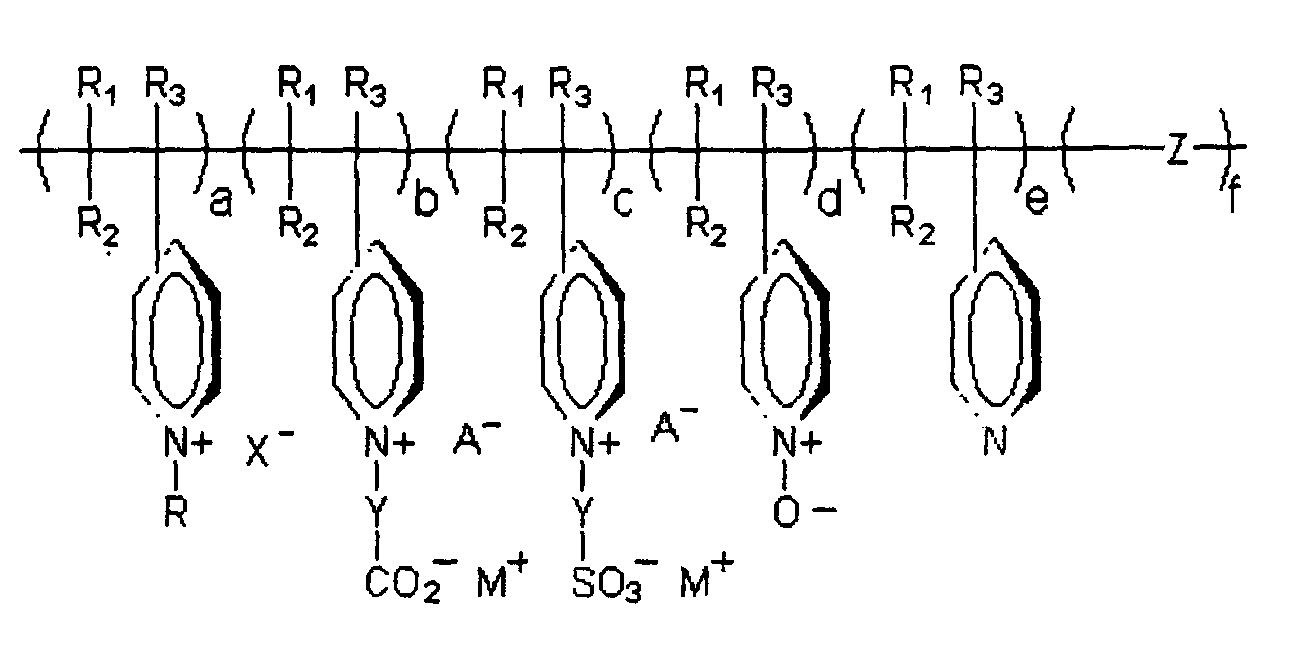 wherein a, b, c, d, e, and f represent the mole percent of the respective
repeating unit, a is 1 to 100, b is 0 to 99, c is 0 to 99, d is 0 to 99, e is 0 to 99;
f is 0 to 99; R is selected from the group consisting of substituted or
unsubstituted C1-C18 alkyl, C1-C18 alkenyl, C1-C18 alkoxy, C1-C18 aryl, and
benzyl; R1, R2, and R3, are independently selected from the group consisting
of hydrogen, hydroxyl, alkyl having C1 to C18, aryl having C6 to C18, and alkaryl
having C7 to C18; Y is independently selected from the group consisting of
(CR4R5)m1, benzene, and substituted benzene, wherein substituted benzene is
independently a benzene substituted with a group selected from the group
consisting of amino, nitro, halogen, and combinations thereof; R4 and R5 are
independently hydrogen or hydroxyl; m1 is 0 to 10; Z is the residue of an
ethylenically unsaturated monomer; M+ is independently a cation wherein M is
selected from the group consisting of hydrogen ammonia, alkali metals,
alkaline earth metals, zinc, copper, organic amines, amino acids, and amino
saccharides; X- is independently a halide; and A- is independently a halide,
provided that A- is present when M+ is present.
wherein a, b, c, d, e, and f represent the mole percent of the respective
repeating unit, a is 1 to 100, b is 0 to 99, c is 0 to 99, d is 0 to 99, e is 0 to 99;
f is 0 to 99; R is selected from the group consisting of substituted or
unsubstituted C1-C18 alkyl, C1-C18 alkenyl, C1-C18 alkoxy, C1-C18 aryl, and
benzyl; R1, R2, and R3, are independently selected from the group consisting
of hydrogen, hydroxyl, alkyl having C1 to C18, aryl having C6 to C18, and alkaryl
having C7 to C18; Y is independently selected from the group consisting of
(CR4R5)m1, benzene, and substituted benzene, wherein substituted benzene is
independently a benzene substituted with a group selected from the group
consisting of amino, nitro, halogen, and combinations thereof; R4 and R5 are
independently hydrogen or hydroxyl; m1 is 0 to 10; Z is the residue of an
ethylenically unsaturated monomer; M+ is independently a cation wherein M is
selected from the group consisting of hydrogen ammonia, alkali metals,
alkaline earth metals, zinc, copper, organic amines, amino acids, and amino
saccharides; X- is independently a halide; and A- is independently a halide,
provided that A- is present when M+ is present.
Description
- This invention relates to water-soluble quaternary polyvinylpyrridinium derivatives containing a quaternary nitrogen. The quaternary polyvinylpyrridinium derivatives are useful as anti-dye transfer and color protection agents in detergent compositions, especially detergent compositions containing a high level of anionic surfactants.
- One of the most persistent and troublesome problems arising during modem fabric laundering operations is the tendency of some colored fabrics to release dye into the laundering solutions. The dye is then transferred onto other fabrics being washed therewith.
- One way of overcoming this problem would be to complex or adsorb the fugitive dyes washed out of dyed fabrics before they have the opportunity to become attached to other articles in the wash. Polyvinylpyrrolidone, by virtue of its dye complexation ability, has been used to inhibit dye deposition during washing of colored fabrics under laundry conditions. The performance of polyvinylpyrrolidone as a dye transfer inhibitor, however, is adversely affected by the presence of high levels of anionic surfactants in the washing process.
- Other polymers which have been used in detergent compositions to inhibit dye transfer include polyvinylimidazole, polyvinylpyridine N-oxide, polyvinylimidazole and copolymers of polyvinylpyridine and polyvinylimidazole. DE 2 814 287-A describes detergent compositions containing N-vinyl imidazole homo- or copolymer in combination with anionic and/or nonionic surfactants and other detergent ingredients. WO 95/03390 describes dye inhibiting polymers of polyvinylpyrrolidone, polyamine N-oxide, and vinylimidazole. U.S. Patent No. 5,460,752 describes polyamine N-oxide polymers.
- U.S. Patent No. 5,627,151 describes copolymers of vinylpyrrolidone or vinylimidazole, vinylpyridine or dimethylaminoethyl methacrylate or dimethylaminopropylmethacrylamide, including up to 20% vinylacetate, for use in laundry detergents. U.S. Patent No. 5,466,802 describes poly(4-vinylpyridine-N-oxide) and copolymers of vinylpyrrolidone and vinylimidazole. EP 754748 describes vinylpyridine copolymers and formic acid. U.S. Patent No. 5,458,809 describes poly(4-vinylpyridine-N-oxide). WO 95/27038 describes poly(4-vinylpyridine-N-oxide), polyvinylpyrrolidone, polyvinylpyrrolidone-vinylimidazole and copolymers of vinylpyrrolidone and vinylimidazole.
- EP 372 291 describes a process for washing discoloration-sensitive textiles. The wash liquor contains anionic/nonionic surfactants and water-soluble polymers, for example, copolymers N-vinylimidazole, N-vinyloxazolidone or N-vinylpyrrolidone. EP 327 927 describes a granular detergent additive comprising water-soluble polymeric compounds based on N-vinylpyrrolidone and/or N-vinylimidazole and/or N-vinyloxazolidone and cationic compounds. DE 4027832 describes electrolyte-free liquid detergent compositions comprising zeolite A, nonionic surfactants and homo- and copolymers selected from N-vinylpyrrolidone and/or N-vinylimidazole and/or N-vinyloxazolidone. U.S. Patent No. 5,776,879 describes water-soluble poly(vinylpyridine betaines) containing a quaternary nitrogen and a carboxylate salt, which have effective dye transfer inhibitor properties. U.S. Patent Application Serial No. 09/300,913, filed April 28, 1999, describes polyvinylpyrridinium derivatives containing a quaternary nitrogen and an anionic moiety selected from a sulfonate or a carboxylate functionality, for use in detergent compositions.
- It would be advantageous to develop a polymer which provides anti-dye transfer and color protection properties to detergent compositions having a high level of anionic surfactants. The polymer should also provide anti-dye transfer and color protection properties without adversely affecting stain or soil removal or soil redeposition. In addition, the polymer should be effective on a broad range of dyes present in the wash water.
- The invention provides a water-soluble quaternary polyvinylpyrridinium derivative comprising a quaternary nitrogen. The quaternary polyvinylpyrridinium derivative has the structure:wherein a, b, c, d, e, and f represent the mole percent of the respective repeating unit, a is 1 to 100, b is 0 to 99, c is 0 to 99, d is 0 to 99, e is 0 to 99; f is 0 to 99; R is selected from the group consisting of substituted or unsubstituted C1-C18 alkyl, C1-C18 alkenyl, C1-C18 alkoxy, C1-C18 aryl, and benzyl; R1, R2, and R3, are independently selected from the group consisting of hydrogen, hydroxyl, alkyl having C1 to C18, aryl having C6 to C18, and alkaryl having C7 to C18; Y is independently selected from the group consisting of (CR4R5)m1, benzene and substituted benzene wherein substituted benzene is independently a benzene substituted with a group selected from the group consisting of amino, nitro, halogen, and combinations thereof; R4 and R5 are independently H or OH; m1 is 0 to 10; Z is the residue of an ethylenically unsaturated monomer; M+ is independently a cation wherein M is selected from the group consisting of hydrogen, ammonia, alkali metals, alkaline earth metals, zinc, copper, organic amines, amino acids, and amino saccharides; X-is independently a halide; and A- is independently a halide, provided that A- is present when M+ is present.

- The quaternary polyvinylpyrridinium derivatives of the invention inhibit dye transfer in detergent compositions having a high level of anionic surfactants. The polymer also provides anti-dye transfer and color protection properties without adversely affecting stain or soil removal or soil redeposition. In addition, the polymer is effective on a broad range of dyes present in the wash water.
- The present inventors believe that the quaternary polyvinylpyrridinium derivative of the invention inhibits dye transfer in laundering or washing processes containing the detergent composition by hydrogen bonding with dyes or through dipole-dipole interaction or electrostatic interaction with dyes which are present in wash water.
- In accordance with the invention, the water-soluble quaternary polyvinylpyrridinium derivative comprises a quaternary nitrogen. The quaternary polyvinylpyrridinium derivative has the general structure:wherein a, b, c, d, e, and f represent the mole percent of the respective repeating unit, a is 1 to 100, b is 0 to 99, c is 0 to 99, d is 0 to 99, e is 0 to 99; f is 0 to 99; R is selected from the group consisting of substituted or unsubstituted C1-C18 alkyl, C1-C18 alkenyl, C1-C18 alkoxy, C1-C18 aryl, and benzyl; R1, R2, and R3, are independently selected from the group consisting of hydrogen, hydroxyl, alkyl having C1 to C18, aryl having C6 to C18, and alkaryl having C7 to C18; Y is independently selected from the group consisting of (CR4R5)m1, benzene, and substituted benzene, wherein substituted benzene is independently a benzene substituted with a group selected from the group consisting of amino, nitro, halogen, and combinations thereof; R4 and R5 are independently hydrogen or hydroxyl; m1 is 0 to 10; Z is the residue of an ethylenically unsaturated monomer; M+ is independently a cation wherein M is selected from the group consisting of hydrogen, ammonia, alkali metals, alkaline earth metals, zinc, copper, organic amines, amino acids, and amino saccharides; X- is independently a halide; and A- is independently a halide, provided that A- is present when M+ is present.
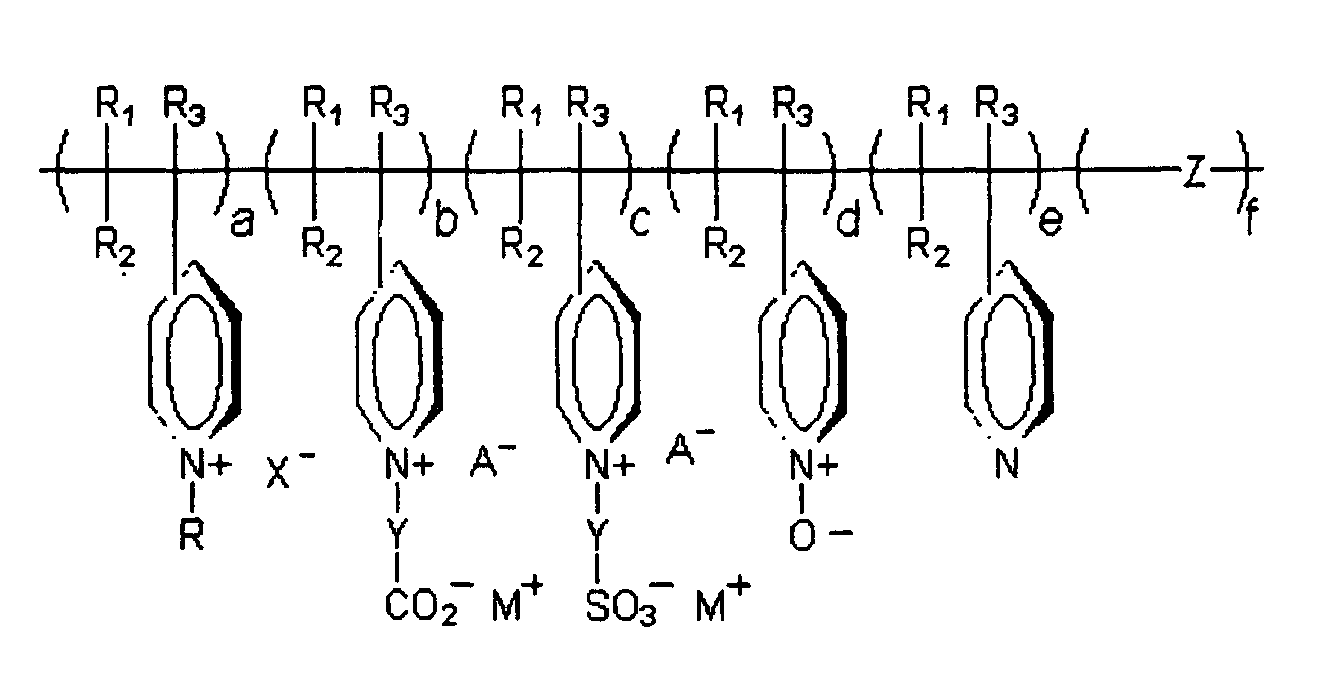
- In a preferred embodiment of the quaternary polyvinylpyrridinium derivative, a is 50 to 100, b is 0 to 50, c is 0 to 50, d is 0 to 50, e is 0 to 50, and f is 0 to 50, more preferably a is 50 to 100, b is 0 to 10, c is 0 to 10, d is 0 to 10, e is 0 to 10, and f is 0 to 10. Preferably R is selected from C1-C18 alkyl, C1-C18 alkenyl, or benzyl. Preferably R1, R2, and R3, are independently selected from hydrogen, hydroxyl or methyl. Preferably Y is independently selected from (CR4R5)m1, or benzene. Preferably m1 is 1 to 6. Preferably Z is the residue of an anionic ethylenically unsaturated monomer. Preferably M+ is independently a cation wherein M is sodium or potassium Preferably X- is independently fluoride, chloride, iodide, or bromide, more preferably chloride. Preferably A- is independently fluoride, chloride, iodide, or bromide, more preferably chloride.
- It is within the scope of the invention that M+ and A- may not be present in the quaternary polyvinylpyrridinium derivative of the invention. A- is present when M+ is present. Similarly, M+ is present when A- is present.
- The letter Z represents the residue of an ethylenically unsaturated monomer. Any ethylenically unsaturated monomer may be used. Such monomers are known to those skilled in the art. A combination of ethylenically unsaturated monomers may also be used.
- In one embodiment of the invention, the ethylenically unsaturated monomers have an anionic charge or become anionic upon treatment with a base. While not wishing to be bound by any particular theory, the inventors believe that the anionic charge minimizes interaction of the polymers of the invention with anionic surfactants present in the detergent compositions. Examples of such monomers are acrylic acid, 2-acrylamido-2-methyl propane sulfonic acid, sodium methallyl sufonate, sodium vinyl sulfonate, sulfonated styrene, allyloxybenzene sulfonic acid, methacrylic acid, ethacrylic acid, alpha-chloro-acrylic acid, alpha-cyano acrylic acid, alpha-chloro-acrylic acid, alpha-cyano acrylic acid, beta methyl-acrylic acid (crotonic acid), alpha-phenyl acrylic acid, beta-acryloxy propionic acid, sorbic acid, alpha-chloro sorbic acid, angelic acid cinnamic acid, p-chloro cinnamic acid, beta styryl acrylic acid (1-carboxy-4-phenyl butadiene-1,3), itaconic acid, maleic acid, citraconic acid, mesaconic acid, glutaconic acid, aconitic acid, fumaric acid, and tricarboxy ethylene.
- In one embodiment of the invention, the ethylenically unsaturated monomers are nonionic nitrogen containing monomers. Examples of such monomers are acrylamide, N, N-dimethylacrylamide, N-octyl acrylamide, N-methylol acrylamide, dimethylaminoethylacrylate, vinyl pyrrolidone, vinyl imidazolidone, N-vinyl formamide, N-vinyl acetamide, dimethytaminoethyl acrylate, dimethylaminoethyl methacrylate, diethylaminoethyl acrylate, diethylaminoethyl methacrylate, dimethylaminopropyl acrylate, dimethylaminopropyl methacrylate, diethylaminopropyl acrylate, diethylaminopropyl methacrylate, dimethylaminobutyl acrylate, dimethylaminobutyl methacrylate, dimethylaminoneopentyl acrylate, dimethylaminoneopentyl methacrylate, dimethylaminoethylacrylamide, dimethylaminoethylmethacrylamide, diethylaminoethylacrylamide, diethylaminoethylmethacrylamide, dipropylaminoethylacrylamide, dipropylaminoethylmethacrylamide, dimethylaminopropylacrylamide, dimethylaminopropylmethacrylamide, diethylaminopropylacrylamide, diethylaminopropylmethacrylamide, dimethylaminoneopentylacrylamide, dimethylaminoneopentylmethacrylamide and dialkylaminobutylacrylamide.
- In one embodiment of the invention, the water-soluble quaternary polyvinylpyrridinium derivatives of the invention are made by polymerizing a vinylpyridine under suitable polymerization conditions to form a poly(vinylpyridine) intermediate, and then reacting the poly(vinylpyridine) intermediate with a quaternizing agent. The reaction product is a quaternary polyvinylpyrridinium derivative containing a quaternary nitrogen.
- In one embodiment of the invention the water-soluble quaternary polyvinylpyrridinium derivatives of the invention are made by reacting a vinylpyridine monomer with a suitable quaternary reagent to form a quaternized vinylpyrridinium monomer, and then polymerizing the quaternized vinylpyrridinium monomer to form a quaternary polyvinylpyrridinium derivative containing a quaternary nitrogen.
- In one embodiment of the invention, unfunctionalized pyridine groups in the quaternary polyvinylpyrridinium derivative are further reacted to the corresponding betaine (repeating unit b and c), or amine oxide (repeating unit d), or left as is (repeating unit e). Optionally another monomer (repeating unit f) may be incorporated into the quaternary polyvinylpyrridinium derivative.
- In one embodiment of the invention, vinyl pyridine is polymerized in an alcohol water mixture and then reacted to form the corresponding quaternary polyvinylpyrridinium derivative. A small amount of base is added to the reaction mixture, alcohol is distilled off to produce a water soluble product. It is important to note, however, that nonwater-soluble monomers may be used to prepare the quaternary polyvinylpyrridinium derivative. Although the reaction proceeds without a catalyst, a catalyst may be employed to speed up the reaction. Suitable catalysts are known to those skilled in the art.
- In one embodiment, the quaternary polyvinylpyrridinium derivative is used in a fabric softening composition. The level of the quaternary polyvinylpyrridinium derivative in the fabric softening compositions is from about 0.01 to about 90 weight percent, more preferably from about 0.05 to about 20 percent, most preferably from about 0.1 to about 10 weight percent, based on the total weight of the fabric softening composition.
- In one embodiment, the quaternary polyvinylpyrridinium derivative is used in detergent compositions The level of the quaternary polyvinylpyrridinium derivative in the detergent compositions is from about 0.01 to about 90 weight percent, more preferably from about 0.05 to about 20 percent, most preferably from about 0.1 to about 10 weight percent, based on the total weight of the detergent composition.
- While not wishing to be bound by any particular theory, the present inventors believe that the quaternary polyvinylpyrridinium derivative of the invention inhibits dye transfer in laundering or washing processes containing the detergent composition by hydrogen bonding with dyes or through dipole-dipole interaction or electrostatic interaction with dyes which are present in wash water. The laundering or washing process is preferably carried out at about 5°C to about 75°C, more preferably, from about 20°C to about 60°C.
- The detergent composition may be a solid or liquid composition. If the detergent composition is solid, the detergent composition may be in any of the usual physical forms, such as for example, powders, beads, flakes, bars, tablets, noodles, pastes, and slurries. If the detergent composition is liquid, the detergent composition preferably disperses or solubilizes the quaternary polyvinylpyrridinium derivative. The detergent composition may be aqueous or nonaqueous. For example, the quaternary polyvinylpyrridinium derivative may be dissolved or dispersed in water, in one or more solvents or inert diluents. Preferably the detergent composition is aqueous.
- The detergent compositions may contain any additional components which are used in detergent compositions. Such additional components are well known to those skilled in the art and include one or more surfactants, builders, ion exchangers, alkalies, anticorrosion materials, antiredeposition materials, optical brighteners, fragrances, dyes, chelating agents, enzymes, whiteners, brighteners, antistatic agents, sudsing control agents, solvents, hydrotropes, bleaching agents, perfumes, bleach precursors, water, buffering agents, soil removal agents, soil release agents, softening agents, opacifiers, inert diluents, buffering agents, corrosion inhibitors, graying inhibitors, and stabilizers. Combinations of such additional components may also be used.
- Suitable surfactants are nonionic, anionic, cationic, ampholytic, zwitterionic and semi-polar surfactants. A combination of surfactants may also be used.
- Anionic surfactants include, for example, from C8 to C20 alkylbenzenesulfonates, from C8 to C20 alkanesulfonates, from C8 to C20 alkylsulfates, from C8 to C20 alkylsulfosuccinates or from C8 to C20 sulfated ethoxylated alkanols.
- Nonionic surfactants include, for example, from C6 to C12 alkylphenol ethoxylates, from C8 to C20 alkanol alkoxylates, and block copolymers of ethylene oxide and propylene oxide. Optionally, the end groups of polyalkylene oxides can be blocked, whereby the free OH groups of the polyalkylene oxides can be etherified, esterified, acetalized and/or aminated. Another modification consists of reacting the free OH groups of the polyalkylene oxides with isocyanates. The nonionic surfactants also include C4 to C18 alkyl glucosides as well as the alkoxylated products obtainable therefrom by alkoxylation, particularly those obtainable by reaction of alkyl glucosides with ethylene oxide.
- Cationic surfactants contain hydrophilic functional groups where the charge of the functional groups are positive when dissolved or dispersed in an aqueous solution. Typical cationic surfactants include, for example, amine compounds, oxygen containing amines, and quaternary amine salts.
- Amphoteric surfactants contain both acidic and basic hydrophilic groups Amphoteric surfactants are preferably derivatives of secondary and tertiary amines, derivatives of quaternary ammonium, quaternary phosphonium or tertiary sulfonium compounds. The cationic atom in the quaternary compound can be part of a heterocyclic ring. The amphoteric surfactant preferably contains at least one aliphatic group, containing about 3 to about 18 carbon atoms. At least one aliphatic group preferably contains an anionic water-solubilizing group such as a carboxy, sulfonate, or phosphono.
- Generally, anionic surfactants, such as linear alkyl sulfonates (LAS) are preferred for use in solid detergent compositions containing the quaternary polyvinylpyrridinium derivative. Nonionic and anionic surfactant mixtures such as alcohol ethoxylates and LAS are preferred in liquid detergent compositions containing the quaternary polyvinylpyrridinium derivative. The surfactants are optionally present in an amount of from about 0 to about 50 weight percent, preferably from about 2 to about 45 weight percent, and more preferably from about 5 to about 40 weight percent, based on the total weight of the detergent composition.
- Examples of bleaching agents are perborates, percarbonates, or chlorine-generating substances such as chloroisocyanurates. Examples of silicates used as corrosion inhibitors are sodium silicate, sodium disilicate, and sodium metasilicate. Examples of graying inhibitors are carboxymethylcellulose, methylcellulose, hydroxypropylmethyl-cellulose, and polyacrylic acid and copolymers of acrylic and maleic acid.
- Examples of enzymes are proteases, amylases, lipases, cellulases, and peroxidases, as well as mixtures thereof. Other types of enzymes may also be included. They may be of any suitable origin, such as vegetable, animal, bacterial, fungal and yeast origin.
- Any conventional builder system is suitable for use in the detergent composition including aluminosilicate materials, silicates, polycarboxylates and fatty acids, materials such as ethylenediamine tetraacetate, metal ion sequestrants such as aminopolyphosphonates, particularly ethylenediamine tetramethylene phosphonic acid and diethylene triamine pentamethylenephosphonic acid. Though less preferred for obvious environmental reasons, phosphate builders can also be used herein.
- Suitable builders can be an inorganic ion exchange material, commonly an inorganic hydrated aluminosilicate material, more particularly a hydrated synthetic zeolite such as hydrated zeolite A, X, B or HS. Another suitable inorganic builder material is layered silicate, e.g., SKS-6 (Hoechst). SKS-6 is a crystalline layered silicate consisting of sodium silicate (Na2Si2O5). The preferred polycarboxylates are hydroxycarboxylates containing up to three carboxy groups per molecule, more particularly citrates.
- Preferred builder systems for use in the detergent compositions include a mixture of a water-insoluble aluminosilicate builder such as zeolite A or of a layered silicate (SKS/6), and a water-soluble carboxylate chelating agent such as citric acid.
- A suitable chelant for inclusion in the detergent compositions is ethylenediamine-N,N'-disuccinic acid (EDDS) or the alkali metal, alkaline earth metal, ammonium, or substituted ammonium salts thereof, or mixtures thereof.
- Examples of suds suppressors are silicones and silica-silicone mixtures. Silicones can be generally represented by alkylated polysiloxane materials while silica is normally used in finely divided forms exemplified by silica aerogels and xerogels and hydrophobic silicas of various types.
- Examples of antiredeposition and soil suspension agents are cellulose derivatives such as methylcellulose, carboxymethylcellulose and hydroxyethylcellulose, and homopolymers of acrylic acid and copolymers of maleic acid and acrylic acid.
- Examples of optical brighteners are disodium 4,41-bis-(2-diethanolamino-4-anilino-s-triazin-6-ylamino)stilbene-2:21disulphonate, disodium 4,-41-bis-(2-morpholino-4-anilino-s-triazin-6-ylaminostilbene-2:21-disulphonate, disodium 4,41- bis-(2,4-dianilino-s-triazin-6-ylamino)stilbene-2:21-disulphonate, monosodium 41,411-bis-(2,4-dianilino-s-triazin-6ylamino)stilbene-2-sulphonate, disodium 4,41-bis-(2-anilino-4-(N-methyl-N-2-hydroxyethylamino)-s-triazin-6-ylamino)stilbene-2,21- disulphonate, disodium 4,41-bis-(4-phenyl-2,1,3-triazol-2-yl)-stilbene-2,21disulphonate, disodium 4,41bis(2-anilino-4-(1-methyl-2-hydroxyethylamino)-s-triazin-6-ylamino)stilbene-2,21disulphonate, and sodium 2(stilbyl-411-(naphtho-11,21:4,5)-1,2,3-triazole-211-sulphonate.
- Other useful polymeric materials which may be added to the detergent compositions are polyethylene glycols, particularly those of molecular weight 1000-10000, more particularly 2000 to 8000 and most preferably about 4000. These optional polymeric materials including the previously mentioned homo- or copolymeric polycarboxylate salts are valuable for improving whiteness maintenance, fabric ash deposition, and cleaning performance on clay, proteinaceous and oxidizable soils in the presence of transition metal impurities.
- Examples of soil release agents are conventional copolymers or terpolymers of terephthalic acid with ethylene glycol and/or propylene glycol units in various arrangements, as well as the ethoxylated/propoxylated polyamines. Modified polyesters may also be used as soil release agents, and include random copolymers of dimethyl terephtalate, dimethyl sulfoisophtalate ethylene glycol and 1-2 propane diol, the end groups consisting primarily of sulphobenzoate and secondarily of mono esters of ethylene glycol and/or propane-diol.
- The following nonlimiting examples illustrate further aspects of the invention.
- A sample of poly(4 vinyl-1-methyl-pyridinium bromide) (20% solution in water) was obtained from PolySciences Inc, Warrington PA. This polymer was evaluated in the anti-dye transfer test described below.
- The test involved washing 1 white cotton swatch with 4 swatches dyed with Direct Blue 1, 4 swatches dyed with Direct Blue 90, and 1 white cotton 400. These swatches are commercially available from Test Fabrics in New Jersey. The test was conducted in a terg-o-tometer using 1.3 g/l of commercial Wisk liquid detergent and 1 weight percent polymer based on the weight of the detergent. The test was conducted at 93.4°F, 80 rpm and 110 PPM hardness water. The wash was 20 minutes and was followed by a 3 minute rinse. The swatches were then dried and the L values (whiteness) of the white swatches were measured using a Hunter colorimeter. A higher L value for the white swatch indicates that less dye is being transferred to the swatch and is a measure of the effectiveness of the dye transfer polymer. The test results are summarized in Table I.
Evaluation of dye transfer properties. Commercial liquid detergent composition Quaternary polyvinylpyrridinium derivative L value of white swatch Wisk None 77.6 Wisk poly(4 vinyl-1-methyl-pyridinium bromide) 84.5 - The results in Table I show that colored swatches washed in the detergent compositions containing the quaternary polyvinylpyrridinium derivative of this invention were significantly whiter, as determined by the higher L values, than the swatches washed in the detergents without the polymer of the invention. Thus, the quaternary polyvinylpyrridinium derivatives prevent dyes which are present in the wash water from depositing on clothing.
- Determination of whether the quaternary polyvinylpyrridinium derivatives such as the poly(4 vinyl-1-methyl-pyridinium bromide) of Example 1 affect stain removal in a detergent composition.
- A primary detergency test was conducted using a Blood/Milk/Ink (BMI) stain that was obtained from Test Fabrics. The test consisted on washing a BMI obtained swatch with 5 white swatches as ballast. These swatches are commercially available from Test Fabrics in New Jersey. The test was conducted in a terg-o-tometer using 1.9 g/l of commercially available Arm and Hammer powder or 1.3 g/l of commercially available liquid Wisk and 1.0 wt. Polymer based on weight of detergent. The test was conducted at 93°F, 80 rpm and 110 PPM hardness water. The wash was 20 minutes and was followed by a 3 minute rinse. The swatches were then dried and the L values of the BMI swatches were measured using a Hunter colorimeter. Higher L values for the BMI swatches indicate better detergency and that the stain is not being held on. The test results are summarized in Table II.
Evaluation of primary detergency properties. Polymer or Copolymer Commercial detergent L value of white swatch in primary detergency L value of BMI swatch in primary detergency None Arm and Hammer powder 61.0 92.7 poly(4 vinyl-1-methyl-pyridinium bromide) Arm and Hammer powder 61.0 92.1 None Wisk liquid 63.9 93.1 poly(4 vinyl-1-methyl-pyridinium bromide) poly(4 vinyl-1-methyl-pyridinium bromide) 63.4 93.0 - The test results in Table II show that the quaternary polyvinylpyrridinium derivative of Example 1 does not adversely affect stain removal since the L value of the BMI swatch in the presence of the polymer is approximately the same as that of the control. Furthermore, the L values of the white swatch indicate that the polymer and copolymer do not have an adverse effect on anti-redeposition properties since L value of the white swatch in the presence of the polymer is approximately the same as that of the control.
- Synthesis of poly(4 vinyl-1-ethyl-pyridinium bromide) 3.5 grams of poly(4-vinyl pyridine), 0.0476 mol, having a molecular weight of 50,000 (obtained from Polysciences, Inc.) was dissolved in 100.0 grams of isopropanol. The mixture was heated to 60°C in a reactor to dissolve the polymer. A solution of 3.63 grams of ethyl bromide was added to the reactor. The mixture was heated to 80°C and held at that temperature for 20 hours. 75 grams of deionized water was then added to the dark brown reaction mixture. The isopropanol was distilled off by raising the temperature to 100°C. After cooling, the product was a clear light brown solution with no undissolved solids.
- A sample of poly(4 vinyl-1-ethyl-pyridinium bromide) synthesized in Example 3 was evaluated in the anti-dye transfer test described below. The test involved washing 1 white cotton swatch with 4 swatches dyed with Direct Blue 1, 4 swatches dyed with Direct Blue 90, and 1 white cotton 400. These swatches are commercially available from Test Fabrics in New Jersey. The test was conducted in a terg-o-tometer using 1.3 g/l of Wisk liquid detergent and 1weight percent polymer based on the weight of the detergent. The test was conducted at 93.4°F, 80 rpm and 110 PPM hardness water. The wash was 20 minutes and was followed by a 3 minute rinse. The swatches were then dried and the L values (whiteness) of the white swatches were measured using a Hunter colorimeter. A higher L value for the white swatch indicates that less dye is being transferred to the swatch and is a measure of the effectiveness of the dye transfer polymer. The test results are summarized in Table III.
Evaluation of dye transfer properties. Commercial liquid detergent composition Quaternary polyvinylpyrridinium derivative L value of white swatch Wisk None 77.9 Wisk poly(4 vinyl-1-ethyl-pyridinium bromide) 86.5 - The results in Table III show that colored swatches washed in the detergent compositions containing the quaternary polyvinylpyrridinium derivative prepared in Example 3 were significantly whiter, as determined by the higher L values, than the swatches washed in the detergents without the polymer of the invention. Thus, the quaternary polyvinylpyrridinium derivatives prevent dyes which are present in the wash water from depositing on clothing.
- Determination of whether the quaternary polyvinylpyrridinium derivatives such as the poly(4 vinyl-1-ethyl-pyridinium bromide) of Example 3 affect stain removal in a detergent composition.
- A primary detergency test was conducted using a series of stains that ware obtained from Test Fabrics. The test consisted on 3 swatches each stained with Grass, tea, red wine and dust sebum in a full scale washing machine using 48.3 L of water. The test was conducted using 1.3 g/l of commercially available liquid Wisk and 0.5 wt. Polymer based on weight of detergent. The test was conducted at 93°F, 80 rpm and 110 PPM hardness water. The wash was 20 minutes and was followed by a 3 minute rinse. The swatches were then dried and the L values of the swatches were measured using a Hunter colorimeter. Higher L values for the swatches indicate better detergency and that the stain is not being held on. The test results are summarized in Table IV.
Evaluation of primary detergency properties. Stain Average L value of stained swatch in the control Average L value of stained swatch with polymer Grass 9.2 8.6 Tea 1.4 1.4 Red Wine 11.0 10.6 Dust Sebum 11.2 11.1 - The test results in Table IV show that the quaternary polyvinylpyrridinium derivative of Example 3 does not adversely affect stain removal since the average L value of the stained swatches in the presence of the polymer are approximately the same as that of the control.
- Synthesis of poly(sodium 2 acrylamido-2 methyl propane sulfonate (2-ACRYLAMIDO-2-METHYL-1-PROPANE SULFONIC ACID)-co-4 vinyl-1-ethyl-pyridinium bromide)
- A mixture of 100 grams of deionized water and 100 grams isopropyl alcohol were taken in a reactor and heated to 80°C. The comonomers comprising 50 grams of 4-vinyl pyridine and 218.2 grams of a 50% solution of sodium 2-ACRYLAMIDO-2-METHYL-1-PROPANE SULFONIC ACID were fed to the reactor in separate feeds over a period of 1 hour. An initiator feed comprising of 1.5 grams of ammonium persulfate in 30 grams of deionized water was simultaneously added over a period of 1.5 hours. The reaction mixture was then held for 2 hours at 80°C. The reaction mixture was then cooled to 21°C and 100 grams of the copolymer product were separated out for the quarternization reaction. Ethyl bromide, 10.3 grams, was added to the 100 grams of copolymer and heated to 80°C for 17 hours. The dark product was distilled to remove the isopropyl alcohol. After cooling, the product was a clear dark brown solution with no undissolved solids.
- A sample of poly(sodium 2 acrylamido-2 methyl propane sulfonate co-4 vinyl-1-ethyl-pyridinium bromide) synthesized in Example 6 was evaluated in the anti-dye transfer test described below.
- The test involved washing 1 white cotton swatch with 4 swatches dyed with Direct Blue 1, 4 swatches dyed with Direct Blue 90, and 1 white cotton 400. These swatches are commercially available from Test Fabrics in New Jersey. The test was conducted in a terg-o-tometer using 1.3 g/l of Wisk liquid detergent and 1weight percent polymer based on the weight of the detergent. The test was conducted at 93.4°F, 80 rpm and 110 PPM hardness water. The wash was 20 minutes and was followed by a 3 minute rinse. The swatches were then dried and the L values (whiteness) of the white swatches were measured using a Hunter colorimeter. A higher L value for the white swatch indicates that less dye is being transferred to the swatch and is a measure of the effectiveness of the dye transfer polymer. The test results are summarized in Table V.
Evaluation of dye transfer properties. Commercial liquid detergent composition Quaternary polyvinylpyrridinium derivative L value of white swatch Wisk None 77.3 Wisk poly(sodium 2 acrylamido-2 methyl propane sulfonate)-co-4 vinyl-1-ethyl-pyridinium bromide) 83.7 - The results in Table V show that colored swatches washed in the detergent compositions containing the quaternary polyvinylpyrridinium derivative prepared in Example 6 were significantly whiter, as determined by the higher L values, than the swatches washed in the detergents without the polymer of the invention. Thus, the quaternary polyvinylpyrridinium derivatives prevent dyes which are present in the wash water from depositing on clothing.
- Determination of whether the quaternary polyvinylpyrridinium derivatives such as the poly(sodium 2 acrylamido-2 methyl propane sulfonate)-co-4 vinyl-1-ethyl-pyridinium bromide) of Example 6 effect stain removal in a detergent composition.
- A primary detergency test was conducted using a Blood/Milk/Ink (BMI) stain that was obtained from Test Fabrics. The test consisted on washing a BMI obtained swatch with 5 white swatches as ballast. These swatches are commercially available from Test Fabrics in New Jersey. The test was conducted in a terg-o-tometer using 1.3 g/l of commercially available liquid Wisk and 1.0 wt. Polymer based on weight of detergent. The test was conducted at 93°F, 80 rpm and 110 PPM hardness water. The wash was 20 minutes and was followed by a 3 minute rinse. The swatches were then dried and the L values of the BMI swatches were measured using a Hunter colorimeter. Higher L values for the BMI swatches indicate better detergency and that the stain is not being held on. The test results are summarized in Table VI.
Evaluation of primary detergency properties. Polymer or Copolymer Commercial detergent L value of white swatch in primary detergency L value of BMI swatch in primary detergency None Wisk liquid 63.4 93.4 poly(sodium 2 acrylamido-2 methyl propane sulfonate)-co-4 vinyl-1-ethyl-pyridinium bromide) Wisk liquid 62.7 93.4 - The test results in Table VI show that the quaternary polyvinylpyrridinium derivative of Example 6 does not adversely affect stain removal since the L value of the BMI swatch in the presence of the polymer is approximately the same as that of the control. Furthermore, the L values of the white swatch indicate that the polymer and copolymer do not have an adverse effect on anti-redeposition properties since L value of the white swatch in the presence of the polymer is approximately the same as that of the control.
- While the invention has been described with particular reference to certain embodiments thereof, it will be understood that changes and modifications may be made by those of ordinary skill in the art within the scope and spirit of the following claims.
Claims (4)
- A water-soluble quaternary polyvinylpyrridinium derivative comprising a quaternary nitrogen and an anionic moiety selected from a sulfonate or a carboxylate functionality, said quaternary polyvinylpyrridinium derivative having the structurewherein a, b, c, d, e, and f represent the mole percent of the respective repeating unit, a is 1 to 100 and preferably 50 to 100; b is 0 to 99 and preferably 0 to 50; c is 0 to 99 and preferably 0 to 50; d is 0 to 99 and preferably 0 to 50; e is 0 to 99 and preferably 0 to 50; f is 0 to 99 and preferably 0 to 50; R is selected from the group consisting of substituted or unsubstituted C1-C18 alkyl, C1-C18 alkenyl, C1-C18 alkoxy, C1-C18 aryl, and benzyl; R1, R2, and R3, are independently selected from the group consisting of hydrogen, hydroxyl, alkyl having C1 to C18, aryl having C6 to C18, and alkaryl having C7 to C18; Y is independently selected from the group consisting of (CR4R5)m1, benzene, and substituted benzene, wherein substituted benzene is independently a benzene substituted with a group selected from the group consisting of amino, nitro, halogen, and combinations thereof; R4 and R5 are independently hydrogen or hydroxyl; m1 is 0 to 10; Z is the residue of an ethylenically unsaturated monomer; M+ is independently a cation wherein M is selected from the group consisting of hydrogen, ammonia, alkali metals, alkaline earth metals, zinc, copper, organic amines, amino acids, and amino saccharides; X- is independently a halide; and A- is independently a halide, provided that A- is present when M+ is present.

- The quaternary polyvinylpyrridinium derivative according to Claim 1 wherein the ethylenically unsaturated monomer is selected from the group consisting of acrylic acid, 2-acrylamido-2-methyl propane sulfonic acid, sodium methallyl sufonate, sodium vinyl sulfonate, sulfonated styrene, allyloxybenzene sulfonic acid, methacrylic acid, ethacrylic acid, alpha-chloro-acrylic acid, alpha-cyano acrylic acid, alpha-chloro-acrylic acid, alpha-cyano acrylic acid, beta methyl-acrylic acid (crotonic acid), alpha-phenyl acrylic acid, beta-acryloxy propionic acid, sorbic acid, alpha-chloro sorbic acid, angelic acid, cinnamic acid, p-chloro cinnamic acid, beta-styryl acrylic acid (1-carboxy-4-phenyl butadiene-1,3), itaconic acid, maleic acid, citraconic acid, mesaconic acid, glutaconic acid, aconitic acid, fumaric acid, tricarboxy ethylene, acrylamide, N, N-dimethylacrylamide, N-octyl acrylamide, N-methylol acrylamide, dimethylaminoethylacrylate, vinyl pyrrolidone, vinyl imidazolidone, N-vinyl formamide, N-vinyl acetamide, dimethylaminoethyl acrylate, dimethylaminoethyl methacrylate, diethylaminoethyl acrylate, diethylaminoethyl methacrylate, dimethylaminopropyl acrylate, dimethylaminopropyl methacrylate, diethylaminopropyl acrylate, diethylaminopropyl methacrylate, dimethylaminobutyl acrylate, dimethylaminobutyl methacrylate, dimethylaminoneopentyl acrylate, dimethylaminoneopentyl methacrylate, dimethylaminoethylacrylamide, dimethylaminoethylmethacrylamide, diethylaminoethylacrylamide, diethylaminoethylmethacrylamide, dipropylaminoethylacrylamide, dipropylaminoethylmethacrylamide, dimethylaminopropylacrylamide, dimethylaminopropylmethacrylamide, diethylaminopropylacrylamide, diethylaminopropylmethacrylamide, dimethylaminoneopentylacrylamide, dimethylaminoneopentylmethacrylamide and dialkylaminobutylacrylamide.
- A laundry detergent composition comprising 0.01 to 90 weight percent and preferably from 0.05 to 20 weight percent and most preferably from 0.1 to 10 percent by weight, based on the total weight of the detergent composition, of a water-soluble quaternary polyvinylpyrridinium derivative comprising a quaternary nitrogen and an anionic moiety selected from a sulfonate or a carboxylate functionality, said quaternary polyvinylpyrridinium derivative having the structurewherein a, b, c, d, e, and f represent the mole percent of the respective repeating unit, a is 1 to 100 and preferably 50 to 100; b is 0 to 99 and preferably 0 to 50; c is 0 to 99 and preferably 0 to 50; d is 0 to 99 and preferably 0 to 50; e is 0 to 99 and preferably 0 to 50; f is 0 to 99 and preferably 0 to 50; R is selected from the group consisting of substituted or unsubstituted C1-C18 alkyl, C1-C18 alkenyl, C1-C18 alkoxy, C1-C18 aryl, and benzyl; R1, R2, and R3, are independently selected from the group consisting of hydrogen, hydroxyl, alkyl having C1 to C18, aryl having C6 to C18, and alkaryl having C7 to C18; Y is independently selected from the group consisting of (CR4R5)m1, benzene, and substituted benzene, wherein substituted benzene is independently a benzene substituted with a group selected from the group consisting of amino, nitro, halogen, and combinations thereof; R4 and R5 are independently hydrogen or hydroxyl; m1 is 0 to 10; Z is the residue of an ethylenically unsaturated monomer; M+ is independently a cation wherein M is selected from the group consisting of hydrogen, ammonia, alkali metals, alkaline earth metals, zinc, copper, organic amines, amino acids, and amino saccharides; X- is independently a halide; and A- is independently a halide, provided that A- is present when M+ is present ; said laundry detergent composition optionally comprising at least one ingredient selected from the group consisting of builders, enzymes and preferably a protease enzyme, enzyme stabilizers, optical brighteners, bleaches, bleach boosters, bleach activators, dye transfer agents, dispersents, enzyme activators, suds suppressers, dyes, perfumes, colorants, filler salts, hydrotropes, and mixtures thereof..

- A process for inhibiting dye transfer from one fabric to another during fabric laundering operations involving colored fabrics, said process comprises contacting fabrics with a laundering solution comprising a water-soluble quaternary polyvinylpyrridinium derivative, preferably in an amount of from 0.05 to 20 weight percent, comprising a quaternary nitrogen and an anionic moiety selected from a sulfonate or a carboxylate functionality, said quaternary polyvinylpyrridinium derivative having the structurewherein a, b, c, d, e, and f represent the mole percent of the respective repeating unit, a is 1 to 100 and preferably 50 to 100; b is 0 to 99 and preferably 0 to 50; c is 0 to 99 and preferably 0 to 50; d is 0 to 99 and preferably 0 to 50; e is 0 to 99 and preferably 0 to 50: f is 0 to 99 and preferably 0 to 50; R is selected from the group consisting of substituted or unsubstituted C1-C18 alkyl, C1-C18 alkenyl, C1-C18 alkoxy, C1-C18 aryl, and benzyl; R1, R2, and R3, are independently selected from the group consisting of hydrogen, hydroxyl, alkyl having C1 to C18, aryl having C6 to C18, and alkaryl having C7 to C18; Y is independently selected from the group consisting of (CR4R5)m1, benzene, and substituted benzene, wherein substituted benzene is independently a benzene substituted with a group selected from the group consisting of amino, nitro, halogen, and combinations thereof; R4 and R5 are independently hydrogen or hydroxyl; m1 is 0 to 10; Z is the residue of an ethylenically unsaturated monomer; M+ is independently a cation wherein M is selected from the group consisting of hydrogen, ammonia alkali metals, alkaline earth metals zinc, copper, organic amines, amino acids, and amino saccharides; X- is independently a halide; and A- is independently a halide, provided that A- is present when M+ is present.

Applications Claiming Priority (2)
| Application Number | Priority Date | Filing Date | Title |
|---|---|---|---|
| US393117 | 1999-09-10 | ||
| US09/393,117 US6306815B1 (en) | 1999-09-10 | 1999-09-10 | Quaternary polyvinylpyrridinium derivatives as anti-dye transfer agents |
Publications (1)
| Publication Number | Publication Date |
|---|---|
| EP1083218A1 true EP1083218A1 (en) | 2001-03-14 |
Family
ID=23553337
Family Applications (1)
| Application Number | Title | Priority Date | Filing Date |
|---|---|---|---|
| EP00119306A Withdrawn EP1083218A1 (en) | 1999-09-10 | 2000-09-06 | Quaternary polyvinylpyrridinium derivatives as anti-dye transfer agents |
Country Status (6)
| Country | Link |
|---|---|
| US (1) | US6306815B1 (en) |
| EP (1) | EP1083218A1 (en) |
| JP (1) | JP2001146507A (en) |
| KR (1) | KR20010039869A (en) |
| AU (1) | AU5654700A (en) |
| CA (1) | CA2317894A1 (en) |
Cited By (3)
| Publication number | Priority date | Publication date | Assignee | Title |
|---|---|---|---|---|
| WO2004067691A1 (en) * | 2003-01-27 | 2004-08-12 | Little Island Patents Ltd | An improved scavenging substrate |
| EP1621604A3 (en) * | 2004-07-29 | 2006-04-12 | Orlandi S.p.a. | Colour scavenger material |
| DE10155863B4 (en) * | 2001-11-06 | 2008-08-28 | J. S. Staedtler Gmbh & Co. Kg | Aqueous based marking ink and its use |
Families Citing this family (6)
| Publication number | Priority date | Publication date | Assignee | Title |
|---|---|---|---|---|
| US20030109411A1 (en) | 2001-08-24 | 2003-06-12 | The Clorox Company, A Delaware Corporation | Bactericidal cleaning wipe |
| US7521484B2 (en) * | 2001-09-07 | 2009-04-21 | Rohm And Haas Company | Mixed bed ion exchange resins |
| WO2004048506A1 (en) * | 2002-11-26 | 2004-06-10 | The Lubrizol Corporation | Dye transfer inhibitors for laundry detergents |
| MXPA05006831A (en) * | 2002-12-23 | 2005-08-16 | Ciba Sc Holding Ag | Hydrophobically modified polymers as laundry additives. |
| US7012048B2 (en) * | 2003-02-11 | 2006-03-14 | National Starch And Chemical Investment Holding Corporation | Composition and method for treating hair containing a cationic ampholytic polymer and an anionic benefit agent |
| US20070123440A1 (en) * | 2005-11-28 | 2007-05-31 | Loughnane Brian J | Stable odorant systems |
Citations (6)
| Publication number | Priority date | Publication date | Assignee | Title |
|---|---|---|---|---|
| US4006092A (en) * | 1971-08-05 | 1977-02-01 | The Procter & Gamble Company | Laundering aid |
| US4222881A (en) * | 1978-05-01 | 1980-09-16 | Mobil Oil Corporation | Oil recovery process involving the injection of thickened water |
| GB2104091A (en) * | 1981-07-17 | 1983-03-02 | Kao Corp | Detergent composition |
| US5458809A (en) * | 1992-07-15 | 1995-10-17 | The Procter & Gamble Co. | Surfactant-containing dye transfer inhibiting compositions |
| EP0754748A1 (en) * | 1995-07-20 | 1997-01-22 | The Procter & Gamble Company | Detergent compositions inhibiting dye transfer |
| US5776879A (en) * | 1997-09-19 | 1998-07-07 | Isp Investments Inc. | Water soluble dye complexing polymers |
Family Cites Families (12)
| Publication number | Priority date | Publication date | Assignee | Title |
|---|---|---|---|---|
| DE2814287A1 (en) | 1978-04-03 | 1979-10-11 | Henkel Kgaa | Detergent compsn. contg. N-vinyl! imidazole polymer - as discoloration-inhibiting additive |
| JPS6147800A (en) * | 1984-08-13 | 1986-03-08 | 花王株式会社 | Detergent composition |
| EP0209337B1 (en) * | 1985-07-13 | 1991-03-06 | Smith & McLaurin Ltd. | Adhesives |
| DE3803630A1 (en) | 1988-02-06 | 1989-08-17 | Henkel Kgaa | DETERGENT ADDITIVE |
| JPH0280664A (en) * | 1988-09-18 | 1990-03-20 | Ipposha Oil Ind Co Ltd | Method for finish processing textile product |
| DE3840056A1 (en) | 1988-11-28 | 1990-05-31 | Henkel Kgaa | METHOD FOR THE WASHING OF COMPOSITE SENSITIVE TEXTILES |
| DE4027832A1 (en) | 1990-09-01 | 1992-03-05 | Henkel Kgaa | LIQUID STAINLESS DETERGENT |
| EP0581752B1 (en) | 1992-07-15 | 1998-12-09 | The Procter & Gamble Company | Built dye transfer inhibiting compositions |
| DE4235798A1 (en) | 1992-10-23 | 1994-04-28 | Basf Ag | Use of vinylpyrrolidone and vinylimidazole copolymers as detergent additive, novel polymers of vinylpyrrolidone and of vinylimidazole and process for their preparation |
| AU7247294A (en) | 1993-07-19 | 1995-02-20 | Procter & Gamble Company, The | Detergent compositions inhibiting dye transfer in washing |
| US5466802A (en) | 1993-11-10 | 1995-11-14 | The Procter & Gamble Company | Detergent compositions which provide dye transfer inhibition benefits |
| CN1145093A (en) | 1994-03-30 | 1997-03-12 | 普罗格特-甘布尔公司 | Laundry detergent bars with improved whitening and dye transfer inhibition |
-
1999
- 1999-09-10 US US09/393,117 patent/US6306815B1/en not_active Expired - Lifetime
-
2000
- 2000-09-06 EP EP00119306A patent/EP1083218A1/en not_active Withdrawn
- 2000-09-07 AU AU56547/00A patent/AU5654700A/en not_active Abandoned
- 2000-09-07 KR KR1020000053092A patent/KR20010039869A/en not_active Withdrawn
- 2000-09-07 CA CA002317894A patent/CA2317894A1/en not_active Abandoned
- 2000-09-11 JP JP2000275080A patent/JP2001146507A/en active Pending
Patent Citations (6)
| Publication number | Priority date | Publication date | Assignee | Title |
|---|---|---|---|---|
| US4006092A (en) * | 1971-08-05 | 1977-02-01 | The Procter & Gamble Company | Laundering aid |
| US4222881A (en) * | 1978-05-01 | 1980-09-16 | Mobil Oil Corporation | Oil recovery process involving the injection of thickened water |
| GB2104091A (en) * | 1981-07-17 | 1983-03-02 | Kao Corp | Detergent composition |
| US5458809A (en) * | 1992-07-15 | 1995-10-17 | The Procter & Gamble Co. | Surfactant-containing dye transfer inhibiting compositions |
| EP0754748A1 (en) * | 1995-07-20 | 1997-01-22 | The Procter & Gamble Company | Detergent compositions inhibiting dye transfer |
| US5776879A (en) * | 1997-09-19 | 1998-07-07 | Isp Investments Inc. | Water soluble dye complexing polymers |
Cited By (4)
| Publication number | Priority date | Publication date | Assignee | Title |
|---|---|---|---|---|
| DE10155863B4 (en) * | 2001-11-06 | 2008-08-28 | J. S. Staedtler Gmbh & Co. Kg | Aqueous based marking ink and its use |
| WO2004067691A1 (en) * | 2003-01-27 | 2004-08-12 | Little Island Patents Ltd | An improved scavenging substrate |
| EP1621604A3 (en) * | 2004-07-29 | 2006-04-12 | Orlandi S.p.a. | Colour scavenger material |
| EP2014754A3 (en) * | 2004-07-29 | 2010-10-06 | Orlandi S.p.A. | Colour scavenger material |
Also Published As
| Publication number | Publication date |
|---|---|
| US6306815B1 (en) | 2001-10-23 |
| KR20010039869A (en) | 2001-05-15 |
| JP2001146507A (en) | 2001-05-29 |
| AU5654700A (en) | 2001-03-15 |
| CA2317894A1 (en) | 2001-03-10 |
Similar Documents
| Publication | Publication Date | Title |
|---|---|---|
| EP0523950B1 (en) | Use of acrylic acid/ethyl acrylate copolymers for enhanced clay soil removal in liquid laundry detergents | |
| US5431846A (en) | Copolymers and detergent compositions containing them | |
| EP0429307B1 (en) | Biodegradable, water-soluble graft copolymers, compositions containing such copolymers, and methods of use of such copolymers | |
| US5977275A (en) | Polymers having pendant polysaccharide moieties and uses thereof | |
| US20110034364A1 (en) | Color-Protecting Detergent or Cleanser | |
| CN100506866C (en) | Polymers and laundry detergent compositions containing them | |
| CA2821990A1 (en) | Cleaning compositions with amphoteric polycarboxylate polymers | |
| EP1167504B1 (en) | Polyvinylpyrridinium derivatives as anti-dye transfer agents | |
| US6306815B1 (en) | Quaternary polyvinylpyrridinium derivatives as anti-dye transfer agents | |
| US6008316A (en) | Functionalized polyamines | |
| EP1023430B1 (en) | Water soluble dye complexing polymers as dye transfer inhibitors in laundry detergent and fabric softener compositions | |
| EP0753566B1 (en) | Fabric washing composition and method for inhibiting deposition of dye | |
| US5863880A (en) | Laundry detergent compositions containing water soluble dye complexing polymers | |
| US5843192A (en) | Washing composition and use of polymer to clean and provide soil resistance to an article | |
| US6180589B1 (en) | Polyether hydroxycarboxylate copolymers | |
| EP0710275A1 (en) | Detergent compositions inhibiting dye transfer in washing | |
| USRE39450E1 (en) | Polyvinylpyrridinium derivatives as anti-dye transfer agents | |
| WO2004048506A1 (en) | Dye transfer inhibitors for laundry detergents | |
| CA2227412A1 (en) | Detergent compositions inhibiting dye transfer based on vinylpyridine copolymers | |
| DE60014607T2 (en) | Polyvinyl derivatives as a dye transfer inhibitor | |
| US20240376405A1 (en) | Color-Protecting Detergents | |
| MXPA99011877A (en) | Copolymers of poly hidroxicarboxylate |
Legal Events
| Date | Code | Title | Description |
|---|---|---|---|
| PUAI | Public reference made under article 153(3) epc to a published international application that has entered the european phase |
Free format text: ORIGINAL CODE: 0009012 |
|
| AK | Designated contracting states |
Kind code of ref document: A1 Designated state(s): DE FR GB |
|
| AX | Request for extension of the european patent |
Free format text: AL;LT;LV;MK;RO;SI |
|
| 17P | Request for examination filed |
Effective date: 20010831 |
|
| AKX | Designation fees paid |
Free format text: DE FR GB |
|
| STAA | Information on the status of an ep patent application or granted ep patent |
Free format text: STATUS: THE APPLICATION IS DEEMED TO BE WITHDRAWN |
|
| 18D | Application deemed to be withdrawn |
Effective date: 20030401 |