EP1083177A1 - Compounds capable of cleaving double-stranded dna and method of utilization of the same - Google Patents
Compounds capable of cleaving double-stranded dna and method of utilization of the same Download PDFInfo
- Publication number
- EP1083177A1 EP1083177A1 EP00907992A EP00907992A EP1083177A1 EP 1083177 A1 EP1083177 A1 EP 1083177A1 EP 00907992 A EP00907992 A EP 00907992A EP 00907992 A EP00907992 A EP 00907992A EP 1083177 A1 EP1083177 A1 EP 1083177A1
- Authority
- EP
- European Patent Office
- Prior art keywords
- dna
- compound
- chemical structure
- double
- alkylating
- Prior art date
- Legal status (The legal status is an assumption and is not a legal conclusion. Google has not performed a legal analysis and makes no representation as to the accuracy of the status listed.)
- Granted
Links
- 0 CC*CC(C(*)*1C=C(*)C=C1)[C@](C)*(C)C1=*C(N*=*)=CC1 Chemical compound CC*CC(C(*)*1C=C(*)C=C1)[C@](C)*(C)C1=*C(N*=*)=CC1 0.000 description 2
Images


Classifications
-
- A—HUMAN NECESSITIES
- A61—MEDICAL OR VETERINARY SCIENCE; HYGIENE
- A61K—PREPARATIONS FOR MEDICAL, DENTAL OR TOILETRY PURPOSES
- A61K31/00—Medicinal preparations containing organic active ingredients
- A61K31/33—Heterocyclic compounds
- A61K31/395—Heterocyclic compounds having nitrogen as a ring hetero atom, e.g. guanethidine or rifamycins
- A61K31/40—Heterocyclic compounds having nitrogen as a ring hetero atom, e.g. guanethidine or rifamycins having five-membered rings with one nitrogen as the only ring hetero atom, e.g. sulpiride, succinimide, tolmetin, buflomedil
- A61K31/407—Heterocyclic compounds having nitrogen as a ring hetero atom, e.g. guanethidine or rifamycins having five-membered rings with one nitrogen as the only ring hetero atom, e.g. sulpiride, succinimide, tolmetin, buflomedil condensed with other heterocyclic ring systems, e.g. ketorolac, physostigmine
-
- A—HUMAN NECESSITIES
- A61—MEDICAL OR VETERINARY SCIENCE; HYGIENE
- A61P—SPECIFIC THERAPEUTIC ACTIVITY OF CHEMICAL COMPOUNDS OR MEDICINAL PREPARATIONS
- A61P35/00—Antineoplastic agents
-
- A—HUMAN NECESSITIES
- A61—MEDICAL OR VETERINARY SCIENCE; HYGIENE
- A61P—SPECIFIC THERAPEUTIC ACTIVITY OF CHEMICAL COMPOUNDS OR MEDICINAL PREPARATIONS
- A61P43/00—Drugs for specific purposes, not provided for in groups A61P1/00-A61P41/00
-
- C—CHEMISTRY; METALLURGY
- C07—ORGANIC CHEMISTRY
- C07D—HETEROCYCLIC COMPOUNDS
- C07D487/00—Heterocyclic compounds containing nitrogen atoms as the only ring hetero atoms in the condensed system, not provided for by groups C07D451/00 - C07D477/00
- C07D487/02—Heterocyclic compounds containing nitrogen atoms as the only ring hetero atoms in the condensed system, not provided for by groups C07D451/00 - C07D477/00 in which the condensed system contains two hetero rings
- C07D487/04—Ortho-condensed systems
Definitions
- the present invention relates to a compound, which can be produced by chemical synthesis and can simultaneously alkylating and cleaving a double-strand DNA, a method for alkylating DNA using compound thereof, a method for cleaving double-strand DNA, and a pharmaceutical composition using compound thereof.
- Anticancer agents used at present are antibiotics mainly selected by screening, and are originally not produced by microorganisms for the purpose of their cytotoxic action for cancer cells, and among them, almost no substances based on molecular biological knowledge of cancer are known. If expression of the intracellular specific gene can be freely controlled extracellularly, ultimate therapeutic method in the gene level can be achieved.
- the present invention provides alkylating agent with improved efficiency of DNA alkylation. Further, we have found in the present study that the alkylating agent of the present invention showed dimer-like behavior as well as simultaneously alkylating and cleaving the double-strand DNA, and had an action as the artificial restriction enzyme for the specific base sequence.
- the present invention provides novel chemical species, which can simultaneously alkylating and cleaving the double-strand DNA. Further, the present invention provides a method for alkylating and cleaving DNA using chemical species thereof.
- the present invention further provides anticancer agent using compound thereof.
- the present invention relates to a compound, which can simultaneously cleave double-strand of DNA, represented by the general formula (I) B-L-A wherein B is a chemical structure which can recognize base sequence of DNA, A is a chemical structure which can bind with a base of DNA, and L is a linker which can link with a chemical structures of A and B.
- B is a chemical structure which can recognize base sequence of DNA
- A is a chemical structure which can bind with a base of DNA
- L is a linker which can link with a chemical structures of A and B.
- the present invention relates to a method for alkylating the specific part of base sequence of the double-strand DNA and a method for cleaving the specific part of base sequence of the double-strand DNA comprising using the compound hereinabove.
- the present invention further relates to a pharmaceutical composition using these compounds, especially an anticancer agent
- a chemical structure moiety B which can recognize base sequence of DNA, in the above general formula (I) of the present invention is preferably the chemical structure derived from optionally substituted pyrrole and/or imidazole.
- Substituents in pyrrole and imidazole are not limited, if these substituents do not inhibit to recognize base sequence of DNA.
- Examples of substituents are straight or branched alkyl having carbon atoms 1-10, preferably 1 - 5, alkoxy derived from the above alkyl, hydroxyl, amino, N-alkyl substituted amino derived from the above alkyl, N-acylamino derived from organic carboxylate, guanidino and substituted guanidino. Examples are N-methylpyrrole, N-methylimidazole, 3-hydroxypyrrole and N-methyl-3-hydroxypyrrole.
- the chemical structural moiety B which can recognize base sequence of DNA, is preferably, with more concretely, pyrrole-imidazole polyamide.
- Length (numbers) of pyrrole and imidazole are not limited, and are 2 - 10, preferably 2 - 5.
- the chemical structural moiety A which can bind with a base of DNA, is preferably the chemical structure having cyclopropane ring, and is more preferably alkylating moiety of duocarmycin.
- the linker moiety L which can link with chemical structures A and B, is preferably a chemical structure having an interval with proper distance between the segment A and the segment B, without losing alkylating activity.
- Preferable example is a chemical structure having vinyl group.
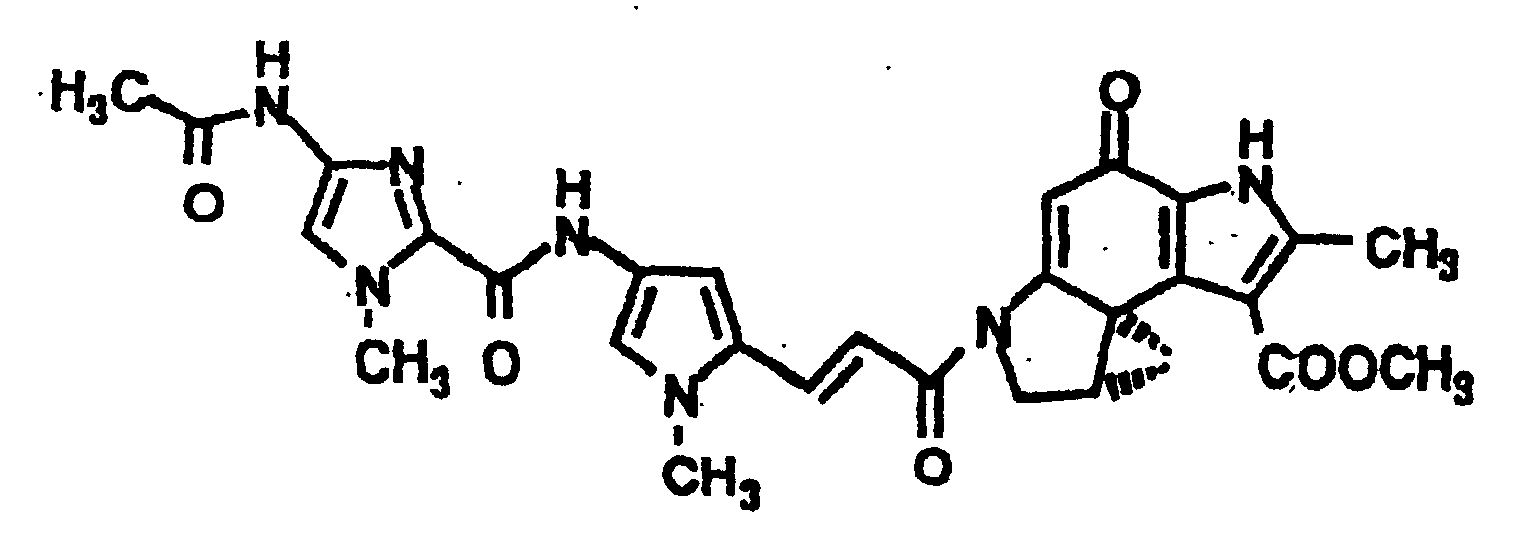
- the compound of the present invention represented by the general formula (I) is preferably a compound represented by the following formula (hereinafter designates as “PyPyLDu86” ): or a compound represented by the formula (hereinafter designates as “ImPyLDu86” ):
- the above compounds recognize abase sequence TGACG or CGACG, or complementary strand thereof.
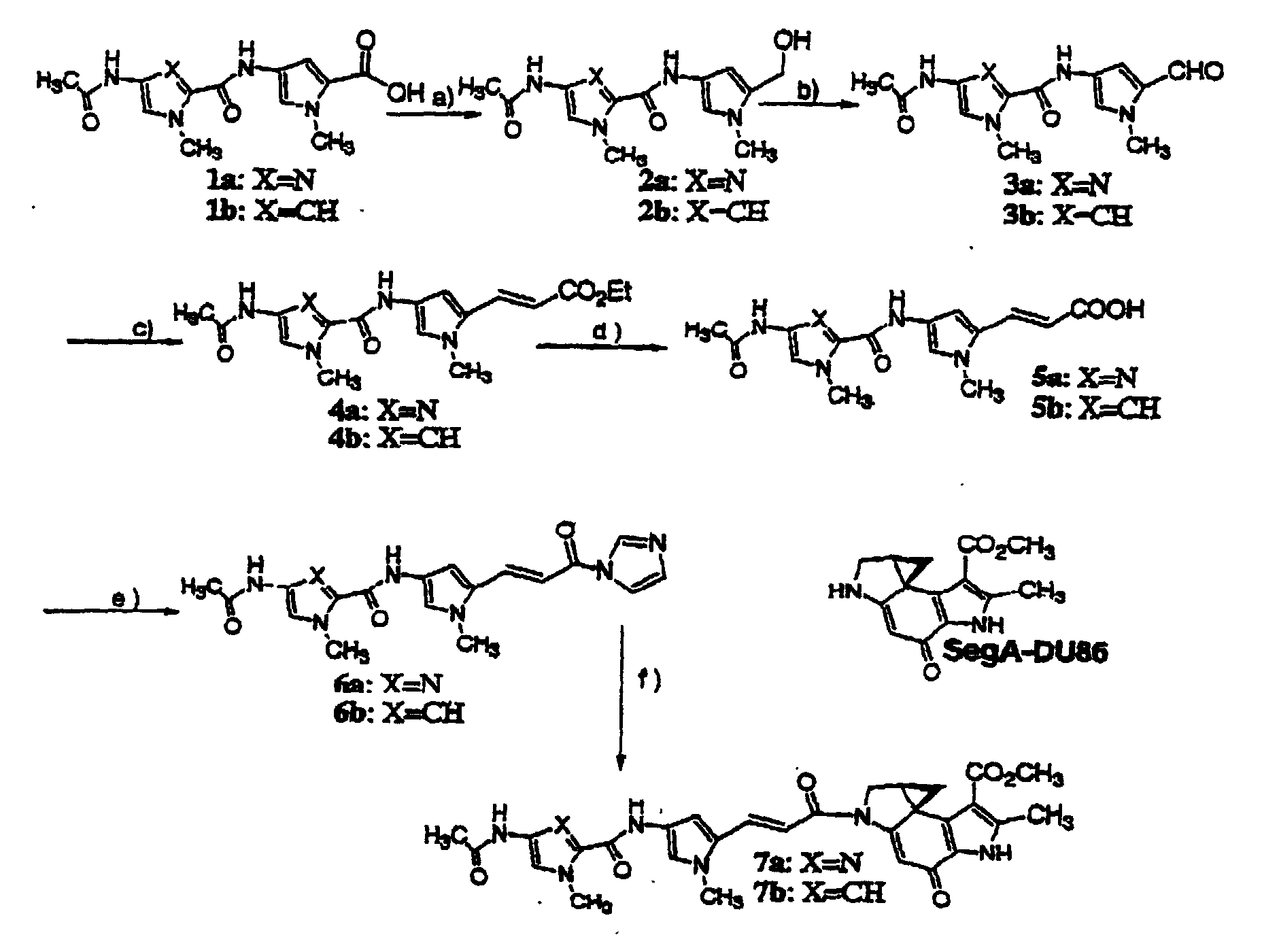
- the compound represented by the general formula (I) of the present invention can be produced according to a known method. Namely, A-segment and B-segment are produced by the conventional method, and a linker segment L is bound with the above segment A or B, and the remaining segment is subsequently bound thereto.
- Each reaction indicates as follows: a) a treatment with benzotriazole-1-yloxytris (dimethylamino) phosphonium hexafluorophosphate (BOP) and NaBH 4 in THF; b) a treatment with MnO 2 in THF; c) a treatment with triethyl phosphonoacetate and NaH in THF; d) a treatment with sodium hydroxide in water-methanol; e) a treatment with 1,1'-carbonyldiimidazole in DMF; and f) a treatment with segment A of DU86 using NaH in DMF.
- the left electrophoresis pattern is a result of the upper strand of the double-strand DNA
- the right electrophoresis pattern is a result of the lower strand of the double-strand DNA.
- Alkylating site can be observed by thermally induced strand cleavage.
- the double-strand DNA is mainly cleaved at the site 1 and the site 2 of the two strands from the lower concentration, and simultaneous alkylation on the two strands can be confirmed.
- No compounds have been known to occur such the cleavage, and in this sense, the compound of the present invention can be said as an artificial restriction enzyme.
- the efficiency of cleavage was found to approach high ratio of 70% calculated by an amount of used ImPyLDu86, and is unusually high efficiency as compared with that of the previously synthesized molecule (refer to Japanese Patent Application No. Hei 10-260710).
- a reason for occurring simultaneous alkylation on the two strands may be, as shown in Fig. 3, that a dimerization of ImPyLDu86 recognizes GC base pair by constructing preferable stacking of the linker moiety and imidozole, and specifically binds with recognition sequence on the double-strand DNA.
- the linker which was proposed and inserted by the molecular design, could increase the reactivity of the compound and could be applied as a recognition unit by pairing with imidazole. Based on these knowledge, we can say that we have taken a step toward the molecular design of the new type of drugs for gene therapy targeting on the specific sequence of DNA.
- Cytotoxic activity of the compound of the present invention based on the properties described hereinbefore was examined. Cytotoxic activities of PyPyLDu86 and ImPyLDu86 of the present invention and known anticancer agent duocarmycin on HeLaS 3 cells (uterocervical squamous cell carcinoma cells) were tested. Results are shown in Table 1. the result indicates that the compounds of the present invention have approximately 3 - 7-fold activities as compared with duocarmycin.
- the compound of the present invention is useful for anticancer agent and can be prepared as a pharmaceutical composition with addition of pharmaceutically acceptable carrier.
- the compound of the present invention can be administered orally or parenterally depending on symptoms. Effective dose of the pharmaceutical composition of the present invention can be selected, although depending on conditions and symptoms of patients, generally within a range of 1 ⁇ g - 100 mg/kg/day.
- the pharmaceutical composition of the present invention can be formulated by conventional method for the preparation for injection.
- reaction was monitored by thin-layer chromatography (TLC) using 025 mm silica gel 60 plates impregnated with 254 nm fluorescent indicator (Merck). TLC plates were visualized by UV light.
- EI Electro impact mass spectra were recorded on a JNM-AX 505, and ESIMS (Electrospray ionization mass spectra) was recorded on a PE SCIEX API 165.
- Ex Taq DNA polymerase and filter tube (Suprec-02) were purchased from Takara Shuzo Co., thermo sequenase core sequencing kit and loading dye (dimethylformamide with fushin red) from Amersham Co., 5'-end Texas Red-modified DNA oligomer (18mer) from Kurabo Co., and 50% Long Ranger gel solution from FMC Bioproducts. Polyacrylamide gel electrophoresis was performed on a HITACHI 5500-S DNA sequencer.
- 1,1'-carboxyldiimidazole 49.9 mg (0.31 mmol) was added to a solution of 26.4 mg (0.08 mmol) of compound 5a in DMF 2ml. The reaction mixture was stirred overnight at room temperature, and water 20 ml was added. The mixture was filtered to obtain 20.5 mg of compound 6a as yellow precipitate in yield 68%.
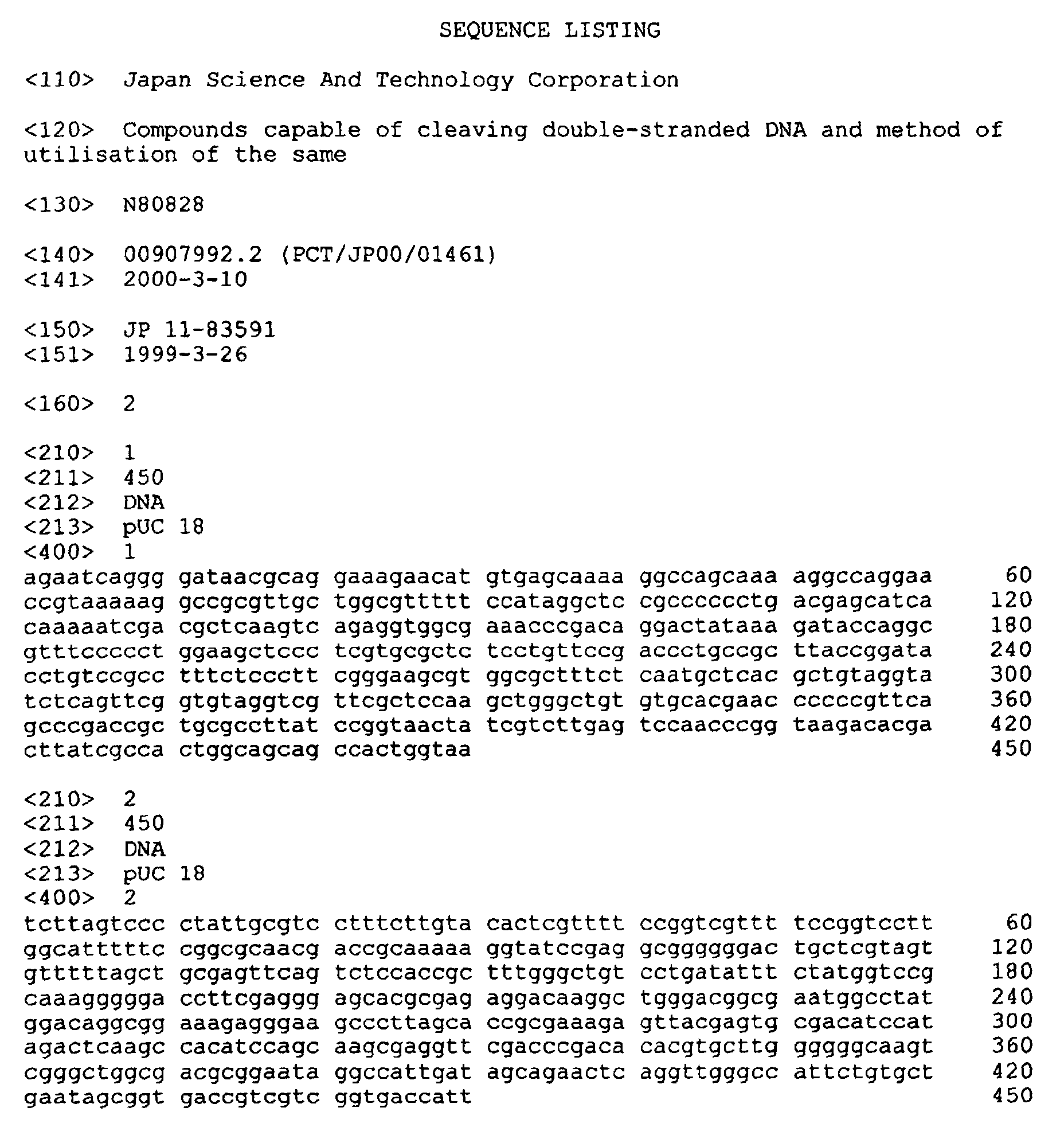
- the 5'-end texas red-modified 450 bp DNA fragments pUC18 F780*-1229 and pUC18 R1459*-1908 were prepared by the PCR method using 5'-end texas red-modified 18mers as primers and purified by filtration using Suprec-02. The concentration was determined by ethidium bromide staining.
- the asterisk (*) indicates texas red modification site, and numerals indicates nucleotide numbering from the replication origin.
- DMF solution of fushin red loading dye
- Test Compound IC 50 PyPyLDu86 1.5 ImPyLDu86 0.7 Duocarmycin 4.7
- the present invention provides chemically synthesized compound, which can simultaneously alkylating or cleaving double-strand DNA.
- the compound is not only useful for artificial restriction enzyme but also useful for gene therapy targeting the specific base sequence.
Landscapes
- Chemical & Material Sciences (AREA)
- Health & Medical Sciences (AREA)
- Organic Chemistry (AREA)
- General Health & Medical Sciences (AREA)
- Public Health (AREA)
- Veterinary Medicine (AREA)
- Medicinal Chemistry (AREA)
- Animal Behavior & Ethology (AREA)
- Life Sciences & Earth Sciences (AREA)
- Pharmacology & Pharmacy (AREA)
- Epidemiology (AREA)
- Nuclear Medicine, Radiotherapy & Molecular Imaging (AREA)
- Chemical Kinetics & Catalysis (AREA)
- General Chemical & Material Sciences (AREA)
- Bioinformatics & Cheminformatics (AREA)
- Engineering & Computer Science (AREA)
- Pharmaceuticals Containing Other Organic And Inorganic Compounds (AREA)
- Nitrogen Condensed Heterocyclic Rings (AREA)
Abstract
Description

10.24 (s, 1H), 9.62 (s, 1H), 7.38 (s, 1H), 7.10 (d, J=2.0Hz, 1H), 6.09 (d, J=2.0Hz, 1H), 4.86 (t, J=5.5Hz, 1H), 4.34 (d, J=5.5Hz, 2H), 3.93 (s, 3H), 3.54 (s, 3H), 2.01 (s, 3H).
9.76 (s, 1H), 9.64 (s, 1H), 7.10 (d, J=2.0Hz, 1H), 7.05 (d, J=2.0Hz, 1H), 6.78 (d, J=2.0Hz, 1H), 6.01 (d, J=2.0Hz, 1H), 4.82 (t, J=5.5Hz, 1H), 4.34 (d, J=5.5Hz, 2H), 3.80 (s, 3H), 3.53 (s, 3H), 1.96 (s, 3H).
10.21 (s, 1H), 10.18 (s, 1H), 9.50 (s, 1H), 7.63 (s, 1H), 7.43 (s, 1H), 7.10 (d, J=2.0Hz, 1H), 3.94 (s, 3H), 2.84 (s, 3H), 2.02 (s, 3H).
9.99 (s, 1H), 9.80 (s, 1H), 9.49 (s, 1H), 7.57 (s, 1H), 7.14 (d, J=1.0Hz, 1H), 6.98 (d, J=1.0Hz, 1H), 6.88 (d, J=2.0Hz, 1H), 3.87 (s, 3H), 3.82 (s, 3H), 1.97 (s, 3H).
10.25 (s, 1H), 9.87 (s, 1H), 7.51 (d, J=15.9Hz, 1H), 7.44 (d, J=1.8Hz, 1H), 7.42 (s, 1H), 6.84 (d, J=1.8Hz, 1H), 6.11 (d, J=15.9Hz, 1H), 4.16 (q, J=7.0Hz, 2H), 4.13 (s, 3H), 3.70 (s, 3H), 2.02 (s, 3H), 1.24 (t, J=7.0Hz, 3H).
9.87 (s, 1H), 9.78 (s, 1H), 7.51 (d, J=15.5Hz, 1H), 7.39 (d, J=2.0Hz, 1H), 7.13 (d, J=2.0Hz, 1H), 6.85 (d, J=2.0Hz, 1H), 6.73 (d, J=2.0Hz, 1H), 6.07 (d. J=15.5Hz, 1H), 4.16 (q, J=7.0Hz, 2H), 3.82 (s, 3H), 3.68 (s, 3H), 1.97 (s, 3H), 1.23 (t, J=7.0Hz, 3H).
10.24 (s, 1H), 9.84 (s, 1H), 7.43 (d, J=15.0Hz, 1H), 7.41 (s, 1H), 7.40 (s, 1H), 6.78 (s, 1H), 6.03 (d, J=15.0Hz, 1H), 3.94 (s, 3H), 3.67 (s, 3H), 3.86 (s, 3H);
| As C15H16N5O4; | Calculated value (M-H) | 330.3 |
| Observed value | 330.2 |
9.83 (s, 1H), 9.78 (s, 1H), 7.38 (d, J=16.0Hz, 1H), 7.34 (s, 1H), 7.13 (d, J=2.0Hz, 1H), 6.84 (d, J=2.0Hz, 1H), 6.64 (s, 1H), 5.99 (d, J=16.0Hz, 1H), 3.82 (s, 3H), 3.65 (s, 3H), 1.99 (s, 3H);
| As C16H17N4O4; | Calculated value (M-H) | 329.3 |
| Observed value | 329.4 |
10.23 (s, 1H), 10.04 (s, 1H), 8.67 (s, 1H), 7.90 (d, J=1.0Hz, 1H), 7.88 (d, J=15.5Hz, 1H), 7.50 (d, J=2.0Hz, 1H), 7.44 (s, 1H), 7.32 (d, J=2.0Hz, 1H), 7.16 (d, J=15.5Hz, 1H), 7.10 (s, 1H), 3.96 (s, 3H), 3.79 (s, 3H), 2.03 (s, 3H);
| As C18H18NO3; | Calculated value (M-H) | 380.4 |
| Observed value | 380.4 |
10.1 (s, 1H), 9.82 (s, 1H), 8.68 (s, 1H), 7.91. (t, J=2.0 and 2.0Hz, 1H), 7.87 (d, J=15.0Hz, 1H), 7.48 (d, J=2.0Hz, 1H), 722 (d, J=2.0Hz, 1H), 7.16 (d, J=1.5Hz, 1H), 7.14 (d, J=15.0Hz, 1H), 7.10 (s, 1H), 6.89 (d, J=1.5Hz, 1H), 3.84 (s, 3H), 3.78 (s, 3H), 1.97 (s, 3H);
| As C19H19N6O3; | Calculated value (M-H) | 379.4 |
| Observed value | 379.4 |
12.36 (s, 1H), 10.24 (s, 1H), 9.97 (s, 1H), 7.58 (d, J=15.0Hz, 1H), 7.43 (s, 1H), 7.41 (d, J=2.0HZ 1H), 6.99 (d, J=2.0Hz, 1H), 6.85 (s, 1H), 6.58 (d, J=15.0Hz, 1H), 4.29 (d, J=10.5Hz, 1H), 4.19 (dd, J=5.0Hz and 4.5Hz, 1H), 3.95 (s, 3H), 3.73 (s, 3H), 3.72 (s, 3H), 3.46 (m, 1H), 2.47 (s, 3H), 2.08 (m, 1H), 2.02 (s, 3H), 1.29 (t, J=4.5 and 3.5Hz, 1H);
| As C29H28N7O6; | Calculated value (M-H) | 570.6 |
| Observed value | 570.4 |
12.36 (s, 1H), 9.90 (s, 1H), 9.80 (s, 1H), 7.57 (d, J=15.0Hz, 1H), 7.38 (d, 1.5Hz, 1H), 7.14 (d, J=2.0Hz, 1H), 6.88 (d, 1.5Hz, 1H), 6.86 (d, J=2.0Hz, 1H), 6.84 (s, 1H), 6.56 (d, J=15.0Hz, 1H), 4.29 (d, J=10.5Hz, 1H), 4.19 (dd, J=4.0 and 4.5Hz, 1H), 3.83 (s, 3H), 3.73 (s, 1H), 3.71 (s, 1H), 3.46 (m, 1H), 2.47 (s, 3H), 2.09 (m, 1H), 1.97 (s, 3H), 1.29 (t, J=4.5 and 3.5Hz, 1H);
| As C30H29N6O6; | Calculated value (M-H) | 569.6 |
| Observed value | 569.5 |
| Test Compound | IC50 (nM) |
| PyPyLDu86 | 1.5 |
| ImPyLDu86 | 0.7 |
| Duocarmycin | 4.7 |
Claims (10)
- A compound which compound can simultaneously cleave double-strand of DNA, represented by the general formula (I)
- The compound according to claim 1 wherein the chemical structure which can recognize the base sequence of DNA, and the chemical structure is derived from opitionally substituted pyrrole and/or imidazole.
- The compound according to claim 1 or 2 wherein the chemical structure which can bind with abase of DNA, and the chemical structure has cyclopropane ring.
- The compound according to any one of claims 1 - 3 wherein the linker which can link with chemical structures of A and B, and the linker is a chemical structure having vinyl group.
- The compound according to any one of claims 1 - 4 wherein the compound of the formula (I) is a compound represented by the following formula.


- A method for alkylating the specific part of base sequence of the double-strand DNA comprising using the compound according to any one of claims 1 - 5.
- A method for cleaving the specific part of base sequence of the double-strand DNA comprising using the compound according to any one of claims 1 - 5.
- The method according to claims 6 or 7 wherein the specific base sequence is TGACG or CGACG, or complementary strand thereof.
- A pharmaceutical composition comprising the compound according to any one of claims 1 - 5 and a pharmaceutically acceptable carrier thereof.
- The pharmaceutical composition according to claim 9 wherein the composition is a remedy for cancer.
Applications Claiming Priority (3)
| Application Number | Priority Date | Filing Date | Title |
|---|---|---|---|
| JP8359199 | 1999-03-26 | ||
| JP08359199A JP3649617B2 (en) | 1999-03-26 | 1999-03-26 | Compound capable of cleaving double-stranded DNA and method of use thereof |
| PCT/JP2000/001461 WO2000058312A1 (en) | 1999-03-26 | 2000-03-10 | Compounds capable of cleaving double-stranded dna and method of utilization of the same |
Publications (3)
| Publication Number | Publication Date |
|---|---|
| EP1083177A1 true EP1083177A1 (en) | 2001-03-14 |
| EP1083177A4 EP1083177A4 (en) | 2003-04-09 |
| EP1083177B1 EP1083177B1 (en) | 2007-06-13 |
Family
ID=13806743
Family Applications (1)
| Application Number | Title | Priority Date | Filing Date |
|---|---|---|---|
| EP00907992A Expired - Lifetime EP1083177B1 (en) | 1999-03-26 | 2000-03-10 | Compounds capable of cleaving double-stranded dna and method of utilization of the same |
Country Status (8)
| Country | Link |
|---|---|
| US (1) | US6713633B1 (en) |
| EP (1) | EP1083177B1 (en) |
| JP (1) | JP3649617B2 (en) |
| KR (1) | KR100745440B1 (en) |
| CA (1) | CA2328903C (en) |
| DE (1) | DE60035154T2 (en) |
| TW (1) | TWI267515B (en) |
| WO (1) | WO2000058312A1 (en) |
Cited By (1)
| Publication number | Priority date | Publication date | Assignee | Title |
|---|---|---|---|---|
| WO2001085733A1 (en) * | 2000-05-12 | 2001-11-15 | Japan Science And Technology Corporation | Interstrand crosslinking agents for dna and compounds therefor |
Families Citing this family (3)
| Publication number | Priority date | Publication date | Assignee | Title |
|---|---|---|---|---|
| JP2001136974A (en) * | 1999-11-16 | 2001-05-22 | Japan Science & Technology Corp | Screening method for bioactive pyrrole-imidazole derivatives |
| US7067622B2 (en) * | 2001-06-25 | 2006-06-27 | Japan Science And Technology Agency | Method of the solid phase synthesis of pyrrole-imidazole polyamide |
| JP3898532B2 (en) | 2002-03-08 | 2007-03-28 | 独立行政法人科学技術振興機構 | New hairpin polyamide |
Family Cites Families (5)
| Publication number | Priority date | Publication date | Assignee | Title |
|---|---|---|---|---|
| US5502068A (en) * | 1995-01-31 | 1996-03-26 | Synphar Laboratories, Inc. | Cyclopropylpyrroloindole-oligopeptide anticancer agents |
| EP0888301B1 (en) | 1996-03-08 | 2005-08-10 | The Scripps Research Institute | Mcbi analogs of cc-1065 and the duocarmycins |
| US5843937A (en) * | 1996-05-23 | 1998-12-01 | Panorama Research, Inc. | DNA-binding indole derivatives, their prodrugs and immunoconjugates as anticancer agents |
| AU3463197A (en) * | 1996-07-23 | 1998-02-10 | Kyowa Hakko Kogyo Co. Ltd. | Dc-89 derivatives |
| US5998140A (en) * | 1996-07-31 | 1999-12-07 | The Scripps Research Institute | Complex formation between dsDNA and oligomer of cyclic heterocycles |
-
1999
- 1999-03-26 JP JP08359199A patent/JP3649617B2/en not_active Expired - Fee Related
-
2000
- 2000-03-10 DE DE60035154T patent/DE60035154T2/en not_active Expired - Lifetime
- 2000-03-10 KR KR1020007012137A patent/KR100745440B1/en not_active Expired - Fee Related
- 2000-03-10 US US09/701,264 patent/US6713633B1/en not_active Expired - Fee Related
- 2000-03-10 CA CA002328903A patent/CA2328903C/en not_active Expired - Fee Related
- 2000-03-10 WO PCT/JP2000/001461 patent/WO2000058312A1/en not_active Ceased
- 2000-03-10 EP EP00907992A patent/EP1083177B1/en not_active Expired - Lifetime
- 2000-03-24 TW TW089105426A patent/TWI267515B/en not_active IP Right Cessation
Cited By (2)
| Publication number | Priority date | Publication date | Assignee | Title |
|---|---|---|---|---|
| WO2001085733A1 (en) * | 2000-05-12 | 2001-11-15 | Japan Science And Technology Corporation | Interstrand crosslinking agents for dna and compounds therefor |
| US6946455B2 (en) | 2000-05-12 | 2005-09-20 | Japan Science And Technology Corporation | Interstrand crosslinking agents for DNA and compounds therefor |
Also Published As
| Publication number | Publication date |
|---|---|
| EP1083177B1 (en) | 2007-06-13 |
| US6713633B1 (en) | 2004-03-30 |
| TWI267515B (en) | 2006-12-01 |
| JP3649617B2 (en) | 2005-05-18 |
| CA2328903A1 (en) | 2000-10-05 |
| CA2328903C (en) | 2005-12-20 |
| DE60035154D1 (en) | 2007-07-26 |
| KR100745440B1 (en) | 2007-08-02 |
| JP2000281679A (en) | 2000-10-10 |
| DE60035154T2 (en) | 2008-02-14 |
| KR20010043207A (en) | 2001-05-25 |
| WO2000058312A1 (en) | 2000-10-05 |
| EP1083177A4 (en) | 2003-04-09 |
Similar Documents
| Publication | Publication Date | Title |
|---|---|---|
| KR101335746B1 (en) | Disubstituted phthalazine hedgehog pathway antagonists | |
| EP3027602B1 (en) | Novel derivatives of indole and pyrrole, method for the production thereof and pharmaceutical compositions containing same | |
| CA3196965A1 (en) | Compounds and uses thereof | |
| DE69832268T2 (en) | PEPTIDYL2-AMINO-1-HYDROXYALKANSULFONIC ACIDS AS CYSTONE PROTEASE INHIBITORS | |
| RS58461B1 (en) | Mono- or di-substituted indole derivatives as dengue viral replication inhibitors | |
| RS58394B1 (en) | Mono- or di-substituted indoles as dengue viral replication inhibitors | |
| UA123737C2 (en) | Phenyl propanamide derivative, and manufacturing method and pharmaceutical application thereof | |
| JPH10511114A (en) | Novel N-aminoalkylfluorenecarboxamides; a new class of dopamine receptor subtype specific ligands | |
| CN1127500C (en) | Substituted bisindolylmaleimides that inhibit cell proliferation | |
| Hsin et al. | Synthesis, DNA binding, and cytotoxicity of 1, 4-bis (2-amino-ethylamino) anthraquinone–amino acid conjugates | |
| TW202510857A (en) | Chemical compounds and uses thereof | |
| EP0778844B1 (en) | Functional terpyridine metal complexes, methods for their preparation and oligonucleotide conjugates with terpyridine metal complexes | |
| WO1999040093A2 (en) | Synthesis of quinobenzoxazine analogues with topoisomerase ii and quadruplex interactions for use as antineoplastic agents | |
| DE4342024A1 (en) | Combination preparations containing a quinoxaline and a nucleoside | |
| EP1083177B1 (en) | Compounds capable of cleaving double-stranded dna and method of utilization of the same | |
| WO2024051720A1 (en) | 5-pyridine-1h-indazole compound for targeted inhibition of clk2 and use of compound | |
| EP1491534B1 (en) | Novel hairpin polyamide | |
| CN100519555C (en) | Novel indole derivative for alkylating specific base sequence of DNA, and alkylating agent and pharmaceutical agent each comprising same | |
| CA2535744A1 (en) | Piperazines as oxytocin agonists | |
| WO2008122667A2 (en) | Ureylene derivatives | |
| Zhang et al. | Design, synthesis and biological evaluation of a novel series of anthrapyrazoles linked with netropsin-like oligopyrrole carboxamides as anticancer agents | |
| Arndt et al. | Stereoselective Synthesis of trans‐threo‐trans‐Oligopyrrolidines: Potential Agents for RNA Cleavage | |
| US6552021B2 (en) | Pharmaceutical compounds | |
| WO2012169785A9 (en) | Symmetrically structured quinazoline derivatives | |
| CN113979981B (en) | Sulfhydryl response type dealkalized site capture reagent and application |
Legal Events
| Date | Code | Title | Description |
|---|---|---|---|
| PUAI | Public reference made under article 153(3) epc to a published international application that has entered the european phase |
Free format text: ORIGINAL CODE: 0009012 |
|
| 17P | Request for examination filed |
Effective date: 20001220 |
|
| AK | Designated contracting states |
Kind code of ref document: A1 Designated state(s): AT BE CH CY DE DK ES FI FR GB GR IE IT LI LU MC NL PT SE |
|
| RIC1 | Information provided on ipc code assigned before grant |
Ipc: 7A 61K 31/4178 B Ipc: 7A 61K 31/415 B Ipc: 7A 61P 35/00 B Ipc: 7C 07D 487/04 A Ipc: 7C 07D 487/04 J Ipc: 7A 61K 31/407 B Ipc: 7A 61K 31/40 B Ipc: 7C 07D 209:00 J Ipc: 7A 61P 43/00 B |
|
| A4 | Supplementary search report drawn up and despatched |
Effective date: 20030224 |
|
| 17Q | First examination report despatched |
Effective date: 20030917 |
|
| RBV | Designated contracting states (corrected) |
Designated state(s): DE FR GB IT NL |
|
| RAP1 | Party data changed (applicant data changed or rights of an application transferred) |
Owner name: JAPAN SCIENCE AND TECHNOLOGY AGENCY |
|
| GRAP | Despatch of communication of intention to grant a patent |
Free format text: ORIGINAL CODE: EPIDOSNIGR1 |
|
| RIC1 | Information provided on ipc code assigned before grant |
Ipc: A61P 43/00 20060101ALI20060626BHEP Ipc: C07D 487/04 20060101AFI20060626BHEP Ipc: A61K 31/40 20060101ALI20060626BHEP Ipc: A61P 35/00 20060101ALI20060626BHEP Ipc: A61K 31/415 20060101ALI20060626BHEP Ipc: A61K 31/407 20060101ALI20060626BHEP Ipc: A61K 31/4178 20060101ALI20060626BHEP |
|
| GRAS | Grant fee paid |
Free format text: ORIGINAL CODE: EPIDOSNIGR3 |
|
| 17Q | First examination report despatched |
Effective date: 20030917 |
|
| GRAA | (expected) grant |
Free format text: ORIGINAL CODE: 0009210 |
|
| AK | Designated contracting states |
Kind code of ref document: B1 Designated state(s): DE FR GB IT NL |
|
| REG | Reference to a national code |
Ref country code: GB Ref legal event code: FG4D |
|
| REF | Corresponds to: |
Ref document number: 60035154 Country of ref document: DE Date of ref document: 20070726 Kind code of ref document: P |
|
| ET | Fr: translation filed | ||
| PLBE | No opposition filed within time limit |
Free format text: ORIGINAL CODE: 0009261 |
|
| STAA | Information on the status of an ep patent application or granted ep patent |
Free format text: STATUS: NO OPPOSITION FILED WITHIN TIME LIMIT |
|
| 26N | No opposition filed |
Effective date: 20080314 |
|
| PGFP | Annual fee paid to national office [announced via postgrant information from national office to epo] |
Ref country code: IT Payment date: 20100315 Year of fee payment: 11 Ref country code: FR Payment date: 20100324 Year of fee payment: 11 |
|
| PGFP | Annual fee paid to national office [announced via postgrant information from national office to epo] |
Ref country code: GB Payment date: 20100310 Year of fee payment: 11 |
|
| PGFP | Annual fee paid to national office [announced via postgrant information from national office to epo] |
Ref country code: DE Payment date: 20100318 Year of fee payment: 11 Ref country code: NL Payment date: 20100304 Year of fee payment: 11 |
|
| REG | Reference to a national code |
Ref country code: NL Ref legal event code: V1 Effective date: 20111001 |
|
| GBPC | Gb: european patent ceased through non-payment of renewal fee |
Effective date: 20110310 |
|
| REG | Reference to a national code |
Ref country code: FR Ref legal event code: ST Effective date: 20111130 |
|
| PG25 | Lapsed in a contracting state [announced via postgrant information from national office to epo] |
Ref country code: FR Free format text: LAPSE BECAUSE OF NON-PAYMENT OF DUE FEES Effective date: 20110331 Ref country code: DE Free format text: LAPSE BECAUSE OF NON-PAYMENT OF DUE FEES Effective date: 20111001 Ref country code: NL Free format text: LAPSE BECAUSE OF NON-PAYMENT OF DUE FEES Effective date: 20111001 |
|
| REG | Reference to a national code |
Ref country code: DE Ref legal event code: R119 Ref document number: 60035154 Country of ref document: DE Effective date: 20111001 |
|
| PG25 | Lapsed in a contracting state [announced via postgrant information from national office to epo] |
Ref country code: GB Free format text: LAPSE BECAUSE OF NON-PAYMENT OF DUE FEES Effective date: 20110310 Ref country code: IT Free format text: LAPSE BECAUSE OF NON-PAYMENT OF DUE FEES Effective date: 20110310 |