EP1082907A2 - A sterilising method by substituting the dissolved oxygen in milk or the like with nitrogen gas, a product thereof and an apparatus for nitrogen gas substitution - Google Patents
A sterilising method by substituting the dissolved oxygen in milk or the like with nitrogen gas, a product thereof and an apparatus for nitrogen gas substitution Download PDFInfo
- Publication number
- EP1082907A2 EP1082907A2 EP00118250A EP00118250A EP1082907A2 EP 1082907 A2 EP1082907 A2 EP 1082907A2 EP 00118250 A EP00118250 A EP 00118250A EP 00118250 A EP00118250 A EP 00118250A EP 1082907 A2 EP1082907 A2 EP 1082907A2
- Authority
- EP
- European Patent Office
- Prior art keywords
- nitrogen gas
- milk
- dissolved oxygen
- substituting
- tank
- Prior art date
- Legal status (The legal status is an assumption and is not a legal conclusion. Google has not performed a legal analysis and makes no representation as to the accuracy of the status listed.)
- Granted
Links
Images
Classifications
-
- A—HUMAN NECESSITIES
- A23—FOODS OR FOODSTUFFS; TREATMENT THEREOF, NOT COVERED BY OTHER CLASSES
- A23C—DAIRY PRODUCTS, e.g. MILK, BUTTER OR CHEESE; MILK OR CHEESE SUBSTITUTES; PREPARATION THEREOF
- A23C9/00—Milk preparations; Milk powder or milk powder preparations
- A23C9/152—Milk preparations; Milk powder or milk powder preparations containing additives
- A23C9/1524—Inert gases, noble gases, oxygen, aerosol gases; Processes for foaming
-
- A—HUMAN NECESSITIES
- A23—FOODS OR FOODSTUFFS; TREATMENT THEREOF, NOT COVERED BY OTHER CLASSES
- A23B—PRESERVATION OF FOODS, FOODSTUFFS OR NON-ALCOHOLIC BEVERAGES; CHEMICAL RIPENING OF FRUIT OR VEGETABLES
- A23B11/00—Preservation of milk or dairy products
- A23B11/10—Preservation of milk or milk preparations
- A23B11/12—Preservation of milk or milk preparations by heating
- A23B11/13—Preservation of milk or milk preparations by heating the materials being loose unpacked
- A23B11/133—Preservation of milk or milk preparations by heating the materials being loose unpacked and progressively transported through the apparatus
-
- A—HUMAN NECESSITIES
- A23—FOODS OR FOODSTUFFS; TREATMENT THEREOF, NOT COVERED BY OTHER CLASSES
- A23B—PRESERVATION OF FOODS, FOODSTUFFS OR NON-ALCOHOLIC BEVERAGES; CHEMICAL RIPENING OF FRUIT OR VEGETABLES
- A23B2/00—Preservation of foods or foodstuffs, in general
- A23B2/40—Preservation of foods or foodstuffs, in general by heating loose unpacked materials
-
- A—HUMAN NECESSITIES
- A23—FOODS OR FOODSTUFFS; TREATMENT THEREOF, NOT COVERED BY OTHER CLASSES
- A23B—PRESERVATION OF FOODS, FOODSTUFFS OR NON-ALCOHOLIC BEVERAGES; CHEMICAL RIPENING OF FRUIT OR VEGETABLES
- A23B2/00—Preservation of foods or foodstuffs, in general
- A23B2/40—Preservation of foods or foodstuffs, in general by heating loose unpacked materials
- A23B2/42—Preservation of foods or foodstuffs, in general by heating loose unpacked materials while they are progressively transported through the apparatus
-
- A—HUMAN NECESSITIES
- A23—FOODS OR FOODSTUFFS; TREATMENT THEREOF, NOT COVERED BY OTHER CLASSES
- A23B—PRESERVATION OF FOODS, FOODSTUFFS OR NON-ALCOHOLIC BEVERAGES; CHEMICAL RIPENING OF FRUIT OR VEGETABLES
- A23B2/00—Preservation of foods or foodstuffs, in general
- A23B2/70—Preservation of foods or foodstuffs, in general by treatment with chemicals
- A23B2/704—Preservation of foods or foodstuffs, in general by treatment with chemicals in the form of gases, e.g. fumigation; Compositions or apparatus therefor
-
- A—HUMAN NECESSITIES
- A23—FOODS OR FOODSTUFFS; TREATMENT THEREOF, NOT COVERED BY OTHER CLASSES
- A23C—DAIRY PRODUCTS, e.g. MILK, BUTTER OR CHEESE; MILK OR CHEESE SUBSTITUTES; PREPARATION THEREOF
- A23C2240/00—Use or particular additives or ingredients
- A23C2240/20—Inert gas treatment, using, e.g. noble gases or CO2, including CO2 liberated by chemical reaction; Carbonation of milk products
Definitions
- the present invention relates to a method for the sterilization by substituting the dissolved oxygen in milk or the like (defined hereinafter) with nitrogen gas in a sterilization of milk or the like, to a product prepared thereby and to an apparatus for substituting with nitrogen gas.
- the matters to be solved are that, when a sterilization is carried out at high temperature (such as at 130°C for 2 seconds) for making the long preservation of milk or the like possible, sulfides which are the causing substances or the so-called heated smell are generated whereby taste and smell of the beverage is deteriorated.
- sulfides are dimethyl sulfide and dimethyl disulfide and, since they greatly deteriorate the taste and the smell of the heat-sterilized product, it has been demanded to suppress the generation of the sulfides in carrying out the sterilization.
- the sterilizing condition has been necessary to be at 130°C for 2 seconds and there is a problem that, when sterilization is carried out under such a condition, generation of the sulfides is inherently unavoidable.
- An object of the present invention is to provide a practical method and apparatus of a low cost and without a large device whereby the above-mentioned problem is solved.
- the inventors of the present invention have carried out a study and have found that, in a method for sterilization where dissolved oxygen in milk or the like is substituted with nitrogen gas, when (1) a means in which nitrogen gas is directly mixed with and dispersed in milk or the like and (2) a means in which milk or the like of the same material with which nitrogen gas is not mixed is sprayed from a nozzle(s) to the top of milk or the like with and in which nitrogen gas has been mixed and dispersed by the means in the above (1), stored in a nitrogen gas substituting tank under a nitrogen gas atmosphere so that substitution with nitrogen gas and defoaming are effected, are jointly used whereby the dissolved oxygen amount in the milk or the like is reduced by means of substitution of the dissolved oxygen with nitrogen gas and then the resultant milk or the like is subjected to sterilization, generation of sulfides can be suppressed to a low degree and the above problems can be solved.
- the above-mentioned problems can be solved at a low cost and without a large equipment which have not been achieved in the prior art.
- the method according to the present invention relates to a method where sterilization is carried out after the dissolved oxygen in milk or the like is substituted with nitrogen gas.
- the method is characterized in that a means in which nitrogen gas is directly mixed with and dispersed in milk or the like and a means in which milk or the like with which nitrogen gas is not mixed is sprayed from at least one nozzle to the top of milk or the like, with and in which nitrogen gas has been mixed and dispersed by the former means, stored in a nitrogen gas substituting tank under a nitrogen gas atmosphere, are jointly used whereby the dissolved oxygen amount in the milk or the like is reduced by means of substitution of the dissolved oxygen with nitrogen gas, followed by subjecting to sterilization.
- the method according to the present invention is also the method for sterilization where dissolved oxygen in milk or the like is substituted with nitrogen gas according to the above, wherein sterilization is carried out by making the dissolved oxygen amount in milk or the like 2 ppm or less.
- the method of the present invention also relates to sterilization where dissolved oxygen in milk or the like is substituted with nitrogen gas according to the above, wherein the means for mixing and dispersing of the nitrogen is a static mixer. It also relates to a product of milk or the like which is manufactured by a sterilizing method mentioned in any of the above methods.
- the present invention relates to that, in an apparatus for substituting the dissolved oxygen in milk or the like with nitrogen gas, a substituting apparatus for milk or the like with nitrogen gas which is characterized in that a nitrogen gas substituting tank connected to a material tank by a liquid-sending pipe is installed, a nitrogen gas supplying device is connected to the said liquid-sending pipe at the side of the material tank while a nitrogen gas mixing/dispersing device is installed at the side of the above nitrogen gas substituting tank, another end of the branched liquid-sending pipe connected to the upstream side from the nitrogen gas-supplying device of the liquid-sending pipe is introduced into a nitrogen gas-substituting tank, a spraying nozzle is connected to the said part and each of the above liquid-sending pipes, nitrogen gas supplying device and a connecting branched pipe is equipped with a flow rate controlling device.
- the present invention relates to the substituting apparatus for milk or the like with nitrogen gas according to the above, wherein the mixing/dispersing device for the nitrogen gas is a static mixer and, still further, the present invention relates to the substituting apparatus for milk or the like with nitrogen gas according to the above, wherein the flow rate controlling device is a flow rate controlling valve.
- the present invention relates to a method for the sterilization in such a state that the dissolved oxygen in milk or the like is substituted with nitrogen gas to make the dissolved oxygen amount low and also relates to an apparatus for carrying out the nitrogen gas substitution therefor efficiently and to a beverage such as milk which is manufactured by the sterilizing method of the present invention.
- the method for the sterilization in such a state that the dissolved oxygen in milk or the like is substituted with nitrogen gas to make the dissolved oxygen amount low in accordance with the present invention is applicable to other beverages which contain protein and saccharide and have a property of an excessive foaming due to mixing and dispersing with gas in a substituting process with nitrogen gas, such as processed milk, milk beverage, reconstituted milk, fermented milk, beverage containing lactic acid bacteria, fresh cream and fruit juice beverage.
- a means where the nitrogen gas is directly mixed with and dispersed in milk or the like and another means where it is sprayed into a tank in a nitrogen atmosphere to substitute with nitrogen gas are jointly used whereby advantageous effect in each of those means results in synergism to give a desired effect.
- nitrogen gas substituting and a rapid defoaming of the foams containing nitrogen gas, etc. are carried out by spraying the same material containing no nitrogen gas, there is no disadvantage of being diluted with other material(s) or being necessary to use a device for removing the other material(s) whereby the process is simplified and efficient.
- the dissolved oxygen amount before the substitution with the gas is about 10 ppm and, in order to lower the dissolved oxygen amount to an extent of 2 ppm by means of substituting with nitrogen gas, about 40-50% of nitrogen gas to the amount of milk by volume is necessary in the method of the present invention.
- Nitrogen gas was mechanically mixed with and dispersed in milk (raw milk) containing about 10 ppm of dissolved oxygen using a cascade pump and foams of the nitrogen gas were made fine whereby the dissolved oxygen in the milk was substituted with nitrogen gas.
- nitrogen gas 30% (45 liters/hour) by volume was mixed and dispersed and the dissolved oxygen amount of the milk was able to be made 2 ppm or less.
- foaming of the milk substituted with nitrogen gas was too much and, when the milk after the nitrogen gas substituting treatment was placed in a 500-ml beaker, about one-third thereof was foams.
- this nitrogen gas-substituted milk was directly sent to the next homogenizing and sterilizing steps, there were various problems such as variation in homogenizing pressure, increase in fouling of sterilizer, occurrence of natural foaming in the storing tank and elongation of holding time. Accordingly, this method may be evaluated to be that which is unable to be practically used.
- Reconstitued skim milk containing about 10 ppm of dissolved oxygen was subjected to a nitrogen gas substitution by a method of spraying of all of the said reconstituted skim milk (concentration of the milk solid was about 8%) at a flow rate of 900 liters/hour from a spraying nozzle into a nitrogen gas substituting tank in a nitrogen gas atmosphere having a diameter of 690 mm x 900 mm (volume was about 340 liters).
- nitrogen gas was introduced so as to keep the gas phase oxygen concentration about 1.0% by volume in the nitrogen gas substituting tank whereupon the dissolved oxygen concentration became 2 ppm or less.
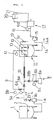
- Milk containing about 10 ppm of dissolved oxygen was sent from a material tank (1) via a liquid-sending pipe (3) while nitrogen gas was injected in the milk in the liquid-sending pipe (3) via a nitrogen gas pipe (7) located before a static mixer (10). After that, the nitrogen gas injected in the milk was mixed and dispersed uniformly using the static mixer (10) attached to the liquid-sending pipe (3) so that the dissolved oxygen in the milk was substituted with the nitrogen gas and then the mixture was transferred to a nitrogen gas substituting tank (11) using a liquid-sending pipe (3).
- the milk in which the nitrogen gas was mixed and dispersed was supplied to a nitrogen gas substituting tank (11) of 690 mm diameter x 900 mm under the condition of flow rate of 1,000 liters/hour and nitrogen gas amount of 8.2 liters/minute (49% by volume) and flowed down from the liquid-sending pipe (3) in a form of thin film.
- the milk which was not mixed and dispersed with nitrogen gas was sprayed into a nitrogen gas substituting tank (11) in a nitrogen atmosphere using spraying nozzles (13) so that the nitrogen gas substitution of the sprayed drops was carried out and, at the same time, foams which were generated therein were extinguished.
- a device of mixing and dispersing the nitrogen gas using a static mixer (10) and a device of spraying from the spraying nozzles were carried out at the same time in parallel.
- the spraying amount of the milk from the nozzles (13) it was made 330 liters/hour (about one-third of the total flow rate) using four spraying nozzles (13) and the spraying pressure was made 0.3-0.4 bar.
- the milk which was substituted with nitrogen gas was sent in a direction of an arrow (14a) by driving the revolution-controlled liquid sending pump (15) by a liquid sending pipe (14) installed at the bottom of the nitrogen gas substituting tank (11), preheated at 80-90°C by a plate sterilizer (17), homogenized by a homogenizer (20), then sent to a plate sterilizer (17) again to sterilize at 130°C for 2 seconds and filled in containers using a filling machine (not shown) to give a product.
- Example 2 The same nitrogen gas substitution as in Example 1 was carried out except that milk containing about 10 ppm of the dissolved oxygen was used and the flow rate was made 12,000 liters/hour using a 2,000-liter nitrogen gas substituting tank (11).
- the milk which was subjected to a nitrogen gas substitution as per the above method was supplied (10,000 liters/hour) to a sterilizer, pre-heated and held at 80-90°C, homogenized and sterilized at 130°C for 2 seconds.
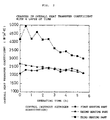
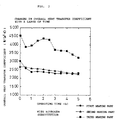
- the overall heat transfer coefficients at the three parts of the sterilizer were measured and their changes with a lapse of time were checked. The result is given in Fig. 2 and Fig. 3.
- Fig. 2 is a control and is an example where no nitrogen gas substitution was carried out.
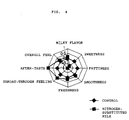
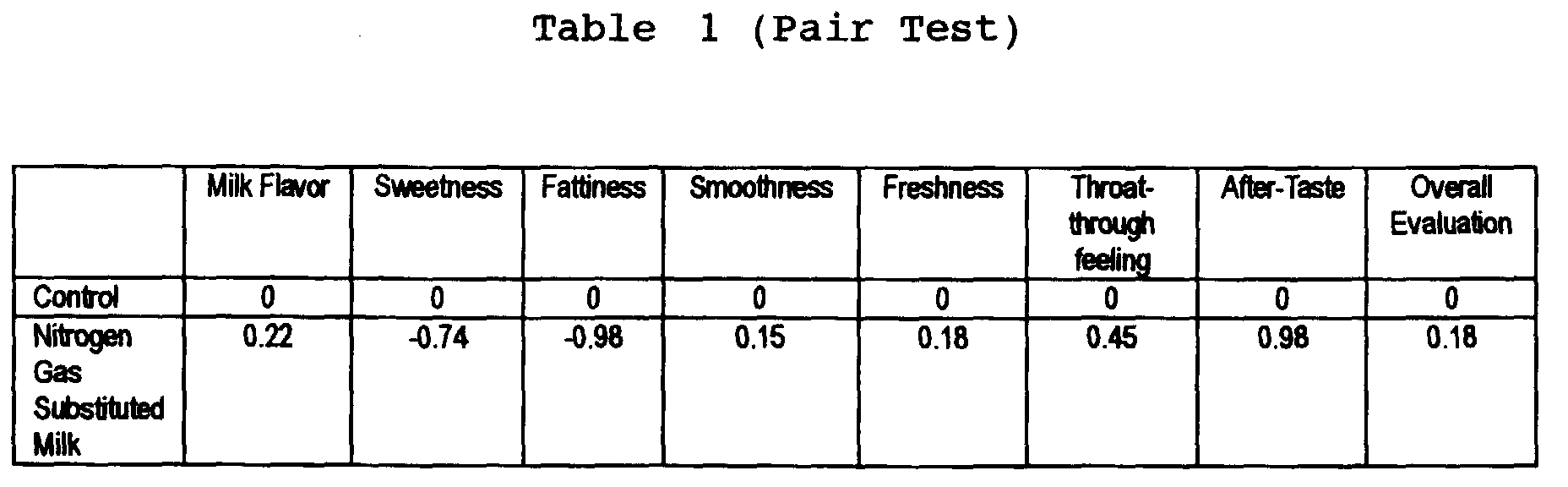
- a duo-trio test Any of samples was submitted as a control and then two kinds of samples were submitted whereby the panelist was asked to choose a sample which was believed to be same as the control.
- Table 1 is a result of evaluation of an organoleptic test for the milk which was substituted with nitrogen gas.
- the test result for the taste showed that the taste was the same as that when sterilization was done at 10-15°C lower temperature than the actual sterilizing temperature (thus, production of sulfides was less) whereby the taste was able to be improved.
- production of foams and entrainment of a sterilizer were prevented whereby a stable sterilizing operation was able to be carried out continuously.
- the milk which was substituted with nitrogen gas was held in a tank for 3 minutes (600 liters) and, since it is possible to separate the fine foams to such an extent that the next step is not badly affected when held for 2 minutes (400 liters) or more, it is believed that, in the manufacture, a tank in smaller size than a 2,000-liter tank is sufficient in the case of treatment at 12,000 liters/hour.
- the material (2) was transferred from a material tank (1) by a liquid-sending pump (1a) passing through a clarifier (19) to a nitrogen gas substituting tank (11) by a liquid-sending pipe (3).
- the material (2) was sent in a direction as shown by an arrow (4) while the flow rate in the liquid-sending pipe (3) was measured by a flowmeter (5a) and, based upon the result thereof, the flow rate was adjusted to a predetermined one by means of a flow rate control valve (1b).
- nitrogen gas was sent into a liquid-sending pipe (3) by a nitrogen gas supplying device (8) connected to a liquid-sending pipe (3).
- the amount of nitrogen gas which was sent thereinto was measured by a flowmeter (5c) and, based upon the measured result, the supplying amount of the nitrogen gas was controlled to a predetermined amount by a flow rate control valve (6b).
- the nitrogen gas sent into the liquid-sending pipe (3) was directly mixed and dispersed with the material (2) by a static mixer (10) which was connected to the liquid-sending pipe (3) and the mixture was immediately sent to a nitrogen gas substituting tank (11) as it was and then stored in a nitrogen gas substituting tank (11).
- the material substituted with nitrogen gas was stored in a nitrogen gas substituting tank (11) and the material surface was in such a state that many small and big foams were floated thereon.
- the material in which nitrogen gas was mixed and dispersed was continuously sent from a liquid-sending pipe (3) whereby foams of nitrogen gas were subjected to a natural breaking and nitrogen gas carried by the foams was released and, therefore, a nitrogen atmosphere was available.
- the foams generated by a substitution with nitrogen gas did not overflow from the nitrogen gas substituting tank (11) but were quickly defoamed by both means of natural breakage and destruction by collision of sprayed drops whereby, when the material stored at the lower part of the nitrogen gas substituting tank (11) was sent to the next step, that did not badly affect the next step.
- the nitrogen gas substituting tank (11) also had a function as a holding tank for the material wherein nitrogen gas was mixed and dispersed by the static mixer (10) and, therefore, the size of the tank was to be considered in connection with the degree of capability of the sterilizing treatment in the next step.
- the surface of the stored liquid was covered by the foamed foams. Due to destruction by sprayed drops and with a lapse of time, the foams were naturally and gradually broken. Accordingly, it was necessary to set and select the holding volume in such a manner that retention time necessary for breakage of the foams was secured until no bad affection to the next sterilizing step was resulted by a progress of destruction of the foams with a lapse of time.
- a revolution controlled liquid-sending pump (15) was driven by a liquid-sending pipe (14) installed at the bottom of the nitrogen gas substituting tank (11) and the material substituted with nitrogen gas was sent in the direction of an arrow (14a). Its flow rate was measured by a flowmeter (5d) and an automatic control was carried out depending upon the measured result in sending the liquid to a plate sterilizer (17) to preheat. After that, it was homogenized in a homogenizer (20), sent to a plate sterilizer (17) again to sterilize and sent to a filling step (not shown) by a liquid-sending pipe to fill whereupon a product was prepared.
Landscapes
- Life Sciences & Earth Sciences (AREA)
- Engineering & Computer Science (AREA)
- Chemical & Material Sciences (AREA)
- Food Science & Technology (AREA)
- Polymers & Plastics (AREA)
- Wood Science & Technology (AREA)
- Zoology (AREA)
- Food Preservation Except Freezing, Refrigeration, And Drying (AREA)
- Dairy Products (AREA)
- Non-Alcoholic Beverages (AREA)
Abstract
Description
- 1:
- Material tank
- 1a:
- Liquid-sending pump
- 2:
- Material
- 3, 9, 14, 16, 21:
- Liquid-sending pipes
- 5a, 5b, 5c, 5d:
- Flowmeters
- 1b, 6a, 6b:
- Flow rate-controlling valves
- 6c:
- Opening/closing valve
- 7:
- Nitrogen gas pipe
- 8:
- Device for supplying the nitrogen gas
- 8a:
- Nitrogen gas tank
- 10:
- Static mixer
- 11:
- Tank for substituting with nitrogen gas
- 12:
- Pressure gauge
- 13:
- Spraying nozzle
- 15:
- Liquid-sending pump equipped with a revolution controller
- 17:
- Plate Sterilizer
- 18a, 18b:
- Check valve
- 19:
- Clarifier
- 20:
- Homogenizer
| (Comparative Analysis with Milk Substituted with Nitrogen Gas) | |||
| Raw Milk | Sterilization after Substituting with Nitrogen | Conventional Sterilization | |
| Dimethyl Sulfide | 393 x 103 | 583 x 103 | 820 x 103 |
| Dimethyl Disulfide | - | 28 | 48 x 103 |
Claims (7)
- In a method for sterilization where dissolved oxygen in milk or the like is substituted with nitrogen gas, a method for sterilization where dissolved oxygen in milk or the like is substituted with nitrogen gas which is characterized in that(1) a means in which nitrogen gas is directly mixed with and dispersed in milk or the like and(2) a means in which milk or the like with which nitrogen gas is not mixed is sprayed from at least one nozzle to the top of milk or the like with and in which nitrogen gas has been mixed and dispersed by the means in the above (1), stored in a nitrogen gas substituting tank under a nitrogen gas atmosphere
are jointly used whereby the dissolved oxygen amount in the milk or the like is reduced by means of substitution of the dissolved oxygen with nitrogen gas, followed by subjecting to sterilization. - The method for sterilization where the dissolved oxygen in milk or the like is substituted with nitrogen gas according to claim 1, wherein the sterilization is carried out by making the dissolved oxygen amount in milk or the like 2 ppm or less.
- The method for sterilization where the dissolved oxygen in milk or the like is substituted with nitrogen gas according to claim 1, wherein the means for mixing and dispersing of the nitrogen gas is a static mixer.
- A product of milk or the like which is manufactured by a sterilizing method mentioned in any of claims 1 to 3.
- In an apparatus for substituting the dissolved oxygen in milk or the like with nitrogen gas, a substituting apparatus for milk or the like with nitrogen gas which is characterized in that a nitrogen gas substituting tank connected to a material tank by a liquid-sending pipe is installed, a nitrogen gas supplying device is connected to the said liquid-sending pipe at the side of the material tank while a nitrogen gas mixing/dispersing device is installed at the side of the above nitrogen gas substituting tank, another end of the branched liquid-sending pipe connected to the upstream side from the nitrogen gas-supplying device of the liquid-sending pipe is introduced into a nitrogen gas-substituting tank, a spraying nozzle is connected to the said part and each of the above liquid-sending pipes, nitrogen gas supplying device and a connecting branched pipe is equipped with a flow rate controlling device.
- The substituting apparatus for milk or the like with nitrogen gas according to claim 5, wherein the mixing/dispersing device for the nitrogen gas is a static mixer.
- The substituting apparatus for milk or the like with nitrogen gas according to claim 5, wherein the flow rate controlling device is a flow rate controlling valve.
Applications Claiming Priority (2)
| Application Number | Priority Date | Filing Date | Title |
|---|---|---|---|
| JP11256300A JP3091752B1 (en) | 1999-09-09 | 1999-09-09 | Method for dissolving dissolved oxygen such as milk with nitrogen gas for sterilization and nitrogen gas replacement device |
| JP25630099 | 1999-09-09 |
Publications (3)
| Publication Number | Publication Date |
|---|---|
| EP1082907A2 true EP1082907A2 (en) | 2001-03-14 |
| EP1082907A3 EP1082907A3 (en) | 2002-04-17 |
| EP1082907B1 EP1082907B1 (en) | 2004-07-07 |
Family
ID=17290754
Family Applications (1)
| Application Number | Title | Priority Date | Filing Date |
|---|---|---|---|
| EP00118250A Expired - Lifetime EP1082907B1 (en) | 1999-09-09 | 2000-09-04 | A sterilising method by substituting the dissolved oxygen in milk or the like with nitrogen gas, a product thereof and an apparatus for nitrogen gas substitution |
Country Status (7)
| Country | Link |
|---|---|
| US (2) | US6447828B1 (en) |
| EP (1) | EP1082907B1 (en) |
| JP (1) | JP3091752B1 (en) |
| AU (1) | AU744307B2 (en) |
| DE (1) | DE60011965T2 (en) |
| DK (1) | DK1082907T3 (en) |
| NZ (1) | NZ506810A (en) |
Cited By (6)
| Publication number | Priority date | Publication date | Assignee | Title |
|---|---|---|---|---|
| WO2004052113A1 (en) * | 2002-12-10 | 2004-06-24 | Meiji Dairies Corporation | Process for producing good-flavor butter milk associated dairy product and dairy processed product |
| WO2004062376A1 (en) * | 2002-12-26 | 2004-07-29 | Meiji Dairies Corporation | Flavorful cream excelling in emulsion stability and process for producing the same |
| EP1568280A4 (en) * | 2002-12-03 | 2006-01-25 | Meiji Dairies Corp | PROCESS FOR PRODUCING FERMENTED MILK AND FERMENTED MILK |
| FR2964884A1 (en) * | 2010-09-16 | 2012-03-23 | Air Liquide | METHOD AND SYSTEM FOR ONLINE DEOXYGENATION OF FOOD OR PHARMACEUTICAL FLUIDS |
| US9161552B2 (en) | 2004-06-14 | 2015-10-20 | Meiji Co., Ltd. | Process for producing fermented milk and fermented milk |
| FR3121578A1 (en) * | 2021-04-12 | 2022-10-14 | Air Liquide France Industrie | MILK DECONTAMINATION PROCESS BY DEOXYGENATION AND CONTROL OF DISSOLVED GAS |
Families Citing this family (34)
| Publication number | Priority date | Publication date | Assignee | Title |
|---|---|---|---|---|
| JP4644396B2 (en) * | 2001-08-10 | 2011-03-02 | 株式会社ポッカコーポレーション | Method for producing liquid food having homogenization step |
| JP3490428B2 (en) | 2001-08-31 | 2004-01-26 | 森永乳業株式会社 | Milk production method and production equipment |
| JP2005110527A (en) * | 2003-10-03 | 2005-04-28 | Suntory Ltd | Drink-producing method and drink-producing apparatus |
| EP1772059B1 (en) * | 2004-05-28 | 2013-08-21 | Meiji Co., Ltd. | Method of producing milk drink |
| KR100616082B1 (en) | 2004-06-23 | 2006-08-28 | 남양유업 주식회사 | Manufacturing method of milk with enhanced flavor |
| JP4530916B2 (en) * | 2005-05-31 | 2010-08-25 | 日本デルモンテ株式会社 | Processed high-quality tomato products and process for producing processed tomato products using the same |
| TWI403272B (en) * | 2005-06-14 | 2013-08-01 | Meiji Co Ltd | The method for inhibiting the odor in the raw milk and the sterilized milk and the method for treating the obtained bactericidal milk |
| JP2007028901A (en) * | 2005-06-20 | 2007-02-08 | Fuji Oil Co Ltd | Method for producing oil-in-water emulsion |
| JP4761356B2 (en) * | 2005-08-29 | 2011-08-31 | 株式会社明治 | Milk material with excellent flavor and physical properties and method for producing the same |
| JP4454570B2 (en) * | 2005-11-21 | 2010-04-21 | 明治乳業株式会社 | Milky food and drink in transparent container and method for producing the same |
| US20100025872A1 (en) * | 2006-04-11 | 2010-02-04 | Wingturf Co., Ltd | Process and apparatus for producing liposome dispersion |
| JP4863832B2 (en) * | 2006-10-13 | 2012-01-25 | エス・ピー・ジーテクノ株式会社 | Dispersion production method and dispersion production module |
| US20080098900A1 (en) * | 2006-11-01 | 2008-05-01 | Babatunde Aremu | Beverage manufacture using a static mixer |
| TWI491362B (en) * | 2006-12-01 | 2015-07-11 | Meiji Co Ltd | Method for producing fermented milk and fermented milk |
| US20080160149A1 (en) * | 2006-12-28 | 2008-07-03 | Maurice Nasrallah | Sterilization of Flowable Food Products |
| FI122334B (en) * | 2007-06-15 | 2011-12-15 | Tapani Alatossava | Procedure for the processing of food |
| EP2294926B1 (en) | 2008-06-30 | 2014-11-19 | Meiji Co., Ltd. | Process for producing fermented milk |
| JP2010124808A (en) * | 2008-12-01 | 2010-06-10 | Naoyuki Yada | Apparatus for producing and dispensing hydrogen-containing drink, and method for producing hydrogen-containing drink |
| SG173789A1 (en) | 2009-02-25 | 2011-09-29 | Meiji Co Ltd | Cultured milk with low lactose content and method for manufacturing the same |
| JP5449006B2 (en) * | 2010-04-23 | 2014-03-19 | サントリーホールディングス株式会社 | Beverage production method and beverage production apparatus |
| EP2606739A4 (en) | 2010-08-21 | 2015-10-07 | Meiji Co Ltd | Fermented milk having little lactose and method for producing same |
| CA2809390A1 (en) | 2010-08-25 | 2012-03-01 | Meiji Co., Ltd. | Dairy beverage having good flavour and good physical properties and method for producing same |
| JP2012082462A (en) * | 2010-10-08 | 2012-04-26 | Toshiba Corp | Ion implantation apparatus and method |
| US20140057019A1 (en) | 2011-03-04 | 2014-02-27 | Meiji Co., Ltd. | Fermented milk with improved flavor and method for producing same |
| JP6043541B2 (en) * | 2011-08-18 | 2016-12-14 | 株式会社Ihi | Dairy product manufacturing apparatus and dairy product manufacturing method |
| WO2014104415A1 (en) * | 2012-12-28 | 2014-07-03 | 株式会社明治 | Process for producing packaged milk-containing drink and producing system |
| JP6301628B2 (en) * | 2013-10-23 | 2018-03-28 | 雪印メグミルク株式会社 | Milk and production method thereof |
| CN103988901B (en) * | 2014-04-24 | 2018-07-27 | 天津科技大学 | A kind of method and system using nitrogen preservation lactogenesis |
| WO2017073477A1 (en) * | 2015-10-26 | 2017-05-04 | 株式会社明治 | Milk-containing beverage production method |
| WO2017073476A1 (en) * | 2015-10-26 | 2017-05-04 | 株式会社明治 | Milk-containing beverage production method |
| CN106261453A (en) * | 2016-10-17 | 2017-01-04 | 南京灏晨瀚泽环保科技有限公司 | Adjust juice turbidity and the processing system of taste and method thereof |
| KR102214093B1 (en) * | 2019-02-18 | 2021-02-09 | 이현우 | Manufacturing method of diet food using an egg white |
| FR3094649B1 (en) * | 2019-04-05 | 2021-12-10 | Air Liquide | Spray drying powder production processes |
| JP7174733B2 (en) | 2020-04-20 | 2022-11-17 | サントリーホールディングス株式会社 | Dairy-containing beverage |
Family Cites Families (12)
| Publication number | Priority date | Publication date | Assignee | Title |
|---|---|---|---|---|
| GB332641A (en) * | 1929-04-26 | 1930-07-28 | Theodor Hofius | Method of and means for preserving milk and cream |
| US3113871A (en) * | 1960-12-23 | 1963-12-10 | Air Reduction | Preparation of fruit juices |
| BR6570861D0 (en) * | 1964-07-29 | 1973-08-16 | & Kappert Gmbh Holstein | PROCESS FOR PURIFICATION OF LIQUIDS LIKE PARTICULARLY MILK AND SIMILARS |
| FR2448864A1 (en) * | 1979-02-19 | 1980-09-12 | Air Liquide | PROCESS FOR TREATING REFRIGERATED MILK |
| US4935255A (en) * | 1985-12-10 | 1990-06-19 | Borden, Inc. | Controlled headspace gas packaging of aseptic dairy products while maintaining fat emulsion stability |
| CH688813A5 (en) * | 1994-06-30 | 1998-04-15 | Ixtlan Ag | Apparatus for the sterilization and homogenization of fluid substances using ultrasonic vibrations. |
| JP2805593B2 (en) | 1994-12-09 | 1998-09-30 | 昭和炭酸株式会社 | Liquid gas mixing equipment |
| US5697291A (en) * | 1995-05-15 | 1997-12-16 | Questron Inc. | Method and apparatus for microwave enhanced pasteurization and enzyme inactivation of continuously flowing product |
| US5585128A (en) * | 1995-06-07 | 1996-12-17 | Welch Foods Inc. | Process for the preparation of stable white grape juice |
| JP3083798B2 (en) * | 1997-02-27 | 2000-09-04 | 明治乳業株式会社 | Method for producing savory milk and fruit juice beverages |
| DE19736643A1 (en) * | 1997-08-22 | 1999-02-25 | Linde Ag | New storage treatment for milk useful in processing e.g. cheese or yogurt |
| US6120822A (en) * | 1998-02-04 | 2000-09-19 | Lynntech, Inc. | Apparatus and method of food decontamination by treatment with ozone |
-
1999
- 1999-09-09 JP JP11256300A patent/JP3091752B1/en not_active Expired - Lifetime
-
2000
- 2000-09-04 DE DE60011965T patent/DE60011965T2/en not_active Expired - Lifetime
- 2000-09-04 EP EP00118250A patent/EP1082907B1/en not_active Expired - Lifetime
- 2000-09-04 DK DK00118250T patent/DK1082907T3/en active
- 2000-09-07 NZ NZ506810A patent/NZ506810A/en not_active IP Right Cessation
- 2000-09-07 AU AU56546/00A patent/AU744307B2/en not_active Expired
- 2000-09-08 US US09/657,504 patent/US6447828B1/en not_active Expired - Lifetime
-
2002
- 2002-08-13 US US10/216,922 patent/US6637318B2/en not_active Expired - Lifetime
Cited By (11)
| Publication number | Priority date | Publication date | Assignee | Title |
|---|---|---|---|---|
| EP1568280A4 (en) * | 2002-12-03 | 2006-01-25 | Meiji Dairies Corp | PROCESS FOR PRODUCING FERMENTED MILK AND FERMENTED MILK |
| AU2003284520B2 (en) * | 2002-12-03 | 2009-09-03 | Meiji Dairies Corporation | Process for producing fermented milk and fermented milk |
| US8236361B2 (en) | 2002-12-03 | 2012-08-07 | Meiji Co., Ltd | Method for producing fermented milk and fermented milk |
| WO2004052113A1 (en) * | 2002-12-10 | 2004-06-24 | Meiji Dairies Corporation | Process for producing good-flavor butter milk associated dairy product and dairy processed product |
| EP1570743A4 (en) * | 2002-12-10 | 2006-06-07 | Meiji Dairies Corp | PROCESS FOR PRODUCING A DAIRY TASTE PRODUCT ASSOCIATED WITH THE BABEER AND MILK PRODUCT PROCESSED |
| AU2003289310B2 (en) * | 2002-12-10 | 2009-07-30 | Meiji Dairies Corporation | Process for producing good-flavor butter milk associated dairy product and dairy processed product |
| US7713563B2 (en) | 2002-12-10 | 2010-05-11 | Meiji Dairies Corporation | Method for producing good-flavor butter milk associated dairy product and dairy processed product |
| WO2004062376A1 (en) * | 2002-12-26 | 2004-07-29 | Meiji Dairies Corporation | Flavorful cream excelling in emulsion stability and process for producing the same |
| US9161552B2 (en) | 2004-06-14 | 2015-10-20 | Meiji Co., Ltd. | Process for producing fermented milk and fermented milk |
| FR2964884A1 (en) * | 2010-09-16 | 2012-03-23 | Air Liquide | METHOD AND SYSTEM FOR ONLINE DEOXYGENATION OF FOOD OR PHARMACEUTICAL FLUIDS |
| FR3121578A1 (en) * | 2021-04-12 | 2022-10-14 | Air Liquide France Industrie | MILK DECONTAMINATION PROCESS BY DEOXYGENATION AND CONTROL OF DISSOLVED GAS |
Also Published As
| Publication number | Publication date |
|---|---|
| AU744307B2 (en) | 2002-02-21 |
| DK1082907T3 (en) | 2004-10-11 |
| JP2001078665A (en) | 2001-03-27 |
| DE60011965T2 (en) | 2005-08-04 |
| AU5654600A (en) | 2001-03-15 |
| EP1082907A3 (en) | 2002-04-17 |
| NZ506810A (en) | 2002-04-26 |
| EP1082907B1 (en) | 2004-07-07 |
| JP3091752B1 (en) | 2000-09-25 |
| US20030015101A1 (en) | 2003-01-23 |
| US6637318B2 (en) | 2003-10-28 |
| DE60011965D1 (en) | 2004-08-12 |
| US6447828B1 (en) | 2002-09-10 |
Similar Documents
| Publication | Publication Date | Title |
|---|---|---|
| US6637318B2 (en) | Sterilizing method by substituting the dissolved oxygen in milk or the like with nitrogen gas, a product thereof and an apparatus for nitrogen gas substitution | |
| US6761920B1 (en) | Process for making shelf-stable carbonated milk beverage | |
| CA1334148C (en) | Carbonated liquid dairy product | |
| US4935255A (en) | Controlled headspace gas packaging of aseptic dairy products while maintaining fat emulsion stability | |
| US20180007923A1 (en) | Process for production of fermented milk, and fermented milk | |
| EP2088876B1 (en) | Improvements in or relating to carbonated beverages | |
| US20210076694A1 (en) | Drinkable dairy product with multiple gas effect and method of making same | |
| US3432306A (en) | Process of preparing chemically acidified milk products | |
| DE69614318T2 (en) | Aerosol container containing a food with a special aerosol | |
| WO1989002221A1 (en) | Carbonated milk | |
| US20080317928A1 (en) | Dairy Product and Process | |
| KR20090068237A (en) | Fermented Milk Beverage or Lactic Acid Bacteria Beverage | |
| RU2749532C1 (en) | Bottling carbonated beverages method | |
| US6994878B2 (en) | Method and apparatus for continuous flow reduction of microbial and/or enzymatic activity in a liquid beer product using carbon dioxide | |
| NZ226287A (en) | Carbonating non-fermented milk | |
| US20240000089A1 (en) | Continuous lactose hydrolysis in milk and other dairy products | |
| KR20040027731A (en) | Method for pasteurizing milk by replacing dissolved oxygen in the milk with nitrogen gas | |
| CA1306141C (en) | Controlled headspace gas packaging of aseptic dairy products | |
| JPS5920347B2 (en) | Fruit juice carbonated beverage production equipment |
Legal Events
| Date | Code | Title | Description |
|---|---|---|---|
| PUAI | Public reference made under article 153(3) epc to a published international application that has entered the european phase |
Free format text: ORIGINAL CODE: 0009012 |
|
| AK | Designated contracting states |
Kind code of ref document: A2 Designated state(s): AT BE CH CY DE DK ES FI FR GB GR IE IT LI LU MC NL PT SE Kind code of ref document: A2 Designated state(s): DE DK FR GB NL |
|
| AX | Request for extension of the european patent |
Free format text: AL;LT;LV;MK;RO;SI |
|
| PUAL | Search report despatched |
Free format text: ORIGINAL CODE: 0009013 |
|
| AK | Designated contracting states |
Kind code of ref document: A3 Designated state(s): AT BE CH CY DE DK ES FI FR GB GR IE IT LI LU MC NL PT SE |
|
| AX | Request for extension of the european patent |
Free format text: AL;LT;LV;MK;RO;SI |
|
| RAP1 | Party data changed (applicant data changed or rights of an application transferred) |
Owner name: MEIJI DAIRIES CORPORATION |
|
| 17P | Request for examination filed |
Effective date: 20020703 |
|
| AKX | Designation fees paid |
Free format text: DE DK FR GB NL |
|
| 17Q | First examination report despatched |
Effective date: 20030203 |
|
| GRAP | Despatch of communication of intention to grant a patent |
Free format text: ORIGINAL CODE: EPIDOSNIGR1 |
|
| GRAS | Grant fee paid |
Free format text: ORIGINAL CODE: EPIDOSNIGR3 |
|
| GRAA | (expected) grant |
Free format text: ORIGINAL CODE: 0009210 |
|
| AK | Designated contracting states |
Kind code of ref document: B1 Designated state(s): DE DK FR GB NL |
|
| REG | Reference to a national code |
Ref country code: GB Ref legal event code: FG4D |
|
| REG | Reference to a national code |
Ref country code: IE Ref legal event code: FG4D |
|
| REF | Corresponds to: |
Ref document number: 60011965 Country of ref document: DE Date of ref document: 20040812 Kind code of ref document: P |
|
| REG | Reference to a national code |
Ref country code: DK Ref legal event code: T3 |
|
| ET | Fr: translation filed | ||
| PLBE | No opposition filed within time limit |
Free format text: ORIGINAL CODE: 0009261 |
|
| STAA | Information on the status of an ep patent application or granted ep patent |
Free format text: STATUS: NO OPPOSITION FILED WITHIN TIME LIMIT |
|
| REG | Reference to a national code |
Ref country code: IE Ref legal event code: MM4A |
|
| 26N | No opposition filed |
Effective date: 20050408 |
|
| REG | Reference to a national code |
Ref country code: FR Ref legal event code: PLFP Year of fee payment: 17 |
|
| REG | Reference to a national code |
Ref country code: FR Ref legal event code: PLFP Year of fee payment: 18 |
|
| REG | Reference to a national code |
Ref country code: FR Ref legal event code: PLFP Year of fee payment: 19 |
|
| PGFP | Annual fee paid to national office [announced via postgrant information from national office to epo] |
Ref country code: NL Payment date: 20190814 Year of fee payment: 20 |
|
| PGFP | Annual fee paid to national office [announced via postgrant information from national office to epo] |
Ref country code: DK Payment date: 20190910 Year of fee payment: 20 Ref country code: DE Payment date: 20190820 Year of fee payment: 20 Ref country code: FR Payment date: 20190815 Year of fee payment: 20 |
|
| PGFP | Annual fee paid to national office [announced via postgrant information from national office to epo] |
Ref country code: GB Payment date: 20190905 Year of fee payment: 20 |
|
| REG | Reference to a national code |
Ref country code: DE Ref legal event code: R071 Ref document number: 60011965 Country of ref document: DE |
|
| REG | Reference to a national code |
Ref country code: DK Ref legal event code: EUP Expiry date: 20200904 |
|
| REG | Reference to a national code |
Ref country code: NL Ref legal event code: MK Effective date: 20200903 |
|
| REG | Reference to a national code |
Ref country code: GB Ref legal event code: PE20 Expiry date: 20200903 |
|
| PG25 | Lapsed in a contracting state [announced via postgrant information from national office to epo] |
Ref country code: GB Free format text: LAPSE BECAUSE OF EXPIRATION OF PROTECTION Effective date: 20200903 |