EP1081305A1 - Frp roof material, method of manufacturing the roof material, and structure and method for connecting the roof material - Google Patents
Frp roof material, method of manufacturing the roof material, and structure and method for connecting the roof material Download PDFInfo
- Publication number
- EP1081305A1 EP1081305A1 EP00909665A EP00909665A EP1081305A1 EP 1081305 A1 EP1081305 A1 EP 1081305A1 EP 00909665 A EP00909665 A EP 00909665A EP 00909665 A EP00909665 A EP 00909665A EP 1081305 A1 EP1081305 A1 EP 1081305A1
- Authority
- EP
- European Patent Office
- Prior art keywords
- frp
- roofing material
- material according
- resin
- frp roofing
- Prior art date
- Legal status (The legal status is an assumption and is not a legal conclusion. Google has not performed a legal analysis and makes no representation as to the accuracy of the status listed.)
- Withdrawn
Links
Images




Classifications
-
- E—FIXED CONSTRUCTIONS
- E04—BUILDING
- E04D—ROOF COVERINGS; SKY-LIGHTS; GUTTERS; ROOF-WORKING TOOLS
- E04D3/00—Roof covering by making use of flat or curved slabs or stiff sheets
- E04D3/35—Roofing slabs or stiff sheets comprising two or more layers, e.g. for insulation
- E04D3/357—Roofing slabs or stiff sheets comprising two or more layers, e.g. for insulation comprising hollow cavities
-
- B—PERFORMING OPERATIONS; TRANSPORTING
- B29—WORKING OF PLASTICS; WORKING OF SUBSTANCES IN A PLASTIC STATE IN GENERAL
- B29C—SHAPING OR JOINING OF PLASTICS; SHAPING OF MATERIAL IN A PLASTIC STATE, NOT OTHERWISE PROVIDED FOR; AFTER-TREATMENT OF THE SHAPED PRODUCTS, e.g. REPAIRING
- B29C65/00—Joining or sealing of preformed parts, e.g. welding of plastics materials; Apparatus therefor
- B29C65/48—Joining or sealing of preformed parts, e.g. welding of plastics materials; Apparatus therefor using adhesives, i.e. using supplementary joining material; solvent bonding
- B29C65/50—Joining or sealing of preformed parts, e.g. welding of plastics materials; Apparatus therefor using adhesives, i.e. using supplementary joining material; solvent bonding using adhesive tape, e.g. thermoplastic tape; using threads or the like
- B29C65/5007—Joining or sealing of preformed parts, e.g. welding of plastics materials; Apparatus therefor using adhesives, i.e. using supplementary joining material; solvent bonding using adhesive tape, e.g. thermoplastic tape; using threads or the like characterised by the structure of said adhesive tape, threads or the like
- B29C65/5028—Joining or sealing of preformed parts, e.g. welding of plastics materials; Apparatus therefor using adhesives, i.e. using supplementary joining material; solvent bonding using adhesive tape, e.g. thermoplastic tape; using threads or the like characterised by the structure of said adhesive tape, threads or the like being textile in woven or non-woven form
-
- B—PERFORMING OPERATIONS; TRANSPORTING
- B29—WORKING OF PLASTICS; WORKING OF SUBSTANCES IN A PLASTIC STATE IN GENERAL
- B29C—SHAPING OR JOINING OF PLASTICS; SHAPING OF MATERIAL IN A PLASTIC STATE, NOT OTHERWISE PROVIDED FOR; AFTER-TREATMENT OF THE SHAPED PRODUCTS, e.g. REPAIRING
- B29C66/00—General aspects of processes or apparatus for joining preformed parts
- B29C66/01—General aspects dealing with the joint area or with the area to be joined
- B29C66/05—Particular design of joint configurations
- B29C66/10—Particular design of joint configurations particular design of the joint cross-sections
- B29C66/11—Joint cross-sections comprising a single joint-segment, i.e. one of the parts to be joined comprising a single joint-segment in the joint cross-section
- B29C66/112—Single lapped joints
-
- B—PERFORMING OPERATIONS; TRANSPORTING
- B29—WORKING OF PLASTICS; WORKING OF SUBSTANCES IN A PLASTIC STATE IN GENERAL
- B29C—SHAPING OR JOINING OF PLASTICS; SHAPING OF MATERIAL IN A PLASTIC STATE, NOT OTHERWISE PROVIDED FOR; AFTER-TREATMENT OF THE SHAPED PRODUCTS, e.g. REPAIRING
- B29C66/00—General aspects of processes or apparatus for joining preformed parts
- B29C66/01—General aspects dealing with the joint area or with the area to be joined
- B29C66/05—Particular design of joint configurations
- B29C66/10—Particular design of joint configurations particular design of the joint cross-sections
- B29C66/11—Joint cross-sections comprising a single joint-segment, i.e. one of the parts to be joined comprising a single joint-segment in the joint cross-section
- B29C66/114—Single butt joints
-
- B—PERFORMING OPERATIONS; TRANSPORTING
- B29—WORKING OF PLASTICS; WORKING OF SUBSTANCES IN A PLASTIC STATE IN GENERAL
- B29C—SHAPING OR JOINING OF PLASTICS; SHAPING OF MATERIAL IN A PLASTIC STATE, NOT OTHERWISE PROVIDED FOR; AFTER-TREATMENT OF THE SHAPED PRODUCTS, e.g. REPAIRING
- B29C66/00—General aspects of processes or apparatus for joining preformed parts
- B29C66/01—General aspects dealing with the joint area or with the area to be joined
- B29C66/05—Particular design of joint configurations
- B29C66/10—Particular design of joint configurations particular design of the joint cross-sections
- B29C66/11—Joint cross-sections comprising a single joint-segment, i.e. one of the parts to be joined comprising a single joint-segment in the joint cross-section
- B29C66/114—Single butt joints
- B29C66/1142—Single butt to butt joints
-
- B—PERFORMING OPERATIONS; TRANSPORTING
- B29—WORKING OF PLASTICS; WORKING OF SUBSTANCES IN A PLASTIC STATE IN GENERAL
- B29C—SHAPING OR JOINING OF PLASTICS; SHAPING OF MATERIAL IN A PLASTIC STATE, NOT OTHERWISE PROVIDED FOR; AFTER-TREATMENT OF THE SHAPED PRODUCTS, e.g. REPAIRING
- B29C66/00—General aspects of processes or apparatus for joining preformed parts
- B29C66/01—General aspects dealing with the joint area or with the area to be joined
- B29C66/05—Particular design of joint configurations
- B29C66/10—Particular design of joint configurations particular design of the joint cross-sections
- B29C66/13—Single flanged joints; Fin-type joints; Single hem joints; Edge joints; Interpenetrating fingered joints; Other specific particular designs of joint cross-sections not provided for in groups B29C66/11 - B29C66/12
- B29C66/131—Single flanged joints, i.e. one of the parts to be joined being rigid and flanged in the joint area
-
- B—PERFORMING OPERATIONS; TRANSPORTING
- B29—WORKING OF PLASTICS; WORKING OF SUBSTANCES IN A PLASTIC STATE IN GENERAL
- B29C—SHAPING OR JOINING OF PLASTICS; SHAPING OF MATERIAL IN A PLASTIC STATE, NOT OTHERWISE PROVIDED FOR; AFTER-TREATMENT OF THE SHAPED PRODUCTS, e.g. REPAIRING
- B29C66/00—General aspects of processes or apparatus for joining preformed parts
- B29C66/01—General aspects dealing with the joint area or with the area to be joined
- B29C66/05—Particular design of joint configurations
- B29C66/10—Particular design of joint configurations particular design of the joint cross-sections
- B29C66/14—Particular design of joint configurations particular design of the joint cross-sections the joint having the same thickness as the thickness of the parts to be joined
-
- B—PERFORMING OPERATIONS; TRANSPORTING
- B29—WORKING OF PLASTICS; WORKING OF SUBSTANCES IN A PLASTIC STATE IN GENERAL
- B29C—SHAPING OR JOINING OF PLASTICS; SHAPING OF MATERIAL IN A PLASTIC STATE, NOT OTHERWISE PROVIDED FOR; AFTER-TREATMENT OF THE SHAPED PRODUCTS, e.g. REPAIRING
- B29C66/00—General aspects of processes or apparatus for joining preformed parts
- B29C66/40—General aspects of joining substantially flat articles, e.g. plates, sheets or web-like materials; Making flat seams in tubular or hollow articles; Joining single elements to substantially flat surfaces
- B29C66/41—Joining substantially flat articles ; Making flat seams in tubular or hollow articles
- B29C66/43—Joining a relatively small portion of the surface of said articles
-
- B—PERFORMING OPERATIONS; TRANSPORTING
- B29—WORKING OF PLASTICS; WORKING OF SUBSTANCES IN A PLASTIC STATE IN GENERAL
- B29C—SHAPING OR JOINING OF PLASTICS; SHAPING OF MATERIAL IN A PLASTIC STATE, NOT OTHERWISE PROVIDED FOR; AFTER-TREATMENT OF THE SHAPED PRODUCTS, e.g. REPAIRING
- B29C66/00—General aspects of processes or apparatus for joining preformed parts
- B29C66/40—General aspects of joining substantially flat articles, e.g. plates, sheets or web-like materials; Making flat seams in tubular or hollow articles; Joining single elements to substantially flat surfaces
- B29C66/41—Joining substantially flat articles ; Making flat seams in tubular or hollow articles
- B29C66/43—Joining a relatively small portion of the surface of said articles
- B29C66/438—Joining sheets for making hollow-walled, channelled structures or multi-tubular articles
-
- B—PERFORMING OPERATIONS; TRANSPORTING
- B29—WORKING OF PLASTICS; WORKING OF SUBSTANCES IN A PLASTIC STATE IN GENERAL
- B29C—SHAPING OR JOINING OF PLASTICS; SHAPING OF MATERIAL IN A PLASTIC STATE, NOT OTHERWISE PROVIDED FOR; AFTER-TREATMENT OF THE SHAPED PRODUCTS, e.g. REPAIRING
- B29C66/00—General aspects of processes or apparatus for joining preformed parts
- B29C66/70—General aspects of processes or apparatus for joining preformed parts characterised by the composition, physical properties or the structure of the material of the parts to be joined; Joining with non-plastics material
- B29C66/72—General aspects of processes or apparatus for joining preformed parts characterised by the composition, physical properties or the structure of the material of the parts to be joined; Joining with non-plastics material characterised by the structure of the material of the parts to be joined
- B29C66/721—Fibre-reinforced materials
-
- B—PERFORMING OPERATIONS; TRANSPORTING
- B29—WORKING OF PLASTICS; WORKING OF SUBSTANCES IN A PLASTIC STATE IN GENERAL
- B29C—SHAPING OR JOINING OF PLASTICS; SHAPING OF MATERIAL IN A PLASTIC STATE, NOT OTHERWISE PROVIDED FOR; AFTER-TREATMENT OF THE SHAPED PRODUCTS, e.g. REPAIRING
- B29C66/00—General aspects of processes or apparatus for joining preformed parts
- B29C66/70—General aspects of processes or apparatus for joining preformed parts characterised by the composition, physical properties or the structure of the material of the parts to be joined; Joining with non-plastics material
- B29C66/72—General aspects of processes or apparatus for joining preformed parts characterised by the composition, physical properties or the structure of the material of the parts to be joined; Joining with non-plastics material characterised by the structure of the material of the parts to be joined
- B29C66/721—Fibre-reinforced materials
- B29C66/7212—Fibre-reinforced materials characterised by the composition of the fibres
-
- B—PERFORMING OPERATIONS; TRANSPORTING
- B29—WORKING OF PLASTICS; WORKING OF SUBSTANCES IN A PLASTIC STATE IN GENERAL
- B29C—SHAPING OR JOINING OF PLASTICS; SHAPING OF MATERIAL IN A PLASTIC STATE, NOT OTHERWISE PROVIDED FOR; AFTER-TREATMENT OF THE SHAPED PRODUCTS, e.g. REPAIRING
- B29C66/00—General aspects of processes or apparatus for joining preformed parts
- B29C66/70—General aspects of processes or apparatus for joining preformed parts characterised by the composition, physical properties or the structure of the material of the parts to be joined; Joining with non-plastics material
- B29C66/72—General aspects of processes or apparatus for joining preformed parts characterised by the composition, physical properties or the structure of the material of the parts to be joined; Joining with non-plastics material characterised by the structure of the material of the parts to be joined
- B29C66/721—Fibre-reinforced materials
- B29C66/7214—Fibre-reinforced materials characterised by the length of the fibres
- B29C66/72141—Fibres of continuous length
-
- B—PERFORMING OPERATIONS; TRANSPORTING
- B29—WORKING OF PLASTICS; WORKING OF SUBSTANCES IN A PLASTIC STATE IN GENERAL
- B29C—SHAPING OR JOINING OF PLASTICS; SHAPING OF MATERIAL IN A PLASTIC STATE, NOT OTHERWISE PROVIDED FOR; AFTER-TREATMENT OF THE SHAPED PRODUCTS, e.g. REPAIRING
- B29C66/00—General aspects of processes or apparatus for joining preformed parts
- B29C66/70—General aspects of processes or apparatus for joining preformed parts characterised by the composition, physical properties or the structure of the material of the parts to be joined; Joining with non-plastics material
- B29C66/72—General aspects of processes or apparatus for joining preformed parts characterised by the composition, physical properties or the structure of the material of the parts to be joined; Joining with non-plastics material characterised by the structure of the material of the parts to be joined
- B29C66/723—General aspects of processes or apparatus for joining preformed parts characterised by the composition, physical properties or the structure of the material of the parts to be joined; Joining with non-plastics material characterised by the structure of the material of the parts to be joined being multi-layered
-
- B—PERFORMING OPERATIONS; TRANSPORTING
- B29—WORKING OF PLASTICS; WORKING OF SUBSTANCES IN A PLASTIC STATE IN GENERAL
- B29C—SHAPING OR JOINING OF PLASTICS; SHAPING OF MATERIAL IN A PLASTIC STATE, NOT OTHERWISE PROVIDED FOR; AFTER-TREATMENT OF THE SHAPED PRODUCTS, e.g. REPAIRING
- B29C70/00—Shaping composites, i.e. plastics material comprising reinforcements, fillers or preformed parts, e.g. inserts
- B29C70/04—Shaping composites, i.e. plastics material comprising reinforcements, fillers or preformed parts, e.g. inserts comprising reinforcements only, e.g. self-reinforcing plastics
- B29C70/06—Fibrous reinforcements only
- B29C70/08—Fibrous reinforcements only comprising combinations of different forms of fibrous reinforcements incorporated in matrix material, forming one or more layers, and with or without non-reinforced layers
- B29C70/088—Fibrous reinforcements only comprising combinations of different forms of fibrous reinforcements incorporated in matrix material, forming one or more layers, and with or without non-reinforced layers and with one or more layers of non-plastics material or non-specified material, e.g. supports
-
- B—PERFORMING OPERATIONS; TRANSPORTING
- B29—WORKING OF PLASTICS; WORKING OF SUBSTANCES IN A PLASTIC STATE IN GENERAL
- B29C—SHAPING OR JOINING OF PLASTICS; SHAPING OF MATERIAL IN A PLASTIC STATE, NOT OTHERWISE PROVIDED FOR; AFTER-TREATMENT OF THE SHAPED PRODUCTS, e.g. REPAIRING
- B29C70/00—Shaping composites, i.e. plastics material comprising reinforcements, fillers or preformed parts, e.g. inserts
- B29C70/04—Shaping composites, i.e. plastics material comprising reinforcements, fillers or preformed parts, e.g. inserts comprising reinforcements only, e.g. self-reinforcing plastics
- B29C70/28—Shaping operations therefor
- B29C70/40—Shaping or impregnating by compression not applied
- B29C70/42—Shaping or impregnating by compression not applied for producing articles of definite length, i.e. discrete articles
- B29C70/46—Shaping or impregnating by compression not applied for producing articles of definite length, i.e. discrete articles using matched moulds, e.g. for deforming sheet moulding compounds [SMC] or prepregs
- B29C70/48—Shaping or impregnating by compression not applied for producing articles of definite length, i.e. discrete articles using matched moulds, e.g. for deforming sheet moulding compounds [SMC] or prepregs and impregnating the reinforcements in the closed mould, e.g. resin transfer moulding [RTM], e.g. by vacuum
-
- B—PERFORMING OPERATIONS; TRANSPORTING
- B29—WORKING OF PLASTICS; WORKING OF SUBSTANCES IN A PLASTIC STATE IN GENERAL
- B29C—SHAPING OR JOINING OF PLASTICS; SHAPING OF MATERIAL IN A PLASTIC STATE, NOT OTHERWISE PROVIDED FOR; AFTER-TREATMENT OF THE SHAPED PRODUCTS, e.g. REPAIRING
- B29C70/00—Shaping composites, i.e. plastics material comprising reinforcements, fillers or preformed parts, e.g. inserts
- B29C70/04—Shaping composites, i.e. plastics material comprising reinforcements, fillers or preformed parts, e.g. inserts comprising reinforcements only, e.g. self-reinforcing plastics
- B29C70/28—Shaping operations therefor
- B29C70/54—Component parts, details or accessories; Auxiliary operations, e.g. feeding or storage of prepregs or SMC after impregnation or during ageing
- B29C70/546—Measures for feeding or distributing the matrix material in the reinforcing structure
- B29C70/547—Measures for feeding or distributing the matrix material in the reinforcing structure using channels or porous distribution layers incorporated in or associated with the product
-
- E—FIXED CONSTRUCTIONS
- E04—BUILDING
- E04B—GENERAL BUILDING CONSTRUCTIONS; WALLS, e.g. PARTITIONS; ROOFS; FLOORS; CEILINGS; INSULATION OR OTHER PROTECTION OF BUILDINGS
- E04B1/00—Constructions in general; Structures which are not restricted either to walls, e.g. partitions, or floors or ceilings or roofs
- E04B1/62—Insulation or other protection; Elements or use of specified material therefor
- E04B1/66—Sealings
- E04B1/665—Sheets or foils impervious to water and water vapor
-
- E—FIXED CONSTRUCTIONS
- E04—BUILDING
- E04B—GENERAL BUILDING CONSTRUCTIONS; WALLS, e.g. PARTITIONS; ROOFS; FLOORS; CEILINGS; INSULATION OR OTHER PROTECTION OF BUILDINGS
- E04B1/00—Constructions in general; Structures which are not restricted either to walls, e.g. partitions, or floors or ceilings or roofs
- E04B1/62—Insulation or other protection; Elements or use of specified material therefor
- E04B1/92—Protection against other undesired influences or dangers
- E04B1/94—Protection against other undesired influences or dangers against fire
- E04B1/941—Building elements specially adapted therefor
-
- E—FIXED CONSTRUCTIONS
- E04—BUILDING
- E04B—GENERAL BUILDING CONSTRUCTIONS; WALLS, e.g. PARTITIONS; ROOFS; FLOORS; CEILINGS; INSULATION OR OTHER PROTECTION OF BUILDINGS
- E04B7/00—Roofs; Roof construction with regard to insulation
- E04B7/08—Vaulted roofs
- E04B7/10—Shell structures, e.g. of hyperbolic-parabolic shape; Grid-like formations acting as shell structures; Folded structures
- E04B7/102—Shell structures
-
- E—FIXED CONSTRUCTIONS
- E04—BUILDING
- E04B—GENERAL BUILDING CONSTRUCTIONS; WALLS, e.g. PARTITIONS; ROOFS; FLOORS; CEILINGS; INSULATION OR OTHER PROTECTION OF BUILDINGS
- E04B7/00—Roofs; Roof construction with regard to insulation
- E04B7/08—Vaulted roofs
- E04B7/10—Shell structures, e.g. of hyperbolic-parabolic shape; Grid-like formations acting as shell structures; Folded structures
- E04B7/107—Folded structures
-
- E—FIXED CONSTRUCTIONS
- E04—BUILDING
- E04B—GENERAL BUILDING CONSTRUCTIONS; WALLS, e.g. PARTITIONS; ROOFS; FLOORS; CEILINGS; INSULATION OR OTHER PROTECTION OF BUILDINGS
- E04B7/00—Roofs; Roof construction with regard to insulation
- E04B7/20—Roofs consisting of self-supporting slabs, e.g. able to be loaded
- E04B7/22—Roofs consisting of self-supporting slabs, e.g. able to be loaded the slabs having insulating properties, e.g. laminated with layers of insulating material
-
- E—FIXED CONSTRUCTIONS
- E04—BUILDING
- E04C—STRUCTURAL ELEMENTS; BUILDING MATERIALS
- E04C2/00—Building elements of relatively thin form for the construction of parts of buildings, e.g. sheet materials, slabs, or panels
- E04C2/02—Building elements of relatively thin form for the construction of parts of buildings, e.g. sheet materials, slabs, or panels characterised by specified materials
- E04C2/26—Building elements of relatively thin form for the construction of parts of buildings, e.g. sheet materials, slabs, or panels characterised by specified materials composed of materials covered by two or more of groups E04C2/04, E04C2/08, E04C2/10 or of materials covered by one of these groups with a material not specified in one of the groups
- E04C2/284—Building elements of relatively thin form for the construction of parts of buildings, e.g. sheet materials, slabs, or panels characterised by specified materials composed of materials covered by two or more of groups E04C2/04, E04C2/08, E04C2/10 or of materials covered by one of these groups with a material not specified in one of the groups at least one of the materials being insulating
- E04C2/296—Building elements of relatively thin form for the construction of parts of buildings, e.g. sheet materials, slabs, or panels characterised by specified materials composed of materials covered by two or more of groups E04C2/04, E04C2/08, E04C2/10 or of materials covered by one of these groups with a material not specified in one of the groups at least one of the materials being insulating composed of insulating material and non-metallic or unspecified sheet-material
-
- E—FIXED CONSTRUCTIONS
- E04—BUILDING
- E04C—STRUCTURAL ELEMENTS; BUILDING MATERIALS
- E04C2/00—Building elements of relatively thin form for the construction of parts of buildings, e.g. sheet materials, slabs, or panels
- E04C2/30—Building elements of relatively thin form for the construction of parts of buildings, e.g. sheet materials, slabs, or panels characterised by the shape or structure
- E04C2/34—Building elements of relatively thin form for the construction of parts of buildings, e.g. sheet materials, slabs, or panels characterised by the shape or structure composed of two or more spaced sheet-like parts
-
- E—FIXED CONSTRUCTIONS
- E04—BUILDING
- E04D—ROOF COVERINGS; SKY-LIGHTS; GUTTERS; ROOF-WORKING TOOLS
- E04D3/00—Roof covering by making use of flat or curved slabs or stiff sheets
- E04D3/24—Roof covering by making use of flat or curved slabs or stiff sheets with special cross-section, e.g. with corrugations on both sides, with ribs, flanges, or the like
- E04D3/28—Roof covering by making use of flat or curved slabs or stiff sheets with special cross-section, e.g. with corrugations on both sides, with ribs, flanges, or the like of glass or other translucent material
-
- E—FIXED CONSTRUCTIONS
- E04—BUILDING
- E04D—ROOF COVERINGS; SKY-LIGHTS; GUTTERS; ROOF-WORKING TOOLS
- E04D3/00—Roof covering by making use of flat or curved slabs or stiff sheets
- E04D3/24—Roof covering by making use of flat or curved slabs or stiff sheets with special cross-section, e.g. with corrugations on both sides, with ribs, flanges, or the like
- E04D3/32—Roof covering by making use of flat or curved slabs or stiff sheets with special cross-section, e.g. with corrugations on both sides, with ribs, flanges, or the like of plastics, fibrous materials, or asbestos cement
-
- E—FIXED CONSTRUCTIONS
- E04—BUILDING
- E04D—ROOF COVERINGS; SKY-LIGHTS; GUTTERS; ROOF-WORKING TOOLS
- E04D3/00—Roof covering by making use of flat or curved slabs or stiff sheets
- E04D3/35—Roofing slabs or stiff sheets comprising two or more layers, e.g. for insulation
-
- E—FIXED CONSTRUCTIONS
- E04—BUILDING
- E04D—ROOF COVERINGS; SKY-LIGHTS; GUTTERS; ROOF-WORKING TOOLS
- E04D3/00—Roof covering by making use of flat or curved slabs or stiff sheets
- E04D3/35—Roofing slabs or stiff sheets comprising two or more layers, e.g. for insulation
- E04D3/351—Roofing slabs or stiff sheets comprising two or more layers, e.g. for insulation at least one of the layers being composed of insulating material, e.g. fibre or foam material
- E04D3/352—Roofing slabs or stiff sheets comprising two or more layers, e.g. for insulation at least one of the layers being composed of insulating material, e.g. fibre or foam material at least one insulating layer being located between non-insulating layers, e.g. double skin slabs or sheets
-
- B—PERFORMING OPERATIONS; TRANSPORTING
- B29—WORKING OF PLASTICS; WORKING OF SUBSTANCES IN A PLASTIC STATE IN GENERAL
- B29C—SHAPING OR JOINING OF PLASTICS; SHAPING OF MATERIAL IN A PLASTIC STATE, NOT OTHERWISE PROVIDED FOR; AFTER-TREATMENT OF THE SHAPED PRODUCTS, e.g. REPAIRING
- B29C65/00—Joining or sealing of preformed parts, e.g. welding of plastics materials; Apparatus therefor
- B29C65/02—Joining or sealing of preformed parts, e.g. welding of plastics materials; Apparatus therefor by heating, with or without pressure
-
- B—PERFORMING OPERATIONS; TRANSPORTING
- B29—WORKING OF PLASTICS; WORKING OF SUBSTANCES IN A PLASTIC STATE IN GENERAL
- B29C—SHAPING OR JOINING OF PLASTICS; SHAPING OF MATERIAL IN A PLASTIC STATE, NOT OTHERWISE PROVIDED FOR; AFTER-TREATMENT OF THE SHAPED PRODUCTS, e.g. REPAIRING
- B29C65/00—Joining or sealing of preformed parts, e.g. welding of plastics materials; Apparatus therefor
- B29C65/56—Joining or sealing of preformed parts, e.g. welding of plastics materials; Apparatus therefor using mechanical means or mechanical connections, e.g. form-fits
- B29C65/562—Joining or sealing of preformed parts, e.g. welding of plastics materials; Apparatus therefor using mechanical means or mechanical connections, e.g. form-fits using extra joining elements, i.e. which are not integral with the parts to be joined
-
- B—PERFORMING OPERATIONS; TRANSPORTING
- B29—WORKING OF PLASTICS; WORKING OF SUBSTANCES IN A PLASTIC STATE IN GENERAL
- B29C—SHAPING OR JOINING OF PLASTICS; SHAPING OF MATERIAL IN A PLASTIC STATE, NOT OTHERWISE PROVIDED FOR; AFTER-TREATMENT OF THE SHAPED PRODUCTS, e.g. REPAIRING
- B29C66/00—General aspects of processes or apparatus for joining preformed parts
- B29C66/70—General aspects of processes or apparatus for joining preformed parts characterised by the composition, physical properties or the structure of the material of the parts to be joined; Joining with non-plastics material
- B29C66/71—General aspects of processes or apparatus for joining preformed parts characterised by the composition, physical properties or the structure of the material of the parts to be joined; Joining with non-plastics material characterised by the composition of the plastics material of the parts to be joined
-
- B—PERFORMING OPERATIONS; TRANSPORTING
- B29—WORKING OF PLASTICS; WORKING OF SUBSTANCES IN A PLASTIC STATE IN GENERAL
- B29C—SHAPING OR JOINING OF PLASTICS; SHAPING OF MATERIAL IN A PLASTIC STATE, NOT OTHERWISE PROVIDED FOR; AFTER-TREATMENT OF THE SHAPED PRODUCTS, e.g. REPAIRING
- B29C66/00—General aspects of processes or apparatus for joining preformed parts
- B29C66/70—General aspects of processes or apparatus for joining preformed parts characterised by the composition, physical properties or the structure of the material of the parts to be joined; Joining with non-plastics material
- B29C66/72—General aspects of processes or apparatus for joining preformed parts characterised by the composition, physical properties or the structure of the material of the parts to be joined; Joining with non-plastics material characterised by the structure of the material of the parts to be joined
- B29C66/727—General aspects of processes or apparatus for joining preformed parts characterised by the composition, physical properties or the structure of the material of the parts to be joined; Joining with non-plastics material characterised by the structure of the material of the parts to be joined being porous, e.g. foam
-
- B—PERFORMING OPERATIONS; TRANSPORTING
- B29—WORKING OF PLASTICS; WORKING OF SUBSTANCES IN A PLASTIC STATE IN GENERAL
- B29L—INDEXING SCHEME ASSOCIATED WITH SUBCLASS B29C, RELATING TO PARTICULAR ARTICLES
- B29L2024/00—Articles with hollow walls
-
- Y—GENERAL TAGGING OF NEW TECHNOLOGICAL DEVELOPMENTS; GENERAL TAGGING OF CROSS-SECTIONAL TECHNOLOGIES SPANNING OVER SEVERAL SECTIONS OF THE IPC; TECHNICAL SUBJECTS COVERED BY FORMER USPC CROSS-REFERENCE ART COLLECTIONS [XRACs] AND DIGESTS
- Y10—TECHNICAL SUBJECTS COVERED BY FORMER USPC
- Y10T—TECHNICAL SUBJECTS COVERED BY FORMER US CLASSIFICATION
- Y10T428/00—Stock material or miscellaneous articles
- Y10T428/24—Structurally defined web or sheet [e.g., overall dimension, etc.]
- Y10T428/24273—Structurally defined web or sheet [e.g., overall dimension, etc.] including aperture
-
- Y—GENERAL TAGGING OF NEW TECHNOLOGICAL DEVELOPMENTS; GENERAL TAGGING OF CROSS-SECTIONAL TECHNOLOGIES SPANNING OVER SEVERAL SECTIONS OF THE IPC; TECHNICAL SUBJECTS COVERED BY FORMER USPC CROSS-REFERENCE ART COLLECTIONS [XRACs] AND DIGESTS
- Y10—TECHNICAL SUBJECTS COVERED BY FORMER USPC
- Y10T—TECHNICAL SUBJECTS COVERED BY FORMER US CLASSIFICATION
- Y10T428/00—Stock material or miscellaneous articles
- Y10T428/24—Structurally defined web or sheet [e.g., overall dimension, etc.]
- Y10T428/24273—Structurally defined web or sheet [e.g., overall dimension, etc.] including aperture
- Y10T428/24322—Composite web or sheet
-
- Y—GENERAL TAGGING OF NEW TECHNOLOGICAL DEVELOPMENTS; GENERAL TAGGING OF CROSS-SECTIONAL TECHNOLOGIES SPANNING OVER SEVERAL SECTIONS OF THE IPC; TECHNICAL SUBJECTS COVERED BY FORMER USPC CROSS-REFERENCE ART COLLECTIONS [XRACs] AND DIGESTS
- Y10—TECHNICAL SUBJECTS COVERED BY FORMER USPC
- Y10T—TECHNICAL SUBJECTS COVERED BY FORMER US CLASSIFICATION
- Y10T428/00—Stock material or miscellaneous articles
- Y10T428/24—Structurally defined web or sheet [e.g., overall dimension, etc.]
- Y10T428/24628—Nonplanar uniform thickness material
-
- Y—GENERAL TAGGING OF NEW TECHNOLOGICAL DEVELOPMENTS; GENERAL TAGGING OF CROSS-SECTIONAL TECHNOLOGIES SPANNING OVER SEVERAL SECTIONS OF THE IPC; TECHNICAL SUBJECTS COVERED BY FORMER USPC CROSS-REFERENCE ART COLLECTIONS [XRACs] AND DIGESTS
- Y10—TECHNICAL SUBJECTS COVERED BY FORMER USPC
- Y10T—TECHNICAL SUBJECTS COVERED BY FORMER US CLASSIFICATION
- Y10T428/00—Stock material or miscellaneous articles
- Y10T428/24—Structurally defined web or sheet [e.g., overall dimension, etc.]
- Y10T428/24628—Nonplanar uniform thickness material
- Y10T428/24661—Forming, or cooperating to form cells
-
- Y—GENERAL TAGGING OF NEW TECHNOLOGICAL DEVELOPMENTS; GENERAL TAGGING OF CROSS-SECTIONAL TECHNOLOGIES SPANNING OVER SEVERAL SECTIONS OF THE IPC; TECHNICAL SUBJECTS COVERED BY FORMER USPC CROSS-REFERENCE ART COLLECTIONS [XRACs] AND DIGESTS
- Y10—TECHNICAL SUBJECTS COVERED BY FORMER USPC
- Y10T—TECHNICAL SUBJECTS COVERED BY FORMER US CLASSIFICATION
- Y10T428/00—Stock material or miscellaneous articles
- Y10T428/24—Structurally defined web or sheet [e.g., overall dimension, etc.]
- Y10T428/24744—Longitudinal or transverse tubular cavity or cell
Definitions
- the present invention relates to an FRP roofing member and manufacturing method, and connecting structure and a connecting method therefor, and, in particular, it relates to an FRP roofing member of large area which is light in weight, has excellent installation characteristics, high durability and outstanding design properties, and which can also be connected together.
- roofing materials comprising a metal material such as a zigzag folded sheet affixed to a steel frame-based framework or roofing materials formed using concrete have been common, but where the chief structural material is a metal there is the problem of deterioration due to rusting. Furthermore, since such roofing materials are composed of metal or concrete, they are heavy and, as well as this resulting in installation difficulties at the time of assembly, there are also, for example, disadvantages from the point of view of the earthquake resistance of the building when an earthquake occurs. With metal, concrete or the like, if the weight is reduced, it then becomes more difficult to ensure satisfactory strength and rigidity.
- JP-A-8-333807 a method where an FRP member is inserted in an opening and, furthermore, there is provided a metallic sleeve in which the FRP member is inserted and, after insertion of the member, a shaft is passed through the metallic sleeve.
- the present invention has the following constitution. Specifically, regarding the structure of the FRP roofing material, this is
- FRP roofing materials 2 gap 3a-i : FRP sheets of various shapes (skin layers) 4 : rib structure 4a-e : rib structures of various shapes 11 : FRP roofing material 12 , 51 , 65 : core materials 13 : rigid frame [Rahmen] structure 14 , 14a , 14b : connecting members 14c : sloping base 16 , 16a : universal joints 16b , 16c : pins 17 : opening 18 : window frame member 19 : window glazing material 20 : fire-resistant layer 44 : three-dimensional curved surface 46 : space 47 : connecting member (e.g.
- connection region 49 waterproof member 50 : mould 52 : reinforcing fibre base material 53 : ⁇ -shaped cap-form reinforcing fibre base material 54 : channel 55 : plurality of channels branching from a channel 56 : through-hole 57 : airtight material 58 : vacuum pump 59 : valve 60 : liquid resin 61 , 62 : edge breathers 63 : joined FRP roofing materials 64 : individual FRP roofing materials 66 : FRP skin sheet 67 : end regions of the FRP roofing materials 68 : FRP connecting layer 69 : FRP roofing material abutting end faces 70 : layer containing resin distribution medium 71 , 72 resin distribution media 73 : resin injection hole 74 : resin flow channel 75 : FRP layer 76 : hollow region
- the FRP roofing material of the present invention comprises a sandwich structure comprising a pair of FRP sheets and a rib structure interposed in the gap between the pair of sheets.
- the pair of sheets may have practically any thickness but, from the point of view of a balance between the FRP sheet properties and weight, the use of sheet with a thickness of between 2 mm and 10 mm is most favourable.
- the sandwich structure top and bottom sheets and the ribs be integrally coupled.
- the rib structure may be of any thickness sufficient to transmit stresses in the top/bottom sandwich panels but, if the rib structure is too thick, the weight of the sandwich structure is increased and the particular advantage of the FRP in being light In weight is lost.
- the most suitable thickness is from 1 mm to 3 mm.
- FRP ribs these can be integrally produced, for example, by an identical procedure to that described above by arranging reinforcing fibre to form the ribs, after which resin is injected.
- the reinforcing fibre used for the ribs may have any form but, in the case where forces which cause the sandwich structure to bend are applied, it is preferred in terms of the shear force produced that there be used a multi-axial woven material having a fibre direction at an angle of 45 ⁇ 10° to the rib lengthwise direction.
- this gap may be substantially constant in the sheet lengthwise direction or it may vary.
- the gap between the upper and lower sheets may be varied.
- the shape of the sheets themselves may be a simple flat shape but it is also possible for at least one of the sheets to be moulded, for example, in a jagged form in which peaks and troughs are alternately provided. Besides such peaks and/or troughs extending linearly in a given direction, moulding may also be carried out in a three dimensional fashion in the form of pyramids.
- the gap in the sandwich structure can just be moulded in the form of an empty space but it is also possible to provide, in the gap, a filler material of specific gravity lower than that of the pair of sheets.
- the filler material may be of any kind which does not make the weight of the sandwich structure heavy, but a lightweight foam is favourably employed.
- the foam type are inorganic material foams such as lightweight blown concrete or a moulded body of pearlite, and foams of organic materials such as urethane, vinyl chloride, polyethylene, polypropylene, polystyrene, phenolic resins and the like.
- this connecting member is also possible to produce a structure in which there is fitted to the outer face of at least one of the sheets a connecting member for connection to some other member.
- a construction is preferred where the connecting member is fitted at a position corresponding to the position of a rib structure. It is preferred that this connecting member be one which has a universal joint in order to prevent torsion in the connecting member or in the FRP roofing material and in order to make possible connection to other members positioned in various directions.
- the ratio of the overall thickness of the aforesaid sandwich structure to the thickness of the respective sheets making up the aforesaid pair of sheets may be of any value, providing that the characteristics as a roofing material are satisfied, but if the thickness of an FRP layer in terms of the overall thickness is too great, then the weight of the sandwich structure is increased and there is a resultant lowering of properties as a sandwich structure. Furthermore, where the amount of resin used is increased, there is an increase in terms of cost. Conversely, if the thickness of an FRP layer is too low, the properties of the skin layer are reduced, with the result that the properties of the sandwich structure are lowered.
- the weight of the FRP roofing material is not particularly restricted but in order to make the most of the particular advantage of FRP, namely its light weight, it is preferred that the unit weight of the FRP roofing material of the present invention be no more than 100 kg/m 2 . Where the weight is light, as well as transportation and installation being facilitated, the load on the building following installation is also markedly reduced. Moreover, since the weight of the roof as a whole is considerably lightened, it is possible to lengthen the span between pillars and beams. Furthermore, large cranes and massive scaffolding become unnecessary and, as well as the installation time being shortened, installation costs can also be reduced.
- the cross-sectional shape of the FRP roofing member of the present invention will depend on the FRP moulding tool used and, basically, it can be of any shape. Any of the shapes commonly used for a roofing material, such as a flat sheet shape, V shape, hat shape, W shape, inverted Y shape or corrugated shape can be favourably employed.
- a length of at least 10 m and a width of at least 1.5 m is preferred in order to make the most of the lightness of the FRP and to realize the advantages of being able to install a large area all in one go.
- a length of no more than 25 m and width of no more than 3.5 m is preferred because of transportation restrictions.
- any lengthwise direction shape may be employed but, for use as a roofing material, It is preferred that a slope enabling rainwater to run off be provided. Furthermore, in addition to the properties required as a roofing material. In particular the inherent rigidity of the FRP required to satisfy the level of flexure when there is fallen snow thereon, it is preferred that the lengthwise direction sectional shape be that of a rising convex circular arc to effectively utilize the effects of the shape.
- the radius of the arc is not particularly restricted but, in terms of ease of production, a radius of 50 m to 250 m is suitable.
- a number of said roofing materials can readily be connected together particularly in the widthwise direction, and so even where the width of the individual FRP roofing materials is small, by linkage it is possible to construct a large-size roof easily. Consequently, while handling is enhanced at the time of transportation and installation when in the form of a comparatively small-size FRP roofing material, it is possible finally to achieve a large-size roof of large area and desired shape. As a result, the work involved can be markedly simplified not only in the case of a new building but also when replacing a roof.
- the degree of flexure when a normal snow load or wind load is applied is prescribed.
- the flexural rigidity per unit width (1 mm) at least 5 x 10 7 kg.mm 2
- the flexural rigidity per unit width (1 mm) in the lengthwise direction at least 5 x 10 7 kg.mm 2
- rib structure various sectional shapes can be employed as described in the embodiments discussed below and, furthermore, construction is also possible as a truss or rigid frame (Rahmen) structure.
- openings passing through in the thickness direction may also be provided in the FRP roofing material relating to the present invention. If a window frame member is fitted in the opening, a window to give light can thus be provided at a specified location, or if an opening of specified shape is left as it is, then it is possible to form a ventilation hole in the roof of an open structure, etc.
- the matrix resin of at least one of the sheets be a phenolic resin.
- the matrix resin of at least one of the sheets be a phenolic resin.
- the roofing material has properties which pass the leaping flame test (ISO test 12468 "Test method for external fire exposure to roofs"), which is a test to evaluate safety in terms of the spread of fire.
- Glass fibre, aramid fibre, carbon fibre or the like is normally used as the reinforcing fibre of the FRP.
- the use of carbon fibre is most preferred but, taking into account a balance in terms of cost, a hybrid with glass fibre is practical.
- a cloth, a mat or the like can be favourably used.
- carbon fibre in particular, in order to raise the productivity at the time of moulding, use in the form of a woven material is preferred.
- a plain weave or a twill weave woven material is favourably used as the woven material.
- a so-called 'non-crimp' woven material in which there is little bending of the carbon fibres at the points of cross-over of the warp and weft yarns.
- Any type of carbon fibre having high strength and high modulus can be used as the carbon fibre employed but, in terms of producing lower cost moulded articles, there can be employed so-called 'large tow' carbon fibre.
- a fire-resistant material layer is provided on at least one face, the fire resistance properties are improved and it can be used favourably as a roofing material.
- Fire-resisting performance as roofing material is specified in Ministry of Construction Ordinance No. 2999, etc, and the present inventors have discovered that the test can be fully satisfied by providing a fire-resistant material layer.
- Any material which is fire-resistant may be employed as the material used in the fire-resistant layer but, in particular, a rock wool fibre blanket, a ceramic fibre blanket or a combination thereof can readily follow changes in shape, and so can be favourably used. It is also possible to use a hardened sheet of rock wool or a phenolic foam, etc.
- the test is passed by affixing to the FRP roofing material a rock wool layer of thickness at least 60 mm and density at least 60 kg/cm 3 , or a ceramic wool layer of thickness at least 25 mm and density at least 120 kg/cm 3 .
- a rock wool layer of thickness at least 60 mm and density at least 60 kg/cm 3 or a ceramic wool layer of thickness at least 25 mm and density at least 120 kg/cm 3 .
- a fire-resistant material layer is to be affixed, there can be employed a normal method such as using an adhesive agent, screwing, or a combination thereof. Furthermore, it is possible to provide a decorative layer on the surface of the fire-resistant material layer to improve the surface appearance thereof.
- a polyester nonwoven material or a glass fibre woven fabric can be suitably used as the decorative layer.
- the method of producing this roofing material there can be employed an ordinary FRP production method, for example the hand lay-up method, the RTM method, the SMC method or the like.
- the RTM method is favourably used, preferably with channels provided in the core material to facilitate distribution of the resin.
- a large size roofing member for example a sandwich structure of surface area at least 10 m 2
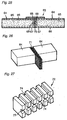
- the FRP roofing material joint structure which is obtained by providing an FRP connecting layer extending across the two end regions and by providing a layer containing a resin distribution medium between the abutting end faces, when butt joining a core material and FRP sheets arranged at the faces thereof.
- This resin distribution medium can be composed of a reticular body, or it can be composed of a block or sheet shaped body having a resin inlet hole and, furthermore, having resin flow channels formed in the surface. It is preferred that an FRP layer also be provided around this resin distribution medium.
- Connection can be effected by directly providing an FRP connecting layer on one or on both faces of the two end regions of the adjacent sandwich structures but the FRP connecting layer(s) can also be arranged in hollow regions formed at the surface of these two end regions, to produce a structure where the surface of the FRP connecting layer is substantially co-planar with the sandwich structures adjacent to these hollow regions.
- the method of joining FRP roofing materials relating to the present invention comprises a joining method which is characterized in that, when butt joining the ends of sandwich structures where FRP skin sheets are arranged on both faces of a core material, as well as arranging a resin distribution medium between the abutting ends, reinforcing fibre is arranged across the surface of the two ends, the resin distribution medium and the region of arrangement of the reinforcing fibre then being covered with an airtight material and the interior placed under vacuum, after which resin is injected into the resin distribution medium region and, as well as distribution of the resin taking place as far as the reinforcing fibre regions, impregnation of the reinforcing fibre takes place, and then, by curing the resin, the end regions are integrally joined together.
- the ends of adjacent sandwich structures are joined together by means of an FRP connecting layer which extends across the two ends on one side or on both sides thereof, and by means of a layer containing a resin distribution medium provided between the abutting end faces. Since there is no need to provide bolt holes as in conventional bolt coupling methods, there is no lowering of the strength and rigidity of the sandwich structure and, furthermore, as well as there not being any bolt holes, the joining is performed basically using an identical material, so there is no dramatic change in rigidity and stress concentrations are avoided. Furthermore, production costs are low since there is no need to reinforce the FRP skin sheets. Again, since there are no exposed bolt head regions, the appearance is good and there is no need for supplementary members such as covers, etc.
- the resin travels to the required sites rapidly and efficiently via a resin distribution medium, to impregnate the reinforcing fibre, and a prescribed joint can be formed, so the ends of the sandwich structures can be firmly and integrally connected together.
- This method of joining can be employed locally just at the position of the joint and it can be carried out easily on-the-spot.
- FIG. 1 shows a partial sectional view of FRP roofing material relating to a first embodiment of the present invention.
- FRP roofing material 1 has a rib structure 4 which joins together a pair of FRP sheets (skin layers) 3a , 3b arranged in parallel at a gap 2 .
- the rib structure 4 is also composed of FRP.
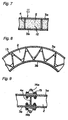
- the dimension (the vertical dimension in the figures) of the gap formed between the pair of FRP sheets 3a , 3b can be constructed to be substantially fixed in the lengthwise direction of the sheets. Furthermore, construction may also be such that the dimension of the gap varies in the lengthwise direction. For example, as shown in Figure 3, viewed in cross-section, by having a form in which one sheet 3c varies in a curved fashion while the other sheet 3d extends linearly, it is possible to continuously vary the dimension of the gap 2a between the pair of sheets 3c , 3d .
- a jagged member has sometimes been used as a roofing material, and this form can also be employed in the same way in the present invention.
- Figure 4 viewed in cross-section, there can be employed a form in which one sheet 3e is moulded in a sharp jagged form with peaks and troughs arranged in alternating fashion, while the other sheet 3f extends linearly.
- sheet 3d at the underside in the figure may also be formed in a shape which changes in a curved fashion and, in the structure shown in Figure 4, sheet 3f on the underside In the figure may also be formed with a jagged shape.
- the pair of sheets 3g , 3h may both be given a jagged or zigzag shape, with these being arranged such that essentially a fixed gap 2 is maintained between them.
- this filler material functions as the core material 12 of FRP roofing material 11 constructed as a sandwich structure.
- FIG. 8 shows a construction where a rigid frame structure 13 is arranged in the gap 2 between the pair of sheets 3a , 3b .
- the rigid frame structure 13 By means of the rigid frame structure 13 , the sheets 3a , 3b are extremely firmly joined together and variations in the space between the sheets are suppressed.
- FRP FRP or a material such as metal or wood.
- a connecting member for connection to another member be fitted to the outer face of at least one of the sheets of the FRP roofing material.
- this connecting member be fitted at a position which corresponds to the position where a rib structure is provided.
- connecting members 14a , 14b are fitted to the outer face of sheet 3a and the outer face of sheet 3b corresponding to the arrangement position of rib structure 4a .
- Fitment may be by a method of adhesion to the outer face of the sheet or by a method of integrally moulding to the sheet, and it is also possible to carry out fitment by through-bolts or the like.
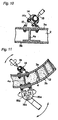
- the connecting member 14 has a universal joint 16 which permits rotation not just in one direction but in many directions.
- universal joint 16 By employing universal joint 16 , as well as fitment and deployment of the FRP roofing material being facilitated, it is possible to prevent the occurrence and transmission of undesirable stresses such as torsional stress.
- the rotation range is somewhat narrow, so an auxiliary sloping base 14c is also employed, but depending on the angle of use this need not necessarily be employed.
- Figure 11 illustrates an example of a preferred embodiment where the aforesaid universal joint 16 is used and where there are arranged rib structures 4, 4a of shape corresponding to their position in the FRP roofing material (a plurality of rib structures is arranged mixed together) and, moreover, where a core material 12 comprising a foam is also used.
- a type having two pins 16b , 16c extending in mutually perpendicular directions there is used as the underside universal joint 16a .
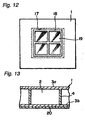
- window frame member 18 For example, as shown in Figure 12, by forming beforehand an opening 17 which passes through FRP roofing material 1 in the thickness direction, it is possible to produce a structure for fitting a window frame member 18 in said opening 17 .
- Window glazing material 19 comprising a transparent material such as acrylic, glass or polycarbonate is inserted in window frame member 18 .
- This window frame member 18 may be of the same material as the rib structure and/or of the same arrangement, and following separate construction can be joined to the FRP roofing material.
- a fire-resistant layer 20 on one face of FRP roofing material 1 .
- the fire-resistant material there can be used a blanket-shaped material of Inorganic fibre such as rock wool fibre or ceramic fibre, or there can be used a phenolic foam, a hardened sheet of rock wool, a fire-resistant coating or a foamable fire-resistant plastic, etc.
- the FRP roofing material relating to the present invention can be freely moulded in various three-dimensional shapes.
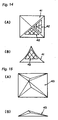
- it can be moulded in the form of a polyhedral (in the illustrated example, a quadrangular pyramid shaped) FRP roofing material 41 , to give a structure in which window frame members 42 are fitted at desired faces (at two faces in the illustrated example), or an FRP roofing material 43 of still more complex shape can be constructed by combining faces at desired angles as shown in Figure 15.
- an FRP roofing material 45 with a non-planar portion having a three-dimensional curved surface 44 , as shown in Figure 16.
- the FRP roofing material relating to the present invention can have a structure as shown in Figure 17 or Figure 18, or a cross-sectional shape as shown in Figure 19 (A) to (F).
- FIG 19 (A) to (F) In the case of such roofing materials which are long in one direction, it is possible to link together a number in their widthwise direction to produce the roofing material.
- mutually adjacent FRP roofing materials can be linked together via suitable linking members (e.g. bolts) at a specified gap 46 , as shown for example in Figure 20.
- suitable linking members e.g. bolts
- By forming such a gap 46 it is possible to absorb dimensional errors in one of the FRP roofing materials 1 or errors at the time of assembly, and it is also possible to absorb changes due to thermal expansion or contraction of the roof according to whether or not the sun is shining, etc.
- a linked region 48 of this kind can be covered with a waterproof member 49 comprising a waterproof sheet material or the like, to readily achieve a waterproof structure and readily prevent leakage of rainwater and the like.
- FIG. 22 illustrates an example of integral moulding relating to the present invention, and in order to simplify explanation there is shown the case of FRP which is entirely flat but, by changing the moulding tool, moulding is possible in any desired shape.
- a plurality of core materials 51 comprising a foam material or the like and, furthermore, reinforcing fibre substrates 52 are arranged at both faces thereof.
- the core materials 51 are arranged lengthwise and crosswise viewed in planar fashion.
- the ends of the arranged core materials 51 may be disposed so that aforesaid fibre reinforcing substrate 52 envelops core material 51 , or as shown in Figure 22 there may be arranged ⁇ -shaped cap-shaped reinforcing fibre substrates 53 .
- Core material 51 has channels 54 forming resin passageways and numerous channels 55 branching from these channels 54 . Now, in such circumstances, the cross-sectional areas of the channels 54 and 55 need not necessarily be different.
- the resin is transmitted in the direction of the face of the reinforcing fibre 52 via these channels 54 , 55 , and the transmitted resin impregnates the reinforcing fibre 52 in the thickness direction.
- through-holes 56 may be provided in the core material as shown in Figure 24. Because there is direct injection of the resin at the lower face of the core material in this way, it is possible to prevent the un-impregnated regions which arise primarily at the moulding tool face side, and it is possible to produce FRP roofing materials of stable properties, and good product quality.
- the upper face of the reinforcing fibre substrate 52 is directly covered with airtight material 57 but, optionally, there may be interposed a release material which is then separated off after the moulding.
- the airtight material 57 itself functions as a release material.
- the optionally-provided release material there is preferably employed a release material through which the resin can pass but, after curing, can then be stripped away from the FRP structure (for example a nylon taffeta, polyester taffeta or the like).
- the injected resin passes through the channels 54 , 55 or the through-holes 56 as described above and, while being rapidly transmitted towards the surface of the fibre reinforcing substrate 52 , gradually impregnates the reinforcing fibre substrate 52 in the thickness direction.
- the ⁇ -shaped reinforcing fibre substrates 53 which form the rib structures are simultaneously impregnated with resin and the rib structures are integrally moulded.
- the impregnated resin hardens at room temperature, or in certain cases it is cured by heating, and the FRP roofing material is completed. Following curing, the airtight material 57 is removed and the hardened FRP structure is removed from the mould 50 . In this way, the FRP roofing material is integrally formed.
- FIG. 25 shows a cross-section of the FRP roofing material joint construction.
- 63 denotes the joined FRP roofing materials
- 64 denotes the individual FRP roofing materials which are mutually joined together.
- Each of the FRP roofing materials 64 comprises FRP skin sheet 66 arranged on both faces of core material 65 , with these being integrally moulded together.
- the FRP skin sheet 66 is arranged so that it is continuously wrapped round from the surface on one side, to that on the other.
- FRP connecting layer 68 which extends across the surfaces of the ends 67 on one face, and the FRP connecting layer 68 and the FRP sheet 66 of each of FRP roofing materials 64 are integrally joined.
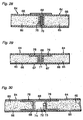
- the FRP connecting layer 68 is provided only on one face but it may also be provided on both faces as shown in undermentioned Figure 30.
- a layer 70 containing a resin distribution medium is provided between the abutting end faces 69 of the adjacent FRP roofing materials 64 and, by means of the injected and cured resin, this layer 70 is integrally coupled to both abutting end faces 69 .
- an FRP layer 75 may also be provided around the aforesaid resin distribution medium or the layer containing the resin distribution medium.
- This FRP layer 75 can be constructed naturally at the time of the resin injection and joint formation by arranging beforehand, around the resin distribution medium, the reinforcing fibre used for constructing FRP layer 75 , prior to the injection into the resin distribution medium.
- Figure 30 shows an example where there is adopted a structure in which the FRP connecting layer 68 is arranged inside hollow regions 76 as shown in Figure 29, and a structure employing a resin distribution medium 72 as shown in Figure 27, together with a structure in which FRP connecting layers 68 are arranged on both end faces.
- the entire joint region is then covered with a sealable airtight material and suction applied to the interior with a vacuum pump to form a vacuum, after which resin is injected into the resin distribution medium 71 portion. Because of the vacuum state, the injected resin is distributed rapidly and, as well as spreading between the abutting end faces 69 , it is also distributed to the aforesaid reinforcing fibre layer(s) arranged at the surface, and so there is simultaneous impregnation of the reinforcing fibre layer(s). In the case where reinforcing fibre has been wound around the resin distribution medium 71 , there is also distribution into, and impregnation of this reinforcing fibre.
- FRP connecting layer(s) 68 is/are constructed from the reinforcing fibre layer(s) arranged at the surface and the impregnated resin and, along with the cured resin between the abutting end faces 69 , the two FRP roofing material 64 are integrally connected.
- a phenolic resin is used as the matrix resin of the FRP, or if a fire-resistant material is provided at the surface, it is possible to produce a roofing material which is outstanding in it fire-resistance.
Landscapes
- Engineering & Computer Science (AREA)
- Architecture (AREA)
- Mechanical Engineering (AREA)
- Civil Engineering (AREA)
- Structural Engineering (AREA)
- Physics & Mathematics (AREA)
- Electromagnetism (AREA)
- Chemical & Material Sciences (AREA)
- Composite Materials (AREA)
- Textile Engineering (AREA)
- Roof Covering Using Slabs Or Stiff Sheets (AREA)
- Building Environments (AREA)
- Lining Or Joining Of Plastics Or The Like (AREA)
Abstract
Description
Claims (39)
- FRP roofing material comprising a sandwich structure where a pair of sheets comprising FRP is arranged with a gap between them and a rib structure which joins said pair of sheets is interposed.
- FRP roofing material according to Claim 1 where the respective thicknesses of said pair of sheets is 2-10 mm.
- FRP roofing material according to Claim 1 where the rib structure is FRP and is substantially integrally moulded to the pair of sheets from which the sandwich structure is composed.
- FRP roofing material according to Claim 1 where the thickness of the rib is 1-3 mm.
- FRP roofing material according to Claim 3 where there is used for the reinforcing fibre of the FRP rib a multiaxial woven material comprising a fibre direction at an angle of 45 ± 10° to the lengthwise direction of the rib.
- FRP roofing material according to Claim 1 where the FRP is CFRP.
- FRP roofing material according to Claim 1 where the FRP is a hybrid FRP of carbon fibre and glass fibre.
- FRP roofing material according to Claim 1 where the form of the reinforcing fibre is that of a woven material.
- FRP roofing material according to Claim 8 where the carbon fibre woven material is a plain weave or twill weave.
- FRP roofing material according to Claim 1 where the spacing of the gap is substantially uniform along the lengthwise direction of the sheets.
- FRP roofing material according to Claim 1 where the spacing of the gap varies along the lengthwise direction of the sheets.
- FRP roofing material according to Claim 1 where there is arranged, in the gap, a filler of specific gravity lower than that of both the pair of sheets.
- FRP roofing material according to Claim 1 where at least one of the sheets has a jagged form in which there are alternately arranged peaks and troughs.
- FRP roofing material according to Claim 1 where a rigid frame (Rahmen) structure is arranged in the gap.
- FRP roofing material according to Claim 1 where a connecting member for connecting to another member is fitted to the outer face of at least one of the sheets.
- FRP roofing material according to Claim 1 where the ratio of the overall thickness of the sandwich structure to the thickness of each of the sheets comprising said pair of sheets lies in the range 5 : 1 to 25 : 1 and, furthermore, the weight of said sandwich structure is no more than 100 kg/m2.
- FRP roofing material according to Claim 1 where the flexural rigidity per unit width of the sandwich structure is at least 5 x 10⁷ kg.mm2.
- FRP roofing material according to Claim 18 which extends in the lengthwise direction at substantially a uniform width, and the flexural rigidity per unit width (1 mm) in the lengthwise direction is at least 5 x 10⁷ kg.mm2.
- FRP roofing material according to Claim 1 where the cross-sectional shape is flat sheet shaped, V-shaped, hat shaped, W-shaped, inverted Y-shaped, corrugated or circular arc shaped.
- FRP roofing material according to Claim 1 which extends in the lengthwise direction at substantially a uniform width, and where its dimensions are a length of 10-25 m and a width of 1.5-3.5 m.
- FRP roofing material according to Claim 20 where the shape in the lengthwise direction is that of a circular arc.
- FRP roofing material according to Claim 1 where a plurality of the FRP roofing materials is connected together in the widthwise direction.
- FRP roofing material according to Claim 22 where a gap is formed between adjacent FRP roofing materials in the widthwise direction connection.
- FRP roofing material according to Claim 23 where the connection region is covered with a waterproof member.
- FRP roofing material according to Claim 1 where the matrix resin of at least one of the sheets chiefly comprises a phenolic resin.
- FRP roofing material according to Claim 1 where a fire-resistant material is provided at least on one face.
- FRP roofing material according to Claim 26 where the fire-resistant material is a fire-resistant material containing rock wool.
- FRP roofing material according to Claim 26 where the fire-resistant material is a fire-resistant material containing phenolic foam.
- FRP roofing material according to Claim 17 where the thickness of the FRP layer comprising carbon fibre is at least 5% that of the FRP sheet.
- A method of producing FRP roofing material where, in an RTM moulding method in which channels are provided in the core material and the reinforcing fibre impregnated with a resin distributed through these channels, there is used an RTM moulding method employing a core material, having through-holes.
- A method of producing FRP roofing material according to Claim 30 which is characterized in that the sum of the areas of the through-holes provided in the core material is from 1/100 to 1/5000 of the area of the upper or lower face of the core material.
- A method of producing FRP roofing material according to Claim 30 which is characterized in that there are provided from 1 to 50 said through-holes per 1 m2.
- FRP roofing material according to Claim 1 where there is a core material in the gap and there are present, in the core material, through-holes running from the upper face to the lower face.
- FRP roofing material according to Claim 1 which is FRP roofing material where two or more FRP sandwich structures are butt joined and, as well as providing an FRP connecting layer extending across the surfaces of both ends of said sandwich structures, there is provided a layer containing a resin distribution medium between the abutting end faces.
- FRP roofing material according to Claim 34 where the resin distribution medium comprises a reticular body.
- FRP roofing material according to Claim 34 where the resin distribution medium comprises a block or sheet-shaped body with a resin injection hole and, furthermore, with resin flow channels formed in the surface.
- FRP roofing material according to Claim 34 where an FRP layer is provided around the resin distribution medium.
- A joint structure for a sandwich structure according to Claim 34 where the FRP connecting layer is arranged in hollows formed in the surfaces of the two end regions, and the surfaces of the sandwich structures adjacent to the hollows and the surface of the FRP connecting layer are coplanar.
- A method for joining FRP roofing materials in which, when butt joining the end regions thereof, as well as arranging a resin distribution medium between the abutting end faces, reinforcing fibre is arranged across the surfaces of the two end regions and, with the area where the resin distribution medium and the reinforcing fibre are arranged being covered with an airtight material, a vacuum is applied to the interior and a resin injected into the resin distribution medium, and as well as distribution being effected as far as the reinforcing fibre region, there is impregnation of the reinforcing fibre and, by curing the resin, the end regions are integrally joined.
Applications Claiming Priority (3)
| Application Number | Priority Date | Filing Date | Title |
|---|---|---|---|
| JP7472299 | 1999-03-19 | ||
| JP7472299 | 1999-03-19 | ||
| PCT/JP2000/001594 WO2000056993A1 (en) | 1999-03-19 | 2000-03-16 | Frp roof material, method of manufacturing the roof material, and structure and method for connecting the roof material |
Publications (2)
| Publication Number | Publication Date |
|---|---|
| EP1081305A1 true EP1081305A1 (en) | 2001-03-07 |
| EP1081305A4 EP1081305A4 (en) | 2005-03-16 |
Family
ID=13555413
Family Applications (1)
| Application Number | Title | Priority Date | Filing Date |
|---|---|---|---|
| EP00909665A Withdrawn EP1081305A4 (en) | 1999-03-19 | 2000-03-16 | Frp roof material, method of manufacturing the roof material, and structure and method for connecting the roof material |
Country Status (6)
| Country | Link |
|---|---|
| US (1) | US6942915B1 (en) |
| EP (1) | EP1081305A4 (en) |
| KR (1) | KR100699394B1 (en) |
| CN (1) | CN1226512C (en) |
| CA (1) | CA2332442C (en) |
| WO (1) | WO2000056993A1 (en) |
Cited By (10)
| Publication number | Priority date | Publication date | Assignee | Title |
|---|---|---|---|---|
| EP1388623A1 (en) * | 2002-08-07 | 2004-02-11 | de Vadder, M. Paul | Building panel |
| WO2005038160A1 (en) * | 2003-10-17 | 2005-04-28 | University Of Delaware | Monolithic hurricane resistant structural panels made from low density composites |
| WO2008070026A1 (en) * | 2006-12-04 | 2008-06-12 | Composite Panel Systems Llc | Construction panels and construction systems, and methods |
| FR2929168A1 (en) * | 2008-03-31 | 2009-10-02 | Int Pour Le Commerce Et L Ind | COMPOSITE PANEL WITH PERFORATED MEMBER, DEVICE AND METHOD FOR MANUFACTURING SUCH A PANEL |
| ITPD20080268A1 (en) * | 2008-09-19 | 2010-03-20 | Giuseppe Pantano | PROCESS FOR THE MANUFACTURE OF PANELS IN COMPOSITE MATERIALS, PARTICULARLY OF INSULATING PANELS FOR ISOTHERMAL VEHICLES, AND PANELS OBTAINABLE WITH THIS PROCESS |
| EP1864792A4 (en) * | 2005-04-01 | 2010-09-01 | Kawasaki Heavy Ind Ltd | STRUCTURE FOR PREVENTING THE PROGRESSION OF THE SCALE OF A SANDWICH PANEL |
| GB2512185A (en) * | 2013-01-28 | 2014-09-24 | Advanced Insulation Plc | Barrier system |
| EP2952645A1 (en) * | 2014-06-06 | 2015-12-09 | IG-GRP Limited | A building component |
| EP2619113A4 (en) * | 2010-09-24 | 2017-09-06 | Cesium Holding AB | Method of producing an enforced delimited element and such an element |
| EP3909751A1 (en) * | 2020-05-16 | 2021-11-17 | Konkol, Janusz | A method of manufacture of a flat laminate construction with a stiffening system and a flat laminate construction with a stiffening system |
Families Citing this family (52)
| Publication number | Priority date | Publication date | Assignee | Title |
|---|---|---|---|---|
| KR100868917B1 (en) * | 2001-05-17 | 2008-11-17 | 도레이 가부시끼가이샤 | Fiber reinforced plastic soundproof wall |
| US6912821B2 (en) * | 2002-10-11 | 2005-07-05 | Zellcomp, Inc. | Composite decking system |
| KR200357517Y1 (en) * | 2004-04-23 | 2004-07-30 | 주식회사 엘지화학 | House access floor system for noise reduction comprising high rigidity sandwich board |
| KR100735571B1 (en) * | 2006-01-24 | 2007-07-06 | 황수원 | Artificial thatched roof using silicon and FRP and its manufacturing method |
| KR100761030B1 (en) * | 2006-04-19 | 2007-09-21 | 주식회사 제이엔티 | Car floor mats |
| US8082711B2 (en) | 2006-12-04 | 2011-12-27 | Composite Panel Systems, Llc | Walls and wall sections |
| PL2126243T3 (en) * | 2007-01-12 | 2012-10-31 | Deutsche Rockwool Mineralwoll Gmbh & Co Ohg | Sloping roof system and insulating board for sloping roof systems |
| KR100855747B1 (en) * | 2007-04-25 | 2008-09-03 | (주)서진라이트 | Manufacturing method of roofing material using resin and FRP |
| DE102007035228B4 (en) * | 2007-05-15 | 2010-12-09 | Rcs Reinforced Composite Solutions Gmbh | transport container |
| US8726580B1 (en) * | 2007-10-15 | 2014-05-20 | Christopher M. Hunt | Standing seam cementitious roof |
| US8904737B2 (en) | 2008-12-18 | 2014-12-09 | Composite Panel Systems, Llc | Building panel assemblies and methods of use in wall structures |
| US8607531B2 (en) | 2008-12-18 | 2013-12-17 | Composite Panel Systems, Llc | Building panel assemblies and methods of use in wall structures |
| US9493938B2 (en) | 2008-12-18 | 2016-11-15 | Composite Panel Systems, Llc | Building panel assemblies and methods of use in wall structures |
| DE102009026458A1 (en) * | 2009-05-25 | 2010-12-09 | Airbus Operations Gmbh | Structural component and manufacturing method for a structural component |
| DE102009033490A1 (en) * | 2009-07-15 | 2011-01-20 | Solarlite Gmbh | Segment of a solar collector as well as solar collectors |
| KR200461569Y1 (en) | 2009-11-25 | 2012-07-20 | 순환엔지니어링 주식회사 | Cfrp beam of plate structure |
| US8342598B2 (en) * | 2009-11-26 | 2013-01-01 | Faroex Ltd. | Structure including a composite panel joint |
| CA3019059C (en) | 2010-10-08 | 2021-01-05 | Composite Panel Systems, Llc | Building panel using wrapped studs |
| CN102162288B (en) * | 2011-03-28 | 2012-10-03 | 张乐军 | Construction method of a thermal insulation and fireproof roof |
| USD713949S1 (en) * | 2011-05-11 | 2014-09-23 | Mark Moore | Duct seal for joining duct boards |
| CN102814979A (en) * | 2011-06-08 | 2012-12-12 | 新疆永昌新材料科技股份有限公司 | Fixed nacelle cover stiffener process |
| JP5578290B1 (en) * | 2012-12-26 | 2014-08-27 | 東レ株式会社 | Molded body having hollow structure and method for producing the same |
| CN103089024A (en) * | 2013-02-05 | 2013-05-08 | 中国十七冶集团有限公司 | Glass reinforced plastics roof framework device |
| US9574349B2 (en) * | 2013-05-13 | 2017-02-21 | Hawkeye Pedershaab Concrete Technologies, Inc. | Post-tensioning concrete pipe wrap |
| JP6146244B2 (en) * | 2013-09-30 | 2017-06-14 | 積水ハウス株式会社 | Waterproof structure and waterproofing method for external floor |
| US12595658B2 (en) * | 2013-10-25 | 2026-04-07 | Mbrico, Llc | Tile and support structure for vertical mounting tiles |
| CN103753829A (en) * | 2013-12-18 | 2014-04-30 | 奇瑞汽车股份有限公司 | RTM preform and RTM rapid forming die applying the same |
| US10538683B2 (en) | 2014-03-11 | 2020-01-21 | Tamko Building Products Llc | Roofing products with carbon fiber substrate |
| CN104070684A (en) * | 2014-06-04 | 2014-10-01 | 洛阳双瑞风电叶片有限公司 | Pipeline-free vacuum infusion forming method of sandwiched composite material |
| CN105522763B (en) * | 2014-10-17 | 2017-09-29 | 三菱电机株式会社 | The manufacture method and FRP sandwich structural bodies of FRP sandwich structural bodies |
| FR3029827B1 (en) * | 2014-12-12 | 2017-06-23 | Plastic Omnium Cie | METHOD FOR MANUFACTURING A PLASTIC PART FOR A MOTOR VEHICLE BY ADDING MATERIAL |
| IS2965B (en) * | 2015-05-28 | 2017-03-15 | Eysturoy GrÃmsson Regin | A new building block made of mineral wool and fiber-reinforced plastic |
| CN105369956B (en) * | 2015-08-17 | 2017-12-29 | 中建一局集团装饰工程有限公司 | Waterproof slope design method for point type glass daylighting roof |
| CN105200913A (en) * | 2015-09-19 | 2015-12-30 | 福州大学 | Connecting structure for directly embedding carbon fiber tube concrete in base and construction method thereof |
| CN105401669B (en) * | 2015-11-04 | 2018-12-14 | 苏州大学 | Based on impedance matching to the unobstructed device of wireless signal |
| CN105604238B (en) * | 2015-11-20 | 2017-10-17 | 河北途牛建筑科技有限公司 | A kind of light wall, floor, the making of roof boarding and installation method |
| CN107696645B (en) * | 2016-08-08 | 2022-07-26 | 胡海东 | Composite material plate and box body |
| CN106738553A (en) * | 2016-11-29 | 2017-05-31 | 沈阳黎明航空发动机(集团)有限责任公司 | The moulding process of the glass fibre reinforced modified small pore area ear shim liner of phenolic resin |
| US10661838B2 (en) | 2017-05-31 | 2020-05-26 | Honda Motor Co., Ltd. | Multi-material vehicle roof stiffener |
| CN107761995A (en) * | 2017-09-15 | 2018-03-06 | 罗石明 | Light-weight aseismatic sound-proof wall body and house |
| CN108625499B (en) * | 2018-05-23 | 2020-04-24 | 五冶集团上海有限公司 | GRC plate waterproof control construction method and application thereof |
| JP7268608B2 (en) * | 2020-01-07 | 2023-05-08 | 株式会社オートネットワーク技術研究所 | Terminal block |
| CN111441477B (en) * | 2020-04-28 | 2024-10-29 | 北京市建筑设计研究院股份有限公司 | Spoke type cable truss structure reinforced by carbon fiber cables |
| KR102152089B1 (en) | 2020-05-20 | 2020-09-07 | 송과모터스 주식회사 | Manufacturing method for glass fiber reinforced plastic and glass fiber reinforced plastic using the same, and building panel and manufacturing method thereof |
| KR102181541B1 (en) | 2020-05-20 | 2020-11-23 | 송과모터스 주식회사 | Manufacturing method for glass fiber reinforced plastic and glass fiber reinforced plastic using the same, and building panel thereof |
| KR102223857B1 (en) | 2020-05-20 | 2021-03-08 | 송과모터스 주식회사 | Building panel manufacturing method using glass fiber reinforced plastic and building panel therefor |
| US11795688B2 (en) | 2020-07-01 | 2023-10-24 | Composite Panel Systems Llc | Structural building panels and panel components, panel assemblies, methods of making, and methods of using |
| US12359423B2 (en) * | 2020-09-18 | 2025-07-15 | Louisiana-Pacific Corp. | Self-sealing joint sealing system |
| US11851877B2 (en) * | 2020-11-17 | 2023-12-26 | Tremco Cpg Inc. | Structural insulated finished cladding assemblies |
| US20250100231A1 (en) * | 2022-02-09 | 2025-03-27 | Toray Industries, Inc. | Integrated molded body |
| CN116023161B (en) * | 2023-01-31 | 2023-07-11 | 北京理工大学 | Large-size high Jiang Taoci-matrix composite special-shaped lattice structure and preparation method thereof |
| CN116409427A (en) * | 2023-03-29 | 2023-07-11 | 中国船舶集团有限公司第七〇八研究所 | Metal sandwich plate composed of π-type cells and preparation method thereof |
Family Cites Families (41)
| Publication number | Priority date | Publication date | Assignee | Title |
|---|---|---|---|---|
| FR1527814A (en) * | 1967-02-14 | 1968-06-07 | Ohg Ferroviarie Pistoiesi S P | Structure in expanded material and synthetic resin incorporating a fabric reinforced by lamellar elements for the formation of panels suitable for the construction of railway wagons or other vehicles |
| DK122829B (en) * | 1970-05-01 | 1972-04-17 | P Bruun | Assembly of at least two building parts and method of manufacturing this assembly. |
| US3732138A (en) * | 1971-03-31 | 1973-05-08 | E Almog | Panel constructions |
| US3920871A (en) * | 1974-09-23 | 1975-11-18 | Frederick M Johnson | Woven structural element, method of manufacture thereof, and method of making a boat hull therefrom |
| FR2343914A1 (en) * | 1976-03-08 | 1977-10-07 | Chereau Jean | ASSEMBLY OF PREFABRICATED PANELS INTENDED IN PARTICULAR FOR REFRIGERATED VEHICLES |
| US4078348A (en) * | 1976-10-18 | 1978-03-14 | Michael Rothman | Construction panels for structural support systems |
| AT352666B (en) * | 1977-09-30 | 1979-10-10 | Artweger Ind | FORMWORK, IN PARTICULAR FOR UNDER-MOUNTED ROUTE EXPANSION |
| US4232494A (en) * | 1979-04-27 | 1980-11-11 | Tamil D. Bauch | Composite construction panel |
| AT376409B (en) * | 1979-06-28 | 1984-11-26 | Hutter & Schranz Bautech | HOUSING, IN PARTICULAR VEHICLE BODY |
| US4361613A (en) * | 1981-09-21 | 1982-11-30 | The Quaker Oats Company | Composite construction materials with improved fire resistance |
| CA1199773A (en) * | 1982-02-10 | 1986-01-28 | Jay R. Auer | Extruded structural system |
| EP0108576B1 (en) * | 1982-11-05 | 1988-08-31 | G. Maunsell & Partners | Load bearing floor or roof members |
| FR2556024B1 (en) * | 1983-12-05 | 1986-10-10 | Sge Construction | FLAT CONSTRUCTION COMPONENTS FOR BUILDINGS |
| FI78775C (en) * | 1983-12-19 | 1989-09-11 | Salakari Maija Leena | Method for joining disc-shaped pieces |
| GB8516437D0 (en) * | 1985-06-28 | 1985-07-31 | Rowan M G | Modular roof |
| GB2193465A (en) * | 1986-07-15 | 1988-02-10 | Cambrian Plastics Ltd | Improvements relating to reinforced bodies |
| EP0453598A1 (en) * | 1990-04-25 | 1991-10-30 | Kabushiki Kaisha Toshonishiwaki | Waterproof structure |
| JP2571276Y2 (en) * | 1991-09-30 | 1998-05-18 | いすゞ自動車株式会社 | Core material for molding fiber-reinforced resin |
| US5508085A (en) * | 1991-10-03 | 1996-04-16 | Tolo, Inc. | Structural elements made with cores of fiber-reinforced plastic |
| US5245803A (en) * | 1991-11-14 | 1993-09-21 | Haag E Keith | Connector means for roof panels and a method for installation thereof |
| JP3216188B2 (en) * | 1991-12-30 | 2001-10-09 | いすゞ自動車株式会社 | Molding method of FRP molded product |
| CA2070079C (en) * | 1992-05-29 | 1997-06-10 | Vittorio De Zen | Thermoplastic structural system and components therefor and method of making same |
| JPH06114980A (en) * | 1992-09-30 | 1994-04-26 | Fukui Giyomou Kk | High-strength panel and manufacturing method thereof |
| EP0643179B1 (en) * | 1992-12-28 | 1998-12-16 | Ig-Technical Research Inc. | Refractory heat-insulating panel |
| JPH06270300A (en) * | 1993-03-17 | 1994-09-27 | Toyota Motor Corp | FRP molded product with insert member |
| CA2232203A1 (en) * | 1993-05-28 | 1994-11-29 | Royal Building Systems (Cdn) Limited | Thermoplastic structural components and structures formed therefrom |
| US5424113A (en) * | 1993-06-23 | 1995-06-13 | The United States Of America As Represented By The Secretary Of The Navy | Lattice core sandwich construction |
| JPH07256769A (en) * | 1994-03-18 | 1995-10-09 | Honda Motor Co Ltd | Fiber reinforced resin material |
| JPH08193409A (en) * | 1995-01-17 | 1996-07-30 | Yamatomi Shoji Kk | Fiber reinforced plastic panels, their joints and non-combustible composite fiber reinforced plastic panels |
| DK0781714T3 (en) * | 1995-07-14 | 2004-01-26 | Toray Industries | Shipping Container |
| WO1997008037A1 (en) * | 1995-08-22 | 1997-03-06 | Toray Industries, Inc. | Panel and cargo compartment for a truck |
| JPH09202145A (en) * | 1995-08-22 | 1997-08-05 | Toray Ind Inc | Truck panel and cargo compartment |
| US5928772A (en) * | 1996-06-13 | 1999-07-27 | Dainippon Ink And Chemicals, Inc. | Panel material and method of manufacturing the same |
| JP3113881B2 (en) * | 1996-07-29 | 2000-12-04 | 旭ファイバーグラス株式会社 | Composite substrate for resin reinforcement and fiber reinforced resin using the composite substrate |
| JPH1061094A (en) * | 1996-08-19 | 1998-03-03 | Taisei Kogyo Kk | Lighting arch structure |
| JPH10238025A (en) * | 1997-02-24 | 1998-09-08 | Shiiraizu Corp:Kk | Building materials |
| JPH10258778A (en) * | 1997-03-19 | 1998-09-29 | Toray Ind Inc | Truck bed |
| JPH10281462A (en) * | 1997-04-09 | 1998-10-23 | Matsushita Electric Ind Co Ltd | Combustion equipment |
| US5849393A (en) * | 1997-04-17 | 1998-12-15 | Mcdonnell Douglas Corporation | Structural element and method of making |
| US6309732B1 (en) * | 1997-06-02 | 2001-10-30 | Roberto A. Lopez-Anido | Modular fiber reinforced polymer composite structural panel system |
| FI973721A0 (en) * | 1997-09-18 | 1997-09-18 | Ahlstrom Glassfibre Oy | Multiaxialarmeringsvaevnad |
-
2000
- 2000-03-16 KR KR1020007012980A patent/KR100699394B1/en not_active Expired - Fee Related
- 2000-03-16 CN CNB008000131A patent/CN1226512C/en not_active Expired - Fee Related
- 2000-03-16 CA CA002332442A patent/CA2332442C/en not_active Expired - Fee Related
- 2000-03-16 WO PCT/JP2000/001594 patent/WO2000056993A1/en not_active Ceased
- 2000-03-16 EP EP00909665A patent/EP1081305A4/en not_active Withdrawn
- 2000-03-16 US US09/700,060 patent/US6942915B1/en not_active Expired - Fee Related
Cited By (14)
| Publication number | Priority date | Publication date | Assignee | Title |
|---|---|---|---|---|
| WO2004015218A1 (en) * | 2002-08-07 | 2004-02-19 | Paul De Vadder | Construction panel |
| EP1388623A1 (en) * | 2002-08-07 | 2004-02-11 | de Vadder, M. Paul | Building panel |
| WO2005038160A1 (en) * | 2003-10-17 | 2005-04-28 | University Of Delaware | Monolithic hurricane resistant structural panels made from low density composites |
| EP1864792A4 (en) * | 2005-04-01 | 2010-09-01 | Kawasaki Heavy Ind Ltd | STRUCTURE FOR PREVENTING THE PROGRESSION OF THE SCALE OF A SANDWICH PANEL |
| US7829178B2 (en) * | 2005-04-01 | 2010-11-09 | Kawasaki Jukogyo Kabushiki Kaisha | Delamination development preventable structure for sandwich panel |
| WO2008070026A1 (en) * | 2006-12-04 | 2008-06-12 | Composite Panel Systems Llc | Construction panels and construction systems, and methods |
| CN102131638A (en) * | 2008-03-31 | 2011-07-20 | 商业及工业国际公司 | Perforated-core composite panel, device and method for manufacturing such panel |
| WO2009125124A3 (en) * | 2008-03-31 | 2009-12-10 | Societe Internationale Pour Le Commerce Et L'industrie | Perforated-core composite panel, device and method for manufacturing such a panel |
| FR2929168A1 (en) * | 2008-03-31 | 2009-10-02 | Int Pour Le Commerce Et L Ind | COMPOSITE PANEL WITH PERFORATED MEMBER, DEVICE AND METHOD FOR MANUFACTURING SUCH A PANEL |
| ITPD20080268A1 (en) * | 2008-09-19 | 2010-03-20 | Giuseppe Pantano | PROCESS FOR THE MANUFACTURE OF PANELS IN COMPOSITE MATERIALS, PARTICULARLY OF INSULATING PANELS FOR ISOTHERMAL VEHICLES, AND PANELS OBTAINABLE WITH THIS PROCESS |
| EP2619113A4 (en) * | 2010-09-24 | 2017-09-06 | Cesium Holding AB | Method of producing an enforced delimited element and such an element |
| GB2512185A (en) * | 2013-01-28 | 2014-09-24 | Advanced Insulation Plc | Barrier system |
| EP2952645A1 (en) * | 2014-06-06 | 2015-12-09 | IG-GRP Limited | A building component |
| EP3909751A1 (en) * | 2020-05-16 | 2021-11-17 | Konkol, Janusz | A method of manufacture of a flat laminate construction with a stiffening system and a flat laminate construction with a stiffening system |
Also Published As
| Publication number | Publication date |
|---|---|
| KR100699394B1 (en) | 2007-03-27 |
| WO2000056993A1 (en) | 2000-09-28 |
| CN1226512C (en) | 2005-11-09 |
| US6942915B1 (en) | 2005-09-13 |
| CA2332442C (en) | 2008-01-15 |
| CA2332442A1 (en) | 2000-09-28 |
| CN1293731A (en) | 2001-05-02 |
| EP1081305A4 (en) | 2005-03-16 |
| KR20010071295A (en) | 2001-07-28 |
Similar Documents
| Publication | Publication Date | Title |
|---|---|---|
| CA2332442C (en) | Frp roofing member manufacturing method, and its connecting structure and connecting method | |
| US7926241B2 (en) | Building panels | |
| US6591567B2 (en) | Lightweight fiber reinforced polymer composite modular panel | |
| US8114501B2 (en) | Fiber reinforced core panel having natural contour | |
| US6309732B1 (en) | Modular fiber reinforced polymer composite structural panel system | |
| AU2007328296B2 (en) | Construction panels and construction systems, and methods | |
| US6735916B2 (en) | Reinforced structural member | |
| KR20010102186A (en) | Frp structure body and production method therefor | |
| Dietz | Potentialities of reinforced plastics and foams in buildings | |
| JP2513625Y2 (en) | Composite structure |
Legal Events
| Date | Code | Title | Description |
|---|---|---|---|
| PUAI | Public reference made under article 153(3) epc to a published international application that has entered the european phase |
Free format text: ORIGINAL CODE: 0009012 |
|
| 17P | Request for examination filed |
Effective date: 20001211 |
|
| AK | Designated contracting states |
Kind code of ref document: A1 Designated state(s): AT BE CH CY DE DK ES FI FR GB GR IE IT LI LU MC NL PT SE |
|
| RBV | Designated contracting states (corrected) |
Designated state(s): DE FR GB |
|
| RIC1 | Information provided on ipc code assigned before grant |
Ipc: 7E 04B 1/61 B Ipc: 7E 04B 7/02 A Ipc: 7B 29C 65/00 B Ipc: 7B 29C 70/08 B Ipc: 7E 04D 3/35 B Ipc: 7B 29C 70/48 B Ipc: 7E 04B 7/10 B Ipc: 7E 04C 2/296 B Ipc: 7B 29C 70/54 B Ipc: 7E 04C 1/36 B |
|
| RIC1 | Information provided on ipc code assigned before grant |
Ipc: 7B 29C 70/54 B Ipc: 7E 04B 1/61 B Ipc: 7B 29C 70/48 B Ipc: 7E 04D 3/35 B Ipc: 7E 04C 2/296 B Ipc: 7B 29C 65/00 B Ipc: 7E 04B 7/02 A Ipc: 7B 29C 70/08 B Ipc: 7E 04B 7/10 B |
|
| A4 | Supplementary search report drawn up and despatched |
Effective date: 20050128 |
|
| 17Q | First examination report despatched |
Effective date: 20051215 |
|
| GRAP | Despatch of communication of intention to grant a patent |
Free format text: ORIGINAL CODE: EPIDOSNIGR1 |
|
| RTI1 | Title (correction) |
Free format text: A FIBRE REINFORCED PLASTIC ROOFING MATERIAL JOINT STRUCTURE AND METHOD OF JOINING TOGETHER FIBRE REINFORCED PLASTIC ROOFING MATERIALS |
|
| STAA | Information on the status of an ep patent application or granted ep patent |
Free format text: STATUS: THE APPLICATION HAS BEEN WITHDRAWN |
|
| 18W | Application withdrawn |
Effective date: 20080808 |