EP1081132B1 - Hydroxamic acid derivatives and medicinal utilization thereof - Google Patents
Hydroxamic acid derivatives and medicinal utilization thereof Download PDFInfo
- Publication number
- EP1081132B1 EP1081132B1 EP99921188A EP99921188A EP1081132B1 EP 1081132 B1 EP1081132 B1 EP 1081132B1 EP 99921188 A EP99921188 A EP 99921188A EP 99921188 A EP99921188 A EP 99921188A EP 1081132 B1 EP1081132 B1 EP 1081132B1
- Authority
- EP
- European Patent Office
- Prior art keywords
- integer
- methyl
- phenyl
- hydroxysulfonyloxy
- ethylcarbamoyl
- Prior art date
- Legal status (The legal status is an assumption and is not a legal conclusion. Google has not performed a legal analysis and makes no representation as to the accuracy of the status listed.)
- Expired - Lifetime
Links
- 0 CC1*CCC1 Chemical compound CC1*CCC1 0.000 description 12
Classifications
-
- C—CHEMISTRY; METALLURGY
- C07—ORGANIC CHEMISTRY
- C07D—HETEROCYCLIC COMPOUNDS
- C07D209/00—Heterocyclic compounds containing five-membered rings, condensed with other rings, with one nitrogen atom as the only ring hetero atom
- C07D209/02—Heterocyclic compounds containing five-membered rings, condensed with other rings, with one nitrogen atom as the only ring hetero atom condensed with one carbocyclic ring
- C07D209/44—Iso-indoles; Hydrogenated iso-indoles
- C07D209/48—Iso-indoles; Hydrogenated iso-indoles with oxygen atoms in positions 1 and 3, e.g. phthalimide
-
- A—HUMAN NECESSITIES
- A61—MEDICAL OR VETERINARY SCIENCE; HYGIENE
- A61P—SPECIFIC THERAPEUTIC ACTIVITY OF CHEMICAL COMPOUNDS OR MEDICINAL PREPARATIONS
- A61P19/00—Drugs for skeletal disorders
- A61P19/02—Drugs for skeletal disorders for joint disorders, e.g. arthritis, arthrosis
-
- C—CHEMISTRY; METALLURGY
- C07—ORGANIC CHEMISTRY
- C07C—ACYCLIC OR CARBOCYCLIC COMPOUNDS
- C07C259/00—Compounds containing carboxyl groups, an oxygen atom of a carboxyl group being replaced by a nitrogen atom, this nitrogen atom being further bound to an oxygen atom and not being part of nitro or nitroso groups
- C07C259/04—Compounds containing carboxyl groups, an oxygen atom of a carboxyl group being replaced by a nitrogen atom, this nitrogen atom being further bound to an oxygen atom and not being part of nitro or nitroso groups without replacement of the other oxygen atom of the carboxyl group, e.g. hydroxamic acids
- C07C259/06—Compounds containing carboxyl groups, an oxygen atom of a carboxyl group being replaced by a nitrogen atom, this nitrogen atom being further bound to an oxygen atom and not being part of nitro or nitroso groups without replacement of the other oxygen atom of the carboxyl group, e.g. hydroxamic acids having carbon atoms of hydroxamic groups bound to hydrogen atoms or to acyclic carbon atoms
-
- C—CHEMISTRY; METALLURGY
- C07—ORGANIC CHEMISTRY
- C07D—HETEROCYCLIC COMPOUNDS
- C07D209/00—Heterocyclic compounds containing five-membered rings, condensed with other rings, with one nitrogen atom as the only ring hetero atom
- C07D209/02—Heterocyclic compounds containing five-membered rings, condensed with other rings, with one nitrogen atom as the only ring hetero atom condensed with one carbocyclic ring
- C07D209/44—Iso-indoles; Hydrogenated iso-indoles
- C07D209/46—Iso-indoles; Hydrogenated iso-indoles with an oxygen atom in position 1
-
- C—CHEMISTRY; METALLURGY
- C07—ORGANIC CHEMISTRY
- C07D—HETEROCYCLIC COMPOUNDS
- C07D233/00—Heterocyclic compounds containing 1,3-diazole or hydrogenated 1,3-diazole rings, not condensed with other rings
- C07D233/54—Heterocyclic compounds containing 1,3-diazole or hydrogenated 1,3-diazole rings, not condensed with other rings having two double bonds between ring members or between ring members and non-ring members
- C07D233/66—Heterocyclic compounds containing 1,3-diazole or hydrogenated 1,3-diazole rings, not condensed with other rings having two double bonds between ring members or between ring members and non-ring members with hetero atoms or with carbon atoms having three bonds to hetero atoms with at the most one bond to halogen, e.g. ester or nitrile radicals, directly attached to ring carbon atoms
- C07D233/72—Two oxygen atoms, e.g. hydantoin
-
- C—CHEMISTRY; METALLURGY
- C07—ORGANIC CHEMISTRY
- C07D—HETEROCYCLIC COMPOUNDS
- C07D307/00—Heterocyclic compounds containing five-membered rings having one oxygen atom as the only ring hetero atom
- C07D307/02—Heterocyclic compounds containing five-membered rings having one oxygen atom as the only ring hetero atom not condensed with other rings
- C07D307/34—Heterocyclic compounds containing five-membered rings having one oxygen atom as the only ring hetero atom not condensed with other rings having two or three double bonds between ring members or between ring members and non-ring members
- C07D307/38—Heterocyclic compounds containing five-membered rings having one oxygen atom as the only ring hetero atom not condensed with other rings having two or three double bonds between ring members or between ring members and non-ring members with substituted hydrocarbon radicals attached to ring carbon atoms
- C07D307/52—Radicals substituted by nitrogen atoms not forming part of a nitro radical
-
- C—CHEMISTRY; METALLURGY
- C07—ORGANIC CHEMISTRY
- C07D—HETEROCYCLIC COMPOUNDS
- C07D309/00—Heterocyclic compounds containing six-membered rings having one oxygen atom as the only ring hetero atom, not condensed with other rings
- C07D309/02—Heterocyclic compounds containing six-membered rings having one oxygen atom as the only ring hetero atom, not condensed with other rings having no double bonds between ring members or between ring members and non-ring members
- C07D309/08—Heterocyclic compounds containing six-membered rings having one oxygen atom as the only ring hetero atom, not condensed with other rings having no double bonds between ring members or between ring members and non-ring members with hetero atoms or with carbon atoms having three bonds to hetero atoms with at the most one bond to halogen, e.g. ester or nitrile radicals, directly attached to ring carbon atoms
- C07D309/10—Oxygen atoms
- C07D309/12—Oxygen atoms only hydrogen atoms and one oxygen atom directly attached to ring carbon atoms, e.g. tetrahydropyranyl ethers
-
- C—CHEMISTRY; METALLURGY
- C07—ORGANIC CHEMISTRY
- C07D—HETEROCYCLIC COMPOUNDS
- C07D405/00—Heterocyclic compounds containing both one or more hetero rings having oxygen atoms as the only ring hetero atoms, and one or more rings having nitrogen as the only ring hetero atom
- C07D405/02—Heterocyclic compounds containing both one or more hetero rings having oxygen atoms as the only ring hetero atoms, and one or more rings having nitrogen as the only ring hetero atom containing two hetero rings
- C07D405/12—Heterocyclic compounds containing both one or more hetero rings having oxygen atoms as the only ring hetero atoms, and one or more rings having nitrogen as the only ring hetero atom containing two hetero rings linked by a chain containing hetero atoms as chain links
-
- C—CHEMISTRY; METALLURGY
- C07—ORGANIC CHEMISTRY
- C07D—HETEROCYCLIC COMPOUNDS
- C07D405/00—Heterocyclic compounds containing both one or more hetero rings having oxygen atoms as the only ring hetero atoms, and one or more rings having nitrogen as the only ring hetero atom
- C07D405/14—Heterocyclic compounds containing both one or more hetero rings having oxygen atoms as the only ring hetero atoms, and one or more rings having nitrogen as the only ring hetero atom containing three or more hetero rings
-
- Y—GENERAL TAGGING OF NEW TECHNOLOGICAL DEVELOPMENTS; GENERAL TAGGING OF CROSS-SECTIONAL TECHNOLOGIES SPANNING OVER SEVERAL SECTIONS OF THE IPC; TECHNICAL SUBJECTS COVERED BY FORMER USPC CROSS-REFERENCE ART COLLECTIONS [XRACs] AND DIGESTS
- Y02—TECHNOLOGIES OR APPLICATIONS FOR MITIGATION OR ADAPTATION AGAINST CLIMATE CHANGE
- Y02P—CLIMATE CHANGE MITIGATION TECHNOLOGIES IN THE PRODUCTION OR PROCESSING OF GOODS
- Y02P20/00—Technologies relating to chemical industry
- Y02P20/50—Improvements relating to the production of bulk chemicals
- Y02P20/55—Design of synthesis routes, e.g. reducing the use of auxiliary or protecting groups
Definitions
- the present invention relates to a novel hydroxamic acid derivative and a pharmacologically acceptable salt thereof. More particularly, the present invention relates to a hydroxamic acid derivative or a pharmacologically acceptable salt thereof, which are useful as an inhibitor of TNF ⁇ (tumor necrosis factor ⁇ ) production. The present invention also relates to a novel intermediate compound useful for the synthesis of the above-mentioned hydroxamic acid derivative.
- TNF ⁇ is a cytokine known to be widely involved in the activation of biological defense and immune system during inflammation.
- MOF multiple organ failure
- MOF is understood to be a functional failure that simultaneously or continuously emerges in plural important organs, such as lung, heart, kidney, liver, central nervous system, blood coagulation system and the like, during progress of a major invasion (after major operation, after serious external injuries, burn, acute pancreatitis, severe infection and the like). MOF shows poor prognosis, which is in proportion to the number of dysfunctional organs, and an extremely high mortality. Nevertheless, it is a representative intractable disease for which no cure has been established.
- MMP matrix metalloproteinase
- the present invention has been made in the above-mentioned background and aims at providing a novel hydroxamic acid derivative or a pharmacologically acceptable salt thereof, which is useful as an inhibitor of TNF ⁇ production.
- a further object of the present invention is to provide a novel inhibitor of TNF ⁇ production, which is useful as a pharmaceutical agent.
- the present invention provides the following (1) to (11).
- the alkyl at R 1 , R 2 , R 3 , R 11 , R 12 , R 14 , R 15 , R 19 , R 20 and R 23 may be a linear or branched chain preferably having 1 to 10 carbon atoms. Examples thereof include methyl, ethyl, n-propyl, isopropyl, n-butyl, isobutyl, sec-butyl, tert-butyl, n-pentyl, isopentyl, n-hexyl, n-octyl, n-decyl and the like.
- the arylalkyl at R 1 , R 2 , R 11 , R 12 , R 14 , R 15 , R 19 , R 20 and R 23 is that wherein the alkyl moiety may be a linear or branched chain preferably having 1 to 6 carbon atoms, and the aryl moiety is preferably a phenyl, naphthyl or ortho-fused bicyclic group having 8 to 10 ring-forming atoms, wherein at least one ring is an aromatic ring (e.g., indenyl and the like).
- Examples thereof include benzyl, phenethyl, 3-phenylpropyl, 1-naphthylmethyl, 2-naphthylmethyl, 2-(1-naphthyl)ethyl, 2-(2-naphthyl)ethyl, 3-(1-naphthyl)propyl, 3-(2-naphthyl)propyl and the like.
- the heteroarylthioalkyl at R 1 and R 12 is that wherein the alkyl moiety may be a linear or branched chain preferably having 1 to 6 carbon atoms, and the heteroaryl moiety is a 5- or 6-membered cyclic group preferably having a carbon atom and 1 to 4 heteroatoms (e.g., oxygen, sulfur or nitrogen), or an ortho-fused bicyclic heteroaryl derived therefrom, which has 8 to 10 ring-forming atoms, particularly a benzo derivative wherein the heterocycle is fused with benzene ring, or a derivative wherein the heterocycle is fused with propenylene, trimethylene or tetramethylene, a stable N-oxide thereof and the like.
- the alkyl moiety may be a linear or branched chain preferably having 1 to 6 carbon atoms
- the heteroaryl moiety is a 5- or 6-membered cyclic group preferably having a carbon atom and 1 to 4 heteroatoms (e.g.
- heteroaryl moiety examples include pyrrolyl, pyrrolinyl, furyl, thienyl, oxazolyl, isoxazolyl, imidazolyl, thiazolyl, isothiazolyl, pyrazolyl, 1,2,3-triazolyl, 1,2,4-triazolyl, tetrazolyl, 1,3,4-oxadiazolyl, 1,3,4-thiadiazolyl, 1,3,4-thiadiazolyl, 1,2,4-thiadiazolyl, pyridyl, pyranyl, pyrazinyl, pyrimidinyl, pyridazinyl, 1,2,4-triazinyl, 1,2,3-triazinyl, 1,3,5-triazinyl, 1,2,5-oxathiazinyl, 1,2,6-oxathiazinyl, benzoxazolyl, benzothiazolyl, benzimidazolyl, thianaph
- heteroarylthioalkyl examples include 2-pyrrolylthiomethyl, 2-pyridylthiomethyl, 3-pyridylthiomethyl, 4-pyridylthiomethyl, 2-thienylthiomethyl and the like.
- the arylthioalkyl at R 1 and R 12 is that wherein the alkyl moiety may be a linear or branched chain preferably having 1 to 6 carbon atoms, and the aryl moiety is the same as the aryl moiety of the above-mentioned arylalkyl. Examples thereof include phenylthiomethyl, 1-naphthylthiomethyl, 2-naphthylthiomethyl and the like.
- the alkylthioalkyl at R 1 and R 12 is that wherein the alkyl moiety of alkylthio moiety is the same as the above-mentioned alkyl, and the remaining alkyl moiety may be a linear or branched chain preferably having 1 to 6 carbon atoms. Examples thereof include methylthiomethyl, ethylthiomethyl, n-propylthiomethyl, isopropylthiomethyl, n-butylthiomethyl, isobutylthiomethyl, sec-butylthiomethyl, tert-butylthiomethyl and the like.
- the arylalkylthioalkyl at R 1 and R 12 is that wherein the arylalkyl moiety is the same as the above-mentioned arylalky.
- the remaining alkyl moiety may be a linear or branched chain preferably having 1 to 6 carbon atoms. Examples thereof include benzylthiomethyl, phenethylthiomethyl and the like.
- the alkyl moiety of phthalimidoalkyl at R 1 and R 12 may be a linear or branched chain preferably having 1 to 6 carbon atoms. Examples thereof include phthalimidomethyl, 2-phthalimidoethyl and the like.
- the alkenyl at R 1 and R 12 preferably has 2 to 6 carbon atoms, and examples thereof include vinyl, allyl, 3-butenyl, 5-hexenyl and the like.
- the aryl at R 2 , R 11 , R 14 , R 15 , R 19 , R 20 , R 21 and R 23 is the same as the aryl moiety of the above-mentioned arylalkyl, which is preferably phenyl.
- the "A" in "-(CH 2 ) l -A" at R 1 and R 12 is an N-heterocycle bonded by an N atom, which is exemplified by the following groups.
- R 8 and R 9 are each hydrogen or show, in combination, a different bond, to form a double bond
- R 10 is hydrogen, lower alkyl or phenyl
- X' is -CO-, -CH 2 -, -CH(lower alkyl)-, -C(lower alkyl) 2 -, -NH-, -N(lower alkyl)- or -O-
- Y' is -O-, -NH- or - N(lower alkyl)-.
- the lower alkyl has 1 to 6 carbon atoms and may be a linear or branched chain. Examples thereof include methyl, ethyl, n-propyl, isopropyl, n-butyl, isobutyl, sec-butyl, tert-butyl, n-pentyl, isopentyl, n-hexyl and the like.
- N-heterocycle examples include 2-oxo-1-pyrrolidinyl, 1-oxoisoindolin-2-yl, 2-oxoindolin-1-yl, 2,5-dioxo-1-pyrrolidinyl, 1,2-dimethyl-3,5-dioxo-1,2,4-triazolidin-4-yl, 2,5-dioxo-3-methyl-1-imidazolidinyl, 2,5-dioxo-3,4,4-trimethyl-1-imidazolidinyl, 3,5-dioxo-2-methyl-1,2,4-oxadiazolidin-4-yl, 3-methyl-2,4,5-trioxo-1-imidazolidinyl, 2,5-dioxo-3-phenyl-1-imidazolidinyl, 2,6-dioxopiperidino and the like.
- rings of the formulas (ii), (iii), (vii) and (viii), such as 1-oxoisoindolin-2-yl, 2-oxoindolin-1-yl, 1,2-dimethyl-3,5-dioxo-1,2,4-triazolidin-4-yl, 2,5-dioxo-3-methyl-1-imidazolidinyl, 2,5-dioxo-3,4,4-trimethyl-1-imidazolidinyl, more preferred are the rings of the formulas (ii) and (iii), such as 1,2-dimethyl-3,5-dioxo-1,2,4-triazolidin-4-yl, 2,5-dioxo-3-methyl-1-imidazolidinyl and 2,5-dioxo-3,4,4-trimethyl-1-imidazolidinyl.
- the heteroarylalkyl at R 2 , R 11 , R 14 , R 15 , R 19 , R 20 and R 23 is that wherein the alkyl moiety may be a linear or branched chain preferably having 1 to 6 carbon atoms, and the heteroaryl moiety is the same as the heteroaryl moiety of the above-mentioned heteroarylthioalkyl.
- Examples thereof include 2-pyrrolylmethyl, 2-pyridylmethyl, 3-pyridylmethyl, 4-pyridylmethyl, 2-thienylmethyl, 2-(2-pyridyl)ethyl, 2-(3-pyridyl)ethyl, 2-(4-pyridyl)ethyl, 3-(2-pyrrolyl)propyl and the like.
- the cycloalkyl at R 2 preferably has 3 to 7 carbon atoms. Examples thereof include cyclopropyl, cyclobutyl, cyclopentyl, cyclohexyl, cycloheptyl and the like.
- the cycloalkylalkyl at R 2 is that wherein the alkyl moiety may be a linear or branched chain preferably having 1 to 6 carbon atoms, and the cycloalkyl moiety is the same as the above-mentioned cycloalkyl.
- Examples thereof include cyclopropylmethyl, 2-cyclobutylethyl, cyclopentylmethyl, 3-cyclopentylpropyl, cyclohexylmethyl, 2-cyclohexylethyl, cycloheptylmethyl and the like.
- the aromatic hydrocarbon ring at Q 1 and Q 2 is exemplified by a benzene ring, a naphthalene ring, or an ortho-fused bicyclic hydrocarbon ring having 8 to 10 ring-forming atoms, wherein at least one ring is an aromatic ring (e.g., indene and the like). Preferred is a benzene ring.
- the aromatic heterocycle at Q 1 and Q 2 is exemplified by 5-or 6-membered ring having a carbon atom and 1 to 4 heteroatoms (e.g., oxygen, sulfur or nitrogen), an ortho-fused bicyclic aromatic heterocycle having 8 to 10 ring-forming atoms derived therefrom, particularly, a benzo derivative wherein the heterocycle is fused with benzene ring.
- heteroatoms e.g., oxygen, sulfur or nitrogen
- aromatic heterocycle examples include pyrrole, furan, thiophene, oxazole, isoxazole, imidazole, thiazole, isothiazole, pyrazole, 1,2,3-triazole, 1,2,4-triazole, tetrazole, 1,3,4-oxadiazole, 1,2,4-oxadiazole, 1,3,4-thiadiazole, 1,2,4-thiadiazole, pyridine, pyrazine, pyrimidine, pyridazine, 1,2,4-triazine, 1,2,3-triazine, 1,3,5-triazine, 1,2,5-oxathiazine, 1,2,6-oxathiazine, benzoxazole, benzothiazole, benzimidazole, thianaphthene, isothianaphthene, benzofuran, isobenzofuran, chromene, isoindole, indole, in
- the heteroaryl at R 16 and R 21 is the same as the heteroaryl moiety of the above-mentioned heteroarylthioalkyl, which is preferably pyridyl.
- arylalkyl, heteroarylthioalkyl, arylthioalkyl, arylalkylthioalkyl, phthalimidoalkyl, aryl, heteroaryl and heteroarylalkyl are optionally substituted by one or more substituents selected from halogen (e.g., fluorine, chlorine, bromine and iodine), hydroxy, nitro, cyano, trifluoromethyl, lower alkyl (provided that the lower alkyl does not substitute at the alkyl moiety of arylalkyl, heteroarylthioalkyl, arylthioalkyl, arylalkylthioalkyl and phthalimidoalkyl), alkoxy, alkylthio, formyl, acyloxy, oxo, phenyl, arylalkyl, carboxyl, a group of the formula: -COORa wherein Ra is lower alkyl, aryl
- Alkoxy may be a linear or branched chain preferably having 1 to 6 carbon atoms. Examples thereof include methoxy, ethoxy, n-propoxy, isopropoxy, n-butoxy, tert-butoxy and the like.
- Alkylthio is that wherein the alkyl moiety may be a linear or branched chain preferably having 1 to 6 carbon atoms. Examples thereof include methylthio, ethylthio, n-propylthio, isopropylthio and the like.
- Acyloxy is alkanoyloxy which may be a linear or branched chain preferably having 2 to 6 carbon atoms. Examples thereof include acetyloxy, propionyloxy, butyryloxy, valeryloxy, pivaloyloxy, hexanoyloxy and the like.
- Arylalkyloxyalkyl is that wherein the arylalkyl moiety is the same as the above-mentioned arylalkyl, and the remaining alkyl moiety may be a linear or branched chain preferably having 1-to 6 carbon atoms. Examples thereof include benzyloxymethyl, phenethyloxymethyl and the like.
- the lower alkyl moiety of (lower alkyl)amino and di(lower alkyl)amino may be a linear or branched chain having 1 to 6 carbon atoms.
- Examples of (lower alkyl)amino include methylamino, ethylamino, propylamino, isopropylamino, butylamino, isobutylamino, sec-butylamino, tert-butylamino, pentylamino, hexylamino and the like.
- di(lower alkyl)amino examples include dimethylamino, diethylamino, dipropylamino, diisopropylamino, dibutylamino, diisobutylamino, di-sec-butylamino, di-tert-butylamino, dipentylamino, dihexylamino, ethylmethylamino, methylpropylamino, butylmethylamino, ethylpropylamino, ethylbutylamino and the like.
- halogen, lower alkyl, alkoxy, alkylthio, acyloxy, arylalkyl, -COORa (Ra is as defined above) and arylalkyloxyalkyl at R 13 and R 18 are as defined above.
- the optionally substituted heterocycle formed by R 14 and R 15 together with the adjacent nitrogen atom, and the optionally substituted heterocycle formed by R 19 and R 20 together with the adjacent nitrogen atom is a 4 to 7-membered ring having a carbon atom and at least one nitrogen atom, which may have, in the ring, at least one atom selected from nitrogen, oxygen and sulfur, as a further heteroatom, wherein the carbon atom constituting the ring is optionally substituted by oxo.
- an aromatic ring such as benzene ring and the like, may be fused therewith utilizing the adjacent two carbon atoms constituting these heterocycles.
- Examples thereof include azetidino, 1-pyrrolidinyl, piperidino, 1-piperazinyl, morpholino, thiomorpholino, oxothiomorpholino, dioxothiomorpholino, 2-oxo-1-quinazolinyl and the like.
- heterocycle has a nitrogen atom as a further heteroatom in the ring, such as 1-piperazinyl, lower alkyl (as defined above), arylalkyl (as defined above), and heteroarylalkyl (as defined above), aryl (as defined above), heteroaryl (as defined above), a group of the formula: -COORa (Ra is as defined above) or acyl may be substituted on the nitrogen atom.
- acyl is expressed by -CORa wherein Ra is as defined above.
- optionally substituted heterocycle examples include 1-pyrrolidinyl, piperidino, morpholino and 1-piperazinyl wherein the 4-position nitrogen atom is optionally substituted by lower alkyl.
- Another preferable mode of the present invention is as follows.
- a preferable example of a group of the formula at R 3 is a group wherein Q 1 is a benzene ring, and R 13 is hydrogen, guanidino, hydroxysulfonyloxy or a group of the formula wherein n is an integer of 1 to 5, r is an integer of 0 to 2, R 14 and R 15 are the same or different and each is alkyl, or R 14 and R 15 may form, together with the adjacent nitrogen atom, an optionally substituted heterocycle.
- More preferable example is a group wherein Q 1 is a benzene ring and R 13 is hydrogen.
- a preferable example of a group of the formula at Y is a group wherein Q 2 is a benzene ring or an aromatic heterocycle selected from pyrrole, furan, thiophene, thiazole and pyridine, and R 18 is hydrogen or a group selected from -O-(CH 2 ) s -R 21 , and -(CH 2 ) s -(O-(CH 2 ) t -) u R 22 wherein s and t are the same or different and each is an integer of 1 to 5, u is an integer of 0 to 2, R 19 and R 20 are the same or different and each is alkyl, or R 19 and R 20 may form, together with the adjacent nitrogen atom, an optionally substituted heterocycle, R 21 is aryl or heteroaryl phenyl, and R 22 is hydroxy.
- More preferable example is a group wherein Q 2 is a benzene ring or an aromatic heterocycle selected from pyrrole, furan, thiophene, thiazole and pyridine, and R 18 is hydrogen or a group of the formula wherein s is an integer of 1 to 5, u is an integer of 0 to 2, R 19 and R 20 are the same or different and each is alkyl, or R 19 and R 20 may form, together with the adjacent nitrogen atom, an optionally substituted heterocycle.
- the hydroxy-protecting group at X may be, for example, arylalkyl (as defined above), aryl (as defined above), heteroaryl (as defined above), silyl (e.g., trimethylsilyl, tertbutyldimethylsilyl, tert-butyldiphenylsilyl and the like), 2-tetrahydropyranyl, p-methoxybenzyl, tert-butyl and the like.
- the arylalkyl, aryl and heteroaryl may have one or more substituents exemplified above.
- the hydroxy-protecting group is preferably silyl, 2-tetrahydropyranyl, benzyl and the like.
- the hydroxamic acid derivative and a pharmacologically acceptable salt thereof represented by the formula (I) may have an asymmetric carbon and can exist as an optically active compound and racemate.
- the racemate can be resolved into respective optically active compounds by a method known per se .
- the hydroxamic acid derivative and a pharmacologically acceptable salt thereof have an additional asymmetric carbon, the compound can exist as a mixture of diastereomers or a single diastereomer, all of which can be separated into respective compounds by a method known per se.
- hydroxamic acid derivative and a pharmacologically acceptable salt thereof can show polymorphism, can exist as two or more tautomers, and can exist as a solvate (e.g., ketone solvate, hydrate and the like).
- a solvate e.g., ketone solvate, hydrate and the like.
- the present invention encompasses all of the above-mentioned stereoisomers, optical isomers, polymorphs, tautomers, solvates, mixtures thereof and the like.
- the optically active compounds, racemates and diastereomers are also encompassed in the present invention.
- the pharmacologically acceptable salts of the hydroxamic acid derivative may be, for example, alkali metal salts (e.g., salt with lithium, sodium, potassium and the like), alkaline earth metal salts (e.g., salt with calcium, magnesium and the like), aluminum salt, ammonium salt, salts with organic base (e.g., salt with triethylamine, morpholine, piperidine, triethanolamine and the like) and the like.
- alkali metal salts e.g., salt with lithium, sodium, potassium and the like
- alkaline earth metal salts e.g., salt with calcium, magnesium and the like
- aluminum salt e.g., ammonium salt
- salts with organic base e.g., salt with triethylamine, morpholine, piperidine, triethanolamine and the like
- pharmacologically acceptable salts may be, for example, inorganic acid addition salts (e.g., salt with hydrochloric acid, hydrobromic acid, hydroiodic acid, sulfuric acid, phosphoric acid and the like), organic acid addition salts (e.g., salt with methanesulfonic acid, benzenesulfonic acid, p-toluenesulfonic acid, formic acid, acetic acid, trifluoroacetic acid, oxalic acid, citric acid, malonic acid, fumaric acid, glutaric acid, adipic acid, maleic acid, tartaric acid, succinic acid, mandelic acid, malic acid and the like), salt with amino acid (e.g., salt with glutamic acid, aspartic acid, hystidine, lysine, arginine and the like) and the like.
- oxalic acid can be used to give a salt.
- the preferable modes of the hydroxamic acid derivative or a pharmacologically acceptable salt thereof of the formula (I) include a hydroxamic acid derivative or a pharmacologically acceptable salt thereof of the formula (I) wherein R 1 is phthalimidomethyl, a hydroxamic acid derivative or a pharmacologically acceptable salt thereof of the formula (I) wherein R 2 is isobutyl, a hydroxamic acid derivative or a pharmacologically acceptable salt thereof of the formula (I) wherein R 3 is benzyl optionally substituted by a substituent selected from guanidino, hydroxysulfonyloxy, sulfo, and -O-(CH 2 ) n -R 16 wherein n an integer of 1 to 5, r is an integer of 0 to 2, R 14 and R 15 are the same or different and each is hydrogen, alkyl, arylalkyl, heteroarylalkyl or aryl, or R 14 and R 15 may form, together with
- the preferable compounds including these preferable modes are shown in Examples 1 - 11, 12, 18, 23, 25, 27, 33, 35, 37, 39, 40, 44, 84, 88, 91, 112, 115, 117, 120, 147, 152, 155, 191, 194 and 245 to be mentioned later.
- R 11' is the same as R 11 (except hydrogen)
- R 12' is the same as R 1
- R 1 , R 2 , R 3 , X and Y are as defined above.
- the hydroxamic acid derivative and a pharmacologically acceptable salt thereof of the present invention can be basically prepared using carboxylic acid (III) as a starting compound and by using amino derivative (IV) to prepare an intermediate compound (II') according to the C end activation method in peptide synthesis (see Pepuchidogousei no kiso to jikken , Izumiya et al., Maruzen Shoten, p 91), converting the intermediate compound (II') to a succinic acid derivative (II'') and reacting the succinic acid derivative (II'') with hydroxylamine: XONH 2 wherein X is as defined above.
- the starting compound, carboxylic acid (III) is described in publications (Japanese Patent Application under PCT laid-open under Kohyo No. 6-506445, JP-A-4-352757, JP-A-7-157470, Japanese Patent Application under PCT laid-open under Kohyo No. 4-502008, JP-A-6-65196, WO96/33968, WO94/21625 and the like), and can be prepared according to a conventional method based on these publications.
- the amino derivative (IV) can be produced, for example, by the method to be mentioned later.
- Step 1 an intermediate compound (II') is prepared by reacting carboxylic acid (III) and amino derivative (IV). Typical methods are shown in the following.
- the intermediate compound (II') can be obtained by reacting carboxylic acid (III) with isobutyl chlorocarbonate in the presence of an amine base, such as triethylamine, N-methylmorpholine and the like, and reacting the resulting compound with amino derivative (IV).
- the solvent used is an aprotic solvent such as tetrahydrofuran (THF), methylene chloride, ethyl acetate, N,N-dimethylformamide (DMF) and the like, and the reaction proceeds at a temperature of from -15°C to room temperature.
- the carboxylic acid (III) is reacted with oxalyl chloride or thionyl chloride to give an acid chloride.
- the solvent used is methylene chloride, or a hydrocarbon solvent such as benzene, toluene and the like, and the reaction proceeds at a temperature of from -15°C to room temperature or under heating.
- the intermediate compound (II') can be obtained by reacting the resulting acid chloride with amino derivative (IV) in the presence of an amine base such as triethylamine, pyridine and the like.
- the solvent used is an aprotic solvent such as THF, ethyl acetate, DMF, methylene chloride, benzene, toluene and the like, and the reaction proceeds at a temperature of from -15°C to room temperature or under heating.
- the intermediate compound (II') can be obtained by reacting carboxylic acid (III), amino derivative (IV) and 1-hydroxybenzotriazole (HOBt) with a condensing agent, such as 1,3-dicyclohexylcarbodiimide (DCC), benzotriazol-1-yloxytris(dimethylamino)phosphonium hexafluorophosphate (BOP reagent) and the like in the presence of an amine base, such as triethylamine, N-methylmorpholine and the like, at a temperature not higher than room temperature.
- aprotic solvent such as THF, methylene chloride, ethyl acetate, DMF, pyridine and the like.
- the carboxylic acid (III) and a phenol derivative, such as pentafluorophenol and the like, or N-hydroxysuccinimide are reacted with a condensing agent, such as DCC and the like, to give an active ester.
- a condensing agent such as DCC and the like
- An amine base may be used as necessary, where examples thereof include triethylamine, N-methylmorpholine and the like.
- the solvent used is an aprotic solvent, such as THF, DMF, methylene chloride and the like, and the reaction proceeds at a temperature not higher than room temperature.
- the intermediate compound (II') can be obtained by reacting the resulting active ester with amino derivative (IV).
- An amine base may be used as necessary, where examples thereof include triethylamine, N-methylmorpholine and the like.
- the solvent used is an aprotic solvent, such as THF, DMF, methylene chloride and the like, and the reaction proceeds at a temperature not higher than room temperature.
- Step 2 the intermediate compound (II') is converted to a succinic acid derivative (II'').
- R 11' can be removed with an acid, such as tert-butyl
- the intermediate compound (II') is reacted with a hydrogen chloride solution or trifluoroacetic acid to give succinic acid derivative (II'').
- the solvent used is an ether solvent, such as 1,4-dioxane and the like or methylene chloride and the like, and the reaction proceeds at a temperature not higher than room temperature.
- Step 3 the succinic acid derivative (II'') is reacted with hydroxylamine:XONH 2 , wherein X is as defined above, with or without protection with silyl (e.g., trimethylsilyl, tertbutyldimethylsilyl, tert-butyldiphenylsilyl and the like), tert-butyl, benzyl, 2-tetrahydropyranyl (Chem. Pharm. Bull. Jpn. 23, 167, 1975) and the like.
- the reaction conditions are the same as in Step 1.
- the hydroxylamine-protecting group can be eliminated, after reaction, under the same deprotection conditions as those generally employed for the deprotection of hydroxy-protecting group.
- the intermediate compound (II') can be also produced by the method shown in the following Scheme 2. wherein R 2 , R 3 , R 11' , R 12' and Y are as defined above.
- Step 4 carboxylic acid (III) and an amino derivative (V) are reacted to give compound (VI). This step is carried out by a method similar to that used in Step 1.
- the amino derivative (V) can be produced, for example, by the method to be mentioned later.
- step 5 compound (VI) is oxidized to give intermediate compound (II').
- oxidation method exemplified are preferably Moffatt oxidation, Swern oxidation, oxidation using Dess-Martin periodinane, Collins oxidation, oxidation using manganese dioxide and the like.
- the inert solvent to be used is preferably a halogenated hydrocarbon solvent, such as methylene chloride, chloroform and the like, or an aromatic hydrocarbon solvent, such as benzene, toluene, xylene and the like.
- reaction temperature varies depending on the starting compound, oxidation method and the like to be employed, it is generally from - 78°C to 50°C.
- reaction time varies depending on the starting compound, oxidation method and the like to be used, it is generally 30 minutes - 24 hours.
- a desired substituent R 1 can be introduced by the use of carboxylic acid (III) having this substituent, according to the method shown in the above-mentioned Scheme 1 or 2, without going through a specific step.
- the following method shown in Scheme 3 can be employed. wherein R 1' is heteroarylthioalkyl, arylthioalkyl, alkylthioalkyl or arylalkylthioalkyl, R 23' is the same as R 23 (except hydrogen), and R 2 , R 3 , R 11' and Y are as defined above.
- Step 6 carboxylic acid (VII) is used as a starting compound, and intermediate compound (II'a) is obtained by the method of Step 1 in the above-mentioned Scheme 1.
- the carboxylic acid (VII) to be the starting compound is described in a publication (JP-A-7-157470), and can be prepared by a conventional method based on this publication.
- Step 7 the substituents R 11' and R 23' of intermediate compound (II'a) are removed to give a succinic acid derivative (II''a).
- R 11' and R 23' are benzyl
- a general hydrogenation reaction is carried out in the presence of a metal catalyst at normal pressure or under pressurization.
- the metal catalyst include palladium carbon and palladium black and the like.
- the solvent may be an ether solvent, such as 1,4-dioxane and the like, an ester solvent, such as ethyl acetate and the like, or an alcohol solvent, such as methanol, ethanol, isopropyl alcohol and the like, and the reaction proceeds from room temperature to under heating.
- Step 8 the succinic acid derivative (II''a) obtained in Step 7 is subjected to decarboxylation to give a succinic acid derivative (II''b) which is a monocarboxylic acid.
- the solvent may be a hydrocarbon solvent such as n-hexane, benzene, toluene and the like.
- the reaction is carried out in the presence of a tertiary amine, such as N-methylmorpholine, triethylamine and the like, at room temperature or under heating.
- Step 9 the succinic acid derivative (II''a) obtained in Step 7 is reacted with formaldehyde in the presence of a secondary amine to give succinic acid derivative (II''c) which is ⁇ -exomethylenecarboxylic acid.
- a secondary amine examples include piperidine, diethylamine, morpholine and the like.
- the reaction is carried out in an alcohol solvent, such as methanol and ethanol and the like, or an amide solvent, such as DMF and the like, from room temperature to under heating.
- succinic acid derivative (II''c) obtained in Step 9 is reacted with arylthiol, heteroarylthiol, alkylthiol or arylalkylthiol as a nucleophilic reagent to give succinic acid derivative (II''d), wherein the substituent R 1 is arylthioalkyl, heteroarylthioalkyl, alkylthioalkyl or arylalkylthioalkyl.
- This reaction is carried out without solvent or in a halogenated hydrocarbon solvent, such as methylene chloride and the like, an alcohol solvent, such as methanol and the like, or in an amide solvent, such as DMF and the like, from room temperature to under heating.
- the amino derivative (IV) and amino derivative (V), which are the starting compounds in schemes 1 - 3, can be produced by the method shown in the following Scheme 4.
- A' is an amino-protecting group such as tert-butoxycarbonyl, benzyloxycarbonyl and the like
- M is lithium or - MgP 1 wherein P 1 is halogen such as bromine, chlorine and the like
- Y" is 2-thiazolyl or 2-oxazolyl optionally substituted with lower alkyl or phenyl
- R 3 and Y are as defined above.
- Step 11 compound (i) and O,N-dimethylhydroxylamine hydrochloride are reacted in an inert solvent in the presence of a condensing agent and a base to give compound (ii).
- This step can be performed by the general method described in Jean-Alain Fehrentz et al., Synthesis (1983) p. 676-678.
- Step 12 compound (ii) is reacted with an organometallic compound Y-M to give compound (iii).
- the inert solvent to be used is preferably an aliphatic hydrocarbon solvent, such as hexane, cyclohexane and the like, ether solvent, such as diethyl ether, tetrahydrofuran and the like, and the like.
- the reaction temperature is generally from -78°C to 80°C, preferably from -78°C to 40°C.
- the reaction time varies depending on the starting compound, solvent, reaction temperature and the like to be employed. It is generally 15 minutes - 24 hours, preferably 15 minutes - 10 hours.
- Step 13 the amino-protecting group of compound (iii) is removed to give amino derivative (IV).
- the protecting group A ' is tert-butoxycarbonyl
- the protecting group can be removed under acidic conditions using, for example, trifluoroacetic acid, hydrogen chloride-containing dioxane, hydrogen chloride-containing methanol, hydrogen bromide-containing acetic acid and the like.
- the inert solvent to be used is preferably a halogenated hydrocarbon solvent, such as methylene chloride, chloroform and the like, an ether solvent, such as diethyl ether, tetrahydrofuran, dioxane and the like, an alcohol solvent, such as methanol, ethanol, n-propyl alcohol, isopropyl alcohol and the like, an organic acid, such as acetic acid and the like.
- the reaction temperature is generally from 0°C to 100°C, preferably from 0°C to 50°C.
- the reaction time is generally 15 minutes - 12 hours, preferably 15 minutes - 4 hours.
- the protecting group A ' is benzyloxycarbonyl, it is preferably removed by treating with an acid or by catalytic reduction.
- the acid to be used for removal with an acid is preferably trifluoromethanesulfonic acid.
- the solvent to be used is preferably methylene chloride.
- the reaction temperature is preferably from 0°C to 50°C and the reaction time is preferably 5 minutes - 6 hours.
- the catalyst to be used for the method based on catalytic reduction is preferably palladium carbon and palladium black.
- the solvent to be used is preferably an alcohol solvent, such as methanol, ethanol, n-propyl alcohol, isopropyl alcohol and the like, an ether solvent, such as diethyl ether, tetrahydrofuran, 1,4-dioxane and the like, or an ester solvent, such as ethyl acetate and the like.
- the hydrogen pressure is generally 1 - 10 atm, and the reaction temperature is preferably from 0°C to 100°C and the reaction time is preferably 5 minutes - 24 hours.
- Step 14 compound (ii) is reduced with a reducing agent, such as lithium aluminum hydride and the like, in an inert solvent to give compound (iv).
- a reducing agent such as lithium aluminum hydride and the like
- Step 15 (a) compound (iv) is reacted with an organometallic compound Y-M in an inert solvent, or (b) compound (iv) is reacted with trimethylsilyl derivative [Y"-Si(CH 3 ) 3 ] wherein Y" is 2-thiazolyl or 2-oxazolyl optionally substituted by lower alkyl or phenyl, in an inert solvent to give compound (v).
- 2-trimethylsilylthiazole optionally substituted by lower alkyl or phenyl which is a trimethylsilyl derivative
- 2-trimethylsilylthiazole optionally substituted by lower alkyl or phenyl can be prepared by the method described in Alessandro Dondoni et al., J. Org. Chem. (1988) 53 p. 1748-1761.
- the 2-trimethylsilyloxazole optionally substituted by lower alkyl or phenyl can be prepared by the method described in Alessandro Dondoni et al., J. Org. Chem. (1987) 52 p. 3413-3420.
- the reaction is preferably carried out without solvent or in methylene chloride.
- the reaction temperature is generally from -40°C to 80°C, preferably from -20°C to 40°C. While the reaction time varies depending on the starting compound, solvent and reaction temperature to be employed, it is generally 1 - 48 hours, preferably 1 - 24 hours.
- the reaction mixture is diluted with THF, and the compound is reacted with tetrabutylammonium fluoride at room temperature for 1 - 2 hours and post-treated by a conventional method to give the objective compound.
- the solvent is evaporated after the reaction and the above step is followed to give the objective compound.
- the reaction is preferably carried out without solvent or in benzene, toluene or xylene.
- the reaction temperature is generally from 0°C to 150°C, preferably from 20°C to 100°C. While the reaction time varies depending on the starting compound, solvent, reaction temperature and the ilke to be employed, it is generally 1 - 80 hours, preferably 1 - 50 hours.
- the objective compound can be obtained in the same manner as for 2-trimethylsilylthiazole.
- the compound is reacted with 1 - 2N hydrochloric acid instead of tetrabutylammonium fluoride for 0.5 - 2 hours and post-treated by a conventional method to give the objective compound.
- Step 16 the amino-protecting group of compound (v) is removed to give an amino derivative (V), which step can be performed by the method similar to'that in Step 13.
- Step 17 compound (i) is reacted with alcohol ZOH in the presence of a condensing agent to give compound (vi).
- the inert solvent to be used is exemplified by a halogenated'hydrocarbon solvent, such as methylene chloride, chloroform and the like, an ester solvent, such as ethyl acetate and the like, and an ether solvent, such as diethyl ether, tetrahydrofuran, 1,4-dioxane and the like, with preference given to methylene chloride and tetrahydrofuran.
- the condensing agent it is preferably DCC, 1-(3-dimethylaminopropyl)-3-ethylcarbodiimide, diphenylphosphoryl azide and the like.
- the acid-eliminating agent to be used is preferably an organic amine such as triethylamine, diisopropylethylamine, N-methylmorpholine, pyridine, 4-dimethylaminopyridine, 4-pyrrolidinopyridine, proton sponge and the like.
- the reaction temperature is generally from 0°C to 80°C, preferably from 0°C to 40°C. While the reaction time varies depending on the starting compound, solvent, reaction temperature and the like to be employed, it is generally 1 - 48 hours, preferably 1 - 12 hours.
- Step 18 compound (vi) is reacted with an organometallic compound Y-M to give compound (iii), wherein the method similar to that in Step 12 can be employed.
- Step 19 compound (vi) is reduced with a reducing agent, such as diisobutylaluminum hydride and the like, to give compound (iv).
- a reducing agent such as diisobutylaluminum hydride and the like.
- the organometallic compound Y-M to be used in the above-mentioned reaction can be prepared by reacting a compound of the formula: Y-U, wherein U is hydrogen or halogen and Y is as defined above, with alkyllithium, aryllithium or Grignard reagent in an inert solvent.
- alkyl lithium to be used examples include ethyllithium, n-butyllithium, sec-butyllithium, tert-butyllithium and the like.
- aryllithium examples include phenyllithium and the like and examples of Grignard reagent include.methylmagnesium bromide and the like.
- the solvent, reaction temperature and reaction time to be employed are the same as those in Step 12.
- the compound (i), which is a starting compound in Schemes 4 and 5, can be prepared by the following method.
- the compound (i) can be produced by protecting amino of an amino acid of the formula with an amino-protecting group such as tert-butoxycarbonyl, benzyloxycarbonyl and the like (see Pepuchidogousei no kiso to jikken , Izumiya et al., Maruzen Shoten, p. 16).
- the hydroxamic acid derivative of the present invention thus synthesized can be collected at an optional purity by a known separation and purification method, such as condensation, extraction, chromatography, reprecipitation, recrystallization and the like, which are used as appropriate.
- a pharmacologically acceptable salt and solvate of the hydroxamic acid derivative can be produced by a known method.
- various isomers and the like of the hydroxamic acid derivative can be produced by a known method.
- hydroxamic acid derivative and a pharmacologically acceptable salt thereof of the present invention are superior in inhibitory activity of TNF ⁇ production in mammals (e.g., human, dog, cat and the like), and low in toxicity.
- the hydroxamic acid derivative and a pharmacologically acceptable salt thereof of the present invention are useful as an inhibitor of TNF ⁇ production and can be used effectively for the prophylaxis and treatment of the diseases such as autoimmune diseases and inflammatory diseases (e.g., sepsis, MOF, rheumatoid arthritis, Crohn's disease, cachexia, myasthenia gravis, systemic lupus erythematosus, asthma, I type diabetes, psoriasis and the like), and the like.
- diseases such as autoimmune diseases and inflammatory diseases (e.g., sepsis, MOF, rheumatoid arthritis, Crohn's disease, cachexia, myasthenia gravis, systemic lupus erythematosus, asthma, I type diabetes, psoriasis and the like), and the like.
- diseases such as autoimmune diseases and inflammatory diseases (e.g., sepsis, MOF, rheuma
- hydroxamic acid derivative or a pharmacologically acceptable salt thereof of the present invention is used as a pharmaceutical product
- a pharmacologically acceptable carrier and the like are used to give a pharmaceutical composition in the form of granules, tablets, capsules, injections, ointment, eye drop, nose drop, cream, aerosol and the like, which can be administered orally or parenterally.
- the hydroxamic acid derivative and a pharmacologically acceptable salt thereof are superior in water-soluble property, they are preferably used for producing a water-soluble pharmaceutical composition such as injection, eye drop, nasal drop, infusion and the like.
- the above-mentioned preparations contain an effective amount of the hydroxamic acid derivative or a pharmacologically acceptable salt thereof.
- the dose of the hydroxamic acid derivative and a pharmacologically acceptable salt thereof varies depending on the administration route, the disease state, body weight and age of patient, and the like, it can be determined as appropriate according to the object of administration. In general, when they are orally administered to an adult, the dose is 0.01 - 1,000 mg/kg body weight/day, preferably 0.05 - 250 mg/kg body weight/day, which is preferably administered once or several times a day.
- 1 H-NMR was measured at 300 or 500MHz.
- the chemical shift of 1 H-NMR was measured using tetramethylsilane as an internal standard, and the relative delta ( ⁇ ) value was expressed in parts per million (ppm).
- the coupling constants were expressed in obvious multiplicity by hertz (Hz), and in s (singlet), d (doublet), t (triplet), q (quartet), m (multiplet), dd (doublet of doublets), br s (broad singlet) and the like.
- Example 1(2) The title compound (14.69 g, 55.8 mmol) of Example 1(2) was dissolved in tetrahydrofuran (THF, 200 ml). To the solution was added dropwise n-butyllithium (1.57M hexane solution, 35.6 ml, 55.8 mmol) at -70°C for 10 min and the mixture was stirred for 1 hr at -70°C to -65°C. Then, a solution of N ⁇ -(tert-butoxycarbonyl)-L-phenylalanine N-methoxy-N-methylamide (5.74 g, 18.6 mmol) prepared according to the method of Jean-Alain Fehrentz et al.
- Example 1(3) The title compound (4.30 g, 9.97 mmol) of Example 1(3) was dissolved in methylene chloride (20 ml). Thereto was added trifluoroacetic acid (20 ml) under ice-cooling and the mixture was stirred for 30 min at the same temperature. The reaction mixture was concentrated and crystallized from diethyl ether to give the title compound (3.64 g, 82%) as a white solid.
- Example 1(5) A mixture of the title compound (5.00 g, 7.11 mmol) of Example 1(5), 10% palladium carbon catalyst (0.50 g) and ethanol (50 ml) was stirred for 28 hr at room temperature in a hydrogen atmosphere. The reaction mixture was filtrated and the filtrate was concentrated. The obtained residue was purified by silica gel column chromatography (10:1 chloroform-methanol) to give the title compound (3.12 g, 72%) as an amorphous solid.
- Example 1(6) The title compound (200 mg, 0.33 mmol) of Example 1(6), the title compound (141 mg, 0.98 mmol) of Example 1(1) and triphenylphosphine (257 mg, 0.98 mmol) were dissolved in THF (5 ml). Diethyl azodicarboxylate (40% toluene solution, 426 mg, 0.98 mmol) was added to the solution under ice-cooling and the mixture was stirred for 4 hr at room temperature. The reaction mixture was concentrated and the obtained residue was purified by silica gel column chromatography (20:1 chloroform-methanol) to give the title compound (200 mg, 83%) as an amorphous solid.
- Example 1(7) The title compound (200 mg, 0.27 mmol) of Example 1(7) was dissolved in methylene chloride (10 ml) and trifluoroacetic acid (10 ml) was added under ice-cooling. The mixture was stirred for 2 hr at room temperature. The reaction mixture was concentrated to give the title compound (217 mg, 88%) as an amorphous solid.
- Example 1(9) To a solution of the the title compound (110 mg, 0.14 mmol) of Example 1(9), methylene chloride (10 ml) and methanol (10 ml) was added 1.3N hydrogen chloride-methanol reagent (1 ml) under ice-cooling, and the mixture was stirred for 2 hr at room temperature. Diethyl ether was added to the reaction mixture to precipitate a solid to give the title compound (69 mg, 62%) as a white solid.
- Example 1(3) According to the method of Example 1(3), the title compound of Example 2(1) and N ⁇ -(tert-butoxycarbonyl)-L-phenylalanine N-methoxy-N-methylamide were reacted and the resulting product was purified by silica gel column chromatography (100:1 chloroform-methanol), followed by recrystallization from hexane, to give the title compound (yield 15%) as a white solid.
- Example 2(2) was treated in the same manner as in Example 1(4) to give the title compound quantitatively as a yellow viscous oil.
- Example 2(3) 4-tert-butoxy-2(R)-isobutyl-3(R or S)-phthalimidomethylsuccinic acid and the title compound of Example 2(3) were reacted and the resulting product was purified by silica gel column chromatography (50:1 chloroform-methanol) to give the title compound as an amorphous solid.
- Example 2(4) was treated in the same manner as in Example 1(8) and the resulting product was crystallized from diethyl ether to give the title compound as a white solid at an overall yield from the title compound of Example 2(2) (3 steps) of 84%.
- Example 2(5) In the same manner as in Example 1(9), the title compound of Example 2(5) and O-2-tetrahydropyranylhydroxylamine were reacted, and the product was purified by silica gel column chromatography (20:1 chloroform-methanol) and recrystallized from diethyl ether-hexane to give the title compound (yield 78%) as a white solid.
- Example 2(6) The title compound of Example 2(6) was treated in the same manner as in Example 1(10) and the product was crystallized from diethyl ether to give the title compound (yield 86%) as a white solid.
- Example 3(2) A mixture of the title compound (1.00 g, 2.78 mmol) of Example 3(2), 10% palladium carbon catalyst (0.10 g), ethanol (20 ml) and ethyl acetate (20 ml) was stirred for 3 hr at room temperature in a hydrogen atmosphere. The reaction mixture was filtrated and the filtrate was concentrated to give the title compound (0.92 g, quantitatively) as an amorphous solid.
- Example 3(3) The title compound (0.92 g, 2.78 mmol) of Example 3(3) was dissolved in methylene chloride (30 ml). 1H-Pyrazole-1-(N,N'-dibenzyloxycarbonyl)carboxamidine (1.58 g, 4.16 mmol) was added under ice-cooling and the mixture was stirred for 65 hr at room temperature. The reaction mixture was concentrated and recrystallized from ethyl acetate-hexane to give the title compound (1.56 g, 88%) as a white solid.
- Example 3(4) The title compound of Example 3(4) was treated in the same manner as in Example 1(4) and the product was crystallized from diethyl ether to give the title compound (yield 89%) as a white solid.
- Example 3(5) 4-tert-butoxy-2(R)-isobutyl-3(R or S)-phthalimidomethylsuccinic acid and the title compound of Example 3(5) were reacted and the product was purified by silica gel column chromatography (1:1 hexane-ethyl acetate) to give the title compound (yield 82%) as an amorphous solid.
- Example 3(6) was treated in the same manner as in Example 1(8) and the product was crystallized from diethyl ether to give the title compound (yield 79%) as a white solid.
- Example 3(7) In the same manner as in Example 1(9), the title compound of Example 3(7) and O-2-tetrahydropyranylhydroxylamine were reacted, and water (50 ml)-diethyl ether (50 ml) was added to the reaction mixture under ice-cooling. The precipitated solid was collected by filtration, washed successively with water, saturated aqueous sodium hydrogencarbonate solution, water and diethyl ether, and dried to give the title compound (yield 75%) as a white solid.
- Example 3(8) A mixture of the title compound (395 mg, 0.41 mmol) of Example 3(8), 10% palladium carbon catalyst (40 mg), methanol (20 ml), methylene chloride (20 ml) and acetic acid (1 ml) was stirred for 26 hr at room temperature in a hydrogen atmosphere. The reaction mixture was filtrated and the filtrate was concentrated. The obtained residue was recrystallized from ethyl acetate-diethyl ether to give the title compound (294 mg, 95%) as a white solid.
- Example 3(9) The title compound of Example 3(9) was treated in the same manner as in Example 1(10) and the product was crystallized from diethyl ether to give the title compound (yield 90%) as a white solid.
- Example 4(2) was treated in the same manner as in Example 1(4) to give the title compound quantitatively as a red oil.
- Example 4(3) 4-tert-butoxy-2(R)-isobutyl-3(R or S)-phthalimidomethylsuccinic acid and the title compound of Example 4(3) were reacted and the resulting product was purified by silica gel column chromatography (10:1 chloroform-methanol) to give the title compound as an amorphous solid at an overall yield (2 steps) of 20% from the title compound of Example 4(2).
- Example 4(4) was treated in the same manner as in Example 1(8) to give the title compound (yield 98%) as an amorphous solid.
- Example 4(5) In the same manner as in Example 1(9), the title compound of Example 4(5) and O-2-tetrahydropyranylhydroxylamine were reacted and the resulting product was purified by silica gel column chromatography (10:1 chloroform-methanol) to give the title compound (yield 47%) as an amorphous solid.
- Example 4(6) The title compound of Example 4(6) was treated in the same manner as in Example 1(10) and the resulting product was crystallized from diethyl ether to give the title compound (yield 63%) as a white solid.
- Example 5(2) The title compound of Example 5(2) was treated in the same manner as in Example 1(4) and the product was crystallized from diethyl ether-hexane to give the title compound quantitatively as a brown solid.
- Example 5(4) In the same manner as in Example 1(6), the title compound of Example 5(4) was subjected to catalytic hydrogenation and the resulting product was purified by silica gel column chromatography (50:1 chloroform-methanol) to give the title compound (yield 49%) as an amorphous solid.
- Example 5(5) the title compound of Example 5(5) and 2-dimethylaminoethanol were reacted and the product was purified by silica gel column chromatography (20:1 chloroform-methanol) to give the title compound as an amorphous solid.
- Example 5(6) was treated in the same manner as in Example 1(8) to give the title compound as an amorphous solid.
- Example 5(7) In the same manner as in Example 1(9), the title compound of Example 5(7) and O-2-tetrahydropyranylhydroxylamine were reacted, and the resulting product was purified by silica gel column chromatography (20:1 chloroform-methanol) and crystallized from hexane to give the title compound as a pale-yellow solid at an overall yield (3 steps) of 42% from the title compound of Example 5(5).
- Example 5(8) The title compound of Example 5(8) was treated in the same manner as in Example 1(10) and diethyl ether was added to the reaction mixture. The precipitated solid was collected by filtration. The obtained solid was purified by reversed phase column chromatography (Chromatorex ODS DM-1020T, Fuji Silysia Chemical Ltd.; 17-33% acetonitrile-0.1% aqueous trifluoroacetic acid solution) and lyophilized. 0.1N Hydrochloric acid (20 ml) was added to the obtained residue and the mixture was again lyophilized to give the title compound (164 mg, 45%) as an amorphous solid.
- Example 5(3) 4-tert-butoxy-2(R)-isobutyl-3(R or S)-phthalimidomethylsuccinic acid and the title compound of Example 5(3) were reacted, and the resulting product was purified by silica gel column chromatography (2:1 hexane-ethyl acetate) and recrystallized from ethyl acetate-hexane to give the title compound (yield 56%) as a white solid.
- Example 6(1) In the same manner as in Example 1(6), the title compound of Example 6(1) was subjected to catalytic hydrogenation, and the product was purified by silica gel column chromatography (1:1 hexane-ethyl acetate) to give the title compound (yield 62%) as an amorphous solid.
- Example 6(2) The title compound of Example 6(2) was treated in the same manner as in Example 1(8) and the product was recrystallized from diethyl ether to give the title compound (yield 87%) as a white solid.
- Example 7 In the same manner as in Example 1(9), the title compound of Example 6(3) and O-2-tetrahydropyranylhydroxylamine were reacted and the resulting product was purified by silica gel column chromatography (20:1 chloroform-methanol) to give the title compound (yield 75%) as a white solid.
- Example 6(4) The title compound (500 mg, 0.77 mmol) of Example 6(4) was dissolved in DMF (3 ml) and a pyridine-sulfur trioxide complex (370 mg, 2.32 mmol) was added to the solution under ice-cooling. The mixture was stirred for 2 hr at room temperature.- A 1N aqueous sodium hydrogencarbonate solution (20 ml) was added to the reaction mixture and the mixture was stirred for 30 min at room temperature. The reaction mixture was purified by reversed phase column chromatography (Chromatorex ODS DM-1020T, Fuji Silysia Chemical Ltd.; 0-50% aqueous methanol solution) and lyophilized to give the title compound (528 mg, 91%) as an amorphous solid.
- Example 6(5) To a solution of the title compound (200 mg, 0.27 mmol) of Example 6(5), water (1.5 ml) and methanol (3 ml) was added 1N hydrochloric acid (1.5 ml) and the mixture was stirred for 1.5 hr at room temperature. Then, 1N aqueous sodium hydrogencarbonate solution (1.5 ml) was added and the mixture was stirred for 30 min at room temperature. The reaction mixture was concentrated, and the obtained residue was purified by reversed phase column chromatography (Chromatorex ODS DM-1020T, Fuji Silysia Chemical Ltd.; 0-17% aqueous methanol solution) and lyophilized to give the title compound (94 mg, 53%) as an amorphous solid.
- Example 1(5) 4-tert-butoxy-2(R)-isobutyl-3(R or S)-(2-naphthylmethyl)succinic acid prepared according to the method described in JP-A-4-352757 and the title compound of Example 7(4) were reacted. After the completion of the reaction, ethyl acetate was added to the reaction mixture, and the mixture was washed successively with 1N hydrochloric acid saturated with sodium chloride, a 2:1 mixed solution of saturated aqueous sodium hydrogencarbonate solution and saturated brine and saturated brine, dried over anhydrous magnesium sulfate, and concentrated.
- Example 7(5) In the same manner as in Example 1(8), the title compound of Example 7(5) was dissolved in trifluoroacetic acid and the mixture was stirred for 1.5 hr at room temperature. The reaction mixture was concentrated, and diethyl ether was added to the residue to give the title compound (quantitatively) as a pale-green powder.
- Example 7(6) In the same manner as in Example 1(9), the title compound of Example 7(6) and O-2-tetrahydropyranylhydroxylamine were reacted. After the completion of the reaction, the reaction mixture was diluted with THF, washed successively with a 2:1 mixed solution of saturated aqueous sodium hydrogencarbonate solution and saturated brine and saturated brine, dried over anhydrous magnesium sulfate, and concentrated. The residue was triturated with diethyl ether to give the title compound (quantitatively) as a pale-yellow powder.
- Example 7(7) The title compound of Example 7(7) was treated in the same manner as in Example 6(6) and the product was purified by reversed phase column chromatography (Chromatorex ODS DM-1020T, Fuji Silysia Chemical Ltd.; 0-25% aqueous methanol solution). The resulting product was concentrated and triturated with diethyl ether to give the title compound (yield 16%) as a white powder.
- Example 7(5)-(8) the title compound was obtained as a white amorphous solid from 4-tert-butoxy-2(R)-isobutyl-3(R or S)-(1-naphthylmethyl)succinic acid prepared according to the method described in JP-A-4-352757 and the title compound of Example 7(4), at an overall yield (4 steps) of 9%.
- Example 7(5)-(8) the title compound was obtained as a white amorphous solid from 3(R or S)-benzyl-4-tert-butoxy-2(R)-isobutylsuccinic acid prepared according to the method described in JP-A-4-352757 and JP-A-7-157470 and the title compound of Example 7(4), at an overall yield (4 steps) of 16%.
- Example 7(5)-(8) the title compound was obtained as a white powder from 4-tert-butoxy-2(R)-isobutyl-3(R or S)-phthalimidomethylsuccinic acid prepared according to the method described in JP-A-4-352757 and JP-A-7-157470 and the title compound of Example 7(4), at an overall yield (4 steps) of 24%.
- Example 7(5)-(8) the title compound was obtained as a white powder from the title compound of Example 11(3) and the title compound of Example 7(4), at an overall yield (4 steps) of 23%.
- the THP-1 cells were suspended to a concentration of 1 ⁇ 10 6 cells/ml in RPMI1640 medium supplemented with 10% fetal calf serum (FCS) and dispensed by 100 ⁇ l.
- FCS fetal calf serum
- a 2 ⁇ g/ml LPS was prepared with RPMI1640 medium supplemented with 10% FCS.
- Each compound (dissolved in dimethyl sulfoxide) was diluted 500-fold with the LPS solution.
- TNF ⁇ amount in the supernatant was quantitatively measured by ELISA.
- the TNF ⁇ release inhibitory effect by each compound was calculated from the proportion of released TNF ⁇ amount of the compound addition group relative to that of the compound non-addition group.
- Test substance (Example No.) Inhibitory activity of TNF ⁇ release, IC 50 ( ⁇ M) 2 0.65 6 1.39 7 2.46 10 1.70 11 1.73 37 3.47 147 2.29 231 5.45 245 3.74
- Tablets having the following composition were produced by a conventional method.
- Ingrdients per tablet compound of Example 2 10 mg lactose 125 mg corn starch 75 mg talc 4 mg magnesium stearate 1 mg total weight 215 mg
- Capsules having the following composition were produced by a conventional method. Ingrdients per capsule compound of Example 2 10 mg lactose 165 mg corn starch 20 mg talc 5 mg weight per capsule 200 mg
- Ointment having the following composition was produced by a conventional method.
- Ingrdients dose compound of Example 2 0.2 g white petrolatum 97.8 g liquid paraffin 2 g total weight 100 g
- Injections having the following composition were produced by a conventional method.
- Ingrdients dose compound of Example 6 0.2 g sodium chloride 0.9 g distilled water for injection appropriate amount total weight 100 g
- Eye drops having the following composition were produced by a conventional method.
- Ingrdients compound of Example 6 0.1 g sodium chloride 0.3 g sterile purified water appropriate amount total weight 100 g
- the hydroxamic acid derivative and a pharmacologically acceptable salt thereof of the present invention have an inhibitory activity of TNF ⁇ production and are useful for the prophylaxis and treatment of the diseases such as autoimmune diseases and inflammatory diseases (e.g., sepsis, MOF, rheumatoid arthritis, Crohn's disease, cachexia, myasthenia gravis, systemic lupus erythematosus, asthma, I type diabetes, psoriasis and the like), and the like.
- diseases such as autoimmune diseases and inflammatory diseases (e.g., sepsis, MOF, rheumatoid arthritis, Crohn's disease, cachexia, myasthenia gravis, systemic lupus erythematosus, asthma, I type diabetes, psoriasis and the like), and the like.
- diseases such as autoimmune diseases and inflammatory diseases (e.g., sepsis, MOF, rheumatoi
Landscapes
- Chemical & Material Sciences (AREA)
- Organic Chemistry (AREA)
- Health & Medical Sciences (AREA)
- Medicinal Chemistry (AREA)
- Immunology (AREA)
- Bioinformatics & Cheminformatics (AREA)
- Physical Education & Sports Medicine (AREA)
- Rheumatology (AREA)
- Chemical Kinetics & Catalysis (AREA)
- General Chemical & Material Sciences (AREA)
- Orthopedic Medicine & Surgery (AREA)
- Nuclear Medicine, Radiotherapy & Molecular Imaging (AREA)
- Engineering & Computer Science (AREA)
- Pharmacology & Pharmacy (AREA)
- Life Sciences & Earth Sciences (AREA)
- Animal Behavior & Ethology (AREA)
- General Health & Medical Sciences (AREA)
- Public Health (AREA)
- Veterinary Medicine (AREA)
- Pharmaceuticals Containing Other Organic And Inorganic Compounds (AREA)
- Acyclic And Carbocyclic Compounds In Medicinal Compositions (AREA)
Abstract
Description
- The present invention relates to a novel hydroxamic acid derivative and a pharmacologically acceptable salt thereof. More particularly, the present invention relates to a hydroxamic acid derivative or a pharmacologically acceptable salt thereof, which are useful as an inhibitor of TNF α (tumor necrosis factor α) production. The present invention also relates to a novel intermediate compound useful for the synthesis of the above-mentioned hydroxamic acid derivative.
- TNF α is a cytokine known to be widely involved in the activation of biological defense and immune system during inflammation. On the other hand, it is known that a sustained and excessive production of TNF a causes various diseases associated with organ disorders represented by MOF (multiple organ failure), as well as aggravation thereof.
- MOF is understood to be a functional failure that simultaneously or continuously emerges in plural important organs, such as lung, heart, kidney, liver, central nervous system, blood coagulation system and the like, during progress of a major invasion (after major operation, after serious external injuries, burn, acute pancreatitis, severe infection and the like). MOF shows poor prognosis, which is in proportion to the number of dysfunctional organs, and an extremely high mortality. Nevertheless, it is a representative intractable disease for which no cure has been established.
- In recent years, a report has documented that an inhibitor of MMP (matrix metalloproteinase), which is an enzyme in charge of processing from membrane-bound TNF α to free TNF α, specifically suppresses the secretion of free TNF α, which is caused by the stimulation of endotoxin (LPS:lipopolysaccharide), and shows a life-saving effect [e.g., McGeehan, G. M. et al. Nature 370: p.558-561 (1994)].
- Given such finding, a wide range of investigations of prophylactic and therapeutic agents for various intractable diseases, inclusive of MOF where free TNF α increases, have been underway by inhibiting TNF α production by the use of a hydroxamic acid derivative that has heretofore been studied as an MMP inhibitor (e.g., W094/10990). However, a satisfactory prophylactic and therapeutic agent has not been afforded. WO-A-9 830 541, published on 16-7-98, discloses C-terminal ketone hydoxamic acid inhibitors of MMF and TNF α.
- The present invention has been made in the above-mentioned background and aims at providing a novel hydroxamic acid derivative or a pharmacologically acceptable salt thereof, which is useful as an inhibitor of TNF α production.
- It is another object of the present invention to provide a novel intermediate compound useful for the synthesis of said compound.
- A further object of the present invention is to provide a novel inhibitor of TNF α production, which is useful as a pharmaceutical agent.
- Accordingly, the present invention provides the following (1) to (11).
- (1) A hydroxamic acid derivative of the formula (I):
wherein
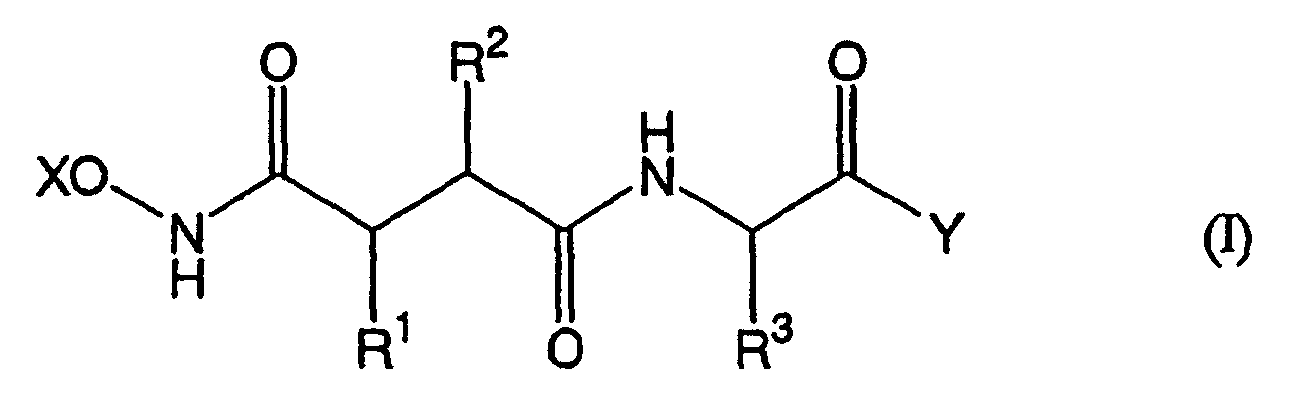
- X
- is hydrogen or hydroxy-protecting group;
- R1
- is hydrogen, alkyl, arylalkyl, heteroarylthioalkyl,
arylthioalkyl, alkylthioalkyl, arylalkylthioalkyl,
phthalimidoalkyl, alkenyl, or -(CH2)l-A
wherein l is an integer of 1 to 4 and A is a 5- or 6-membered N-heterocycle- (a) which is bonded by N atom,
- (b) which optionally has at least one atom selected from N, O and S as an additional heteroatom at a position not adjacent to the bonded N atom,
- (c) in which one or both C atom(s) adjacent to said bonded N atom is(are) substituted by oxo, and
- (d) which is benzo-fused, or one or more other C atom(s) is(are) substituted by lower alkyl or oxo, and/or a different N atom is optionally substituted by lower alkyl or phenyl;
- R2
- is hydrogen, alkyl, arylalkyl, heteroarylalkyl, cycloalkyl, cycloalkylalkyl or aryl;
- R3
- is hydrogen, alkyl or a group of the formula
wherein Q1 is an aromatic hydrocarbon ring or an aromatic heterocycle, m is an integer of 0 to 3, and R13 is hydrogen, halogen, hydroxy, nitro, cyano, trifluoromethyl, lower alkyl, alkoxy, alkylthio, formyl, acyloxy, phenyl, arylalkyl, carboxy, -COORa wherein Ra is lower alkyl, arylalkyl or aryl, carbamoyl, guanidino, hydroxysulfonyloxy, sulfo, arylalkyloxyalkyl or a group selected from
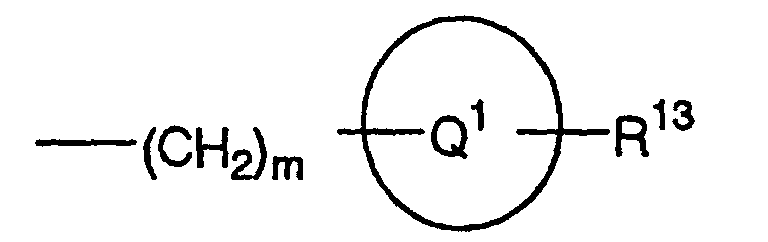
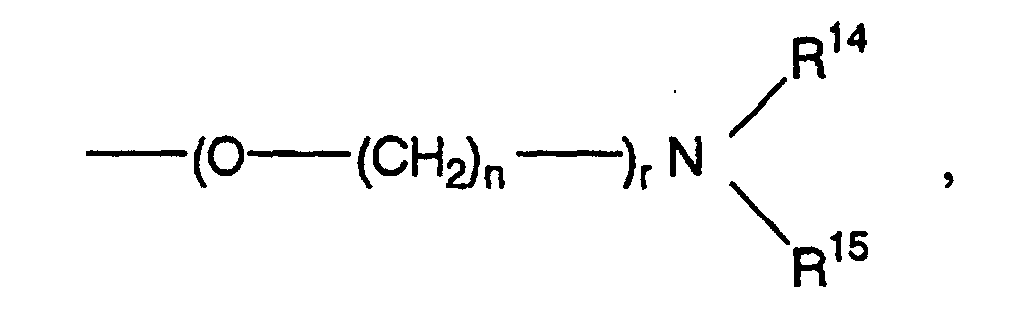 and
and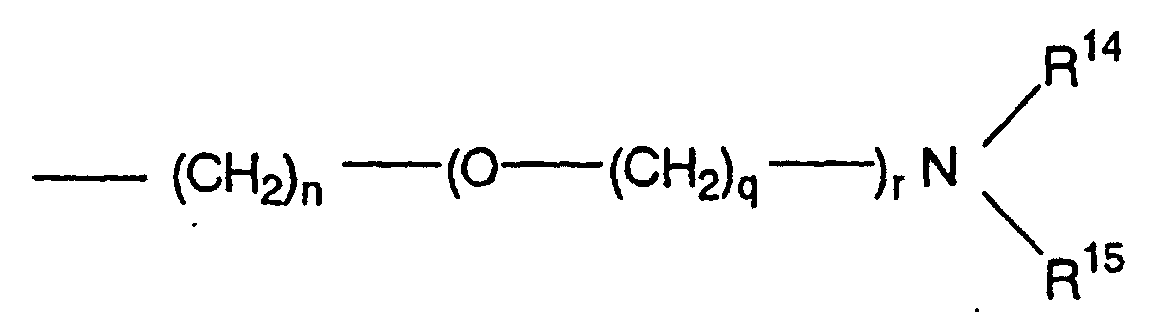
- Y
- is a group of the formula
wherein Q2 is an aromatic hydrocarbon ring or an aromatic heterocycle, and R18 is hydrogen, halogen, hydroxy, nitro, cyano, trifluoromethyl, lower alkyl, alkoxy, alkylthio, formyl, acyloxy, phenyl, arylalkyl, carboxy, -COORa wherein Ra is lower alkyl, arylalkyl or aryl, carbamoyl, guanidino, hydroxysulfonyloxy, sulfo, arylalkyloxyalkyl or a group selected from

 and
and
R3 is a group other than a group of the formula (A)wherein Q1 is a benzene ring, m is an integer of 0 to 3, and R13 is guanidino, hydroxysulfonyloxy, sulfo or a group selected from and
and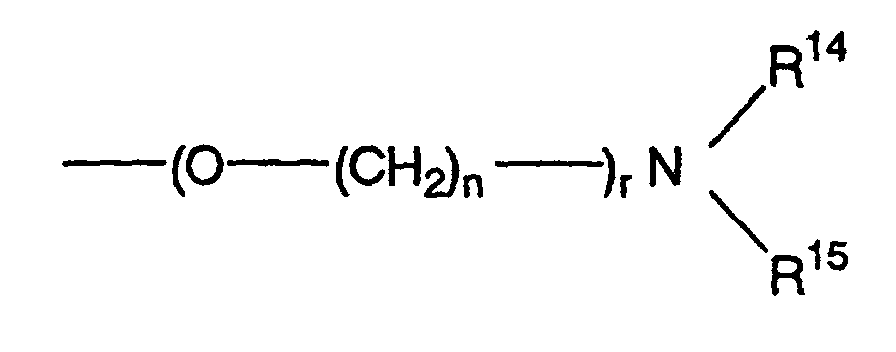
Y is a group of the formula (B)wherein Q2 is a benzene ring, and R18 is a group selected from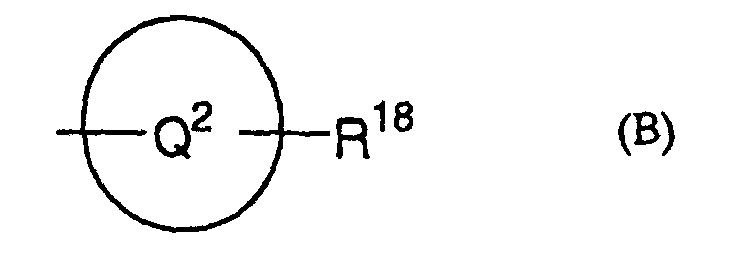 and
and
Q2 is a furan ring, and R18 is arylalkyloxyalkyl or a group selected fromand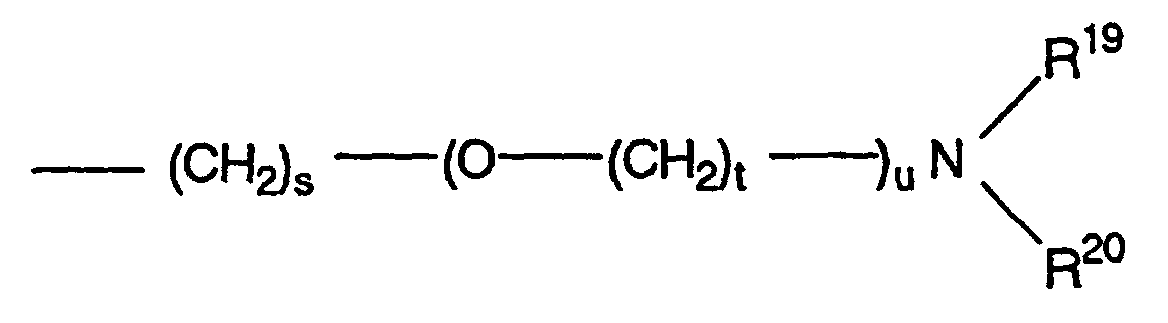
wherein the aforementioned arylalkyl, heteroarylthioalkyl, arylthioalkyl, arylalkylthioalkyl, phthalimidoalkyl, aryl, heteroaryl and heteroarylalkyl may have a substituent, or a pharmacologically acceptable salt thereof. - (2) The hydroxamic acid derivative of the aforementioned (1)
wherein
- (i) R3 is a group of the formula (A)
wherein Q1 is a benzene ring, m is an integer of 0 to 3, and R13 is guanidino, hydroxysulfonyloxy, sulfo or a group selected from
 and
and
Y is furyl, thienyl, pyrrolyl, pyridyl, thiazolyl, phenyl, alkoxyphenyl, or phenyl substituted by -NR19R20
wherein R19 and R20 are the same or different and each is alkyl, or - (ii) R3 is alkyl or a group of the formula
wherein Q1 is a benzene ring, m is an integer of 0 to 3, and R13 is hydrogen, and
 Y is a group of the formula (B)
- (3) The hydroxamic acid derivative of the aforementioned (2),
wherein R13 in the formula (A) is guanidino, hydroxysulfonyloxy or
a group of the formula
wherein each symbol is as defined in the aforementioned (2) or a pharmacologically acceptable salt thereof.
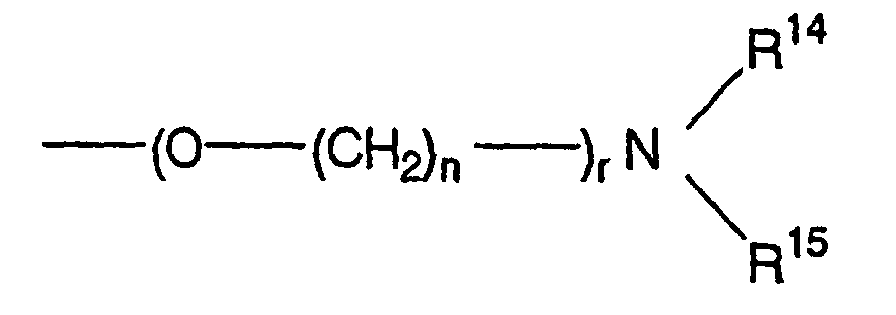
- (4) The hydroxamic acid derivative of the aforementioned (2) or a
pharmacologically acceptable salt thereof, which is a member
selected from the group consisting of
5-methyl-3(R)-[1(S)-[4-[2-[1-(4-methyl)piperazinyl]ethoxy]-benzoyl]-2-phenyl]ethylcarbamoyl-2(R or S)-phthalimidomethylhexanohydroxamic acid dihydrochloride,
3(R)-[1(S)-[4-(2-dimethylaminoethoxy)benzoyl]-2-phenyl]-ethylcarbamoyl-5-methyl-2(R or S)-phthalimidomethylhexanohydroxamic acid hydrochloride,
3(R)-[1(S)-(2-furyl)carbonyl-2-(4-guanidinophenyl)]ethylcarbamoyl-5-methyl-2(R or S)-phthalimidomethylhexanohydroxamic acid hydrochloride,
3(R)-[1(S)-[2-[5-(2-dimethylaminoethoxy)methyl]furyl]carbonyl-2-phenyl]ethylcarbamoyl-5-methyl-2(R or S)-phthalimidomethylhexanohydroxamic acid hydrochloride,
3(R)-[2-[4-(2-dimethylaminoethoxy)phenyl]-1(S)-(2-furyl)carbonyl]-ethylcarbamoyl-5-methyl-2(R or S)-(2,5-dioxo-3,4,4-trimethyl-1-imidazolidinyl)methylhexanohydroxamic acid hydrochloride,
sodium salt of 3(R)-[1(S)-(2-furyl)carbonyl-2-[4-(hydroxysulfonyloxy)phenyl]]ethylcarbamoyl-5-methyl-2(R or S)-phthalimidomethylhexanohydroxamic acid,
sodium salt of 3(R)-[1(S)-(2-furyl)carbonyl-2-(4-sulfophenyl)-ethylcarbamoyl]-5-methyl-2(R or S)-(2-naphthylmethyl)-hexanohydroxamic acid,
sodium salt of 3(R)-[1(S)-(2-furyl)carbonyl-2-(4-sulfophenyl)-ethylcarbamoyl]-5-methyl-2(R or S)-(1-naphthylmethyl)-hexanohydroxamic acid,
sodium salt of 2(R or S)-benzyl-3(R)-[1(S)-(2-furyl)carbonyl-2-(4-sulfophenyl)ethylcarbamoyl]-5-methylhexanohydroxamic acid,
sodium salt of 3(R)-[1(S)-(2-furyl)carbonyl-2-(4-sulfophenyl)-ethylcarbamoyl]-5-methyl-2(R or S)-phthalimidomethylhexanohydroxamic acid,
sodium salt of 3(R)-[1(S)-(2-furyl)carbonyl-2-(4-sulfophenyl)-ethylcarbamoyl]-5-methyl-2(R or S)-(1-oxoisoindolin-2-ylmethyl)hexanohydroxamic acid,
3(R)-[2-(4-aminophenyl)-1(S)-(2-furyl)carbonyl]ethylcarbamoyl-5-methyl-2(R or S)-phthalimidomethylhexanohydroxamic acid hydrochloride,
5-methyl-3(R)-[2-phenyl-1(S)-[4-(2-piperidinoethoxy)benzoyl]]-ethylcarbamoyl-2(R or S)-phthalimidomethylhexanohydroxamic acid hydrochloride,
3(R)-[1(S)-[2-(5-dimethylaminomethyl)furyl]carbonyl-2-phenyl]-ethylcarbamoyl-5-methyl-2(R or S)-phthalimidomethylhexanohydroxamic acid hydrochloride,
3(R)-[2-[4-(2-dimethylaminoethoxy)phenyl]-1(S)-(2-furyl)carbonyl]-ethylcarbamoyl-5-methyl-2(R or S)-phthalimidomethylhexanohydroxamic acid hydrochloride,
3(R)-[1(S)-[2-(5-hydroxymethyl)furyl]carbonyl-2-phenyl]ethylcarbamoyl-5-methyl-2(R or S)-phthalimidomethylhexanohydroxamic acid,
2(R or S),5-dimethyl-3(R)-[1(S)-[4-(2-dimethylaminoethoxy)-benzoyl]-2-phenyl]ethylcarbamoylhexanohydroxamic acid hydrochloride,
3(R)-[1(S)-[4-(2-dimethylaminoethoxy)benzoyl]-2-phenyl]-ethylcarbamoyl-5-methyl-2(R or S)-(3-phenylpropyl)hexanohydroxamic acid hydrochloride,
3(R)-[1(S)-[4-(2-dimethylaminoethoxy)benzoyl]-2-phenyl]-ethylcarbamoyl-5-methyl-2(R or S)-(2,5-dioxo-3,4,4-trimethyl-1-imidazolidinyl)methylhexanohydroxamic acid hydrochloride,
3(R)-[2,2-dimethyl-1(S)-[4-(2-dimethylaminoethoxy)benzoyl]]-propylcarbamoyl-5-methyl-2(R or S)-phthalimidomethylhexanohydroxamic acid hydrochloride,
3(R)-[1(S)-[4-(2-dimethylaminoethoxy)benzoyl]-2-phenyl]-ethylcarbamoyl-5-methyl-2(R or S)-(2-propenyl)hexanohydroxamic acid hydrochloride,
3(R)-[2-[4-(2-dimethylaminoethoxy)phenyl]-1(S)-(2-furyl)carbonyl]-ethylcarbamoyl-5-methyl-2(R or S)-(3-phenylpropyl)hexanohydroxamic acid hydrochloride,
sodium salt of 3(R)-[1(S)-(2-furyl)carbonyl-2-[4-(hydroxysulfonyloxy)phenyl]]ethylcarbamoyl-5-methyl-2(R or S)-(2,5-dioxo-3,4,4-trimethyl-1-imidazolidinyl)methylhexanohydroxamic acid,
3(R)-[2,2-dimethyl-1(S)-[4-(2-dimethylaminoethoxy)benzoyl]]-propylcarbamoyl-5-methyl-2(R or S)-(3-phenylpropyl)-hexanohydroxamic acid hydrochloride,
sodium salt of 3(R)-[1(S)-(2-furyl)carbonyl-2-[4-(hydroxysulfonyloxy)phenyl]]ethylcarbamoyl-5-methyl-2(R or S)-(3-phenylpropyl)hexanohydroxamic acid,
3(R)-[1(S)-[4-(2-dimethylaminoethoxy)benzoyl]-2-phenyl]-ethylcarbamoyl-5-methyl-2(R or S)-(2-naphthylmethyl)-hexanohydroxamic acid hydrochloride,
3(R)-[1(S)-[4-(2-dimethylaminoethoxy)benzoyl]-2-phenyl]-ethylcarbamoyl-5-methyl-2(R or S)-(1-oxoisoindolin-2-ylmethyl)-hexanohydroxamic acid hydrochloride,
3(R)-[2-[4-(2-dimethylaminoethoxy)phenyl]-1(S)-(2-furyl)carbonyl]-ethylcarbamoyl-5-methyl-2(R or S)-(2-naphthylmethyl)-hexanohydroxamic acid hydrochloride,
3(R)-[2-[4-(2-dimethylaminoethoxy)phenyl]-1(S)-(2-furyl)carbonyl]-ethylcarbamoyl-5-methyl-2(R or S)-(1-oxoisoindolin-2-ylmethyl)hexanohydroxamic acid hydrochloride,
3(R)-[2,2-dimethyl-1(S)-[4-(2-dimethylaminoethoxy)benzoyl]]-propylcarbamoyl-5-methyl-2(R or S)-(2,5-dioxo-3,4,4-trimethyl-1-imidazolidinyl)methylhexanohydroxamic acid hydrochloride,
sodium salt of 3(R)-[1(S)-(2-furyl)carbonyl-2-[4-(hydroxysulfonyloxy)phenyl]]ethylcarbamoyl-5-methyl-2(R or S)-(2-naphthylmethyl)hexanohydroxamic acid,
sodium salt of 3(R)-[1(S)-(2-furyl)carbonyl-2-[4-(hydroxysulfonyloxy)phenyl]]ethylcarbamoyl-5-methyl-2(R or S)-(1-oxoisoindolin-2-ylmethyl)hexanohydroxamic acid,
sodium salt of 3(R)-[1(S)-(2-furyl)carbonyl-2-(4-sulfophenyl)-ethylcarbamoyl]-5-methyl-2(R or S)-(3-phenylpropyl)-hexanohydroxamic acid,
sodium salt of 3(R)-[1(S)-(2-furyl)carbonyl-2-(4-sulfophenyl)-ethylcarbamoyl]-5-methyl-2(R or S)-(2,5-dioxo-3,4,4-trimethyl-1-imidazolidinyl)methylhexanohydroxamic acid, and
3(R)-[1(S)-[2-(5-hydroxymethyl)furyl]carbonyl-2-phenyl]-ethylcarbamoyl-5-methyl-2(R or S)-(2,5-dioxo-3,4,4-trimethyl-1-imidazolidinyl)methylhexanohydroxamic acid. - (5) The hydroxamic acid derivative of the aforementioned (1) or (2), wherein R1 is phthalimidomethyl, or a pharmacologically acceptable salt thereof.
- (6) The hydroxamic acid derivative of the aforementioned (1) or (2), wherein R2 is isobutyl, or a pharmacologically acceptable salt thereof.
- (7) The hydroxamic acid derivative of the aforementioned (1) or (2),
wherein R3 is benzyl optionally substituted by a substituent
selected from guanidino, hydroxysulfonyloxy, sulfo,
and

- (8) A compound of the formula (II):
wherein
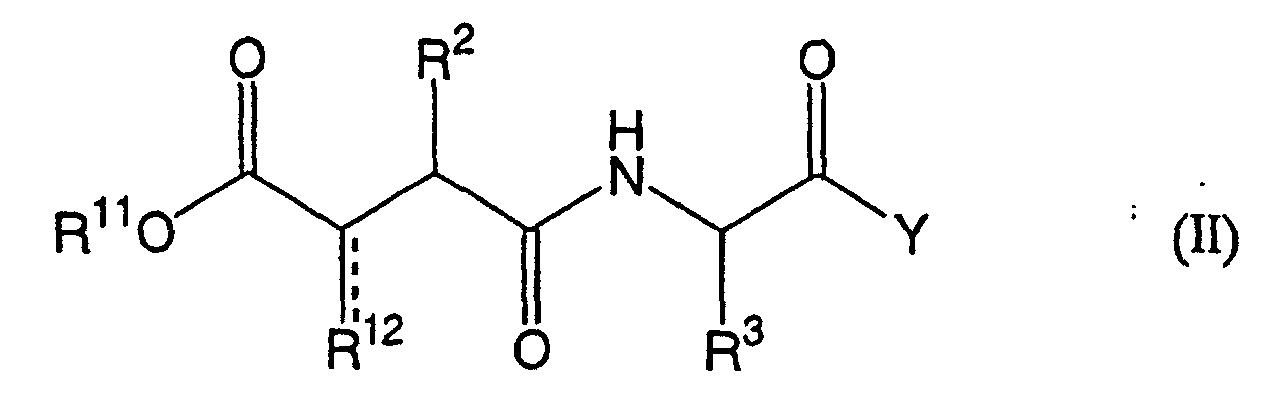
R11 is hydrogen, alkyl, arylalkyl, heteroarylalkyl or aryl,
------
is a single bond or a double bond,
when
------
is a single bond, R12 is hydrogen, alkyl, arylalkyl, heteroarylthioalkyl, arylthioalkyl, alkylthioalkyl, arylalkylthioalkyl, phthalimidoalkyl, alkenyl, -(CH2)l-A
wherein l is an integer of 1 to 4, A is a 5- or 6-membered N-heterocycle - (a) which is bonded by N atom,
- (b) which optionally has at least one atom selected from N, O and S as an additional heteroatom at a position not adjacent to the bonded N atom,
- (c) in which one or both C atom(s) adjacent to said bonded N atom is(are) substituted by oxo, and
- (d) which is benzo-fused, or one or more other C atom(s) is (are) substituted by lower alkyl or oxo, and/or a different N atom is optionally substituted by lower alkyl or phenyl, or -COOR23 wherein R23 is hydrogen, alkyl, arylalkyl, heteroarylalkyl or aryl, or
- (9) The compound of the aforementioned (8)
wherein - (i) R3 is a group of the formula (A)
wherein Q1 is a benzene ring, m is an integer of 0 to 3, and R13 is guanidino, hydroxysulfonyloxy, sulfo or a group selected from
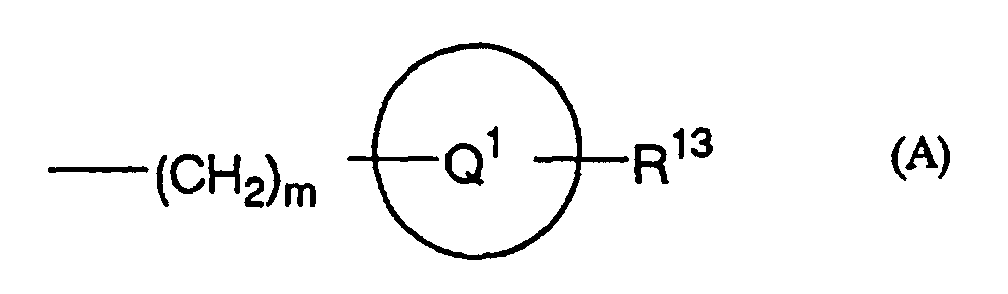 and
and
Y is furyl, thienyl, pyrrolyl, pyridyl, thiazolyl, phenyl, alkoxyphenyl, or phenyl substituted by -NR19R20
wherein R19 and R20 are the same or different and each is alkyl, or - (ii) R3 is alkyl or a group of
wherein Q1 is a benzene ring, m is an integer of 0 to 3, and R13 is hydrogen, and
 Y is a group of the formula (B)
- (10) A pharmaceutical composition comprising a hydroxamic acid derivative of any of the aforementioned (1) to (7) or a pharmacologically acceptable salt thereof, and a pharmacologically acceptable carrier.
- (11) The pharmaceutical composition of the aforementioned (10), which is an inhibitor of TNF α production.
-
- The symbols used in the present specification are explained in the following.
- The alkyl at R1, R2, R3, R11, R12, R14, R15, R19, R20 and R23 may be a linear or branched chain preferably having 1 to 10 carbon atoms. Examples thereof include methyl, ethyl, n-propyl, isopropyl, n-butyl, isobutyl, sec-butyl, tert-butyl, n-pentyl, isopentyl, n-hexyl, n-octyl, n-decyl and the like.
- The arylalkyl at R1, R2, R11, R12, R14, R15, R19, R20 and R23 is that wherein the alkyl moiety may be a linear or branched chain preferably having 1 to 6 carbon atoms, and the aryl moiety is preferably a phenyl, naphthyl or ortho-fused bicyclic group having 8 to 10 ring-forming atoms, wherein at least one ring is an aromatic ring (e.g., indenyl and the like). Examples thereof include benzyl, phenethyl, 3-phenylpropyl, 1-naphthylmethyl, 2-naphthylmethyl, 2-(1-naphthyl)ethyl, 2-(2-naphthyl)ethyl, 3-(1-naphthyl)propyl, 3-(2-naphthyl)propyl and the like.
- The heteroarylthioalkyl at R1 and R12 is that wherein the alkyl moiety may be a linear or branched chain preferably having 1 to 6 carbon atoms, and the heteroaryl moiety is a 5- or 6-membered cyclic group preferably having a carbon atom and 1 to 4 heteroatoms (e.g., oxygen, sulfur or nitrogen), or an ortho-fused bicyclic heteroaryl derived therefrom, which has 8 to 10 ring-forming atoms, particularly a benzo derivative wherein the heterocycle is fused with benzene ring, or a derivative wherein the heterocycle is fused with propenylene, trimethylene or tetramethylene, a stable N-oxide thereof and the like. Examples of the heteroaryl moiety include pyrrolyl, pyrrolinyl, furyl, thienyl, oxazolyl, isoxazolyl, imidazolyl, thiazolyl, isothiazolyl, pyrazolyl, 1,2,3-triazolyl, 1,2,4-triazolyl, tetrazolyl, 1,3,4-oxadiazolyl, 1,3,4-thiadiazolyl, 1,3,4-thiadiazolyl, 1,2,4-thiadiazolyl, pyridyl, pyranyl, pyrazinyl, pyrimidinyl, pyridazinyl, 1,2,4-triazinyl, 1,2,3-triazinyl, 1,3,5-triazinyl, 1,2,5-oxathiazinyl, 1,2,6-oxathiazinyl, benzoxazolyl, benzothiazolyl, benzimidazolyl, thianaphthenyl, isothianaphthenyl, benzofuranyl, isobenzofuranyl, chromenyl, isoindolyl, indolyl, indazolyl, isoquinolyl, quinolyl, phthalazinyl, quinoxalinyl, quinazolinyl, cinnolinyl, benzoxazinyl and the like.
- Examples of heteroarylthioalkyl include 2-pyrrolylthiomethyl, 2-pyridylthiomethyl, 3-pyridylthiomethyl, 4-pyridylthiomethyl, 2-thienylthiomethyl and the like.
- The arylthioalkyl at R1 and R12 is that wherein the alkyl moiety may be a linear or branched chain preferably having 1 to 6 carbon atoms, and the aryl moiety is the same as the aryl moiety of the above-mentioned arylalkyl. Examples thereof include phenylthiomethyl, 1-naphthylthiomethyl, 2-naphthylthiomethyl and the like.
- The alkylthioalkyl at R1 and R12 is that wherein the alkyl moiety of alkylthio moiety is the same as the above-mentioned alkyl, and the remaining alkyl moiety may be a linear or branched chain preferably having 1 to 6 carbon atoms. Examples thereof include methylthiomethyl, ethylthiomethyl, n-propylthiomethyl, isopropylthiomethyl, n-butylthiomethyl, isobutylthiomethyl, sec-butylthiomethyl, tert-butylthiomethyl and the like.
- The arylalkylthioalkyl at R1 and R12 is that wherein the arylalkyl moiety is the same as the above-mentioned arylalky. The remaining alkyl moiety may be a linear or branched chain preferably having 1 to 6 carbon atoms. Examples thereof include benzylthiomethyl, phenethylthiomethyl and the like.
- The alkyl moiety of phthalimidoalkyl at R1 and R12 may be a linear or branched chain preferably having 1 to 6 carbon atoms. Examples thereof include phthalimidomethyl, 2-phthalimidoethyl and the like.
- The alkenyl at R1 and R12 preferably has 2 to 6 carbon atoms, and examples thereof include vinyl, allyl, 3-butenyl, 5-hexenyl and the like.
- The aryl at R2, R11, R14, R15, R19, R20, R21 and R23 is the same as the aryl moiety of the above-mentioned arylalkyl, which is preferably phenyl.
- The "A" in "-(CH2)l-A" at R1 and R12 is an N-heterocycle bonded by an N atom, which is exemplified by the following groups.
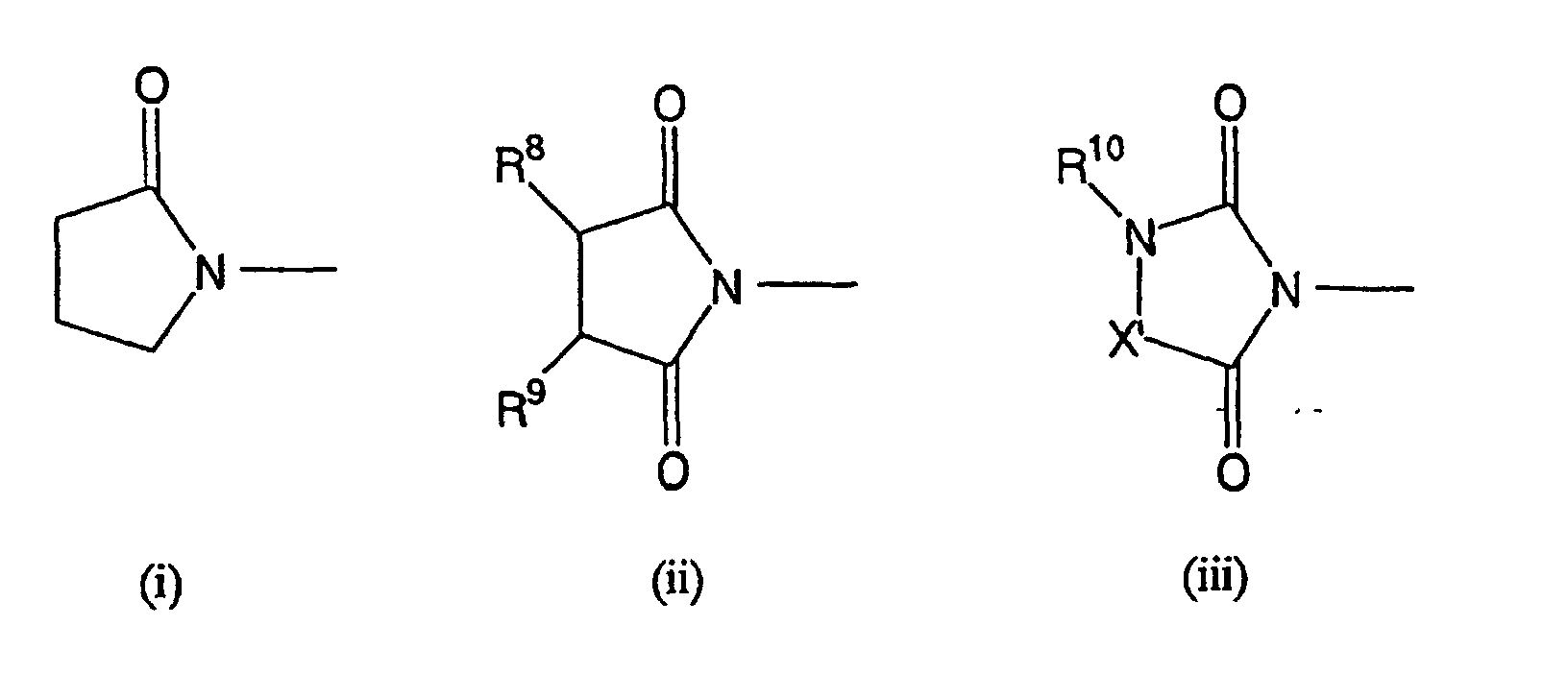
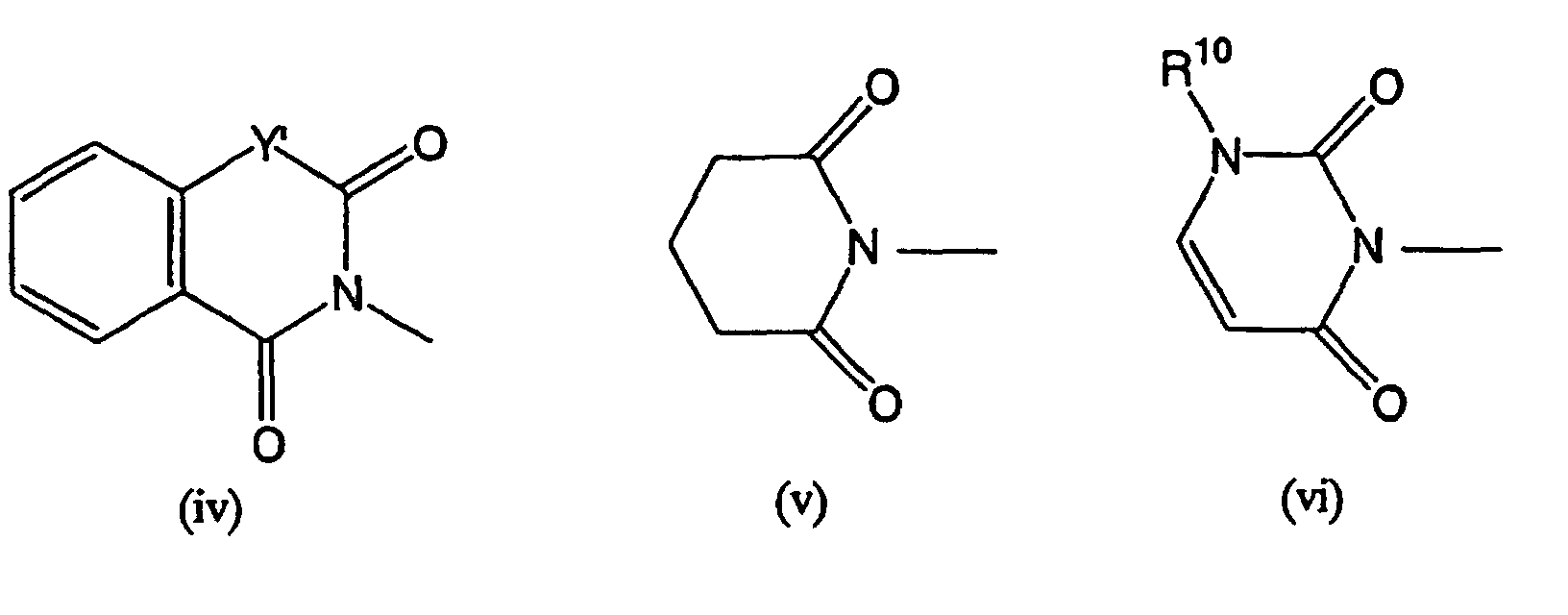 wherein R8 and R9 are each hydrogen or show, in combination, a different bond, to form a double bond, R10 is hydrogen, lower alkyl or phenyl, X' is -CO-, -CH2-, -CH(lower alkyl)-, -C(lower alkyl)2-, -NH-, -N(lower alkyl)- or -O-, and Y' is -O-, -NH- or - N(lower alkyl)-.
- As used herein, the lower alkyl has 1 to 6 carbon atoms and may be a linear or branched chain. Examples thereof include methyl, ethyl, n-propyl, isopropyl, n-butyl, isobutyl, sec-butyl, tert-butyl, n-pentyl, isopentyl, n-hexyl and the like.
- Examples of the N-heterocycle include 2-oxo-1-pyrrolidinyl, 1-oxoisoindolin-2-yl, 2-oxoindolin-1-yl, 2,5-dioxo-1-pyrrolidinyl, 1,2-dimethyl-3,5-dioxo-1,2,4-triazolidin-4-yl, 2,5-dioxo-3-methyl-1-imidazolidinyl, 2,5-dioxo-3,4,4-trimethyl-1-imidazolidinyl, 3,5-dioxo-2-methyl-1,2,4-oxadiazolidin-4-yl, 3-methyl-2,4,5-trioxo-1-imidazolidinyl, 2,5-dioxo-3-phenyl-1-imidazolidinyl, 2,6-dioxopiperidino and the like. Preferred are the rings of the formulas (ii), (iii), (vii) and (viii), such as 1-oxoisoindolin-2-yl, 2-oxoindolin-1-yl, 1,2-dimethyl-3,5-dioxo-1,2,4-triazolidin-4-yl, 2,5-dioxo-3-methyl-1-imidazolidinyl, 2,5-dioxo-3,4,4-trimethyl-1-imidazolidinyl, more preferred are the rings of the formulas (ii) and (iii), such as 1,2-dimethyl-3,5-dioxo-1,2,4-triazolidin-4-yl, 2,5-dioxo-3-methyl-1-imidazolidinyl and 2,5-dioxo-3,4,4-trimethyl-1-imidazolidinyl.
- The heteroarylalkyl at R2, R11, R14, R15, R19, R20 and R23 is that wherein the alkyl moiety may be a linear or branched chain preferably having 1 to 6 carbon atoms, and the heteroaryl moiety is the same as the heteroaryl moiety of the above-mentioned heteroarylthioalkyl. Examples thereof include 2-pyrrolylmethyl, 2-pyridylmethyl, 3-pyridylmethyl, 4-pyridylmethyl, 2-thienylmethyl, 2-(2-pyridyl)ethyl, 2-(3-pyridyl)ethyl, 2-(4-pyridyl)ethyl, 3-(2-pyrrolyl)propyl and the like.
- The cycloalkyl at R2 preferably has 3 to 7 carbon atoms. Examples thereof include cyclopropyl, cyclobutyl, cyclopentyl, cyclohexyl, cycloheptyl and the like.
- The cycloalkylalkyl at R2 is that wherein the alkyl moiety may be a linear or branched chain preferably having 1 to 6 carbon atoms, and the cycloalkyl moiety is the same as the above-mentioned cycloalkyl. Examples thereof include cyclopropylmethyl, 2-cyclobutylethyl, cyclopentylmethyl, 3-cyclopentylpropyl, cyclohexylmethyl, 2-cyclohexylethyl, cycloheptylmethyl and the like.
- The aromatic hydrocarbon ring at Q1 and Q2 is exemplified by a benzene ring, a naphthalene ring, or an ortho-fused bicyclic hydrocarbon ring having 8 to 10 ring-forming atoms, wherein at least one ring is an aromatic ring (e.g., indene and the like). Preferred is a benzene ring.
- The aromatic heterocycle at Q1 and Q2 is exemplified by 5-or 6-membered ring having a carbon atom and 1 to 4 heteroatoms (e.g., oxygen, sulfur or nitrogen), an ortho-fused bicyclic aromatic heterocycle having 8 to 10 ring-forming atoms derived therefrom, particularly, a benzo derivative wherein the heterocycle is fused with benzene ring. Examples of aromatic heterocycle include pyrrole, furan, thiophene, oxazole, isoxazole, imidazole, thiazole, isothiazole, pyrazole, 1,2,3-triazole, 1,2,4-triazole, tetrazole, 1,3,4-oxadiazole, 1,2,4-oxadiazole, 1,3,4-thiadiazole, 1,2,4-thiadiazole, pyridine, pyrazine, pyrimidine, pyridazine, 1,2,4-triazine, 1,2,3-triazine, 1,3,5-triazine, 1,2,5-oxathiazine, 1,2,6-oxathiazine, benzoxazole, benzothiazole, benzimidazole, thianaphthene, isothianaphthene, benzofuran, isobenzofuran, chromene, isoindole, indole, indazole, isoquinoline, quinoline, phthalazine, quinoxaline, quinazoline, cinnoline, benzoxazine and the like. Preferred are pyrrole, furan, thiophene, thiazole and pyridine.
- The heteroaryl at R16 and R21 is the same as the heteroaryl moiety of the above-mentioned heteroarylthioalkyl, which is preferably pyridyl.
- The above-mentioned arylalkyl, heteroarylthioalkyl, arylthioalkyl, arylalkylthioalkyl, phthalimidoalkyl, aryl, heteroaryl and heteroarylalkyl are optionally substituted by one or more substituents selected from halogen (e.g., fluorine, chlorine, bromine and iodine), hydroxy, nitro, cyano, trifluoromethyl, lower alkyl (provided that the lower alkyl does not substitute at the alkyl moiety of arylalkyl, heteroarylthioalkyl, arylthioalkyl, arylalkylthioalkyl and phthalimidoalkyl), alkoxy, alkylthio, formyl, acyloxy, oxo, phenyl, arylalkyl, carboxyl, a group of the formula: -COORa wherein Ra is lower alkyl, arylalkyl or aryl, carbamoyl, amino, (lower alkyl)amino, di(lower alkyl)amino, guanidino, hydroxysulfonyloxy, sulfo, arylalkyloxyalkyl and the like.
- As used herein, lower alkyl, arylalkyl and aryl are the same as those mentioned above. Alkoxy may be a linear or branched chain preferably having 1 to 6 carbon atoms. Examples thereof include methoxy, ethoxy, n-propoxy, isopropoxy, n-butoxy, tert-butoxy and the like. Alkylthio is that wherein the alkyl moiety may be a linear or branched chain preferably having 1 to 6 carbon atoms. Examples thereof include methylthio, ethylthio, n-propylthio, isopropylthio and the like. Acyloxy is alkanoyloxy which may be a linear or branched chain preferably having 2 to 6 carbon atoms. Examples thereof include acetyloxy, propionyloxy, butyryloxy, valeryloxy, pivaloyloxy, hexanoyloxy and the like. Arylalkyloxyalkyl is that wherein the arylalkyl moiety is the same as the above-mentioned arylalkyl, and the remaining alkyl moiety may be a linear or branched chain preferably having 1-to 6 carbon atoms. Examples thereof include benzyloxymethyl, phenethyloxymethyl and the like. The lower alkyl moiety of (lower alkyl)amino and di(lower alkyl)amino may be a linear or branched chain having 1 to 6 carbon atoms. Examples of (lower alkyl)amino include methylamino, ethylamino, propylamino, isopropylamino, butylamino, isobutylamino, sec-butylamino, tert-butylamino, pentylamino, hexylamino and the like. Examples of di(lower alkyl)amino include dimethylamino, diethylamino, dipropylamino, diisopropylamino, dibutylamino, diisobutylamino, di-sec-butylamino, di-tert-butylamino, dipentylamino, dihexylamino, ethylmethylamino, methylpropylamino, butylmethylamino, ethylpropylamino, ethylbutylamino and the like.
- The halogen, lower alkyl, alkoxy, alkylthio, acyloxy, arylalkyl, -COORa (Ra is as defined above) and arylalkyloxyalkyl at R13 and R18 are as defined above.
- The optionally substituted heterocycle formed by R14 and R15 together with the adjacent nitrogen atom, and the optionally substituted heterocycle formed by R19 and R20 together with the adjacent nitrogen atom is a 4 to 7-membered ring having a carbon atom and at least one nitrogen atom, which may have, in the ring, at least one atom selected from nitrogen, oxygen and sulfur, as a further heteroatom, wherein the carbon atom constituting the ring is optionally substituted by oxo. In addition, an aromatic ring, such as benzene ring and the like, may be fused therewith utilizing the adjacent two carbon atoms constituting these heterocycles. Examples thereof include azetidino, 1-pyrrolidinyl, piperidino, 1-piperazinyl, morpholino, thiomorpholino, oxothiomorpholino, dioxothiomorpholino, 2-oxo-1-quinazolinyl and the like.
- When the heterocycle has a nitrogen atom as a further heteroatom in the ring, such as 1-piperazinyl, lower alkyl (as defined above), arylalkyl (as defined above), and heteroarylalkyl (as defined above), aryl (as defined above), heteroaryl (as defined above), a group of the formula: -COORa (Ra is as defined above) or acyl may be substituted on the nitrogen atom. As used herein, acyl is expressed by -CORa wherein Ra is as defined above.
- Preferable examples of optionally substituted heterocycle include 1-pyrrolidinyl, piperidino, morpholino and 1-piperazinyl wherein the 4-position nitrogen atom is optionally substituted by lower alkyl.
- With regard to the formula (I) and the formula (II) of the present invention, a more preferable mode is as follows.
- (i) R3 is a group of the formula (A)
wherein Q1 is a benzene ring, m is an integer of 0 to 3, and R13 is guanidino, hydroxysulfonyloxy, sulfo or a group selected from
 and
and
wherein R19 and R20 are the same or different and each is alkyl, or - (ii) R3 is alkyl or a group of the formula
wherein Q1 is a benzene ring, m is an integer of 0 to 3, and R13 is hydrogen, and
 Y is a group of the formula (B)
-
- With regard to the formula (I) and the formula (II) of the present invention, a particularly preferable mode is as follows.
- (a) R3 is a group of the formula
wherein Q1 is a benzene ring, m is 1, and R13 is guanidino, hydroxysulfonyloxy, sulfo or a group of the formula
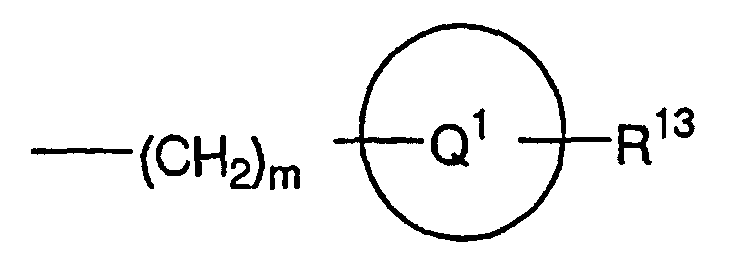 wherein n is an integer of 1 to 5, r is an integer of 1 or 2, R14 and R15 are the same or different and each is hydrogen or alkyl, or R14 and R15 may form, together with the adjacent nitrogen atom, an optionally substituted heterocycle, and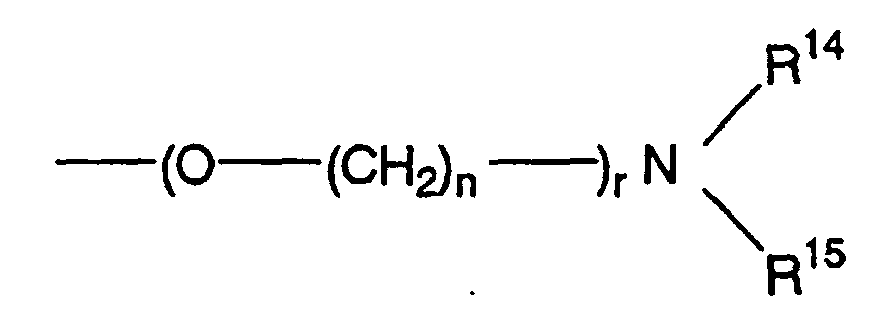
Y is furyl, thienyl, pyrrolyl, pyridyl, thiazolyl, phenyl, alkoxyphenyl, or phenyl substituted by -NR19R20
wherein R19 and R20 are the same or different and each is alkyl. - (b) R3 is a group of the formula
wherein Q1 is a benzene ring, m is 1, and R13 is guanidino, hydroxysulfonyloxy, sulfo or a group of the formula
 wherein n is an integer of 1 to 5, r is 1, R14 and R15 are the same or different and each is hydrogen or alkyl, and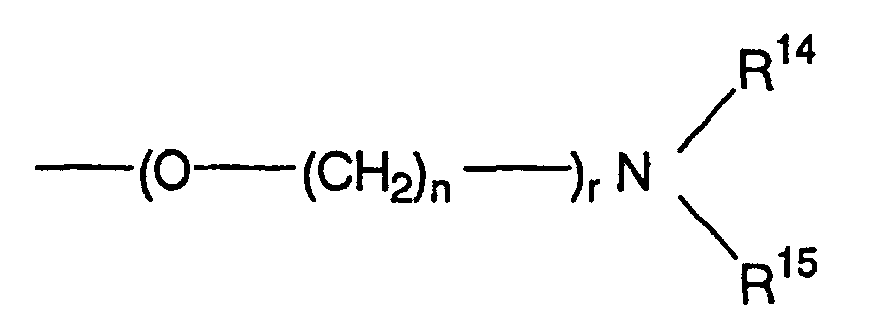
Y is furyl, thienyl, pyrrolyl, pyridyl, thiazolyl, phenyl, alkoxyphenyl, or phenyl substituted by -NR19R20
wherein R19 and R20 are the same or different and each is alkyl. - (c) R3 is alkyl or benzyl and Y is a group of the formula
wherein Q2 is a benzene ring, and R18 is a group selected from
 and
and
- (d) R3 is alkyl or benzyl and Y is a group of the formula
wherein Q2 is a benzene ring, and R18 is a group selected from
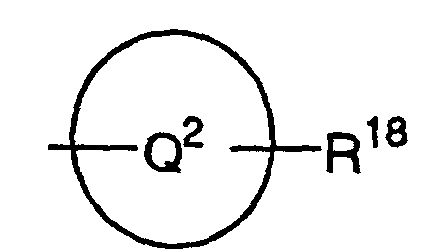 and
and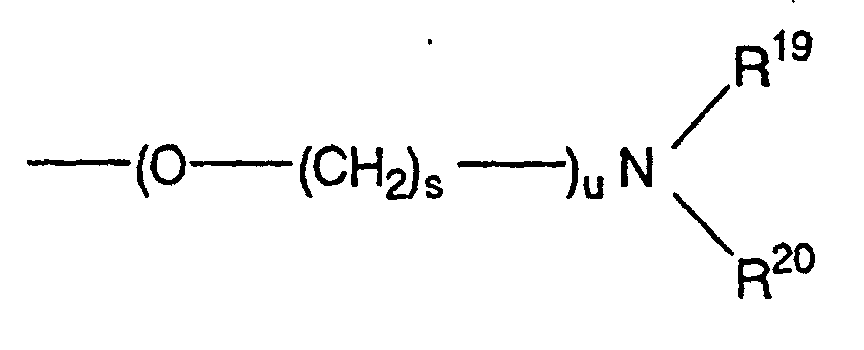
- (e) R3 is alkyl or benzyl and Y is a group of the formula
wherein Q2 is a furan ring, and R18 is phenylalkyloxyalkyl or a group selected from
 and
and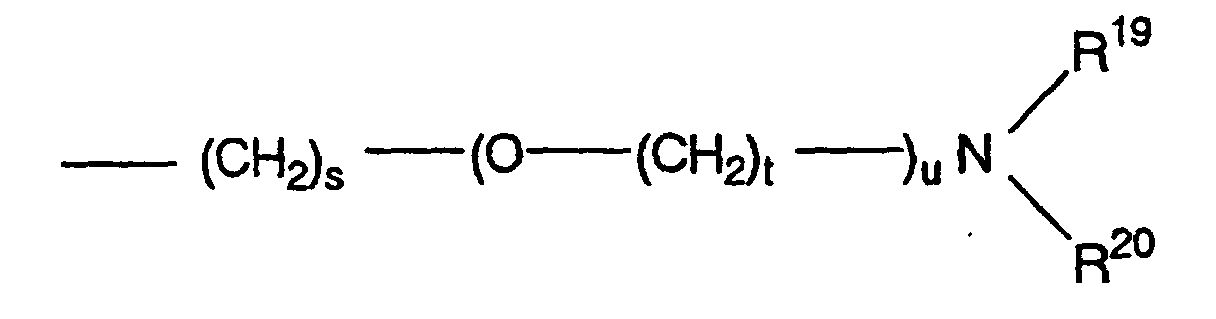
- (f) R3 is alkyl or benzyl and Y is a group of the formula
wherein Q2 is a furan ring, and R18 is benzyloxymethyl or a group selected from
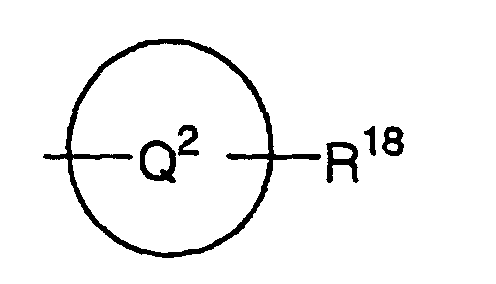 and
and
-
- Another preferable mode of the present invention is as follows.
- A preferable example of a group of the formulaat R3 is a group wherein Q1 is a benzene ring, and R13 is hydrogen, guanidino, hydroxysulfonyloxy or a group of the formula
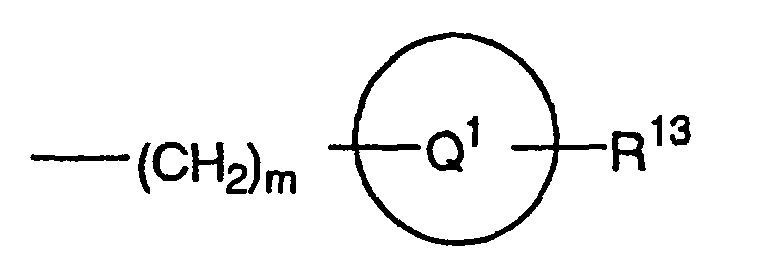 wherein n is an integer of 1 to 5, r is an integer of 0 to 2, R14 and R15 are the same or different and each is alkyl, or R14 and R15 may form, together with the adjacent nitrogen atom, an optionally substituted heterocycle.
- More preferable example is a group wherein Q1 is a benzene ring and R13 is hydrogen.
- A preferable example of a group of the formulaat Y is a group wherein Q2 is a benzene ring or an aromatic heterocycle selected from pyrrole, furan, thiophene, thiazole and pyridine, and R18 is hydrogen or a group selected from

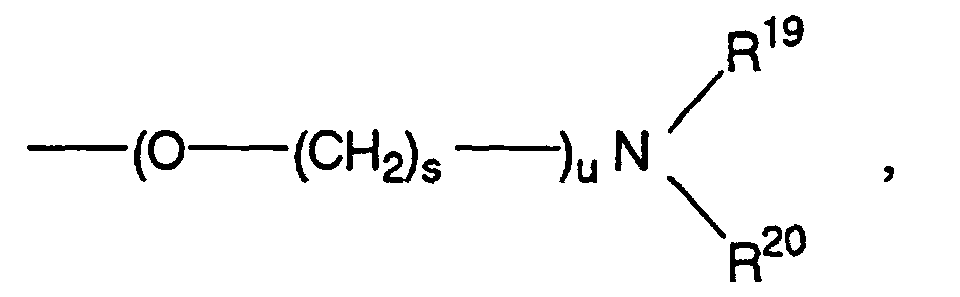 and
and
- More preferable example is a group wherein Q2 is a benzene ring or an aromatic heterocycle selected from pyrrole, furan, thiophene, thiazole and pyridine, and R18 is hydrogen or a group of the formulawherein s is an integer of 1 to 5, u is an integer of 0 to 2, R19 and R20 are the same or different and each is alkyl, or R19 and R20 may form, together with the adjacent nitrogen atom, an optionally substituted heterocycle.
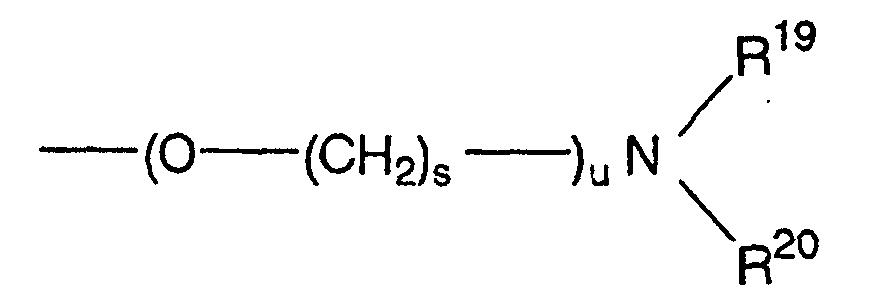
- The hydroxy-protecting group at X may be, for example, arylalkyl (as defined above), aryl (as defined above), heteroaryl (as defined above), silyl (e.g., trimethylsilyl, tertbutyldimethylsilyl, tert-butyldiphenylsilyl and the like), 2-tetrahydropyranyl, p-methoxybenzyl, tert-butyl and the like. The arylalkyl, aryl and heteroaryl may have one or more substituents exemplified above. The hydroxy-protecting group is preferably silyl, 2-tetrahydropyranyl, benzyl and the like.
- The hydroxamic acid derivative and a pharmacologically acceptable salt thereof represented by the formula (I) may have an asymmetric carbon and can exist as an optically active compound and racemate. The racemate can be resolved into respective optically active compounds by a method known per se. When the hydroxamic acid derivative and a pharmacologically acceptable salt thereof have an additional asymmetric carbon, the compound can exist as a mixture of diastereomers or a single diastereomer, all of which can be separated into respective compounds by a method known per se.
- The hydroxamic acid derivative and a pharmacologically acceptable salt thereof can show polymorphism, can exist as two or more tautomers, and can exist as a solvate (e.g., ketone solvate, hydrate and the like).
- Therefore, the present invention encompasses all of the above-mentioned stereoisomers, optical isomers, polymorphs, tautomers, solvates, mixtures thereof and the like. The optically active compounds, racemates and diastereomers are also encompassed in the present invention.
- The pharmacologically acceptable salts of the hydroxamic acid derivative may be, for example, alkali metal salts (e.g., salt with lithium, sodium, potassium and the like), alkaline earth metal salts (e.g., salt with calcium, magnesium and the like), aluminum salt, ammonium salt, salts with organic base (e.g., salt with triethylamine, morpholine, piperidine, triethanolamine and the like) and the like.
- Other pharmacologically acceptable salts may be, for example, inorganic acid addition salts (e.g., salt with hydrochloric acid, hydrobromic acid, hydroiodic acid, sulfuric acid, phosphoric acid and the like), organic acid addition salts (e.g., salt with methanesulfonic acid, benzenesulfonic acid, p-toluenesulfonic acid, formic acid, acetic acid, trifluoroacetic acid, oxalic acid, citric acid, malonic acid, fumaric acid, glutaric acid, adipic acid, maleic acid, tartaric acid, succinic acid, mandelic acid, malic acid and the like), salt with amino acid (e.g., salt with glutamic acid, aspartic acid, hystidine, lysine, arginine and the like) and the like. For crystallization, oxalic acid can be used to give a salt.
- The preferable modes of the hydroxamic acid derivative or a pharmacologically acceptable salt thereof of the formula (I) include a hydroxamic acid derivative or a pharmacologically acceptable salt thereof of the formula (I) wherein R1 is phthalimidomethyl, a hydroxamic acid derivative or a pharmacologically acceptable salt thereof of the formula (I) wherein R2 is isobutyl, a hydroxamic acid derivative or a pharmacologically acceptable salt thereof of the formula (I) wherein R3 is benzyl optionally substituted by a substituent selected from guanidino, hydroxysulfonyloxy, sulfo,and

- The production methods of the hydroxamic acid derivative and a pharmacologically acceptable salt thereof of the present invention are shown in the following.wherein R11' is the same as R11 (except hydrogen), R12' is the same as R1, and R1, R2, R3, X and Y are as defined above.
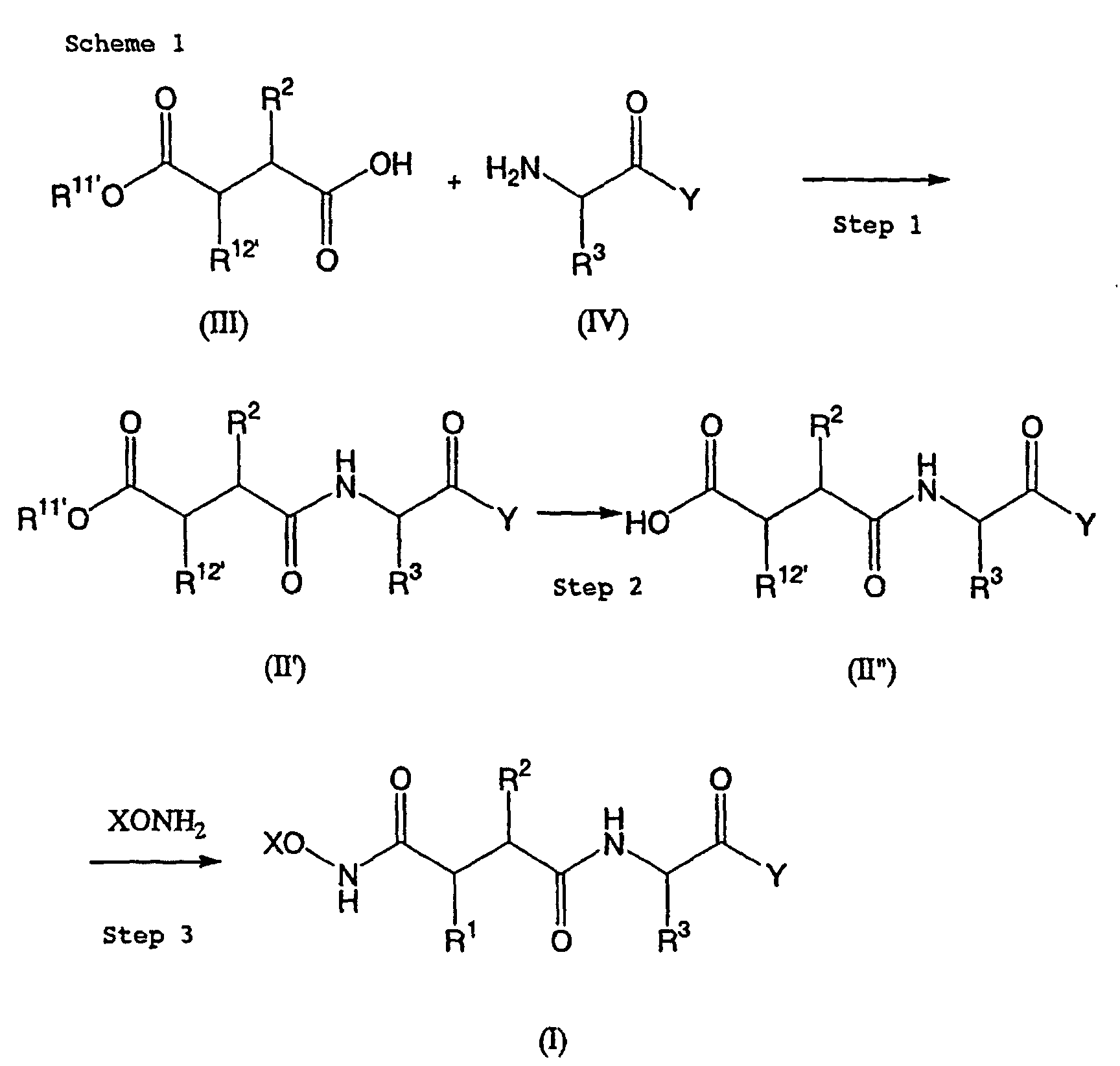
- As shown in the above-mentioned Scheme 1, the hydroxamic acid derivative and a pharmacologically acceptable salt thereof of the present invention can be basically prepared using carboxylic acid (III) as a starting compound and by using amino derivative (IV) to prepare an intermediate compound (II') according to the C end activation method in peptide synthesis (see Pepuchidogousei no kiso to jikken, Izumiya et al., Maruzen Shoten, p 91), converting the intermediate compound (II') to a succinic acid derivative (II'') and reacting the succinic acid derivative (II'') with hydroxylamine: XONH2 wherein X is as defined above. The starting compound, carboxylic acid (III), is described in publications (Japanese Patent Application under PCT laid-open under Kohyo No. 6-506445, JP-A-4-352757, JP-A-7-157470, Japanese Patent Application under PCT laid-open under Kohyo No. 4-502008, JP-A-6-65196, WO96/33968, WO94/21625 and the like), and can be prepared according to a conventional method based on these publications.
- The amino derivative (IV) can be produced, for example, by the method to be mentioned later.
- Each step is explained in detail in the following.
- In Step 1, an intermediate compound (II') is prepared by reacting carboxylic acid (III) and amino derivative (IV). Typical methods are shown in the following.
- The intermediate compound (II') can be obtained by reacting carboxylic acid (III) with isobutyl chlorocarbonate in the presence of an amine base, such as triethylamine, N-methylmorpholine and the like, and reacting the resulting compound with amino derivative (IV). The solvent used is an aprotic solvent such as tetrahydrofuran (THF), methylene chloride, ethyl acetate, N,N-dimethylformamide (DMF) and the like, and the reaction proceeds at a temperature of from -15°C to room temperature.
- The carboxylic acid (III) is reacted with oxalyl chloride or thionyl chloride to give an acid chloride. The solvent used is methylene chloride, or a hydrocarbon solvent such as benzene, toluene and the like, and the reaction proceeds at a temperature of from -15°C to room temperature or under heating. The intermediate compound (II') can be obtained by reacting the resulting acid chloride with amino derivative (IV) in the presence of an amine base such as triethylamine, pyridine and the like. The solvent used is an aprotic solvent such as THF, ethyl acetate, DMF, methylene chloride, benzene, toluene and the like, and the reaction proceeds at a temperature of from -15°C to room temperature or under heating.
- The intermediate compound (II') can be obtained by reacting carboxylic acid (III), amino derivative (IV) and 1-hydroxybenzotriazole (HOBt) with a condensing agent, such as 1,3-dicyclohexylcarbodiimide (DCC), benzotriazol-1-yloxytris(dimethylamino)phosphonium hexafluorophosphate (BOP reagent) and the like in the presence of an amine base, such as triethylamine, N-methylmorpholine and the like, at a temperature not higher than room temperature. The solvent used is an aprotic solvent such as THF, methylene chloride, ethyl acetate, DMF, pyridine and the like.
- The carboxylic acid (III) and a phenol derivative, such as pentafluorophenol and the like, or N-hydroxysuccinimide are reacted with a condensing agent, such as DCC and the like, to give an active ester. An amine base may be used as necessary, where examples thereof include triethylamine, N-methylmorpholine and the like. The solvent used is an aprotic solvent, such as THF, DMF, methylene chloride and the like, and the reaction proceeds at a temperature not higher than room temperature. The intermediate compound (II') can be obtained by reacting the resulting active ester with amino derivative (IV). An amine base may be used as necessary, where examples thereof include triethylamine, N-methylmorpholine and the like. The solvent used is an aprotic solvent, such as THF, DMF, methylene chloride and the like, and the reaction proceeds at a temperature not higher than room temperature.
- In Step 2, the intermediate compound (II') is converted to a succinic acid derivative (II''). For example, when R11' can be removed with an acid, such as tert-butyl, the intermediate compound (II') is reacted with a hydrogen chloride solution or trifluoroacetic acid to give succinic acid derivative (II''). The solvent used is an ether solvent, such as 1,4-dioxane and the like or methylene chloride and the like, and the reaction proceeds at a temperature not higher than room temperature.
- In Step 3, the succinic acid derivative (II'') is reacted with hydroxylamine:XONH2, wherein X is as defined above, with or without protection with silyl (e.g., trimethylsilyl, tertbutyldimethylsilyl, tert-butyldiphenylsilyl and the like), tert-butyl, benzyl, 2-tetrahydropyranyl (Chem. Pharm. Bull. Jpn. 23, 167, 1975) and the like. The reaction conditions are the same as in Step 1. When protected hydroxylamine is used, the hydroxylamine-protecting group can be eliminated, after reaction, under the same deprotection conditions as those generally employed for the deprotection of hydroxy-protecting group.
- The intermediate compound (II') can be also produced by the method shown in the following Scheme 2.wherein R2, R3, R11', R12' and Y are as defined above.

- In Step 4, carboxylic acid (III) and an amino derivative (V) are reacted to give compound (VI). This step is carried out by a method similar to that used in Step 1.
- The amino derivative (V) can be produced, for example, by the method to be mentioned later.
- In step 5, compound (VI) is oxidized to give intermediate compound (II'). As the oxidation method, exemplified are preferably Moffatt oxidation, Swern oxidation, oxidation using Dess-Martin periodinane, Collins oxidation, oxidation using manganese dioxide and the like. The inert solvent to be used is preferably a halogenated hydrocarbon solvent, such as methylene chloride, chloroform and the like, or an aromatic hydrocarbon solvent, such as benzene, toluene, xylene and the like. While the reaction temperature varies depending on the starting compound, oxidation method and the like to be employed, it is generally from - 78°C to 50°C. While the reaction time varies depending on the starting compound, oxidation method and the like to be used, it is generally 30 minutes - 24 hours.
- A desired substituent R1 can be introduced by the use of carboxylic acid (III) having this substituent, according to the method shown in the above-mentioned Scheme 1 or 2, without going through a specific step. In addition, for example, the following method shown in Scheme 3 can be employed.
 wherein R1' is heteroarylthioalkyl, arylthioalkyl, alkylthioalkyl or arylalkylthioalkyl, R23' is the same as R23 (except hydrogen), and R2, R3, R11' and Y are as defined above.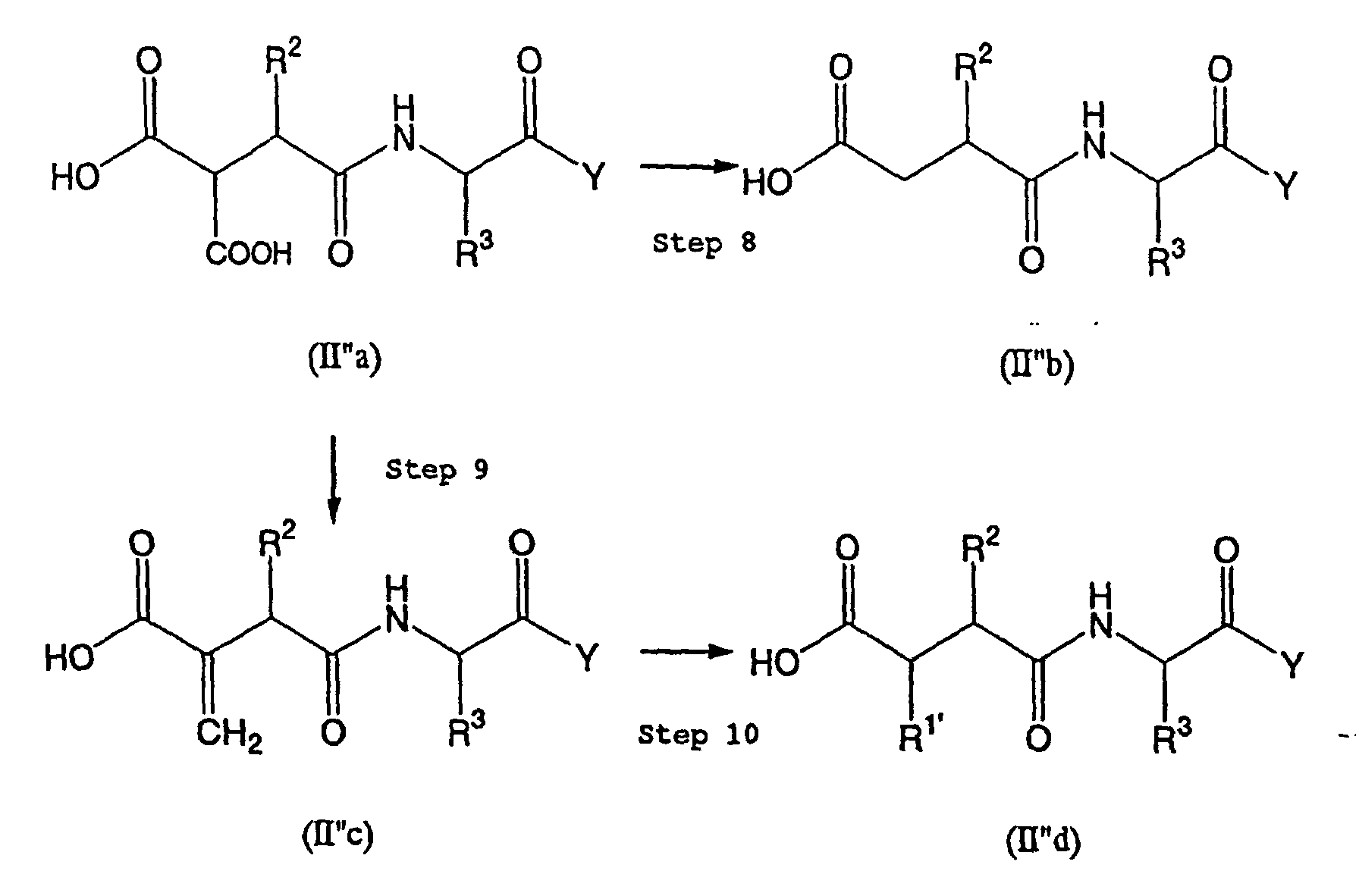
- In Step 6, carboxylic acid (VII) is used as a starting compound, and intermediate compound (II'a) is obtained by the method of Step 1 in the above-mentioned Scheme 1. The carboxylic acid (VII) to be the starting compound is described in a publication (JP-A-7-157470), and can be prepared by a conventional method based on this publication.
- In Step 7, the substituents R11' and R23' of intermediate compound (II'a) are removed to give a succinic acid derivative (II''a). For example, when R11' and R23' are benzyl, a general hydrogenation reaction is carried out in the presence of a metal catalyst at normal pressure or under pressurization. Examples of the metal catalyst include palladium carbon and palladium black and the like. The solvent may be an ether solvent, such as 1,4-dioxane and the like, an ester solvent, such as ethyl acetate and the like, or an alcohol solvent, such as methanol, ethanol, isopropyl alcohol and the like, and the reaction proceeds from room temperature to under heating.
- In Step 8, the succinic acid derivative (II''a) obtained in Step 7 is subjected to decarboxylation to give a succinic acid derivative (II''b) which is a monocarboxylic acid. The solvent may be a hydrocarbon solvent such as n-hexane, benzene, toluene and the like. The reaction is carried out in the presence of a tertiary amine, such as N-methylmorpholine, triethylamine and the like, at room temperature or under heating.
- In Step 9, the succinic acid derivative (II''a) obtained in Step 7 is reacted with formaldehyde in the presence of a secondary amine to give succinic acid derivative (II''c) which is α-exomethylenecarboxylic acid. Examples of the secondary amine include piperidine, diethylamine, morpholine and the like. The reaction is carried out in an alcohol solvent, such as methanol and ethanol and the like, or an amide solvent, such as DMF and the like, from room temperature to under heating.
- In Step 10, succinic acid derivative (II''c) obtained in Step 9 is reacted with arylthiol, heteroarylthiol, alkylthiol or arylalkylthiol as a nucleophilic reagent to give succinic acid derivative (II''d), wherein the substituent R1 is arylthioalkyl, heteroarylthioalkyl, alkylthioalkyl or arylalkylthioalkyl. This reaction is carried out without solvent or in a halogenated hydrocarbon solvent, such as methylene chloride and the like, an alcohol solvent, such as methanol and the like, or in an amide solvent, such as DMF and the like, from room temperature to under heating.
- The amino derivative (IV) and amino derivative (V), which are the starting compounds in schemes 1 - 3, can be produced by the method shown in the following Scheme 4.wherein A' is an amino-protecting group such as tert-butoxycarbonyl, benzyloxycarbonyl and the like, M is lithium or - MgP1 wherein P1 is halogen such as bromine, chlorine and the like, Y" is 2-thiazolyl or 2-oxazolyl optionally substituted with lower alkyl or phenyl, and R3 and Y are as defined above.
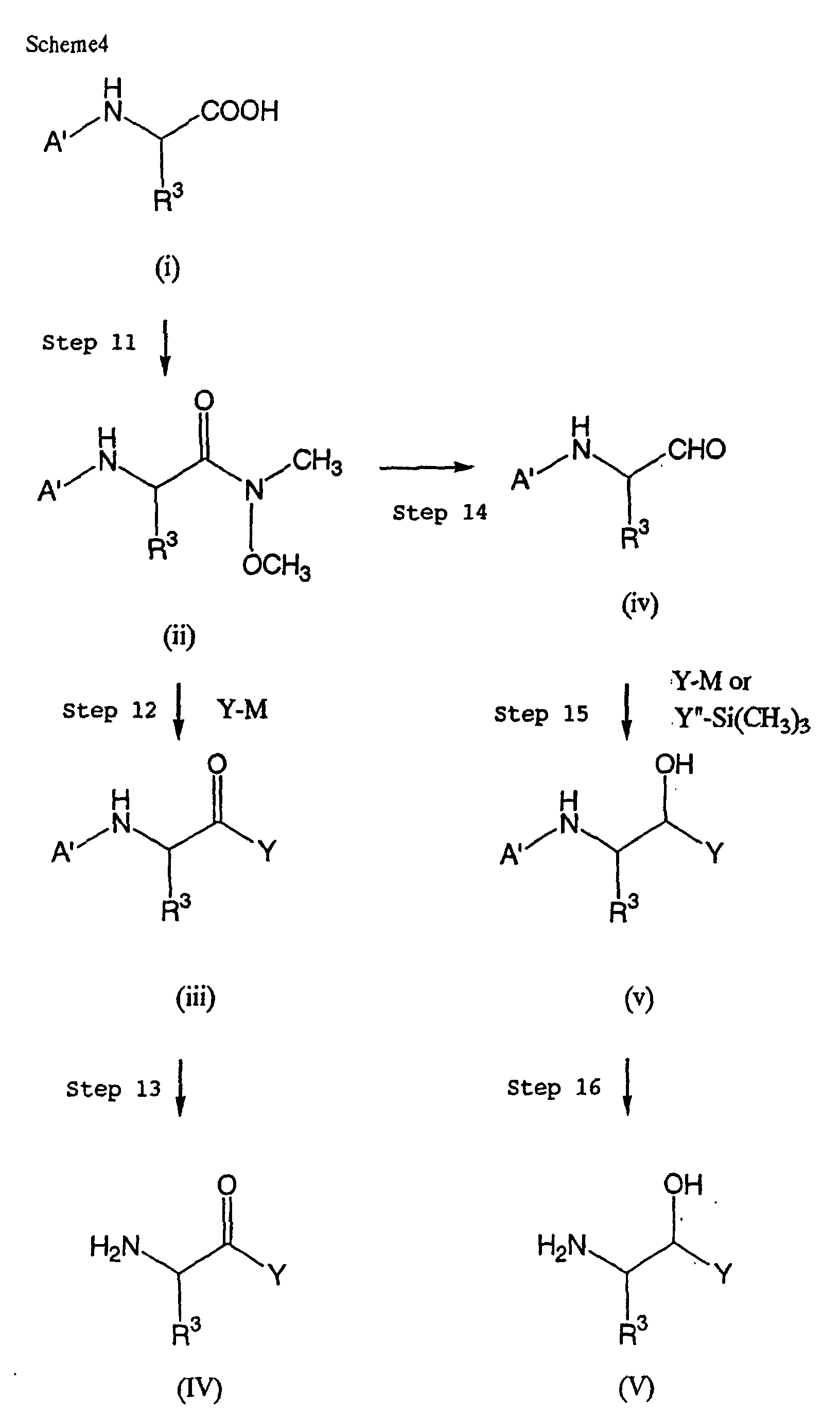
- In Step 11, compound (i) and O,N-dimethylhydroxylamine hydrochloride are reacted in an inert solvent in the presence of a condensing agent and a base to give compound (ii). This step can be performed by the general method described in Jean-Alain Fehrentz et al., Synthesis (1983) p. 676-678.
- In Step 12, compound (ii) is reacted with an organometallic compound Y-M to give compound (iii). The inert solvent to be used is preferably an aliphatic hydrocarbon solvent, such as hexane, cyclohexane and the like, ether solvent, such as diethyl ether, tetrahydrofuran and the like, and the like.
- The reaction temperature is generally from -78°C to 80°C, preferably from -78°C to 40°C. The reaction time varies depending on the starting compound, solvent, reaction temperature and the like to be employed. It is generally 15 minutes - 24 hours, preferably 15 minutes - 10 hours.
- In Step 13, the amino-protecting group of compound (iii) is removed to give amino derivative (IV).
- When the protecting group A' is tert-butoxycarbonyl, the protecting group can be removed under acidic conditions using, for example, trifluoroacetic acid, hydrogen chloride-containing dioxane, hydrogen chloride-containing methanol, hydrogen bromide-containing acetic acid and the like. The inert solvent to be used is preferably a halogenated hydrocarbon solvent, such as methylene chloride, chloroform and the like, an ether solvent, such as diethyl ether, tetrahydrofuran, dioxane and the like, an alcohol solvent, such as methanol, ethanol, n-propyl alcohol, isopropyl alcohol and the like, an organic acid, such as acetic acid and the like.
- The reaction temperature is generally from 0°C to 100°C, preferably from 0°C to 50°C. The reaction time is generally 15 minutes - 12 hours, preferably 15 minutes - 4 hours.
- When the protecting group A' is benzyloxycarbonyl, it is preferably removed by treating with an acid or by catalytic reduction.
- The acid to be used for removal with an acid is preferably trifluoromethanesulfonic acid. The solvent to be used is preferably methylene chloride. The reaction temperature is preferably from 0°C to 50°C and the reaction time is preferably 5 minutes - 6 hours.
- The catalyst to be used for the method based on catalytic reduction is preferably palladium carbon and palladium black. The solvent to be used is preferably an alcohol solvent, such as methanol, ethanol, n-propyl alcohol, isopropyl alcohol and the like, an ether solvent, such as diethyl ether, tetrahydrofuran, 1,4-dioxane and the like, or an ester solvent, such as ethyl acetate and the like. The hydrogen pressure is generally 1 - 10 atm, and the reaction temperature is preferably from 0°C to 100°C and the reaction time is preferably 5 minutes - 24 hours.
- In Step 14, compound (ii) is reduced with a reducing agent, such as lithium aluminum hydride and the like, in an inert solvent to give compound (iv). This step is performed according to the general method described in the above-mentioned Jean-Alain Fehrentz et al., Synthesis (1983) p. 676-678.
- In Step 15, (a) compound (iv) is reacted with an organometallic compound Y-M in an inert solvent, or (b) compound (iv) is reacted with trimethylsilyl derivative [Y"-Si(CH3)3] wherein Y" is 2-thiazolyl or 2-oxazolyl optionally substituted by lower alkyl or phenyl, in an inert solvent to give compound (v).
- When compound (v) is produced by Step (a), the method is similar to that used in Step 12.
- When compound (v) is produced by Step (b), 2-trimethylsilylthiazole optionally substituted by lower alkyl or phenyl, which is a trimethylsilyl derivative, can be prepared by the method described in Alessandro Dondoni et al., J. Org. Chem. (1988) 53 p. 1748-1761. The 2-trimethylsilyloxazole optionally substituted by lower alkyl or phenyl can be prepared by the method described in Alessandro Dondoni et al., J. Org. Chem. (1987) 52 p. 3413-3420.
- When 2-trimethylsilylthiazole optionally substituted by lower alkyl or phenyl is used, the reaction is preferably carried out without solvent or in methylene chloride. The reaction temperature is generally from -40°C to 80°C, preferably from -20°C to 40°C. While the reaction time varies depending on the starting compound, solvent and reaction temperature to be employed, it is generally 1 - 48 hours, preferably 1 - 24 hours.
- After the reaction without solvent, the reaction mixture is diluted with THF, and the compound is reacted with tetrabutylammonium fluoride at room temperature for 1 - 2 hours and post-treated by a conventional method to give the objective compound. When a solvent is used, the solvent is evaporated after the reaction and the above step is followed to give the objective compound.
- When 2-trimethylsilyloxazole optionally substituted by lower alkyl or phenyl is used, the reaction is preferably carried out without solvent or in benzene, toluene or xylene. The reaction temperature is generally from 0°C to 150°C, preferably from 20°C to 100°C. While the reaction time varies depending on the starting compound, solvent, reaction temperature and the ilke to be employed, it is generally 1 - 80 hours, preferably 1 - 50 hours.
- After the reaction, the objective compound can be obtained in the same manner as for 2-trimethylsilylthiazole. Alternatively, the compound is reacted with 1 - 2N hydrochloric acid instead of tetrabutylammonium fluoride for 0.5 - 2 hours and post-treated by a conventional method to give the objective compound.
- In Step 16, the amino-protecting group of compound (v) is removed to give an amino derivative (V), which step can be performed by the method similar to'that in Step 13.
- The compound (iii) and compound (iv) in Scheme 4 can be also produced by the method shown in the following Scheme 5.wherein Z is lower alkyl, such as methyl, ethyl and the like, or arylalkyl, such as benzyl and the like, and A', M, R3 and Y are as defined above.
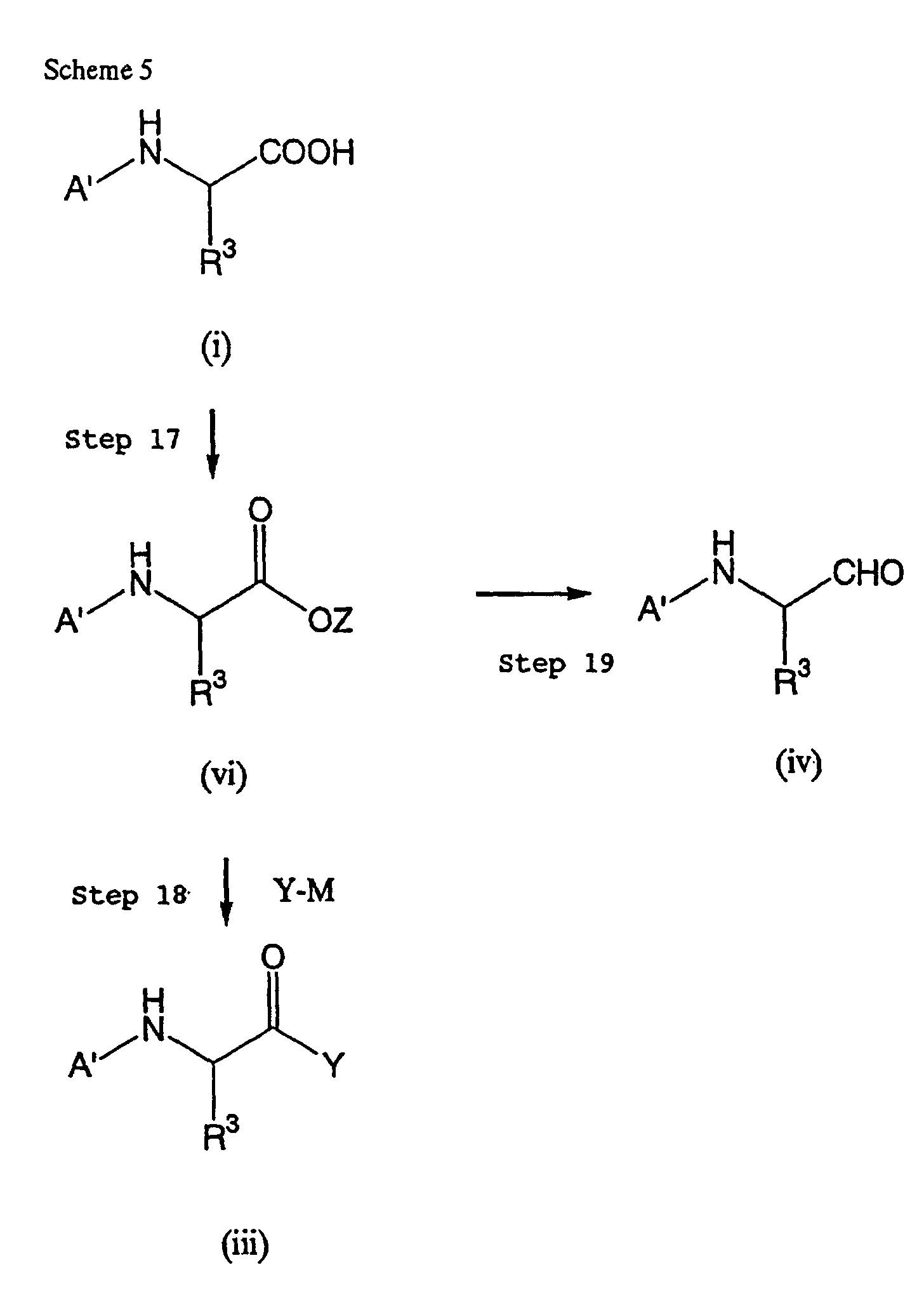
- In Step 17, compound (i) is reacted with alcohol ZOH in the presence of a condensing agent to give compound (vi). The inert solvent to be used is exemplified by a halogenated'hydrocarbon solvent, such as methylene chloride, chloroform and the like, an ester solvent, such as ethyl acetate and the like, and an ether solvent, such as diethyl ether, tetrahydrofuran, 1,4-dioxane and the like, with preference given to methylene chloride and tetrahydrofuran.
- As the condensing agent, it is preferably DCC, 1-(3-dimethylaminopropyl)-3-ethylcarbodiimide, diphenylphosphoryl azide and the like.
- An acid-eliminating agent may be concurrently used in this reaction. The acid-eliminating agent to be used is preferably an organic amine such as triethylamine, diisopropylethylamine, N-methylmorpholine, pyridine, 4-dimethylaminopyridine, 4-pyrrolidinopyridine, proton sponge and the like.
- The reaction temperature is generally from 0°C to 80°C, preferably from 0°C to 40°C. While the reaction time varies depending on the starting compound, solvent, reaction temperature and the like to be employed, it is generally 1 - 48 hours, preferably 1 - 12 hours.
- In Step 18, compound (vi) is reacted with an organometallic compound Y-M to give compound (iii), wherein the method similar to that in Step 12 can be employed.
- In Step 19, compound (vi) is reduced with a reducing agent, such as diisobutylaluminum hydride and the like, to give compound (iv). This step can be performed by the method described in Daniel H. Rich et al., J. Org. Chem. (1978) 43 p. 3624-3626.
- The organometallic compound Y-M to be used in the above-mentioned reaction can be prepared by reacting a compound of the formula: Y-U, wherein U is hydrogen or halogen and Y is as defined above, with alkyllithium, aryllithium or Grignard reagent in an inert solvent.
- Examples of the alkyl lithium to be used include ethyllithium, n-butyllithium, sec-butyllithium, tert-butyllithium and the like. Examples of aryllithium include phenyllithium and the like and examples of Grignard reagent include.methylmagnesium bromide and the like. The solvent, reaction temperature and reaction time to be employed are the same as those in Step 12.
- The compound (i), which is a starting compound in Schemes 4 and 5, can be prepared by the following method.
- The compound (i) can be produced by protecting amino of an amino acid of the formulawith an amino-protecting group such as tert-butoxycarbonyl, benzyloxycarbonyl and the like (see Pepuchidogousei no kiso to jikken, Izumiya et al., Maruzen Shoten, p. 16).
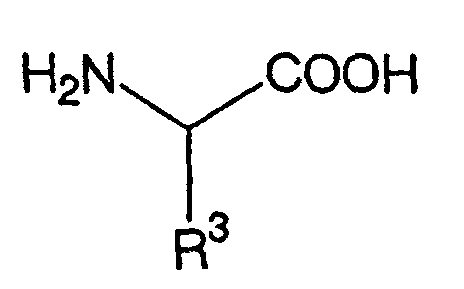
- Any variation in various kinds of substituents, inclusive of R3, and the like is not necessarily applicable only to a specific step, but rather, the step is free of limitation as long as it is performed under conditions that do not influence other functional groups present in chemical formula.
- The hydroxamic acid derivative of the present invention thus synthesized can be collected at an optional purity by a known separation and purification method, such as condensation, extraction, chromatography, reprecipitation, recrystallization and the like, which are used as appropriate.
- A pharmacologically acceptable salt and solvate of the hydroxamic acid derivative can be produced by a known method. Moreover, various isomers and the like of the hydroxamic acid derivative can be produced by a known method.
- The hydroxamic acid derivative and a pharmacologically acceptable salt thereof of the present invention are superior in inhibitory activity of TNF α production in mammals (e.g., human, dog, cat and the like), and low in toxicity.
- Therefore, the hydroxamic acid derivative and a pharmacologically acceptable salt thereof of the present invention are useful as an inhibitor of TNF α production and can be used effectively for the prophylaxis and treatment of the diseases such as autoimmune diseases and inflammatory diseases (e.g., sepsis, MOF, rheumatoid arthritis, Crohn's disease, cachexia, myasthenia gravis, systemic lupus erythematosus, asthma, I type diabetes, psoriasis and the like), and the like.
- When the hydroxamic acid derivative or a pharmacologically acceptable salt thereof of the present invention is used as a pharmaceutical product, a pharmacologically acceptable carrier and the like are used to give a pharmaceutical composition in the form of granules, tablets, capsules, injections, ointment, eye drop, nose drop, cream, aerosol and the like, which can be administered orally or parenterally. Particularly, since the hydroxamic acid derivative and a pharmacologically acceptable salt thereof are superior in water-soluble property, they are preferably used for producing a water-soluble pharmaceutical composition such as injection, eye drop, nasal drop, infusion and the like.
- The above-mentioned preparations contain an effective amount of the hydroxamic acid derivative or a pharmacologically acceptable salt thereof.
- While the dose of the hydroxamic acid derivative and a pharmacologically acceptable salt thereof varies depending on the administration route, the disease state, body weight and age of patient, and the like, it can be determined as appropriate according to the object of administration. In general, when they are orally administered to an adult, the dose is 0.01 - 1,000 mg/kg body weight/day, preferably 0.05 - 250 mg/kg body weight/day, which is preferably administered once or several times a day.
- While the present invention is explained in more detail in the following by referring to examples, the present invention is not limited by them.
- 1H-NMR was measured at 300 or 500MHz. The chemical shift of 1H-NMR was measured using tetramethylsilane as an internal standard, and the relative delta (δ) value was expressed in parts per million (ppm). The coupling constants were expressed in obvious multiplicity by hertz (Hz), and in s (singlet), d (doublet), t (triplet), q (quartet), m (multiplet), dd (doublet of doublets), br s (broad singlet) and the like.
-
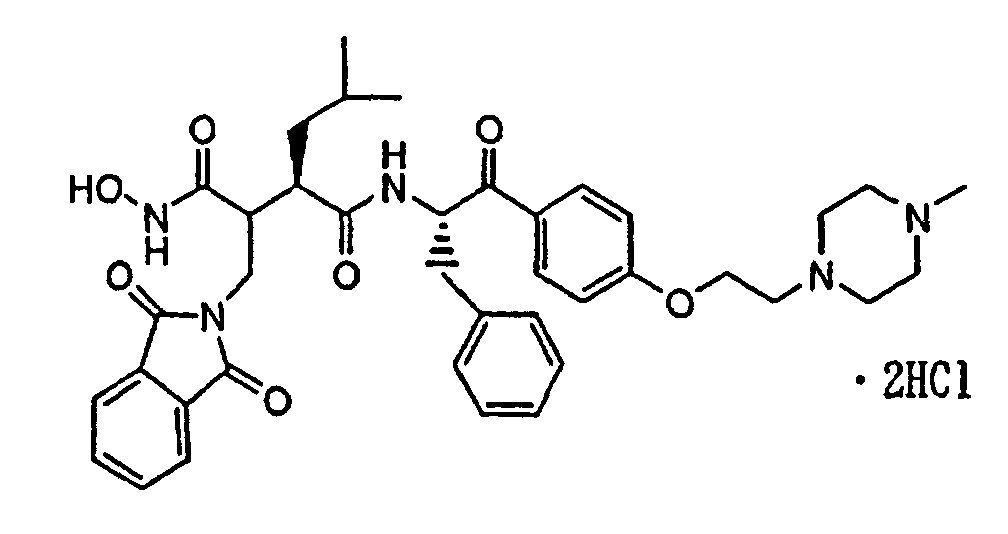
- A mixture of 1-(2-hydroxyethyl)piperazine (10.0 g, 76.8 mmol), 37% aqueous formaldehyde solution (11.5 ml, 154 mmol), 10% palladium carbon catalyst (1.0 g) and methanol (100 ml) was stirred for 13 hr at room temperature in a hydrogen atmosphere. The reaction mixture was filtrated and the filtrate was concentrated. To the obtained residue was added 2N hydrochloric acid, and the mixture was washed with diethyl ether (200 ml). Sodium hydroxide (16 g) was added to the aqueous layer to make the layer alkaline, and the mixture was extracted with chloroform (4 × 200 ml). The organic layer was dried over anhydrous sodium sulfate and concentrated to give the title compound (9.3 g, 84%) as a pale-yellow liquid.
1H-NMR (300 MHz, CDCl3) δ 3.61 (t, J = 5.4 Hz, 2H), 2.90-2.30 (m, 8H), 2.55 (t, J = 5.4 Hz, 2H), 2.29 (s, 3H). - To a solution of 4-bromophenol (20.0 g, 116 mmol) dissolved in DMF (100 ml) were added successively benzyl bromide (13.7 ml, 116 mmol), potassium carbonate (47.9 g, 347 mmol) and sodium iodide (1.7 g, 11.6 mmol), and the mixture was stirred for 4 hr at room temperature. Insoluble material was filtered off and water (500 ml) was added to the obtained filtrate. The precipitate was collected by filtration and the obtained precipitate was dissolved in diethyl ether (300 ml). The mixture was washed with water (100 ml) and saturated brine (100 ml). The organic layer was dried over anhydrous magnesium sulfate and concentrated. The obtained residue was washed with cold hexane and dried to give the title compound (26.2 g, 86%) as a white solid.
1H-NMR (300 MHz, CDCl3) δ 7.37 (d, J = 8.9 Hz, 2H), 7.50-7.30 (m, 5H), 6.84 (d, J = 8.9 Hz, 2H), 5.02 (s, 2H). - The title compound (14.69 g, 55.8 mmol) of Example 1(2) was dissolved in tetrahydrofuran (THF, 200 ml). To the solution was added dropwise n-butyllithium (1.57M hexane solution, 35.6 ml, 55.8 mmol) at -70°C for 10 min and the mixture was stirred for 1 hr at -70°C to -65°C. Then, a solution of Nα-(tert-butoxycarbonyl)-L-phenylalanine N-methoxy-N-methylamide (5.74 g, 18.6 mmol) prepared according to the method of Jean-Alain Fehrentz et al. [Synthesis (1983) 676-678] and dissolved in THF (50 ml) was added dropwise at -70°C over 5 min and the mixture was stirred for 30 min at -70°C to -65°C. A saturated aqueous ammonium chloride solution (50 ml) was added to the reaction mixture under ice-cooling, and the mixture was concentrated. A saturated aqueous ammonium chloride solution (50 ml) was added to the obtained residue and the mixture was extracted with ethyl acetate (2×200 ml). The organic layer was washed with saturated brine (100 ml), dried over anhydrous magnesium sulfate and concentrated. The residue was purified by silica gel column chromatography (10:1 hexane-ethyl acetate) and recrystallized from ethyl acetate-hexane to give the title compound (4.42 g, 55%) as a white solid.
1H-NMR (300 MHz, CDCl3) δ 7.92 (d, J = 8.9 Hz, 2H), 7.50-6.95 (m, 10H), 7.01 (d, J = 8.9 Hz, 2H), 5.55-5.35 (m, 2H), 5.14 (s, 2H), 3.22 (dd, J = 13.7, 5.7 Hz, 1H), 2.96 (dd, J = 13.7, 5.6 Hz, 1H), 1.42 (s, 9H). - The title compound (4.30 g, 9.97 mmol) of Example 1(3) was dissolved in methylene chloride (20 ml). Thereto was added trifluoroacetic acid (20 ml) under ice-cooling and the mixture was stirred for 30 min at the same temperature. The reaction mixture was concentrated and crystallized from diethyl ether to give the title compound (3.64 g, 82%) as a white solid.
1H-NMR (300 MHz, CDCl3) δ 7.78 (d, J = 8.9 Hz, 2H), 7.50-7.05 (m, 10H), 6.95 (d, J = 8.9 Hz, 2H), 5.27 (t, J = 6.1 Hz, 1H), 5.10 (s, 2H), 3.32 (dd, J = 14.4, 6.2 Hz, 1H), 3.25 (dd, J = 14.4, 6.2 Hz, 1H). - The title compound (3.60 g, 8.08 mmol) of Example 1(4), 4-tert-butoxy-2(R)-isobutyl-3(R or S)-phthalimidomethylsuccinic acid (3.15 g, 8.08 mmol) prepared according to the method described in JP-A-4-352757 and JP-A-7-157470, 1-hydroxybenzotriazole monohydrate (HOBt·H2O) (1.24 g, 8.08 mmol) and N-methylmorpholine (2.70 ml, 24.2 mmol) were dissolved in DMF (80 ml) and BOP reagent (5.36 g, 12.1 mmol) was added under ice-cooling, which was followed by stirring at room temperature for 6 hr. Water (300 ml) was added to the reaction mixture, and the mixture was extracted with ethyl acetate (2×200 ml). The organic layer was washed successively with 1N hydrochloric acid (100 ml), water (100 ml), saturated aqueous sodium hydrogencarbonate solution (2×100 ml) and saturated brine (100 ml), dried over anhydrous magnesium sulfate and concentrated. The obtained residue was purified by silica gel column chromatography (2:1 hexane-ethyl acetate) to give the title compound (5.35 g, 94%) as an amorphous powder.
1H-NMR (300 MHz, CDCl3) δ 7.99 (d, J = 8.9 Hz, 2H), 7.90-7.80 (m, 2H), 7.78-7.65 (m, 2H), 7.48-7.30 (m, 5H), 7.23-7.10 (m, 4H), 7.10-7.03 (m, 1H), 7.01 (d, J = 8.9 Hz, 2H), 6.93 (d, J = 8.3 Hz, 1H), 6.00-5.90 (m, 1H), 5.14 (s, 2H), 3.49 (dd, J = 14.0, 8.1 Hz, 1H), 3.38 (dd, J = 14.0, 5.0 Hz, 1H), 3.28 (dd, J = 14.1, 5.8 Hz, 1H), 3.02 (dd, J = 14.1, 8.0 Hz, 1H), 3.00-2.88 (m, 1H), 2.68-2.55 (m, 1H), 1.75-1.60 (m, 1H), 1.50-1.30 (m, 1H), 1.26 (s, 9H), 1.12-0.98 (m, 1H), 0.80 (d, J = 6.5 Hz, 3H), 0.76 (d, J = 6.5 Hz, 3H). - A mixture of the title compound (5.00 g, 7.11 mmol) of Example 1(5), 10% palladium carbon catalyst (0.50 g) and ethanol (50 ml) was stirred for 28 hr at room temperature in a hydrogen atmosphere. The reaction mixture was filtrated and the filtrate was concentrated. The obtained residue was purified by silica gel column chromatography (10:1 chloroform-methanol) to give the title compound (3.12 g, 72%) as an amorphous solid.
1H-NMR (300 MHz, CDCl3) δ 8.50 (s, 1H), 7.90-7.65 (m, 6H), 7.30-7.00 (m, 6H), 6.89 (d, J = 8.5 Hz, 2H), 6.00-5.80 (m, 1H), 3.50 (dd, J = 14.1, 8.1 Hz, 1H), 3.42-3.25 (m, 2H), 3.05-2.85 (m, 2H), 2.73-2.60 (m, 1H), 1.75-1.60 (m, 1H), 1.50-1.30 (m, 1H), 1.28 (s, 9H), 1.17-1.00 (m, 1H), 0.84 (d, J = 6.3 Hz, 3H), 0.76 (d, J = 6.3 Hz, 3H). - The title compound (200 mg, 0.33 mmol) of Example 1(6), the title compound (141 mg, 0.98 mmol) of Example 1(1) and triphenylphosphine (257 mg, 0.98 mmol) were dissolved in THF (5 ml). Diethyl azodicarboxylate (40% toluene solution, 426 mg, 0.98 mmol) was added to the solution under ice-cooling and the mixture was stirred for 4 hr at room temperature. The reaction mixture was concentrated and the obtained residue was purified by silica gel column chromatography (20:1 chloroform-methanol) to give the title compound (200 mg, 83%) as an amorphous solid.
1H-NMR (300 MHz, CDCl3) δ 7.97 (d, J = 8.9 Hz, 2H), 7.90-7.78 (m, 2H), 7.78-7.65 (m, 2H), 7.22-7.12 (m, 4H), 7.12-7.00 (m, 1H), 7.00-6.80 (m, 1H), 6.94 (d, J = 8.9 Hz, 2H), 6.00-5.90 (m, 1H), 4.17 (t, J = 5.8 Hz, 2H), 3.55-3.45 (m, 1H), 3.45-3.35 (m, 1H), 3.35-3.20 (m, 1H), 3.10-2.90 (m, 2H), 2.84 (t, J = 5.8 Hz, 2H), 2.75-2.35 (m, 9H), 2.30 (s, 3H), 1.73-1.60 (m, 1H), 1.35-1.26 (m, 1H), 1.26 (s, 9H), 1.12-1.00 (m, 1H), 0.81 (d, J = 6.5 Hz, 3H), 0.76 (d, J = 6.5 Hz, 3H). - The title compound (200 mg, 0.27 mmol) of Example 1(7) was dissolved in methylene chloride (10 ml) and trifluoroacetic acid (10 ml) was added under ice-cooling. The mixture was stirred for 2 hr at room temperature. The reaction mixture was concentrated to give the title compound (217 mg, 88%) as an amorphous solid.
1H-NMR (300 MHz, DMSO-d6) δ 8.70 (d, J = 8.8 Hz, 1H), 8.03 (d, J = 8.8 Hz, 2H), 7.95-7.82 (m, 4H), 7.35 (d, J = 7.5 Hz, 2H), 7.12 (t, J = 7.6 Hz, 2H), 7.05 (d, J = 8.8 Hz, 2H), 6.85 (t, J = 7.4 Hz, 1H), 5.75-5.60 (m, 1H), 4.20 (t, J = 5.3 Hz, 2H), 3.20-3.00 (m, 5H), 3.00-2.85 (m, 3H), 2.85-2.60 (m, 4H), 2.78 (s, 3H), 2.60-2.40 (m, 2H), 2.40-2.25 (m, 1H), 1.50-1.35 (m, 1H), 1.10-0.95 (m, 1H), 0.90-0.75 (m, 1H), 0.68 (d, J = 6.4 Hz, 3H), 0.61 (d, J = 6.4 Hz, 3H). - The title compound (210 mg, 0.23 mmol) of Example 1(8), o-2-tetrahydropyranylhydroxylamine (33 mg, 0.28 mmol), HOBt·H2O (36 mg, 0.23 mmol) and N-methylmorpholine (0.25 ml, 2.32 mmol) were dissolved in DMF (10 ml), and BOP reagent (154 mg, 0.35 mmol) was added under ice-cooling. The mixture was stirred for 13 hr at room temperature. Water (50 ml) was added and the mixture was extracted with ethyl acetate (2×50 ml). The organic layer was washed successively with saturated aqueous sodium hydrogencarbonate solution (2×50 ml) and saturated brine (50 ml), dried over anhydrous sodium sulfate and concentrated. The obtained residue was purified by silica gel column chromatography (20:1 chloroform-methanol) to give the title compound (120 mg, 66%) as a white solid.
1H-NMR (300 MHz, DMSO-d6) δ 10.95-10.80 (m, 1H), 8.72-8.60 (m, 1H), 8.00 (d, J = 8.8 Hz, 2H), 7.95-7.75 (m, 4H), 7.35 (d, J = 7.4 Hz, 2H), 7.09 (t, J = 7.6 Hz, 2H), 7.02 (d, J = 8.8 Hz, 2H), 6.81 (t, J = 7.3 Hz, 1H), 5.70-5.55 (m, 1H), 4.55-4.30 (m, 1H), 4.11 (t, J = 5.7 Hz, 2H), 3.70-3.55 (m, 1H), 3.18-3.05 (m, 1H), 3.05-2.95 (m, 1H), 2.95-2.80 (m, 1H), 2.80-2.55 (m, 1H), 2.64 (t, J = 5.7 Hz, 2H), 2.55-2.20 (m, 10H), 2.20-2.05 (m, 1H), 2.14 (s, 3H), 1.60-1.20 (m, 7H), 1.05-0.90 (m, 1H), 0.80-0.70 (m, 1H), 0.64 (d, J = 6.3 Hz, 3H), 0.60 (d, J = 6.3 Hz, 3H). - To a solution of the the title compound (110 mg, 0.14 mmol) of Example 1(9), methylene chloride (10 ml) and methanol (10 ml) was added 1.3N hydrogen chloride-methanol reagent (1 ml) under ice-cooling, and the mixture was stirred for 2 hr at room temperature. Diethyl ether was added to the reaction mixture to precipitate a solid to give the title compound (69 mg, 62%) as a white solid.
1H-NMR (500 MHz, DMSO-d6) δ 10.31 (br s, 1H), 8.63 (d, J = 8.6 Hz, 1H), 8.04 (d, J = 8.7 Hz, 2H), 7.90-7.80 (m, 4H), 7.35 (d, J = 7.3 Hz, 2H), 7.10-7.05 (m, 4H), 6.79 (t, J = 7.4 Hz, 1H), 5.70-5.60 (m, 1H), 4.50-4.20 (br, 2H), 3.65-3.15 (m, 11H), 3.11 (dd, J = 14.0, 4.5 Hz, 1H), 2.86 (dd, J = 14.0, 10.7 Hz, 1H), 2.81 (s, 3H), 2.50-2.40 (m, 2H), 2.25-2.15 (m, 1H), 1.41-1.32 (m, 1H), 1.08-0.97 (m, 1H), 0.82-0.75 (m, 1H), 0.68 (d, J = 6.5 Hz, 3H), 0.62 (d, J = 6.5 Hz, 3H). -
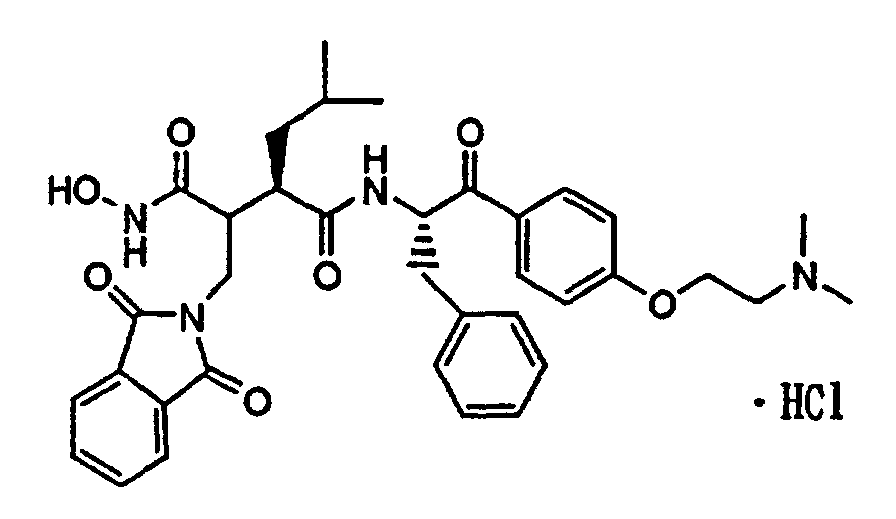
- 4-Bromophenol (10.0 g, 57.8 mmol) and 2-dimethylaminoethyl chloride hydrochloride (8.33 g, 57.8 mmol) were dissolved in DMF (200 ml), and potassium carbonate (24.0 g, 173 mmol) and sodium iodide (0.87 g, 5.78 mmol) were added under ice-cooling. The mixture was stirred for 13 hr at room temperature and at 70°C for 3 hr. Water (400 ml) was added to the reaction mixture and the mixture was extracted with chloroform (2×200 ml). The organic layer was washed successively with water (2×200 ml) and saturated brine (200 ml), dried over anhydrous magnesium sulfate and concentrated. The obtained residue was dissolved in 1N hydrochloric acid (100 ml) and washed with ethyl acetate (2×200 ml). Sodium hydroxide (4 g) was added to the aqueous layer to make the layer alkaline, and the mixture was extracted with chloroform (2×200 ml). The organic layer was dried over anhydrous magnesium sulfate and concentrated. Hexane was added to the obtained residue and insoluble matter was filtered off. The mother liquor was concentrated to give the title compound (5.25 g, 37%) as a transparent oil.
1H-NMR (300 MHz, CDCl3) δ 7.36 (d, J = 8.9 Hz, 2H), 6.80 (d, J = 8.9 Hz, 2H), 4.02 (t, J = 5.7 Hz, 2H), 2.71 (t, J = 5.7 Hz, 2H), 2.33 (s, 6H). - According to the method of Example 1(3), the title compound of Example 2(1) and Nα-(tert-butoxycarbonyl)-L-phenylalanine N-methoxy-N-methylamide were reacted and the resulting product was purified by silica gel column chromatography (100:1 chloroform-methanol), followed by recrystallization from hexane, to give the title compound (yield 15%) as a white solid.
1H-NMR (300 MHz, CDCl3) δ 7.91 (d, J = 8.8 Hz, 2H), 7.30-7.12 (m, 3H), 7.02 (d, J = 7.4 Hz, 2H), 6.95 (d, J = 8.8 Hz, 2H), 5.55-5.35 (m, 2H), 4.14 (t, J = 5.7 Hz, 2H), 3.22 (dd, J = 13.7, 5.7 Hz, 1H), 2.92 (dd, J = 13.7, 5.5 Hz, 1H), 2.76 (t, J = 5.7 Hz, 2H), 2.35 (s, 6H), 1.42 (s, 9H). - The title compound of Example 2(2) was treated in the same manner as in Example 1(4) to give the title compound quantitatively as a yellow viscous oil.
1H-NMR (300 MHz, DMSO-d6) δ 10.20-9.80 (br, 1H), 8.50-8.20 (br, 3H), 8.01 (d, J = 8.9 Hz, 2H), 7.30-7.20 (m, 3H), 7.20-7.15 (m, 2H), 7.11 (d, J = 8.9 Hz, 2H), 5.45-5.30 (m, 1H), 4.50-4.40 (m, 2H), 3.60-3.50 (m, 2H), 3.20-3.00 (m, 2H), 2.88 (s, 6H). - In the same manner as in Example 1(5), 4-tert-butoxy-2(R)-isobutyl-3(R or S)-phthalimidomethylsuccinic acid and the title compound of Example 2(3) were reacted and the resulting product was purified by silica gel column chromatography (50:1 chloroform-methanol) to give the title compound as an amorphous solid.
1H-NMR (300 MHz, CDCl3) δ 7.98 (d, J = 8.9 Hz, 2H), 7.90-7.78 (m, 2H), 7.78-7.65 (m, 2H), 7.20-7.10 (m, 4H), 7.10-7.00 (m, 1H), 6.96 (d, J = 8.9 Hz, 2H), 6.95-6.85 (m, 1H), 6.00-5.90 (m, 1H), 4.15 (t, J = 5.6 Hz, 2H), 3.49 (dd, J = 14.0, 8.1 Hz, 1H), 3.38 (dd, J = 14.0, 5.0 Hz, 1H), 3.27 (dd, J = 14.1, 5.8 Hz, 1H), 3.02 (dd, J = 14.1, 7.9 Hz, 1H), 2.95-2.85 (m, 1H), 2.79 (t, J = 5.6 Hz, 2H), 2.65-2.53 (m, 1H), 2.37 (s, 6H), 1.75-1.60 (m, 1H), 1.50-1.25 (m, 1H), 1.26 (s, 9H), 1.10-0.95 (m, 1H), 0.81 (d, J = 6.6 Hz, 3H), 0.76 (d, J = 6.6 Hz, 3H). - The title compound of Example 2(4) was treated in the same manner as in Example 1(8) and the resulting product was crystallized from diethyl ether to give the title compound as a white solid at an overall yield from the title compound of Example 2(2) (3 steps) of 84%.
1H-NMR (300 MHz, DMSO-d6) δ 12.80-12.00 (br, 1H), 9.80-9.40 (br, 1H), 8.71 (d, J = 8.7 Hz, 1H), 8.07 (d, J = 8.9 Hz, 2H), 7.95-7.80 (m, 4H), 7.36 (d, J = 7.2 Hz, 2H), 7.20-7.00 (m, 4H), 6.84 (t, J = 7.4 Hz, 1H), 5.75-5.65 (m, 1H), 4.40 (t, J = 4.8 Hz, 2H), 3.52 (t, J = 4.8 Hz, 2H), 3.45-3.30 (m, 1H), 3.11 (dd, J = 13.9, 4.3 Hz, 1H), 2.90-2.80 (m, 1H), 2.86 (s, 6H), 2.70-2.60 (m, 1H), 2.55-2.45 (m, 1H), 2.35 (dd, J = 13.6, 5.1 Hz, 1H), 1.50-1.35 (m, 1H), 1.10-0.90 (m, 1H), 0.90-0.75 (m, 1H), 0.69 (d, J = 6.5 Hz, 3H), 0.62 (d, J = 6.5 Hz, 3H). - In the same manner as in Example 1(9), the title compound of Example 2(5) and O-2-tetrahydropyranylhydroxylamine were reacted, and the product was purified by silica gel column chromatography (20:1 chloroform-methanol) and recrystallized from diethyl ether-hexane to give the title compound (yield 78%) as a white solid.
1H-NMR (300 MHz, DMSO-d6) δ 11.00-10.80 (m, 1H), 8.75-8.60 (m, 1H), 8.00 (d, J = 8.8 Hz, 2H), 7.90-7.85 (m, 4H), 7.36 (d, J = 7.4 Hz, 2H), 7.09 (t, J = 7.5 Hz, 2H), 7.02 (d, J = 8.8 Hz, 2H), 6.81 (t, J = 7.3 Hz, 1H), 5.70-5.55 (m, 1H), 4.55-4.30 (m, 1H), 4.09 (t, J = 5.5 Hz, 2H), 3.70-3.60 (m, 1H), 3.50-3.25 (m, 2H), 3.13 (dd, J = 14.0, 4.1 Hz, 1H), 3.05-2.65 (m, 1H), 2.87 (dd, J = 14.0, 10.8 Hz, 1H), 2.58 (t, J = 5.5 Hz, 2H), 2.55-2.47 (m, 1H), 2.47-2.40 (m, 1H), 2.19 (s, 6H), 2.09 (dd, J = 13.5, 4.1 Hz, 1H), 1.60-1.20 (m, 7H), 1.10-0.90 (m, 1H), 0.82-0.70 (m, 1H), 0.64 (d, J = 6.6 Hz, 3H), 0.60 (d, J = 6.6 Hz, 3H). - The title compound of Example 2(6) was treated in the same manner as in Example 1(10) and the product was crystallized from diethyl ether to give the title compound (yield 86%) as a white solid.
1H-NMR (500 MHz, DMSO-d6) δ 10.33 (br s, 1H), 10.20-10.00 (br, 1H), 8.64 (d, J = 8.6 Hz, 1H), 8.61 (br s, 1H), 8.07 (d, J = 9.0 Hz, 2H), 8.00-7.82 (m, 4H), 7.36 (d, J = 7.4 Hz, 2H), 7.11 (d, J = 9.0 Hz, 2H), 7.08 (t, J = 7.7 Hz, 2H), 6.78 (t, J = 7.4 Hz, 1H), 5.71-5.63 (m, 1H), 4.45-4.35 (br t, 2H), 3.55-3.48 (br t, 2H), 3.48-3.40 (m, 1H), 3.09 (dd, J = 14.0, 4.4 Hz, 1H), 2.90-2.85 (m, 1H), 2.84 (s, 6H), 2.49-2.42 (m, 2H), 2.20-2.13 (m, 1H), 1.40-1.30 (m, 1H), 1.08-0.95 (m, 1H), 0.81-0.73 (m, 1H), 0.67 (d, J = 6.5 Hz, 3H), 0.62 (d, J = 6.5 Hz, 3H). -

- According to the method of Jean-Alain Fehrentz et al. [Synthesis (1983) 676-678], N-(tert-butoxycarbonyl)-L-(4-nitro)phenylalanine and N,O-dimethylhydroxylamine hydrochloride were reacted and the resulting product was purified by silica gel column chromatography (2:1 hexane-ethyl acetate) to give the title compound (yield 96%) as a yellow viscous liquid.
1H-NMR (300 MHz, CDCl3) δ 8.15 (d, J = 8.6 Hz, 2H), 7.34 (d, J = 8.6 Hz, 2H), 5.25 (br d, J = 8.7 Hz, 1H), 5.05-4.85 (m, 1H), 3.73 (s, 3H), 3.25-3.10 (m, 1H), 3.19 (s, 3H), 2.97 (dd, J = 13.5, 7.2 Hz, 1H), 1.38 (s, 9H). - According to the method of Example 1(3), furan and the title compound of Example 3(1) were reacted and the resulting product was recrystallized from ethyl acetate-hexane to give the title compound (yield 59%) as a pale-yellow solid.
1H-NMR (300 MHz, CDCl3) δ 8.12 (d, J = 8.6 Hz, 2H), 7.64 (d, J = 1.6 Hz, 1H), 7.45-7.25 (m, 3H), 6.59 (dd, J = 3.6, 1.6 Hz, 1H), 5.45-5.25 (m, 2H), 3.45-3.20 (m, 1H), 3.20-3.00 (m, 1H), 1.40 (s, 9H). - A mixture of the title compound (1.00 g, 2.78 mmol) of Example 3(2), 10% palladium carbon catalyst (0.10 g), ethanol (20 ml) and ethyl acetate (20 ml) was stirred for 3 hr at room temperature in a hydrogen atmosphere. The reaction mixture was filtrated and the filtrate was concentrated to give the title compound (0.92 g, quantitatively) as an amorphous solid.
1H-NMR (300 MHz, CDCl3) δ 7.61 (d, J = 1.2 Hz, 1H), 7.22 (d, J = 3.5 Hz, 1H), 6.86 (d, J = 8.1 Hz, 2H), 6.70-6.45 (m, 3H), 5.35-5.10 (m, 2H), 3.58 (br s, 2H), 3.10 (dd, J = 13.9, 5.7 Hz, 1H), 2.93 (dd, J = 13.9, 5.6 Hz, 1H), 1.41 (s, 9H). - The title compound (0.92 g, 2.78 mmol) of Example 3(3) was dissolved in methylene chloride (30 ml). 1H-Pyrazole-1-(N,N'-dibenzyloxycarbonyl)carboxamidine (1.58 g, 4.16 mmol) was added under ice-cooling and the mixture was stirred for 65 hr at room temperature. The reaction mixture was concentrated and recrystallized from ethyl acetate-hexane to give the title compound (1.56 g, 88%) as a white solid.
1H-NMR (300 MHz, CDCl3) δ 11.88 (br s, 1H), 10.20 (br s, 1H), 7.60 (d, J = 1.6 Hz, 1H), 7.55-7.25 (m, 10H), 7.46 (d, J = 8.3 Hz, 2H), 7.24 (d, J = 3.6 Hz, 1H), 7.05 (d, J = 8.3 Hz, 2H), 6.53 (dd, J = 3.6, 1.6 Hz, 1H), 5.35-5.20 (m, 2H), 5.23 (s, 2H), 5.14 (s, 2H), 3.30-3.10 (m, 1H), 3.10-2.95 (m, 1H), 1.41 (s, 9H). - The title compound of Example 3(4) was treated in the same manner as in Example 1(4) and the product was crystallized from diethyl ether to give the title compound (yield 89%) as a white solid.
1H-NMR (300 MHz, DMSO-d6) δ 11.40-11.20 (br, 1H), 9.95 (s, 1H), 8.50-8.10 (br, 3H), 8.08 (d, J = 1.7 Hz, 1H), 7.65 (d, J = 3.7 Hz, 1H), 7.55-7.25 (m, 10H), 7.48 (d, J = 8.5 Hz, 2H), 7.16 (d, J = 8.5 Hz, 2H), 6.75 (dd, J = 3.7, 1.7 Hz, 1H), 5.25 (s, 2H), 5.04 (s, 2H), 4.96 (t, J = 6.7 Hz, 1H), 3.20-3.00 (m, 2H). - In the same manner as in Example 1(5), 4-tert-butoxy-2(R)-isobutyl-3(R or S)-phthalimidomethylsuccinic acid and the title compound of Example 3(5) were reacted and the product was purified by silica gel column chromatography (1:1 hexane-ethyl acetate) to give the title compound (yield 82%) as an amorphous solid.
1H-NMR (300 MHz, CDCl3) δ 11.60 (s, 1H), 10.07 (s, 1H), 7.75-7.65 (m, 2H), 7.63 (d, J = 1.7 Hz, 1H), 7.59-7.51 (m, 2H), 7.48 (d, J = 8.5 Hz, 2H), 7.45-7.25 (m, 11H), 7.21 (d, J = 8.5 Hz, 2H), 6.71 (d, J = 8.7 Hz, 1H), 6.55 (dd, J = 3.6, 1.7 Hz, 1H), 5.82-5.70 (m, 1H), 5.19 (s, 2H), 5.10 (s, 2H), 3.45 (dd, J = 13.9, 8.8 Hz, 1H), 3.29 (dd, J = 14.1, 5.7 Hz, 1H), 3.14 (dd, J = 13.9, 4.8 Hz, 1H), 2.96 (dd, J = 14.1, 9.0 Hz, 1H), 2.95-2.83 (m, 1H), 2.55 (ddd, J = 10.2, 10.2, 2.9 Hz, 1H), 1.75-1.60 (m, 1H), 1.50-1.30 (m, 1H), 1.24 (s, 9H), 1.10-0.95 (m, 1H), 0.84 (d, J = 6.5 Hz, 3H), 0.78 (d, J = 6.5 Hz, 3H). - The title compound of Example 3(6) was treated in the same manner as in Example 1(8) and the product was crystallized from diethyl ether to give the title compound (yield 79%) as a white solid.
1H-NMR (300 MHz, DMSO-d6) δ 12.40-12.10 (br, 1H), 10.95 (s, 1H), 9.81 (s, 1H), 8.68 (d, J = 8.9 Hz, 1H), 8.08 (d, J = 1.7 Hz, 1H), 7.79 (d, J = 3.6 Hz, 1H), 7.66-7.58 (m, 2H), 7.57-7.30 (m, 16H), 6.77 (dd, J = 3.6, 1.7 Hz, 1H), 5.63-5.50 (m, 1H), 5.21 (s, 2H), 5.04 (s, 2H), 3.50-3.25 (m, 1H), 3.20-3.05 (m, 1H), 2.88-2.70 (m, 1H), 2.60-2.40 (m, 2H), 1.90-1.78 (m, 1H), 1.50-1.35 (m, 1H), 1.20-1.05 (m, 1H), 0.87-0.75 (m, 1H), 0.75 (d, J = 6.5 Hz, 3H), 0.66 (d, J = 6.5 Hz, 3H). - In the same manner as in Example 1(9), the title compound of Example 3(7) and O-2-tetrahydropyranylhydroxylamine were reacted, and water (50 ml)-diethyl ether (50 ml) was added to the reaction mixture under ice-cooling. The precipitated solid was collected by filtration, washed successively with water, saturated aqueous sodium hydrogencarbonate solution, water and diethyl ether, and dried to give the title compound (yield 75%) as a white solid.
1H-NMR (300 MHz, DMSO-d6) δ 11.00-10.75 (m, 2H), 9.90-9.65 (br, 1H), 8.64 (d, J = 8.6 Hz, 1H), 8.10-8.00 (m, 1H), 7.90-7.20 (m, 19H), 6.80-6.70 (m, 1H), 5.60-5.40 (m, 1H), 5.30-4.85 (m, 4H), 4.55-4.30 (m, 1H), 3.70-2.90 (m, 3H), 2.90-2.70 (m, 1H), 2.70-2.25 (m, 3H), 1.90-1.60 (m, 1H), 1.60-1.18 (m, 7H), 1.18-1.00 (m, 1H), 0.90-0.75 (m, 1H), 0.73 (d, J = 6.3 Hz, 3H), 0.65 (d, J = 6.3 Hz, 3H). - A mixture of the title compound (395 mg, 0.41 mmol) of Example 3(8), 10% palladium carbon catalyst (40 mg), methanol (20 ml), methylene chloride (20 ml) and acetic acid (1 ml) was stirred for 26 hr at room temperature in a hydrogen atmosphere. The reaction mixture was filtrated and the filtrate was concentrated. The obtained residue was recrystallized from ethyl acetate-diethyl ether to give the title compound (294 mg, 95%) as a white solid.
1H-NMR (300 MHz, DMSO-d6) δ 11.10-10.90 (br, 1H), 8.78 (d, J = 8.3 Hz, 1H), 8.02 (d, J = 1.6 Hz, 1H), 7.90-7.80 (m, 4H), 7.56 (d, J = 3.6 Hz, 1H), 7.50-7.10 (br, 4H), 7.34 (d, J = 8.3 Hz, 2H), 6.96 (d, J = 8.3 Hz, 2H), 6.73 (dd, J = 3.6, 1.6 Hz, 1H), 5.40-5.23 (m, 1H), 4.60-4.35 (m, 1H), 3.80-2.45 (m, 8H), 1.74 (s, 3H), 1.60-1.10 (m, 8H), 0.93-0.80 (m, 1H), 0.76 (d, J = 6.3 Hz, 3H), 0.68 (d, J = 6.3 Hz, 3H). - The title compound of Example 3(9) was treated in the same manner as in Example 1(10) and the product was crystallized from diethyl ether to give the title compound (yield 90%) as a white solid.
1H-NMR (500 MHz, DMSO-d6) δ 10.42 (br s, 1H), 9.38 (br s, 1H), 8.78 (d, J = 8.1 Hz, 1H), 8.75-8.60 (br, 1H), 8.01 (d, J = 1.7 Hz, 1H), 7.90-7.80 (m, 4H), 7.55 (d, J = 3.6 Hz, 1H), 7.40 (d, J = 8.4 Hz, 2H), 7.09 (br s, 4H), 7.03 (d, J = 8.4 Hz, 2H), 6.73 (dd, J = 3.6, 1.7 Hz, 1H), 5.35-5.28 (m, 1H), 3.90-3.60 (m, 1H), 3.12 (dd, J = 14.0, 5.4 Hz, 1H), 2.93 (dd, J = 14.0, 9.4 Hz, 1H), 2.75 (dd, J = 13.5, 3.8 Hz, 1H), 2.62-2.55 (m, 1H), 1.47-1.32 (m, 1H), 1.25-1.12 (m, 1H), 0.92-0.83 (m, 1H), 0.76 (d, J = 6.5 Hz, 3H), 0.69 (d, J = 6.5 Hz, 3H). -

- Furfuryl alcohol (10.0 g, 102 mmol) was dissolved in DMF (200 ml) and sodium hydride (60% dispersion in oil, 9.00 g, 225 mmol) was added under ice-cooling. The mixture was stirred for 15 min at the same temperature. Then, 2-dimethylaminoethyl chloride hydrochloride (15.4 g, 107 mmol) was added under ice-cooling and the mixture was stirred at the same temperature for 30 min and at room temperature for 3.5 hr. Water (200 ml) was added to the reaction mixture under ice-cooling and the mixture was extracted with diethyl ether (2×500 ml). The organic layer was dried over anhydrous sodium sulfate and concentrated. The obtained residue was purified by silica gel column chromatography (20:1 chloroform-methanol) to give the title compound (4.19 g, 24%) as a red-brown liquid.
1H-NMR (300 MHz, CDCl3) δ 7.45-7.35 (m, 1H), 6.40-6.30 (m, 2H), 4.48 (s, 2H), 3.56 (t, J = 5.8 Hz, 2H), 2.51 (t, J = 5.8 Hz, 2H), 2.25 (s, 6H). - Diisopropylamine (3.65 ml, 26.1 mmol) was dissolved in THF (50 ml) and n-butyllithium (1.57M hexane solution, 16.6 ml, 26.1 mmol) was added dropwise under ice-cooling. The mixture was stirred for 30 min at the same temperature. Then, a solution of the title compound (4.19 g, 24.8 mmol) of Example 4(1) dissolved in THF (25 ml) was added dropwise at -78°C and the mixture was stirred for 40 min at the same temperature. A solution of Nα-(tert-butoxycarbonyl)-L-phenylalanine N-methoxy-N-methylamide (2.55 g, 8.27 mmol) dissolved in THF (25 ml) was added dropwise at - 78°C and the mixture was stirred for 3 hr at the same temperature. A 5% aqueous citric acid solution (50 ml) was added and THF was evaporated under reduced pressure. The obtained residue was extracted with ethyl acetate (3×100 ml). The organic layer was washed with saturated aqueous sodium hydrogencarbonate solution (2 ×100 ml) and saturated brine (100 ml), dried over anhydrous sodium sulfate and concentrated. The obtained residue was purified by silica gel column chromatography (20:1 chloroform-methanol) to give the title compound (280 mg, 8%) as a red-brown liquid.
1H-NMR (300 MHz, CDCl3) δ 7.35-7.05 (m, 6H), 6.45 (d, J = 3.5 Hz, 1H), 5.40-5.20 (m, 2H), 4.52 (s, 2H), 3.70-3.50 (m, 2H), 3.18 (dd, J = 13.2, 5.9 Hz, 1H), 3.02 (dd, J = 13.2, 5.7 Hz, 1H), 2.60-2.45 (m, 2H), 2.25 (s, 6H), 1.41 (s, 9H). - The title compound of Example 4(2) was treated in the same manner as in Example 1(4) to give the title compound quantitatively as a red oil.
1H-NMR (300 MHz, DMSO-d6) δ 9.45-9.10 (br, 3H), 8.60-8.40 (br, 1H), 7.59 (d, J = 3.7 Hz, 1H), 7.35-7.15 (m, 5H), 6.72 (d, J = 3.7 Hz, 1H), 5.10-4.90 (m, 1H), 4.58 (s, 2H), 3.80-3.65 (m, 2H), 3.20-3.10 (m, 4H), 2.78 (s, 6H). - In the same manner as in Example 1(5), 4-tert-butoxy-2(R)-isobutyl-3(R or S)-phthalimidomethylsuccinic acid and the title compound of Example 4(3) were reacted and the resulting product was purified by silica gel column chromatography (10:1 chloroform-methanol) to give the title compound as an amorphous solid at an overall yield (2 steps) of 20% from the title compound of Example 4(2).
1H-NMR (300 MHz, DMSO-d6) δ 8.77 (d, J = 8.5 Hz, 1H), 7.98-7.80 (m, 4H), 7.61 (d, J = 3.5 Hz, 1H), 7.35 (d, J = 7.0 Hz, 2H), 7.12 (t, J = 7.6 Hz, 2H), 6.86 (t, J = 7.3 Hz, 1H), 6.67 (d, J = 3.5 Hz, 1H), 5.50-5.35 (m, 1H), 4.52 (s, 2H), 3.60-3.40 (m, 1H), 3.52 (t, J = 5.9 Hz, 2H), 3.10 (dd, J = 13.9, 4.4 Hz, 1H), 2.87 (dd, J = 13.9, 10.7 Hz, 1H), 2.78-2.45 (m, 2H), 2.45-2.30 (m, 1H), 2.40 (t, J = 5.9 Hz, 2H), 2.13 (s, 6H), 1.55-1.30 (m, 1H), 1.30-1.05 (m, 1H), 1.09 (s, 9H), 0.90-0.70 (m, 1H), 0.79 (d, J = 6.4 Hz, 3H), 0.68 (d, J = 6.4 Hz, 3H). - The title compound of Example 4(4) was treated in the same manner as in Example 1(8) to give the title compound (yield 98%) as an amorphous solid.
1H-NMR (300 MHz, DMSO-d6) δ 12.60-12.30 (br, 1H), 9.50-9.25 (br, 1H), 8.75 (d, J = 8.2 Hz, 1H), 7.95-7.75 (m, 4H), 7.63 (d, J = 3.5 Hz, 1H), 7.35 (d, J = 7.3 Hz, 2H), 7.13 (t, J = 7.6 Hz, 2H), 6.87 (t, J = 7.4 Hz, 1H), 6.75 (d, J = 3.5 Hz, 1H), 5.48-5.32 (m, 1H), 4.63 (s, 2H), 3.82-3.70 (m, 2H), 3.45 (dd, J = 13.4, 11.1 Hz, 1H), 3.10 (dd, J = 13.9, 4.5 Hz, 1H), 2.86 (dd, J = 13.9, 10.9 Hz, 1H), 2.85-2.40 (m, 5H), 1.55-1.30 (m, 1H), 1.30-1.10 (m, 1H), 0.95-0.75 (m, 1H), 0.80 (d, J = 6.5 Hz, 3H), 0.70 (d, J = 6.5 Hz, 3H). - In the same manner as in Example 1(9), the title compound of Example 4(5) and O-2-tetrahydropyranylhydroxylamine were reacted and the resulting product was purified by silica gel column chromatography (10:1 chloroform-methanol) to give the title compound (yield 47%) as an amorphous solid.
1H-NMR (500 MHz, DMSO-d6) δ 11.00-10.85 (m, 1H), 8.72-8.65 (m, 1H), 7.88-7.78 (m, 4H), 7.64-7.58 (m, 1H), 7.35 (d, J = 7.1 Hz, 2H), 7.08 (t, J = 7.6 Hz, 2H), 6.73-6.68 (m, 1H), 6.67 (d, J = 3.5 Hz, 1H), 5.42-5.32 (m, 1H), 4.52 (s, 2H), 4.57-4.35 (m, 1H), 3.72-3.30 (m, 2H), 3.53 (t, J = 5.9 Hz, 2H), 3.13-3.00 (m, 1H), 2.92-2.78 (m, 1H), 2.78-2.20 (m, 4H), 2.41 (t, J = 5.9 Hz, 2H), 2.13 (s, 6H), 1.60-1.10 (m, 8H), 0.95-0.75 (m, 1H), 0.76 (d, J = 6.5 Hz, 3H), 0.67 (d, J = 6.5 Hz, 3H). - The title compound of Example 4(6) was treated in the same manner as in Example 1(10) and the resulting product was crystallized from diethyl ether to give the title compound (yield 63%) as a white solid.
1H-NMR (500 MHz, DMSO-d6) δ 10.33 (br s, 1H), 8.68 (d, J = 8.1 Hz, 1H), 8.60 (br s, 1H), 7.90-7.80 (m, 4H), 7.62 (d, J = 3.5 Hz, 1H), 7.35 (d, J = 7.1 Hz, 2H), 7.09 (t, J = 7.7 Hz, 2H), 6.81 (t, J = 7.4 Hz, 1H), 6.74 (d, J = 3.5 Hz, 1H), 5.40-5.32 (m, 1H), 4.63 (s, 2H), 3.79 (t, J = 5.1 Hz, 2H), 3.48 (dd, J = 13.4, 11.3 Hz, 1H), 3.09 (dd, J = 13.8, 4.4 Hz, 1H), 2.86 (dd, J = 13.8, 10.7 Hz, 1H), 2.80-2.72 (m, 2H), 2.78 (s, 6H), 2.67-2.40 (m, 2H), 2.30 (dd, J = 13.4, 4.4 Hz, 1H), 1.45-1.35 (m, 1H), 1.27-1.15 (m, 1H), 0.90-0.75 (m, 1H), 0.78 (d, J = 6.6 Hz, 3H), 0.69 (d, J = 6.6 Hz, 3H). -
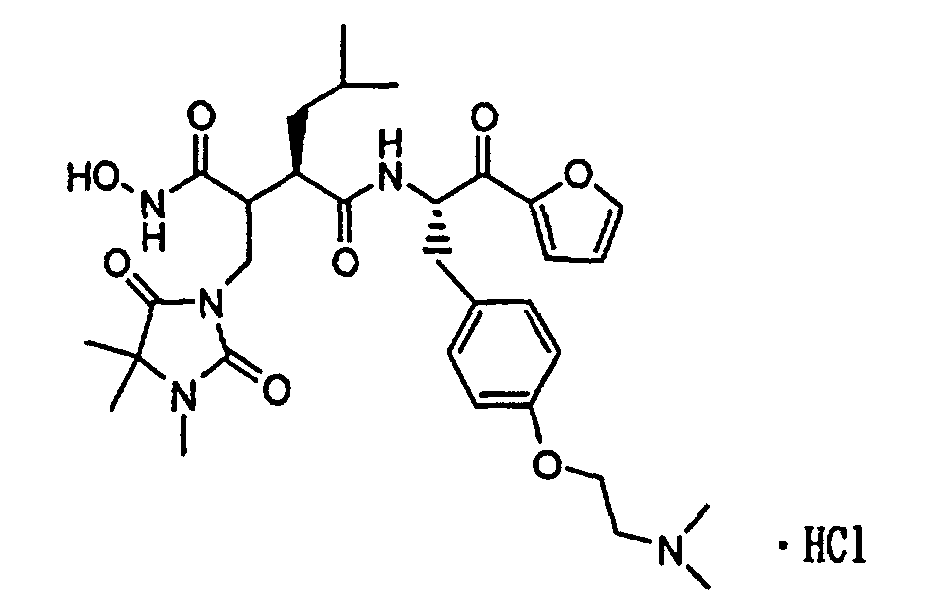
- According to the method of Jean-Alain Fehrentz et al. [Synthesis (1983) 676-678], N-(tert-butoxycarbonyl)-L-(O-benzyl)tyrosine and N,O-dimethylhydroxylamine hydrochloride were reacted, and the resulting product was purified by silica gel column chromatography (2:1 hexane-ethyl acetate) and recrystallized from ethyl acetate-hexane to give the title compound (yield 89%) as a white solid.
1H-NMR (300 MHz, CDCl3) δ 7.50-7.20 (m, 5H), 7.08 (d, J = 8.5 Hz, 2H), 6.89 (d, J = 8.5 Hz, 2H), 5.22-5.08 (m, 1H), 5.03 (s, 2H), 4.98-4.80 (m, 1H), 3.65 (br s, 3H), 3.16 (br s, 3H), 3.07-2.90 (m, 1H), 2.90-2.75 (m, 1H), 1.39 (s, 9H). - According to the method of Example 1(3), furan and the title compound of Example 5(1) were reacted, and the product was purified by silica gel column chromatography (1:1 hexane-ethyl acetate) and crystallized from hexane to give the title compound (yield 83%) as a yellow solid.
1H-NMR (300 MHz, CDCl3) δ 7.65-7.55 (m, 1H), 7.48-7.25 (m, 5H), 7.23 (d, J = 3.6 Hz, 1H), 7.00 (d, J = 8.4 Hz, 2H), 6.85 (d, J = 8.4 Hz, 2H), 6.60-6.45 (m, 1H), 5.38-5.15 (m, 2H), 5.02 (br s, 2H), 3.16 (dd, J = 13.6, 4.9 Hz, 1H), 2.98 (dd, J = 13.6, 5.3 Hz, 1H), 1.41 (s, 9H). - The title compound of Example 5(2) was treated in the same manner as in Example 1(4) and the product was crystallized from diethyl ether-hexane to give the title compound quantitatively as a brown solid.
1H-NMR (300 MHz, DMSO-d6) δ 8.60-8.20 (br, 3H), 8.08 (d, J = 1.6 Hz, 1H), 7.63 (d, J = 3.6 Hz, 1H), 7.50-7.25 (m, 5H), 7.09 (d, J = 8.6 Hz, 2H), 6.92 (d, J = 8.6 Hz, 2H), 6.75 (dd, J = 3.6, 1.6 Hz, 1H), 5.06 (s, 2H), 4.95 (t, J = 6.7 Hz, 1H), 3.07 (d,-J = 6.7 Hz, 2H). - In the same manner as in Example 1(5), 4-tert-butoxy-2(R)-isobutyl-3(R or S)-(2,5-dioxo-3,4,4-trimethyl-1-imidazolidinyl)methylsuccinic acid prepared according to the method described in JP-A-6-65196 and the title compound of Example 5(3) were reacted and the product was purified by silica gel column chromatography (1:1 hexane-ethyl acetate) to give the title compound (yield 68%) as an amorphous solid.
1H-NMR (300 MHz, DMSO-d6) δ 8.69 (d, J = 8.5 Hz, 1H), 8.04 (d, J = 1.6 Hz, 1H), 7.65 (d, J = 3.6 Hz, 1H), 7.45-7.25 (m, 5H), 7.26 (d, J = 8.5 Hz, 2H), 6.79 (d, J = 8.5 Hz, 2H), 6.74 (dd, J = 3.6, 1.6 Hz, 1H), 5.42-5.30 (m, 1H), 4.94 (s, 2H), 3.40-3.18 (m, 1H), 3.02 (dd, J = 13.8, 4.3 Hz, 1H), 2.90-2.70 (m, 1H), 2.65 (s, 3H), 2.70-2.40 (m, 2H), 2.19 (dd, J = 13.4, 4.4 Hz, 1H), 1.37-1.00 (m, 1H), 1.29 (s, 9H), 1.26 (s, 6H), 0.90-0.70 (m, 1H), 0.79 (d, J = 6.5 Hz, 3H), 0.68 (d, J = 6.5 Hz, 3H). - In the same manner as in Example 1(6), the title compound of Example 5(4) was subjected to catalytic hydrogenation and the resulting product was purified by silica gel column chromatography (50:1 chloroform-methanol) to give the title compound (yield 49%) as an amorphous solid.
1H-NMR (300 MHz, DMSO-d6) δ 9.04 (br s, 1H), 8.66 (d, J = 8.4 Hz, 1H), 8.03 (d, J = 1.6 Hz, 1H), 7.61 (d, J = 3.6 Hz, 1H), 7.10 (d, J = 8.0 Hz, 2H), 6.73 (dd, J = 3.6, 1.6 Hz, 1H), 6.52 (d, J = 8.0 Hz, 2H), 5.38-5.25 (m, 1H), 2.96 (dd, J = 13.8, 4.5 Hz, 1H), 2.88-2.65 (m, 1H), 2.76 (s, 3H), 2.65-2.40 (m, 2H), 2.21 (dd, J = 13.6, 4.6 Hz, 1H), 1.55-1.38 (m, 1H), 1.30 (s, 9H), 1.26 (s, 6H), 1.25-1.05 (m, 1H), 0.85-0.70 (m, 1H), 0.78 (d, J = 6.5 Hz, 3H), 0.68 (d, J = 6.5 Hz, 3H). - In the same manner as in Example 1(7), the title compound of Example 5(5) and 2-dimethylaminoethanol were reacted and the product was purified by silica gel column chromatography (20:1 chloroform-methanol) to give the title compound as an amorphous solid.
1H-NMR (300 MHz, CDCl3) δ 7.60 (d, J = 1.7 Hz, 1H), 7.28 (d, J = 3.6 Hz, 1H), 7.18 (d, J = 8.5 Hz, 1H), 7.10 (d, J = 8.5 Hz, 2H), 6.75 (d, J = 8.5 Hz, 2H), 6.52 (dd, J = 3.6, 1.7 Hz, 1H), 5.70-5.58 (m, 1H), 3.98 (t, J = 5.8 Hz, 2H), 3.43 (dd, J = 14.3, 4.9 Hz, 1H), 3.25 (dd, J = 14.3, 6.2 Hz, 1H), 3.20 (dd, J = 14.6, 6.1 Hz, 1H), 2.99 (dd, J = 14.6, 8.2 Hz, 1H), 2.85-2.75 (m, 1H), 2.70-2.55 (m, 1H), 2.67 (t, J = 5.8 Hz, 2H), 2.31 (s, 6H), 1.70-1.55 (m, 1H), 1.45-1.20 (m, 1H), 1.39 (s, 9H), 1.37 (s, 6H), 1.05-0.95 (m, 1H), 0.80 (d, J = 6.5 Hz, 3H), 0.76 (d, J = 6.5 Hz, 3H). - The title compound of Example 5(6) was treated in the same manner as in Example 1(8) to give the title compound as an amorphous solid.
1H-NMR (300 MHz, DMSO-d6) δ 8.69 (d, J = 8.3 Hz, 1H), 8.02 (d, J = 1.7 Hz, 1H), 7.59 (d, J = 3.5 Hz, 1H), 7.27 (d, J = 8.6 Hz, 2H), 6.81 (d, J = 8.6 Hz, 2H), 6.72 (dd, J = 3.5, 1.7 Hz, 1H), 5.40-5.28 (m, 1H), 4.20-4.00 (m, 2H), 3.40-3.28 (m, 1H), 3.28-3.15 (m, 2H), 3.04 (dd, J = 13.8, 5.6 Hz, 1H), 2.82 (s, 6H), 2.90-2.70 (m, 1H), 2.70-2.40 (m, 3H), 1.50-1.35 (m, 1H), 1.30-1.10 (m, 1H), 1.25 (s, 6H), 0.90-0.75 (m, 1H), 0.75 (d, J = 6.5 Hz, 3H), 0.67 (d, J = 6.5 Hz, 3H). - In the same manner as in Example 1(9), the title compound of Example 5(7) and O-2-tetrahydropyranylhydroxylamine were reacted, and the resulting product was purified by silica gel column chromatography (20:1 chloroform-methanol) and crystallized from hexane to give the title compound as a pale-yellow solid at an overall yield (3 steps) of 42% from the title compound of Example 5(5).
1H-NMR (300 MHz, DMSO-d6) δ 11.10-10.90 (m, 1H), 8.65-8.50 (m, 1H), 8.08-8.00 (m, 1H), 7.70-7.62 (m, 1H), 7.25 (d, J = 8.4 Hz, 2H), 6.88-6.63 (m, 3H), 5.38-5.20 (m, 1H), 4.12-3.95 (m, 2H), 3.95-3.70 (m, 1H), 33-3.10 (m, 1H), 3.08-2.95 (m, 1H), 2.85-2.05 (m, 10H), 2.20 (s, 6H), 1.70-1.05 (m, 14H), 0.90-0.70 (m, 1H), 0.76 (d, J = 6.5 Hz, 3H), 0.67 (d, J = 6.5 Hz, 3H). - The title compound of Example 5(8) was treated in the same manner as in Example 1(10) and diethyl ether was added to the reaction mixture. The precipitated solid was collected by filtration. The obtained solid was purified by reversed phase column chromatography (Chromatorex ODS DM-1020T, Fuji Silysia Chemical Ltd.; 17-33% acetonitrile-0.1% aqueous trifluoroacetic acid solution) and lyophilized. 0.1N Hydrochloric acid (20 ml) was added to the obtained residue and the mixture was again lyophilized to give the title compound (164 mg, 45%) as an amorphous solid.
1H-NMR (500 MHz, DMSO-d6) δ 10.37 (br s, 1H), 9.95-9.75 (br, 1H), 8.72-8.62 (br, 1H), 8.61 (d, J = 8.0 Hz, 1H), 8.01 (d, J = 1.7 Hz, 1H), 7.58 (d, J = 3.6 Hz, 1H), 7.27 (d, J = 8.6 Hz, 2H), 6.80 (d, J = 8.6 Hz, 2H), 6.72 (dd, J = 3.6, 1.7 Hz, 1H), 5.32-5.25 (m, 1H), 4.22-4.10 (m, 2H), 3.45-3.20 (m, 3H), 3.03 (dd, J = 13.9, 5.3 Hz, 1H), 2.88-2.80 (m, 1H), 2.81 (s, 6H), 2.76 (s, 3H), 2.57-2.45 (m, 2H), 2.40-2.30 (m, 1H), 1.43-1.35 (m, 1H), 1.25 (s, 3H), 1.23 (s, 3H), 1.20-1.10 (m, 1H), 0.85-0.75 (m, 1H), 0.74 (d, J = 6.6 Hz, 3H), 0.67 (d, J = 6.6 Hz, 3H). -
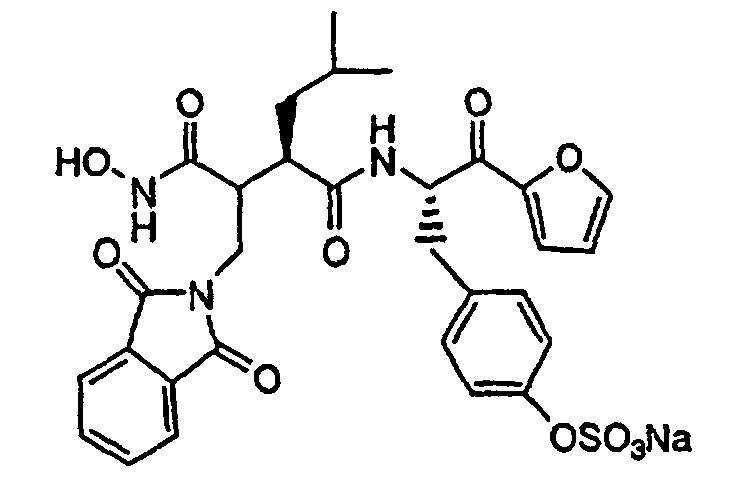
- In the same manner as in Example 1(5), 4-tert-butoxy-2(R)-isobutyl-3(R or S)-phthalimidomethylsuccinic acid and the title compound of Example 5(3) were reacted, and the resulting product was purified by silica gel column chromatography (2:1 hexane-ethyl acetate) and recrystallized from ethyl acetate-hexane to give the title compound (yield 56%) as a white solid.
1H-NMR (300 MHz, DMSO-d6) δ 8.73 (d, J = 8.8 Hz, 1H), 8.07 (d, J = 1.3 Hz, 1H), 7.90-7.73 (m, 4H), 7.73 (d, J = 3.4 Hz, 1H), 7.31 (d, J = 8.6 Hz, 2H), 7.25-7.10 (m, 3H), 6.98-6.85 (m, 2H), 6.80-6.70 (m, 3H), 5.55-5.40 (m, 1H), 4.57 (s, 2H), 3.45-3.25 (m, 1H), 3.06 (dd, J = 13.8, 4.0 Hz, 1H), 2.79 (dd, J = 13.8, 11.8 Hz, 1H), 2.64 (ddd, J = 11.2, 11.1, 5.0 Hz, 1H), 2.58-2.45 (m, 1H), 2.10 (dd, J = 13.7, 5.1 Hz, 1H), 1.55-1.38 (m, 1H), 1.25-0.95 (m, 1H), 1.07 (s, 9H), 0.90-0.60 (m, 1H), 0.78 (d, J = 6.5 Hz, 3H), 0.68 (d, J = 6.5 Hz, 3H). - In the same manner as in Example 1(6), the title compound of Example 6(1) was subjected to catalytic hydrogenation, and the product was purified by silica gel column chromatography (1:1 hexane-ethyl acetate) to give the title compound (yield 62%) as an amorphous solid.
1H-NMR (300 MHz, DMSO-d6) δ 8.82 (br s, 1H), 8.69 (d, J = 8.6 Hz, 1H), 8.05 (d, J = 1.7 Hz, 1H), 7.92-7.80 (m, 4H), 7.65 (d, J = 3.6 Hz, 1H), 7.11 (d, J = 8.4 Hz, 2H), 6.74 (dd, J = 3.6, 1.7 Hz, 1H), 6.48 (d, J = 8.4 Hz, 2H), 5.45-5.30 (m, 1H), 3.50-3.30 (m, 1H), 2.99 (dd, J = 13.8, 4.5 Hz, 1H), 2.75-2.60 (m, 1H), 2.73 (dd, J = 13.8, 11.1 Hz, 1H), 2.60-2.45 (m, 1H), 2.28 (dd, J = 13.7, 5.2 Hz, 1H), 1.55-1.38 (m, 1H), 1.32-1.05 (m, 1H), 1.09 (s, 9H), 0.90-0.70 (m, 1H), 0.78 (d, J = 6.5 Hz, 3H), 0.68 (d, J = 6.5 Hz, 3H). - The title compound of Example 6(2) was treated in the same manner as in Example 1(8) and the product was recrystallized from diethyl ether to give the title compound (yield 87%) as a white solid.
1H-NMR (300 MHz, DMSO-d6) δ 12.70-12.00 (br, 1H), 9.00-8.70 (br, 1H), 8.66 (d, J = 8.6 Hz, 1H), 8.05 (d, J = 1.6 Hz, 1H), 7.90-7.75 (m, 4H), 7.64 (d, J = 3.6 Hz, 1H), 7.11 (d, J = 8.4 Hz, 2H), 6.74 (dd, J = 3.6, 1.6 Hz, 1H), 6.48 (d, J = 8.4 Hz, 2H), 5.42-5.30 (m, 1H), 3.42 (dd, J = 13.7, 11.3 Hz, 1H), 2.99 (dd, J = 13.8, 4.5 Hz, 1H), 2.75-2.45 (m, 2H), 2.73 (dd, J = 13.8, 11.2 Hz, 1H), 2.38 (dd, J = 13.7, 4.8 Hz, 1H), 1.55-1.38 (m, 1H), 1.28-1.05 (m, 1H), 0.92-0.75 (m, 1H), 0.77 (d, J = 6.5 Hz, 3H), 0.68 (d, J = 6.5 Hz, 3H). - In the same manner as in Example 1(9), the title compound of Example 6(3) and O-2-tetrahydropyranylhydroxylamine were reacted and the resulting product was purified by silica gel column chromatography (20:1 chloroform-methanol) to give the title compound (yield 75%) as a white solid.
1H-NMR (300 MHz, DMSO-d6) δ 11.00-10.85 (m, 1H), 8.77 (br s, 1H), 8.70-8.55 (m, 1H), 8.10-8.00 (m, 1H), 7.90-7.75 (m, 4H), 7.68-7.60 (m, 1H), 7.11 (d, J = 8.3 Hz, 2H), 6.74 (dd, J = 3.6, 1.6 Hz, 1H), 6.46 (d, J = 8.3 Hz, 2H), 5.40-5.25 (m, 1H), 4.60-4.30 (m, 1H), 3.75-3.35 (m, 2H), 3.10-2.65 (m, 1H), 2.98 (dd, J = 13.9, 4.5 Hz, 1H), 2.73 (dd, J = 13.9, 11.0 Hz, 1H), 2.65-2.38 (m, 2H), 2.38-2.20 (m, 1H), 1.65-1.05 (m, 8H), 0.90-0.70 (m, 1H), 0.76 (d, J = 6.4 Hz, 3H), 0.67 (d, J = 6.4 Hz, 3H). - The title compound (500 mg, 0.77 mmol) of Example 6(4) was dissolved in DMF (3 ml) and a pyridine-sulfur trioxide complex (370 mg, 2.32 mmol) was added to the solution under ice-cooling. The mixture was stirred for 2 hr at room temperature.- A 1N aqueous sodium hydrogencarbonate solution (20 ml) was added to the reaction mixture and the mixture was stirred for 30 min at room temperature. The reaction mixture was purified by reversed phase column chromatography (Chromatorex ODS DM-1020T, Fuji Silysia Chemical Ltd.; 0-50% aqueous methanol solution) and lyophilized to give the title compound (528 mg, 91%) as an amorphous solid.
1H-NMR (300 MHz, DMSO-d6) δ 11.30-10.60 (br, 1H), 8.80-8.70 (m, 1H), 8.05-7.97 (m, 1H), 7.85-7.75 (m, 4H), 7.60-7.50 (m, 1H), 7.18 (d, J = 8.4 Hz, 2H), 6.93 (d, J = 8.4 Hz, 2H), 6.70 (dd, J = 3.6, 1.8 Hz, 1H), 5.32-5.20 (m, 1H), 4.60-4.35 (m, 1H), 3.80-3.20 (m, 3H), 3.10-2.95 (m, 1H), 2.93-2.70 (m, 2H), 2.70-2.50 (m, 2H), 1.60-1.10 (m, 8H), 0.90-0.75 (m, 1H), 0.77 (d, J = 6.4 Hz, 3H), 0.68 (d, J = 6.4 Hz, 3H). - To a solution of the title compound (200 mg, 0.27 mmol) of Example 6(5), water (1.5 ml) and methanol (3 ml) was added 1N hydrochloric acid (1.5 ml) and the mixture was stirred for 1.5 hr at room temperature. Then, 1N aqueous sodium hydrogencarbonate solution (1.5 ml) was added and the mixture was stirred for 30 min at room temperature. The reaction mixture was concentrated, and the obtained residue was purified by reversed phase column chromatography (Chromatorex ODS DM-1020T, Fuji Silysia Chemical Ltd.; 0-17% aqueous methanol solution) and lyophilized to give the title compound (94 mg, 53%) as an amorphous solid.
1H-NMR (300 MHz, DMSO-d6) δ 10.38 (br s, 1H), 8.72. (d, J = 8.0 Hz, 1H), 8.63 (br s, 1H), 8.03-7.95 (m, 1H), 7.87-7.75 (m, 4H), 7.52 (d, J = 3.5 Hz, 1H), 7.17 (d, J = 8.4 Hz, 2H), 6.93 (t, J = 8.4 Hz, 2H), 6.69 (dd, J = 3.5, 1.5 Hz, 1H), 5.30-5.18 (m, 1H), 3.80-3.60 (m, 1H), 3.02 (dd, J = 13.9, 5.5 Hz, 1H), 2.90-2.74 (m, 1H), 2.87 (dd, J = 13.9, 9.0 Hz, 1H), 2.70-2.50 (m, 2H), 1.52-1.32 (m, 1H), 1.30-1.10 (m, 1H), 0.92-0.75 (m, 1H), 0.77 (d, J = 6.4 Hz, 3H), 0.69 (d, J = 6.4 Hz, 3H). -

- To a suspension of L-4'-sulfophenylalanine (368 g, 1.50 mol) in water (2 L) was added sodium hydrogencarbonate (508 g, 6.05 mol) over 20 min under ice-cooling. Then, benzyl chloroformate (300 ml, 2.00 mol) was added dropwise over 20 min under ice-cooling, and the mixture was stirred for 4 hr at room temperature. The reaction mixture was washed with ethyl acetate (3×1 L) and filtrated. 6N Hydrochloric acid (1020 ml, 6.12 mol) was added to the filtrate under ice-cooling, and the obtained acidic aqueous solution was saturated with sodium chloride and extracted with THF (4×1 L). The THF solution was washed with saturated brine (2 L), dried over anhydrous magnesium sulfate and concentrated to give the title compound (509 g, 89%) as a white solid.
1H-NMR (300 MHz, DMSO-d6) δ 7.66 (d, J = 8.4 Hz, 1H), 7.52 (d, J = 8.1 Hz, 2H), 7.43-7.25 (m, 5H), 7.21 (d, J = 8.1 Hz, 2H), 4.98 (s, 2H), 4.27-4.13 (m, 1H), 3.07 (dd, J= 13.6, 4.4 Hz, 1H), 2.84 (dd, J= 13.6, 10.5Hz, 1H). - According to the method of Jean-Alain Fehrentz et al. [Synthesis (1983) 676-678], to a solution of the title compound (57.4 g, 151 mmol) of Example 7(1) dissolved in DMF (180 ml) were added N,O-dimethylhydroxylamine (17.7 g, 182 mmol) and BOP reagent (86.7 g, 196 mmol). Triethylamine (84 ml, 604 mmol) was added dropwise under ice-cooling and the mixture was stirred under ice-cooling for 30 min, and at room temperature for 5 hr. THF (1.5 L) was added to the reaction mixture, and the mixture was washed successively with a 2:1 mixed solution (1.2 L) of saturated aqueous sodium hydrogencarbonate solution and saturated brine and saturated brine (0.6 L), dried over anhydrous magnesium sulfate and concentrated. The residue was purified by silica gel column chromatography (10:1 chloroform-methanol) to give the title compound (37.1 g, 55%) as a white solid.
1H-NMR (300 MHz, DMSO-d6) δ 7.73 (d, J = 8.6 Hz, 1H), 7.52 (d, J = 8.0 Hz, 2H), 7.40-7.21 (m, 5H), 7.20 (d, J = 8.0 Hz, 2H), 4.95 (s, 2H), 4.70-4.50 (m, 1H), 3.74 (s, 3H), 3.11 (s, 3H), 2.89 (dd, J = 13.6, 4.3 Hz, 1H), 2.73 (dd, J = 13.6, 9.9 Hz, 1H). - To a solution of furan (10 ml, 137 mmol) dissolved in THF (90 ml) was added dropwise n-butyllithium (1.54M hexane solution, 65 ml, 100 mmol) at -70°C over 10 min and the mixture was stirred for 2 hr at -30°C. Then a solution of the title compound (7.42 g, 16.7 mmol) of Example 7(2) dissolved in THF (110 ml) was added dropwise at -70°C over 20 min and the mixture was stirred for 2 hr at -40°C. The reaction mixture was added to 1N hydrochloric acid (140 ml) saturated with sodium chloride to separate the organic layer from the aqueous layer. The aqueous layer was extracted with THF (2×200 ml). The organic layer and THF layer were combined, dried over anhydrous magnesium sulfate and concentrated. The residue was purified by silica gel column chromatography (10:1 chloroform-methanol) to give the title compound (6.65 g, 93%) as a brown oil.
1H-NMR (300 MHz, DMSO-d6) δ 8.10-8.00 (m, 1H), 7.92 (d, J = 8.5 Hz, 1H), 7.65-7.55 (m, 1H), 7.51 (d, J = 8.0 Hz, 2H), 7.40-7.18 (m, 7H), 6.78-6.67 (m, 1H), 5.05-4.95 (m, 3H), 3.05 (dd, J = 13.5, 4.4 Hz, 1H), 2.82 (dd, J = 13.5, 10.4 Hz, 1H). - A mixture of the title compound (7.63 g, 17.8 mmol) of Example 7(3), thioanisole (3.2 ml, 27.3 mmol) and'trifluoroacetic acid (26 ml) was stirred for 3 hr at room temperature.
Thioanisole (3.2 ml, 27.3 mmol) was added and the mixture was stirred for 1.5 hr at room temperature. Then, thioanisole (2.2 ml, 18.7 mmol) was added, and the mixture was stirred at room temperature for 1 hr. Diethyl ether (360 ml) was added to the reaction mixture and the precipitate was collected by filtration, and washed with diethyl ether. The obtained precipitate was reprecipitated from methanol-ethyl acetate to give the title compound (4.29 g, 59%) as a purple powder.
1H-NMR (300 MHz, DMSO-d6) δ 8.34 (br s, 3H), 8.13 (d, J = 1.2 Hz, 1H), 7.73 (d, J = 3.7 Hz, 1H), 7.53 (d, J = 8.0 Hz, 2H), 7.16 (d, J = 8.1 Hz, 2H), 6.80 (dd, J = 3.6, 1.6 Hz, 1H), 5.06-4.96 (m, 1H), 3.19 (dd, J = 14.2, 5.8Hz, 1H), 3.08 (dd, J = 14.2, 7.4Hz, 1H). - In the same manner as in Example 1(5), 4-tert-butoxy-2(R)-isobutyl-3(R or S)-(2-naphthylmethyl)succinic acid prepared according to the method described in JP-A-4-352757 and the title compound of Example 7(4) were reacted. After the completion of the reaction, ethyl acetate was added to the reaction mixture, and the mixture was washed successively with 1N hydrochloric acid saturated with sodium chloride, a 2:1 mixed solution of saturated aqueous sodium hydrogencarbonate solution and saturated brine and saturated brine, dried over anhydrous magnesium sulfate, and concentrated. The residue was purified by silica gel column chromatography (10:1 chloroform-methanol) to give the title compound (yield 96%) as a pale-yellow foam.
1H-NMR (300 MHz, DMSO-d6) δ 8.78 (d, J = 7.5 Hz, 1H), 8.00 (d, J = 1.4 Hz, 1H), 7.89-7.78 (m, 3H), 7.57 (d, J = 3.6 Hz, 1H), 7.55 (s, 1H), 7.49 (d, J = 8.2 Hz, 2H), 7.48-7.43 (m, 2H), 7.27 (d, J = 8.2 Hz, 2H), 7.23 (dd, J = 8.5, 1.5 Hz, 1H), 6.70 (dd, J = 3.6, 1.7 Hz, 1H), 5.39-5.26 (m, 1H), 3.13 (dd, J = 14.1, 5.2 Hz, 1H), 2.98 (dd, J = 14.2, 9.0 Hz, 1H), 2.78-2.65 (m, 3H), 2.65-2.54 (m, 1H), 1.64-1.49(m, 1H), 1.29-1.18 (m, 1H), 1.14 (s, 9H), 0.97-0.84 (m, 1H), 0.78 (d, J = 6.4 Hz, 3H), 0.72 (d, J = 6.5 Hz, 3H). - In the same manner as in Example 1(8), the title compound of Example 7(5) was dissolved in trifluoroacetic acid and the mixture was stirred for 1.5 hr at room temperature. The reaction mixture was concentrated, and diethyl ether was added to the residue to give the title compound (quantitatively) as a pale-green powder.
1H-NMR (300 MHz, DMSO-d6) δ 13.20-11.60 (br), 8.77 (d, J = 7.5 Hz, 1H), 8.00 (d, J = 1.4 Hz, 1H), 7.89-7.78 (m, 3H), 7.60-7.52 (m, 2H), 7.52-7.41 (m, 4H), 7.26 (d, J = 8.1 Hz, 2H), 7.22 (dd, J = 8.5, 1.5 Hz, 1H), 6.70 (dd, J=3.6, 1.6 Hz, 1H), 5.38-5.26 (m, 1H), 3.12 (dd, J = 14.0, 5.4 Hz, 1H), 2.98 (dd, J = 14.2, 9.0 Hz, 1H), 2.80-2.66 (m, 3H), 2.66-2.55 (m, 1H), 1.63-1.50 (m, 1H), 1.31-1.16 (m, 1H), 1.01-0.89 (m, 1H), 0.78 (d, J = 6.4 Hz) and 0.72 (d, J = 6.5 Hz) (6H total). - In the same manner as in Example 1(9), the title compound of Example 7(6) and O-2-tetrahydropyranylhydroxylamine were reacted. After the completion of the reaction, the reaction mixture was diluted with THF, washed successively with a 2:1 mixed solution of saturated aqueous sodium hydrogencarbonate solution and saturated brine and saturated brine, dried over anhydrous magnesium sulfate, and concentrated. The residue was triturated with diethyl ether to give the title compound (quantitatively) as a pale-yellow powder.
1H-NMR (300 MHz, DMSO-d6) δ 10.93 (s) and 10.90 (s) (1H total), 8.87-8.73 (m, 1H), 8.06-7.09 (m, 13H), 6.73-6.66 (m, 1H), 5.38-5.20 (m, 1H), 4.70 (s) and 4.24 (s) (1H total), 3.71-2.37 (m, 8H), 1.68-1.17 (m, 8H), 1.03-0.91 (m, 1H), 0.83-0.66 (m, 6H). - The title compound of Example 7(7) was treated in the same manner as in Example 6(6) and the product was purified by reversed phase column chromatography (Chromatorex ODS DM-1020T, Fuji Silysia Chemical Ltd.; 0-25% aqueous methanol solution). The resulting product was concentrated and triturated with diethyl ether to give the title compound (yield 16%) as a white powder.
1H-NMR (300 MHz, DMSO-d6) δ 10.27 (br s, 1H), 8.77 (d, J = 7.4Hz, 1H), 8.63 (br s, 1H), 7.99 (d, J = 1.1 Hz, 1H), 7.88-7.81 (m, 2H), 7.77 (d, J = 8.4 Hz, 1H), 7.53 (d, J = 3.6 Hz, 1H), 7.52-7.38 (m, 5H), 7.25 (d, J = 8.1 Hz, 2H), 7.14 (dd, J = 8.4, 1.0 Hz, 1H), 6.69 (dd, J = 3.5, 1.6 Hz, 1H), 5.38-5.22 (m, 1H), 3.12 (dd, J = 14.3, 5.7 Hz, 1H), 2.97 (dd, J = 14.3, 8.6 Hz,1H), 2.90-2.76 (m, 1H), 2.70-2.58 (m, 1H), 2.58-2.37 (m, 2H), 1.52-1.38 (m, 1H), 1.35-1.16 (m, 1H), 1.00-0.88 (m, 1H), 0.78 (d, J = 6.4 Hz) and 0.71 (d, J = 6.5 Hz) (6H total). -

- In the same manner as in Example 7(5)-(8), the title compound was obtained as a white amorphous solid from 4-tert-butoxy-2(R)-isobutyl-3(R or S)-(1-naphthylmethyl)succinic acid prepared according to the method described in JP-A-4-352757 and the title compound of Example 7(4), at an overall yield (4 steps) of 9%.
1H-NMR (300 MHz, DMSO-d6) δ 10.12 (s, 1H), 8.93 (d, J = 7.2 Hz, 1H), 8.55 (s, 1H), 8.02-7.92 (m, 2H), 7.88 (d, J = 7.6 Hz, 1H), 7.74 (d, J = 8.2 Hz, 1H), 7.59-7.46 (m, 3H), 7.41 (d, J = 8.1 Hz, 2H), 7.38-7.32 (m, 1H), 7.21 (d, J = 8.1 Hz, 2H), 7.17 (d, J = 7.0 Hz, 1H), 6.66 (dd, J = 3.6, 1.6 Hz, 1H), 5.46-5.34 (m, 1H), 3.25-3.13 (m, 1H), 3.13-2.97 (m, 3H), 2.79-2.66 (m, 1H), 2.61-2.47 (m, 1H), 1.53-1.39 (m, 1H), 1.37-1.21 (m, 1H), 1.01-0.87 (m, 1H), 0.78 (d, J = 6.4 Hz) and 0.72 (d, J = 6.5 Hz) (6H total). -

- In the same manner as in Example 7(5)-(8), the title compound was obtained as a white amorphous solid from 3(R or S)-benzyl-4-tert-butoxy-2(R)-isobutylsuccinic acid prepared according to the method described in JP-A-4-352757 and JP-A-7-157470 and the title compound of Example 7(4), at an overall yield (4 steps) of 16%.
1H-NMR(300 MHz, DMSO-d6) δ 10.28 (br s, 1H), 8.77 (d, J = 9.9 Hz, 1H), 8.66 (br s, 1H), 7.99 (d, J = 1.4Hz, 1H), 7.53 (d, J = 3.6 Hz, 1H), 7.46 (d, J = 8.0 Hz, 2H), 7.32-7.17 (m, 4H), 7.17-7.08 (m, 1H), 6.95 (d, J = 7.1 Hz, 2H), 6.69 (dd, J = 3.6, 1.6Hz, 1H), 5.34-5.23 (m, 1H), 3.10 (dd, J = 14.4, 5.5 Hz, 1H), 2.94 (dd, J = 14.4, 8.7 Hz, 1H), 2.75-2.54 (m, 2H), 2.40-2.26 (m, 2H), 1.48-1.36 (m, 1H), 1.33-1.13 (m, 1H), 0.97-0.83 (m, 1H), 0.77 (d, J = 6.4 Hz) and 0.70 (d, J = 6.5 Hz) (6H total). -

- In the same manner as in Example 7(5)-(8), the title compound was obtained as a white powder from 4-tert-butoxy-2(R)-isobutyl-3(R or S)-phthalimidomethylsuccinic acid prepared according to the method described in JP-A-4-352757 and JP-A-7-157470 and the title compound of Example 7(4), at an overall yield (4 steps) of 24%.
1H-NMR (300 MHz, DMSO-d6) δ 10.38 (s, 1H), 8.73 (d, J = 7.7 Hz, 1H), 8.61 (s, 1H), 7.98 (d, J = 1.4 Hz, 1H), 7.79 (s, 4H), 7.50 (d, J = 3.3 Hz, 1H), 7.39 (d, J = 8.0 Hz, 2H), 7.21 (d, J = 8.0 Hz, 2H), 6.68 (dd, J = 3.5, 1.65 Hz, 1H), 5.25 (q, J = 6.4Hz, 1H), 3.70 (dd, J= 13.4, 10.20 Hz, 1H), 3.07 (dd, J = 13.9, 6.18 Hz, 1H), 2.94-2.82 (m, 2H), 2.62-2.54 (m, 2H), 1.40 (m, 1H), 1.18 (m, 1H), 0.85 (t, J = 12.5 Hz, 1H), 0.76 (d, J = 6.5Hz, 3H), 0.68 (d, J = 6.5 Hz, 3H). -

- To a solution of 4-tert-butoxy-2(R)-isobutyl-3(R or S)-phthalimidomethylsuccinic acid (10.7 g, 27.4 mmol) prepared according to the method decribed in JP-A-4-352757 and JP-A-7-157470, benzyl alcohol (3.26 g, 30.1 mmol), methylene chloride (20 ml) and DMF (20 ml) were added successively HOBt·H2O (4.19 g, 27.4 mmol), 1-(3-dimethylaminopropyl)-3-ethylcarbodiimide hydrochloride (6.83 g, 35.6 mmol), N-methylmorpholine (9.02 ml, 82.8 mmol) and 4-dimethylaminopyridine (1.67 g, 13.7 mmol), and the mixture was stirred for 69 hr at room temperature. Ethyl acetate and diethyl ether were added to the reaction mixture and the mixture was washed successively with dilute hydrochloric acid, dilute aqueous sodium hydrogencarbonate solution and water, dried over anhydrous magnesium sulfate and concentrated. The obtained residue was purified by silica gel column chromatography (10:1 hexane-ethyl acetate) to give the title compound (12.6 g, 96%) as a transparent liquid.
1H-NMR (300 MHz, DMSO-d6) δ 7.97-7.80 (m, 4H), 7.42-7.27 (m, 5H), 5.18-5.02 (m, 2H), 3.94 (dd, J = 13.8, 9.8 Hz, 1H), 3.59 (dd, J = 13.8, 5.7 Hz, 1H), 3.20-3.01 (m, 1H), 2.80-2.67 (m, 1H), 1.70-1.40 (m, 2H), 1.30-1.10 (m, 10H), 0.92-0.70 (m, 6H). - A mixture of the title compound (12.2 g, 25.4 mmol) of Example 11(1), Lawesson's reagent (3.00 g, 7.41 mmol) and toluene (100 ml) was stirred for 2.5 hr under reflux with heating. Lawesson's reagent (2.66 g, 6.58 mmol) was added and the mixture was stirred for 1.5 hr under reflux with heating. The reaction mixture was cooled to room temperature and purified by silica gel column chromatography (25:1 hexane-ethyl acetate) to give the title compound (6.17 g, 49%) as a red-brown liquid.
1H-NMR (300 MHz, DMSO-d6) δ 8.00-7.80 (m, 4H), 7.45-7.28 (m, 5H), 5.20-5.05 (m, 2H), 4.34 (dd, J = 13.7, 9.9 Hz, 1H), 3.95 (dd, J = 13.7, 5.8 Hz, 1H), 3.35-3.20 (m, 1H), 2.83-2.62 (m, 1H), 1.70-1.40 (m, 2H), 1.28-1.13 (m, 10H), 0.92-0.77 (m, 6H). - To a solution of the title compound (6.03 g, 12.2 mmol) of Example 11(2) dissolved in ethanol (100 ml) was added Raney nickel (112 g) and the mixture was stirred for 2.5 hr under reflux with heating. Raney nickel (112 g) was added and the mixture was stirred for 2.5 hr under reflux with heating. The reaction mixture was filtrated and the filtrate was concentrated. The residue was dissolved in chloroform, dried over anhydrous magnesium sulfate and concentrated. The obtained residue was purified by silica gel column chromatography (1:0-5:1 chloroform-methanol) and precipitated from ethyl acetate-hexane to give the title compound (1.31 g, 29%) as a pale-yellow solid.
1H-NMR (300 MHz, DMSO-d6) δ 7.70-7.40 (m, 4H), 4.51-4.30 (m, 2H), 3.84 (dd, J = 13.6, 10.1 Hz, 1H), 3.51 (dd, J = 13.6, 5.3 Hz, 1H), 2.94-2.80 (m, 1H), 2.60-2.50 (m, 1H), 1.70-1.42 (m, 2H), 1.25 (s, 9H), 1.20-1.03 (m, 1H), 0.95-0.80 (m, 6H). - In the same manner as in Example 7(5)-(8), the title compound was obtained as a white powder from the title compound of Example 11(3) and the title compound of Example 7(4), at an overall yield (4 steps) of 23%.
1H-NMR (300 MHz, DMSO-d6) δ 10.52-10.41 (m, 1H), 8.80-8.69 (m, 2H), 8.00-7.90 (m, 1H), 7.70-7.38 (m, 7H), 7.19 (d, J = 8.0 Hz, 2H), 6.70-6.60 (m, 1H), 5.30-5.17 (m, 1H), 4.40-4.12 (m, 2H), 3.57-3.40 (m, 1H), 3.30-3.16 (m, 1H), 3.15-3.05 (m, 1H), 3.00-2.88 (m, 1H), 2.75-2.48 (m, 2H), 1.50-1.35 (m, 1H), 1.30-1.11 (m, 1H), 1.00-0.82 (m, 1H), 0.78-0.61 (m, 6H). - The compounds of the above Examples are shown in the following Table 1.
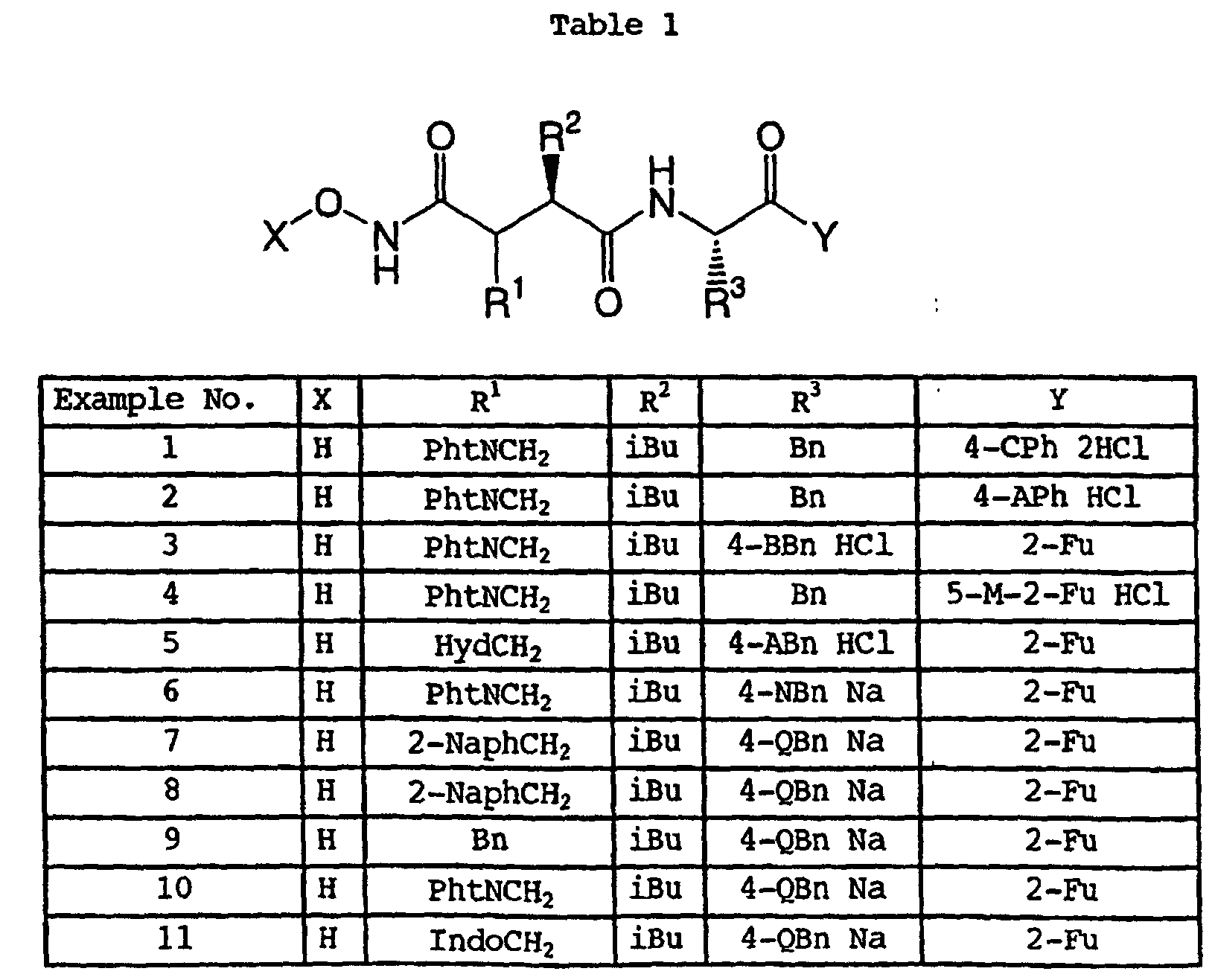
- In the same manner as in Examples 1 - 11, the compounds of Examples 12 - 323 were synthesized.
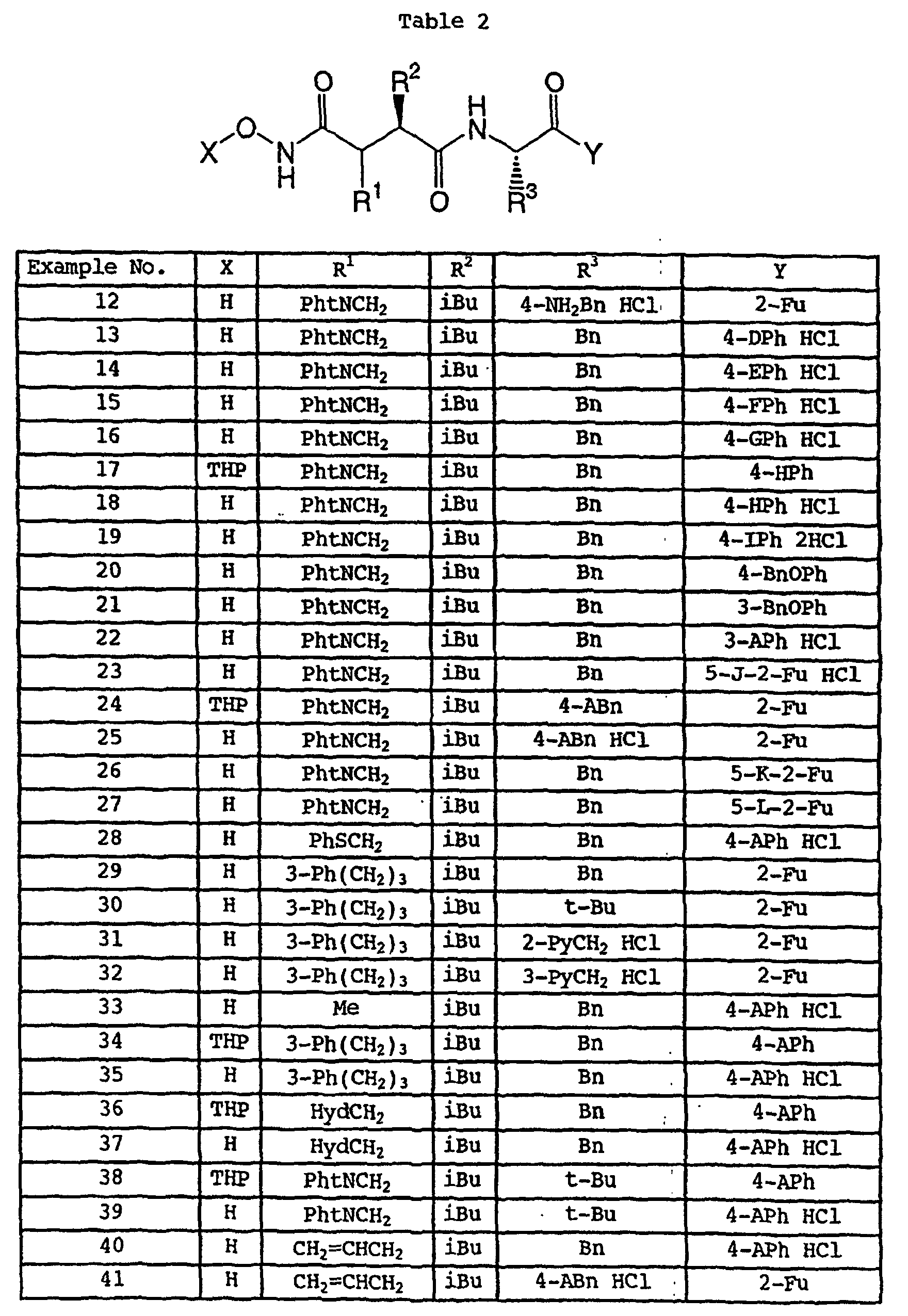
Example No. X R1 R2 R3 Y 42 H Me iBu 4-ABn HCl 2-Fu 43 THP 3-Ph(CH2)3 iBu 4-ABn 2-Fu 44 H 3-Ph(CH2)3 iBu 4-ABn HCl 2-Fu 45 THP 3-Ph(CH2)3 iBu Bn 2-Thio 46 H 3-Ph(CH2)3 iBu Bn 2-Thio 47 H 3-Ph(CH2)3 iBu Bn 2-Pyrr 48 H 3-Ph(CH2)3 iBu Bn Ph 49 H 3-Ph(CH2)3 iBu Bn 4-MeOPh 50 THP 3-Ph(CH2)3 iBu Bn 4-Me2NPh 51 H 3-Ph(CH2)3 iBu Bn 4-Me2NPh 52 H 3-Ph(CH2)3 iBu t-Bu 2-Pyrr 53 THP PhtNCH2 iBu 4-ABn 2-Thio 54 H PhtNCH2 iBu 4-ABn HCl 2-Thio 55 H 3-Ph(CH2)3 iBu 4-ABn HCl 2-Thio 56 H Me iBu 4-ABn HCl 2-Thio 57 H CH2=CHCH2 iBu 4-ABn HCl 2-Thio 58 H HydCH2 iBu 4-ABn HCl 2-Thio 59 THP PhtNCH2 iBu 4-ABn 2-Pyrr 60 H PhtNCH2 iBu 4-ABn HCl 2-Pyrr 61 H 3-Ph(CH2)3 iBu 4-ABn HCl 2-Pyrr 62 H Me iBu 4-ABn HCl 2-Pyrr 63 H CH2=CHCH2 iBu 4-ABn HCl 2-Pyrr 64 THP HydCH2 iBu 4-ABn 2-Pyrr 65 H HydCH2 iBu 4-ABn HCl 2-Pyrr 66 H PhtNCH2 iBu 4-ABn HCl Ph 67 H 3-Ph(CH2)3 iBu 4-ABn HCl Ph 68 H Me iBu 4-ABn HCl Ph 69 H CH2=CHCH2 iBu 4-ABn HCl Ph 70 H HydCH2 iBu 4-ABn HCl Ph 71 THP PhtNCH2 iBu 4-ABn 4-MeOPh 72 H PhtNCH2 iBu 4-ABn HCl 4-MeOPh 73 H 3-Ph(CH2)3 iBu 4-ABn HCl 4-MeOPh 74 H Me iBu 4-ABn HCl 4-MeOPh 75 H CH2=CHCH2 iBu 4-ABn HCl 4-MeOPh 76 H HydCH2 iBu 4-ABn HCl 4-MeOPh 77 THP PhtNCH2 iBu 4-ABn 4-Me2NPh 78 H PhtNCH2 iBu 4-ABn HCl 4-Me2NPh 79 H 3-Ph(CH2)3 iBu 4-ABn HCl 4-Me2NPh 80 H Me iBu 4-ABn HCl 4-Me2NPh 81 H CH2=CHCH2 iBu 4-ABn HCl 4-Me2Nph 82 H HydCH2 iBu 4-ABn HCl 4-Me2NPh Example No. X R1 R2 R3 Y 83 THP HydCH2 iBu 4-NBn Na 2-Fu 84 H HydCH2 iBu 4-NBn Na 2-Fu 85 H Me iBu t-Bu 4-APh HCl 86 H CH2=CHCH2 iBu t-Bu 4-APh HCl 87 THP 3-Ph (CH2)3 iBu t-Bu 4-APh 88 H 3-Ph(CH2)3 iBu t-Bu 4-APh HCl 89 THP 2-NaphCH2 iBu t-Bu 4-APh 90 H 2-NaphCH2 iBu t-Bu 4-APh HCl 91 H 3-Ph(CH2)3 iBu 4-NBn Na 2-Fu 92 H Me iBu 4-NBn Na 2-Fu 93 H CH2=CHCH2 iBu 4-NBn Na 2-Fu 94 H PhtNCH2 iBu 4-NBn Na 2-Thio 95 H 3-Ph(CH2)3 iBu 4-NBn Na 2-Thio 96 H HydCH2 iBu 4-NBn Na 2-Thio 97 H PhtNCH2 iBu 4-NBn Na 2-Pyrr 98 H 3-Ph(CH2)3 iBu 4-NBn Na 2-Pyrr 99 H HydCH2 iBu 4-NBn Na 2-Pyrr 100 H PhtNCH2 iBu 4-NBn Na Ph 101 H 3-Ph(CH2)3 iBu 4-NBn Na Ph 102 H HydCH2 iBu 4-NBn Na Ph 103 H PhtNCH2 iBu 4-NBn Na 4-MeOPh 104 H 3-Ph(CH2)3 iBu 4-NBn Na 4-MeOPh 105 H HydCH2 iBu 4-NBn Na 4-MeOPh 106 H PhtNCH2 iBu 4-NBn Na 4-Me2NPh 107 H 3-Ph(CH2)3 iBu 4-NBn Na 4-Me2NPh 108 H HydCH2 iBu 4-NBn Na 4-Me2NPh 109 H PhtNCH2 iBu 4-ABn HCl 3-Fu 110 H 3-Ph(CH2)3 iBu 4-ABn HCl 3-Fu 111 THP 2-NaphCH2 iBu Bn 4-APh 112 H 2-NaphCH2 iBu Bn 4-APh HCl 113 H 1-NaphCH2 iBu Bn 4-APh HCl 114 H Bn iBu Bn 4-APh HCl 115 H IndoCH2 iBu Bn 4-APh HCl 116 THP 2-NaphCH2 iBu 4-ABn 2-Fu 117 H 2-NaphCH2 iBu 4-ABn HCl 2-Fu 118 H 1-NaphCH2 iBu 4-ABn HCl 2-Fu 119 H Bn iBu 4-ABn HCl 2-Fu 120 H IndoCH2 iBu 4-ABn HCl 2-Fu 121 THP 2-NaphCH2 iBu 4-ABn 2-Thio 122 H 2-NaphCH2 iBu 4-ABn HCl 2-Thio 123 H 1-NaphCH2 iBu 4-ABn HCl 2-Thio Example No. X R1 R2 R3 Y 124 H Bn iBu 4-ABn HCl 2-Thio 125 H IndoCH2 iBu 4-ABn HCl 2-Thio 126 THP 2-NaphCH2 iBu 4-ABn 2-Pyrr 127 H 2-NaphCH2 iBu 4-ABn HCl 2-Pyrr 128 H 1-NaphCH2 iBu 4-ABn HCl 2-Pyrr 129 H Bn iBu 4-ABn HCl 2-Pyrr 130 H IndoCH2 iBu 4-ABn HCl 2-Pyrr 131 THP 2-NaphCH2 iBu 4-ABn Ph 132 H 2-NaphCH2 iBu 4-ABn HCl Ph 133 H 1-NaphCH2 iBu 4-ABn HCl Ph 134 H Bn iBu 4-ABn HCl Ph 135 H IndoCH2 iBu 4-ABn HCl Ph 136 THP 2-NaphCH2 iBu 4-ABn 4-MeOPh 137 H 2-NaphCH2 iBu 4-ABn HCl 4-MeOPh 138 H 1-NaphCH2 iBu 4-ABn HCl 4-MeOPh 139 H Bn iBu 4-ABn HCl 4-MeOPh 140 H IndoCH2 iBu 4-ABn HCl 4-MeOPh 141 THP 2-NaphCH2 iBu 4-ABn 4-Me2NPh 142 H 2-NaphCH2 iBu 4-ABn HCl 4-Me2NPh 143 H 1-NaphCH2 iBu 4-ABn HCl 4-Me2NPh 144 H Bn iBu 4-ABn HCl 4-Me2NPh 145 H IndoCH2 iBu 4-ABn HCl 4-Me2NPh 146 THP HydCH2 iBu t-Bu 4-APh 147 H HydCH2 iBu t-Bu 4-APh HCl 148 H 1-NaphCH2 iBu t-Bu 4-APh HCl 149 H Bn iBu t-Bu 4-APh HCl 150 H IndoCH2 iBu t-Bu 4-APh HCl 151 THP 2-NaphCH2 iBu 4-NBn Na 2-Fu 152 H 2-NaphCH2 iBu 4-NBn Na 2-Fu 153 H 1-NaphCH2 iBu 4-NBn Na 2-Fu 154 H Bn iBu 4-NBn Na 2-Fu 155 H IndoCH2 iBu 4-NBn Na 2-Fu 156 H Me iBu 4-NBn Na 2-Thio 157 H CH2=CHCH2 iBu 4-NBn Na 2-Thio 158 THP 2-NaphCH2 iBu 4-NBn Na 2-Thio 159 H 2-NaphCH2 iBu 4-NBn Na 2-Thio 160 H 1-NaphCH2 iBu 4-NBn Na 2-Thio 161 H Bn iBu 4-NBn Na 2-Thio 162 H IndoCH2 iBu 4-NBn Na 2-Thio 163 H Me iBu 4-NBn Na 2-Pyrr 164 H CH2=CHCH2 iBu 4-NBn Na 2-Pyrr Example No. X R1 R2 R3 Y 165 THP 2-NaphCH2 iBu 4-NBn Na 2-Pyrr 166 H 2-NaphCH2 iBu 4-NBn Na 2-Pyrr 167 H 1-NaphCH2 iBu 4-NBn Na 2-Pyrr 168 H Bn iBu 4-NBn Na 2-Pyrr 169 H IndoCH2 iBu 4-NBn Na 2-Pyrr 170 B Me iBu 4-NBn Na Ph 171 H CH2=CHCH2 iBu 4-NBn Na Ph 172 THP 2-NaphCH2 iBu 4-NBn Na Ph 173 H 2-NaphCH2 iBu 4-NBn Na Ph 174 H 1-NaphCH2 iBu 4-NBn Na Ph 175 H Bn iBu 4-NBn Na Ph 176 H IndoCH2 iBu 4-NBn Na Ph 177 H Me iBu 4-NBn Na 4-MeOPh 178 H CH2=CHCH2 iBu 4-NBn Na 4-MeOPh 179 THP 2-NaphCH2 iBu 4-NBn Na 4-MeOPh 180 H 2-NaphCH2 iBu 4-NBn Na 4-MeOPh 181 H 1-NaphCH2 iBu 4-NBn Na 4-MeOPh 182 H Bn iBu 4-NBn Na 4-MeOPh 183 H IndoCH2 iBu 4-NBn Na 4-MeOPh 184 H Me iBu 4-NBn Na 4-Me2NPh 185 H CH2=CHCH2 iBu 4-NBn Na 4-Me2NPh 186 THP 2-NaphCH2 iBu 4-NBn Na 4-Me2NPh 187 H 2-NaphCH2 iBu 4-NBn Na 4-Me2NPh 188 H 1-NaphCH2 iBu 4-NBn Na 4-Me2NPh 189 H Bn iBu 4-NBn Na 4-Me2NPh 190 H IndoCH2 iBu 4-NBn Na 4-Me2NPh 191 H 3-Ph(CH2)3 iBu 4-QBn Na 2-Fu 192 H Me iBu 4-QBn Na 2-Fu 193 H CH2=CHCH2 iBu 4-QBn Na 2-Fu 194 H HydCH2 iBu 4-QBn Na 2-Fu 195 H PhtNCH2 iBu 4-QBn Na 2-Thio 196 H 3-Ph(CH2)3 iBu 4-QBn Na 2-Thio 197 H Me iBu 4-QBn Na 2-Thio 198 H CH2=CHCH2 iBu 4-QBn Na 2-Thio 199 H HydCH2 iBu 4-QBn Na 2-Thio 200 THP 2-NaphCH2 iBu 4-QBn Na 2-Thio 201 H 2-NaphCH2 iBu 4-QBn Na 2-Thio 202 H 1-NaphCH2 iBu 4-QBn Na 2-Thio 203 H Bn iBu 4-QBn Na 2-Thio 204 H IndoCH2 iBu 4-QBn Na 2-Thio 205 H PhtNCH2 iBu 4-QBn Na 2-Pyrr Example No. X R1 R2 R3 Y 206 H 3-Ph(CH2)3 iBu 4-QBn Na 2-Pyrr 207 H Me iBu 4-QBn Na 2-Pyrr 208 H CH2=CHCH2 iBu 4-QBn Na 2-Pyrr 209 H HydCH2 iBu 4-QBn Na 2-Pyrr 210 THP 2-NaphCH2 iBu 4-QBn Na 2-Pyrr 211 H 2-NaphCH2 iBu 4-QBn Na 2-Pyrr 212 H 1-NaphCH2 iBu 4-QBn Na 2-Pyrr 213 H Bn iBu 4-QBn Na 2-Pyrr 214 H IndoCH2 iBu 4-QBn Na 2-Pyrr 215 H PhtNCH2 iBu 4-QBn Na Ph 216 H 3-Ph(CH2)3 iBu 4-QBn Na Ph 217 H Me iBu 4-QBn Na Ph 218 H CH2=CHCH2 iBu 4-QBn Na Ph 219 H HydCH2 iBu 4-QBn Na Ph 220 THP 2-NaphCH2 iBu 4-QBn Na Ph 221 H 2-NaphCH2 iBu 4-QBn Na Ph 222 H 1-NaphCH2 iBu 4-QBn Na Ph 223 H Bn iBu 4-QBn Na Ph 224 H IndoCH2 iBu 4-QBn Na Ph 225 H PhtNCH2 iBu 4-QBn Na 4-MeOPh 226 H 3-Ph(CH2)3 iBu 4-QBn Na 4-MeOPh 227 H Me iBu 4-QBn Na 4-MeOPh 228 H CH2=CHCH2 iBu 4-QBn Na 4-MeOPh 229 H HydCH2 iBu 4-QBn Na 4-MeOPh 230 THP 2-NaphCH2 iBu 4-QBn Na 4-MeOPh 231 H 2-NaphCH2 iBu 4-QBn Na 4-MeOPh 232 H 1-NaphCH2 iBu 4-QBn Na 4-MeOPh 233 H Bn iBu 4-QBn Na 4-MeOPh 234 H IndoCH2 iBu 4-QBn Na 4-MeOPh 235 H PhtNCH2 iBu 4-QBn Na 4-Me2NPh 236 H 3-Ph(CH2)3 iBu 4-QBn Na 4-Me2NPh 237 H Me iBu 4-QBn Na 4-Me2NPh 238 H CH2=CHCH2 iBu 4-QBn Na 4-Me2NPh 239 H HydCH2 iBu 4-QBn Na 4-Me2NPh 240 THP 2-NaphCH2 iBu 4-QBn Na 4-Me2NPh 241 H 2-NaphCH2 iBu 4-QBn Na 4-Me2NPh 242 H 1-NaphCH2 iBu 4-QBn Na 4-Me2NPh 243 H Bn iBu 4-QBn Na 4-Me2NPh 244 H IndoCH2 iBu 4-QBn Na 4-Me2NPh 245 H HydCH2 iBu Bn 5-L-2-Fu 246 H 3-Ph(CH2)3 iBu Bn 5-L-2-Fu Example No. X R1 R2 R3 Y 247 H HydCH2 iBu 4-ABn HCl 3-Fu 248 H 2-NaphCH2 iBu 4-ABn HCl 3-Fu 249 H IndoCH2 iBu 4-ABn HCl 3-Fu 250 H PhthNCH2 iBu 4-NBn Na 3-Fu 251 H 3-Ph(CH2)3 iBu 4-NBn Na 3-Fu 252 H HydCH2 iBu 4-NBn Na 3-Fu 253 H 2-NaphCH2 iBu 4-NBn Na 3-Fu 254 H IndoCH2 iBu 4-NBn Na 3-Fu 255 H PhtNCH2 iBu 4-QBn Na 3-Fu 256 H 3-Ph(CH2)3 iBu 4-QBn Na 3-Fu 257 H HydCH2 iBu 4-QBn Na 3-Fu 258 H 2-NaphCH2 iBu 4-QBn Na 3-Fu 259 H IndoCH2 iBu 4-QBn Na 3-Fu 260 H PhtNCH2 iBu 4-ABn HCl 2-Thia 261 H 2-NaphCH2 iBu 4-ABn HCl 2-Thia 262 H IndoCH2 iBu 4-ABn HCl 2-Thia 263 H PhtNCH2 iBu 4-NBn Na 2-Thia 264 H 2-NaphCH2 iBu 4-NBn Na 2-Thia 265 H IndoCH2 iBu 4-NBn Na 2-Thia 266 H PbtNCH2 iBu 4-QBn Na 2-Thia 267 H 2-NaphCH2 iBu 4-QBn Na 2-Thia 268 H IndoCH2 iBu 4-QBn Na 2-Thia 269 H PhtNCH2 iBu 4-ABn HCl 3-Py 270 H 3-Ph(CH2)3 iBu 4-ABn HCl 3-Py 271 H HydCH2 iBu 4-ABn HCl 3-Py 272 H 2-NaphCH2 iBu 4-ABn HCl 3-Py 273 H IndoCH2 iBu 4-ABn HCl 3-Py 274 H PhtNCH2 iBu 4-NBn Na 3-Py 275 H 3-Ph(CH2)3 iBu 4-NBn Na 3-Py 276 H HydCH2 iBu 4-NBn Na 3-Py 277 H 2-NaphCH2 iBu 4-NBn Na 3-Py 278 H IndoCH2 iBu 4-NBn Na 3-Py 279 H PhtNCH2 iBu 4-QBn Na 3-Py 280 H 3-Ph(CH2)3 iBu 4-QBn Na 3-Py 281 H HydCH2 iBu 4-QBn Na 3-Py 282 H 2-NaphCH2 iBu 4-QBn Na 3-Py 283 H IndoCH2 iBu 4-QBn Na 3-Py 284 H PhtNCH2 iBu Bn 4-UPh Na 285 H 3-Ph(CH2)3 iBu Bn 4-UPh Na 286 H HydCH2 iBu Bn 4-UPh Na 287 H 2-NaphCH2 iBu Bn 4-UPh Na Example No. X R1 R2 R3 Y 288 H IndoCH2 iBu Bn 4-UPh Na 289 H PhtNCH2 iBu Bn 4-VPh Na 290 H 3-Ph(CH2)3 iBu Bn 4-VPh Na 291 H HydCH2 iBu Bn 4-VPh Na 292 H 2-NaphCH2 iBu Bn 4-VPh Na 293 H IndoCH2 iBu Bn 4-VPh Na 294 H PhtNCH2 iBu Bn 4-WPh Na 295 H 3-Ph(CH2)3 iBu Bn 4-WPh Na 296 H HydCH2 iBu Bn 4-WPh Na 297 H 2-NaphCH2 iBu Bn 4-WPh Na 298 H IndoCH2 iBu Bn 4-WPh Na 299 H PhtNCH2 iBu Bn 5-X-2-Fu Na 300 H 3-Ph(CH2)3 iBu Bn 5-X-2-Fu Na 301 H HydCH2 iBu Bn 5-X-2-Fu Na 302 H 2-NaphCH2 iBu Bn 5-X-2-Fu Na 303 H IndoCH2 iBu Bn 5-X-2-Fu Na 304 H PhtNCH2 iBu Bn 5-Y-2-Fu Na 305 H 3-Ph(CH2)3 iBu Bn 5-Y-2-Fu Na 306 H HYdCH2 iBu Bn 5-Y-2-Fu Na 307 H 2-NaphCH2 iBu Bn 5-Y-2-Fu Na 308 H IndoCH2 iBu Bn 5-Y-2-Fu Na 309 H PhtNCH2 iBu Bn 5-Z-2-Fu Na 310 H 3-Ph(CH2)3 iBu Bn 5-Z-2-Fu Na 311 H HydCH2 iBu Bn 5-Z-2-Fu Na 312 H 2-NaphCH2 iBu Bn 5-Z-2-Fu Na 313 H IndoCH2 iBu Bn 5-Z-2-Fu Na Example No. X R1 R2 R3 Y 314 H PhtNCH2 iBu 4-UBn Na 2-Fu 315 H 3-Ph(CH2)3 iBu 4-UBn Na 2-Fu 316 H HydCH2 iBu 4-UBn Na 2-Fu 317 H 2-NaphCH2 iBu 4-UBn Na 2-Fu 318 H IndoCH2 iBu 4-UBn Na 2-Fu 319 H PhtNCH2 iBu 4-VBn Na 2-Fu 320 H 3-Ph(CH2)3 iBu 4-VBn Na 2-Fu 321 H HydCH2 iBu 4-VBn Na 2-Fu 322 H 2-NaphCH2 iBu 4-VBn Na 2-Fu 323 H IndoCH2 iBu 4-VBn Na 2-Fu - Of these compounds, the 1H-NMR spectrum data of the representative compounds are shown in the following.
- 1H-NMR (300 MHz, DMSO-d6) δ 10.39 (br s, 1H), 8.74 (d, J = 8.0 Hz, 1H), 8.05-7.95 (m, 1H), 7.90-7.75 (m, 4H), 7.55 (d, J = 3.6 Hz, 1H), 7.37 (d, J = 8.0 Hz, 2H), 7.07 (d, J = 8.0 Hz, 2H), 6.75-6.68 (m, 1H), 5.35-5.22 (m, 1H), 3.75-3.60 (m, 1H), 3.09 (dd, J = 13.9, 5.3 Hz, 1H), 2.92 (dd, J = 13.9, 9.4 Hz, 1H), 2.86-2.75 (m, 1H), 2.68-2.50 (m, 2H), 1.47-1.32 (m, 1H), 1.25-1.10 (m, 1H), 0.90-0.75 (m, 1H), 0.77 (d, J = 6.4 Hz, 3H), 0.68 (d, J = 6.4 Hz, 3H).
- 1H-NMR (300 MHz, DMSO-d6) δ 11.00-10.80 (m, 1H), 8.70-8.60 (m, 1H), 7.99 (dd, J = 8.7, 2.0 Hz, 2H), 7.90-7.78 (m, 4H), 7.35 (d, J = 7.5 Hz, 2H), 7.09 (t, J = 7.6 Hz, 2H), 7.01 (d, J = 8.7 Hz, 2H), 6.81 (t, J = 7.4 Hz, 1H), 5.70-5.55 (m, 1H), 4.55-4.30 (m, 1H), 4.10 (t, J = 5.3 Hz, 2H), 3.75-3.25 (m, 2H), 3.12 (dd, J = 14.0, 4.5 Hz, 1H), 3.08-2.65 (m, 1H), 2.87 (dd, J = 14.0, 10.7 Hz, 1H), 2.65-2.30 (m, 8H), 2.20-2.05 (m, 1H), 1.60-1.20 (m, 13H), 1.10-0.90 (m, 1H), 0.85-0.70 (m, 1H), 0.63 (d, J = 6.4 Hz, 3H), 0.60 (d, J = 6.4 Hz, 3H).
- 1H-NMR (300 MHz, DMSO-d6) δ 10.33 (br s, 1H), 10.10-9.90 (br, 1H), 8.70-8.50 (br, 1H), 8.64 (d, J = 8.6 Hz, 1H), 8.06 (d, J = 8.9 Hz, 2H), 7.95-7.80 (m, 4H), 7.36 (d, J = 7.4 Hz, 2H), 7.10 (d, J = 8.9 Hz, 2H), 7.08 (t, J = 7.6 Hz, 2H), 6.78 (t, J = 7.2 Hz, 1H), 5.75-5.60 (m, 1H), 4.55-4.40 (m, 2H), 3.60-3.25 (m, 5H), 3.11 (dd, J = 14.2, 4.4 Hz, 1H), 3.10-2.90 (m, 2H), 2.86 (dd, J = 14.2, 10.4 Hz, 1H), 2.60-2.40 (m, 2H), 2.25-2.12 (m, 1H), 1.90-1.63 (m, 5H), 1.50-1.25 (m, 2H), 1.10-0.90 (m, 1H), 0.85-0.70 (m, 1H), 0.68 (d, J = 6.4 Hz, 3H), 0.62 (d, J = 6.4 Hz, 3H).
- 1H-NMR (300 MHz, DMSO-d6) δ 10.65-10.40 (br, 1H), 10.34 (br s, 1H), 8.70 (d, J = 8.7 Hz, 1H), 8.70-8.50 (br, 1H), 7.90-7.80 (m, 4H), 7.68 (d, J = 3.6 Hz, 1H), 7.37 (d, J = 7.2 Hz, 2H), 7.09 (t, J = 7.7 Hz, 2H), 6.95 (d, J = 3.6 Hz, 1H), 6.79 (t, J = 7.4 Hz, 1H), 5.48-5.35 (m, 1H), 4.50 (s, 2H), 3.55-3.25 (m, 1H), 3.14 (dd, J = 13.5, 4.2 Hz, 1H), 2.87 (dd, J = 13.5, 11.1 Hz, 1H), 2.76 (s, 6H), 2.65-2.40 (m, 2H), 2.25 (dd, J = 13.2, 3.9 Hz, 1H), 1.46-1.32 (m, 1H), 1.25-1.10 (m, 1H), 0.90-0.75 (m, 1H), 0.78 (d, J = 6.5 Hz, 3H), 0.69 (d, J = 6.5 Hz, 3H).
- 1H-NMR (300 MHz, DMSO-d6) δ 10.91-10.78 (m, 1H), 8.70-8.50 (m, 1H), 8.10-8.00 (m, 1H), 7.90-7.80 (m, 4H), 7.80-7.65 (m, 1H), 7.32-7.18 (m, 2H), 6.80-6.70 (m, 1H), 6.63-6.50 (m, 2H), 5.5.0-5.33 (m, 1H), 4.60-4.30 (m, 1H), 3.74-3.40 (m, 4H), 3.10-2.94 (m, 1H), 2.80-2.20 (m, 4H), 1.93 (s, 6H), 1.83 (t, J = 6.1 Hz, 2H), 1.60-1.00 (m, 8H), 0.85-0.60 (m, 7H).
- 1H-NMR (300 MHz, DMSO-d6) δ 10.38-10.26 (m, 1H), 10.05 (br s, 1H), 8.90-8.37 (m, 2H), 8.10-8.02 (m, 1H), 7.92-7.80 (m, 4H), 7.70-7.60 (m, 1H), 7.30 (d, J = 8.6 Hz, 2H), 6.74 (dd, J = 3.6, 1.6 Hz, 1H), 6.71 (d, J = 8.6 Hz, 2H), 5.45-5.30 (m, 1H), 3.86 (t, J = 5.1 Hz, 2H), 3.50-3.40 (m, 1H), 3.05 (dd, J = 13.9, 4.7 Hz, 1H), 2.95-2.39 (m, 11H), 2.25-2.11 (m, 1H), 1.48-1.30 (m, 1H), 1.22-1.02 (m, 1H), 0.88-0.59 (m, 7H).
- 1H-NMR (300 MHz, DMSO-d6) δ 10.33 (br s, 1H), 8.65 (d, J = 8.3 Hz, 1H), 8.61 (br s, 1H), 7.90-7.80 (m, 4H), 7.60 (d, J = 3.5 Hz, 1H), 7.36 (d, J = 7.4 Hz, 2H), 7.08 (t, J = 7.6 Hz, 2H), 6.78 (t, J = 7.4 Hz, 1H), 6.54 (t, J = 3.5 Hz, 1H), 5.54 (t, J = 5.8 Hz, 1H), 5.42-5.30 (m, 1H), 4.50 (d, J = 5.8 Hz, 2H), 3.47 (dd, J = 13.2, 10.9 Hz, 1H), 3.09 (dd, J = 13.8, 4.4 Hz, 1H), 2.85 (dd, J = 13.8, 10.5 Hz, 1H), 2.65-2.40 (m, 2H), 2.25 (dd, J = 13.2, 3.9 Hz, 1H), 1.48-1.35 (m, 1H), 1.30-1.10 (m, 1H), 0.90-0.75 (m, 1H), 0.78 (d, J = 6.5 Hz, 3H), 0.69 (d, J = 6.5 Hz, 3H).
- 1H-NMR (300 MHz, DMSO-d6) δ 10.40-10.30 (m, 1H), 10.02 (br s, 1H), 8.52 (d, J = 8.3 Hz, 1H), 8.03 (d, J = 8.8 Hz, 2H), 7.39-7.13 (m, 5H), 7.11 (d, J = 8.8 Hz, 2H), 5.65-5.48 (m, 1H), 4.50-4.35 (m, 2H), 3.60-3.48 (m, 2H), 3.12-3.02 (m, 1H), 2.92-2.78 (m, 7H), 2.42-2.23 (m, 1H), 2.05-1.90 (m 1H), 1.36-1.20 (m, 1H), 1.07-0.92 (m, 1H), 0.80-0.40 (m, 10H).
- 1H-NMR (300 MHz, DMSO-d6) δ 11.10-11.00 (m, 1H), 8.60-8.50 (m, 1H), 8.02-7.90 (m, 2H), 7.40-6.98 (m, 12H), 5.65-5.50 (m, 1H), 4.85-4.70 (m, 1H), 4.20-4.07 (m, 2H), 4.00-3.80 (m, 1H), 3.50-3.32 (m, 1H), 3.17-3.00 (m, 1H), 2.90-2.76 (m, 1H), 2.70-2.58 (m, 2H), 2.43-1.94 (m, 10H), 1.70-1.39 (m, 6H), 1.39-1.08 (m, 5H), 1.08-0.90 (m, 1H), 0.88-0.72 (m, 1H), 0.70-0.50 (m, 6H).
- 1H-NMR (300 MHz, DMSO-d6) δ 10.46-10.38 (m, 1H), 10.15-9.98 (m, 1H), 8.54 (d, J = 8.3 Hz, 1H), 8.04 (d, J = 8.8 Hz, 2H), 7.40-7.00 (m, 12H), 5.65-5.50 (m, 1H), 4.50-4.31 (t, J = 4.9 Hz, 2H), 3.60-3.47 (m, 2H), 3.10-2.98 (m, 1H), 2.90-2.73 (m, 7H), 2.40-1.85 (m, 4H), 1.36-0.90 (m, 6H), 0.83-0.55 (m, 7H).
- 1H-NMR (300 MHz, DMSO-d6) δ 11.00-10.80 (m, 1H), 8.65-8.50 (m, 1H), 8.08-7.95 (m, 2H), 7.40-6.90 (m, 7H), 5.70-5.45 (m, 1H), 4.80-4.55 (m, 1H), 4.20-4.05 (m, 2H), 3.95-3.70 (m, 1H), 3.50-3.20 (m, 2H), 3.10 (dd, J = 13.9, 4.2 Hz, 1H), 2.92-2.78 (m, 1H), 2.86 (s, 3H), 2.69-2.60 (m, 2H), 2.55-2.30 (m, 2H), 2.21 (s, 6H), 2.08-1.90 (m, 1H), 1.70-1.15 (m, 7H), 1.24 (s, 6H), 1.07-0.89 (m, 1H), 0.80-0.65 (m, 1H), 0.63 (d, J = 6.5 Hz, 3H), 0.60 (d, J = 6.5 Hz, 3H).
- 1H-NMR (500 MHz, DMSO-d6) δ 10.31 (br s, 1H), 10.00-9.90 (br, 1H), 8.64 (br s, 1H), 8.57 (d, J = 8.6 Hz, 1H), 8.06 (d, J = 8.9 Hz, 2H), 7.35 (d, J = 7.2 Hz, 2H), 7.13 (t, J = 7.5 Hz, 2H), 7.11 (d, J = 8.9 Hz, 2H), 6.98 (t, J = 7.4 Hz, 1H), 5.70-5.60 (m, 1H), 4.50-4.35 (m, 2H), 3.60-3.45 (m, 2H), 3.35-3.20 (m, 1H), 3.29 (s, 6H), 2.90-2.80 (m, 1H), 2.76 (s, 3H), 2.55-2.40 (m, 2H), 1.99 (dd, J = 13.4, 3.6 Hz, 1H), 1.40-1.30 (m, 1H), 1.24 (s, 3H), 1.23 (s, 3H), 1.05-0.95 (m, 1H), 0.80-0.70 (m, 1H), 0.66 (d, J = 6.5 Hz, . 3H), 0.61 (d, J = 6.5 Hz, 3H).
- 1H-NMR (300 MHz, DMSO-d6) δ 11.10-10.93 (m, 1H), 8.41-8.30 (m, 1H), 8.00-7.90 (m, 2H), 7.90-7.75 (m, 4H), 7.10-7.00 (m, 2H), 5.35-5.20 (m, 1H), 4.65-4.40 (m, 1H), 4.20-4.05 (m, 2H), 4.05-2.57 (m, 8H), 2.30-2.17 (m, 6H), 1.66-1.23 (m, 7H), 1.23-1.00 (m, 1H), 1.00-0.57 (m, 16H).
- 1H-NMR (300 MHz, DMSO-d6) δ 10.50-10.37 (m, 1H), 9.60 (br s, 1H), 8.72-8.60 (m, 1H), 8.40-8.27 (m, 1H), 7.97 (d, J = 8.8 Hz, 2H), 7.87-7.75 (m, 4H), 7.09 (d, J = 8.8 Hz, 2H), 5.30-5.20 (m, 1H), 4.50-4.31 (m, 2H), 4.10-3.95 (m, 1H), 3.60-3.45 (m, 2H), 3.40-3.36 (m, 1H), 3.00-2.60 (m, 8H), 1.50-1.30 (m, 1H), 1.23-0.55 (m, 17H).
- 1H-NMR (500 MHz, DMSO-d6) δ 10.36 (br s, 1H), 9.90-9.70 (br, 1H), 8.75-8.65 (br, 1H), 8.52 (d, J = 8.4 Hz, 1H), 8.04 (d, J = 8.9 Hz, 2H), 7.35 (d, J = 7.3 Hz, 2H), 7.24 (t, J = 7.6 Hz, 2H), 7.15 (t, J = 7.6 Hz, 1H), 7.11 (d, J = 8.9 Hz, 2H), 5.62-5.55 (m, 1H), 5.42-5.30 (m, 1H), 4.81 (d, J = 10.3 Hz, 1H), 4.71 (dd, J = 17.1, 1.8 Hz, 1H), 4.48-4.35 (m, 2H), 3.60-3.50 (m, 2H), 3.08 (dd, J = 14.0, 4.2 Hz, 1H), 2.90-2.80 (m, 1H), 2.86 (s, 6H), 2.36 (ddd, J = 10.4, 10.4, 3.1 Hz, 1H), 1.92 (ddd, J = 10.8, 10.7, 2.8 Hz, 1H), 1.88-1.75 (m, 1H), 1.32-1.20 (m, 2H), 1.08-0.95 (m, 1H), 0.85-0.75 (m, 1H), 0.67 (d, J = 6.5 Hz, 3H), 0.60 (d, J = 6.5 Hz, 3H).
- 1H-NMR (300 MHz, DMSO-d6) δ 10.96 (br s, 1H), 8.70-8.55 (m, 1H), 8.07-7.98 (m, 1H), 7.65-7.55 (m, 1H), 7.20 (d, J = 8.3 Hz, 2H), 6.98-6.88 (m, 2H), 6.75-6.70 (m, 1H), 5.35-5.10 (m, 1H), 4.80-4.50 (m, 1H), 4.00-3.25 (m, 3H), 3.02 (dd, J = 14.3, 4.8 Hz, 1H), 2.92-2.68 (m, 4H), 2.62-2.30 (m, 2H), 1.70-1.05 (m, 8H), 1.26 (s, 3H), 1.25 (s, 3H), 0.90-0.70 (m, 1H), 0.75 (d, J = 6.3 Hz, 3H), 0.67 (d, J = 6.3 Hz, 3H).
- 1H-NMR (300 MHz, DMSO-d6) δ 10.37 (br s, 1H), 8.67 (br s, 1H), 8.63 (d, J = 8.1 Hz, 1H), 8.02 (d, J = 1.7 Hz, 1H), 7.60 (d, J = 3.6 Hz, 1H), 7.20 (d, J = 8.5 Hz, 2H), 6.93 (d, J = 8.5 Hz, 2H), 6.72 (dd, J = 3.6, 1.7 Hz, 1H), 5.35-5.20 (m, 1H), 3.50-3.20 (m, 1H), 3.01 (dd, J = 13.8, 4.9 Hz, 1H), 2.82 (dd, J:= 13.8, 10.2 Hz, 1H), 2.74 (s, 3H), 2.65-2.40 (m, 2H), 2.35-2.20 (m, 1H), 1.50-1.30 (m, 1H), 1.30-1.05 (m, 1H), 1.25 (s, 3H), 1.24 (s, 3H), 0.90-0.70 (m, 1H), 0.75 (d, J = 6.5 Hz, 3H), 0.67 (d, J = 6.5 Hz, 3H).
- 1H-NMR (300 MHz, DMSO-d6) δ 10.72 (br s, 1H), 10.47 (s, 1H), 8.72 (br s, 1H), 8.30 (d, J = 7.6 Hz, 1H), 8.01 (d, J = 8.6 Hz, 2H), 7.11 (d, J = 8.7 Hz, 2H), 5.29 (d, J = 7.6 Hz, 1H), 4.47 (br s, 2H), 3.86 (dd, J = 12.3, 12.1 Hz, 1H), 3.53 (br s, 2H), 3.10 (dd, J = 12.8, 4.2 Hz, 1H), 2.93-2.79 (m, 1H), 2.84 (s, 6H), 2.76 (s, 3H), 2.65 (ddd, J = 10.7, 10.7, 4.2 Hz, 1H), 1.44-1.31 (m, 1H), 1.25 (s, 6H), 1.18-1.05 (m, 1H), 0.93 (s, 9H), 0.89-0.79 (m, 1H), 0.76 (d, J = 6.3 Hz, 3H), 0.64 (d, J = 6.5 Hz, 3H).
- 1H-NMR (300 MHz, DMSO-d6) δ 10.35 (br s, 1H), 8.75-8.60 (br, 1H), 8.60 (d, J = 8.4 Hz, 1H), 7.59 (d, J = 3.6 Hz, 1H), 7.36 (d, J = 7.3 Hz, 2H), 7.13 (t, J = 7.6 Hz, 2H), 6.93 (t, J = 7.4 Hz, 1H), 6.54 (d, J = 3.6 Hz, 1H), 5.70-5.40 (br, 1H), 5.40-5.28 (m, 1H), 4.49 (s, 2H), 3.40-3.20 (m, 1H), 3.07 (dd, J = 13.7, 4.5 Hz, 1H), 2.83 (dd, J = 13.7, 10.8 Hz, 1H), 2.75 (s, 3H), 2.60-2.35 (m, 2H), 2.03 (dd, J = 13.3, 3.8 Hz, 1H), 1.45-1.30 (m, 1H), 1.30-1.10 (m, 1H), 1.24 (s, 3H), 1.22 (s, 3H), 0.85-0.70 (m, 1H), 0.76 (d, J = 6.5 Hz, 3H), 0.68 (d, J = 6.5 Hz, 3H).
- The inhibitory effect of each compound (compounds of Examples 1, 2, 3, 6, 35, 39 and 44) on the release of TNF α from THP-1 cells which are monocyte cultured cells [see Nature 370, 218-220 (1994)] was investigated.
- The THP-1 cells were suspended to a concentration of 1×10⁶ cells/ml in RPMI1640 medium supplemented with 10% fetal calf serum (FCS) and dispensed by 100 µl. A 2 µg/ml LPS was prepared with RPMI1640 medium supplemented with 10% FCS. Each compound (dissolved in dimethyl sulfoxide) was diluted 500-fold with the LPS solution.
- The diluted solutions of these compounds were added to the dispensed cell suspensions by 100 µl and allowed for 3 hr to react under the conditions of 37°C, 5% CO2. After the completion of the reaction, the reaction mixture was centrifuged and the culture supernatant was collected. The TNF α amount was quantitatively measured by ELISA (enzyme-linked immunosorbent assay). The TNF α release inhibitory effect by each compound was calculated from the proportion of released TNF α amount of the compound addition group relative to that of the compound non-addition group.
Test substance (Example No.) Inhibitory activity of TNF α release, IC50 (µM) 1 0.27 2 0.20 3 0.19 6 0.66 35 0.14 39 0.30 44 0.42 - The inhibitory effect of each compound (compounds of Examples 2, 6, 7, 10, 11, 37, 147, 231 and 245) on the release of TNF α from LPS treated human whole blood [see: Lymphokine Res 8, 141-146 (1989)] was investigated.
- Human whole blood was diluted 4-fold with RPMI1640-medium supplemented with 10% FCS. The diluted blood was dispensed to a 96 multi-well plate by 100 µl and equilibrated under the conditions of 37°C, 5% CO2. LPS (2 µg/ml) was prepared with RPMI1640 medium supplemented with 10% FCS and a culture broth prepared by dissolving each compound (dissolved in dimethyl sulfoxide) in the LPS solution was added by 100 µl/well (final concentration of dimethyl sulfoxide 0.1%), which was followed by incubation for 24 hr (37°C, 5% CO2). After the incubation, the reaction mixture was centrifuged (1,500 rpm, 5 min). The culture supernatant (40 µl/well) was collected, and TNF α amount in the supernatant was quantitatively measured by ELISA. The TNF α release inhibitory effect by each compound was calculated from the proportion of released TNF α amount of the compound addition group relative to that of the compound non-addition group.
Test substance (Example No.) Inhibitory activity of TNF α release, IC50 (µM) 2 0.65 6 1.39 7 2.46 10 1.70 11 1.73 37 3.47 147 2.29 231 5.45 245 3.74 - It is evident from the above experimental results that the hydroxamic acid derivative of the present invention inhibits the production of TNF α.
- The solubility of the Example compounds of the present invention in saline (0.9% aqueous sodium chloride solution) at 25°C was measured. The results are shown in Table 13.
Example No. Solubility, saline, mg/ml 1 >10 2 >5 5 >20 6 >20 7 >20 8 >20 9 >20 10 10 11 >20 19 >20 35 >20 37 >20 39 >20 84 >20 88 5 147 >20 - Tablets having the following composition were produced by a conventional method.
Ingrdients per tablet compound of Example 2 10 mg lactose 125 mg corn starch 75 mg talc 4 mg magnesium stearate 1 mg total weight 215 mg - Capsules having the following composition were produced by a conventional method.
Ingrdients per capsule compound of Example 2 10 mg lactose 165 mg corn starch 20 mg talc 5 mg weight per capsule 200 mg - Ointment having the following composition was produced by a conventional method.
Ingrdients dose compound of Example 2 0.2 g white petrolatum 97.8 g liquid paraffin 2 g total weight 100 g - Injections having the following composition were produced by a conventional method.
Ingrdients dose compound of Example 6 0.2 g sodium chloride 0.9 g distilled water for injection appropriate amount total weight 100 g - Eye drops having the following composition were produced by a conventional method.
Ingrdients compound of Example 6 0.1 g sodium chloride 0.3 g sterile purified water appropriate amount total weight 100 g - The hydroxamic acid derivative and a pharmacologically acceptable salt thereof of the present invention have an inhibitory activity of TNF α production and are useful for the prophylaxis and treatment of the diseases such as autoimmune diseases and inflammatory diseases (e.g., sepsis, MOF, rheumatoid arthritis, Crohn's disease, cachexia, myasthenia gravis, systemic lupus erythematosus, asthma, I type diabetes, psoriasis and the like), and the like.
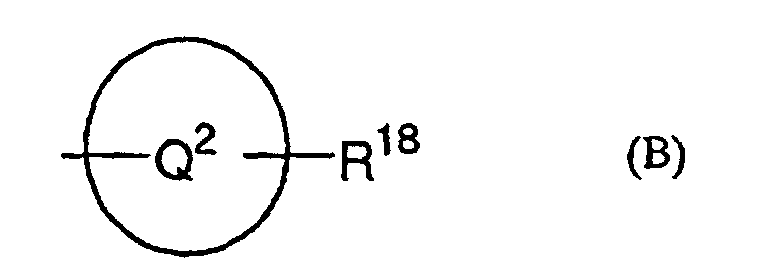

Q2 is a furan ring, and R18 is arylalkyloxyalkyl or a group selected from

when
is a double bond, R12 is CH2;
R2 is hydrogen, alkyl, arylalkyl, heteroarylalkyl, cycloalkyl, cycloalkylalkyl or aryl;
R3 is hydrogen, alkyl or a group of the formula


Y is a group of the formula
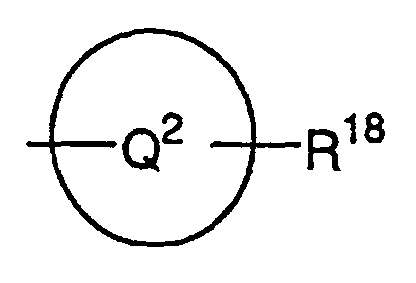
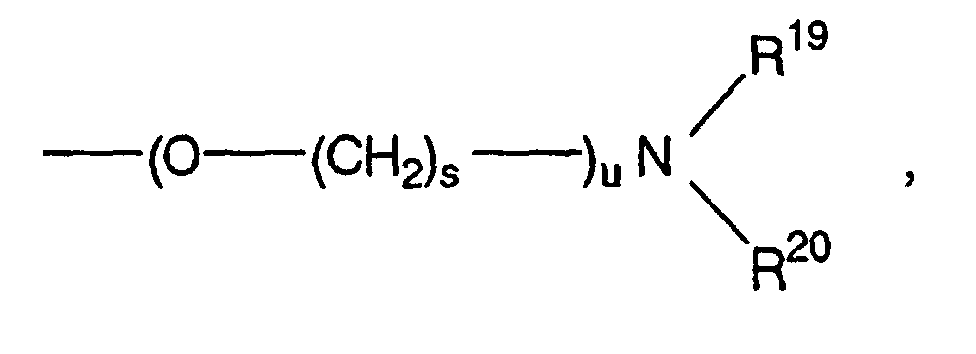
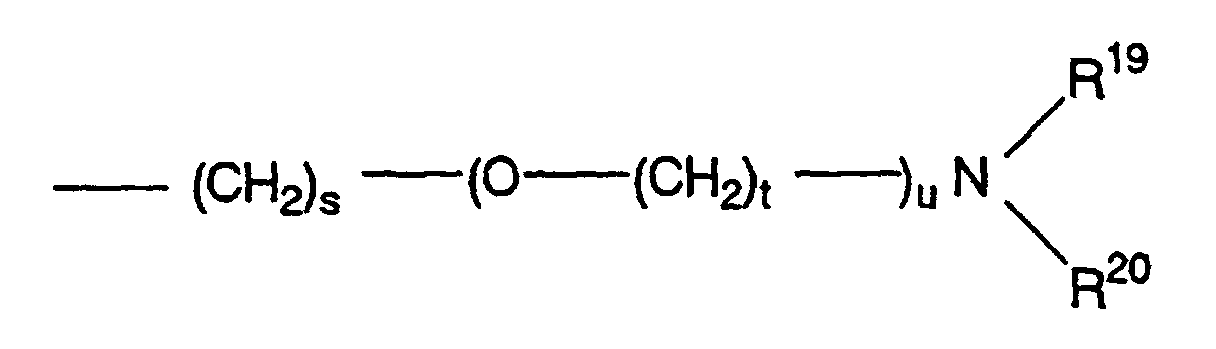
provided that when
R3 is a group other than a group of the formula (A)


Y is a group of the formula (B)

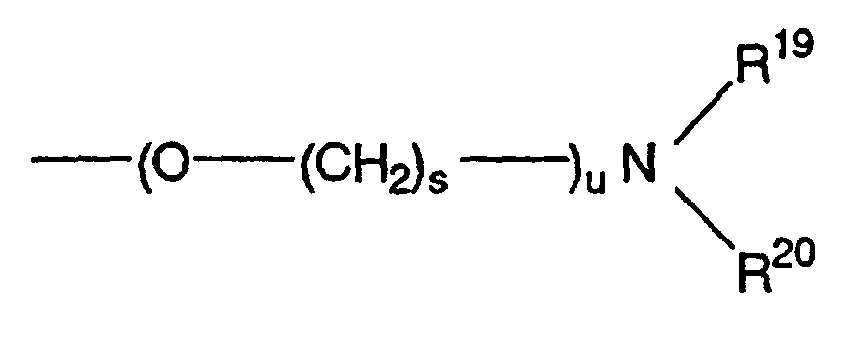
Q2 is a furan ring, and R18 is arylalkyloxyalkyl or a group selected from

wherein the aforementioned arylalkyl, heteroarylthioalkyl, arylthioalkyl, arylalkylthioalkyl, phthalimidoalkyl, aryl, heteroaryl and heteroarylalkyl may have a substituent [hereinafter to be referred to as intermediate compound (II)].
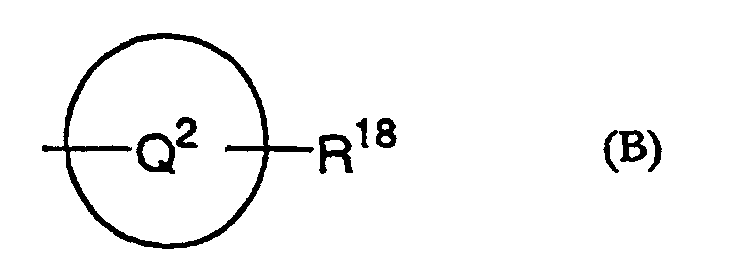

Q2 is a furan ring, and R18 is arylalkyloxyalkyl or a group selected from
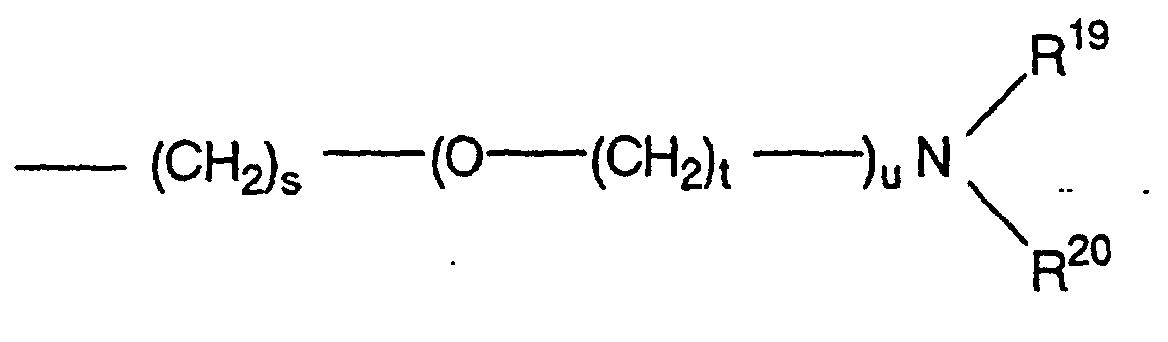


Q2 is a furan ring, and R18 is arylalkyloxyalkyl or a group selected from

Claims (11)
- A hydroxamic acid derivative of the formula (I):wherein
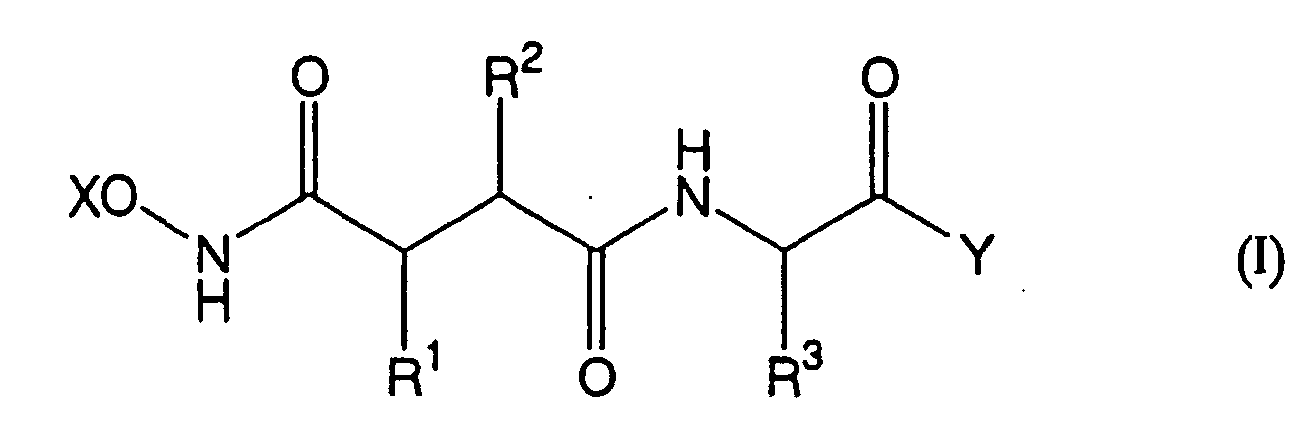
- X
- is hydrogen or hydroxy-protecting group;
- R1
- is hydrogen, alkyl, arylalkyl, heteroarylthioalkyl,
arylthioalkyl, alkylthioalkyl, arylalkylthioalkyl,
phthalimidoalkyl, alkenyl, or -(CH2)l-A
wherein l is an integer of 1 to 4 and A is a 5-
or 6-membered N-heterocycle
- (a) which is bonded by N atom,
- (b) which optionally has at least one atom selected from N, O and S as an additional heteroatom at a position not adjacent to the bonded N atom,
- (c) in which one or both C atom(s) adjacent to said bonded N atom is(are) substituted by oxo, and
- (d) which is benzo-fused, or one or more other C atom(s) is(are) substituted by lower alkyl or oxo, and/or a different N atom is optionally substituted by lower alkyl or phenyl;
- R2
- is hydrogen, alkyl, arylalkyl, heteroarylalkyl, cycloalkyl, cycloalkylalkyl or aryl;
- R3
- is hydrogen, alkyl or a group of the formula
wherein Q1 is an aromatic hydrocarbon ring or an aromatic heterocycle, m is an integer of 0 to 3, and R13 is hydrogen, halogen, hydroxy, nitro, cyano, trifluoromethyl, lower alkyl, alkoxy, alkylthio, formyl, acyloxy, phenyl, arylalkyl, carboxy, -COORa wherein Ra is lower alkyl, arylalkyl or aryl, carbamoyl, guanidino, hydroxysulfonyloxy, sulfo, arylalkyloxyalkyl or a group selected from
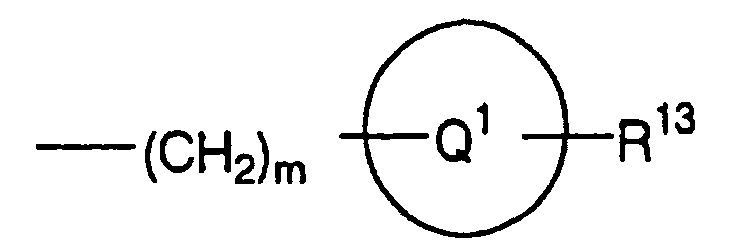
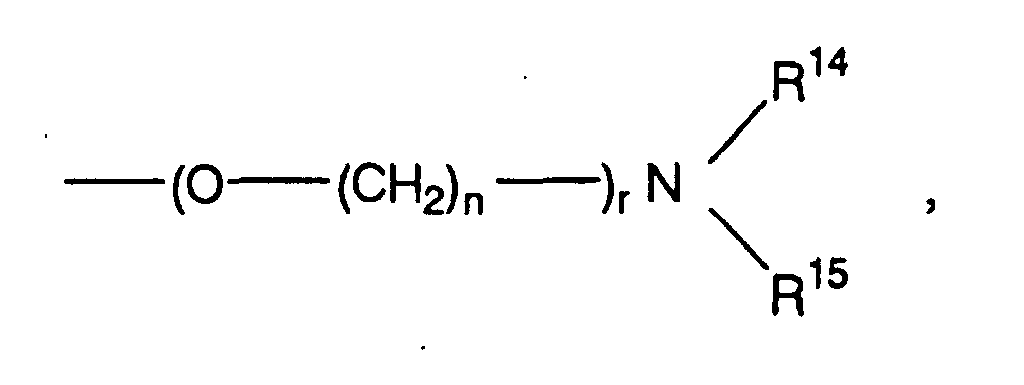 and
and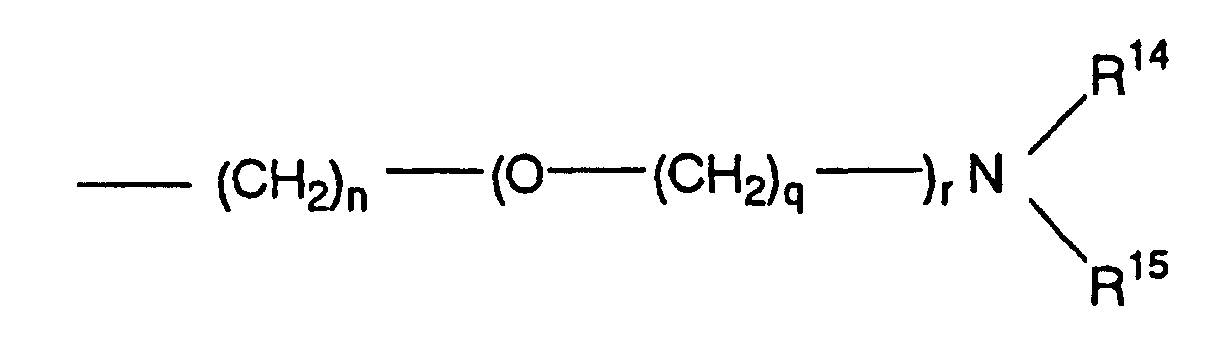
- Y
- is a group of the formula
wherein Q2 is an aromatic hydrocarbon ring or an aromatic heterocycle, and R18 is hydrogen, halogen, hydroxy, nitro, cyano, trifluoromethyl, lower alkyl, alkoxy, alkylthio, formyl, acyloxy, phenyl, arylalkyl, carboxy, -COORa wherein Ra is lower alkyl, arylalkyl or aryl, carbamoyl, guanidino, hydroxysulfonyloxy, sulfo, arylalkyloxyalkyl or a group selected from

 and
and
wherein Q1 is a benzene ring, m is an integer of 0 to 3, and R13 is guanidino, hydroxysulfonyloxy, sulfo or a group selected from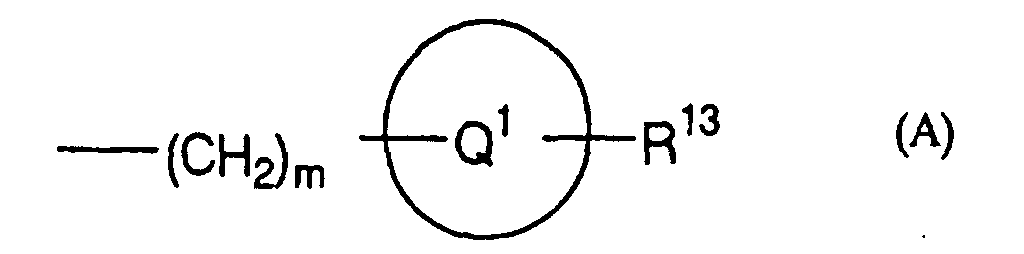 and
and
Y is a group of the formula (B)wherein Q2 is a benzene ring, and R18 is a group selected from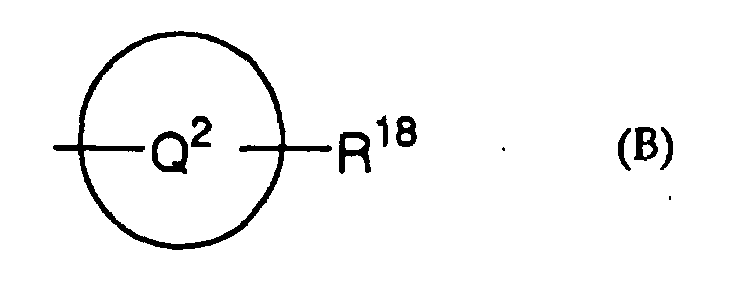 and
and
Q2 is a furan ring, and R18 is arylalkyloxyalkyl or a group selected fromand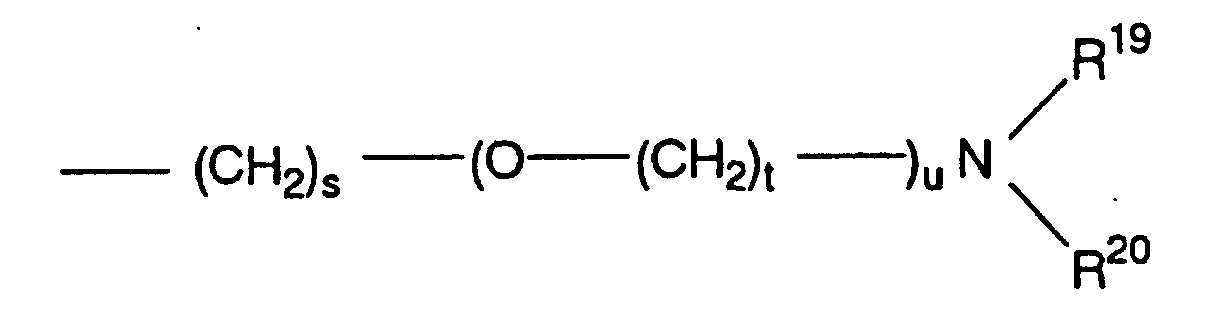
wherein the aforementioned arylalkyl, heteroarylthioalkyl, arylthioalkyl, arylalkylthioalkyl, phthalimidoalkyl, aryl, heteroaryl and heteroarylalkyl may have a substituent,
or a pharmacologically acceptable salt thereof. - The hydroxamic acid derivative of claim 1, whereinor a pharmacologically acceptable salt thereof.(i) R3 is a group of the formula (A)wherein Q1 is a benzene ring, m is an integer of 0 to 3, and R13 is guanidino, hydroxysulfonyloxy, sulfo or a group selected from
 and
and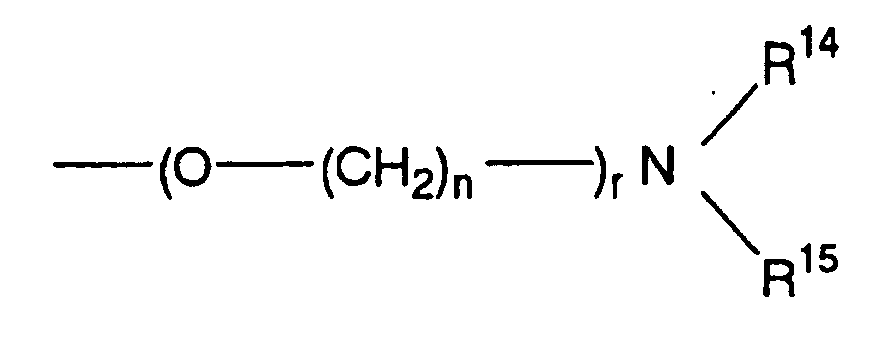
Y is furyl, thienyl, pyrrolyl, pyridyl, thiazolyl, phenyl, alkoxyphenyl, or phenyl substituted by -NR19R20
wherein R19 and R20 are the same or different and each is alkyl, or(ii) R3 is alkyl or a group of the formulawherein Q1 is a benzene ring, m is an integer of 0 to 3, and R13 is hydrogen, and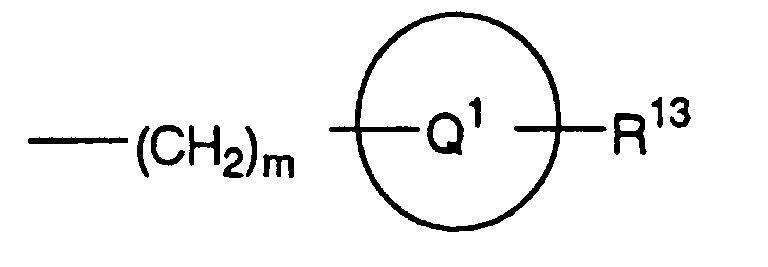
Y is a group of the formula (B) wherein Q2 is a benzene ring, and R18 is a group selected fromand
Q2 is a furan ring, and R18 is arylalkyloxyalkyl or a group selected fromand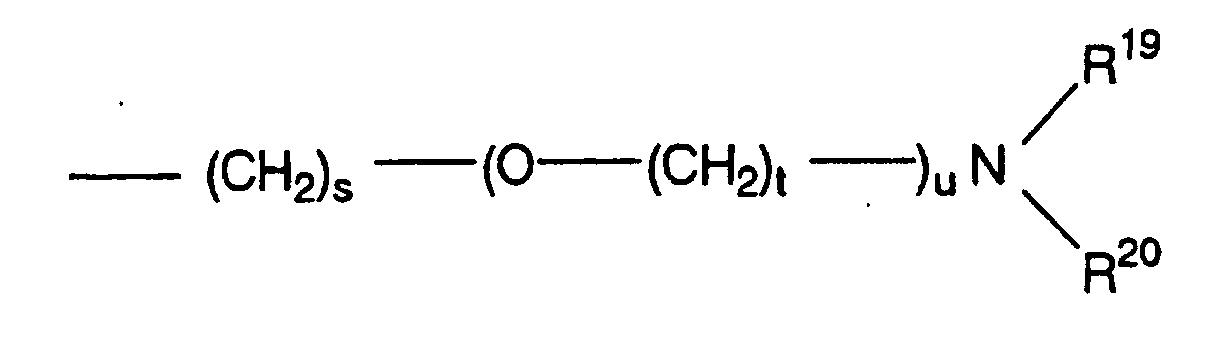
- The hydroxamic acid derivative of claim 2, wherein R13 in the formula (A) is guanidino, hydroxysulfonyloxy or a group of the formulawherein each symbol is as defined in claim 2, or a pharmacologically acceptable salt thereof.

- The hydroxamic acid derivative of claim 2 or a pharmacologically acceptable salt thereof, which is a member selected from the group consisting of
5-methyl-3(R)-[1(S)-[4-[2-[1-(4-methyl)piperazinyl]ethoxy]-benzoyl]-2-phenyl]ethylcarbamoyl-2(R or S)-phthalimidomethylhexanohydroxamic acid dihydrochloride,
3(R)-[1(S)-[4-(2-dimethylaminoethoxy)benzoyl]-2-phenyl]-ethylcarbamoyl-5-methyl-2(R or S)-phthalimidomethylhexanohydroxamic acid hydrochloride,
3(R)-[1(S)-(2-furyl)carbonyl-2-(4-guanidinophenyl)]ethylcarbamoyl-5-methyl-2(R or S)-phthalimidomethylhexanohydroxamic acid hydrochloride,
3(R)-[1(S)-[2-[5-(2-dimethylaminoethoxy)methyl]furyl]carbonyl-2-phenyl]ethylcarbamoyl-5-methyl-2(R or S)-phthalimidomethylhexanohydroxamic acid hydrochloride,
3(R)-[2-[4-(2-dimethylaminoethoxy)phenyl]-1(S)-(2-furyl)carbonyl]-ethylcarbamoyl-5-methyl-2(R or S)-(2,5-dioxo-3,4,4-trimethyl-1-imidazolidinyl)methylhexanohydroxamic acid hydrochloride,
sodium salt of 3(R)-[1(S)-(2-furyl)carbonyl-2-[4-(hydroxysulfonyloxy)phenyl]]ethylcarbamoyl-5-methyl-2(R or S)-phthalimidomethylhexanohydroxamic acid,
sodium salt of 3(R)-[1(S)-(2-furyl)carbonyl-2-(4-sulfophenyl)-ethylcarbamoyl]-5-methyl-2(R or S)-(2-naphthylmethyl)-hexanohydroxamic acid,
sodium salt of 3(R)-[1(S)-(2-furyl)carbonyl-2-(4-sulfophenyl)-ethylcarbamoyl]-5-methyl-2(R or S)-(1-naphthylmethyl)-hexanohydroxamic acid,
sodium salt of 2(R or S)-benzyl-3(R)-[1(S)-(2-furyl)carbonyl-2-(4-sulfophenyl)ethylcarbamoyl]-5-methylhexanohydroxamic acid,
sodium salt of 3(R)-[1(S)-(2-furyl)carbonyl-2-(4-sulfophenyl)-ethylcarbamoyl]-5-methyl-2(R or S)-phthalimidomethylhexanohydroxamic acid,
sodium salt of 3(R)-[1(S)-(2-furyl)carbonyl-2-(4-sulfophenyl)-ethylcarbamoyl]-5-methyl-2(R or S)-(1-oxoisoindolin-2-ylmethyl)-hexanohydroxamic acid,
3(R)-[2-(4-aminophenyl)-1(S)-(2-furyl)carbonyl]ethylcarbamoyl-5-methyl-2(R or S)-phthalimidomethylhexanohydroxamic acid hydrochloride,
5-methyl-3(R)-[2-phenyl-1(S)-[4-(2-piperidinoethoxy)benzoyl]]-ethylcarbamoyl-2(R or S)-phthalimidomethylhexanohydroxamic acid hydrochloride,
3(R)-[1(S)-[2-(5-dimethylaminomethyl)furyl]carbonyl-2-phenyl]-ethylcarbamoyl-5-methyl-2(R or S)-phthalimidomethylhexanohydroxamic acid hydrochloride,
3(R)-[2-[4-(2-dimethylaminoethoxy)phenyl]-1(S)-(2-furyl)carbonyl]-ethylcarbamoyl-5-methyl-2(R or S)-phthalimidomethylhexanohydroxamic acid hydrochloride,
3(R)-[1(S)-[2-(5-hydroxymethyl)furyl]carbonyl-2-phenyl]ethylcarbamoyl-5-methyl-2(R or S)-phthalimidomethylhexanohydroxamic acid,
2(R or S),5-dimethyl-3(R)-[1(S)-[4-(2-dimethylaminoethoxy)-benzoyl]-2-phenyl]ethylcarbamoylhexanohydroxamic acid hydrochloride,
3(R)-[1(S)-[4-(2-dimethylaminoethoxy)benzoyl]-2-phenyl]-ethylcarbamoyl-5-methyl-2(R or S)-(3-phenylpropyl)hexanohydroxamic acid hydrochloride,
3(R)-[1(S)-[4-(2-dimethylaminoethoxy)benzoyl]-2-phenyl]-ethylcarbamoyl-5-methyl-2(R or S)-(2,5-dioxo-3,4,4-trimethyl-1-imidazolidinyl)methylhexanohydroxamic acid hydrochloride,
3(R)-[2,2-dimethyl-1(S)-[4-(2-dimethylaminoethoxy)benzoyl]]-propylcarbamoyl-5-methyl-2(R or S)-phthalimidomethylhexanohydroxamic acid hydrochloride,
3(R)-[1(S)-[4-(2-dimethylaminoethoxy)benzoyl]-2-phenyl]-ethylcarbamoyl-5-methyl-2(R or S)-(2-propenyl)hexanohydroxamic acid hydrochloride,
3(R)-[2-[4-(2-dimethylaminoethoxy)phenyl]-1(S)-(2-furyl)carbonyl]-ethylcarbamoyl-5-methyl-2(R or S)-(3-phenylpropyl)hexanohydroxamic acid hydrochloride,
sodium salt of 3(R)-[1(S)-(2-furyl)carbonyl-2-[4-(hydroxysulfonyloxy)phenyl]]ethylcarbamoyl-5-methyl-2(R or S)-(2,5-dioxo-3,4,4-trimethyl-1-imidazolidinyl)methylhexanohydroxamic acid,
3(R)-[2,2-dimethyl-1(S)-[4-(2-dimethylaminoethoxy)benzoyl]]-propylcarbamoyl-5-methyl-2(R or S)-(3-phenylpropyl)-hexanohydroxamic acid hydrochloride,
sodium salt of 3(R)-[1(S)-(2-furyl)carbonyl-2-[4-(hydroxysulfonyloxy)phenyl]]ethylcarbamoyl-5-methyl-2(R or S)-(3-phenylpropyl)hexanohydroxamic acid,
3(R)-[1(S)-[4-(2-dimethylaminoethoxy)benzoyl]-2-phenyl]-ethylcarbamoyl-5-methyl-2(R or S)-(2-naphthylmethyl)-hexanohydroxamic acid hydrochloride,
3(R)-[1(S)-[4-(2-dimethylaminoethoxy)benzoyl]-2-phenyl]-ethylcarbamoyl-5-methyl-2(R or S)-(1-oxoisoindolin-2-ylmethyl)-hexanohydroxamic acid hydrochloride,
3(R)-[2-[4-(2-dimethylaminoethoxy)phenyl]-1(S)-(2-furyl)carbonyl]-ethylcarbamoyl-5-methyl-2(R or S)-(2-naphthylmethyl)-hexanohydroxamic acid hydrochloride,
3(R)-[2-[4-(2-dimethylaminoethoxy)phenyl]-1(S)-(2-furyl)carbonyl]-ethylcarbamoyl-5-methyl-2(R or S)-(1-oxoisoindolin-2-ylmethyl)-hexanohydroxamic acid hydrochloride,
3(R)-[2,2-dimethyl-1(S)-[4-(2-dimethylaminoethoxy)benzoyl]]-propylcarbamoyl-5-methyl-2(R or S)-(2,5-dioxo-3,4,4-trimethyl-1-imidazolidinyl)methylhexanohydroxamic acid hydrochloride,
sodium salt of 3(R)-[1(S)-(2-furyl)carbonyl-2-[4-(hydroxysulfonyloxy)phenyl]]ethylcarbamoyl-5-methyl-2(R or S)-(2-naphthylmethyl)hexanohydroxamic acid,
sodium salt of 3(R)-[1(S)-(2-furyl)carbonyl-2-[4-(hydroxysulfonyloxy)phenyl]]ethylcarbamoyl-5-methyl-2(R or S)-(1-oxoisoindolin-2-ylmethyl)hexanohydroxamic acid,
sodium salt of 3(R)-[1(S)-(2-furyl)carbonyl-2-(4-sulfophenyl)-ethylcarbamoyl]-5-methyl-2(R or S)-(3-phenylpropyl)-hexanohydroxamic acid,
sodium salt of 3(R)-[1(S)-(2-furyl)carbonyl-2-(4-sulfophenyl)-ethylcarbamoyl]-5-methyl-2(R or S)-(2,5-dioxo-3,4,4-trimethyl-1-imidazolidinyl)methylhexanohydroxamic acid, and
3(R)-[1(S)-[2-(5-hydroxymethyl)furyl]carbonyl-2-phenyl]-ethylcarbamoyl-5-methyl-2(R or S)-(2,5-dioxo-3,4,4-trimethyl-1-imidazolidinyl)methylhexanohydroxamic acid. - The hydroxamic acid derivative of claim 1 or claim 2, wherein R1 is phthalimidomethyl, or a pharmacologically acceptable salt thereof.
- The hydroxamic acid derivative of claim 1 or claim 2, wherein R2 is isobutyl, or a pharmacologically acceptable salt thereof.
- The hydroxamic acid derivative of claim 1 or claim 2, wherein R3 is benzyl optionally substituted by a substituent selected from guanidino, hydroxysulfonyloxy, sulfo,and

- A compound of the formula (II):wherein

R11 is hydrogen, alkyl, arylalkyl, heteroarylalkyl or aryl,
------
is a single bond or a double bond,
when
------
is a single bond, R12 is hydrogen, alkyl, arylalkyl, heteroarylthioalkyl, arylthioalkyl, alkylthioalkyl, arylalkylthioalkyl, phthalimidoalkyl, alkenyl, -(CH2)l-A
wherein l is an integer of 1 to 4, A is a 5- or 6-membered N-heterocycle-COOR23 wherein R23 is hydrogen, alkyl, arylalkyl, heteroarylalkyl or aryl, or(a) which is bonded by N atom,(b) which optionally has at least one atom selected from N, O and S as an additional heteroatom at a position not adjacent to the bonded N atom,(c) in which one or both C atom(s) adjacent to said bonded N atom is(are) substituted by oxo, and(d) which is benzo-fused, or one or more other C atom(s) is(are) substituted by lower alkyl or oxo, and/or a different N atom is optionally substituted by lower alkyl or phenyl, or
when
------
is a double bond, R12 is CH2;
R2 is hydrogen, alkyl, arylalkyl, heteroarylalkyl, cycloalkyl, cycloalkylalkyl or aryl;
R3 is hydrogen, alkyl or a group of the formulawherein Q1 is an aromatic hydrocarbon ring or an aromatic heterocycle, m is an integer of 0 to 3, and R13 is hydrogen, halogen, hydroxy, nitro, cyano, trifluoromethyl, lower alkyl, alkoxy, alkylthio, formyl, acyloxy, phenyl, arylalkyl, carboxy, - COORa wherein Ra is lower alkyl, arylalkyl or aryl, carbamoyl, guanidino, hydroxysulfonyloxy, sulfo, arylalkyloxyalkyl or a group selected from
 and
and
Y is a group of the formulawherein Q2 is an aromatic hydrocarbon ring or an aromatic heterocycle, and R18 is hydrogen, halogen, hydroxy, nitro, cyano, trifluoromethyl, lower alkyl, alkoxy, alkylthio, formyl, acyloxy, phenyl, arylalkyl, carboxy, -COORa wherein Ra is lower alkyl, arylalkyl or aryl, carbamoyl, guanidino, hydroxysulfonyloxy, sulfo, arylalkyloxyalkyl or a group selected from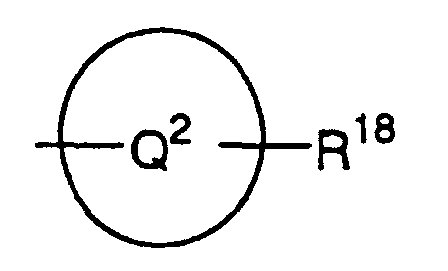
 and
and
provided that
when R3 is a group other than a group of the formula (A)wherein Q1 is a benzene ring, m is an integer of 0 to 3, and R13 is guanidino, hydroxysulfonyloxy, sulfo or a group selected from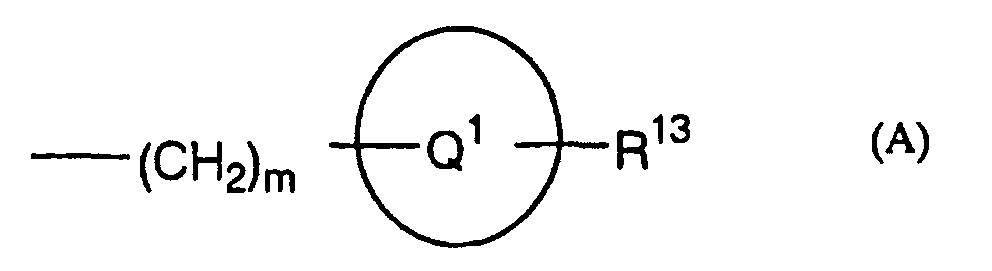 and
and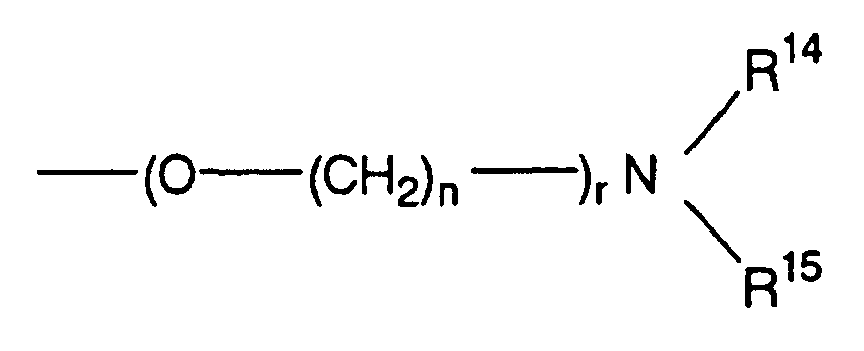
Y is a group of the formula (B)wherein Q2 is a benzene ring, and R18 is a group selected from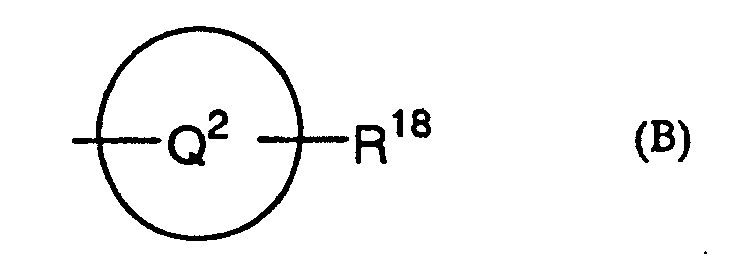 and
and
Q2 is a furan ring, and R18 is arylalkyloxyalkyl or a group selected fromand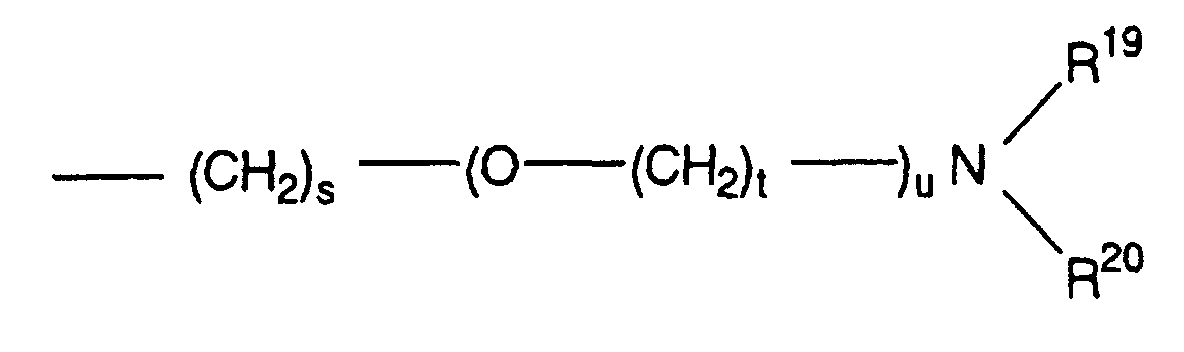
wherein the aforementioned arylalkyl, heteroarylthioalkyl, arylthioalkyl, arylalkylthioalkyl, phthalimidoalkyl, aryl, heteroaryl and heteroarylalkyl may have a substituent. - The compound of claim 8 wherein(i) R3 is a group of the formula (A)wherein Q1 is a benzene ring, m is an integer of 0 to 3, and R13 is guanidino, hydroxysulfonyloxy, sulfo or a group selected from
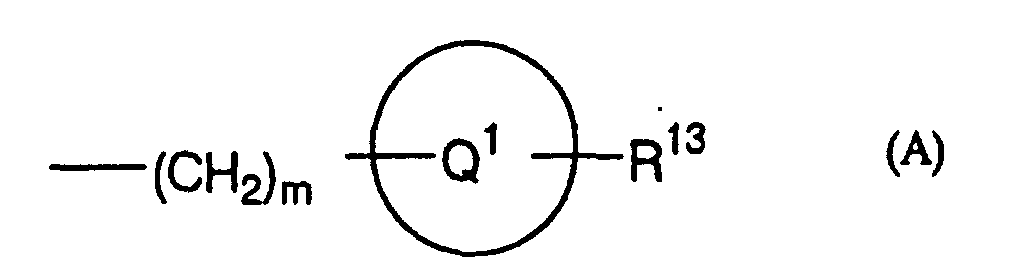 and
and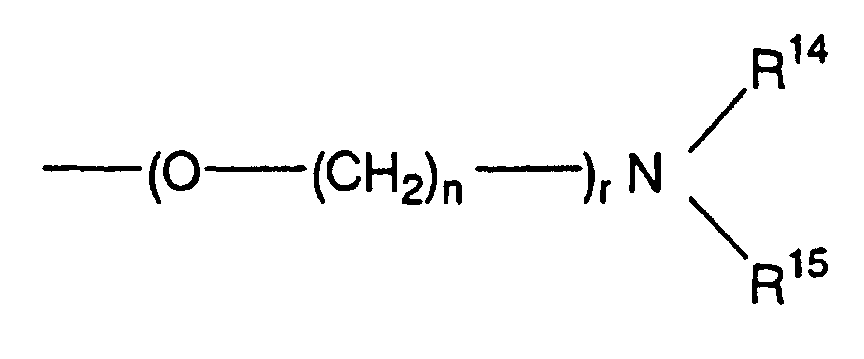
Y is furyl, thienyl, pyrrolyl, pyridyl, thiazolyl, phenyl, alkoxyphenyl, or phenyl substituted by -NR19R20
wherein R19 and R20 are the same or different and each is alkyl, or(ii) R3 is alkyl or a group ofwherein Q1 is a benzene ring, m is an integer of 0 to 3, and R13 is hydrogen, and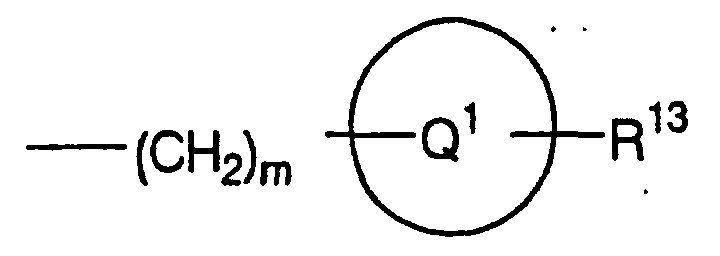
Y is a group of the formula (B)wherein Q2 is a benzene ring, and R18 is a group selected from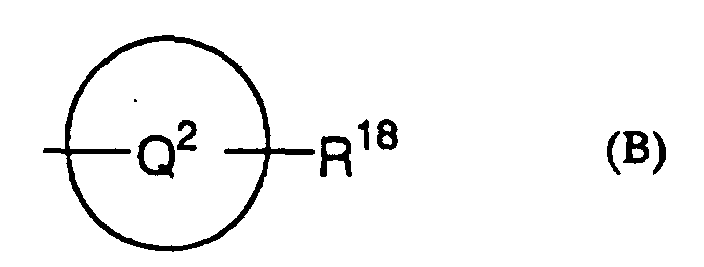 and
and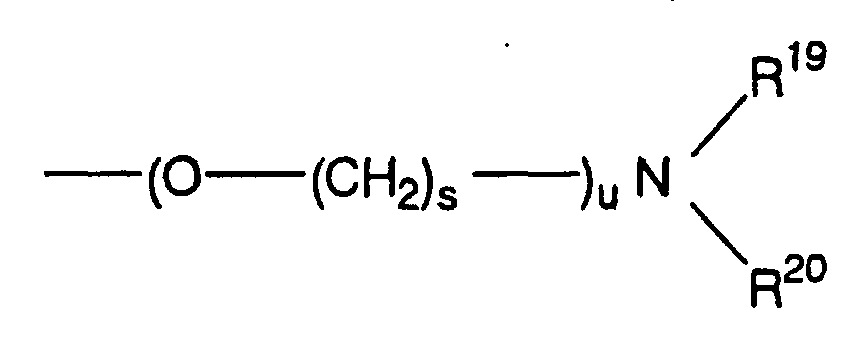
Q2 is a furan ring, and R18 is arylalkyloxyalkyl or a group selected fromand
- A pharmaceutical composition comprising a hydroxamic acid derivative of any of claims 1 to 7 or a pharmacologically acceptable salt thereof, and a pharmacologically acceptable carrier.
- The pharmaceutical composition of claim 10, which is an inhibitor of TNF α production.
Applications Claiming Priority (3)
| Application Number | Priority Date | Filing Date | Title |
|---|---|---|---|
| JP14130498 | 1998-05-22 | ||
| JP14130498 | 1998-05-22 | ||
| PCT/JP1999/002631 WO1999061412A1 (en) | 1998-05-22 | 1999-05-19 | Hydroxamic acid derivatives and medicinal utilization thereof |
Publications (3)
| Publication Number | Publication Date |
|---|---|
| EP1081132A1 EP1081132A1 (en) | 2001-03-07 |
| EP1081132A4 EP1081132A4 (en) | 2002-11-13 |
| EP1081132B1 true EP1081132B1 (en) | 2004-03-10 |
Family
ID=15288785
Family Applications (1)
| Application Number | Title | Priority Date | Filing Date |
|---|---|---|---|
| EP99921188A Expired - Lifetime EP1081132B1 (en) | 1998-05-22 | 1999-05-19 | Hydroxamic acid derivatives and medicinal utilization thereof |
Country Status (10)
| Country | Link |
|---|---|
| US (1) | US6610729B1 (en) |
| EP (1) | EP1081132B1 (en) |
| KR (1) | KR100606989B1 (en) |
| CN (1) | CN1289472C (en) |
| AT (1) | ATE261428T1 (en) |
| AU (1) | AU3849699A (en) |
| CA (1) | CA2332946A1 (en) |
| DE (1) | DE69915467T2 (en) |
| ES (1) | ES2214026T3 (en) |
| WO (1) | WO1999061412A1 (en) |
Families Citing this family (7)
| Publication number | Priority date | Publication date | Assignee | Title |
|---|---|---|---|---|
| EP1169031A1 (en) * | 1999-04-09 | 2002-01-09 | British Biotech Pharmaceuticals Limited | Antimicrobial agents |
| US6989401B2 (en) * | 2000-07-19 | 2006-01-24 | Mitsubishi Pharma Corporation | Sulfonic acid derivatives of hydroxamic acids and their use as medicinal products |
| US20050124684A1 (en) * | 2003-08-29 | 2005-06-09 | Ying Du | 5-(hydroxymethyl) furfural and derivatives as inhibitors of TNFalpha and IL-1beta production |
| WO2005037265A1 (en) * | 2003-10-17 | 2005-04-28 | Mitsubishi Pharma Corporation | Concurrent drugs |
| EP1787986A4 (en) | 2004-08-10 | 2007-08-22 | Shizuoka Coffein Co Ltd | Hydroxamic acid derivative and medicine containing the same as active ingredient |
| CA2645053A1 (en) | 2006-03-09 | 2007-09-13 | Om Pharma | Immunomodulatory compounds and treatment of diseases related to an overproduction of inflammatory cytokines |
| CA3115038A1 (en) | 2018-10-04 | 2020-04-09 | Inserm (Institut National De La Sante Et De La Recherche Medicale) | Egfr inhibitors for treating keratodermas |
Family Cites Families (3)
| Publication number | Priority date | Publication date | Assignee | Title |
|---|---|---|---|---|
| GB9223904D0 (en) | 1992-11-13 | 1993-01-06 | British Bio Technology | Inhibition of cytokine production |
| ZA9818B (en) | 1997-01-07 | 1998-07-02 | Abbott Lab | C-terminal ketone inhibitors of matrix metalloproteinases and tnf alpha secretion |
| US5985911A (en) * | 1997-01-07 | 1999-11-16 | Abbott Laboratories | C-terminal ketone inhibitors of matrix metalloproteinases and TNFα secretion |
-
1999
- 1999-05-19 CA CA002332946A patent/CA2332946A1/en not_active Abandoned
- 1999-05-19 ES ES99921188T patent/ES2214026T3/en not_active Expired - Lifetime
- 1999-05-19 EP EP99921188A patent/EP1081132B1/en not_active Expired - Lifetime
- 1999-05-19 AT AT99921188T patent/ATE261428T1/en not_active IP Right Cessation
- 1999-05-19 WO PCT/JP1999/002631 patent/WO1999061412A1/en not_active Ceased
- 1999-05-19 US US09/701,043 patent/US6610729B1/en not_active Expired - Fee Related
- 1999-05-19 AU AU38496/99A patent/AU3849699A/en not_active Abandoned
- 1999-05-19 KR KR1020007013151A patent/KR100606989B1/en not_active Expired - Fee Related
- 1999-05-19 DE DE69915467T patent/DE69915467T2/en not_active Expired - Fee Related
- 1999-05-19 CN CNB998090336A patent/CN1289472C/en not_active Expired - Fee Related
Also Published As
| Publication number | Publication date |
|---|---|
| ES2214026T3 (en) | 2004-09-01 |
| EP1081132A4 (en) | 2002-11-13 |
| CA2332946A1 (en) | 1999-12-02 |
| DE69915467D1 (en) | 2004-04-15 |
| CN1310704A (en) | 2001-08-29 |
| CN1289472C (en) | 2006-12-13 |
| ATE261428T1 (en) | 2004-03-15 |
| EP1081132A1 (en) | 2001-03-07 |
| KR20010043767A (en) | 2001-05-25 |
| WO1999061412A1 (en) | 1999-12-02 |
| DE69915467T2 (en) | 2005-01-27 |
| US6610729B1 (en) | 2003-08-26 |
| AU3849699A (en) | 1999-12-13 |
| KR100606989B1 (en) | 2006-08-01 |
Similar Documents
| Publication | Publication Date | Title |
|---|---|---|
| EP0766672B1 (en) | Arylsulfonamido-substituted hydroxamic acids as matrix metalloproteinase inhibitors | |
| US5672615A (en) | Arylsulfonamido-substituted hydrodxamic acids | |
| CA2112779C (en) | Arylsulfonamido-substituted hydroxamic acids | |
| JP3827324B2 (en) | Metalloproteinase inhibitor | |
| US5646167A (en) | Arylsulfonamido-substituted hydroxamix acids | |
| CZ211596A3 (en) | Metalloprotease inhibitors, process of their preparation, their use and pharmaceutical compositions containing thereof | |
| US5859061A (en) | Bis-sulfonamides hydroxamic acids as MMP inhibitors | |
| HRP20030748A2 (en) | Derivatives of n-(arylsulfonyl)beta-aminoacids comprising a substituted aminomethyl group, the preparation method thereof and the pharmaceutical compositions containing same | |
| MX2011000628A (en) | Heteroaryl derivatives as dgat1 inhibitors. | |
| RO115354B1 (en) | PHENYLHETEROCYCLIC COMPOUNDS, PROCESSES FOR THEIR PREPARATION, PREPARATION INTERMEDIATE, PHARMACEUTICAL COMPOSITION AND METHOD FOR TREATMENT OF AN INFLAMATIVE INFECTION | |
| CA2371876A1 (en) | Aromatic sulfone hydroxamic acid metalloprotease inhibitor | |
| CA2372934A1 (en) | Aromatic sulfone hydroxamic acid metalloprotease inhibitor | |
| EP2081917A2 (en) | Cytochrome p450 oxidase inhibitors and uses thereof | |
| WO2002018321A2 (en) | Amino(oxo)acetic acid protein tyrosine phosphatase inhibitors | |
| US6610729B1 (en) | Hydroxamic acid derivatives and medicinal utilization thereof | |
| JP2015091824A (en) | Hydroxamic acid-based selective mmp-12 and mmp-13 inhibitor | |
| JP4921167B2 (en) | Hydroxamic acid derivatives as metalloproteinase inhibitors | |
| CA2407463C (en) | N-substituted peptidyl nitriles as cysteine cathepsin inhibitors | |
| JPWO1999061412A1 (en) | Hydroxamic acid derivatives and their medical uses | |
| EP1270559A1 (en) | Novel imidazole derivatives with anti-inflammatory activity | |
| CA2274889A1 (en) | Bis-sulfonomides hydroxamic acids as mmp inhibitors | |
| HK1107977A1 (en) | Triazole derivative | |
| JPWO1999040063A1 (en) | Novel azapeptide-type hydroxamic acid derivatives | |
| HK1002633B (en) | Arylsulfonamido-substituted hydroxamic acids | |
| HK1107977B (en) | Triazole derivative |
Legal Events
| Date | Code | Title | Description |
|---|---|---|---|
| PUAI | Public reference made under article 153(3) epc to a published international application that has entered the european phase |
Free format text: ORIGINAL CODE: 0009012 |
|
| 17P | Request for examination filed |
Effective date: 20001213 |
|
| AK | Designated contracting states |
Kind code of ref document: A1 Designated state(s): AT BE CH CY DE DK ES FI FR GB GR IE IT LI LU MC NL PT SE |
|
| RAP1 | Party data changed (applicant data changed or rights of an application transferred) |
Owner name: MITSUBISHI PHARMA CORPORATION |
|
| A4 | Supplementary search report drawn up and despatched |
Effective date: 20021001 |
|
| AK | Designated contracting states |
Kind code of ref document: A4 Designated state(s): AT BE CH CY DE DK ES FI FR GB GR IE IT LI LU MC NL PT SE |
|
| REG | Reference to a national code |
Ref country code: GB Ref legal event code: FG4D |
|
| GRAP | Despatch of communication of intention to grant a patent |
Free format text: ORIGINAL CODE: EPIDOSNIGR1 |
|
| GRAS | Grant fee paid |
Free format text: ORIGINAL CODE: EPIDOSNIGR3 |
|
| GRAA | (expected) grant |
Free format text: ORIGINAL CODE: 0009210 |
|
| AK | Designated contracting states |
Kind code of ref document: B1 Designated state(s): AT BE CH CY DE DK ES FI FR GB GR IE IT LI LU MC NL PT SE |
|
| PG25 | Lapsed in a contracting state [announced via postgrant information from national office to epo] |
Ref country code: NL Free format text: LAPSE BECAUSE OF FAILURE TO SUBMIT A TRANSLATION OF THE DESCRIPTION OR TO PAY THE FEE WITHIN THE PRESCRIBED TIME-LIMIT Effective date: 20040310 Ref country code: LI Free format text: LAPSE BECAUSE OF FAILURE TO SUBMIT A TRANSLATION OF THE DESCRIPTION OR TO PAY THE FEE WITHIN THE PRESCRIBED TIME-LIMIT Effective date: 20040310 Ref country code: FI Free format text: LAPSE BECAUSE OF FAILURE TO SUBMIT A TRANSLATION OF THE DESCRIPTION OR TO PAY THE FEE WITHIN THE PRESCRIBED TIME-LIMIT Effective date: 20040310 Ref country code: CY Free format text: LAPSE BECAUSE OF FAILURE TO SUBMIT A TRANSLATION OF THE DESCRIPTION OR TO PAY THE FEE WITHIN THE PRESCRIBED TIME-LIMIT Effective date: 20040310 Ref country code: CH Free format text: LAPSE BECAUSE OF FAILURE TO SUBMIT A TRANSLATION OF THE DESCRIPTION OR TO PAY THE FEE WITHIN THE PRESCRIBED TIME-LIMIT Effective date: 20040310 Ref country code: BE Free format text: LAPSE BECAUSE OF FAILURE TO SUBMIT A TRANSLATION OF THE DESCRIPTION OR TO PAY THE FEE WITHIN THE PRESCRIBED TIME-LIMIT Effective date: 20040310 Ref country code: AT Free format text: LAPSE BECAUSE OF FAILURE TO SUBMIT A TRANSLATION OF THE DESCRIPTION OR TO PAY THE FEE WITHIN THE PRESCRIBED TIME-LIMIT Effective date: 20040310 |
|
| REG | Reference to a national code |
Ref country code: CH Ref legal event code: EP |
|
| REG | Reference to a national code |
Ref country code: IE Ref legal event code: FG4D |
|
| REF | Corresponds to: |
Ref document number: 69915467 Country of ref document: DE Date of ref document: 20040415 Kind code of ref document: P |
|
| RIN2 | Information on inventor provided after grant (corrected) |
Inventor name: TAKEMOTO, TADAHIRO,WELFIDE CORP. DRUG DISC. LAB. Inventor name: SUGIYAMA, NAOKI,WELFIDE CORP. DRUG DISCOVERY LAB. Inventor name: YOSHIDA, TOMOHIRO,WELFIDE CORP.DRUG DISCOVERY LAB Inventor name: MAEDA, KAZUHIRO,WELFIDE CORP. DRUG DISCOVERY LAB. Inventor name: TAKEDA, SHINJI,WELFIDE CORP.DRUG DEVELOPMENT LAB. Inventor name: GOTOU, TOMOKAZU,WELFIDE CORP. DRUG DISCOVERY LAB. |
|
| PG25 | Lapsed in a contracting state [announced via postgrant information from national office to epo] |
Ref country code: LU Free format text: LAPSE BECAUSE OF NON-PAYMENT OF DUE FEES Effective date: 20040519 Ref country code: IE Free format text: LAPSE BECAUSE OF NON-PAYMENT OF DUE FEES Effective date: 20040519 |
|
| RIN2 | Information on inventor provided after grant (corrected) |
Inventor name: TAKEMOTO, TADAHIRO,WELFIDE CORP. DRUG DISC. LAB. Inventor name: SUGIYAMA, NAOKI,WELFIDE CORP. DRUG DISCOVERY LAB. Inventor name: YOSHIDA, TOMOHIRO,WELFIDE CORP.DRUG DISCOVERY LAB Inventor name: MAEDA, KAZUHIRO,WELFIDE CORP. DRUG DISCOVERY LAB. Inventor name: TAKEDA, SHINJI,WELFIDE CORP.DRUG DEVELOPMENT LAB. Inventor name: GOTOU, TOMOKAZU,WELFIDE CORP. DRUG DISCOVERY LAB. |
|
| PG25 | Lapsed in a contracting state [announced via postgrant information from national office to epo] |
Ref country code: MC Free format text: LAPSE BECAUSE OF NON-PAYMENT OF DUE FEES Effective date: 20040531 |
|
| PG25 | Lapsed in a contracting state [announced via postgrant information from national office to epo] |
Ref country code: SE Free format text: LAPSE BECAUSE OF FAILURE TO SUBMIT A TRANSLATION OF THE DESCRIPTION OR TO PAY THE FEE WITHIN THE PRESCRIBED TIME-LIMIT Effective date: 20040610 Ref country code: GR Free format text: LAPSE BECAUSE OF FAILURE TO SUBMIT A TRANSLATION OF THE DESCRIPTION OR TO PAY THE FEE WITHIN THE PRESCRIBED TIME-LIMIT Effective date: 20040610 Ref country code: DK Free format text: LAPSE BECAUSE OF FAILURE TO SUBMIT A TRANSLATION OF THE DESCRIPTION OR TO PAY THE FEE WITHIN THE PRESCRIBED TIME-LIMIT Effective date: 20040610 |
|
| NLV1 | Nl: lapsed or annulled due to failure to fulfill the requirements of art. 29p and 29m of the patents act | ||
| REG | Reference to a national code |
Ref country code: ES Ref legal event code: FG2A Ref document number: 2214026 Country of ref document: ES Kind code of ref document: T3 |
|
| REG | Reference to a national code |
Ref country code: CH Ref legal event code: PL |
|
| ET | Fr: translation filed | ||
| PLBE | No opposition filed within time limit |
Free format text: ORIGINAL CODE: 0009261 |
|
| 26N | No opposition filed |
Effective date: 20041213 |
|
| REG | Reference to a national code |
Ref country code: IE Ref legal event code: MM4A |
|
| PGFP | Annual fee paid to national office [announced via postgrant information from national office to epo] |
Ref country code: DE Payment date: 20070517 Year of fee payment: 9 |
|
| PGFP | Annual fee paid to national office [announced via postgrant information from national office to epo] |
Ref country code: ES Payment date: 20070524 Year of fee payment: 9 |
|
| PGFP | Annual fee paid to national office [announced via postgrant information from national office to epo] |
Ref country code: GB Payment date: 20070516 Year of fee payment: 9 |
|
| PG25 | Lapsed in a contracting state [announced via postgrant information from national office to epo] |
Ref country code: PT Free format text: LAPSE BECAUSE OF NON-PAYMENT OF DUE FEES Effective date: 20040810 |
|
| PGFP | Annual fee paid to national office [announced via postgrant information from national office to epo] |
Ref country code: IT Payment date: 20070507 Year of fee payment: 9 |
|
| PGFP | Annual fee paid to national office [announced via postgrant information from national office to epo] |
Ref country code: FR Payment date: 20070510 Year of fee payment: 9 |
|
| GBPC | Gb: european patent ceased through non-payment of renewal fee |
Effective date: 20080519 |
|
| REG | Reference to a national code |
Ref country code: FR Ref legal event code: ST Effective date: 20090119 |
|
| PG25 | Lapsed in a contracting state [announced via postgrant information from national office to epo] |
Ref country code: FR Free format text: LAPSE BECAUSE OF NON-PAYMENT OF DUE FEES Effective date: 20080602 Ref country code: DE Free format text: LAPSE BECAUSE OF NON-PAYMENT OF DUE FEES Effective date: 20081202 |
|
| PG25 | Lapsed in a contracting state [announced via postgrant information from national office to epo] |
Ref country code: GB Free format text: LAPSE BECAUSE OF NON-PAYMENT OF DUE FEES Effective date: 20080519 |
|
| REG | Reference to a national code |
Ref country code: ES Ref legal event code: FD2A Effective date: 20080520 |
|
| PG25 | Lapsed in a contracting state [announced via postgrant information from national office to epo] |
Ref country code: IT Free format text: LAPSE BECAUSE OF NON-PAYMENT OF DUE FEES Effective date: 20080519 |
|
| PG25 | Lapsed in a contracting state [announced via postgrant information from national office to epo] |
Ref country code: ES Free format text: LAPSE BECAUSE OF NON-PAYMENT OF DUE FEES Effective date: 20080520 |