EP1080776A2 - Electrodialysis water splitting process - Google Patents
Electrodialysis water splitting process Download PDFInfo
- Publication number
- EP1080776A2 EP1080776A2 EP00306359A EP00306359A EP1080776A2 EP 1080776 A2 EP1080776 A2 EP 1080776A2 EP 00306359 A EP00306359 A EP 00306359A EP 00306359 A EP00306359 A EP 00306359A EP 1080776 A2 EP1080776 A2 EP 1080776A2
- Authority
- EP
- European Patent Office
- Prior art keywords
- salt
- solution
- alkali
- stream
- cell
- Prior art date
- Legal status (The legal status is an assumption and is not a legal conclusion. Google has not performed a legal analysis and makes no representation as to the accuracy of the status listed.)
- Granted
Links
Images



Classifications
-
- C—CHEMISTRY; METALLURGY
- C01—INORGANIC CHEMISTRY
- C01D—COMPOUNDS OF ALKALI METALS, i.e. LITHIUM, SODIUM, POTASSIUM, RUBIDIUM, CAESIUM, OR FRANCIUM
- C01D1/00—Oxides or hydroxides of sodium, potassium or alkali metals in general
- C01D1/04—Hydroxides
- C01D1/28—Purification; Separation
- C01D1/32—Purification; Separation by absorption or precipitation
-
- B—PERFORMING OPERATIONS; TRANSPORTING
- B01—PHYSICAL OR CHEMICAL PROCESSES OR APPARATUS IN GENERAL
- B01D—SEPARATION
- B01D61/00—Processes of separation using semi-permeable membranes, e.g. dialysis, osmosis or ultrafiltration; Apparatus, accessories or auxiliary operations specially adapted therefor
- B01D61/42—Electrodialysis; Electro-osmosis ; Electro-ultrafiltration; Membrane capacitive deionization
- B01D61/44—Ion-selective electrodialysis
- B01D61/445—Ion-selective electrodialysis with bipolar membranes; Water splitting
-
- C—CHEMISTRY; METALLURGY
- C01—INORGANIC CHEMISTRY
- C01D—COMPOUNDS OF ALKALI METALS, i.e. LITHIUM, SODIUM, POTASSIUM, RUBIDIUM, CAESIUM, OR FRANCIUM
- C01D1/00—Oxides or hydroxides of sodium, potassium or alkali metals in general
- C01D1/04—Hydroxides
- C01D1/28—Purification; Separation
- C01D1/38—Purification; Separation by dialysis
-
- C—CHEMISTRY; METALLURGY
- C25—ELECTROLYTIC OR ELECTROPHORETIC PROCESSES; APPARATUS THEREFOR
- C25B—ELECTROLYTIC OR ELECTROPHORETIC PROCESSES FOR THE PRODUCTION OF COMPOUNDS OR NON-METALS; APPARATUS THEREFOR
- C25B15/00—Operating or servicing cells
- C25B15/08—Supplying or removing reactants or electrolytes; Regeneration of electrolytes
Definitions
- This invention relates to processes arising out of the use of a chromatographic separation step in combination with electrodialysis water splitting that improve process reliability and efficiency, and enable production of a high quality base product.
- the feed salt may be purified to remove certain contaminating anions in order to ensure reliable long term operation.
- the product base also has a certain amount of contaminating anions that need to be removed and then, preferably, the solution containing contaminating anions is recycled.
- a bipolar membrane based water splitting process is a low cost, low energy route to the production of acids and bases from their salts.
- K. N. Mani "Electrodialysis water splitting Technology” , J. Membrane Sci., 58 , (1991) pp. 117-138).
- two or three compartment cells may be used to convert soluble salts such as sodium chloride (NaCl), potassium chloride (KCl) , sodium sulfate (Na 2 SO 4 ) to their corresponding base (sodium hydroxide NaOH; potassium hydroxide, KOH) and acid (hydrochloric acid, HCl; sulfuric acid, H 2 SO 4 ).
- bipolar membrane technology there is a certain amount of salt contaminant present in the end product acid and the base.
- the problem arises out of the non-ideal permselectivity of the membranes as well as possible internal leakage.
- the contamination of the acid with salt is usually less problematic; since in many processes the acid is internally consumed (e.g., U.S. Patent 4,391,680 - Brine acidification for chlor-alkali plants, U.S. Patent 4,504,373 - Sodium sulfate conversion in rayon plants, Pending U.S. Application 09/223,054 - Production of amino acid hydrochloride and caustic via electrodialysis water splitting).
- salt contamination of the caustic co-product e.g.
- NaOH, KOH, LiOH can present a serious problem in many instances, since certain end uses demand high purity.
- the caustic When the caustic is sold commercially, it has to meet the industry specifications on the salt content.
- One example of a high purity base product is potassium hydroxide, which is sold at 45 wt% strength, typically has only ⁇ 50 ppm of KCl present. Contamination of the product with salt also, in effect, represents a loss of raw material.
- U.S. Patent 5,200,046 describes an apparatus and process for producing acid and base of improved purity.
- the apparatus uses a multi-compartment cell containing two bipolar membranes per cell.
- a liquid usually comprising water is circulated in the compartment between the two bipolar membranes, so as to trap the transported salt contaminant. While somewhat effective, the process is complex, and has a relatively high capital and operating (i.e. energy) costs.
- Electrodialysis water splitting processes have been devised by an incorporation of a chromatographic separation step to substantially completely remove the contaminating salt from the feed salt solution and/or the product base solution.
- the chromatographic separation step uses an amphoteric ion exchange resin.
- the resin has a slightly different affinity toward the contaminating salt as compared to the affinity for the bulk component (pure salt) in the stream.
- an effective separation of the components is achieved.
- the separated pure salt stream is forwarded to the electrodialysis water splitter cell for conversion to acid and base.
- the base product solution (sodium hydroxide, potassium hydroxide) from the water splitter cell is similarly purified by passing through a second chromatographic column also containing an amphoteric resin, so as to obtain an effective separation of the base from the salt (recovered salt).
- the purified base solution is then concentrated, as needed, for sale.
- the recovered salt solution is returned to the electrodialysis water splitter cell for conversion into acid and base.
- the inventive process is applicable in the chlor-alkali process for acidifying the brine feed to the electrolysis cell.
- the feed brine is purified by passing it through a chromatographic column containing an amphoteric ion exchange resin, so as to separate out the contaminating sodium chlorate salt (NaClO 3 ).
- the purified brine is then acidified by processing it through either a two compartment water splitting cell comprising bipolar and cation membranes or a three compartment water splitter comprising bipolar, cation and anion exchange membranes. An equivalent amount of NaOH is produced in the cell as co-product.
- the chlorate rich effluent from the chromatographic column is combined with the acidified brine from the water splitter and forwarded to the electrolysis cell.
- the inventive process is of particular use in producing a high purity caustic from salt.
- a salt such as potassium chloride is purified as needed and converted in a three compartment water splitter comprising bipolar, cation and anion exchange membranes using a direct current driving force.
- the output from the acid loop might comprise dilute HCl or an acidified compound such as lysine hydrochloride (lysine (HCl), obtained by reacting lysine with the HCl that is produced; or with glutamic acid hydrochloride (glutamic (HCl) that is obtained by reacting glutamic acid with the HCl that is produced), as described in my earlier U.S. application S.N. 09/223,054, now Patent .
- the output from the base loop is usually about 10-18 wt% KOH, contaminated with 500-8000 ppm KCl.
- the base solution is processed through a chromatographic column containing an amphoteric ion exchange resin.
- the resin has a high affinity for the salt, so that when the column is initially eluted with water a pure concentrated product is recovered first, that is then sent to a downstream concentration step. A further elution with water results in the recovery of a stream that is rich in salt. This stream is returned to the water splitter for conversion to acid and base.
- the combination of chromatography and water splitting results in an improved brine acidification process.
- the combination also results in a novel route to the production of a high quality base product, while also permitting a recovery and reprocessing of the salt contaminant.
- a saturated salt solution e.g., sodium chloride, NaCl or potassium chloride, KCl
- an undesirable contaminant such as sodium chlorate (NaClO 3 ) or potassium chlorate (KClO 3 ).
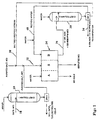
- the solution is processed in a chromatographic separation (C-SEP Column 1) 20 to recover a first stream that is substantially free of the chlorate, and a second stream that contains the chlorate as well as a significant amount of the chloride.
- the C-SEP column 20 is packed with an amphoteric ion exchange resin.
- Suitable resins may be either AMP 01 from Mitsubishi Chemical Corporation or 11A8 from Dow Chemical.
- a certain volume of feed is charged to the column, followed by a certain volume of water for elution.
- the resin has a selectivity which is higher for chlorate than it is for chloride, so that the chloride is eluted first, followed by an elution of the chlorate rich solution.
- By carefully monitoring the effluent property e.g. via a refractive index, it possible to obtain a quantity of a solution containing chloride that is substantially free of the chlorate.
- the chloride solution is optionally combined with a purified brine solution from a different source (e.g. by dissolving purchased salt in water to obtain a saturated solution that is subsequently purified by methods known in the art). Then, the saturated solution is fed to the salt loop of an electrodialysis water splitter.
- a purified brine solution from a different source (e.g. by dissolving purchased salt in water to obtain a saturated solution that is subsequently purified by methods known in the art). Then, the saturated solution is fed to the salt loop of an electrodialysis water splitter.
- Fig. 1 shows a three compartment cell 24, either a two or three compartment cell may be used.
- the salt is converted to acid and base under a direct current driving force.
- the base product from the cell (out of the base compartment B) is usually about 10-18 wt% strength.
- the product acid (HCl, out of the acid compartment A) usually has about a 3-8 wt% concentration.
- the output from the salt compartment (S) is depleted in its salt content. Depending on the operating conditions and the membranes deployed, the depleted salt solution may also contain a certain amount of free HCl.
- Disposition of the depleted salt solution and the acid product depends on the specific application.
- the salt stream may be forwarded to the electrolysis cells for the production of chlorine and caustic, while the acid product can be used in a number of places within a manufacturing plant complex.
- the base product from the water splitter contains a certain amount of salt contaminant, e.g., about 500-8000 ppm in the form of the chloride salt.
- salt contaminant e.g., about 500-8000 ppm in the form of the chloride salt.
- the presence of salt in the base (and acid) occurs because the ion exchange membranes used in the water splitting process are not 100% permselective. Consequently there is a certain amount of salt ion transport across the membranes from the adjoining compartments (see the above cited Mani reference for more details).
- the base product solution from the water splitter is purified by passing it through a column (C-SEP Column 2) 30 containing an amphoteric ion exchange resin.
- the resin has a selectivity which is higher for the salt when compared with the selectivity for the base product. Consequently, when the column is subsequently eluted with water, the base product solution is recovered first and in a highly purified form, while the salt-rich solution elutes later.
- the salt rich solution is returned to the salt loop 32 of the water splitter for conversion back to acid and base.
- the purified base product is further concentrated at 34 as desired and sold.
- the first fraction comprises the purified base at 34, the second a salt rich stream at 38, while the third is a weak stream 40 containing only small amounts of salt and base.
- the salt rich stream at 38 (the second fraction) may be forwarded to the salt loop of the water splitter for conversion to acid and base, while the third fraction, comprising mostly water and small amounts of base and salt, is forwarded to the base loop in order to provide dilution water. In this manner, the dilution of the caustic product is minimized, while salt recovery is maximized.
- Fig. 2 shows the cell arrangements used to produce acid and base from salt.
- the input feedstream is shown as MCl.
- Fig. 2(a) shows a two compartment cell containing bipolar (-+) and cation (+) exchange membranes 44, 46. Suitable membranes are available from Tokuyama Corporation, Asahi Glass Co. and Aqualytics, Inc. In the cell, the membranes are used to contain the base (B) and salt/acid (S/A) compartments as shown.
- the compartments are fashioned out of thin ( ⁇ 1 mm thick) polymeric gasket material. Suitable cutouts within the gaskets are compartments in which the solution flow occurs.
- the compartments are preferably packed with a suitable non-woven netting material that separates and mechanically supports the adjacent membranes, while allowing a solution flow. Entry and exit of process solutions from the individual gasket/compartment is achieved via "ports" that are fashioned within each gasket/compartment.
- the assembly comprising a base compartment, bipolar membrane, a salt/acid compartment and a cation membrane is termed a "cell pair" or simply a "cell”.
- a cell pair As many as about 100-200 cells may be assembled between a single set of anode (+) and a cathode (-) electrodes 48, 50.
- the entire assembly, comprising the electrodes, gaskets and membranes, is held together by a set of end plates/backup plates (not shown) and a suitable clamping mechanism. In a properly constructed cell assembly, there should be little or no fluid leakage between the various compartments.
- the feed salt is acidified in the salt/acid loop, while an equivalent amount of base is generated in the base loop responsive to the application of a direct current driving force.
- the feed salt solution is admitted to the S/A compartment between a cation membrane 46 and the cation selective side of the bipolar membrane 44.
- a liquid comprising water is admitted to the compartment B bounded by a cation membrane 52 and the anion selective side of the bipolar membrane 44.
- the salt cations (M + ) move from the salt/acid compartment S/A, across the cation selective membrane (+) at 44 and into the base compartment B.
- the first issue involves the competitive transport of H + and M + ions across the cation selective membrane.
- the mobility of hydrogen ions is significantly more than the mobility of the salt cation. This, in turn, reduces the overall process efficiency, since only the transport of the salt cation results in the production of the base product. For this reason, the process works best when there is a large excess of salt cations.
- the problem of salt contamination of the base product is much more severe in the water splitting process than in the membrane electrolysis process. This is because, in the electrolysis process, the production of acid and base is effected through the use of electrodes 48, 50, which are impervious to the transport of salt ions. In effect, the electrodes bounding the electrolysis cell are 100% permselective.
- Fig. 2(b) shows the order of the membrane assembly for a three compartment cell 56.
- the cell has a bipolar membrane 58, cation membrane 62(+), and an anion membrane 60(-).
- the compartments bounding the membranes are once again formed of gaskets, resulting in an acid (A) compartment between the anion membrane 60 and the anion selective side of the bipolar membrane, a base compartment (B) between the cation selective side of the bipolar membrane 58 and the adjacent cation membrane 62, and a salt compartment (S/A) between the cation exchange membranes 62 and a second anion membrane 64.
- the assembly comprising three membranes and the three compartments is termed a "cell". As many as about 100-200 cells may be assembled between an anode 48 and a cathode 50, so as to form a compact water splitting cell stack.
- a purified salt solution is fed to the salt compartment S/A, while a liquid comprising water is admitted to the acid A and base B compartments.
- the bipolar membrane Under a direct current driving force, the bipolar membrane generates H + and OH - ions in the acid and base compartments respectively.
- salt cations M + and anions X - from the dissociation of salt MX are transported across the cation and anion 60/64 membranes respectively.
- the net result is the production of acid HX and base MOH from salt.
- the acid, base, and the depleted salt products are withdrawn from their respective compartments.
- the ion exchange membranes are not 100% permselective, a certain amount of undesirable ionic transport occurs within the cell. Some of this transport is shown in the form of dashed lines in the figure.
- the transport of salt anion X - from the acid loop across the bipolar membrane 58 leads to the formation of salt in the base product.
- Other sources of inefficiency arise from the transport of co-ions, (e.g., the transport of H + ions) across the anion membrane 60 and the OH - ions across the cation membrane.
- the movement of H + ions across the anion membrane is greater than the movement of the OH - ions across the cation membrane 62, so that during the process the salt loop S/A tends to become acidic.
- Fig. 2(c) shows a three compartment cell 70, wherein a suitable neutralizing compound is admitted to the acid loop.
- An amino acid represented as RNH 2
- RNH 2 is an example of a neutralizing (or buffering) compound.
- the base product would nevertheless contain a certain amount of salt, arising from the transport of X - ions across the bipolar membrane 72.
- KOH potassium hydroxide
- Fig. 3 shows the results from the two tests.
- "Pure" KOH containing essentially no chloride contaminant is eluted first. After the first 52 ml. of solution, containing ⁇ 98% of the KOH in the feed sample, has been withdrawn, the chloride rich solution is eluted as a strong, sharp peak. Consequently, it is possible to separate out substantially all of the chloride contaminant from the feed KOH solution. Furthermore, the peak separation between the components is good enough to permit the recovery of the purified KOH with minimal dilution.
- the effectiveness of the chromatographic separation technique is specific to the solution mixture and the resin that is used.
- the amphoteric resins AMP01 and 11A8 for example were found to be highly effective in separating the chloride from the alkali metal hydroxide (NaOH, KOH). Separation of other anions, such as sulfate, lactate from the alkali hydroxide using these resins was either extremely poor or ineffective.
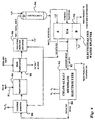
- Fig. 4 shows the integration of the brine acidification process with the chlor-alkali process by using the process of this invention.
- the process of Fig. 4 starts with NaCl at input 81.
- the chlor-alkali cell 80 uses a purified, acidified brine at input 82 (i.e., NaCl, along with some NaClO 3 , Na 2 SO 4 and HCl) and generates sodium hydroxide (NaOH), chlorine gas (Cl 2 ) and hydrogen (H 2 ).
- NaOH sodium hydroxide
- Cl 2 chlorine gas
- H 2 hydrogen
- the depleted brine solution from the cell 80 appears at output 84 and contains a number of undesirable components such as oxygen, chlorine, hypochlorous acid, hypochloric acid and chlorate.
- Substantially all of these contaminants are removed from the depleted brine by using a combination of acidification (with additional HCl) and vacuum stripping operations at 86.
- Sodium chlorate (NaClO 3 ) is one component which is deleterious to the water splitter operation and which is not removed to a significant extent during these purification steps.
- the depleted brine is then re-saturated at 86 with solid salt(NaCl) and purified at 88 to remove impurities such as calcium and magnesium.
- the procedure for this is well known, and includes a pH adjustment, filtration and chelating resin ion exchanger treatment.
- the purified salt solution comprises primarily sodium chloride, but also certain amounts of sodium chlorate and sodium sulfate. This solution is suitable for feeding directly to the chlor-alkali cell 90.
- the inventive process uses a water splitting cell 92 to directly acidify the brine feed or optionally to generate a certain amount of hydrochloric acid solution. With either option an equivalent amount of sodium hydroxide is also generated.
- the brine solution is passed through a column 92 containing an amphoteric ion exchange resin.
- the resin has a selectivity for chlorate which is higher than its selectivity for chloride, so that an effective removal of chlorate from a portion of the chloride solution is achieved.
- the chloride solution, substantially free of the chlorate is then processed in the water splitter 92, while the chlorate rich brine solution is directed to the chlor-alkali cell as shown.
- the caustic product which is typically contaminated with a certain amount of chloride may then be processed in an optional second chromatographic column (C-SEP 2) (not shown) so as to recover a purified caustic product and a salt rich stream that can be recycled as shown in Fig. 1.
- C-SEP 2 optional second chromatographic column
- the treatment of the purified brine in the amphoteric resin column 30 is an important pre-requisite to a reliable operation of the water splitting cell 24. This is because any chlorate present in the feed to the water splitter cell will react with the hydrogen ions generated therein, producing strongly oxidizing compounds such as chlorine and chlorine dioxide (ClO 2 ). These oxidizing species are detrimental to the chemical stability of the hydrocarbon based membranes that are used in the water splitter cell 24.
- the use of a step including this chromatographic separation column 30 permits an isolation of a chloride stream that can be reliably processed in the water splitter 24. A chlorate-rich stream is produced that can be forwarded directly to the chlor-alkali cell. An improved brine acidification process is thereby realized.
- Fig. 5 shows an application of the inventive process which begins with the production of a purified base product (MOH) at 48 and a high quality calcium chloride (CaCl 2 ) at 100 using an alkali metal salt (MCl) at input 96.
- the salt is converted to acid and base by using a three compartment water splitter and a direct current input.
- the base product from the cell 102 usually comprises 8-18 wt% alkali MOH at 104 containing an amount of salt contaminant MCl.
- This solution is processed in a chromatographic separation column 106 using water elution, so as to obtain three output streams.
- the first output stream 108 comprising purified caustic (MOH) is optionally concentrated to ⁇ 50 wt% and sold.
- the second stream output at 110 rich in salt, is combined at saturator 112 with the depleted salt solution from the water splitter 102, fortified with fresh salt at input 96, purified to remove impurities such as Ca, Mg, and then returned to the salt loop at 116.
- the third stream at 118 comprising substantially pure water, is combined with fresh make up water at 120 and returned to the base loop of the water splitter at 122.
- water is added to the acid loop, so as to obtain product acid (HCl) at 126 to provide a target concentration of ⁇ 7 wt%.
- the acid product may contain 0.05-0.3 wt% salt content (MCl).
- the acid product is reacted with calcium carbonate or lime (CaO) in a neutralization tank 128, resulting in the production of ⁇ 10 wt% calcium chloride;
- 2HCl + CaCO 3 CaCl 2 + CO 2(g) ⁇ + H 2 O
- CaO CaCl 2 + H 2 O
- the calcium chloride solution is concentrated in an evaporator 130 to ⁇ 40-50% strength and sold.
Landscapes
- Chemical & Material Sciences (AREA)
- Organic Chemistry (AREA)
- Engineering & Computer Science (AREA)
- Materials Engineering (AREA)
- Inorganic Chemistry (AREA)
- Water Supply & Treatment (AREA)
- Health & Medical Sciences (AREA)
- Urology & Nephrology (AREA)
- Chemical Kinetics & Catalysis (AREA)
- General Health & Medical Sciences (AREA)
- Metallurgy (AREA)
- Electrochemistry (AREA)
- Separation Using Semi-Permeable Membranes (AREA)
- Water Treatment By Electricity Or Magnetism (AREA)
- Electrolytic Production Of Non-Metals, Compounds, Apparatuses Therefor (AREA)
- Treatment Of Liquids With Adsorbents In General (AREA)
Abstract
Description
Claims (16)
- A process for the a production of high purity alkali from salt, said process comprising the steps of:(a) processing a salt solution feedstream in an electrodialysis cell comprising bipolar membranes so as to produce an alkali solution containing a salt impurity; and(b) passing the solution of step (a) through a chromatographic column containing an amphoteric ion exchange resin so as to recover a purified alkali solution and a second solution containing the salt.
- The process of claim 1 wherein the salt used is selected from a group consisting of sodium chloride, alkali metal chloride, or potassium chloride.
- A process for a production of high purity alkali from salt, said process comprising the steps of:(a) processing a salt solution feedstream in an electrodialysis cell comprising bipolar membranes so as to produce an alkali solution containing a salt impurity;(b) passing the solution of step (a) through a chromatographic column containing an amphoteric ion exchange resin so as to recover a purified alkali solution and a solution containing the salt; and(c) recovering a salt by recycling the salt solution from step (b) through the electrodialysis cell.
- The process of claim 3 wherein the alkali salt is selected from a group consisting of sodium chloride or potassium chloride, and a corresponding alkali produced by said process is sodium hydroxide or potassium hydroxide.
- The process of claim 3 wherein step (b) further includes a recovery of a purified alkali solution, a solution rich in salt, and substantially pure water.
- The process of claim 5 and the further steps of recycling the salt rich solution to the salt loop and returning the substantially pure water stream to the base loops of the water splitter cell.
- A process for acidifying a brine feed in at least one chlor-alkali cell, said process comprising the steps of:(a) subjecting a brine stream containing alkali metal chlorate to a chromatographic separation step so as to obtain a first stream that is substantially free of the chlorate contaminant and a second stream containing chlorate;(b) providing a water splitter cell having bipolar membranes;(c) processing the first stream of step (a) in said water splitter cell to obtain an acidified brine solution;(d) forming a third stream by combining said second stream of step (a) with said acidified brine solution of step c, said third stream having an equivalent amount of alkali;(e) providing a chlor-alkali membrane electrolyzer; and(f) forwarding said third stream of step (d) to said electrolyzer of step (e).
- The process of claim 7 and the further step of forming a fourth stream from said water splitter, said fourth step being a hydrochloric acid.
- The process of claim 7 wherein the brine stream is selected from a group consisting of sodium chloride, and potassium chloride wherein the corresponding chlorate is sodium chlorate or potassium chlorate.
- The process of either of the claims 1 or claim 3 wherein the salt processed is an alkali metal chloride and the corresponding acid produced is hydrochloric acid.
- The process of claim 10 wherein the acid produced is neutralized with a neutralizing agent.
- The process of claim 11 wherein the neutralizing agent is selected from a group consisting of lysine or glutamic acid and the product is a hydrochloride compound.
- The process of claim 10 wherein the acid produced is reacted with a material selected from a group consisting of lime or calcium carbonate in order to produce calcium chloride.
- The process of either claim 1 or claim 3 wherein the alkali solution concentration output of the water splitter is in the range of 10-18 wt%
- The process of either of the claims 1 or 3 wherein the purified alkali solution from the chromatographic column has a concentration 8-17 wt%.
- The process of either of the claims 3 or 7 wherein the water splitter is selected from a group consisting of two compartments containing bipolar and cation exchange membranes or three compartments containing bipolar cation and anion exchange membranes.
Applications Claiming Priority (4)
| Application Number | Priority Date | Filing Date | Title |
|---|---|---|---|
| US15196799P | 1999-09-01 | 1999-09-01 | |
| US151967P | 1999-09-01 | ||
| US562233 | 2000-04-28 | ||
| US09/562,233 US6482305B1 (en) | 1999-09-01 | 2000-04-28 | Electrodialysis water splitting process |
Publications (3)
| Publication Number | Publication Date |
|---|---|
| EP1080776A2 true EP1080776A2 (en) | 2001-03-07 |
| EP1080776A3 EP1080776A3 (en) | 2001-04-11 |
| EP1080776B1 EP1080776B1 (en) | 2004-09-22 |
Family
ID=26849130
Family Applications (1)
| Application Number | Title | Priority Date | Filing Date |
|---|---|---|---|
| EP00306359A Expired - Lifetime EP1080776B1 (en) | 1999-09-01 | 2000-07-26 | Electrodialysis water splitting process |
Country Status (7)
| Country | Link |
|---|---|
| US (1) | US6482305B1 (en) |
| EP (1) | EP1080776B1 (en) |
| JP (1) | JP3680296B2 (en) |
| AT (1) | ATE276820T1 (en) |
| CA (1) | CA2315344C (en) |
| DE (1) | DE60013992T2 (en) |
| ES (1) | ES2223406T3 (en) |
Families Citing this family (39)
| Publication number | Priority date | Publication date | Assignee | Title |
|---|---|---|---|---|
| JP3839641B2 (en) * | 2000-06-20 | 2006-11-01 | 独立行政法人科学技術振興機構 | Hydroxide ion separation and analysis method and ion chromatography apparatus |
| US7175869B2 (en) * | 2000-11-30 | 2007-02-13 | Kraft Foods Holdings, Inc. | Method of deflavoring soy-derived materials using electrodialysis |
| US7582326B2 (en) | 2003-10-29 | 2009-09-01 | Kraft Foods Global Brands Llc | Method of deflavoring whey protein using membrane electrodialysis |
| US20050183955A1 (en) * | 2004-02-23 | 2005-08-25 | Crowley Colin P. | Electrodialyzed compositions and method of treating aqueous solutions using elecrtrodialysis |
| US20050220969A1 (en) * | 2004-02-23 | 2005-10-06 | Kraft Foods Holdings, Inc. | Shelf-stable cold-processed food compositions and methods for their preparation |
| US20050186312A1 (en) * | 2004-02-23 | 2005-08-25 | Kraft Foods Holdings, Inc. | Shelf-stable foodstuffs and methods for their preparation |
| US7887867B2 (en) | 2004-02-23 | 2011-02-15 | Kraft Foods Global Brands Llc | Stabilized non-sour dairy base materials and methods for preparation |
| US7959780B2 (en) | 2004-07-26 | 2011-06-14 | Emporia Capital Funding Llc | Textured ion exchange membranes |
| JP4344668B2 (en) * | 2004-09-21 | 2009-10-14 | 株式会社 伊藤園 | Method for removing nitric acid from aqueous liquid and method for producing beverage |
| US7780833B2 (en) | 2005-07-26 | 2010-08-24 | John Hawkins | Electrochemical ion exchange with textured membranes and cartridge |
| US8562803B2 (en) | 2005-10-06 | 2013-10-22 | Pionetics Corporation | Electrochemical ion exchange treatment of fluids |
| JP4839949B2 (en) * | 2006-04-27 | 2011-12-21 | 日本錬水株式会社 | Electrolysis method of alkali metal chloride |
| JP5023809B2 (en) * | 2007-05-29 | 2012-09-12 | 日本錬水株式会社 | Electrolysis method of aqueous sodium chloride solution |
| WO2009005767A1 (en) * | 2007-06-29 | 2009-01-08 | Archer-Daniels-Midland Company | Process for desalting glycerol solutions and recovery of chemicals |
| CN101468832A (en) * | 2007-12-25 | 2009-07-01 | 通用电气公司 | Electrolytic apparatus, method and washing facility including the electrolytic apparatus |
| WO2010069031A1 (en) | 2008-12-17 | 2010-06-24 | Aker Solutions Canada Inc. | Perchlorate removal from concentrated salt solutions using amphoteric ion-exchange resins |
| WO2011102848A1 (en) * | 2010-02-17 | 2011-08-25 | Katana Energy Llc | Zero discharge water desalination plant with minerals extraction integrated with natural gas combined cycle power generation |
| US10526224B2 (en) | 2010-06-02 | 2020-01-07 | Hl Seawater Holdings, Llc | Desalination intake system with net positive impact on habitat |
| CN102947227A (en) * | 2010-06-21 | 2013-02-27 | 太平洋水泥株式会社 | Calcium removal method |
| US8999172B1 (en) | 2010-12-16 | 2015-04-07 | Global Water Advisors, Inc. | Selective removal of dissolved substances from aqueous solutions |
| US8764957B2 (en) | 2010-12-23 | 2014-07-01 | General Electric Company | Water treatment using a bipolar membrane |
| JP5650028B2 (en) * | 2011-03-24 | 2015-01-07 | 太平洋セメント株式会社 | Calcium chloride recovery method |
| US8999171B2 (en) | 2011-07-18 | 2015-04-07 | Hl Seawater Holdings, Llc | Membrane and electrodialysis based seawater desalination with salt, boron and gypsum recovery |
| WO2013071304A1 (en) * | 2011-11-10 | 2013-05-16 | Davis Jake | Electrochemical ion exchange water treatment |
| CA2797995A1 (en) * | 2011-12-06 | 2013-06-06 | Drake Water Technologies, Inc. | Antisolvent process for treating liquids that include high total dissolved solids |
| US9737827B2 (en) | 2012-08-13 | 2017-08-22 | Enviro Water Minerals Company, Inc. | System for removing high purity salt from a brine |
| US10189733B2 (en) | 2012-08-13 | 2019-01-29 | Enviro Water Minerals Company, Inc. | Heating system for desalination |
| US10011506B2 (en) | 2012-08-13 | 2018-07-03 | Enviro Water Minerals Company, Inc. | System for removing minerals from a brine using electrodialysis |
| US9259703B2 (en) | 2012-08-13 | 2016-02-16 | Enviro Water Minerals Company, Inc. | System for removing selenium from a feed stream |
| US10105653B2 (en) | 2012-08-13 | 2018-10-23 | Enviro Water Minerals Company, Inc. | System for rinsing electrodialysis electrodes |
| US9217108B2 (en) | 2012-08-13 | 2015-12-22 | Enviro Water Minerals Company, Inc. | System and method for producing a gypsum slurry for irrigation |
| CN103214113B (en) * | 2013-04-08 | 2014-07-30 | 江苏洪流化工机械有限公司 | Chromatographic separation method of sodium chloride and sodium glycollate in waste water in production process of sodium carboxy methyl cellulose |
| US10065859B2 (en) | 2013-04-29 | 2018-09-04 | Enviro Water Minerals Company, Inc. | Hydrochloric acid production system |
| US10370275B2 (en) | 2013-11-25 | 2019-08-06 | Enviro Water Minerals Company, Inc. | System for removing minerals from a brine |
| WO2016033319A1 (en) * | 2014-08-27 | 2016-03-03 | Tangent Company Llc | Electrochemically regenerated water decationization method and apparatus |
| US9757695B2 (en) | 2015-01-03 | 2017-09-12 | Pionetics Corporation | Anti-scale electrochemical apparatus with water-splitting ion exchange membrane |
| JP6320324B2 (en) * | 2015-02-16 | 2018-05-09 | 株式会社日本海水 | Purification method of potassium chloride |
| CN116669834A (en) * | 2020-11-09 | 2023-08-29 | 加州理工学院 | Electrodialyzer and electrodialysis system for CO2 capture from seawater |
| WO2025038149A2 (en) * | 2023-05-10 | 2025-02-20 | The Board Of Trustees Of The Leland Stanford Junior University | Electrochemical system for generating acidic and basic solutions |
Family Cites Families (4)
| Publication number | Priority date | Publication date | Assignee | Title |
|---|---|---|---|---|
| US4154801A (en) * | 1978-02-01 | 1979-05-15 | The Dow Chemical Company | Process for purifying alkali metal hydroxide or carbonate solutions |
| US4391680A (en) * | 1981-12-03 | 1983-07-05 | Allied Corporation | Preparing alkali metal hydroxide by water splitting and hydrolysis |
| JPH07112559B2 (en) * | 1987-11-18 | 1995-12-06 | 神鋼パンテック株式会社 | Method for treating alkaline fluoride waste liquid containing metal ions and oils |
| US5200046A (en) * | 1990-12-12 | 1993-04-06 | Allied-Signal Inc. | Apparatus and method for electrodialytic treatment of salts to produce acid and/or base of improved purity |
-
2000
- 2000-04-28 US US09/562,233 patent/US6482305B1/en not_active Expired - Lifetime
- 2000-07-26 AT AT00306359T patent/ATE276820T1/en not_active IP Right Cessation
- 2000-07-26 EP EP00306359A patent/EP1080776B1/en not_active Expired - Lifetime
- 2000-07-26 DE DE60013992T patent/DE60013992T2/en not_active Expired - Lifetime
- 2000-07-26 ES ES00306359T patent/ES2223406T3/en not_active Expired - Lifetime
- 2000-08-03 CA CA002315344A patent/CA2315344C/en not_active Expired - Lifetime
- 2000-08-31 JP JP2000263966A patent/JP3680296B2/en not_active Expired - Fee Related
Also Published As
| Publication number | Publication date |
|---|---|
| US6482305B1 (en) | 2002-11-19 |
| ES2223406T3 (en) | 2005-03-01 |
| ATE276820T1 (en) | 2004-10-15 |
| EP1080776B1 (en) | 2004-09-22 |
| DE60013992D1 (en) | 2004-10-28 |
| DE60013992T2 (en) | 2005-01-27 |
| JP3680296B2 (en) | 2005-08-10 |
| JP2001122616A (en) | 2001-05-08 |
| CA2315344C (en) | 2007-06-05 |
| EP1080776A3 (en) | 2001-04-11 |
| CA2315344A1 (en) | 2001-03-01 |
Similar Documents
| Publication | Publication Date | Title |
|---|---|---|
| EP1080776B1 (en) | Electrodialysis water splitting process | |
| US6294066B1 (en) | Apparatus and process for electrodialysis of salts | |
| US4238305A (en) | Electrodialytic process for the conversion of impure soda values to sodium hydroxide and carbon dioxide | |
| US6627061B2 (en) | Apparatus and process for electrodialysis of salts | |
| US4219396A (en) | Electrodialytic process | |
| JP3333960B2 (en) | Method for producing hydrochloride and caustic amino acid using water splitting by electrodialysis | |
| EP0246070B1 (en) | Process and apparatus for recovery of precious metal compound | |
| US3463814A (en) | Chemical cycle for evaporative water desalination plant | |
| US4069117A (en) | Process for removing and recovering acidic gases from gaseous mixtures containing them | |
| KR20230142589A (en) | System and method for direct production of lithium hydroxide | |
| US20200024757A1 (en) | Production of Alkali Metal Hydroxide, Chloride and Sulfate via Electrodialysis and Subsequent Downstream Processing | |
| US4481088A (en) | Removal of chlorate from electrolyte cell brine | |
| KR20250088486A (en) | Electrochemical production of alkali metal hydroxides and sulfuric acid by battery manufacturing and waste stream recycling | |
| JPH0533169A (en) | Method for treating and recovering waste etchant containing fluorine and ammonia compound | |
| EP4326701A1 (en) | The production of formic acid or formaldehyde from carbon dioxide | |
| US20180119298A1 (en) | Iodide removal from brine using ion retardation resins | |
| US5474581A (en) | Method for producing an aqueous sodium chloride solution and use thereof | |
| JPWO2003014028A1 (en) | Method for selective separation of iodine ion in aqueous solution and method for producing iodine alkali salt | |
| NZ247644A (en) | Process for preparing alkali metal chlorates, apparatus therefor | |
| EP0572389B1 (en) | Separation/recovery of ammonium salts via electrodialytic water splitting | |
| EP3204333A1 (en) | Process for producing ammonia | |
| US6132591A (en) | Method for removal of sulfate groups and chlorate groups from brine | |
| CN109851107A (en) | A method for recycling mixed industrial salt waste liquid using membrane technology | |
| RU2071508C1 (en) | Plant for production of high-purity potassium hydroxide | |
| CA2646875C (en) | Perchlorate removal from concentrated salt solutions using amphoteric ion-exchange resins |
Legal Events
| Date | Code | Title | Description |
|---|---|---|---|
| PUAI | Public reference made under article 153(3) epc to a published international application that has entered the european phase |
Free format text: ORIGINAL CODE: 0009012 |
|
| PUAL | Search report despatched |
Free format text: ORIGINAL CODE: 0009013 |
|
| AK | Designated contracting states |
Kind code of ref document: A2 Designated state(s): AT BE CH CY DE DK ES FI FR GB GR IE IT LI LU MC NL PT SE |
|
| AX | Request for extension of the european patent |
Free format text: AL;LT;LV;MK;RO;SI |
|
| AK | Designated contracting states |
Kind code of ref document: A3 Designated state(s): AT BE CH CY DE DK ES FI FR GB GR IE IT LI LU MC NL PT SE |
|
| AX | Request for extension of the european patent |
Free format text: AL;LT;LV;MK;RO;SI |
|
| 17P | Request for examination filed |
Effective date: 20010613 |
|
| AKX | Designation fees paid |
Free format text: AT BE CH CY DE DK ES FI FR GB GR IE IT LI LU MC NL PT SE |
|
| 17Q | First examination report despatched |
Effective date: 20030723 |
|
| GRAP | Despatch of communication of intention to grant a patent |
Free format text: ORIGINAL CODE: EPIDOSNIGR1 |
|
| GRAS | Grant fee paid |
Free format text: ORIGINAL CODE: EPIDOSNIGR3 |
|
| GRAA | (expected) grant |
Free format text: ORIGINAL CODE: 0009210 |
|
| AK | Designated contracting states |
Kind code of ref document: B1 Designated state(s): AT BE CH CY DE DK ES FI FR GB GR IE IT LI LU MC NL PT SE |
|
| PG25 | Lapsed in a contracting state [announced via postgrant information from national office to epo] |
Ref country code: IT Free format text: LAPSE BECAUSE OF FAILURE TO SUBMIT A TRANSLATION OF THE DESCRIPTION OR TO PAY THE FEE WITHIN THE PRE;WARNING: LAPSES OF ITALIAN PATENTS WITH EFFECTIVE DATE BEFORE 2007 MAY HAVE OCCURRED AT ANY TIME BEFORE 2007. THE CORRECT EFFECTIVE DATE MAY BE DIFFERENT FROM THE ONE RECORDED.SCRIBED TIME-LIMIT Effective date: 20040922 Ref country code: CH Free format text: LAPSE BECAUSE OF FAILURE TO SUBMIT A TRANSLATION OF THE DESCRIPTION OR TO PAY THE FEE WITHIN THE PRESCRIBED TIME-LIMIT Effective date: 20040922 Ref country code: NL Free format text: LAPSE BECAUSE OF FAILURE TO SUBMIT A TRANSLATION OF THE DESCRIPTION OR TO PAY THE FEE WITHIN THE PRESCRIBED TIME-LIMIT Effective date: 20040922 Ref country code: LI Free format text: LAPSE BECAUSE OF FAILURE TO SUBMIT A TRANSLATION OF THE DESCRIPTION OR TO PAY THE FEE WITHIN THE PRESCRIBED TIME-LIMIT Effective date: 20040922 Ref country code: AT Free format text: LAPSE BECAUSE OF FAILURE TO SUBMIT A TRANSLATION OF THE DESCRIPTION OR TO PAY THE FEE WITHIN THE PRESCRIBED TIME-LIMIT Effective date: 20040922 Ref country code: BE Free format text: LAPSE BECAUSE OF FAILURE TO SUBMIT A TRANSLATION OF THE DESCRIPTION OR TO PAY THE FEE WITHIN THE PRESCRIBED TIME-LIMIT Effective date: 20040922 Ref country code: FI Free format text: LAPSE BECAUSE OF FAILURE TO SUBMIT A TRANSLATION OF THE DESCRIPTION OR TO PAY THE FEE WITHIN THE PRESCRIBED TIME-LIMIT Effective date: 20040922 |
|
| REG | Reference to a national code |
Ref country code: GB Ref legal event code: FG4D |
|
| REG | Reference to a national code |
Ref country code: CH Ref legal event code: EP |
|
| REG | Reference to a national code |
Ref country code: IE Ref legal event code: FG4D |
|
| REF | Corresponds to: |
Ref document number: 60013992 Country of ref document: DE Date of ref document: 20041028 Kind code of ref document: P |
|
| PG25 | Lapsed in a contracting state [announced via postgrant information from national office to epo] |
Ref country code: GR Free format text: LAPSE BECAUSE OF FAILURE TO SUBMIT A TRANSLATION OF THE DESCRIPTION OR TO PAY THE FEE WITHIN THE PRESCRIBED TIME-LIMIT Effective date: 20041222 Ref country code: SE Free format text: LAPSE BECAUSE OF FAILURE TO SUBMIT A TRANSLATION OF THE DESCRIPTION OR TO PAY THE FEE WITHIN THE PRESCRIBED TIME-LIMIT Effective date: 20041222 Ref country code: DK Free format text: LAPSE BECAUSE OF FAILURE TO SUBMIT A TRANSLATION OF THE DESCRIPTION OR TO PAY THE FEE WITHIN THE PRESCRIBED TIME-LIMIT Effective date: 20041222 |
|
| REG | Reference to a national code |
Ref country code: ES Ref legal event code: FG2A Ref document number: 2223406 Country of ref document: ES Kind code of ref document: T3 |
|
| ET | Fr: translation filed | ||
| REG | Reference to a national code |
Ref country code: CH Ref legal event code: PL |
|
| NLV1 | Nl: lapsed or annulled due to failure to fulfill the requirements of art. 29p and 29m of the patents act | ||
| PG25 | Lapsed in a contracting state [announced via postgrant information from national office to epo] |
Ref country code: IE Free format text: LAPSE BECAUSE OF NON-PAYMENT OF DUE FEES Effective date: 20050726 Ref country code: LU Free format text: LAPSE BECAUSE OF NON-PAYMENT OF DUE FEES Effective date: 20050726 Ref country code: CY Free format text: LAPSE BECAUSE OF FAILURE TO SUBMIT A TRANSLATION OF THE DESCRIPTION OR TO PAY THE FEE WITHIN THE PRESCRIBED TIME-LIMIT Effective date: 20050726 |
|
| PLBE | No opposition filed within time limit |
Free format text: ORIGINAL CODE: 0009261 |
|
| STAA | Information on the status of an ep patent application or granted ep patent |
Free format text: STATUS: NO OPPOSITION FILED WITHIN TIME LIMIT |
|
| PG25 | Lapsed in a contracting state [announced via postgrant information from national office to epo] |
Ref country code: MC Free format text: LAPSE BECAUSE OF NON-PAYMENT OF DUE FEES Effective date: 20050731 |
|
| 26N | No opposition filed |
Effective date: 20050623 |
|
| REG | Reference to a national code |
Ref country code: IE Ref legal event code: MM4A |
|
| PG25 | Lapsed in a contracting state [announced via postgrant information from national office to epo] |
Ref country code: PT Free format text: LAPSE BECAUSE OF NON-PAYMENT OF DUE FEES Effective date: 20050222 |
|
| REG | Reference to a national code |
Ref country code: FR Ref legal event code: PLFP Year of fee payment: 17 |
|
| REG | Reference to a national code |
Ref country code: FR Ref legal event code: PLFP Year of fee payment: 18 |
|
| PGFP | Annual fee paid to national office [announced via postgrant information from national office to epo] |
Ref country code: GB Payment date: 20170727 Year of fee payment: 18 Ref country code: ES Payment date: 20170801 Year of fee payment: 18 |
|
| REG | Reference to a national code |
Ref country code: FR Ref legal event code: PLFP Year of fee payment: 19 |
|
| PGFP | Annual fee paid to national office [announced via postgrant information from national office to epo] |
Ref country code: DE Payment date: 20180710 Year of fee payment: 19 Ref country code: FR Payment date: 20180712 Year of fee payment: 19 |
|
| GBPC | Gb: european patent ceased through non-payment of renewal fee |
Effective date: 20180726 |
|
| PG25 | Lapsed in a contracting state [announced via postgrant information from national office to epo] |
Ref country code: GB Free format text: LAPSE BECAUSE OF NON-PAYMENT OF DUE FEES Effective date: 20180726 |
|
| REG | Reference to a national code |
Ref country code: ES Ref legal event code: FD2A Effective date: 20190917 |
|
| PG25 | Lapsed in a contracting state [announced via postgrant information from national office to epo] |
Ref country code: ES Free format text: LAPSE BECAUSE OF NON-PAYMENT OF DUE FEES Effective date: 20180727 |
|
| REG | Reference to a national code |
Ref country code: DE Ref legal event code: R119 Ref document number: 60013992 Country of ref document: DE |
|
| PG25 | Lapsed in a contracting state [announced via postgrant information from national office to epo] |
Ref country code: DE Free format text: LAPSE BECAUSE OF NON-PAYMENT OF DUE FEES Effective date: 20200201 |
|
| PG25 | Lapsed in a contracting state [announced via postgrant information from national office to epo] |
Ref country code: FR Free format text: LAPSE BECAUSE OF NON-PAYMENT OF DUE FEES Effective date: 20190731 |