BACKGROUND OF THE INVENTION
Field of the Invention
The present invention relates to an apparatus
equipped with a digital interface, which is used for
connecting a plurality of nodes in a daisy chain
and/or a branch and does not allow a loop, a loop
status notifying method in the apparatus equipped
with a digital interface, and a loop connection
avoiding method in the apparatus equipped with a
digital interface.
Description of Prior Art
As digital interfaces for connecting a digital
VCR (Video Cassette Recorder), a DVD (Digital
Versatile Disc), a video camera, a printer, or the
like to a PC (Personal Computer), IEEE 1394
high-speed serial bus interfaces have been paid
attention to in recent years.
When the IEEE 1394 is used, nodes are connected
in a daisy chain and a branch. A connection structure
of the nodes is automatically recognized and set.
The setting is performed by performing bus
initialization, tree identification, and self-node
ID identification in this order.
(1) Bus Initialization
When the power supply is turned on and when a
node is added to a bus, a bus reset signal is fed
to all connected apparatuses. Consequently, all
information relating to a connection structure of
nodes are cleared. At the time point of node
initialization, each of nodes has only information
indicating whether the node itself is a branch node
(a node connected to two or more nodes), a leaf node
(a node connected to only one node), or is in a
non-connected state.
(2) Tree Identification
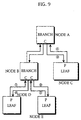
A signal (parent notify) indicating
notification from a child node to a parent node is
first fed to branch nodes from all leaf nodes, as
indicated by 1 ○ in Fig. 9. The node which has received
the parent notify signal recognizes its port as a
child port C, and feeds a signal (child notify)
indicating notification from a parent node to a child
node, as indicated by 2 ○ in Fig. 9. The node which
has received the child notify signal recognizes its
port as a parent port P, and recognizes that its own
role is terminated. Consequently, a parent
relationship between the nodes is determined.
At this time point, a node A and a node B
recognize that they respectively have ports which
are connected to each other but are not determined
as a child port or a parent port (they respectively
have ports which are connected to each other but
receive neither a parent notify signal nor a child
notify signal), and feed parent notify signals to
each other, as indicated by 1 ○ and 2 ○ in Fig. 1.
The nodes A and B respectively set, when they
recognize that they receive the parent notify
signals, independent time periods (Timers). The
node at which the set time period has elapsed first
feeds the parent notify signal to the other node.
The node which has first received the parent notify
signal, the node A in this example, is a parent node
(a root), and feeds a child notify signal to the other
node (the node B), as indicated by 3 ○ in Fig. 10.
When a certain node is loop-connected, the node
does not receive a parent notify signal at all its
ports excluding one port within a certain time period
at the time of tree identification. Accordingly,
it is detected that the node is loop-connected. That
is, the node which is loop-connected and the ports
constituting factors of the loop connection are
recognized.
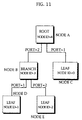
(3) Self-node ID Identification
After the tree identification, self-node IDs
are identified. In a method of determining self-node
IDs, a node ID assigned to a leaf (a node C) at a
terminal end of a lowest-numbered port of a root is
zero, and the node ID is broadcast to nodes other
than the node C as a self-node ID = 0, as shown in
Fig. 11. Ports of the root are subjected to this
operation in ascending order of their numbers. Each
of the nodes other than the node C broadcasts the
number of node IDs which have received from all the
other nodes at the time point of the broadcasting
as a self-node ID.
However, a network topology using the IEEE 1394
is limited to a daisy chain, a branch, or their
combination. When a loop exists on the topology,
a node ID cannot be identified. Accordingly, the
entire network does not function. When a loop
connection is erroneously made, therefore, a user
must find a loop-connected portion, to cancel a loop.
When a loop connection is erroneously made in
a network to which a lot of apparatuses are
connected, however, it is difficult to find a
loop-connected portion.
SUMMARY OF THE INVENTION
An object of the present invention is to
provide an apparatus equipped with a digital
interface, which can notify a user that a loop
connection exists, and a loop status notifying
method in the apparatus.
Another object of the present invention is to
provide an apparatus equipped with a digital
interface, which can notify a user that a loop
connection exists and of ports constituting factors
of a loop, and a loop status notifying method in the
apparatus.
Still another object of the present invention
is to provide an apparatus equipped with a digital
interface, which can cause a network to normally
function even when a loop connection exists, and a
loop connection avoiding method in the apparatus.
A first apparatus equipped with a digital
interface according to the present invention is an
apparatus equipped with a digital interface, which
is used for connecting a plurality of nodes in a daisy
chain and/or a branch and does not allow a loop,
comprising means for the digital interface
performing, when the power supply is turned on or
when a node is added to a bus, bus initialization
processing, tree identification processing, and
self-node ID identification processing in this
order, to automatically recognize and set a
connection structure of nodes, and means for
detecting, when the node is loop-connected, that the
node is loop-connected, characterized by comprising
notification means for notifying, when the digital
interface detects that the apparatus equipped with
the digital interface is loop-connected in the
process of performing the tree identification
processing, a user that the apparatus is loop-connected.
An example of the notification means is one
comprising a display device, and causing, when the
digital interface detects that the apparatus
equipped with the digital interface is loop-connected,
the display device to indicate that the
apparatus is loop-connected.
An example of the notification means is one
comprising a lamp, and turning on the lamp when the
digital interface detects that the apparatus
equipped with the digital interface is loop-connected.
A second apparatus equipped with a digital
interface according to the present invention is an
apparatus equipped with a digital interface, which
is used for connecting a plurality of nodes in a daisy
chain and/or a branch and does not allow a loop,
comprising means for the digital interface
performing, when the power supply is turned on or
when a node is added to a bus, bus initialization
processing, tree identification processing, and
self-node ID identification processing in this
order, to automatically recognize and set a
connection structure of nodes, and means for
detecting, when the node is loop-connected, that the
node is loop-connected and the numbers of ports
constituting factors of the loop, characterized by
comprising notification means for notifying, when
the digital interface detects that the apparatus
equipped with the digital interface is loop-connected
and the numbers of the ports constituting
factors of the loop in the process of performing the
tree identification processing, a user that the
apparatus is loop-connected and of the numbers of
the ports constituting factors of the loop.
An example of the notification means is one
comprising a display device, and causing, when the
digital interface detects that the apparatus
equipped with the digital interface is loop-connected
and the numbers of the ports constituting
factors of the loop, the display device to indicate
that the apparatus is loop-connected and the numbers
of the ports constituting factors of the loop.
An example of the notification means is one
comprising lamps respectively corresponding to the
numbers of the ports, and turning on the lamps
corresponding to the numbers of the ports
constituting factors of the loop when the digital
interface detects that the apparatus equipped with
the digital interface is loop-connected and the
numbers of the ports constituting factors of the
loop.
A first loop status notifying method in an
apparatus equipped with a digital interface
according to the present invention is a loop status
notifying method in an apparatus equipped with a
digital interface, which is used for connecting a
plurality of nodes in a daisy chain and/or a branch
and does not allow a loop, comprising means for the
digital interface performing, when the power supply
is turned on or when a node is added to a bus, bus
initialization processing, tree identification
processing, and self-node ID identification
processing in this order, to automatically recognize
and set a connection structure of nodes, and means
for detecting, when the node is loop-connected, that
the node is loop-connected, characterized in that
the apparatus equipped with the digital interface
is provided with notification means for notifying,
when the digital interface detects that the
apparatus equipped with the digital interface is
loop-connected in the process of performing the tree
identification processing, a user that the apparatus
is loop-connected.
An example of the notification means is one
comprising a display device, and causing, when the
digital interface detects that the apparatus
equipped with the digital interface is loop-connected,
the display device to indicate that the
apparatus is loop-connected.
An example of the notification means is one
comprising a lamp, and turning on the lamp when the
digital interface detects that the apparatus
equipped with the digital interface is loop-connected.
A second loop status notifying method in an
apparatus equipped with a digital interface
according to the present invention is a loop status
notifying method in an apparatus equipped with a
digital interface, which is used for connecting a
plurality of nodes in a daisy chain and/or a branch
and does not allow a loop, comprising means for the
digital interface performing, when the power supply
is turned on or when a node is added to a bus, bus
initialization processing, tree identification
processing, and self-node ID identification
processing in this order, to automatically recognize
and set a connection structure of nodes, and means
for detecting, when the node is loop-connected, that
the node is loop-connected and the numbers of ports
constituting factors of the loop, characterized in
that the apparatus equipped with the digital
interface is provided with notification means for
notifying, when the digital interface detects that
the apparatus equipped with the digital interface
is loop-connected and the numbers of the ports
constituting factors of the loop in the process of
performing the tree identification processing, a
user that the apparatus is loop-connected and of the
numbers of the ports constituting factors of the
loop.
An example of the notification means is one
comprising a display device, and causing, when the
digital interface detects that the apparatus
equipped with the digital interface is loop-connected
and the numbers of the ports constituting
factors of the loop, the display device to indicate
that the apparatus is loop-connected and the numbers
of the ports constituting factors of the loop.
An example of the notification means is one
comprising lamps respectively corresponding to the
numbers of the ports, and turning on the lamps
corresponding to the numbers of the ports
constituting factors of the loop when the digital
interface detects that the apparatus equipped with
the digital interface is loop-connected and the
numbers of the ports constituting factors of the
loop.
A third apparatus equipped with a digital
interface according to the present invention is an
apparatus equipped with a digital interface, which
is used for connecting a plurality of nodes in a daisy
chain and/or a branch and does not allow a loop,
comprising means for the digital interface
performing, when the power supply is turned on or
when a node is added to a bus, bus initialization
processing, tree identification processing, and
self-node ID identification processing in this
order, to automatically recognize and set a
connection structure of nodes, and means for
detecting, when the node is loop-connected, that the
node is loop-connected and the numbers of ports
constituting factors of the loop, characterized by
comprising means for bringing, when the digital
interface detects that the apparatus equipped with
the digital interface is loop-connected in the
process of performing the tree identification
processing, any one of the plurality of ports
constituting factors of the loop into a non-connected
state; and means for causing, after any
one of the plurality of ports constituting factors
of the loop is brought into a non-connected state,
the digital interface to perform the bus
initialization processing in order to cause the
digital interface to recognize and set the
connection structure of the nodes again.
A loop connection avoiding method in an
apparatus equipped with a digital interface
according to the present invention is a loop
connection avoiding method in an apparatus equipped
with a digital interface, which is used for
connecting a plurality of nodes in a daisy chain
and/or a branch and does not allow a loop, comprising
means for the digital interface performing, when the
power supply is turned on or when a node is added
to a bus, bus initialization processing, tree
identification processing, and self-node ID
identification processing in this order, to
automatically recognize and set a connection
structure of nodes, and means for detecting, when
the node is loop-connected, that the node is
loop-connected and the numbers of ports constituting
factors of the loop, characterized by comprising the
steps of bringing, when the digital interface
detects that the apparatus equipped with the digital
interface is loop-connected in the process of
performing the tree identification processing, any
one of the plurality of ports constituting factors
of the loop into a non-connected state; and causing,
after any one of the plurality of ports constituting
factors of the loop is brought into a non-connected
state, the digital interface to perform the bus
initialization processing in order to cause the
digital interface to recognize and set the
connection structure of the nodes again.
The foregoing and other objects, features,
aspects and advantages of the present invention will
become more apparent from the following detailed
description of the present invention when taken in
conjunction with the accompanying drawings.
BRIEF DESCRIPTION OF THE DRAWINGS
Fig. 1 is a block diagram showing the
configuration of an apparatus equipped with an IEEE
1394 interface;
Fig. 2 is a schematic view showing the
configuration of a network including the apparatus
shown in Fig. 1;
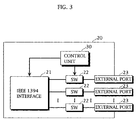
Fig. 3 is a block diagram showing the
configuration of an apparatus equipped with an IEEE
1394 interface;
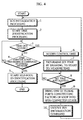
Fig. 4 is a flow chart showing the procedure
for recognition and setting processing of a
connection structure of nodes by the IEEE 1394
interface and a control unit;
Fig. 5 is a schematic view showing an example
in which two apparatuses 41 and 42 are loop-connected;
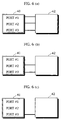
Figs. 6(a), 6(b) and 6(c) are schematic views
showing an example in which a loop connection is
avoided when two apparatuses 41 and 42 are loop-connected,
and three ports constituting factors of
a loop exist in the apparatus 41;
Figs. 7(a), 7(b) and 7(c) are schematic views
showing an example in which a loop connection is
avoided when three apparatuses 41, 42, and 43 are
loop-connected, and four ports constituting factors
of a loop exist in the apparatus 42;
Figs. 8(a), 8(b) and 8(c) are schematic views
showing an example in which a loop connection is
avoided when four apparatuses 41, 42, 43, and 44 are
loop-connected, and three ports constituting
factors of a loop exist in the apparatus 42;
Fig. 9 is a schematic view for explaining a
method of identifying a tree structure of nodes;
Fig. 10 is a schematic view for explaining a
method of identifying a tree structure of nodes; and
Fig. 11 is a schematic view for explaining a
method of setting node IDs.
DETAILED DESCRIPTION OF THE PREFERRED
EMBODIMENTS
Referring now to the drawings, embodiments of
the present invention will be described.
[1] Description of First Embodiment
Fig. 1 illustrates the configuration of an
apparatus equipped with an IEEE 1394 interface.
An apparatus 10 has a loop status notifying
function. The apparatus 10 is a digital VCR, for
example, and comprises a display device 13. The
apparatus 10 is provided with an IEEE 1394 interface
11 composed of an LSI (Large-Scale Integrated
Circuit) for establishing IEEE 1394 communication,
and a display control unit 12 for causing the display
device 13 to display a message relating to a loop
connection on the basis of a loop detection signal
or the like from the IEEE 1394 interface 11.
When the apparatus 10 is loop-connected on a
network, the IEEE 1394 interface 11 has the function
of detecting that the apparatus 10 is loop-connected
and the numbers of ports constituting factors of a
loop in tree identification processing, as is
well-known.
When the IEEE 1394 interface 11 detects that
the apparatus 10 is loop-connected and the numbers
of the ports constituting factors of the loop, the
contents of the detection are sent to the display
control unit 12.
The display control unit 12 causes the display
device 13 to display a message indicating that the
apparatus 10 is loop-connected and the numbers of
the ports constituting factors of the loop when the
contents of the detection are sent from the IEEE 1394
interface 11.
Fig. 2 illustrates a network using IEEE 1394.
In the network, six apparatuses 21 to 26 each
equipped with an IEEE 1394 interface are connected
by a bus in addition to the apparatus 10 having a
loop status notifying function. In this example,
the apparatus 10 and the four apparatuses 21 to 24
are in a loop-connected state.
In the network in which such a loop connection
exists, the IEEE 1394 interface 11 in the apparatus
10 detects that the apparatus 10 is loop-connected
and ports #1 and #3 constituting factors of a loop
in tree identification processing. Accordingly, the
contents of the detection are sent to the display
control unit 12.
The display control unit 12 causes the display
device 13 to display a message "A loop connection
exists. Detach a cable connected to a port #1 or
a port #3" when the contents of the detection are
sent from the IEEE 1394 interface 11.
A user can know that a loop connection exists
by the display, and can know a method of canceling
the loop connection. Accordingly, the loop
connection can be easily canceled.
A message only indicating that a loop
connection exists may be displayed on the display
device 13. Further, lamps respectively
corresponding to the ports may be provided in place
of the display device 13, to turn on the lamps
corresponding to the ports constituting factors of
the loop. Alternatively, one lamp may be provided
in place of the display device 13, to turn on the
lamp when it is detected that the apparatus is
loop-connected.
[2] Description of Second Embodiment
Fig. 3 illustrates the configuration of an
apparatus equipped with an IEEE 1394 interface.
An apparatus 20 has a loop connection avoiding
function. The apparatus 20 is equipped with an IEEE
1394 interface 21. The IEEE 1394 interface 21 is
connected to a plurality of external ports 23 through
a plurality of switches (SW) 22. The apparatus 20
is provided with a control unit 30 for controlling
the plurality of switches (SW) 22 and the IEEE 1394
interface 21.
Fig. 4 shows the procedure for recognition and
setting processing of a connection structure of
nodes by the IEEE 1394 interface 21 and the control
unit 30.
In Fig. 4, steps 1 to 6 show processing by the
IEEE 1394 interface 21, and steps 7 to 10 show
processing by the control unit 30.
When the power supply is turned on or when a
node is added to a bus, bus initialization processing
is performed by the IEEE 1394 interface 21 (step 1).
Tree identification processing is started by the
IEEE 1394 interface 21 (step 2).
When the apparatus 20 is loop-connected, a
time-out occurs in the tree identification
processing. Consequently, the IEEE 1394 interface
21 recognizes that the apparatus 20 is loop-connected.
In this case, the IEEE 1394 interface
21 recognizes ports constituting factors of a loop.
When a time-out occurs due to the loop-connection
of the apparatus 20 (YES at step 3), the
control unit 30 is notified that the apparatus 20
is loop-connected and of the numbers of the ports
constituting factors of the loop from the IEEE 1394
interface 21 (step 6).
The control unit 30 determines a set time
period by drawing processing, that is, determines
a set time period at random when it receives the
notification, to start to measure the set time period
(step 7). When the determined set time period has
elapsed (step 8), any one of the plurality of ports
constituting factors of the loop is brought into a
non-connected state by turning off the switch 22
corresponding to the port (step 9).
Thereafter, the control unit 30 outputs to the
IEEE 1394 interface 21 a bus initialization command
for causing the IEEE 1394 interface 21 to perform
bus initialization processing again (step 10). The
IEEE 1394 interface 21 performs the processing at
the step 1 and the subsequent steps again when it
receives the bus initialization command from the
control unit 30.
When the tree initialization processing is
started at the step 2, and the tree initialization
processing is then completed in the overall network
(YES at step 4), self-node ID identification
processing is started (step 5).
Description is made of a case where two
apparatuses 41 and 42 are loop-connected, as shown
in Fig. 5, for example. The two apparatuses 41 and
42 shall have a loop releasing function.
In this example, first ports #1 and second
ports #2 in both the apparatuses 41 and 42 are
respectively connected to each other by cables,
thereby causing a loop status.
In the tree identification processing in the
recognition and setting processing of the connection
structure of the nodes which is performed by the IEEE
1394 interface carried in each of the apparatuses
41 and 42, a time-out occurs.
Therefore, a set time period is determined by
drawing for each of the apparatuses 41 and 42. The
set time period determined by the apparatus 41 shall
be shorter than the set time period determined by
the apparatus 42.
In the apparatus 41, either one of the first
port #1 and the second port #2 constituting factors
of a loop (for example, the first port #1) is brought
into a non-connected state when the set time period
determined by the drawing has elapsed. Thereafter,
a bus is initialized, and the tree identification
processing is performed again. In the tree
identification processing, it is recognized that the
first port #1 in the apparatus 41 is in a non-connected
state, so that the loop is not detected,
thereby normally completing the tree identification
processing.
Figs. 6(a), 6(b) and 6(c) illustrate an example
in which a loop connection is avoided when two
apparatuses 41 and 42 are loop-connected, and three
ports constituting factors of a loop exist in the
apparatus 41. Here, only the apparatus 41 shall have
a loop connection avoiding function.
From a state shown in Fig. 6 (a), one port #1
out of three ports #1, #2, and #3 constituting
factors of the loop is brought into a non-connected
state, as shown in Fig. 6 (b), by the first cycle
comprising the steps 1 to 3 and 6 to 10 shown in Fig.
4.
The one port #2 out of the two ports #2 and #3
constituting factors of the loop is brought into a
non-connected state, as shown in Fig. 6 (c), by the
second cycle comprising the steps 1 to 3 and 6 to
10.
Figs. 7(a), 7(b) and 7(c) show an example in
which a loop connection is avoided when three
apparatuses 41, 42, and 43 are loop-connected, and
four ports constituting factors of a loop exist in
the apparatus 42. Here, only the apparatus 42 shall
have a loop connection avoiding function.
From a state shown in Fig. 7 (a), one port #1
out of four ports #1, #2, #3, and #4 constituting
factors of the loop is brought into a non-connected
state, as shown in Fig. 7 (b), by the first cycle
comprising the steps 1 to 3 and 6 to 10 shown in Fig.
4.
The one port #4 out of the two ports #3 and #4
constituting factors of the loop is brought into a
non-connected state, as shown in Fig. 7 (c), by the
second cycle comprising the steps 1 to 3 and 6 to
10.
Figs. 8(a), 8(b) and 8(c) show an example in
which a loop connection is avoided when four
apparatuses 41, 42, 43, and 44 are loop-connected,
and three ports constituting factors of a loop exist
in the apparatus 42. Here, only the apparatus 42
shall have a loop connection avoiding function.
From a state shown in Fig. 8 (a), one port #1
out of three ports #1, #2, and #3 constituting
factors of the loop is brought into a non-connected
state, as shown in Fig. 8 (b), by the first cycle
comprising the steps 1 to 3 and 6 to 10 shown in Fig.
4.
The one port #2 out of the two ports #2 and #3
constituting factors of the loop is brought into a
non-connected state, as shown in Fig. 8 (c), by the
second cycle comprising the steps 1 to 3 and 6 to
10.
Although the present invention has been
described and illustrated in detail, it is clearly
understood that the same is by way of illustration
and example only and is not to be taken by way of
limitation, the spirit and scope of the present
invention being limited only by the terms of the
appended claims.