EP1078881A1 - Storage and safe delivery of hazardous speciality gases by acid/base reactions with ionic polymers - Google Patents
Storage and safe delivery of hazardous speciality gases by acid/base reactions with ionic polymers Download PDFInfo
- Publication number
- EP1078881A1 EP1078881A1 EP00307232A EP00307232A EP1078881A1 EP 1078881 A1 EP1078881 A1 EP 1078881A1 EP 00307232 A EP00307232 A EP 00307232A EP 00307232 A EP00307232 A EP 00307232A EP 1078881 A1 EP1078881 A1 EP 1078881A1
- Authority
- EP
- European Patent Office
- Prior art keywords
- mol
- polymer
- basic gas
- gas
- kcal
- Prior art date
- Legal status (The legal status is an assumption and is not a legal conclusion. Google has not performed a legal analysis and makes no representation as to the accuracy of the status listed.)
- Withdrawn
Links
- 239000007789 gas Substances 0.000 title claims abstract description 99
- 239000002253 acid Substances 0.000 title claims description 26
- 238000003860 storage Methods 0.000 title claims description 12
- 231100001261 hazardous Toxicity 0.000 title abstract description 7
- 238000006243 chemical reaction Methods 0.000 title description 11
- 238000012384 transportation and delivery Methods 0.000 title description 5
- 229920000831 ionic polymer Polymers 0.000 title description 3
- 229920000642 polymer Polymers 0.000 claims abstract description 51
- XYFCBTPGUUZFHI-UHFFFAOYSA-N Phosphine Chemical compound P XYFCBTPGUUZFHI-UHFFFAOYSA-N 0.000 claims abstract description 31
- 229910000073 phosphorus hydride Inorganic materials 0.000 claims abstract description 22
- RBFQJDQYXXHULB-UHFFFAOYSA-N arsane Chemical compound [AsH3] RBFQJDQYXXHULB-UHFFFAOYSA-N 0.000 claims abstract description 20
- 239000007787 solid Substances 0.000 claims abstract description 20
- 230000002378 acidificating effect Effects 0.000 claims abstract description 15
- 150000003839 salts Chemical class 0.000 claims abstract description 15
- 238000000034 method Methods 0.000 claims description 32
- 239000002594 sorbent Substances 0.000 claims description 20
- 150000001875 compounds Chemical class 0.000 claims description 14
- 150000007513 acids Chemical class 0.000 claims description 13
- QGZKDVFQNNGYKY-UHFFFAOYSA-N Ammonia Chemical compound N QGZKDVFQNNGYKY-UHFFFAOYSA-N 0.000 claims description 12
- 150000004678 hydrides Chemical class 0.000 claims description 11
- BDHFUVZGWQCTTF-UHFFFAOYSA-N sulfonic acid Chemical class OS(=O)=O BDHFUVZGWQCTTF-UHFFFAOYSA-N 0.000 claims description 11
- 239000000203 mixture Substances 0.000 claims description 10
- 229920001577 copolymer Polymers 0.000 claims description 7
- 150000001735 carboxylic acids Chemical class 0.000 claims description 6
- 230000002860 competitive effect Effects 0.000 claims description 6
- 229910021529 ammonia Inorganic materials 0.000 claims description 5
- 229920003053 polystyrene-divinylbenzene Polymers 0.000 claims description 5
- 150000004820 halides Chemical class 0.000 claims description 4
- RWSOTUBLDIXVET-UHFFFAOYSA-N Dihydrogen sulfide Chemical compound S RWSOTUBLDIXVET-UHFFFAOYSA-N 0.000 claims description 3
- BLRPTPMANUNPDV-UHFFFAOYSA-N Silane Chemical compound [SiH4] BLRPTPMANUNPDV-UHFFFAOYSA-N 0.000 claims description 3
- 229910000074 antimony hydride Inorganic materials 0.000 claims description 3
- 229910000078 germane Inorganic materials 0.000 claims description 3
- 229910000037 hydrogen sulfide Inorganic materials 0.000 claims description 3
- WKFBZNUBXWCCHG-UHFFFAOYSA-N phosphorus trifluoride Chemical compound FP(F)F WKFBZNUBXWCCHG-UHFFFAOYSA-N 0.000 claims description 3
- SPVXKVOXSXTJOY-UHFFFAOYSA-N selane Chemical compound [SeH2] SPVXKVOXSXTJOY-UHFFFAOYSA-N 0.000 claims description 3
- 229910000058 selane Inorganic materials 0.000 claims description 3
- 229910000077 silane Inorganic materials 0.000 claims description 3
- OUULRIDHGPHMNQ-UHFFFAOYSA-N stibane Chemical compound [SbH3] OUULRIDHGPHMNQ-UHFFFAOYSA-N 0.000 claims description 3
- VTLHPSMQDDEFRU-UHFFFAOYSA-N tellane Chemical compound [TeH2] VTLHPSMQDDEFRU-UHFFFAOYSA-N 0.000 claims description 3
- 229910000059 tellane Inorganic materials 0.000 claims description 3
- 238000004891 communication Methods 0.000 claims description 2
- 239000012530 fluid Substances 0.000 claims description 2
- 230000000694 effects Effects 0.000 claims 2
- 235000019647 acidic taste Nutrition 0.000 description 18
- 229910000070 arsenic hydride Inorganic materials 0.000 description 11
- 230000008859 change Effects 0.000 description 8
- 239000004065 semiconductor Substances 0.000 description 5
- 239000000126 substance Substances 0.000 description 5
- HEMHJVSKTPXQMS-UHFFFAOYSA-M Sodium hydroxide Chemical compound [OH-].[Na+] HEMHJVSKTPXQMS-UHFFFAOYSA-M 0.000 description 3
- 239000003463 adsorbent Substances 0.000 description 3
- 230000015572 biosynthetic process Effects 0.000 description 3
- 229920006037 cross link polymer Polymers 0.000 description 3
- 238000004519 manufacturing process Methods 0.000 description 3
- 239000000463 material Substances 0.000 description 3
- 238000006116 polymerization reaction Methods 0.000 description 3
- 230000008569 process Effects 0.000 description 3
- 239000011973 solid acid Substances 0.000 description 3
- 238000003786 synthesis reaction Methods 0.000 description 3
- 238000013459 approach Methods 0.000 description 2
- 230000008901 benefit Effects 0.000 description 2
- 230000005595 deprotonation Effects 0.000 description 2
- 238000010537 deprotonation reaction Methods 0.000 description 2
- HNPSIPDUKPIQMN-UHFFFAOYSA-N dioxosilane;oxo(oxoalumanyloxy)alumane Chemical compound O=[Si]=O.O=[Al]O[Al]=O HNPSIPDUKPIQMN-UHFFFAOYSA-N 0.000 description 2
- 229910000069 nitrogen hydride Inorganic materials 0.000 description 2
- 238000002360 preparation method Methods 0.000 description 2
- 230000005588 protonation Effects 0.000 description 2
- 230000002441 reversible effect Effects 0.000 description 2
- 238000001179 sorption measurement Methods 0.000 description 2
- 239000000758 substrate Substances 0.000 description 2
- XLYOFNOQVPJJNP-UHFFFAOYSA-N water Substances O XLYOFNOQVPJJNP-UHFFFAOYSA-N 0.000 description 2
- -1 AsH3 and PH3 Chemical class 0.000 description 1
- 0 CCC(CC)(*NO**(**)OC(C)(CC*)N)N Chemical compound CCC(CC)(*NO**(**)OC(C)(CC*)N)N 0.000 description 1
- VEXZGXHMUGYJMC-UHFFFAOYSA-N Hydrochloric acid Chemical compound Cl VEXZGXHMUGYJMC-UHFFFAOYSA-N 0.000 description 1
- BAVYZALUXZFZLV-UHFFFAOYSA-N Methylamine Chemical compound NC BAVYZALUXZFZLV-UHFFFAOYSA-N 0.000 description 1
- OAICVXFJPJFONN-UHFFFAOYSA-N Phosphorus Chemical compound [P] OAICVXFJPJFONN-UHFFFAOYSA-N 0.000 description 1
- QAOWNCQODCNURD-UHFFFAOYSA-N Sulfuric acid Chemical compound OS(O)(=O)=O QAOWNCQODCNURD-UHFFFAOYSA-N 0.000 description 1
- 229910021536 Zeolite Inorganic materials 0.000 description 1
- 238000010521 absorption reaction Methods 0.000 description 1
- 230000009471 action Effects 0.000 description 1
- 229910000323 aluminium silicate Inorganic materials 0.000 description 1
- 229910052785 arsenic Inorganic materials 0.000 description 1
- RQNWIZPPADIBDY-UHFFFAOYSA-N arsenic atom Chemical compound [As] RQNWIZPPADIBDY-UHFFFAOYSA-N 0.000 description 1
- 238000009835 boiling Methods 0.000 description 1
- 238000006555 catalytic reaction Methods 0.000 description 1
- 239000000470 constituent Substances 0.000 description 1
- 238000004132 cross linking Methods 0.000 description 1
- 230000006378 damage Effects 0.000 description 1
- 238000009792 diffusion process Methods 0.000 description 1
- 238000010494 dissociation reaction Methods 0.000 description 1
- 230000005593 dissociations Effects 0.000 description 1
- 238000001035 drying Methods 0.000 description 1
- 125000006575 electron-withdrawing group Chemical group 0.000 description 1
- 238000005516 engineering process Methods 0.000 description 1
- 230000007613 environmental effect Effects 0.000 description 1
- 238000005530 etching Methods 0.000 description 1
- 238000010438 heat treatment Methods 0.000 description 1
- 231100000086 high toxicity Toxicity 0.000 description 1
- 238000005468 ion implantation Methods 0.000 description 1
- 229920000554 ionomer Polymers 0.000 description 1
- 125000001319 lambda(5)-arsanyl group Chemical group [H][As]([H])([H])([H])[*] 0.000 description 1
- 238000011068 loading method Methods 0.000 description 1
- 239000011159 matrix material Substances 0.000 description 1
- 229910052751 metal Inorganic materials 0.000 description 1
- 239000002184 metal Substances 0.000 description 1
- 238000012986 modification Methods 0.000 description 1
- 230000004048 modification Effects 0.000 description 1
- 239000000178 monomer Substances 0.000 description 1
- 150000004010 onium ions Chemical class 0.000 description 1
- 238000005457 optimization Methods 0.000 description 1
- 150000002894 organic compounds Chemical class 0.000 description 1
- 150000004714 phosphonium salts Chemical class 0.000 description 1
- 229910052698 phosphorus Inorganic materials 0.000 description 1
- 239000011574 phosphorus Substances 0.000 description 1
- 229920003023 plastic Polymers 0.000 description 1
- 239000004033 plastic Substances 0.000 description 1
- 230000009257 reactivity Effects 0.000 description 1
- 239000011347 resin Substances 0.000 description 1
- 229920005989 resin Polymers 0.000 description 1
- 230000004044 response Effects 0.000 description 1
- 230000002269 spontaneous effect Effects 0.000 description 1
- 238000000427 thin-film deposition Methods 0.000 description 1
- 231100000331 toxic Toxicity 0.000 description 1
- 230000002588 toxic effect Effects 0.000 description 1
- 231100000419 toxicity Toxicity 0.000 description 1
- 230000001988 toxicity Effects 0.000 description 1
- 239000010457 zeolite Substances 0.000 description 1
Classifications
-
- B—PERFORMING OPERATIONS; TRANSPORTING
- B01—PHYSICAL OR CHEMICAL PROCESSES OR APPARATUS IN GENERAL
- B01J—CHEMICAL OR PHYSICAL PROCESSES, e.g. CATALYSIS OR COLLOID CHEMISTRY; THEIR RELEVANT APPARATUS
- B01J20/00—Solid sorbent compositions or filter aid compositions; Sorbents for chromatography; Processes for preparing, regenerating or reactivating thereof
- B01J20/22—Solid sorbent compositions or filter aid compositions; Sorbents for chromatography; Processes for preparing, regenerating or reactivating thereof comprising organic material
- B01J20/26—Synthetic macromolecular compounds
- B01J20/261—Synthetic macromolecular compounds obtained by reactions only involving carbon to carbon unsaturated bonds
-
- B—PERFORMING OPERATIONS; TRANSPORTING
- B01—PHYSICAL OR CHEMICAL PROCESSES OR APPARATUS IN GENERAL
- B01J—CHEMICAL OR PHYSICAL PROCESSES, e.g. CATALYSIS OR COLLOID CHEMISTRY; THEIR RELEVANT APPARATUS
- B01J20/00—Solid sorbent compositions or filter aid compositions; Sorbents for chromatography; Processes for preparing, regenerating or reactivating thereof
- B01J20/22—Solid sorbent compositions or filter aid compositions; Sorbents for chromatography; Processes for preparing, regenerating or reactivating thereof comprising organic material
- B01J20/26—Synthetic macromolecular compounds
-
- C—CHEMISTRY; METALLURGY
- C01—INORGANIC CHEMISTRY
- C01B—NON-METALLIC ELEMENTS; COMPOUNDS THEREOF; METALLOIDS OR COMPOUNDS THEREOF NOT COVERED BY SUBCLASS C01C
- C01B6/00—Hydrides of metals including fully or partially hydrided metals, alloys or intermetallic compounds ; Compounds containing at least one metal-hydrogen bond, e.g. (GeH3)2S, SiH GeH; Monoborane or diborane; Addition complexes thereof
- C01B6/34—Purification; Stabilisation
-
- F—MECHANICAL ENGINEERING; LIGHTING; HEATING; WEAPONS; BLASTING
- F17—STORING OR DISTRIBUTING GASES OR LIQUIDS
- F17C—VESSELS FOR CONTAINING OR STORING COMPRESSED, LIQUEFIED OR SOLIDIFIED GASES; FIXED-CAPACITY GAS-HOLDERS; FILLING VESSELS WITH, OR DISCHARGING FROM VESSELS, COMPRESSED, LIQUEFIED, OR SOLIDIFIED GASES
- F17C11/00—Use of gas-solvents or gas-sorbents in vessels
Definitions
- This invention relates generally to storage and dispensing systems for the selective dispensing of gaseous compounds, in particular hazardous hydride and halide gases, from a storage container in which the gaseous compounds are held in sorptive relationship to a solid sorbent medium, and are desorptively released from the sorbent medium in the dispensing operation.
- gaseous compounds in particular hazardous hydride and halide gases
- phosphine (PH 3 ) and arsine (AsH 3 ) are needed for numerous semiconductor fabrication processes, though their use poses significant safety and environmental challenges due to their high toxicity and pyrophoricity (i.e., spontaneous inflammability in air).
- PH 3 phosphine
- AsH 3 arsine
- the storage and transport of highly toxic or pyrophoric materials as compressed or liquefied gases in metal cylinders is often unacceptable because of the possibility of developing a leak or catastrophic rupture of the container which could lead to injuries or death. It would be preferable to have a reliable source of these gases wherein the gases are maintained at or below atmospheric pressure during shipping and storage. Also, since many semiconductor processes using speciality gases are operated below ambient pressure, positive gauge pressures of these gases may not be needed, even when in use.
- the invention addresses at least the aforementioned problems by providing a method of storing, transporting and/or dispensing a basic gas having a proton affinity of less than 207 kcal/mol (866 kJ/mol), said method comprising: contacting said basic gas with a support comprising at least one polymer having a Hammett acidity value lower than the Hammett acidity value of the conjugate acid of said basic gas, whereby said basic gas is protonated by said at least one polymer and condensed to form a solid salt sorbed by said support; and, when dispensing, deprotonating said sorbed solid salt to regenerate said basic gas.
- the invention also provides a solid salt of a protonated basic gas having a proton affinity of less than 866 kJ/mol (207 kcal/mol) and a polymer having a Hammett acidity value lower than the Hammett acidity value of the conjugate acid of said basic gas.
- the invention further provides the use of an acidic polymer as a reactive sorbent in the storage, transportation and/or dispensing of a basic gas having a proton affinity of less than 866 kJ/mol (207 kcal/mol), said polymer having a Hammett acidity value lower than the Hammett acidity value of the conjugate acid of said basic gas.
- the proton affinity of said basic gas is 145 kcal/mol (607 kJ/mol) to 200 kcal/mol (837 kJ/mol), more preferably from 150 kcal/mol (628 kJ/mol) to 190 kcal/mol (795 kJ/mol).
- the basic gas can be, for example, a hydride or halide, and/or selected from silane, germane, phosphine, trifluorophosphine, arsine, stibine, hydrogen sulfide, hydrogen selenide and hydrogen telluride.
- the basic gas is phosphine or arsine.
- the Hammett acidity value of the polymer is from -17 to 6.5, more preferably from -14 to 2, even more preferably from -12.5 to -7. In certain embodiments, said Hammett acidity value is -12 or lower than -12.
- the at least one polymer can be, for example, selected from polymeric sulphonic acids, polymeric perfluoroalkylsulphonic acids, fluorinated sulphonic acid polymers, cross-linked sulphonated polystyrene-divinylbenzene macroreticular copolymers, carboxylic acid polymers halogenated carboxylic acid functionalized polymers and mixtures thereof.
- the at least one polymer is selected from polymeric sulphonic acids, polymeric perfluoroalkylsulphonic acids, fluorinated sulphonic acid polymers and mixtures thereof.
- One preferred polymer is a perfluorinated sulphonic acid represented by the following Formula I: wherein:
- Another preferred polymer is a fluorinated sulphonic acid represented by the following Formula II: wherein:
- Another preferred polymer is a cross-linked sulphonated polystyrene-divinylbenzene macroreticular copolymer represented by the following Formula III: wherein:
- Deprotonation of the solid salt may be conducted by, for example, heating or contact with a competitive base compound having a proton affinity greater than that of said basic gas.
- the competitive base compound has a proton affinity of at least 207 kcal/mol (866 kJ/mol), and/or is ammonia.
- the invention also provides an apparatus adapted to deliver a basic gas according to the aforementioned method, said apparatus comprising:
- the invention enables safe storage, transportation and delivery of a gas by sorbing the gas with a sorbent composition sufficiently acidic to protonate the gas. Upon protonation, the gas and sorbent collectively form a solid salt which is more easily handled than the gas, and can be converted back to the gas by deprotonation.
- weakly basic gases have a gas phase proton affinity of less than 207 kcal/mol (866 kJ/mol), preferably from 145 kcal/mol (607 kJ/mol) to 200 kcal/mol (837 kJ/mol), and more preferably from 150 kcal/mol (628 kJ/mol) to 190 kcal/mol (795 kJ/mol).
- gases for use in the invention include, e.g., hydride gases and halide gases, such as silane, germane, phosphine, trifluorophosphine, arsine, stibine, hydrogen sulfide, hydrogen selenide and hydrogen telluride.
- the invention is particularly advantageous for storing, transporting and delivering the gaseous hydrides PH 3 and AsH 3 , which are commonly used as sources of arsenic and phosphorus in ion implantation. Due to their extreme toxicity and high vapour pressure, the use, transportation and storage of PH 3 and AsH 3 raise significant safety concerns for the semiconductor industry.
- Compounds such as AsH 3 and PH 3 can act both as weak acids and weak bases.
- the acidic properties of AsH 3 and PH 3 are exploited by US-A-5,037,624 in which a solid, basic substrate is described that irreversibly chemisorbs those compounds in order to abate them from a gas exhaust stream.
- the invention described herein utilizes the weak gas phase basicity of compounds such as AsH 3 and PH 3 , to reversibly bind, and hence temporarily store, these species on solid, acidic substrates. That AsH 3 and PH 3 are weak bases is evidenced by their respective proton affinities of 175 kcal/mol (732 kJ/mol) and 185 kcal/mol (774 kJ/mol).
- PH 3 has a pK b value of -27 and a pK a value of -29 in water.
- the protonated pnictide onium ions (i.e., AsH 4 + and PH 4 + ) formed by protonation of arsine and phosphine are a potential source of the corresponding hydride gases.
- PH 3 is liberated upon the action of heat or aqueous NaOH on PH 4 I.
- the acidity of the sorbent composition and its acid functionalities are chosen so that the reverse reaction which leads to liberation of the hydride gas can occur in response to a predetermined stimulus, such as raising the temperature to a predetermined value or contacting the salt with a base (e.g., ammonia) stronger than the original hydride gas.
- a predetermined stimulus such as raising the temperature to a predetermined value or contacting the salt with a base (e.g., ammonia) stronger than the original hydride gas.
- Onium complexes can be prepared by directly contacting the phosphine, arsine or similar gas with an ionic polymer in its H + form.
- the polymer is initially dried to the point that the vapour pressure of water in equilibrium with the polymer is low, most preferably less than 1 ppm v at 1 atmosphere (0.1 MPa) total pressure. It is important, however, that the drying process not totally destroy the porosity of the polymer to gaseous species.
- a macroreticular or heavily cross-linked polymer may be used so as to retain a greater degree of porosity when dried sufficiently.
- Other means of preparation of these ion-exchanged polymers may be envisioned, though the direct combination of the strongly acidic polymer with the weakly basic gas is preferred for its simplicity.
- Compounds suitable for use in sorbent compositions according to the invention include solids sufficiently acidic to protonate the weakly basic gas being sorbed.
- compounds having a Hammett acidity parameter lower than the Hammett acidity parameter of the conjugate acid of the weakly basic gas are used.
- H 0 is generally from -17 to 6.5, preferably from -14 to 2, more preferably from -12.5 to -7.
- Particularly preferred as constituents of suitable sorbent compositions are ionomers, such as, e.g., polymeric sulphonic acids and polymeric perfluoroalkylsulphonic acids, and mixtures thereof.
- Nafion-H® is a brand name for perfluorinated sulphonic acid resin marketed by the Du Pont company.
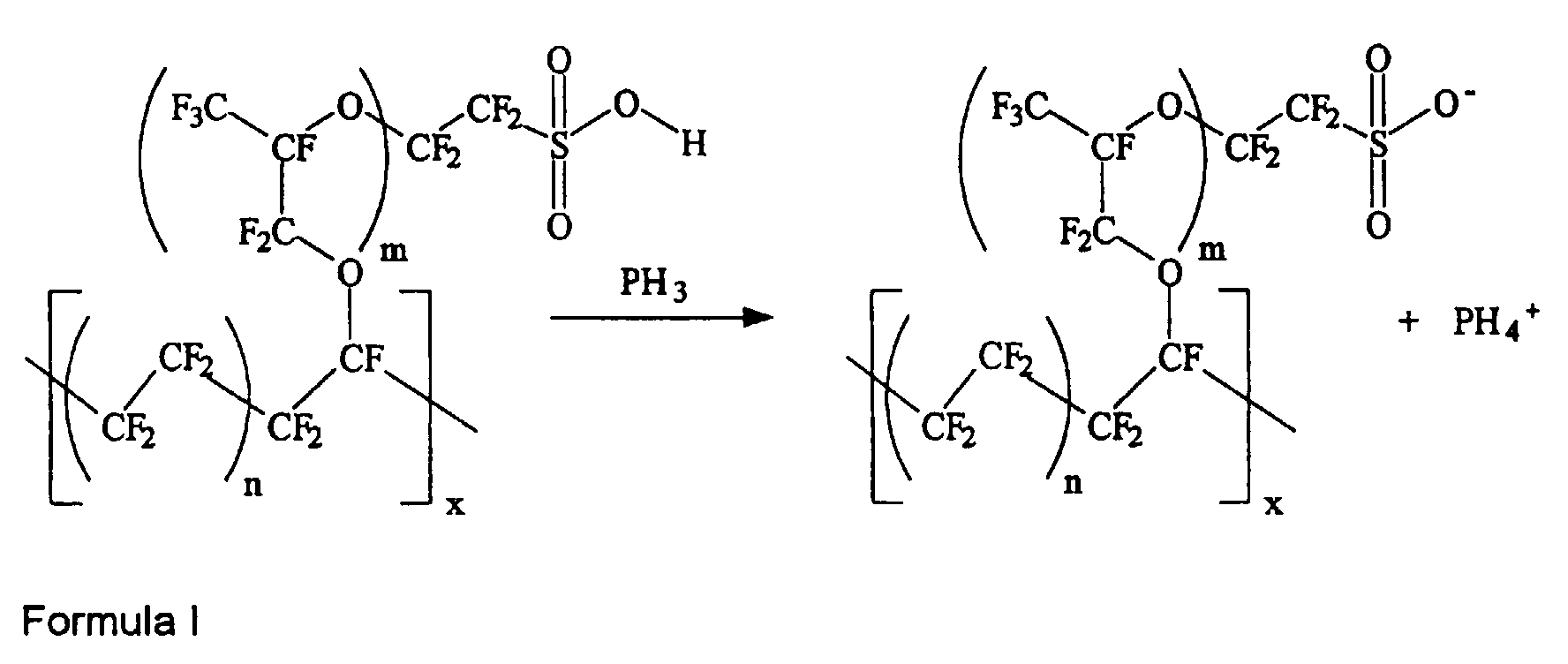
- Nafion-H® has a Hammett acidity parameter of at least -12.0, which is equal to or stronger than that of 96 to 100% H 2 SO 4 (Olah et al., "Perfluorinated Resinsulfonic Acid (Nafion-H®) Catalysis in Synthesis," 7 Synthesis 513 (1986)) and is therefore capable of protonating PH 3 , as shown in Scheme I.
- the effective acidity of the sulphonic acid groups can be altered in a predictable manner by adding or removing electron-withdrawing groups from the polymeric backbone.
- the co-polymer fractions i.e., n, m and x in the formulae
- n, m and x Exemplary values for n, m and x are shown in the following table.
- sorptive properties of the sorbent can be tailored to the gas being sorbed and other aspects of the task being performed.
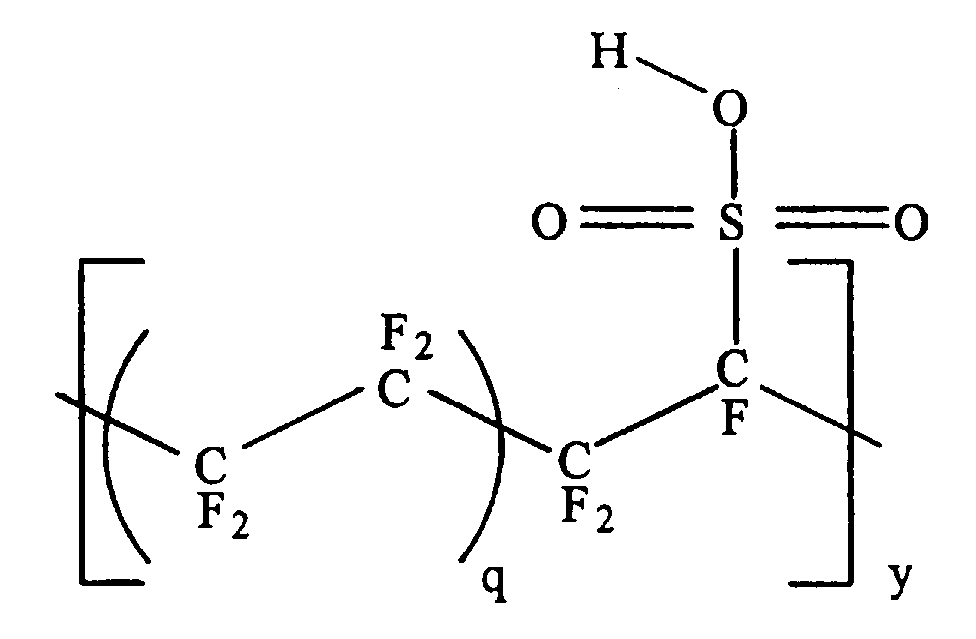
- fluorinated sulphonic acid polymers such those represented by Formula II: where q is from 0 to 9.0, preferably from 0 to 1.0, and y is from 10 to 10,000, preferably from 500 to 5,000, can also be suitable for use in the invention. More weakly acidic polymers, while less chemically inert, can also be useful by more weakly binding with the hydride.
- a common example of a weakly acidic polymer is the cross-linked sulphonated polystyrene-divinylbenzene macroreticular copolymers schematically represented by Formula III: wherein the circled P denotes a cross-linkage with another polymer, and exemplary values for s, t and u are shown in the following table.
- a commercially available example of such a polymer is Amberlyst-15TM (available from Rohm & Haas Co.). Typically even less acidic are the carboxylic acid or halogenated carboxylic acid functionalized polymers.
- Formula III does not specify a degree of polymerization, because the formula represents cross-linked polymers in which the degree of polymerization is effectively infinite. See, e.g., the definition of "cross-linking" in Whittington's Dictionary of Plastics (Technomic Publishing 1993) and the discussion of cross-linked polymers in The Encyclopedia of Polymer Science and Engineering, Vol. 4, p. 351 (John Wiley & Sons Publishing). Thus, the degree of polymerization is not a meaningful parameter in the context of Formula III, even if a few chains of finite molecular weight are entrapped in the cross-linked matrix in certain embodiments.
- acidic polymers can be used for the removal of strongly basic gases, such as ammonia, from gaseous effluents discharged by semiconductor manufacturing facilities.
- strongly basic gases such as, e.g., NH 3 or MeNH 2
- weakly bound, weakly basic gas e.g., AsH 3 or PH 3
- Equations 1-5 represent: ⁇ G - Gibbs free energy change ⁇ - fractional loading ⁇ H - enthalpy change p - partial pressure ⁇ S - entropy change p 0 - reference pressure K- equilibrium constant R - gas constant T - absolute temperature a - maximum usage pressure b - minimum usage pressure
- adsorbents to reduce the equilibrium pressure of dangerous gases is currently being practised.
- One problem of the devices is the expense of the speciality gas adsorbed on the support which cannot be removed under normal operating conditions. A major expense of these devices comes from the cost of these gas molecules which must be kept in inventory, but are not immediately available for delivery.
- the current art typically employs a microporous aluminosilicate (zeolite) to physically adsorb the gas. It is difficult to rationally tune the affinity of binding between the speciality gas and the walls of these physical adsorbents.
- An advantage of the present invention is the ability to tune the absorption properties of the solid acid to maximize the fraction of the speciality gas that is absorbed which can be delivered under the usage conditions. This optimization can take advantage of the nearly continuous variations in acidity which can be obtained by molecular engineering of the monomers and by varying the copolymer ratios used in the preparation of the acidic ionic polymers.
Landscapes
- Chemical & Material Sciences (AREA)
- Organic Chemistry (AREA)
- Analytical Chemistry (AREA)
- Chemical Kinetics & Catalysis (AREA)
- Engineering & Computer Science (AREA)
- Mechanical Engineering (AREA)
- General Engineering & Computer Science (AREA)
- Inorganic Chemistry (AREA)
- Solid-Sorbent Or Filter-Aiding Compositions (AREA)
- Filling Or Discharging Of Gas Storage Vessels (AREA)
- Feeding, Discharge, Calcimining, Fusing, And Gas-Generation Devices (AREA)
- Silicon Compounds (AREA)
Abstract
Description
- This invention relates generally to storage and dispensing systems for the selective dispensing of gaseous compounds, in particular hazardous hydride and halide gases, from a storage container in which the gaseous compounds are held in sorptive relationship to a solid sorbent medium, and are desorptively released from the sorbent medium in the dispensing operation.
- The semiconductor manufacturing industry uses a number of hazardous speciality gases for doping, etching and thin-film deposition. For example, phosphine (PH3) and arsine (AsH3) are needed for numerous semiconductor fabrication processes, though their use poses significant safety and environmental challenges due to their high toxicity and pyrophoricity (i.e., spontaneous inflammability in air). The storage and transport of highly toxic or pyrophoric materials as compressed or liquefied gases in metal cylinders is often unacceptable because of the possibility of developing a leak or catastrophic rupture of the container which could lead to injuries or death. It would be preferable to have a reliable source of these gases wherein the gases are maintained at or below atmospheric pressure during shipping and storage. Also, since many semiconductor processes using speciality gases are operated below ambient pressure, positive gauge pressures of these gases may not be needed, even when in use.
- In order to mitigate some of these safety issues, on-site electrochemical generation of such gases has been described. See, e.g., US-A-4,178,224, US-A-5,158,656, US-A-5,425,857 and US-A-5,474,659. Because of difficulties in the on-site synthesis of these gases, a better technique has been developed where the gas is physisorbed or chemisorbed on a support, thereby reducing the vapour pressure of the gas to render it safer. For example, US-A-5,518,528 to Tom et al. discloses such a process wherein PH3 and AsH3 are adsorbed on physical sorbent and chemisorbent materials, such as strongly basic adsorbents dispersed in, but not covalently bonded to a support. The strong bases presumably react at the surface with the weakly acidic protons on the hydride gas molecules.
- It would be more desirable to have a system where the hazardous speciality gas could be reversibly immobilized by undergoing a chemical reaction with the bulk of the solid sorbent. This approach has the potential for higher sorption capacities compared to the surface adsorption and chemisorption approaches of the prior art. The ability to tune the chemical reactivity of the sorbent also provides far greater control over the equilibrium pressure of the hazardous gas over the solid.
- The invention addresses at least the aforementioned problems by providing a method of storing, transporting and/or dispensing a basic gas having a proton affinity of less than 207 kcal/mol (866 kJ/mol), said method comprising: contacting said basic gas with a support comprising at least one polymer having a Hammett acidity value lower than the Hammett acidity value of the conjugate acid of said basic gas, whereby said basic gas is protonated by said at least one polymer and condensed to form a solid salt sorbed by said support; and, when dispensing, deprotonating said sorbed solid salt to regenerate said basic gas.
- The invention also provides a solid salt of a protonated basic gas having a proton affinity of less than 866 kJ/mol (207 kcal/mol) and a polymer having a Hammett acidity value lower than the Hammett acidity value of the conjugate acid of said basic gas.
- The invention further provides the use of an acidic polymer as a reactive sorbent in the storage, transportation and/or dispensing of a basic gas having a proton affinity of less than 866 kJ/mol (207 kcal/mol), said polymer having a Hammett acidity value lower than the Hammett acidity value of the conjugate acid of said basic gas.
- Preferably, the proton affinity of said basic gas is 145 kcal/mol (607 kJ/mol) to 200 kcal/mol (837 kJ/mol), more preferably from 150 kcal/mol (628 kJ/mol) to 190 kcal/mol (795 kJ/mol).
- The basic gas can be, for example, a hydride or halide, and/or selected from silane, germane, phosphine, trifluorophosphine, arsine, stibine, hydrogen sulfide, hydrogen selenide and hydrogen telluride. Preferably, the basic gas is phosphine or arsine.
- Preferably, the Hammett acidity value of the polymer is from -17 to 6.5, more preferably from -14 to 2, even more preferably from -12.5 to -7. In certain embodiments, said Hammett acidity value is -12 or lower than -12.
- The at least one polymer can be, for example, selected from polymeric sulphonic acids, polymeric perfluoroalkylsulphonic acids, fluorinated sulphonic acid polymers, cross-linked sulphonated polystyrene-divinylbenzene macroreticular copolymers, carboxylic acid polymers halogenated carboxylic acid functionalized polymers and mixtures thereof. Preferably, the at least one polymer is selected from polymeric sulphonic acids, polymeric perfluoroalkylsulphonic acids, fluorinated sulphonic acid polymers and mixtures thereof.
- One preferred polymer is a perfluorinated sulphonic acid represented by the following Formula I:wherein:

- m is from 0 to 2, preferably from 0 to 1,
- n is from 0 to 4.0, preferably from 0 to 2.0, and
- x is from 10 to 10,000, preferably from 500 to 5,000.
-
- Another preferred polymer is a fluorinated sulphonic acid represented by the following Formula II:wherein:

- q is from 0 to 9.0, preferably from 0 to 1.0 and
- y is from 10 to 10,000, preferably from 500 to 5,000.
-
- Another preferred polymer is a cross-linked sulphonated polystyrene-divinylbenzene macroreticular copolymer represented by the following Formula III:wherein:

- s is from 0 to 0.75, preferably from 0 to 0.5, more preferably from 0 to 0.1,
- t is from 0.25 to 1.0, preferably from 0.5 to 0.95, more preferably from 0.8 to 0.93,
- u is from 0 to 0.25, preferably from 0.01 to 0.16, more preferably from 0.07 to 0.09, and
- the circled P denotes a cross-linkage with another polymer.
-
- Deprotonation of the solid salt may be conducted by, for example, heating or contact with a competitive base compound having a proton affinity greater than that of said basic gas. Preferably, the competitive base compound has a proton affinity of at least 207 kcal/mol (866 kJ/mol), and/or is ammonia.
- The invention also provides an apparatus adapted to deliver a basic gas according to the aforementioned method, said apparatus comprising:
- a container containing said support and adapted to selectively contain said basic gas; and
- a valve in fluid communication with said container, and adapted to selectively convey said basic gas into and out of said storage and dispensing vessel.
- The invention enables safe storage, transportation and delivery of a gas by sorbing the gas with a sorbent composition sufficiently acidic to protonate the gas. Upon protonation, the gas and sorbent collectively form a solid salt which is more easily handled than the gas, and can be converted back to the gas by deprotonation.
- The invention can be used to store, transport and deliver any weakly basic gas, although the invention is particularly suitable for use with weakly basic hazardous gases for at least the reasons set forth above. As used herein, the expression "weakly basic" means that the substance being described is less basic than ammonia. Thus, weakly basic gases according to the invention have a gas phase proton affinity of less than 207 kcal/mol (866 kJ/mol), preferably from 145 kcal/mol (607 kJ/mol) to 200 kcal/mol (837 kJ/mol), and more preferably from 150 kcal/mol (628 kJ/mol) to 190 kcal/mol (795 kJ/mol). Proton affinities of a variety of compounds are tabulated in Porterfield, "Inorganic Chemistry" at p. 252, Table 5.6 (Addison-Wesley Publ. 1984). Particularly suitable gases for use in the invention include, e.g., hydride gases and halide gases, such as silane, germane, phosphine, trifluorophosphine, arsine, stibine, hydrogen sulfide, hydrogen selenide and hydrogen telluride.
- The invention is particularly advantageous for storing, transporting and delivering the gaseous hydrides PH3 and AsH3, which are commonly used as sources of arsenic and phosphorus in ion implantation. Due to their extreme toxicity and high vapour pressure, the use, transportation and storage of PH3 and AsH3 raise significant safety concerns for the semiconductor industry.
- Compounds such as AsH3 and PH3 can act both as weak acids and weak bases. The acidic properties of AsH3 and PH3 are exploited by US-A-5,037,624 in which a solid, basic substrate is described that irreversibly chemisorbs those compounds in order to abate them from a gas exhaust stream. On the other hand, the invention described herein utilizes the weak gas phase basicity of compounds such as AsH3 and PH3, to reversibly bind, and hence temporarily store, these species on solid, acidic substrates. That AsH3 and PH3 are weak bases is evidenced by their respective proton affinities of 175 kcal/mol (732 kJ/mol) and 185 kcal/mol (774 kJ/mol). Although not applicable to anhydrous systems, PH3 has a pKb value of -27 and a pKa value of -29 in water. The weak basicity of PH3 is evident in its reaction with anhydrous HCl (pKa = -5.7) to form a phosphonium salt, [PH4]+ Cl-. AsH3 can also be protonated by the strong acids HI (pKa = -10.7) and HBr (pKa = -7.7), but not by the slightly weaker acids, HCI and HF (pKa = +3.5). Note that despite its high pKa, anhydrous HF has the relatively large Hammett acidity factor (H0) of -10.2, indicative of substantial acidity in non-aqueous systems.
- The protonated pnictide onium ions (i.e., AsH4 + and PH4 +) formed by protonation of arsine and phosphine are a potential source of the corresponding hydride gases. For example, PH3 is liberated upon the action of heat or aqueous NaOH on PH4I. By choosing an appropriate acid sorbent composition which permits adequate diffusion of the hydride gas to its acid functionalities, a reversible reaction to form solid onium salts can be effected. The acidity of the sorbent composition and its acid functionalities are chosen so that the reverse reaction which leads to liberation of the hydride gas can occur in response to a predetermined stimulus, such as raising the temperature to a predetermined value or contacting the salt with a base (e.g., ammonia) stronger than the original hydride gas.
- Onium complexes can be prepared by directly contacting the phosphine, arsine or similar gas with an ionic polymer in its H+ form. Preferably, the polymer is initially dried to the point that the vapour pressure of water in equilibrium with the polymer is low, most preferably less than 1 ppmv at 1 atmosphere (0.1 MPa) total pressure. It is important, however, that the drying process not totally destroy the porosity of the polymer to gaseous species. A macroreticular or heavily cross-linked polymer may be used so as to retain a greater degree of porosity when dried sufficiently. Other means of preparation of these ion-exchanged polymers may be envisioned, though the direct combination of the strongly acidic polymer with the weakly basic gas is preferred for its simplicity.
- Compounds suitable for use in sorbent compositions according to the invention include solids sufficiently acidic to protonate the weakly basic gas being sorbed. Thus, compounds having a Hammett acidity parameter lower than the Hammett acidity parameter of the conjugate acid of the weakly basic gas are used. H0 is generally from -17 to 6.5, preferably from -14 to 2, more preferably from -12.5 to -7. Particularly preferred as constituents of suitable sorbent compositions are ionomers, such as, e.g., polymeric sulphonic acids and polymeric perfluoroalkylsulphonic acids, and mixtures thereof. Nafion-H® is a brand name for perfluorinated sulphonic acid resin marketed by the Du Pont company. This material has the chemical structure of Formula I shown on the left hand side of the proposed reaction scheme below (Scheme I):Nafion-H® has a Hammett acidity parameter of at least -12.0, which is equal to or stronger than that of 96 to 100% H2SO4 (Olah et al., "Perfluorinated Resinsulfonic Acid (Nafion-H®) Catalysis in Synthesis," 7 Synthesis 513 (1986)) and is therefore capable of protonating PH3, as shown in Scheme I. The effective acidity of the sulphonic acid groups can be altered in a predictable manner by adding or removing electron-withdrawing groups from the polymeric backbone. Also, the co-polymer fractions (i.e., n, m and x in the formulae) can be varied to affect the physical and chemical properties of the support. Exemplary values for n, m and x are shown in the following table.

- Thus, the sorptive properties of the sorbent can be tailored to the gas being sorbed and other aspects of the task being performed.
- Other fluorinated sulphonic acid polymers, such those represented by Formula II:where q is from 0 to 9.0, preferably from 0 to 1.0, and y is from 10 to 10,000, preferably from 500 to 5,000, can also be suitable for use in the invention. More weakly acidic polymers, while less chemically inert, can also be useful by more weakly binding with the hydride. A common example of a weakly acidic polymer is the cross-linked sulphonated polystyrene-divinylbenzene macroreticular copolymers schematically represented by Formula III:
 wherein the circled P denotes a cross-linkage with another polymer, and exemplary values for s, t and u are shown in the following table.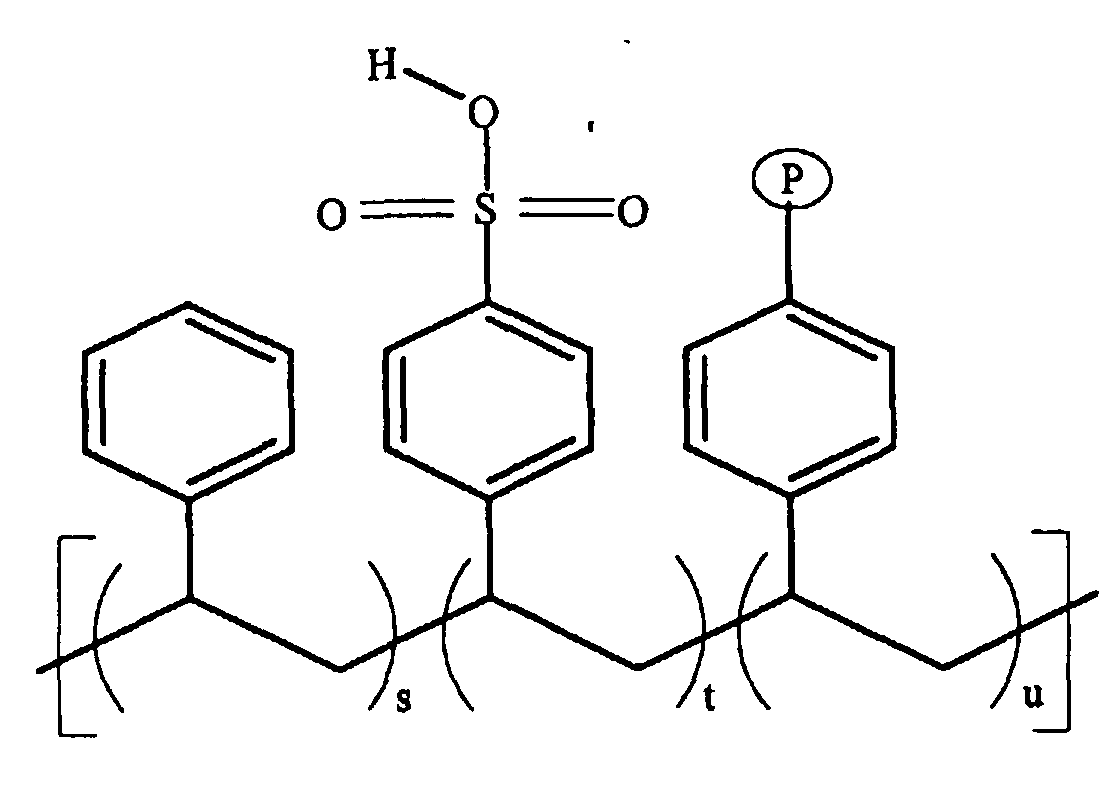

- A commercially available example of such a polymer is Amberlyst-15™ (available from Rohm & Haas Co.). Typically even less acidic are the carboxylic acid or halogenated carboxylic acid functionalized polymers.
- Formula III does not specify a degree of polymerization, because the formula represents cross-linked polymers in which the degree of polymerization is effectively infinite. See, e.g., the definition of "cross-linking" in Whittington's Dictionary of Plastics (Technomic Publishing 1993) and the discussion of cross-linked polymers in The Encyclopedia of Polymer Science and Engineering, Vol. 4, p. 351 (John Wiley & Sons Publishing). Thus, the degree of polymerization is not a meaningful parameter in the context of Formula III, even if a few chains of finite molecular weight are entrapped in the cross-linked matrix in certain embodiments.
- While not pertaining to delivery systems for gases, US-A-5,037,624 discloses that acidic polymers, including those suitable for use in the present invention, can be used for the removal of strongly basic gases, such as ammonia, from gaseous effluents discharged by semiconductor manufacturing facilities. In embodiments of the present invention, strongly basic gases such as, e.g., NH3 or MeNH2, are used to competitively displace from the sorbent the more weakly bound, weakly basic gas (e.g., AsH3 or PH3) initially stored on the sorbent. In such embodiments of the invention, it may not be necessary to heat the sorbent to enhance the delivery rate or pressure, which is advantageous both for the stability of the sorbent and for the inherent simplicity and safety of the system.
- From the published dissociation pressure of PH4I as a function of temperature (Stull, "Vapour Pressure of Pure Substances Organic Compounds," 39 Ind. Eng. Chem. 517-540 (1947), compiled in Brown et al., "Boiling Point Data" in NIST Standard Reference Database Number 69, Eds. Mallard et al., February 1997, National Institute of Standards and Technology, Gaithersburg MD, 20899), it is possible to estimate the energetics of the reaction:
- Changes in the relative acidities of the solid acid will primarily affect the magnitude of the corresponding ΔH of reaction for a given gas. In contrast, the entropy change (ΔS) of these reactions stems primarily from the loss of translational entropy when the gas is incorporated into the condensed phase and should not depend on the nature of the solid acid. This translational entropy may be calculated by statistical mechanics. The value of Strans at 25°C and 1 atm. (0.1 MPa) is calculated as 0.14, 0.15 and 0.16 kJ/mol • K for NH3, PH3 and AsH3 gases, respectively.
- Since the equilibrium constant at a given temperature depends solely on the Gibbs free energy, given a fixed entropy change, increasing the acidity of the sorbent and consequently raising the magnitude of the reaction enthalpy will necessarily increase the equilibrium constant. These relationships are given below in Equations 1 and 2.
- The symbols in Equations 1-5 represent:
ΔG - Gibbs free energy change Θ - fractional loading ΔH - enthalpy change p - partial pressure ΔS - entropy change p0 - reference pressure K- equilibrium constant R - gas constant T - absolute temperature a - maximum usage pressure b - minimum usage pressure - The application of adsorbents to reduce the equilibrium pressure of dangerous gases is currently being practised. One problem of the devices is the expense of the speciality gas adsorbed on the support which cannot be removed under normal operating conditions. A major expense of these devices comes from the cost of these gas molecules which must be kept in inventory, but are not immediately available for delivery. The current art typically employs a microporous aluminosilicate (zeolite) to physically adsorb the gas. It is difficult to rationally tune the affinity of binding between the speciality gas and the walls of these physical adsorbents. An advantage of the present invention is the ability to tune the absorption properties of the solid acid to maximize the fraction of the speciality gas that is absorbed which can be delivered under the usage conditions. This optimization can take advantage of the nearly continuous variations in acidity which can be obtained by molecular engineering of the monomers and by varying the copolymer ratios used in the preparation of the acidic ionic polymers.
- While the invention has been described in detail and with reference to specific examples thereof, it will be apparent to one skilled in the art that various changes and modifications can be made therein without departing from the scope thereof as defined in the following Claims.
Claims (28)
- A method of storing, transporting and/or dispensing a basic gas having a proton affinity of less than 866 kJ/mol (207 kcal/mol), said method comprising contacting said basic gas with a support comprising at least one polymer having a Hammett acidity value lower than the Hammett acidity value of the conjugate acid of said basic gas, whereby said basic gas is protonated by said at least one polymer and condensed to form a solid salt sorbed by said support; and, when dispensing, deprotonating said sorbed solid salt to regenerate said basic gas.
- A method as claimed in Claim 1, wherein said proton affinity of said basic gas is 607 kJ/mol to 837 kJ/mol (145 kcal/mol to 200 kcal/mol).
- A method as claimed in Claim 2, wherein said proton affinity of said basic gas is from 628 kJ/mol to 795 kJ/mol (150 kcal/mol to 190 kcal/mol).
- A method as claimed in any one of the preceding claims, wherein said basic gas is a hydride or halide.
- A method as claimed in any one of Claims 1 to 3, wherein said basic gas is selected from silane, germane, phosphine, trifluorophosphine, arsine, stibine, hydrogen sulfide, hydrogen selenide and hydrogen telluride.
- A method as claimed in Claim 5, wherein said basic gas is phosphine or arsine.
- A method as claimed in any one of the preceding claims, wherein said Hammett acidity value of the polymer is from -17 to 6.5.
- A method as claimed in Claim 7, wherein said Hammett acidity value of the polymer is from -14 to 2.
- A method as claimed in Claim 8, wherein said Hammett acidity value of the polymer is from -12.5 to -7.
- A method as claimed in any one of the preceding claims, wherein said Hammett acidity value of the polymer is -12 or lower than -12.
- A method as claimed in any one of the preceding claims, wherein said at least one polymer is selected from polymeric sulphonic acids, polymeric perfluoroalkylsulphonic acids, fluorinated sulphonic acid polymers, cross-linked sulphonated polystyrene-divinylbenzene macroreticular copolymers, carboxylic acid polymers halogenated carboxylic acid functionalized polymers and mixtures thereof.
- A method as claimed in Claim 11, wherein said at least one polymer is selected from polymeric sulphonic acids, polymeric perfluoroalkylsulphonic acids, fluorinated sulphonic acid polymers and mixtures thereof.
- A method as claimed in Claim 12, wherein said at least one polymer is a perfluorinated sulphonic acid represented by the following Formula I:wherein:
 m is from 0 to 2,n is from 0 to 4 andx is from 10 to 10,000.
 - A method as claimed in Claim 13, wherein m is from 0 to 1, n is from 0 to 2, and x is from 500 to 5,000.
- A method as claimed in Claim 12, wherein said at least one polymer is a fluorinated sulphonic acid represented by the following Formula II:wherein:
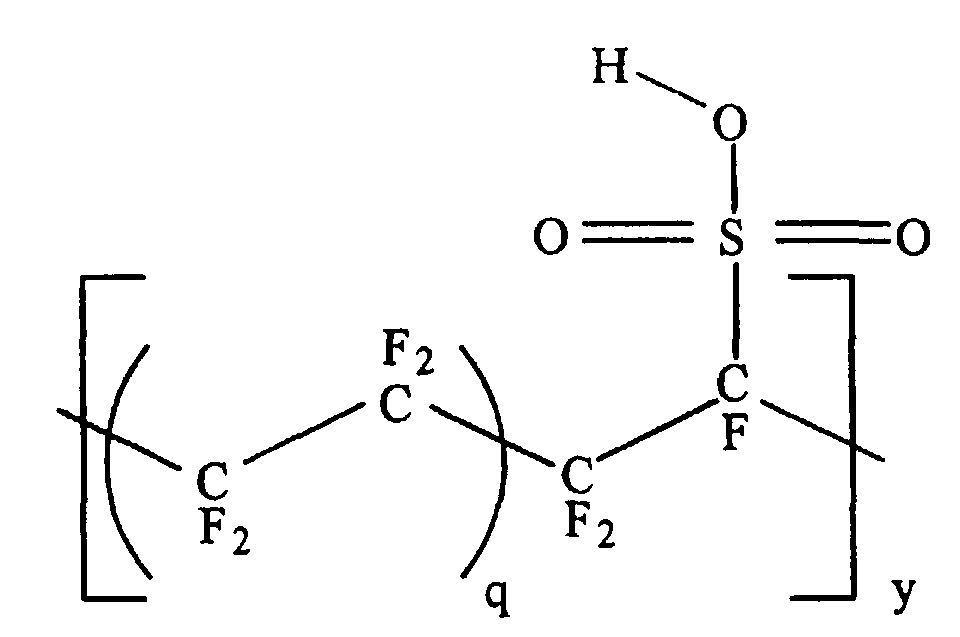 q is from 0 to 9 andy is from 10 to 10,000.
 - A method as claimed in Claim 15, wherein q is from 0 to 1 and y is from 500 to 5,000.
- A method as claimed in Claim 11, wherein said at least one polymer is a cross-linked sulphonated polystyrene-divinylbenzene macroreticular copolymer represented by the following Formula III:wherein:
 s is from 0 to 0.75,t is from 0.25 to 1.0,u is from 0 to 0.25 andthe circled P denotes a cross-linkage with another polymer.
 - A method as claimed in claim 17, wherein s is from 0 to 0.50, t is from 0.5 to 0.95, and u is from 0.01 to 0.16.
- A method as claimed in claim 18, wherein s is from 0 to 0.1, t is from 0.8 to 0.93, and u is from 0.07 to 0.09.
- A method as claimed in any one of the preceding claims, wherein said solid salt is heated to effect said deprotonating.
- A method as claimed in any one of Claims 1 to 21, wherein said solid salt is contacted with a competitive base compound to effect said deprotonating, said competitive base compound having a proton affinity greater than that of said basic gas.
- A method as claimed in claim 21, wherein said competitive base compound has a proton affinity of at least 866 kJ/mol (207 kcal/mol).
- A method as claimed in claim 21, wherein said competitive base compound is ammonia.
- An apparatus adapted to deliver a basic gas according to the method of claim 1, said apparatus comprising:a container containing said support and adapted to selectively contain said basic gas; anda valve in fluid communication with said container, and adapted to selectively convey said basic gas into and out of said storage and dispensing vessel.
- A solid salt of a protonated basic gas having a proton affinity of less than 866 kJ/mol (207 kcal/mol) and a polymer having a Hammett acidity value lower than the Hammett acidity value of the conjugate acid of said basic gas.
- A solid salt as claimed in Claim 25, wherein said gas and/or said polymer is as defined in any one of Claims 2 to 19.
- The use of an acidic polymer as a reactive sorbent in the storage, transportation and/or dispensing of a basic gas having a proton affinity of less than 866 kJ/mol (207 kcal/mol), said polymer having a Hammett acidity value lower than the Hammett acidity value of the conjugate acid of said basic gas.
- A use as claimed in Claim 27, wherein said gas and/or said polymer is as defined in any one of Claims 2 to 19.
Applications Claiming Priority (2)
| Application Number | Priority Date | Filing Date | Title |
|---|---|---|---|
| US09/379,007 US6277342B1 (en) | 1999-08-23 | 1999-08-23 | Storage and safe delivery of hazardous specialty gases by acid/base reactions with ionic polymers |
| US379007 | 2003-03-04 |
Publications (1)
| Publication Number | Publication Date |
|---|---|
| EP1078881A1 true EP1078881A1 (en) | 2001-02-28 |
Family
ID=23495430
Family Applications (1)
| Application Number | Title | Priority Date | Filing Date |
|---|---|---|---|
| EP00307232A Withdrawn EP1078881A1 (en) | 1999-08-23 | 2000-08-22 | Storage and safe delivery of hazardous speciality gases by acid/base reactions with ionic polymers |
Country Status (4)
| Country | Link |
|---|---|
| US (1) | US6277342B1 (en) |
| EP (1) | EP1078881A1 (en) |
| JP (1) | JP3440232B2 (en) |
| TW (1) | TW562693B (en) |
Families Citing this family (5)
| Publication number | Priority date | Publication date | Assignee | Title |
|---|---|---|---|---|
| WO2004040374A2 (en) * | 2002-10-29 | 2004-05-13 | Dupont Photomasks, Inc. | Photomask assembly and method for protecting the same from contaminants generated during a lithography process |
| US7172646B2 (en) * | 2003-04-15 | 2007-02-06 | Air Products And Chemicals, Inc. | Reactive liquid based gas storage and delivery systems |
| US7303607B2 (en) | 2004-06-14 | 2007-12-04 | Air Products And Chemicals, Inc. | Liquid media containing Lewis acidic reactive compounds for storage and delivery of Lewis basic gases |
| US7563308B2 (en) * | 2004-09-23 | 2009-07-21 | Air Products And Chemicals, Inc. | Ionic liquid based mixtures for gas storage and delivery |
| US7404845B2 (en) * | 2004-09-23 | 2008-07-29 | Air Products And Chemicals, Inc. | Ionic liquid based mixtures for gas storage and delivery |
Citations (4)
| Publication number | Priority date | Publication date | Assignee | Title |
|---|---|---|---|---|
| US5151395A (en) * | 1987-03-24 | 1992-09-29 | Novapure Corporation | Bulk gas sorption and apparatus, gas containment/treatment system comprising same, and sorbent composition therefor |
| EP0638363A1 (en) * | 1993-08-06 | 1995-02-15 | ENIRICERCHE S.p.A. | Process for the alkylation of aliphatic hydrocarbons with olefins |
| WO1996011739A1 (en) * | 1994-10-13 | 1996-04-25 | Advanced Technology Materials, Inc. | Storage and delivery system for gaseous compounds |
| WO1997044118A1 (en) * | 1996-05-20 | 1997-11-27 | Advanced Technology Materials, Inc. | Fluid storage and delivery system comprising high work capacity physical sorbent |
Family Cites Families (13)
| Publication number | Priority date | Publication date | Assignee | Title |
|---|---|---|---|---|
| US4178224A (en) | 1978-01-19 | 1979-12-11 | Texas Instruments Incorporated | Apparatus for generation and control of dopant and reactive gases |
| US5037624A (en) | 1987-03-24 | 1991-08-06 | Advanced Technology Materials Inc. | Composition, apparatus, and process, for sorption of gaseous compounds of group II-VII elements |
| US5458674A (en) * | 1993-08-24 | 1995-10-17 | E. I. Du Pont De Nemours And Company | Organic separation from HF |
| US5474659A (en) | 1989-04-18 | 1995-12-12 | At&T Corp. | Process and apparatus for generating precursor gases used in the manufacture of semiconductor devices |
| US5158656A (en) | 1991-03-22 | 1992-10-27 | Electron Transfer Technologies, Inc. | Method and apparatus for the electrolytic preparation of group IV and V hydrides |
| FR2710043B1 (en) | 1993-09-17 | 1995-10-13 | Air Liquide | Method and device for generating arsine electrolytically. |
| US6132492A (en) * | 1994-10-13 | 2000-10-17 | Advanced Technology Materials, Inc. | Sorbent-based gas storage and delivery system for dispensing of high-purity gas, and apparatus and process for manufacturing semiconductor devices, products and precursor structures utilizing same |
| US5707424A (en) * | 1994-10-13 | 1998-01-13 | Advanced Technology Materials, Inc. | Process system with integrated gas storage and delivery unit |
| US6177058B1 (en) * | 1996-03-07 | 2001-01-23 | Alliedsignal Inc. | Hydrogen fluoride compositions |
| US5761910A (en) * | 1996-05-20 | 1998-06-09 | Advanced Technology Materials, Inc. | High capacity gas storage and dispensing system |
| US5993766A (en) * | 1996-05-20 | 1999-11-30 | Advanced Technology Materials, Inc. | Gas source and dispensing system |
| US5916245A (en) * | 1996-05-20 | 1999-06-29 | Advanced Technology Materials, Inc. | High capacity gas storage and dispensing system |
| US6019823A (en) * | 1997-05-16 | 2000-02-01 | Advanced Technology Materials, Inc. | Sorbent-based fluid storage and dispensing vessel with replaceable sorbent cartridge members |
-
1999
- 1999-08-23 US US09/379,007 patent/US6277342B1/en not_active Expired - Lifetime
-
2000
- 2000-08-17 TW TW089116680A patent/TW562693B/en active
- 2000-08-22 EP EP00307232A patent/EP1078881A1/en not_active Withdrawn
- 2000-08-23 JP JP2000252619A patent/JP3440232B2/en not_active Expired - Fee Related
Patent Citations (4)
| Publication number | Priority date | Publication date | Assignee | Title |
|---|---|---|---|---|
| US5151395A (en) * | 1987-03-24 | 1992-09-29 | Novapure Corporation | Bulk gas sorption and apparatus, gas containment/treatment system comprising same, and sorbent composition therefor |
| EP0638363A1 (en) * | 1993-08-06 | 1995-02-15 | ENIRICERCHE S.p.A. | Process for the alkylation of aliphatic hydrocarbons with olefins |
| WO1996011739A1 (en) * | 1994-10-13 | 1996-04-25 | Advanced Technology Materials, Inc. | Storage and delivery system for gaseous compounds |
| WO1997044118A1 (en) * | 1996-05-20 | 1997-11-27 | Advanced Technology Materials, Inc. | Fluid storage and delivery system comprising high work capacity physical sorbent |
Also Published As
| Publication number | Publication date |
|---|---|
| JP3440232B2 (en) | 2003-08-25 |
| JP2001113155A (en) | 2001-04-24 |
| TW562693B (en) | 2003-11-21 |
| US6277342B1 (en) | 2001-08-21 |
Similar Documents
| Publication | Publication Date | Title |
|---|---|---|
| US6309446B1 (en) | Activated carbon for adsorptive storage of gaseous compound | |
| US7396381B2 (en) | Storage and delivery systems for gases held in liquid medium | |
| AU713214B2 (en) | Fluid storage and delivery system comprising high work capacity physical sorbent | |
| KR100529262B1 (en) | Methods for removal of impurity metals from gases using low metal zeolites | |
| JP3592636B2 (en) | Activated carbon for adsorption and storage of gaseous compounds | |
| KR100601121B1 (en) | Reactive liquid based gas storage and delivery systems | |
| JPH11264500A (en) | Storage and feed system for gas compound | |
| EP1163041A1 (en) | Methods for removal of water from gases using superheated zeolites | |
| JP2013523424A (en) | Method for protecting solid adsorbent and protected solid adsorbent | |
| US6277342B1 (en) | Storage and safe delivery of hazardous specialty gases by acid/base reactions with ionic polymers | |
| US10940426B2 (en) | Adsorbent-assisted stabilization of highly reactive gases | |
| US7282084B2 (en) | Liquid media containing Lewis basic reactive compounds for storage and delivery of Lewis acidic gases | |
| JP5700570B2 (en) | Adsorbing / desorbing device for storing and dispensing adsorbing fluid and fluid reagent supply method | |
| CN112424114B (en) | Storage medium and method for separating, storing and transporting chlorine from chlorine-containing gases | |
| US8153096B2 (en) | Hydrogen fluoride compositions | |
| KR100635961B1 (en) | Process for removing water from ammonia | |
| US20040159234A1 (en) | Method for rapid activation or preconditioning of porous gas purification substrates | |
| KR100683366B1 (en) | Apparatus and method for removing amine compounds from liquefied petroleum gas | |
| WO2023076184A1 (en) | Boron oxide-containing adsorbent and related methods and devices | |
| WO2000009257A1 (en) | Method and apparatus for storing and feeding gaseous compound | |
| Sheshkovas et al. | Co2 Capture Using Amino Acid Ionic Liquid-Functionalized Zirconia-Silica Aerogels | |
| Kefer | Synthesis and assessment of aminosilane-grafted silica gel for the post-combustion CO2 adsorption in a fixed-bed reactor | |
| US20040009873A1 (en) | Adsorbent for water removal from ammonia | |
| CN122003287A (en) | Method for separating chlorine from chlorine-containing gases and reversibly storing chlorine and storage medium for storing chlorine for use in said method |
Legal Events
| Date | Code | Title | Description |
|---|---|---|---|
| PUAI | Public reference made under article 153(3) epc to a published international application that has entered the european phase |
Free format text: ORIGINAL CODE: 0009012 |
|
| AK | Designated contracting states |
Kind code of ref document: A1 Designated state(s): AT BE CH CY DE DK ES FI FR GB GR IE IT LI LU MC NL PT SE |
|
| AX | Request for extension of the european patent |
Free format text: AL;LT;LV;MK;RO;SI |
|
| 17P | Request for examination filed |
Effective date: 20010405 |
|
| AKX | Designation fees paid |
Free format text: AT BE CH CY DE DK ES FI FR GB GR IE IT LI LU MC NL PT SE |
|
| GRAH | Despatch of communication of intention to grant a patent |
Free format text: ORIGINAL CODE: EPIDOS IGRA |
|
| STAA | Information on the status of an ep patent application or granted ep patent |
Free format text: STATUS: THE APPLICATION IS DEEMED TO BE WITHDRAWN |
|
| 18D | Application deemed to be withdrawn |
Effective date: 20030620 |