EP1078727A1 - Polyolefin blend containing delustering agent and molded product therefrom having varied wall thickness - Google Patents
Polyolefin blend containing delustering agent and molded product therefrom having varied wall thickness Download PDFInfo
- Publication number
- EP1078727A1 EP1078727A1 EP00118385A EP00118385A EP1078727A1 EP 1078727 A1 EP1078727 A1 EP 1078727A1 EP 00118385 A EP00118385 A EP 00118385A EP 00118385 A EP00118385 A EP 00118385A EP 1078727 A1 EP1078727 A1 EP 1078727A1
- Authority
- EP
- European Patent Office
- Prior art keywords
- weight
- wall portion
- molded resin
- thickness
- resin product
- Prior art date
- Legal status (The legal status is an assumption and is not a legal conclusion. Google has not performed a legal analysis and makes no representation as to the accuracy of the status listed.)
- Granted
Links
Images



Classifications
-
- C—CHEMISTRY; METALLURGY
- C08—ORGANIC MACROMOLECULAR COMPOUNDS; THEIR PREPARATION OR CHEMICAL WORKING-UP; COMPOSITIONS BASED THEREON
- C08L—COMPOSITIONS OF MACROMOLECULAR COMPOUNDS
- C08L23/00—Compositions of homopolymers or copolymers of unsaturated aliphatic hydrocarbons having only one carbon-to-carbon double bond; Compositions of derivatives of such polymers
- C08L23/02—Compositions of homopolymers or copolymers of unsaturated aliphatic hydrocarbons having only one carbon-to-carbon double bond; Compositions of derivatives of such polymers not modified by chemical after-treatment
- C08L23/16—Ethylene-propylene or ethylene-propylene-diene copolymers
-
- B—PERFORMING OPERATIONS; TRANSPORTING
- B29—WORKING OF PLASTICS; WORKING OF SUBSTANCES IN A PLASTIC STATE IN GENERAL
- B29C—SHAPING OR JOINING OF PLASTICS; SHAPING OF MATERIAL IN A PLASTIC STATE, NOT OTHERWISE PROVIDED FOR; AFTER-TREATMENT OF THE SHAPED PRODUCTS, e.g. REPAIRING
- B29C45/00—Injection moulding, i.e. forcing the required volume of moulding material through a nozzle into a closed mould; Apparatus therefor
- B29C45/0001—Injection moulding, i.e. forcing the required volume of moulding material through a nozzle into a closed mould; Apparatus therefor characterised by the choice of material
-
- B—PERFORMING OPERATIONS; TRANSPORTING
- B29—WORKING OF PLASTICS; WORKING OF SUBSTANCES IN A PLASTIC STATE IN GENERAL
- B29C—SHAPING OR JOINING OF PLASTICS; SHAPING OF MATERIAL IN A PLASTIC STATE, NOT OTHERWISE PROVIDED FOR; AFTER-TREATMENT OF THE SHAPED PRODUCTS, e.g. REPAIRING
- B29C45/00—Injection moulding, i.e. forcing the required volume of moulding material through a nozzle into a closed mould; Apparatus therefor
- B29C45/0081—Injection moulding, i.e. forcing the required volume of moulding material through a nozzle into a closed mould; Apparatus therefor of objects with parts connected by a thin section, e.g. hinge, tear line
-
- C—CHEMISTRY; METALLURGY
- C08—ORGANIC MACROMOLECULAR COMPOUNDS; THEIR PREPARATION OR CHEMICAL WORKING-UP; COMPOSITIONS BASED THEREON
- C08L—COMPOSITIONS OF MACROMOLECULAR COMPOUNDS
- C08L53/00—Compositions of block copolymers containing at least one sequence of a polymer obtained by reactions only involving carbon-to-carbon unsaturated bonds; Compositions of derivatives of such polymers
-
- B—PERFORMING OPERATIONS; TRANSPORTING
- B29—WORKING OF PLASTICS; WORKING OF SUBSTANCES IN A PLASTIC STATE IN GENERAL
- B29L—INDEXING SCHEME ASSOCIATED WITH SUBCLASS B29C, RELATING TO PARTICULAR ARTICLES
- B29L2031/00—Other particular articles
- B29L2031/30—Vehicles, e.g. ships or aircraft, or body parts thereof
- B29L2031/3005—Body finishings
- B29L2031/3038—Air bag covers
Definitions
- the present invention relates to the formation of various molded resin products having varied wall thicknesses.
- the present invention also relates to a resin composition for making such products in a way that prevents visible imperfections often associated with changes in wall thickness of molded products.
- Injection molding is a known molding technique for forming a molded product from a resin material.
- a molten resin is injected from a gate of a mold into a cavity thereof, so as to fill the cavity with the resin. After the resin has cooled, the mold is opened to permit removal of the molded resin product.
- FIG. 6(a) illustrates a molded resin product produced by conventional injection molding techniques using conventional molding materials.
- the molded resin product 9 has a portion 910 with reduced thickness (e.g. a groove). Flashing stripes 914 and 915 (i.e., areas of luster unevenness) have formed in the surface of the product 9 in the areas were the wall thickness changes.
- the groove 910 extends generally orthogonal to the direction of resin flow, illustrated by arrow 95.
- the flashing stripes 914 and 915 are generated on both sides of the groove 910.
- FIG. 6(b) illustrates another molded resin product 90 produced by conventional injection molding techniques also using conventional molding materials.
- the molded resin product 90 has a stepwise reduction in wall thickness and a flashing stripe 914 is generated in the surface adjacent the reduction in wall thickness thereof.
- the flashing stripes 914 and 915 produced in the molded resin product 9 and the flashing stripe 914 produced in the molded resin product 90 may be produced by residual stresses and negative pressures.
- the flashing stripes 914 in FIGS. 6(a) and FIG. 6(b) are formed in the area where the wall thickness of the product is reduced. Flow of resin through the mold is choked in this area, which produces residual stresses causing grain gap.
- the flashing stripe 915 in FIG. 6(a) is formed in the area where there is an increase in the thickness of the wall of the product 9. In this area, there is poor flow of resin based on the negative pressure associated with the enlarged wall thickness.
- the resin composition in accordance with the present invention includes a delustering agent and a blend of components.
- the resin composition includes 0.01-0.1 part by weight of the delustering agent, and 100 parts by weight of a blend of components.
- the blend of components includes 30-50% by weight of a polypropylene block copolymer containing 4-20% by weight of ethylene, 0-10% by weight of polyethylene, 5-15% by weight of a propylene/butene copolymer, and 40-60% by weight of an ethylene/ ⁇ -olefin copolymer rubber.
- the ethylene/ ⁇ -olefin copolymer rubber may have a glass transition point of -45°C or lower.
- the polyethylene may have a density of not more than 0.95 g/cm 3 . It is also contemplated that the polyethylene content in the resin composition is 0% by weight.
- the butene content by percentage in the propylene/butene copolymer may vary from 10% to 30% by weight.
- the present invention is also directed to a molded resin product.
- the molded resin product includes at least one thick wall portion, and at least one thinner wall portion. Also, the molded product can have at least one changing thickness portion that extends between thick and thinner wall portions, mentioned above.
- the molded resin product molded in accordance with the present invention is formed from a resin composition comprising 0.01-0.1 part by weight of a delustering agent and 100 parts by weight of a blend of components.
- the blend of components may be as noted above and include 30-50% by weight of a polypropylene block copolymer containing 4-20% by weight of ethylene, 0-10% by weight of polyethylene, 5-15% by weight of a propylene/butene copolymer, and 40-60% by weight of an ethylene/ ⁇ -olefin copolymer rubber.
- the molded resin product may be formed by injection molding. However, other methods of forming molded resin products are also to be considered well within the scope of the present invention.
- the thickness of the portion changing in thickness may gradually decrease from the thick wall portion to the thinner wall portion.
- the thickness of the portion that is changing in thickness may gradually increase from the thinner wall portion to the thicker wall portion.
- portion changing in thickness may exhibit stepwise thickness changes as well as or in lieu of gradual changes.
- the portion changing in thickness may have at least one stepwise decrease in thickness between the thick wall portion and the thinner wall portion.
- the changing in thickness portion may have at least one stepwise increase in thickness between the thinner wall portion and the thicker wall portion.
- the present invention is directed to the formation of various molded resin products having walls of varying thicknesses.
- the products described below are merely illustrative of the numerous products that can be formed using various molding techniques and the resin composition described below.
- the molded resin products formed in accordance with the present invention include thick wall portions 2, and thin wall portions 1.
- the thick wall portions 2 have a thickness greater than the thin wall portions 1.
- Located between the thick wall portion 2 and the thin wall portion 1 is a portion where the thickness changes from thin to thick and from thick to thin.
- the wall thickness my gradually change between the thick wall portion 2 and the thin wall portion 1.
- the thickness change can occur in a stepwise manner.
- examples of the thickness change portion include a flow choke portion 12, where the wall thickness is reduced from a thick wall portion 2 to a thin wall portion 1, and a flow enlargement portion 13 where wall thickness is increased from the thin wall portion 1 to another thick wall portion 2.
- FIGs. 2(a)-2(e) Several examples of molded resin products formed in accordance with the present invention are shown in FIGs. 2(a)-2(e). These figures illustrate exemplary types of thickness changes and are only illustrative. There are others and other combinations.
- the molded resin product 10, illustrated in FIG. 2(a), includes a thin wall portion 1 associated with a bottom portion of a groove 11.
- the groove 11 and thin wall portion 1 extend in a direction transverse to the direction of resin flow 5 from gate 4.
- Groove 11 also extends between adjacent thick wall portions 2. Thickness changes on both sides of the thin wall portion 1.
- a single groove 11 is illustrated, the present invention is not limited to a single thin wall portion 1; rather, it is contemplated that the molded resin product 10 may include multiple grooves 11. Furthermore, it is contemplated that the grooves 11 may extend in any direction. Additionally, the thickness of the groove may vary.
- the molded resin product 20, illustrated in Fig. 2(b), includes multiple thick wall portions 2 formed as ribs between thin wall portions 1. Like the resin product 10, the changing thickness portion extends in a direction crossing the direction of resin flow 5 on both sides of each of the thin wall portions 1.
- the molded resin product 30, illustrated in Fig. 2(c), includes a thick wall portion 2 formed adjacent the gate 4 followed by a stepwise decrease in thickness to a thin wall portion 1 downstream from the gate 4.
- the molded resin product 40 illustrated in Fig. 2(d), also includes a stepwise thickness changing portion.
- a thin wall portion 1 is formed at the upstream side of the direction of resin flow 5 followed by a stepwise increase in thickness to a thicker wall portion 2 formed at the downstream side thereof.
- the molded resin product 50 illustrated in FIG. 2(e), includes a thin wall portion 1 formed as part of a bottom portion of a triangular shaped groove 100 formed in a direction crossing the direction of resin flow 5 and between thick wall portions 2.
- the above described molded resin products 10, 20, 30, 40 and 50 have numerous applications. It is also contemplated that these examples may be combined.
- the resin molded product may include both stepwise increases and decreases in wall thickness.
- resin products may include stepwise and/or gradual changes in wall thicknesses.
- the molded resin product of the present invention include airbag covers for cars, and car parts such as an instrument panel, a bumper, a door pillar, weather striping, door trim, shift lever boots, column covers, console boxes, side braids, bumper braids, wheel caps, locker braids, engine covers, and timing belt covers. Numerous other applications are contemplated and are considered to be within the scope of the present invention.
- the resin composition used in forming the above-described molded resin products will now be described.
- the resin composition comprises a blend of components including a polypropylene block copolymer, polyethylene, a propylene/butene copolymer, an ethylene/ ⁇ -olefin copolymer rubber, and a delustering agent.
- the polypropylene block copolymer content by percentage in the blend components is 30-50% by weight. If the content by percentage is below 30% by weight, a flow mark may be generated by a drop in fluidity or luster may increase. If the content by percentage is over 50% by weight, impact strength may drop.
- the ethylene content by percentage in the polypropylene block copolymer is 4-20% by weight. If the content by percentage is below 4% by weight, impact strength of a molded resin product may drop or a flow mark may be generated by a drop in rubber dispersibility. If the content by percentage is over 20% by weight, heat resistance and rigidity may drop.
- the polyethylene content by percentage in the blend components is preferably from 0-10% by weight. If the content by percentage is over 10% by weight, heat resistance may drop. It is contemplated that the resin composition in accordance with the present invention may contain no polyethylene.
- the propylene/butene copolymer content by percentage in the blend components is 5-15% by weight. If the content by percentage is below 5% by weight, flashing may increase or a flow mark may be generated. If the content by percentage is over 15% by weight, impact strength may drop.
- the butene content by percentage in the propylene/butene copolymer is preferably 10-30% by weight. If the content by percentage is below 10% by weight, impact strength may drop or a flow mark may be generated by a drop in rubber dispersibility. If the content by percentage is over 30% by weight, moldability (mold releasing ability) may deteriorate by a drop in rigidity.
- the butene content by percentage in the propylene/butene copolymer is more preferably 20-30% by weight.
- the ethylene/ ⁇ -olefin copolymer rubber content by percentage in the blend components is 40-60% by weight. If the content by percentage is below 40% by weight, impact strength of the molded resin product may drop. If the content by percentage is over 60% by weight, a flow mark may be generated by a drop in fluidity.
- the ethylene/ ⁇ -olefin copolymer rubber preferably has a glass transition point of-45°C or lower. This causes an improvement in A/B cleavage in the case that the molded resin product is used as an airbag cover. On the other hand, if the glass transition point is - 45°C or higher, the A/B cleavage may drop. A/B cleavage relates to the nature that an airbag cover cleave at a given position when the airbag cover is expanded by impact.
- a delustering agent is added to the resin composition.
- the delustering agent content is 0.01-0.1 part by weight per 100 parts by weight of the blend components. If the content is below 0.01 part by weight, delustering ability may be insufficient. If the content is over 0.1 part by weight, the physical properties of the molded product may drop due to a drop in molecular weight.
- delustering agent examples include: i) delustering agents of ketone peroxides such as methyl ethyl ketone peroxide, cyclohexane peroxide, and acetylacetone peroxide; ii) delustering agents of peroxyketals such as 1,1-bis(t-butylperoxy)3,3,5-trimethylcyclohexane, and 1,1-bis(t-butylperoxy)cyclododecane; iii) delustering agents of hydroperoxides such as t-hexylhydroperoxide and t-butylhydroperoxide; iv) delustering agents of dialkylperoxides such as 1,3-bis(t-butylperoxy)diisopropylbenzene, ⁇ , ⁇ '-bis(t-butylperoxy)diisopropylbenzene, dicumylperoxide, and 2,5-dimethyl
- the resin composition formed in accordance with the present invention, prevents flashing stripes and changes in luster those portions where thickness changes. Thus, even if grain gap or poor transfer arises, any difference in surface appearances is lost between the thickness changing portions and the thick wall portion and the thin wall portion. As a result, changes in luster or flashing can be prevented. This is a direct result of the surface state of the molded resin product using the above-described resin composition, which is rough so that the gloss of the composition itself is low. It is contemplated that the exterior surfaces of the molded resin product have a measurable rough or textured surface, wich is a direct result of the resin composition of the present invention.
- the molded resin product of the present invention can be molded by any known method, such as injection molding or extrusion molding.
- the molded resin product is preferably a product molded by injection molding. In this case, the advantageous effect of the present invention can be effectively exhibited.
- the resin composition formed in accordance with the present invention is especially useful when the wall thickness change ratio DV of the thickness S of the thin wall portion to the thickness T of the thick wall portion is preferably between 20-99%. Flashing stripes and changes in luster can effectively be prevented. If the ratio is below 20%, a difference in thickness between the thick wall portion and the thin wall portion is so small that flashing stripes are not easily generated. Thus, under such condition it is unnecessary that molding be performed using the resin composition of the present invention. If the ratio is over 99%, the thickness S of the thin wall portion becomes so thin that strength may be insufficient.
- the wall thickness change ratio DV of the thickness S of the thin wall portion to the thickness T of the thick wail portion is between 50-99%, the reductions in flashing stripes and changes in luster are most effectively exhibited.
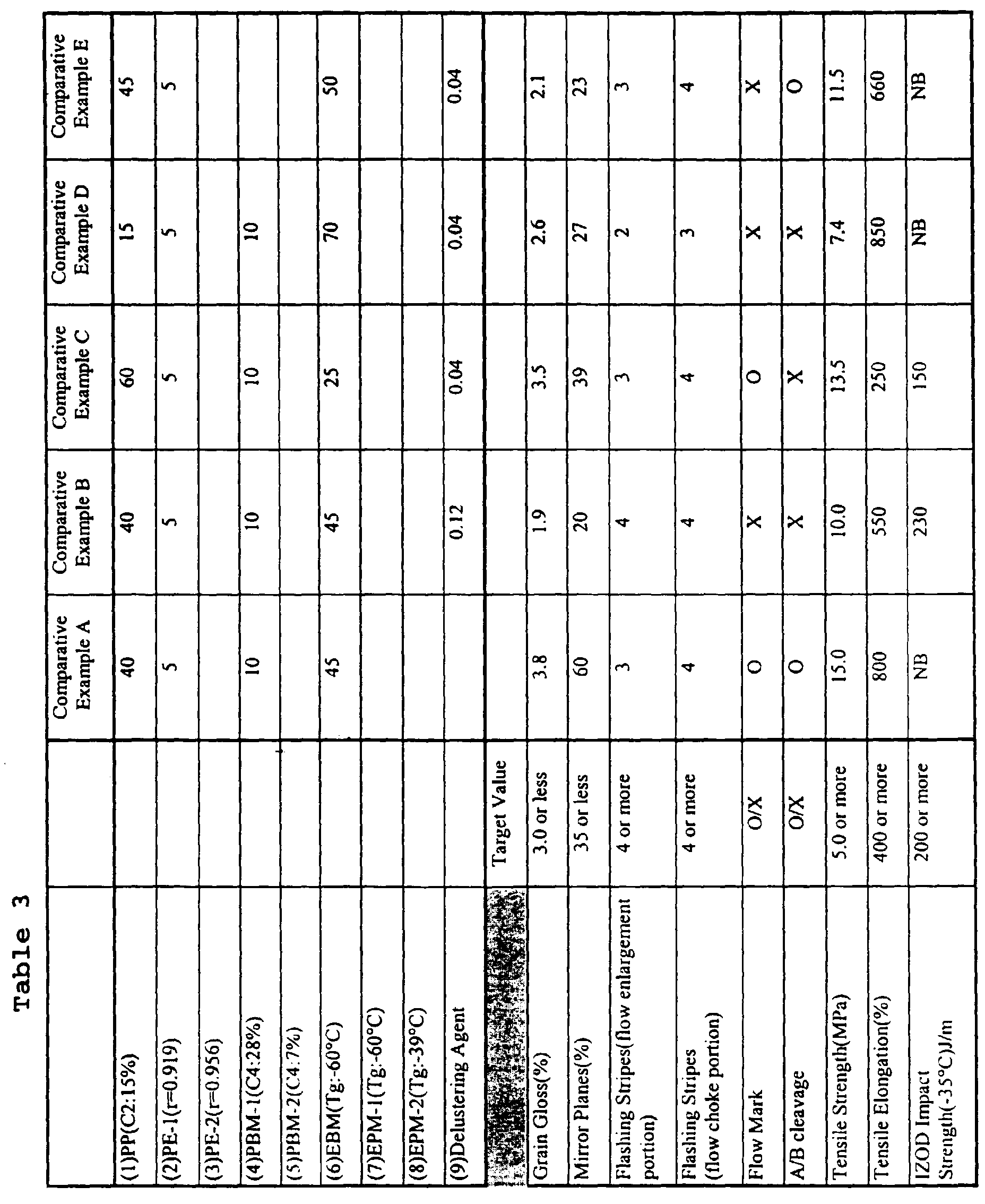
- Molded resin products according to the present invention will be described by way of Examples 1-11, which will be compared with Comparative Examples A-E. Molded resin products according to Examples 1-11 and Comparative Examples A-E were first molded. Components of resin compositions used for the molded resin products were as follows.
- each of the amounts of the components (1)-(8) is represented by a weight percentage (% by weight) in blend components wherein they were mixed.
- the content of the delustering agent (9) is represented by parts by weight per 100 parts by weight of the total content of the blend components (1)-(8).
- the blended resin compositions were injected into a cavity of a mold by injection molding.
- the shape of the mold cavity was made so as to obtain a plate-form molded resin product 51 having a groove 510, as shown in FIG. 3.
- the molded resin product 51 was then cooled and released from the mold.
- the thickness change ratios for each of the examples was 68%.
- Example 1 a blended resin composition described in Example 1 was used to mold an airbag cover.
- the surface of the airbag cover was formed to have a delustered surface.
- the molded airbag cover 55 is composed of a plane portion 557 and a leg portion 558 extending from the circumference of the plane portion 557.
- the plane portion 557 is composed of a thick wall portion 552 and a thin wall portion 551 formed from the bottom portion of a groove 550 for cleavage of the airbag.
- Wall thickness change portions 553 are located on both sides of the thin wall portion 551.
- the airbag cover 55 was molded in a mold 8.
- the mold 8 has a cavity 80 whose shape is substantially the same as that of the airbag cover 55.
- a projection portion 89 is disposed to make the groove 550 in the back surface of the airbag cover.
- a molten resin composition is injected from a gate 84 into the cavity 80, so as to fill the cavity 80 with the resin composition and the resin composition is hardened.
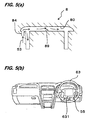
- the resultant airbag cover 55 is set up to a central axis of a steering wheel 63 of a car.
- the airbag cover 55 is fixed to a concave portion 639 of the steering wheel 63 with an engaging portion 559 located on the circumference of the cover 55.
- An airbag 631 is put in the airbag cover 55.
- a collision will trigger an inflator 632 to send air into the airbag 631, so that the airbag 631 is expanded and deployed.
- the force caused by the expansion of airbag 631 opens a tear seam in the cover as defined by the groove 550 made in a back surface 554, and then the airbag 631 deploys into the car.
- flashing stripes and flow marks were not observed.
- the airbag cover exhibited good appearance characteristics.
Landscapes
- Chemical & Material Sciences (AREA)
- Health & Medical Sciences (AREA)
- Chemical Kinetics & Catalysis (AREA)
- Medicinal Chemistry (AREA)
- Polymers & Plastics (AREA)
- Organic Chemistry (AREA)
- Engineering & Computer Science (AREA)
- Manufacturing & Machinery (AREA)
- Mechanical Engineering (AREA)
- Compositions Of Macromolecular Compounds (AREA)
- Air Bags (AREA)
- Injection Moulding Of Plastics Or The Like (AREA)
Abstract
Description

| Example 7 | Example 8 | Example 9 | Example 10 | Example 11 | ||
| (1)PP(C2:15%) | 40 | 40 | 37 | 40 | 40 | |
| (2)PE-1(r=0.919) | 5 | 8 | 5 | 5 | ||
| (3)PE-2(r=0.956) | 5 | |||||
| (4)PBM-1(C4:28%) | 10 | 10 | 10 | 7 | 13 | |
| (5)PBM-2(C4:7%) | ||||||
| (6)EBM(Tg:-60°C) | 45 | 45 | 48 | 42 | ||
| (7)EPM-1(Tg:-60°C) | 45 | |||||
| (8)EPM-2(Tg:-39°C) | ||||||
| (9)Delustering Agent | 0.04 | 0.04 | 0.04 | 0.04 | 0.04 | |
| Target Value | ||||||
| Grain Gloss(%) | 30 or less | 2.4 | 1.9 | 1.9 | 2.2 | 2.1 |
| Minor Planes(%) | 35 or less | 25 | 21 | 19 | 23 | 22 |
| Flashing Stripes(flow enlargement portion) | 4 or more | 4 | 4 | 4 | 4 | 4 |
| Flashing Stripes (flow choke portion) | 4 or more | 5 | 5 | 5 | 5 | 5 |
| Flow Mark | O/X | O | O | O | O | O |
| A/B Cleavage | O/X | O | O | O | O | O |
| Tensile Strength(MPa) | 5.0 or more | 10.1 | 11.3 | 10.7 | 11.4 | 11.1 |
| Tensile Elongation(%) | 400 or more | 600 | 670 | 630 | 690 | 680 |
| IZOD Impact Strength(-35°C)J/m | 200 or more | NB | NB | NB | NB | NB |
Claims (14)
- A molded resin product comprising:at least one thick wall portion (2);at least one thin wall portion (1); andat least one thickness changing portion (12, 13) extending between said at least one thick wall portion (2) and said at least one thin wall portion (1),
wherein said molded resin product being formed from a resin composition comprising 0.01-0.1 part by weight of a delustering agent and 100 parts by weight of a blend of components, said blend of components comprising: 30-50% by weight of a polypropylene block copolymer containing 4-20% by weight of ethylene, 0-10% by weight of polyethylene, 5-15% by weight of a propylene/butene copolymer, and 40-60% by weight of an ethylene/α-olefin copolymer rubber. - The molded resin product according to claim 1, wherein said molded resin product is formed by injection molding.
- The molded resin product according to claim 1 or 2, wherein the butene content by percentage in the propylene/butene copolymer is 10-30% by weight.
- The molded resin product according to any of claims 1 to 3, wherein the ethylene/α-olefin copolymer rubber has a glass transition point of -45°C or lower.
- The molded resin product according to any of claims 1 to 4, wherein the polyethylene has a density of not more than 0.95 g/cm3.
- The molded resin product according to any of claims 1 to 5, wherein the thickness of said at least one thickness changing portion (12) gradually decreases from said at least one thick wall portion (2) to said at least one thin wall portion (1).
- The molded resin product according to any of claims 1 to 5, wherein the thickness of said at least one thickness changing portion (13) gradually increases from said at least one thin wall portion (1) to said at least one thick wall portion (2).
- The molded resin product according to any of claims 1 to 5, wherein said at least one thickness changing portion (12) has at least one stepwise decrease in thickness between said at least one thick wall portion (2) and said at least one thin wall portion (1).
- The molded resin product according to any of claims 1 to 5, wherein said at least one thickness changing portion (13) has at least one stepwise increase in thickness between said at least one thin wall portion (1) and said at least one thick wall portion (2).
- A resin composition comprising:0.01-0.1 part by weight of a delustering agent; and100 parts by weight of a blend of components, said blend of components comprising 30-50% by weight of a polypropylene block copolymer containing 4-20% by weight of ethylene, 0-10% by weight of polyethylene, 5-15% by weight of a propylene/butene copolymer, and 40-60% by weight of an ethylene/α-olefin copolymer rubber.
- The resin composition according to claim 10, wherein the ethylene/α-olefin copolymer rubber has a glass transition point of -45°C or lower.
- The resin composition according to claim 10 or 11, wherein the polyethylene content is 0% by weight.
- The resin composition according to claim 10 or 11, wherein the polyethylene has a density of not more than 0.95 g/cm3.
- The resin composition according to any of claims 10 to 13, wherein the butene content by percentage in the propylene/butene copolymer is 10-30% by weight.
Applications Claiming Priority (2)
| Application Number | Priority Date | Filing Date | Title |
|---|---|---|---|
| JP23662499A JP3514179B2 (en) | 1999-08-24 | 1999-08-24 | Plastic molded product |
| JP23662499 | 1999-08-24 |
Publications (2)
| Publication Number | Publication Date |
|---|---|
| EP1078727A1 true EP1078727A1 (en) | 2001-02-28 |
| EP1078727B1 EP1078727B1 (en) | 2003-08-06 |
Family
ID=17003396
Family Applications (1)
| Application Number | Title | Priority Date | Filing Date |
|---|---|---|---|
| EP00118385A Expired - Lifetime EP1078727B1 (en) | 1999-08-24 | 2000-08-24 | Polyolefin blend containing delustering agent and molded product therefrom having varied wall thickness |
Country Status (4)
| Country | Link |
|---|---|
| US (1) | US6384137B1 (en) |
| EP (1) | EP1078727B1 (en) |
| JP (1) | JP3514179B2 (en) |
| DE (1) | DE60004300T2 (en) |
Families Citing this family (7)
| Publication number | Priority date | Publication date | Assignee | Title |
|---|---|---|---|---|
| JP4640726B2 (en) * | 2004-08-06 | 2011-03-02 | タカタ株式会社 | Manufacturing method of airbag cover |
| US20090326123A1 (en) | 2006-12-26 | 2009-12-31 | Sumitomo Chemical Company, Limited | Polypropylene resin composition and molded article made thereof |
| JP5747853B2 (en) | 2012-03-29 | 2015-07-15 | 豊田合成株式会社 | Polypropylene composition and molded article thereof |
| EP3351434A4 (en) * | 2015-09-16 | 2019-04-17 | Shanghai Yanfeng Jin Qiao Automotive Trim Systems Co., Ltd. | Method for forming dashboard assembly and dashboard assembly obtained thereby |
| US10941287B1 (en) * | 2019-10-15 | 2021-03-09 | Innovative Polymers, Llc | Low-gloss thermoplastic composition |
| US12054603B2 (en) | 2019-10-15 | 2024-08-06 | Innovative Polymers, Llc | Low-gloss thermoplastic composition |
| CN122055411A (en) * | 2023-10-26 | 2026-05-15 | 三井化学株式会社 | Thermoplastic elastomer composition, molded body and automobile part |
Citations (10)
| Publication number | Priority date | Publication date | Assignee | Title |
|---|---|---|---|---|
| JPS55139447A (en) * | 1979-04-06 | 1980-10-31 | Chisso Corp | Modification of propylene-ethylene block copolymer |
| JPS58210949A (en) * | 1982-06-02 | 1983-12-08 | Showa Denko Kk | Preparation of impact-resistant polypropylene composition |
| EP0132931A2 (en) * | 1983-05-31 | 1985-02-13 | Mitsui Petrochemical Industries, Ltd. | Thermoplastic elastomer composition and process for preparation thereof |
| EP0204400A1 (en) * | 1985-04-09 | 1986-12-10 | MITSUI TOATSU CHEMICALS, Inc. | Polypropylene-base resin composition |
| JPH0269549A (en) * | 1988-09-05 | 1990-03-08 | Showa Denko Kk | Production of polypropylene-based resin composition |
| GB2254618A (en) * | 1991-04-11 | 1992-10-14 | Takata Corp | Air bag cover |
| EP0784074A1 (en) * | 1994-09-30 | 1997-07-16 | Idemitsu Petrochemical Co., Ltd. | Propylene resin composition for interior material for automobiles, and interior material for automobiles |
| WO1998032795A1 (en) * | 1997-01-29 | 1998-07-30 | Dupont Dow Elastomers L.L.C. | Rheology-modified thermoplatic elastomer compositions and articles fabricated therefrom |
| JPH10306195A (en) * | 1997-03-04 | 1998-11-17 | Grand Polymer:Kk | Polypropylene resin composition |
| WO1999005007A1 (en) * | 1997-07-23 | 1999-02-04 | Toyota Shatai Kabushiki Kaisha | Panel for air bags and method of manufacturing the same |
Family Cites Families (2)
| Publication number | Priority date | Publication date | Assignee | Title |
|---|---|---|---|---|
| JP3401386B2 (en) * | 1996-04-26 | 2003-04-28 | 日本プラスト株式会社 | POLYOLEFIN RESIN COMPOSITION AND VEHICLE PILLAR MOLDING COMPRISING THE COMPOSITION |
| JP3032857U (en) | 1996-06-26 | 1997-01-17 | 日精樹脂工業株式会社 | Plunger type injection device with leaked resin recovery device |
-
1999
- 1999-08-24 JP JP23662499A patent/JP3514179B2/en not_active Expired - Lifetime
-
2000
- 2000-08-23 US US09/643,712 patent/US6384137B1/en not_active Expired - Lifetime
- 2000-08-24 EP EP00118385A patent/EP1078727B1/en not_active Expired - Lifetime
- 2000-08-24 DE DE60004300T patent/DE60004300T2/en not_active Expired - Lifetime
Patent Citations (10)
| Publication number | Priority date | Publication date | Assignee | Title |
|---|---|---|---|---|
| JPS55139447A (en) * | 1979-04-06 | 1980-10-31 | Chisso Corp | Modification of propylene-ethylene block copolymer |
| JPS58210949A (en) * | 1982-06-02 | 1983-12-08 | Showa Denko Kk | Preparation of impact-resistant polypropylene composition |
| EP0132931A2 (en) * | 1983-05-31 | 1985-02-13 | Mitsui Petrochemical Industries, Ltd. | Thermoplastic elastomer composition and process for preparation thereof |
| EP0204400A1 (en) * | 1985-04-09 | 1986-12-10 | MITSUI TOATSU CHEMICALS, Inc. | Polypropylene-base resin composition |
| JPH0269549A (en) * | 1988-09-05 | 1990-03-08 | Showa Denko Kk | Production of polypropylene-based resin composition |
| GB2254618A (en) * | 1991-04-11 | 1992-10-14 | Takata Corp | Air bag cover |
| EP0784074A1 (en) * | 1994-09-30 | 1997-07-16 | Idemitsu Petrochemical Co., Ltd. | Propylene resin composition for interior material for automobiles, and interior material for automobiles |
| WO1998032795A1 (en) * | 1997-01-29 | 1998-07-30 | Dupont Dow Elastomers L.L.C. | Rheology-modified thermoplatic elastomer compositions and articles fabricated therefrom |
| JPH10306195A (en) * | 1997-03-04 | 1998-11-17 | Grand Polymer:Kk | Polypropylene resin composition |
| WO1999005007A1 (en) * | 1997-07-23 | 1999-02-04 | Toyota Shatai Kabushiki Kaisha | Panel for air bags and method of manufacturing the same |
Non-Patent Citations (4)
| Title |
|---|
| DATABASE WPI Section Ch Week 198050, Derwent World Patents Index; Class A17, AN 1980-89274C, XP002155106 * |
| DATABASE WPI Section Ch Week 198404, Derwent World Patents Index; Class A17, AN 1984-020522, XP002155107 * |
| DATABASE WPI Section Ch Week 199016, Derwent World Patents Index; Class A17, AN 1990-119721, XP002155108 * |
| PATENT ABSTRACTS OF JAPAN vol. 1999, no. 02 26 February 1999 (1999-02-26) * |
Also Published As
| Publication number | Publication date |
|---|---|
| DE60004300D1 (en) | 2003-09-11 |
| US6384137B1 (en) | 2002-05-07 |
| JP2001062861A (en) | 2001-03-13 |
| EP1078727B1 (en) | 2003-08-06 |
| DE60004300T2 (en) | 2004-06-09 |
| JP3514179B2 (en) | 2004-03-31 |
Similar Documents
| Publication | Publication Date | Title |
|---|---|---|
| DE60116209T2 (en) | airbag cover | |
| US8536260B2 (en) | Resin composition for seamless air bag covers, and seamless air bag covers or seamless instrument panels with air bag covers, made by using the composition | |
| US5110647A (en) | Cover for a vehicle air bag | |
| WO2006065307A3 (en) | Thermoplastic olefin compositions and injection molded articles made thereof | |
| JP3618762B2 (en) | Novel thermoplastic elastomer composition and cover for airbag device | |
| US20180201218A1 (en) | Vehicle interior component | |
| US6384137B1 (en) | Molded resin product having varied wall thickness and resin composition forming the same | |
| DE19717648C2 (en) | Polyolefin-based plastic composition and its use | |
| CN113661096A (en) | Full TPO airbag assembly | |
| JP3840897B2 (en) | Automotive interior parts with airbag cover | |
| EP1146080B1 (en) | Olefin-based thermoplastic elastomer and molded product produced therefrom | |
| CN105082549B (en) | A kind of method for forming instrument panel assembly and thus obtained instrument panel assembly | |
| EP0918070B1 (en) | Elastomer composition | |
| CN108136720B (en) | Film laminates and interior parts for motor vehicles | |
| JP3430915B2 (en) | Vehicle interior member having an airbag door | |
| US6214442B1 (en) | Resin molded product and method for producing the same | |
| JP3566065B2 (en) | Airbag storage cover | |
| JPH0827331A (en) | Thermoplastic olefin elastomer composition for air bag cover material | |
| JP2004189001A (en) | Instrument board integrally having air bag cover | |
| EP1101795B1 (en) | Air bag cover for vehicles | |
| JPH1081797A (en) | Thermoplastic elastomer composition for air bag cover | |
| US20260034771A1 (en) | Soft polyolefin film and foam laminate for airbag covers | |
| JP4137251B2 (en) | Storage composition for elastomer composition and airbag device | |
| US20100190915A1 (en) | Novel Polymer Compound and Uses Thereof | |
| JPH0834304A (en) | Air bag storage cover |
Legal Events
| Date | Code | Title | Description |
|---|---|---|---|
| PUAI | Public reference made under article 153(3) epc to a published international application that has entered the european phase |
Free format text: ORIGINAL CODE: 0009012 |
|
| AK | Designated contracting states |
Kind code of ref document: A1 Designated state(s): DE FR GB |
|
| AX | Request for extension of the european patent |
Free format text: AL;LT;LV;MK;RO;SI |
|
| 17P | Request for examination filed |
Effective date: 20010403 |
|
| AKX | Designation fees paid |
Free format text: DE FR GB |
|
| 17Q | First examination report despatched |
Effective date: 20020107 |
|
| GRAH | Despatch of communication of intention to grant a patent |
Free format text: ORIGINAL CODE: EPIDOS IGRA |
|
| GRAH | Despatch of communication of intention to grant a patent |
Free format text: ORIGINAL CODE: EPIDOS IGRA |
|
| GRAA | (expected) grant |
Free format text: ORIGINAL CODE: 0009210 |
|
| AK | Designated contracting states |
Designated state(s): DE FR GB |
|
| REG | Reference to a national code |
Ref country code: GB Ref legal event code: FG4D |
|
| REF | Corresponds to: |
Ref document number: 60004300 Country of ref document: DE Date of ref document: 20030911 Kind code of ref document: P |
|
| ET | Fr: translation filed | ||
| PLBE | No opposition filed within time limit |
Free format text: ORIGINAL CODE: 0009261 |
|
| STAA | Information on the status of an ep patent application or granted ep patent |
Free format text: STATUS: NO OPPOSITION FILED WITHIN TIME LIMIT |
|
| 26N | No opposition filed |
Effective date: 20040507 |
|
| REG | Reference to a national code |
Ref country code: GB Ref legal event code: 746 Effective date: 20120709 |
|
| REG | Reference to a national code |
Ref country code: DE Ref legal event code: R084 Ref document number: 60004300 Country of ref document: DE Effective date: 20120627 |
|
| REG | Reference to a national code |
Ref country code: FR Ref legal event code: PLFP Year of fee payment: 17 |
|
| PGFP | Annual fee paid to national office [announced via postgrant information from national office to epo] |
Ref country code: GB Payment date: 20160824 Year of fee payment: 17 |
|
| PGFP | Annual fee paid to national office [announced via postgrant information from national office to epo] |
Ref country code: FR Payment date: 20160712 Year of fee payment: 17 |
|
| GBPC | Gb: european patent ceased through non-payment of renewal fee |
Effective date: 20170824 |
|
| REG | Reference to a national code |
Ref country code: FR Ref legal event code: ST Effective date: 20180430 |
|
| PG25 | Lapsed in a contracting state [announced via postgrant information from national office to epo] |
Ref country code: GB Free format text: LAPSE BECAUSE OF NON-PAYMENT OF DUE FEES Effective date: 20170824 |
|
| PG25 | Lapsed in a contracting state [announced via postgrant information from national office to epo] |
Ref country code: FR Free format text: LAPSE BECAUSE OF NON-PAYMENT OF DUE FEES Effective date: 20170831 |
|
| PGFP | Annual fee paid to national office [announced via postgrant information from national office to epo] |
Ref country code: DE Payment date: 20190813 Year of fee payment: 20 |
|
| REG | Reference to a national code |
Ref country code: DE Ref legal event code: R071 Ref document number: 60004300 Country of ref document: DE |