EP1078635A2 - Medicaments comprising sialic acid derivatives as active ingredients - Google Patents
Medicaments comprising sialic acid derivatives as active ingredients Download PDFInfo
- Publication number
- EP1078635A2 EP1078635A2 EP00117917A EP00117917A EP1078635A2 EP 1078635 A2 EP1078635 A2 EP 1078635A2 EP 00117917 A EP00117917 A EP 00117917A EP 00117917 A EP00117917 A EP 00117917A EP 1078635 A2 EP1078635 A2 EP 1078635A2
- Authority
- EP
- European Patent Office
- Prior art keywords
- group
- optionally substituted
- hydrogen atom
- medicament according
- compound
- Prior art date
- Legal status (The legal status is an assumption and is not a legal conclusion. Google has not performed a legal analysis and makes no representation as to the accuracy of the status listed.)
- Withdrawn
Links
- 0 CC*OC(*C)(*1)C(C)(*C)C(*)C(C(C)C)C1[C@](*)C(*)C* Chemical compound CC*OC(*C)(*1)C(C)(*C)C(*)C(C(C)C)C1[C@](*)C(*)C* 0.000 description 1
Classifications
-
- A—HUMAN NECESSITIES
- A61—MEDICAL OR VETERINARY SCIENCE; HYGIENE
- A61K—PREPARATIONS FOR MEDICAL, DENTAL OR TOILETRY PURPOSES
- A61K31/00—Medicinal preparations containing organic active ingredients
- A61K31/70—Carbohydrates; Sugars; Derivatives thereof
- A61K31/7012—Compounds having a free or esterified carboxyl group attached, directly or through a carbon chain, to a carbon atom of the saccharide radical, e.g. glucuronic acid, neuraminic acid
-
- A—HUMAN NECESSITIES
- A61—MEDICAL OR VETERINARY SCIENCE; HYGIENE
- A61P—SPECIFIC THERAPEUTIC ACTIVITY OF CHEMICAL COMPOUNDS OR MEDICINAL PREPARATIONS
- A61P31/00—Antiinfectives, i.e. antibiotics, antiseptics, chemotherapeutics
- A61P31/12—Antivirals
- A61P31/14—Antivirals for RNA viruses
- A61P31/16—Antivirals for RNA viruses for influenza or rhinoviruses
Definitions
- the present invention relates to medicaments comprising a sialic acid derivative as an active ingredient.
- Viruses including influenza virus proliferate depending on the biosynthesis mechanism of the host. Therefore, it is difficult to develop medicaments which can exert sufficient antiviral action specifically on viruses, and only a few medicaments which can exert clinically high effectiveness are known.
- vaccines have been used as the most effective means so far.
- influenza viruses There are types A, B and C of influenza viruses, and the virus type A is known to drastically change the structure of the antigen protein and pass through the immune mechanism of a human as a host, so that a problem arises that vaccine treatment fails to achieve sufficient effectiveness.
- Influenza viruses have two spike glycoproteins. trimer hemagglutinin (HA) and tetramer sialidase (NA). They form infection through polyvalent specific action of the hemagglutinin (HA) and the sialoglycoside chain receptor of host cells. The viruses, after proliferation by destruction of the virus receptor by sialidase (NA), are released from the host cells. These two proteins recognize the sialoglycoside chain as ligands which exist on the surface of the host cell. Accordingly, it can be considered that the infection of influenza viruses can be inhibited by interference of the interaction of these two proteins and the sialoglycoside chain.
- HA trimer hemagglutinin
- NA tetramer sialidase
- the inventors of the present invention succeeded in synthesizing sialic acid derivatives having a substituent on the carbon atom in the 3-position on the basis of studies conducted so far to provide a compound which can be expected to exert excellent antiviral activity on viruses including influenza viruses (Japanese Patent Unexamined Publication (KOKAI) No.(Hei)11-343295/1999; The 20th Carbohydrate Symposium, July 1998).
- these sialic acid derivatives have not been verified to have antiviral activity on influenza viruses.
- An object of the present invention is to provide novel medicaments comprising a sialic acid derivative, especially a sialic acid derivative having a low molecular weight. More specifically, the object is to provide medicaments for preventive and/or therapeutic treatment of viral diseases such as influenza virus infectious diseases.
- Another object of the present invention is to provide novel medicaments comprising a sialic acid derivative having resistance against hydrolysis by sialidase, more specifically, medicaments for preventive and/or therapeutic treatment of viral diseases such as influenza virus infectious diseases.
- the inventors of the present invention conducted intensive studies to solve the aforementioned problems. As a result, they found that sialic acid derivatives which may be substituted on the carbon atom in the 3-position have resistance to hydrolysis and inhibitory action against the membrane binding proteins of influenza viruses, and another membrane enzyme sialidase. The present invention was achieved on the basis of these finding.
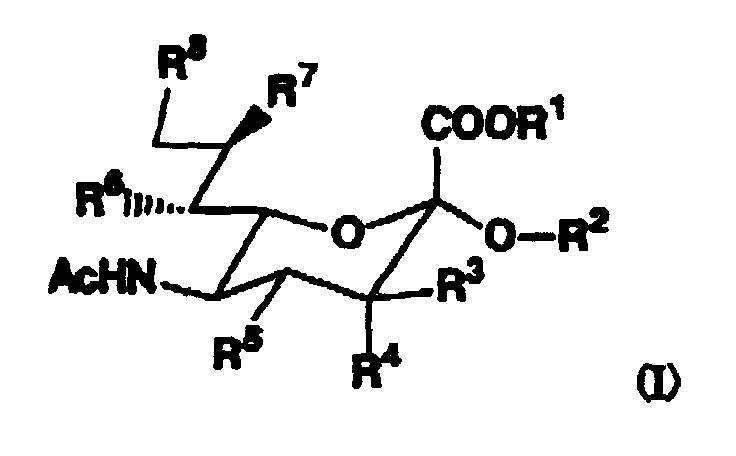
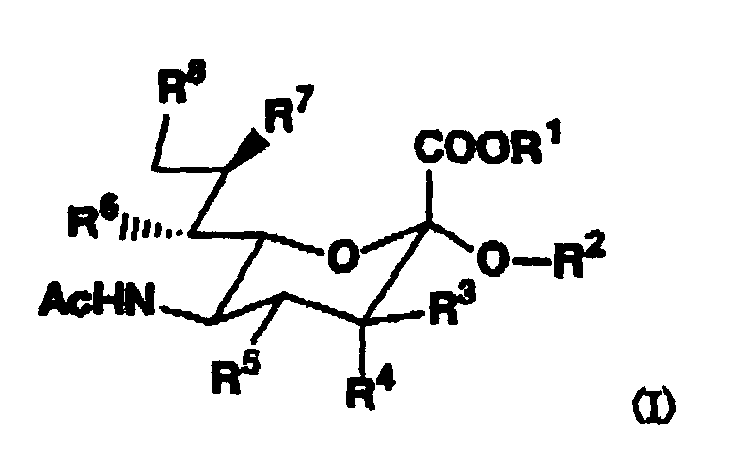
- the present invention thus provides medicaments which comprise as an active ingredient a compound represented by the following formula (I) or its pharmaceutically acceptable salt, or a hydrate thereof or a solvate thereof: wherein R 1 represents hydrogen atom or a C 1-6 alkyl group; R 2 represents an optionally substituted phenyl group, a C 1-20 alkyl group, a C 1-20 alkenyl group, or -(CH 2 ) k -[NH-(CH 2 ) m -NH] n -Y or -(CH 2 ) k -[NH-(CH 2 CH 2 O) m-1 -CH 2 CH 2 NH] n -Y in which Y represents phosphatidylethanolamine residue or polyglutamic acid residue, k and m independently represent an integer of from 2 to 10, n represents 0 or 1, provided that when n represents 1, Y represents phosphatidylethyl group; R 3 represents hydrogen atom or an optionally substituted hydroxyl group; R 4 represents hydrogen
- the medicaments of the present invention are those for preventive and/or therapeutic treatment of viral diseases.
- the medicaments of the present invention are those for preventive and/or therapeutic treatment of influenza virus infectious diseases.
- the medicaments of the present invention have inhibitory action against infection and/or proliferation of influenza viruses.
- R 2 represents -(CH 2 ) k -[NH-(CH 2 ) m -NH] n -Y or -(CH 2 ) k -[NH-(CH 2 CH 2 O) m-1 -CH 2 CH 2 NH] n -Y in which Y represents phosphatidylethanolamine residue or polyglutamic acid residue, k and m independently represent an integer of from 2 to 10, n represents 0 or 1, provided that when n represents 1, Y represents phosphatidylethyl group.
- R 2 represents -(CH 2 ) k -Y wherein Y represents phosphatidylethanolamine residue, and k represents an integer of from 2 to 10.
- one of R 3 and R 4 is hydrogen atom, and the other is a halogen atom or an optionally substituted hydroxyl group.
- R 3 is hydrogen atom
- R 4 is a halogen atom or an optionally substituted hydroxyl group.
- R 1 is hydrogen atom.
- a compound represented by the above formula (I) or a pharmaceutically acceptable salt thereof, or a hydrate thereof or a solvate thereof for the manufacture of a medicament, in particular, a medicament for preventive and/or therapeutic treatment of viral infectious disease such as influenza viral infections; and a method for preventive and/or therapeutic treatment of viral infectious diseases such as influenza viral infections which comprises the step of administering to a mammal including human an effective amount of a compound represented by the above formula (I) or a pharmaceutically acceptable salt thereof, or a hydrate thereof or a solvate thereof.
- the alkyl group or an alkyl moiety of a functional groups containing the alkyl moiety may be linear, branched, or cyclic alkyl groups, or a combination thereof. Examples include methyl group, ethyl group, n-propyl group, isopropyl group, cyclopropyl group, n-butyl group, sec-butyl group, tert-butyl group, cyclopropylmethyl group, and cyclobutyl group.
- the number of the substituent and the substituting position are not particularly limited. Examples include substituted or unsubstituted C 1-6 alkyl groups such as methyl group, trifluoromethyl group, and hydroxyethyl group; C 1-6 alkoxyl groups such as methoxy group and ethoxy group; halogen atoms (a halogen atom used herein may be any of fluorine, chlorine, bromine and iodine atoms); substituted or unsubstituted C 1-6 alkanoyl groups such as acetyl group and trifluoroacetyl group; substituted or unsubstituted aralkyl groups such as benzyl group, p-methoxybenzyl group and p-chlorobenzyl group; nitro group; cyano group; substituted or unsubstituted aryl groups such as phenyl group and chlorophenyl group; substituted or unsubsti
- the C 1-20 alkyl group or the C 1-20 alkenyl group represented by R 2 may be linear, branched, or cyclic, or a combination thereof.
- the number of unsaturated bonds m the alkenyl group is not particularly limited, for example from 1 to 3, and preferably 1.
- Y represents phosphatidylethanolamine residue or polyglutamic acid residue, and preferably, k is 2 and n is 0.
- the nitrogen atom of the phosphatidylethanolamine in Y preferably binds to -(CH 2 ) k -.
- N-terminal acetylated polyglutamic acid residue is preferably used as the polyglutamic acid residue, and preferably k is 2 and n is 1.
- R 2 preferably represents -(CH 2 ) k -[NH-(CH 2 ) m -NH] n -Y or -(CH 2 ) k -[NH-(CH 2 CH 2 O) m-1 -CH 2 CH 2 NH] n -Y, most preferably -(CH 2 ) k -[NH-(CH 2 ) m -NH] n -Y, wherein Y represents phosphatidylethanolamine residue or polyglutamic acid residue, k and m independently represent an integer of from 2 to 10, n represents 0 or 1, provided that when n represents 1, Y represents phosphatidylethyl group. Most preferably, R 2 represents -(CH 2 ) k -Y wherein Y represents phosphatidylethanolamine residue, and k represents an integer of from 2 to 10.
- R 3 , R 4 , R 5 , R 6 , R 7 or R 8 represents a substituted hydroxyl group
- the substituent of the hydroxyl group is not particularly limited, and examples include substituents commonly used as protective groups for hydroxyl group and those used for eliminating hydroxyl group.
- Examples include, for example, substituted or unsubstituted C 1-6 alkanoyl groups such as acetyl group and trifluoroacetyl group; substituted or unsubstituted aralkyl groups such as benzyl group, p-methoxybenzyl group and p-chlorobenzyl group; alkylsilyl groups such as trimethylsilyl group; substituted or unsubstituted C 1-6 alkyl groups such as methyl group, trifluoromethyl group and hydroxyethyl group; substituted or unsubstituted aryl groups such as phenyl group and chlorophenyl group; substituted or unsubstituted aroyl groups such as benzoyl group and chlorobenzoyl group; C 1-6 alkoxycarbonyl groups such as ethoxycarbonyl group and tert-butoxycarbonyl group; and substituted sulfonyl groups such as p-toluenesul
- R 4 represents a substituted amino group
- substituents on the amino group may be the same or different, and types of the substituent are not particularly limited.
- substituents include, for example, substituted or unsubstituted C 1-6 alkanoyl groups such as acetyl group and trifluoroacetyl group; substituted or unsubstituted aralkyl groups such as benzyl group, p-methoxybenzyl group and p-chlorobenzyl group; substituted or unsubstituted, C 1-6 alkyl groups such as methyl group, trifluoromethyl group and hydroxyethyl group; substituted or unsubstituted aryl groups such as phenyl group and chlorophenyl group; substituted or unsubstituted aroyl groups such as benzoyl group and chlorobenzoyl group; and C 1-6 alkoxycarbonyl groups such as
- the compound represented by the aforementioned formula (I) may sometimes form a salt according to the type of the substituent.
- pharmaceutically acceptable salts of the compound represented by the aforementioned formula (I) may be used.
- the salt include mineral acid salts such as hydrochloride and sulfate; or organic acid salts such as p-toluenesulfonate; metal salts such as sodium salt, potassium salt and calcium salt; ammonium salt; organic ammonium salts such as methylammonium salt; and amino acid salts such as glycine salt.
- any hydrates thereof or solvates thereof may also be used.
- the compounds represented by the aforementioned formula (I) have asymmetric carbon atoms and they may exist as optically active compounds. Any stereoisomers such as optical isomers or diastersoisomers, any mixtures of such stereoisomers, racemates and the like can be used in the present invention.
- stereochemistry of R 6 and R 7 in the aforementioned formula (I) their relative configurations are shown. However, it should not be interpreted that the formula shows absolute configuration of the compound represented by the aforementioned formula (I).
- R 2 is an optionally substituted phenyl group
- R 2 is an optionally substituted phenyl group
- R 2 is an optionally substituted phenyl group
- a known bromohydrin compound Okamoto, K., et al., Bull. Chem. Soc. Jpn., 60, pp.631-636, 1987
- Ac represents acetyl group
- Me represents methyl group
- Tf represents trifluoromethanesulfonyl group
- Py represents pyridine
- DMF represents dimethylformamide
- THF represents tetrahydrofuran
- TASF represents tris(dimethylamino)sulfonium difluoromethylsilicate.
- R 2 is a C 1-20 alkyl group or a C 1-20 alkenyl group
- R 2 is a C 1-20 alkyl group or a C 1-20 alkenyl group
- the compounds having -(CH 2 ) k -Y wherein Y is phosphatidylethanolamine residue can be prepared by ozonolysis of a compound introduced with an alkenyl group such as allyl group, and reacting the resulting ketone or aldehyde compound with phosphatidylethanolamine.
- the compounds introduced with polyglutamic acid residue can be prepared by reacting the above ketone compound with a diamine compound represented by H 2 N-(CH 2 ) m -NH 2 or H 2 N-(CH 2 CH 2 O) m-1 -CH 2 CH 2 NH 2 as a linker, and further reacting the amino group at the terminal of the reaction product with a reactive acetylated polyglutamic acid derivative.
- a diamine compound represented by H 2 N-(CH 2 ) m -NH 2 or H 2 N-(CH 2 CH 2 O) m-1 -CH 2 CH 2 NH 2 as a linker and further reacting the amino group at the terminal
- the compounds represented by the aforementioned formula (I) or their pharmaceutically acceptable salts, or hydrates thereof and solvates thereof used in the present invention have inhibitory activities against both of hemagglutinin and sialidase which are membrane binding proteins of influenza virus. They are also expected to have similar inhibitory activities on membrane binding proteins of other viruses.
- Some of the compounds represented by the aforementioned formula (I) or their pharmaceutically acceptable salts, or hydrates thereof and solvates thereof used in the present invention have resistance to sialidase hydrolysis. Accordingly, their administrations may be effective treatment of diseases in which sialic acid recognition occurs in an initial stage of infection.
- the compounds represented by the aforementioned formula (I) or their pharmaceutically acceptable salts, or hydrate thereof or solvate thereof are useful as active ingredients of medicaments for preventive and/or therapeutic treatment of viral diseases such as influenza viral infections.
- diseases to be applied by the medicaments of the present invention include, for example, to influenza, viral hepatitis (types A, B, C, E, or the like), viral pneumonia, viral bronchitis, herpeevirus infectious diseases, polio, AIDS, adult T cell leukemia, papiroma, measles, rubella, sudden eruption, infectious erythema, viral encephalitis, viral meningitis, cytomegalovirus infectious diseases, epidemic parotitis, varicella, rabies, and viral enteritis, and a preferred example includes influenza.
- a substance can be used which is selected from the group consisting of the compounds as free form represented by the aforementioned formula (I) and their salts, and hydrates thereof and solvates thereof.
- the medicament of the present invention is provided in a form of a pharmaceutical composition which comprises the aforementioned active ingredient end one or mere pharmaceutical additives such as carriers and excipients.
- the administration route of the medicament of the present invention is not particularly limited, and oral administration or parenteral administration such as intramuscular, intravenous, subcutaneous and intraperitoneal administration, transmucosal administration to nasal fossa and the like, and inhalation may be applied.
- the form of the medicament of the present invention is not particularly limited.
- formulations for oral administration include, for example, tablets, capsules, fine granules, granules. liquids and syrups
- formulations for parenteral administration include, for example, injections, drip infusions, suppositories, inhalants, transmucosal preparation, transdermal preparations, nasal drops, and ear drops.
- Dose of the medicament of the present invention can be appropriately chosen by comprehensive consideration of sexuality, age or body weight of a patient, severity of a disease, a purpose of preventive and/or therapeutic treatment, presence or absence of other complication and the like.
- the dose may be 0.001 to 1,000 ⁇ g/kg of body weight per day, preforably 0.001 to 100 ⁇ g/kg of body weight per day.
- sialic acid derivatives 1 to 9 and 24 were used in experiments. Preparations of these compounds are described in Japanese Patent Unexamined Publication (KOKAI) No.(Hei)11-343295/1999 and the like.
- Test Example 1 Resistance to sialidase hydrolysis and sialidase inhibitory activity of the sialic acid derivatives
- the p-nitrophenyl- ⁇ -O-glycoside optionally having a substituent in the 3-position were used as test compounds to examine (1) resistance to acid hydrolysis, (2) resistance to enzymatic (sialidase) hydrolysis, (3) sialidase inhibitory activity (kinetic analysis), (4) inhibitory activity against hemagglutinin, and (5) inhibition of infection of influenza virus to MDCK cells.
- acetic buffer pH 5.5 for sialidase from Arthrobacter Ureafaciens; pH 5.0 for sialidase from Clostridium perfringens; and pH 5.5 for sialidase from Vibrio cholerae
- 0.5 mM p-nitrophenyl- ⁇ -O-glycoside of sialic acid a test compound (Compounds 2 to 5 and 24)
- sialidase (20 mU Arthrobacter Ureafaciens sialidase; 15 mU Clostridium perfringens sialidase; and 50 mU Vibrio cholerae sialidase: all were purchased from Boehringer Mannheim Gmbh) were mixed.
- the mixture was maintained at 37°C and a part of the reaction mixture (about 10 ⁇ L) was continually sampled.
- the reaction was stopped with 200 mM aqueous Na 2 CO 3 of 10 ⁇ L, and capillary electrophoresis was carried out as follows.
- the measurement was made by using a Water Quanta 4000E capillary electrophoresis apparatus.
- a capillary column a fused silica capillary column (inside diameter of 75 ⁇ m, effective length of 53 cm) was used.
- the capillary column was washed with 0.1 M KOH for 2 minutes before introducing the sample, and substituted with a electrophoresis buffer. Injection of the sample was made by the siphon effect at the height difference of 10 cm for 30 seconds (38.4 nL).
- Electrophoresis was carried out by using 50 mM boric buffer (pH 10.2) as an electrolyte at voltage of 20 kV and at a constant temperature of 37°C. Detection was made at 7.5 cm from the anode by ultraviolet absorption (405 nm). Results were analyzed by using Millienium 2010 system (Millipore).
- IC 50 of the teat compounds (Compounds 2 to 5 and 24) was determined, and then, using the buffer used in the aforementioned hydrolysis test, the reaction mixture was added with 4-methylumbelliferyl- ⁇ -D-N-acetylneuraminic acid (Compound 1) (0.4 mM) as a substrate, a compound verified to have an inhibitory action, and sialidase (1.25 mU Arthrobacter Ureafaciens; 0.1 mU Clostridium perfringens sialidase; and 2.0 mU Vibrio cholerae sialidase) to adjust a final volume of 30 ⁇ L, and maintained at 37°C for 10 minutes. The reaction was stopped with 30 ⁇ L of 200 mM Na 2 CO 3 and measurement was carried out using capillary electrophoresis as follows.
- a Backman P/ACE 5010 capillary electrophoresis apparatus and a fused silica capillary column were used. Detection was made by using a He-Cd Laser (Kimmon Electro Co., Ltd,. Japan) and excitation light at 325 nm and fluorescence of 375 nm at the point of 7.0 cm from the anode. The sample was injected by the pressurization method (1.0 Sec., 300 nL). Electrophoresis was performed by using 50 mM boric buffer (pH 10.2) as an electrolyte at the applied voltage of 15 kV at 35°C.
- the Ki value was estimated from calculation using the following formula on the basis of the IC 50 (%) value and the assumption that the inhibition was antagonistic.
- i represents inhibitory rate (50%); [I] represents a concentration of an inhibitor; [S] represents a substrate concentration; and Km represents the Michaelis constant.
- Test Example 2 Inhibitory activities of C-3 modified sialyl DSPE derivatives against sialidases from human influenza A viruses
- Test Example 3 Inhibitory activities of Neu5Ac3 ⁇ F-DSPE against the sialidases from influenza A viruses of different host
- Tb examine the effect of Compound 9 against various influenza A virus sialidases, 16 strains of influenza virus isolated from humans, ducks and swine, were tested. As the result, it was shown that broad inhibitory spectrum of compound 9 against sialidases of all influenza viruses tested (Table 3).
- the IC 50 values of compound 9 for these viral sialidases varied from 15.6 to 500 ⁇ M with 4-MU-NeuAc as the substrate, and from 31.3 to 250 ⁇ M with compound 2 as the substrate.
- Test Example 4 Inhibitory activity against hemagglutinin action
- influenza virus A/PR/8/34 (H1N1) and A/Aichi/2/68 (H3N2) strains were cultured using eggs of 15 days old at 35°C for 48 hours, and purified by sucrose density gradient centrifugation.
- Rabbit anti-influenza virus antibody was prepared by using the influenza virus A/PR/8/34 (H1N1) and A/Aichi/2/68 (H3N2) strains cultured in eggs as described above.
- test compounds (Compounds 6 to 9) were spotted on a TLC plate (Polygram Sil G; Macherey-Nagel, Germany). The plate was developed with chloroform/methanol/12mM MgCl 2 (5:4:1, v/v/v) and blocked with 1% egg albumin (crystals; Taiyo Kagaku Company, Ltd., Japan) and 1% polyvinylpyrrolidone containing PBS solution (solution A) at room temperature for 2 hours.
- TLC plate Polygram Sil G; Macherey-Nagel, Germany.
- the plate was developed with chloroform/methanol/12mM MgCl 2 (5:4:1, v/v/v) and blocked with 1% egg albumin (crystals; Taiyo Kagaku Company, Ltd., Japan) and 1% polyvinylpyrrolidone containing PBS solution (solution A) at room temperature for 2 hours.
- the plate was washed with PBS 3 times and incubated with a PBS suspension containing the A/PR/8/34 (H1N1) and A/Aichi/2/68 (H3N2) viruses in the 2 8 HA unit concentration (titer; for reference, Suzuki, Y. et al, Virology, 1992, 189 , 121-131) at 4°C for a maximum of 12 hours.
- the TLC plate was washed with PBS 5 times, blocked with solution A at 4°C for 30 minutes, further washed with PBS 3 times, and incubated with the aforementioned antibody solution at 4°C for 2 hours.
- anti-influenza antibody diluted with 3% polyvinylpyrrolidone containing PBS solution (Solution B) to 1:1,000 was used.
- the plate was washed with PBS and blocked with solution A at 4°C for 30 minutes. After the blocking solution was removed, the plate was further washed with PBS and incubated with horseradish peroxidase binding protein A (Organon Teknika N.V. Cappel Products) diluted with Solution B to 1:1,000 at 4°C for 2 hours.
- horseradish peroxidase binding protein A Organon Teknika N.V. Cappel Products
- the plate was washed with PBS and incubated with a substrate solution (10 mM Tris-HCl buffer (pH 7.2), 0.3% 4-chloronaphthol, 3% H 2 O 2 (5:1:0.02, v/v/v) at room temperature for 20 minutes.
- a substrate solution (10 mM Tris-HCl buffer (pH 7.2), 0.3% 4-chloronaphthol, 3% H 2 O 2 (5:1:0.02, v/v/v) at room temperature for 20 minutes.
- the virus binding activity of each compound was obtained by colorimetry using a double wavelength chromatoscanner (CR-910, Shimadzu, Kyoto) at the coloring of 620 nm (the control of 430 nm). The results are shown in Table 2 below.
- virus hemagglutination inhibitory activity was determined as follows.
- hemagglutination inhibitory activity was performed by using a 96-well microplate, a 0.01% (w/v) gelatin-PBS solution (pH 6.5) as a diluting buffer, and human erythrocytes.
- Virus suspension was added to a 0.01% (w/v) gelatin-PBS solution of each test compound (Compounds 6 to 9, initial concentration of 2 mM and then subjected to two-fold dilution), and the mixture was incubated at 4°C for 1 hour. Then, the mixture was added dropwise with 0.5% human erythrocyte-PBS suspension (0.5 mL/well) and then incubated at 4°C for additional 1 hour.
- HA inhibitory activity test revealed that Compounds 6 to 9 have potent inhibitory activities against H3 type virus HA (the HAI values of ⁇ M order).
- Test Example 5 Inhibition of infection of influenza virus to MDCK cells Neu5Ac3 ⁇ F-DSPE inhibited the cell infection by influenza virus in the early and late stages
- the LDH activities from infected cells were determined adding the derivatives to the infected cells and incubation for 20 h.
- the experimental data showed that only Compound 9 prevented the cytopathic effects with IC 50 value of ca. 40 ⁇ M, but not other derivatives examined.
- Influenza viruses Inhibitory activity 4-MU-Neu5Ac as substrate Neu5Ac-DSPE as substrate
- Human isolates A/PR/8/34 (H1N1) 62.5 31.3 A/Singapore/1/57 (H2N2) 15.6 62.5 A/Aichi/2/68 (H3N2) 31.3 31.3
- Avian isolates A/duck/36/4/76 (H1N1) 125 62.5 A/duck/849/3/80 (H4N1) 123 125 A/duck/13/2/76 (H6N1) 150 180 A/duck/33/3/76 (H10N1) 500 250 A/duck/273/8/78 (H2N2) 150 125 A/duck/24/5/76 (H3N2) 180 100 A/duck/47/5/76 (H7N2) 200 150 A/duck/86/1/76 (H9N2) 180 125 A/duck/3
- novel medicaments which have inhibitory activities against both hemagglutinin and sialidase which are membrane binding proteins of influenza virus.
- the medicaments of the present invention are useful for preventive and/or therapeutic treatment of viral infectious diseases such as influenza virus infections.
Landscapes
- Health & Medical Sciences (AREA)
- Life Sciences & Earth Sciences (AREA)
- General Health & Medical Sciences (AREA)
- Pharmacology & Pharmacy (AREA)
- Molecular Biology (AREA)
- Veterinary Medicine (AREA)
- Chemical & Material Sciences (AREA)
- Public Health (AREA)
- Animal Behavior & Ethology (AREA)
- Medicinal Chemistry (AREA)
- Virology (AREA)
- Epidemiology (AREA)
- Nuclear Medicine, Radiotherapy & Molecular Imaging (AREA)
- Organic Chemistry (AREA)
- General Chemical & Material Sciences (AREA)
- Pulmonology (AREA)
- Chemical Kinetics & Catalysis (AREA)
- Oncology (AREA)
- Communicable Diseases (AREA)
- Pharmaceuticals Containing Other Organic And Inorganic Compounds (AREA)
Abstract
Description


| Stability to acid hydrolysis and enzyme-catalyzing hydrolysis, and neuraminidase inhibition | |||
| Compound | Hydrolysis T1/2 (hour) 1N sulfuric acid 50°C | Hydrolysis (%) NAs 24 hours | Ki (M) NA (C. perfringens) |
| Compound 2 | 0.15 | 100 | - |
| Compound 3 | 23 | Not detected | Very weak |
| Compound 4 | 30 | Not detected | 1.1 × 10⁻⁶ |
| Compound 5 | 48 | Not detected | 2.2 × 10⁻⁶ |
| Compound 10 | 62 | Not detected | 4.4 × 10⁻⁶ |
| Binding and inhibitory activity of Compounds 6 to 9 to influenza viruses A/PR/8/34 (H1N1) and A/Aichi/2/68 (H3N2) | |||||
| Compound | Substituent in the 3-position | Binding assay (%) | HAI (M) | ||
| H1N1 | H3N2 | H1N1 | H3N2 | ||
| Compound 6 | no substituent | N.D. | 25 | 1×10⁻³ | 6.3×10⁻⁵ |
| Compound 7 | OH (equatorial) | N.D. | 36 | 1×10⁻³ | 3.1×10⁻⁵ |
| Compound 8 | OH (axial) | N.D. | 32 | >1×10⁻³ | 6.3×10⁻⁵ |
| Compound 9 | F (axial) | N.D. | 33 | 1×10⁻³ | 3.1×10⁻⁵ |
| Inhibitory activity of Neu5Ac3αF-DSPE against the sialidase activities of various influenza A viruses. | ||
| Influenza viruses | Inhibitory activity (IC50, µM) | |
| 4-MU-Neu5Ac as substrate | Neu5Ac-DSPE as substrate | |
| Human isolates | ||
| A/PR/8/34 (H1N1) | 62.5 | 31.3 |
| A/Singapore/1/57 (H2N2) | 15.6 | 62.5 |
| A/Aichi/2/68 (H3N2) | 31.3 | 31.3 |
| Avian isolates | ||
| A/duck/36/4/76 (H1N1) | 125 | 62.5 |
| A/duck/849/3/80 (H4N1) | 123 | 125 |
| A/duck/13/2/76 (H6N1) | 150 | 180 |
| A/duck/33/3/76 (H10N1) | 500 | 250 |
| A/duck/273/8/78 (H2N2) | 150 | 125 |
| A/duck/24/5/76 (H3N2) | 180 | 100 |
| A/duck/47/5/76 (H7N2) | 200 | 150 |
| A/duck/86/1/76 (H9N2) | 180 | 125 |
| A/duck/313/4/78 (H5N3) | 62.5 | 62.5 |
| A/duck/44/3/76 (H11N3) | 250 | 75 |
| A/duck/862/5/80 (H12N5) | 125 | 100 |
| Swine isolates | ||
| A/swine/Hokkaido/2/81 (H1N1) | 62.5 | 125 |
| A/swine/Italy/309/83 (H3N2) | 125 | 150 |
Claims (9)
- A medicament which comprises as an active ingredient a compound represented by the following formula (I) or its pharmaceutically acceptable salt, or a hydrate thereof or a solvate thereof:wherein R1 represents hydrogen atom or a C1-6 alkyl group; R2 represents an optionally substituted phenyl group, a C1-20 alkyl group, a C1-20 alkenyl group, or -(CH2)k-[NH-(CH2)mNH]n-Y or -(CH2)k-[NH-(CH2CH2O)m-1-CH2CH2NH]n-Y in which Y represents phosphatidylethanolamine residue or polyglutamic acid residue, k and m independently represent an integer of from 2 to 10, n represents 0 or 1, provided that when n represents 1, Y represents phosphatidylethyl group R3 represents hydrogen atom or an optionally substituted hydroxyl group; R4 represents hydrogen atom, a halogen atom, azide group, an optionally substituted amino group, or an optionally substituted hydroxyl group; and R5, R6, R7 and R8 independently represent an optionally substituted hydroxyl group.

- The medicament according to claim 1 which is used for preventive and/or therapeutic treatment of a viral infectious disease.
- The medicament according to claim 1 which is used for preventive and/or therapeutic treatment of an influenza virus infectious disease.
- The medicament according to claim 1 which has inhibitory activity against infection and/or proliferation of influenza virus.
- The medicament according to claim 1 wherein R2 represents -(CH2)k-[NH-(CH2)mNH]n-Y or -(CH2)k-[NH-(CH2CH2O)m-1-CH2CH2NH]n-Y in which Y represents phosphatidylethanolamine residue or polyglutamic acid residue, k and m independently represent an integer of from 2 to 10, n represents 0 or 1, provided that when n represents 1, Y represents phophatidylethyl group.
- The medicament according to claim 1 wherein R2 represents -(CH2)k-Y wherein Y represents phosphatidylethanolamine residue, and k represents an integer of from 2 to 10.
- The medicament according to claim 1 wherein one of R3 and R4 is hydrogen atom and the other is a halogen atom or an optionally substituted hydroxyl group.
- The medicament according to claim 1 wherein R3 is hydrogen atom, and R4 is a halogen atom or an optionally substituted hydroxyl group.
- The medicament according to claim 1 wherein R1 is hydrogen atom.
Applications Claiming Priority (2)
| Application Number | Priority Date | Filing Date | Title |
|---|---|---|---|
| JP23422499 | 1999-08-20 | ||
| JP23422499 | 1999-08-20 |
Publications (2)
| Publication Number | Publication Date |
|---|---|
| EP1078635A2 true EP1078635A2 (en) | 2001-02-28 |
| EP1078635A3 EP1078635A3 (en) | 2003-11-19 |
Family
ID=16967650
Family Applications (1)
| Application Number | Title | Priority Date | Filing Date |
|---|---|---|---|
| EP00117917A Withdrawn EP1078635A3 (en) | 1999-08-20 | 2000-08-21 | Medicaments comprising sialic acid derivatives as active ingredients |
Country Status (2)
| Country | Link |
|---|---|
| US (1) | US6664235B1 (en) |
| EP (1) | EP1078635A3 (en) |
Cited By (1)
| Publication number | Priority date | Publication date | Assignee | Title |
|---|---|---|---|---|
| WO2004076471A1 (en) * | 2003-02-25 | 2004-09-10 | The Kitasato Institute | Anti-influenza virus compound comprising biflavonoid-sialic acid glycoside |
Families Citing this family (5)
| Publication number | Priority date | Publication date | Assignee | Title |
|---|---|---|---|---|
| GB0029562D0 (en) * | 2000-12-04 | 2001-01-17 | Novartis Ag | Organic compounds |
| EP1411952B1 (en) * | 2001-06-29 | 2009-04-22 | Glykos Finland Oy | Use of at least one glycoinhibitor substance against infectious diseases |
| US9119866B2 (en) * | 2008-04-08 | 2015-09-01 | Huiru Wang | Glycan-based drugs, therapies and biomarkers |
| JP2015518464A (en) * | 2012-03-16 | 2015-07-02 | ユニバーシティ オブ ジョージア リサーチ ファンデーション,インコーポレーテッド | Glucose mimics that inhibit pathogen-host interactions |
| WO2019126725A1 (en) * | 2017-12-22 | 2019-06-27 | The Board Of Trustees Of The Leland Stanford Junior University | Compositions and methods for treating age-related diseases |
Family Cites Families (9)
| Publication number | Priority date | Publication date | Assignee | Title |
|---|---|---|---|---|
| US4107157A (en) * | 1973-07-12 | 1978-08-15 | Hoffmann-La Roche Inc. | Barbituric acid antigens and antibodies specific therefor |
| US5192661A (en) * | 1987-08-04 | 1993-03-09 | University Of Ottawa | Multicomponent kit containing an antibody to a synthetic antigen of sialic acid |
| JPH02145596A (en) * | 1988-11-29 | 1990-06-05 | Mect Corp | Sialic acid derivative having active ester group |
| SK282950B6 (en) | 1990-04-24 | 2003-01-09 | Biota Scientific Management Pty Ltd | Alpha-D-neuraminic acid derivatives, processes for their preparation, their use, and pharmaceutical compositions based thereon |
| US5639786A (en) | 1992-12-04 | 1997-06-17 | Biota Scientific Management, Pty., Ltd. | Antiviral 4-substituted-2-deoxy-2,3-didehydro-derivatives of α-D-neuraninic acid |
| JPH0827176A (en) * | 1994-07-15 | 1996-01-30 | Taiyo Kagaku Co Ltd | Method for producing sialylphospholipid |
| JPH10182686A (en) * | 1996-12-26 | 1998-07-07 | Ngk Insulators Ltd | Ganglioside GQ1b analog |
| JP3390965B2 (en) | 1997-09-12 | 2003-03-31 | 理化学研究所 | Polymer compound containing sugar-linked sphingosine |
| JP3773153B2 (en) | 1998-05-29 | 2006-05-10 | 独立行政法人理化学研究所 | Sialic acid derivatives |
-
2000
- 2000-08-18 US US09/640,776 patent/US6664235B1/en not_active Expired - Fee Related
- 2000-08-21 EP EP00117917A patent/EP1078635A3/en not_active Withdrawn
Cited By (1)
| Publication number | Priority date | Publication date | Assignee | Title |
|---|---|---|---|---|
| WO2004076471A1 (en) * | 2003-02-25 | 2004-09-10 | The Kitasato Institute | Anti-influenza virus compound comprising biflavonoid-sialic acid glycoside |
Also Published As
| Publication number | Publication date |
|---|---|
| EP1078635A3 (en) | 2003-11-19 |
| US6664235B1 (en) | 2003-12-16 |
Similar Documents
| Publication | Publication Date | Title |
|---|---|---|
| US6548476B1 (en) | Dimeric inhibitors of influenza neuraminidase | |
| US12337007B2 (en) | Patentiflorin A analogs as antiviral agents | |
| AU2001285601B2 (en) | Multivalent neuraminidase inhibitor conjugates | |
| BG62092B1 (en) | DERIVATIVES AND ANALYSIS OF 2-DEOXY-2,3-DIDEHYDRO-N-ACETTINEURAMIC ACID USE THEREOF AS ANTI-VIRUS | |
| US6664235B1 (en) | Medicaments comprising sialic acid derivatives as active ingredients | |
| JPH11147951A (en) | Polymer compound containing sugar-linked sphingosine | |
| KR100942494B1 (en) | Dimer Compounds and Uses thereof as Antiviral Agents | |
| JP2001131074A (en) | Medicine containing sialic acid derivative as active ingredient | |
| US9284292B2 (en) | Sialochimeric compounds | |
| EP1872794B1 (en) | Nasal vaccine | |
| US20240076299A1 (en) | Tuberculatin analogs as antiviral agents | |
| US5571836A (en) | Viral attachment inhibitors | |
| JP5777200B2 (en) | Anti-dengue virus agent | |
| JP2024140077A (en) | Anti-mumps virus agents | |
| EP3377487B1 (en) | Compounds for medicinal applications | |
| US20070207971A1 (en) | Neuraminidase inhibitor | |
| EP3981777A1 (en) | Antiviral compounds and polymers | |
| CN121773124A (en) | Lipid-based enhancers for RNA delivery and therapy | |
| CN121419780A (en) | RNAi reagents for inhibiting influenza A virus gene expression, their compositions, and methods of use. | |
| HK1261542B (en) | Compounds for medicinal applications |
Legal Events
| Date | Code | Title | Description |
|---|---|---|---|
| PUAI | Public reference made under article 153(3) epc to a published international application that has entered the european phase |
Free format text: ORIGINAL CODE: 0009012 |
|
| AK | Designated contracting states |
Kind code of ref document: A2 Designated state(s): AT BE CH CY DE DK ES FI FR GB GR IE IT LI LU MC NL PT SE |
|
| AX | Request for extension of the european patent |
Free format text: AL;LT;LV;MK;RO;SI |
|
| PUAL | Search report despatched |
Free format text: ORIGINAL CODE: 0009013 |
|
| RIC1 | Information provided on ipc code assigned before grant |
Ipc: 7C 07H 15/203 B Ipc: 7A 61P 31/16 B Ipc: 7A 61K 31/7012 A |
|
| AK | Designated contracting states |
Kind code of ref document: A3 Designated state(s): AT BE CH CY DE DK ES FI FR GB GR IE IT LI LU MC NL PT SE |
|
| AX | Request for extension of the european patent |
Extension state: AL LT LV MK RO SI |
|
| 17P | Request for examination filed |
Effective date: 20040517 |
|
| AKX | Designation fees paid |
Designated state(s): AT BE CH CY DE DK ES FI FR GB GR IE IT LI LU MC NL PT SE |
|
| 17Q | First examination report despatched |
Effective date: 20040902 |
|
| STAA | Information on the status of an ep patent application or granted ep patent |
Free format text: STATUS: THE APPLICATION IS DEEMED TO BE WITHDRAWN |
|
| 18D | Application deemed to be withdrawn |
Effective date: 20080301 |