EP1077238A1 - Ink composition for ink jet recording - Google Patents
Ink composition for ink jet recording Download PDFInfo
- Publication number
- EP1077238A1 EP1077238A1 EP20000117812 EP00117812A EP1077238A1 EP 1077238 A1 EP1077238 A1 EP 1077238A1 EP 20000117812 EP20000117812 EP 20000117812 EP 00117812 A EP00117812 A EP 00117812A EP 1077238 A1 EP1077238 A1 EP 1077238A1
- Authority
- EP
- European Patent Office
- Prior art keywords
- ink composition
- polymer
- ink
- fine particles
- water
- Prior art date
- Legal status (The legal status is an assumption and is not a legal conclusion. Google has not performed a legal analysis and makes no representation as to the accuracy of the status listed.)
- Granted
Links
- 239000000203 mixture Substances 0.000 title claims abstract description 193
- 239000006185 dispersion Substances 0.000 claims abstract description 72
- 239000000049 pigment Substances 0.000 claims description 138
- 238000006243 chemical reaction Methods 0.000 claims description 121
- 229920000642 polymer Polymers 0.000 claims description 109
- 239000010419 fine particle Substances 0.000 claims description 96
- XLYOFNOQVPJJNP-UHFFFAOYSA-N water Substances O XLYOFNOQVPJJNP-UHFFFAOYSA-N 0.000 claims description 96
- 239000000243 solution Substances 0.000 claims description 88
- 239000000839 emulsion Substances 0.000 claims description 61
- 239000000178 monomer Substances 0.000 claims description 61
- 238000000034 method Methods 0.000 claims description 52
- 239000004094 surface-active agent Substances 0.000 claims description 52
- -1 acetylene glycol Chemical compound 0.000 claims description 41
- 238000007639 printing Methods 0.000 claims description 36
- 238000000151 deposition Methods 0.000 claims description 28
- 239000003960 organic solvent Substances 0.000 claims description 28
- LYCAIKOWRPUZTN-UHFFFAOYSA-N ethylene glycol Natural products OCCO LYCAIKOWRPUZTN-UHFFFAOYSA-N 0.000 claims description 27
- 229920005989 resin Polymers 0.000 claims description 26
- 239000011347 resin Substances 0.000 claims description 26
- PEDCQBHIVMGVHV-UHFFFAOYSA-N Glycerine Chemical compound OCC(O)CO PEDCQBHIVMGVHV-UHFFFAOYSA-N 0.000 claims description 20
- 150000001875 compounds Chemical class 0.000 claims description 17
- MTHSVFCYNBDYFN-UHFFFAOYSA-N diethylene glycol Chemical compound OCCOCCO MTHSVFCYNBDYFN-UHFFFAOYSA-N 0.000 claims description 17
- 229910052751 metal Inorganic materials 0.000 claims description 16
- 239000002184 metal Substances 0.000 claims description 16
- 150000003839 salts Chemical class 0.000 claims description 15
- 238000009835 boiling Methods 0.000 claims description 14
- 125000003178 carboxy group Chemical group [H]OC(*)=O 0.000 claims description 14
- WGCNASOHLSPBMP-UHFFFAOYSA-N hydroxyacetaldehyde Natural products OCC=O WGCNASOHLSPBMP-UHFFFAOYSA-N 0.000 claims description 14
- CERQOIWHTDAKMF-UHFFFAOYSA-N Methacrylic acid Chemical compound CC(=C)C(O)=O CERQOIWHTDAKMF-UHFFFAOYSA-N 0.000 claims description 13
- 238000006116 polymerization reaction Methods 0.000 claims description 13
- HSFWRNGVRCDJHI-UHFFFAOYSA-N alpha-acetylene Natural products C#C HSFWRNGVRCDJHI-UHFFFAOYSA-N 0.000 claims description 12
- 125000000391 vinyl group Chemical group [H]C([*])=C([H])[H] 0.000 claims description 12
- COBPKKZHLDDMTB-UHFFFAOYSA-N 2-[2-(2-butoxyethoxy)ethoxy]ethanol Chemical compound CCCCOCCOCCOCCO COBPKKZHLDDMTB-UHFFFAOYSA-N 0.000 claims description 11
- 125000000129 anionic group Chemical group 0.000 claims description 11
- 125000004432 carbon atom Chemical group C* 0.000 claims description 10
- 229920001577 copolymer Polymers 0.000 claims description 10
- 235000011187 glycerol Nutrition 0.000 claims description 10
- 239000000376 reactant Substances 0.000 claims description 10
- 230000005540 biological transmission Effects 0.000 claims description 9
- 239000004809 Teflon Substances 0.000 claims description 8
- 229920006362 Teflon® Polymers 0.000 claims description 8
- NIXOWILDQLNWCW-UHFFFAOYSA-N acrylic acid group Chemical group C(C=C)(=O)O NIXOWILDQLNWCW-UHFFFAOYSA-N 0.000 claims description 8
- 229920000083 poly(allylamine) Polymers 0.000 claims description 7
- VZCYOOQTPOCHFL-OWOJBTEDSA-N Fumaric acid Chemical compound OC(=O)\C=C\C(O)=O VZCYOOQTPOCHFL-OWOJBTEDSA-N 0.000 claims description 6
- VZCYOOQTPOCHFL-UHFFFAOYSA-N trans-butenedioic acid Natural products OC(=O)C=CC(O)=O VZCYOOQTPOCHFL-UHFFFAOYSA-N 0.000 claims description 6
- 150000003863 ammonium salts Chemical class 0.000 claims description 5
- 230000009257 reactivity Effects 0.000 claims description 5
- 150000005690 diesters Chemical group 0.000 claims description 4
- 125000004435 hydrogen atom Chemical group [H]* 0.000 claims description 4
- 239000004593 Epoxy Substances 0.000 claims description 3
- OFOBLEOULBTSOW-UHFFFAOYSA-N Propanedioic acid Natural products OC(=O)CC(O)=O OFOBLEOULBTSOW-UHFFFAOYSA-N 0.000 claims description 3
- 239000001530 fumaric acid Substances 0.000 claims description 3
- 125000002887 hydroxy group Chemical group [H]O* 0.000 claims description 3
- VZCYOOQTPOCHFL-UPHRSURJSA-N maleic acid Chemical compound OC(=O)\C=C/C(O)=O VZCYOOQTPOCHFL-UPHRSURJSA-N 0.000 claims description 3
- 239000011976 maleic acid Substances 0.000 claims description 3
- 125000005395 methacrylic acid group Chemical group 0.000 claims description 3
- 150000003923 2,5-pyrrolediones Chemical class 0.000 claims description 2
- FCYVWWWTHPPJII-UHFFFAOYSA-N 2-methylidenepropanedinitrile Chemical compound N#CC(=C)C#N FCYVWWWTHPPJII-UHFFFAOYSA-N 0.000 claims description 2
- 229910002651 NO3 Inorganic materials 0.000 claims description 2
- 125000001931 aliphatic group Chemical group 0.000 claims description 2
- 229910052783 alkali metal Inorganic materials 0.000 claims description 2
- 150000001340 alkali metals Chemical group 0.000 claims description 2
- 150000002763 monocarboxylic acids Chemical class 0.000 claims description 2
- NHNBFGGVMKEFGY-UHFFFAOYSA-N nitrate group Chemical group [N+](=O)([O-])[O-] NHNBFGGVMKEFGY-UHFFFAOYSA-N 0.000 claims description 2
- 239000012266 salt solution Substances 0.000 claims description 2
- 150000007942 carboxylates Chemical class 0.000 claims 2
- 125000001183 hydrocarbyl group Chemical group 0.000 claims 1
- 230000000379 polymerizing effect Effects 0.000 claims 1
- 238000001238 wet grinding Methods 0.000 claims 1
- 230000000740 bleeding effect Effects 0.000 abstract description 4
- 238000011161 development Methods 0.000 abstract description 4
- 239000000976 ink Substances 0.000 description 224
- PPBRXRYQALVLMV-UHFFFAOYSA-N Styrene Chemical compound C=CC1=CC=CC=C1 PPBRXRYQALVLMV-UHFFFAOYSA-N 0.000 description 34
- 239000002609 medium Substances 0.000 description 25
- 239000002245 particle Substances 0.000 description 25
- 238000003756 stirring Methods 0.000 description 19
- KWYUFKZDYYNOTN-UHFFFAOYSA-M Potassium hydroxide Chemical compound [OH-].[K+] KWYUFKZDYYNOTN-UHFFFAOYSA-M 0.000 description 15
- ATUOYWHBWRKTHZ-UHFFFAOYSA-N Propane Chemical compound CCC ATUOYWHBWRKTHZ-UHFFFAOYSA-N 0.000 description 14
- 238000011156 evaluation Methods 0.000 description 14
- VHUUQVKOLVNVRT-UHFFFAOYSA-N Ammonium hydroxide Chemical compound [NH4+].[OH-] VHUUQVKOLVNVRT-UHFFFAOYSA-N 0.000 description 12
- YIXJRHPUWRPCBB-UHFFFAOYSA-N magnesium nitrate Chemical compound [Mg+2].[O-][N+]([O-])=O.[O-][N+]([O-])=O YIXJRHPUWRPCBB-UHFFFAOYSA-N 0.000 description 12
- 229920005862 polyol Polymers 0.000 description 12
- 150000003077 polyols Chemical class 0.000 description 12
- USHAGKDGDHPEEY-UHFFFAOYSA-L potassium persulfate Chemical compound [K+].[K+].[O-]S(=O)(=O)OOS([O-])(=O)=O USHAGKDGDHPEEY-UHFFFAOYSA-L 0.000 description 12
- 239000000047 product Substances 0.000 description 12
- 239000003086 colorant Substances 0.000 description 11
- 229910021645 metal ion Inorganic materials 0.000 description 11
- IJGRMHOSHXDMSA-UHFFFAOYSA-N Atomic nitrogen Chemical compound N#N IJGRMHOSHXDMSA-UHFFFAOYSA-N 0.000 description 10
- SOGAXMICEFXMKE-UHFFFAOYSA-N Butylmethacrylate Chemical compound CCCCOC(=O)C(C)=C SOGAXMICEFXMKE-UHFFFAOYSA-N 0.000 description 10
- OKTJSMMVPCPJKN-UHFFFAOYSA-N Carbon Chemical compound [C] OKTJSMMVPCPJKN-UHFFFAOYSA-N 0.000 description 10
- DBMJMQXJHONAFJ-UHFFFAOYSA-M Sodium laurylsulphate Chemical compound [Na+].CCCCCCCCCCCCOS([O-])(=O)=O DBMJMQXJHONAFJ-UHFFFAOYSA-M 0.000 description 10
- CQEYYJKEWSMYFG-UHFFFAOYSA-N butyl acrylate Chemical compound CCCCOC(=O)C=C CQEYYJKEWSMYFG-UHFFFAOYSA-N 0.000 description 10
- 150000001720 carbohydrates Chemical class 0.000 description 10
- 238000002156 mixing Methods 0.000 description 10
- 238000010992 reflux Methods 0.000 description 10
- 235000019333 sodium laurylsulphate Nutrition 0.000 description 10
- 238000003860 storage Methods 0.000 description 10
- NECRQCBKTGZNMH-UHFFFAOYSA-N 3,5-dimethylhex-1-yn-3-ol Chemical compound CC(C)CC(C)(O)C#C NECRQCBKTGZNMH-UHFFFAOYSA-N 0.000 description 9
- LFQSCWFLJHTTHZ-UHFFFAOYSA-N Ethanol Chemical compound CCO LFQSCWFLJHTTHZ-UHFFFAOYSA-N 0.000 description 9
- OKKJLVBELUTLKV-UHFFFAOYSA-N Methanol Chemical compound OC OKKJLVBELUTLKV-UHFFFAOYSA-N 0.000 description 9
- 239000003505 polymerization initiator Substances 0.000 description 9
- XFCMNSHQOZQILR-UHFFFAOYSA-N 2-[2-(2-methylprop-2-enoyloxy)ethoxy]ethyl 2-methylprop-2-enoate Chemical compound CC(=C)C(=O)OCCOCCOC(=O)C(C)=C XFCMNSHQOZQILR-UHFFFAOYSA-N 0.000 description 8
- KFZMGEQAYNKOFK-UHFFFAOYSA-N Isopropanol Chemical compound CC(C)O KFZMGEQAYNKOFK-UHFFFAOYSA-N 0.000 description 8
- 238000001035 drying Methods 0.000 description 8
- 238000012360 testing method Methods 0.000 description 8
- HRPVXLWXLXDGHG-UHFFFAOYSA-N Acrylamide Chemical compound NC(=O)C=C HRPVXLWXLXDGHG-UHFFFAOYSA-N 0.000 description 7
- 230000015572 biosynthetic process Effects 0.000 description 7
- 239000003795 chemical substances by application Substances 0.000 description 7
- 229940028356 diethylene glycol monobutyl ether Drugs 0.000 description 7
- 125000003700 epoxy group Chemical group 0.000 description 7
- 239000004615 ingredient Substances 0.000 description 7
- JCGNDDUYTRNOFT-UHFFFAOYSA-N oxolane-2,4-dione Chemical compound O=C1COC(=O)C1 JCGNDDUYTRNOFT-UHFFFAOYSA-N 0.000 description 7
- 239000001294 propane Substances 0.000 description 7
- 239000004576 sand Substances 0.000 description 7
- 239000000126 substance Substances 0.000 description 7
- 150000005846 sugar alcohols Chemical class 0.000 description 7
- YAJYJWXEWKRTPO-UHFFFAOYSA-N 2,3,3,4,4,5-hexamethylhexane-2-thiol Chemical compound CC(C)C(C)(C)C(C)(C)C(C)(C)S YAJYJWXEWKRTPO-UHFFFAOYSA-N 0.000 description 6
- LXOFYPKXCSULTL-UHFFFAOYSA-N 2,4,7,9-tetramethyldec-5-yne-4,7-diol Chemical compound CC(C)CC(C)(O)C#CC(C)(O)CC(C)C LXOFYPKXCSULTL-UHFFFAOYSA-N 0.000 description 6
- QTBSBXVTEAMEQO-UHFFFAOYSA-N Acetic acid Chemical compound CC(O)=O QTBSBXVTEAMEQO-UHFFFAOYSA-N 0.000 description 6
- 241000557626 Corvus corax Species 0.000 description 6
- 241000721047 Danaus plexippus Species 0.000 description 6
- DNIAPMSPPWPWGF-UHFFFAOYSA-N Propylene glycol Chemical compound CC(O)CO DNIAPMSPPWPWGF-UHFFFAOYSA-N 0.000 description 6
- 230000032683 aging Effects 0.000 description 6
- QGZKDVFQNNGYKY-UHFFFAOYSA-N ammonia Natural products N QGZKDVFQNNGYKY-UHFFFAOYSA-N 0.000 description 6
- ROOXNKNUYICQNP-UHFFFAOYSA-N ammonium persulfate Chemical compound [NH4+].[NH4+].[O-]S(=O)(=O)OOS([O-])(=O)=O ROOXNKNUYICQNP-UHFFFAOYSA-N 0.000 description 6
- 239000012736 aqueous medium Substances 0.000 description 6
- 239000006229 carbon black Substances 0.000 description 6
- 235000019241 carbon black Nutrition 0.000 description 6
- 239000011362 coarse particle Substances 0.000 description 6
- 239000002270 dispersing agent Substances 0.000 description 6
- STVZJERGLQHEKB-UHFFFAOYSA-N ethylene glycol dimethacrylate Substances CC(=C)C(=O)OCCOC(=O)C(C)=C STVZJERGLQHEKB-UHFFFAOYSA-N 0.000 description 6
- 229920001223 polyethylene glycol Polymers 0.000 description 6
- 238000000790 scattering method Methods 0.000 description 6
- 239000007787 solid Substances 0.000 description 6
- POAOYUHQDCAZBD-UHFFFAOYSA-N 2-butoxyethanol Chemical compound CCCCOCCO POAOYUHQDCAZBD-UHFFFAOYSA-N 0.000 description 5
- NLHHRLWOUZZQLW-UHFFFAOYSA-N Acrylonitrile Chemical compound C=CC#N NLHHRLWOUZZQLW-UHFFFAOYSA-N 0.000 description 5
- FBPFZTCFMRRESA-JGWLITMVSA-N D-glucitol Chemical compound OC[C@H](O)[C@@H](O)[C@H](O)[C@H](O)CO FBPFZTCFMRRESA-JGWLITMVSA-N 0.000 description 5
- 239000002202 Polyethylene glycol Substances 0.000 description 5
- 238000004140 cleaning Methods 0.000 description 5
- 230000015271 coagulation Effects 0.000 description 5
- 238000005345 coagulation Methods 0.000 description 5
- 230000008021 deposition Effects 0.000 description 5
- 238000010586 diagram Methods 0.000 description 5
- XXJWXESWEXIICW-UHFFFAOYSA-N diethylene glycol monoethyl ether Chemical compound CCOCCOCCO XXJWXESWEXIICW-UHFFFAOYSA-N 0.000 description 5
- 229940075557 diethylene glycol monoethyl ether Drugs 0.000 description 5
- 238000007720 emulsion polymerization reaction Methods 0.000 description 5
- 239000007788 liquid Substances 0.000 description 5
- 229910052757 nitrogen Inorganic materials 0.000 description 5
- 230000000149 penetrating effect Effects 0.000 description 5
- 238000002360 preparation method Methods 0.000 description 5
- 150000003512 tertiary amines Chemical class 0.000 description 5
- SBASXUCJHJRPEV-UHFFFAOYSA-N 2-(2-methoxyethoxy)ethanol Chemical compound COCCOCCO SBASXUCJHJRPEV-UHFFFAOYSA-N 0.000 description 4
- INQDDHNZXOAFFD-UHFFFAOYSA-N 2-[2-(2-prop-2-enoyloxyethoxy)ethoxy]ethyl prop-2-enoate Chemical compound C=CC(=O)OCCOCCOCCOC(=O)C=C INQDDHNZXOAFFD-UHFFFAOYSA-N 0.000 description 4
- SVTBMSDMJJWYQN-UHFFFAOYSA-N 2-methylpentane-2,4-diol Chemical compound CC(O)CC(C)(C)O SVTBMSDMJJWYQN-UHFFFAOYSA-N 0.000 description 4
- NUYADIDKTLPDGG-UHFFFAOYSA-N 3,6-dimethyloct-4-yne-3,6-diol Chemical compound CCC(C)(O)C#CC(C)(O)CC NUYADIDKTLPDGG-UHFFFAOYSA-N 0.000 description 4
- SRBFZHDQGSBBOR-IOVATXLUSA-N D-xylopyranose Chemical compound O[C@@H]1COC(O)[C@H](O)[C@H]1O SRBFZHDQGSBBOR-IOVATXLUSA-N 0.000 description 4
- 241000283070 Equus zebra Species 0.000 description 4
- BAPJBEWLBFYGME-UHFFFAOYSA-N Methyl acrylate Chemical compound COC(=O)C=C BAPJBEWLBFYGME-UHFFFAOYSA-N 0.000 description 4
- LRHPLDYGYMQRHN-UHFFFAOYSA-N N-Butanol Chemical compound CCCCO LRHPLDYGYMQRHN-UHFFFAOYSA-N 0.000 description 4
- 229920003171 Poly (ethylene oxide) Polymers 0.000 description 4
- GSEJCLTVZPLZKY-UHFFFAOYSA-N Triethanolamine Chemical compound OCCN(CCO)CCO GSEJCLTVZPLZKY-UHFFFAOYSA-N 0.000 description 4
- 239000002253 acid Substances 0.000 description 4
- 229910001854 alkali hydroxide Inorganic materials 0.000 description 4
- 150000008044 alkali metal hydroxides Chemical class 0.000 description 4
- PYMYPHUHKUWMLA-UHFFFAOYSA-N arabinose Natural products OCC(O)C(O)C(O)C=O PYMYPHUHKUWMLA-UHFFFAOYSA-N 0.000 description 4
- WPYMKLBDIGXBTP-UHFFFAOYSA-N benzoic acid Chemical compound OC(=O)C1=CC=CC=C1 WPYMKLBDIGXBTP-UHFFFAOYSA-N 0.000 description 4
- AOJOEFVRHOZDFN-UHFFFAOYSA-N benzyl 2-methylprop-2-enoate Chemical compound CC(=C)C(=O)OCC1=CC=CC=C1 AOJOEFVRHOZDFN-UHFFFAOYSA-N 0.000 description 4
- SRBFZHDQGSBBOR-UHFFFAOYSA-N beta-D-Pyranose-Lyxose Natural products OC1COC(O)C(O)C1O SRBFZHDQGSBBOR-UHFFFAOYSA-N 0.000 description 4
- 125000004386 diacrylate group Chemical group 0.000 description 4
- 230000000694 effects Effects 0.000 description 4
- VOZRXNHHFUQHIL-UHFFFAOYSA-N glycidyl methacrylate Chemical compound CC(=C)C(=O)OCC1CO1 VOZRXNHHFUQHIL-UHFFFAOYSA-N 0.000 description 4
- BDAGIHXWWSANSR-UHFFFAOYSA-N methanoic acid Natural products OC=O BDAGIHXWWSANSR-UHFFFAOYSA-N 0.000 description 4
- 239000002736 nonionic surfactant Substances 0.000 description 4
- 125000001997 phenyl group Chemical group [H]C1=C([H])C([H])=C(*)C([H])=C1[H] 0.000 description 4
- ZIBGPFATKBEMQZ-UHFFFAOYSA-N triethylene glycol Chemical compound OCCOCCOCCO ZIBGPFATKBEMQZ-UHFFFAOYSA-N 0.000 description 4
- CUVLMZNMSPJDON-UHFFFAOYSA-N 1-(1-butoxypropan-2-yloxy)propan-2-ol Chemical compound CCCCOCC(C)OCC(C)O CUVLMZNMSPJDON-UHFFFAOYSA-N 0.000 description 3
- RWNUSVWFHDHRCJ-UHFFFAOYSA-N 1-butoxypropan-2-ol Chemical compound CCCCOCC(C)O RWNUSVWFHDHRCJ-UHFFFAOYSA-N 0.000 description 3
- SMZOUWXMTYCWNB-UHFFFAOYSA-N 2-(2-methoxy-5-methylphenyl)ethanamine Chemical compound COC1=CC=C(C)C=C1CCN SMZOUWXMTYCWNB-UHFFFAOYSA-N 0.000 description 3
- XNWFRZJHXBZDAG-UHFFFAOYSA-N 2-METHOXYETHANOL Chemical compound COCCO XNWFRZJHXBZDAG-UHFFFAOYSA-N 0.000 description 3
- ZNQVEEAIQZEUHB-UHFFFAOYSA-N 2-ethoxyethanol Chemical compound CCOCCO ZNQVEEAIQZEUHB-UHFFFAOYSA-N 0.000 description 3
- QCAHUFWKIQLBNB-UHFFFAOYSA-N 3-(3-methoxypropoxy)propan-1-ol Chemical compound COCCCOCCCO QCAHUFWKIQLBNB-UHFFFAOYSA-N 0.000 description 3
- DBCAQXHNJOFNGC-UHFFFAOYSA-N 4-bromo-1,1,1-trifluorobutane Chemical compound FC(F)(F)CCCBr DBCAQXHNJOFNGC-UHFFFAOYSA-N 0.000 description 3
- SAPGBCWOQLHKKZ-UHFFFAOYSA-N 6-(2-methylprop-2-enoyloxy)hexyl 2-methylprop-2-enoate Chemical compound CC(=C)C(=O)OCCCCCCOC(=O)C(C)=C SAPGBCWOQLHKKZ-UHFFFAOYSA-N 0.000 description 3
- NIXOWILDQLNWCW-UHFFFAOYSA-M Acrylate Chemical compound [O-]C(=O)C=C NIXOWILDQLNWCW-UHFFFAOYSA-M 0.000 description 3
- FBPFZTCFMRRESA-FSIIMWSLSA-N D-Glucitol Natural products OC[C@H](O)[C@H](O)[C@@H](O)[C@H](O)CO FBPFZTCFMRRESA-FSIIMWSLSA-N 0.000 description 3
- DGAQECJNVWCQMB-PUAWFVPOSA-M Ilexoside XXIX Chemical compound C[C@@H]1CC[C@@]2(CC[C@@]3(C(=CC[C@H]4[C@]3(CC[C@@H]5[C@@]4(CC[C@@H](C5(C)C)OS(=O)(=O)[O-])C)C)[C@@H]2[C@]1(C)O)C)C(=O)O[C@H]6[C@@H]([C@H]([C@@H]([C@H](O6)CO)O)O)O.[Na+] DGAQECJNVWCQMB-PUAWFVPOSA-M 0.000 description 3
- WMFOQBRAJBCJND-UHFFFAOYSA-M Lithium hydroxide Chemical compound [Li+].[OH-] WMFOQBRAJBCJND-UHFFFAOYSA-M 0.000 description 3
- SECXISVLQFMRJM-UHFFFAOYSA-N N-Methylpyrrolidone Chemical compound CN1CCCC1=O SECXISVLQFMRJM-UHFFFAOYSA-N 0.000 description 3
- HEMHJVSKTPXQMS-UHFFFAOYSA-M Sodium hydroxide Chemical compound [OH-].[Na+] HEMHJVSKTPXQMS-UHFFFAOYSA-M 0.000 description 3
- ZMANZCXQSJIPKH-UHFFFAOYSA-N Triethylamine Chemical compound CCN(CC)CC ZMANZCXQSJIPKH-UHFFFAOYSA-N 0.000 description 3
- 150000001298 alcohols Chemical class 0.000 description 3
- 150000005215 alkyl ethers Chemical class 0.000 description 3
- 125000000217 alkyl group Chemical group 0.000 description 3
- 229910001870 ammonium persulfate Inorganic materials 0.000 description 3
- 239000003945 anionic surfactant Substances 0.000 description 3
- 150000001450 anions Chemical class 0.000 description 3
- XCJYREBRNVKWGJ-UHFFFAOYSA-N copper(II) phthalocyanine Chemical compound [Cu+2].C12=CC=CC=C2C(N=C2[N-]C(C3=CC=CC=C32)=N2)=NC1=NC([C]1C=CC=CC1=1)=NC=1N=C1[C]3C=CC=CC3=C2[N-]1 XCJYREBRNVKWGJ-UHFFFAOYSA-N 0.000 description 3
- 230000018109 developmental process Effects 0.000 description 3
- 239000000975 dye Substances 0.000 description 3
- 239000000417 fungicide Substances 0.000 description 3
- 229960004592 isopropanol Drugs 0.000 description 3
- 238000004519 manufacturing process Methods 0.000 description 3
- RPQRDASANLAFCM-UHFFFAOYSA-N oxiran-2-ylmethyl prop-2-enoate Chemical compound C=CC(=O)OCC1CO1 RPQRDASANLAFCM-UHFFFAOYSA-N 0.000 description 3
- 229920001282 polysaccharide Polymers 0.000 description 3
- 239000005017 polysaccharide Substances 0.000 description 3
- 150000004804 polysaccharides Chemical class 0.000 description 3
- BDERNNFJNOPAEC-UHFFFAOYSA-N propan-1-ol Chemical compound CCCO BDERNNFJNOPAEC-UHFFFAOYSA-N 0.000 description 3
- 230000009467 reduction Effects 0.000 description 3
- 229910052708 sodium Inorganic materials 0.000 description 3
- 239000011734 sodium Substances 0.000 description 3
- 239000000600 sorbitol Substances 0.000 description 3
- JLGLQAWTXXGVEM-UHFFFAOYSA-N triethylene glycol monomethyl ether Chemical compound COCCOCCOCCO JLGLQAWTXXGVEM-UHFFFAOYSA-N 0.000 description 3
- 229920002554 vinyl polymer Polymers 0.000 description 3
- 238000009736 wetting Methods 0.000 description 3
- HDTRYLNUVZCQOY-UHFFFAOYSA-N α-D-glucopyranosyl-α-D-glucopyranoside Natural products OC1C(O)C(O)C(CO)OC1OC1C(O)C(O)C(O)C(CO)O1 HDTRYLNUVZCQOY-UHFFFAOYSA-N 0.000 description 2
- MYRTYDVEIRVNKP-UHFFFAOYSA-N 1,2-Divinylbenzene Chemical compound C=CC1=CC=CC=C1C=C MYRTYDVEIRVNKP-UHFFFAOYSA-N 0.000 description 2
- VDYWHVQKENANGY-UHFFFAOYSA-N 1,3-Butyleneglycol dimethacrylate Chemical compound CC(=C)C(=O)OC(C)CCOC(=O)C(C)=C VDYWHVQKENANGY-UHFFFAOYSA-N 0.000 description 2
- CYSGHNMQYZDMIA-UHFFFAOYSA-N 1,3-Dimethyl-2-imidazolidinon Chemical compound CN1CCN(C)C1=O CYSGHNMQYZDMIA-UHFFFAOYSA-N 0.000 description 2
- QWOZZTWBWQMEPD-UHFFFAOYSA-N 1-(2-ethoxypropoxy)propan-2-ol Chemical compound CCOC(C)COCC(C)O QWOZZTWBWQMEPD-UHFFFAOYSA-N 0.000 description 2
- JOLQKTGDSGKSKJ-UHFFFAOYSA-N 1-ethoxypropan-2-ol Chemical compound CCOCC(C)O JOLQKTGDSGKSKJ-UHFFFAOYSA-N 0.000 description 2
- ARXJGSRGQADJSQ-UHFFFAOYSA-N 1-methoxypropan-2-ol Chemical compound COCC(C)O ARXJGSRGQADJSQ-UHFFFAOYSA-N 0.000 description 2
- FENFUOGYJVOCRY-UHFFFAOYSA-N 1-propoxypropan-2-ol Chemical compound CCCOCC(C)O FENFUOGYJVOCRY-UHFFFAOYSA-N 0.000 description 2
- GQCZPFJGIXHZMB-UHFFFAOYSA-N 1-tert-Butoxy-2-propanol Chemical compound CC(O)COC(C)(C)C GQCZPFJGIXHZMB-UHFFFAOYSA-N 0.000 description 2
- OWEGMIWEEQEYGQ-UHFFFAOYSA-N 100676-05-9 Natural products OC1C(O)C(O)C(CO)OC1OCC1C(O)C(O)C(O)C(OC2C(OC(O)C(O)C2O)CO)O1 OWEGMIWEEQEYGQ-UHFFFAOYSA-N 0.000 description 2
- OAYXUHPQHDHDDZ-UHFFFAOYSA-N 2-(2-butoxyethoxy)ethanol Chemical compound CCCCOCCOCCO OAYXUHPQHDHDDZ-UHFFFAOYSA-N 0.000 description 2
- WMDZKDKPYCNCDZ-UHFFFAOYSA-N 2-(2-butoxypropoxy)propan-1-ol Chemical compound CCCCOC(C)COC(C)CO WMDZKDKPYCNCDZ-UHFFFAOYSA-N 0.000 description 2
- LEJBBGNFPAFPKQ-UHFFFAOYSA-N 2-(2-prop-2-enoyloxyethoxy)ethyl prop-2-enoate Chemical compound C=CC(=O)OCCOCCOC(=O)C=C LEJBBGNFPAFPKQ-UHFFFAOYSA-N 0.000 description 2
- HUFRRBHGGJPNGG-UHFFFAOYSA-N 2-(2-propan-2-yloxypropoxy)propan-1-ol Chemical compound CC(C)OC(C)COC(C)CO HUFRRBHGGJPNGG-UHFFFAOYSA-N 0.000 description 2
- DJCYDDALXPHSHR-UHFFFAOYSA-N 2-(2-propoxyethoxy)ethanol Chemical compound CCCOCCOCCO DJCYDDALXPHSHR-UHFFFAOYSA-N 0.000 description 2
- XYVAYAJYLWYJJN-UHFFFAOYSA-N 2-(2-propoxypropoxy)propan-1-ol Chemical compound CCCOC(C)COC(C)CO XYVAYAJYLWYJJN-UHFFFAOYSA-N 0.000 description 2
- XHZPRMZZQOIPDS-UHFFFAOYSA-N 2-Methyl-2-[(1-oxo-2-propenyl)amino]-1-propanesulfonic acid Chemical compound OS(=O)(=O)CC(C)(C)NC(=O)C=C XHZPRMZZQOIPDS-UHFFFAOYSA-N 0.000 description 2
- BDLXTDLGTWNUFM-UHFFFAOYSA-N 2-[(2-methylpropan-2-yl)oxy]ethanol Chemical compound CC(C)(C)OCCO BDLXTDLGTWNUFM-UHFFFAOYSA-N 0.000 description 2
- GICQWELXXKHZIN-UHFFFAOYSA-N 2-[2-[(2-methylpropan-2-yl)oxy]ethoxy]ethanol Chemical compound CC(C)(C)OCCOCCO GICQWELXXKHZIN-UHFFFAOYSA-N 0.000 description 2
- HWSSEYVMGDIFMH-UHFFFAOYSA-N 2-[2-[2-(2-methylprop-2-enoyloxy)ethoxy]ethoxy]ethyl 2-methylprop-2-enoate Chemical compound CC(=C)C(=O)OCCOCCOCCOC(=O)C(C)=C HWSSEYVMGDIFMH-UHFFFAOYSA-N 0.000 description 2
- HCLJOFJIQIJXHS-UHFFFAOYSA-N 2-[2-[2-(2-prop-2-enoyloxyethoxy)ethoxy]ethoxy]ethyl prop-2-enoate Chemical compound C=CC(=O)OCCOCCOCCOCCOC(=O)C=C HCLJOFJIQIJXHS-UHFFFAOYSA-N 0.000 description 2
- TXBCBTDQIULDIA-UHFFFAOYSA-N 2-[[3-hydroxy-2,2-bis(hydroxymethyl)propoxy]methyl]-2-(hydroxymethyl)propane-1,3-diol Chemical compound OCC(CO)(CO)COCC(CO)(CO)CO TXBCBTDQIULDIA-UHFFFAOYSA-N 0.000 description 2
- WDQMWEYDKDCEHT-UHFFFAOYSA-N 2-ethylhexyl 2-methylprop-2-enoate Chemical compound CCCCC(CC)COC(=O)C(C)=C WDQMWEYDKDCEHT-UHFFFAOYSA-N 0.000 description 2
- VHSHLMUCYSAUQU-UHFFFAOYSA-N 2-hydroxypropyl methacrylate Chemical compound CC(O)COC(=O)C(C)=C VHSHLMUCYSAUQU-UHFFFAOYSA-N 0.000 description 2
- GWZMWHWAWHPNHN-UHFFFAOYSA-N 2-hydroxypropyl prop-2-enoate Chemical compound CC(O)COC(=O)C=C GWZMWHWAWHPNHN-UHFFFAOYSA-N 0.000 description 2
- CEXQWAAGPPNOQF-UHFFFAOYSA-N 2-phenoxyethyl 2-methylprop-2-enoate Chemical compound CC(=C)C(=O)OCCOC1=CC=CC=C1 CEXQWAAGPPNOQF-UHFFFAOYSA-N 0.000 description 2
- HCGFUIQPSOCUHI-UHFFFAOYSA-N 2-propan-2-yloxyethanol Chemical compound CC(C)OCCO HCGFUIQPSOCUHI-UHFFFAOYSA-N 0.000 description 2
- NTKBNCABAMQDIG-UHFFFAOYSA-N 3-butoxypropan-1-ol Chemical compound CCCCOCCCO NTKBNCABAMQDIG-UHFFFAOYSA-N 0.000 description 2
- FQMIAEWUVYWVNB-UHFFFAOYSA-N 3-prop-2-enoyloxybutyl prop-2-enoate Chemical compound C=CC(=O)OC(C)CCOC(=O)C=C FQMIAEWUVYWVNB-UHFFFAOYSA-N 0.000 description 2
- GBSGXZBOFKJGMG-UHFFFAOYSA-N 3-propan-2-yloxypropan-1-ol Chemical compound CC(C)OCCCO GBSGXZBOFKJGMG-UHFFFAOYSA-N 0.000 description 2
- DBTMGCOVALSLOR-UHFFFAOYSA-N 32-alpha-galactosyl-3-alpha-galactosyl-galactose Natural products OC1C(O)C(O)C(CO)OC1OC1C(O)C(OC2C(C(CO)OC(O)C2O)O)OC(CO)C1O DBTMGCOVALSLOR-UHFFFAOYSA-N 0.000 description 2
- XOJWAAUYNWGQAU-UHFFFAOYSA-N 4-(2-methylprop-2-enoyloxy)butyl 2-methylprop-2-enoate Chemical compound CC(=C)C(=O)OCCCCOC(=O)C(C)=C XOJWAAUYNWGQAU-UHFFFAOYSA-N 0.000 description 2
- OSWFIVFLDKOXQC-UHFFFAOYSA-N 4-(3-methoxyphenyl)aniline Chemical compound COC1=CC=CC(C=2C=CC(N)=CC=2)=C1 OSWFIVFLDKOXQC-UHFFFAOYSA-N 0.000 description 2
- FIHBHSQYSYVZQE-UHFFFAOYSA-N 6-prop-2-enoyloxyhexyl prop-2-enoate Chemical compound C=CC(=O)OCCCCCCOC(=O)C=C FIHBHSQYSYVZQE-UHFFFAOYSA-N 0.000 description 2
- DLFVBJFMPXGRIB-UHFFFAOYSA-N Acetamide Chemical compound CC(N)=O DLFVBJFMPXGRIB-UHFFFAOYSA-N 0.000 description 2
- 229920002126 Acrylic acid copolymer Polymers 0.000 description 2
- 229920000178 Acrylic resin Polymers 0.000 description 2
- 239000004925 Acrylic resin Substances 0.000 description 2
- VVJKKWFAADXIJK-UHFFFAOYSA-N Allylamine Chemical compound NCC=C VVJKKWFAADXIJK-UHFFFAOYSA-N 0.000 description 2
- GUBGYTABKSRVRQ-XLOQQCSPSA-N Alpha-Lactose Chemical compound O[C@@H]1[C@@H](O)[C@@H](O)[C@@H](CO)O[C@H]1O[C@@H]1[C@@H](CO)O[C@H](O)[C@H](O)[C@H]1O GUBGYTABKSRVRQ-XLOQQCSPSA-N 0.000 description 2
- 239000005711 Benzoic acid Substances 0.000 description 2
- KAKZBPTYRLMSJV-UHFFFAOYSA-N Butadiene Chemical compound C=CC=C KAKZBPTYRLMSJV-UHFFFAOYSA-N 0.000 description 2
- FERIUCNNQQJTOY-UHFFFAOYSA-N Butyric acid Chemical compound CCCC(O)=O FERIUCNNQQJTOY-UHFFFAOYSA-N 0.000 description 2
- GUBGYTABKSRVRQ-CUHNMECISA-N D-Cellobiose Chemical compound O[C@@H]1[C@@H](O)[C@H](O)[C@@H](CO)O[C@H]1O[C@@H]1[C@@H](CO)OC(O)[C@H](O)[C@H]1O GUBGYTABKSRVRQ-CUHNMECISA-N 0.000 description 2
- RXVWSYJTUUKTEA-UHFFFAOYSA-N D-maltotriose Natural products OC1C(O)C(OC(C(O)CO)C(O)C(O)C=O)OC(CO)C1OC1C(O)C(O)C(O)C(CO)O1 RXVWSYJTUUKTEA-UHFFFAOYSA-N 0.000 description 2
- WQZGKKKJIJFFOK-QTVWNMPRSA-N D-mannopyranose Chemical compound OC[C@H]1OC(O)[C@@H](O)[C@@H](O)[C@@H]1O WQZGKKKJIJFFOK-QTVWNMPRSA-N 0.000 description 2
- HMFHBZSHGGEWLO-SOOFDHNKSA-N D-ribofuranose Chemical compound OC[C@H]1OC(O)[C@H](O)[C@@H]1O HMFHBZSHGGEWLO-SOOFDHNKSA-N 0.000 description 2
- IAZDPXIOMUYVGZ-UHFFFAOYSA-N Dimethylsulphoxide Chemical compound CS(C)=O IAZDPXIOMUYVGZ-UHFFFAOYSA-N 0.000 description 2
- JIGUQPWFLRLWPJ-UHFFFAOYSA-N Ethyl acrylate Chemical compound CCOC(=O)C=C JIGUQPWFLRLWPJ-UHFFFAOYSA-N 0.000 description 2
- ZHNUHDYFZUAESO-UHFFFAOYSA-N Formamide Chemical compound NC=O ZHNUHDYFZUAESO-UHFFFAOYSA-N 0.000 description 2
- 229930091371 Fructose Natural products 0.000 description 2
- RFSUNEUAIZKAJO-ARQDHWQXSA-N Fructose Chemical compound OC[C@H]1O[C@](O)(CO)[C@@H](O)[C@@H]1O RFSUNEUAIZKAJO-ARQDHWQXSA-N 0.000 description 2
- 239000005715 Fructose Substances 0.000 description 2
- WQZGKKKJIJFFOK-GASJEMHNSA-N Glucose Natural products OC[C@H]1OC(O)[C@H](O)[C@@H](O)[C@@H]1O WQZGKKKJIJFFOK-GASJEMHNSA-N 0.000 description 2
- WOBHKFSMXKNTIM-UHFFFAOYSA-N Hydroxyethyl methacrylate Chemical compound CC(=C)C(=O)OCCO WOBHKFSMXKNTIM-UHFFFAOYSA-N 0.000 description 2
- UQSXHKLRYXJYBZ-UHFFFAOYSA-N Iron oxide Chemical compound [Fe]=O UQSXHKLRYXJYBZ-UHFFFAOYSA-N 0.000 description 2
- GUBGYTABKSRVRQ-QKKXKWKRSA-N Lactose Natural products OC[C@H]1O[C@@H](O[C@H]2[C@H](O)[C@@H](O)C(O)O[C@@H]2CO)[C@H](O)[C@@H](O)[C@H]1O GUBGYTABKSRVRQ-QKKXKWKRSA-N 0.000 description 2
- 235000002159 Lilium auratum Nutrition 0.000 description 2
- 240000007466 Lilium auratum Species 0.000 description 2
- GUBGYTABKSRVRQ-PICCSMPSSA-N Maltose Natural products O[C@@H]1[C@@H](O)[C@H](O)[C@@H](CO)O[C@@H]1O[C@@H]1[C@@H](CO)OC(O)[C@H](O)[C@H]1O GUBGYTABKSRVRQ-PICCSMPSSA-N 0.000 description 2
- VVQNEPGJFQJSBK-UHFFFAOYSA-N Methyl methacrylate Chemical compound COC(=O)C(C)=C VVQNEPGJFQJSBK-UHFFFAOYSA-N 0.000 description 2
- AMQJEAYHLZJPGS-UHFFFAOYSA-N N-Pentanol Chemical compound CCCCCO AMQJEAYHLZJPGS-UHFFFAOYSA-N 0.000 description 2
- 101000579647 Penaeus vannamei Penaeidin-2a Proteins 0.000 description 2
- ALQSHHUCVQOPAS-UHFFFAOYSA-N Pentane-1,5-diol Chemical compound OCCCCCO ALQSHHUCVQOPAS-UHFFFAOYSA-N 0.000 description 2
- PYMYPHUHKUWMLA-LMVFSUKVSA-N Ribose Natural products OC[C@@H](O)[C@@H](O)[C@@H](O)C=O PYMYPHUHKUWMLA-LMVFSUKVSA-N 0.000 description 2
- CZMRCDWAGMRECN-UGDNZRGBSA-N Sucrose Chemical compound O[C@H]1[C@H](O)[C@@H](CO)O[C@@]1(CO)O[C@@H]1[C@H](O)[C@@H](O)[C@H](O)[C@@H](CO)O1 CZMRCDWAGMRECN-UGDNZRGBSA-N 0.000 description 2
- 229930006000 Sucrose Natural products 0.000 description 2
- RAHZWNYVWXNFOC-UHFFFAOYSA-N Sulphur dioxide Chemical compound O=S=O RAHZWNYVWXNFOC-UHFFFAOYSA-N 0.000 description 2
- DKGAVHZHDRPRBM-UHFFFAOYSA-N Tert-Butanol Chemical compound CC(C)(C)O DKGAVHZHDRPRBM-UHFFFAOYSA-N 0.000 description 2
- HDTRYLNUVZCQOY-WSWWMNSNSA-N Trehalose Natural products O[C@@H]1[C@@H](O)[C@@H](O)[C@@H](CO)O[C@@H]1O[C@@H]1[C@H](O)[C@@H](O)[C@@H](O)[C@@H](CO)O1 HDTRYLNUVZCQOY-WSWWMNSNSA-N 0.000 description 2
- DAKWPKUUDNSNPN-UHFFFAOYSA-N Trimethylolpropane triacrylate Chemical compound C=CC(=O)OCC(CC)(COC(=O)C=C)COC(=O)C=C DAKWPKUUDNSNPN-UHFFFAOYSA-N 0.000 description 2
- OKKRPWIIYQTPQF-UHFFFAOYSA-N Trimethylolpropane trimethacrylate Chemical compound CC(=C)C(=O)OCC(CC)(COC(=O)C(C)=C)COC(=O)C(C)=C OKKRPWIIYQTPQF-UHFFFAOYSA-N 0.000 description 2
- XSQUKJJJFZCRTK-UHFFFAOYSA-N Urea Chemical compound NC(N)=O XSQUKJJJFZCRTK-UHFFFAOYSA-N 0.000 description 2
- XTXRWKRVRITETP-UHFFFAOYSA-N Vinyl acetate Chemical compound CC(=O)OC=C XTXRWKRVRITETP-UHFFFAOYSA-N 0.000 description 2
- BZHJMEDXRYGGRV-UHFFFAOYSA-N Vinyl chloride Chemical compound ClC=C BZHJMEDXRYGGRV-UHFFFAOYSA-N 0.000 description 2
- ULQMPOIOSDXIGC-UHFFFAOYSA-N [2,2-dimethyl-3-(2-methylprop-2-enoyloxy)propyl] 2-methylprop-2-enoate Chemical compound CC(=C)C(=O)OCC(C)(C)COC(=O)C(C)=C ULQMPOIOSDXIGC-UHFFFAOYSA-N 0.000 description 2
- HVVWZTWDBSEWIH-UHFFFAOYSA-N [2-(hydroxymethyl)-3-prop-2-enoyloxy-2-(prop-2-enoyloxymethyl)propyl] prop-2-enoate Chemical compound C=CC(=O)OCC(CO)(COC(=O)C=C)COC(=O)C=C HVVWZTWDBSEWIH-UHFFFAOYSA-N 0.000 description 2
- MPIAGWXWVAHQBB-UHFFFAOYSA-N [3-prop-2-enoyloxy-2-[[3-prop-2-enoyloxy-2,2-bis(prop-2-enoyloxymethyl)propoxy]methyl]-2-(prop-2-enoyloxymethyl)propyl] prop-2-enoate Chemical compound C=CC(=O)OCC(COC(=O)C=C)(COC(=O)C=C)COCC(COC(=O)C=C)(COC(=O)C=C)COC(=O)C=C MPIAGWXWVAHQBB-UHFFFAOYSA-N 0.000 description 2
- 235000011054 acetic acid Nutrition 0.000 description 2
- 150000003926 acrylamides Chemical class 0.000 description 2
- 150000001336 alkenes Chemical class 0.000 description 2
- HDTRYLNUVZCQOY-LIZSDCNHSA-N alpha,alpha-trehalose Chemical compound O[C@@H]1[C@@H](O)[C@H](O)[C@@H](CO)O[C@@H]1O[C@@H]1[C@H](O)[C@@H](O)[C@H](O)[C@@H](CO)O1 HDTRYLNUVZCQOY-LIZSDCNHSA-N 0.000 description 2
- HMFHBZSHGGEWLO-UHFFFAOYSA-N alpha-D-Furanose-Ribose Natural products OCC1OC(O)C(O)C1O HMFHBZSHGGEWLO-UHFFFAOYSA-N 0.000 description 2
- WQZGKKKJIJFFOK-PHYPRBDBSA-N alpha-D-galactose Chemical compound OC[C@H]1O[C@H](O)[C@H](O)[C@@H](O)[C@H]1O WQZGKKKJIJFFOK-PHYPRBDBSA-N 0.000 description 2
- 239000007864 aqueous solution Substances 0.000 description 2
- PYMYPHUHKUWMLA-WDCZJNDASA-N arabinose Chemical compound OC[C@@H](O)[C@@H](O)[C@H](O)C=O PYMYPHUHKUWMLA-WDCZJNDASA-N 0.000 description 2
- 239000002585 base Substances 0.000 description 2
- 235000010233 benzoic acid Nutrition 0.000 description 2
- GCTPMLUUWLLESL-UHFFFAOYSA-N benzyl prop-2-enoate Chemical compound C=CC(=O)OCC1=CC=CC=C1 GCTPMLUUWLLESL-UHFFFAOYSA-N 0.000 description 2
- WQZGKKKJIJFFOK-VFUOTHLCSA-N beta-D-glucose Chemical compound OC[C@H]1O[C@@H](O)[C@H](O)[C@@H](O)[C@@H]1O WQZGKKKJIJFFOK-VFUOTHLCSA-N 0.000 description 2
- GUBGYTABKSRVRQ-QUYVBRFLSA-N beta-maltose Chemical compound OC[C@H]1O[C@H](O[C@H]2[C@H](O)[C@@H](O)[C@H](O)O[C@@H]2CO)[C@H](O)[C@@H](O)[C@@H]1O GUBGYTABKSRVRQ-QUYVBRFLSA-N 0.000 description 2
- BTANRVKWQNVYAZ-UHFFFAOYSA-N butan-2-ol Chemical compound CCC(C)O BTANRVKWQNVYAZ-UHFFFAOYSA-N 0.000 description 2
- WERYXYBDKMZEQL-UHFFFAOYSA-N butane-1,4-diol Chemical compound OCCCCO WERYXYBDKMZEQL-UHFFFAOYSA-N 0.000 description 2
- 239000011248 coating agent Substances 0.000 description 2
- 238000000576 coating method Methods 0.000 description 2
- 230000000052 comparative effect Effects 0.000 description 2
- 238000007334 copolymerization reaction Methods 0.000 description 2
- 239000007771 core particle Substances 0.000 description 2
- OIWOHHBRDFKZNC-UHFFFAOYSA-N cyclohexyl 2-methylprop-2-enoate Chemical compound CC(=C)C(=O)OC1CCCCC1 OIWOHHBRDFKZNC-UHFFFAOYSA-N 0.000 description 2
- KBLWLMPSVYBVDK-UHFFFAOYSA-N cyclohexyl prop-2-enoate Chemical compound C=CC(=O)OC1CCCCC1 KBLWLMPSVYBVDK-UHFFFAOYSA-N 0.000 description 2
- 230000006866 deterioration Effects 0.000 description 2
- 150000001993 dienes Chemical class 0.000 description 2
- XBDQKXXYIPTUBI-UHFFFAOYSA-N dimethylselenoniopropionate Natural products CCC(O)=O XBDQKXXYIPTUBI-UHFFFAOYSA-N 0.000 description 2
- 125000001832 dioxo-lambda(5)-chloranyloxy group Chemical group *OCl(=O)=O 0.000 description 2
- SZXQTJUDPRGNJN-UHFFFAOYSA-N dipropylene glycol Chemical compound OCCCOCCCO SZXQTJUDPRGNJN-UHFFFAOYSA-N 0.000 description 2
- 150000002016 disaccharides Chemical class 0.000 description 2
- GMSCBRSQMRDRCD-UHFFFAOYSA-N dodecyl 2-methylprop-2-enoate Chemical compound CCCCCCCCCCCCOC(=O)C(C)=C GMSCBRSQMRDRCD-UHFFFAOYSA-N 0.000 description 2
- 238000004945 emulsification Methods 0.000 description 2
- 239000003995 emulsifying agent Substances 0.000 description 2
- 150000002170 ethers Chemical class 0.000 description 2
- SUPCQIBBMFXVTL-UHFFFAOYSA-N ethyl 2-methylprop-2-enoate Chemical compound CCOC(=O)C(C)=C SUPCQIBBMFXVTL-UHFFFAOYSA-N 0.000 description 2
- XLLIQLLCWZCATF-UHFFFAOYSA-N ethylene glycol monomethyl ether acetate Natural products COCCOC(C)=O XLLIQLLCWZCATF-UHFFFAOYSA-N 0.000 description 2
- 238000001704 evaporation Methods 0.000 description 2
- 235000019253 formic acid Nutrition 0.000 description 2
- 229930182830 galactose Natural products 0.000 description 2
- 239000008103 glucose Substances 0.000 description 2
- 235000019239 indanthrene blue RS Nutrition 0.000 description 2
- 239000001023 inorganic pigment Substances 0.000 description 2
- ZXEKIIBDNHEJCQ-UHFFFAOYSA-N isobutanol Chemical compound CC(C)CO ZXEKIIBDNHEJCQ-UHFFFAOYSA-N 0.000 description 2
- KQNPFQTWMSNSAP-UHFFFAOYSA-N isobutyric acid Chemical compound CC(C)C(O)=O KQNPFQTWMSNSAP-UHFFFAOYSA-N 0.000 description 2
- JVTAAEKCZFNVCJ-UHFFFAOYSA-N lactic acid Chemical compound CC(O)C(O)=O JVTAAEKCZFNVCJ-UHFFFAOYSA-N 0.000 description 2
- 239000008101 lactose Substances 0.000 description 2
- 235000010187 litholrubine BK Nutrition 0.000 description 2
- MFUVDXOKPBAHMC-UHFFFAOYSA-N magnesium;dinitrate;hexahydrate Chemical compound O.O.O.O.O.O.[Mg+2].[O-][N+]([O-])=O.[O-][N+]([O-])=O MFUVDXOKPBAHMC-UHFFFAOYSA-N 0.000 description 2
- FYGDTMLNYKFZSV-UHFFFAOYSA-N mannotriose Natural products OC1C(O)C(O)C(CO)OC1OC1C(CO)OC(OC2C(OC(O)C(O)C2O)CO)C(O)C1O FYGDTMLNYKFZSV-UHFFFAOYSA-N 0.000 description 2
- 239000003550 marker Substances 0.000 description 2
- 238000005259 measurement Methods 0.000 description 2
- 230000007246 mechanism Effects 0.000 description 2
- YDKNBNOOCSNPNS-UHFFFAOYSA-N methyl 1,3-benzoxazole-2-carboxylate Chemical compound C1=CC=C2OC(C(=O)OC)=NC2=C1 YDKNBNOOCSNPNS-UHFFFAOYSA-N 0.000 description 2
- 239000003607 modifier Substances 0.000 description 2
- 150000002772 monosaccharides Chemical class 0.000 description 2
- 229920001542 oligosaccharide Polymers 0.000 description 2
- 150000002482 oligosaccharides Chemical class 0.000 description 2
- 239000012860 organic pigment Substances 0.000 description 2
- 230000035515 penetration Effects 0.000 description 2
- PNJWIWWMYCMZRO-UHFFFAOYSA-N pent‐4‐en‐2‐one Natural products CC(=O)CC=C PNJWIWWMYCMZRO-UHFFFAOYSA-N 0.000 description 2
- QIWKUEJZZCOPFV-UHFFFAOYSA-N phenyl 2-methylprop-2-enoate Chemical compound CC(=C)C(=O)OC1=CC=CC=C1 QIWKUEJZZCOPFV-UHFFFAOYSA-N 0.000 description 2
- WRAQQYDMVSCOTE-UHFFFAOYSA-N phenyl prop-2-enoate Chemical compound C=CC(=O)OC1=CC=CC=C1 WRAQQYDMVSCOTE-UHFFFAOYSA-N 0.000 description 2
- IEQIEDJGQAUEQZ-UHFFFAOYSA-N phthalocyanine Chemical compound N1C(N=C2C3=CC=CC=C3C(N=C3C4=CC=CC=C4C(=N4)N3)=N2)=C(C=CC=C2)C2=C1N=C1C2=CC=CC=C2C4=N1 IEQIEDJGQAUEQZ-UHFFFAOYSA-N 0.000 description 2
- 229940099800 pigment red 48 Drugs 0.000 description 2
- 229920000768 polyamine Chemical class 0.000 description 2
- 229920002857 polybutadiene Polymers 0.000 description 2
- 229920005650 polypropylene glycol diacrylate Polymers 0.000 description 2
- 229920005651 polypropylene glycol dimethacrylate Polymers 0.000 description 2
- 239000000843 powder Substances 0.000 description 2
- 239000003755 preservative agent Substances 0.000 description 2
- 230000008569 process Effects 0.000 description 2
- YPFDHNVEDLHUCE-UHFFFAOYSA-N propane-1,3-diol Chemical compound OCCCO YPFDHNVEDLHUCE-UHFFFAOYSA-N 0.000 description 2
- HNJBEVLQSNELDL-UHFFFAOYSA-N pyrrolidin-2-one Chemical compound O=C1CCCN1 HNJBEVLQSNELDL-UHFFFAOYSA-N 0.000 description 2
- 230000001105 regulatory effect Effects 0.000 description 2
- 238000004062 sedimentation Methods 0.000 description 2
- 238000010186 staining Methods 0.000 description 2
- 239000005720 sucrose Substances 0.000 description 2
- 235000000346 sugar Nutrition 0.000 description 2
- 150000008163 sugars Chemical class 0.000 description 2
- 150000004044 tetrasaccharides Chemical class 0.000 description 2
- URAYPUMNDPQOKB-UHFFFAOYSA-N triacetin Chemical compound CC(=O)OCC(OC(C)=O)COC(C)=O URAYPUMNDPQOKB-UHFFFAOYSA-N 0.000 description 2
- GETQZCLCWQTVFV-UHFFFAOYSA-N trimethylamine Chemical compound CN(C)C GETQZCLCWQTVFV-UHFFFAOYSA-N 0.000 description 2
- 150000004043 trisaccharides Chemical class 0.000 description 2
- NQPDZGIKBAWPEJ-UHFFFAOYSA-N valeric acid Chemical compound CCCCC(O)=O NQPDZGIKBAWPEJ-UHFFFAOYSA-N 0.000 description 2
- 229920001567 vinyl ester resin Polymers 0.000 description 2
- 238000011179 visual inspection Methods 0.000 description 2
- 239000001052 yellow pigment Substances 0.000 description 2
- FYGDTMLNYKFZSV-BYLHFPJWSA-N β-1,4-galactotrioside Chemical compound O[C@@H]1[C@@H](O)[C@H](O)[C@@H](CO)O[C@H]1O[C@@H]1[C@H](CO)O[C@@H](O[C@@H]2[C@@H](O[C@@H](O)[C@H](O)[C@H]2O)CO)[C@H](O)[C@H]1O FYGDTMLNYKFZSV-BYLHFPJWSA-N 0.000 description 2
- PUPZLCDOIYMWBV-UHFFFAOYSA-N (+/-)-1,3-Butanediol Chemical compound CC(O)CCO PUPZLCDOIYMWBV-UHFFFAOYSA-N 0.000 description 1
- UUGPEMZLPUXXTG-UHFFFAOYSA-N (1,3-dihydroxy-2,2-dimethylpropyl) prop-2-enoate Chemical compound C(C=C)(=O)OC(O)C(C)(CO)C UUGPEMZLPUXXTG-UHFFFAOYSA-N 0.000 description 1
- PRBBFHSSJFGXJS-UHFFFAOYSA-N (2,2-dimethyl-3-prop-2-enoyloxypropyl) prop-2-enoate;3-hydroxy-2,2-dimethylpropanoic acid Chemical compound OCC(C)(C)C(O)=O.C=CC(=O)OCC(C)(C)COC(=O)C=C PRBBFHSSJFGXJS-UHFFFAOYSA-N 0.000 description 1
- YYJIYUNJTKCRHL-UHFFFAOYSA-N (2-hydroxy-3-prop-2-enoyloxypropyl) prop-2-enoate Chemical compound C=CC(=O)OCC(O)COC(=O)C=C YYJIYUNJTKCRHL-UHFFFAOYSA-N 0.000 description 1
- JNYAEWCLZODPBN-JGWLITMVSA-N (2r,3r,4s)-2-[(1r)-1,2-dihydroxyethyl]oxolane-3,4-diol Chemical compound OC[C@@H](O)[C@H]1OC[C@H](O)[C@H]1O JNYAEWCLZODPBN-JGWLITMVSA-N 0.000 description 1
- JHPBZFOKBAGZBL-UHFFFAOYSA-N (3-hydroxy-2,2,4-trimethylpentyl) 2-methylprop-2-enoate Chemical compound CC(C)C(O)C(C)(C)COC(=O)C(C)=C JHPBZFOKBAGZBL-UHFFFAOYSA-N 0.000 description 1
- PSGCQDPCAWOCSH-UHFFFAOYSA-N (4,7,7-trimethyl-3-bicyclo[2.2.1]heptanyl) prop-2-enoate Chemical compound C1CC2(C)C(OC(=O)C=C)CC1C2(C)C PSGCQDPCAWOCSH-UHFFFAOYSA-N 0.000 description 1
- KYPOHTVBFVELTG-OWOJBTEDSA-N (e)-but-2-enedinitrile Chemical compound N#C\C=C\C#N KYPOHTVBFVELTG-OWOJBTEDSA-N 0.000 description 1
- ORTVZLZNOYNASJ-UPHRSURJSA-N (z)-but-2-ene-1,4-diol Chemical compound OC\C=C/CO ORTVZLZNOYNASJ-UPHRSURJSA-N 0.000 description 1
- ZWVMLYRJXORSEP-UHFFFAOYSA-N 1,2,6-Hexanetriol Chemical compound OCCCCC(O)CO ZWVMLYRJXORSEP-UHFFFAOYSA-N 0.000 description 1
- MYWOJODOMFBVCB-UHFFFAOYSA-N 1,2,6-trimethylphenanthrene Chemical compound CC1=CC=C2C3=CC(C)=CC=C3C=CC2=C1C MYWOJODOMFBVCB-UHFFFAOYSA-N 0.000 description 1
- NVZWEEGUWXZOKI-UHFFFAOYSA-N 1-ethenyl-2-methylbenzene Chemical compound CC1=CC=CC=C1C=C NVZWEEGUWXZOKI-UHFFFAOYSA-N 0.000 description 1
- LNETULKMXZVUST-UHFFFAOYSA-N 1-naphthoic acid Chemical compound C1=CC=C2C(C(=O)O)=CC=CC2=C1 LNETULKMXZVUST-UHFFFAOYSA-N 0.000 description 1
- HIDBROSJWZYGSZ-UHFFFAOYSA-N 1-phenylpyrrole-2,5-dione Chemical compound O=C1C=CC(=O)N1C1=CC=CC=C1 HIDBROSJWZYGSZ-UHFFFAOYSA-N 0.000 description 1
- IGGDKDTUCAWDAN-UHFFFAOYSA-N 1-vinylnaphthalene Chemical compound C1=CC=C2C(C=C)=CC=CC2=C1 IGGDKDTUCAWDAN-UHFFFAOYSA-N 0.000 description 1
- XYHKNCXZYYTLRG-UHFFFAOYSA-N 1h-imidazole-2-carbaldehyde Chemical compound O=CC1=NC=CN1 XYHKNCXZYYTLRG-UHFFFAOYSA-N 0.000 description 1
- GZBSIABKXVPBFY-UHFFFAOYSA-N 2,2-bis(hydroxymethyl)propane-1,3-diol;prop-2-enoic acid Chemical compound OC(=O)C=C.OC(=O)C=C.OC(=O)C=C.OC(=O)C=C.OCC(CO)(CO)CO GZBSIABKXVPBFY-UHFFFAOYSA-N 0.000 description 1
- JMIZWXDKTUGEES-UHFFFAOYSA-N 2,2-di(cyclopenten-1-yloxy)ethyl 2-methylprop-2-enoate Chemical compound C=1CCCC=1OC(COC(=O)C(=C)C)OC1=CCCC1 JMIZWXDKTUGEES-UHFFFAOYSA-N 0.000 description 1
- QRIMLDXJAPZHJE-UHFFFAOYSA-N 2,3-dihydroxypropyl 2-methylprop-2-enoate Chemical compound CC(=C)C(=O)OCC(O)CO QRIMLDXJAPZHJE-UHFFFAOYSA-N 0.000 description 1
- KMZHZAAOEWVPSE-UHFFFAOYSA-N 2,3-dihydroxypropyl acetate Chemical compound CC(=O)OCC(O)CO KMZHZAAOEWVPSE-UHFFFAOYSA-N 0.000 description 1
- STMDPCBYJCIZOD-UHFFFAOYSA-N 2-(2,4-dinitroanilino)-4-methylpentanoic acid Chemical compound CC(C)CC(C(O)=O)NC1=CC=C([N+]([O-])=O)C=C1[N+]([O-])=O STMDPCBYJCIZOD-UHFFFAOYSA-N 0.000 description 1
- PRAMZQXXPOLCIY-UHFFFAOYSA-N 2-(2-methylprop-2-enoyloxy)ethanesulfonic acid Chemical compound CC(=C)C(=O)OCCS(O)(=O)=O PRAMZQXXPOLCIY-UHFFFAOYSA-N 0.000 description 1
- JJBFVQSGPLGDNX-UHFFFAOYSA-N 2-(2-methylprop-2-enoyloxy)propyl 2-methylprop-2-enoate Chemical compound CC(=C)C(=O)OC(C)COC(=O)C(C)=C JJBFVQSGPLGDNX-UHFFFAOYSA-N 0.000 description 1
- IEQWWMKDFZUMMU-UHFFFAOYSA-N 2-(2-prop-2-enoyloxyethyl)butanedioic acid Chemical compound OC(=O)CC(C(O)=O)CCOC(=O)C=C IEQWWMKDFZUMMU-UHFFFAOYSA-N 0.000 description 1
- HRWADRITRNUCIY-UHFFFAOYSA-N 2-(2-propan-2-yloxyethoxy)ethanol Chemical compound CC(C)OCCOCCO HRWADRITRNUCIY-UHFFFAOYSA-N 0.000 description 1
- JAHNSTQSQJOJLO-UHFFFAOYSA-N 2-(3-fluorophenyl)-1h-imidazole Chemical compound FC1=CC=CC(C=2NC=CN=2)=C1 JAHNSTQSQJOJLO-UHFFFAOYSA-N 0.000 description 1
- OEPOKWHJYJXUGD-UHFFFAOYSA-N 2-(3-phenylmethoxyphenyl)-1,3-thiazole-4-carbaldehyde Chemical compound O=CC1=CSC(C=2C=C(OCC=3C=CC=CC=3)C=CC=2)=N1 OEPOKWHJYJXUGD-UHFFFAOYSA-N 0.000 description 1
- 229920000536 2-Acrylamido-2-methylpropane sulfonic acid Polymers 0.000 description 1
- RWLALWYNXFYRGW-UHFFFAOYSA-N 2-Ethyl-1,3-hexanediol Chemical compound CCCC(O)C(CC)CO RWLALWYNXFYRGW-UHFFFAOYSA-N 0.000 description 1
- GOXQRTZXKQZDDN-UHFFFAOYSA-N 2-Ethylhexyl acrylate Chemical compound CCCCC(CC)COC(=O)C=C GOXQRTZXKQZDDN-UHFFFAOYSA-N 0.000 description 1
- FWLHAQYOFMQTHQ-UHFFFAOYSA-N 2-N-[8-[[8-(4-aminoanilino)-10-phenylphenazin-10-ium-2-yl]amino]-10-phenylphenazin-10-ium-2-yl]-8-N,10-diphenylphenazin-10-ium-2,8-diamine hydroxy-oxido-dioxochromium Chemical compound O[Cr]([O-])(=O)=O.O[Cr]([O-])(=O)=O.O[Cr]([O-])(=O)=O.Nc1ccc(Nc2ccc3nc4ccc(Nc5ccc6nc7ccc(Nc8ccc9nc%10ccc(Nc%11ccccc%11)cc%10[n+](-c%10ccccc%10)c9c8)cc7[n+](-c7ccccc7)c6c5)cc4[n+](-c4ccccc4)c3c2)cc1 FWLHAQYOFMQTHQ-UHFFFAOYSA-N 0.000 description 1
- AZCYBBHXCQYWTO-UHFFFAOYSA-N 2-[(2-chloro-6-fluorophenyl)methoxy]benzaldehyde Chemical compound FC1=CC=CC(Cl)=C1COC1=CC=CC=C1C=O AZCYBBHXCQYWTO-UHFFFAOYSA-N 0.000 description 1
- WMYINDVYGQKYMI-UHFFFAOYSA-N 2-[2,2-bis(hydroxymethyl)butoxymethyl]-2-ethylpropane-1,3-diol Chemical compound CCC(CO)(CO)COCC(CC)(CO)CO WMYINDVYGQKYMI-UHFFFAOYSA-N 0.000 description 1
- WFSMVVDJSNMRAR-UHFFFAOYSA-N 2-[2-(2-ethoxyethoxy)ethoxy]ethanol Chemical compound CCOCCOCCOCCO WFSMVVDJSNMRAR-UHFFFAOYSA-N 0.000 description 1
- WAEVWDZKMBQDEJ-UHFFFAOYSA-N 2-[2-(2-methoxypropoxy)propoxy]propan-1-ol Chemical compound COC(C)COC(C)COC(C)CO WAEVWDZKMBQDEJ-UHFFFAOYSA-N 0.000 description 1
- LBNDGEZENJUBCO-UHFFFAOYSA-N 2-[2-(2-methylprop-2-enoyloxy)ethyl]butanedioic acid Chemical compound CC(=C)C(=O)OCCC(C(O)=O)CC(O)=O LBNDGEZENJUBCO-UHFFFAOYSA-N 0.000 description 1
- JFZBUNLOTDDXNY-UHFFFAOYSA-N 2-[2-(2-methylprop-2-enoyloxy)propoxy]propyl 2-methylprop-2-enoate Chemical compound CC(=C)C(=O)OCC(C)OCC(C)OC(=O)C(C)=C JFZBUNLOTDDXNY-UHFFFAOYSA-N 0.000 description 1
- LTHJXDSHSVNJKG-UHFFFAOYSA-N 2-[2-[2-[2-(2-methylprop-2-enoyloxy)ethoxy]ethoxy]ethoxy]ethyl 2-methylprop-2-enoate Chemical compound CC(=C)C(=O)OCCOCCOCCOCCOC(=O)C(C)=C LTHJXDSHSVNJKG-UHFFFAOYSA-N 0.000 description 1
- VIYWVRIBDZTTMH-UHFFFAOYSA-N 2-[4-[2-[4-[2-(2-methylprop-2-enoyloxy)ethoxy]phenyl]propan-2-yl]phenoxy]ethyl 2-methylprop-2-enoate Chemical compound C1=CC(OCCOC(=O)C(=C)C)=CC=C1C(C)(C)C1=CC=C(OCCOC(=O)C(C)=C)C=C1 VIYWVRIBDZTTMH-UHFFFAOYSA-N 0.000 description 1
- PTJDGKYFJYEAOK-UHFFFAOYSA-N 2-butoxyethyl prop-2-enoate Chemical compound CCCCOCCOC(=O)C=C PTJDGKYFJYEAOK-UHFFFAOYSA-N 0.000 description 1
- SBYMUDUGTIKLCR-UHFFFAOYSA-N 2-chloroethenylbenzene Chemical compound ClC=CC1=CC=CC=C1 SBYMUDUGTIKLCR-UHFFFAOYSA-N 0.000 description 1
- BFSVOASYOCHEOV-UHFFFAOYSA-N 2-diethylaminoethanol Chemical compound CCN(CC)CCO BFSVOASYOCHEOV-UHFFFAOYSA-N 0.000 description 1
- IEVADDDOVGMCSI-UHFFFAOYSA-N 2-hydroxybutyl 2-methylprop-2-enoate Chemical compound CCC(O)COC(=O)C(C)=C IEVADDDOVGMCSI-UHFFFAOYSA-N 0.000 description 1
- OMIGHNLMNHATMP-UHFFFAOYSA-N 2-hydroxyethyl prop-2-enoate Chemical compound OCCOC(=O)C=C OMIGHNLMNHATMP-UHFFFAOYSA-N 0.000 description 1
- KXGFMDJXCMQABM-UHFFFAOYSA-N 2-methoxy-6-methylphenol Chemical compound [CH]OC1=CC=CC([CH])=C1O KXGFMDJXCMQABM-UHFFFAOYSA-N 0.000 description 1
- GMWUGZRYXRJLCX-UHFFFAOYSA-N 2-methoxypentan-2-ol Chemical compound CCCC(C)(O)OC GMWUGZRYXRJLCX-UHFFFAOYSA-N 0.000 description 1
- RUMACXVDVNRZJZ-UHFFFAOYSA-N 2-methylpropyl 2-methylprop-2-enoate Chemical compound CC(C)COC(=O)C(C)=C RUMACXVDVNRZJZ-UHFFFAOYSA-N 0.000 description 1
- CFVWNXQPGQOHRJ-UHFFFAOYSA-N 2-methylpropyl prop-2-enoate Chemical compound CC(C)COC(=O)C=C CFVWNXQPGQOHRJ-UHFFFAOYSA-N 0.000 description 1
- RZVINYQDSSQUKO-UHFFFAOYSA-N 2-phenoxyethyl prop-2-enoate Chemical compound C=CC(=O)OCCOC1=CC=CC=C1 RZVINYQDSSQUKO-UHFFFAOYSA-N 0.000 description 1
- VFZKVQVQOMDJEG-UHFFFAOYSA-N 2-prop-2-enoyloxypropyl prop-2-enoate Chemical compound C=CC(=O)OC(C)COC(=O)C=C VFZKVQVQOMDJEG-UHFFFAOYSA-N 0.000 description 1
- VEORPZCZECFIRK-UHFFFAOYSA-N 3,3',5,5'-tetrabromobisphenol A Chemical compound C=1C(Br)=C(O)C(Br)=CC=1C(C)(C)C1=CC(Br)=C(O)C(Br)=C1 VEORPZCZECFIRK-UHFFFAOYSA-N 0.000 description 1
- DXIJHCSGLOHNES-UHFFFAOYSA-N 3,3-dimethylbut-1-enylbenzene Chemical compound CC(C)(C)C=CC1=CC=CC=C1 DXIJHCSGLOHNES-UHFFFAOYSA-N 0.000 description 1
- UXTGJIIBLZIQPK-UHFFFAOYSA-N 3-(2-prop-2-enoyloxyethyl)phthalic acid Chemical compound OC(=O)C1=CC=CC(CCOC(=O)C=C)=C1C(O)=O UXTGJIIBLZIQPK-UHFFFAOYSA-N 0.000 description 1
- GWYFCOCPABKNJV-UHFFFAOYSA-M 3-Methylbutanoic acid Natural products CC(C)CC([O-])=O GWYFCOCPABKNJV-UHFFFAOYSA-M 0.000 description 1
- DWTKNKBWDQHROK-UHFFFAOYSA-N 3-[2-(2-methylprop-2-enoyloxy)ethyl]phthalic acid Chemical compound CC(=C)C(=O)OCCC1=CC=CC(C(O)=O)=C1C(O)=O DWTKNKBWDQHROK-UHFFFAOYSA-N 0.000 description 1
- AGNTUZCMJBTHOG-UHFFFAOYSA-N 3-[3-(2,3-dihydroxypropoxy)-2-hydroxypropoxy]propane-1,2-diol Chemical compound OCC(O)COCC(O)COCC(O)CO AGNTUZCMJBTHOG-UHFFFAOYSA-N 0.000 description 1
- ULYIFEQRRINMJQ-UHFFFAOYSA-N 3-methylbutyl 2-methylprop-2-enoate Chemical compound CC(C)CCOC(=O)C(C)=C ULYIFEQRRINMJQ-UHFFFAOYSA-N 0.000 description 1
- ZVYGIPWYVVJFRW-UHFFFAOYSA-N 3-methylbutyl prop-2-enoate Chemical compound CC(C)CCOC(=O)C=C ZVYGIPWYVVJFRW-UHFFFAOYSA-N 0.000 description 1
- JHWGFJBTMHEZME-UHFFFAOYSA-N 4-prop-2-enoyloxybutyl prop-2-enoate Chemical compound C=CC(=O)OCCCCOC(=O)C=C JHWGFJBTMHEZME-UHFFFAOYSA-N 0.000 description 1
- GZVHEAJQGPRDLQ-UHFFFAOYSA-N 6-phenyl-1,3,5-triazine-2,4-diamine Chemical compound NC1=NC(N)=NC(C=2C=CC=CC=2)=N1 GZVHEAJQGPRDLQ-UHFFFAOYSA-N 0.000 description 1
- PGDIJTMOHORACQ-UHFFFAOYSA-N 9-prop-2-enoyloxynonyl prop-2-enoate Chemical compound C=CC(=O)OCCCCCCCCCOC(=O)C=C PGDIJTMOHORACQ-UHFFFAOYSA-N 0.000 description 1
- QTBSBXVTEAMEQO-UHFFFAOYSA-M Acetate Chemical compound CC([O-])=O QTBSBXVTEAMEQO-UHFFFAOYSA-M 0.000 description 1
- 229920001450 Alpha-Cyclodextrin Polymers 0.000 description 1
- XWUNIDGEMNBBAQ-UHFFFAOYSA-N Bisphenol A ethoxylate diacrylate Chemical compound C=1C=C(OCCOC(=O)C=C)C=CC=1C(C)(C)C1=CC=C(OCCOC(=O)C=C)C=C1 XWUNIDGEMNBBAQ-UHFFFAOYSA-N 0.000 description 1
- CPELXLSAUQHCOX-UHFFFAOYSA-M Bromide Chemical compound [Br-] CPELXLSAUQHCOX-UHFFFAOYSA-M 0.000 description 1
- FVPCIJVQJOOVSG-UHFFFAOYSA-N C(CCC)C=CC(=O)NS(=O)(=O)O Chemical compound C(CCC)C=CC(=O)NS(=O)(=O)O FVPCIJVQJOOVSG-UHFFFAOYSA-N 0.000 description 1
- WIVTXBIFTLNVCZ-UHFFFAOYSA-N CC(=C)C(=O)OCCP(=O)=O Chemical compound CC(=C)C(=O)OCCP(=O)=O WIVTXBIFTLNVCZ-UHFFFAOYSA-N 0.000 description 1
- WWZKQHOCKIZLMA-UHFFFAOYSA-N Caprylic acid Natural products CCCCCCCC(O)=O WWZKQHOCKIZLMA-UHFFFAOYSA-N 0.000 description 1
- VEXZGXHMUGYJMC-UHFFFAOYSA-M Chloride anion Chemical compound [Cl-] VEXZGXHMUGYJMC-UHFFFAOYSA-M 0.000 description 1
- IAYPIBMASNFSPL-UHFFFAOYSA-N Ethylene oxide Chemical compound C1CO1 IAYPIBMASNFSPL-UHFFFAOYSA-N 0.000 description 1
- 239000004348 Glyceryl diacetate Substances 0.000 description 1
- CERQOIWHTDAKMF-UHFFFAOYSA-M Methacrylate Chemical compound CC(=C)C([O-])=O CERQOIWHTDAKMF-UHFFFAOYSA-M 0.000 description 1
- GYCMBHHDWRMZGG-UHFFFAOYSA-N Methylacrylonitrile Chemical compound CC(=C)C#N GYCMBHHDWRMZGG-UHFFFAOYSA-N 0.000 description 1
- WHNWPMSKXPGLAX-UHFFFAOYSA-N N-Vinyl-2-pyrrolidone Chemical compound C=CN1CCCC1=O WHNWPMSKXPGLAX-UHFFFAOYSA-N 0.000 description 1
- UEEJHVSXFDXPFK-UHFFFAOYSA-N N-dimethylaminoethanol Chemical compound CN(C)CCO UEEJHVSXFDXPFK-UHFFFAOYSA-N 0.000 description 1
- 229910019142 PO4 Inorganic materials 0.000 description 1
- 229920001214 Polysorbate 60 Polymers 0.000 description 1
- NRCMAYZCPIVABH-UHFFFAOYSA-N Quinacridone Chemical compound N1C2=CC=CC=C2C(=O)C2=C1C=C1C(=O)C3=CC=CC=C3NC1=C2 NRCMAYZCPIVABH-UHFFFAOYSA-N 0.000 description 1
- QAOWNCQODCNURD-UHFFFAOYSA-L Sulfate Chemical compound [O-]S([O-])(=O)=O QAOWNCQODCNURD-UHFFFAOYSA-L 0.000 description 1
- LCXXNKZQVOXMEH-UHFFFAOYSA-N Tetrahydrofurfuryl methacrylate Chemical compound CC(=C)C(=O)OCC1CCCO1 LCXXNKZQVOXMEH-UHFFFAOYSA-N 0.000 description 1
- GWEVSGVZZGPLCZ-UHFFFAOYSA-N Titan oxide Chemical compound O=[Ti]=O GWEVSGVZZGPLCZ-UHFFFAOYSA-N 0.000 description 1
- ZJCCRDAZUWHFQH-UHFFFAOYSA-N Trimethylolpropane Chemical compound CCC(CO)(CO)CO ZJCCRDAZUWHFQH-UHFFFAOYSA-N 0.000 description 1
- 239000007983 Tris buffer Substances 0.000 description 1
- 238000005411 Van der Waals force Methods 0.000 description 1
- QYKIQEUNHZKYBP-UHFFFAOYSA-N Vinyl ether Chemical compound C=COC=C QYKIQEUNHZKYBP-UHFFFAOYSA-N 0.000 description 1
- IAXXETNIOYFMLW-COPLHBTASA-N [(1s,3s,4s)-4,7,7-trimethyl-3-bicyclo[2.2.1]heptanyl] 2-methylprop-2-enoate Chemical compound C1C[C@]2(C)[C@@H](OC(=O)C(=C)C)C[C@H]1C2(C)C IAXXETNIOYFMLW-COPLHBTASA-N 0.000 description 1
- LEPMNRDLCZJGTG-UHFFFAOYSA-N [2,2-dimethyl-3-(2-methylprop-2-enoyloxy)propyl] 2-methylprop-2-enoate;3-hydroxy-2,2-dimethylpropanoic acid Chemical compound OCC(C)(C)C(O)=O.CC(=C)C(=O)OCC(C)(C)COC(=O)C(C)=C LEPMNRDLCZJGTG-UHFFFAOYSA-N 0.000 description 1
- VSVDQVJQWXJJSS-UHFFFAOYSA-N [2,6-dibromo-4-[2-(3,5-dibromo-4-prop-2-enoyloxyphenyl)propan-2-yl]phenyl] prop-2-enoate Chemical compound C=1C(Br)=C(OC(=O)C=C)C(Br)=CC=1C(C)(C)C1=CC(Br)=C(OC(=O)C=C)C(Br)=C1 VSVDQVJQWXJJSS-UHFFFAOYSA-N 0.000 description 1
- JUDXBRVLWDGRBC-UHFFFAOYSA-N [2-(hydroxymethyl)-3-(2-methylprop-2-enoyloxy)-2-(2-methylprop-2-enoyloxymethyl)propyl] 2-methylprop-2-enoate Chemical compound CC(=C)C(=O)OCC(CO)(COC(=O)C(C)=C)COC(=O)C(C)=C JUDXBRVLWDGRBC-UHFFFAOYSA-N 0.000 description 1
- INXWLSDYDXPENO-UHFFFAOYSA-N [2-(hydroxymethyl)-3-prop-2-enoyloxy-2-[[3-prop-2-enoyloxy-2,2-bis(prop-2-enoyloxymethyl)propoxy]methyl]propyl] prop-2-enoate Chemical compound C=CC(=O)OCC(COC(=O)C=C)(CO)COCC(COC(=O)C=C)(COC(=O)C=C)COC(=O)C=C INXWLSDYDXPENO-UHFFFAOYSA-N 0.000 description 1
- LXEKPEMOWBOYRF-UHFFFAOYSA-N [2-[(1-azaniumyl-1-imino-2-methylpropan-2-yl)diazenyl]-2-methylpropanimidoyl]azanium;dichloride Chemical compound Cl.Cl.NC(=N)C(C)(C)N=NC(C)(C)C(N)=N LXEKPEMOWBOYRF-UHFFFAOYSA-N 0.000 description 1
- XRMBQHTWUBGQDN-UHFFFAOYSA-N [2-[2,2-bis(prop-2-enoyloxymethyl)butoxymethyl]-2-(prop-2-enoyloxymethyl)butyl] prop-2-enoate Chemical compound C=CC(=O)OCC(COC(=O)C=C)(CC)COCC(CC)(COC(=O)C=C)COC(=O)C=C XRMBQHTWUBGQDN-UHFFFAOYSA-N 0.000 description 1
- OQHMGFSAURFQAF-UHFFFAOYSA-N [2-hydroxy-3-(2-methylprop-2-enoyloxy)propyl] 2-methylprop-2-enoate Chemical compound CC(=C)C(=O)OCC(O)COC(=O)C(C)=C OQHMGFSAURFQAF-UHFFFAOYSA-N 0.000 description 1
- PSSYEWWHQGPWGA-UHFFFAOYSA-N [2-hydroxy-3-[2-hydroxy-3-(2-hydroxy-3-prop-2-enoyloxypropoxy)propoxy]propyl] prop-2-enoate Chemical compound C=CC(=O)OCC(O)COCC(O)COCC(O)COC(=O)C=C PSSYEWWHQGPWGA-UHFFFAOYSA-N 0.000 description 1
- SWHLOXLFJPTYTL-UHFFFAOYSA-N [2-methyl-3-(2-methylprop-2-enoyloxy)-2-(2-methylprop-2-enoyloxymethyl)propyl] 2-methylprop-2-enoate Chemical compound CC(=C)C(=O)OCC(C)(COC(=O)C(C)=C)COC(=O)C(C)=C SWHLOXLFJPTYTL-UHFFFAOYSA-N 0.000 description 1
- HSZUHSXXAOWGQY-UHFFFAOYSA-N [2-methyl-3-prop-2-enoyloxy-2-(prop-2-enoyloxymethyl)propyl] prop-2-enoate Chemical compound C=CC(=O)OCC(C)(COC(=O)C=C)COC(=O)C=C HSZUHSXXAOWGQY-UHFFFAOYSA-N 0.000 description 1
- UKMBKKFLJMFCSA-UHFFFAOYSA-N [3-hydroxy-2-(2-methylprop-2-enoyloxy)propyl] 2-methylprop-2-enoate Chemical compound CC(=C)C(=O)OCC(CO)OC(=O)C(C)=C UKMBKKFLJMFCSA-UHFFFAOYSA-N 0.000 description 1
- FHLPGTXWCFQMIU-UHFFFAOYSA-N [4-[2-(4-prop-2-enoyloxyphenyl)propan-2-yl]phenyl] prop-2-enoate Chemical compound C=1C=C(OC(=O)C=C)C=CC=1C(C)(C)C1=CC=C(OC(=O)C=C)C=C1 FHLPGTXWCFQMIU-UHFFFAOYSA-N 0.000 description 1
- 239000000980 acid dye Substances 0.000 description 1
- 150000008360 acrylonitriles Chemical class 0.000 description 1
- 239000000654 additive Substances 0.000 description 1
- 239000000783 alginic acid Substances 0.000 description 1
- 235000010443 alginic acid Nutrition 0.000 description 1
- 229920000615 alginic acid Polymers 0.000 description 1
- 229960001126 alginic acid Drugs 0.000 description 1
- 150000004781 alginic acids Chemical class 0.000 description 1
- 125000005907 alkyl ester group Chemical group 0.000 description 1
- 125000005233 alkylalcohol group Chemical group 0.000 description 1
- HFHDHCJBZVLPGP-RWMJIURBSA-N alpha-cyclodextrin Chemical compound OC[C@H]([C@H]([C@@H]([C@H]1O)O)O[C@H]2O[C@@H]([C@@H](O[C@H]3O[C@H](CO)[C@H]([C@@H]([C@H]3O)O)O[C@H]3O[C@H](CO)[C@H]([C@@H]([C@H]3O)O)O[C@H]3O[C@H](CO)[C@H]([C@@H]([C@H]3O)O)O3)[C@H](O)[C@H]2O)CO)O[C@@H]1O[C@H]1[C@H](O)[C@@H](O)[C@@H]3O[C@@H]1CO HFHDHCJBZVLPGP-RWMJIURBSA-N 0.000 description 1
- 229940043377 alpha-cyclodextrin Drugs 0.000 description 1
- 229910052782 aluminium Inorganic materials 0.000 description 1
- XAGFODPZIPBFFR-UHFFFAOYSA-N aluminium Chemical compound [Al] XAGFODPZIPBFFR-UHFFFAOYSA-N 0.000 description 1
- 150000001408 amides Chemical class 0.000 description 1
- 150000001413 amino acids Chemical class 0.000 description 1
- 239000002280 amphoteric surfactant Substances 0.000 description 1
- PYKYMHQGRFAEBM-UHFFFAOYSA-N anthraquinone Natural products CCC(=O)c1c(O)c2C(=O)C3C(C=CC=C3O)C(=O)c2cc1CC(=O)OC PYKYMHQGRFAEBM-UHFFFAOYSA-N 0.000 description 1
- 150000004056 anthraquinones Chemical class 0.000 description 1
- LFZDEAVRTJKYAF-UHFFFAOYSA-L barium(2+) 2-[(2-hydroxynaphthalen-1-yl)diazenyl]naphthalene-1-sulfonate Chemical compound [Ba+2].C1=CC=CC2=C(S([O-])(=O)=O)C(N=NC3=C4C=CC=CC4=CC=C3O)=CC=C21.C1=CC=CC2=C(S([O-])(=O)=O)C(N=NC3=C4C=CC=CC4=CC=C3O)=CC=C21 LFZDEAVRTJKYAF-UHFFFAOYSA-L 0.000 description 1
- 239000000981 basic dye Substances 0.000 description 1
- 230000008901 benefit Effects 0.000 description 1
- GONOPSZTUGRENK-UHFFFAOYSA-N benzyl(trichloro)silane Chemical compound Cl[Si](Cl)(Cl)CC1=CC=CC=C1 GONOPSZTUGRENK-UHFFFAOYSA-N 0.000 description 1
- GWYFCOCPABKNJV-UHFFFAOYSA-N beta-methyl-butyric acid Natural products CC(C)CC(O)=O GWYFCOCPABKNJV-UHFFFAOYSA-N 0.000 description 1
- 239000011230 binding agent Substances 0.000 description 1
- QUZSUMLPWDHKCJ-UHFFFAOYSA-N bisphenol A dimethacrylate Chemical compound C1=CC(OC(=O)C(=C)C)=CC=C1C(C)(C)C1=CC=C(OC(=O)C(C)=C)C=C1 QUZSUMLPWDHKCJ-UHFFFAOYSA-N 0.000 description 1
- 229920001400 block copolymer Polymers 0.000 description 1
- MTAZNLWOLGHBHU-UHFFFAOYSA-N butadiene-styrene rubber Chemical compound C=CC=C.C=CC1=CC=CC=C1 MTAZNLWOLGHBHU-UHFFFAOYSA-N 0.000 description 1
- PCELSSNUBBRCHW-UHFFFAOYSA-N butoxymethyl 2-methylprop-2-enoate Chemical compound CCCCOCOC(=O)C(C)=C PCELSSNUBBRCHW-UHFFFAOYSA-N 0.000 description 1
- 125000000484 butyl group Chemical group [H]C([*])([H])C([H])([H])C([H])([H])C([H])([H])[H] 0.000 description 1
- 239000004202 carbamide Substances 0.000 description 1
- 125000002837 carbocyclic group Chemical group 0.000 description 1
- 229910052799 carbon Inorganic materials 0.000 description 1
- 150000001735 carboxylic acids Chemical class 0.000 description 1
- 125000002091 cationic group Chemical group 0.000 description 1
- 229920006317 cationic polymer Polymers 0.000 description 1
- 239000003093 cationic surfactant Substances 0.000 description 1
- 239000001913 cellulose Substances 0.000 description 1
- 229920002678 cellulose Polymers 0.000 description 1
- 230000008859 change Effects 0.000 description 1
- 239000013522 chelant Substances 0.000 description 1
- PZTQVMXMKVTIRC-UHFFFAOYSA-L chembl2028348 Chemical compound [Ca+2].[O-]S(=O)(=O)C1=CC(C)=CC=C1N=NC1=C(O)C(C([O-])=O)=CC2=CC=CC=C12 PZTQVMXMKVTIRC-UHFFFAOYSA-L 0.000 description 1
- YACLQRRMGMJLJV-UHFFFAOYSA-N chloroprene Chemical compound ClC(=C)C=C YACLQRRMGMJLJV-UHFFFAOYSA-N 0.000 description 1
- 238000004581 coalescence Methods 0.000 description 1
- 239000002131 composite material Substances 0.000 description 1
- 230000001276 controlling effect Effects 0.000 description 1
- 238000007796 conventional method Methods 0.000 description 1
- 229920006037 cross link polymer Polymers 0.000 description 1
- 238000004132 cross linking Methods 0.000 description 1
- 229960002887 deanol Drugs 0.000 description 1
- GTBGXKPAKVYEKJ-UHFFFAOYSA-N decyl 2-methylprop-2-enoate Chemical compound CCCCCCCCCCOC(=O)C(C)=C GTBGXKPAKVYEKJ-UHFFFAOYSA-N 0.000 description 1
- FWLDHHJLVGRRHD-UHFFFAOYSA-N decyl prop-2-enoate Chemical compound CCCCCCCCCCOC(=O)C=C FWLDHHJLVGRRHD-UHFFFAOYSA-N 0.000 description 1
- JBSLOWBPDRZSMB-BQYQJAHWSA-N dibutyl (e)-but-2-enedioate Chemical compound CCCCOC(=O)\C=C\C(=O)OCCCC JBSLOWBPDRZSMB-BQYQJAHWSA-N 0.000 description 1
- JBSLOWBPDRZSMB-FPLPWBNLSA-N dibutyl (z)-but-2-enedioate Chemical compound CCCCOC(=O)\C=C/C(=O)OCCCC JBSLOWBPDRZSMB-FPLPWBNLSA-N 0.000 description 1
- AQNSVANSEBPSMK-UHFFFAOYSA-N dicyclopentenyl methacrylate Chemical compound C12CC=CC2C2CC(OC(=O)C(=C)C)C1C2.C12C=CCC2C2CC(OC(=O)C(=C)C)C1C2 AQNSVANSEBPSMK-UHFFFAOYSA-N 0.000 description 1
- 235000014113 dietary fatty acids Nutrition 0.000 description 1
- 239000012972 dimethylethanolamine Substances 0.000 description 1
- PPSZHCXTGRHULJ-UHFFFAOYSA-N dioxazine Chemical compound O1ON=CC=C1 PPSZHCXTGRHULJ-UHFFFAOYSA-N 0.000 description 1
- VPWFPZBFBFHIIL-UHFFFAOYSA-L disodium 4-[(4-methyl-2-sulfophenyl)diazenyl]-3-oxidonaphthalene-2-carboxylate Chemical compound [Na+].[Na+].[O-]S(=O)(=O)C1=CC(C)=CC=C1N=NC1=C(O)C(C([O-])=O)=CC2=CC=CC=C12 VPWFPZBFBFHIIL-UHFFFAOYSA-L 0.000 description 1
- 238000004090 dissolution Methods 0.000 description 1
- GVGUFUZHNYFZLC-UHFFFAOYSA-N dodecyl benzenesulfonate;sodium Chemical compound [Na].CCCCCCCCCCCCOS(=O)(=O)C1=CC=CC=C1 GVGUFUZHNYFZLC-UHFFFAOYSA-N 0.000 description 1
- 238000005538 encapsulation Methods 0.000 description 1
- 230000002708 enhancing effect Effects 0.000 description 1
- 239000003822 epoxy resin Substances 0.000 description 1
- RTZKZFJDLAIYFH-UHFFFAOYSA-N ether Substances CCOCC RTZKZFJDLAIYFH-UHFFFAOYSA-N 0.000 description 1
- 125000001495 ethyl group Chemical group [H]C([H])([H])C([H])([H])* 0.000 description 1
- 229930195729 fatty acid Natural products 0.000 description 1
- 239000000194 fatty acid Substances 0.000 description 1
- 230000002349 favourable effect Effects 0.000 description 1
- 238000009472 formulation Methods 0.000 description 1
- 125000000524 functional group Chemical group 0.000 description 1
- 230000000855 fungicidal effect Effects 0.000 description 1
- 230000009477 glass transition Effects 0.000 description 1
- 235000019443 glyceryl diacetate Nutrition 0.000 description 1
- 239000001087 glyceryl triacetate Substances 0.000 description 1
- 235000013773 glyceryl triacetate Nutrition 0.000 description 1
- 150000002334 glycols Chemical class 0.000 description 1
- 238000000227 grinding Methods 0.000 description 1
- LNCPIMCVTKXXOY-UHFFFAOYSA-N hexyl 2-methylprop-2-enoate Chemical compound CCCCCCOC(=O)C(C)=C LNCPIMCVTKXXOY-UHFFFAOYSA-N 0.000 description 1
- 229940051250 hexylene glycol Drugs 0.000 description 1
- 150000002430 hydrocarbons Chemical group 0.000 description 1
- XMBWDFGMSWQBCA-UHFFFAOYSA-N hydrogen iodide Chemical compound I XMBWDFGMSWQBCA-UHFFFAOYSA-N 0.000 description 1
- 230000003100 immobilizing effect Effects 0.000 description 1
- UHOKSCJSTAHBSO-UHFFFAOYSA-N indanthrone blue Chemical compound C1=CC=C2C(=O)C3=CC=C4NC5=C6C(=O)C7=CC=CC=C7C(=O)C6=CC=C5NC4=C3C(=O)C2=C1 UHOKSCJSTAHBSO-UHFFFAOYSA-N 0.000 description 1
- 239000003999 initiator Substances 0.000 description 1
- 230000000977 initiatory effect Effects 0.000 description 1
- 238000007689 inspection Methods 0.000 description 1
- 150000002500 ions Chemical class 0.000 description 1
- 229940119545 isobornyl methacrylate Drugs 0.000 description 1
- ZFSLODLOARCGLH-UHFFFAOYSA-N isocyanuric acid Chemical compound OC1=NC(O)=NC(O)=N1 ZFSLODLOARCGLH-UHFFFAOYSA-N 0.000 description 1
- PXZQEOJJUGGUIB-UHFFFAOYSA-N isoindolin-1-one Chemical compound C1=CC=C2C(=O)NCC2=C1 PXZQEOJJUGGUIB-UHFFFAOYSA-N 0.000 description 1
- 125000001449 isopropyl group Chemical group [H]C([H])([H])C([H])(*)C([H])([H])[H] 0.000 description 1
- 239000004310 lactic acid Substances 0.000 description 1
- 235000014655 lactic acid Nutrition 0.000 description 1
- PBOSTUDLECTMNL-UHFFFAOYSA-N lauryl acrylate Chemical compound CCCCCCCCCCCCOC(=O)C=C PBOSTUDLECTMNL-UHFFFAOYSA-N 0.000 description 1
- CDOSHBSSFJOMGT-UHFFFAOYSA-N linalool Chemical compound CC(C)=CCCC(C)(O)C=C CDOSHBSSFJOMGT-UHFFFAOYSA-N 0.000 description 1
- 229940097364 magnesium acetate tetrahydrate Drugs 0.000 description 1
- XKPKPGCRSHFTKM-UHFFFAOYSA-L magnesium;diacetate;tetrahydrate Chemical compound O.O.O.O.[Mg+2].CC([O-])=O.CC([O-])=O XKPKPGCRSHFTKM-UHFFFAOYSA-L 0.000 description 1
- 239000000845 maltitol Substances 0.000 description 1
- VQHSOMBJVWLPSR-WUJBLJFYSA-N maltitol Chemical compound OC[C@H](O)[C@@H](O)[C@@H]([C@H](O)CO)O[C@H]1O[C@H](CO)[C@@H](O)[C@H](O)[C@H]1O VQHSOMBJVWLPSR-WUJBLJFYSA-N 0.000 description 1
- 235000010449 maltitol Nutrition 0.000 description 1
- 229940035436 maltitol Drugs 0.000 description 1
- 239000012528 membrane Substances 0.000 description 1
- 229910001960 metal nitrate Inorganic materials 0.000 description 1
- LUCXVPAZUDVVBT-UHFFFAOYSA-N methyl-[3-(2-methylphenoxy)-3-phenylpropyl]azanium;chloride Chemical compound Cl.C=1C=CC=CC=1C(CCNC)OC1=CC=CC=C1C LUCXVPAZUDVVBT-UHFFFAOYSA-N 0.000 description 1
- VNLHWLYAOHNSCH-UHFFFAOYSA-N methyl-bis(prop-2-enyl)azanium;chloride Chemical compound [Cl-].C=CC[NH+](C)CC=C VNLHWLYAOHNSCH-UHFFFAOYSA-N 0.000 description 1
- LVHBHZANLOWSRM-UHFFFAOYSA-N methylenebutanedioic acid Natural products OC(=O)CC(=C)C(O)=O LVHBHZANLOWSRM-UHFFFAOYSA-N 0.000 description 1
- 150000002762 monocarboxylic acid derivatives Chemical class 0.000 description 1
- WFKDPJRCBCBQNT-UHFFFAOYSA-N n,2-dimethylprop-2-enamide Chemical compound CNC(=O)C(C)=C WFKDPJRCBCBQNT-UHFFFAOYSA-N 0.000 description 1
- ZIUHHBKFKCYYJD-UHFFFAOYSA-N n,n'-methylenebisacrylamide Chemical compound C=CC(=O)NCNC(=O)C=C ZIUHHBKFKCYYJD-UHFFFAOYSA-N 0.000 description 1
- FUZZWVXGSFPDMH-UHFFFAOYSA-N n-hexanoic acid Natural products CCCCCC(O)=O FUZZWVXGSFPDMH-UHFFFAOYSA-N 0.000 description 1
- 125000001280 n-hexyl group Chemical group C(CCCCC)* 0.000 description 1
- DYUWTXWIYMHBQS-UHFFFAOYSA-N n-prop-2-enylprop-2-en-1-amine Chemical compound C=CCNCC=C DYUWTXWIYMHBQS-UHFFFAOYSA-N 0.000 description 1
- 230000003472 neutralizing effect Effects 0.000 description 1
- 125000000449 nitro group Chemical group [O-][N+](*)=O 0.000 description 1
- 125000000018 nitroso group Chemical group N(=O)* 0.000 description 1
- SFBTTWXNCQVIEC-UHFFFAOYSA-N o-Vinylanisole Chemical compound COC1=CC=CC=C1C=C SFBTTWXNCQVIEC-UHFFFAOYSA-N 0.000 description 1
- HMZGPNHSPWNGEP-UHFFFAOYSA-N octadecyl 2-methylprop-2-enoate Chemical compound CCCCCCCCCCCCCCCCCCOC(=O)C(C)=C HMZGPNHSPWNGEP-UHFFFAOYSA-N 0.000 description 1
- FSAJWMJJORKPKS-UHFFFAOYSA-N octadecyl prop-2-enoate Chemical compound CCCCCCCCCCCCCCCCCCOC(=O)C=C FSAJWMJJORKPKS-UHFFFAOYSA-N 0.000 description 1
- NWAHZAIDMVNENC-UHFFFAOYSA-N octahydro-1h-4,7-methanoinden-5-yl methacrylate Chemical compound C12CCCC2C2CC(OC(=O)C(=C)C)C1C2 NWAHZAIDMVNENC-UHFFFAOYSA-N 0.000 description 1
- NZIDBRBFGPQCRY-UHFFFAOYSA-N octyl 2-methylprop-2-enoate Chemical compound CCCCCCCCOC(=O)C(C)=C NZIDBRBFGPQCRY-UHFFFAOYSA-N 0.000 description 1
- 229940065472 octyl acrylate Drugs 0.000 description 1
- ANISOHQJBAQUQP-UHFFFAOYSA-N octyl prop-2-enoate Chemical compound CCCCCCCCOC(=O)C=C ANISOHQJBAQUQP-UHFFFAOYSA-N 0.000 description 1
- JRZJOMJEPLMPRA-UHFFFAOYSA-N olefin Natural products CCCCCCCC=C JRZJOMJEPLMPRA-UHFFFAOYSA-N 0.000 description 1
- 229920000620 organic polymer Polymers 0.000 description 1
- RZFODFPMOHAYIR-UHFFFAOYSA-N oxepan-2-one;prop-2-enoic acid Chemical compound OC(=O)C=C.O=C1CCCCCO1 RZFODFPMOHAYIR-UHFFFAOYSA-N 0.000 description 1
- 230000001590 oxidative effect Effects 0.000 description 1
- 238000010979 pH adjustment Methods 0.000 description 1
- UCUUFSAXZMGPGH-UHFFFAOYSA-N penta-1,4-dien-3-one Chemical compound C=CC(=O)C=C UCUUFSAXZMGPGH-UHFFFAOYSA-N 0.000 description 1
- GYDSPAVLTMAXHT-UHFFFAOYSA-N pentyl 2-methylprop-2-enoate Chemical compound CCCCCOC(=O)C(C)=C GYDSPAVLTMAXHT-UHFFFAOYSA-N 0.000 description 1
- ULDDEWDFUNBUCM-UHFFFAOYSA-N pentyl prop-2-enoate Chemical compound CCCCCOC(=O)C=C ULDDEWDFUNBUCM-UHFFFAOYSA-N 0.000 description 1
- DGBWPZSGHAXYGK-UHFFFAOYSA-N perinone Chemical compound C12=NC3=CC=CC=C3N2C(=O)C2=CC=C3C4=C2C1=CC=C4C(=O)N1C2=CC=CC=C2N=C13 DGBWPZSGHAXYGK-UHFFFAOYSA-N 0.000 description 1
- JRKICGRDRMAZLK-UHFFFAOYSA-L peroxydisulfate Chemical compound [O-]S(=O)(=O)OOS([O-])(=O)=O JRKICGRDRMAZLK-UHFFFAOYSA-L 0.000 description 1
- 125000002080 perylenyl group Chemical group C1(=CC=C2C=CC=C3C4=CC=CC5=CC=CC(C1=C23)=C45)* 0.000 description 1
- CSHWQDPOILHKBI-UHFFFAOYSA-N peryrene Natural products C1=CC(C2=CC=CC=3C2=C2C=CC=3)=C3C2=CC=CC3=C1 CSHWQDPOILHKBI-UHFFFAOYSA-N 0.000 description 1
- 229920001568 phenolic resin Polymers 0.000 description 1
- 239000005011 phenolic resin Substances 0.000 description 1
- NBIIXXVUZAFLBC-UHFFFAOYSA-K phosphate Chemical compound [O-]P([O-])([O-])=O NBIIXXVUZAFLBC-UHFFFAOYSA-K 0.000 description 1
- 239000010452 phosphate Substances 0.000 description 1
- 229940110337 pigment blue 1 Drugs 0.000 description 1
- 229940104573 pigment red 5 Drugs 0.000 description 1
- 229940067265 pigment yellow 138 Drugs 0.000 description 1
- IUGYQRQAERSCNH-UHFFFAOYSA-N pivalic acid Chemical compound CC(C)(C)C(O)=O IUGYQRQAERSCNH-UHFFFAOYSA-N 0.000 description 1
- 229920000058 polyacrylate Polymers 0.000 description 1
- 229920000767 polyaniline Polymers 0.000 description 1
- 229920001748 polybutylene Polymers 0.000 description 1
- 125000003367 polycyclic group Chemical group 0.000 description 1
- 229920000647 polyepoxide Polymers 0.000 description 1
- 239000002685 polymerization catalyst Substances 0.000 description 1
- 229920001451 polypropylene glycol Polymers 0.000 description 1
- 230000002335 preservative effect Effects 0.000 description 1
- QTECDUFMBMSHKR-UHFFFAOYSA-N prop-2-enyl prop-2-enoate Chemical compound C=CCOC(=O)C=C QTECDUFMBMSHKR-UHFFFAOYSA-N 0.000 description 1
- HJWLCRVIBGQPNF-UHFFFAOYSA-N prop-2-enylbenzene Chemical compound C=CCC1=CC=CC=C1 HJWLCRVIBGQPNF-UHFFFAOYSA-N 0.000 description 1
- BOQSSGDQNWEFSX-UHFFFAOYSA-N propan-2-yl 2-methylprop-2-enoate Chemical compound CC(C)OC(=O)C(C)=C BOQSSGDQNWEFSX-UHFFFAOYSA-N 0.000 description 1
- LYBIZMNPXTXVMV-UHFFFAOYSA-N propan-2-yl prop-2-enoate Chemical compound CC(C)OC(=O)C=C LYBIZMNPXTXVMV-UHFFFAOYSA-N 0.000 description 1
- 235000019260 propionic acid Nutrition 0.000 description 1
- 125000004805 propylene group Chemical group [H]C([H])([H])C([H])([*:1])C([H])([H])[*:2] 0.000 description 1
- IUVKMZGDUIUOCP-BTNSXGMBSA-N quinbolone Chemical compound O([C@H]1CC[C@H]2[C@H]3[C@@H]([C@]4(C=CC(=O)C=C4CC3)C)CC[C@@]21C)C1=CCCC1 IUVKMZGDUIUOCP-BTNSXGMBSA-N 0.000 description 1
- IZMJMCDDWKSTTK-UHFFFAOYSA-N quinoline yellow Chemical compound C1=CC=CC2=NC(C3C(C4=CC=CC=C4C3=O)=O)=CC=C21 IZMJMCDDWKSTTK-UHFFFAOYSA-N 0.000 description 1
- 229920005604 random copolymer Polymers 0.000 description 1
- 239000005871 repellent Substances 0.000 description 1
- 230000002940 repellent Effects 0.000 description 1
- 238000005185 salting out Methods 0.000 description 1
- RSVDRWTUCMTKBV-UHFFFAOYSA-N sbb057044 Chemical compound C12CC=CC2C2CC(OCCOC(=O)C=C)C1C2 RSVDRWTUCMTKBV-UHFFFAOYSA-N 0.000 description 1
- 238000004904 shortening Methods 0.000 description 1
- 229920002050 silicone resin Polymers 0.000 description 1
- 229940080264 sodium dodecylbenzenesulfonate Drugs 0.000 description 1
- 239000002904 solvent Substances 0.000 description 1
- 238000001179 sorption measurement Methods 0.000 description 1
- HXJUTPCZVOIRIF-UHFFFAOYSA-N sulfolane Chemical compound O=S1(=O)CCCC1 HXJUTPCZVOIRIF-UHFFFAOYSA-N 0.000 description 1
- 239000013589 supplement Substances 0.000 description 1
- MUTNCGKQJGXKEM-UHFFFAOYSA-N tamibarotene Chemical compound C=1C=C2C(C)(C)CCC(C)(C)C2=CC=1NC(=O)C1=CC=C(C(O)=O)C=C1 MUTNCGKQJGXKEM-UHFFFAOYSA-N 0.000 description 1
- UWHCKJMYHZGTIT-UHFFFAOYSA-N tetraethylene glycol Chemical compound OCCOCCOCCOCCO UWHCKJMYHZGTIT-UHFFFAOYSA-N 0.000 description 1
- JOUDBUYBGJYFFP-FOCLMDBBSA-N thioindigo Chemical compound S\1C2=CC=CC=C2C(=O)C/1=C1/C(=O)C2=CC=CC=C2S1 JOUDBUYBGJYFFP-FOCLMDBBSA-N 0.000 description 1
- OGIDPMRJRNCKJF-UHFFFAOYSA-N titanium oxide Inorganic materials [Ti]=O OGIDPMRJRNCKJF-UHFFFAOYSA-N 0.000 description 1
- 229960002622 triacetin Drugs 0.000 description 1
- QXJQHYBHAIHNGG-UHFFFAOYSA-N trimethylolethane Chemical compound OCC(C)(CO)CO QXJQHYBHAIHNGG-UHFFFAOYSA-N 0.000 description 1
- 229940005605 valeric acid Drugs 0.000 description 1
- 239000002699 waste material Substances 0.000 description 1
- 229920003176 water-insoluble polymer Polymers 0.000 description 1
- 229920003169 water-soluble polymer Polymers 0.000 description 1
- 239000000080 wetting agent Substances 0.000 description 1
- DGVVWUTYPXICAM-UHFFFAOYSA-N β‐Mercaptoethanol Chemical compound OCCS DGVVWUTYPXICAM-UHFFFAOYSA-N 0.000 description 1
- PAPBSGBWRJIAAV-UHFFFAOYSA-N ε-Caprolactone Chemical compound O=C1CCCCCO1 PAPBSGBWRJIAAV-UHFFFAOYSA-N 0.000 description 1
Images


Classifications
-
- B—PERFORMING OPERATIONS; TRANSPORTING
- B41—PRINTING; LINING MACHINES; TYPEWRITERS; STAMPS
- B41M—PRINTING, DUPLICATING, MARKING, OR COPYING PROCESSES; COLOUR PRINTING
- B41M5/00—Duplicating or marking methods; Sheet materials for use therein
- B41M5/0011—Pre-treatment or treatment during printing of the recording material, e.g. heating, irradiating
- B41M5/0017—Application of ink-fixing material, e.g. mordant, precipitating agent, on the substrate prior to printing, e.g. by ink-jet printing, coating or spraying
-
- C—CHEMISTRY; METALLURGY
- C09—DYES; PAINTS; POLISHES; NATURAL RESINS; ADHESIVES; COMPOSITIONS NOT OTHERWISE PROVIDED FOR; APPLICATIONS OF MATERIALS NOT OTHERWISE PROVIDED FOR
- C09D—COATING COMPOSITIONS, e.g. PAINTS, VARNISHES OR LACQUERS; FILLING PASTES; CHEMICAL PAINT OR INK REMOVERS; INKS; CORRECTING FLUIDS; WOODSTAINS; PASTES OR SOLIDS FOR COLOURING OR PRINTING; USE OF MATERIALS THEREFOR
- C09D11/00—Inks
- C09D11/30—Inkjet printing inks
- C09D11/32—Inkjet printing inks characterised by colouring agents
- C09D11/322—Pigment inks
-
- C—CHEMISTRY; METALLURGY
- C09—DYES; PAINTS; POLISHES; NATURAL RESINS; ADHESIVES; COMPOSITIONS NOT OTHERWISE PROVIDED FOR; APPLICATIONS OF MATERIALS NOT OTHERWISE PROVIDED FOR
- C09D—COATING COMPOSITIONS, e.g. PAINTS, VARNISHES OR LACQUERS; FILLING PASTES; CHEMICAL PAINT OR INK REMOVERS; INKS; CORRECTING FLUIDS; WOODSTAINS; PASTES OR SOLIDS FOR COLOURING OR PRINTING; USE OF MATERIALS THEREFOR
- C09D11/00—Inks
- C09D11/30—Inkjet printing inks
- C09D11/40—Ink-sets specially adapted for multi-colour inkjet printing
-
- C—CHEMISTRY; METALLURGY
- C09—DYES; PAINTS; POLISHES; NATURAL RESINS; ADHESIVES; COMPOSITIONS NOT OTHERWISE PROVIDED FOR; APPLICATIONS OF MATERIALS NOT OTHERWISE PROVIDED FOR
- C09D—COATING COMPOSITIONS, e.g. PAINTS, VARNISHES OR LACQUERS; FILLING PASTES; CHEMICAL PAINT OR INK REMOVERS; INKS; CORRECTING FLUIDS; WOODSTAINS; PASTES OR SOLIDS FOR COLOURING OR PRINTING; USE OF MATERIALS THEREFOR
- C09D11/00—Inks
- C09D11/54—Inks based on two liquids, one liquid being the ink, the other liquid being a reaction solution, a fixer or a treatment solution for the ink
Definitions
- the present invention relates to an ink composition for ink jet recording which can yield printed images having high quality on recording media, and an ink jet recording method using the same.
- Ink jet recording is a recording method wherein droplets of ink are ejected through fine nozzles to form letters or figures on the surface of recording media.
- Various properties are required of inks used in such ink jet recording, and examples thereof include good dispersion stability, ejection stability, and rubbing/scratch resistance of prints.
- Inks comprising various water-soluble dyes dissolved in aqueous media have generally been used. Further, inks comprising pigments dispersed in aqueous media have also been provided. Inks comprising pigments dispersed in aqueous media are advantageously superior to inks using water-soluble dyes in waterfastness and lightfastness of printed images.
- a pigment in a water-based ink composition poses a problem of dispersion stability.
- polymeric dispersants, surfactants or the like are generally used as a dispersant.
- An ink using a pigment, the surface of which has been subjected to some treatment for enhancing ejection stability, dispersion stability, print density, color development, etc. has also been proposed in the art.
- Japanese Patent Laid-open No. 319444/1996 proposes surface-oxidized pigment particles, Japanese Patent Publication No. 94634/1995 and Japanese Patent Laid-Open No.
- Japanese Patent Laid-Open No. 218015/1996 proposes an ink using a pigment which has been coated with a resin having a film-forming property at room temperature by a phase inversion emulsion method.
- Japanese Patent Laid-Open No. 31360/1997 proposes an ink using a pigment which has been coated with an anionic group-containing organic polymer compound by a salting-out method.
- Japanese Patent Laid-Open No. 286939/1997 proposes an ink using a polymer emulsion wherein fine particles of a polymer have been impregnated with a colorant by a phase inversion emulsion method.
- Japanese Patent Publication No. 1426/1987 proposes an ink comprising a pigment and a resin emulsion dispersed in water
- Japanese Patent Laid-Open No. 157668/1980 proposes that a pigment is dispersed in a water-insoluble resin emulsion dispersion
- Japanese Patent Laid-Open No. 217088/1989 proposes the use of an emulsion having a specific film-forming temperature
- Japanese Patent Laid-Open Nos. 60068/1991 and 18462/1992 propose an ink using a resin emulsion.
- Japanese Patent Laid-Open No. 147861/1981 proposes the use of triethylene glycol monomethyl ether
- Japanese Patent Laid-Open No. 111165/1997 proposes the use of ethers of ethylene glycol, diethylene glycol, or triethylene glycol.
- U.S. Patent No. 5156675 proposes the addition of diethylene glycol monobutyl ether
- U.S. Patent No. 5183502 proposes the addition of Surfynol 465, which is an acetylene glycol surfactant manufactured by Nissin Chemical Industry Co., Ltd.
- U.S. Patent No. 5196056 proposes the use of diethylene glycol monobutyl ether in combination with Surfynol 465.
- U.S. Patent No. 2083372 proposes the use of ethers of diethylene glycol in inks.
- the present inventor has now found that a combination of a water-based dispersion of a pigment, encapsulated in a polymer produced from a polymerizable surfactant having both nonionic hydrophilicity and anionic hydrophilicity and a monomer, with fine particles of a polymer can realize an ink composition possessing excellent properties.
- the present inventor has found that the above combination can provide an ink for ink jet recording which possesses excellent dispersion stability and ejection stability, can yield high-quality images free from feathering or bleeding and having high print density and excellent color development on plain papers and recycled papers, and can yield images having satisfactory rubbing/scratch resistance on plain papers and recycled papers, as well as on other recording media, such as coated paper.
- the present inventor has particularly found that the use of penetrating agents, such as glycol ethers or surfactants, can increase the content of pigment in ink and can provide an ink for ink jet recording which can enhance print density and, at the same time, does not significantly cause an increase in viscosity, sedimentation of colorant, and a deterioration in properties of the ink during storage for a long period of time, that is, has excellent stability.
- penetrating agents such as glycol ethers or surfactants
- the present inventor has further found that the deposition of two liquids, that is, the ink composition according to the present invention and a reaction solution containing a reactant capable of producing coagulate upon contact with this ink composition, onto a recording medium to perform printing can realize an ink jet recording method which can improve fixation and fast drying properties and can provide significantly good print quality.
- the present invention has been made based on such finding.
- an object of the present invention to provide an ink composition for ink jet recording, which possesses excellent dispersion stability and ejection stability and can yield images having excellent rubbing/scratch resistance, and an ink jet recording method using the same. It is another object of the present invention to provide an ink composition for ink jet recording, which is free from sedimentation of colorant and a deterioration in properties during storage for a long period of time, that is, has excellent stability, and an ink jet recording method using the same.
- an ink composition for ink jet recording comprising a water-based pigment dispersion, fine particles of a polymer, a water-soluble organic solvent, and water,
- an ink jet recording method using two liquids there is provided an ink jet recording method using two liquids.
- the ink jet recording method using two liquids comprises the step of depositing, on a recording medium, an ink composition and a reaction solution containing a reactant which, when brought into contact with the ink composition, produces coagulate, thereby performing printing,
- the ink composition according to the present invention comprises a water-based pigment dispersion, fine particles of a polymer, a water-soluble organic solvent, and water.
- the ink composition according to the present invention can be used as an ink for handwriting or an ink for writing implements, such as ballpoint pens and fountain pens, and is preferably used in ink jet recording.
- the water-based pigment dispersion according to the present invention comprises a pigment and a co-polymer which minute and stable encapsulates the pigment, and the co-polymer is obtained from a polymerizable surfactant having both nonionic hydrophilicity and anionic hydrophilicity and a monomer.
- the "water-based pigment dispersion” refers to a stable dispersion of minute and stable encapsulated particles of pigment in an aqueous medium.
- the polymerizable surfactant having both anionic hydrophilicity and nonionic hydrophilicity according to the present invention adsorbs on the surface of pigment particles, has excellent dispersion stability under conditions for subsequent polymerization, that is, can prevent coagulation among particles, and thus advantageously can easily form encapsulated particles.
- the water-based pigment dispersion according to the present invention has excellent dispersion stability. The reason for this has not been fully elucidated yet. However, it is believed that, as compared with mere adsorption of a dispersant on the surface of pigment particles inspired by van der Waals forces, the encapsulation can provide mechanically stronger fixation of the dispersant on the surface of pigment particles.
- the above theory is used only for explaining the present invention, and should not be construed as limiting the scope of the present invention.
- Preferred polymerizable surfactants having both anionic hydrophilicity and nonionic hydrophilicity usable in the present invention include compounds represented by formula (I).
- Polymerizable surfactants represented by formula (I) are disclosed in Japanese Patent Laid-Open Nos. 320276/1993 and 316909/1998. wherein
- Properly regulating R and n value in formula (I) permits the hydrophilicity or the hydrophobicity to be made equivalent to that of the surface of the pigment.
- Specific examples of preferred polymerizable surfactants represented by formula (I) include compounds represented by formulae (II) to (V). They may be used alone or as a mixture of two or more. According to a preferred embodiment of the present invention, the polymerizable surfactant is copolymerized although the polymerizable surfactant may be homopolymerized.
- commercially available products may also be used as the polymerizable surfactant, end examples thereof include Aqualon HS Series manufactured by Dai-Ichi Kogyo Seiyaku Co., Ltd. (Aqualon HS-05, HS-10, HS-20, and HS-1025), Aqualon RN Series manufactured by Dai-Ichi Kogyo Seiyaku Co., Ltd. (RN-10, RN-20, RN-30, RN-50, and RN-2025), New Frontier Series manufactured by Dai-Ichi Kogyo Seiyaku Co., Ltd.. (New Frontier N-177E and S-510), Adeka Reasoap SE Series manufactured by Asahi Denka Kogyo Ltd.
- SE-10N and SE-20N Adeka Reasoap NE Series manufactured by Asahi Denka Kogyo Ltd.
- NE-10, NE-20, NE-30, NE-40, and NE-50 Adeka Reasoap SE Series SE-10N and SE-20N are particularly preferred.
- the amount of the polymerizable surfactant added is preferably about 10 to 150% by weight, more preferably about 20 to 100% by weight, based on the pigment.
- the addition of the polymerizable surfactant in an amount of not less than 10% by weight can improve the dispersion stability of the ink composition.
- the addition of the polymerizable surfactant in an amount of not more than 150% by weight can inhibit the occurrence of the polymerizable surfactant remaining unadsorbed on the pigment and can prevent polymer other than that involved in encapsulated particles from being present. This can improve the ejection stability of the ink composition.
- any monomer may be used in the present invention so far as the monomer is highly copolymerizable with the polymerizable surf actant. Since, however, the polymerizable surfactant represented by formula (I) is a monomer having a high electron donating property, the monomer according to the present invention preferably has a high electron accepting property. Specific examples of the monomer having a high electron accepting property include: acrylonitrile; fumaronitrile; diesters of fumaric acid, such as dibutyl fumarate; diesters of maleic acid, such as dibutyl maleate; maleimides, such as N-phenylmaleimide; and vinylidene cyanide. They may be used alone or as a mixture of two or more.
- Examples of monomers usable herein include acrylic acid, acrylic esters, methacrylic acid, and methacrylic esters. Specific examples thereof include acrylic acid, methyl acrylate, ethyl acrylate, n-butyl acrylate, butoxyethyl acrylate, benzyl acrylate, phenyl acrylate, phenoxyethyl acrylate, cyclohexyl acrylate, dicyclopentanyl acrylate, dicyclopentenyl acrylate, dicyclopentenyloxyethyl acrylate, tetrahydrofurfuryl acrylate, isobornyl acrylate, 2-hydroxysthyl acrylate, 2-hydroxypropyl acrylate, 2-acryloyloxyethylsuccinic acid, 2-acryloyloxyethylphthalic acid, caprolactone acrylate, glycidyl acrylate, methacrylic acid, methyl methacrylate, ethyl me
- the amount of the monomer added is preferably about 2 to 15 moles, more preferably about 3 to 12 moles, based on one mole of the polymerizable surfactant.
- the addition of the monomer in an amount of not less than 2 moles based on one mole of the polymerizable surfactant can provide encapsulated pigment particles having excellent dispersion stability in an aqueous medium.
- the addition of the monomer in an amount of not more than 15 moles based on one mole of the polymerizable surfactant can enhance the dispersion stability of the ink composition, because the monomer can be satisfactorily dissolved in an adsorbed layer of the polymerizable surfactant and this can inhibit the production of water-insoluble polymer and can inhibit a relative reduction in the amount of ionic repellent groups.
- Polymerization initiators usable in the present invention include potassium persulfate, ammonium persulfate, sodiom persulfate, 2,2-azobis(2-methylpropionamidine) dihydrochloride, and 4,4-azobis(4-cyanovaleric acid).
- the pigment used in the present invention is used as a colorant.
- the pigment is a preferred colorant from the viewpoints of lightfastness and waterfastness.
- inorganic and organic pigments are usable without particular limitation.
- Inorganic pigments usable herein include, in addition to titanium oxide and iron oxide, carbon blacks produced by known processes, such as contact, furnace, and thermal processes.
- Organic pigments usable herein include: azo pigments including azo lake, insoluble azo pigment, condensed azo pigment, and chelate azo pigment; polycyclic pigments, for example, phthalocyanine, perylene, perinone, anthraquinone, quinacridone, dioxazine, thioindigo, isoindolinone, and quinophthalone pigments; dye chelates, for example, basic dye chelates and acid dye chelates; nitro pigments; nitroso pigments; and aniline black.
- Carbon blacks usable as black inks include: No. 2300, No. 900, MCF 88, No. 33, No. 40, No. 45, No. 52, MA 7, MA 8, MA 100, and No. 2200 B, which are manufactured by Mitsubishi Chemical Corporation; Raven 5750, Raven 5250, Raven 5000, Raven 3500, Raven 1255, and Raven 700, which are manufactured by Columbian Carbon Co., Ltd.; Regal 400 R, Regal 330 R, Regal 660 R, Mogul L, Monarch 700, Monarch 800, Monarch 880, Monarch 900, Monarch 1000, Monarch 1100, Monarch 1300, and Monarch 1400, which are manufactured by Cabot Corporation; Color Black FW 1, Color Black FW 2, Color Black FW 2V, Color Black FW 18, Color Black FW 200, Color Black S 150, Color Black S 160, Color Black S 170, Printex 35, Printex U, Printex V, Printex 140 U, Special Black 6, Special Black 5, Special Black 4A, and Special Black 4, which are manufactured by Degussa.
- Pigments usable in yellow inks include C.I. Pigment Yellow 1, C.I. Pigment Yellow 2, C.I. Pigment Yellow 3, C.I. Pigment Yellow 12, C.I. Pigment Yellow 13, C.I. Pigment Yellow 14C, C.I. Pigment Yellow 16, C.I. Pigment Yellow 17, C.I. Pigment Yellow 73, C.I. Pigment Yellow 74, C.I. Pigment Yellow 75, C.I. Pigment Yellow 83, C.I. Pigment Yellow 93, C.I. Pigment Yellow 95, C.I. Pigment Yellow 97, C.I. Pigment Yellow 98, C.I. Pigment Yellow 109, C.I. Pigment Yellow 110, C.I. Pigment Yellow 114, C.I.
- Pigments usable in magenta inks include C.I. Pigment Red 5, C.I. Pigment Red 7, C.I. Pigment Red 12, C.I. Pigment Red 48 (Ca), C.I. Pigment Red 48 (Mn), C.I. Pigment Red 57 (Ca), C.I. Pigment Red 57 : 1, C.I. Pigment Red 112, C.I. Pigment Red 122, C.I. Pigment Red 123, C.I. Pigment Red 168, C.I. Pigment Red 184, and C.I. Pigment Red 202.
- Pigments usable in cyan inks include C.I. Pigment Blue 1, C.I. Pigment Blue 2, C.I. Pigment Blue 3, C.I. Pigment Blue 15 : 3, C.I. Pigment Blue 15 : 34, C.I. Pigment Blue 16, C.I. Pigment Blue 22, C.I. Pigment Blue 60, C.I. Vat Blue 4, and C.I. Vat Blue 60.
- the amount of the pigment added is preferably about 5 to 50% by weight, more preferably about 5 to 30% by weight, based on the water-based pigment dispersion.
- the particle diameter of the pigment is preferably not more than 400 nm, more preferably not more than 200 nm.
- the content of the water-based pigment dispersion is preferably about 1 to 20% by weight, more preferably about 1 to 10% by weight, based on the ink composition.
- the content of the water-based pigment dispersion is not less than 1% by weight, satisfactory print density can be realized.
- the content of the pigment dispersion is not more than 20% by weight, the ink composition has a viscosity suitable for ink jet recording, contributing to good ejection stability.
- the water-based pigment dispersion according to the present invention may be produced as follows.
- the water-based pigment dispersion may be produced by immobilizing a polymerizable surfactant on a pigment, that is, by encapsulization of a pigment. More specifically, a pigment and a polymerizable surfactant are added optionally in an aqueous organic solvent and/or in water, and the mixture is dispersed and wet ground, for example, by ultrasonics, ball mill, or sand grinder. Thereafter, a monomer to be copolymerized and/or a polymerization initiator optionally while continuing grinding are added, and a polymerization reaction is allowed to proceed at 40 to 100°C for 10 to 60 hr. Thus, encapsulated pigment particles can be prepared.
- the amount of the polymerization initiator added is preferably 0.1 to 10% by weight, more preferably 1 to 5% by weight, based on the monomer.
- the encapsulated pigment particles thus obtained are then centrifuged or filtered to remove coarse particles.
- Water-soluble organic solvents such as alcohols, glycols, or amides, water-soluble polymers, surfactants, fungicides and the like may be then added according to the application of the ink composition to prepare the water-based pigment dispersion according to the present invention. More preferably, the water-based pigment dispersion is prepared according to a production process described in Japanese Patent Laid-Open No. 316909/1998.
- the ink composition according to the present invention contains fine particles of a polymer.
- fine particles of polymer used herein refers to fine particles comprising polymer component of a polymer preferably fine particles of a polymer having a film-forming property.
- aqueous emulsion used herein refers to an aqueous dispersion comprising water as a continuous phase and fine particles of a polymer as dispersed particles.
- the "aqueous emulsion” is often called “polymer emulsion” or "resin emulsion.”
- Specific examples of the polymer component constituting the fine particles of a polymer include acrylic resin, vinyl acetate resin, styrene/butadiene resin, vinyl chloride resin, acryl/styrene resin, butadiene resin, styrene resin, crosslinked acrylic resin, crosslinked styrene resin, benzoguanamine resin, phenolic resin, silicone resin, arid epoxy resin.
- the form of copolymerization is not limited, and the resins may be present, for example, in the form of a block copolymer or a random copolymer.
- the fine particles of a polymer are preferably those of resins having a film-forming property among the above resins.
- film-forming property used herein means that evaporating the water component of an aqueous emulsion of the fine particles of a polymer dispersed in water results in the formation of a resin film.
- the ink composition with the fine particles of a polymer added thereto has a property such that evaporating water or the aqueous organic solvent results in the formation of a resin film.
- This resin film functions to strongly fix the pigment component contained in the ink composition onto the surface of recording media. It is considered that this can realize images having excellent rubbing/scratch resistance and waterfastness.
- the fine particles of a polymer have a minimum film-forming temperature of 30°C or below, more preferably room temperature or below (around 25°C), most preferably 10°C or below.
- the film formation of the fine particles of a polymer at 30°C or below is preferred, because the film formation on the printing surf ace proceeds automatically and the pigment is strongly fixed on recording media.
- minimum film-forming temperature used herein refers to a minimum temperature at which, when an aqueous emulsion prepared by dispersing fine particles of a polymer in water is thinly cast onto a sheet of a metal, such as aluminum, to form a coating which is then gradually heated, a transparent, continuous film is formed. In this case, a white powder is formed in a temperature region below the minimum film-forming temperature.
- the fine particles of a polymer have a glass transition point of 10°C or below.
- the fine particles of a polymer have carboxyl groups on the surface thereof and, in addition, have high reactivity with a divalent metal salt. More specifically, the fine particles of a polymer have a reactivity with a divalent metal salt such that, when 3 volumes of a 0.1 wt% aqueous emulsion of the fine particles of a polymer is brought into contact with one volume of a 1 mol/liter aqueous divalent metal salt solution, the time required for the transmission of light having a wavelength of 700 nm to become 50% of the initial value is preferably not more than 1 x 10 4 sec, more preferably not more than 1 x 10 3 sec, still more preferably not more than 1 x 10 2 sec.
- Divalent metal ions include Ca 2+ , Cu 2+ , Ni 2+ , Mg 2+ , Zn 2+ , and Ba 2+ .
- Anions, which form salts with divalent metal ions include Cl - , NO 3- , I - , Br - , ClO 3- , and CH 3 COO - . This high reactivity is considered attributable to the presence of a relatively large amount of carboxyl groups on the surface of the fine particles of a polymer.
- Ink compositions containing fine particles of a polymer having, on the surface thereof, a large amount of carboxyl groups having high reactivity do not have any affinity for a nozzle plate, in a head for ink jet recording, which has been subjected to water repellency-imparting treatment.
- This can provide a great advantage that problems involved in conventional resin-containing ink compositions, that is, an ink droplet trajectory directionality problem and a failure of the ink droplets to be ejected, caused by good wettability of the nozzle plate by the ink composition, can be effectively prevented.
- the contact angle of an aqueous emulsion, prepared by dispersing the fine particles of a polymer in water to provide a fine particles of a polymer concentration of 10% by weight, on a teflon sheet is not less than 70 degrees.
- the surface tension of an aqueous emulsion, prepared by dispersing the fine particles of a polymer in water to provide a fine particle of a polymer concentration of 35% by weight is preferably not less than 40 x 10 -3 N/m (40 dyne/cm, 20°C).
- the high level of hydrophilicity of the surface of the fine particles of a polymer can advantageously impart excellent storage stability to the ink composition.
- the fine particles of a polymer contain 1 to 10% by weight of a structure derived from an unsaturated vinyl monomer having a carboxyl group and has a structure crosslinked by a crosslinkable monomer having two or more polymerizable double bonds with the content of the structure derived from the crosslinkable monomer being 0.2 to 4% by weight.
- the fine particles of a polymer used may have a single-particle structure.
- fine particles of a polymer having a core/shell structure may also be utilized.
- the core/shell structure comprises a core and a shell surrounding the core.
- the term "core/shell structure" used herein refers to "a form such that two or more polymers having different compositions are present in a phase separated state in a particle.”
- Forms of the core/shell structure usable in the present invention include a form wherein the core is entirely covered with the shell, a form wherein the core is partially covered with the shell, and a form wherein a part of the polymer constituting the shell forms a domain or the like within the core particle.
- the particle may have a multi-layer structure of three or more layers wherein at least one additional layer having a different composition is further interposed between the core and the shell.
- the core is formed of a resin having epoxy groups
- the shell is formed of a resin having carboxyl groups.
- the epoxy group is reactive with the carboxyl group. These two groups are allowed to exist separately from each other. That is, the epoxy group and the carboxyl group are present respectively in the core and shell, or vice versa.
- the reduction in the amount of water and the water-soluble organic solvent causes coalescence of the fine particles of a polymer with one another, and the fine particles of a polymer are deformed by pressure involved in the film formation.
- the epoxy groups in the core is bonded to the carboxyl groups in the shell to form a network structure. This can advantageously form a coating having higher strength.
- the amount of the unsaturated vinyl monomer having an epoxy group is preferably 1 to 10% by weight. According to the present invention, a reaction of a part of the epoxy groups with a part of the carboxyl groups before the film formation is acceptable so far as the film-forming property is not lost. In the present invention, the property such that, when reactive functional groups are allowed to coexist within the tine particles of a polymer, these groups are reacted with each other without the addition of any curing agent at the time of film formation to form a network structure, will be referred to as "self-crosslinkable.”
- the fine particles of a polymer may be prepared by conventional emulsion polymerization. Specifically, the fine particles of a polymer may be prepared by emulsion polymerization of an unsaturated vinyl monomer in water in the presence of a polymerization catalyst and an emulsifier.
- Unsaturated vinyl monomers usable herein include those commonly used in emulsion polymerization, such as acrylic ester monomers, methacrylic ester monomers, aromatic vinyl monomers, vinyl ester monomers, vinyl cyanide compound monomers, halogenated monomers, olefin monomers, and diene monomers.
- acrylic esters such as methyl acrylate, ethyl acrylate, isopropyl acrylate, n-butyl acrylate, isobutyl acrylate, n-amyl acrylate, isoamyl acrylate, n-hexyl aerylate, 2-ethylhexyl acrylate, octyl acrylate, decyl acrylate, dodecyl acrylate, octadecyl acrylate, cyclohexyl acrylate, phenyl acrylate, benzyl acrylate, and glycidyl acrylate; methacrylic esters, such as methyl methacrylate, ethyl methacrylate, isopropyl methacrylate, n-butyl methacrylate, isobutyl methacrylate, n-amyl methacrylate, isoamyl methacrylate, isoamyl me
- an unsaturated vinyl monomer having a carboxyl group should be used.
- Preferred examples thereof include acrylic acid, methacrylic acid, itaconic acid, fumaric acid, and maleic acid. Among them, methacrylic acid is preferred.
- Emulsifiers usable herein include anionic surfactants, nonionic surfactants, and mixtures of these surfactants.
- crosslinkable monomers having two or more polymerizable double bonds include: diacrylate compounds, such as polyethylene glycol diacrylate, triethylene glycol diacrylate, 1,3-butylene glycol diacrylate, 1,6-butylene glycol diacrylate, 1,6-hexanediol diacrylate, neopentyl glycol diacrylate, 1,9-nonanediol diacrylate, polypropylene glycol diacrylate, 2,2'-bis(4-acryloxypropyloxyphenyl)propane, and 2,2'-bis(4-acryloxydiethoxyphenyl)propane; triacrylate compounds, such as trimethylolpropane triacrylate, trimethylolethane triacrylate, and tetramethylolmethane triacrylate; t
- acrylamides or hydxoxyl-containing monomers can further improve printing stability.
- acrylamides include acrylamide and N,N'-dimethylacrylamide.
- hydroxyl-containing monomers include 2-hydroxyathyl acrylate, 2-hydroxypropyl acrylate, 2-hydroxyethyl methacrylate, and 2-hydroxypropyl methacrylate. They may be used alone or as a mixture of two or more.
- the fine particles of a polymer having a core/shell structure may be produced by conventional, methods, generally multi-step emulsion polymerization and the like, for example, by a method disclosed in Japanese Patent Laid-Open No. 76004/1992.
- Specific examples of unsaturated vinyl monomers usable in the polymerization include those described above.
- Methods usable for the introduction of epoxy group into the core include a method wherein an epoxy-containing unsaturated vinyl monomer, such as glycidyl acrylate, glycidyl methacrylate, or allylglycidyl ether, is copolymerized with other unsaturated vinyl monomer, and a method wherein, in the polymerization of at least one unsaturated vinyl monomer to prepare core particles, an epoxy compound is simultaneously added to form a composite structure.
- the former method is preferred from the viewpoints of easiness of the polymerization, polymerization stability and the like.
- Initiators surfactants, and molecular weight regulators commonly used in emulsion polymerization, and neutralizing agents and the like may be used according to a conventional method.
- the fine particles of a polymer may be mixed as fine particles with other ingredients of the ink composition.
- fine particles of a polymer are dispersed in water to prepare an aqueous emulsion, followed by mixing with other ingredients of the ink composition.
- conventional aqueous emulsions may also be used as the aqueous emulsion satisfying the above requirements.
- aqueous emulsions described in Japanese Patent Publication No. 1426/1987 and Japanese Patent Laid-Open Mos. 56573/1991, 79678/1991, 160068/1991, and 18462/1992 may be used.
- the fine particles of a polymer may be mixed as a powder of fine particles with other ingredients of the ink composition.
- the fine particles of a polymer are dispersed in a water medium to prepare an aqueous emulsion, followed by mixing with other ingredients of the ink composition.
- the content of the fine particles of a polymer is about 0.1 to 40% by weight, preferably about 0.1 to 25% by weight, more preferably about 0.1 to 10% by weight, based on the ink composition.
- the diameter of the fine particles of a polymer is preferably about 10 to 400 nm, more preferably about 50 to 200 nm.
- the molecular weight of the fine particles of a polymer is preferably not less than 10,000, more preferably not lees than 100,000.
- the solvent in the ink composition according to the present invention is composed mainly of water and a water-soluble organic solvent.
- the ink composition according to the present invention may contain optional ingredients.
- the ink composition according to the present invention contains a water-soluble organic solvent.
- water-soluble organic solvents include: alkyl alcohols having 1 to 4 carbon atoms, such as ethanol, methanol, butanol, propanol, and isopropanol; glycol ethers, such as ethylene glycol monomethyl ether, ethylene glycol monoethyl ether, ethylene glycol monobutyl ether, ethylene glycol monomethyl ether acetate, diethylene glycol monomethyl ether, diethylene glycol monoethyl ether, diethylene glycol mono-n-propyl ether, ethylene glycol mono-iso-propyl ether, diethylene glycol mono-iso-propyl ether, ethylene glycol mono-n-butyl ether, ethylene glycol mono-t-butyl ether, diethylene glycol mono-n-butyl ether, triethylene glycol mono-n-butyl ether, di
- water-soluble organic solvents among the water-soluble organic solvents, those having a boiling point of 180°C or above are used.
- the use of water-soluble organic solvents having a boiling point of 180°C or above can impart water retention and wetting properties to the ink composition.
- storage of the ink composition for a long period of time neither causes coagulation of pigment nor an increase in the viscosity of the ink composition.
- excellent storage stability can be realized.
- an ink composition can be realized which, even when allowed to stand in an open state, that is, when allowed to stand in contact with air at room temperature, can maintain the fluidity and the redispersibility for a long period of time, and, in addition, does not cause clogging of nozzles during printing or at the time of restarting after interruption of printings, thus offering high ejection stability.
- water-soluble organic solvents having a boiling point of 180°C or above include ethylene glycol (b.p.: 197°C; the boiling point being hereinafter described within parentheses), propylene glycol (187°C), diethylene glycol (245°C), pentamethylene glycol (242°C), trimethylene glycol (214°C), 2-butene-1,4-diol (235°C), 2-ethyl-1,3-hexanediol (243°C), 2-methyl-2,4-pentanediol (197°C), 1-methyl-2-pyrrolidone (202°C), 1,3-dimethyl-2-imidazolidinone (257-260°C), 2-pyrrolidone (245°C), glycerin (290°C), tripropylene glycol monomethyl ether (243°C), dipropylene glycol monoethyl glycol (198°C), dipropylene glycol monomethyl ether (190°C), dipropylene glycol
- the content of the water-soluble organic solvent is preferably about 10 to 40% by weight, more preferably 10 to 20% by weight.
- the ink composition according to the present invention contains a saccharide, a tertiary amine, or an alkali hydroxide.
- the addition of the saccharide and the tertiary amine can impart wetting properties.
- the addition of the saccharide can impart, to the ink composition, the effect of maintaining water retention and wetting properties for a long period of time, and thus can realize an ink composition which, when stored for a long period of time, causes neither coagulation of pigment nor an increase in viscosity of the ink composition, that is, has excellent storage stability.
- the addition of the saccharide can impart, to the ink composition, the effect of maintaining, for a long period of time, fluidity and redispersibility even when the ink composition is allowed to stand in an open state, that is, is allowed to stand in contact with air at room temperature. Furthermore, the addition of the succharide can prevent nozzle clogging during printing or at the time of restarting after printing, thus offering high ejection stability.
- the addition of the tertiary amine and the alkali hydroxide brings about stable dispersion of the pigment and the fine particles of a polymer in the ink composition.
- the above theory is merely hypothetical and should not be construed as limiting the scope of the present invention.
- saccharides usable herein include monosaccharides, disaccharides, oligosaccharides, including trisaccharides and tetrasaccharides, and other polysaccharides, preferably glucose, mannose, fructose, ribose, xylose, arabinose, galactose, aldonic acid, glucitol, sorbitol, maltose, cellobiose, lactose, sucrose, trehalose, and maltotriose.
- polysaccharide used herein means saccharides in the broad sense as including substances which exist widely in the world of nature, such as alginic acid, ⁇ -cyclodextrin, and cellulose.
- saccharides usable herein include reducing sugars of the above saccharides, for example, sugar alcohols represented by the general formula HOCH 2 (CHOH) n CH 2 OH, wherein n is an integer of 2 to 5, oxidizing sugars, for example, aldonic acid or uronic acid, amino acids, and thiosugars.
- sugar alcohols are particularly preferred, and specific examples thereof include maltitol and sorbitol.
- the content of the saccharide is preferably about 0.1 to 40% by weight, more preferably about 1 to 30% by weight, based on the ink composition.
- tertiary amines include trimethylamine, triethylamine, triethanolamine, dimethylethanolamine, diethylethanolamine, triisopropenolamine, and butyldiethanolainine. They may be used alone or as a mixture of two or more.
- the amount of the tertiary amine added to the ink composition is preferably about 0.1 to 10% by weight, more preferably about 0.5 to 5% by weight.
- alkali hydroxides include potassium hydroxide, sodium hydroxide, and lithium hydroxide, and the amount of the alkali hydroxide added to the ink composition is preferably about 0.01 to 5% by weight, more preferably about 0.05 to 3% by weight.
- the ink composition according to the present invention may further comprise a surfactant.
- surfactants usable herein includes anionic surfactants, for example, sodium dodecylbenzeneculfonate, sodium laurylate, and an ammonium salt of polyoxyethylene alkyl ether sulfates; nonionic surfactants, for example, polyoxyethylene alkyl ethers, polyoxyethylene alkyl esters, polyoxyethylene sorbitan fatty acid esters, polyoxyethylene alkylphenyl ethers, polyexyethylenealkylamines, and polyoxyethylenealkylamides; and acetylene glycol. They may be used alone or in combination of two or more.
- the ink composition according to the present invention further contains a glycol ether and/or an acetylene glycol surfactant.
- Glycol ethers include ethylene glycol monomethyl ether, ethylene glycol monoethyl ether, ethylene glycol monobutyl ether, diethylene glycol monomethyl ether, diethylene glycol monoethyl ether, diethylene glycol mono-n-propyl ether, ethylene glycol mono-iso-propyl ether, diethylene glycolmono-iso-propyl ether, ethylene glycol mono-n-butyl ether, diethylene glycol mono-n-butyl ether, triethylene glycol mono-n-butyl ether, ethylene glycol mono-t-butyl ether, diethylene glycol mono-t-butyl ether, propylene glycol monomethyl ether, propylene glycol monoethyl ether, propylene glycol mono-t-butyl ether, propylene glycol monomethyl
- acetylene glycol surfactants usable in the present invention include compounds represented by formula (VI): wherein 0 ⁇ m + n ⁇ 50 and R 1 , R 2 , R 3 , and R 4 each independently represent an alkyl group, preferably a straight-chain or branched alkyl group having 6 or less carbon atoms.
- particularly preferred compounds include 2,4,7,9-tetramethyl-5-decyne-4,7-diol, 3,6-dimethyl-4-octyne-3,6-diol, and 3,5-dimethyl-1-hexyn-3-ol.
- Commercially available products may also be used as the acetylene glycol surfactant represented by the formula (VI).
- the amount of the surfactant added is preferably 0.01 to 10% by weight, more preferably 0.1 to 5% by weight, based on the ink composition.
- the ink compositions may further contain pH adjustors, preservatives, fungicides, etc. from the viewpoint of improving the storage stability.
- the ink composition comprises a water-based dispersion of a pigment encapsulated in a polymer produced from a polymerizable surfactant having both nonionic hydrophilicity and anionic hydrophilicity and a monomer, fine particles of a polymer, acetylene glycol and/or an acetylene alcohol surfactant, at least one compound selected from the group consisting of diethylene glycol monobutyl ether, triethylene glycol monobutyl ether, propylene glycol monobutyl ether, dipropylene glycol monobutyl ether and/or 1,2-alkylene glycols, and water.
- a polymerizable surfactant having both nonionic hydrophilicity and anionic hydrophilicity and a monomer, fine particles of a polymer, acetylene glycol and/or an acetylene alcohol surfactant, at least one compound selected from the group consisting of diethylene glycol monobutyl ether, triethylene glycol monobutyl ether
- the ink composition comprises preferably 1 to 10% by weight of the water-based dispersion of a pigment encapsulated in a polymer produced from a polymerizable surfactant having both nonionic hydrophilicity and anionic hydrophilicity and a monomer, preferably 0.1 to 10% by weight of the fine particles of a polymer, preferably 0.01 to 10% by weight, more preferably 0.1 to 5% by weight, of the acetylene glycol and/or an acetylene alcohol surfactant, and preferably 0.5 to 20% by weight, more preferably 1 to 10% by weight, of at least one compound selected from the group consisting of diethylene glycol monobutyl ether, triethylene glycol monobutyl ether, propylene glycol monobutyl ether, and dipropylene glycol monobutyl ether.
- This ink composition can advantageously yield high-quality images free from feathering or bleeding and having high print density and excellent color development on plain papers and recycled papers, and can yield images having satisfactory rubbing/scratch resistance on plain papers and recycled papers, as well as on other recording media, such as coated papers.
- the ink composition according to the present invention may be used with other ink composition(s) to perform image recording.
- Other ink compositions include black, cyan, magenta, and yellow ink compositions.
- an ink set for ink jet recording comprising the above ink composition and other ink composition(s).
- These other ink compositions may be the ink composition according to the present invention or alternatively may be an ink composition produced by other production process.
- the colorant and other composition may be properly determined by taking a printing method into consideration. Printing of a combination of these ink compositions to form images can realize images possessing excellent fast drying properties and rubbing/scratch resistance.
- an ink jet recording method comprising the step of depositing a reaction solution and an ink composition onto a recording medium to perform printing.
- contact of the reaction solution with the ink composition can realize good prints.
- the mechanism through which good prints can be realized has not been elucidated yet, the mechanism is believed to be as follows.
- the reactant contained in the reaction solution breaks the state of dispersion of the water-based pigment dispersion, the fine particles of a polymer, or other ingredients in the ink composition. This results in coagulation thereof.
- the coagulate is considered to inhibit the penetration of pigment into the recording medium and to strongly fix the pigment onto the recording medium.
- the reaction solution and the ink composition may be applied onto the recording medium in any order.
- suitable methods for the deposition of the reaction solution and the ink composition include a method wherein the ink composition is deposited onto the recording medium after the deposition of the reaction solution onto the recording medium, a method wherein the ink, composition is first printed onto the recording medium followed by the deposition of the reaction solution onto the recording medium, and a method wherein the reaction solution and the ink composition are mixed together just before or just after the ejection.
- the deposition of the reaction solution onto the recording medium may be carried out by any of a method wherein the reaction solution is selectively deposited onto only an area where the ink composition is deposited, and a method wherein the reaction solution is deposited on the whole area of the recording medium.
- the former method is cost-effective because the consumption of the reaction solution can be minimized.
- the accuracy of the position at which both the reaction solution and the ink composition are deposited should be high to some extent.
- the method to be used may be determined by taking a combination of the ink composition with the reaction solution into consideration.
- the reaction solution may be deposited by ink jet recording.
- the reaction solution used in the present invention contains a reactant.
- the reactant can break the state of dispersion and/or dissolution of pigment particles of the water-based pigment dispersion and/or fine particles of a polymer of the aqueous emulsion in the ink composition to cause coagulation.
- Specific examples of reactants usable herein include metal salts, polyamines, and polyamine derivatives.
- the metal salt usable in the reaction solution is a salt that is constituted by divalent or higher polyvalent metal ions and anions bonded to the polyvalent metal ions and is soluble in water.
- polyvalent metal ions include divalent metal ions, such as Ca 2+ , Cu 2+ , Ni 2+ , Mg 2+ , Zn 2+ , and Ba 2+ , and trivalent metal ions, such as Al 3+ , Fe 3+ , and Cr 3+ .
- Anions include Cl - , NO 3- , I - , Br - , ClO 3- , and CH 3 COO - .
- a metal salt constituted by Ca 2+ or Mg 2+ provides favorable results in terms of pH of the reaction solution and the quality of prints.
- the concentration of the polyvalent metal salt in the reaction solution may be suitably determined so as to attain the effect of providing good print quality and preventing clogging. It, however, is preferably about 0.1 to 40% by weight, more preferably about 5 to 25% by weight.
- the polyvalent metal salt contained in the reaction solution is constituted by divalent or higher polyvalent metal ions and nitrate ions or carboxylate ions bonded to the polyvalent metal ions and is soluble in water.
- the carboxylate ions are derived from a saturated aliphatic monocarboxylic acid having 1 to 6 carbon atoms or a carbocyclic monocarboxylic acid having 7 to 11 carbon atoms.
- Specific examples of preferred saturated aliphatic monocarboxylic acids having 1 to 6 carbon atoms include formic acid, acetic acid, propionic acid, butyric acid, isobutyric acid, valeric acid, isovaleric acid, pivalic acid, and hexanoic acid. Among then, formic acid and acetic acid are particularly preferred.
- a hydrogen atom(s) on the saturated aliphatic hydrocarbon group in the monocarboxylic acid may be substituted by a hydroxyl group.
- Specific examples of preferred substituted carboxylic acids include lactic acid.
- carbocyclic monocarboxylic acids having 6 to 10 carbon atoms include benzoic acid and naphthoic acid with benzoic acid being more preferred.
- Polyallylamine and polyallylamine derivative usable in the reaction solution are cationic polymers which are soluble in water and can be positively charged in water.
- Such polymers include, for example, those represented by the following formulae (VII), (VIII), and (IX): wherein represents chloride, bromide, iodide, nitrate, phosphate, sulfate, acetate or other ions.
- a copolymer of an allylamine with a diallylamine and a copolymer of diallylmethylammonium chloride with sulfur dioxide may also be used.
- the content of the polyallylamine and the polyallylamine derivative is preferably 0.5 to 10% by weight based on the reaction solution.
- the reaction solution may further contain a polyol in addition to the polyvalent metal salt.
- the polyol has a vapor pressure of not more than 0.01 mmHg at 20°C, and the amount of the polyol added is such that the weight ratio of the polyol to the polyvalent metal salt is not less than 1, preferably 1.0 to 5.0. Further, according to a preferred embodiment of the present invention, the amount of the polyol added is not less than 10% by weight, more preferably about 10 to 30% by weight, based on the reaction solution.
- preferred polyols usable herein include polyhydric alcohols, for example, glycerin, diethylene glycol, triethylene glycol, 1,5-pentanediol, and 1,4-butanediol.
- Further specific examples of preferred polyols include saccharides, for example, monosaccharides, disaccharides, oligosaccharides including trisaccharides and tetrasaccharides, and other polysaccharides, preferably glucose, mannose, fructose, ribose, xylose, arabinose, galactose, aldonic acid, glucitol, sorbitol, maltose, cellobiose, lactose, sucrose, trehalose, and maltotriose.
- polyols may be added alone or as a mixture of two or more.
- the amount of these polyols added is such that the weight ratio of the total amount of the polyols to the polyvalent metal salt is not less than 1.
- the reaction solution comprises a wetting agent comprising a high-boiling organic solvent.
- the high-boiling organic solvent functions to prevent the reaction solution from drying out.
- preferred high-boiling organic solvents include: polyhydric alcohols, such as ethylene glycol, diethylene glycol, triethylene glycol, polyethylene glycol, polypropylene glycol, propylene glycol, butylene glycol, 1,2,6-hexanetriol, thioglycol, hexylene glycol, glycerin, trimethylolethane, and trimethylolpropane; alkyl ethers of polyhydric alcohols, such as ethylene glycol monoethyl ether, ethylene glycol monobutyl ether, diethylene glycol monomethyl ether, diethylene glycol monoethyl ether, diethylene glycol monobutyl ether, triethylene glycol mono
- the amount of the high-boiling organic solvent added is not particularly limited, it is preferably about 0.5 to 40% by weight, more preferably about 2 to 20% by weight, based on the reaction solution.
- the reaction solution may further contain a low-boiling organic solvent.
- a low-boiling organic solvent include methanol, ethanol, n-propyl alcohol, iso-propyl alcohol, n-butanol, sec-butanol, tert-butanol, iso-butanol, and n-pentanol. Monohydric alcohols are particularly preferred.
- the low-boiling organic solvent has the effect of shortening the time required for drying the ink composition.
- the amount of the low-boiling organic solvent added is preferably 0.5 to 10% by weight, more preferably 1.5 to 6% by weight, based on the reaction solution.
- the reaction solution may further contain a penetrating agent.
- Penetrating agents usable herein include various surfactants, such as anionic, cationic, and amphoteric surfactants; alcohols, such as methanol, ethanol, and iso-propyl alcohol; and lower alkyl ethers of polyhydric alcohols, such as ethylene glycol monomethyl ether, diethylene glycol monoethyl ether, diethylene glycol monobutyl ether, triethylene glycol monobutyl ether, propylene glycol monobutyl ether, and dipropylene glycol monobutyl ether.
- More preferred penetrating agents usable in the present invention are compounds represented by formula (VI) and/or lower alcohol ethers of polyhydric alcohols. wherein 0 ⁇ m + n ⁇ 50 and R 1 , R 2 , R 3 , and R 4 each independently represent an alkyl group.
- preferred compounds include 2,4,7,9-tetramethyl-5-decyne-4,7-diol, 3,6-dimethyl-4-octyne-3,6-diol, and 3,5-dimethyl-1-hexyn-3-ol.
- Commercially available products may also be used as the acetylene glycol surfactant represented by formula (VI).
- Surfynol 104 examples include Surfynol 104, Surfynol 82, Surfynol 440, Surfynol 465, Surfynol 485, and Surfynol TG (all the above products being available from Air Products and Chemicals Inc.) and OLFINE STG and OLFINE E 1010 (tradenames: manufactured by Nissin Chemical Industry Co., Ltd.). They may be used alone or as a mixture of two or more.
- the reaction solution contains triethanolamine for pH adjustment purposes.
- the amount of the triethanolamine added is preferably about 0 to 2.0% by weight.
- the ink composition as described above in connection with one aspect of the present invention may be used in the recording method according to the present invention.
- the composition, preparation and the like may be the same as those described above.
- Fig. 1 is a diagram showing an embodiment of an ink jet recording apparatus.
- an ink composition and a reaction solution are accommodated in a tank and fed into a recording head through an ink tube.
- a recording head 1 is communicated with an ink tank 2 through an ink tube 3.
- the interior of the ink tank 2 is partitioned, and a chamber for an ink composition, optionally a plurality of chambers respectively for a plurality of color ink compositions, and a chamber for a reaction solution are provided.
- the recording head 1 is moved along a carriage 4 by means of a timing belt 6 driven by a motor 5.
- a recording medium 7 is placed by a platen 8 and a guide 9 at a position facing the recording head 1.
- a cap 10 is provided.
- a suction pump 11 is connected to the cap 10 in order to conduct the so-called "cleaning operation.”
- the ink composition sucked by the suction pump 11 is resorquestionedd in a waste ink tank 13 through a tube 12.
- Fig 2 is an enlarged view showing the surface of nozzles for the recording head 1.
- the surface of a nozzle for a reaction solution is indicated by 1b
- a nozzle 21 for ejecting the reaction solution is provided in the longitudinal direction.
- the surface of nozzles for the ink composition is indicated by 1c
- a yellow ink composition, a magenta ink composition, a cyan ink composition, and a black ink composition are ejected respectively through nozzles 22, 23, 24, and 25.
- the recording head 1 is moved in the direction indicated by an arrow A, during which time the reaction solution is ejected through the nozzle surface 1b to form a reaction solution-deposited region 31 in a band form on the recording medium 7. Subsequently, the recording medium 7 is transferred by a predetermined extent in the recording medium feed direction indicated by an arrow B, during which time the recording head 1 is moved in the direction opposite to that indicated by the arrow A in the drawing and returned to the left end of the recording medium 7, and the recording head 1 conducts printing using the ink composition on the reaction solution-deposited region, thereby forming a print region 32.
- nozzles for a reaction solution are denoted by 41a and 41b, and a yellow ink composition, a magenta ink composition, a cyan ink composition, and a black ink composition are ejected respectively through nozzles 42, 43, 44, and 45.
- the recording head 1 when reciprocated on the carriage, can conduct printing in both directions. Therefore, in this cage, printing at a higher speed can be expected as compared with the case where the recording head shown in Fig. 2 is used.
- Regulating the surface tension of the reaction solution and the ink composition preferably by the above method enables a high-quality print to be more stably provided independently of the order of depositing the reaction solution and the ink composition.
- the use of only one ejection nozzle for the reaction solution suffices for desired results (for example, the nozzle indicated by numeral 41b in the drawing may be omitted), leading to a further reduction in size of head and an increase in printing speed.
- the supplement of the ink composition may be carried out by replacing a cartridge as an ink tank.
- the ink tank may be integral with the recording head.
- FIG. 5 A preferred embodiment of an ink jet recording apparatus using such an ink tank is shown in Fig. 5.
- recording heads 1a and 1b are integral respectively with ink tanks 2a and 2b.
- An ink composition and a reaction solution are ejected respectively through the recording heads 1a and 1b.
- printing may be conducted in the same manner as described above in connection with the apparatus shown in Fig. 1.
- the recording head 1a is moved together with the ink tank 2a on a carriage 4, while the recording head 1b is moved together with the ink tank 2b on the carriage 4.
- Dispersion 1 of pigment was prepared in the same manner as described in Example 1 of Japanese Patent Laid-Open No. 316909/1998. Specifically, a reaction vessel equipped with an ultrasonic generator, a stirrer, and a temperature controller was charged with 5 parts by weight of carbon black, 3 parts by weight of a polymerizable surfactant represented by formula (II) described in the above publication, and 80 parts by weight of water. Ultrasonic waves were applied to the mixture in the reaction vessel for 4 hr to comminute the mixture. Next, 1.6 parts by weight of acrylonitrile and 0.05 part by weight of potassium persulfate were further added to the reaction vessel, and a polymerization reaction was allowed to proceed at 60°C for 48 hr.
- a reaction vessel equipped with an ultrasonic generator, a stirrer, and a temperature controller was charged with 5 parts by weight of carbon black, 3 parts by weight of a polymerizable surfactant represented by formula (II) described in the above publication, and 80 parts by weight of
- Adeka Reasoap SE-10N (number of moles of ethylene oxide added 10, purity 100%, manufactured by Asahi Denka Kogyo Ltd.) was used as the polymerizable surfactant represented by formula (II) described in Japanese Patent Laid-Open No. 316909/1998.
- Carbon black (100 g) and 60 g of a polymerizable surfactant SE-10N manufactured by Asahi Denka Kogyo Ltd. were added to 1,000 g of ion-exchanged water.
- Ultrasonic waves generated by an ultrasonic generator were applied to the mixture for 2 hr to perform dispersion, followed by dispersion in a sand mill for additional about 2 hr.
- the dispersion was introduced into a reaction vessel equipped with an ultrasonic generator, a stirrer, a temperature controller, a reflux condenser, and a dropping funnel.
- a mixed monomer solution previously prepared by mixing 20 g of phenoxyethyl methacrylate, 10 g of butyl methacrylate, and 10 g of methacrylic acid together and 1 g of potassium persulfate were further added to the reaction vessel, and a polymerization reaction was allowed to proceed at 60°C for 48 hr.
- the desired product thus obtained was adjusted to pH 8 by the addition of potassium hydroxide, and then passed through a 0.4- ⁇ m filter to remove coarse particles.
- the contemplated dispersion of pigment was prepared.
- C.I. Pigment Red 122 (100 g) and 60 g of a polymerizable surfactant SE-10N manufactured by Asahi Denka Kogyo Ltd. were added to 1,000 g of ion-exchanged water.
- Ultrasonic waves generated by an ultrasonic generator were applied to the mixture for 2 hr to perform dispersion, followed by dispersion in a sand mill for additional about 2 hr.
- the dispersion was introduced into a reaction vessel equipped with an ultrasonic generator, a stirrer, a temperature controller, a reflux condenser, and a dropping funnel.
- a mixed monomer solution previously prepared by mixing 5 g of benzyl methacrylate, 15 g of butyl methacrylate, 10 g of dicyclopentanyl dimethacrylate, and 10 g of methacrylic acid together and 1 g of potassium persulfate were further added to the reaction vessel, and a polymerization reaction was allowed to proceed at 60°C for 48 hr.
- the desired product thus obtained was adjusted to pH 8 by the addition of potassium hydroxide, and then passed through a 0.4- ⁇ m filter to remove coarse particles.
- the contemplated dispersion of magenta pigment was prepared.
- C.I. Pigment Blue 15 :3 (100 g) and 60 g of a polymerizabie surfactant SE-10N manufactured by Asahi Denka Kogyo Ltd. were added to 1,000 g of ion-exchanged water.
- Ultrasonic waves generated by an ultrasonic generator were applied to the mixture for 2 hr to perform dispersion, followed by dispersion in a sand mill for additional about 2 hr.
- the dispersion was introduced into a reaction vessel equipped with an ultrasonic generator, a stirrer, a temperature controller, a reflux condenser, and a dropping funnel.
- a mixed monomer solution previously prepared by mixing 10 g of 2-acrylamido-2-methylpropanesulfonic acid, 10 g of acrylonitrile, 10 g of benzyl methacrylate, and 10 g of butyl methacrylate together and 1 g of potassium persulfate were further added to the reaction vessel, and a polymerization reaction was allowed to proceed at 60°C for 48 hr.
- the desired product thus obtained was adjusted to pH 8 by the addition of potassium hydroxide, and then passed through a 0.4- ⁇ m filter to remove coarse particles.
- the contemplated dispersion of cyan pigment was prepared.
- C.I. Pigment yellow 185 (100 g) and 60 g of a polymerizable surfactant SE-10N manufactured by Asahi Denka Kogyo Ltd. were added to 1,000 g of ion-exchanged water.
- Ultrasonic waves generated by an ultrasonic generator were applied to the mixture for 2 hr to perform dispersion, followed by dispersion in a sand mill for additional about 2 hr.
- the dispersion was introduced into a reaction vessel equipped with an ultrasonic generator, a stirrer, a temperature controller, a reflux condenser, and a dropping funnel.
- a mixed monomer solution previously prepared by mixing 20 g of acrylonitrile and 20 g of dibutyl fumacate together and 1 g of potassium persulfate were further added to the reaction vessel, and a polymerization reaction was allowed to proceed at 60°C for 48 hr.
- the desired product thus obtained was adjusted to pH 8 by the addition of potassium hydroxide, and then passed through a 0.4- ⁇ m filter to remove coarse particles.
- the contemplated dispersion of yellow pigment was prepared.
- a flask equipped with a stirrer, a thermometer, a reflux condenser, and a dropping funnel was charged with 0.5 part by weight of potassium persulfate and 80 parts by weight of pure water to prepare a solution.
- the flask was heated while stirring the solution to raise the internal temperature to 70°C.
- 40 parts by weight of styrene, 45 parts by weight of butyl acrylate, 5 parts by weight of methacrylic acid, 1 part by weight of 2-hydroxyethyl acrylate, 1 part by weight of 1,6-hexanediol dimethacrylate, 1 part by weight of sodium laurylsulfate, and 40 parts by weight of pure water were stirred to mix them together.
- an emulsion was prepared. This emulsion was gradually added dropwise to the flask through the dropping funnel over a period of 3 hr to allow a polymerization reaction to proceed.
- the aqueous emulsion of fine particles of a polymer thus obtained was adjusted to solid content 35% by weight and pH 8 by the addition of ion-exchanged water and aqueous ammonia, and then passed through a 0.2- ⁇ m filter. The average particle diameter was measured by a laser scattering method and found to be 180 nm.
- the aqueous emulsion of fine particles of a polymer had a minimum film-forming temperature of 20°C.
- a reaction vessel equipped with a stirrer, a thermometer, a reflux condenser, and a dropping funnel was charged with 100 g of ion-exchanged water and 1.5 g of potassium persulfate.
- the internal temperature of the reaction vessel was raised to 70°C under stirring while replacing the air in the reaction vessel by nitrogen.
- 100 g of ion-exchanged water, 2 g of sodium dodecylbenzenesulfonate, 60 g of styrene, 80 g of n-lauryl methacrylate, 10 g of methacrylic acid, and 5 g of acrylamide were stirred to mix them together.
- an emulsion was prepared.
- This emulsion was gradually added dropwise to the reaction vessel through the dropping funnel.
- the aqueous emulsion of fine particles of a polymer thus obtained was cooled to room temperature, adjusted to solid content 35% by weight and pH 8 by the addition of ion-exchanged water and aqueous ammonia, and then passed through a 0.1- ⁇ m filter. The average particle diameter was measured by a laser scattering method and found to be 90 nm.
- the aqueous emulsion of fine particles of a polymer had a minimum film-forming temperature of 23°C.
- a reaction vessel equipped with a stirrer, a thermometer, a reflux condenser, and a dropping funnel was charged with 900 g of ion-exchanged water and 4 g of sodium laurylsulfate.
- the internal temperature of the reaction vessel was raised to 70°C under stirring while replacing the air in the reaction vessel by nitrogen. While maintaining the internal temperature of the reaction vessel at 70°C, 2 g of potassium persulfate as a polymerization initiator was added to and dissolved in the system.
- An emulsion previously prepared by adding 450 g of ion-exchanged water, 3 g of sodium laurylsulfate, 435 g of styrene, 20 g of acrylamide, 475 g of butyl acrylata, 30 g of methacrylic acid, and 10 g of ethylene glycol dimethacrylate with stirring was then continuously added dropwize to the reaction vessel over a period of 3 hr. After the completion of the dropwise addition, aging was carried out for 3 hr.
- the aqueous emulsion of fine particles of a polymer thus obtained was cooled to room temperature, adjusted to solid content 35% by weight and pH 8 by the addition of ion-exchanged water and aqueous ammonia, and then passed through a 0.1- ⁇ m filter.
- the average particle diameter was measured by a laser scattering method and found to be 80 nm.
- the aqueous emulsion of fine particles of a polymer had a minimum film-forming temperature of 22°C.
- a reaction vessel equipped with a stirrer, a thermometer, a reflux condenser, and a dropping funnel was charged with 900 g of ion-exchanged water and 4 g of sodium laurylsulfate.
- the internal temperature of the reaction vessel was raised to 70°C under stirring while replacing the air in the reaction vessel by nitrogen. While maintaining the internal temperature of the reaction vessel at 70°C, 8 g of potassium persulfate as a polymerization initiator was added to and dissolved in the system.
- An emulsion previously prepared by adding 450 g of ion-exchanged water, 3 g of sodium laurylsulfate, 435 g of styrene, 475 g of butyl acrylate, 15 g of 2-acryloylamino-2-methylpropanesulfonic acid, 30 g of methacrylic acid, and 10 g of diethylene glycol dimethacrylate under stirring was then continuously added dropwise to the reaction vessel over a period of 3 hr. After the completion of the dropwise addition, aging was carried out for 3 hr.
- the aqueous emulsion of fine particles of a polymer thus obtained was cooled to room temperature, adjusted to solid content 35% by weight and pH 8 by the addition of ion-exchanged water and aqueous ammonia, and then passed through a 0.1- ⁇ m filter.
- the average particle diameter was measured by a laser scattering method and found to be 90 nm.
- the aqueous emulsion of fine particles of a polymer had a minimum film-forming temperature of 20°C.
- a reaction vessel equipped with a stirrer, a thermometer, a reflux condenser, and a dropping funnel was charged with 900 g of ion-exchanged water.
- the internal temperature of the reaction vessel was raised to 70°C while replacing the air in the reaction vessel by nitrogen under stirring. While holding the internal temperature of the reaction vessel at 70°C, 3.5 g of potassium persulfate as a polymerization initiator was added to and dissolved in the system.
- an emulsion previously prepared by adding 300 g of ion-exchanged water, 2 g of sodium laurylsulfate, 16 g of acrylamide, 298 g of styrene, 297 g of butyl acrylate, 29 g of methacrylic acid, 30 g of diethylene glycol dimethacrylate, and 0.65 g of t-dodecylmercaptan under stirring was continuously added dropwise to the reaction vessel over a period of 3 hr.
- the aqueous emulsion of fine particles of a polymer thus obtained was cooled to room temperature, adjusted to solid content 35% by weight and pH 8 by the addition of ion-exchanged water and aqueous ammonia, and then passed through a 0.1- ⁇ m filter.
- the average particle diameter was measured by a laser scattering method and found to be 90 nm.
- the aqueous emulsion of fine particles of a polymer had a minimum film-forming temperature of 23°C.
- a reaction vessel equipped with a stirrer, a thermometer, a reflux condenser, and a dropping funnel was charged with 900 g of ion-exchanged water.
- the internal temperature of the reaction vessel was raised to 70°C while replacing the air in the reaction vessel by nitrogen under stirring. While holding the internal temperature of the reaction vessel at 70°C, 4 g of potassium persulfate as a polymerization initiator was added to and dissolved in the system.
- An emulsion previously prepared by adding 70 g of ion-exchanged water, 1 g of sodium laurylsulfate, 53 g of styrene, 59 g of butyl acrylate, 48 g of glycidyl methacrylate, and 0.16 g of t-dodecylmercaptan as a molecular weight modifier under stirring was then continuously added dropwise to the reaction vessel over a period of one hr. After the completion of the dropwise addition, aging was carried out for one hr.
- the aqueous emulsion of fine particles of a polymer thus obtained was cooled to room temperature, adjusted to solid content 35% by weight and pH 8 by the addition of ion-exchanged water and aqueous ammonia, and then passed through a 0.1- ⁇ m filter.
- the average particle diameter was measured by a laser scattering method and found to be 90 nm.
- the aqueous emulsion of fine particles of a polymer had a minimum film-forming temperature of 24°C.
- Ink compositions as shown in Table 1 below were prepared according to the following procedure. Ion-exchanged water, a water-soluble organic solvent, an acetylene glycol surfactant and the like and optional additives, such as a pH adjustor, a preservative, and a fungicide, were previously added and mixed together while stirring at room temperature to prepare a liquid mixture. The stirring liquid mixture was then gradually added to a predetermined amount of the aqueous emulsion of fine particles of a polymer under stirring, followed by stirring for one hr. This was then gradually added to a predetermined amount of the dispersion of pigment under stirring, and the mixture was thoroughly stirred for additional one hr and then passed through a 5- ⁇ m membrane filter to prepare an ink composition.
- Carbon black (5% by weight), 3% by weight of an ammonium salt of a styrene/acrylic acid copolymer (molecular weight 8,000, polymer component 38%) as a dispersant, and 20% by weight of water were dispersed in a sand mill.
- Glycerin (10% by weight), 2% by weight of a nonionic surfactant Noigen EA-160 (manufactured by Dai-ichi Kogyo Seiyaku Co., Ltd.), and water (balance) were then added thereto to prepare an ink.
- Carbon black (5% by weight), 3% by weight of an ammonium salt of a styrene/acrylic acid copolymer (molecular weight 7,000, polymer component 38%) as a dispersant, and 20% by weight of water were dispersed in a sand mill.
- Glycerin (10% by weight), 2% by weight of a nonionic surfactant Noigen EA-160 (manufactured by Dai-ichi Kogyo Seiyaku Co., Ltd.), 3% by weight of a styrene/acrylic polymer emulsion Microgel E-5002 (manufactured by Nippon Paint Co., Ltd.), and water (balance) were then added thereto to prepare an ink.
- the ink compositions prepared above were evaluated by the following tests. The results of evaluation were as shown in Tables 2 and 3 below.
- printing was carried out as follows. Specifically, letters were printed on the following papers by means of an ink jet printer PM-670C manufactured by Seiko Epson Corporation. The ink density was 720 dpi. The following papers were used for the printing tests.
- the ink composition was loaded into the printer, and alphameric characters were continuously printed. At that time, inspection was performed on dropouts of dots and scattering of ink to determine the time required for dropouts of dots and scattering of ink to occur 10 times in total. The results were evaluated according to the following criteria.
- the ink composition was loaded into the printer, and aiphameric characters were continuously printed for 10 min. Thereafter, the printer was stopped, and allowed to stand for one week without capping under an environment of temperature 40°C and humidity 25%. After the standing, alphameric characters were printed again to determine the number of cleaning operations necessary for print quality equal to that before the standing to be obtained. The results were evaluated according to the following criteria.
- the ink composition was loaded into the printer, and alphameric characters were continuously printed on the test papers.
- the prints thus obtained were air dried for 1 hr, and the printed characters were then rubbed with a water-base yellow fluorescent marker pen (ZEBRA PEN 2 (trademark)) manufactured by ZEBRA at a marking force of 4.9 x 10 5 N/m 2 , followed by visual inspection for staining.
- ZEBRA PEN 2 trademark
- the results were evaluated according to the following criteria.
- Each ink composition was stored at 60°C for one week.
- the viscosity of the ink composition before the storage and the viscosity of the ink composition after the storage that is, the initial viscosity of the ink composition and the viscosity of the ink composition one week after the initiation of the storage, were measured.
- the ratio of the viscosity after one week to the initial viscosity was determined. The closer the viscosity ratio to 1, the better the dispersion stability.
- the ink composition was loaded into the printer, and letters were printed on the following printing papers.
- the prints were visually inspected for feathering.
- the results were evaluated according to the following criteria.
- the reflection OD value of the blotted image portion was measured with Macbeth TR 972 manufactured by Macbeth. The average of the measurements was determined.
- an ink jet recording apparatus as shown in Fig. 5, provided with a recording head shown in Fig. 4, was used.
- the ink jet recording apparatus performs printing by depositing, on a recording medium, an ink composition and a reaction solution containing a reactant capable of producing coagulate upon contact with the ink composition, and comprises: means for depositing the reaction solution onto the recording medium; means for depositing the ink composition onto the recording medium to record an image; and ink jet recording means for controlling means for depositing the reaction solution onto the recording medium and means for depositing the ink composition onto the recording medium to record an image.
- the ink composition was allowed to impact against the position where the reaction solution impacted, thereby printing a blotted image (100% duty).
- the amount of the ink composition ejected and the amount of the reaction solution ejected each were 0.07 ⁇ g/dot, and the density was 360 dpi.
- the following printing papers were used in the printing.
- the ink composition was loaded into the ink jet recording apparatus, and alphabetical characters (24 characters) were continuously printed.
- alphabetical characters 24 characters
- the total number of feathered characters in the prints was counted. The results were evaluated according to the following criteria.
- the prints produced in evaluation 1 were allowed to stand for one hr, and then rubbed with a water-base yellow fluorescent marker pen (ZEBRA PEN 2 (trademark)) manufactured by ZEBRA at a marking force of 4.9 x 10 5 N/m 2 , followed by visual inspection for staining of the yellow portion.
- ZEBRA PEN 2 (trademark)
- the reflection OD value of the blotted image portion was measured with Macbeth TR 972 manufactured by Macbeth. The average of the measurements was determined.
- the reaction solution was first printed at 100% duty, and color inks (cyan, magenta, and yellow inks) were then printed The prints were visually inspected for uneven color mixing in boundaries or different colors. The results were evaluated according to the following criteria. For both the reaction solution and the inks, the amount thereof ejected was 0.7 ⁇ g/dot, and the density was 360 dpi. The results were as shown in Table 6.
Landscapes
- Chemical & Material Sciences (AREA)
- Life Sciences & Earth Sciences (AREA)
- Engineering & Computer Science (AREA)
- Materials Engineering (AREA)
- Wood Science & Technology (AREA)
- Organic Chemistry (AREA)
- Chemical Kinetics & Catalysis (AREA)
- Inks, Pencil-Leads, Or Crayons (AREA)
- Ink Jet Recording Methods And Recording Media Thereof (AREA)
- Pigments, Carbon Blacks, Or Wood Stains (AREA)
- Ink Jet (AREA)
Abstract
Description
- The present invention relates to an ink composition for ink jet recording which can yield printed images having high quality on recording media, and an ink jet recording method using the same.
- Ink jet recording is a recording method wherein droplets of ink are ejected through fine nozzles to form letters or figures on the surface of recording media. Various properties are required of inks used in such ink jet recording, and examples thereof include good dispersion stability, ejection stability, and rubbing/scratch resistance of prints.
- Inks comprising various water-soluble dyes dissolved in aqueous media have generally been used. Further, inks comprising pigments dispersed in aqueous media have also been provided. Inks comprising pigments dispersed in aqueous media are advantageously superior to inks using water-soluble dyes in waterfastness and lightfastness of printed images.
- On the other hand, the use of a pigment in a water-based ink composition poses a problem of dispersion stability. In this case, in order to stably disperse the pigment in an aqueous medium, polymeric dispersants, surfactants or the like are generally used as a dispersant. An ink using a pigment, the surface of which has been subjected to some treatment for enhancing ejection stability, dispersion stability, print density, color development, etc., has also been proposed in the art. For example, Japanese Patent Laid-open No. 319444/1996 proposes surface-oxidized pigment particles, Japanese Patent Publication No. 94634/1995 and Japanese Patent Laid-Open No. 59715/1996 propose encapsulated fine particles of pigment, and Japanese Patent Laid-Open Nos. 339516/1993, 302227/1996, 302228/1996, and 81647/1996 propose pigment particles with a polymer grafted on the surface thereof.
- In addition to the above proposals, proposals on techniques for improving the fixation of pigment on recording media have been made. For example, Japanese Patent Laid-Open No. 218015/1996 proposes an ink using a pigment which has been coated with a resin having a film-forming property at room temperature by a phase inversion emulsion method. Japanese Patent Laid-Open No. 31360/1997 proposes an ink using a pigment which has been coated with an anionic group-containing organic polymer compound by a salting-out method. Japanese Patent Laid-Open No. 286939/1997 proposes an ink using a polymer emulsion wherein fine particles of a polymer have been impregnated with a colorant by a phase inversion emulsion method.
- Further, the addition of a resin to an ink composition has been proposed from the viewpoint of improving the fixation of a colorant onto recording media. It is considered that this resin serves as a binder to strongly fix the colorant onto recording media. Regarding resin-containing ink compositions, for example, Japanese Patent Publication No. 1426/1987 proposes an ink comprising a pigment and a resin emulsion dispersed in water, Japanese Patent Laid-Open No. 157668/1980 proposes that a pigment is dispersed in a water-insoluble resin emulsion dispersion, Japanese Patent Laid-Open No. 217088/1989 proposes the use of an emulsion having a specific film-forming temperature, and, likewise, Japanese Patent Laid-Open Nos. 60068/1991 and 18462/1992 propose an ink using a resin emulsion.
- Further, the addition of a penetrating agent has been proposed from the viewpoint of improving the penetration of ink into paper. For example, Japanese Patent Laid-Open No. 147861/1981 proposes the use of triethylene glycol monomethyl ether, Japanese Patent Laid-Open No. 111165/1997 proposes the use of ethers of ethylene glycol, diethylene glycol, or triethylene glycol. Further, U.S. Patent No. 5156675 proposes the addition of diethylene glycol monobutyl ether, U.S. Patent No. 5183502 proposes the addition of Surfynol 465, which is an acetylene glycol surfactant manufactured by Nissin Chemical Industry Co., Ltd., and U.S. Patent No. 5196056 proposes the use of diethylene glycol monobutyl ether in combination with Surfynol 465. Furthermore, U.S. Patent No. 2083372 proposes the use of ethers of diethylene glycol in inks.
- The present inventor has now found that a combination of a water-based dispersion of a pigment, encapsulated in a polymer produced from a polymerizable surfactant having both nonionic hydrophilicity and anionic hydrophilicity and a monomer, with fine particles of a polymer can realize an ink composition possessing excellent properties. Among others, the present inventor has found that the above combination can provide an ink for ink jet recording which possesses excellent dispersion stability and ejection stability, can yield high-quality images free from feathering or bleeding and having high print density and excellent color development on plain papers and recycled papers, and can yield images having satisfactory rubbing/scratch resistance on plain papers and recycled papers, as well as on other recording media, such as coated paper. The present inventor has particularly found that the use of penetrating agents, such as glycol ethers or surfactants, can increase the content of pigment in ink and can provide an ink for ink jet recording which can enhance print density and, at the same time, does not significantly cause an increase in viscosity, sedimentation of colorant, and a deterioration in properties of the ink during storage for a long period of time, that is, has excellent stability. The present inventor has further found that the deposition of two liquids, that is, the ink composition according to the present invention and a reaction solution containing a reactant capable of producing coagulate upon contact with this ink composition, onto a recording medium to perform printing can realize an ink jet recording method which can improve fixation and fast drying properties and can provide significantly good print quality. The present invention has been made based on such finding.
- Accordingly, it is an object of the present invention to provide an ink composition for ink jet recording, which possesses excellent dispersion stability and ejection stability and can yield images having excellent rubbing/scratch resistance, and an ink jet recording method using the same. It is another object of the present invention to provide an ink composition for ink jet recording, which is free from sedimentation of colorant and a deterioration in properties during storage for a long period of time, that is, has excellent stability, and an ink jet recording method using the same.
- According to one aspect of the present invention, there is provided an ink composition for ink jet recording, comprising a water-based pigment dispersion, fine particles of a polymer, a water-soluble organic solvent, and water,
- the water-based pigment dispersion comprises a pigment and a co-polymer which encapsulates the pigment, and the co-polymer is obtained from a polymerizable surfactant having both nonionic hydrophilicity and anionic hydrophilicity and a monomer.
-
- According to another aspect of the present invention, there is provided an ink jet recording method using two liquids.
- The ink jet recording method using two liquids according to the present invention comprises the step of depositing, on a recording medium, an ink composition and a reaction solution containing a reactant which, when brought into contact with the ink composition, produces coagulate, thereby performing printing,
- the ink composition comprising at least a water-based pigment dispersion, fine particles of a polymer, a water-soluble organic solvent, and water,
- the water-based pigment dispersion comprises a pigment and a co-polymer which encapsulates the pigment, and the co-polymer is obtained from a polymerizable surf actant having both nonionic hydrophilicity and anionic hydrophilicity and a monomer.
-
-
- Fig. 1 is a diagram showing an embodiment of the ink jet recording apparatus according to the present invention, wherein a recording head is provided separately from an ink tank and an ink composition and a reaction solution are fed into the recording head through an ink tube;
- Fig. 2 is an enlarged view showing a nozzle face of a recording head, wherein 1b designates a nozzle face for a reaction solution and 1c a nozzle face for ink compositions;
- Fig. 3 is a diagram illustrating ink jet recording using
the recording head shown in Fig. 2, wherein
numeral 31 designates a reaction solution-deposited region and numeral 32 a printed region where an ink composition has been printed on a reaction solution-deposited portion; - Fig. 4 is a diagram showing another embodiment of the recording head usable in practicing the present invention, wherein all ejection nozzles are arranged in the lateral direction; and
- Fig. 5 is a diagram showing another embodiment of the ink jet recording apparatus according to the present invention, wherein a recording head is integral with an ink tank.
-
- The ink composition according to the present invention comprises a water-based pigment dispersion, fine particles of a polymer, a water-soluble organic solvent, and water. The ink composition according to the present invention can be used as an ink for handwriting or an ink for writing implements, such as ballpoint pens and fountain pens, and is preferably used in ink jet recording.
- The water-based pigment dispersion according to the present invention comprises a pigment and a co-polymer which minute and stable encapsulates the pigment, and the co-polymer is obtained from a polymerizable surfactant having both nonionic hydrophilicity and anionic hydrophilicity and a monomer. The "water-based pigment dispersion" refers to a stable dispersion of minute and stable encapsulated particles of pigment in an aqueous medium. The polymerizable surfactant having both anionic hydrophilicity and nonionic hydrophilicity according to the present invention adsorbs on the surface of pigment particles, has excellent dispersion stability under conditions for subsequent polymerization, that is, can prevent coagulation among particles, and thus advantageously can easily form encapsulated particles.
- The water-based pigment dispersion according to the present invention has excellent dispersion stability. The reason for this has not been fully elucidated yet. However, it is believed that, as compared with mere adsorption of a dispersant on the surface of pigment particles inspired by van der Waals forces, the encapsulation can provide mechanically stronger fixation of the dispersant on the surface of pigment particles. The above theory is used only for explaining the present invention, and should not be construed as limiting the scope of the present invention.
- Preferred polymerizable surfactants having both anionic hydrophilicity and nonionic hydrophilicity usable in the present invention include compounds represented by formula (I). Polymerizable surfactants represented by formula (I) are disclosed in Japanese Patent Laid-Open Nos. 320276/1993 and 316909/1998.wherein

- R represents a hydrogen atom or a hydrocarbon residue having 1 to 12 carbon atoms; n is a number of 2 to 20; and M represents an alkali metal atom, an ammonium salt, or an alkanolamine.
-
- Properly regulating R and n value in formula (I) permits the hydrophilicity or the hydrophobicity to be made equivalent to that of the surface of the pigment. Specific examples of preferred polymerizable surfactants represented by formula (I) include compounds represented by formulae (II) to (V). They may be used alone or as a mixture of two or more. According to a preferred embodiment of the present invention, the polymerizable surfactant is copolymerized although the polymerizable surfactant may be homopolymerized.
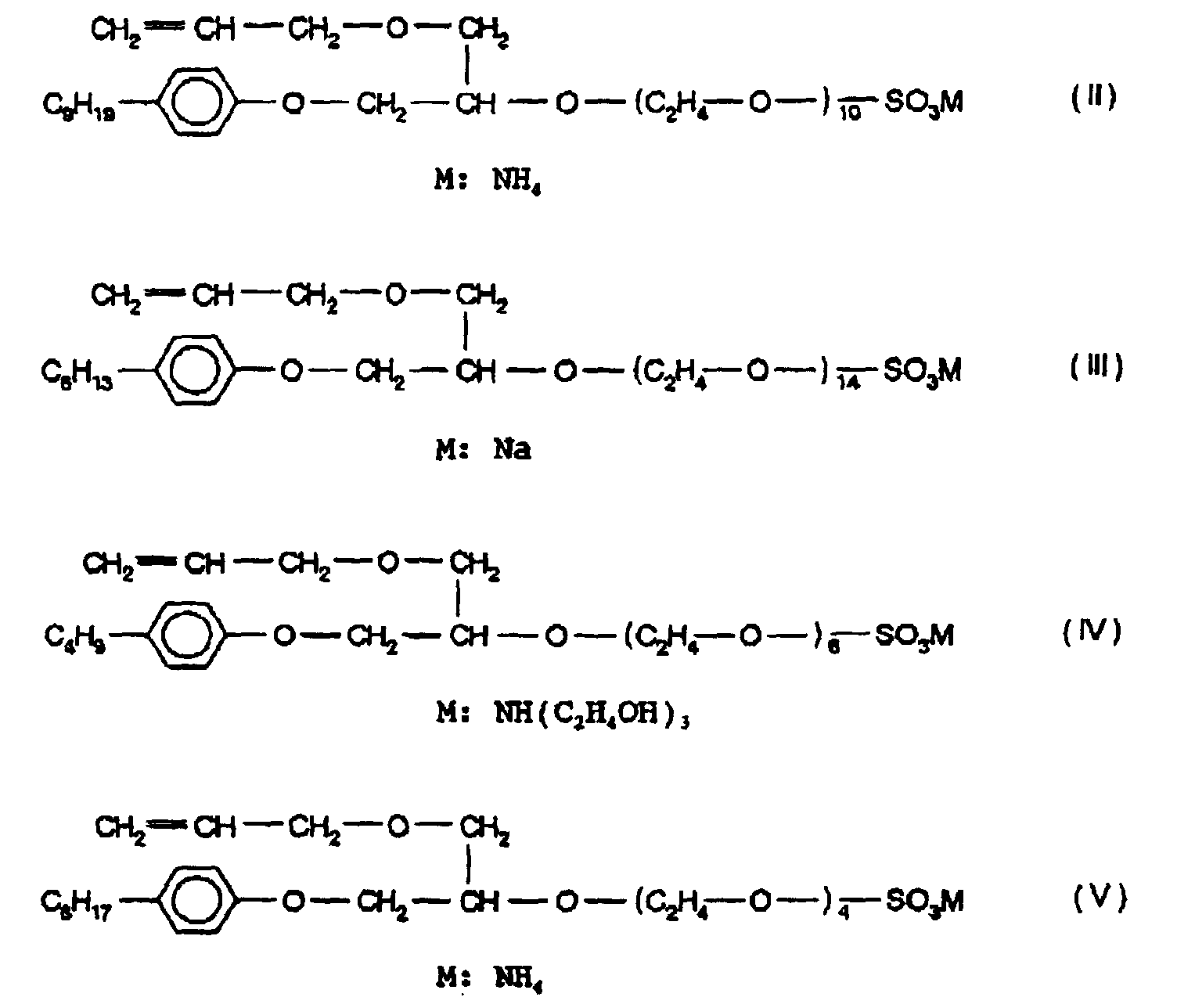
- According to the present invention, commercially available products may also be used as the polymerizable surfactant, end examples thereof include Aqualon HS Series manufactured by Dai-Ichi Kogyo Seiyaku Co., Ltd. (Aqualon HS-05, HS-10, HS-20, and HS-1025), Aqualon RN Series manufactured by Dai-Ichi Kogyo Seiyaku Co., Ltd. (RN-10, RN-20, RN-30, RN-50, and RN-2025), New Frontier Series manufactured by Dai-Ichi Kogyo Seiyaku Co., Ltd.. (New Frontier N-177E and S-510), Adeka Reasoap SE Series manufactured by Asahi Denka Kogyo Ltd. (SE-10N and SE-20N), and Adeka Reasoap NE Series manufactured by Asahi Denka Kogyo Ltd. (NE-10, NE-20, NE-30, NE-40, and NE-50). Among them, Adeka Reasoap SE Series SE-10N and SE-20N are particularly preferred.
- The amount of the polymerizable surfactant added is preferably about 10 to 150% by weight, more preferably about 20 to 100% by weight, based on the pigment. The addition of the polymerizable surfactant in an amount of not less than 10% by weight can improve the dispersion stability of the ink composition. The addition of the polymerizable surfactant in an amount of not more than 150% by weight can inhibit the occurrence of the polymerizable surfactant remaining unadsorbed on the pigment and can prevent polymer other than that involved in encapsulated particles from being present. This can improve the ejection stability of the ink composition.
- Any monomer may be used in the present invention so far as the monomer is highly copolymerizable with the polymerizable surf actant. Since, however, the polymerizable surfactant represented by formula (I) is a monomer having a high electron donating property, the monomer according to the present invention preferably has a high electron accepting property. Specific examples of the monomer having a high electron accepting property include: acrylonitrile; fumaronitrile; diesters of fumaric acid, such as dibutyl fumarate; diesters of maleic acid, such as dibutyl maleate; maleimides, such as N-phenylmaleimide; and vinylidene cyanide. They may be used alone or as a mixture of two or more.
- Examples of monomers usable herein include acrylic acid, acrylic esters, methacrylic acid, and methacrylic esters. Specific examples thereof include acrylic acid, methyl acrylate, ethyl acrylate, n-butyl acrylate, butoxyethyl acrylate, benzyl acrylate, phenyl acrylate, phenoxyethyl acrylate, cyclohexyl acrylate, dicyclopentanyl acrylate, dicyclopentenyl acrylate, dicyclopentenyloxyethyl acrylate, tetrahydrofurfuryl acrylate, isobornyl acrylate, 2-hydroxysthyl acrylate, 2-hydroxypropyl acrylate, 2-acryloyloxyethylsuccinic acid, 2-acryloyloxyethylphthalic acid, caprolactone acrylate, glycidyl acrylate, methacrylic acid, methyl methacrylate, ethyl methacrylate, n-butyl methacrylate, 2-ethylhexyl methacrylate, butoxymethyl methacrylate, benzyl methacrylate, phenyl methacrylate, phenoxyethyl methacrylate, cyclohexyl methacrylate, dicyclopentanyl methacrylate, dicyclopentenyl methacrylate, dicyclopentenyloxyethyl methacrylate, tetrahydrofurfuryl methacrylate, isobornyl methacrylate, 2-hydroxyethyl methacrylate, 2-hydroxypropyl methacrylate, 2-hydroxybutyl methacrylate, glycerol methacrylate, 2-methacryloyloxyethylsuccinic acid, 2-methacryloyloxyethylphthalic acid, caprolactone methacrylate, glycidyl methacrylate, sulfoethyl methacrylate, butylacrylamidosulfonic acid, phosphoethyl methacrylate, ethylene glycol diactylate, diethylene glycol diacrylate, triethylene glycol diacrylate, tetraethylene glycol diacrylate, polyethylene glycol diacrylate, allyl acrylate, bis(acryloxyethyl)hydroxyethyl isocyanurate, bis(acryloxyneopentyl glycol) azipate, 1,3-butylene glycol diacrylate, 1,6-hexanediol diacrylate, neopentyl glycol diacrylate, propylene glycol diacrylate, polypropylene glycol diacrylate, 2-hydroxy-1,3-diacryloxypropane, 2,2-bis[4-(acryloxy)phenyl]propane, 2,2-bis[4-(acryloxyethoxy)phenyl]propane, 2,2-bis[4-(acryloxyethoxy or diethoxy)phenyl]propane, 2,2-bis[4-(acryloxyethoxy or polyethoxy)phenyl]propane, hydroxypivalic acid neopentyl glycol diacrylate, 1,4-butanediol diacrylate, dicyclopentanyl diacrylate, dipentaerythritol hexaacrylate, dipentaerythritol monohydroxypentaacrylate, ditrimethylolpropane tetraacrylate, pentaerythritol triacrylate, tetrabromobisphenol A diacrylate, triglycerol diacrylate, trimethylolpropane triacrylate, tris(acryloxyethyl) isocyanurate, ethylene glycol dimethacrylate, diethylene glycol dimethacrylate, triethylene glycol dimethacrylate, tetraethylene glycol dimethacrylate, polyethylene glycol dimethacrylate, propylene glycol dimethacrylate, polypropylene glycol dimethacrylate, 1,3-butylene glycol dimethacrylate, 1,4-butanediol dimethacrylate, 1,6-hexanediol dimethacrylate, neopentyl glycol dimethacrylate, 2-hydroxy-1,3-dimethacryloxypropane, 2,2-bis[4-(methacryloxy)phenyl]propane, 2,2-bis[4-(methacryloxyethoxy)phenyl]propane, 2,2-bis[4-(methacryloxyethoxydiethoxy)phenyl]propane, 2,2-bis[4-(methacryloxyethoxypolyethoxy)phenyl]propane, tetrabromobisphenol A dimethacrylace, dicyclopentanyl dimethacrylate, dipentaerythritol hexamethacrylate, glycerol dimethacrylate, hydroxypivalic acid neopentyl glycol dimethacrylate, dipentaerythritol monohydroxypentamethacrylate, ditrimethylolpropane tetramethacrylate, pentaerythritol trimethacrylate, pentaerythritol tetramethacrylate, triglycerol dimethacrylate, and trimethylolpropane trimethacrylate.
- The amount of the monomer added is preferably about 2 to 15 moles, more preferably about 3 to 12 moles, based on one mole of the polymerizable surfactant. The addition of the monomer in an amount of not less than 2 moles based on one mole of the polymerizable surfactant can provide encapsulated pigment particles having excellent dispersion stability in an aqueous medium. On the other hand, the addition of the monomer in an amount of not more than 15 moles based on one mole of the polymerizable surfactant can enhance the dispersion stability of the ink composition, because the monomer can be satisfactorily dissolved in an adsorbed layer of the polymerizable surfactant and this can inhibit the production of water-insoluble polymer and can inhibit a relative reduction in the amount of ionic repellent groups.
- Polymerization initiators usable in the present invention include potassium persulfate, ammonium persulfate, sodiom persulfate, 2,2-azobis(2-methylpropionamidine) dihydrochloride, and 4,4-azobis(4-cyanovaleric acid).
- The pigment used in the present invention is used as a colorant. The pigment is a preferred colorant from the viewpoints of lightfastness and waterfastness.
- Regarding the pigment, inorganic and organic pigments are usable without particular limitation. Inorganic pigments usable herein include, in addition to titanium oxide and iron oxide, carbon blacks produced by known processes, such as contact, furnace, and thermal processes. Organic pigments usable herein include: azo pigments including azo lake, insoluble azo pigment, condensed azo pigment, and chelate azo pigment; polycyclic pigments, for example, phthalocyanine, perylene, perinone, anthraquinone, quinacridone, dioxazine, thioindigo, isoindolinone, and quinophthalone pigments; dye chelates, for example, basic dye chelates and acid dye chelates; nitro pigments; nitroso pigments; and aniline black.
- Carbon blacks usable as black inks include: No. 2300, No. 900, MCF 88, No. 33, No. 40, No. 45, No. 52,
MA 7, MA 8, MA 100, and No. 2200 B, which are manufactured by Mitsubishi Chemical Corporation; Raven 5750, Raven 5250, Raven 5000, Raven 3500, Raven 1255, and Raven 700, which are manufactured by Columbian Carbon Co., Ltd.; Regal 400 R, Regal 330 R, Regal 660 R, Mogul L, Monarch 700, Monarch 800, Monarch 880, Monarch 900, Monarch 1000, Monarch 1100, Monarch 1300, and Monarch 1400, which are manufactured by Cabot Corporation; Color Black FW 1, Color Black FW 2, Color Black FW 2V,Color Black FW 18, Color Black FW 200, Color Black S 150, Color Black S 160, Color Black S 170, Printex 35, Printex U, Printex V, Printex 140 U,Special Black 6,Special Black 5, Special Black 4A, and Special Black 4, which are manufactured by Degussa. - Pigments usable in yellow inks include C.I. Pigment Yellow 1, C.I. Pigment Yellow 2, C.I.
Pigment Yellow 3, C.I. Pigment Yellow 12, C.I. Pigment Yellow 13, C.I. Pigment Yellow 14C, C.I. Pigment Yellow 16, C.I. Pigment Yellow 17, C.I. Pigment Yellow 73, C.I. Pigment Yellow 74, C.I. Pigment Yellow 75, C.I. Pigment Yellow 83, C.I. Pigment Yellow 93, C.I. Pigment Yellow 95, C.I. Pigment Yellow 97, C.I. Pigment Yellow 98, C.I. Pigment Yellow 109, C.I. Pigment Yellow 110, C.I. Pigment Yellow 114, C.I. Pigment Yellow 128, C.I. Pigment Yellow 129, C.I. Pigment Yellow 138, C.I. Pigment Yellow 150, C.I. Pigment Yellow 151, C.I. Pigment Yellow 154, C.I. Pigment Yellow 155, C.I. Pigment Yellow 180, and C.I. Pigment Yellow 185. - Pigments usable in magenta inks include C.I.
Pigment Red 5, C.I.Pigment Red 7, C.I. Pigment Red 12, C.I. Pigment Red 48 (Ca), C.I. Pigment Red 48 (Mn), C.I. Pigment Red 57 (Ca), C.I. Pigment Red 57 : 1, C.I. Pigment Red 112, C.I. Pigment Red 122, C.I. Pigment Red 123, C.I. Pigment Red 168, C.I. Pigment Red 184, and C.I. Pigment Red 202. - Pigments usable in cyan inks include C.I. Pigment Blue 1, C.I. Pigment Blue 2, C.I.
Pigment Blue 3, C.I. Pigment Blue 15 : 3, C.I. Pigment Blue 15 : 34, C.I. Pigment Blue 16, C.I.Pigment Blue 22, C.I. Pigment Blue 60, C.I. Vat Blue 4, and C.I. Vat Blue 60. - The amount of the pigment added is preferably about 5 to 50% by weight, more preferably about 5 to 30% by weight, based on the water-based pigment dispersion. The particle diameter of the pigment is preferably not more than 400 nm, more preferably not more than 200 nm.
- The content of the water-based pigment dispersion is preferably about 1 to 20% by weight, more preferably about 1 to 10% by weight, based on the ink composition. When the content of the water-based pigment dispersion is not less than 1% by weight, satisfactory print density can be realized. On the other hand, when the content of the pigment dispersion is not more than 20% by weight, the ink composition has a viscosity suitable for ink jet recording, contributing to good ejection stability.
- The water-based pigment dispersion according to the present invention may be produced as follows.
- Specifically, the water-based pigment dispersion may be produced by immobilizing a polymerizable surfactant on a pigment, that is, by encapsulization of a pigment. More specifically, a pigment and a polymerizable surfactant are added optionally in an aqueous organic solvent and/or in water, and the mixture is dispersed and wet ground, for example, by ultrasonics, ball mill, or sand grinder. Thereafter, a monomer to be copolymerized and/or a polymerization initiator optionally while continuing grinding are added, and a polymerization reaction is allowed to proceed at 40 to 100°C for 10 to 60 hr. Thus, encapsulated pigment particles can be prepared. The amount of the polymerization initiator added is preferably 0.1 to 10% by weight, more preferably 1 to 5% by weight, based on the monomer. The encapsulated pigment particles thus obtained are then centrifuged or filtered to remove coarse particles. Water-soluble organic solvents, such as alcohols, glycols, or amides, water-soluble polymers, surfactants, fungicides and the like may be then added according to the application of the ink composition to prepare the water-based pigment dispersion according to the present invention. More preferably, the water-based pigment dispersion is prepared according to a production process described in Japanese Patent Laid-Open No. 316909/1998.
- The ink composition according to the present invention contains fine particles of a polymer. The term "fine particles of polymer" used herein refers to fine particles comprising polymer component of a polymer preferably fine particles of a polymer having a film-forming property. The term "aqueous emulsion" used herein refers to an aqueous dispersion comprising water as a continuous phase and fine particles of a polymer as dispersed particles. The "aqueous emulsion" is often called "polymer emulsion" or "resin emulsion." Specific examples of the polymer component constituting the fine particles of a polymer include acrylic resin, vinyl acetate resin, styrene/butadiene resin, vinyl chloride resin, acryl/styrene resin, butadiene resin, styrene resin, crosslinked acrylic resin, crosslinked styrene resin, benzoguanamine resin, phenolic resin, silicone resin, arid epoxy resin. Regarding these resins, the form of copolymerization is not limited, and the resins may be present, for example, in the form of a block copolymer or a random copolymer.
- According to the present invention, the fine particles of a polymer are preferably those of resins having a film-forming property among the above resins. The term "film-forming property" used herein means that evaporating the water component of an aqueous emulsion of the fine particles of a polymer dispersed in water results in the formation of a resin film. Likewise, the ink composition with the fine particles of a polymer added thereto has a property such that evaporating water or the aqueous organic solvent results in the formation of a resin film. This resin film functions to strongly fix the pigment component contained in the ink composition onto the surface of recording media. It is considered that this can realize images having excellent rubbing/scratch resistance and waterfastness.
- According to a preferred embodiment of the present invention, the fine particles of a polymer have a minimum film-forming temperature of 30°C or below, more preferably room temperature or below (around 25°C), most preferably 10°C or below. The film formation of the fine particles of a polymer at 30°C or below is preferred, because the film formation on the printing surf ace proceeds automatically and the pigment is strongly fixed on recording media. The term "minimum film-forming temperature" used herein refers to a minimum temperature at which, when an aqueous emulsion prepared by dispersing fine particles of a polymer in water is thinly cast onto a sheet of a metal, such as aluminum, to form a coating which is then gradually heated, a transparent, continuous film is formed. In this case, a white powder is formed in a temperature region below the minimum film-forming temperature. Further, according to a preferred embodiment of the present invention, the fine particles of a polymer have a glass transition point of 10°C or below.
- According to a preferred embodiment of the present invention, the fine particles of a polymer have carboxyl groups on the surface thereof and, in addition, have high reactivity with a divalent metal salt. More specifically, the fine particles of a polymer have a reactivity with a divalent metal salt such that, when 3 volumes of a 0.1 wt% aqueous emulsion of the fine particles of a polymer is brought into contact with one volume of a 1 mol/liter aqueous divalent metal salt solution, the time required for the transmission of light having a wavelength of 700 nm to become 50% of the initial value is preferably not more than 1 x 10⁴ sec, more preferably not more than 1 x 10³ sec, still more preferably not more than 1 x 10² sec. The fine particles of a polymer, when brought into contact with divalent metal ions, are reacted with the divalent metal ions to form suspended matter which lowers the transparency of the solution. The amount of the resultant suspended matter is measured in terms of light transmission. Divalent metal ions include Ca2+, Cu2+, Ni2+, Mg2+, Zn2+, and Ba2+. Anions, which form salts with divalent metal ions, include Cl-, NO3-, I-, Br-, ClO3-, and CH3COO-. This high reactivity is considered attributable to the presence of a relatively large amount of carboxyl groups on the surface of the fine particles of a polymer. Ink compositions containing fine particles of a polymer having, on the surface thereof, a large amount of carboxyl groups having high reactivity do not have any affinity for a nozzle plate, in a head for ink jet recording, which has been subjected to water repellency-imparting treatment. This can provide a great advantage that problems involved in conventional resin-containing ink compositions, that is, an ink droplet trajectory directionality problem and a failure of the ink droplets to be ejected, caused by good wettability of the nozzle plate by the ink composition, can be effectively prevented. According to a preferred embodiment of the present invention, the contact angle of an aqueous emulsion, prepared by dispersing the fine particles of a polymer in water to provide a fine particles of a polymer concentration of 10% by weight, on a teflon sheet is not less than 70 degrees. Further, the surface tension of an aqueous emulsion, prepared by dispersing the fine particles of a polymer in water to provide a fine particle of a polymer concentration of 35% by weight is preferably not less than 40 x 10-3 N/m (40 dyne/cm, 20°C). The utilization of such fine particles of a polymer, when the ink composition is used in ink jet recording, can more effectively prevent the ink droplet trajectory directionality problem and, at the same time, can realize good prints.
- Further, the high level of hydrophilicity of the surface of the fine particles of a polymer can advantageously impart excellent storage stability to the ink composition.
- According to another preferred embodiment of the present invention, the fine particles of a polymer contain 1 to 10% by weight of a structure derived from an unsaturated vinyl monomer having a carboxyl group and has a structure crosslinked by a crosslinkable monomer having two or more polymerizable double bonds with the content of the structure derived from the crosslinkable monomer being 0.2 to 4% by weight. The utilization of a three-dimensionally crosslinked polymer prepared by copolymerization of crosslinkable monomers preferably having two or more polymerizable double bonds, more preferably three or more polymerizable double bonds, makes it more difficult for the surface of the nozzle plate to be wetted by the ink composition. This can more effectively reduce the ink droplet trajectory directionality problem and, at the same time, can further improve the ejection stability.
- According to the present invention, the fine particles of a polymer used may have a single-particle structure. On the other hand, according to the present invention, fine particles of a polymer having a core/shell structure may also be utilized. The core/shell structure comprises a core and a shell surrounding the core. The term "core/shell structure" used herein refers to "a form such that two or more polymers having different compositions are present in a phase separated state in a particle." Forms of the core/shell structure usable in the present invention include a form wherein the core is entirely covered with the shell, a form wherein the core is partially covered with the shell, and a form wherein a part of the polymer constituting the shell forms a domain or the like within the core particle. Further, the particle may have a multi-layer structure of three or more layers wherein at least one additional layer having a different composition is further interposed between the core and the shell.
- According to a preferred embodiment of the present invention, the core is formed of a resin having epoxy groups, and the shell is formed of a resin having carboxyl groups. The epoxy group is reactive with the carboxyl group. These two groups are allowed to exist separately from each other. That is, the epoxy group and the carboxyl group are present respectively in the core and shell, or vice versa. The reduction in the amount of water and the water-soluble organic solvent causes coalescence of the fine particles of a polymer with one another, and the fine particles of a polymer are deformed by pressure involved in the film formation. As a result, the epoxy groups in the core is bonded to the carboxyl groups in the shell to form a network structure. This can advantageously form a coating having higher strength. The amount of the unsaturated vinyl monomer having an epoxy group is preferably 1 to 10% by weight. According to the present invention, a reaction of a part of the epoxy groups with a part of the carboxyl groups before the film formation is acceptable so far as the film-forming property is not lost. In the present invention, the property such that, when reactive functional groups are allowed to coexist within the tine particles of a polymer, these groups are reacted with each other without the addition of any curing agent at the time of film formation to form a network structure, will be referred to as "self-crosslinkable."
- The fine particles of a polymer may be prepared by conventional emulsion polymerization. Specifically, the fine particles of a polymer may be prepared by emulsion polymerization of an unsaturated vinyl monomer in water in the presence of a polymerization catalyst and an emulsifier.
- Unsaturated vinyl monomers usable herein include those commonly used in emulsion polymerization, such as acrylic ester monomers, methacrylic ester monomers, aromatic vinyl monomers, vinyl ester monomers, vinyl cyanide compound monomers, halogenated monomers, olefin monomers, and diene monomers. Specific examples thereof include: acrylic esters, such as methyl acrylate, ethyl acrylate, isopropyl acrylate, n-butyl acrylate, isobutyl acrylate, n-amyl acrylate, isoamyl acrylate, n-hexyl aerylate, 2-ethylhexyl acrylate, octyl acrylate, decyl acrylate, dodecyl acrylate, octadecyl acrylate, cyclohexyl acrylate, phenyl acrylate, benzyl acrylate, and glycidyl acrylate; methacrylic esters, such as methyl methacrylate, ethyl methacrylate, isopropyl methacrylate, n-butyl methacrylate, isobutyl methacrylate, n-amyl methacrylate, isoamyl methacrylate, n-hexyl methacrylate, 2-ethylhexyl methacrylate, octyl methacrylate, decyl methacrylate, dodecyl methacrylate, octadecyl methacrylate, cyclohexyl methacrylate, phenyl methacrylate, benzyl methacrylate, and glycidyl methacrylate; vinyl esters, such as vinyl acetate; vinyl cyanide compounds, such as acrylonitrile and methacrylonitrile; halogenated monomers, such as vinylidene chloride and vinyl chloride; aromatic vinyl monomers, such as styrene, 2-methylstyrene, vinyltoluene, t-butylstyrene, chlorostyrene, vinylanisole, and vinylnaphthalene; olefins, such as ethylene, propylene, and isopropylene; dienes, such as butadiene and chloroprene; and vinyl monomers, such as vinyl ether, vinyl ketone, and vinylpyrrolidone. In the case of monomers not having a carboxyl group, an unsaturated vinyl monomer having a carboxyl group should be used. Preferred examples thereof include acrylic acid, methacrylic acid, itaconic acid, fumaric acid, and maleic acid. Among them, methacrylic acid is preferred. Emulsifiers usable herein include anionic surfactants, nonionic surfactants, and mixtures of these surfactants.
- According to the present invention, a structure formed by crosslinking of molecules, derived from the above monomers, with a crosslinkable monomer having two or more polymerizable double bonds is preferred. Specific examples of crosslinkable monomers having two or more polymerizable double bonds include: diacrylate compounds, such as polyethylene glycol diacrylate, triethylene glycol diacrylate, 1,3-butylene glycol diacrylate, 1,6-butylene glycol diacrylate, 1,6-hexanediol diacrylate, neopentyl glycol diacrylate, 1,9-nonanediol diacrylate, polypropylene glycol diacrylate, 2,2'-bis(4-acryloxypropyloxyphenyl)propane, and 2,2'-bis(4-acryloxydiethoxyphenyl)propane; triacrylate compounds, such as trimethylolpropane triacrylate, trimethylolethane triacrylate, and tetramethylolmethane triacrylate; tetraacrylate compounds, such as ditrimethylol tetraacrylate, tetramethylolmethane tetraacrylate, and pentaerythritol tetraacrylate; hexaacrylate compounds, such as dipentaerythritol hexaacrylate; dimethacrylate compounds, such as ethylene glycol dimethacrylate, diethylene glycol dimethacrylate, triethylene glycol dimethacrylate, polyethylene glycol dimethacrylate, 1,3-butylene glycol dimethacrylate, 1,4-butylene glycol dimethacrylate, 1,6-hexanediol dimethacrylate, neopentyl glycol dimethacrylate, dipropylene glycol dimethacrylate, polypropylene glycol dimethacrylate, polybutylene glycol dimethacrylate, and 2,2'-bis(4-methacryloxydiethoxyphenyl)propane; trimeth-acrylate compounds, such as trimethylolpropane trimethacrylate and trimethylolethane trimethacrylate; methylene bisacrylamide; and divinylbenzene.
- The addition of acrylamides or hydxoxyl-containing monomers besides the above monomers can further improve printing stability. Specific examples of acrylamides include acrylamide and N,N'-dimethylacrylamide. Specific examples of hydroxyl-containing monomers include 2-hydroxyathyl acrylate, 2-hydroxypropyl acrylate, 2-hydroxyethyl methacrylate, and 2-hydroxypropyl methacrylate. They may be used alone or as a mixture of two or more.
- The fine particles of a polymer having a core/shell structure may be produced by conventional, methods, generally multi-step emulsion polymerization and the like, for example, by a method disclosed in Japanese Patent Laid-Open No. 76004/1992. Specific examples of unsaturated vinyl monomers usable in the polymerization include those described above.
- Methods usable for the introduction of epoxy group into the core include a method wherein an epoxy-containing unsaturated vinyl monomer, such as glycidyl acrylate, glycidyl methacrylate, or allylglycidyl ether, is copolymerized with other unsaturated vinyl monomer, and a method wherein, in the polymerization of at least one unsaturated vinyl monomer to prepare core particles, an epoxy compound is simultaneously added to form a composite structure. The former method is preferred from the viewpoints of easiness of the polymerization, polymerization stability and the like.
- Initiators, surfactants, and molecular weight regulators commonly used in emulsion polymerization, and neutralizing agents and the like may be used according to a conventional method.
- According to the present invention, the fine particles of a polymer may be mixed as fine particles with other ingredients of the ink composition. Preferably, however, fine particles of a polymer are dispersed in water to prepare an aqueous emulsion, followed by mixing with other ingredients of the ink composition.
- According to the present invention, conventional aqueous emulsions may also be used as the aqueous emulsion satisfying the above requirements. For example, aqueous emulsions described in Japanese Patent Publication No. 1426/1987 and Japanese Patent Laid-Open Mos. 56573/1991, 79678/1991, 160068/1991, and 18462/1992 may be used.
- According to the present invention, the fine particles of a polymer may be mixed as a powder of fine particles with other ingredients of the ink composition. Preferably, however, the fine particles of a polymer are dispersed in a water medium to prepare an aqueous emulsion, followed by mixing with other ingredients of the ink composition.
- The content of the fine particles of a polymer is about 0.1 to 40% by weight, preferably about 0.1 to 25% by weight, more preferably about 0.1 to 10% by weight, based on the ink composition. The diameter of the fine particles of a polymer is preferably about 10 to 400 nm, more preferably about 50 to 200 nm. The molecular weight of the fine particles of a polymer is preferably not less than 10,000, more preferably not lees than 100,000.
- The solvent in the ink composition according to the present invention is composed mainly of water and a water-soluble organic solvent. The ink composition according to the present invention may contain optional ingredients.
- According to a preferred embodiment of the present invention, the ink composition according to the present invention contains a water-soluble organic solvent. Specific examples of water-soluble organic solvents include: alkyl alcohols having 1 to 4 carbon atoms, such as ethanol, methanol, butanol, propanol, and isopropanol; glycol ethers, such as ethylene glycol monomethyl ether, ethylene glycol monoethyl ether, ethylene glycol monobutyl ether, ethylene glycol monomethyl ether acetate, diethylene glycol monomethyl ether, diethylene glycol monoethyl ether, diethylene glycol mono-n-propyl ether, ethylene glycol mono-iso-propyl ether, diethylene glycol mono-iso-propyl ether, ethylene glycol mono-n-butyl ether, ethylene glycol mono-t-butyl ether, diethylene glycol mono-n-butyl ether, triethylene glycol mono-n-butyl ether, diethylene glycol mono-t-butyl ether, 1-methyl-1-methoxybutanol, propylene glycol monomethyl ether, propylene glycol monoethyl ether, propylene glycol mono-t-butyl ether, propylene glycol mono-n-propyl ether, propylene glycol mono-iso-propyl ether, propylene glycol mono-n-butyl ether, dipropylene glycol mono-n-butyl ether, dipropylene glycol monomethyl ether, dipropylene glycol monoethyl ether, dipropylene glycol mono-n-propyl ether, and dipropylene glycol mono-iso-propyl ether; formamide; acetamide; dimethyl sulfoxide; sorbit; sorbitan; acetin; diacetin; triacetin; and sulfolane.
- According to a preferred embodiment of the present invention, among the water-soluble organic solvents, those having a boiling point of 180°C or above are used. The use of water-soluble organic solvents having a boiling point of 180°C or above can impart water retention and wetting properties to the ink composition. As a result, storage of the ink composition for a long period of time neither causes coagulation of pigment nor an increase in the viscosity of the ink composition. Thus, excellent storage stability can be realized. Further, an ink composition can be realized which, even when allowed to stand in an open state, that is, when allowed to stand in contact with air at room temperature, can maintain the fluidity and the redispersibility for a long period of time, and, in addition, does not cause clogging of nozzles during printing or at the time of restarting after interruption of printings, thus offering high ejection stability.
- Specific examples of water-soluble organic solvents having a boiling point of 180°C or above include ethylene glycol (b.p.: 197°C; the boiling point being hereinafter described within parentheses), propylene glycol (187°C), diethylene glycol (245°C), pentamethylene glycol (242°C), trimethylene glycol (214°C), 2-butene-1,4-diol (235°C), 2-ethyl-1,3-hexanediol (243°C), 2-methyl-2,4-pentanediol (197°C), 1-methyl-2-pyrrolidone (202°C), 1,3-dimethyl-2-imidazolidinone (257-260°C), 2-pyrrolidone (245°C), glycerin (290°C), tripropylene glycol monomethyl ether (243°C), dipropylene glycol monoethyl glycol (198°C), dipropylene glycol monomethyl ether (190°C), dipropylene glycol (232°C), triethylene glycol monomethyl ether (249°C), tetraethylene glycol (327°C), triethylene glycol (288°C), diethylene glycol monobutyl ether (230°C), diethylene glycol monoethyl ether (202°C), and diethylene glycol monomethyl ether (194°C). They may be used alone or as a mixture of two or more. According to the present invention, among the water-soluble organic solvents, those having a boiling point of 200°C or above are more preferred.
- The content of the water-soluble organic solvent is preferably about 10 to 40% by weight, more preferably 10 to 20% by weight.
- According to a preferred embodiment of the present invention, the ink composition according to the present invention contains a saccharide, a tertiary amine, or an alkali hydroxide. The addition of the saccharide and the tertiary amine can impart wetting properties. In particular, the addition of the saccharide can impart, to the ink composition, the effect of maintaining water retention and wetting properties for a long period of time, and thus can realize an ink composition which, when stored for a long period of time, causes neither coagulation of pigment nor an increase in viscosity of the ink composition, that is, has excellent storage stability. Further, the addition of the saccharide can impart, to the ink composition, the effect of maintaining, for a long period of time, fluidity and redispersibility even when the ink composition is allowed to stand in an open state, that is, is allowed to stand in contact with air at room temperature. Furthermore, the addition of the succharide can prevent nozzle clogging during printing or at the time of restarting after printing, thus offering high ejection stability. The addition of the tertiary amine and the alkali hydroxide brings about stable dispersion of the pigment and the fine particles of a polymer in the ink composition. However, it should be noted that the above theory is merely hypothetical and should not be construed as limiting the scope of the present invention.
- Specific examples of saccharides usable herein include monosaccharides, disaccharides, oligosaccharides, including trisaccharides and tetrasaccharides, and other polysaccharides, preferably glucose, mannose, fructose, ribose, xylose, arabinose, galactose, aldonic acid, glucitol, sorbitol, maltose, cellobiose, lactose, sucrose, trehalose, and maltotriose. The term "polysaccharide" used herein means saccharides in the broad sense as including substances which exist widely in the world of nature, such as alginic acid, α-cyclodextrin, and cellulose. Derivatives of these saccharides usable herein include reducing sugars of the above saccharides, for example, sugar alcohols represented by the general formula HOCH2(CHOH)nCH2OH, wherein n is an integer of 2 to 5, oxidizing sugars, for example, aldonic acid or uronic acid, amino acids, and thiosugars. Among them, sugar alcohols are particularly preferred, and specific examples thereof include maltitol and sorbitol. The content of the saccharide is preferably about 0.1 to 40% by weight, more preferably about 1 to 30% by weight, based on the ink composition.
- Specific examples of tertiary amines include trimethylamine, triethylamine, triethanolamine, dimethylethanolamine, diethylethanolamine, triisopropenolamine, and butyldiethanolainine. They may be used alone or as a mixture of two or more. The amount of the tertiary amine added to the ink composition is preferably about 0.1 to 10% by weight, more preferably about 0.5 to 5% by weight.
- Specific examples of alkali hydroxides include potassium hydroxide, sodium hydroxide, and lithium hydroxide, and the amount of the alkali hydroxide added to the ink composition is preferably about 0.01 to 5% by weight, more preferably about 0.05 to 3% by weight.
- The ink composition according to the present invention may further comprise a surfactant. Specific examples of surfactants usable herein includes anionic surfactants, for example, sodium dodecylbenzeneculfonate, sodium laurylate, and an ammonium salt of polyoxyethylene alkyl ether sulfates; nonionic surfactants, for example, polyoxyethylene alkyl ethers, polyoxyethylene alkyl esters, polyoxyethylene sorbitan fatty acid esters, polyoxyethylene alkylphenyl ethers, polyexyethylenealkylamines, and polyoxyethylenealkylamides; and acetylene glycol. They may be used alone or in combination of two or more.
- Preferably, the ink composition according to the present invention further contains a glycol ether and/or an acetylene glycol surfactant. Glycol ethers include ethylene glycol monomethyl ether, ethylene glycol monoethyl ether, ethylene glycol monobutyl ether, diethylene glycol monomethyl ether, diethylene glycol monoethyl ether, diethylene glycol mono-n-propyl ether, ethylene glycol mono-iso-propyl ether, diethylene glycolmono-iso-propyl ether, ethylene glycol mono-n-butyl ether, diethylene glycol mono-n-butyl ether, triethylene glycol mono-n-butyl ether, ethylene glycol mono-t-butyl ether, diethylene glycol mono-t-butyl ether, propylene glycol monomethyl ether, propylene glycol monoethyl ether, propylene glycol mono-t-butyl ether, propylene glycol mono-n-propyl ether, propylene glycol mono-iso-propyl ether, dipropylene glycol monomethyl ether, dipropylene glycol monoethyl ether, dipropylene glycol mono-n-propyl ether, dipropylene glycol mono-iso-propyl ether, propylene glycol mono-n-butyl ether, and dipropylene glycol mono-n-butyl ether.
- Specific examples of preferred acetylene glycol surfactants usable in the present invention include compounds represented by formula (VI):wherein
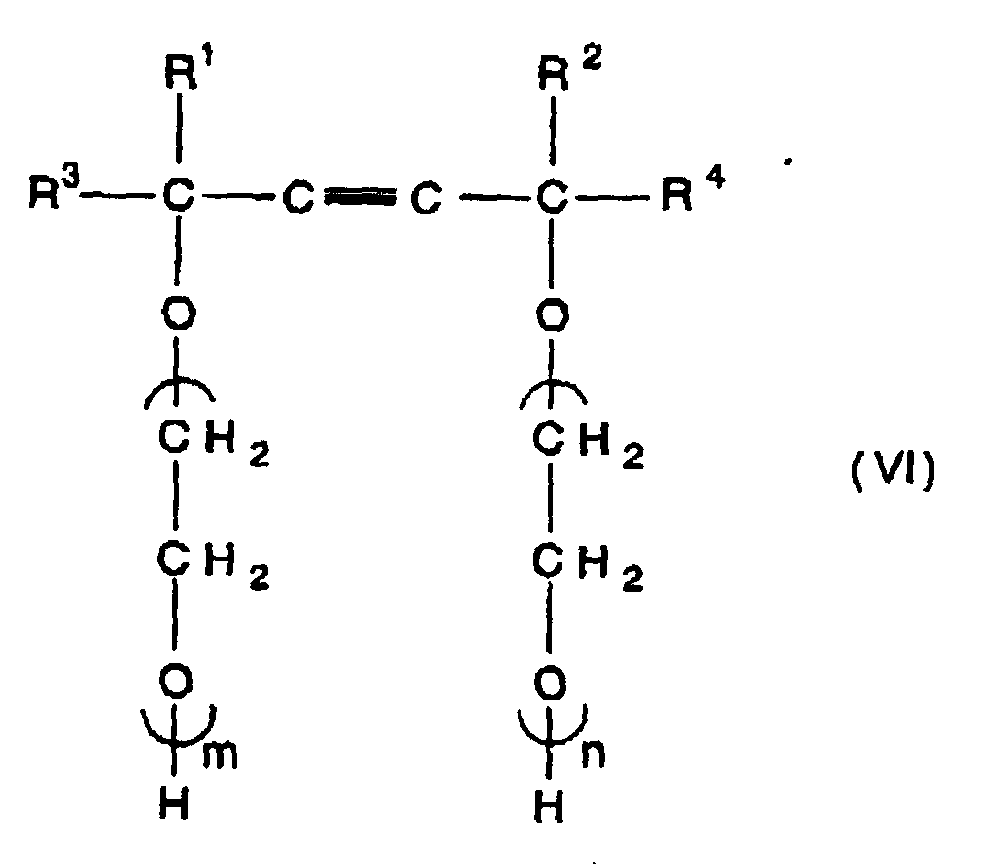
- Among the compounds represented by formula (VI), particularly preferred compounds include 2,4,7,9-tetramethyl-5-decyne-4,7-diol, 3,6-dimethyl-4-octyne-3,6-diol, and 3,5-dimethyl-1-hexyn-3-ol. Commercially available products may also be used as the acetylene glycol surfactant represented by the formula (VI). Specific examples thereof include Surfynol 104, Surfynol 82, Surfynol 465, Surfynol 485, and Surfynol TG (all the above products being available from Air Products and Chemicals Inc.) and OLFINE STG and OLFINE E 1010 (tradenames: manufactured by Nissin Chemical Industry Co., Ltd.).
- The amount of the surfactant added is preferably 0.01 to 10% by weight, more preferably 0.1 to 5% by weight, based on the ink composition.
- If necessary, the ink compositions may further contain pH adjustors, preservatives, fungicides, etc. from the viewpoint of improving the storage stability.
- According to a preferred embodiment of the present invention, the ink composition comprises a water-based dispersion of a pigment encapsulated in a polymer produced from a polymerizable surfactant having both nonionic hydrophilicity and anionic hydrophilicity and a monomer, fine particles of a polymer, acetylene glycol and/or an acetylene alcohol surfactant, at least one compound selected from the group consisting of diethylene glycol monobutyl ether, triethylene glycol monobutyl ether, propylene glycol monobutyl ether, dipropylene glycol monobutyl ether and/or 1,2-alkylene glycols, and water.
- Further, according to a preferred embodiment of the present invention, the ink composition comprises preferably 1 to 10% by weight of the water-based dispersion of a pigment encapsulated in a polymer produced from a polymerizable surfactant having both nonionic hydrophilicity and anionic hydrophilicity and a monomer, preferably 0.1 to 10% by weight of the fine particles of a polymer, preferably 0.01 to 10% by weight, more preferably 0.1 to 5% by weight, of the acetylene glycol and/or an acetylene alcohol surfactant, and preferably 0.5 to 20% by weight, more preferably 1 to 10% by weight, of at least one compound selected from the group consisting of diethylene glycol monobutyl ether, triethylene glycol monobutyl ether, propylene glycol monobutyl ether, and dipropylene glycol monobutyl ether.
- This ink composition can advantageously yield high-quality images free from feathering or bleeding and having high print density and excellent color development on plain papers and recycled papers, and can yield images having satisfactory rubbing/scratch resistance on plain papers and recycled papers, as well as on other recording media, such as coated papers.
- The ink composition according to the present invention may be used with other ink composition(s) to perform image recording. Other ink compositions include black, cyan, magenta, and yellow ink compositions. Thus, according to another aspect of the present invention, there is provided an ink set for ink jet recording, comprising the above ink composition and other ink composition(s). These other ink compositions may be the ink composition according to the present invention or alternatively may be an ink composition produced by other production process. For other ink compositions, the colorant and other composition may be properly determined by taking a printing method into consideration. Printing of a combination of these ink compositions to form images can realize images possessing excellent fast drying properties and rubbing/scratch resistance.
- According to still another aspect of the present invention, there is provided an ink jet recording method comprising the step of depositing a reaction solution and an ink composition onto a recording medium to perform printing.
- According to the ink jet recording method of the present invention, contact of the reaction solution with the ink composition can realize good prints. Although the mechanism through which good prints can be realized has not been elucidated yet, the mechanism is believed to be as follows. Upon contact of the reaction solution with the ink composition, the reactant contained in the reaction solution breaks the state of dispersion of the water-based pigment dispersion, the fine particles of a polymer, or other ingredients in the ink composition. This results in coagulation thereof. The coagulate is considered to inhibit the penetration of pigment into the recording medium and to strongly fix the pigment onto the recording medium.
- The reaction solution and the ink composition may be applied onto the recording medium in any order. Specifically, suitable methods for the deposition of the reaction solution and the ink composition include a method wherein the ink composition is deposited onto the recording medium after the deposition of the reaction solution onto the recording medium, a method wherein the ink, composition is first printed onto the recording medium followed by the deposition of the reaction solution onto the recording medium, and a method wherein the reaction solution and the ink composition are mixed together just before or just after the ejection.
- The deposition of the reaction solution onto the recording medium may be carried out by any of a method wherein the reaction solution is selectively deposited onto only an area where the ink composition is deposited, and a method wherein the reaction solution is deposited on the whole area of the recording medium. The former method is cost-effective because the consumption of the reaction solution can be minimized. In this method, however, the accuracy of the position at which both the reaction solution and the ink composition are deposited should be high to some extent. On the other hand, in the latter method, as compared with the former method, the requirement for the accuracy of the position where the reaction solution and the ink composition are deposited is relaxed. In the latter method, however, a larger amount of the reaction solution should be deposited on the whole area of the recording medium. This is often causative of curling of papers upon drying. For this reason, the method to be used may be determined by taking a combination of the ink composition with the reaction solution into consideration. When the former method is adopted, the reaction solution may be deposited by ink jet recording.
- The reaction solution used in the present invention contains a reactant. The reactant can break the state of dispersion and/or dissolution of pigment particles of the water-based pigment dispersion and/or fine particles of a polymer of the aqueous emulsion in the ink composition to cause coagulation. Specific examples of reactants usable herein include metal salts, polyamines, and polyamine derivatives.
- The metal salt usable in the reaction solution is a salt that is constituted by divalent or higher polyvalent metal ions and anions bonded to the polyvalent metal ions and is soluble in water. Specific examples of polyvalent metal ions include divalent metal ions, such as Ca2+, Cu2+, Ni2+, Mg2+, Zn2+, and Ba2+, and trivalent metal ions, such as Al3+, Fe3+, and Cr3+. Anions include Cl-, NO3-, I-, Br-, ClO3-, and CH3COO-.
- Especially, a metal salt constituted by Ca2+ or Mg2+ provides favorable results in terms of pH of the reaction solution and the quality of prints.
- The concentration of the polyvalent metal salt in the reaction solution may be suitably determined so as to attain the effect of providing good print quality and preventing clogging. It, however, is preferably about 0.1 to 40% by weight, more preferably about 5 to 25% by weight.
- According to a preferred embodiment of the present invention, the polyvalent metal salt contained in the reaction solution is constituted by divalent or higher polyvalent metal ions and nitrate ions or carboxylate ions bonded to the polyvalent metal ions and is soluble in water.
- In this case, preferably, the carboxylate ions are derived from a saturated aliphatic monocarboxylic acid having 1 to 6 carbon atoms or a carbocyclic monocarboxylic acid having 7 to 11 carbon atoms. Specific examples of preferred saturated aliphatic monocarboxylic acids having 1 to 6 carbon atoms include formic acid, acetic acid, propionic acid, butyric acid, isobutyric acid, valeric acid, isovaleric acid, pivalic acid, and hexanoic acid. Among then, formic acid and acetic acid are particularly preferred.
- A hydrogen atom(s) on the saturated aliphatic hydrocarbon group in the monocarboxylic acid may be substituted by a hydroxyl group. Specific examples of preferred substituted carboxylic acids include lactic acid.
- Specific examples of preferred carbocyclic monocarboxylic acids having 6 to 10 carbon atoms include benzoic acid and naphthoic acid with benzoic acid being more preferred.
- Polyallylamine and polyallylamine derivative usable in the reaction solution are cationic polymers which are soluble in water and can be positively charged in water. Such polymers include, for example, those represented by the following formulae (VII), (VIII), and (IX):wherein
 represents chloride, bromide, iodide, nitrate, phosphate, sulfate, acetate or other ions.
- In addition, a copolymer of an allylamine with a diallylamine and a copolymer of diallylmethylammonium chloride with sulfur dioxide may also be used.
- The content of the polyallylamine and the polyallylamine derivative is preferably 0.5 to 10% by weight based on the reaction solution.
- According to a preferred embodiment of the present invention, the reaction solution may further contain a polyol in addition to the polyvalent metal salt. The polyol has a vapor pressure of not more than 0.01 mmHg at 20°C, and the amount of the polyol added is such that the weight ratio of the polyol to the polyvalent metal salt is not less than 1, preferably 1.0 to 5.0. Further, according to a preferred embodiment of the present invention, the amount of the polyol added is not less than 10% by weight, more preferably about 10 to 30% by weight, based on the reaction solution.
- Specific examples of preferred polyols usable herein include polyhydric alcohols, for example, glycerin, diethylene glycol, triethylene glycol, 1,5-pentanediol, and 1,4-butanediol. Further specific examples of preferred polyols include saccharides, for example, monosaccharides, disaccharides, oligosaccharides including trisaccharides and tetrasaccharides, and other polysaccharides, preferably glucose, mannose, fructose, ribose, xylose, arabinose, galactose, aldonic acid, glucitol, sorbitol, maltose, cellobiose, lactose, sucrose, trehalose, and maltotriose.
- These polyols may be added alone or as a mixture of two or more. When the polyols are added as a mixture of two or more, the amount of these polyols added is such that the weight ratio of the total amount of the polyols to the polyvalent metal salt is not less than 1.
- According to a preferred embodiment of the present invention, the reaction solution comprises a wetting agent comprising a high-boiling organic solvent. The high-boiling organic solvent functions to prevent the reaction solution from drying out, Specific examples of preferred high-boiling organic solvents usable herein, some of which are described above in connection with the polyol, include: polyhydric alcohols, such as ethylene glycol, diethylene glycol, triethylene glycol, polyethylene glycol, polypropylene glycol, propylene glycol, butylene glycol, 1,2,6-hexanetriol, thioglycol, hexylene glycol, glycerin, trimethylolethane, and trimethylolpropane; alkyl ethers of polyhydric alcohols, such as ethylene glycol monoethyl ether, ethylene glycol monobutyl ether, diethylene glycol monomethyl ether, diethylene glycol monoethyl ether, diethylene glycol monobutyl ether, triethylene glycol monomethyl ether, triethylene glycol monoethyl ether, and triethylene glycol monobutyl ether; urea; 2-pyrrolidone; N-methyl-2-pyrrolidone; 1,3-dimethyl-2-imidazolidinone; and triethanolamine. According to a preferred embodiment of the present invention, the reaction solution may contain triethylene glycol monobutyl ether and glycerin in combination.
- Although the amount of the high-boiling organic solvent added is not particularly limited, it is preferably about 0.5 to 40% by weight, more preferably about 2 to 20% by weight, based on the reaction solution.
- According to a preferred embodiment of the present invention, the reaction solution may further contain a low-boiling organic solvent. Specific examples of preferred low-boiling organic solvents usable herein include methanol, ethanol, n-propyl alcohol, iso-propyl alcohol, n-butanol, sec-butanol, tert-butanol, iso-butanol, and n-pentanol. Monohydric alcohols are particularly preferred. The low-boiling organic solvent has the effect of shortening the time required for drying the ink composition. The amount of the low-boiling organic solvent added is preferably 0.5 to 10% by weight, more preferably 1.5 to 6% by weight, based on the reaction solution.
- According to a preferred embodiment of the present invention, the reaction solution may further contain a penetrating agent. Penetrating agents usable herein include various surfactants, such as anionic, cationic, and amphoteric surfactants; alcohols, such as methanol, ethanol, and iso-propyl alcohol; and lower alkyl ethers of polyhydric alcohols, such as ethylene glycol monomethyl ether, diethylene glycol monoethyl ether, diethylene glycol monobutyl ether, triethylene glycol monobutyl ether, propylene glycol monobutyl ether, and dipropylene glycol monobutyl ether.
- More preferred penetrating agents usable in the present invention are compounds represented by formula (VI) and/or lower alcohol ethers of polyhydric alcohols.wherein
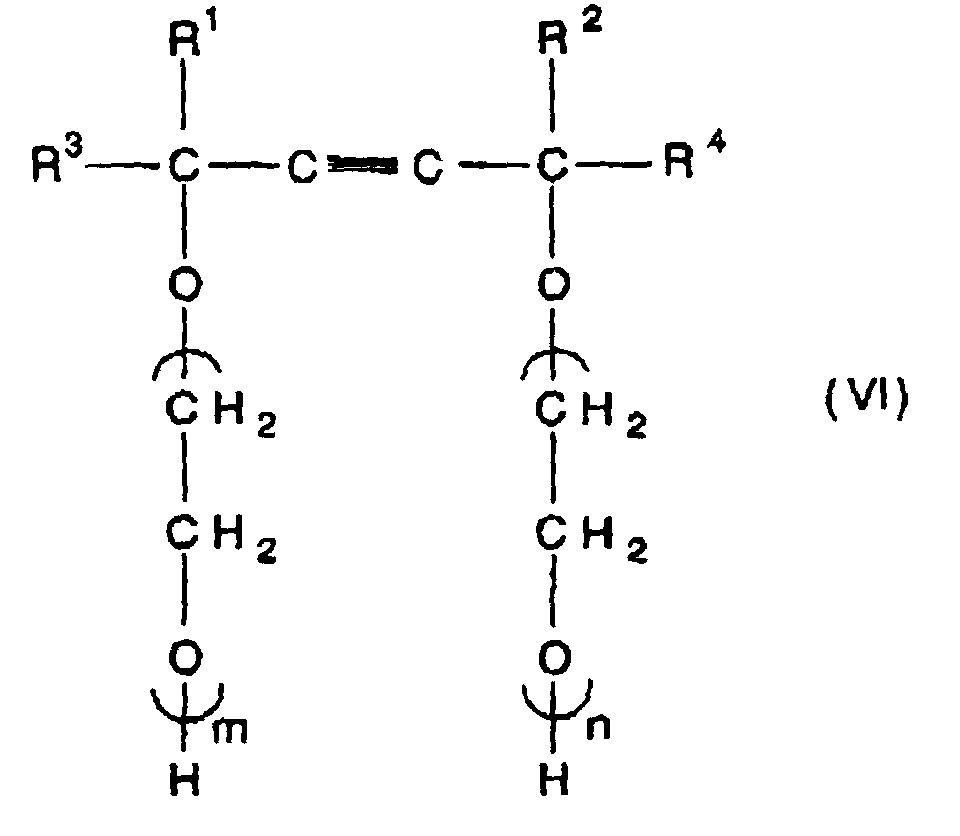
- Among the compounds represented by formula (VI), preferred compounds include 2,4,7,9-tetramethyl-5-decyne-4,7-diol, 3,6-dimethyl-4-octyne-3,6-diol, and 3,5-dimethyl-1-hexyn-3-ol. Commercially available products may also be used as the acetylene glycol surfactant represented by formula (VI). Specific examples thereof include Surfynol 104, Surfynol 82, Surfynol 440, Surfynol 465, Surfynol 485, and Surfynol TG (all the above products being available from Air Products and Chemicals Inc.) and OLFINE STG and OLFINE E 1010 (tradenames: manufactured by Nissin Chemical Industry Co., Ltd.). They may be used alone or as a mixture of two or more.
- According to a preferred embodiment of the present invention, the reaction solution contains triethanolamine for pH adjustment purposes. The amount of the triethanolamine added is preferably about 0 to 2.0% by weight.
- The ink composition as described above in connection with one aspect of the present invention may be used in the recording method according to the present invention. The composition, preparation and the like may be the same as those described above.
- A recording apparatus for carrying out the recording method according to the present invention will be described with reference to the accompanying drawings.
- Fig. 1 is a diagram showing an embodiment of an ink jet recording apparatus. In this embodiment, an ink composition and a reaction solution are accommodated in a tank and fed into a recording head through an ink tube. Specifically, a recording head 1 is communicated with an ink tank 2 through an
ink tube 3. In this case, the interior of the ink tank 2 is partitioned, and a chamber for an ink composition, optionally a plurality of chambers respectively for a plurality of color ink compositions, and a chamber for a reaction solution are provided. - The recording head 1 is moved along a carriage 4 by means of a
timing belt 6 driven by amotor 5. On the other hand, arecording medium 7 is placed by a platen 8 and a guide 9 at a position facing the recording head 1. In this embodiment, acap 10 is provided. A suction pump 11 is connected to thecap 10 in order to conduct the so-called "cleaning operation." The ink composition sucked by the suction pump 11 is resorvoired in awaste ink tank 13 through a tube 12. - Fig 2 is an enlarged view showing the surface of nozzles for the recording head 1. In the drawing, the surface of a nozzle for a reaction solution is indicated by 1b, and a
nozzle 21 for ejecting the reaction solution is provided in the longitudinal direction. On the other hand, the surface of nozzles for the ink composition is indicated by 1c, and a yellow ink composition, a magenta ink composition, a cyan ink composition, and a black ink composition are ejected respectively throughnozzles - Further, an ink jet recording method using the recording head shown in Fig. 2 will be described with reference to Fig. 3. The recording head 1 is moved in the direction indicated by an arrow A, during which time the reaction solution is ejected through the nozzle surface 1b to form a reaction solution-deposited
region 31 in a band form on therecording medium 7. Subsequently, therecording medium 7 is transferred by a predetermined extent in the recording medium feed direction indicated by an arrow B, during which time the recording head 1 is moved in the direction opposite to that indicated by the arrow A in the drawing and returned to the left end of therecording medium 7, and the recording head 1 conducts printing using the ink composition on the reaction solution-deposited region, thereby forming aprint region 32. - Further, as shown in Fig. 4, in the recording head 1, it is also possible to arrange all nozzles in the lateral direction to construct a nozzle assembly. In the drawing, ejection nozzles for a reaction solution are denoted by 41a and 41b, and a yellow ink composition, a magenta ink composition, a cyan ink composition, and a black ink composition are ejected respectively through
nozzles - Regulating the surface tension of the reaction solution and the ink composition preferably by the above method enables a high-quality print to be more stably provided independently of the order of depositing the reaction solution and the ink composition. In this case, the use of only one ejection nozzle for the reaction solution suffices for desired results (for example, the nozzle indicated by numeral 41b in the drawing may be omitted), leading to a further reduction in size of head and an increase in printing speed.
- In the ink jet recording apparatus, the supplement of the ink composition may be carried out by replacing a cartridge as an ink tank. The ink tank may be integral with the recording head.
- A preferred embodiment of an ink jet recording apparatus using such an ink tank is shown in Fig. 5. In the drawing, the same members as used in the apparatus shown in Fig. 1 have the same reference numerals. In the embodiment shown in Fig. 5, recording heads 1a and 1b are integral respectively with
ink tanks 2a and 2b. An ink composition and a reaction solution are ejected respectively through the recording heads 1a and 1b. Basically, printing may be conducted in the same manner as described above in connection with the apparatus shown in Fig. 1. Further, in this embodiment, the recording head 1a is moved together with the ink tank 2a on a carriage 4, while the recording head 1b is moved together with theink tank 2b on the carriage 4. - The present invention will be described in more detail with reference to the following examples, though it is not limited to these examples only.
- Dispersion 1 of pigment was prepared in the same manner as described in Example 1 of Japanese Patent Laid-Open No. 316909/1998. Specifically, a reaction vessel equipped with an ultrasonic generator, a stirrer, and a temperature controller was charged with 5 parts by weight of carbon black, 3 parts by weight of a polymerizable surfactant represented by formula (II) described in the above publication, and 80 parts by weight of water. Ultrasonic waves were applied to the mixture in the reaction vessel for 4 hr to comminute the mixture. Next, 1.6 parts by weight of acrylonitrile and 0.05 part by weight of potassium persulfate were further added to the reaction vessel, and a polymerization reaction was allowed to proceed at 60°C for 48 hr. The desired product thus obtained was filtered through a 0.4-µm filter to remove coarse particles. Thus, the dispersion of pigment was prepared. Adeka Reasoap SE-10N (number of moles of ethylene oxide added 10, purity 100%, manufactured by Asahi Denka Kogyo Ltd.) was used as the polymerizable surfactant represented by formula (II) described in Japanese Patent Laid-Open No. 316909/1998.
- Carbon black (100 g) and 60 g of a polymerizable surfactant SE-10N manufactured by Asahi Denka Kogyo Ltd. were added to 1,000 g of ion-exchanged water. Ultrasonic waves generated by an ultrasonic generator were applied to the mixture for 2 hr to perform dispersion, followed by dispersion in a sand mill for additional about 2 hr. The dispersion was introduced into a reaction vessel equipped with an ultrasonic generator, a stirrer, a temperature controller, a reflux condenser, and a dropping funnel. A mixed monomer solution previously prepared by mixing 20 g of phenoxyethyl methacrylate, 10 g of butyl methacrylate, and 10 g of methacrylic acid together and 1 g of potassium persulfate were further added to the reaction vessel, and a polymerization reaction was allowed to proceed at 60°C for 48 hr. The desired product thus obtained was adjusted to pH 8 by the addition of potassium hydroxide, and then passed through a 0.4-µm filter to remove coarse particles. Thus, the contemplated dispersion of pigment was prepared.
- C.I. Pigment Red 122 (100 g) and 60 g of a polymerizable surfactant SE-10N manufactured by Asahi Denka Kogyo Ltd. were added to 1,000 g of ion-exchanged water. Ultrasonic waves generated by an ultrasonic generator were applied to the mixture for 2 hr to perform dispersion, followed by dispersion in a sand mill for additional about 2 hr. The dispersion was introduced into a reaction vessel equipped with an ultrasonic generator, a stirrer, a temperature controller, a reflux condenser, and a dropping funnel. A mixed monomer solution previously prepared by mixing 5 g of benzyl methacrylate, 15 g of butyl methacrylate, 10 g of dicyclopentanyl dimethacrylate, and 10 g of methacrylic acid together and 1 g of potassium persulfate were further added to the reaction vessel, and a polymerization reaction was allowed to proceed at 60°C for 48 hr. The desired product thus obtained was adjusted to pH 8 by the addition of potassium hydroxide, and then passed through a 0.4-µm filter to remove coarse particles. Thus, the contemplated dispersion of magenta pigment was prepared.
- C.I. Pigment Blue 15 :3 (100 g) and 60 g of a polymerizabie surfactant SE-10N manufactured by Asahi Denka Kogyo Ltd. were added to 1,000 g of ion-exchanged water. Ultrasonic waves generated by an ultrasonic generator were applied to the mixture for 2 hr to perform dispersion, followed by dispersion in a sand mill for additional about 2 hr. The dispersion was introduced into a reaction vessel equipped with an ultrasonic generator, a stirrer, a temperature controller, a reflux condenser, and a dropping funnel. A mixed monomer solution previously prepared by mixing 10 g of 2-acrylamido-2-methylpropanesulfonic acid, 10 g of acrylonitrile, 10 g of benzyl methacrylate, and 10 g of butyl methacrylate together and 1 g of potassium persulfate were further added to the reaction vessel, and a polymerization reaction was allowed to proceed at 60°C for 48 hr. The desired product thus obtained was adjusted to pH 8 by the addition of potassium hydroxide, and then passed through a 0.4-µm filter to remove coarse particles. Thus, the contemplated dispersion of cyan pigment was prepared.
- C.I. Pigment yellow 185 (100 g) and 60 g of a polymerizable surfactant SE-10N manufactured by Asahi Denka Kogyo Ltd. were added to 1,000 g of ion-exchanged water. Ultrasonic waves generated by an ultrasonic generator were applied to the mixture for 2 hr to perform dispersion, followed by dispersion in a sand mill for additional about 2 hr. The dispersion was introduced into a reaction vessel equipped with an ultrasonic generator, a stirrer, a temperature controller, a reflux condenser, and a dropping funnel. A mixed monomer solution previously prepared by mixing 20 g of acrylonitrile and 20 g of dibutyl fumacate together and 1 g of potassium persulfate were further added to the reaction vessel, and a polymerization reaction was allowed to proceed at 60°C for 48 hr. The desired product thus obtained was adjusted to pH 8 by the addition of potassium hydroxide, and then passed through a 0.4-µm filter to remove coarse particles. Thus, the contemplated dispersion of yellow pigment was prepared.
- A flask equipped with a stirrer, a thermometer, a reflux condenser, and a dropping funnel was charged with 0.5 part by weight of potassium persulfate and 80 parts by weight of pure water to prepare a solution. The flask was heated while stirring the solution to raise the internal temperature to 70°C. Separately, 40 parts by weight of styrene, 45 parts by weight of butyl acrylate, 5 parts by weight of methacrylic acid, 1 part by weight of 2-hydroxyethyl acrylate, 1 part by weight of 1,6-hexanediol dimethacrylate, 1 part by weight of sodium laurylsulfate, and 40 parts by weight of pure water were stirred to mix them together. Thus, an emulsion was prepared. This emulsion was gradually added dropwise to the flask through the dropping funnel over a period of 3 hr to allow a polymerization reaction to proceed. The aqueous emulsion of fine particles of a polymer thus obtained was adjusted to solid content 35% by weight and pH 8 by the addition of ion-exchanged water and aqueous ammonia, and then passed through a 0.2-µm filter. The average particle diameter was measured by a laser scattering method and found to be 180 nm. The aqueous emulsion of fine particles of a polymer had a minimum film-forming temperature of 20°C. When 3 volumes of an aqueous emulsion containing 0.1% by weight of the fine particles of a polymer was brought into contact with one volume of a 1 mol/liter aqueous magnesium nitrate solution, the time required for the transmission of light having a wavelength of 700 nm to become 50% of the initial value (half-value period) was 500 sec. The contact angle of an aqueous emulsion, prepared so as to contain 10% by weight of the fine particles of a polymer, on a teflon sheet was 80 degrees.
- A reaction vessel equipped with a stirrer, a thermometer, a reflux condenser, and a dropping funnel was charged with 100 g of ion-exchanged water and 1.5 g of potassium persulfate. The internal temperature of the reaction vessel was raised to 70°C under stirring while replacing the air in the reaction vessel by nitrogen. Separately, 100 g of ion-exchanged water, 2 g of sodium dodecylbenzenesulfonate, 60 g of styrene, 80 g of n-lauryl methacrylate, 10 g of methacrylic acid, and 5 g of acrylamide were stirred to mix them together. Thus, an emulsion was prepared. This emulsion was gradually added dropwise to the reaction vessel through the dropping funnel. The aqueous emulsion of fine particles of a polymer thus obtained was cooled to room temperature, adjusted to solid content 35% by weight and pH 8 by the addition of ion-exchanged water and aqueous ammonia, and then passed through a 0.1-µm filter. The average particle diameter was measured by a laser scattering method and found to be 90 nm. The aqueous emulsion of fine particles of a polymer had a minimum film-forming temperature of 23°C. When 3 volumes of an aqueous emulsion containing 0.1% by weight of the fine particles of a polymer was brought into contact with one volume of a 1 mol/liter aqueous magnesium nitrate solution, the time required for the transmission of light having a wavelength of 700 nm to become 50% of the initial value (half-value period) was 30 sec. The contact angle of an aqueous emulsion, prepared so as to contain 10% by weight of the fine particles of a polymer, on a teflon sheet was 83 degrees
- A reaction vessel equipped with a stirrer, a thermometer, a reflux condenser, and a dropping funnel was charged with 900 g of ion-exchanged water and 4 g of sodium laurylsulfate. The internal temperature of the reaction vessel was raised to 70°C under stirring while replacing the air in the reaction vessel by nitrogen. While maintaining the internal temperature of the reaction vessel at 70°C, 2 g of potassium persulfate as a polymerization initiator was added to and dissolved in the system. An emulsion previously prepared by adding 450 g of ion-exchanged water, 3 g of sodium laurylsulfate, 435 g of styrene, 20 g of acrylamide, 475 g of butyl acrylata, 30 g of methacrylic acid, and 10 g of ethylene glycol dimethacrylate with stirring was then continuously added dropwize to the reaction vessel over a period of 3 hr. After the completion of the dropwise addition, aging was carried out for 3 hr.
- The aqueous emulsion of fine particles of a polymer thus obtained was cooled to room temperature, adjusted to solid content 35% by weight and pH 8 by the addition of ion-exchanged water and aqueous ammonia, and then passed through a 0.1-µm filter. The average particle diameter was measured by a laser scattering method and found to be 80 nm. The aqueous emulsion of fine particles of a polymer had a minimum film-forming temperature of 22°C. When 3 volumes of an aqueous emulsion containing 0.1% by weight of the fine particles of a polymer was brought into contact with one volume of a 1 mol/liter aqueous magnesium nitrate solution, the time required for the transmission of light having a wavelength of 700 nm to become 50% of the initial value (half-value period) was 5 sec. The contact angle of an aqueous emulsion, prepared so as to contain 10% by weight of the fine particles of a polymer, on a teflon sheet was 113 degrees
- A reaction vessel equipped with a stirrer, a thermometer, a reflux condenser, and a dropping funnel was charged with 900 g of ion-exchanged water and 4 g of sodium laurylsulfate. The internal temperature of the reaction vessel was raised to 70°C under stirring while replacing the air in the reaction vessel by nitrogen. While maintaining the internal temperature of the reaction vessel at 70°C, 8 g of potassium persulfate as a polymerization initiator was added to and dissolved in the system. An emulsion previously prepared by adding 450 g of ion-exchanged water, 3 g of sodium laurylsulfate, 435 g of styrene, 475 g of butyl acrylate, 15 g of 2-acryloylamino-2-methylpropanesulfonic acid, 30 g of methacrylic acid, and 10 g of diethylene glycol dimethacrylate under stirring was then continuously added dropwise to the reaction vessel over a period of 3 hr. After the completion of the dropwise addition, aging was carried out for 3 hr.
- The aqueous emulsion of fine particles of a polymer thus obtained was cooled to room temperature, adjusted to solid content 35% by weight and pH 8 by the addition of ion-exchanged water and aqueous ammonia, and then passed through a 0.1-µm filter. The average particle diameter was measured by a laser scattering method and found to be 90 nm. The aqueous emulsion of fine particles of a polymer had a minimum film-forming temperature of 20°C. When 3 volumes of an aqueous emulsion containing 0.1% by weight of the fine particles of a polymer was brought into contact with one volume of a 1 mol/liter aqueous magnesium nitrate solution, the time required for the transmission of light having a wavelength of 700 nm to become 50% of the initial value (half-value period) was 7 sec. The contact angle of an aqueous emulsion, prepared so as to contain 10% by weight of the fine particles of a polymer, on a teflon sheet was 115 degrees.
- A reaction vessel equipped with a stirrer, a thermometer, a reflux condenser, and a dropping funnel was charged with 900 g of ion-exchanged water. The internal temperature of the reaction vessel was raised to 70°C while replacing the air in the reaction vessel by nitrogen under stirring. While holding the internal temperature of the reaction vessel at 70°C, 3.5 g of potassium persulfate as a polymerization initiator was added to and dissolved in the system. An emulsion previously prepared by adding 70 g of ion-exchanged water, 1 g of sodium laurylsulfate, 53 g of styrene, 59 g of butyl acrylate, and 0.16 g of t-dodecylmercaptan as a molecular weight modifier under stirring was then continuously added dropwise to the reaction vessel over a period of one hr. After the completion of the dropwise addition, aging was carried out for one hr. Subsequently, an emulsion previously prepared by adding 79 g of styrene, 80 g of butyl acrylate, and 0.16 g of t-dodecylmercaptan to 70 g of ion-exchanged water, 1 g of sodium laurylsulfate, and 1 g of acrylamide under stirring was continuously added dropwise to the reaction vessel over a period of one hr. After the completion of the dropwise addition, aging was carried out for one hr. An aqueous solution of 3.5 g of ammonium persulfate as a polymerization initiator dissolved in 20 g of ion-exchanged water was then added to the reaction vessel. Further, an emulsion previously prepared by adding 300 g of ion-exchanged water, 2 g of sodium laurylsulfate, 16 g of acrylamide, 298 g of styrene, 297 g of butyl acrylate, 29 g of methacrylic acid, 30 g of diethylene glycol dimethacrylate, and 0.65 g of t-dodecylmercaptan under stirring was continuously added dropwise to the reaction vessel over a period of 3 hr. The aqueous emulsion of fine particles of a polymer thus obtained was cooled to room temperature, adjusted to solid content 35% by weight and pH 8 by the addition of ion-exchanged water and aqueous ammonia, and then passed through a 0.1-µm filter. The average particle diameter was measured by a laser scattering method and found to be 90 nm. The aqueous emulsion of fine particles of a polymer had a minimum film-forming temperature of 23°C. When 3 volumes of an aqueous emulsion containing 0.1% by weight of the fine particles of a polymer was brought into contact with one volume of a 1 mol/liter aqueous magnesium nitrate solution, the time required for the transmission of light having a wavelength of 700 nm to become 50% of the initial value (half-value period) was 6 sec. The contact angle of an aqueous emulsion, prepared so as to contain 10% by weight of the fine particles of a polymer, on a teflon sheet was 114 degrees.
- A reaction vessel equipped with a stirrer, a thermometer, a reflux condenser, and a dropping funnel was charged with 900 g of ion-exchanged water. The internal temperature of the reaction vessel was raised to 70°C while replacing the air in the reaction vessel by nitrogen under stirring. While holding the internal temperature of the reaction vessel at 70°C, 4 g of potassium persulfate as a polymerization initiator was added to and dissolved in the system. An emulsion previously prepared by adding 70 g of ion-exchanged water, 1 g of sodium laurylsulfate, 53 g of styrene, 59 g of butyl acrylate, 48 g of glycidyl methacrylate, and 0.16 g of t-dodecylmercaptan as a molecular weight modifier under stirring was then continuously added dropwise to the reaction vessel over a period of one hr. After the completion of the dropwise addition, aging was carried out for one hr. Subsequently, an emulsion previously prepared by adding 79 g of styrene, 80 g of butyl acrylate, and 0.16 g of t-dodecylmercaptan to 70 g of ion-exchanged water, 1 g of sodium laurylsuifate, and 1 g of acrylamide under stirring was continuously added dropwise to the reaction vessel over a period of one hr. After the completion of the dropwise addition, aging was carried out for one hr.
- An aqueous solution of 4 g of ammonium persulfate as a polymerization initiator dissolved in 20 g of ion-exchanged water was then added to the reaction vessel. Further, an emulsion previously prepared by adding 300 g of ion-exchanged water, 2 g of sodium laurylsulfate, 16 g of acrylamide, 298 g of styrene, 297 g of butyl acrylate, 29 g of methacrylic acid, and 0.65 g of t-dodecylmercaptan under stirring was continuously added dropwise to the reaction vessel over a period of 3 hr. The aqueous emulsion of fine particles of a polymer thus obtained was cooled to room temperature, adjusted to solid content 35% by weight and pH 8 by the addition of ion-exchanged water and aqueous ammonia, and then passed through a 0.1-µm filter. The average particle diameter was measured by a laser scattering method and found to be 90 nm. The aqueous emulsion of fine particles of a polymer had a minimum film-forming temperature of 24°C. When 3 volumes of an aqueous emulsion containing 0.1% by weight of the fine particles of a polymer was brought into contact with one volume of a 1 mol/liter aqueous magnesium nitrate solution, the time required for the transmission of light having a wavelength of 700 nm to become 50% of the initial value (half-value period) was 10 sec. The contact angle of an aqueous emulsion, prepared so as to contain 10% by weight of the fine particles of a polymer, on a teflon sheet was 108 degrees.
- Ink compositions as shown in Table 1 below were prepared according to the following procedure. Ion-exchanged water, a water-soluble organic solvent, an acetylene glycol surfactant and the like and optional additives, such as a pH adjustor, a preservative, and a fungicide, were previously added and mixed together while stirring at room temperature to prepare a liquid mixture. The stirring liquid mixture was then gradually added to a predetermined amount of the aqueous emulsion of fine particles of a polymer under stirring, followed by stirring for one hr. This was then gradually added to a predetermined amount of the dispersion of pigment under stirring, and the mixture was thoroughly stirred for additional one hr and then passed through a 5-µm membrane filter to prepare an ink composition.
- Carbon black (5% by weight), 3% by weight of an ammonium salt of a styrene/acrylic acid copolymer (molecular weight 8,000, polymer component 38%) as a dispersant, and 20% by weight of water were dispersed in a sand mill. Glycerin (10% by weight), 2% by weight of a nonionic surfactant Noigen EA-160 (manufactured by Dai-ichi Kogyo Seiyaku Co., Ltd.), and water (balance) were then added thereto to prepare an ink.
- Carbon black (5% by weight), 3% by weight of an ammonium salt of a styrene/acrylic acid copolymer (molecular weight 7,000, polymer component 38%) as a dispersant, and 20% by weight of water were dispersed in a sand mill. Glycerin (10% by weight), 2% by weight of a nonionic surfactant Noigen EA-160 (manufactured by Dai-ichi Kogyo Seiyaku Co., Ltd.), 3% by weight of a styrene/acrylic polymer emulsion Microgel E-5002 (manufactured by Nippon Paint Co., Ltd.), and water (balance) were then added thereto to prepare an ink.
- Reaction solutions were prepared according to the following formulations.
-
Magnesium nitrate hexahydrate 25 wt% Triethylene glycol monobutyl ether 10 wt % Glycerin 20 wt% Ion-exchanged water Balance -
Magnesium acetate tetrahydrate 25 wt% Triethylene glycol monobutyl ether 10 wt % Glycerin 20 wt% Ion-exchanged water Balance -
Polyallylamine represented by formula (VII) 5 wt% Triethylene glycol monobutyl ether 10 wt % Glycerin 20 wt% Ion-exchanged water Balance - The ink compositions prepared above were evaluated by the following tests. The results of evaluation were as shown in Tables 2 and 3 below. In the tests, printing was carried out as follows. Specifically, letters were printed on the following papers by means of an ink jet printer PM-670C manufactured by Seiko Epson Corporation. The ink density was 720 dpi. The following papers were used for the printing tests.
- Xerox P, manufactured by Xerox Corp.
- Xerox 4024, manufactured by Xerox Corp.
- Xerox R (recycled paper), manufactured by Xerox Corp.
- Yamayuri (recycled paper), manufactured by Honshu Paper Co., Ltd.
-
- The ink composition was loaded into the printer, and alphameric characters were continuously printed. At that time, inspection was performed on dropouts of dots and scattering of ink to determine the time required for dropouts of dots and scattering of ink to occur 10 times in total. The results were evaluated according to the following criteria.
- A: 48 hr or more
- B: 24 hr to less than 48 hr
- C: 1 hr to less than 24 hr
-
- The ink composition was loaded into the printer, and aiphameric characters were continuously printed for 10 min. Thereafter, the printer was stopped, and allowed to stand for one week without capping under an environment of temperature 40°C and
humidity 25%. After the standing, alphameric characters were printed again to determine the number of cleaning operations necessary for print quality equal to that before the standing to be obtained. The results were evaluated according to the following criteria. - A: Print quality equal to the initial print quality could be obtained after 0 to 2 cleaning operations.
- B: Print quality equal to the initial print quality could be obtained after 3 to 5 cleaning operations.
- C: Print quality equal to the initial print quality could not be obtained even after 6 or more cleaning operations.
-
- The ink composition was loaded into the printer, and alphameric characters were continuously printed on the test papers. The prints thus obtained were air dried for 1 hr, and the printed characters were then rubbed with a water-base yellow fluorescent marker pen (ZEBRA PEN 2 (trademark)) manufactured by ZEBRA at a marking force of 4.9 x 10⁵ N/m2, followed by visual inspection for staining. The results were evaluated according to the following criteria.
- A: For all the papers, rubbing twice caused no stain.
- B: For some of the papers, rubbing twice caused stain, although rubbing once caused no stain.
- C: For some of the papers, rubbing once caused stain.
-
- Each ink composition was stored at 60°C for one week. The viscosity of the ink composition before the storage and the viscosity of the ink composition after the storage, that is, the initial viscosity of the ink composition and the viscosity of the ink composition one week after the initiation of the storage, were measured. The ratio of the viscosity after one week to the initial viscosity was determined. The closer the viscosity ratio to 1, the better the dispersion stability.
- The ink composition was loaded into the printer, and letters were printed on the following printing papers. The prints were visually inspected for feathering. The results were evaluated according to the following criteria.
- A: Feathering observed.
- B: Feathering slightly observed.
- C: Feathering significantly observed.
-
- The following printing papers were used for the evaluation.
- Conqueror
- Favorit, manufactured by Xerox Corp.
- Modo
- Rapid Copy, manufactured by Igepa Artikel
- EPSON EPP, manufactured by Seiko Epson Corporation
- Xerox P, manufactured by Xerox Corp.
- Xerox 4024, manufactured by Xerox Corp.
-
Xerox 10, manufactured by Xerox Corp. - Neenha Bond, manufactured by Kinbery-Clark
- Ricopy 6200, manufactured by Ricoh Co., Ltd.
- Yamayuri (recycled paper), manufactured by Honshu Paper Co., Ltd.
-
- For the prints formed by the above printing, the reflection OD value of the blotted image portion was measured with Macbeth TR 972 manufactured by Macbeth. The average of the measurements was determined.
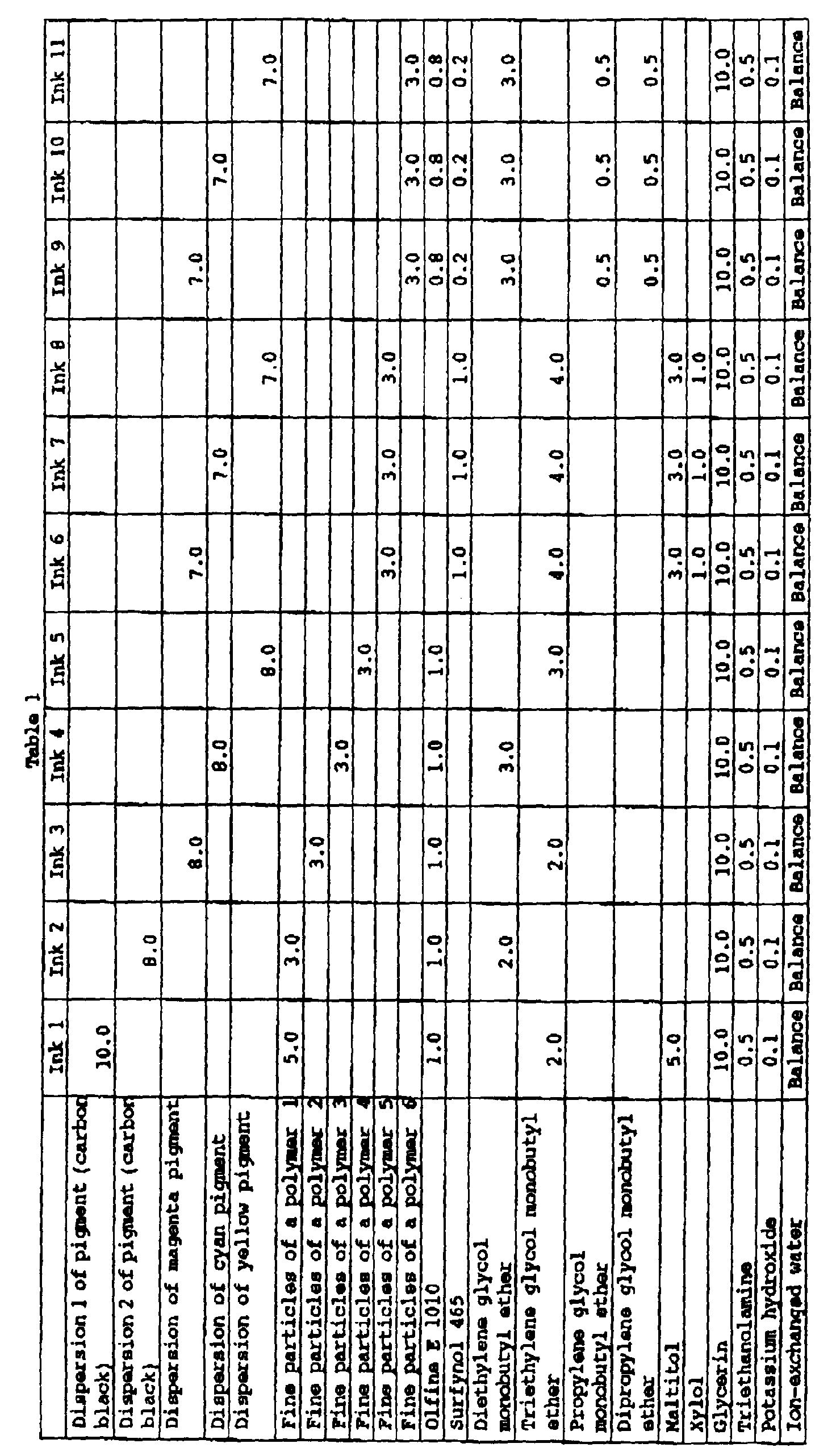


- Prints produced by an ink jet recording method, wherein droplets of the ink composition and droplets of the reaction solution were ejected and deposited onto a recording medium to provide a record, were evaluated as follows. Ink compositions, reaction solution, and the results of evaluation were as summarized in Tables 4 to 6 below.
- For the printing, an ink jet recording apparatus as shown in Fig. 5, provided with a recording head shown in Fig. 4, was used. The ink jet recording apparatus performs printing by depositing, on a recording medium, an ink composition and a reaction solution containing a reactant capable of producing coagulate upon contact with the ink composition, and comprises: means for depositing the reaction solution onto the recording medium; means for depositing the ink composition onto the recording medium to record an image; and ink jet recording means for controlling means for depositing the reaction solution onto the recording medium and means for depositing the ink composition onto the recording medium to record an image.
- In the printing, immediately after the reaction solution was allowed to impact against the test paper by means of the ink jet recording apparatus, the ink composition was allowed to impact against the position where the reaction solution impacted, thereby printing a blotted image (100% duty). The amount of the ink composition ejected and the amount of the reaction solution ejected each were 0.07 µg/dot, and the density was 360 dpi. The following printing papers were used in the printing.
- Xerox P, manufactured by Xerox Corp.
- Ricopy 6200, manufactured by Ricoh Co., Ltd.
- Xerox 4024, manufactured by Xerox Corp.
- Neenha Bond, manufactured by Kimberly-Clark
- Xerox R, manufactured by Xerox Corp.
-
- The ink composition was loaded into the ink jet recording apparatus, and alphabetical characters (24 characters) were continuously printed. For the printed alphabetical characters, the total number of feathered characters in the prints was counted. The results were evaluated according to the following criteria.
- A: The total number of feathered characters was less than 350.
- B: The total number of feathered characters was 350 to 1,000.
- C: The total number of feathered characters was not less than 1,000.
-
- The prints produced in evaluation 1 were allowed to stand for one hr, and then rubbed with a water-base yellow fluorescent marker pen (ZEBRA PEN 2 (trademark)) manufactured by ZEBRA at a marking force of 4.9 x 10⁵ N/m2, followed by visual inspection for staining of the yellow portion. The results were evaluated according to the following criteria.
- A: Rubbing three times caused no stain.
- B: For some of the papers, rubbing three times caused stain, although rubbing twice caused no stain.
- C: For some of the papers, rubbing twice caused stain, although rubbing once caused no stain.
- D: For some of the papers, rubbing once caused stain.
-
- For prints produced in evaluation 1, inmtediately after printing, the same type of paper as used in the test was put on top of the print, and a load of 250 g/cm2 was applied to the laminate. At that time, the time required for the printed ink no longer to be transferred onto the paper was determined as a fast drying property. The fast drying property was evaluated according to the following criteria;
- A: Less than 20 sec
- B: 20 to less than 60 sec
- C: Not less than 60 sec
-
- Water droplets were dropped on printed areas in the prints produced in evaluation 1. The prints were then visually inspected. The results were evaluated according to the following criteria.
- A: No change occurred in printed areas on which water droplets had been dropped.
- B: Marks (water marks) were formed around printed areas on which water droplets had been dropped.
- C: The periphery of printed areas, on which water droplets had been dropped, was blurred.
-
- For the prints formed by the above printing, the reflection OD value of the blotted image portion was measured with Macbeth TR 972 manufactured by Macbeth. The average of the measurements was determined.
- Printing on the above-described various printing papers was performed using ink sets 1 to 7 and reaction solutions as indicated in Table 6 by means of the ink jet recording apparatus.
- In this case, the reaction solution was first printed at 100% duty, and color inks (cyan, magenta, and yellow inks) were then printed The prints were visually inspected for uneven color mixing in boundaries or different colors. The results were evaluated according to the following criteria. For both the reaction solution and the inks, the amount thereof ejected was 0.7 µg/dot, and the density was 360 dpi. The results were as shown in Table 6.
- A: No color mixing occurred, and the boundaries between adjacent colors were clear.
- B: Feather-like color mixing occurred.
- C: Significant color mixing occurred to such an extent that the boundaries between adjacent colors blurred.
-
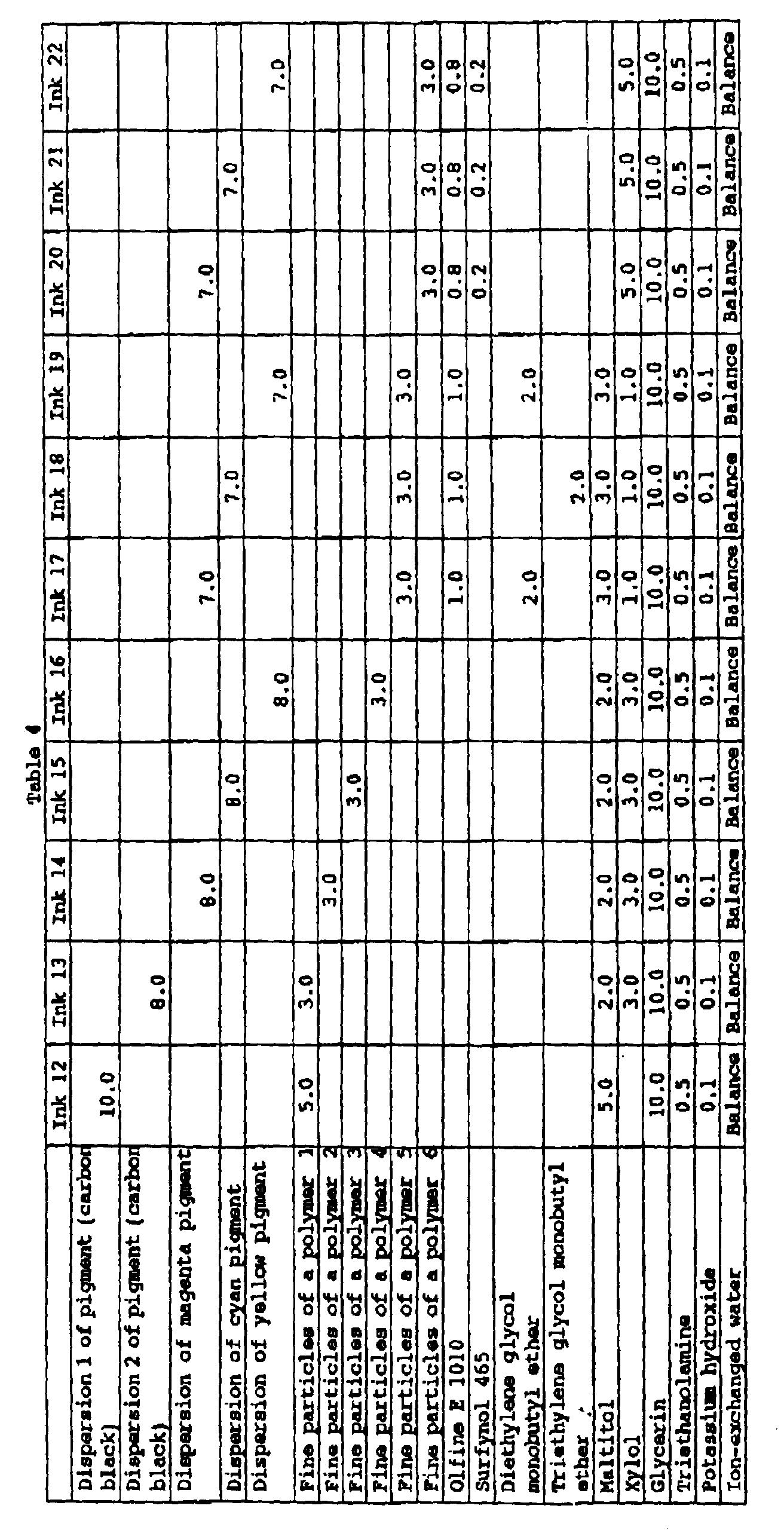


Claims (35)
- An ink composition for ink jet recording, comprising a water-based pigment dispersion, fine particles of a polymer, a water-soluble organic solvent, and water,
wherein the water-based pigment dispersion comprises a pigment and a co-polymer which encapsulates the pigment, and the co-polymer is obtained from a polymerizable surfactant having both nonionic hydrophilicity and anionic hydrophilicity and a monomer. - The ink composition according to claim 1, wherein the polymerizable surfactant is a compound represented by formula (I):wherein
 R represents a hydrogen atom or a hydrocarbon residue having 1 to 12 carbon atoms; n is a number of 2 to 20; and M represents an alkali metal atom, an ammonium salt, or an alkanolamine.
 - The ink composition according to claim 1 or 2, wherein the water-based pigment dispersion has been produced by dispersing the pigment in the polymerizable surfactant optionally in water and/or a water-soluble organic solvent and then polymerizing the dispersion together with the monomer.
- The ink composition according to any one of claims 1 to 3, wherein the water-based pigment dispersion has been produced by further performing wet grinding after the polymerization.
- The ink composition according to any one of claims 1 to 4, wherein the monomer is an electron-accepting monomer.
- The ink composition according to claim 5, wherein the monomer is selected from the group consisting of diesters of fumaric acid, diesters of maleic acid, maleimides, and vinylidene cyanide.
- The ink composition according to claim 5, wherein the monomer is selected from the group consisting of acrylic acid, acrylic esters, methacrylic acid, and methacrylic esters.
- The ink composition according to any one of claims 1 to 7, which contains 1 to 20% by weight of the water-based pigment dispersion.
- The ink composition according to any one of claims 1 to 8, wherein the fine particles of a polymer are comprised of a polymer having a film-forming property
- The ink composition according to any one of claims 1 to 9, wherein the fine particles of a polymer have a minimum film-forming temperature of 30°C or below.
- The ink composition according to any one of claims 1 to 10, wherein the content of the fine particles of a polymer is 0.1 to 25% by weight based on the ink composition.
- The ink composition according to any one of claims 1 to 11, wherein the fine particles of a polymer have a diameter of not more than 400 nm.
- The ink composition according to any one of claims 1 to 12, wherein the fine particles of a polymer have a film-forming property, have carboxyl groups on the surface thereof, and have a reactivity with a divalent metal salt such that, when 3 volumes of a 0.1 wt% aqueous emulsion is brought into contact with one volume of a 1 mol/liter aqueous divalent metal salt solution, the time required for the transmission of light having a wavelength of 700 nm to become 50% of the initial value is not more than 1 x 10⁴ sec.
- The ink composition according to any one of claims 1 to 13, wherein an aqueous emulsion prepared by dispersing the fine particles of a polymer in water and adjusting the concentration of the aqueous emulsion to 10% by weight has a contact angle on a teflon sheet of not less than 70 degrees.
- The ink composition according to any one of claims 1 to 14, wherein the fine particles of a polymer contain 1 to 10% by weight of a structure derived from an unsaturated vinyl monomer having a carboxyl group and has a structure crosslinked by a crosslinkable monomer having two or more polymerizable double bonds with the content of the structure derived from the crosslinkable monomer being 0.2 to 4% by weight.
- The ink composition according to any one of claims 1 to 15, wherein the fine particles of a polymer have a core/shell structure.
- The ink composition according to claim 16, wherein the core comprises an epoxy-containing resin while the shell comprises a carboxyl-containing resin.
- The ink composition according to any one of claims 1 to 17, wherein the fine particles of a polymer are self-crosslinkable.
- The ink composition according to any one of claims 1 to 18, wherein the water-soluble organic solvent has a boiling point of 180°C or above.
- The ink composition according to any one of claims 1 to 19, which further contains a glycol ether and/or an acetylene glycol surfactant.
- An ink jet recording method comprising the steps of: ejecting droplets of an ink composition; and depositing the droplets onto a recording medium to perform printing, the ink composition being one according to any one of claims 1 to 20.
- A record produced by the ink jet recording method according to claim 21.
- An ink set for ink jet recording, comprising an ink composition according to any one of claims 1 to 20.
- An ink jet recording method comprising the step of depositing, on a recording medium, an ink composition and a reaction solution containing a reactant which, when brought into contact with the ink composition, produces coagulate, thereby performing printing,the ink composition being one according to any one of claims 1 to 20.
- The ink jet recording method according to claim 24, wherein the reactant is a metal salt, a polyallylamine, or a derivative of the polyallylamine.
- The ink jet recording method according to claim 25, wherein the metal salt is a nitrate or a carboxylate.
- The ink jet recording method according to claim 26, wherein carboxylic acid ions constituting the carboxylate have been derived from a saturated aliphatic monocarboxylic acid having 1 to 6 carbon atoms (hydrogen atoms on the saturated aliphatic hydrocarbon group in the monocarboxylic acid being optionally substituted by a hydroxyl group) or a carbocyclic monocarboxylic acid having 6 to 10 carbon atoms
- The ink jet recording method according to any one of claims 24 to 27, wherein the reaction solution further contains triethylene glycol monobutyl ether and glycerin.
- The ink jet recording method according to any one of claims 24 to 28, wherein the step of depositing the droplets of the ink composition on the recording medium is carried out after the step of depositing the reaction solution onto the recording medium.
- The ink jet recording method according to any one of claims 24 to 28, wherein the step of depositing the droplets of the ink composition on the recording medium is carried out before the step of depositing the reaction solution onto the recording medium.
- The ink jet recording method according to any one of claims 24 to 30, wherein the step of depositing the droplets of the ink composition on the recording medium or the step of depositing the reaction solution onto the recording medium is carried out by an ink jet recording method wherein droplets are ejected and deposited onto the recording medium to perform printing.
- A record produced by the recording method according to any one of claims 24 to 31.
- An ink jet recording apparatus for performing printing by depositing, on a recording medium, an ink composition and a reaction solution containing a reactant which, when brought into contact with the ink composition, produces coagulate,the ink composition being one according to any one of claims 1 to 20,said apparatus comprising:means for depositing the reaction solution onto the recording medium;means for depositing the ink composition onto the recording medium to record an image; andink jet recording means for controlling means for depositing the reaction solution onto the recording medium and means for depositing the ink composition onto the recording medium to record an image.
- The apparatus according to claim 33, wherein means for controlling means for depositing the reaction solution onto the recording medium and means for depositing the ink composition onto the recording medium to record an image is ink jet recording means.
- A record produced by printing by means of the recording apparatus according to claim 33 or 34.
Applications Claiming Priority (4)
| Application Number | Priority Date | Filing Date | Title |
|---|---|---|---|
| JP23311199 | 1999-08-19 | ||
| JP23311199 | 1999-08-19 | ||
| JP2000241097A JP2001123098A (en) | 1999-08-19 | 2000-08-09 | Ink composition for inkjet recording |
| JP2000241097 | 2000-08-09 |
Publications (2)
| Publication Number | Publication Date |
|---|---|
| EP1077238A1 true EP1077238A1 (en) | 2001-02-21 |
| EP1077238B1 EP1077238B1 (en) | 2005-11-02 |
Family
ID=26530853
Family Applications (1)
| Application Number | Title | Priority Date | Filing Date |
|---|---|---|---|
| EP20000117812 Expired - Lifetime EP1077238B1 (en) | 1999-08-19 | 2000-08-18 | Ink composition for ink jet recording |
Country Status (4)
| Country | Link |
|---|---|
| EP (1) | EP1077238B1 (en) |
| JP (1) | JP2001123098A (en) |
| AT (1) | ATE308592T1 (en) |
| DE (1) | DE60023611T2 (en) |
Cited By (20)
| Publication number | Priority date | Publication date | Assignee | Title |
|---|---|---|---|---|
| WO2001094482A1 (en) * | 2000-06-07 | 2001-12-13 | Seiko Epson Corporation | Ink set for ink-jet recording |
| WO2001096483A1 (en) | 2000-06-07 | 2001-12-20 | Seiko Epson Corporation | Ink-jet recording ink, ink-jet recording ink set, recording method, print, and ink-jet recording apparatus |
| EP1268688A4 (en) * | 1999-12-14 | 2003-06-25 | Lexmark Int Inc | INK COMPOSITIONS |
| WO2003057787A1 (en) * | 2002-01-08 | 2003-07-17 | Ricoh Company Ltd. | Ink set, ink-jet recording method, and recorder |
| GB2401872A (en) * | 2003-05-20 | 2004-11-24 | Ilford Imaging Uk Ltd | Ink jet ink and recording process |
| US6864302B2 (en) * | 2000-09-14 | 2005-03-08 | Seiko Epson Corporation | Ink jet recording method and ink set therefor |
| US7030174B2 (en) * | 2000-09-27 | 2006-04-18 | Seiko Epson Corporation | Ink set for ink jet-jet recording, method for ink-jet recording and recorded matter |
| WO2006054787A1 (en) * | 2004-11-22 | 2006-05-26 | Kao Corporation | Water-based inks for ink-jet printing |
| US7074843B2 (en) * | 2001-08-27 | 2006-07-11 | Seiko Epson Corporation | Microencapsulated pigment, production process therefor, aqueous dispersion and ink jet recording ink |
| WO2007134093A1 (en) | 2006-05-11 | 2007-11-22 | Hewlett-Packard Development Company, L.P. | Printing ink based on encapsulation of pigment particles by polymerization |
| US7332532B2 (en) * | 2004-04-13 | 2008-02-19 | Hewlett-Packard Development, L.P. | Polymeric dispersants for ink-jet applications |
| EP1878774A4 (en) * | 2005-03-28 | 2009-09-02 | Seiko Epson Corp | INK COMPOSITION, PRINTING METHOD USING THE SAME, AND PRINTED MATERIAL |
| US7812070B2 (en) | 2003-10-14 | 2010-10-12 | Seiko Epson Corporation | Microencapsulated pigment, preparation process therefor, aqueous dispersion and ink jet recording ink |
| CN102199383A (en) * | 2010-03-23 | 2011-09-28 | 精工爱普生株式会社 | Aqueous ink composition and printing process by ink jet recording method using the same |
| CN102211452A (en) * | 2010-03-23 | 2011-10-12 | 精工爱普生株式会社 | Printing method for ink-jet recording mode |
| EP1808225A4 (en) * | 2004-10-18 | 2011-11-30 | Seiko Epson Corp | ENCAPSULATION PRODUCT, PROCESS FOR PRODUCING THE SAME, AND INK COMPOSITION |
| US8361213B2 (en) | 2008-03-13 | 2013-01-29 | Fujifilm Corporation | Ink composition and image recording method |
| JP2013095766A (en) * | 2011-10-28 | 2013-05-20 | Riso Kagaku Corp | Encapsulated pigment, aqueous ink, and ink set |
| JP2013204025A (en) * | 2012-03-29 | 2013-10-07 | Mimaki Engineering Co Ltd | Inkjet ink, reaction liquid, ink set, ink cartridge, ink jet recording method, and ink jet recording apparatus |
| US8697774B2 (en) | 2011-03-07 | 2014-04-15 | Seiko Epson Corporation | Ink for ink jet recording and ink set for ink jet recording |
Families Citing this family (22)
| Publication number | Priority date | Publication date | Assignee | Title |
|---|---|---|---|---|
| JP2005272848A (en) * | 2000-06-07 | 2005-10-06 | Seiko Epson Corp | Ink-jet recording ink, recording method, print, and ink-jet recording apparatus |
| JP4701545B2 (en) * | 2001-06-19 | 2011-06-15 | セイコーエプソン株式会社 | Ink set |
| JP4168641B2 (en) * | 2002-02-26 | 2008-10-22 | セイコーエプソン株式会社 | Water-based ink |
| JP2004182878A (en) * | 2002-12-04 | 2004-07-02 | Konica Minolta Holdings Inc | Colored fine grain dispersion and water-based ink |
| JP4547893B2 (en) * | 2003-10-31 | 2010-09-22 | セイコーエプソン株式会社 | Microencapsulated pigment, method for producing the same, and aqueous dispersion |
| JP4595336B2 (en) * | 2004-02-06 | 2010-12-08 | 富士ゼロックス株式会社 | Ink jet recording ink and method for producing the same |
| JP2006028460A (en) * | 2004-07-21 | 2006-02-02 | Seiko Epson Corp | Microencapsulated pigment, method for producing microencapsulated pigment, aqueous dispersion, and ink composition for ink jet recording |
| JP5352939B2 (en) * | 2004-09-28 | 2013-11-27 | セイコーエプソン株式会社 | Encapsulated inorganic fine particles and production method thereof, coating composition containing encapsulated inorganic fine particles and coating method thereof, and printing composition containing encapsulated inorganic fine particles and printing method thereof |
| JP2006273892A (en) * | 2005-03-28 | 2006-10-12 | Seiko Epson Corp | Ink composition, recording method using the same, and recorded material |
| JP2006273891A (en) * | 2005-03-28 | 2006-10-12 | Seiko Epson Corp | Ink composition, recording method using the same, and recorded material |
| JP4934977B2 (en) * | 2005-03-28 | 2012-05-23 | セイコーエプソン株式会社 | Ink set, recording method using the same, and recorded matter |
| JP4803356B2 (en) | 2005-08-15 | 2011-10-26 | セイコーエプソン株式会社 | Ink set, recording method using the same, and recorded matter |
| JP5164352B2 (en) * | 2006-09-08 | 2013-03-21 | 花王株式会社 | Water-based ink for inkjet recording |
| JP2009191133A (en) * | 2008-02-13 | 2009-08-27 | Fujifilm Corp | Water-based ink for inkjet recording |
| JP5338102B2 (en) * | 2008-03-26 | 2013-11-13 | セイコーエプソン株式会社 | Ink composition, ink jet recording method using the same, and recorded matter |
| JP2010180419A (en) * | 2010-05-27 | 2010-08-19 | Seiko Epson Corp | Microencapsulated pigment and method for manufacturing the same, aqueous dispersion, and ink for inkjet recording |
| JP5729066B2 (en) * | 2011-03-23 | 2015-06-03 | 東洋インキScホールディングス株式会社 | Binder resin composition for aqueous inkjet ink and aqueous inkjet ink composition using the same |
| JP6059634B2 (en) * | 2013-11-05 | 2017-01-11 | 大日精化工業株式会社 | Polymer emulsion, colorant composition containing the same, aqueous inkjet ink, and method for producing polymer emulsion |
| JP6281396B2 (en) * | 2014-04-17 | 2018-02-21 | セイコーエプソン株式会社 | Ink composition and recording apparatus |
| JP6957923B2 (en) * | 2017-03-24 | 2021-11-02 | セイコーエプソン株式会社 | Water-based ink composition, inkjet recording method, inkjet recording device |
| JP2020183458A (en) * | 2019-04-26 | 2020-11-12 | 三菱鉛筆株式会社 | Ink composition for writing instrument |
| JP2021080381A (en) * | 2019-11-20 | 2021-05-27 | 株式会社ミマキエンジニアリング | Aqueous ink |
Citations (6)
| Publication number | Priority date | Publication date | Assignee | Title |
|---|---|---|---|---|
| JPH05320276A (en) * | 1992-05-20 | 1993-12-03 | Nippon Paint Co Ltd | Microencapsulation of hydrophobic powder using amphiphilic graft polymer |
| JPH09279053A (en) * | 1996-04-10 | 1997-10-28 | Mitsubishi Chem Corp | Aqueous dispersion of pigment |
| JPH10176130A (en) * | 1996-06-19 | 1998-06-30 | Mitsubishi Pencil Co Ltd | Aqueous ink composition |
| EP0859037A1 (en) * | 1997-02-17 | 1998-08-19 | Seiko Epson Corporation | Ink jet recording ink and ink jet recording apparatus |
| JPH10316909A (en) * | 1997-05-20 | 1998-12-02 | Mitsubishi Chem Corp | Aqueous dispersion and method for producing the same |
| EP0887391A1 (en) * | 1997-06-26 | 1998-12-30 | Seiko Epson Corporation | Ink jet recording ink and method |
-
2000
- 2000-08-09 JP JP2000241097A patent/JP2001123098A/en active Pending
- 2000-08-18 AT AT00117812T patent/ATE308592T1/en not_active IP Right Cessation
- 2000-08-18 EP EP20000117812 patent/EP1077238B1/en not_active Expired - Lifetime
- 2000-08-18 DE DE2000623611 patent/DE60023611T2/en not_active Expired - Lifetime
Patent Citations (6)
| Publication number | Priority date | Publication date | Assignee | Title |
|---|---|---|---|---|
| JPH05320276A (en) * | 1992-05-20 | 1993-12-03 | Nippon Paint Co Ltd | Microencapsulation of hydrophobic powder using amphiphilic graft polymer |
| JPH09279053A (en) * | 1996-04-10 | 1997-10-28 | Mitsubishi Chem Corp | Aqueous dispersion of pigment |
| JPH10176130A (en) * | 1996-06-19 | 1998-06-30 | Mitsubishi Pencil Co Ltd | Aqueous ink composition |
| EP0859037A1 (en) * | 1997-02-17 | 1998-08-19 | Seiko Epson Corporation | Ink jet recording ink and ink jet recording apparatus |
| JPH10316909A (en) * | 1997-05-20 | 1998-12-02 | Mitsubishi Chem Corp | Aqueous dispersion and method for producing the same |
| EP0887391A1 (en) * | 1997-06-26 | 1998-12-30 | Seiko Epson Corporation | Ink jet recording ink and method |
Non-Patent Citations (4)
| Title |
|---|
| DATABASE WPI Section Ch Week 199402, Derwent World Patents Index; Class A14, AN 1994-012348, XP002153617 * |
| DATABASE WPI Section Ch Week 199907, Derwent World Patents Index; Class A14, AN 1999-076652, XP002153618 * |
| PATENT ABSTRACTS OF JAPAN vol. 1998, no. 02 30 January 1998 (1998-01-30) * |
| PATENT ABSTRACTS OF JAPAN vol. 1998, no. 11 30 September 1998 (1998-09-30) * |
Cited By (32)
| Publication number | Priority date | Publication date | Assignee | Title |
|---|---|---|---|---|
| EP1268688A4 (en) * | 1999-12-14 | 2003-06-25 | Lexmark Int Inc | INK COMPOSITIONS |
| US6646024B2 (en) | 1999-12-14 | 2003-11-11 | Lexmark International, Inc. | Ink compositions |
| WO2001094482A1 (en) * | 2000-06-07 | 2001-12-13 | Seiko Epson Corporation | Ink set for ink-jet recording |
| WO2001096483A1 (en) | 2000-06-07 | 2001-12-20 | Seiko Epson Corporation | Ink-jet recording ink, ink-jet recording ink set, recording method, print, and ink-jet recording apparatus |
| US6864302B2 (en) * | 2000-09-14 | 2005-03-08 | Seiko Epson Corporation | Ink jet recording method and ink set therefor |
| US7030174B2 (en) * | 2000-09-27 | 2006-04-18 | Seiko Epson Corporation | Ink set for ink jet-jet recording, method for ink-jet recording and recorded matter |
| US7074843B2 (en) * | 2001-08-27 | 2006-07-11 | Seiko Epson Corporation | Microencapsulated pigment, production process therefor, aqueous dispersion and ink jet recording ink |
| US7683108B2 (en) | 2001-08-27 | 2010-03-23 | Seiko Epson Corporation | Microencapsulated pigment, production process therefor, aqueous dispersion, and ink jet recording ink |
| SG148849A1 (en) * | 2002-01-08 | 2009-01-29 | Ricoh Kk | Ink set, ink-jet printing method, and ink-jet printer |
| WO2003057787A1 (en) * | 2002-01-08 | 2003-07-17 | Ricoh Company Ltd. | Ink set, ink-jet recording method, and recorder |
| EP1464684A4 (en) * | 2002-01-08 | 2006-11-15 | Ricoh Kk | "INK COMBINATION, INK JET PRINTING METHOD AND PRINTER" |
| US7645035B2 (en) | 2002-01-08 | 2010-01-12 | Ricob Company, Ltd. | Ink set, ink-jet printing method, and ink-jet printer |
| GB2401872A (en) * | 2003-05-20 | 2004-11-24 | Ilford Imaging Uk Ltd | Ink jet ink and recording process |
| GB2401872B (en) * | 2003-05-20 | 2007-01-17 | Ilford Imaging Uk Ltd | Ink jet ink and recording process |
| US7812070B2 (en) | 2003-10-14 | 2010-10-12 | Seiko Epson Corporation | Microencapsulated pigment, preparation process therefor, aqueous dispersion and ink jet recording ink |
| US7332532B2 (en) * | 2004-04-13 | 2008-02-19 | Hewlett-Packard Development, L.P. | Polymeric dispersants for ink-jet applications |
| EP1808225A4 (en) * | 2004-10-18 | 2011-11-30 | Seiko Epson Corp | ENCAPSULATION PRODUCT, PROCESS FOR PRODUCING THE SAME, AND INK COMPOSITION |
| US8524803B2 (en) | 2004-10-18 | 2013-09-03 | Seiko Epson Corporation | Encapsulation product, process for producing the same, and ink composition |
| GB2433939B (en) * | 2004-11-22 | 2007-12-05 | Kao Corp | Water-based inks for ink-jet printing |
| GB2433939A (en) * | 2004-11-22 | 2007-07-11 | Kao Corp | Water-based inks for ink-jet printing |
| WO2006054787A1 (en) * | 2004-11-22 | 2006-05-26 | Kao Corporation | Water-based inks for ink-jet printing |
| US8536245B2 (en) | 2005-03-28 | 2013-09-17 | Seiko Epson Corporation | Ink composition, recording method using the same, and recorded matter |
| EP1878774A4 (en) * | 2005-03-28 | 2009-09-02 | Seiko Epson Corp | INK COMPOSITION, PRINTING METHOD USING THE SAME, AND PRINTED MATERIAL |
| WO2007134093A1 (en) | 2006-05-11 | 2007-11-22 | Hewlett-Packard Development Company, L.P. | Printing ink based on encapsulation of pigment particles by polymerization |
| US7741384B2 (en) | 2006-05-11 | 2010-06-22 | Hewlett-Packard Development Company, L.P. | Encapsulation of pigment particles by polymerization |
| US8361213B2 (en) | 2008-03-13 | 2013-01-29 | Fujifilm Corporation | Ink composition and image recording method |
| CN102211452A (en) * | 2010-03-23 | 2011-10-12 | 精工爱普生株式会社 | Printing method for ink-jet recording mode |
| CN102199383A (en) * | 2010-03-23 | 2011-09-28 | 精工爱普生株式会社 | Aqueous ink composition and printing process by ink jet recording method using the same |
| CN102199383B (en) * | 2010-03-23 | 2015-08-05 | 精工爱普生株式会社 | Aqueous ink composition and use its printing process of ink-jet recording |
| US8697774B2 (en) | 2011-03-07 | 2014-04-15 | Seiko Epson Corporation | Ink for ink jet recording and ink set for ink jet recording |
| JP2013095766A (en) * | 2011-10-28 | 2013-05-20 | Riso Kagaku Corp | Encapsulated pigment, aqueous ink, and ink set |
| JP2013204025A (en) * | 2012-03-29 | 2013-10-07 | Mimaki Engineering Co Ltd | Inkjet ink, reaction liquid, ink set, ink cartridge, ink jet recording method, and ink jet recording apparatus |
Also Published As
| Publication number | Publication date |
|---|---|
| ATE308592T1 (en) | 2005-11-15 |
| DE60023611T2 (en) | 2006-06-01 |
| EP1077238B1 (en) | 2005-11-02 |
| JP2001123098A (en) | 2001-05-08 |
| DE60023611D1 (en) | 2005-12-08 |
Similar Documents
| Publication | Publication Date | Title |
|---|---|---|
| EP1077238B1 (en) | Ink composition for ink jet recording | |
| EP1088865B1 (en) | Ink composition and ink jet recording method using the same | |
| EP0867484B1 (en) | Ink-composition for ink jet recording | |
| US6426375B1 (en) | Method for ink jet recording on non-absorbing recording medium | |
| EP0791473B1 (en) | Ink jet recording ink and recording method | |
| US6039796A (en) | Ink jet recording ink and method | |
| JP5287003B2 (en) | Inkjet recording method and recorded matter | |
| US6590012B2 (en) | Ink composition capable of realizing light fast image | |
| EP0832741B1 (en) | Ink jet recording method | |
| US6439708B1 (en) | Method of ink-jet recording with two fluids | |
| US6204307B1 (en) | Ink composition capable of realizing image possessing excellent rubbing/scratch resistance | |
| US6419733B1 (en) | Ink composition | |
| US6234601B1 (en) | Ink jet recording method and apparatus for forming an image on either plain paper or a specialty recording medium | |
| EP1006161A1 (en) | Ink composition providing image excellent in light stability | |
| JP2002347338A (en) | Ink jet recording method and ink set for ink jet recording used therefor | |
| JP3770011B2 (en) | Recording method for printing on recording medium using two liquids | |
| US6328438B1 (en) | Ink jet recording method and apparatus thereof | |
| EP0885744A1 (en) | Ink jet recording method using two solutions | |
| JP2001240779A (en) | Recording method for printing on ink composition and recording medium using two liquids | |
| HK1002651B (en) | Ink jet recording ink and recording method | |
| HK1011545B (en) | Ink composition capable of realizing light fast image |
Legal Events
| Date | Code | Title | Description |
|---|---|---|---|
| PUAI | Public reference made under article 153(3) epc to a published international application that has entered the european phase |
Free format text: ORIGINAL CODE: 0009012 |
|
| AK | Designated contracting states |
Kind code of ref document: A1 Designated state(s): AT BE CH CY DE DK ES FI FR GB GR IE IT LI LU MC NL PT SE |
|
| AX | Request for extension of the european patent |
Free format text: AL;LT;LV;MK;RO;SI |
|
| 17P | Request for examination filed |
Effective date: 20010222 |
|
| AKX | Designation fees paid |
Free format text: AT BE CH CY DE DK ES FI FR GB GR IE IT LI LU MC NL PT SE |
|
| 17Q | First examination report despatched |
Effective date: 20040701 |
|
| GRAP | Despatch of communication of intention to grant a patent |
Free format text: ORIGINAL CODE: EPIDOSNIGR1 |
|
| GRAS | Grant fee paid |
Free format text: ORIGINAL CODE: EPIDOSNIGR3 |
|
| GRAA | (expected) grant |
Free format text: ORIGINAL CODE: 0009210 |
|
| AK | Designated contracting states |
Kind code of ref document: B1 Designated state(s): AT BE CH CY DE DK ES FI FR GB GR IE IT LI LU MC NL PT SE |
|
| PG25 | Lapsed in a contracting state [announced via postgrant information from national office to epo] |
Ref country code: NL Free format text: LAPSE BECAUSE OF FAILURE TO SUBMIT A TRANSLATION OF THE DESCRIPTION OR TO PAY THE FEE WITHIN THE PRESCRIBED TIME-LIMIT Effective date: 20051102 Ref country code: CH Free format text: LAPSE BECAUSE OF FAILURE TO SUBMIT A TRANSLATION OF THE DESCRIPTION OR TO PAY THE FEE WITHIN THE PRESCRIBED TIME-LIMIT Effective date: 20051102 Ref country code: LI Free format text: LAPSE BECAUSE OF FAILURE TO SUBMIT A TRANSLATION OF THE DESCRIPTION OR TO PAY THE FEE WITHIN THE PRESCRIBED TIME-LIMIT Effective date: 20051102 Ref country code: FI Free format text: LAPSE BECAUSE OF FAILURE TO SUBMIT A TRANSLATION OF THE DESCRIPTION OR TO PAY THE FEE WITHIN THE PRESCRIBED TIME-LIMIT Effective date: 20051102 Ref country code: AT Free format text: LAPSE BECAUSE OF FAILURE TO SUBMIT A TRANSLATION OF THE DESCRIPTION OR TO PAY THE FEE WITHIN THE PRESCRIBED TIME-LIMIT Effective date: 20051102 Ref country code: BE Free format text: LAPSE BECAUSE OF FAILURE TO SUBMIT A TRANSLATION OF THE DESCRIPTION OR TO PAY THE FEE WITHIN THE PRESCRIBED TIME-LIMIT Effective date: 20051102 |
|
| REG | Reference to a national code |
Ref country code: GB Ref legal event code: FG4D |
|
| REG | Reference to a national code |
Ref country code: CH Ref legal event code: EP |
|
| REF | Corresponds to: |
Ref document number: 60023611 Country of ref document: DE Date of ref document: 20051208 Kind code of ref document: P |
|
| PG25 | Lapsed in a contracting state [announced via postgrant information from national office to epo] |
Ref country code: SE Free format text: LAPSE BECAUSE OF FAILURE TO SUBMIT A TRANSLATION OF THE DESCRIPTION OR TO PAY THE FEE WITHIN THE PRESCRIBED TIME-LIMIT Effective date: 20060202 Ref country code: DK Free format text: LAPSE BECAUSE OF FAILURE TO SUBMIT A TRANSLATION OF THE DESCRIPTION OR TO PAY THE FEE WITHIN THE PRESCRIBED TIME-LIMIT Effective date: 20060202 Ref country code: GR Free format text: LAPSE BECAUSE OF FAILURE TO SUBMIT A TRANSLATION OF THE DESCRIPTION OR TO PAY THE FEE WITHIN THE PRESCRIBED TIME-LIMIT Effective date: 20060202 |
|
| PG25 | Lapsed in a contracting state [announced via postgrant information from national office to epo] |
Ref country code: ES Free format text: LAPSE BECAUSE OF FAILURE TO SUBMIT A TRANSLATION OF THE DESCRIPTION OR TO PAY THE FEE WITHIN THE PRESCRIBED TIME-LIMIT Effective date: 20060213 |
|
| PG25 | Lapsed in a contracting state [announced via postgrant information from national office to epo] |
Ref country code: PT Free format text: LAPSE BECAUSE OF FAILURE TO SUBMIT A TRANSLATION OF THE DESCRIPTION OR TO PAY THE FEE WITHIN THE PRESCRIBED TIME-LIMIT Effective date: 20060403 |
|
| NLV1 | Nl: lapsed or annulled due to failure to fulfill the requirements of art. 29p and 29m of the patents act | ||
| REG | Reference to a national code |
Ref country code: CH Ref legal event code: PL |
|
| ET | Fr: translation filed | ||
| PG25 | Lapsed in a contracting state [announced via postgrant information from national office to epo] |
Ref country code: IE Free format text: LAPSE BECAUSE OF NON-PAYMENT OF DUE FEES Effective date: 20060818 |
|
| PG25 | Lapsed in a contracting state [announced via postgrant information from national office to epo] |
Ref country code: MC Free format text: LAPSE BECAUSE OF NON-PAYMENT OF DUE FEES Effective date: 20060831 |
|
| PLBE | No opposition filed within time limit |
Free format text: ORIGINAL CODE: 0009261 |
|
| STAA | Information on the status of an ep patent application or granted ep patent |
Free format text: STATUS: NO OPPOSITION FILED WITHIN TIME LIMIT |
|
| 26N | No opposition filed |
Effective date: 20060803 |
|
| REG | Reference to a national code |
Ref country code: IE Ref legal event code: MM4A |
|
| PG25 | Lapsed in a contracting state [announced via postgrant information from national office to epo] |
Ref country code: LU Free format text: LAPSE BECAUSE OF NON-PAYMENT OF DUE FEES Effective date: 20060818 |
|
| PG25 | Lapsed in a contracting state [announced via postgrant information from national office to epo] |
Ref country code: CY Free format text: LAPSE BECAUSE OF FAILURE TO SUBMIT A TRANSLATION OF THE DESCRIPTION OR TO PAY THE FEE WITHIN THE PRESCRIBED TIME-LIMIT Effective date: 20051102 |
|
| PGFP | Annual fee paid to national office [announced via postgrant information from national office to epo] |
Ref country code: DE Payment date: 20100812 Year of fee payment: 11 Ref country code: FR Payment date: 20100824 Year of fee payment: 11 Ref country code: IT Payment date: 20100819 Year of fee payment: 11 |
|
| PGFP | Annual fee paid to national office [announced via postgrant information from national office to epo] |
Ref country code: GB Payment date: 20100818 Year of fee payment: 11 |
|
| GBPC | Gb: european patent ceased through non-payment of renewal fee |
Effective date: 20110818 |
|
| REG | Reference to a national code |
Ref country code: FR Ref legal event code: ST Effective date: 20120430 |
|
| PG25 | Lapsed in a contracting state [announced via postgrant information from national office to epo] |
Ref country code: IT Free format text: LAPSE BECAUSE OF NON-PAYMENT OF DUE FEES Effective date: 20110818 |
|
| REG | Reference to a national code |
Ref country code: DE Ref legal event code: R119 Ref document number: 60023611 Country of ref document: DE Effective date: 20120301 |
|
| PG25 | Lapsed in a contracting state [announced via postgrant information from national office to epo] |
Ref country code: FR Free format text: LAPSE BECAUSE OF NON-PAYMENT OF DUE FEES Effective date: 20110831 Ref country code: GB Free format text: LAPSE BECAUSE OF NON-PAYMENT OF DUE FEES Effective date: 20110818 |
|
| PG25 | Lapsed in a contracting state [announced via postgrant information from national office to epo] |
Ref country code: DE Free format text: LAPSE BECAUSE OF NON-PAYMENT OF DUE FEES Effective date: 20120301 |