EP1077224A1 - Styrene/macromonomer random polymer having excellent melt flowability and method of preparing the same - Google Patents
Styrene/macromonomer random polymer having excellent melt flowability and method of preparing the same Download PDFInfo
- Publication number
- EP1077224A1 EP1077224A1 EP00306963A EP00306963A EP1077224A1 EP 1077224 A1 EP1077224 A1 EP 1077224A1 EP 00306963 A EP00306963 A EP 00306963A EP 00306963 A EP00306963 A EP 00306963A EP 1077224 A1 EP1077224 A1 EP 1077224A1
- Authority
- EP
- European Patent Office
- Prior art keywords
- chosen
- styrene
- macromonomer
- carbon atoms
- ion
- Prior art date
- Legal status (The legal status is an assumption and is not a legal conclusion. Google has not performed a legal analysis and makes no representation as to the accuracy of the status listed.)
- Withdrawn
Links
Images


Classifications
-
- C—CHEMISTRY; METALLURGY
- C08—ORGANIC MACROMOLECULAR COMPOUNDS; THEIR PREPARATION OR CHEMICAL WORKING-UP; COMPOSITIONS BASED THEREON
- C08F—MACROMOLECULAR COMPOUNDS OBTAINED BY REACTIONS ONLY INVOLVING CARBON-TO-CARBON UNSATURATED BONDS
- C08F290/00—Macromolecular compounds obtained by polymerising monomers on to polymers modified by introduction of aliphatic unsaturated end or side groups
- C08F290/02—Macromolecular compounds obtained by polymerising monomers on to polymers modified by introduction of aliphatic unsaturated end or side groups on to polymers modified by introduction of unsaturated end groups
- C08F290/06—Polymers provided for in subclass C08G
-
- C—CHEMISTRY; METALLURGY
- C08—ORGANIC MACROMOLECULAR COMPOUNDS; THEIR PREPARATION OR CHEMICAL WORKING-UP; COMPOSITIONS BASED THEREON
- C08F—MACROMOLECULAR COMPOUNDS OBTAINED BY REACTIONS ONLY INVOLVING CARBON-TO-CARBON UNSATURATED BONDS
- C08F12/00—Homopolymers and copolymers of compounds having one or more unsaturated aliphatic radicals, each having only one carbon-to-carbon double bond, and at least one being terminated by an aromatic carbocyclic ring
- C08F12/02—Monomers containing only one unsaturated aliphatic radical
- C08F12/04—Monomers containing only one unsaturated aliphatic radical containing one ring
-
- C—CHEMISTRY; METALLURGY
- C08—ORGANIC MACROMOLECULAR COMPOUNDS; THEIR PREPARATION OR CHEMICAL WORKING-UP; COMPOSITIONS BASED THEREON
- C08F—MACROMOLECULAR COMPOUNDS OBTAINED BY REACTIONS ONLY INVOLVING CARBON-TO-CARBON UNSATURATED BONDS
- C08F12/00—Homopolymers and copolymers of compounds having one or more unsaturated aliphatic radicals, each having only one carbon-to-carbon double bond, and at least one being terminated by an aromatic carbocyclic ring
- C08F12/02—Monomers containing only one unsaturated aliphatic radical
- C08F12/04—Monomers containing only one unsaturated aliphatic radical containing one ring
- C08F12/06—Hydrocarbons
- C08F12/08—Styrene
-
- C—CHEMISTRY; METALLURGY
- C08—ORGANIC MACROMOLECULAR COMPOUNDS; THEIR PREPARATION OR CHEMICAL WORKING-UP; COMPOSITIONS BASED THEREON
- C08F—MACROMOLECULAR COMPOUNDS OBTAINED BY REACTIONS ONLY INVOLVING CARBON-TO-CARBON UNSATURATED BONDS
- C08F290/00—Macromolecular compounds obtained by polymerising monomers on to polymers modified by introduction of aliphatic unsaturated end or side groups
- C08F290/02—Macromolecular compounds obtained by polymerising monomers on to polymers modified by introduction of aliphatic unsaturated end or side groups on to polymers modified by introduction of unsaturated end groups
- C08F290/04—Polymers provided for in subclasses C08C or C08F
-
- C—CHEMISTRY; METALLURGY
- C08—ORGANIC MACROMOLECULAR COMPOUNDS; THEIR PREPARATION OR CHEMICAL WORKING-UP; COMPOSITIONS BASED THEREON
- C08L—COMPOSITIONS OF MACROMOLECULAR COMPOUNDS
- C08L71/00—Compositions of polyethers obtained by reactions forming an ether link in the main chain; Compositions of derivatives of such polymers
- C08L71/02—Polyalkylene oxides
-
- C—CHEMISTRY; METALLURGY
- C08—ORGANIC MACROMOLECULAR COMPOUNDS; THEIR PREPARATION OR CHEMICAL WORKING-UP; COMPOSITIONS BASED THEREON
- C08F—MACROMOLECULAR COMPOUNDS OBTAINED BY REACTIONS ONLY INVOLVING CARBON-TO-CARBON UNSATURATED BONDS
- C08F2410/00—Features related to the catalyst preparation, the catalyst use or to the deactivation of the catalyst
- C08F2410/03—Multinuclear procatalyst, i.e. containing two or more metals, being different or not
-
- C—CHEMISTRY; METALLURGY
- C08—ORGANIC MACROMOLECULAR COMPOUNDS; THEIR PREPARATION OR CHEMICAL WORKING-UP; COMPOSITIONS BASED THEREON
- C08F—MACROMOLECULAR COMPOUNDS OBTAINED BY REACTIONS ONLY INVOLVING CARBON-TO-CARBON UNSATURATED BONDS
- C08F4/00—Polymerisation catalysts
- C08F4/42—Metals; Metal hydrides; Metallo-organic compounds; Use thereof as catalyst precursors
- C08F4/44—Metals; Metal hydrides; Metallo-organic compounds; Use thereof as catalyst precursors selected from light metals, zinc, cadmium, mercury, copper, silver, gold, boron, gallium, indium, thallium, rare earths or actinides
- C08F4/60—Metals; Metal hydrides; Metallo-organic compounds; Use thereof as catalyst precursors selected from light metals, zinc, cadmium, mercury, copper, silver, gold, boron, gallium, indium, thallium, rare earths or actinides together with refractory metals, iron group metals, platinum group metals, manganese, rhenium technetium or compounds thereof
- C08F4/62—Refractory metals or compounds thereof
- C08F4/64—Titanium, zirconium, hafnium or compounds thereof
- C08F4/659—Component covered by group C08F4/64 containing a transition metal-carbon bond
- C08F4/65912—Component covered by group C08F4/64 containing a transition metal-carbon bond in combination with an organoaluminium compound
Definitions
- the present invention relates to a styrene/macromonomer random copolymer. More specifically, the present invention relates to a styrene/ macromonomer random copolymer that has excellent melt flowability as well as good heat resistance, chemical resistance, dimensional stability, elongation, flexural strength, impact strength, compatibility, and electrical properties.
- the present invention includes a method of preparing the styrene copolymer. Also, the present invention relates to a styrene/styrene derivative/macromonomer random terpolymer and a method of preparing the terpolymer.
- a styrene resin is prepared by radical polymerization. Since a styrene resin prepared by radical polymerization has an atactic structure as a whole, it has poor heat resistance and chemical resistance.
- a styrene resin with stereoregularity is prepared in the form of an isotactic structure or a syndiotactic structure. The former is polymerized by using a Ziegler catalyst and the latter is polymerized by using a uniform catalyst consisting of a titanium compound such as halogen titanium, alkoxy titanium, etc. with an alkylaluminoxane.
- the styrene resin having a syndiotactic structure has good heat resistance and chemical resistance, but, on the other hand, it has poor impact strength.
- methods of mixing rubber, inorganic filler, etc. have been attempted, but in this case, their usage is limited. Further, since the melting point of the styrene resin is about 270 °C and the degradation temperature is 310 °C, it is not easy to operate the process.
- the present inventors have developed a styrene/macromonomer random copolymer that has excellent melt flowability as well as good heat resistance, chemical resistance, dimensional stability, elongation, flexural strength, impact strength, compatibility, and electrical properties, which are required for engineering plastics. Further, the present inventors have developed a styrene/styrene derivative/macromonomer random terpolymer having excellent melt flowability as well as impact strength and other physical properties.
- a feature of the present invention is the provision of a styrene random copolymer having excellent melt flowability, which is prepared by copolymerization of a styrene derivative monomer and a macromonomer and which is useful for engineering plastics having good heat resistance.
- Another feature of the present invention is the provision of a styrene random copolymer prepared by copolymerization of a styrene derivative monomer and a macromonomer, which has good heat resistance, chemical resistance, dimensional stability, elongation, flexural strength, impact strength, compatibility, and electrical properties.
- a further feature of the present invention is the provision of a method of preparing the styrene random copolymer prepared by copolymerization of a styrene derivative monomer and a macromonomer.
- a further feature of the present invention is the provision of a styrene random terpolymer having excellent melt flowability, which is prepared by polymerization of a styrene monomer, a styrene derivative, and a macromonomer and which is useful to engineering plastics having good heat resistance.
- a further feature of the present invention is the provision of a styrene random terpolymer prepared by polymerization of a styrene monomer, a styrene derivative, and a macromonomer, which has good heat resistance, chemical resistance, dimensional stability, elongation, flexural strength, impact strength, compatibility, and electrical properties.
- a further feature of the present invention is the provision of a method of preparing the styrene random terpolymer prepared by polymerization of a styrene monomer, a styrene derivative, and a macromonomer.
- the styrene random copolymer according to the present invention is copolymerized with a styrene monomer and a macromonomer, thus having at least two repeating units, the styrene derivative with a syndiotactic structure and the macromonomer.
- the macromonomer has polymerization activity via a vinyl group at the end of the chain.
- the repeating units of styrene derivative have a highly syndiotactic structure.
- the amount of macromonomer is 0.1 ⁇ 50 % by weight in the random copolymer.
- the melting point of the copolymer is at 150 ⁇ 272 °C, and the weight average molecular weight is in the range of 50,000 to 2,000,000 when it is measured by gel permeation chromatography.
- the styrene random copolymer of the present invention is prepared by polymerization of a styrene derivative monomer and a macromonomer in the presence of a catalyst comprising a transition metal compound and an alkylaluminoxane.
- the present invention includes a styrene random terpolymer being copolymerized from a styrene monomer, a styrene derivative, and a macromonomer, thus having at least three repeating units, the two styrenes with a syndiotactic structure and the macromonomer.
- the macromonomer has a polymerization activity via a vinyl group at the end of the chain.
- the repeating units of the styrene have a highly syndiotactic structure.
- the amount of macromonomer is 0.1 to 50 % by weight in the random terpolymer.
- the melting point of the terpolymer is at 150 ⁇ 272 °C, and the weight average molecular weight is in the range of 50,000 to 5,000,000 when it is measured by gel permeation chromatography.
- the styrene random terpolymer of the present invention is prepared in the presence of a catalyst comprising a transition metal compound and an alkylaluminoxane.
- the styrene random copolymer according to the present invention is copolymerized with a styrene derivative monomer and a macromonomer, thus having at least two repeating units, the styrene with a syndiotactic structure and the macromonomer.
- the macromonomer has polymerization activity via a vinyl group at the end of the chain.
- the repeating units of styrene derivative has a highly syndiotactic structure.
- the amount of macromonomer is 0.1 ⁇ 50 % by weight in the random copolymer.
- the melting point of the copolymer is at 150 ⁇ 272 °C, and the weight average molecular weight is in the range of 50,000 to 2,000,000 when it is measured by gel permeation chromatography.
- the styrene random copolymer of the present invention is prepared by polymerization of a styrene derivative monomer and a macromonomer in the presence of a catalyst comprising a transition metal compound and an alkylaluminoxane.
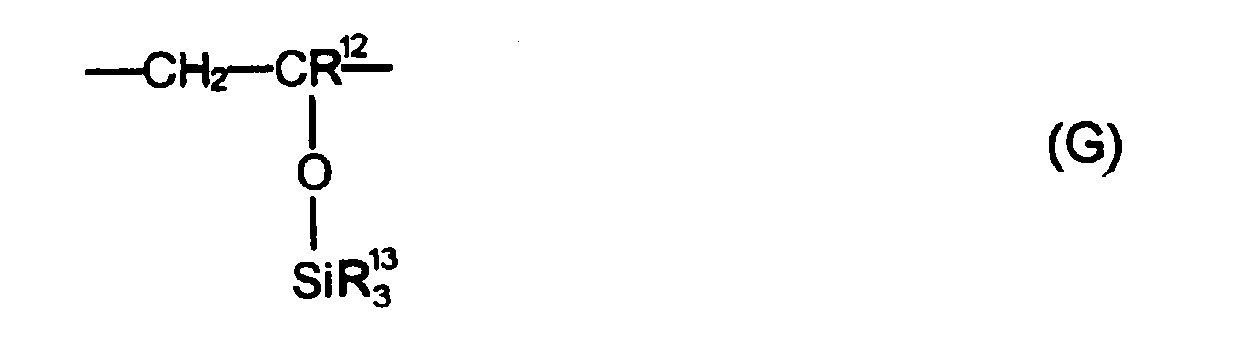
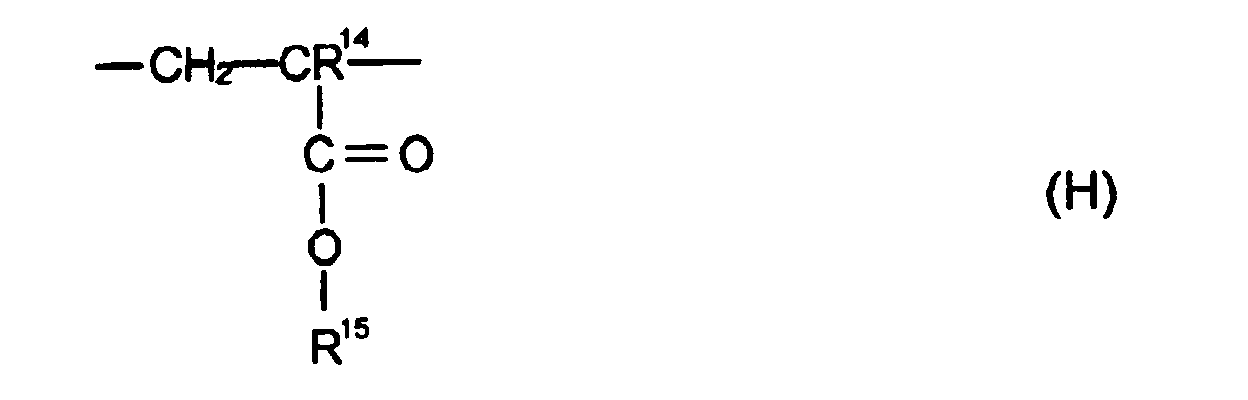
- the styrene random copolymer consists of the following styrene derivative repeating unit (I) and one or more of the following macromonomer repeating unit (II): wherein R 1 is a hydrogen, a halogen, or an alkyl group containing 1 ⁇ 20 carbon atoms, R 2 is a saturated hydrocarbon group containing 1 ⁇ 20 carbon atoms, an aromatic group, or a cycloalkyl group with the proviso that R 2 is not -CO- or -CH 2 -C 6 H 4 -, such as R 2 is a linear alkyl containing 1 ⁇ 10 carbons, R 3 is a saturated hydrocarbon group containing 1 ⁇ 10 carbon atoms, X is an ion polymerizable monomer for synthesizing the macromonomer and is represented as the following structural formulae (A) to (K), n is a degree of polymerization for the styrene repeating unit, m is a degree of polymerization
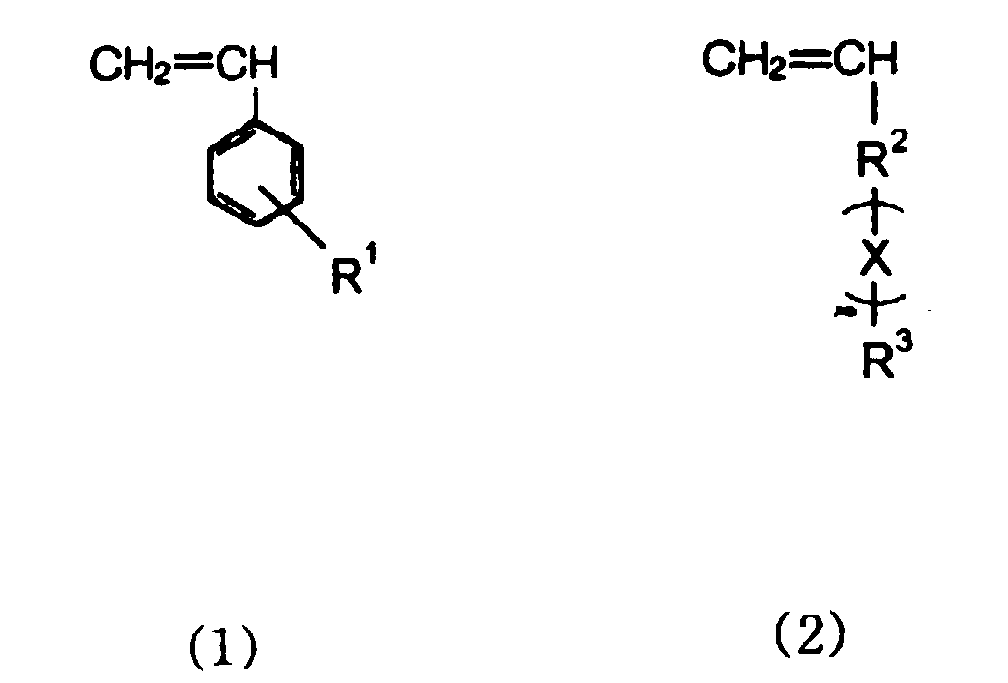
- a styrene derivative monomer represented by the following general formula (1) and a macromonomer represented by the following general formula (2) are copolymerized: wherein R 1 is a hydrogen, a halogen, or an alkyl group containing 1 ⁇ 20 carbon atoms, R 2 is a saturated hydrocarbon containing 1 ⁇ 20 carbon atoms, an aromatic group or a cycloalkyl group with the proviso that R 2 is not -CO- or -CH 2 -C 6 H 4 -, such as R 2 is a linear alkyl containing 1 ⁇ 10 carbons, R 3 is a saturated hydrocarbon containing 1 ⁇ 10 carbon atoms, l is the degree of polymerization for X in the range of 10 to 1,000 integers.
- the styrene monomer used to prepare the styrene random copolymer of the present invention is commercially available.
- Typical examples of the styrene monomer are styrene; halogenated styrene such as o-, m-, p-chlorostyrene, o-, m-, p-bromostytrene, and o-, m-, p-fluorostyrene; and alkylstyrene such as o-, m-, p- methylstyrene, o-, m-, p- ethylstyrene, o-, m-, p- propylstyrene, o-, m-, p- butylstyrene, o-, m-, p-tert-butylstyrene, etc.
- the macromonomer used as a comonomer in this invention is prepared by polymerizing an ion polymerizable monomer represented by the general formula (2) using an ionic initiator, and reacting the resulting macromonomer with a halogenated unsaturated hydrocarbon compound so as to form a vinyl group showing polymerization activity at the end of the chain.
- the macromonomer represented as the general formula (2) is prepared variously depending upon the species of monomer, and X in the formula (2) is the repeating unit of monomer having ion polymerization ability.
- Typical examples of the donor monomers showing ion polymerization ability are olefins such as isobutylene and isopentene; dienes such as isoprene, 1,3-butadiene, 2-fluoro-1,3-butadiene, 2,3-dichloro-1,3-butadiene, etc; styrene; halogenated styrenes such as o-, m-, p-chlorostyrene, o-, m-, p-bromostyrene, and o-, m-, p-fluorostyrene; alkylstyrenes such as o-, m-, p-methylstyrene, o-, m-, p-ethylstyrene, o-, m-, p-propylstyrene, o-, m-, p-butylstyrene, o-, m-
- the ion polymerizable monomer can be used singly and a mixture of at least two monomers can also be used.
- An initiator is employed for polymerization of the ion polymerizable monomer.
- Representative initiators include alkali metals such as cesium, rubidium, potassium, sodium, lithium, etc and alkali metal compounds such as n-butyl lithium, sec-butyl lithium, tert-butyl lithium, lithium diisopropylamide, octyl potassium, lithium trimethyl silanonate, butyl magnesium bromide, etc.
- the weight average molecular weight of the macromonomer is preferably in the range of 1,000 to 200,000, most preferably greater than 10,000, such as between 10,000 and 200,000.
- the styrene random copolymer of the present invention is prepared by copolymerization of a styrene monomer and a macromonomer in the presence of a catalyst comprising a transition metal compound and an alkylaluminoxane.
- the styrene repeating unit in the styrene random copolymer has a highly syndiotactic structure.
- the amount of macromonomer in the random copolymer is 0.1 ⁇ 50 % by weight preferably.
- the melting point of the styrene random copolymer is at 150 ⁇ 272 °C and the weight average molecular weight analyzed by gel permeation chromatography is in the range of 50,000 to 2,000,000 preferably.
- the styrene random terpolymer according to the present invention is polymerized with a styrene monomer, a styrene derivative, and a macromonomer, thus having three repeating units of the two styrenes with a syndiotactic structure and of the macromonomer.
- the macromonomer has polymerization activity via a vinyl group at the end of the chain.
- the repeating unit of styrenes has a highly syndiotactic structure.
- the amount of macromonomer is 0.1 ⁇ 50 % by weight in the random copolymer.
- the melting point of the copolymer is at 150 ⁇ 272 °C, and the weight average molecular weight is in the range of 50,000 to 5,000,000 when it is measured by gel permeation chromatography.
- the styrene random terpolymer of the present invention is prepared by polymerization of a styrene monomer, a styrene derivative, and a macromonomer in the presence of a catalyst comprising a transition metal compound and an alkylaluminoxane.
- the styrene random terpolymer is represented by the following formula (III): wherein R 1 is a hydrogen, a halogen, or an alkyl group containing 1 ⁇ 20 carbon atoms, R 2 is a saturated hydrocarbon containing 1 ⁇ 20 carbon atoms, an aromatic group or a cycloalkyl group with the proviso that R 2 is not -CO- or -CH 2 -C 6 H 4 -, such as R 2 is a linear alkyl containing 1 ⁇ 10 carbons, R 3 is a saturated hydrocarbon containing 1 ⁇ 10 carbon atoms, m is an integer of 400 to 20,000 as a degree of polymerization for the repeating unit of styrene monomer, n is an integer of 5 to 200 as a degree of polymerization for the repeating unit of styrene derivative monomer, o is an integer of 1 to 20 as a degree of polymerization for the repeating unit of macromonomer, and l is the degree
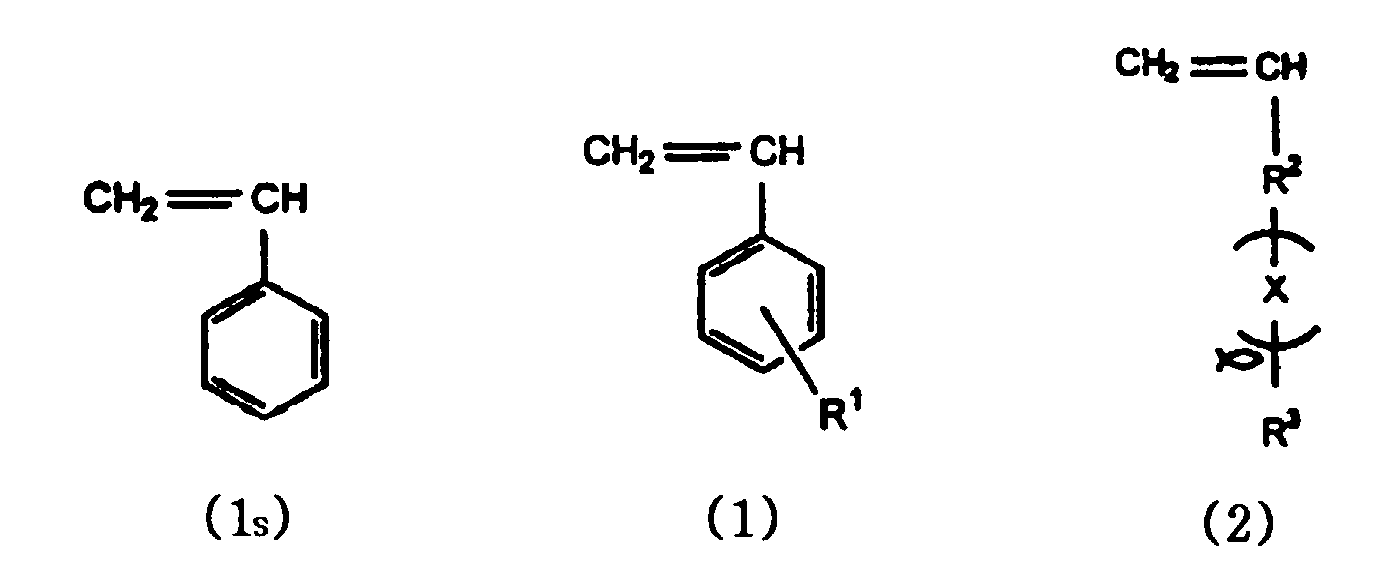
- a styrene monomer represented by the following general formula (1 s ), a styrene derivative monomer represented by the following general formula (1), and a macromonomer represented by the following general formula (2) are polymerized: wherein R 1 is a hydrogen, a halogen, or an alkyl group containing 1 ⁇ 20 carbon atoms, R 2 is a saturated hydrocarbon containing 1 ⁇ 20 carbon atoms, an aromatic group or a cycloalkyl group with the proviso that R 2 is not -CO- or -CH 2 -C 6 H 4 -, such as R 2 is a linear alkyl containing 1 ⁇ 10 carbons, R 3 is a saturated hydrocarbon containing 1 ⁇ 10 carbon atoms.
- the styrene derivative monomer which is represented by the formula (1), used to prepare the styrene random terpolymer of the present invention, is commercially available.
- Typical examples of the styrene derivative monomer are halogenated styrene such as o-, m-, p-chlorostyrene, o-, m-, p-bromostyrene, and o-, m-, p-fluorostyrene; and alkylstyrene such as o-, m-, p- methylstyrene, o-, m-, p- ethylstyrene, o-, m-, p- propylstyrene, o-, m-, p- butylstyrene, o-, m-, p-tert-butylstyrene, etc.
- the macromonomer represented by the general formula (2) used as a monomer in this invention is prepared by polymerizing at least one ion polymerizable monomer using an ionic initiator, and reacting the resulting macromonomer with a halogenated unsaturated hydrocarbon compound so as to form a vinyl group showing polymerization activity at the end of the chain.
- the macromonomer represented by the general formula (2) is prepared variously depending upon the species of monomer, and X in the formula (2) is the repeating unit of monomer having ion polymerization ability.
- the monomers having ion polymerization ability are monomers, which include the same as represented in formulae (a) to (k) above.
- Typical examples of the donor monomers showing ion polymerization ability are olefins such as isobutylene and isopentene; dienes such as isoprene, 1,3-butadiene, 2-fluoro-1,3-butadiene, 2,3-dichloro-1,3-butadiene, etc; styrene; halogenated styrenes such as o-, m-, p-chlorostyrene, o-, m-, p-bromostyrene, and o-, m-, p-fluorostyrene; alkylstyrenes such as o-, m-, p-methylstyrene, o-, m-, p-ethylstyrene, o-, m-, p-propylstyrene, o-, m-, p-butylstyrene, o-, m-
- the ion polymerizable monomer can be used singly and a mixture of at least two monomers can also be used.
- An initiator is employed for polymerization of the ion polymerizable monomer.
- Representative initiators include alkali metals such as cesium, rubidium, potassium, sodium, lithium, etc and alkali metal compounds such as n-butyl lithium, sec-butyl lithium, tert-butyl lithium, lithium diisopropylamide, octyl potassium, lithium trimethyl silanonate, butyl magnesium bromide, etc.
- the weight average molecular weight of the macromonomer is preferably in the range of 1,000 to 300,000, most preferably greater than 10,000, such as between 10,000 and 300,000.
- the styrene random copolymer or terpolymer of the present invention is prepared in the presence of a catalyst comprising a transition metal compound, preferably a Group IV transition metal compound, more preferably a titanium compound, as a major catalyst, and an organic aluminum or an alkylaluminoxane, which is formed by reaction of organic aluminum and water, as a cocatalyst.
- a catalyst comprising a transition metal compound, preferably a Group IV transition metal compound, more preferably a titanium compound, as a major catalyst, and an organic aluminum or an alkylaluminoxane, which is formed by reaction of organic aluminum and water, as a cocatalyst.
- the molar ratio of aluminum to titanium is from about 1:1 to about 1,000,000:1, preferably, from about 10:1 to about 10,000:1.
- the temperature of polymerization is preferably in the range of about 0 to 90 °C and the time of polymerization is in the range of about 1 second to 24 hours.
- the solvent usable in the solution polymerization includes aliphatic hydrocarbons such as pentane, hexane, and heptane and aromatic hydrocarbons such as benzene, toluene, and xylene.
- the styrene terpolymer according to the present invention has a 5 to 70 °C lower melting point than a conventional styrene homopolymer.
- the temperature for processing with the terpolymer can be lowered by controlling the amount of the styrene derivative in the terpolymer. Since the styrene copolymer and terpolymer contain the marcomonomer units to form long chains, the melt flowability can be improved during the post process.
- the flexural modulus and Izod impact strength of the copolymer and terpolymer are not reduced as much as in the styrene homopolymer although the amount of styrene derivative is increased.
- the copolymer or terpolymer has a good compatibility with a rubber component so as to provide a resin composition with improved impact strength.
- the copolymer or terpolymer of the present invention can be processed at relatively lower temperatures with not causing deterioration of other physical properties.
- a styrene macromonomer having a degree of polymerization of 40 was prepared in the same manner as in Example 1A, except that 2.5 mmol of tert-butyl lithium was used as the initiator and 3.0 mmol of 3-chloro-1-propene was used as the endcapping reagent.
- a styrene macromonomer having a degree of polymerization of 100 was prepared in the same manner as in Example 1A, except that 1 mmol of tert-butyl lithium was used as the initiator and 12 mmol of 3-chloro-1-propene was used as the endcapping reagent.
- a styrene macromonomer having a degree of polymerization of 1000 was prepared in the same manner as in Example 1A, except that 0.1 mmol of tert-butyl lithium was used as the initiator and 0.12 mmol of 3-chloro-1-propene was used as the endcapping reagent.
- An isoprene macromonomer having a degree of polymerization of 40 was prepared in the same manner as in Example 2A except that 2.5 ml of tert-butyl lithium was used as the initiator and 3.0 ml of 3-chloro-1-propene was used as the endcapping reagent.
- An isoprene macromonomer having a degree of polymerization of 100 was prepared in the same manner as in Example 2A except that 1 mmol of tert-butyl lithium was used as the initiator and 1.2 mmol of 3-chloro-1-propene was used as the endcapping reagent.
- An isoprene macromonomer having a degree of polymerization of 1000 was prepared in the same manner as in Example 2A except that 0.1 mmol of tert-butyl lithium was used as the initiator and 0.12 mmol of 3-chloro-1-propene was used as the endcapping reagent.
- Styrene-isoprene block macromonomers having degrees of polymerization of 40-100 was prepared in the same manner as in Example 3A .
- Styrene-isoprene block macromonomers having degrees of polymerization of 100-100 was prepared in the same manner as in Example 3A .
- Styrene-isoprene block macromonomers having degrees of polymerization of 1000-1000 was prepared in the same manner as in Example 3A .
- Isoprene-styrene block macromonomers having degrees of polymerization of 40-100 was prepared in the same manner as in Example 3B .
- Isoprene-styrene block macromonomers having degrees of polymerization of 100-100 was prepared in the same manner as in Example 3C .
- Isoprene-styrene block macromonomers having degrees of polymerization of 1000-1000 was prepared in the same manner as in Example 3D .
- Isoprene-styrene block macromonomers having degrees of polymerization of 25-25 was prepared in the same manner as in Example 3D .
- Isoprene-styrene block macromonomers having degrees of polymerization of 50-50 was prepared in the same manner as in Example 3D .
- a siloxane macromonomer having a degree of polymerization of 41 was prepared in the same manner as in Example 5A except that 2.5 mmol of tert-butyl lithium was used as the initiator and 3.0 mmol of 3-chloro-1-propene was used as the endcapping reagent.
- a methyl methacylate macromonomer having a degree of polymerization of 10 was prepared in the same manner as in Example 6A except that 10 mmol of sec-butyl lithium was used as the initiator and 12 mmol of 3-chloro-1-propene was used as the endcapping reagent.
- a methyl methacylate macromonomer having a degree of polymerization of 41 was prepared in the same manner as in Example 6A except that 2.5 mmol of sec-butyl lithium was used as the initiator and 3.0 mmol of 3-chloro-1-propene was used as the endcapping reagent.
- n-butyl methacrylate macromonomers having various degrees of polymerization were prepared in the same manner as in Example 6C except that n-butyl methacrylate was used instead of methyl methacrylate.
- Example 8 preparation of styrene/n-butyl methacrylate block macromonomer
- a styrene/n-butyl methacrylate block macromonomer having various degrees of polymerization were prepared in the same manner as in Example 3 except that n-butyl methacrylate was used instead of isoprene.
- Example 9 preparation of styrene/macromonomer random copolymer (Example 9(A) to 9(T))
- Example monomer macromonomer degree of polymerization of macromonomer yield (g) amount of macromonomer (wt%) melting point (°C) weight average molecular insoluble weight fraction insoluble (wt%) 9(A) styrene
- Example 1A 20 3.2 7.0 268 200000 93 9(B) styrene
- Example 1B 40 3.2 6.9 265 195000 93 9(C) styrene
- Example 1C 100 3.2 6.8 264 197000 92 9(D) styrene
- Example 1D 1000 3.3 7.0 264 196000
- Example 2A 20 3.4 7.2 263 198000 93 9(F) styrene
- Example 2B 40 40 3.3 6.8 263 201000 94 9(G) styrene
- Example 2C 100 3.3 6.2 259 189000 93 9(H
- Example 10A-10D preparation of terpolymer
- the weight average molecular weight of the terpolymer obtained was 400,000, and the melting point was 250 °C.
- the amount of isoprene-styrene macromonomer was 2.45 % by weight and that of tert-butylstyrene was 1.69 mol %.
- the resulting data are shown in Table 2.
- Example 10A The polymerization for preparing a terpolymer was conducted in the same manner as in Example 10A except that isoprene-styrene block macromonomer with a degree of polymerization 50-50 of Example 3I was used. The resulting data are shown in Table 2.
- Example 10A The polymerization for preparing a terpolymer was conducted in the same manner as in Example 10A except that isoprene-styrene block macromonomer with a degree of polymerization 100-100 of Example 3F was used. The resulting data are shown in Table 2.
- Example 10A The polymerization for preparing a terpolymer was conducted in the same manner as in Example 10A except that isoprene-styrene block macromonomer with a degree of polymerization 1000-1000 of Example 3G was used. The resulting data were shown in Table 2.
- the polymerization for preparing a styrene homopolymer was conducted in the same manner as in Example 10A except that tert-butylstyrene and isoprene-styrene block macromonomer were not used.
- the resulting data are shown in Table 2.
- the polymerization for preparing a styrene/tert-butylstyrene copolymer was conducted in the same manner as in Example 10A except that isoprene-styrene block macromonomer was not used.
- the resulting data were shown in Table 2.
- the polymerization for preparing a styrene copolymer was conducted in the same manner as in Example 9A except that tert-butylstyrene was not used, but isoprene-styrene block macromonomer with a degree of polymerization 1000-1000 was used.
- the resulting data are shown in Table 2.
- the melting point, molecular weight, amount of macromonomer, and fraction insoluble were obtained by the following methods:
- the melting point was measured by DuPont DSC (Differential Scanning Calorimeter) heating the polymer at the rate of 10 °C increase per minute.
- the molecular weight of the polymer was measured by PL-GPC (Mixed B column) at 135 °C using 1,2,4-trichlorobenzene as a solvent.
- the mount of macromonomer in the copolymer was measured by Bruker NMR-300 at 115 °C using 1,2,4-trichlorobenzene/benzene-d6 as a solvent at 115 °C.
- Fraction insoluble was represented as weight % using the methylethylketone as a solvent.
- Shear viscosity was measured by Capillary Rheometry at 290 °C in the range of 1 ⁇ 10 4 (sec -1 ) of shear rate.
- the shear viscosity was shown in Fig. 2 and Table 3 to measure the melt flowability of styrene random terpolymer.
- the shear viscosities of the random terpolymer of Example 9A-9D and the styrene homopolymer and copolymers of Comparative Example 2A-2C were measured at 290 °C.
- the shear viscosities of styrene random terpolymer were much lower than those of styrene homopolymer irrespective of shear rates.
- Example 9A-9D To 35 grams of the random terpolymers of Example 9A-9D and the styrene homopolymer and copolymers of Comparative Example 2A-2C, respectively, was added 15 grams SEBS, and each composition was blended in a mixer at 50 rpm at 280 °C for 5 minutes. Each specimen for impact strength was prepared and tested according to ASTM 256-D. The resulting data were shown in Table 3 and in Fig. 3.
- the shear viscosity was shown in Fig. 1 to measure the melt flowability of styrene random copolymer.
- the shear viscosities of the random copolymer of Example 8(A), 8(E), and 8(K) and the styrene homopolymer of the Comparative Example were measured at 290 °C.
- the shear viscosities of styrene random copolymer was much lower than those of styrene homopolymer irrespective of shear rates.
Landscapes
- Chemical & Material Sciences (AREA)
- Health & Medical Sciences (AREA)
- Chemical Kinetics & Catalysis (AREA)
- Medicinal Chemistry (AREA)
- Polymers & Plastics (AREA)
- Organic Chemistry (AREA)
- Macromonomer-Based Addition Polymer (AREA)
- Transition And Organic Metals Composition Catalysts For Addition Polymerization (AREA)
Abstract
Description
- The present invention relates to a styrene/macromonomer random copolymer. More specifically, the present invention relates to a styrene/ macromonomer random copolymer that has excellent melt flowability as well as good heat resistance, chemical resistance, dimensional stability, elongation, flexural strength, impact strength, compatibility, and electrical properties. The present invention includes a method of preparing the styrene copolymer. Also, the present invention relates to a styrene/styrene derivative/macromonomer random terpolymer and a method of preparing the terpolymer.
- In general, a styrene resin is prepared by radical polymerization. Since a styrene resin prepared by radical polymerization has an atactic structure as a whole, it has poor heat resistance and chemical resistance. A styrene resin with stereoregularity is prepared in the form of an isotactic structure or a syndiotactic structure. The former is polymerized by using a Ziegler catalyst and the latter is polymerized by using a uniform catalyst consisting of a titanium compound such as halogen titanium, alkoxy titanium, etc. with an alkylaluminoxane.
- The styrene resin having a syndiotactic structure has good heat resistance and chemical resistance, but, on the other hand, it has poor impact strength. In order to overcome these shortcomings, methods of mixing rubber, inorganic filler, etc. have been attempted, but in this case, their usage is limited. Further, since the melting point of the styrene resin is about 270 °C and the degradation temperature is 310 °C, it is not easy to operate the process.
- Recently, macromonomers with polymerization activity at the end of the chain have been developed and applied to various uses. The present inventors have developed a styrene/macromonomer random copolymer that has excellent melt flowability as well as good heat resistance, chemical resistance, dimensional stability, elongation, flexural strength, impact strength, compatibility, and electrical properties, which are required for engineering plastics. Further, the present inventors have developed a styrene/styrene derivative/macromonomer random terpolymer having excellent melt flowability as well as impact strength and other physical properties.
- A feature of the present invention is the provision of a styrene random copolymer having excellent melt flowability, which is prepared by copolymerization of a styrene derivative monomer and a macromonomer and which is useful for engineering plastics having good heat resistance.
- Another feature of the present invention is the provision of a styrene random copolymer prepared by copolymerization of a styrene derivative monomer and a macromonomer, which has good heat resistance, chemical resistance, dimensional stability, elongation, flexural strength, impact strength, compatibility, and electrical properties.
- A further feature of the present invention is the provision of a method of preparing the styrene random copolymer prepared by copolymerization of a styrene derivative monomer and a macromonomer.
- A further feature of the present invention is the provision of a styrene random terpolymer having excellent melt flowability, which is prepared by polymerization of a styrene monomer, a styrene derivative, and a macromonomer and which is useful to engineering plastics having good heat resistance.
- A further feature of the present invention is the provision of a styrene random terpolymer prepared by polymerization of a styrene monomer, a styrene derivative, and a macromonomer, which has good heat resistance, chemical resistance, dimensional stability, elongation, flexural strength, impact strength, compatibility, and electrical properties.
- A further feature of the present invention is the provision of a method of preparing the styrene random terpolymer prepared by polymerization of a styrene monomer, a styrene derivative, and a macromonomer.
- The above and the other objects and advantages of this invention will be apparent from the ensuing disclosure and appended claims.
- The styrene random copolymer according to the present invention is copolymerized with a styrene monomer and a macromonomer, thus having at least two repeating units, the styrene derivative with a syndiotactic structure and the macromonomer. The macromonomer has polymerization activity via a vinyl group at the end of the chain. The repeating units of styrene derivative have a highly syndiotactic structure. The amount of macromonomer is 0.1 ~ 50 % by weight in the random copolymer. The melting point of the copolymer is at 150 ~ 272 °C, and the weight average molecular weight is in the range of 50,000 to 2,000,000 when it is measured by gel permeation chromatography. The styrene random copolymer of the present invention is prepared by polymerization of a styrene derivative monomer and a macromonomer in the presence of a catalyst comprising a transition metal compound and an alkylaluminoxane.
- Further, the present invention includes a styrene random terpolymer being copolymerized from a styrene monomer, a styrene derivative, and a macromonomer, thus having at least three repeating units, the two styrenes with a syndiotactic structure and the macromonomer. The macromonomer has a polymerization activity via a vinyl group at the end of the chain. The repeating units of the styrene have a highly syndiotactic structure. The amount of macromonomer is 0.1 to 50 % by weight in the random terpolymer. The melting point of the terpolymer is at 150 ~ 272 °C, and the weight average molecular weight is in the range of 50,000 to 5,000,000 when it is measured by gel permeation chromatography. The styrene random terpolymer of the present invention is prepared in the presence of a catalyst comprising a transition metal compound and an alkylaluminoxane.
-
- Fig. 1 is a graph of shear viscosity measured at 270 °C of the random copolymers of Examples 8(A), 8(E), and 8(K) and of a styrene homopolymer of Comparative Example 1 to measure melt flowability of the random copolymer;
- Fig. 2 is a graph of shear viscosity measured at 270 °C of the random terpolymers of Examples 9(A)-9(D) and of styrene homopolymer and copolymer of Comparative Examples 2(A)-2(C) to measure melt flowability of the random terpolymer; and
- Fig. 3 is a graph of Izod impact strength measured of the random terpolymers of Examples 9(A)-9(D) and of styrene homopolymer and copolymer of Comparative Examples 2(A)-2(C) to measure impact strength of the random terpolymer.
-
- The styrene random copolymer according to the present invention is copolymerized with a styrene derivative monomer and a macromonomer, thus having at least two repeating units, the styrene with a syndiotactic structure and the macromonomer. The macromonomer has polymerization activity via a vinyl group at the end of the chain. The repeating units of styrene derivative has a highly syndiotactic structure. The amount of macromonomer is 0.1 ~ 50 % by weight in the random copolymer. The melting point of the copolymer is at 150 ~ 272 °C, and the weight average molecular weight is in the range of 50,000 to 2,000,000 when it is measured by gel permeation chromatography. The styrene random copolymer of the present invention is prepared by polymerization of a styrene derivative monomer and a macromonomer in the presence of a catalyst comprising a transition metal compound and an alkylaluminoxane.
- The styrene random copolymer consists of the following styrene derivative repeating unit (I) and one or more of the following macromonomer repeating unit (II):wherein R1 is a hydrogen, a halogen, or an alkyl group containing 1 ~ 20 carbon atoms, R2 is a saturated hydrocarbon group containing 1 ~ 20 carbon atoms, an aromatic group, or a cycloalkyl group with the proviso that R2 is not -CO- or -CH2-C6H4-, such as R2 is a linear alkyl containing 1 ~ 10 carbons, R3 is a saturated hydrocarbon group containing 1 ~ 10 carbon atoms, X is an ion polymerizable monomer for synthesizing the macromonomer and is represented as the following structural formulae (A) to (K), n is a degree of polymerization for the styrene repeating unit, m is a degree of polymerization for the macromonomer repeating unit, ℓ is the degree of polymerization for X;


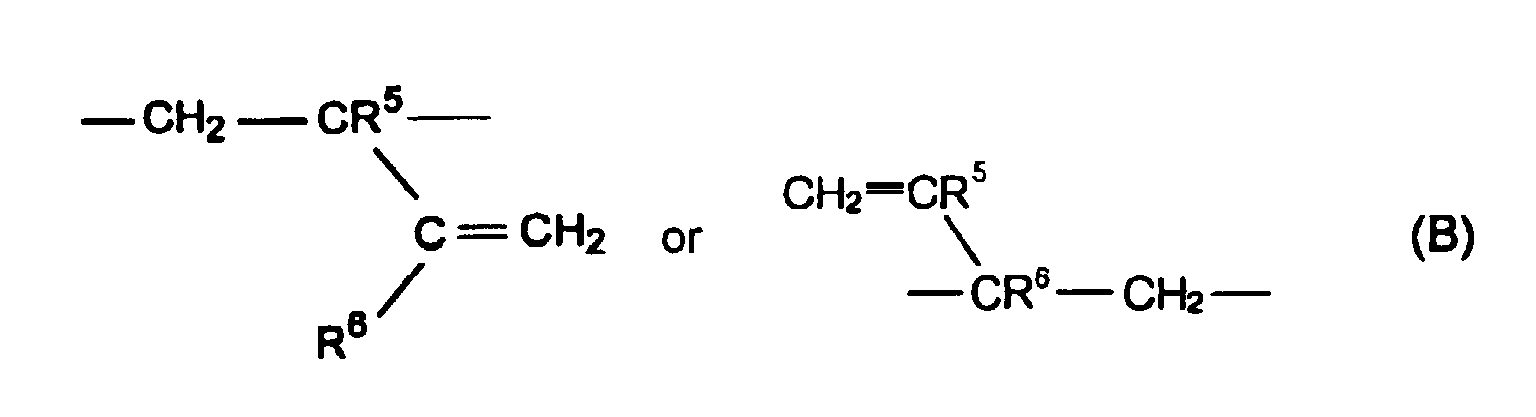
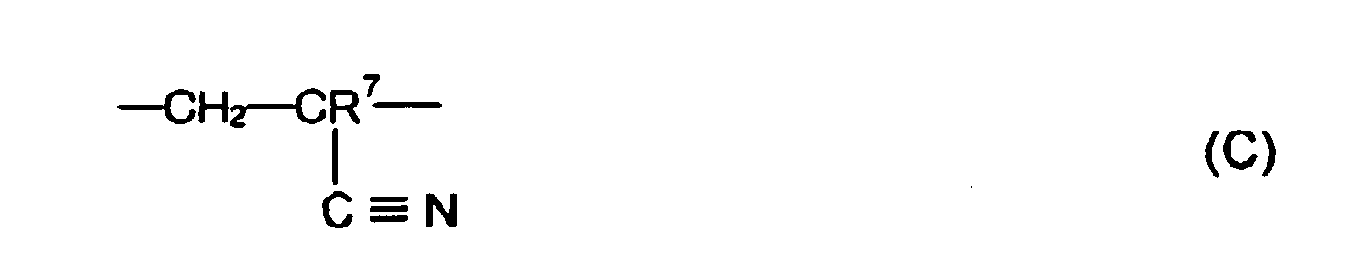
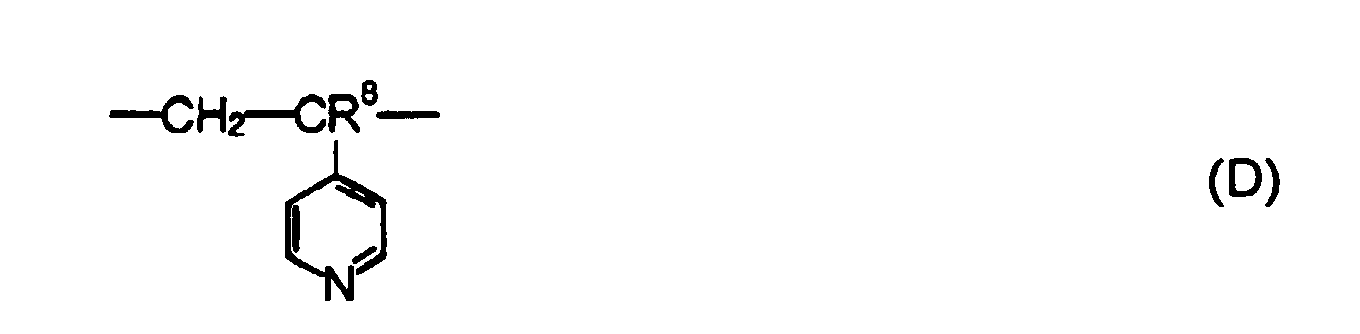
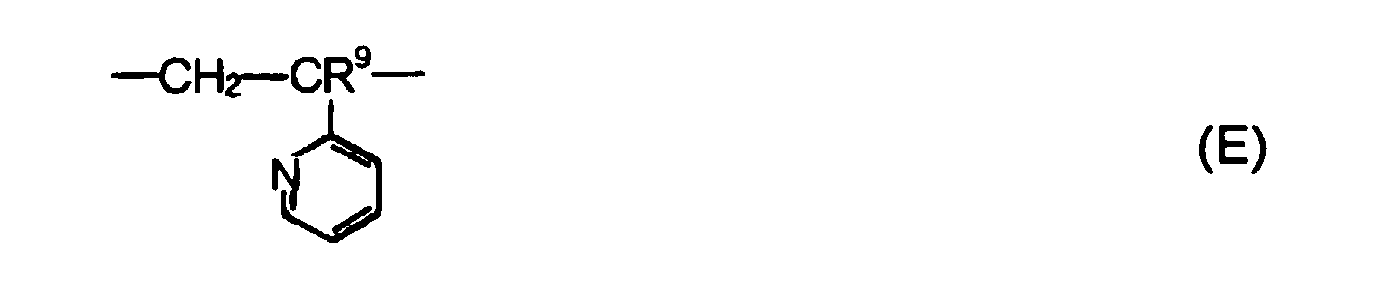

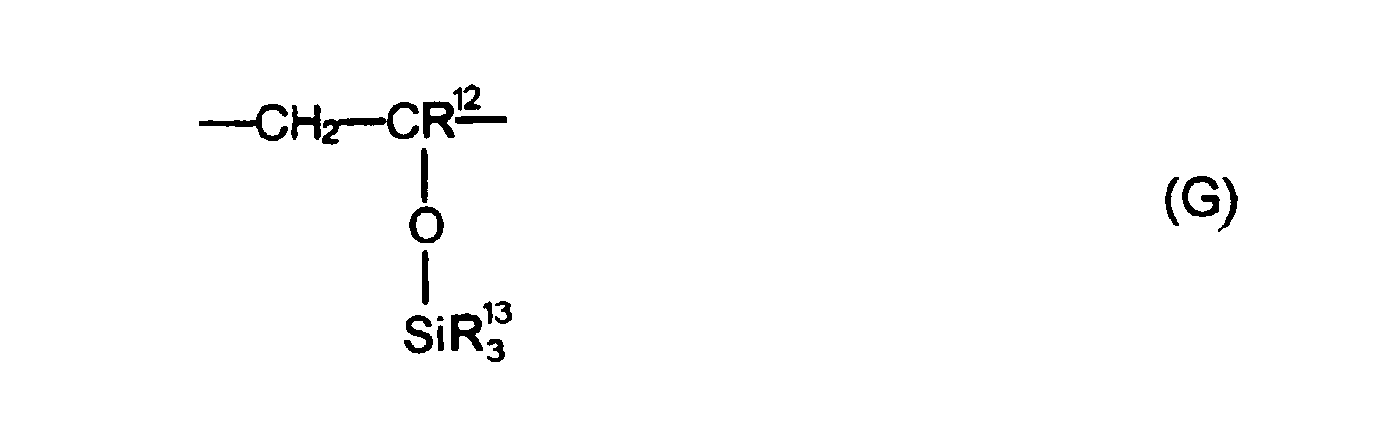

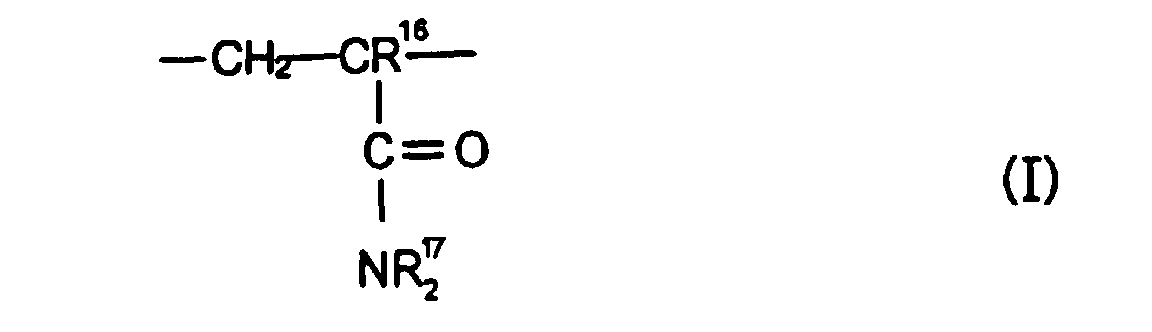 wherein R4, R5, R6, R7, R8, and R9 are the same or different and are a hydrogen, a halogen, or an alkyl or alkoxy group containing 1 ~ 20 carbon atoms, R10, R11, R12, R13, R14, R15, R16, and R17 are the same or different and are an alkyl group containing 1 ~ 20 carbon atoms, R14 and R15 are the same or different and are a hydrogen or an alkyl group containing 1 ~ 20 carbon atoms, R18 is a hydrogen or an alkyl group containing 1 ~ 4 carbon atoms, R19 is an alkyl group containing 1 ~ 4 carbon atoms.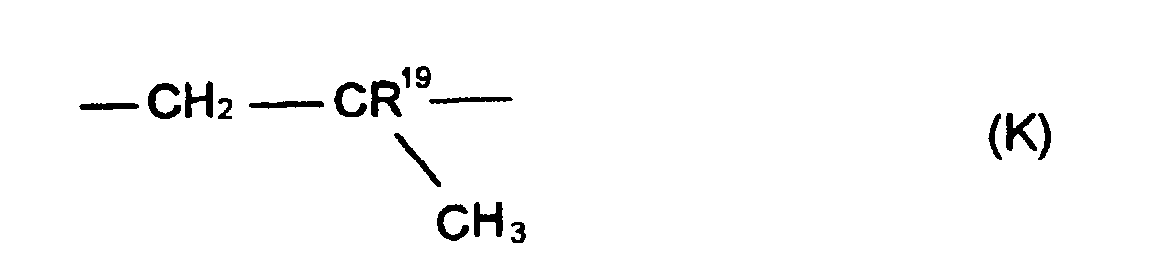
- To prepare the styrene random copolymer of the present invention, a styrene derivative monomer represented by the following general formula (1) and a macromonomer represented by the following general formula (2) are copolymerized:wherein R1 is a hydrogen, a halogen, or an alkyl group containing 1 ~ 20 carbon atoms, R2 is a saturated hydrocarbon containing 1 ~ 20 carbon atoms, an aromatic group or a cycloalkyl group with the proviso that R2 is not -CO- or -CH2-C6H4-, such as R2 is a linear alkyl containing 1 ~ 10 carbons, R3 is a saturated hydrocarbon containing 1 ~ 10 carbon atoms, ℓ is the degree of polymerization for X in the range of 10 to 1,000 integers.

- The styrene monomer used to prepare the styrene random copolymer of the present invention is commercially available. Typical examples of the styrene monomer are styrene; halogenated styrene such as o-, m-, p-chlorostyrene, o-, m-, p-bromostytrene, and o-, m-, p-fluorostyrene; and alkylstyrene such as o-, m-, p- methylstyrene, o-, m-, p- ethylstyrene, o-, m-, p- propylstyrene, o-, m-, p- butylstyrene, o-, m-, p-tert-butylstyrene, etc.
- The macromonomer used as a comonomer in this invention is prepared by polymerizing an ion polymerizable monomer represented by the general formula (2) using an ionic initiator, and reacting the resulting macromonomer with a halogenated unsaturated hydrocarbon compound so as to form a vinyl group showing polymerization activity at the end of the chain.
- The macromonomer represented as the general formula (2) is prepared variously depending upon the species of monomer, and X in the formula (2) is the repeating unit of monomer having ion polymerization ability.
- The monomers having ion polymerization ability are monomers represented by the following general formulae (a) to (k):
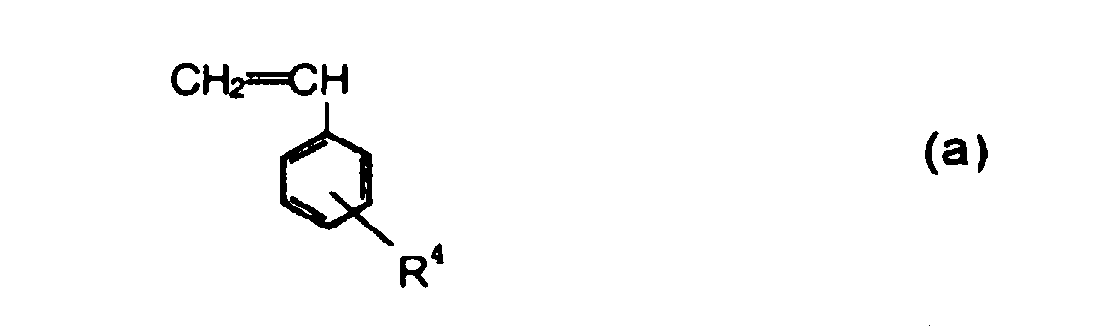


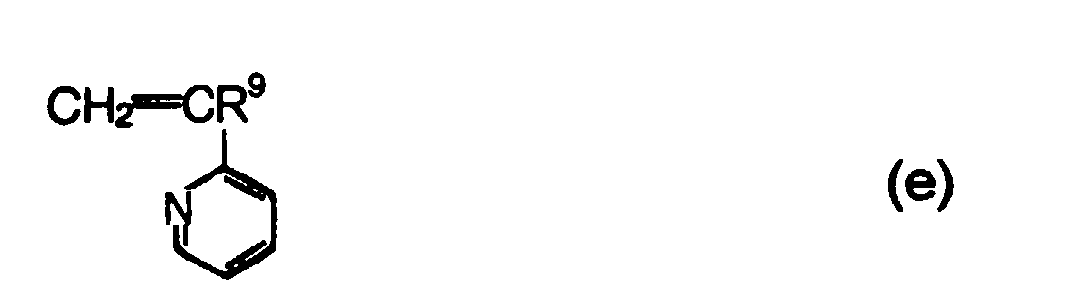
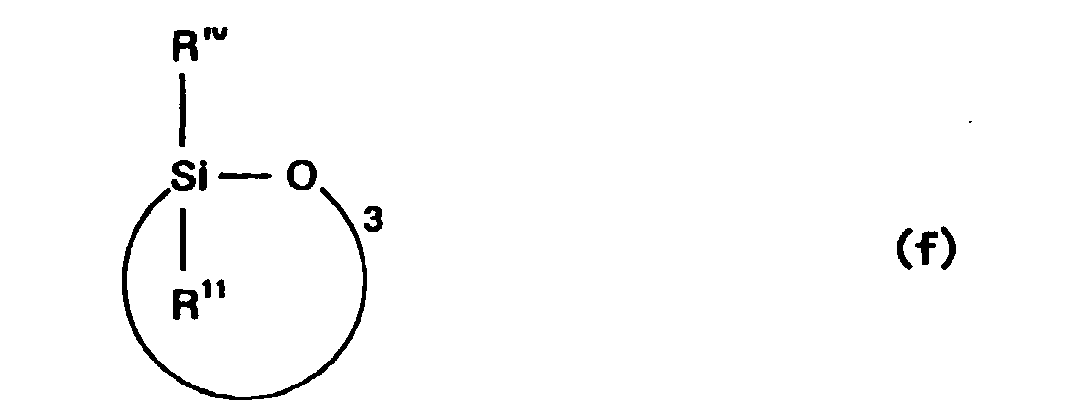


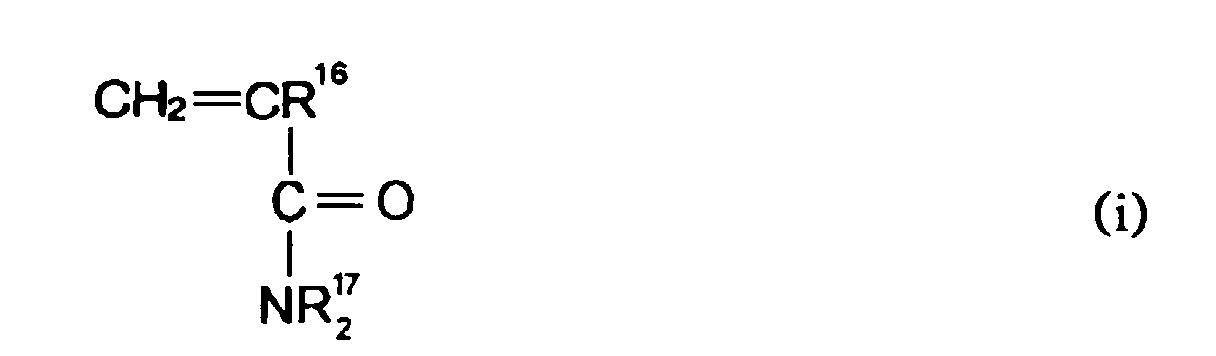
 wherein R4, R5, R6, R7, R8, and R9 the same or different and are a hydrogen, a halogen, or an alkyl group or an alkoxy group containing 1 ~ 20 carbon atoms, R10, R11, R12, R13, R16, and R17 are the same or different and are an alkyl group containing 1 ~ 20 carbon atoms, R14 and R15 are the same or different and are a hydrogen or an alkyl group containing 1 ~ 20 carbon atoms, R18 is a hydrogen or an alkyl group containing 1 ~ 4 carbon atoms, and R19 is an alkyl group containing 1 ~ 4 carbon atoms.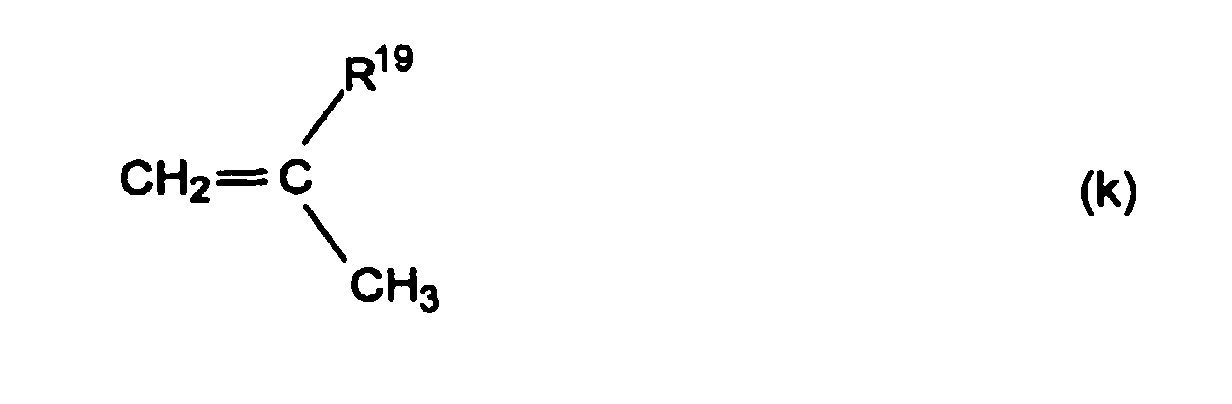
- Typical examples of the donor monomers showing ion polymerization ability are olefins such as isobutylene and isopentene; dienes such as isoprene, 1,3-butadiene, 2-fluoro-1,3-butadiene, 2,3-dichloro-1,3-butadiene, etc; styrene; halogenated styrenes such as o-, m-, p-chlorostyrene, o-, m-, p-bromostyrene, and o-, m-, p-fluorostyrene; alkylstyrenes such as o-, m-, p-methylstyrene, o-, m-, p-ethylstyrene, o-, m-, p-propylstyrene, o-, m-, p-butylstyrene, o-, m-, p-tert-butylstyrene, etc; acrylonitrile; ethyleneoxide; propyleneoxide; hexamethylcyclotrisiloxane; vinylsiloxane; vinylacetates; methacrylates; methacrylic acids; methacrylamides; 2-vinylpyridine; 4-vinylpyridine, etc.
- To prepare the macromonomer according to the present invention, the ion polymerizable monomer can be used singly and a mixture of at least two monomers can also be used.
- An initiator is employed for polymerization of the ion polymerizable monomer. Representative initiators include alkali metals such as cesium, rubidium, potassium, sodium, lithium, etc and alkali metal compounds such as n-butyl lithium, sec-butyl lithium, tert-butyl lithium, lithium diisopropylamide, octyl potassium, lithium trimethyl silanonate, butyl magnesium bromide, etc.
- The weight average molecular weight of the macromonomer is preferably in the range of 1,000 to 200,000, most preferably greater than 10,000, such as between 10,000 and 200,000.
- The styrene random copolymer of the present invention is prepared by copolymerization of a styrene monomer and a macromonomer in the presence of a catalyst comprising a transition metal compound and an alkylaluminoxane.
- The styrene repeating unit in the styrene random copolymer has a highly syndiotactic structure. The amount of macromonomer in the random copolymer is 0.1 ~ 50 % by weight preferably. The melting point of the styrene random copolymer is at 150 ~ 272 °C and the weight average molecular weight analyzed by gel permeation chromatography is in the range of 50,000 to 2,000,000 preferably.
- Further, the styrene random terpolymer according to the present invention is polymerized with a styrene monomer, a styrene derivative, and a macromonomer, thus having three repeating units of the two styrenes with a syndiotactic structure and of the macromonomer. The macromonomer has polymerization activity via a vinyl group at the end of the chain. The repeating unit of styrenes has a highly syndiotactic structure. The amount of macromonomer is 0.1 ~ 50 % by weight in the random copolymer. The melting point of the copolymer is at 150 ~ 272 °C, and the weight average molecular weight is in the range of 50,000 to 5,000,000 when it is measured by gel permeation chromatography. The styrene random terpolymer of the present invention is prepared by polymerization of a styrene monomer, a styrene derivative, and a macromonomer in the presence of a catalyst comprising a transition metal compound and an alkylaluminoxane.

- The styrene random terpolymer is represented by the following formula (III):
wherein R1 is a hydrogen, a halogen, or an alkyl group containing 1 ~ 20 carbon atoms, R2 is a saturated hydrocarbon containing 1 ~ 20 carbon atoms, an aromatic group or a cycloalkyl group with the proviso that R2 is not -CO- or -CH2-C6H4-, such as R2 is a linear alkyl containing 1 ~ 10 carbons, R3 is a saturated hydrocarbon containing 1 ~ 10 carbon atoms, m is an integer of 400 to 20,000 as a degree of polymerization for the repeating unit of styrene monomer, n is an integer of 5 to 200 as a degree of polymerization for the repeating unit of styrene derivative monomer, o is an integer of 1 to 20 as a degree of polymerization for the repeating unit of macromonomer, and ℓ is the degree of polymerization for X in the range of 10 to 3,000 integers. - To prepare the styrene random terpolymer of the present invention, a styrene monomer represented by the following general formula (1s), a styrene derivative monomer represented by the following general formula (1), and a macromonomer represented by the following general formula (2) are polymerized:wherein R1 is a hydrogen, a halogen, or an alkyl group containing 1 ~ 20 carbon atoms, R2 is a saturated hydrocarbon containing 1 ~ 20 carbon atoms, an aromatic group or a cycloalkyl group with the proviso that R2 is not -CO- or -CH2-C6H4-, such as R2 is a linear alkyl containing 1 ~ 10 carbons, R3 is a saturated hydrocarbon containing 1 ~ 10 carbon atoms.

- The styrene derivative monomer, which is represented by the formula (1), used to prepare the styrene random terpolymer of the present invention, is commercially available. Typical examples of the styrene derivative monomer are halogenated styrene such as o-, m-, p-chlorostyrene, o-, m-, p-bromostyrene, and o-, m-, p-fluorostyrene; and alkylstyrene such as o-, m-, p- methylstyrene, o-, m-, p- ethylstyrene, o-, m-, p- propylstyrene, o-, m-, p- butylstyrene, o-, m-, p-tert-butylstyrene, etc.
- The macromonomer represented by the general formula (2) used as a monomer in this invention is prepared by polymerizing at least one ion polymerizable monomer using an ionic initiator, and reacting the resulting macromonomer with a halogenated unsaturated hydrocarbon compound so as to form a vinyl group showing polymerization activity at the end of the chain.
- The macromonomer represented by the general formula (2) is prepared variously depending upon the species of monomer, and X in the formula (2) is the repeating unit of monomer having ion polymerization ability. The monomers having ion polymerization ability are monomers, which include the same as represented in formulae (a) to (k) above.
- Typical examples of the donor monomers showing ion polymerization ability are olefins such as isobutylene and isopentene; dienes such as isoprene, 1,3-butadiene, 2-fluoro-1,3-butadiene, 2,3-dichloro-1,3-butadiene, etc; styrene; halogenated styrenes such as o-, m-, p-chlorostyrene, o-, m-, p-bromostyrene, and o-, m-, p-fluorostyrene; alkylstyrenes such as o-, m-, p-methylstyrene, o-, m-, p-ethylstyrene, o-, m-, p-propylstyrene, o-, m-, p-butylstyrene, o-, m-, p-tert-butylstyrene, and etc; acrylonitrile; ethyleneoxide; propyleneoxide; hexamethylcyclotrisiloxane; vinylsiloxane; vinylacetates; methacrylates; methacrylic acids; methacrylamides; 2-vinylpyridine; 4-vinylpyridine, etc.
- To prepare the macromonomer according to the present invention, the ion polymerizable monomer can be used singly and a mixture of at least two monomers can also be used.
- An initiator is employed for polymerization of the ion polymerizable monomer. Representative initiators include alkali metals such as cesium, rubidium, potassium, sodium, lithium, etc and alkali metal compounds such as n-butyl lithium, sec-butyl lithium, tert-butyl lithium, lithium diisopropylamide, octyl potassium, lithium trimethyl silanonate, butyl magnesium bromide, etc.
- The weight average molecular weight of the macromonomer is preferably in the range of 1,000 to 300,000, most preferably greater than 10,000, such as between 10,000 and 300,000.
- The styrene random copolymer or terpolymer of the present invention is prepared in the presence of a catalyst comprising a transition metal compound, preferably a Group IV transition metal compound, more preferably a titanium compound, as a major catalyst, and an organic aluminum or an alkylaluminoxane, which is formed by reaction of organic aluminum and water, as a cocatalyst.
- When a titanium compound is used as a major catalyst, the molar ratio of aluminum to titanium is from about 1:1 to about 1,000,000:1, preferably, from about 10:1 to about 10,000:1.
- Bulk, solution, or suspension polymerization is available for preparing the copolymer or terpolymer according to the present invention. The temperature of polymerization is preferably in the range of about 0 to 90 °C and the time of polymerization is in the range of about 1 second to 24 hours. The solvent usable in the solution polymerization includes aliphatic hydrocarbons such as pentane, hexane, and heptane and aromatic hydrocarbons such as benzene, toluene, and xylene.
- The styrene terpolymer according to the present invention has a 5 to 70 °C lower melting point than a conventional styrene homopolymer. The temperature for processing with the terpolymer can be lowered by controlling the amount of the styrene derivative in the terpolymer. Since the styrene copolymer and terpolymer contain the marcomonomer units to form long chains, the melt flowability can be improved during the post process. The flexural modulus and Izod impact strength of the copolymer and terpolymer are not reduced as much as in the styrene homopolymer although the amount of styrene derivative is increased. And the copolymer or terpolymer has a good compatibility with a rubber component so as to provide a resin composition with improved impact strength. In consequence, the copolymer or terpolymer of the present invention can be processed at relatively lower temperatures with not causing deterioration of other physical properties.
- The present invention will be described in more details by the following Examples. The Examples are given only to illustrate the present invention and not intended in any way to limit the scope of the invention.
- To a 500 ml glass reactor, which had been dried under nitrogen atmosphere, were added 80 ml of toluene and 11.5 ml of styrene and then were added dropwise 5 mmol of tert-butyl lithium. Then polymerization was carried out at -78 °C. After 3 hours, 6 mmol of 3-chloro-1-propene was added dropwise and polymerization was carried out for 2 hours at -78 °C. When the reaction was complete, the resultant was precipitated in excess methanol and dried in vacuum, and then 7.5 g of styrene macromonomer was obtained. The degree of polymerization of the macromonomer analyzed by NMR was 20.
- A styrene macromonomer having a degree of polymerization of 40 was prepared in the same manner as in Example 1A, except that 2.5 mmol of tert-butyl lithium was used as the initiator and 3.0 mmol of 3-chloro-1-propene was used as the endcapping reagent.
- A styrene macromonomer having a degree of polymerization of 100 was prepared in the same manner as in Example 1A, except that 1 mmol of tert-butyl lithium was used as the initiator and 12 mmol of 3-chloro-1-propene was used as the endcapping reagent.
- A styrene macromonomer having a degree of polymerization of 1000 was prepared in the same manner as in Example 1A, except that 0.1 mmol of tert-butyl lithium was used as the initiator and 0.12 mmol of 3-chloro-1-propene was used as the endcapping reagent.
- To a 500 ml glass reactor, which had been dried under nitrogen atmosphere, were added 80 ml of toluene and 20 ml of isoprene, and then were added dropwise 5 mmol of tert-butyl lithium. Then polymerization was carried out at -78 °C. After 3 hours, 6 mmol of 3-chloro-1-propene was added dropwise and polymerization was carried out for 2 hours at -78 °C. When the reaction was complete, the resultant was precipitated in excess methanol and dried in vacuum, and then 7 g of isoprene macromonomer was obtained. The degree of polymerization of the macromonomer analyzed by NMR was 20.
- An isoprene macromonomer having a degree of polymerization of 40 was prepared in the same manner as in Example 2A except that 2.5 ml of tert-butyl lithium was used as the initiator and 3.0 ml of 3-chloro-1-propene was used as the endcapping reagent.
- An isoprene macromonomer having a degree of polymerization of 100 was prepared in the same manner as in Example 2A except that 1 mmol of tert-butyl lithium was used as the initiator and 1.2 mmol of 3-chloro-1-propene was used as the endcapping reagent.
- An isoprene macromonomer having a degree of polymerization of 1000 was prepared in the same manner as in Example 2A except that 0.1 mmol of tert-butyl lithium was used as the initiator and 0.12 mmol of 3-chloro-1-propene was used as the endcapping reagent.
- To a 500 ml glass reactor which had been dried under nitrogen atmosphere, were added 80 ml of toluene and 11.5 ml of styrene, and then were added dropwise 10 mmol of tert-butyl lithium. Then polymerization was carried out at -78 °C. After 3 hours, 20 ml of isoprene was added dropwise and polymerization was carried out for 2 hours at -78 °C and 3.0 ml of 3-chloro-1-propene was used as the endcapping reagent . When the reaction was complete, the resultant was precipitated in excess methanol and dried in vacuum, then and 18g of styrene-isoprene block macromonomer was obtained. The degrees of polymerization of styrene block and isoprene block in the macromonomer analyzed by NMR was 40 and 40, respectively.
- Styrene-isoprene block macromonomers having degrees of polymerization of 40-100 was prepared in the same manner as in Example 3A . To a 500 ml glass reactor which had been dried under nitrogen atmosphere, were added 80 ml of toluene and 11.5 ml of styrene, and then were added dropwise 10 mmol of tert-butyl lithium. Then polymerization was carried out at -78 °C. After 3 hours, 50 ml of isoprene was added dropwise and polymerization was carried out for 2 hours at -78 °C and 3.0 ml of 3-chloro-1-propene was used as the endcapping reagent .
- Styrene-isoprene block macromonomers having degrees of polymerization of 100-100 was prepared in the same manner as in Example 3A . To a 500 ml glass reactor which had been dried under nitrogen atmosphere, were added 80 ml of toluene and 28.75 ml of styrene, and then were added dropwise 10 mmol of tert-butyl lithium. Then polymerization was carried out at -78 °C. After 3 hours, 50 ml of isoprene was added dropwise and polymerization was carried out for 2 hours at -78 °C and 3.0 ml of 3-chloro-1-propene was used as the endcapping reagent.
- Styrene-isoprene block macromonomers having degrees of polymerization of 1000-1000 was prepared in the same manner as in Example 3A . To a 1000 ml glass reactor which had been dried under nitrogen atmosphere, were added 500 ml of toluene and 57.5 ml of styrene, and then were added dropwise 0.5 mmol of tert-butyl lithium. Then polymerization was carried out at -78 °C. After 10 hours, 50 ml of isoprene was added dropwise and polymerization was carried out for 10 hours at -78 °C and 1.0 ml of 3-chloro-1-propene was used as the endcapping reagent.
- Isoprene-styrene block macromonomers having degrees of polymerization of 40-100 was prepared in the same manner as in Example 3B . To a 500 ml glass reactor which had been dried under nitrogen atmosphere, were added 80 ml of toluene and 20 ml of isoprene, and then were added dropwise 10 mmol of tert-butyl lithium. Then polymerization was carried out at -78 °C. After 3 hours, 11.5 ml of styrene was added dropwise and polymerization was carried out for 2 hours at -78 °C and 3.0 ml of 3-chloro-1-propene was used as the endcapping reagent .
- Isoprene-styrene block macromonomers having degrees of polymerization of 100-100 was prepared in the same manner as in Example 3C . To a 500 ml glass reactor which had been dried under nitrogen atmosphere, were added 80 ml of toluene and 50 ml of isoprene, and then were added dropwise 10 mmol of tert-butyl lithium. Then polymerization was carried out at -78 °C. After 3 hours, 28.75 ml of styrene was added dropwise and polymerization was carried out for 2 hours at -78 °C and 3.0 ml of 3-chloro-1-propene was used as the endcapping reagent .
- Isoprene-styrene block macromonomers having degrees of polymerization of 1000-1000 was prepared in the same manner as in Example 3D . To a 1000 ml glass reactor which had been dried under nitrogen atmosphere, were added 500 ml of toluene and, 50 ml of isoprene and then were added dropwise 0.5 mmol of tert-butyl lithium. Then polymerization was carried out at -78 °C. After 10 hours, 57.5 ml of styrene was added dropwise and polymerization was carried out for 10 hours at -78 °C and 1.0 ml of 3-chloro-1-propene was used as the endcapping reagent.
- Isoprene-styrene block macromonomers having degrees of polymerization of 25-25 was prepared in the same manner as in Example 3D . To a 1000 ml glass reactor which had been dried under nitrogen atmosphere, were added 500 ml of toluene and, 50 ml of isoprene and then were added dropwise 20.0 mmol of tert-butyl lithium. Then polymerization was carried out at -78 °C. After 10 hours, 57.5 ml of styrene was added dropwise and polymerization was carried out for 10 hours at -78 °C and 3.0 ml of 3-chloro-1-propene was used as the endcapping reagent.
- Isoprene-styrene block macromonomers having degrees of polymerization of 50-50 was prepared in the same manner as in Example 3D . To a 1000 ml glass reactor which had been dried under nitrogen atmosphere, were added 500 ml of toluene and, 50 ml of isoprene and then were added dropwise 10.0 mmol of tert-butyl lithium. Then polymerization was carried out at -78 °C. After 10 hours, 57.5 ml of styrene was added dropwise and polymerization was carried out for 10 hours at -78 °C and 1.5 ml of 3-chloro-1-propene was used as the endcapping reagent.
- To a 500 ml glass reactor which had been dried under nitrogen atmosphere, were added 80 ml of toluene, 11.5 ml of styrene, and 20 ml of isoprene and then were added dropwise 10 mmol of tert-butyl lithium. Then polymerization was carried out at -78 °C. After 5 hours, 3.0 ml of 3-chloro-1-propene was used as the endcapping reagent .
- To a 500 ml glass reactor which had been dried under nitrogen atmosphere, were added 80 ml of toluene and 20 g of hexamethyl cyclotrisiloxane, and then were added dropwise 5 mmol of tert-butyl lithium. Then polymerization was carried out at -78 °C. After 3 hours, 6 mmol of 3-chloro-1-propene was added dropwise and polymerization was carried out for 2 hours at -78 °C. When the reaction was complete, the resultant was precipitated in excess methanol and dried in vacuum, and then 15g of siloxane macromonomer was obtained. The degree of polymerization of the macromonomer analyzed by NMR was 20.
- A siloxane macromonomer having a degree of polymerization of 41 was prepared in the same manner as in Example 5A except that 2.5 mmol of tert-butyl lithium was used as the initiator and 3.0 mmol of 3-chloro-1-propene was used as the endcapping reagent.
- To a 500 ml glass reactor which had been dried under nitrogen atmosphere, were added 80 ml of toluene and 10.7 ml of methyl methacylate, and then were added dropwise 5 mmol of sec-butyl lithium. Then polymerization was carried out at -78 °C. After 3 hours, 6 mmol of 3-chloro-1-propene was added dropwise and polymerization was carried out for 2 hours at -78 °C. When the reaction was complete, the resultant was precipitated in excess methanol and dried in vacuum, and then 7 g of methyl methacylate macromonomer was obtained. The degree of polymerization of the macromonomer analyzed by NMR was 20.
- A methyl methacylate macromonomer having a degree of polymerization of 10 was prepared in the same manner as in Example 6A except that 10 mmol of sec-butyl lithium was used as the initiator and 12 mmol of 3-chloro-1-propene was used as the endcapping reagent.
- A methyl methacylate macromonomer having a degree of polymerization of 41 was prepared in the same manner as in Example 6A except that 2.5 mmol of sec-butyl lithium was used as the initiator and 3.0 mmol of 3-chloro-1-propene was used as the endcapping reagent.
- n-butyl methacrylate macromonomers having various degrees of polymerization were prepared in the same manner as in Example 6C except that n-butyl methacrylate was used instead of methyl methacrylate.
- A styrene/n-butyl methacrylate block macromonomer having various degrees of polymerization were prepared in the same manner as in Example 3 except that n-butyl methacrylate was used instead of isoprene.
- To a 500 ml glass reactor which had been dried under nitrogen atmosphere, were added 80 ml of toluene, 5 ml of styrene, and 0.5 g of styrene macromonomer (degree of polymerization: 20) dissolved in toluene, and then were added dropwise 5 mmol of modified aluminoxane, was then added 10 µ mol of 1,2,3,4,5-pentamethyl cyclopentadienyl titanium trichloride. Then polymerization was carried out at 70 °C.
- After 30 minutes, the resultant was introduced to excess methanol and then washed with methanol and dried. The fraction insoluble extracted by methylethylketone was 92 % by weight. The weight average molecular weight of prepared polymer was 200,000 and melting point was 268 °C. The amount of styrene macromonomer analyzed by 13C-NMR was 7 % by weight. The results of the polymerization are disclosed in Table 1. Also copolymerization using isoprene macromonomer, styrene/isoprene block macromonomer, isoprene/styrene block monomer, styrene/isoprene random macromonomer, siloxane macromonomer, methyl methacrylate macromonomer, n-butyl methacrylate macromonomer and styrene/ n-butyl methacrylate block macromonomer were carried out in the same manner as in Example 9 and the results are disclosed in Table 1.
- A styrene homopolymerization was carried out in the same manner as in Example 9 and the results are disclosed in Table 1.
Example monomer macromonomer degree of polymerization of macromonomer yield (g) amount of macromonomer (wt%) melting point (°C) weight average molecular insoluble weight fraction insoluble (wt%) 9(A) styrene Example 1A 20 3.2 7.0 268 200000 93 9(B) styrene Example 1B 40 3.2 6.9 265 195000 93 9(C) styrene Example 1C 100 3.2 6.8 264 197000 92 9(D) styrene Example 1D 1000 3.3 7.0 264 196000 93 9(E) styrene Example 2A 20 3.4 7.2 263 198000 93 9(F) styrene Example 2B 40 3.3 6.8 263 201000 94 9(G) styrene Example 2C 100 3.3 6.2 259 189000 93 9(H) styrene Example 2D 1000 3.4 7.6 257 192000 92 9(I) styrene Example 3A 40-40 3.1 7.2 263 178000 92 9(J) styrene Example 3B 40-100 3.3 6.7 264 187000 92 9(K) styrene Example 3C 100-100 3.4 6.4 261 196000 91 9(L) styrene Example 3D 1000-1000 3.4 6.9 262 178000 92 9(M) styrene Example 4A 40-40 3.4 6.3 265 200000 92 9(N) styrene Example 3E 40-100 3.3 6.6 263 198000 93 9(O) styrene Example 3F 100-100 3.3 6.5 264 196000 92 9(P) styrene Example 3G 1000-1000 3.4 6.9 261 196000 93 9(R) styrene Example 5A 20 2.1 3.1 271 168000 94 9(S) styrene Example 6A 20 2.5 4.2 269 - - 9(T) styrene Example 7 40 3.2 4.5 270 195000 92 Comp. Ex. 1 styrene - - 2.9 - 275 198000 97 - To a 1 liter glass reactor with a mechanical agitator, which had been dried under nitrogen atmosphere, were added styrene 196 ml and tert-butylstyrene 4 ml, and isoprene-styrene block macromonomer (degree of polymerization 25-25 of Example 3H) 5 grams dissolved in toluene.
Modified aluminoxane 3 mmole was added dropwise to the reactor and was kept at 70 °C, and (Cp*Ti)2(OC6H4C(CH3)2C6H4O)3 15 µmol was added to initiate prepolymerization and continued polymerization at 400 rpm for one hour. The obtained solid polymer was washed with excess of methanol and dried. The polymer after extracting with methylethyl ketone was 92 weight %. - The weight average molecular weight of the terpolymer obtained was 400,000, and the melting point was 250 °C. As a result of analyzing 13C-NMR, the amount of isoprene-styrene macromonomer was 2.45 % by weight and that of tert-butylstyrene was 1.69 mol %. The resulting data are shown in Table 2.
- The polymerization for preparing a terpolymer was conducted in the same manner as in Example 10A except that isoprene-styrene block macromonomer with a degree of polymerization 50-50 of Example 3I was used. The resulting data are shown in Table 2.
- The polymerization for preparing a terpolymer was conducted in the same manner as in Example 10A except that isoprene-styrene block macromonomer with a degree of polymerization 100-100 of Example 3F was used. The resulting data are shown in Table 2.
- The polymerization for preparing a terpolymer was conducted in the same manner as in Example 10A except that isoprene-styrene block macromonomer with a degree of polymerization 1000-1000 of Example 3G was used. The resulting data were shown in Table 2.
- The polymerization for preparing a styrene homopolymer was conducted in the same manner as in Example 10A except that tert-butylstyrene and isoprene-styrene block macromonomer were not used. The resulting data are shown in Table 2.
- The polymerization for preparing a styrene/tert-butylstyrene copolymer was conducted in the same manner as in Example 10A except that isoprene-styrene block macromonomer was not used. The resulting data were shown in Table 2.
- The polymerization for preparing a styrene copolymer was conducted in the same manner as in Example 9A except that tert-butylstyrene was not used, but isoprene-styrene block macromonomer with a degree of polymerization 1000-1000 was used. The resulting data are shown in Table 2.
Styrene derivative Styrene derivative (wt%) Macromonomer Degree of polymerization of macromonomer amount of macromonomer (wt%) Melting Point (°C) Activit y (kgPS/molTi hr) Example 10A t-BuSt 1.69 Example 3H 25-25 2.45 254 640 Example 10B t-BuSt 1.84 Example 3I 50-50 5.35 252 1088 Example 10C t-BuSt 1.58 Example 3F 100-100 6.78 253 1372 Example 10D t-BuSt 1.72 Example 3G 1000-1000 8.20 254 1654 Comp. Ex. 2A - - - - - 273 1414 Comp. Ex. 2B t-BuSt 1.95 - - - 255 2078 Comp. Ex. 2C - - Example 3E 1000-1000 7.80 269 1255 - The melting point, molecular weight, amount of macromonomer, and fraction insoluble were obtained by the following methods:
- After keeping the temperature at 300 °C for 3 minutes, the melting point was measured by DuPont DSC (Differential Scanning Calorimeter) heating the polymer at the rate of 10 °C increase per minute.
- The molecular weight of the polymer was measured by PL-GPC (Mixed B column) at 135 °C using 1,2,4-trichlorobenzene as a solvent.
- The mount of macromonomer in the copolymer was measured by Bruker NMR-300 at 115 °C using 1,2,4-trichlorobenzene/benzene-d6 as a solvent at 115 °C.
- Fraction insoluble was represented as weight % using the methylethylketone as a solvent.
- Shear viscosity was measured by Capillary Rheometry at 290 °C in the range of 1~104 (sec-1) of shear rate. The shear viscosity was shown in Fig. 2 and Table 3 to measure the melt flowability of styrene random terpolymer. The shear viscosities of the random terpolymer of Example 9A-9D and the styrene homopolymer and copolymers of Comparative Example 2A-2C were measured at 290 °C. As shown in Fig. 2, the shear viscosities of styrene random terpolymer were much lower than those of styrene homopolymer irrespective of shear rates.
- To 35 grams of the random terpolymers of Example 9A-9D and the styrene homopolymer and copolymers of Comparative Example 2A-2C, respectively, was added 15 grams SEBS, and each composition was blended in a mixer at 50 rpm at 280 °C for 5 minutes. Each specimen for impact strength was prepared and tested according to ASTM 256-D. The resulting data were shown in Table 3 and in Fig. 3.
- The shear viscosity was shown in Fig. 1 to measure the melt flowability of styrene random copolymer. The shear viscosities of the random copolymer of Example 8(A), 8(E), and 8(K) and the styrene homopolymer of the Comparative Example were measured at 290 °C. As shown in Fig. 1, the shear viscosities of styrene random copolymer was much lower than those of styrene homopolymer irrespective of shear rates.
Example Comp. Ex. 10A 10B 10C 10D 2A 2B 2C Flow viscosity (poise) 3428 4805 3075 5123 6364 5713 5321 1/8' Notch Impact Strength (kg· cm/cm) - - - 33 16 20 12
Claims (34)
- A styrene random copolymer comprising at least one unit of styrene derivative and at least one unit of macromonomer, said at least one unit of styrene derivative being polymerized from a styrene derivative monomer of formula (1), said at least one unit of macromonomer being polymerized from a macromonomer of formula (2), the amount of the macromonomer is 0.1 ~ 50 % by weight of the random copolymer, and wherein the weight average molecular weight of the random copolymer ranges from 50,000 to 2,000,000:wherein R1 is chosen from hydrogen, halogen, and alkyl groups with 1 ~ 20 carbon atoms, R2 is at least one group chosen from saturated hydrocarbons with 1 ~ 20 carbon atoms, aromatic groups, and cycloalkyl groups with the proviso that R2 is not -CO- or -CH2-C6H4-, R3 is chosen from saturated hydrocarbons with 1 ~ 10 carbon atoms, ℓ is the degree of polymerization for X ranging from 10 to 1,000 integers, and X is at least one ion polymerizable monomer unit chosen from monomers of formulae (A) to (K):
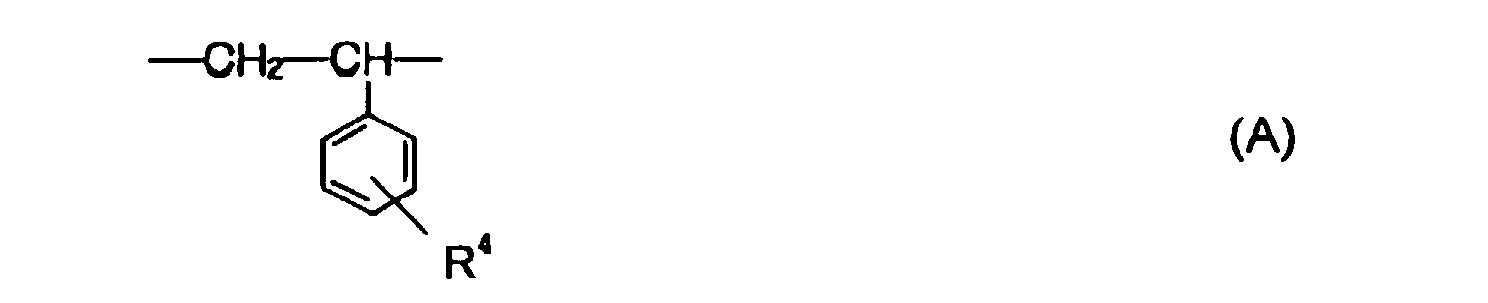
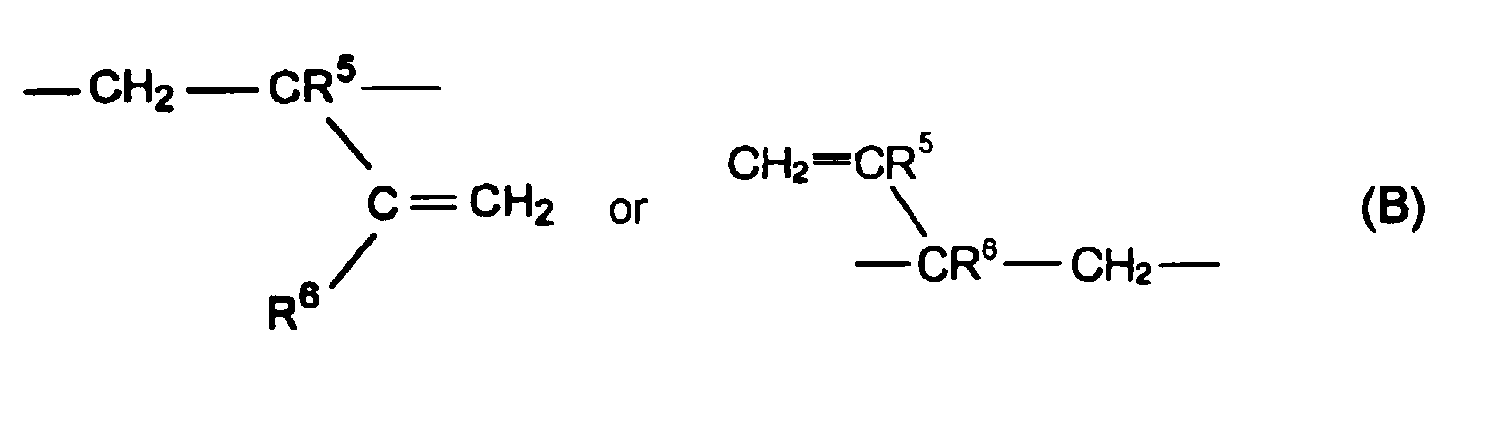



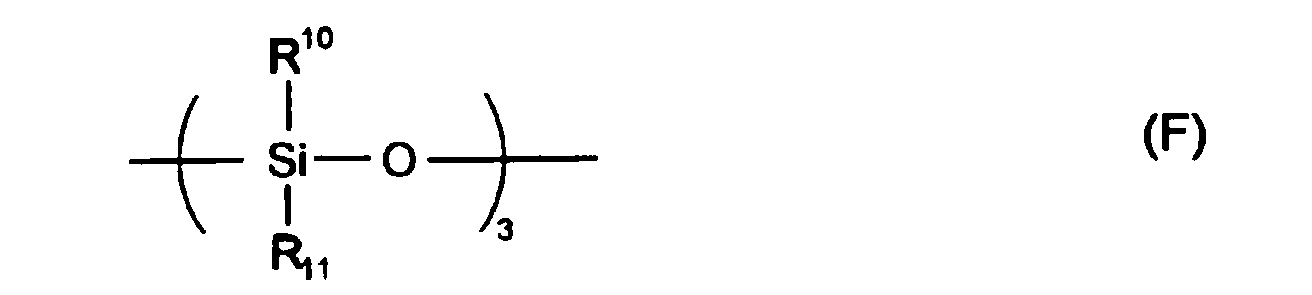
 wherein R4, R5, R6, R7, R8, and R9 are the same or different and chosen from hydrogen, halogen, alkyl groups with 1 ~ 20 carbon atoms, and alkoxy groups with 1 ~ 20 carbon atoms, R10, R11, R12, R13, R16, and R17 are the same or different and are chosen from alkyl groups with 1 ~ 20 carbon atoms, R14 and R15 are the same or different and chosen from hydrogen and alkyl groups with 1 ~ 20 carbon atoms, R18 is chosen from hydrogen and alkyl groups with 1 ~ 4 carbon atoms, and R19 is chosen from alkyl groups with 1 ~ 4 carbon atoms.
- The styrene random copolymer according to claim 1, wherein said styrene derivative is chosen from styrene, o-, m-, and p-chlorostyrene, o-, m-, and p-bromostyrene, o-, m-, and p-fluorostyrene, o-, m-, and p- methylstyrene, o-, m-, and p-ethylstyrene, o-, m-, and p-propylstyrene, o-, m-, and p-butylstyrene, and o-, m-, and p-tert-butylstyrene.
- The styrene random copolymer according to claim 1 or 2, wherein said styrene derivative units have a highly syndiotactic structure.
- The styrene random copolymer according to any of claims 1 to 3, wherein said macromonomer is ion-polymerized from an ion polymerizable monomer chosen from monomers of formula (a) and has a weight average molecular weight ranging from 1,000~200,000:wherein R4 is chosen from hydrogen, halogen, alkyl groups with 1 ~ 20 carbon atoms, and alkoxy groups with 1 ~ 20 carbon atoms.

- The styrene random copolymer according to any of claims 1 to 3, wherein said macromonomer is ion-polymerized from an ion polymerizable monomer chosen from monomers of formula (b) and has a weight average molecular weight ranging from 1,000~200,000:wherein R5 and R6 are the same or different and chosen from hydrogen, halogen, and alkyl groups with 1 ~ 20 carbon atoms.

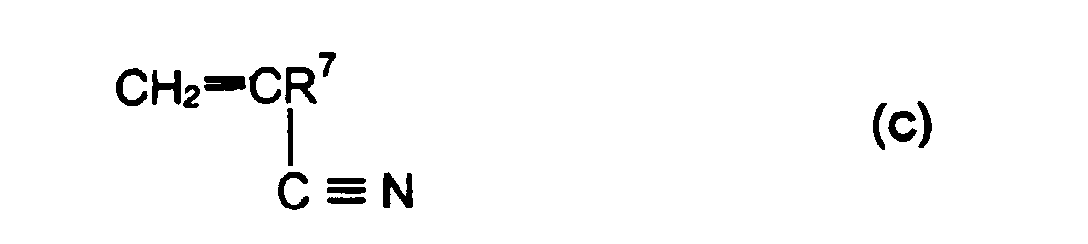
- The styrene random copolymer according to any of claims 1 to 3, wherein said macromonomer is ion-polymerized from an ion polymerizable monomer chosen from monomers of formula (c) and has a weight average molecular weight ranging from 1,000 ~ 200,000:wherein R7 is chosen from hydrogen, halogen, and alkyl groups with 1 ~ 20 carbon atoms.
- The styrene random copolymer according to any of claims 1 to 3, wherein said macromonomer is ion-polymerized from an ion polymerizable monomer chosen from monomers of formula (d) and has a weight average molecular weight ranging from 1,000 ~ 200,000:wherein R8 is chosen from hydrogen, halogen, and alkyl groups with 1 ~ 20 carbon atoms.

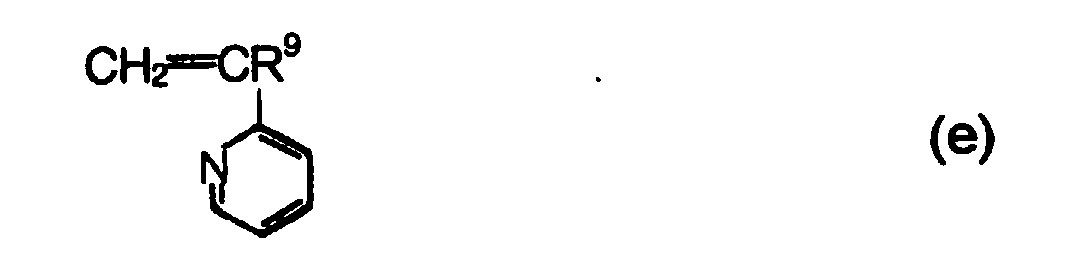
- The styrene random copolymer according to any of claims 1 to 3, wherein said macromonomer is ion-polymerized from an ion polymerizable monomer chosen from monomers of formula (e) and has a weight average molecular weight ranging from 1,000 ~ 200,000:wherein R9 is chosen from hydrogen, halogen, and alkyl groups with 1 ~ 20 carbon atoms.
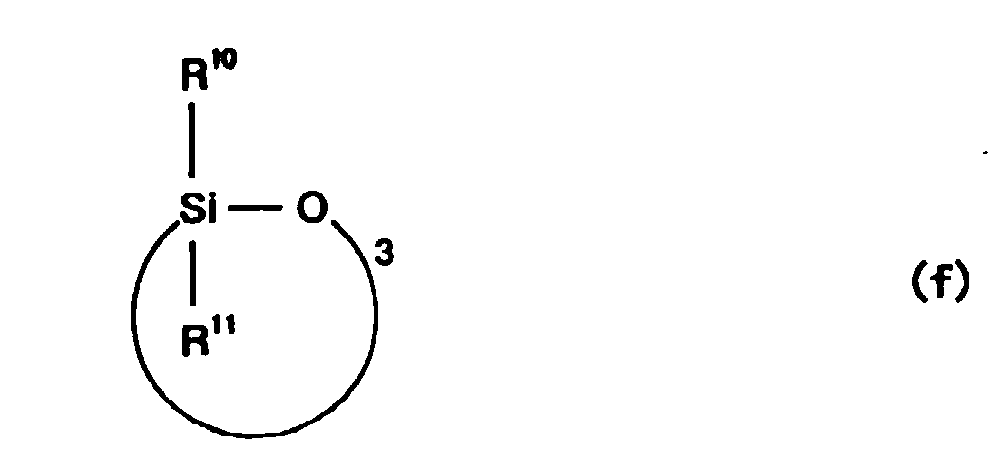
- The styrene random copolymer according to any of claims 1 to 3, wherein said macromonomer is ion-polymerized from an ion polymerizable monomer chosen from monomers of formula (f) and has a weight average molecular weight ranging from 1,000 ~ 200,000:wherein R10 and R11 are the same or different and chosen from alkyl groups with 1~ 20 carbon atoms.
- The styrene random copolymer according to any of claims 1 to 3, wherein said macromonomer is ion-polymerized from an ion polymerizable monomer chosen from monomers of formula (g) and has a weight average molecular weight ranging from 1,000 ~ 200,000:wherein R12 and R13 are the same or different and chosen from alkyl groups with 1~ 20 carbon atoms.

- The styrene random copolymer according to any of claims 1 to 3, wherein said macromonomer is ion-polymerized from an ion polymerizable monomer chosen from monomers of formula (h) and has a weight average molecular weight ranging from 1,000 ~ 200,000:wherein R14 and R15 are the same or different and chosen from alkyl groups with 1~ 20 carbon atoms and hydrogen.

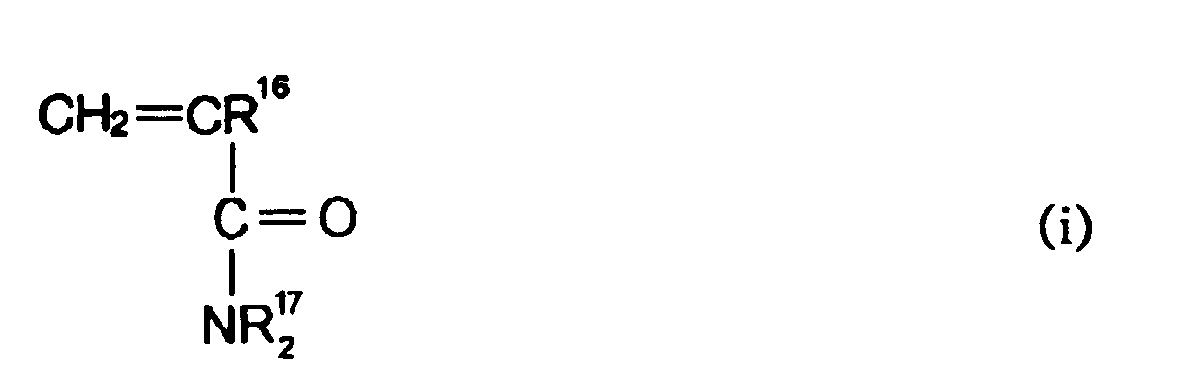
- The styrene random copolymer according to any of claims 1 to 3, wherein said macromonomer is ion-polymerized from an ion polymerizable monomer chosen from monomers of formula (i) and has a weight average molecular weight ranging from 1,000 ~ 200,000:wherein R16 and R17 are the same or different and are chosen from alkyl groups with 1 ~ 20 carbon atoms.
- The styrene random copolymer according to any of claims 1 to 3, wherein said macromonomer is ion-polymerized from an ion polymerizable monomer chosen from monomers of formula (j) and has a weight average molecular weight ranging from 1,000 ~ 200,000:wherein R18 is chosen from hydrogen and alkyl groups with 1 ~ 4 carbon atoms.

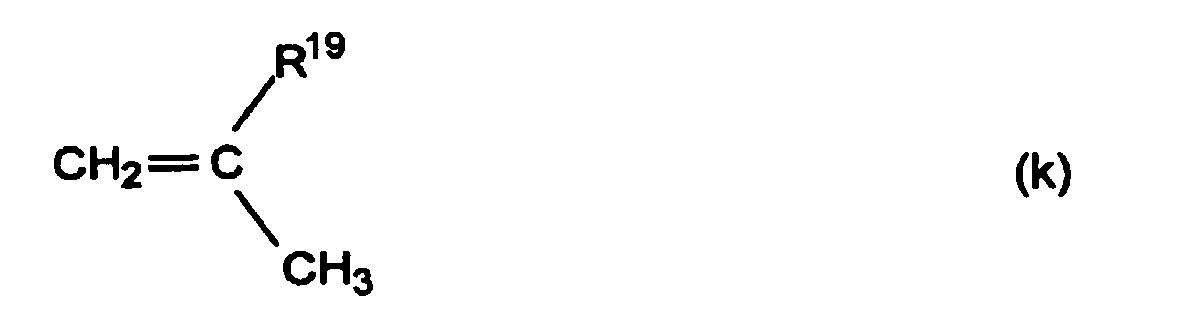
- The styrene random copolymer according to any of claims 1 to 3, wherein said macromonomer is ion-polymerized from an ion polymerizable monomer chosen from monomers of formula (k) and has a weight average molecular weight ranging from 1,000 ~ 200,000:wherein R19 is chosen from alkyl groups with 1 ~ 4 carbon atoms.
- The styrene random copolymer according to any of claims 1 to 14, wherein said macromonomer is copolymerized from at least two ion polymerizable monomers.
- The styrene random copolymer according to any of claims 1 to 14, wherein said macromonomer is chosen from homo, random, and block macromonomers.
- A process for preparing a styrene random copolymer according to any of claims 1 to 16, comprising polymerizing, in the presence of a catalyst system comprising a Group IV transition metal compound and an alkylaluminoxane, said styrene derivative monomer of formula (1) and said macromonomer of formula (2).
- A styrene random terpolymer comprising units of styrene monomer, units of styrene derivative, and units of macromonomer, said units of styrene monomer being polymerized from a styrene monomer of formula (1s), said units of styrene derivative being polymerized from a styrene derivative monomer of formula (1), said units of macromonomer being polymerized from a macromonomer of formula (2),the amount of the macromonomer is 0.1 ~ 50 % by weight of the random terpolymer, and the weight average molecular weight ranges from 50,000 to 5,000,000, and said terpolymer is represented by formula (III):
 wherein R1 is chosen from hydrogen, halogen, and alkyl groups with 1 ~ 20 carbon atoms, R2 is at least one group chosen from saturated hydrocarbons with 1 ~ 20 carbon atoms, aromatic groups, and cycloalkyl groups with the proviso that R2 is not -CO- or -CH2-C6H4-, R3 is chosen from saturated hydrocarbons with 1 ~ 10 carbon atoms, m is an integer of 400 to 20,000 as a degree of polymerization for styrene monomer, n is an integer of 5 to 200 as a degree of polymerization for styrene derivative monomer, o is an integer of 1 to 20 as a degree of polymerization for macromonomer, ℓ is the degree of polymerization for X ranging from 10 to 3,000 integers, and X is at least one ion polymerizable monomer unit chosen from monomers of formulae (A) to (K):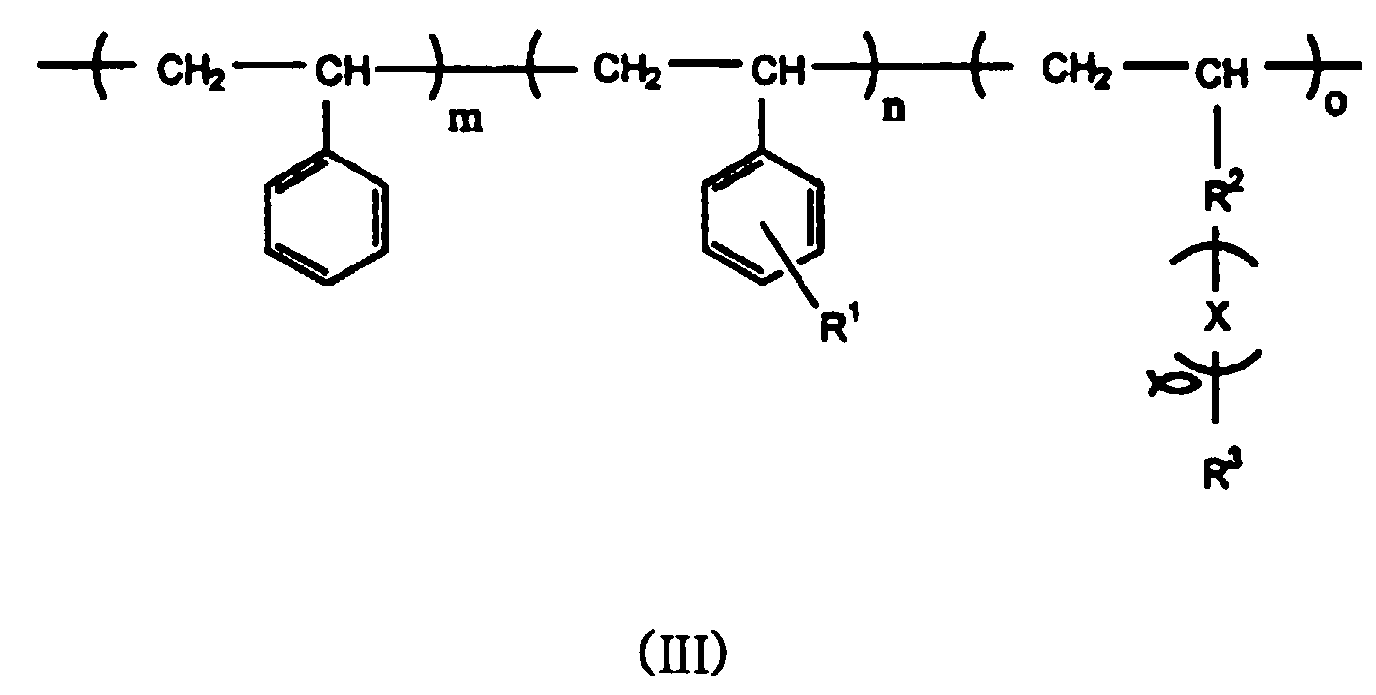

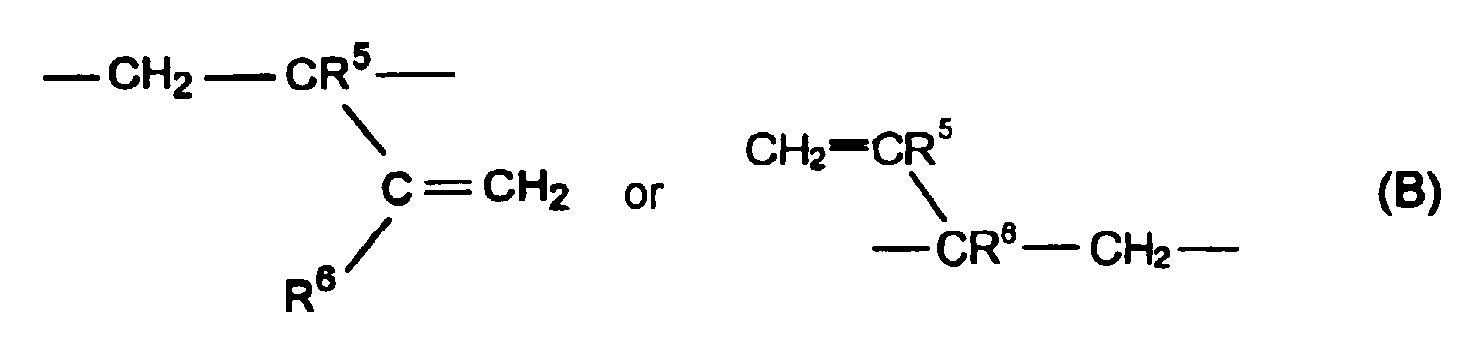




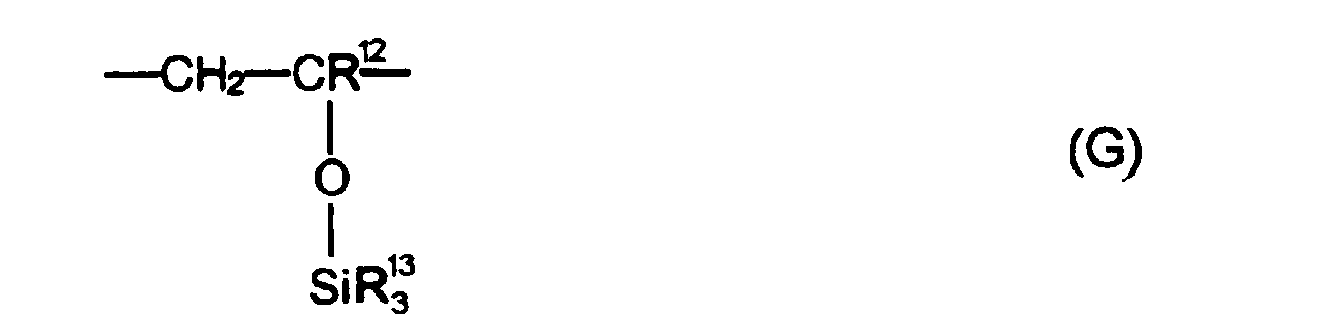

 wherein R4, R5, R6, R7, R8, and R9 are the same or different and chosen from hydrogen, halogen, alkyl groups with 1 ~ 20 carbon atoms, and alkoxy groups with 1 ~20 carbon atoms, R10, R11, R12, R13, R16, and R17 are the same or different and are chosen from alkyl groups with 1 ~ 20 carbon atoms, R14 and R15 are the same or different and chosen from hydrogen and alkyl groups with 1 ~ 20 carbon atoms, R18 is chosen from hydrogen and alkyl groups with 1 ~ 4 carbon atoms, and R19 is chosen from alkyl groups with 1 ~ 4 carbon atoms.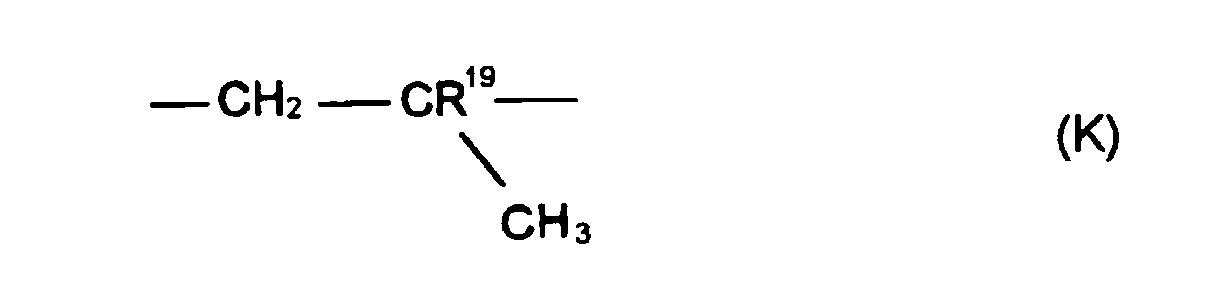
- The styrene random terpolymer according to claim 18, wherein said styrene derivative monomer is chosen from o-, m-, and p-chlorostyrene, o-, m-, and p-bromostyrene, o-, m-, and p-fluorostyrene, o-, m-, and p- methylstyrene, o-, m-, and p-ethylstyrene, o-, m-, and p-propylstyrene, o-, m-, and p-butylstyrene, and o-, m-, and p-tert-butylstyrene.
- The styrene random terpolymer according to claim 18 or 19, wherein said units of styrene monomer and styrene derivative monomer have a high syndiotacticity.
- The styrene random terpolymer according to any of claims 18 to 20, wherein said macromonomer is ion-polymerized from an ion polymerizable monomer chosen from monomers of formula (a) and has a weight average molecular weight ranging from 1,000 ~ 300,000:wherein R4 is chosen from hydrogen, halogen alkyl groups with 1 ~ 20 carbon atoms, and alkoxy groups with 1 ~ 20 carbon atoms.
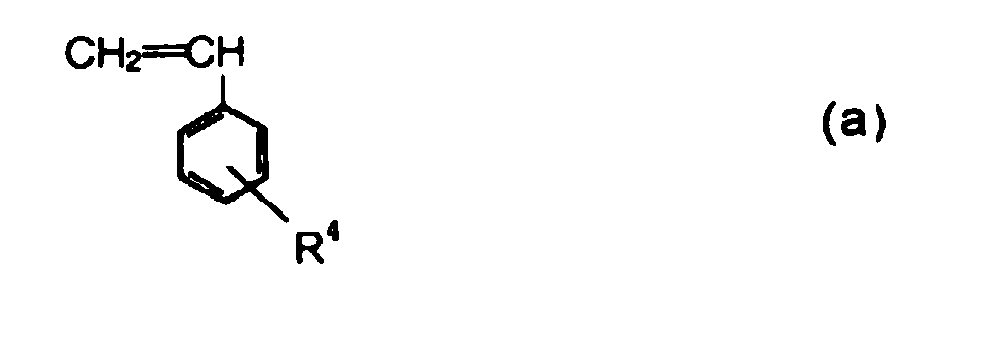
- The styrene random terpolymer according to any of claims 18 to 20, wherein said macromonomer is ion-polymerized from an ion polymerizable monomer chosen from monomers of formula (b) and has a weight average molecular weight ranging from 1,000 ~ 300,000:wherein R5 and R6 are the same or different and are chosen from hydrogen, halogen, and alkyl groups with 1 ~ 20 carbon atoms.

- The styrene random terpolymer according to any of claims 18 to 20, wherein said macromonomer is ion-polymerized from an ion polymerizable monomer chosen from monomers of formula (c) and has a weight average molecular weight ranging from 1,000 ~ 300,000:wherein R7 is chosen from hydrogen, halogen, and alkyl groups with 1 ~ 20 carbon atoms.

- The styrene random terpolymer according to any of claims 18 to 20, wherein said macromonomer is ion-polymerized from an ion polymerizable monomer chosen from monomers of formula (d) and has a weight average molecular weight ranging from 1,000 ~ 300,000:wherein R8 is chosen from hydrogen, halogen, and alkyl groups with 1 ~ 20 carbon atoms.

- The styrene random terpolymer according to any of claims 18 to 20, wherein said macromonomer is ion-polymerized from an ion polymerizable monomer chosen from monomers of formula (e) and has a weight average molecular weight ranging from 1,000 ~ 300,000:wherein R9 is chosen from hydrogen, halogen, and alkyl groups with 1 ~ 20 carbon atoms.
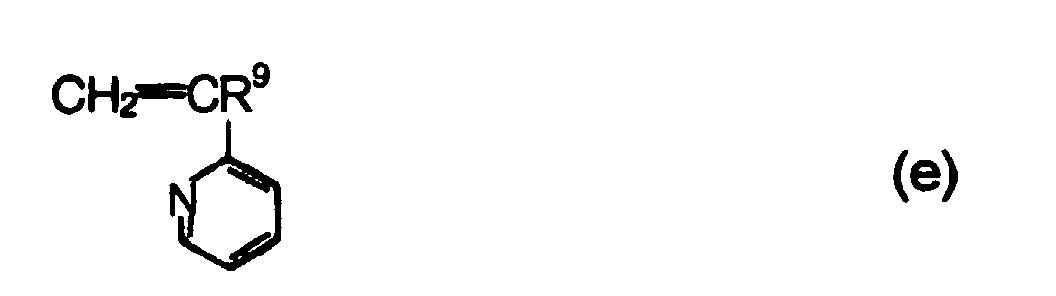
- The styrene random terpolymer according to any of claims 18 to 20, wherein said macromonomer is ion-polymerized from an ion polymerizable monomer chosen from monomers of formula (f) and has a weight average molecular weight ranging from 1,000 ~ 300,000:wherein R10 and R11 are the same or different and are chosen from alkyl groups with 1 ~ 20 carbon atoms.
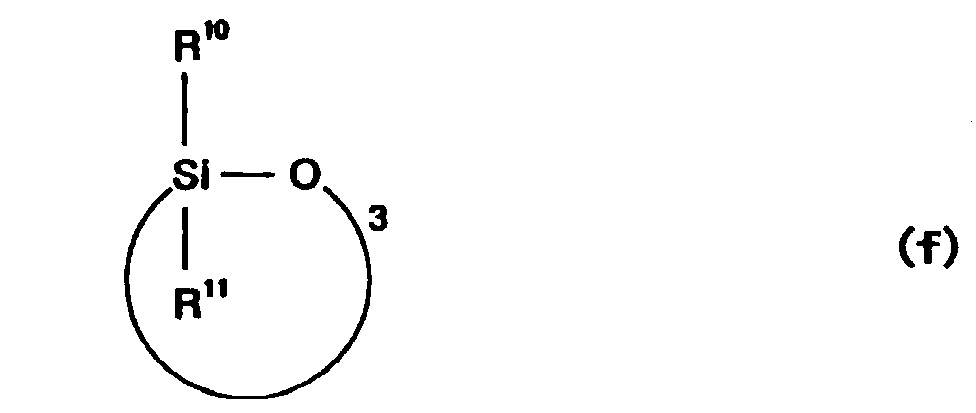
- The styrene random terpolymer according to any of claims 18 to 20, wherein said macromonomer is ion-polymerized from an ion polymerizable monomer chosen from monomers of formula (g) and has a weight average molecular weight ranging from 1,000 ~ 300,000:wherein R12 and R13 are the same or different and are chosen from alkyl groups with 1 ~ 20 carbon atoms.

- The styrene random terpolymer according to any of claims 18 to 20, wherein said macromonomer is ion-polymerized from an ion polymerizable monomer chosen from monomers of formula (h) and has a weight average molecular weight ranging from 1,000 ~ 300,000:wherein R14 and R15 are the same or different and are chosen from alkyl groups with 1 ~ 20 carbon atoms and hydrogen.
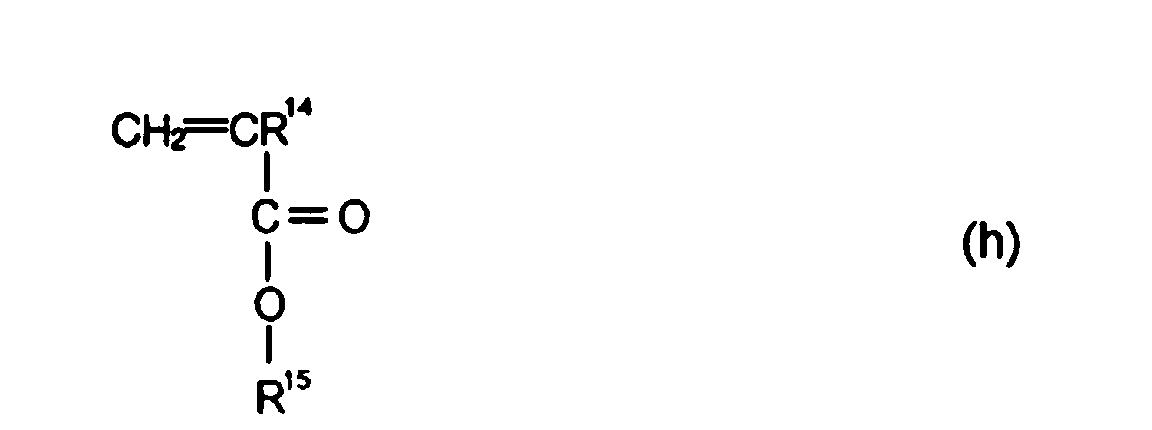
- The styrene random terpolymer according to any of claims 18 to 20, wherein said macromonomer is ion-polymerized from an ion polymerizable monomer chosen from monomers of formula (i) and has a weight average molecular weight ranging from 1,000 ~ 300,000:wherein R16 and R17 are the same or different and are chosen from alkyl groups with 1 ~ 20 carbon atoms.
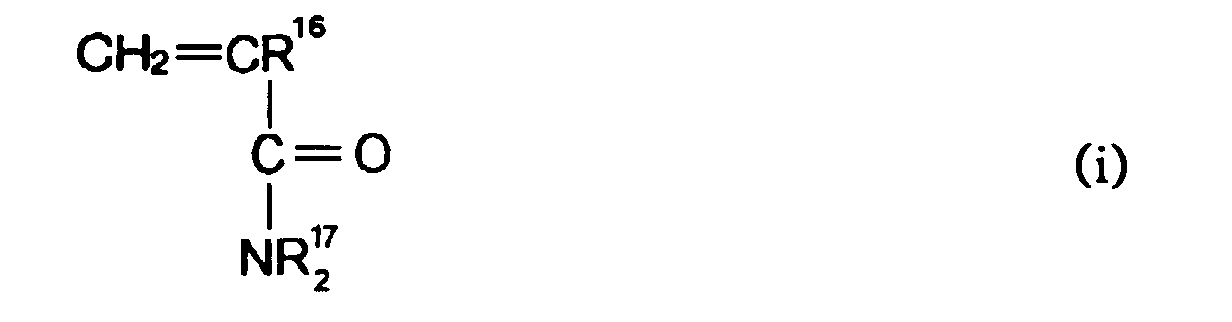
- The styrene random terpolymer according to any of claims 18 to 20, wherein said macromonomer is ion-polymerized from an ion polymerizable monomer chosen from monomers of formula (j) and has a weight average molecular weight ranging from 1,000 ~ 300,000:wherein R18 is chosen from hydrogen and alkyl groups with 1 ~ 4 carbon atoms.

- The styrene random terpolymer according to any of claims 18 to 20, wherein said macromonomer is ion-polymerized from an ion polymerizable monomer chosen from monomers of formula (k) and has a weight average molecular weight ranging from 1,000 ~ 300,000:wherein R19 is chosen from alkyl groups with 1 ~ 4 carbon atoms.
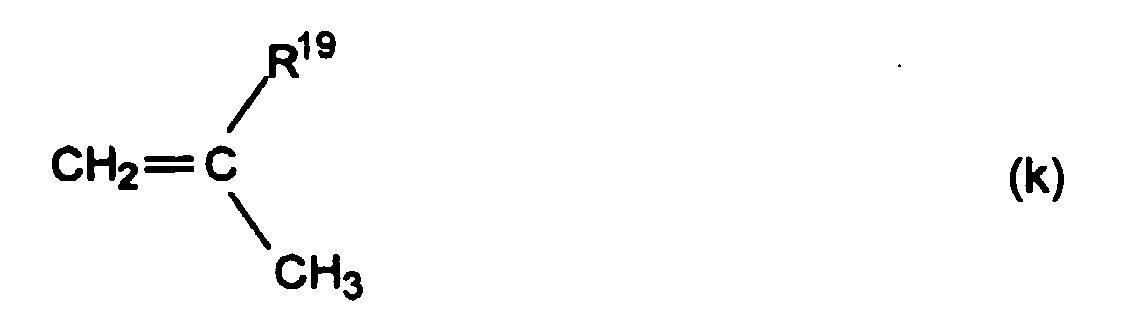
- The styrene random copolymer according to any of claims 18 to 31, wherein said macromonomer is copolymerized from at least two ion polymerizable monomers.
- The styrene random terpolymer according to any of claims 18 to 31, wherein said macromonomer is chosen from homo, random, and block macromonomers.
- A process for preparing a styrene random terpolymer according to any of claims 18 to 33, comprising polymerizing, in the presence of a catalyst system comprising a Group IV transition metal compound and an alkylaluminoxane, said styrene monomer of formula (1s), said styrene derivative monomer of formula (1), said macromonomer of formula (2).
Applications Claiming Priority (4)
| Application Number | Priority Date | Filing Date | Title |
|---|---|---|---|
| KR9933723 | 1999-08-16 | ||
| KR1019990033723A KR100332673B1 (en) | 1999-08-16 | 1999-08-16 | Styrene/Macromonomer Random Copolymer Having Excellent Melt Flowability and Method of Preparing The Same |
| KR1019990048607A KR100344893B1 (en) | 1999-11-04 | 1999-11-04 | Styrene Based Terpolymer Having Excellent Melt Flowability and Impact Strength and Method of Preparing the Same |
| KR9948607 | 1999-11-04 |
Publications (1)
| Publication Number | Publication Date |
|---|---|
| EP1077224A1 true EP1077224A1 (en) | 2001-02-21 |
Family
ID=26636035
Family Applications (1)
| Application Number | Title | Priority Date | Filing Date |
|---|---|---|---|
| EP00306963A Withdrawn EP1077224A1 (en) | 1999-08-16 | 2000-08-15 | Styrene/macromonomer random polymer having excellent melt flowability and method of preparing the same |
Country Status (3)
| Country | Link |
|---|---|
| US (1) | US6489425B1 (en) |
| EP (1) | EP1077224A1 (en) |
| JP (1) | JP2001081146A (en) |
Cited By (2)
| Publication number | Priority date | Publication date | Assignee | Title |
|---|---|---|---|---|
| US6756448B2 (en) | 2002-09-19 | 2004-06-29 | Korea Kumho Petrochemical Co., Ltd. | Styrene copolymer |
| US7163992B2 (en) | 2001-03-15 | 2007-01-16 | Toagosei Co., Ltd. | Methods for manufacturing a copolymer with a high yield by reacting a vinyl monomer and a macromonomer |
Families Citing this family (2)
| Publication number | Priority date | Publication date | Assignee | Title |
|---|---|---|---|---|
| CN101628959A (en) | 2008-07-15 | 2010-01-20 | 中国石油化工集团公司 | Foamed styrene monomer-diolefin copolymer, and preparation method and application thereof |
| RU2533206C2 (en) | 2008-10-14 | 2014-11-20 | Бриджстоун Корпорейшн | Novel polymers and their application in obtaining high-impact polymer compositions |
Citations (4)
| Publication number | Priority date | Publication date | Assignee | Title |
|---|---|---|---|---|
| US4413104A (en) * | 1981-02-19 | 1983-11-01 | Wacker-Chemie Gmbh | Process for preparing organopolysiloxanes and copolymers thereof |
| WO1996039451A1 (en) * | 1995-06-06 | 1996-12-12 | The Dow Chemical Company | Segmented multicomponent interpolymers of monovinylidene aromatic monomers |
| EP0864593A1 (en) * | 1997-03-11 | 1998-09-16 | Basf Aktiengesellschaft | Comb-polymers via metallocene catalysis |
| JP2000044639A (en) * | 1998-07-31 | 2000-02-15 | Toagosei Co Ltd | Production of aqueous resin emulsion |
Family Cites Families (5)
| Publication number | Priority date | Publication date | Assignee | Title |
|---|---|---|---|---|
| US4722976A (en) * | 1985-11-22 | 1988-02-02 | Pony Industries, Inc. | Macromonomer-based polymer concrete compositions |
| JPH0413707A (en) | 1990-05-08 | 1992-01-17 | Idemitsu Kosan Co Ltd | Styrene-based macromonomer, polymer thereof and production of the same polymer |
| US5192616A (en) * | 1990-11-15 | 1993-03-09 | Minnesota Mining And Manufacturing Company | Macromolecular monomers from living polymers |
| JP3107251B2 (en) | 1992-04-17 | 2000-11-06 | 出光興産株式会社 | Styrene block copolymer and method for producing the same |
| US6306995B1 (en) * | 1999-11-18 | 2001-10-23 | Eastman Kodak Company | Polymerization process |
-
2000
- 2000-08-15 EP EP00306963A patent/EP1077224A1/en not_active Withdrawn
- 2000-08-16 JP JP2000246856A patent/JP2001081146A/en active Pending
- 2000-08-16 US US09/639,237 patent/US6489425B1/en not_active Expired - Fee Related
Patent Citations (4)
| Publication number | Priority date | Publication date | Assignee | Title |
|---|---|---|---|---|
| US4413104A (en) * | 1981-02-19 | 1983-11-01 | Wacker-Chemie Gmbh | Process for preparing organopolysiloxanes and copolymers thereof |
| WO1996039451A1 (en) * | 1995-06-06 | 1996-12-12 | The Dow Chemical Company | Segmented multicomponent interpolymers of monovinylidene aromatic monomers |
| EP0864593A1 (en) * | 1997-03-11 | 1998-09-16 | Basf Aktiengesellschaft | Comb-polymers via metallocene catalysis |
| JP2000044639A (en) * | 1998-07-31 | 2000-02-15 | Toagosei Co Ltd | Production of aqueous resin emulsion |
Non-Patent Citations (1)
| Title |
|---|
| DATABASE WPI Derwent World Patents Index; AN 2000-218014, XP002153564 * |
Cited By (2)
| Publication number | Priority date | Publication date | Assignee | Title |
|---|---|---|---|---|
| US7163992B2 (en) | 2001-03-15 | 2007-01-16 | Toagosei Co., Ltd. | Methods for manufacturing a copolymer with a high yield by reacting a vinyl monomer and a macromonomer |
| US6756448B2 (en) | 2002-09-19 | 2004-06-29 | Korea Kumho Petrochemical Co., Ltd. | Styrene copolymer |
Also Published As
| Publication number | Publication date |
|---|---|
| JP2001081146A (en) | 2001-03-27 |
| US6489425B1 (en) | 2002-12-03 |
Similar Documents
| Publication | Publication Date | Title |
|---|---|---|
| EP0308916B1 (en) | Styrene-based polymers and process for production thereof | |
| US7064164B2 (en) | Transparent styrol-butadiene block copolymer mixtures | |
| US4029720A (en) | Block or graft copolymers of polyalkylene oxides and vinylaromatic or diene polymers | |
| CA2097304A1 (en) | Entanglement-inhibited macromolecules | |
| JPH10512916A (en) | Preparation of graft block copolymers by growing anionic polymer chains from functionalized polyolefin backbones | |
| KR100367342B1 (en) | Syndiotactic Polystyrene Copolymer Resin Composition Having Macromonomer for Improving Impact Strength | |
| CN1064975C (en) | Process for preparation of vinylaromatic copolymers reinforced with rubber | |
| NO973504L (en) | Process for Preparation of Graft Block Copolymers by Grafting Anionic Polymer Chains on Functionalized Polyolefins | |
| US6489425B1 (en) | Styrene/macromonomer random polymer having excellent melt flowability and impact strength and method of preparing the same | |
| JPH1072512A5 (en) | ||
| KR100466201B1 (en) | Styrene copolymer | |
| JPH0672173B2 (en) | Graft polymer and method for producing the same | |
| Quirk | Recent advances in controlled grafting of elastomers | |
| JP3518081B2 (en) | Rubber reinforced vinyl resin | |
| KR100344893B1 (en) | Styrene Based Terpolymer Having Excellent Melt Flowability and Impact Strength and Method of Preparing the Same | |
| KR100332673B1 (en) | Styrene/Macromonomer Random Copolymer Having Excellent Melt Flowability and Method of Preparing The Same | |
| JP3089067B2 (en) | Method for producing rubber-modified styrenic polymer | |
| JP2001514311A (en) | Polystyrene with bimodal molecular weight distribution | |
| WO1993020120A2 (en) | Norbornene polymerization initiators and polymers prepared therewith | |
| KR20020091280A (en) | Anionically Polymerized, Impact-Resistant Polystyrene with Capsule Particle Morphology | |
| KR100714658B1 (en) | Syndiotactic Polystyrene Reactor Copolymer | |
| KR20060120157A (en) | Use of tetrafunctional initiator to improve the amount of impact resistant polystyrene in the rubber phase | |
| US20040132908A1 (en) | Graft copolymers of syndiotactic polystyrene with polar functional group containing grafting arms and processes for their preparations | |
| JPH1135757A (en) | Resin composition used for pump component and having excellent heat resistance | |
| JPH0413707A (en) | Styrene-based macromonomer, polymer thereof and production of the same polymer |
Legal Events
| Date | Code | Title | Description |
|---|---|---|---|
| PUAI | Public reference made under article 153(3) epc to a published international application that has entered the european phase |
Free format text: ORIGINAL CODE: 0009012 |
|
| 17P | Request for examination filed |
Effective date: 20000913 |
|
| AK | Designated contracting states |
Kind code of ref document: A1 Designated state(s): CH DE FR GB IT LI SE |
|
| AX | Request for extension of the european patent |
Free format text: AL;LT;LV;MK;RO;SI |
|
| RIN1 | Information on inventor provided before grant (corrected) |
Inventor name: RHEU, YI-YOL Inventor name: YOON, KEUN-BYOUNG Inventor name: YIM, JIN HEONG |
|
| AKX | Designation fees paid |
Free format text: CH DE FR GB IT LI SE |
|
| 17Q | First examination report despatched |
Effective date: 20030213 |
|
| STAA | Information on the status of an ep patent application or granted ep patent |
Free format text: STATUS: THE APPLICATION IS DEEMED TO BE WITHDRAWN |
|
| 18D | Application deemed to be withdrawn |
Effective date: 20030624 |