EP1076849B1 - Method and system for configuring a computer - Google Patents
Method and system for configuring a computer Download PDFInfo
- Publication number
- EP1076849B1 EP1076849B1 EP99921671A EP99921671A EP1076849B1 EP 1076849 B1 EP1076849 B1 EP 1076849B1 EP 99921671 A EP99921671 A EP 99921671A EP 99921671 A EP99921671 A EP 99921671A EP 1076849 B1 EP1076849 B1 EP 1076849B1
- Authority
- EP
- European Patent Office
- Prior art keywords
- database
- configuration
- computer
- means adapted
- scripting
- Prior art date
- Legal status (The legal status is an assumption and is not a legal conclusion. Google has not performed a legal analysis and makes no representation as to the accuracy of the status listed.)
- Expired - Lifetime
Links
Images





Classifications
-
- G—PHYSICS
- G06—COMPUTING OR CALCULATING; COUNTING
- G06F—ELECTRIC DIGITAL DATA PROCESSING
- G06F9/00—Arrangements for program control, e.g. control units
- G06F9/06—Arrangements for program control, e.g. control units using stored programs, i.e. using an internal store of processing equipment to receive or retain programs
- G06F9/44—Arrangements for executing specific programs
- G06F9/445—Program loading or initiating
- G06F9/44505—Configuring for program initiating, e.g. using registry, configuration files
-
- G—PHYSICS
- G06—COMPUTING OR CALCULATING; COUNTING
- G06F—ELECTRIC DIGITAL DATA PROCESSING
- G06F9/00—Arrangements for program control, e.g. control units
- G06F9/06—Arrangements for program control, e.g. control units using stored programs, i.e. using an internal store of processing equipment to receive or retain programs
- G06F9/46—Multiprogramming arrangements
Definitions
- This invention relates to the field of computer software, and, more specifically, to network protocols and configuration.
- a network also may include resources, such as printers, modems, file servers, etc., and may also include services, such as electronic mail.
- a network can be a small system that is physically connected by cables (a local area network or "LAN”), or several separate networks can be connected together to form a larger network (a wide area network or "WAN").
- LAN local area network
- WAN wide area network
- Other types of networks include the internet, tel-com networks, the World Wide Web, intranets, extranets, wireless networks, and other networks over which electronic, digital, and/or analog data may be communicated.
- Individual computers often use various ports to physically connect to a network. For example, if you need to dial into a network using the phone lines and a modem, the modem port may be utilized. Other ports that may be used include a Printer Port, Ethernet, Infrared, and Remote Access.
- Protocols generally specify the data format, timing, sequencing, and error checking of data transmissions. Numerous protocols are used in the networking environment. For example, transmission control protocol/internet protocols (“TCP/IP”) are the protocols used on the internet and on many multiplatform networks, and AppleTalk is the network protocol built into every Macintosh computer.
- TCP/IP transmission control protocol/internet protocols
- AppleTalk is the network protocol built into every Macintosh computer.
- one of the protocols does not operate. For example, if two configurations or devices try and use the same non-sharable port, the user may not be allowed to use the desired port until the conflicting device is deactivated (e.g., a printer can't be activated if it shares the same port as "modem settings"). To deactivate the conflicting device, the user has to search numerous control panels to locate the conflicting device and deactivate or delete the conflicting configuration by adjusting the settings. Thus, the use of an individual control panel for each protocol forces the user to make adjustments and modifications in numerous control panels in order to properly configure the computer.
- the conflicting device e.g., a printer can't be activated if it shares the same port as "modem settings"
- each individual computer To route messages and communicate between computers using a TCP/IP protocol, each individual computer must be identified with a unique identifier or address.
- the unique identifier is referred to as an internet address or Internet Protocol (IP) address.
- IP Internet Protocol
- An individual computer can be assigned a static IP address that does not change.
- An individual computer can also maintain a dynamic IP address such that whenever it connects to the network, the computer is assigned an IP address. In this manner, each time the individual computer connects to the network, a different IP address may be assigned to the computer.
- a computer program To enable a computer to execute a sequence of instructions or commands, a computer program is utilized.
- One type of computer program that provides for the automation of a task or a series of tasks is called a script.
- a script can be used to perform simple tasks such as a file back-up, or more complex tasks such as adding capability to a program or presentation.
- a scripting language is used to create a script.
- Event scripting consists of mimicking a user's actions and events as they are performed in a user interface. For example, copying the user's actions entailed in moving a mouse over a screen location containing a checkbox for activating sound and depressing the mouse button.
- Semantic scripting consists of function specific commands that perform specific actions. For example, the execution of a command to activate sound.
- AppleScript one type of semantic scripting language that is often utilized is called AppleScript.
- Location Manager allows users to assign specific settings to a "location" for a variety of capabilities including networking, printers, time zone, file sharing, sound, and frequently used applications.
- a location Once a location is set up, a user can select that location and the computer system recognizes the user's preferences for that environment. For example, a home location and an office location may be set up for the various printers and networks available at the user's home and office.
- a network administrator it is not possible for a network administrator to remotely configure a computer or adjust network settings.
- NetworkInfo Another prior art method used to configure a network referred to as "NetInfo" provides for a centralized database that contains the available configurations. When a user wants to configure his/her computer for network capabilities, the user accesses the centralized database to determine what options are available. However, it is not possible for a network administrator to remotely configure a user's computer or adjust network settings.
- This prior art method is more fully described in United States Patent No. 5,410,691 entitled “Method and Apparatus for Providing a Network Configuration Database” issued on April 25, 1995 and United States Patent No. 5,459,863 entitled “ Method of Maintaining Integrity in a Network Database” issued on October 17, 1995.
- Another prior art method provides the ability to swap various configuration files in order to configure a computer.
- the system is not notified when the file swapping occurs and does not recognize the new configuration.
- the computer must be restarted or one of the control panels must be manually adjusted.
- EP 0 791 881 A1 discloses a method of configuring devices in a network from a central location by a configuration manager. By means of a configuration script, an automated process of requests and related inputs made by an administrator creates a configuration for a device. This configuration may then be uploaded to the device or requested by a remote device for automated configuration.
- US-PS 5 414 812 discloses a computer network that is constructed according to an object-oriented hierarchical model. This model is implemented in a hierarchical database with a consistent set of commands for each of the object classes. The network configuration can be changed by user commands.
- NIS Network Information Service
- pages 377-379 a method of (and a corresponding system for) configuring a computer comprising the steps of obtaining a database, loading said database with configuration settings, wherein said loading step comprisis retrieving configuration settings from existing files and storing said configuration settings from said existing files into said database of configuration settings.
- Chapter 15.3 NIS+ Network Information Service Plus indicates that the configuration settings can be modified.
- the invention provides for the configuration of a computer.
- One embodiment of the invention combines the prior art control panels related to networking into a consolidated Network Setup Control Panel.
- the invention provides for computer configuration by scripting.
- the configuration may be for any type of system setting or for network configurations and protocols.
- a computer may be configured locally or remotely on a network.
- One embodiment of the invention provides for a centralized database consisting of the collected data relating to available configuration settings.
- This database is not limited to configuration information and can be used as a general database containing any type of information the user desires to store.
- the database may be accessed by an administrator desiring to configure a computer.
- the database may be modified directly using the Network Setup Control Panel.
- One embodiment of the invention provides for modification of the database and computer configuration through scripting.
- the invention provides for a Scripting Interface consisting of a Scripting Server and Scripting Plug-In.
- the Scripting Server is programmed with the general knowledge of the structure and type of objects representing configurations stored in the database.
- the Scripting Server receives the script forwarded from a user or network administrator, parses the script and determines the appropriate Scripting Plug-In to forward the desired action to (by accessing the general knowledge the Scripting Server maintains).
- the Scripting Plug-In is programmed to maintain knowledge of the specific fields and methods of the objects stored in the database. Thus, the Scripting Plug-In receives the commands and executes the appropriate actions to modify the configuration as directed.
- one embodiment of the invention provides for the use of a dictionary containing available commands and objects that may be modified.
- the administrator merely executes the script on a copy of the Scripting Server that is run either remotely or locally. In this manner, a computer may be configured using scripting.
- one embodiment of the invention provides for backwards compatibility with prior art configuration settings (using the file formats that existed in the prior art).
- the backwards compatibility method includes exporting and importing various configuration settings into the consolidated database.
- the invention is a method and apparatus for configuring a computer.
- numerous specific details are set forth to provide a more thorough description of embodiments of the invention. It is apparent, however, to one skilled in the art, that the invention may be practiced without these specific details, In other instances, well known features have not been described in detail so as not to obscure the invention.
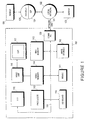
- An embodiment of the invention can be implemented as computer software in the form of computer readable code executed on a general purpose computer such as computer 100 illustrated in Figure 1, or in the form of bytecode class files running on such a computer.
- a keyboard 110 and mouse 111 are coupled to a bi-directional system bus 118. The keyboard and mouse are for introducing user input to the computer system and communicating that user input to processor 113. Other suitable input devices may be used in addition to, or in place of, the mouse 111 and keyboard 110.
- I/O (input/output) unit 119 coupled to bi-directional system bus 118 represents such I/O elements as a printer, A/V (audio/video) I/O, etc.
- Computer 100 includes a video memory 114, main memory 115 and mass storage 112, all coupled to bi-directional system bus 118 along with keyboard 110, mouse 111 and processor 113.
- the mass storage 112 may include both fixed and removable media, such as magnetic, optical or magnetic optical storage systems or any other available mass storage technology.
- Bus 118 may contain, for example, thirty-two address lines for addressing video memory 114 or main memory 115.
- the system bus 118 also includes, for example, a 32-bit data bus for transferring data between and among the components, such as processor 113, main memory 115, video memory 114 and mass storage 112. Alternatively, multiplex data/address lines may be used instead of separate data and address lines.
- the processor 113 is a microprocessor manufactured by Motorola, such as the 680X0 processor or a microprocessor manufactured by Intel, such as the 80X86, or Pentium processor. However, any other suitable microprocessor or microcomputer may be utilized.
- Main memory 115 is comprised of dynamic random access memory (DRAM).
- Video memory 114 is a dual-ported video random access memory. One port of the video memory 114 is coupled to video amplifier 116. The video amplifier 116 is used to drive the cathode ray tube (CRT) raster monitor 117.
- Video amplifier 116 is well known in the art and may be implemented by any suitable apparatus. This circuitry converts pixel data stored in video memory 114 to a raster signal suitable for use by monitor 117.
- Monitor 117 is a type of monitor suitable for displaying graphic images.
- Network link 121 typically provides data communication through one or more networks to other data devices.
- network link 121 may provide a connection through local network 122 to local server computer 123 or to data equipment operated by an Internet Service Provider (ISP) 124.
- ISP 124 in turn provides data communication services through the world wide packet data communication network now commonly referred to as the "Internet" 125.
- Internet 125 uses electrical, electromagnetic or optical signals which carry digital data streams.
- the signals through the various networks and the signals on network link 121 and through communication interface 120, which carry the digital data to and from computer 100, are exemplary forms of carrier waves transporting the information.
- Computer 100 can send messages and receive data, including program code, through the network(s), network link 121, and communication interface 120.
- remote server computer 126 might transmit a requested code for an application program through Internet 125, ISP 124, local network 122 and communication interface 120.
- one such application is that of remotely configuring a computer.
- Application code may be embodied in any form of computer program product.
- a computer program product comprises a medium configured to store or transport computer readable code, or in which computer readable code may be embedded.
- Some examples of computer program products are CD-ROM disks, ROM cards, floppy disks, magnetic tapes, computer hard drives, servers on a network, and carrier waves.
- control panels may contain multiple related functions and data structures.
- one embodiment of the invention utilizes a standard object oriented programming (OOP) language approach.
- OOP object oriented programming
- Object-oriented programming is a method of creating computer programs by combining certain fundamental building blocks, and creating relationships among and between the building blocks.
- the building blocks in object-oriented programming systems are called "objects.”
- An object is a programming unit that groups together a data structure (one or more instance variables) and the operations (methods) that can use or affect that data.
- an object consists of data and one or more operations or procedures that can be performed on that data.
- the joining of data and operations into a unitary building block is called "encapsulation.”
- An object can be instructed to perform one of its methods when it receives a "message."
- a message is a command or instruction sent to the object to execute a certain method.
- a message consists of a method selection (e.g., method name) and a plurality of arguments.
- a message tells the receiving object what operations to perform.
- object-oriented programming is the way in which methods are invoked. When a message is sent to an object, it is not necessary for the message to instruct the object how to perform a certain method. It is only necessary to request that the object execute the method. This greatly simplifies program development.
- a class defines a type of object that typically includes both variables and methods for the class.
- An object class is used to create a particular instance of an object.
- An instance of an object class includes the variables and methods defined for the class. Multiple instances of the same class can be created from an object class. Each instance that is created from the object class is said to be of the same type or class.
- an employee object class can include "name” and “salary” instance variables and a "set_salary” method. Instances of the employee object class can be created, or instantiated for each employee in an organization. Each object instance is said to be of type “employee.” Each employee object instance includes “name” and “salary” instance variables and the "set_salary” method. The values associated with the "name” and “salary” variables in each employee object instance contain the name and salary of an employee in the organization. A message can be sent to an employee's employee object instance to invoke the "set_salary” method to modify the employee's salary (i.e., the value associated with the "salary" variable in the employee's employee object).
- a hierarchy of classes can be defined such that an object class definition has one or more subclasses.
- a subclass inherits its parent's (and grandparent's etc.) definition, Each subclass in the hierarchy may add to or modify the behavior specified by its parent class.
- Some object-oriented programming languages support multiple inheritance where a subclass may inherit a class definition from more than one parent class.
- Other programming languages support only single inheritance, where a subclass is limited to inheriting the class definition of only one parent class.
- An object is a generic term that is used in the object-oriented programming environment to refer to a module that contains related code and variables.
- a software application can be written using an object-oriented programming language whereby the program's functionality is implemented using objects.
- the encapsulation provided by objects in an object-oriented programming environment may be extended to the notion of control panels and representations of the control panel configurations stored in a database.
- One embodiment of the invention provides for the ability to easily and remotely configure a computer for network accessibility.
- the multiple control panels that are used in the prior art to properly configure a computer are consolidated into one Network Control Panel that allows the configuration of the various protocols that the computer operating system supports.
- the present invention implements several unique features.
- One embodiment of the invention provides for a centralized database that remains persistent on the computer that consists of the collected data relating to available configuration settings.
- This database is not limited to configuration information and can be used as a general database containing information the user desires to store.
- the database may be accessed by an administrator desiring to configure any computer.
- the consolidated database provides advantages and features not available in the prior art. Some of these advantages include: (1) A combined uniform database containing a collection of the incompatible file formats for the individual configurations; (2) The database may be viewed and read by multiple readers and may be modified by one user or writer concurrently (the embodiment provides protection for the readers when the database is modified by a writer); (3) The database maintains crash protection; (4) The database is capable of receiving remote commands or remote scripting; (5) The database maintains backwards compatibility with prior art file formats; and (6) The database supports a unified mechanism for sorting and sifting files by protocol type.
- a format that supports multiple configurations allows multiple configurations of the same type to be configured and saved at the same time (e.g., the user may configure and store several TCP/IP protocols at the same time).
- a format that does not support multiple configurations only permits one type of each protocol to be active and stored at a time. If the user desires to change or modify the active configuration, the user may do so, but the prior settings cannot be stored or saved (only the modified version is stored and remains active) (e.g., the user may only have one Infrared Configuration active or stored on a computer at any one time). To combine the configurations into a centralized database, these incompatible formats have to be reconciled.
- each file data format of the prior art is mapped into a new data format.
- the new mapped data from each type of format may then be stored together in one uniform database.
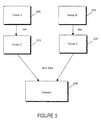
- Figure 5 demonstrates the mapping used to create a consolidated database.
- Format A 500 supports multiple configurations (but may only allow one configuration to be activated at a time).
- Format B 504 does not support multiple configurations at all. Both Format A 500 and Format B 504 are imported or mapped into a compatible Format C 502 and 506 respectively. The imported configurations 502 and 506 may then be stored in the Database 508.
- One embodiment of the invention provides an additional feature that converts formats that do not support multiple configurations into a format that supports multiple configurations while maintaining the integrity of the file format.
- This feature is provided by importing the non-multiple configuration files into the database.
- the database allows multiple configurations to be used and provides for one of the configurations to maintain "active" status. When the database is closed, the "active" configuration is exported and saved to the non-multiple file format. Thus, the database maintains the integrity of the file formats that supports multiple configurations while simultaneously supporting multiple formats on the computer system.
- the remaining users are notified of the modification at step 206.
- the notification consists of a message being transmitted to the user and if any operation is attempted on the database by the user, the operation fails.
- the database file must be closed at step 208.
- the database file is reopened in its modified form. In this manner, any program that is accessing the database file does not need to be restarted or exited.
- the database file being accessed by the program merely needs to be closed and reopened. Subsequently, users may access the database as if no change had been made at step 200.
- One embodiment of the invention implements the "write" procedure indicated above through various steps.
- a duplicate copy of the information being viewed e.g., a configuration set or protocol
- Any modifications that are made prior to being committed are made to the temporary file.
- the temporary file is marked as "committed” (or alternatively, a duplicate of the temporary file is created and labeled as "committed") and the original information is replaced with the modified permanent information.
- the "committed" file copies may be deleted.
- One embodiment of the invention provides the ability to maintain and protect the database if a system failure occurs (i.e., when the computer must be restarted or unexpectedly quits the application) while the user is attempting to commit modified information to the database.
- a Configuration Library that includes code to maintain and modify the database may provide this ability.
- a flag Prior to committing information to the database, a flag is set indicating that the information being modified has not yet been "committed” to the database. Subsequent to committing the information, the flag is set indicating that the "commit” operation has occurred. In the event of a system failure, the lock that is placed on the database during a "write” transaction is released (thus enabling others to access and write to the database if needed).
- the next time a user tries to access the database it can be determined if the modified information was committed by checking the flag. If the flag indicates that a "commit" operation has occurred, the user knows that the information was recorded and access may continue as normal. If the committed flag indicates that the "commit" has not yet occurred, the data that has not been committed is deleted and the user must restart the modification process. In this manner the integrity of the database is maintained even in the event of a system failure.
- One embodiment of the invention provides the ability to perform remote scripting.
- Remote scripting allows an administrator to set up a script on the administrator's computer to perform a plurality of events sequentially on the administrator's computer or on a computer connected to the network.
- a script can be stored remotely and an administrator or user may command the script to run.
- the ability to run a script to perform a plurality of events on the network enables a network administrator to automatically custom configure each network user's computer from a remote location. This capability eliminates the need to physically and manually adjust each computer that is connected to the network. If a network contains several hundred computers and each has a static IP address that needs to be changed, the network administrator saves considerable time by merely creating a script to adjust the IP address on each user's computer. This also prevents possible errors if each computer user were required to manually adjust the computer's configuration.
- a key may be titled NAME, and a Value for any one record in the database may be the name of an employee such as John Smith.
- Various other keys may also be utilized such as ADDRESS, DEPARTMENT, and SALARY. Database accessibility using key-value pairs is more fully described in pending United States Patent Application serial no. 08/863,416 entitled "Dynamic Object Communication Protocol".
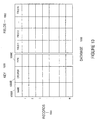
- one embodiment of the invention provides for the database 1006 to be accessible using a three-part key 1000 consisting of NAME 1000a, CREATOR 1000b, and TYPE 1000c.
- Each record 1004 in the database has a NAME 1000a associated with it, the name of the CREATOR 1000b of the record, and the TYPE 1000c of record.
- an arbitrary amount of data 1002 may stored in each record.
- the three-part key for each record consists of the NAME of an employee, the name of the CREATOR of that record, and the TYPE of record (e.g., an employment record).
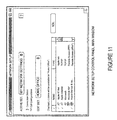
- the User Interface client consolidates all of the existing control panels into one combined Network Setup control panel as demonstrated by a screen print out of the Network Setup Control Panel of one embodiment in Figure 11.
- a consolidated control panel the user does not need to adjust multiple control panels for existing protocols such as the TCP/IP control panel and the PPP control panel.
- the user need only use the one control panel to adjust all networking capabilities.
- the configuration or other settings may be checked at the time of set-up to ensure that the protocols are compatible (the prior art only detects incompatibility at the time of execution or use).
- the user interface permits two protocols of the same type to be created and active at the same time, referred to as multihoming.
- Multihoming is beneficial when a user has multiple networks connected and being used simultaneously. For example, if the user has a network within the user's company (called an intranet) through two different ethernets, multihoming allows the user to use two AppleTalk protocols at the same time to permit access through both ethernet connections.
- the invention provides for the activation of multiple networks to be active simultaneously.
- Another example of multihoming consists of two TCP/IP configurations active at the same time which thereby provides the ability to have a static IP address and dynamic IP address on the same computer active at the same time.
- the Scripting Interface is a general tool that can be used to access the database (remotely or locally) or configure a user's computer system (remotely or locally) (including system settings other than network configurations).
- the Scripting Interface consists of two components: (1) an Application Program or Scripting Server; and (2) Personality Module or Scripting Plug-In.
- the Scripting Interface may be customized for particular purposes.
- the Scripting Interface may be customized into a Network Scripting Interface.
- the Scripting Server component of the Scripting Interface acts as an engine.
- the Scripting Server receives the commands.
- the commands are transmitted in the form of a script.
- the Scripting Server may accept AppleEvents.
- An AppleEvent provides for communication between applications by allowing an application to send a command to another application.
- the Scripting Server component of the Scripting Interface may be used to receive either AppleScript or AppleEvents. This ability is enabled by utilization of a dictionary (encompassed within a configuration library that is invoked when the user desires to access the database) that describes recognizable script events, and the objects and their relationships as they exist in the database.
- the dictionary consists of the standard dictionary utilized in AppleScript and any extended capabilities added by a scripting language programmer.
- the dictionary must contain a class for each object or item that may be configured (e.g., the dictionary must contain a class for each protocol such as TCP/IP, AppleTalk, etc.). Further, if a particular configuration is expanded and is capable of handling additional features, the dictionary and Plug-In must be modified to accommodate the new features.
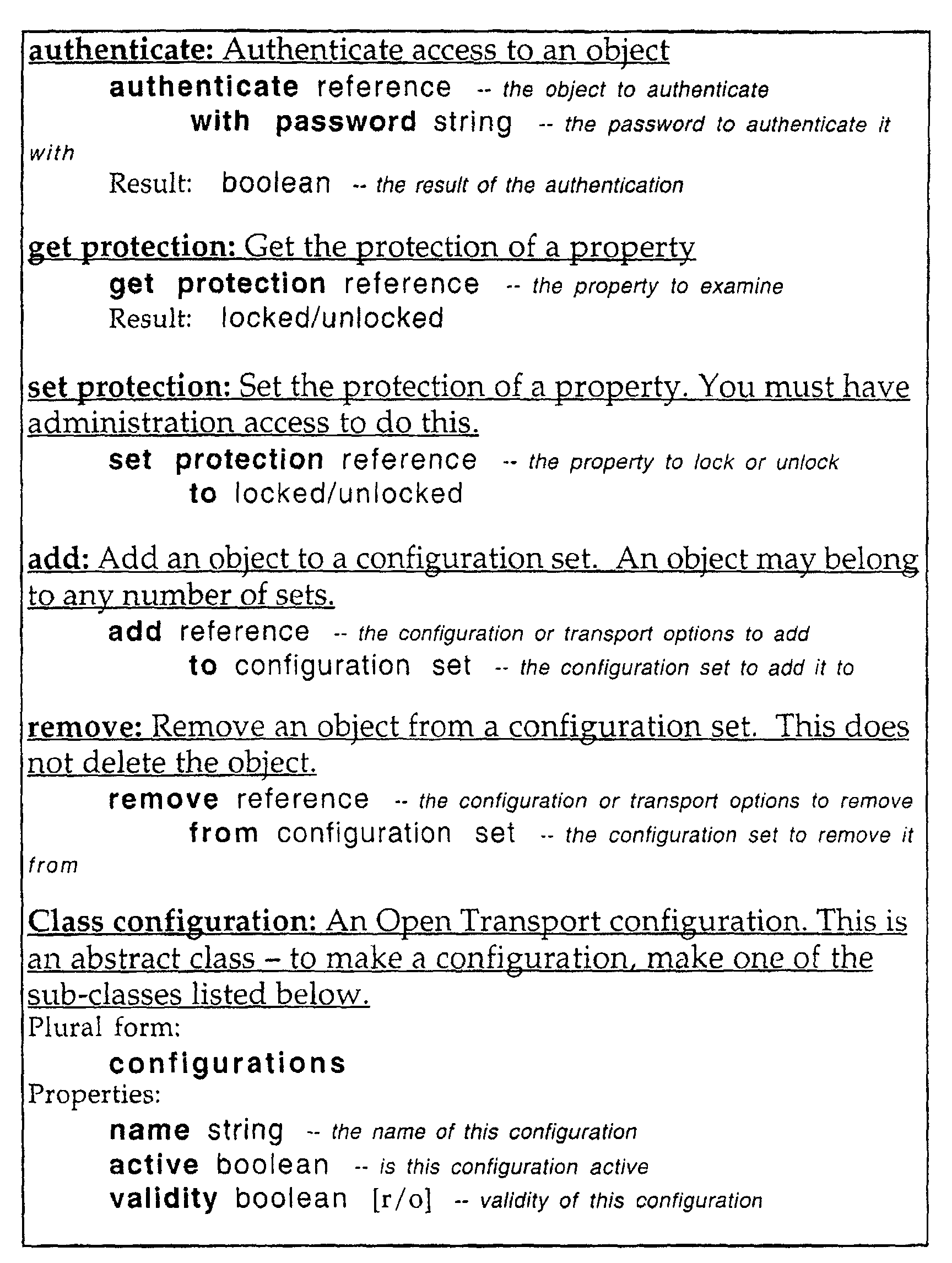
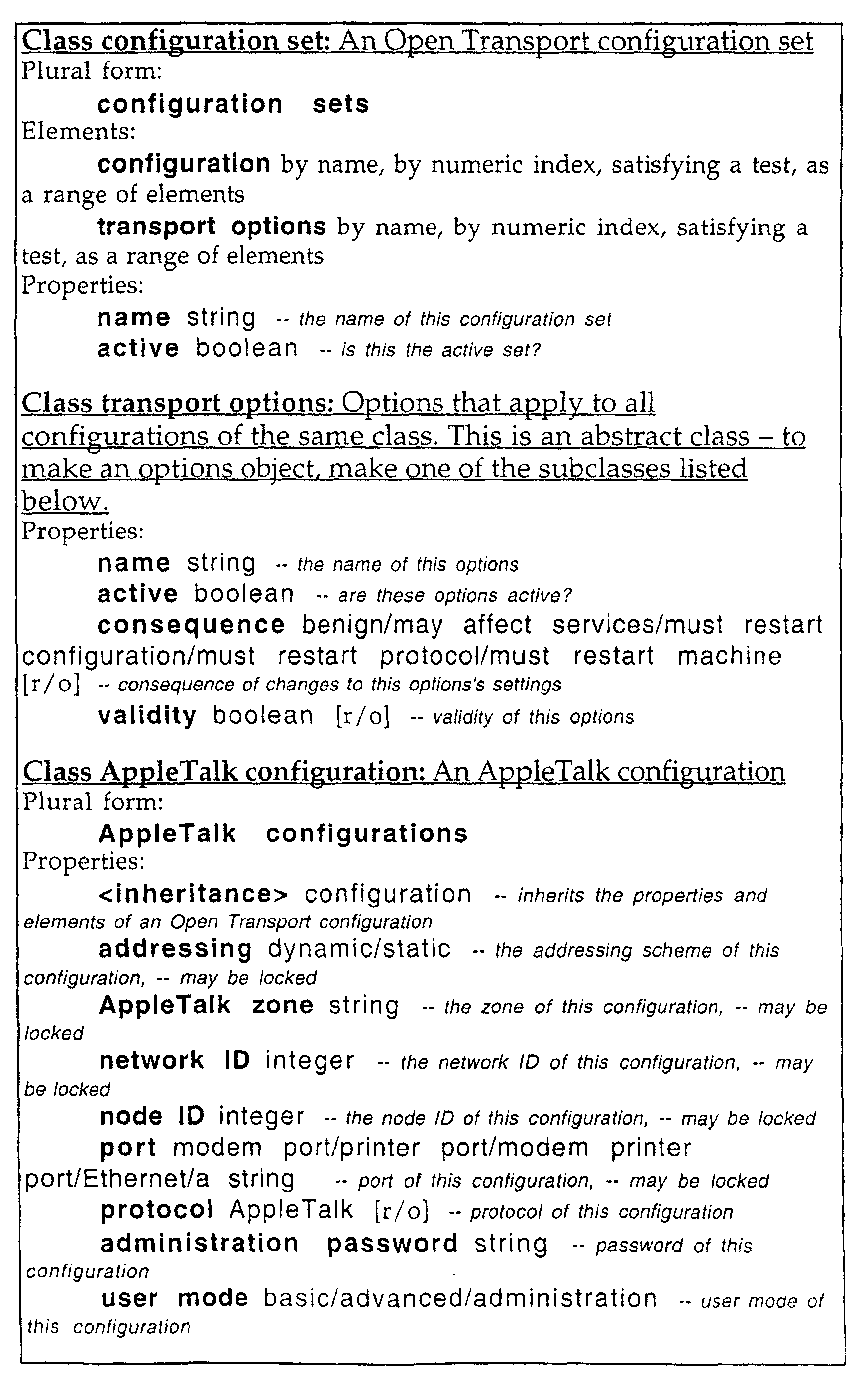
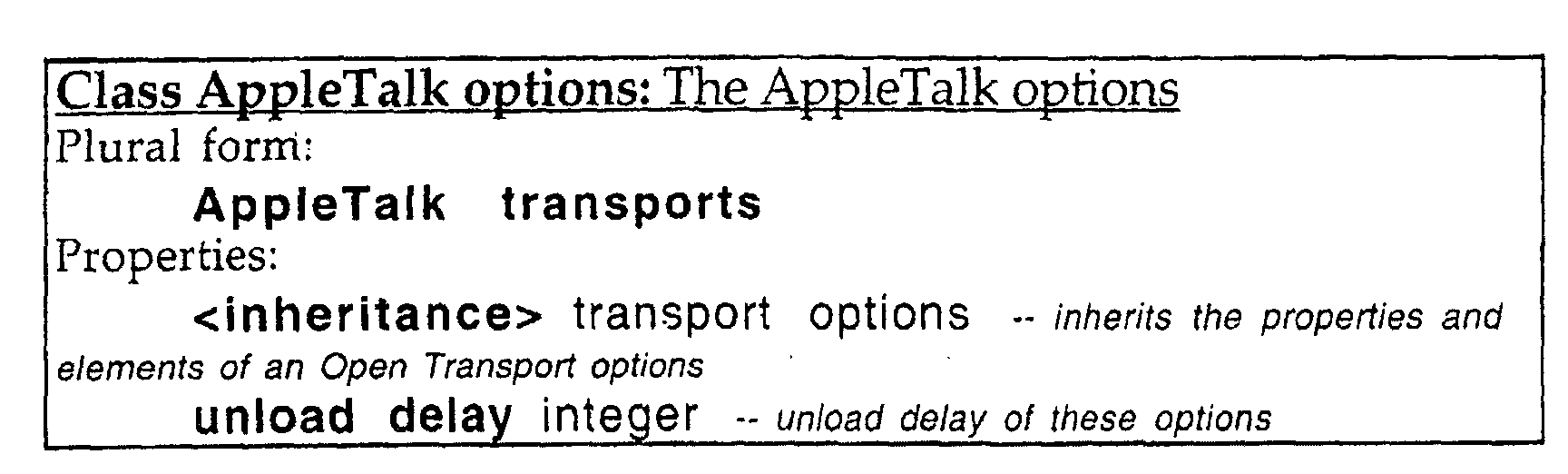
- the dictionary and Plug-In must be modified to accommodate the new features. The following is an example of part of a dictionary:
- the Scripting Server component is configured to maintain knowledge of the general structure and capabilities of the database. However, the Scripting Server does not maintain any knowledge about particular fields that are in the classes. Based on its knowledge of the database, the Scripting Server interprets the commands and determines the type of object that the desired action is to be performed on. Once determining the appropriate object, the Scripting Server forwards the commands to the appropriate Scripting Plug-In that has the ability to modify the object.
- the Scripting Plug-In receives parsed commands from the Scripting Server. Since the Scripting Server is specific to a particular object or type of configuration, it maintains knowledge of the individual fields, data structures, and methods of each type of configuration, class, or object. Consequently, when the command is received from the Scripting Server, the Scripting Plug-In is able to utilize the necessary method to manipulate the field in the database and perform the desired operation or command. Each Plug-In maintains the knowledge of the desired classes to manipulate the field as necessary. For example, a TCP Plug-In maintains the necessary knowledge to modify any fields in a TCP configuration. Similarly, an AppleTalk Plug-In maintains the necessary information to modify any fields in an AppleTalk Configuration. Further, to ensure that each Plug-In is only operating on fields in the appropriate configuration, the sorting and sifting capabilities of the database described above are used.
- the configuration settings that the Scripting Plug-In maintains knowledge about include two parts: (1) Global Settings (referred to as Globals); and (2) Configuration Settings.
- Global settings are those settings that are not dependent on the type of configuration and do not change from configuration to configuration.
- both Global Settings and Configuration Settings are implemented in an object oriented programming language as abstract classes.
- An abstract class is a class that contains functions that are declared but not implemented. In other words, an abstract class merely declares its existence and a subclass (a class that inherits or descends from the another class) must implement the abstract methods and protocol specific fields and accessors. For example, in one embodiment the abstract methods that must be implemented are:
- protocol proxy object that encapsulates all of the protocol data and behavior must be implemented.
- the protocol proxy is responsible for:
- the Scripting Plug-In notifies the operating system software so that the changes are recognized by the system.
- Figure 3 illustrates the interaction between the Scripting Server component and Scripting Plug-In component of the Scripting Interface.
- the user or application transmits a command to the Scripting Interface. This command may be from a local script on the user's machine, from a remote script from a machine somewhere on the network, or from a remote process running on a machine somewhere on the network.
- the Scripting Server receives the command.
- the Scripting Server interprets the command. The interpretation process consists of the Scripting Server parsing the command and determining the type of object that the command is to be executed by or on.
- the Scripting Server forwards the command to the appropriate Scripting Plug-In (which is customized for the particular type of object that is to perform the command).
- the Scripting Plug-In performs the desired action.
- the Scripting Plug-In notifies the operating system software of any system settings that have changed.
- Figure 4a illustrates the architectural design of one embodiment of the invention.
- File system 406a contains the general file structure available on computer systems and the database of configurations.
- the Configuration Library 404a provides the necessary software, configuration information, protocol information, and dictionary for use by the scripting interface to access and modify the database in the file system 404a.
- Scripting Server 400a receives the commands and determines the appropriate Scripting Plug-In 402a to forward the command to by examining Configuration Library 404a.
- Figure 4b illustrates an architectural design of an embodiment for network configuration.
- the Configuration Library 404b contains network configuration specific information to enable access to the database.
- Network Scripting Server 400b receives the commands, interprets them and forwards them to the appropriate Network Scripting Plug-In 402b to modify the desired type of protocol (e.g., AppleTalk, TCP/IP, etc.) in the database.
- the desired type of protocol e.g., AppleTalk, TCP/IP, etc.
- the creator of a particular Plug-In only needs to create a dictionary as described above (and may omit any code that provides support for the classes in the dictionary).
- the dictionary specifies that each particular class in the dictionary inherits from a predefined class (such as an AppleEventRecord (a Record containing AppleEvents)).
- the Scripting Server encapsulates the fields that have been defined in the dictionary into an AppleEventRecord and writes the encapsulated information to the database.
- the Scripting Server must maintain knowledge of how to support the predefined class (e.g., an AppleEventRecord). In this manner, the objects and configurations in the dictionary appear in the database through an interaction with the Scripting Server.
- one embodiment of the invention continues to provide support for the Location Manager such that if the user desires to switch locations, the Location Manager may be continue to be used as in the prior art.
- the database and methods described above provide for data protection, crash recovery, sorting and sifting of items by protocol type, and a method for creating, accessing, and modifying the data.
- One embodiment of the invention provides for an additional Configuration Library that supports a broader set of capabilities specific to Network Configuration.
- Figure 6 illustrates the architectural design of such an embodiment. Similar to the design described in Figure 4b, the underlying File system and database 606, Network Scripting Server 600, Network Scripting Plug-In 602, and Configuration Library 604 remain intact.
- an OpenTransport (OT) type of network software product manufactured by Apple Computer, Inc.
- Network Configuration Library 608 layer is added to the design.
- the OT Configuration Library 608 provides backwards compatibility such that all computer systems, old and new have the ability to support multiple configurations.
- This layer of the architectural design may be created and used for any type of configuration that requires backwards compatibility. The layer need not be specific to network configuration.
- the backwards compatibility feature is enabled through an automated import-export feature that occurs transparently to the user.
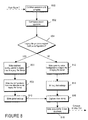
- Figures 7 and 8 illustrate this import-export feature.
- the prior art control panels modify their respective files (referred to as legacy files) when a change is made.
- legacy files Each time a change is made to a legacy file, the legacy file is date stamped with the date and time the change is made at step 702.
- the new database containing the consolidated information from the prior art control panels is opened or accessed by the Scripting Server or Scripting Plug-In at step 704.
- the date stamp of each legacy file represented in the database is checked. If the date stamp matches the date stamp set in the database, execution continues normally as indicated in Figure 8 (see below).
- an import operation commences at step 712.
- a determination regarding the type of configuration that is stored in the legacy file is made at step 714. If the configuration in the legacy file supports multiple configurations, a configuration for each of the multiple configurations in the legacy file is made in the new database at step 716. Additionally, a set of globals are created in the new database at step 718. Thus, if there are n configurations in the legacy file, n +1 entries are created in the new database (one for each configuration + a set of globals).
- a configuration for the legacy file configuration is created in the new database at step 720.
- a set of globals are created at step 722.
- the currently active configuration is written to the legacy file in the old legacy file format at step 812.
- the old file format (which only supports one configuration at a time) is preserved while at the same time the new database continues to provide support for multiple configurations.
- the user simply designates a new active configuration in the database which starts the import-export procedure (the import-export procedure commences because a change in a configuration causes the database to be opened, a "write" to the database occurs, or the database is closed).
- the global settings are written to the legacy file at step 814, and the date stamp is captured and written to the new database at steps 816 and 818. Upon completing the date stamp capture at step 818, the database is ready to receive a new import and the process starts over again at step 704.
- the OT Configuration Library 608 provides protection and recovery if the system or database is interrupted or crashes.
- the support consists of the database protection available with the Configuration Library 604 with an additional export feature to restore the legacy files.
- the OT Configuration Library 608 hooks into the recovery process and applies the results to the legacy files using the export operation set forth in steps 802-818 of Figure 8.
- the export operation commences as a result of a database recovery operation instead of the normal database close operation. Consequently, the legacy files accurately reflect any change in the database.
- script drafting may be performed by displaying the dictionary stored in the Configuration Library associated with a particular Plug-In which enables the drafter to select the operations and fields that need to be performed or configured (the Scripting Server may be used to display the available dictionaries to the user).
- the script is drafted.
- the script may then be launched with a Scripting Server.
- the script is run on the network administrator's own computer locally first. Subsequently, the remote computer is configured to accept remote scripting at step 904.
Landscapes
- Engineering & Computer Science (AREA)
- Software Systems (AREA)
- Theoretical Computer Science (AREA)
- Physics & Mathematics (AREA)
- General Engineering & Computer Science (AREA)
- General Physics & Mathematics (AREA)
- Information Retrieval, Db Structures And Fs Structures Therefor (AREA)
- Computer And Data Communications (AREA)
Description

- (1) ReadSettings:
- to initialize the object from an entity;
- (2) WriteSettings:
- to write the object into an entity; and
- (3) Clone:
- to clone the object.
Claims (16)
- Method of configuring a computer comprising the steps of:a) obtaining a database;b) loading said database with configuration settings, said loading step comprising:characterised by the step of:retrieving configuration settings from existing files and storing said configuration settings from said existing files into said database of configuration settings;c) modifying said configuration settings in said database,
wherein said modifying step comprises:determining, if said existing files have been altered;
if said existing files have been altered, performing the following steps:determining, if said existing files support multiple configurations;obtaining a configuration in said database for each multiple configuration, if said files support multiple configurations;obtaining a configuration in said database for said existing file's configuration, if said configuration does not support multiple configurations;and modifying said configurations in said database. - Method according to claim 1, further comprising:determining, if said existing files support multiple configurations;writing said configurations from said database into said existing files, if said existing files support multiple configurations;and writing a currently active configuration from said database to said existing file, if said existing files do not support multiple configurations.
- Method according to one of claims 1 to 2, further comprising:capturing a date stamp from said existing file;recording said date stamp in said database;comparing said date stamp in said existing file to said recorded date stamp in said database when determining if said configuration has been altered.
- Method according to one of claims 1 to 3, further comprising:determining, if other users were accessing said database; and notifying said other users of said modification.
- Method according to one of claims 1 to 4, wherein as configuration settings network configuration settings are used.
- Method according to one of claims 1 to 5, further comprising:obtaining a script;launching said script on a scripting server;and modifying configuration settings according to said script.
- Method according to claim 6 wherein said step of obtaining a script further comprises:obtaining a dictionary of scriptable commands; andprogramming a script using scriptable commands from said dictionary.
- Method according to claim 6 or 7 wherein said scripting server is located on a remote computer.
- Method according to one of claims 6 to 8 wherein said modifying step comprises:parsing said script;forwarding commands contained in said script to a Scripting Plug-In; andmodifying configuration settings using said Scripting Plug-In.
- System comprising:characterised by:a processor;a memory coupled to said processor;said processor comprissing object code means adapted to carry out a method of configuring a computer;said object code means comprising:means adapted to obtain a database;means adapted to load said database with configuration settings, comprising:means adapted to retrieve configuration settings from existing files; and means adapted to store said configuration settings from said existing files into said database of configuration settings;wherein said means adapted to modify said configuration settings comprises:means adapted to modify said configuration settings in said database,means adapted to determine, if said existing files have been altered;means operationable if said existing files have been altered, these means comprising:means adapted to determine, if said existing files support multiple configurations;means adapted to obtain a configuration in said database for each multiple configuration, if said files support multiple configurations;means adapted to obtain a configuration in said database for said existing file's configuration, if said configuration does not support multiple configurations; and means adapted to modify said configurations in said database.
- System according to claim 10, further comprising:means adapted to determine, if said existing files support multiple configurations;means adapted to write said configurations from said database into said existing files, if said existing files support multiple configurations; andmeans adapted to write a currently active configuration from said database to said existing file, if said existing files do not support multiple configurations.
- System according to one of claims 10 to 11, comprising:means adapted to capture a date stamp from said existing file;means adapted to record said date stamp in said database;means adapted to determine, if said configuration has been altered,means adapted to compare said date stamp in said existing file to said recorded date stamp in said database.
- System according to one of claims 10 to 12 comprising:means adapted to determine, if other users were accessing said database;and means adapted to notify said other users of said modification.
- System according to one of claims 10 to 13, wherein said configuration settings are network configuration settings.
- Computer program product comprising a computer usable medium having computer readable code embodied therein for configuring a computer, said computer program product comprising:computer readable code adapted to configure a computer to carry out the steps of the method to according to anyone of the claims 1 to 9.
- Program to be carried out by a computer for configuring a computer, said program, when loaded into a computer, causing the computer to carry out the steps of a method according to one of claims 1 to 9.
Applications Claiming Priority (3)
| Application Number | Priority Date | Filing Date | Title |
|---|---|---|---|
| US7479598A | 1998-05-08 | 1998-05-08 | |
| US74795 | 1998-05-08 | ||
| PCT/US1999/009797 WO1999057957A2 (en) | 1998-05-08 | 1999-05-05 | Method and apparatus for configuring a computer |
Publications (2)
| Publication Number | Publication Date |
|---|---|
| EP1076849A2 EP1076849A2 (en) | 2001-02-21 |
| EP1076849B1 true EP1076849B1 (en) | 2002-12-04 |
Family
ID=22121742
Family Applications (1)
| Application Number | Title | Priority Date | Filing Date |
|---|---|---|---|
| EP99921671A Expired - Lifetime EP1076849B1 (en) | 1998-05-08 | 1999-05-05 | Method and system for configuring a computer |
Country Status (4)
| Country | Link |
|---|---|
| EP (1) | EP1076849B1 (en) |
| CA (1) | CA2330030C (en) |
| DE (1) | DE69904317T2 (en) |
| WO (1) | WO1999057957A2 (en) |
Families Citing this family (12)
| Publication number | Priority date | Publication date | Assignee | Title |
|---|---|---|---|---|
| US6779016B1 (en) | 1999-08-23 | 2004-08-17 | Terraspring, Inc. | Extensible computing system |
| US7103647B2 (en) * | 1999-08-23 | 2006-09-05 | Terraspring, Inc. | Symbolic definition of a computer system |
| US8179809B1 (en) | 1999-08-23 | 2012-05-15 | Oracle America, Inc. | Approach for allocating resources to an apparatus based on suspendable resource requirements |
| US8019870B1 (en) | 1999-08-23 | 2011-09-13 | Oracle America, Inc. | Approach for allocating resources to an apparatus based on alternative resource requirements |
| US7703102B1 (en) | 1999-08-23 | 2010-04-20 | Oracle America, Inc. | Approach for allocating resources to an apparatus based on preemptable resource requirements |
| US8032634B1 (en) | 1999-08-23 | 2011-10-04 | Oracle America, Inc. | Approach for allocating resources to an apparatus based on resource requirements |
| US7463648B1 (en) | 1999-08-23 | 2008-12-09 | Sun Microsystems, Inc. | Approach for allocating resources to an apparatus based on optional resource requirements |
| US8234650B1 (en) | 1999-08-23 | 2012-07-31 | Oracle America, Inc. | Approach for allocating resources to an apparatus |
| US6714980B1 (en) | 2000-02-11 | 2004-03-30 | Terraspring, Inc. | Backup and restore of data associated with a host in a dynamically changing virtual server farm without involvement of a server that uses an associated storage device |
| US7093005B2 (en) | 2000-02-11 | 2006-08-15 | Terraspring, Inc. | Graphical editor for defining and creating a computer system |
| GB2364589A (en) * | 2000-06-23 | 2002-01-30 | Ebs Nominees Ltd | Configurable anonymous trading system |
| GB0226919D0 (en) * | 2002-11-18 | 2002-12-24 | Active Ltd | Database management |
Family Cites Families (4)
| Publication number | Priority date | Publication date | Assignee | Title |
|---|---|---|---|---|
| US5175800A (en) * | 1987-03-23 | 1992-12-29 | Case Group Plc | Expert and data base system and method for communications network |
| US5414812A (en) * | 1992-03-27 | 1995-05-09 | International Business Machines Corporation | System for using object-oriented hierarchical representation to implement a configuration database for a layered computer network communications subsystem |
| US5838907A (en) * | 1996-02-20 | 1998-11-17 | Compaq Computer Corporation | Configuration manager for network devices and an associated method for providing configuration information thereto |
| US5734831A (en) * | 1996-04-26 | 1998-03-31 | Sun Microsystems, Inc. | System for configuring and remotely administering a unix computer over a network |
-
1999
- 1999-05-05 WO PCT/US1999/009797 patent/WO1999057957A2/en not_active Ceased
- 1999-05-05 CA CA002330030A patent/CA2330030C/en not_active Expired - Lifetime
- 1999-05-05 DE DE69904317T patent/DE69904317T2/en not_active Expired - Lifetime
- 1999-05-05 EP EP99921671A patent/EP1076849B1/en not_active Expired - Lifetime
Non-Patent Citations (1)
| Title |
|---|
| THOMAS HANDSCHUCH: "Solaris 2 Systemadministration,Grundlagen und Systemmanagement, unveränderter Nachdruck 1996", 1996, IWT VERLAG GMBH, BONN, H * |
Also Published As
| Publication number | Publication date |
|---|---|
| WO1999057957A3 (en) | 2000-03-09 |
| CA2330030A1 (en) | 1999-11-18 |
| WO1999057957A2 (en) | 1999-11-18 |
| CA2330030C (en) | 2009-10-13 |
| DE69904317D1 (en) | 2003-01-16 |
| DE69904317T2 (en) | 2003-09-04 |
| EP1076849A2 (en) | 2001-02-21 |
Similar Documents
| Publication | Publication Date | Title |
|---|---|---|
| US6256635B1 (en) | Method and apparatus for configuring a computer using scripting | |
| US6085198A (en) | Integrated three-tier application framework with automated class and table generation | |
| US7941796B2 (en) | Distributing and synchronizing objects | |
| US5787413A (en) | C++ classes for a digital library | |
| US7269664B2 (en) | Network portal system and methods | |
| US6018743A (en) | Framework for object-oriented interface to record file data | |
| EP0605959B1 (en) | Apparatus and methods for making a portion of a first name space available as a portion of a second name space | |
| US5623666A (en) | Distributed computing system | |
| KR100868410B1 (en) | Managed file system filter model and architecture | |
| US6061692A (en) | System and method for administering a meta database as an integral component of an information server | |
| US7181474B2 (en) | Database communication system and method for communicating with a database | |
| US6339782B1 (en) | Persistence mechanism and method for objects | |
| US6996565B2 (en) | System and method for dynamically mapping dynamic multi-sourced persisted EJBs | |
| EP1126681A2 (en) | A network portal system and methods | |
| US5862377A (en) | Technique for sharing information between applications | |
| US20030105858A1 (en) | Method and apparatus for remote database maintenance and access | |
| EP0817025A2 (en) | Data structures and method for implementing subcontracts in a distributed object oriented system | |
| WO2007035733A2 (en) | Interfaces for a productivity suite application and a hosted user interface | |
| CA2330030C (en) | Method and apparatus for configuring a computer | |
| US6832223B1 (en) | Method and system for facilitating access to a lookup service | |
| JP2002505553A (en) | Diversity token based control | |
| US6912561B1 (en) | Method and apparatus for using classes, encapsulating data with its behaviors, for transferring between databases and client applications and for enabling applications to adapt to specific constraints of the data | |
| US7487137B2 (en) | Apparatus, system, and method for java bean delta generation | |
| GB2370658A (en) | A modular software framework | |
| EP0714532B1 (en) | Dynamic value mechanism for computer storage container manager |
Legal Events
| Date | Code | Title | Description |
|---|---|---|---|
| PUAI | Public reference made under article 153(3) epc to a published international application that has entered the european phase |
Free format text: ORIGINAL CODE: 0009012 |
|
| 17P | Request for examination filed |
Effective date: 20001205 |
|
| AK | Designated contracting states |
Kind code of ref document: A2 Designated state(s): DE FR GB |
|
| 17Q | First examination report despatched |
Effective date: 20010522 |
|
| GRAG | Despatch of communication of intention to grant |
Free format text: ORIGINAL CODE: EPIDOS AGRA |
|
| RTI1 | Title (correction) |
Free format text: METHOD AND SYSTEM FOR CONFIGURING A COMPUTER |
|
| GRAG | Despatch of communication of intention to grant |
Free format text: ORIGINAL CODE: EPIDOS AGRA |
|
| GRAH | Despatch of communication of intention to grant a patent |
Free format text: ORIGINAL CODE: EPIDOS IGRA |
|
| GRAH | Despatch of communication of intention to grant a patent |
Free format text: ORIGINAL CODE: EPIDOS IGRA |
|
| GRAA | (expected) grant |
Free format text: ORIGINAL CODE: 0009210 |
|
| AK | Designated contracting states |
Kind code of ref document: B1 Designated state(s): DE FR GB |
|
| REG | Reference to a national code |
Ref country code: GB Ref legal event code: FG4D |
|
| REF | Corresponds to: |
Ref document number: 69904317 Country of ref document: DE Date of ref document: 20030116 |
|
| ET | Fr: translation filed | ||
| PLBE | No opposition filed within time limit |
Free format text: ORIGINAL CODE: 0009261 |
|
| STAA | Information on the status of an ep patent application or granted ep patent |
Free format text: STATUS: NO OPPOSITION FILED WITHIN TIME LIMIT |
|
| 26N | No opposition filed |
Effective date: 20030905 |
|
| REG | Reference to a national code |
Ref country code: FR Ref legal event code: CD |
|
| REG | Reference to a national code |
Ref country code: FR Ref legal event code: PLFP Year of fee payment: 18 |
|
| REG | Reference to a national code |
Ref country code: FR Ref legal event code: PLFP Year of fee payment: 19 |
|
| REG | Reference to a national code |
Ref country code: FR Ref legal event code: PLFP Year of fee payment: 20 |
|
| PGFP | Annual fee paid to national office [announced via postgrant information from national office to epo] |
Ref country code: GB Payment date: 20180329 Year of fee payment: 20 |
|
| PGFP | Annual fee paid to national office [announced via postgrant information from national office to epo] |
Ref country code: DE Payment date: 20180424 Year of fee payment: 20 |
|
| PGFP | Annual fee paid to national office [announced via postgrant information from national office to epo] |
Ref country code: FR Payment date: 20180411 Year of fee payment: 20 |
|
| REG | Reference to a national code |
Ref country code: DE Ref legal event code: R071 Ref document number: 69904317 Country of ref document: DE |
|
| REG | Reference to a national code |
Ref country code: GB Ref legal event code: PE20 Expiry date: 20190504 |
|
| PG25 | Lapsed in a contracting state [announced via postgrant information from national office to epo] |
Ref country code: GB Free format text: LAPSE BECAUSE OF EXPIRATION OF PROTECTION Effective date: 20190504 |