EP1076287A2 - Method and apparatus for performing method lookup in the presence of modularity constructs to support transitive method override - Google Patents
Method and apparatus for performing method lookup in the presence of modularity constructs to support transitive method override Download PDFInfo
- Publication number
- EP1076287A2 EP1076287A2 EP00306784A EP00306784A EP1076287A2 EP 1076287 A2 EP1076287 A2 EP 1076287A2 EP 00306784 A EP00306784 A EP 00306784A EP 00306784 A EP00306784 A EP 00306784A EP 1076287 A2 EP1076287 A2 EP 1076287A2
- Authority
- EP
- European Patent Office
- Prior art keywords
- class
- implementation
- intervening
- resolved
- instructions
- Prior art date
- Legal status (The legal status is an assumption and is not a legal conclusion. Google has not performed a legal analysis and makes no representation as to the accuracy of the status listed.)
- Granted
Links
Images



Classifications
-
- G—PHYSICS
- G06—COMPUTING OR CALCULATING; COUNTING
- G06F—ELECTRIC DIGITAL DATA PROCESSING
- G06F9/00—Arrangements for program control, e.g. control units
- G06F9/06—Arrangements for program control, e.g. control units using stored programs, i.e. using an internal store of processing equipment to receive or retain programs
- G06F9/44—Arrangements for executing specific programs
- G06F9/448—Execution paradigms, e.g. implementations of programming paradigms
- G06F9/4488—Object-oriented
- G06F9/449—Object-oriented method invocation or resolution
Definitions
- This invention relates generally to computer systems and more particularly to a method and apparatus for performing method lookup to support transitive method override in the presence of modularity constructs, such as packages.
- Inheritance is a major property of most object oriented programming systems. With inheritance, when a class is declared as a subclass of a superclass, that subclass automatically inherits all of the methods and attributes of the superclass. Thus, if class A has method M1 and attribute AT1, then class B, which is a subclass of class A, automatically inherits method M1 and attribute AT1. In addition to inheriting the methods and attributes of the superclass, the subclass may further comprise additional methods and attributes. Thus, for the example given above, class B may further comprise methods M2 and M3, and attributes AT2 and AT3.
- some object oriented systems further allow subclasses to override the methods of the superclass. That is, the subclass is allowed to provide an implementation for an inherited method which is different from that provided by the superclass.
- subclass B may provide a different implementation for method M1 than that provided by superclass A.
- the implementation for M1 provided by superclass A may draw a square whereas the implementation for method M1 provided by subclass B draws a circle.
- both methods have the same name, they may have different implementations. Which implementation is invoked depends upon the class of the object instance on which the method is invoked. If the method is invoked on a class A instance, then the implementation provided by class A will be invoked.
- class B If the method is invoked on a class B instance, then the implementation provided by class B will be invoked. Because there may be multiple implementations for any particular method, a determination will have to be made at runtime as to which implementation to invoke. The process of selecting which implementation to invoke at runtime is referred to as dynamic method dispatch.
- a modularity construct sometimes referred to as a "package” in JavaTM, provides a mechanism for grouping or encapsulating selected classes.
- the package construct makes it possible to limit access to the classes within a package by classes in other packages. More specifically, each method of each class within a package may be declared as "public”, “protected”, or “package private”. If a method is declared public or protected (denoted as public/protected hereinafter), then it may be accessed, and hence overridden, by any subclass of that class. On the other hand, if a method is declared package private, then that method may be accessed and overridden by a subclass if and only if that subclass is within the same package.
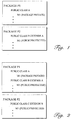
- Fig. 1 illustrates an example of such a situation.
- Package P1 contains a class A having a package private method M1.
- Package P2 contains a class B which extends A (meaning that B is a subclass of A) having a public/protected method M1. Because method M1 of class A is declared package private, and because class B is not in the same package as class A, class B will not be able to access or to override the method M1 of class A. Note that the package construct does not prevent class B from being a subclass of A, and hence, inheriting all of the attributes and methods of class A.
- the package only prevents class B from overriding the method M1 of class A.
- it is a general rule that unless a subclass is within the same package as a higher level class that it wishes to override, it cannot override a package private method of the higher level class.
- method M1 of subclass B can access and hence override method M1 of class A (since B is in the same package as A). It is also clear that method M1 of class C can override the method M1 of class B (since method M1 of B is declared to be public/protected). According to the transitive property, if method M1 of C can override method M1 of B, and method M1 of B can override method M1 of A, then method M1 of C should be able to override method M1 of A. This is not the result in this example, however, because under the rule set forth above, M1 of C cannot override M1 of A because M1 of A is package private and C is not in the same package as A.
- One mechanism that may be used to perform dynamic method dispatch is a method lookup mechanism.
- An embodiment of the invention provides an improved method lookup mechanism which not only enforces accessibility constraints imposed by modularity constructs but also enables transitive method override.
- the resolved method m in a resolved class is checked to determine whether it has been declared as public/protected. If so, then standard method lookup may be used to determine the proper implementation of method m to invoke. However, if the resolved method is not declared as public/protected, then a path stack is constructed. The path stack provides a listing of the class hierarchy between the target object and the resolved class.
- the path stack is used to determine which implementation of method m to invoke in response to the method invocation.
- the resolved method m is initially set as the candidate method to invoke. Then a downward search is performed through the classes on the path stack. At each class on the path stack, a determination is made as to whether that class: (1) provides an implementation for the method m; (2) can access the resolved method; and (3) has declared the method m as public/protected. If so, then the proper implementation for method m to be invoked may be determined using standard method lookup. However, if a class satisfies only the first two criteria, then the implementation for method m provided by that class is made the new candidate method, and the process loops back to test the next class on the path stack.
- Method lookup is one of the mechanisms that may be used to perform dynamic method dispatch.
- An embodiment of the invention provides an improved method lookup mechanism which enables transitive method override while enforcing accessibility constraints imposed by modularity constructs.
- method lookup refers to the process, performed at runtime, of navigating through a class hierarchy to determine which method implementation to invoke in response to a method invocation.
- concepts include the notion of a "resolved class”, a “resolved method”, and a "target object”. These are best understood with reference to an example.
- the resolved class is the class in which there is guaranteed (unless an error has occurred) to be an implementation for the method m.
- this implementation for method m may not necessarily be the one that is invoked when Foo is executed, but it is one possible implementation.
- the resolved method may be viewed as the default implementation for method m.
- resolution of symbolic references typically takes place only once, at resolution time. It is not carried out each time the function Foo is executed.
- Function Foo may be invoked on any object instance of class A.
- Foo may also be invoked on any object instance of any subclass of A.
- B is a subclass of A
- C is a subclass of B
- Foo may be invoked on an instance of class B, and an instance of class C. This makes sense since B and C, being subclasses of A, are technically of type A.
- the object instance on which Foo is invoked is referred to as the target object.
- object T is an instance of class C, and function Foo is invoked on object T (denoted as Foo(T)). then object T is the target object.
- each class provides a different implementation for method m, with class A 302 providing implementation m(1), class B 304 providing implementation m(2), and class C 306 providing implementation m(3).
- class A 302 providing implementation m(1)
- class B 304 providing implementation m(2)
- class C 306 providing implementation m(3).
- the implementation of method m that is invoked when function Foo is invoked on a target object will depend upon the class of the target object.
- target object T 308 is an instance of class C 306, then implementation m(3) of method m will be invoked when Foo is executed.
- target object T 308 is an instance of class B 304, then implementation m(2) of method m will be invoked.
- class A is the resolved class and method m of class A 302 is the resolved method, the implementation for method m that is actually invoked at runtime may not (and often is not) the implementation m(1) provided by the resolved class.
- One methodology that has been used to perform dynamic method dispatch is that of standard method lookup. This methodology will be described with reference to the sample hierarchy shown in Fig. 3.
- standard method lookup when a method m is invoked on a target object of a certain class (class C 306, for example), that class 306 is checked for an implementation of the method m. If an implementation is found, as is the case in this example, then that method implementation m(3) is invoked. Otherwise, the superclass 304 of the current class 306 is checked for an implementation of the method m. If an implementation is found in the superclass, then that method implementation m(2) is invoked. Otherwise, the next superclass 302 is checked. This process continues until an implementation is found and invoked or the resolved class 302 is reached. If the resolved class 302 is reached, then the resolved method implementation m(1) will be invoked.
- the standard method lookup methodology is based upon the assumption that each subclass can access and override each method of its superclass. Because it is based upon this assumption, it cannot handle the accessibility limits imposed by modularity constructs, and because it cannot handle modularity constructs, it cannot enable transitive method override in the face of such constructs.
- An embodiment of the invention provides a method lookup mechanism which addresses and solves all of these problems.
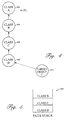
- Fig. 4 shows a sample class hierarchy which will be used to facilitate the description of the embodiment.
- Fig. 5 shows a sample path stack for the class hierarchy of Fig. 4
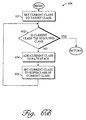
- Figs. 6a-6b are the flow diagrams for an example of a methodology according to the present invention. The following description will be based upon the following assumptions: (1) the resolved class is class A 402 which is part of a package P; (2) the resolved method is method m of class A 402 having a resolved method implementation m(1); (3) the target object is object T 410; and (4) the method invocation is on method in of target object T 410.
- an embodiment of a lookup method begins by determining ( 602 ) whether the resolved method (method m of class A 402) has been marked as public/protected. If it has, then it can be accessed and overridden by all subsequent subclasses. If that is the case, then the standard method lookup procedure discussed above may be used to perform ( 604 ) the method dispatch. Namely, the class 408 of the target object T 410 is searched for an implementation of the method m. If an implementation is found, then it is invoked. Otherwise, the next superclass 406 is searched for an implementation of method m. If an implementation is found in the superclass 406, then that implementation is invoked. Otherwise, the next superclass 404 is searched. This process continues until either an implementation for method m is found and invoked in one of the subclasses 404, 406, 408, or the resolved class 402 is reached, in which case the resolved method implementation m(1) is invoked.
- the resolved method is not marked public/protected, then it is private to package P. This is known because if the resolved method were private to another package or private altogether, then it would have failed to link, in which case, it would not have even gotten to the point of execution. If the resolved method is private to package P, then a more involved process will be used to determine which implementation of method m to invoke. This process begins with constructing ( 606 ) a path stack. A path stack is constructed as shown in Fig. 6b, wherein a current class variable is initially set ( 630 ) to the class of the target object 410 (Fig. 4). In this example, target object 410 is of class D 408; thus, the current class variable is initialized to class D 408.
- FIG. 5 With reference to Fig. 5, there is shown a path stack 500 for the sample class hierarchy shown in Fig. 4. Notice that the stack goes from the bottom up, with each superclass above its subclass. Notice further that the class (class D 408) of the target object 410 is included at the bottom of the path stack 500, but that the resolved class 402 is not included in the stack 500 at all.
- the path stack 500 may be used to determine the proper implementation of method m to invoke in response to the method invocation.
- the proper implementation is invoked as follows. Initially, a candidate method variable is set ( 608 of Fig. 6a) to the resolved method.
- the candidate method represents the implementation for method m that will be invoked unless an overriding method is found.
- the resolved method implementation m(1) provided by the resolved class 402 is made the default implementation. Unless a valid overriding implementation is found in one of the subclasses 404, 406, 408, the resolved method implementation m( 1) for method m will be invoked.
- a loop is entered. Within this loop, a determination ( 610 ) is made as to whether the path stack 500 is currently empty. If so, then it means that all of the subclasses 404, 406, 408 have been checked. In such a case, the current candidate method implementation is invoked ( 612 ) and the process is terminated. On the other hand, if the path stack 500 is not empty, then a current class variable is set ( 614 ) to the class currently on the top of the stack 500 (class B in the current example), and that class is removed from the stack 500. Then, the current class is checked ( 616 ) for an implementation for method m.
- the process loops back to ( 610 ) to test the next class (if any) on the stack 500. However, if the current class does provide an implementation for method m, then a determination ( 618 ) is made as to whether the current class can directly access the resolved method. This determination is made be checking the package to which the current class belongs. If the current class is in the same package P as the resolved class 402, then it can directly access and hence override the resolved method. In such a case, the process proceeds to ( 620 ). Otherwise, the process loops back to ( 610 ).
- the resolved method can be treated as if it were marked public/protected for purposes of the subclasses of the current class.
- the standard method lookup methodology described previously may be performed ( 622 ) to determine the proper implementation for method m to invoke.
- the candidate method variable is set ( 624 ) to the method m implementation of the current class. Even though this implementation has not been declared public/protected, it is still a valid override of the resolved method. Thus, it is set as the candidate method, and it will be invoked unless it is properly overridden by another implementation of method m in a subclass.
- the process loops back to ( 610 ) to test the next class on the path stack 500. By looping through each class on the path stack in the manner described, the present invention invokes the lowest implementation of method m in the class hierarchy that validly overrides the resolved method.
- the resolved class is class A and the resolved method is method M1 of class A
- a path stack is created (because method M1 of class A is not declared public/protected) comprising class C and class B.
- the classes on the stack beginning with class B, are put through a series of tests.
- it is determined whether the current class provides an implementation for the method M1.
- class B there is an implementation provided; thus, the process proceeds to the next determination, which is whether the current class can access the resolved method (method M1 of class A).
- class B Since class B is in the same package as class A, class B can access the resolved method; thus, the process proceeds to the next determination, which is whether the method M1 has been declared public/protected in the current class. In the case of class B, the method M1 has been declared public/protected; thus, in an embodiment of the invention, the proper implementation to invoke for method M1 may be determined by performing the standard method lookup procedure.
- the class (class C in this example) of the target object instance is searched for an implementation of the method M1. If one is found, then it is invoked. In the example of Fig. 2, class C does provide an implementation for method M1; thus, it is that implementation for M1 that will be invoked. Note that by invoking the implementation for M1 provided by class C, the resolved method M1 of class A is in effect being overridden by the method M1 of class C. This is exactly the desired result under the transitive property. Namely, since method M1 of C can override method M1 of B, and method M1 of B can override method M1 of A, method M1 of C should be able to override method M1 of A. This is indeed the result achieved by an embodiment of the invention. Thus, an embodiment of the invention enables transitive method override.
- FIG. 7 shows a hardware block diagram of a computer system 700 in which an embodiment of the invention may be implemented.
- Computer system 700 includes a bus 702 or other communication mechanism for communicating information, and a processor 704 coupled with bus 702 for processing information.
- Computer system 700 also includes a main memory 706, such as a random access memory (RAM) or other dynamic storage device, coupled to bus 702 for storing information and instructions to be executed by processor 704.
- main memory 706 such as a random access memory (RAM) or other dynamic storage device
- main memory 706 may also be further used to store temporary variables or other intermediate information during execution of instructions by processor 704.
- Computer system 700 further includes a read only memory (ROM) 708 or other static storage device coupled to bus 702 for storing static information and instructions for processor 704.
- ROM read only memory
- a storage device 710 such as a magnetic disk or optical disk, is provided and coupled to bus 702 for storing information and instructions.
- Computer system 700 may be coupled via bus 702 to a display 712, such as a cathode ray tube (CRT), for displaying information to a computer user.
- a display 712 such as a cathode ray tube (CRT)
- An input device 714 is coupled to bus 702 for communicating information and command selections to processor 704.
- cursor control 716 is Another type of user input device
- cursor control 716 such as a mouse, a trackball, or cursor direction keys for communicating direction information and command selections to processor 704 and for controlling cursor movement on display 712.
- This input device typically has two degrees of freedom in two axes, a first axis (e.g., x) and a second axis (e.g., y), that allows the device to specify positions in a plane.
- the functionality of the present invention is provided by computer system 700 in response to processor 704 executing one or more sequences of one or more instructions contained in main memory 706. Such instructions may be read into main memory 706 from another computer-readable medium, such as storage device 710. Execution of the sequences of instructions contained in main memory 706 causes processor 704 to perform the process steps described herein.
- main memory 706 may be read into main memory 706 from another computer-readable medium, such as storage device 710.
- main memory 706 causes processor 704 to perform the process steps described herein.
- hard-wired circuitry may be used in place of or in combination with software instructions to implement the invention.
- embodiments of the invention are not limited to any specific combination of hardware circuitry and software.
- the functionality could be provided by a computer program comprising computer code on, for example, a carrier medium.
- carrier medium and “computer readable medium” are used synonymously herein to mean any medium that participates in providing instructions to processor 704 for execution.
- a medium may take many forms, including but not limited to, non-volatile media, volatile media, and transmission media.
- Non-volatile media includes, for example, optical or magnetic disks, such as storage device 710.
- Volatile media includes dynamic memory, such as main memory 706.
- Transmission media includes coaxial cables, copper wire and fiber optics, including the wires that comprise bus 702. Transmission media can also take the form of acoustic or electromagnetic waves, such as those generated during radio-wave, infrared, and optical data communications.
- Computer-readable media include, for example, a floppy disk, a flexible disk, hard disk, magnetic tape, or any other magnetic medium, a CD-ROM, any other optical medium, punchcards, papertape, any other physical medium with patterns of holes, a RAM, a PROM, and EPROM, a FLASH-EPROM, any other memory chip or cartridge, a carrier wave as described hereinafter, or any other medium from which a computer can read.
- Various forms of computer readable media may be involved in carrying one or more sequences of one or more instructions to processor 704 for execution.
- the instructions may initially be carried on a magnetic disk of a remote computer.
- the remote computer can load the instructions into its dynamic memory and send the instructions over a telephone line using a modem.
- a modem local to computer system 700 can receive the data on the telephone line and use an infra-red transmitter to convert the data to an infra-red signal.
- An infra-red detector can receive the data carried in the infra-red signal and appropriate circuitry can place the data on bus 702.
- Bus 702 carries the data to main memory 706, from which processor 704 retrieves and executes the instructions.
- the instructions received by main memory 706 may optionally be stored on storage device 10 either before or after execution by processor 704.
- Computer system 700 also includes a communication interface 718 coupled to bus 702.
- Communication interface 718 provides a two-way data communication coupling to a network link 720 that is connected to a local network 722.
- communication interface 718 may be an integrated services digital network (ISDN) card or a modem to provide a data communication connection to a corresponding type of telephone line.
- ISDN integrated services digital network
- communication interface 718 may be a local area network (LAN) card to provide a data communication connection to a compatible LAN.
- LAN local area network
- Wireless links may also be implemented.
- communication interface 718 sends and receives electrical, electromagnetic or optical signals that carry digital data streams representing various types of information.
- Network link 720 typically provides data communication through one or more networks to other data devices.
- network link 720 may provide a connection through local network 722 to a host computer 724 or to data equipment operated by an Internet Service Provider (ISP) 726.
- ISP 726 in turn provides data communication services through the world wide packet data communication network now commonly referred to as the "Internet" 728.
- Internet 728 uses electrical, electromagnetic or optical signals that carry digital data streams.
- the signals through the various networks and the signals on network link 720 and through communication interface 718, which carry the digital data to and from computer system 700, are exemplary forms of carrier waves transporting the information.
- Computer system 100 can send messages and receive data, including program code, through the network(s), network link 720 and communication interface 718.
- a server 730 might transmit a requested code for an application program through Internet 728, ISP 726, local network 722 and communication interface 718.
- the received code may be executed by processor 704 as it is received, and/or stored in storage device 710, or other non-volatile storage for later execution. In this manner, computer system 700 may obtain application code in the form of a carrier wave.
Landscapes
- Engineering & Computer Science (AREA)
- Software Systems (AREA)
- Theoretical Computer Science (AREA)
- Physics & Mathematics (AREA)
- General Engineering & Computer Science (AREA)
- General Physics & Mathematics (AREA)
- Stored Programmes (AREA)
- Data Exchanges In Wide-Area Networks (AREA)
Abstract
Description
Claims (30)
- A computer implemented method for performing dynamic method dispatch, comprising:detecting an invocation of a method m on a target object of class X, said invocation having associated therewith a resolved method and a resolved class, wherein said resolved method is private to a particular modularity construct;determining a class hierarchy between said resolved class and said class X, said class hierarchy comprising one or more intervening classes;determining whether at least one of said intervening classes has publicized said resolved method; andin response to a determination that an intervening class has publicized said resolved method, performing standard method lookup to invoke a proper implementation for said method m.
- The method of claim 1, wherein performing standard method lookup comprises:determining whether said class X provides an implementation for said method m; andin response to a determination that said class X provides an implementation for said method m, invoking said implementation.
- The method of claim 2, wherein performing standard method lookup further comprises:in response to a determination that said class X does not provide an implementation for said method m, proceeding to a superclass of said class X;determining whether said superclass provides an implementation for said method m; andin response to a determination that said superclass provides an implementation for said method m, invoking said implementation.
- The method of claim 1, wherein determining said class hierarchy comprises:constructing a path stack which comprises all intervening classes between said class X and said resolved class.
- The method of claim 4, wherein said path stack comprises said class X, wherein said class X is situated at the bottom of said path stack, and wherein said path stack is popped from the top.
- The method of claim 1, wherein determining whether at least one of said intervening classes has publicized said resolved method comprises:selecting an intervening class;determining whether said intervening class provides an implementation for said method m;determining whether said intervening class can access said resolved method; anddetermining whether said intervening class has declared said method m as not being private to any modularity construct.
- The method of claim 6, wherein determining whether said intervening class can access said resolved method comprises:determining whether said intervening class is within said same particular modularity construct as said resolved class.
- The method of claim 7, wherein said method m in said intervening class is considered to have been declared as not being private to any modularity construct if it is designated as being either public or protected.
- The method of claim 6, further comprising:in response to a determination that said intervening class provides an implementation for said method m, and that said intervening class can access said resolve method, but that said intervening class has not declared said method m as not being private to any modularity construct, designating said implementation as a current candidate implementation for said method m.
- The method of claim 9, further comprising:determining whether any other intervening class provides an implementation for said method m which overrides said current candidate implementation; andin response to a determination that no other intervening class provides an implementation for said method m which overrides said current candidate implementation, invoking said current candidate implementation.
- An apparatus for performing dynamic method dispatch, comprising:a mechanism for detecting an invocation of a method m on a target object of class X, said invocation having associated therewith a resolved method and a resolved class, wherein said resolved method is private to a particular modularity construct;a mechanism for determining a class hierarchy between said resolved class and said class X, said class hierarchy comprising one or more intervening classes;a mechanism for determining whether at least one of said intervening classes has publicized said resolved method; anda mechanism for performing, in response to a determination that an intervening class has publicized said resolved method, standard method lookup to invoke a proper implementation for said method m.
- The apparatus of claim 11, wherein said mechanism for performing standard method lookup comprises:a mechanism for determining whether said class X provides an implementation for said method m; anda mechanism for invoking, in response to a determination that said class X provides an implementation for said method m, said implementation.
- The apparatus of claim 12, wherein said mechanism for performing standard method lookup further comprises:a mechanism for proceeding, in response to a determination that said class X does not provide an implementation for said method m, to a superclass of said class X;a mechanism for determining whether said superclass provides an implementation for said method m; anda mechanism for invoking, in response to a determination that said superclass provides an implementation for said method m, said implementation.
- The apparatus of claim 11, wherein said mechanism for determining said class hierarchy comprises:a mechanism for constructing a path stack which comprises all intervening classes between said class X and said resolved class.
- The apparatus of claim 14, wherein said path stack comprises said class X, wherein said class X is situated at the bottom of said path stack, and wherein said path stack is popped from the top.
- The apparatus of claim 11, wherein said mechanism for determining whether at least one of said intervening classes has publicized said resolved method comprises:a mechanism for selecting an intervening class;a mechanism for determining whether said intervening class provides an implementation for said method m;a mechanism for determining whether said intervening class can access said resolved method; anda mechanism for determining whether said intervening class has declared said method m as not being private to any modularity construct.
- The apparatus of claim 16, wherein said mechanism for determining whether said intervening class can access said resolved method comprises:a mechanism for determining whether said intervening class is within said same particular modularity construct as said resolved class.
- The apparatus of claim 17, wherein said method m in said intervening class is considered to have been declared as not being private to any modularity construct if it is designated as being either public or protected.
- The apparatus of claim 16, further comprising:a mechanism for designating, in response to a determination that said intervening class provides an implementation for said method m, and that said intervening class can access said resolve method, but that said intervening class has not declared said method m as not being private to any modularity construct, said implementation as a current candidate implementation for said method m.
- The apparatus of claim 19, further comprising:a mechanism for determining whether any other intervening class provides an implementation for said method m which overrides said current candidate implementation; anda mechanism for invoking, in response to a determination that no other intervening class provides an implementation for said method m which overrides said current candidate implementation, said current candidate implementation.
- A computer readable medium having stored thereon instructions which, when executed by one or more processors, cause the one or more processors to perform dynamic method dispatch, said computer readable medium comprising:instructions for causing one or more processors to detect an invocation of a method m on a target object of class X, said invocation having associated therewith a resolved method and a resolved class, wherein said resolved method is private to a particular modularity construct;instructions for causing one or more processors to determine a class hierarchy between said resolved class and said class X, said class hierarchy comprising one or more intervening classes;instructions for causing one or more processors to determine whether at least one of said intervening classes has publicized said resolved method; andinstructions for causing one or more processors to perform, in response to a determination that an intervening class has publicized said resolved method, standard method lookup to invoke a proper implementation for said method m.
- The computer readable medium of claim 21, wherein said instructions for causing one or more processors to perform standard method lookup comprises:instructions for causing one or more processors to determine whether said class X provides an implementation for said method m; andinstructions for causing one or more processors to invoke, in response to a determination that said class X provides an implementation for said method m, said implementation.
- The computer readable medium of claim 22, wherein said instructions for causing one or more processors to performing standard method lookup further comprises:instructions for causing one or more processors to proceed, in response to a determination that said class X does not provide an implementation for said method m, to a superclass of said class X;instructions for causing one or more processors to determine whether said superclass provides an implementation for said method m; andinstructions for causing one or more processors to invoke, in response to a determination that said superclass provides an implementation for said method m, said implementation.
- The computer readable medium of claim 21, wherein said instructions for causing one or more processors to determine said class hierarchy comprises:instructions for causing one or more processors to construct a path stack which comprises all intervening classes between said class X and said resolved class.
- The computer readable medium of claim 24, wherein said path stack comprises said class X, wherein said class X is situated at the bottom of said path stack, and wherein said path stack is popped from the top.
- The computer readable medium of claim 21, wherein said instructions for causing one or more processors to determine whether at least one of said intervening classes has publicized said resolved method comprises:instructions for causing one or more processors to select an intervening class;instructions for causing one or more processors to determine whether said intervening class provides an implementation for said method m;instructions for causing one or more processors to determine whether said intervening class can access said resolved method; andinstructions for causing one or more processors to determine whether said intervening class has declared said method m as not being private to any modularity construct.
- The computer readable medium of claim 26, wherein said instructions for causing one or more processors to determine whether said intervening class can access said resolved method comprises:instructions for causing one or more processors to determine whether said intervening class is within said same particular modularity construct as said resolved class.
- The computer readable medium of claim 27, wherein said method m in said intervening class is considered to have been declared as not being private to any modularity construct if it is designated as being either public or protected.
- The computer readable medium of claim 26, further comprising:instructions for causing one or more processors to designate, in response to a determination that said intervening class provides an implementation for said method m, and that said intervening class can access said resolve method, but that said intervening class has not declared said method m as not being private to any modularity construct, said implementation as a current candidate implementation for said method m.
- The computer readable medium of claim 29, further comprising:instructions for causing one or more processors to determine whether any other intervening class provides an implementation for said method m which overrides said current candidate implementation; andinstructions for causing one or more processors to invoke, in response to a determination that no other intervening class provides an implementation for said method m which overrides said current candidate implementation, said current candidate implementation.
Applications Claiming Priority (2)
| Application Number | Priority Date | Filing Date | Title |
|---|---|---|---|
| US374485 | 1982-05-04 | ||
| US09/374,485 US6687760B1 (en) | 1999-08-13 | 1999-08-13 | Method and apparatus for preforming method lookup in the presence of modularity constructs to support transitive method override |
Publications (3)
| Publication Number | Publication Date |
|---|---|
| EP1076287A2 true EP1076287A2 (en) | 2001-02-14 |
| EP1076287A3 EP1076287A3 (en) | 2005-02-09 |
| EP1076287B1 EP1076287B1 (en) | 2013-01-16 |
Family
ID=23477042
Family Applications (1)
| Application Number | Title | Priority Date | Filing Date |
|---|---|---|---|
| EP00306784A Expired - Lifetime EP1076287B1 (en) | 1999-08-13 | 2000-08-09 | Method and apparatus for performing method lookup in the presence of modularity constructs to support transitive method override |
Country Status (3)
| Country | Link |
|---|---|
| US (1) | US6687760B1 (en) |
| EP (1) | EP1076287B1 (en) |
| JP (1) | JP2001075806A (en) |
Cited By (1)
| Publication number | Priority date | Publication date | Assignee | Title |
|---|---|---|---|---|
| JP2016014949A (en) * | 2014-07-01 | 2016-01-28 | 株式会社エクサ | Java development support program |
Families Citing this family (6)
| Publication number | Priority date | Publication date | Assignee | Title |
|---|---|---|---|---|
| US6912542B2 (en) * | 2001-09-26 | 2005-06-28 | Intel Corporation | Method for implementing fast type checking |
| US7165057B2 (en) * | 2001-11-29 | 2007-01-16 | Veritas Operating Corporation | Methods and systems to access storage objects |
| US20060059471A1 (en) * | 2004-09-15 | 2006-03-16 | Microsoft Corporation | Calling non-public types |
| US9424010B2 (en) * | 2010-08-30 | 2016-08-23 | International Business Machines Corporation | Extraction of functional semantics and isolated dataflow from imperative object oriented languages |
| US9021448B1 (en) * | 2013-02-28 | 2015-04-28 | Ca, Inc. | Automated pattern detection in software for optimal instrumentation |
| US9104432B2 (en) | 2013-06-24 | 2015-08-11 | International Business Machines Corporation | Extracting stream graph structure in a computer language by pre-executing a deterministic subset |
Family Cites Families (9)
| Publication number | Priority date | Publication date | Assignee | Title |
|---|---|---|---|---|
| US5327562A (en) | 1992-05-06 | 1994-07-05 | Microsoft Corporation | Method for implementing virtual function tables in a compiler for an object-oriented programming language |
| US5404525A (en) | 1992-09-30 | 1995-04-04 | International Business Machines Corporation | Efficient method router that supports multiple simultaneous object versions |
| JP2597460B2 (en) | 1992-11-12 | 1997-04-09 | インターナショナル・ビジネス・マシーンズ・コーポレイション | Method and apparatus for creating and storing a composite data structure |
| US5632034A (en) * | 1993-06-01 | 1997-05-20 | International Business Machines Corporation | Controlling method invocation sequence through virtual functions in an object-oriented class library |
| US5721824A (en) | 1996-04-19 | 1998-02-24 | Sun Microsystems, Inc. | Multiple-package installation with package dependencies |
| US5913064A (en) * | 1997-06-24 | 1999-06-15 | Sun Microsystems, Inc. | Method for generating instructions for an object-oriented processor |
| US6102966A (en) | 1998-03-20 | 2000-08-15 | Preemptive Solutions, Inc. | Method for renaming identifiers of a computer program |
| US6526571B1 (en) * | 1999-03-16 | 2003-02-25 | International Business Machines Corporation | Method for identifying calls in java packages whose targets are guaranteed to belong to the same package |
| US6687759B1 (en) * | 1999-08-13 | 2004-02-03 | Sun Microsystems, Inc. | Method and apparatus for performing method lookup in the presence of modularity constructs to support transitive method override |
-
1999
- 1999-08-13 US US09/374,485 patent/US6687760B1/en not_active Expired - Lifetime
-
2000
- 2000-08-09 EP EP00306784A patent/EP1076287B1/en not_active Expired - Lifetime
- 2000-08-11 JP JP2000243578A patent/JP2001075806A/en not_active Ceased
Cited By (1)
| Publication number | Priority date | Publication date | Assignee | Title |
|---|---|---|---|---|
| JP2016014949A (en) * | 2014-07-01 | 2016-01-28 | 株式会社エクサ | Java development support program |
Also Published As
| Publication number | Publication date |
|---|---|
| EP1076287B1 (en) | 2013-01-16 |
| US6687760B1 (en) | 2004-02-03 |
| EP1076287A3 (en) | 2005-02-09 |
| JP2001075806A (en) | 2001-03-23 |
Similar Documents
| Publication | Publication Date | Title |
|---|---|---|
| US8756681B2 (en) | Hybrid system implementing distinct and co-existing application execution environments and methods for implementing the same | |
| US8352925B2 (en) | Mechanism for enabling a set of code intended for a first platform to be executed on a second platform | |
| US6192476B1 (en) | Controlling access to a resource | |
| CN100410929C (en) | Key-value store with pluggable architecture | |
| US7703089B2 (en) | Compatibility framework using versioning class loaders | |
| US5699518A (en) | System for selectively setting a server node, evaluating to determine server node for executing server code, and downloading server code prior to executing if necessary | |
| US6044467A (en) | Secure class resolution, loading and definition | |
| RU2398266C2 (en) | Application of data binding mechanism to perform command binding | |
| KR101098603B1 (en) | System and method for transferring computer-readable objects across a remote boundary | |
| US8387111B2 (en) | Type independent permission based access control | |
| US20030084325A1 (en) | Method and apparatus for implementing permission based access control through permission type inheritance | |
| US8429623B2 (en) | Processing engine for enabling a set of code intended for a first platform to be executed on a second platform | |
| US9311111B2 (en) | Programming environment with support for handle and non-handle user-created classes | |
| US7840967B1 (en) | Sharing data among isolated applications | |
| US20040263515A1 (en) | Behavior architecture for component designers | |
| US6687760B1 (en) | Method and apparatus for preforming method lookup in the presence of modularity constructs to support transitive method override | |
| US8438577B2 (en) | Method and system for extending scripting languages | |
| US20070006141A1 (en) | Introspection support for local and anonymous classes | |
| US20080127053A1 (en) | Controlling application features | |
| US20040015928A1 (en) | Code generation for mapping object fields within nested arrays | |
| EP1076285B1 (en) | Method and apparatus for performing method lookup in the presence of modularity constructs to support transitive method override | |
| US6725280B1 (en) | Method and apparatus for constructing dispatch tables which enable transitive method override | |
| US10521200B2 (en) | Unambiguous proxying of interface methods | |
| US20030117417A1 (en) | Generic application flow management system and method | |
| US7631341B2 (en) | Extensible security architecture for an interpretive environment |
Legal Events
| Date | Code | Title | Description |
|---|---|---|---|
| PUAI | Public reference made under article 153(3) epc to a published international application that has entered the european phase |
Free format text: ORIGINAL CODE: 0009012 |
|
| AK | Designated contracting states |
Kind code of ref document: A2 Designated state(s): AT BE CH CY DE DK ES FI FR GB GR IE IT LI LU MC NL PT SE |
|
| AX | Request for extension of the european patent |
Free format text: AL;LT;LV;MK;RO;SI |
|
| RAP1 | Party data changed (applicant data changed or rights of an application transferred) |
Owner name: SUN MICROSYSTEMS, INC. |
|
| PUAL | Search report despatched |
Free format text: ORIGINAL CODE: 0009013 |
|
| RIC1 | Information provided on ipc code assigned before grant |
Ipc: 7G 06F 9/44 A Ipc: 7G 06F 9/42 B |
|
| AK | Designated contracting states |
Kind code of ref document: A3 Designated state(s): AT BE CH CY DE DK ES FI FR GB GR IE IT LI LU MC NL PT SE |
|
| AX | Request for extension of the european patent |
Extension state: AL LT LV MK RO SI |
|
| 17P | Request for examination filed |
Effective date: 20050725 |
|
| AKX | Designation fees paid |
Designated state(s): DE GB |
|
| RAP1 | Party data changed (applicant data changed or rights of an application transferred) |
Owner name: ORACLE AMERICA, INC. |
|
| GRAP | Despatch of communication of intention to grant a patent |
Free format text: ORIGINAL CODE: EPIDOSNIGR1 |
|
| GRAS | Grant fee paid |
Free format text: ORIGINAL CODE: EPIDOSNIGR3 |
|
| GRAA | (expected) grant |
Free format text: ORIGINAL CODE: 0009210 |
|
| AK | Designated contracting states |
Kind code of ref document: B1 Designated state(s): DE GB |
|
| REG | Reference to a national code |
Ref country code: GB Ref legal event code: FG4D |
|
| REG | Reference to a national code |
Ref country code: DE Ref legal event code: R096 Ref document number: 60047791 Country of ref document: DE Effective date: 20130314 |
|
| PLBE | No opposition filed within time limit |
Free format text: ORIGINAL CODE: 0009261 |
|
| STAA | Information on the status of an ep patent application or granted ep patent |
Free format text: STATUS: NO OPPOSITION FILED WITHIN TIME LIMIT |
|
| 26N | No opposition filed |
Effective date: 20131017 |
|
| REG | Reference to a national code |
Ref country code: DE Ref legal event code: R097 Ref document number: 60047791 Country of ref document: DE Effective date: 20131017 |
|
| PGFP | Annual fee paid to national office [announced via postgrant information from national office to epo] |
Ref country code: DE Payment date: 20190730 Year of fee payment: 20 |
|
| PGFP | Annual fee paid to national office [announced via postgrant information from national office to epo] |
Ref country code: GB Payment date: 20190808 Year of fee payment: 20 |
|
| REG | Reference to a national code |
Ref country code: DE Ref legal event code: R071 Ref document number: 60047791 Country of ref document: DE |
|
| REG | Reference to a national code |
Ref country code: GB Ref legal event code: PE20 Expiry date: 20200808 |
|
| PG25 | Lapsed in a contracting state [announced via postgrant information from national office to epo] |
Ref country code: GB Free format text: LAPSE BECAUSE OF EXPIRATION OF PROTECTION Effective date: 20200808 |