EP1075087A2 - Variable length coding method and apparatus - Google Patents
Variable length coding method and apparatus Download PDFInfo
- Publication number
- EP1075087A2 EP1075087A2 EP00306429A EP00306429A EP1075087A2 EP 1075087 A2 EP1075087 A2 EP 1075087A2 EP 00306429 A EP00306429 A EP 00306429A EP 00306429 A EP00306429 A EP 00306429A EP 1075087 A2 EP1075087 A2 EP 1075087A2
- Authority
- EP
- European Patent Office
- Prior art keywords
- symbols
- variable length
- scene
- mapping relationship
- length coding
- Prior art date
- Legal status (The legal status is an assumption and is not a legal conclusion. Google has not performed a legal analysis and makes no representation as to the accuracy of the status listed.)
- Granted
Links
Images


Classifications
-
- H—ELECTRICITY
- H04—ELECTRIC COMMUNICATION TECHNIQUE
- H04N—PICTORIAL COMMUNICATION, e.g. TELEVISION
- H04N19/00—Methods or arrangements for coding, decoding, compressing or decompressing digital video signals
- H04N19/90—Methods or arrangements for coding, decoding, compressing or decompressing digital video signals using coding techniques not provided for in groups H04N19/10-H04N19/85, e.g. fractals
- H04N19/91—Entropy coding, e.g. variable length coding [VLC] or arithmetic coding
-
- H—ELECTRICITY
- H03—ELECTRONIC CIRCUITRY
- H03M—CODING; DECODING; CODE CONVERSION IN GENERAL
- H03M7/00—Conversion of a code where information is represented by a given sequence or number of digits to a code where the same, similar or subset of information is represented by a different sequence or number of digits
- H03M7/30—Compression; Expansion; Suppression of unnecessary data, e.g. redundancy reduction
- H03M7/40—Conversion to or from variable length codes, e.g. Shannon-Fano code, Huffman code, Morse code
- H03M7/42—Conversion to or from variable length codes, e.g. Shannon-Fano code, Huffman code, Morse code using table look-up for the coding or decoding process, e.g. using read-only memory
-
- H—ELECTRICITY
- H04—ELECTRIC COMMUNICATION TECHNIQUE
- H04N—PICTORIAL COMMUNICATION, e.g. TELEVISION
- H04N19/00—Methods or arrangements for coding, decoding, compressing or decompressing digital video signals
- H04N19/10—Methods or arrangements for coding, decoding, compressing or decompressing digital video signals using adaptive coding
- H04N19/102—Methods or arrangements for coding, decoding, compressing or decompressing digital video signals using adaptive coding characterised by the element, parameter or selection affected or controlled by the adaptive coding
- H04N19/13—Adaptive entropy coding, e.g. adaptive variable length coding [AVLC] or context adaptive binary arithmetic coding [CABAC]
-
- H—ELECTRICITY
- H04—ELECTRIC COMMUNICATION TECHNIQUE
- H04N—PICTORIAL COMMUNICATION, e.g. TELEVISION
- H04N19/00—Methods or arrangements for coding, decoding, compressing or decompressing digital video signals
- H04N19/10—Methods or arrangements for coding, decoding, compressing or decompressing digital video signals using adaptive coding
- H04N19/134—Methods or arrangements for coding, decoding, compressing or decompressing digital video signals using adaptive coding characterised by the element, parameter or criterion affecting or controlling the adaptive coding
- H04N19/142—Detection of scene cut or scene change
-
- H—ELECTRICITY
- H04—ELECTRIC COMMUNICATION TECHNIQUE
- H04N—PICTORIAL COMMUNICATION, e.g. TELEVISION
- H04N19/00—Methods or arrangements for coding, decoding, compressing or decompressing digital video signals
- H04N19/10—Methods or arrangements for coding, decoding, compressing or decompressing digital video signals using adaptive coding
- H04N19/169—Methods or arrangements for coding, decoding, compressing or decompressing digital video signals using adaptive coding characterised by the coding unit, i.e. the structural portion or semantic portion of the video signal being the object or the subject of the adaptive coding
- H04N19/179—Methods or arrangements for coding, decoding, compressing or decompressing digital video signals using adaptive coding characterised by the coding unit, i.e. the structural portion or semantic portion of the video signal being the object or the subject of the adaptive coding the unit being a scene or a shot
-
- H—ELECTRICITY
- H04—ELECTRIC COMMUNICATION TECHNIQUE
- H04N—PICTORIAL COMMUNICATION, e.g. TELEVISION
- H04N19/00—Methods or arrangements for coding, decoding, compressing or decompressing digital video signals
- H04N19/50—Methods or arrangements for coding, decoding, compressing or decompressing digital video signals using predictive coding
- H04N19/503—Methods or arrangements for coding, decoding, compressing or decompressing digital video signals using predictive coding involving temporal prediction
-
- H—ELECTRICITY
- H04—ELECTRIC COMMUNICATION TECHNIQUE
- H04N—PICTORIAL COMMUNICATION, e.g. TELEVISION
- H04N19/00—Methods or arrangements for coding, decoding, compressing or decompressing digital video signals
- H04N19/60—Methods or arrangements for coding, decoding, compressing or decompressing digital video signals using transform coding
- H04N19/61—Methods or arrangements for coding, decoding, compressing or decompressing digital video signals using transform coding in combination with predictive coding
-
- H—ELECTRICITY
- H04—ELECTRIC COMMUNICATION TECHNIQUE
- H04N—PICTORIAL COMMUNICATION, e.g. TELEVISION
- H04N19/00—Methods or arrangements for coding, decoding, compressing or decompressing digital video signals
- H04N19/85—Methods or arrangements for coding, decoding, compressing or decompressing digital video signals using pre-processing or post-processing specially adapted for video compression
- H04N19/87—Methods or arrangements for coding, decoding, compressing or decompressing digital video signals using pre-processing or post-processing specially adapted for video compression involving scene cut or scene change detection in combination with video compression
-
- H—ELECTRICITY
- H04—ELECTRIC COMMUNICATION TECHNIQUE
- H04N—PICTORIAL COMMUNICATION, e.g. TELEVISION
- H04N5/00—Details of television systems
- H04N5/14—Picture signal circuitry for video frequency region
- H04N5/147—Scene change detection
Definitions
- the present invention relates to a variable length coding method, and more particularly, to a variable length coding method for reducing the number of bits generated by dynamically varying the mapping between symbols and bit patterns depending on the occurrence statistics of symbols of an input image.
- the present invention also relates to a variable length coding apparatus for performing the variable length coding method.
- the present invention also relates to a variable length decoding method for decoding a bit pattern which has been coded by the variable length coding method.
- the present invention also relates to a variable length decoding apparatus for performing the variable length decoding method.
- FIG. 1 shows a block diagram of a conventional variable length coding apparatus.
- a VLC unit 10 receives a symbol and performs variable length coding based on a VLC table 12.
- VLC table 12 In the VLC table 12, each symbol is mapped onto a bit pattern of a different length based on average symbol statistics of usual test patterns.
- a conventional method prepares a plurality of VLC tables and selectively uses one among the prepared VLC tables.
- this method is disadvantageous in that it is difficult to sort a sequence characteristic and that efficiency of bit compression may be decreased because the characteristics of occurrence probabilities of symbols vary with coding parameters even with respect to the same sequence.
- variable length coding method capable of efficiently reducing a bit rate by taking into account the occurrence statistics of symbols in an input image.
- Another aim is to provide a variable length coding apparatus for performing this method.
- Yet another aim is to provide a variable length decoding method for decoding a bit pattern which has been coded by the variable length coding method.
- Another aim is to provide a variable length decoding apparatus for performing the variable length decoding.
- a method of variable length coding input symbols to generate bit patterns includes the steps of (a) analyzing the occurrence statistics of symbols with respect to previous frames, (b) resetting a mapping relationship based on the analyzed occurrence statistics of symbols, and (c) variable length coding a current frame based on the reset mapping relationship.
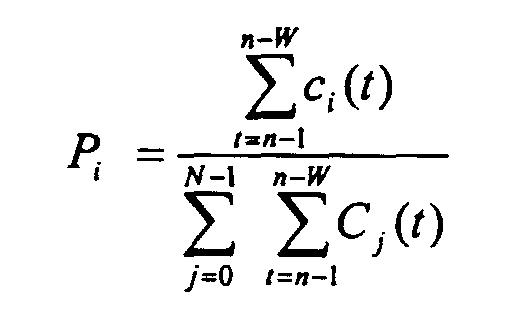
- the step (a) includes the step of calculating the occurrence statistics P i of an i-th symbol a i in N of symbols using W previous frames in accordance with where i is a predetermined positive number indicating a symbol number, c i (t) is the number of occurrences of the symbol a i in a t-th frame, and W is a predetermined positive integer indicating the number of frames used for analyzing the occurrence statistics of symbols.
- the step (a) analyzes the occurrence statistics of symbols using only symbols that are obtained from a frame immediately before the current frame.
- the step (a) may analyze the occurrence statistics of symbols using symbols that are obtained from all the previous frames.
- the variable length coding method preferably further includes the step (c-1) for detecting whether the scene of each of the previous frames is similar to the scene of the current frame before the step (c).
- the current frame is preferably variable length coded using a default variable length coding table and the mapping relationship when it is determined that the scene of a previous frame is not similar to the scene of the current frame in the step (c-1).
- the step (c) is preferably performed when it is determined that the scene of a previous frame is similar to the scene of the current frame in the step (c-1).
- the step (c-1) preferably includes the steps of (d-1) checking to find whether the ratio of occurrences of an intra macroblock in a frame immediately before the current frame is equal to or greater than a predetermined threshold, and (d-2) determining that the scene is changed if the ratio of occurrences of an intra macroblock in a frame immediately before the current frame is equal to or greater than the predetermined threshold, and, if not, determining that the scene is not changed.
- the step (c-1) may include the steps of (e-1) checking to find whether the difference between the number of bits, which are generated by performing the mapping between a symbol and a bit pattern in a current image frame according to the method described above, and the number of bits, which are generated by using a default variable length coding definition, is equal to or greater than a predetermined number of bits; and (e-2) determining that the scene is changed if the difference is equal to or greater than the predetermined number of bits in the step (e-1) and, if not, determining that the scene is not changed.
- the step (c-1) may include the steps of (f-1) measuring the sum of absolute difference (SAD) between a current image frame and a motion compensated image frame; and (f-2) determining that the scene is changed if the SAD is equal to or greater than a predetermined value in the step (f-1), and, otherwise, determining that the scene is not changed.
- SAD sum of absolute difference
- an apparatus of variable length coding input symbols to generate bit patterns includes a statistical analyzer for analyzing the occurrence statistics of the input symbols with respect to previous frames, a mapping relationship resetter for resetting a mapping relationship based on the analyzed occurrence statistics of the symbols, and a variable length coding unit for variable length coding a current frame based on the reset mapping relationship.
- a digital image coding method to which variable length coding for generating bit patterns by variable length coding input symbols is applied.
- the method includes the steps of (a) analyzing the occurrence statistics of symbols with respect to previous frames, (b) resetting a mapping relationship based on the analyzed occurrence statistics of symbols, and (c) variable length coding a current frame based on the reset mapping relationship.
- variable length decoding input bit patterns which have been variable length coded.
- the method includes the steps of (a) variable length decoding the input bit patterns using a default variable length coding table to obtain decoded symbols, (b) analyzing the occurrence statistics of the decoded symbols with respect to previous frames of a current frame, (c) resetting a mapping relationship based on the analyzed occurrence statistics of the input symbols, and (d) replacing the decoded symbols with symbols corresponding to the reset mapping relationship in the current frame.
- an apparatus for variable length decoding input bit patterns which have been variable length coded.
- the apparatus includes a variable length decoder for variable length decoding the input bit patterns using a default variable length coding table to obtain decoded symbols, a statistical analyzer for analyzing the occurrence statistics of the decoded symbols with respect to previous frames of a current frame, a mapping relationship resetter for resetting a mapping relationship between symbols and bit patterns based on the analyzed occurrence statistics of the input symbols, and a symbol replacer for replacing the decoded symbols with symbols corresponding to the reset mapping relationship in the current frame.
- a digital image decoding apparatus using variable length decoding includes a variable length decoding unit including a variable length decoder for variable length decoding the input bit patterns using a default variable length coding table to obtain decoded symbols, a statistical analyzer for analyzing the occurrence statistics of the decoded symbols with respect to previous frames of a current frame, a mapping relationship resetter for resetting a mapping relationship between symbols and bit patterns based on the analyzed occurrence statistics of the input symbols, and a symbol replacer for replacing the decoded symbols with symbols corresponding to the reset mapping relationship in the current frame.
- a variable length coding apparatus includes a statistical analyzer 202, a mapping relationship resetting unit 204, a scene change detector 208 and a variable length coding (VLC) unit 210.
- the mapping relationship resetting unit 204 includes a mapper 205 and a symbol replacer 206.
- the statistical analyzer 202 when representing a symbol number by i , a predetermined positive number, receives a symbol in step 302 and calculates the occurrence statistics of the input symbol a i with respect to previous frames in step 304.
- the statistical analyzer 202 calculates the occurrence statistics P i of each symbol a i in W previous frames in accordance with Thus, the occurrence statistics P i of an i-th symbol among N kinds of symbols in W previous frames are obtained.
- the occurrence statistics of each symbol are calculated based on symbols which are obtained from a plurality of previous image frames, but the present invention is not restricted thereto.
- the occurrence statistics of each symbol may be calculated based on only symbols which are obtained from the previous image, or based on symbols which are obtained from all previous images.
- the scene change detector 208 compares a current frame scene with previous frame scenes and detects whether they are similar, in step 320.
- the scene change detector 208 outputs a control signal SCENE_CHANGE as a logic "low” level when a current frame scene is similar to a previous frame scene, and outputs a control signal SCENE_CHANGE as a logic "high” level when a current frame scene is not similar to a previous frame scene.
- a scene is changed when the ratio of occurrences of an intra macroblock in the previous image frame is equal to or more than a predetermined threshold.
- a predetermined threshold it is possible to determine that a scene is changed when the difference between the number of bits, which are generated by performing the mapping between a symbol and a bit pattern in a current image frame according to the method described above, and the number of bits, which are generated by using a default variable length coding definition, is equal to or more than a predetermined number of bits.
- SAD sum of absolute difference
- step 30 the VLC unit 210 performs variable length coding on the replaced symbols, that is, symbols a i' obtained based on the reset mapping relationship, using the default VLC table 212 for the current frame.
- a "high" level control signal SCENE_CHANGE is input from the scene change detector 208, this indicates that a scene has changed, and thus, in step 322, the VLC unit 210 performs variable length coding on the input symbols a i using the default VLC table 212 and mapping relationship for the current frame, instead of performing variable length coding on the current frame based on the reset mapping relationship.
- step 324 After performing variable length coding with respect to the current frame, it is determined whether the current frame is the last frame in step 324. When it is determined that the current frame is not the last one in step 324, the next frame is selected in step 326, and the steps 302 through 324 are repeated.
- variable length coding is performed using a VLC table such as Table 1. Symbols Bit patterns Number of bits a 0 1 1 a 1 01 2 a 2 001 3 a 3 0001 4
- the mapping table between symbols and bit patterns is generated depending on probabilities.
- a symbol a 2 whose occurrence probability is smallest, is mapped to a bit pattern of four bits, i.e., 0001.
- a symbol a 3 whose occurrence probability is largest, is mapped to a bit pattern of a single bit, i.e., 1.
- variable length coding is stably performed regardless of changes in the statistical characteristics or coding parameters of an image, since the variable length coding is performed considering the statistical characteristics of symbols of an image frame.
- Simulations were performed to estimate the performance of a variable length coding method of the present invention.
- Five kinds of test sequence which have a QCIF frame format of 176 ⁇ 144 pixels and are composed of 100 frames, were used in the simulations.
- a fixed quantization step size was used.
- Figures 4A through 4E show graphs for comparing a variable length coding method of the present invention and a conventional variable length coding method based on the number of bits per frame during coding.
- Figures 4A through 4E show the variation of bits per frame with respect to quantization step size when "News”, “Silent”, “Container ship”,”Foreman” and "Hall Objects", each of which has a QCIF frame format of 176 ⁇ 144 pixels and is composed of 100 frames, were used as test sequences. For other test conditions, common test conditions defined in H.26L were used.
- a mapping relationship between symbols and bit patterns is adaptively changed in a variable length codeword table based on the results of partially measuring symbol probabilities, without changing a VLC table.
- the reduction of MB mode bit rate was about 50%.
- variable length coding method of the present invention the number of bits to be generated can be reduced by dynamically varying a mapping relationship.
- a variable length coding method of the present invention can be applied to H.261, H.263, MPEG-1, MPEG-2 and MPEG-4, which use variable length coding, and to H.26L proposals which uses universal variable length coding (UVLC).
- Bit patterns which have been variable length coded by a variable length coding method according to the present invention, are transmitted to a transmission channel.
- the transmitted bit patterns can be decoded by a variable length decoder according to an embodiment of the present invention.
- Figure 5 is a block diagram of a variable length decoding apparatus according to an embodiment of the present invention. Referring to Figure 5, the variable length decoding apparatus includes a variable length decoder 502, a statistical analyzer 504, a mapping relationship resetter 506, a symbol replacer 508 and a scene change detector 510.
- variable length decoder 502 performs variable length decoding on bit patterns in an input bit stream using a default VLC table 503 and outputs decoded symbols.
- the statistical analyzer 504 analyzes the occurrence statistics of the decoded symbols with respect to previous frames.
- the mapping relationship resetter 506 resets the mapping relationship between input symbols and bit patterns based on the analyzed occurrence statistics. Since the reset mapping relationship is determined based on the occurrence statistics of symbols, the reset mapping relationship is the same as that used during coding, which is performed by a variable length coding method according to an embodiment of the present invention as described with reference to Figures 2, 3A and 3B, if errors in the input bit patterns are not large.
- the decoding apparatus can obtain the mapping relationship used during the encoding by decoding a bit stream transmitted from the encoding apparatus. Then, the symbol replacer 508 replaces the decoded symbols with symbols corresponding to the reset mapping relationship in a current frame and outputs symbol data. Finally, the bit patterns, which have been coded by a variable length coding method according to the present invention, which dynamically varies a mapping relationship to reduce the number of bits that are generated, are successfully variable length decoded.
- the reset mapping relationship is applied to all the bit patterns during the variable length decoding.
- the variable length decoding apparatus may also include a scene change detector 510 in order to decode bit patterns which have been coded by a variable length coding apparatus, which includes the scene change detector 208 as described with reference to Figure 2.
- the scene change detector 510 compares a previous frame scene and a current frame scene using the decoded symbols which are output from the variable length decoder 502 to detect whether they are similar. Then, the scene change detector 510 outputs a "low" control signal when they are not similar and a "high” control signal when they are similar.
- the symbol replacer 508 In response to the "low” control signal, the symbol replacer 508 does not perform symbol replacement and outputs the decoded symbols received from the variable length decoder 502 as symbol data. Alternatively, in response to the "high” control signal, the symbol replacer 508 replaces the decoded symbols received from the variable length decoder 502 with symbols corresponding to the reset mapping relationship and outputs the replaced symbols as symbol data.
- variable length coding apparatus may be included in a digital image decoding apparatus using variable length decoding.
- Variable length coding and decoding methods can be made into programs which can be executed in a computer.
- the programs may be stored in a magnetic recoding medium such as a floppy disc or a hard disc or an optical recording medium such as CD-ROM or DVD, or may be transmitted through a carrier wave medium such as the Internet.
- program codes and code segments constructing the programs can be easily inferred by computer programmers in the art.
- variable length coding method dynamically varies the mapping relationship between input symbols and bit patterns based on the characteristics of an image, thereby reducing the amount of bits to be generated.
Landscapes
- Engineering & Computer Science (AREA)
- Multimedia (AREA)
- Signal Processing (AREA)
- Theoretical Computer Science (AREA)
- Compression, Expansion, Code Conversion, And Decoders (AREA)
- Compression Or Coding Systems Of Tv Signals (AREA)
- Compression Of Band Width Or Redundancy In Fax (AREA)
Abstract
Description

| Symbols | Bit patterns | Number of bits |
| a0 | 1 | 1 |
| a1 | 01 | 2 |
| a2 | 001 | 3 |
| a3 | 0001 | 4 |
| Symbols | Occurrence probabilities |
| a0 | 0.2 |
| a1 | 0.3 |
| a2 | 0.1 |
| a3 | 0.4 |
| Symbol (ai) | Bit pattern | Mapping table | |
| i' | | ||
| a3 | 1 | 0 | m(3)=0 |
| a1 | 01 | 1 | m(1)=1 |
| a0 | 001 | 2 | m(0)=2 |
| a2 | 0001 | 3 | m(2)=3 |
Claims (23)
- A method of variable length coding input symbols to generate bit patterns, the method comprising the steps of:(a) analyzing the occurrence statistics of symbols with respect to previous frames;(b) resetting a mapping relationship based on the analyzed occurrence statistics of symbols; and(c) variable length coding a current frame based on the reset mapping relationship.
- The method of claim 1, wherein the step (a) comprises the step of calculating the occurrence statistics Pi of an i-th symbol ai in N of symbols using W previous frames in accordance withwhere i is a predetermined positive number indicating a symbol number, ci(t) is the number of occurrences of the symbol ai in a t-th frame, and W is a predetermined positive integer indicating the number of frames used for analyzing the occurrence statistics of symbols.

- The method of claim 1 or 2, wherein the step (a) analyzes the occurrence statistics of symbols using only symbols that are obtained from a frame immediately before the current frame.
- The method of claim 1 or 2, wherein the step (a) analyzes the occurrence statistics of symbols using symbols that are obtained from all the previous frames.
- The method of claim 1, 2, 3 or 4, wherein the step (b) comprises the steps of:reordering the symbols ai based on the occurrence statistics Pi of the symbols ai such that Pi≥ Pi'+1 if i'≤i'+1, where i' is a new number of a symbol ai; andresetting the mapping relationship such that
- The method of any one of claims 1-5, before the step (c), further comprising the step (c-1) for detecting whether the scene of each of the previous frames is similar to the scene of the current frame, wherein the current frame is variable length coded using a default variable length coding table and the mapping relationship when it is determined that the scene of a previous frame is not similar to the scene of the current frame in the step (c-1), and the step (c) is performed when it is determined that the scene of a previous frame is similar to the scene of the current frame in the step (c-1).
- The method of claim 6, wherein the step (c-1) comprises the steps of:(d-1) checking to find whether the ratio of occurrences of an intra macroblock in a frame immediately before the current frame is equal to or greater than a predetermined threshold; and(d-2) determining that the scene is changed if the ratio of occurrences of an intra macroblock in a frame immediately before the current frame is equal to or greater than the predetermined threshold, and, if not, determining that the scene is not changed.
- The method of claim 6, wherein the step (c-1) comprises the steps of:(e-1) checking to find whether the difference between the number of bits, which are generated by performing the mapping between a symbol and a bit pattern in a current image frame according to the method described above, and the number of bits, which are generated by using a default variable length coding definition, is equal to or greater than a predetermined number of bits; and(e-2) determining that the scene is changed if the difference is equal to or greater than the predetermined number of bits in the step (e-1) and, if not, determining that the scene is not changed.
- The method of claim 6, wherein the step (c-1) comprises the steps of:(f-1) measuring the sum of absolute difference (SAD) between a current image frame and a motion compensated image frame; and(f-2) determining that the scene is changed if the SAD is equal to or greater than a predetermined value in the step (f-1), and, otherwise, determining that the scene is not changed.
- An apparatus of variable length coding input symbols to generate bit patterns, the apparatus comprising:a statistical analyzer for analyzing the occurrence statistics of the input symbols with respect to previous frames;a mapping relationship resetter for resetting a mapping relationship based on the analyzed occurrence statistics of the symbols; anda variable length coding unit for variable length coding a current frame based on the reset mapping relationship.
- The apparatus of claim 10, wherein the statistical analyzer calculates the occurrence statistics Pi of each symbol ai in W previous frames in accordance withwhere i is a predetermined positive number indicating a symbol number, ci(t) is the number of occurrences of the symbol ai in a t-th frame, and W is a predetermined positive integer indicating the number of frames used for analyzing the occurrence statistics of symbols, and outputs the occurrence statistics Pi of an i-th symbol among N of symbols in W previous frames.

- The apparatus of claim 10 or 11, wherein the statistical analyzer analyzes (202) the occurrence statistics of symbols using only symbols that are obtained from a frame immediately before the current frame.
- The apparatus of claim 10 or 11, wherein the statistical analyzer (202) analyzes the occurrence statistics of symbols using symbols that are obtained from all the previous frames.
- The apparatus of claim 10, wherein the mapping relationship resetter (204, 206) reorders the symbols ai based on the occurrence statistics Pi of the symbols ai such that Pi'≥ Pi'+1 if i'≤i'+1, where i' is a new number of a symbol ai, and resets the mapping relationship such that
- The apparatus of any of claims 10 to 14, further comprising a scene change detector (208) for detecting whether the scene of each of the previous frames is similar to the scene of the current frame, outputting a first logic level as a control signal when they are not similar, and outputting a second logic level as a control signal when they are similar,
wherein the variable length coding unit (210) performs variable length coding on the current frame using a default variable length coding table and the mapping relationship, in response to the first logic level control signal, and performs variable length coding on the current frame using the reset mapping relationship, in response to the second logic level control signal. - The apparatus of claim 15, wherein the scene change detector (208) comprises:means for measuring the ratio of occurrences of an intra macroblock in a frame immediately before the current frame; anddetermining means for determining that the scene is changed if the ratio of occurrences of an intra macroblock is equal to or greater than a predetermined threshold, and, if not, determining that the scene is not changed.
- The apparatus of claim 15, wherein the scene change detector (208) comprises:means for counting the first number of bits, which are generated by performing mapping between symbols and bit patterns with respect to the current image frame based on a default mapping table and counting the second number of bits, which are generated by performing mapping between symbols and bit patterns with respect to the current image frame based on the reset mapping relationship; anddetermining means for calculating a difference between the first number of bits and the second number of bits, determining that the scene is changed if the difference is equal to or greater than a predetermined value, and, if not, determining that the scene is not changed.
- The apparatus of claim 15, wherein the scene change detector (208) comprises:sum of absolute difference (SAD) measuring means for measuring the SAD between the current image frame and a motion compensated image frame; anddetermining means for determining that the scene is changed if the SAD is equal to or greater than a predetermined value, and, otherwise, determining that the scene is not changed.
- A digital image coding method to which variable length coding for generating bit patterns by variable length coding input symbols is applied, the method comprising the steps of:(a) analyzing the occurrence statistics of symbols with respect to previous frames;(b) resetting a mapping relationship based on the analyzed occurrence statistics of symbols; and(c) variable length coding a current frame based on the reset mapping relationship.
- A method of variable length decoding input bit patterns which have been variable length coded, comprising the steps of:(a) variable length decoding the input bit patterns using a default variable length coding table to obtain decoded symbols;(b) analyzing the occurrence statistics of the decoded symbols with respect to previous frames of a current frame;(c) resetting a mapping relationship based on the analyzed occurrence statistics of the input symbols; and(d) replacing the decoded symbols with symbols corresponding to the reset mapping relationship in the current frame.
- An apparatus for variable length decoding input bit patterns which have been variable length coded, comprising:a variable length decoder (502) for variable length decoding the input bit patterns using a default variable length coding table to obtain decoded symbols;a statistical analyzer (504) for analyzing the occurrence statistics of the decoded symbols with respect to previous frames of a current frame;a mapping relationship resetter (506) for resetting a mapping relationship between symbols and bit patterns based on the analyzed occurrence statistics of the input symbols; anda symbol replacer (508) for replacing the decoded symbols with symbols corresponding to the reset mapping relationship in the current frame.
- A digital image decoding apparatus using variable length decoding, the apparatus comprising variable length decoding means comprising:a variable length decoder (502) for variable length decoding the input bit patterns using a default variable length coding table to obtain decoded symbols;a statistical analyzer (504) for analyzing the occurrence statistics of the decoded symbols with respect to previous frames of a current frame;a mapping relationship resetter (506) for resetting a mapping relationship between symbols and bit patterns based on the analyzed occurrence statistics of the input symbols; anda symbol replacer (508) for replacing the decoded symbols with symbols corresponding to the reset mapping relationship in the current frame.
- The apparatus of claim 22, further comprising a scene change detector (510) for detecting whether the scene of each of the previous frames is similar to the scene of the current frame using the decoded symbols output from the variable length decoder, outputting a first logic level as a control signal when they are not similar, and outputting a second logic level as a control signal when they are similar,
wherein the symbol replacer (508) does not perform symbol replacement but outputs the decoded symbols, which are received from the variable length decoder, as symbol data, in response to the first logic level control signal, and the symbol replacer (508) replaces the decoded symbols received from the variable length decoder (502) with symbols corresponding to the reset mapping relationship, in response to the second logic level control signal, and outputs the replaced symbols as symbol data.
Applications Claiming Priority (2)
| Application Number | Priority Date | Filing Date | Title |
|---|---|---|---|
| KR9931672 | 1999-08-02 | ||
| KR19990031672A KR100618972B1 (en) | 1999-08-02 | 1999-08-02 | Variable length coding method and apparatus |
Publications (3)
| Publication Number | Publication Date |
|---|---|
| EP1075087A2 true EP1075087A2 (en) | 2001-02-07 |
| EP1075087A3 EP1075087A3 (en) | 2003-07-02 |
| EP1075087B1 EP1075087B1 (en) | 2005-10-19 |
Family
ID=36590847
Family Applications (1)
| Application Number | Title | Priority Date | Filing Date |
|---|---|---|---|
| EP20000306429 Expired - Lifetime EP1075087B1 (en) | 1999-08-02 | 2000-07-27 | Variable length coding method and apparatus |
Country Status (7)
| Country | Link |
|---|---|
| US (1) | US6668094B1 (en) |
| EP (1) | EP1075087B1 (en) |
| JP (1) | JP3466140B2 (en) |
| KR (1) | KR100618972B1 (en) |
| CN (1) | CN1174555C (en) |
| AT (1) | ATE307424T1 (en) |
| DE (1) | DE60023226T2 (en) |
Cited By (2)
| Publication number | Priority date | Publication date | Assignee | Title |
|---|---|---|---|---|
| WO2003105483A3 (en) * | 2002-01-22 | 2004-07-08 | Gen Instrument Corp | WORD CODING VARIABLE LENGTH ADAPTIVE UNIVERSAL CODES FOR DIGITAL VIDEO CONTENT |
| EP1874057A3 (en) * | 2006-06-30 | 2008-11-05 | Medison Co., Ltd. | Method of compressing an ultrasound image |
Families Citing this family (14)
| Publication number | Priority date | Publication date | Assignee | Title |
|---|---|---|---|---|
| KR100750092B1 (en) * | 2000-01-28 | 2007-08-21 | 삼성전자주식회사 | Variable length coding method and apparatus |
| KR100856398B1 (en) * | 2000-05-17 | 2008-09-04 | 삼성전자주식회사 | Variable length coding and decoding method using multiple mapping tables and apparatus therefor |
| US7286157B2 (en) * | 2003-09-11 | 2007-10-23 | Intellivid Corporation | Computerized method and apparatus for determining field-of-view relationships among multiple image sensors |
| JPWO2006011197A1 (en) * | 2004-07-27 | 2008-05-01 | 三菱電機株式会社 | Encoded data re-encoding device, decoding device and program thereof |
| JP2006128759A (en) * | 2004-10-26 | 2006-05-18 | Matsushita Electric Ind Co Ltd | Video encoding apparatus, video decoding apparatus, video encoding method, and video decoding method |
| JP2010103969A (en) * | 2008-09-25 | 2010-05-06 | Renesas Technology Corp | Image-decoding method, image decoder, image encoding method, and image encoder |
| US8971413B2 (en) | 2010-05-24 | 2015-03-03 | Intel Corporation | Techniques for storing and retrieving pixel data |
| US20110317759A1 (en) * | 2010-06-25 | 2011-12-29 | Thomas Vinay S | System, method, and computer program product for parameter estimation for lossless video compression |
| CN102377996B (en) * | 2010-08-05 | 2014-04-30 | 华为技术有限公司 | Context-adaptive variable-length coding method and apparatus thereof |
| CN102404571A (en) * | 2011-11-22 | 2012-04-04 | 浙江大学 | Binarization method and device in video image coding and decoding |
| US9264707B2 (en) * | 2013-02-04 | 2016-02-16 | Google Inc. | Multi-symbol run-length coding |
| CN106849956B (en) * | 2016-12-30 | 2020-07-07 | 华为机器有限公司 | Compression method, decompression method, apparatus and data processing system |
| CN109818940B (en) * | 2019-01-03 | 2021-06-25 | 浙江好络维医疗技术有限公司 | Electrocardio waveform rapid compression algorithm suitable for realizing real-time transmission in embedded hardware |
| FR3154565A1 (en) * | 2023-10-19 | 2025-04-25 | Thales | Method for analyzing changes in a video stream for bitrate-constrained, low-latency video coding, and associated device |
Family Cites Families (18)
| Publication number | Priority date | Publication date | Assignee | Title |
|---|---|---|---|---|
| US4626829A (en) * | 1985-08-19 | 1986-12-02 | Intelligent Storage Inc. | Data compression using run length encoding and statistical encoding |
| JPH03145223A (en) * | 1989-10-30 | 1991-06-20 | Toshiba Corp | Variable length code demodulator |
| US5134477A (en) * | 1990-12-11 | 1992-07-28 | At&T Bell Laboratories | Hdtv receiver |
| JPH0575477A (en) * | 1991-09-13 | 1993-03-26 | Sony Corp | Huffman encoder and decoder |
| JP3093499B2 (en) * | 1992-03-06 | 2000-10-03 | 三菱電機株式会社 | Scene change detection device |
| JP2697479B2 (en) * | 1992-04-17 | 1998-01-14 | 国際電信電話株式会社 | Reversible variable length coding |
| US5510785A (en) * | 1993-03-19 | 1996-04-23 | Sony Corporation | Method of coding a digital signal, method of generating a coding table, coding apparatus and coding method |
| US5541595A (en) * | 1994-05-19 | 1996-07-30 | Matsushita Electric Corporation Of America | Variable length code decoder for simultaneous decoding the most significant bits and the least significant bits of a variable length code |
| KR0139161B1 (en) * | 1994-11-26 | 1998-05-15 | 김광호 | Variable length encoding / decoding device using symbol-code rearrangement of variable length code table |
| EP1802135A3 (en) * | 1995-03-15 | 2008-11-12 | Kabushiki Kaisha Toshiba | Moving picture coding and/or decoding systems |
| JPH08256266A (en) * | 1995-03-17 | 1996-10-01 | Mitsubishi Electric Corp | Image coding method |
| US5793896A (en) * | 1995-03-23 | 1998-08-11 | Intel Corporation | Ordering corrector for variable length codes |
| KR100319919B1 (en) * | 1996-07-06 | 2002-06-20 | 윤종용 | Improved Arithmetic Coder and / or Decoder Using Variable Probability Models |
| JPH10336654A (en) * | 1997-06-02 | 1998-12-18 | Nec Corp | Image encoder |
| JPH1155531A (en) | 1997-07-31 | 1999-02-26 | Ricoh Co Ltd | Arithmetic coding device |
| US5982306A (en) * | 1997-12-02 | 1999-11-09 | Daewoo Electronics Co., Ltd. | Variable-length coding method and apparatus thereof |
| KR100281328B1 (en) * | 1998-01-30 | 2001-02-01 | 전주범 | Context-based Arithmetic Coding / Decoding Method and Apparatus |
| US6449394B1 (en) * | 1999-07-09 | 2002-09-10 | Sarnoff Corporation | Packing variable-length code bits at fixed positions |
-
1999
- 1999-08-02 KR KR19990031672A patent/KR100618972B1/en not_active Expired - Fee Related
-
2000
- 2000-07-27 AT AT00306429T patent/ATE307424T1/en not_active IP Right Cessation
- 2000-07-27 DE DE2000623226 patent/DE60023226T2/en not_active Expired - Lifetime
- 2000-07-27 EP EP20000306429 patent/EP1075087B1/en not_active Expired - Lifetime
- 2000-08-02 US US09/631,883 patent/US6668094B1/en not_active Expired - Lifetime
- 2000-08-02 JP JP2000234923A patent/JP3466140B2/en not_active Expired - Fee Related
- 2000-08-02 CN CNB001189840A patent/CN1174555C/en not_active Expired - Fee Related
Cited By (2)
| Publication number | Priority date | Publication date | Assignee | Title |
|---|---|---|---|---|
| WO2003105483A3 (en) * | 2002-01-22 | 2004-07-08 | Gen Instrument Corp | WORD CODING VARIABLE LENGTH ADAPTIVE UNIVERSAL CODES FOR DIGITAL VIDEO CONTENT |
| EP1874057A3 (en) * | 2006-06-30 | 2008-11-05 | Medison Co., Ltd. | Method of compressing an ultrasound image |
Also Published As
| Publication number | Publication date |
|---|---|
| EP1075087A3 (en) | 2003-07-02 |
| KR100618972B1 (en) | 2006-09-01 |
| CN1291826A (en) | 2001-04-18 |
| ATE307424T1 (en) | 2005-11-15 |
| JP2001086004A (en) | 2001-03-30 |
| KR20010016662A (en) | 2001-03-05 |
| DE60023226T2 (en) | 2006-07-06 |
| CN1174555C (en) | 2004-11-03 |
| DE60023226D1 (en) | 2006-03-02 |
| EP1075087B1 (en) | 2005-10-19 |
| US6668094B1 (en) | 2003-12-23 |
| JP3466140B2 (en) | 2003-11-10 |
Similar Documents
| Publication | Publication Date | Title |
|---|---|---|
| US6917651B1 (en) | Variable length coding method and apparatus | |
| EP1075087B1 (en) | Variable length coding method and apparatus | |
| US8594366B2 (en) | Context-based adaptive binary arithmetic coding (CABAC) video stream compliance | |
| US7613345B2 (en) | Image coding apparatus and image decoding apparatus and their control methods, and computer program and computer-readable storage medium | |
| US8102911B2 (en) | Picture coding device | |
| KR100694098B1 (en) | Arithmetic decoding method and apparatus | |
| KR20200127899A (en) | Method and encoder relating to encoding of pixel values to accomplish lossless compression of a digital image | |
| US7158684B2 (en) | Entropy coding scheme for video coding | |
| US6298090B1 (en) | System for detecting redundant images in a video sequence by comparing two predetermined threshold values | |
| US7747092B2 (en) | Image encoding apparatus and method, and image decoding apparatus and method | |
| US6898322B2 (en) | Coding method, coding apparatus, decoding method and decoding apparatus using subsampling | |
| JPH08205169A (en) | Video encoding device and decoding device | |
| CN101657973A (en) | Recording medium with program for encoding and decoding with bit precision and device thereof | |
| CN107005706B (en) | Method for re-encoding image and apparatus thereof | |
| WO2007148596A1 (en) | Image encoding device and image encoding method | |
| Vermeirsch et al. | Region-adaptive probability model selection for the arithmetic coding of video texture | |
| Boyd | Determining Optimal Compression Effort For JPEG-LS Images | |
| Nunes | Segmented optimal linear prediction applied to lossless image coding | |
| Zargari et al. | Removing channel error artifacts in motion JPEG2000 coded videos | |
| JPH1169165A (en) | Character image coding method and system | |
| JPH11215492A (en) | Binary form signal coding/decoding device | |
| JP2002077627A (en) | Image encoding method, image encoding device, image decoding method, image decoding device, image forming device, and recording medium | |
| Vermeirsch et al. | Region-Adaptive Probability Model Selection for the Arithmetic Coding of Video Texture Authors: K. Vermeirsch, J. Barbari | |
| JP2007104271A (en) | Data compression apparatus, data compression method, and program thereof | |
| JP2002077628A (en) | Image encoding method, image encoding device, image decoding method, image decoding device, image forming device, and recording medium |
Legal Events
| Date | Code | Title | Description |
|---|---|---|---|
| PUAI | Public reference made under article 153(3) epc to a published international application that has entered the european phase |
Free format text: ORIGINAL CODE: 0009012 |
|
| 17P | Request for examination filed |
Effective date: 20000811 |
|
| AK | Designated contracting states |
Kind code of ref document: A2 Designated state(s): AT BE CH CY DE DK ES FI FR GB GR IE IT LI LU MC NL PT SE |
|
| AX | Request for extension of the european patent |
Free format text: AL;LT;LV;MK;RO;SI |
|
| PUAL | Search report despatched |
Free format text: ORIGINAL CODE: 0009013 |
|
| AK | Designated contracting states |
Designated state(s): AT BE CH CY DE DK ES FI FR GB GR IE IT LI LU MC NL PT SE |
|
| AX | Request for extension of the european patent |
Extension state: AL LT LV MK RO SI |
|
| 17Q | First examination report despatched |
Effective date: 20030917 |
|
| AKX | Designation fees paid |
Designated state(s): AT BE CH CY DE DK ES FI FR GB GR IE IT LI LU MC NL PT SE |
|
| GRAP | Despatch of communication of intention to grant a patent |
Free format text: ORIGINAL CODE: EPIDOSNIGR1 |
|
| GRAS | Grant fee paid |
Free format text: ORIGINAL CODE: EPIDOSNIGR3 |
|
| GRAA | (expected) grant |
Free format text: ORIGINAL CODE: 0009210 |
|
| AK | Designated contracting states |
Kind code of ref document: B1 Designated state(s): AT BE CH CY DE DK ES FI FR GB GR IE IT LI LU MC NL PT SE |
|
| PG25 | Lapsed in a contracting state [announced via postgrant information from national office to epo] |
Ref country code: BE Free format text: LAPSE BECAUSE OF FAILURE TO SUBMIT A TRANSLATION OF THE DESCRIPTION OR TO PAY THE FEE WITHIN THE PRESCRIBED TIME-LIMIT Effective date: 20051019 Ref country code: AT Free format text: LAPSE BECAUSE OF FAILURE TO SUBMIT A TRANSLATION OF THE DESCRIPTION OR TO PAY THE FEE WITHIN THE PRESCRIBED TIME-LIMIT Effective date: 20051019 Ref country code: LI Free format text: LAPSE BECAUSE OF FAILURE TO SUBMIT A TRANSLATION OF THE DESCRIPTION OR TO PAY THE FEE WITHIN THE PRESCRIBED TIME-LIMIT Effective date: 20051019 Ref country code: CH Free format text: LAPSE BECAUSE OF FAILURE TO SUBMIT A TRANSLATION OF THE DESCRIPTION OR TO PAY THE FEE WITHIN THE PRESCRIBED TIME-LIMIT Effective date: 20051019 |
|
| REG | Reference to a national code |
Ref country code: GB Ref legal event code: FG4D |
|
| REG | Reference to a national code |
Ref country code: CH Ref legal event code: EP |
|
| REG | Reference to a national code |
Ref country code: IE Ref legal event code: FG4D |
|
| PG25 | Lapsed in a contracting state [announced via postgrant information from national office to epo] |
Ref country code: GR Free format text: LAPSE BECAUSE OF FAILURE TO SUBMIT A TRANSLATION OF THE DESCRIPTION OR TO PAY THE FEE WITHIN THE PRESCRIBED TIME-LIMIT Effective date: 20060119 Ref country code: SE Free format text: LAPSE BECAUSE OF FAILURE TO SUBMIT A TRANSLATION OF THE DESCRIPTION OR TO PAY THE FEE WITHIN THE PRESCRIBED TIME-LIMIT Effective date: 20060119 Ref country code: DK Free format text: LAPSE BECAUSE OF FAILURE TO SUBMIT A TRANSLATION OF THE DESCRIPTION OR TO PAY THE FEE WITHIN THE PRESCRIBED TIME-LIMIT Effective date: 20060119 |
|
| PG25 | Lapsed in a contracting state [announced via postgrant information from national office to epo] |
Ref country code: ES Free format text: LAPSE BECAUSE OF FAILURE TO SUBMIT A TRANSLATION OF THE DESCRIPTION OR TO PAY THE FEE WITHIN THE PRESCRIBED TIME-LIMIT Effective date: 20060130 |
|
| REF | Corresponds to: |
Ref document number: 60023226 Country of ref document: DE Date of ref document: 20060302 Kind code of ref document: P |
|
| PG25 | Lapsed in a contracting state [announced via postgrant information from national office to epo] |
Ref country code: PT Free format text: LAPSE BECAUSE OF FAILURE TO SUBMIT A TRANSLATION OF THE DESCRIPTION OR TO PAY THE FEE WITHIN THE PRESCRIBED TIME-LIMIT Effective date: 20060320 |
|
| REG | Reference to a national code |
Ref country code: CH Ref legal event code: PL |
|
| ET | Fr: translation filed | ||
| PG25 | Lapsed in a contracting state [announced via postgrant information from national office to epo] |
Ref country code: IE Free format text: LAPSE BECAUSE OF NON-PAYMENT OF DUE FEES Effective date: 20060727 |
|
| PG25 | Lapsed in a contracting state [announced via postgrant information from national office to epo] |
Ref country code: MC Free format text: LAPSE BECAUSE OF NON-PAYMENT OF DUE FEES Effective date: 20060731 |
|
| PLBE | No opposition filed within time limit |
Free format text: ORIGINAL CODE: 0009261 |
|
| STAA | Information on the status of an ep patent application or granted ep patent |
Free format text: STATUS: NO OPPOSITION FILED WITHIN TIME LIMIT |
|
| 26N | No opposition filed |
Effective date: 20060720 |
|
| REG | Reference to a national code |
Ref country code: IE Ref legal event code: MM4A |
|
| PG25 | Lapsed in a contracting state [announced via postgrant information from national office to epo] |
Ref country code: LU Free format text: LAPSE BECAUSE OF NON-PAYMENT OF DUE FEES Effective date: 20060727 |
|
| PG25 | Lapsed in a contracting state [announced via postgrant information from national office to epo] |
Ref country code: CY Free format text: LAPSE BECAUSE OF FAILURE TO SUBMIT A TRANSLATION OF THE DESCRIPTION OR TO PAY THE FEE WITHIN THE PRESCRIBED TIME-LIMIT Effective date: 20051019 |
|
| REG | Reference to a national code |
Ref country code: FR Ref legal event code: PLFP Year of fee payment: 16 |
|
| PGFP | Annual fee paid to national office [announced via postgrant information from national office to epo] |
Ref country code: FI Payment date: 20150625 Year of fee payment: 16 Ref country code: GB Payment date: 20150623 Year of fee payment: 16 |
|
| PGFP | Annual fee paid to national office [announced via postgrant information from national office to epo] |
Ref country code: NL Payment date: 20150623 Year of fee payment: 16 |
|
| PGFP | Annual fee paid to national office [announced via postgrant information from national office to epo] |
Ref country code: DE Payment date: 20150626 Year of fee payment: 16 |
|
| PGFP | Annual fee paid to national office [announced via postgrant information from national office to epo] |
Ref country code: FR Payment date: 20150625 Year of fee payment: 16 |
|
| PGFP | Annual fee paid to national office [announced via postgrant information from national office to epo] |
Ref country code: IT Payment date: 20150710 Year of fee payment: 16 |
|
| REG | Reference to a national code |
Ref country code: DE Ref legal event code: R119 Ref document number: 60023226 Country of ref document: DE |
|
| REG | Reference to a national code |
Ref country code: NL Ref legal event code: MM Effective date: 20160801 |
|
| GBPC | Gb: european patent ceased through non-payment of renewal fee |
Effective date: 20160727 |
|
| PG25 | Lapsed in a contracting state [announced via postgrant information from national office to epo] |
Ref country code: FR Free format text: LAPSE BECAUSE OF NON-PAYMENT OF DUE FEES Effective date: 20160801 Ref country code: DE Free format text: LAPSE BECAUSE OF NON-PAYMENT OF DUE FEES Effective date: 20170201 Ref country code: FI Free format text: LAPSE BECAUSE OF NON-PAYMENT OF DUE FEES Effective date: 20160727 Ref country code: NL Free format text: LAPSE BECAUSE OF NON-PAYMENT OF DUE FEES Effective date: 20160801 |
|
| REG | Reference to a national code |
Ref country code: FR Ref legal event code: ST Effective date: 20170331 |
|
| PG25 | Lapsed in a contracting state [announced via postgrant information from national office to epo] |
Ref country code: GB Free format text: LAPSE BECAUSE OF NON-PAYMENT OF DUE FEES Effective date: 20160727 |
|
| PG25 | Lapsed in a contracting state [announced via postgrant information from national office to epo] |
Ref country code: IT Free format text: LAPSE BECAUSE OF NON-PAYMENT OF DUE FEES Effective date: 20160727 |