EP1074972A2 - Speech synthesis using multimode coded units - Google Patents
Speech synthesis using multimode coded units Download PDFInfo
- Publication number
- EP1074972A2 EP1074972A2 EP00306561A EP00306561A EP1074972A2 EP 1074972 A2 EP1074972 A2 EP 1074972A2 EP 00306561 A EP00306561 A EP 00306561A EP 00306561 A EP00306561 A EP 00306561A EP 1074972 A2 EP1074972 A2 EP 1074972A2
- Authority
- EP
- European Patent Office
- Prior art keywords
- speech segment
- speech
- encoding
- decoding
- dictionary
- Prior art date
- Legal status (The legal status is an assumption and is not a legal conclusion. Google has not performed a legal analysis and makes no representation as to the accuracy of the status listed.)
- Granted
Links
- 230000015572 biosynthetic process Effects 0.000 title claims abstract description 107
- 238000003786 synthesis reaction Methods 0.000 title claims abstract description 57
- 238000000034 method Methods 0.000 claims abstract description 190
- 238000013139 quantization Methods 0.000 claims description 109
- 230000010365 information processing Effects 0.000 claims description 31
- 230000002194 synthesizing effect Effects 0.000 claims description 31
- 238000003672 processing method Methods 0.000 claims description 17
- 230000004048 modification Effects 0.000 description 18
- 238000012986 modification Methods 0.000 description 18
- 230000008569 process Effects 0.000 description 11
- 230000002542 deteriorative effect Effects 0.000 description 7
- -1 CV or VC) Chemical compound 0.000 description 6
- MQJKPEGWNLWLTK-UHFFFAOYSA-N Dapsone Chemical compound C1=CC(N)=CC=C1S(=O)(=O)C1=CC=C(N)C=C1 MQJKPEGWNLWLTK-UHFFFAOYSA-N 0.000 description 6
- 230000015556 catabolic process Effects 0.000 description 5
- 238000006731 degradation reaction Methods 0.000 description 5
- 230000006870 function Effects 0.000 description 5
- 239000011295 pitch Substances 0.000 description 5
- 230000003044 adaptive effect Effects 0.000 description 2
- 238000004458 analytical method Methods 0.000 description 2
- 230000008901 benefit Effects 0.000 description 2
- 238000010586 diagram Methods 0.000 description 2
- 210000001260 vocal cord Anatomy 0.000 description 2
- 230000008859 change Effects 0.000 description 1
- 230000006835 compression Effects 0.000 description 1
- 238000007906 compression Methods 0.000 description 1
- 230000000593 degrading effect Effects 0.000 description 1
- 230000006866 deterioration Effects 0.000 description 1
- 230000001771 impaired effect Effects 0.000 description 1
Images






Classifications
-
- G—PHYSICS
- G10—MUSICAL INSTRUMENTS; ACOUSTICS
- G10L—SPEECH ANALYSIS TECHNIQUES OR SPEECH SYNTHESIS; SPEECH RECOGNITION; SPEECH OR VOICE PROCESSING TECHNIQUES; SPEECH OR AUDIO CODING OR DECODING
- G10L13/00—Speech synthesis; Text to speech systems
- G10L13/06—Elementary speech units used in speech synthesisers; Concatenation rules
Definitions
- the present invention relates to a technique for synthesizing speech by using a speech segment dictionary.
- a speech synthesizing technique for synthesizing speech by using a computer uses a speech segment dictionary.
- This speech segment dictionary stores speech segments in units (synthetic units) of speech segments, CV/VC, or VCV. To synthesize speech, appropriate speech segments are selected from this speech segment dictionary and modified and connected to generate desired synthetic speech.
- a flow chart in Fig. 15 explains this process.
- step S131 speech contents expressed by kana-kanji mixed text and the like are input.
- step S132 the input speech contents are analyzed to obtain a speech segment symbol string ⁇ p0, p1,... ⁇ and parameters for determining prosody.
- the flow then advances to step S133 to determine the prosody such as the speech segment time length, fundamental frequency, and power.
- speech segment dictionary look-up step S134 speech segments (w0, w1,... ⁇ appropriate for the speech segment symbol string ⁇ p0, p1,... ⁇ obtained by the input analysis in step S132 and the prosody obtained by the prosody determination in step S133 are retrieved from the speech segment dictionary.
- step S135 the speech segments ⁇ w0, w1,... ⁇ obtained by the speech segment dictionary retrieval in step S134 are modified and concatenated to match the prosody determined in step S133.
- step S136 the result of the speech segment modification and concatenation in step S135 is output as a synthetic speech.
- Waveform editing is one effective method of speech synthesis.
- This method e.g., superposes waveforms and changes pitches in synchronism with vocal cord vibrations.
- the method is advantageous in that synthetic speech close to a natural utterance can be generated with a small amount of arithmetic operations.
- a speech segment dictionary is composed of indexes for retrieval, waveform data (also called speech segment data) corresponding to individual speech segments, and auxiliary information of the data.
- waveform data also called speech segment data
- auxiliary information of the data are often encoded using the ⁇ -law or ADPCM (Adaptive Differential Pulse Code Modulation).
- the operation amount in decoding increases by the operation amount of an adaptive algorithm. This is so because the advantage (small processing amount) of the waveform editing method is impaired if a large operation amount is required for decoding.
- the present invention has been made in consideration of the above prior art, and has as its object to provide a technique which very efficiently reduces a storage capacity necessary for a speech segment dictionary without degrading the quality of speech segments registered in the speech segment dictionary.
- the present invention has been made in consideration of the above prior art, and has as its another object to provide a technique which generates natural, high-quality synthetic speech.
- a speech information processing method of one embodiment provides a speech information processing method of generating a speech segment dictionary for holding a plurality of speech segments, characterized by comprising the selection step of selecting an encoding method of encoding a speech segment from a plurality of encoding methods, the encoding step of encoding the speech segment by using the selected encoding method, and the storage step of storing the encoded speech segment in a speech segment dictionary.
- a storage medium of this embodiment is characterized by storing a control program for allowing a computer to realize the above speech information processing method.
- a speech information processing apparatus of this embodiment is a speech information processing apparatus for generating a speech segment dictionary for holding a plurality of speech segments, characterized by comprising selecting means for selecting an encoding method of encoding a speech segment from a plurality of encoding methods, encoding means for encoding the speech segment by using the selected encoding method, and storage means for storing the encoded speech segment in a speech segment dictionary.
- a speech information processing method of another embodiment is a speech information processing method of synthesizing speech by using a speech segment dictionary for holding a plurality of speech segments, characterized by comprising the selection step of selecting, from a plurality of decoding methods, a decoding method of decoding a speech segment read out from the speech segment dictionary, the decoding step of decoding the speech segment by using the selected decoding method, and the speech synthesizing step of synthesizing speech on the basis of the decoded speech segment.
- a storage medium of this embodiment is characterized by storing a control program for allowing a computer to realize the above speech information processing method.
- a speech information processing apparatus of this embodiment is a speech information processing apparatus for synthesizing speech by using a speech segment dictionary for holding a plurality of speech segments, characterized by comprising selecting means for selecting, from a plurality of decoding methods, a decoding method of decoding a speech segment read out from the speech segment dictionary, decoding means for decoding the speech segment by using the selected decoding method, and speech synthesizing means for synthesizing speech on the basis of the decoded speech segment.
- a speech information processing method of another embodiment is a speech information processing method of generating a speech segment dictionary for holding a plurality of speech segments, characterized by comprising the setting step of setting an encoding method of encoding a speech segment in accordance with the type of the speech segment, the encoding step of encoding the speech segment by using the set encoding method, and the storage step of storing the encoded speech segment in a speech segment dictionary.
- a storage medium of this embodiment is characterized by comprising a control program for allowing a computer to realize the above speech information processing method.
- a speech information processing apparatus of this embodiment is a speech information processing apparatus for generating a speech segment dictionary for holding a plurality of speech segments, characterized by comprising setting means for setting an encoding method of encoding a speech segment in accordance with the type of the speech segment, encoding means for encoding the speech segment by using the set encoding method, and storage means for storing the encoded speech segment in a speech segment dictionary.
- a speech information processing method of another embodiment is a speech information processing method of synthesizing speech by using a speech segment dictionary for holding a plurality of speech segments, characterized by comprising the setting step of setting a decoding method of decoding a speech segment read out from the speech segment dictionary in accordance with the type of the speech segment, the decoding step of decoding the speech segment by using the set decoding method, and the speech synthesizing step of synthesizing speech on the basis of the decoded speech segment.
- a storage medium of this embodiment is characterized by comprising a control program for allowing a computer to realize the above speech information processing method.
- a speech information processing apparatus of this embodiment is a speech information processing apparatus for synthesizing speech by using a speech segment dictionary for holding a plurality of speech segments, characterized by comprising setting means for setting a decoding method of decoding a speech segment read out from the speech segment dictionary in accordance with the type of the speech segment, decoding means for decoding the speech segment by using the set decoding method, and speech synthesizing means for synthesizing speech on the basis of the decoded speech segment.
- Fig. 1 is a block diagram showing an outline of the functional configuration of a speech information processing apparatus according to the embodiments of the present invention.
- a speech segment dictionary formation algorithm and a speech synthesis algorithm in each embodiment are realized by using this speech information processing apparatus.
- a central processing unit (CPU) 100 executes numerical operations and various control processes and controls operations of individual units (to be described later) connected via a bus 105.
- a storage device 101 includes, e.g., a RAM and ROM and stores various control programs executed by the CPU 100, data, and the like. The storage device 101 also temporarily stores various data necessary for the control by the CPU 100.
- An external storage device 102 is a hard disk device or the like and includes speech segment database 111 and a speech segment dictionary 112. This speech segment database 111 holds speech segments before registration in the speech segment dictionary 112 (i.e., non-compressed speech segments).
- An output device 103 includes a monitor for displaying the operation statuses of diverse programs, a loudspeaker for outputting synthesized speech, and the like.
- An input device 104 includes, e.g., a keyboard and a mouse. By using this input device 104, a user can control a program for forming the speech segment dictionary 112, control a program for synthesizing speech by using the speech segment dictionary 112, and input text (containing a plurality of character strings) as an object of speech synthesis.
- a speech segment dictionary formation algorithm and a speech synthesis algorithm according to the first embodiment of the present invention will be described below by using the speech processing apparatus shown in Fig. 1.
- one of a plurality of encoding methods (more specifically, a 7-bit ⁇ -law scheme and an 8-bit ⁇ -law scheme) different in the number of quantization steps is selected for each speech segment to be registered in a speech segment dictionary 112.
- a speech segment to be registered in the speech segment dictionary 112 is composed of a phoneme, semi-phoneme, diphone (e.g., CV or VC), VCV (or CVC), or combinations thereof.
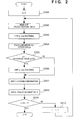
- Fig. 2 is a flow chart for explaining the speech segment dictionary formation algorithm in the first embodiment of the present invention.
- a program for achieving this algorithm is stored in a storage device 101.
- a CPU 100 reads out this program from the storage device 101 on the basis of an instruction from a user and executes the following procedure.
- step S201 the CPU 100 initializes an index i , which indicates each of N speech segment data (each speech segment data is non-compressed) stored in speech segment database 111 of an external storage device 102, to "0". Note that this index i is stored in the storage device 101.
- step S202 the CPU 100 reads out ith speech segment data Wi indicated by this index i.
- step S204 the CPU 100 calculates encoding distortion ⁇ produced by the 7-bit ⁇ -law encoding in step S203.
- a mean square error ⁇ is used as a measure of this encoding distortion.
- step S207 the CPU 100 writes encoding information of the phoneme data Wi and the like in the phoneme dictionary 112. In addition to the encoding information, the CPU 100 writes information necessary to decode the phoneme data Wi.
- This encoding information specifies the encoding method by which the speech segment data Wi is encoded:
- step S208 the CPU 100 writes the speech segment data Wi encoded by one encoding scheme in the speech segment dictionary 112.
- an encoding scheme can be selected from the 7-bit ⁇ -law scheme and the 8-bit ⁇ -law scheme for each speech segment to be registered in the speech segment dictionary 112.
- a storage capacity necessary for the speech segment dictionary can be very efficiently reduced without deteriorating the quality of speech segments to be registered in the speech segment dictionary.
- a larger number of types of speech segments than in conventional speech segment dictionaries can be registered in a speech segment dictionary having a storage capacity equivalent to those of the conventional dictionaries.
- the aforementioned speech segment dictionary formation algorithm is realized on the basis of the program stored in the storage device 101.
- a part or the whole of this speech segment dictionary formation algorithm can also be constituted by hardware.
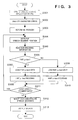
- Fig. 3 is a flow chart for explaining the speech synthesis algorithm in the first embodiment of the present invention.
- a program for achieving this algorithm is stored in the storage device 101.
- the CPU 100 reads out this program on the basis of an instruction from a user and executes the following procedure.
- step S301 the user inputs a character string in Japanese, English, or some other language by using the keyboard and the mouse of an input device 104.
- the user inputs a character string expressed by kana-kanji mixed text.
- the CPU 100 analyzes the input character string and obtains the speech segment sequence of this character string and parameters for determining the prosody of this character string.
- step S303 on the basis of the prosodic parameters obtained in step S302, the CPU 100 determines prosody such as a duration length (the prosody for controlling the length of a voice), fundamental frequency (the prosody for controlling the pitch of a voice), and power (the prosody for controlling the strength of a voice).
- step S304 the CPU 100 obtains an optimum speech segment sequence on the basis of the speech segment sequence obtained in step S302 and the prosody determined in step S303.
- the CPU 100 selects one speech segment contained in this speech segment sequence and retrieves speech segment data corresponding to the selected speech segment and encoding information corresponding to this speech segment data. If the speech segment dictionary 112 is stored in a storage medium such as a hard disk, the CPU 100 sequentially seeks to storage areas of encoding information and speech segment data. If the speech segment dictionary 112 is stored in a storage medium such as a RAM, the CPU 100 sequentially moves a pointer (address register) to storage areas of encoding information and speech segment data.
- step S305 the CPU 100 reads out the encoding information retrieved in step S304 from the speech segment dictionary 112.
- This encoding information indicates the encoding method of the speech segment data retrieved in step S304:
- step S306 the CPU 100 examines the encoding information read out in step S305. If the encoding information is "0", the CPU 100 selects a decoding method corresponding to the 7-bit ⁇ -law scheme, and the flow advances to step S307. If the encoding information is "1”, the CPU 100 selects a decoding method corresponding to the 8-bit ⁇ -law scheme, and the flow advances to step S309.
- step S307 the CPU 100 reads out the speech segment data (encoded by the 7-bit ⁇ -law scheme) retrieved in step S304 from the speech segment dictionary 112.
- step S308 the CPU 100 decodes the speech segment data encoded by the 7-bit ⁇ -law scheme.
- step S309 the CPU 100 reads out the speech segment data (encoded by the 8-bit ⁇ -law scheme) retrieved in step S304 from the speech segment dictionary 112.
- step S310 the CPU 100 decodes the speech segment data encoded by the 8-bit ⁇ -law scheme.
- step S311 the CPU 100 checks whether speech segment data corresponding to all speech segments contained in the speech segment sequence obtained in step S304 are decoded. If all speech segment data are decoded, the flow advances to step S312. If speech segment data not decoded yet is present, the flow returns to step S304 to decode the next speech segment data.
- step S312 on the basis of the prosody determined in step S303, the CPU 100 modifies and concatenates the decoded speech segments (i.e., edits the waveform).
- step S313 the CPU 100 outputs the synthetic speech obtained in step S312 from the loudspeaker of an output device 103.
- a desired speech segment can be decoded by a decoding method corresponding to the 7-bit ⁇ -law scheme or the 8-bit ⁇ -law scheme. With this arrangement, natural, high-quality synthetic speech can be generated.
- the aforementioned speech synthesis algorithm is realized on the basis of the program stored in the storage device 101.
- a part or the whole of this speech synthesis algorithm can also be constituted by hardware.
- speech segment data whose encoding distortion is larger than a predetermined threshold value is encoded by the 8-bit ⁇ -law scheme.
- degradation of the quality of an unstable speech segment e.g., a speech segment classified into a voiced fricative sound or a plosive
- natural, high-quality synthetic speech can be generated by using a speech segment dictionary thus formed.
- an encoding method is selected from the 7-bit ⁇ -law scheme and the 8-bit ⁇ -law scheme in accordance with the encoding distortion.
- the type e.g., a voiced fricative sound, plosive, nasal sound, some other voiced sound, or unvoiced sound
- a speech segment of the type of a voiced fricative sound and plosive may be registered in the speech segment dictionary 112 without encoding it
- a speech segment of the type of nasal sound and unvoiced sound may be registered in the speech segment dictionary 112 by encoding with the 7-bit ⁇ -law scheme
- a speech segment of the type of other voiced sound may be registered in the speech segment dictionary 112 by encoding with the 8-bit ⁇ -law scheme.
- a speech segment dictionary formation algorithm and a speech synthesis algorithm according to the second embodiment of the present invention will be described below by using the speech processing apparatus shown in Fig. 1.
- a speech segment to be registered in the speech segment dictionary 112 is composed of a phoneme, semi-phoneme, diphone (e.g., CV or VC), VCV (or CVC), or combinations thereof.
- Fig. 4 is a flow chart for explaining the speech segment dictionary formation algorithm in the second embodiment of the present invention.
- a program for achieving this algorithm is stored in a storage device 101.
- a CPU 100 reads out this program from the storage device 101 on the basis of an instruction from a user and executes the following procedure.
- step S401 the CPU 100 initializes an index i , which indicates each of N speech segment data (each speech segment data is non-compressed) stored in speech segment database 111 of an external storage device 102, to "0". Note that this index i is stored in the storage device 101.
- step S402 the CPU 100 reads out ith speech segment data Wi indicated by this index i .
- step S404 the CPU 100 writes the scalar quantization code book Qi formed in step S403 and the like in the speech segment dictionary 112. In addition to the quantization code book Qi, the CPU 100 writes information necessary to decode the speech segment data Wi.
- step S405 the CPU 100 encodes (scalar-quantizes) the speech segment data Wi by using the quantization code book Qi formed in step S403.
- the speech segment dictionary formation algorithm of the second embodiment it is possible to form a quantization code book for each speech segment to be registered in the speech segment dictionary 112 and scalar-quantize the speech segment by using the formed quantization code book.
- a storage capacity necessary for the speech segment dictionary can be very efficiently reduced without deteriorating the quality of speech segments to be registered in the speech segment dictionary.
- a larger number of types of speech segments than in conventional speech segment dictionaries can be registered in a speech segment dictionary having a storage capacity equivalent to those of the conventional dictionaries.
- the aforementioned speech segment dictionary formation algorithm is realized on the basis of the program stored in the storage device 101.
- a part or the whole of this speech segment dictionary formation algorithm can also be constituted by hardware.
- Fig. 5 is a flow chart for explaining the speech synthesis algorithm in the second embodiment of the present invention.
- a program for achieving this algorithm is stored in the storage device 101.
- the CPU 100 reads out this program on the basis of an instruction from a user and executes the following procedure.
- step S501 the user inputs a character string in Japanese, English, or some other language by using the keyboard and the mouse of an input device 104.
- the user inputs a character string expressed by kana-kanji mixed text.
- the CPU 100 analyzes the input character string and obtains the speech segment sequence of this character string and parameters for determining the prosody of this character string.
- step S503 on the basis of the prosodic parameters obtained in step S502, the CPU 100 determines prosody such as a duration length (the prosody for controlling the length of a voice), fundamental frequency (the prosody for controlling the pitch of a voice), and power (the prosody for controlling the strength of a voice).
- step S504 the CPU 100 obtains an optimum speech segment sequence on the basis of the speech segment sequence obtained in step S502 and the prosody determined in step S503.
- the CPU 100 selects one speech segment contained in this speech segment sequence and retrieves a scalar quantization code book and speech segment data corresponding to the selected speech segment. If the speech segment dictionary 112 is stored in a storage medium such as a hard disk, the CPU 100 sequentially seeks to storage areas of scalar quantization code books and speech segment data. If the speech segment dictionary 112 is stored in a storage medium such as a RAM, the CPU 100 sequentially moves a pointer (address register) to storage areas of scalar quantization code books and speech segment data.
- step S505 the CPU 100 reads out the scalar quantization code book retrieved in step S504 from the speech segment dictionary 112.
- step S506 the CPU 100 reads out the speech segment data retrieved in step S504 from the speech segment dictionary 112.
- step S507 the CPU 100 decodes the speech segment data read out in step S506 by using the scalar quantization code book read out in step S505.
- step S508 the CPU 100 checks whether speech segment data corresponding to all speech segments contained in the speech segment sequence obtained in step S504 are decoded. If all speech segment data are decoded, the flow advances to step S509. If speech segment data not decoded yet is present, the flow returns to step S504 to decode the next speech segment data.
- step S509 on the basis of the prosody determined in step S503, the CPU 100 modifies and connects the decoded speech segments (i.e., edits the waveform).
- step S510 the CPU 100 outputs the synthetic speech obtained in step S509 from the loudspeaker of an output device 103.
- a desired speech segment can be decoded using an optimum quantization code book for the speech segment. Accordingly, natural, high-quality synthetic speech can be generated.
- the aforementioned speech synthesis algorithm is realized on the basis of the program stored in the storage device 101.
- a part or the whole of this speech synthesis algorithm can also be constituted by hardware.
- the number of bits (i.e., the number of quantization steps of scalar quantization) per sample can be changed for each speech segment data.
- This can be accomplished by changing the procedures of the second embodiment as follows. That is, in the speech segment dictionary formation algorithm, the number of quantization steps is determined prior to the process (the write of the scalar quantization code book) in step S404 of Fig. 4. The determined number of quantization steps and the code book are recorded in the speech segment dictionary 112. In the speech synthesis algorithm, the number of quantization steps is read out from the speech segment dictionary 112 before the process (the read-out of the scalar quantization code book) in step S505. As in the first embodiment, the number of quantization steps can be determined on the basis of the encoding distortion.
- a scalar quantization code book formed for each speech segment data is selected.
- the present invention is not limited to this embodiment. For example, from a plurality of types of scalar quantization code books previously held by the speech segment dictionary 112, a code book having the highest performance (i.e., by which the quantization distortion is a minimum) can also be chosen.
- a quantization code book is so designed that the encoding distortion is a minimum, and speech segment data is scalar-quantized by using the designed quantization code book.
- speech segment data whose encoding distortion is larger than a predetermined threshold value can also be registered in a speech segment dictionary without being encoded.
- degradation of the quality of an unstable speech segment e.g., a speech segment classified into a voiced fricative sound or a plosive
- natural, high-quality synthetic speech can be generated by using a speech segment dictionary thus formed.
- a speech segment dictionary formation algorithm and a speech synthesis algorithm according to the second embodiment of the present invention will be described below by using the speech processing apparatus shown in Fig. 1.
- one of a plurality of encoding methods using different quantization code books is selected for each speech segment to be registered in a speech segment dictionary 112.
- one of a plurality of encoding methods using different quantization code books is selected for each of a plurality of speech segment clusters.
- a speech segment to be registered in the speech segment dictionary 112 is composed of a phoneme, semi-phoneme, diphone (e.g., CV or VC), VCV (or CVC), or combinations thereof.
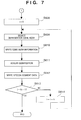
- Fig. 6 is a flow chart for explaining the speech segment dictionary formation algorithm in the third embodiment of the present invention.
- a program for achieving this algorithm is stored in a storage device 101.
- a CPU 100 reads out this program from the storage device 101 on the basis of an instruction from a user and executes the following procedure.
- step S601 the CPU 100 reads out all of N speech segment data (each speech segment data is non-compressed) stored in speech segment database 111 of an external storage device 102.
- step S602 the CPU 100 clusters all these speech segments into a plurality of (M) speech segment clusters. More specifically, the CPU 100 forms M speech segment clusters in accordance with the similarity of the waveform of each speech segment.
- step S603 the CPU 100 initializes index i which indicates each of the M speech segment clusters to "0".
- step S604 the CPU 100 forms a scalar quantization code book Qi for ith speech segment cluster Li.
- step S605 the CPU 100 writes the code book Qi formed in step S604 into the speech segment dictionary 112.
- step S608 the CPU 100 initializes index i , which indicates each of the N speech segments stored in the speech segment database 111 of the external storage device 102, to "0".
- step S609 the CPU 100 selects a scalar quantization code book Qi for ith speech segment data Wi. This scalar quantization code book Qi selected is a quantization code book corresponding to a speech segment cluster to which the speech segment data Wi belongs.
- step S610 the CPU 100 writes information (code book information) designating the scalar quantization code book selected in step S609 and the like into the speech segment dictionary 112. In addition to the code book information, the CPU 100 writes information necessary to decode the speech segment data Wi.
- step S611 the CPU 100 encodes the speech segment data Wi by using the code book Qi formed in step S604.
- one of a plurality of encoding methods using different quantization code books can be selected for each of a plurality of speech segment clusters. This can reduce the number of quantization code books to be registered in the speech segment dictionary 112. With this arrangement, a storage capacity necessary for the speech segment dictionary can be very efficiently reduced without deteriorating the quality of speech segments to be registered in the speech segment dictionary. Also, a larger number of types of speech segments than in conventional speech segment dictionaries can be registered in a speech segment dictionary having a storage capacity equivalent to those of the conventional dictionaries.
- the aforementioned speech segment dictionary formation algorithm is realized on the basis of the program stored in the storage device 101.
- a part or the whole of this speech segment dictionary formation algorithm can also be constituted by hardware.
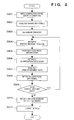
- Fig. 8 is a flow chart for explaining the speech synthesis algorithm in the third embodiment of the present invention.
- a program for achieving this algorithm is stored in the storage device 101.
- the CPU 100 reads out this program on the basis of an instruction from a user and executes the following procedure.
- code books corresponding to all speech segment clusters are previously stored in the storage device 101.
- Steps S801 to 803 have the same functions and processes as in steps S501 to S503 of Fig. 5, so a detailed description thereof will be omitted.
- step S804 the CPU 100 obtains an optimum speech segment sequence on the basis of a speech segment sequence obtained in step S802 and prosody determined in step S803.
- the CPU 100 selects one speech segment contained in this speech segment sequence and retrieves code book information and speech segment data corresponding to the selected speech segment. If the speech segment dictionary 112 is stored in a storage medium such as a hard disk, the CPU 100 sequentially seeks to storage areas of code book information and speech segment data. If the speech segment dictionary 112 is stored in a storage medium such as a RAM, the CPU 100 sequentially moves a pointer (address register) to storage areas of code book information and speech segment data.
- step S805 the CPU 100 reads out the code book information retrieved in step S804 and determines a speech segment cluster of this speech segment data and a scalar quantization code book corresponding to the speech segment cluster.
- step S806 the CPU 100 looks up the speech segment dictionary 112 to obtain the scalar quantization code book determined in step S805.
- step S807 the CPU 100 reads out the speech segment data retrieved in step S804 from the speech segment dictionary 112.
- step S808 the CPU 100 decodes the speech segment data read out in step S807 by using the scalar quantization code book obtained in step S806.
- step S809 the CPU 100 checks whether speech segment data corresponding to all speech segments contained in the speech segment sequence obtained in step S804 are decoded. If all speech segment data are decoded, the flow advances to step S810. If speech segment data not decoded yet is present, the flow returns to step S804 to decode the next speech segment data.
- step S810 on the basis of the prosody determined in step S803, the CPU 100 modifies and connects the decoded speech segments (i.e., edits the waveform).
- step S811 the CPU 100 outputs the synthetic speech obtained in step S810 from the loudspeaker of an output device 103.
- a desired speech segment can be decoded using an optimum quantization code book for a speech segment cluster to which this speech segment belongs. Accordingly, natural, high-quality synthetic speech can be generated.
- the aforementioned speech synthesis algorithm is realized on the basis of the program stored in the storage device 101.
- a part or the whole of this speech synthesis algorithm can also be constituted by hardware.
- a speech segment cluster in accordance with the similarity of the waveform of a speech segment has been explained.
- a speech segment cluster in accordance with the type (e.g., a voiced fricative sound, plosive, nasal sound, some other voiced sound, or unvoiced sound) of speech segment, and form a quantization code book for each speech segment cluster.
- a scalar quantization code book formed for each speech segment cluster is selected.
- the present invention is not limited to this embodiment. For example, from a plurality of types of scalar quantization code books held by the speech segment dictionary 112, a code book having the highest performance (i.e., by which the quantization distortion is a minimum) can also be chosen.
- step S808 reference to a code book of the speech synthesis algorithm
- the value q obtained by the code book reference is multiplied by the gain q to yield a decoded value.
- an optimum quantization code book is designed for each speech segment cluster, and speech segment data belonging to each speech segment cluster is scalar-quantized by using the designed quantization code book.
- speech segment data found to increase the encoding distortion can also be registered in a speech segment dictionary without being encoded.
- degradation of the quality of an unstable speech segment e.g., a speech segment classified into a voiced fricative sound or a plosive
- natural, high-quality synthetic speech can be generated by using a speech segment dictionary thus formed.
- a speech segment dictionary formation algorithm and a speech synthesis algorithm according to the fourth embodiment of the present invention will be described below by using the speech processing apparatus shown in Fig. 1.
- a linear prediction coefficient and a prediction difference are calculated for each speech segment data, and the data is encoded by an optimum quantization code book for the calculated prediction difference.
- a speech segment to be registered in the speech segment dictionary 112 is composed of a phoneme, semi-phoneme, diphone (e.g., CV or VC), VCV (or CVC), or combinations thereof.
- Fig. 9 is a flow chart for explaining the speech segment dictionary formation algorithm in the fourth embodiment of the present invention.
- a program for achieving this algorithm is stored in a storage device 101.
- a CPU 100 reads out this program from the storage device 101 on the basis of an instruction from a user and executes the following procedure.
- step S901 the CPU 100 initializes an index i , which indicates each of N speech segment data (each speech segment data is non-compressed) stored in speech segment database 111 of an external storage device 102, to "0".
- step S902 the CPU 100 reads out speech segment data (a speech segment before encoding) Wi of the ith speech segment indicated by this index i .
- step S903 the CPU 100 calculates a linear prediction coefficient and a prediction difference of the speech segment data Wi read out in step S902.
- step S904 the CPU 100 writes the linear prediction coefficient al calculated in step S903 into the speech segment dictionary 112.
- step S906 the CPU 100 writes the quantization code book Qi formed in step S905 and the like in the speech segment dictionary 112. In addition to the code book Qi, the CPU 100 writes information necessary to decode the speech segment data Wi.
- the speech segment dictionary formation algorithm of the fourth embodiment it is possible to calculate a linear prediction coefficient and a prediction difference for each speech segment to be registered in the speech segment dictionary 112, and encode the speech segment by an optimum quantization code book for the calculated prediction difference.
- a storage capacity necessary for the speech segment dictionary can be very efficiently reduced without deteriorating the quality of speech segments to be registered in the speech segment dictionary.
- a larger number of types of speech segments than in conventional speech segment dictionaries can be registered in a speech segment dictionary having a storage capacity equivalent to those of the conventional dictionaries.
- the aforementioned speech segment dictionary formation algorithm is realized on the basis of the program stored in the storage device 101.
- a part or the whole of this speech segment dictionary formation algorithm can also be constituted by hardware.
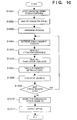
- Fig. 10 is a flow chart for explaining the speech synthesis algorithm in the fourth embodiment of the present invention.
- a program for achieving this algorithm is stored in the storage device 101.
- the CPU 100 reads out this program on the basis of an instruction from a user and executes the following procedure.
- step S1001 the user inputs a character string in Japanese, English, or some other language by using the keyboard and the mouse of an input device 104.
- the user inputs a character string expressed by kana-kanji mixed text.
- the CPU 100 analyzes the input character string and obtains the speech segment sequence of this character string and parameters for determining the prosody of this character string.
- step S1003 on the basis of the prosodic parameters obtained in step S1002, the CPU 100 determines prosody such as a duration length (the prosody for controlling the length of a voice), the fundamental frequency (the prosody for controlling the pitch of a voice), and the power (the prosody for controlling the strength of a voice).
- step S1004 the CPU 100 obtains an optimum speech segment sequence on the basis of the speech segment sequence obtained in step S1002 and the prosody determined in step S1003.
- the CPU 100 selects one speech segment contained in this speech segment sequence and retrieves a linear prediction coefficient, quantization code book, and prediction difference corresponding to the selected speech segment. If the speech segment dictionary 112 is stored in a storage medium such as a hard disk, the CPU 100 sequentially seeks to storage areas of linear prediction coefficients, quantization code books, and prediction differences. If the speech segment dictionary 112 is stored in a storage medium such as a RAM, the CPU 100 sequentially moves a pointer (address register) to storage areas of linear prediction coefficients, quantization code books, and prediction differences.
- step S1005 the CPU 100 reads out the prediction coefficient retrieved in step S1004 from the speech segment dictionary 112.
- step S1006 the CPU 100 reads out the quantization code book retrieved in step S1004 from the speech segment dictionary 112.
- step S1007 the CPU 100 reads out the prediction difference retrieved in step S1004 from the speech segment dictionary 112.
- step S1008 the CPU 100 decodes the prediction difference by using the prediction coefficient, the quantization code book, and the decoded data of the immediately preceding sample, thereby obtaining speech segment data.
- step S1009 the CPU 100 checks whether speech segment data corresponding to all speech segments contained in the speech segment sequence obtained in step S1004 are decoded. If all speech segment data are decoded, the flow advances to step S1010. If speech segment data not decoded yet is present, the flow returns to step S1004 to decode the next speech segment data.
- step S1010 on the basis of the prosody determined in step S1003, the CPU 100 modifies and connects the decoded speech segments (i.e., edits the waveform).
- step S1011 the CPU 100 outputs the synthetic speech obtained in step S1010 from the loudspeaker of an output device 103.
- a desired speech segment can be decoded using an optimum quantization code book for the speech segment. Accordingly, natural, high-quality synthetic speech can be generated.
- the aforementioned speech synthesis algorithm is realized on the basis of the program stored in the storage device 101.
- a part or the whole of this speech synthesis algorithm can also be constituted by hardware.
- the number of bits (i.e., the number of quantization steps) per sample can be changed for each speech segment data.
- This can be accomplished by changing the procedures of the fourth embodiment as follows. That is, in the speech segment dictionary formation algorithm, the number of quantization steps is determined prior to the process (the write of the quantization code book) in step S905. The determined number of quantization steps and the code book are recorded in the speech segment dictionary 112. In the speech synthesis algorithm, the number of quantization steps is read out from the speech segment dictionary 112 before the process (the read-out of the quantization code book) in step S1006. As in the first embodiment, the number of quantization steps can be determined on the basis of the encoding distortion.
- the linear prediction order L can also be change for each speech segment data. This can be accomplished by changing the procedures of the fourth embodiment as follows. That is, in the speech segment dictionary formation algorithm, the prediction order is set prior to the process (the write of the prediction coefficient) in step S904. The set prediction order and the prediction coefficient are recorded in the speech segment dictionary 112. In the speech synthesis algorithm, the prediction order is read out from the speech segment dictionary 112 before the process (the read-out of the prediction coefficient) in step S1005. As in the first embodiment, this prediction order can be determined on the basis of the encoding distortion.
- An AbS (Analysis by Synthesis) method or the like can be used as an algorithm for updating this code book.
- one quantization code book is designed for one speech segment data.
- one quantization code book can also be designed for a plurality of speech segment data. For example, as in the third embodiment, it is possible to cluster N speech segment data into M speech segment clusters and design a quantization code book for each speech segment cluster.
- data of L samples from the beginning of speech segment data can be directly written in the speech segment dictionary 112 without being encoded. This makes it possible to avoid a phenomenon in which linear prediction cannot be well performed for L samples from the beginning of speech segment data.
- step S907 the code ct that is optimum for xt is obtained.
- this optimum code ct can also be obtained by taking account of m samples after xt. This can be realized by temporarily determining the code ct and recursively searching for the code ct (searching the tree structure).
- a quantization code book is so designed that the encoding distortion is a minimum, and speech segment data is linearly encoded by using the designed quantization code book.
- speech segment data whose encoding distortion is larger than a predetermined threshold value can be registered in a speech segment dictionary without being encoded.
- degradation of the quality of an unstable speech segment e.g., a speech segment classified into a voiced fricative sound or a plosive
- natural, high-quality synthetic speech can be generated by using a speech segment dictionary thus formed.
- a speech segment dictionary formation algorithm and a speech synthesis algorithm according to the fifth embodiment of the present invention will be described below by using the speech processing apparatus shown in Fig. 1.
- a speech segment to be registered in the speech segment dictionary 112 is composed of a phoneme, semi-phoneme, diphone (e.g., CV or VC), VCV (or CVC), or combinations thereof.
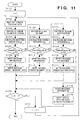
- Fig. 11 is a flow chart for explaining the speech segment dictionary formation algorithm in the fifth embodiment of the present invention.
- a program for achieving this algorithm is stored in a storage device 101.
- a CPU 100 reads out this program from the storage device 101 on the basis of an instruction from a user and executes the following procedure.
- step S1101 the CPU 100 initializes an index i , which indicates each of N speech segment data (each speech segment data is non-compressed) stored in speech segment database 111 of an external storage device 102, to "0". Note that this index i is stored in the storage device 101.
- step S1102 the CPU 100 reads out ith speech segment data Wi indicated by this index i .
- step S1103 the CPU 100 encodes the speech segment data Wi read out in step S1102 by using the encoding scheme (i.e., linear predictive coding) explained in the fourth embodiment.
- the encoding scheme i.e., linear predictive coding
- step S1104 the CPU 100 calculates encoding distortion ⁇ by this encoding scheme.
- step S1105 the CPU 100 checks whether the encoding distortion ⁇ calculated in step S1104 is larger than a predetermined threshold value ⁇ 0. If ⁇ > ⁇ 0, the flow advances to step S1108, and the CPU 100 encodes the speech segment data Wi by using another encoding scheme. If ⁇ > ⁇ 0 does not hold, the flow advances to step S1106.
- step S1106 the CPU 100 writes encoding information of the speech segment data Wi in the speech segment dictionary 112.
- This encoding information contains information specifying the encoding method by which the speech segment data Wi is encoded and information necessary to decode the speech segment data Wi (e.g., a prediction coefficient and a quantization code book) .
- step S1107 the CPU 100 writes the speech segment data Wi encoded in step S1103 into the speech segment dictionary 112, and the flow advances to step S1120.
- step S1108 the CPU 100 encodes the speech segment data Wi read out in step S1102 by using the encoding scheme (i.e., the 7-bit ⁇ -law scheme or the 8-bit ⁇ -law scheme) explained in the first embodiment.
- the encoding scheme i.e., the 7-bit ⁇ -law scheme or the 8-bit ⁇ -law scheme
- step S1109 the CPU 100 calculates encoding distortion ⁇ by this encoding scheme.
- step S1110 the CPU 100 checks whether the encoding distortion ⁇ calculated in step S1109 is larger than a predetermined threshold value ⁇ 1. If ⁇ > ⁇ 1, the flow advances to step S1113, and the CPU 100 encodes the speech segment data Wi by using another encoding scheme. If ⁇ > ⁇ 1 does not hold, the flow advances to step S1111.
- step S1111 the CPU 100 writes encoding information of the speech segment data Wi in the speech segment dictionary 112.
- This encoding information contains information specifying the encoding method by which the speech segment data Wi is encoded and information necessary to decode the speech segment data Wi.
- step S1112 the CPU 100 writes the speech segment data Wi encoded in step S1108 into the speech segment dictionary 112, and the flow advances to step S1120.
- step S1113 the CPU 100 encodes the speech segment data Wi read out in step S1102 by using the encoding scheme (i.e., scalar quantization) explained in the second or third embodiment.
- the encoding scheme i.e., scalar quantization
- step S1114 the CPU 100 calculates encoding distortion ⁇ by this encoding scheme.
- step S1115 the CPU 100 checks whether the encoding distortion ⁇ calculated in step S1114 is larger than a predetermined threshold value ⁇ 2. For example, the waveform of a strongly unstable speech segment (e.g., a speech segment classified into a voiced fricative sound or a plosive) largely varies, so ⁇ > ⁇ 2 does not hold. If ⁇ > ⁇ 2, the flow advances to step S1118. If ⁇ > p2 does not hold, the flow advances to step S1116.
- a strongly unstable speech segment e.g., a speech segment classified into a voiced fricative sound or a plosive
- step S1116 the CPU 100 writes encoding information of the speech segment data Wi in the speech segment dictionary 112.
- This encoding information contains information specifying the encoding method by which the speech segment data Wi is encoded and information necessary to decode the speech segment data Wi (e.g., a quantization code book) .
- step S1117 the CPU 100 writes the speech segment data Wi encoded in step S1113 into the speech segment dictionary 112, and the flow advances to step S1120.
- step S1118 the CPU 100 writes encoding information of the speech segment data Wi read out in step S1102 into the speech segment dictionary 112 without compressing the speech segment data Wi.
- This encoding information contains information indicating that the speech segment data Wi is not encoded.
- step S1119 the CPU 100 writes this speech segment data Wi in the speech segment dictionary 112, and the flow advances to step S1120. With this arrangement, deterioration of the quality of an unstable speech segment can be prevented.
- an encoding scheme can be selected from the ⁇ -law scheme, scalar quantization, and linear predictive coding for each speech segment to be registered in the speech segment dictionary 112.
- a storage capacity necessary for the speech segment dictionary can be very efficiently reduced without deteriorating the quality of speech segments to be registered in the speech segment dictionary.
- a larger number of types of speech segments than in conventional speech segment dictionaries can be registered in a speech segment dictionary having a storage capacity equivalent to those of the conventional dictionaries.
- the aforementioned speech segment dictionary formation algorithm is realized on the basis of the program stored in the storage device 101.
- a part or the whole of this speech segment dictionary formation algorithm can also be constituted by hardware.
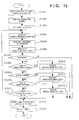
- Fig. 12 is a flow chart for explaining the speech synthesis algorithm in the fifth embodiment of the present invention.
- a program for achieving this algorithm is stored in the storage device 101.
- the CPU 100 reads out this program on the basis of an instruction from a user and executes the following procedure.
- step S1201 the user inputs a character string in Japanese, English, or some other language by using the keyboard and the mouse of an input device 104.
- the user inputs a character string expressed by kana-kanji mixed text.
- the CPU 100 analyzes the input character string and obtains the speech segment sequence of this character string and parameters for determining the prosody of this character string.
- step S1203 on the basis of the prosodic parameters obtained in step S1202, the CPU 100 determines prosody such as a duration length (the prosody for controlling the length of a voice), fundamental frequency (the prosody for controlling the pitch of a voice), and power (the prosody for controlling the strength of a voice).
- step S1204 the CPU 100 obtains an optimum speech segment sequence on the basis of the speech segment sequence obtained in step S1202 and the prosody determined in step S1203.
- the CPU 100 selects one speech segment contained in this speech segment sequence and retrieves speech segment data and encoding information corresponding to the selected speech segment. If the speech segment dictionary 112 is stored in a storage medium such as a hard disk, the CPU 100 sequentially seeks to storage areas of speech segment data and encoding information. If the speech segment dictionary 112 is stored in a storage medium such as a RAM, the CPU 100 sequentially moves a pointer (address register) to storage areas of speech segment data and encoding information.
- step S1205 the CPU 100 reads out the encoding information retrieved in step S1204 from the speech segment dictionary 112.
- the CPU 100 reads out the speech segment data retrieved in step S1204 from the speech segment dictionary 112.
- step S1207 on the basis of the encoding information read out in step S1205, the CPU 100 checks whether the speech segment data read out in step S1206 is encoded. If the data is encoded, the flow advances to step S1208 to specify the encoding method. If the data is not encoded, the flow advances to step S1215.
- step S1208 on the basis of the encoding information read out in step S1205, the CPU 100 examines the encoding method of the speech segment data read out in step S1206. If the encoding method is linear predictive coding, the flow advances to step S1212 to decode the data. In other cases, the flow advances to step S1209.
- step S1209 on the basis of the encoding information read out in step S1205, the CPU 100 examines the encoding method of the speech segment data read out in step S1206. If the encoding method is the ⁇ -law scheme, the flow advances to step S1213 to decode the data. In other cases, the flow advances to step S1210.
- step S1210 on the basis of the encoding information read out in step S1205, the CPU 100 examines the encoding method of the speech segment data read out in step S1206. If the encoding method is scalar quantization, the flow advances to step S1214 to decode the data. In other cases, the flow advances to step S1211.
- step S1211 the CPU 100 checks whether speech segment data corresponding to all speech segments contained in the speech segment sequence obtained in step S1204 are decoded. If all speech segment data are decoded, the flow advances to step S1215. If speech segment data not decoded yet is present, the flow returns to step S1204 to decode the next speech segment data.
- step S1215 on the basis of the prosody determined in step S1203, the CPU 100 modifies and connects the decoded speech segments (i.e., edits the waveform).
- step S1216 the CPU 100 outputs the synthetic speech obtained in step S1215 from the loudspeaker of an output device 103.
- a desired speech segment can be decoded by a decoding method corresponding to one of the ⁇ -law scheme, scalar quantization, and linear predictive coding. Therefore, natural, high-quality synthetic speech can be generated.
- the aforementioned speech synthesis algorithm is realized on the basis of the program stored in the storage device 101.
- a part or the whole of this speech synthesis algorithm can also be constituted by hardware.
- a speech segment dictionary formation algorithm and a speech synthesis algorithm according to the sixth embodiment of the present invention will be described below by using the speech processing apparatus shown in Fig. 1.
- an optimum encoding method is selected from a plurality of encoding methods using different encoding schemes for each speech segment data to be registered in a speech segment dictionary 112.
- an optimum encoding method is chosen from a plurality of encoding methods using different encoding schemes in accordance with the type of speech segment data.
- a speech segment to be registered in the speech segment dictionary 112 is constructed of a phoneme, semi-phoneme, diphone (e.g., CV or VC), VCV (or CVC), or combinations thereof.
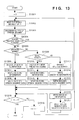
- Fig. 13 is a flow chart for explaining the speech segment dictionary formation algorithm in the sixth embodiment of the present invention.
- a program for achieving this algorithm is stored in a storage device 101.
- a CPU 100 reads out this program from the storage device 101 on the basis of an instruction from a user and executes the following procedure.
- step S1301 the CPU 100 initializes an index i , which indicates each of N speech segment data (each speech segment data is non-compressed) stored in speech segment database 111 of an external storage device 102, to "0". Note that this index i is stored in the storage device 101.
- step S1302 the CPU 100 reads out ith speech segment data Wi indicated by this index i .
- step S1303 the CPU 100 discriminates the type of the speech segment data Wi read out in step S1302. More specifically, the CPU 100 checks whether the type of the speech segment data Wi is a voiced fricative sound, plosive, unvoiced sound, nasal sound, or some other voiced sound.
- step S1316 the CPU 100 does not compress this speech segment data Wi. With this arrangement, degradation of the quality of the voiced fricative sound or plosive can be prevented.
- step S1316 the CPU 100 writes encoding information of the speech segment data Wi in the speech segment dictionary 112. This encoding information contains the type of the speech segment data Wi and information indicating that the speech segment data Wi is not encoded.
- step S1317 the CPU 100 writes the speech segment data Wi in the speech segment dictionary 112 without encoding the speech segment data Wi, and the flow advances to step S1318.
- step S1306 the CPU 100 encodes the speech segment data Wi by using the encoding scheme (i.e., scalarquantization) explained in the second or third embodiment.
- step S1307 the CPU 100 writes encoding information of the speech segment data Wi in the speech segment dictionary 112.
- This encoding information contains the type of the speech segment data Wi, information specifying the encoding method by which the speech segment data Wi is encoded, and information necessary to decode the speech segment data Wi (e.g., a quantization code book) .
- step S1308 the CPU 100 writes the speech segment data Wi encoded in step S1306 into the speech segment dictionary 112, and the flow advances to step S1318.
- step S1310 the CPU 100 encodes the speech segment data Wi by using the encoding scheme (i.e., linear predictive coding) explained in the fourth embodiment.
- step S1311 the CPU 100 writes encoding information of the speech segment data Wi in the speech segment dictionary 112.
- This encoding information contains the type of the speech segment data Wi, information specifying the encoding method by which the speech segment data Wi is encoded, and information necessary to decode the speech segment data Wi (e.g., a prediction coefficient and a quantization code book) .
- step S1312 the CPU 100 writes the speech segment data Wi encoded in step S1310 into the speech segment dictionary 112, and the flow advances to step S1318.
- step S1313 the CPU 100 encodes the speech segment data Wi by using the encoding scheme (i.e., the 7-bit ⁇ -law scheme or the 8-bit ⁇ -law scheme) explained in the first embodiment.
- step S1314 the CPU 100 writes encoding information of the speech segment data Wi in the speech segment dictionary 112. This encoding information contains the type of the speech segment data Wi, information specifying the encoding method by which the speech segment data Wi is encoded, and information necessary to decode the speech segment data Wi.
- step S1315 the CPU 100 writes the speech segment data Wi encoded in step S1313 into the speech segment dictionary 112, and the flow advances to step S1318.
- an encoding scheme can be selected from the ⁇ -law scheme, scalar quantization, and linear predictive coding in accordance with the type of speech segment to be registered in the speech segment dictionary 112.
- a storage capacity necessary for the speech segment dictionary can be very efficiently reduced without deteriorating the quality of speech segments to be registered in the speech segment dictionary.
- a larger number of types of speech segments than in conventional speech segment dictionaries can be registered in a speech segment dictionary having a storage capacity equivalent to those of the conventional dictionaries.
- the aforementioned speech segment dictionary formation algorithm is realized on the basis of the program stored in the storage device 101.
- a part or the whole of this speech segment dictionary formation algorithm can also be constituted by hardware.
- Fig. 14 is a flow chart for explaining the speech synthesis algorithm in the sixth embodiment of the present invention.
- a program for achieving this algorithm is stored in the storage device 101.
- the CPU 100 reads out this program on the basis of an instruction from a user and executes the following procedure.
- Steps S1401 to S1403 have the same functions and processes as in steps S1201 to S1203 of Fig. 12, so a detailed description thereof will be omitted.
- step S1404 the CPU 100 obtains an optimum speech segment sequence on the basis of a speech segment sequence obtained in step S1402 and prosody determined in step S1403.
- the CPU 100 selects one speech segment contained in this speech segment sequence and retrieves speech segment data and encoding information corresponding to the selected speech segment. If the speech segment dictionary 112 is stored in a storage medium such as a hard disk, the CPU 100 sequentially seeks to storage areas of speech segment data and encoding information. If the speech segment dictionary 112 is stored in a storage medium such as a RAM, the CPU 100 sequentially moves a pointer (address register) to storage areas of speech segment data and encoding information.
- step S1405 the CPU 100 reads out the encoding information retrieved in step S1404 from the speech segment dictionary 112.
- the CPU 100 reads out the speech segment data retrieved in step S1404 from the speech segment dictionary 112.
- step S1406 on the basis of the encoding information read out in step S1405, the CPU 100 discriminates the type of the speech segment data retrieved in step S1404. More specifically, the CPU 100 checks whether the type of the speech segment data is a voiced fricative sound, plosive, unvoiced sound, nasal sound, or some other voiced sound.
- step S1416 the CPU 100 reads out the speech segment data retrieved in step S1404, and the flow advances to step S1417. In this case, this speech segment data is not encoded.
- step S1414 the CPU 100 reads out the speech segment data retrieved in step S1404, and the flow advances to step S1415.
- This speech segment data is encoded by scalar quantization.
- step S1415 the CPU 100 decodes this speech segment data on the basis of the encoding information read out in step S1405.
- step S1412 the CPU 100 reads out the speech segment data retrieved in step S1404, and the flow advances to step S1413.
- This speech segment data is encoded by linear predictive coding.
- step S1413 the CPU 100 decodes this speech segment data on the basis of the encoding information read out in step S1405.
- step S1410 the CPU 100 reads out the speech segment data retrieved in step S1404, and the flow advances to step S1411.
- This speech segment data is encoded by the ⁇ -law scheme.
- step S1411 the CPU 100 decodes this speech segment data on the basis of the encoding information read out in step S1405.
- step S1417 the CPU 100 checks whether speech segment data corresponding to all speech segments contained in the speech segment sequence obtained in step S1404 are decoded. If all speech segment data are decoded, the flow advances to step S1418. If speech segment data not decoded yet is present, the flow returns to step S1404 to decode the next speech segment data.
- step S1418 on the basis of the prosody determined in step S1403, the CPU 100 modifies and connects the decoded speech segments (i.e., edits the waveform).
- step S1419 the CPU 100 outputs the synthetic speech obtained in step S1418 from the loudspeaker of an output device 103.
- a desired speech segment can be decoded by a decoding method corresponding to one of the ⁇ -law scheme, scalar quantization, and linear predictive coding. With this arrangement, natural, high-quality synthetic speech can be generated.
- the aforementioned speech synthesis algorithm is realized on the basis of the program stored in the storage device 101.
- a part or the whole of this speech synthesis algorithm can also be constituted by hardware.
- scalar quantization is used as the method of quantization.
- vector quantization can also be applied by regarding a plurality of consecutive samples as one vector.
- an unstable speech segment such as a plosive into two portions before and after the plosion and encode these two portions by their respective optimum encoding methods. This can further improve the encoding efficiency of an unstable speech segment.
- the fourth embodiment has been explained on the basis of a linear prediction model.
- some other vocal cord filter model is also applicable.
- an LMA (Log Magnitude Approximation) filter coefficient can be used in place of a linear prediction coefficient, and model parameters can be calculated by using the residual error of this LMA filter instead of a prediction difference.
- the fourth embodiment can be applied to the cepstrum domain.
- Each of the above embodiments is applicable to a system comprising a plurality of devices (e.g., a host computer, interface device, reader, and printer) or to an apparatus (e.g., a copying machine or facsimile apparatus) comprising a single device.
- a host computer e.g., a host computer, interface device, reader, and printer
- an apparatus e.g., a copying machine or facsimile apparatus
- an operating system (OS) or the like running on the CPU 100 can execute a part or the whole of actual processing.
- program codes read out from the storage device 101 are written in a memory of a function extension unit connected to the CPU 100, and a CPU or the like of this function extension unit executes a part or the whole of actual processing on the basis of instructions by the program codes.
- an encoding method can be selected for each speech segment data. Therefore, a storage capacity necessary for the speech segment dictionary can be very efficiently reduced without deteriorating the quality of speech segments to be registered in the speech segment dictionary. Also, natural, high-quality synthetic speech can be generated by using the speech segment dictionary thus formed.
Landscapes
- Engineering & Computer Science (AREA)
- Computational Linguistics (AREA)
- Health & Medical Sciences (AREA)
- Audiology, Speech & Language Pathology (AREA)
- Human Computer Interaction (AREA)
- Physics & Mathematics (AREA)
- Acoustics & Sound (AREA)
- Multimedia (AREA)
- Compression, Expansion, Code Conversion, And Decoders (AREA)
Abstract
Description
Claims (49)
- A speech information processing method of generating a speech segment dictionary for holding a plurality of speech segments, characterised by comprising:a selection step of selecting an encoding method of encoding a speech segment from a plurality of encoding methods;an encoding step of encoding the speech segment by using the selected encoding method; anda storage step of storing the encoded speech segment in a speech segment dictionary.
- The method according to claim 1, characterised in that one of the plurality of encoding methods differs from other encoding methods in the number of quantization steps.
- The method according to claim 1 or 2, characterised in that one of the plurality of encoding methods differs from other encoding methods in a quantization code book.
- The method according to claim 1, 2 or 3, characterised in that one of the plurality of encoding methods differs from other encoding methods in an encoding scheme.
- The method according to any preceding claim, characterised in that one of the plurality of encoding methods uses one of a µ-law scheme, scalar quantization, and linear predictive coding.
- The method according to any one of claims 1 to 5, characterised in that said selection step comprises performing control such that some speech segments are not encoded.
- A speech information processing apparatus for generating a speech segment dictionary for holding a plurality of speech segments, characterised by comprising:selecting means for selecting an encoding method of encoding a speech segment from a plurality of encoding methods;encoding means for encoding the speech segment by using the selected encoding method; andstorage means for storing the encoded speech segment in a speech segment dictionary.
- The apparatus according to claim 7, characterised in that one of the plurality of encoding methods differs from other encoding methods in the number of quantization steps.
- The apparatus according to claim 7 or 8, characterised in that one of the plurality of encoding methods differs from other encoding methods in a quantization code book.
- The apparatus according to claim 7, 8 or 9, characterised in that one of the plurality of encoding methods differs from other encoding methods in an encoding scheme.
- The apparatus according to any of claims 7 to 10, characterised in that one of the plurality of encoding methods uses one of a µ-law scheme, scalar quantization, and linear predictive coding.
- The apparatus according to any one of claims 7 to 11, characterised in that said selecting means performs control such that some speech segments are not encoded.
- A speech information processing method of synthesizing speech by using a speech segment dictionary for holding a plurality of speech segments, characterised by comprising:a selection step of selecting, from a plurality of decoding methods, a decoding method of decoding a speech segment read out from the speech segment dictionary;a decoding step of decoding the speech segment by using the selected decoding method; anda speech synthesizing step of synthesizing speech on the basis of the decoded speech segment.
- The method according to claim 13, characterised in that one of the plurality of decoding methods differs from other decoding methods in the number of quantization steps.
- The method according to claim 13 or 14, characterised in that one of the plurality of decoding methods differs from other decoding methods in a quantization code book.
- The method according to claim 13, 14 or 15, characterised in that one of the plurality of decoding methods differs from other decoding methods in a decoding scheme.
- The method according to any of claims 13 to 16, characterised in that one of the plurality of decoding methods uses one of a µ-law scheme, scalar quantization, and linear predictive coding.
- The method according to any one of claims 13 to 17, characterised in that said selection step comprises performing control such that some speech segments are not decoded.
- A speech information processing apparatus for synthesizing speech by using a speech segment dictionary for holding a plurality of speech segments, characterised by comprising:selecting means for selecting, from a plurality of decoding methods, a decoding method of decoding a speech segment read out from the speech segment dictionary;decoding means for decoding the speech segment by using the selected decoding method; andspeech synthesizing means for synthesizing speech on the basis of the decoded speech segment.
- The apparatus according to claim 19, characterised in that one of the plurality of decoding methods differs from other decoding methods in the number of quantization steps.
- The apparatus according to claim 19 or 20, characterised in that one of the plurality of decoding methods differs from other decoding methods in a quantization code book.
- The apparatus according to claim 19, 20 or 21, characterised in that one of the plurality of decoding methods differs from other decoding methods in a decoding scheme.
- The apparatus according to any of claims 19 to 22, characterised in that one of the plurality of decoding methods uses one of a µ-law scheme, scalar quantization, and linear predictive coding.
- The apparatus according to any one of claims 19 to 23, characterised in that said selecting means performs control such that some speech segments are not decoded.
- A speech information processing method of generating a speech segment dictionary for holding a plurality of speech segments, characterised by comprising:a setting step of setting an encoding method of encoding a speech segment in accordance with the type of the speech segment;an encoding step of encoding the speech segment by using the set encoding method; anda storage step of storing the encoded speech segment in a speech segment dictionary.
- The method according to claim 25, characterised in that said setting step comprises changing an encoding method to be set for the speech segment in accordance with whether the type of the speech segment is a plosive or not.
- The method according to claim 25 or 26, characterised in that said setting step comprises performing setting such that the speech segment is not encoded if the type of the speech segment is a plosive.
- The method according to claim 25, 26 or 27, characterised in that said setting step comprises changing an encoding method to be set for the speech segment in accordance with whether the type of the speech segment is an unvoiced sound or not.
- The method according to any of claims 25 to 28, characterised in that said setting step comprises changing an encoding method to be set for the speech segment in accordance with whether the type of the speech segment is a nasal sound or not.
- A speech information processing apparatus for generating a speech segment dictionary for holding a plurality of speech segments, characterised by comprising:setting means for setting an encoding method of encoding a speech segment in accordance with the type of the speech segment;encoding means for encoding the speech segment by using the set encoding method; andstorage means for storing the encoded speech segment in a speech segment dictionary.
- The apparatus according to claim 30, characterised in that said setting means changes an encoding method to be set for the speech segment in accordance with whether the type of the speech segment is a plosive or not.
- The apparatus according to claim 30 or 31, characterised in that said setting means performs setting such that the speech segment is not encoded if the type of the speech segment is a plosive.
- The apparatus according to claim 30, 31 or 32, characterised in that said setting means changes an encoding method to be set for the speech segment in accordance with whether the type of the speech segment is an unvoiced sound or not.
- The apparatus according to any of claims 30 to 33, characterised in that said setting means changes an encoding method to be set for the speech segment in accordance with whether the type of the speech segment is a nasal sound or not.
- A speech information processing method of synthesizing speech by using a speech segment dictionary for holding a plurality of speech segments, characterised by comprising:a setting step of setting a decoding method of decoding a speech segment read out from the speech segment dictionary in accordance with the type of the speech segment;a decoding step of decoding the speech segment by using the set decoding method; anda speech synthesizing step of synthesizing speech on the basis of the decoded speech segment.
- The method according to claim 35, characterised in that said setting step comprises changing a decoding method to be set for the speech segment in accordance with whether the type of the speech segment is a plosive or not.
- The method according to claim 35 or 36, characterised in that said setting step comprises performing setting such that the speech segment is not decoded if the type of the speech segment is a plosive.
- The method according to claim 35, 36 or 37, characterised in that said setting step comprises changing a decoding method to be set for the speech segment in accordance with whether the type of the speech segment is an unvoiced sound or not.
- The method according to any of claims 35 to 38, characterised in that said setting step comprises changing a decoding method to be set for the speech segment in accordance with whether the type of the speech segment is a nasal sound or not.
- A speech information processing apparatus for synthesizing speech by using a speech segment dictionary for holding a plurality of speech segments, characterised by comprising:setting means for setting a decoding method of decoding a speech segment read out from the speech segment dictionary in accordance with the type of the speech segment;decoding means for decoding the speech segment by using the set decoding method; andspeech synthesizing means for synthesizing speech on the basis of the decoded speech segment.
- The apparatus according to claim 40, characterised in that said setting means changes a decoding method to be set for the speech segment in accordance with whether the type of the speech segment is a plosive or not.
- The apparatus according to claim 40 or 41, characterised in that said setting means performs setting such that the speech segment is not decoded if the type of the speech segment is a plosive.
- The apparatus according to claim 40, 41 or 42, characterised in that said setting means changes a decoding method to be set for the speech segment in accordance with whether the type of the speech segment is an unvoiced sound or not.
- The apparatus according to any of claims 40 to 43, characterised in that said setting means changes a decoding method to be set
- A method of storing a speech segment in a speech segment dictionary for use in a speech synthesis system, the method comprising the steps of:receiving a speech segment to be stored within said dictionary;encoding said received speech segment using a first encoding technique;analysing the encoded speech segment to determine an encoding distortion value for the encoded speech segment;comparing said encoding distortion value with a predetermined threshold value; andin dependence upon the results of said comparison step:(i) encoding said received speech segment using a second encoding technique and storing the thus encoded speech segment in said dictionary; or(ii) storing said speech segment encoded in accordance with the first encoding technique in said dictionary.
- A method of storing a speech segment in a speech segment dictionary for use in a speech synthesising system, the method comprising the steps of:receiving a speech segment;categorising the received speech segment into one of a plurality of predetermined acoustic categories;encoding the received speech segment in dependence upon the acoustic category in which the received speech segment has been categorised; andstoring the encoded speech segment in said dictionary.
- A speech synthesising method characterised by the step of using a speech segment dictionary generated using the method according to claim 45 or 46.
- A storage medium storing a control program for allowing a computer to realize the speech information processing method according to any one of claims 1 to 6, 13 to 18, 25 to 29, 35 to 39 or 45 to 47.
- Processor implementable instructions for controlling a processor to implement the method of any one of claims 1 to 6, 13 to 18, 25 to 29, 35 to 39 or 45 to 47.
Applications Claiming Priority (4)
| Application Number | Priority Date | Filing Date | Title |
|---|---|---|---|
| JP22049699 | 1999-08-03 | ||
| JP22049699 | 1999-08-03 | ||
| JP2000221128A JP2001109489A (en) | 1999-08-03 | 2000-07-21 | Voice information processing method, apparatus and storage medium |
| JP2000221128 | 2000-07-21 |
Publications (3)
| Publication Number | Publication Date |
|---|---|
| EP1074972A2 true EP1074972A2 (en) | 2001-02-07 |
| EP1074972A3 EP1074972A3 (en) | 2004-01-07 |
| EP1074972B1 EP1074972B1 (en) | 2006-06-07 |
Family
ID=26523737
Family Applications (1)
| Application Number | Title | Priority Date | Filing Date |
|---|---|---|---|
| EP00306561A Expired - Lifetime EP1074972B1 (en) | 1999-08-03 | 2000-08-02 | Generation and use of a speech segment dictionary |
Country Status (4)
| Country | Link |
|---|---|
| US (1) | US7092878B1 (en) |
| EP (1) | EP1074972B1 (en) |
| JP (1) | JP2001109489A (en) |
| DE (1) | DE60028471T2 (en) |
Families Citing this family (3)
| Publication number | Priority date | Publication date | Assignee | Title |
|---|---|---|---|---|
| US6804650B2 (en) * | 2000-12-20 | 2004-10-12 | Bellsouth Intellectual Property Corporation | Apparatus and method for phonetically screening predetermined character strings |
| TWI307037B (en) * | 2005-10-31 | 2009-03-01 | Holtek Semiconductor Inc | Audio calculation method |
| JP5471858B2 (en) * | 2009-07-02 | 2014-04-16 | ヤマハ株式会社 | Database generating apparatus for singing synthesis and pitch curve generating apparatus |
Family Cites Families (25)
| Publication number | Priority date | Publication date | Assignee | Title |
|---|---|---|---|---|
| US4833718A (en) | 1986-11-18 | 1989-05-23 | First Byte | Compression of stored waveforms for artificial speech |
| JPS63253995A (en) | 1987-04-10 | 1988-10-20 | 松下電器産業株式会社 | voice mail device |
| GB8720527D0 (en) * | 1987-09-01 | 1987-10-07 | King R A | Voice recognition |
| US5073940A (en) * | 1989-11-24 | 1991-12-17 | General Electric Company | Method for protecting multi-pulse coders from fading and random pattern bit errors |
| US5278943A (en) * | 1990-03-23 | 1994-01-11 | Bright Star Technology, Inc. | Speech animation and inflection system |
| JP3267308B2 (en) | 1991-04-12 | 2002-03-18 | 沖電気工業株式会社 | Statistical excitation code vector optimization method, multi-stage code excitation linear prediction encoder, and multi-stage code excitation linear prediction decoder |
| JPH0815261B2 (en) | 1991-06-06 | 1996-02-14 | 松下電器産業株式会社 | Adaptive transform vector quantization coding method |
| JP3081300B2 (en) | 1991-10-01 | 2000-08-28 | 三洋電機株式会社 | Residual driven speech synthesizer |
| US5671327A (en) * | 1991-10-21 | 1997-09-23 | Kabushiki Kaisha Toshiba | Speech encoding apparatus utilizing stored code data |
| JP3425996B2 (en) | 1992-07-30 | 2003-07-14 | 株式会社リコー | Pitch pattern generator |
| DE69413002T2 (en) | 1993-01-21 | 1999-05-06 | Apple Computer, Inc., Cupertino, Calif. | Text-to-speech translation system using speech coding and decoding based on vector quantization |
| JP3431655B2 (en) | 1993-03-10 | 2003-07-28 | 三菱電機株式会社 | Encoding device and decoding device |
| FR2702590B1 (en) * | 1993-03-12 | 1995-04-28 | Dominique Massaloux | Device for digital coding and decoding of speech, method for exploring a pseudo-logarithmic dictionary of LTP delays, and method for LTP analysis. |
| JP3183072B2 (en) | 1994-12-19 | 2001-07-03 | 松下電器産業株式会社 | Audio coding device |
| US5751903A (en) * | 1994-12-19 | 1998-05-12 | Hughes Electronics | Low rate multi-mode CELP codec that encodes line SPECTRAL frequencies utilizing an offset |
| US5774846A (en) | 1994-12-19 | 1998-06-30 | Matsushita Electric Industrial Co., Ltd. | Speech coding apparatus, linear prediction coefficient analyzing apparatus and noise reducing apparatus |
| JP3281266B2 (en) | 1996-03-12 | 2002-05-13 | 株式会社東芝 | Speech synthesis method and apparatus |
| US6240384B1 (en) | 1995-12-04 | 2001-05-29 | Kabushiki Kaisha Toshiba | Speech synthesis method |
| US5729694A (en) * | 1996-02-06 | 1998-03-17 | The Regents Of The University Of California | Speech coding, reconstruction and recognition using acoustics and electromagnetic waves |
| JP3505364B2 (en) | 1997-09-12 | 2004-03-08 | 三洋電機株式会社 | Method and apparatus for optimizing phoneme information in speech database |
| JPH1195796A (en) | 1997-09-16 | 1999-04-09 | Toshiba Corp | Voice synthesis method |
| JPH11231890A (en) | 1998-02-12 | 1999-08-27 | Oki Electric Ind Co Ltd | Dictionary preparation method for speech recognition |
| US6115689A (en) * | 1998-05-27 | 2000-09-05 | Microsoft Corporation | Scalable audio coder and decoder |
| US6173257B1 (en) * | 1998-08-24 | 2001-01-09 | Conexant Systems, Inc | Completed fixed codebook for speech encoder |
| JP2000221128A (en) | 1999-01-29 | 2000-08-11 | Ricoh Co Ltd | Sample dish position correction device |
-
2000
- 2000-07-21 JP JP2000221128A patent/JP2001109489A/en active Pending
- 2000-08-01 US US09/630,356 patent/US7092878B1/en not_active Expired - Fee Related
- 2000-08-02 EP EP00306561A patent/EP1074972B1/en not_active Expired - Lifetime
- 2000-08-02 DE DE60028471T patent/DE60028471T2/en not_active Expired - Lifetime
Also Published As
| Publication number | Publication date |
|---|---|
| DE60028471T2 (en) | 2006-11-09 |
| EP1074972B1 (en) | 2006-06-07 |
| DE60028471D1 (en) | 2006-07-20 |
| EP1074972A3 (en) | 2004-01-07 |
| JP2001109489A (en) | 2001-04-20 |
| US7092878B1 (en) | 2006-08-15 |
Similar Documents
| Publication | Publication Date | Title |
|---|---|---|
| US5673362A (en) | Speech synthesis system in which a plurality of clients and at least one voice synthesizing server are connected to a local area network | |
| EP0140777B1 (en) | Process for encoding speech and an apparatus for carrying out the process | |
| US7035794B2 (en) | Compressing and using a concatenative speech database in text-to-speech systems | |
| KR101076202B1 (en) | Speech synthesis device speech synthesis method and recording media for program | |
| JP3446764B2 (en) | Speech synthesis system and speech synthesis server | |
| US6212501B1 (en) | Speech synthesis apparatus and method | |
| KR20080070725A (en) | Sound quality conversion system | |
| WO2004066271A1 (en) | Speech synthesizing apparatus, speech synthesizing method, and speech synthesizing system | |
| JP4516863B2 (en) | Speech synthesis apparatus, speech synthesis method and program | |
| US6611797B1 (en) | Speech coding/decoding method and apparatus | |
| JPH0573100A (en) | Speech synthesis method and apparatus thereof | |
| EP1074972A2 (en) | Speech synthesis using multimode coded units | |
| JP4264030B2 (en) | Audio data selection device, audio data selection method, and program | |
| JP2005018037A (en) | Device and method for speech synthesis and program | |
| JP4407305B2 (en) | Pitch waveform signal dividing device, speech signal compression device, speech synthesis device, pitch waveform signal division method, speech signal compression method, speech synthesis method, recording medium, and program | |
| JPH08335096A (en) | Text voice synthesizer | |
| JP2005018036A (en) | Device and method for speech synthesis and program | |
| JP4209811B2 (en) | Voice selection device, voice selection method and program | |
| JP2624972B2 (en) | Speech synthesis system | |
| JPH01211799A (en) | Regular synthesizing device for multilingual voice | |
| JPH037999A (en) | Voice output device | |
| JPH04349499A (en) | Voice synthesis system | |
| Dong-jian | Two stage concatenation speech synthesis for embedded devices | |
| KR20250027887A (en) | System and method for text analysis and audio synthesis | |
| JP4780188B2 (en) | Audio data selection device, audio data selection method, and program |
Legal Events
| Date | Code | Title | Description |
|---|---|---|---|
| PUAI | Public reference made under article 153(3) epc to a published international application that has entered the european phase |
Free format text: ORIGINAL CODE: 0009012 |
|
| AK | Designated contracting states |
Kind code of ref document: A2 Designated state(s): AT BE CH CY DE DK ES FI FR GB GR IE IT LI LU MC NL PT SE |
|
| AX | Request for extension of the european patent |
Free format text: AL;LT;LV;MK;RO;SI |
|
| PUAL | Search report despatched |
Free format text: ORIGINAL CODE: 0009013 |
|
| AK | Designated contracting states |
Kind code of ref document: A3 Designated state(s): AT BE CH CY DE DK ES FI FR GB GR IE IT LI LU MC NL PT SE |
|
| AX | Request for extension of the european patent |
Extension state: AL LT LV MK RO SI |
|
| 17P | Request for examination filed |
Effective date: 20040521 |
|
| AKX | Designation fees paid |
Designated state(s): DE FR GB IT NL |
|
| 17Q | First examination report despatched |
Effective date: 20050331 |
|
| GRAP | Despatch of communication of intention to grant a patent |
Free format text: ORIGINAL CODE: EPIDOSNIGR1 |
|
| RTI1 | Title (correction) |
Free format text: GENERATION AND USE OF A SPEECH SEGMENT DICTIONARY |
|
| GRAS | Grant fee paid |
Free format text: ORIGINAL CODE: EPIDOSNIGR3 |
|
| GRAA | (expected) grant |
Free format text: ORIGINAL CODE: 0009210 |
|
| AK | Designated contracting states |
Kind code of ref document: B1 Designated state(s): DE FR GB IT NL |
|
| PG25 | Lapsed in a contracting state [announced via postgrant information from national office to epo] |
Ref country code: NL Free format text: LAPSE BECAUSE OF FAILURE TO SUBMIT A TRANSLATION OF THE DESCRIPTION OR TO PAY THE FEE WITHIN THE PRESCRIBED TIME-LIMIT Effective date: 20060607 |
|
| REG | Reference to a national code |
Ref country code: GB Ref legal event code: FG4D |
|
| REF | Corresponds to: |
Ref document number: 60028471 Country of ref document: DE Date of ref document: 20060720 Kind code of ref document: P |
|
| NLV1 | Nl: lapsed or annulled due to failure to fulfill the requirements of art. 29p and 29m of the patents act | ||
| ET | Fr: translation filed | ||
| PLBE | No opposition filed within time limit |
Free format text: ORIGINAL CODE: 0009261 |
|
| STAA | Information on the status of an ep patent application or granted ep patent |
Free format text: STATUS: NO OPPOSITION FILED WITHIN TIME LIMIT |
|
| 26N | No opposition filed |
Effective date: 20070308 |
|
| REG | Reference to a national code |
Ref country code: FR Ref legal event code: PLFP Year of fee payment: 16 |
|
| PGFP | Annual fee paid to national office [announced via postgrant information from national office to epo] |
Ref country code: DE Payment date: 20150831 Year of fee payment: 16 Ref country code: GB Payment date: 20150826 Year of fee payment: 16 |
|
| PGFP | Annual fee paid to national office [announced via postgrant information from national office to epo] |
Ref country code: FR Payment date: 20150826 Year of fee payment: 16 |
|
| PGFP | Annual fee paid to national office [announced via postgrant information from national office to epo] |
Ref country code: IT Payment date: 20150819 Year of fee payment: 16 |
|
| REG | Reference to a national code |
Ref country code: DE Ref legal event code: R119 Ref document number: 60028471 Country of ref document: DE |
|
| GBPC | Gb: european patent ceased through non-payment of renewal fee |
Effective date: 20160802 |
|
| REG | Reference to a national code |
Ref country code: FR Ref legal event code: ST Effective date: 20170428 |
|
| PG25 | Lapsed in a contracting state [announced via postgrant information from national office to epo] |
Ref country code: FR Free format text: LAPSE BECAUSE OF NON-PAYMENT OF DUE FEES Effective date: 20160831 Ref country code: GB Free format text: LAPSE BECAUSE OF NON-PAYMENT OF DUE FEES Effective date: 20160802 Ref country code: DE Free format text: LAPSE BECAUSE OF NON-PAYMENT OF DUE FEES Effective date: 20170301 |
|
| PG25 | Lapsed in a contracting state [announced via postgrant information from national office to epo] |
Ref country code: IT Free format text: LAPSE BECAUSE OF NON-PAYMENT OF DUE FEES Effective date: 20160802 |