EP1074911A2 - Aspect-oriented programming - Google Patents
Aspect-oriented programming Download PDFInfo
- Publication number
- EP1074911A2 EP1074911A2 EP00305804A EP00305804A EP1074911A2 EP 1074911 A2 EP1074911 A2 EP 1074911A2 EP 00305804 A EP00305804 A EP 00305804A EP 00305804 A EP00305804 A EP 00305804A EP 1074911 A2 EP1074911 A2 EP 1074911A2
- Authority
- EP
- European Patent Office
- Prior art keywords
- cross
- cut
- software
- computer
- software entity
- Prior art date
- Legal status (The legal status is an assumption and is not a legal conclusion. Google has not performed a legal analysis and makes no representation as to the accuracy of the status listed.)
- Granted
Links
Images
Classifications
-
- G—PHYSICS
- G06—COMPUTING OR CALCULATING; COUNTING
- G06F—ELECTRIC DIGITAL DATA PROCESSING
- G06F8/00—Arrangements for software engineering
- G06F8/30—Creation or generation of source code
- G06F8/31—Programming languages or programming paradigms
- G06F8/316—Aspect-oriented programming techniques
-
- G—PHYSICS
- G06—COMPUTING OR CALCULATING; COUNTING
- G06F—ELECTRIC DIGITAL DATA PROCESSING
- G06F9/00—Arrangements for program control, e.g. control units
- G06F9/06—Arrangements for program control, e.g. control units using stored programs, i.e. using an internal store of processing equipment to receive or retain programs
- G06F9/44—Arrangements for executing specific programs
- G06F9/448—Execution paradigms, e.g. implementations of programming paradigms
- G06F9/4488—Object-oriented
Definitions
- the present invention relates generally to creating software, and more particularly to aspect-oriented programming and aspect libraries.
- Procedural languages such as for Fortran, Pascal, and C are useful for defining programs where the execution is straightforward, beginning at a starting point and executing in a stepwise manner to an end.
- design issues can be addressed by units of contiguous program execution. Deviations from the straightforward path are provided by function calls which allow program execution to jump from the main routine to the subroutine, and back again to the main routine.
- the use of subroutines allows for programming efficiency for implementing common routines; however, with programs becoming increasingly more complicated, and the number of common routines also growing, programs written in procedural languages are becoming increasingly complicated and difficult to maintain.
- object-oriented programming is the object model, where all programs are structured as collections of interrelated objects, each of which represents an instance of some class in a hierarchy of object classes.
- Object-oriented programming involves defining, creating, using, and reusing "objects", which can be used to model ideas and things in terms of their features (data) and behaviors (methods).
- Each object is a self-contained software element including data and methods for operating on the data.
- Objects are created by defining object classes from which objects are created, or "instantiated”.
- the object classes are templates for creating objects.
- Each object created from a particular object class includes all the data and methods of the object class, as well as data and methods from its superclasses, and different objects of the same object class may be used for different purposes.
- Common object-oriented programming languages include Smalltalk, C++, and Java.
- Object classes for implementing commonly-encountered issues are often packaged as class libraries which developers can call upon, rather than having to re-create new object classes.
- non-trivial performance optimizations tend to cross-cut many modules when writing programs using traditional programming languages. So, for example, using Lisp or Java, the implementation of a cross-cutting performance optimization ends up affecting the non-optimized, modular implementation of the components in ways that are all but obvious, resulting in code that is tangled and in loss of the optimization abstraction.
- a computer system has a processor, a memory, and a software entity comprising either a program body or one or more object classes, the software entity defining an overall functionality of a software application program, and an aspect-oriented programming environment supporting an aspect that implements concerns that cross-cut the overall functionality of the software entity, the aspect comprising:
- An aspect is a concern that cross-cuts the primary modularization of a software system.
- An aspect-oriented programming language extends traditional programming languages with constructs for programming aspects. Such constructs can localize the implementation of cross-cutting concerns in a small number of special program modules, rather than spreading the implementation of such concerns throughout the primary program modules.
- such special program modules break the traditional rules of encapsulation in principled ways. They can affect the implementation of the primary modules without the explicit consent of those primary modules; further, they can do that for several primary modules simultaneously.
- AOP Aspect oriented programing
- aspect code can localize the implementation of some design patterns in a few modules, rather than spreading the fields and methods of those patterns throughout the classes, and can capture the tracing, debugging and instrumentation support for a complex system in a few modules, capture error handling protocols involving several classes in a single module, and capture resource sharing algorithms involving several classes in a single module, rather than as multiple code fragments tangled throughout the classes.
- Aspect-Object interaction differs from Object-Object interaction and other traditional programming paradigms in that with the traditional approaches, all behaviors of the objects are encapsulated in the objects themselves, either as a direct implementation in the object class definition, as a request encoded in the object class definition to use the behaviors of other objects (e.g., a method call), or as a request in the object class definition to reuse the implementations of other object classes (e.g. through inheritance).
- all control of an object's behavior lies with the object itself.
- a part of the object's behavior can be defined in an aspect outside of the object without the object having to request the behavior in any way.
- a part of the object's behavior is transparently forced on the object by the aspect.
- aspects have a more global effect in that one aspect can forces its behavior on multiple objects, possibly of different classes.
- the present invention presents a general-purpose aspect-oriented programming paradigm.
- the environment embodying the present invention is called AspectJ, and avoids the shortcomings of prior art programming paradigms.
- AspectJ is an extension to the Java programming language.
- object code is encapsulated in Java classes, and aspect code is encapsulated in special program modules called "aspects”.
- the generalization embodied in the present invention is based on the realization that cross-cuts can be represented by capturing points in the computation, such as message sends, method definitions, object accesses, paths in sequences of calls, etc.
- the method is implemented on a computer system 400 ( Figure 4) having a processor 410 and a memory 420 including a software entity 430.
- the present invention is a system for facilitating the development of software programs using aspect-oriented techniques.
- the system of the present invention executes on a computer, such as a general purpose personal computer of a type well-known in the art.
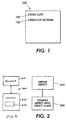
- an aspect 110 provides a general way of implementing cross-cutting behavior.
- the aspect includes a cross-cut 120 and a cross-cut action 130.
- These cross-cuts can be concrete or abstract, as will be described in greater detail in conjunction with the discussion of aspect libraries, below.
- the cross-cut includes points in the computation where the cross-cutting action is to occur.
- a point in the computation of a program is an action of the computation corresponding to a feature of the programming language in which the program is developed.
- Programming languages have features that describe kinds of actions to perform.
- a program written in the programming language uses these features to call for specific such actions.
- the implementation dynamically carries out a sequence of these actions in accordance with the program's instructions. Those are referred to as points in the computation.
- Examples of points in the computation include reading a variable, a method invocation, the start of the execution of a method, the return from a method invocation, instantiation of an object, test of a condition, the raising of an exception, the capture of an exception, etc.
- a general-purpose aspect language provides support for identifying sets of points of interest in the computation and for referring to them in the source code. By providing this support, the programmer can then associate one single piece of behavior with many different points in the computation.
- a cross-cut action is a piece of implementation (i.e., code) that is to be executed on a cross-cut. These cross-cut actions may be implemented using common programming techniques and common programming language constructs.
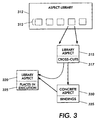
- Figure 2 illustrates the application, of AOP in developing and/or modifying software.
- AOP can be applied to any previously developed software application for which source code is available. This can be useful for applying such functionality as system monitoring or tracing, both of which are described in greater detail in our copending US patent application entitled ASPECT-ORIENTED SYSTEM MONITORING AND TRACING filed on 20 July 1999, which is incorporated by reference into the present specification.
- AOP can also be applied to previously developed software to add new functionality which cross-cuts the primary functionality of the software application.
- AOP can be used to software monitoring and tracing as described above, and can also be used to implement any other cross-cutting issues for the software application.
- a benefit of AOP is that the defining of aspects may be done concurrently with the development of the software entities defining the primary functionality of the software application.
- aspects implementing cross-cutting behavior are defined at step 210. Then, in order to have the aspects force their behavior on the object classes, the aspects are compiled, at step 220, along with the object classes.
- a compiler for performing the compilation of step 220 takes the source files for the aspects and object classes, and produces intermediate object classes that are then compiled into byte codes.
- the composition might be done at the byte code level.
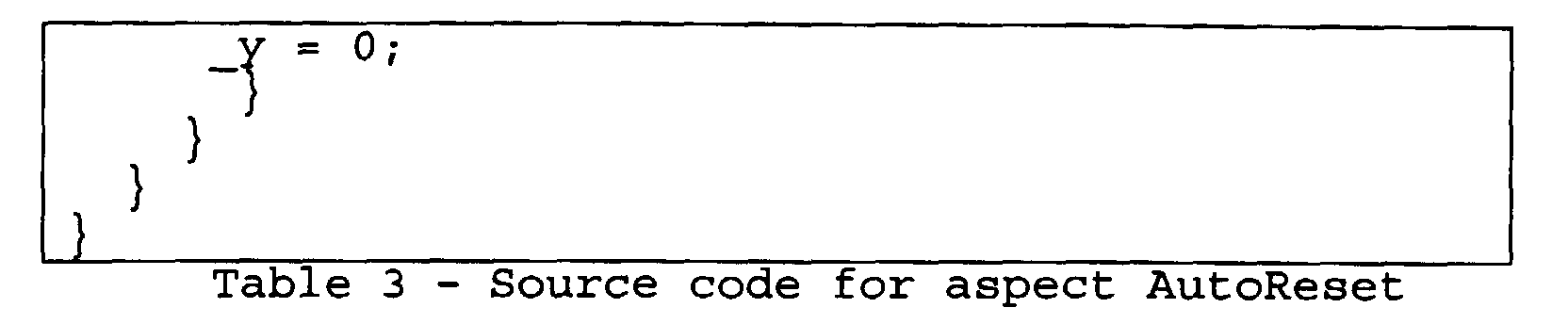
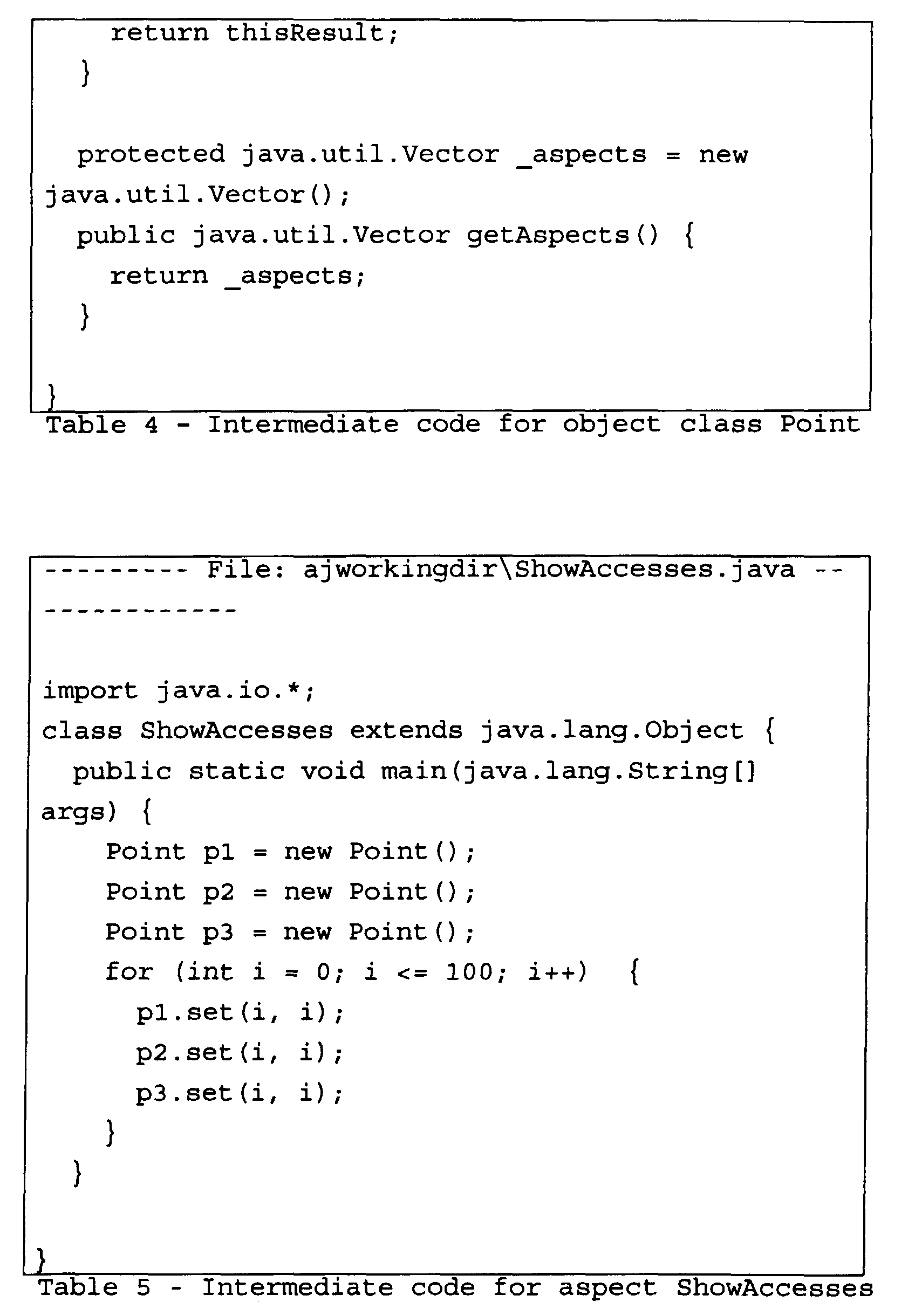
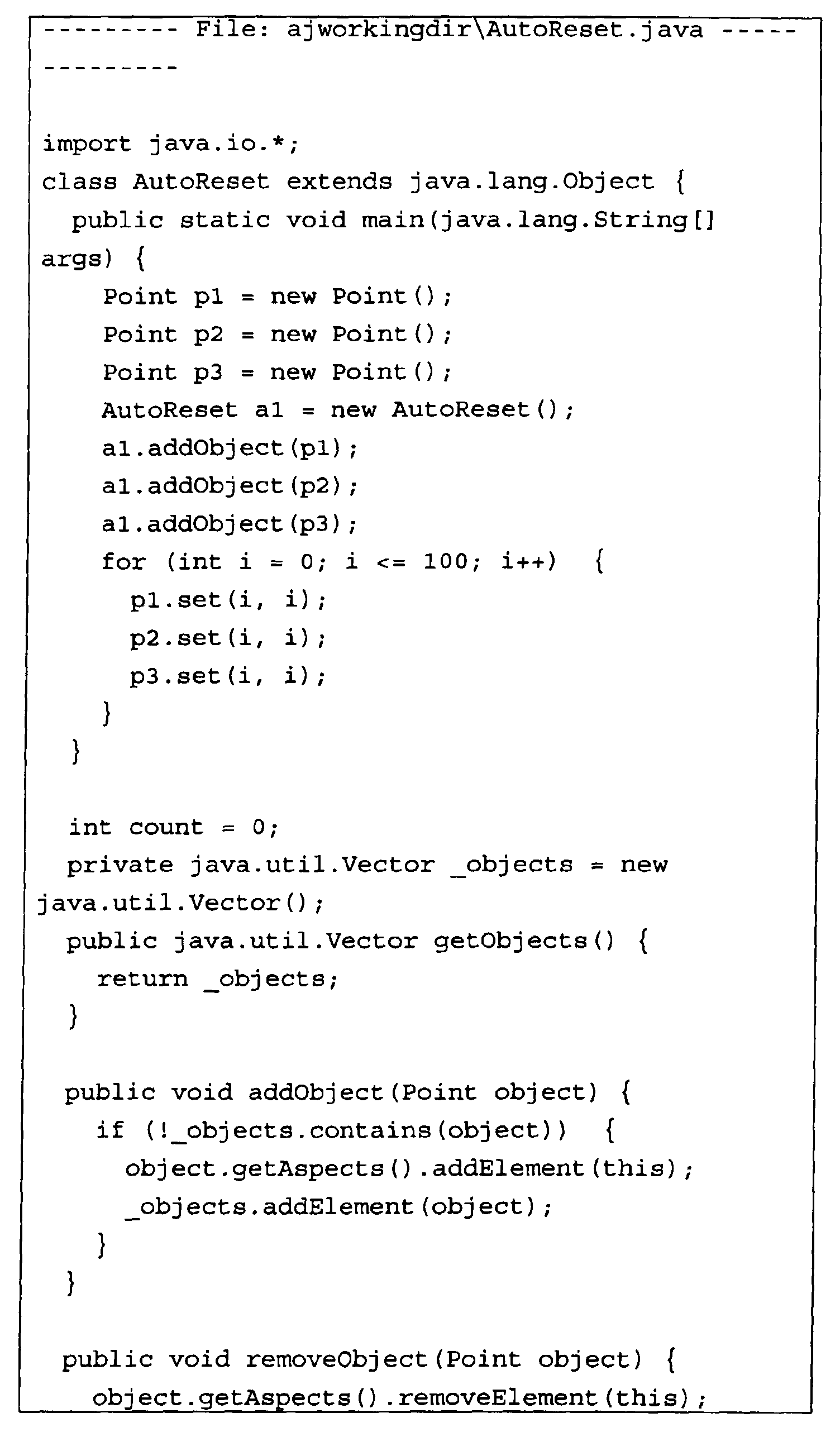
- Tables 1 through 3 contain source code for an object class, and two aspect definitions, respectively.
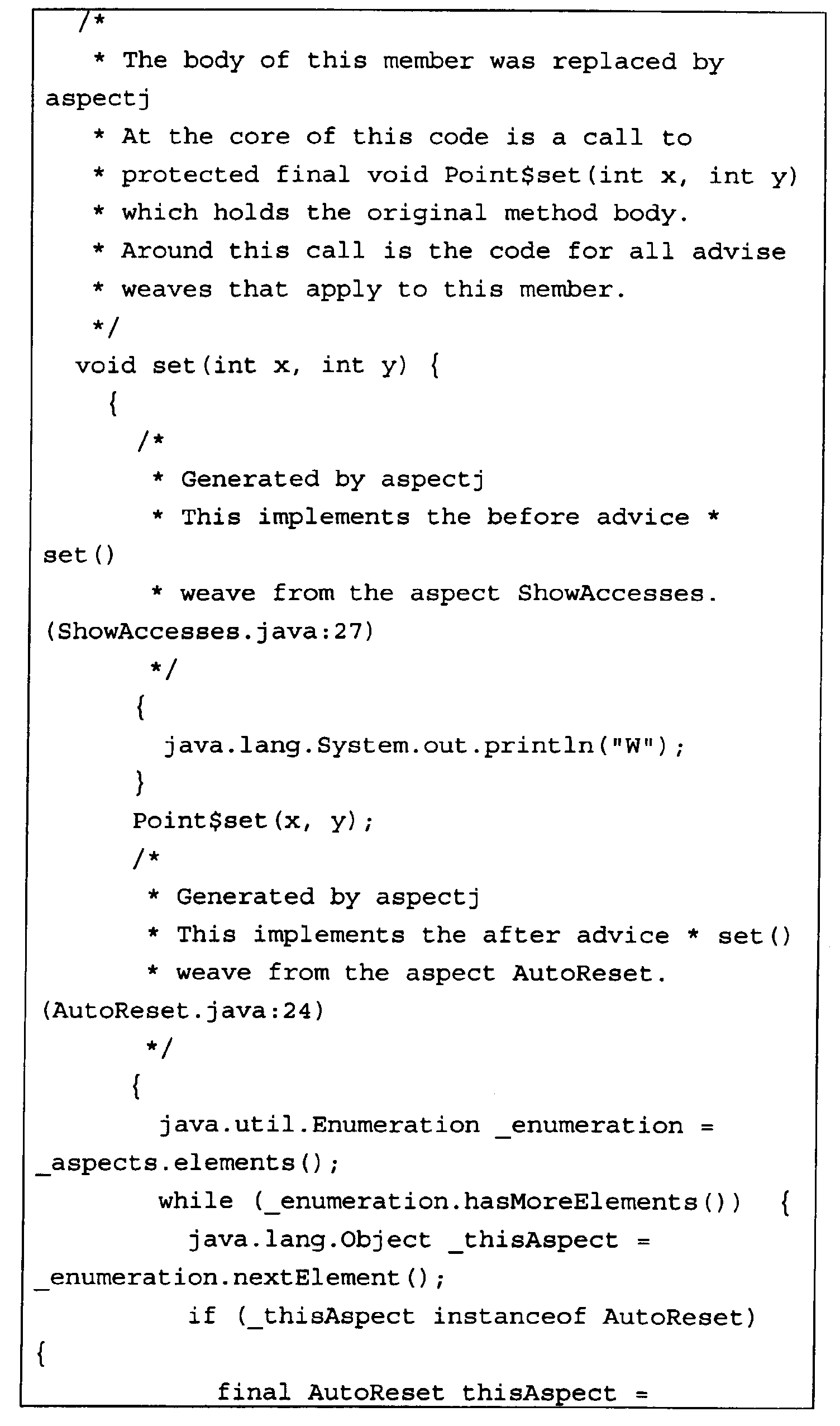
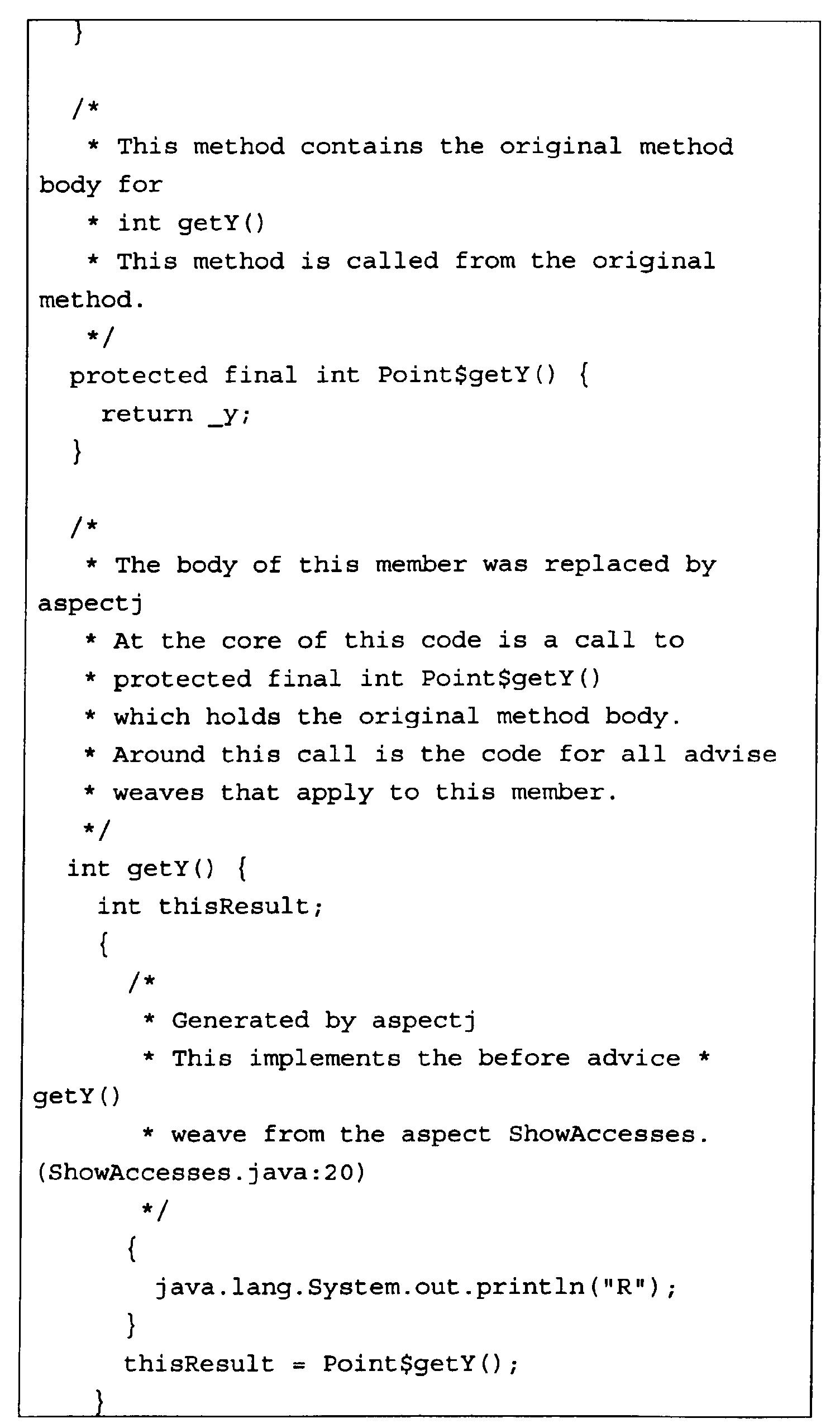
- Tables 4 through 6 contain code for three intermediate object classes corresponding to the object class and two aspects in Tables 1 through 3, respectively. The comments in the intermediate code of Table 4 help describe the transformation in greater detail. These are the intermediate codes generated by the preprocessing phase of the compiler.
- a general routine for implementing the solution may be accessed from a library.
- a software entity which may be one or more program bodies or one or more object classes, embodying the primary functionality of the software program will include calls to a library routine.
- object class libraries are popular resources for developing software applications because they allow the developer to concentrate on writing code for new issues rather than having to re-create solutions that have previously been addressed by other developers in other applications.
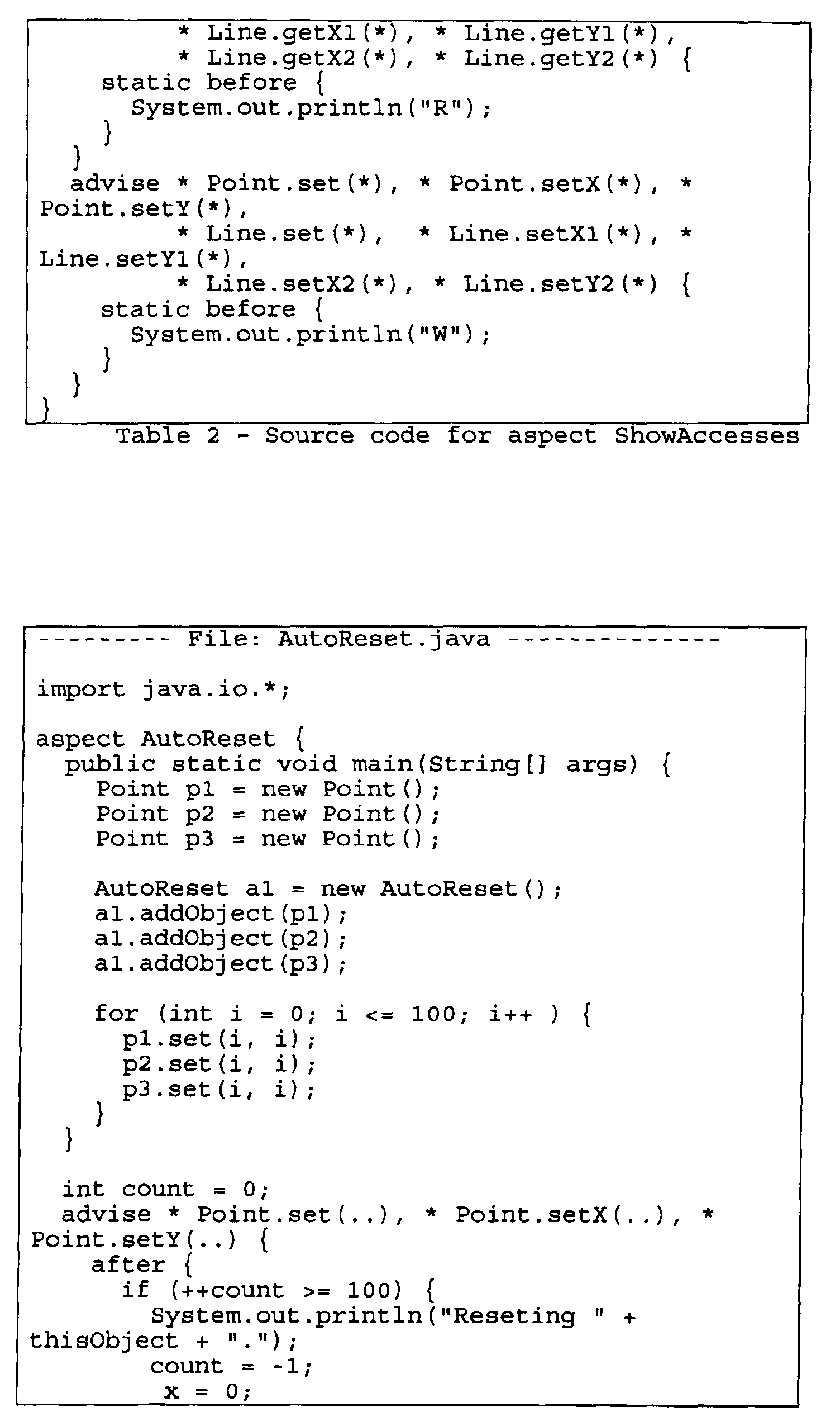
- an aspect library 310 is shown including a number of library aspects 312.
- Library aspects may be concrete or abstract.
- a concrete library aspect is the same as the aspect 110 illustrated in Figure 1, only packaged as part of an aspect library. It is described as being concrete because all the cross-cuts in it refer to concrete points in the computation, i.e. all the cross-cuts are bound to specific places in object classes.
- the concrete aspect extends the abstract library aspect through inheritance, but other ways of implementing this extension can be practiced without departing from the spirit of the invention.
- An exemplary abstract library aspect 315 includes crosscut actions as in aspect 110 if Figure 1, but the crosscut 317 of the abstract library aspect acts as a placeholder rather than being specified as a particular point in the execution.
- an abstract library aspect When use of an abstract library aspect is desired, it is bound to concrete points in the execution of an object (not shown) created from object class 320 by a concrete aspect 330 defined by the developer.
- the developer uses the crosscut to define bindings 335 between the names of the cross-cuts 317 in the library aspect 315 to concrete points in the execution 325 of the object class 320.
- a compiler for performing the compilation of abstract cross-cuts 317 of an abstract library aspect 315 takes the source files for the object classes and the concrete and abstract library aspects, and produces intermediate object classes that are then compiled into byte codes.
- the composition might be done at the byte code level, and might make use of the extensibility of Java's byte code format, e.g., tags.
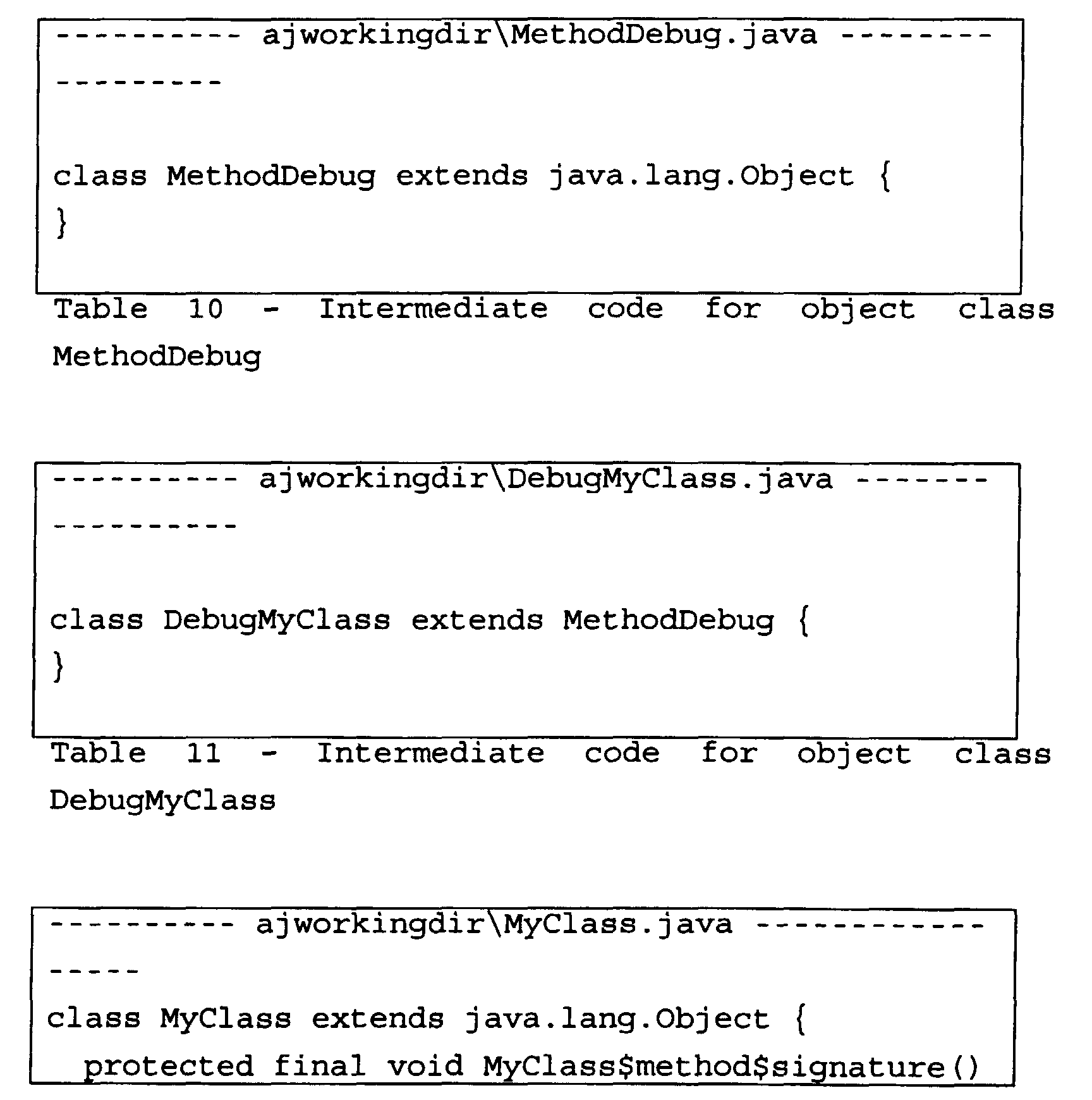
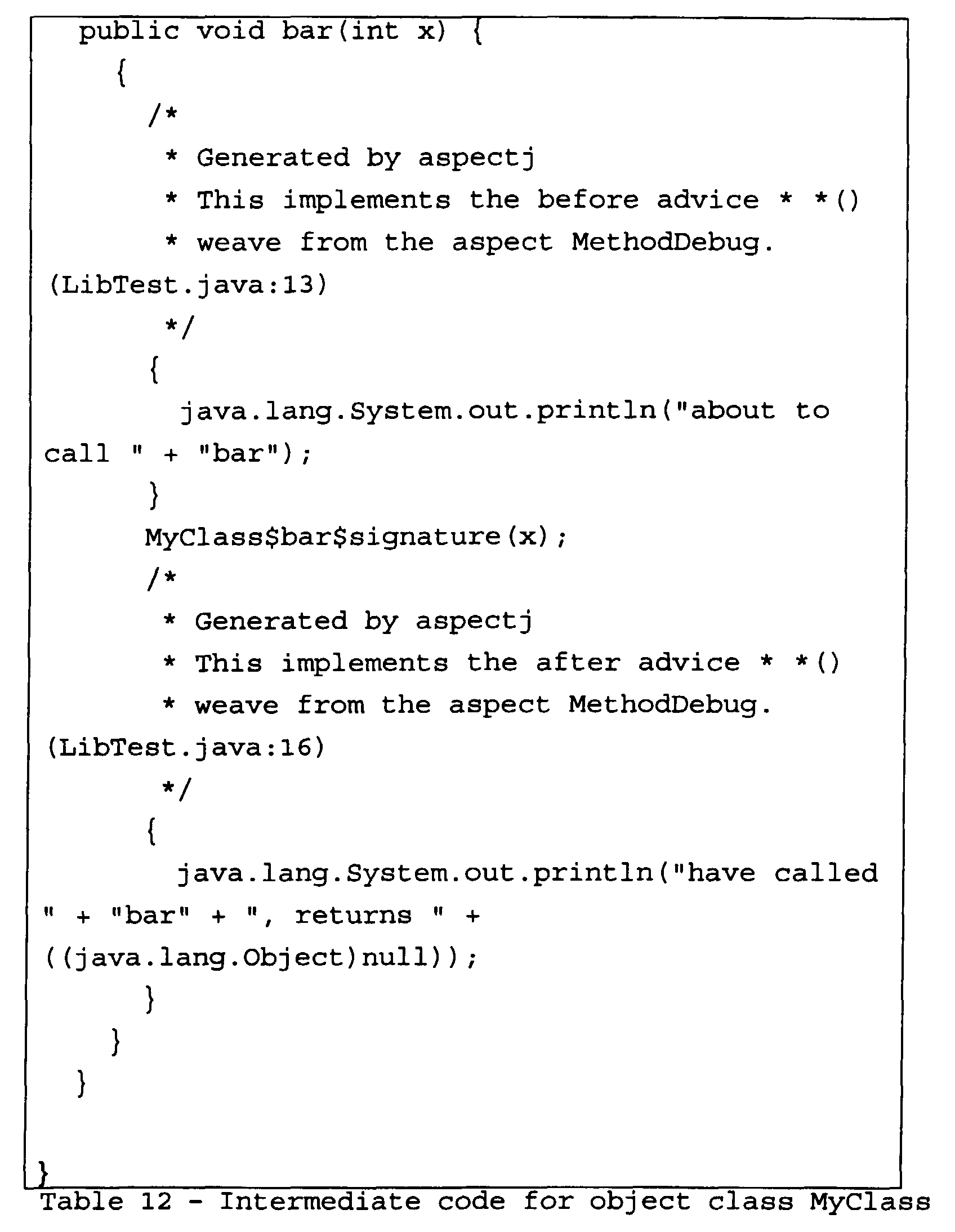
- Tables 7 through 9 contain source code for an abstract library aspect, a concrete aspect, and an object class, respectively.
- Tables 10 through 12 contain source code for three intermediate object classes corresponding to the two aspects and the object class in Tables 7 through 9, respectively. Table 12 also contains comments which are helpful in describing the transformations. These the intermediate codes generated by the preprocessing phase of the compiler.
Landscapes
- Engineering & Computer Science (AREA)
- Software Systems (AREA)
- Theoretical Computer Science (AREA)
- General Engineering & Computer Science (AREA)
- Physics & Mathematics (AREA)
- General Physics & Mathematics (AREA)
- Computing Systems (AREA)
- Stored Programmes (AREA)
- Devices For Executing Special Programs (AREA)
Abstract
Description







Claims (10)
- A computer system having a processor, a memory, and a software entity comprising either a program body or one or more object classes, the software entity defining an overall functionality of a software application program, and an aspect-oriented programming environment supporting an aspect that implements concerns that cross-cut the overall functionality of the software entity, the aspect comprising:a) a cross-cut that comprises a point in the execution where cross-cutting behavior is to be included; andb) a cross-cut action comprising a piece of implementation associated with the cross-cut, the piece of implementation comprising computer-executable code that implements the cross-cutting behavior;c) wherein the cross-cut action transparently forces the cross-cutting behavior on the software entity.
- A system according to claim 1, wherein the cross-cut defines a plurality of points in the computation associated with a plurality of places in the software entity.
- A method for developing software in a computer system including an aspect-oriented programming environment supporting an aspect that implements concerns that cross-cut the overall functionality of the software entity, the method comprising:a) creating a software entity comprising either a program body or one or more object classes, the software entity defining an overall functionality of a software application program,b) creating an aspect which modifies at least one software entity by forcing behavior on the at least one software entity, wherein the modification is transparent to the at least one software entity;c) compiling the software entity along with the aspect to thereby force the behavior of the aspect onto the software entity.
- The method of claim 3, wherein the cross-cut defines a plurality of points in the computation associated with a plurality of places in the software entity.
- The method of claim 3 or claim 4, wherein creating an aspect comprises:1) creating a cross-cut defining a point in the computation where cross-cutting behavior is to be included; and2) creating a cross-cut action comprising a piece of implementation associated with the cross-cut, the piece of implementation comprising computer-executable code that implements the cross-cutting behavior.
- The method of any of claims 3 to 5, wherein the cross-cut is a concrete cross-cut that uniquely defines a point in the computation where cross-cutting behavior is to be included.
- The method of any of claims 3 to 6, wherein the computer system further includes an aspect library including a library aspect, the method comprising creating the cross-cut comprises creating a concrete aspect that reuses parts of an implementation of the library aspect.
- An aspect library for use in a computer system having a processor, memory, and an aspect-oriented operating environment, the aspect library for use in creating a software program, the software program comprising one or more software entities that define the overall functionality of the software program, each of the one or more software entities comprising one or more program bodies or one or more object classes, each of the one or more software entities comprising computer executable code which performs one or more functions, the aspect library comprising a plurality of aspects, each aspect comprising:a) a placeholder for specifying a cross-cut that comprises a point in the execution where cross-cutting behavior is to be included; andb) a cross-cut action comprising a piece of implementation associated with the cross-cut, the piece of implementation comprising computer-executable code that implements the cross-cutting behavior;c) wherein the cross-cut action transparently forces the cross-cutting behavior on the software entity.
- A computer-readable medium for use a computer system having a processor, a display, and memory, the memory including an aspect-oriented operating environment, the computer-readable medium having an aspect library comprising a plurality of aspects, each aspect comprising:a) a placeholder for specifying a cross-cut that comprises a point in the execution where cross-cutting behavior is to be included; andb) a cross-cut action comprising a piece of implementation associated with the cross-cut, the piece of implementation comprising computer-executable code that implements the cross-cutting behavior;c) wherein the cross-cut action transparently forces the cross-cutting behavior on the software entity.
- A method for transferring a computer program product from one or more first computers to a second computer connected to the one or more first computers through a communications medium, the method comprising:a) accessing, on the one or more first computers, an aspect library comprising a plurality of aspects, each aspect comprising:1) a placeholder for specifying a cross-cut that comprises a point in the execution where cross-cutting behavior is to be included; and2) a cross-cut action comprising a piece of implementation associated with the cross-cut, the piece of implementation comprising computer-executable code that implements the cross-cutting behavior;3) wherein the cross-cut action transparently forces the cross-cutting behavior on the software entity; andb) transferring the computer-executable instructions from the one or more first computers to the second computer.
Applications Claiming Priority (2)
| Application Number | Priority Date | Filing Date | Title |
|---|---|---|---|
| US357738 | 1999-07-20 | ||
| US09/357,738 US6467086B1 (en) | 1999-07-20 | 1999-07-20 | Aspect-oriented programming |
Publications (3)
| Publication Number | Publication Date |
|---|---|
| EP1074911A2 true EP1074911A2 (en) | 2001-02-07 |
| EP1074911A3 EP1074911A3 (en) | 2002-08-28 |
| EP1074911B1 EP1074911B1 (en) | 2017-04-26 |
Family
ID=23406825
Family Applications (1)
| Application Number | Title | Priority Date | Filing Date |
|---|---|---|---|
| EP00305804.7A Expired - Lifetime EP1074911B1 (en) | 1999-07-20 | 2000-07-10 | Aspect-oriented programming |
Country Status (3)
| Country | Link |
|---|---|
| US (1) | US6467086B1 (en) |
| EP (1) | EP1074911B1 (en) |
| CA (1) | CA2313721C (en) |
Cited By (12)
| Publication number | Priority date | Publication date | Assignee | Title |
|---|---|---|---|---|
| US7043636B2 (en) | 2000-09-26 | 2006-05-09 | Telefonaktiebolaget Lm Ericsson (Publ) | Data integrity mechanisms for static and dynamic data |
| US7149510B2 (en) | 2002-09-23 | 2006-12-12 | Telefonaktiebolaget Lm Ericsson (Publ) | Security access manager in middleware |
| WO2007025588A1 (en) * | 2005-07-22 | 2007-03-08 | Telefonaktiebolaget Lm Ericsson (Publ) | System and method for transforming generic software code into operator specific code |
| US7240830B2 (en) | 2002-02-15 | 2007-07-10 | Telefonaktiebolaget Lm Ericsson (Publ) | Layered SIM card and security function |
| US7286823B2 (en) | 2002-02-15 | 2007-10-23 | Telefonaktiebolaget Lm Ericsson (Publ) | Mobile multimedia engine |
| US7350211B2 (en) | 2002-09-23 | 2008-03-25 | Telefonaktiebolaget Lm Ericsson (Publ) | Middleware application environment |
| US7363033B2 (en) | 2002-02-15 | 2008-04-22 | Telefonaktiebolaget Lm Ericsson (Publ) | Method of and system for testing equipment during manufacturing |
| US7415270B2 (en) | 2002-02-15 | 2008-08-19 | Telefonaktiebolaget L M Ericsson (Publ) | Middleware services layer for platform system for mobile terminals |
| US7478395B2 (en) | 2002-09-23 | 2009-01-13 | Telefonaktiebolaget L M Ericsson (Publ) | Middleware application message/event model |
| US7536181B2 (en) | 2002-02-15 | 2009-05-19 | Telefonaktiebolaget L M Ericsson (Publ) | Platform system for mobile terminals |
| WO2011064001A1 (en) * | 2009-11-25 | 2011-06-03 | Telefonaktiebolaget L M Ericsson (Publ) | Application server and method for managing a service |
| US8079015B2 (en) | 2002-02-15 | 2011-12-13 | Telefonaktiebolaget L M Ericsson (Publ) | Layered architecture for mobile terminals |
Families Citing this family (43)
| Publication number | Priority date | Publication date | Assignee | Title |
|---|---|---|---|---|
| US7441231B1 (en) * | 1999-11-08 | 2008-10-21 | British Telecommunications Public Limited Company | Task management |
| US7441232B2 (en) * | 1999-11-08 | 2008-10-21 | British Telecommunications Public Limited Company | Task management |
| CN1682186A (en) * | 2001-09-05 | 2005-10-12 | 斯文·约翰·贝林 | Technology independent information management |
| US7140007B2 (en) * | 2002-01-16 | 2006-11-21 | Xerox Corporation | Aspect-oriented programming with multiple semantic levels |
| US7137104B2 (en) * | 2002-05-21 | 2006-11-14 | International Business Machines Corporation | Semantics-based composition of class hierarchies |
| GB0229669D0 (en) * | 2002-12-19 | 2003-01-29 | Ibm | A method for capturing computer application diagnostics |
| US7478375B1 (en) | 2004-04-23 | 2009-01-13 | Computer Associates Think, Inc. | Directed acyclic graph (DAG) exploration through separation of concerns |
| US20060053116A1 (en) * | 2004-08-31 | 2006-03-09 | Rits Maarten E | Dynamic software updating using mobile agent AOP |
| US7984422B2 (en) * | 2004-09-30 | 2011-07-19 | Graham Kevin P | Repository relationship programming |
| US20080005723A1 (en) * | 2004-11-15 | 2008-01-03 | Peter Zimmerer | Method For Manipulating Software-Tests |
| US20060149550A1 (en) * | 2004-12-30 | 2006-07-06 | Henri Salminen | Multimodal interaction |
| US20060156418A1 (en) * | 2005-01-10 | 2006-07-13 | Ibm Corporation | Method and apparatus for preventing unauthorized access to data |
| GB0510657D0 (en) * | 2005-05-25 | 2005-06-29 | Ibm | Generating an application software library |
| US7971194B1 (en) | 2005-06-16 | 2011-06-28 | Sap Portals Israel Ltd. | Programming language techniques for client-side development and execution |
| US8146051B2 (en) * | 2006-10-02 | 2012-03-27 | International Business Machines Corporation | Method and computer program product for providing a representation of software modeled by a model |
| US20080141335A1 (en) * | 2006-12-08 | 2008-06-12 | Novell, Inc. | Provisioning software with policy-appropriate capabilities |
| US8020143B2 (en) * | 2007-01-10 | 2011-09-13 | International Business Machines Corporation | Remote aspect advising for an aspect-oriented program |
| US8141042B2 (en) * | 2007-03-06 | 2012-03-20 | International Business Machines Corporation | Extending portability of java code through the use of AOP |
| US9703576B2 (en) * | 2007-04-05 | 2017-07-11 | International Business Machines Corporation | Aspect scoping in a modularity runtime |
| US8452882B2 (en) * | 2007-05-18 | 2013-05-28 | Red Hat, Inc. | Method and an apparatus to validate a web session in a proxy server |
| US8489740B2 (en) * | 2007-05-18 | 2013-07-16 | Red Hat, Inc. | Method and an apparatus to generate message authentication codes at a proxy server for validating a web session |
| US9009699B2 (en) | 2007-05-31 | 2015-04-14 | Red Hat, Inc. | Providing a POJO-based microcontainer for an application server |
| US8640146B2 (en) * | 2007-05-31 | 2014-01-28 | Red Hat, Inc. | Providing extensive ability for describing a management interface |
| US8103495B2 (en) * | 2007-08-08 | 2012-01-24 | Microsoft Corporation | Feature oriented protocol modeling |
| US20090119636A1 (en) * | 2007-11-02 | 2009-05-07 | Paul Kettley | Instrumenting a compiled software routine for augmentation |
| US8347278B2 (en) * | 2007-11-02 | 2013-01-01 | International Business Machines Corporation | Instrumenting a compiled software routine for augmentation |
| US20090198496A1 (en) * | 2008-01-31 | 2009-08-06 | Matthias Denecke | Aspect oriented programmable dialogue manager and apparatus operated thereby |
| US20090249021A1 (en) * | 2008-03-26 | 2009-10-01 | Morris Robert P | Method And Systems For Invoking An Advice Operation Associated With A Joinpoint |
| US7881304B2 (en) * | 2008-05-29 | 2011-02-01 | Red Hat, Inc. | Using distributed aspects to reorder online application workflows |
| US8180854B2 (en) | 2008-05-29 | 2012-05-15 | Red Hat, Inc. | Aspect services |
| US8103607B2 (en) * | 2008-05-29 | 2012-01-24 | Red Hat, Inc. | System comprising a proxy server including a rules engine, a remote application server, and an aspect server for executing aspect services remotely |
| US8869099B2 (en) * | 2008-07-28 | 2014-10-21 | Infosys Limited | System and method of enabling multi-tenancy for software as a service application |
| US9910688B2 (en) * | 2008-11-28 | 2018-03-06 | Red Hat, Inc. | Implementing aspects with callbacks in virtual machines |
| US8990779B2 (en) | 2009-08-11 | 2015-03-24 | Sap Se | Response time measurement system and method |
| CN103186371A (en) * | 2011-12-29 | 2013-07-03 | 宇龙计算机通信科技(深圳)有限公司 | Cloud aspectual system and implementation method |
| US9712530B2 (en) | 2012-01-06 | 2017-07-18 | Optio Labs, Inc. | Systems and methods for enforcing security in mobile computing |
| US9787681B2 (en) | 2012-01-06 | 2017-10-10 | Optio Labs, Inc. | Systems and methods for enforcing access control policies on privileged accesses for mobile devices |
| US9609020B2 (en) | 2012-01-06 | 2017-03-28 | Optio Labs, Inc. | Systems and methods to enforce security policies on the loading, linking, and execution of native code by mobile applications running inside of virtual machines |
| US9773107B2 (en) | 2013-01-07 | 2017-09-26 | Optio Labs, Inc. | Systems and methods for enforcing security in mobile computing |
| US20140282992A1 (en) | 2013-03-13 | 2014-09-18 | Optio Labs, Inc. | Systems and methods for securing the boot process of a device using credentials stored on an authentication token |
| DE102015107786A1 (en) | 2015-05-18 | 2016-11-24 | Iunera GmbH & Co. KG | System, methods and arrangements for the implicit validation and retrieval of documents |
| US9430200B1 (en) | 2015-06-04 | 2016-08-30 | Microsoft Technology Licensing Llc | Cross-library framework architecture feature sets |
| US20220317980A1 (en) * | 2019-02-17 | 2022-10-06 | Sage Global Services Limited | Code modification technique |
Family Cites Families (3)
| Publication number | Priority date | Publication date | Assignee | Title |
|---|---|---|---|---|
| CA2165893C (en) * | 1995-12-21 | 2001-03-13 | Richard Denison Mcdonald | Visual application partitioning for creating distributed object oriented applications |
| US5822593A (en) * | 1996-12-06 | 1998-10-13 | Xerox Corporation | High-level loop fusion |
| US6314562B1 (en) * | 1997-09-12 | 2001-11-06 | Microsoft Corporation | Method and system for anticipatory optimization of computer programs |
-
1999
- 1999-07-20 US US09/357,738 patent/US6467086B1/en not_active Expired - Lifetime
-
2000
- 2000-07-10 EP EP00305804.7A patent/EP1074911B1/en not_active Expired - Lifetime
- 2000-07-11 CA CA002313721A patent/CA2313721C/en not_active Expired - Fee Related
Cited By (15)
| Publication number | Priority date | Publication date | Assignee | Title |
|---|---|---|---|---|
| US7043636B2 (en) | 2000-09-26 | 2006-05-09 | Telefonaktiebolaget Lm Ericsson (Publ) | Data integrity mechanisms for static and dynamic data |
| US7363033B2 (en) | 2002-02-15 | 2008-04-22 | Telefonaktiebolaget Lm Ericsson (Publ) | Method of and system for testing equipment during manufacturing |
| US7415270B2 (en) | 2002-02-15 | 2008-08-19 | Telefonaktiebolaget L M Ericsson (Publ) | Middleware services layer for platform system for mobile terminals |
| US7240830B2 (en) | 2002-02-15 | 2007-07-10 | Telefonaktiebolaget Lm Ericsson (Publ) | Layered SIM card and security function |
| US7286823B2 (en) | 2002-02-15 | 2007-10-23 | Telefonaktiebolaget Lm Ericsson (Publ) | Mobile multimedia engine |
| US8079015B2 (en) | 2002-02-15 | 2011-12-13 | Telefonaktiebolaget L M Ericsson (Publ) | Layered architecture for mobile terminals |
| US7536181B2 (en) | 2002-02-15 | 2009-05-19 | Telefonaktiebolaget L M Ericsson (Publ) | Platform system for mobile terminals |
| US7478395B2 (en) | 2002-09-23 | 2009-01-13 | Telefonaktiebolaget L M Ericsson (Publ) | Middleware application message/event model |
| US7149510B2 (en) | 2002-09-23 | 2006-12-12 | Telefonaktiebolaget Lm Ericsson (Publ) | Security access manager in middleware |
| US7584471B2 (en) | 2002-09-23 | 2009-09-01 | Telefonaktiebolaget L M Ericsson (Publ) | Plug-in model |
| US7350211B2 (en) | 2002-09-23 | 2008-03-25 | Telefonaktiebolaget Lm Ericsson (Publ) | Middleware application environment |
| WO2007025588A1 (en) * | 2005-07-22 | 2007-03-08 | Telefonaktiebolaget Lm Ericsson (Publ) | System and method for transforming generic software code into operator specific code |
| US7810082B2 (en) | 2005-07-22 | 2010-10-05 | Telefonaktiebolaget L M Ericsson (Publ) | System and method for transforming generic software code into operator specific code |
| WO2011064001A1 (en) * | 2009-11-25 | 2011-06-03 | Telefonaktiebolaget L M Ericsson (Publ) | Application server and method for managing a service |
| US8972935B2 (en) | 2009-11-25 | 2015-03-03 | Telefonaktiebolaget L M Ericsson (Publ) | Application server and method for managing a service |
Also Published As
| Publication number | Publication date |
|---|---|
| CA2313721C (en) | 2004-04-27 |
| CA2313721A1 (en) | 2001-01-20 |
| EP1074911B1 (en) | 2017-04-26 |
| US6467086B1 (en) | 2002-10-15 |
| EP1074911A3 (en) | 2002-08-28 |
Similar Documents
| Publication | Publication Date | Title |
|---|---|---|
| EP1074911B1 (en) | Aspect-oriented programming | |
| EP1178404B1 (en) | Method and system for compiling multiple languages | |
| US7305666B2 (en) | Description language for an extensible compiler and tools infrastructure | |
| Czarnecki et al. | Generative programming and active libraries | |
| Brant et al. | Wrappers to the Rescue | |
| US6539390B1 (en) | Integrated development environment for aspect-oriented programming | |
| US6185728B1 (en) | Development system with methods for type-safe delegation of object events to event handlers of other objects | |
| US5615333A (en) | Integration testing method for object-oriented software | |
| US20040230958A1 (en) | Compiler and software product for compiling intermediate language bytecodes into Java bytecodes | |
| Adams et al. | Object-oriented programming in Scheme | |
| US6442750B1 (en) | Design by contract with aspect-oriented programming | |
| Hamilton | Language integration in the common language runtime | |
| Nierstrasz et al. | A calculus for modeling software components | |
| Cifuentes et al. | Experience in the design, implementation and use of a retargetable static binary translation framework | |
| CN100507843C (en) | A Dynamic Programming Method | |
| Atkinson et al. | Experiences creating a portable Cedar | |
| US7512938B2 (en) | Typed intermediate representation for object-oriented languages | |
| Martinez et al. | A review on Java programming language | |
| Konstantas | An Implementation of Hybrid A Concurrent, Object-Oriented Language | |
| Schattkowsky et al. | A model-based approach for executable specifications on reconfigurable hardware | |
| Briain | Introduction to Programming | |
| Forgáč et al. | Static and dynamic approaches to weaving | |
| JP2002132502A (en) | Automatic creating system and method of distributed object with interpretation of language function | |
| Plumbridge et al. | Translating Java for resource constrained embedded systems | |
| Malhotra | Dynamic extensibility in a statically-compiled object-oriented language |
Legal Events
| Date | Code | Title | Description |
|---|---|---|---|
| PUAI | Public reference made under article 153(3) epc to a published international application that has entered the european phase |
Free format text: ORIGINAL CODE: 0009012 |
|
| AK | Designated contracting states |
Kind code of ref document: A2 Designated state(s): AT BE CH CY DE DK ES FI FR GB GR IE IT LI LU MC NL PT SE |
|
| AX | Request for extension of the european patent |
Free format text: AL;LT;LV;MK;RO;SI |
|
| PUAL | Search report despatched |
Free format text: ORIGINAL CODE: 0009013 |
|
| RIC1 | Information provided on ipc code assigned before grant |
Free format text: 7G 06F 9/44 A, 7G 06F 9/46 B |
|
| AK | Designated contracting states |
Kind code of ref document: A3 Designated state(s): AT BE CH CY DE DK ES FI FR GB GR IE IT LI LU MC NL PT SE |
|
| AX | Request for extension of the european patent |
Free format text: AL;LT;LV;MK;RO;SI |
|
| RIN1 | Information on inventor provided before grant (corrected) |
Inventor name: LOPES, CRISTINA V. Inventor name: LAMPING, JOHN O. Inventor name: HILSDALE, ERIK A. Inventor name: HUGUNIN, JAMES J. Inventor name: BOYAPATI, CHANDRASEKHAR Inventor name: KICZALES, GREGOR J. |
|
| 17P | Request for examination filed |
Effective date: 20030228 |
|
| AKX | Designation fees paid |
Designated state(s): DE FR GB |
|
| 17Q | First examination report despatched |
Effective date: 20080103 |
|
| GRAP | Despatch of communication of intention to grant a patent |
Free format text: ORIGINAL CODE: EPIDOSNIGR1 |
|
| GRAJ | Information related to disapproval of communication of intention to grant by the applicant or resumption of examination proceedings by the epo deleted |
Free format text: ORIGINAL CODE: EPIDOSDIGR1 |
|
| GRAP | Despatch of communication of intention to grant a patent |
Free format text: ORIGINAL CODE: EPIDOSNIGR1 |
|
| INTG | Intention to grant announced |
Effective date: 20161026 |
|
| INTC | Intention to grant announced (deleted) | ||
| INTG | Intention to grant announced |
Effective date: 20161123 |
|
| GRAS | Grant fee paid |
Free format text: ORIGINAL CODE: EPIDOSNIGR3 |
|
| GRAA | (expected) grant |
Free format text: ORIGINAL CODE: 0009210 |
|
| AK | Designated contracting states |
Kind code of ref document: B1 Designated state(s): DE FR GB |
|
| REG | Reference to a national code |
Ref country code: GB Ref legal event code: FG4D |
|
| REG | Reference to a national code |
Ref country code: DE Ref legal event code: R096 Ref document number: 60049601 Country of ref document: DE |
|
| REG | Reference to a national code |
Ref country code: FR Ref legal event code: PLFP Year of fee payment: 18 |
|
| PGFP | Annual fee paid to national office [announced via postgrant information from national office to epo] |
Ref country code: GB Payment date: 20170620 Year of fee payment: 18 Ref country code: FR Payment date: 20170621 Year of fee payment: 18 |
|
| PGFP | Annual fee paid to national office [announced via postgrant information from national office to epo] |
Ref country code: DE Payment date: 20170620 Year of fee payment: 18 |
|
| REG | Reference to a national code |
Ref country code: DE Ref legal event code: R097 Ref document number: 60049601 Country of ref document: DE |
|
| PLBE | No opposition filed within time limit |
Free format text: ORIGINAL CODE: 0009261 |
|
| STAA | Information on the status of an ep patent application or granted ep patent |
Free format text: STATUS: NO OPPOSITION FILED WITHIN TIME LIMIT |
|
| 26N | No opposition filed |
Effective date: 20180129 |
|
| REG | Reference to a national code |
Ref country code: DE Ref legal event code: R119 Ref document number: 60049601 Country of ref document: DE |
|
| GBPC | Gb: european patent ceased through non-payment of renewal fee |
Effective date: 20180710 |
|
| PG25 | Lapsed in a contracting state [announced via postgrant information from national office to epo] |
Ref country code: FR Free format text: LAPSE BECAUSE OF NON-PAYMENT OF DUE FEES Effective date: 20180731 Ref country code: GB Free format text: LAPSE BECAUSE OF NON-PAYMENT OF DUE FEES Effective date: 20180710 Ref country code: DE Free format text: LAPSE BECAUSE OF NON-PAYMENT OF DUE FEES Effective date: 20190201 |