EP1074269A2 - Disposable water-absorbent structure - Google Patents
Disposable water-absorbent structure Download PDFInfo
- Publication number
- EP1074269A2 EP1074269A2 EP00306682A EP00306682A EP1074269A2 EP 1074269 A2 EP1074269 A2 EP 1074269A2 EP 00306682 A EP00306682 A EP 00306682A EP 00306682 A EP00306682 A EP 00306682A EP 1074269 A2 EP1074269 A2 EP 1074269A2
- Authority
- EP
- European Patent Office
- Prior art keywords
- ethylene
- fibrous support
- polymer particles
- water
- glycidyl
- Prior art date
- Legal status (The legal status is an assumption and is not a legal conclusion. Google has not performed a legal analysis and makes no representation as to the accuracy of the status listed.)
- Withdrawn
Links
Images



Classifications
-
- A—HUMAN NECESSITIES
- A61—MEDICAL OR VETERINARY SCIENCE; HYGIENE
- A61F—FILTERS IMPLANTABLE INTO BLOOD VESSELS; PROSTHESES; DEVICES PROVIDING PATENCY TO, OR PREVENTING COLLAPSING OF, TUBULAR STRUCTURES OF THE BODY, e.g. STENTS; ORTHOPAEDIC, NURSING OR CONTRACEPTIVE DEVICES; FOMENTATION; TREATMENT OR PROTECTION OF EYES OR EARS; BANDAGES, DRESSINGS OR ABSORBENT PADS; FIRST-AID KITS
- A61F13/00—Bandages or dressings; Absorbent pads
- A61F13/15—Absorbent pads, e.g. sanitary towels, swabs or tampons for external or internal application to the body; Supporting or fastening means therefor; Tampon applicators
-
- A—HUMAN NECESSITIES
- A61—MEDICAL OR VETERINARY SCIENCE; HYGIENE
- A61F—FILTERS IMPLANTABLE INTO BLOOD VESSELS; PROSTHESES; DEVICES PROVIDING PATENCY TO, OR PREVENTING COLLAPSING OF, TUBULAR STRUCTURES OF THE BODY, e.g. STENTS; ORTHOPAEDIC, NURSING OR CONTRACEPTIVE DEVICES; FOMENTATION; TREATMENT OR PROTECTION OF EYES OR EARS; BANDAGES, DRESSINGS OR ABSORBENT PADS; FIRST-AID KITS
- A61F13/00—Bandages or dressings; Absorbent pads
- A61F13/15—Absorbent pads, e.g. sanitary towels, swabs or tampons for external or internal application to the body; Supporting or fastening means therefor; Tampon applicators
- A61F13/53—Absorbent pads, e.g. sanitary towels, swabs or tampons for external or internal application to the body; Supporting or fastening means therefor; Tampon applicators characterised by the absorbing medium
-
- A—HUMAN NECESSITIES
- A61—MEDICAL OR VETERINARY SCIENCE; HYGIENE
- A61L—METHODS OR APPARATUS FOR STERILISING MATERIALS OR OBJECTS IN GENERAL; DISINFECTION, STERILISATION OR DEODORISATION OF AIR; CHEMICAL ASPECTS OF BANDAGES, DRESSINGS, ABSORBENT PADS OR SURGICAL ARTICLES; MATERIALS FOR BANDAGES, DRESSINGS, ABSORBENT PADS OR SURGICAL ARTICLES
- A61L15/00—Chemical aspects of, or use of materials for, bandages, dressings or absorbent pads
- A61L15/16—Bandages, dressings or absorbent pads for physiological fluids such as urine or blood, e.g. sanitary towels, tampons
- A61L15/42—Use of materials characterised by their function or physical properties
- A61L15/60—Liquid-swellable gel-forming materials, e.g. super-absorbents
-
- A—HUMAN NECESSITIES
- A61—MEDICAL OR VETERINARY SCIENCE; HYGIENE
- A61F—FILTERS IMPLANTABLE INTO BLOOD VESSELS; PROSTHESES; DEVICES PROVIDING PATENCY TO, OR PREVENTING COLLAPSING OF, TUBULAR STRUCTURES OF THE BODY, e.g. STENTS; ORTHOPAEDIC, NURSING OR CONTRACEPTIVE DEVICES; FOMENTATION; TREATMENT OR PROTECTION OF EYES OR EARS; BANDAGES, DRESSINGS OR ABSORBENT PADS; FIRST-AID KITS
- A61F13/00—Bandages or dressings; Absorbent pads
- A61F13/15—Absorbent pads, e.g. sanitary towels, swabs or tampons for external or internal application to the body; Supporting or fastening means therefor; Tampon applicators
- A61F13/53—Absorbent pads, e.g. sanitary towels, swabs or tampons for external or internal application to the body; Supporting or fastening means therefor; Tampon applicators characterised by the absorbing medium
- A61F2013/530481—Absorbent pads, e.g. sanitary towels, swabs or tampons for external or internal application to the body; Supporting or fastening means therefor; Tampon applicators characterised by the absorbing medium having superabsorbent materials, i.e. highly absorbent polymer gel materials
Definitions
- This invention relates to a disposable water-absorbent structure suitable for absorption and disposal of body fluids, waste water or the like.
- Water-absorbent structures of this type have already been proposed, for example, a structure comprising a mixture of highly water-absorptive polymer particles and fluff pulp compressed in a desired shape and entirely covered with tissue paper and the structure comprising highly water-absorptive polymer particles bound with a fibrous support by means of hot melt polymer particles.
- Japanese Patent Application Disclosure Gazette No. 1994-245958 describes a water-absorbent structure comprising highly water-absorptive particles bound with the fibrous support by means of hot melt resin.
- the structure of this type is suitable as absorbent cores of disposable diapers or sanitary napkins.
- the polymer particles should be reliably held in the structure so far as the highly water-absorptive polymer particles are used as the component of the water-absorbent structure and the above-mentioned structure of prior art is an example taking a measure to meet this requirement.
- the highly water-absorptive polymer particles tends to be bound together and consequently to form a gel block as they absorb water and swell, when an excessive amount of these polymer particles per unit area or unit volume.
- the polymer particles confined within the block are no more utilized for water absorption and these relatively expensive polymer particles come to nothing since a water content of body fluids or the like can not permeate such gel block.
- a water absorption of highly water-absorptive polymer particles is insufficient to obtain a water-absorbent structure having a high instantaneous water absorption merely by increasing an amount of the polymer particles.
- the above-mentioned document describes no measure to solve such problems of the assembly using the highly water-absorptive polymer particles.
- a water-absorbent structure comprising highly water absorptive polymer particles, a fibrous support and binders disposed between the polymer particles and the fibrous support to fix the polymer particles to the fibrous support, wherein: the fibrous support is elastically compressive and firmly bound to the binders by a firmly binding effect, depending on spots in the fibrous support, in a manner that the fibrous support can not be easily dissociated from the binder even the polymer particles absorb water and swell and loosely bound to the binders, depending on spots in the fibrous support, in a manner that the fibrous support can be easily dissociated from the binders as the polymer particles absorb water and swell so that the fibrous support is maintained in compressed state thereof by the loosely binding effect.
- the fiber interstices as well as the particle interstices are progressively enlarged as the polymer particles lying in the vicinity of the structure's upper surface absorb an amount of water and swell even if the polymer particles and the fibers are initially in compactly compressed state.
- the amount of water supplied onto the upper surface of the structure can permeate into the structure and be absorbed also by the polymer particles lying in a relatively deep region of the structure.
- the structure of this invention enables most of the polymer particles to be successively utilized from those lying in the vicinity of the upper surface to those lying in the vicinity of the lower surface of the structure.
- the water-absorbent structure containing in its upper layer the hydrophilic fibers such as pulp fibers is particularly advantageous from the viewpoint of its ability of instantaneous water absorption.
- FIG. 1 is a perspective view showing a partially cutaway disposable diaper using the structure according to this invention.
- a diaper 1 comprises, as well known, a liquid-pervious topsheet 2, a liquid-impervious backsheet 3 and an absorbent core 4 disposed between these two sheets 2, 3.
- the diaper 1 is longitudinally composed of a front waist region 6, a rear waist region 7 and a crotch region 8 extending between these two waist regions 6, 7.
- the crotch region 8 has its transversely opposite side edges curved inwardly of the diaper 1.
- the diaper 1 is provided along the side edges of the crotch region 8 with elastic members 9 associated with a pair of leg-openings.
- the elastic members 9 are disposed between the topsheet 2 and the backsheet 3 and secured under tension to the inner surface of at least one of the topsheet 2 and the backsheet 3.
- Tape fasteners 10 laterally extend from transversely opposite side edges of the rear waist region 7, respectively.
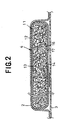
- Fig. 2 is a sectional view taken along line II - II in Fig. 1.
- the absorbent core 4 comprises the water-absorbent structure according to this invention exploited in the form of water-holding member 11 covered with a tissue paper 12.
- the water-holding member 11 is of a layer-like form having an upper surface 13 facing the diaper wearer's skin and a lower surface 14 opposed to the upper surface 13.
- the water-holding member 11 comprises highly water absorptive polymer particles 16, staple fibers 17 and binders 18 (See Figs. 3 and 4) functioning to fix the particles 16 to the fibers 17.
- the highly water absorptive polymer particles 16 contained in thewater-holding member 11 are well known to those skilled in the art, for example, crosslinked acrylate polymer, crosslinked vinyl alcohol/acrylate copolymer, crosslinked graft polyvinyl alcohol maleic anhydride, crosslinked acrylate/methacrylate copolymer, crosslinked and saponified methacrylate/vinyl acetate copolymer, crosslinked starch/acrylate graft copolymer, crosslinked and saponified starch/acrylonitrile graft copolymer, crosslinked carboxymethyl cellulose, crosslinked isobutylene/maleate anhydride copolymer and crosslinked ethylene oxide polymer.
- One of these crosslinked polymers or copolymers or a mixture of two or more selected from them may be used as the polymer particles 16.
- An average particles diameter of these polymer particles is preferably in a range of 5 - 1000 ⁇ m and more preferably in a range of 100 - 600 ⁇ m.
- the staple fibers 17 as the component of the water-holding member may contain crimped thermoplastic synthetic fiber of 100 - 40 % by weight and non-crimped thermoplastic synthetic fiber, natural fiber or chemical fiber of 0 - 60 % by weight. These thermoplastic synthetic fiber and chemical fiber preferably has a length of 5 - 100 mm and a fineness of 1 - 20 deniers.
- the crimped thermoplastic synthetic fiber is preferably conjugated fiber of side-by-side type or sheath-and-core type.
- the natural fiber and the chemical fiber are preferably of hydrophilic nature and fluff pulp may be used as the natural fiber and rayon fiber may be used as the chemical fiber.
- the staple fibers 17 are bonded and/or mechanically entangled together to form a layer-like form similar to the water-holding member 11. Within the water-holding member 11, the staple fibers 17 form a three dimensional support network adapted to support the polymer particles 16.
- the staple fibers 17 may be used in the form of nonwoven or woven fabric of in the form of fibrous assembly comprising the staple fibers 17 merely assembled at random.
- the crimped staple fibers 17 enables the water-holding member 11 to be elastically compressed in a thickness direction between the upper and lower surfaces 13, 14 and to elastically restore its initial thickness.
- hot melt polymer particles are used as the binders 18. These particles have a melting point preferably in a range of 50 - 150 °C, more preferably in a range of 60 - 130 °C and have an average particles diameter preferably in a range of 5 - 1000 ⁇ m, more preferably in a range of 100 - 600 ⁇ m.
- the binders 18 can be bound to both the polymer particles 16 and the staple fibers 17.
- Ethylene/glycidyl (metha) acrylate copolymer one example of the polymer particles 25, is particularly advantageous since this copolymer can rapidly bind the highly water absorptive polymer particles 16 to the staple fibers 17.
- the expression "(metha) acrylate” used herein means both acrylate and methacrylate.
- ethylene/glycidyl (metha) acrylate copolymer examples include: ethylene/glycidyl acrylate copolymer, ethylene/glycidyl methacrylate copolymer, ethylene/glycidyl acrylate/glycidyl methacrylate copolymer, ethylene/glycidyl acrylate/vinyl acetate copolymer, ethylene/glycidyl acrylate/vinyl acetate/methyl acrylate copolymer, ethylene/glycidyl acrylate/methyl methacrylate copolymer, ethylene/glycidyl acrylate/vinyl acetate/methyl methacrylate copolymer, ethylene/glycidyl acrylate/ethyl acrylate copolymer, ethylene/glycidyl acrylate/vinyl acetate/ethyl acrylate copolymer, ethylene/glycidyl methacrylate/vinyl
- these copolymers may be used independently or in the form of a mixture.
- these copolymers have a melt flow rate preferably in a range of 1 g/10 min - 400 g/10 min, more preferably in a range of 2 g/10 min - 100 g/10 min at 190 °C, 2160 gf.
- the polymer particles 16 and the binders 18 may be mixed together preferably at a temperature at which the binders 18 is softened or molten, more preferably at a temperature at which the binders 18 is molten to form composite particles 21 (See Fig. 3) comprising the polymer particles 16 and the binders 18 firmly bound to the surfaces of the respective polymer particle 16.
- composite particles 21 See Fig. 3
- the surface of each polymer particle 16 might be entirely covered with the binders 18.
- a weigh ratio of the binders 18 to the polymer particles is adjusted preferably at 0.5 - 50 : 100, more preferably at 3 - 30 : 100 or the particle diameter of the binder 18 is adjusted to an appropriate dimension so that preferably 5 - 50 %, more preferably 10 - 30 % of the surface of each polymer particle may be covered with the binder 18.
- the composite particles 21 and the staple fibers 17 are mixed together with a weight ratio of 5 : 95 - 95 : 5 between the polymer particles 16 and the staple fibers 17 and then the mixture is heated at a temperature corresponding to or higher than the melting point of the binders 18.
- the composite particles 21 and the staple fibers 17 are mixed together at such temperature.
- the binders 18 in its molten or semi-molten state firmly binds the composite particles 21 to the staple fibers 17.
- the polymer particles 16 and the staple fibers 17 are bound together by means of the binders 18 to form a composite assembly 22 (See Fig. 3).
- the composite assembly 22 once formed is well resistant to its dissociation even when the polymer particles 21 absorb water and swell.
- Fig. 3 is a fragmentary diagram illustrating the composite assembly 22 in an enlarged scale.
- those having a relatively large dimension are the polymer particles 16 and those clinging to the surfaces of the respective polymer particles 16 are the particles of the binders 18. These large- and small-diametered particles form together the composite particles 21.
- the polymer particles 16 are fixed to the crimped staple fibers 17 by means of the binders 18.
- the staple fibers 17 are mechanically entangled one with another.
- a single composite particle 21 is fixed to two or more staple fibers 17 and the staple fibers 17 are bonded one with another.
- the crimped ones of the staple fibers 17 are elastically deformed as the composite assembly 22 is compressed and elastically restore their initial crimped states as the assembly 22 is relieved of the compressive force.
- the composite assembly of Fig. 3 may be developed to form a layer having a substantially uniform basis weight. Then this layer may be compressed under heating it at a temperature at which the binders 18 are softened or semi-molten until the staple fibers 17 are loosely bound to the binders 18 whereupon the layer may be cooled to maintain it in a compressed state.
- Fig. 4 is a fragmentary diagram illustrating the water-holding member 11 obtained by compressing the composite assembly 22 of Fig. 3 under heating.
- the crimped staple fibers 17 are more remarkably collapsed than those in Fig. 3 and interstices among them, therefore, distances among the highly water absorptive polymer particles 16 also are closer than those in Fig. 3.
- An amount of water supplied to the upper surface 12 of the water-holding member 11 are absorbed by the polymer particles 16 and these polymer particles swell.
- the polymer particles 16 move as they swell and such movement of the polymer particles 16 causes the staple fibers 17 to move.
- the staple fibers 17 and the binders 18 loosely bound together during the process of compression are dissociated one from another so that the staple fibers 17 may elastically restore their crimped states as seen in Fig. 3 and spaced one from another.
- the fibers 17 as well as the particles 16 are spaced one from another sufficiently to make undesired formation of gel block difficult.
- the amount of water supplied to the upper surface of the water-holding member 11 smoothly flows down through the interstices among the fibers 17 as well as among the particles 16 and is successively absorbed by the particles 16.
- the elastic movement of the crimped staple fibers 17 prohibits formation of the gel block by the highly water-absorptive polymer particles 16 and these polymer particles 16 can be utilized successively from the upper surface toward the lower surface 14 of the water-holding member 11. In other words, it is not concerned that the polymer particles 16 might be more or less wastefully used.
- Such water-holding member 11 may be used as the component of the disposable diaper 1 to eliminate the problem that the amount of urine discharged on the diaper 1 might stay on the gel block formed by the polymer particles causing a leak of urine, stuffiness-and eruption.
- the compact water-holding member 11 having the staple fibers 17 maintained in their compressed states is well resistant to getting out of shape and not bulky.
- This feature facilitates the water-holding member 11 to be covered with tissue paper as shown in Fig. 1 and, in addition, facilitates the absorbent core 4 to be handled in the course of process for making the diaper 1.
- the diaper 1 itself as the final product is correspondingly compact and the space occupied by the diaper 1 in the course of distribution is effectively saved.
- the staple fibers 17 are preferably mixed with suitable hydrophilic fibers such as pulp fibers or rayon fibers so that these mixed fibers may instantaneously absorb an amount of water and this amount of water once absorbed by said hydrophilic fibers may be then transferred to the highly water absorptive polymer particles 16.
- suitable hydrophilic fibers such as pulp fibers or rayon fibers so that these mixed fibers may instantaneously absorb an amount of water and this amount of water once absorbed by said hydrophilic fibers may be then transferred to the highly water absorptive polymer particles 16.
- the water-holding member 11 of this arrangement is better than the water-holding member 11 in which all the staple fibers 17 are of synthetic fibers so far as the ability of instantaneous water absorption is concerned.
- Fig. 5 is a view similar to Fig. 2 but showing one embodiment of this invention.
- the water-holding member 11 according to this embodiment has an upper layer 31 and a lower layer 32.
- the upper layer 31 is formed by thermoplastic synthetic resin staple fibers 17A having a relatively large fineness, for example, a fineness of 5 - 20 deniers, preferably of 8 - 15 deniers and may contain the component particle 21 corresponding to 0 - 5 % by weight of the staple fibers 17A.
- the lower layer 32 is formed by the staple fibers 17B having a fineness smaller than that of the staple fibers 17A in the upper layer 31, for example, a fineness of 1 - 10 deniers and may contain the highly water absorptive polymer particles 16 and the staple fibers 17B at a weight ratio of 5 : 95 - 95 : 5.
- the upper layer 31 has a thickness corresponding to 5 - 30 % and the lower layer 32 has a thickness corresponding to 95 - 70 % of the thickness of the water-holding member 11 in its compressed state.
- the staple fibers 17 as a whole inclusive of the staple fibers 17A, 17B in the upper and lower layers 31, 32 may contain the crimped thermoplastic synthetic fibers of 100 - 40 % by weight and non-crimped thermoplastic synthetic fibers, natural fibers and/or chemical fibers of 0 - 60 % by weight. While it is rather preferable to use the hydrophobic staple fibers 17A in the upper layer 31, it is possible to use the hydrophilic staple fibers in the upper layer 31. While it is rather preferable to use the hydrophilic staple fibers 17B in the lower layer 32, it is also possible to use the hydrophobic staple fibers in the lower layer.
- the water-holding member 11 is advantageous in that a substantially total amount of water permeates through the upper layer 31 to be absorbed by the lower layer 32 and therefore the upper surface 13 can be rapidly free from a wetness.
- the staple fibers 17A of a relatively large fineness in the order of 8 - 15 deniers may be used in the upper layer 31 to facilitate the staple fibers 17 intertwined one with another to define relatively large interstices among them and, at the same time, to facilitate the lower layer 32 holding an amount of water to be adequately spaced from the diaper wearer's skin.
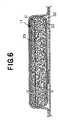
- Fig. 6 also is a view similar to Fig. 2 but showing another embodiment of this invention.
- the water-holding member 11 according to this embodiment is formed by the hydrophilic upper layer 31 comprising pulp fibers 33 and the lower layer 32 comprising the composite assembly 22 in its compressed state as shown in Figs. 2 and 3.
- the upper layer 31 preferably has a thickness in the order of 5 - 30 % of the water-holding member 11 in its compressed state.
- This water-holding member 11 has its upper surface 13 softer than the upper surface 13 of the member 11 according to the embodiment shown in Fig. 2 and a high ability of instantaneous water absorption.
- water-absorbent structure according to this invention has been described above with respect to the water-holding member 11 used to absorb body fluids, the water-absorbent structure of this invention is suitable as disposable articles rather than as repetitively used articles. This structure is applicable also to absorption of household or industrial waste water.
Landscapes
- Health & Medical Sciences (AREA)
- General Health & Medical Sciences (AREA)
- Epidemiology (AREA)
- Engineering & Computer Science (AREA)
- Veterinary Medicine (AREA)
- Public Health (AREA)
- Life Sciences & Earth Sciences (AREA)
- Animal Behavior & Ethology (AREA)
- Heart & Thoracic Surgery (AREA)
- Vascular Medicine (AREA)
- Biomedical Technology (AREA)
- Chemical & Material Sciences (AREA)
- Dispersion Chemistry (AREA)
- Hematology (AREA)
- Materials Engineering (AREA)
- Absorbent Articles And Supports Therefor (AREA)
- Treatment Of Liquids With Adsorbents In General (AREA)
Abstract
Description
the fibrous support is elastically compressive and firmly bound to the binders by a firmly binding effect, depending on spots in the fibrous support, in a manner that the fibrous support can not be easily dissociated from the binder even the polymer particles absorb water and swell and loosely bound to the binders, depending on spots in the fibrous support, in a manner that the fibrous support can be easily dissociated from the binders as the polymer particles absorb water and swell so that the fibrous support is maintained in compressed state thereof by the loosely binding effect.
Claims (9)
- A water-absorbent structure comprising highly water absorptive polymer particles, a fibrous support and binders disposed between said polymer particles and said fibrous support to fix said polymer particles to said fibrous support, wherein:
said fibrous support is elastically compressive and firmly bound to said binders by a firmly binding effect, depending on spots in said fibrous support, in a manner that said fibrous support can not be easily dissociated from said binders even said polymer particle absorb water and swell and loosely bound to said binders, depending on spots in said fibrous support, in a manner that said fibrous support can be easily dissociated from said binders as said polymer particles absorb water and swell so that said fibrous support is maintained in compressed state thereof by said loosely binding effect. - The structure according to Claim 1, wherein said fibrous support contains crimped conjugated fibers of 100 - 40 % by weight of said fibrous support.
- The structure according to Claim 1, wherein said fibrous support is of a layer-like form having an upper surface and a lower surface and maintained in said compressed state between said upper and lower surfaces.
- The structure according to Claim 1, wherein said fibrous support is formed by a nonwoven fabric comprising crimped conjugated fibers.
- The structure according to Claim 3, wherein said fibrous support is at least two-layered network comprising an upper layer defining said upper surface and a lower layer underlying said upper layer and wherein said upper layer is formed by fibers having a fineness larger than that of fibers forming said lower layer.
- The structure according to Claim 1, wherein said binders are ethylene/glycidyl (metha) acrylate copolymer.
- The structure according to Claim 6, wherein said ethylene/glycidyl(metha)acrylate copolymer is at least one selected from a group consisting of ethylene/glycidyl acrylate copolymer, ethylene/glycidyl methacrylate copolymer, ethylene/glycidyl acrylate/vinyl acetate copolymer, ethylene/glycidyl methacrylate/vinyl acetate copolymer, ethylene/glycidyl acrylate/methyl acrylate copolymer, ethylene/glycidyl acrylate/ethyl acrylate copolymer, ethylene/glycidyl methacrylate/methyl acrylate copolymer.
- The structure according to Claim 6, wherein a weight ratio of said ethylene/glycidyl(metha)acrylate copolymer to said highly water-absorptive polymer particles is 0.5 - 50 : 100.
- The structure according to Claim 6, wherein said ethylene/glycidyl(metha)acrylate copolymer has a melting point of 50 - 150 °C.
Applications Claiming Priority (2)
| Application Number | Priority Date | Filing Date | Title |
|---|---|---|---|
| JP22331299A JP3500330B2 (en) | 1999-08-06 | 1999-08-06 | Disposable water-absorbing structure |
| JP22331299 | 1999-08-06 |
Publications (2)
| Publication Number | Publication Date |
|---|---|
| EP1074269A2 true EP1074269A2 (en) | 2001-02-07 |
| EP1074269A3 EP1074269A3 (en) | 2003-04-16 |
Family
ID=16796188
Family Applications (1)
| Application Number | Title | Priority Date | Filing Date |
|---|---|---|---|
| EP00306682A Withdrawn EP1074269A3 (en) | 1999-08-06 | 2000-08-04 | Disposable water-absorbent structure |
Country Status (7)
| Country | Link |
|---|---|
| EP (1) | EP1074269A3 (en) |
| JP (1) | JP3500330B2 (en) |
| KR (1) | KR100669123B1 (en) |
| CN (1) | CN1171573C (en) |
| AU (1) | AU774685B2 (en) |
| CA (1) | CA2314730C (en) |
| TW (1) | TW542710B (en) |
Families Citing this family (15)
| Publication number | Priority date | Publication date | Assignee | Title |
|---|---|---|---|---|
| AU749640B2 (en) * | 1997-09-25 | 2002-06-27 | Holbray Pty Ltd | Sponge |
| JP2003135524A (en) * | 2001-11-07 | 2003-05-13 | Uni Charm Corp | Disposable diapers |
| JP3754351B2 (en) * | 2001-11-09 | 2006-03-08 | ユニ・チャーム株式会社 | Disposable diapers |
| US20030211248A1 (en) * | 2001-12-14 | 2003-11-13 | Ko Young C. | High performance absorbent structure including superabsorbent added to a substrate via in situ polymerization |
| KR20030087410A (en) * | 2002-05-09 | 2003-11-14 | 코리아에어레이드 | Absorbent core for diaper and its producing method |
| DE10334286B4 (en) * | 2003-07-25 | 2006-01-05 | Stockhausen Gmbh | Powdered, water-absorbing polymers with fine particles bound by means of thermoplastic adhesives, process for their preparation and chemical products and compounds containing them |
| JP2006262916A (en) * | 2005-03-22 | 2006-10-05 | Kao Corp | Absorbent articles |
| JP4863848B2 (en) * | 2006-11-17 | 2012-01-25 | 花王株式会社 | Absorbent body of absorbent article and method for producing the same |
| CN101404970B (en) | 2006-03-23 | 2012-12-12 | 花王株式会社 | Absorbent body and its manufacturing method |
| JP5000198B2 (en) * | 2006-05-30 | 2012-08-15 | 旭化成ケミカルズ株式会社 | Absorber and body fluid absorbent article with little leakage |
| JP4919774B2 (en) * | 2006-11-17 | 2012-04-18 | 花王株式会社 | Absorber |
| JP2017221275A (en) * | 2016-06-13 | 2017-12-21 | 花王株式会社 | Absorbent body |
| JP2018094246A (en) * | 2016-12-15 | 2018-06-21 | 花王株式会社 | Absorber |
| JP2019041859A (en) * | 2017-08-30 | 2019-03-22 | 花王株式会社 | Absorber |
| JP7058112B2 (en) * | 2017-10-03 | 2022-04-21 | 花王株式会社 | Absorber and absorbent article |
Family Cites Families (6)
| Publication number | Priority date | Publication date | Assignee | Title |
|---|---|---|---|---|
| IT1200283B (en) * | 1986-08-06 | 1989-01-12 | Mira Lanza Spa | METHOD FOR THE DRY MANUFACTURE OF SHEET PRODUCTS CONTAINING A SUPERABSORBENT POLYMER MIXED WITH CELLULOSE FIBERS AND SHEET ABSORBING PRODUCTS SO OBTAINED |
| US5641561A (en) * | 1992-08-17 | 1997-06-24 | Weyerhaeuser Company | Particle binding to fibers |
| TW320647B (en) * | 1993-02-24 | 1997-11-21 | ||
| EP0850615A1 (en) * | 1996-12-20 | 1998-07-01 | The Procter & Gamble Company | A dry laid structure comprising particulate material |
| CA2275605A1 (en) | 1996-12-20 | 1998-07-02 | The Procter & Gamble Company | A dry laid structure comprising particulate material |
| JP2000212458A (en) * | 1999-01-25 | 2000-08-02 | Sumitomo Seika Chem Co Ltd | Super absorbent resin particles |
-
1999
- 1999-08-06 JP JP22331299A patent/JP3500330B2/en not_active Expired - Lifetime
-
2000
- 2000-07-31 CA CA002314730A patent/CA2314730C/en not_active Expired - Fee Related
- 2000-08-04 CN CNB00128603XA patent/CN1171573C/en not_active Expired - Fee Related
- 2000-08-04 AU AU51824/00A patent/AU774685B2/en not_active Ceased
- 2000-08-04 KR KR1020000045257A patent/KR100669123B1/en not_active Expired - Fee Related
- 2000-08-04 EP EP00306682A patent/EP1074269A3/en not_active Withdrawn
- 2000-08-29 TW TW089115881A patent/TW542710B/en not_active IP Right Cessation
Also Published As
| Publication number | Publication date |
|---|---|
| JP2001046434A (en) | 2001-02-20 |
| AU5182400A (en) | 2001-02-08 |
| KR100669123B1 (en) | 2007-01-16 |
| JP3500330B2 (en) | 2004-02-23 |
| CA2314730A1 (en) | 2001-02-06 |
| CN1171573C (en) | 2004-10-20 |
| KR20010021224A (en) | 2001-03-15 |
| AU774685B2 (en) | 2004-07-01 |
| CA2314730C (en) | 2006-05-16 |
| TW542710B (en) | 2003-07-21 |
| CN1284319A (en) | 2001-02-21 |
| EP1074269A3 (en) | 2003-04-16 |
Similar Documents
| Publication | Publication Date | Title |
|---|---|---|
| JP3489140B2 (en) | Absorbent articles | |
| KR100341414B1 (en) | Mixed-bed ion-exchange hydrogel-forming polymer compositions and absorbent members comprising relatively high concentrations of these compositions | |
| CA2314730C (en) | Disposable water-absorbent structure | |
| EP0439962B1 (en) | Disposable urine and fecal waste containment product | |
| JP3429760B2 (en) | Sanitary absorbent product with mixed absorbent core | |
| EP0441064B2 (en) | Disposable urinary pad | |
| FI84018C (en) | Absorbent product, comprising a corrugated fiber web | |
| KR100259733B1 (en) | Disposable absorbent articles having reduced surface wetness | |
| JP2000510365A (en) | Absorbent products that give improved compatibility when wet | |
| KR20000069069A (en) | Absorbent Articles with Controllable Fill Patterns | |
| MXPA05005562A (en) | Absorbent core including folded substrate. | |
| JPH05503449A (en) | Absorbent structure including thermally bonded stiffening fiber layer and superabsorbent material layer | |
| CZ20003916A3 (en) | Absorption article providing enhanced fitting when moistened by body liquids | |
| JPH0829152B2 (en) | Disposable urine pad | |
| EP0440161B1 (en) | Absorbent panel for body fluid absorptive garments | |
| AU727728B2 (en) | Absorbent structure for use in an absorbent article | |
| JP4638205B2 (en) | Absorbent articles | |
| JP2000024033A (en) | Absorbent articles | |
| JP2005000566A (en) | Absorbent article | |
| JP3805034B2 (en) | Absorbent articles | |
| JP2018094246A (en) | Absorber | |
| KR100510218B1 (en) | An absorbent structures | |
| JP2000093454A (en) | Absorbent articles | |
| EP0850629A2 (en) | Absorbent member | |
| JPH10513369A (en) | Absorbing supplies |
Legal Events
| Date | Code | Title | Description |
|---|---|---|---|
| PUAI | Public reference made under article 153(3) epc to a published international application that has entered the european phase |
Free format text: ORIGINAL CODE: 0009012 |
|
| AK | Designated contracting states |
Kind code of ref document: A2 Designated state(s): AT BE CH CY DE DK ES FI FR GB GR IE IT LI LU MC NL PT SE |
|
| AX | Request for extension of the european patent |
Free format text: AL;LT;LV;MK;RO;SI |
|
| PUAL | Search report despatched |
Free format text: ORIGINAL CODE: 0009013 |
|
| AK | Designated contracting states |
Designated state(s): AT BE CH CY DE DK ES FI FR GB GR IE IT LI LU MC NL PT SE |
|
| AX | Request for extension of the european patent |
Extension state: AL LT LV MK RO SI |
|
| RIC1 | Information provided on ipc code assigned before grant |
Ipc: 7A 61F 13/00 B Ipc: 7A 61L 15/60 A |
|
| 17P | Request for examination filed |
Effective date: 20030627 |
|
| AKX | Designation fees paid |
Designated state(s): DE |
|
| 17Q | First examination report despatched |
Effective date: 20031229 |
|
| RAP1 | Party data changed (applicant data changed or rights of an application transferred) |
Owner name: UNI-CHARM CORPORATION |
|
| 17Q | First examination report despatched |
Effective date: 20031229 |
|
| STAA | Information on the status of an ep patent application or granted ep patent |
Free format text: STATUS: THE APPLICATION IS DEEMED TO BE WITHDRAWN |
|
| 18D | Application deemed to be withdrawn |
Effective date: 20070123 |