EP1074244A2 - Topical composition comprising a tocopherol compound - Google Patents
Topical composition comprising a tocopherol compound Download PDFInfo
- Publication number
- EP1074244A2 EP1074244A2 EP00116499A EP00116499A EP1074244A2 EP 1074244 A2 EP1074244 A2 EP 1074244A2 EP 00116499 A EP00116499 A EP 00116499A EP 00116499 A EP00116499 A EP 00116499A EP 1074244 A2 EP1074244 A2 EP 1074244A2
- Authority
- EP
- European Patent Office
- Prior art keywords
- signifies
- topical composition
- tocopherol
- hydrogen
- composition according
- Prior art date
- Legal status (The legal status is an assumption and is not a legal conclusion. Google has not performed a legal analysis and makes no representation as to the accuracy of the status listed.)
- Granted
Links
- 0 CC*c(cc(C=C(*)*)cc1*)c1OCC#C Chemical compound CC*c(cc(C=C(*)*)cc1*)c1OCC#C 0.000 description 1
Classifications
-
- A—HUMAN NECESSITIES
- A61—MEDICAL OR VETERINARY SCIENCE; HYGIENE
- A61K—PREPARATIONS FOR MEDICAL, DENTAL OR TOILETRY PURPOSES
- A61K8/00—Cosmetics or similar toiletry preparations
- A61K8/18—Cosmetics or similar toiletry preparations characterised by the composition
- A61K8/72—Cosmetics or similar toiletry preparations characterised by the composition containing organic macromolecular compounds
- A61K8/84—Cosmetics or similar toiletry preparations characterised by the composition containing organic macromolecular compounds obtained by reactions otherwise than those involving only carbon-carbon unsaturated bonds
- A61K8/89—Polysiloxanes
-
- A—HUMAN NECESSITIES
- A61—MEDICAL OR VETERINARY SCIENCE; HYGIENE
- A61K—PREPARATIONS FOR MEDICAL, DENTAL OR TOILETRY PURPOSES
- A61K8/00—Cosmetics or similar toiletry preparations
- A61K8/18—Cosmetics or similar toiletry preparations characterised by the composition
- A61K8/30—Cosmetics or similar toiletry preparations characterised by the composition containing organic compounds
- A61K8/67—Vitamins
- A61K8/678—Tocopherol, i.e. vitamin E
-
- A—HUMAN NECESSITIES
- A61—MEDICAL OR VETERINARY SCIENCE; HYGIENE
- A61K—PREPARATIONS FOR MEDICAL, DENTAL OR TOILETRY PURPOSES
- A61K8/00—Cosmetics or similar toiletry preparations
- A61K8/18—Cosmetics or similar toiletry preparations characterised by the composition
- A61K8/72—Cosmetics or similar toiletry preparations characterised by the composition containing organic macromolecular compounds
- A61K8/84—Cosmetics or similar toiletry preparations characterised by the composition containing organic macromolecular compounds obtained by reactions otherwise than those involving only carbon-carbon unsaturated bonds
- A61K8/89—Polysiloxanes
- A61K8/891—Polysiloxanes saturated, e.g. dimethicone, phenyl trimethicone, C24-C28 methicone or stearyl dimethicone
-
- A—HUMAN NECESSITIES
- A61—MEDICAL OR VETERINARY SCIENCE; HYGIENE
- A61K—PREPARATIONS FOR MEDICAL, DENTAL OR TOILETRY PURPOSES
- A61K8/00—Cosmetics or similar toiletry preparations
- A61K8/18—Cosmetics or similar toiletry preparations characterised by the composition
- A61K8/72—Cosmetics or similar toiletry preparations characterised by the composition containing organic macromolecular compounds
- A61K8/84—Cosmetics or similar toiletry preparations characterised by the composition containing organic macromolecular compounds obtained by reactions otherwise than those involving only carbon-carbon unsaturated bonds
- A61K8/89—Polysiloxanes
- A61K8/895—Polysiloxanes containing silicon bound to unsaturated aliphatic groups, e.g. vinyl dimethicone
-
- A—HUMAN NECESSITIES
- A61—MEDICAL OR VETERINARY SCIENCE; HYGIENE
- A61P—SPECIFIC THERAPEUTIC ACTIVITY OF CHEMICAL COMPOUNDS OR MEDICINAL PREPARATIONS
- A61P17/00—Drugs for dermatological disorders
- A61P17/16—Emollients or protectives, e.g. against radiation
-
- A—HUMAN NECESSITIES
- A61—MEDICAL OR VETERINARY SCIENCE; HYGIENE
- A61Q—SPECIFIC USE OF COSMETICS OR SIMILAR TOILETRY PREPARATIONS
- A61Q17/00—Barrier preparations; Preparations brought into direct contact with the skin for affording protection against external influences, e.g. sunlight, X-rays or other harmful rays, corrosive materials, bacteria or insect stings
- A61Q17/04—Topical preparations for affording protection against sunlight or other radiation; Topical sun tanning preparations
-
- A—HUMAN NECESSITIES
- A61—MEDICAL OR VETERINARY SCIENCE; HYGIENE
- A61K—PREPARATIONS FOR MEDICAL, DENTAL OR TOILETRY PURPOSES
- A61K2800/00—Properties of cosmetic compositions or active ingredients thereof or formulation aids used therein and process related aspects
- A61K2800/40—Chemical, physico-chemical or functional or structural properties of particular ingredients
- A61K2800/57—Compounds covalently linked to a(n inert) carrier molecule, e.g. conjugates, pro-fragrances
Definitions
- the present invention relates to topical compositions useful to prevent damage to skin caused by ultraviolet irradiation, such as sunburn and sun-induced premature aging of the skin.
- compositions comprising a tocopherol compound and a lipophilic polysiloxane type UV-B screening agent.
- Topical compositions containing tocopherol (Vitamin E) and UV screening agents are known in the art.
- US Patent No. 4,144,325 describes for example a sunscreen composition comprising a tocopherol compound and an ultraviolet-absorbing compound selected from the group consisting of salicylates, para-aminobenzoates, benzophenone, çinnamate, naphthoate, gallate and mixtures thereof.
- Topical compositions containing tocopherol sorbate as active agent, together with sunscreening agents are described in US Patent No. 4,847,072.
- the sunscreening agent is selected from the group consisting of 2-ethylhexyl p-methoxycinnamate, butylmethoxy dibenzoylmethane, 2-hydroxy-4-methoxybenzopenone, octyl dimethyl p-aminobenzoic acid, the 4-N,N-(2-ethylhexyl) methylaminobenzoic acid ester of 2,4-dihydroxy benzophenone, the N,N-di-(2-ethylhexyl)-4-aminobenzoic acid ester of 4-hydroxy dibenzoylmethane, the 4-N,N-(2-ethylhexyl)methylaminobenzoic acid ester of 4-hydroxy-dibenzoylmethane, the 4-N,N-(2-ethylhexyl)
- tocopherol compounds can be enhanced by adding a lipophilic polysiloxane type UV-B screening agent without a further penetration enhancing agent.
- the present invention is concerned with a topical composition
- a topical composition comprising a) about 1wt% to 30wt% of a linear or cyclic polysiloxane compound of the general formula Ia or Ib, wherein
- to tocopherol compound refers to alpha tocopherol, mixed tocopherols, short-chain carboxylic acid ester of tocopherol such as e.g. tocopherol acetate, tocopherol propionate, and tocopherol butyrate. Preferred is tocopherol acetate.
- C 1-6 -alkyl refers to groups such as methyl, ethyl, propyl, isopropyl, n-butyl, sec. butyl, tert. butyl, pentyl and neopentyl.
- C 1-6 -alkoxy refers to the corresponding alkoxy groups.
- the residue R signifies preferably C 1-4 -alkyl, more preferably methyl.
- R 1 and R 2 can be the same or different.
- R 1 and R 2 have the same meaning and signify hydrogen, methoxy or ethoxy, more preferably hydrogen.
- the residue R 3 signifies preferably methyl or ethyl, more preferably ethyl.
- the residue R 4 signifies preferably hydrogen or methyl, more preferably hydrogen.
- the residues R 5 and R 6 signify preferably hydrogen.
- n has preferably a value of 1.
- polysiloxane compounds having a group A of the general formula IIa and IIb and their preparation are described in the European Patent EP 0538431 B1 and EP 0709080 A1. These polysiloxane compounds are preferred.
- polysiloxane compounds having a group A of the general formula llc and their preparation are described in the European Patent EP 0358584 B1.
- Linear polysiloxane compounds wherein the chromophore carrying residue A is statistically distributed are preferred.
- the number of r of the other silicone units present in the polysiloxane compounds is preferably about 5 to about 150, more preferably a statistical mean value of about 60.
- the ratio of polysiloxane units having a chromophore residue A of the formula IIa to those having a chromophore residue A of the formula IIb is not critical. Said ratio may be about 1:1 to about 19:1, preferably about 2:1 to about 9:1, more preferably about 4:1.
- the concentration of the polysiloxane compound in the topical composition is preferably about 2wt% to 20wt%, more preferably about 5 wt% to about 10 wt%.
- the concentration of the tocopherol compound in the topical composition is preferably about 1wt% to about 10wt%, more preferably about 1wt% to about 5wt%.
- the ratio of the tocopherol compound to the polysiloxane compound as defined above is not critical.
- the ratio is about 1:1 to about 1:20, preferably about 1:2 to about 1:3.
- a preferred topical composition comprises about 1wt% to about 10wt% of a tocopherol compound and about 2wt% to 20wt% of a linear polysiloxane compound of the general formula Ia, wherein
- a more preferred topical composition comprises
- the polysiloxane compounds Ia or Ib wherein A is a residue of the formula IIa or IIb can be prepared as described in EP 0538431 B1 by silylation of the corresponding benzalmalonates.
- the following reaction scheme shows an example to build up a compound of the general formula Ia wherein R 4 , R 5 and R 6 signify hydrogen and n has a value of 1. wherein R, R 1 , R 2 and R 3 are as defined above.
- the silylation of the 4-(2-propynylox)phenyl methylene diethylester may be carried out employing known procedures for the addition of silicon bonded hydrogen atoms to groups containing aliphatic unsaturation. Such reactions are generally catalyzed by a platinum group metal or a complex of such a metal. Examples of catalysts which may be employed are platinum on carbon, chloroplatinic acid, platinum acetyl acetonate, complexes of platinum compounds with unsaturated compounds e.g. olefins and divinyl disiloxanes, complexes of rhodium and palladium compounds and complexes of platinum compounds supported on inorganic substrates.
- the addition reaction may be performed at reduced, atmospheric or increased pressure.
- a solvent can be used, e.g. toluene or xylene, in the reaction mixture although the presence of the solvent is not essential. It is also preferred to carry out the reaction at elevated reaction temperatures e.g. from about 50°C up to 150°C.
- novel topical compositions comprises incorporating a polysiloxane compound as defined above and a tocopherol compound optionally in combination with other known UV-A and/or UV-B filters, in a cosmetic base which is usual for topical compositions such as e.g. for light screening agents.
- a cosmetic base which is usual for topical compositions such as e.g. for light screening agents.
- the preparation of said topical composition is well known to the suled artisan in this field.
- Suitable UV-B filters i.e. substances having absorption maxima between about 290 and 320 nm, are for example the following compounds:
- Suitable UV-A filters i.e. substances having absorption maxima between about 320 and 400 nm, are for example the following compounds.
- dibenzoylmethane derivatives are photolabile it is necessary to photostabilze these UV-A screening agents.
- common UV-A screening agent also refers to dibenzoylmethane derivatives such as e.g. Parsol 1789 stabilized by the following stabilizing agents,
- any conventional preparation which corresponds to the cosmetic requirements e.g. creams, lotions, emulsions, salves, gels, solutions, sprays, sticks and milks; see also, Sunscreens, Development, Evaluation and Regulatory Aspects, ed. N.Y. Lowe, N.A. Shaath, Marcel Dekker, Inc. New York and Basel, 1990.
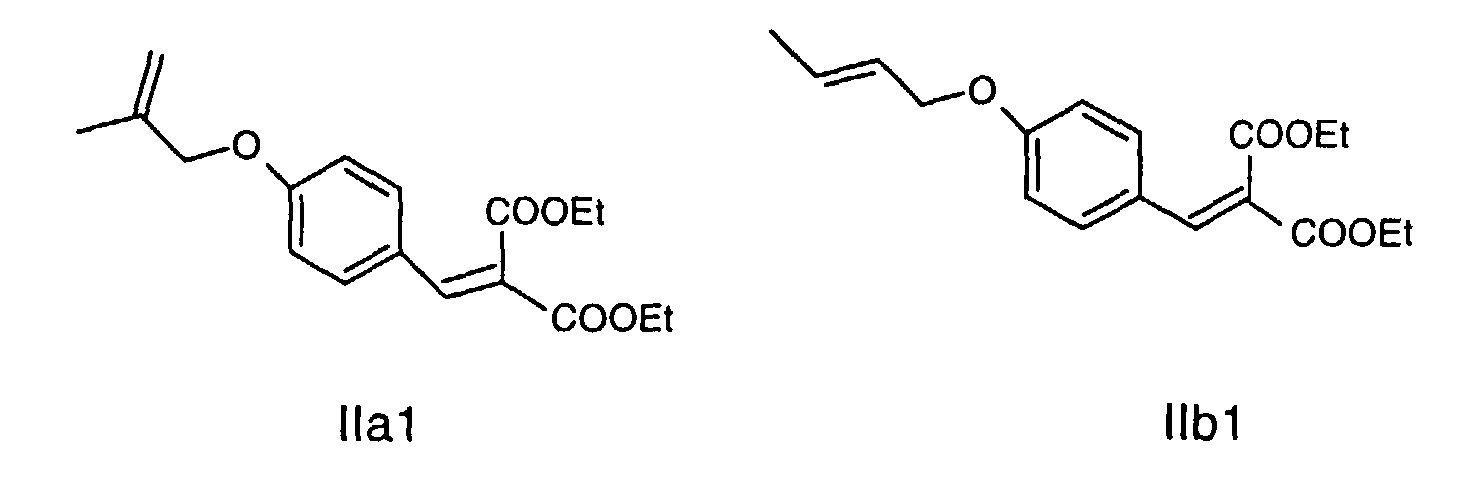
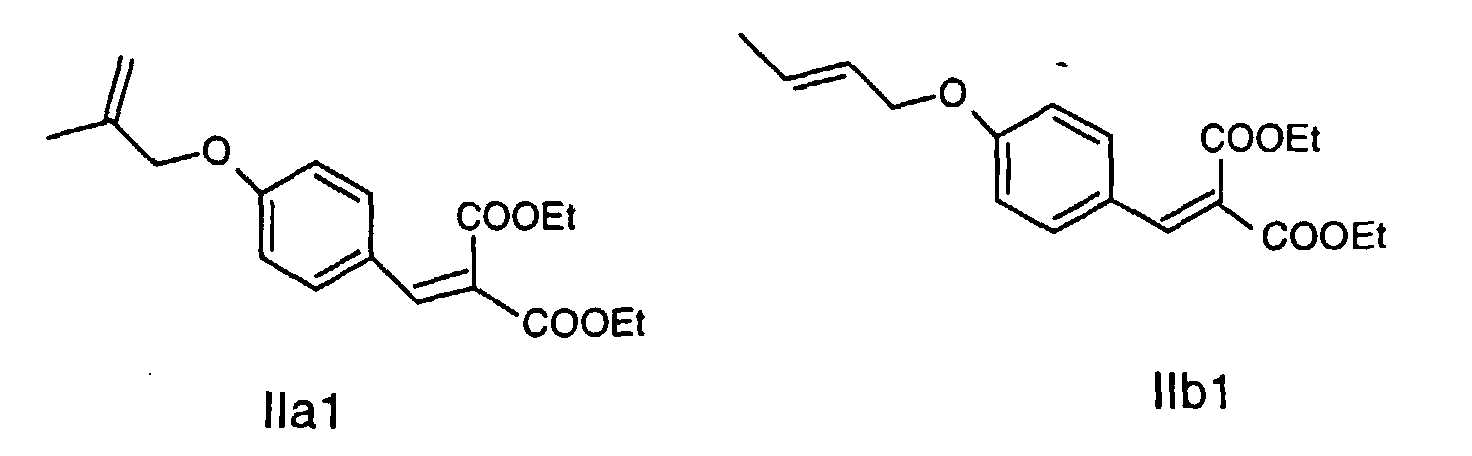
- the ratio of compounds having a residue IIa1 to compounds having a residue IIb1 is about 4:1.
- Topical composition according to the invention containing 5wt% polysiloxane.
- a topical comprising 5wt% of a polysiloxane of formula Ia according to Example 2 and 2wt% of tocopherol acetate was prepared using the following ingredients: Part %wt Ingredient INCI Name Supplier A 2.5 ARLACEL 60 Sorbitan Stearate ICI 17.5 WITCONOL APM PPG-3 Myristyl ether WITCO 1.0 Stearyl alkohol Stearyl alkohol 3.0 Silicone oil Dimethicone DOW 2.0 Tocopherol acetate Tocopherol acetate 5.0 Compound of Ex.
- the compounds of Part A were added to and melted in a reactor.
- the compounds of Part B were mixed, heated to 85°C and added to Part A.
- SEPIGEL 305 was added at a temperature of 50°C.
- Topical composition according to the invention containing 10wt% polysiloxane.
- a topical comprising 10wt% of a polysiloxane of formula Ia according to Example 2 and 2wt% of tocopherol acetate was prepared using the following ingredients: Part %wt Ingredient INCI Name Supplier A 2.5 ARLACEL 60 Sorbitan Stearate ICI 17.5 WITCONOL APM PPG-3 Myristyl ether WITCO 1.0 Stearyl alkohol Stearyl alkohol --- Silicone oil Dimethicone DOW 2.0 Tocopherol acetate Tocopherol acetate 10.0 Compound of Ex. 2 B 2.5 TWEEN 60 Polysorbate 60 ICI 0.3 KELTROL Xanthan Gum KELCO UK 62.2 Water C 2.0 SEPIGEL 305 Polyacrylamid & 13-14 isoparaffin+laureth-7 SEPPIC
- the compounds of Part A were added to and melted in a reactor.
- the compounds of Part B were mixed, heated to 85°C and added to Part A.
- SEPIGEL 305 was added at a temperature of 50°C.
- a lotion as described in Examples 3-5 was placed on freshly isolated physiologically intact hairless rat skin and the percutaneous absorption was assessed 16 h after application.
- Stratum corneum The horny layer of the skin was taken off with adhesive tape. A piece of tape was put on the skin with soft pressure and drawn off again. This procedure is called “stripping" and was repeated (10 ⁇ 6 times) until the skin shines and a moderate afflux of moisture indicates the total removal of the horny layer.
- the adhesive tapes were extracted with 15 ml of acetontrile and quantitatively analyzed by HPLC.
- Stripped skin The application area was punched out, cut in small pieces with a scalpel and homogenized in 10 ml 100% acetontrile. It was then centrifuged and filtered, and the clear solution analyzed quantitatively by HPLC.
- Receptor phase The receptor-liquid (approx. 10 ml) is collected, the chamber rinsed with 3 x 1 ml acetontrile, which is added to the receptor-liquid and the volume is adjusted to 15ml. An aliquot of this solution is quantitatively analyzed by HPLC.
- Example 3 Example 4
- Example 5 comparative skin surface 64.5 65.2 69.7 Stratum Corneum 9.5 7.4 9.5 Stripped skin 26.0 27.4 20.8 Receptor Phase 0 0 0 mean result of 4 measurements.
- the above table clearly shows that the polysiloxane compound enhances the skin penetration of tocopherol acetate.
- the stripped skin contains 26-27% of tocopherol acetate applied compared to 20% of tocopherol acetate applied.
Landscapes
- Health & Medical Sciences (AREA)
- Life Sciences & Earth Sciences (AREA)
- Animal Behavior & Ethology (AREA)
- General Health & Medical Sciences (AREA)
- Public Health (AREA)
- Veterinary Medicine (AREA)
- Birds (AREA)
- Epidemiology (AREA)
- Dermatology (AREA)
- Chemical & Material Sciences (AREA)
- Pharmacology & Pharmacy (AREA)
- Engineering & Computer Science (AREA)
- Toxicology (AREA)
- Chemical Kinetics & Catalysis (AREA)
- General Chemical & Material Sciences (AREA)
- Medicinal Chemistry (AREA)
- Nuclear Medicine, Radiotherapy & Molecular Imaging (AREA)
- Organic Chemistry (AREA)
- Bioinformatics & Cheminformatics (AREA)
- Cosmetics (AREA)
- Pharmaceuticals Containing Other Organic And Inorganic Compounds (AREA)
- Medicines That Contain Protein Lipid Enzymes And Other Medicines (AREA)
- Compositions Of Macromolecular Compounds (AREA)
- Acyclic And Carbocyclic Compounds In Medicinal Compositions (AREA)
- Medicines Containing Plant Substances (AREA)
- Medicinal Preparation (AREA)
Abstract
Description

- X
- signifies R or A;
- A
- signifies a group of the general formula IIa, IIb or IIc;
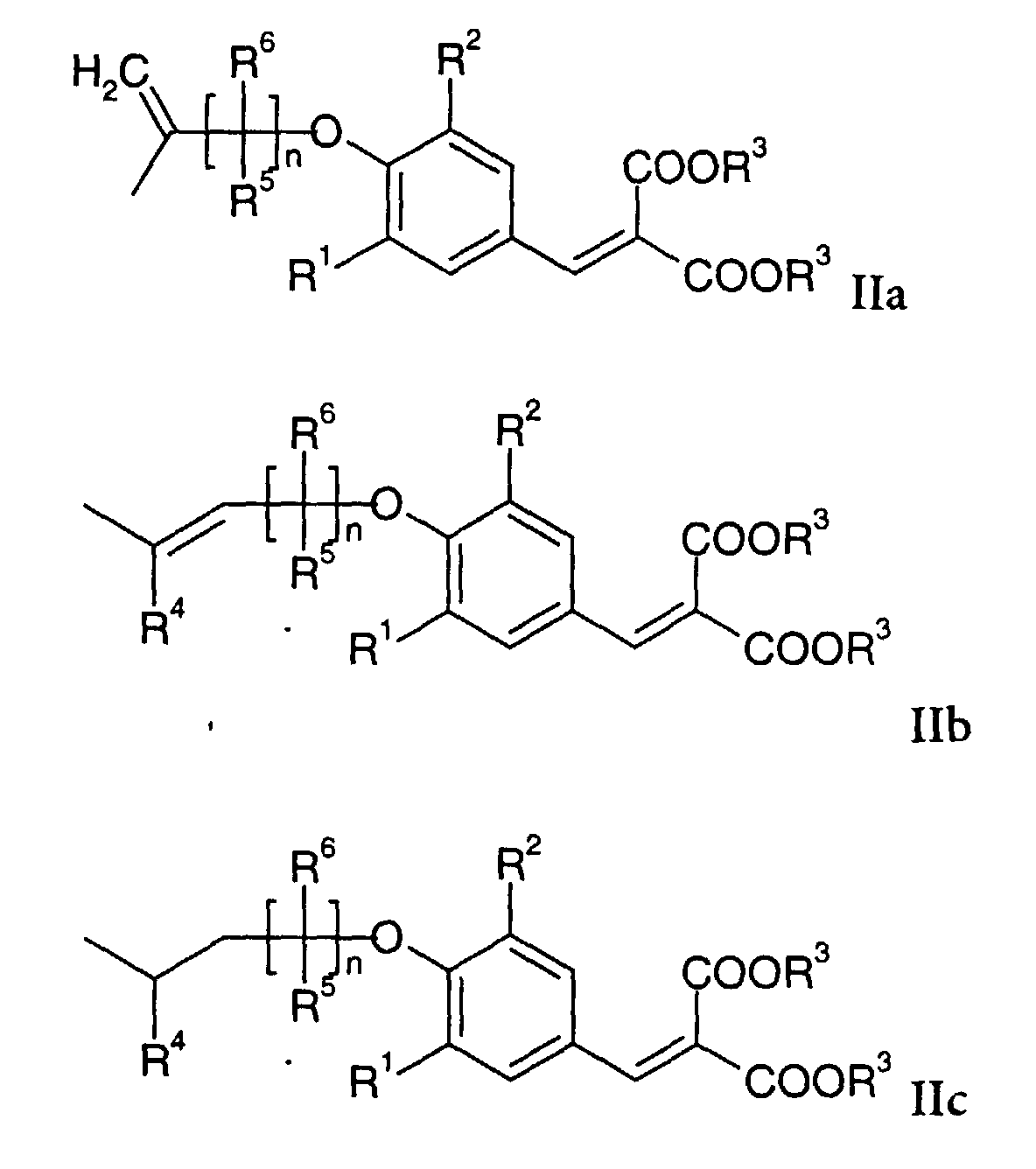
- R
- signifies hydrogen, C1-6 alkyl or phenyl;
- R1 and R2
- each independently signify hydrogen, hydroxy, C1-6-alkyl or C1-6-alkoxy;
- R3
- signifies C1-6-alkyl;
- R4
- signifies hydrogen or C1-6-alkyl;
- R5 and R6
- each independently signify hydrogen or C1-6-alkyl;
- r
- has a value of from 0 to 250;
- s
- has a value of from 0 to 20;
- r +S
- has a value of at least 3;
- t
- has a value of from 0 to 10;
- v
- has a value of from 0 to 10; and
- v+t
- has a value of at least 3;
- n
- has a value from 1 to 6;
- b) about 0.5 wt% to about 15 wt% of a tocopherol compound.
- X
- signifies methyl;
- A
- signifies a group of the formula IIa or IIb;
- R
- signifies C1-4-alkyl;
- R1 and R2
- have the same meaning and signify hydrogen, methoxy or ethoxy;
- R3
- signifies methyl or ethyl;
- R4
- signifies hydrogen or methyl;
- R5 and R6
- signify hydrogen;
- r
- is about 5 to about 150;
- s
- is about 2 to about 10;
- n
- has a value of 1.
- X
- signifies methyl;
- A
- signifies a group of the formula IIa or IIb;
- R
- signifies methyl;
- R1 and R2
- signify hydrogen;
- R3
- signifies ethyl;
- R4
- signifies hydrogen;
- R5 and R6
- signify hydrogen;
- r
- is a statistical mean value of about 4;
- s
- is a statistical mean value of about 60;
- n
- has a value of 1.

| Part | %wt | Ingredient | INCI Name | Supplier |
| A | 2.5 | ARLACEL 60 | Sorbitan Stearate | ICI |
| 17.5 | WITCONOL APM | PPG-3 Myristyl ether | WITCO | |
| 1.0 | Stearyl alkohol | Stearyl alkohol | ||
| 3.0 | Silicone oil | Dimethicone | DOW | |
| 2.0 | Tocopherol acetate | Tocopherol acetate | ||
| 5.0 | Compound of Ex. 2 | |||
| B | 2.5 | TWEEN 60 | Polysorbate 60 | ICI |
| 0.3 | KELTROL | Xanthan Gum | KELCO UK | |
| 64.2 | Water | |||
| C | 2.0 | SEPIGEL 305 | Polyacrylamid & 13-14 isoparaffin+laureth-7 | SEPPIC |
| INCI: International Nomenclature of Cosmetic lngredients |
| Part | %wt | Ingredient | INCI Name | Supplier |
| A | 2.5 | ARLACEL 60 | Sorbitan Stearate | ICI |
| 17.5 | WITCONOL APM | PPG-3 Myristyl ether | WITCO | |
| 1.0 | Stearyl alkohol | Stearyl alkohol | ||
| --- | Silicone oil | Dimethicone | DOW | |
| 2.0 | Tocopherol acetate | Tocopherol acetate | ||
| 10.0 | Compound of Ex. 2 | |||
| B | 2.5 | TWEEN 60 | Polysorbate 60 | ICI |
| 0.3 | KELTROL | Xanthan Gum | KELCO UK | |
| 62.2 | Water | |||
| C | 2.0 | SEPIGEL 305 | Polyacrylamid & 13-14 isoparaffin+laureth-7 | SEPPIC |
| Part | %wt | Ingredient | INCI Name | Supplier |
| A | 2.5 | ARLACEL 60 | Sorbitan Stearate | ICI |
| 17.5 | WITCONOL APM | PPG-3 Myristyl ether | WITCO | |
| 1.0 | Stearyl alkohol | Stearyl alkohol | ||
| 8.0 | Silicone oil | Dimethicone | DOW | |
| 2.0 | Tocopherol acetate | Tocopherol acetate | ||
| B | 2.5 | TWEEN 60 | Polysorbate 60 | ICI |
| 0.3 | KELTROL | Xanthan Gum | KELCO UK | |
| 64.2 | Water | |||
| C | 2.0 | SEPIGEL 305 | Polyacrylamid & 13-14 isoparaffin+laureth-7 | SEPPIC |
| Example 3 | Example 4 | Example 5 comparative | |
| skin surface | 64.5 | 65.2 | 69.7 |
| Stratum Corneum | 9.5 | 7.4 | 9.5 |
| Stripped skin | 26.0 | 27.4 | 20.8 |
| Receptor Phase | 0 | 0 | 0 |
| mean result of 4 measurements. |
Claims (15)
- A topical composition comprisinga) about 1wt% to 30wt% of a linear or cyclic polysiloxane compound of the general formula Ia or Ib,wherein

- X
- signifies R or A;
- A
- signifies a group of the general formula IIa, IIb or IIc;
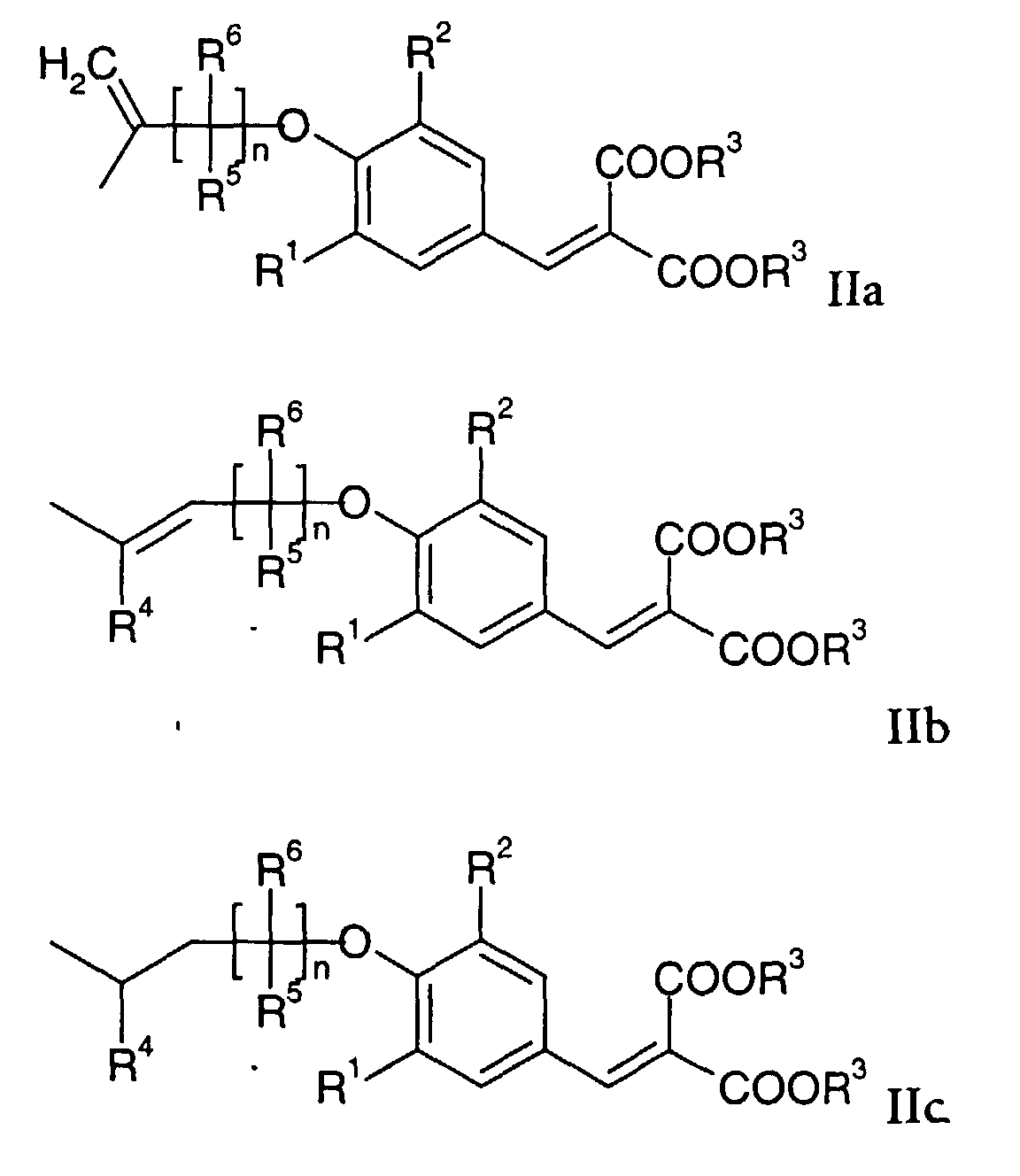
- R
- signifies hydrogen, C1-6 alkyl or phenyl;
- R1 and R2
- each independently signify hydrogen, hydroxy, C1-6-alkyl or C1-6 -alkoxy;
- R3
- signifies C1-6-alkyl;
- R4
- signifies hydrogen or C1-6-alkyl;
- R5 and R6
- each independently signify hydrogen or C1-6-alkyl;
- r
- has a value of from 0 to 250;
- s
- has a value of from 0 to 20;
- r +S
- has a value of at least 3;
- t
- has a value of from 0 to 10;
- v
- has a value of from 0 to 10; and
- v+t
- has a value of at least 3;
- n
- has a value from 1 to 6;
c) about 0.5 wt% to about 15 wt% of a tocopherol compound. - A topical composition according to claim 1, wherein the tocopherol compound is alpha tocopherol, mixed tocopherols or a short-chain carboxylic acid ester of tocopherol.
- A topical composition according to claim 2, wherein the short-chain carboxylic acid ester of tocopherol is tocopherol acetate, tocopherol propionate or tocopherol butyrate, preferably tocopherol acetate.
- A topical composition according to any one of claims 1 to 3, wherein R signifies C1-4-alkyl, preferably methyl.
- A topical composition according to any one of claims 1 to 4, wherein R1 and R2 have the same meaning and signify hydrogen, methoxy or ethoxy, preferably hydrogen.
- A topical composition according to any one of claims 1 to 5, wherein methyl or ethyl, preferably ethyl.
- A topical composition according to any one of claims 1 to 6, wherein R4 signifies hydrogen or methyl, preferably hydrogen.
- A topical composition according to any one of claims 1 to 7, wherein R5 and R6 signify hydrogen and n is 1.
- A topical composition according to any one of claims 1 to 8, wherein X signifies R, s has a value of from 1 to 20 and A is a residue of the formula IIa or IIb.
- A topical composition according to any one of claims 1 to 9 comprisinga) about 2wt% to 20wt%, preferably about 5 wt% to about 10wt% of a linear or cyclic polysiloxane compound of the general formula Ia or Ib, andb) about 1wt% to about 10wt%, preferably about 1wt% to about 5wt% of a tocopherol compound.
- A topical composition according to any one of claims 1 to 10 comprising,about 1wt% to about 10wt% of a tocopherol compound andabout 2wt% to 20wt% of a linear polysiloxane compound of the general formula Ia, wherein
- X
- signifies methyl;
- A
- signifies a group of the formula IIa or IIb;
- R
- signifies C1-4-alkyl;
- R1 and R2
- have the same meaning and signify hydrogen, methoxy or ethoxy;
- R3
- signifies methyl or ethyl;
- R4
- signifies hydrogen or methyl;
- R5 and R6
- signify hydrogen;
- r
- is about 5 to about 150;
- s
- is about 2 to about 10;
- n
- has a value of 1.
- A topical composition according to anyone of claims 1 to 11 comprising about1wt% to about 5wt% of tocopherol acetate; andabout 5wt% to about 10wt% of a linear polysiloxane compound of the general formula Ia, wherein
- X
- signifies methyl;
- A
- signifies a group of the formula IIa or IIb;
- R
- signifies C1-4-alkyl;
- R1 and R2
- have the same meaning and signify hydrogen, methoxy or ethoxy;
- R3
- signifies methyl or ethyl;
- R4
- signifies hydrogen or methyl;
- R5 and R6
- signify hydrogen;
- r
- is about 5 to about 150;
- s
- is about 2 to about 10;
- n
- has a value of 1.
- A topical composition according to any one of claims 1 to 12 comprising in addition common UV-A and/or UV-B filters.
- The use of a topical composition according to any one of claims 1 to 12 as light screening agent.
- The invention sustantially as described hereinbefore, especially with reference to the Examples.
Priority Applications (1)
| Application Number | Priority Date | Filing Date | Title |
|---|---|---|---|
| EP00116499A EP1074244B1 (en) | 1999-08-06 | 2000-07-31 | Topical composition comprising a tocopherol compound |
Applications Claiming Priority (3)
| Application Number | Priority Date | Filing Date | Title |
|---|---|---|---|
| EP99115555 | 1999-08-06 | ||
| EP99115555 | 1999-08-06 | ||
| EP00116499A EP1074244B1 (en) | 1999-08-06 | 2000-07-31 | Topical composition comprising a tocopherol compound |
Publications (3)
| Publication Number | Publication Date |
|---|---|
| EP1074244A2 true EP1074244A2 (en) | 2001-02-07 |
| EP1074244A3 EP1074244A3 (en) | 2002-10-09 |
| EP1074244B1 EP1074244B1 (en) | 2006-03-08 |
Family
ID=8238741
Family Applications (1)
| Application Number | Title | Priority Date | Filing Date |
|---|---|---|---|
| EP00116499A Expired - Lifetime EP1074244B1 (en) | 1999-08-06 | 2000-07-31 | Topical composition comprising a tocopherol compound |
Country Status (12)
| Country | Link |
|---|---|
| EP (1) | EP1074244B1 (en) |
| JP (1) | JP3983461B2 (en) |
| KR (1) | KR100702749B1 (en) |
| CN (1) | CN1213724C (en) |
| AT (1) | ATE319415T1 (en) |
| AU (1) | AU784692B2 (en) |
| BR (1) | BR0003381A (en) |
| CA (1) | CA2314849A1 (en) |
| DE (1) | DE60026406T2 (en) |
| ES (1) | ES2259960T3 (en) |
| ID (1) | ID26740A (en) |
| NO (1) | NO20003949L (en) |
Cited By (2)
| Publication number | Priority date | Publication date | Assignee | Title |
|---|---|---|---|---|
| US7745547B1 (en) * | 2005-08-05 | 2010-06-29 | Becton, Dickinson And Company | Multi-arm cyclic or cubic siloxane-based formulations for drug delivery |
| US10300004B2 (en) | 2015-08-25 | 2019-05-28 | Cuskin Co., Ltd. | Cosmetic composition for preventing or ameliorating skin damage caused by ultraviolet light |
Families Citing this family (3)
| Publication number | Priority date | Publication date | Assignee | Title |
|---|---|---|---|---|
| EP2192143B1 (en) * | 2008-12-01 | 2011-09-07 | DSM IP Assets B.V. | Novel method |
| EP2192142B1 (en) * | 2008-12-01 | 2012-02-08 | DSM IP Assets B.V. | Novel process |
| JP6402969B2 (en) * | 2014-04-15 | 2018-10-10 | Dic株式会社 | Silane compound and polymer thereof, and liquid crystal alignment layer comprising the polymer |
Family Cites Families (2)
| Publication number | Priority date | Publication date | Assignee | Title |
|---|---|---|---|---|
| FR2684551B1 (en) * | 1991-12-05 | 1995-04-21 | Oreal | COSMETIC FILTERING OIL CONTAINING A FILTERED SILICONE AND A MIXTURE OF A VOLATILE SILICONE AND A SILICONE OIL OR A SILICONE GUM AND COSMETIC FILTERING EMULSION CONTAINING SUCH AN OIL. |
| DE19735900A1 (en) * | 1997-08-19 | 1999-02-25 | Beiersdorf Ag | Photoprotective combinations |
-
2000
- 2000-07-31 EP EP00116499A patent/EP1074244B1/en not_active Expired - Lifetime
- 2000-07-31 ES ES00116499T patent/ES2259960T3/en not_active Expired - Lifetime
- 2000-07-31 AT AT00116499T patent/ATE319415T1/en not_active IP Right Cessation
- 2000-07-31 DE DE60026406T patent/DE60026406T2/en not_active Expired - Lifetime
- 2000-08-02 ID IDP20000656D patent/ID26740A/en unknown
- 2000-08-02 CA CA002314849A patent/CA2314849A1/en not_active Abandoned
- 2000-08-02 JP JP2000233864A patent/JP3983461B2/en not_active Expired - Fee Related
- 2000-08-02 AU AU48988/00A patent/AU784692B2/en not_active Expired
- 2000-08-03 CN CNB001224832A patent/CN1213724C/en not_active Expired - Lifetime
- 2000-08-03 KR KR1020000044997A patent/KR100702749B1/en not_active Expired - Fee Related
- 2000-08-04 NO NO20003949A patent/NO20003949L/en not_active Application Discontinuation
- 2000-08-07 BR BR0003381-2A patent/BR0003381A/en not_active Application Discontinuation
Cited By (2)
| Publication number | Priority date | Publication date | Assignee | Title |
|---|---|---|---|---|
| US7745547B1 (en) * | 2005-08-05 | 2010-06-29 | Becton, Dickinson And Company | Multi-arm cyclic or cubic siloxane-based formulations for drug delivery |
| US10300004B2 (en) | 2015-08-25 | 2019-05-28 | Cuskin Co., Ltd. | Cosmetic composition for preventing or ameliorating skin damage caused by ultraviolet light |
Also Published As
| Publication number | Publication date |
|---|---|
| ES2259960T3 (en) | 2006-11-01 |
| CA2314849A1 (en) | 2001-02-06 |
| NO20003949L (en) | 2001-02-07 |
| DE60026406T2 (en) | 2006-09-28 |
| EP1074244A3 (en) | 2002-10-09 |
| NO20003949D0 (en) | 2000-08-04 |
| BR0003381A (en) | 2001-03-13 |
| ATE319415T1 (en) | 2006-03-15 |
| JP2001064143A (en) | 2001-03-13 |
| KR20010049982A (en) | 2001-06-15 |
| ID26740A (en) | 2001-02-08 |
| DE60026406D1 (en) | 2006-05-04 |
| KR100702749B1 (en) | 2007-04-03 |
| CN1283451A (en) | 2001-02-14 |
| EP1074244B1 (en) | 2006-03-08 |
| CN1213724C (en) | 2005-08-10 |
| AU4898800A (en) | 2001-02-08 |
| AU784692B2 (en) | 2006-06-01 |
| JP3983461B2 (en) | 2007-09-26 |
Similar Documents
| Publication | Publication Date | Title |
|---|---|---|
| AU679391B2 (en) | Novel sunscreens, photoprotective cosmetic compositions containing them and uses thereof | |
| AU679647B2 (en) | Novel sunscreens, photoprotective cosmetic compositions containing them and uses thereof | |
| US5882632A (en) | Compositions comprising a dibenzoylmethane derivative, a 1,3,5-triazine derivative and a silicon derivative containing a benzalmalonate function, and methods of use therefor | |
| KR100349049B1 (en) | Photoprotective cosmetic compositions and uses | |
| US6123929A (en) | Light screening composition containing a polysiloxane-type UV-B screening agent and a benzimidazol-type screening agent | |
| US5223249A (en) | Cosmetic composition and methods containing diorganopoly-siloxanes containing a 2-hydroxybenzohenone group | |
| EP1074244B1 (en) | Topical composition comprising a tocopherol compound | |
| JP3516614B2 (en) | Light stabilization method of sunscreen agent derived from dibenzoylmethane, light-stabilized shielding cosmetic composition obtained by the method, and use thereof | |
| FR2775479A1 (en) | USE OF AN ORGANOSILOXANE AND/OR AN ANTIOXIDANT ORGANOSILANE FOR THE PHOTOPROTECTION OF THE COLOR OF NATURALLY OR ARTIFICIALLY COLORED KERATIN FIBERS | |
| EP0305059A2 (en) | Organosilicon compounds their preparation and use | |
| EP1081140B1 (en) | Novel Pyrimidine-2,4,6-trione compounds | |
| WO2004000256A1 (en) | Benzoxazole and benzodiazole uv-a sunscreens | |
| MXPA00007660A (en) | Topical composition containing tocopherol compound | |
| US6573269B1 (en) | Pyrimidine-2,4,6-trione light screening compositions | |
| MXPA99006612A (en) | Light screening composition containing a polysiloxane type uv-b screening agent and a benzimidazol type uv-b screening agent |
Legal Events
| Date | Code | Title | Description |
|---|---|---|---|
| PUAI | Public reference made under article 153(3) epc to a published international application that has entered the european phase |
Free format text: ORIGINAL CODE: 0009012 |
|
| AK | Designated contracting states |
Kind code of ref document: A2 Designated state(s): AT BE CH CY DE DK ES FI FR GB GR IE IT LI LU MC NL PT SE |
|
| AX | Request for extension of the european patent |
Free format text: AL;LT;LV;MK;RO;SI |
|
| PUAL | Search report despatched |
Free format text: ORIGINAL CODE: 0009013 |
|
| AK | Designated contracting states |
Kind code of ref document: A3 Designated state(s): AT BE CH CY DE DK ES FI FR GB GR IE IT LI LU MC NL PT SE |
|
| AX | Request for extension of the european patent |
Free format text: AL;LT;LV;MK;RO;SI |
|
| RIC1 | Information provided on ipc code assigned before grant |
Free format text: 7A 61K 7/48 A, 7A 61K 7/42 B |
|
| 17P | Request for examination filed |
Effective date: 20030409 |
|
| AKX | Designation fees paid |
Designated state(s): AT BE CH CY DE DK ES FI FR GB GR IE IT LI LU MC NL PT SE |
|
| RAP1 | Party data changed (applicant data changed or rights of an application transferred) |
Owner name: DSM IP ASSETS B.V. |
|
| 17Q | First examination report despatched |
Effective date: 20040414 |
|
| GRAP | Despatch of communication of intention to grant a patent |
Free format text: ORIGINAL CODE: EPIDOSNIGR1 |
|
| GRAS | Grant fee paid |
Free format text: ORIGINAL CODE: EPIDOSNIGR3 |
|
| GRAA | (expected) grant |
Free format text: ORIGINAL CODE: 0009210 |
|
| RIC1 | Information provided on ipc code assigned before grant |
Ipc: A61K 8/67 20060101AFI20060110BHEP Ipc: A61K 8/895 20060101ALI20060110BHEP Ipc: A61Q 17/04 20060101ALI20060110BHEP |
|
| AK | Designated contracting states |
Kind code of ref document: B1 Designated state(s): AT BE CH CY DE DK ES FI FR GB GR IE IT LI LU MC NL PT SE |
|
| PG25 | Lapsed in a contracting state [announced via postgrant information from national office to epo] |
Ref country code: FI Free format text: LAPSE BECAUSE OF FAILURE TO SUBMIT A TRANSLATION OF THE DESCRIPTION OR TO PAY THE FEE WITHIN THE PRESCRIBED TIME-LIMIT Effective date: 20060308 Ref country code: AT Free format text: LAPSE BECAUSE OF FAILURE TO SUBMIT A TRANSLATION OF THE DESCRIPTION OR TO PAY THE FEE WITHIN THE PRESCRIBED TIME-LIMIT Effective date: 20060308 Ref country code: BE Free format text: LAPSE BECAUSE OF FAILURE TO SUBMIT A TRANSLATION OF THE DESCRIPTION OR TO PAY THE FEE WITHIN THE PRESCRIBED TIME-LIMIT Effective date: 20060308 Ref country code: NL Free format text: LAPSE BECAUSE OF FAILURE TO SUBMIT A TRANSLATION OF THE DESCRIPTION OR TO PAY THE FEE WITHIN THE PRESCRIBED TIME-LIMIT Effective date: 20060308 |
|
| REG | Reference to a national code |
Ref country code: GB Ref legal event code: FG4D |
|
| REG | Reference to a national code |
Ref country code: CH Ref legal event code: EP |
|
| REG | Reference to a national code |
Ref country code: IE Ref legal event code: FG4D |
|
| REF | Corresponds to: |
Ref document number: 60026406 Country of ref document: DE Date of ref document: 20060504 Kind code of ref document: P |
|
| REG | Reference to a national code |
Ref country code: CH Ref legal event code: NV Representative=s name: DSM NUTRITIONAL PRODUCTS LTD |
|
| PG25 | Lapsed in a contracting state [announced via postgrant information from national office to epo] |
Ref country code: SE Free format text: LAPSE BECAUSE OF FAILURE TO SUBMIT A TRANSLATION OF THE DESCRIPTION OR TO PAY THE FEE WITHIN THE PRESCRIBED TIME-LIMIT Effective date: 20060608 Ref country code: DK Free format text: LAPSE BECAUSE OF FAILURE TO SUBMIT A TRANSLATION OF THE DESCRIPTION OR TO PAY THE FEE WITHIN THE PRESCRIBED TIME-LIMIT Effective date: 20060608 |
|
| PG25 | Lapsed in a contracting state [announced via postgrant information from national office to epo] |
Ref country code: MC Free format text: LAPSE BECAUSE OF NON-PAYMENT OF DUE FEES Effective date: 20060731 Ref country code: IE Free format text: LAPSE BECAUSE OF NON-PAYMENT OF DUE FEES Effective date: 20060731 |
|
| PG25 | Lapsed in a contracting state [announced via postgrant information from national office to epo] |
Ref country code: PT Free format text: LAPSE BECAUSE OF FAILURE TO SUBMIT A TRANSLATION OF THE DESCRIPTION OR TO PAY THE FEE WITHIN THE PRESCRIBED TIME-LIMIT Effective date: 20060808 |
|
| NLV1 | Nl: lapsed or annulled due to failure to fulfill the requirements of art. 29p and 29m of the patents act | ||
| ET | Fr: translation filed | ||
| REG | Reference to a national code |
Ref country code: ES Ref legal event code: FG2A Ref document number: 2259960 Country of ref document: ES Kind code of ref document: T3 |
|
| PLBE | No opposition filed within time limit |
Free format text: ORIGINAL CODE: 0009261 |
|
| STAA | Information on the status of an ep patent application or granted ep patent |
Free format text: STATUS: NO OPPOSITION FILED WITHIN TIME LIMIT |
|
| 26N | No opposition filed |
Effective date: 20061211 |
|
| PG25 | Lapsed in a contracting state [announced via postgrant information from national office to epo] |
Ref country code: GR Free format text: LAPSE BECAUSE OF FAILURE TO SUBMIT A TRANSLATION OF THE DESCRIPTION OR TO PAY THE FEE WITHIN THE PRESCRIBED TIME-LIMIT Effective date: 20060609 |
|
| PG25 | Lapsed in a contracting state [announced via postgrant information from national office to epo] |
Ref country code: LU Free format text: LAPSE BECAUSE OF NON-PAYMENT OF DUE FEES Effective date: 20060731 |
|
| PG25 | Lapsed in a contracting state [announced via postgrant information from national office to epo] |
Ref country code: CY Free format text: LAPSE BECAUSE OF FAILURE TO SUBMIT A TRANSLATION OF THE DESCRIPTION OR TO PAY THE FEE WITHIN THE PRESCRIBED TIME-LIMIT Effective date: 20060308 |
|
| REG | Reference to a national code |
Ref country code: FR Ref legal event code: PLFP Year of fee payment: 17 |
|
| REG | Reference to a national code |
Ref country code: FR Ref legal event code: PLFP Year of fee payment: 18 |
|
| REG | Reference to a national code |
Ref country code: FR Ref legal event code: PLFP Year of fee payment: 19 |
|
| PGFP | Annual fee paid to national office [announced via postgrant information from national office to epo] |
Ref country code: FR Payment date: 20190619 Year of fee payment: 20 |
|
| PGFP | Annual fee paid to national office [announced via postgrant information from national office to epo] |
Ref country code: ES Payment date: 20190801 Year of fee payment: 20 Ref country code: DE Payment date: 20190716 Year of fee payment: 20 Ref country code: IT Payment date: 20190719 Year of fee payment: 20 |
|
| PGFP | Annual fee paid to national office [announced via postgrant information from national office to epo] |
Ref country code: GB Payment date: 20190731 Year of fee payment: 20 |
|
| PGFP | Annual fee paid to national office [announced via postgrant information from national office to epo] |
Ref country code: CH Payment date: 20190718 Year of fee payment: 20 |
|
| REG | Reference to a national code |
Ref country code: DE Ref legal event code: R071 Ref document number: 60026406 Country of ref document: DE |
|
| REG | Reference to a national code |
Ref country code: CH Ref legal event code: PL |
|
| REG | Reference to a national code |
Ref country code: GB Ref legal event code: PE20 Expiry date: 20200730 |
|
| PG25 | Lapsed in a contracting state [announced via postgrant information from national office to epo] |
Ref country code: GB Free format text: LAPSE BECAUSE OF EXPIRATION OF PROTECTION Effective date: 20200730 |
|
| REG | Reference to a national code |
Ref country code: ES Ref legal event code: FD2A Effective date: 20201126 |
|
| PG25 | Lapsed in a contracting state [announced via postgrant information from national office to epo] |
Ref country code: ES Free format text: LAPSE BECAUSE OF EXPIRATION OF PROTECTION Effective date: 20200801 |