EP1074179A2 - Microbicidal active ingredients - Google Patents
Microbicidal active ingredients Download PDFInfo
- Publication number
- EP1074179A2 EP1074179A2 EP00810675A EP00810675A EP1074179A2 EP 1074179 A2 EP1074179 A2 EP 1074179A2 EP 00810675 A EP00810675 A EP 00810675A EP 00810675 A EP00810675 A EP 00810675A EP 1074179 A2 EP1074179 A2 EP 1074179A2
- Authority
- EP
- European Patent Office
- Prior art keywords
- formula
- compound
- use according
- weight
- alkyl
- Prior art date
- Legal status (The legal status is an assumption and is not a legal conclusion. Google has not performed a legal analysis and makes no representation as to the accuracy of the status listed.)
- Granted
Links
- 239000004480 active ingredient Substances 0.000 title description 3
- 230000003641 microbiacidal effect Effects 0.000 title 1
- 150000001875 compounds Chemical class 0.000 claims abstract description 59
- -1 trifluoro-C1-C3alkyl Chemical group 0.000 claims abstract description 23
- 230000000845 anti-microbial effect Effects 0.000 claims abstract description 21
- 238000011282 treatment Methods 0.000 claims abstract description 13
- 125000004642 (C1-C12) alkoxy group Chemical group 0.000 claims abstract description 9
- 229910052736 halogen Inorganic materials 0.000 claims abstract description 7
- 150000002367 halogens Chemical class 0.000 claims abstract description 7
- 229910052739 hydrogen Inorganic materials 0.000 claims abstract description 7
- 239000001257 hydrogen Substances 0.000 claims abstract description 7
- 150000002431 hydrogen Chemical class 0.000 claims abstract description 6
- 125000001544 thienyl group Chemical group 0.000 claims abstract description 4
- 125000003178 carboxy group Chemical group [H]OC(*)=O 0.000 claims abstract description 3
- 125000001997 phenyl group Chemical group [H]C1=C([H])C([H])=C(*)C([H])=C1[H] 0.000 claims abstract description 3
- 238000002360 preparation method Methods 0.000 claims description 61
- 239000000203 mixture Substances 0.000 claims description 28
- YMWUJEATGCHHMB-UHFFFAOYSA-N Dichloromethane Chemical compound ClCCl YMWUJEATGCHHMB-UHFFFAOYSA-N 0.000 claims description 11
- 239000000463 material Substances 0.000 claims description 9
- 238000000034 method Methods 0.000 claims description 9
- 239000011347 resin Substances 0.000 claims description 9
- 229920005989 resin Polymers 0.000 claims description 9
- 239000002537 cosmetic Substances 0.000 claims description 8
- 210000004209 hair Anatomy 0.000 claims description 8
- 239000002904 solvent Substances 0.000 claims description 8
- 238000005406 washing Methods 0.000 claims description 8
- 239000002671 adjuvant Substances 0.000 claims description 6
- 239000000835 fiber Substances 0.000 claims description 6
- 238000009472 formulation Methods 0.000 claims description 6
- DTQVDTLACAAQTR-UHFFFAOYSA-N Trifluoroacetic acid Chemical compound OC(=O)C(F)(F)F DTQVDTLACAAQTR-UHFFFAOYSA-N 0.000 claims description 5
- 238000006243 chemical reaction Methods 0.000 claims description 5
- 239000004033 plastic Substances 0.000 claims description 5
- 229920003023 plastic Polymers 0.000 claims description 5
- 239000002585 base Substances 0.000 claims description 4
- 238000004140 cleaning Methods 0.000 claims description 4
- 150000002148 esters Chemical class 0.000 claims description 4
- 239000000123 paper Substances 0.000 claims description 4
- 239000010985 leather Substances 0.000 claims description 3
- 125000004076 pyridyl group Chemical group 0.000 claims description 3
- 239000004753 textile Substances 0.000 claims description 3
- NAWXUBYGYWOOIX-SFHVURJKSA-N (2s)-2-[[4-[2-(2,4-diaminoquinazolin-6-yl)ethyl]benzoyl]amino]-4-methylidenepentanedioic acid Chemical compound C1=CC2=NC(N)=NC(N)=C2C=C1CCC1=CC=C(C(=O)N[C@@H](CC(=C)C(O)=O)C(O)=O)C=C1 NAWXUBYGYWOOIX-SFHVURJKSA-N 0.000 claims description 2
- 239000003054 catalyst Substances 0.000 claims description 2
- 210000004877 mucosa Anatomy 0.000 claims description 2
- 239000004745 nonwoven fabric Substances 0.000 claims description 2
- 229920005990 polystyrene resin Polymers 0.000 claims description 2
- 125000003373 pyrazinyl group Chemical group 0.000 claims description 2
- 125000002098 pyridazinyl group Chemical group 0.000 claims description 2
- 125000000714 pyrimidinyl group Chemical group 0.000 claims description 2
- 239000002023 wood Substances 0.000 claims description 2
- NGNBDVOYPDDBFK-UHFFFAOYSA-N 2-[2,4-di(pentan-2-yl)phenoxy]acetyl chloride Chemical compound CCCC(C)C1=CC=C(OCC(Cl)=O)C(C(C)CCC)=C1 NGNBDVOYPDDBFK-UHFFFAOYSA-N 0.000 claims 1
- UFHFLCQGNIYNRP-UHFFFAOYSA-N Hydrogen Chemical compound [H][H] UFHFLCQGNIYNRP-UHFFFAOYSA-N 0.000 claims 1
- 238000010438 heat treatment Methods 0.000 claims 1
- 238000004321 preservation Methods 0.000 claims 1
- PUDVESDXUMXEDW-UHFFFAOYSA-N 2-hydroxy-3-oxo-3-phenylpropanal Chemical class O=CC(O)C(=O)C1=CC=CC=C1 PUDVESDXUMXEDW-UHFFFAOYSA-N 0.000 abstract description 10
- 241000894006 Bacteria Species 0.000 abstract description 9
- 240000004808 Saccharomyces cerevisiae Species 0.000 abstract description 7
- 230000001717 pathogenic effect Effects 0.000 abstract description 2
- LFQSCWFLJHTTHZ-UHFFFAOYSA-N Ethanol Chemical compound CCO LFQSCWFLJHTTHZ-UHFFFAOYSA-N 0.000 description 22
- XLYOFNOQVPJJNP-UHFFFAOYSA-N water Substances O XLYOFNOQVPJJNP-UHFFFAOYSA-N 0.000 description 19
- 239000006071 cream Substances 0.000 description 17
- PEDCQBHIVMGVHV-UHFFFAOYSA-N Glycerine Chemical compound OCC(O)CO PEDCQBHIVMGVHV-UHFFFAOYSA-N 0.000 description 15
- DNIAPMSPPWPWGF-UHFFFAOYSA-N Propylene glycol Chemical compound CC(O)CO DNIAPMSPPWPWGF-UHFFFAOYSA-N 0.000 description 12
- 239000003921 oil Substances 0.000 description 12
- 239000000843 powder Substances 0.000 description 11
- 239000000243 solution Substances 0.000 description 11
- JUJWROOIHBZHMG-UHFFFAOYSA-N Pyridine Chemical compound C1=CC=NC=C1 JUJWROOIHBZHMG-UHFFFAOYSA-N 0.000 description 10
- 239000007788 liquid Substances 0.000 description 10
- KRKNYBCHXYNGOX-UHFFFAOYSA-N citric acid Chemical compound OC(=O)CC(O)(C(O)=O)CC(O)=O KRKNYBCHXYNGOX-UHFFFAOYSA-N 0.000 description 9
- 239000000047 product Substances 0.000 description 9
- KFZMGEQAYNKOFK-UHFFFAOYSA-N Isopropanol Chemical compound CC(C)O KFZMGEQAYNKOFK-UHFFFAOYSA-N 0.000 description 8
- FAPWRFPIFSIZLT-UHFFFAOYSA-M Sodium chloride Chemical compound [Na+].[Cl-] FAPWRFPIFSIZLT-UHFFFAOYSA-M 0.000 description 8
- 239000000126 substance Substances 0.000 description 8
- ZMXDDKWLCZADIW-UHFFFAOYSA-N N,N-Dimethylformamide Chemical compound CN(C)C=O ZMXDDKWLCZADIW-UHFFFAOYSA-N 0.000 description 7
- 239000002781 deodorant agent Substances 0.000 description 7
- 239000000499 gel Substances 0.000 description 7
- 239000002304 perfume Substances 0.000 description 7
- 239000000344 soap Substances 0.000 description 7
- RTZKZFJDLAIYFH-UHFFFAOYSA-N Diethyl ether Chemical compound CCOCC RTZKZFJDLAIYFH-UHFFFAOYSA-N 0.000 description 6
- OKKJLVBELUTLKV-UHFFFAOYSA-N Methanol Chemical compound OC OKKJLVBELUTLKV-UHFFFAOYSA-N 0.000 description 6
- 239000006210 lotion Substances 0.000 description 6
- 238000004061 bleaching Methods 0.000 description 5
- 239000000194 fatty acid Substances 0.000 description 5
- UMJSCPRVCHMLSP-UHFFFAOYSA-N pyridine Natural products COC1=CC=CN=C1 UMJSCPRVCHMLSP-UHFFFAOYSA-N 0.000 description 5
- 239000002453 shampoo Substances 0.000 description 5
- 239000007787 solid Substances 0.000 description 5
- IAZDPXIOMUYVGZ-UHFFFAOYSA-N Dimethylsulphoxide Chemical compound CS(C)=O IAZDPXIOMUYVGZ-UHFFFAOYSA-N 0.000 description 4
- JGFZNNIVVJXRND-UHFFFAOYSA-N N,N-Diisopropylethylamine (DIPEA) Chemical compound CCN(C(C)C)C(C)C JGFZNNIVVJXRND-UHFFFAOYSA-N 0.000 description 4
- 239000003795 chemical substances by application Substances 0.000 description 4
- 239000008367 deionised water Substances 0.000 description 4
- 235000014113 dietary fatty acids Nutrition 0.000 description 4
- 239000000839 emulsion Substances 0.000 description 4
- 229930195729 fatty acid Natural products 0.000 description 4
- 150000002191 fatty alcohols Chemical class 0.000 description 4
- 239000006260 foam Substances 0.000 description 4
- PYIDGJJWBIBVIA-UYTYNIKBSA-N lauryl glucoside Chemical compound CCCCCCCCCCCCO[C@@H]1O[C@H](CO)[C@@H](O)[C@H](O)[C@H]1O PYIDGJJWBIBVIA-UYTYNIKBSA-N 0.000 description 4
- 229940048848 lauryl glucoside Drugs 0.000 description 4
- 239000011780 sodium chloride Substances 0.000 description 4
- 239000007921 spray Substances 0.000 description 4
- KBPLFHHGFOOTCA-UHFFFAOYSA-N 1-Octanol Chemical compound CCCCCCCCO KBPLFHHGFOOTCA-UHFFFAOYSA-N 0.000 description 3
- VHYFNPMBLIVWCW-UHFFFAOYSA-N 4-Dimethylaminopyridine Chemical compound CN(C)C1=CC=NC=C1 VHYFNPMBLIVWCW-UHFFFAOYSA-N 0.000 description 3
- 241000186245 Corynebacterium xerosis Species 0.000 description 3
- XEKOWRVHYACXOJ-UHFFFAOYSA-N Ethyl acetate Chemical compound CCOC(C)=O XEKOWRVHYACXOJ-UHFFFAOYSA-N 0.000 description 3
- FPVVYTCTZKCSOJ-UHFFFAOYSA-N Ethylene glycol distearate Chemical compound CCCCCCCCCCCCCCCCCC(=O)OCCOC(=O)CCCCCCCCCCCCCCCCC FPVVYTCTZKCSOJ-UHFFFAOYSA-N 0.000 description 3
- DBMJMQXJHONAFJ-UHFFFAOYSA-M Sodium laurylsulphate Chemical compound [Na+].CCCCCCCCCCCCOS([O-])(=O)=O DBMJMQXJHONAFJ-UHFFFAOYSA-M 0.000 description 3
- DKGAVHZHDRPRBM-UHFFFAOYSA-N Tert-Butanol Chemical compound CC(C)(C)O DKGAVHZHDRPRBM-UHFFFAOYSA-N 0.000 description 3
- 239000000654 additive Substances 0.000 description 3
- 230000001476 alcoholic effect Effects 0.000 description 3
- 230000001166 anti-perspirative effect Effects 0.000 description 3
- 239000003213 antiperspirant Substances 0.000 description 3
- 239000001913 cellulose Substances 0.000 description 3
- 229920002678 cellulose Polymers 0.000 description 3
- MRUAUOIMASANKQ-UHFFFAOYSA-N cocamidopropyl betaine Chemical compound CCCCCCCCCCCC(=O)NCCC[N+](C)(C)CC([O-])=O MRUAUOIMASANKQ-UHFFFAOYSA-N 0.000 description 3
- 229940073507 cocamidopropyl betaine Drugs 0.000 description 3
- 150000004665 fatty acids Chemical class 0.000 description 3
- 229940100608 glycol distearate Drugs 0.000 description 3
- 239000002324 mouth wash Substances 0.000 description 3
- 239000006072 paste Substances 0.000 description 3
- 150000003839 salts Chemical class 0.000 description 3
- 229940045990 sodium laureth-2 sulfate Drugs 0.000 description 3
- 235000019333 sodium laurylsulphate Nutrition 0.000 description 3
- GUQPDKHHVFLXHS-UHFFFAOYSA-M sodium;2-(2-dodecoxyethoxy)ethyl sulfate Chemical compound [Na+].CCCCCCCCCCCCOCCOCCOS([O-])(=O)=O GUQPDKHHVFLXHS-UHFFFAOYSA-M 0.000 description 3
- 239000004094 surface-active agent Substances 0.000 description 3
- 239000002966 varnish Substances 0.000 description 3
- HZAXFHJVJLSVMW-UHFFFAOYSA-N 2-Aminoethan-1-ol Chemical compound NCCO HZAXFHJVJLSVMW-UHFFFAOYSA-N 0.000 description 2
- SVTBMSDMJJWYQN-UHFFFAOYSA-N 2-methylpentane-2,4-diol Chemical compound CC(O)CC(C)(C)O SVTBMSDMJJWYQN-UHFFFAOYSA-N 0.000 description 2
- TXFPEBPIARQUIG-UHFFFAOYSA-N 4'-hydroxyacetophenone Chemical compound CC(=O)C1=CC=C(O)C=C1 TXFPEBPIARQUIG-UHFFFAOYSA-N 0.000 description 2
- 229920001817 Agar Polymers 0.000 description 2
- 241000228245 Aspergillus niger Species 0.000 description 2
- 241000222122 Candida albicans Species 0.000 description 2
- 229920000742 Cotton Polymers 0.000 description 2
- FBPFZTCFMRRESA-FSIIMWSLSA-N D-Glucitol Natural products OC[C@H](O)[C@H](O)[C@@H](O)[C@H](O)CO FBPFZTCFMRRESA-FSIIMWSLSA-N 0.000 description 2
- FBPFZTCFMRRESA-JGWLITMVSA-N D-glucitol Chemical compound OC[C@H](O)[C@@H](O)[C@H](O)[C@H](O)CO FBPFZTCFMRRESA-JGWLITMVSA-N 0.000 description 2
- 239000003109 Disodium ethylene diamine tetraacetate Substances 0.000 description 2
- ZGTMUACCHSMWAC-UHFFFAOYSA-L EDTA disodium salt (anhydrous) Chemical compound [Na+].[Na+].OC(=O)CN(CC([O-])=O)CCN(CC(O)=O)CC([O-])=O ZGTMUACCHSMWAC-UHFFFAOYSA-L 0.000 description 2
- 241000588724 Escherichia coli Species 0.000 description 2
- MHAJPDPJQMAIIY-UHFFFAOYSA-N Hydrogen peroxide Chemical compound OO MHAJPDPJQMAIIY-UHFFFAOYSA-N 0.000 description 2
- DGAQECJNVWCQMB-PUAWFVPOSA-M Ilexoside XXIX Chemical compound C[C@@H]1CC[C@@]2(CC[C@@]3(C(=CC[C@H]4[C@]3(CC[C@@H]5[C@@]4(CC[C@@H](C5(C)C)OS(=O)(=O)[O-])C)C)[C@@H]2[C@]1(C)O)C)C(=O)O[C@H]6[C@@H]([C@H]([C@@H]([C@H](O6)CO)O)O)O.[Na+] DGAQECJNVWCQMB-PUAWFVPOSA-M 0.000 description 2
- 239000005662 Paraffin oil Substances 0.000 description 2
- 241001123663 Penicillium expansum Species 0.000 description 2
- 239000004952 Polyamide Substances 0.000 description 2
- 239000004743 Polypropylene Substances 0.000 description 2
- 241000589517 Pseudomonas aeruginosa Species 0.000 description 2
- 241000235546 Rhizopus stolonifer Species 0.000 description 2
- 241000191967 Staphylococcus aureus Species 0.000 description 2
- GWEVSGVZZGPLCZ-UHFFFAOYSA-N Titan oxide Chemical compound O=[Ti]=O GWEVSGVZZGPLCZ-UHFFFAOYSA-N 0.000 description 2
- 239000000443 aerosol Substances 0.000 description 2
- 239000008272 agar Substances 0.000 description 2
- 239000003788 bath preparation Substances 0.000 description 2
- 229940095731 candida albicans Drugs 0.000 description 2
- 239000013078 crystal Substances 0.000 description 2
- 239000003599 detergent Substances 0.000 description 2
- 235000019301 disodium ethylene diamine tetraacetate Nutrition 0.000 description 2
- GVGUFUZHNYFZLC-UHFFFAOYSA-N dodecyl benzenesulfonate;sodium Chemical compound [Na].CCCCCCCCCCCCOS(=O)(=O)C1=CC=CC=C1 GVGUFUZHNYFZLC-UHFFFAOYSA-N 0.000 description 2
- 150000004673 fluoride salts Chemical class 0.000 description 2
- 238000005187 foaming Methods 0.000 description 2
- 239000003205 fragrance Substances 0.000 description 2
- 230000002401 inhibitory effect Effects 0.000 description 2
- 239000000077 insect repellent Substances 0.000 description 2
- 239000004816 latex Substances 0.000 description 2
- 229920000126 latex Polymers 0.000 description 2
- 235000013336 milk Nutrition 0.000 description 2
- 210000004080 milk Anatomy 0.000 description 2
- 229940051866 mouthwash Drugs 0.000 description 2
- 239000007764 o/w emulsion Substances 0.000 description 2
- WWZKQHOCKIZLMA-UHFFFAOYSA-N octanoic acid Chemical compound CCCCCCCC(O)=O WWZKQHOCKIZLMA-UHFFFAOYSA-N 0.000 description 2
- 239000012071 phase Substances 0.000 description 2
- 229920002647 polyamide Polymers 0.000 description 2
- 229920000728 polyester Polymers 0.000 description 2
- 239000004848 polyfunctional curative Substances 0.000 description 2
- 229920001155 polypropylene Polymers 0.000 description 2
- 229920002635 polyurethane Polymers 0.000 description 2
- 239000004814 polyurethane Substances 0.000 description 2
- 239000011541 reaction mixture Substances 0.000 description 2
- FSYKKLYZXJSNPZ-UHFFFAOYSA-N sarcosine Chemical compound C[NH2+]CC([O-])=O FSYKKLYZXJSNPZ-UHFFFAOYSA-N 0.000 description 2
- 229920006395 saturated elastomer Polymers 0.000 description 2
- 235000003441 saturated fatty acids Nutrition 0.000 description 2
- 150000004671 saturated fatty acids Chemical class 0.000 description 2
- 239000011734 sodium Substances 0.000 description 2
- 229910052708 sodium Inorganic materials 0.000 description 2
- 239000001509 sodium citrate Substances 0.000 description 2
- NLJMYIDDQXHKNR-UHFFFAOYSA-K sodium citrate Chemical compound O.O.[Na+].[Na+].[Na+].[O-]C(=O)CC(O)(CC([O-])=O)C([O-])=O NLJMYIDDQXHKNR-UHFFFAOYSA-K 0.000 description 2
- 229940080264 sodium dodecylbenzenesulfonate Drugs 0.000 description 2
- MDSQKJDNWUMBQQ-UHFFFAOYSA-M sodium myreth sulfate Chemical compound [Na+].CCCCCCCCCCCCCCOCCOCCOCCOS([O-])(=O)=O MDSQKJDNWUMBQQ-UHFFFAOYSA-M 0.000 description 2
- MFRIHAYPQRLWNB-UHFFFAOYSA-N sodium tert-butoxide Chemical compound [Na+].CC(C)(C)[O-] MFRIHAYPQRLWNB-UHFFFAOYSA-N 0.000 description 2
- 238000010532 solid phase synthesis reaction Methods 0.000 description 2
- 239000000600 sorbitol Substances 0.000 description 2
- 238000004659 sterilization and disinfection Methods 0.000 description 2
- 238000003756 stirring Methods 0.000 description 2
- 239000003760 tallow Substances 0.000 description 2
- 239000000606 toothpaste Substances 0.000 description 2
- LADGBHLMCUINGV-UHFFFAOYSA-N tricaprin Chemical compound CCCCCCCCCC(=O)OCC(OC(=O)CCCCCCCCC)COC(=O)CCCCCCCCC LADGBHLMCUINGV-UHFFFAOYSA-N 0.000 description 2
- 150000004670 unsaturated fatty acids Chemical class 0.000 description 2
- 235000021122 unsaturated fatty acids Nutrition 0.000 description 2
- 239000007762 w/o emulsion Substances 0.000 description 2
- IUXXBBAXOMSNJO-UHFFFAOYSA-N (2-acetylphenyl) furan-2-carboxylate Chemical compound CC(=O)C1=CC=CC=C1OC(=O)C1=CC=CO1 IUXXBBAXOMSNJO-UHFFFAOYSA-N 0.000 description 1
- VBICKXHEKHSIBG-UHFFFAOYSA-N 1-monostearoylglycerol Chemical compound CCCCCCCCCCCCCCCCCC(=O)OCC(O)CO VBICKXHEKHSIBG-UHFFFAOYSA-N 0.000 description 1
- OFTKFKYVSBNYEC-UHFFFAOYSA-N 2-furoyl chloride Chemical compound ClC(=O)C1=CC=CO1 OFTKFKYVSBNYEC-UHFFFAOYSA-N 0.000 description 1
- ZWVHTXAYIKBMEE-UHFFFAOYSA-N 2-hydroxyacetophenone Chemical compound OCC(=O)C1=CC=CC=C1 ZWVHTXAYIKBMEE-UHFFFAOYSA-N 0.000 description 1
- 229960000549 4-dimethylaminophenol Drugs 0.000 description 1
- 229940073735 4-hydroxy acetophenone Drugs 0.000 description 1
- 235000007173 Abies balsamea Nutrition 0.000 description 1
- QGZKDVFQNNGYKY-UHFFFAOYSA-O Ammonium Chemical compound [NH4+] QGZKDVFQNNGYKY-UHFFFAOYSA-O 0.000 description 1
- WKBOTKDWSSQWDR-UHFFFAOYSA-N Bromine atom Chemical compound [Br] WKBOTKDWSSQWDR-UHFFFAOYSA-N 0.000 description 1
- 244000025254 Cannabis sativa Species 0.000 description 1
- 235000012766 Cannabis sativa ssp. sativa var. sativa Nutrition 0.000 description 1
- 235000012765 Cannabis sativa ssp. sativa var. spontanea Nutrition 0.000 description 1
- 239000004215 Carbon black (E152) Substances 0.000 description 1
- 229920003043 Cellulose fiber Polymers 0.000 description 1
- ZAMOUSCENKQFHK-UHFFFAOYSA-N Chlorine atom Chemical compound [Cl] ZAMOUSCENKQFHK-UHFFFAOYSA-N 0.000 description 1
- 238000003512 Claisen condensation reaction Methods 0.000 description 1
- 244000060011 Cocos nucifera Species 0.000 description 1
- 235000013162 Cocos nucifera Nutrition 0.000 description 1
- 240000000491 Corchorus aestuans Species 0.000 description 1
- 235000011777 Corchorus aestuans Nutrition 0.000 description 1
- 235000010862 Corchorus capsularis Nutrition 0.000 description 1
- SNRUBQQJIBEYMU-UHFFFAOYSA-N Dodecane Natural products CCCCCCCCCCCC SNRUBQQJIBEYMU-UHFFFAOYSA-N 0.000 description 1
- WQZGKKKJIJFFOK-GASJEMHNSA-N Glucose Natural products OC[C@H]1OC(O)[C@H](O)[C@@H](O)[C@@H]1O WQZGKKKJIJFFOK-GASJEMHNSA-N 0.000 description 1
- 244000018716 Impatiens biflora Species 0.000 description 1
- 244000208060 Lawsonia inermis Species 0.000 description 1
- 244000246386 Mentha pulegium Species 0.000 description 1
- 235000016257 Mentha pulegium Nutrition 0.000 description 1
- 235000004357 Mentha x piperita Nutrition 0.000 description 1
- FXHOOIRPVKKKFG-UHFFFAOYSA-N N,N-Dimethylacetamide Chemical compound CN(C)C(C)=O FXHOOIRPVKKKFG-UHFFFAOYSA-N 0.000 description 1
- 239000001888 Peptone Substances 0.000 description 1
- 229920003171 Poly (ethylene oxide) Polymers 0.000 description 1
- 239000004698 Polyethylene Substances 0.000 description 1
- ZLMJMSJWJFRBEC-UHFFFAOYSA-N Potassium Chemical compound [K] ZLMJMSJWJFRBEC-UHFFFAOYSA-N 0.000 description 1
- 206010040904 Skin odour abnormal Diseases 0.000 description 1
- 241000192087 Staphylococcus hominis Species 0.000 description 1
- 229920002472 Starch Polymers 0.000 description 1
- 235000021355 Stearic acid Nutrition 0.000 description 1
- 206010052428 Wound Diseases 0.000 description 1
- 208000027418 Wounds and injury Diseases 0.000 description 1
- 239000006096 absorbing agent Substances 0.000 description 1
- 125000000217 alkyl group Chemical group 0.000 description 1
- 230000002882 anti-plaque Effects 0.000 description 1
- 239000004599 antimicrobial Substances 0.000 description 1
- 239000003963 antioxidant agent Substances 0.000 description 1
- 230000015572 biosynthetic process Effects 0.000 description 1
- 229920001400 block copolymer Polymers 0.000 description 1
- GDTBXPJZTBHREO-UHFFFAOYSA-N bromine Substances BrBr GDTBXPJZTBHREO-UHFFFAOYSA-N 0.000 description 1
- 229910052794 bromium Inorganic materials 0.000 description 1
- 239000011575 calcium Chemical class 0.000 description 1
- 229910052791 calcium Inorganic materials 0.000 description 1
- WUKWITHWXAAZEY-UHFFFAOYSA-L calcium difluoride Chemical compound [F-].[F-].[Ca+2] WUKWITHWXAAZEY-UHFFFAOYSA-L 0.000 description 1
- 229910001634 calcium fluoride Inorganic materials 0.000 description 1
- 235000009120 camo Nutrition 0.000 description 1
- 239000000969 carrier Substances 0.000 description 1
- 230000003197 catalytic effect Effects 0.000 description 1
- 235000005607 chanvre indien Nutrition 0.000 description 1
- 239000000460 chlorine Substances 0.000 description 1
- 229910052801 chlorine Inorganic materials 0.000 description 1
- 238000000576 coating method Methods 0.000 description 1
- 238000004040 coloring Methods 0.000 description 1
- 239000012141 concentrate Substances 0.000 description 1
- 239000000470 constituent Substances 0.000 description 1
- 239000012611 container material Substances 0.000 description 1
- 238000001816 cooling Methods 0.000 description 1
- 239000012043 crude product Substances 0.000 description 1
- 125000002704 decyl group Chemical group [H]C([H])([H])C([H])([H])C([H])([H])C([H])([H])C([H])([H])C([H])([H])C([H])([H])C([H])([H])C([H])([H])C([H])([H])* 0.000 description 1
- 208000002925 dental caries Diseases 0.000 description 1
- 239000007854 depigmenting agent Substances 0.000 description 1
- 230000035617 depilation Effects 0.000 description 1
- 239000000645 desinfectant Substances 0.000 description 1
- 230000000249 desinfective effect Effects 0.000 description 1
- 150000001991 dicarboxylic acids Chemical class 0.000 description 1
- 238000010790 dilution Methods 0.000 description 1
- 239000012895 dilution Substances 0.000 description 1
- 238000004851 dishwashing Methods 0.000 description 1
- 239000006185 dispersion Substances 0.000 description 1
- 125000003438 dodecyl group Chemical group [H]C([H])([H])C([H])([H])C([H])([H])C([H])([H])C([H])([H])C([H])([H])C([H])([H])C([H])([H])C([H])([H])C([H])([H])C([H])([H])C([H])([H])* 0.000 description 1
- 239000003814 drug Substances 0.000 description 1
- 239000000975 dye Substances 0.000 description 1
- 239000003995 emulsifying agent Substances 0.000 description 1
- 125000001495 ethyl group Chemical group [H]C([H])([H])C([H])([H])* 0.000 description 1
- 238000001704 evaporation Methods 0.000 description 1
- 230000008020 evaporation Effects 0.000 description 1
- 230000001815 facial effect Effects 0.000 description 1
- 239000000834 fixative Substances 0.000 description 1
- 125000003838 furazanyl group Chemical group 0.000 description 1
- 125000002541 furyl group Chemical group 0.000 description 1
- 239000008103 glucose Substances 0.000 description 1
- 229940075529 glyceryl stearate Drugs 0.000 description 1
- 239000008266 hair spray Substances 0.000 description 1
- 239000011487 hemp Substances 0.000 description 1
- 125000003187 heptyl group Chemical group [H]C([*])([H])C([H])([H])C([H])([H])C([H])([H])C([H])([H])C([H])([H])C([H])([H])[H] 0.000 description 1
- 229940051250 hexylene glycol Drugs 0.000 description 1
- 239000008240 homogeneous mixture Substances 0.000 description 1
- 235000001050 hortel pimenta Nutrition 0.000 description 1
- 229930195733 hydrocarbon Natural products 0.000 description 1
- 150000002430 hydrocarbons Chemical class 0.000 description 1
- 125000002883 imidazolyl group Chemical group 0.000 description 1
- 238000011534 incubation Methods 0.000 description 1
- 238000002329 infrared spectrum Methods 0.000 description 1
- 230000005764 inhibitory process Effects 0.000 description 1
- 229910001506 inorganic fluoride Inorganic materials 0.000 description 1
- JEIPFZHSYJVQDO-UHFFFAOYSA-N iron(III) oxide Inorganic materials O=[Fe]O[Fe]=O JEIPFZHSYJVQDO-UHFFFAOYSA-N 0.000 description 1
- 125000001972 isopentyl group Chemical group [H]C([H])([H])C([H])(C([H])([H])[H])C([H])([H])C([H])([H])* 0.000 description 1
- 125000001449 isopropyl group Chemical group [H]C([H])([H])C([H])(*)C([H])([H])[H] 0.000 description 1
- 125000000842 isoxazolyl group Chemical group 0.000 description 1
- 150000002632 lipids Chemical class 0.000 description 1
- 238000011068 loading method Methods 0.000 description 1
- 229910052943 magnesium sulfate Inorganic materials 0.000 description 1
- 235000019341 magnesium sulphate Nutrition 0.000 description 1
- QQHNNQCWKYFNAC-UHFFFAOYSA-N methyl 3-(trifluoromethyl)benzoate Chemical compound COC(=O)C1=CC=CC(C(F)(F)F)=C1 QQHNNQCWKYFNAC-UHFFFAOYSA-N 0.000 description 1
- 125000002496 methyl group Chemical group [H]C([H])([H])* 0.000 description 1
- 230000000813 microbial effect Effects 0.000 description 1
- 244000005700 microbiome Species 0.000 description 1
- 125000004108 n-butyl group Chemical group [H]C([H])([H])C([H])([H])C([H])([H])C([H])([H])* 0.000 description 1
- 125000000740 n-pentyl group Chemical group [H]C([H])([H])C([H])([H])C([H])([H])C([H])([H])C([H])([H])* 0.000 description 1
- 125000004123 n-propyl group Chemical group [H]C([H])([H])C([H])([H])C([H])([H])* 0.000 description 1
- 125000000449 nitro group Chemical group [O-][N+](*)=O 0.000 description 1
- 125000001400 nonyl group Chemical group [H]C([*])([H])C([H])([H])C([H])([H])C([H])([H])C([H])([H])C([H])([H])C([H])([H])C([H])([H])C([H])([H])[H] 0.000 description 1
- 235000015097 nutrients Nutrition 0.000 description 1
- QIQXTHQIDYTFRH-UHFFFAOYSA-N octadecanoic acid Chemical compound CCCCCCCCCCCCCCCCCC(O)=O QIQXTHQIDYTFRH-UHFFFAOYSA-N 0.000 description 1
- OQCDKBAXFALNLD-UHFFFAOYSA-N octadecanoic acid Natural products CCCCCCCC(C)CCCCCCCCC(O)=O OQCDKBAXFALNLD-UHFFFAOYSA-N 0.000 description 1
- 125000002347 octyl group Chemical group [H]C([*])([H])C([H])([H])C([H])([H])C([H])([H])C([H])([H])C([H])([H])C([H])([H])C([H])([H])[H] 0.000 description 1
- 230000003287 optical effect Effects 0.000 description 1
- 239000005022 packaging material Substances 0.000 description 1
- 239000003973 paint Substances 0.000 description 1
- 229940031709 peg-30-dipolyhydroxystearate Drugs 0.000 description 1
- LQIHFTAJSUTWLW-UHFFFAOYSA-N phenacyl furan-2-carboxylate Chemical compound C=1C=COC=1C(=O)OCC(=O)C1=CC=CC=C1 LQIHFTAJSUTWLW-UHFFFAOYSA-N 0.000 description 1
- 229920000515 polycarbonate Polymers 0.000 description 1
- 239000004417 polycarbonate Substances 0.000 description 1
- 229920000573 polyethylene Polymers 0.000 description 1
- 150000003077 polyols Polymers 0.000 description 1
- 229920001451 polypropylene glycol Polymers 0.000 description 1
- 239000011591 potassium Substances 0.000 description 1
- 229910052700 potassium Inorganic materials 0.000 description 1
- 239000002244 precipitate Substances 0.000 description 1
- 239000003755 preservative agent Substances 0.000 description 1
- 125000003226 pyrazolyl group Chemical group 0.000 description 1
- 125000000168 pyrrolyl group Chemical group 0.000 description 1
- 229940032044 quaternium-18 Drugs 0.000 description 1
- 239000004627 regenerated cellulose Substances 0.000 description 1
- 230000000630 rising effect Effects 0.000 description 1
- 125000002914 sec-butyl group Chemical group [H]C([H])([H])C([H])([H])C([H])(*)C([H])([H])[H] 0.000 description 1
- 239000003352 sequestering agent Substances 0.000 description 1
- 239000002437 shaving preparation Substances 0.000 description 1
- 229920002545 silicone oil Polymers 0.000 description 1
- 244000005714 skin microbiome Species 0.000 description 1
- 239000003009 skin protective agent Substances 0.000 description 1
- 159000000000 sodium salts Chemical class 0.000 description 1
- 239000008107 starch Substances 0.000 description 1
- 235000019698 starch Nutrition 0.000 description 1
- 239000008117 stearic acid Substances 0.000 description 1
- 239000000725 suspension Substances 0.000 description 1
- 229940104261 taurate Drugs 0.000 description 1
- XOAAWQZATWQOTB-UHFFFAOYSA-N taurine Chemical compound NCCS(O)(=O)=O XOAAWQZATWQOTB-UHFFFAOYSA-N 0.000 description 1
- 125000000999 tert-butyl group Chemical group [H]C([H])([H])C(*)(C([H])([H])[H])C([H])([H])[H] 0.000 description 1
- 230000008719 thickening Effects 0.000 description 1
- 239000002562 thickening agent Substances 0.000 description 1
- 239000004408 titanium dioxide Substances 0.000 description 1
- 235000015961 tonic Nutrition 0.000 description 1
- 230000001256 tonic effect Effects 0.000 description 1
- 229960000716 tonics Drugs 0.000 description 1
- 238000007039 two-step reaction Methods 0.000 description 1
- 125000002948 undecyl group Chemical group [H]C([*])([H])C([H])([H])C([H])([H])C([H])([H])C([H])([H])C([H])([H])C([H])([H])C([H])([H])C([H])([H])C([H])([H])C([H])([H])[H] 0.000 description 1
- 239000001993 wax Substances 0.000 description 1
- 210000002268 wool Anatomy 0.000 description 1
Classifications
-
- A—HUMAN NECESSITIES
- A01—AGRICULTURE; FORESTRY; ANIMAL HUSBANDRY; HUNTING; TRAPPING; FISHING
- A01N—PRESERVATION OF BODIES OF HUMANS OR ANIMALS OR PLANTS OR PARTS THEREOF; BIOCIDES, e.g. AS DISINFECTANTS, AS PESTICIDES OR AS HERBICIDES; PEST REPELLANTS OR ATTRACTANTS; PLANT GROWTH REGULATORS
- A01N43/00—Biocides, pest repellants or attractants, or plant growth regulators containing heterocyclic compounds
- A01N43/02—Biocides, pest repellants or attractants, or plant growth regulators containing heterocyclic compounds having rings with one or more oxygen or sulfur atoms as the only ring hetero atoms
- A01N43/04—Biocides, pest repellants or attractants, or plant growth regulators containing heterocyclic compounds having rings with one or more oxygen or sulfur atoms as the only ring hetero atoms with one hetero atom
- A01N43/06—Biocides, pest repellants or attractants, or plant growth regulators containing heterocyclic compounds having rings with one or more oxygen or sulfur atoms as the only ring hetero atoms with one hetero atom five-membered rings
- A01N43/10—Biocides, pest repellants or attractants, or plant growth regulators containing heterocyclic compounds having rings with one or more oxygen or sulfur atoms as the only ring hetero atoms with one hetero atom five-membered rings with sulfur as the ring hetero atom
-
- A—HUMAN NECESSITIES
- A01—AGRICULTURE; FORESTRY; ANIMAL HUSBANDRY; HUNTING; TRAPPING; FISHING
- A01N—PRESERVATION OF BODIES OF HUMANS OR ANIMALS OR PLANTS OR PARTS THEREOF; BIOCIDES, e.g. AS DISINFECTANTS, AS PESTICIDES OR AS HERBICIDES; PEST REPELLANTS OR ATTRACTANTS; PLANT GROWTH REGULATORS
- A01N35/00—Biocides, pest repellants or attractants, or plant growth regulators containing organic compounds containing a carbon atom having two bonds to hetero atoms with at the most one bond to halogen, e.g. aldehyde radical
- A01N35/04—Biocides, pest repellants or attractants, or plant growth regulators containing organic compounds containing a carbon atom having two bonds to hetero atoms with at the most one bond to halogen, e.g. aldehyde radical containing aldehyde or keto groups, or thio analogues thereof, directly attached to an aromatic ring system, e.g. acetophenone; Derivatives thereof, e.g. acetals
-
- A—HUMAN NECESSITIES
- A01—AGRICULTURE; FORESTRY; ANIMAL HUSBANDRY; HUNTING; TRAPPING; FISHING
- A01N—PRESERVATION OF BODIES OF HUMANS OR ANIMALS OR PLANTS OR PARTS THEREOF; BIOCIDES, e.g. AS DISINFECTANTS, AS PESTICIDES OR AS HERBICIDES; PEST REPELLANTS OR ATTRACTANTS; PLANT GROWTH REGULATORS
- A01N37/00—Biocides, pest repellants or attractants, or plant growth regulators containing organic compounds containing a carbon atom having three bonds to hetero atoms with at the most two bonds to halogen, e.g. carboxylic acids
- A01N37/42—Biocides, pest repellants or attractants, or plant growth regulators containing organic compounds containing a carbon atom having three bonds to hetero atoms with at the most two bonds to halogen, e.g. carboxylic acids containing within the same carbon skeleton a carboxylic group or a thio analogue, or a derivative thereof, and a carbon atom having only two bonds to hetero atoms with at the most one bond to halogen, e.g. keto-carboxylic acids
-
- A—HUMAN NECESSITIES
- A01—AGRICULTURE; FORESTRY; ANIMAL HUSBANDRY; HUNTING; TRAPPING; FISHING
- A01N—PRESERVATION OF BODIES OF HUMANS OR ANIMALS OR PLANTS OR PARTS THEREOF; BIOCIDES, e.g. AS DISINFECTANTS, AS PESTICIDES OR AS HERBICIDES; PEST REPELLANTS OR ATTRACTANTS; PLANT GROWTH REGULATORS
- A01N43/00—Biocides, pest repellants or attractants, or plant growth regulators containing heterocyclic compounds
- A01N43/34—Biocides, pest repellants or attractants, or plant growth regulators containing heterocyclic compounds having rings with one nitrogen atom as the only ring hetero atom
- A01N43/40—Biocides, pest repellants or attractants, or plant growth regulators containing heterocyclic compounds having rings with one nitrogen atom as the only ring hetero atom six-membered rings
Definitions
- the present invention relates to the use of hydroxyphenyl-1,3-propanediones in the antimicrobial treatment of surfaces.
- C 1 -C 12 Alkyl and C 1 -C 12 alkoxy are straight-chain or branched alkyl and alkoxy radicals, for example methyl, ethyl, n-propyl, isopropyl, n-butyl, sec-butyl, tert-butyl, amyl, isoamyl or tert-amyl, heptyl, octyl, isooctyl, nonyl, decyl, undecyl and dodecyl, and methoxy, ethoxy, n-propoxy, isopropoxy, n-butoxy, sec-butoxy, tert-butoxy, amyloxy, isoamyloxy or tert-amyloxy, heptyloxy, octyloxy, isooctyloxy, nonyloxy, decyloxy, undecyloxy and dodecyloxy.
- Preferred 6-membered heteroaromatic radicals are pyrazinyl, pyrimidinyl and pyridazinyl and especially pyridyl.
- 5-membered heteroaromatic radicals are thienyl, furyl, pyrrolyl, imidazolyl, pyrazolyl, isoxazolyl and furazanyl.
- the 5- or 6-membered heteroaromatic radicals may be unsubstituted or substituted by halogen, such as chlorine or bromine, by nitro, by C 1 -C 5 alkyl or by C 1 -C 5 alkoxy.
- halogen such as chlorine or bromine
- R 1 , R 2 , R 3 , R 4 , R 5 , R 6 and R 7 are as defined for formula (1).
- the invention relates also to the process for the preparation of the compounds according to formula (1 ).
- the process is carried out in a suitable solvent, usually at a temperature of from 0 to 50°C (1 st step).
- pyridine is used as solvent at a temperature of 25°C.
- ester of formula (10) is rearranged to form the corresponding target compound of formula (1 ) by reaction with KOH powder in a suitable solvent, preferably pyridine, at a temperature of from 40 to 80°C, preferably 50°C.
- a further process for the preparation of the compounds of formula (1 ) is solid phase synthesis on polymeric supports.
- R 1 and R 2 -substituted hydroxyacetophenones of formula (9) are immobilised on a polystyrene-trityl chloride resin using suitable solvents, bases and catalysts, preferably dimethylformamide, N,N-diisopropylethylamine and 4-(N,N-dimethylamino)pyridine.
- R 3 -Substituted esters are then heated with the polystyrene resin using suitable bases and solvents at temperatures of from 40 to 100°C.
- sodium tert-butanolate and N,N-dimethylacetamide are used at a temperature of 80°C.
- the resins are treated with 5 % trifluoroacetic acid in dichloromethane.
- hydroxyphenyl-1,3-propanediones used according to the invention are known compounds, while some are new compounds.
- the hydroxyphenyl-1,3-propanediones used according to the invention exhibit a pronounced antimicrobial action, especially against pathogenic gram-positive and gram-negative bacteria and also against bacteria of skin flora, e.g. Corynebacterium xerosis (bacteria that cause body odour), and also against yeasts and moulds. They are therefore especially suitable in the disinfection, deodorisation and general antimicrobial treatment of the skin and mucosa and of integumentary appendages (hair), more especially in the disinfection of the hands and of wounds.
- the invention therefore relates also to a personal care preparation comprising at least one compound of formula (1) as well as cosmetically tolerable carriers or adjuvants.
- the personal care preparation according to the invention comprises from 0.01 to 15 % by weight, preferably from 0.5 to 10 % by weight, based on the total weight of the composition, of the hydroxyphenyl-1,3-propanedione compound of formula (1) and cosmetically tolerable adjuvants.
- the personal care preparation will comprise, in addition to the hydroxyphenyl-1,3-propanedione compound of formula (1), further constituents, for example sequestering agents, colourings, perfume oils, thickening or solidifying (consistency regulator) agents, emolients, UV absorbers, skin-protective agents, antioxidants, additives that improve mechanical properties, such as dicarboxylic acids and/or Al, Zn, Ca and Mg salts of C 14 -C 22 fatty acids, and optionally additional preservatives and antimicrobial active ingredients.
- further constituents for example sequestering agents, colourings, perfume oils, thickening or solidifying (consistency regulator) agents, emolients, UV absorbers, skin-protective agents, antioxidants, additives that improve mechanical properties, such as dicarboxylic acids and/or Al, Zn, Ca and Mg salts of C 14 -C 22 fatty acids, and optionally additional preservatives and antimicrobial active ingredients.
- the personal care preparation according to the invention may be formulated as a water-in-oil or oil-in-water emulsion, as an alcoholic or alcohol-containing formulation, as a vesicular dispersion of an ionic or non-ionic amphiphilic lipid, as a gel, a solid stick or as an aerosol formulation.
- a water-in-oil or oil-in-water emulsion containing the hydroxyphenyl-1,3-propanedione compound of formula (1) comprises as cosmetically tolerable adjuvants preferably from 5 to 50 % of an oily phase, from 5 to 20 % of an emulsifier and from 30 to 90 % water.
- the oily phase may contain any oil suitable for cosmetic formulations, e.g. one or more hydrocarbon oils, a wax, a natural oil, a silicone oil, a fatty acid ester or a fatty alcohol.
- Preferred mono- or poly-ols are ethanol, isopropanol, propylene glycol, hexylene glycol, glycerol and sorbitol.
- compositions according to the invention may be contained in a variety of cosmetic preparations. Especially the following preparations, for example, come into consideration:
- An antimicrobial soap has, for example, the following composition:
- a shampoo has, for example, the following composition:
- a deodorant has, for example, the following composition:
- the invention relates also to an oral care composition, comprising 0.01 to 15 % by weight, based on the total weight of the composition, of the compound of formula (1) and orally tolerable adjuvants.
- the oral care composition according to the invention may be, for example, in the form of a gel, a paste, a cream or an aqueous preparation (mouthwash).
- the oral care composition according to the invention may also comprise compounds that release fluoride ions which are effective against the formation of caries, for example inorganic fluoride salts, e.g. sodium, potassium, ammonium or calcium fluoride, or organic fluoride salts, e.g. amine fluorides, which are known under the trade name Olafluor.
- fluoride ions which are effective against the formation of caries
- inorganic fluoride salts e.g. sodium, potassium, ammonium or calcium fluoride
- organic fluoride salts e.g. amine fluorides, which are known under the trade name Olafluor.
- the hydroxyphenyl-1,3-propanediones of formula (1) used according to the invention are also suitable for the antimicrobial treatment of textile fibre materials.
- Such materials are undyed and dyed or printed fibre materials, e.g. of silk, wool, polyamide, polyester, polypropylene or polyurethanes, and especially cellulose-containing fibre materials of all kinds.
- Such fibre materials are, for example, natural cellulose fibres, such as cotton, linen, jute and hemp, as well as cellulose and regenerated cellulose.
- Preferred suitable textile fibre materials are made of cotton.
- the compounds of formula (1 ) are also suitable, alone or in combination with other antimicrobial substances, for preserving cosmetic products, e.g. shampoos, bath additives, hair-care preparations, liquid and solid soaps (based on synthetic surfactants and salts of saturated and/or unsaturated fatty acids), lotions and creams, deodorants, other aqueous or alcoholic solutions, e.g. cleansing solutions for the skin, moist cleansing cloths, oils or powders and household products, for example in washing and cleaning formulations, e.g. in liquid or powder washing agents or softeners.
- cosmetic products e.g. shampoos, bath additives, hair-care preparations, liquid and solid soaps (based on synthetic surfactants and salts of saturated and/or unsaturated fatty acids), lotions and creams, deodorants, other aqueous or alcoholic solutions, e.g. cleansing solutions for the skin, moist cleansing cloths, oils or powders and household products, for example in washing and cleaning formulations, e.g. in liquid or
- hydroxyphenyl-1,3-propanediones used according to the invention are also suitable for imparting antimicrobial properties to plastics, e.g. polyethylene, polypropylene, polyurethane, polyester, polyamide, polycarbonate, latex etc..
- Fields of use therefor are, for example, floor coverings, plastics coatings, plastics container and packaging materials, kitchen and bathroom utensils (e.g. brushes, shower curtains, sponges, bathmats), latex filter materials (air and water filters), plastics articles used in the field of medicine, e.g. dressing materials, syringes, catheters etc., so-called “medical devices", gloves and mattresses.
- Paper for example papers used for hygiene purposes, may also be provided with antimicrobial properties using the hydroxyphenyl-1,3-propanediones according to the invention.
- nonwovens e.g. nappies/diapers, sanitary towels, panty liners, and cloths for hygiene and household uses
- nonwovens e.g. nappies/diapers, sanitary towels, panty liners, and cloths for hygiene and household uses
- hydroxyphenyl-1,3-propanediones can be used especially also in household and all-purpose cleaners for cleaning and disinfecting hard surfaces.
- a cleaning preparation has, for example, the following composition:
- hydroxyphenyl-1,3-propanediones of formula (1 ) are also suitable for the antimicrobial treatment of wood and for the antimicrobial treatment of leather and the provision of leather with antimicrobial properties.
- the compounds according to the invention are also suitable for the protection of cosmetic products and household products from microbial damage.
- the o-(2-furoyloxy)acetophenone crude product is recrystallised from ethanol (200 ml). The crystals are dried in vacuo.
- Polystyrene-trityl chloride resin (100 mg, loading approx. 1 mmol/g) is shaken at 25°C for 18 hours with 4-hydroxyacetophenone (10 eq), DIPEA (10 eq) and DMAP (catalytic amounts) in DMF (2 ml). The resin is then filtered off with suction and washed intensively with DMF (3x), methanol (3x), DCM (3x) and methanol (3x) and dried in vacuo.
- the loaded resin (100 mg) is heated at 80oC for 3 hours with 3-trifluoromethylbenzoic acid methyl ester (10 eq) and sodium tert-butanolate (10 eq) in DMA (2 ml, absolute). The resin is then filtered off with suction, washed as described above and dried in vacuo.
- the resin (100 mg) is shaken at 25oC for 2 hours with 5 % TFA in dichloromethane (2 ml), and then the removal solution is concentrated to dryness by evaporation and freeze-dried from tert-butyl alcohol/water (4:1). Yield: 52.3 %
- the compound of formula (101) is dissolved in the C 14 -C 15 alcohol ether at 50°C. Propylene glycol and sodium dodecylbenzenesulfonate are added and the mixture is stirred until homogeneous. After cooling to 22°C, sodium citrate and water are added.
- the compound of formula (101) is dissolved in Quaternium 18 at 40°C; pareth-25-7 and water are added and the mixture is stirred until a homogeneous mixture is formed.
- the compound of formula (101) is dissolved in ethanol.
- the surfactants sodium lauryl sulfate, sodium myreth sulfate, lauryl glucoside and cocobetaine
- Citric acid and water are added to the solution at 22°C.
- the compound of formula (101) is solubilised at 50oC, with stirring, in cocamidopropyl betaine and lauryl glucoside.
- Sodium laureth-2-sulfate and glycol distearate are added and the mixture is stirred at 50°C until homogeneous.
- the glycol distearate has fully dissolved, the mixture is cooled to room temperature, with stirring; water is added and the viscosity is adjusted with sodium chloride.
- Example 8 Preparation of a surface disinfectant
- the compound of formula (101) is dissolved in isopropanol; octyl alcohol 4EO and fatty alcohol C 8 -C 10 polyglucoside are added to the solution and the mixture is stirred until homogeneous.
- the pH value is adjusted with ethanolamine and the formulation is made up to 100 % with water.
- Example 9 Determination of antimicrobial activity in accordance with the microtitre plate method
- Mycological slant agar for the preculture of moulds Mycological slant agar for the preculture of moulds.
- test organisms examples include test organisms, test organisms, test organisms, test organisms, test organisms, test organisms, test organisms, test organisms, test organisms, test organisms, test organisms, test organisms, test organisms, test organisms, test organisms, test organisms, test organisms, test organisms, test organisms, test organisms, test organisms, test organisms, test organisms, test organisms, test organisms, test organisms, test organisms:
Landscapes
- Life Sciences & Earth Sciences (AREA)
- General Health & Medical Sciences (AREA)
- Plant Pathology (AREA)
- Health & Medical Sciences (AREA)
- Engineering & Computer Science (AREA)
- Dentistry (AREA)
- Agronomy & Crop Science (AREA)
- Wood Science & Technology (AREA)
- Zoology (AREA)
- Environmental Sciences (AREA)
- Pest Control & Pesticides (AREA)
- Agricultural Chemicals And Associated Chemicals (AREA)
- Cosmetics (AREA)
- Pharmaceuticals Containing Other Organic And Inorganic Compounds (AREA)
Abstract

- R1 and R2
- are each independently of the other hydrogen, C1-C12alkyl, C1-C12alkoxy, trifluoro-C1-C3alkyl, phenyl or halogen;
- R3
- is a 5- or 6-membered heteroaromatic radical; thiophenyl; or a radical of formula
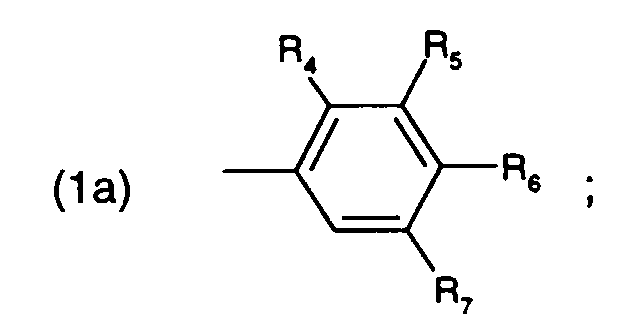
- R4, R5, R6 and R7
- are each independently of the other hydrogen, halogen, C1-C12alkyl, C1-C12alkoxy, carboxy or trifluoro-C1-C3alkyl;
Description
- The present invention relates to the use of hydroxyphenyl-1,3-propanediones in the antimicrobial treatment of surfaces.
- The hydroxyphenyl-1,3-propanediones used according to the invention correspond to formulawherein

- R1 and R2
- are each independently of the other hydrogen, C1-C12alkyl, C1-C12alkoxy, trifluoro-C1-C3alkyl, phenyl or halogen;
- R3
- is a 5- or 6-membered heteroaromatic radical; thiophenyl; or a radical of formula

- R4, R5, R6 and R7
- are each independently of the other hydrogen, halogen, C1-C12alkyl, C1-C12alkoxy, carboxy or trifluoro-C1-C3alkyl.
- C1-C12Alkyl and C1-C12alkoxy are straight-chain or branched alkyl and alkoxy radicals, for example methyl, ethyl, n-propyl, isopropyl, n-butyl, sec-butyl, tert-butyl, amyl, isoamyl or tert-amyl, heptyl, octyl, isooctyl, nonyl, decyl, undecyl and dodecyl, and methoxy, ethoxy, n-propoxy, isopropoxy, n-butoxy, sec-butoxy, tert-butoxy, amyloxy, isoamyloxy or tert-amyloxy, heptyloxy, octyloxy, isooctyloxy, nonyloxy, decyloxy, undecyloxy and dodecyloxy.
- Preferred 6-membered heteroaromatic radicals are pyrazinyl, pyrimidinyl and pyridazinyl and especially pyridyl.
- Examples of 5-membered heteroaromatic radicals are thienyl, furyl, pyrrolyl, imidazolyl, pyrazolyl, isoxazolyl and furazanyl.
- The 5- or 6-membered heteroaromatic radicals may be unsubstituted or substituted by halogen, such as chlorine or bromine, by nitro, by C1-C5alkyl or by C1-C5alkoxy.
- There are preferably used also compounds of formulawherein
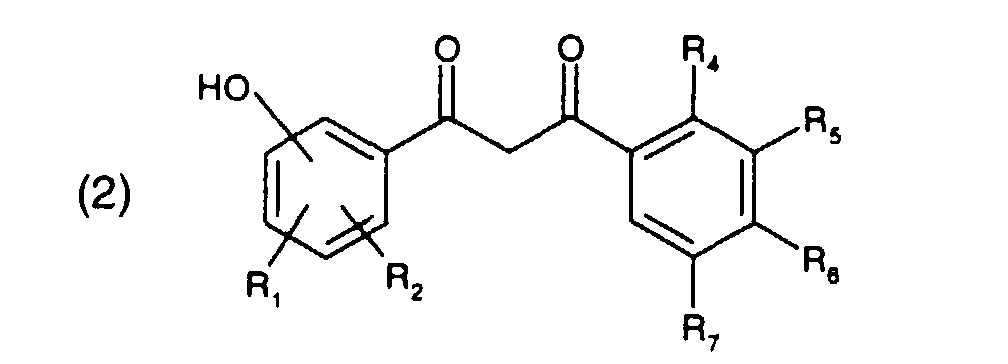
R1, R2, R3, R4, R5, R6 and R7 are as defined for formula (1). - Examples of compounds that can be used according to the invention correspond to formulae
 and
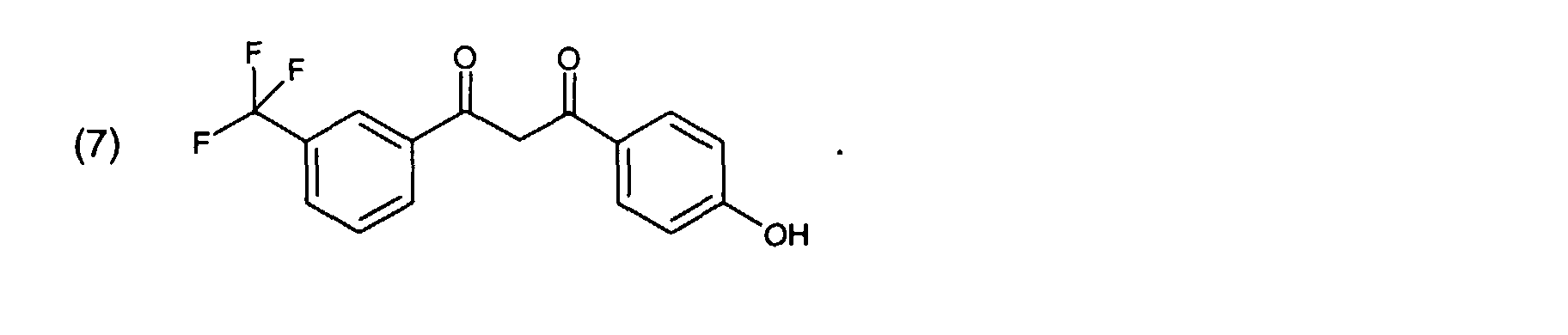
and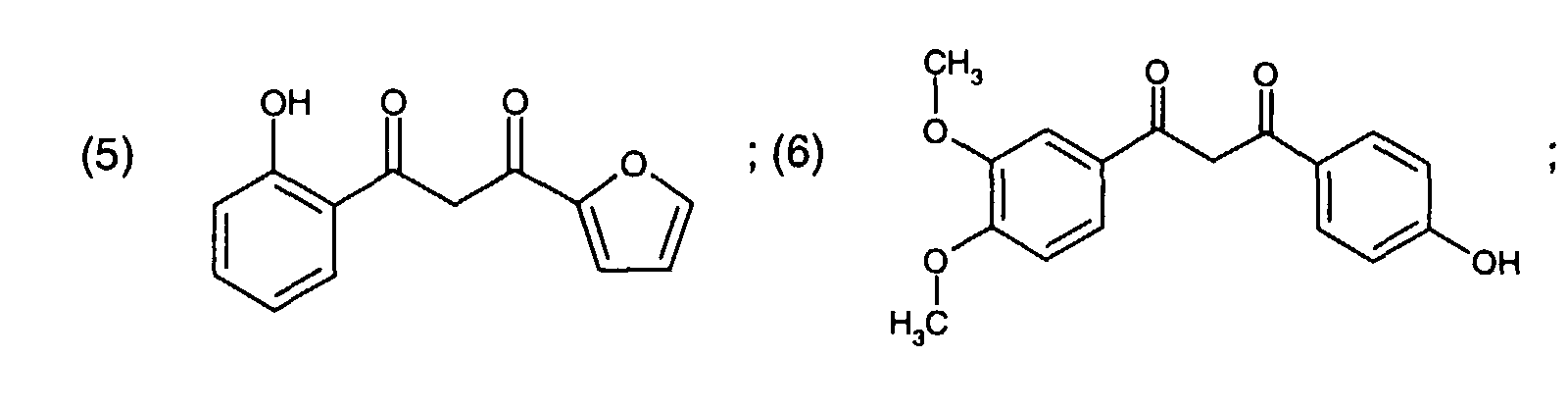
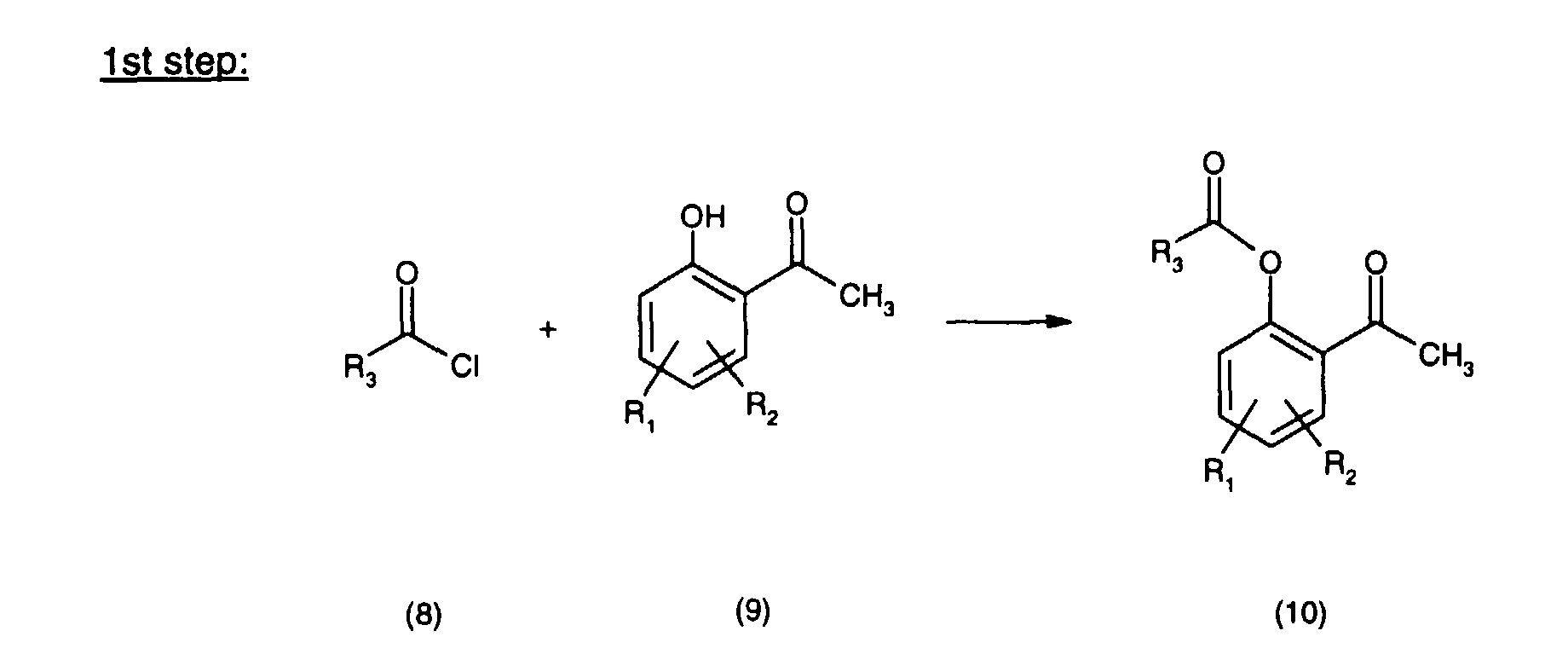
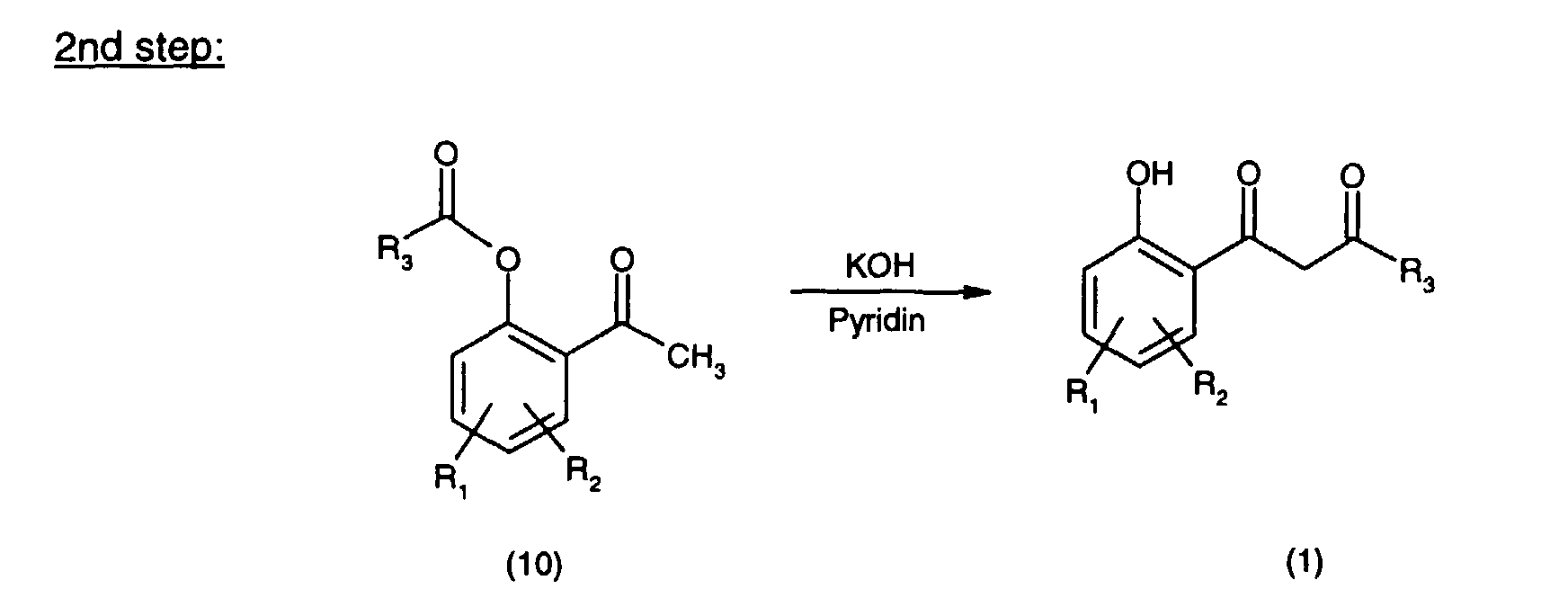
- The preparation of the compounds of formula (1 ) is carried out in a manner known per se in analogy to K.A. Thakar, D.D. Goswami, G.G. Pachpor, J.lnd.Chem.Soc. (I) (1973), 420-423 in a two-step reaction in accordance with the following scheme:
-
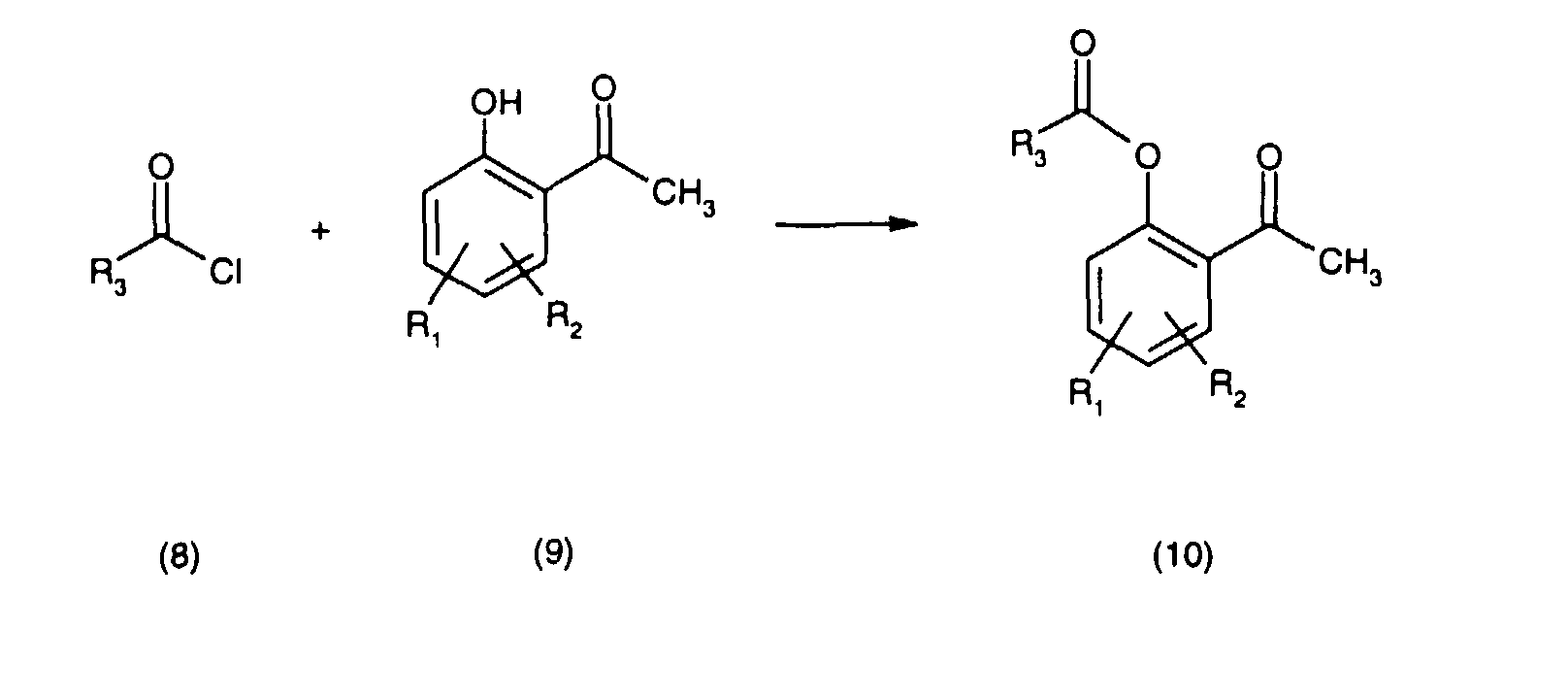
- The invention relates also to the process for the preparation of the compounds according to formula (1 ).
- The process is carried out in a suitable solvent, usually at a temperature of from 0 to 50°C (1 st step).
- Preferably, pyridine is used as solvent at a temperature of 25°C.
- In a 2nd step the ester of formula (10) is rearranged to form the corresponding target compound of formula (1 ) by reaction with KOH powder in a suitable solvent, preferably pyridine, at a temperature of from 40 to 80°C, preferably 50°C.
- A further process for the preparation of the compounds of formula (1 ) is solid phase synthesis on polymeric supports.

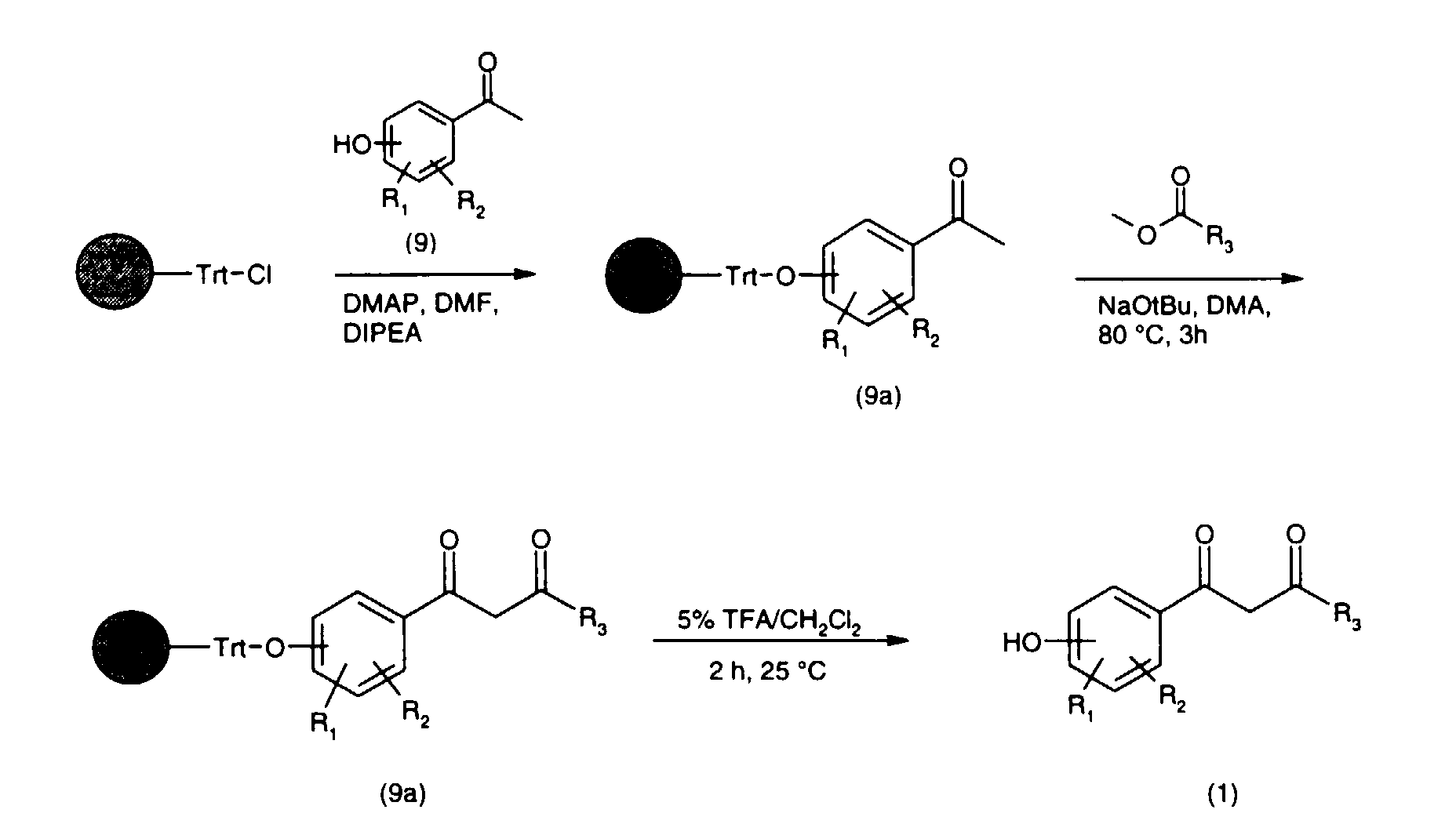
- For that purpose, R1 and R2-substituted hydroxyacetophenones of formula (9) are immobilised on a polystyrene-trityl chloride resin using suitable solvents, bases and catalysts, preferably dimethylformamide, N,N-diisopropylethylamine and 4-(N,N-dimethylamino)pyridine.
- R3-Substituted esters are then heated with the polystyrene resin using suitable bases and solvents at temperatures of from 40 to 100°C.
- Preferably, sodium tert-butanolate and N,N-dimethylacetamide are used at a temperature of 80°C.
- For the removal of the compounds according to formula (1), the resins are treated with 5 % trifluoroacetic acid in dichloromethane.
- Some of the hydroxyphenyl-1,3-propanediones used according to the invention are known compounds, while some are new compounds.
- The new compounds correspond to formulaor

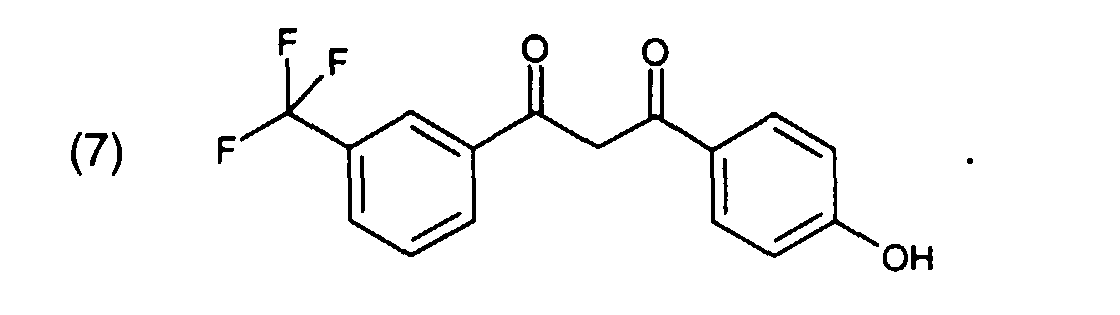
- The hydroxyphenyl-1,3-propanediones used according to the invention exhibit a pronounced antimicrobial action, especially against pathogenic gram-positive and gram-negative bacteria and also against bacteria of skin flora, e.g. Corynebacterium xerosis (bacteria that cause body odour), and also against yeasts and moulds. They are therefore especially suitable in the disinfection, deodorisation and general antimicrobial treatment of the skin and mucosa and of integumentary appendages (hair), more especially in the disinfection of the hands and of wounds.
- They are therefore suitable as antimicrobial active ingredients in personal care preparations, for example shampoos, bath additives, hair-care products, liquid and solid soaps (based on synthetic surfactants and salts of saturated and/or unsaturated fatty acids), lotions and creams, deodorants, other aqueous or alcoholic solutions, e.g. cleansing solutions for the skin, moist cleansing cloths, oils or powders.
- The invention therefore relates also to a personal care preparation comprising at least one compound of formula (1) as well as cosmetically tolerable carriers or adjuvants.
- The personal care preparation according to the invention comprises from 0.01 to 15 % by weight, preferably from 0.5 to 10 % by weight, based on the total weight of the composition, of the hydroxyphenyl-1,3-propanedione compound of formula (1) and cosmetically tolerable adjuvants.
- Depending upon the form of the personal care preparation, it will comprise, in addition to the hydroxyphenyl-1,3-propanedione compound of formula (1), further constituents, for example sequestering agents, colourings, perfume oils, thickening or solidifying (consistency regulator) agents, emolients, UV absorbers, skin-protective agents, antioxidants, additives that improve mechanical properties, such as dicarboxylic acids and/or Al, Zn, Ca and Mg salts of C14-C22fatty acids, and optionally additional preservatives and antimicrobial active ingredients.
- The personal care preparation according to the invention may be formulated as a water-in-oil or oil-in-water emulsion, as an alcoholic or alcohol-containing formulation, as a vesicular dispersion of an ionic or non-ionic amphiphilic lipid, as a gel, a solid stick or as an aerosol formulation.
- A water-in-oil or oil-in-water emulsion containing the hydroxyphenyl-1,3-propanedione compound of formula (1) comprises as cosmetically tolerable adjuvants preferably from 5 to 50 % of an oily phase, from 5 to 20 % of an emulsifier and from 30 to 90 % water.
- The oily phase may contain any oil suitable for cosmetic formulations, e.g. one or more hydrocarbon oils, a wax, a natural oil, a silicone oil, a fatty acid ester or a fatty alcohol. Preferred mono- or poly-ols are ethanol, isopropanol, propylene glycol, hexylene glycol, glycerol and sorbitol.
- Compounds according to the invention may be contained in a variety of cosmetic preparations. Especially the following preparations, for example, come into consideration:
- skin-care preparations, e.g. skin-washing and cleansing preparations in the form of tablet-form or liquid soaps, soapless detergents or washing pastes;
- bath preparations, e.g. liquid (foam baths, milks, shower preparations) or solid bath preparations, e.g. bath cubes and bath salts;
- skin-care preparations, e.g. skin emulsions, multi-emulsions or skin oils;
- cosmetic personal care preparations, e.g. facial make-up in the form of day creams or powder creams, face powder (loose or pressed), rouge or cream make-up, eye-care preparations, e.g. eyeshadow preparations, mascara, eyeliner, eye creams or eye-fix creams, lip-care preparations, e.g. lipsticks, lip gloss, lip contour pencils, nail-care preparations, such as nail varnish, nail varnish removers, nail hardeners or nail hardener removers;
- intimate hygiene preparations, e.g. intimate washing lotions or intimate sprays;
- foot-care preparations, e.g. foot baths, foot powders, foot creams or foot balsams, special deodorants and antiperspirants or callous-removing preparations;
- light-protective preparations, such as sun milks, lotions, creams and oils, sun blocks or tropicals, pre-tanning preparations or after-sun preparations;
- skin-tanning preparations, e.g. self-tanning creams;
- depigmenting preparations, e.g. preparations for bleaching the skin or skin-lightening preparations;
- insect-repellents, e.g. insect-repellent oils, lotions, sprays or sticks;
- deodorants, such as deodorant sprays, pump-action sprays, deodorant gels, sticks or roll-ons;
- antiperspirants, e.g. antiperspirant sticks, creams or roll-ons;
- preparations for cleansing and caring for blemished skin, e.g. soapless detergents (solid or liquid), peeling or scrub preparations or peeling masks;
- hair-removal preparations in chemical form (depilation), e.g. hair-removing powders, liquid hair-removing preparations, cream- or paste-form hair-removing preparations, hair-removing preparations in gel form or aerosol foams;
- shaving preparations, e.g. shaving soap, foaming shaving creams, non-foaming shaving creams, foams and gels, preshave preparations for dry shaving, aftershaves or after-shave lotions;
- fragrance preparations, e.g. fragrances (eau de Cologne, eau de toilette, eau de parfum, parfum de toilette, perfume), perfume oils or cream perfumes;
- dental-care, denture-care and mouth-care preparations, e.g. toothpastes, gel toothpastes, tooth powders, mouthwash concentrates, anti-plaque mouthwashes, denture cleaners or denture fixatives;
- cosmetic hair-treatment preparations, e.g. hair-washing preparations in the form of shampoos and conditioners, hair-care preparations, e.g. pretreatment preparations, hair tonics, styling creams, styling gels, pomades, hair rinses, treatment packs, intensive hair treatments, hair-structuring preparations, e.g. hair-waving preparations for permanent waves (hot wave, mild wave, cold wave), hair-straightening preparations, liquid hair-setting preparations, foams, hairsprays, bleaching preparations, e.g. hydrogen peroxide solutions, lightening shampoos, bleaching creams, bleaching powders, bleaching pastes or oils, temporary, semi-permanent or permanent hair colourants, preparations containing self-oxidising dyes, or natural hair colourants, such as henna or camomile.
- An antimicrobial soap has, for example, the following composition:
- 0.01 to 5 % by weight of the compound of formula (1)
- 0.3 to 1 % by weight titanium dioxide
- 1 to 10 % by weight stearic acid
- ad 100 % soap base, e.g. the sodium salts of tallow fatty acid and coconut fatty acid or glycerol.
-
- A shampoo has, for example, the following composition:
- 0.01 to 5 % by weight of the compound of formula (1)
- 12.0 % by weight sodium laureth-2-sulfate
- 4.0 % by weight cocamidopropyl betaine
- 3.0 % by weight NaCI and
- water ad 100%.
-
- A deodorant has, for example, the following composition:
- 0.01 to 5 % by weight of the compound of formula (1)
- 60 % by weight ethanol
- 0.3 % by weight perfume oil and
- water ad 100 %.
-
- Example of an O/W emulsion:
- 0.01-5 % by weight of the compound of formula (1)
- 12 % by weight glyceryl stearate
- 6 % by weight paraffin oil
- 6 % by weight caprylic/capric triglyceride
- 4 % by weight glycerol
- 0.2 % by weight disodium EDTA
- 1.0 % by weight citric acid (20 %) and
- 65.8-70.8 % by weight water.
-
- Example of an O/W emulsion:
- 0.01-5 % by weight of the compound of formula (1)
- 3.5 % by weight PEG-30 dipolyhydroxystearate
- 10.0 % by weight paraffin oil
- 4 % by weight caprylic/capric triglyceride
- 4 % by weight dicaprylic ether
- 0.2 % by weight disodium EDTA
- 3.4 % by weight glycerol and
- 69.9-74.9 % by weight water.
-
- The invention relates also to an oral care composition, comprising
0.01 to 15 % by weight, based on the total weight of the composition, of the compound of formula (1) and orally tolerable adjuvants. - Example of an oral care composition:
- 10 % by weight sorbitol
- 10 % by weight glycerol
- 15 % by weight ethanol
- 15 % by weight propylene glycol
- 0.5 % by weight sodium lauryl sulfate
- 0.25 % by weight sodium methylcocyl taurate
- 0.25 % by weight polyoxypropylene/polyoxyethylene block copolymer
- 0.10 % by weight peppermint flavouring
- 0.1 to 0.5 % by weight of a compound of formula (1 ) and
- 48.6 % by weight water.
-
- The oral care composition according to the invention may be, for example, in the form of a gel, a paste, a cream or an aqueous preparation (mouthwash).
- The oral care composition according to the invention may also comprise compounds that release fluoride ions which are effective against the formation of caries, for example inorganic fluoride salts, e.g. sodium, potassium, ammonium or calcium fluoride, or organic fluoride salts, e.g. amine fluorides, which are known under the trade name Olafluor.
- The hydroxyphenyl-1,3-propanediones of formula (1) used according to the invention are also suitable for the antimicrobial treatment of textile fibre materials. Such materials are undyed and dyed or printed fibre materials, e.g. of silk, wool, polyamide, polyester, polypropylene or polyurethanes, and especially cellulose-containing fibre materials of all kinds. Such fibre materials are, for example, natural cellulose fibres, such as cotton, linen, jute and hemp, as well as cellulose and regenerated cellulose. Preferred suitable textile fibre materials are made of cotton.
- The compounds of formula (1 ) are also suitable, alone or in combination with other antimicrobial substances, for preserving cosmetic products, e.g. shampoos, bath additives, hair-care preparations, liquid and solid soaps (based on synthetic surfactants and salts of saturated and/or unsaturated fatty acids), lotions and creams, deodorants, other aqueous or alcoholic solutions, e.g. cleansing solutions for the skin, moist cleansing cloths, oils or powders and household products, for example in washing and cleaning formulations, e.g. in liquid or powder washing agents or softeners.
- The hydroxyphenyl-1,3-propanediones used according to the invention are also suitable for imparting antimicrobial properties to plastics, e.g. polyethylene, polypropylene, polyurethane, polyester, polyamide, polycarbonate, latex etc.. Fields of use therefor are, for example, floor coverings, plastics coatings, plastics container and packaging materials, kitchen and bathroom utensils (e.g. brushes, shower curtains, sponges, bathmats), latex filter materials (air and water filters), plastics articles used in the field of medicine, e.g. dressing materials, syringes, catheters etc., so-called "medical devices", gloves and mattresses.
- Paper, for example papers used for hygiene purposes, may also be provided with antimicrobial properties using the hydroxyphenyl-1,3-propanediones according to the invention.
- It is also possible for nonwovens, e.g. nappies/diapers, sanitary towels, panty liners, and cloths for hygiene and household uses, to be provided with antimicrobial properties in accordance with the invention.
- The hydroxyphenyl-1,3-propanediones can be used especially also in household and all-purpose cleaners for cleaning and disinfecting hard surfaces.
- A cleaning preparation has, for example, the following composition:
- 0.01 to 5 % of the compound of formula (1)
- 3.0 % octyl alcohol 4EO
- 1.3 % fatty alcohol C8-C10Polyglucoside
- 3.0 % isopropanol
- ad 100 % water.
-
- In addition to preserving cosmetic and household products, technical products, such as paper treatment liquors, printing thickeners of starch or of cellulose derivatives, varnishes and paints, can be preserved and provided with antimicrobial properties.
- The hydroxyphenyl-1,3-propanediones of formula (1 ) are also suitable for the antimicrobial treatment of wood and for the antimicrobial treatment of leather and the provision of leather with antimicrobial properties.
- The compounds according to the invention are also suitable for the protection of cosmetic products and household products from microbial damage.
- The following Examples serve to illustrate the invention but do not limit the invention to the Examples.
-

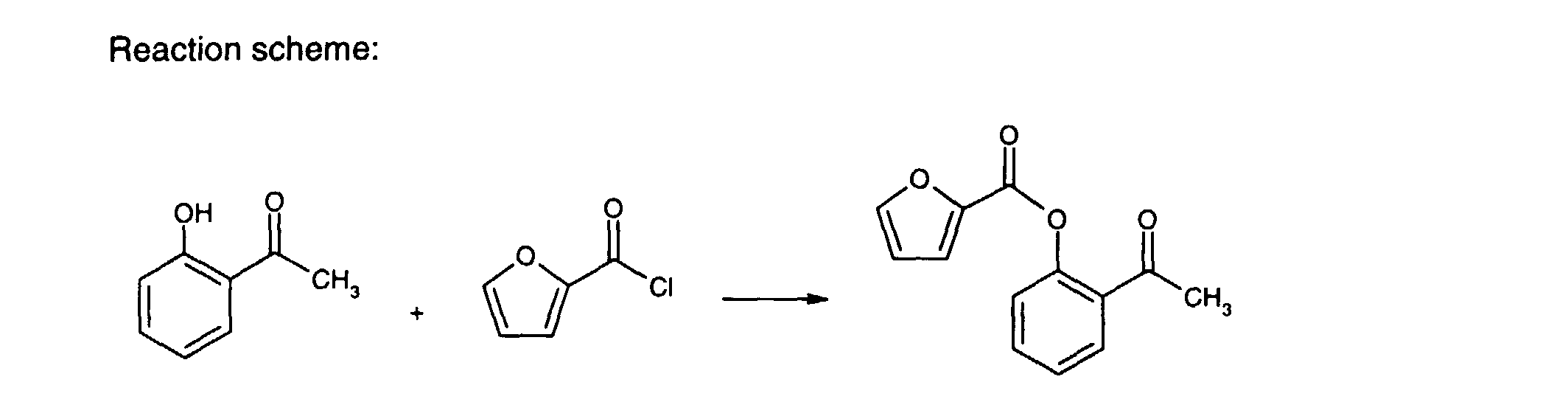
- 2-Hydroxyacetophenone (0.5 mol; 68.1 g) is dissolved in pyridine (121 ml) at 25°C. 2-Furoyl chloride (0.51 mol, 66.6 g) is then added in the course of 10 minutes, the temperature rising to a maximum of 50°C. The mixture is then cooled to 25°C and stirred for 1.5 hours. The thick reaction mass is poured into aqueous HCI solution (10 %, 1 litre) at from 5 to 20°C, and the white product is filtered off and washed with water (100 ml).
- The o-(2-furoyloxy)acetophenone crude product is recrystallised from ethanol (200 ml). The crystals are dried in vacuo.
- Yield: 108.4 g (94.2 % of theory)
-
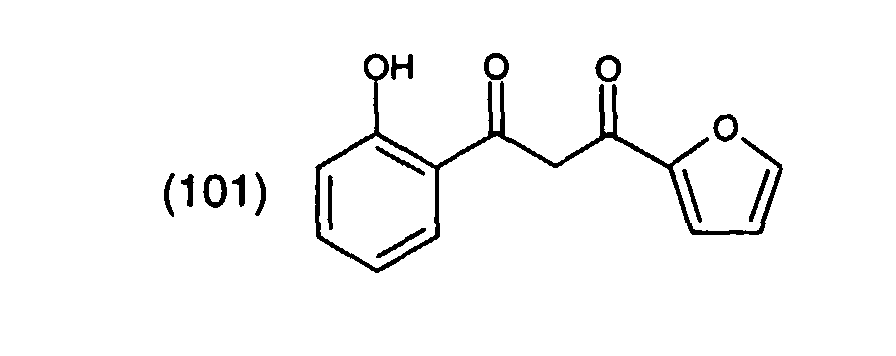
- 2-(2-Furoyloxy)acetophenone (0.43 mol; 100 g) is dissolved in pyridine (260 ml). The mixture is heated to from 45 to 50°C. KOH powder (0.52 mol; 29 g) is then added in the course of 10 minutes and the mixture is stirred with pyridine (100 ml). The reaction mixture is then stirred at 45ºC for 15 minutes, and ethyl acetate (1.3 litres) is added until the pH value falls to < 7. The reaction mixture is then cooled to 10°C, a yellow product being precipitated. The precipitate is filtered off, washed with water (100 ml) and recrystallised from ethanol/water (3:1, 500 ml). The crystals are dried in vacuo.
- Yield: 60.6 g (60.6 % of theory)
-


- Polystyrene-trityl chloride resin (100 mg, loading approx. 1 mmol/g) is shaken at 25°C for 18 hours with 4-hydroxyacetophenone (10 eq), DIPEA (10 eq) and DMAP (catalytic amounts) in DMF (2 ml). The resin is then filtered off with suction and washed intensively with DMF (3x), methanol (3x), DCM (3x) and methanol (3x) and dried in vacuo.
- The IR spectrum exhibits a C(=O) bond-stretching vibration at 1655 cm-1.
- For the Claisen condensation, the loaded resin (100 mg) is heated at 80ºC for 3 hours with 3-trifluoromethylbenzoic acid methyl ester (10 eq) and sodium tert-butanolate (10 eq) in DMA (2 ml, absolute). The resin is then filtered off with suction, washed as described above and dried in vacuo.
- For removal, the resin (100 mg) is shaken at 25ºC for 2 hours with 5 % TFA in dichloromethane (2 ml), and then the removal solution is concentrated to dryness by evaporation and freeze-dried from tert-butyl alcohol/water (4:1).
Yield: 52.3 % -
- 0.01-5 % of the compound of formula (101)
- 15.0 % PEG-7 C14-C15alcohol ether
- 10.0 % sodium dodecylbenzenesulfonate
- 10.0 % propylene glycol
- 3.0 % sodium citrate
- ad 100 % deionised water
-
- The compound of formula (101) is dissolved in the C14-C15alcohol ether at 50°C. Propylene glycol and sodium dodecylbenzenesulfonate are added and the mixture is stirred until homogeneous. After cooling to 22°C, sodium citrate and water are added.
-
- 0-5 % of the compound of formula (101)
- 4.0 % of the compound of formula
R = aliphatic radical of tallow fatty acid
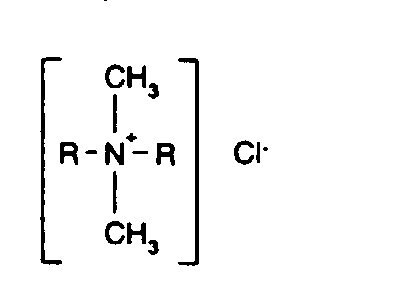
- 0.5 % pareth-25-7 and
- ad 100% deionised water.
-
- The compound of formula (101) is dissolved in Quaternium 18 at 40°C; pareth-25-7 and water are added and the mixture is stirred until a homogeneous mixture is formed.
-
- 0.01-5 % of the compound of formula (101)
- 7.0 % sodium lauryl sulfate
- 7.0 % sodium myreth sulfate
- 4.0 % lauryl glucoside
- 1.1 % cocobetaine
- 5.0 % ethanol
- 1.0 % citric acid
- ad 100 % deionised water
-
- The compound of formula (101) is dissolved in ethanol. The surfactants (sodium lauryl sulfate, sodium myreth sulfate, lauryl glucoside and cocobetaine) are added predissolved in water and the mixture is stirred at 40°C until homogeneous. Citric acid and water are added to the solution at 22°C.
-
- 0.01-5 % of the compound of formula (101)
- 10.0 % sodium laureth-2-sulfate
- 3.0 % cocamidopropyl betaine
- 2.0 % lauryl glucoside
- 1.0 % glycol distearate
- 1.0 % sodium chloride
- ad 100 % deionised water.
-
- The compound of formula (101) is solubilised at 50ºC, with stirring, in cocamidopropyl betaine and lauryl glucoside. Sodium laureth-2-sulfate and glycol distearate are added and the mixture is stirred at 50°C until homogeneous. When the glycol distearate has fully dissolved, the mixture is cooled to room temperature, with stirring; water is added and the viscosity is adjusted with sodium chloride.
-
- 0.01 to 5 % of the compound of formula (101)
- 3.0 % octyl alcohol 4EO
- 1.3 % fatty alcohol C8-C10Polyglucoside
- 3.0 % isopropanol
- ad 100 % water
-
- The compound of formula (101) is dissolved in isopropanol; octyl alcohol 4EO and fatty alcohol C8-C10polyglucoside are added to the solution and the mixture is stirred until homogeneous. The pH value is adjusted with ethanolamine and the formulation is made up to 100 % with water.
-
- Nutrient medium:
- casein-soybean flour-peptone bouillon for the preparation of the precultures of the test bacteria and yeast.
- Mycological slant agar for the preculture of moulds.
-
- Bacteria:
- Staphylococcus hominis DSM 20328
Escherichia coli NCTC 8196
Pseudomonas aeruginosa CIP A-22
Staphylococcus aureus ATCC 9144
Corynebacterium xerosis ATCC 373 - Yeast:
- Candida albicans ATCC 10231
- Mould:
- Aspergillus niger ATCC 6275
Rhizopus stolonifer DSM 63011
Penicillium expansum ATCC 36200 - Procedure:
- The test substances are predissolved in dimethyl sulfoxide (DMSO) and
tested in a dilution series of 1:2.
Bacteria and yeast are cultured overnight in CASO bouillon, the mould on mycological slant agar and rinsed off with 10 ml of 0.85 % sodium chloride solution (+ 0.1% TritonX-100).
All test organisms are adjusted to an organism count of 1-5*106 CFU/ml with 0.85 % sodium chloride solution.
The test substances are prepipetted into microtitre plates in an amount of 8 µl per well.
Previously diluted test organism suspensions are diluted 1:100 in CASO bouillon (bacteria and yeast) and Sabouraud 2 % glucose bouillon (mould) and added to the test substances in an amount of 192 µl per well.
The test batches are incubated for 48 hours at 37°C (bacteria and yeast) or for 5 days at 28°C (mould).
After incubation, the growth is determined by reference to the turbidity of the test batches (optical density) at 620 nm in a microplate reader.
The minimum inhibitory concentration (MIC value) is the concentration of substance at which (compared with the growth of the control) an appreciable inhibition of the growth (≤ 20 % growth) of the test organisms is ascertained.
One microtitre plate is used for each test organism and substance concentration.
All substances are tested in duplicate. - The results obtained (MIC in ppm) are given in Table 1 and 2.
Compound of formula (101) Microorganism [ppm] Staphylococcus aureus ATCC 9144 100-500 Corynebacterium xerosis ATCC 373 50 Escherichia coli NCTC 8196 50 Pseudomonas aeruginosa CIP A-22 >1000 Candida albicans ATCC 10231 >100-500 Aspergillus niger ATCC 6275 100 Rhizopus stolonifer DSM 63011 50 Penicillium expansum ATCC 36200 100 

Claims (21)
- The use of a compound of formulawherein

- R1 and R2
- are each independently of the other hydrogen, C1-C12alkyl, C1-C12alkoxy, trifluoro-C1-C3alkyl, phenyl or halogen;
- R3
- is a 5- or 6-membered heteroaromatic radical; thiophenyl; or a radical of formula

- R4, R5, R6 and R7
- are each independently of the other hydrogen, halogen, C1-C12alkyl, C1-C12alkoxy, carboxy or trifluoro-C1-C3alkyl;
- Use according to claim 1, wherein in the compounds of formula (1)
- R3
- is a 5- or 6-membered heteroaromatic radical, and
- R1 and R2
- are as defined in claim 1.
- Use according to claim 1 or 2, wherein pyridyl, pyrazinyl, pyrimidinyl or pyridazinyl are used as 6-membered heteroaromatic radicals.
- Use according to claim 3, wherein pyridyl is used as 6-membered heteroaromatic radical.
- Use according to claim 4, the use relating to a compound of formula

- Use according to claim 1, the use relating to a compound of formulawherein

R1, R2, R3, R4, R5, R6 and R7 are as defined in claim 1. - Use according to claim 6, wherein
R4, R5, R6 and R7 are hydrogen or C1-C12alkoxy, wherein at least one of the radicals R4, R5, R6 and R7 is C1-C12alkoxy. - Use according to claim 7, the use relating to the compound of formula
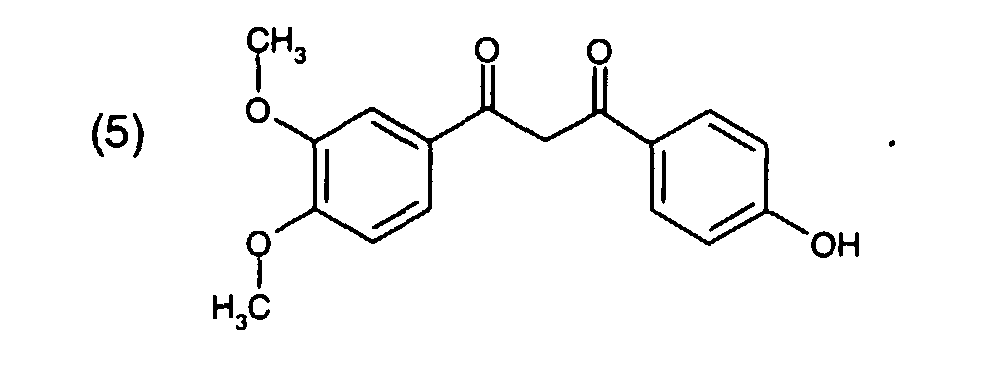
- Use according to claim 1 or 6, the use relating to the compound of formula

- Use according to claim 1 or 6, the use relating to the compound of formula

- A process for the preparation of a compound of formula (1), which process comprises reacting an acid chloride of formula (8) with a hydroxyacetophenone compound of formula (9) in a suitable solvent (1st reaction step) and reacting the resulting ester of formula (10) with KOH to form a compound of formula (1) (2nd reaction step) in accordance with the following scheme:
- A process for the preparation of a compound of formula (1) according to claim 1, which process comprises immobilising the hydroxyacetophenone compound of formula (9) on a polystyrene-trichloride resin using suitable solvents, bases and catalysts and heating the resulting ester of formula (9a) with polystyrene resin using suitable bases and solvents at a temperature of from 40 to 100°C and, for the removal of the compound of formula (1), treating the resins with 5 % trifluoroacetic acid in dichloromethane in accordance with the following scheme:
- Use of a compound of formula (1) in the antimicrobial treatment of the skin, mucosa and hair.
- Use of a compound of formula (1) in the antimicrobial treatment of textile fibre materials.
- Use of a compound of formula (1) in washing and cleaning formulations.
- Use of a compound of formula (1) in imparting antimicrobial properties to plastics, paper, nonwovens, wood or leather.
- Use of a compound of formula (1) in the preservation of cosmetic products.
- A personal care preparation, comprising
from 0.01 to 15 % by weight, based on the total weight of the composition, of a compound of formula (1) and cosmetically tolerable adjuvants. - An oral care composition, comprising
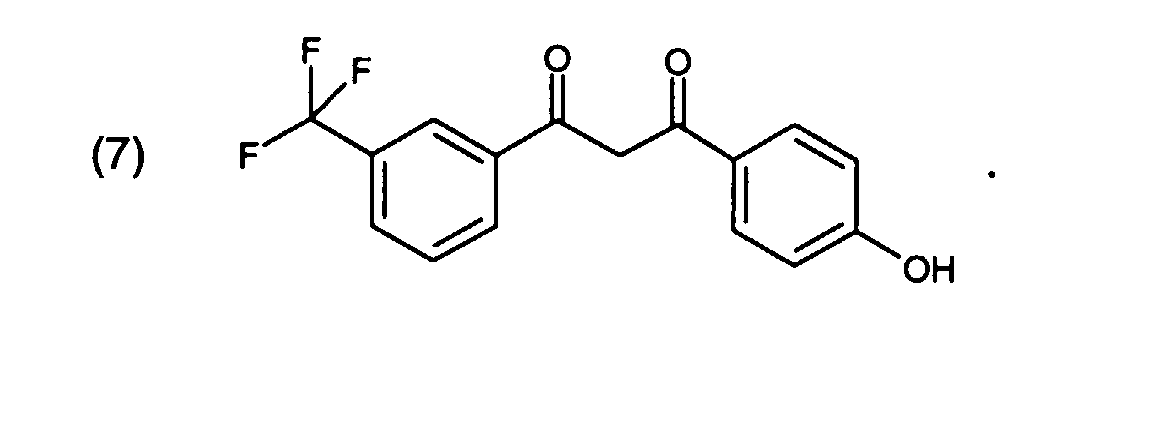
from 0.01 to 15 % by weight, based on the total weight of the composition, of a compound of formula (1) and orally tolerable adjuvants. - A compound of formula

- A compound of formula
Priority Applications (1)
| Application Number | Priority Date | Filing Date | Title |
|---|---|---|---|
| EP20000810675 EP1074179B1 (en) | 1999-08-06 | 2000-07-27 | Microbicidal active ingredients |
Applications Claiming Priority (3)
| Application Number | Priority Date | Filing Date | Title |
|---|---|---|---|
| EP99810708 | 1999-08-06 | ||
| EP99810708 | 1999-08-06 | ||
| EP20000810675 EP1074179B1 (en) | 1999-08-06 | 2000-07-27 | Microbicidal active ingredients |
Publications (3)
| Publication Number | Publication Date |
|---|---|
| EP1074179A2 true EP1074179A2 (en) | 2001-02-07 |
| EP1074179A3 EP1074179A3 (en) | 2001-04-11 |
| EP1074179B1 EP1074179B1 (en) | 2005-04-20 |
Family
ID=26073968
Family Applications (1)
| Application Number | Title | Priority Date | Filing Date |
|---|---|---|---|
| EP20000810675 Expired - Lifetime EP1074179B1 (en) | 1999-08-06 | 2000-07-27 | Microbicidal active ingredients |
Country Status (1)
| Country | Link |
|---|---|
| EP (1) | EP1074179B1 (en) |
-
2000
- 2000-07-27 EP EP20000810675 patent/EP1074179B1/en not_active Expired - Lifetime
Non-Patent Citations (2)
| Title |
|---|
| K. A. THAKAR ET AL.: "Synthesis of furyl analogs of substituted flavanoids" JOURNAL OF THE INDIAN CHEMICAL SOCIETY, vol. 50, no. 3, 1973, pages 420-423, XP000874086 * |
| K.A. THAKAR ET AL: "Synthesis and screening of some 1,3-propane diones and flavones" JOURNAL OF THE INDIAN CHEMICAL SOCIETY, vol. 60, no. 7, 1983, pages 668-670, XP000874599 * |
Also Published As
| Publication number | Publication date |
|---|---|
| EP1074179A3 (en) | 2001-04-11 |
| EP1074179B1 (en) | 2005-04-20 |
Similar Documents
| Publication | Publication Date | Title |
|---|---|---|
| EP1484971B1 (en) | Use of 4-aminopyrimidines for the antimicrobial treatment of surfaces | |
| US6814960B1 (en) | Hydroxystilbene compounds used as microbicidal active substances | |
| US7015228B2 (en) | 4-amino-2-(2-pyridyl)pyrimidines as microbicidal active substances | |
| US7722893B2 (en) | Use of substitute 2,4-bis (alkylamino) pyrimidines or quinzolines as antimicrobials | |
| US6346260B1 (en) | Microbicidal active ingredients | |
| EP1254903B1 (en) | 4-Amino-2-(pyridin-2-yl)pyrimidine as microbicidal active substances | |
| US6376522B1 (en) | 4-hydroxyisothiazole compounds | |
| US6689372B1 (en) | Microbicidal active substances | |
| US6753451B2 (en) | Process for the preparation of phenylphenol compounds | |
| US6624182B1 (en) | Hydroxyphenylvinylthiazoles | |
| US7208597B2 (en) | Pyridyl-triazine derivatives as microbiocidal active substances | |
| US20040006061A1 (en) | Alkoxybenzylamine | |
| EP1074179B1 (en) | Microbicidal active ingredients | |
| US7078550B2 (en) | Silanyl phenols and naphthols | |
| EP1319006B1 (en) | Tetrahydrocarbazoles, a process for the preparation of those compounds, and the use thereof | |
| US20060052375A1 (en) | Bis-alkylbenzylamines | |
| US6743940B2 (en) | 4-aminobut-2-ynecarboxylic acid derivatives | |
| US20070196407A1 (en) | Alkoxyphenylcarboxylic acid derivatives | |
| EP1651177A1 (en) | 3-aryl-2-cyano-3-hydroxy-acrylic acid derivatives | |
| EP1215198A1 (en) | 4-Aminobut-2-yne carboxylic acid derivatives and their use as antimicrobial agents | |
| CN119212556A (en) | Antibacterial or antiviral agents |
Legal Events
| Date | Code | Title | Description |
|---|---|---|---|
| PUAI | Public reference made under article 153(3) epc to a published international application that has entered the european phase |
Free format text: ORIGINAL CODE: 0009012 |
|
| AK | Designated contracting states |
Kind code of ref document: A2 Designated state(s): CH DE FR GB IT LI |
|
| AX | Request for extension of the european patent |
Free format text: AL;LT;LV;MK;RO;SI |
|
| PUAL | Search report despatched |
Free format text: ORIGINAL CODE: 0009013 |
|
| AK | Designated contracting states |
Kind code of ref document: A3 Designated state(s): AT BE CH CY DE DK ES FI FR GB GR IE IT LI LU MC NL PT SE |
|
| AX | Request for extension of the european patent |
Free format text: AL;LT;LV;MK;RO;SI |
|
| 17P | Request for examination filed |
Effective date: 20010709 |
|
| AKX | Designation fees paid |
Free format text: CH DE FR GB IT LI |
|
| 17Q | First examination report despatched |
Effective date: 20020712 |
|
| GRAP | Despatch of communication of intention to grant a patent |
Free format text: ORIGINAL CODE: EPIDOSNIGR1 |
|
| GRAS | Grant fee paid |
Free format text: ORIGINAL CODE: EPIDOSNIGR3 |
|
| GRAA | (expected) grant |
Free format text: ORIGINAL CODE: 0009210 |
|
| AK | Designated contracting states |
Kind code of ref document: B1 Designated state(s): CH DE FR GB IT LI |
|
| REG | Reference to a national code |
Ref country code: GB Ref legal event code: FG4D |
|
| REG | Reference to a national code |
Ref country code: CH Ref legal event code: EP |
|
| REF | Corresponds to: |
Ref document number: 60019505 Country of ref document: DE Date of ref document: 20050525 Kind code of ref document: P |
|
| PLBE | No opposition filed within time limit |
Free format text: ORIGINAL CODE: 0009261 |
|
| STAA | Information on the status of an ep patent application or granted ep patent |
Free format text: STATUS: NO OPPOSITION FILED WITHIN TIME LIMIT |
|
| ET | Fr: translation filed | ||
| 26N | No opposition filed |
Effective date: 20060123 |
|
| PGFP | Annual fee paid to national office [announced via postgrant information from national office to epo] |
Ref country code: CH Payment date: 20070515 Year of fee payment: 8 |
|
| PGFP | Annual fee paid to national office [announced via postgrant information from national office to epo] |
Ref country code: DE Payment date: 20070523 Year of fee payment: 8 |
|
| PGFP | Annual fee paid to national office [announced via postgrant information from national office to epo] |
Ref country code: GB Payment date: 20070615 Year of fee payment: 8 |
|
| PGFP | Annual fee paid to national office [announced via postgrant information from national office to epo] |
Ref country code: IT Payment date: 20070613 Year of fee payment: 8 |
|
| PGFP | Annual fee paid to national office [announced via postgrant information from national office to epo] |
Ref country code: FR Payment date: 20070515 Year of fee payment: 8 |
|
| REG | Reference to a national code |
Ref country code: CH Ref legal event code: PL |
|
| GBPC | Gb: european patent ceased through non-payment of renewal fee |
Effective date: 20080727 |
|
| PG25 | Lapsed in a contracting state [announced via postgrant information from national office to epo] |
Ref country code: DE Free format text: LAPSE BECAUSE OF NON-PAYMENT OF DUE FEES Effective date: 20090203 |
|
| REG | Reference to a national code |
Ref country code: FR Ref legal event code: ST Effective date: 20090331 |
|
| PG25 | Lapsed in a contracting state [announced via postgrant information from national office to epo] |
Ref country code: CH Free format text: LAPSE BECAUSE OF NON-PAYMENT OF DUE FEES Effective date: 20080731 Ref country code: LI Free format text: LAPSE BECAUSE OF NON-PAYMENT OF DUE FEES Effective date: 20080731 Ref country code: GB Free format text: LAPSE BECAUSE OF NON-PAYMENT OF DUE FEES Effective date: 20080727 |
|
| PG25 | Lapsed in a contracting state [announced via postgrant information from national office to epo] |
Ref country code: FR Free format text: LAPSE BECAUSE OF NON-PAYMENT OF DUE FEES Effective date: 20080731 Ref country code: IT Free format text: LAPSE BECAUSE OF NON-PAYMENT OF DUE FEES Effective date: 20080727 |