EP1073688B1 - The construction of copolymer libraries - Google Patents
The construction of copolymer libraries Download PDFInfo
- Publication number
- EP1073688B1 EP1073688B1 EP99918534.1A EP99918534A EP1073688B1 EP 1073688 B1 EP1073688 B1 EP 1073688B1 EP 99918534 A EP99918534 A EP 99918534A EP 1073688 B1 EP1073688 B1 EP 1073688B1
- Authority
- EP
- European Patent Office
- Prior art keywords
- polymers
- polyarylate
- polymer
- tyrosine
- properties
- Prior art date
- Legal status (The legal status is an assumption and is not a legal conclusion. Google has not performed a legal analysis and makes no representation as to the accuracy of the status listed.)
- Expired - Lifetime
Links
- 229920001577 copolymer Polymers 0.000 title description 28
- 238000010276 construction Methods 0.000 title description 3
- 229920001230 polyarylate Polymers 0.000 claims description 45
- RTZKZFJDLAIYFH-UHFFFAOYSA-N Diethyl ether Chemical compound CCOCC RTZKZFJDLAIYFH-UHFFFAOYSA-N 0.000 claims description 43
- 125000004432 carbon atom Chemical group C* 0.000 claims description 16
- 239000001257 hydrogen Substances 0.000 claims description 14
- 229910052739 hydrogen Inorganic materials 0.000 claims description 14
- UFHFLCQGNIYNRP-UHFFFAOYSA-N Hydrogen Chemical compound [H][H] UFHFLCQGNIYNRP-UHFFFAOYSA-N 0.000 claims description 10
- 125000000217 alkyl group Chemical group 0.000 claims description 10
- 238000006116 polymerization reaction Methods 0.000 claims description 8
- 125000002877 alkyl aryl group Chemical group 0.000 claims description 7
- 239000003814 drug Substances 0.000 claims description 4
- 229940079593 drug Drugs 0.000 claims description 4
- 239000002904 solvent Substances 0.000 claims description 3
- 230000006835 compression Effects 0.000 claims description 2
- 238000007906 compression Methods 0.000 claims description 2
- QEVGZEDELICMKH-UHFFFAOYSA-N Diglycolic acid Chemical compound OC(=O)COCC(O)=O QEVGZEDELICMKH-UHFFFAOYSA-N 0.000 claims 2
- 229920000642 polymer Polymers 0.000 description 154
- 239000000178 monomer Substances 0.000 description 68
- IAZDPXIOMUYVGZ-UHFFFAOYSA-N Dimethylsulphoxide Chemical compound CS(C)=O IAZDPXIOMUYVGZ-UHFFFAOYSA-N 0.000 description 45
- YMWUJEATGCHHMB-UHFFFAOYSA-N Dichloromethane Chemical compound ClCCl YMWUJEATGCHHMB-UHFFFAOYSA-N 0.000 description 31
- 238000000034 method Methods 0.000 description 28
- 125000003118 aryl group Chemical group 0.000 description 26
- XLYOFNOQVPJJNP-UHFFFAOYSA-N water Substances O XLYOFNOQVPJJNP-UHFFFAOYSA-N 0.000 description 26
- 239000000463 material Substances 0.000 description 23
- OKKJLVBELUTLKV-UHFFFAOYSA-N Methanol Chemical compound OC OKKJLVBELUTLKV-UHFFFAOYSA-N 0.000 description 21
- -1 polyethylene Polymers 0.000 description 21
- 125000001570 methylene group Chemical group [H]C([H])([*:1])[*:2] 0.000 description 20
- ISWSIDIOOBJBQZ-UHFFFAOYSA-N Phenol Chemical compound OC1=CC=CC=C1 ISWSIDIOOBJBQZ-UHFFFAOYSA-N 0.000 description 18
- 125000002496 methyl group Chemical group [H]C([H])([H])* 0.000 description 17
- XKZQKPRCPNGNFR-UHFFFAOYSA-N 2-(3-hydroxyphenyl)phenol Chemical class OC1=CC=CC(C=2C(=CC=CC=2)O)=C1 XKZQKPRCPNGNFR-UHFFFAOYSA-N 0.000 description 16
- 239000011521 glass Substances 0.000 description 16
- 239000000243 solution Substances 0.000 description 16
- 238000013459 approach Methods 0.000 description 15
- 229910052760 oxygen Inorganic materials 0.000 description 15
- 239000001301 oxygen Substances 0.000 description 15
- QVGXLLKOCUKJST-UHFFFAOYSA-N atomic oxygen Chemical compound [O] QVGXLLKOCUKJST-UHFFFAOYSA-N 0.000 description 14
- 230000004048 modification Effects 0.000 description 14
- 238000012986 modification Methods 0.000 description 14
- 238000006243 chemical reaction Methods 0.000 description 13
- 230000000694 effects Effects 0.000 description 13
- 210000002950 fibroblast Anatomy 0.000 description 13
- 230000009477 glass transition Effects 0.000 description 13
- 238000002844 melting Methods 0.000 description 13
- 230000008018 melting Effects 0.000 description 13
- 239000000126 substance Substances 0.000 description 13
- 238000001644 13C nuclear magnetic resonance spectroscopy Methods 0.000 description 12
- 238000005160 1H NMR spectroscopy Methods 0.000 description 12
- HEDRZPFGACZZDS-MICDWDOJSA-N Trichloro(2H)methane Chemical compound [2H]C(Cl)(Cl)Cl HEDRZPFGACZZDS-MICDWDOJSA-N 0.000 description 12
- 150000001408 amides Chemical group 0.000 description 12
- 238000013461 design Methods 0.000 description 12
- 230000035755 proliferation Effects 0.000 description 12
- OUYCCCASQSFEME-UHFFFAOYSA-N tyrosine Natural products OC(=O)C(N)CC1=CC=C(O)C=C1 OUYCCCASQSFEME-UHFFFAOYSA-N 0.000 description 12
- 230000015572 biosynthetic process Effects 0.000 description 11
- XEKOWRVHYACXOJ-UHFFFAOYSA-N Ethyl acetate Chemical compound CCOC(C)=O XEKOWRVHYACXOJ-UHFFFAOYSA-N 0.000 description 10
- OUYCCCASQSFEME-QMMMGPOBSA-N L-tyrosine Chemical compound OC(=O)[C@@H](N)CC1=CC=C(O)C=C1 OUYCCCASQSFEME-QMMMGPOBSA-N 0.000 description 9
- 125000000524 functional group Chemical group 0.000 description 9
- 238000000113 differential scanning calorimetry Methods 0.000 description 8
- 230000008569 process Effects 0.000 description 8
- 238000003786 synthesis reaction Methods 0.000 description 8
- 230000009897 systematic effect Effects 0.000 description 8
- 238000002411 thermogravimetry Methods 0.000 description 8
- 230000004663 cell proliferation Effects 0.000 description 7
- KDYFGRWQOYBRFD-UHFFFAOYSA-L succinate(2-) Chemical compound [O-]C(=O)CCC([O-])=O KDYFGRWQOYBRFD-UHFFFAOYSA-L 0.000 description 7
- QEVGZEDELICMKH-UHFFFAOYSA-L 2-(carboxylatomethoxy)acetate Chemical class [O-]C(=O)COCC([O-])=O QEVGZEDELICMKH-UHFFFAOYSA-L 0.000 description 6
- OFOBLEOULBTSOW-UHFFFAOYSA-N Malonic acid Chemical compound OC(=O)CC(O)=O OFOBLEOULBTSOW-UHFFFAOYSA-N 0.000 description 6
- 239000012620 biological material Substances 0.000 description 6
- 210000004027 cell Anatomy 0.000 description 6
- 230000036755 cellular response Effects 0.000 description 6
- 150000001875 compounds Chemical class 0.000 description 6
- 230000007423 decrease Effects 0.000 description 6
- 150000002148 esters Chemical group 0.000 description 6
- JFCQEDHGNNZCLN-UHFFFAOYSA-N glutaric acid Chemical class OC(=O)CCCC(O)=O JFCQEDHGNNZCLN-UHFFFAOYSA-N 0.000 description 6
- 238000005259 measurement Methods 0.000 description 6
- 239000000203 mixture Substances 0.000 description 6
- 125000004430 oxygen atom Chemical group O* 0.000 description 6
- 238000006467 substitution reaction Methods 0.000 description 6
- 239000000758 substrate Substances 0.000 description 6
- 239000004793 Polystyrene Substances 0.000 description 5
- WYURNTSHIVDZCO-UHFFFAOYSA-N Tetrahydrofuran Chemical compound C1CCOC1 WYURNTSHIVDZCO-UHFFFAOYSA-N 0.000 description 5
- WNLRTRBMVRJNCN-UHFFFAOYSA-L adipate(2-) Chemical compound [O-]C(=O)CCCCC([O-])=O WNLRTRBMVRJNCN-UHFFFAOYSA-L 0.000 description 5
- 230000010261 cell growth Effects 0.000 description 5
- 230000000875 corresponding effect Effects 0.000 description 5
- 230000003247 decreasing effect Effects 0.000 description 5
- 238000011161 development Methods 0.000 description 5
- 125000001495 ethyl group Chemical group [H]C([H])([H])C([H])([H])* 0.000 description 5
- 238000010438 heat treatment Methods 0.000 description 5
- 229920002223 polystyrene Polymers 0.000 description 5
- 238000002360 preparation method Methods 0.000 description 5
- 229940116351 sebacate Drugs 0.000 description 5
- IJGRMHOSHXDMSA-UHFFFAOYSA-N Atomic nitrogen Chemical compound N#N IJGRMHOSHXDMSA-UHFFFAOYSA-N 0.000 description 4
- KFZMGEQAYNKOFK-UHFFFAOYSA-N Isopropanol Chemical compound CC(C)O KFZMGEQAYNKOFK-UHFFFAOYSA-N 0.000 description 4
- 125000001931 aliphatic group Chemical group 0.000 description 4
- 230000015556 catabolic process Effects 0.000 description 4
- 238000006731 degradation reaction Methods 0.000 description 4
- 230000006870 function Effects 0.000 description 4
- 230000002209 hydrophobic effect Effects 0.000 description 4
- 239000004810 polytetrafluoroethylene Substances 0.000 description 4
- 229920001343 polytetrafluoroethylene Polymers 0.000 description 4
- CXMXRPHRNRROMY-UHFFFAOYSA-L sebacate(2-) Chemical compound [O-]C(=O)CCCCCCCCC([O-])=O CXMXRPHRNRROMY-UHFFFAOYSA-L 0.000 description 4
- 241000894007 species Species 0.000 description 4
- TYFQFVWCELRYAO-UHFFFAOYSA-N suberic acid Chemical compound OC(=O)CCCCCCC(O)=O TYFQFVWCELRYAO-UHFFFAOYSA-N 0.000 description 4
- 239000006228 supernatant Substances 0.000 description 4
- 238000012360 testing method Methods 0.000 description 4
- 239000003643 water by type Substances 0.000 description 4
- SYEOWUNSTUDKGM-YFKPBYRVSA-N 3-methyladipic acid Chemical class OC(=O)C[C@@H](C)CCC(O)=O SYEOWUNSTUDKGM-YFKPBYRVSA-N 0.000 description 3
- WEVYAHXRMPXWCK-UHFFFAOYSA-N Acetonitrile Chemical compound CC#N WEVYAHXRMPXWCK-UHFFFAOYSA-N 0.000 description 3
- ZMXDDKWLCZADIW-UHFFFAOYSA-N N,N-Dimethylformamide Chemical compound CN(C)C=O ZMXDDKWLCZADIW-UHFFFAOYSA-N 0.000 description 3
- MUBZPKHOEPUJKR-UHFFFAOYSA-N Oxalic acid Chemical compound OC(=O)C(O)=O MUBZPKHOEPUJKR-UHFFFAOYSA-N 0.000 description 3
- HEMHJVSKTPXQMS-UHFFFAOYSA-M Sodium hydroxide Chemical compound [OH-].[Na+] HEMHJVSKTPXQMS-UHFFFAOYSA-M 0.000 description 3
- 230000008901 benefit Effects 0.000 description 3
- 125000001797 benzyl group Chemical group [H]C1=C([H])C([H])=C(C([H])=C1[H])C([H])([H])* 0.000 description 3
- 230000009141 biological interaction Effects 0.000 description 3
- 125000000484 butyl group Chemical group [H]C([*])([H])C([H])([H])C([H])([H])C([H])([H])[H] 0.000 description 3
- 230000003197 catalytic effect Effects 0.000 description 3
- 230000008859 change Effects 0.000 description 3
- 239000003153 chemical reaction reagent Substances 0.000 description 3
- 238000004587 chromatography analysis Methods 0.000 description 3
- 230000005494 condensation Effects 0.000 description 3
- 238000006482 condensation reaction Methods 0.000 description 3
- 238000007334 copolymerization reaction Methods 0.000 description 3
- 150000001991 dicarboxylic acids Chemical class 0.000 description 3
- 239000000499 gel Substances 0.000 description 3
- 230000012010 growth Effects 0.000 description 3
- 125000004051 hexyl group Chemical group [H]C([H])([H])C([H])([H])C([H])([H])C([H])([H])C([H])([H])C([H])([H])* 0.000 description 3
- 230000003301 hydrolyzing effect Effects 0.000 description 3
- 125000002347 octyl group Chemical group [H]C([*])([H])C([H])([H])C([H])([H])C([H])([H])C([H])([H])C([H])([H])C([H])([H])C([H])([H])[H] 0.000 description 3
- 230000009257 reactivity Effects 0.000 description 3
- 239000000523 sample Substances 0.000 description 3
- KDYFGRWQOYBRFD-UHFFFAOYSA-N succinic acid Chemical compound OC(=O)CCC(O)=O KDYFGRWQOYBRFD-UHFFFAOYSA-N 0.000 description 3
- 238000005303 weighing Methods 0.000 description 3
- BDNKZNFMNDZQMI-UHFFFAOYSA-N 1,3-diisopropylcarbodiimide Chemical compound CC(C)N=C=NC(C)C BDNKZNFMNDZQMI-UHFFFAOYSA-N 0.000 description 2
- KPGXRSRHYNQIFN-UHFFFAOYSA-N 2-oxoglutaric acid Chemical compound OC(=O)CCC(=O)C(O)=O KPGXRSRHYNQIFN-UHFFFAOYSA-N 0.000 description 2
- XQXPVVBIMDBYFF-UHFFFAOYSA-N 4-hydroxyphenylacetic acid Chemical compound OC(=O)CC1=CC=C(O)C=C1 XQXPVVBIMDBYFF-UHFFFAOYSA-N 0.000 description 2
- HEDRZPFGACZZDS-UHFFFAOYSA-N Chloroform Chemical compound ClC(Cl)Cl HEDRZPFGACZZDS-UHFFFAOYSA-N 0.000 description 2
- VZCYOOQTPOCHFL-OWOJBTEDSA-N Fumaric acid Chemical compound OC(=O)\C=C\C(O)=O VZCYOOQTPOCHFL-OWOJBTEDSA-N 0.000 description 2
- XEEYBQQBJWHFJM-UHFFFAOYSA-N Iron Chemical compound [Fe] XEEYBQQBJWHFJM-UHFFFAOYSA-N 0.000 description 2
- KKEYFWRCBNTPAC-UHFFFAOYSA-N Terephthalic acid Chemical compound OC(=O)C1=CC=C(C(O)=O)C=C1 KKEYFWRCBNTPAC-UHFFFAOYSA-N 0.000 description 2
- WNLRTRBMVRJNCN-UHFFFAOYSA-N adipic acid Chemical compound OC(=O)CCCCC(O)=O WNLRTRBMVRJNCN-UHFFFAOYSA-N 0.000 description 2
- 125000005907 alkyl ester group Chemical group 0.000 description 2
- 125000002947 alkylene group Chemical group 0.000 description 2
- 230000004075 alteration Effects 0.000 description 2
- 150000008064 anhydrides Chemical class 0.000 description 2
- 238000003556 assay Methods 0.000 description 2
- 125000004429 atom Chemical group 0.000 description 2
- 230000036760 body temperature Effects 0.000 description 2
- 239000003054 catalyst Substances 0.000 description 2
- 238000001516 cell proliferation assay Methods 0.000 description 2
- 230000000295 complement effect Effects 0.000 description 2
- 238000000748 compression moulding Methods 0.000 description 2
- 238000009833 condensation Methods 0.000 description 2
- 239000007859 condensation product Substances 0.000 description 2
- 238000012937 correction Methods 0.000 description 2
- 230000002596 correlated effect Effects 0.000 description 2
- 238000000354 decomposition reaction Methods 0.000 description 2
- BGRWYRAHAFMIBJ-UHFFFAOYSA-N diisopropylcarbodiimide Natural products CC(C)NC(=O)NC(C)C BGRWYRAHAFMIBJ-UHFFFAOYSA-N 0.000 description 2
- 150000002009 diols Chemical class 0.000 description 2
- 238000001125 extrusion Methods 0.000 description 2
- 238000004128 high performance liquid chromatography Methods 0.000 description 2
- 150000002431 hydrogen Chemical group 0.000 description 2
- 125000004435 hydrogen atom Chemical group [H]* 0.000 description 2
- 125000002887 hydroxy group Chemical group [H]O* 0.000 description 2
- 238000000338 in vitro Methods 0.000 description 2
- 238000002955 isolation Methods 0.000 description 2
- QQVIHTHCMHWDBS-UHFFFAOYSA-N isophthalic acid Chemical compound OC(=O)C1=CC=CC(C(O)=O)=C1 QQVIHTHCMHWDBS-UHFFFAOYSA-N 0.000 description 2
- 239000004816 latex Substances 0.000 description 2
- 229920000126 latex Polymers 0.000 description 2
- 150000002611 lead compounds Chemical class 0.000 description 2
- 239000007788 liquid Substances 0.000 description 2
- 150000004702 methyl esters Chemical class 0.000 description 2
- 230000000877 morphologic effect Effects 0.000 description 2
- ZACKOMADVCPUNP-UHFFFAOYSA-M n,n-dimethylpyridin-1-ium-1-amine;4-methylbenzenesulfonate Chemical compound CN(C)[N+]1=CC=CC=C1.CC1=CC=C(S([O-])(=O)=O)C=C1 ZACKOMADVCPUNP-UHFFFAOYSA-M 0.000 description 2
- OAOSXODRWGDDCV-UHFFFAOYSA-N n,n-dimethylpyridin-4-amine;4-methylbenzenesulfonic acid Chemical compound CN(C)C1=CC=NC=C1.CC1=CC=C(S(O)(=O)=O)C=C1 OAOSXODRWGDDCV-UHFFFAOYSA-N 0.000 description 2
- 229910052757 nitrogen Inorganic materials 0.000 description 2
- 239000012299 nitrogen atmosphere Substances 0.000 description 2
- BDJRBEYXGGNYIS-UHFFFAOYSA-N nonanedioic acid Chemical compound OC(=O)CCCCCCCC(O)=O BDJRBEYXGGNYIS-UHFFFAOYSA-N 0.000 description 2
- 239000003960 organic solvent Substances 0.000 description 2
- KHPXUQMNIQBQEV-UHFFFAOYSA-N oxaloacetic acid Chemical compound OC(=O)CC(=O)C(O)=O KHPXUQMNIQBQEV-UHFFFAOYSA-N 0.000 description 2
- NMHMNPHRMNGLLB-UHFFFAOYSA-N phloretic acid Chemical compound OC(=O)CCC1=CC=C(O)C=C1 NMHMNPHRMNGLLB-UHFFFAOYSA-N 0.000 description 2
- 230000000704 physical effect Effects 0.000 description 2
- WLJVNTCWHIRURA-UHFFFAOYSA-N pimelic acid Chemical compound OC(=O)CCCCCC(O)=O WLJVNTCWHIRURA-UHFFFAOYSA-N 0.000 description 2
- 239000002244 precipitate Substances 0.000 description 2
- 238000000746 purification Methods 0.000 description 2
- 238000010526 radical polymerization reaction Methods 0.000 description 2
- 239000000376 reactant Substances 0.000 description 2
- 239000011541 reaction mixture Substances 0.000 description 2
- CXMXRPHRNRROMY-UHFFFAOYSA-N sebacic acid Chemical compound OC(=O)CCCCCCCCC(O)=O CXMXRPHRNRROMY-UHFFFAOYSA-N 0.000 description 2
- 238000000807 solvent casting Methods 0.000 description 2
- 238000000527 sonication Methods 0.000 description 2
- 238000004528 spin coating Methods 0.000 description 2
- TYFQFVWCELRYAO-UHFFFAOYSA-L suberate(2-) Chemical compound [O-]C(=O)CCCCCCC([O-])=O TYFQFVWCELRYAO-UHFFFAOYSA-L 0.000 description 2
- 125000001424 substituent group Chemical group 0.000 description 2
- 238000002076 thermal analysis method Methods 0.000 description 2
- VZCYOOQTPOCHFL-UHFFFAOYSA-N trans-butenedioic acid Natural products OC(=O)C=CC(O)=O VZCYOOQTPOCHFL-UHFFFAOYSA-N 0.000 description 2
- 238000010626 work up procedure Methods 0.000 description 2
- COMSBNSFYYEQOJ-INIZCTEOSA-N (2s)-3-(4-hydroxyphenyl)-2-[3-(4-hydroxyphenyl)propanoylamino]propanoic acid Chemical class C([C@@H](C(=O)O)NC(=O)CCC=1C=CC(O)=CC=1)C1=CC=C(O)C=C1 COMSBNSFYYEQOJ-INIZCTEOSA-N 0.000 description 1
- LMDZBCPBFSXMTL-UHFFFAOYSA-N 1-Ethyl-3-(3-dimethylaminopropyl)carbodiimide Substances CCN=C=NCCCN(C)C LMDZBCPBFSXMTL-UHFFFAOYSA-N 0.000 description 1
- RTBFRGCFXZNCOE-UHFFFAOYSA-N 1-methylsulfonylpiperidin-4-one Chemical compound CS(=O)(=O)N1CCC(=O)CC1 RTBFRGCFXZNCOE-UHFFFAOYSA-N 0.000 description 1
- GELKGHVAFRCJNA-UHFFFAOYSA-N 2,2-Dimethyloxirane Chemical compound CC1(C)CO1 GELKGHVAFRCJNA-UHFFFAOYSA-N 0.000 description 1
- FPQQSJJWHUJYPU-UHFFFAOYSA-N 3-(dimethylamino)propyliminomethylidene-ethylazanium;chloride Chemical compound Cl.CCN=C=NCCCN(C)C FPQQSJJWHUJYPU-UHFFFAOYSA-N 0.000 description 1
- LFPLRGMCQXEYDO-UHFFFAOYSA-N 4-[1-(4-carboxyphenoxy)propoxy]benzoic acid Chemical compound C=1C=C(C(O)=O)C=CC=1OC(CC)OC1=CC=C(C(O)=O)C=C1 LFPLRGMCQXEYDO-UHFFFAOYSA-N 0.000 description 1
- NIXOWILDQLNWCW-UHFFFAOYSA-M Acrylate Chemical compound [O-]C(=O)C=C NIXOWILDQLNWCW-UHFFFAOYSA-M 0.000 description 1
- NIXOWILDQLNWCW-UHFFFAOYSA-N Acrylic acid Chemical class OC(=O)C=C NIXOWILDQLNWCW-UHFFFAOYSA-N 0.000 description 1
- 108091003079 Bovine Serum Albumin Proteins 0.000 description 1
- DQFWRUHWQCZHCF-UHFFFAOYSA-N C(CCCCC(=O)O)(=O)O.C(COCC(=O)O)(=O)O.C(CCCC(=O)O)(=O)O.C(CCC(=O)O)(=O)O Chemical compound C(CCCCC(=O)O)(=O)O.C(COCC(=O)O)(=O)O.C(CCCC(=O)O)(=O)O.C(CCC(=O)O)(=O)O DQFWRUHWQCZHCF-UHFFFAOYSA-N 0.000 description 1
- 239000004215 Carbon black (E152) Substances 0.000 description 1
- MYMOFIZGZYHOMD-UHFFFAOYSA-N Dioxygen Chemical compound O=O MYMOFIZGZYHOMD-UHFFFAOYSA-N 0.000 description 1
- SNRUBQQJIBEYMU-UHFFFAOYSA-N Dodecane Natural products CCCCCCCCCCCC SNRUBQQJIBEYMU-UHFFFAOYSA-N 0.000 description 1
- 239000006144 Dulbecco’s modified Eagle's medium Substances 0.000 description 1
- 238000002965 ELISA Methods 0.000 description 1
- LFQSCWFLJHTTHZ-UHFFFAOYSA-N Ethanol Chemical compound CCO LFQSCWFLJHTTHZ-UHFFFAOYSA-N 0.000 description 1
- IAYPIBMASNFSPL-UHFFFAOYSA-N Ethylene oxide Chemical compound C1CO1 IAYPIBMASNFSPL-UHFFFAOYSA-N 0.000 description 1
- 238000012695 Interfacial polymerization Methods 0.000 description 1
- IEDBNTAKVGBZEP-VMPITWQZSA-N N-trans-sinapoyltyramine Chemical compound COC1=C(O)C(OC)=CC(\C=C\C(=O)NCCC=2C=CC(O)=CC=2)=C1 IEDBNTAKVGBZEP-VMPITWQZSA-N 0.000 description 1
- 229920001244 Poly(D,L-lactide) Polymers 0.000 description 1
- 239000004698 Polyethylene Substances 0.000 description 1
- GOOHAUXETOMSMM-UHFFFAOYSA-N Propylene oxide Chemical compound CC1CO1 GOOHAUXETOMSMM-UHFFFAOYSA-N 0.000 description 1
- 229920002125 Sokalan® Polymers 0.000 description 1
- 239000002253 acid Substances 0.000 description 1
- 230000001464 adherent effect Effects 0.000 description 1
- 230000001070 adhesive effect Effects 0.000 description 1
- 239000001361 adipic acid Substances 0.000 description 1
- 235000011037 adipic acid Nutrition 0.000 description 1
- 230000002776 aggregation Effects 0.000 description 1
- 238000004220 aggregation Methods 0.000 description 1
- 150000001335 aliphatic alkanes Chemical class 0.000 description 1
- HWXBTNAVRSUOJR-UHFFFAOYSA-N alpha-hydroxyglutaric acid Natural products OC(=O)C(O)CCC(O)=O HWXBTNAVRSUOJR-UHFFFAOYSA-N 0.000 description 1
- 229940009533 alpha-ketoglutaric acid Drugs 0.000 description 1
- 229910052782 aluminium Inorganic materials 0.000 description 1
- XAGFODPZIPBFFR-UHFFFAOYSA-N aluminium Chemical compound [Al] XAGFODPZIPBFFR-UHFFFAOYSA-N 0.000 description 1
- 125000003277 amino group Chemical group 0.000 description 1
- 230000000844 anti-bacterial effect Effects 0.000 description 1
- 238000003491 array Methods 0.000 description 1
- 238000004630 atomic force microscopy Methods 0.000 description 1
- 238000004166 bioassay Methods 0.000 description 1
- 239000000560 biocompatible material Substances 0.000 description 1
- 230000004071 biological effect Effects 0.000 description 1
- 230000008512 biological response Effects 0.000 description 1
- 229920001400 block copolymer Polymers 0.000 description 1
- 239000008280 blood Substances 0.000 description 1
- 210000004369 blood Anatomy 0.000 description 1
- KDYFGRWQOYBRFD-NUQCWPJISA-N butanedioic acid Chemical compound O[14C](=O)CC[14C](O)=O KDYFGRWQOYBRFD-NUQCWPJISA-N 0.000 description 1
- 150000001718 carbodiimides Chemical class 0.000 description 1
- 150000001732 carboxylic acid derivatives Chemical class 0.000 description 1
- 125000002843 carboxylic acid group Chemical group 0.000 description 1
- 238000004113 cell culture Methods 0.000 description 1
- 230000004098 cellular respiration Effects 0.000 description 1
- 238000012512 characterization method Methods 0.000 description 1
- 238000002144 chemical decomposition reaction Methods 0.000 description 1
- 239000007795 chemical reaction product Substances 0.000 description 1
- 239000000356 contaminant Substances 0.000 description 1
- 238000001816 cooling Methods 0.000 description 1
- 230000008878 coupling Effects 0.000 description 1
- 238000010168 coupling process Methods 0.000 description 1
- 238000005859 coupling reaction Methods 0.000 description 1
- 238000004132 cross linking Methods 0.000 description 1
- BELUJIRQWUXEKA-UHFFFAOYSA-N decanedioic acid;octanedioic acid Chemical compound OC(=O)CCCCCCC(O)=O.OC(=O)CCCCCCCCC(O)=O BELUJIRQWUXEKA-UHFFFAOYSA-N 0.000 description 1
- 239000007857 degradation product Substances 0.000 description 1
- 239000008367 deionised water Substances 0.000 description 1
- 229910021641 deionized water Inorganic materials 0.000 description 1
- 230000001419 dependent effect Effects 0.000 description 1
- 239000003599 detergent Substances 0.000 description 1
- 238000007865 diluting Methods 0.000 description 1
- 239000000539 dimer Substances 0.000 description 1
- 125000003438 dodecyl group Chemical group [H]C([H])([H])C([H])([H])C([H])([H])C([H])([H])C([H])([H])C([H])([H])C([H])([H])C([H])([H])C([H])([H])C([H])([H])C([H])([H])C([H])([H])* 0.000 description 1
- 239000012154 double-distilled water Substances 0.000 description 1
- 238000001035 drying Methods 0.000 description 1
- 238000002296 dynamic light scattering Methods 0.000 description 1
- 125000001033 ether group Chemical group 0.000 description 1
- RPFGGFUGKGSQMH-UHFFFAOYSA-N ethyl acetate;1-methylpyrrolidin-2-one Chemical compound CCOC(C)=O.CN1CCCC1=O RPFGGFUGKGSQMH-UHFFFAOYSA-N 0.000 description 1
- 125000004494 ethyl ester group Chemical group 0.000 description 1
- 238000011156 evaluation Methods 0.000 description 1
- 230000007717 exclusion Effects 0.000 description 1
- 239000012091 fetal bovine serum Substances 0.000 description 1
- 229920005570 flexible polymer Polymers 0.000 description 1
- 239000011888 foil Substances 0.000 description 1
- 239000001530 fumaric acid Substances 0.000 description 1
- 239000007789 gas Substances 0.000 description 1
- 229930195733 hydrocarbon Natural products 0.000 description 1
- 150000002430 hydrocarbons Chemical class 0.000 description 1
- 229920001600 hydrophobic polymer Polymers 0.000 description 1
- 230000005661 hydrophobic surface Effects 0.000 description 1
- NPZTUJOABDZTLV-UHFFFAOYSA-N hydroxybenzotriazole Substances O=C1C=CC=C2NNN=C12 NPZTUJOABDZTLV-UHFFFAOYSA-N 0.000 description 1
- 238000001727 in vivo Methods 0.000 description 1
- 238000010348 incorporation Methods 0.000 description 1
- 229910052738 indium Inorganic materials 0.000 description 1
- APFVFJFRJDLVQX-UHFFFAOYSA-N indium atom Chemical compound [In] APFVFJFRJDLVQX-UHFFFAOYSA-N 0.000 description 1
- 238000002347 injection Methods 0.000 description 1
- 239000007924 injection Substances 0.000 description 1
- 238000001746 injection moulding Methods 0.000 description 1
- 238000011835 investigation Methods 0.000 description 1
- 238000012690 ionic polymerization Methods 0.000 description 1
- 229910052742 iron Inorganic materials 0.000 description 1
- 125000000959 isobutyl group Chemical group [H]C([H])([H])C([H])(C([H])([H])[H])C([H])([H])* 0.000 description 1
- 239000012948 isocyanate Substances 0.000 description 1
- IQPQWNKOIGAROB-UHFFFAOYSA-N isocyanate group Chemical group [N-]=C=O IQPQWNKOIGAROB-UHFFFAOYSA-N 0.000 description 1
- 150000002513 isocyanates Chemical class 0.000 description 1
- 239000012633 leachable Substances 0.000 description 1
- 238000002898 library design Methods 0.000 description 1
- 210000004072 lung Anatomy 0.000 description 1
- VZCYOOQTPOCHFL-UPHRSURJSA-N maleic acid Chemical compound OC(=O)\C=C/C(O)=O VZCYOOQTPOCHFL-UPHRSURJSA-N 0.000 description 1
- 239000011976 maleic acid Substances 0.000 description 1
- 238000000691 measurement method Methods 0.000 description 1
- 230000001404 mediated effect Effects 0.000 description 1
- 239000002207 metabolite Substances 0.000 description 1
- SNVLJLYUUXKWOJ-UHFFFAOYSA-N methylidenecarbene Chemical compound C=[C] SNVLJLYUUXKWOJ-UHFFFAOYSA-N 0.000 description 1
- 239000000693 micelle Substances 0.000 description 1
- 238000000465 moulding Methods 0.000 description 1
- 239000002547 new drug Substances 0.000 description 1
- 230000003287 optical effect Effects 0.000 description 1
- 238000005457 optimization Methods 0.000 description 1
- 235000006408 oxalic acid Nutrition 0.000 description 1
- 239000000123 paper Substances 0.000 description 1
- 230000037361 pathway Effects 0.000 description 1
- 230000035699 permeability Effects 0.000 description 1
- 230000004962 physiological condition Effects 0.000 description 1
- 229920000573 polyethylene Polymers 0.000 description 1
- 230000000379 polymerizing effect Effects 0.000 description 1
- 229920001296 polysiloxane Polymers 0.000 description 1
- 239000011148 porous material Substances 0.000 description 1
- 125000002924 primary amino group Chemical group [H]N([H])* 0.000 description 1
- 238000003672 processing method Methods 0.000 description 1
- 239000000047 product Substances 0.000 description 1
- 230000009696 proliferative response Effects 0.000 description 1
- 125000004805 propylene group Chemical group [H]C([H])([H])C([H])([*:1])C([H])([H])[*:2] 0.000 description 1
- OSFBJERFMQCEQY-UHFFFAOYSA-N propylidene Chemical compound [CH]CC OSFBJERFMQCEQY-UHFFFAOYSA-N 0.000 description 1
- 108090000623 proteins and genes Proteins 0.000 description 1
- 102000004169 proteins and genes Human genes 0.000 description 1
- 230000005855 radiation Effects 0.000 description 1
- 150000003254 radicals Chemical class 0.000 description 1
- 229920005604 random copolymer Polymers 0.000 description 1
- 230000009467 reduction Effects 0.000 description 1
- 238000012552 review Methods 0.000 description 1
- 229920006395 saturated elastomer Polymers 0.000 description 1
- 238000012216 screening Methods 0.000 description 1
- 125000002914 sec-butyl group Chemical group [H]C([H])([H])C([H])([H])C([H])(*)C([H])([H])[H] 0.000 description 1
- 238000001338 self-assembly Methods 0.000 description 1
- 229940126586 small molecule drug Drugs 0.000 description 1
- 238000010512 small scale reaction Methods 0.000 description 1
- 238000001179 sorption measurement Methods 0.000 description 1
- 239000001384 succinic acid Substances 0.000 description 1
- 229910052717 sulfur Inorganic materials 0.000 description 1
- 125000004434 sulfur atom Chemical group 0.000 description 1
- 239000000725 suspension Substances 0.000 description 1
- 238000010557 suspension polymerization reaction Methods 0.000 description 1
- 229920001897 terpolymer Polymers 0.000 description 1
- YLQBMQCUIZJEEH-UHFFFAOYSA-N tetrahydrofuran Natural products C=1C=COC=1 YLQBMQCUIZJEEH-UHFFFAOYSA-N 0.000 description 1
- 238000012546 transfer Methods 0.000 description 1
- 230000007704 transition Effects 0.000 description 1
- 230000004102 tricarboxylic acid cycle Effects 0.000 description 1
- 238000012800 visualization Methods 0.000 description 1
- 239000002023 wood Substances 0.000 description 1
Images




Classifications
-
- C—CHEMISTRY; METALLURGY
- C08—ORGANIC MACROMOLECULAR COMPOUNDS; THEIR PREPARATION OR CHEMICAL WORKING-UP; COMPOSITIONS BASED THEREON
- C08G—MACROMOLECULAR COMPOUNDS OBTAINED OTHERWISE THAN BY REACTIONS ONLY INVOLVING UNSATURATED CARBON-TO-CARBON BONDS
- C08G63/00—Macromolecular compounds obtained by reactions forming a carboxylic ester link in the main chain of the macromolecule
- C08G63/78—Preparation processes
-
- A—HUMAN NECESSITIES
- A61—MEDICAL OR VETERINARY SCIENCE; HYGIENE
- A61L—METHODS OR APPARATUS FOR STERILISING MATERIALS OR OBJECTS IN GENERAL; DISINFECTION, STERILISATION OR DEODORISATION OF AIR; CHEMICAL ASPECTS OF BANDAGES, DRESSINGS, ABSORBENT PADS OR SURGICAL ARTICLES; MATERIALS FOR BANDAGES, DRESSINGS, ABSORBENT PADS OR SURGICAL ARTICLES
- A61L17/00—Materials for surgical sutures or for ligaturing blood vessels ; Materials for prostheses or catheters
- A61L17/06—At least partially resorbable materials
- A61L17/10—At least partially resorbable materials containing macromolecular materials
-
- A—HUMAN NECESSITIES
- A61—MEDICAL OR VETERINARY SCIENCE; HYGIENE
- A61L—METHODS OR APPARATUS FOR STERILISING MATERIALS OR OBJECTS IN GENERAL; DISINFECTION, STERILISATION OR DEODORISATION OF AIR; CHEMICAL ASPECTS OF BANDAGES, DRESSINGS, ABSORBENT PADS OR SURGICAL ARTICLES; MATERIALS FOR BANDAGES, DRESSINGS, ABSORBENT PADS OR SURGICAL ARTICLES
- A61L27/00—Materials for grafts or prostheses or for coating grafts or prostheses
- A61L27/14—Macromolecular materials
- A61L27/18—Macromolecular materials obtained otherwise than by reactions only involving carbon-to-carbon unsaturated bonds
-
- A—HUMAN NECESSITIES
- A61—MEDICAL OR VETERINARY SCIENCE; HYGIENE
- A61L—METHODS OR APPARATUS FOR STERILISING MATERIALS OR OBJECTS IN GENERAL; DISINFECTION, STERILISATION OR DEODORISATION OF AIR; CHEMICAL ASPECTS OF BANDAGES, DRESSINGS, ABSORBENT PADS OR SURGICAL ARTICLES; MATERIALS FOR BANDAGES, DRESSINGS, ABSORBENT PADS OR SURGICAL ARTICLES
- A61L27/00—Materials for grafts or prostheses or for coating grafts or prostheses
- A61L27/28—Materials for coating prostheses
- A61L27/34—Macromolecular materials
-
- A—HUMAN NECESSITIES
- A61—MEDICAL OR VETERINARY SCIENCE; HYGIENE
- A61L—METHODS OR APPARATUS FOR STERILISING MATERIALS OR OBJECTS IN GENERAL; DISINFECTION, STERILISATION OR DEODORISATION OF AIR; CHEMICAL ASPECTS OF BANDAGES, DRESSINGS, ABSORBENT PADS OR SURGICAL ARTICLES; MATERIALS FOR BANDAGES, DRESSINGS, ABSORBENT PADS OR SURGICAL ARTICLES
- A61L31/00—Materials for other surgical articles, e.g. stents, stent-grafts, shunts, surgical drapes, guide wires, materials for adhesion prevention, occluding devices, surgical gloves, tissue fixation devices
- A61L31/04—Macromolecular materials
- A61L31/06—Macromolecular materials obtained otherwise than by reactions only involving carbon-to-carbon unsaturated bonds
-
- A—HUMAN NECESSITIES
- A61—MEDICAL OR VETERINARY SCIENCE; HYGIENE
- A61L—METHODS OR APPARATUS FOR STERILISING MATERIALS OR OBJECTS IN GENERAL; DISINFECTION, STERILISATION OR DEODORISATION OF AIR; CHEMICAL ASPECTS OF BANDAGES, DRESSINGS, ABSORBENT PADS OR SURGICAL ARTICLES; MATERIALS FOR BANDAGES, DRESSINGS, ABSORBENT PADS OR SURGICAL ARTICLES
- A61L31/00—Materials for other surgical articles, e.g. stents, stent-grafts, shunts, surgical drapes, guide wires, materials for adhesion prevention, occluding devices, surgical gloves, tissue fixation devices
- A61L31/08—Materials for coatings
- A61L31/10—Macromolecular materials
-
- C—CHEMISTRY; METALLURGY
- C08—ORGANIC MACROMOLECULAR COMPOUNDS; THEIR PREPARATION OR CHEMICAL WORKING-UP; COMPOSITIONS BASED THEREON
- C08G—MACROMOLECULAR COMPOUNDS OBTAINED OTHERWISE THAN BY REACTIONS ONLY INVOLVING UNSATURATED CARBON-TO-CARBON BONDS
- C08G63/00—Macromolecular compounds obtained by reactions forming a carboxylic ester link in the main chain of the macromolecule
- C08G63/02—Polyesters derived from hydroxycarboxylic acids or from polycarboxylic acids and polyhydroxy compounds
- C08G63/12—Polyesters derived from hydroxycarboxylic acids or from polycarboxylic acids and polyhydroxy compounds derived from polycarboxylic acids and polyhydroxy compounds
- C08G63/16—Dicarboxylic acids and dihydroxy compounds
- C08G63/18—Dicarboxylic acids and dihydroxy compounds the acids or hydroxy compounds containing carbocyclic rings
- C08G63/19—Hydroxy compounds containing aromatic rings
-
- C—CHEMISTRY; METALLURGY
- C08—ORGANIC MACROMOLECULAR COMPOUNDS; THEIR PREPARATION OR CHEMICAL WORKING-UP; COMPOSITIONS BASED THEREON
- C08G—MACROMOLECULAR COMPOUNDS OBTAINED OTHERWISE THAN BY REACTIONS ONLY INVOLVING UNSATURATED CARBON-TO-CARBON BONDS
- C08G63/00—Macromolecular compounds obtained by reactions forming a carboxylic ester link in the main chain of the macromolecule
- C08G63/68—Polyesters containing atoms other than carbon, hydrogen and oxygen
- C08G63/685—Polyesters containing atoms other than carbon, hydrogen and oxygen containing nitrogen
- C08G63/6854—Polyesters containing atoms other than carbon, hydrogen and oxygen containing nitrogen derived from polycarboxylic acids and polyhydroxy compounds
- C08G63/6856—Dicarboxylic acids and dihydroxy compounds
-
- C—CHEMISTRY; METALLURGY
- C08—ORGANIC MACROMOLECULAR COMPOUNDS; THEIR PREPARATION OR CHEMICAL WORKING-UP; COMPOSITIONS BASED THEREON
- C08G—MACROMOLECULAR COMPOUNDS OBTAINED OTHERWISE THAN BY REACTIONS ONLY INVOLVING UNSATURATED CARBON-TO-CARBON BONDS
- C08G64/00—Macromolecular compounds obtained by reactions forming a carbonic ester link in the main chain of the macromolecule
- C08G64/04—Aromatic polycarbonates
- C08G64/06—Aromatic polycarbonates not containing aliphatic unsaturation
- C08G64/08—Aromatic polycarbonates not containing aliphatic unsaturation containing atoms other than carbon, hydrogen or oxygen
- C08G64/12—Aromatic polycarbonates not containing aliphatic unsaturation containing atoms other than carbon, hydrogen or oxygen containing nitrogen
-
- B—PERFORMING OPERATIONS; TRANSPORTING
- B01—PHYSICAL OR CHEMICAL PROCESSES OR APPARATUS IN GENERAL
- B01J—CHEMICAL OR PHYSICAL PROCESSES, e.g. CATALYSIS OR COLLOID CHEMISTRY; THEIR RELEVANT APPARATUS
- B01J2219/00—Chemical, physical or physico-chemical processes in general; Their relevant apparatus
- B01J2219/00274—Sequential or parallel reactions; Apparatus and devices for combinatorial chemistry or for making arrays; Chemical library technology
- B01J2219/00718—Type of compounds synthesised
- B01J2219/0072—Organic compounds
- B01J2219/00722—Nucleotides
-
- C—CHEMISTRY; METALLURGY
- C08—ORGANIC MACROMOLECULAR COMPOUNDS; THEIR PREPARATION OR CHEMICAL WORKING-UP; COMPOSITIONS BASED THEREON
- C08G—MACROMOLECULAR COMPOUNDS OBTAINED OTHERWISE THAN BY REACTIONS ONLY INVOLVING UNSATURATED CARBON-TO-CARBON BONDS
- C08G63/00—Macromolecular compounds obtained by reactions forming a carboxylic ester link in the main chain of the macromolecule
- C08G63/68—Polyesters containing atoms other than carbon, hydrogen and oxygen
- C08G63/685—Polyesters containing atoms other than carbon, hydrogen and oxygen containing nitrogen
- C08G63/6854—Polyesters containing atoms other than carbon, hydrogen and oxygen containing nitrogen derived from polycarboxylic acids and polyhydroxy compounds
- C08G63/6858—Polycarboxylic acids and polyhydroxy compounds in which at least one of the two components contains aliphatic unsaturation
-
- C—CHEMISTRY; METALLURGY
- C08—ORGANIC MACROMOLECULAR COMPOUNDS; THEIR PREPARATION OR CHEMICAL WORKING-UP; COMPOSITIONS BASED THEREON
- C08G—MACROMOLECULAR COMPOUNDS OBTAINED OTHERWISE THAN BY REACTIONS ONLY INVOLVING UNSATURATED CARBON-TO-CARBON BONDS
- C08G64/00—Macromolecular compounds obtained by reactions forming a carbonic ester link in the main chain of the macromolecule
- C08G64/04—Aromatic polycarbonates
- C08G64/045—Aromatic polycarbonates containing aliphatic unsaturation
-
- C—CHEMISTRY; METALLURGY
- C40—COMBINATORIAL TECHNOLOGY
- C40B—COMBINATORIAL CHEMISTRY; LIBRARIES, e.g. CHEMICAL LIBRARIES
- C40B40/00—Libraries per se, e.g. arrays, mixtures
- C40B40/04—Libraries containing only organic compounds
- C40B40/14—Libraries containing macromolecular compounds and not covered by groups C40B40/06 - C40B40/12
Definitions
- the present invention relates to the construction of libraries of polymers based on the design principle of introducing systematic variations in the structure of a copolymer in at least two separate and independently variable domains within the copolymer structure.
- the inventive methodology is broadly applicable to the development of copolymers where complex requirements necessitate a careful optimization of copolymer structure.
- This invention is also related to the preparation of tyrosine-derived monomers as disclosed in U.S. Patent No. 5,587,507 and to the preparation and use of polyarylates as disclosed in U.S. Patent Nos. 5,216,115 and 5,317,077 .
- a multi-dimensional copolymer array comprising a plurality of copolymers polymerized from at least two independently variable sets of monomers, wherein the polymerization is characterized by:
- the copolymers include both condensation-type copolymers and copolymers prepared by free-radical polymerization.
- the homologous variations within each monomer series are preferably selected to minimize any effect upon the reactivity of the polymerizing functional groups of the monomers within each series.
- homologous series are defined not only as relating to substituent groups on a series of monomers, but also including variations within the monomer backbone structure such as the introduction of unsaturation, the inclusion of additional methylene units, the replacement of a methylene carbon with a nitrogen or any other suitable atom, the replacement of a methylene unit with an oxygen or sulfur atom, or any other suitable atom, the replacement of a methylene unit with another unit including, but not limited to, a keto- unit, an amide unit, or an ester unit, and the like.
- hydrogen is treated as a member of homologous substituent series.
- the monomer sets A and B must be designed to provide complementary structural variations.
- Preferred target end-use properties for investigation include glass transition temperature, surface tension, and biological interaction with living cells.
- the unique utility of such polymer libraries is twofold. The approach as described here can be used to (1) increase the number of candidate polymers available to be evaluated for any specific application and (2) systematize the study of correlations between polymer structure, end-use properties, and performance.
- polyarylate copolymers prepared by the condensation of a tyrosine-derived diphenol compound and a dicarboxylic acid, and having an ether linkage in either the polymer backbone or the polymer side chain were good cell growth substrates despite being very hydrophobic. Therefore, another aspect of the present invention relates to the use of polyarylates as defined in the appended claim 1.
- the polyarylate copolymers used in the context of the present invention and having ether linkage-containing side chains are the condensation product of a dicarboxylic acid with a tyrosine-derived diphenol compound having at least one side chain containing at least one ether linkage.
- These diphenol compounds are novel and non-obvious in view of their unexpected ability to condense with a dicarboxylic acid to form a polyarylate copolymer that is unexpectedly both a good cell growth substrate and very hydrophobic.
- a tyrosine-derived diphenol compound having the structure of Formula II: wherein R 1 , R 2 , and b are the same as described above with respect to Formula I, with the proviso that R 2 , and/or, when R 1 is -CHNL 1 L 2 , at least one of L 1 and L 2 , contains at least one ether linkage.
- polymerizable functional groups are hydroxyl and carboxylic acid groups
- other monomer series suitable for use with the present invention in condensation-type polymerization reactions include monomers having polymerizable amino, ester, anhydride, and isocyanate functional groups.
- the polymerizable functional group may also be activated to react with the polymerizable functional groups of the other monomer series.
- monomer series suitable for use as additional monomer series include monomer series in which the polymerizable functional group is a carboxylic acid, isocyanate, ester or anhydride group.
- the second additional monomer series include alkylene oxide monomers. Examples of suitable alkylene oxide monomers include ethylene oxide, propylene oxide, isopropylene oxide, butylene oxide, isobutylene oxide and block and random copolymer segments thereof.
- Condensation-type polymerization reactions include both interfacial and suspension processes.
- the present invention also includes copolymers prepared by free radical processes including ionic polymerization processes.
- the synthesis reactions may be performed in solution or in bulk and with or without a catalyst.
- the reaction products may be further modified by chemical reactions or by cross-linking.
- Such synthesis features are well-known to those of ordinary skill in the art and require no further explanation.
- a particularly preferred monomer series for use as the first monomer series are the tyrosine-derived diphenol monomers of U.S. Patent Nos. 5,587,507 and 5,670,602 .
- the preferred diphenol monomers are desaminotyrosyltyrosine esters, which are referred to as DT esters.
- the ethyl ester is referred to as DTE, the benzyl ester as DTBn, and so forth. Both patents disclose methods by which these monomers may be prepared.
- the diphenol monomers may be employed in the synthesis of the polyarylates disclosed by U.S. Patent No. 5,216,115 .
- polyarylates The general structure of polyarylates is shown in Figure 3 . These materials are strictly alternating A-B type copolymers consisting of a diacid component (the "A” monomers) and a diphenol component (the “B” monomers).
- the diacids allow for variation in the polymer backbone while the diphenols contain a moiety for appending and varying a pendent chain. While the diphenol is a tyrosine-derived dimer, it functions as a single monomer unit in the condensation reactions of the present invention, so that the condensation product of the diphenol with the diacid is considered a strictly alternating polyarylate copolymer when a third homologous monomer series is not employed.
- Each set of monomers was derived from a single structural template that was varied according to the schemes shown in FIG. 4 . Care was taken to include only those compounds within the monomer sets of diacids and diphenols that had roughly identical reactivity at their reactive groups. In this way all polymers within the library, when prepared under identical reaction conditions, were expected to reach comparable molecular weights. Based on the above selection criteria, a total of 8 different aliphatic diacids and 14 different diphenols were identified for inclusion in the sets of monomers.
- Mw Molecular weights (Mw) for the entire library of 112 polyarylates ranged from 50,000 to 150,000 g/mole. Polymer polydispersities ranged from 1.4 to 2.0. These values indicate that all polymers contained within the library were of sufficiently high molecular weight and of sufficiently similar polydispersity to allow meaningful comparisons of their respective material properties. All polymers had the expected chemical structure, as confirmed by 1 H-NMR spectrometry.
- At least one end-use property of each polymer is then measured and the variations in each measured end-use property are compared as a function of the homologous variations within the series of monomers to determine any relationship or lack thereof between the homologous variations and the series of monomers and the measured variations in end-use properties for the resulting polymers.
- the end-use properties may be measured simultaneously, serially or in a spatially selected manner. Measurement techniques include ELISA, SAM, chromatographic methods, DSC, TGA, DMA and TMA. Microscopic techniques may also be employed, as well as processing methods such as extrusion, solvent casting, compression molding, injection molding and microencapsulation.
- End-use properties that may be measured are typically physical properties such as mechanical properties, viscoelastic properties, morphological properties, electrical properties, optical properties (such as polarizability), solute and gas permeability, thermal properties (including glass transition temperature and degradation properties), surface tension properties, and the like.
- morphological properties include liquid crystalline properties, phase-separated microdomain formation, the short- and long-range order of polymer chains, and the like.
- electrical properties include, dipole properties, pizeoelectric properties, dielectric properties, and the like.
- end-use properties include, but are not limited to, antibacterial activity, blood compatibility, tissue compatibility, drug release characteristics, biological interactions with living organisms, specifically the ability to support cell attachment and proliferation required for the construction of scaffolds for tissue engineering, hydrolytic degradation in vivo, protein adsorption characteristics, and the like. Still more end-use properties that may be measured include, but are not limited to, processability, radiation stability, sterilizability, adhesive properties, hydrophobic characteristics (as measured by air-water contact angle and other techniques), a stability to specific reaction conditions, and the like. For purposes of the present invention, end-use properties are also defined as including the use of the inventive method to identify monomers for condensation-type polymerization reactions that are sufficiently miscible for the condensation-type reaction to occur under interfacial or suspension polymerization process conditions.
- end-use properties relate to self-assembly, aggregation (micelle formation) and the formation of ordered networks (gels) in aqueous or organic solutions. These properties are controlled by the hydrophilic-hydrophobic balance of the monomers used in the design of the polymeric libraries and are measured by rheological studies in solutions, dynamic light scattering, or by visualization of self-assembled aggregates by microscopic techniques such as atomic force microscopy.
- Important mechanical end-use properties include tensile strength, Young's modulus and yield strength.
- An important thermal property is glass transition temperature.
- Other important end-use properties are surface tension, air-water contact angle as a measure of hydrophobicity, and biological interactions with living cells.
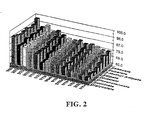
- FIG. 1 depicts the glass transition temperature (T g ) and FIG. 2 depicts the contact angle values for each of the 112 polymers. These histograms illustrate how the values for T g and contact angle incrementally varied over a wide range. T g values ranged from 2-91 °C and increased in about 1°C intervals from polymer to polymer while air-water contact angles ranged from 64-101° and increased in about 0.5° intervals from polymer to polymer.
- FIGS. 5a and 5b depict structure-property correlations within a subset of 72 polymers whose variable regions ("Y" and "R” in FIG. 4 ) were aliphatic, non-oxygen containing moieties.
- the total flexibility index (TFI) was defined as the number of carbon atoms incorporated at the modification points in the backbone and pendent chain.
- the exclusion of polymers containing oxygen atoms within their variable regions made it possible to isolate the effects related to the steric bulk of the pendent chain and the mobility/flexibility of the polymer backbone.
- FIG. 5a Plots of T g and contact angle values versus TFI for these polymers are shown in FIG. 5a . These plots indicate that as TFI increases the T g values decreased in an exponential fashion and that T g values were modeled by the curve fitting equation shown , in FIG. 5a . Air-water contact angles correlated with TFI in a linear fashion ( FIG. 5b ). Overall, varying the number of methylene groups in either the pendent chain or backbone were effective means for changing T g and contact angle over a wide range and in a predictable fashion.
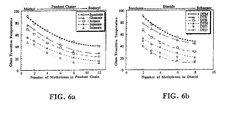
- FIGS. 6A and 6B are two plots illustrating how T g varies with increasing numbers of methylene groups in the pendent chain and backbone respectively. Each point in these plots represents one specific polymer (excluding polymers with branched, aromatic, and oxygen-containing variable regions "R" and "Y”).
- the T g values decreased exponentially as methylene groups were added to either the pendent chain or backbone.
- the exponential curves are non-intersecting and similar in shape indicating that alterations in either the pendent chain or backbone produced a similar change in T g .
- polyarylate library also noteworthy of this polyarylate library is that select polymers have glass transition temperatures close to or below body temperature. Hence, devices made of these polymers can be designed to remain either in a glassy state or to assume a rubbery state when implanted.
- FIGS. 7a and 7b An analogous set of plots are shown in FIGS. 7a and 7b for changes in contact angle.
- alterations in the pendent chain or backbone produced different changes in the contact angle.
- the steeper curve slopes observed in the graph of contact angle vs. pendent chain suggests that surface hydrophobicity was more efficiently influenced by varying the number of methylene groups in the pendent chain. The slopes were also greater for modifications on the lower methylene homologues compared to the higher homologues.
- FIGS. 1 and 2 depict that the substitution of oxygen atoms in place of methylene groups in the diphenol pendent chain and the diacid backbone had a significant effect on the glass transition temperature.
- Oxygen substitution in the diacid backbone increased T g .
- the replacement of one single methylene group in the diacid backbone with an oxygen atom resulted, on average, in an increase of 8°C (range 2-13°C) in the respective T g values.
- oxygen substitution in the diphenol pendent chain decreased T g in a comparison of the DTG series of polymers to the comparable DTO series of polymers.
- the oxygen substituted DTG series had an average T g that was 13 °C (range 11-15°C) less than the comparable fully hydrocarbon DTO series of polymers.
- Oxygen substitution in either the backbone of the diacid or the pendent chain of the diphenol decreased the surface hydrophobicity of the polymers compared to the corresponding polymers having only methylene groups in their variable regions.
- All polymers derived from dioxaoctanedioic acid exhibited, on average, an air-water contact angle 5° (range 0-10°) less than the corresponding polymers derived from suberic acid.
- all the library polymers with the oxygen-containing DTG pendent chain had air-water contact angles that were on the average 10°C (range 2-17°C) less than the contact angles of the corresponding DTO polymers.
- the polyarylate library encompasses a broad range of mechanical properties.
- the stiffest of the polyarylates has mechanical properties similar to poly(D,L-lactic acid), while the most flexible polymers within the library have mechanical properties resembling those of soft polysiloxanes.
- the mechanical properties of a subset of eleven polymers chosen to represent a range of glass transition temperatures from 28°C to 78°C in approximately 5° intervals are listed in Table 1 in order of decreasing T g . In this subset of materials, Young's modulus varied from 0.28 - 1.68 GPa and yield strength ranged from 5.8 - 44.8 MPa. There are no observable incremental correlations between polymer structure and stiffness or yield strength.
- Fibroblast proliferation ranged from approximating that typically seen on tissue culture polystyrene (TSPS) dishes (poly(DTM glutarate) and poly(DTM succinate)) to complete absence of any proliferation (poly(DTD adipate) and poly(DTD succinate)).
- TSPS tissue culture polystyrene
- the proliferation of fibroblasts on materials derived from non-oxygen containing diacids exhibits a strong, linear correlation with the contact angle ( FIGS. 7a and 7b ).
- FIGS. 7a and 7b As indicated by the highly negative slopes of the curves, cell proliferation decreases as the air-water contact angle increases from 65-100°. This is in agreement with the general observation that more hydrophobic polymer surfaces are poorer cell growth substrates for fibroblasts.
- Fibroblast proliferation is more sensitive to the chemical structure of the polymer than the absolute contact angle measurement.
- the series of polymers having a methyl ester pendent chain (DTM) are all excellent, almost equivalent growth substrates (average 91% of TCPS proliferation; range 79-115%) even though the contact angles range from 66° to 77°.
- poly(DTB sebacate) and poly(DTH adipate) have an air-water contact angle of 84°, yet cell proliferation (relative to TCPS) is 58 % and 16 % respectively.
- cell proliferation decreases linearly as methylene groups are successively added to the pendent chain.
- this decrease is not directly correlated with the absolute contact angle measurement of the surface and the slopes of the respective regression curves are different for each of the polymer subgroups. That is, the chemical structure of the diacid in the polymer backbone modulates the cellular response to the pendent chains.
- FIG. 7a A particularly striking example of the effect of oxygen substitution on the cellular response is the direct comparison of poly(DTD glutarate) and poly(DTD diglycolate) ( FIG. 7a ). These two polymers have identical structures, except that one single methylene group in the backbone of poly(DTD glutarate) has been replaced by an oxygen atom in poly(DTD diglycolate). This small structural change has very little effect on the overall polymer properties and the two polymers have virtually identical air-water contact angles of 96° and 97°, respectively. Yet fibroblasts do not proliferate on poly(DTD glutarate) to any significant extent, while substantial cell proliferation is observed on identical surfaces prepared from poly(DTD diglycolate). This is a valuable finding since it demonstrates that careful polymer design makes it possible to "decouple" the correlation between surface hydrophobicity and cell proliferation.
- the present invention includes polyarylate copolymers having the structure of Formula I in which R, R 1 , R 2 and b are the same as described above with respect to Formula I and at least one of R, R 1 and R 2 contain an ether linkage.
- R 1 is preferably -CH 2 -CH 2 - and b is preferably one.
- R 2 is preferably hydrogen or an ethyl, butyl, hexyl, octyl or benzyl group.
- R when it contains an ether linkage, is preferably -CH 2 -O-CH 2 - or -CH 2 -O-CH 2 -CH 2 -O-CH 2 -.
- R 1 or R 2 contain an ether linkage
- R preferably, when aliphatic, contains from 4 to 12 carbon atoms.
- aromatic preferably contains from 8 to 14 carbon atoms.
- R is even more preferably selected so that the dicarboxylic acids from which the polyarylates are polymerized are either important naturally-occurring metabolites or highly biocompatible compounds.
- Preferred aliphatic dicarboxylic acids therefore include the intermediate dicarboxylic acids of the cellular respiration pathway known as the Krebs Cycle.
- dicarboxylic acids include alpha-ketoglutaric acid, succinic acid, fumaric acid, maleic acid and oxalacetic acid.
- Other preferred biocompatible materials include sebacic acid, adipic acid, oxalic acid, malonic acid, glutaric acid, pimelic acid, suberic acid and azelaic acid.
- aromatic dicarboxylic acids are terephthalic acid, isophthalic acid and bis(p-carboxyphenoxy) alkanes such bis(p-carboxyphenoxy) propane.
- R 1 can contain an ether linkage when it is either -CHNHL 1 or -CHNL 1 L 2 , wherein at least one ether linkage is located in the alkyl group of L 1 or L 2 .
- R 1 or R 2 contains an ether linkage the moiety is preferably -CH 2 -CH 2 -O-CH 2 -CH 2 -O-CH 2 -CH 2 OH.
- Polyarylate copolymers in accordance with the present invention have weight average molecular weights between about 20,000 and 400,000 daltons, and preferably about 100,000 daltons, measured by GPC relative to polystyrene standards without further correction.
- Tyrosine-derived diphenol monomers in which either R 1 or R 2 contain at least one ether linkage are also included within the scope of the present invention.
- Such monomers have the structure of Formula II, in which R 1 , R 2 and b are the same as described above with respect to Formula II.
- R 1 is preferably -CH 2 -CH 2 -, in which case R 2 will contain an ether linkage, preferably the aforementioned -CH 2 -CH 2 -O-CH 2 -CH 2 -O-CH 2 -CH 2 OH.
- R 1 is either -CHNHL 1 or -CHNL 1 L 2 , wherein either L 1 or L 2 contains at least one ether linkage
- R 2 is preferably hydrogen or an ethyl, butyl, hexyl, octyl or benzyl group.
- the preferred ether linkage-containing moiety for L 1 or L 2 is also the aforementioned CH 3 -CH 2 -O-CH 2 -CH 2 -O-CH 2 -CH 2 OH-.
- polyarylate copolymers were designed for use in medical applications requiring degradable materials.
- a medical application might require a soft, pliable (low T g ) material which is hydrophobic (low contact angle), while another application might require a relatively hard, stiff (higher T g ) material which is hydrophilic, while both applications may require properties that are commonly shared among all library materials such as processibility by molding, biocompatibility, degradability, and amorphous morphology.
- the monomers were chosen to provide incremental differences in polymer free volume, bulkiness, flexibility, and hydrophobicity. Corresponding structural variations in the two sets of monomers did not affect polymers properties equally. Thus, the monomer modifications were complementary because variation of the pendent chain did not have the same influence on polymer properties as the same modification to the polymer backbone.
- the three broad types of modification on the pendent chain and backbone structure were (1) simple homologative type variations to vary the number of methylene groups, (2) substitution of oxygen for methylene groups, and (3) branching.
- the pendent chain modifications were all carried out with the tyrosine-derived diphenols which were prepared by a common synthetic process while backbone modifications were achieved by the judicious use of commercial diacids and hydroxyphenyl alkyl acids.
- poly(amide esters) of WO 98/36013 Similar modifications are expected to provide useful results with the poly(amide esters) of WO 98/36013.
- R 5 and R 6 are each independently selected from hydrogen and straight or branched alkyl groups having up to 18 carbon atoms and R 4 is (-CH 2 -) b , wherein b independently has a value between zero and eight, inclusive.
- R 2 is selected from straight and branched alkyl and alkylaryl groups containing up to 18 carbon atoms, and R is selected from saturated and unsaturated, substituted and unsubstituted alkyl, aryl and alkylaryl groups containing up to 18 carbon atoms.
- At least one of R, R 2 , R 5 , R 6 and, when R 3 is -CHNL 1 L 2 , L 1 or L 2 contains at least one ether linkage.
- R 3 is preferably (-CH 2 -) a , with a being zero, and R 5 and R 6 are preferably independently selected from hydrogen and methyl. Most preferably, at least one of R 5 and R 6 is hydrogen, while the other, when not hydrogen is methyl. The value for b is preferably one. Thus, it is preferred that at least one of R and R 2 contain at least one ether linkage. Preferred ether and non-ether species for R and R 2 are the same as described above for the polyarylates of the present invention.
- R 4 is (-CH 2 -) b , wherein b independently has a value between zero and eight, inclusive; and R 2 is selected from straight and branched alkyl and alkylaryl groups containing up to 18 carbon atoms. At least one of R 2 , R 5 , R 6 and, when R 3 is -CHNL 1 L 2 , L 1 or L 2 , contains at least one ether linkage.
- the preferred species of R 2 ,R 3 ,R 4 , R 5 , R 6 , a and b are the same as described above with respect to the poly(amide esters) of the present invention. In preferred dihydroxy monomer compounds, only R 2 contains an ether linkage.
- a basic requirement is to prepare a large enough amount of each polymer with sufficiently high molecular weight to establish basic structure-property correlations.
- first, easily purified monomers are preferred that have comparable reactivities at the polymerizable functionality so the same polymerization conditions can be used to prepare the entire library.
- second, in order to routinely construct polymer libraries the potential for automating the entire process is also of considerable importance.
- the process of isolation and purification should be designed so the individual polymers are never removed from the reaction vessel.
- the polyarylate copolymers are intended for use in medical applications.
- a fundamental result of the inventive methodology is that more meaningful biological correlations are derived.
- In vitro correlations between polymer structure and the proliferative response of rat lung fibroblasts were established.
- cell response screening studies of biomedical polymers have been conducted in the past, the lack of common structural features among test materials prevented the identification of correlations between chemical structure and cellular response.
- the polyarylate copolymers exhibited systematic variations in structure while sharing a range of common properties it was possible to correlate biological response with defined changes in the chemical structure of the tested polymers. This is a widely used approach in the pharmaceutical industry for the development of small molecule drugs, however the prior art does not address this issue with respect to the development of degradable polymeric biomaterials.
- the inventive methodology produced a library which facilitates the selection of polymers for biomedical applications in ways not previously possible in the prior art. For example, polymers with an air-water contact angle around 70° often lead to optimum cell attachment and proliferation. From this polymer library it is possible to choose polymers of similar structure having a 70° contact angle that span a wide T g range, including polymers that would be either glassy or rubbery at body temperature. In other subgroups of polymers, the glass transition can be kept constant while the air-water contact angle can be varied over a wide range.
- Tyrosine alkyl esters were coupled with recrystallized 3-(4-hydroxyphenyl)-propionic acid (or in some cases, 4-hydroxyphenylacetic acid) using EDCI (1.0 eq.) and HOBt (0.1 eq.) in a solution of either N-methylpyrrolidinone-ethyl acetate (1:3; 1.5M concentration in tyrosine ester) or acetonitrile (0.75M concentration in tyrosine ester). After aqueous workup, the desaminotyrosyl-tyrosyl diols 1 were obtained in purities up to 99 % (HPLC) and 98% (DSC). Most of the diacids 2 were commercially available in at least 99% purity. Less pure diacids 2 were recrystallized.
- Dimethylaminopyridinium-p-toluenesulfonate (0.06-0.08g), methylene chloride (4 mL), and diisopropyl-carbodiimide (0.35 mL) were then sequentially added to the vial which was tightly capped and Parafilmed.
- the vials were transferred to a Labline water bath shaker (model 3540) and agitated (250 rpm) at 30 ⁇ 1° C for 36-48h. Work-up consisted of diluting each vial reaction mixture with 16 mL methanol, recapping the vial, and vigorously shaking to precipitate the polymer 3 , then decanting the supernatant leaving the polymer in the vial.
- the polymer was then dissolved in methylene chloride (1-2 mL) followed by the addition of methanol (18 mL), vigorous shaking to re-precipitate the polymer, and decanting the supernatant. Methanol (5 mL) was added to the vial and decanted as a final rinse.
- the polymer 3 was dried at ambient temperature in vacuum for 1 day then in vacuum at 45° C for one day.
- the reaction was stirred for 24-36 hours and then was transferred to a separatory funnel and slowly added to a stirred (mechanical stirrer) solution of methanol (at least 10 volumes) to precipitate the polymer 3 .
- the supernatant was decanted and the polymer transferred to a separatory funnel, dissolved into methylene chloride (8-10% w/v), and precipitated into either methanol or isopropanol (10 volumes). Again the supernatant was decanted and then the polymer rinsed in methanol (or isopropanol).
- the polymer 3 was then dried in vacuum at ambient temperature for 2-3 days then in vacuum at 45° C for 2 days.
- the gel permeation chromatographic system consisted of either a Perkin Elmer pump model 250 or a Waters pump model 510, a Waters refractive index detector model 410, and either two PL-gel GPC columns (pore size 10 5 and 10 3 ⁇ ) or two Waters Styragel 7.8x300 mm GPC (HR3 and HR4) columns operated in series at a flow rate of 1 mL/min in THF.
- Molecular weights were calculated relative to polystyrene standards without further correction using Waters Millenium Chromatography Manager software on a Digital VenturisFP model 466 personal computer. Samples (5 mg/mL) were filtered (PTFE, 0.45 mL syringe filter) prior to injection.
- T g polymer glass transition
- monomer absolute purities a thermal analyzer model DSC 910 (TA Instruments, Delaware) calibrated with indium was used to determine polymer glass transition (T g ) temperatures and monomer absolute purities.
- T g measurement each specimen was subjected to two consecutive DSC scans with a heating rate of 10°C min -1 . After the first run to 50°C above T g the specimen was quenched with liquid nitrogen to at least 50°C below T g and the second scan was immediately obtained from which the T g was determined by the midpoint on the endothermic changes associated with the glass transition. The reproducibility of the T g measurement was within 1 °C for different specimens and polymer batches.
- Monomer purity was measured by heating a previously dried (50°C in vacuum) sample (2-3 mg) at a rate of 10°C min -1 until the temperature was ca. 20°C below the melting point and then the heating rate reduced to 1°C min -1 until the temperature reaches about 10°C above the melting point. After this heating cycle, the purity and depression were determined.
- T g values for the library of polyarylates are shown in Table III.
- TABLE III T g Values For The Library Of Polyarylates Succinate Diglycolate Glutarate Adipate 3-Methyl Adipate Dioxaoctanedioate Suberate Sebacate (1) (2) (3) (4) (5) (6) (7) (8) DTM (1') 91 82 76 69 68 63 55 47 DTiP (2') 82 80 68 58 54 58 46 44 DTE (3') 78 79 69 61 63 53 50 44 DTBn (4') 78 76 66 61 60 55 47 42 HTB (5') 73 66 65 65 63 50 54 43 DTiB (6') 75 72 62 56 47 50 42 33 DTsB (7') 75 68 58 50 56 44 46 36 DTB (8') 67 64 55 46 45 45 37 30 HTH (9') 59 46 42 32 38 31 27 23 DTH (10') 53 45 43 38 33 28 27 20 H
- the decomposition temperature (Td) was determined by thermogravimetric analysis on a TGA 951 (TA Instruments, Delaware) and was reported at 10% decrease in weight. The heating rate was 10°C min -1 and the average sample size was 30 mg.
- Air-water contact angles were measured on a Rame-Hart goniometer model 100-00-115 using double distilled water as the probe. The water was deposited onto the polyarylate spin coated glass cover slip in a small volume from above forming a sessile drop having a diameter of approximately 2.5 mm. Results were the average of at least 5 measurements (error ⁇ 1 °).
- Each polyarylate solution was prepared by first adding about 20-30 mg of polymer to a tared glass vial and adding enough methylene chloride to give a 2.5% (w/v) solution which was then filtered (PTFE syringe filter, 0.45 mm). Cover slips were removed from the methylene chloride solution and spun dried. Polymer solution was added to provide complete coverage of the glass surface which was then spun for 20 seconds at 2000 rpm. The procedure was repeated twice more to ensure a smooth surface and then the cover slips were placed into individual disposable petri dishes and dried at ambient temperature in vacuum prior to contact angle measurement.
- cover slips (15 mm diameter) were cleaned in the same way as were the cover slips used for contact angle measurement. After the final sonication in methylene chloride, the cover slips were rinsed twice in ethyl acetate and then sonicated twice (5 minutes) in a 2.5% (w/v) poly(styrene-silane) copolymer-ethyl acetate solution. The cover slips were soaked in this solution a further 10 minutes, then placed flat one cover slip high in glass petri dishes, and stored in an oven at 60°C in vacuum for 2 days.
- cover slips were removed from the vacuum oven and rinsed in ethyl acetate (2x) and methanol (2x), and then ethyl acetate once more before drying on crumbled aluminum foil in air for 30 minutes.
- the cover slips were then stored in a glass vial until needed for spin coating.
- Filtered (PTFE syringe filter, 0.45 mm) 2.5%(w/v) polyarylate-methylene chloride solutions were used to spin coat each glass cover slip two times to ensure a smooth surface.
- the polymer solution was added to provide complete coverage of the glass surface which was then spun for 20 seconds at 2000 rpm.
- the cover slips were handled either with tweezers or on the edge by hand while wearing latex disposable gloves and carefully placed into individual wells in non-tissue culture treated 24-well cell culture plates which were then stored at ambient temperature in vacuum until needed for use.
- R 2 CH 3 CH 2 O-CH 2 CH 2 O-CH 2 CH 2 - C 24 H 31 NO 7 Molecular Weight, 445.53 Melting Point (°C), oil at ambient temperature.
Landscapes
- Health & Medical Sciences (AREA)
- Chemical & Material Sciences (AREA)
- Medicinal Chemistry (AREA)
- Chemical Kinetics & Catalysis (AREA)
- Public Health (AREA)
- Veterinary Medicine (AREA)
- Epidemiology (AREA)
- Life Sciences & Earth Sciences (AREA)
- Animal Behavior & Ethology (AREA)
- General Health & Medical Sciences (AREA)
- Polymers & Plastics (AREA)
- Organic Chemistry (AREA)
- Surgery (AREA)
- Vascular Medicine (AREA)
- Transplantation (AREA)
- Dermatology (AREA)
- Oral & Maxillofacial Surgery (AREA)
- Heart & Thoracic Surgery (AREA)
- Materials Engineering (AREA)
- Engineering & Computer Science (AREA)
- Polyesters Or Polycarbonates (AREA)
- Other Resins Obtained By Reactions Not Involving Carbon-To-Carbon Unsaturated Bonds (AREA)
- Organic Low-Molecular-Weight Compounds And Preparation Thereof (AREA)
- Materials For Medical Uses (AREA)
- Polyethers (AREA)
Description
- The present invention relates to the construction of libraries of polymers based on the design principle of introducing systematic variations in the structure of a copolymer in at least two separate and independently variable domains within the copolymer structure. The inventive methodology is broadly applicable to the development of copolymers where complex requirements necessitate a careful optimization of copolymer structure.
- This invention is also related to the preparation of tyrosine-derived monomers as disclosed in
U.S. Patent No. 5,587,507 and to the preparation and use of polyarylates as disclosed inU.S. Patent Nos. 5,216,115 and5,317,077 . - Combinatorial approaches that have led to dramatic changes in the way lead compounds for the discovery of new drugs are identified are disclosed by Lowe, JCS Reviews, 309-317 (1995). As usually practiced in the pharmaceutical industry, combinatorial schemes are used to create a large number of structurally related compounds (almost always within a single reaction vessel) followed by the identification of potential lead compounds in a selective bioassay. Such combinational schemes are disclosed by Mischer, ChemTracts-Org. Chem., 8(1), 19-25 (1995). This approach is not readily applicable to the design of engineering polymers or biomaterials. Starting with a mixture of monomers and creating a large number of different polymers within the same reaction vessel would result in a blend of polymers that would be difficult to resolve into individual compounds. While such approaches are disclosed by
EP 789,671 - Correlations between chemical structure and the properties of polymers were explored since the early 1930's when the macromolecular structure of polymers was first-recognized. Sometimes, materials are studied in "sets" of structurally unrelated materials. For example, studying the tensile strength of glass, iron, paper, wood, and polyethylene may lead to the identification of a material with suitable strength for any given application, however, because of the lack of any systematic variation in structure between the test materials, it is impossible to draw any generally useful conclusions from such a study.
- A study design of somewhat greater sophistication is illustrated by Ertel et al., J. Biomed. Mater. Res., 28, 919-930 (1994). A group of four polymers was investigated that had identical backbone structures but differed in the length of an alkyl ester pendent chain attached to the polymer backbone at each repeat unit. In this study, a relatively small number of polymers were compared and valid conclusions were drawn regarding the effect of increasing pendent chain length on selected polymer properties such as glass transition temperature, rate of chemical degradation etc. It is estimated that hundreds of studies of this kind have been reported in the literature. The main limitation of this study design is that only one single structural variable can be explored.
- A study design of greater complexity attempts to correlate the effect of two or more structural variables on a set of selected materials properties. For example in the field of poly(acrylic acid) derivatives, a limited number of studies attempted to correlate the effect of simultaneous variations within the chemical structure of the acrylate pendent chains. Although such studies are known in the literature, the general paradigm of combinatorial synthesis has never been applied to the combinatorial synthesis of copolymers with systematic and defined structural features. In terms of the requirements for library design, this approach is unknown in the prior art.
- Menger et al., J. Org. Chem., 60, 6666-6667 (1995), exposed a preformed polymer with reactive pendent chains to a reaction mixture that contained a series of different reactants. As a random coupling procedure was initiated, random sequences of pendent chains were attached to the preexisting polymer backbone. In essence, this is an approach whereby an untraceable mixture of pendent chain sequences were all prepared at once. The individual sequences could not be isolated and no structurally defined materials were obtained. Rather, the entire mixture was tested for a specific catalytic activity and it was impossible to detect which particular pendent chain sequence was responsible for any observed catalytic activity.
- Considering the cost and time required to identify carefully designed and optimized polymeric materials as "specialty polymers" in many different industrial, medical, and scientific applications, there is a great need to develop new paradigms and approaches that can (1) increase the number of candidate polymers available for any specific application and (2) systematize the study of correlations between polymer structure on one hand and material properties and performance on the other hand.
- This need is met by the present invention, the invention being defined by the appended independent claims. Preferred embodiments are defined in the dependent claims. An important aspect of this invention is that systems of monomers is used in such a way that a large number of polymers can be synthesized in a parallel fashion so that each polymer contained within the resulting library is obtained in pure form in its own reaction vessel. One of the important advantages of this approach is that libraries of polymers are obtained which facilitate the establishment of simple and useful correlations between systematic changes in the chemical composition of the polymers on one hand and a wide range of physicomechanical and biological properties on the other hand.
- The practical utility of this approach depends on a chemical design that provides for the formation of copolymers of the type A-B, or A-B-C, and so forth. In the example of A-B type copolymers, two sets of reactants Am and Bn, the copolymerization in all possible combinations of all monomers of set A with all monomers of set B will give a library with a total of A x B products. It has now been established that if the A and B monomers possess deliberate structural design features, the resultant library will be endowed with informative permutations of these characteristics.
- The usefulness of this approach in rapidly developing large arrays of polymers with systematically varying properties can be further illustrated by the extension of this principle to polymers that are derived of more than 2 monomeric species. For example, using an A-B-C terpolymer design, the copolymerization of a set of 10 A's with 10 B's and 10 C's will give rise to 1000 different combinations. For sake of clarity, the following discussion is limited to strictly alternating A-B type copolymers with the understanding that the principles discussed can be readily extended to alternating polymers derived from more than two separate monomeric species.
- Therefore, in accordance with the present invention, it is now possible to copolymerize a set of monomers derived from one structural template, with another set of monomers derived from a different structural template, so that the copolymerization of all members of the first set with all members of the second set in a preferably PARALLEL synthesis will lead to a library of copolymers in which the individual members of the library exhibit unusually systematic and regular variations in key end-use properties.
- In the context of the present invention there is disclosed a multi-dimensional copolymer array, comprising a plurality of copolymers polymerized from at least two independently variable sets of monomers, wherein the polymerization is characterized by:
- (a) selecting a first homologously varying series of monomers with non-varying polymerizable functional groups;
- (b) selecting at least one additional homologously varying series of different monomers having non-varying polymerizable functional groups that are reactive with the polymerizable functional groups of the first series of monomers to form copolymers; and
- (c) separately reacting a plurality of monomers from the first monomer series with a plurality of monomers from each of the additional monomer series to form the plurality of copolymers;
- The copolymers include both condensation-type copolymers and copolymers prepared by free-radical polymerization. The homologous variations within each monomer series are preferably selected to minimize any effect upon the reactivity of the polymerizing functional groups of the monomers within each series.
- For purposes of the present invention, homologous series are defined not only as relating to substituent groups on a series of monomers, but also including variations within the monomer backbone structure such as the introduction of unsaturation, the inclusion of additional methylene units, the replacement of a methylene carbon with a nitrogen or any other suitable atom, the replacement of a methylene unit with an oxygen or sulfur atom, or any other suitable atom, the replacement of a methylene unit with another unit including, but not limited to, a keto- unit, an amide unit, or an ester unit, and the like. For purposes of the present invention, hydrogen is treated as a member of homologous substituent series.
- To obtain a library of polymers where selected end-use properties change in a predictable and systematic fashion, the monomer sets A and B must be designed to provide complementary structural variations. Preferred target end-use properties for investigation include glass transition temperature, surface tension, and biological interaction with living cells. The unique utility of such polymer libraries is twofold. The approach as described here can be used to (1) increase the number of candidate polymers available to be evaluated for any specific application and (2) systematize the study of correlations between polymer structure, end-use properties, and performance.
- Further disclosed is a method is provided for determining the effect of independently varying at least two different structural features of a copolymer on an end-use property of the copolymer, which method includes the steps of:
- (a) measuring at least one end-use property of each of a plurality of copolymers prepared according to the present invention; and
- (b) comparing the variations in each end-use property measured for each of the copolymers as a function of the homologous variation within the monomer series from which the copolymers were polymerized to determine any relationship between the homologous variations and the end-use property variations among the copolymers;
- Through the use of the inventive methodology it was unexpectedly discovered that polyarylate copolymers, prepared by the condensation of a tyrosine-derived diphenol compound and a dicarboxylic acid, and having an ether linkage in either the polymer backbone or the polymer side chain were good cell growth substrates despite being very hydrophobic. Therefore, another aspect of the present invention relates to the use of polyarylates as defined in the appended claim 1.
- The polyarylate copolymers used in the context of the present invention and having ether linkage-containing side chains are the condensation product of a dicarboxylic acid with a tyrosine-derived diphenol compound having at least one side chain containing at least one ether linkage. These diphenol compounds are novel and non-obvious in view of their unexpected ability to condense with a dicarboxylic acid to form a polyarylate copolymer that is unexpectedly both a good cell growth substrate and very hydrophobic. Therefore, according to another aspect of the present invention, a tyrosine-derived diphenol compound is provided having the structure of Formula II:

- A more complete appreciation of the invention and many other intended advantages can be readily obtained by reference to the following detailed description of the preferred embodiment and claims in conjunction with the accompanying drawings, which disclose the principles of the invention and the best modes which are presently contemplated for carrying them out.
-
-
FIG. 1 depicts the correlation between polymer glass transition temperature (Tg) and the chemical structure of polymer backbone (y axis) and pendent chain (x axis); -
FIG. 2 depicts the correlation between the air-water contact angle (a measure of surface hydrophobicity and the chemical structure of polymer backbone (y axis) and pendent chain (x axis); -
FIG. 3 depicts the general structure of polyarylates in accordance with the present invention; -
FIGS. 4a and4b depict the first and second homologous series of monomers employed in the method of the present invention to create the polyarylate copolymers of the present invention; -
FIG. 5a depicts the correlation between Tg and the number of carbon atoms incorporated at the modification points of the polymer backbone and pendent chain, expressed as the total flexibility index (TFI); -
FIG. 5b depicts the correlation between air-water contact angle and the number of carbon atoms incorporated at the modification points of the polymer backbone and pendent chain; -
FIG. 6a depicts the correlation between Tg and the number of carbon atoms incorporated at the modification point of the polymer pendent chain; -
FIG. 6b depicts the correlation between Tg and the number of carbon atoms incorporated at the modification point of the polymer backbone; -
FIG. 7a depicts the correlation between fibroblast proliferation and surface hydrophobicity for poly(DT ester glutarates) and poly(DT ester glycolates); and -
FIG. 7b depicts the correlation between fibroblast proliferation and surface hydrophobicity for poly(DT ester suberates) and poly(DT ester dioxaoctanedioates). - The general concept of the present invention and its application to biomaterials development is illustrated here for polyarylate copolymers prepared by the condensation of a diacid with a diphenol according to the method described by the above-referenced
U.S. Patent No. 5,216,115 , in which diphenol compounds are reacted with aliphatic or aromatic dicarboxylic acids in a carbodiimide mediated direct polyesterification using 4-(dimethyl-amino) pyridinium-p-toluene sulfonate (DPTS) as a catalyst. However, one of ordinary skill in the art will understand how this concept may be extended to other condensation or free radical polymerization reactions for other end-uses in addition to the preparation of biomaterials. - For example, in addition to monomer series in which the polymerizable functional groups are hydroxyl and carboxylic acid groups, other monomer series suitable for use with the present invention in condensation-type polymerization reactions include monomers having polymerizable amino, ester, anhydride, and isocyanate functional groups. The polymerizable functional group may also be activated to react with the polymerizable functional groups of the other monomer series.
- When the polymerizable functional group of the first monomer series is a hydroxyl or amino group, monomer series suitable for use as additional monomer series include monomer series in which the polymerizable functional group is a carboxylic acid, isocyanate, ester or anhydride group. For condensation reactions in which two additional monomer series are employed, the second additional monomer series include alkylene oxide monomers. Examples of suitable alkylene oxide monomers include ethylene oxide, propylene oxide, isopropylene oxide, butylene oxide, isobutylene oxide and block and random copolymer segments thereof.
- Condensation-type polymerization reactions include both interfacial and suspension processes. However, the present invention also includes copolymers prepared by free radical processes including ionic polymerization processes.
- The synthesis reactions may be performed in solution or in bulk and with or without a catalyst. The reaction products may be further modified by chemical reactions or by cross-linking. Such synthesis features are well-known to those of ordinary skill in the art and require no further explanation.
- A particularly preferred monomer series for use as the first monomer series are the tyrosine-derived diphenol monomers of
U.S. Patent Nos. 5,587,507 and5,670,602 . The preferred diphenol monomers are desaminotyrosyltyrosine esters, which are referred to as DT esters. For purposes of the present invention, the ethyl ester is referred to as DTE, the benzyl ester as DTBn, and so forth. Both patents disclose methods by which these monomers may be prepared. As noted above, the diphenol monomers may be employed in the synthesis of the polyarylates disclosed byU.S. Patent No. 5,216,115 . - The general structure of polyarylates is shown in
Figure 3 . These materials are strictly alternating A-B type copolymers consisting of a diacid component (the "A" monomers) and a diphenol component (the "B" monomers). The diacids allow for variation in the polymer backbone while the diphenols contain a moiety for appending and varying a pendent chain. While the diphenol is a tyrosine-derived dimer, it functions as a single monomer unit in the condensation reactions of the present invention, so that the condensation product of the diphenol with the diacid is considered a strictly alternating polyarylate copolymer when a third homologous monomer series is not employed. - Each set of monomers was derived from a single structural template that was varied according to the schemes shown in
FIG. 4 . Care was taken to include only those compounds within the monomer sets of diacids and diphenols that had roughly identical reactivity at their reactive groups. In this way all polymers within the library, when prepared under identical reaction conditions, were expected to reach comparable molecular weights. Based on the above selection criteria, a total of 8 different aliphatic diacids and 14 different diphenols were identified for inclusion in the sets of monomers. - Next, a grid of small reaction vessels was set up within a water shaker bath so that each reaction vessel contained one of the 8 x 14 = 112 different monomer combinations. Although the addition of monomers and reagents was performed in a manual fashion in these initial feasibility studies, the process of dispensing the appropriate monomers and reagents within the reaction vessels could be readily automated.
- Molecular weights (Mw) for the entire library of 112 polyarylates ranged from 50,000 to 150,000 g/mole. Polymer polydispersities ranged from 1.4 to 2.0. These values indicate that all polymers contained within the library were of sufficiently high molecular weight and of sufficiently similar polydispersity to allow meaningful comparisons of their respective material properties. All polymers had the expected chemical structure, as confirmed by 1H-NMR spectrometry.
- At least one end-use property of each polymer is then measured and the variations in each measured end-use property are compared as a function of the homologous variations within the series of monomers to determine any relationship or lack thereof between the homologous variations and the series of monomers and the measured variations in end-use properties for the resulting polymers. The end-use properties may be measured simultaneously, serially or in a spatially selected manner. Measurement techniques include ELISA, SAM, chromatographic methods, DSC, TGA, DMA and TMA. Microscopic techniques may also be employed, as well as processing methods such as extrusion, solvent casting, compression molding, injection molding and microencapsulation.
- End-use properties that may be measured are typically physical properties such as mechanical properties, viscoelastic properties, morphological properties, electrical properties, optical properties (such as polarizability), solute and gas permeability, thermal properties (including glass transition temperature and degradation properties), surface tension properties, and the like. Examples of morphological properties include liquid crystalline properties, phase-separated microdomain formation, the short- and long-range order of polymer chains, and the like. Examples of electrical properties include, dipole properties, pizeoelectric properties, dielectric properties, and the like.
- Other end-use properties that may be measured include, but are not limited to, antibacterial activity, blood compatibility, tissue compatibility, drug release characteristics, biological interactions with living organisms, specifically the ability to support cell attachment and proliferation required for the construction of scaffolds for tissue engineering, hydrolytic degradation in vivo, protein adsorption characteristics, and the like. Still more end-use properties that may be measured include, but are not limited to, processability, radiation stability, sterilizability, adhesive properties, hydrophobic characteristics (as measured by air-water contact angle and other techniques), a stability to specific reaction conditions, and the like. For purposes of the present invention, end-use properties are also defined as including the use of the inventive method to identify monomers for condensation-type polymerization reactions that are sufficiently miscible for the condensation-type reaction to occur under interfacial or suspension polymerization process conditions.
- Other end-use properties relate to self-assembly, aggregation (micelle formation) and the formation of ordered networks (gels) in aqueous or organic solutions. These properties are controlled by the hydrophilic-hydrophobic balance of the monomers used in the design of the polymeric libraries and are measured by rheological studies in solutions, dynamic light scattering, or by visualization of self-assembled aggregates by microscopic techniques such as atomic force microscopy.
- Important mechanical end-use properties include tensile strength, Young's modulus and yield strength. An important thermal property is glass transition temperature. Other important end-use properties are surface tension, air-water contact angle as a measure of hydrophobicity, and biological interactions with living cells.
-
FIG. 1 depicts the glass transition temperature (Tg) andFIG. 2 depicts the contact angle values for each of the 112 polymers. These histograms illustrate how the values for Tg and contact angle incrementally varied over a wide range. Tg values ranged from 2-91 °C and increased in about 1°C intervals from polymer to polymer while air-water contact angles ranged from 64-101° and increased in about 0.5° intervals from polymer to polymer. - There are two useful ways to create more detailed correlations that include a larger number of polymers. First, it is possible to keep the polymer backbone composition constant while varying the polymer pendent chain of the diphenol repeating unit. For example, all polymers prepared from succinic acid but carrying different pendent chain alkyl esters would be such a subgroup. Second, it is possible to look at subgroups of polymers where the pendent chain is kept constant while the polymer backbone derived from the diacid repeating unit is varied. All polymers carrying a methyl ester pendent chain but containing different diacids would be such a subgroup. Using this approach, more detailed correlations examining selected subsets of polymers within the library were developed.
-
FIGS. 5a and 5b depict structure-property correlations within a subset of 72 polymers whose variable regions ("Y" and "R" inFIG. 4 ) were aliphatic, non-oxygen containing moieties. The total flexibility index (TFI) was defined as the number of carbon atoms incorporated at the modification points in the backbone and pendent chain. The exclusion of polymers containing oxygen atoms within their variable regions made it possible to isolate the effects related to the steric bulk of the pendent chain and the mobility/flexibility of the polymer backbone. - Plots of Tg and contact angle values versus TFI for these polymers are shown in
FIG. 5a . These plots indicate that as TFI increases the Tg values decreased in an exponential fashion and that Tg values were modeled by the curve fitting equation shown, inFIG. 5a . Air-water contact angles correlated with TFI in a linear fashion (FIG. 5b ). Overall, varying the number of methylene groups in either the pendent chain or backbone were effective means for changing Tg and contact angle over a wide range and in a predictable fashion. - More specific correlations of Tg and contact angle dependence on the chemical structure of the backbone and pendent chain are shown in
FIGS. 6A and 6B , which are two plots illustrating how Tg varies with increasing numbers of methylene groups in the pendent chain and backbone respectively. Each point in these plots represents one specific polymer (excluding polymers with branched, aromatic, and oxygen-containing variable regions "R" and "Y"). The Tg values decreased exponentially as methylene groups were added to either the pendent chain or backbone. The exponential curves are non-intersecting and similar in shape indicating that alterations in either the pendent chain or backbone produced a similar change in Tg. - Also noteworthy of this polyarylate library is that select polymers have glass transition temperatures close to or below body temperature. Hence, devices made of these polymers can be designed to remain either in a glassy state or to assume a rubbery state when implanted.
- An analogous set of plots are shown in
FIGS. 7a and 7b for changes in contact angle. In contrast, there was a linear increase in the air-water contact angle as methylene groups were added to either the pendent chain or backbone. Also, unlike the Tg relationships, alterations in the pendent chain or backbone produced different changes in the contact angle. The steeper curve slopes observed in the graph of contact angle vs. pendent chain suggests that surface hydrophobicity was more efficiently influenced by varying the number of methylene groups in the pendent chain. The slopes were also greater for modifications on the lower methylene homologues compared to the higher homologues. - Thus, the addition of methylene groups to the pendent chain had a greater relative effect in the succinate polymers than in the sebacate polymers. It is noteworthy that such detailed and predictive correlations between polymer structure and physical properties cannot usually be obtained in the absence of the combinatorial approach described here.
- Backbone branching was studied with the 3-methyl adipate series of polymers. Keeping the diphenol pendent chain constant and varying the diacid backbone was found to modestly effect Tg ranging from a 2°C increase to a 5°C decrease with an overall average decrease of 1 °C. Pendent chain branching studied with the iso- and sec-butyl esters, while keeping the diacid backbone constant, caused an average 6°C (range 3-10°C) increase in Tg over the linear pendent chain polymers. Branching at either the pendent chain or the backbone had little discernible influence on the surface hydrophobicity as measured by the air-water contact angle.
-
FIGS. 1 and2 depict that the substitution of oxygen atoms in place of methylene groups in the diphenol pendent chain and the diacid backbone had a significant effect on the glass transition temperature. Oxygen substitution in the diacid backbone increased Tg. Comparing the glutarate series of polymers to the diglycolate series of polymers, the replacement of one single methylene group in the diacid backbone with an oxygen atom resulted, on average, in an increase of 8°C (range 2-13°C) in the respective Tg values. - On the other hand, oxygen substitution in the diphenol pendent chain decreased Tg in a comparison of the DTG series of polymers to the comparable DTO series of polymers. The oxygen substituted DTG series had an average Tg that was 13 °C (range 11-15°C) less than the comparable fully hydrocarbon DTO series of polymers.
- Oxygen substitution in either the backbone of the diacid or the pendent chain of the diphenol decreased the surface hydrophobicity of the polymers compared to the corresponding polymers having only methylene groups in their variable regions. All polymers derived from dioxaoctanedioic acid exhibited, on average, an air-
water contact angle 5° (range 0-10°) less than the corresponding polymers derived from suberic acid. Similarly, all the library polymers with the oxygen-containing DTG pendent chain had air-water contact angles that were on the average 10°C (range 2-17°C) less than the contact angles of the corresponding DTO polymers. Still, some polymers such as poly(DTD diglycolate) (air water contact angle = 97°) had extremely hydrophobic surfaces in spite of the replacement of a methylene group by an oxygen atom in the polymer backbone. - The polyarylate library encompasses a broad range of mechanical properties. In qualitative terms, the stiffest of the polyarylates has mechanical properties similar to poly(D,L-lactic acid), while the most flexible polymers within the library have mechanical properties resembling those of soft polysiloxanes. The mechanical properties of a subset of eleven polymers chosen to represent a range of glass transition temperatures from 28°C to 78°C in approximately 5° intervals are listed in Table 1 in order of decreasing Tg. In this subset of materials, Young's modulus varied from 0.28 - 1.68 GPa and yield strength ranged from 5.8 - 44.8 MPa. There are no observable incremental correlations between polymer structure and stiffness or yield strength. However, those polymers whose glass transition temperature was below 35°C showed a dramatic drop in stiffness and tensile strength that was related to their impending transition from the glassy into the rubbery state.
TABLE I ROOM TEMPERATURE (22 °C) MECHANICAL PROPERTIES OF SELECTED POLYARYLATES Polymer Tg (°C) Young's Modulus (GPa) Yield Stress (Mpa) Strain at Break (%) poly(DTE succinate) 78 1.68 ± 0.17 40.7 ± 3.2 304 ± 102 poly(DTB succinate) 67 1.56 ± 0.18 44.8 ± 3.8 566 ± 36 poly(DTE adipate) 61 1.56 ± 0.10 42.0 ± 4.4 638 ± 152 poly(DTH succinate) 53 1.61 ± 0.10 44.8 ± 2.3 456 ± 103 poly(DTE suberate) 50 1.39 ± 0.10 39.9 ± 3.7 534 ± 91 poly.(DTO succinate) 48 1.41 ± 0.18 41.9 ± 4.5 622 ± 68 poly(DTB adipate) 46 1.49 ± 0.22 40.5 ± 3.5 710 ± 96 poly(DTE sebacate) 44 1.44 ± 0.06 34.4 ± 3.1 657 ± 56 poly(DTB suberate) 37 1.24 ± 0.04 31.0 ± 0.8 138 ± 150 poly(DTB sebacate) 30 0.28 ± 0.03 5.8 ± 0.7 744 ± 50 poly(DTO adipate) 28 0.39 ± 0.09 7.6 ± 1.8 676 ± 86 - One of the important aspects of this library of polymers is that some material properties remained reasonably constant throughout the entire library. For example, all 112 polymers had decomposition temperatures (measured by TGA, open pan, nitrogen atmosphere) above 300°C, all polymers were amorphous and readily soluble in common organic solvents (methylene chloride, chloroform, tetrahydrofuran, dimethylformamide). Thus, all polymers contained in the library could be readily processed by solvent casting, compression molding, and extrusion.
- An unexpectedly systematic correlation between polymer structure and cellular response is a unique aspect of the library of polyarylates and was observed in vitro in a study of the proliferation of fibroblasts on growth surfaces prepared from a subgroup of 42 test polymers having a straight-chain diphenol pendent chain (methyl, ethyl, butyl, hexyl, octyl and dodecyl) in combination with seven straight-chain diacid backbone configurations.
- Although the polymers are degradable under physiological conditions, release of leachable contaminants or degradation products is not observed and no mass loss occurs over a period of several months. Fibroblast proliferation ranged from approximating that typically seen on tissue culture polystyrene (TSPS) dishes (poly(DTM glutarate) and poly(DTM succinate)) to complete absence of any proliferation (poly(DTD adipate) and poly(DTD succinate)). In general, the proliferation of fibroblasts on materials derived from non-oxygen containing diacids exhibits a strong, linear correlation with the contact angle (
FIGS. 7a and 7b ). As indicated by the highly negative slopes of the curves, cell proliferation decreases as the air-water contact angle increases from 65-100°. This is in agreement with the general observation that more hydrophobic polymer surfaces are poorer cell growth substrates for fibroblasts. - Fibroblast proliferation is more sensitive to the chemical structure of the polymer than the absolute contact angle measurement. The series of polymers having a methyl ester pendent chain (DTM) are all excellent, almost equivalent growth substrates (average 91% of TCPS proliferation; range 79-115%) even though the contact angles range from 66° to 77°. Likewise, within the library there are several polymers that have comparable contact angles that support widely varying levels of cell proliferation. For example, poly(DTB sebacate) and poly(DTH adipate) have an air-water contact angle of 84°, yet cell proliferation (relative to TCPS) is 58 % and 16 % respectively. In other words, within each subgroup of polymers from the same diacid but having different pendent chains, cell proliferation decreases linearly as methylene groups are successively added to the pendent chain. However, this decrease is not directly correlated with the absolute contact angle measurement of the surface and the slopes of the respective regression curves are different for each of the polymer subgroups. That is, the chemical structure of the diacid in the polymer backbone modulates the cellular response to the pendent chains.
- On those polymers where oxygen was substituted in the backbones (diglycolate and dioxaoctanedioates series), fibroblast proliferation was far less sensitive to pendent chain length and surface hydrophobicity. This correlation is illustrated in
FIGS. 7a and 7b by the dramatically less negative slope of the linear curve fit. All polymers having oxygen-containing diacids in their backbone are unexpectedly uniformly good fibroblast growth substrates irrespective of surface hydrophobicity. - A particularly striking example of the effect of oxygen substitution on the cellular response is the direct comparison of poly(DTD glutarate) and poly(DTD diglycolate) (
FIG. 7a ). These two polymers have identical structures, except that one single methylene group in the backbone of poly(DTD glutarate) has been replaced by an oxygen atom in poly(DTD diglycolate). This small structural change has very little effect on the overall polymer properties and the two polymers have virtually identical air-water contact angles of 96° and 97°, respectively. Yet fibroblasts do not proliferate on poly(DTD glutarate) to any significant extent, while substantial cell proliferation is observed on identical surfaces prepared from poly(DTD diglycolate). This is a valuable finding since it demonstrates that careful polymer design makes it possible to "decouple" the correlation between surface hydrophobicity and cell proliferation. - Ertel et al., J. Biomed. Mat. Res., 24, 1637-1659 (1990), and Steele et al., J. Biomater. Sci. Polymer Edn., 6(6), 511-532 (1994), have reported that incorporation of oxygen species into the surface by plasma glow discharge can improve cell growth. This method incorporates oxygen species in a random fashion and is associated with a corresponding reduction in the air-water contact angle. In the polyarylate library of this invention, the selective replacement of a single methylene group by a single oxygen atom occurs at a specific position in the polymer backbone and has little effect on the air-water contact angle while significantly improving the cell growth characteristics of the substrate. This finding is unprecedented in the current literature.
- Therefore the present invention includes polyarylate copolymers having the structure of Formula I in which R, R1, R2 and b are the same as described above with respect to Formula I and at least one of R, R1 and R2 contain an ether linkage. R1 is preferably -CH2-CH2- and b is preferably one. When R contains an ether linkage, R2 is preferably hydrogen or an ethyl, butyl, hexyl, octyl or benzyl group.
- R, when it contains an ether linkage, is preferably -CH2-O-CH2- or -CH2-O-CH2-CH2-O-CH2-. When R1 or R2 contain an ether linkage, R preferably, when aliphatic, contains from 4 to 12 carbon atoms. When aromatic, R preferably contains from 8 to 14 carbon atoms. R is even more preferably selected so that the dicarboxylic acids from which the polyarylates are polymerized are either important naturally-occurring metabolites or highly biocompatible compounds. Preferred aliphatic dicarboxylic acids therefore include the intermediate dicarboxylic acids of the cellular respiration pathway known as the Krebs Cycle. These dicarboxylic acids include alpha-ketoglutaric acid, succinic acid, fumaric acid, maleic acid and oxalacetic acid. Other preferred biocompatible materials include sebacic acid, adipic acid, oxalic acid, malonic acid, glutaric acid, pimelic acid, suberic acid and azelaic acid. Among the preferred aromatic dicarboxylic acids are terephthalic acid, isophthalic acid and bis(p-carboxyphenoxy) alkanes such bis(p-carboxyphenoxy) propane. R is most preferably selected from - CH2-C(=O)-, -CH2-CH2-C(=O)-, -CH=CH- and (-CH2-)z, wherein z is an integer between two and eight, inclusive.
- R1 can contain an ether linkage when it is either -CHNHL1 or -CHNL1L2, wherein at least one ether linkage is located in the alkyl group of L1 or L2. When either R1 or R2, contains an ether linkage the moiety is preferably -CH2-CH2-O-CH2-CH2-O-CH2-CH2OH. Polyarylate copolymers in accordance with the present invention have weight average molecular weights between about 20,000 and 400,000 daltons, and preferably about 100,000 daltons, measured by GPC relative to polystyrene standards without further correction.
- Tyrosine-derived diphenol monomers in which either R1 or R2 contain at least one ether linkage are also included within the scope of the present invention. Such monomers have the structure of Formula II, in which R1, R2 and b are the same as described above with respect to Formula II. R1 is preferably -CH2-CH2-, in which case R2 will contain an ether linkage, preferably the aforementioned -CH2-CH2-O-CH2-CH2-O-CH2-CH2OH. If R1 is either -CHNHL1 or -CHNL1L2, wherein either L1 or L2 contains at least one ether linkage, then R2 is preferably hydrogen or an ethyl, butyl, hexyl, octyl or benzyl group. The preferred ether linkage-containing moiety for L1 or L2 is also the aforementioned CH3-CH2-O-CH2-CH2-O-CH2-CH2OH-.
- The two general features of the above-disclosed polyarylate copolymer library which dictated the choice of monomers were that specific properties including Tg, contact angle, mechanical properties and cellular response should vary incrementally over a wide range, and properties such as amorphous morphology, hydrolytic lability, processibility, and biocompatibility would remain broadly similar. The advantage for this juxtaposition of property variability is that structurally similar polymers can be used in applications that are related in some general ways, but disparate in others. There are significant economic incentives in this approach for developing polymers because once a material from such a library establishes itself by successfully undergoing rigorous evaluation (e.g., FDA) for an application, other library materials might then be more quickly developed for other applications. The above-described polyarylate copolymers were designed for use in medical applications requiring degradable materials. For example, a medical application might require a soft, pliable (low Tg) material which is hydrophobic (low contact angle), while another application might require a relatively hard, stiff (higher Tg) material which is hydrophilic, while both applications may require properties that are commonly shared among all library materials such as processibility by molding, biocompatibility, degradability, and amorphous morphology.
- For the above-described polyarylate copolymers, the monomers were chosen to provide incremental differences in polymer free volume, bulkiness, flexibility, and hydrophobicity. Corresponding structural variations in the two sets of monomers did not affect polymers properties equally. Thus, the monomer modifications were complementary because variation of the pendent chain did not have the same influence on polymer properties as the same modification to the polymer backbone. The three broad types of modification on the pendent chain and backbone structure were (1) simple homologative type variations to vary the number of methylene groups, (2) substitution of oxygen for methylene groups, and (3) branching. The pendent chain modifications were all carried out with the tyrosine-derived diphenols which were prepared by a common synthetic process while backbone modifications were achieved by the judicious use of commercial diacids and hydroxyphenyl alkyl acids.
- Similar modifications are expected to provide useful results with the poly(amide esters) of WO 98/36013. The present application therefore also discloses poly(amide esters) having the structure:

- R3 is preferably (-CH2-)a, with a being zero, and R5 and R6 are preferably independently selected from hydrogen and methyl. Most preferably, at least one of R5 and R6 is hydrogen, while the other, when not hydrogen is methyl. The value for b is preferably one. Thus, it is preferred that at least one of R and R2 contain at least one ether linkage. Preferred ether and non-ether species for R and R2 are the same as described above for the polyarylates of the present invention.
- The present application therefore also discloses aliphatic-aromatic dihydroxy monomer compounds having the structure:
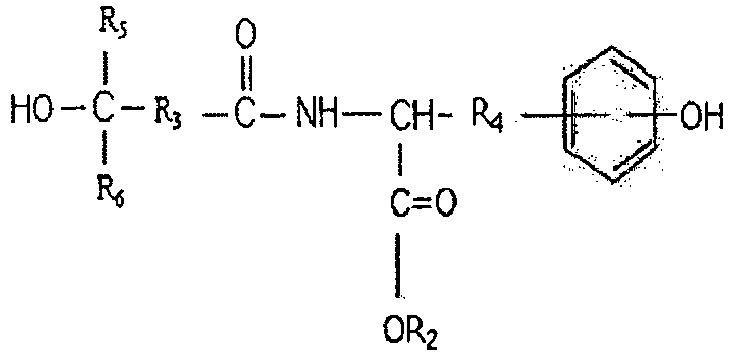
- A basic requirement is to prepare a large enough amount of each polymer with sufficiently high molecular weight to establish basic structure-property correlations. However, because a large number of polymers are required for this methodology, there are practical requirements for practicing this methodology that the prior art does not address. First, easily purified monomers are preferred that have comparable reactivities at the polymerizable functionality so the same polymerization conditions can be used to prepare the entire library. Secondly, in order to routinely construct polymer libraries, the potential for automating the entire process is also of considerable importance. Thus, it is necessary to use mild, reproducible polymerization conditions adaptable to small scale reactions and from which the isolation and purification procedures are identical for each polymer. In order to reinforce the potential for automation, the process of isolation and purification should be designed so the individual polymers are never removed from the reaction vessel.
- As noted above, the polyarylate copolymers are intended for use in medical applications. A fundamental result of the inventive methodology is that more meaningful biological correlations are derived. In vitro correlations between polymer structure and the proliferative response of rat lung fibroblasts were established. Although cell response screening studies of biomedical polymers have been conducted in the past, the lack of common structural features among test materials prevented the identification of correlations between chemical structure and cellular response. Because the polyarylate copolymers exhibited systematic variations in structure while sharing a range of common properties it was possible to correlate biological response with defined changes in the chemical structure of the tested polymers. This is a widely used approach in the pharmaceutical industry for the development of small molecule drugs, however the prior art does not address this issue with respect to the development of degradable polymeric biomaterials.
- Traditionally, the biomaterial field has relied on the availability of commodity polymers rather than polymers specifically used for medical applications. This particular utility of the inventive methodology is not in the prior art associated with biomaterials development.
- While specific properties that varied as a function of structural modifications have been described for the polyarylate copolymers, several properties remain essentially the same. In terms of processibility, all the polymers were soluble in common organic solvents and could be spin coated onto glass. Several test polymers were fabricated into solvent cast films, compression molded films, and extruded rods and ribbons. All 112 polymers appeared to be amorphous. The structural modifications imparted to the 112 polymers did not involve changing the hydrolytically labile moieties. While the relative hydrolytic rate of these moieties might vary, the rate differences are not expected to be great. Water uptake studies and preliminary degradation studies suggest similar amounts of water are imbibed into films fabricated from several of the library polymers with little only small differences in the rate of degradation. Finally, studies also strongly suggest that the tyrosine-derived polyarylates are biocompatible.
- The inventive methodology produced a library which facilitates the selection of polymers for biomedical applications in ways not previously possible in the prior art. For example, polymers with an air-water contact angle around 70° often lead to optimum cell attachment and proliferation. From this polymer library it is possible to choose polymers of similar structure having a 70° contact angle that span a wide Tg range, including polymers that would be either glassy or rubbery at body temperature. In other subgroups of polymers, the glass transition can be kept constant while the air-water contact angle can be varied over a wide range.
- The following non-limiting examples set forth hereinbelow illustrate certain aspects of the invention. All parts and percentages are by mole percent unless otherwise noted, and all temperatures are in degrees Celsius. All solvents were HPLC grade. All other reagents were of analytical grade and were used as received.
- Tyrosine alkyl esters were coupled with recrystallized 3-(4-hydroxyphenyl)-propionic acid (or in some cases, 4-hydroxyphenylacetic acid) using EDCI (1.0 eq.) and HOBt (0.1 eq.) in a solution of either N-methylpyrrolidinone-ethyl acetate (1:3; 1.5M concentration in tyrosine ester) or acetonitrile (0.75M concentration in tyrosine ester). After aqueous workup, the desaminotyrosyl-tyrosyl diols 1 were obtained in purities up to 99 % (HPLC) and 98% (DSC). Most of the
diacids 2 were commercially available in at least 99% purity. Lesspure diacids 2 were recrystallized. - Small scale polymerizations were conducted and worked up entirely in tared 20 mL glass chromatography vials with PTFE lined caps. Careful weighing of one equivalent each of the
diacid 2 and desaminotyrosyl-tyrosyl diol 1 was necessary to ensure that high molecular weight material was isolated. First the diacid was weighed directly in the vial to minimize mass transfer weighing errors.Enough diacid 2 was used so one equivalent of desaminotyrosyl-tyrosyl diol 1 typically weighing in the range between 0.20-0.25g could then be added to the vial. Dimethylaminopyridinium-p-toluenesulfonate (0.06-0.08g), methylene chloride (4 mL), and diisopropyl-carbodiimide (0.35 mL) were then sequentially added to the vial which was tightly capped and Parafilmed. The vials were transferred to a Labline water bath shaker (model 3540) and agitated (250 rpm) at 30± 1° C for 36-48h. Work-up consisted of diluting each vial reaction mixture with 16 mL methanol, recapping the vial, and vigorously shaking to precipitate thepolymer 3, then decanting the supernatant leaving the polymer in the vial. The polymer was then dissolved in methylene chloride (1-2 mL) followed by the addition of methanol (18 mL), vigorous shaking to re-precipitate the polymer, and decanting the supernatant. Methanol (5 mL) was added to the vial and decanted as a final rinse. Thepolymer 3 was dried at ambient temperature in vacuum for 1 day then in vacuum at 45° C for one day. - An equimolar amount of desaminotyrosyl-tyrosyl diol 1 and
diacid 2 were dissolved in methylene chloride to a concentration of 1.4 molar (in diol) in a 1 liter single-neck round bottom flask under nitrogen atmosphere. To this solution was added dimethyl aminopyridinium-p-toluenesulfonate (0.4 eq.) followed by the syringe addition of diisopropyl carbodiimide (2.5 eq.) after which the reaction generally became clear. After about 1 hour a precipitate became evident. The reaction was stirred for 24-36 hours and then was transferred to a separatory funnel and slowly added to a stirred (mechanical stirrer) solution of methanol (at least 10 volumes) to precipitate thepolymer 3 . The supernatant was decanted and the polymer transferred to a separatory funnel, dissolved into methylene chloride (8-10% w/v), and precipitated into either methanol or isopropanol (10 volumes). Again the supernatant was decanted and then the polymer rinsed in methanol (or isopropanol). Thepolymer 3 was then dried in vacuum at ambient temperature for 2-3 days then in vacuum at 45° C for 2 days. - The gel permeation chromatographic system consisted of either a Perkin Elmer pump model 250 or a Waters pump model 510, a Waters refractive index detector model 410, and either two PL-gel GPC columns (pore
size - Molecular weights and polydispersities for the library of polyarylates are shown in Table II.
TABLE II MOLECULAR WEIGHTS (MW=103) AND POLYDISPERSITIES FOR THE LIBRARY OF POLYARYLATES Succinic Acid Glutaric Acid Diglycolic Acid Adipic Acid - 3-Methyl-Adipic Acid Suberic Acid Dioxaoctanedioic Acid Sebacic Acid DTM 61 76 11 77 100 44 18 113 1.40 1.84 1.50 1.53 1.68 1.69 1.66 1.45 DTE 79 49 20 129 84 237 22 57 1.62 1.68 1.49 1.36 1.48 1.50 1.32 1.89 DTB 81 63 26 142 58 123 25 112 2.23 1.64 1.54 1.80 1.61 1.88 1.50 1.87 DTH 79 67 26 61 61 161 38 82 1.48 1.59 1.45 1.46 1.59 1.39 1.76 1.43 DTO 67 83 35 68 95 134 28 68 1.62 2.10 1.80 1.84 1.76 1.79 1.89 1.68 DTD 112 113 35 137 164 117 61 189 1.46 1.49 1.45 1.44 1.34 1.48 2.09 1.45 DTG 65 102 21 106 71 45 45 78 1.80 1.71 1.50 1.75 1.60 1.68 1.96 1.71 DTiP 78 89 31 32 58 33 36 88 2.64 2.93 1.74 1.47 1.64 1.54 1.96 1.66 DTiB 81 99 20 135 72 203 57 44 1.67 1.56 1.51 1.62 1.93 1.49 1.55 1.48 DTsB 72 127 21 83 89 133 25 185 2.08 1.89 1.57 1.94 1.82 2.24 1.73 1.77 DTBn 70 98 24 122 101 43 41 117 1.45 1.33 1.64 1.44 1.42 1.39 1.42 1.36 THE 37 28 14 66 49 119 19 158 1.73 1.77 1.49 1.58 1.82 1.39 1.47 1.74 HTH 46 51 17 54 74 103 42 134 1.70 1.70 1.64 1.57 1.91 1.57 1.81 2.03 HTO 68 29 35 101 47 36 29 44 1.95 1.93 1.62 1.76 1.94 1.87 1.65 1.84 - A thermal analyzer model DSC 910 (TA Instruments, Delaware) calibrated with indium was used to determine polymer glass transition (Tg) temperatures and monomer absolute purities. For Tg measurement, each specimen was subjected to two consecutive DSC scans with a heating rate of 10°C min-1. After the first run to 50°C above Tg the specimen was quenched with liquid nitrogen to at least 50°C below Tg and the second scan was immediately obtained from which the Tg was determined by the midpoint on the endothermic changes associated with the glass transition. The reproducibility of the Tg measurement was within 1 °C for different specimens and polymer batches. Monomer purity was measured by heating a previously dried (50°C in vacuum) sample (2-3 mg) at a rate of 10°C min-1 until the temperature was ca. 20°C below the melting point and then the heating rate reduced to 1°C min-1 until the temperature reaches about 10°C above the melting point. After this heating cycle, the purity and depression were determined.
- Tg values for the library of polyarylates are shown in Table III.
TABLE III Tg Values For The Library Of Polyarylates Succinate Diglycolate Glutarate Adipate 3-Methyl Adipate Dioxaoctanedioate Suberate Sebacate (1) (2) (3) (4) (5) (6) (7) (8) DTM (1') 91 82 76 69 68 63 55 47 DTiP (2') 82 80 68 58 54 58 46 44 DTE (3') 78 79 69 61 63 53 50 44 DTBn (4') 78 76 66 61 60 55 47 42 HTB (5') 73 66 65 65 63 50 54 43 DTiB (6') 75 72 62 56 47 50 42 33 DTsB (7') 75 68 58 50 56 44 46 36 DTB (8') 67 64 55 46 45 45 37 30 HTH (9') 59 46 42 32 38 31 27 23 DTH (10') 53 45 43 38 33 28 27 20 HTO (11') 51 51 38 28 30 23 22 16 DTO (12') 48 40 32 28 30 16 21 13 DTD (13') 40 36 28 22 1 19 17 15 12 DTG (14') 34 27 21 15 16 18 6 2 - The decomposition temperature (Td) was determined by thermogravimetric analysis on a TGA 951 (TA Instruments, Delaware) and was reported at 10% decrease in weight. The heating rate was 10°C min-1 and the average sample size was 30 mg.
- Air-water contact angles were measured on a Rame-Hart goniometer model 100-00-115 using double distilled water as the probe. The water was deposited onto the polyarylate spin coated glass cover slip in a small volume from above forming a sessile drop having a diameter of approximately 2.5 mm. Results were the average of at least 5 measurements (error ± 1 °).
- Contact angle values for the library of polyarylates are shown in Table IV:
TABLE IV CONTACT ANGLE VALUES FOR THE LIBRARY OF POLYARYLATES Sebacate Suberate 3-Methyl Adipate Adipate Glutarate Dioxaoctane-dioate Succinate Diglycolate (1) (2) (3) (4) (5) (6) (7) (8) DTD (1') 101.2 95.5 94.0 96.7 95.6 94.4 96.1 97.5 HTO (2') 90.7 89.5 88.4 89.9 87.7 90.4 86.6 86.9 DTO (3') 94.6 88.1 86.3 87.3 85.7 88.1 86.8 86.6 HTH (4') 86.6 85.6 82.9 84.2 83.3 83.1 11 81.8 80.8 DTH (5') 90.3 84.4 83.8 83.7 79.9 81.0 81.0 80.5 DTG (6') 86 85.7 78.6 79.1 75.6 75.9 70.3 70.1 DTiB (7') 82.5 79.7 76.8 76.9 76.3 73.7 74.8 73.9 DTsB (8') 82.1 78.7 76.4 75.9 74.0 73.5 73.7 73.1 DTB (9') 83.6 81.3 78.7 77.6 74.9 75.2 74.0 72.5 DTBn (10') 80.7 77.1 75.3 74.1 73.8 71.1 72.6 71.1 DTiP (11') 81.4 77.0 75.3 73.5 71.8 69.6 70.7 67.9 DTB (12') 79.5 75.9 75.3 73.0 69.0 68.5 68.7 67.3 THE (13') 77.0 74.8 72.7 71.4 70.7 67.7 68.1 66.3 DTM (14') 77.3 74.1 77.5 70.7 67.2 64.6 66.4 64.2 - Glass cover slips (18 mm diameter) were sequentially sonicated twice each in solutions of 25% NaOH (10 minutes), 25% HCl (10 minutes), and 2% Micro detergent (30 minutes). The cover slips were thoroughly rinsed after each sonication with distilled deionized water and after the final rinse sequentially sonicated twice each in absolute ethanol (5 minutes) and then methylene chloride (5 minutes). The cover slips were then stored in a solution of methylene chloride until needed for spin coating and were carefully handled either with tweezers or on the edge by hand while wearing latex disposable gloves. Each polyarylate solution was prepared by first adding about 20-30 mg of polymer to a tared glass vial and adding enough methylene chloride to give a 2.5% (w/v) solution which was then filtered (PTFE syringe filter, 0.45 mm). Cover slips were removed from the methylene chloride solution and spun dried. Polymer solution was added to provide complete coverage of the glass surface which was then spun for 20 seconds at 2000 rpm. The procedure was repeated twice more to ensure a smooth surface and then the cover slips were placed into individual disposable petri dishes and dried at ambient temperature in vacuum prior to contact angle measurement.
- Glass cover slips (15 mm diameter) were cleaned in the same way as were the cover slips used for contact angle measurement. After the final sonication in methylene chloride, the cover slips were rinsed twice in ethyl acetate and then sonicated twice (5 minutes) in a 2.5% (w/v) poly(styrene-silane) copolymer-ethyl acetate solution. The cover slips were soaked in this solution a further 10 minutes, then placed flat one cover slip high in glass petri dishes, and stored in an oven at 60°C in vacuum for 2 days. After cooling to ambient temperature, the cover slips were removed from the vacuum oven and rinsed in ethyl acetate (2x) and methanol (2x), and then ethyl acetate once more before drying on crumbled aluminum foil in air for 30 minutes. The cover slips were then stored in a glass vial until needed for spin coating. Filtered (PTFE syringe filter, 0.45 mm) 2.5%(w/v) polyarylate-methylene chloride solutions were used to spin coat each glass cover slip two times to ensure a smooth surface. The polymer solution was added to provide complete coverage of the glass surface which was then spun for 20 seconds at 2000 rpm. The cover slips were handled either with tweezers or on the edge by hand while wearing latex disposable gloves and carefully placed into individual wells in non-tissue culture treated 24-well cell culture plates which were then stored at ambient temperature in vacuum until needed for use.
- Glass coverslips previously spin coated with each of the polymers, were placed in 24 well, non-tissue culture treated polystyrene plates. Four glass coverslips for each polymer (n = 4) were used in each assay and tissue culture polystyrene served as the control material. Employing a drop culture technique, 1 x 10⁴ cells/cm2 in DMEM media supplemented with 10% heat inactivated fetal bovine serum were seeded onto each surface and incubated for one hour. Following the one hour attachment period, the wells in each plate were washed with PBS to remove non-adherent cells, replenished with media, and returned to the incubator. The number of fibroblasts present on each of the surfaces was measured at seven days with the commercially available MTS colormetric assay (Promega, Madison, WI).
- The foregoing examples illustrate how the present invention may be employed to establish a correlation between chemical structure and Tg, fibroblast proliferation, and air-water contact angles.
- The characterization data for desaminotyrosyl-tyrosine diols not previously reported in the literature is set forth below. All diols are variations of the general structure of
Fig. 3 . - n=2, R2= CH3-
(C19H21NO5)
Molecular Weight, 343.39.
Melting Point (C°) 123-124. - 1H-NMR (200 MHz, DMSO) δ 9.25 (s, 1 H, phenol), 9.16 (s, 1 H, phenol), 8.27 (d, 1 H, amide), 6.96 (m, 4 H, aryl), 6.67 (d, 4 H, aryl), 4.40 (q, 1 H, a-proton), 3.59 (s, 3 H, -O-CH3), 2.60-2.92 (m, 4 H, -CH2-), 2.33 (t, 2 H, -CH2-).
- 13C-NMR (50 MHz, DMSO) δ 172.5, 171.9, 156.2, 155.6, 131.5, 130.2, 129.2, 127.5, 115.2, 54.1, 51.9, 37.3, 36.3, 30.4.
- Anal. Calcd.: C, 66.46; H, 6.17; N, 4.08. Found: C, 66.39; H, 6.26; N, 3.97.
- n=2, R2 =CH3 (CH2)11-
C30H43NO5
Molecular Weight, 497.68.
Melting Point (C°) 93-94. - 1H-NMR (200 MHz, DMSO) δ 9.23 (s, 1 H, phenol), 9.14 (s, 1 H, phenol), 8.25 (d, 1 H, amide), 6.96 (m, 4 H, aryl), 6.65 (d, 4 H, aryl), 4.38 (q, 1 H, a-proton), 3.59 (t, 2 H, -O-CH2-), 2.60-2.86 (m, 4 H, -CH2-), 2.32 (t, 2 H, -CH2-), 1.49 (bs, 2 H, [O-CH2-]CH2-), 1.24 (s, 18 H, -CH2-), 0.86 (bs, 3 H, - CH3).
- 13C-NMR (50 MHz, DMSO) δ 172.0, 171.8, 156.3, 155.7, 131.4, 130.2, 129.2, 127.4, 115.2, 64.2, 54.2, 37.3, 36.4, 31.6, 30.5, 29.3, 29.0, 28.9, 28.3, 25.5, 22.4, 14.2.
- Anal. Calcd.: C, 72.40; H, 8.71; N, 2.82. Found: C, 71.88; H, 8.58; N, 2.71.
- n=2, R2=(CH3)2CH-
C21H25NO5
Molecular Weight, 371.44.
Melting Point (C°) 79 (DSC). - 1H-NMR (200 MHz, DMSO) δ 9.24 (s, 1 H, phenol), 9.15 (s, 1 H, phenol), 8.22 (d, 1 H, amide), 6.96 (m, 4 H, aryl), 6.67 (d, 4 H, aryl), 4.84 (quint., 1 H, [O-(CH3)2]-H), 4.33 (q, 1 H, a-proton), 2.82 (t, 2 H, -CH2-), 2.65 (t, 2 H, -CH2-), 2.33 (t, 2 H, -CH2-), 1.16 (d, 3 H, -CH3), 1.06 (d, 3 H, - CH3).
- 13C-NMR (50 MHz, DMSO) δ 171.8, 171.5, 156.2, 155.7, 131.5, 130.3, 129.2, 127.4, 115.2, 68.0, 54.3, 37.3, 36.4, 30.4, 21.8, 21.6.
- Anal. Calcd.: C, 67.91; H, 6.78; N, 3.77. Found: C, 67.61; H, 7.19; N, 3.54.
- n=2, R1 = (CH3)2CH-CH2-
C22H25NO5
Molecular Weight, 385.46.
Melting Point (C°) 104.6 (DSC). - 1H-NMR (200 MHz, DMSO) δ 9.23 (s, 1 H, phenol), 9.15 (s, 1 H, phenol), 8.26 (d, 1 H, amide), 6.98 (m, 4 H, aryl), 6.65 (d, 4 H, aryl), 4.38 (q, 1 H, a-proton), 3.78 (d, 2 H, -O-CH2-), 2.60-2.87(m, 4 H, -CH2-), 2.32 (t, 2 H, -CH2-), 1.81 (m, 1 H, [(-O-CH2)C(CH3)2-]H), 1.76 (d; 6 H, -CH3).
- 13C-NMR (50 MHz, DMSO) δ 172.1, 171.8, 156.2, 155.6, 131.5, 130.2, 129.2, 127.5, 115.3, 70.3, 54.3, 37.3, 36.4, 30.4, 27.5, 19.0.
- Anal. Calcd.: C, 68.55; H, 7.06; N, 3.63. Found: C, 68.60; H, 7.21; N, 3.55.
- n=2, R2=CH3CH2CH(CH3)-
C22H27NO5
Molecular Weight, 385.46.
Melting Point (C°) 121 (DSC). - 1H-NMR (200 MHz, DMSO) δ 9.24 (s, 1 H, phenol), 9.15 (s, 1 H, phenol), 8.24 (d, 1 H, amide), 6.98 (m, 4 H, aryl), 6.67 (d, 4 H, aryl), 4.70 (m, 1 H, -O[(-CH2)C(CH3-)]H), 4.35 (q, 1 H, a-proton), 2.60-2.90 (m, 4 H, CH2-), 2.32 (t, 2 H, -CH2-), 1.45 (m, 2 H, -CH2-), 1.08 (d 3 H, -CH3), 0.80 (dt, 3 H, -CH3).
- 13C-NMR (50 MHz, DMSO) δ 171.9, 171.8, 156.2, 155.7, 131.5, 130.3, 129.3, 127.4, 115.2, 72.5, 72.3, 54.4, 54.3, 37.3, 36.4, 30.4, 28.4, 28.3, 19.4, 19.3, 9.6.
- Anal. Calcd.: C, 68.55; H, 7.06; N, 3.63. Found: C, 68.35; H, 7.18; N, 3.59.
- n=2, R2 = -CH2C6H5
C25H25NO5
Molecular Weight, 419.49.
Melting Point (C°) 113-115. - 1H-NMR (200 MHz, DMSO) δ 9.25 (s, 1 H, phenol), 9.16 (s, 1 H, phenol), 8.31 (d, 1 H, amide), 7.30 (m, 5 H, aryl), 6.97 (m, 4 H, aryl), 6.65 (d, 4 H, aryl), 5.07 (s, 2 H, Ph-CH2-), 4.44 (q, 1 H, a-proton), 2.59-2.89 (m, 4 H, -CH2-), 2.32 (t, 2 H, -CH2-).
- 13C-NMR (50 MHz, DMSO) δ 171.9,156.3, 155.7, 136.1, 131.5, 130.3, 129.2, 128.6, 128.3, 128.1, 127.3, 115.3, 66.1, 54.3, 37.3, 36.3, 30.4
- Anal. Calcd.: C, 71.58; H, 6.01; N, 3.34. Found: C, 71.14; H, 6.31; N, 3.16.
- n=1, R2 = CH3CH2-
C19H21NO5
Molecular Weight, 343.39.
Melting Point (C°) 124-125. - 1H-NMR (200 MHz, DMSO) δ 9.25 (s, 2 H, phenol), 8.37 (d, 1 H, amide), 6.97 (t, 4 H, aryl), 6.67 (d, 4 H, aryl), 4.35 (q, 1 H, a-proton), 4.05 (q, 2 H, -O-CH2-), 3.31 (s, 2 H, Ph-CH2-), 2.86 (m, 2 H, -CH2-), 1.12 (t, 3 H, -CH3).
- 13C-NMR (50 MHz, DMSO) δ 171.9, 170.9, 156.3, 156.0, 130.3, 130.1, 127.4, 126.4, 115.2, 115.1, 60.7, 54.2, 41.3, 36.3, 14.2.
- Anal. Calcd.: C, 66.46; H, 6.17; N, 4.08. Found: C, 66.41; H, 6.31; N, 4.03.
- n=1, R2 = CH3(CH2)5-
C23H29NO5
Molecular Weight, 399.50.
Melting Point (C°) 106-108. - 1H-NMR (200 MHz, CDCL3) δ 7.73 (bs, 1 H, phenol), 7.59 (bs, 1 H, phenol), 6.91 (d, 2 H, aryl), 6.64 (d, 6 H, aryl), 6.07 (d, 1 H, amide), 4.78 (q, 1 H, a-proton), 4.12 (t, 2 H, -O-CH2-), 3.46 (s, 2 H, Ph-CH2-), 2.93 (m, 2 H, -CH2-), 1.62 (m, 2 H, -CH2-), 1.28 (bs, 6 H, -CH2-), 0.87 (bs, 3 H, - CH3).
- 13C-NMR (50 MHz, CDCl3) δ 173.2, 172.6, 156.1, 155.8, 131.2, 130.6, 126.8, 125.6, 116.6, 116.2, 66.7, 53.6, 43.0, 37.1, 31.8, 28.9, 25.9, 22.9, 14.5.
- Anal. Calcd.: C, 69.15; H, 7.32; N, 3.51. Found: C, 69.13; H, 7.33; N,3.44.
- n=1, R2 = CH3(CH2)7
C25H33NO5
Molecular Weight, 427.55.
Melting Point (C°) 59-61. - 1H-NMR (200 MHz, CDCL3) δ 7.60 (bs, 2 H, phenol), 6.90 (d, 2 H, aryl), 6.67 (d, 6 H, aryl), 6.07 (d, 1 H, amide), 4.79 (q, 1 H, a-proton), 4.14 (t, 2 H, -O-CH2-), 3.46 (s, 2 H, Ph-CH2-), 2.93 (m, 2 H, -CH2-), 1.63 (bs, 2 H, -CH2-), 1.26 (s, 10 H, -CH2-), 0.86 (bs, 3 H, -CH3).
- 13C-NMR (50 MHz, CDCl3) δ 173.2, 172.6, 156.1, 155.8, 131.2, 130.6, 126.8, 125.7, 116.6, 116.3, 66.7, 53.6, 43.0, 37.1, 32.2, 29.6, 28.9, 26.3, 23.1, 14.6.
- Anal. Calcd.: C, 70.23; H, 7.78; N, 3.28. Found: C, 69.94; H, 7.46; N, 3.16.
- n=2, R2 = CH3CH2O-CH2CH2O-CH2CH2-
C24H31NO7
Molecular Weight, 445.53
Melting Point (°C), oil at ambient temperature. - 1H-NMR (200 MHz, CDCl3) δ 7.62-7.50 (bs, 2 H, phenol), 6.88 (d, 2H, aryl), 6.70 (q, 6 H, aryl), 6.34 (d, 1 H, amide), 4.78 (q. 1 H, a-proton), 4.17 (bs, 2 H, -O-CH2-), 3.60 (bs, 6 H, -CH2-O-CH2-O-), 3.51 (q. 2 H, -O-CH2-Methyl), 2.90 (m, 2 H, -CH2-), 2.76 (m, 2 H, -CH2-), 2.37 (m, 2 H, -CH2-), 1.16 (t, 3 H, -CH3)
- 13C-NMR (50 Mhz. CDCl3) δ 173.5, 172.2, 155.8, 155.1, 132.1, 130.8, 129.8, 127.3, 116.0, 70.9, 70.1, 69.2, 67.3, 53.9, 38.7, 37.3, 31.1, 15.5.
- Anal. Calcd.: C, 64.70; H, 7.01; N, 3.14. Found: C, 64.88; H, 6.79; N, 3.03.
- C24H31NO7
Molecular Weight, 445.53
Melting Point (C°) Boil at ambient temperature. - 1H-NMR (200 MHz, CDCl3) δ 7.62-7.50 (bs, 2 H, phenol), 6.88(d, 2 H aryl, 6.70(q, 6 H, aryl), 6.34(d, 1 H, amide), 4.78(q, 1 H, α-proton), 4.17(bs, 2 H, -O-CH2-), 3.60(bs, 6 H, -CH2-O-CH2-CH2-O-), 3.51(q, 2 H, -O-CH2-CH3), 2.90(m, 2 H, -CH2-), 2.76(m, 2 H, -CH2-), 2.37 (m, 2 H, -CH2-), 1.16(t, 3 H,-CH3).
- 13C-NMR (50 MHz, CDCl3) δ 173.5, 172.2, 155.8, 155.1, 132.1, 130.8, 129.8, 127.3, 116.0, 70.9, 70.1, 69.2, 67.3, 64.9, 53.9, 38.7, 37.3, 31.1, 15.5.
- 13C-NMR (50 MHz, DMSO) δ 171.9, 156.2, 155.7, 131.5, 130.3, 129.2, 127.4, 115.2, 70.1, 69.4, 68.4, 65.8, 64.0, 54.2, 37.3, 36.3, 30.4, 15.3.
- Anal. Calcd.: C, 64.707; H 7.01; N, 3.28. Found: C, 64.88; H, 6.79; N, 3.03.
- The foregoing examples and description of the preferred embodiment should be taken as illustrating, rather than as limiting, the present invention as defined by the claims.
Claims (7)
- Use of a polyarylate for drug release, wherein said polyarylate comprises repeating units having the structure:

-CH2-O-CH2-
R1 is selected from the group consisting of-CH =CH-, (-CH2-)a, and -CHN(L1L2), in which a has a value from zero to eight, inclusive, and L1 and L2 are independently selected from the group consisting of hydrogen and straight and branched alkyl and alkylaryl groups containing up to 18 carbon atoms, provided that L1 and L2 are not both hydrogen;b independently has a value between zero and eight, Inclusive; andR2 is selected from the group consisting of straight and branched alkyl and alkylaryl groups containing up to 18 carbon atoms; andwherein R2, and, when R1 Is -CHNL1L2, L1 and L2 optionally contain at least one ether linkage. - Use of a polyarylate according to claim 1, wherein R1 is -CH2-CH2- and b is one.
- Use of a polyarylate according to claim 1, wherein said polyarylate is the polymerization product ofL-tyrosine-N-{2-(4-hydroxyphenyl)-1-oxoethyl}-hexyl ester,L-tyrosine-N-{2-(4-hydroxyphenyl)-1-oxoethyl}-octyl ester orL-tyrosine-N-{3-(4-hydroxyphenyl)-1-oxopropyl}-dodecyl ester with diglycolic acid.
- Use of a drug release article comprising a polyarylate, wherein said polyarylate comprises repeating units having a structure as defined in claim 1, for drug release.
- Use according to claim 4 in the form of a solvent cast film, a compression molded film or an extruded rod or ribbon.
- Use according to claim 4 or 5, wherein R1 is -CH2-CH2- and b Is one.
- Use according to claim 4 or 5, wherein said polyarylate is the polymerisation product ofL-tyrosine-N-{2-(4-hydroxyphenyl)-1-oxoethyl}-hexyl ester,L-tyrosine-N-{2-(4-hydroxyphenyl)-1-oxoethyl}-octyl ester orL-tyrosine-N-{3-(4-hydroxyphenyl)-1-oxopropyl}-dodecyl ester with diglycolic acid.
Applications Claiming Priority (3)
| Application Number | Priority Date | Filing Date | Title |
|---|---|---|---|
| US8150298P | 1998-04-13 | 1998-04-13 | |
| US81502P | 1998-04-13 | ||
| PCT/US1999/008131 WO1999052962A1 (en) | 1998-04-13 | 1999-04-13 | The construction of copolymer libraries |
Publications (3)
| Publication Number | Publication Date |
|---|---|
| EP1073688A1 EP1073688A1 (en) | 2001-02-07 |
| EP1073688A4 EP1073688A4 (en) | 2002-08-14 |
| EP1073688B1 true EP1073688B1 (en) | 2015-03-04 |
Family
ID=22164603
Family Applications (1)
| Application Number | Title | Priority Date | Filing Date |
|---|---|---|---|
| EP99918534.1A Expired - Lifetime EP1073688B1 (en) | 1998-04-13 | 1999-04-13 | The construction of copolymer libraries |
Country Status (6)
| Country | Link |
|---|---|
| US (4) | US20020151668A1 (en) |
| EP (1) | EP1073688B1 (en) |
| JP (1) | JP4312384B2 (en) |
| AU (1) | AU761458B2 (en) |
| CA (1) | CA2328830C (en) |
| WO (1) | WO1999052962A1 (en) |
Families Citing this family (37)
| Publication number | Priority date | Publication date | Assignee | Title |
|---|---|---|---|---|
| EP1073688B1 (en) | 1998-04-13 | 2015-03-04 | Rutgers, The State University | The construction of copolymer libraries |
| AU784226B2 (en) * | 1999-12-31 | 2006-02-23 | Rutgers, The State University | Pharmaceutical formulation for regulating the timed release of biologically active compounds based on a polymer matrix |
| AU775905B2 (en) * | 1999-12-31 | 2004-08-19 | Rutgers, The State University | Pharmaceutical formulation composed of a polymer blend and an active compound for time-controlled release |
| DE10034893A1 (en) * | 2000-07-18 | 2002-01-31 | Basf Ag | Arrays of n aqueous polymer dispersions and m formulations of aqueous polymer dispersions |
| ATE281474T1 (en) * | 2000-08-17 | 2004-11-15 | Basf Ag | DEVICE AND METHOD FOR PRODUCING NANODISPERSANTS |
| DE60131177T2 (en) | 2000-09-06 | 2008-08-07 | AP Pharma, Inc., Redwood | DEVELOPABLE POLYACETAL POLYMERS |
| US7514263B2 (en) | 2001-04-02 | 2009-04-07 | 3M Innovative Properties Company | Continuous process for the production of combinatorial libraries of materials |
| DE10125571A1 (en) * | 2001-05-25 | 2002-12-05 | Ticona Gmbh | Mixtures with high diversity, process for their preparation and their use |
| AU2003234231A1 (en) * | 2002-04-24 | 2003-11-10 | Rutgers | New polyarylates for drug delivery and tissue engineering |
| DE10248639B4 (en) * | 2002-10-18 | 2005-03-17 | Ticona Gmbh | Process and device for the combinatorial production of mixtures and their use |
| RU2309144C2 (en) * | 2005-03-25 | 2007-10-27 | Общество С Ограниченной Ответственностью "Фарминтерпрайсез" | Phenyl-containing n-acylamine derivatives, method for production thereof, pharmaceutical composition and uses thereof as anti-inflammatory and analgesic agents |
| US8153837B2 (en) | 2005-11-03 | 2012-04-10 | Tyrx, Inc. | Resorbable phenolic polymers |
| AU2012202056B2 (en) * | 2005-11-03 | 2012-10-18 | Medtronic, Inc. | Resorbable phenolic polymers |
| JP5367692B2 (en) | 2006-02-08 | 2013-12-11 | タイレックス・インコーポレイテッド | Temporary stiffening mesh prosthesis |
| US8315700B2 (en) * | 2006-02-08 | 2012-11-20 | Tyrx, Inc. | Preventing biofilm formation on implantable medical devices |
| US8591531B2 (en) * | 2006-02-08 | 2013-11-26 | Tyrx, Inc. | Mesh pouches for implantable medical devices |
| US9023114B2 (en) | 2006-11-06 | 2015-05-05 | Tyrx, Inc. | Resorbable pouches for implantable medical devices |
| JP2010508915A (en) | 2006-11-06 | 2010-03-25 | タイレックス・ファーマ・インコーポレイテッド | Mesh pouch for implantable medical devices |
| EP2129339B1 (en) * | 2007-03-29 | 2015-03-04 | Tyrx, Inc. | Biodegradable, polymer coverings for breast implants |
| MX2009011785A (en) * | 2007-05-02 | 2010-03-04 | Tyrx Pharma Inc | DIHYDROXIBENZOATE POLYMERS AND USES OF THE SAME. |
| WO2010006046A1 (en) | 2008-07-10 | 2010-01-14 | Tyrx Pharma, Inc. | Nsaid delivery from polyarylates |
| US8617607B2 (en) * | 2008-07-10 | 2013-12-31 | Tyrx, Inc. | Sustained release formulations of psychoactive drugs |
| WO2010033995A1 (en) | 2008-09-22 | 2010-03-25 | Tyrx Pharma, Inc. | Linear polyesteramides from aminophenolic esters |
| US9839628B2 (en) | 2009-06-01 | 2017-12-12 | Tyrx, Inc. | Compositions and methods for preventing sternal wound infections |
| US8409279B2 (en) | 2009-10-01 | 2013-04-02 | Lipose Corporation | Breast implant implantation method and apparatus |
| JP6031033B2 (en) | 2010-08-25 | 2016-11-24 | タイレックス・インコーポレイテッドTyrx Inc. | New coatings for medical devices |
| WO2012064963A1 (en) | 2010-11-12 | 2012-05-18 | Tyrx, Inc. | Anchorage devices comprising an active pharmaceutical ingredient |
| US8858070B2 (en) * | 2011-06-03 | 2014-10-14 | The Aerospace Corporation | System and method for measuring glass transition temperature |
| AU2012283875B2 (en) | 2011-07-20 | 2016-05-12 | Medtronic, Inc. | Drug eluting mesh to prevent infection of indwelling transdermal devices |
| WO2014137454A1 (en) | 2013-03-07 | 2014-09-12 | Tyrx, Inc. | Methods and compositions to inhibit the assemblage of microbial cells irreversibly associated with surfaces of medical devices |
| WO2015069305A1 (en) | 2013-11-08 | 2015-05-14 | Tyrx, Inc. | Antimicrobial compositions and methods for preventing infection in surgical incision sites |
| WO2018191415A1 (en) * | 2017-04-11 | 2018-10-18 | Colorado State University Research Foundation | Functionalization of metal-organic frameworks |
| US10442757B2 (en) * | 2017-06-07 | 2019-10-15 | Medtronic, Inc. | Synthesis of tyrosine derived diphenol monomers |
| EP3651580A4 (en) | 2017-07-11 | 2021-04-21 | Colorado State University Research Foundation | CHITOSAN COMPOSITE MATERIAL AND METALLO-ORGANIC STRUCTURE |
| TW202411269A (en) | 2022-04-11 | 2024-03-16 | 日商三菱瓦斯化學股份有限公司 | Method for producing optical material |
| CN118829664A (en) | 2022-04-11 | 2024-10-22 | 三菱瓦斯化学株式会社 | Method for producing hydrogenated polymer using multiple solvents |
| JPWO2023199874A1 (en) | 2022-04-11 | 2023-10-19 |
Family Cites Families (13)
| Publication number | Priority date | Publication date | Assignee | Title |
|---|---|---|---|---|
| AU466760B2 (en) | 1972-03-14 | 1975-11-06 | Takeda Chemical Industries Ltd. | Process for producing peptide |
| USRE37160E1 (en) * | 1990-06-12 | 2001-05-01 | Rutgers, The State University | Synthesis of tyrosine derived diphenol monomers |
| US5099060A (en) * | 1990-06-12 | 1992-03-24 | Rutgers, The State University Of New Jersey | Synthesis of amino acid-derived bioerodible polymers |
| US5216115A (en) * | 1990-06-12 | 1993-06-01 | Rutgers, The State University Of New Jersey | Polyarylate containing derivatives of the natural amino acid L-tyrosine |
| US5587507A (en) * | 1995-03-31 | 1996-12-24 | Rutgers, The State University | Synthesis of tyrosine derived diphenol monomers |
| US5310669A (en) * | 1992-06-22 | 1994-05-10 | The Trustees Of Dartmouth College | Fullerene coated surfaces and uses thereof |
| DE4234601A1 (en) * | 1992-10-14 | 1994-04-21 | Basf Ag | Process for the preparation of block copolymers by ionic polymerization |
| US5877224A (en) | 1995-07-28 | 1999-03-02 | Rutgers, The State University Of New Jersey | Polymeric drug formulations |
| US6120491A (en) | 1997-11-07 | 2000-09-19 | The State University Rutgers | Biodegradable, anionic polymers derived from the amino acid L-tyrosine |
| EP1073688B1 (en) | 1998-04-13 | 2015-03-04 | Rutgers, The State University | The construction of copolymer libraries |
| US20060034891A1 (en) * | 2004-08-12 | 2006-02-16 | Laurie Lawin | Biodegradable controlled release bioactive agent delivery device |
| US8313763B2 (en) | 2004-10-04 | 2012-11-20 | Tolmar Therapeutics, Inc. | Sustained delivery formulations of rapamycin compounds |
| EP1824460B1 (en) | 2004-11-10 | 2014-12-24 | Tolmar Therapeutics, Inc. | A stabilized polymeric delivery system |
-
1999
- 1999-04-13 EP EP99918534.1A patent/EP1073688B1/en not_active Expired - Lifetime
- 1999-04-13 JP JP2000543517A patent/JP4312384B2/en not_active Expired - Lifetime
- 1999-04-13 WO PCT/US1999/008131 patent/WO1999052962A1/en not_active Ceased
- 1999-04-13 US US09/291,426 patent/US20020151668A1/en not_active Abandoned
- 1999-04-13 AU AU36420/99A patent/AU761458B2/en not_active Expired
- 1999-04-13 CA CA2328830A patent/CA2328830C/en not_active Expired - Lifetime
-
2004
- 2004-07-13 US US10/889,914 patent/US7585929B2/en not_active Expired - Fee Related
-
2009
- 2009-07-31 US US12/533,953 patent/US8114951B2/en not_active Expired - Fee Related
-
2012
- 2012-01-30 US US13/361,268 patent/US8907043B2/en not_active Expired - Fee Related
Also Published As
| Publication number | Publication date |
|---|---|
| WO1999052962A1 (en) | 1999-10-21 |
| US20020151668A1 (en) | 2002-10-17 |
| EP1073688A1 (en) | 2001-02-07 |
| CA2328830C (en) | 2012-07-24 |
| US7585929B2 (en) | 2009-09-08 |
| AU761458B2 (en) | 2003-06-05 |
| US20120135523A1 (en) | 2012-05-31 |
| US20040254334A1 (en) | 2004-12-16 |
| JP2002511508A (en) | 2002-04-16 |
| US20100063242A1 (en) | 2010-03-11 |
| US8114951B2 (en) | 2012-02-14 |
| JP4312384B2 (en) | 2009-08-12 |
| AU3642099A (en) | 1999-11-01 |
| EP1073688A4 (en) | 2002-08-14 |
| CA2328830A1 (en) | 1999-10-21 |
| US8907043B2 (en) | 2014-12-09 |
Similar Documents
| Publication | Publication Date | Title |
|---|---|---|
| US8114951B2 (en) | Preparation and uses of polyarylates | |
| Brocchini et al. | Structure–property correlations in a combinatorial library of degradable biomaterials | |
| KR100479288B1 (en) | Copolymer of Tyrosine-based Polycarbonate with Poly (Alkylene Oxide) | |
| CN1250600C (en) | Low melt viscosity amorphous copolymers with enhanced glass transition temperatures | |
| US6048521A (en) | Copolymers of tyrosine-based polyarlates and poly(alkylene oxides) | |
| Nagata et al. | Synthesis, characterization, and enzymatic degradation of network aliphatic copolyesters | |
| Liu et al. | Modulating the crystallinity, mechanical properties, and degradability of poly (ε-caprolactone) derived polyesters by statistical and alternating copolymerization | |
| Wurth et al. | Hydrophilization of poly (caprolactone) copolymers through introduction of oligo (ethylene glycol) moieties | |
| Kricheldorf et al. | Telechelic polyesters of ethane diol and adipic or sebacic acid by means of bismuth carboxylates as non-toxic catalysts | |
| AU2003244591B2 (en) | The Construction of Copolymer Libraries | |
| CN105073025B (en) | By the polylactone polymer of single methanol and the preparation of glycol polymerization initiator with two or more carboxylic acid groups | |
| Mulchandani et al. | Effects of chain microstructure on the thermal, mechanical and crystallization behaviors of poly (ε-caprolactone-co-lactide) copolymers: Processable biomaterials with tunable properties | |
| MXPA00010052A (en) | The construction of copolymer libraries | |
| Kricheldorf et al. | Poly (ester urethane) s derived from lactide, isosorbide, terephthalic acid, and various diisocyanates | |
| Korhonen et al. | Synthesis of Poly (ester‐anhydrides) Based on Different Polyester Precursors | |
| Korhonen et al. | Synthesis and hydrolysis behaviour of poly (ester anhydrides) from polylactone precursors containing alkenyl moieties | |
| US8013061B2 (en) | Polyester based degradable materials and implantable biomedical articles formed therefrom | |
| US11192977B2 (en) | Use of poly(alkylene terephthalates) and methods for their preparation | |
| 김형준 | Synthetic Approach to Produce Poly (ester-amide) s Using Bio-based Diols | |
| KR100420209B1 (en) | Heat Resistant Polyester Copolymer for Extrusion | |
| US5506330A (en) | Polymerization method for preparing non-halogenated aromatic | |
| Chanthaset | Preparation of Poly (trimethylene carbonate) Derivatives with Oligo (ethylene glycol) and Their Thermosensitive and Degradable Properties | |
| TW200530291A (en) | Method for enhanced solid state polymerization of polyethylene terephthalate | |
| CN102898636A (en) | Novel polyester material containing controlled side chain carboxyl number, and preparation method thereof | |
| JPH02138336A (en) | Aromatic polyester-polyorganosiloxane block copolymer |
Legal Events
| Date | Code | Title | Description |
|---|---|---|---|
| PUAI | Public reference made under article 153(3) epc to a published international application that has entered the european phase |
Free format text: ORIGINAL CODE: 0009012 |
|
| 17P | Request for examination filed |
Effective date: 20001113 |
|
| AK | Designated contracting states |
Kind code of ref document: A1 Designated state(s): AT BE CH CY DE DK ES FI FR GB GR IE IT LI LU MC NL PT SE |
|
| A4 | Supplementary search report drawn up and despatched |
Effective date: 20020701 |
|
| AK | Designated contracting states |
Kind code of ref document: A4 Designated state(s): AT BE CH CY DE DK ES FI FR GB GR IE IT LI LU MC NL PT SE |
|
| RIC1 | Information provided on ipc code assigned before grant |
Free format text: 7C 08G 63/48 A, 7C 08G 63/685 B, 7C 08G 63/19 B, 7C 08F 2/00 B, 7G 01N 33/566 B |
|
| 17Q | First examination report despatched |
Effective date: 20050419 |
|
| 17Q | First examination report despatched |
Effective date: 20050419 |
|
| REG | Reference to a national code |
Ref country code: DE Ref legal event code: R079 Ref document number: 69945281 Country of ref document: DE Free format text: PREVIOUS MAIN CLASS: C08G0063480000 Ipc: A61L0027180000 |
|
| GRAP | Despatch of communication of intention to grant a patent |
Free format text: ORIGINAL CODE: EPIDOSNIGR1 |
|
| RIC1 | Information provided on ipc code assigned before grant |
Ipc: A61L 27/34 20060101ALI20140828BHEP Ipc: A61L 17/10 20060101ALI20140828BHEP Ipc: A61L 31/06 20060101ALI20140828BHEP Ipc: A61L 31/10 20060101ALI20140828BHEP Ipc: C08G 63/685 20060101ALI20140828BHEP Ipc: C40B 40/14 20060101ALI20140828BHEP Ipc: C08G 64/12 20060101ALI20140828BHEP Ipc: A61L 27/18 20060101AFI20140828BHEP Ipc: C08G 63/19 20060101ALI20140828BHEP Ipc: C08G 63/78 20060101ALI20140828BHEP Ipc: C08G 64/04 20060101ALI20140828BHEP |
|
| INTG | Intention to grant announced |
Effective date: 20140925 |
|
| GRAS | Grant fee paid |
Free format text: ORIGINAL CODE: EPIDOSNIGR3 |
|
| GRAA | (expected) grant |
Free format text: ORIGINAL CODE: 0009210 |
|
| AK | Designated contracting states |
Kind code of ref document: B1 Designated state(s): AT BE CH CY DE DK ES FI FR GB GR IE IT LI LU MC NL PT SE |
|
| REG | Reference to a national code |
Ref country code: GB Ref legal event code: FG4D |
|
| REG | Reference to a national code |
Ref country code: CH Ref legal event code: EP |
|
| REG | Reference to a national code |
Ref country code: IE Ref legal event code: FG4D |
|
| REG | Reference to a national code |
Ref country code: AT Ref legal event code: REF Ref document number: 713274 Country of ref document: AT Kind code of ref document: T Effective date: 20150415 |
|
| REG | Reference to a national code |
Ref country code: DE Ref legal event code: R096 Ref document number: 69945281 Country of ref document: DE Effective date: 20150416 |
|
| REG | Reference to a national code |
Ref country code: NL Ref legal event code: VDEP Effective date: 20150304 Ref country code: AT Ref legal event code: MK05 Ref document number: 713274 Country of ref document: AT Kind code of ref document: T Effective date: 20150304 |
|
| PG25 | Lapsed in a contracting state [announced via postgrant information from national office to epo] |
Ref country code: ES Free format text: LAPSE BECAUSE OF FAILURE TO SUBMIT A TRANSLATION OF THE DESCRIPTION OR TO PAY THE FEE WITHIN THE PRESCRIBED TIME-LIMIT Effective date: 20150304 Ref country code: FI Free format text: LAPSE BECAUSE OF FAILURE TO SUBMIT A TRANSLATION OF THE DESCRIPTION OR TO PAY THE FEE WITHIN THE PRESCRIBED TIME-LIMIT Effective date: 20150304 Ref country code: SE Free format text: LAPSE BECAUSE OF FAILURE TO SUBMIT A TRANSLATION OF THE DESCRIPTION OR TO PAY THE FEE WITHIN THE PRESCRIBED TIME-LIMIT Effective date: 20150304 |
|
| PG25 | Lapsed in a contracting state [announced via postgrant information from national office to epo] |
Ref country code: GR Free format text: LAPSE BECAUSE OF FAILURE TO SUBMIT A TRANSLATION OF THE DESCRIPTION OR TO PAY THE FEE WITHIN THE PRESCRIBED TIME-LIMIT Effective date: 20150605 Ref country code: AT Free format text: LAPSE BECAUSE OF FAILURE TO SUBMIT A TRANSLATION OF THE DESCRIPTION OR TO PAY THE FEE WITHIN THE PRESCRIBED TIME-LIMIT Effective date: 20150304 |
|
| PG25 | Lapsed in a contracting state [announced via postgrant information from national office to epo] |
Ref country code: NL Free format text: LAPSE BECAUSE OF FAILURE TO SUBMIT A TRANSLATION OF THE DESCRIPTION OR TO PAY THE FEE WITHIN THE PRESCRIBED TIME-LIMIT Effective date: 20150304 |
|
| PG25 | Lapsed in a contracting state [announced via postgrant information from national office to epo] |
Ref country code: PT Free format text: LAPSE BECAUSE OF FAILURE TO SUBMIT A TRANSLATION OF THE DESCRIPTION OR TO PAY THE FEE WITHIN THE PRESCRIBED TIME-LIMIT Effective date: 20150706 |
|
| PG25 | Lapsed in a contracting state [announced via postgrant information from national office to epo] |
Ref country code: MC Free format text: LAPSE BECAUSE OF FAILURE TO SUBMIT A TRANSLATION OF THE DESCRIPTION OR TO PAY THE FEE WITHIN THE PRESCRIBED TIME-LIMIT Effective date: 20150304 |
|
| REG | Reference to a national code |
Ref country code: CH Ref legal event code: PL |
|
| REG | Reference to a national code |
Ref country code: DE Ref legal event code: R097 Ref document number: 69945281 Country of ref document: DE |
|
| PG25 | Lapsed in a contracting state [announced via postgrant information from national office to epo] |
Ref country code: IT Free format text: LAPSE BECAUSE OF FAILURE TO SUBMIT A TRANSLATION OF THE DESCRIPTION OR TO PAY THE FEE WITHIN THE PRESCRIBED TIME-LIMIT Effective date: 20150304 |
|
| PLBE | No opposition filed within time limit |
Free format text: ORIGINAL CODE: 0009261 |
|
| STAA | Information on the status of an ep patent application or granted ep patent |
Free format text: STATUS: NO OPPOSITION FILED WITHIN TIME LIMIT |
|
| PG25 | Lapsed in a contracting state [announced via postgrant information from national office to epo] |
Ref country code: LI Free format text: LAPSE BECAUSE OF NON-PAYMENT OF DUE FEES Effective date: 20150430 Ref country code: DK Free format text: LAPSE BECAUSE OF FAILURE TO SUBMIT A TRANSLATION OF THE DESCRIPTION OR TO PAY THE FEE WITHIN THE PRESCRIBED TIME-LIMIT Effective date: 20150304 Ref country code: CH Free format text: LAPSE BECAUSE OF NON-PAYMENT OF DUE FEES Effective date: 20150430 |
|
| 26N | No opposition filed |
Effective date: 20151207 |
|
| REG | Reference to a national code |
Ref country code: FR Ref legal event code: PLFP Year of fee payment: 18 |
|
| PG25 | Lapsed in a contracting state [announced via postgrant information from national office to epo] |
Ref country code: BE Free format text: LAPSE BECAUSE OF FAILURE TO SUBMIT A TRANSLATION OF THE DESCRIPTION OR TO PAY THE FEE WITHIN THE PRESCRIBED TIME-LIMIT Effective date: 20150304 |
|
| REG | Reference to a national code |
Ref country code: FR Ref legal event code: PLFP Year of fee payment: 19 |
|
| PG25 | Lapsed in a contracting state [announced via postgrant information from national office to epo] |
Ref country code: CY Free format text: LAPSE BECAUSE OF FAILURE TO SUBMIT A TRANSLATION OF THE DESCRIPTION OR TO PAY THE FEE WITHIN THE PRESCRIBED TIME-LIMIT Effective date: 20150304 |
|
| PG25 | Lapsed in a contracting state [announced via postgrant information from national office to epo] |
Ref country code: LU Free format text: LAPSE BECAUSE OF NON-PAYMENT OF DUE FEES Effective date: 20150413 |
|
| REG | Reference to a national code |
Ref country code: FR Ref legal event code: PLFP Year of fee payment: 20 |
|
| PGFP | Annual fee paid to national office [announced via postgrant information from national office to epo] |
Ref country code: IE Payment date: 20180427 Year of fee payment: 20 Ref country code: DE Payment date: 20180427 Year of fee payment: 20 |
|
| PGFP | Annual fee paid to national office [announced via postgrant information from national office to epo] |
Ref country code: FR Payment date: 20180425 Year of fee payment: 20 |
|
| PGFP | Annual fee paid to national office [announced via postgrant information from national office to epo] |
Ref country code: GB Payment date: 20180427 Year of fee payment: 20 |
|
| REG | Reference to a national code |
Ref country code: DE Ref legal event code: R071 Ref document number: 69945281 Country of ref document: DE |
|
| REG | Reference to a national code |
Ref country code: GB Ref legal event code: PE20 Expiry date: 20190412 |
|
| REG | Reference to a national code |
Ref country code: IE Ref legal event code: MK9A |
|
| PG25 | Lapsed in a contracting state [announced via postgrant information from national office to epo] |
Ref country code: IE Free format text: LAPSE BECAUSE OF EXPIRATION OF PROTECTION Effective date: 20190413 |
|
| PG25 | Lapsed in a contracting state [announced via postgrant information from national office to epo] |
Ref country code: GB Free format text: LAPSE BECAUSE OF EXPIRATION OF PROTECTION Effective date: 20190412 |