EP1072985A2 - Automatic wrapper grammar generation - Google Patents
Automatic wrapper grammar generation Download PDFInfo
- Publication number
- EP1072985A2 EP1072985A2 EP00306268A EP00306268A EP1072985A2 EP 1072985 A2 EP1072985 A2 EP 1072985A2 EP 00306268 A EP00306268 A EP 00306268A EP 00306268 A EP00306268 A EP 00306268A EP 1072985 A2 EP1072985 A2 EP 1072985A2
- Authority
- EP
- European Patent Office
- Prior art keywords
- attributes
- wrapper
- attribute
- particular format
- grammar
- Prior art date
- Legal status (The legal status is an assumption and is not a legal conclusion. Google has not performed a legal analysis and makes no representation as to the accuracy of the status listed.)
- Granted
Links
Images




Classifications
-
- G—PHYSICS
- G06—COMPUTING OR CALCULATING; COUNTING
- G06F—ELECTRIC DIGITAL DATA PROCESSING
- G06F16/00—Information retrieval; Database structures therefor; File system structures therefor
- G06F16/20—Information retrieval; Database structures therefor; File system structures therefor of structured data, e.g. relational data
- G06F16/25—Integrating or interfacing systems involving database management systems
- G06F16/258—Data format conversion from or to a database
Definitions
- This invention relates generally to information retrieval and integration systems, and more particularly, to the creation and generation of wrapper grammars for extracting and regenerating information from documents stored in networked repositories.
- a wrapper is a type of interface or container that is tied to data; it encapsulates and hides the intricacies of a remote information source in accordance with a set of rules known as a grammar or a wrapper grammar, providing two functions to an information broker.
- wrappers are used to translate a client query to a corresponding one that the remote information source will understand. Wrappers are associated with the particular information source. For example, HTTP wrappers interact with HTTP servers and HTML documents; JDBC wrappers work with ODBC-compliant databases; and DMA wrappers work with DMA-compliant document management systems.
- wrappers are used by search engines to extract the information stored in the HTML files representing the individual web pages; the wrapper scans the HTML files returned by the search engine, drops the markup instructions and extracts the information related to the query. If an information broker is involved, the wrapper parses (or processes) the results in a form that can be interpreted and filtered by the information broker. Then the wrapper takes the search answers, either from the different document repositories or from the information broker, puts them in a new format that can be viewed by the user. Extraction and parsing is done in accordance with the grammar or rules for the particular type of response file.
- HTML response files are generated for the convenience of visualization rather than information extraction.
- response files from different information providers vary widely both in structure and in format: HTML, ODBC, DMA.
- HTML providers may generate HTML tags to separate each attribute of the document (author, title, journal, and date of publication).
- Other providers may link attributes, such as author and title, together, separating them not by an HTML tag, but by a grammatical separator such as a comma or semicolon.
- the first problem is the ambiguous markup of response pages by some Web-based information providers, which makes automatic wrapper grammar generation difficult at best and in some cases impossible.
- a Web provider reports a list of answers, with each item containing two string-value attributes t 1 and t 2 , with t 2 being optional.
- the provider may use a unique format for each attribute. That is, the HTML file structure of a response page from this Web provider looks as follows: ( ⁇ i> String ( t 1 ) ⁇ i> ( ⁇ i> String ( t 2 ) ⁇ /i>)) +.
- wrapper grammar Assume the wrapper grammar has been generated, it has correctly guessed this format and it receives the following response from the provider: ⁇ i> string 1 ⁇ /i> ⁇ i> string 2 ⁇ /i>. While the wrapper grammar uniquely assigns strings to attribute t 1 , recognizing string 2 is ambiguous; the wrapper grammar may assign string 2 to either attribute t 1 or attribute t 2 (nondeterministic choice). Clearly, such a behavior is unacceptable for correct attribute extraction and t 2 should therefore be excluded during the wrapper grammar generation.
- the second main problem in automatically generated wrapper grammars is over-generalization.
- String)* will accept any HTML file, but it is incapable of properly assigning tokens (or specific values) to the defined user attributes (Title, Author, etc.).
- Over-generalization originates from a grammar inference mechanism which detects some common fragments in the sample input strings and generalizes them by merging them into a single attribute. Actually, over-generalization is related to inadequate or missing control over merges, which produces a general grammar that extracts more than the allowed for correct attribute.
- a method for generating a wrapper grammar for a file having a structure of a particular format includes providing at least one sample file of the particular format, wherein the particular format comprises a plurality of string tokens. While any particular type format file may be used (such as HTML, JDBC, DMA) with the invention, for convenience, only HTML files will be discussed hereafter.
- Each sample HTML file includes a plurality of tokens (data strings) which may be actual data from the document, an HTML tag or some other grammatical separator.
- the sample file of the particular format is then processed by annotating attributable tokens with attributes from a set of attributes to generate an annotated sample set.
- a token is attributable if it can be assigned to an attribute.
- the tokens are, for example, annotated or labeled by assigning a user-defined attribute, such as Author, Title, etc., to those tokens for which such an attribute is defined by an appropriate user.
- the annotated sample set is then evaluated to determine if wrapper grammar generation is possible, and if wrapper grammar generation is possible, a wrapper grammar for the files having a structure of the particular format is generated.
- the method for generating a wrapper grammar according to the invention overcomes the problems of the manual approach to wrapper grammar generation, eliminating time-consuming and error-prone human intervention.
- the method for generating a wrapper grammar according to the invention uses techniques from grammatical inference and machine learning and can be used with a much larger class of wrapper grammars than those considered above.
- a grammar is a set of rules that together define what may be "spoken" or displayed.
- the wrapper is the interface program that implements the grammar rules.
- the Java compiler compiler converts the wrapper grammar to a Java program (i.e., the wrapper) that can recognize matches from response pages to the grammar.
- a basis for the method of the invention is the assumption that a response page can be covered by a regular grammar. More precisely, a response page is assumed to be covered by a k -reversible regular grammar, where k ⁇ 0.
- the class of reversible grammars is a proper subset of the regular grammar class, the difference between the two classes is minimal so the two can be considered the same for purposes of wrapper grammar generation.
- attribute acceptors induced for the two classes have the same expressive power.
- the method is incremental; it does not require the annotated samples to be necessarily complete, that is, representing all structural elements of the responses.
- the method is capable of refining the wrapper grammar each time a new HTML response contains a structural element not used in previously processed HTML responses.
- the method of wrapper grammar generation according to the invention overcomes the problems of both ambiguity and over-generalization. Ambiguity and over-generalization are eliminated by detecting a proper level of commonness between different fragments of sample strings. Thus the depth of merge operations is determined in such a way that the wrapper grammar generated automatically will accept all strings similar to those in the sample set and, at the same time, will be able to recognize tokens corresponding to use-defined attributes.
- the method of wrapper grammar generation is capable of generating a wrapper grammar in partial cases, i.e., when only some of the user-defined attributes can be distinguished by the automatic grammar generation.
- the method provides a partial solution; it merges attributes it cannot recognize into a newly defined joint attribute and then completes the automatic grammar generation.
- the automatically generated wrapper grammar will recognize the individual attributes, if present, or the joint attribute if present. For example, if user attributes Journal and Volume are not distinguished by the automatic wrapper grammar generation, they can be substituted by a joint attribute called Reference, which will be used in the automatic grammar generation.
- the wrapper grammar is used to scan HTML files, if the particular file contains separate tokens for Journal and Volume, they will be found. If only a single token is found, then it will be reported as the attribute Reference.
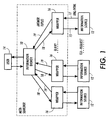
- Information broker 10 is a type of search engine that accesses search results from multiple search engines 12, ranks them and presents them to a user or client 14.
- a wrapper 16 is a type of interface or container that is tied to data; it encapsulates and hides the intricacies of a remote information source in accordance with a set of rules known as a grammar or a wrapper grammar, providing two functions to an information broker 10. First, wrappers are used to translate a client query 18 to a corresponding one the remote information source 12 will understand. Wrappers are associated with the particular information source.
- HTTP wrappers interact with HTTP servers and HTML documents; JDBC wrappers work with ODBC-compliant databases; and DMA wrappers work with DMA-compliant document management systems.
- Wrapped queries 15 are submitted via a common gateway interface (CGI) to the various information sources 12, which generate responses 17 in XML or HTML format.
- CGI common gateway interface
- a separate wrapper 16 In order for information broker 10 to process results from information sources 12, a separate wrapper 16 must be provided for each information source 12. Referring to Figure 2, a wrapper grammar must be generated (step 20) and a wrapper created (step 22) for each new information source 12 that information broker 10 intends to submit a client query. Then information source 10 uses the wrapper 16 to process the client query (step 24) to provide the query elements (wrapped query 15) in a form understandable by the information source 12.
- the wrapper 16 is used to process the results 17 in a form that can be used by the information source 10 (step 28).
- Wrappers 16 extract the information stored in the HTML files representing the individual web pages.
- the wrapper 16 scans the HTML files 17 returned by the information source 12, drops the markup instructions and extracts the information related to the query, then parses (or processes) the results in a form that can be interpreted and filtered by the information broker 10.
- the information source 10 displays the wrapped results 19 to the client (step 30) in a format that can be viewed by the user. Extraction and parsing is done in accordance with the grammar or rules for the particular type of response file.
- the information source 10 checks for a new query (step 32) and if none, ends (step 34) and if yes, loops back to receive a new query (step 24).
- the alphabet is a fixed finite nonempty set ⁇ of symbols.
- a string is a group of symbols (tokens).
- the set of all finite strings over ⁇ is denoted ⁇ *.
- ⁇ denotes an empty string.
- denotes the length of w
- w r denotes the reverse of w .
- the concatenation of two strings w and u is denoted wu .
- a language is any subset of ⁇ *.
- Q is the set of states
- I is the set of initial states
- F is the set of final or accepting states of A
- ⁇ is the transition function of A .
- the acceptor is deterministic if and only if there is one initial state, and for each state q ⁇ Q and symbol a ⁇ ⁇ there is at most one element in ⁇ (q,a).
- the transition function ⁇ may be extended to map a set of states and a string to a set of states in the usual way. If q ⁇ ⁇ (q',a), then q' is called an a-predecessor of q and q is called an a-successor of q'.
- the set of strings accepted by A is called the language of A and is denoted L ( A ).
- HTML tags and Strings for the contents of the HTML elements
- ⁇ ⁇ String , ⁇ html >, ⁇ / html >, ⁇ body >, ⁇ / body >..., ⁇ .
- two tag tokens surround one String token (and it can be annotated with one or no user attribute). The case when one HTML String token can be assigned to more that one attribute is considered below.
- S be a positive sample set of a language L .
- PT ( S ) is a deterministic acceptor that accepts precisely the set S .
- the inference algorithm for determining if a grammar is k -reversible begins with the prefix tree acceptor for S and generalizes it by merging states.
- An acceptor either accepts an input string or rejects it. In wrappers, more actions for information extraction are needed than just acceptance or rejection.
- An attribute acceptor is an acceptor that, beyond accepting or rejecting input strings, also annotates recognized String tokens with certain attributes defined by the user or application. In the following, the user-defined attributes create a list T and the attribute acceptor A ( T ) can be likened to a wrapper grammar.
- any transition rule in ⁇ of an attribute acceptor is annotated with an attribute t ⁇ T.
- a list T with a special attribute void is used each time there is no assignment.
- those attributes that can be assigned are separated from those attributes that cannot.
- a symbol a ⁇ ⁇ is called attributable, if its value can be assigned to an attribute of T .
- For an HTML acceptor we assume that only token String and token tag ⁇ a > which contains a hyper-link are attributable.
- L ⁇ HTML> ( ⁇ b> Author ( ⁇
- Figure 5 shows a graphical representation of the acceptor A(T) above.
- K-reversibility An important aspect of the invention is determining if the HTML response structure is k -reversible.
- k be a fixed nonnegative integer.
- A ( ⁇ , Q, I, F , ⁇ ) be an acceptor.
- String u is said to be a k-follower (respectively, k-leader) of a state q in A if and only if
- k and ⁇ ( q,u ) ⁇ 0 (respectively, ⁇ r ( q,u r ) ⁇ 0). Note that every state has exactly one 0-follower and one 0-leader, namely, ⁇ .
- the acceptor A is defined to be deterministic with lookahead k if and only if any pair of distinct states q 1 and q 2 , if q 1 , q 2 ⁇ I or q 1 , q 2 ⁇ (q 3 ,a) for some q 3 ⁇ Q and a ⁇ ⁇ , then there is no string that is a k -follower of both q 1 and q 2 . This guarantees that any non-deterministic choice in the operation of A can be resolved by looking ahead k symbols past the current one.
- An acceptor A is defined to be k -reversible if and only if A is deterministic and A r is deterministic with lookahead k.
- k -reversibility of attribute acceptors is defined in a similar way.
- An attribute acceptor A is defined to be k -reversible if and only if A is deterministic and A r is deterministic with lookahead k .
- the requirements the positive sample set of HTML files from a given information source must satisfy the following requirements in order to make the automatic wrapper grammar inference or generation possible.
- Sample HTML files may be annotated by a user or a routine that interactively queries the user for attribute names.
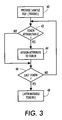
- a sample file comprising a set of tokens, including HTML tags and strings (step 40) is provided.
- a sample HTML file comprises a series of none or one or more individual string tokens, s .
- each token is examined to determine if it is attributable (can it be assigned to a user-defined or predetermined attribute) in step 42. If the token is attributable, it is assigned to one of the attributes in the set of attributes (step 44). If not, the next token is examined.
- a set of attributable tokens S T is formed (Step 48).
- each string s has been annotated with an attribute t from the set of attributes T .
- a string s' ⁇ S T is a string s ⁇ S that has been preprocessed by annotating all attributable tokens with attributes from T .
- string s is a string s' cleaned from all labels.
- S T ⁇ HTML> ⁇ b>String(Author) ⁇ b>String(Title) ⁇ p> ⁇ b>String (Author) ⁇ p>, ⁇ HTML> ⁇ b>String (Author) ⁇ p> ⁇ b>String (Author) ⁇ p>, ⁇ HTML> ⁇ b>String(Author) ⁇ b>String(Title)> ⁇ p>, ⁇ HTML> ⁇ b>String (Author) ⁇ p>, ⁇ HTML> ⁇ .
- S T be an annotated sample set corresponding to the above sample set S .
- T be an attribute list and S T be an annotated sample set.
- S T be an annotated sample set.
- Theorem 1 indicates that if all attributes in the annotated sample set S T are distinguishable, then the grammar is k -reversible, the wrapper grammar generation can be done automatically and all attributes will be properly recognized.
- a partial wrapper grammar is generated for all other distinguishable attributes (excluding only those indistinguishable attributes). This is a significant advantage.
- the attribute set is normalized, that is, each group of indistinguishable attributes is merged into one joint attribute. (As noted above, if some information provider or source links Journal and Volume in the same string, these will be combined into a single attribute called Reference.)
- d is a subset of T
- a reverse prefix set of d as the union of reverse prefix sets of attributes in d
- Pr(d) ⁇ ti ⁇ d Pr( t i ).
- the attribute normalization partitions all user attributes of T into classes based on reverse prefix equivalence.
- the reversibility index k is a measure of the complexity of the HTML file. For example, if the HTML files are relatively simple (such as in Example 1), then the value of k is small (the smallest value is 1). In more complex HTML files, the value of k may be larger: 2, 3 or more. Small values of k are preferable from a performance point of view, because they make the grammar shorter and the processing (parsing) faster. However larger values of k mean the wrapper grammar is more complex and more information can be extracted.
- k ( i,j ) min ⁇ k
- Pr k ( t i ) ⁇ Prk ( t j ) ⁇ ⁇ .
- k ( T' ) min ⁇ k
- ⁇ i,j:t i ,t j ⁇ T' , Pr k ( t i ) ⁇ Pr k ( s j ) ⁇ .
- the value k(T') indicates the reversibility index of the regular language corresponding to attribute set T' obtained by the normalization of the annotated sample set S T .
- Induction with the reversibility index k is a recursive construction of the attribute acceptor Ai +1 from the attribute A i +1 by merging two states q 1 and q 2 such that either
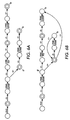
- Figure 6a shows the initial prefix tree acceptor.
- Figures 6b-6d show the merge steps conducted by the 2-reversibility of the attribute acceptor. Merged states at each step are indicated by arrows. Note the final attribute acceptor in Figure 6d is equivalent to the acceptor in Figure 1.
- the method for automatic wrapper grammar generation can be described as a sequence of steps to be performed.
- create the prefix sets Pr( t i ) for all attributes t i ⁇ T. Construct the attribute partition ⁇ of T, T' ⁇ d i ⁇ .
- step 56 check if wrapper grammar generation is completely possible (step 56). If
- 1, the wrapper cannot be generated automatically (step 62). If 1 ⁇
- the attribute acceptor generated by the method corresponds to a regular grammar that accepts responses from the information provider and assigns the tokens to the user attributes.
- the method of automatic wrapper grammar generation is incremental. First, it does not require all grammatical particularities of the source responses to appear in the initial sample set. The attribute acceptor that will be generated from such an incomplete sample set will accept the sample files as well as all responses having the same (incomplete) structure. Second, each time a response from the source contains a grammatical element not appeared in previous samples, the method would upgrade the acceptor following the same procedure used for the initial sample set. If the difference does not contain any attributable tokens, the upgrade will be mute; otherwise the designer will be asked to annotate the attributable tokens in order to update the annotated sample set. Note that new grammatical elements in the response files can result in recalculation of some prefix values or even converting some distinguishable user attributes into indistinguishable.
- the present invention may be readily implemented in software using software development environments that provide portable source code that can be used on a variety of hardware platforms.
- the disclosed system may be implemented partially or fully in hardware using standard logic circuits. Whether software or hardware is used to implement the system varies depending on the speed and efficiency requirements of the system and also the particular function and the particular software or hardware systems and the particular microprocessor or microcomputer systems being utilized.
Landscapes
- Engineering & Computer Science (AREA)
- Databases & Information Systems (AREA)
- Theoretical Computer Science (AREA)
- Data Mining & Analysis (AREA)
- Physics & Mathematics (AREA)
- General Engineering & Computer Science (AREA)
- General Physics & Mathematics (AREA)
- Information Retrieval, Db Structures And Fs Structures Therefor (AREA)
- Stored Programmes (AREA)
- Machine Translation (AREA)
Abstract
Description
- This invention relates generally to information retrieval and integration systems, and more particularly, to the creation and generation of wrapper grammars for extracting and regenerating information from documents stored in networked repositories.
- A wrapper is a type of interface or container that is tied to data; it encapsulates and hides the intricacies of a remote information source in accordance with a set of rules known as a grammar or a wrapper grammar, providing two functions to an information broker. First, wrappers are used to translate a client query to a corresponding one that the remote information source will understand. Wrappers are associated with the particular information source. For example, HTTP wrappers interact with HTTP servers and HTML documents; JDBC wrappers work with ODBC-compliant databases; and DMA wrappers work with DMA-compliant document management systems.
- Second, wrappers are used by search engines to extract the information stored in the HTML files representing the individual web pages; the wrapper scans the HTML files returned by the search engine, drops the markup instructions and extracts the information related to the query. If an information broker is involved, the wrapper parses (or processes) the results in a form that can be interpreted and filtered by the information broker. Then the wrapper takes the search answers, either from the different document repositories or from the information broker, puts them in a new format that can be viewed by the user. Extraction and parsing is done in accordance with the grammar or rules for the particular type of response file.
- Unfortunately, document repositories and providers' HTML response files are generated for the convenience of visualization rather than information extraction. Moreover, response files from different information providers vary widely both in structure and in format: HTML, ODBC, DMA. Even among HTML providers, the format may vary. For example, some providers may generate HTML tags to separate each attribute of the document (author, title, journal, and date of publication). Other providers may link attributes, such as author and title, together, separating them not by an HTML tag, but by a grammatical separator such as a comma or semicolon.
- As a result, the analysis of response files and the creation of wrapper grammars in most search engines require human intervention. As the Web providers evolve over time and as individual documents may change over time, human intervention is also needed each time the response structure or markup is changed. This makes the process of the wrapper grammar creation and maintenance extremely time-consuming and error-prone.
- Two main problems affect automatic wrapper grammar generation. The first problem is the ambiguous markup of response pages by some Web-based information providers, which makes automatic wrapper grammar generation difficult at best and in some cases impossible. For example, a Web provider reports a list of answers, with each item containing two string-value attributes t 1 and t 2, with t 2 being optional. Additionally, the provider may use a unique format for each attribute. That is, the HTML file structure of a response page from this Web provider looks as follows: (<i> String (t 1) <i> (<i> String (t 2) </i>)) +. Assume the wrapper grammar has been generated, it has correctly guessed this format and it receives the following response from the provider: <i> string1 </i> <i> string2 </i>. While the wrapper grammar uniquely assigns strings to attribute t 1, recognizing string 2 is ambiguous; the wrapper grammar may assign string 2 to either attribute t1 or attribute t 2 (nondeterministic choice). Clearly, such a behavior is unacceptable for correct attribute extraction and t 2 should therefore be excluded during the wrapper grammar generation.
- The second main problem in automatically generated wrapper grammars is over-generalization. For example, a grammar like (<HTML> | </HTML> | <body> | </body > | ...| String)* will accept any HTML file, but it is incapable of properly assigning tokens (or specific values) to the defined user attributes (Title, Author, etc.). Over-generalization originates from a grammar inference mechanism which detects some common fragments in the sample input strings and generalizes them by merging them into a single attribute. Actually, over-generalization is related to inadequate or missing control over merges, which produces a general grammar that extracts more than the allowed for correct attribute.
- A method for generating a wrapper grammar for a file having a structure of a particular format, according to the invention, includes providing at least one sample file of the particular format, wherein the particular format comprises a plurality of string tokens. While any particular type format file may be used (such as HTML, JDBC, DMA) with the invention, for convenience, only HTML files will be discussed hereafter. Each sample HTML file includes a plurality of tokens (data strings) which may be actual data from the document, an HTML tag or some other grammatical separator.
- The sample file of the particular format is then processed by annotating attributable tokens with attributes from a set of attributes to generate an annotated sample set. A token is attributable if it can be assigned to an attribute. The tokens are, for example, annotated or labeled by assigning a user-defined attribute, such as Author, Title, etc., to those tokens for which such an attribute is defined by an appropriate user.
- The annotated sample set is then evaluated to determine if wrapper grammar generation is possible, and if wrapper grammar generation is possible, a wrapper grammar for the files having a structure of the particular format is generated.
- Preferably, the annotated sample set is evaluated by determining if all attributes in the annotated sample set are distinguishable from one another. Distinguishability is determined by generating a set of reverse prefixes for each attribute ti , partitioning the attribute set into equivalence classes di , where no two equivalence classes have common reverse prefixes, and if the equivalence classes are equal to the attributes, di = ti , then all attributes ti are distinguishable and automatic wrapper grammar generation is possible.
- The method for generating a wrapper grammar according to the invention overcomes the problems of the manual approach to wrapper grammar generation, eliminating time-consuming and error-prone human intervention. The method for generating a wrapper grammar according to the invention uses techniques from grammatical inference and machine learning and can be used with a much larger class of wrapper grammars than those considered above.
- A grammar is a set of rules that together define what may be "spoken" or displayed. In the context of the invention, the wrapper is the interface program that implements the grammar rules. For example, when the wrapper is compiled with a Java compiler compiler, which is a parser generator for use with Java applications, the Java compiler compiler converts the wrapper grammar to a Java program (i.e., the wrapper) that can recognize matches from response pages to the grammar.
- A basis for the method of the invention is the assumption that a response page can be covered by a regular grammar. More precisely, a response page is assumed to be covered by a k-reversible regular grammar, where k ≥ 0. Although the class of reversible grammars is a proper subset of the regular grammar class, the difference between the two classes is minimal so the two can be considered the same for purposes of wrapper grammar generation. Moreover, it can be proven that attribute acceptors induced for the two classes (regular grammars and k-reversible grammars) have the same expressive power. Thus, applying the method of the invention to real Web information providers to generate wrapper grammars based on regular grammars, wrapper grammars are successfully generated nearly 100% of the time.
- The method is incremental; it does not require the annotated samples to be necessarily complete, that is, representing all structural elements of the responses. The method is capable of refining the wrapper grammar each time a new HTML response contains a structural element not used in previously processed HTML responses.
- The method of wrapper grammar generation according to the invention overcomes the problems of both ambiguity and over-generalization. Ambiguity and over-generalization are eliminated by detecting a proper level of commonness between different fragments of sample strings. Thus the depth of merge operations is determined in such a way that the wrapper grammar generated automatically will accept all strings similar to those in the sample set and, at the same time, will be able to recognize tokens corresponding to use-defined attributes.
- Moreover, the method of wrapper grammar generation according to the invention is capable of generating a wrapper grammar in partial cases, i.e., when only some of the user-defined attributes can be distinguished by the automatic grammar generation. In this case, the method provides a partial solution; it merges attributes it cannot recognize into a newly defined joint attribute and then completes the automatic grammar generation. The automatically generated wrapper grammar will recognize the individual attributes, if present, or the joint attribute if present. For example, if user attributes Journal and Volume are not distinguished by the automatic wrapper grammar generation, they can be substituted by a joint attribute called Reference, which will be used in the automatic grammar generation. When the wrapper grammar is used to scan HTML files, if the particular file contains separate tokens for Journal and Volume, they will be found. If only a single token is found, then it will be reported as the attribute Reference.
- Some examples of methods and systems according to the present invention will now be described with reference to the accompanying drawings, in which:-
- Figure 1 is a block diagram of an information broker system, which uses different wrappers to transcribe and extract data from a plurality of different information providers;
- Figure 2 is a flow chart of an overall method of generating and using a wrapper;
- Figure 3 is a flow chart of a method according to the invention for creating an annotated sample set;
- Figure 4 is a flow chart of a method according to the invention for generating a wrapper grammar;
- Figure 5 is a graph of an attribute acceptor A(T) for the sample set ST given in Example 1; and
- Figures 6a-6d are graphs of the attribute acceptor A(T) for the sample set ST given in Example 2.
-
- Referring to Figure 1, an information broker is shown therein and generally referred to by
reference numeral 10.Information broker 10 is a type of search engine that accesses search results frommultiple search engines 12, ranks them and presents them to a user orclient 14. Awrapper 16 is a type of interface or container that is tied to data; it encapsulates and hides the intricacies of a remote information source in accordance with a set of rules known as a grammar or a wrapper grammar, providing two functions to aninformation broker 10. First, wrappers are used to translate aclient query 18 to a corresponding one theremote information source 12 will understand. Wrappers are associated with the particular information source. For example, HTTP wrappers interact with HTTP servers and HTML documents; JDBC wrappers work with ODBC-compliant databases; and DMA wrappers work with DMA-compliant document management systems. Wrapped queries 15 are submitted via a common gateway interface (CGI) to thevarious information sources 12, which generateresponses 17 in XML or HTML format. - In order for
information broker 10 to process results frominformation sources 12, aseparate wrapper 16 must be provided for eachinformation source 12. Referring to Figure 2, a wrapper grammar must be generated (step 20) and a wrapper created (step 22) for eachnew information source 12 thatinformation broker 10 intends to submit a client query. Theninformation source 10 uses thewrapper 16 to process the client query (step 24) to provide the query elements (wrapped query 15) in a form understandable by theinformation source 12. - When the
information source 12 returns the search results 17 (step 26), thewrapper 16 is used to process theresults 17 in a form that can be used by the information source 10 (step 28).Wrappers 16 extract the information stored in the HTML files representing the individual web pages. Thewrapper 16 scans the HTML files 17 returned by theinformation source 12, drops the markup instructions and extracts the information related to the query, then parses (or processes) the results in a form that can be interpreted and filtered by theinformation broker 10. Once processed, theinformation source 10 then displays the wrappedresults 19 to the client (step 30) in a format that can be viewed by the user. Extraction and parsing is done in accordance with the grammar or rules for the particular type of response file. Theinformation source 10 checks for a new query (step 32) and if none, ends (step 34) and if yes, loops back to receive a new query (step 24). - To aid in understanding the method and system of the invention, certain definitions from the theory of formal languages and grammar learning are provided. The alphabet is a fixed finite nonempty set Σ of symbols. A string is a group of symbols (tokens). The set of all finite strings over Σ is denoted Σ*. λ denotes an empty string. For any string w, |w| denotes the length of w and wr denotes the reverse of w. The concatenation of two strings w and u is denoted wu. The string v is a prefix of the string w if and only if there exists a string u such that vu = w. A language is any subset of Σ*. The reverse of a language L is defined by Lr = {wr | w ∈ L}· A positive sample set of the language L is a finite set of strings of L.
- An acceptor is a 5-tuple A = (Σ,Q,I,F,δ), such that Σ is an alphabet, Q is a finite set, I and F are subsets of Q, and δ is a map from Q x Σ to subsets of Q. Q is the set of states, I is the set of initial states, F is the set of final or accepting states of A, and δ is the transition function of A. The acceptor is deterministic if and only if there is one initial state, and for each state q ∈ Q and symbol a ∈ Σ there is at most one element in δ(q,a). The transition function δ may be extended to map a set of states and a string to a set of states in the usual way. If q ∈ δ (q',a), then q' is called an a-predecessor of q and q is called an a-successor of q'.
- A string u is accepted by an acceptor A = (Σ,Q,I,F,δ) if and only if δ(I,u) contains some element of F. The set of strings accepted by A is called the language of A and is denoted L(A).
- In an HTML acceptor, the alphabet consists of a predefined set of tokens: HTML tags and Strings (for the contents of the HTML elements), Σ = {String, <html>,</html>,<body>,</body>...,}. Without loss of generality, we here assume two tag tokens surround one String token (and it can be annotated with one or no user attribute). The case when one HTML String token can be assigned to more that one attribute is considered below.
- Let S be a positive sample set of a language L. We define the prefix tree acceptor for S, PT(S) = (Σ, Q, I, F, δ), as follows: Q = Pr(S); I = {λ}; F = S; δ(u,a) = ua, whenever u,ua ∈ Q. PT(S) is a deterministic acceptor that accepts precisely the set S. The inference algorithm for determining if a grammar is k-reversible (defined below) begins with the prefix tree acceptor for S and generalizes it by merging states.
- An acceptor, as defined above, either accepts an input string or rejects it. In wrappers, more actions for information extraction are needed than just acceptance or rejection. An attribute acceptor is an acceptor that, beyond accepting or rejecting input strings, also annotates recognized String tokens with certain attributes defined by the user or application. In the following, the user-defined attributes create a list T and the attribute acceptor A(T) can be likened to a wrapper grammar.
- An attribute acceptor is a tuple A(T) = (Σ, Q, I, F, T, δ) where Σ is an alphabet, Q, I, F are sets of all, initial and final states of A(T), T is an attribute set and δ is a map from q x Σ to Q x T. Informally, any transition rule in δ of an attribute acceptor is annotated with an attribute t ∈ T. Each time the attribute acceptor consumes the transition rule (q,t) = δ(q',a), the value of String token a (or attributable token a) is assigned to attribute t, such producing the attribute-value pair (t, a.value). Note that a.value is used to distinguish between token a (String) and its value ('XRCE').
- To allow transitions without any attribute assignment, a list T with a special attribute void is used each time there is no assignment. Moreover, for practical needs of HTML acceptors, those attributes that can be assigned are separated from those attributes that cannot. A symbol a ∈ Σ is called attributable, if its value can be assigned to an attribute of T. For an HTML acceptor, we assume that only token String and token tag <a> which contains a hyper-link are attributable. Given an attribute list T, an attribute acceptor A(T) is an acceptor A extended with T in such a way that each rule q' = δ(q,a) in δ where a is attributable symbol, is assigned with attributes ti ∈ T:q, ti = δ(q,a).
- Inversely, for an attribute acceptor A(T), its plain acceptor A is an acceptor obtained from A(T) by the removal all attribute annotations from the transition rules. String u is accepted by A(T) if and only if it is accepted by its plain acceptor A. For an accepted string u, the attribute acceptor A(T) produces a labeled sequence G(u) of attribute-value pairs (ti ,a.value), where ti ∈ T and a ∈ u.
- Assume an information provider generates responses using an HTML structure which is described by the following regular expression: L =<HTML> (<b> Author (∈ | <b> Title) <p>)*, that is, each response starts with the token <HTML> tag followed by a list of 0 or more authors, and each author can be optionally accompanied with a title. An attribute acceptor for L is A(T) = (Σ,Q,I,F,T,δ, where Q = {q 1,...,q 6}, I = {q0}, F = {q 1. q 6}, T = {Author, Title, void}, and
q q q q q - Figure 5 shows a graphical representation of the acceptor A(T) above.
- K-reversibility. An important aspect of the invention is determining if the HTML response structure is k-reversible. Let k be a fixed nonnegative integer. Let A = (Σ, Q, I, F, δ) be an acceptor. String u is said to be a k-follower (respectively, k-leader) of a state q in A if and only if |u|=k and δ(q,u) ≠ 0 (respectively, δr(q,ur ) ≠ 0). Note that every state has exactly one 0-follower and one 0-leader, namely, λ. The acceptor A is defined to be deterministic with lookahead k if and only if any pair of distinct states q 1 and q 2, if q1, q2 ∈ I or q1, q2 ∈δ(q3,a) for some q3 ∈ Q and a ∈ Σ, then there is no string that is a k-follower of both q1 and q2 . This guarantees that any non-deterministic choice in the operation of A can be resolved by looking ahead k symbols past the current one.
- An acceptor A is defined to be k-reversible if and only if A is deterministic and Ar is deterministic with lookahead k. A language L is defined to be k-reversible if and only if there exists a k-reversible automaton A such that L=L(A). k-reversibility of attribute acceptors is defined in a similar way. An attribute acceptor A is defined to be k-reversible if and only if A is deterministic and Ar is deterministic with lookahead k. An HTML response structure W is defined to be k-reversible, and a wrapper grammar may be generated, if and only if there exists a k-reversible automaton A such that W=W(A).
- The requirements the positive sample set of HTML files from a given information source must satisfy the following requirements in order to make the automatic wrapper grammar inference or generation possible.
- Let S be a set of sample HTML files and ST be a set of annotated sample files. Sample HTML files may be annotated by a user or a routine that interactively queries the user for attribute names. Referring to Figure 3, for example, a sample file comprising a set of tokens, including HTML tags and strings (step 40) is provided. Thus a sample HTML file comprises a series of none or one or more individual string tokens, s. To annotate the tokens, each token is examined to determine if it is attributable (can it be assigned to a user-defined or predetermined attribute) in
step 42. If the token is attributable, it is assigned to one of the attributes in the set of attributes (step 44). If not, the next token is examined. When the last token in the file has been examined (step 46), a set of attributable tokens ST is formed (Step 48). When the string tokens have been annotated into attributes, each string s has been annotated with an attribute t from the set of attributes T. Thus, a string s'∈ ST is a string s ∈ S that has been preprocessed by annotating all attributable tokens with attributes from T. Inversely, string s is a string s' cleaned from all labels. - Let s' be a labeled string from ST and ti be an attribute of T. If s' contain tokens ai,a2,,,an annotated with ti , we calculate the set Pr(s',ti) of reverse prefixes of ai . (Note that string u is a reverse prefix of symbol a∈s if there exists a string v such that s = urav.) Then we calculate Pr(ti ) = {∪ s ,∈ST Pr(s',ti )}, the union of all cleaned prefixes of attribute ti in the set S. The next step is to determine if all attributes in ST are distinguishable, i.e., whether the grammar S is k-reversible.
- Let the user attribute list T be given by two attributes Author and Title and the annotated sample set ST be given by:
- Then the prefix of attribute Author, Pr(Author) ={<b><HTML>,<b><p>String<b>String<b><HTML>, <b><p>String<b><HTML>} and the prefix of attribute Title, Pr(Title) = (<b>String<b><HTML>}.
- Let ST be an annotated sample set corresponding to the above sample set S. Two distinct attributes ti and tj of T are called distinguishable in ST if Pr(ti ) ∩ Pr(tj ) = .
- Let T be an attribute list and ST be an annotated sample set. There exists a deterministic attribute acceptor for set ST if and only if any pair of attributes of T is indistinguishable in ST. Theorem 1 indicates that if all attributes in the annotated sample set ST are distinguishable, then the grammar is k-reversible, the wrapper grammar generation can be done automatically and all attributes will be properly recognized.
- Alternatively, if two or more attributes are indistinguishable, it does not necessarily mean a partial wrapper grammar cannot be generated. In many practical situations, an automatically generated partial wrapper grammar can be sufficient to meet the user's needs. A partial wrapper grammar is generated for all other distinguishable attributes (excluding only those indistinguishable attributes). This is a significant advantage.
- To allow partial wrapper grammar generation, the attribute set is normalized, that is, each group of indistinguishable attributes is merged into one joint attribute. (As noted above, if some information provider or source links Journal and Volume in the same string, these will be combined into a single attribute called Reference.)
- If d is a subset of T, we define a reverse prefix set of d as the union of reverse prefix sets of attributes in d, Pr(d) = ∪ ti ∈ d Pr(ti ). Then the attribute normalization is a partition π of the attribute set T into equivalence classes d1, d2 ,... such that T = ∪ idi and Pr(di)∩Pr(dj) = , where i ≠ j, that is no two classes have common reverse prefixes. Once the partition π is done, we obtain all equivalence classes di that are distinguishable for the automatic wrapper grammar generation.
- The following are some important cases of attribute normalization:
- If all attributes are distinguishable, then di = {ti }. This means the wrapper grammar can be completely generated.
- If d1 = T, then all attributes are indistinguishable and no partial parser can be generated automatically. This means the wrapper grammar cannot be generated at all.
- If an equivalence class di contains an attribute ti and to = void, attribute ti is consumed by void and cannot be recognized in response files and must be excluded from the wrapper grammar.
- The attribute normalization partitions all user attributes of T into classes based on reverse prefix equivalence. The partition π of the attribute set T = {ti } is denoted as the normalized attribute set T'={di }. Partial wrapper grammar generation is possible with some merged attributes.
- The reversibility index k is a measure of the complexity of the HTML file. For example, if the HTML files are relatively simple (such as in Example 1), then the value of k is small (the smallest value is 1). In more complex HTML files, the value of k may be larger: 2, 3 or more. Small values of k are preferable from a performance point of view, because they make the grammar shorter and the processing (parsing) faster. However larger values of k mean the wrapper grammar is more complex and more information can be extracted.
- Once a normalized partition of the attribute set has been created, no two classes (attributes) in T' have any common reverse prefix. Let ti and tj be two attributes in T'. For a string s ∈ S, the leading k characters of s is called a k-prefix and denoted by s[k]. If len(s) < k, s[k] = s, where len(s) is the length of string s. Given the set Pr(ti) of reverse prefixes of attribute ti ∈ T', the set PRk (ti ) = {s[k]|s ∈ Pr(ti )} is called a k-prefix set of the attribute ti .
- For two distinct attributes ti and tj, the minimal joint index between ti and tj is given by k(i,j) = min{k|Pr k (ti ) ∩ Prk(tj )} = .
- For the example set given in Example 2 above, we obtain the prefixes of attributes Author and Title: Pr(Author) = {<b><HTML>, <b><p>String<b>String<b> <HTML>, <b><p>String<b><HTML>) and Pr(Title) = {<b>String <b><HTML>}. Then the minimal joint index k between Author and Title is given by: k(Author, Title) = 2. Indeed, if the prefix of Author is given by Pr2(Author) = {<b><HTML>,<b><p>} and the prefix of Title is given by Pr2(Title) = {<b>String}, then for these definitions of Author and Title, Pr2(Author) ∩ Pr2(Title) = . Instead, for k = 1, Pr1(Author) ∩ Pr1(Title) = {<b>} ≠ . Thus the wrapper grammar given by Example 2 is 2-reversible and not 1-reversible. This means the wrapper grammar must search k = 2 symbols past the current one for a deterministic result.
- For the whole attribute set T', we calculate a minimal reversibility index for all pairs of attributes, we can similarly calculate a common index for all attributes: k(T') = min{k|∀i,j:ti,tj ∈ T', Pr k (ti ) ∩ Pr k (sj ) = . The value k(T') indicates the reversibility index of the regular language corresponding to attribute set T' obtained by the normalization of the annotated sample set ST.
- Given a reversibility index k obtained in the previous section, we can infer a k-reversible attribute acceptor by applying the definition described above. Starting from the prefix tree acceptor A0 = PA(ST), we generate acceptors A 1,A 2,... by merging the states which violate the k-reversibility conditions. When no pair of states is found to violate these conditions, the result is a final attribute k-reversible acceptor for the sample set ST.
- More precisely, let ST be the set of annotated sample files and A0 = (Σ, Q0, I0, F0 , δ 0 ) be a prefix tree acceptor constructed for ST. Induction with the reversibility index k is a recursive construction of the attribute acceptor Ai+1 from the attribute Ai +1 by merging two states q1 and q2 such that either
- 1. for some a ∈ Σ and state q 3, states q 1 and q 2 are both a-successors of q 3, or
- 2. q 1 and q 2 have a common k-leader and either q 1 and q 2 are both final states, or there exists state q 3 and a symbol a ∈ Σ such that q 3 is an a-successor of both q 1 and q 2.
-
- For the annotated sample set given in Example 2, Figure 6a shows the initial prefix tree acceptor. Then Figures 6b-6d show the merge steps conducted by the 2-reversibility of the attribute acceptor. Merged states at each step are indicated by arrows. Note the final attribute acceptor in Figure 6d is equivalent to the acceptor in Figure 1.
- Referring to Figure 4, the method for automatic wrapper grammar generation can be described as a sequence of steps to be performed. Provide a set of sample HTML files of a particular format and a set of user selected or predetermined attributes (step 50). Preprocess the set of sample HTML files by annotating attributable tokens by attributes from the attribute set T = {d0 = void, t 1,t 2...} to form an annotated sample set (step 52). Evaluate the annotated sample set (step 54) to determine if wrapper grammar generation is possible. To accomplish this, create the prefix sets Pr(ti ) for all attributes ti ∈ T. Construct the attribute partition π of T, T'= {di }. Then, check if wrapper grammar generation is completely possible (step 56). If |T'| = |T|, the complete wrapper can be generated automatically and continue to generate the wrapper grammar (step 58). Then check if partial grammar generation is possible (step 60). If the obtained partition contains one class, |T'|=1, the wrapper cannot be generated automatically (step 62). If 1 < |T'| < |T|, a partial wrapper can be generated automatically. Normalize the attribute set (step 64). If 1 < |T'| calculate the minimal reversibility index k for T'. Construct the prefix tree acceptor A 0 and induce the k-reversibility attribute acceptor from the sample set ST. Generate the normalized sample set (step 66) and generate the wrapper grammar (step 58) .
- Note that if any equivalence class di contains attribute t0 = void and ti , i > 0, attribute ti is consumed by void attribute and cannot be recognized in the automatic wrapper generation. If there are additional HTML sample files (step 68) the method loops back to step 52. If not, a wrapper grammar is generated (step 70). The attribute acceptor generated by the method corresponds to a regular grammar that accepts responses from the information provider and assigns the tokens to the user attributes.
- The method of automatic wrapper grammar generation is incremental. First, it does not require all grammatical particularities of the source responses to appear in the initial sample set. The attribute acceptor that will be generated from such an incomplete sample set will accept the sample files as well as all responses having the same (incomplete) structure. Second, each time a response from the source contains a grammatical element not appeared in previous samples, the method would upgrade the acceptor following the same procedure used for the initial sample set. If the difference does not contain any attributable tokens, the upgrade will be mute; otherwise the designer will be asked to annotate the attributable tokens in order to update the annotated sample set. Note that new grammatical elements in the response files can result in recalculation of some prefix values or even converting some distinguishable user attributes into indistinguishable.
- The method of the invention that employs learning from samples marked by the wrapper grammar designer (for example) turns out to be more efficient than the rigid schemes used in other approaches. Analysis of 21 HTML wrapper grammars shows that all of them can be covered by k-reversible grammars, with 1-reversible grammar in 12 cases, 2-reversible grammars in 8 cases and 3-reversible grammar in 1 case.
- It will be appreciated that the present invention may be readily implemented in software using software development environments that provide portable source code that can be used on a variety of hardware platforms. Alternatively, the disclosed system may be implemented partially or fully in hardware using standard logic circuits. Whether software or hardware is used to implement the system varies depending on the speed and efficiency requirements of the system and also the particular function and the particular software or hardware systems and the particular microprocessor or microcomputer systems being utilized.
Claims (8)
- A method for generating a wrapper grammar for a file having a structure of a particular format, comprising:providing (50) at least one sample file of the particular format, wherein the particular format comprises a plurality of string tokens;processing (52) the at least one sample file of the particular format by annotating attributable tokens with attributes from a set of attributes, wherein a token is attributable if it can be assigned to an attribute, to generate an annotated sample set;evaluating (54) the annotated sample set to determine if wrapper grammar generation is possible; andif wrapper grammar generation is possible (56,60), generating (70) a wrapper grammar for the files having a structure of the particular format.
- The method of claim 1, wherein the step of evaluating the annotated sample set comprises determining if all attributes in the annotated sample set are distinguishable from one another.
- The method of claim 2, wherein the step of determining if all attributes ti are distinguishable comprises:generating a set of reverse prefixes for each attribute ti ;partitioning the attribute set into equivalence classes di , wherein no two equivalence classes have common reverse prefixes; andif the equivalence classes are equal to the attributes, di = ti , then all attributes ti are distinguishable.
- The method of any of the preceding claims, further comprising:providing a second sample of the particular format;processing the second sample file by annotating attributable tokens with new attributes from the set of attributes to generate a second annotated sample set;evaluating the second annotated sample set to determine if wrapper generation is possible; andif wrapper generation is possible, generating an incremental wrapper grammar.
- A system for generating a wrapper for a file having a structure of a particular format, comprising:a memory storing at least one sample file of the particular format, wherein the particular format comprises a plurality of string tokens; anda processor for processing the at least one sample file of the particular format by annotating attributable tokens with attributes from a set of attributes, wherein a token is attributable if it can be assigned to an attribute, to generate an annotated sample set; for evaluating the annotated sample set to determine if wrapper generation is possible; and if wrapper generation is possible, generating a wrapper for the files having a structure of the particular format.
- The system of claim 5, wherein the processor evaluates the annotated sample set by determining if all attributes in the annotated sample set are distinguishable from one another.
- The system of claim 6, wherein processor determines if all attributes ti are distinguishable by:generating a set of reverse prefixes for each attribute ti ;partitioning the attribute set into equivalence classes di , wherein no two equivalence classes have common reverse prefixes; andif the equivalence classes are equal to the attributes, di = ti , then all attributes ti are distinguishable.
- An article of manufacture for use in a system that includes a processor for accessing data on a storage medium using a storage medium access device, comprising:a storage medium; andinstruction data stored on the storage medium, the instruction data defining a sequence of instructions for access by the processor using the storage medium access device, wherein the sequence of instructions comprises:providing at least one sample file of the particular format, wherein the particular format comprises a plurality of string tokens;processing the at least one sample file of the particular format by annotating attributable tokens with attributes from a set of attributes, wherein a token is attributable if it can be assigned to an attribute, to generate an annotated sample set;evaluating the annotated sample set to determine if wrapper grammar generation is possible; andif wrapper grammar generation is possible, generating a wrapper grammar for the files having a structure of the particular format.
Applications Claiming Priority (2)
| Application Number | Priority Date | Filing Date | Title |
|---|---|---|---|
| US09/361,496 US6792576B1 (en) | 1999-07-26 | 1999-07-26 | System and method of automatic wrapper grammar generation |
| US361496 | 1999-07-26 |
Publications (3)
| Publication Number | Publication Date |
|---|---|
| EP1072985A2 true EP1072985A2 (en) | 2001-01-31 |
| EP1072985A3 EP1072985A3 (en) | 2002-08-28 |
| EP1072985B1 EP1072985B1 (en) | 2012-07-04 |
Family
ID=23422284
Family Applications (1)
| Application Number | Title | Priority Date | Filing Date |
|---|---|---|---|
| EP00306268A Expired - Lifetime EP1072985B1 (en) | 1999-07-26 | 2000-07-24 | Automatic wrapper grammar generation |
Country Status (3)
| Country | Link |
|---|---|
| US (1) | US6792576B1 (en) |
| EP (1) | EP1072985B1 (en) |
| JP (1) | JP4659946B2 (en) |
Cited By (1)
| Publication number | Priority date | Publication date | Assignee | Title |
|---|---|---|---|---|
| EP1582995A3 (en) * | 2004-03-31 | 2007-08-08 | Fujitsu Limited | Information sharing device and information sharing method |
Families Citing this family (25)
| Publication number | Priority date | Publication date | Assignee | Title |
|---|---|---|---|---|
| US7451136B2 (en) * | 2000-10-11 | 2008-11-11 | Microsoft Corporation | System and method for searching multiple disparate search engines |
| US20020147749A1 (en) * | 2001-04-06 | 2002-10-10 | Ortiz C. Enrique | Mobile presentation system |
| US7039647B2 (en) * | 2001-05-10 | 2006-05-02 | International Business Machines Corporation | Drag and drop technique for building queries |
| US7035841B2 (en) * | 2002-07-18 | 2006-04-25 | Xerox Corporation | Method for automatic wrapper repair |
| US7114118B1 (en) * | 2002-08-09 | 2006-09-26 | Virage Logic Corp. | System and method for providing adjustable read margins in a semiconductor memory |
| US20040111400A1 (en) * | 2002-12-10 | 2004-06-10 | Xerox Corporation | Method for automatic wrapper generation |
| US7689709B2 (en) * | 2002-12-13 | 2010-03-30 | Sap Ag | Native format tunneling |
| US20050165789A1 (en) * | 2003-12-22 | 2005-07-28 | Minton Steven N. | Client-centric information extraction system for an information network |
| US7716216B1 (en) | 2004-03-31 | 2010-05-11 | Google Inc. | Document ranking based on semantic distance between terms in a document |
| US20070039010A1 (en) * | 2005-08-15 | 2007-02-15 | Microsoft Corporation | Automatic generation of software code to facilitate interoperability |
| US7536369B2 (en) * | 2005-09-23 | 2009-05-19 | Xerox Corporation | XML-based architecture for rule induction system |
| US7660804B2 (en) * | 2006-08-16 | 2010-02-09 | Microsoft Corporation | Joint optimization of wrapper generation and template detection |
| US7617195B2 (en) * | 2007-03-28 | 2009-11-10 | Xerox Corporation | Optimizing the performance of duplicate identification by content |
| US8831950B2 (en) * | 2008-04-07 | 2014-09-09 | Nuance Communications, Inc. | Automated voice enablement of a web page |
| US8543404B2 (en) * | 2008-04-07 | 2013-09-24 | Nuance Communications, Inc. | Proactive completion of input fields for automated voice enablement of a web page |
| US9047869B2 (en) * | 2008-04-07 | 2015-06-02 | Nuance Communications, Inc. | Free form input field support for automated voice enablement of a web page |
| US20090271388A1 (en) * | 2008-04-23 | 2009-10-29 | Yahoo! Inc. | Annotations of third party content |
| US20100199165A1 (en) * | 2009-02-03 | 2010-08-05 | Yahoo!, Inc., a Delaware corporation | Updating wrapper annotations |
| US20100198770A1 (en) * | 2009-02-03 | 2010-08-05 | Yahoo!, Inc., a Delaware corporation | Identifying previously annotated web page information |
| US20100257440A1 (en) * | 2009-04-01 | 2010-10-07 | Meghana Kshirsagar | High precision web extraction using site knowledge |
| US8516457B2 (en) | 2011-06-28 | 2013-08-20 | International Business Machines Corporation | Method, system and program storage device that provide for automatic programming language grammar partitioning |
| US8676826B2 (en) | 2011-06-28 | 2014-03-18 | International Business Machines Corporation | Method, system and program storage device for automatic incremental learning of programming language grammar |
| US9377321B2 (en) | 2011-11-16 | 2016-06-28 | Telenav, Inc. | Navigation system with semi-automatic point of interest extraction mechanism and method of operation thereof |
| JP5784182B2 (en) * | 2014-05-01 | 2015-09-24 | 株式会社東芝 | Receiving device, query generation method, and program |
| US9977817B2 (en) | 2014-10-20 | 2018-05-22 | Conduent Business Services, Llc | Matching co-referring entities from serialized data for schema inference |
Family Cites Families (13)
| Publication number | Priority date | Publication date | Assignee | Title |
|---|---|---|---|---|
| US4996642A (en) | 1987-10-01 | 1991-02-26 | Neonics, Inc. | System and method for recommending items |
| US5724567A (en) | 1994-04-25 | 1998-03-03 | Apple Computer, Inc. | System for directing relevance-ranked data objects to computer users |
| US5794237A (en) | 1995-11-13 | 1998-08-11 | International Business Machines Corporation | System and method for improving problem source identification in computer systems employing relevance feedback and statistical source ranking |
| US5704017A (en) | 1996-02-16 | 1997-12-30 | Microsoft Corporation | Collaborative filtering utilizing a belief network |
| US6009441A (en) * | 1996-09-03 | 1999-12-28 | Microsoft Corporation | Selective response to a comment line in a computer file |
| US6085186A (en) * | 1996-09-20 | 2000-07-04 | Netbot, Inc. | Method and system using information written in a wrapper description language to execute query on a network |
| US5826258A (en) * | 1996-10-02 | 1998-10-20 | Junglee Corporation | Method and apparatus for structuring the querying and interpretation of semistructured information |
| US6304870B1 (en) * | 1997-12-02 | 2001-10-16 | The Board Of Regents Of The University Of Washington, Office Of Technology Transfer | Method and apparatus of automatically generating a procedure for extracting information from textual information sources |
| US6473752B1 (en) * | 1997-12-04 | 2002-10-29 | Micron Technology, Inc. | Method and system for locating documents based on previously accessed documents |
| US6085198A (en) * | 1998-06-05 | 2000-07-04 | Sun Microsystems, Inc. | Integrated three-tier application framework with automated class and table generation |
| US6424980B1 (en) * | 1998-06-10 | 2002-07-23 | Nippon Telegraph And Telephone Corporation | Integrated retrieval scheme for retrieving semi-structured documents |
| US6266668B1 (en) * | 1998-08-04 | 2001-07-24 | Dryken Technologies, Inc. | System and method for dynamic data-mining and on-line communication of customized information |
| US6442749B1 (en) * | 1998-10-30 | 2002-08-27 | Fujitsu Limited | Apparatus, method and architecture for task oriented applications |
-
1999
- 1999-07-26 US US09/361,496 patent/US6792576B1/en not_active Expired - Lifetime
-
2000
- 2000-07-18 JP JP2000216727A patent/JP4659946B2/en not_active Expired - Fee Related
- 2000-07-24 EP EP00306268A patent/EP1072985B1/en not_active Expired - Lifetime
Non-Patent Citations (1)
| Title |
|---|
| KUSHMERICK N; GRACE B: "The Wrapper Induction Environment", AAAI WORKSHOP WS-98-10: SOFTWARE TOOLS FOR DEVELOPING AGENTS, 1998 |
Cited By (1)
| Publication number | Priority date | Publication date | Assignee | Title |
|---|---|---|---|---|
| EP1582995A3 (en) * | 2004-03-31 | 2007-08-08 | Fujitsu Limited | Information sharing device and information sharing method |
Also Published As
| Publication number | Publication date |
|---|---|
| US6792576B1 (en) | 2004-09-14 |
| JP2001067255A (en) | 2001-03-16 |
| EP1072985B1 (en) | 2012-07-04 |
| EP1072985A3 (en) | 2002-08-28 |
| JP4659946B2 (en) | 2011-03-30 |
Similar Documents
| Publication | Publication Date | Title |
|---|---|---|
| EP1072985B1 (en) | Automatic wrapper grammar generation | |
| Giantamidis et al. | Learning Moore machines from input–output traces: G. Giantamidis et al. | |
| EP2057557B1 (en) | Joint optimization of wrapper generation and template detection | |
| US6606625B1 (en) | Wrapper induction by hierarchical data analysis | |
| Sycara et al. | Larks: Dynamic matchmaking among heterogeneous software agents in cyberspace | |
| JP4656868B2 (en) | Structured document creation device | |
| US6742163B1 (en) | Displaying multiple document abstracts in a single hyperlinked abstract, and their modified source documents | |
| CA2242158C (en) | Method and apparatus for searching and displaying structured document | |
| JP5431513B2 (en) | Interpreting command scripts using local and extended storage for command indexing | |
| US7165216B2 (en) | Systems and methods for converting legacy and proprietary documents into extended mark-up language format | |
| Kushmerick et al. | Adaptive information extraction: Core technologies for information agents | |
| EP1808777B1 (en) | System and method for matching schemas to ontologies | |
| US20050091587A1 (en) | Expression grouping and evaluation | |
| WO2000063783A1 (en) | Method and system for generating structured data from semi-structured data sources | |
| WO2005043412A1 (en) | Hardware/software partition for high performance structured data transformation | |
| WO2006054959A1 (en) | Device for structured data transformation | |
| Kosala et al. | Information extraction in structured documents using tree automata induction | |
| Kosala et al. | Information extraction from web documents based on local unranked tree automaton inference | |
| Chidlovskii | Wrapper generation by k-reversible grammar induction | |
| Chidlovskii | Wrapping web information providers by transducer induction | |
| KR100504632B1 (en) | Apparatus for extracting information desired by users from unstructured documents and method thereof | |
| Borsotti et al. | Fast deterministic parsers for transition networks | |
| KR20100014116A (en) | Wi-the mechanism of rule-based user defined for tab | |
| Sakamoto et al. | Knowledge discovery from semistructured texts | |
| Flesca et al. | Wrapping pdf documents exploiting uncertain knowledge |
Legal Events
| Date | Code | Title | Description |
|---|---|---|---|
| PUAI | Public reference made under article 153(3) epc to a published international application that has entered the european phase |
Free format text: ORIGINAL CODE: 0009012 |
|
| AK | Designated contracting states |
Kind code of ref document: A2 Designated state(s): AT BE CH CY DE DK ES FI FR GB GR IE IT LI LU MC NL PT SE |
|
| AX | Request for extension of the european patent |
Free format text: AL;LT;LV;MK;RO;SI |
|
| PUAL | Search report despatched |
Free format text: ORIGINAL CODE: 0009013 |
|
| AK | Designated contracting states |
Kind code of ref document: A3 Designated state(s): AT BE CH CY DE DK ES FI FR GB GR IE IT LI LU MC NL PT SE |
|
| AX | Request for extension of the european patent |
Free format text: AL;LT;LV;MK;RO;SI |
|
| 17P | Request for examination filed |
Effective date: 20030228 |
|
| 17Q | First examination report despatched |
Effective date: 20030401 |
|
| AKX | Designation fees paid |
Designated state(s): DE FR GB |
|
| 17Q | First examination report despatched |
Effective date: 20030401 |
|
| GRAP | Despatch of communication of intention to grant a patent |
Free format text: ORIGINAL CODE: EPIDOSNIGR1 |
|
| GRAS | Grant fee paid |
Free format text: ORIGINAL CODE: EPIDOSNIGR3 |
|
| GRAA | (expected) grant |
Free format text: ORIGINAL CODE: 0009210 |
|
| AK | Designated contracting states |
Kind code of ref document: B1 Designated state(s): DE FR GB |
|
| REG | Reference to a national code |
Ref country code: GB Ref legal event code: FG4D |
|
| REG | Reference to a national code |
Ref country code: DE Ref legal event code: R096 Ref document number: 60047311 Country of ref document: DE Effective date: 20120823 |
|
| PLBE | No opposition filed within time limit |
Free format text: ORIGINAL CODE: 0009261 |
|
| STAA | Information on the status of an ep patent application or granted ep patent |
Free format text: STATUS: NO OPPOSITION FILED WITHIN TIME LIMIT |
|
| 26N | No opposition filed |
Effective date: 20130405 |
|
| REG | Reference to a national code |
Ref country code: DE Ref legal event code: R097 Ref document number: 60047311 Country of ref document: DE Effective date: 20130405 |
|
| REG | Reference to a national code |
Ref country code: FR Ref legal event code: PLFP Year of fee payment: 17 |
|
| PGFP | Annual fee paid to national office [announced via postgrant information from national office to epo] |
Ref country code: GB Payment date: 20160627 Year of fee payment: 17 |
|
| PGFP | Annual fee paid to national office [announced via postgrant information from national office to epo] |
Ref country code: FR Payment date: 20160622 Year of fee payment: 17 |
|
| PGFP | Annual fee paid to national office [announced via postgrant information from national office to epo] |
Ref country code: DE Payment date: 20160622 Year of fee payment: 17 |
|
| REG | Reference to a national code |
Ref country code: DE Ref legal event code: R119 Ref document number: 60047311 Country of ref document: DE |
|
| GBPC | Gb: european patent ceased through non-payment of renewal fee |
Effective date: 20170724 |
|
| REG | Reference to a national code |
Ref country code: FR Ref legal event code: ST Effective date: 20180330 |
|
| PG25 | Lapsed in a contracting state [announced via postgrant information from national office to epo] |
Ref country code: GB Free format text: LAPSE BECAUSE OF NON-PAYMENT OF DUE FEES Effective date: 20170724 Ref country code: DE Free format text: LAPSE BECAUSE OF NON-PAYMENT OF DUE FEES Effective date: 20180201 |
|
| PG25 | Lapsed in a contracting state [announced via postgrant information from national office to epo] |
Ref country code: FR Free format text: LAPSE BECAUSE OF NON-PAYMENT OF DUE FEES Effective date: 20170731 |